
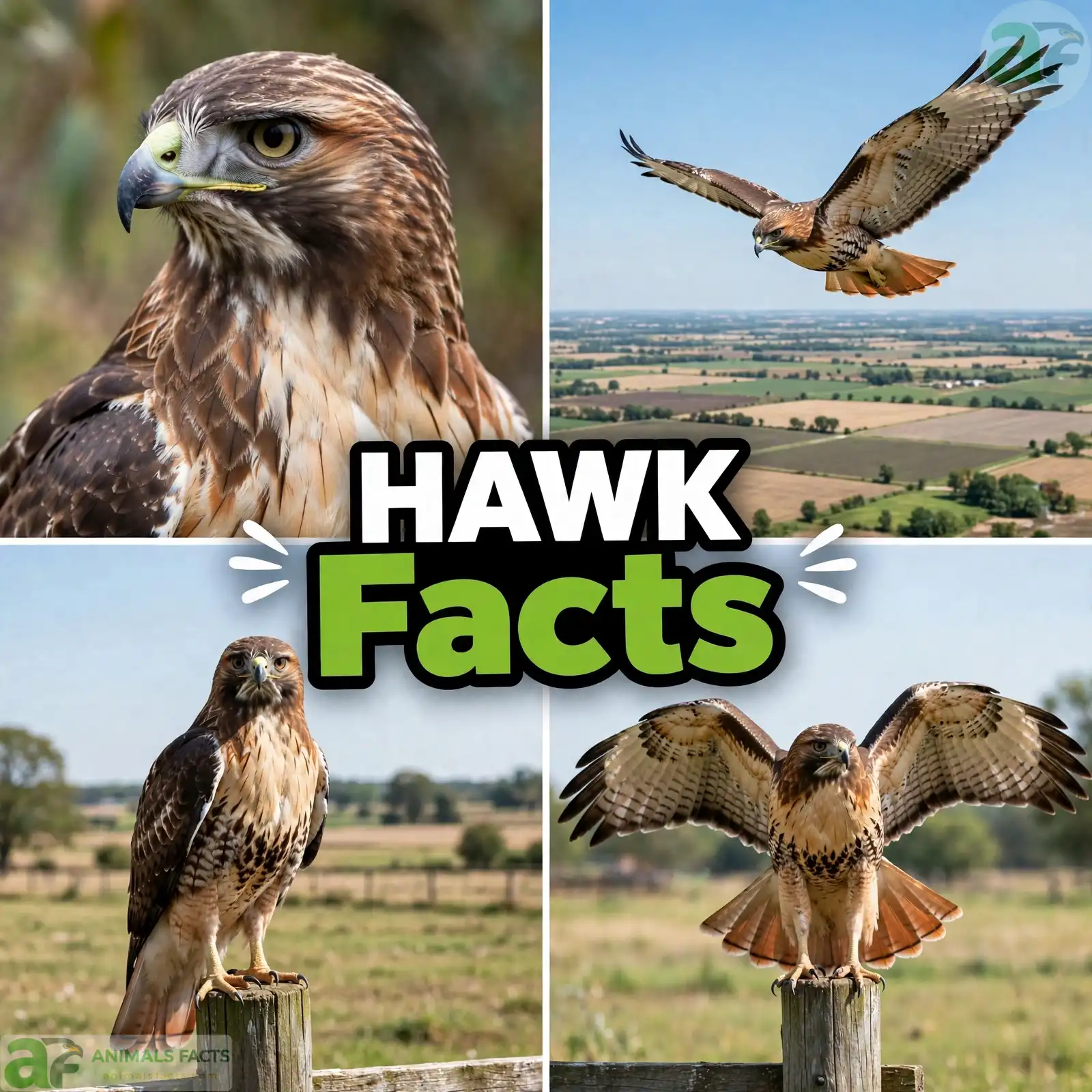
Hawk Facts
| Feature | Details |
|---|---|
| Common Name | Hawk |
| Primary Scientific Groups | Genera Accipiter (true hawks); Buteo (buzzard-hawks); Parabuteo; many others across family Accipitridae |
| Kingdom | Animalia |
| Phylum | Chordata |
| Class | Aves |
| Order | Accipitriformes |
| Family | Accipitridae (primary) — also Falconidae in North American usage |
| Common Names | Hawk; sparrowhawk; goshawk; red-tailed hawk; Cooper’s hawk; sharp-shinned hawk; marsh hawk; and hundreds of regional names globally |
| Native Range | Every continent except Antarctica — the most globally distributed bird of prey group |
| Habitat | Extraordinary range — forest, woodland, grassland, desert, wetland, mountain, arctic tundra, urban — virtually every terrestrial habitat type |
| Lifespan | 2–25 years (wild, varies dramatically by species); up to 30 years (captivity) |
| Diet | Small to medium birds, mammals, reptiles, amphibians, invertebrates — varies by species |
| Body Length | 20–66 cm — enormous size range across the group |
| Wingspan | 52–155 cm — varies by species |
| Weight | 87 grams (tiny Accipiter) to 2.3 kg (large female goshawk or large Buteo) |
| Conservation Status | Ranges from Least Concern to Critically Endangered — varies by species; most common species abundant |
| Defining Feature | Combination of hooked bill, powerful talons, forward-facing eyes, and the characteristic active flapping-and-gliding flight — the fundamental raptor body plan at medium scale |
| Species Count | Approximately 270 species across the broader hawk grouping — one of the largest assemblages of birds of prey |
| Most Familiar Species | Red-tailed hawk (Buteo jamaicensis) — most common large raptor in North America |
 1. Introduction: What is a Hawk?
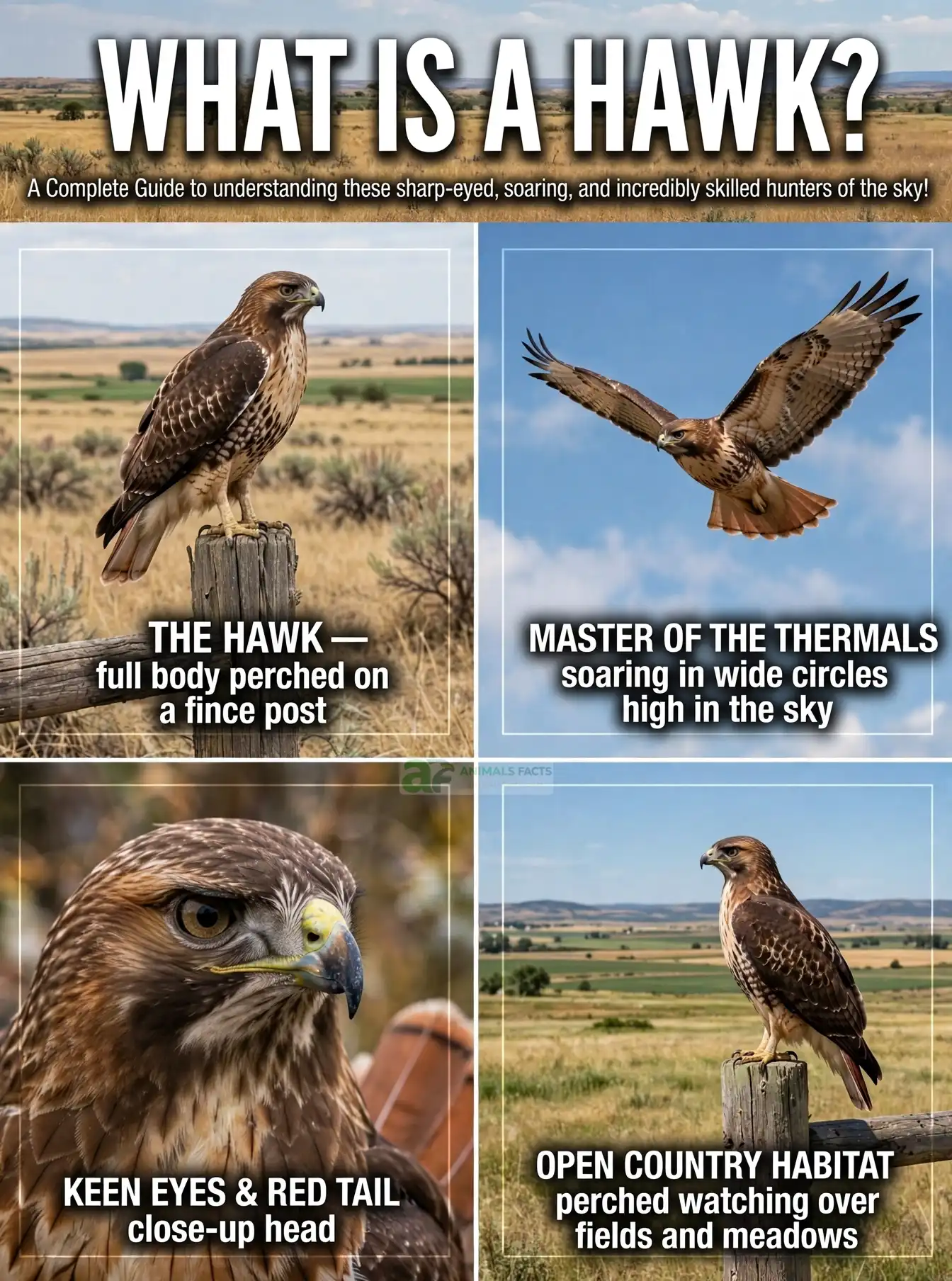
On a fence post along a winter highway in Kansas, a red-tailed hawk sits in the posture that has become the default image of “hawk” in the North American imagination — upright, compact, scanning the harvested corn field with the focused intensity of a predator that knows this landscape and its inhabitants in granular spatial and temporal detail. In the dense oak forest of England, a female goshawk accelerates between tree trunks at 50 kilometers per hour in pursuit of a wood pigeon — her short, broad wings snapping open and closed to navigate obstacles that would require conscious calculation from any human pilot. In the savanna woodlands of Kenya, an augur buzzard rides the morning thermal above the acacia tree line, its red tail catching the equatorial light. In the cloud forest of Ecuador, a tiny Accipiter hawk the size of a thrush disappears into the epiphyte-laden understory after a hummingbird. Hawk facts begin with the recognition that “hawk” is not a single biological category but a functional and cultural designation applied to a remarkable diversity of raptor species across the entire planet — birds that share the fundamental body plan of the active aerial predator (hooked bill, powerful talons, forward-facing eyes, relatively long tail for maneuverability) but that differ from each other in size, ecology, hunting strategy, and habitat specialization more than almost any other comparably named bird group.
The hawks — broadly defined to include the Accipiters (true forest hawks), the Buteos (broad-winged soaring hawks), the kites, harriers, and various other medium-sized raptors of the family Accipitridae, plus the falcons that North American usage groups under “hawk” — collectively represent one of the most biologically successful bird radiations in the history of the class Aves. They are found on every continent except Antarctica, in virtually every terrestrial habitat type from arctic tundra to tropical rainforest to desert to urban park, at altitudes from sea level to above 5,000 meters. The red-tailed hawk (Buteo jamaicensis) is the most commonly seen large raptor in North America — a bird so ubiquitous along North American highways, in suburban parks, and across agricultural landscapes that it has become the visual default for “hawk” in the American imagination, and — as previously noted in this article series — the bird whose call has been borrowed to represent the bald eagle in American media. The northern goshawk (Accipiter gentilis) is one of the most powerful woodland predators in the Northern Hemisphere — a bird so intimidatingly aggressive in defense of its nest that forest rangers in multiple countries are required to wear hard hats when approaching active nesting territories. The Swainson’s hawk (Buteo swainsoni) completes one of the longest migrations of any North American bird of prey — breeding in the Great Plains and migrating 10,000+ kilometers to wintering grounds in the Argentine pampas. And the common black hawk, the zone-tailed hawk, the roadside hawk, and hundreds of other species fill in a diversity of ecological niches across the globe that makes hawks collectively the most ecologically significant group of medium-sized predators in the world’s terrestrial and freshwater ecosystems.
Interesting facts about hawks are more diverse than those of any other raptor group precisely because the group itself is so diverse — what is true of the sharp-shinned hawk (a tiny forest hawk weighing 87 grams that pursues small birds through dense vegetation) is entirely different from what is true of the ferruginous hawk (a large grassland Buteo weighing up to 2.3 kg that hunts prairie dogs from soaring altitude). This guide is therefore organized to cover both the general biology and ecology that is shared across most hawks and the remarkable diversity of specific adaptations, behaviors, and conservation situations that make this group one of the most fascinating in all of ornithology. Whether you are a student researching hawk biology for the first time, a backyard birder who sees red-tailed hawks in suburban trees every day, a wildlife enthusiast who watched a Swainson’s hawk migration kettle of thousands of birds in the Texas Hill Country, a falconer whose partnership with a trained Harris’s hawk has opened a window into raptor cognition, or simply someone who heard the sound identified as a “bald eagle scream” in every Hollywood film and wanted to know whose voice that actually is — this is your comprehensive guide to the world’s most diverse and most universally present birds of prey.
2. Hawk Species Overview & Classification
The term “hawk” does not correspond to a single biological taxon — it is a functional and cultural designation applied to multiple groups of medium-sized raptors across the family Accipitridae and, in North American usage, sometimes the Falconidae.
What Is a “Hawk”? — The Terminology Challenge
The terminological complexity — “Hawk” means different things in different countries:
- North American usage — Hawks include Accipiters (Accipiter species), Buteos (Buteo species), and sometimes falcons, kites, and harriers; the term is broadly applied to any medium-sized diurnal raptor
- British/European usage — “Hawk” most specifically refers to the Accipiters (sparrowhawks and goshawk); Buteos are called “buzzards”; “hawk” is less broadly applied
- Australian usage — Various raptors are called hawks including some Accipitridae; “hawk” overlaps with “eagle” in colloquial use
- Scientific usage — No single scientific definition corresponds to “hawk”; the term is informal
The Major Hawk Groups
| Group | Genus/Genera | Common Examples | Hunting Style | Range |
|---|---|---|---|---|
| True hawks (Accipiters) | Accipiter | Goshawk, sharp-shinned, Cooper’s, sparrowhawk | Forest ambush — short burst pursuit | Worldwide |
| Buteo hawks/buzzards | Buteo | Red-tailed, red-shouldered, Swainson’s, ferruginous | Open country soaring | Americas, Eurasia, Africa |
| Harris’s hawk | Parabuteo | Harris’s hawk | Cooperative pack hunting | SW USA to Argentina |
| Harriers | Circus | Northern harrier, marsh hawk | Low-level quartering | Worldwide |
| Kites | Multiple genera | Mississippi kite, black kite, snail kite | Variable | Worldwide |
| Broad-winged hawks | Buteo platypterus | Broad-winged hawk | Forest soaring; spectacular migration | Americas |
| Gray hawks and allies | Various | Gray hawk, white hawk | Forest hunting | Neotropics |
| Falcons (N. American “hawks”) | Falco | Red-tailed (not a falcon) — context note | — | Worldwide |
The Most Important Species — Detailed Overview
Red-Tailed Hawk (Buteo jamaicensis) — The Most Familiar North American Hawk
| Feature | Details |
|---|---|
| Scientific name | Buteo jamaicensis (Gmelin, 1788) |
| Common name | Red-tailed hawk |
| Weight | Males 690–1,300 g; females 900–1,460 g |
| Wingspan | 105–141 cm |
| Range | Alaska and Canada through contiguous USA to Panama and Caribbean |
| Habitat | Open woodland, agricultural areas, grassland, desert, urban — extreme habitat flexibility |
| Primary prey | Voles, mice, rabbits, squirrels — medium mammals primary |
| Conservation | Least Concern — extremely abundant |
| Notable fact | Its call is the “bald eagle scream” universally used in North American media |
Northern Goshawk (Accipiter gentilis) — The Most Powerful Forest Hawk
| Feature | Details |
|---|---|
| Scientific name | Accipiter gentilis (Linnaeus, 1758) |
| Common name | Northern goshawk |
| Weight | Males 630–1,100 g; females 860–2,200 g |
| Wingspan | 98–127 cm |
| Range | Boreal and temperate forest across Northern Hemisphere — Eurasia and North America |
| Habitat | Mature forest — conifer and mixed woodland |
| Primary prey | Large birds (pigeons, grouse, jays), rabbits, squirrels |
| Conservation | Least Concern globally — locally declining |
| Notable fact | Nest defense so aggressive forest rangers wear hard hats near active nests |
Swainson’s Hawk (Buteo swainsoni) — The Long-Distance Migrant
| Feature | Details |
|---|---|
| Scientific name | Buteo swainsoni (Bonaparte, 1838) |
| Common name | Swainson’s hawk |
| Weight | 693–1,367 g |
| Wingspan | 117–137 cm |
| Range | Breeds Great Plains and western North America; winters Argentine pampas |
| Habitat | Open grassland, agricultural land, prairie |
| Primary prey | Ground squirrels, dragonflies and insects during migration |
| Conservation | Least Concern — but affected by pesticides on wintering grounds |
| Notable fact | Migrates 10,000+ km from North America to South America annually |
Harris’s Hawk (Parabuteo unicinctus) — The Social Hunter
| Feature | Details |
|---|---|
| Scientific name | Parabuteo unicinctus (Temminck, 1824) |
| Common name | Harris’s hawk |
| Weight | Males 700–1,020 g; females 900–1,020 g |
| Wingspan | 103–120 cm |
| Range | Southwestern USA through Central America to Argentina |
| Habitat | Desert scrub, mesquite grassland, semi-arid woodland |
| Primary prey | Rabbits, hares, various small mammals; cooperative hunting |
| Conservation | Least Concern |
| Notable fact | The only known cooperative pack-hunting hawk — hunts in family groups |
Eurasian Sparrowhawk (Accipiter nisus) — The Garden Bird Predator
| Feature | Details |
|---|---|
| Scientific name | Accipiter nisus (Linnaeus, 1758) |
| Common name | Eurasian sparrowhawk |
| Weight | Males 110–196 g; females 185–342 g |
| Wingspan | 55–77 cm |
| Range | Europe and Asia — one of the most common raptors in Britain |
| Habitat | Woodland, gardens, farmland, urban parks |
| Primary prey | Small birds — tits, sparrows, finches |
| Conservation | Least Concern |
| Notable fact | Significant driver of garden bird community structure in British suburbia |
Evolution & Discovery Timeline
~50 million years ago (Eocene) — The ancestral Accipitridae lineage diversifies from the base of the raptor radiation — establishing the hawk and eagle lineage that will eventually produce the extraordinary diversity of Accipiters, Buteos, and related groups.
~20–30 million years ago (Oligocene-Miocene) — The major Accipitridae groups diverge — the Accipiter lineage, the Buteo lineage, and other hawk genera establishing independently across the developing modern world.
~5–10 million years ago — The modern hawk species groups diversify — the Pleistocene ice age cycles creating the range contractions and expansions that drive speciation within the Accipiter and Buteo genera.
Pre-European contact, Americas — Red-tailed hawks, Cooper’s hawks, sharp-shinned hawks, and other North American species are already abundant and integrated into indigenous North American ecological and cultural knowledge.
1758 — Linnaeus formally describes multiple hawk species in Systema Naturae — including the northern goshawk (Accipiter gentilis) and the Eurasian sparrowhawk (Accipiter nisus).
19th century — Systematic persecution of hawks across North America and Europe — gamekeepers, farmers, and pigeon fanciers shoot hawks at extraordinary rates; the northern goshawk is extirpated from most of Britain and severely reduced across Europe.
1972 — The US Endangered Species Act’s predecessor legislation and the Migratory Bird Treaty Act create the legal framework that eventually allows North American hawk populations to recover.
1990s–2000s — Red-tailed hawks and Cooper’s hawks begin breeding in urban areas across North America — the urban hawk colonization representing one of the most significant North American raptor population shifts of recent decades.
2024 — Most common hawk species are Least Concern globally; specific species face meaningful conservation challenges from pesticides, habitat loss, and wind energy; the red-tailed hawk remains the most abundant large raptor in North America with an estimated population of approximately 2 million individuals.
“The hawk is the raptor that most people know — the bird on the fence post, the shadow crossing the garden, the silhouette against the winter sky. What most people don’t know is how much is happening behind that seemingly simple image — the extraordinary sensory acuity, the spatial mapping of the hunting territory, the precise calibration of pursuit decisions based on prey behavior and environmental conditions. The hawk is never simply sitting. It is always calculating.”
— Dr. Cheryl Dykstra, Cincinnati Museum Center — urban hawk ecology researcher
3. Hawk Physical Description & Unique Features
Hawks span an extraordinary range of body sizes and structural adaptations — from the tiny sharp-shinned hawk weighing 87 grams to the ferruginous hawk at 2.3 kilograms — but share a set of fundamental features that define the hawk body plan.
The Fundamental Hawk Body Plan
The hooked bill — All hawks possess the characteristic hooked, laterally compressed bill of raptors — designed for tearing flesh rather than killing. Prey is typically killed by the talons; the bill processes the carcass. Bill size varies by prey type — insectivorous hawks (Mississippi kite) have smaller, more delicate bills; large mammal specialists (ferruginous hawk) have larger, more powerful bills.
Forward-facing eyes — Like all raptors, hawks have eyes positioned to provide binocular overlap of approximately 30–50 degrees — the binocular field providing the depth perception needed for accurate prey distance estimation during the pursuit and strike. The total visual field (monocular plus binocular) covers approximately 250 degrees.
The hawk visual system — Hawks share with eagles the fundamental raptor visual superiority:
- Visual acuity estimated at 4–8 times human acuity in most species
- UV sensitivity — hawks can see ultraviolet wavelengths; vole urine reflects UV, allowing hawks to detect vole runways from altitude
- High flicker fusion rate — processing visual information at 100+ frames per second, far exceeding human perception
The talons — The primary killing weapons; hawk talons vary significantly between functional groups:
- Accipiter talons — long, fine, spreading — designed to penetrate between feathers and reach the body of bird prey
- Buteo talons — shorter, more robust — designed to grip and crush small mammal prey
- Harrier talons — intermediate — designed for small mammal and bird prey in open habitats
The tail — Proportionally longer in hawks than in eagles — the longer tail provides the fine directional control needed for the active pursuit hunting that characterizes most hawk species. The tail length relative to body is greatest in the Accipiters — the forest hawks where maneuvering in confined space is most critical.
The Two Major Body Plans Within Hawks
The Accipiter body plan — built for forest speed:
- Short, rounded wings — reduced wingspan-to-body ratio
- Long, narrow tail — maximum ruddering capability
- Short, powerful legs with long, spreading talons
- Relatively small head with large eyes
- High wing loading — requires active flapping; cannot soar as efficiently as Buteos
- Optimized for explosive acceleration and pursuit in complex vegetation
The Buteo body plan — built for soaring search:
- Broad, rounded wings — high wing area-to-body ratio (low wing loading)
- Moderate tail length
- Shorter legs and more robust, less spreading talons
- Relatively large head
- Low wing loading — efficient soaring on thermals
- Optimized for extended aerial surveillance with power strikes when prey is located
Plumage — The Complexity of Hawk Coloration
Hawk plumage is one of the most variable in the bird world — reflecting the diversity of habitats, hunting strategies, and sexual selection pressures across hundreds of species. Key patterns:
Countershading — Most hawks are darker above and paler below — the classic countershading that provides camouflage from both above (matching the ground/vegetation when seen from predators above) and below (pale underparts less visible against the sky when seen by prey below).
Breast streaking or barring — Many hawk species show streaking or barring on the pale underparts — patterns that provide camouflage when the bird is perched in dappled vegetation.
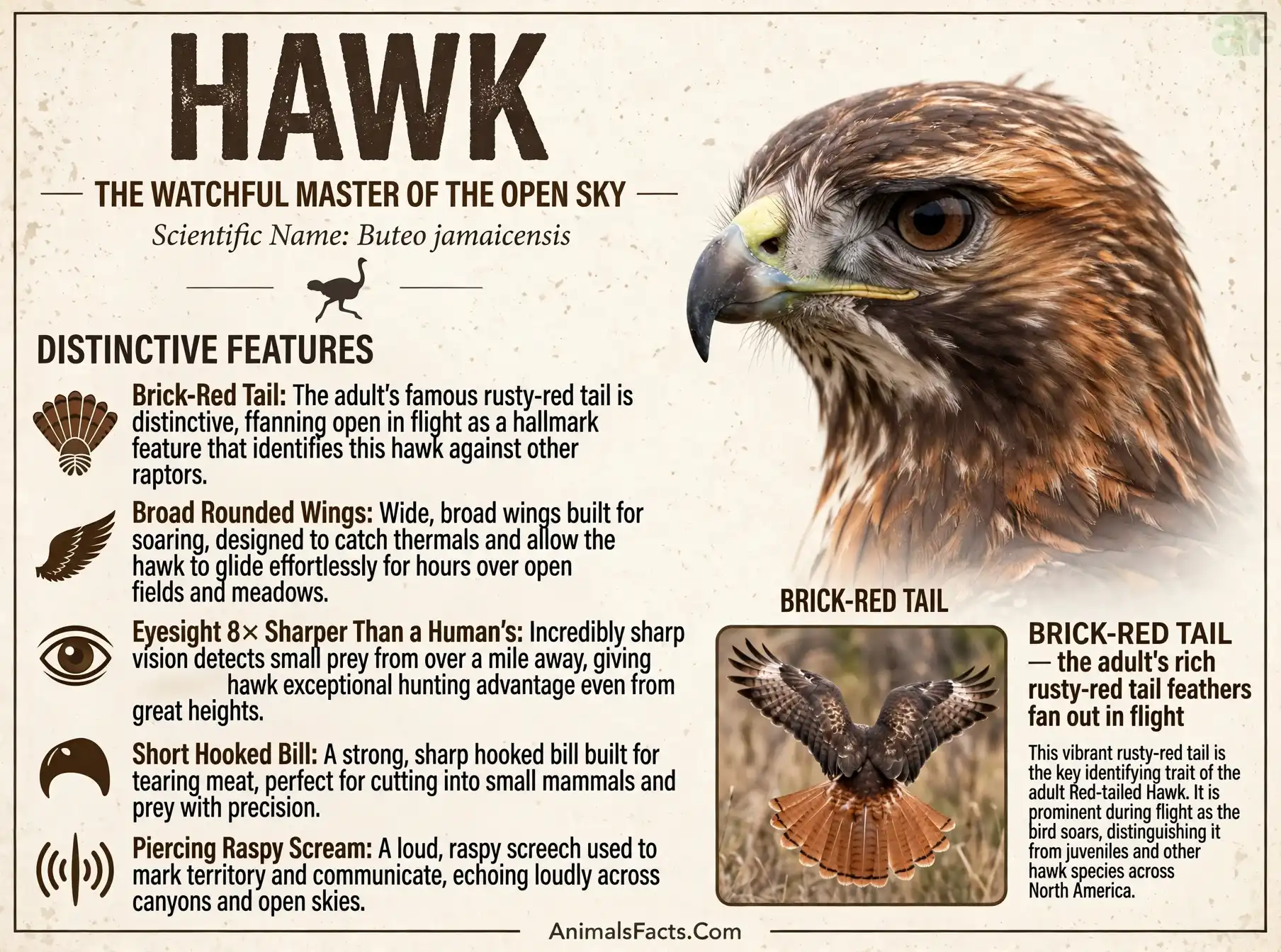
The rufous (rusty-red) tail — The defining plumage feature of the red-tailed hawk — the rufous tail visible from above and providing an immediate field identification mark in the adult bird. Immature red-tailed hawks have brown-banded tails rather than the adult rufous, and are one of the most common North American hawk identification challenges.
Morph variation — Many hawk species show color morphs — light, dark, and intermediate forms that differ in overall body coloration. The red-tailed hawk has the most extreme morph variation of any North American hawk — multiple named morphs including the pale “Krider’s” form, the dark “Harlan’s” form, and various intermediate and regional variants.
Sexual size dimorphism in plumage — In Accipiters, females are significantly larger than males and often show different plumage intensity — female goshawks typically showing more vivid barring and richer blue-grey upperparts than males.
Size Extremes in the Hawk Group
| Species | Weight | Wingspan | Notes |
|---|---|---|---|
| Sharp-shinned hawk | 87–218 g | 52–68 cm | Smallest North American Accipiter |
| Eurasian sparrowhawk (male) | 110–196 g | 55–77 cm | Smallest common European hawk |
| Cooper’s hawk | 280–680 g | 75–94 cm | Medium Accipiter |
| Red-tailed hawk | 690–1,460 g | 105–141 cm | Most common large North American hawk |
| Northern goshawk (female) | 860–2,200 g | 98–127 cm | Largest Accipiter |
| Ferruginous hawk | 977–2,268 g | 133–155 cm | Largest North American Buteo |
💡 Did You Know? The red-tailed hawk (Buteo jamaicensis) is the source of the iconic bird call heard in virtually every North American film, television show, commercial, and news broadcast whenever a raptor — particularly the bald eagle — is shown on screen. The red-tailed hawk’s distinctive, descending kee-eeeee-ar scream was adopted by sound designers as the definitive “hawk sound” because it is more dramatic and more immediately recognizable than most other North American raptor calls. It has been used as the “bald eagle’s call” in every major American film from Jurassic Park to The Colbert Report — and is so deeply embedded in American acoustic culture that most Americans would fail to recognize the actual bald eagle’s call as belonging to a bald eagle. The red-tailed hawk’s call has also been used to represent many other raptors in international media — including golden eagles, ospreys, and various other species whose actual calls were deemed insufficiently dramatic for the cinematic context. This auditory substitution represents one of the most pervasive and most successful acoustic “impostures” in the history of wildlife filmmaking.
4. Top 25 Amazing Hawk Facts
Here is your definitive collection of the most extraordinary, scientifically verified, and genuinely astonishing hawk facts as of 2026:
- The red-tailed hawk’s call — the iconic descending kee-eeeee-ar scream heard in virtually every North American film or television show featuring a raptor — is universally misidentified as the bald eagle’s call. The bald eagle’s actual call is a thin, high-pitched chatter; the red-tailed hawk’s is the sound of American cinema.
- Hawks can see ultraviolet light — vole (field mouse) urine reflects UV radiation, creating visible trails to hawk eyes that are entirely invisible to humans. Red-tailed hawks and other rodent-hunting Buteos use UV detection from altitude to locate the most active vole runways before committing to a hunting stoop — hunting a trail of invisible light.
- The Harris’s hawk (Parabuteo unicinctus) is the only hawk known to hunt cooperatively in family groups — packs of 2–6 related birds using coordinated pursuit strategies to flush and chase rabbits and other prey. One bird flushes the prey, another pursues, while others wait at escape route exits — a hunting strategy more commonly associated with wolf packs or killer whales than birds of prey.
- Swainson’s hawks migrate 10,000+ kilometers between their North American breeding grounds (Great Plains and western USA) and their South American wintering grounds (Argentine and Brazilian pampas) — passing through Central America in enormous kettles of thousands of birds that constitute one of the most spectacular raptor migrations on Earth.
- The northern goshawk is so aggressive in nest defense that forest rangers and researchers are required to wear hard hats when approaching active nests in multiple countries. Goshawks have been documented striking and drawing blood from intruders — including large dogs, bears, and humans — approaching within approximately 200 meters of an active nest.
- The sharp-shinned hawk weighing as little as 87 grams is one of the smallest raptors in North America — light enough to be lifted by a large songbird mobbing it in flight. The species pursues songbirds smaller than itself through dense vegetation at high speed, occasionally killing prey only 30–40 grams lighter than the hawk itself.
- Red-tailed hawks have colonized urban environments across North America with extraordinary success — the famous pair Pale Male and Lola who nested on a Fifth Avenue apartment building in New York City from 1993 to the early 2000s pioneered urban hawk nesting in Manhattan and generated a public following that drew national media attention and influenced wildlife legislation.
- The broad-winged hawk migration at Hawk Mountain, Pennsylvania produces some of the most spectacular raptor concentration events in North America — up to 21,000 broad-winged hawks in a single day counted by Hawk Mountain counters during peak October migration, representing one of the largest single-species raptor movements documented in North America.
- Cooper’s hawks have become one of the most successful urban colonizers of any North American raptor — the species is now documented breeding in virtually every major North American city, typically nesting in suburban trees and hunting garden birds attracted to feeders. Urban Cooper’s hawk populations in some cities have grown to higher densities than rural populations.
- The rough-legged hawk (Buteo lagopus) is one of very few raptors capable of sustained true hovering — beating its wings to maintain a stationary position above potential prey on the ground. This hovering behavior, unusual for a Buteo, allows hunting in the treeless Arctic and subarctic tundra where this species breeds.
- Hawk migrations along traditional flyway routes concentrate hundreds of thousands of birds at specific geographic bottlenecks — particularly mountain ridges, peninsulas, and narrow land bridges. The Strait of Gibraltar, Bosphorus, Veracruz, Mexico, Elat, Israel, and various Pennsylvania ridges are among the most famous hawk migration concentration points, producing some of wildlife observation’s most spectacular events.
- The ferruginous hawk (Buteo regalis) — the largest North American Buteo — shows an unusual bicolored underpart pattern when seen in flight from below: pale underwings contrasting with a distinctive V-shaped rufous leg patch visible against a white belly. This pattern is unique among North American raptors and makes the ferruginous hawk one of the most distinctive in-flight silhouettes.
- Accipiters show the most extreme reverse sexual size dimorphism of any hawk group — in the sharp-shinned hawk, females weigh approximately 60–75% more than males; in the northern goshawk, large females can weigh more than twice the average male. This extreme size difference means that male and female Accipiters effectively hunt different prey size classes within the same territory.
- The zone-tailed hawk (Buteo albonotatus) of the American Southwest and tropics mimics the appearance and flight style of turkey vultures — soaring in the same areas, with similar black plumage and tilted flight posture. Prey animals that have learned to ignore non-threatening turkey vultures are surprised when the apparently harmless vulture-shape suddenly stoops on them. This mimicry of a harmless species by a predator is called aggressive mimicry.
- Hawks molt their flight feathers gradually rather than all at once — a strategy that maintains flight capability year-round. The molt process typically takes several months and proceeds in a systematic sequence that ensures the wings remain functional throughout. The sequential molt is visible in photographed hawks as a patchwork of old (worn, paler) and new (fresh, dark) feathers.
- The red-shouldered hawk (Buteo lineatus) is documented as one of the most consistently site-faithful raptors in North America — individuals and pairs returning to the same nesting territory for 10–20+ years in studies using marked individuals. Some nesting territories in mature riparian forest have been continuously occupied across many consecutive decades.
- Hawk Mountain Sanctuary in Pennsylvania — established in 1934 by ornithologist Rosalie Edge — was the world’s first refuge created specifically to protect hawks from shooting. Before the sanctuary’s establishment, gunners on Kittatinny Ridge shot thousands of hawks per season during the autumn migration; the sanctuary’s establishment essentially ended this practice and pioneered the hawk conservation movement in North America.
- The Mississippi kite (Ictinia mississippiensis) has undergone one of the most dramatic range expansions of any North American raptor in recent decades — the species originally restricted to the southeastern United States has expanded its breeding range northward into Oklahoma, Kansas, Colorado, and even Nebraska and South Dakota in recent years, establishing urban breeding populations in cities far outside its historical range.
- Buteo hawks use thermals — rising columns of warm air — for efficient travel and territory surveying. A red-tailed hawk can gain sufficient altitude from a single thermal to survey several square kilometers of territory without a single wing flap — the economics of thermal soaring making Buteos extraordinarily energy-efficient hunters compared to species that rely on powered flight.
- The northern harrier (Circus hudsonius) — classified as a hawk in North America though related to Old World harriers — is unique among North American raptors in having a polygynous mating system where a single male mates with up to five females simultaneously — each female nesting in the same marsh territory and receiving prey deliveries from the shared male. The male’s ability to provision multiple females is limited — chicks of secondary females typically have lower survival than those of the primary female.
- Cooper’s hawks and sharp-shinned hawks regularly follow bird feeders — drawn by the concentration of small birds that supplementary feeding creates. Research has documented that approximately 30% of Cooper’s hawk territories in suburban areas include at least one active bird feeder as a significant food source, raising complex conservation questions about the role of supplementary feeding in maintaining urban raptor populations.
- The broad-winged hawk demonstrates one of the most dramatic behavioral shifts of any migratory hawk — during the breeding season it is a secretive forest bird rarely seen in the open; during migration it concentrates with thousands of conspecifics in soaring kettles that can contain thousands of birds visible simultaneously from a single viewpoint.
- Research in the UK has documented that Eurasian sparrowhawks were reduced to near-extinction in many areas during the 1950s–1970s by the combined effects of organochlorine pesticide poisoning (particularly dieldrin) and continued persecution by gamekeepers. Following pesticide restrictions and some reduction in persecution, the sparrowhawk recovered dramatically — the UK population now estimated at approximately 35,000 pairs.
- The gray hawk (Buteo plagiatus) of the American Southwest demonstrates that Buteo vocalization is a critical complement to visual hunting — the species produces a distinctive whistled call that disturbs lizards from cover, then captures them as they flee. This acoustic prey-flushing behavior — using sound to expose hidden prey — is documented in few other raptor species.
- As of 2026, the most commonly detected hawk species in North America (by annual eBird submission count) is the red-tailed hawk — with more individual sighting submissions than any other raptor annually, reflecting both the species’ genuine abundance and its conspicuous behavior. The red-tailed hawk population in the contiguous United States is estimated at approximately 2 million individuals — making it one of the most abundant large predatory birds in North America.
5. Fun Facts About Hawks
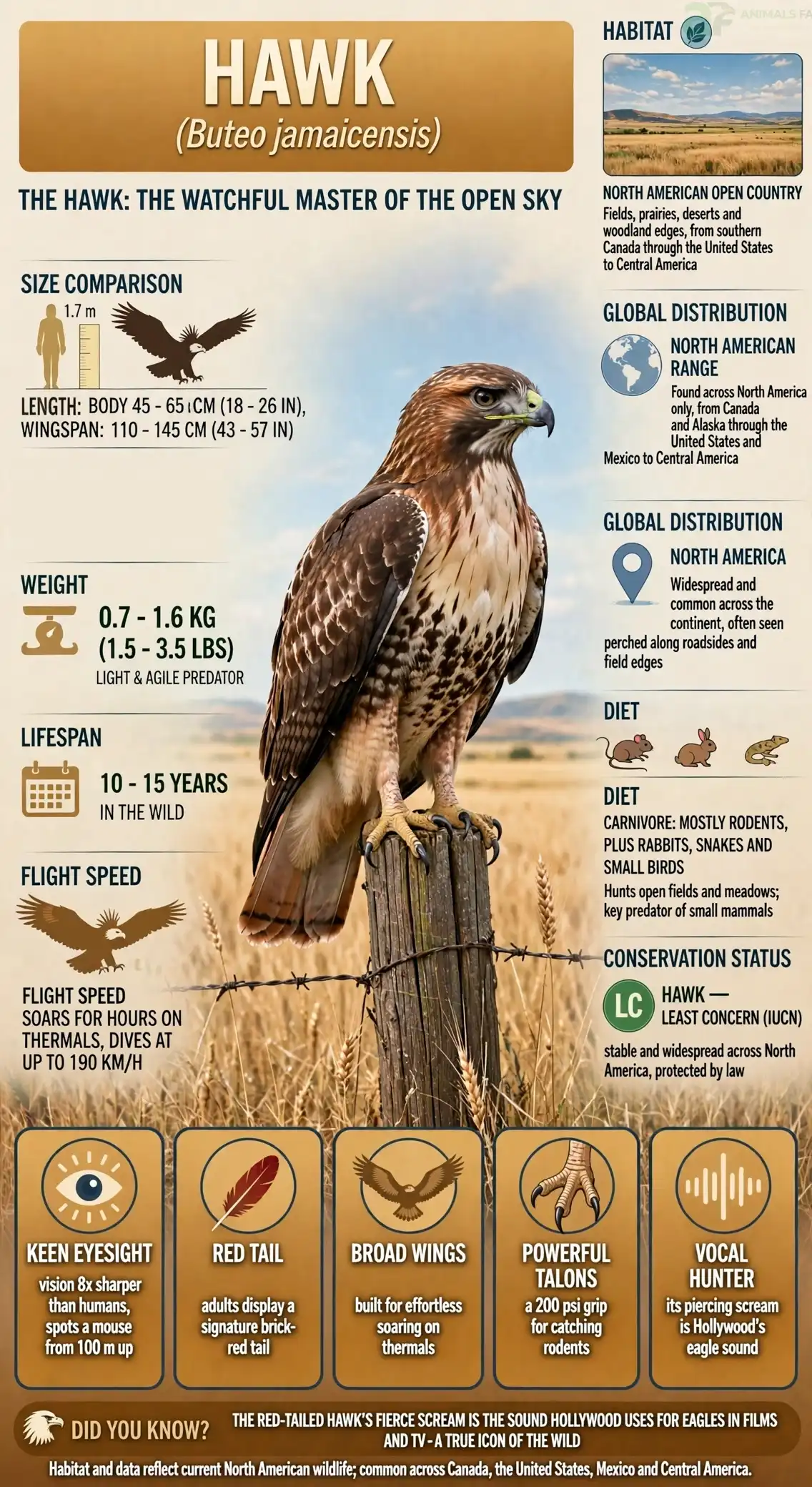
- Red-tailed hawk call is Hollywood’s “eagle scream”
- Hawks see UV light — detecting vole urine trails
- Harris’s hawk hunts in family packs — unique among hawks
- Swainson’s hawk migrates 10,000+ km annually
- Goshawk nest defense — rangers wear hard hats
- Sharp-shinned hawk weighs only 87 grams
- Pale Male’s urban NYC nest pioneered urban hawk biology
- 21,000 broad-winged hawks in one day at Hawk Mountain
- Cooper’s hawk now breeds in virtually every major North American city
- Rough-legged hawk can hover like a kestrel
- Zone-tailed hawk mimics turkey vultures to deceive prey
- Hawk Mountain Sanctuary — world’s first hawk refuge (1934)
6. Hawk Natural Habitat & Geographic Range
Hawk habitat spans a range so broad that it essentially encompasses every terrestrial ecosystem on Earth except Antarctica — the hawk group’s ecological diversity allowing exploitation of every major habitat type available to medium-sized avian predators.
Habitat Types by Major Group
Forest and woodland (Accipiters):
The Accipiters are the hawk group most specifically associated with forest and woodland habitat — their short, broad wings and long tails being specifically evolved for high-speed pursuit in the confined airspace between tree trunks and branches:
- Mature deciduous woodland (Cooper’s hawk in North America; Eurasian sparrowhawk in Europe)
- Boreal conifer forest (northern goshawk across the Northern Hemisphere)
- Tropical rainforest (various small Accipiters in South America, Africa, and Southeast Asia)
- Mixed forest and forest edge (many Accipiter species globally)
Open country and grassland (Buteos and harriers):
The Buteos are the hawk group most associated with open country — their broad wings and low wing loading providing efficient soaring over agricultural land, grassland, and other open terrain:
- Agricultural landscape (red-tailed hawk across North America; common buzzard across Europe)
- Prairie and Great Plains (ferruginous hawk, Swainson’s hawk)
- Desert and semi-arid scrub (Harris’s hawk; ferruginous hawk in winter)
- Arctic and subarctic tundra (rough-legged hawk breeding; Swainson’s hawk at range margins)
Wetland and marshland (harriers):
Harriers — often called “marsh hawks” in North American tradition — specialize in low-level hunting over wetland, marsh, and wet grassland:
- Freshwater marsh (northern harrier in North America; marsh harrier in Europe)
- Wet meadow and farmland (northern harrier wintering areas)
- Coastal salt marsh (various harrier species)
Urban and suburban (multiple species):
One of the most significant hawk habitat developments of the past 30 years — the colonization of urban and suburban environments by multiple hawk species:
- Suburban woodland and parks (Cooper’s hawk; Eurasian sparrowhawk; red-tailed hawk)
- City parks and waterfronts (red-tailed hawk; red-shouldered hawk)
- University campuses and large gardens (Cooper’s hawk nesting documented in virtually every major North American city)
Geographic Distribution
Americas
- Red-tailed hawk — Alaska to Panama and Caribbean; most widespread North American Buteo
- Cooper’s hawk — Canada through Central America; increasing in urban areas
- Sharp-shinned hawk — Alaska through Central America; highly migratory
- Northern harrier — Alaska and Canada to southern USA (breeding); Mexico to Colombia (wintering)
- Swainson’s hawk — Great Plains and western USA (breeding); Argentina and Brazil (wintering)
- Ferruginous hawk — Great Plains and western interior USA; winters southwest USA and Mexico
- Harris’s hawk — Southwestern USA through Central and South America to Argentina
- Broad-winged hawk — Eastern North America (breeding); Amazon Basin (wintering)
Eurasia and Africa
- Eurasian sparrowhawk — Europe and Asia; one of the most common raptors in Britain
- Northern goshawk — Northern Hemisphere circumpolar; boreal and temperate forest
- Common buzzard (Buteo buteo) — Europe and Asia; the most common buzzard in Europe
- Steppe buzzard — Central Asia, Eastern Europe; major migrant
- Eurasian marsh harrier — Europe and Asia; key wetland raptor
The Migration Dimension
Hawk migration is one of wildlife observation’s great spectacles — certain hawk species undertaking extraordinary annual journeys that concentrate birds at geographic bottlenecks:
Hawk Mountain, Pennsylvania — The world’s most famous hawk watching site; a ridge in the Appalachian Mountains that concentrates southbound autumn migrants. Counts of 20,000+ broad-winged hawks in a single day are documented; over 20 hawk and eagle species are recorded annually.
Veracruz, Mexico — The single most important raptor migration bottleneck in the Americas; counts of millions of broad-winged hawks and Swainson’s hawks pass through in autumn, concentrating at the narrow coastal plain between mountains and sea.
Strait of Gibraltar — The primary European-African hawk migration crossing; hundreds of thousands of honey buzzards, booted eagles, black kites, and various harriers cross each spring and autumn.
Bosphorus, Turkey — One of the world’s most important raptor migration points; hundreds of thousands of raptors including steppe buzzards, honey buzzards, and lesser spotted eagles cross each spring and autumn.
Elat, Israel — Arguably the world’s most important single raptor migration site; counts of over 1 million raptors of multiple species in a single spring season.
7. Hawk Diet & Feeding Behavior
Hawk diet varies more dramatically across the group than in virtually any other bird of prey assemblage — from the tiny sharp-shinned hawk that specializes on small songbirds to the ferruginous hawk that regularly takes prairie dogs and jackrabbits.
Diet by Major Group
Accipiter (true hawk) diet — Bird specialists:
| Species | Primary Prey | Prey Size | Hunting Method |
|---|---|---|---|
| Sharp-shinned hawk | Small passerines (tits, warblers, sparrows) | 10–50 g | Forest ambush; feeder raids |
| Cooper’s hawk | Medium birds (starlings, doves, jays) | 50–200 g | Forest ambush; suburban pursuit |
| Northern goshawk | Large birds (pigeons, grouse); rabbits | 200 g–1 kg | Forest power pursuit |
| Eurasian sparrowhawk | Small passerines (sparrows, tits, finches) | 10–40 g | Garden ambush; hedge-hopping |
Buteo (broad-winged hawk) diet — Mammal and open country specialists:
| Species | Primary Prey | Prey Size | Hunting Method |
|---|---|---|---|
| Red-tailed hawk | Voles, mice, ground squirrels, rabbits | 30 g–1 kg | Soaring surveillance; perch-and-drop |
| Red-shouldered hawk | Frogs, snakes, mice, crayfish | 10–200 g | Forest-floor hunting; riparian |
| Ferruginous hawk | Prairie dogs, ground squirrels, jackrabbits | 200 g–2 kg | Soaring; ground pursuit |
| Swainson’s hawk | Ground squirrels (breeding); insects (migrating) | 10 g–500 g | Soaring; follows agricultural operations |
| Rough-legged hawk | Voles, lemmings, mice | 30–150 g | Hovering; soaring |
| Common buzzard | Earthworms, voles, rabbits, carrion | 5 g–500 g | Ground searching; soaring |
Harris’s hawk — Cooperative pack specialist:
Harris’s hawk prey is primarily lagomorphs (rabbits and hares) and other medium mammals — the cooperative hunting strategy allowing the group to take larger and more mobile prey than any individual could manage. The pack hunts by:
- Flushing — one bird enters vegetation to flush the rabbit
- Relay pursuit — birds take turns pursuing when a pursuer tires
- Ambush — birds position at alternative escape routes
Harrier diet — Open country mammal specialists:
Harriers hunt by low-level quartering — flying slowly just above the vegetation surface, using both sight and hearing to locate prey below. The facial disc of harriers (similar to owls) enhances acoustic prey detection:
- Northern harrier — voles, meadow mice, small birds, frogs
- Marsh harrier (Eurasia) — water voles, frogs, moorhen chicks, coots
The Vole-Hawk Connection
The relationship between vole populations and hawk abundance is one of the most well-documented examples of predator-prey cycling in any bird of prey system:
The vole cycle — Vole populations in temperate grassland and agricultural habitats cycle with a 3–5 year periodicity — populations building over several years before crashing due to food depletion and disease, then recovering.
The hawk response — Red-tailed hawk, rough-legged hawk, and various European Buteo populations track vole cycles with a 1-year time lag — hawk populations increasing in years of high vole abundance (higher breeding success and immigrant attraction) and declining when vole populations crash.
The UV hunting connection — Research has demonstrated that hawk hunting efficiency on voles is enhanced by UV vision — vole urine and feces concentrate along active runways and reflect UV radiation. Hawks hovering over grassland can detect the most actively used vole pathways from altitude, concentrating hunting effort where voles are most likely to be encountered.
The Urban Hunting Dimension
Urban hawk populations have developed specialized foraging strategies adapted to the novel opportunities and constraints of city environments:
Bird feeder exploitation — Cooper’s hawks and Eurasian sparrowhawks have learned to exploit the predictable concentrations of small birds at garden feeders — the feeder creating a reliable, repeated prey aggregation that the hawk can exploit more efficiently than hunting in dispersed natural habitat.
Window-glass hunting — Urban hawks exploit the confusion that window glass creates in prey birds — pursuing prey toward glass surfaces that the prey does not recognize as obstacles. This hunting technique is not deliberate exploitation by hawks but a behavioral outcome that has been observed repeatedly.
Pigeon hunting — Urban red-tailed hawks and Cooper’s hawks have added feral rock pigeon (Columba livia) as a major urban prey species — the pigeon’s abundance in cities providing a food resource that has facilitated hawk urban colonization.
8. Hawks Reproduction & Life Cycle
Hawk reproduction across the diverse group shows patterns characteristic of medium-sized raptors — monogamous pair bonds (usually seasonal; sometimes multi-year), territorial nesting, and biparental care — but varies enormously in specifics across species.
Breeding Season and Pair Formation
Timing — Breeding season timing varies by latitude and species:
- Northern Hemisphere Buteos (red-tailed, ferruginous): nest building February–March; eggs March–April
- Northern Hemisphere Accipiters (goshawk, Cooper’s): nest building March–April; eggs April–May
- Tropical hawk species: variable; often linked to dry season prey abundance
Pair bond duration — Most hawk species form seasonally monogamous pairs — the same individuals may reunite at the same territory in successive years, but the pair bond is not actively maintained outside the breeding season:
- Red-tailed hawks show high site fidelity — the same pair often uses the same territory for multiple years
- Goshawks are documented maintaining multi-year pair bonds at traditional nesting territories
- Swainson’s hawks apparently pair anew each year on the breeding grounds after migration
Courtship Displays
Aerial displays are the primary courtship mechanism across most hawk species:
Sky-dancing (red-tailed hawk, ferruginous hawk, Buteos) — The male performs undulating display flights over the territory — rising and diving repeatedly while calling, sometimes approaching the female and retreating in a coordinated sky-dance. Both members of the pair may participate in aerial display.
Food delivery (Accipiters) — Male Accipiters demonstrate hunting capability through prey delivery to the female during the courtship period — the female assessing male quality partly through the quality and frequency of prey delivery before committing to the pair bond.
Mutual soaring — Many hawk species include mutual soaring flights in courtship — both birds rising together on thermals, soaring close together, and occasionally touching wings or locking talons briefly.
Nesting
Nest site selection — Hawks show strong variation in nest site preferences:
| Species | Preferred Nest Site | Height | Reuse |
|---|---|---|---|
| Red-tailed hawk | Large tree crown; cliff face | 4–21 m | Often reused annually |
| Cooper’s hawk | Deciduous or conifer tree fork | 6–15 m | Sometimes reused |
| Northern goshawk | Large tree trunk fork; near water | 10–25 m | Multiple alternates; 1–2 primary |
| Ferruginous hawk | Ground (unique!); low tree; cliff | 0–15 m | Often reused |
| Rough-legged hawk | Cliff ledge; ground | 0–15 m | Often reused |
| Northern harrier | Ground — marsh vegetation | 0 m | Annual construction |
Nest materials — Most hawks build open, stick-platform nests lined with bark strips, moss, fresh green leaves, and various soft materials. The green leaf lining — brought fresh throughout incubation — may serve parasite suppression or thermoregulation functions.
Clutch sizes — Hawks show the typical raptor pattern of moderate clutch sizes:
| Species | Typical Clutch | Range |
|---|---|---|
| Red-tailed hawk | 2–3 eggs | 1–5 |
| Cooper’s hawk | 4–5 eggs | 3–6 |
| Sharp-shinned hawk | 4–5 eggs | 3–7 |
| Northern goshawk | 3–4 eggs | 2–5 |
| Ferruginous hawk | 3–4 eggs | 1–8 |
| Northern harrier | 4–6 eggs | 3–9 |
Incubation — 28–38 days for most species — incubated primarily by the female, with the male providing food during incubation and taking brief incubation shifts.
Chick Development and Fledging
The nestling period varies by species:
- Sharp-shinned hawk — approximately 25–27 days
- Cooper’s hawk — approximately 30–34 days
- Red-tailed hawk — approximately 42–46 days
- Northern goshawk — approximately 36–42 days
- Ferruginous hawk — approximately 44–48 days
Post-fledging dependency — Unlike eagles with multi-year dependencies, most hawk species achieve independence 4–10 weeks after fledging — a much shorter dependency period reflecting the faster development trajectory of medium-sized species.
Sexual maturity — Most hawk species breed first at 1–2 years of age — first-year birds attempting breeding in their first complete spring after hatching. First-year breeding success is generally lower than in experienced adults.
9. Social Behavior & Communication
Hawk social behavior ranges from the strict territorial solitude of Accipiters during breeding to the cooperative social hunting of Harris’s hawks, with migration producing the spectacular social aggregations of kettle formation that constitute some of the world’s greatest wildlife spectacles.
Territory and Breeding Season Behavior
Territorial exclusivity — Most hawk species are strictly territorial during breeding — defending the nest site and surrounding hunting area against other members of the same species. Territory size varies dramatically by species and habitat:
- Sharp-shinned hawk — approximately 0.5–2 km²
- Cooper’s hawk — approximately 1–6 km² (larger in rural; smaller in dense urban)
- Red-tailed hawk — approximately 1–5 km² in good habitat; up to 10 km² in open country
- Ferruginous hawk — approximately 10–40 km²
The goshawk nest defense — The northern goshawk’s nest defense is legendary in raptor research:
- Defense begins at 200–300 meters from the nest — far earlier than most raptors
- Attacks are directed at the head — hard hats are standard protective equipment
- Both sexes defend; the female is the primary attacker
- Attacks continue regardless of intruder size — bears, horses, and humans all attacked with equal determination
Harris’s Hawk Cooperative Social System
The Harris’s hawk’s cooperative hunting represents the most complex social system of any hawk species — and one of the most complex social hunting systems documented in any bird:
Group composition — Harris’s hawk groups consist of 2–6 related individuals — typically a breeding pair plus offspring from previous years that remain and assist with hunting and chick-rearing.
The “back-stacking” behavior — Harris’s hawks perch in a vertical column on a single cactus or post — each bird standing on the back of the bird below — a behavior unique among hawks that allows multiple birds to access a single elevated observation post simultaneously.
Hunting coordination — The group coordinates prey pursuit through behavioral signals that are not yet fully decoded by researchers — individuals taking turns in pursuit roles, positioning at escape routes, and coordinating flushes in ways that significantly exceed individual hunting success.
The cooperative advantage — Studies confirm that Harris’s hawk groups achieve significantly higher per-individual prey intake than solitary hunters would achieve — the coordination benefit exceeding the sharing cost.
Migration Social Behavior
Kettle formation — During migration, particularly in Buteos and broad-winged species, hawks aggregate in “kettles” — large numbers of birds soaring together on the same thermal. The kettle behavior has several proposed benefits:
- Information sharing — birds that find a productive thermal attract others through their soaring behavior
- Predator detection — many eyes detect threats more reliably
- Navigation cues — experienced birds in the kettle may provide navigational information to less experienced migrants
Roost aggregations — Wintering Swainson’s hawks in Argentina aggregate in roosts of thousands to tens of thousands of individuals — one of the largest raptor roost aggregations documented anywhere.
Communication
Territorial calls — The red-tailed hawk’s descending kee-eeeee-ar (the Hollywood “eagle call”) is the most familiar hawk territorial call in North America. Each hawk species has characteristic calls used for territory advertisement, alarm, pair bond maintenance, and food solicitation.
Visual displays — Wing spreading, tail fanning, and posture displays are used in close-range communication — particularly during territory defense and courtship.
Begging calls — Nestling and recently fledged hawks produce distinctive insistent begging calls — high-pitched and persistently repeated when food is expected. These calls are one of the most reliable ways to locate a hawk nest from a distance in the field.
10. Predators & Defense Mechanisms
Adult hawks occupy mid-level positions in raptor hierarchies — subordinate to large eagles and certain large owls, dominant over smaller raptors and most other birds. Their defense systems reflect this intermediate position.
Natural Predators of Adults
Large owls — The great horned owl (Bubo virginianus) in North America and the eagle owl (Bubo bubo) in Eurasia are the primary predators of adult hawks — taking roosting hawks at night, usurping hawk nests, and killing hawk chicks. The great horned owl is documented as the most significant natural predator of Cooper’s hawks in North America.
Large eagles — Golden eagles, bald eagles, and various large eagle species take adult hawks opportunistically — the size difference providing clear dominance.
Northern goshawk — The goshawk preys on smaller Accipiters — Cooper’s hawks and sharp-shinned hawks are documented goshawk prey.
Larger Accipiters on smaller Accipiters — The dominance hierarchy within Accipiters creates significant intraspecific and interspecific predation risk — female goshawks have been documented killing male goshawks at nests.
Peregrine falcon — Taking hawks in aerial pursuit; the peregrine’s speed advantage allows capture of Buteos caught in open airspace.
Predators of Eggs and Chicks
Raccoons — Major nest predators in North America; climbing ability allows access to most hawk nests in trees.
American crow and common raven — Both species raid hawk nests when adults are absent, taking eggs and small chicks.
Tree squirrels — Gray squirrels documented raiding hawk nests.
Rat snakes — Climbing snakes documented consuming hawk eggs and small chicks.
Defense Mechanisms
Aggressive nest defense — The northern goshawk’s extreme nest defense is the most aggressive response to nest threats of any North American hawk. Most other hawk species also actively defend nests — dive-bombing intruders and vocalizing — though typically with less physical contact than goshawks.
Cryptic incubation posture — Incubating hawks remain extremely still when potential threats approach — relying on the nest’s concealment and the sitting bird’s plumage camouflage.
Mobbing behavior — Hawks are frequently mobbed by smaller birds and songbirds — the collective harassment drawing the hawk’s attention and potentially causing it to leave the area. Hawks respond to mobbing by either:
- Ignoring it — continuing previous behavior
- Relocating — moving to a less-harassed position
- Striking the mobbers — occasionally taking a mobbing bird as opportunistic prey
The sharp-shinned hawk escape strategy — The smallest North American Accipiter uses a distinctive escape from aerial threats — immediately dropping into the densest available cover (hedgerow, shrub thicket) where larger pursuers cannot follow.
Speed and maneuverability — The Accipiters’ primary defense against aerial predators is their extraordinary maneuverability — outturning pursuing eagles and owls in the confined airspace of woodland.
11. Hawk Facts for Kids
Hey amazing young wildlife scientists, backyard naturalists, and bird enthusiasts! Here are some truly extraordinary hawk facts for kids that will make every wildlife conversation instantly more exciting:
- 🦅 The SCREAM you hear for the bald eagle in movies is actually a HAWK! Every time you see a bald eagle in a movie or on TV and hear a fierce, piercing scream — that sound actually belongs to the red-tailed hawk. Sound designers decided the bald eagle’s real call (which sounds more like squeaky chattering) was not impressive enough for America’s national symbol. So they borrowed the red-tailed hawk’s much more dramatic call instead. Now that call is in basically EVERY American movie or show that features any large bird!
- 🦅 Hawks can see INVISIBLE MOUSE TRAILS from high up in the sky! Mouse and vole urine glows in ultraviolet light — a type of light that is completely invisible to human eyes. But hawk eyes can see UV light! This means a red-tailed hawk soaring high above a field can actually SEE the trails that mice leave with their urine — like following glowing paths that are completely invisible to everyone else. The hawk essentially has a mouse-detection superpower!
- 🦅 One kind of hawk hunts in PACKS like wolves! The Harris’s hawk is the only hawk in the world known to hunt cooperatively in family groups. A family of 3 to 6 Harris’s hawks will work together to catch rabbits — one bird flushes the rabbit from the bushes, another chases it, while others wait at the exits. They share the meal afterward. Pack hunting in birds of prey is so unusual that scientists study Harris’s hawks specifically to understand this behavior!
- 🦅 The Swainson’s hawk travels over 10,000 KILOMETERS every year! This hawk breeds on the prairies of North America and then flies all the way to Argentina in South America for the winter — and back again in spring. That is like flying from one end of a continent to the other, then doing it again in reverse — twice a year, every year, for its entire life. And during migration, thousands of them fly together in enormous spiraling clouds called “kettles”!
- 🦅 There is a hawk that is SO AGGRESSIVE that scientists wear HELMETS near its nest! The northern goshawk is so fierce about protecting its nest that forest rangers and bird researchers are required to wear hard hats when working near active nests. The goshawk will dive-bomb, scream at, and physically strike ANYTHING that comes too close — including bears, horses, and humans! Scientists have needed stitches from goshawk attacks!
- 🦅 Red-tailed hawks now live in BIG CITIES, including nesting on skyscrapers! Hawks used to only live in forests and fields. But in the 1990s, a red-tailed hawk named Pale Male started nesting on a Fifth Avenue apartment building in New York City — right next to Central Park. Now Cooper’s hawks, red-tailed hawks, and other species breed in virtually every major city in North America, hunting pigeons and garden birds in city parks and suburban gardens. Hawks have figured out how to be city birds!
- 🦅 One hawk PRETENDS to be a vulture to sneak up on prey! The zone-tailed hawk has dark feathers and tilts its wings when flying — exactly like a turkey vulture. Animals that have learned to ignore harmless vultures circling overhead do not notice the danger until the zone-tailed hawk suddenly dives at them. This trick — a predator disguising itself as a harmless animal — is called aggressive mimicry, and it is one of the most clever hunting strategies of any bird!
- 🦅 Thousands of hawks can spiral together in the SAME THERMAL! During autumn migration, thousands of broad-winged hawks can ride the same rising column of warm air together — spiraling upward in a living tornado of birds called a “kettle.” At Hawk Mountain in Pennsylvania, people have counted over 21,000 broad-winged hawks in a single day passing through! It is one of the most spectacular wildlife events in North America and it happens every autumn!
12. Relationship with Humans
The hawk’s relationship with humans is as diverse as the hawk group itself — ranging from centuries of persecution that drove multiple species to near-extinction to the modern urban ecology revolution in which hawks have become emblematic of wildlife’s capacity to thrive alongside human civilization, to the falconry tradition that represents one of the longest sustained human-raptor working relationships in history.
Historical Persecution
The gamekeeper era — Through the 19th and early 20th centuries, hawks were systematically persecuted across Europe and North America:
British persecution — The expansion of driven pheasant and grouse shooting estates across Victorian Britain created the most intensive hawk persecution environment in the world — gamekeepers were employed specifically to eliminate raptors from shooting estates. The northern goshawk was extirpated from Britain entirely by approximately 1900; the hen harrier was reduced to near-extinction; the sparrowhawk was severely reduced across England. The Peregrine, red kite, and various other raptors similarly suffered drastic range contractions.
North American persecution — Similar dynamics operated in North America — hawks shot by farmers protecting poultry and by pigeon fanciers protecting racing pigeons. Annual hawk shooting events at Pennsylvania ridge sites killed thousands of migrating hawks per season before the establishment of Hawk Mountain Sanctuary in 1934 ended this practice at that location.
Pigeon fancier persecution — The conflict between hawk hunters (particularly Accipiters) and pigeon fanciers — people who keep racing or show pigeons — has been one of the most persistent sources of illegal hawk killing across both North America and Europe. Sparrowhawks and Cooper’s hawks are shot, trapped, and poisoned by pigeon fanciers whose birds are taken by these predators.
The recovery — Legal protection across most of the range (Migratory Bird Treaty Act in the USA; various European legislation) combined with the gradual decline of intensive gamekeeper persecution has allowed most hawk populations to recover from 19th-century lows. The recovery of the sparrowhawk in Britain following organochlorine pesticide restrictions in the 1970s and 1980s is one of the most dramatic European raptor recoveries documented.
The DDT and Pesticide Impact
As with the bald eagle, DDT and other organochlorine pesticides caused reproductive failure in multiple hawk species through eggshell thinning:
Sparrowhawk eggshell thinning — British sparrowhawk eggs showed up to 24% eggshell thinning during peak DDT/dieldrin use in the 1950s–1960s — comparable to the bald eagle’s crisis. The sparrowhawk was eliminated from large areas of agricultural England.
Cooper’s hawk and sharp-shinned hawk — North American Accipiters showed similar reproductive depression; Cooper’s hawk populations in agricultural areas collapsed during the DDT era.
Recovery post-restriction — Following organochlorine restrictions (dieldrin banned in the UK in 1966; DDT banned in the USA in 1972), hawk eggshell thickness recovered and populations rebounded across most of the affected range.
The Urban Hawk Phenomenon
The colonization of urban environments by multiple hawk species in the past 30 years represents one of the most significant raptor behavioral and ecological developments of recent decades:
Pale Male and Lola — The pair of red-tailed hawks that began nesting on 927 Fifth Avenue in Manhattan’s Upper East Side in 1993 pioneered urban hawk nesting in New York City and generated a public following that transformed American urban wildlife awareness. Pale Male and his various mates (Lola being the most famous) raised chicks on the building ledge across multiple decades — the nest visible from Central Park and documented by a devoted community of urban hawk watchers. When building management attempted to remove the nest in 2004, public protests involving thousands of New Yorkers and national media coverage forced its restoration — a watershed moment in American urban wildlife advocacy.
The urban Cooper’s hawk revolution — Cooper’s hawks have colonized cities across North America with extraordinary success — adapting their forest hunting strategy to suburban tree canopy and hunting garden birds at feeders. Urban Cooper’s hawk populations in cities including Tucson, Arizona have been documented at higher breeding densities than surrounding rural habitat — the combination of abundant prey (garden birds at feeders), lower nesting predator pressure, and available tree canopy creating unexpectedly favorable urban habitat.
The implications — Urban hawk colonization has transformed urban wildlife management debates — the hawks creating both “conservation wins” (successful predators thriving in cities) and “conservation challenges” (predation pressure on garden birds; window strike mortality; conflict with pigeon keepers).
Falconry — The Hawk’s Working Relationship With Humanity
While the preceding articles in this series discussed falconry primarily in the context of golden eagles (Central Asian berkutchi tradition), hawks have been the primary falconry birds across most of the global falconry tradition:
The Accipiter falconry tradition — Goshawks and sparrowhawks have been the primary falconry birds across European and Asian falconry traditions for over 2,000 years — the goshawk being called the “cooks bird” in medieval falconry because it could reliably produce food (rabbit, pheasant, partridge) rather than merely being a sporting spectacle.
Red-tailed hawk falconry in North America — The red-tailed hawk is the most commonly trained bird in North American falconry — its abundance, robust constitution, and effective rabbit-hunting capability making it the standard starting bird for apprentice falconers under the North American falconry licensing system.
Harris’s hawk falconry — The Harris’s hawk’s cooperative social nature — which makes it significantly easier to train than most other raptors, as it naturally follows a human partner as if following a pack member — has made it the most popular falconry bird globally over the past 30 years. Harris’s hawks are now the most commonly kept falconry bird in the UK, Germany, and many other countries despite being non-native to these regions.
The falconry-conservation relationship — Falconers have contributed significantly to raptor conservation — the first successful captive breeding of peregrine falcons (used to reintroduce the species after DDT-caused population collapse) was achieved by falconers, and the North American falconry community maintains detailed knowledge of raptor biology and husbandry that informs conservation management.
13. Hawk Conservation Status & Threats
Conservation Status Overview
Most common hawk species are Least Concern — the group’s generalist ecology and adaptability making them relatively resilient to human modifications of the landscape. However, specific species and regional populations face meaningful conservation challenges.
| Species | IUCN Status | Population Trend | Primary Threat |
|---|---|---|---|
| Red-tailed hawk | Least Concern | Stable/Increasing | Lead poisoning from carrion; window strikes |
| Cooper’s hawk | Least Concern | Increasing | Historically DDT; now largely recovered |
| Northern goshawk | Least Concern | Declining in some areas | Old-growth forest loss; some persecution |
| Sharp-shinned hawk | Least Concern | Declining slightly | Window strikes; cat predation at feeders |
| Eurasian sparrowhawk | Least Concern | Stable (recovered post-DDT) | Ongoing persecution; collisions |
| Ferruginous hawk | Least Concern | Declining | Prairie loss; wind energy; agricultural change |
| Swainson’s hawk | Least Concern | Stable | Pesticides on wintering grounds; wind energy |
| Northern harrier | Least Concern | Declining | Wetland loss; grassland drainage |
| Common buzzard | Least Concern | Increasing (UK, Europe) | Historically persecution; now recovering |
| Red-shouldered hawk | Least Concern | Recovering | Historical DDT; ongoing forest loss |
Major Threats Across the Group
| Threat | Description | Impact Level |
|---|---|---|
| Window/glass strikes | Building window collisions — major mortality source | High — estimated 600 million bird deaths/year in USA |
| Lead poisoning | Carrion consumption near hunting areas | High for Buteos especially |
| Persecution | Illegal shooting, trapping (pigeon fancier conflicts; some agricultural) | High in some areas |
| Pesticides | Agricultural insecticides (affects prey; secondary poisoning) | Medium — ongoing concern |
| Wind energy | Turbine collisions — ferruginous hawk especially affected | Medium-High for specific species |
| Habitat loss | Old-growth forest loss (goshawk); prairie loss (ferruginous); wetland drainage (harrier) | High for specific habitat specialists |
| Rodenticide secondary poisoning | Anticoagulant rodenticides in prey rodents | Medium — urban hawks especially |
| Cat predation | Domestic cats taking feeder-attracted hawks at ground level | Low-Medium |
| Climate change | Prey availability shifts; altered migration timing | Increasing long-term concern |
The Window Strike Problem
Scale — Building window strikes are estimated to kill 600 million birds per year in the United States — hawks included. For raptors specifically, window strikes represent a meaningful mortality source in suburban and urban areas where window glass is abundant and hawks are increasingly common.
Why hawks are vulnerable — Hawks pursuing prey at high speed in suburban environments are vulnerable to glass collision — particularly when pursuing prey that has flown toward a reflective surface. Cooper’s hawks — which pursue prey at high speed through suburban woodland — are among the most commonly reported window-strike victims at wildlife rehabilitation centers.
Solutions — Window markers, external screens, and bird-safe glass designs reduce strike mortality; the American Bird Conservancy maintains guidelines for reducing window strike mortality at both commercial and residential buildings.
The Ferruginous Hawk Conservation Concern
The ferruginous hawk — North America’s largest Buteo — is one of the most conservation-concerning common hawk species:
Grassland loss — The ferruginous hawk is a Great Plains grassland specialist; conversion of native prairie to intensive agriculture has eliminated habitat across much of the historical range. Remaining populations are concentrated in areas retaining native or semi-native grassland.
Wind energy collision — The ferruginous hawk’s open-country soaring behavior makes it vulnerable to wind turbine collision; the species is one of the most commonly killed raptors at wind farms sited in grassland habitats.
Prairie dog persecution — Where prairie dogs — a major ferruginous hawk prey species — have been reduced by poisoning campaigns, ferruginous hawk food availability has declined correspondingly.
14. Famous Hawks in History & Pop Culture
Famous Individual Hawks
Pale Male — The most famous individual hawk in American history; a male red-tailed hawk who began nesting on a ledge at 927 Fifth Avenue, Manhattan in 1993. Over the following decades, Pale Male (named for his unusually pale plumage) became one of the most watched individual wild animals in New York City — his nesting attempts documented by the devoted Fifth Avenue Hawk Watchers community. The 2004 attempt by building management to remove the nest (citing pigeon dropping concerns from the nest birds) generated extraordinary public protest — prominent New Yorkers including Mary Tyler Moore participated in demonstrations — and national media coverage that resulted in the nest’s restoration. Pale Male was still documented at the Fifth Avenue territory as recently as 2023 — an extraordinarily long territorial tenure for an urban hawk. The story was documented in the film “The Legend of Pale Male” (2009) and in the book “Red-tails in Love” by Marie Winn.
“Kes” — Not a real individual bird but the most celebrated hawk in British literary and cinematic history; the kestrel (Falco tinnunculus — technically a falcon, but commonly called a “hawk” in British usage) trained by the protagonist Billy Casper in Barry Hines’s 1968 novel A Kestrel for a Knave, later adapted into Ken Loach’s 1969 film Kes. The film and novel remain among the most celebrated British films of the 20th century — the kestrel’s name (Kes) and the hawk-training relationship between the disadvantaged boy and the bird have remained cultural reference points in British popular culture for over 50 years.
Hawk Mountain Founding Birds — The hawks that flew over Hawk Mountain, Pennsylvania in the autumn of 1934 — when Rosalie Edge established the world’s first hawk sanctuary on that ridge — are collectively the most historically significant hawk observation event in American conservation history. The establishment of Hawk Mountain Sanctuary effectively ended the mass shooting of migrating hawks at Pennsylvania ridge sites and pioneered the hawk watching movement in North America.
The Swainson’s Hawk Argentine Poisoning Incident — In 1995–1996, a pesticide poisoning event on the Swainson’s hawk’s Argentine wintering grounds killed an estimated 20,000+ birds — one of the largest documented raptor mortality events in history. The incident, involving the pesticide monocrotophos used in Argentine sunflower fields where the hawks overwintered on their insect-based diet, prompted international conservation response and negotiation with Argentine agricultural operators that significantly reduced subsequent mortality.
Historical Cultural Significance
Rosalie Edge and Hawk Mountain — The establishment of Hawk Mountain Sanctuary by conservationist Rosalie Edge in 1934 is the founding moment of North American hawk conservation. Edge — a suffragist and early conservation activist — purchased the ridge specifically to stop the annual hawk shooting that killed thousands of migrating raptors. Her action pioneered the concept of private land purchase for wildlife conservation that would later be adopted by organizations including the Nature Conservancy.
The Migratory Bird Treaty Act — The 1918 US-Canada treaty that made killing migratory birds (including most hawks) illegal provided the legal foundation for the recovery of hawk populations from 19th-century persecution lows. The Act is still in force and still the primary legal protection for most North American hawk species.
15. Role in Ecosystem & Food Chain
The Mesopredator Control Function
Hawks occupy the mesopredator position in most ecosystems — large enough to suppress populations of small to medium-sized prey but subject to suppression from above by eagles and large owls. This middle position creates important ecosystem effects:
Rodent population control — Red-tailed hawks, common buzzards, rough-legged hawks, and other Buteos collectively constitute the most important top-down control of rodent populations in temperate agricultural and grassland landscapes. Research has quantified the rodent-suppression service value of hawk populations in agricultural areas — a service with direct economic relevance to crop protection.
The vole-hawk cascade — Where hawk populations have been suppressed (by persecution or pesticide impacts), vole populations have increased — creating downstream effects on vegetation (increased grazing) and on other predators dependent on vole prey.
Small bird community structure (Accipiters) — Eurasian sparrowhawks have been shown to significantly influence garden bird community composition in British suburbs — the presence of a resident sparrowhawk creating a “landscape of fear” that alters small bird behavior, feeding site selection, and habitat use. Research has documented that small bird species composition at garden feeders differs predictably depending on sparrowhawk presence or absence in the surrounding area.
The Prey Role
Hawks support larger predators — golden eagles, great horned owls, eagle owls — as prey:
Great horned owl — Cooper’s hawk predation — The great horned owl is documented as the primary natural predator of Cooper’s hawks in North American populations — taking hawks from roosts at night. The owl-hawk relationship creates a classic predator-prey size hierarchy in urban raptor communities.
The Carrion and Nutrient Function
Buteo hawks that consume carrion contribute to nutrient cycling — the decomposition acceleration provided by hawk carcass processing paralleling the function of larger scavengers. Road-killed and hunter-killed animals consumed by red-tailed hawks and common buzzards reduce carcass persistence and accelerate nutrient return to the ecosystem.
The Seed Dispersal Paradox
While hawks are predators rather than seed dispersers, their prey selection indirectly influences plant community composition — small mammal populations regulated by hawk predation affect seed caching and consumption rates, creating indirect links between hawk populations and forest regeneration dynamics.
16. Myths, Folklore & Cultural Significance
Ancient Egyptian and Mediterranean Traditions
Horus — the Falcon-Hawk — In ancient Egyptian religion, Horus — one of the most important deities in the Egyptian pantheon — was depicted as a hawk or as a human with a hawk’s head. Horus represented the sky, kingship, and divine authority — the hawk’s soaring ability and dominant aerial position making it the natural embodiment of celestial power and royal authority. The Eye of Horus — one of the most ancient and most reproduced symbols in human cultural history — is directly associated with the hawk’s exceptional visual acuity.
Ra and the solar hawk — The Egyptian sun god Ra was depicted as a hawk-headed deity wearing a solar disc — the hawk’s association with the sun (flying toward it, enduring its brightness) extending the bird’s divine attributes into solar theology.
Apollo’s hawk in Greek mythology — The red-tailed hawk is associated in Greek mythology with the deity Apollo — the hawk being Apollo’s messenger, carrying messages between Apollo and the world below. The association between the hawk and Apollo’s domain of light, knowledge, and music reinforces the cross-cultural association between hawks and divine communication.
Indigenous North American Traditions
The hawk as messenger — Across multiple indigenous North American traditions, the red-tailed hawk appears as a messenger between the human and spirit worlds — the hawk’s aerial position allowing communication between earth and sky realms. Red-tailed hawk feathers are used in ceremonies across multiple traditions for this messenger function.
The Lakota tradition — The spotted eagle and various hawk species appear in Lakota spiritual tradition as powerful spiritual allies — the hawk’s hunting precision and aerial mastery representing qualities of spiritual clarity and focused intention valued in warrior and ceremonial contexts.
The Anishinaabe (Ojibwe) tradition — The red-tailed hawk occupies a significant position in Anishinaabe spiritual teaching — appearing as a spirit guide associated with clarity of vision, both literal and metaphorical.
The Cherokee hawk clans — Various Cherokee clan traditions incorporate hawk imagery — the hawk’s qualities of sharp perception, speed, and aerial authority making it a valued clan totem.
European Falconry Culture
The medieval European falconry tradition — centered on trained hawks — produced one of the most elaborate cultural systems built around a bird group in Western history. The social hierarchy of medieval falconry was strictly codified:
- Kings and emperors — gyrfalcon (Falco rusticolus)
- Princes — peregrine falcon
- Knights — saker falcon
- Squires — lanner falcon
- Ladies — merlin
- Yeomen — goshawk
- Priests — sparrowhawk
- Servants and knaves — kestrel
The allocation of specific hawk species to specific social ranks reflects the extraordinary cultural significance of hawk training in medieval European society — the possession of a high-quality hawk being a mark of status comparable to the possession of a fine horse or sword.
17. Hawks in Pop Culture
“Red-tailed Hawk” call in North American media — As discussed throughout this guide, the red-tailed hawk’s kee-eeeee-ar call is the most widely heard bird vocalization in North American popular culture — used to represent bald eagles, golden eagles, and generic raptors in thousands of films, television shows, commercials, and video games. The call is so deeply embedded in American acoustic culture that it functions as the audio signifier for “raptor” regardless of which bird is actually depicted.
Kes (Ken Loach, 1969) — The most celebrated hawk film in British cinema history; the story of a working-class Yorkshire boy who trains a kestrel has remained a cultural touchstone in British popular culture for over 50 years. The film’s treatment of the hawk-training relationship — and what it represents for a child otherwise failing to find meaning or dignity — is widely studied in British secondary schools.
My Side of the Mountain (1969 film; Jean Craighead George novel, 1959) — The story of a boy who trains a peregrine falcon (called a “hawk” in the novel’s context) while living alone in the Catskill Mountains; one of the most influential American children’s nature novels of the 20th century, creating multiple generations of American children with interest in raptors.
“Hawk” as sports team name — The hawk is among the most commonly used bird names in American professional sports:
- Atlanta Hawks (NBA)
- Chicago Blackhawks (NHL)
- Hartford Whalers (historical NHL — featured hawk-related imagery)
- Numerous college sports programs across North America
“Hawk” in hip-hop and popular music — “Hawk” as a cultural symbol of sharp perception, predatory focus, and aerial freedom appears across hip-hop and popular music — the hawk’s qualities of keen vision and decisive action making it a metaphor for individual clarity and capability.
Harry Potter — Hedwig — While Hedwig is an owl, the broader Harry Potter universe uses various raptor imagery throughout — the hawk and owl imagery of the wizarding world contributing to the franchise’s environmental aesthetic.
“Hawk” in the Marvel Comics universe — Hawkeye (Clint Barton) — one of the original Avengers — takes his superhero name from the hawk’s exceptional visual acuity. The character’s defining superpower (extraordinary marksmanship and precision) directly references the hawk’s biological capability.
18. Hawk Facts vs. Common Myths
| Common Myth | The Real Fact |
|---|---|
| “Hawks are all the same bird — just ‘hawks'” | False — “hawk” encompasses hundreds of species across multiple genera with dramatically different sizes, ecologies, prey preferences, and behaviors. A sharp-shinned hawk (87 grams) and a ferruginous hawk (2.3 kg) are as ecologically different as a wren and a crow |
| “The scream in movies is the bald eagle’s real call” | False — it is the red-tailed hawk’s call, borrowed by sound designers because the bald eagle’s actual thin chattering was deemed insufficiently dramatic |
| “Hawks are dangerous to small children and pets” | Vastly overstated — while red-tailed hawks and other large Buteos have occasionally struck small dogs and cats, documented attacks on human children are essentially unheard of. Hawks select prey they can carry; a human child weighs 50–100 times what a hawk can carry. Small kittens and very small dog breeds may occasionally be targeted but this is rare |
| “Killing a hawk is legal if it threatens your animals” | False in the USA — all native hawk species are protected under the Migratory Bird Treaty Act; killing any hawk is illegal regardless of perceived threat to livestock or pets. Deterrent methods (noise, netting, supervision) are the legal response |
| “Hawks eat only birds” | False — this applies to Accipiters (sparrowhawks, Cooper’s hawks) but not Buteos, which are primarily mammal predators, or harriers, or the many hawk species that eat insects, frogs, snakes, and various other prey |
| “Hawks are bad for wildlife and should be controlled” | False — hawks are native predators that play essential roles in ecosystem regulation, particularly rodent population control. The 19th-century “vermin” perspective that justified mass killing of hawks has been thoroughly discredited by ecological research |
| “Hawks at bird feeders mean you should stop feeding birds” | A personal choice — hawk predation at bird feeders is natural predation behavior, not a conservation problem. Individual songbirds taken by hawks at feeders are replaced by the population; the feeder does not create a net negative for songbirds. Removing feeders removes a food resource from songbirds without preventing hawk predation overall |
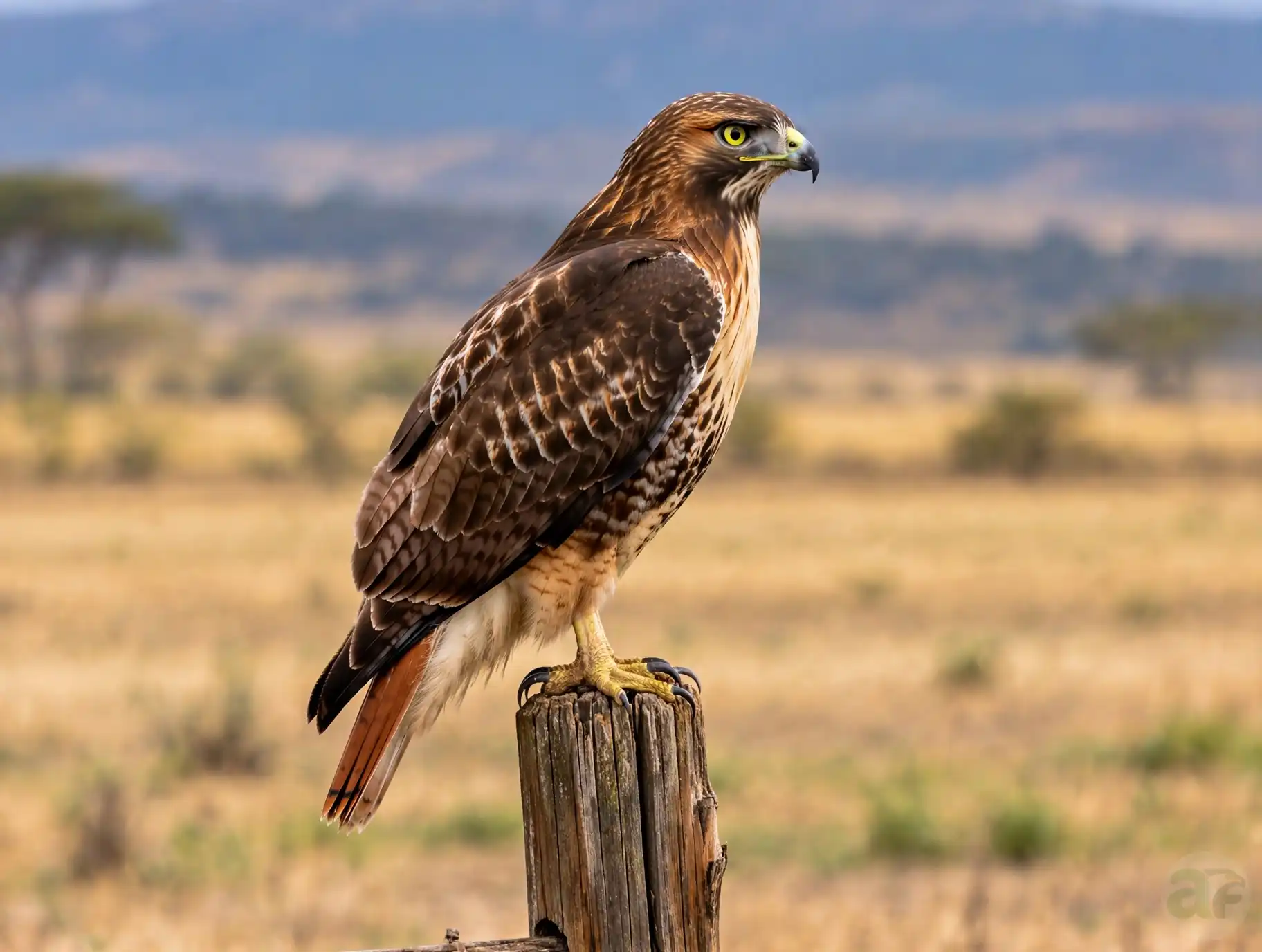
19. Best Places to See Hawks in the Wild
Hawk Migration Watching — The Most Spectacular Hawk Experiences
1. Hawk Mountain Sanctuary, Pennsylvania, USA — The world’s most famous hawk watching site; a ridge in the Appalachian Mountains that concentrates southbound autumn migrants. September 1 through November 30 is the main season; broad-winged hawk day in mid-September produces counts of 10,000–21,000+ birds in a single day. The Sanctuary maintains counts going back to 1934 — the longest continuous raptor migration dataset in the world. Visitor facilities include observation platforms, interpretive exhibits, and guided programs. Entry fee; advance planning recommended for peak broad-winged hawk weekend.
2. Cape May Point, New Jersey, USA — A coastal hawk watching site where migrating raptors concentrate at the cape before crossing Delaware Bay. Spectacular autumn concentrations of sharp-shinned hawks, Cooper’s hawks, merlins, and various other species. Peak October–November. Cape May Hawk Watch provides daily counts. The broader Cape May autumn birding scene makes this one of North America’s premier autumn wildlife destinations.
3. Veracruz, Mexico — The most important raptor migration bottleneck in the Americas; counts of millions of broad-winged hawks and Swainson’s hawks pass through each October. The Mexican non-profit Pronatura Veracruz operates count stations and provides public viewing. Witnessing a continuous stream of raptors passing overhead for hours is one of the most extraordinary wildlife experiences available anywhere.
4. Elat, Israel — Arguably the world’s most important raptor migration point; spring (March–May) migration concentrations of steppe buzzards, lesser spotted eagles, marsh harriers, black kites, and dozens of other species can produce single-day counts of tens of thousands of raptors. The International Birding and Research Center at Elat operates counts and guides public viewing.
5. Bosphorus, Turkey — Spring and autumn raptor migration across the Bosphorus strait concentrates birds at the narrow crossing point between Europe and Asia. Honey buzzards, steppe buzzards, black kites, lesser spotted eagles, booted eagles, and various other species cross in their hundreds of thousands. September and October for autumn; April–May for spring.
6. Monterey County, California, USA — The Pacific Coast raptor migration is less well-known than the East Coast routes but produces excellent autumn hawk watching at various sites in coastal California. Ferruginous hawks, red-tailed hawks, sharp-shinned hawks, and Cooper’s hawks are regularly seen.
Year-Round Hawk Watching
7. Central Park, New York City, USA — The most accessible urban hawk watching location in the world; Pale Male’s legacy red-tailed hawk nest on Fifth Avenue is visible from the park with binoculars; Cooper’s hawks, sharp-shinned hawks, and various Buteos are regularly seen throughout the year. The combination of accessibility (no travel required for NYC visitors) and diversity of hawk species makes Central Park one of the finest urban raptor watching sites in the world.
8. Any suburban American yard with feeders (autumn and winter) — The presence of bird feeders in suburban gardens reliably attracts Cooper’s hawks and sharp-shinned hawks throughout autumn and winter across North America. Setting up a seed feeder and suet feeder and watching the resulting small bird activity will almost certainly produce hawk visits within weeks at most suburban North American locations.
9. Open agricultural land in winter (Buteos) — Driving country roads through agricultural land in winter across North America and Europe produces reliable red-tailed hawk, common buzzard, rough-legged hawk (winter visitor), and northern harrier sightings. The combination of vole-rich field margins and the hawk’s habit of perching prominently on fence posts, telephone poles, and trees makes winter farmland hawk watching extremely productive.
20. How You Can Help
Supporting hawk conservation requires differentiated action — from individual household changes to policy advocacy — reflecting the diverse threats facing different hawk species.
Support these organizations:
- Hawk Mountain Sanctuary — hawkmountain.org — the world’s oldest raptor conservation organization; scientific research, public education, and long-term population monitoring through hawk count data
- HawkWatch International — hawkwatch.org — North American raptor monitoring and conservation through long-term population data
- American Bird Conservancy — abcbirds.org — broad US bird conservation including hawk-relevant window strike reduction and pesticide advocacy
- RSPB (UK) — rspb.org.uk — leads sparrowhawk and other hawk conservation in Britain; monitoring and legal protection advocacy
- The Peregrine Fund — peregrinefund.org — raptor conservation globally including hawk-relevant programs
- National Audubon Society — audubon.org — bird conservation advocacy including hawk habitat protection
Critical individual actions:
- Make windows safer — apply window markers, external screens, or bird-safe glass films to reduce window strike mortality; this is the highest-impact individual action for reducing hawk mortality in suburban and urban environments
- Switch to non-lead ammunition — lead-contaminated carrion is a significant mortality source for red-tailed hawks and other Buteos that consume road-killed and hunter-killed animals; copper ammunition eliminates this exposure pathway
- Use rodenticides responsibly — second-generation anticoagulant rodenticides in prey rodents cause secondary poisoning in urban hawks; alternatives to rodenticide use (snap traps, exclusion) eliminate the secondary poisoning pathway
- Avoid disturbing hawk nests — maintaining appropriate distances from active nests (particularly goshawk nests) prevents nest abandonment
- Report suspected illegal hawk killing — to USFWS Law Enforcement (USA) or local wildlife crime units (UK and Europe); illegal persecution remains a significant hawk mortality source in some areas
- Submit hawk sightings to eBird — citizen science hawk occurrence data contributes to population monitoring that informs conservation management
- Support bird feeder programs with awareness — maintaining bird feeders creates both songbird food resources and hawk hunting opportunities; the net effect on songbird populations is positive, but placing feeders away from windows reduces window strike mortality
21. Top Documentaries & Books
Must-Watch Documentaries
- “A Kestrel for a Knave / Kes” (Ken Loach, 1969) — The most culturally significant hawk film in British cinema; essential viewing even for non-birders
- “The Legend of Pale Male” (2009) — The story of Manhattan’s famous Fifth Avenue red-tailed hawk; one of the finest urban wildlife documentaries made
- “The Natural World: Urban Hawk” (BBC) — Various BBC treatments of urban hawk ecology including Cooper’s hawk and sparrowhawk suburban adaptations
- “Hawk Mountain: First Sanctuary” (various productions) — Documentary history of the world’s first hawk sanctuary and the development of hawk conservation in North America
- “The Sparrowhawk” (BBC Natural World) — Classic BBC treatment of Eurasian sparrowhawk ecology and behavior
Must-Read Books
- Red-tails in Love by Marie Winn (1998) — The story of Pale Male and the urban red-tailed hawk community of Central Park; beautifully written and essential for understanding urban hawk ecology
- The Goshawk by T.H. White (1951) — The most celebrated English-language book about hawk training; White’s account of attempting to train a northern goshawk is both hilarious and profound — one of the finest pieces of nature writing in the English language
- A Kestrel for a Knave by Barry Hines (1968) — The British novel on which the film Kes was based; one of the most celebrated British novels of the 20th century
- Hawks in Flight by Pete Dunne, David Sibley, and Clay Sutton — The standard North American reference for hawk identification in flight; essential for hawk watchers
- The Hawk’s Way by Emma Ford — Personal account of hawk training and raptor natural history from a falconry perspective
- Raptors of the World by Ferguson-Lees and Christie — The comprehensive global reference for all raptor species including detailed hawk coverage
22. Comparison of Major Hawk Groups and Species
| Feature | Sharp-shinned hawk | Cooper’s hawk | Red-tailed hawk | Ferruginous hawk | Northern goshawk | Eurasian sparrowhawk |
|---|---|---|---|---|---|---|
| Scientific name | Accipiter striatus | Accipiter cooperii | Buteo jamaicensis | Buteo regalis | Accipiter gentilis | Accipiter nisus |
| Group | Accipiter | Accipiter | Buteo | Buteo | Accipiter | Accipiter |
| Male weight | 87–114 g | 280–450 g | 690–1,300 g | 977–1,500 g | 630–1,100 g | 110–196 g |
| Female weight | 140–218 g | 330–680 g | 900–1,460 g | 1,500–2,268 g | 860–2,200 g | 185–342 g |
| Wingspan | 52–68 cm | 75–94 cm | 105–141 cm | 133–155 cm | 98–127 cm | 55–77 cm |
| Primary prey | Small passerines | Medium birds, doves | Voles, mice, rabbits | Prairie dogs, jackrabbits | Large birds, rabbits | Small passerines |
| Habitat | Forest, suburban | Forest, suburban | Open country, mixed | Grassland, prairie | Mature forest | Woodland, gardens |
| Range | North America | North America | North America (widespread) | Great Plains/West | Northern Hemisphere | Europe and Asia |
| Conservation | Least Concern | Least Concern | Least Concern | Least Concern | Least Concern | Least Concern |
| Famous for | Smallest N. American Accipiter; feeder raids | Urban colonization success | Hollywood call; Pale Male | Largest N. American Buteo | Hard hat nest defense | Suburban garden predator |
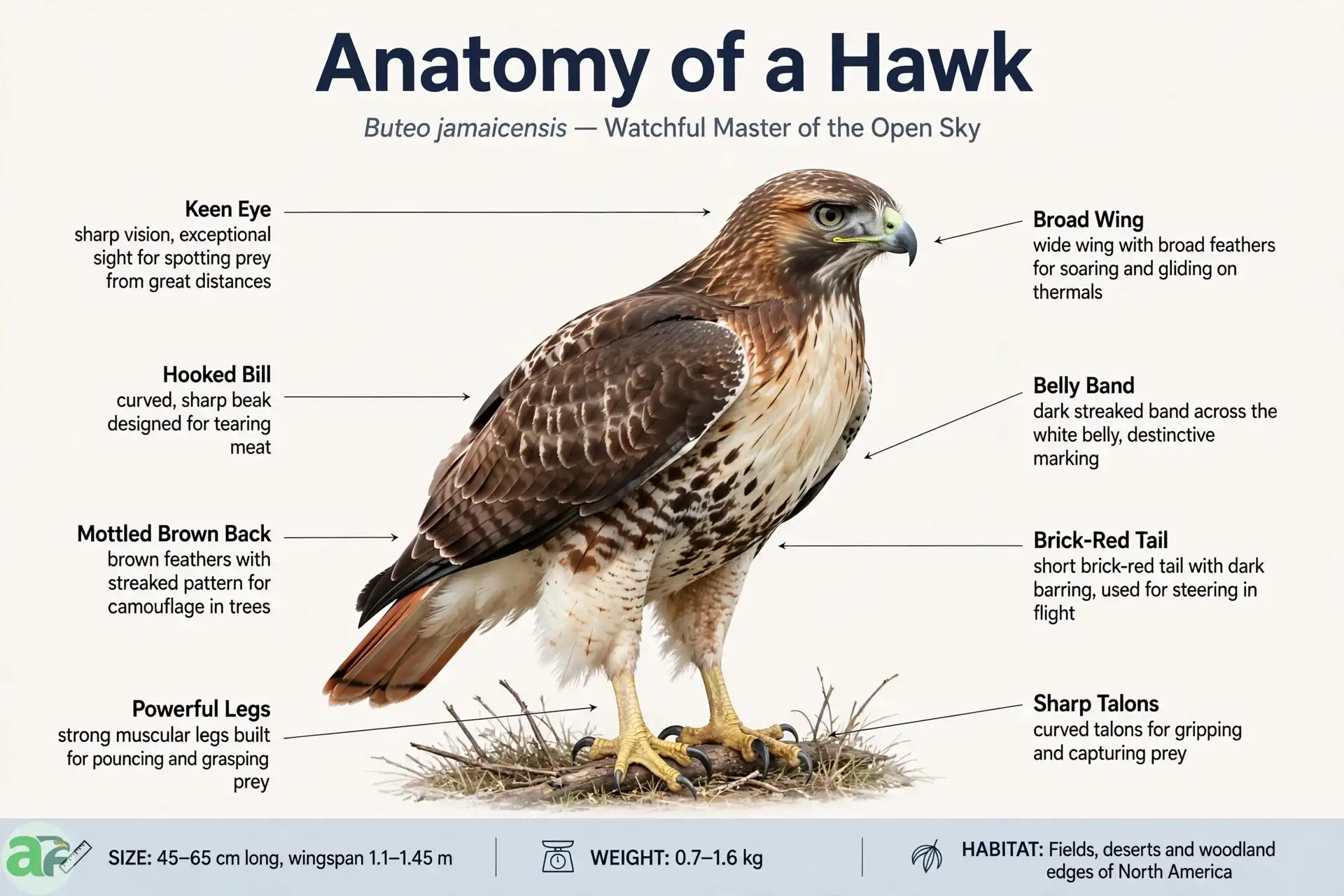
23. Frequently Asked Questions About Hawks
Q1. What is the difference between a hawk and a falcon?
Hawks and falcons are both diurnal birds of prey (raptors) but belong to different evolutionary lineages — they are not closely related despite superficial similarities. Hawks belong primarily to the family Accipitridae (genus Accipiter for true hawks; Buteo for buzzard-hawks), while falcons belong to the family Falconidae (genus Falco). Key differences include: Bill shape — hawks have a relatively simple hooked bill; falcons have a tomial tooth (a notch on the upper mandible) used to sever prey’s spinal cord. Nesting — hawks build stick nests; falcons typically use cliff ledges, tree cavities, or other birds’ old nests. Egg shape — hawk eggs are typically oval; falcon eggs are rounded. Wing shape — falcons typically have long, pointed wings suited to aerial pursuit at high speed; most hawks have more rounded wings. Hunting method — falcons typically stoop from above at very high speed; hawks use a combination of ambush, soaring surveillance, and pursuit. In North American usage, “hawk” is sometimes informally applied to falcons (prairie falcon, peregrine falcon) — this is an informal convention rather than a scientific designation. In scientific classification, hawks and falcons represent two distinct evolutionary experiments in becoming a medium-sized aerial predator.
Q2. What do hawks eat?
Hawk diet varies dramatically across the approximately 270 species included in the broader hawk group. Accipiters (true hawks — goshawk, Cooper’s hawk, sharp-shinned hawk, Eurasian sparrowhawk) are primarily bird specialists — pursuing small to medium-sized birds through forest and woodland at high speed. Sharp-shinned hawks specialize on small songbirds (tits, warblers, sparrows, finches); Cooper’s hawks take medium-sized birds (doves, starlings, jays); northern goshawks take large birds (pigeons, grouse, crows) and rabbits. Buteos (red-tailed hawk, ferruginous hawk, Swainson’s hawk, common buzzard) are primarily mammal specialists — hunting voles, mice, ground squirrels, rabbits, and prairie dogs from soaring altitude or perch-and-drop. Harriers specialize in small mammals and frogs in open wetland and grassland habitats, hunting by low-level quartering flight. Harris’s hawk takes rabbits and hares through cooperative pack hunting. Many species supplement their primary prey with whatever is seasonally available — Swainson’s hawks eat primarily insects during migration, common buzzards eat earthworms in wet weather, and various species take carrion opportunistically.
Q3. Are hawks dangerous to humans or pets?
Hawks pose minimal danger to humans — documented attacks on human adults are essentially nonexistent, and attacks on children are exceptionally rare (essentially no substantiated cases of serious injury). The northern goshawk is the most aggressive hawk toward humans — actively defending nests by diving at intruders and occasionally making contact, causing minor scratches. Other hawk species may dive at people approaching nests (red-tailed hawks, Cooper’s hawks) but rarely make physical contact. For pets, the risk varies by species and pet size: Large Buteos (red-tailed hawk, ferruginous hawk) occasionally take very small cats and kittens and very small dog breeds (less than approximately 1 kg) — these incidents are documented but uncommon. Cooper’s hawks and sharp-shinned hawks are too small to take cats or dogs of any size. The risk to pets is often overstated — most pet owners in hawk territory never experience any hawk interaction with their animals despite years of hawks being present. Supervision of very small pets outdoors eliminates the risk.
Q4. Why do hawks circle high in the air?
Hawks that are observed circling high in the air without flapping are typically engaging in thermal soaring — riding rising columns of warm air (thermals) upward with minimal energy expenditure. Thermals form when the sun heats the ground surface unevenly — dark surfaces (parking lots, plowed fields) heat faster than lighter surfaces, creating columns of rising warm air above them. By banking in a circle within a thermal, a hawk can gain hundreds or thousands of meters of altitude essentially for free — using the free vertical lift of the rising air rather than expending energy in flapping flight. Once at altitude, the hawk can glide in any direction, surveying the landscape below for prey. Thermal soaring is most commonly observed in Buteos (red-tailed hawk, common buzzard, ferruginous hawk) and less commonly in Accipiters (who rely more on active flapping pursuit). During migration, large numbers of hawks may share the same thermal — the spectacular “kettle” formations of broad-winged hawks and Swainson’s hawks during autumn migration involve thousands of birds simultaneously using the same thermal column to gain altitude before continuing their southward journey.
Q5. Where is the best place to see hawks?
The answer depends on what type of hawk experience you want. For spectacular migration watching, Hawk Mountain Sanctuary in Pennsylvania (September–November) provides the most accessible and most historically significant North American hawk watching site — broad-winged hawk day in mid-September can produce counts of 10,000–21,000+ birds in a single day. Cape May, New Jersey (October–November) provides a different migration concentration spectacle. For everyday hawk watching, any agricultural area with fence posts and telephone poles in North America or Europe will produce reliable Buteo (red-tailed hawk or common buzzard) sightings — drive slowly along country roads scanning fence posts and tree tops. For urban hawk watching, Central Park in New York City provides the most accessible urban hawk experience (red-tailed hawks, Cooper’s hawks, and occasional rarities), while any suburban American neighborhood with bird feeders will produce Cooper’s hawk or sharp-shinned hawk visits in autumn and winter. For the most spectacular hawk experience globally, consider Veracruz, Mexico (October) where millions of broad-winged hawks pass through, or Elat, Israel (March–May) where spring migration concentrates hundreds of thousands of raptors at the northern tip of the Red Sea.
24. Sources & References
- Wikipedia — Accipiter, Buteo, Buteo jamaicensis, Accipiter gentilis, Parabuteo unicinctus, Accipiter nisus, Accipitridae
- IUCN Red List — iucnredlist.org (current assessments for all major hawk species)
- BirdLife International — birdlife.org (species factsheets; population assessments)
- Cornell Lab of Ornithology — allaboutbirds.org (species accounts; Macaulay Library; eBird population data)
- HawkWatch International — hawkwatch.org (North American hawk count data)
- Hawk Mountain Sanctuary — hawkmountain.org (migration count data; conservation history)
- American Bird Conservancy — abcbirds.org (window strike data; conservation advocacy)
- Dykstra, C.R. — published research on urban Cooper’s hawk ecology
- National Geographic — nationalgeographic.com
- Smithsonian National Museum of Natural History — naturalhistory.si.edu
- BBC Wildlife / BBC Earth — bbcearth.com
- Britannica — britannica.com/animal/hawk
- RSPB — rspb.org.uk (UK hawk population data)