
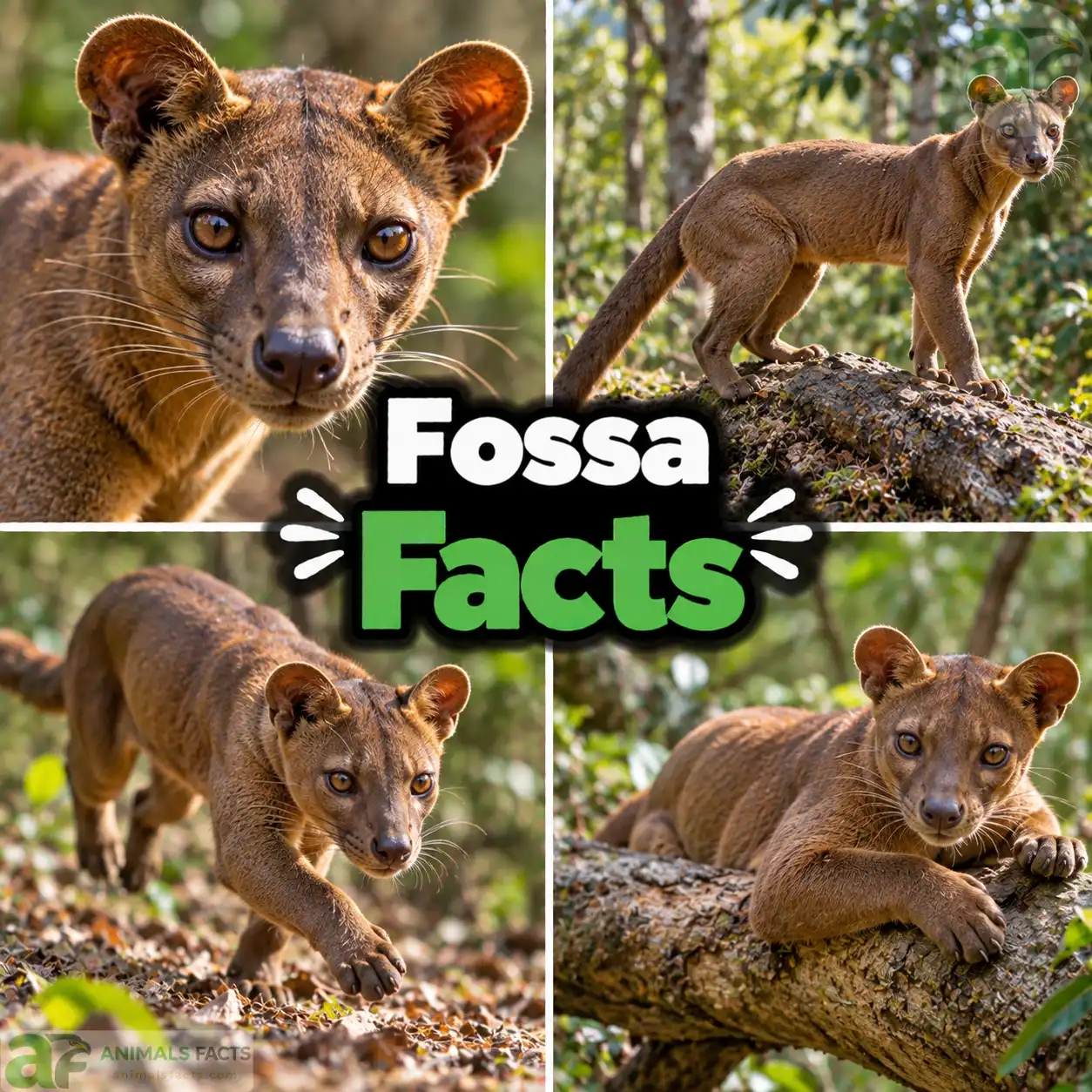
Fossa Facts
| Feature | Details |
|---|---|
| Scientific Name | Cryptoprocta ferox (Bennett, 1833) |
| Kingdom | Animalia |
| Phylum | Chordata |
| Class | Mammalia |
| Order | Carnivora |
| Family | Eupleridae |
| Subfamily | Euplerinae |
| Common Names | Fossa; fosa (alternative spelling) |
| Native Range | Madagascar — island-wide but fragmented |
| Habitat | Tropical rainforest, dry deciduous forest, montane forest — requires intact forest |
| Lifespan | 15–20 years (wild estimate); up to 20 years (captivity) |
| Diet | Lemurs (primary), tenrecs, rodents, birds, lizards, snakes, domestic poultry |
| Body Length | 61–80 cm body plus 61–70 cm tail |
| Height | 37–47 cm at shoulder |
| Weight | 5.5–8.6 kg (males larger than females) |
| Top Speed | Estimated up to 56 km/h in short bursts |
| Conservation Status | Vulnerable (IUCN) — declining |
| Defining Feature | Madagascar’s largest native terrestrial carnivore — apex predator of the island’s entire food web |
| Closest Relative | Other members of family Eupleridae — Madagascar’s endemic carnivores |
| Taxonomic History | Historically misclassified as a cat, civet, and mongoose before molecular genetics resolved placement |
 1. Introduction: What is a Fossa?
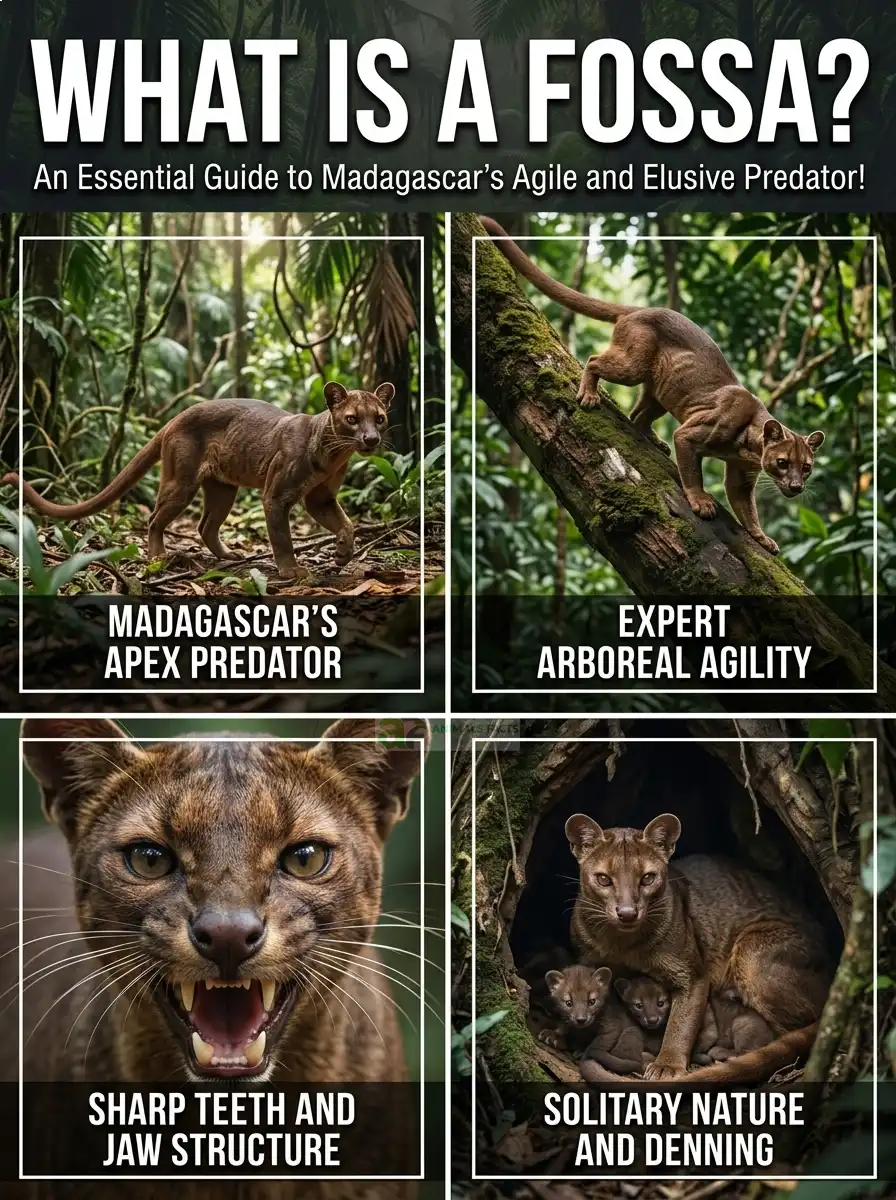
On the edge of a forest clearing in western Madagascar, in the pale light before dawn, a shape emerges from the treeline that does not quite fit any familiar animal category. It moves with the liquid, low-slung grace of a large cat — shoulders rolling, body close to the ground, tail held low and straight — but something in the proportions is slightly wrong for a cat: the muzzle too long, the ears too round, the legs too uniformly sized between front and rear. It pauses at the clearing’s edge, raises its pointed muzzle, reads the air with nostrils that are processing information invisible to the human observer nearby. Then, in a single flowing movement that seems to defy the laws of forest physics, it flows up a vertical tree trunk — all four feet finding purchase on bark that appears completely smooth — and disappears into the canopy as if it were never terrestrial at all. Fossa facts begin with this single, disorienting image — an animal that looks like something between a cat and a mongoose, moves like a weasel, climbs like a primate, and has confused taxonomists for two centuries.
The fossa is Madagascar’s apex predator — the ecological equivalent of a leopard, a puma, and a large mongoose simultaneously — and it is one of the most extraordinary examples of convergent evolution and island evolution in the mammalian world. It belongs to a family of carnivores (Eupleridae) found nowhere else on Earth — a family that evolved in complete isolation on Madagascar from a single ancestral mongoose-like colonist approximately 20–26 million years ago, diversifying into Madagascar’s only native carnivore guild without competition from the cats, dogs, bears, and civets that fill carnivore niches on other continents. The result is the fossa — an animal that looks like a cat (convergent evolution producing cat-like morphology in a non-cat carnivore), climbs like a primate (rotating ankles allowing head-first descent of tree trunks), and hunts like a specialist predator (targeting lemurs with a skill and consistency that has shaped the anti-predator behavior of Madagascar’s primates over millions of years).
Interesting facts about fossas reveal an animal of extraordinary biological sophistication — semi-retractile claws that provide the dual capability of arboreal climbing and ground-level running; a mating system so unusual that females conduct mating from designated arboreal mating trees that the same individuals return to across multiple years; a scent communication system complex enough to encode individual identity, reproductive status, and territorial information across the wide forest ranges the fossa must cover; and a set of juvenile female characteristics — including a temporary masculinization in which young females develop features resembling male genitalia — that represents one of the most unusual developmental biology phenomena documented in any carnivore.
Whether you are searching for fossa facts for kids to explore the remarkable science of island evolution and apex predation, a wildlife enthusiast fascinated by Madagascar’s unique carnivore fauna, a conservation researcher wanting to understand the threats facing the island’s ecological regulator, or simply someone who watched the fossa scenes in DreamWorks’ Madagascar and needed to understand the real animal behind the fictional depiction — this is your comprehensive guide. We cover fossa scientific name, fossa diet, fossa size and weight, fossa behavior, the extraordinary reproductive biology, conservation status, cultural significance, and the ecological roles this irreplaceable predator plays. Madagascar’s most powerful predator has an extraordinary story to tell.
2. Fossa Species Overview & Classification
The fossa belongs to the family Eupleridae — Madagascar’s endemic carnivore family — and occupies the taxonomically isolated position of the largest member of this island-endemic group.
Species Classification Table
| Taxonomic Rank | Classification |
|---|---|
| Kingdom | Animalia |
| Phylum | Chordata |
| Class | Mammalia |
| Order | Carnivora |
| Family | Eupleridae (Chenu, 1852) |
| Subfamily | Euplerinae |
| Genus | Cryptoprocta (Bennett, 1833) |
| Species | C. ferox (Bennett, 1833) |
| Common Name | Fossa |
| Etymology | Cryptoprocta = “hidden anus” (Greek: kryptos + prōktos) — referring to the partially concealed anal gland structure; ferox = “fierce” (Latin) |
The Eupleridae — Madagascar’s Endemic Carnivore Family
The fossa belongs to a family found exclusively in Madagascar — a group of 8 species across 7 genera that all descended from a single ancestral colonist approximately 20–26 million years ago:
| Species | Common Name | Weight | IUCN Status | Notable Feature |
|---|---|---|---|---|
| Cryptoprocta ferox | Fossa | 5.5–8.6 kg | Vulnerable | Largest; apex predator |
| Eupleres goudotii | Falanuc | 1.5–2 kg | Vulnerable | Eats earthworms primarily |
| Fossa fossana | Malagasy civet (Falanouc) | 1.5–2 kg | Vulnerable | Spotted; forest specialist |
| Cryptoprocta spelea | Giant fossa | ~17 kg (estimated) | Extinct | Subfossil; pre-human extinction |
| Galidictis fasciata | Broad-striped Malagasy mongoose | 0.6–0.8 kg | Near Threatened | Striped; nocturnal |
| Mungotictis decemlineata | Narrow-striped mongoose | 0.6–0.7 kg | Endangered | Dry forest specialist |
| Salanoia concolor | Brown-tailed mongoose | 0.5–0.7 kg | Vulnerable | Poorly known |
The Taxonomic History — A Classification Odyssey
The fossa’s taxonomic history is one of the most convoluted in carnivore biology — reflecting the genuine difficulty of classifying an animal that has independently evolved features resembling multiple unrelated carnivore groups:
1833 — Edward Turner Bennett formally describes the fossa as Cryptoprocta ferox — establishing the current scientific name.
19th century — The fossa is variously classified as:
- A large civet (family Viverridae) — based on the elongated body, scent glands, and superficially civet-like appearance
- A cat relative (family Felidae) — based on the cat-like retractile claws, hunting behavior, and body proportions
- A mongoose relative (family Herpestidae) — based on the elongated muzzle, rounded ears, and Malagasy geographic origin suggesting mongoose ancestry
20th century — Morphological analyses consistently failed to resolve the fossa’s placement satisfactorily — each anatomical analysis emphasizing different features produced different family placements.
1990s–2000s — Molecular genetic analysis definitively resolves the question — DNA evidence confirms that the fossa belongs in a Madagascar-endemic family (Eupleridae) descended from a mongoose-like ancestor that colonized Madagascar approximately 20–26 million years ago. The fossa’s cat-like features — semi-retractile claws, cat-like hunting behavior, and elongated cat-like body — are products of convergent evolution, not shared ancestry with cats.
The convergent evolution significance — The fossa’s molecular resolution is one of the most instructive examples in zoology of how convergent evolution can deceive morphological taxonomy. The fossa evolved cat-like features because cat-like morphology is the optimal solution for a generalist mammalian apex predator in a forest environment — whether the predator belongs to the cat family or not.
The Extinct Giant Fossa
A second species of Cryptoprocta is known from Madagascar’s subfossil record:
Cryptoprocta spelea — The giant fossa was approximately twice the weight of the living species — estimated at 17 kg or more. It went extinct following human arrival in Madagascar, likely driven by hunting and habitat loss, within approximately the past 2,000 years. Its extinction removed the top predator capable of hunting large adult lemurs — the living fossa, already the island’s largest surviving carnivore, filling a somewhat diminished version of this role.
Evolution & Discovery Timeline
~20–26 million years ago — A mongoose-like ancestor colonizes Madagascar — the founding event of the Eupleridae radiation. This colonization, like the lemur colonization of approximately 50–60 million years ago, most likely occurred via oceanic rafting.
~20 million years of evolution — The ancestral euplerids diversify in isolation — the largest lineage (Cryptoprocta) evolving toward increasing body size and cat-like morphology as it specializes as the island’s apex predator.
~2,000 years ago — Human arrival in Madagascar; the giant fossa (Cryptoprocta spelea) goes extinct within centuries; the living fossa begins facing increasing pressure from deforestation and persecution.
1833 — Edward Turner Bennett formally describes Cryptoprocta ferox based on specimens brought to Europe.
Late 19th – early 20th century — Colonial-era natural history collections accumulate fossa specimens; basic biology begins to be documented; the species is frequently but incorrectly described as a “cat.”
1969–1970 — First systematic field observations of fossa behavior — early accounts from Roland Albignac’s fieldwork in Madagascar provide the foundational behavioral descriptions.
1990s–2000s — Molecular genetic resolution of fossa taxonomy; beginning of systematic ecological research using radio-telemetry.
2000s–2010s — Camera trap programs across Madagascar begin accumulating population-level data on fossa distribution and density.
2024 — Updated population assessments confirm continued fossa population decline across Madagascar — the species maintaining its Vulnerable IUCN status with a decreasing population trend.
“The fossa is Madagascar’s leopard, puma, and mongoose rolled into one — an animal that has independently reinvented apex predation using a completely different evolutionary starting point from any of those animals. It is one of the finest examples of convergent evolution available to science — and one of the most urgent conservation priorities in the carnivore world.”
— Dr. Luke Hunter, President Emeritus, Panthera, and author of Wild Cats of the World
3. Fossa Physical Description & Unique Features
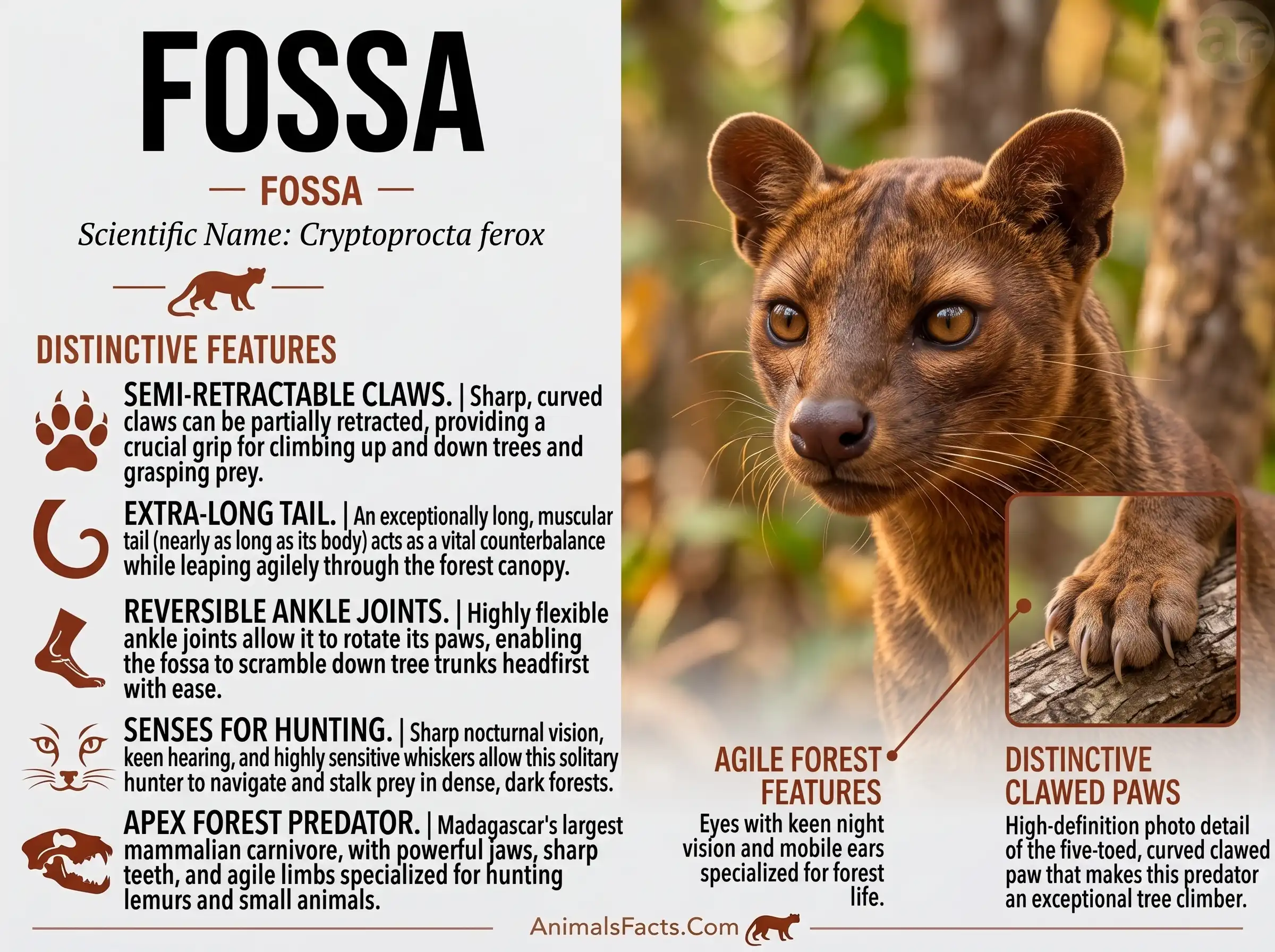
Fossa size and weight make it a medium-large carnivore — at 5.5–8.6 kg and 61–80 cm body length (plus an equally long tail), it is substantially smaller than a leopard but larger than any other native Malagasy carnivore. Its physical appearance combines features from multiple carnivore families in a way that reflects both its unique evolutionary history and the convergent evolution that has shaped it toward cat-like morphology.
Body Form — The Cat That Is Not a Cat
The fossa’s body form is so cat-like that casual observers — and even trained naturalists of the 19th century — consistently perceived it as a cat. The specific cat-like features and their evolutionary origins:
Low-slung, elongated body — The fossa has the long, sinuous body typical of both cats and mongoose — an optimal form for a terrestrial-arboreal predator that must navigate complex forest environments. The body is muscular and flexible — capable of twisting, turning, and compressing through vegetation gaps.
Long tail — The tail is approximately equal to body length — 61–70 cm — and is thick at the base, tapering toward the tip. The long tail provides balance and counterweight during arboreal locomotion — critical for an animal that regularly navigates tree canopies at speed. The tail is held low and roughly horizontal during terrestrial movement.
Short legs, roughly equal in length — Unlike cats (which have longer hindlimbs for powerful pouncing) and unlike mongooses (which have shorter, stockier limbs), the fossa has legs that are remarkably equal in length between front and rear — an adaptation that facilitates head-first descent of tree trunks (which requires the rear legs to be able to support the animal’s weight with the body inverted).
Pointed muzzle — More elongated than a cat’s muzzle; shorter than a mongoose’s. The muzzle length reflects the fossa’s evolutionary heritage from a mongoose-like ancestor, though convergent evolution has shortened it toward the cat end of the spectrum.
Rounded ears — The ears are rounded and moderately sized — providing good sound collection without the extreme ear size specialization of desert or nocturnal specialists.
The Semi-Retractile Claws — The Key Innovation
One of the fossa’s most functionally significant anatomical features is its semi-retractile claws — a claw type that occupies a unique position in the carnivore spectrum:
True retractile claws (cats) — Fully retracted into protective sheaths when not in use — kept sharp and protected during walking; extended for gripping prey
Non-retractile claws (most other carnivores) — Always extended; used for traction during running but worn down by contact with ground surfaces
Semi-retractile claws (fossa) — Partially retractable — providing intermediate capability between the two extremes. During arboreal locomotion, the claws are fully extended and grip bark. During terrestrial movement, partial retraction reduces wear. The semi-retractile nature provides better tree-climbing grip than fully retractile claws (which have less downward surface contact) while maintaining reasonable sharpness through partial protection.
This semi-retractile claw system is one of the fossa’s most significant adaptations — enabling the combination of efficient arboreal locomotion and terrestrial pursuit that makes the fossa such a versatile and effective predator.
The Rotating Ankle — Arboreal Superpower
The fossa’s most extraordinary anatomical feature for arboreal locomotion is its highly mobile ankle joint — specifically its ability to rotate the hind feet outward so that the feet face backward when descending a vertical tree trunk:
The squirrel parallel — Tree squirrels use the same ankle rotation for head-first tree descent — the feet rotating to face backward so the claws grip the bark during descent rather than pointing away from it. Very few mammals have this capability — and among carnivores, the fossa is unique in its extent of ankle rotation.
The functional advantage — Head-first descent allows the fossa to maintain visual tracking of the ground below while descending — providing situational awareness that is impossible in animals restricted to backing down tree trunks. More significantly, head-first descent allows the fossa to chase prey down a tree trunk — pursuing a lemur that descends from the canopy to the forest floor without losing speed or position.
The semi-horizontal claw gripping — During head-first descent, the rotated hind feet allow the claws to engage the bark surface with downward traction rather than upward traction — maintaining grip against the animal’s weight during the descent.
The Coat
The fossa’s coat is reddish-brown to medium brown on the dorsal surface — tawny to warm brown-orange — and paler, creamy-white to pale buff on the ventral surface. The coat is uniform without spots or stripes — unlike the spotted coats of many civet and mongoose relatives. The uniformity provides reasonable camouflage in the dappled light of forest environments.
Sexual Dimorphism
Male fossas are significantly larger than females — a pronounced sexual dimorphism unusual for a solitary carnivore:
- Males: typically 6–8.6 kg
- Females: typically 5.5–6.8 kg
- The size difference is approximately 20–30% in body weight
The Juvenile Female Masculinization — One of the Most Unusual Developmental Phenomena in Any Carnivore
One of the most biologically extraordinary features of the fossa is the transient masculinization of juvenile females — a developmental phenomenon with no parallel in any other carnivore:
What happens — Juvenile female fossas develop features that resemble male genitalia — including a structure resembling a penis (with a pointed, spiny surface similar to the male’s) and orange secretion from associated glands. This masculinized appearance persists from approximately 1–2 years before reverting to standard female morphology as the individual approaches sexual maturity.
The proposed explanation — The most widely accepted hypothesis is that the masculinized appearance reduces aggression from adult males — adult male fossas may be less likely to attack juveniles that appear morphologically male, reducing the risk to young females during the vulnerable juvenile period. The orange secretion may chemically signal non-receptive status to adult males.
The spotted hyena parallel — A superficially similar phenomenon (female external genitalia resembling male genitalia) occurs in spotted hyenas — one of the most studied animal developmental systems. However, the hyena case involves permanent (not transient) masculinization and has a different proposed evolutionary driver. The fossa represents an independent evolution of temporary female masculinization — a remarkable convergence with the hyena in both the phenomenon itself and the proposed mechanism.
💡 Did You Know? The fossa’s ankle rotation capability — allowing head-first descent of vertical tree trunks by rotating the hind feet to face backward — is shared with relatively few non-primate mammals. The animals that can descend trees head-first form a short list that includes squirrels, some mustelids, martens, and the fossa — but not most climbing carnivores including cats, which descend trees tail-first (backing down). The fossa’s ability to descend head-first is critically important for its role as a lemur predator — lemurs that attempt to escape to the ground by descending a tree trunk can be pursued by the fossa at speed, removing the escape option that would be available if the fossa could only descend tail-first. This ankle rotation is therefore not merely an interesting anatomical feature but a key component of the fossa’s predatory effectiveness against its primary prey.
4. Top 25 Amazing Fossa Facts
Here is your definitive collection of the most extraordinary, scientifically verified, and genuinely astonishing fossa facts as of 2026:
- The fossa is Madagascar’s largest native terrestrial carnivore — the ecological equivalent of the leopard, puma, and large mongoose simultaneously — filling the apex predator role on an island that has never had native cats, dogs, or bears.
- Despite looking like a cat and being commonly described as a “cat-like” animal, the fossa is not related to cats — molecular genetics confirms it belongs to the family Eupleridae, descended from a mongoose-like ancestor that colonized Madagascar approximately 20–26 million years ago. Its cat-like features are the product of convergent evolution.
- The fossa is the only carnivore on Earth known to use designated arboreal mating trees — specific trees that females return to for mating across multiple breeding seasons, sometimes across multiple years, with multiple males competing for access in what represents one of the most unusual mating systems documented in any carnivore.
- The fossa can rotate its ankles 180 degrees — allowing it to descend vertical tree trunks head-first, like a squirrel. This capability allows the fossa to pursue lemurs from the tree canopy to the forest floor without losing speed or ground — eliminating the escape route that would be available if the fossa could only descend trees backwards.
- The fossa’s semi-retractile claws occupy a unique intermediate position in the carnivore spectrum — neither fully retractile like cats (kept sharp in protective sheaths) nor fully non-retractile like most other carnivores. This intermediate system provides both arboreal gripping capability and reasonable claw sharpness for prey capture.
- Juvenile female fossas develop genitalia that resembles male genitalia — including a spiny, penis-like structure and orange secretion — for approximately 1–2 years before reverting to standard female morphology. This transient masculinization is unique among carnivorans and may reduce aggression from adult males during the vulnerable juvenile period.
- The fossa was historically classified as a cat, a civet, and a mongoose — in that order — before molecular genetics in the 1990s–2000s confirmed it belongs to Madagascar’s endemic carnivore family (Eupleridae). The repeated reclassification reflects how effectively convergent evolution mimicked the morphology of unrelated carnivore groups.
- An extinct species of fossa — Cryptoprocta spelea — was approximately twice the weight of the living fossa, reaching an estimated 17 kg. It went extinct following human arrival in Madagascar approximately 2,000 years ago, leaving the smaller living fossa as the island’s sole surviving apex carnivore.
- Lemurs constitute the majority of the fossa’s diet — with research at multiple sites confirming that lemurs of multiple species, sizes, and activity patterns are taken by fossas throughout the year. The fossa has shaped lemur anti-predator behavior through millions of years of predator-prey coevolution.
- The fossa is crepuscular and cathemeral — active at both day and night at various times throughout the year. Activity patterns appear to shift seasonally and with prey availability — the fossa is one of the most temporally flexible large carnivores documented.
- Male fossas maintain home ranges of 15–26 km² — among the largest for any carnivore of its body size — reflecting the patchy and unpredictable distribution of lemur prey across Madagascar’s forest landscapes.
- The fossa has a penis with a baculum (penis bone) unusually long relative to body size — the baculum reaches approximately 6 cm in adults, proportionally one of the largest bacula relative to body size documented in Carnivora.
- Fossas are exceptional swimmers — documented crossing rivers and swimming between islands in some parts of Madagascar. This swimming capability may be important for accessing prey in riverine and wetland habitats.
- The fossa has scent glands on the chest that produce a bright orange secretion — used in scent marking and visible as orange staining on the fur of the chest and belly. This orange secretion is one of the most visually distinctive features of individual identification.
- Despite their reputation as fierce predators, fossas show surprisingly relaxed behavior around habituated human observers at research sites — individuals at Kirindy Forest in western Madagascar have become sufficiently accustomed to researcher presence to behave naturally within meters of people.
- The fossa’s reproductive season is highly synchronized — mating occurring in September–October and births occurring in December–January across most of Madagascar’s range. This synchrony presumably reflects the timing of peak lemur abundance and prey vulnerability during the southern hemisphere summer wet season.
- Camera trap studies have documented fossas and ring-tailed lemurs in remarkably close proximity at some sites — confirming the direct predator-prey relationship and the intensity of the anti-predator vigilance that ring-tailed lemur groups maintain against the fossa threat.
- The fossa’s scent marking includes rubbing the chest and anogenital glands on tree trunks and branches — creating chemical signals that persist for extended periods and communicate individual identity, sex, and reproductive status to other fossas traversing the same forest.
- Fossa population density in the best remaining habitat is estimated at approximately 1 individual per 4 km² — one of the lowest densities of any apex carnivore of comparable size anywhere in the world, reflecting both the patchy nature of Madagascar’s prey base and the fossa’s large individual home ranges.
- The fossa has been documented raiding domestic poultry at rates that create significant human-fossa conflict — in areas where forest has been fragmented to near settlements, fossa predation on chickens and ducks represents a major direct driver of retaliatory killing.
- Research has documented that fossa individuals maintain non-overlapping home ranges of the same sex — males avoid other males’ ranges, and females avoid other females’ ranges — while male and female ranges overlap substantially. This spatial organization is maintained primarily through scent communication.
- Fossas are documented as excellent leapers — capable of leaping between trees at distances of several meters during arboreal pursuit of prey. These leaping distances, combined with the semi-retractile claws and rotating ankles, make the fossa an arboreal pursuit predator of remarkable capability.
- The total wild fossa population is estimated at fewer than 2,500 mature individuals — making it one of the rarest apex carnivores in the world by population size, and one of the carnivores most urgently in need of conservation attention.
- Fossas have no natural predators as adults — they occupy the apex position in Madagascar’s food web with no native carnivore capable of threatening an adult fossa. Introduced dogs and occasionally crocodiles may occasionally threaten individuals, but no native species regularly preys on adult fossas.
- Despite being Madagascar’s apex predator and the ecological regulator of the island’s most important primate radiation, the fossa receives a fraction of the conservation funding and research attention devoted to comparable apex predators on other continents — a disproportion that reflects Madagascar’s limited research infrastructure and the global prioritization of more charismatic megafauna.
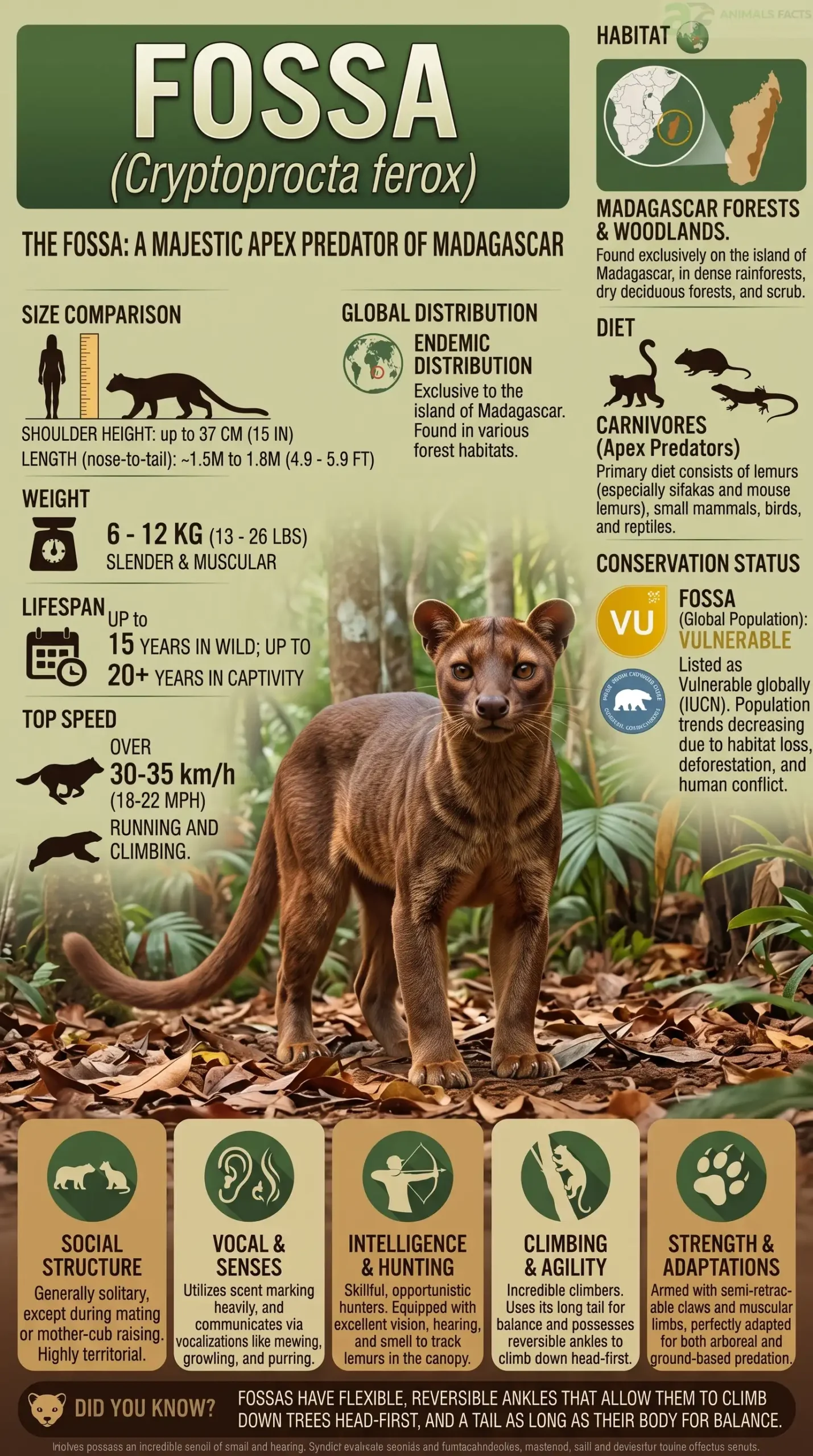
5. Fun Facts About Fossa Animal
- The fossa is not a cat — it’s a mongoose relative shaped by convergent evolution
- It can rotate its ankles 180° — descending trees head-first like a squirrel
- It uses designated mating trees — returned to year after year
- An extinct relative weighed 17 kg — twice the living fossa’s size
- Juvenile females temporarily develop male-like genitalia
- Total wild population is fewer than 2,500 individuals
- The fossa is simultaneously active day and night — cathemeral
- Male home ranges can reach 26 km²
- They have an orange chest scent gland visible as orange staining on fur
- Fossas were misclassified as cats, civets, AND mongooses before DNA testing
- They can swim between islands in some parts of Madagascar
- Lemurs are the primary prey — the fossa has shaped lemur evolution
6. Fossa’s Habitat & Geographic Range
Fossa habitat is strictly limited to intact or near-intact forest across Madagascar — the species cannot persist in the heavily modified agricultural landscapes that now cover the majority of the island. This strict forest dependency makes the fossa’s conservation status directly linked to the fate of Madagascar’s remaining forests.
Habitat Requirements
Forest integrity — The fossa’s primary habitat requirement is intact or minimally disturbed forest — providing adequate prey base (lemur populations), sufficient cover for hunting, and den sites for reproduction. The species cannot maintain viable populations in forest fragments below approximately 20–50 km² in area — the minimum size needed to support viable lemur prey populations sufficient for fossa persistence.
Prey base availability — As a specialist lemur predator, the fossa requires forests supporting adequate lemur populations. Forests where bushmeat hunting has depleted lemur populations cannot support fossa even if the forest structure remains intact.
Large home range territory — The fossa’s large home ranges require contiguous forest blocks — fragmentation that prevents movement between forest patches isolates individuals and prevents the mate-finding that is essential for reproduction.
Den sites — Rocky outcrops, hollow trees, and dense root systems provide the denning sites used for raising young. The availability of secure den sites limits reproduction in some habitats.
Habitat Types
Tropical rainforest — The primary habitat of the eastern fossa populations; the high lemur diversity and abundance of eastern Madagascar’s rainforest supports the highest known fossa densities.
Dry deciduous forest — Western Madagascar’s deciduous forests support significant fossa populations; the Kirindy Forest in the west is one of the most intensively studied fossa sites. Dry forest fossas hunt a different lemur species assemblage from rainforest populations.
Montane forest — Fossas are documented in montane forest up to approximately 2,000 meters — demonstrating a broader elevation tolerance than early accounts suggested.
Secondary forest — Limited evidence suggests fossas can occasionally use secondary forest adjacent to primary forest — but populations in secondary forest alone cannot be sustained.
Geographic Distribution
| Region | Status | Primary Sites |
|---|---|---|
| Eastern rainforest zone | Present — better forest remaining | Masoala, Ranomafana, Andasibe |
| Western dry deciduous forest | Present — best studied | Kirindy Forest; Ankarana |
| Northern forest | Present | Ankarana Reserve; Montagne d’Ambre |
| Southern forest | Marginal | Scattered records; habitat degraded |
| Central highland | Largely absent | Forest clearance has eliminated most habitat |
💡 Did You Know? The Kirindy Forest in western Madagascar — a dry deciduous forest managed by the Swiss Centre de Recherches de Coriolis Kirindy (CNFEREF) — is the site of the most intensive long-term fossa research program in the world. Individual fossas at Kirindy have been radio-collared, GPS-tracked, and monitored over multiple years — providing the foundational dataset on fossa home range, social behavior, mating system, and diet that underlies most current scientific understanding of the species. The Kirindy fossa population’s habituated behavior around researchers — developed through years of careful, respectful human presence — has provided direct behavioral observation opportunities that are essentially unavailable at unhabituated sites. Several individual Kirindy fossas monitored over multiple years represent the most continuously studied individual large carnivores in Madagascar’s research history.
7. Fossa Diet & Feeding Behavior
Fossa diet is dominated by lemurs — the primary prey across all habitat types and seasons — but extends to a diverse range of other prey that reflects the fossa’s generalist predatory capability and opportunistic hunting strategy.
Diet Breakdown Table
| Food Type | Estimated % of Diet | Notes |
|---|---|---|
| Lemurs (multiple species) | ~50–60% | Primary prey; taken from ground to canopy |
| Tenrecs (Tenrec species) | ~10–15% | Common prey; spiny exterior no defense against fossa |
| Rodents (introduced and native) | ~8–12% | Both black rats and native rodents |
| Birds (ground and arboreal) | ~5–8% | Ground birds particularly vulnerable |
| Lizards (including large geckos) | ~5–8% | Large Malagasy lizards documented as prey |
| Snakes | ~3–5% | Various Malagasy snake species |
| Chameleons | ~2–4% | Madagascar’s diverse chameleon fauna |
| Domestic poultry | ~5–10% (near settlements) | Significant human-conflict driver |
| Insects and invertebrates | ~1–3% | Minor; opportunistic |
Lemur Predation — The Primary Ecological Role
The fossa’s predation on lemurs is ecologically its most significant dietary behavior — and represents one of the most important predator-prey relationships in Madagascar’s ecology:
Species taken — Fossas prey on lemurs across a remarkable size range — from mouse lemurs (30–100 grams) to sifakas and ruffed lemurs (3–8+ kg). This size range — spanning approximately a 250-fold difference in prey mass — reflects the fossa’s versatility as a predator.
Temporal flexibility — As a cathemeral predator (active both day and night), the fossa can hunt the full range of lemur activity types — diurnal species (sifakas, ring-tailed lemurs, ruffed lemurs), crepuscular species (various Eulemur species), and nocturnal species (mouse lemurs, sportive lemurs, aye-aye).
Hunting strategies — The fossa employs different hunting strategies for different prey and contexts:
- Terrestrial pursuit — Chasing ground-level prey across open forest floor
- Arboreal pursuit — Following lemurs through the canopy using the climbing and leaping capabilities that match or exceed most prey species’ arboreal mobility
- Vertical pursuit — The head-first descent capability allowing the fossa to pursue lemurs down tree trunks without losing contact
- Ambush — Remaining motionless near known lemur sleeping sites or travel routes, striking when prey passes within range
Lemur anti-predator responses — The evolutionary pressure of fossa predation has shaped multiple aspects of lemur behavior and morphology:
- Alarm call systems — Ring-tailed lemurs, sifakas, and ruffed lemurs all produce specific alarm calls for the fossa as a ground or arboreal predator
- Group vigilance — Social lemur species maintain elevated scanning behavior specifically in response to fossa detection
- Sleeping site selection — Many lemur species select sleeping sites — in hollow trees, dense vegetation, or high canopy — that reduce fossa access
- The fossa effect on lemur behavior persists even at research sites where fossas have not been directly observed for extended periods — confirming the depth of this evolutionary relationship
The Seasonal Diet Shift
Fossa diet varies seasonally in response to prey availability changes:
Wet season (November–April) — Higher lemur reproductive activity; increased abundance of juvenile lemurs (highly vulnerable to fossa predation); greatest prey diversity available.
Dry season (May–October) — Reduced lemur activity (some species in torpor); shift toward alternative prey including tenrecs, rodents, and lizards; increased importance of dry season-active prey species.
8. Fossa Reproduction & Life Cycle
Fossa reproduction involves one of the most unusual mating systems documented in any carnivore — and a developmental biology featuring the transient female masculinization already described in the physical features section.
The Arboreal Mating System
The fossa’s mating system is unlike that of any other carnivore on Earth — centered on designated arboreal mating trees that females use across multiple breeding seasons:
The mating tree phenomenon — During the breeding season, a female fossa will position herself in a specific large tree and produce chemical and vocal signals that attract males from across the surrounding landscape. This tree — the “mating tree” — is not randomly selected:
- The same individual female has been documented returning to the same tree in successive years
- The same tree has been documented used by different females in successive years when the previous female did not return
- Trees used as mating sites appear to have specific characteristics (size, position, exposure) that make them predictably detectable over large distances
Male competition — Multiple males are attracted to the mating tree simultaneously — with males occupying branches in the same tree or adjacent trees, competing through posturing, vocalizing, and occasionally direct confrontation. Males may remain at or near the mating tree for extended periods (days) waiting for mating opportunities.
Sequential mating — The female mates with multiple males sequentially over a period of several days while remaining at or near the mating tree — this promiscuous mating pattern produces sperm competition between the sperm of multiple males.
Post-mating dispersal — After the mating period, both males and females return to their normal solitary behavior — there is no pair bonding, no male parental care, and no sustained male-female social association.
Why trees? — The evolutionary advantage of the arboreal mating system is debated. Proposed explanations include: elevation reduces risk from terrestrial threats during the vulnerable mating period; specific trees serve as reliable landscape landmarks that can be detected from long distances; the tree position allows females to assess male climbing ability and physical condition during competition; and the elevated position allows mating without the female being overwhelmed by multiple males simultaneously in the way ground-level mating might allow.
Gestation and Birth
- Gestation period: approximately 90 days
- Litter size: typically 2–4 young (range 1–6 documented)
- Birth weight: approximately 100 grams per young
- Birth season: December–January (southern hemisphere summer) — timed to the period of maximum lemur prey availability
Den Site and Early Development
- The female establishes a den site — typically in a rock crevice, hollow tree, or dense root system — before giving birth
- Young are born altricial — blind, helpless, and entirely dependent on the mother
- Eyes open at approximately 2–3 weeks
- First emergence from the den at approximately 4 months
- Weaning at approximately 4–5 months — but young remain associated with the mother for an extended period
- Independence at approximately 12–18 months — the young fossa begins establishing its own home range
- Sexual maturity: approximately 3–4 years
The Transient Female Masculinization Period
As noted in the physical features section, juvenile females develop masculinized genitalia that persists for approximately 1–2 years before reverting. This period overlaps with the first year or two of life — the period of highest vulnerability when the juvenile female is establishing independence from the mother and beginning to navigate the adult social landscape.
Fossa Lifespan Comparison Table
| Species | Wild Lifespan | Max Captive | Litter Size |
|---|---|---|---|
| Fossa | 15–20 years (estimated) | 20 years | 2–4 |
| Leopard (Panthera pardus) | 12–17 years | 23 years | 2–3 |
| Puma (Puma concolor) | 8–13 years | 20 years | 2–4 |
| Binturong (Arctictis binturong) | 10–15 years | 25+ years | 1–3 |
| Spotted hyena (Crocuta crocuta) | 12–16 years | 25 years | 1–2 |
9. Social Behavior & Communication
Fossa social behavior is characterized by functional solitude outside of the mating season — with adults maintaining large, non-overlapping same-sex home ranges and interacting primarily through scent communication rather than direct contact.
Social Organization
Solitary adult lifestyle — Adult fossas of the same sex maintain non-overlapping home ranges — two male fossas or two female fossas do not regularly share space. This exclusive same-sex spacing is maintained through scent marking rather than active territorial defense.
Male-female range overlap — Male and female home ranges overlap substantially — a spatial organization that facilitates mate-finding during the breeding season while maintaining resource partitioning through same-sex spacing during the non-breeding period.
Range size variation — Male fossas maintain larger home ranges than females:
- Males: 15–26 km²
- Females: 12–20 km²
The size difference presumably reflects males’ need to range across multiple female ranges to maximize mating opportunities.
Subadult tolerance — Some evidence suggests that adult females show limited tolerance of their own juvenile offspring for an extended period after independence — a maternal-juvenile overlap that may persist for months after formal independence.
Communication Systems
Chest scent gland marking — The fossa’s most visible scent marking behavior involves the chest gland — the animal rubs its chest along tree trunks and branches, depositing an orange-colored secretion that is visible on the fur and presumably leaves persistent chemical signals in the environment.
Anogenital scent marking — Secretions from glands near the anus are deposited on substrates during a characteristic rubbing behavior — communicating individual identity and reproductive status.
Urine marking — Directed urine deposits at specific locations supplement glandular scent marks — particularly important for communicating reproductive status.
Vocalizations — Fossas produce a distinctive repertoire of vocalizations:
- Purring — A repetitive, low-frequency vocalization produced during relaxed social contact (documented during mating season interactions)
- Meowing — A cat-like call used in various social contexts; one of the features that contributed to early cat misclassification
- Growling and hissing — Agonistic vocalizations during direct confrontations
- Coughing bark — An alarm or long-distance communication sound
The cat-like vocalizations — The fossa’s cat-like meowing and purring represent another convergent evolution with cats — the same acoustic signaling types arriving independently in two unrelated carnivore lineages.
Intelligence and Hunting Cognition
The fossa’s success as an apex predator in a complex, three-dimensional forest environment requires sophisticated cognitive capabilities:
Spatial memory — Maintaining and navigating home ranges of 15–26 km² requires detailed spatial memory of landscape features, prey locations, water sources, and den sites across extensive areas.
Prey behavior modeling — Effective lemur hunting requires the fossa to predict and anticipate lemur behavior — understanding how different lemur species respond to different approach strategies and adapting hunting tactics accordingly.
Multi-environment switching — The ability to hunt effectively in both terrestrial and arboreal environments requires the cognitive flexibility to switch between movement patterns, attack strategies, and prey assessment methods depending on environmental context.
10. Predators & Defense Mechanisms
The fossa occupies the apex position in Madagascar’s food web — it has no natural predators as an adult and faces only anthropogenic threats and rare attacks from introduced species.
Absence of Natural Predators
No native apex predator — Madagascar’s native fauna contains no carnivore capable of threatening an adult fossa. The island’s native bird of prey fauna, while including some impressive species, does not include anything approaching the size needed to take an adult fossa. The island’s snake fauna, while including some large boas, cannot regularly overcome a healthy adult fossa.
Crocodile exception — The Nile crocodile (Crocodylus niloticus), present in Madagascar’s rivers and coastal areas, represents a potential threat to fossas crossing water bodies — but this risk is occasional rather than a regular predation pressure.
Introduced dog threat — Domestic and feral dogs introduced by humans represent an increasing threat to fossas in areas near human settlements — particularly to juveniles and animals weakened by injury or illness.
Defense Mechanisms
Top predator status — The primary “defense” of the fossa is its position as the apex predator — there is no selective pressure for elaborate anti-predator defenses in an animal that nothing hunts.
Size and fighting capability — A healthy adult fossa is a formidable opponent — the powerful jaws, sharp claws, and muscular body make it a dangerous adversary for most animals it might encounter.
Scent marking — The communication system that maintains spacing between adult fossas also functions as a mutual avoidance system — preventing the direct confrontations between same-sex adults that could result in serious injury.
Arboreal escape — If threatened by introduced dogs or human hunters, the fossa’s exceptional climbing capability allows rapid retreat to the canopy — inaccessible to dogs and providing distance from human-level threats.
Threats from humans — The fossa’s primary threats are anthropogenic — see the Conservation Status section for details.
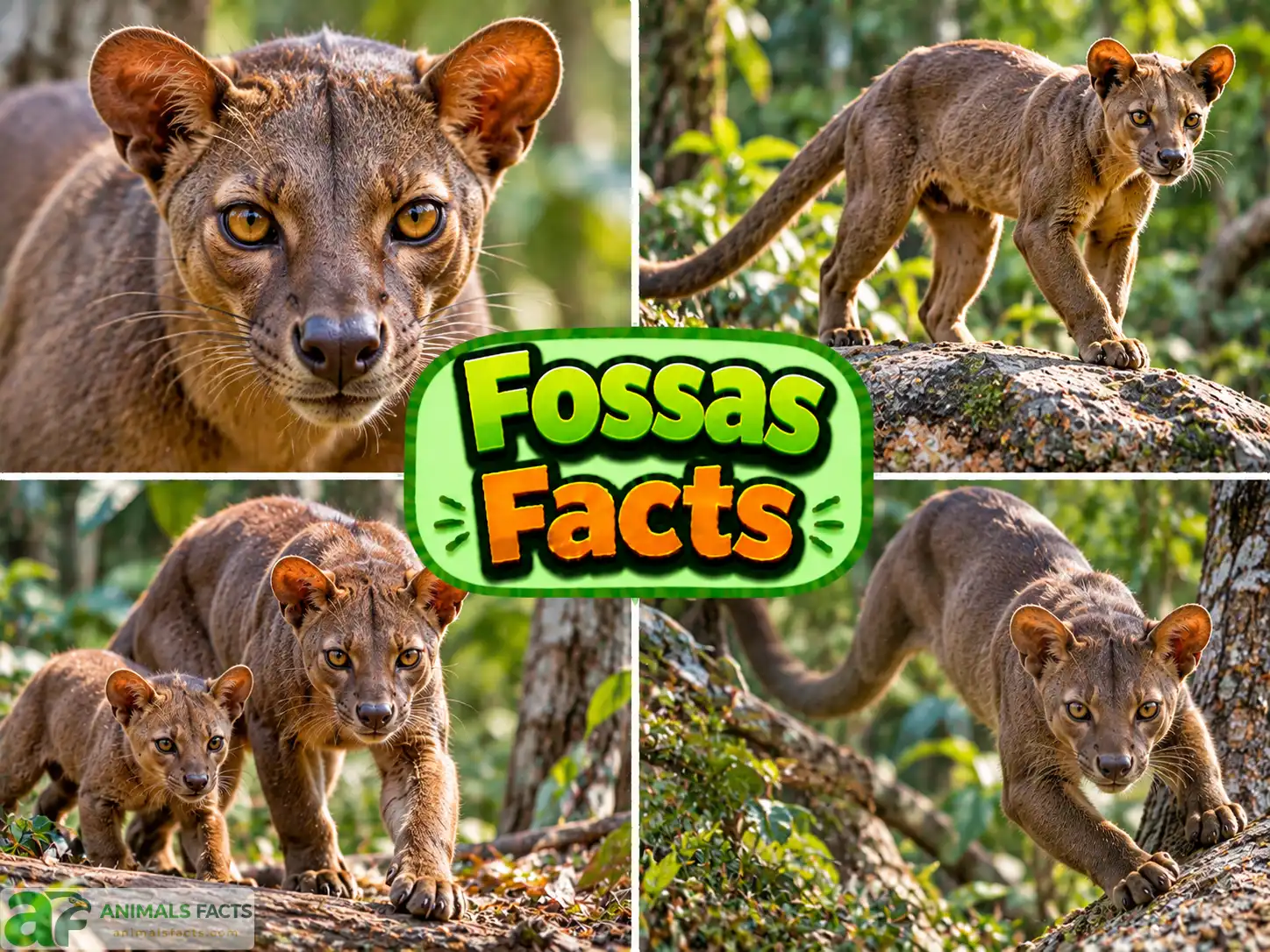
11. Fossa Facts for Kids
Hey amazing young wildlife scientists and nature explorers! Here are some completely mind-blowing fossa facts for kids that will make every wildlife fan you know say “Wow, I had no idea!”:
- 🐾 The fossa looks like a cat but is NOT a cat! Scientists spent over 150 years arguing about what kind of animal the fossa was — classifying it as a cat, then a civet, then a mongoose — before DNA testing in the 2000s finally revealed the truth. The fossa is actually a relative of mongooses that EVOLVED to look like a cat because being cat-shaped is a great design for a forest predator. Evolution invented the “cat shape” at least twice — in actual cats, and in the fossa!
- 🐾 It can run DOWN a tree HEAD-FIRST — like a squirrel! Most climbing animals have to back down trees because their claws only point the right way for going up. But the fossa can rotate its back ankles completely around — so its feet face backward when going down — allowing it to run head-first down a vertical tree at speed. This makes it able to chase lemurs down a tree trunk and catch them before they reach the ground!
- 🐾 Female fossas develop male-looking body parts when they are young! For their first year or two of life, young female fossas develop features that make them look like males. Scientists think this might protect them from aggressive adult males during this vulnerable time. This is one of the strangest development quirks of any carnivore on Earth — and it goes away on its own as the female grows up!
- 🐾 Fossas mate in SPECIAL TREES they come back to every year! When it is time to mate, female fossas choose specific large trees and stay there while multiple males compete to mate with them. The same female often comes back to the same tree the next year — and even if she doesn’t, another female might use the same tree! These “mating trees” are unique in the entire animal kingdom for carnivorans.
- 🐾 It is the TOP PREDATOR in all of Madagascar! Madagascar is the world’s fourth largest island and the fossa is at the top of every food chain on it. There is no animal in Madagascar that hunts an adult fossa — it is the leopard, lion, and wolf of Madagascar all rolled into one animal. And its closest competitor for that role — the GIANT fossa — went extinct about 2,000 years ago!
- 🐾 There are fewer than 2,500 fossas left in the wild! Even though the fossa is the top predator of an entire island, there are incredibly few of them left. The destruction of Madagascar’s forests has pushed this amazing animal to become Vulnerable — on the path to becoming endangered. Helping protect Madagascar’s forests directly helps fossas!
- 🐾 Fossas were completely MISIDENTIFIED by science for 150 years! When European scientists first studied the fossa in the 1800s, they could not figure out what it was. Its teeth looked like a mongoose, its claws looked like a cat, its body shape looked like a civet. It took DNA technology in the 2000s to finally prove what the fossa really is — a completely unique animal from Madagascar’s own special group of carnivores!
- 🐾 The fossa can eat animals TEN TIMES its own weight! Well, not quite — but fossas regularly catch and eat sifakas and ruffed lemurs that weigh up to 8 kg, while the fossa itself may weigh only 6 or 7 kg. That is like a medium-sized dog catching and eating an animal almost as big as itself!
12. Relationship with Humans
The relationship between fossas and humans in Madagascar is shaped by three intersecting dynamics — ancient Malagasy cultural traditions, the economic pressures that drive poultry predation conflict, and the modern conservation crisis driven by deforestation.
Traditional Malagasy Relationships — Fady and Cultural Beliefs
The fossa’s position in Malagasy cultural traditions is complex and varies significantly across the island’s approximately 18 ethnic groups:
Protective fady in some regions — In parts of Madagascar, the fossa is protected by cultural fady (taboos) — traditions prohibiting its hunting or killing. These protective traditions likely reflect the fossa’s recognized role as a powerful forest animal deserving respect, and may also reflect the practical observation that the fossa controls lemur and rodent populations that would otherwise damage crops.
Persecution in other regions — In areas where the fossa is not protected by fady, and particularly in areas where it regularly predates on domestic poultry, it is actively persecuted — killed on sight as a threat to livestock.
Fear and superstition — The fossa’s combination of unusual appearance, nocturnal habits, and powerful predatory behavior has generated various supernatural associations in some Malagasy traditions — making it a feared forest spirit in some cultural frameworks.
The Madagascar film effect — The portrayal of fossas as fierce, organized predators in the DreamWorks Madagascar film franchise (see Pop Culture section) has generated some international awareness of the species — but the fictional portrayal is biologically inaccurate in multiple respects that conservation educators must address.
Human-Fossa Conflict — The Poultry Predation Problem
The most significant direct human-fossa conflict involves predation on domestic poultry — chickens and ducks kept by rural Malagasy communities:
The driver — As Madagascar’s forests have been fragmented and deforestation has pushed the boundary between forest and agricultural land closer to remaining fossa populations, fossas regularly encounter domestic poultry that is often inadequately secured for the night.
The scale — A single fossa that discovers an accessible poultry operation may kill multiple birds in a single night — the fossa’s surplus killing behavior (common in many carnivores encountering defenseless prey) meaning that damage to a single household can be significant.
The community response — Retaliatory killing of fossas following poultry predation events is one of the most significant direct mortality drivers for the species — particularly because the fossas most likely to encounter poultry are those living in degraded habitat at the forest margin, already representing vulnerable populations in suboptimal habitat.
Conflict mitigation approaches — Conservation programs working on fossa-human conflict have focused on:
- Predator-proof poultry housing — simple, cost-effective improvements to poultry enclosure security that significantly reduce fossa access
- Community education — building understanding of the fossa’s ecological importance and the indirect benefits it provides through lemur population regulation
- Compensation programs — in some areas, providing small financial compensation for verified fossa predation events to reduce the economic incentive for retaliatory killing
Research Relationships
The fossa has been the subject of systematic research only since approximately the 1990s — far later than comparable apex predators on other continents:
Kirindy Forest long-term study — The long-term research program at Kirindy Forest in western Madagascar — involving radio-telemetry, GPS tracking, and behavioral observation of habituated individuals — has produced most of the quantitative ecological data currently available on the species.
Camera trap distribution surveys — Camera trap programs across Madagascar are progressively improving understanding of fossa distribution and relative abundance across different habitat types.
Research gaps — Despite progress, significant knowledge gaps remain — particularly regarding:
- Reproductive success rates and juvenile survival
- Population connectivity between forest fragments
- Detailed dietary ecology across different habitat types
- Long-term population trends
13. Fossa Conservation Status & Threats
Conservation Status Overview
| Feature | Details |
|---|---|
| IUCN Status | Vulnerable (VU) |
| Population Trend | Decreasing |
| Estimated Wild Population | Fewer than 2,500 mature individuals |
| CITES Listing | Appendix II |
| National Protection | Protected under Malagasy wildlife law |
Major Threats
| Threat | Description | Impact Level |
|---|---|---|
| Deforestation | Primary driver — eliminates both fossa habitat and prey base | Critical |
| Prey depletion | Bushmeat hunting eliminates lemur prey even in intact forest | High |
| Retaliatory killing | Killing following poultry predation events | High |
| Habitat fragmentation | Isolates populations; prevents gene flow; restricts home ranges | High |
| Direct persecution | Hunting for bushmeat and traditional use | Medium-High |
| Road kills | Expanding road network in forest areas | Medium |
| Introduced predators | Feral dog disease transmission and direct conflict | Medium |
| Political instability | Undermines conservation law enforcement | High |
| Climate change | Altering forest composition; increasing drought stress | Increasing concern |
The Small Population Vulnerability
With fewer than 2,500 mature individuals across Madagascar, the fossa faces the vulnerability inherent in small carnivore populations:
Stochastic threats — Small populations are vulnerable to random events — disease outbreaks, localized habitat destruction, or bad reproductive years can have disproportionate effects on a species with so few individuals.
Genetic diversity — Small, fragmented populations lose genetic diversity through drift and inbreeding — potentially reducing disease resistance and reproductive fitness over time.
Prey base dependency — The fossa’s dependence on lemur prey means that any factor threatening lemur populations (hunting, habitat loss) directly threatens the fossa’s food security — the apex predator’s fate is tied to its prey’s.
Island endemism risk — As a Madagascar endemic, the fossa has no global backup population — its extinction would be complete and final, with no remaining populations anywhere in the world.
Conservation Responses
Protected area network — Fossas are present in multiple Malagasy national parks and special reserves — including Kirindy-Mitea National Park, Ranomafana National Park, Masoala National Park, Ankarana Special Reserve, and others. Protected area management is the primary conservation framework.
Research programs — Long-term ecological research at Kirindy and other sites provides the scientific foundation for evidence-based conservation planning.
Community programs — Predator-proof poultry housing programs and community education initiatives in forest-adjacent villages reduce human-fossa conflict.
Captive breeding — A small number of zoos maintain fossas in captivity — contributing to genetic banking and public education. The species is challenging to breed in captivity; successful breeding programs are maintained at San Diego Zoo, Cologne Zoo (Germany), and a small number of other facilities.
14. Famous Fossas in History & Pop Culture
Famous Individual Fossas
Kirindy Research Individuals — Multiple individually identified fossas at the Kirindy Forest research site in western Madagascar — tracked over multiple years and identified through unique physical markings and GPS collar data — represent the most extensively studied individual fossas in history. These individuals, including several females monitored across multiple reproductive cycles and several males whose home ranges were mapped in detail, have contributed the primary quantitative behavioral ecology data available for the species.
“Fosa” (fictional, DreamWorks Madagascar) — The unnamed fossas in DreamWorks’ Madagascar franchise represent the most culturally visible fictional portrayal of the species — introduced to global audiences as the primary antagonists of the lemur characters. The portrayal (pack-hunting, highly coordinated predators resembling cats) is biologically inaccurate in multiple respects but has substantially increased global public awareness that the fossa exists.
First Described Specimen (1833) — The specimen formally described by Edward Turner Bennett in 1833 — establishing Cryptoprocta ferox as the scientific name — represents the founding record of Western scientific documentation of the species. The original description noted the species’ unusual combination of features and specifically flagged the taxonomic uncertainty that would take another 170 years to resolve.
Roland Albignac’s study animals (1969–1970) — The individual fossas observed and described by French biologist Roland Albignac during the first systematic field behavioral study of the species in 1969–1970 represent the historical foundation of fossa behavioral ecology — Albignac’s observations providing the foundational behavioral descriptions that subsequent research has built upon.
Scientific Historical Significance
The fossa’s taxonomic odyssey — classified and reclassified across multiple carnivore families over 170 years before molecular genetics resolved the question — represents one of the most instructive case studies in the history of zoological taxonomy. The case is regularly cited in discussions of convergent evolution and the limitations of morphological taxonomy — the fossa providing definitive proof that superficial appearance can be a deeply misleading guide to evolutionary relationships.
15. Role in Ecosystem & Food Chain
The Apex Predator Ecosystem Function
The fossa plays the most ecologically significant role of any native mammalian carnivore in Madagascar — functioning as the ecological regulator of the island’s most important wildlife guild (the lemurs) and the top-down controller of Madagascar’s forest food web:
Lemur population regulation — The fossa’s predation maintains lemur population density below the level that would be reached in the absence of predation. Without the fossa, lemur populations would increase until limited by food availability — potentially overconsumimg the fruit and leaf resources that the forest ecosystem depends on. The fossa thus indirectly maintains forest plant community composition through its regulation of the herbivore guild.
The trophic cascade — Fossa predation creates a trophic cascade — changes in lemur behavior and density driven by fossa predation pressure cascade through the plant community (affecting seed dispersal, leaf consumption, and flower visitation) and through the invertebrate community (affected by lemur foraging on insects and invertebrates).
Behavioral ecology effects — The fossa’s predation pressure has shaped lemur anti-predator behavior over millions of years — driving the evolution of alarm call systems, group vigilance behavior, sleeping site selection, and locomotor patterns that are adaptations specifically to fossa predation risk. The removal of the fossa from an ecosystem would trigger behavioral changes in lemur populations that would cascade through the forest ecosystem in ways that are difficult to predict but likely significant.
The mesopredator release effect — Without the fossa, smaller predators (including introduced cats and dogs) would face reduced competition and intraguild predation — potentially increasing their impact on small lemurs, ground birds, and other prey. The fossa’s presence suppresses these smaller predators — a mesopredator regulation effect that maintains the ecological balance of the carnivore guild.
The Scavenger Support Role
Fossa kills provide carcasses that support the scavenger community of Madagascar’s forests — various bird species, invertebrates, and smaller carnivores exploit fossa kills as a food resource. The removal of the fossa would reduce this carcass subsidy to scavenger communities.
Seed Dispersal Effects
By regulating lemur populations and behavior, the fossa indirectly affects seed dispersal — lemurs are among Madagascar’s most important seed dispersers, and changes in lemur behavior driven by predation risk (including altered movement patterns and habitat use) affect the patterns of seed deposition that shape forest regeneration.
16. Myths, Folklore & Cultural Significance
Malagasy Cultural Traditions
The fossa’s cultural significance across Madagascar’s diverse ethnic traditions is complex and regionally variable:
The powerful forest spirit — In multiple Malagasy cultural frameworks, the fossa is recognized as one of the most powerful spirits (fanahy) of the forest — an animal that embodies the dangerous, unpredictable power of the natural world. This recognition of the fossa’s power creates mixed cultural responses — awe and respect in some communities, fear and active persecution in others.
Protective fady — In some regions of Madagascar, particularly in areas with strong traditional forest management practices, the fossa is protected by fady — hunting or killing the fossa is prohibited as an act of disrespect toward the forest spirits it embodies. These protective traditions provide locally meaningful conservation benefit where they remain active.
The trickster fossa — In some Malagasy oral traditions, the fossa appears as a clever, powerful trickster — an animal whose intelligence and predatory skill are recognized and treated with respectful fear rather than simple hostility.
The chicken thief — The most practically significant Malagasy relationship with the fossa in many agricultural communities is purely economic — the fossa as a poultry thief that causes genuine economic hardship. This economic relationship generates the most practically important conservation challenge — converting a negative economic relationship into tolerance requires addressing the real economic costs that some communities bear.
The Name — Etymology and Meaning
The Malagasy word “fosa” (the local spelling) is the direct origin of the English and French scientific common name “fossa.” The word appears in Malagasy oral traditions predating European contact — confirming an ancient human awareness of and relationship with this animal. The alternative spelling “fossa” reflects the Italian/Latin phonetic convention adopted in the European scientific literature.
17. Fossas in Pop Culture
Madagascar (DreamWorks Animation, 2005) and sequels — The most culturally significant fictional treatment of the fossa; in the film and subsequent franchise, fossas appear as the primary antagonists — portrayed as coordinated pack hunters with somewhat cat-like appearance pursuing the main lemur characters. The portrayal has multiple biological inaccuracies:
- Fossas are not pack hunters — they are solitary predators
- The film fossas are portrayed as entirely terrestrial when real fossas are highly arboreal
- The aesthetic design more closely resembles a large mongoose or hyena than an actual fossa
Despite these inaccuracies, the Madagascar franchise introduced the fossa to a global audience of hundreds of millions — substantially increasing public awareness that the animal exists. Many conservation educators use the “Madagascar movie fossa vs. real fossa” comparison as an engaging entry point for accurate fossa biology education.
David Attenborough BBC “Madagascar” (2011) — The BBC’s landmark Madagascar documentary series includes accurate, exceptional fossa behavioral footage — including arboreal hunting sequences and mating behavior documentation. This documentary provides the most accurate and most visually impressive public treatment of real fossa behavior available.
San Diego Zoo and Cologne Zoo educational programs — Zoos maintaining fossas use the species as an educational ambassador for Madagascar’s unique evolutionary biology — the fossa’s extraordinary taxonomic history, convergent evolution, and conservation status making it an exceptionally teachable species.
Wildlife photography and camera trap releases — Increasingly, research camera trap footage and professional wildlife photography of fossas at Kirindy and other sites circulates through wildlife media channels — providing growing public exposure to the real animal beyond the fictional portrayal.
18. Fossa Facts vs. Common Myths
| Common Myth | The Real Fact |
|---|---|
| “The fossa is a type of cat” | False — molecular genetics confirms it belongs to Eupleridae, descended from a mongoose-like ancestor; cat-like features are products of convergent evolution |
| “Fossas hunt in packs like in the Madagascar movie” | False — fossas are solitary hunters; they do not coordinate hunts or form social hunting groups |
| “The fossa is the most dangerous animal in Madagascar” | Contextually misleading — the fossa is the apex predator but poses no significant danger to humans; it avoids human contact and there are no documented cases of fossa attacks on people |
| “Fossas only live in Madagascar’s rainforest” | False — fossas inhabit multiple forest types including dry deciduous forest, montane forest, and forest margins; the Kirindy dry forest population is among the best-studied in the world |
| “There are plenty of fossas — they are the top predator” | False — fewer than 2,500 mature individuals exist; being an apex predator does not mean being abundant; apex predators typically exist at low densities across large ranges |
| “The fossa is basically just a large mongoose” | Oversimplification — while descended from a mongoose-like ancestor, the fossa has evolved so dramatically from that ancestor (evolving cat-like features, arboreal capability, and apex predator ecology) that “large mongoose” is deeply misleading |
| “Fossas and lemurs have always existed in tense relationship” | True but incomplete — the predator-prey relationship is real and ancient; but the now-extinct giant fossa was the primary apex predator, and the living fossa fills a somewhat diminished version of that ecological role |
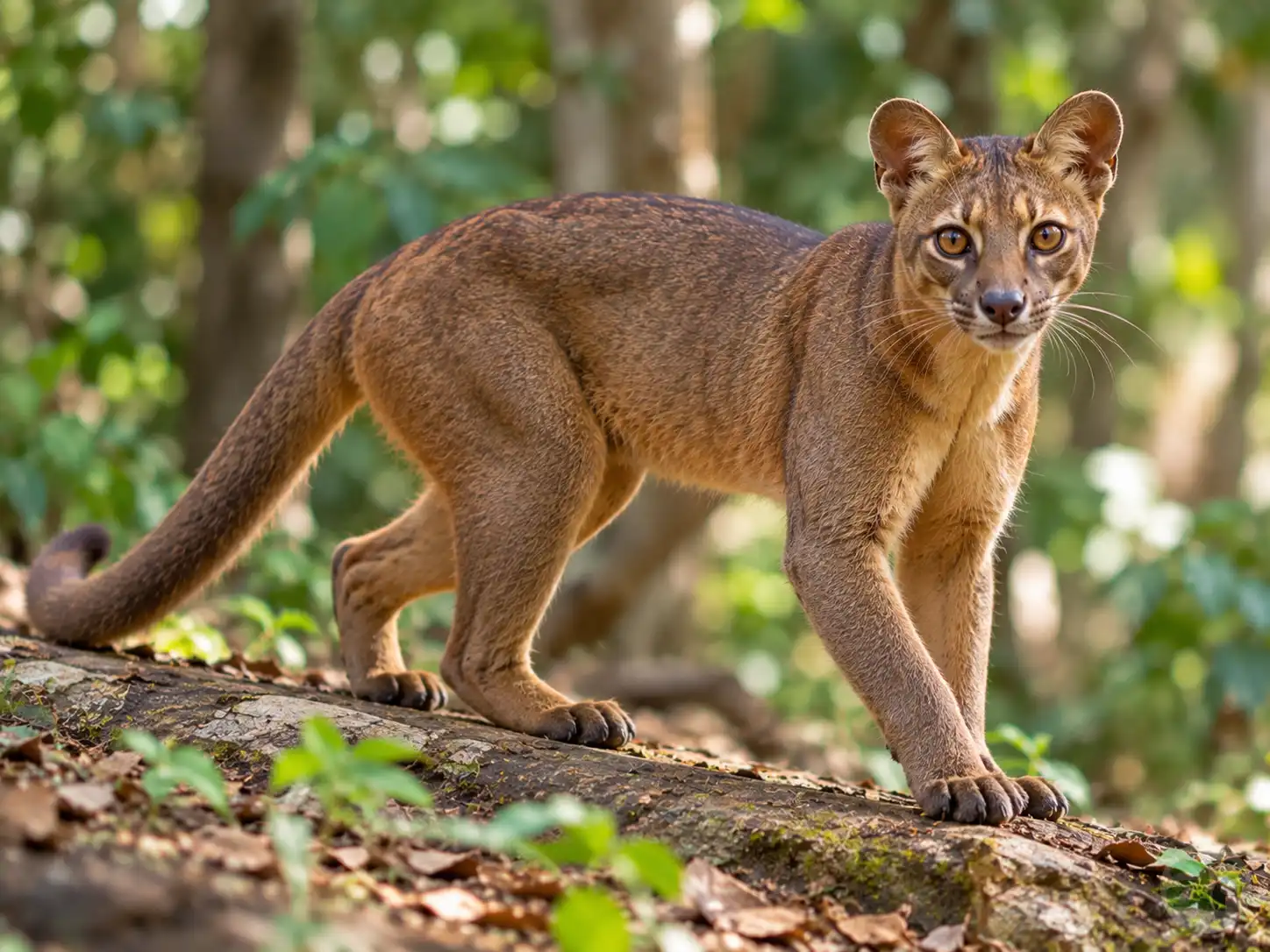
19. Best Places to See Fossas in the Wild
1. Kirindy Forest (CNFEREF), Western Madagascar — The single most reliable location in the world for wild fossa observation. The long-term research program at Kirindy has produced a population of habituated fossas that are accustomed to human presence and regularly visible during both day and night spotlight walks. The site offers the closest thing to a guaranteed fossa encounter available anywhere — experienced guides know individual animals and their territories. Kirindy is accessible from Morondava in western Madagascar.
2. Ranomafana National Park, Southern Highlands — Eastern Madagascar’s premier wildlife park; fossas are present and occasionally observed during nocturnal walks. The park’s excellent guide infrastructure and established trail network make fossa encounters possible, though less reliable than Kirindy. The park’s extraordinary broader biodiversity makes it a premier Madagascar wildlife destination regardless of fossa sightings.
3. Ankarana Special Reserve, Northern Madagascar — The dramatic limestone karst landscape of Ankarana supports fossas in its dry forest habitats; nocturnal spotlight walks occasionally produce sightings. The reserve’s accessibility from Diego Suarez (Antsiranana) makes it one of northern Madagascar’s most visited wildlife areas.
4. Masoala National Park, Northeastern Madagascar — Madagascar’s largest protected area; fossa presence is confirmed but sightings are less reliable than Kirindy due to the denser forest cover and less habituated population. The park’s extraordinary biodiversity and spectacular coastal forest make it one of Madagascar’s premier wildlife destinations.
5. Montagne d’Ambre National Park, Northern Madagascar — Montane forest near Madagascar’s northern tip; fossas are present in the forest; nocturnal walks occasionally produce sightings.
6. San Diego Zoo / Cologne Zoo — For visitors outside Madagascar, San Diego Zoo and Cologne Zoo (Germany) maintain the most significant captive fossa populations available for public viewing outside Madagascar — providing close-range observation of this extraordinary species in well-managed naturalistic enclosures.
7. The Honest Assessment — Wild fossa sightings, even at Kirindy, require patience and good guides. The most productive approach is dedicating multiple evenings to spotlight walks with experienced local guides who know individual fossa territories. Kirindy provides the best probability anywhere in the world. A sighting when it occurs is typically one of the most extraordinary wildlife encounters available in Madagascar — an animal of such unusual morphology and behavioral sophistication that it rewards every hour of waiting.
20. How You Can Help
Supporting fossa conservation requires action primarily focused on Madagascar forest protection, human-wildlife conflict reduction, and research funding.
Support these organizations:
- Wildlife Conservation Society Madagascar — wcs.org — operates conservation programs across Madagascar including fossa research and community programs
- Durrell Wildlife Conservation Trust — durrell.org — long-term Madagascar conservation programs including carnivore work
- Rainforest Trust — rainforesttrust.org — funds protection of Madagascar forest directly benefiting fossa habitat
- Lemur Conservation Network — lemurconservationnetwork.org — lemur conservation directly benefits fossas by maintaining prey base
- Madagascar Fauna and Flora Group — madagascarfaunaflora.org — Madagascar-specific conservation
- CNFEREF (Centre National de Formation, d’Etudes et de Recherche en Environnement et Foresterie) — manages the Kirindy Forest site where most fossa research is conducted
Critical individual actions:
- Support Madagascar forest protection — the fossa’s fate is directly tied to Madagascar’s forests; any action supporting forest conservation benefits fossas
- Support predator-proof poultry housing programs — these programs directly reduce the human-fossa conflict that drives retaliatory killing; organizations working on Madagascar rural development often include these programs
- Visit Madagascar responsibly — wildlife tourism in areas where fossas occur generates revenue for conservation; choosing operators who support conservation programs makes tourism beneficial
- Support captive breeding programs — zoos maintaining fossas contribute to genetic banking and public education; supporting these institutions contributes to species conservation
21. Top Documentaries & Books
Must-Watch Documentaries
- “Madagascar” (BBC, 2011, David Attenborough) — The definitive wildlife documentary on Madagascar including exceptional fossa behavioral footage
- “Life of Mammals — Carnivores” (BBC, David Attenborough, 2002) — Covers carnivore diversity including fossa content in the context of carnivore evolution
- “Our Planet — Jungles” (Netflix, 2019) — Includes Madagascar coverage relevant to fossa habitat context
- “Madagascar: Island of Marvels” (National Geographic) — Dedicated Madagascar wildlife documentary with fossa content
- Kirindy Forest research footage — Various research institutions have released documentary footage from Kirindy field research programs; best source for authentic fossa behavioral footage outside major production documentaries
Must-Read Books
- Wild Cats of the World by Luke Hunter — Despite the title, includes essential context on convergent evolution and the fossa’s relationship to cat morphology
- Mammals of Madagascar by Nick Garbutt — The definitive field guide including comprehensive fossa species account
- A Field Guide to the Mammals of Madagascar — Practical field reference for Madagascar wildlife including fossas
- Yoder, A.D. et al. published research — The landmark molecular genetics papers confirming fossa placement in Eupleridae; foundational for understanding fossa evolutionary biology
- The Natural History of Madagascar edited by Steven Goodman and Jonathan Benstead — The most comprehensive scientific reference for Madagascar’s natural history including carnivore ecology
22. Comparison with Similar Apex Predator Species
| Feature | Fossa | Leopard | Puma | Binturong | African Civet |
|---|---|---|---|---|---|
| Scientific name | Cryptoprocta ferox | Panthera pardus | Puma concolor | Arctictis binturong | Civettictis civetta |
| Family | Eupleridae | Felidae | Felidae | Viverridae | Viverridae |
| Weight | 5.5–8.6 kg | 29–90 kg | 35–65 kg | 9–20 kg | 7–20 kg |
| Claw type | Semi-retractile | Retractile | Retractile | Semi-retractile | Non-retractile |
| Arboreal capability | Excellent — head-first descent | Good — tail-first descent | Moderate | Excellent | Moderate |
| Primary prey | Lemurs | Ungulates, primates | Deer, other mammals | Fruit, small animals | Rodents, birds |
| Social structure | Solitary | Solitary | Solitary | Solitary | Solitary |
| Mating system | Arboreal mating trees; promiscuous | Temporary pair | Temporary pair | Pair bond | Temporary pair |
| Conservation | Vulnerable | Vulnerable | Least Concern | Vulnerable | Least Concern |
| Evolutionary origin | Mongoose-like ancestor | Felid ancestor | Felid ancestor | Viverrid ancestor | Viverrid ancestor |
| Range | Madagascar only | Africa, Asia | Americas | SE Asia | Sub-Saharan Africa |
23. Frequently Asked Questions About Fossas
Q1. What is the scientific name of the fossa?
The fossa’s scientific name is Cryptoprocta ferox (Bennett, 1833). The genus name Cryptoprocta derives from the Greek kryptos (hidden) and prōktos (anus) — referring to the partially concealed anal gland structure that was one of the anatomical features noted in the original scientific description. The species name ferox is Latin for “fierce” or “ferocious” — reflecting the species’ reputation as a powerful predator. The species belongs to the family Eupleridae — Madagascar’s endemic carnivore family — within the order Carnivora. It was formally described by British zoologist Edward Turner Bennett in 1833 based on specimens obtained from Madagascar.
Q2. Is the fossa a cat?
No — despite its strikingly cat-like appearance and behavior, the fossa is not a cat. This is one of the most important and most instructive facts in fossa biology. Molecular genetic analysis in the 1990s–2000s definitively confirmed that the fossa belongs to the family Eupleridae — Madagascar’s endemic carnivore family — descended from a mongoose-like ancestor that colonized Madagascar approximately 20–26 million years ago. The fossa’s cat-like features — including its elongated body, semi-retractile claws, cat-like hunting behavior, purring and meowing vocalizations, and overall body proportions — are products of convergent evolution rather than shared ancestry with cats. This means that the cat body plan is such an optimal design for a forest apex predator that evolution independently arrived at it in both the cat lineage and the Malagasy euplerids.
Q3. How does the fossa hunt?
The fossa hunts using a combination of terrestrial and arboreal strategies — making it one of the most three-dimensionally versatile hunters of any comparable-sized carnivore. On the ground, it uses stalking and pursuit — approaching prey with the low-slung, fluid movement typical of felid predators, then launching a rapid sprint or pounce. In the trees, it uses its exceptional climbing capability — the rotating ankles allowing head-first descent, the semi-retractile claws providing secure grip on bark, and the long balancing tail maintaining stability during leaps between trees. The fossa can pursue lemurs through the forest canopy with a speed and agility that matches many of its arboreal prey. It also uses ambush strategies — remaining motionless near known lemur sleeping sites or travel routes and striking when prey passes within range. Its cathemeral activity (hunting both day and night) allows it to target the full range of lemur species regardless of their activity patterns.
Q4. What does the fossa eat?
The fossa is a generalist carnivore whose diet is dominated by lemurs — which constitute approximately 50–60% of prey items across most studies. Lemurs of multiple species and sizes are taken — from mouse lemurs weighing 30–100 grams to sifakas and ruffed lemurs weighing 3–8 kg. The remaining diet includes tenrecs (10–15%), rodents (8–12%), birds (5–8%), lizards (5–8%), snakes (3–5%), chameleons (2–4%), and in areas near human settlements, domestic poultry (5–10%). The fossa’s dietary flexibility — spanning prey from tiny mouse lemurs to lemurs approaching its own body weight — reflects its versatility as both an arboreal and terrestrial predator.
Q5. Why is the fossa endangered?
The fossa is classified as Vulnerable (one step below Endangered) with a declining population primarily because of Madagascar’s catastrophic deforestation — the island has lost approximately 90% of its original forest cover, eliminating the habitat that fossas require. The fossa cannot persist in agricultural or open land — it needs intact forest for hunting, territory maintenance, and reproduction. Additional threats include prey depletion (bushmeat hunting of lemurs removes the fossa’s primary food source even in forests that remain physically intact), retaliatory killing following poultry predation events, and direct persecution in some areas. With fewer than 2,500 mature individuals remaining across Madagascar, the fossa is one of the rarest apex carnivores in the world — and its small population makes it particularly vulnerable to stochastic threats and genetic erosion from fragmented populations.
Q6. Can fossas be seen in zoos?
Yes — a small number of accredited zoos maintain fossas in captivity. San Diego Zoo and Cologne Zoo in Germany are among the most notable facilities maintaining the species. Fossa captive breeding is challenging — the species has specific behavioral and dietary requirements, and breeding success rates in captivity are lower than for many other carnivore species. Zoos that successfully maintain fossas typically provide significant naturalistic enclosure space and carefully managed dietary variety. Captive fossa populations contribute to genetic banking, public education about Madagascar’s unique wildlife, and occasionally to research on fossa physiology and behavior. The species has not been considered for reintroduction programs to date, as the primary conservation need is protecting existing wild habitat rather than restoring extinct populations.
24. Sources & References
- Wikipedia — Cryptoprocta ferox, Eupleridae, Feliformia, Madagascar carnivores
- IUCN Red List — iucnredlist.org (current assessment for Cryptoprocta ferox)
- Wildlife Conservation Society Madagascar — wcs.org
- Durrell Wildlife Conservation Trust — durrell.org
- National Geographic — nationalgeographic.com
- Smithsonian National Museum of Natural History — naturalhistory.si.edu
- BBC Wildlife / BBC Earth — bbcearth.com
- Britannica — britannica.com/animal/fossa-mammal
- Live Science — livescience.com
- Yoder, A.D. et al. (2003). “Single origin of Malagasy Carnivora from an African ancestor.” Nature — the landmark molecular genetics paper confirming Eupleridae
- Hawkins, C.E. — multiple published papers on fossa behavioral ecology; Kirindy research program
- Deppe, A.M. and colleagues — published research on fossa mating system and home range
- Garbutt, N. (2007). Mammals of Madagascar. Christopher Helm Publishers