

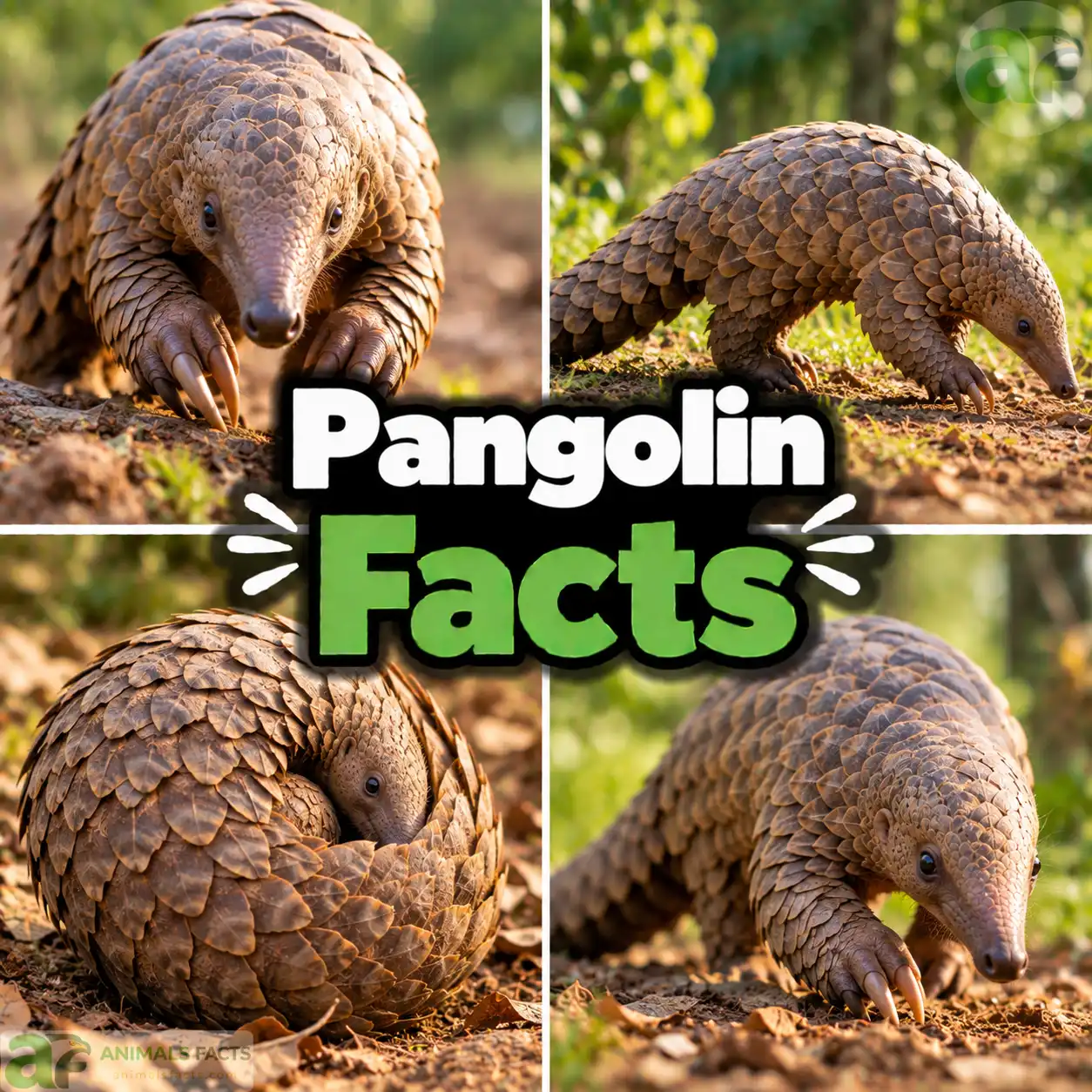
Pangolin Facts
| Feature | Details |
|---|---|
| Scientific Name | Order Pholidota; family Manidae; 8 living species |
| Kingdom | Animalia |
| Phylum | Chordata |
| Class | Mammalia |
| Order | Pholidota (Weber, 1904) |
| Family | Manidae (Gray, 1821) |
| Common Names | Pangolin, scaly anteater, armored anteater |
| Native Range | Sub-Saharan Africa (4 species); South and Southeast Asia (4 species) |
| Habitat | Tropical and subtropical forest, savanna, grassland, dry woodland |
| Lifespan | Largely unknown — estimated 12–20 years in wild; rarely survive captivity |
| Diet | Ants and termites — exclusively |
| Body Length | 30–100 cm body plus 26–88 cm tail (varies by species) |
| Weight | 1.6–33 kg depending on species |
| Top Speed | 5 km/h walking; 25 km/h sprinting bipedally |
| Conservation Status | All 8 species threatened — Critically Endangered to Vulnerable |
| Defining Feature | Overlapping keratin scales covering body — unique among mammals |
| Most Trafficked | The world’s most illegally trafficked mammal — over 1 million taken since 2000 |
| Closest Relative | Carnivora (dogs, cats, bears) — molecular evidence; not anteaters |
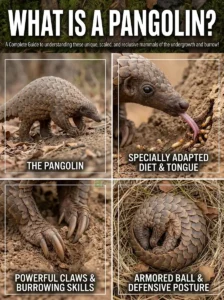 1. Introduction: What is a Pangolin?
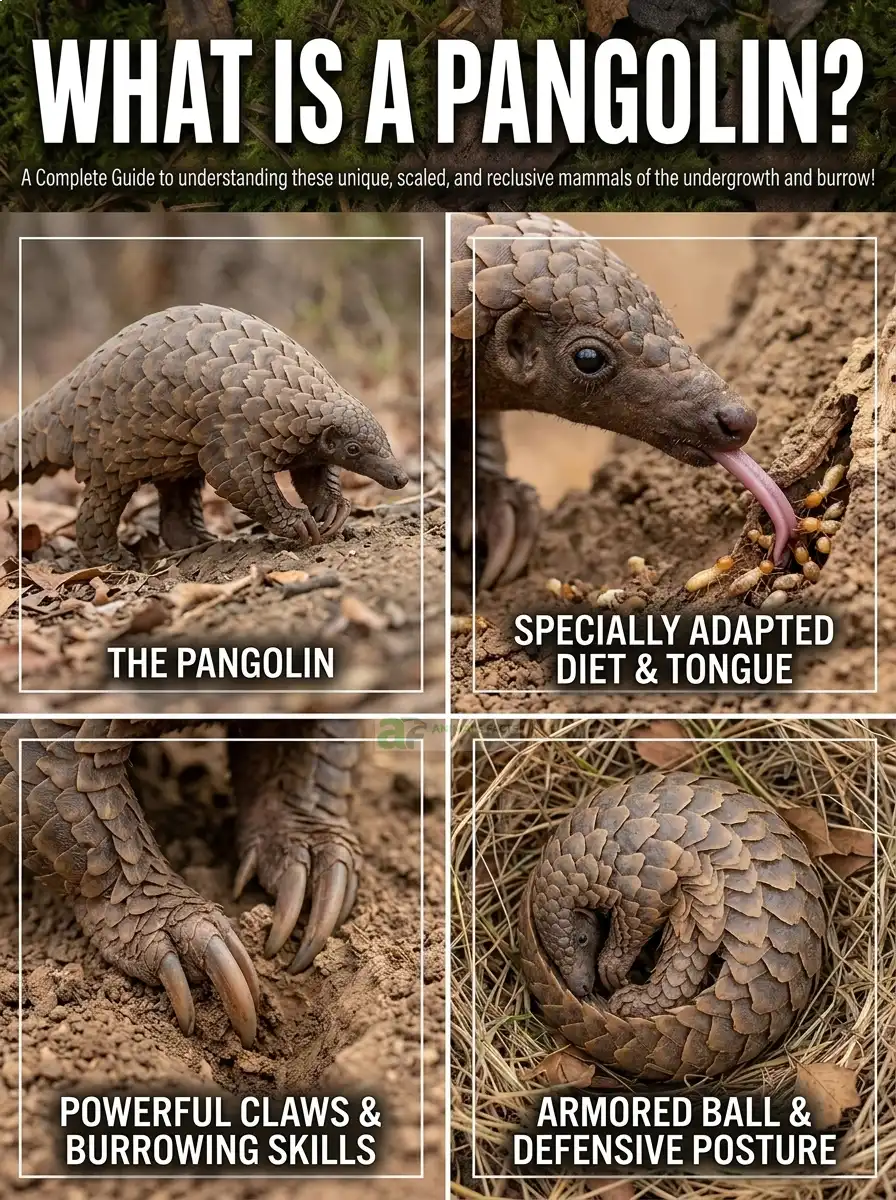
In the darkness of a Central African forest, something extraordinary moves along the forest floor — a creature so ancient in its design, so singular in its appearance, and so elusive in its habits that most people who have spent their entire lives in its range have never seen one. It is roughly the size of a domestic cat, armored from head to tail in overlapping scales of keratin that catch the moonlight with an almost reptilian sheen, and it moves with a waddling purposefulness toward a termite mound that its extraordinary nose located from dozens of meters away. Pangolin facts begin with this single image — and then immediately pivot to a second, devastating image: a shipping container in a Southeast Asian port, confiscated by customs officers, containing thousands of pangolin scales representing the remains of hundreds of animals killed to satisfy a black market demand that is threatening to drive all eight species of pangolin to extinction within decades.
The pangolin is simultaneously one of the world’s most extraordinary and most endangered mammals — and one of the least known. Interesting facts about pangolins reveal an animal of breathtaking biological uniqueness: the only mammal in the world covered in overlapping keratin scales — scales so structurally effective that they defeat the bite of lions and leopards; a tongue longer than its entire body that can probe the deepest recesses of ant and termite colonies with devastating efficiency; a complete absence of teeth replaced by a uniquely modified stomach that grinds insects using swallowed stones; and a defensive rolling behavior so effective that a rolled pangolin is essentially a perfect, living sphere of overlapping scales that no predator has evolved an efficient answer to. All of this biological magnificence is being systematically destroyed by the world’s most extensive illegal wildlife trade — with more than one million pangolins estimated to have been taken from the wild since 2000, making the pangolin the most trafficked mammal on Earth.
Whether you are searching for pangolin facts for kids to spark awareness of the conservation crisis facing these extraordinary animals, a researcher interested in pangolin habitat and ecology, a wildlife enthusiast determined to understand the animal behind the most significant wildlife trafficking story of the 21st century, or simply someone who encountered a photograph of this impossibly ancient-looking scaled mammal and needed to know everything — this is your comprehensive guide. We cover pangolin scientific name, pangolin diet, pangolin size and weight, pangolin behavior, the extraordinary biology of scales and tongue and stomach, the full story of the trafficking crisis, conservation responses, cultural significance, and the ecological roles these irreplaceable animals play. The world’s most trafficked mammal needs every voice of understanding and advocacy it can find.
2. Pangolin Species Overview & Classification
The pangolin order Pholidota contains only 8 living species — four in Africa and four in Asia — all belonging to the single family Manidae. This remarkable taxonomic isolation reflects the pangolin’s extraordinary evolutionary distinctiveness — an entire mammalian order represented by just one family, one genus (with African species sometimes split into additional genera), and eight species.
Species Classification Table
| Taxonomic Rank | Classification |
|---|---|
| Kingdom | Animalia |
| Phylum | Chordata |
| Class | Mammalia |
| Order | Pholidota (Weber, 1904) |
| Family | Manidae (Gray, 1821) |
| Number of Genera | 3 (Manis, Phataginus, Smutsia) — some authorities use only Manis |
| Number of Living Species | 8 species |
| Temporal Range | ~50 million years to present |
| Closest Living Relatives | Order Carnivora (dogs, cats, bears, hyenas) — confirmed by molecular analysis |
The Eight Pangolin Species
African Pangolins:
| Species | Common Name | Weight | IUCN Status | Range |
|---|---|---|---|---|
| Smutsia gigantea | Giant ground pangolin | 25–33 kg | Endangered | Central/West Africa |
| Smutsia temminckii | Ground pangolin (Temminck’s) | 5–18 kg | Vulnerable | East and Southern Africa |
| Phataginus tricuspis | White-bellied (tree) pangolin | 1.6–3.5 kg | Endangered | Central/West Africa |
| Phataginus tetradactyla | Long-tailed (black-bellied) pangolin | 1.5–2.5 kg | Endangered | Central Africa |
Asian Pangolins:
| Species | Common Name | Weight | IUCN Status | Range |
|---|---|---|---|---|
| Manis crassicaudata | Indian pangolin | 10–16 kg | Endangered | Indian subcontinent |
| Manis pentadactyla | Chinese pangolin | 2–7 kg | Critically Endangered | South/Southeast Asia, China |
| Manis javanica | Sunda pangolin | 4–10 kg | Critically Endangered | Southeast Asia |
| Manis culionensis | Philippine pangolin | 2–5 kg | Critically Endangered | Palawan Island, Philippines |
The Surprising Molecular Relationship
One of the most scientifically significant pangolin facts is the discovery through molecular genetics that pangolins are not related to anteaters — despite their similar body form, diet, and behavior. Pangolins’ closest living relatives are the carnivorans — the order containing dogs, cats, bears, hyenas, seals, and their relatives. Pangolins and anteaters represent a classic case of convergent evolution — independently evolving nearly identical solutions to the ecological problem of myrmecophage (ant and termite eating) in completely unrelated lineages on different continents.
Evolution & Discovery Timeline
~80 million years ago — The Pholidota lineage is estimated to have diverged from the Carnivora — the orders separating in the Late Cretaceous period, approximately contemporaneously with the dinosaur extinction.
~50 million years ago — The earliest definitively assigned pangolin fossils appear in Europe and North America — during the Eocene epoch. These early pangolins were broadly similar to modern species, confirming the remarkable evolutionary conservatism of the pangolin body plan.
~10 million years ago — The African and Asian pangolin lineages diverge — as geological and climatic changes separate the Afrotropical and Indomalayan faunal regions.
1758 — Carl Linnaeus formally describes the Indian pangolin as Manis pentadactyla in the 10th edition of Systema Naturae — the first formal Western scientific description of a pangolin species.
1820s — Multiple additional pangolin species are formally described as European natural history expeditions document the fauna of Africa and Asia.
2000 — The first systematic global assessment of pangolin conservation status confirms the growing severity of the trafficking crisis — with Asian species already showing dramatic population declines.
2016 — All eight pangolin species are uplisted on the CITES Appendix I — prohibiting all commercial international trade. The two most endangered Asian species (M. pentadactyla and M. javanica) are simultaneously uplisted to Critically Endangered by the IUCN.
2020 — China removes pangolin scales from the official list of approved Traditional Chinese Medicine ingredients — a significant policy step, though enforcement challenges remain.
2022 — Updated global trafficking analysis confirms that pangolins remain the most trafficked mammal in the world — with seizure records showing a minimum of 895 pangolins trafficked per day based on confirmed law enforcement actions.
2024 — New camera trap records of giant ground pangolins in protected areas of several West African countries provide rare photographic documentation of one of the least known pangolin species — a small conservation positive in an otherwise bleak picture.
“The pangolin is the mammalian equivalent of an evolutionary masterpiece that the world knows almost nothing about — and is systematically destroying before we have the opportunity to understand it. Every pangolin trafficked represents not just an individual animal but the irreplaceable embodiment of 80 million years of evolutionary innovation.”
— Dr. Jane Goodall, primatologist and global conservation advocate, speaking at the first World Pangolin Day in 2012
3. Pangolin Physical Description & Unique Features
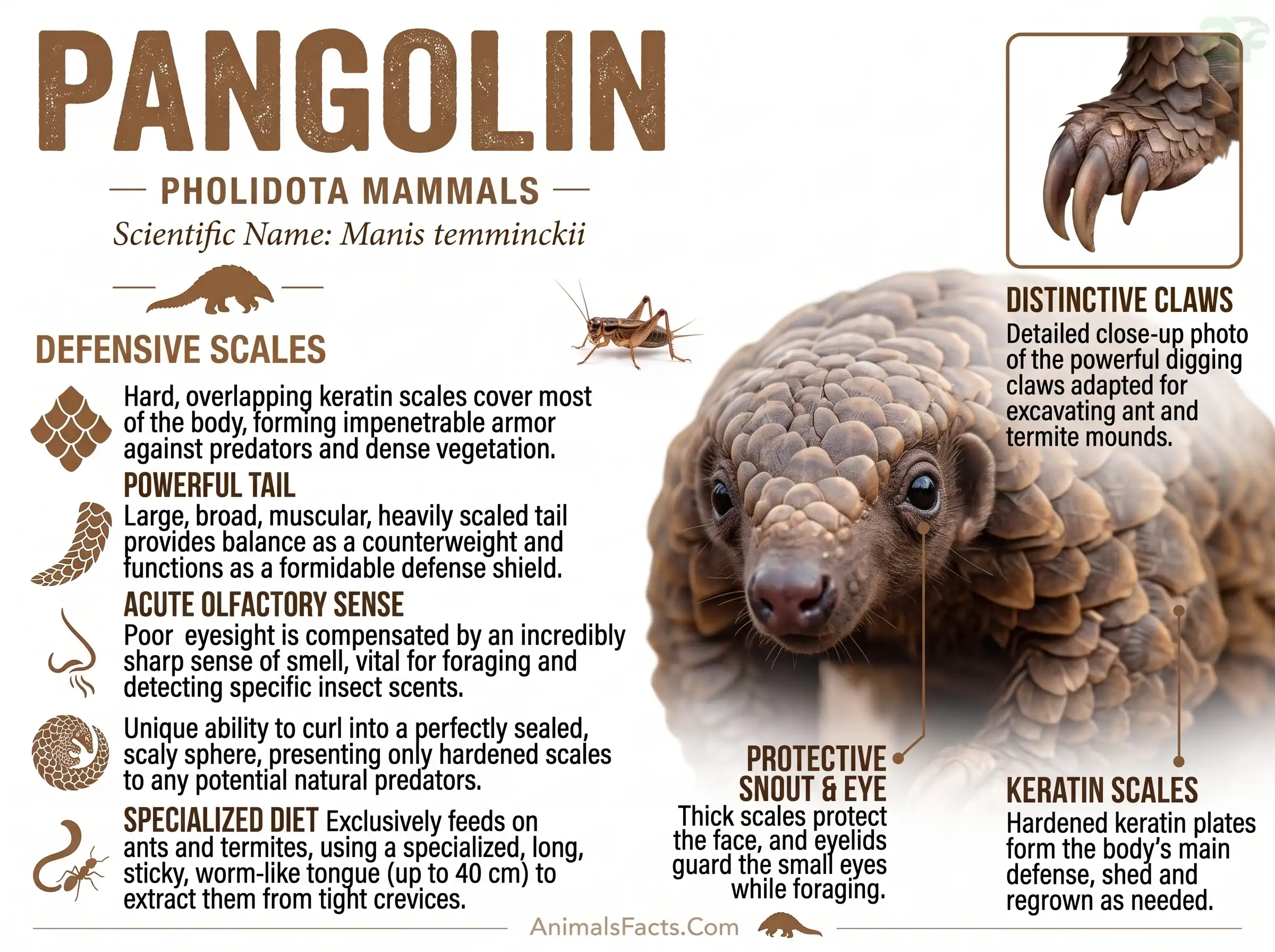
Pangolin size and weight vary enormously across the eight species — from the tiny long-tailed pangolin at 1.5–2.5 kg to the giant ground pangolin at up to 33 kg — but all species share the same immediately recognizable body plan that makes pangolins unlike any other mammal on Earth.
The Scales — The Defining Innovation
The pangolin’s overlapping keratin scales are its most immediately distinctive feature and represent one of the most remarkable evolutionary innovations in mammalian biology:
Composition — Pangolin scales are made of keratin — the same protein as human fingernails, hair, and rhinoceros horn. This is the same material as the scales of reptiles — but pangolin scales evolved completely independently from reptile scales. The keratin is arranged in a specific fibrous architecture that provides remarkable hardness and resilience.
Coverage — Scales cover the dorsal (top) and lateral (side) surfaces of the pangolin’s body — the head, back, flanks, tail, and outer limbs. The underside of the body and the inner surfaces of the limbs are covered in soft skin with sparse hair — the only surfaces exposed when the animal is rolling.
Arrangement — Scales are arranged in overlapping rows — like the tiles on a roof — with each scale’s base attached to the skin and its tip overlapping the scale behind it. This arrangement allows individual scales to move independently — the entire coat of scales can be raised or flattened — while maintaining full coverage of the body at all times.
Number — A single adult pangolin may have 400–500 individual scales — each varying in size from small scales near the face to large, broad scales on the back and tail.
Protective capability — The overlapping arrangement and keratin hardness create a defensive system of extraordinary effectiveness. When a pangolin rolls into a ball, the scales of adjacent rows interlock and the edges overlap — creating a surface that resists the bite of lions and leopards through a combination of hardness, edge sharpness, and the ability to tighten and compress under pressure. No predator that shares the pangolin’s range has evolved an efficient method of forcing a rolled pangolin open.
Sharpness — The edges of pangolin scales are genuinely sharp — capable of causing lacerations to predators that attempt to bite through the rolled ball. The pangolin can also flex its body while rolled, moving the scale edges in a way that increases laceration risk for any animal biting the scales.
The Tongue — Longer Than the Body
The pangolin’s tongue is one of the most extraordinary anatomical structures in the mammalian world — and understanding it requires understanding the unusual anatomy that houses it:
Length — A pangolin’s tongue is typically longer than the combined length of its head and body — in the giant ground pangolin, the tongue can reach 70 cm in length.
Attachment — The tongue’s remarkable length is possible because it does not attach at the throat as in most mammals. Instead, it attaches deep in the chest cavity — connected to the sternum and last pair of ribs or even to the pelvic region in some species — allowing the full length to extend forward through the throat when the tongue is extended.
Tongue anatomy — The pangolin tongue is covered in a viscous, sticky mucus secreted by enlarged salivary glands in the chest. This mucus coats insects as the tongue sweeps through ant and termite colonies — the insects adhering to the mucus-coated surface and being retracted into the mouth.
Extension speed — Pangolins can extend and retract their tongue at extraordinary speed — 0.25 laps per second — making each extension-retraction cycle approximately 0.25 seconds and allowing remarkably rapid feeding even in turbulent insect colonies.
The Stomach — Stone-Grinding Insect Processing
The pangolin’s stomach is one of the most unusual digestive organs in the mammalian world — reflecting the complete absence of teeth in all pangolin species:
No teeth — Pangolins are entirely toothless — the only toothless order of placental mammals. The absence of teeth is compensated by a specially modified stomach.
Stone-grinding chamber — The pangolin deliberately swallows stones — which are retained in a specially thickened, muscular section of the stomach that functions as a grinding gizzard (similar to the gizzard of birds). The stones, combined with the muscular action of the stomach walls, grind the ingested insects into a paste that can be digested without chewing.
Keratin-lined pyloric region — The section of the stomach nearest the intestines is lined with a tough, keratinized layer — providing wear resistance against the grinding action.
Other Distinctive Features
Claws — All four feet have powerful, curved claws — used for tearing apart ant and termite mounds and for tree climbing in arboreal species. The front claws are substantially larger than the rear claws.
Nostrils — Capable of being sealed shut when probing insect colonies — preventing ants and termites from entering the nasal passages during feeding.
Eyelids — Extremely thick, tough eyelids that can close tightly — protecting the eyes from insect bites during foraging.
Ears — The ear openings can also be closed voluntarily — sealed against insect entry during foraging.
💡 Did You Know? Pangolin scales are among the most trafficked wildlife products in the world — seized in quantities measured in tonnes rather than individual pieces. Yet the scales have no proven medical value whatsoever — they are pure keratin, chemically indistinguishable from a compressed human fingernail. The entire pangolin trafficking crisis — the largest illegal wildlife trade of any mammal in history — is driven by demand for a substance that has no scientific evidence of any pharmacological activity beyond what would be achieved by chewing one’s own fingernails. The pangolin extinction crisis is arguably the most medically unfounded conservation disaster in history.
4. Top 25 Amazing Pangolin Facts
Here is your definitive collection of the most extraordinary, scientifically verified, and genuinely astonishing pangolin facts as of 2026:
- Pangolins are the world’s most illegally trafficked mammal — with over one million pangolins estimated to have been taken from the wild since 2000, and seizure data suggesting a minimum of 895 pangolins trafficked per day at the current rate.
- Pangolin scales are made entirely of keratin — the same protein as human fingernails — and have no proven medical value whatsoever. The entire trafficking crisis is driven by demand for a substance chemically equivalent to a fingernail clipping.
- A pangolin’s tongue is longer than its entire body — attached not in the throat but deep in the chest cavity near the sternum or pelvis, allowing it to extend to extraordinary lengths.
- Pangolins are the only mammals with overlapping keratin scales — a feature unique in the mammalian kingdom that convergently resembles reptile scales but evolved independently from an entirely different biological basis.
- Pangolins are the closest mammalian relatives of dogs, cats, and bears — belonging to a lineage that diverged from the ancestors of modern carnivorans approximately 80 million years ago. They are not related to anteaters despite nearly identical diet and appearance.
- All pangolin species are completely toothless — they swallow stones that are retained in a specially modified gizzard-like stomach section and used to grind insects into digestible paste.
- A single pangolin can consume up to 70 million insects per year — making each individual an extraordinary natural pest control agent with measurable value to the agricultural communities surrounding its habitat.
- Pangolins close their nostrils, ear canals, and eyelids when foraging in insect colonies — using specially thickened, sealable anatomical features to prevent insect entry into sensitive body openings.
- The giant ground pangolin (Smutsia gigantea) — the world’s largest pangolin at up to 33 kg — is so rarely observed in the wild that many range-country biologists have never seen one. Camera trap footage of live wild specimens is extraordinarily rare.
- Pangolins are largely immune to ant and termite chemical defenses — their body scales, sealable nose and ears, thick eyelids, and mucus-coated tongue provide protection against the formic acid, alarm pheromones, and physical defensive biting that would deter most other predators from raiding ant and termite colonies.
- A pangolin’s rolled ball defense has defeated lions and leopards in documented encounters — the scaled exterior providing resistance to bite force that exceeds the jaw capability of even Africa’s largest land predators.
- All eight pangolin species are currently threatened with extinction — ranging from Vulnerable (Temminck’s ground pangolin) to Critically Endangered (Chinese, Sunda, and Philippine pangolins) on the IUCN Red List.
- Pangolins are catastrophically poor captive animals — they almost universally refuse to eat in captivity, develop severe stress responses in any confined environment, and typically die within weeks or months of capture regardless of care quality. This makes rescue and rehabilitation of trafficked pangolins extraordinarily challenging.
- The Chinese pangolin (Manis pentadactyla) has declined by an estimated 90% or more over the past 50 years — a population collapse that rivals the most dramatic megafaunal declines in conservation history.
- Pangolins walk on their knuckles — their large front claws are folded inward to protect them during walking, producing a distinctive knuckle-walking gait similar to gorillas.
- A single pangolin mother carries her infant on the base of her tail — the infant riding in this position for the first months of life, perfectly protected by its mother’s scales. When the mother rolls defensively, the infant rolls inside the protective sphere with her.
- The word “pangolin” derives from the Malay word pengguling — meaning “one who rolls up” — accurately describing the species’ primary defense mechanism.
- Pangolins can spray a noxious-smelling chemical from anal scent glands when threatened — in addition to rolling into a ball. The secretion is described as having a similar effect to skunk spray — sufficiently unpleasant to deter many predators.
- Asian pangolin populations have been so heavily depleted by trafficking that poachers have now turned to African species — creating a trafficking crisis in Africa that has emerged specifically because Asian populations have been commercially driven toward extinction.
- Pangolins have extraordinarily poor eyesight — they navigate primarily through smell and touch, using their extraordinary nose and whiskers to locate insect colonies that they have detected from considerable distances.
- The Sunda pangolin (Manis javanica) is the most commonly trafficked pangolin species — with tens of thousands seized annually in customs operations across Southeast Asia, representing only a small fraction of actual trade volume.
- A pangolin’s scales represent approximately 20% of its total body weight — a substantial investment of biological resources that reflects the evolutionary importance of scale-based defense.
- Pangolins are solitary and nocturnal — spending daylight hours in burrows or tree hollows and emerging at night to forage. Their nocturnal solitary habits make population estimates extremely difficult and contribute to the slow recognition of trafficking pressure on their populations.
- The 2020 COVID-19 pandemic generated significant research interest in pangolins as potential intermediate hosts for SARS-CoV-2 — though the pangolin’s specific role in the pandemic’s emergence remains scientifically debated. The associated media attention brought unprecedented public awareness to the pangolin trafficking crisis.
- A single seizure of pangolin scales in 2019 — 72.6 tonnes of scales seized in one operation in Singapore — represented the remains of an estimated 145,000 pangolins killed for a single trafficking shipment, providing a sobering illustration of the industrial scale of the trade.
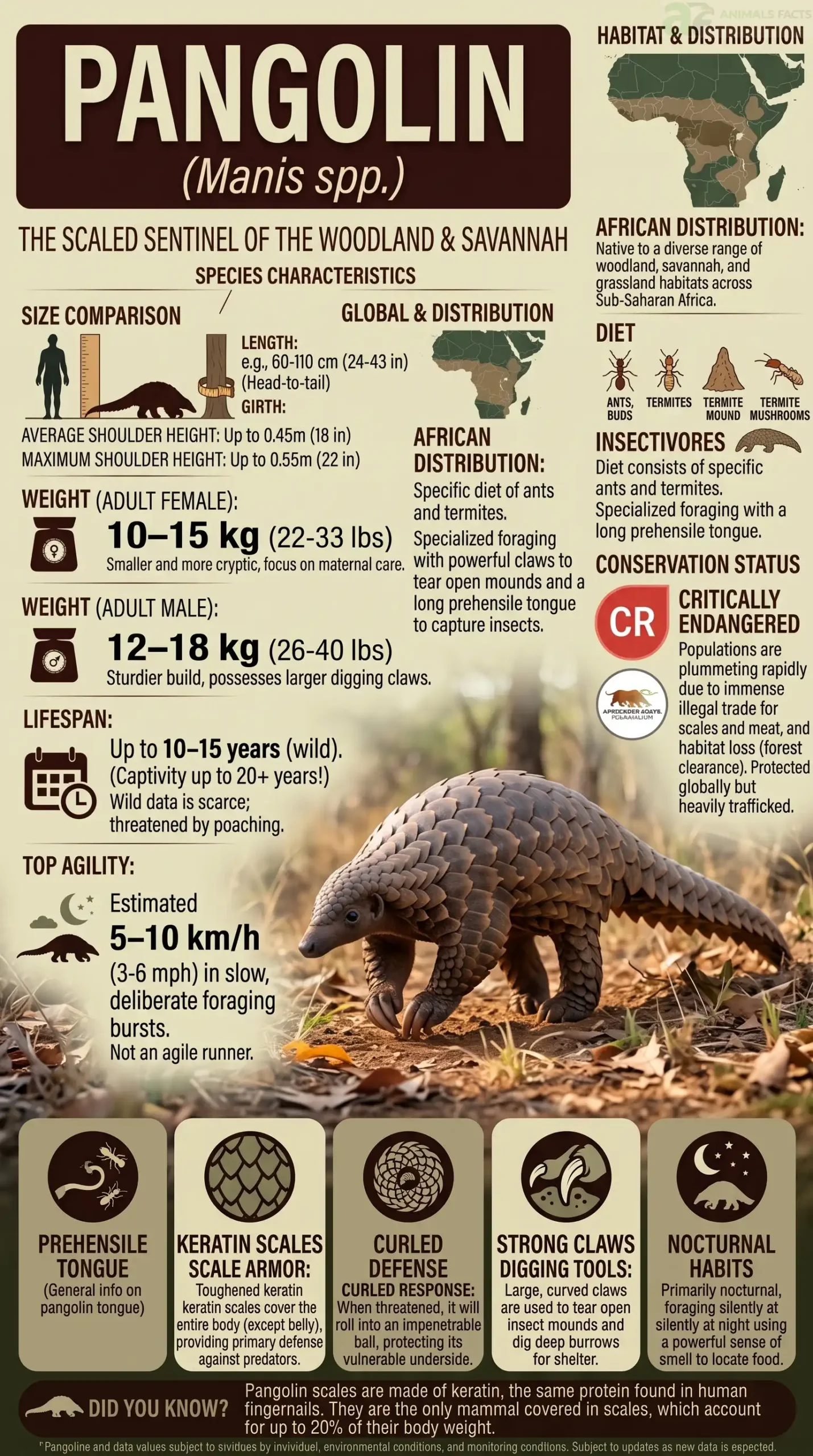
5. Fun Facts About Pangolins
- Pangolins are the world’s most trafficked mammal — 1 million+ since 2000
- Their tongue is longer than their body — attached to the sternum
- Pangolins are the only scaled mammals on Earth
- They are closest relatives of dogs and cats — not anteaters
- Each pangolin eats up to 70 million insects per year
- Pangolin scales are pure keratin — like human fingernails
- They have no teeth — stones in the stomach grind their food
- A rolled pangolin defeats lions and leopards
- The word “pangolin” means “one who rolls up” in Malay
- They close their nostrils, ears, and eyes when feeding
- One 2019 seizure represented 145,000 pangolins — from one shipment
- The Chinese pangolin has declined by 90% in 50 years
6. Pangolins Habitat & Geographic Range
Pangolin habitat varies considerably across the eight species — from dense equatorial rainforest to open savanna and dry woodland — but all species share a dependence on environments with sufficient ant and termite populations to meet their extraordinary dietary requirements.
Habitat Types
Tropical and subtropical moist broadleaf forest — The primary habitat for the four African tree pangolin species (Phataginus species) and the arboreal Asian species. Dense rainforest supports the highest ant and termite diversity and abundance.
Savanna and open woodland — The primary habitat for the larger ground pangolin species in Africa — the giant ground pangolin and Temminck’s ground pangolin favor more open environments with abundant termite mound systems.
Tropical dry forest and deciduous woodland — The primary habitat for the Indian pangolin — tolerating drier conditions than most other Asian species.
Agricultural margins and scrubland — Many pangolin species show some tolerance of degraded and human-modified landscapes where ant and termite populations remain — though habitat degradation generally reduces viable pangolin habitat.
Geographic Range by Species Group
| Region | Species | Primary Habitat | Threat Level |
|---|---|---|---|
| Central/West Africa | White-bellied pangolin; Long-tailed pangolin; Giant ground pangolin | Tropical forest; forest floor | High — trafficking increasing |
| East/Southern Africa | Temminck’s ground pangolin | Savanna, dry woodland | High — trafficking; habitat loss |
| Indian subcontinent | Indian pangolin | Forest, grassland, agricultural margins | High — trafficking |
| China and Southeast Asia | Chinese pangolin; Sunda pangolin | Tropical forest, grassland, agricultural | Critical — commercially depleted |
| Philippines (Palawan) | Philippine pangolin | Tropical forest | Critical — extremely restricted range |
💡 Did You Know? The shift of pangolin trafficking from Asian to African species is one of the most alarming trends in current wildlife crime. As Asian pangolin populations have been commercially driven toward extinction through decades of intensive trafficking, criminal networks have expanded their operations to Africa — where four additional pangolin species were historically less targeted. From approximately 2010 onward, African pangolin seizure rates have increased dramatically as traffickers pivoted to the African species to meet the same demand that has already devastated their Asian counterparts. This represents a literal extinction wave — moving geographically as each population is successively depleted — that conservationists describe as one of the most alarming patterns in contemporary wildlife trafficking.
7. Pangolin Diet & Feeding Behavior
Pangolin diet is the most specialized of any mammal in the world — these are obligate myrmecophages — animals that eat exclusively ants and termites. This dietary specialization is so extreme that pangolins in captivity almost universally refuse all food substitutes and die of starvation rather than eating anything other than their natural prey.
Diet Breakdown Table
| Food Type | Estimated % of Diet | Notes |
|---|---|---|
| Termites (Termitidae and related families) | ~50–70% | Primary prey; varies by season |
| Ants (Formicidae) | ~30–50% | Important particularly in dry season |
| Termite/ant eggs and larvae | Included in above | Higher protein; preferred where accessible |
| Termite/ant pupae | Included in above | Nutritionally important |
| Any other food | ~0% | Pangolins do not eat anything else |
The Foraging System
Pangolin foraging is a process of extraordinary sensory sophistication and physical power:
Olfactory detection — Pangolins locate ant and termite colonies primarily through smell — their elongated, highly sensitive nose detecting the chemical signatures of insect colonies from distances of several meters through the soil surface.
Colony selection — Pangolins are not random foragers — they appear to selectively target specific colony sizes and species, avoiding colonies that are too small to be worth the energy investment and showing preference for colonies of specific ant and termite species whose defense capabilities are manageable.
Physical access — Once a colony is located, the pangolin uses its powerful front claws to tear open the mound, wood, or soil surface. The claws are specifically shaped for this excavation work — long, curved, and extraordinarily strong. The giant ground pangolin can destroy even the hardest termite mound structures.
Tongue feeding — Once access is achieved, the pangolin inserts its long, sticky, mucus-coated tongue into the colony galleries — sweeping it back and forth to collect hundreds of insects per extension. Each tongue extension-retraction cycle takes approximately 0.25 seconds — meaning a pangolin can make four feeding licks per second at peak feeding rate.
Colony abandonment — Pangolins typically feed at a colony for 1–5 minutes before moving to the next — avoiding overharvesting any single colony and allowing insect populations to recover for future visits.
The Captive Feeding Problem
The pangolin’s dietary specialization creates one of the most significant challenges in pangolin conservation — their catastrophic failure to thrive in captivity:
- Pangolins in captivity almost universally refuse alternative food sources
- The specific ants and termites they eat in the wild are frequently unavailable in captive settings — particularly in temperate countries far from pangolin habitat
- The stress of captivity itself suppresses feeding behavior regardless of food availability
- The result is that rescued and confiscated pangolins typically die within weeks to months of capture despite the best efforts of conservation facilities
This captive failure has enormous conservation implications — trafficked pangolins that are seized by law enforcement cannot be easily rehabilitated, making prosecution of traffickers the only effective conservation response (as opposed to rescue-and-release programs that work for many other species).
8. Pangolin Reproduction & Life Cycle
Pangolin reproduction is one of the least documented aspects of these extraordinarily secretive animals — their nocturnal, solitary habits, low population densities, and the near-impossibility of maintaining them in captivity have severely limited systematic study of their reproductive biology.
Mating Behavior
The mating systems of pangolins are poorly documented across all species — what is known is pieced together from opportunistic field observations and the few captive breeding attempts that have been partially successful:
Solitary courtship — Male pangolins appear to locate receptive females through scent detection — following the chemical signals that females deposit in their environment during reproductive periods. Given the extremely low population densities of pangolins and their large home ranges, mate location is presumably a significant challenge.
Territorial male competition — Some evidence suggests that male pangolins defend territories or at least ranges — with chemical marking using secretions from anal scent glands and tail rubbing creating scent landscapes that communicate individual presence and status.
Brief mating encounters — Direct mating encounters appear to be brief and non-pair-bonded — the male and female associating only for the mating period before separating.
Birth and Infant Development
- Gestation period: approximately 65–70 days for African species; 130 days for some Asian species — significant variation exists between species
- Litter size: always 1 in African species; 1–3 in Asian species (though typically 1)
- Birth weight: approximately 80–450 grams depending on species
- Birth condition: pangolins are born with soft scales that harden within days — an adaptation preventing injury to the mother during birth
The Remarkable Mother-Infant Relationship
The pangolin mother-infant relationship is one of the most distinctive aspects of pangolin biology:
Scale protection — When threatened, a mother pangolin rolls into a ball with her infant enclosed within the protective sphere — the infant curled inside the rolled mother’s body, completely protected by her scales.
Tail riding — When traveling, the infant rides on the base of the mother’s tail — clinging to the tail scales and being carried during foraging trips. This tail-riding behavior is a distinctive pangolin characteristic.
Extended association — Mothers and young appear to remain associated for 3–5 months after birth — a relatively extended period for a small, solitary mammal.
Slow reproduction rate — With only one offspring per year (or potentially less frequently in some species), pangolins have among the lowest reproductive rates of any mammal of their size — a life history characteristic that makes their populations extremely slow to recover from any significant mortality pressure.
Lifespan Comparison Table
| Species | Estimated Wild Lifespan | Captive Survival | Reproductive Rate |
|---|---|---|---|
| Chinese pangolin (M. pentadactyla) | ~12–20 years (estimated) | Very poor — days to months | 1 offspring/year (max) |
| Sunda pangolin (M. javanica) | ~12–20 years (estimated) | Very poor | 1–2 offspring/year (max) |
| Temminck’s ground pangolin (S. temminckii) | ~12–20 years (estimated) | Slightly better than Asian | 1 offspring/year |
| Giant ground pangolin (S. gigantea) | Unknown | Unknown | 1 offspring/year (estimated) |
| Indian pangolin (M. crassicaudata) | ~12–20 years (estimated) | Poor | 1–3 offspring/year |
9. Social Behavior & Communication
Pangolin social behavior is characterized by extreme solitude — these are among the most independently organized of all mammals, with essentially no documented social structure beyond temporary mating associations and the mother-infant relationship.
Solitary Lifestyle
All eight pangolin species are solitary — adults maintaining individual home ranges and avoiding sustained social interaction with conspecifics. This solitude is so complete that even in areas of relatively high pangolin density, direct encounters between adults are rare and typically brief.
Home range — Individual home ranges vary enormously by species and habitat — from a few hectares for small arboreal species to over 100 km² for some ground pangolin species in low-density savanna habitats.
Scent marking — The primary communication mechanism — pangolins mark their ranges with secretions from anal scent glands and through urine deposition at specific locations — creating a chemical landscape that communicates individual identity, reproductive status, and territorial occupancy to any other pangolin that passes through.
Vocalizations
Pangolins are among the most vocally limited of mammals — producing essentially no sound as a matter of routine. The only documented pangolin vocalizations are:
Puffing and hissing — Defensive sounds produced during threat encounters — forceful exhalations through partially closed nostrils
Snuffling — The constant low-level snuffling produced during active foraging — more a feeding behavior than a deliberate communication signal
Infant distress calls — Young pangolins produce soft crying sounds when separated from the mother — the primary documented purposeful vocalization in the group
This remarkable vocal silence is consistent with the pangolin’s reliance on the rolling ball defense — an animal that rolls into an impenetrable ball when threatened has little need for the complex alarm call systems of species that flee or fight their predators.
Intelligence
Pangolin intelligence is extraordinarily poorly studied — the combination of their nocturnal solitary habits, extreme sensitivity to captivity, and low population densities has made systematic cognitive testing essentially impossible. What field observation data exists suggests:
Spatial memory — Pangolins appear to remember the locations of productive foraging sites — returning to specific ant and termite colonies repeatedly over multiple nights and weeks, suggesting the maintenance of a detailed spatial map of resources within their home range.
Colony management — The systematic rotation of feeding sites — spending a limited time at each colony before moving to the next — suggests a level of resource management forethought that implies meaningful cognitive planning.
Predator assessment — Pangolins show apparently calibrated responses to predator encounters — rolling only when a threat is sufficiently proximate, maintaining a risk-assessed threshold before deploying the energetically costly rolling behavior.
10. Predators & Defense Mechanisms
The pangolin’s defense system is one of the most effective passive defense mechanisms in the animal kingdom — and the story of predator-pangolin encounters is one of the most one-sided in African and Asian wildlife ecology.
Natural Predators
In their natural ecosystems, pangolins face a range of potential predators:
Lions (Panthera leo) — Documented investigating and occasionally attacking rolled pangolins in Africa — without success. Field observations of lion-pangolin encounters consistently show the lion eventually giving up after failing to bite through or force open the rolled animal.
Leopards (Panthera pardus) — Similarly documented investigating and failing to open rolled pangolins — though leopards may occasionally succeed with juvenile animals whose scales have not fully hardened.
Hyenas (Crocuta crocuta) — With the strongest bite force of any land predator relative to body size, spotted hyenas may represent the predator most capable of injuring a rolled pangolin — though even hyena bite force appears insufficient to reliably crack the overlapping scale armor.
Pythons — Large pythons represent a threat particularly to smaller pangolin species — a python’s crushing constriction rather than biting may be more effective than the bite-based attacks of mammalian predators against the scale armor.
Humans — By far the most significant pangolin predator — see the Conservation section.
The Rolling Ball Defense — Nature’s Most Effective Passive Defense
When threatened, a pangolin executes one of the most effective defensive maneuvers of any animal:
- Detection — The pangolin detects a threat through sound, scent, or sight
- Tucking — The head is tucked downward and the body begins to curl
- Rolling — The powerful orbicularis muscle (a ring-shaped muscle similar to the opossum’s rolling muscle) draws the tail forward and under the body while the head and limbs retract inward
- Locking — The tail wraps around the outside of the ball, the limbs are tucked inside, and the scales of adjacent rows interlock — creating a mechanical lock that requires enormous force to open
- Active defense — Once rolled, the pangolin can actively saw the scale edges against any pressure applied to the ball — the movement of scale edges capable of causing lacerations to paws or muzzles pressing against the surface
- Scent deployment — Simultaneously, the anal scent glands may release their noxious secretion — adding chemical deterrence to the mechanical defense
The predator’s perspective — From a predator’s standpoint, a rolled pangolin presents essentially no entry point — no paw grips the smooth, hard surface; no tooth can penetrate or gain purchase on the interlocking scales; and the scent is actively aversive. Field observations of lions spending 20–30 minutes batting a rolled pangolin before abandoning it confirm the extraordinary effectiveness of this defense.
The human circumvention — The rolling defense that defeats lions and leopards is completely ineffective against humans — a person can simply pick up the rolled ball and walk away with it. The pangolin’s entire defensive system evolved for a world that did not include human hunters with vehicles and export networks — a tragic evolutionary blind spot.
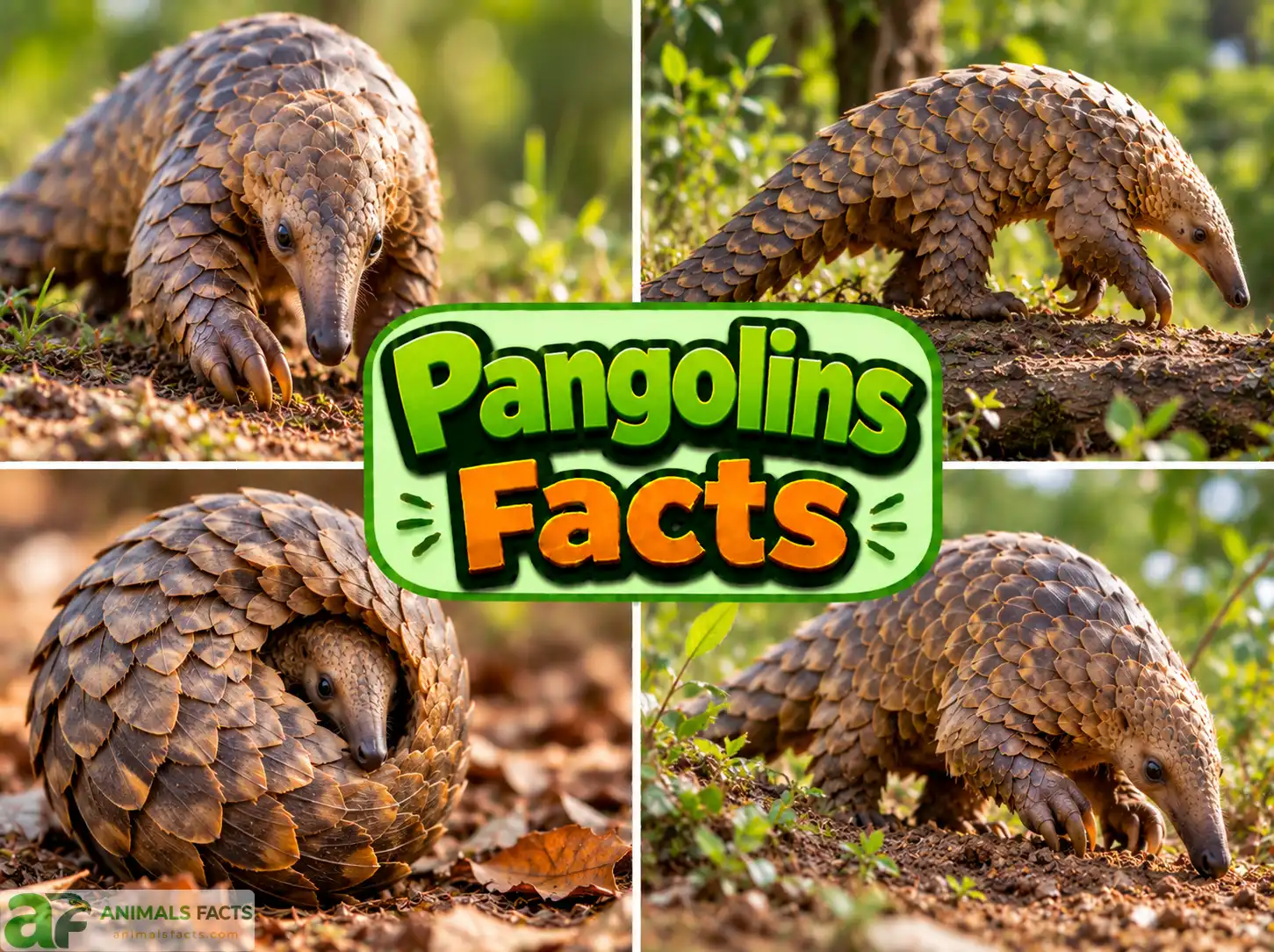
11. Pangolin Facts for Kids
Hey amazing young wildlife heroes! Here are some absolutely incredible pangolin facts for kids that might just turn you into a pangolin conservation champion:
- 🦔 Pangolins are the only mammals with SCALES! Every other scaled animal on Earth — snakes, lizards, fish — either has scales made of different materials or belongs to a completely different group. Pangolins are the one and only mammal with overlapping keratin scales like a living suit of armor!
- 🦔 Their tongue is LONGER than their whole body! Imagine if your tongue was attached somewhere in your chest and could extend beyond your feet. That is basically what a pangolin’s tongue does — it is so long it attaches near the ribs, not in the throat!
- 🦔 They have NO TEETH — and they swallow STONES instead! Because pangolins have no teeth at all, they swallow small rocks that stay in a special part of their stomach and grind up all the insects they eat. It is like having a rock-powered food processor inside your body!
- 🦔 A rolled-up pangolin can beat a LION! When a pangolin is threatened, it curls into a perfect ball of sharp scales. Even lions and leopards — Africa’s most powerful predators — cannot open a rolled pangolin. The scales are too hard, too sharp, and too perfectly arranged. Nature’s perfect shield!
- 🦔 They are also the world’s most TRAFFICKED mammal — and need our help! Over one million pangolins have been stolen from the wild since 2000. They are taken for their scales — which people claim have medical value — but the scales are just keratin, exactly like your fingernails. Scientists confirm they have no special medical properties. Every pangolin trafficked is one more step toward extinction.
- 🦔 One pangolin eats 70 MILLION ants and termites every year! That is a lot of pest control! Pangolins are nature’s insect controllers — and without them, termite populations in their habitats would grow dramatically.
- 🦔 Pangolin mums carry their babies on their TAILS! Baby pangolins ride on the base of their mother’s tail while being carried around. And if danger comes — mum rolls into a ball with the baby safely inside, protected by her scales. Best mum shield ever!
- 🦔 Pangolins are related to DOGS and CATS — not anteaters! Even though they look just like anteaters, scientists discovered that pangolins and anteaters evolved separately — they just came up with the same brilliant solution to eating ants independently. Pangolins are actually distant cousins of dogs, cats, and bears!
12. Relationship with Humans
The relationship between pangolins and humans is one of the most asymmetrical and most tragic in the entire natural world — an animal that poses no threat whatsoever to human safety, provides substantial ecological services, and possesses no trait that could not be replicated by far more sustainable means has been driven to the edge of extinction by human demand for its scales.
Traditional Coexistence and Indigenous Use
Across pangolin range countries in Africa and Asia, indigenous communities have coexisted with pangolins for thousands of years — maintaining relationships that, while not entirely without consumption, were sustainable at traditional harvest levels:
African traditional use — Pangolin meat has historically been consumed as a food source in various Central and West African communities — the animal’s scarcity and secretive habits naturally limiting harvest rates to levels that populations could sustain. Pangolin scales were used in some traditional medicine applications across Africa, but at scales that did not constitute a commercial trade.
Asian traditional use — Pangolin scales and meat have been components of Traditional Chinese Medicine (TCM) for at least 2,000 years — with references in ancient medical texts describing various claimed medicinal properties. At traditional use levels — harvesting from a relatively abundant population using non-motorized technology — this use was likely sustainable.
The Commercial Trafficking Crisis
The transformation from sustainable traditional use to the current commercial trafficking crisis represents one of the most catastrophic escalations in wildlife trade history:
Phase 1 — Asian depletion — From approximately the 1990s onward, commercial demand for pangolin scales and meat in China and Vietnam grew dramatically — driven by rising incomes that made previously unaffordable traditional medicine ingredients accessible to a mass market, and by demand for pangolin meat as a luxury restaurant item signaling wealth and status. This commercial demand rapidly exceeded what Asian pangolin populations could sustain — driving all four Asian species toward commercial extinction.
Phase 2 — African expansion — As Asian populations were depleted, trafficking networks expanded operations to Africa — initially targeting pangolins for the same TCM market. African law enforcement encountered a new threat they were largely unprepared for: well-organized criminal networks sourcing pangolins from communities with no previous commercial hunting tradition.
Current scale — The scale of the trade is almost incomprehensible:
- The 2019 Singapore seizure of 72.6 tonnes of scales represented approximately 145,000 pangolins from a single shipment
- Interpol estimates that only 10–20% of actual trade volume is detected by law enforcement — meaning the true annual toll may exceed 1 million pangolins per year
- The trade generates an estimated $2.5 billion annually — making pangolins one of the most valuable illegal wildlife commodities per kilogram
The demand drivers — Three primary demand factors drive pangolin trafficking:
- TCM scales — Scales are ground into powder and used in Traditional Chinese Medicine for conditions ranging from poor circulation to cancer — despite no clinical evidence of any efficacy beyond placebo. China formally removed pangolin scales from the official TCM pharmacopoeia in 2020 but enforcement of the ban has been limited.
- Luxury meat — Pangolin meat is consumed as a luxury status food in parts of China and Vietnam — the rarity and price of the dish (sometimes exceeding $1,000 per serving) making it a status symbol for wealthy diners.
- Totemic use — In some African contexts, pangolin scales and body parts are used in traditional ceremonies and fetish objects — demand distinct from the Chinese-market trade.
The COVID-19 Connection
The 2020 COVID-19 pandemic generated significant research into pangolins as a potential intermediate host for SARS-CoV-2 — the virus causing COVID-19. Early studies found pangolin coronaviruses with some genetic similarity to SARS-CoV-2, leading to widespread media coverage identifying pangolins as a potential link in the virus’s emergence.
The pangolin-COVID connection remains scientifically debated — subsequent research has questioned whether pangolins were actually the intermediate host, and the scientific consensus has not definitively established pangolins’ role. However, the media coverage generated unprecedented public awareness of pangolin trafficking and the wildlife markets that create conditions for zoonotic disease emergence — producing a silver lining of conservation awareness from the pandemic’s devastation.
13. Conservation Status & Threats
Pangolin conservation represents one of the most urgent and most challenging crises in global wildlife protection — with all eight species threatened, the most endangered facing commercial extinction within years, and a trafficking network of industrial scale and criminal sophistication that overwhelms the law enforcement resources of most range countries.
Conservation Status Overview
| Species | IUCN Status | Population Trend | Key Threat |
|---|---|---|---|
| Chinese pangolin (M. pentadactyla) | Critically Endangered | Rapid decrease | Commercial trafficking |
| Sunda pangolin (M. javanica) | Critically Endangered | Rapid decrease | Commercial trafficking |
| Philippine pangolin (M. culionensis) | Critically Endangered | Decrease | Trafficking; habitat loss |
| Indian pangolin (M. crassicaudata) | Endangered | Decrease | Trafficking; habitat loss |
| White-bellied pangolin (P. tricuspis) | Endangered | Decrease | Trafficking |
| Long-tailed pangolin (P. tetradactyla) | Endangered | Decrease | Trafficking |
| Giant ground pangolin (S. gigantea) | Endangered | Decrease | Trafficking; habitat loss |
| Temminck’s ground pangolin (S. temminckii) | Vulnerable | Decrease | Trafficking |
Major Threats
| Threat | Description | Impact Level |
|---|---|---|
| Illegal trafficking (scales and meat) | Organized criminal trade for TCM and luxury consumption | Critical — primary threat for all species |
| Local bushmeat hunting | In-country consumption; less organized than export trade | High |
| Habitat loss | Deforestation, agricultural expansion in range countries | High |
| Habitat fragmentation | Reduces viable population size and connectivity | Medium-High |
| Captive mortality | Confiscated pangolins die in care due to captive intolerance | High — impedes rescue |
| Climate change | Alters insect population dynamics affecting food availability | Increasing concern |
| Demand maintenance | Cultural beliefs about scale medicinal value persist despite evidence | Critical — root cause |
The CITES Appendix I Listing
In 2016, all eight pangolin species were uplisted to CITES Appendix I — prohibiting all commercial international trade in pangolins or their products. This was a significant policy achievement — but enforcement has proven extraordinarily difficult:
- Trafficking networks have adapted to CITES restrictions by increasing concealment sophistication
- Demand in consuming countries continues despite trade prohibition
- Range country law enforcement capacity is often insufficient to interdict trade at scale
- Corruption within law enforcement and customs agencies facilitates trade in some range countries
- The high value of pangolin products creates economic incentives that overwhelm deterrence
The Demand Reduction Imperative
Conservation scientists working on pangolin protection consistently identify demand reduction in consuming countries — particularly China and Vietnam — as the single most important conservation intervention. All other approaches — anti-poaching patrols, law enforcement, habitat protection — are addressing the supply side of the trade while demand remains the fundamental driver.
What demand reduction requires:
- Behavioral change in millions of individuals who believe pangolin scales have medical value
- Adequate enforcement of China’s 2020 TCM listing removal to make scale prescriptions illegal
- Cultural messaging that reframes pangolin scale use as socially unacceptable
- Provision of evidence-based alternatives that satisfy the underlying health concerns driving TCM scale use
14. Famous Pangolins in History & Pop Culture
Famous Pangolin Individuals and Moments
“Benny” — A Sunda pangolin maintained at the Singapore Zoo who became one of the most studied individual pangolins in captivity — his extended survival (several years, compared to the days-to-weeks survival typical of captive pangolins) providing valuable behavioral and nutritional data that contributed to improving captive management protocols for confiscated animals.
The Taronga Zoo Pangolins — Taronga Zoo in Sydney has participated in pangolin conservation research programs — their work on pangolin nutrition, stress physiology, and captive management protocols has contributed to the small but growing body of knowledge about maintaining seized pangolins in care.
“Esme” — A Temminck’s ground pangolin fitted with a GPS tracking device by the Tikki Hywood Foundation in Zimbabwe — whose tracking data provided the first comprehensive home range analysis for a wild Temminck’s pangolin. Esme’s data — showing nightly movements of several kilometers, complex home range use, and seasonal variation in habitat selection — transformed the scientific understanding of African ground pangolin ecology.
The Singapore 2019 Seizure — While not involving a named individual animal, the June 2019 seizure of 72.6 tonnes of pangolin scales in Singapore was the world’s largest pangolin trafficking bust in recorded history — representing the remains of approximately 145,000 individual pangolins. The seizure generated global media coverage and became one of the defining conservation news stories of 2019 — introducing pangolin trafficking to global audiences who had never previously heard of the species.
World Pangolin Day — Established in 2012, World Pangolin Day (celebrated on the third Saturday of February each year) has generated growing annual media coverage and public engagement — with the 2024 edition generating the most global media coverage of any World Pangolin Day to date. The day has become the primary annual moment for pangolin conservation advocacy globally.
15. Role in Ecosystem & Food Chain
The Ecosystem Engineer Role
Pangolins’ ecological role is primarily defined by their extraordinary insect consumption — an activity that has profound and measurable effects on insect populations and soil ecosystems:
Termite population control — In African and Asian ecosystems, termites are among the most ecologically significant organisms — their mound-building creates soil structure, their foraging aerates and mixes soil, and their biomass represents one of the most significant fractions of total soil animal biomass. Unchecked termite populations can cause significant damage to agricultural crops and wooden structures. A single pangolin consuming 70 million termites per year represents an enormous regulatory force on termite population dynamics.
Ant population control — Similar regulation of ant populations — many of which are significant agricultural pests — provides measurable economic value to farming communities within pangolin range.
Soil aeration — The pangolin’s excavation of termite mounds and ant colonies — and the digging of burrows for shelter — aerates and mixes soil in ways that improve soil structure and facilitate plant root penetration. This burrowing ecosystem engineering role is significant in African savanna and woodland ecosystems.
Mound architecture — The pangolin’s feeding on termite mounds creates access points and structural damage that are subsequently colonized by a range of other organisms — creating secondary habitat for lizards, small mammals, and various invertebrate species that inhabit the damaged mound structures.
Quantifying the Ecosystem Service
Researchers have attempted to quantify the economic value of pangolin ecosystem services — with estimates suggesting that the insect control services provided by a single pangolin are worth thousands of dollars annually in reduced crop damage and reduced need for pesticide application in agricultural areas adjacent to pangolin habitat. At the population scale, functioning pangolin populations provide insect control services valued at millions of dollars annually across their range.
This economic framing of pangolin ecosystem services is increasingly used by conservation advocates — arguing that the economic value of a living pangolin dramatically exceeds the black market value of a dead one’s scales.
16. Myths, Folklore & Cultural Significance
Traditional Chinese Medicine and the Scale Mythology
The most significant cultural belief affecting pangolin conservation is the Traditional Chinese Medicine mythology surrounding pangolin scales:
Historical context — Pangolin scales have been listed in TCM texts for over 2,000 years — classified under various diagnostic frameworks as beneficial for conditions including blood stasis, blocked lactation, skin conditions, and swollen lymph nodes.
The pharmacological reality — Modern pharmacological analysis of pangolin scales confirms they are pure keratin with no unique pharmacological compounds. Clinical trials of pangolin scale preparations have found no efficacy beyond placebo for any condition. The scales are literally, chemically, pharmacologically equivalent to a compressed human fingernail.
The persistence of belief — Despite this scientific evidence, belief in pangolin scale medicinal efficacy persists — particularly among older demographics in China and Vietnam where traditional medicine is culturally embedded. This persistence reflects the extraordinary resilience of traditional medical knowledge systems and the difficulty of changing health beliefs through rational argument alone.
China’s 2020 policy response — China’s removal of pangolin scales from the official TCM pharmacopoeia in 2020 was a significant policy step — making pangolin scale prescriptions officially unsanctioned. However, informal use continues, and enforcement of the policy faces significant cultural and practical challenges.
African Traditional Significance
Across multiple African cultures, pangolins hold significant symbolic and spiritual status — often associated with rain, fertility, prosperity, and protection:
Rain-calling association — In several southern and central African traditions, the pangolin is considered a rain-associated animal — its scales associated with rainfall patterns, and the discovery of a pangolin regarded as an omen of good rains. In some Shona traditions of Zimbabwe, a pangolin found on a chief’s land was a significant spiritual event requiring specific ceremonial responses.
Royal and chiefly significance — The pangolin’s association with royalty and chiefly authority in some African traditions reflects both its rarity and its extraordinary appearance. In some contexts, gifting a pangolin to a chief was an act of significant political significance.
These cultural associations have created a complex conservation situation — where the same animal that is spiritually significant in some contexts is commercially trafficked in others — and where community engagement with conservation must navigate these cultural meanings carefully.
17. Pangolins in Pop Culture
“Pangolin” in conservation media — Unlike many wildlife species, the pangolin has not generated significant popular cultural representation in film, literature, or mainstream entertainment — a contributing factor to public unawareness of the species and its trafficking crisis. The pangolin’s nocturnal, secretive habits and its near-impossibility as a captive or filmed animal have limited its exposure in the wildlife documentaries and zoo encounters through which many people become familiar with wild species.
“Eye of the Pangolin” (African Wildlife Foundation, 2019) — A critically acclaimed short documentary produced specifically to raise awareness of African pangolin trafficking — one of the most widely viewed pangolin-focused conservation films. The film’s focus on the personal story of the filmmakers’ efforts to document wild pangolins in Africa provided the kind of narrative engagement that more straightforwardly educational pangolin content lacks.
World Pangolin Day social media — The annual World Pangolin Day (third Saturday of February) generates the most concentrated burst of pangolin social media content globally — with conservation organizations, celebrities, and government agencies collectively reaching audiences of tens of millions annually through coordinated social media campaigns.
David Attenborough pangolin sequences — Various BBC wildlife documentaries narrated by David Attenborough have included pangolin sequences — including footage in “Our Planet” (Netflix, 2019) and various BBC Natural World episodes. These sequences — often involving the remarkable rolling defense or mother-infant interactions — have introduced pangolin biology to the enormous audiences that BBC and Netflix wildlife content reaches.
Google’s “#WorthMore Alive” campaign — Technology company Google participated in a pangolin conservation awareness campaign that used their search platform to direct searches about pangolin scales toward conservation information — one of the most innovative applications of technology company resources to wildlife demand reduction.
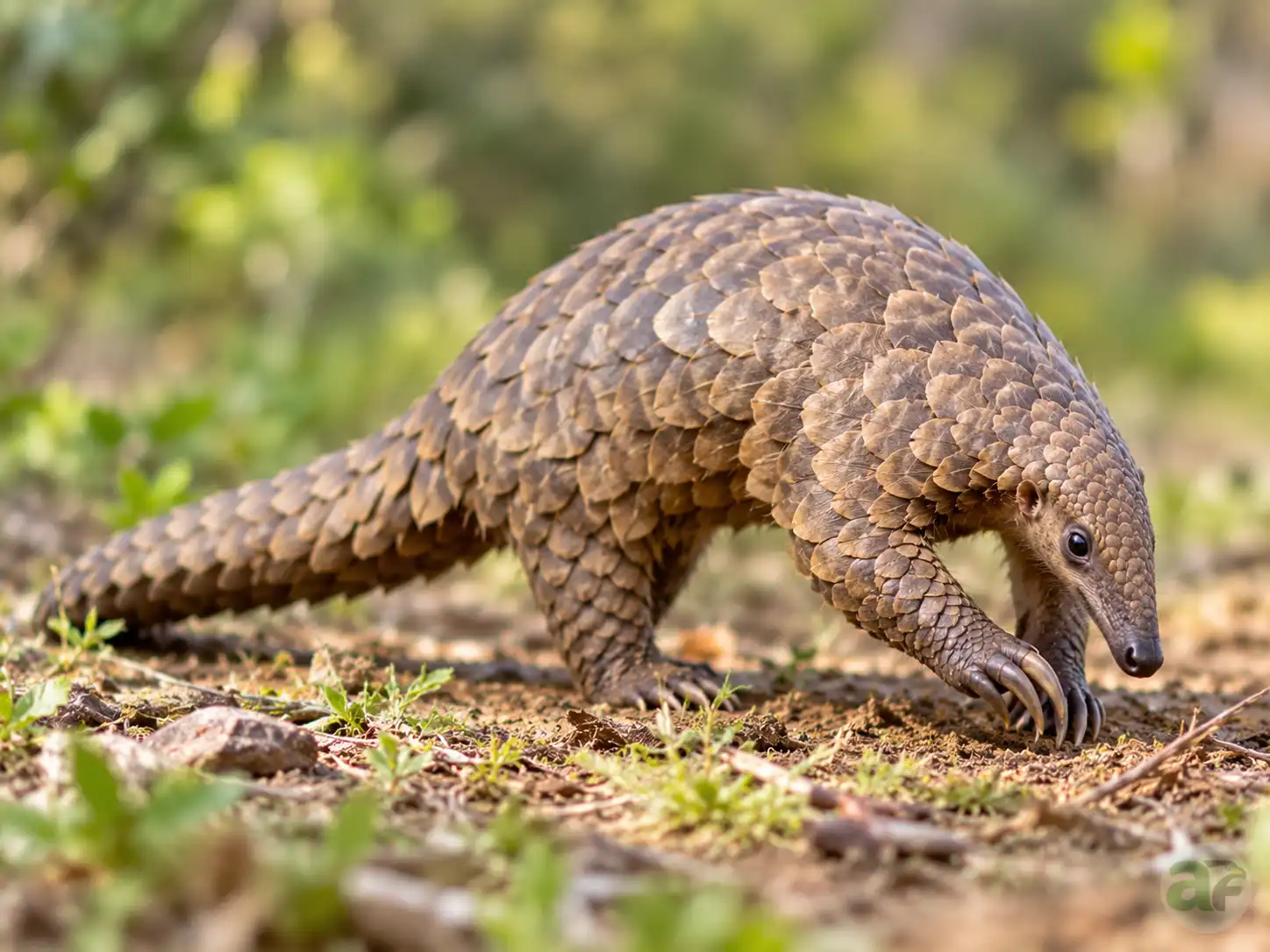
18. Pangolin Facts vs. Common Myths
| Common Myth | The Real Fact |
|---|---|
| “Pangolin scales have medicinal properties” | False — pangolin scales are pure keratin with no proven pharmacological activity beyond what you would achieve by consuming a human fingernail |
| “Pangolins are reptiles” | False — pangolins are mammals; their scales evolved independently from reptile scales through convergent evolution |
| “Pangolins are related to anteaters” | False — pangolins and anteaters evolved independently on separate continents; molecular genetics confirms pangolins’ closest relatives are dogs, cats, and bears |
| “Pangolins can survive in captivity with proper care” | Largely false — pangolins are catastrophically poor captive animals that typically die within weeks to months regardless of care quality; this is a fundamental biological limitation |
| “Pangolin trafficking only affects Asian species” | False — African pangolin species are now heavily trafficked as Asian populations have been commercially depleted; the extinction wave has moved geographically |
| “Pangolin scales are a rare ingredient in traditional medicine” | False — pangolin scales are one of the most commonly used wildlife-derived TCM ingredients; their widespread use is a primary driver of the extinction crisis |
| “Pangolins are dangerous due to their sharp scales” | Partially false — pangolin scales can cause lacerations if the animal is handled roughly; but pangolins pose no offensive threat and only use scale defense passively |
| “Pangolins were definitively proven to be the intermediate host for COVID-19” | False — the pangolin’s role in COVID-19 emergence is scientifically debated and has not been definitively established |
19. Best Places to See Pangolins in the Wild
1. Tswalu Kalahari Reserve, South Africa — One of the most reliable locations in the world for wild Temminck’s ground pangolin sightings — the reserve has a dedicated pangolin research and monitoring program that maintains GPS-tagged individuals whose nighttime locations can be followed by guided safari vehicles. This represents the closest thing to a guaranteed wild pangolin encounter available anywhere.
2. Tikki Hywood Foundation, Zimbabwe — The Tikki Hywood Foundation operates one of the world’s most respected pangolin rehabilitation and research programs — working with rescued Temminck’s ground pangolins and developing protocols for their care and eventual release. Conservation-focused visitors can support the program and observe their conservation work.
3. African Pangolin Working Group partner sites — The African Pangolin Working Group coordinates research and conservation across multiple sites in southern Africa with ground pangolin populations. Their partner reserves offer the best chances of encountering wild African pangolins during nighttime research-guided activities.
4. Borneo (Sabah and Sarawak, Malaysia) — The dense rainforests of Malaysian Borneo support Sunda pangolin populations — though encounters are extraordinarily rare even for experienced researchers. Wildlife camera trap programs run by conservation organizations in Sabah’s Kinabatangan Watershed and Danum Valley occasionally detect pangolins.
5. Critically — Wildlife Sanctuaries and Rehabilitation Centers — For most people, the closest practical pangolin encounter available is through accredited wildlife facilities and conservation centers that maintain small numbers of rescued pangolins. In South Africa, the Johannesburg Wildlife Veterinary Hospital and similar facilities occasionally host pangolins in care. In Southeast Asia, various wildlife rescue centers hold confiscated Sunda pangolins during rehabilitation.
6. The Honest Advice — The pangolin is among the most genuinely difficult of all large mammals to observe in the wild. Their nocturnal habits, solitary nature, low population densities, and increasingly reduced populations make wild sightings rare even for professional researchers who spend careers working in their habitat. The most meaningful contribution most pangolin enthusiasts can make is through financial support of conservation organizations rather than attempting to see one in the wild.
20. How You Can Help
Pangolin conservation requires action across multiple scales — from personal consumer choices to international policy advocacy. Every action matters in the context of a species on the edge.
Support these organizations:
- Save Pangolins — savepangolins.org — dedicated pangolin conservation organization; funds research and anti-poaching programs
- African Pangolin Working Group — pangolin.co.za — the primary research and conservation organization for African pangolins
- Pangolin Crisis Fund — pangolincrisis.com — Wildlife Conservation Society initiative; funds emergency response to trafficking crises
- TRAFFIC — traffic.org — monitors and combats illegal wildlife trade including pangolin trafficking
- WWF’s pangolin conservation programs — worldwildlife.org — global conservation advocacy including demand reduction in China and Vietnam
- WCS Pangolin Program — wcs.org — field-based pangolin conservation across range countries
Critical individual actions:
- Never purchase pangolin products — including scales, meat, or traditional medicine products containing pangolin scale powder; demand reduction in consuming countries is the single most impactful conservation action
- Spread accurate information about pangolin scale efficacy — challenging the medical mythology that drives demand is the root cause intervention
- Report suspected pangolin trafficking — TRAFFIC and national wildlife crime units accept anonymous tips; if you see pangolin products for sale, report it
- Support demand reduction campaigns in China and Vietnam — organizations working to change consumer behavior in these markets need financial support
- Advocate for wildlife crime enforcement — support politicians and policies that prioritize wildlife trafficking as a serious criminal matter rather than a regulatory infraction
- Donate to rehabilitation centers — the extraordinary difficulty of keeping confiscated pangolins alive makes funding for specialist care facilities genuinely life-saving
21. Top Documentaries & Books
Must-Watch Documentaries
- “Eye of the Pangolin” (African Wildlife Foundation, 2019) — The most acclaimed and most watched pangolin-specific documentary; follows the filmmakers’ efforts to document wild pangolins in Africa; available on YouTube
- “Our Planet — Forests” (Netflix, 2019) — David Attenborough’s landmark series includes pangolin sequences that reached the largest wildlife documentary audience in history
- “Pangolins: The World’s Most Wanted Animal” (National Geographic) — Dedicated investigation into pangolin trafficking networks; the most comprehensive journalistic treatment of the trade available in documentary format
- “The Pangolin Men” (Al Jazeera) — Investigative journalism documentary on pangolin trafficking networks; provides the clearest picture of how the trade operates at the ground level
- “Wild Savers” (various) — Multiple episodes of wildlife conservation documentary series feature pangolin rehabilitation and anti-poaching work
Must-Read Books
- “The Pangolin Reports” by various conservation journalists — Multiple long-form investigative journalism pieces on pangolin trafficking, available through National Geographic, The Guardian, and similar outlets
- “Poached: Inside the Dark World of Wildlife Trafficking” by Rachel Love Nuwer — The most comprehensive popular account of the global wildlife trafficking crisis, with extensive pangolin content
- “Eat the Buddha” — While not specifically about pangolins, this account of wildlife trafficking in Asia provides essential context for understanding the cultural drivers of pangolin demand
- IUCN SSC Pangolin Specialist Group publications — The primary scientific literature on pangolin ecology, behavior, and conservation; available through the IUCN website
- “The Thundering Herd: Pangolins and the Last Wild Animals” — Various popular natural history accounts of pangolins available through conservation organization publications
22. Comparison of the Eight Pangolin Species
| Feature | Chinese Pangolin | Sunda Pangolin | Indian Pangolin | Philippine Pangolin | Giant Ground Pangolin | Temminck’s Ground Pangolin | White-bellied Pangolin | Long-tailed Pangolin |
|---|---|---|---|---|---|---|---|---|
| Weight | 2–7 kg | 4–10 kg | 10–16 kg | 2–5 kg | 25–33 kg | 5–18 kg | 1.6–3.5 kg | 1.5–2.5 kg |
| IUCN Status | Critically Endangered | Critically Endangered | Endangered | Critically Endangered | Endangered | Vulnerable | Endangered | Endangered |
| Continent | Asia | Asia | Asia | Asia (Philippines) | Africa | Africa | Africa | Africa |
| Arboreal? | Partly | Partly | Terrestrial | Partly | Terrestrial | Terrestrial | Arboreal | Arboreal |
| Tail | Medium | Medium | Medium | Long | Short and thick | Medium | Long | Very long |
| Scale color | Brown | Brown | Brown/grey | Brown | Brown | Brown | Brown | Dark brown/black |
| Range size | Broad (Asia) | SE Asia | South Asia | Palawan only | Central/W Africa | E/S Africa | Central/W Africa | Central Africa |
| Primary habitat | Forest, grassland | Tropical forest | Forest, grassland | Tropical forest | Forest, savanna | Savanna, woodland | Tropical forest | Tropical forest |
23. Frequently Asked Questions About Pangolins
Q1. What is the scientific name of the pangolin?
Pangolins belong to the order Pholidota (Weber, 1904) and the family Manidae (Gray, 1821). There are 8 living species across three genera: Asian pangolins belong to the genus Manis — including the Chinese pangolin (M. pentadactyla), Sunda pangolin (M. javanica), Indian pangolin (M. crassicaudata), and Philippine pangolin (M. culionensis). African arboreal pangolins belong to the genus Phataginus — the white-bellied pangolin (P. tricuspis) and long-tailed pangolin (P. tetradactyla). African ground pangolins belong to the genus Smutsia — the giant ground pangolin (S. gigantea) and Temminck’s ground pangolin (S. temminckii). Some authorities place all species in the genus Manis, but the three-genus arrangement is increasingly standard.
Q2. Why are pangolins the most trafficked mammal?
Pangolins are the most trafficked mammal primarily due to demand for their scales in Traditional Chinese Medicine — where the scales are believed (without scientific evidence) to promote blood circulation, reduce inflammation, and treat various conditions. Pangolin meat is also consumed as a luxury food in parts of China and Vietnam. The combination of high demand, high prices (pangolin scales sell for $600–$3,000 per kilogram on black markets), and the pangolin’s inability to defend against human capture creates the conditions for the world’s most extensive illegal wildlife trade. Over one million pangolins are estimated to have been taken since 2000, with seizure data suggesting the trade continues at industrial scale.
Q3. Are pangolin scales really used in medicine?
Pangolin scales are used in Traditional Chinese Medicine — but they have no proven medical efficacy. The scales are made of keratin — the same protein as human fingernails — and contain no unique pharmacological compounds. Multiple clinical studies of pangolin scale preparations have found no efficacy beyond placebo for any condition. China’s National Medical Products Administration formally removed pangolin scales from the approved TCM ingredients list in 2020 — officially acknowledging the lack of medical evidence. Despite this, informal prescribing and use continues. The entire pangolin trafficking crisis — the largest illegal mammal trade in history — is driven by demand for a substance that is pharmacologically equivalent to a compressed human fingernail.
Q4. Can pangolins be kept as pets?
Absolutely not — and this point cannot be emphasized strongly enough. Pangolins are among the worst possible captive animals — they are extraordinarily difficult to feed (requiring specific live ants and termites), respond to captivity with severe, often fatal stress, and typically die within weeks to months of capture regardless of care quality. In addition to the welfare catastrophe that pangolin ownership entails, pangolins are protected by CITES Appendix I — making international trade illegal — and are protected by national legislation in all range countries. Acquiring, possessing, or trading pangolins (or their products) is a serious criminal offense in most countries. The animals’ captive intolerance also means that even well-intentioned “rescue” of pangolins by private individuals is almost always fatal to the animal.
Q5. How can I help pangolins?
The most impactful individual actions for pangolin conservation are: financial donation to organizations including Save Pangolins, the African Pangolin Working Group, and the Pangolin Crisis Fund; demand reduction advocacy — sharing accurate information that pangolin scales have no medical value, particularly in communities where TCM use is cultural; never purchasing pangolin products — scales, meat, or TCM preparations; reporting suspected trafficking to TRAFFIC or national wildlife crime agencies; supporting political advocacy for stronger wildlife crime enforcement and penalties; and spreading awareness about the crisis. The pangolin’s extraordinary obscurity — most people have never heard of it — means that awareness generation is itself a significant conservation contribution.
Q6. Why are pangolins going extinct?
Pangolins are being driven toward extinction by the world’s most extensive illegal wildlife trade — organized criminal networks harvesting pangolins in Africa and Asia for scales (sold to TCM markets) and meat (consumed as luxury food). The trade is driven by persistent demand in China and Vietnam that generates prices high enough to overwhelm legal deterrence. Pangolins’ slow reproduction rate (one offspring per year maximum), low population densities, and inability to recover quickly from population losses means that even moderate offtake levels can cause population collapse. The additional factors of habitat loss across their range and the catastrophic failure of pangolins in captivity (preventing rescue-and-release conservation responses that work for other species) compound the trafficking pressure into an existential threat.
Q7. What do pangolins eat?
Pangolins eat exclusively ants and termites — making them obligate myrmecophages with the most specialized diet of any mammal. They eat nothing else — in captivity, pangolins almost universally refuse all alternative food sources and die of starvation rather than consuming anything other than live ants and termites. A single adult pangolin consumes an estimated 70 million insects per year — foraging each night across its home range, locating colonies through its extraordinary sense of smell, tearing them open with powerful claws, and sweeping up insects with its extraordinarily long, mucus-coated tongue. The absence of teeth is compensated by a modified stomach section that uses swallowed stones to grind insects into digestible paste.
24. Sources & References
- Wikipedia — Pholidota, Manidae, Manis javanica, Manis pentadactyla, Smutsia temminckii
- IUCN Red List — iucnredlist.org (2019–2024 assessments for all pangolin species)
- TRAFFIC — traffic.org (pangolin trafficking seizure data and analysis)
- Save Pangolins — savepangolins.org
- African Pangolin Working Group — pangolin.co.za
- WWF Pangolin Conservation — worldwildlife.org
- National Geographic — nationalgeographic.com
- Smithsonian National Museum of Natural History — naturalhistory.si.edu
- BBC Wildlife / BBC Earth — bbcearth.com
- Britannica — britannica.com/animal/pangolin
- Live Science — livescience.com
- Challender, D.W.S. et al. — multiple published papers on pangolin ecology and conservation
- Heinrich, S. et al. (2017). “The challenge of regulating trade of pangolins in Asia.” Oryx
- Nuwer, Rachel (2018). Poached: Inside the Dark World of Wildlife Trafficking. Da Capo Press
- CITES — cites.org (Appendix I pangolin listing documentation)