
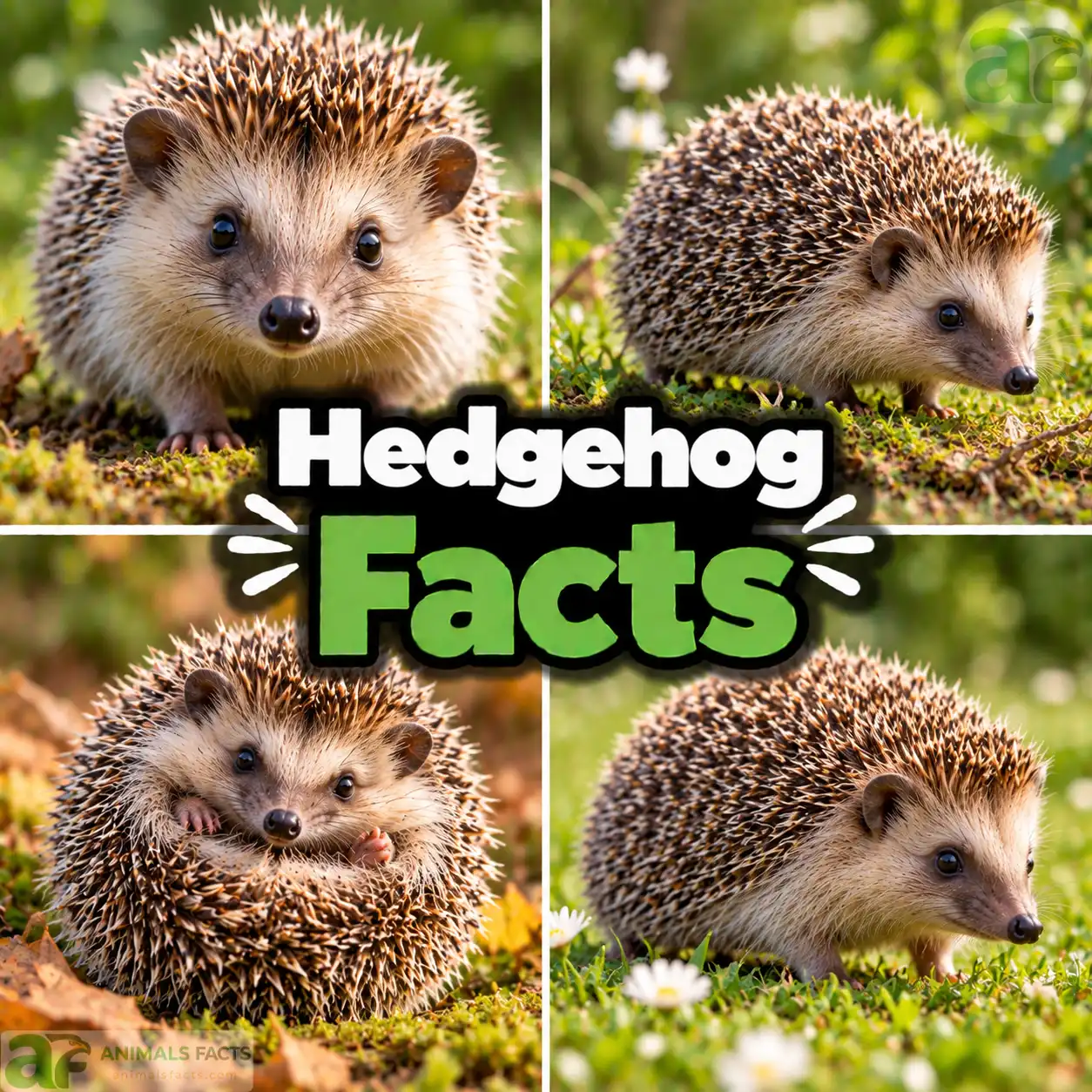
Hedgehog Facts
| Feature | Details |
|---|---|
| Scientific Name | Family Erinaceidae; most common pet species: Atelerix albiventris (African pygmy hedgehog) |
| Kingdom | Animalia |
| Phylum | Chordata |
| Class | Mammalia |
| Order | Erinaceomorpha (sometimes placed in Eulipotyphla) |
| Family | Erinaceidae (Fischer, 1814) |
| Common Names | Hedgehog, hedgepig, urchin (historical), furze-pig (historical) |
| Native Range | Europe, Asia, Africa (wild species); worldwide (captive/pet) |
| Habitat | Hedgerows, woodland edges, grassland, gardens, desert margins, savanna |
| Lifespan | 2–5 years (wild); up to 8–10 years (captivity) depending on species |
| Diet | Insects, worms, beetles, snails, slugs, small vertebrates, eggs, plant matter |
| Body Length | 14–30 cm depending on species |
| Weight | 155 grams–1.1 kg depending on species |
| Top Speed | Up to 9.6 km/h (surprisingly fast for short periods) |
| Conservation Status | Varies by species — from Least Concern to Critically Endangered; European hedgehog Vulnerable in UK (2020) |
| Number of Species | 17 recognized species across 5 genera |
| Defining Feature | 5,000–7,000 modified hair spines covering the back and sides |
| Hibernation | European species hibernate; African and desert species do not |
 1. Introduction: What is a Hedgehog?
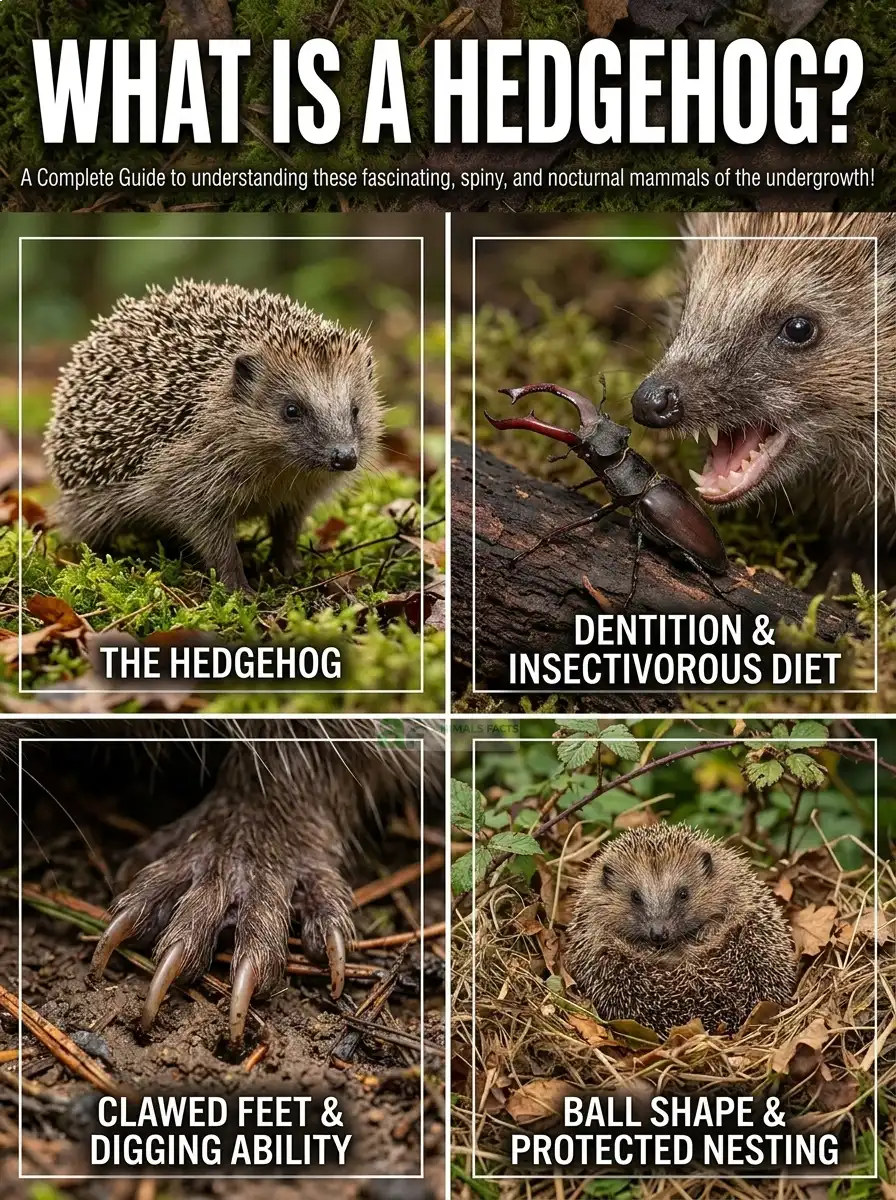
In a quiet English garden at dusk, something rustles purposefully through the fallen leaves beneath the privet hedge — a small, round shape moving with a determined, waddling gait, snuffling loudly through a pointed snout as it investigates every promising scent with the focused intensity of a tiny, armored detective. The gardener who spots this creature feels something that transcends ordinary wildlife observation — a sense of encountering something genuinely ancient, genuinely precious, and genuinely enchanting. Hedgehog facts begin with this single image — one of the world’s most instantly recognizable and most universally beloved small mammals, an animal whose combination of comical shape, endearing behavior, and extraordinary biology has made it a beloved figure in human culture for thousands of years and one of the most sought-after pet species in the world.
The hedgehog is simultaneously one of the most ancient mammalian lineages surviving today — with a body plan that has remained essentially unchanged for over 15 million years — and one of the most biologically remarkable small mammals in existence. Interesting facts about hedgehogs reveal an animal of stunning physiological ingenuity: the ability to eat prey laced with enough poison to kill a dog without ill effect; immunity to snake venom that parallels the opossum’s; the capacity to roll into a ball of 5,000–7,000 hardened keratin spines that defeats virtually every predator not specifically adapted to overcome it; a hibernation strategy so physiologically extreme that the animal’s heart rate drops from 190 beats per minute to fewer than 20; a bizarre self-anointing behavior in which hedgehogs coat their spines with frothy saliva mixed with novel scents — a behavior that remains genuinely unexplained despite decades of scientific study.
Whether you are searching for hedgehog facts for kids to explore the science of defensive spines and hibernation biology, a prospective hedgehog owner researching hedgehog habitat needs and care requirements, a European wildlife enthusiast concerned about declining hedgehog populations, or simply someone captivated by photographs of tiny hedgehogs curled into perfect spiny balls and needing to understand everything about this remarkable animal — this is your comprehensive guide. We cover hedgehog scientific name, hedgehog diet, hedgehog size and weight, hedgehog behavior, the extraordinary biology of hibernation, the self-anointing mystery, conservation threats, cultural significance, and the profound ecological roles these ancient animals play. The world’s most beloved spiny mammal has an extraordinary story to tell.
2. Hedgehog Species Overview & Classification
Hedgehogs belong to the family Erinaceidae — one of the most ancient surviving mammalian families — containing 17 recognized species distributed across Europe, Asia, and Africa. Their taxonomic classification has been revised multiple times as molecular genetics has clarified relationships within the insectivore group.
Species Classification Table
| Taxonomic Rank | Classification |
|---|---|
| Kingdom | Animalia |
| Phylum | Chordata |
| Class | Mammalia |
| Order | Eulipotyphla (formerly Erinaceomorpha) |
| Family | Erinaceidae (Fischer, 1814) |
| Number of Genera | 5 genera containing spiny hedgehogs |
| Number of Spiny Species | 17 recognized species |
| Also in family | Gymnures (moonrats/hairy hedgehogs) — 7 species; hair-covered, no spines |
| Temporal Range | ~15+ million years essentially unchanged body plan |
| Closest relatives | Shrews and moles (within order Eulipotyphla) |
Major Hedgehog Species
European Hedgehog (Erinaceus europaeus):
| Feature | Details |
|---|---|
| Scientific Name | Erinaceus europaeus (Linnaeus, 1758) |
| Weight | 450–1,100 grams |
| Body Length | 20–30 cm |
| Range | Western and Central Europe; introduced to New Zealand |
| Hibernation | Yes — October to March/April |
| IUCN Status | Least Concern (globally); Vulnerable in UK (2020) |
| Conservation Concern | Population declining significantly across Europe |
African Pygmy Hedgehog (Atelerix albiventris):
| Feature | Details |
|---|---|
| Scientific Name | Atelerix albiventris (Wagner, 1841) |
| Weight | 300–600 grams |
| Body Length | 14–23 cm |
| Range | Central and East Africa |
| Hibernation | No (estivation possible in drought conditions) |
| IUCN Status | Least Concern |
| Note | Most common pet hedgehog species worldwide |
Indian Long-eared Hedgehog (Hemiechinus collaris):
| Feature | Details |
|---|---|
| Scientific Name | Hemiechinus collaris (Gray, 1830) |
| Weight | 155–400 grams |
| Body Length | 14–23 cm |
| Range | Pakistan, northwestern India |
| Hibernation | Partial torpor in winter |
| IUCN Status | Least Concern |
| Notable Feature | Very large ears — largest relative to body size of hedgehog species |
Subspecies Comparison Table
The European hedgehog has two recognized subspecies of conservation relevance:
| Subspecies | Range | Notes |
|---|---|---|
| E. e. europaeus | Western Europe | Darker coloration; most studied |
| E. e. roumanicus | Eastern Europe | Lighter; sometimes treated as separate species |
Evolution & Discovery Timeline
~65 million years ago — The earliest erinaceid ancestors appear in the fossil record in the late Cretaceous — placing hedgehog ancestors alongside the last non-avian dinosaurs.
~15–20 million years ago — Fossil hedgehogs essentially identical to modern species appear in the Miocene — confirming that the hedgehog body plan has remained virtually unchanged for at least this period, making hedgehogs one of the classic examples of evolutionary stasis.
~1,000 BCE — Written references to hedgehogs appear in ancient texts including the Hebrew Bible (translated as “hedgehog” in some versions) and ancient Greek natural history literature.
350 BCE — Aristotle describes the hedgehog in his Historia Animalium — providing the first systematic Western scientific account of hedgehog biology.
1758 — Carl Linnaeus formally describes the European hedgehog as Erinaceus europaeus in Systema Naturae.
1800s — European colonists introduce hedgehogs to New Zealand — an introduction that becomes ecologically catastrophic for New Zealand’s native ground-nesting birds and lizards.
1980s — The African pygmy hedgehog (Atelerix albiventris) becomes established as the most popular pet hedgehog species following successful captive breeding programs in the United States.
1994 — Sonic the Hedgehog franchise reaches peak global recognition — making the hedgehog one of the most culturally prominent animals in the video game world.
2020 — The European hedgehog is officially reclassified as Vulnerable on the Great Britain mammal red list — one of the most significant UK wildlife conservation announcements of the decade.
2024 — The People’s Trust for Endangered Species (PTES) releases updated hedgehog population estimates for the UK — confirming continued declines that have reduced the UK hedgehog population by approximately 50% since 2000.
“The hedgehog is one of those animals that is so perfectly formed for its ecological niche, so beautifully adapted to its way of life, and so utterly endearing in its behavior and appearance, that it is difficult to imagine a world without it. And yet, in Britain at least, we are systematically creating exactly that world.”
— Sir David Attenborough, in support of the British Hedgehog Preservation Society
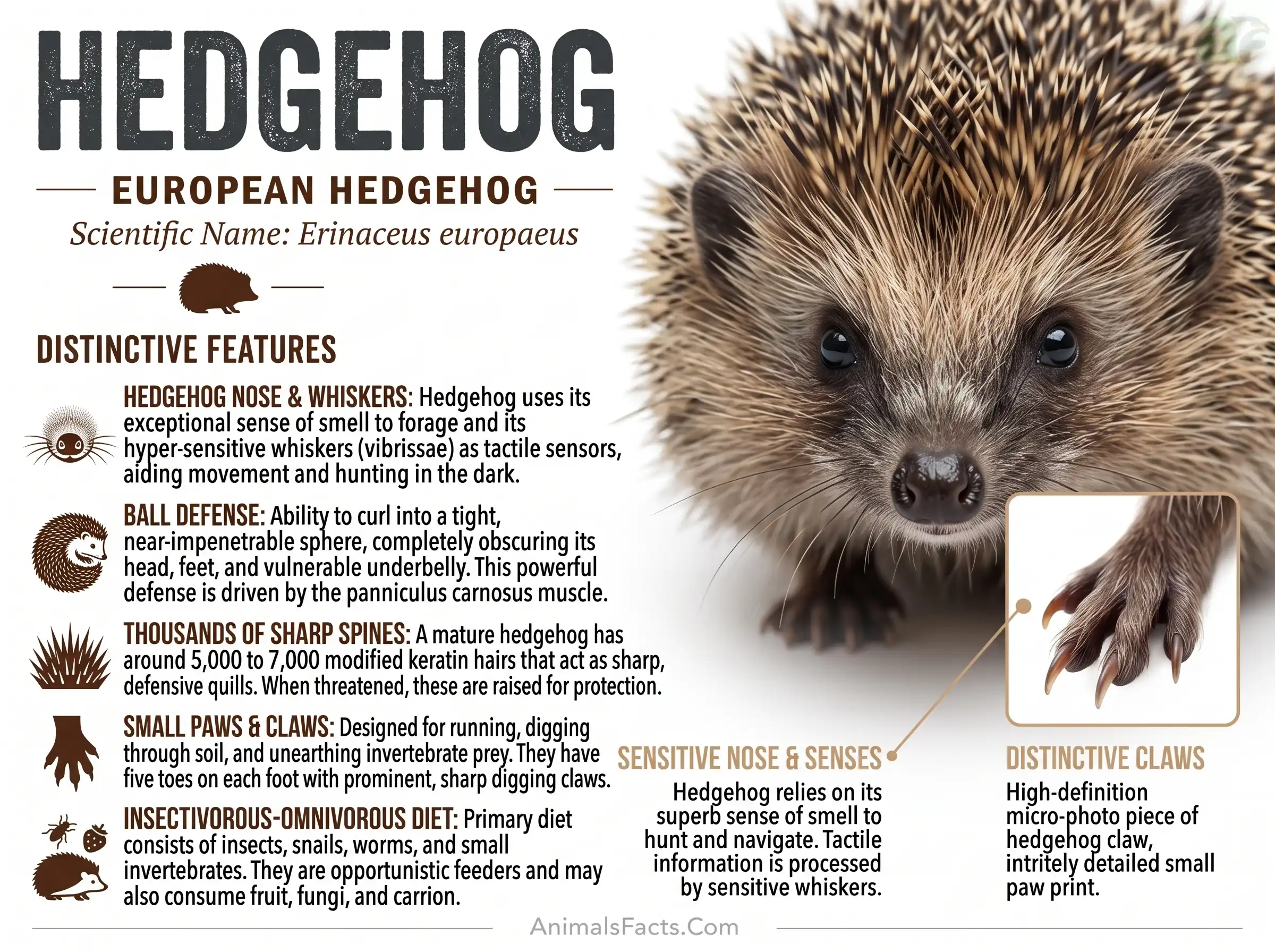
3. Hedgehog Physical Description & Unique Features
Hedgehog size and weight vary considerably across the 17 species — from the tiny African pygmy hedgehog at under 200 grams to the robust European hedgehog reaching 1.1 kg before hibernation — but all species share the defining physical features that make hedgehogs immediately recognizable across cultures.
The Spines — The Defining Feature
The hedgehog’s most immediately distinctive feature is its covering of modified hair spines — the biological innovation that gives hedgehogs both their defense capability and their name. Key spine facts:
Number — A typical adult hedgehog carries 5,000–7,000 spines — distributed across the back, crown, and sides of the body
Composition — Each spine is a modified hair shaft — hollow, made of keratin (the same protein as human fingernails and hair), with a complex internal structure of air-filled chambers that provide rigidity while minimizing weight. A solid keratin rod of the same diameter would be too heavy to be practical; the hollow, chambered structure achieves necessary rigidity at a fraction of the weight
Length — Typically 2–3 cm in most species — long enough to be effective deterrents to most predators but short enough to allow the rolling ball defense
Structure — Each spine has a flexible base connected to powerful erector muscles in the skin — allowing individual spines to be raised or lowered independently and the entire spine coat to be erected simultaneously as a defensive response
Lifespan — Individual spines are shed and replaced in a cycle of approximately 18 months — a gradual replacement that prevents the hedgehog from ever being without full spine coverage. Young hedgehogs undergo a specific “quilling” process when juvenile spines are replaced by adult spines — a sometimes painful-appearing process similar to teething in humans
Not poisonous — Despite persistent myths, hedgehog spines are not venomous or poisonous — they are purely mechanical deterrents, though the self-anointing behavior (see below) sometimes coats spines with toxic substances the hedgehog has encountered
The Rolling Ball Defense
The hedgehog’s capacity to roll into a perfect ball — presenting an all-around surface of erect spines to a predator — is one of the most effective passive defense mechanisms in the mammal world. The mechanism:
Orbicularis muscle — A specialized ring-shaped muscle (musculus orbicularis) runs around the perimeter of the hedgehog’s body beneath the spiny skin. When contracted, this muscle draws the spiny skin downward and inward — pulling the head, legs, and belly into the center of the ball and exposing only the impenetrable spiny surface to the outside world
Speed of rolling — A hedgehog can complete the rolling response in approximately 0.5 seconds from the first detection of threat — fast enough to defend against many predator strike speeds
The locked ball — Once rolled, the hedgehog can maintain the ball posture for hours without physiological cost — simply waiting for the threat to pass before uncurling
The Pointed Snout
The hedgehog’s long, pointed snout — the feature that, combined with the spines, gives the hedgehog its immediately recognizable profile — houses highly sensitive olfactory organs that are the primary sensory tool for foraging. A hedgehog’s sense of smell is estimated to be approximately 2,000 times more sensitive than a human’s — allowing detection of earthworms and other prey items buried several centimeters beneath the soil surface.
Feet and Locomotion
Despite their rotund appearance, hedgehogs move with a surprisingly rapid, waddling trot — reaching speeds of up to 9.6 km/h when motivated. Their feet are armed with small but functional claws — useful for digging at soil in search of buried prey and for climbing low obstacles.
Eyes and Vision
Hedgehog eyes are small and relatively poorly developed compared to their olfactory and auditory systems — hedgehogs are nearsighted and have limited color vision (primarily seeing in blue-green wavelengths). Their eyes are positioned on the sides of the head — providing a wide field of view but limited binocular overlap. The eyes shine red-orange in flashlight beams at night — less dramatic than many nocturnal mammals but detectable.
💡 Did You Know? A hedgehog spine is a masterpiece of biomechanical engineering — its hollow, air-chambered structure achieves the rigidity of a solid keratin rod while being only 20% of the weight that a solid rod would require. The base of each spine has a ball-and-socket joint connection to the skin — allowing the spine to flex slightly under impact rather than breaking or driving directly into the hedgehog’s own skin when a predator bites the spine tip. The design has been studied by materials scientists and engineers investigating lightweight rigid structures for aerospace and architectural applications — the hedgehog spine is essentially a naturally occurring example of optimal engineering design.
4. Top 25 Amazing Hedgehog Facts
Here is your definitive collection of the most extraordinary, scientifically verified, and genuinely astonishing hedgehog facts as of 2026:
- Hedgehogs have existed in essentially their current form for 15 million years — making them one of the most evolutionarily stable (least changed) mammalian lineages alive today. The hedgehog that Aristotle described in 350 BCE would be recognizable as essentially the same animal living in gardens across Europe today.
- Hedgehogs can walk up to 3 km in a single night while foraging — an extraordinary distance for an animal typically weighing under half a kilogram. European hedgehog males during breeding season have been tracked covering up to 6 km in a single night.
- Hedgehog hibernation is physiologically extreme — during deep hibernation, the European hedgehog reduces its heart rate from 190 beats per minute to fewer than 20, its breathing from 50 breaths per minute to approximately 10 per hour, and its body temperature from 35°C to as low as 2°C — matching the ambient temperature of its hibernaculum.
- Hedgehogs engage in a bizarre behavior called “self-anointing” (also called anointing or anting) — when encountering a novel, strong-smelling substance, a hedgehog will lick and chew the substance, produce enormous quantities of frothy saliva, and then contort its body to apply this saliva-scent mixture to its spines with its tongue. The function of this behavior remains genuinely unexplained despite decades of scientific investigation — proposed explanations include camouflage, parasite deterrence, mate attraction, and poison application, but none has been definitively confirmed.
- Hedgehogs are immune to adder (European viper) venom (Vipera berus) — the only venomous snake in the UK — and regularly eat adders in their range. The immunity is provided by a blood serum protein called erinacin that neutralizes the viper’s venom.
- The hedgehog’s immunity extends to other potentially harmful substances — they regularly consume beetles containing cantharidins (the toxic compound in blister beetles), wasps and bees, and other prey that would poison or severely injure most mammals their size.
- A European hedgehog must consume approximately 70 grams of food per night — approximately 10% of its body weight — during the active season to build sufficient fat reserves for winter hibernation.
- Hedgehog mothers sometimes eat their own young if the nest is disturbed in the days after birth — a stress response that appears to be a mechanism for protecting nest location secrecy by eliminating the evidence of the nest when disturbance signals human or predator presence.
- The word “hedgehog” derives from the Old English hege (hedge) and hogge (pig or hog) — the animal was named for its pig-like snout, its characteristic grunting vocalizations, and its preference for hedge habitats. Other historical names include “urchin” (which is also the original word for sea urchin — both having spines), “furze-pig”, and “hedgepig” (used by Shakespeare in The Tempest).
- New Zealand has one of the world’s most significant invasive hedgehog problems — European hedgehogs introduced in the 1870s have devastated populations of native ground-nesting birds, lizards, and invertebrates. In New Zealand, hedgehogs kill millions of native animals annually and are subject to pest control, creating the paradox of an animal loved in Europe but ecologically destructive in its introduced range.
- A female hedgehog is called a “sow”, a male is a “boar”, and a group of hedgehogs is called a “prickle” — one of the most delightful collective nouns in zoology.
- Baby hedgehogs are called “hoglets” — they are born blind and with their spines hidden beneath a fluid-filled membrane that prevents the spines from injuring the mother during birth. The membrane dries within hours of birth, revealing the first set of white juvenile spines.
- The European hedgehog is the UK’s most beloved wild mammal — consistently ranking first in public polls about favorite British wildlife. Despite this affection, the UK hedgehog population has declined by approximately 50% since 2000 — one of the most dramatic wildlife declines of any species in Britain.
- Hedgehogs have an extraordinarily acute sense of smell — estimated to be approximately 2,000 times more sensitive than a human’s — allowing them to locate earthworms buried 3 cm underground and to navigate using scent trails over considerable distances.
- Hedgehog hibernation is not a simple sleep — it is a regulated torpor in which the animal’s physiology undergoes dramatic changes. Hedgehogs periodically arouse from hibernation during winter (approximately every 2–3 weeks), warming briefly to full body temperature before entering torpor again — a cycle that consumes significant fat reserves and is one of the primary sources of overwinter mortality.
- Sonic the Hedgehog — created by Sega designer Yuji Naka in 1991 — is one of the most successful video game characters in history, with the franchise selling over 150 million units and the 2020 film grossing over $300 million worldwide. The franchise has done more for hedgehog cultural prominence than any wildlife documentary.
- Hedgehogs produce an extraordinary range of vocalizations for animals typically considered relatively quiet — including grunts, snuffles, squeals, hisses, clicking sounds, and a distinctive twittering song produced by males during courtship that is one of the most charming mammal sounds in British wildlife.
- The African pygmy hedgehog can enter a state called estivation — a summer torpor analogous to hibernation — when exposed to drought conditions or food scarcity. Unlike European hibernation, estivation is not a regular annual cycle but an emergency physiological response.
- Hedgehog saliva has mild antiseptic properties — their practice of licking wounds on their own body (and sometimes on humans who handle them) may provide some genuine wound management benefit, though this has not been formally quantified.
- Hedgehogs are surprisingly good swimmers — they can swim considerable distances and will cross ponds and streams when necessary during foraging. However, they are unable to exit steep-sided garden ponds and frequently drown in them — a significant mortality source in suburban environments.
- The People’s Trust for Endangered Species estimates that the UK now has fewer than 1 million hedgehogs — compared to approximately 30 million in the 1950s — representing one of the most catastrophic population collapses of any beloved species in British wildlife history.
- Hedgehogs have five toes on each foot — equipped with small but effective claws that allow them to climb over low obstacles and dig into soil. They can climb brick walls, garden steps, and surprisingly steep inclines — but cannot easily descend the same obstacles, frequently becoming trapped.
- The self-anointing behavior has been observed in hedgehogs of all ages from a few weeks old — suggesting it is an innate behavior rather than one learned from other individuals. Young hedgehogs will self-anoint with completely novel substances they have never previously encountered — confirming the behavior’s instinctive basis.
- Hedgehog hearts beat at approximately 190 beats per minute while active — more than twice the human resting rate — reflecting the high metabolic demands of an active, warm-blooded small mammal. The dramatic slowdown during hibernation to fewer than 20 beats per minute represents one of the most extreme heart rate reductions recorded in any mammal.
- As of 2026, the International Union for Conservation of Nature assesses the European hedgehog as Least Concern globally — but this global status masks severe regional declines. The species is classified as Vulnerable in Great Britain, Near Threatened in several European countries, and subject to dedicated conservation programs in multiple nations.
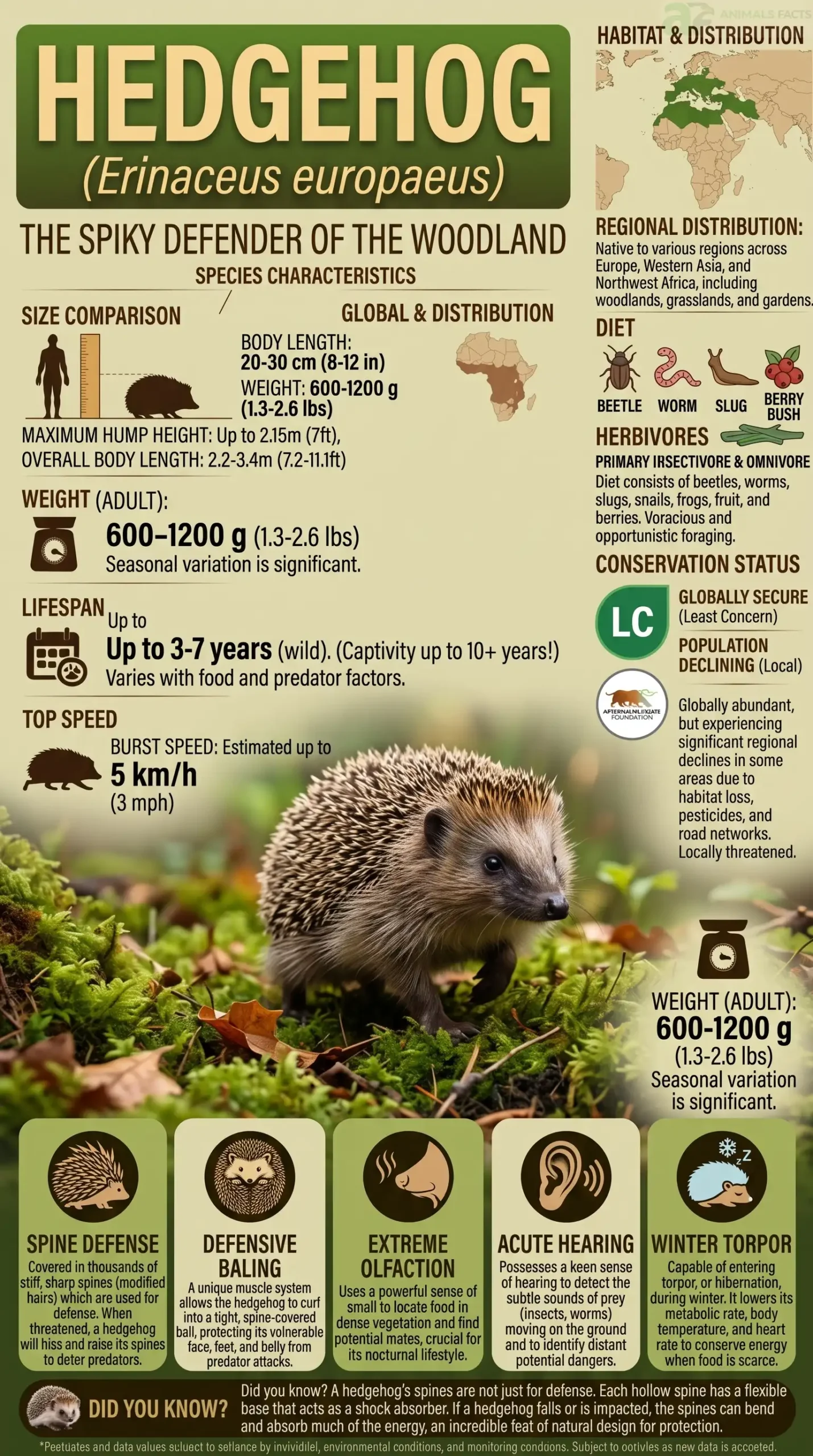
5. Fun Facts About Hedgehog Cute Animal
- Hedgehogs have been essentially unchanged for 15 million years
- They have 5,000–7,000 spines — each a modified hair
- Hedgehog heart rate drops from 190 to fewer than 20 in hibernation
- They are immune to adder venom — and eat adders
- The self-anointing behavior remains scientifically unexplained
- A group of hedgehogs is called a “prickle”
- Baby hedgehogs are called “hoglets”
- UK hedgehog population has declined by 50% since 2000
- Hedgehogs can walk 3–6 km in a single night
- They are an invasive pest in New Zealand — devastating native wildlife
- Hedgehogs can swim — but drown in garden ponds
- Sonic the Hedgehog has sold over 150 million video game units
6. Hedgehog Habitat & Geographic Range
Hedgehog habitat varies considerably across the 17 species — from the temperate woodland edges of Europe to the arid deserts of Central Asia and the open savannas of sub-Saharan Africa — but all species share a preference for environments offering adequate invertebrate prey, den sites, and cover from predators.
Habitat Requirements
All hedgehog species require a combination of:
Invertebrate prey abundance — The primary food source across all species; habitats must support sufficient populations of beetles, worms, slugs, and other invertebrates to meet the hedgehog’s significant nightly energy requirements
Denning sites — Piles of leaves, hollow logs, root systems, dense vegetation, and increasingly human-made structures provide essential resting and hibernation sites
Foraging cover — Vegetation cover that allows foraging movement with some concealment from aerial and terrestrial predators
Water access — All species require drinking water; proximity to natural or artificial water sources is important particularly in warmer climates
Habitat by Species
European hedgehog habitat:
- Hedgerows — the defining habitat element; dense linear vegetation providing both foraging corridors and den sites
- Woodland edge — the interface between woodland and more open habitats where invertebrate diversity is highest
- Pastoral farmland — traditional mixed farmland with hedgerows and pasture supports excellent hedgehog populations
- Gardens and parkland — urban and suburban gardens are increasingly important as agricultural habitat declines
- Grassland — open grassland supports hedgehogs where sufficient structural diversity exists
African pygmy hedgehog habitat:
- Savanna and open woodland — the primary habitat across the species’ Central African range
- Agricultural margins — the species adapts well to traditional agricultural landscapes
- Desert margins — tolerates semi-arid conditions more effectively than European relatives
Desert hedgehog species (Paraechinus genus) habitat:
- True desert and semi-desert — the most arid habitats occupied by any hedgehog species; Paraechinus species in the Middle East and Central Asia survive in environments with rainfall below 100 mm annually
Geographic Range by Species Group
| Species Group | Geographic Range | Representative Species |
|---|---|---|
| Western European | W. Europe (UK to Poland) | Erinaceus europaeus |
| Eastern European | E. Europe, Russia | Erinaceus roumanicus |
| Central Asian | Russia, China, Central Asia | Erinaceus amurensis |
| African (Atelerix) | Sub-Saharan Africa | Atelerix albiventris, A. frontalis |
| Long-eared (Hemiechinus) | Middle East, South Asia | Hemiechinus auritus, H. collaris |
| Desert (Paraechinus) | N. Africa, Middle East, S. Asia | Paraechinus aethiopicus |
| Introduced (invasive) | New Zealand | Erinaceus europaeus |
💡 Did You Know? The desert-dwelling hedgehog species (Paraechinus and Hemiechinus species) of the Middle East and Central Asia represent some of the most physiologically extreme vertebrate adaptations to arid environments known. These species can survive on metabolic water alone during extreme drought, tolerate body temperatures of up to 40°C without heat stress (while most European hedgehogs begin to suffer above 30°C), and have enlarged ears — providing both enhanced cooling (blood vessels near the ear surface radiate heat) and improved low-frequency hearing for detecting underground invertebrate prey in a landscape where surface prey is scarce. The Indian long-eared hedgehog (Hemiechinus collaris) has ears so disproportionately large relative to body size that they give the animal a distinctly rabbit-like appearance that startles most people expecting the standard small-eared European hedgehog profile.
7. Hedgehogs Diet & Feeding Behavior
Hedgehog diet is primarily insectivorous but extends across a remarkable range of invertebrate and small vertebrate prey — reflecting the species’ status as a generalist predator of small animals across a wide range of taxonomic groups.
Diet Breakdown Table
| Food Type | Estimated % of Diet | Notes |
|---|---|---|
| Beetles and beetle larvae | ~25–35% | The single most important food category |
| Earthworms | ~20–30% | Particularly important in European species |
| Caterpillars and moth larvae | ~10–15% | Seasonally important |
| Slugs and snails | ~10–15% | Significant; makes hedgehogs popular with gardeners |
| Earwigs and other invertebrates | ~5–10% | Various invertebrate groups |
| Small vertebrates (mice, frogs, young birds) | ~3–5% | Opportunistic; occasional |
| Eggs | ~2–5% | Ground-nesting bird eggs in range; significant in NZ |
| Mushrooms, berries, fallen fruit | ~2–5% | Plant matter; supplementary |
| Carrion | ~1–3% | Opportunistic scavenging |
The Toxin-Resistant Feeding Strategy
One of the most remarkable aspects of hedgehog diet is their remarkable resistance to the chemical defenses of many prey species:
Blister beetles — Hedgehogs consume beetles containing cantharidins — the highly toxic compounds that can cause severe blistering of internal tissues in most mammals. The mechanism of hedgehog resistance to canthariding is not fully characterized but appears to involve neutralization in the digestive system rather than avoidance of absorption.
Venomous prey — Hedgehogs eat bees, wasps, and other stinging invertebrates — their thick skin and rapid crushing bites minimize venom delivery; the erinacin protein in their blood provides additional protection.
Toxic toads — Some hedgehog species will attempt to consume natterjack toads — which produce toxic skin secretions — using a rapid bite-and-turn strategy that minimizes contact between toad skin and their own body.
Adders (European vipers) — The European hedgehog regularly predates on Europe’s only venomous snake. The erinacin protein in hedgehog blood binds to and neutralizes the main toxic enzyme in adder venom — providing reliable protection that allows hedgehogs to consume the entire snake without ill effect.
Foraging Behavior
Nocturnal foraging — European hedgehogs are almost exclusively nocturnal foragers — emerging after sunset and returning to their day nest before dawn. The African pygmy hedgehog is also primarily nocturnal but shows some crepuscular activity.
Auditory prey detection — Despite poor vision, hedgehogs have excellent hearing — using both the rustling sounds of invertebrates moving through leaf litter and the low-frequency substrate vibrations of burrowing worms to locate prey before the final olfactory confirmation.
Foraging range — European hedgehogs typically forage over a nightly range of 0.5–3 km — with males ranging more widely than females. The foraging area is not strictly territorial — multiple individuals may use the same area at different times.
8. Hedgehog Reproduction & Life Cycle
Hedgehog reproduction is shaped by the seasonality of temperate climates in European species — with breeding timed to maximize the overlap between juvenile development and the peak abundance of invertebrate prey in late summer and autumn.
Mating Behavior
European hedgehog courtship — One of the most entertaining spectacles in British wildlife. A male European hedgehog locating a female in breeding condition will circle her persistently — sometimes for hours — while she resists and snorts at him. This courtship circle may involve the male making complete circuits around the female dozens of times, with the female consistently facing away from him and delivering defensive head-butts when he approaches too closely. The process eventually culminates in mating if the female becomes receptive — a process that may involve considerable snuffling and persistence from the male.
Mating vocalizations — Males produce a variety of grunts, snuffles, and hissing sounds during courtship; females produce characteristic defensive snorting. The overall acoustic experience of hedgehog courtship has been described as resembling a small, domestic argument conducted by intensely determined small animals.
Breeding season — April to September in Europe — corresponding to the period of hedgehog active season between emergence from hibernation and re-entry.
Gestation & Birth
- Gestation period: 34–37 days — relatively short for a mammal producing multiple offspring
- Litter size: typically 4–5 hoglets (range 1–7; occasionally up to 11 in exceptional cases)
- Birth weight: approximately 12–25 grams per hoglet
- Spine protection at birth: hoglets are born with their spines hidden beneath a fluid-filled skin membrane that prevents the spines from injuring the birth canal. The membrane dries and the spines erect within hours of birth — revealing a first coat of pale, soft white spines that will be replaced by the permanent adult dark spines within days
The “Quilling” Process
Young hedgehogs undergo a distinctive developmental process called “quilling” — in which the soft white juvenile spines are gradually replaced by the harder, darker adult spines over a period of several weeks. During quilling:
- The skin beneath the spines becomes temporarily sensitive as new spine bases push through
- Young hedgehogs may appear irritable or uncomfortable during peak quilling periods
- The transition from white juvenile spines to mixed juvenile-adult spines to full adult coat is a reliable age indicator in young hedgehogs
Development Stages
- Newborn (Days 0–7) — Blind, deaf; white juvenile spines; nursing only
- Early hoglet (Days 7–21) — Eyes opening; beginning to hear; first dark spines emerging
- Active hoglet (Days 21–40) — Eyes and ears fully functional; beginning to follow mother on foraging trips
- Weaning (approximately Day 40–45) — Beginning independent foraging; still associating with mother
- Independence (approximately Days 45–60) — Fully independent; beginning to establish own foraging range
- First hibernation (autumn, if born in time) — Must reach sufficient weight (~450g minimum for European hedgehogs) to survive first hibernation
- Sexual maturity — 10–11 months — most individuals first breed in their second spring
Hedgehog Lifespan Comparison Table
| Species | Average Lifespan (Wild) | Max Documented | Notes |
|---|---|---|---|
| European hedgehog | 2–3 years | ~10 years (wild) | Short due to predation and road kills |
| African pygmy hedgehog | 3–5 years | 8–10 years (captivity) | Longer captive lifespan |
| Long-eared hedgehog | 3–5 years | ~7 years (captivity) | Less studied |
| Desert hedgehog | 3–6 years | ~7 years (captivity) | Harsh environment; variable |
9. Social Behavior & Communication
Hedgehog social behavior is characterized by fundamental solitude — these are among the most independently organized of all small mammals, with social interaction limited primarily to mating, maternal care, and occasional sharing of foraging areas.
Solitary Lifestyle
European hedgehogs are almost entirely solitary outside of mating encounters and mother-young associations. Unlike many small mammals, they do not form pair bonds, family groups, or social hierarchies — each individual navigates its environment independently.
Overlapping home ranges — While individuals do not defend strict territories (they cannot sustain the energetic cost of territorial defense), neighboring hedgehog home ranges typically overlap only marginally — suggesting a loose system of mutual avoidance maintained through scent marking rather than direct confrontation.
Scent marking — Hedgehogs mark their foraging routes and resting sites with urine and feces — creating an olfactory landscape that communicates the presence and recent activity of individual hedgehogs to other passing individuals. The precise information content of these scent marks has not been fully characterized.
The Remarkable Vocal Range
For animals typically assumed to be quiet, hedgehogs produce a surprisingly rich vocal repertoire:
Grunts and snuffles — The most common sounds; produced almost continuously during foraging — reflecting the intensive olfactory investigation the animal conducts through its pointed snout
Hissing — The primary defensive vocalization; produced when a threat approaches and the hedgehog is still deciding whether to roll into a ball
Clicking — A sharp, repetitive clicking produced when threatened and during aggressive encounters between adults
Twittering song — The most charming hedgehog vocalization; a musical, high-pitched twittering produced by males during courtship — quite unlike any other sound most people associate with hedgehogs
Screaming — A loud, distressing scream produced when in extreme pain or severe fear — one of the most startling sounds from an animal this size
Hoglet vocalizations — Young hoglets produce frequent, high-pitched tweeting and chirping sounds — particularly when cold, hungry, or separated from the mother
Intelligence
Hedgehog intelligence is frequently underestimated — an artifact of the animal’s primarily defensive behavioral repertoire in threatening situations. Systematic cognitive testing reveals:
Spatial learning — Hedgehogs learn and remember maze routes efficiently — performing comparably to rats on many standard spatial memory tasks
Associative learning — They learn quickly to associate specific stimuli with food rewards or aversive consequences
Problem-solving — Captive hedgehogs demonstrate moderate problem-solving capability — working through multi-step food access challenges
Individual recognition — Evidence suggests hedgehogs can recognize individual conspecifics by scent — a cognitive capability important for the loose social organization of overlapping home ranges
10. Predators & Defense Mechanisms
The hedgehog’s defense system is one of the most effective passive defense mechanisms in the mammal world — and the primary reason that a relatively slow, short-legged, and seemingly vulnerable animal has survived essentially unchanged for 15 million years.
Natural Predators
Badgers (Meles meles) — The primary natural predator of European hedgehogs. Badgers have the long, strong claws and brute strength to force open a rolled hedgehog — using their claws to pry apart the ball and bite through the unspined belly. Badger-hedgehog interactions are the primary selective pressure maintaining hedgehog spine effectiveness — areas with high badger density often have lower hedgehog densities.
Foxes (Vulpes vulpes) — Occasionally manage to overcome a hedgehog’s defenses — primarily through patience (waiting for the hedgehog to uncurl) or by rolling the hedgehog to a wet surface and causing the hedgehog to uncurl due to moisture. More commonly foxes investigate and abandon rolled hedgehogs.
Eagle owls (Bubo bubo) — The continental European eagle owl is one of the few birds capable of successfully taking rolled hedgehogs — using extremely powerful talons to grip the spiny ball and then tearing the hedgehog apart. Barn owls and tawny owls are not capable of overcoming a rolled hedgehog and primarily take unrolled individuals.
Domestic and feral cats — Rarely successful against adult hedgehogs; will attack small hedgehogs and hoglets. Dog attacks are more common and often fatal.
Humans (vehicles) — Road kills are the single largest source of hedgehog mortality in European populations — with an estimated 300,000–500,000 hedgehogs killed on British roads annually. The hedgehog’s defensive instinct — to roll into a ball when threatened — is catastrophically inappropriate on roads, where the response results in the animal being struck rather than protected.
The Defense Arsenal
Primary defense — the spine ball — As described above, the rolled ball presents an all-around surface of erect spines that defeats virtually every predator except badgers and eagle owls. The effectiveness of this defense against the majority of predators has contributed to the hedgehog’s remarkable evolutionary stability.
The freeze-and-snort response — Before rolling, a threatened hedgehog will typically freeze, erect its spines, tuck its head down, and produce a rhythmic snorting/puffing sound — created by forcing air through the partially closed nostrils. This sound — surprisingly loud for such a small animal — may serve to startle predators or signal the hedgehog’s readiness to roll.
Camouflage — The hedgehog’s brown-grey coloration provides reasonable camouflage against the leaf litter and soil of its natural habitat — reducing detection probability before the defensive spine ball needs to be deployed.
Speed — While not a fast animal overall, hedgehogs can move at 9.6 km/h over short distances — sufficient to reach cover when a threat is detected at a distance.
💡 Did You Know? The badger-hedgehog arms race has been one of the most intensively studied predator-prey evolutionary relationships in European mammalogy. In areas where European badgers (Meles meles) have been experimentally reduced or removed (as part of bovine TB control studies in the UK), hedgehog populations have measurably increased — confirming the ecological significance of badger predation in limiting hedgehog abundance. Conversely, in areas of low badger density (parts of Ireland, New Zealand), hedgehog populations can reach extraordinarily high densities. This relationship is one of the clearest demonstrations in European wildlife ecology of top-down predator control of a prey population.
11. Hedgehog Facts for Kids
Hey brilliant young wildlife explorers! Here are some absolutely incredible hedgehog facts for kids that will astonish everyone you share them with:
- 🦔 Hedgehogs have been around since the time of GIANT mammals! The hedgehog body plan has barely changed in 15 million years — when the great mammoths and saber-toothed cats were roaming the Earth, hedgehogs that would look almost identical to modern ones were already snuffling through the undergrowth. They are living fossils!
- 🦔 Baby hedgehogs are born with their spines COVERED by special skin! The baby hedgehog’s spines are hidden under a special fluid-filled skin at birth — so they don’t hurt the mother during birth. Within a few hours, the skin dries and the first spines pop out! Newborn hedgehogs are called “hoglets” — possibly the best animal baby name ever.
- 🦔 They do something NOBODY can fully explain! When a hedgehog finds something with a strong smell — perfume, paint, even a dead worm — it will lick it, chew it, make enormous amounts of bubbly spit, and then twist itself into impossible shapes to rub the spit onto its spines. Scientists call this “self-anointing” and nobody knows for certain WHY they do it!
- 🦔 Their hearts slow down to barely BEATING in winter! During hibernation, a hedgehog’s heart goes from 190 beats per minute to fewer than 20. Their body temperature drops from 35°C to nearly 2°C. If you found a hibernating hedgehog and didn’t know what it was, you might think it was dead — but it’s just waiting for spring!
- 🦔 Hedgehogs can eat VENOMOUS SNAKES! European hedgehogs regularly eat adders — the only venomous snake in the UK — because they have a special protein in their blood that stops the snake’s venom from working. They eat the whole snake without being hurt at all!
- 🦔 A group of hedgehogs is called a PRICKLE! Which is obviously perfect. A prickle of hedgehogs — shuffling through autumn leaves together. You’re welcome for that information.
- 🦔 Sonic the Hedgehog has sold over 150 MILLION video games! The world’s most famous video game hedgehog has made hedgehogs one of the most recognized animals in gaming history — though real hedgehogs cannot run at the speed of sound. (They can run at about 9.6 km/h, which is still impressive for their size.)
- 🦔 Hedgehogs are KILLING native wildlife in New Zealand! This might seem sad, but it’s important. When European hedgehogs were brought to New Zealand in the 1800s, they had no natural predators and have destroyed millions of native eggs, lizards, and insects. It shows why moving animals to new places they don’t belong is always a bad idea.
12. Relationship with Humans
The relationship between hedgehogs and humans is one of the longest, most intimate, and most culturally layered human-wildlife relationships in European history — encompassing thousands of years of folklore, practical use, garden companionship, conservation concern, and the complex dynamics of an introduced invasive pest in the Southern Hemisphere.
Ancient and Medieval Relationships
Hedgehogs appear in human records across virtually every European culture that has shared territory with them — from ancient Mesopotamia and Egypt to classical Greece and Rome through medieval Europe to the present. This long coexistence has generated:
Ancient Egyptian depictions — Hedgehog imagery appears in ancient Egyptian art and in ancient Egyptian faience objects — small pottery figurines depicting hedgehogs that are among the oldest decorative hedgehog objects in human history.
Ancient Greek and Roman accounts — Aristotle described hedgehog behavior in detail; Pliny the Elder provided accounts of hedgehog behavior in his Natural History — including the enduring (and false) claim that hedgehogs carry fruit on their spines. Roman texts describe hedgehog hunting for food — the animals were reportedly a delicacy in some Roman culinary traditions.
Medieval European uses — Hedgehog fat was used in folk medicine across medieval Europe for treating deafness, baldness, and various skin conditions. Roasted hedgehog was consumed as food across multiple European cultures — a practice that persisted in some Roma (Gypsy) communities into the 20th century, using a traditional cooking method of encasing the hedgehog in clay and baking, which removes the spines with the clay casing when opened.
The Gardener’s Friend
The hedgehog’s role as a “gardener’s friend” — consuming the slugs, snails, beetles, and other invertebrates that damage garden plants — has made it one of the most welcomed wild animals in European garden culture for centuries. This role was recognized formally in 19th century horticultural literature and remains a significant part of hedgehog cultural identity today.
The practical value of hedgehog garden service is genuine — a hedgehog resident in a garden will consume hundreds of slugs, snails, and soil invertebrates per night, providing pest control that would require significant pesticide application to replicate. Gardeners who welcome hedgehogs — by providing food, water, and shelter — benefit from this service while also supporting a declining species.
The Conservation Crisis
The contemporary human-hedgehog relationship is increasingly defined by conservation concern — particularly in the United Kingdom where the hedgehog’s dramatic population decline has made it a flagship species for broader concerns about the state of British wildlife:
UK population collapse — From approximately 30 million hedgehogs in the 1950s to fewer than 1 million today — a decline of over 95% in approximately 70 years. This represents one of the most dramatic population collapses of any beloved species in British wildlife history.
Causes of decline — Multiple interacting factors including:
- Agricultural intensification — removal of hedgerows; pesticide use reducing invertebrate prey base
- Road network expansion — vehicle strikes killing an estimated 300,000–500,000 hedgehogs annually in the UK
- Garden fragmentation — impermeable fencing preventing hedgehog movement between gardens
- Badger population recovery — following badger protection legislation; badger populations have recovered significantly; some evidence of inverse hedgehog-badger relationship
Public response — The British hedgehog conservation crisis has generated extraordinary public engagement — with millions of people installing hedgehog highways (small holes in garden fences), providing food and water, and creating hibernation sites. The British Hedgehog Preservation Society and People’s Trust for Endangered Species maintain the most active citizen science hedgehog monitoring programs of any small mammal species in Europe.
The New Zealand Invasion
The introduction of European hedgehogs to New Zealand in the 1870s — by British settlers seeking to recreate the wildlife of their homeland — has had devastating consequences for New Zealand’s unique native fauna:
- Hedgehogs prey on the eggs and chicks of ground-nesting birds — including the critically endangered kiwi and multiple wading bird species
- They consume native invertebrates — including weta, native beetles, and other species found nowhere else on Earth
- They eat native lizards — including skinks and geckos that share ground-level habitats
- In New Zealand, hedgehogs kill an estimated millions of native animals per year
New Zealand classifies hedgehogs as pest animals — subject to trapping and poisoning in conservation areas. This creates the profound cultural paradox of an animal beloved in Europe and simultaneously a significant conservation threat in its introduced range — a situation that illustrates vividly the ecological consequences of species introductions.
13. Hedgehog Conservation Status & Threats
Hedgehog conservation presents a study in contrasts — from species of least concern at the global level to dramatically declining regional populations that have become major conservation priorities.
Conservation Status Overview
| Species | IUCN Global Status | Regional Status | Population Trend |
|---|---|---|---|
| European hedgehog (E. europaeus) | Least Concern | Vulnerable (GB); NT in several EU countries | Decreasing rapidly |
| African pygmy hedgehog (A. albiventris) | Least Concern | Stable | Stable |
| Southern African hedgehog (A. frontalis) | Least Concern | Some regional concern | Decreasing |
| Long-eared hedgehog (H. auritus) | Least Concern | Stable | Stable |
| Indian long-eared hedgehog (H. collaris) | Least Concern | Some concern | Stable to decreasing |
| Desert hedgehogs (Paraechinus species) | Least Concern | Stable | Variable |
Major Threats to European Hedgehog
| Threat | Description | Impact Level |
|---|---|---|
| Road kills | Vehicle strikes; estimated 300,000–500,000/year in UK | Critical — primary direct mortality |
| Agricultural intensification | Hedgerow removal; pesticide use reducing invertebrate prey | Critical — primary habitat threat |
| Garden fragmentation | Solid fencing preventing movement between habitats | High |
| Predation (badger, fox) | Badger populations recovering post-protection legislation | Medium-High |
| Slug pellet poisoning | Metaldehyde and iron phosphate slug pellets; secondary poisoning | Medium |
| Drowning (garden ponds) | Steep-sided ponds trap hedgehogs that cannot exit | Medium |
| Bonfire injuries | Bonfires built on top of hedgehog hibernation sites | Medium |
| Lawnmower injuries | Hedgehogs sleeping in long grass injured by mowers | Medium |
| Climate change | Disrupting hibernation timing; affecting invertebrate prey | Increasing concern |
The UK Hedgehog Conservation Response
The UK hedgehog conservation effort represents one of the most widespread and most publicly engaged wildlife conservation campaigns ever conducted in Britain:
Hedgehog Street — A joint campaign by the British Hedgehog Preservation Society (BHPS) and People’s Trust for Endangered Species (PTES) that has enrolled over 100,000 households in hedgehog-friendly garden management.
Hedgehog highways — The 13cm × 13cm hole that allows hedgehog movement between gardens has become one of the most widely adopted citizen conservation actions in British wildlife history — with major garden centers, housing developments, and local councils explicitly incorporating hedgehog highways into garden design.
National Hedgehog Monitoring Programme — A citizen science initiative using trained volunteers to systematically survey hedgehog populations across Britain — providing the most comprehensive population data for any small mammal species in the country.
Hedgehog Street Hedgehog House — A standardized hedgehog hibernation box design promoted through the Hedgehog Street campaign has been installed by hundreds of thousands of British households — providing supplementary hibernation sites in garden environments.
14. Famous Hedgehogs in History & Pop Culture
Famous Named Hedgehog Individuals
“Mrs. Tiggy-Winkle” — The hedgehog laundress created by Beatrix Potter in her 1905 children’s book The Tale of Mrs. Tiggy-Winkle — one of the most beloved hedgehog characters in children’s literature. Potter’s beautifully illustrated, character-perfect hedgehog — a small, prickly laundress living in a hill in the Lake District — introduced millions of children to the hedgehog through one of the warmest, most endearing portrayals of any animal in children’s fiction. Mrs. Tiggy-Winkle was based on Potter’s own pet hedgehog — named Tiggy — confirming the personal affection that inspired the character.
“Sonic the Hedgehog” — Created by Sega designer and artist Yuji Naka in 1991 — the blue hedgehog who runs at supersonic speed is one of the most recognized video game characters in history. The Sonic franchise has sold over 150 million video game units, generated three feature films (the 2020 film alone grossing over $300 million), multiple animated series, and a global merchandise empire. Sonic is arguably the primary reason hedgehogs are among the most globally recognized animals in children’s popular culture — his blue color and supersonic speed are non-biological but his spines and general body form reflect a genuine hedgehog design sensibility. The franchise has also generated interest in real hedgehog conservation among audiences who might not otherwise engage with wildlife issues.
“Tiggy” — Beatrix Potter’s own pet hedgehog who was the direct inspiration for Mrs. Tiggy-Winkle — perhaps the most culturally consequential individual hedgehog in history.
“Speedy” — A European hedgehog fitted with a GPS tracking device in a long-term British research study that revealed the species’ remarkable nightly travel distances — becoming one of the most frequently cited individual animals in hedgehog ecology research and widely covered in UK media.
“Mr. Prickles” — A hedgehog at the Brow Farm Wildlife Centre in Scotland who became a social media phenomenon after photographs of his enormous weight before hibernation — appearing almost spherical — went viral globally, generating millions of shares and introducing the concept of hedgehog pre-hibernation weight gain to international audiences.
15. Role in Ecosystem & Food Chain
Hedgehogs play multiple significant ecological roles in European and African ecosystems — as predators of invertebrate pest species, as prey for larger carnivores, and as components of the complex food web that structures temperate woodland and grassland communities.
Invertebrate Population Regulation
The hedgehog’s most ecologically significant role is as a predator of soil and leaf litter invertebrates — regulating populations of beetles, earthworms, slugs, snails, and other invertebrates that are critical components of soil ecosystem functioning:
Slug and snail regulation — In garden and agricultural contexts, hedgehog predation on slugs and snails provides measurable pest control — reducing the populations of the primary herbivorous pests of vegetable crops without the environmental costs of pesticide application.
Beetle population effects — As one of the most important predators of ground beetles and their larvae in European woodland and grassland, hedgehog foraging influences beetle community structure — with effects that cascade through the invertebrate food web.
Earthworm consumption — The hedgehog’s consumption of earthworms — particularly during wet weather when earthworms are most surface-accessible — intersects with the earthworm’s critical role as a soil aerator and decomposer. Whether hedgehog earthworm predation has measurable effects on soil ecosystem functioning is an active area of ecological research.
The Prey Role
Hedgehogs represent a significant prey resource for several European predator species — their removal from ecosystems would reduce food availability for:
- Badgers — Hedgehogs are an important supplementary prey item for European badgers, particularly in autumn when pre-hibernation hedgehogs are fat and relatively abundant
- Foxes — Occasionally take hedgehogs, particularly juveniles
- Eagle owls — Where present, European eagle owls take significant numbers of hedgehogs
- Tawny owls — Take hoglets and small adults
Seed Dispersal
Hedgehogs’ consumption of fruit and berries — while a small proportion of their total diet — contributes to seed dispersal for various plant species. Seeds pass through the hedgehog’s digestive system and are deposited across the foraging range — potentially contributing to plant community distribution over time.
16. Myths, Folklore & Cultural Significance
Hedgehogs have occupied extraordinary positions in human cultural imagination across millennia — appearing in ancient Egyptian art, Biblical texts, medieval bestiaries, Renaissance natural history, and contemporary popular culture with a consistency that reflects something profound about the human response to this small, spiny, ancient animal.
The Fruit-Carrying Myth
One of the most persistent and most widely distributed myths about hedgehogs is the claim that they carry fruit on their spines — impaling apples, grapes, or berries on their spines to transport food. This myth appears in texts as ancient as Pliny the Elder’s Natural History (77 CE) and was repeated in natural history literature for over 1,500 years — appearing in medieval bestiaries with illustrations of hedgehogs covered in impaled fruit.
The myth is entirely false — hedgehogs cannot deliberately impale anything on their spines (the spines point backward and downward and have no mechanism for impaling), and they do not transport food. The myth may have originated from observations of hedgehogs rolling through fallen fruit and occasionally having small pieces adhere to their spines accidentally — though the deliberate food-transport interpretation is entirely a human cultural construction.
The persistence of this myth across 1,500 years of European natural history literature is one of the finest examples of the survival of error through repeated citation in the history of science — a cautionary tale about the importance of direct observation over inherited authority.
Hedgehog in Indigenous European Traditions
Across European folk traditions, the hedgehog occupies distinctive symbolic roles:
Weather prediction — In multiple European folk traditions, the hedgehog’s behavior at emergence from hibernation was used to predict weather — the hedgehog observing its shadow (similar to the modern American Groundhog Day tradition — which may derive from this European hedgehog tradition) to determine whether winter would continue or spring would arrive. The American Groundhog Day tradition is believed by some folklorists to derive from German immigrant communities’ adaptation of a European hedgehog weather-prediction tradition.
Good luck symbol — In several Central European folk traditions, encountering a hedgehog was considered a sign of good fortune — the animal’s persistence, its remarkable survival abilities, and its association with productive garden environments made it a symbol of agricultural prosperity.
Witchcraft associations — In British and some European folk traditions, hedgehogs were occasionally associated with witchcraft — their nocturnal habits, pointed snout, and association with darkness made them suspects in the milk-stealing accusations leveled at various animals in early modern England. Hedgehogs were accused of sucking milk from cows’ udders while they lay in fields — a biological impossibility but a culturally persistent belief that contributed to hedgehog persecution in some periods.
Hedgehog in Ancient Near East
The hedgehog appears in texts and art across the ancient Near East — in ancient Mesopotamian cylinder seals and in ancient Egyptian objects including faience hedgehog figurines that were among the most popular small decorative objects of certain periods. In some ancient Egyptian contexts, the hedgehog appears to have had associations with protection against disease and danger — its spines perhaps symbolizing defensive capability.
17. Hedgehogs in Pop Culture
The Tale of Mrs. Tiggy-Winkle by Beatrix Potter (1905) — One of the most beloved animal characters in children’s literature — the hedgehog laundress Mrs. Tiggy-Winkle is a masterpiece of animal anthropomorphism that captures genuine hedgehog characteristics (small, prickly, earnest, industrious) within a human narrative frame. Potter’s hedgehog remains one of the most recognized fictional animals in British cultural history and continues to introduce children to hedgehogs through one of the warmest portrayals of any animal in literature.
Sonic the Hedgehog franchise (Sega, 1991–present) — As documented above, one of the most successful video game franchises in history — making the hedgehog one of the most globally recognized animals in popular culture. The 2020 Sonic the Hedgehog film and its sequels have collectively grossed over $700 million at the global box office — making Sonic the most financially successful hedgehog-themed entertainment property in history.
Wind in the Willows by Kenneth Grahame (1908) — While the hedgehog is a minor character in this classic of British children’s literature, the hedgehog’s presence in the Mole and Rat’s world reflects the animal’s deep integration into the British countryside cultural imagination.
The Hedgehog (Il riccio) by Muriel Barbery (2006) — A critically acclaimed French novel whose central character is a Parisian concierge who secretly harbors extraordinary intellectual depth — the hedgehog metaphor in the title referring to the character’s spiny exterior concealing a rich inner world. The novel was a major international bestseller — introducing hedgehog symbolism to literary audiences worldwide.
Social Media Hedgehog Content — Hedgehogs are among the most photographed and most shared small animals on social media globally — their photogenic spiny appearance, adorable when curled, combined with the dramatic visual contrast of their rolled-ball defense, generates consistent viral content. Images of hedgehogs in tiny Halloween costumes, curled in autumn leaves, and being handled by apparently delighted owners accumulate millions of interactions annually.
18. Hedgehog Facts vs. Common Myths
| Common Myth | The Real Fact |
|---|---|
| “Hedgehogs carry fruit on their spines” | False — one of the most persistent myths in natural history; hedgehogs cannot impale objects on their spines and do not transport food this way |
| “Hedgehogs are good pets for children” | Partially misleading — hedgehogs are nocturnal, do not enjoy being handled frequently, can carry Salmonella, and require specialist care; they are not ideal first pets for young children |
| “Hedgehogs can shoot their spines like arrows” | False — hedgehog spines are permanently attached; they can erect and vibrate them but cannot project them |
| “Hedgehogs hibernate in leaf piles you should move” | True concern — hedgehogs do use garden leaf piles for hibernation; disturbing these in autumn to spring can be fatal |
| “Hedgehogs can drink cow’s milk” | False and harmful — hedgehogs are lactose intolerant; cow’s milk causes severe digestive distress. The old practice of leaving milk for hedgehogs is harmful |
| “Hedgehogs that appear during the day are fine” | False — a hedgehog active in daylight is almost certainly ill or in distress; this is a veterinary emergency |
| “Hedgehogs are rodents” | False — hedgehogs are insectivores (order Eulipotyphla); they are more closely related to shrews and moles than to rats or mice |
| “The American Groundhog Day is unrelated to hedgehogs” | Disputed — some folklorists believe Groundhog Day derives from a European hedgehog weather-prediction tradition brought by German immigrants; German tradition used hedgehogs rather than groundhogs for the same purpose |
19. Best Places to See Hedgehogs in the Wild
1. English Countryside Gardens and Hedgerows — The English garden remains one of the best places in the world to encounter wild hedgehogs — emerging at dusk in late spring through autumn. Country gardens with compost heaps, log piles, and connected hedgerows support excellent populations. Regions with the strongest populations include parts of East Anglia, the South East, and the Scottish Borders.
2. Uist Islands, Scotland — The Outer Hebrides islands of North Uist, South Uist, and Benbecula host a unique hedgehog story — hedgehogs were introduced in 1974 and became so abundant (in the absence of natural predators) that they threatened breeding wading birds including dunlin and redshank. A controversial capture and translocation program moved hedgehogs to mainland Scotland — making the Uist hedgehog population both one of the most abundant and most managed in Britain.
3. New Zealand — Unexpected Abundance — New Zealand, despite its relationship with hedgehogs being ecologically complex, offers extraordinary hedgehog observation opportunities — hedgehog densities in some New Zealand environments are among the highest in the world given the absence of natural predators. Visitors to New Zealand’s South Island can encounter hedgehogs with a frequency impossible in their native European range.
4. Masai Mara and Serengeti Region, East Africa — The East African savanna supports populations of the African pygmy hedgehog and four-toed hedgehog — often visible at dusk and dawn near camp lighting that attracts the insects these hedgehogs hunt. Night game drives in the Masai Mara and Serengeti frequently produce hedgehog encounters that surprise visitors expecting only megafauna.
5. Etosha National Park, Namibia — The African pygmy hedgehog is encountered regularly around Etosha’s waterholes and camp perimeters at night — foraging under the artificial lights that concentrate insect prey. Night drives in Namibia’s desert parks also produce encounters with desert hedgehog (Paraechinus aethiopicus) species.
6. Hedgehog-Friendly Garden Creation — For most people globally, the most reliable hedgehog encounter is through deliberate garden hedgehog habitat creation — providing log piles, leaf piles, a hedgehog house, fresh water, and connection to neighboring gardens through a hedgehog highway. The British Hedgehog Preservation Society provides detailed guidance on creating hedgehog-friendly gardens that can transform an ordinary suburban plot into a reliable hedgehog habitat.
7. Wildlife Rescue Centers — For guaranteed, educational hedgehog encounters — particularly with animals at various developmental stages including tiny hoglets — licensed wildlife rescue centers and rehabilitation facilities across the UK provide the most direct contact with wild hedgehog biology available to the public.
20. How You Can Help
Hedgehog conservation — particularly for the declining European hedgehog — requires action across multiple scales from individual garden management to policy advocacy.
Support these organizations:
- British Hedgehog Preservation Society (BHPS) — britishhedgehogs.org.uk — the primary UK organization dedicated to hedgehog welfare and conservation
- People’s Trust for Endangered Species (PTES) — ptes.org — runs the National Hedgehog Monitoring Programme and Hedgehog Street campaign
- Hedgehog Street — hedgehogstreet.org — the joint BHPS/PTES campaign connecting hedgehog-friendly garden households
- Hedgehog Bottom Rescue — and similar local hedgehog rescue organizations across Europe
- Wildlife Trusts — wildlifetrusts.org — county-level wildlife organizations often with local hedgehog conservation programs
What you can do:
- Install a hedgehog highway — a 13×13 cm hole in the bottom of garden fencing connects your garden to neighboring gardens; register your highway at hedgehogstreet.org
- Create a hedgehog house — a simple wooden box or proprietary hedgehog hibernation box in a sheltered garden corner; essential for overwinter survival
- Provide fresh water — especially during dry summer months when natural water sources are reduced; never leave out cow’s milk (lactose intolerant!) — water only
- Stop using slug pellets — metaldehyde and even some “wildlife-friendly” pellets poison hedgehogs through the slugs they eat
- Check before strimming and mowing — hedgehogs rest in long grass; always check carefully before using garden machinery
- Drive slowly at night — particularly on rural lanes in summer; slow down and look for eye-shine
- Never move a hedgehog hibernation site — a hedgehog found in a leaf pile in winter should be carefully re-covered rather than disturbed
- Report hedgehog sightings — data submitted to the PTES Big Hedgehog Map or iNaturalist contributes to population monitoring
21. Top Documentaries & Books
Must-Watch Documentaries
- “Hedgehog Hospital” (Channel 4/ITVX) — Behind-the-scenes documentary at a UK hedgehog rescue center; excellent hedgehog biology and welfare content
- “The Autumnwatch/Springwatch Hedgehog specials” (BBC) — The BBC’s annual wildlife series regularly features dedicated hedgehog content including night-vision footage of garden hedgehogs and conservation discussion
- “Britain’s Ancient Tracks” (BBC) — Features hedgehog ecology in the context of traditional British countryside; excellent habitat discussion
- “Wild Britain” (BBC Natural World) — Multiple episodes covering British wildlife ecology include hedgehog biology
- “Hedgehog Rescue” (various regional UK broadcasters) — Multiple regional documentary treatments of hedgehog wildlife rehabilitation; available through streaming services
Must-Read Books
- “The Hedgehog” by Pat Morris — The definitive scientific account of European hedgehog biology and ecology; written by one of Britain’s leading hedgehog researchers; readable and comprehensive
- “A Prickly Affair: The Charm of the Hedgehog” by Hugh Warwick — The most engaging popular natural history account of hedgehog biology, culture, and conservation; beautifully written and scientifically accurate
- “The Tale of Mrs. Tiggy-Winkle” by Beatrix Potter (1905) — Essential reading; possibly the finest piece of hedgehog-themed literature in any language
- “Hedgehogs” by Nigel Reeve — Academic but accessible; the most comprehensive scientific treatment of European hedgehog ecology
- “The New Hedgehog Book” by Pat Morris — Updated popular guide to hedgehog biology and conservation; essential reading for anyone wanting to help garden hedgehogs
22. Comparison with Similar Spiny Mammal Species
| Feature | European Hedgehog | African Pygmy Hedgehog | Porcupine (African) | Echidna (Australian) | Tenrec (Hedgehog) |
|---|---|---|---|---|---|
| Scientific name | Erinaceus europaeus | Atelerix albiventris | Hystrix species | Tachyglossus aculeatus | Setifer setosus |
| Order | Eulipotyphla | Eulipotyphla | Rodentia | Monotremata | Afrosoricida |
| Spines | 5,000–7,000 modified hairs | ~5,000 modified hairs | Quills — enlarged hollow hairs | Spines — modified hairs | ~3,000 spines |
| Weight | 450g–1.1 kg | 300–600 g | 5–30 kg | 2–7 kg | 100–350 g |
| Rolling defense | Yes — complete ball | Yes | No | Partial | Yes |
| Hibernation | Yes | No | No | Yes (winter torpor) | Seasonal torpor |
| Venom immunity | Yes (erinacin) | Partial | No | No | Unknown |
| Self-anointing | Yes — unexplained | Yes | No | No | Unknown |
| Diet | Omnivorous (insect focus) | Omnivorous (insect focus) | Herbivorous | Ants/termites | Omnivorous |
| Conservation | Vulnerable (UK) | Least Concern | Least Concern | Least Concern | Least Concern |
23. Frequently Asked Questions About Hedgehogs
Q1. What is the scientific name of the hedgehog?
The most familiar species — the European hedgehog — is Erinaceus europaeus (Linnaeus, 1758). The most common pet species — the African pygmy hedgehog — is Atelerix albiventris (Wagner, 1841). All hedgehog species belong to the family Erinaceidae (Fischer, 1814), within the order Eulipotyphla (formerly Erinaceomorpha). The genus name Erinaceus derives from the Latin word for hedgehog; Atelerix derives from Greek words meaning “incomplete” and “hedgehog” — referring to the smaller size of African species relative to European ones. There are 17 recognized hedgehog species across 5 genera.Q.
Q2. Why do hedgehogs self-anoint?
Self-anointing (applying frothy saliva mixed with novel scent substances to the spines) is one of the most genuinely mysterious behaviors in mammalian biology — and despite decades of scientific investigation, no definitive explanation exists. Proposed hypotheses include: camouflage (coating spines with local scents to blend into the environment); parasite deterrence (applying toxic or repellent substances to reduce ectoparasite loads); mate attraction (signaling individual fitness or environmental familiarity to potential mates); sensory curiosity (an innate response to novel stimuli without specific adaptive function); and toxin application (applying poisonous substances to spines as a defensive weapon). No hypothesis has been definitively confirmed through controlled experimentation, and the self-anointing behavior remains a genuine scientific mystery.
Q3. Do hedgehogs hibernate?
European hedgehog species hibernate; African and most desert species do not. European hedgehogs enter true hibernation — a state of regulated torpor — in autumn (typically October to November) and emerge in spring (March to April). During hibernation, heart rate drops from 190 to fewer than 20 beats per minute, breathing reduces dramatically, and body temperature drops to match ambient temperature as low as 2°C. Hedgehogs must accumulate sufficient fat reserves before entering hibernation — animals weighing less than approximately 450 grams by autumn are at serious risk of dying during hibernation. African pygmy hedgehogs do not hibernate but can enter estivation — a summer torpor — during extreme drought conditions.
Q4. Are hedgehogs good pets?
Hedgehogs can be rewarding pets for the right owner but are frequently disappointing for those expecting cat-or-dog-like companionship. Key considerations: They are primarily nocturnal — most active when owners want to sleep; they require specialist veterinary care (few vets have experience with hedgehogs); they need regular, specific diet (specialist insectivore food or carefully formulated raw diet); they can carry Salmonella — requiring careful hygiene when handling; they are prone to Wobbly Hedgehog Syndrome (a progressive neurological disease); and they generally tolerate rather than enjoy handling — becoming hand-tame with patient socialization from young ages but not seeking affection in the manner of dogs or cats. In the United States, African pygmy hedgehogs are the legal pet species; wild European hedgehogs should not be kept as pets and are legally protected in most European countries.
Q5. Why are hedgehog populations declining in the UK?
The UK hedgehog population has declined by approximately 50% since 2000 and by over 95% since the 1950s — one of the most dramatic wildlife collapses of any beloved species in British history. The primary causes are: road kills (estimated 300,000–500,000 annually); agricultural intensification removing hedgerows and reducing invertebrate prey through pesticide use; garden fragmentation through solid fencing preventing movement between habitats; slug pellet use causing secondary poisoning; predation by recovering badger populations; climate disruption of hibernation timing; and garden hazards including ponds, bonfires, and garden machinery. Addressing these requires both individual action (garden improvements, driving carefully) and policy change (agricultural support for hedgerow maintenance, road infrastructure that considers wildlife).
Q6. What should I do if I find a hedgehog in the day?
A hedgehog active in daylight is almost certainly in distress — healthy hedgehogs are nocturnal and should not be visible during the day. If you find a daylight hedgehog: Do not leave it — it needs immediate help. Do not give it milk — hedgehogs are lactose intolerant. Place it in a high-sided box with a towel to hide under; provide a small amount of meat-based cat food and fresh water. Contact your local hedgehog rescue or wildlife rehabilitator immediately — in the UK, call the British Hedgehog Preservation Society helpline (01584 890 801) for referrals to your nearest rehabilitator. Time is critical — a hedgehog out in daylight is typically suffering from hypothermia, starvation, injury, or disease and requires urgent veterinary attention.
Q7. Are hedgehogs related to porcupines?
No — hedgehogs and porcupines are not closely related despite both having spines. Hedgehogs belong to the order Eulipotyphla — the insectivores — related to shrews and moles. Porcupines belong to the order Rodentia — the rodents — related to rats, mice, and beavers. Their spines evolved independently through convergent evolution — the same defensive solution arriving via different evolutionary pathways in completely unrelated animal lineages. Similarly, the echidna (an Australian egg-laying mammal with spines) is even more distantly related — belonging to the order Monotremata — yet also independently evolved a spine-based defense. The hedgehog’s spines, porcupine quills, and echidna spines are all modified hairs (keratin-based) but represent three separate evolutionary innovations of the same basic physical defense.
24. Sources & References
- Wikipedia — Erinaceus europaeus, Atelerix albiventris, Erinaceidae, Hedgehog, Hibernation
- IUCN Red List — iucnredlist.org (assessments for all hedgehog species)
- People’s Trust for Endangered Species — ptes.org (National Hedgehog Monitoring Programme)
- British Hedgehog Preservation Society — britishhedgehogs.org.uk
- Hedgehog Street — hedgehogstreet.org
- National Geographic — nationalgeographic.com
- BBC Wildlife / BBC Earth — bbcearth.com
- Britannica — britannica.com/animal/hedgehog
- Live Science — livescience.com
- Morris, Pat (2018). The Hedgehog. Whittet Books
- Warwick, Hugh (2010). A Prickly Affair: The Charm of the Hedgehog. Penguin Books
- Reeve, Nigel (1994). Hedgehogs. T&AD Poyser
- Perez, J.C. et al. — published research on erinacin and hedgehog venom immunity
- Huijser, M.P. & Bergers, P.J.M. (2000). “The effect of roads and traffic on hedgehog (Erinaceus europaeus) populations.” Biological Conservation