
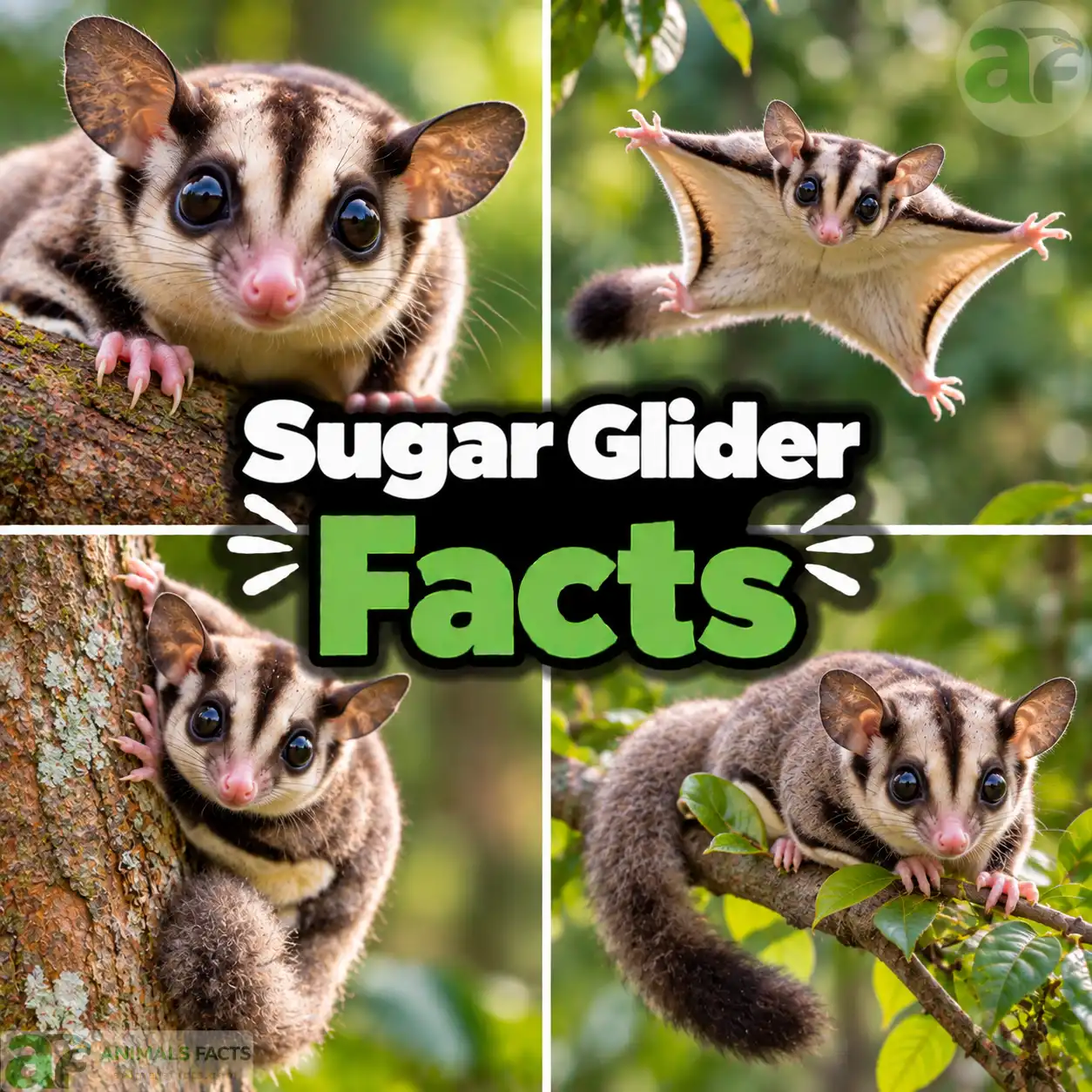
Sugar Glider Facts
| Feature | Details |
|---|---|
| Scientific Name | Petaurus breviceps (Waterhouse, 1839) |
| Kingdom | Animalia |
| Phylum | Chordata |
| Class | Mammalia |
| Infraclass | Marsupialia |
| Order | Diprotodontia |
| Family | Petauridae |
| Common Names | Sugar glider, sugar bear, honey glider |
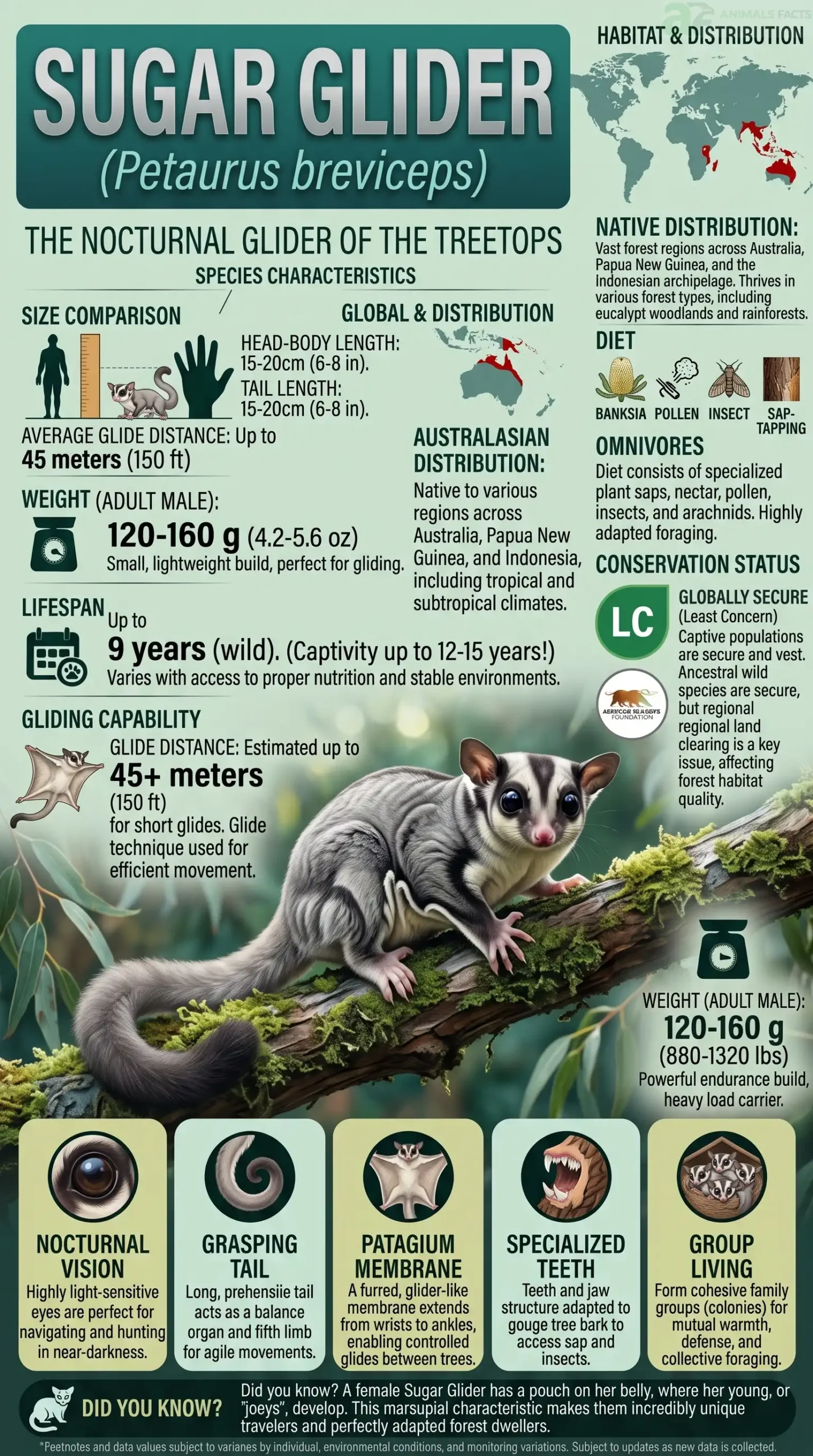
| Native Range | Australia, Papua New Guinea, eastern Indonesia |
| Habitat | Eucalyptus woodland, rainforest edge, open forest |
| Lifespan | 4–9 years (wild); up to 15 years (captivity) |
| Diet | Nectar, tree sap, pollen, insects, small vertebrates — highly varied |
| Body Length | 12–17 cm body plus 15–19 cm tail |
| Weight | 95–160 grams — roughly the weight of a tangerine |
| Top Speed | Gliding speed approximately 9 m/s (32 km/h) |
| Glide Distance | Up to 50 meters in a single glide |
| Conservation Status | Least Concern (IUCN) — abundant in native range |
| Gliding Membrane | Patagium — stretches from wrist to ankle on each side |
| Defining Feature | The gliding membrane and extraordinary social bonding behavior |
| Legal Status as Pet | Legal in most US states; banned in some; restricted in others |
 1. Introduction: What is a Sugar Glider?
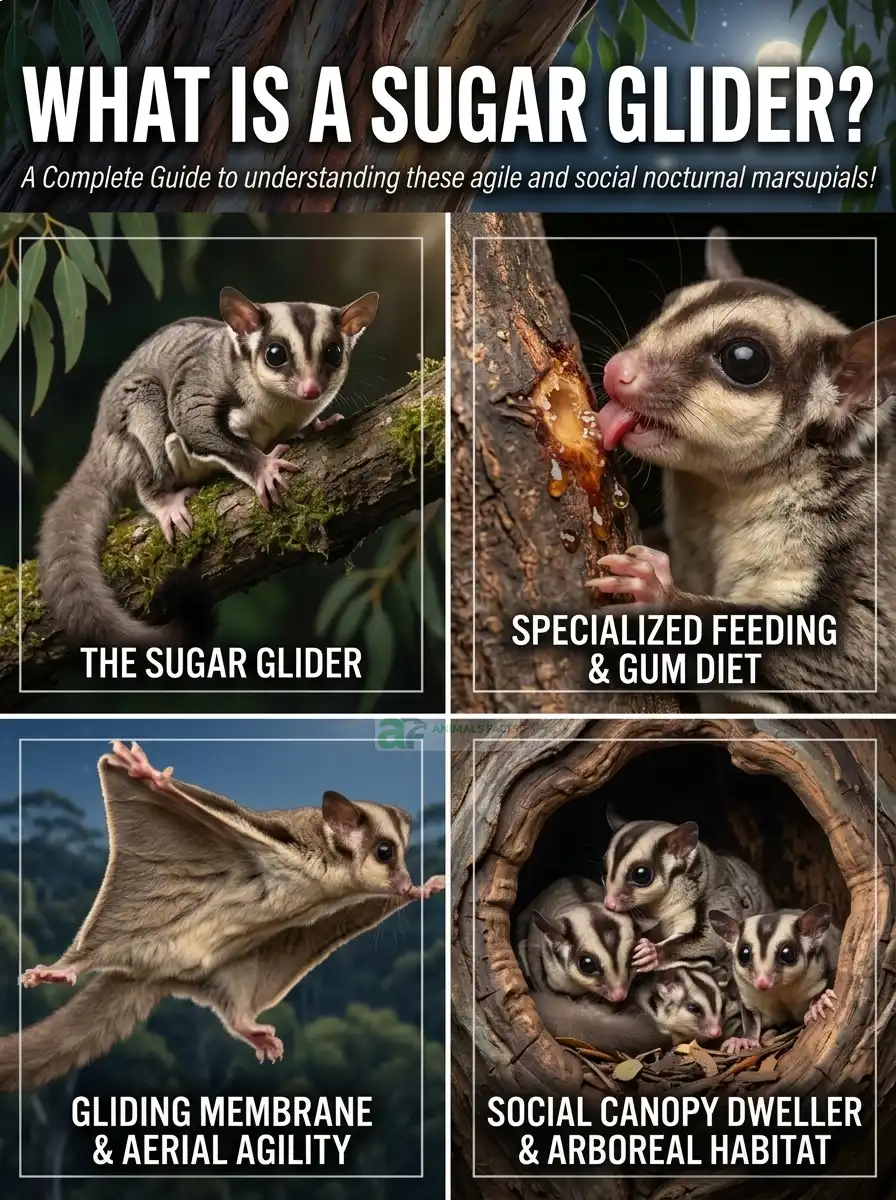
High in the eucalyptus canopy on an Australian night, a pair of small, wide-eyed animals clings to the upper branches — their enormous dark eyes scanning the darkness below with the alert intensity of creatures who know they are about to do something extraordinary. Then, with barely a moment’s hesitation, they launch — spreading their arms wide as a membrane of delicate skin unfurls from wrist to ankle on each side, transforming two tiny palm-sized marsupials into living glider planes that sail through the darkness in silence, covering fifty meters in a single sweeping arc before landing with a tiny thump on the trunk of a distant tree. Sugar glider facts begin with this single, breathtaking image — one of the most perfectly engineered small mammals on Earth, an animal that has solved the problem of moving efficiently through a three-dimensional forest environment with an evolutionary solution of extraordinary elegance.
The sugar glider is simultaneously one of the most beloved wildlife species in Australia and one of the most popular exotic pets in the world — a status earned not merely through its extraordinary gliding ability but through a combination of characteristics that make it unlike virtually any other small mammal. Interesting facts about sugar gliders reveal an animal of remarkable social sophistication — living in tight family groups of up to seven adults who share sleeping sites, groom each other extensively, and maintain group cohesion through a complex system of chemical and vocal communication. They produce vocalizations ranging from dog-like barking to locust-like hissing to an eerie cry some observers have compared to a miniature electric spark. They practice one of the most elaborate group scent-marking rituals of any marsupial — the dominant male marking all group members with his own scent secreted from glands on his forehead and chest. And they demonstrate a level of social bonding that has made them among the most studied social marsupials in the world.
Whether you are searching for sugar glider facts for kids to explore the science of gliding flight and marsupial biology, a prospective owner researching sugar glider habitat needs and care requirements, an Australian wildlife enthusiast wanting to understand the nocturnal aerial ballet happening in eucalyptus trees above their heads, or simply someone who encountered a photograph of this enormous-eyed, membrane-winged tiny animal and needed to know everything immediately — this is your comprehensive guide. We cover sugar glider scientific name, sugar glider diet, sugar glider size and weight, sugar glider behavior, the extraordinary mechanics of gliding, social colony life, conservation, cultural significance, and the ecological roles these remarkable animals play. The most enchanting glider in the marsupial world awaits.
2. Sugar Glider Species Overview & Classification
The sugar glider belongs to the family Petauridae — a family of Australasian gliding and non-gliding marsupials — and occupies a taxonomically fascinating position as the most widespread and most studied of the Australian gliding possum species.
Species Classification Table
| Taxonomic Rank | Classification |
|---|---|
| Kingdom | Animalia |
| Phylum | Chordata |
| Class | Mammalia |
| Infraclass | Marsupialia |
| Order | Diprotodontia |
| Family | Petauridae |
| Genus | Petaurus (Shaw, 1791) |
| Species | P. breviceps (Waterhouse, 1839) |
| Common Names | Sugar glider, sugar bear, honey glider |
| Etymology | Petaurus = “rope dancer” (Greek); breviceps = “short-headed” (Latin) |
| Sister Species | Squirrel glider (P. norfolcensis); Mahogany glider (P. gracilis) |
Related Species in Genus Petaurus
| Species | Common Name | Range | Notable Feature |
|---|---|---|---|
| Petaurus breviceps | Sugar glider | Australia, PNG, Indonesia | Most widespread; most studied |
| Petaurus norfolcensis | Squirrel glider | Eastern Australia | Larger than sugar glider; bushier tail |
| Petaurus gracilis | Mahogany glider | NE Queensland | Endangered; restricted range |
| Petaurus australis | Yellow-bellied glider | Eastern Australia | Largest Petaurus; aggressive territorial calls |
| Petaurus abidi | Northern glider | Papua New Guinea | Least known; poorly studied |
The Broader Gliding Possum Context
Sugar gliders are part of a broader radiation of gliding possums in Australia — representing one of the most remarkable examples of convergent evolution in the mammalian world:
Australian gliding marsupials:
- Sugar glider (Petaurus breviceps)
- Squirrel glider (Petaurus norfolcensis)
- Yellow-bellied glider (Petaurus australis)
- Mahogany glider (Petaurus gracilis)
- Feathertail glider (Acrobates pygmaeus) — world’s smallest gliding mammal
- Greater glider (Petauroides volans) — world’s largest gliding marsupial
Northern hemisphere gliding rodents (convergent, unrelated):
- Flying squirrels (family Sciuridae)
- Scaly-tailed flying squirrels (family Anomaluridae)
- Colugo (order Dermoptera) — technically a gliding placental mammal
The fact that gliding has evolved independently multiple times in mammals on different continents reflects the enormous adaptive value of the gliding solution in forest environments — the ability to move efficiently between trees without descending to the dangerous ground level.
Evolution & Discovery Timeline
~30–40 million years ago — The Petauridae family diverges from other Australian marsupial lineages — the gliding capability of the Petaurus genus developing during the Oligocene and Miocene epochs as Australian forest environments diversified.
~15 million years ago — The Petaurus genus is believed to have diverged from non-gliding petaurid ancestors — with the gliding membrane (patagium) evolving as an adaptation for inter-tree movement in Australia’s increasingly fragmented forest environments.
1789 — John White, Chief Surgeon of the First Fleet, provides one of the earliest documented European descriptions of sugar gliders — observing them in the forests around Sydney Cove in the months following the establishment of the colony.
1839 — George Robert Waterhouse formally describes the species as Petaurus breviceps — establishing the binomial nomenclature still used today.
1850s — First systematic studies of sugar glider colony behavior are conducted by early Australian naturalists — documenting the group-living pattern and tree hollow den sharing that characterize the species.
1980s — Sugar gliders become established as exotic pets in the United States — following successful captive breeding programs and increasing availability through the exotic animal trade.
1990s — Research on sugar glider colony social structure, scent marking, and communication systems by Australian ecologists establishes the foundations of modern sugar glider behavioral ecology.
2001 — Genetic analysis confirms the sugar glider’s distribution across Australia, Papua New Guinea, and eastern Indonesia — clarifying population relationships across the species’ range.
2019–2021 — The Australian bushfire crisis generates significant concern about sugar glider populations in affected areas — with the species listed among those potentially impacted by habitat loss in fire-affected eastern Australian forests.
2024 — Updated distribution surveys across Papua New Guinea confirm that sugar glider populations in the island’s complex forest mosaic are more taxonomically diverse than previously recognized — with potential for additional species descriptions.
“The sugar glider is one of those animals that makes you genuinely question how something so perfectly suited to its environment — so physically elegant and so socially sophisticated — could have evolved from such ancient, generalist marsupial ancestors. It is a masterpiece of Australian evolutionary innovation.”
— Dr. David Lindenmayer, Professor of Ecology, Australian National University, and leading researcher on Australian forest wildlife
3. Sugar Glider Physical Description & Unique Features
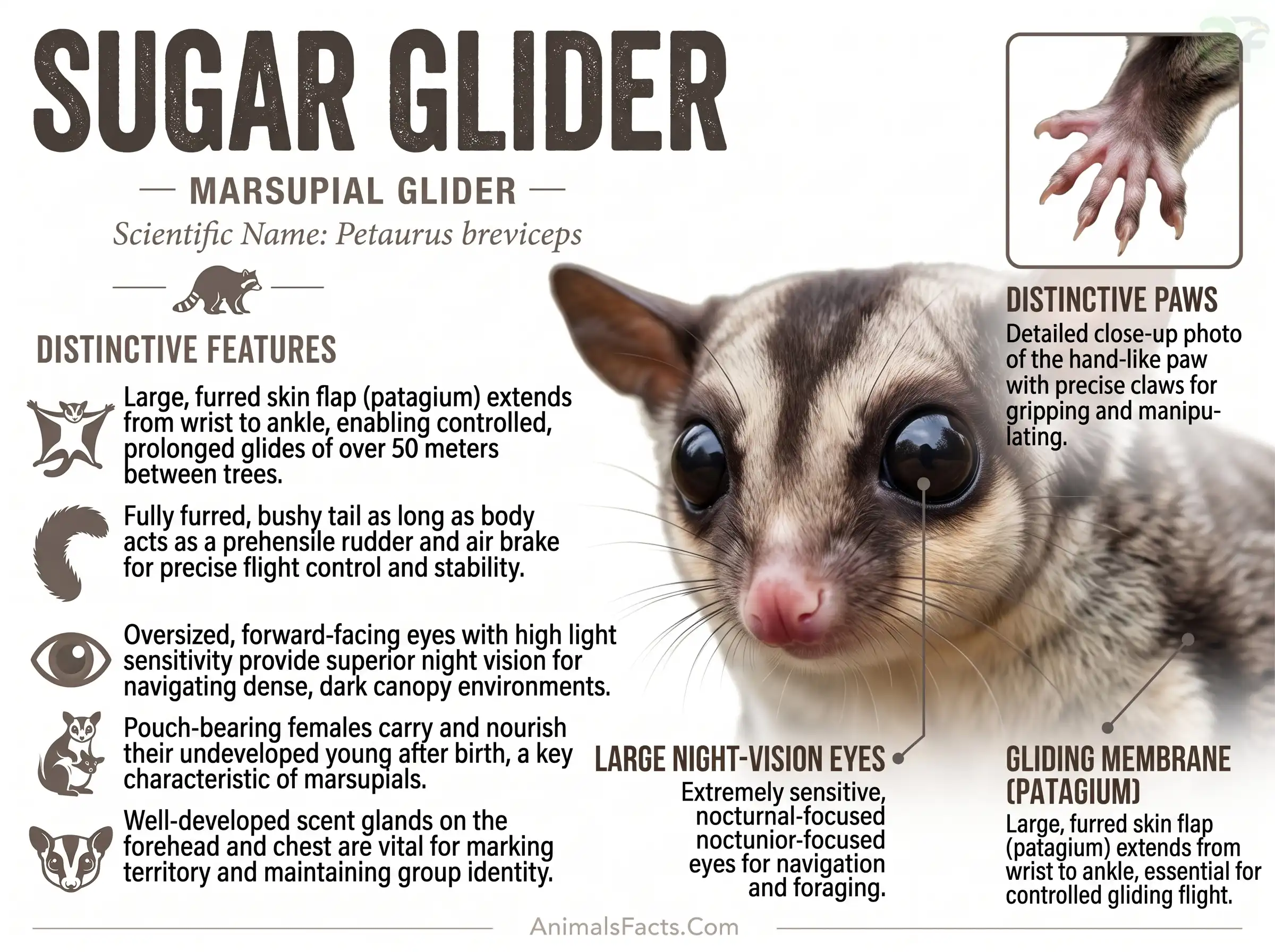
Sugar glider size and weight make it a tiny animal — roughly the weight of a tangerine at approximately 95–160 grams — with a body length of 12–17 cm plus a tail nearly as long again. Yet this modest physical investment houses one of the most sophisticated locomotion systems and social behavioral repertoires of any small marsupial.
The Patagium — Wings of Skin
The defining physical feature of the sugar glider is its patagium — the gliding membrane that transforms this small marsupial into an aerial acrobat of extraordinary capability:
Structure — The patagium is a thin but tough membrane of skin that stretches from the fifth finger of each hand to the first toe of each foot on both sides of the body — creating two triangular sail-like surfaces, one on each side. When the arms are extended, the patagium unfurls to create a surface area dramatically exceeding the animal’s body cross-section.
Size — When fully extended, the two patagium panels together create a gliding surface approximately the area of a large postcard — extraordinary efficiency for an animal weighing less than 160 grams.
Control — The sugar glider controls its glide trajectory by adjusting the tension in each patagium panel independently using the muscles of the arm, body wall, and legs — the same physical principle as a wingsuit skydiver. Steering left requires reducing tension on the left panel relative to the right; banking right does the opposite. The tail provides additional steering and braking — held in a curve during gliding and used to adjust drag.
Landing — The final stage of a glide involves the sugar glider pulling its body upright in the last fraction of a second before impact — presenting the patagium as a braking surface and converting horizontal momentum into a controlled vertical touchdown on the target tree trunk. The extended claws then grip the bark simultaneously — preventing rebound and completing the landing in one fluid motion.
The Body
Beyond the patagium, the sugar glider has a distinctive body form:
Enormous eyes — Disproportionately large, forward-facing dark eyes that provide the binocular vision essential for judging gliding distances and landing positions accurately. The eyes are so large relative to head size that they give the sugar glider the characteristic appearance of perpetual, wide-eyed astonishment that contributes to the species’ extraordinary visual appeal.
Pointed snout — A delicate pointed muzzle housing a long, extensible tongue used for lapping nectar and extracting tree sap — the primary food sources from which the “sugar” in sugar glider derives.
Grasping feet and hands — Both hands and feet are equipped with opposable toes — the hallux (inner toe) of the hind foot is especially important, providing the vice-like grip on bark that allows the animal to cling to vertical surfaces immediately after landing.
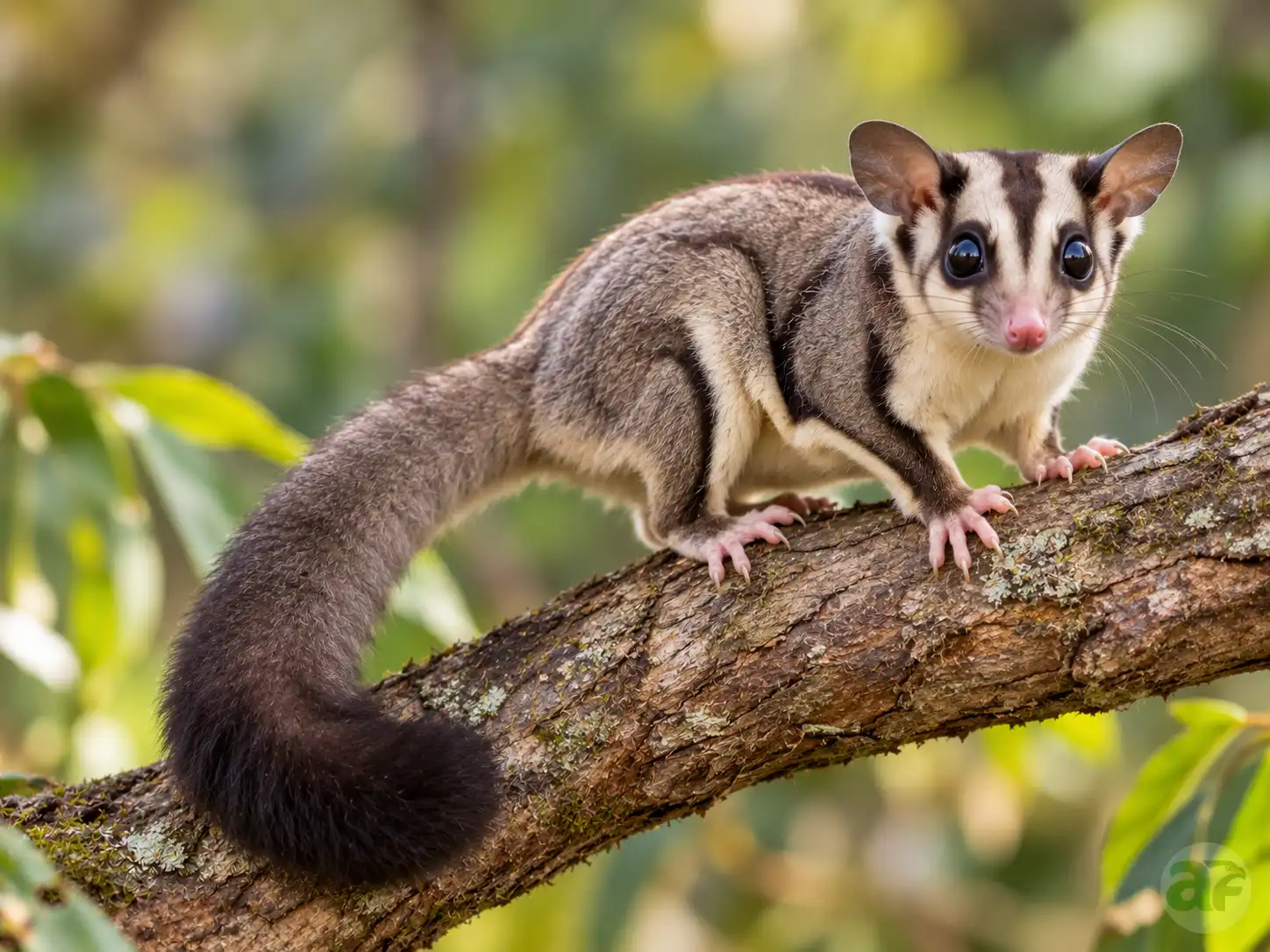
Soft, dense fur — The fur is blue-grey on the back, paler silver-grey on the underside, with a distinctive dark mid-dorsal stripe running from the snout along the full length of the back. This stripe is one of the most reliable field identification features. The fur is extremely soft and dense — providing thermal insulation for an animal that loses heat rapidly through the large surface area of the patagium.
Scent Glands — The Social Chemistry System
Male sugar gliders possess two conspicuous scent glands visible as patches of different skin texture on the body:
Frontal gland — Located on the top of the head — appearing as a diamond-shaped bald or slightly waxy patch in the fur. This gland produces the secretions used by dominant males to mark group members — the male rubbing his head on the bodies of group members to leave his chemical signature.
Sternal gland — Located on the chest — appearing as a slightly raised, bald area on the lower chest. Used for marking substrates and also for marking group members.
Pouch gland — Females have a scent gland associated with the pouch opening — important in joey identification and maternal recognition.
Paracloacal glands — Both sexes have glands near the cloaca — important in reproductive signaling.
💡 Did You Know? The sugar glider’s gliding mechanics have been studied by aeronautical engineers interested in the efficiency of biological gliding systems. A sugar glider achieves a glide ratio of approximately 2:1 — moving forward approximately 2 meters for every 1 meter of height lost — a remarkable efficiency for a passive glider with no powered flight capability. This efficiency means that a sugar glider launching from a height of 25 meters can reach a tree 50 meters away horizontally — crossing a gap in the forest canopy that would require the same animal many minutes of ground travel to circumnavigate, with significant predation risk during that ground travel. The patagium thus provides not merely a transportation advantage but a dramatic predation risk reduction — each glide replaces dozens of seconds of vulnerable ground movement with approximately 5 seconds of airborne travel.
4. Top 25 Amazing Sugar Glider Facts
Here is your definitive collection of the most extraordinary, scientifically verified, and genuinely astonishing sugar glider facts as of 2026:
- Sugar gliders can glide up to 50 meters in a single glide — covering distances equivalent to the length of an Olympic swimming pool while barely losing altitude, through a passive gliding mechanism with no flapping or powered flight.
- The sugar glider’s gliding membrane — the patagium — stretches from wrist to ankle and allows glide ratios of approximately 2:1 — traveling forward 2 meters for every 1 meter of altitude lost.
- Sugar gliders are social colony animals living in groups of up to 7 adults plus young — sharing tree hollow sleeping sites in tight, warm huddles that simultaneously conserve heat and reinforce social bonds.
- The dominant male in a sugar glider colony marks every member of his group with his own scent — rubbing his forehead and chest glands on the bodies of all group members — a behavior that creates a shared group odor allowing instant identification of group members vs. strangers.
- Sugar gliders produce at least 15 distinct vocalizations — including a dog-like barking sound, a locust-like hissing, a chattering alarm call, a haunting cry described as resembling a tiny electric discharge, and soft chirping sounds used during close social interactions.
- Despite their name, sugar gliders do not eat only sweet foods — they are highly opportunistic omnivores, consuming insects, spiders, small lizards, bird eggs, pollen, and even small birds in addition to the nectar and tree sap that the name suggests.
- Sugar gliders enter torpor during cold weather or food scarcity — dramatically reducing their metabolic rate and body temperature to conserve energy. Unlike true hibernation, torpor is shorter in duration and more reversible — animals can return to full activity within minutes if disturbed.
- A sugar glider colony expels intruder sugar gliders aggressively — individuals not belonging to the group are identified by scent and driven off. The scent marking behavior of the dominant male is thus not merely social bonding but an active group security system.
- Sugar gliders have been documented planning glide routes — assessing multiple potential landing trees before choosing the optimal target, suggesting cognitive spatial planning capabilities unusual in small marsupials.
- The feathertail glider (Acrobates pygmaeus) — a close relative — is the world’s smallest gliding mammal at approximately 10–14 grams. Sugar gliders, at 95–160 grams, are among the smallest non-feathertail gliders.
- Sugar gliders build sophisticated nests inside tree hollows — lining the hollow with leaves that they carry in their prehensile tail, curled around bundles of nesting material to transport it up the tree.
- Both male and female sugar gliders have pouches — but only the female’s pouch is functional for joey development; the male’s is vestigial, a reminder of the shared evolutionary heritage.
- A sugar glider joey is born at a weight of approximately 0.2 grams — invisible to the naked eye — and completes its early development in the mother’s pouch over approximately 60–70 days before emerging.
- Sugar gliders use latrines — specific locations in their territory where they preferentially defecate — a behavioral feature unusual among small marsupials that contributes to the chemical communication landscape of their territory.
- The yellow-bellied glider (Petaurus australis) — the sugar glider’s larger relative — produces one of the loudest and most eerie vocalizations of any Australian mammal — a complex, territorial “shriek” that can be heard over 500 meters away and is one of the defining sounds of southeastern Australian eucalyptus forest at night.
- Sugar gliders show rapid adaptation to novel food sources — in areas where introduced plant species provide nectar or sap, sugar gliders incorporate these novel resources into their diet with remarkable behavioral flexibility.
- The sugar glider’s tongue is specifically adapted for extracting nectar and sap — long, thin, and equipped with a brush-like tip that efficiently sweeps liquid food from flowers, bark surfaces, and feeding incisions.
- Wild sugar gliders make incisions in specific tree species to access sap — using their lower incisors to gouge the bark and stimulate sap flow from the underlying phloem. These incisions are maintained and revisited repeatedly — individual trees bearing the characteristic feeding scars of long-term sugar glider use.
- Sugar gliders have been observed altruistically sharing food — a behavior rare enough in non-primate mammals to attract significant scientific attention. Colony members, particularly adults toward juveniles, have been documented sharing insect prey.
- The sugar glider’s torpor capability is one of its most important survival adaptations — during cold nights when foraging would cost more energy than it produced, a sugar glider can drop its body temperature by up to 15°C and its metabolic rate by up to 75%, saving the energy equivalent of several hours of foraging in a single overnight torpor episode.
- Sugar glider colony membership is remarkably stable — radio-tracking studies have found that the same individuals maintain the same colony associations for multiple years, and colony disruption through member loss is followed by a period of social instability before new stable configurations form.
- Sugar gliders use acoustic communication across distances that exceed their visual range — the barking call is used in long-distance communication between colony members and in territorial advertisement to neighboring colonies.
- The sugar glider’s large ears can rotate independently to track sounds — allowing precise acoustic localization of both insect prey and approaching predators from a distance.
- Sugar gliders are among the most popular exotic pet species in the United States — with an estimated 100,000–200,000 sugar gliders maintained as pets in the US as of 2026, making them one of the most numerous exotic pet mammals in American households.
- Research on sugar glider thermoregulation and torpor has contributed to understanding of metabolic flexibility in small endotherms — with implications for conservation biology of small mammals facing cold stress and for biomedical research into low-metabolic-rate physiology.
5. Fun Facts About Sugar Gliders
- Sugar gliders can glide 50 meters in a single leap — the length of an Olympic pool
- They live in social colonies of up to 7 adults
- The dominant male marks all colony members with his scent
- They produce 15 different vocalizations — including barking like a tiny dog
- Sugar gliders carry nesting material in their prehensile tail
- They can enter torpor — dropping body temperature by 15°C to save energy
- A newborn sugar glider weighs just 0.2 grams — invisible to the naked eye
- Their tongue has a brush-like tip for extracting nectar
- They plan their glide routes before launching
- There are an estimated 100,000–200,000 pet sugar gliders in the US
- They never descend to the ground — living entire lives in the forest canopy
- Sugar gliders recognize colony vs. stranger instantly through scent
6. Sugar Glider Natural Habitat & Geographic Range
Sugar glider habitat encompasses a remarkably diverse range of Australian forest types — from tropical rainforest edges to dry eucalyptus woodland — reflecting the species’ considerable dietary and habitat flexibility within the constraint of needing tree hollows for denning and adequate tree cover for gliding.
Habitat Requirements
Sugar gliders require several specific habitat components:
Tree hollows — The most critical limiting resource for sugar gliders across their entire range. Tree hollows used as denning and sleeping sites require old growth trees — typically trees at least 120 years old in Australian forests before developing hollows of sufficient size. Sugar glider colonies rotate among multiple tree hollows within their territory — using different hollows on different nights and maintaining several backup sites. The loss of old-growth trees through clearing, fire, and logging is the primary driver of sugar glider habitat quality decline.
Diverse food tree species — A healthy sugar glider territory requires a mix of species providing different food resources at different times of year:
- Eucalyptus (various species) — sap, pollen, nectar
- Acacia (wattles) — gum, pollen, insects
- Banksia and Grevillea — nectar (critical food sources)
- Diverse trees supporting insect populations
Canopy connectivity — Trees must be close enough together for gliding travel — gaps exceeding approximately 50 meters between trees represent barriers that fragment sugar glider populations and require them to descend to the dangerous ground level.
Habitat Types
Eucalyptus woodland and open forest — The primary habitat across most of the Australian range; provides the combination of eucalyptus sap, associated insect populations, and old growth tree hollows that sugar gliders require.
Wet sclerophyll forest — High-rainfall eucalyptus forest; typically excellent sugar glider habitat due to tree diversity and high invertebrate productivity.
Rainforest edge — The interface between rainforest and open forest; exploited for nectar and insects from both forest types while denning in adjacent eucalyptus trees with hollows.
Coastal heathland — Present where suitable tree hollows occur; exploited for banksia and grevillea nectar.
Agricultural margins with remnant trees — In modified landscapes, sugar gliders persist in remnant tree patches if hollow-bearing trees remain and canopy connectivity is maintained.
Geographic Range
| Region | Country | Status | Notes |
|---|---|---|---|
| Eastern Australia | Australia | Core range; abundant | Queensland to Victoria; most studied populations |
| Northern Australia | Australia | Present | Queensland and Northern Territory populations |
| Tasmania | Australia | Present | Introduced; established population |
| Papua New Guinea | PNG | Abundant | Entire island; complex genetic structure |
| Moluccas Islands | Indonesia | Present | Ternate, Bacan, Halmahera |
| West Papua | Indonesia | Present | Western New Guinea populations |
| Bismarck Archipelago | PNG | Present | Various islands |
💡 Did You Know? The sugar glider’s absolute dependence on tree hollows for denning creates an interesting conservation paradox — sugar gliders need old, large trees with developed hollows, but these trees take 100–200 years or more to develop suitable hollows. When forests are cleared and then allowed to regrow, the young trees that quickly re-establish are excellent for foliage, flowers, and insects — but provide no tree hollows. A regenerating forest may appear to offer suitable habitat for 50–80 years after clearing while actually providing none of the hollow-denning sites that sugar glider colonies require. This lag between forest structural recovery and hollow availability means that the true timeline for sugar glider habitat recovery after clearing is measured in centuries rather than decades — a conservation reality that makes habitat protection far preferable to habitat restoration for this species.
7. Sugar Glider Diet & Feeding Behavior
Sugar glider diet is one of the most nutritionally diverse and seasonally flexible of any small Australian marsupial — reflecting a feeding strategy that balances the predictable but low-protein rewards of plant foods with the high-protein but variable rewards of arthropod and small vertebrate prey.
Diet Breakdown Table
| Food Type | Estimated % of Diet (seasonal) | Notes |
|---|---|---|
| Acacia gum and tree sap | ~25–40% (winter dominant) | Critical winter energy source when insects scarce |
| Eucalyptus nectar and pollen | ~20–30% (spring dominant) | Primary spring food when eucalypts flower |
| Insects (beetles, moths, crickets) | ~25–35% (summer dominant) | Critical protein source; most important in breeding season |
| Banksia/Grevillea nectar | ~10–15% (variable) | Important where these plant families are abundant |
| Spiders and other arthropods | ~5–10% | Supplementary invertebrate protein |
| Small vertebrates (lizards, small birds) | ~2–5% | Opportunistic; more common than many sources suggest |
| Bird eggs | ~2–5% | Seasonal; opportunistic |
| Plant matter (leaves, bark, fruit) | ~3–5% | Supplementary; minor component |
The Seasonal Feeding Strategy
The sugar glider’s diet is not a fixed mixture but a highly dynamic seasonal program that tracks the availability of different food types across the year:
Winter strategy — When insects are scarce, sugar gliders shift heavily toward acacia gum and eucalyptus sap — high-energy carbohydrate resources that provide caloric fuel even when protein is limited. During this period, sugar gliders maintain sap feeding sites by creating and maintaining bark incisions — using their lower incisors to gouge channels in specific tree species that produce high volumes of sap in response to wounding.
Spring strategy — As temperatures rise and eucalypts and banksias begin flowering, sugar gliders shift toward nectar and pollen — exploiting the massive seasonal pulse of floral resources. This period coincides with breeding — ensuring that females in gestation and early lactation have access to high-energy food.
Summer strategy — Peak insect season drives sugar gliders toward arthropod prey — with insect consumption highest during the period of joey development in the pouch, when the mother’s protein requirements are at their maximum.
The Sap-Tapping Technique
One of the most behaviorally distinctive aspects of sugar glider feeding is their sap-tapping technique — using the lower incisors to gouge specific patterns in tree bark to stimulate sap flow:
- Sugar gliders preferentially gouge specific tree species — primarily acacias (Acacia species) and eucalypts (Eucalyptus species) whose sap is high in carbohydrates and low in toxic secondary compounds
- Individual trees are repeatedly visited — maintained feeding wounds are revisited across multiple nights and multiple seasons
- The sap produced is lapped up using the brush-tipped tongue — the animal spending several minutes at each feeding site before moving to the next
- In some habitats, sap feeding sites become important spatial landmarks around which sugar glider territories are organized
The Tongue — A Specialized Tool
The sugar glider’s tongue is among its most exquisite physical adaptations — extended, thin, and equipped with a fine bristle-brush tip that efficiently sweeps nectar and sap from surfaces that a pointed tongue could not access effectively. This tongue structure has evolved convergently in numerous other nectar-feeding animals including honeyeater birds and some bat species — representing a classic example of the same physical solution being independently invented by different evolutionary lineages for the same ecological problem.
8. Sugar Glider Reproduction & Life Cycle
Sugar glider reproduction reflects the marsupial reproductive strategy — extremely brief gestation, tiny and altricial newborns, extended pouch development — combined with the specific social context of the colony group that influences multiple aspects of sugar glider reproductive biology.
Mating System
The sugar glider’s mating system is polygynous within the colony — the dominant male of the colony mates with all breeding females within the group. His scent-marking of all colony members is both social bonding and mate-guarding — the shared colony scent that results from his marking of females makes it difficult for outside males to identify receptive females within the established group.
Female choice — Despite the dominant male’s mate-guarding, females show preference behaviors that suggest active female mate choice is an important component of the mating system. Females may solicit mating from the dominant male while resisting advances from subordinate males.
Breeding season — In Australia, sugar gliders breed primarily from June to November — with the timing varying by latitude. In tropical portions of the range, breeding is less strictly seasonal. Females typically produce two litters per year under favorable conditions.
Gestation & Birth
- Gestation period: approximately 16 days — among the shortest in any marsupial
- Litter size: typically 1–2 joeys — most commonly twins
- Birth weight: approximately 0.2 grams per joey — a barely visible speck of life
- Joey at birth: blind, deaf, forelimbs only partially formed, hindlimbs barely began; must crawl to pouch independently using only forelimbs
Pouch Development
The joey’s development in the pouch spans approximately 60–70 days:
- Days 0–30 — Permanently attached to nipple; essentially embryonic development continuing outside the womb
- Days 30–60 — Eyes beginning to open; fur developing; beginning to thermoregulate partially
- Days 60–70 — Fully furred; eyes open; beginning to detach from nipple occasionally
- Days 70–90 — Beginning to emerge from pouch for brief periods; still returning to nurse
- Days 90–120 — Riding on mother’s back during foraging; beginning to explore environment
- Day ~120 — Weaning; independent foraging beginning; remaining with colony
The Colony Juvenile Integration
One of the most distinctive aspects of sugar glider reproduction is the integration of juveniles into the colony social group — rather than dispersing immediately after weaning, juvenile sugar gliders remain with the parental colony for an extended period, learning foraging techniques, gliding skills, and social navigation from adult colony members. This extended juvenile period within the colony contributes significantly to the social sophistication of adult sugar gliders.
Lifespan Comparison Table
| Species | Average Lifespan (Wild) | Max Documented | Reproductive Rate |
|---|---|---|---|
| Sugar glider (P. breviceps) | 4–9 years | 15 years (captivity) | 2 litters/year; 1–2 joeys each |
| Squirrel glider (P. norfolcensis) | 3–6 years | 12 years (captivity) | 1–2 litters/year |
| Feathertail glider (Acrobates pygmaeus) | 3–5 years | 7 years (captivity) | 2 litters/year; 2–4 joeys each |
| Greater glider (Petauroides volans) | 10–15 years | 20 years (captivity) | 1 joey per year |
| Common brushtail possum | 7–13 years | 17 years (captivity) | 1 joey per year |
9. Social Behavior & Communication
Sugar glider social behavior is the most extensively studied and most complex of any Petaurus species — and represents one of the richest behavioral ecologies of any small marsupial.
The Colony Structure
The fundamental social unit of the sugar glider is the family colony — a group of 1–7 adults (typically 1–2 dominant males, multiple females, and subordinate males or previous-year offspring) plus current-year young, all sharing a home territory and nesting sites. Colony structure characteristics:
Territory — A colony typically maintains a territory of approximately 1–4 hectares containing multiple tree hollow den sites, multiple sap feeding stations, and diverse foraging areas.
Den sharing — All colony members share the same tree hollow each day — huddling together in a tight ball for warmth and social bonding. This communal sleeping is not merely economical (conserving heat during cold Australian nights and day) but actively reinforces the social bonds that maintain colony cohesion.
Dominance hierarchy — Within the colony, a dominance hierarchy exists — particularly among males. The dominant male is the primary breeder and primary scent-marker. His scent-marking of all colony members is the most important single behavior in sugar glider colonial life — the signature he deposits on each group member creates the shared chemical identity that defines colony membership.
Scent Marking — The Chemistry of Community
Sugar glider scent marking is among the most sophisticated chemical communication systems of any marsupial:
Frontal gland marking of colony members — The dominant male approaches each colony member and rubs his head across their body — transferring secretions from the frontal gland. This is repeated regularly — the chemical signal fading over time requires periodic refreshing.
Sternal gland substrate marking — Both sexes mark branches, den entrance holes, and other substrates with sternal gland secretions — creating a three-dimensional chemical map of the territory that community members can read for information about activity, reproductive state, and group membership.
Paracloacal gland marking — Reproductive status communication through secretions near the cloaca.
Stranger recognition — When a sugar glider from outside the colony enters the territory, the absence of the dominant male’s chemical signature on its body — combined with its carrying a different group odor — triggers immediate recognition and aggressive response from colony members.
The Vocal Repertoire
Sugar gliders produce an extraordinary range of vocalizations:
Crabbing — The most commonly heard sugar glider sound; a loud, electrical-spark-like cry produced when frightened or threatened — startlingly loud for such a small animal
Barking — A repetitive, dog-like bark used in long-distance communication between colony members and in territorial advertisement to neighboring groups; particularly common in winter
Chattering — Rapid, staccato sound used in alarm situations
Chirping — Soft, high-pitched contact calls used between colony members at close range during social interactions
Hissing — Defensive sound combined with crabbing when threatened
Purring — Very soft sounds produced during grooming and relaxed social contact
Ultrasonic vocalizations — Documented in joey-mother communication; inaudible to humans without electronic detection equipment
Mutual Grooming — The Social Glue
Allogrooming (grooming of one individual by another) is one of the most frequent and most important social behaviors in the sugar glider colony — occurring between virtually all colony member pairs. Allogrooming sessions reinforce social bonds, distribute colony scent among members, and provide hygiene maintenance. The frequency and distribution of grooming relationships within a colony have been used by researchers as a proxy measure of social bond strength — colonies in which all members groom each other frequently are more cohesive and more stable than those with asymmetric grooming relationships.
10. Predators & Defense Mechanisms
Sugar gliders face a diverse range of predators in their Australian and Papuan environments — and have evolved a combination of behavioral, acoustic, and chemical defenses calibrated for the specific predator community of the forest canopy.
Natural Predators
Owls — The powerful owl (Ninox strenua) and lesser sooty owl (Tyto multipunctata) are the most significant predators of sugar gliders across much of their Australian range. Owls are highly effective nocturnal hunters whose silent flight and acute hearing make them formidable threats to arboreal marsupials.
Quolls (Dasyurus species) — Tiger quolls and eastern quolls — Australia’s marsupial carnivores — are significant sugar glider predators where ranges overlap. Quolls climb trees efficiently and hunt in the same nocturnal time window as sugar gliders.
Pythons — Carpet pythons (Morelia spilota) and other arboreal python species take sugar gliders — the pythons’ ability to climb trees and their patience in ambush making them effective predators of small sleeping marsupials.
Brown tree snakes (Boiga irregularis) — Highly effective nocturnal arboreal predators; significant in the Papua New Guinea range; also the species responsible for the catastrophic extinctions of native forest birds on Guam following introduction.
Kookaburras and large birds of prey — Diurnal raptors including wedge-tailed eagles and grey goshawks take sugar gliders caught in the open during dawn or dusk activity.
Domestic and feral cats — Increasingly significant predators in areas where sugar glider habitat overlaps with human habitation — cats are effective nocturnal hunters capable of climbing trees to access sleeping sugar gliders.
Defense Strategies
The crabbing alarm call — The most distinctive sugar glider defense — an extraordinarily loud, electrical-discharge-like cry produced when a predator is detected at close range. The call startles approaching predators and alerts colony members simultaneously.
Colony vigilance — Multiple colony members sharing a den hollow provide collectively enhanced predator detection — more pairs of eyes, ears, and scenting ability than any individual alone.
Gliding escape — A sugar glider detecting a predator approach in a tree can escape by launching a glide to a distant tree — the aerial route being inaccessible to most ground and tree-climbing predators.
Cryptic coloring — The grey-brown dorsal coloring of sugar gliders provides excellent camouflage against the grey bark of eucalyptus trees — reducing detection probability at close range.
Tree hollow security — The primary sleeping site inside a tree hollow provides protection that most predators cannot access; the entrance hole of a suitable hollow may be too small for many predators to enter.
💡 Did You Know? The sugar glider’s crabbing alarm call is one of the most startling sounds made by any small Australian mammal — observers who have heard it for the first time consistently describe being shocked by how loud and how unusual the sound is for an animal barely larger than a tennis ball. The call has been described as resembling an electric spark, a miniature locust swarm, and the sound of tearing velcro amplified. Its volume relative to the animal’s size is extraordinary — designed to startle and disorient approaching predators rather than simply alert. Wildlife researchers who accidentally trigger the call during nighttime surveys have consistently reported that the sound is genuinely alarming even when you know it is coming from a tiny marsupial you are holding.
11. Sugar Glider Facts for Kids
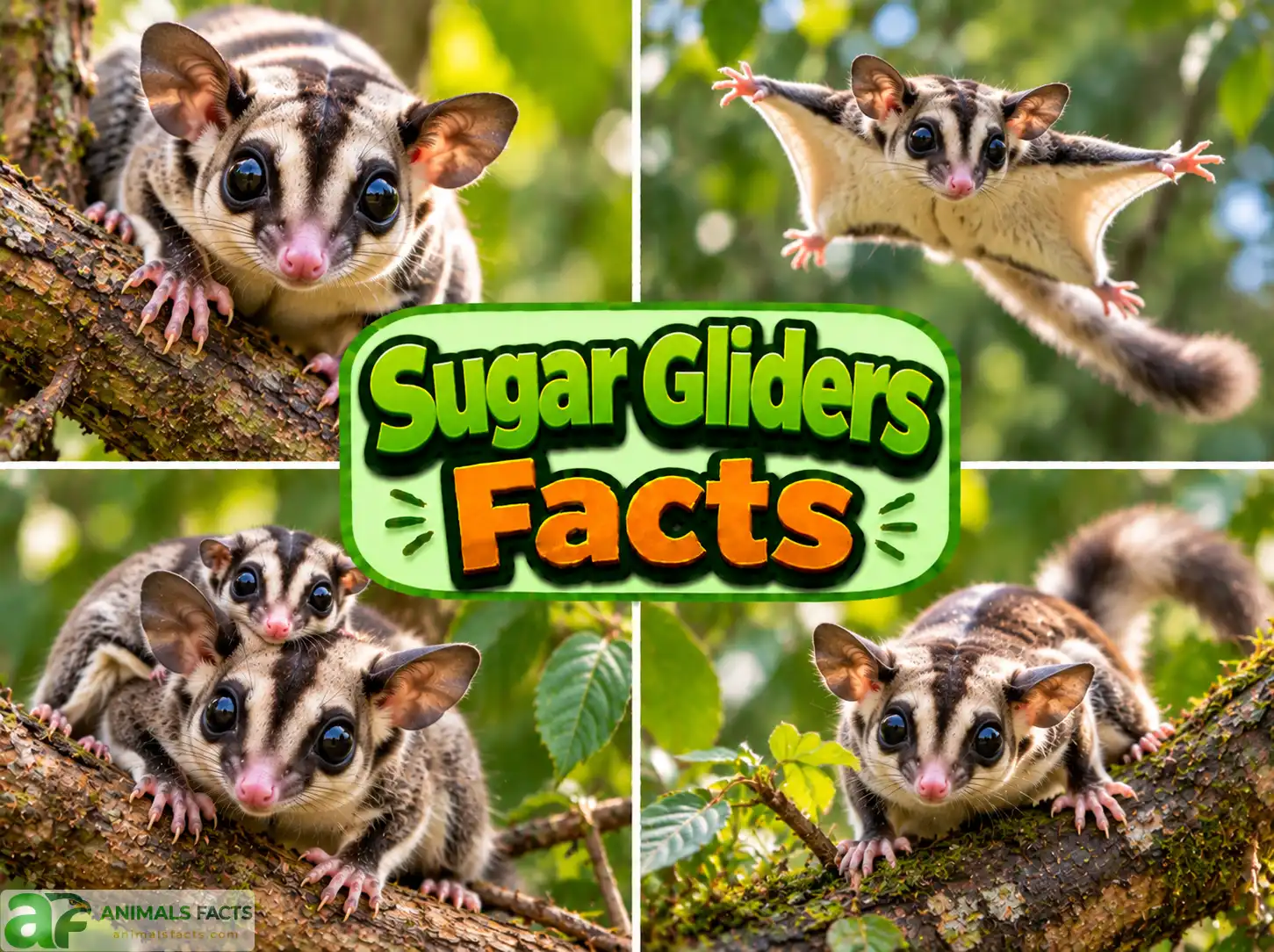
Hey incredible young wildlife explorers! Here are some totally amazing sugar glider facts for kids that will absolutely blow your mind:
- Sugar gliders can FLY — well, almost! They spread a special skin membrane between their arms and legs — called a patagium — and glide through the air for up to 50 meters in one leap. That is the length of a swimming pool! They steer by tightening one side of the membrane or the other, just like a tiny living airplane.
- They live in FAMILIES just like us! Sugar gliders live in family groups of up to 7 adults who all sleep together in a tree hollow during the day, groom each other, share food, and look out for each other. When a new sugar glider tries to join the group, the family works together to drive it away!
- The dad marks EVERYONE with his smell! The leader of a sugar glider family has special scent glands on his forehead and chest. He rubs himself on every family member to leave his scent on them — like giving everyone a name tag that other sugar gliders can read by sniffing. If someone doesn’t have the right smell, the family knows they’re a stranger!
- Baby sugar gliders weigh 0.2 grams — you CANNOT see them! When a sugar glider is born, it is so tiny — less than the weight of a paper clip — that it is almost invisible. This tiny baby then crawls all by itself into its mother’s pouch, where it spends the next two months growing.
- They can make 15 different sounds! Sugar gliders make barking sounds like tiny dogs, hissing sounds like angry insects, and a startlingly loud electric-crackle sound when frightened. Scientists have identified at least 15 completely different calls that sugar gliders use to communicate different messages.
- They carry their HOME in their tail! When a sugar glider decides to redecorate its tree hollow, it curls leaves around its prehensile tail and carries them up to the nest. The tail works like a backpack — holding the nesting material while the glider climbs!
- Sugar gliders can slow their heartbeat DOWN to save energy! On cold nights when there is no food to find, a sugar glider can lower its body temperature and slow everything in its body almost to a stop — entering a state called torpor — to save energy until better conditions arrive.
- There are almost as many pet sugar gliders in America as there are koalas in Australia! With an estimated 100,000–200,000 sugar gliders kept as pets in the United States, they are one of the most popular exotic pets in the world!
12. Relationship with Humans
The relationship between sugar gliders and humans encompasses three quite distinct dimensions — the ancient traditional relationship with Indigenous Australian peoples, the contemporary wildlife coexistence and conservation context in Australia, and the global exotic pet phenomenon that has made sugar gliders one of the most widely kept marsupial species outside their native range.
Indigenous Australian Relationships
Sugar gliders have coexisted with Aboriginal and Torres Strait Islander peoples throughout the entirety of human presence in Australia — at least 65,000 years. Indigenous Australians across the species’ range have developed detailed traditional ecological knowledge of sugar glider behavior, habitat requirements, and seasonal patterns — knowledge accumulated through millennia of close observation and practical use.
Traditional food resource — Sugar gliders were hunted as food across multiple Aboriginal language groups — their high body fat content (particularly before the energetically expensive winter period) making them a nutritious resource for communities in forested environments. Traditional hunting methods involved locating hollows containing sleeping groups and extracting the animals with specialized tools.
Ecological knowledge — Indigenous traditional ecological knowledge of sugar glider habitat requirements — particularly the critical importance of old-growth trees with developed hollows — has been increasingly recognized by Australian conservation scientists as containing insights that directly inform modern conservation management. The traditional practice of protecting specific hollow-bearing trees from burning — recognizing their value as wildlife habitat — predates Western conservation recognition of the same principle by thousands of years.
Cultural significance — Sugar gliders appear in the Dreamtime stories and artistic traditions of multiple Aboriginal language groups — their nighttime aerial behavior, communal living, and distinctive vocalizations featuring in narratives that explain natural phenomena and encode ecological observations. The sugar glider’s gliding behavior — crossing seemingly impossible distances through the air — features in stories involving themes of connection, community, and overcoming separation.
The Global Pet Trade
The sugar glider’s extraordinary appeal as a potential companion animal — its small size, social bonding with familiar humans, large eyes, and spectacular gliding behavior — has generated one of the most significant exotic pet markets for any marsupial species globally:
United States pet population — Estimated 100,000–200,000 sugar gliders are kept as pets in the United States as of 2026 — making them one of the most numerous exotic mammal pets in the country. They are legally kept in most US states, though specific regulations vary by state and locality.
The bonding claim — A central marketing claim in the sugar glider pet trade is that sugar gliders “bond” with their owners in ways analogous to dogs or primates. The biological basis for this claim lies in the species’ genuine colonial social bonding — sugar gliders that are raised from a young age with extensive daily human contact can become accustomed to and comfortable with specific humans. However, the depth and reciprocity of this “bond” is extensively debated by animal behavior scientists and welfare specialists.
Welfare concerns — The sugar glider pet trade has generated significant animal welfare concerns from wildlife and veterinary specialists:
- Sugar gliders are highly social animals that suffer when housed alone — single sugar glider ownership is almost universally condemned by welfare specialists
- Their complex dietary needs — requiring a diverse diet mimicking seasonal wild food availability — are difficult to meet with commercially available pet foods
- Their nocturnal nature creates challenges for owners who want daytime interaction
- Veterinary expertise for sugar glider health problems is limited outside of specialty exotic animal practices
- The exotic pet trade supply chain has historically involved wild-caught animals in some supply chains, raising conservation concerns
Legal status — Sugar gliders are legal pets in most US states; specifically banned in California, Alaska, and Hawaii; and subject to various local regulations in many municipalities. In Australia, keeping native wildlife including sugar gliders as pets is generally prohibited without specific permits — reflecting Australia’s strict native species protection framework.
Australian Conservation Context
In their native range, sugar gliders are broadly abundant and of least conservation concern — though specific local populations face pressures from habitat clearing. The species’ conservation significance in Australia is primarily as an indicator of old-growth forest quality:
Hollow-dependent species indicator — The presence of sugar gliders in a forest area is a reliable indicator of old-growth tree presence — a direct function of their obligate dependence on developed tree hollows. Conversely, the absence of sugar gliders from apparently suitable forest may indicate recent loss of hollow-bearing trees.
Fire ecology — Sugar gliders are among the hollow-dependent species most directly impacted by catastrophic bushfire — not because fire directly kills them (animals can often escape individual fires) but because fire destroys the hollow-bearing trees that took a century or more to develop, removing the denning habitat that populations require.
13. Sugar Glider Conservation Status & Threats
Conservation Status Overview
| Species | IUCN Status | Australian Status | Population Trend |
|---|---|---|---|
| Sugar glider (P. breviceps) | Least Concern | Not listed (abundant) | Stable overall |
| Squirrel glider (P. norfolcensis) | Least Concern | Vulnerable in some states | Decreasing in parts of range |
| Mahogany glider (P. gracilis) | Endangered | Endangered | Decreasing |
| Yellow-bellied glider (P. australis) | Least Concern | Vulnerable in some states | Stable to decreasing |
| Feathertail glider (A. pygmaeus) | Least Concern | Not listed | Stable |
Threats to Sugar Gliders
Despite the species’ overall Least Concern status, sugar glider populations face genuine threats in many parts of their range:
| Threat | Description | Impact Level |
|---|---|---|
| Habitat clearing | Loss of woodland and forest for agriculture and development | High — primary long-term threat |
| Loss of hollow-bearing trees | Old growth tree removal through clearing, logging, fire | Critical — direct habitat loss |
| Habitat fragmentation | Canopy gaps exceeding gliding range isolating populations | High |
| Catastrophic bushfire | Destruction of hollow-bearing trees; habitat loss | High — 2019–20 bushfires significant |
| Predation by introduced species | Cats, foxes in degraded habitats | Medium-High |
| Road kills | Vehicle strikes in fragmented landscapes | Medium |
| Climate change | Increased fire frequency; altered food phenology | Increasing concern |
| Exotic pet trade | Potential for wild collection in supply chain | Low-medium |
The Mahogany Glider Conservation Crisis
While the sugar glider is secure, its close relative the mahogany glider (Petaurus gracilis) represents one of Australia’s most critical small mammal conservation emergencies. Restricted to a tiny area of coastal woodland in northeastern Queensland (around Cardwell and Ingham), the mahogany glider has been reduced to fewer than 1,500–2,000 individuals by habitat clearing — with less than 20% of its original habitat remaining and continuing to decline. The mahogany glider’s precarious situation — a beautiful, poorly known relative of the abundant sugar glider — is a powerful illustration of how habitat specificity can make closely related species have dramatically different conservation trajectories.
14. Famous Sugar Gliders in History & Pop Culture
Famous Sugar Glider Individuals and Cultural Moments
“Sugar” and “Glider” — Multiple individual sugar gliders maintained at major zoological institutions — including Taronga Zoo (Sydney), San Diego Zoo, and Smithsonian National Zoo — have served as educational ambassador animals, introduced to millions of zoo visitors as representatives of Australian marsupial diversity. These individual animals have featured in zoo educational programs and media coverage that has substantially raised public awareness of sugar glider biology.
The Joey Rescue Media Moments — Multiple social media-viral moments involving rescued sugar glider joeys — tiny, transparent, barely-visible animals being cared for by wildlife rehabilitators in Australian wildlife centers — have collectively reached audiences of tens of millions. The visual contrast between the joey’s near-invisibility at birth and the fully formed adult capable of 50-meter glides has made the sugar glider’s developmental story one of the most compelling wildlife rehabilitation narratives in Australian social media.
Wildlife photography viral content — Images of wild sugar gliders mid-glide — captured with high-speed photography that freezes the patagium fully extended and the animal suspended between trees — have become some of the most widely shared Australian wildlife images on platforms including Instagram, National Geographic online, and BBC Earth digital content.
“Sugar Gliders” in science communication — The species’ extraordinary combination of marsupial biology, gliding flight, and complex social behavior has made it a frequent subject in science communication content — featured prominently in discussions of convergent evolution, marsupial biology, and Australian wildlife diversity in educational media, popular science articles, and museum exhibits.
15. Role in Ecosystem & Food Chain
Sugar gliders play multiple simultaneous ecological roles in Australian woodland and forest ecosystems — functioning as pollinators, insect regulators, seed dispersers, and prey species in ways that make their ecological contribution considerably more significant than their small size would suggest.
The Pollinator Role
One of the sugar glider’s most ecologically significant roles is as a nocturnal pollinator — a function that complements the diurnal pollination services of honeyeater birds and bees:
Eucalyptus pollination — When sugar gliders forage for nectar in eucalyptus flowers, pollen adheres to their fur and facial region — and is transferred to subsequent flowers visited during the same foraging bout. In habitats with high sugar glider density, sugar glider pollination may contribute meaningfully to eucalyptus reproductive success.
Banksia and Grevillea pollination — Sugar gliders visiting banksia and grevillea inflorescences for nectar similarly contribute to the pollination of these plant families — which provide critical habitat and food resources for numerous other Australian wildlife species.
Nocturnal pollination gap — Because sugar gliders are exclusively nocturnal foragers, their pollination services fill a temporal gap in the pollination day that diurnal pollinators cannot access — potentially providing pollination services to flowers that open specifically at night.
The Insect Regulation Role
Sugar gliders’ seasonal consumption of insects — particularly during summer when colony energy demands peak — provides a measurable contribution to insect population regulation in woodland habitats. Their predation on moth larvae, beetles, and other arthropods may reduce insect herbivory on eucalyptus foliage — contributing to forest health in ways that parallel the insect-regulation services of insectivorous birds.
The Prey Role
Sugar gliders are important prey resources for multiple native predator species:
- Powerful owls — Sugar gliders are among the most important prey items for powerful owls across their shared range in southeastern Australia
- Tiger quolls — Sugar gliders contribute significantly to quoll diet where ranges overlap
- Arboreal pythons — An important prey species for carpet pythons in woodland habitats
This prey role means that sugar glider population abundance influences predator population viability — declining sugar glider populations in fragmented habitats can contribute to population declines of specialist predators including the powerful owl, which is itself listed as threatened in parts of its Australian range.
16. Myths, Folklore & Cultural Significance
Aboriginal Australian Tradition and Dreamtime
Sugar gliders feature in the cultural and spiritual frameworks of multiple Aboriginal and Torres Strait Islander language groups across Australia — their aerial behavior, nocturnal habits, and tight family groupings providing rich material for narratives that explain the natural world and encode ecological knowledge in culturally transmissible form.
In several southeastern Australian Aboriginal traditions, the sugar glider’s gliding behavior is associated with themes of freedom, connection across distance, and the ability to cross boundaries between worlds or communities that are otherwise separated. The image of a small animal stretching itself wide open to travel impossible distances through the darkness — and returning to its family group regardless of where it lands — provides a powerful metaphor for community bonds that transcend physical separation.
The detailed ecological knowledge encoded in traditional narratives — the identity of hollow-bearing tree species, the seasonal patterns of nectar availability, the acoustic cues of sugar glider presence — represents thousands of years of accumulated natural history observation that is increasingly recognized by ecologists as a significant supplement to Western scientific understanding of Australian forest ecology.
The “Sugar Bear” Pet Trade Mythology
A significant body of cultural mythology has developed around the pet sugar glider trade — particularly in the United States — that deserves specific attention as an example of how commercial interests can shape public understanding of animal biology:
The “bonding” mythology — Pet sugar glider marketing frequently emphasizes that sugar gliders “bond” with their owners in ways that make them “uniquely rewarding” pets. While the species’ colonial social nature does mean that hand-raised individuals can become accustomed to human contact, the commercial version of this claim often significantly overstates both the depth and the universality of this bonding — leading many purchasers to expectations that individual animals cannot meet.
The “easy pet” mythology — Marketing materials frequently describe sugar gliders as “low maintenance” — a claim that is directly contradicted by the specialized dietary, social, and environmental needs of the species. Sugar gliders require complex diets, social companionship from conspecifics, adequate space for gliding behavior, and specialist veterinary care that significantly exceed the requirements of more conventional pets.
Addressing these mythologies through accurate information is an important wildlife education role — helping potential owners understand the genuine complexity of sugar glider care before committing to ownership of an animal that, if inadequately cared for, suffers significantly from poor conditions.
17. Sugar Gliders in Pop Culture
“Bing Bong” from Pixar’s Inside Out (2015) — While not definitively a sugar glider, the character Bing Bong — a pink, elephant-cat-dolphin imaginary companion from Riley’s childhood — has aspects of design reminiscent of small, large-eyed marsupial animals including sugar gliders. The character’s story of being remembered and forgotten resonated enormously with audiences and generated renewed interest in small, large-eyed animals that visually inspired aspects of the design.
Sugar glider viral video genre — Sugar gliders have generated an entire dedicated genre of viral social media content — with videos of gliders launching from hands, performing multiple-glide sequences in outdoor settings, and interacting with owners accumulating hundreds of millions of views across YouTube, Instagram, and TikTok. The visual spectacle of a tiny, enormous-eyed animal extending a full patagium and sailing through the air consistently generates extraordinary viewer engagement.
Australian wildlife documentary coverage — Sugar gliders feature prominently in BBC’s Australia, Planet Earth II’s Forest episode, and multiple David Attenborough narrated productions covering Australian wildlife. High-speed camera footage of gliders in flight — showing the full patagium extension and the precise landing on bark in extraordinary detail — has become some of the most frequently shared Australian wildlife footage in the social media era.
Exotic pet social media community — The sugar glider pet owner community maintains one of the most active exotic pet communities on social media — with dedicated Facebook groups, subreddits, YouTube channels, and Instagram accounts collectively reaching millions of followers and generating consistent content about sugar glider ownership, health, and behavior.
18. Sugar Glider Facts vs. Common Myths
| Common Myth | The Real Fact |
|---|---|
| “Sugar gliders can fly” | Partially misleading — sugar gliders glide passively using a membrane; they cannot generate lift through flapping and are not capable of powered flight |
| “Sugar gliders make great beginner pets” | False — they require complex diets, social companionship from conspecifics, specialist veterinary care, and significant time investment; they are not appropriate pets for inexperienced owners |
| “A single sugar glider can be happy as an only pet” | False — sugar gliders are highly social colony animals that suffer psychologically when isolated; welfare specialists universally recommend keeping them in pairs or groups |
| “Sugar gliders bond with humans like dogs do” | Overstated — accustomed to human contact, they can be handled without distress; but the deep reciprocal bond typical of human-dog relationships is not well-documented |
| “Sugar gliders only eat sugar and sweet things” | False — they require a diverse diet including significant protein from insects; a diet of only sweet foods leads to nutritional deficiency |
| “Sugar gliders are easy to care for” | False — their specific dietary, social, environmental, and veterinary needs make them significantly more demanding than conventional pets |
| “Playing with a sugar glider helps it bond with you” | Partially true — handling from a young age with positive experiences increases tolerance of human contact, but “bonding” as commonly described is more complex than simple play interaction |
| “Sugar gliders are related to flying squirrels” | False — sugar gliders are marsupials; flying squirrels are placental rodents. Their gliding is a classic example of convergent evolution — the same solution independently evolved in different mammalian lineages |
19. Best Places to See Sugar Gliders in the Wild
1. Lamington National Park, Queensland, Australia — One of the finest places in Australia to see wild sugar gliders — the park’s exceptional old-growth rainforest and eucalyptus woodland supports dense sugar glider populations. Night walks on the park’s extensive trail network frequently produce sugar glider sightings as they forage in the canopy above. O’Reilly’s Rainforest Retreat runs dedicated nocturnal wildlife walks with excellent sugar glider observation records.
2. Royal National Park, New South Wales — Australia’s oldest national park — easily accessible from Sydney — supports excellent sugar glider populations in its coastal heath and eucalyptus forest. Nocturnal spotlight walks near the park’s camping areas and along forest tracks frequently produce sugar glider eye-shine observations and occasional gliding sightings.
3. Bunya Mountains National Park, Queensland — The ancient bunya pine forests of the Bunya Mountains support one of the most accessible wild sugar glider populations in southeastern Queensland. The campground areas attract sugar gliders to the large forest trees that overhang the sites — making early evening observations from camp chairs a genuine possibility.
4. Grampians (Gariwerd) National Park, Victoria — The spectacular sandstone ranges of the Grampians support sugar glider populations in the surrounding woodland and within the park itself. Night walks near Halls Gap frequently produce sugar glider sightings.
5. Daintree Rainforest, Queensland — The world’s oldest tropical rainforest hosts sugar gliders at the rainforest-woodland interface. Nocturnal wildlife tours from Daintree and Cape Tribulation lodges regularly produce sugar glider sightings in the interface zone between forest types.
6. Australian Wildlife Sanctuaries — For guaranteed, close-range sugar glider encounters, accredited wildlife facilities including Taronga Zoo (Sydney), Healesville Sanctuary (Victoria), Featherdale Wildlife Park (NSW), and Australia Zoo (Queensland) maintain sugar gliders in educational exhibits. Some facilities offer nocturnal wildlife experiences that provide remarkable close-range sugar glider observation.
7. Nocturnal Wildlife Spotlighting Tours — Throughout eastern Australia, commercial nocturnal wildlife tours using red-light spotlights provide the most reliable wild sugar glider observation experiences. Tours operating from Lamington, Daintree, Blue Mountains, and Grampians regions consistently produce sugar glider sightings.
20. How You Can Help
Supporting sugar gliders requires action primarily focused on habitat protection, tree hollow conservation, canopy connectivity, and informed responsible ownership for those who keep them as pets.
Support these organizations:
- Australian Wildlife Conservancy — australianwildlife.org — habitat protection and management across Australian wildlife including sugar glider range
- Wildlife Preservation Society of Queensland — wildlife.org.au — Queensland-focused conservation including sugar glider habitat advocacy
- World Wildlife Fund Australia — wwf.org.au — forest protection campaigns directly relevant to sugar glider hollow-bearing tree conservation
- Birdlife Australia — birdlife.org.au — forest bird and hollow-dependent species conservation
- Sugar Glider Rescue and Rehabilitation — various state-based wildlife rescue organizations
What you can do in Australia:
- Install nest boxes — artificial hollows can partially supplement the loss of natural tree hollows; Wildlife Victoria and similar organizations provide guidance on appropriate designs
- Protect hollow-bearing trees on private property — old trees with hollows are irreplaceable; maintaining them provides decades of hollow-dependent species habitat
- Plant connectivity corridors — connecting isolated tree patches with planted corridors allows sugar glider movement through fragmented landscapes
- Advocate for old-growth protection — supporting policies that protect old-growth trees in forest management planning directly benefits sugar gliders
What to do if you own a pet sugar glider:
- Keep them in pairs or groups — single sugar glider ownership is inhumane; always keep at least two
- Provide complex, varied nutrition — consult a veterinarian specializing in exotic animals for appropriate diet formulation; avoid commercial diets as the sole food source
- Ensure adequate space for gliding behavior — a tall enclosure allowing real gliding is essential
- Register with a veterinarian experienced in exotic animal care before purchasing
21. Top Documentaries & Books
Must-Watch Documentaries
- “Australia” (BBC Earth, 2020) — David Attenborough’s landmark documentary on Australian wildlife includes sugar glider content within spectacular forest sequences
- “Planet Earth II — Forests” (BBC, 2016) — Features Australian forest wildlife including gliding marsupials in extraordinary high-speed photography sequences
- “Wild Australia” (ABC/BBC) — Various episodes of this flagship Australian wildlife series feature sugar glider behavior, colony life, and gliding sequences
- “Australia’s First 4 Billion Years” (PBS Nova) — Places sugar gliders in the context of Australian mammal evolutionary history
- Nocturnal wildlife spotlighting YouTube content — Multiple Australian wildlife guides maintain YouTube channels featuring real sugar glider encounters; collectively representing thousands of hours of sugar glider behavioral documentation
Must-Read Books
- “The Sugar Glider” by David Lindenmayer — The most comprehensive scientific treatment of sugar glider biology and ecology; accessible to general readers
- “Possums of the World” by Ronald Strahan — Comprehensive marsupial reference including detailed sugar glider species accounts
- “Australia’s Mammals” by Andrew Burbidge and N.L. McKenzie — Comprehensive reference covering all Australian marsupials including gliders
- “The Complete Sugar Glider: A Comprehensive Guide” — Pet care guides; use cautiously — verify welfare information against specialist veterinary sources
- “Marsupials” by Patricia Armati et al. — Academic but accessible; the most scientifically rigorous treatment of marsupial biology including glider chapters
22. Comparison with Similar Gliding Mammal Species
| Feature | Sugar Glider | Greater Glider | Feathertail Glider | North American Flying Squirrel | Southern Flying Squirrel |
|---|---|---|---|---|---|
| Scientific name | Petaurus breviceps | Petauroides volans | Acrobates pygmaeus | Glaucomys sabrinus | Glaucomys volans |
| Class | Marsupial | Marsupial | Marsupial | Placental mammal | Placental mammal |
| Weight | 95–160 g | 900–1,700 g | 10–14 g | 75–140 g | 40–80 g |
| Glide distance | Up to 50 m | Up to 100 m | Up to 25 m | Up to 90 m | Up to 50 m |
| Gliding membrane | Wrist to ankle | Wrist to ankle | Wrist to ankle | Wrist to ankle | Wrist to ankle |
| Social structure | Colonies of 7+ | Largely solitary | Pairs or small groups | Solitary | Solitary to pairs |
| Diet | Omnivorous (nectar, insects) | Herbivorous (eucalyptus leaves) | Nectar, insects | Omnivorous (nuts, fungi) | Omnivorous (nuts, fungi) |
| Pouch | Yes | Yes | Yes | No | No |
| Conservation | Least Concern | Vulnerable | Least Concern | Least Concern | Least Concern |
| Native continent | Australia/PNG | Australia | Australia | North America | North America |
23. Frequently Asked Questions About Sugar Gliders
Q1. What is the scientific name of the sugar glider?
The sugar glider’s scientific name is Petaurus breviceps (Waterhouse, 1839). The genus name Petaurus derives from the Greek petauron meaning “rope dancer” or “springboard” — evoking the animal’s acrobatic aerial behavior. The species name breviceps combines the Latin brevis (short) and caput (head) — meaning “short-headed” — referring to the animal’s relatively broad, short facial profile compared to other Petaurus species. The species was formally described by George Robert Waterhouse in 1839, based on specimens collected in Australia. The family Petauridae contains all Petaurus species plus related gliding and non-gliding Australian marsupials.Q.
Q2. How far can a sugar glider glide?
Sugar gliders can glide up to 50 meters in a single glide under optimal conditions — this represents the horizontal distance traveled when launching from a height of approximately 25 meters with a 2:1 glide ratio (2 meters forward for every 1 meter of altitude lost). In typical forest conditions, most glides are 10–30 meters — the animal launching from one tree and landing on another within the same forest patch. The glide trajectory is controlled by independent adjustment of tension in each patagium panel — allowing steering left, right, banking, and braking in the final approach to landing. The tail provides additional steering control and acts as an airbrake during landing.
Q3. Are sugar gliders good pets?
Sugar gliders can be kept as pets in most US states, but they are significantly more demanding than conventional pets and are not appropriate for inexperienced animal owners. Key considerations: they are highly social and suffer when kept alone — pairs or groups are mandatory for welfare; their diet requires careful formulation — commercial pet foods are inadequate as a sole source; they are nocturnal — most active at night when owners typically sleep; they require specialist veterinary care that is not universally available; they have long lifespans (up to 15 years in captivity) representing a significant long-term commitment; and they can be difficult to handle — particularly adults not socialized from young ages. Prospective owners should thoroughly research dietary requirements, social needs, and veterinary care availability in their area before acquiring sugar gliders.
Q4. What do sugar gliders eat?
Sugar gliders are omnivores with a highly seasonal and diverse diet. In the wild they consume tree sap and gum (25–40% in winter), eucalyptus nectar and pollen (20–30% in spring), insects and spiders (25–35% in summer), and smaller amounts of other invertebrates, small vertebrates, eggs, and plant matter throughout the year. In captivity, the challenge is replicating this nutritional diversity — most veterinary nutritionists specializing in exotic animals recommend a combination of specialized commercial marsupial diet products, fresh fruit (limited quantity due to sugar content), protein from insects or cooked lean meat, and calcium supplementation. A diet dominated by fruit or sweet foods leads to nutritional secondary hyperparathyroidism (metabolic bone disease) — one of the most common and most serious health problems in captive sugar gliders.
Q5. How do sugar gliders glide?
Sugar gliders glide using a patagium — a thin membrane of skin stretching from the fifth finger of each hand to the first toe of each foot on each side of the body. When the animal extends its arms, the patagium unfurls to create two triangular sail-like panels — one on each side of the body. The combined surface area of these panels dramatically exceeds the animal’s body cross-section, creating the aerodynamic lift needed for gliding. The sugar glider controls its trajectory by independently adjusting the tension in each panel using arm, body wall, and leg muscles — reducing tension on one side steers toward that side. The tail acts as an additional control surface and airbrake during landing. The landing itself involves a rapid upward pull of the body into a vertical position — converting horizontal momentum into a controlled vertical impact — followed by simultaneous gripping of the landing surface with all four feet.
Q6. Do sugar gliders hibernate?
No — sugar gliders do not hibernate. They are native to Australia, Papua New Guinea, and eastern Indonesia — climates that do not impose the severe seasonal cold of the northern hemisphere that drives true hibernation in many species. However, sugar gliders can enter torpor — a shorter, reversible reduction in body temperature and metabolic rate — during cold nights or periods of food scarcity. During torpor, a sugar glider’s body temperature can drop by up to 15°C and metabolic rate reduces by up to 75% — providing significant energy savings during periods when foraging would cost more energy than it would produce. Torpor episodes typically last hours rather than months and animals can be roused from torpor quickly if disturbed.
Q7. What is the sugar glider’s gliding membrane called?
The sugar glider’s gliding membrane is called a patagium — from the Latin patagium meaning “gold edging on a tunic” — a term also used for the gliding membranes of flying squirrels, colugos, and other gliding mammals. The sugar glider’s patagium specifically stretches from the fifth finger (pinky) of each hand to the first toe (hallux) of each foot on each side — creating two bilateral triangular membranes. This specific attachment pattern (wrist to ankle) is consistent across all Petaurus species and many other gliding mammals — suggesting it represents the most aerodynamically efficient configuration for passive gliding given standard vertebrate limb geometry. The patagium is richly supplied with blood vessels and nerves — allowing fine-motor control of membrane tension during flight.
24. Sources & References
- Wikipedia — Petaurus breviceps, Petauridae, Patagium, Sugar glider
- IUCN Red List — iucnredlist.org (assessments for sugar glider and related species)
- Australian Wildlife Conservancy — australianwildlife.org
- Lindenmayer, David B. — multiple published papers on sugar glider ecology; Australian National University
- National Geographic — nationalgeographic.com
- Smithsonian National Museum of Natural History — naturalhistory.si.edu
- BBC Wildlife / BBC Earth — bbcearth.com
- Britannica — britannica.com/animal/sugar-glider
- Live Science — livescience.com
- Suckling, G.C. (1984). “Population ecology of the sugar glider.” Australian Wildlife Research
- How, R.A. (1981). “Population parameters of two contemporaneous possums in Victoria.” Australian Journal of Zoology
- Australian Museum — australianmuseum.net.au
- Atlas of Living Australia — ala.org.au