
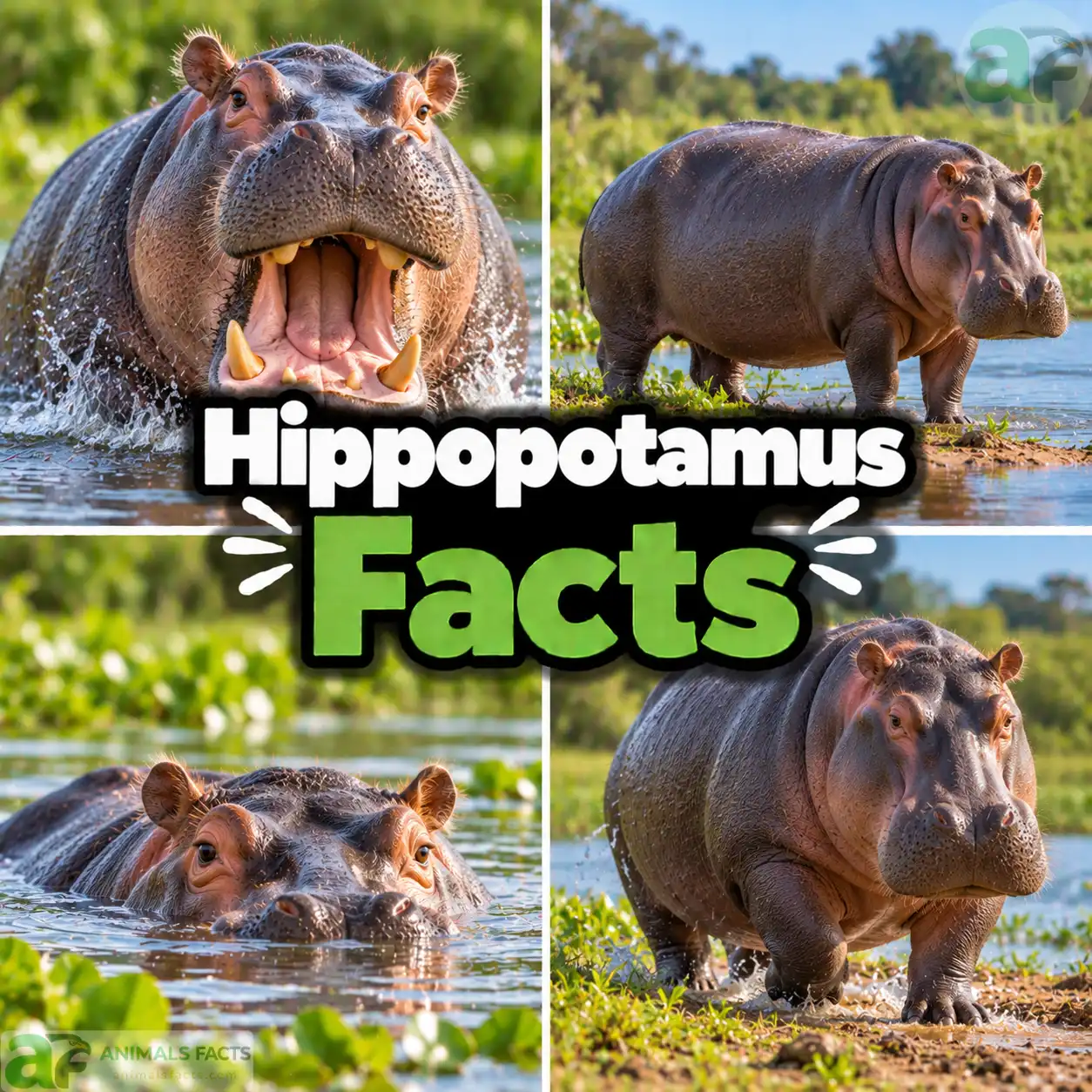
Hippopotamus Facts
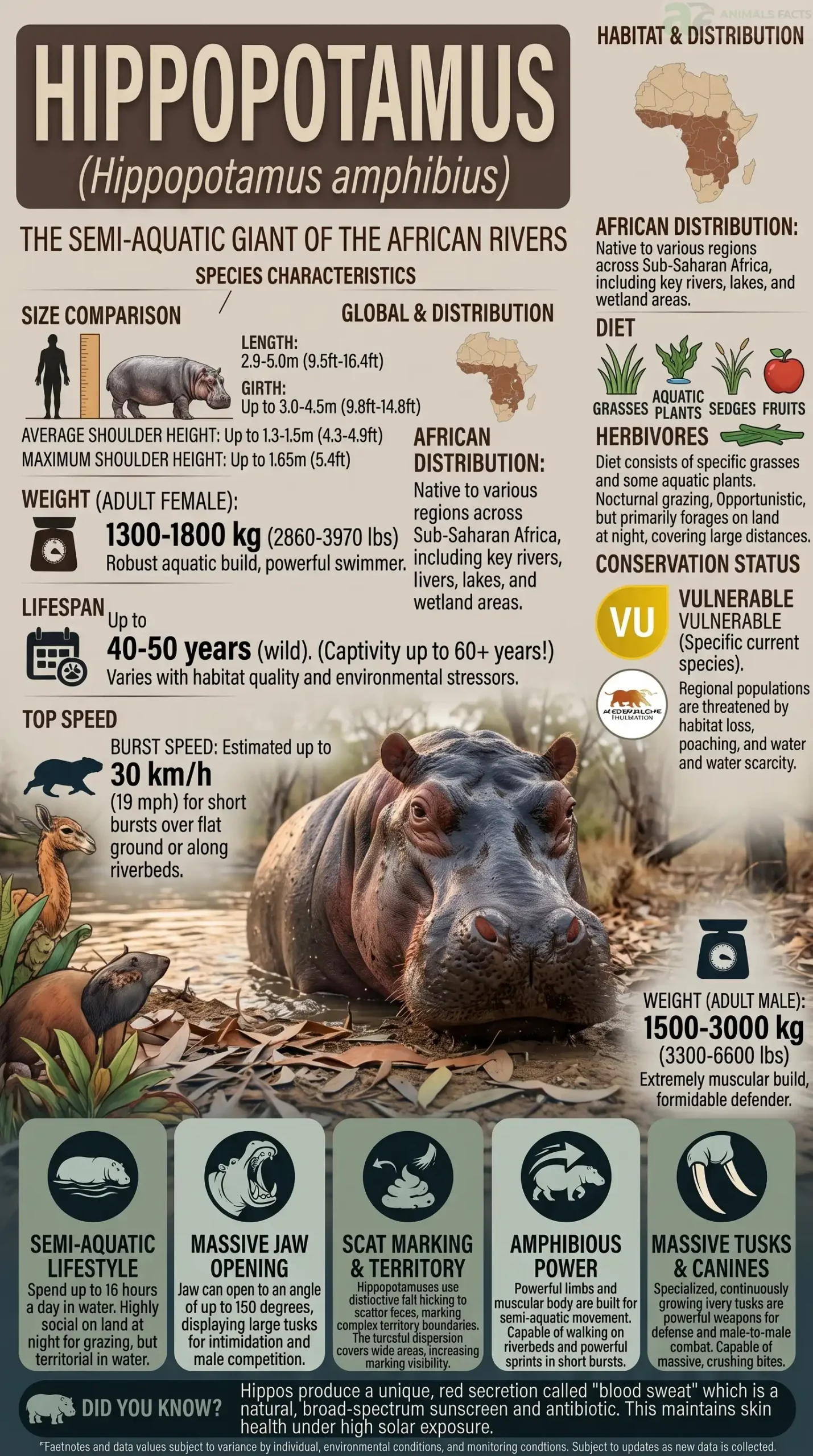
| Feature | Details |
|---|---|
| Scientific Name | Hippopotamus amphibius |
| Common Names | Hippo, Common Hippopotamus, Nile Hippopotamus, River Hippopotamus |
| Kingdom | Animalia |
| Phylum | Chordata |
| Class | Mammalia |
| Order | Artiodactyla |
| Family | Hippopotamidae |
| Genus | Hippopotamus |
| Habitat | Rivers, lakes, swamps, and flooded grasslands across sub-Saharan Africa |
| Lifespan | 35–50 years in the wild; up to 65 years in captivity (record) |
| Diet | Herbivore — primarily short grasses |
| Weight | 1,300–3,800+ kg (2,900–8,800+ lbs); males significantly heavier |
| Body Length | 3–5 m (10–17 ft) |
| Height at Shoulder | 1.5 m (5 ft) |
| Bite Force | Approximately 1,800 PSI — among the strongest of any land mammal |
| Top Speed | Up to 30–35 km/h (19–22 mph) on land over short distances |
| Underwater Speed | Roughly 0.5–0.6 m/s (~1.7 km/h) walking; faster during “bounce” gait |
| Conservation Status | Vulnerable (IUCN) |
| Population Estimate | Roughly 115,000–148,000 individuals in the wild |
| Unique Feature | Closest living relatives are whales and dolphins; densest bones of any land mammal act as natural ballast |
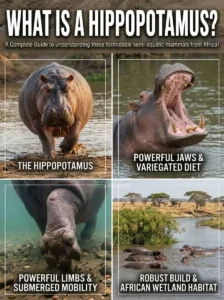 1. Introduction: What is a Hippopotamus?

It cannot swim. It doesn’t hunt. It eats nothing but grass. And yet the hippopotamus is widely considered the most dangerous large mammal in Africa — responsible for an estimated 500 human deaths every year, more than lions, leopards, and crocodiles combined. Its bite force of roughly 1,800 PSI is strong enough to snap a canoe in half or crush the bones of a rival male in a territorial duel, delivered through a mouth that can gape 150 to 180 degrees wide — the largest mouth opening of any land animal on Earth. Hippopotamus facts reveal an animal built entirely of contradictions: a placid grazer that spends its days dozing at the riverbank, hiding one of nature’s most formidable weapons systems beneath a sleepy gaze.
The hippopotamus (Hippopotamus amphibius) is a massive, semi-aquatic mammal native to sub-Saharan Africa, and one of only two living species in the family Hippopotamidae — the other being the much smaller pygmy hippopotamus. Despite superficially resembling a pig, genetic evidence places the hippo’s closest living relatives among the cetaceans — whales, dolphins, and porpoises — a lineage split that occurred around 55 million years ago. This single fact alone has made the hippo one of the most cited examples of evolutionary surprise in modern zoology, and biomechanics researchers have found that its underwater movement bears a striking resemblance to a “reduced-gravity” version of the same trotting gait its extinct aquatic relatives may once have used.
Whether you’re a student researching hippopotamus facts for a school project, a safari traveler hoping to spot a bloat of hippos along an African river, a parent looking for hippo facts for kids, or simply someone curious why an herbivore ended up with the bite force to rival a lion three times over, this is the most complete guide to hippopotamus facts you’ll find. We cover hippo habitat, hippo diet, hippo behavior, the extraordinary “blood sweat” adaptation, the mechanics of underwater “walking,” territorial dung-showering, reproduction, conservation status, mythology, and the full story of Africa’s most misunderstood giant.
2. Hippopotamus Species Overview & Classification
The hippopotamus belongs to the order Artiodactyla (even-toed ungulates) and the family Hippopotamidae — a family that once included many more species during the Miocene and Pliocene but has been reduced to just two living representatives: the common hippopotamus and the pygmy hippopotamus.
Species Classification Table
| Level | Classification |
|---|---|
| Kingdom | Animalia |
| Phylum | Chordata |
| Class | Mammalia |
| Order | Artiodactyla |
| Family | Hippopotamidae |
| Genus | Hippopotamus |
| Species | H. amphibius |
| Closest Living Relatives | Cetaceans (whales, dolphins, porpoises) |
Subspecies Comparison Table
| Subspecies | Range | Notable Feature |
|---|---|---|
| H. a. amphibius | East/Southern Africa (Nile/Mozambique) | Nominate subspecies; widely referenced type |
| H. a. capensis | Southern Africa | Southern range population |
| H. a. kiboko | East Africa (Kenya/Somalia) | Smaller cranial features noted by some researchers |
| H. a. tschadensis | Central/West Africa (Chad basin) | West-central population |
| H. a. constrictus | Angola/Namibia | Southwestern range population |
Note: Genetic boundaries between these traditionally described subspecies remain debated among researchers, and some modern taxonomists question whether all five are genetically distinct enough to warrant separate subspecies status.
Species Evolution & Discovery Timeline
~55 million years ago: The lineage that would produce hippos diverges from the ancestors of modern cetaceans — the single most surprising fact in hippo evolutionary history, and one that has reshaped how paleontologists think about the transition of mammals into and out of aquatic life.
~60 million years ago (approx.): Early hippopotamid ancestors begin appearing in the fossil record, eventually diversifying into a family that once included many more genera than survive today.
Middle Pleistocene (~560,000–460,000 years ago): Hippopotamus amphibius arrives in Europe, with fossil evidence documented as far as Britain and continental Europe during warmer interglacial periods.
19th–20th centuries: Hippos are extirpated from northern and southern portions of their historical African range due to hunting, habitat conversion, and human settlement expansion, becoming restricted largely to Central, East, and parts of West Africa.
2006: The IUCN formally lists the common hippopotamus as Vulnerable on the Red List, a status it retains as of 2026.
2009: A landmark biomechanics study published in the Journal of Mammalogy formally documents that hippos use an unstable underwater gait resembling a gallop with extended unsupported intervals, moving at an average horizontal velocity of about 0.47 meters per second, in a form of locomotion the researchers describe as analogous to movement in reduced gravity.
2024: Follow-up biomechanics research documents that hippos can briefly become airborne — with all four feet leaving the ground — while trotting at high speed on land, marking the first time such an aerial phase had been documented in this species.
2026: Population estimates range between roughly 115,000 and 148,000 individuals, with East Africa — particularly Zambia and Tanzania — hosting the largest strongholds, accounting for around 77% of the global population.
3. Physical Description & Unique Features
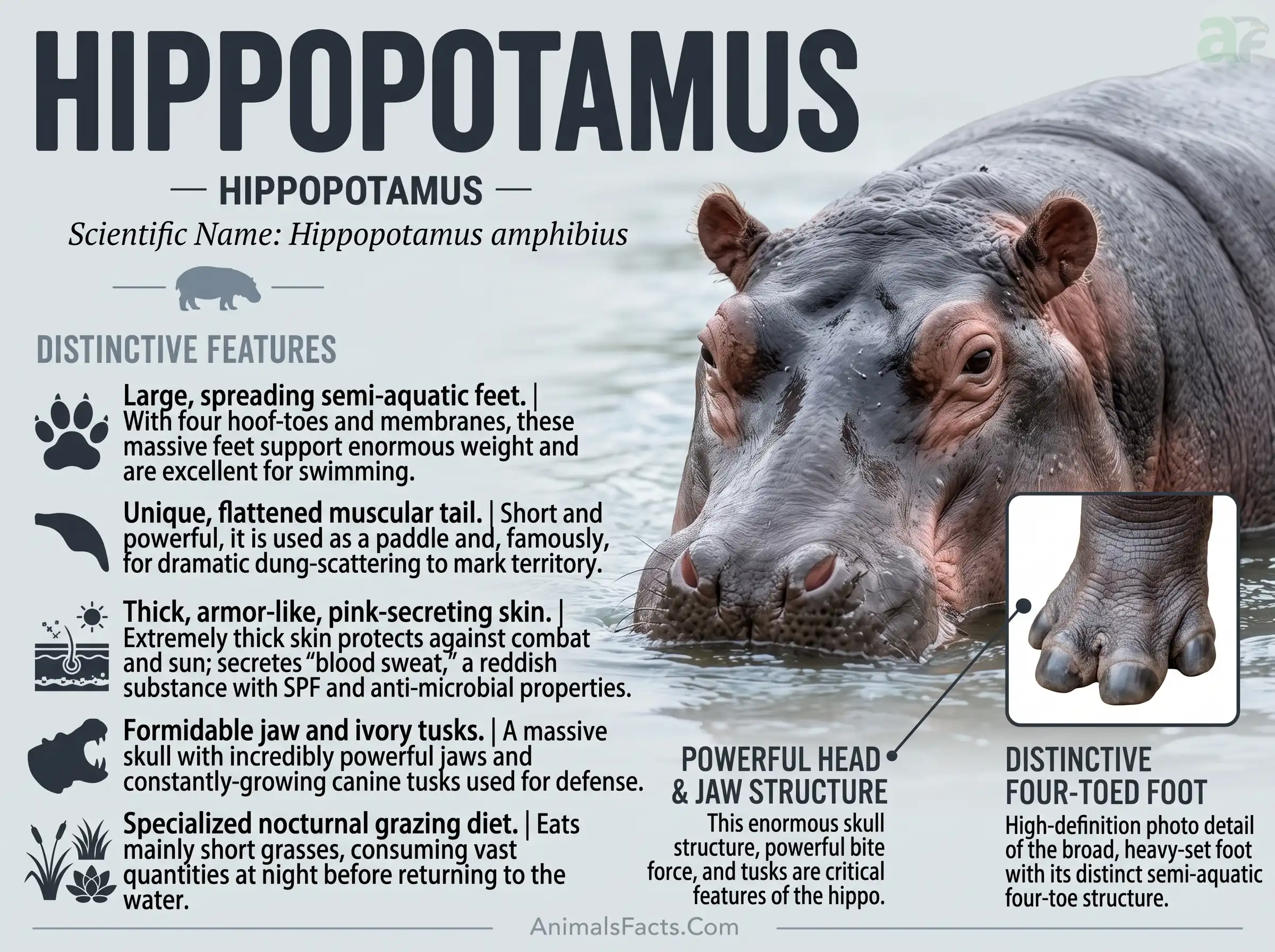
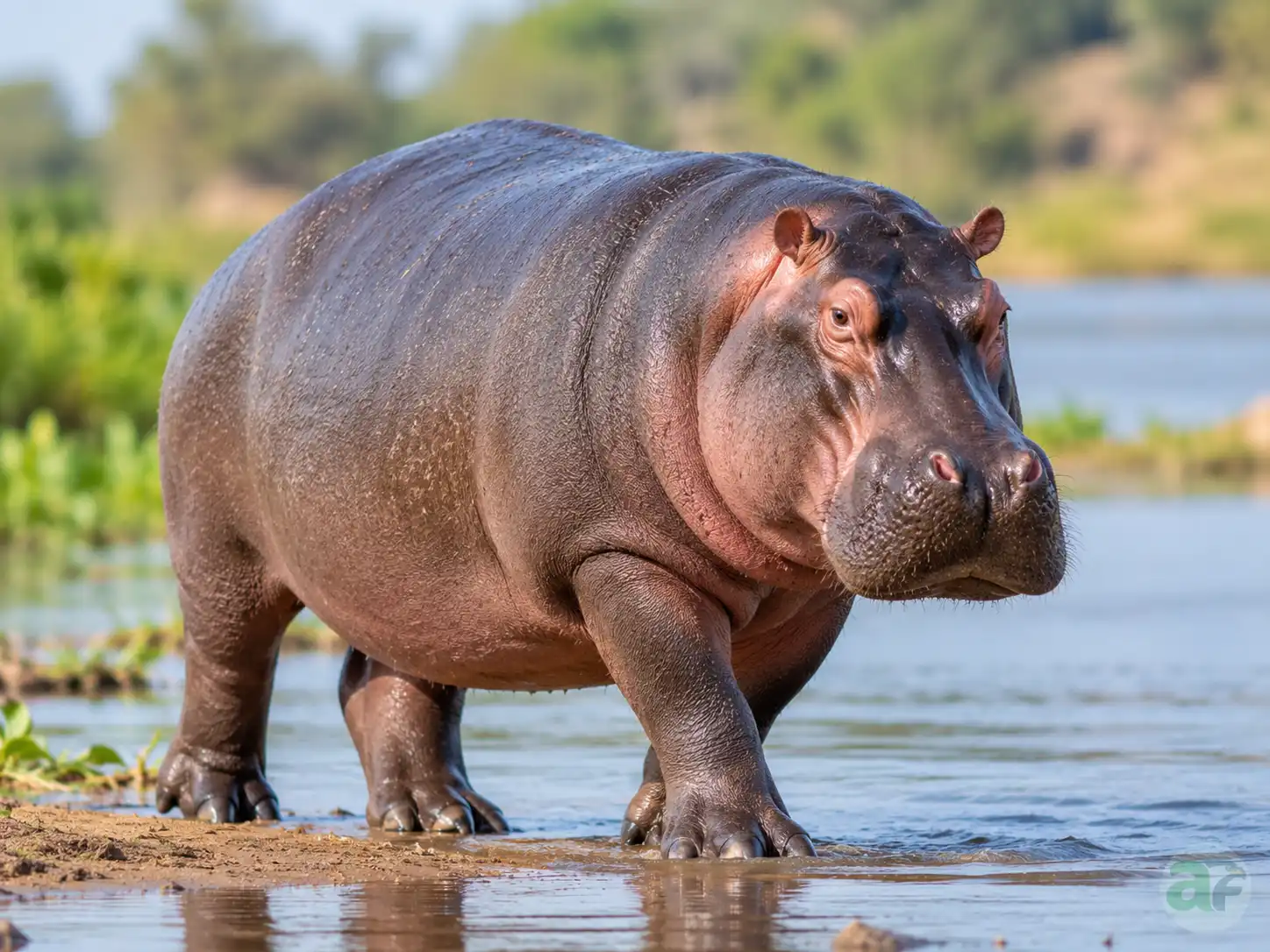
The hippo’s body is a barrel-shaped mass of muscle and fat supported on short, sturdy legs, with a huge head, wide muzzle, and skin that is almost entirely hairless except for sparse bristles around the ears, muzzle, and tail tip.
Size by Gender
- Males (bulls): The larger sex, with the biggest individuals reaching close to 3,800 kg (8,800+ lbs) in exceptional cases
- Females (cows): Typically lighter, in the 1,300–3,000 kg range
- Calves: Born weighing approximately 25–55 kg (55–120 lbs)
Eyes, Ears, and Nostrils — Built for Ambush from the Water
One of the hippo’s most distinctive design features is the placement of its eyes, ears, and nostrils high on top of the skull, allowing it to see, hear, and breathe while the rest of its enormous body remains submerged. Nostrils close automatically during dives, and calves are capable of walking along the riverbed rather than swimming almost from birth.
The “Blood Sweat” Adaptation — Nature’s Built-In Sunscreen
Few hippo facts generate more confusion than the animal’s famous reddish secretion, long nicknamed “blood sweat.” Hippos do not actually sweat blood — they lack functional sweat glands in the way most mammals do. Instead, specialized subdermal glands secrete a viscous, initially colorless fluid that rapidly oxidizes on contact with air, turning a deep red-orange within minutes. This secretion serves at least three overlapping functions:
- Sun protection: The pigment absorbs ultraviolet light, functioning as a natural sunscreen for skin that has no fur to shield it from the intense equatorial sun.
- Antimicrobial action: Compounds in the secretion have documented antibacterial properties, helping protect wounds picked up during territorial fights from infection in bacteria-rich river water.
- Moisture retention: The oily texture helps slow water loss from skin that would otherwise dry and crack rapidly outside the water.
💡 Did You Know? The “blood sweat” myth was so persistent historically that some early European naturalists genuinely described hippos as animals that bled from their skin under stress — a belief only fully corrected once modern biochemical analysis of the secretion became possible.
The Jaw and Teeth — A Weapon, Not a Feeding Tool
The hippo’s mouth is the largest of any land mammal, capable of opening to an angle of 150 to 180 degrees — wide enough, according to multiple wildlife sources, to fit a grown adult standing upright. This gape is not used for feeding but for combat and dominance display. Long, curved canine teeth (tusks) can grow to 50 centimeters (nearly 20 inches) in the lower jaw, with some documented specimens reaching even greater lengths, and these teeth are sharpened continuously as they grind against each other with every bite. Despite the intimidating dental arsenal, hippos use their flat, wide incisors and lips — not their tusks — for actual grazing.
💡 Did You Know? A hippo’s bite force is estimated at around 1,800 PSI — nearly three times stronger than a lion’s bite and about ten times stronger than an average human bite — despite the animal eating nothing but plants.
Skin, Bones, and Buoyancy Control
Hippo skin can be roughly 5–6 cm (2 inches) thick in places, providing substantial natural armor, though it remains vulnerable to the tusks of rival hippos during serious fights. Unlike most mammals, hippo limb bones are osteosclerotic — meaning normally porous bone tissue is replaced with unusually dense, compact bone. This extra-dense skeleton functions as a form of natural ballast, allowing hippos to sink and remain submerged without constantly expending energy to stay down, while still retaining enough buoyancy to rise to the surface to breathe without excessive effort.
4. Underwater Locomotion — Why Hippos Can’t Swim
Perhaps no hippopotamus fact surprises people more than this one: despite spending up to 16 hours a day in water, hippos cannot swim in any conventional sense. They have no swimming stroke, no paddling motion, and no floating buoyancy comparable to a seal, dolphin, or even a dog. Instead, hippos rely on a form of locomotion biomechanics researchers call “underwater walking” or “bottom-walking” — and the science behind it is more sophisticated than most people realize.
How Hippos Actually Move Through Water
Researchers using high-speed videography have identified that hippo underwater movement changes with depth:
- Shallow water (under roughly 2.5 meters): Hippos walk deliberately along the riverbed or lakebed, placing each foot with precision, in a mode sometimes called bottom-walking.
- Moderate to deep water: Hippos shift to a bouncing, gallop-like gait — pushing off the substrate with powerful hind-leg extensions, briefly rising through the water column, then sinking back down under gravity before pushing off again.
A landmark 2009 study published in the Journal of Mammalogy, based on frame-by-frame video analysis, found that hippos use a gait underwater similar to a gallop with extended unsupported intervals, averaging a horizontal velocity of about 0.47 meters per second — with researchers describing the overall effect as movement analogous to a microgravity environment, since the water’s buoyancy dramatically reduces the effective burden of the animal’s enormous weight.
Follow-up research analyzing dozens of video sequences of hippos moving underwater found that hippos typically move by walking along the pool or river bottom in a slow-motion gallop, keeping only one foot in contact with the ground at any given moment — compared to three feet in contact during normal walking on land.
The Bone Ballast System
This unusual gait is only possible because of the hippo’s uniquely dense skeleton. Researchers note that parts of the hippo’s limb skeleton are osteosclerotic, meaning porous bone has been replaced with denser, more compact bone tissue that functions as a kind of ballast, helping the animal achieve near-neutral buoyancy underwater — without this adaptation, hippos would need to expend considerable energy simply to stay submerged, while too much bone density would make it correspondingly harder to return to the surface to breathe.
💡 Did You Know? Because the water’s buoyancy partially offsets a hippo’s massive weight, researchers have found that hippos can perform underwater movements — including brief unsupported “flight” phases where no feet touch the bottom at all — that would be biomechanically impossible for an animal of their size to perform on dry land.
Why This Matters for Safety
The myth that hippos “swim” leads to real danger. Wildlife safety researchers analyzing human-hippo conflict incidents across sub-Saharan Africa have found that misjudging a hippo’s underwater mobility is a recurring factor in dangerous encounters — people who assume a submerged hippo is essentially stationary, or conversely assume it can’t move quickly toward a boat, often underestimate both its speed and its intent. In deeper water, hippos can cover ground at speeds exceeding 8 km/h using the same bounding gait, whether transiting normally or charging during a territorial dispute.
5. Top 30 Surprising & Interesting Hippo Facts
- A hippo’s bite force is estimated at approximately 1,800 PSI — among the strongest of any land mammal, and nearly three times a lion’s bite force.
- Hippos cannot swim in the conventional sense — they walk, bounce, or “gallop” along the riverbed instead, in a gait unlike any true swimming stroke.
- Despite living most of the day in water, hippos are Africa’s most dangerous large mammal to humans, responsible for an estimated 500 deaths per year.
- The hippo’s mouth can open to 150–180 degrees — the widest gape of any land mammal.
- Hippo canine teeth (tusks) can grow up to 50 cm (20 inches) long in the lower jaw and are used purely for fighting, not eating.
- Hippos are strict herbivores, feeding almost exclusively on short grasses despite their fearsome reputation.
- A hippo’s closest living relatives are whales and dolphins — not pigs, despite superficial resemblance.
- Hippos can hold their breath for up to five minutes while submerged.
- Their reddish “blood sweat” secretion is actually a natural sunscreen and antimicrobial fluid, not blood at all — it’s colorless when secreted and oxidizes red on contact with air.
- A group of hippos is called a bloat, pod, or herd.
- Baby hippos are born and nursed underwater, and can swim (or rather, bottom-walk) before they can walk properly on land.
- Adult male hippos can weigh close to 3,800 kg in exceptional cases — as much as a small truck.
- Hippos are the third-largest living land mammal, after elephants and white rhinos.
- Territorial bull hippos mark boundaries by spinning their tails while defecating, spraying dung in a wide arc — a behavior called dung-showering.
- Hippo teeth grow continuously throughout life, similar to elephant tusks.
- Real hippo fights — which can last hours and occasionally prove fatal — usually only occur after ritualized displays like yawning and grunting fail to settle a dispute.
- Hippos can reach speeds of roughly 30 km/h (19–22 mph) on land over short distances, despite their bulky build.
- Researchers have documented that hippos can briefly become airborne — with all four feet off the ground — while trotting at top speed on land, a discovery first published in 2024.
- A hippo gestation period lasts between 227 and 240 days (about 8 months).
- The oldest confirmed hippos on record, Bertha and Lu, both lived to 65 years old in captivity.
- Female hippos often form nursery groups called creches to protect calves from aggressive males.
- Hippo teeth (ivory) have become an increasingly targeted substitute for elephant ivory among poachers.
- Hippos are listed as Vulnerable — not currently endangered — on the IUCN Red List, with a population between roughly 115,000 and 148,000.
- Hippos sleep partly submerged, rising to breathe every few minutes through a reflex that doesn’t fully wake them.
- Hippos have been an invasive species in Colombia since escaping from a private estate decades ago, with the population steadily growing.
- Despite their strength, hippos generally chase crocodiles away from their territory rather than attacking them outright — direct hippo-crocodile combat is rare but has been documented.
- Hippo limb bones are osteosclerotic — unusually dense — functioning as natural ballast that helps them sink and walk along riverbeds without excessive effort.
- Underwater, hippos typically keep only one foot on the ground at a time during their “slow-motion gallop,” compared to three feet on land.
- A hippo’s average underwater walking speed is roughly 0.47 meters per second, according to frame-by-frame video biomechanics research.
- Over 500 human-hippo conflict incidents were officially reported across sub-Saharan Africa in a recent five-year survey period, with a majority involving misjudged proximity to water.
6. Fun Facts About Hippopotamus
- Hippos can’t actually swim — they walk or bounce along the riverbed instead.
- Their bite force (~1,800 PSI) beats a lion’s by nearly 3x.
- A hippo’s mouth can open wider than any other land mammal’s.
- Hippos are more closely related to whales than to pigs.
- Baby hippos are born underwater.
- Hippos are Africa’s deadliest large mammal to humans.
- Their “blood sweat” is really a natural sunscreen, not blood.
- A group of hippos is called a bloat.
- Adult males can weigh over 3.5 tons.
- Hippo teeth never stop growing.
- Hippos can briefly become airborne while running at top speed.
- The IUCN lists hippos as Vulnerable, not endangered.
7. Hippopotamus Natural Habitat & Geographic Range
Hippos are found across sub-Saharan Africa, from Senegal and Guinea in the west to Ethiopia and Tanzania in the east, and as far south as South Africa. They always live near permanent freshwater, favoring rivers and lakes with calm, deep water and gently sloping banks that make entering and exiting the water easier.
Habitat Range by Region
| Region | Status | Notes |
|---|---|---|
| West Africa | Fragmented, declining | Habitat loss and poaching pressure highest here |
| Central Africa | Moderate strongholds | Some stable populations remain |
| East Africa | Strongest populations | Kenya, Tanzania, Zambia are core strongholds |
| Southern Africa | Present in reserves | Well-managed protected areas support stable numbers |
| North Africa | Extinct in the wild | Historical range lost |
| Colombia (outside native range) | Small, growing invasive population | Descendants of hippos imported decades ago |
Population by Selected Country (Approximate Estimates)
| Country | Estimated Population | Notes |
|---|---|---|
| Zambia | Among the largest national populations | Luangwa River a key stronghold |
| Tanzania | Among the largest national populations | Includes Serengeti-Mara ecosystem |
| Kenya | Significant population | Mara River, Lake Naivasha strongholds |
| Uganda | Significant population | Murchison Falls a key site |
| Mozambique | Recovering population | Gorongosa a conservation success story |
| Ghana | Sharply declining | Bui National Park population fell ~70% (2003–2021) |
| South Africa | Stable, protected | St. Lucia Estuary a key viewing site |
Roughly 77% of the world’s hippos live in East Africa, with Zambia and Tanzania hosting the largest national populations.
💡 Did You Know? Where rivers have been dammed or wetlands drained for farming, hippo populations tend to decline quickly — making free-flowing river systems especially important for the species’ long-term survival.
8. Hippopotamus Diet & Feeding Behavior
Hippos are herbivores that leave the water at night to graze on land, favoring short grasses and generally avoiding aquatic vegetation despite living in water most of the day.
Diet Breakdown Table
| Food Type | Approximate Share |
|---|---|
| Short grasses | ~90% |
| Other terrestrial vegetation | ~8% |
| Fruit/aquatic plants (opportunistic) | ~2% |
In a single night’s grazing, a hippo can consume roughly 35–40 kg (77–88 lbs) of grass — a surprisingly modest amount for an animal of its size, largely because hippos spend most of the day resting in water and conserving energy rather than moving constantly like other large grazers.
💡 Did You Know? Nighttime feeding is thought to be primarily a thermoregulation strategy, helping hippos avoid Africa’s intense daytime heat while grazing on land.
9. Reproduction & Life Cycle
Breeding is timed so that births coincide with peak rainfall. Gestation lasts 227 to 240 days, and the female produces a single calf, born and nursed underwater, and nursed for roughly 4–6 months.
Lifespan Comparison Table
| Species | Average Lifespan |
|---|---|
| Common Hippopotamus | 35–50 years |
| African Elephant | 60–70 years |
| White Rhinoceros | 40–50 years |
| Nile Crocodile | 45–80 years |
Key Developmental Stages
| Stage | Approximate Age | Key Development |
|---|---|---|
| Birth | — | 25–55 kg; born underwater; can move within minutes |
| Nursing | 0–4 to 6 months | Nurses both on land and underwater |
| First grazing | A few weeks | Begins sampling grass alongside milk |
| Weaning | ~4–8 months | Full transition to grazing |
| Juvenile period | 1–7 years | Remains near mother/creche group |
| Sexual maturity (male) | ~7 years | Begins competing for territory |
| Prime breeding age (male) | Later adulthood | Controls territory and mating access |
Males typically reach sexual maturity around age 7. The hippo’s overall lifespan typically runs 35 to 50 years, though standout individuals have lived far longer — Bertha (Manila Zoo) and Lu (Homosassa Springs, Florida) both reached 65 years old, the oldest confirmed ages on record for the species.
10. Social Behavior & Communication
Hippos live in groups structured around a dominant male, who controls a stretch of river or lakeshore as his territory — typically 50–100 meters of river or 250–500 meters of lakeshore. He defends this territory from rival males through ritualized displays and, when necessary, violent combat involving tusk-clashing, slashing, and wrestling similar to deer locking antlers.
Because dominant males can be aggressive toward calves that aren’t their own, females often form nursery herds, or creches, to collectively protect their young.
Hippos communicate through deep grunts, wheeze-honks, and bellows that can travel both through the air and underwater — a rare dual-channel communication ability among land mammals, related to their semi-aquatic lifestyle. Researchers have also documented a specialized underwater sensory behavior in which hippos draw in a small sample of urine or water through the mouth to detect hormonal cues, similar to the flehmen response seen in many other ungulates checking for signs of female reproductive status.
💡 Did You Know? Real hippo fights are actually fairly rare. Most territorial disputes are settled through dramatic yawning (displaying the tusks), grunting, and dung-showering — genuine combat is typically only a last resort, though when it happens, it can be brutal and occasionally fatal.
11. The Dung-Showering Ritual — Territory Marking Explained
One of the most distinctive — and least understood — hippo behaviors is dung-showering, a ritualized territorial display that substitutes for physical combat in the majority of disputes between rival males.
How Dung-Showering Works
- The setup: Two bull hippos approach each other at a territorial boundary and position themselves side by side, facing in opposite directions, several feet apart.
- The display: Each male defecates while rapidly spinning his short, flat tail like a propeller, flinging dung outward in a wide arc that can scatter over a broad area — and often over the rival male himself.
- The message: The scent and visual display communicate territorial ownership, individual identity, and general dominance status to the rival, without requiring physical contact.
- The outcome: In most encounters, this ritual — sometimes repeated along with yawning, grunting, and lunging — is enough to settle the dispute. The intruding male backs off, and no injury results.
Dung Middens
Beyond active dung-showering between rival bulls, hippos also create dung middens — accumulated piles of dung along the paths connecting grazing grounds to the water — which are renewed nightly as bulls travel to pasture and again during the day when they emerge and defecate on the heaps. Interestingly, researchers note that these paths and middens do not appear to function strictly as territorial boundary markers on land, since grazing pastures themselves are typically treated as shared, unowned ground open to any hippo, unlike the water and shoreline territory a bull actively defends. The exact social function of these land-based dung middens remains an area of ongoing research.
💡 Did You Know? Ritualized dung-showering is considered a key reason actual hippo combat is relatively uncommon — despite the species’ fearsome reputation, most disputes over territory are resolved through display and scent communication rather than the tusk-based violence hippos are capable of when displays fail.
12. Predators & Defense Mechanisms
Adult hippos have almost no natural predators thanks to their size, thick skin, and explosive aggression. Lions and Nile crocodiles occasionally target young, sick, or isolated calves, but a healthy adult hippo is rarely challenged by any African predator.
Defense Mechanisms
- Sheer bite force: At roughly 1,800 PSI, a hippo’s bite can crush bone and has been documented in confrontations with crocodiles.
- Speed: Despite their bulk, hippos can charge at over 30 km/h on land, and researchers have documented brief airborne phases at top running speed — closing distance on a threat far faster than most people expect.
- Territorial aggression: Hippos don’t wait to be attacked — they proactively charge anything perceived as a threat to their territory or calves, including boats.
- Thick skin: Skin up to several centimeters thick provides a degree of natural armor against bites and tusk slashes from rivals.
- Maternal defense: Female hippos aggressively protect calves, frequently charging boats or other perceived threats that approach too closely.
13. Hippo vs. Crocodile — Africa’s Great River Rivalry
Few animal rivalries capture the imagination like the hippo and the Nile crocodile, two of Africa’s most formidable river residents sharing the same waterways for millennia.
Bite Force Comparison
| Species | Estimated Bite Force |
|---|---|
| Nile Crocodile | Roughly 3,700–5,000 PSI |
| Hippopotamus | Roughly 1,800 PSI |
| Lion | Roughly 650 PSI |
| Human | Roughly 120–160 PSI |
Despite the crocodile’s significantly stronger bite in raw PSI terms, hippos are generally considered dominant in direct encounters — not because of superior jaw strength, but because of overwhelming size, mass, territorial aggression, and thick skin. Wildlife researchers note that the hippo’s mouth is technically large enough to fit a crocodile inside it, and while genuine hippo-crocodile combat does occur — particularly when a crocodile threatens a hippo calf — hippos typically respond by chasing crocodiles away from their territory rather than engaging in prolonged fights. Documented cases exist of hippos biting and killing crocodiles that ventured too close to calves, but such fatal encounters are relatively rare exceptions rather than the norm; most interactions consist of crocodiles giving hippo territory a wide berth.
💡 Did You Know? Young crocodiles and hippo calves share the same river systems from birth, and it is the hippo — not the crocodile — that is generally regarded by safari guides and researchers as the more dangerous animal to encounter unexpectedly at close range.

14. Hippopotamus Facts for Kids
Hey kids — get ready to meet one of Africa’s biggest and most surprising animals!
- Hippos are HUGE — some weigh as much as a small truck!
- Even though hippos live in water most of the day, they can’t actually swim — they walk or bounce along the bottom of the river or lake instead!
- Baby hippos are born underwater and can move around before they can even walk properly on land.
- A hippo’s mouth can open incredibly wide — wide enough that grown-ups say it could fit a person standing up inside!
- Hippos only eat plants, mostly grass, even though they look scary with those huge teeth.
- Hippos are actually more closely related to whales and dolphins than to pigs!
- A group of hippos has a silly name — it’s called a “bloat”!
- Hippos make their own natural sunscreen with a special reddish oil on their skin — it’s not blood, even though people used to think it was!
- Scientists discovered that hippos can actually fly through the air for a split second when they run really fast — all four feet off the ground at once!
💡 Did You Know? Hippos sleep partly underwater and pop up to breathe every few minutes without even fully waking up — like taking a breath in your sleep, but for a giant!
15. Relationship with Humans
Hippos have shared the Nile Valley and other African waterways with people for thousands of years, appearing in ancient Egyptian art, religion, and hieroglyphics. Today the relationship is far more fraught: hippos react with immediate aggression when humans enter their territory by boat or on foot, and conflicts are becoming more frequent as human settlements expand closer to hippo habitat.
A curious historical footnote is the so-called American Hippo Bill — a 1910 proposal to introduce hippos into Louisiana’s swamps as a meat source to address a domestic meat shortage. The bill never passed, but it remains one of the most surprising pieces of hippo trivia in American history.
Because hippos are considered Africa’s most dangerous large mammal to humans, safari guides, fishermen, and riverside communities treat hippo encounters with far more caution than encounters with lions or leopards. Recent surveys of human-hippo conflict incidents across sub-Saharan Africa have found that misjudging a hippo’s mobility — both its speed on land and its ability to move underwater — is a recurring factor in dangerous encounters, reinforcing why local safety guidance consistently urges people to keep well back from the water’s edge in hippo territory.
16. Hippopotamus Conservation Status & Threats
The hippopotamus is currently classified as Vulnerable on the IUCN Red List, a status it has held since 2006. The population is currently estimated between roughly 115,000 and 130,000 by the most recent formal IUCN assessment, with some more recent estimates from wildlife organizations suggesting numbers closer to 125,000–148,000.
Conservation Data Table
| Threat | Impact |
|---|---|
| Habitat loss | Rivers/wetlands drained for farming and settlement |
| Poaching (ivory) | Canine teeth targeted as an elephant-ivory substitute |
| Human-wildlife conflict | Rising as settlements expand into hippo range |
| Political instability | Weakens enforcement in parts of Central/West Africa |
Between 1975 and 2017 alone, roughly 770,000 kilograms of hippo teeth were legally traded internationally under CITES — a figure that doesn’t account for illegal trade, and one that illustrates how significant the ivory pressure on hippos has become as elephant ivory restrictions have tightened.
Regional case studies reveal how severe local declines can get: in Ghana’s Bui National Park, the hippo population fell 70%, from 209 individuals in 2003 to just 64 by 2021, driven largely by dam construction and habitat flooding.
There is a hopeful counter-story, too — populations in well-managed reserves such as those in Kenya, Tanzania, and Zambia remain comparatively stable, demonstrating that dedicated protection and anti-poaching enforcement can genuinely work.
17. Famous Hippopotamuses
Bertha — Lived at Manila Zoo in the Philippines from 1959 until her death in July 2017, reaching 65 years old — among the oldest hippos ever recorded.
Lu — Born at San Diego Zoo in January 1960, later lived at Homosassa Springs Wildlife State Park in Florida until his death in June 2025, also reaching 65 years old, tying the record for oldest hippo ever recorded.
Donna — Lived at Mesker Park Zoo in Evansville, Indiana, until her death in 2012 at age 61, previously among the oldest hippos on record.
Fiona — A hippo born prematurely at the Cincinnati Zoo who became a widely followed social media phenomenon due to the extraordinary veterinary effort involved in her survival.
Pablo Escobar’s “Cocaine Hippos” — Descendants of hippos illegally imported to Colombia decades ago for a private estate; the population has since grown into one of the most-discussed invasive megafauna populations in the world.
18. Role in Ecosystem & Food Chain
Hippos are considered a keystone species in African freshwater ecosystems. By grazing on land at night and depositing nutrient-rich dung directly into rivers and lakes, they transport nutrients from terrestrial grasslands into aquatic food webs, fueling fish populations and aquatic plant productivity.
Their constant movement in and out of the water also helps carve and maintain channels, prevents excessive vegetation overgrowth, and shapes the physical structure of the rivers and lakes they inhabit — services that ripple outward to benefit countless other species sharing the same waterways.
19. Myths, Folklore & Cultural Significance
In ancient Egyptian mythology, the hippo held striking dual symbolism. It was feared as a destructive, chaotic force linked to the god Set, yet simultaneously revered through the goddess Taweret, a hippo-headed deity associated with protection during childbirth and fertility. This duality — fearsome yet protective — mirrors the hippo’s real-world contradiction as a peaceful grazer with a violent defensive temperament.
Across various African cultures, hippos feature prominently in folklore as symbols of raw strength, danger, and the untamed power of rivers — often cast as formidable characters that even other powerful animals are wise to avoid provoking.
20. Hippos in Pop Culture
Hippos have made countless pop culture appearances, from animated films and children’s toys to viral internet moments and zoo mascots. The species was even immortalized in the novelty Christmas song “I Want a Hippopotamus for Christmas,” a hit for child star Gayla Peevey in 1953, and has also appeared in comedic musical numbers such as “The Hippopotamus Song” by Flanders and Swann. Hippos frequently appear as characters in children’s animated media, typically portrayed with an exaggerated, comically oversized gentleness that contrasts sharply with their real-world reputation as Africa’s most dangerous large mammal.
21. Hippo Facts vs. Common Myths
Myth: Hippos sweat blood. Fact: Hippos secrete a colorless fluid that oxidizes red on contact with air, acting as a natural sunscreen and antimicrobial skin protectant — it is not blood at all.
Myth: Hippos are closely related to pigs. Fact: Despite superficial resemblance, a hippo’s closest living relatives are whales and dolphins, with the lineages diverging around 55 million years ago.
Myth: Hippos can swim. Fact: Hippos are too dense to float in the conventional sense — biomechanics research shows they walk, bounce, or “gallop” along the riverbed rather than swimming with any true stroke.
Myth: Hippos are slow, harmless plant-eaters with no real threat to humans. Fact: Hippos can charge at speeds over 30 km/h — and have even been documented briefly airborne at top speed — and are considered Africa’s most dangerous large mammal to humans, responsible for an estimated 500 deaths per year.
Myth: Hippo tusks are used for eating grass. Fact: Hippos graze using their lips and flat incisors; the large curved tusks are used exclusively for fighting and dominance display, never for feeding.
Myth: Crocodiles always win in a hippo-vs-crocodile confrontation because they have a stronger bite. Fact: While crocodiles have a stronger raw bite force, hippos are generally dominant in direct encounters due to their far greater size, mass, and territorial aggression — crocodiles typically avoid confrontation with adult hippos altogether.
22. Best Places to See Hippos in the Wild
Mara River, Kenya/Tanzania — Famous for large, dense hippo pods along the Serengeti-Mara ecosystem, especially visible during the wildebeest migration season.
Luangwa River, Zambia — One of Africa’s highest hippo densities, with pods easily visible from riverside lodges.
St. Lucia Estuary, South Africa — Accessible boat tours offer frequent, close-range hippo sightings in a UNESCO World Heritage wetland.
Okavango Delta, Botswana — Hippos navigate the delta’s channels amid one of the world’s most stunning inland wetland systems.
Murchison Falls, Uganda — Nile River hippo pods gather near the falls in large numbers.
Lake Naivasha, Kenya — One of the most reliable and accessible hippo-viewing lakes in East Africa.
Gorongosa National Park, Mozambique — A conservation success story with steadily recovering hippo numbers following decades of post-war restoration work.
23. Top Documentaries & Books
Documentaries:
- Various BBC and National Geographic African wildlife series featuring extensive hippo behavior studies, particularly territorial combat and river ecosystem footage.
- Nile River and Okavango Delta-focused nature documentaries covering hippo social structure and predator interactions.
Books:
- General African wildlife field guides covering hippopotamus biology, behavior, and conservation status.
- Academic texts on Hippopotamidae evolution and the cetartiodactyl (whale-hippo) phylogenetic relationship for more advanced readers.
24. Comparison of Hippos with Similar Species
| Feature | Common Hippopotamus | Pygmy Hippopotamus | White Rhinoceros | Nile Crocodile |
|---|---|---|---|---|
| Scientific Name | Hippopotamus amphibius | Choeropsis liberiensis | Ceratotherium simum | Crocodylus niloticus |
| Weight | 1,300–3,800 kg | 180–275 kg | 1,800–2,500 kg | 225–750 kg |
| Habitat | Rivers, lakes, wetlands | Rainforests, swamps (West Africa) | Savanna grasslands | Rivers, lakes, wetlands |
| Diet | Herbivore (grasses) | Herbivore (fruit, ferns, plants) | Herbivore (grasses) | Carnivore |
| Bite Force | ~1,800 PSI | Lower (smaller body) | Not a major weapon | ~3,700–5,000 PSI |
| Conservation Status | Vulnerable | Endangered | Near Threatened | Least Concern |
| Social Structure | Territorial male-led groups | Largely solitary | Small groups/solitary bulls | Solitary/territorial |
| Locomotion in Water | Bottom-walking/bouncing gait, cannot swim | Similarly non-swimming, smaller scale | Does not typically enter deep water | True swimmer (tail-propelled) |
25. How You Can Help
- Support organizations such as the African Wildlife Foundation, IFAW, and the IUCN that fund anti-poaching patrols and habitat protection programs across hippo range states.
- Avoid purchasing any ivory products, including hippo-tooth ivory, which continues to fuel illegal wildlife trade.
- Support responsible eco-tourism operators in East and Southern Africa whose revenue funds community-based conservation programs.
- Participate in citizen science wildlife monitoring platforms tracking African megafauna populations and river ecosystem health.
- Spread awareness of the hippo’s Vulnerable status — many people mistakenly assume hippos face no conservation risk at all.
26. Frequently Asked Questions About Hippopos
Q1: What is the scientific name of the hippopotamus?
The scientific name is Hippopotamus amphibius, belonging to the family Hippopotamidae.
Q2: Are hippos related to pigs?
No. Despite physical resemblance, a hippo’s closest living relatives are whales and dolphins, with the lineages diverging roughly 55 million years ago.
Q3: How long do hippos live? Typically 35–50 years in the wild, with some captive individuals living to 65 years — the confirmed record for the species.
Q4: What do hippos eat?
Hippos are strict herbivores, feeding almost exclusively on short grasses grazed at night.
Q5: Are hippos endangered?
No — they’re currently classified as Vulnerable, not endangered, though populations are declining in parts of West Africa due to habitat loss and poaching.
Q6: Can hippos swim?
Not in the traditional sense. Biomechanics research shows hippos walk, bounce, or gallop along riverbeds using a substrate-dependent gait rather than swimming with a true stroke.
Q7: How strong is a hippo’s bite?
A hippo’s bite force is estimated at roughly 1,800 PSI — nearly three times stronger than a lion’s bite, despite the hippo being an herbivore.
Q8: Why are hippos considered so dangerous?
Their territorial aggression, speed (up to 30 km/h, with documented brief airborne phases), size, and unpredictability make them responsible for an estimated 500 human deaths per year in Africa — more than lions, leopards, and crocodiles combined.
Q9: How much does a hippo weigh?
Between roughly 1,300 kg and 3,800 kg (2,900–8,800+ lbs), with males significantly heavier than females.
Q10: What is a group of hippos called?
A bloat, pod, or herd.
29. Sources & References
Research Sources:
Wikipedia, IUCN Red List, San Diego Zoo Wildlife Alliance, Philadelphia Zoo, SeaWorld/United Parks & Resorts, IFAW, BioDB, World Population Review, BBC Science Focus, Discover Wildlife Magazine, Journal of Mammalogy (Coughlin & Fish, 2009), National Geographic, PMC/PeerJ locomotion research.