
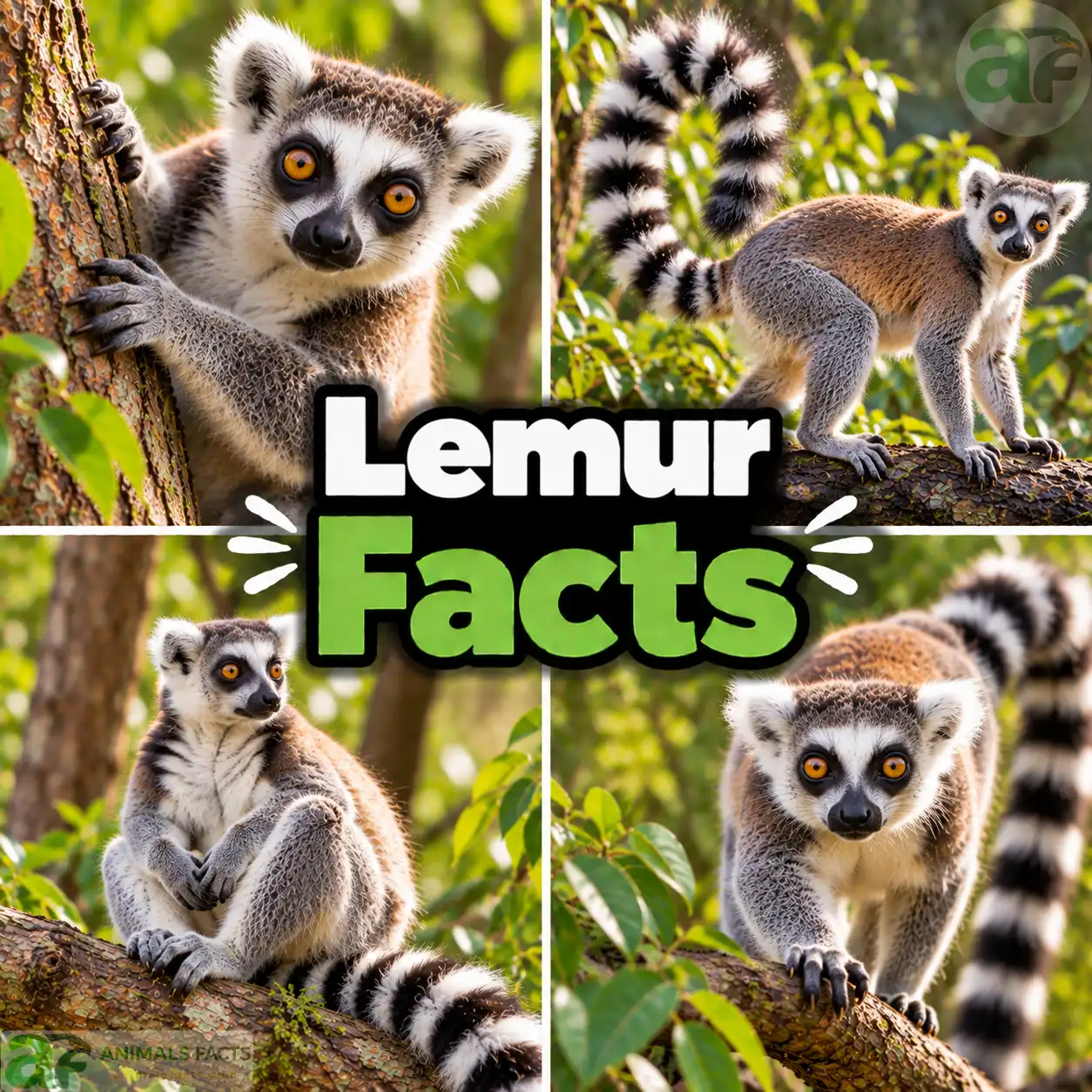
Lemur Facts
| Feature | Details |
|---|---|
| Scientific Name | Infraorder Lemuriformes; over 100 species across 5 families |
| Kingdom | Animalia |
| Phylum | Chordata |
| Class | Mammalia |
| Order | Primates |
| Infraorder | Lemuriformes |
| Common Names | Lemur; prosimian (broader group) |
| Native Range | Madagascar exclusively — and the nearby Comoros Islands for one species |
| Habitat | Tropical rainforest, dry deciduous forest, spiny forest, montane forest, mangrove |
| Lifespan | 5–25 years depending on species; up to 37 years in captivity (ring-tailed lemur) |
| Diet | Highly varied — fruit, leaves, nectar, insects, small vertebrates depending on species |
| Body Size | 30 grams (Madame Berthe’s mouse lemur) to 9 kg (indri) |
| Conservation Status | 97% of lemur species are threatened — the most threatened mammal group in the world |
| Number of Species | Over 100 recognized species — with new species still being described |
| Defining Feature | Strictly endemic to Madagascar — found nowhere else on Earth naturally |
| Evolutionary Age | Lemur ancestors colonized Madagascar approximately 50–60 million years ago |
| Closest Relatives | Lorises and galagos (Africa/Asia) — together forming the suborder Strepsirrhini |
 1. Introduction: What is a Lemur?
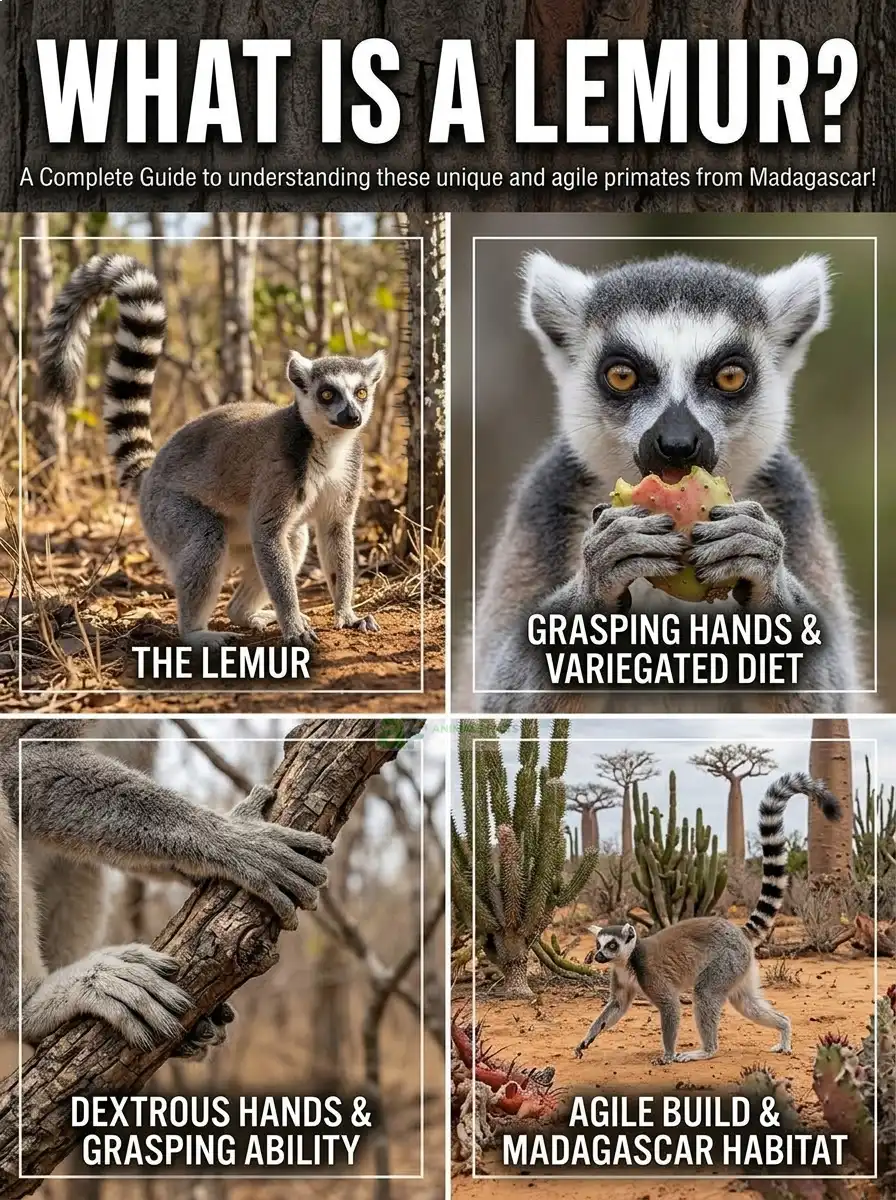
On a sun-warmed rock in the spiny forest of southern Madagascar, a ring-tailed lemur raises its arms in a posture that appears almost deliberate — black-and-white striped tail curled behind it, dark-ringed eyes forward, chest and abdomen turned toward the morning sun. It is sunbathing — warming itself after the cool night with a behavior so specifically mammalian, so apparently comfortable and intentional, that first-time observers consistently feel a jolt of recognition that transcends the usual human-to-wildlife distance. This is the beginning of understanding lemurs — that moment of recognition, of seeing something simultaneously ancient and familiar, alien and deeply connected to the primate lineage that produced us. Lemur facts begin with that moment — and then deepen into one of the most extraordinary and most urgent stories in all of natural history.
Madagascar is the world’s greatest single-island experiment in evolution — an island the size of France that separated from the African mainland approximately 90 million years ago, carrying with it a cargo of ancient organisms that subsequently evolved in isolation into forms found nowhere else on Earth. Lemurs — the primates that colonized this island approximately 50–60 million years ago from the African mainland, likely on floating vegetation rafts — subsequently diversified into one of the most astonishing radiations of any mammalian group: over 100 species ranging from the 30-gram Madame Berthe’s mouse lemur (the world’s smallest primate) to the indri whose haunting song carries for kilometers through the rainforest; from the strictly nocturnal aye-aye with its elongated middle finger for extracting wood-boring larvae to the deeply social ring-tailed lemur of southern Madagascar whose complex group dynamics and powerful scent communication have made it one of the most studied primates in the world. Interesting facts about lemurs reveal a primate group of breathtaking diversity — ecological roles ranging from herbivore to insectivore to nectarivore; social organizations from solitary to pair-bonded to large multi-male multi-female groups; reproductive strategies including the only mammal known to hibernate with a full bladder; and unique physiological adaptations including torpor and fat-tail energy storage that allow survival in Madagascar’s extraordinarily seasonal and unpredictable climate.
And then there is the crisis — the one that transforms lemur facts from wonderful natural history into urgent conservation advocacy. 97% of lemur species are threatened with extinction — making lemurs the most threatened mammal group on Earth. Madagascar has lost approximately 90% of its original forest cover — the deforestation continues at an alarming rate — and the combination of habitat loss, hunting for bushmeat, and the illegal pet trade is driving multiple lemur species toward extinction within years. The most extraordinary primate radiation on Earth is disappearing in real time, on an island where the majority of species found nowhere else on Earth are facing the loss of the forests they require to survive.
This is your comprehensive guide to everything lemur. We cover lemur scientific names, lemur diet, lemur size and weight, lemur behavior, the extraordinary ecology of Madagascar, lemur reproduction, social structure, communication, the conservation emergency, cultural significance, and the profound ecological roles these irreplaceable primates play. The world’s most ancient primates deserve every voice of understanding and advocacy that can be found.
2. Lemur Species Overview & Classification
Lemurs belong to the infraorder Lemuriformes within the suborder Strepsirrhini — the wet-nosed primates — and represent the most species-rich and most ecologically diverse primate radiation in the world outside the anthropoids (monkeys, apes, and humans).
Species Classification Table
| Taxonomic Rank | Classification |
|---|---|
| Kingdom | Animalia |
| Phylum | Chordata |
| Class | Mammalia |
| Order | Primates |
| Suborder | Strepsirrhini |
| Infraorder | Lemuriformes |
| Number of Families | 5 families |
| Number of Genera | ~15 genera |
| Number of Species | Over 100 recognized species |
| Endemic to | Madagascar (and Comoros Islands — one species) |
The Five Lemur Families
Family Lemuridae (True Lemurs):
| Species | Common Name | Weight | IUCN Status | Notable Feature |
|---|---|---|---|---|
| Lemur catta | Ring-tailed lemur | 2.2–3.5 kg | Endangered | Most studied; iconic striped tail |
| Varecia variegata | Black-and-white ruffed lemur | 3.1–4.1 kg | Critically Endangered | Largest seed disperser in Madagascar |
| Varecia rubra | Red ruffed lemur | 3.3–3.6 kg | Critically Endangered | Critically threatened; small range |
| Eulemur fulvus | Brown lemur | 2–2.5 kg | Near Threatened | Cathemeral (active day and night) |
| Eulemur mongoz | Mongoose lemur | 1.5–2 kg | Critically Endangered | Pair-bonded; crepuscular |
Family Indriidae (Indris and Sifakas):
| Species | Common Name | Weight | IUCN Status | Notable Feature |
|---|---|---|---|---|
| Indri indri | Indri | 6–9 kg | Critically Endangered | Largest living lemur; haunting song |
| Propithecus diadema | Diademed sifaka | 6–8.5 kg | Critically Endangered | Most spectacular sifaka |
| Propithecus tattersalli | Golden-crowned sifaka | 3–3.5 kg | Critically Endangered | ~2,000 individuals remaining |
| Propithecus verreauxi | Verreaux’s sifaka | 3–3.5 kg | Endangered | “Dancing” locomotion on ground |
Family Cheirogaleidae (Mouse and Dwarf Lemurs):
| Species | Common Name | Weight | IUCN Status | Notable Feature |
|---|---|---|---|---|
| Microcebus berthae | Madame Berthe’s mouse lemur | 30–38 grams | Critically Endangered | World’s smallest primate |
| Microcebus murinus | Grey mouse lemur | 40–70 grams | Least Concern | Most studied mouse lemur |
| Cheirogaleus medius | Fat-tailed dwarf lemur | 140–450 grams | Least Concern | Only primate that hibernates |
Family Lepilemuridae (Sportive Lemurs):
| Representative | Lepilemur mustelinus and ~25 related species | Highly threatened across many species |
|---|
Family Daubentoniidae (Aye-aye):
| Species | Common Name | Weight | IUCN Status | Notable Feature |
|---|---|---|---|---|
| Daubentonia madagascariensis | Aye-aye | 2.5–2.7 kg | Endangered | Most morphologically bizarre primate |
The Giant Extinct Lemurs
Madagascar’s lemur diversity was formerly even greater — 17 genera and dozens of species are known from the fossil and subfossil record but went extinct following human arrival approximately 2,000 years ago:
| Species | Common Name | Weight | Extinction |
|---|---|---|---|
| Archaeoindris fontoynontii | Giant sloth lemur | ~160 kg | ~1,000–500 BCE |
| Megaladapis madagascariensis | Koala lemur | ~75 kg | ~1,000–500 BCE |
| Palaeopropithecus ingens | Sloth lemur | ~45 kg | ~1,000–500 BCE |
| Babakotia radofilai | Babakotia | ~15 kg | ~1,000–500 BCE |
These extinct giants — some weighing as much as a male gorilla — went extinct following human arrival in Madagascar, driven by habitat loss and hunting in what represents one of the largest prehistoric defaunation events in the Indian Ocean region.
Evolution & Discovery Timeline
~90 million years ago — Madagascar separates from the African mainland — initiating the island’s isolation that will drive the evolution of its unique fauna.
~50–60 million years ago — Ancestral lemurs colonize Madagascar — most likely via transoceanic rafting on floating vegetation mats from Africa across what was then a narrower Mozambique Channel. This colonization event — a single or very few ancestral populations — founded the entire subsequent lemur radiation.
~50 million years of evolution — With no competing primate species, no large predators (initially), and abundant ecological niches, lemurs diversify into an extraordinary range of forms — filling the ecological roles occupied elsewhere by monkeys, squirrels, sloths, and various other mammals.
~2,000 years ago — Humans arrive in Madagascar — initiating the deforestation and hunting that drives the giant lemur species to extinction within centuries.
1758 — Carl Linnaeus formally names the genus Lemur — from the Latin lemures (spirits of the dead) — referencing the nocturnal habits and glowing eyes of the animals described in early European accounts.
19th century — European naturalists systematically document Madagascar’s lemur diversity — establishing the foundational taxonomy that remains largely intact today.
1980s–present — The explosion of field research and molecular genetics dramatically revises understanding of lemur diversity — more than doubling the recognized species count through molecular identification of cryptic species.
2020s — New lemur species continue to be formally described — with several new mouse lemur and sportive lemur species described in the 2010s and 2020s through combined morphological and genetic analysis.
2024 — Over 100 lemur species are now recognized — with the majority classified as Threatened or Critically Endangered.
“Madagascar is the world’s highest conservation priority for mammals — bar none. The lemurs are more threatened, more diverse, more irreplaceable, and more urgently in need of conservation action than any comparable group of animals anywhere on Earth. Every lemur species that goes extinct takes with it 50–60 million years of evolutionary history found nowhere else.”
— Dr. Russell Mittermeier, Chief Conservation Officer, Global Wildlife Conservation, and leading lemur conservation authority
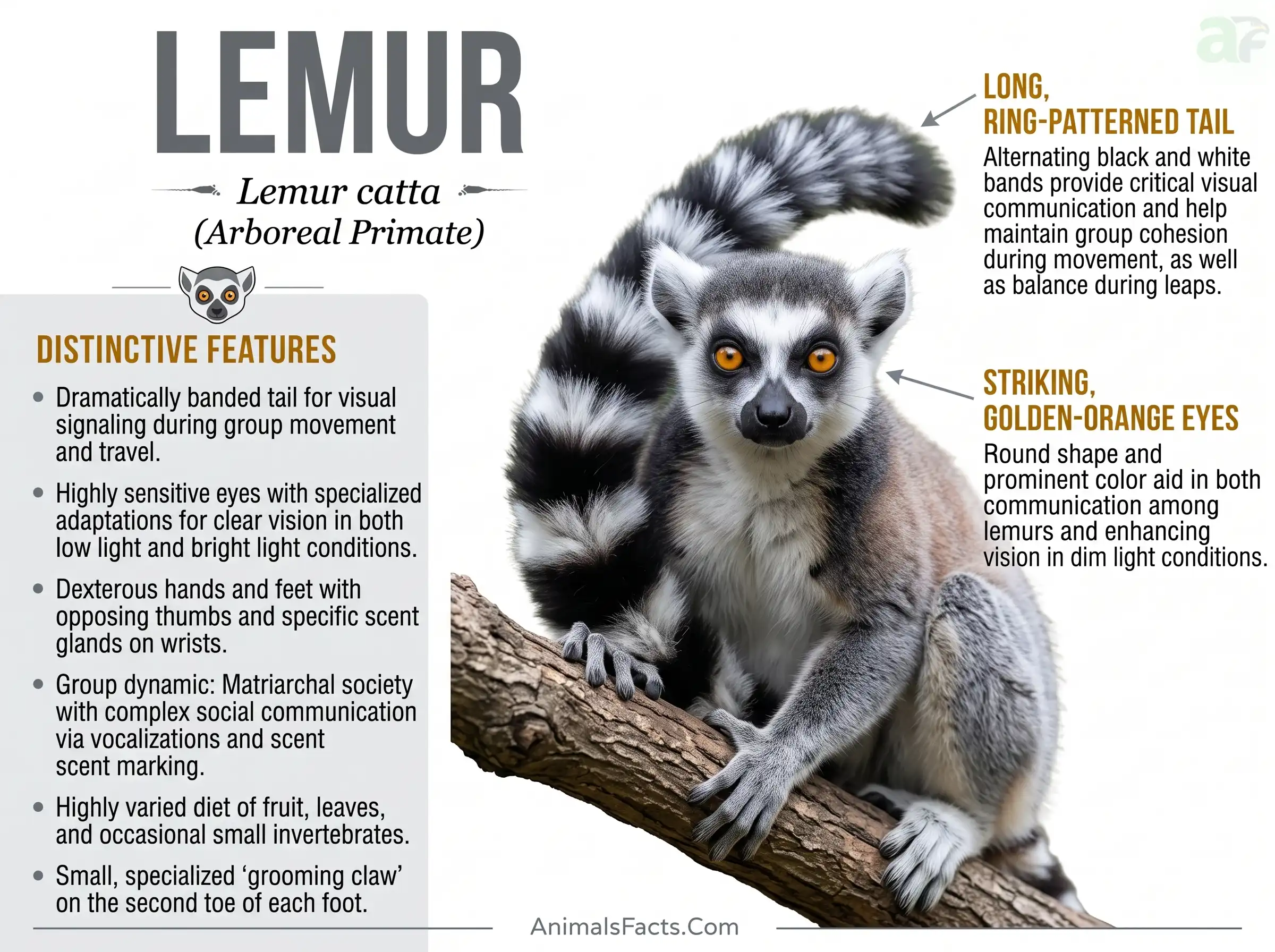
3. Lemur Physical Description & Unique Features
Lemur size and weight span the most extraordinary range of any primate group — from the 30-gram Madame Berthe’s mouse lemur (the world’s smallest primate by weight) to the 9-kg indri — a body size range of approximately 300-fold within a single infraorder. This size diversity reflects the extraordinary ecological diversification of the lemur radiation across Madagascar’s diverse habitats.
The Strepsirrhine Features — What Makes a Lemur
Lemurs belong to the suborder Strepsirrhini — the “wet-nosed” primates — characterized by several anatomical features that distinguish them from the higher primates (monkeys, apes, and humans):
Rhinarium (wet nose) — The moist, hairless nose tip that is the defining strepsirrhine feature — providing enhanced olfactory sensitivity through direct environmental air contact. The rhinarium connects to the upper lip by a philtrum — constraining facial mobility but maintaining the olfactory connection that is critical for scent communication in lemurs.
Tooth comb — Most lemurs have a dental tooth comb — the lower incisors and canines are elongated, flattened, and project forward as a comblike structure used for grooming fur and extracting tree gum. This structure is one of the most reliable anatomical markers of strepsirrhine primates.
Grooming claw — The second toe of the hind foot has a specialized toilet claw (rather than a flattened nail) used for grooming — another characteristic strepsirrhine feature.
Eyes and vision — Lemurs have relatively large eyes with a tapetum lucidum (reflective layer behind the retina) that produces the distinctive eye-shine visible when a flashlight is directed at a nocturnal lemur. Most lemurs have limited color vision compared to higher primates.
Olfactory communication — Lemurs rely heavily on scent for communication — more so than any other primate group. Multiple specialized scent glands produce complex chemical signals that communicate identity, reproductive state, and territorial information.
Selected Physical Descriptions by Major Species
Ring-tailed Lemur (Lemur catta):
- Body length: 38–46 cm plus 56–63 cm tail
- Weight: 2.2–3.5 kg
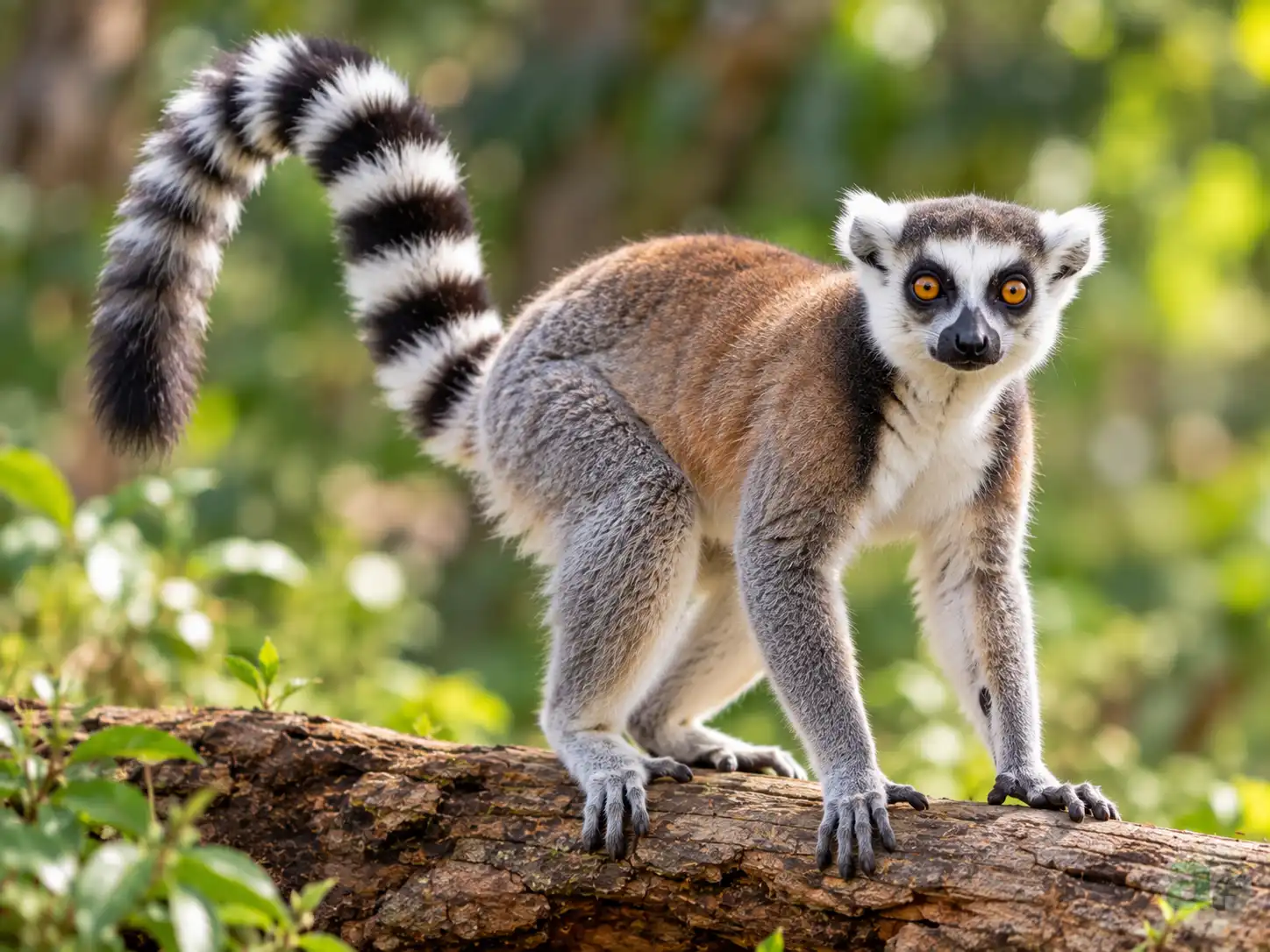
- Coat: grey-brown dorsal, white ventral; distinctive black-and-white banded tail (13 alternating black and white rings)
- Face: white with black eye patches and black muzzle; intensely orange-yellow eyes
- Tail: always longer than body; used in “stink fights” where males rub scent glands on the tail and wave it at rivals
Indri (Indri indri):
- Body length: 64–72 cm — the longest-bodied living lemur
- Weight: 6–9.5 kg — the heaviest living lemur
- Virtually no tail — the only virtually tailless living lemur; tail reduced to a small stub
- Coat: striking black and white patterning; variable between individuals and populations
- Locomotion: vertical clinging and leaping — the indri moves through the forest by gripping vertical tree trunks and making spectacular leaps between trees
Aye-aye (Daubentonia madagascariensis):
- Body length: 30–37 cm plus 44–53 cm tail
- Weight: 2.5–2.7 kg
- Coat: coarse, dark brown to black with white-tipped guard hairs creating a shaggy appearance
- Enormous ears — bat-like, mobile, highly sensitive
- Elongated middle finger — the third finger is dramatically elongated and wire-thin with a hook-like claw — used to tap on wood surfaces (detecting hollow spaces by sound) and to extract larvae from wood
- Continuously growing incisors — like rodents; used to gnaw into wood
- The most morphologically bizarre primate alive — no other primate has anything resembling the aye-aye’s unique combination of features
Madame Berthe’s Mouse Lemur (Microcebus berthae):
- Body length: 9–11 cm plus 13–14 cm tail
- Weight: 30–38 grams — the world’s smallest primate
- Coat: reddish-brown dorsal; pale underside
- Eyes: enormous relative to head — providing exceptional low-light vision for nocturnal foraging
💡 Did You Know? The indri — the largest living lemur — is one of only a handful of non-human primates known to communicate through complex songs comparable in some respects to those of whales and gibbons. Indri pairs and family groups produce haunting, wailing songs that carry through the rainforest for up to 3 kilometers — the calls serving to advertise territory, maintain contact between group members, and coordinate group movement. Remarkably, research by Chiara De Gregorio and colleagues published in Current Biology in 2022 confirmed that indri songs have a rhythmic structure consistent with human musical concepts of rhythm — specifically showing intervals characteristic of both perfect fourth and perfect fifth musical intervals and a regular rhythmic beat. This finding — that an animal completely isolated from human cultural influence independently developed music with recognizable rhythmic and interval structures — is one of the most astonishing findings in comparative musicology and raises profound questions about the evolutionary origins of human music.
4. Top 25 Amazing Lemur Facts
Here is your definitive collection of the most extraordinary, scientifically verified, and genuinely astonishing lemur facts as of 2026:
- 97% of all lemur species are threatened with extinction — making lemurs the most threatened mammal group on Earth. No other mammalian infraorder has a comparable proportion of its species facing extinction risk simultaneously.
- The fat-tailed dwarf lemur (Cheirogaleus medius) is the only primate known to hibernate — entering torpor for up to 7 months during Madagascar’s dry season, surviving entirely on fat reserves stored in its dramatically enlarged tail. During hibernation, its heart rate drops from approximately 180 beats per minute to fewer than 8.
- Madame Berthe’s mouse lemur (Microcebus berthae) is the world’s smallest primate — weighing approximately 30–38 grams (about the weight of a golf ball) and measuring approximately 9 cm in body length. It was only described as a distinct species in 2000 — previously confused with the slightly larger grey mouse lemur.
- The indri (Indri indri) produces songs with rhythmic structures consistent with human musical intervals — specifically perfect fourths and perfect fifths — according to research published in Current Biology in 2022. This makes the indri one of only a handful of animals known to produce music with interval patterns recognizable from human musical traditions, despite complete evolutionary isolation from human culture.
- Lemurs are strictly endemic to Madagascar — they evolved nowhere else, they naturally occur nowhere else, and they represent a primate radiation completely isolated for 50–60 million years. Madagascar is the only place on Earth where lemurs exist in the wild.
- Ring-tailed lemur males engage in “stink fights” — rubbing their wrists and chests (where scent glands are located) across their tails, then waving the scent-laden tail at rivals. These encounters are decided primarily by the persistence and intensity of the scent display rather than physical combat.
- The aye-aye uses tap-foraging — tapping on wood surfaces with its elongated middle finger and listening to the resonance to locate hollow spaces where wood-boring larvae are present. This echolocation-like technique is unique among primates and precisely parallels the woodpecker’s foraging strategy — the aye-aye is Madagascar’s ecological equivalent of a woodpecker.
- Female lemurs are dominant over males — in most lemur species, females have priority access to food, grooming partners, and sleeping sites. This female dominance is extremely unusual in primates and is considered one of the most significant behavioral distinctions between lemurs and higher primates.
- The black-and-white ruffed lemur (Varecia variegata) builds the only nest among living lemurs — constructing a lined nest of leaves and fur in which she gives birth and raises her young. It also produces the largest litter size of any primate — typically 2–3 offspring simultaneously.
- Madagascar has lost approximately 90% of its original forest cover — the primary driver of lemur extinction risk. This deforestation has occurred primarily since human arrival approximately 2,000 years ago and continues at alarming rates driven by slash-and-burn agriculture, charcoal production, and logging.
- The bamboo lemurs (Hapalemur and Prolemur species) consume cyanide-containing bamboo shoots as their primary food — ingesting quantities of cyanide daily that would be lethal to most mammals of equivalent body size. The biochemical mechanism of their cyanide detoxification remains incompletely understood.
- Mouse lemurs (Microcebus species) have the highest diversity of any lemur genus — with over 23 recognized species — and new species continue to be described based on molecular genetic analysis of populations previously considered a single species. As recently as the 1990s, only 2 mouse lemur species were recognized.
- The indri cannot survive in captivity — no indri has ever been successfully maintained in a zoo outside Madagascar for more than a very brief period. The species’ extreme sensitivity to captive conditions, specific dietary requirements, and apparent psychological requirement for a specific forest environment make it one of the most captivity-intolerant primates in the world.
- Lemurs practice counterintuitive female dominance — including in feeding contexts where females will physically displace males from food sources despite often being smaller. This social structure is maintained by female coalitions and is so consistent across species that it is considered a fundamental characteristic of the lemur infraorder.
- The greater bamboo lemur (Prolemur simus) is one of the world’s rarest primates — with a total wild population estimated at fewer than 1,000 individuals — and is found in one of Madagascar’s most threatened forest habitats.
- Ring-tailed lemur females form matrilineal social groups — the core social unit of a ring-tailed lemur group is a family of related females whose social relationships determine group structure, while males are peripheral members who move between groups.
- The sifakas (Propithecus species) have an extraordinary form of terrestrial locomotion — when crossing open ground between trees, they move bipedally with their arms raised for balance, hopping sideways in a distinctive “dancing” gait that makes them appear to be performing a slow-motion dance across the forest floor.
- Lemurs are among the most important seed dispersers in Madagascar’s forests — the ruffed lemurs in particular disperse seeds of large-fruited trees that no other animal in Madagascar is large enough to consume and disperse, making them functionally irreplaceable in the forest ecosystem.
- The aye-aye is considered a harbinger of death in Malagasy cultural tradition — a creature so associated with evil omens that its appearance near a village historically triggered the killing of the animal and sometimes the burning of the village itself. This cultural fear has directly contributed to the species’ decline through persecution.
- Despite their extraordinary diversity, all living lemurs descend from a single ancestral colonization event — a tiny founding population that crossed the Mozambique Channel approximately 50–60 million years ago and subsequently diversified into all 100+ living species through adaptive radiation.
- The Coquerel’s sifaka (Propithecus coquereli) was the subject of a dedicated scientific research program at the Duke Lemur Center that has contributed significantly to understanding of sifaka cognitive ability — including demonstrations of numerical concepts, spatial memory, and social learning that challenge earlier assumptions about strepsirrhine primate intelligence.
- Madagascar’s lemurs have evolved to cope with one of the most unpredictable and most seasonal environments of any primate habitat — the island’s climates range from tropical humid to extremely arid, and its rainfall is among the most temporally unpredictable of any primate habitat globally, driving the extreme physiological adaptations (hibernation, torpor, fat storage) unique to the lemur radiation.
- The indri is the only lemur species that is exclusively diurnal (active only during daylight hours) among the Indriidae — most other lemur species are either nocturnal, cathemeral (active both day and night), or have more flexible activity patterns.
- Lemur population genetics research has revealed that many populations previously considered single species represent multiple genetically distinct species — molecular genetics has more than doubled the recognized lemur species count since the 1990s, and additional species descriptions continue to be published.
- The Duke Lemur Center at Duke University in North Carolina — the world’s largest lemur research and captive breeding facility — maintains over 200 individual lemurs of more than 14 species, representing the most significant ex-situ lemur conservation program outside Madagascar and a globally unique resource for lemur research and conservation.
5. Fun Facts About Lemurs
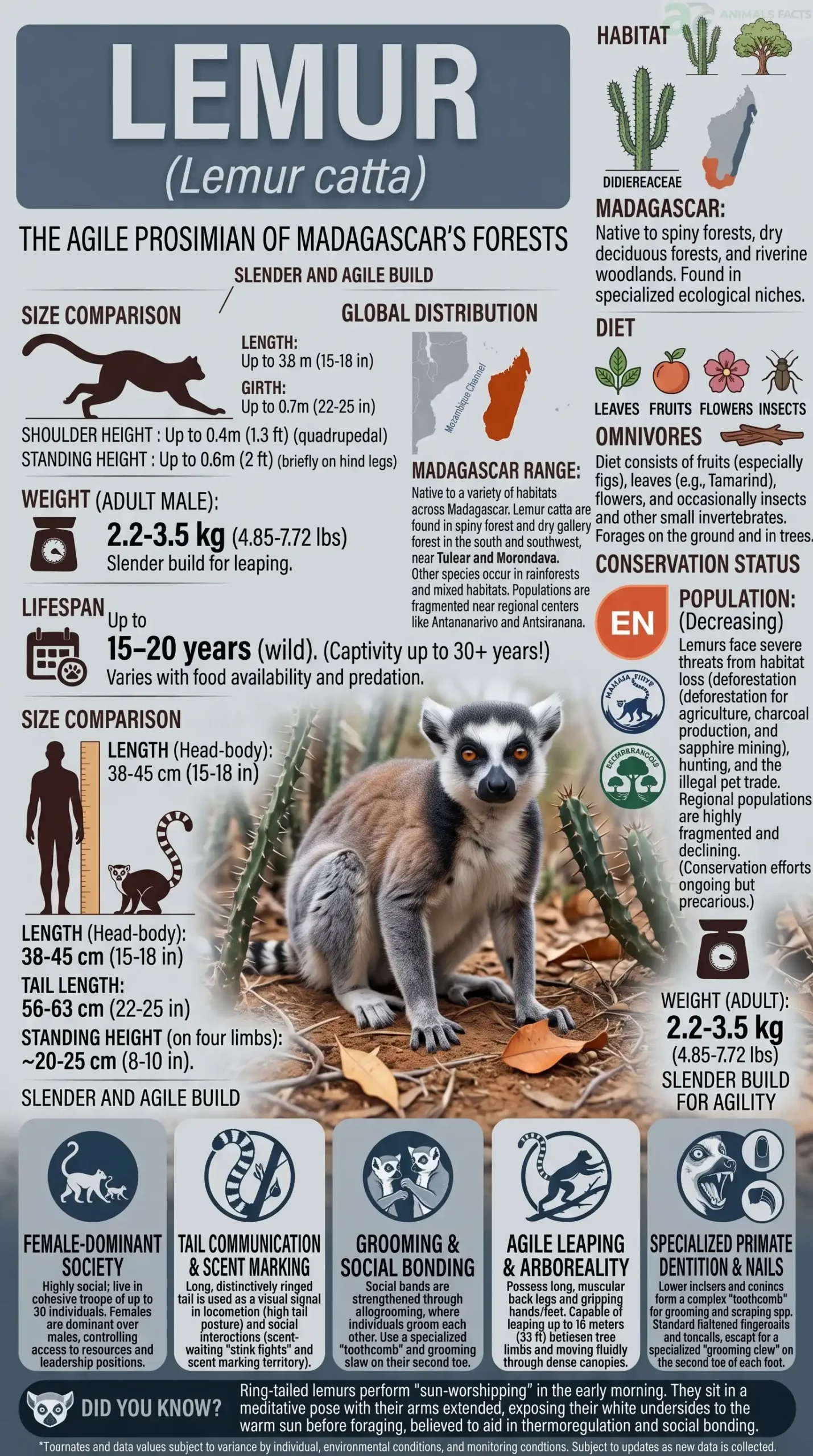
- 97% of lemur species are threatened — the most endangered mammal group
- The fat-tailed dwarf lemur is the only hibernating primate
- Madame Berthe’s mouse lemur is the world’s smallest primate
- The indri’s song has human musical intervals — perfect fourths and fifths
- Lemurs exist only in Madagascar — nowhere else on Earth
- Female lemurs are dominant over males — unique among primates
- Aye-ayes use tap-foraging like a woodpecker — unique among primates
- Ring-tailed lemurs fight with their scented tails — “stink fights”
- Bamboo lemurs eat deadly cyanide daily without harm
- The indri cannot survive in captivity — ever successfully
- Madagascar has lost 90% of its forest since humans arrived
- Sifakas dance sideways when crossing open ground
6. Lemur Habitat & Geographic Range
Lemur habitat is exclusively Madagascar — the world’s fourth largest island — and the nearby Comoros Islands where the mongoose lemur (Eulemur mongoz) was introduced. Madagascar’s extraordinary geographic and climatic diversity has driven the equally extraordinary diversity of the lemur radiation.
Madagascar’s Habitat Mosaic
Madagascar contains an extraordinary range of habitat types across its 587,000 km² — and different lemur species are specialized for different parts of this mosaic:
Eastern Rainforest — The humid forest along the eastern escarpment of Madagascar; the most species-rich lemur habitat; receives high rainfall year-round; home to indri, ruffed lemurs, bamboo lemurs, and many other species. This is also the most severely threatened habitat — fragmented into isolated patches separated by agricultural land.
Western Dry Deciduous Forest — Seasonal forest that loses most of its leaves during the dry season; home to ring-tailed lemurs, sportive lemurs, and several Eulemur species adapted to the pronounced dry season. These forests are heavily impacted by charcoal production and agricultural expansion.
Southern Spiny Forest — The most arid and most distinctive Malagasy habitat; dominated by spiny succulent plants including the bizarre Didiereaceae family found nowhere else; home to ring-tailed lemurs, radiated tortoises, and various specialized dry-adapted species. This extreme habitat supports lemurs through severe water stress periods.
Northern Montane Forest — High-altitude forest in the Tsaratanana Massif and other northern highlands; home to the golden-crowned sifaka and other range-restricted species; relatively less studied than lowland habitats.
Mangrove and Coastal Forest — Coastal habitats supporting some Eulemur species and mongoose lemurs in the northwest.
Species Distribution Patterns
Lemur species show remarkably fine-grained habitat specialization — many species have extremely restricted ranges that make them highly vulnerable to local habitat disturbance:
| Species Group | Primary Habitat | Geographic Range |
|---|---|---|
| Ring-tailed lemur | Dry forest, scrub, rocky areas | South and southwest Madagascar |
| Ruffed lemurs | Eastern rainforest | Eastern Madagascar (fragmented) |
| Indri | Eastern rainforest | Northeast and east Madagascar |
| Sifakas | Varied — rainforest to dry forest | Multiple species across Madagascar |
| Mouse lemurs | Almost all habitat types | Entire island — species vary by region |
| Fat-tailed dwarf lemur | Western dry forest | West and northwest Madagascar |
| Aye-aye | Multiple habitat types | Scattered across Madagascar |
| Bamboo lemurs | Bamboo-containing forest | East and southeast Madagascar |
💡 Did You Know? The reason lemurs exist only in Madagascar — and not in Africa, where their ancestors originated — is one of the great puzzles of island biogeography. When ancestral lemurs colonized Madagascar approximately 50–60 million years ago, the African mainland already had its own primate fauna (the ancestors of modern African primates). On Madagascar, the ancestral lemur colonists found an island with no competing primates, no large terrestrial predators, and a vast array of unfilled ecological niches. They diversified explosively — occupying the ecological roles that in Africa were occupied by monkeys, squirrels, and various other mammals. Meanwhile, on the African mainland, higher primates (monkeys and apes) evolved and out-competed the ancestral lemur-like primates — driving them to extinction in Africa. The result is a world where lemurs exist only on Madagascar — the one place where they escaped competition from higher primates long enough to diversify into one of the world’s most extraordinary primate radiations.
7. Lemur Diet & Feeding Behavior
Lemur diet is the most varied of any primate infraorder — ranging from exclusively frugivorous (fruit-eating) to exclusively folivorous (leaf-eating) to insectivorous to nectarivorous, with many species consuming diverse combinations across seasons.
Diet Breakdown Table by Major Species
| Species | Primary Diet | Notable Features |
|---|---|---|
| Ring-tailed lemur | Fruit, leaves, flowers, bark, sap | Highly seasonal; eats from 24+ plant species |
| Ruffed lemur | Primarily fruit (~90%) | Most frugivorous lemur; critical seed disperser |
| Indri | Leaves, seeds, fruit, flowers | Primarily folivorous; highly selective |
| Verreaux’s sifaka | Leaves, fruit, bark, soil | Eats nutritious leaves; soil eating (geophagy) |
| Aye-aye | Wood-boring larvae, seeds, fruit, nectar | Most insectivorous of all lemurs |
| Grey mouse lemur | Insects, fruit, flowers, nectar | Highly omnivorous; stores fat for hibernation |
| Fat-tailed dwarf lemur | Fruit, nectar, insects | Stores fat in tail for 7-month hibernation |
| Bamboo lemur | Bamboo shoots and leaves | Contains cyanide — lemur detoxifies it |
The Cyanide Eating Bamboo Lemurs
The dietary biology of bamboo lemurs (Hapalemur and Prolemur species) is one of the most extraordinary and most counterintuitive findings in primate nutrition:
The diet — Bamboo lemurs consume bamboo shoots, young leaves, and leaf bases as their primary food — specifically the parts of bamboo plants highest in hydrogen cyanide (HCN) precursors.
The toxin — The bamboo species consumed by these lemurs contain cyanogenic glucosides that the plant’s own enzymes convert to hydrogen cyanide when the plant tissue is damaged — a chemical defense system against herbivores. The quantities consumed by bamboo lemurs daily contain cyanide equivalent to several times the lethal dose for a mammal of their body size without detoxification.
The mystery — How bamboo lemurs detoxify these cyanide doses remains not fully understood. The liver detoxification pathways in mammals can handle modest cyanide exposures — but the quantities bamboo lemurs consume suggest either highly upregulated detoxification capacity or other mechanisms not yet identified.
The evolutionary significance — The bamboo lemur’s ability to exploit a food source toxic to most other animals effectively gives it exclusive access to an abundant, year-round food resource in a habitat where food can otherwise be limited — a classic example of niche specialization through tolerance of otherwise lethal chemistry.
The Aye-Aye’s Tap-Foraging
The aye-aye’s feeding behavior is the most unusual of any primate — representing an independent evolution of the woodpecker foraging strategy in a mammal:
Detection — The aye-aye taps rhythmically on wood surfaces with its elongated third finger — moving rapidly along branches and trunks, tapping every few centimeters. The enormous, mobile ears detect the resonance differences between solid wood and hollow spaces containing larvae.
Confirmation — When a hollow space is detected, the aye-aye gnaws through the wood with its continuously growing incisors — creating an access hole precisely sized for the long middle finger.
Extraction — The elongated third finger is inserted into the hole and rotated — the hook-like claw at the tip hooking larvae and pulling them out. The finger can reach approximately 3 cm deeper into wood than the hole’s surface — accessing larvae hidden in spaces that no other predator could reach.
The ecological role — The aye-aye is Madagascar’s functional equivalent of a woodpecker — filling the ecological niche of wood-boring larva extraction that woodpeckers fill on other continents. Madagascar has no woodpeckers — the aye-aye evolved this foraging system independently to access the same food resource.
8. Lemurs Reproduction & Life Cycle
Lemur reproduction shows the extraordinary diversity expected of a group that has radiated into 100+ species across multiple ecological niches — with reproductive strategies ranging from the multiple offspring of ruffed lemurs to the strict single-offspring reproduction of the indri.
Female Dominance and Reproductive Control
The most distinctive aspect of lemur reproductive biology is female social dominance — a characteristic so universal across the infraorder that it is considered a defining lemur behavioral feature:
Priority access — Dominant females have priority access to food resources — particularly during the energetically demanding periods of pregnancy and lactation. This priority access translates into better nutrition, improved offspring survival, and higher lifetime reproductive success for dominant females.
Hormonal basis — Research on ring-tailed lemurs and other species has documented that female dominance is hormonally mediated — females have elevated androgen (male sex hormone) levels relative to the pattern in higher primates, which may contribute to the behavioral aggression that enforces their social priority.
Evolutionary explanation — The evolutionary basis of lemur female dominance is debated. Leading hypotheses include: female nutritional requirements during reproduction on Madagascar’s highly seasonal, often poor-quality food resources drove selection for female priority access; the energetics of large litters (in ruffed lemurs) selected for female feeding priority; or the ancestral lemur social system was already female-dominant before the Madagascar radiation.
Breeding Seasonality
Most lemur species are highly seasonally reproductive — with strict mating seasons timed so that births occur when food resources are at their peak:
Ring-tailed lemur — Mating in April–May (southern hemisphere autumn); births in August–September (southern hemisphere spring) — timed to the period of highest food availability in the dry southern Madagascar habitat.
Ruffed lemur — One of the earliest-breeding lemurs; births occurring in September–October; the infants developing in the nest while food resources increase toward summer peak.
Indri — The slowest reproducing lemur; births every 2–3 years with a single offspring; the extended inter-birth interval produces one of the lowest reproductive rates of any primate.
The Ruffed Lemur’s Unique Reproductive Strategy
The black-and-white ruffed lemur (Varecia variegata) has the most unusual reproductive strategy of any lemur:
- Multiple offspring — typically 2–3 infants per litter (the largest litter of any lemur)
- Nest building — the only lemur to build a nest for birth and early infant care
- Infant parking — infants are left in the nest while the mother forages — unlike most primate species where infants cling to the mother during her movements
- The high energetic cost of multiple offspring and nest-based infant care makes ruffed lemurs particularly dependent on high-quality fruit-rich forest
Fat-Tailed Dwarf Lemur Hibernation
The fat-tailed dwarf lemur (Cheirogaleus medius) has the most remarkable reproductive-seasonal biology of any primate:
Fat storage — During the wet season when food is abundant, the fat-tailed dwarf lemur accumulates fat specifically in its tail — the tail more than doubling in diameter as fat is stored. Up to 40% of total body weight may be stored as tail fat before hibernation entry.
Hibernation — The lemur enters a tree hollow (or similar shelter) in May and hibernates for up to 7 months through the dry season — surviving entirely on tail fat reserves. Heart rate drops from approximately 180 beats per minute to fewer than 8. Body temperature drops to near-ambient temperature.
The full-bladder hibernation — Research has documented that fat-tailed dwarf lemurs enter hibernation with their bladder full — and retain this urine throughout hibernation, reabsorbing water and nutrients from the stored urine during the dry season when external water is unavailable. This urine retention during hibernation is unique among mammals.
Lifespan Comparison Table
| Species | Wild Lifespan | Max Captive | Reproductive Rate |
|---|---|---|---|
| Ring-tailed lemur | 16–19 years | 37 years | 1–2 offspring/year |
| Indri | 15–20 years (estimated) | Cannot be maintained | 1 offspring every 2–3 years |
| Ruffed lemur | 15–20 years | 30+ years | 2–3 offspring/year |
| Grey mouse lemur | 3–5 years | 15 years | 2–4 offspring per litter; 2 litters/year |
| Fat-tailed dwarf lemur | 5–8 years | 20+ years | 2–4 offspring/year |
| Aye-aye | 20+ years (estimated) | 23 years | 1 offspring every 2–3 years |
9. Social Behavior & Communication
Lemur social behavior is among the most diverse of any primate infraorder — ranging from the strict solitude of some mouse lemur species to the complex multi-individual social groups of ring-tailed lemurs, with extraordinary variation in between.
Social Organization Diversity
Solitary — Most mouse lemur species and many nocturnal lemurs are primarily solitary — adults maintaining individual home ranges with minimal sustained social contact beyond brief mating encounters. Even “solitary” mouse lemurs, however, may share sleeping sites with other individuals.
Pair-bonded — Several lemur species maintain long-term pair bonds — the mongoose lemur and some other Eulemur species living in male-female pairs that maintain exclusive territories together.
Family groups — Indri and several sifaka species live in small family groups of 2–6 individuals — typically a mated pair plus offspring of various ages.
Multi-male multi-female groups — Ring-tailed lemurs live in groups of typically 13–15 individuals — multiple adult females, their offspring, and several adult males. The females form the stable core of the group; males transfer between groups.
Communication Systems
Olfactory communication — The dominant long-distance communication channel for most lemur species. Multiple specialized glands produce complex chemical signals:
- Brachial glands (upper arm) — present in some species
- Antebrachial glands (forearm) — used in scent marking in ring-tailed lemurs
- Chest glands — horny spurs used for marking in ring-tailed lemurs
- Genital glands — reproductive status signals
The ring-tailed lemur stink fight — Male ring-tailed lemurs rub their tails across their wrist and chest scent glands — impregnating the long tail fur with their chemical signature — then wave the scent-laden tail toward rivals. These encounters can last 30–60 minutes and are decided by the chemical persistence of the competitors’ scent rather than physical combat.
Vocal communication — Lemurs are among the most vocal primates:
- Indri song — haunting, musical calls carrying 3 km through forest
- Ring-tailed lemur alarm calls — distinct calls for aerial vs. terrestrial threats
- Ruffed lemur — the loudest call of any lemur; audible for considerable distances; used for group coordination and alarm
Visual communication — The tail stripe of ring-tailed lemurs; postural signals; facial expressions including the stare used in dominance interactions.
The Indri’s Musical Communication
The indri’s song deserves special attention as one of the most remarkable communication systems of any primate:
- Indri pairs and family groups produce coordinated songs — individuals harmonizing in a way that suggests awareness of each other’s vocal output
- Songs can last 45 seconds to several minutes
- The rhythmic structure documented in the 2022 Current Biology study — with intervals corresponding to perfect fourths and fifths — represents the first documentation of non-human music with recognizably Western musical interval structure in an animal with no cultural contact with humans
- The evolutionary implications are profound — suggesting that some musical intervals may have deep biological roots that predate human culture
10. Predators & Defense Mechanisms
Madagascar’s lemurs face a predator community quite different from that faced by primates on other continents — without large cats, large canids, or eagles specialized for primate hunting, the predation pressure is shaped by a unique cast of native and introduced predators.
Natural Predators
Fossa (Cryptoprocta ferox) — Madagascar’s largest native carnivore; a cat-like mongoose relative weighing 5.5–8.6 kg that is the most significant natural predator of lemurs across all body sizes. The fossa hunts both arboreal and terrestrial lemurs and is the primary apex predator of Madagascar’s forest ecosystem.
Madagascar harrier-hawk (Polyboroides radiatus) — A specialist raptor adapted for reaching into tree hollows to extract prey including small lemurs and bird nestlings.
Madagascar buzzard (Buteo brachypterus) — Diurnal raptor that takes lemurs up to medium size.
Madagascar ground boa (Acrantophis madagascariensis) — The largest native Malagasy snake; documented taking lemurs including ring-tailed lemurs up to medium size.
Introduced species — Since human arrival, domestic dogs, cats, rats, and other introduced species have added to the predation pressure on lemurs — particularly on ground-level and small species.
Defense Mechanisms
Cryptic nocturnal activity — The majority of lemur species are nocturnal — avoiding the diurnal predators through temporal niche partitioning. The tapetum lucidum provides superior low-light vision for navigating and hunting in darkness.
Alarm call systems — Most lemur species have distinct alarm calls for aerial versus terrestrial predators — allowing appropriate group responses (freeze-and-hide for aerial; move to safety for terrestrial) based on the nature of the threat.
Group vigilance — Social species like ring-tailed lemurs benefit from collective predator detection — multiple individuals scanning simultaneously providing earlier threat detection than solitary animals.
Arboreal escape — Most lemur species are arboreal or semi-arboreal — rapid movement into the tree canopy provides escape from terrestrial predators including the fossa. The fossa, however, is itself an exceptional climber.
Cryptic coloration — Many nocturnal lemur species have cryptic brown-grey coloring that provides camouflage against the bark of their resting sites during daylight hours.
11. Lemur Facts for Kids
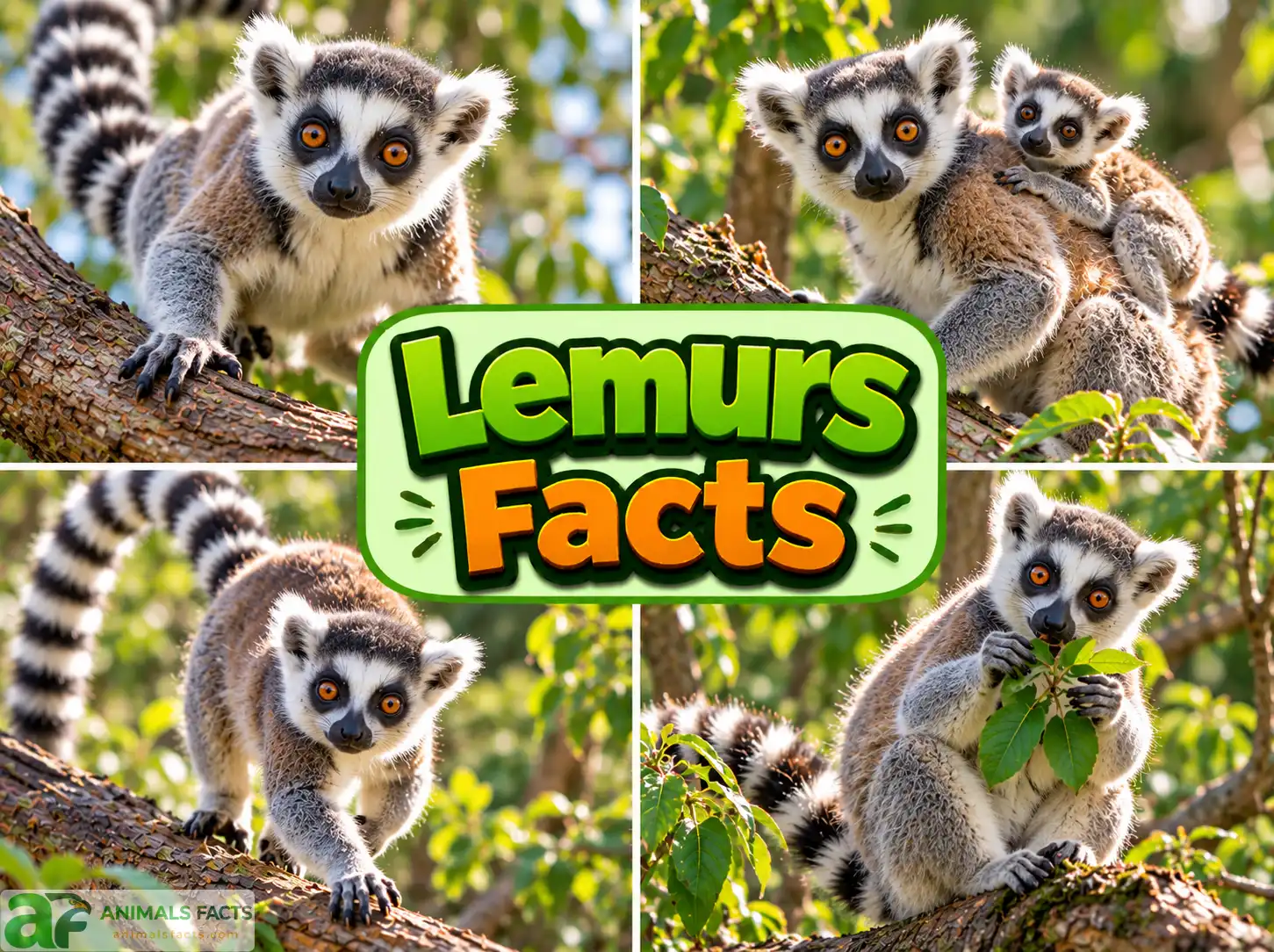
Hey amazing young primatologists and future conservationists! Here are some absolutely mind-blowing lemur facts for kids that will astonish every wildlife fan you know:
- 🐾 97 out of every 100 lemur species are in danger of disappearing FOREVER! Lemurs are the most endangered group of mammals on the entire planet. More than almost any other animal you can think of, lemurs need people to care about them right now. Learning about them is already a step toward helping them!
- 🐾 The world’s SMALLEST primate is a lemur! Madame Berthe’s mouse lemur weighs just 30 to 38 grams — about the same as a golf ball. Its whole body is only about 9 centimeters long. It fits in the palm of your hand and yet it is a completely real wild primate — the tiniest cousin of monkeys, apes, and humans!
- 🐾 One lemur HIBERNATES for 7 months — and it hibernates with a full bladder! The fat-tailed dwarf lemur is the only primate on Earth that truly hibernates. It stores fat in its tail all summer, then sleeps for seven months through winter. And weirdly, it goes to sleep with its bladder completely full — and keeps all that liquid stored inside it the whole time, slowly reabsorbing the water!
- 🐾 Lemurs can sing MUSIC with human musical intervals! Scientists discovered that indri lemurs sing songs that follow the same musical spacing — called intervals — that humans use in music. A perfect fourth and a perfect fifth are intervals found in loads of human music from folk songs to classical — and indri lemurs independently evolved to sing with these same intervals. Nature invented music!
- 🐾 Female lemurs are the BOSSES! In almost every lemur species, females are dominant over males. Female lemurs eat first, choose where to sleep, and can push males out of the way whenever they want. This is the opposite of most primates — including our closest relatives the chimpanzees — making lemurs genuinely unusual in the primate world.
- 🐾 The aye-aye has a MAGICAL finger for finding hidden food! The aye-aye has one finger that is incredibly long and thin — much longer than all its other fingers. It uses this finger to tap on wood listening for hollow spaces, and then pokes it into the hole to hook out insects. This is exactly the same trick that woodpeckers use with their beaks — but the aye-aye independently invented it as a primate!
- 🐾 Bamboo lemurs eat POISON every day and are completely fine! Bamboo lemurs eat bamboo shoots that contain cyanide — a substance so toxic that it would kill most animals much larger than the lemur. But bamboo lemurs eat enormous amounts of it every day without any apparent harm. Scientists are still working out exactly how they do it!
- 🐾 Lemurs ONLY live in Madagascar — nowhere else on Earth naturally. Madagascar is the world’s fourth largest island and has been isolated from other land masses for 90 million years — creating a world where animals evolved in complete isolation and produced some of the most unique creatures on Earth. Without Madagascar, there are no lemurs.
12. Relationship with Humans
The relationship between lemurs and humans is one of the most consequential and most tragic in primate conservation — a species group that has existed for 50–60 million years in Madagascar facing near-simultaneous extinction pressure from the approximately 2,000 years of human presence on the island.
Traditional Malagasy Relationships — Fady and Taboo
The Malagasy people’s traditional relationship with lemurs is profoundly shaped by the cultural concept of fady — a system of taboos that prohibits various actions and that has historically provided significant informal protection for many lemur species:
Fady protecting lemurs — In many Malagasy communities, specific lemur species are protected by fady — it is forbidden to hunt, kill, or eat them. The specific species protected vary by region and ethnic group — reflecting the extraordinary cultural diversity of Madagascar’s approximately 18 ethnic groups, each with distinct traditions.
The indri protection — In communities in the northeastern forests where the indri occurs, the indri is frequently protected by fady — often associated with Malagasy origin stories connecting humans and indri as relatives, or with the belief that the indri’s call connects the forest to the spirit world. This traditional protection has historically provided meaningful conservation benefit — in areas with strong indri fady, the species has historically been better protected than in areas without it.
The aye-aye curse — In striking contrast to the protective fady of other species, the aye-aye is traditionally viewed as an evil omen in many Malagasy communities — its appearance near a village sometimes triggering the aye-aye’s killing and the burning of nearby structures. This cultural fear has directly driven the persecution of one of the most morphologically unique primates in the world.
Weakening of fady — Traditional fady protections have weakened significantly over the past several decades — driven by economic desperation, population pressure, political instability that undermines traditional social structures, and the influence of outside cultural and religious frameworks that do not recognize fady obligations.
Bushmeat Hunting
Despite traditional taboos protecting many lemur species, bushmeat hunting of lemurs has become a significant conservation threat — particularly in areas of economic desperation:
Scale — A 2011 survey of lemur hunting in Madagascar documented lemur bushmeat consumption across most of the country — with larger-bodied species (sifakas, ruffed lemurs, indri) being most heavily targeted. Estimated harvest rates in some areas were dramatically unsustainable relative to estimated population sizes.
Drivers — Economic poverty, protein deficiency in rural diets, weakening of traditional fady, and political instability during which wildlife laws are unenforced all contribute to increased bushmeat hunting.
Impact — Given lemurs’ already fragile population sizes and slow reproduction rates, even modest levels of hunting can push populations toward local extinction — particularly for large-bodied, slow-reproducing species like the indri and large sifakas.
Deforestation — The Primary Threat
Madagascar’s deforestation crisis is the most significant factor driving lemur extinction — and one of the most severe deforestation situations in the world:
Historical loss — Madagascar has lost approximately 90% of its original forest cover since human arrival approximately 2,000 years ago — a loss of approximately 530,000 km² of original forest. The vast majority of this loss has occurred since the mid-20th century.
Slash-and-burn agriculture (tavy) — The traditional Malagasy agricultural practice of burning forest to create agricultural land continues across Madagascar — driven by poverty and population growth. It is estimated that 111,000 hectares of Malagasy forest are lost annually to tavy and other clearing.
Charcoal production — Urban demand for charcoal as the primary cooking fuel drives massive forest clearance, particularly in the western dry deciduous forests.
Illegal logging — High-value hardwoods including rosewood (Dalbergia species) are illegally harvested and exported — causing targeted destruction of some of Madagascar’s most biodiverse forests.
The cascading impact — Each hectare of forest lost eliminates habitat for multiple lemur species, fragment populations, reduces gene flow between populations, and eliminates the food trees that make lemur survival possible.
International Conservation Engagement
The global scientific community has engaged with Malagasy lemur conservation with increasing intensity since the 1980s:
Madagascar National Parks — A network of protected areas covering approximately 3 million hectares — providing formal protection for a significant portion of remaining lemur habitat. However, enforcement capacity is severely limited.
Research institutions — Organizations including the Duke Lemur Center, Durrell Wildlife Conservation Trust, Madagascar Fauna and Flora Group, Lemur Conservation Foundation, and Lemur Conservation Network maintain research and conservation programs across Madagascar.
Community-based conservation — Programs engaging local communities in conservation — providing economic incentives for forest protection, developing sustainable livelihoods, and working with traditional leaders to strengthen fady — represent the most promising path to long-term lemur conservation.
13. Lemur Conservation Status & Threats
Conservation Status Overview
The lemur conservation crisis is the most extreme of any primate group — and arguably the most extreme of any mammalian infraorder:
| Conservation Category | Number of Lemur Species | Percentage |
|---|---|---|
| Critically Endangered | 33 species | ~31% |
| Endangered | 49 species | ~46% |
| Vulnerable | 20 species | ~19% |
| Near Threatened | 4 species | ~4% |
| Least Concern | 3 species | ~3% |
| Data Deficient | Several species | — |
| Total Threatened | ~102 species | ~97% |
Major Threats
| Threat | Description | Impact Level |
|---|---|---|
| Deforestation | Agricultural burning, charcoal, logging | Critical — primary long-term threat |
| Bushmeat hunting | Direct consumption of lemurs | High — particularly large species |
| Illegal pet trade | Live lemur capture for domestic pets | High |
| Mining | Destruction of forest for mineral extraction | High |
| Political instability | Undermines conservation enforcement | High |
| Climate change | Altered seasonality; drought; cyclone impacts | Increasing concern |
| Introduced predators | Dogs, cats devastating ground-nesting species | Medium-High |
| Invasive plants | Replacing native food plants | Medium |
The Political Instability Factor
Madagascar has experienced significant political instability over the past two decades — including a 2009 coup that led to a period of international aid suspension and severely weakened conservation law enforcement. During periods of political instability, illegal logging, hunting, and the live animal trade all increase dramatically — the 2009 coup was followed by a surge in rosewood logging from previously protected areas that caused massive and irreversible forest destruction.
This political dimension of lemur conservation is one of the most challenging — conservation biology can identify the threats and propose solutions, but implementation requires stable governance, adequate law enforcement, and sustained international engagement that political instability can rapidly undermine.
The Most Critically Threatened Species
Golden-crowned sifaka (Propithecus tattersalli) — Approximately 2,000 individuals remaining in a tiny area of northern Madagascar. Among the 25 most endangered primates in the world.
Greater bamboo lemur (Prolemur simus) — Fewer than 1,000 individuals remaining; dependent on bamboo forest that is itself severely threatened.
Silky sifaka (Propithecus candidus) — One of the world’s rarest primates; possibly fewer than 1,000 individuals in fragmented northeastern Madagascar rainforest.
Northern sportive lemur (Lepilemur septentrionalis) — Estimated fewer than 50 individuals remaining — potentially one of the most critically endangered mammals in the world.
14. Famous Lemurs in History & Pop Culture
Famous Individual Lemurs
“King Julien” — The animated ring-tailed lemur king from DreamWorks’ Madagascar franchise (2005–present) is the most culturally influential fictional lemur in history — introducing ring-tailed lemur behavior (or a highly stylized version of it) to global audiences of hundreds of millions. The character — voiced by Sacha Baron Cohen in the films — subsequently starred in the Netflix animated series All Hail King Julien (2014–2017). The cultural impact of King Julien substantially increased global awareness of lemurs as a distinctive primate group.
“Jovian” — A ring-tailed lemur at the Duke Lemur Center who became one of the most-studied individual lemurs in research history — contributing to multiple published studies on lemur cognition, social behavior, and aging. Jovian lived to an extraordinary age and was the subject of a significant longitudinal health and behavioral study.
“Sprite” — An aye-aye at the San Diego Zoo who was among the first aye-ayes to be successfully maintained and bred in captivity — contributing significantly to the understanding of aye-aye reproductive biology and captive management.
“Raffles” — An indri documented by researchers in Andasibe-Mantadia National Park whose territory and social behavior have been monitored over multiple field seasons — providing some of the most detailed individual-level data available on wild indri social dynamics.
Historical Significance
First European encounter — The first European description of lemurs was provided by the French explorer Étienne de Flacourt in 1658 in his work Histoire de la Grande Isle Madagascar — describing several lemur species including what appears to be the aye-aye, sifaka, and ring-tailed lemur.
Linnaeus naming — Carl Linnaeus chose the genus name Lemur in 1758 — derived from the Latin lemures (ghosts of the dead in Roman mythology) — reportedly referencing the nocturnal habits and glowing eyes of these animals described in early accounts. The name has an ironic quality given that lemurs now face their own potential ghostly fate.
15. Role in Ecosystem & Food Chain
The Seed Dispersal Role
Lemurs are among the most ecologically important seed dispersers in Madagascar — and for several large-fruited tree species, they are the only seed dispersers of sufficient body size:
Ruffed lemurs as critical dispersers — The black-and-white ruffed lemur (Varecia variegata) is the largest frugivore in eastern Madagascar’s rainforest. It disperses seeds of multiple tree species whose fruits are too large for smaller animals to consume. For several tree species, the ruffed lemur is the only animal in Madagascar capable of ingesting and dispersing the seed — making the ruffed lemur functionally irreplaceable in the seed dispersal ecology of eastern Madagascar’s forest. Without ruffed lemurs, these tree species could not reproduce — and their loss would cascade through the forest ecosystem.
Broader dispersal network — Multiple lemur species contribute to seed dispersal across Madagascar’s forests — collectively maintaining plant community composition and facilitating forest regeneration in ways that support the entire ecosystem.
The Pollinator Role
Several lemur species are important pollinators of Malagasy plants — transferring pollen while foraging for nectar:
Mouse lemurs — Small nocturnal mouse lemurs visit flowers for nectar and in doing so transfer pollen between plants. The baobab trees (Adansonia species) of Madagascar are pollinated partly by mouse lemurs that visit the large, night-opening flowers.
Ruffed lemurs — Also documented as important pollinators of traveller’s palm (Ravenala madagascariensis) and other large-flowered Malagasy plants.
The Predator Role
Insectivorous and omnivorous lemur species regulate invertebrate populations in Madagascar’s forests — a regulatory role that cascades through the food web.
The Apex Predator Support Role
Lemurs are the primary prey base for the fossa — Madagascar’s apex predator. The fossa’s population density and distribution are closely linked to lemur abundance — and the loss of lemur populations would directly threaten fossa viability. This predator-prey linkage means that lemur conservation is simultaneously fossa conservation — the two cannot be effectively separated.
16. Myths, Folklore & Cultural Significance
The Fady System and Lemur Protection
As discussed above, the Malagasy fady system has historically provided significant cultural protection for many lemur species. Several particularly notable cultural relationships deserve specific attention:
The Indri-Human Connection — In the Betsimisaraka and several other Malagasy ethnic traditions, the indri is believed to be a close relative of humans — a forest-dwelling ancestor who chose to remain in the trees while the human branch of the family came down to live on the ground. This belief is not merely a charming myth — it reflects a genuine cultural framework that places the indri in a sacred, protected category. The indri’s haunting song is interpreted in some traditions as the calls of ancestor spirits — and harming an indri has historically been one of the most serious fady violations possible.
The Aye-Aye as Evil Omen — The cultural treatment of the aye-aye represents one of the most tragic intersections of folklore and conservation anywhere in the world. In multiple Malagasy traditions, the aye-aye is associated with evil spirits, death, and misfortune — its appearance near a village or garden being interpreted as an omen that someone in the community will die. Historical responses included killing the aye-aye immediately upon sighting, placing its body on a stake at the village entrance to ward off the evil it brought, or abandoning the dwelling that it appeared near. This cultural fear has directly driven the persecution of a species that in biological terms is extraordinary and irreplaceable — the unfortunate victim of its own bizarre appearance translated through cultural interpretation into supernatural malevolence.
The Sifaka as Sacred Forest Spirit — Several Propithecus species are protected in various Malagasy traditions — the sifaka’s spectacular appearance, distinctive dancing locomotion, and relative fearlessness making it a particularly visible and spiritually significant forest inhabitant. In areas where sifaka fady is strong, human-sifaka coexistence has historically been relatively successful.
Historical and Scientific Significance
The discovery of Madagascar’s lemur fauna by European science in the 17th century was a major event in the history of natural history — establishing the concept of endemism (species found nowhere else) as a fundamental principle of biogeography and contributing to the subsequent development of island biogeography theory.
17. Lemurs in Pop Culture
Madagascar (DreamWorks Animation, 2005) and sequels — The animated film franchise that introduced the lemur character King Julien to global audiences; subsequent films and the Netflix series All Hail King Julien have made the ring-tailed lemur one of the most globally recognized primate characters in animation history. While the films’ biological accuracy is limited, the cultural exposure has substantially increased global awareness of Madagascar’s unique wildlife.
David Attenborough and BBC Natural World — Multiple landmark BBC wildlife documentaries have featured Madagascar’s lemurs — including “Life of Mammals” (BBC, 2002), “Madagascar” (BBC, 2011, narrated by David Attenborough), and various BBC Earth and BBC Natural World productions. These documentaries have introduced lemur biology and conservation to global audiences at a level of biological accuracy and emotional engagement that fictional portrayals cannot achieve.
“Zoboomafoo” (PBS Kids, 1999–2001) — The educational children’s television show featuring a coquerel’s sifaka lemur named Jovian (a real lemur from the Duke Lemur Center) introduced lemurs to millions of American children — one of the most effective wildlife education programs for children featuring non-standard wildlife subjects.
National Geographic and scientific media — Lemurs feature prominently in conservation-focused media across National Geographic Magazine, National Geographic Documentary Films, and online wildlife platforms — with particular focus on the conservation crisis.
18. Lemur Facts vs. Common Myths
| Common Myth | The Real Fact |
|---|---|
| “Lemurs are monkeys” | False — lemurs are prosimians (strepsirrhine primates) belonging to the infraorder Lemuriformes — they are more distantly related to monkeys and apes than monkeys and apes are to each other |
| “Lemurs live in Africa” | False — lemurs are strictly endemic to Madagascar (and one species to the Comoros); they are found nowhere else on Earth naturally |
| “Male lemurs are dominant, like in most primates” | False — female dominance is one of the most consistent characteristics of the lemur infraorder; females have social priority in virtually all lemur species |
| “Ring-tailed lemurs have the best-known appearance of any lemur” | True in popular culture — but misleading overall — the ring-tailed lemur is the most recognizable lemur but represents only one of 100+ species; the infraorder contains extraordinary diversity that most people never see |
| “The aye-aye is an evil animal that brings death” | A cultural belief — not biological fact — the aye-aye is an extraordinary, ecologically important primate that poses no threat to humans; the cultural beliefs driving its persecution represent one of the most tragic intersections of folklore and conservation |
| “Lemurs will thrive once hunting stops” | Oversimplified — while hunting reduction is critical, habitat loss is the primary threat; stopping hunting without addressing deforestation is insufficient to prevent most lemur extinctions |
| “Lemurs are abundant in Madagascar” | False for most species — while some species remain locally abundant in protected areas, 97% of species are threatened and many have populations of only hundreds to a few thousand individuals |
19. Best Places to See Lemurs in the Wild
1. Andasibe-Mantadia National Park, Eastern Madagascar — The most accessible lemur-watching destination in Madagascar — accessible by road from Antananarivo in approximately 3 hours. The park supports indri — the flagship species of the park whose haunting calls are audible throughout the reserve — plus diademed sifaka, black-and-white ruffed lemur, and multiple smaller lemur species. The Vakona Private Reserve adjacent to the national park provides guaranteed lemur encounters including habituated ring-tailed lemurs.
2. Ranomafana National Park, Southern Highlands — One of Madagascar’s finest national parks; famous for its populations of greater bamboo lemur — one of the world’s rarest primates. Also supports multiple sifaka species, mouse lemurs, and numerous other species. The park’s well-trained guides and established trail network make it one of the best wildlife experiences in Madagascar.
3. Berenty Private Reserve, Southern Madagascar — Famous for exceptionally habituated ring-tailed lemur and Verreaux’s sifaka populations that are among the most accessible wild lemurs anywhere. The reserve’s ring-tailed lemur population has been continuously studied since the 1960s — providing one of the longest continuous primate behavioral datasets in the world.
4. Kirindy Forest, Western Madagascar — The best location for encountering the fossa — Madagascar’s apex predator — and also excellent for nocturnal lemur species including fat-tailed dwarf lemur and giant jumping rat on spotlight walks. One of the most rewarding wildlife experiences in western Madagascar.
5. Masoala National Park, Northeastern Madagascar — Madagascar’s largest protected area; some of the finest and most intact eastern rainforest remaining; home to red ruffed lemurs and multiple other species in exceptional forest condition. Remote and logistically challenging — but one of the most biologically rich lemur habitats accessible to visitors.
6. Lokobe National Park, Nosy Be — The only protected area on Madagascar’s tourist island of Nosy Be; excellent black lemur (Eulemur macaco) viewing in accessible coastal forest — one of the most straightforward lemur encounters in the country.
7. Duke Lemur Center, North Carolina, USA — For non-Madagascar visitors, the Duke Lemur Center at Duke University in Durham, North Carolina maintains the largest collection of lemurs outside Madagascar — with guided tours providing close encounters with multiple species in naturalistic enclosures.
20. How You Can Help
Lemur conservation is one of the most urgent conservation priorities in the world — and requires action across multiple scales simultaneously.
Support these organizations:
- Lemur Conservation Network — lemurconservationnetwork.org — coordinates the global network of lemur conservation organizations; supports projects across Madagascar
- Lemur Conservation Foundation — lemurreserve.org — operates the Myakka City Lemur Reserve in Florida and funds conservation in Madagascar
- Duke Lemur Center — lemur.duke.edu — the world’s largest lemur research and conservation facility; directly supports Madagascar conservation programs
- Durrell Wildlife Conservation Trust — durrell.org — long-term lemur conservation programs in Madagascar including breeding and community conservation
- Madagascar Fauna and Flora Group — madagascarfaunaflora.org — Madagascar-focused conservation including the Ivoloina Park
- Rainforest Trust — rainforesttrust.org — funds purchase and protection of Madagascar forest for lemur conservation
- World Wildlife Fund Madagascar — wwf.org — forest protection programs in Madagascar
Critical individual actions:
- Never purchase a lemur as a pet — the live lemur trade is illegal, drives wild population decline, and results in severe animal welfare suffering; report any live lemur trade to wildlife authorities
- Choose Madagascar tourism responsibly — visiting Madagascar and supporting responsible wildlife lodges and guides directly funds conservation infrastructure; choose operators who actively support conservation programs
- Support Madagascar conservation organizations financially — direct donations fund field research, anti-poaching programs, community livelihoods, and forest protection
- Spread awareness — lemurs are one of the most endangered mammal groups on Earth; most people don’t know; sharing accurate information builds the awareness that drives political will and funding
- Advocate for Madagascar governance support — international engagement with Madagascar’s political stability is ultimately necessary for conservation enforcement; supporting organizations that engage with this dimension addresses the root cause
21. Top Documentaries & Books
Must-Watch Documentaries
- “Madagascar” (BBC, 2011, David Attenborough narrator) — The definitive popular documentary treatment of Madagascar’s wildlife including exceptional lemur coverage; beautifully filmed and scientifically accurate
- “Island of Lemurs: Madagascar” (IMAX, 2014) — Giant-screen documentary focused specifically on lemur diversity and conservation; excellent for introducing the conservation crisis to general audiences
- “Our Planet — Jungles” (Netflix, 2019) — Includes Madagascar coverage with lemur sequences
- “Life of Mammals” (BBC, David Attenborough, 2002) — The primate episode includes exceptional lemur content
- “The Natural World: Lemurs of Madagascar” (BBC) — Dedicated lemur documentary available through BBC archive
Must-Read Books
- Lemurs of Madagascar by Russell Mittermeier et al. — The definitive field guide and natural history reference for all lemur species; the most comprehensive single volume on lemur diversity
- The Aye-Aye and I by Gerald Durrell (1992) — Gerald Durrell’s account of an aye-aye conservation expedition; beautifully written; the finest popular account of aye-aye biology
- A Field Guide to the Lemurs of Madagascar by Nick Garbutt — Practical field identification guide; essential for Madagascar visitors
- The Song of the Dodo by David Quammen — While not exclusively about lemurs, provides essential context for understanding island biogeography and extinction dynamics including Madagascar
- Lemur Biology (academic) edited by various authors — Most comprehensive scientific treatment of lemur biology and conservation
22. Comparison of Major Lemur Species
| Feature | Ring-tailed Lemur | Indri | Aye-aye | Mouse Lemur (grey) | Ruffed Lemur (B&W) | Verreaux’s Sifaka |
|---|---|---|---|---|---|---|
| Scientific name | Lemur catta | Indri indri | Daubentonia madagascariensis | Microcebus murinus | Varecia variegata | Propithecus verreauxi |
| Weight | 2.2–3.5 kg | 6–9.5 kg | 2.5–2.7 kg | 40–70 grams | 3.1–4.1 kg | 3–3.5 kg |
| Activity | Diurnal | Diurnal | Nocturnal | Nocturnal | Diurnal | Diurnal |
| IUCN Status | Endangered | Critically Endangered | Endangered | Least Concern | Critically Endangered | Endangered |
| Social structure | Multi-male/female groups | Family groups | Solitary | Solitary | Pair/small groups | Family groups |
| Primary diet | Omnivorous | Folivorous | Insectivorous/omnivorous | Omnivorous | Frugivorous | Folivorous |
| Captive breeding | Yes — successful | Cannot be maintained | Limited | Yes — successful | Yes — successful | Limited |
| Famous for | Striped tail; stink fights | Haunting song | Elongated finger; tap-foraging | World’s smallest primate | Largest seed disperser | Dancing locomotion |
| Tail | Long; striped | None (vestigial) | Long; bushy | Long | Long; thick | Long |
| Distinctive call | Meowing, purring | Song — 3 km range | Not vocal | High-pitched | Loudest lemur | Shrill contact calls |
23. Frequently Asked Questions About Lemurs
Q1. What is the scientific name of the lemur?
Lemurs belong to the infraorder Lemuriformes within the suborder Strepsirrhini of the order Primates. There is no single scientific name for all lemurs — the infraorder contains over 100 species across 5 families and approximately 15 genera. The most familiar species — the ring-tailed lemur — is Lemur catta (Linnaeus, 1758). The genus Lemur was established by Linnaeus in 1758 — derived from the Latin lemures meaning “spirits of the dead” in Roman mythology. Other major genera include Indri (indri), Propithecus (sifakas), Daubentonia (aye-aye), Microcebus (mouse lemurs), Eulemur (true lemurs), Varecia (ruffed lemurs), Cheirogaleus (dwarf lemurs), and Hapalemur (bamboo lemurs).
Q2. Are lemurs monkeys?
No — lemurs are not monkeys. This is one of the most common misconceptions about lemur taxonomy. Lemurs belong to the suborder Strepsirrhini (wet-nosed primates) while monkeys and apes belong to the suborder Haplorhini (dry-nosed primates). Lemurs are actually more distantly related to monkeys than monkeys are to humans — the strepsirrhine-haplorhine split occurred approximately 85 million years ago. Lemurs are the most ancient branch of the primate order — they represent the primates closest in form to the ancestral primate that gave rise to all subsequent primate evolution.
Q3. Why are lemurs only found in Madagascar?
Lemurs are found only in Madagascar because of a unique combination of island isolation and colonization history. Approximately 50–60 million years ago, ancestral lemur-like primates crossed the Mozambique Channel from Africa to Madagascar — most likely on floating vegetation mats carried by ocean currents. On Madagascar, they found no competing primates, no large predators, and abundant unfilled ecological niches — conditions that allowed them to diversify into the extraordinary radiation of 100+ species found today. Meanwhile, on the African mainland, higher primates (monkeys and apes) evolved and out-competed the ancestral strepsirrhine primates — driving them to extinction in Africa. Madagascar’s isolation — the island has been separated from Africa by the Mozambique Channel for approximately 90 million years — prevented mainland primates from colonizing the island and competing with the lemur radiation.
Q4. Why are lemurs so endangered?
97% of lemur species are threatened primarily because of deforestation — Madagascar has lost approximately 90% of its original forest cover since human arrival approximately 2,000 years ago. This forest loss directly eliminates lemur habitat, fragments populations, reduces gene flow, and removes the food sources that specific lemur species depend on. Additional threats include bushmeat hunting (direct consumption of lemurs, particularly larger species), the illegal live animal trade, mining activity that destroys forest, political instability that undermines conservation enforcement, and increasingly, climate change that is altering Madagascar’s seasonal patterns and increasing the frequency and intensity of cyclones. Lemurs’ situation is exacerbated by their strict endemism — because they exist nowhere else on Earth, there is no global backup population and no source for recolonization of areas where they have been lost.
Q5. What do lemurs eat?
Lemur diet varies enormously across the 100+ species — reflecting the extraordinary ecological diversification of the lemur radiation:
- Ruffed lemurs are primarily frugivorous — consuming fruit for approximately 90% of their diet
- Indri and sifakas are primarily folivorous — consuming leaves, seeds, and flowers
- Aye-aye is the most insectivorous of all lemurs — obtaining much of its protein from wood-boring larvae located by tap-foraging
- Mouse lemurs are highly omnivorous — consuming insects, fruit, nectar, and small vertebrates
- Bamboo lemurs eat bamboo shoots — including cyanide-containing species — as their primary food
- Ring-tailed lemurs are broadly omnivorous — consuming fruit, leaves, flowers, bark, and occasionally insects across a highly seasonal diet
Q6. Can lemurs be kept as pets?
Keeping lemurs as pets is illegal in Madagascar and in most countries — and is strongly opposed by conservation organizations and primate welfare groups. Wild-caught lemurs for the pet trade directly reduce wild populations that are already critically small in most species. Lemurs have complex social, dietary, and environmental needs that cannot be adequately met in household settings — captive lemurs typically suffer psychologically and physically from inadequate social companionship, inappropriate diet, insufficient space, and lack of environmental enrichment. In Madagascar, an illegal domestic pet trade exists despite legal prohibition — driven by poverty and demand from both Malagasy and foreign buyers. Anyone who encounters evidence of live lemur trade should report it to wildlife authorities. The appropriate way to experience lemurs is through responsible wildlife tourism in Madagascar or through visits to accredited zoological institutions with legitimate lemur conservation programs.
24. Sources & References
- Wikipedia — Lemuriformes, Lemur catta, Indri indri, Daubentonia madagascariensis, Microcebus berthae
- IUCN Red List — iucnredlist.org (current assessments for all lemur species)
- Lemur Conservation Network — lemurconservationnetwork.org
- Duke Lemur Center — lemur.duke.edu
- Mittermeier, R.A. et al. (2010). Lemurs of Madagascar (3rd ed.). Conservation International
- De Gregorio, C. et al. (2022). “Categorical rhythms in a singing primate.” Current Biology
- Durrell Wildlife Conservation Trust — durrell.org
- National Geographic — nationalgeographic.com
- Smithsonian National Museum of Natural History — naturalhistory.si.edu
- BBC Wildlife / BBC Earth — bbcearth.com
- Britannica — britannica.com/animal/lemur
- Live Science — livescience.com
- Sterling, E.J. et al. — multiple published papers on aye-aye tap-foraging and ecology
- Jolly, A. — foundational lemur behavioral research; Princeton University