

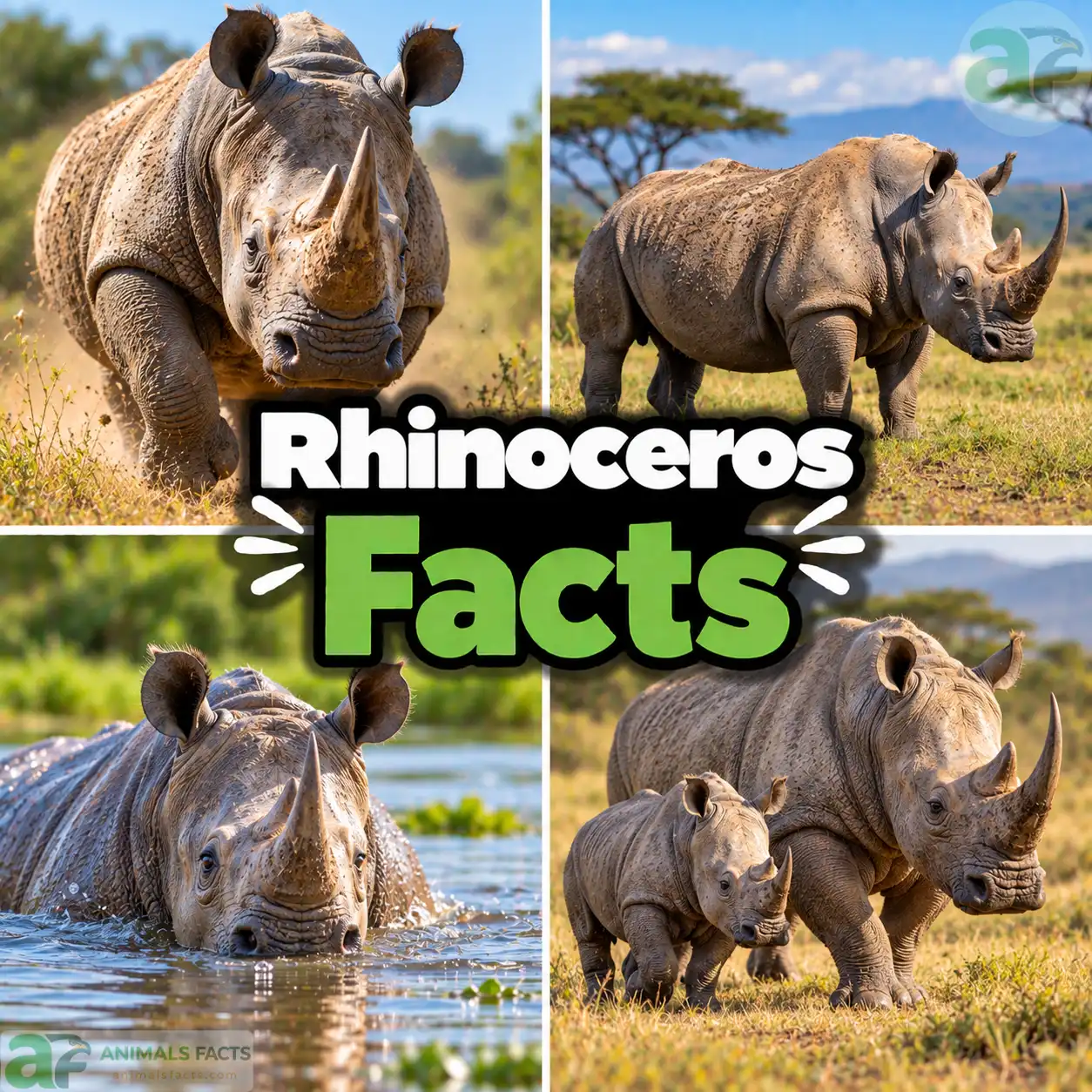
Rhinoceros Facts
| Feature | Details |
|---|---|
| Scientific Name | Rhinocerotidae (family); 5 living species |
| Kingdom | Animalia |
| Phylum | Chordata |
| Class | Mammalia |
| Order | Perissodactyla |
| Family | Rhinocerotidae (Owen, 1845) |
| Common Names | Rhinoceros, rhino |
| Native Range | Sub-Saharan Africa, South and Southeast Asia |
| Habitat | Tropical and subtropical forests, grasslands, savannas, shrublands |
| Lifespan | 35–50 years (wild); up to 55 years (captivity) |
| Diet | Herbivores — grasses, leaves, shoots, fruit, bark |
| Shoulder Height | 1.1–1.85 meters depending on species |
| Body Length | 2–4 meters depending on species |
| Weight | 700 kg (Sumatran rhino) to 2,300 kg (white rhino) |
| Top Speed | Up to 55 km/h (white rhino) — 50 km/h (Indian rhino) |
| Conservation Status | Critically Endangered (3 of 5 species); Vulnerable (white rhino); Near Threatened (Indian rhino) |
| Total Wild Population | Approximately 27,000 individuals across all species (2024) |
| Horn Composition | Pure keratin — the same protein as human fingernails and hair |
 1. Introduction: What is a Rhinoceros?

There is something profoundly moving about standing in the presence of a rhinoceros. These massive, armored animals — the largest land mammals after elephants — carry an air of prehistoric authority that no photograph fully captures. Their skin hangs in deep, ancient folds. Their small eyes regard you with a kind of patient inscrutability. And rising from their snout, the horn that has made them simultaneously one of the world’s most iconic animals and one of its most desperately poached — a structure worth more by weight than gold on the illegal wildlife market, made of nothing more remarkable than compressed keratin. Rhinoceros facts begin with this central paradox: an animal that has survived for 50 million years is now being driven to extinction within decades by human greed for a substance chemically identical to your own fingernails.
Interesting facts about rhinoceroses reveal animals of far greater complexity, intelligence, and ecological importance than their reputation as lumbering tanks suggests. Rhinoceroses are nearsighted but compensate with extraordinary senses of smell and hearing. They maintain complex social relationships communicated through an elaborate system of dung middens and urine sprays. They are capable of running at 55 km/h despite weighing over two tonnes. They shape entire ecosystems through their grazing and wallowing — maintaining open grassland habitats that hundreds of other species depend on. And three of the five surviving species now exist at population levels so critically low — the Javan rhinoceros at fewer than 68 individuals, the Sumatran rhinoceros at an estimated 34–47 individuals — that the loss of a single individual to poaching or disease represents a statistically significant blow to the survival of the species.
Whether you are searching for rhinoceros facts for kids to inspire the next generation of conservationists, exploring rhinoceros habitat and ecology for academic study, planning a wildlife journey to encounter these magnificent animals in the wild, or simply compelled by the urgency of the conservation crisis that threatens to eliminate three rhinoceros species within our lifetimes — this is your comprehensive guide. We cover rhinoceros scientific names, rhinoceros diet, rhinoceros size and weight, rhinoceros behavior and social life, the full story of the poaching crisis, cultural significance, and the profound ecological roles these ancient animals play in maintaining the wild landscapes of Africa and Asia. The armored giants deserve our full attention. They are running out of time.
2. Rhinoceros Species Overview & Classification
Rhinoceroses belong to the family Rhinocerotidae within the order Perissodactyla — the odd-toed ungulates — making them relatives of horses and tapirs rather than of elephants (which belong to a completely different order). Five species of rhinoceros survive today, down from a historically far more diverse family that once included dozens of species across multiple continents.
Species Classification Table
| Taxonomic Rank | Classification |
|---|---|
| Kingdom | Animalia |
| Phylum | Chordata |
| Class | Mammalia |
| Order | Perissodactyla |
| Family | Rhinocerotidae (Owen, 1845) |
| Number of Genera | 4 living genera |
| Number of Living Species | 5 species |
| Number of Extinct Species | 50+ described species |
| Temporal Range | ~50 million years ago to present |
| Closest Living Relatives | Horses (Equidae) and tapirs (Tapiridae) |
The Five Living Rhinoceros Species
African Rhinoceroses (2 species):
- Ceratotherium simum — White rhinoceros — the world’s largest rhinoceros and the most numerous; divided into the southern white rhino (~20,000 individuals — Least Concern) and the critically endangered northern white rhinoceros (only 2 surviving individuals, both female, making it functionally extinct as a wild breeding population)
- Diceros bicornis — Black rhinoceros — smaller, more agile, with a pointed prehensile lip for browsing; Critically Endangered; approximately 6,195 individuals (2024)
Asian Rhinoceroses (3 species):
- Rhinoceros unicornis — Greater one-horned rhinoceros (Indian rhinoceros) — the largest Asian rhinoceros; distinctive segmented-looking armor skin; Near Threatened; approximately 4,000 individuals
- Rhinoceros sondaicus — Javan rhinoceros — one-horned; found only in Ujung Kulon National Park, Java, Indonesia; Critically Endangered; approximately 68 individuals — the rarest large mammal on Earth
- Dicerorhinus sumatrensis — Sumatran rhinoceros — the smallest living rhinoceros; two horns; covered with reddish-brown hair; Critically Endangered; estimated 34–47 individuals — the most critically endangered rhinoceros
Subspecies Comparison Table
| Species | Subspecies | Wild Population | Status |
|---|---|---|---|
| White rhino | C. s. simum (Southern) | ~20,000 | Least Concern |
| White rhino | C. s. cottoni (Northern) | 2 individuals (both female) | Functionally Extinct |
| Black rhino | D. b. bicornis (SW Africa) | ~2,000 | Critically Endangered |
| Black rhino | D. b. michaeli (E Africa) | ~800 | Critically Endangered |
| Black rhino | D. b. minor (SC Africa) | ~3,000 | Critically Endangered |
| Sumatran rhino | D. s. sumatrensis (Sumatran) | ~34–47 | Critically Endangered |
| Indian rhino | R. u. unicornis | ~4,000 | Near Threatened |
| Javan rhino | R. s. sondaicus | ~68 | Critically Endangered |
Rhinoceros Evolution & Discovery Timeline
~50 million years ago — The earliest rhinoceros ancestors appear in the Eocene epoch — small, tapir-like animals without horns that bear little resemblance to modern rhinoceroses.
~30 million years ago — Paraceratherium (also known as Indricotherium) — a rhinoceros relative — becomes the largest land mammal ever to have lived on Earth, reaching heights of 5.5 meters at the shoulder and weights estimated at 15,000–20,000 kg. It is genuinely larger than many sauropod dinosaurs in body mass.
~10 million years ago — The modern rhinoceros genera begin diversifying; the African and Asian lineages increasingly diverge as continental configurations shift.
~2–5 million years ago — Woolly rhinoceros (Coelodonta antiquitatis) evolves in Asia — a cold-adapted, shaggy-coated relative that coexists with woolly mammoths across Ice Age Eurasia and is known from extraordinary frozen specimens in Siberian permafrost.
~10,000 years ago — The woolly rhinoceros goes extinct, likely through the combination of climate change at the end of the last Ice Age and pressure from human hunters.
1758 — Carl Linnaeus formally describes the Indian rhinoceros in Systema Naturae — among the first formal scientific descriptions of a rhinoceros species.
1845 — Richard Owen formally establishes the family Rhinocerotidae.
1868 — The Javan rhinoceros is formally described by Western science — already by then severely reduced in range from its historical distribution across much of Southeast Asia.
1975 — All rhinoceros species receive CITES Appendix I protection — prohibiting all commercial international trade in rhinoceros products.
2011 — The Western black rhinoceros (Diceros bicornis longipes) is officially declared extinct — the first rhinoceros subspecies to go extinct in the modern era.
2018 — Sudan — the last male northern white rhinoceros — dies at the Ol Pejeta Conservancy in Kenya, leaving only two females of the subspecies alive. Extinction of the northern white rhinoceros as a natural breeding population is confirmed.
2023 — Advanced reproductive technology produces the first northern white rhinoceros embryos through in vitro fertilization using cryopreserved genetic material — a landmark step toward potential genetic rescue of the subspecies.
“The rhinoceros is one of the most ancient and magnificent creatures to have walked this Earth. To lose even a single species — let alone three — within our lifetime would be an act of vandalism against the natural world that no future generation could ever forgive us for.” — Sir David Attenborough, Our Planet (Netflix, 2019)

3. Rhinoceros Physical Description & Unique Features
Rhinoceros size and weight make them the second-largest land animals on Earth after elephants — and their physical characteristics combine extraordinary power with sensory systems finely tuned to environments where vision is a secondary sense.
Body & Skin
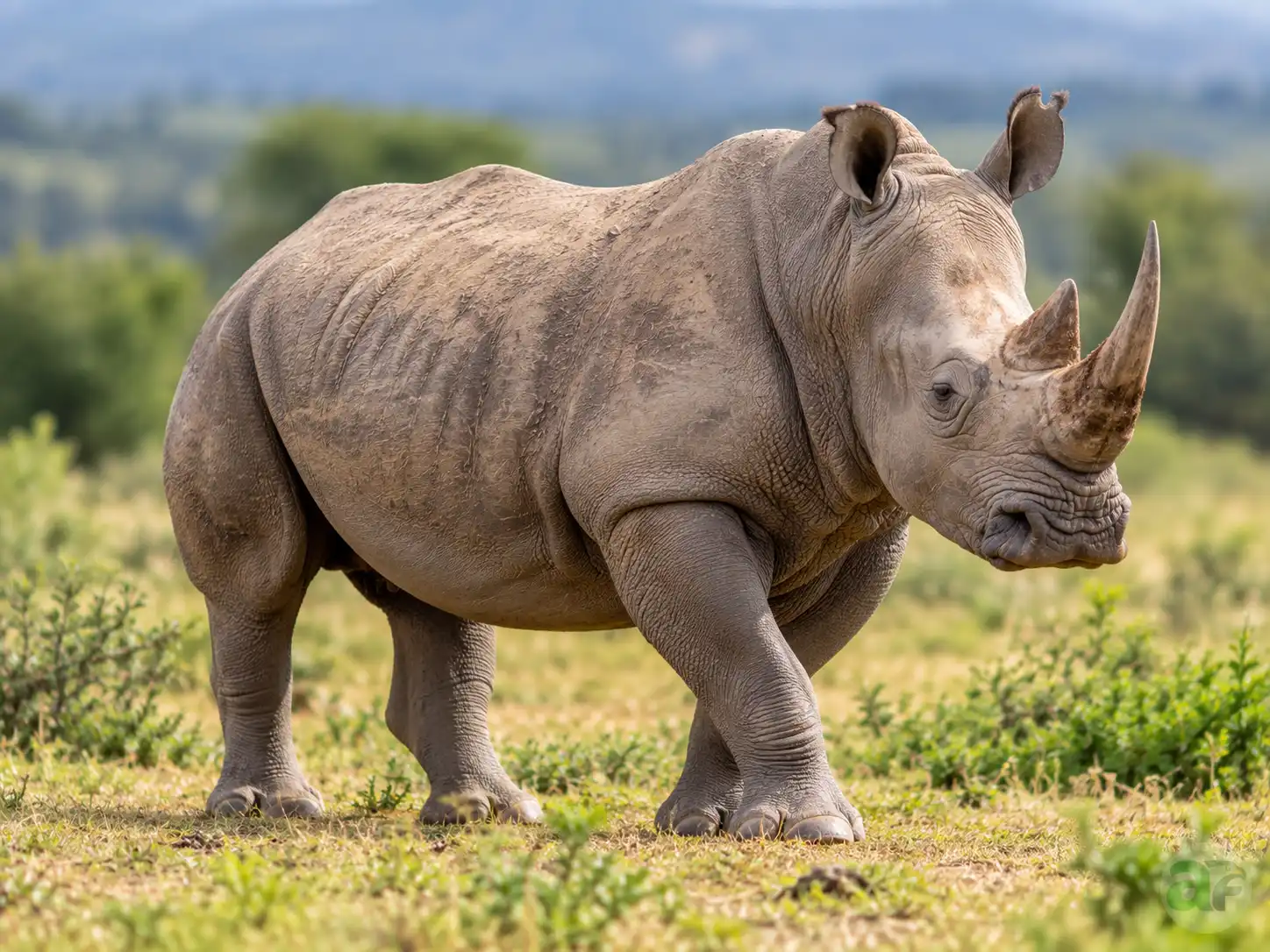
Rhinoceros skin is one of the most distinctive physical features of the family — thick, grey, and deeply folded in the Asian species, giving them the appearance of wearing segmented armor plates. The Indian rhinoceros has the most pronounced folding, with dramatic folds at the shoulders, back, and rump that genuinely resemble plate armor and have fueled centuries of comparison to medieval knights. The African rhinoceroses have smoother skin with less pronounced folding but still remarkable thickness — up to 5 cm deep in some areas.
Despite this thickness, rhinoceros skin is surprisingly sensitive — rhinoceroses are easily irritated by insects, which is one reason they spend substantial time wallowing in mud, which provides a protective coating against biting insects, cools the body in tropical heat, and may offer some sunscreen protection for the skin.
The Horn
The rhinoceros horn is the defining feature of the family and the source of both its cultural fascination and its conservation crisis. Key horn facts:
- Composed entirely of keratin — the same fibrous protein that forms human fingernails, hair, and the hooves of horses
- Contains no bone — despite its apparent hardness and density
- Grows continuously throughout the rhinoceros’s life — at rates of 5–7 cm per year in white rhinoceroses
- Can be removed without killing the animal — a fact exploited in some conservation programs that dehorn rhinoceroses to reduce poaching incentive (though dehorning is itself controversial and the horn regrows within 3 years)
- The largest recorded rhinoceros horn measured 150.8 cm in length — a southern white rhinoceros specimen
- White rhinoceroses have two horns — the front (anterior) horn is typically much longer; black rhinoceroses also have two; Indian and Javan rhinoceroses have one; Sumatran rhinoceroses have two (smaller)
Eyes & Senses
All rhinoceros species have poor eyesight — they are essentially nearsighted and struggle to identify stationary objects beyond approximately 30 meters. This visual limitation has contributed to the rhinoceros’s reputation for unpredictability — an animal that detects a threat by smell before seeing it may charge blindly in what it perceives to be the direction of the threat.
To compensate, rhinoceroses have developed exceptional senses of smell and hearing. The olfactory region of a rhinoceros brain is larger than the entire cerebral cortex. Their ears are highly mobile — rotating independently like radar dishes to locate the source of sounds with remarkable precision. These two senses together provide a sophisticated environmental awareness system that more than compensates for the visual limitation in dense vegetation.
Gender & Age Differences
In most rhinoceros species, males and females are similar in size with overlapping weight ranges — unlike the extreme sexual dimorphism of some other large mammals. Male white rhinoceroses are somewhat larger on average than females, and males of most species tend to have longer, thicker horns. Young rhinoceroses are distinguishable from adults by their proportionally larger heads, shorter horns, and the more prominent skin folding that gradually smooths as they grow.
💡 Did You Know? The word “rhinoceros” derives from the Greek rhinos (nose) and keras (horn) — literally meaning “nose-horned.” Despite centuries of legend, rhinoceros horn has no proven medical benefit of any kind — pharmacological analysis confirms it is pure keratin, chemically indistinguishable from a compressed human fingernail. The belief in its medicinal properties — driving a black market worth billions of dollars — is based entirely on traditional belief systems with no scientific basis, making the rhinoceros extinction crisis one of the most senseless in conservation history.
4. Top 25 Amazing Rhinoceros Facts
Here is your definitive collection of the most extraordinary, scientifically verified, and genuinely astonishing rhinoceros facts as of 2026:
- The rhinoceros family has existed for approximately 50 million years — making rhinoceroses among the oldest families of large land mammals still alive today.
- Paraceratherium — a prehistoric rhinoceros relative — was the largest land mammal ever to have lived on Earth, reaching estimated weights of 15,000–20,000 kg — larger than most dinosaurs in body mass.
- A rhinoceros horn is made entirely of keratin — the same protein as human fingernails — with no bone, no ivory, and no medicinal compounds of any kind. Every rhinoceros killed for its horn dies for a substance chemically equivalent to a compressed fingernail.
- The Javan rhinoceros now numbers approximately 68 individuals — confined to a single national park in Java, Indonesia — making it the rarest large mammal on Earth and one of the most endangered animals of any kind.
- The Sumatran rhinoceros is the smallest living rhinoceros and the most ancient of the five species — covered in a sparse coat of reddish-brown hair, it most closely resembles the woolly rhinoceros of the Ice Age and diverged from other rhinoceros lineages approximately 25 million years ago.
- Northern white rhinoceros — of which only 2 individuals survive, both female — represents the closest any large charismatic mammal has come to functional extinction in the modern era while still technically having living members.
- White rhinoceroses can run at speeds of up to 55 km/h — faster than a racehorse at a canter and faster than any human can sprint — making their popular image as slow, lumbering animals profoundly misleading.
- Rhinoceroses communicate through an elaborate system of dung middens — communal dung piles visited regularly by multiple individuals, in which the chemical signature of each rhinoceros’s dung conveys information about identity, sex, reproductive status, age, and health.
- The greater one-horned Indian rhinoceros has skin that appears plated like medieval armor — the dramatic folds at the shoulders, flanks, and rump are created by thick skin folds that superficially resemble interlocking armor plates but are actually continuous skin.
- Black rhinoceroses have a prehensile (grasping) upper lip — used to grasp and pull branches and leaves in a browsing feeding style. White rhinoceroses have a wide, flat, square upper lip adapted for grazing grass — the key morphological difference between these two African species.
- Rhinoceros horn grows at a rate of approximately 5–7 cm per year and can regrow to full size within 3–5 years if removed — a fact exploited in some anti-poaching programs that dehorn live rhinoceroses.
- A group of rhinoceroses is called a “crash” — a name that may reflect the sound and impact of multiple two-tonne animals moving through dense vegetation.
- Rhinoceroses are solitary animals for most of their lives — the only long-term social bond is between a mother and her calf, which may last 2–3 years before the calf is driven off when the mother becomes pregnant again.
- Oxpecker birds (genus Buphagus) maintain a mutualistic relationship with African rhinoceroses — feeding on the ticks, parasites, and dead skin in the rhinoceros’s skin folds while providing an early warning alarm system when their alarmed calls alert the rhinoceros to approaching threats.
- The white rhinoceros name does not derive from the color white — the animal is grey. The name is a mistranslation of the Afrikaans word “wyd” (wide), referring to its wide, square lip — corrupted through English speakers to “white.”
- Black rhinoceroses are also grey — the “black” and “white” color names are entirely misleading; the actual skin color of both African species is similar shades of grey.
- Rhinoceroses have a remarkable intestinal flora — specialized gut bacteria allow them to ferment and extract nutrition from tough, fibrous vegetation that most other mammals cannot digest effectively.
- The Indian rhinoceros is an excellent swimmer — regularly crossing rivers several hundred meters wide in pursuit of fresh grazing, and occasionally using water as escape cover from threats.
- A 2023 breakthrough at the Leibniz Institute and Vienna Zoo produced viable northern white rhinoceros embryos using in vitro fertilization with cryopreserved genetic material — representing the first realistic scientific pathway to reversing the functional extinction of a rhinoceros subspecies.
- Rhinoceroses are keystone species in their ecosystems — their grazing and wallowing behavior creates and maintains open grassland habitats that hundreds of other species depend on, making their loss an ecological catastrophe far beyond the loss of a single species.
- The greatest single-year loss of rhinoceroses to poaching occurred in South Africa in 2014, when 1,215 rhinoceroses were poached — equivalent to more than 3 per day — in a crisis driven by demand for horn primarily from Vietnam and China.
- Rhinoceroses can live for 35–50 years in the wild and up to 55 years in captivity — lifespans comparable to great apes, reflecting their position as large, slow-reproducing K-strategist mammals.
- Sumatran rhinoceroses are the only Asian rhinoceros species with two horns — and the only rhinoceros species with significant hair coverage as an adult. Their closest relatives are the extinct woolly rhinoceros of the Ice Age rather than other living rhinoceros species.
- A southern white rhinoceros female named “Nola” at the San Diego Safari Park became one of the most famous individual rhinoceroses in the world — her death in 2015 reduced the northern white rhinoceros (to which she was not actually a subspecies, but the confusion drove global media attention) population and generated unprecedented conservation fundraising.
- Wild rhinoceros populations could be self-sustaining if poaching were eliminated — southern white rhinoceros populations grew from fewer than 50 individuals in the late 19th century to over 20,000 today through effective protection, demonstrating that rhinoceros recovery is biologically possible when humans choose to prioritize it.

5. Fun Facts About Rhinos
- Rhinoceros horn is made of keratin — the same material as human fingernails
- The white rhinoceros name comes from the Afrikaans word for “wide” — not the color white
- A group of rhinoceroses is called a “crash”
- Rhinoceroses can run at 55 km/h — faster than most horses at a canter
- The Javan rhinoceros is the rarest large mammal on Earth — only 68 individuals remain
- Rhinoceroses have been on Earth for 50 million years
- Only 2 northern white rhinoceroses survive — both are female
- Paraceratherium — a rhino relative — was the biggest land mammal ever
- Rhinoceroses communicate through dung middens containing complex chemical information
- Oxpecker birds live on rhinoceroses eating parasites and warning of danger
- Southern white rhinos recovered from fewer than 50 to 20,000+ individuals with protection
- Rhinoceros horn grows back within 3–5 years after removal
6. Rhinoceros Habitat & Geographic Range
Rhinoceros habitat varies considerably between the African and Asian species — with African rhinoceroses occupying open savanna and woodland systems while Asian rhinoceroses inhabit dense tropical forests, riverine vegetation, and grassland mosaics.
Habitat Requirements
All rhinoceros species share certain basic habitat requirements:
- Adequate food — sufficient vegetation (grasses for white rhinos and Indian rhinos; browse for black rhinos and Sumatran rhinos; mixed for Javan rhinos)
- Water access — rhinoceroses drink daily when water is available and require regular access to wallowing sites for temperature regulation and skin care
- Shade and shelter — all species use dense vegetation for shade during the hottest parts of the day
- Sufficient territory — rhinoceros home ranges vary from 2–200 km² depending on species and habitat quality
- Security from poaching — in the modern context, ranger-protected areas are essentially a minimum requirement for rhinoceros survival
Habitat Range by Country
| Country | Species | Approximate Population | Habitat Type |
|---|---|---|---|
| South Africa | White (S), Black | ~16,000 (white), ~2,000 (black) | Savanna, bushveld, grassland |
| Zimbabwe | White (S), Black | ~700 (white), ~800 (black) | Savanna, woodland |
| Namibia | White (S), Black | ~1,000 (white), ~2,000 (black) | Semi-arid savanna, desert-edge |
| Kenya | White (S), Black | ~750 (white), ~900 (black) | Savanna, highland grassland |
| India | Greater one-horned | ~4,000 | Alluvial grassland, riverine forest |
| Nepal | Greater one-horned | ~700 | Terai grassland, riverine forest |
| Indonesia (Java) | Javan | ~68 | Dense tropical rainforest |
| Indonesia/Malaysia | Sumatran | ~34–47 | Tropical hill forest |
| Botswana | White (S) | ~400 | Savanna, woodland |
| Uganda | White (S) | ~40 (reintroduced) | Savanna |
💡 Did You Know? The historical range of rhinoceroses once covered a vastly larger area than their current tiny refugia. The Javan rhinoceros formerly ranged across mainland Southeast Asia from northeastern India through Myanmar, Thailand, Cambodia, Vietnam, and throughout the Indonesian archipelago. The Sumatran rhinoceros was found from Assam in India through Myanmar, Thailand, Malaysia, Sumatra, and Borneo. The collapse from continent-spanning distributions to single-park survival in less than two centuries represents one of the fastest and most catastrophic range contractions of any large mammal in recorded history.
7. Rhinoceros Diet & Feeding Behavior
Rhinoceros diet is entirely herbivorous — but the five species have evolved remarkably distinct feeding strategies reflecting their different habitats and the different vegetation types available to them.
Diet Breakdown Table
| Species | Primary Diet | Feeding Style | Daily Intake |
|---|---|---|---|
| White rhinoceros | Grasses (~95%) | Grazer — wide square lip scoops grass | ~120 kg of grass |
| Black rhinoceros | Leaves, shoots, branches (~95%) | Browser — prehensile lip grasps vegetation | ~60 kg of browse |
| Indian rhinoceros | Grasses, aquatic plants, fruit (~80% grass) | Primarily grazer; opportunistic browser | ~100 kg mixed |
| Javan rhinoceros | Shoots, leaves, fallen fruit, twigs | Browser — similar to black rhino | Estimated ~60 kg |
| Sumatran rhinoceros | Fruit, bark, leaves, bamboo shoots | Browser/mixed feeder | ~50 kg mixed |
Grazing vs. Browsing
The most fundamental dietary distinction in the rhinoceros family is between grazers (feeding primarily on grasses close to the ground) and browsers (feeding on leaves, shoots, and branches of trees and shrubs). This dietary division is reflected in the most obvious physical difference between the African species:
The white rhinoceros has a wide, flat, squared upper lip — perfectly designed as a lawnmower-like grazing tool that efficiently clips grass at ground level. The black rhinoceros has a pointed, prehensile upper lip — a flexible, finger-like structure that grasps individual branches, twigs, and leaves with remarkable dexterity.
The Indian rhinoceros is a versatile feeder — using its own prehensile upper lip to graze grass efficiently but also capable of browsing on tall elephant grass, aquatic vegetation, fruit fallen from trees, and various shrubs and crops.
Water Requirements
All rhinoceros species are obligate drinkers — they must access water daily in hot weather. This dependence creates both ecological patterns (rhinoceros distribution closely tracks permanent water sources) and vulnerability (poachers learn rhinoceros drinking schedules and locations). African rhinoceroses can survive on remarkably little water in dry conditions — black rhinoceroses in Namibia’s Damaraland have been recorded going 4–5 days without drinking during dry season, obtaining moisture from the succulents and vegetation they consume.
8. Rhinoceros Reproduction & Life Cycle
Rhinoceros reproduction is characterized by the slow reproductive rate typical of large, long-lived K-strategist mammals — a biological reality that makes poaching losses particularly catastrophic and population recovery agonizingly slow.
Mating Behavior
Rhinoceroses are solitary outside of mating — males and females rarely interact except during the breeding season. Males locate receptive females through olfactory detection of urine and dung marks that communicate the female’s hormonal status with remarkable chemical precision.
Courtship in rhinoceroses can be surprisingly extended — and occasionally violent. Male black rhinoceroses and female black rhinoceroses sometimes engage in prolonged aggressive encounters during courtship that can last hours, with both animals charging, sparring with horns, and vocalizing. This apparent aggression resolves into mating behavior but can occasionally result in serious injury to one or both animals — contributing to natural mortality, particularly in small populations.
White rhinoceros courtship is more measured — the male follows the female persistently for days, engaging in mutual chin-resting (placing the chin on the partner’s back), vocalizations, and urine spraying as the pair bond develops before mating occurs.
Gestation & Birth
Rhinoceros gestation periods are among the longest of any land mammal:
- White rhinoceros: 16–18 months
- Black rhinoceros: 15–16 months
- Indian rhinoceros: 15–16 months
- Javan and Sumatran rhinoceroses: estimated 15–17 months
Single calves are born — twins are essentially unknown in rhinoceroses. Calves are born precocial — standing within hours of birth and able to move with the mother within days. A rhinoceros calf typically stays with its mother for 2–4 years before being driven off when the mother’s next pregnancy approaches its final stages.
Inter-birth Interval & Reproductive Rate
The time between successful births — the inter-birth interval — is one of the most important population dynamics parameters for rhinoceros conservation:
- White rhinoceros: 2–3 years under optimal conditions
- Black rhinoceros: 2.5–3.5 years
- Indian rhinoceros: 3–4 years
- Asian species: 4–5 years estimated
This means a female rhinoceros, beginning reproduction at approximately 6–8 years of age and living to 35–40 years in the wild, produces a maximum of approximately 8–12 calves in her lifetime — a reproductive rate that makes each individual critically important and each poaching death a disproportionate blow to population viability.
Lifespan Comparison Table
| Species | Average Lifespan (Wild) | Average Lifespan (Captivity) | Age at First Reproduction |
|---|---|---|---|
| White rhinoceros | 35–50 years | Up to 55 years | 6–7 years (female) |
| Black rhinoceros | 35–45 years | Up to 50 years | 5–7 years (female) |
| Indian rhinoceros | 35–45 years | Up to 47 years | 5–7 years (female) |
| Javan rhinoceros | Estimated 35–45 years | N/A (none in captivity) | ~5–7 years (estimated) |
| Sumatran rhinoceros | 30–40 years | Up to 32 years | ~4–6 years (female) |
9. Social Behavior & Communication
Rhinoceroses are among the most chemically sophisticated communicators in the mammal world — maintaining a complex social information network through scent marking that conveys detailed individual and social information across their territories.
Dung Middens
The dung midden is the rhinoceros’s primary communication tool — a communal dung pile visited by multiple individuals in a territory, to which each rhinoceros contributes its own dung and from which it reads the chemical signatures of others. A typical white rhinoceros territory contains numerous middens, regularly visited and refreshed by the dominant male. Chemical analysis of rhinoceros dung reveals that it encodes information about:
- Individual identity — Each rhinoceros has a unique chemical signature
- Sex — Male and female dung contain different hormonal compounds
- Reproductive status — Females in estrus produce detectably different chemical profiles
- Age — Age-related hormonal shifts are detectable in dung chemistry
- Social status — Dominant individuals produce different chemical profiles from subordinates
Black rhinoceroses scatter their dung by kicking it apart with their hind feet after defecating — potentially spreading scent information over a larger area. White rhinoceroses typically leave dung in more compact communal piles.
Urine Spraying
Male rhinoceroses — particularly black and white rhinoceros bulls — spray urine against rocks, vegetation, and other landmarks along territorial boundaries using a distinctive backward-directed spray that can reach distances of 3–4 meters. This urine marking carries hormonal information about the male’s health, dominance status, and territorial claims. Females also urine-spray but less extensively.
Intelligence
Rhinoceroses demonstrate spatial memory of remarkable precision — navigating complex terrain to reach specific water sources, mineral licks, and food patches across large home ranges. Captive rhinoceroses have shown the ability to recognize individual humans by sight and smell, demonstrating the sophisticated social cognition that mirrors their wild need to identify and track conspecifics across territories. Problem-solving behavior in captivity — including learning novel tasks to access food rewards — has been documented in both African and Asian species.
10. Predators & Defense Mechanisms
Adult rhinoceroses have essentially no natural predators — their enormous size, thick skin, horn, speed, and powerful charge make them invulnerable to virtually every predator sharing their range. However, calves face genuine predation risk, and humans have proven to be the rhinoceros’s overwhelming threat.
Threats to Calves
- Lions (Panthera leo) — Documented taking rhinoceros calves in South Africa; rarely attempt adults
- Spotted hyenas (Crocuta crocuta) — May harass and occasionally kill very young calves if separated from the mother
- Nile crocodiles — Take calves at water crossings in Africa
- Tigers (Panthera tigris) — May take Indian rhinoceros calves in Nepal and India; adults are invulnerable
- Wild dogs and dholes — Recorded harassing but rarely successfully predating rhinoceros calves
Rhinoceros Defense Strategies
The charge — A rhinoceros charge is the ultimate defense mechanism and one of the most alarming spectacles in the animal world. A white rhinoceros bull charging at 55 km/h with 2,300 kg of mass behind a 1.5-meter horn generates kinetic force that can kill lions, flip vehicles, and penetrate the walls of concrete structures. Rhinoceros charges are often mock charges — the animal approaching with apparent aggression but veering off when the threat retreats — a behavior that emphasizes deterrence over actual contact.
The horn — Used actively in defensive combat against predators and competing rhinoceroses. Analysis of skeletal remains shows healed horn wounds on the bodies of multiple rhinoceros species, confirming active horn use in intraspecific combat.
Mud wallowing — While primarily a thermoregulation and parasite control behavior, wallowing in mud creates a physical protective coating over the skin that reduces the success of biting insects and may provide some protection against minor abrasions.
Maternal defense — Rhinoceros mothers are extraordinarily protective of calves — documented chasing and fighting lions, hyenas, and threatening humans with a ferocity and persistence that exceeds their normal solitary temperament dramatically.
💡 Did You Know? The oxpecker bird relationship with African rhinoceroses may be more complicated than the simple mutualism traditionally described. While oxpeckers do consume ticks and parasites from rhinoceros skin, research has shown they also peck at wounds and prevent them from healing — potentially benefiting from keeping wounds open as a food source. The relationship appears to be a conditional mutualism that depends on tick abundance — in high-tick environments, the birds provide net benefit; in low-tick environments, their wound-pecking may represent a net cost to the rhinoceros. This nuanced reality is characteristic of the complexity that careful ecological research reveals in even the most “obvious” animal relationships.

11. Rhinoceros Facts for Kids
Hey amazing young wildlife champions! Here are the most incredible rhinoceros facts for kids that will make you the most interesting person in your whole school:
- Rhino horn is just like your fingernails! The horn that poachers kill rhinoceroses for is made of keratin — exactly the same stuff as your fingernails and hair. It has absolutely no medicine in it at all. Imagine something this beautiful being destroyed for something worth no more than a clipped nail!
- Rhinoceroses can run as fast as a horse! Even though a white rhinoceros weighs more than a small car, it can run at 55 km/h — faster than most horses at a canter and much faster than any human being. Don’t try to outrun a rhinoceros!
- The name “white rhinoceros” has nothing to do with the color white! White rhinoceroses are actually grey. Their name comes from a misunderstanding of the Afrikaans word “wyd” meaning “wide” — because of their wide, flat lip used for eating grass. Someone mistakenly changed “wide” to “white” and the name stuck forever!
- Rhino horn grows back! If a rhinoceros horn is cut off carefully, it grows back over the next few years — just like your fingernails grow back after being cut. Some conservation programs remove horns carefully to reduce the reason poachers would target them.
- A group of rhinoceroses is called a CRASH! Can you imagine why? Think about what would happen if a group of two-tonne animals ran through your living room. That’s a crash!
- Only 68 Javan rhinoceroses exist on the ENTIRE PLANET! That’s fewer people than might be in your school year. These animals are so rare that each one is known and monitored individually by conservation teams.
- Rhinoceroses talk with their poo! They leave dung at special communal spots called middens, and other rhinoceroses can read the chemical messages in the dung — learning who visited, whether they’re male or female, and even if they’re looking for a mate!
- A prehistoric rhinoceros relative was the BIGGEST land animal ever! Paraceratherium — a relative of modern rhinoceroses that lived 30 million years ago — was as tall as a giraffe and weighed as much as four African elephants. It makes modern rhinoceroses look small!
12. Relationship with Humans
The relationship between rhinoceroses and humans is one of the most tragic in the entire history of wildlife conservation — an animal that coexisted with human populations across Africa and Asia for millions of years has been reduced to the edge of extinction within the span of a single human lifetime, driven by a demand for its horn that is based on scientifically unfounded traditional belief.
Historical Coexistence
For most of human history, rhinoceroses and human communities coexisted across enormous shared landscapes. Archaeological evidence from multiple African and Asian sites documents human hunting of rhinoceroses as far back as 100,000 years ago, primarily for meat and hide — sustainable hunting that, at low human population densities with Stone Age technology, did not threaten rhinoceros populations.
Historical accounts from early European travelers in Africa and Asia describe rhinoceroses in extraordinary abundance — herds of white rhinoceroses numbering in the hundreds on South African grasslands, Indian rhinoceroses described as “common as cattle” in the Terai grasslands of Nepal, Javan rhinoceroses reportedly densely distributed across mainland Southeast Asia’s river valleys. The contrast with today’s crisis is devastating.
Colonial Era Hunting
The introduction of high-powered firearms to Africa and Asia during the 19th century transformed the human-rhinoceros relationship catastrophically. European colonial hunters killed rhinoceroses by the thousands — partly for sport, partly for horn and hide, and partly to clear land for agriculture. The southern white rhinoceros was reduced to fewer than 50 individuals in a single South African reserve by 1895 through hunting. Multiple subspecies of black rhinoceros and the broader Javan and Sumatran populations were similarly decimated.
The Modern Poaching Crisis
The contemporary rhinoceros crisis is driven primarily by demand for rhinoceros horn in Vietnam and China — where horn powder commands extraordinary prices as a purported cure for everything from cancer to hangovers, and where whole horns are used as status symbols among wealthy elites. The price of rhinoceros horn on the black market — reaching $60,000–$100,000 per kilogram at peak demand — exceeds the price of gold, cocaine, and platinum, creating economic incentives for poaching that overwhelm the resources of many conservation agencies.
Organized crime syndicates run sophisticated poaching operations using helicopters, night-vision equipment, veterinary tranquilizers, and corruption of law enforcement — hunting rhinoceroses with military-grade efficiency across protected areas in South Africa, Zimbabwe, and across Asian range countries. The sophistication of the poaching networks dramatically outpaces the capacity of most range-country governments to combat them without substantial international support.
Community-Based Conservation
The most successful rhinoceros conservation programs combine anti-poaching enforcement with community engagement — giving local communities economic benefit from living rhinoceroses (through tourism revenue, employment as rangers, and direct conservation payments) that exceeds the short-term income available from poaching cooperation. Programs like Black Mambas (South Africa’s all-female anti-poaching unit), WWF’s community conservation programs in Nepal, and various community conservancy models in Namibia and Kenya demonstrate that rhinoceros conservation is most durable when the communities surrounding rhinoceros habitat are actively invested in their survival.
13. Rhinos Conservation Status & Threats
Rhinoceros conservation represents one of the most urgent and challenging battles in global wildlife protection. The scale of the crisis — with three of five species at critically low population levels — is without parallel among megafauna and demands extraordinary resources and political will.
Conservation Status Overview
| Species | IUCN Status | Wild Population (2024) | Population Trend |
|---|---|---|---|
| Southern white rhinoceros | Near Threatened | ~20,000 | Decreasing (poaching) |
| Northern white rhinoceros | Functionally Extinct | 2 (both female) | Terminal without intervention |
| Black rhinoceros | Critically Endangered | ~6,195 | Slowly increasing |
| Indian rhinoceros | Near Threatened | ~4,000 | Increasing |
| Javan rhinoceros | Critically Endangered | ~68 | Slowly increasing |
| Sumatran rhinoceros | Critically Endangered | 34–47 | Decreasing |
Major Threats
| Threat | Description | Impact Level |
|---|---|---|
| Poaching for horn | Organized criminal networks targeting all rhinoceros species | Critical — primary mortality cause |
| Habitat loss and fragmentation | Agricultural expansion, infrastructure development | High |
| Human-wildlife conflict | Rhinoceroses raiding crops; retaliatory killing | Medium |
| Inbreeding depression | Very small populations losing genetic diversity | High for Javan and Sumatran |
| Disease | Foot-and-mouth, skin diseases, reproductive issues in small captive populations | Medium |
| Climate change | Habitat quality changes; water availability; vegetation shifts | Increasing |
| Demand-driven illegal trade | Primary economic driver of poaching; centered in Vietnam and China | Critical |
The Northern White Rhinoceros Situation
The northern white rhinoceros (Ceratotherium simum cottoni) represents the most acute conservation emergency in megafauna biology. With only Najin and Fatu — a mother and daughter — surviving at Kenya’s Ol Pejeta Conservancy under 24-hour armed guard, natural reproduction is impossible. Both females have reproductive abnormalities preventing successful pregnancy. The only pathway to preventing complete genetic extinction involves advanced reproductive technology — using cryopreserved sperm and egg cells from deceased individuals to produce embryos through IVF, which would then be implanted into southern white rhinoceros surrogate mothers.
In 2023, the international BioRescue consortium announced the successful creation of three northern white rhinoceros embryos using this approach — a scientific landmark that offers the first realistic hope of preventing the complete extinction of this subspecies. Whether these embryos can be successfully brought to term in surrogate mothers remains to be confirmed.
14. Famous Rhinoceroses in History & Pop Culture
Famous Named Rhinoceros Individuals
“Clara” — An Indian rhinoceros transported to Europe in 1741 who became the most celebrated animal in 18th-century Europe — touring Germany, France, Italy, England, and the Netherlands for 17 years. Clara generated extraordinary public interest and inspired dozens of paintings, sculptures, and literary descriptions that constitute the primary European documentation of rhinoceros appearance before photography. The German artist Albrecht Dürer’s famous 1515 woodcut of a rhinoceros — actually made without Dürer having seen the animal, based on a written description — remains one of the most reproduced animal images in the history of European art.
“Sudan” — The last male northern white rhinoceros, born approximately 1973 in the wild in Sudan, captured as a calf and kept at Dvůr Králové Zoo in the Czech Republic before being transferred to Ol Pejeta Conservancy in Kenya in 2009 in a last-ditch effort to stimulate breeding. Sudan became globally famous as a symbol of the rhinoceros extinction crisis — described in media worldwide as the animal protected by 24-hour armed guards and listed on Tinder as the “world’s most eligible bachelor” in a 2017 conservation campaign that generated unprecedented media attention. His death on March 19, 2018 — at approximately 45 years of age — was mourned globally.
“Nola” — A southern white rhinoceros (frequently misidentified in media as a northern white rhinoceros) at the San Diego Safari Park whose death in November 2015 generated global media attention and significant conservation donations, demonstrating the extraordinary public engagement that individual named rhinoceroses can generate for conservation fundraising.
“Harapan” — The last Sumatran rhinoceros in the United States, born at Cincinnati Zoo in 2007, transferred to the Sumatran Rhino Sanctuary in Indonesia in 2015 in a complex conservation decision that acknowledged that ex-situ (captive) conservation outside the species’ range was less likely to succeed than sanctuary programs within Indonesia.
15. Role in Ecosystem & Food Chain
Rhinoceroses are keystone species in the ecosystems they inhabit — their ecological influence extending far beyond their individual feeding behavior to shape the entire community of species sharing their landscape.
Grazing & Vegetation Management
White rhinoceroses are among the most powerful grassland engineers in Africa — their intensive grazing maintains short-grass “lawns” that provide critical feeding habitat for dozens of other species including wildebeest, zebras, Thomson’s gazelles, and the predators that hunt them. Studies in South Africa’s Hluhluwe-iMfolozi Park have shown that areas with high white rhinoceros density maintain dramatically different vegetation structure from rhinoceros-free areas — with the rhinoceros-grazed areas supporting higher diversity of grass species and associated invertebrate communities.
Black rhinoceroses perform an equivalent function in browsing — their feeding on woody shrubs and small trees prevents bush encroachment into grassland areas, maintaining the open habitat mosaic that characterizes productive African savanna.
Wallowing & Habitat Creation
Rhinoceros wallowing behavior creates and maintains mud wallows — water-filled depressions used by dozens of other species for cooling, parasite removal, and moisture access. These wallow sites become biodiversity hotspots — attracting birds, amphibians, reptiles, and mammals that depend on the water access and disturbed-ground habitat that rhinoceroses maintain through regular use.
Dung & Nutrient Cycling
Rhinoceroses are enormous consumers of vegetation — a white rhinoceros consuming 120 kg of grass per day produces correspondingly enormous quantities of dung that rapidly cycle nutrients back into the soil. The dung middens that rhinoceroses maintain are hotspots of invertebrate diversity — dung beetles, flies, and other decomposers concentrate at these sites, accelerating nutrient recycling and supporting the food web of insectivores that depend on them.
Trophic Cascade Effects
The loss of rhinoceroses from an ecosystem initiates trophic cascades — bush encroachment replaces open grassland, reducing prey visibility for predators, eliminating habitat for grazing herbivores, and progressively homogenizing the vegetation structure that supports biodiversity. Studies documenting rhinoceros loss from historical habitat areas confirm measurable and significant changes in vegetation community composition within 10–20 years of rhinoceros disappearance.
16. Myths, Folklore & Cultural Significance
Rhinoceroses have occupied positions of cultural significance across the civilizations that share their range for thousands of years — revered as symbols of power and good fortune, feared as embodiments of primordial force, and exploited for perceived medicinal properties in traditions that ultimately drove the current extinction crisis.
Traditional Chinese Medicine
The use of rhinoceros horn in Traditional Chinese Medicine (TCM) dates back at least 2,000 years — with descriptions appearing in the Shennong Bencao Jing (the Classic of Herbal Medicine, compiled around 2,700 years ago) as a treatment for fever, convulsions, and delirium. Despite being removed from the official Chinese Pharmacopoeia in 1993 and despite scientific analysis confirming that rhinoceros horn contains no pharmacologically active compounds not found in a human fingernail, demand in Chinese and Vietnamese markets persists — driven by cultural beliefs that scientific pharmacology has not successfully displaced.
The irony of the TCM rhinoceros horn tradition is profound: buffalo horn, saiga antelope horn, and other keratinous materials have identical chemical compositions and are explicitly recognized as acceptable substitutes in TCM texts — yet the belief in the specific potency of rhinoceros horn persists with extraordinary cultural tenacity.
African Traditional Beliefs
In many southern African traditional belief systems, the rhinoceros is associated with power, protection, and ancestral authority. The rhinoceros figures in the spiritual traditions of Zulu, Ndebele, and other Nguni-speaking peoples as a symbol of resilience and primordial force. Rhinoceros hide shields were status symbols in pre-colonial Zulu warrior culture — their use reserved for senior warriors and royalty.
Among some East African pastoral communities, the rhinoceros was regarded as a guardian of the landscape — its presence indicating intact, productive rangeland. The loss of rhinoceroses from these landscapes is experienced by some traditional communities not merely as the loss of an animal but as a spiritual and cultural diminishment of the land itself.
Dürer’s Rhinoceros
Albrecht Dürer’s 1515 woodcut of a rhinoceros — depicting an animal the artist never saw, based on a written description and a sketch of the first Indian rhinoceros to reach Europe (a gift from the Sultan of Gujarat to the King of Portugal) — became the defining European image of the rhinoceros for over 200 years and was reproduced in hundreds of natural history books despite its significant inaccuracies (the woodcut shows an armored animal with a secondary horn on its back and a heavily scaled appearance). The image demonstrates how profoundly human cultural representations of animals can diverge from reality — and how persistently those representations can shape public understanding.
17. Rhinoceroses in Pop Culture
Operation Rhino (1961) — The dramatic capture and translocation of white rhinoceroses from the heavily poached Hluhluwe reserve to new protected areas in South Africa — documented in a 1964 film — introduced the concept of wildlife conservation translocation to a global audience and established the southern white rhinoceros recovery as one of conservation’s earliest major success stories.
James and the Giant Peach by Roald Dahl (1961) — The rhinoceros that kills James’s parents at the opening of this classic children’s story established the rhinoceros’s cultural role as an embodiment of dangerous, unpredictable natural force — one of the few animals whose sheer physical presence requires no malevolent motivation to be genuinely threatening.
Sudan on Tinder (2017) — The conservation marketing campaign placing Sudan — the last male northern white rhinoceros — on the dating app Tinder as the “world’s most eligible bachelor” seeking a mate generated global media coverage valued at over $10 million in equivalent advertising exposure, demonstrating the extraordinary public resonance of individual rhinoceros stories and the creative potential of conservation communications.
Rhinoceros by Eugène Ionesco (1959) — The absurdist play in which people gradually transform into rhinoceroses — representing conformity, fascism, and the abandonment of individual humanity — is one of the most celebrated works of 20th-century theater, using the rhinoceros as a symbol of mindless collective power. Ionesco’s rhinoceros has been interpreted as representing Nazism, Stalinism, and mass political conformity — the animal’s physical invulnerability and apparent mindlessness making it a perfect metaphor for ideological totalitarianism.
18. Rhinoceros Facts vs. Common Myths
| Common Myth | The Real Fact |
|---|---|
| “Rhinoceros horn has medicinal properties” | False — rhinoceros horn is pure keratin; pharmacological analysis confirms it contains no compounds not found in human fingernails and has no proven medical benefit |
| “White rhinoceroses are white” | False — both African species are grey; “white” is a corruption of the Afrikaans word “wyd” meaning wide, referring to the lip shape |
| “Rhinoceroses are slow and lumbering” | False — white rhinoceroses can run at 55 km/h, faster than most horses and far faster than any human |
| “Rhinoceroses are very aggressive by nature” | Partially false — rhinoceroses are generally calm when undisturbed; charges are typically defensive responses to surprise or perceived threat; most charges are mock charges |
| “Rhinoceroses are related to elephants” | False — rhinoceroses belong to Perissodactyla (odd-toed ungulates, related to horses and tapirs); elephants belong to Proboscidea — they are not closely related |
| “Removing a rhinoceros’s horn saves it from poaching” | Partially true — dehorning reduces but does not eliminate poaching risk; poachers sometimes kill dehorned rhinoceroses for the horn stub; the horn regrows in 3–5 years requiring repeated intervention |
| “Rhinoceroses can’t see well because they’re not intelligent” | False — rhinoceroses have poor distant vision but extraordinary smell and hearing, combined with demonstrated spatial memory and social intelligence |
| “The rhinoceros extinction crisis is exaggerated” | False — with the Sumatran rhinoceros at 34–47 individuals and the Javan at 68, these species are among the most critically endangered large mammals in the history of scientific monitoring |
19. Best Places to See Rhinoceroses in the Wild
1. Hluhluwe-iMfolozi Park, KwaZulu-Natal, South Africa — The single most important location in rhinoceros conservation history — the reserve where the southern white rhinoceros was saved from extinction in the early 20th century. Today it holds the largest concentration of both white and black rhinoceroses of any single protected area in the world. Open vehicles on self-drive and guided safaris provide extraordinary rhinoceros encounters at close range.
2. Kaziranga National Park, Assam, India — The stronghold of the greater one-horned Indian rhinoceros — home to approximately 2,600 individuals, the largest single population. UNESCO World Heritage Site. Elephant-back safaris and open jeep tours provide exceptional rhinos encounters in the alluvial grasslands. The park’s rhinoceros density is among the highest of any rhinoceros habitat globally.
3. Chitwan National Park, Nepal — Nepal’s premier wildlife destination hosts over 700 Indian rhinoceroses in the Terai grasslands at the base of the Himalayas. Canoe rides on the Rapti River, jeep safaris, and guided walks with armed park rangers offer close encounters with rhinoceroses in extraordinary riverine landscape.
4. Etosha National Park, Namibia — Home to both black and white rhinoceroses, Etosha’s waterholes attract rhinoceroses reliably — particularly at dawn and dusk, when rhinoceroses congregate to drink. Night hides at illuminated waterholes near Okaukuejo camp produce spectacular rhinos encounters in total darkness with artificial illumination.
5. Ol Pejeta Conservancy, Laikipia, Kenya — The home of the world’s last two northern white rhinoceroses — Najin and Fatu — as well as significant populations of black rhinoceroses. The conservancy’s transparent conservation operations, ranger-guided experiences, and the extraordinary emotional impact of meeting the world’s rarest large mammals make this a uniquely significant rhinoceros destination.
6. Ujung Kulon National Park, Java, Indonesia — The only location on Earth where wild Javan rhinoceroses survive. Unfortunately — and for obvious conservation reasons — the area is not accessible to tourists, and Javan rhinoceroses are monitored exclusively through camera traps and ranger patrols. Conservation-focused travelers can contribute to Javan rhinoceros conservation through organizations working with the national park without visiting the park itself.
7. Lewa Wildlife Conservancy, Kenya — A pioneering community conservancy hosting both black and white rhinoceroses with an extraordinary record of zero poaching over multiple years. Lewa’s conservancy model — integrating rhinoceros protection with community development — is considered one of the most successful rhinos conservation models in Africa and offers exceptional wildlife experiences combined with genuine conservation education.
20. How You Can Help
Rhinoceros conservation depends on action at every level — from international policy to individual consumer choices and direct financial support.
Support these organizations:
- Save the Rhino International — savetherhino.org — comprehensive support for rhinoceros conservation programs across Africa and Asia
- WWF Rhinoceros Program — worldwildlife.org — global rhinoceros advocacy and field programs
- International Rhino Foundation — rhinos.org — focused on Asian rhinoceros species conservation
- BioRescue Consortium — biorescue.eu — leading the northern white rhinoceros reproductive technology project
- Sumatran Rhino Rescue — sumatranrhinorescue.org — focused on the world’s most critically endangered rhinoceros species
- African Wildlife Foundation — awf.org — community-based rhinoceros conservation across Africa
What you can do:
- Never buy rhinoceros horn products — demand reduction in consumer markets is the single most important long-term solution to the poaching crisis
- Support demand reduction campaigns in Vietnam and China — organizations working to change consumer behavior in these key markets need financial support
- Adopt a rhinoceros through Save the Rhino or WWF — funds go directly to field conservation and anti-poaching programs
- Choose rhinoceros-focused tourism — visiting rhinoceros conservation areas generates revenue that funds protection directly
- Spread accurate information — correcting myths about rhinoceros horn medicinal properties through social sharing reduces demand at its source
- Advocate for strong trade enforcement — support international CITES enforcement and demand your government prioritize wildlife crime prosecution
21. Top Documentaries & Books
Must-Watch Documentaries
- Our Planet — Grasslands & Jungles (Netflix, 2019) — David Attenborough’s landmark series features rhinoceros conservation crisis content with extraordinary cinematography
- Kifaru (2020) — An extraordinarily intimate documentary following the last male northern white rhinoceros Sudan through his final years at Ol Pejeta; among the most moving wildlife films ever made
- The Last Survivors (various networks) — Dedicated documentary on Sumatran and Javan rhinoceros conservation featuring unprecedented camera trap footage
- Poached (National Geographic) — Investigation into the rhinoceros horn trade from poaching to consumer markets
- Wildlife Warriors: Rhinoceros (Discovery) — Conservation programs working to save African rhinoceros species with frontline anti-poaching documentary coverage
Must-Read Books
- Ivory, Horn and Blood: Behind the Elephant and Rhinoceros Poaching Crisis by Robin Radcliffe — The most comprehensive and readable account of the current rhinoceros poaching crisis and conservation responses
- The White Rhino Hotel by Bartle Bull — Classic account of rhinos country in East Africa; beautifully written historical context
- The Last Rhinos by Lawrence Anthony — The moving story of Lawrence Anthony’s efforts to save northern white rhinoceroses in the Congo; essential reading for anyone concerned about rhinoceros conservation
- Rhinoceros: A Cultural History by Kelly Enright — Comprehensive cultural history of the rhinoceros in human imagination, art, and science
- Countdown: Our Last, Best Hope for a Future on Earth by Alan Weisman — Places rhinoceros extinction in the broader context of global biodiversity crisis
22. Comparison of the Five Rhinoceros Species
| Feature | White Rhino | Black Rhino | Indian Rhino | Javan Rhino | Sumatran Rhino |
|---|---|---|---|---|---|
| Scientific name | Ceratotherium simum | Diceros bicornis | Rhinoceros unicornis | Rhinoceros sondaicus | Dicerorhinus sumatrensis |
| Number of horns | 2 | 2 | 1 | 1 | 2 |
| Weight | 1,400–2,300 kg | 800–1,400 kg | 1,600–2,200 kg | 900–2,300 kg | 700–1,000 kg |
| Lip type | Wide, flat (grazer) | Pointed, prehensile (browser) | Prehensile (grazer/browser) | Prehensile (browser) | Prehensile (browser) |
| Habitat | Savanna, grassland | Thornbush, savanna | Alluvial grassland | Dense tropical forest | Tropical hill forest |
| Continent | Africa | Africa | Asia | Asia | Asia |
| Wild population | ~20,000 (S) + 2 (N) | ~6,195 | ~4,000 | ~68 | ~34–47 |
| IUCN Status | Near Threatened / Functionally Extinct (N) | Critically Endangered | Near Threatened | Critically Endangered | Critically Endangered |
| Hair | Sparse | Sparse | Sparse | Very sparse | Notable reddish-brown hair |
| Skin appearance | Smooth grey | Smooth grey | Deeply folded (“armored”) | Folded | Folded, hairy |
23. Frequently Asked Questions About Rhinos
Q1. What is the scientific name of the rhinoceros?
Rhinoceroses belong to the family Rhinocerotidae (Owen, 1845) within the order Perissodactyla. Individual species have distinct scientific names: the white rhinoceros is Ceratotherium simum, the black rhinoceros is Diceros bicornis, the greater one-horned Indian rhinoceros is Rhinoceros unicornis, the Javan rhinoceros is Rhinoceros sondaicus, and the Sumatran rhinoceros is Dicerorhinus sumatrensis. The family name Rhinocerotidae derives from the Greek rhinos (nose) and keras (horn) — meaning “nose-horned.”Q.
Q2. How many rhinoceros species are there?
There are 5 living species of rhinoceros: two in Africa (white and black rhinoceros) and three in Asia (greater one-horned, Javan, and Sumatran rhinoceros). The northern white rhinoceros — a subspecies of the white rhinoceros — is considered functionally extinct as a wild breeding population with only two surviving females. Historically, the rhinoceros family (Rhinocerotidae) included over 50 described species, of which only five survive today.
Q3. What is rhinoceros horn made of?
Rhino horn is composed entirely of keratin — the same fibrous structural protein that makes up human fingernails, hair, and the hooves of horses. It contains no bone, no ivory, and no pharmacologically active compounds not found in human fingernails. Despite its cultural association with medicinal properties in some traditional medicine systems, pharmacological analysis consistently confirms that rhinoceros horn has no proven medical benefit of any kind. The persistent demand for it as a medicine is based entirely on traditional belief, making the rhinoceros extinction crisis one of the most medically unfounded conservation disasters in history.
Q4. How many rhinoceroses are left in the world?
As of 2024, the total global wild rhinoceros population across all five species is approximately 27,000 individuals — but this figure is heavily weighted by the southern white rhinoceros (~20,000). The critically endangered species have far lower numbers: black rhinoceros (~6,195), Indian rhinoceros (~4,000), Javan rhinoceros (~68), and Sumatran rhinoceros (~34–47). The northern white rhinoceros subspecies has only 2 surviving individuals — both female, making natural reproduction impossible.
Q5. Are rhinoceroses dangerous to humans?
Rhinos are genuinely dangerous animals capable of killing humans — their combination of speed (up to 55 km/h), mass (up to 2,300 kg), and horn gives them formidable offensive capability. Black rhinoceroses are generally considered more unpredictably aggressive than white rhinoceroses and are responsible for more attacks on humans in shared landscapes. However, the vast majority of rhinoceros charges are mock charges — the animal approaching with apparent aggression but veering off when the threat retreats. Genuine attacks typically occur when rhinoceroses are startled at close range, when mothers are protecting calves, or when animals are cornered. Rhinoceros attacks on humans are rare in properly managed wildlife areas where guides maintain appropriate distances.
Q6. Why are rhinoceroses being poached?
Rhinoceroses are poached primarily for their horns, which are sold illegally in Vietnam and China where they command extraordinary prices — reaching $60,000–$100,000 per kilogram at peak demand. In Vietnam, horn powder is believed to cure cancer, reduce fever, and function as a luxury status symbol. In China, horn is used in traditional medicine preparations and increasingly as a high-end gift item among wealthy buyers. The trade is driven by organized criminal networks that use sophisticated methods including helicopters, night-vision equipment, and veterinary tranquilizers. Despite rhinoceros horn being listed under CITES Appendix I (prohibiting all commercial international trade since 1977), the illegal trade continues to drive poaching that kills thousands of rhinoceroses per year.
Q7. What is the difference between white and black rhinoceroses?
Despite their names — both are actually grey in color — white and black rhinos differ significantly in multiple ways. The most important difference is their lip shape and feeding strategy: white rhinoceroses have a wide, flat, squared upper lip for grazing grass; black rhinoceroses have a pointed, prehensile upper lip for grasping and browsing leaves and branches. White rhinoceroses are also significantly larger (up to 2,300 kg vs. 1,400 kg), tend to be more social (often seen in groups), prefer open grassland over thornbush, and are generally considered less aggressive. The name “white” derives from a mistranslation of the Afrikaans word “wyd” (wide); “black” may have been coined in contrast or may derive from the dark mud in which black rhinoceroses often wallow.
Q8. Can rhinoceroses be saved from extinction?
For most rhino species, the answer is yes — if poaching is controlled and habitat is protected. The southern white rhinoceros recovery — from fewer than 50 individuals in 1895 to over 20,000 today — proves that rhinoceroses can recover dramatically when humans choose to protect them effectively. The Indian rhinoceros has similarly recovered from approximately 200 individuals at the start of the 20th century to over 4,000 today. The black rhinoceros population, though still critically endangered at 6,195, has been growing steadily from a low of approximately 2,400 in the 1990s. The Sumatran and Javan rhinoceroses present more profound challenges — their extremely small populations and the genetic consequences of the population bottleneck they have experienced make their recovery far more uncertain and dependent on increasingly intensive human management including captive breeding and advanced reproductive technology.
24. Sources & References
- Wikipedia — Rhinocerotidae, Ceratotherium simum, Diceros bicornis, Rhinoceros unicornis, Rhinoceros sondaicus, Dicerorhinus sumatrensis
- IUCN Red List — iucnredlist.org (2024 assessments for all rhinoceros species)
- Save the Rhino International — savetherhino.org
- WWF Species Programme — worldwildlife.org
- International Rhino Foundation — rhinos.org
- BioRescue Consortium — biorescue.eu
- National Geographic — nationalgeographic.com
- Smithsonian National Museum of Natural History — naturalhistory.si.edu
- BBC Wildlife / BBC Earth — bbcearth.com
- Britannica — britannica.com/animal/rhinoceros
- Live Science — livescience.com
- Attenborough, David (2019). Our Planet. Penguin Books
- Anthony, Lawrence (2012). The Last Rhinos. Thomas Dunne Books
- Emslie, R. et al. — multiple published IUCN rhinoceros status survey reports
- Traffic — traffic.org (rhinoceros horn trade monitoring reports)


