

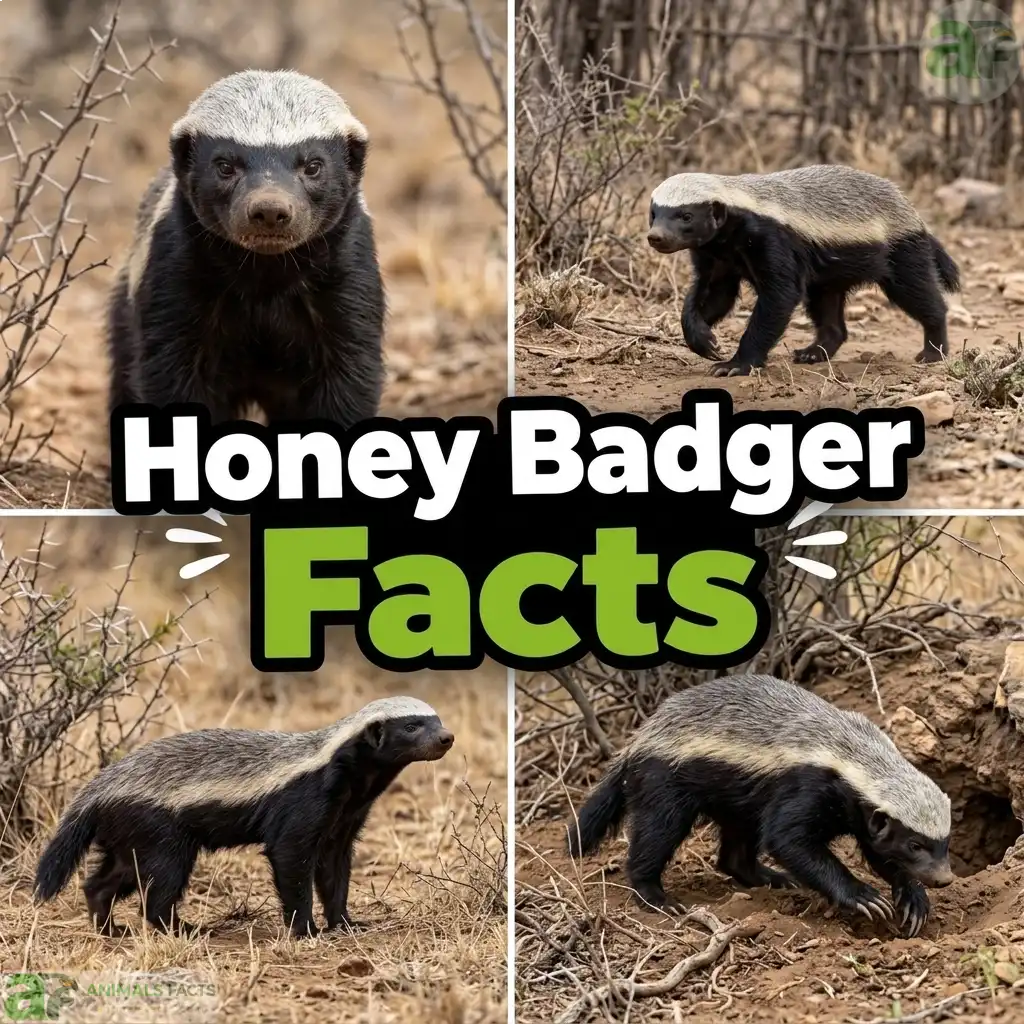
Honey Badger Facts
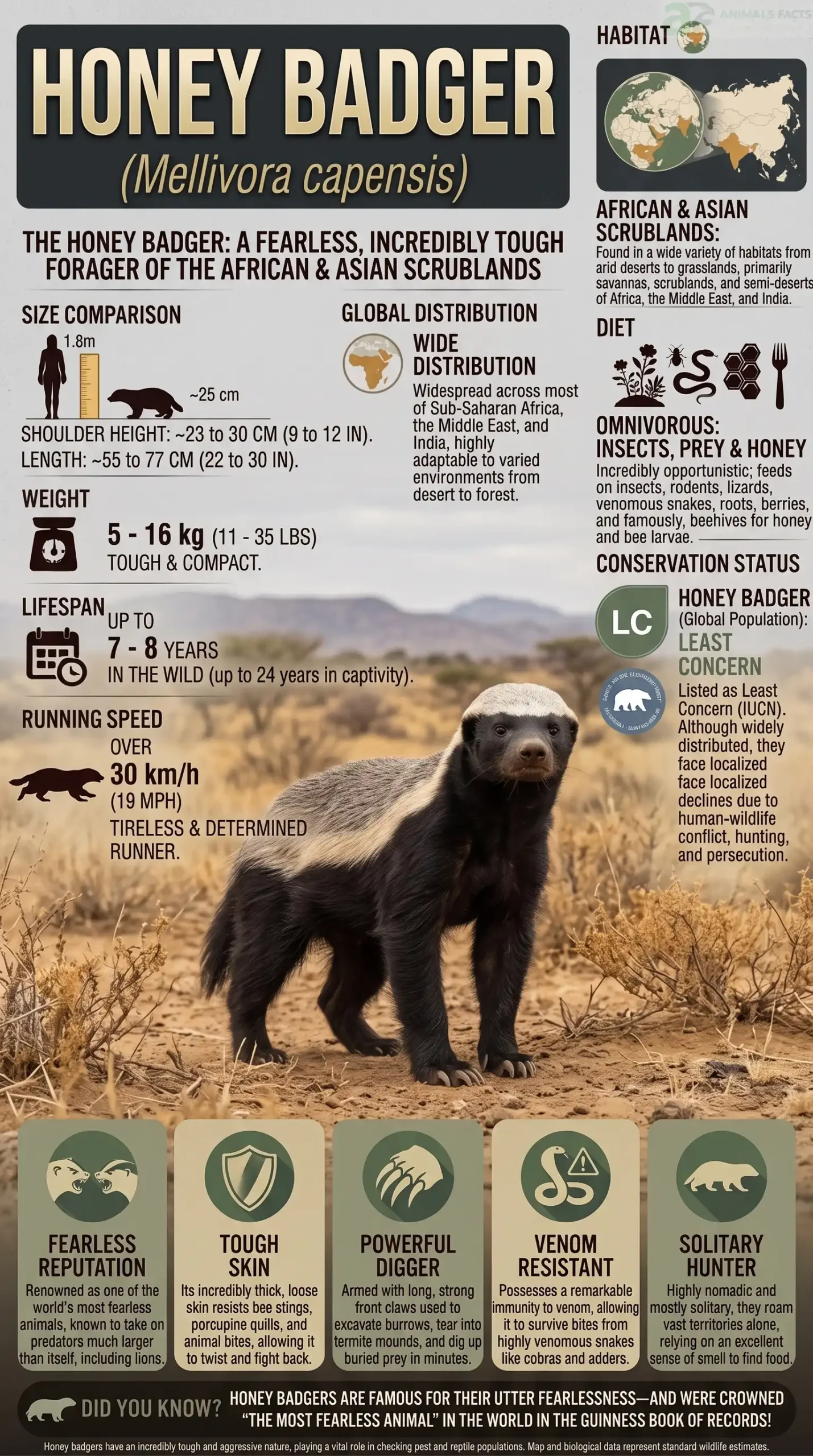
| Feature | Details |
|---|---|
| Scientific Name | Mellivora capensis (Schreber, 1776) |
| Kingdom | Animalia |
| Phylum | Chordata |
| Class | Mammalia |
| Order | Carnivora |
| Family | Mustelidae |
| Subfamily | Mellivorinae |
| Common Names | Honey badger; ratel (Afrikaans/historical) |
| Native Range | Sub-Saharan Africa, North Africa, Middle East, Indian subcontinent, Central Asia |
| Habitat | Savanna, grassland, forest, desert, scrubland, rocky hillsides — extraordinary habitat flexibility |
| Lifespan | 24–26 years (captivity); estimated 7–8 years (wild) |
| Diet | Honey, bee larvae, small mammals, snakes, insects, fruit, carrion — extraordinarily diverse |
| Body Length | 55–77 cm body plus 12–30 cm tail |
| Height | 23–28 cm at shoulder |
| Weight | 5–16 kg — males significantly larger than females |
| Top Speed | Up to 30 km/h |
| Conservation Status | Least Concern (IUCN) — but declining in parts of range |
| Defining Feature | Officially the world’s most fearless animal according to the Guinness World Records |
| Closest Relatives | Wolverine, otters, weasels, badgers — all Mustelidae |
| Skin Thickness | 6 mm — extraordinarily tough and loose; resistant to arrows, spears, and most snake bites |
| Venom Resistance | Documented resistance to cobra, puff adder, and other highly venomous snake venoms |
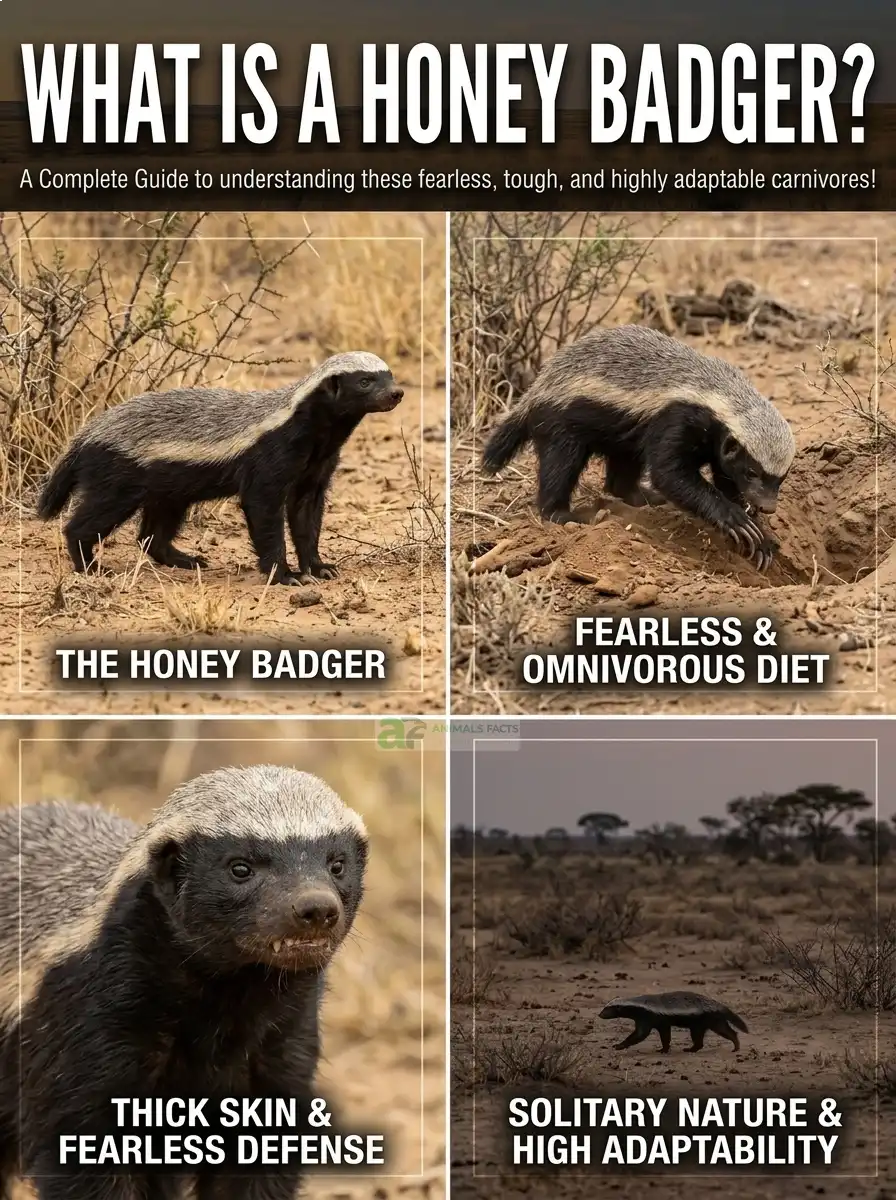
 1. Introduction: What is a Honey Badger?
In a dry acacia savanna in the Kalahari Desert, a black-and-white animal roughly the size of a small dog is doing something that no rational assessment of the situation would predict. A pride of lions — five individuals, collectively weighing approximately a thousand kilograms — is attempting to take away the carcass that the honey badger found and killed and has been eating for the past twenty minutes. The honey badger weighs approximately 12 kilograms. It has assessed the situation. It has decided, with the complete confidence of an animal that has never meaningfully lost a confrontation in its evolutionary history, that the lions are in the wrong. It turns to face them. It makes a sound somewhere between a growl and a shriek. And then it advances. The lions — among the most formidable predators on Earth — hesitate. One backs away. The honey badger returns to its meal. Honey badger facts begin with this single, almost impossible scene — the most fearless animal in the world, officially certified as such by the Guinness World Records, making decisions about conflict and retreat that bear no relationship to what any reasonable calculation of size and danger would suggest.
The honey badger (Mellivora capensis) is not merely fearless — it is a biological system of extraordinary sophistication in which fearlessness is the visible expression of physical and biochemical capabilities that make the confidence justified. The 6-millimeter skin — so thick that arrows, spears, and most snake fangs cannot penetrate it, so loose that the animal can turn within it to bite an attacker holding it from behind. The venom resistance that allows a honey badger to absorb a puff adder bite, go unconscious for several hours, and then wake up and continue eating the same snake that bit it. The jaw strength capable of crushing tortoise shells. The claws — long enough and powerful enough to dig through concrete-hard sun-baked soil faster than a human with a shovel. The scent gland capable of producing a suffocating chemical eruption that drives bees away from hives and deters most predators from sustained attacks. And a brain that, in captive studies, has demonstrated problem-solving capability, tool use, and escape artistry that has made every zoo that has kept a honey badger permanently vigilant about the security of its enclosure.
Interesting facts about honey badgers reveal an animal that has solved the problem of being small in a dangerous world not by hiding, not by speed, not by camouflage, but by becoming the most physically and biochemically armored small carnivore on Earth and then using that armor to pursue a lifestyle of extraordinary ecological opportunism — eating everything from bee larvae to cobras to puff adders to tortoises to scorpions, engaging predators ten times its size when its interests are threatened, and ranging across a geographic distribution spanning three continents. Whether you are searching for honey badger facts for kids to explore the science of animal toughness and fearlessness, a wildlife enthusiast wanting to understand the extraordinary biology behind one of Africa’s most discussed animals, or simply someone who watched the viral 2011 “Honey Badger Don’t Care” video and needed to understand the real animal behind the phenomenon — this is your complete guide. The world’s most fearless animal has an extraordinary story to tell.
2. Honey Badger Species Overview & Classification
The honey badger belongs to the family Mustelidae — the weasel family — and is sufficiently distinctive to occupy its own monotypic subfamily (Mellivorinae) within this family.
Species Classification Table
| Taxonomic Rank | Classification |
|---|---|
| Kingdom | Animalia |
| Phylum | Chordata |
| Class | Mammalia |
| Order | Carnivora |
| Family | Mustelidae (Fischer de Waldheim, 1817) |
| Subfamily | Mellivorinae (Gray, 1865) — monotypic; honey badger only |
| Genus | Mellivora (Storr, 1780) |
| Species | M. capensis (Schreber, 1776) |
| Common Names | Honey badger; ratel |
| Etymology | Mellivora = “honey eater” (Latin: mel = honey + vorare = to devour); capensis = “of the Cape” (Cape of Good Hope, South Africa — the type locality) |
The Mustelidae Family Context
The honey badger belongs to the largest family in the order Carnivora — Mustelidae contains approximately 57 species across multiple subfamilies:
| Subfamily | Representative Species | Notes |
|---|---|---|
| Mellivorinae | Honey badger | Monotypic — honey badger only |
| Mustelinae | Weasels, wolverine, martens | Largest subfamily |
| Lutrinae | Otters | Aquatic specialists |
| Melinae | European badger | Burrowing specialists |
| Taxidiinae | American badger | North American digging specialist |
| Helictidinae | Ferret-badgers | Asian forest species |
The Honey Badger’s Closest Relatives
Despite sharing the common name “badger,” the honey badger is not closely related to the European badger (Meles meles) or American badger (Taxidea taxus) — the shared name reflects superficial similarities in body plan rather than close phylogenetic relationship:
| Relative | Relationship | Similarity Type |
|---|---|---|
| Wolverine (Gulo gulo) | Mustelidae — moderately close | Body plan; fearlessness; dietary opportunism |
| Weasels (Mustela spp.) | Mustelidae — moderately close | Family; basic body plan |
| European badger (Meles meles) | Mustelidae — distant | Convergent body plan; different subfamily |
| American badger (Taxidea taxus) | Mustelidae — distant | Convergent digging capability |
| Otters | Mustelidae — distant | Family membership only |
Recognized Subspecies
Approximately 12 subspecies of honey badger are recognized — reflecting the species’ enormous geographic range and the morphological variation across populations:
| Subspecies | Range | Notes |
|---|---|---|
| M. c. capensis | South Africa | Nominate subspecies; Cape region |
| M. c. cottoni | West Africa | Forest-associated western population |
| M. c. signata | East Africa | Most commonly depicted in wildlife media |
| M. c. indica | Indian subcontinent | Indian population; slightly smaller |
| M. c. inaurita | Middle East, Central Asia | Paler coloration; arid adaptation |
| M. c. leuconota | North Africa | Northern African populations |
Evolution & Discovery Timeline
~15–20 million years ago — The ancestral Mustelidae diversify into the subfamily lineages that will produce the honey badger — the Mellivora lineage separating from related mustelids during the Miocene.
~5–8 million years ago — Mellivora capensis as a recognizable species is established — the honey badger lineage achieving the basic morphological and ecological form that persists today.
1776 — German naturalist Johann Christian Daniel von Schreber formally describes the honey badger as Viverra capensis — based on specimens from the Cape of Good Hope region of South Africa.
1780 — Gottlieb Conrad Christian Storr establishes the genus Mellivora — recognizing the honey badger’s distinctiveness from other mustelids.
1865 — The monotypic subfamily Mellivorinae is established — formally recognizing the honey badger’s sufficient distinctiveness to warrant its own subfamily within Mustelidae.
1974 — The Greater Honeyguide (Indicator indicator) — honeybadger mutualism is formally described in scientific literature — documenting one of the most remarkable inter-species cooperative relationships in Africa.
2002 — The Guinness World Records officially certifies the honey badger as the world’s most fearless animal — a distinction that remains current and that has driven enormous popular interest in the species.
2011 — The viral YouTube video “The Crazy Nasty-Ass Honey Badger” by Randall reaches over 100 million views — making the honey badger one of the most recognizable animals on the internet and generating global popular awareness of the species that substantially exceeded anything previously achieved by natural history media coverage.
2024 — Mellivora capensis maintains its Least Concern IUCN classification globally — though specific populations in North Africa and parts of the Middle East show declining trends.
“There is no animal on Earth that combines physical toughness, biochemical resilience, cognitive capability, and sheer behavioral audacity in the way the honey badger does. It has solved the problem of being a small animal in a world of large predators by making itself effectively invulnerable and then advertising that invulnerability through confrontational behavior that would be suicidal in any less-armored animal.”
— Dr. Colleen Begg, honey badger researcher and co-founder of the Niassa Carnivore Project
3. Honey Badger Physical Description & Unique Features
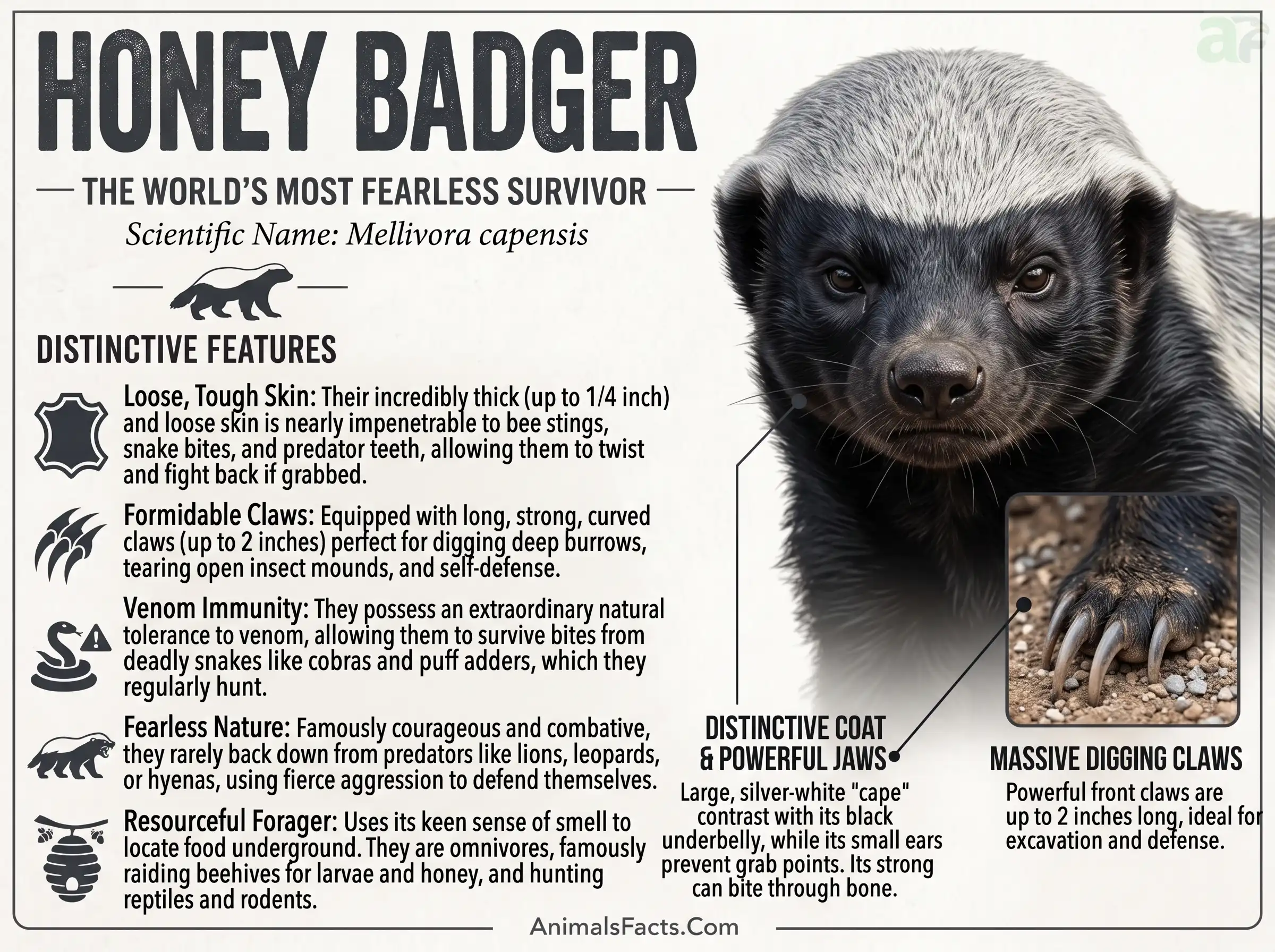
Honey badger size and weight make it a medium-sized carnivore — at 5–16 kg (with significant sexual dimorphism, males substantially heavier than females) and 55–77 cm body length — comparable in size to a large domestic cat but dramatically more powerfully built.
The Black-and-White Coloration — Warning, Not Camouflage
The honey badger’s distinctive two-toned coloration is one of its most immediately recognizable features — and is the precise opposite of camouflage:
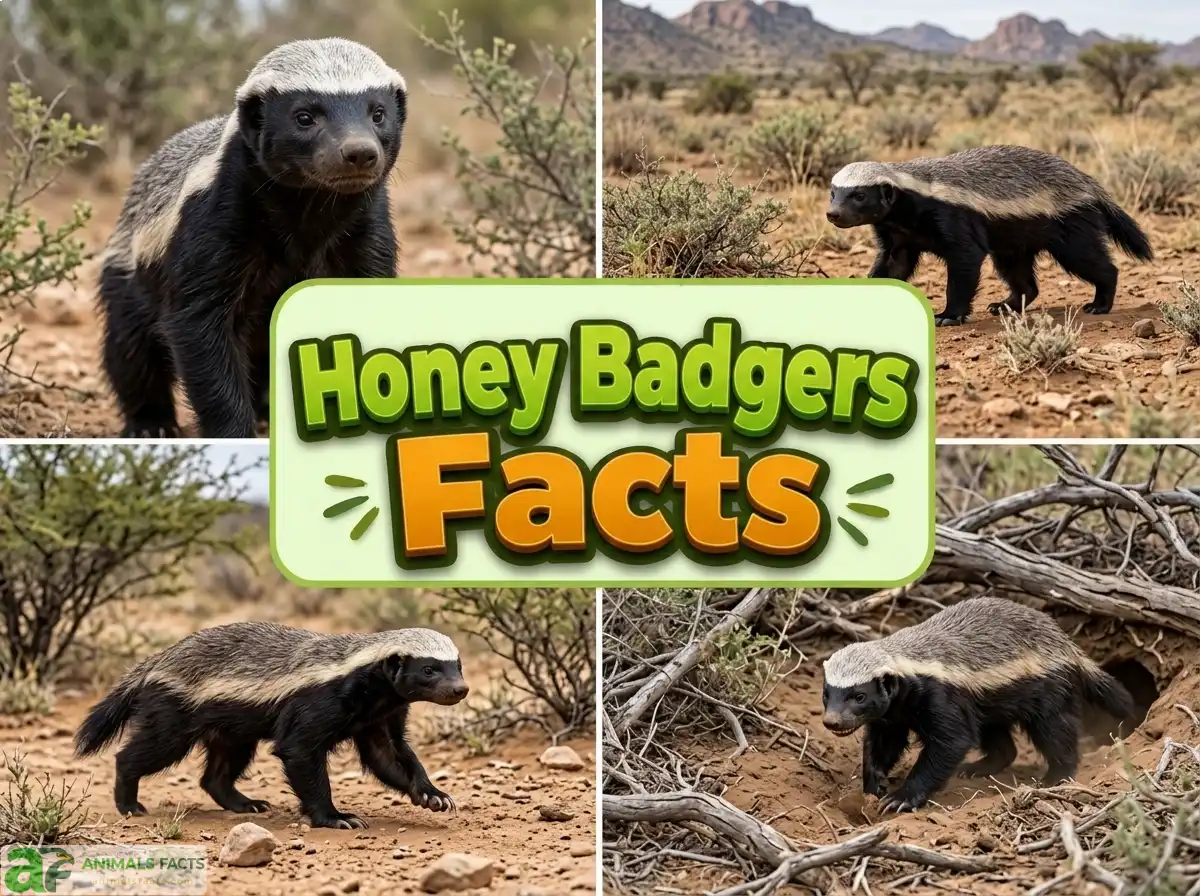
Dorsal surface — The top of the head, neck, back, and upper sides are white to silver-grey — a pale coloration highly visible in the savanna and forest environments the honey badger inhabits.
Ventral surface — The lower face, chin, throat, chest, belly, and all four legs are jet black — creating a sharp, high-contrast boundary between the pale top and dark bottom.
The aposematic function — This high-contrast coloration is aposematic (warning coloration) — it advertises to potential predators that this animal is dangerous, distasteful, or otherwise not worth attacking. The same coloration principle is used by skunks (which spray), wolverines (which fight), and various venomous animals. In the honey badger, the warning is backed by the genuine physical and chemical defensive capability the coloration advertises.
Visibility at distance — The white-and-black pattern is visible at substantial distances in the honey badger’s typical habitats — ensuring that predators are warned before they invest energy in an approach.
The Skin — The Most Extraordinary Biological Armor of Any Small Carnivore
The honey badger’s skin is the single most important component of its defensive biology — a structure so unusual that it deserves detailed examination:
Thickness — The skin is approximately 6 mm thick — extraordinary for a mammal of this size. For comparison, standard leather (cured cattle skin) is typically 2–4 mm thick. Buffalo hide — considered extremely thick mammalian skin — is 6–8 mm. The honey badger’s skin approaches buffalo thickness on an animal 1/50th the size of a buffalo.
Toughness — Beyond raw thickness, the skin has exceptional tensile strength — documented resistance to arrows, spears, and machete blows that would penetrate the skin of most mammals. Historical accounts from African hunters describe the difficulty of penetrating honey badger skin with traditional weapons.
Looseness — The skin is remarkably loosely attached to the underlying musculature — particularly around the neck and rear quarters. This looseness allows the honey badger to rotate within its own skin when seized by a predator. An animal biting or gripping the honey badger’s back can hold the skin while the honey badger’s body inside the skin rotates until the animal is facing its attacker — allowing it to bite and claw an attacker that believes it has secure hold.
Snake fang resistance — The skin thickness is sufficient to prevent penetration by most snake fangs in typical strikes — the fang length and strike force of cobras and puff adders are insufficient to penetrate the 6mm honey badger dorsal skin in most encounters. This passive resistance complements the active venom resistance (discussed below) to make the honey badger extraordinarily difficult to kill with snake venom.
The neck gorget — The skin around the neck is particularly thick and tough — providing protection for the carotid arteries and jugular veins during predator attacks.
The Claws — Engineered for Excavation
The honey badger’s claws are among the most powerful digging tools in the mammalian world for its body size:
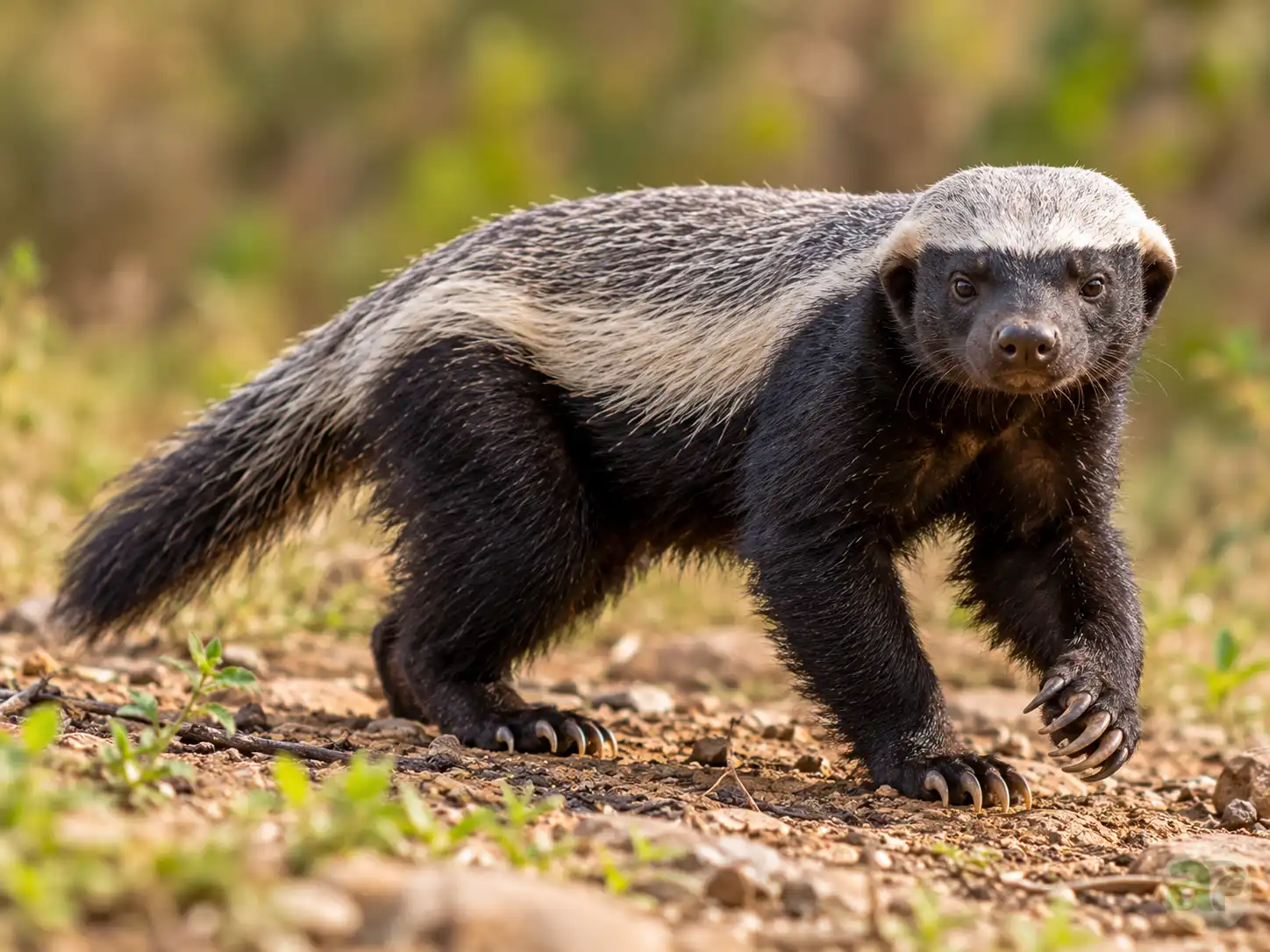
Foreleg claws — Approximately 4–5 cm long — thick, curved, and extremely strong. These claws can penetrate sun-baked African soil that is effectively concrete-hard.
Digging speed — A honey badger can excavate a burrow deep enough to completely conceal itself within 10 minutes — a digging speed that outpaces a human with a shovel in similar soil conditions. This excavation capability is essential for accessing bee hives in soil banks, finding burrowing prey, and creating rapid refuges from predators.
Prey extraction — The powerful claws are used to tear apart termite mounds (accessing the insects and their larvae within), rip open beehives (accessing honey and larvae), and excavate burrowing prey including scorpions and rodents.
The Jaws — Bone-Crushing Force
The honey badger’s jaw musculature is disproportionately developed for its body size — producing bite forces capable of:
- Crushing tortoise shells — including the shells of species specifically evolved for resistance to predation
- Cracking large bones for marrow — a feeding behavior documented in field observations
- Killing cobras and puff adders through spine-severing bites
- Breaking through hard-cased insects, nuts, and other hard food items
The Scent Glands — Chemical Warfare
Like many mustelids, the honey badger has well-developed anal scent glands that produce a complex chemical secretion:
Composition — The secretion contains sulfurous compounds, thiols, and other volatile organic compounds that produce an intensely pungent smell when discharged.
The bee-repelling function — The scent gland secretion is specifically documented as effective at repelling bees — honey badgers are observed to evert (turn inside out and expose) the scent gland when approaching beehives, and the chemical discharge appears to pacify or repel bees sufficiently to allow the honey badger to access the hive. This chemical bee repellent is one of the honey badger’s most important feeding adaptations.
The predator deterrent function — The scent gland secretion also functions as a predator deterrent — the intense chemical smell making sustained attack deeply unpleasant and potentially disorienting for predators with sensitive olfactory systems.
💡 Did You Know? The honey badger’s loose skin has been independently noted and documented by researchers across Africa and Asia as one of the most extraordinary passive defensive adaptations in the mammalian world. In field conditions, researchers have documented honey badgers being seized by large predators — including leopards and lions — and continuing to fight effectively while being held, rotating within the skin to bite the attacker’s face. The mechanism has been described as functionally similar to the gi (martial arts jacket) rotation technique used by human grapplers — the attacker seizes the outer layer but the body inside can rotate to face the attacker. This comparison was made by a wildlife biologist who also trained in judo and recognized the mechanical principle immediately upon observing a honey badger escape from a leopard’s grip at a South African research site.
4. Top 25 Amazing Honey Badger Facts
Here is your definitive collection of the most extraordinary, scientifically verified, and genuinely astonishing honey badger facts as of 2026:
- The honey badger holds the official Guinness World Record for the world’s most fearless animal — a distinction awarded in 2002 and maintained in subsequent editions, recognizing the honey badger’s documented willingness to confront predators many times its size.
- A honey badger can be bitten by a puff adder — one of Africa’s most venomous snakes, responsible for the majority of human snakebite fatalities in Africa — go into unconsciousness for several hours, and then wake up and continue eating the same snake that bit it. This venom recovery has been documented on camera and represents one of the most astonishing animal behaviors recorded in African wildlife.
- The honey badger’s skin is approximately 6 mm thick — comparable to buffalo hide on an animal 1/50th the size of a buffalo — making it effectively impenetrable to arrows, spears, and most snake fangs.
- The honey badger’s skin is so loosely attached to the underlying body that when seized from behind, the honey badger can rotate within its own skin to face and bite its attacker — a defensive capability that has been observed allowing honey badgers to escape from leopards, lions, and crocodiles.
- Honey badgers have been documented attacking and killing snakes from over 60 species — including the black mamba, king cobra, puff adder, saw-scaled viper, and various other highly venomous species. The honey badger is the most prolific known snake predator of any mammal its size.
- The relationship between the honey badger and the Greater Honeyguide (Indicator indicator) is one of the most remarkable inter-species collaborations in the animal kingdom — the honeyguide bird locating beehives and leading the honey badger to them through a distinctive guiding behavior, after which the honey badger opens the hive and both animals share the contents.
- Captive honey badgers have demonstrated extraordinary escape artistry — documented at multiple zoos and wildlife facilities using rocks, tools, and cooperative strategies to escape enclosures. One famous captive honey badger in South Africa reportedly used a rake to scale a wall, escaped his enclosure 26 times, and learned to use novel objects as tools specifically for escape purposes.
- Honey badgers have been documented eating the King Cobra — the world’s longest venomous snake, reaching up to 5.5 meters in length — despite the honey badger’s body length of less than 80 cm. The size ratio of prey to predator in this encounter exceeds almost any other documented predator-prey relationship in the mammalian world.
- The honey badger’s diet spans an extraordinary range — including honey, bee larvae, cobras, puff adders, scorpions, tortoises, porcupines, wild boar piglets, fruit, and carrion — making it one of the most dietary-diverse small carnivores on Earth.
- Honey badgers can run backward as effectively as forward — allowing rapid retreat while maintaining a defensive face-forward posture toward threats. This bidirectional running capability is unusual among mammals of this body plan.
- The honey badger’s geographic range is the widest of any mustelid species — spanning from sub-Saharan Africa through North Africa, the Middle East, the Caucasus, and the Indian subcontinent — a range covering three continents and an extraordinary diversity of habitats from tropical forest to high-altitude mountain.
- Honey badgers can dig through solid concrete in some documented cases — captive animals have excavated through concrete floors in enclosures, driven by the combination of powerful claws, determination, and the cognitive recognition that escape is possible given sufficient excavation effort.
- The honey badger’s body temperature regulation is exceptional — the species is documented active and feeding in temperatures ranging from below freezing in Central Asian mountain environments to over 40°C in the Sahara and Kalahari — a thermal tolerance range exceeding that of almost any comparable small carnivore.
- In documented encounters, honey badgers have successfully driven lions, leopards, and hyenas away from kills — the predators apparently recognizing that the cost of sustained conflict with the honey badger exceeds the value of the contested food.
- The honey badger’s mating system involves minimal male-female association — the male’s only involvement is mating; all parental care is provided by the female alone. Cubs remain with the mother for approximately 14–16 months — one of the longest mother-offspring associations of any mustelid.
- Female honey badgers continuously relocate their cubs — moving them to a new burrow every 2–5 days — a behavior that prevents predators from learning the location of the den through repeated visits. A female may use over 50 different den sites across her home range during a single cub-rearing period.
- The honey badger’s home range is among the largest of any mustelid — with males maintaining ranges of up to 600 km² in low-density desert environments. In more productive habitats, ranges are typically 50–150 km² — still enormous for an animal of this body size.
- Honey badgers are documented to be able to climb trees despite their body plan — scaling vertical trunks to raid bird nests, access beehives in tree cavities, and occasionally escape terrestrial threats. The combination of powerful claws and muscular forearms provides tree-climbing capability unexpected in this body form.
- Research has documented that honey badgers in captivity solve multi-step problems that require planning — including one famous documented case of a honey badger using a ball, a rake, and a box in sequence to escape an enclosure, apparently understanding the spatial relationships between objects and the escape goal.
- The honey badger’s resistance to bee stings is partially behavioral as well as biochemical — the thick skin prevents most stings from reaching the vascular system, and the scent gland secretion repels bees. Research estimates that a honey badger raiding a large African bee colony may absorb hundreds of individual stings in a single raid that would represent a potentially lethal systemic envenomation for an animal with standard-thickness skin.
- Honey badgers have been observed following and utilizing human hunting activities — documented in parts of their range following human hunters to consume discarded entrails and occasionally confronting hunters for claimed kills, suggesting a level of opportunistic human-wildlife interaction unusual for a small carnivore.
- The porcupine — despite its 30,000 needle-sharp quills — is a documented honey badger prey item. Honey badgers have been observed attacking and consuming adult porcupines in Africa — the thick skin providing sufficient protection against the quills to allow predation that would be impossible for most other carnivores.
- Honey badgers have been documented sharing kills in some field observations — occasionally tolerating other honey badgers at large carcasses, and sometimes tolerating the presence of jackals, black-backed jackals, and other scavengers at shared food sources in ways atypical for a species generally described as solitary and aggressive.
- The honey badger has been used as a military mascot — the South African Army’s 61 Mechanised Infantry Battalion (formerly 61 Mechanised Battalion Group) used the honey badger (ratel) as its mascot, and the Ratel IFV (Infantry Fighting Vehicle) — one of South Africa’s most important military vehicles — was named after the honey badger specifically because of the animal’s renowned fearlessness and resilience.
- As of 2026, despite its Guinness World Records status and extraordinary internet fame, the honey badger remains classified as Least Concern by the IUCN — though specific regional populations in North Africa, parts of the Middle East, and heavily farmed areas of Asia show significant declining trends driven by persecution, habitat loss, and prey depletion.
5. Fun Facts About Honey Badgers
- Official Guinness World Record holder for most fearless animal
- Can survive a puff adder bite — wake up hours later and continue eating the snake
- Skin is 6 mm thick — like buffalo hide on a cat-sized body
- Can rotate inside its own skin to bite attackers from behind
- Has raided hives absorbing hundreds of bee stings in a single session
- Documented eating 60+ species of venomous snake including king cobras
- One captive honey badger escaped its enclosure 26 times using tools
- Diet spans honey to cobras to tortoises to porcupines
- Male home ranges up to 600 km² — enormous for a mustelid
- Named a South African military vehicle after it
- The 2011 viral video generated 100+ million YouTube views
- Female moves cubs to a new burrow every 2–5 days
6. Honey Badger Habitat & Geographic Range
Honey badger habitat is the most geographically extensive of any mustelid — spanning three continents across an extraordinary range of vegetation zones and climate types.
Habitat Types
African savanna and bushveld — The primary honey badger habitat across sub-Saharan Africa; the combination of abundant prey diversity (snakes, insects, small mammals), termite mounds for den sites, and beehives for foraging makes savanna one of the most productive honey badger habitats.
African semi-arid and arid zones — The Kalahari, Namib margins, and Sahel support honey badger populations at lower density — the animals’ extraordinary thermal tolerance and dietary flexibility allowing persistence in environments where food and water are scarce and unpredictable.
Tropical and subtropical forest — Present throughout the forests of Central and West Africa and in Indian forest habitats — forest populations may have different dietary profiles emphasizing different prey categories.
Mediterranean scrub — Present in North African scrub and in the Maghreb region (Morocco, Algeria, Tunisia) — the Mediterranean scrub habitats of the honey badger’s northern African range.
Middle Eastern and Central Asian steppe and desert — One of the most surprising aspects of honey badger distribution — the species extends through Iran, Afghanistan, Pakistan, and into Central Asia’s semi-arid steppes and rocky mountain environments.
Indian subcontinent — Distributed across much of India from the Himalayas south through the peninsula — the Indian honey badger population occupies habitats ranging from tropical forest to dry scrub to agricultural margins.
Montane environments — Documented at elevations up to 3,000 meters in the Himalayas and in African mountain systems — the thermal tolerance allowing persistence at elevations where most tropical carnivores cannot survive.
Geographic Distribution
| Region | Status | Notes |
|---|---|---|
| Sub-Saharan Africa | Widespread — stronghold | Most populations; best studied |
| North Africa | Present; declining | Sahara margins; threatened |
| East Africa highlands | Present | Mountain-adapted populations |
| Arabian Peninsula | Present; sparse | Desert and montane populations |
| Middle East (Iran, Iraq) | Present | Rocky and mountainous terrain |
| Central Asia | Present | Pakistan, Afghanistan; sparse |
| Indian subcontinent | Present | Multiple habitat types |
💡 Did You Know? The honey badger’s geographic range — spanning from South Africa to Siberia’s southern margins and from Senegal to India — makes it one of the widest-ranging small carnivores on Earth. This extraordinary distribution reflects the combination of dietary flexibility (eating almost anything available), habitat flexibility (thriving in environments from tropical forest to high-altitude steppe), and physical toughness (withstanding temperature extremes from sub-zero to over 40°C) that characterizes the species. A honey badger in South Africa’s Kalahari and a honey badger in India’s Rajasthan Desert are technically the same species — separated by thousands of kilometers but using the same fundamental ecological strategy of opportunistic dietary generalism backed by physical invulnerability.
7. Honey Badger Diet & Feeding Behavior
Honey badger diet is one of the most extraordinarily diverse of any small carnivore on Earth — the combination of physical capability (powerful claws, crushing jaws, thick defensive skin) and biochemical protection (venom resistance, bee sting tolerance) allowing access to food sources unavailable to virtually any competing carnivore.
Diet Breakdown Table
| Food Type | Estimated % of Diet | Notes |
|---|---|---|
| Insects and larvae (especially bee larvae, beetles) | ~25–35% | Bee larvae; termites; beetles — primary by volume |
| Small mammals (rodents, hares, mongooses) | ~15–20% | Ground squirrels, rats, mice; even young jackals documented |
| Snakes (venomous and non-venomous) | ~10–20% | 60+ species documented; cobras, puff adders, mambas |
| Honey and bee products | ~10–15% | Seasonal; massive caloric value when available |
| Lizards and small reptiles | ~8–12% | Including large monitor lizards |
| Tortoises | ~5–8% | Jaw strength allows shell crushing |
| Scorpions | ~3–7% | Including the most venomous African scorpion species |
| Eggs and nestlings | ~3–5% | Ground-nesting bird eggs; reptile eggs |
| Fruit and plant material | ~3–5% | Seasonal opportunism |
| Carrion | ~3–5% | Highly opportunistic; will steal kills |
| Porcupines | ~1–3% | Documented prey despite 30,000 quills |
| Fish and crabs | ~1–3% | In riverine habitats |
The Beehive Raiding System
The honey badger’s relationship with beehives is the most famous aspect of its feeding ecology — and one of the most remarkable feeding specializations of any mammal:
The honeyguide partnership — The Greater Honeyguide (Indicator indicator) — a bird that locates beehives but cannot open them — has evolved a remarkable partnership with the honey badger. The honeyguide finds a hive and then actively seeks out a honey badger, leading it to the hive through a distinctive rattling call and fluttering flight. The honey badger follows. The honey badger opens the hive. Both animals share the contents. The honey badger gets honey and larvae; the honeyguide gets beeswax and remaining larvae.
Scientific debate — The honeyguide-honey badger partnership has been described in the literature since the 19th century, but systematic scientific documentation has been surprisingly limited. Some researchers question whether the partnership is as consistent as popular accounts suggest, noting that honeyguides primarily lead humans to hives in documented studies — the honey badger relationship may be less obligate than traditional accounts imply. However, multiple independent naturalist accounts from across Africa describe witnessing the behavior.
The raid itself — When approaching a beehive, the honey badger:
- Everts its anal scent glands — releasing the sulfurous chemical spray that pacifies or repels bees
- Excavates the hive entrance with its powerful claws — rapidly enlarging any opening or digging directly into a soil-bank hive
- Extracts honey combs, bee larvae, and adult bees indiscriminately — consuming everything accessible
- Tolerates massive bee stinging — the thick skin preventing most stings from reaching the vascular system; the scent gland repellent reducing the total stings absorbed
The caloric return — Wild bee honey in African environments has a caloric density of approximately 3,000 calories per kilogram — among the highest of any natural food. A honey badger accessing a large colony’s honey stores can consume thousands of calories in a single raid — a caloric windfall of extraordinary value in the unpredictable savanna food environment.
The Snake-Killing System
The honey badger’s snake predation is more sophisticated and more impressive than any other small mammal’s snake predation:
Species range — Documented prey includes cobras (Egyptian, Mozambique, Cape, Indian), puff adders, mambas (green and black), saw-scaled vipers, boomslang, king cobras, and many non-venomous species. The totality spans snakes from multiple continents and includes the most dangerous snake species in each region of the honey badger’s range.
The venom recovery behavior — The most extraordinary documented honey badger behavior is its recovery from venom — specifically from puff adder bites. The puff adder (Bitis arietans) is Africa’s most medically significant snake — responsible for the majority of African snakebite fatalities and delivering a cytotoxic and hemotoxic venom that causes massive tissue destruction and systemic hemorrhage. A honey badger bitten by a puff adder during snake predation has been documented:
- Going limp and unconscious — apparently incapacitated by the venom
- Remaining unconscious for 1–5 hours
- Recovering — apparently spontaneously, as the venom is metabolized
- Returning to and continuing to eat the same snake that caused the envenomation
This recovery behavior — documented on camera in multiple incidents — represents one of the most dramatic demonstrations of animal venom resistance available in wildlife video documentation.
The biochemical basis — Honey badger venom resistance involves the same nAChR receptor modification documented in mongooses for cobra alpha-neurotoxins — but the honey badger’s resistance extends further, appearing to include resistance to or accelerated recovery from cytotoxic and hemotoxic venoms as well. The full biochemical basis of honey badger puff adder resistance has not been completely characterized and represents an active area of research.
8. Honey Badger Reproduction & Life Cycle
Honey badger reproduction is characterized by the extremely conservative reproductive strategy typical of long-lived, large-brained mustelids — small litter sizes, extended maternal care, and slow generation time.
Mating System
The honey badger mating system is promiscuous and non-bonding — males and females associate only for mating, with no pair bond formation and no male parental care:
Male home range overlap — Male honey badger home ranges overlap with those of multiple females — males follow female scent marks to locate estrus females, traveling long distances within their very large ranges to maximize mating opportunities.
No pair bond — Following mating, the male and female separate entirely. The male provides no resources, no territory defense, and no parental assistance during cub-rearing.
Scent communication — Females advertise reproductive status through scent marking — anal gland secretions and urine marking communicate estrus condition to males tracking female ranges.
Gestation and Birth
- Gestation period: approximately 50–70 days — relatively short for a mammal of this body size
- Litter size: typically 1–2 cubs — single cubs are most common
- Birth weight: approximately 100–200 grams per cub
- Birth condition: altricial — blind, helpless, sparsely furred; completely dependent on mother
- Eyes opening: approximately 35 days
- First solid food: approximately 3 months
- Weaning: approximately 14–16 weeks
- Breeding season: varies by region — in Africa, births can occur in any month; some evidence of seasonal peaks coinciding with prey abundance periods
The Den Relocation Behavior
One of the most remarkable aspects of honey badger maternal behavior is the continuous den relocation — moving cubs to new burrows every 2–5 days throughout the cub-rearing period:
Why relocate? — The primary driver is predator pressure — if a predator discovers the den location (through scent tracking or direct observation), repeated use of the same burrow creates a predictable target. By moving cubs continuously, the mother prevents predators from accumulating knowledge of den location.
The logistics — The mother carries each cub individually by the scruff of the neck — moving them one at a time to the new burrow location. With typically one cub (occasionally two), this transport is manageable but requires multiple trips.
The den diversity — A female may use 50 or more different den sites during a single cub-rearing period — utilizing abandoned aardvark burrows, self-excavated burrows, rock crevices, dense vegetation, and termite mound excavations.
The learning period — Cubs remain with their mother for approximately 14–16 months — one of the longest mother-offspring associations in mustelids. During this period they learn foraging techniques, prey recognition, and the complex behavioral repertoire required for adult honey badger life. The extended learning period reflects the cognitive demands of the honey badger’s diverse and technically demanding feeding behavior.
Lifespan
- Wild lifespan: estimated 7–8 years on average — though detailed wild population data is limited
- Captive maximum: 24–26 years — reflecting the extraordinary longevity possible in the absence of predation and disease pressure
9. Social Behavior & Communication
Honey badger social behavior is characterized by functional solitude in most contexts — adults maintaining large individual home ranges with minimal direct social interaction outside of mating and the extended mother-cub association.
Social Organization
Primarily solitary — Adult honey badgers outside of the mating season and mother-cub associations are essentially solitary — individual animals maintaining large exclusive home ranges without sustained social relationships.
Tolerance at food concentrations — Despite solitary tendencies, honey badgers show occasional tolerance of conspecifics at large, concentrated food sources — multiple honey badgers have been documented at large carcasses and at productive beehive sites without immediate serious conflict.
Mother-cub association — The most sustained social relationship is the approximately 14–16 month mother-cub bond — during which the mother teaches the cub the full behavioral repertoire of honey badger life.
Male-male avoidance — Adult males apparently avoid each other outside of competitive contexts, maintaining ranges through scent communication rather than direct territorial defense.
Communication Systems
Olfactory communication — The primary communication channel; scent marks from the anal glands, cheek glands, and urine deposits communicate identity, sex, and reproductive status across the large home ranges. The persistence of scent marks in the environment allows asynchronous communication — a male following a female’s scent trail may be hours behind her but receives complete information about her identity and reproductive state.
Vocalizations — Honey badgers produce a diverse vocalization repertoire:
- Growling and snorting — primary antagonistic and threat vocalizations; the sounds most often heard during confrontations with predators and competitors
- High-pitched squealing — produced during extreme stress or injury
- Clucking and chittering — contact calls used between mother and cub
- Churring — a low repetitive call used in various social contexts
- Hissing — defensive vocalization at close range to threatening animals
Visual communication — The erect hair display — raising the thick dorsal fur — enlarges the apparent body size during threat displays. The two-toned coloration functions as a continuous visual signal to any observing animals.
Problem-Solving and Cognition
The honey badger’s cognitive capabilities have attracted significant research interest — particularly the documented escape artistry of captive individuals:
Stoffel — The most famous cognitively documented honey badger; a captive individual in South Africa who escaped his enclosure 26 times over several years using increasingly sophisticated tool use and problem-solving. Documented behaviors included:
- Using a rake to prop against a wall and climb over
- Moving a stone to a corner of the enclosure and using it as a step
- Rolling a log to a wall for climbing
- Using a ball thrown into the enclosure as a climbing aid
- Collaborating with a female companion — the female climbing on Stoffel’s back to reach an otherwise inaccessible ledge
These behaviors — particularly the sequential tool use and the apparent collaborative strategy — represent some of the most sophisticated problem-solving documented in any mustelid and compare favorably with documented tool use in primates.
Research implications — The honey badger’s demonstrated cognitive flexibility suggests a level of executive function and planning that was not predicted by the animal’s brain-to-body ratio. Current research interest focuses on whether honey badger intelligence represents an adaptation to the complex, multi-step foraging behavior (coordinating the honeyguide partnership, executing beehive raids, managing snake predation) that characterizes the species’ ecology.
10. Predators & Defense Mechanisms
The honey badger’s predator-defense system is the most comprehensive and most multi-layered of any small carnivore — integrating passive physical armor, active biochemical resistance, behavioral intimidation, and cognitive escape capability.
Potential Predators
Lions (Panthera leo) — Documented as occasional honey badger attackers — but also frequently documented retreating from honey badger confrontations. The cost-benefit analysis of sustained conflict with a honey badger apparently resolves against conflict for most individual lions in most situations.
Leopards (Panthera pardus) — The most significant predator of honey badgers in African environments — leopards are documented taking honey badgers occasionally, primarily through ambush rather than sustained pursuit. However, many leopard-honey badger encounters end with the honey badger escaping through the skin-rotation defense and counterattacking.
Spotted hyenas (Crocuta crocuta) — Documented in confrontation with honey badgers; typically resolve in the honey badger’s behavioral retreat or the hyena’s decision that the conflict cost exceeds the reward.
Nile crocodiles (Crocodylus niloticus) — Honey badgers foraging in riparian habitats face crocodile predation risk — the primary context in which honey badger skin thickness is insufficient to provide complete protection against a determined large predator.
Large eagles — Martial eagles and crowned eagles represent potential aerial predation threats, particularly to young or sub-adult honey badgers.
Large pythons — African rock pythons and Indian rock pythons represent constriction threats that the honey badger’s skin cannot protect against in the same way it protects against biting predators.
Defense Mechanisms
Passive skin armor — The 6mm thick, loose skin prevents penetration by most biting and scratching attacks — the primary passive defense.
Skin rotation defense — The active use of skin looseness to rotate and face attackers is the most sophisticated behavioral deployment of the passive skin armor.
Scent gland discharge — The anal scent gland’s sulfurous secretion deters sustained predator attacks through chemical irritation — creating an unpleasant sensory environment that makes continued attack costly.
Counterattack behavior — The honey badger’s primary behavioral defense is attack rather than flight — it turns and fights most predators rather than attempting to escape. This counterattack strategy, while seemingly reckless, is calculated on the genuine difficulty of seriously injuring a honey badger through normal predator attack.
The mock charge — Honey badgers frequently mock charge predators — running directly at an approaching threat with hair erect, growling loudly, and stopping short. This behavior exploits the predator’s uncertainty about whether the tiny charging animal represents a genuine threat — and the honey badger’s reputation means that many experienced African predators treat this uncertainty conservatively.
Burrow excavation — When pressed by a determined large predator, the honey badger can excavate a burrow rapidly enough to disappear underground within minutes — providing the ultimate escape that no surface predator can follow.
11. Honey Badger Facts for Kids
Hey incredible young wildlife scientists and nature explorers! Here are some mind-blowing honey badger facts for kids that will absolutely astonish every wildlife fan and science lover you know:
- 🦡 The honey badger is officially the world’s MOST FEARLESS ANIMAL — it is in the Guinness World Records! The Guinness Book of World Records officially gave the honey badger this title in 2002. It earned this title because it has been documented chasing lions away from kills, fighting leopards to a standstill, and attacking cobra snakes that would kill most animals immediately. And it usually wins!
- 🦡 A honey badger can get BITTEN BY A DEADLY SNAKE, fall asleep, and then WAKE UP AND EAT THE SNAKE! A puff adder is one of Africa’s most dangerous snakes — its venom kills thousands of people every year. But a honey badger bitten by a puff adder can survive. It might go unconscious for a few hours — but then it wakes up and finishes eating the very snake that bit it. This has actually been filmed and watched by millions of people online!
- 🦡 Its skin is so thick that ARROWS AND SPEARS cannot easily penetrate it! The honey badger has skin about 6 millimeters thick — almost as thick as buffalo leather — on a body the size of a large cat. Most snake fangs cannot even get through this skin. African hunters historically noted how difficult it was to injure honey badgers with traditional weapons. The skin is also incredibly LOOSE — so when something grabs the honey badger from behind, it can spin around inside its own skin and bite the attacker in the face!
- 🦡 One honey badger named Stoffel ESCAPED HIS ENCLOSURE 26 TIMES using tools! A captive honey badger in South Africa figured out how to escape no matter what his keepers tried. He used a rake to climb a wall, moved a rock to use as a step, and even rolled a log to reach a higher ledge. When his keepers put a female honey badger with him, she climbed ON HIS BACK to help them both escape together. Scientists say this is some of the most impressive problem-solving ever seen in a mustelid!
- 🦡 Honey badgers can eat 60+ species of VENOMOUS SNAKES — including king cobras! The king cobra is the world’s longest venomous snake — up to 5.5 meters long. The honey badger is less than 80 cm long. And honey badgers have been documented killing and eating king cobras. That is the equivalent of a housecat eating a 30-foot animal. The honey badger does not care about the size difference!
- 🦡 A BIRD named the Honeyguide shows honey badgers where beehives are! The Greater Honeyguide is a bird that can find beehives but cannot open them. So it finds a honey badger and LEADS it to the hive by flying ahead and making special sounds. The honey badger follows, breaks open the hive, and both animals share the honey and bee larvae inside. It is one of the only known cases of a bird and a mammal working as a team to get food!
- 🦡 The South African Army named a MILITARY VEHICLE after the honey badger! The Ratel IFV — one of South Africa’s most important armored military vehicles — is named “Ratel,” the Afrikaans word for honey badger. The army chose this name specifically because the honey badger is famous for being impossibly tough and absolutely fearless under any circumstances — exactly what they wanted their armored vehicle to be!
- 🦡 A honey badger can dig itself UNDERGROUND in just 10 minutes! The honey badger has enormous claws that can rip through sun-hardened African soil faster than a human with a shovel. When threatened by a predator it cannot fight off, or when chasing burrowing prey, the honey badger can excavate a hiding hole deep enough to completely conceal itself in about ten minutes — disappearing into the ground while predators watch from above!
12. Relationship with Humans
The honey badger’s relationship with humans is complex — shaped by ancient African and Asian cultural traditions, significant modern conflict over livestock and beekeeping, and the extraordinary 21st century internet fame that has made the honey badger one of the world’s most recognized wild animals.
Traditional Human-Honey Badger Relationships
African pastoral communities — Honey badgers living near human settlements in Africa regularly raid beehives managed by human beekeepers — destroying hive structures, consuming honey and larvae, and causing economic damage significant enough to drive retaliatory killing. In some African pastoral communities, the honey badger is considered a serious pest species.
The honey-hunting tradition — In parts of Africa where wild honey is harvested by human hunters, the honeyguide-honey badger partnership has historically provided a template for the human-honeyguide relationship — human honey hunters have their own partnership with the Greater Honeyguide that parallels the honey badger partnership, with the honeyguide leading human hunters to hives in exchange for beeswax.
Livestock predation — Honey badgers occasionally prey on small livestock including young goats, sheep, and chickens — creating human-wildlife conflict in pastoral and agricultural communities. This predation is less economically significant than lion or leopard depredation but generates local persecution.
Traditional medicine — Honey badger body parts — particularly the skin and fat — have traditional medicinal and spiritual significance in some African cultures. The honey badger’s extraordinary toughness and fearlessness are believed in some traditions to be transferable to humans through the consumption of honey badger products — creating demand for honey badger body parts in some traditional medicine markets.
South Asian relationships — In India and Central Asia, honey badgers have historically been viewed as fierce but generally neutral wildlife — neither particularly valued nor particularly persecuted in most cultural contexts, though livestock predation creates local conflict.
The Beekeeping Conflict
The honey badger’s beehive raiding creates its most significant modern human-wildlife conflict across Africa and parts of Asia:
The damage — A single honey badger raid on a managed beehive can completely destroy the colony — the structural damage to the hive, the consumption of honey stores, and the disruption of the colony all contributing to total hive loss. In communities where beekeeping is a primary income source, repeated honey badger raids can be economically devastating.
Mitigation approaches — Various approaches have been developed to protect managed hives from honey badger predation:
- Elevated hive placement — raising hives on metal poles with inverted metal cones (unable to grip) as trunk guards
- Electric fence protection — small electric fence enclosures around apiaries
- Metal hive boxes — replacing traditional wooden hives with steel-bodied boxes that resist honey badger claw penetration
- Chili pepper barriers — the use of chili peppers around hive bases exploiting the honey badger’s sensitivity to capsaicin despite its general toughness
The conservation implication — Beekeeping conflict drives retaliatory killing that represents one of the primary direct mortality sources for honey badgers near human settlements. Conservation programs that provide effective hive protection reduce retaliatory killing while protecting beekeepers’ livelihoods.
The Internet Fame Effect
The 2011 viral YouTube video “The Crazy Nasty-Ass Honey Badger” — a comedic narration of honey badger wildlife footage by the creator known as Randall — generated over 100 million views and fundamentally transformed global awareness of the species:
The cultural impact — The video’s comedic framing of honey badger fearlessness through the repeated phrase “Honey Badger Don’t Care” became a global internet meme — appearing on merchandise, in advertising campaigns, in political commentary, and in casual conversation across dozens of languages and cultures.
The conservation irony — The video generated extraordinary global public interest in honey badgers while providing almost no accurate biological information about the species. Most viewers came away knowing that honey badgers are “crazy” and “fearless” — accurate characterizations — without knowing the species’ actual biology, conservation status, or the threats it faces.
The researcher impact — Honey badger researchers and conservationists report that the video substantially increased research interest and conservation funding for the species — the global public attention driving philanthropic support that more conventional wildlife media had not generated.
13. Honey Badger Conservation Status & Threats
Conservation Status Overview
| Feature | Details |
|---|---|
| IUCN Status | Least Concern (LC) |
| Population Trend | Decreasing in parts of range |
| Population Estimate | Unknown globally — insufficient survey data |
| CITES Listing | Appendix III (India) — partial listing |
| National Protection | Fully protected in South Africa; partial protection across most of range |
Major Threats
| Threat | Description | Impact Level |
|---|---|---|
| Persecution (beekeeping/livestock conflict) | Retaliatory killing; poisoning; trapping | High — primary mortality driver near settlements |
| Habitat loss | Agricultural expansion; deforestation | High — particularly in South Asian range |
| Road kills | Expanding road networks | Medium-High |
| Prey depletion | Bushmeat hunting reducing available prey | Medium |
| Traditional medicine trade | Body parts used in traditional medicine | Medium in some regions |
| Trapping for fur/trophy | Small-scale but documented | Low-Medium |
| Introduced prey depletion | Pesticide use reducing insect availability | Medium |
| Political instability | Reduces conservation enforcement | High in some range countries |
Regional Variation
While the honey badger is globally classified as Least Concern, significant regional variation in population status exists:
Southern Africa — Most stable populations; best-studied; active conservation programs; several protected area populations receiving formal management attention.
North Africa — Declining populations; habitat degradation and human persecution driving range contraction in Morocco, Algeria, Tunisia, and Libya.
Middle East — Sparse and declining populations in many areas; human persecution and prey depletion significant.
Indian subcontinent — Patchy distribution; declining in heavily agricultural areas; some protected area populations stable.
West and Central Africa — Poorly documented; forest populations may be declining with forest clearance.
Conservation Responses
Protected area populations — Honey badgers in Africa’s national park system — Kruger, Serengeti, Etosha, Okavango — receive incidental protection through the broader protected area management framework.
Beekeeping conflict mitigation — Programs providing predator-proof hive technology and compensation for verified honey badger losses reduce retaliatory killing — the most direct conservation intervention available for this species.
Road ecology programs — Fauna passes and wildlife crossing programs in parts of South Africa address road kill mortality for honey badgers and other mustelids.
Research programs — The Niassa Carnivore Project and other African carnivore research organizations have contributed field data on honey badger ecology and threats — providing the scientific foundation for evidence-based conservation planning.
14. Famous Honey Badgers in History & Pop Culture
Famous Individual Honey Badgers
“Stoffel” — The most famous individual honey badger in history — a captive male at the Moholoholo Wildlife Rehabilitation Centre in South Africa whose extraordinary escape artistry was documented over multiple years by wildlife filmmaker Brian Jones and subsequently featured in multiple television documentaries. Stoffel’s documented tool use — including the sequential use of rake, stone, log, and ball for escape — and his apparent collaboration with a female companion represent the most extensively documented cognitive achievements in any mustelid. Stoffel’s story was featured in the BBC documentary “Honey Badgers: Masters of Mayhem” and generated global media coverage of honey badger intelligence.
Randall’s Honey Badger (2011 viral video) — The unnamed honey badger featured in the wildlife footage used in Randall’s viral YouTube video “The Crazy Nasty-Ass Honey Badger” became one of the most viewed individual wild animals in internet history — the video reaching over 100 million views and spawning the “Honey Badger Don’t Care” internet meme that remains one of the most recognized animal-related memes in internet culture history.
The 61 Mechanised Battalion’s Ratel — The Ratel IFV (Infantry Fighting Vehicle) — named after the honey badger in Afrikaans — became one of the most significant military vehicles in South African military history, serving in the Border War and multiple subsequent conflicts. The honey badger mascot of 61 Mechanised Battalion Group (the “Ratel Battalion”) carried the animal’s symbolic fearlessness and toughness into a military context that gave the honey badger significant cultural prominence in South African military and national identity.
The Niassa Honey Badgers — Multiple individually identified honey badgers monitored by Dr. Colleen Begg and colleagues at the Niassa Carnivore Project in Mozambique — constituting the most systematically studied wild honey badger population and providing the primary scientific data on honey badger ecology, home range, and behavior currently available.
Historical Significance
The ratel name — The Afrikaans word “ratel” for honey badger — derived from the Dutch raat (honeycomb) — reflects the species’ honey-eating specialization and its cultural prominence in southern African settler culture. The ratel name appears throughout South African historical records, military nomenclature, and cultural references — the honey badger’s toughness making it a natural symbol in the settler culture of southern Africa.
15. Role in Ecosystem & Food Chain
The Ecosystem Engineering Role
The honey badger is an ecosystem engineer whose foraging activities physically modify the environment in ways that benefit other species:
Burrow creation — Honey badgers excavate burrows throughout their large home ranges — abandoned burrows are subsequently used as den sites by warthogs, porcupines, wild cats, servals, bat-eared foxes, and numerous other burrowing species across African savanna. The honey badger’s excavation activities effectively create housing infrastructure that supports significant biodiversity across the savanna ecosystem.
Hive damage and bee colony distribution — Honey badger raids on wild bee colonies, while destructive to individual colonies, may contribute to bee colony dispersal — survivor bees from raided colonies establishing new colonies elsewhere, potentially distributing bee colonies more widely across the landscape than would occur without honey badger predation pressure.
Termite mound excavation — Honey badger digging into termite mounds for termite and larvae access creates physical modifications to mound structure that subsequently provide shelter for small lizards, snakes, birds, and invertebrates.
The Predator-Prey Regulation Role
Snake population effects — The honey badger’s predation on venomous snakes across Africa and Asia constitutes a meaningful predation pressure on snake populations — potentially reducing snake density in areas of high honey badger abundance. This snake control has direct implications for human safety in areas where venomous snakebite is a significant public health concern.
Rodent population regulation — Honey badger predation on rodents contributes to the broader rodent control services provided by Africa and Asia’s carnivore guild — limiting rodent population growth and the associated agricultural damage and disease transmission.
The mesopredator position — The honey badger occupies a mesopredator position in the African food web — hunting small to medium prey while being occasionally hunted by large apex predators. Its presence regulates its prey populations while its defensive capability makes it an unreliable prey item for apex predators — it occupies the mesopredator niche with an unusual degree of effective invulnerability to predation.
16. Myths, Folklore & Cultural Significance
African Cultural Traditions
The honey badger’s extraordinary toughness and fearlessness have generated rich cultural traditions across the diverse societies of sub-Saharan Africa:
The symbol of fearlessness — In multiple southern and eastern African cultural traditions, the honey badger is invoked as a symbol of extraordinary courage and determination. Honey badger medicine — preparations made from honey badger body parts — is used in some traditional contexts to confer fearlessness on warriors, hunters, and others facing dangerous situations. The transfer of the honey badger’s qualities to humans through ritual use is one of the most consistent themes in honey badger cultural traditions.
The unstoppable fighter — Across Khoisan, Zulu, Xhosa, and other southern African cultural traditions, the honey badger is recognized as an animal that does not retreat — that engages any threat regardless of size disparity. This quality is invoked in praise poetry, proverbs, and traditional songs as a model of determined resistance.
The Khoisan perspective — The San people (Bushmen) of the Kalahari — who share the honey badger’s primary range — have an intimate knowledge of honey badger behavior developed through millennia of coexistence. San oral traditions include the honey badger as a character recognized for cleverness, persistence, and a fearless directness that contrasts with the more cautious behavior of most savanna animals.
South Asian Cultural Traditions
Indian folklore — In various Indian regional traditions, the honey badger appears as a symbol of determination and invulnerability — the animal that cannot be stopped by any adversary. The Sanskrit tradition includes the honey badger in accounts of extraordinary animals with unusual properties.
The snake-fighting symbolism — The honey badger’s snake-fighting capability has made it a natural symbol in cultures where snake-human conflict is a significant concern — the honey badger representing the force that defeats the deadly serpent, paralleling the mongoose’s cultural role in Hindu and Egyptian traditions.
17. Honey Badgers in Pop Culture
“The Crazy Nasty-Ass Honey Badger” (YouTube, 2011) — The most significant popular cultural representation of the honey badger — Randall’s viral video narrating honey badger wildlife footage with comedic commentary generated over 100 million views, spawned the “Honey Badger Don’t Care” meme, and introduced the honey badger to global internet culture in a way that no wildlife documentary had achieved. The meme spread to political commentary, advertising, sports culture, and everyday conversation across dozens of languages — making “Honey Badger Don’t Care” one of the most recognized phrases in early 2010s internet culture.
“Honey Badgers: Masters of Mayhem” (BBC/National Geographic, 2014) — The most scientifically accurate and visually comprehensive documentary treatment of honey badger biology — featuring Stoffel’s escape artistry, wild honey badger foraging and snake predation, and the first systematic television coverage of honey badger cognitive capability. The documentary reached global audiences through BBC and National Geographic platforms and provided the most complete popular science treatment of honey badger biology available in any medium.
The Ratel IFV — The South African Ratel Infantry Fighting Vehicle — named after the honey badger — served as one of the most important military vehicles in the South African Border War (1966–1989). The vehicle’s naming after the honey badger gave the animal significant symbolic presence in South African military culture and national identity.
comparethemarket.com — Following the success of meerkat advertising mascots (Aleksandr Orlov), the “Honey Badger Don’t Care” meme was incorporated into advertising campaigns by multiple brands seeking to invoke the honey badger’s attitude of fearless indifference — a marketing application of the internet meme that brought the animal into commercial culture.
“Honey Badger” — The nickname applied to Nick Cummins — the Australian rugby player renowned for his fearless playing style and eccentric personality — confirming the honey badger’s status as the definitive cultural symbol of fearless, unconventional behavior.
David Attenborough BBC Wildlife — Multiple BBC wildlife series have featured honey badger content — including “Africa” (2013), “The Life of Mammals” (2002), and various BBC Natural World productions. Attenborough’s narration of honey badger snake predation and beehive raiding sequences has produced some of the most widely watched honey badger wildlife footage in broadcast media history.
18. Honey Badger Facts vs. Common Myths
| Common Myth | The Real Fact |
|---|---|
| “Honey badgers are completely immune to all venom” | Partially false — honey badgers have substantial resistance to cobra alpha-neurotoxins and documented recovery from puff adder bites; but very large venom doses, certain venom types, and unusual delivery circumstances can still harm or kill them; resistance is remarkable but not absolute |
| “Honey badgers always win fights against lions and leopards” | False — honey badgers are occasionally killed by lions and leopards; what is true is that they win more confrontations than their body size would predict, and that the cost-benefit for predators often resolves against sustained attack |
| “Honey badgers are related to bears” | False — honey badgers belong to the weasel family (Mustelidae); their bear-like stocky build is a convergent feature reflecting their powerful digging ecology, not shared ancestry |
| “The ‘honey badger don’t care’ behavior means they are stupid” | Opposite of true — captive honey badgers have demonstrated some of the most sophisticated problem-solving documented in any mustelid; the “don’t care” behavior reflects confidence based on genuine physical capability, not cognitive limitation |
| “Honey badgers primarily eat honey” | False — honey and bee products constitute approximately 10–15% of the diet; insects, small mammals, and snakes are more consistently important prey categories |
| “Honey badgers and honey badgers alone work with the honeyguide bird” | Partially false — the Greater Honeyguide primarily leads human honey hunters to hives in the best-documented studies; the honey badger partnership is documented but may be less obligate than traditional accounts suggest |
| “Honey badgers are endangered” | False — globally classified as Least Concern; though specific regional populations are declining, the species maintains a broad, secure global distribution |
19. Best Places to See Honey Badgers in the Wild
1. Kgalagadi Transfrontier Park, South Africa/Botswana — One of the most reliable locations for honey badger sightings in Africa; the open Kalahari terrain and the park’s minimal off-road restriction allows extended vehicle observation when honey badgers are located. Night drives in the park’s camps occasionally produce honey badger sightings during crepuscular foraging periods.
2. Kruger National Park, South Africa — The largest South African national park; honey badger sightings occur throughout but are more common in the central and northern Kruger sections. Night drives from private lodges in the Greater Kruger ecosystem substantially increase sighting probability.
3. Serengeti National Park, Tanzania — Honey badgers are present throughout the Serengeti; most sightings occur at dawn and dusk near termite mounds and along riverine areas where beehives may be located. The park’s enormous size and excellent safari infrastructure make it one of East Africa’s finest honey badger viewing locations.
4. Etosha National Park, Namibia — The Etosha pan’s surrounding woodland and scrub support good honey badger populations; sightings at waterholes at dawn and dusk are possible, and the park’s excellent road network allows systematic searching.
5. Ranthambore National Park, India — One of the better locations in India for honey badger observation — the dry scrub and forest habitats support visible honey badger populations that can be encountered during vehicle safaris, particularly along rocky sections of the park.
6. Bera, Rajasthan, India — A surprisingly excellent honey badger viewing location; the rocky Aravalli hills around Bera in Rajasthan support leopards and honey badgers in proximity, and local wildlife guides have developed skills in locating honey badgers in the rocky terrain.
7. The Honest Assessment — Honey badgers are notoriously difficult to observe in the wild — their large home ranges, variable activity patterns (active at any time of day or night depending on conditions), and preference for dense vegetation at many sites combine to make deliberate encounters rare. Nocturnal spotlight surveys in good savanna habitat, combined with experienced local guides who know active honey badger territories, provide the best opportunity. When sightings do occur, they are typically among the most memorable wildlife encounters available in Africa.
20. How You Can Help
Supporting honey badger conservation requires action at both the local conflict-mitigation level and the broader habitat protection level.
Support these organizations:
- Niassa Carnivore Project — niassacarivoreproject.com — Dr. Colleen Begg’s program conducting the most comprehensive wild honey badger research and running community conflict-mitigation programs in Mozambique
- Endangered Wildlife Trust — ewt.org.za — South Africa-based conservation organization with carnivore conservation programs
- African Wildlife Foundation — awf.org — broader African wildlife conservation supporting honey badger habitat
- Wildlife ACT — wildlifeact.com — supports monitoring programs in South African protected areas
- Moholoholo Wildlife Rehabilitation Centre — moholoholo.co.za — the South African rehabilitation centre where Stoffel lived; supports honey badger rehabilitation and public education
Critical individual actions:
- Support beehive protection programs — providing predator-proof hive equipment to African and South Asian beekeepers directly reduces retaliatory honey badger killing; organizations working on human-wildlife conflict in these regions often include hive protection programs
- Never support traditional medicine products using honey badger parts — the honey badger body part trade in some markets creates demand that drives targeted hunting
- Visit honey badger range responsibly — wildlife tourism in South Africa, Botswana, and Tanzania that generates ranger funding and conservation revenue indirectly supports honey badger conservation
- Share accurate information — the “Honey Badger Don’t Care” meme, while fun, has somewhat distorted public understanding of the species; sharing accurate information about honey badger biology and conservation needs helps translate internet fame into conservation awareness
21. Top Documentaries & Books
Must-Watch Documentaries
- “Honey Badgers: Masters of Mayhem” (BBC/National Geographic, 2014) — The definitive honey badger documentary; features Stoffel, wild foraging footage, snake predation, and cognitive research
- “Africa — Kalahari” (BBC, David Attenborough, 2013) — Features exceptional honey badger sequences including snake predation and conflict with larger predators
- “The Life of Mammals — Insect Hunters” (BBC, David Attenborough, 2002) — Includes honey badger content in the broader context of small carnivore ecology
- “Planet Earth — Deserts” (BBC, 2006) — Includes footage of honey badger foraging in desert environments
- “African Cats and Wildlife” (various producers) — Multiple African wildlife productions include honey badger encounter footage, particularly encounters with lions and leopards
Must-Read Books
- Honey Badger: The Story of Africa’s Most Fearless Animal by Colleen Begg and Keith Begg — The most comprehensive popular science account of honey badger biology by the world’s leading honey badger researchers
- Carnivores of the World by Luke Hunter — Comprehensive species-by-species treatment including the honey badger with distribution maps and ecology accounts
- The Behavior Guide to African Mammals by Richard Estes — Comprehensive behavioral ecology reference including honey badger behavioral accounts
- Mustelids of the World by various authors — The most comprehensive taxonomic treatment of the weasel family including the honey badger
- Kingdom of the Sun Bear by various wildlife authors — Comparative mustelid biology providing context for honey badger placement in the family
22. Honey Badger Comparison with Other Fearless Small Carnivores
| Feature | Honey Badger | Wolverine | Mongoose (Indian Grey) | Tasmanian Devil | Striped Skunk |
|---|---|---|---|---|---|
| Scientific name | Mellivora capensis | Gulo gulo | Herpestes edwardsii | Sarcophilus harrisii | Mephitis mephitis |
| Family | Mustelidae | Mustelidae | Herpestidae | Dasyuridae | Mephitidae |
| Weight | 5–16 kg | 5–25 kg | 0.9–1.7 kg | 4–14 kg | 1.5–8 kg |
| Defining defense | Thick skin + venom resistance | Ferocity + musk | Venom resistance + speed | Ferocity + bite force | Chemical spray (thiols) |
| Venom resistance | Yes — documented | Partial | Yes — documented | No | No |
| Skin protection | Extraordinary | Thick fur | Standard | Thick | Standard |
| Fearlessness record | Guinness World Record | Legendary | Well documented | High | High |
| Primary fame | Attacking lions; snake eating | Driving bears from kills | Cobra fighting | Bone-crushing jaws | Spray defense |
| Diet breadth | Extraordinary | Very broad | Moderate | Very broad | Moderate |
| Conservation | Least Concern | Least Concern | Least Concern | Endangered | Least Concern |
| Range | Africa, Asia | Northern Hemisphere | India | Tasmania only | North America |
23. Frequently Asked Questions About Honey Badgers
Q1. What is the scientific name of the honey badger?
The honey badger’s scientific name is Mellivora capensis (Schreber, 1776). The genus name Mellivora combines the Latin words mel (honey) and vorare (to devour) — meaning “honey eater” — accurately referencing the species’ famous honey-feeding behavior. The species name capensis means “of the Cape” — referring to the Cape of Good Hope region of South Africa where the type specimens used for the original formal description were collected. The species belongs to the monotypic subfamily Mellivorinae within the family Mustelidae (the weasel family) — making it sufficiently distinctive to warrant its own subfamily but clearly a member of the broader mustelid group. Approximately 12 subspecies are recognized across the species’ vast geographic range from South Africa to India.
Q2. Is the honey badger really the world’s most fearless animal?
Yes — officially. The Guinness World Records officially certified the honey badger as the world’s most fearless animal in 2002 — a designation based on documented behavioral evidence of the honey badger confronting predators, prey, and defensive animals many times its own size without retreat. The specific behaviors cited include confrontations with lions, leopards, spotted hyenas, and African rock pythons — all animals that pose genuine lethal threats to an animal of honey badger size. The designation is not purely cultural or anecdotal — it reflects systematic assessment of documented behavior across multiple wildlife accounts and research observations. It is worth noting that “most fearless” reflects the extreme improbability of the size-matched confrontations the honey badger regularly initiates and wins — other animals may show individual bold behavior but none matches the honey badger’s consistent willingness to confront predators many times its size as a normal behavioral pattern.
Q3. Can a honey badger really survive a cobra or puff adder bite?
Yes — with important nuance. The honey badger has genuine, documented resistance to cobra venom — the specific nAChR receptor modification that reduces alpha-neurotoxin binding (also found in mongooses) provides substantial protection against cobra neurotoxicity. The honey badger’s resistance to puff adder venom — a cytotoxic and hemotoxic venom quite different from cobra neurotoxin — is even more remarkable and less completely understood biochemically. Multiple documented incidents — some filmed — show honey badgers bitten by puff adders during snake predation, losing consciousness for 1–5 hours, and then recovering to continue feeding on the snake. This recovery is not immunity — the venom clearly has some effect (unconsciousness for several hours is a significant physiological impact) — but the honey badger’s biochemistry and physiology can process and recover from venom doses that would be fatal to most mammals.
Q4. What does the honey badger eat?
The honey badger’s diet is one of the most diverse of any small carnivore — encompassing essentially anything it can overpower, excavate, or access through its physical and biochemical capabilities. Major prey categories include insects and bee larvae (approximately 25–35% of diet), small mammals (15–20%), venomous and non-venomous snakes (10–20%), honey (10–15% when seasonally available), lizards (8–12%), tortoises (5–8%), scorpions (3–7%), eggs (3–5%), and opportunistic carrion, fruit, and fish. The honey badger is one of the only small carnivores documented eating porcupines (despite 30,000 quills), king cobras (5.5 meters long), tortoises (shells crushed by jaw force), and bee colonies (absorbing hundreds of stings). This dietary breadth is the direct expression of the physical capability and biochemical protection that makes the honey badger essentially invulnerable to most defensive mechanisms its prey employs.
Q5. How thick is honey badger skin?
Honey badger skin is approximately 6 millimeters thick — a measurement that is extraordinary for a mammal of this body size. For comparison, standard leather (cured cattle hide) is typically 2–4 mm thick; buffalo hide is 6–8 mm thick. The honey badger’s skin therefore approaches the thickness of buffalo hide on an animal approximately 1/50th the body weight of a buffalo. Beyond raw thickness, the skin has exceptional tensile strength — documented resistance to arrows, spears, and machete cuts that would penetrate standard mammalian skin — and extraordinary looseness, with the skin attached to the underlying musculature with significantly less connective tissue than typical mammalian skin. This looseness allows the honey badger to rotate within its skin when seized from behind — enabling it to face and bite attackers that believe they have secure hold.
Q6. Why is the honey badger so tough?
The honey badger’s extraordinary toughness is the product of multiple independent biological adaptations that have co-evolved over millions of years of living in environments with abundant dangerous prey and dangerous predators:
- 6mm thick, loose skin — passive armor against bites, stings, and strikes
- nAChR receptor modification — biochemical resistance to neurotoxic snake venoms
- Cytotoxin resistance — less-characterized but documented resistance to cytotoxic and hemotoxic venoms
- Thick fur — additional physical barrier and insulation against bee stings
- Scent gland chemical deterrent — bee repellent and predator deterrent
- Powerful claws and jaws — offensive capability that backs up the defensive toughness
- Behavioral fearlessness — the confidence and strategic intelligence to deploy these physical and biochemical assets effectively
The combination of passive physical protection, active biochemical resistance, and offensive capability makes the honey badger a genuinely unusual biological system — the toughness is not a single feature but an integrated defensive ecology that makes attack both physically difficult and biochemically ineffective against this particular animal.
24. Sources & References
- Wikipedia — Mellivora capensis, Mustelidae, Mellivorinae
- IUCN Red List — iucnredlist.org (current assessment for Mellivora capensis)
- Guinness World Records — guinnessworldrecords.com (world’s most fearless animal designation)
- Niassa Carnivore Project — niassacarnivoreprojct.com — Dr. Colleen Begg’s research programs
- Begg, C.M. et al. — published papers on honey badger ecology, diet, and behavior
- National Geographic — nationalgeographic.com
- Smithsonian National Museum of Natural History — naturalhistory.si.edu
- BBC Wildlife / BBC Earth — bbcearth.com
- Britannica — britannica.com/animal/honey-badger
- Live Science — livescience.com
- Mourier, T. et al. — published research on mustelid venom resistance
- Hunter, L. (2011). Carnivores of the World. Princeton University Press
- Moholoholo Wildlife Rehabilitation Centre — moholoholo.co.za (Stoffel documentation)