
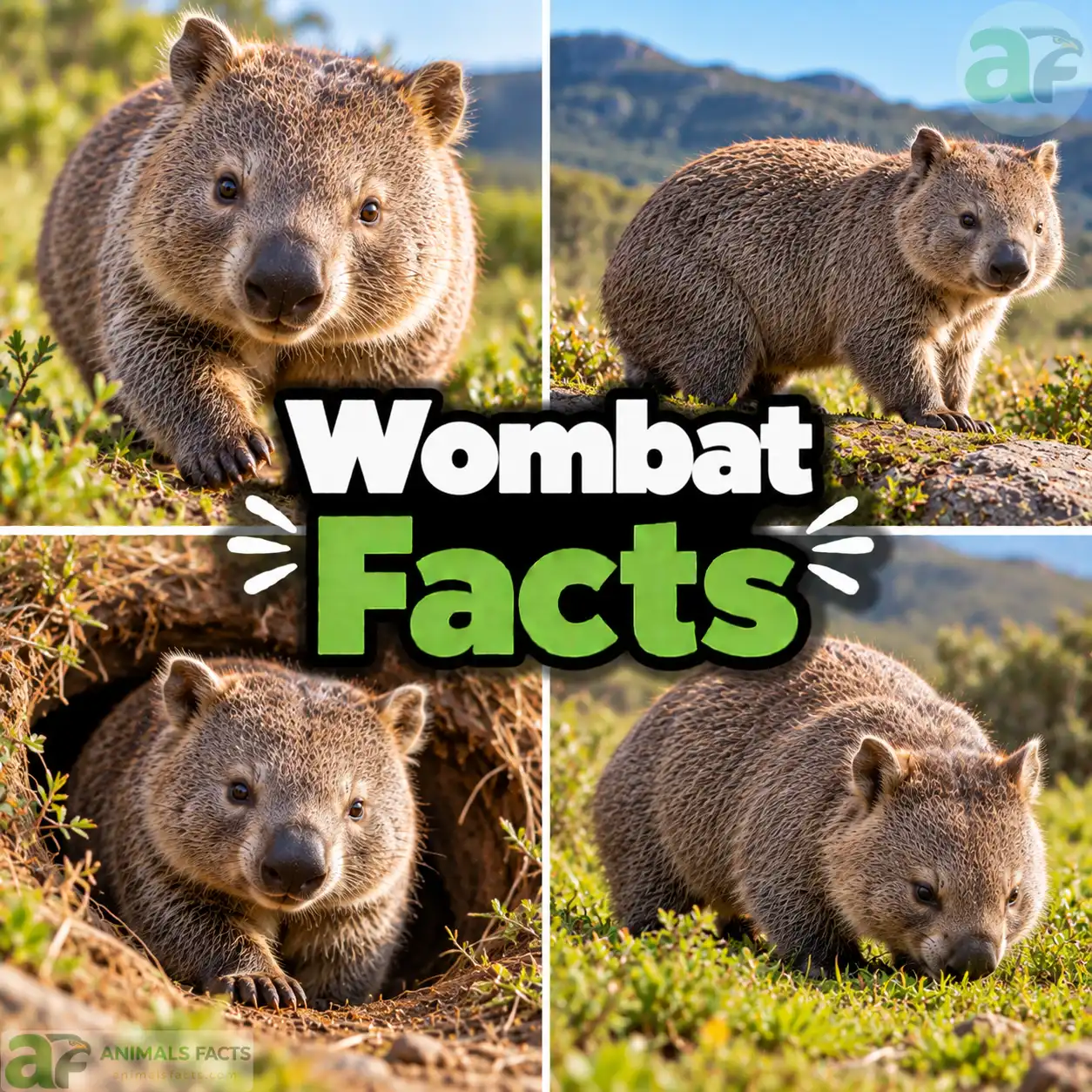
Wombat Facts
| Feature | Details |
|---|---|
| Scientific Name | Family Vombatidae; 3 species in 2 genera |
| Kingdom | Animalia |
| Phylum | Chordata |
| Class | Mammalia |
| Order | Diprotodontia |
| Family | Vombatidae (Gray, 1841) |
| Common Names | Wombat |
| Native Range | Australia (southeastern and southwestern mainland; Tasmania) |
| Habitat | Temperate forest, heathland, grassland, semi-arid scrubland |
| Lifespan | 15–26 years (wild); up to 34 years (captivity) |
| Diet | Grasses, sedges, roots, bark, shrubs — exclusively herbivorous |
| Body Length | 70–120 cm depending on species |
| Height | 30–45 cm at shoulder |
| Weight | 17–40 kg depending on species |
| Top Speed | Up to 40 km/h in short bursts |
| Conservation Status | Common wombat: Least Concern; Southern hairy-nosed: Least Concern; Northern hairy-nosed: Critically Endangered |
| Defining Feature | Cubic feces — the only animal on Earth known to produce cube-shaped droppings |
| Pouch Direction | Backward-facing pouch — unique among herbivorous marsupials |
 1. Introduction: What is a Wombat?
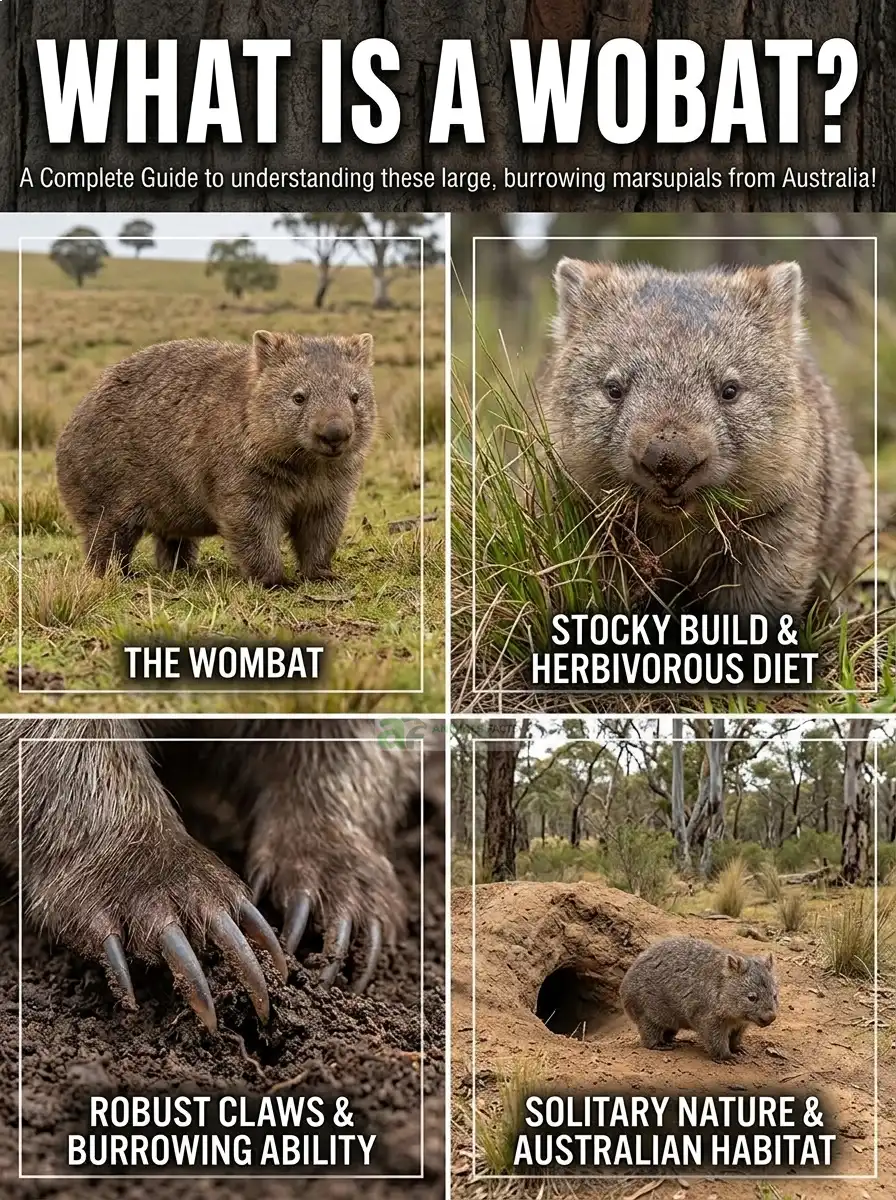
Australia is a continent of biological superlatives — home to some of the world’s most venomous snakes, most unusual egg-laying mammals, most iconic marsupials, and most extraordinary evolutionary experiments. And yet, in a continent full of astonishing animals, the wombat manages to stand apart as something genuinely unique. Wombat facts begin with the single most improbable biological truth about this animal — it is the only creature on Earth that produces cube-shaped feces. Not approximately cubic. Not sort of boxy. Geometrically, remarkably, scientifically confirmed cubic droppings — a fact so extraordinary that it earned researchers the 2019 Ig Nobel Prize for investigations into how and why this seemingly impossible digestive feat is achieved.
But the cubic poop — as remarkable as it is — is only the beginning. Interesting facts about wombats reveal an animal of extraordinary biological ingenuity: a stocky, powerful herbivore with a backward-facing pouch that keeps soil out of the joey’s face while the mother digs, a cartilaginous plate in the rump so dense it can withstand the bite force of a dingo when the wombat uses its famous “crush defense” in a burrow, claws powerful enough to excavate tunnel systems extending 30 meters underground, and a digestive system so efficient that it extracts more water and nutrients from food than almost any other herbivore of comparable size — allowing wombats to thrive in environments that would be nutritionally inadequate for most animals their size. One species — the northern hairy-nosed wombat — is among the most critically endangered large mammals on Earth, surviving in a single Queensland location with a population of fewer than 315 individuals. Another — the common wombat — is so abundant that some Australian farmers consider it a pest.
Whether you are searching for wombat facts for kids to explore the fascinating world of Australian marsupials, planning a wildlife trip to see wombats in their natural habitat, researching wombat habitat and ecology for academic purposes, or simply captivated by the improbable reality of a barrel-shaped marsupial that defecates perfect cubes and crushes predators against burrow walls — this is your comprehensive guide. We cover wombat scientific name, wombat diet, wombat size and weight, wombat behavior, the extraordinary biology of the three wombat species, conservation, cultural significance, and the profound ecological roles these remarkable animals play in Australian ecosystems. The cube-poop champion of the animal kingdom awaits.
2. Wombat Species Overview & Classification
Wombats belong to the family Vombatidae — one of Australia’s most distinctive marsupial families — containing three living species in two genera that represent the surviving members of a once far more diverse lineage of large Australian herbivores.
Species Classification Table
| Taxonomic Rank | Classification |
|---|---|
| Kingdom | Animalia |
| Phylum | Chordata |
| Class | Mammalia |
| Infraclass | Marsupialia |
| Order | Diprotodontia |
| Family | Vombatidae (Gray, 1841) |
| Number of Genera | 2 (Vombatus and Lasiorhinus) |
| Number of Living Species | 3 |
| Sister Group | Koalas (Phascolarctidae) — closest living relatives |
| Temporal Range | ~40 million years to present |
The Three Living Wombat Species
Common Wombat (Vombatus ursinus):
| Feature | Details |
|---|---|
| Scientific Name | Vombatus ursinus (Shaw, 1800) |
| Common Names | Common wombat, coarse-haired wombat, bare-nosed wombat |
| Weight | 22–35 kg |
| Body Length | 84–115 cm |
| Nose | Bare, leathery nose — key identification feature |
| Distribution | Southeastern Australia; Tasmania; Flinders Island |
| IUCN Status | Least Concern |
| Population | Hundreds of thousands |
Southern Hairy-Nosed Wombat (Lasiorhinus latifrons):
| Feature | Details |
|---|---|
| Scientific Name | Lasiorhinus latifrons (Owen, 1845) |
| Common Names | Southern hairy-nosed wombat |
| Weight | 19–32 kg |
| Body Length | 77–94 cm |
| Nose | Hairy nose — with dense fur covering the rhinarium |
| Distribution | Semi-arid southern Australia (South Australia, Western Australia) |
| IUCN Status | Least Concern |
| Population | ~100,000–200,000 |
Northern Hairy-Nosed Wombat (Lasiorhinus krefftii):
| Feature | Details |
|---|---|
| Scientific Name | Lasiorhinus krefftii (Owen, 1872) |
| Common Names | Northern hairy-nosed wombat, Queensland hairy-nosed wombat, yaminon |
| Weight | 25–40 kg — largest wombat species |
| Body Length | 96–112 cm |
| Nose | Hairy nose — same genus as southern |
| Distribution | Single location only — Epping Forest National Park, Queensland |
| IUCN Status | Critically Endangered |
| Population | Approximately 315 individuals (2024) |
Evolutionary Relationship with Koalas
One of the most surprising wombat facts for many people is the confirmation that wombats and koalas are closest living relatives — both belonging to the order Diprotodontia and sharing a common ancestor that lived approximately 40 million years ago. Despite the dramatic differences in their body form, lifestyle, and diet — the barrel-shaped burrowing wombat and the tree-climbing, eucalyptus-eating koala — molecular phylogenetics consistently confirms this sister group relationship.
Subspecies Comparison Table
The common wombat has three recognized subspecies:
| Subspecies | Range | Notes |
|---|---|---|
| V. u. ursinus | Flinders Island, Tasmania | Island populations; smallest |
| V. u. tasmaniensis | Tasmania (mainland) | Tasmanian mainland |
| V. u. hirsutus | Southeastern mainland Australia | Most widespread |
Wombats Evolution & Discovery Timeline
~40–50 million years ago — The ancestral wombat lineage diverges from the koala lineage during the Eocene epoch — beginning the evolutionary trajectory toward ground-dwelling, burrowing herbivory.
~5–10 million years ago — The family Vombatidae diversifies significantly during the Miocene — producing a fauna of wombat-like animals including the giant Diprotodon (Diprotodon optatum) — the largest marsupial ever to have lived, reaching 3 meters in length and approximately 2,700 kg in weight — essentially a wombat-relative the size of a rhinoceros.
~50,000 years ago — Diprotodon and most other giant marsupials (megafauna) go extinct — leaving the modern wombat species as the surviving members of a lineage that once included much larger forms. The exact causes of megafaunal extinction (human hunting, climate change, or a combination) remain debated.
1788 — British colonists at Sydney Cove encounter wombats — among the first descriptions of the animal entering Western scientific literature.
1800 — George Shaw formally describes the common wombat as Didelphis ursina — subsequently reclassified into the genus Vombatus.
1869 — The northern hairy-nosed wombat is formally described by Richard Owen from specimens — but the species’ extremely restricted range means it remains poorly known for most of the following century.
1982 — The northern hairy-nosed wombat population is reduced to approximately 30–35 individuals — one of the lowest population sizes ever recorded for a large mammal outside of complete extinction.
2005 — Population recovery of the northern hairy-nosed wombat reaches 130 individuals — reflecting successful conservation management at Epping Forest National Park.
2019 — Researchers at Georgia Institute of Technology receive the Ig Nobel Prize for Physics for their investigation of how wombats produce cube-shaped feces — using mathematical modeling, fluid dynamics, and analysis of wombat intestinal tissue to explain the mechanism.
2024 — Northern hairy-nosed wombat population reaches approximately 315 individuals — the highest recorded since monitoring began — representing one of Australia’s most significant wildlife conservation recovery stories.
“The wombat is one of the most underappreciated engineering marvels in the mammalian world — its burrow systems are among the most sophisticated structures built by any non-human animal, its digestive system achieves nutrient extraction efficiencies that rival laboratory processes, and its behavioral adaptations to the Australian environment are the product of tens of millions of years of remarkable evolutionary refinement.”
— Dr. Kath Handasyde, University of Melbourne, and leading wombat biologist
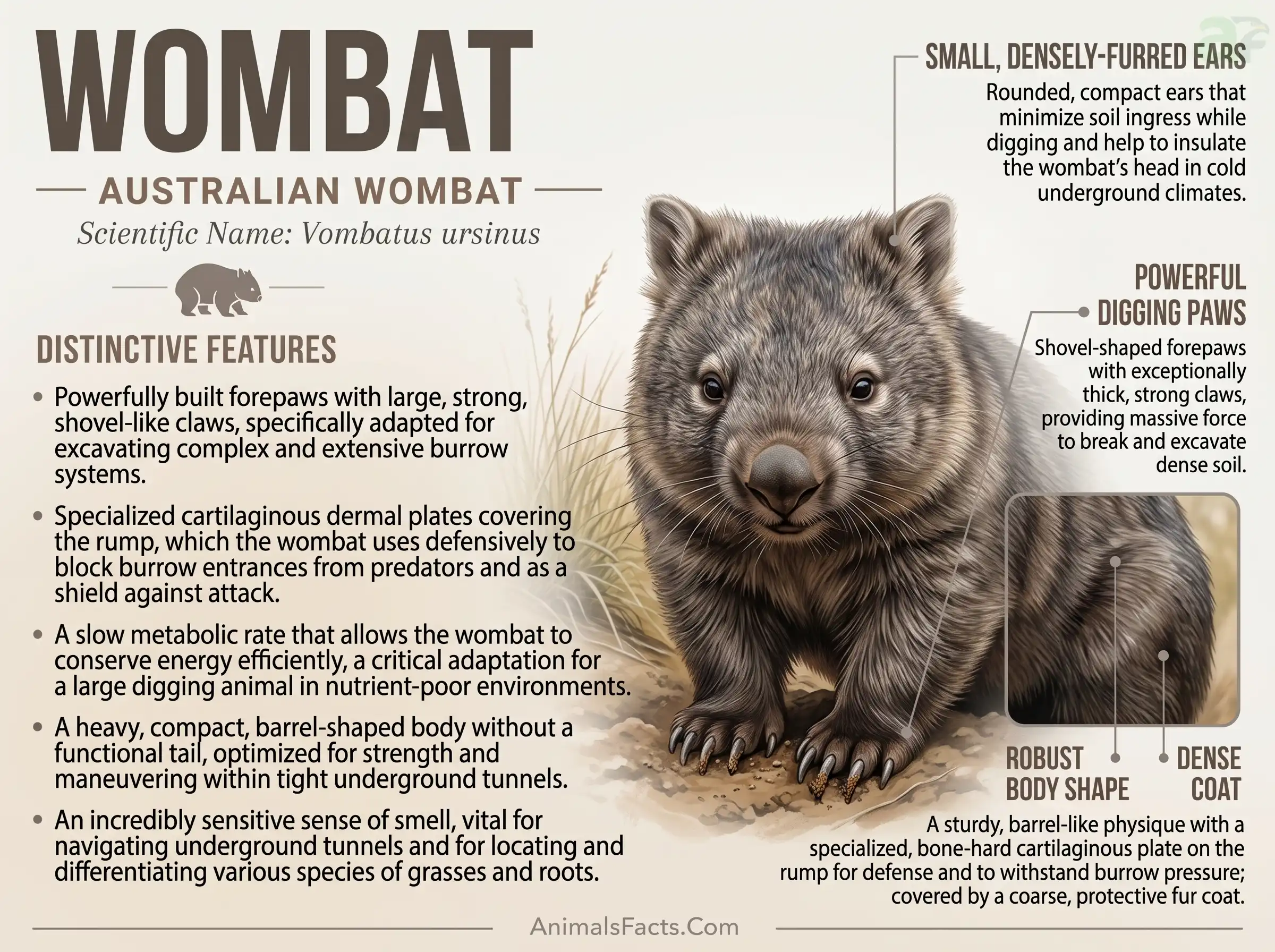
3. Wombat Physical Description & Unique Features
Wombat size and weight make them the largest burrowing herbivores on Earth — stocky, powerful animals whose body form reflects the specific demands of tunneling through hard Australian soil and defending those tunnels against predators.
Body Form — Built for Burrowing
The wombat’s body is immediately and distinctively recognizable — a compact, barrel-shaped form with short, powerful legs, a broad flat head, and almost no visible neck — giving the animal a silhouette that resembles a furry, animate boulder more than any conventional mammal:
Barrel-shaped torso — The wombat’s body is extraordinarily wide and deep relative to its height — providing maximum internal volume for the large digestive system required to process tough, low-quality vegetation while minimizing the overall profile that must be pushed through a burrow tunnel.
Short, powerful legs — All four legs are short relative to body mass — ending in broad, strong feet equipped with five toes bearing powerful, flattened claws on the forefeet and four toes on the hindfeet. These claws are the primary excavation tools for burrow construction — capable of moving significant quantities of compacted soil in short periods.
Broad, flat head — The wombat’s head is broad and flat with a wide muzzle — creating a wedge shape that helps push through soil during tunnel excavation. The ears are small and rounded — set on the top and sides of the wide skull.
Vestigial tail — Wombats have a very short, stubby tail — essentially vestigial — that does not interfere with movement through burrow tunnels.
The Rump — Nature’s Shield
The wombat’s rump is one of its most functionally extraordinary physical features — containing a cartilaginous plate embedded in the thick skin of the hindquarters that creates a structure of remarkable toughness. This bony-cartilaginous shield serves as the primary defense mechanism when a wombat retreats into a burrow — the animal blocks the tunnel entrance with its armored rump, which can withstand the bite force of dingoes and quolls attempting to drag the wombat out.
The skin of the rump is also extremely thick — 2–3 cm of dense, tough tissue — providing additional protection beyond the cartilaginous plate. The combination creates what may be the most impressive passive defensive structure of any marsupial.
The Backward-Facing Pouch
The wombat’s pouch opens backward and downward — toward the hind legs rather than toward the head as in kangaroos. This backward orientation is a direct adaptation to the burrowing lifestyle — when the mother excavates tunnels, the pouch opening faces away from the soil being displaced, preventing dirt from entering the pouch and suffocating the joey inside.
Nose Differences Between Species
The most immediately reliable field identification feature distinguishing wombat species is the nose:
- Common wombat — Bare, smooth, leathery nose with a hard rhinarium and no hair coverage
- Southern hairy-nosed wombat — Hairy nose with soft fur covering the rhinarium and a distinctive silky texture
- Northern hairy-nosed wombat — Hairy nose similar to the southern species but with larger body size and broader muzzle
Fur & Coloration
Wombat fur is coarse, dense, and waterproof — ranging from grey-brown to black in the common wombat and pale sandy-grey to brownish-grey in the hairy-nosed species. The fur provides effective insulation against the cold nights of southeastern Australian highland habitats and adequate thermal protection across the environmental range of all three species.
💡 Did You Know? The wombat’s claws are among the most powerful relative to body size of any Australian mammal — capable of moving 3 cubic meters of soil in a single night of digging. A single wombat’s lifetime excavation activity may displace hundreds of cubic meters of soil — making wombats among the most significant ecological engineers in Australian terrestrial ecosystems and their burrow systems among the most important microhabitat features in southeastern Australian landscapes.
4. Top 25 Amazing Wombat Facts
Here is your definitive collection of the most extraordinary, scientifically verified, and genuinely astonishing wombat facts as of 2026:
- Wombats are the only animals on Earth that produce cube-shaped feces — a fact so biologically improbable that it earned the researchers who explained the mechanism the 2019 Ig Nobel Prize for Physics.
- The cubic shape of wombat droppings is produced not by a cubic anus (which would be structurally impossible) but by variable elasticity in the final section of the intestine — sections of intestinal wall with different stretch properties create grooves and flat faces in the fecal matter as it passes through, producing the cubic shape.
- Wombats produce approximately 80–100 cubic fecal pellets per night — depositing them on prominent rocks, logs, and elevated surfaces to mark territory. The cubic shape prevents the pellets from rolling away from marking sites — a functional advantage that may explain why the unusual shape was evolutionarily selected.
- The northern hairy-nosed wombat — with approximately 315 individuals as of 2024 — is one of the rarest large mammals on Earth — rarer than giant pandas and surviving in a single national park in Queensland.
- Wombats have the slowest digestive system of any marsupial — food takes 14–18 days to pass through the wombat’s digestive system, compared to approximately 12 hours in a cow. This extraordinarily slow digestion allows maximum nutrient and water extraction from low-quality food.
- A wombat’s rump contains a cartilaginous shield — essentially a built-in armor plate in the hindquarters — that the animal uses to block burrow entrances and crush predators against the tunnel ceiling when pursued underground.
- Wombat burrow systems can extend up to 30 meters in length and reach depths of 3.5 meters — creating underground structures of extraordinary complexity that provide refuge for dozens of other animal species.
- Wombats can run at speeds of up to 40 km/h in short bursts — a speed comparable to a Thoroughbred racehorse’s canter and dramatically faster than their barrel-shaped appearance would suggest.
- Wombats are the largest burrowing herbivores on Earth — no other herbivore of comparable body weight constructs and inhabits complex underground burrow systems.
- The wombat’s closest living relative is the koala — a finding that surprises most people given the dramatic differences in lifestyle, body form, and diet between Australia’s barrel-shaped burrower and its tree-climbing, eucalyptus-eating cousin.
- Wombat burrows provide critical refuge for dozens of Australian wildlife species during bushfires — the underground tunnels maintain temperatures far below the fire line, and multiple species including snakes, lizards, rabbits, and small mammals shelter in wombat burrows during fires.
- The digestive efficiency of wombats is among the highest of any herbivore — they extract approximately 10% more water from food than kangaroos and can survive on food sources of such low nutritional quality that most other herbivores would starve.
- Wombats are functionally blind in bright light — their eyes are adapted for the low-light conditions of twilight and nighttime activity, and in full daylight their vision is extremely limited.
- A wombat’s teeth grow continuously throughout its life — like rodent teeth — because the tough, gritty, silica-rich grasses and roots they consume would otherwise wear down the teeth to uselessness within years.
- The northern hairy-nosed wombat was reduced to approximately 30–35 individuals in 1982 — one of the lowest population levels ever recorded for any large mammal — before conservation interventions enabled the remarkable recovery to 315 individuals documented in 2024.
- Wombat burrows are used by multiple generations — with the same burrow system sometimes being maintained and inhabited continuously for decades, growing more complex as successive generations extend the tunnel network.
- Wombats have backward-facing pouches — the only major herbivorous marsupials to do so — an adaptation that prevents soil from entering the pouch and suffocating joeys during the mother’s burrowing activities.
- A female wombat’s joey spends approximately 6–10 months in the pouch after birth — being born at a weight of approximately 1 gram (roughly the size of a jellybean) and developing within the pouch to a size of approximately 500 grams before first emerging.
- Wombats are among the longest-lived of any marsupial — documented to live up to 34 years in captivity and potentially over 26 years in the wild — a remarkable lifespan for a mammal of their body size.
- The common wombat is considered a pest species by some Australian farmers — its burrow systems can undermine fence posts, damage irrigation infrastructure, and compete with livestock for pasture — creating a genuine human-wildlife conflict dimension to the species’ conservation story.
- Wombats use a hip-check defense — when cornered outside a burrow, they can forcefully swing their armored rump into a predator or human with considerable impact force, using the same motion that would crush a predator against a burrow wall.
- Research has documented wombat burrows providing thermal buffering for their inhabitants — maintaining temperatures within the tunnel between 17–23°C even when external temperatures range from below zero to above 40°C — a thermoregulatory benefit that dramatically reduces energy expenditure.
- Wombat joeys remain with their mothers for approximately 18 months after leaving the pouch — an unusually long period of maternal dependency for a marsupial — learning foraging routes, burrow locations, and social landscapes from direct accompaniment of the mother.
- The southern hairy-nosed wombat can enter a state of torpor during food scarcity — dramatically reducing metabolic rate and body temperature to conserve energy in the semi-arid environments it inhabits.
- Genetic analysis has confirmed that wombats are the marsupial family most closely related to the extinct megafauna including Diprotodon (Diprotodon optatum) — the car-sized marsupial that roamed Australia until approximately 46,000 years ago — making wombats the living representatives of a lineage that once produced the largest marsupials that ever existed.
5. Fun Facts About Wombats
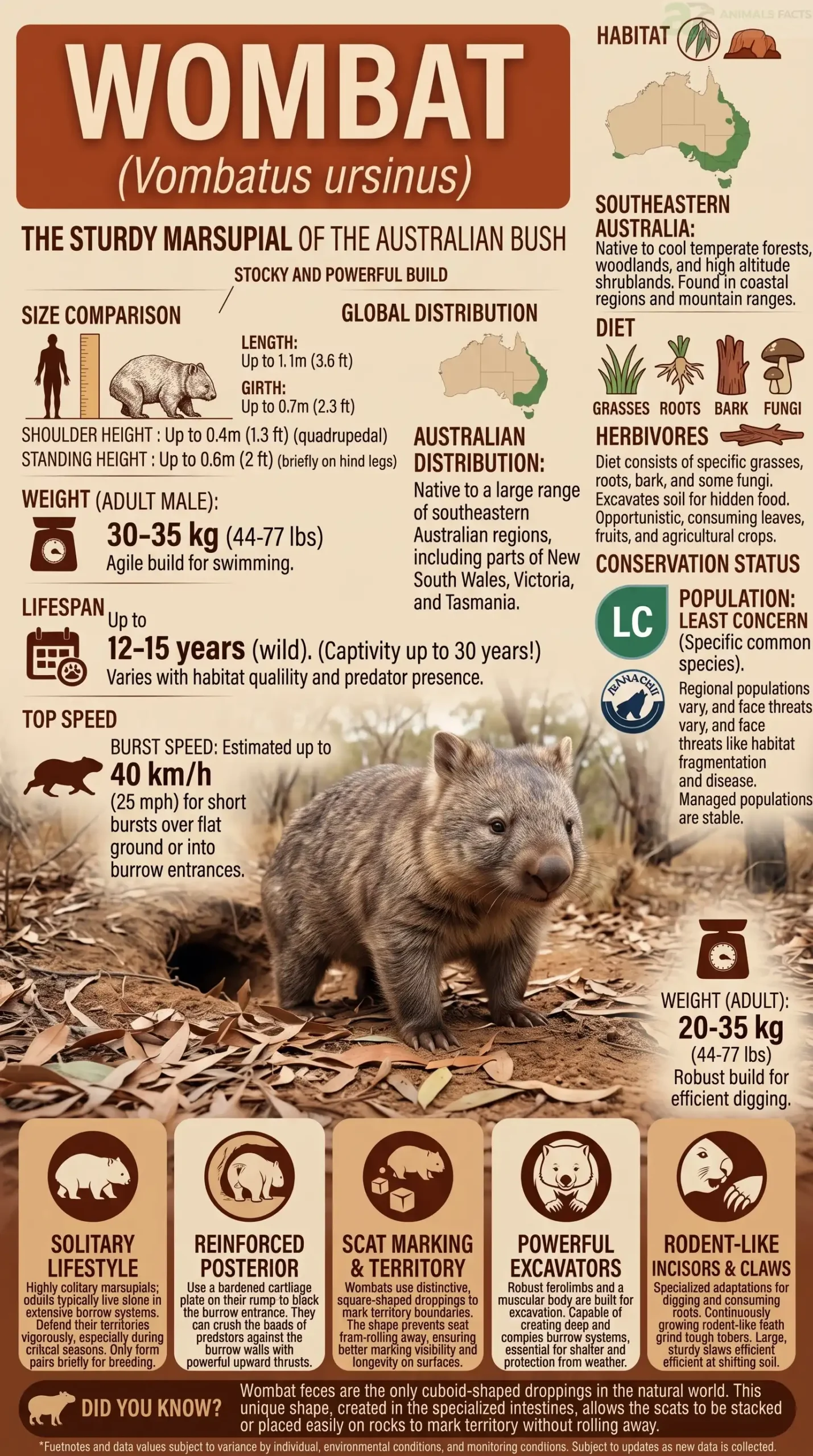
- Wombats are the only animal on Earth to produce cube-shaped poop
- Their closest relative is the koala — despite looking completely different
- They can run at 40 km/h — as fast as a galloping horse
- Wombats have an armored rump to crush predators in their burrows
- Their burrows can be 30 meters long and 3.5 meters deep
- The northern hairy-nosed wombat has only 315 individuals left
- Food takes 14–18 days to pass through a wombat’s gut
- Wombats are born weighing just 1 gram — about the size of a jellybean
- Their teeth grow continuously like rodent teeth
- Wombat burrows save other animals from bushfires
- Wombats can live for 34 years in captivity
- Wombats have backward-facing pouches to keep dirt away from joeys
6. Wombat Habitat & Geographic Range
Wombat habitat varies considerably between the three species — from the temperate forests and alpine meadows of southeastern Australia to the semi-arid scrublands of the southern interior and the single Queensland location where the northern hairy-nosed wombat clings to survival.
Habitat Requirements
All wombat species share fundamental habitat requirements:
Suitable burrowing substrate — Soil that is deep enough, stable enough, and soft enough to permit the construction of extensive burrow systems. Rocky ground or very shallow soils preclude wombat habitation even in areas with suitable vegetation.
Adequate food plants — Sufficient grasses, sedges, and roots to support the wombat’s substantial caloric needs — typically requiring home ranges large enough to encompass multiple foraging areas that can be used rotationally.
Sufficient cover — Vegetation or terrain features providing shelter from predators when wombats are active above ground at night.
Suitable temperature regime — While wombats are remarkably thermally buffered by their burrow systems, extremely high ambient temperatures can stress animals particularly in the southern hairy-nosed species’ semi-arid range.
Habitat by Species
Common Wombat Habitat:
- Temperate eucalyptus forest — The primary habitat; open forest with grass understorey
- Alpine and subalpine grassland — Up to approximately 1,800 meters elevation; important in the ACT, NSW highlands, and Victoria
- Coastal heathland — Significant habitat in parts of the range
- Agricultural margins — Increasingly important as native habitat is cleared
Southern Hairy-Nosed Wombat Habitat:
- Chenopod shrubland — Semi-arid open shrubland dominated by saltbush and bluebush
- Mallee scrub — Low eucalyptus scrubland with hard, calcareous soils
- Semi-arid grassland — Open grass communities in the Nullarbor Plain and adjacent areas
Northern Hairy-Nosed Wombat Habitat:
- Single location only — Epping Forest National Park, central Queensland
- Brigalow/Gidgee scrub — Semi-arid woodland on black soil plains
- Annual and perennial grass communities — The primary food source within the reserve
Geographic Range by Species
| Species | States/Territories | Notes |
|---|---|---|
| Common wombat | NSW, VIC, ACT, SA, TAS | Broadest range; most abundant |
| Southern hairy-nosed | SA, WA, southern NSW | Semi-arid range; Nullarbor region |
| Northern hairy-nosed | QLD only | Single 3,000 ha protected area |
💡 Did You Know? The northern hairy-nosed wombat now survives in a protected area of only 3,000 hectares — approximately the size of 4,200 football fields — making it one of the most range-restricted large mammals on Earth. The entire global wild population of this species lives within this single Queensland national park, making it extraordinarily vulnerable to any localized catastrophe — disease, fire, drought, or human disturbance — that could affect the entire population simultaneously. A second population has been established at Richard Underwood Nature Refuge in Queensland as an insurance population, providing some degree of protection against single-site catastrophe.
7. Wombat Diet & Feeding Behavior
Wombat diet is entirely herbivorous — and the specific feeding ecology of wombats reflects their status as some of the most efficient plant-matter processors in the marsupial world.
Diet Breakdown Table
| Food Type | Estimated % of Diet | Notes |
|---|---|---|
| Native grasses | ~50–70% | Primary food source across all species |
| Sedges and rushes | ~10–20% | Important in wetter habitats |
| Roots and rhizomes | ~10–15% | Excavated with claws; important in dry seasons |
| Bark and woody material | ~3–5% | Occasional; particularly in common wombat |
| Herbs and forbs | ~3–5% | Supplementary; nutritional variety |
| Fungi | ~1–3% | Opportunistic consumption documented |
| Soil | Trace | Incidental ingestion during root excavation; may provide minerals |
The Extraordinary Digestive System
The wombat digestive system is one of the most remarkable in the mammalian world — producing the cubic feces while achieving nutrient extraction efficiencies that allow survival on food of genuinely low quality:
Slow passage rate — The 14–18 day transit time of food through the wombat’s gut is extraordinarily long — allowing maximum fermentation by gut microbes and maximum extraction of both nutrients and water from each mouthful of food.
Hindgut fermentation — Like horses and rhinoceroses, wombats are hindgut fermenters — with a large cecum and proximal colon where microbial fermentation of cellulose occurs. This fermentation produces volatile fatty acids that are the primary energy source for wombats.
Water extraction — The wombat’s large intestine extracts water with extraordinary efficiency — reducing fecal water content to very low levels and allowing survival in environments where free water is scarce or unavailable for extended periods.
Continuously growing teeth — The wombat’s hypselodont teeth (continuously growing) allow lifetime consumption of the highly abrasive, silica-rich native Australian grasses that would wear standard teeth to uselessness within years.
The Cubic Feces — Explained
The cubic shape of wombat droppings was confirmed through detailed research by Patricia Yang and colleagues at Georgia Tech — research that earned the 2019 Ig Nobel Prize. The mechanism involves:
- The final 8% of the wombat’s intestine (the distal colon) has non-uniform elastic properties — with sections that are stiffer and sections that are more flexible alternating around the intestine’s circumference
- As fecal material is pushed through this section, the stiff sections create flat faces and the flexible sections create grooves
- The combination of alternating stiff and flexible sections around the circumference of a tube produces four flat faces separated by four slight grooves — the geometry of a cube
- The process is repeated as material moves through approximately 10–12 groove-and-flat sections in this portion of the intestine, progressively shaping each pellet into the final cubic form
This is the only known mechanism by which a biological tube produces cubic cross-section objects — and it may have implications for manufacturing processes seeking to produce cube-shaped products without cutting.
8. Wombat Reproduction & Life Cycle
Wombat reproduction is characterized by the slow, energy-conservative strategy typical of large marsupials in resource-limited environments — producing single offspring at long intervals and investing heavily in each joey’s development.
Mating Behavior
Wombats are predominantly solitary and most social interaction occurs during the breeding season. Male wombats pursue females with considerable persistence during mating — following them repeatedly around their territory in circling pursuit behavior that can last hours. This pursuit has been described as comically determined — the stocky male following the stocky female in tight circles with neither animal moving particularly fast but both demonstrating remarkable endurance.
Vocalizations during courtship include clicks, hisses, and low grunting sounds — a limited repertoire reflecting the generally quiet nature of the species.
Breeding season — The common wombat breeds primarily from April to June (southern hemisphere autumn-winter); the southern hairy-nosed wombat breeds in spring (September–November); the northern hairy-nosed wombat breeds with low seasonality but with peak births from November to March.
Birth & Pouch Development
- Gestation period: approximately 21–30 days — very short, as typical of marsupials
- Litter size: 1 joey — wombats virtually never produce twins
- Birth weight: approximately 1–2 grams — among the most altricial mammal newborns
- Pouch period: 6–10 months — joey develops from jellybean-sized newborn to approximately 500–700 grams before first pouch emergence
The newborn wombat — born in an essentially embryonic state — uses its forelimbs to crawl from the birth canal to the backward-facing pouch, where it attaches to one of two available teats and begins the long process of pouch development.
Post-Pouch Development
After first emerging from the pouch at 6–10 months, the joey:
- Continues to use the pouch for sleep and refuge for another 2–3 months
- Gradually transitions to solid food while still nursing
- Remains associated with the mother for approximately 18 months total after birth
- Achieves sexual maturity at approximately 18–24 months in females; 24–36 months in males
Lifespan Comparison Table
| Species | Average Lifespan (Wild) | Max Documented | Notes |
|---|---|---|---|
| Common wombat (V. ursinus) | 15–20 years | ~26 years (wild) | Longest-documented wild lifespan |
| Southern hairy-nosed wombat | 15–25 years | Up to 34 years (captivity) | Longest captive lifespan |
| Northern hairy-nosed wombat | 15–20 years (estimated) | Unknown | Population too small for good data |
| Koala (Phascolarctos cinereus) | 13–18 years | ~25 years (captivity) | Closest relative |
| Eastern grey kangaroo (Macropus giganteus) | 12–18 years | ~27 years (captivity) | Comparable marsupial |
9. Social Behavior & Communication
Wombat social behavior is among the most understudied aspects of the species’ ecology — these primarily solitary, nocturnal, burrowing animals are difficult to observe directly, and most behavioral data comes from opportunistic field observations, camera traps, and captive studies.
Solitary Living with Complex Social Landscapes
Wombats are predominantly solitary — adults maintain individual home ranges and typically avoid direct contact with conspecifics outside of the breeding season and mother-joey associations. However, the social landscape of wombats is considerably more complex than simple solitude suggests:
Overlapping burrow use — Multiple wombats frequently share and use the same burrow system at different times — with camera trap studies documenting sequential use of the same burrows by multiple individuals across single nights. This time-sharing of burrow resources suggests a passive social tolerance more complex than strict territorial exclusion.
Home range overlaps — Particularly in the common wombat, home ranges of adjacent individuals overlap substantially — with ranges of 10–25 hectares in good habitat overlapping with multiple neighboring individuals.
Scent marking — Wombats maintain a scent-marking landscape through the deposition of cubic feces on prominent features, urine marking, and secretions from facial glands. These chemical marks communicate individual identity, reproductive status, and territorial occupancy to other wombats navigating the same landscape.
Communication
Cubic feces as communication — The territorial marking function of cubic feces is one of the most discussed aspects of wombat behavior. By depositing their distinctively shaped droppings on elevated surfaces including rocks, logs, and fallen branches — where they are maximally visible and maximally unlikely to roll away — wombats create a persistent chemical communication network across their home ranges. The cubic shape that prevents rolling may therefore be understood as an adaptation specifically for this marking function.
Vocalizations — Wombats are generally quiet animals — producing:
- Low grunts and growls during social encounters and defensive situations
- Hissing when threatened
- Clicking vocalizations during courtship
- Screeching when in severe distress
Physical communication — Direct physical communication between wombats includes nose-to-nose contact during social investigation, chest-rubbing (depositing scent from sternal glands), and the pursuit behavior of courtship.
Intelligence
Wombats demonstrate spatial memory of exceptional precision — navigating complex burrow systems in complete darkness, accurately returning to specific burrows from distances of several kilometers, and learning and remembering the locations of productive foraging patches across their home ranges over multiple years. Captive wombats have shown the capacity for associative learning — responding to specific stimuli with learned behavioral sequences — at a level broadly comparable to other marsupials of similar brain size.
10. Predators & Defense Mechanisms
The wombat’s defense system is one of the most unusual and most effective of any Australian mammal — combining physical armor, specialized behavior, and exploitation of the burrow environment into a defensive strategy of genuine ingenuity.
Natural Predators
- Dingo (Canis lupus dingo) — The primary large predator of adult wombats across the mainland; significant mortality agent particularly for juveniles and sub-adults
- Spotted-tailed quoll (Dasyurus maculatus) — The largest marsupial carnivore; capable of taking juvenile wombats
- Wedge-tailed eagle (Aquila audax) — Australia’s largest raptor; documented taking juvenile wombats
- Introduced predators — Red foxes (Vulpes vulpes) and feral dogs — significant threats, particularly to juvenile wombats
- Humans — Vehicle strikes are a major mortality source; deliberate killing by some farmers
- Historically — The Tasmanian devil (Sarcophilus harrisii) was a significant wombat predator in Tasmania; still preys on sick or injured wombats where both species coexist
The Crush Defense — Nature’s Most Unusual Defense Mechanism
The wombat’s most distinctive and remarkable defense mechanism is the crush defense — performed exclusively within burrow systems:
- When a predator enters a wombat burrow to pursue the fleeing animal, the wombat retreats to a widened section of the tunnel — a defensive chamber
- The wombat turns to face the burrow wall — presenting its armored rump to the entrance
- The predator attempting to reach the wombat must pass between the wombat’s rump and the tunnel ceiling
- The wombat uses powerful leg muscles to drive its rump upward — crushing the predator’s skull between the cartilaginous rump plate and the solid tunnel ceiling
This defense has been directly observed killing foxes, dogs, and other predators that entered wombat burrows in pursuit. It has also been documented fatally trapping dingoes that became stuck between the wombat’s rump and the tunnel ceiling — a defense mechanism so effective that it has been described as one of the most powerful passive defenses of any marsupial.
Wombat rump-crush incidents involving humans — Several documented cases exist of wombats using the rump-crush defense against humans who reached into burrows — typically resulting in broken fingers or wrist injuries from the extraordinary force applied.
Speed as Defense
Despite their apparent awkwardness, wombats can achieve 40 km/h in short bursts — sufficient to reach burrow entrances before most pursuing predators can close the distance in open terrain. Their acceleration from standing to full speed is also remarkable — the powerful legs propelling the compact body to running speed almost instantaneously.
💡 Did You Know? During the 2019–2020 Australian bushfires — the catastrophic fire season that burned approximately 18 million hectares and killed or displaced an estimated 3 billion animals — wombat burrows became emergency refuges for dozens of other species. Camera trap footage and field observations documented wombats, wallabies, echidnas, reptiles, and small mammals sharing wombat burrows simultaneously during the fires — an extraordinary cross-species cooperation under extreme environmental pressure. The fires confirmed what ecologists had suspected: wombat burrows are not merely wombat homes but critical infrastructure for the broader Australian terrestrial wildlife community.
11. Wombat Facts for Kids
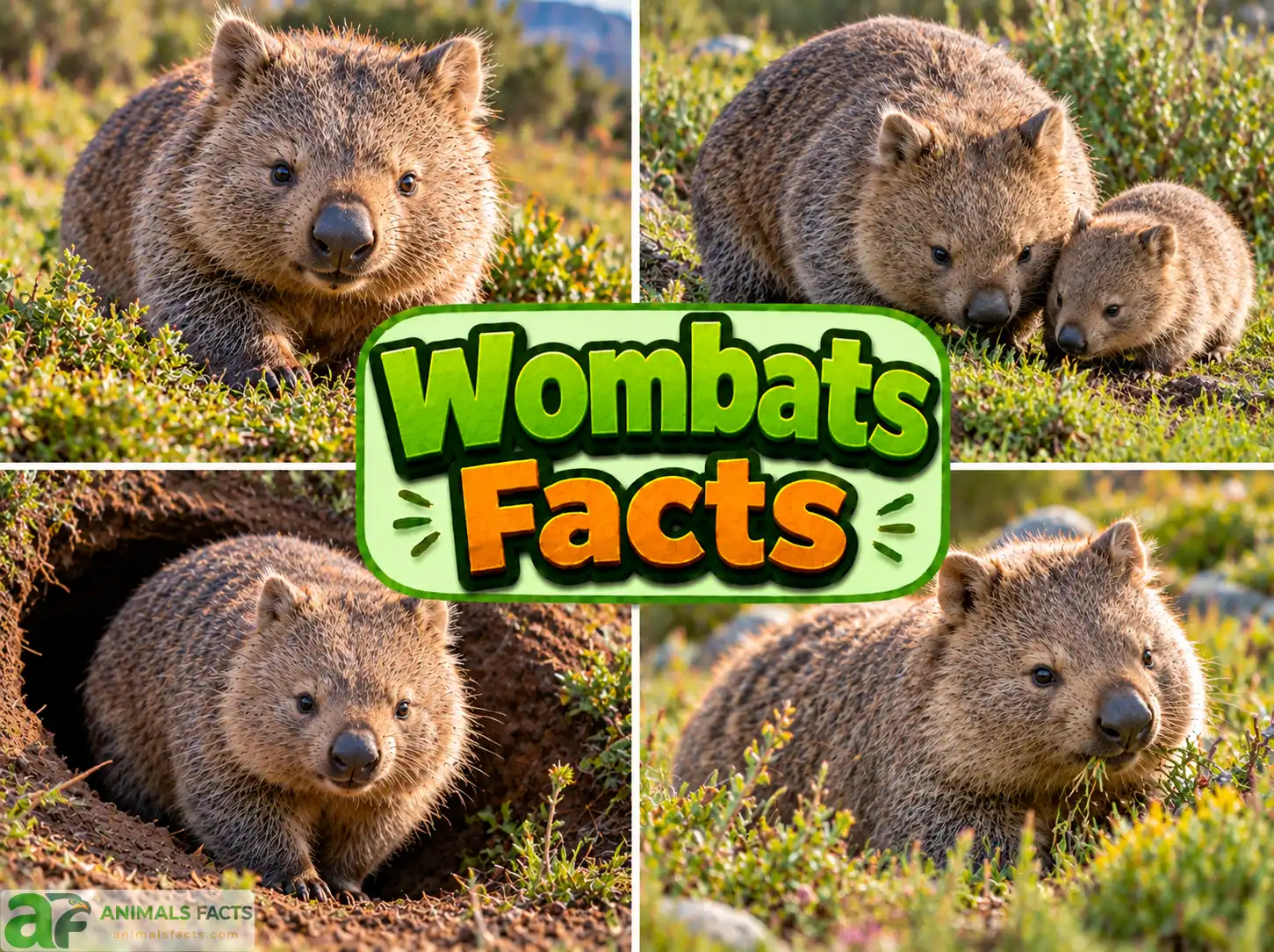
Hey amazing young wildlife explorers and future Australian wildlife experts! Here are some absolutely incredible wombat facts for kids that will make everyone around you stare in disbelief:
- 🐨 Wombats poop in CUBES! This is real, this is true, and this earned scientists an actual Nobel-style prize for figuring out how it works. Wombats are the ONLY animals on Earth that produce square-shaped droppings. They use them to mark their territory — and because they are cube-shaped, they don’t roll away!
- 🐨 They are related to KOALAS! Even though a wombat looks nothing like a koala — one is a barrel-shaped burrowing animal and the other is a fluffy tree-climber — they are actually closest relatives in the marsupial world. Nature makes the strangest friends!
- 🐨 Wombat babies are born the size of a JELLYBEAN! A newborn wombat weighs about 1 gram — less than a paperclip. It has to crawl from the birth canal all the way to its mother’s pouch and attach to a teat. Then it spends months inside the pouch growing bigger!
- 🐨 Their pouch opens BACKWARD! Unlike kangaroo pouches that open upward, wombat pouches open downward and backward — so when mum is digging her burrow, dirt cannot fall into the pouch and hurt the baby inside!
- 🐨 Wombats have a built-in SHIELD in their bottom! The skin on a wombat’s rump contains a plate of tough cartilage — like armour — that it uses to block the entrance to its burrow. If a predator tries to follow it in, the wombat can crush it against the tunnel ceiling. Nature’s own door stopper!
- 🐨 Wombats can run as fast as a HORSE canters! Despite looking like a furry potato, wombats can sprint at 40 km/h — fast enough to outrun most predators over short distances. Do not challenge a wombat to a race!
- 🐨 Their burrows SAVE other animals during bushfires! When Australia’s terrible bushfires happen, many animals escape the flames by hiding in wombat burrows — which stay much cooler underground than the surface. Wombats are accidental heroes of the Australian bushfire season!
- 🐨 Only 315 northern hairy-nosed wombats exist in the WHOLE WORLD! These are the rarest wombats and they all live in one single national park in Queensland. There are fewer of them than there are people in your school!
12. Relationship with Humans
The relationship between wombats and humans in Australia encompasses a complex history of Indigenous coexistence, European colonial disruption, contemporary human-wildlife conflict, passionate conservation advocacy, and the unique cultural status that has made the wombat one of Australia’s most beloved wildlife symbols.
Indigenous Australian Relationships
Wombats have coexisted with Aboriginal and Torres Strait Islander peoples for at least 50,000–65,000 years — throughout the entire period of human presence in Australia. Indigenous Australians hunted wombats as a significant food source — the large body size, burrowing habit (making animals predictably locatable), and excellent-quality meat making wombats one of the most important large prey animals in southeastern Australia.
Traditional ecological knowledge of wombats — including detailed understanding of burrow system locations, seasonal behavioral patterns, and habitat associations — accumulated over thousands of years represents some of the most comprehensive wildlife knowledge ever developed by any human culture. Many Aboriginal language groups have specific names for wombats — reflecting the cultural importance of the animal in local ecological frameworks.
The northern hairy-nosed wombat is known as the “yaminon” in some Aboriginal traditions — a name that has been adopted into the formal conservation literature as an alternative common name for the species, reflecting contemporary recognition of Indigenous nomenclature.
European Colonial Impact
The arrival of European settlers in 1788 initiated a series of pressures on wombat populations that drastically altered the human-wombat relationship:
Habitat clearance — Agricultural expansion across southeastern Australia destroyed enormous areas of wombat habitat — the single most significant historical impact on wombat populations.
Direct persecution — Wombats were extensively killed by European settlers and farmers who regarded their burrow systems as hazards (livestock breaking legs in burrow entrances), competitors with sheep and cattle for pasture, and nuisances. Bounty programs in some Australian states paid for wombat ears or scalps — resulting in hundreds of thousands of animals being killed during the 19th and early 20th centuries.
Introduced predators — The introduction of red foxes and feral dogs created new predation pressure on wombats — particularly devastating for juveniles that had not previously faced such efficient mammalian predators.
Disease — Mange (Sarcoptes scabiei) — introduced to Australia’s wildlife community through contact with introduced animals — has caused devastating population impacts on common wombats in many areas, with affected animals suffering a slow, distressing decline and death that has prompted significant animal welfare concern.
Contemporary Relationship
Today the human-wombat relationship is characterized by multiple simultaneous dynamics:
Conservation advocacy — Wombats — particularly the critically endangered northern hairy-nosed wombat — inspire genuine, passionate conservation advocacy from Australian and international communities.
Human-wildlife conflict — The common wombat remains subject to legal lethal control in some Australian states — primarily New South Wales — where landholders can obtain permits to kill wombats damaging fences or infrastructure. This conflict between farmers and conservationists about wombat management represents one of the most contentious wildlife management debates in contemporary Australian environmental policy.
Wildlife rescue and rehabilitation — Wombat rescue, particularly of joeys orphaned by vehicle strikes, is one of the most active areas of Australian wildlife rehabilitation — with dedicated wombat rescue organizations operating across the country.
Mange treatment programs — Volunteer-led programs treating wombats with sarcoptic mange — using medicated flaps placed over burrow entrances that dose animals as they exit — represent one of the most innovative community wildlife welfare programs in Australia.
13. Wombat Conservation Status & Threats
Wombat conservation presents a study in contrasts — with one species so abundant it is considered a pest in some areas, and another so rare it represents one of the most critical large mammal conservation challenges in Australia.
Conservation Status Overview
| Species | IUCN Status | Australian Status | Population |
|---|---|---|---|
| Common wombat | Least Concern | Not listed | Hundreds of thousands |
| Southern hairy-nosed wombat | Least Concern | Not listed | ~100,000–200,000 |
| Northern hairy-nosed wombat | Critically Endangered | Critically Endangered | ~315 individuals |
Major Threats
| Threat | Species Affected | Impact Level |
|---|---|---|
| Habitat loss (agriculture, development) | All species | High — primary historical threat |
| Sarcoptic mange | Common wombat primarily | High — significant mortality |
| Vehicle strikes | All species | High — major mortality cause near roads |
| Drought and climate change | Northern and southern hairy-nosed | High and increasing |
| Predation (fox, feral dog) | All species; juveniles most vulnerable | Medium-High |
| Legal lethal control | Common wombat | Medium — contested management tool |
| Disease | Northern hairy-nosed most vulnerable | Critical — single population at risk |
| Wildfire | All species | Medium — burrows provide some protection |
| Poaching | Northern hairy-nosed | Low but catastrophic if it occurs |
The Northern Hairy-Nosed Wombat Recovery Story
The northern hairy-nosed wombat conservation story is one of Australia’s most remarkable wildlife recoveries — and one of its most precarious ongoing conservation situations:
1982 — Population estimated at 30–35 individuals — functionally at extinction threshold
1985 — Epping Forest National Park formally gazetted to protect the sole remaining population
1990s — Predator-proof fence constructed around core wombat habitat — dramatically reducing dingo and feral predator pressure
2000 — Population reaches approximately 100 individuals
2009 — Second insurance population established at Richard Underwood Nature Refuge (10 individuals transferred)
2016 — Global population reaches 240 individuals
2024 — Population documented at approximately 315 individuals — highest ever recorded
Despite this recovery, the northern hairy-nosed wombat remains extraordinarily vulnerable — a single severe drought, disease outbreak, or wildfire could devastate the entire global population. The establishment of additional insurance populations is the highest conservation priority for the species.
14. Famous Wombats in History & Pop Culture
Famous Named Wombat Individuals
“Fatima” — A female northern hairy-nosed wombat at Epping Forest National Park who became one of the most camera-trap-documented individuals in the conservation program — her reproductive success over multiple breeding seasons providing crucial data for understanding the species’ reproductive biology and population growth potential.
“Patrick” — A male common wombat at Ballarat Wildlife Park in Victoria, Australia, who became famous as the “world’s oldest wombat” — living to the confirmed age of 32 years before his death in 2017, making him the longest-lived wombat in recorded history and generating global media coverage that introduced millions of people to wombat biology. Patrick became beloved internationally for his gentle temperament and the park staff’s dedication to his care.
“Pete the Wombat” — Among the most famous early wombats in Australian colonial culture — several named wombat pets were kept by early European settlers and naturalists in the late 18th and early 19th century, whose descriptions provided the first detailed behavioral accounts of wombats in Western scientific literature.
The Pre-Raphaelite Wombats — The poet Dante Gabriel Rossetti kept multiple wombats as pets at his Chelsea home in London in the 1860s–1870s — an eccentric collection that also included kangaroos, a peacock, a raccoon, and an armadillo. Rossetti’s wombats became famous among his artistic circle and appear as characters in letters and artworks of the period. One wombat was reportedly the inspiration for the dormouse in Lewis Carroll’s Alice in Wonderland — though this claim is contested.
15. Role in Ecosystem & Food Chain
Wombats are ecological engineers of the first order — their burrowing activity, grazing behavior, and the structural complexity of their burrow systems create and maintain environmental conditions that support entire communities of other species.
Ecosystem Engineering Through Burrowing
The wombat’s primary ecological role is as a burrowing ecosystem engineer — creating and maintaining underground structures that have profound effects on soil properties, hydrology, and wildlife habitat:
Soil aeration and mixing — Wombat burrow construction brings deep soil materials to the surface and creates extensive zones of loosened, aerated soil — improving water infiltration, nutrient cycling, and plant root penetration in areas that would otherwise develop hard-setting, compacted soil surfaces.
Seed burial — Soil displacement during burrow construction buries seeds that would otherwise remain on the surface — improving germination success for many plant species and contributing to vegetation regeneration following disturbance.
Microhabitat creation — The complex internal structure of wombat burrow systems — with multiple chambers, branching tunnels, and varying cross-sections — creates a diverse array of microhabitats used by an extraordinary range of other species:
- Reptiles — Blue-tongue lizards, skinks, and eastern bearded dragons shelter and potentially overwinter in wombat burrows
- Small mammals — Bandicoots, bettongs, rabbits, and various rodents use wombat burrows for shelter and nesting
- Birds — Shearwaters and other ground-nesting birds have been documented nesting in abandoned wombat burrows on islands
- Invertebrates — An entire community of invertebrates — beetles, spiders, millipedes, and specialized cave-adapted species — inhabits the microhabitat of wombat burrow systems
- Amphibians — Various frog species use the humidity and stable temperature of wombat burrows for shelter during dry periods
Grazing Effects
Wombats are significant grazers — their concentrated feeding activity on native grasses creates grazing lawns of short, nutritious grass that are preferred by other herbivores including kangaroos, wallabies, and various birds. These wombat-maintained grazing areas may be significantly more nutritious per unit area than surrounding ungrazed vegetation — functioning as nutritional hotspots in the landscape.
Nutrient Cycling
The cubic feces deposited at marking sites serve not only a communication function but also a nutrient cycling function — concentrating plant nutrients at specific landscape locations and supporting the growth of plants and invertebrates associated with nutrient-rich microsites. Over the decades and centuries of repeated use, wombat marking sites may accumulate significant quantities of organic material — creating persistent nutrient hotspots in the landscape.
16. Myths, Folklore & Cultural Significance
Wombats hold a complex and significant place in both Indigenous Australian cultural traditions and the broader Australian national cultural identity that has developed since European colonization.
Aboriginal and Torres Strait Islander Traditions
The wombat features in the Dreamtime stories of multiple Aboriginal language groups across southeastern Australia — typically as a character whose physical characteristics (the stubby body, burrowing habits, and armored rump) are explained through mythological narrative. In many traditions, the wombat is associated with digging, persistence, and the underground world — qualities that connect the animal to themes of the earth, of ancestral creation, and of the relationship between the surface world and what lies beneath it.
In Wiradjuri tradition (central New South Wales), the wombat (Wombat or Wambad in Wiradjuri language — from which the English name derives) is a significant animal in Dreamtime stories involving the creation of underground passages through which the first people emerged into the world. The wombat’s role as a burrower of passages connects it to fundamental cosmological themes of emergence, creation, and the relationship between worlds.
The word “wombat” itself is believed to derive from an Aboriginal language of the Sydney region — most likely Dharuk (wambad, wombad, or womback) — making it one of the Australian wildlife names that has entered English directly from Indigenous language without translation, preserving Aboriginal ecological knowledge in the species’ very name.
National Cultural Symbol
The wombat occupies a distinctive position in Australian national cultural identity — less celebrated than the kangaroo or koala as an official national symbol, yet enormously popular in Australian popular culture, children’s literature, wildlife tourism, and environmental advocacy. The combination of the wombat’s barrel-shaped appearance, cubic feces, extraordinary defensive behavior, and conservation significance has made it an irresistible subject for Australian storytelling and humor.
17. Wombats in Pop Culture
“Diary of a Wombat” by Jackie French (2002) — One of the most successful and beloved Australian children’s picture books ever published, this picture book narrating a wombat’s daily life from the wombat’s perspective (“morning: slept. Afternoon: slept. Evening: ate grass. Scratched. Went back to sleep”) has sold millions of copies globally and introduced the wombat to generations of children worldwide. The book’s deadpan humor perfectly captures the wombat’s apparently unconcerned, determinedly low-key lifestyle.
Dante Gabriel Rossetti’s Wombats — The Pre-Raphaelite poet and artist’s famous collection of exotic pets in Victorian London — including multiple wombats — became a celebrated eccentricity of the London artistic scene in the 1860s and 1870s, generating letters, artworks, and literary references that contributed to the wombat’s early cultural footprint in British popular culture.
Australian Wildlife Tourism — Wombats are among the most sought-after wildlife encounters for international visitors to Australia — featuring prominently in wildlife tourism marketing for New South Wales, Victoria, and Tasmania. Locations where wombats are reliably visible — including Cradle Mountain in Tasmania and various wildlife sanctuaries — generate significant tourism revenue and serve as important conservation education platforms.
The “cubic poop” viral phenomenon — The discovery and scientific explanation of wombat cubic feces generated extraordinary viral media coverage beginning around 2018–2019 — with the story appearing in major international media across dozens of languages and introducing the concept of wombat biology to global audiences who had never previously thought about wombats. The Ig Nobel Prize announcement in 2019 generated a second wave of media coverage, cementing the cubic feces as the defining popular fact about wombat biology.
18. Wombat Facts vs. Common Myths
| Common Myth | The Real Fact |
|---|---|
| “Wombats are slow and lumbering” | False — wombats can run at 40 km/h; they are deceptively fast for their appearance |
| “Wombat poop is round like most animals” | False — wombat poop is cubic — the only animal known to produce cube-shaped feces |
| “Wombats are related to badgers or groundhogs” | False — wombats are marsupials; their closest relatives are koalas, not any Northern Hemisphere burrowing animal |
| “A wombat’s pouch opens upward like a kangaroo’s” | False — the wombat’s pouch opens backward and downward — an adaptation to the burrowing lifestyle |
| “All wombats are common and not threatened” | False — the northern hairy-nosed wombat is Critically Endangered with only ~315 individuals worldwide |
| “Wombats are passive, harmless animals” | Partially false — wombats have an armored rump used to crush predators; they can seriously injure humans who handle them incorrectly |
| “Wombat burrows are simple holes in the ground” | False — wombat burrow systems can extend 30 meters in length with multiple chambers and branching tunnels |
| “Wombats and koalas are not related” | False — wombats and koalas are closest living relatives in the marsupial world |
19. Best Places to See Wombats in the Wild
1. Cradle Mountain – Lake St Clair National Park, Tasmania — Arguably the single best place in Australia to see wild wombats in their natural habitat. The common wombats around Cradle Mountain Lodge and the park’s walking trails are so habituated to human presence that close-range encounters — often at distances of less than 3 meters — are routine at dawn and dusk. The spectacular alpine scenery makes this one of Australia’s finest wildlife experiences.
2. Kosciuszko National Park, New South Wales — The alpine and subalpine areas around Perisher, Thredbo, and Charlotte Pass support high-density common wombat populations in spectacular high-country scenery. Wombats are frequently seen grazing on the short-grass meadows adjacent to the ski resorts and walking tracks — often in large numbers at dawn and dusk.
3. Wilson’s Promontory National Park, Victoria — “The Prom” — Victoria’s most beloved national park at the southernmost tip of mainland Australia — has excellent common wombat populations throughout its forest and heathland habitats. The campsite areas, particularly at Tidal River, have habituated wombats that are regularly encountered by campers.
4. Narawntapu National Park, Tasmania — Often called the “Serengeti of Tasmania” for its extraordinary density of wildlife, Narawntapu has some of the finest wombat watching in Australia — with dozens of common wombats regularly visible grazing on the park’s coastal grasslands in early morning and evening hours.
5. Epping Forest National Park, Queensland — The only location on Earth where wild northern hairy-nosed wombats can be seen — though public access is restricted to protect the critically endangered population. Conservation-focused visits may be arranged through the Queensland Parks and Wildlife Service, and the park’s conservation significance makes it one of the most meaningful wildlife destinations in Australia.
6. Murramarang National Park, New South Wales — Coastal heathland and eucalyptus forest south of Sydney supports good common wombat populations, with reliable sightings on the park’s camping areas and walking tracks at dawn and dusk.
7. Various Wildlife Sanctuaries — For guaranteed, close-range wombat encounters — including hand-feeding and touching opportunities — Bonorong Wildlife Sanctuary (Tasmania), Healesville Sanctuary (Victoria), and various other accredited wildlife facilities offer educational encounters with wombats of all three species under professional wildlife care.
20. How You Can Help
Wombat conservation requires action across multiple fronts — from supporting the critically endangered northern hairy-nosed wombat to addressing mange in common wombats and reducing vehicle strike mortality.
Support these organizations:
- Wombat Foundation — wombatfoundation.com.au — dedicated to northern hairy-nosed wombat conservation; the primary fundraising vehicle for the most endangered wombat species
- Wombat Protection Society of Australia — wombatprotection.com.au — advocacy and education for wombat welfare and conservation
- WIRES (Wildlife Information, Rescue and Education Service) — wires.org.au — NSW wildlife rescue including wombat rescue and rehabilitation
- Bonorong Wildlife Sanctuary — bonorong.com.au — Tasmania; wombat rescue, rehabilitation, and conservation education
- Australian Wildlife Conservancy — australianwildlife.org — habitat protection and management across wombat range
What you can do:
- Drive carefully at dawn and dusk near wombat habitat — vehicle strikes are a leading cause of wombat mortality; slowing down on rural roads during these peak activity periods saves lives
- Support the Wombat Foundation — direct financial support to northern hairy-nosed wombat conservation is the most impactful action available for the most endangered species
- Report sick or injured wombats — mange-affected and vehicle-struck wombats can be treated if found quickly; contact WIRES (1300 094 737) or your state wildlife rescue organization
- Oppose lethal control permits — in states where lethal control of common wombats is permitted, advocacy against such permits and support for non-lethal exclusion methods matters
- Participate in citizen science — wombat sighting records submitted to iNaturalist Australia and the Atlas of Living Australia contribute to population monitoring
21. Top Documentaries & Books
Must-Watch Documentaries
- “Australia’s First 4 Billion Years” (Nova/PBS) — Covers Australian megafauna including the giant wombat relatives that preceded modern wombats in the continent’s evolutionary history
- “Wild Australia” (various BBC/ABC productions) — Multiple documentary series covering Australian wildlife ecology include wombat sequences; the ABC’s Australian wildlife documentaries are particularly detailed
- “Wombat: Secrets of an Underground World” (various wildlife networks) — Several dedicated wombat documentaries have been produced by Australian and international wildlife broadcasters; currently available through streaming platforms
- “Australia” (BBC Earth, 2020) — Sir David Attenborough’s sweeping overview of Australian wildlife includes wombat content in the context of Australian marsupial diversity
- “First Australians: Wildlife Survivors” — ABC documentary content on Australian native wildlife conservation including segments on northern hairy-nosed wombat recovery
Must-Read Books
- “Diary of a Wombat” by Jackie French — The most beloved popular wombat book; essential reading for any age
- “Wombat: The Hairy-Nosed Wombats” by Barbara Triggs — The most comprehensive popular natural history account of all three wombat species; authoritative and accessible
- “The Secret Life of Wombats” by James Woodford — Engaging popular science account of wombat biology and the conservation story of the northern hairy-nosed wombat
- “Australia’s Mammals” by Andrew Burbidge and Friends of the Australian Museum — Comprehensive reference covering all three wombat species in the context of Australian mammal diversity
- “Marsupials” by Patricia Armati et al. — Academic but accessible; the most scientifically rigorous treatment of marsupial biology including detailed wombat coverage
22. Wombat Comparison with Similar Marsupial Species
| Feature | Common Wombat | N. Hairy-Nosed Wombat | Koala | Bare-tailed Woolly Opossum | Eastern Grey Kangaroo |
|---|---|---|---|---|---|
| Scientific name | Vombatus ursinus | Lasiorhinus krefftii | Phascolarctos cinereus | Caluromys philander | Macropus giganteus |
| Weight | 22–35 kg | 25–40 kg | 4–15 kg | 0.1–0.5 kg | 17–85 kg |
| Pouch direction | Backward | Backward | Forward | Forward | Forward |
| Lifestyle | Burrowing; nocturnal | Burrowing; nocturnal | Arboreal; nocturnal | Arboreal | Terrestrial; grazing |
| Diet | Grasses, roots | Grasses, roots | Eucalyptus leaves | Fruit, insects, nectar | Grasses |
| Feces | Cubic | Cubic | Oval pellets | Standard | Oval pellets |
| Conservation status | Least Concern | Critically Endangered | Endangered | Least Concern | Least Concern |
| Closest relative | Koala | Koala | Wombats | Opossums | Other kangaroos |
| Burrow use | Extensive | Extensive | None | None | None |
| IUCN | LC | CR | EN | LC | LC |
23. Frequently Asked Questions About Wombats
Q1. What is the scientific name of the wombat?
Wombats belong to the family Vombatidae (Gray, 1841). The three living species have distinct scientific names: the common wombat is Vombatus ursinus (Shaw, 1800), the southern hairy-nosed wombat is Lasiorhinus latifrons (Owen, 1845), and the northern hairy-nosed wombat is Lasiorhinus krefftii (Owen, 1872). The family name Vombatidae and genus name Vombatus derive from the English word “wombat” — which itself derives from the Dharuk Aboriginal language of the Sydney region (wambad or wombad). The species epithet ursinus (of the common wombat) means “bear-like” in Latin — reflecting the animal’s stocky, bear-resembling appearance that early European naturalists noted.
Q2. Why do wombats poop in cubes?
The cubic shape of wombat droppings is produced by the unique elastic properties of the final section of the wombat’s large intestine — the distal colon. This section of intestine has alternating stiff and flexible sections around its circumference — rather than uniform elasticity. As fecal material is pushed through this region, the stiff sections create flat faces and the flexible sections create slight grooves — and the alternating pattern around the tube’s circumference produces four flat faces and four slight grooves, the geometry of a cube. This mechanism — unique in the animal kingdom — was explained by Patricia Yang and colleagues at Georgia Institute of Technology in research that earned the 2019 Ig Nobel Prize for Physics. The functional advantage of cubic droppings is likely related to territorial marking — cubic shapes do not roll away from the prominent positions (rock tops, log surfaces) where wombats deposit them.
Q3. How are wombats related to koalas?
Wombats and koalas are each other’s closest living relatives — both belonging to the order Diprotodontia and sharing a common ancestor that lived approximately 40 million years ago during the Eocene epoch. They are classified together in the suborder Vombatiformes by most modern authorities. This relationship — confirmed by multiple molecular phylogenetic studies — is one of the most surprising in Australian mammalogy given the dramatic lifestyle differences between the barrel-shaped, burrowing, grass-eating wombat and the tree-climbing, leaf-eating koala. Their shared ancestry is visible in several anatomical features including similar tooth structure and aspects of skull morphology.
Q4. How many northern hairy-nosed wombats are left?
As of 2024, the global population of northern hairy-nosed wombats (Lasiorhinus krefftii) is approximately 315 individuals — all living at Epping Forest National Park in Queensland, with a small insurance population at Richard Underwood Nature Refuge. This makes the northern hairy-nosed wombat one of the rarest large mammals on Earth — numerically rarer than giant pandas and surviving in a total area smaller than many suburban neighborhoods. The species was reduced to approximately 30–35 individuals in 1982 before conservation interventions — including predator-proof fencing and active management — enabled the remarkable recovery to current levels.
Q5. What do wombats eat?
Wombats are exclusively herbivorous — consuming primarily native grasses (approximately 50–70% of diet), supplemented by sedges and rushes (10–20%), roots and rhizomes (10–15% — excavated with powerful claws), bark and woody material (3–5%), and herbs, forbs, and fungi (3–5% combined). Wombats are hindgut fermenters with extraordinarily slow digestive systems — food takes 14–18 days to pass through their gut, allowing maximum water and nutrient extraction from tough, low-quality food. Their continuously growing, hypselodont teeth are adapted for lifelong consumption of the abrasive, silica-rich native Australian grasses that would quickly wear down standard teeth.
Q6. Are wombats dangerous to humans?
Wombats are generally not aggressive toward humans and most wild wombat encounters are entirely safe. However, they are large, powerful animals with strong claws and the famous armored rump — and can cause genuine injuries if handled incorrectly or if they feel threatened. Documented human injuries from wombats include broken fingers and bruised shins from rump-charges. Habituated wombats at Cradle Mountain and similar locations that regularly encounter tourists are safe to observe at close range — but should never be touched, fed inappropriate food, or cornered. The most significant wombat-related human safety concern is vehicle collisions — a wombat struck by a vehicle at speed is both likely to be killed and likely to cause significant vehicle damage.
Q7. How do wombats defend themselves?
The wombat’s primary defense mechanism is the famous crush defense — retreating into a burrow and using the cartilaginous plate in the rump to block the tunnel entrance, then crushing pursuing predators between the armored rump and the solid tunnel ceiling using powerful leg muscles. This defense has been directly documented killing foxes and dogs that pursued wombats underground. Secondary defenses include speed (40 km/h sprints to reach burrow entrances) and rump-charging — swinging the armored hindquarters into threats outside burrows. The thick, tough skin of the rump provides additional protection against bites from predators attempting to drag wombats out of burrows.
Q8. Can wombats be kept as pets?
No — wombats are protected native wildlife in Australia and cannot be kept as pets without specific wildlife keeper licenses. Even under license, wombats have specific environmental, dietary, and social needs that are extremely difficult to meet in domestic settings. The northern hairy-nosed wombat specifically cannot be kept by private individuals under any circumstances — only specialist wildlife managers with approved facilities may work with this critically endangered species. Wild-born wombats raised in captivity from infancy can become habituated to human presence — but they retain wild behavioral characteristics and are not suitable domestic animals. The appropriate response to encountering a wombat in need (typically an orphaned joey or vehicle-strike casualty) is to contact WIRES or your state wildlife rescue service.
24. Sources & References
- Wikipedia — Vombatidae, Vombatus ursinus, Lasiorhinus latifrons, Lasiorhinus krefftii
- IUCN Red List — iucnredlist.org (2016–2024 assessments for all three wombat species)
- Australian Department of the Environment — environment.gov.au (northern hairy-nosed wombat recovery plan)
- Wombat Foundation — wombatfoundation.com.au
- National Geographic — nationalgeographic.com
- Smithsonian National Museum of Natural History — naturalhistory.si.edu
- BBC Wildlife / BBC Earth — bbcearth.com
- Britannica — britannica.com/animal/wombat
- Live Science — livescience.com
- Yang, Patricia et al. (2018). “How do wombats make cubed feces?” Soft Matter — Georgia Institute of Technology
- Handasyde, Kath — multiple published papers on wombat biology; University of Melbourne
- Triggs, Barbara (1996). Wombats. University of New South Wales Press
- Woodford, James (2001). The Secret Life of Wombats. Text Publishing
- Atlas of Living Australia — ala.org.au (wombat distribution data)