
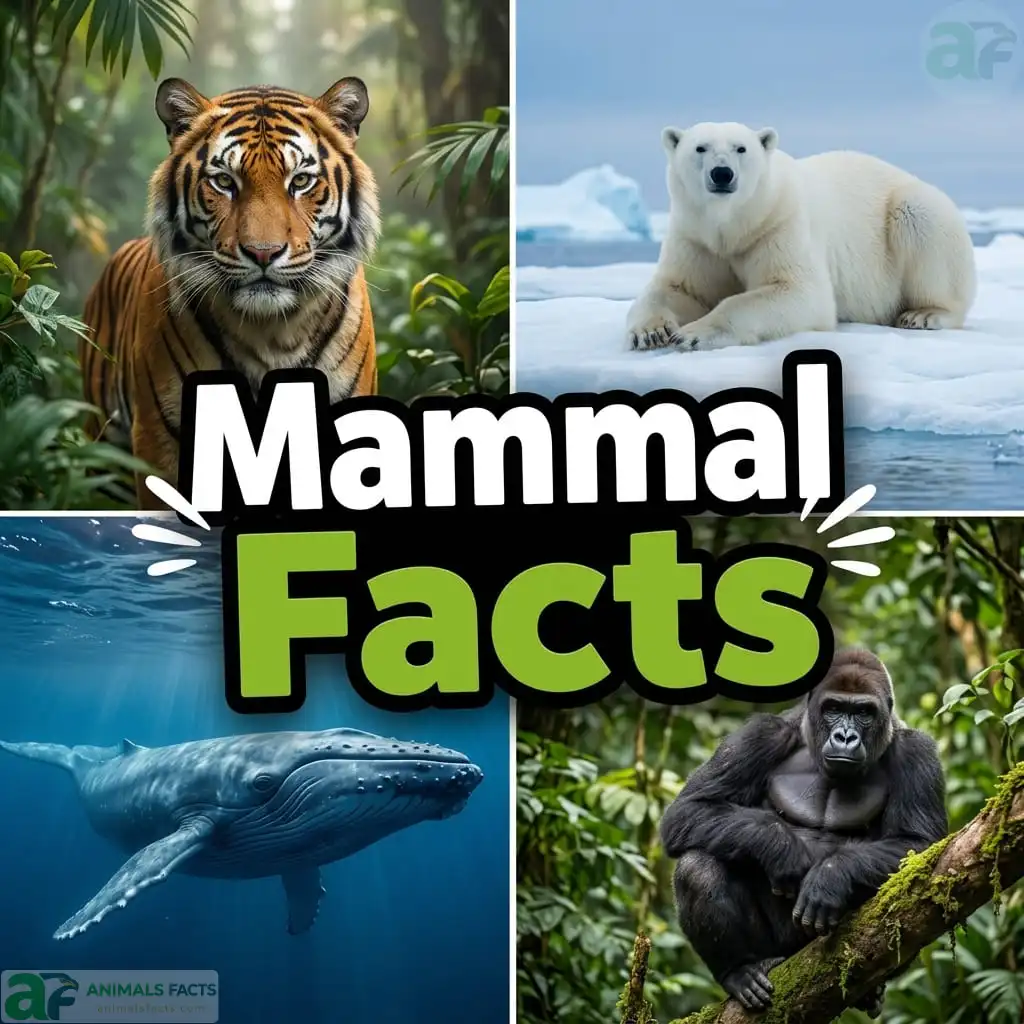
Mammal Facts
| Feature | Details |
|---|---|
| Scientific Name | Mammalia (class) |
| Kingdom | Animalia |
| Phylum | Chordata |
| Subphylum | Vertebrata |
| Number of Species | Approximately 6,500 known species |
| Habitat | Every environment on Earth — oceans, deserts, forests, arctic ice, mountains |
| Lifespan | 2 years (shrews) to 211 years (bowhead whale) |
| Diet | Herbivores, carnivores, omnivores, insectivores, filter feeders |
| Size Range | 30 mm (Etruscan shrew) to 33 meters (blue whale) |
| Weight Range | Under 2 grams to 190,000 kg (blue whale) |
| Top Speed | Up to 120 km/h (cheetah) on land; 56 km/h (sailfish-chasing dolphins) in water |
| Conservation Status | Varies — 25% of mammal species currently threatened with extinction |
| Population Estimate | Varies wildly by species; humans alone number 8.1 billion |
| Defining Feature | Warm-blooded, hair/fur, live birth (most), mammary glands for nursing young |
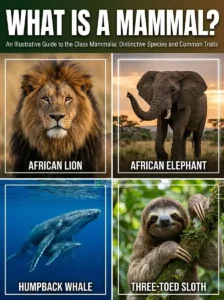 1. Introduction – What is a Mammal?
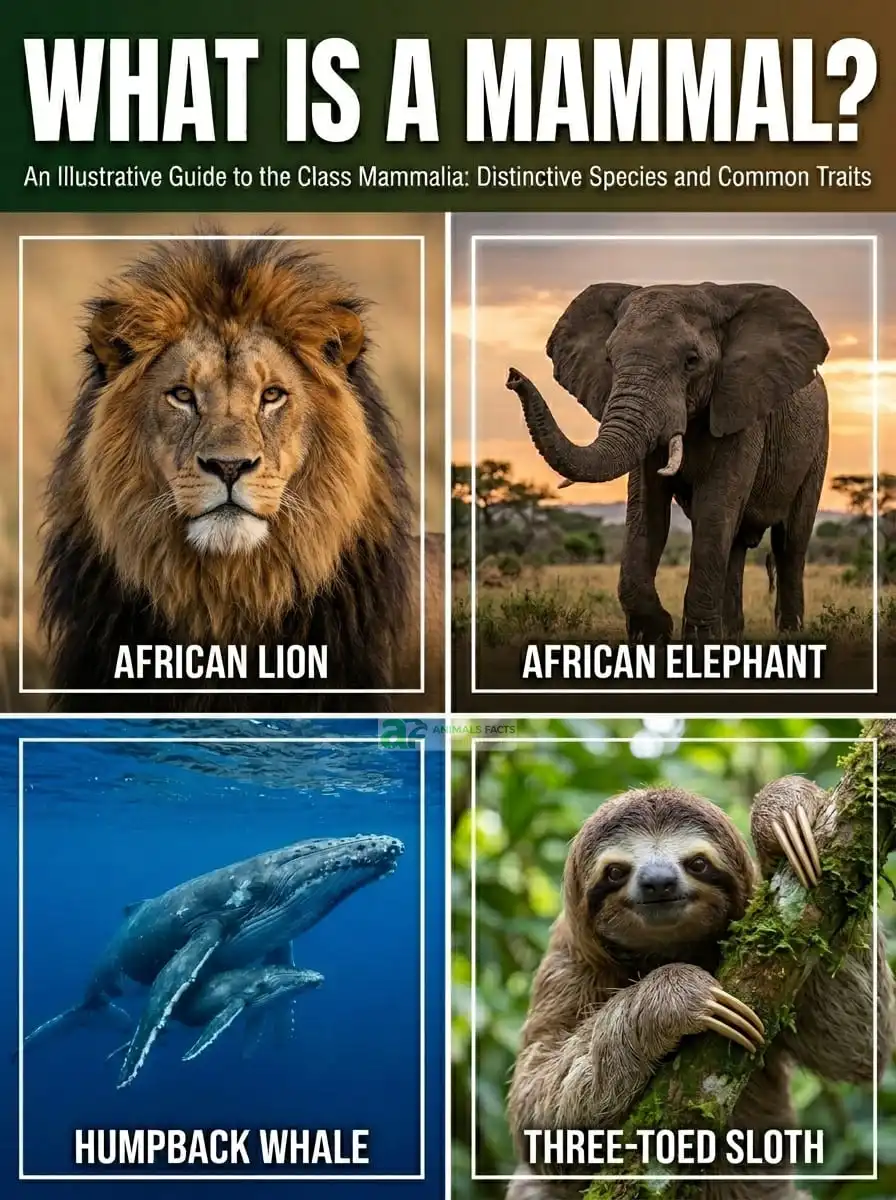
When most people think of mammal facts, they picture the animals they know best — dogs, cats, elephants, and whales. But the true story of mammals is far grander, stranger, and more awe-inspiring than our everyday familiarity with household pets and zoo animals suggests. Mammals are the class of animals that includes the largest creature ever to live on Earth, the fastest land predator alive, the only animals capable of true language, and the sole group that has conquered every environment from the deepest ocean to the highest mountain to the frozen poles — and even outer space.
Mammal facts reveal a group of animals defined not by any single dramatic trait but by a remarkable combination of features that together produced what many biologists consider evolution’s most flexible and successful vertebrate experiment. With approximately 6,500 known species, mammals span an almost incomprehensible range of size, shape, behavior, and lifestyle. From the bumblebee bat of Thailand — the world’s smallest mammal, barely larger than a thumbnail — to the blue whale, the largest animal that has ever existed on this planet, mammals have evolved to exploit virtually every ecological niche available on Earth.
Whether you’re a student researching interesting facts about mammals for a school project, a parent looking for mammal facts for kids, a wildlife enthusiast wanting to go deeper into mammal habitat, mammal diet, and mammal behavior, or simply someone struck by curiosity about the class of animals that includes ourselves, this is your definitive guide. We’ll cover everything from mammal scientific names and classification to conservation crises, cultural mythology, and the most jaw-dropping records in the natural world. Welcome to the complete story of mammals — your own family, extended to its most spectacular extremes.
2. Mammal Species Overview & Classification
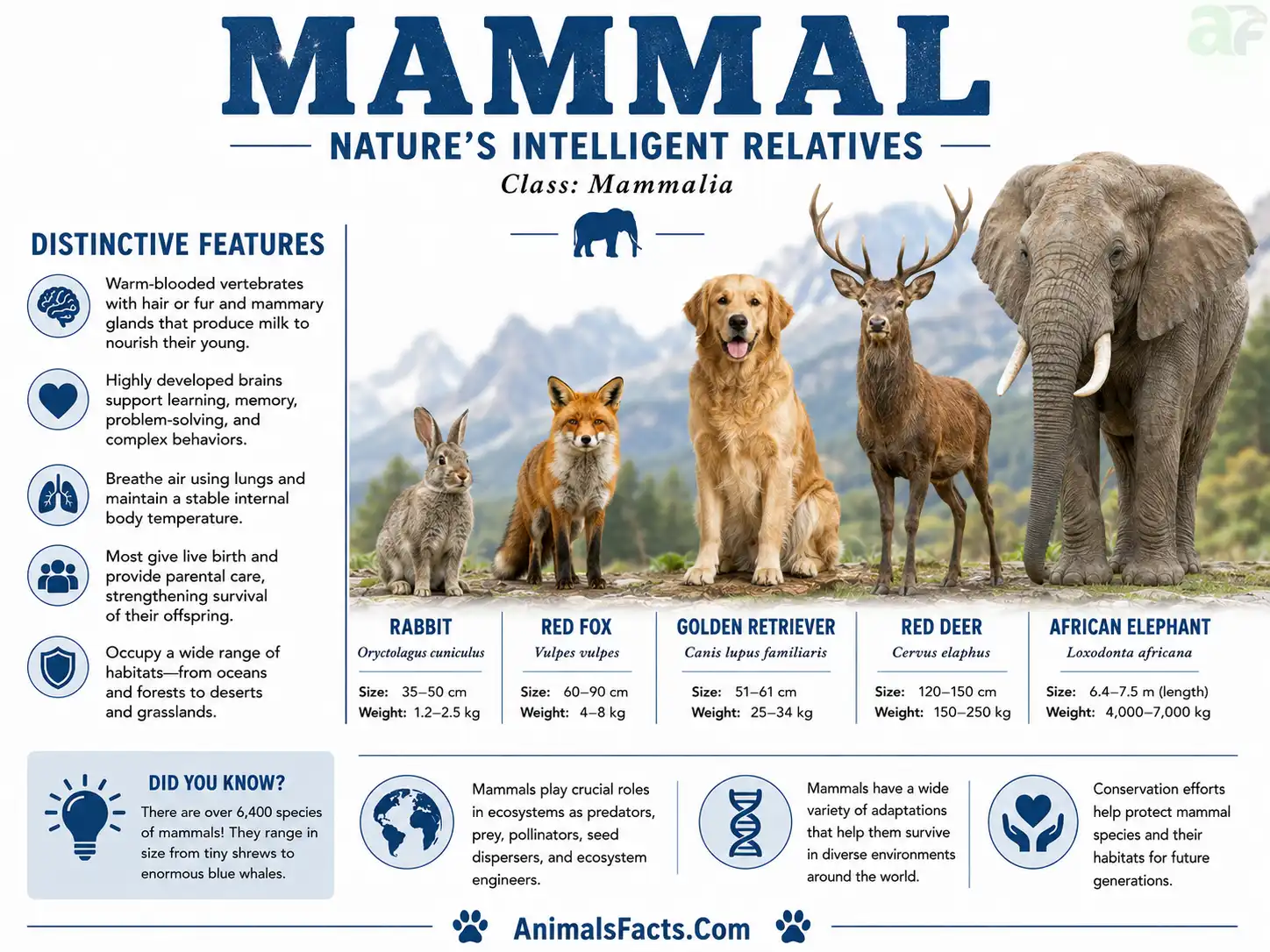
Mammals belong to the class Mammalia, within the subphylum Vertebrata. They share their broader group with fish, amphibians, reptiles, and birds — but they are distinguished by a precise set of defining characteristics that appear in no other animal class in combination.
Defining Characteristics of Mammals
Every mammal, without exception, shares these traits:
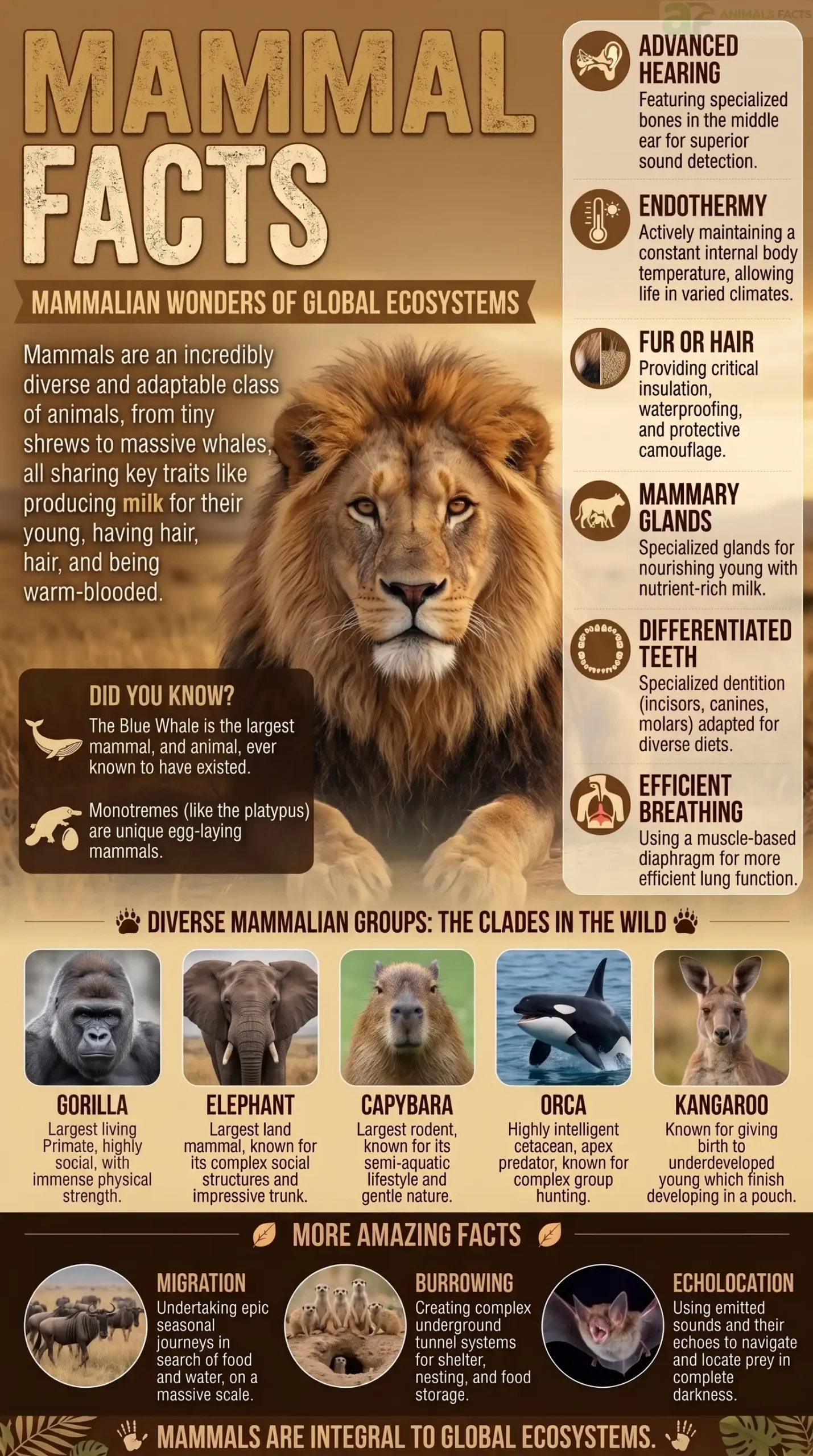
- Hair or fur at some stage of life (even whales have vestigial hair as embryos or adults)
- Mammary glands that produce milk to nourish young
- Warm-blooded (endothermic) — able to regulate internal body temperature independently of environment
- Three middle ear bones (malleus, incus, stapes) — a unique feature found in no other vertebrate
- A single lower jawbone (dentary) — all other vertebrates have multiple bones forming the lower jaw
- A four-chambered heart (shared with birds, but evolved independently)
- A neocortex — an advanced brain region responsible for higher cognition, absent in other vertebrates
Mammals Species Classification Table
| Taxonomic Rank | Classification |
|---|---|
| Kingdom | Animalia |
| Phylum | Chordata |
| Subphylum | Vertebrata |
| Class | Mammalia |
| Subclasses | Prototheria (monotremes), Metatheria (marsupials), Eutheria (placental mammals) |
| Number of Orders | ~27 orders |
| Number of Families | ~155 families |
| Number of Genera | ~1,200+ genera |
| Number of Species | ~6,500 described species |
The Three Major Mammal Groups
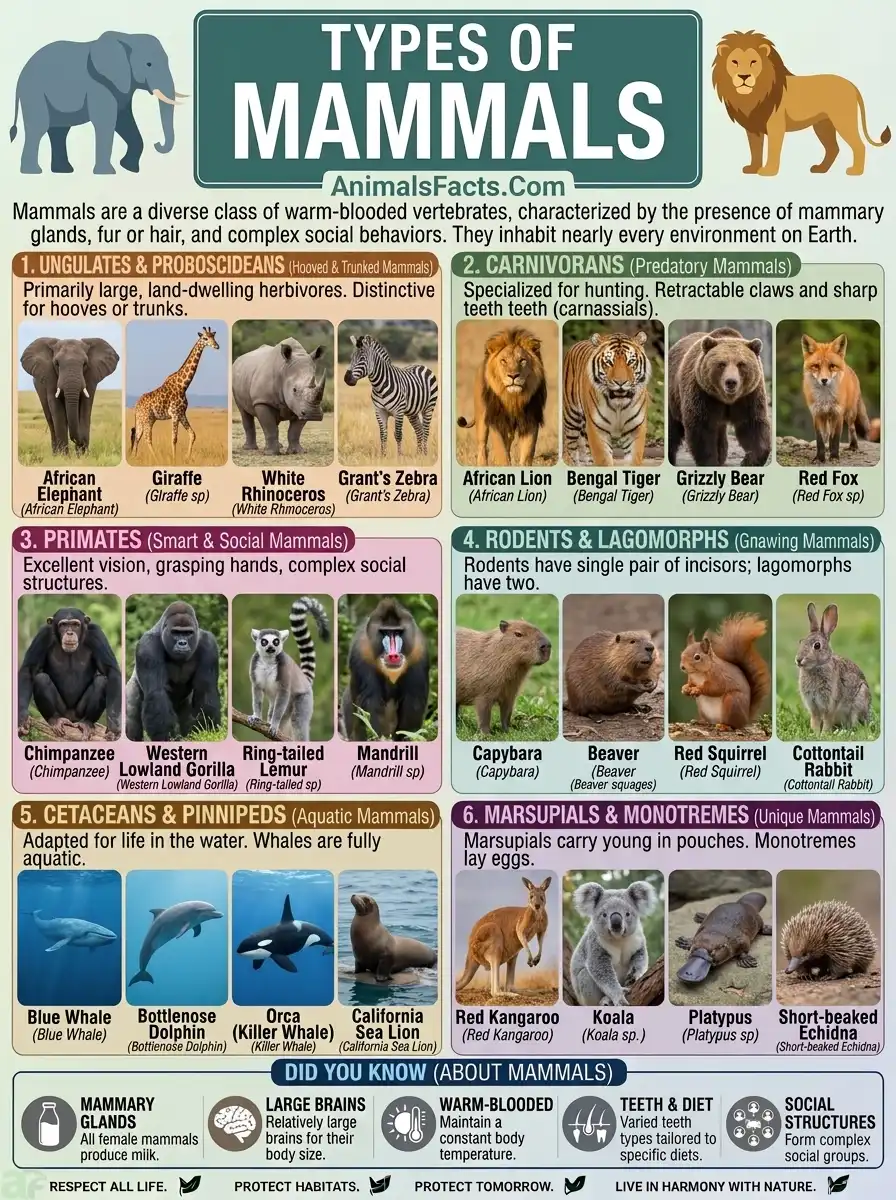
Monotremes — The most ancient lineage. Only 5 living species: the platypus and four species of echidna. They lay eggs — the only mammals to do so — but nurse their young on milk secreted through patches of skin (they have no nipples).
Marsupials — About 335 species including kangaroos, koalas, wombats, opossums, and Tasmanian devils. They give birth to extremely underdeveloped young that complete their development in an external pouch.
Placental mammals (Eutheria) — The vast majority of mammals (~6,150 species), including all humans, whales, bats, rodents, and carnivores. Young develop inside the mother connected to a nutrient-providing placenta.
Mammals Evolution & Discovery Timeline
~225 million years ago — The first true mammals appear during the Late Triassic period, evolving from a group of reptile-like animals called cynodonts. These early mammals were tiny, shrew-like creatures living alongside early dinosaurs.
~180 million years ago — The split between monotremes and the ancestor of marsupials and placentals occurs.
~148 million years ago — Marsupials and placental mammals diverge from a common ancestor.
~66 million years ago — The Cretaceous-Paleogene extinction event wipes out non-avian dinosaurs. Mammals, largely nocturnal and burrowing, survive and undergo an extraordinary adaptive radiation — diversifying into the ecological roles vacated by dinosaurs.
~55 million years ago — The first whales (Pakicetus) appear as land mammals begin returning to the ocean. The first bats appear, becoming the only mammals to achieve powered flight.
~7 million years ago — The lineage leading to humans diverges from the lineage leading to chimpanzees.
1758 — Carl Linnaeus formally establishes the class Mammalia in Systema Naturae, coining the name from the Latin mamma (breast).
1847 — Richard Owen formally describes the platypus venom spur system, resolving years of debate about whether the egg-laying, venomous, duck-billed “platypus” was a real animal or an elaborate hoax.
1964 — Roger Payne and Scott McVay discover that humpback whales produce complex songs — songs that change from year to year and spread across populations like cultural trends.
2006 — The baiji (Yangtze river dolphin, Lipotes vexillifer) is declared functionally extinct — the first cetacean driven to extinction in modern times, and one of the most emblematic mammal conservation failures in history.
2021 — DNA analysis confirms that the narwhal and beluga whale hybridize in the wild, producing a “narluga” — a remarkable finding with implications for understanding mammal speciation.
“If we can stop the destruction of habitat, we have a chance. We have a duty to future generations to make sure we hand on the world as rich in life as we found it.” — Sir David Attenborough, on mammal conservation, Our Planet (Netflix, 2019)
3. Mammals Physical Description
The physical diversity of mammals is perhaps the most striking feature of the class. No other vertebrate group has produced such extremes of form while remaining recognizably united by shared ancestry and shared defining characteristics.
Size & Weight
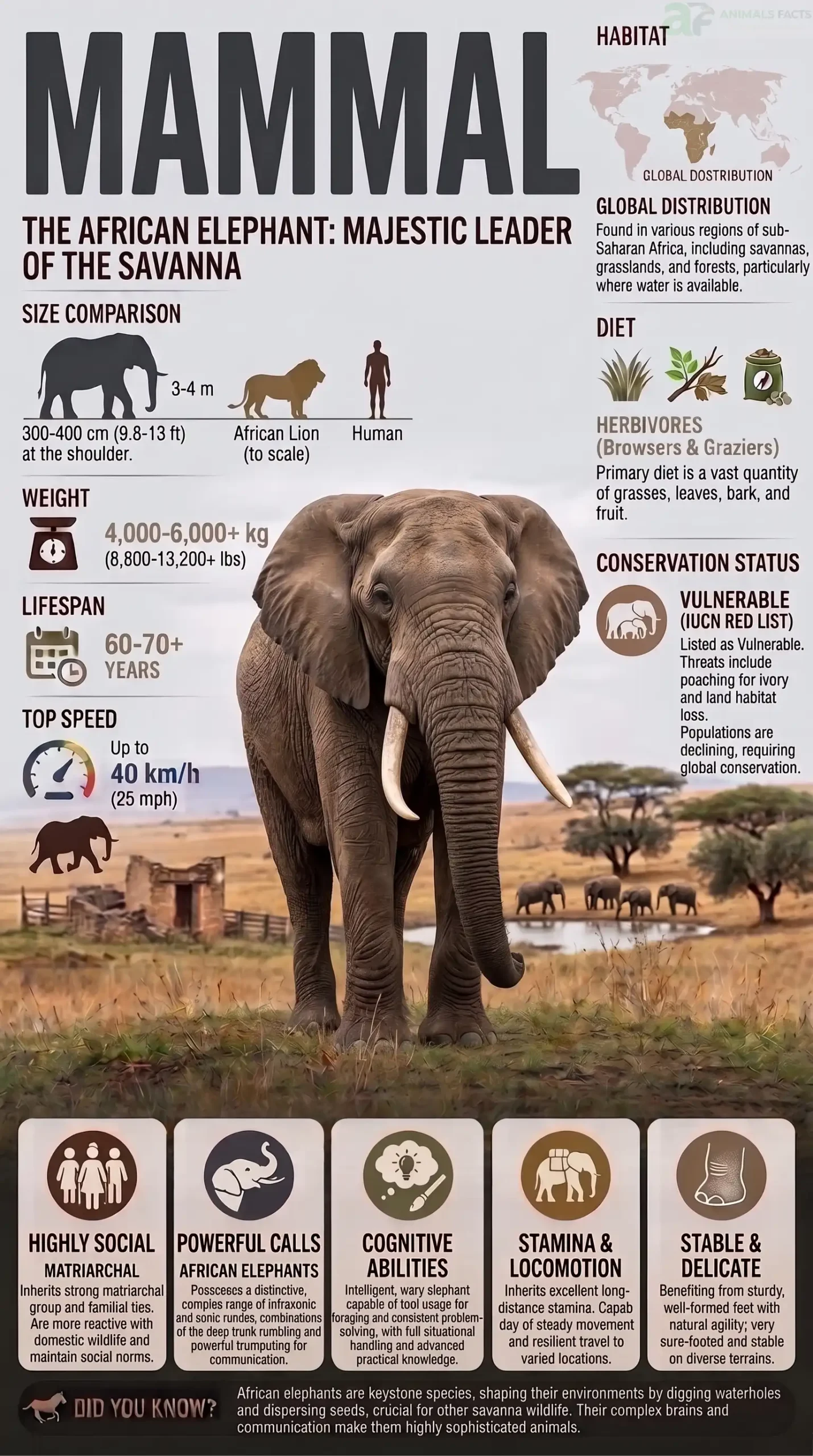
The blue whale (Balaenoptera musculus) is not just the largest mammal — it is the largest animal ever known to have existed, reaching lengths of 33 meters (108 feet) and weights of up to 190 metric tons. Its heart alone is the size of a small car. A blue whale’s call, at up to 188 decibels, is the loudest sound produced by any animal and can be detected by other whales over 1,600 km away.
At the other extreme, the bumblebee bat (Craseonycteris thonglongyai) of Thailand and Myanmar weighs just 2 grams and has a wingspan of 15 cm, making it the world’s smallest mammal by mass.
Hair & Fur
All mammals have hair at some stage of development — a feature unique to the class. Hair functions as thermal insulation, sensory input (whiskers/vibrissae), camouflage, waterproofing, and social signaling. The Arctic fox grows a thick white winter coat that provides insulation against temperatures of -70°C. The naked mole rat (Heterocephalus glaber) appears hairless but retains sparse, sensory hairs across its body. Even whales have hair — in the form of small bristle patches on their snout called vibrissal crypts.
Gender & Age Differences
Sexual dimorphism in mammals ranges from negligible (many rodents and small mammals) to extreme. Male elephant seals weigh up to 2,700 kg — nearly four times the weight of females. Male lions develop the famous mane that darkens with age, advertising health and testosterone levels. Male deer grow antlers that are shed and regrown annually, reaching their most impressive size in prime adulthood. Humans display relatively modest sexual dimorphism by mammal standards, with males averaging roughly 15% larger than females.
Did You Know? The platypus (Ornithorhynchus anatinus) of Australia is one of only a handful of venomous mammals. Males possess a hollow spur on their hind leg connected to a venom gland, capable of delivering excruciating pain to a human — and potentially lethal doses to smaller animals like dogs.
4. Top 25 Amazing Mammal Facts
Here is your comprehensive collection of the most extraordinary, scientifically verified, and genuinely mind-bending mammal facts as of 2026:
- The blue whale is the largest animal ever to exist — larger than any known dinosaur.
- A blue whale’s heartbeat can be detected from 2 km away using sensitive underwater microphones.
- Elephants are the only non-human animals known to hold funerals — they return to the bones of deceased family members and touch them gently with their feet and trunks.
- Bats represent 20% of all mammal species — making them the second most species-rich mammalian order after rodents.
- The naked mole rat is biologically immortal in one remarkable sense — it shows negligible senescence, meaning it does not age the way other mammals do, and rarely develops cancer.
- Dolphins have unique signature whistles that function as personal names — they address each other by name and remember the names of individuals they haven’t seen for 20 years.
- A shrew’s heart beats up to 1,500 times per minute — the fastest heartbeat of any mammal.
- The bowhead whale can live for over 200 years — making it the longest-lived mammal on Earth.
- Elephants can “hear” through their feet — sensing low-frequency vibrations through the ground that travel from the feet to the inner ear via bones in the leg and jaw.
- Otters hold hands while sleeping to prevent drifting apart — a behavior called “rafting.”
- The cheetah accelerates from 0 to 96 km/h (60 mph) in just 3 seconds — faster than most sports cars.
- Cows have best friends — studies show they experience lower stress when housed with a preferred companion.
- The platypus has no stomach — food passes directly from its esophagus to its intestine.
- Whales and dolphins are more closely related to hippos than hippos are to other hoofed mammals.
- Elephants are the only mammals that physically cannot jump.
- A blue whale’s tongue weighs as much as a full-grown elephant.
- The star-nosed mole (Condylura cristata) has 22 pink tentacles on its nose and is the fastest-eating animal ever recorded — identifying and consuming prey in under 120 milliseconds.
- Mammals are the only animals that play in a cognitively complex sense — engaging in activities with no immediate survival purpose that appear to be undertaken purely for enjoyment.
- The wolverine (Gulo gulo) can consume prey frozen solid, has jaws powerful enough to crush moose bones, and has been documented driving grizzly bears off kills.
- Sperm whales have the largest brains ever evolved — weighing up to 7.8 kg (17 lbs), nearly 5 times the size of a human brain.
- Moose antlers can grow at rates of up to 2.5 cm (1 inch) per day during spring — the fastest-growing tissue of any mammal.
- Elephants are one of only a handful of animals to pass the mirror self-recognition test — recognizing their own reflection as themselves.
- Humpback whale songs change every year across entire ocean populations, spreading westward around the Pacific like a musical trend — the only known example of cultural transmission of a complex behavior in a non-human animal across an entire ocean basin.
- The platypus uses electroreception — detecting the electrical fields produced by the muscles of prey animals through sensors in its bill — allowing it to hunt with its eyes, ears, and nose completely shut underwater.
- Humans are the only mammal known to have voluntarily permanent control of their breathing, enabling language and music.
Mammals Fun Facts for Kids
- Mammals have existed for over 225 million years
- The blue whale’s call is louder than a jet engine
- A group of otters is called a raft; a group of rhinos is called a crash
- Bats are the only mammals capable of true powered flight
- A grizzly bear can smell food from 29 km (18 miles) away
- Elephants have a pregnancy lasting 22 months — the longest of any land animal
- Dolphins sleep with one eye open and one brain hemisphere at a time
- The mantled guereza monkey newborn is born completely white
- A blue whale baby gains 90 kg per day during nursing
- Sloths move so slowly that algae grows in their fur — providing camouflage
- A tiger’s roar can be heard from 3 km away
- Meerkats teach their young how to handle and eat dangerous prey — one of very few documented examples of animal pedagogy
5. Natural Habitat of Mammals
Mammal habitat diversity exceeds that of any other vertebrate class. Mammals have conquered every major environment on Earth — from the deep ocean at 3,000 meters below sea level to mountain altitudes of 6,000 meters in the Himalayas, from equatorial rainforests to Arctic sea ice.
Habitat Types
Mammals live in tropical rainforests, temperate deciduous forests, boreal taiga, arctic tundra, deserts, grasslands, wetlands, freshwater rivers and lakes, coastal zones, open oceans, and even underground tunnel systems. The star-nosed mole spends most of its life in complete darkness under soil. The sperm whale dives to depths exceeding 2,000 meters in pursuit of giant squid. The snow leopard hunts at altitudes above 5,000 meters in the Himalayas and Tibetan Plateau.
Habitat Range by Continent
| Continent/Region | Notable Species | Primary Habitat Type |
|---|---|---|
| Africa | Lion, elephant, giraffe, gorilla, cheetah | Savanna, rainforest, desert, montane forest |
| Asia | Tiger, giant panda, snow leopard, orangutan | Tropical forest, montane forest, grassland |
| Australia/Oceania | Kangaroo, koala, platypus, Tasmanian devil | Eucalyptus forest, desert, woodland, wetland |
| North America | Grizzly bear, bison, moose, puma | Forest, grassland, tundra, mountain |
| South America | Jaguar, capybara, giant anteater, tapir | Rainforest, wetland, grassland, cloud forest |
| Europe | Wolf, brown bear, lynx, red deer | Temperate forest, mountain, boreal forest |
| Arctic/Antarctic | Polar bear, walrus, narwhal, leopard seal | Sea ice, open ocean, tundra |
| Open Ocean | Blue whale, sperm whale, dolphin, orca | Pelagic ocean, coastal waters |
Did You Know? The common pipistrelle bat (Pipistrellus pipistrellus), one of Europe’s smallest bats, can travel up to 50 km in a single night while foraging for insects — covering distances that seem astonishing for an animal weighing just 5 grams.
6. Mammal’s Diet & Feeding Behavior
Mammal diet spans a wider range than any other vertebrate class, encompassing everything from the pure filter feeding of baleen whales — sieving millions of tiny krill from ocean water — to the hyper-carnivory of orcas and wolves, to the strict herbivory of koalas (which eat almost nothing but toxic eucalyptus leaves), to the remarkable omnivory of bears and humans.
Diet Breakdown Table
| Dietary Strategy | Approximate % of Mammal Species | Example Species |
|---|---|---|
| Insectivory (insects & arthropods) | ~35% | Bats, shrews, moles, pangolins, aardvarks |
| Herbivory (plants, leaves, fruit, grass) | ~32% | Elephants, horses, rabbits, koalas, deer |
| Omnivory (mixed plant & animal) | ~18% | Bears, pigs, raccoons, humans, primates |
| Carnivory (vertebrate prey) | ~12% | Lions, wolves, orcas, tigers, cheetahs |
| Granivory (seeds) | ~5% | Many rodents, squirrels, some primates |
| Filter feeding (plankton/krill) | ~1% | Baleen whales, whale sharks (not a mammal) |
| Sanguivory (blood) | <1% | Vampire bats (3 species only) |
Remarkable Feeding Strategies
Filter feeding in blue whales — A single blue whale consumes approximately 3.6 metric tons (8,000 lbs) of krill per day during feeding season. It engulfs enormous volumes of water, then pushes it out through baleen plates that sieve out krill like a massive biological strainer.
Vampire bats (Desmodus rotundus, Diaemus youngi, Diphylla ecaudata) are the only mammals with a diet consisting exclusively of blood. They use heat-sensing organs near their nose to locate blood vessels close to the skin, make a painless incision with razor-sharp teeth, and lap blood (not suck it) using a grooved tongue, while anticoagulant compounds in their saliva keep the blood flowing.
Orca (killer whale) hunting — Orcas demonstrate some of the most sophisticated cooperative hunting strategies in the animal kingdom, with different orca populations having developed entirely distinct hunting cultures — “fish-eating” orcas use completely different techniques from “mammal-eating” orcas, and these techniques are culturally transmitted from mothers to offspring.
7. Mammals Reproduction & Life Cycle
Mammal reproduction is defined most fundamentally by maternal investment — the nursing of young on milk produced by the mother’s mammary glands. This single trait has profoundly shaped the evolution of mammal social structures, brain size, lifespan, and learning capacity.
Mating Systems
Mammals employ virtually every mating system found in the animal kingdom. Monogamy (rare but present) is found in gibbons, beavers, and some wolves. Polygyny (one male, multiple females) characterizes lions, elephant seals, gorillas, and many deer species. Polyandry (one female, multiple males) occurs in some marmot populations. Promiscuity is common in chimpanzees and many rodents. Harems — defended groups of females controlled by a dominant male — are characteristic of elephant seals, gorillas, and many hoofed mammals.
Gestation & Birth
Gestation periods vary from 12 days (Virginia opossum — shortest of any mammal) to 22 months (African elephant — longest). Litter sizes range from a single offspring (elephants, whales, many primates) to up to 30 in Virginia opossums. The degree of development at birth also varies enormously — precocial young (horses, elephants, wildebeest) are born highly developed and can walk within hours; altricial young (bears, mice, humans) are born helpless and require intensive parental care.
Mammals Lifespan Comparison Table
| Species | Average Lifespan (Wild) | Maximum Recorded Lifespan |
|---|---|---|
| Bowhead whale | 100–150 years | 211 years |
| African elephant | 60–70 years | ~80 years |
| Chimpanzee | 30–40 years | 70+ years (captivity) |
| Lion | 10–14 years | ~26 years (captivity) |
| Common shrew | ~1 year | 2 years |
| Horse | 25–30 years | 62 years |
| Human | 72–80 years (global average) | 122 years (verified record) |
Did You Know? The bowhead whale (Balaena mysticetus) of Arctic waters is the longest-lived mammal on Earth, with specimens found carrying ivory harpoon tips from weapons that went out of use in the 1880s, confirming ages exceeding 130 years. DNA analysis has since pushed confirmed maximum ages to over 200 years.
8. Social Behavior & Communication
Mammals produce the most complex social behaviors and the most sophisticated communication systems of any animals on Earth. The mammalian brain — particularly its neocortex — has enabled social learning, cultural transmission, language, and emotional bonds of extraordinary richness.
Vocalizations
Whale song is the most structurally complex vocalization produced by any non-human animal. Humpback whale songs can last up to 20 hours without repetition, involve multiple distinct “themes” repeated in a precise order, and change from year to year across entire ocean populations — a form of cultural evolution with no parallel outside human music.
Elephant infrasound — Elephants communicate across distances of up to 10 km using low-frequency calls below the range of human hearing (infrasound). These rumbles carry information about identity, reproductive state, alarm, greeting, and location with remarkable specificity.
Dolphin signature whistles — Each dolphin develops a unique signature whistle within its first year of life, which functions as a personal name. Dolphins use each other’s signature whistles to address specific individuals — a form of naming behavior previously thought unique to humans.
Intelligence & Cognition
The great apes (chimpanzees, bonobos, gorillas, orangutans) have been demonstrated to use tools, engage in tactical deception, solve novel problems, demonstrate theory of mind (understanding that others have different knowledge and beliefs), and in captive settings learn human sign language with sufficient fluency to construct novel sentences.
Elephants demonstrate empathy — responding to distressed individuals with comforting touches and vocalizations — and have passed the mirror self-recognition test, placing them in the elite cognitive category alongside great apes, dolphins, and magpies.
Rats and mice have been shown to demonstrate empathy — releasing trapped companions from restraints even when no reward is offered, and sharing food with hungry strangers. This finding profoundly challenges assumptions about the uniqueness of mammalian compassion.
9. Predators & Defense Mechanisms
Even the largest and most powerful mammals face threats from predators — and evolution has produced a spectacular toolkit of defensive adaptations in response.
Natural Predators by Species Group
- Large ungulates (zebra, wildebeest, antelope) — Preyed upon by lions, leopards, cheetahs, wild dogs, crocodiles, hyenas
- Small mammals (rabbits, voles, shrews) — Preyed upon by foxes, weasels, owls, hawks, snakes
- Marine mammals — Preyed upon by orcas, great white sharks, leopard seals
- Primates — Preyed upon by leopards, eagles, pythons, chimpanzees (in the case of smaller monkeys)
- Young of large mammals — Preyed upon by hyenas, jackals, wild dogs even when adults are safe
Defense Strategies
Horns and tusks — The elephant’s tusks, rhinoceros horn, and the horns of buffalo and wildebeest are formidable weapons used in both defense and intraspecific competition.
Armor — The pangolin (Manis species) is covered in overlapping scales of hardened keratin — the only mammal with this feature. When threatened, it rolls into a perfect armored ball, protecting its soft underside. Its scales are strong enough to resist the jaws of most predators.
Speed — The cheetah escapes potential dangers and pursues prey with speed, while the pronghorn antelope (Antilocapra americana) of North America is the second-fastest land mammal at 88 km/h and can sustain speeds that no predator can match over distance.
Chemical defense — The striped skunk (Mephitis mephitis) can spray a sulfurous liquid from anal scent glands with impressive accuracy up to 3 meters, and the odor can be detected over 1.5 km downwind.
Group defense — Musk oxen (Ovibos moschatus) form a defensive circle when threatened by wolves, with adults facing outward and calves protected in the center — a formation so effective that wolves rarely break it successfully.
Toxicity — The slow loris (Nycticebus species) is one of the world’s only venomous primates. It produces a toxic secretion from a gland on its elbow, which it mixes with saliva and can deliver through its bite — causing severe anaphylaxis in humans and death in smaller animals.
Did You Know? The honey badger (Mellivora capensis) has such loose, thick skin that it can turn around inside its own skin to bite an attacker that has gripped it from behind. It has been documented surviving bites from puff adders (among Africa’s most venomous snakes), recovering and continuing to feed. It holds the Guinness World Record for the world’s most fearless animal.
10. Mammal Facts for Kids
Hey young wildlife explorers! Here are some totally amazing mammal facts for kids that will impress your friends and family:
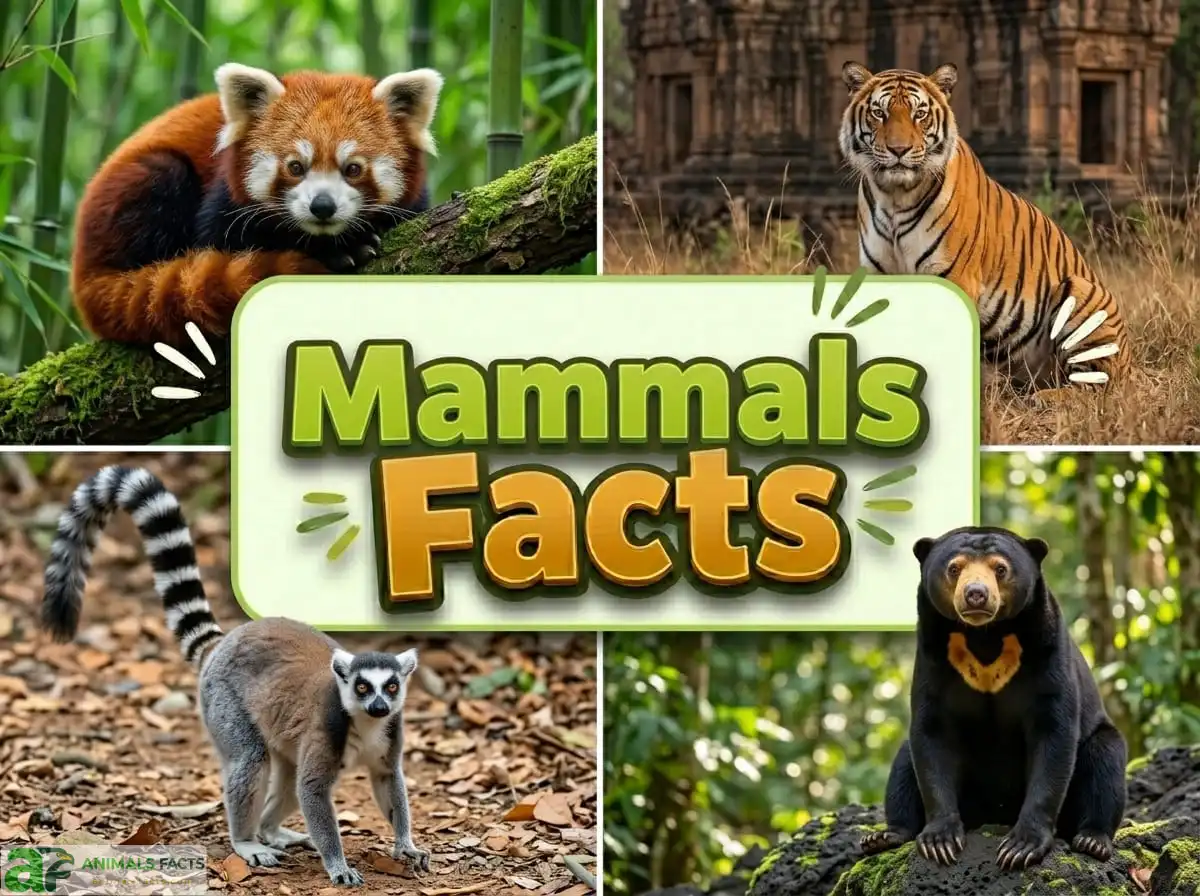
🐾 Mammals are YOUR family! You are a mammal — and so are your dogs, cats, and the dolphins at the aquarium. We’re all part of the same amazing group!
🐾 Bats can fly in total darkness! They use a superpower called echolocation — sending out sound waves that bounce back from objects, creating a “sound map” of everything around them.
🐾 Elephants never forget! They really don’t — elephants have exceptional memories and can recognize hundreds of other elephants and humans they met years or even decades ago.
🐾 A blue whale’s heart is as big as a car! And its arteries are so wide a human could swim through them (though we wouldn’t recommend it).
🐾 Sloths are VERY slow — on purpose! Moving slowly means predators can’t see them easily, and they don’t need much food. A sloth digests one leaf meal over an entire month!
🐾 Otters hold hands while sleeping! River and sea otters float in groups and hold paws so they don’t drift away from each other. Isn’t that cute?
🐾 A giraffe’s tongue is purple and nearly 50 cm long! The dark color is thought to protect it from sunburn since giraffes use their tongues so much while feeding in bright sunlight.
🐾 Humpback whales sing songs! These songs can last for hours and change every year — like a new hit album released across the entire ocean.
11. Relationship with Humans
The relationship between humans and other mammals is the deepest, most complex, and most consequential interspecies relationship in the history of life on Earth. Mammals fed us, clothed us, carried us, worked alongside us, and eventually became the subjects of our scientific inquiry, our conservation efforts, and our deepest moral debates about our obligations to other species.
Domestication
Humans have domesticated approximately 15 mammal species in a deep, multigenerational sense. The dog (Canis lupus familiaris) was the first — domesticated from wolves between 15,000 and 40,000 years ago, making it the oldest human-animal partnership. Cattle, sheep, goats, and pigs were domesticated approximately 10,000 years ago in the Fertile Crescent, forming the agricultural foundation of human civilization. Horses were domesticated around 5,500 years ago in Central Asia, transforming warfare, trade, and human migration patterns so profoundly that historians consider it one of the most consequential events in human history.
Human-Wildlife Conflict
As human populations expand into wildlife habitat, conflicts with large mammals are increasing globally. Elephant-human conflict affects millions of people in Africa and Asia, as elephants raid crops and occasionally injure or kill people. Tiger attacks on humans occur most frequently in the Sundarbans mangrove forests of Bangladesh and India. Polar bear-human encounters are increasing in Arctic communities as sea ice loss pushes bears into closer contact with human settlements.
Medical & Scientific Contributions
Mammals — particularly mice, rats, and primates — have been central to virtually every major medical advance of the past century, from vaccine development to surgical technique refinement to cancer research. The nine-banded armadillo (Dasypus novemcinctus) is the only non-human animal that naturally contracts leprosy (Hansen’s disease), making it invaluable in leprosy research. Vampire bat saliva contains a compound called draculin (officially DSPA) that is being developed as a stroke treatment due to its powerful anticoagulant and clot-dissolving properties.
12. Mammals Conservation Status & Threats
Mammal conservation is one of the most urgent challenges in modern biology. The scale of current mammal population declines is not merely an ecological problem — it is a fundamental transformation of the living world that has been called the sixth mass extinction.
IUCN Status Overview
| Status Category | Approximate Number of Mammal Species |
|---|---|
| Least Concern | ~3,300 species |
| Near Threatened | ~320 species |
| Vulnerable | ~530 species |
| Endangered | ~400 species |
| Critically Endangered | ~220 species |
| Extinct in the Wild | ~10 species |
| Extinct (since 1500) | ~90+ species |
Major Threats
Habitat loss remains the dominant driver of mammal population declines globally. The destruction of tropical rainforests — particularly in the Amazon basin, Borneo, and the Congo basin — is eliminating the habitat of thousands of species at a rate unprecedented outside of mass extinction events.
Poaching and illegal wildlife trade — The illegal trade in mammals and their parts is estimated to be worth $23 billion annually and drives critical declines in elephants (ivory), rhinoceroses (horn), tigers (bones and skin), and pangolins (scales) among many others.
Climate change is reshaping mammal habitat at a pace that many species cannot adapt to fast enough. Polar bears (Ursus maritimus) face the effective loss of their primary hunting platform — sea ice — within decades under current warming trajectories. Pika (small mountain-dwelling relatives of rabbits) are being pushed to ever-higher altitudes as temperatures rise, with nowhere left to go when they reach the summit.
Did You Know? The Amur leopard (Panthera pardus orientalis) of the Russian Far East is the world’s rarest wild cat and one of the world’s rarest large mammals, with a wild population that reached a low of approximately 30 individuals in the early 2000s. Intensive conservation efforts have since brought numbers to approximately 100 individuals as of 2026 — a fragile but genuine recovery.
13. Famous Mammals in History & Pop Culture
Real-World Famous Mammals
Keiko — The orca (Orcinus orca) who starred in the Free Willy film series (1993–1997) became the subject of the most expensive and emotionally discussed wildlife rehabilitation project in history. His attempted reintroduction to wild Icelandic waters generated global debate about the ethics of keeping cetaceans in captivity.
Lonesome George — The last Pinta Island tortoise (technically a reptile, but often cited alongside famous mammals in conservation discussions), died in June 2012 without reproducing — becoming the most famous symbol of extinction in modern conservation history.
Christian the Lion — A lion purchased from Harrods department store in London in 1969 by two Australians, raised in a Chelsea apartment, and later released into the wild in Kenya. When his former owners visited a year later, the fully wild lion recognized them and greeted them with embraces. The footage, rediscovered on YouTube, has been viewed over 100 million times.
Koko — A female western lowland gorilla (Gorilla gorilla gorilla) who was taught American Sign Language by Dr. Francine Patterson beginning in 1972 and demonstrated a working vocabulary of over 1,000 signs and comprehension of approximately 2,000 English words before her death in 2018.
Dolly the Sheep — The first mammal cloned from an adult somatic cell, born at the Roslin Institute in Scotland on 5 July 1996. Dolly’s birth triggered a global scientific and ethical debate about cloning that continues to shape biotechnology policy worldwide.
14. Role in Ecosystem & Food Chain
Mammals serve as engineers, regulators, seed dispersers, top predators, and prey in virtually every ecosystem on Earth. Their removal from ecosystems — through extinction, extirpation, or population collapse — triggers trophic cascades that can restructure entire landscapes.
Keystone Species
The gray wolf (Canis lupus) is perhaps the most extensively studied example of mammalian keystone predation. When wolves were reintroduced to Yellowstone National Park in 1995 after a 70-year absence, the changes cascaded through the entire ecosystem. Elk herds began avoiding riverbanks (where they were vulnerable to wolves), allowing riverside vegetation to recover. Trees stabilized stream banks, reducing erosion. Beaver populations recovered (beavers need trees). Beaver ponds created habitat for fish, otters, and waterfowl. The rivers themselves literally changed course — a phenomenon called a trophic cascade.
Elephants are perhaps the most dramatic large-scale mammalian ecosystem engineers. Their feeding behavior creates clearings in forests that allow grassland plants to establish. Their footprints create small ponds used by hundreds of other species. Their dung distributes seeds across vast distances. In the African savanna, it is not an exaggeration to say that without elephants, the entire ecosystem would be fundamentally different.
Whales play a crucial and recently-discovered role in global carbon cycling. When whales die and their enormous bodies sink to the ocean floor, they transport large quantities of carbon from the surface to the deep ocean — a process called whale fall. Additionally, whale feces are extremely rich in iron, stimulating phytoplankton growth that absorbs atmospheric CO₂. Recovering whale populations is now considered a climate change mitigation strategy.
15. Mammal Myths, Folklore & Cultural Significance
Throughout human history, mammals have occupied the center of our mythological imagination. The animals we most feared, most hunted, and most depended upon became the subjects of our deepest stories.
In Norse mythology, the wolf holds supreme symbolic importance. Fenrir, the monstrous wolf son of Loki, was prophesied to swallow Odin himself at Ragnarök. Huginn and Muninn, Odin’s ravens, were secondary to the wolves Geri and Freki who ate from the All-Father’s table.
In Hindu tradition, the elephant-headed deity Ganesha is one of the most widely worshipped figures in the religion, embodying wisdom, beginnings, and the removal of obstacles. The relationship between Hindu culture and elephants is deep, ancient, and complex — revered as sacred animals while also serving in royal courts and religious ceremonies for millennia.
In Chinese culture, the tiger is one of the twelve animals of the zodiac and is considered the king of all animals (not the lion, which is not native to China). The tiger is a symbol of power, courage, and military prowess, and tiger body parts have been used in traditional Chinese medicine for centuries — a practice that remains one of the greatest drivers of illegal tiger poaching today.
In Aboriginal Australian traditions, the kangaroo features prominently in Dreamtime stories and is both a sacred totem animal and a fundamental source of food, material culture (skins, sinew), and ecological knowledge that Aboriginal peoples have managed sustainably for 50,000+ years.
16. Mammals in Pop Culture
The Lion King (1994/2019) — Disney’s retelling of Shakespeare’s Hamlet using African savanna mammals remains one of the highest-grossing films in cinema history, generating approximately $1.1 billion at the global box office for its 2019 remake alone.
Free Willy (1993) — The story of a captive orca launched the most significant public conversation about cetacean captivity in history and directly inspired the legislative movement that eventually led to California’s Orca Protection Act.
Bambi (1942) — Disney’s adaptation of Felix Salten’s novel is credited by many wildlife historians with creating a generation of Americans emotionally invested in deer conservation — and with permanently altering public perception of hunting.
Lassie — The rough collie character, first appearing in a 1940 short story by Eric Knight, became one of the most enduring animal characters in entertainment history across books, radio, films, and a television series running from 1954 to 1973.
Paddington Bear — Created by British author Michael Bond in 1958, Paddington Brown is among the most beloved fictional mammals in children’s literature, with film adaptations generating over $500 million worldwide.
17. Mammal Facts vs. Common Myths
| Common Myth | The Real Fact |
|---|---|
| “Bats are blind” | All bat species can see; many have excellent vision. Echolocation supplements, not replaces, vision |
| “Elephants are afraid of mice” | Completely false — elephants pay no special attention to mice. The myth likely originates from circus folklore |
| “Bulls are enraged by the color red” | Bulls are red-green colorblind. They charge the moving cape, not its color |
| “Ostriches bury their heads in sand” | They don’t — this myth comes from their habit of lying flat when threatened (ostriches are birds, but the myth extends to many savanna mammals too) |
| “Wolves are dangerous to humans” | Verified wolf attacks on healthy adult humans are extremely rare. Wild wolves are naturally shy of humans |
| “Porcupines can shoot their quills” | False — porcupine quills detach easily on contact but are not projected at attackers |
| “Koalas are bears” | Koalas are marsupials — more closely related to wombats than to any bear species |
| “A dog’s mouth is cleaner than a human’s” | Completely false — dogs carry hundreds of bacteria species in their mouths, many unique to dogs, and dog bite wounds carry serious infection risk |
18. Best Places to See Mammals in the Wild
1. Serengeti National Park, Tanzania — Home to the greatest concentration of large mammals on Earth, including 1.5 million wildebeest, lions, elephants, cheetahs, leopards, and hundreds of other species during the annual Great Migration.
2. Borneo (Sabah & Sarawak, Malaysia) — The best place on Earth to see wild pygmy elephants, proboscis monkeys, sun bears, and wild Bornean orangutans in riverine rainforest settings.
3. Churchill, Manitoba, Canada — The world’s best location to see wild polar bears gathering on Hudson Bay shore ice each autumn, with hundreds of bears visible from specialized vehicles.
4. Galápagos Islands, Ecuador — Extraordinary mammal encounters including swimming with Galápagos sea lions, watching marine iguanas (reptile), and observing whale and dolphin species in waters teeming with life.
5. Svalbard Archipelago, Norway — High Arctic wilderness offering opportunities to observe polar bears, walruses, arctic foxes, and beluga whales against dramatic glacial landscapes.
6. Amazon Basin, Peru & Brazil — The world’s richest freshwater mammal habitat, home to pink river dolphins, giant river otters, tapirs, jaguars, and hundreds of monkey species.
7. Amboseli National Park, Kenya — Widely considered the world’s finest location for observing wild African elephants in large, undisturbed family groups against the backdrop of Mount Kilimanjaro.
19. How You Can Help
Mammal conservation depends on action at every level — from individual choices to international policy.
Support these organizations:
- WWF (World Wildlife Fund) — worldwildlife.org
- IUCN — iucn.org
- Wildlife Conservation Society — wcs.org
- African Wildlife Foundation — awf.org
- Panthera (wild cat conservation) — panthera.org
- Whale and Dolphin Conservation — uk.whales.org
- iNaturalist — inaturalist.org (citizen science mammal documentation)
What you can do:
- Never buy products containing wildlife parts — ivory, rhino horn, tiger bone, or pangolin scales
- Choose sustainably sourced palm oil and beef — both industries are major drivers of mammal habitat destruction
- Support wildlife corridor programs in your region — allowing mammals to move between habitat fragments
- Reduce your carbon footprint — climate change is a leading threat to Arctic and mountain-dwelling mammals
- Adopt an animal through a reputable conservation organization — funds go directly to field research and habitat protection
- Report wildlife trade — TRAFFIC’s Wildlife Crime hotline operates in multiple countries
20. Mammal’s Top Documentaries & Books
Must-Watch Documentaries
- Planet Earth II (BBC, 2016) — Narrated by David Attenborough; contains some of the most extraordinary mammal footage ever captured, including the famous snow leopard hunting sequence
- Our Planet (Netflix, 2019) — Landmark series covering mammal conservation crises with extraordinary cinematography
- The Blue Planet II (BBC, 2017) — The definitive documentary on marine mammals including orca, sperm whale, and dolphin intelligence
- Dynasties (BBC, 2018) — Intimate multi-episode portraits of endangered mammal family groups including chimpanzees, lions, painted wolves, and tigers
- My Octopus Teacher (Netflix, 2020) — Explores interspecies relationship themes broadly applicable to mammal conservation
Must-Read Books
- The Soul of an Octopus by Sy Montgomery — explores animal consciousness in ways deeply relevant to mammal cognition
- Are We Smart Enough to Know How Smart Animals Are? by Frans de Waal — the definitive modern book on animal intelligence with extensive mammal content
- The Elephant Whisperer by Lawrence Anthony — a remarkable memoir of a man who communicated with and saved a herd of “rogue” elephants in South Africa
- Among Whales by Roger Payne — by the scientist who discovered whale song; the definitive popular book on cetacean biology and conservation
- Mama’s Last Hug by Frans de Waal — explores animal emotions through research on mammals from chimpanzees to mice
21. Mammals Comparison with Similar Animal Classes
| Feature | Mammals | Birds | Reptiles |
|---|---|---|---|
| Body temperature | Warm-blooded (endothermic) | Warm-blooded (endothermic) | Cold-blooded (ectothermic) |
| Reproduction | Live birth (mostly); mammary glands | Eggs; no mammary glands | Eggs (mostly); no mammary glands |
| Skin covering | Hair/fur | Feathers | Scales |
| Brain complexity | Highest among vertebrates | High; excellent spatial memory | Lower |
| Number of species | ~6,500 | ~10,700 | ~10,000 |
| Oldest fossil | ~225 million years | ~150 million years | ~315 million years |
| Powered flight | Bats only | All birds (most) | None living |
| Largest living representative | Blue whale (190 tons) | Ostrich (156 kg) | Saltwater crocodile (1,000 kg) |
22. Frequently Asked Questions About Mammal Facts
What makes an animal a mammal?
An animal is classified as a mammal if it possesses all of the following: hair or fur at some stage of life, mammary glands that produce milk to nourish young, warm-bloodedness (internal temperature regulation), three middle ear bones (malleus, incus, and stapes), a single lower jawbone (the dentary), and a neocortex in the brain. These features, found in combination only in mammals, define the class Mammalia.
How many mammal species are there?
As of 2026, approximately 6,500 species of mammals have been formally described. The Mammal Diversity Database (MDD), maintained by the American Society of Mammalogists, is the authoritative reference and is updated regularly as new species are discovered and taxonomic classifications are revised. Rodents (~2,500 species) and bats (~1,400 species) together account for more than half of all mammal species.
What is the largest mammal in the world?
The blue whale (Balaenoptera musculus) is the largest mammal and the largest animal ever known to have existed. The largest reliably measured specimen reached 33.5 meters (110 feet) in length and an estimated weight of 190 metric tons (209 short tons). The largest land mammal is the African bush elephant (Loxodonta africana), weighing up to 6,000 kg.
What is the smallest mammal in the world?
By body mass, the bumblebee bat (Craseonycteris thonglongyai), also known as Kitti’s hog-nosed bat, of Thailand and Myanmar is the world’s smallest mammal, weighing approximately 2 grams. By skull size (another commonly used measure), the Etruscan shrew (Suncus etruscus) of southern Europe and Asia holds the record.
Are humans the most intelligent mammals?
In terms of absolute brain size, sperm whales have the largest brains (up to 7.8 kg). However, intelligence is not simply a function of brain size. Brain-to-body mass ratio (encephalization quotient) is one measure — and humans score highest. In terms of language, abstract thought, cumulative culture, and technological complexity, humans are unique among mammals. However, the picture is considerably more nuanced for other cognitive abilities — chimpanzees outperform humans on some short-term memory tests, elephants demonstrate empathy and self-awareness comparable to humans, and dolphins have demonstrated forms of syntax and referential communication.
Are any mammals venomous?
Yes — several mammal species are venomous. The platypus (Ornithorhynchus anatinus) of Australia has a venom-delivering spur on its hind leg (in males only). The slow loris (Nycticebus species) of Southeast Asia produces a toxic secretion from a gland on its upper arm that it delivers through a bite. Short-tailed shrews (Blarina brevicauda) of North America produce venomous saliva capable of paralyzing small prey. Interestingly, the solenodon of Cuba and Hispaniola also delivers venom through grooved teeth.
What mammals are most endangered?
As of 2026, the mammals most critically endangered include the Amur leopard (~100 wild individuals), Javan rhinoceros (~68 individuals), Sumatran rhinoceros (~34–47 individuals), vaquita porpoise (fewer than 10 individuals — possibly the world’s rarest mammal), Hainan gibbon (~35 individuals), and the Cross River gorilla (~200–300 individuals). The vaquita (Phocoena sinus), a tiny porpoise found only in the Gulf of California, Mexico, is widely considered the world’s most endangered marine mammal and faces almost certain extinction.
What is the fastest mammal?
The cheetah (Acinonyx jubatus) is the world’s fastest land mammal, reaching speeds of up to 120 km/h (75 mph) in short sprints. However, the Mexican free-tailed bat (Tadarida brasiliensis) has been recorded flying at horizontal speeds exceeding 160 km/h (99 mph) — making it potentially the fastest mammal of all when measured in level flight. In water, the common dolphin (Delphinus delphis) has been recorded at speeds of up to 60 km/h (37 mph).
Do mammals feel emotions?
The scientific evidence is increasingly strong that many mammal species experience a range of emotions including fear, joy, grief, empathy, and attachment. The structural components of the brain involved in emotion processing — including the amygdala, hypothalamus, and limbic system — are highly conserved across mammals, suggesting emotional experience predates the divergence of mammal groups. Elephants demonstrate grief responses at the deaths of family members. Rats demonstrate empathy. Chimpanzees show joy during play. Dogs show complex social emotions including jealousy and guilt. The Cambridge Declaration on Consciousness (2012), signed by a prominent group of neuroscientists, formally concluded that non-human animals possess the neurological substrates that generate consciousness — including most mammal species.
How are mammals classified?
Mammals are classified into three major groups. Monotremes (order Monotremata) lay eggs and include only 5 species: the platypus and four species of echidna. Marsupials (infraclass Metatheria) give birth to underdeveloped young that complete development in a pouch, and include ~335 species such as kangaroos, koalas, wombats, and opossums. Placental mammals (infraclass Eutheria) — by far the largest group at ~6,150 species — nourish developing young through a placenta inside the uterus, and include all rodents, bats, primates, carnivores, whales, and humans.
23. Sources & References
Research Sources
- Wikipedia — Mammalia, Cetacea, Elephantidae, Chiroptera, Primates
- IUCN Red List — iucnredlist.org (2025–2026 species assessments)
- Mammal Diversity Database (MDD) — mammaldiversity.org
- National Geographic — nationalgeographic.com
- Smithsonian’s National Zoo — nationalzoo.si.edu
- WWF Global — worldwildlife.org
- BBC Wildlife / BBC Earth — bbcearth.com
- Britannica — britannica.com/animal/mammal
- Live Science — livescience.com
- Animal Diversity Web (University of Michigan) — animaldiversity.org
- De Waal, Frans (2016). Are We Smart Enough to Know How Smart Animals Are? W.W. Norton
- Payne, Roger (1995). Among Whales. Scribner
- Attenborough, David (2019). Our Planet. Penguin
- Nyffeler, M. et al. — multiple published studies on mammal population ecology