
Invertebrate Facts
| Feature | Details |
|---|---|
| Collective Term | Invertebrates (not a formal taxonomic group — a descriptive category) |
| Definition | All animals without a vertebral column (backbone) |
| Kingdom | Animalia |
| Major Phyla | Arthropoda, Mollusca, Annelida, Echinodermata, Cnidaria, Porifera, Platyhelminthes, Nematoda, and more |
| % of All Animal Species | Over 97% of all known animal species on Earth |
| Estimated Species | Over 1.3 million described; estimated 8–30 million total |
| Habitat | Every environment on Earth — deep sea, freshwater, desert, rainforest, polar ice, soil, sky |
| Lifespan Range | A few hours (some jellyfish) to potentially immortal (Turritopsis dohrnii) |
| Size Range | 0.1 mm (some mites) to 13 m tentacle span (giant squid) |
| Diet | Herbivores, carnivores, filter feeders, detritivores, parasites, omnivores — all feeding strategies |
| Conservation | Thousands of species threatened; many undescribed and unmonitored |
| Oldest Fossil Record | ~600–700 million years ago (Ediacaran period) |
| Estimated Individuals Alive | Trillions upon trillions — the overwhelming majority of all animal life on Earth |
1. Introduction: What is Invertebrate?
Here is a fact that should fundamentally change how you see the animal kingdom: of every animal species ever catalogued by science, more than 97% have no backbone. Not 20%. Not half. Ninety-seven percent. Every elephant, every whale, every eagle, every human — all vertebrates combined — represent a thin sliver of animal diversity sitting atop a vast, ancient, teeming foundation of life built from creatures without a single bone in their bodies. Invertebrate facts are, in the truest sense, facts about what it means to be an animal on Earth.
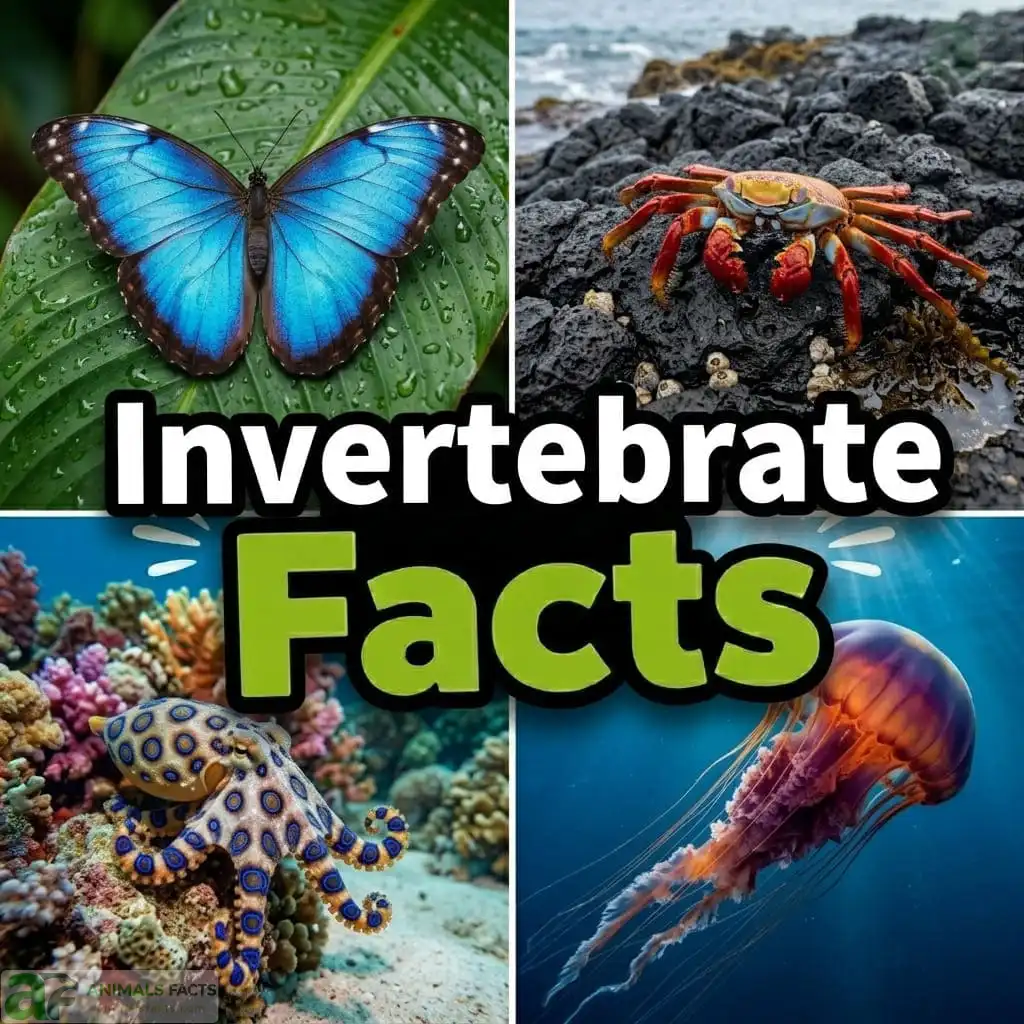
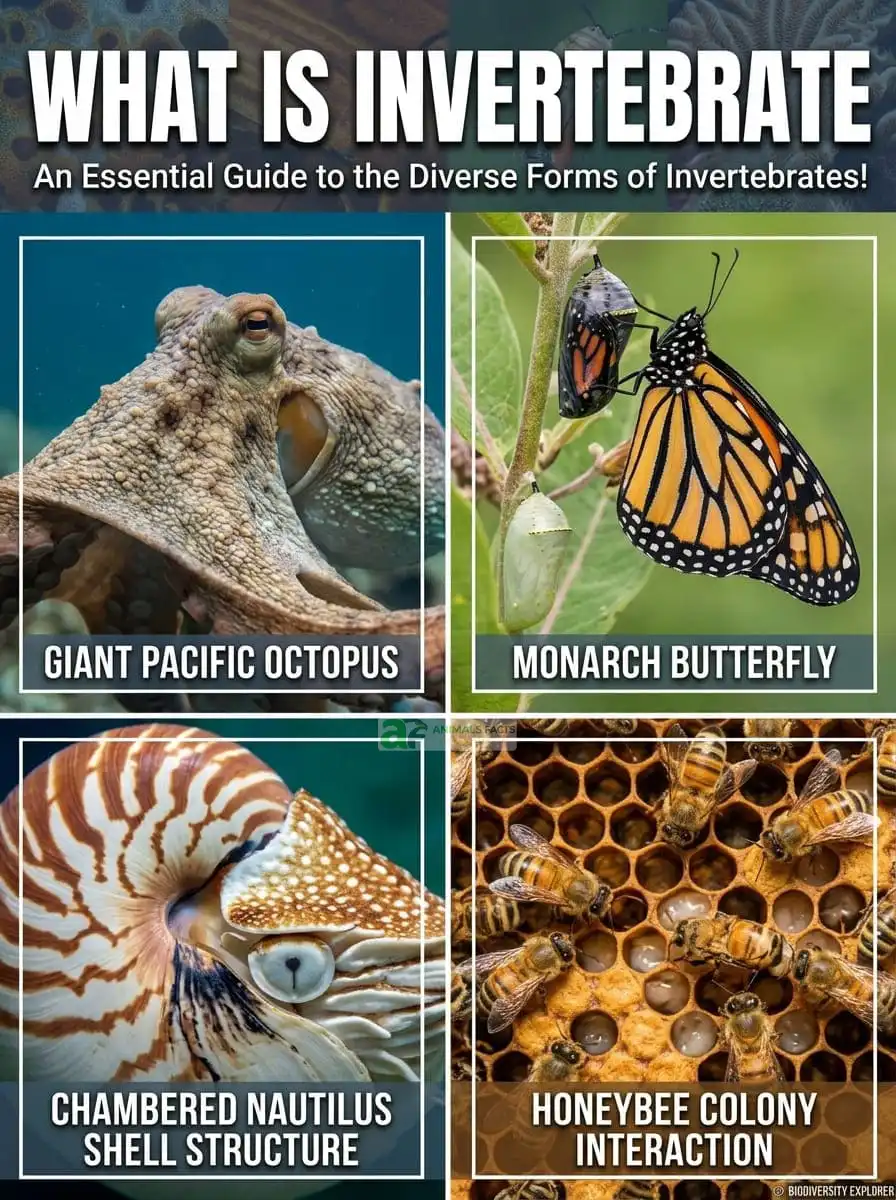
Invertebrates are not a formal scientific classification — they are a descriptive term for every animal that lacks a vertebral column. Within that vast umbrella live some of the most astonishing organisms ever produced by evolution: the octopus, with nine brains and the ability to dream; the mantis shrimp, whose punch accelerates faster than a bullet; the immortal jellyfish, which can reverse its own aging process; the coral polyp, which builds structures visible from space; and the tardigrade, which survives the vacuum of outer space. Interesting facts about invertebrates span every imaginable extreme of biology — and they never stop arriving, because scientists are still discovering thousands of new invertebrate species every single year.
This is your complete, definitive guide to invertebrate facts — covering every major group, every record-breaking adaptation, and every critical ecological role these extraordinary animals play in keeping life on this planet functioning. Whether you are a student searching for invertebrate facts for kids, a teacher building a curriculum, a researcher needing precise data, or simply a curious person who looked at a tide pool and felt the universe open up — this article was written for you.
2. Invertebrate Species Overview & Classification
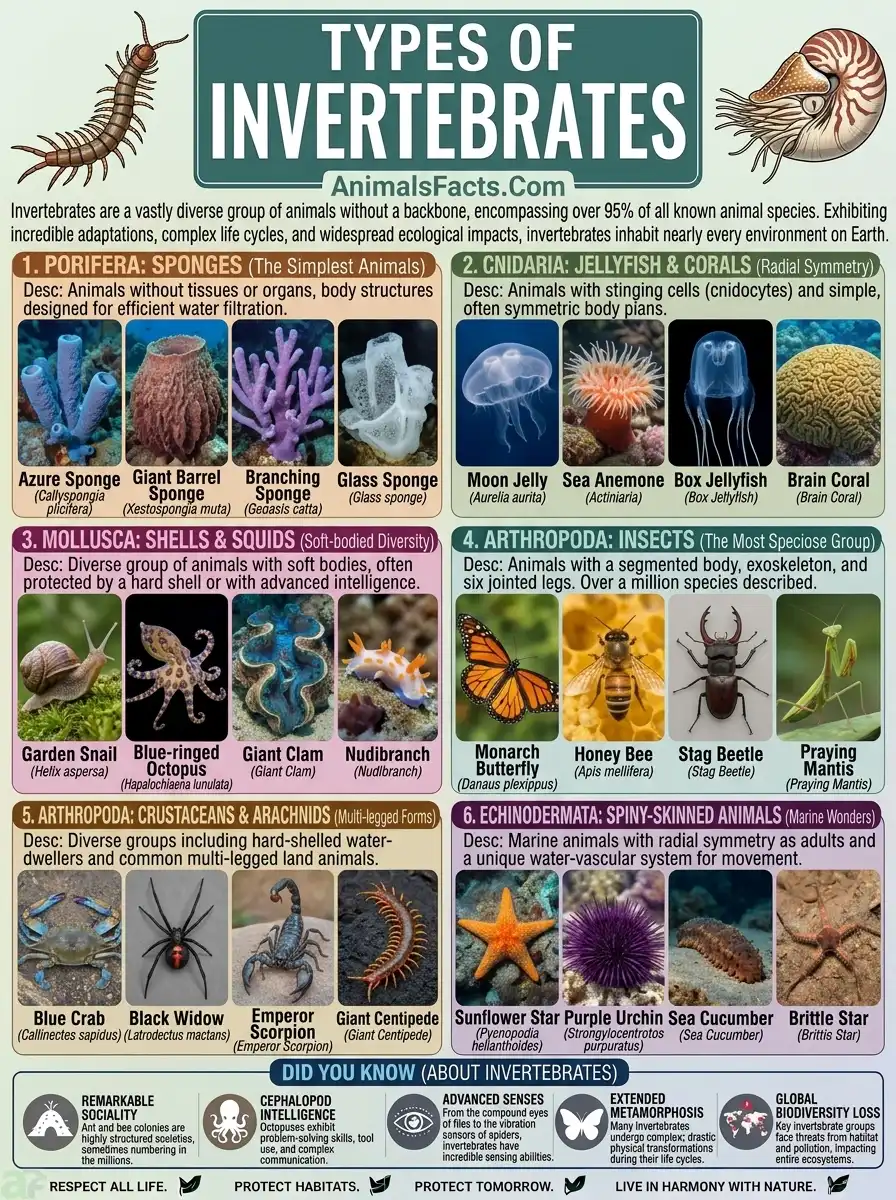
Invertebrates are not a phylum, class, or any formal taxonomic rank. The term was first coined by the French naturalist Jean-Baptiste Lamarck in the early 19th century to distinguish animals lacking a spinal column from those that possess one. Today, the invertebrates encompass over 30 animal phyla — representing the overwhelming bulk of animal diversity on Earth.
Major Invertebrate Phyla
| Phylum | Common Examples | Approx. Species | Key Feature |
|---|---|---|---|
| Arthropoda | Insects, spiders, crabs, scorpions | 1,100,000+ | Jointed legs, exoskeleton |
| Mollusca | Octopus, snails, clams, squid | ~85,000 | Soft body; many have shells |
| Nematoda | Roundworms | ~25,000 described; millions estimated | Unsegmented cylindrical body |
| Annelida | Earthworms, leeches, polychaetes | ~22,000 | Segmented worm body |
| Echinodermata | Sea stars, sea urchins, sea cucumbers | ~7,500 | Five-fold symmetry; water vascular system |
| Cnidaria | Jellyfish, corals, sea anemones, hydras | ~11,000 | Stinging cells (nematocysts) |
| Platyhelminthes | Flatworms, tapeworms, flukes | ~25,000 | Flat, unsegmented body |
| Porifera | Sponges | ~10,000 | Sessile; filter feeders; no true tissues |
| Bryozoa | Moss animals | ~6,000 | Colonial filter feeders |
| Chordata (Invertebrate) | Sea squirts, lancelets | ~3,000 | Have notochord but no backbone |
Classification Context
| Level | Detail |
|---|---|
| Kingdom | Animalia |
| Subkingdom | Eumetazoa (all except sponges) and Parazoa (sponges) |
| Formal Status | Not a clade — a paraphyletic grouping of all non-vertebrate animals |
| Coined by | Jean-Baptiste Lamarck, 1801 |
| Vertebrates (for comparison) | ~66,000 species — less than 5% of animal diversity |
Invertebrate Species Evolution & Discovery Timeline
- ~700 million years ago — First multicellular animals appear; likely sponge-like organisms in Ediacaran seas
- ~600 million years ago — Ediacaran fauna flourish; soft-bodied invertebrate communities dominate the ocean floor
- ~541 million years ago — Cambrian Explosion: most major invertebrate body plans appear in the fossil record within ~25 million years — one of the most dramatic events in the history of life
- ~500 million years ago — Trilobites, early mollusks, and echinoderms diversify explosively
- ~430 million years ago — Invertebrates colonize land; scorpions and millipedes among the first terrestrial animals
- ~350 million years ago — Insects evolve wings — the first flying animals on Earth
- ~250 million years ago — Permian mass extinction eliminates ~96% of marine invertebrate species; recovery takes millions of years
- 1758 — Carl Linnaeus begins systematic classification of invertebrate species
- 1801 — Jean-Baptiste Lamarck introduces the term “invertebrate”
- 1859 — Charles Darwin’s On the Origin of Species uses invertebrate variation extensively to demonstrate natural selection
- 1930s–1960s — Marine biology expeditions reveal extraordinary deep-sea invertebrate diversity
- 1988 — The immortal jellyfish (Turritopsis dohrnii) is first described; its biological immortality recognized in 1996
- 2000–2026 — Environmental DNA sampling and deep-sea exploration continue revealing thousands of new invertebrate species annually; estimated undescribed species numbers revised upward repeatedly
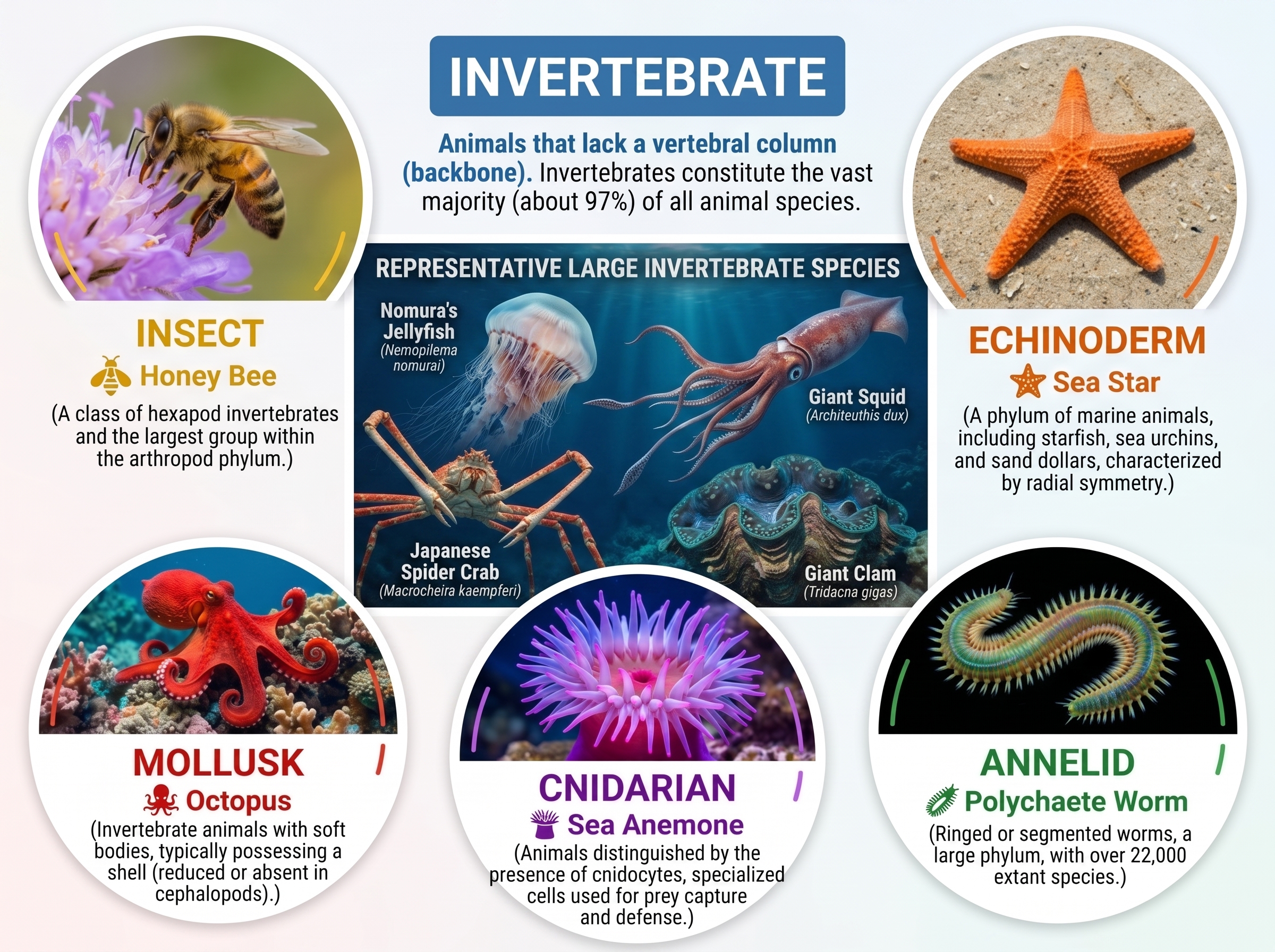
3. Invertebrate Physical Description & Features
The defining physical characteristic of an invertebrate is, paradoxically, an absence — no backbone, no vertebral column, no internal bony skeleton of the vertebrate type. Beyond this shared absence, invertebrate body plans represent the full range of what animal biology is capable of producing.
Body Plan Diversity Across Major Groups
| Group | Body Symmetry | Support Structure | Notable Physical Feature |
|---|---|---|---|
| Sponges (Porifera) | Asymmetrical | None (water-supported) | Porous body; no true tissues or organs |
| Jellyfish (Cnidaria) | Radial | Hydrostatic (water-filled mesoglea) | Up to 95% water by body mass |
| Flatworms (Platyhelminthes) | Bilateral | None | Completely flat; some microscopic |
| Roundworms (Nematoda) | Bilateral | Hydrostatic | Cylindrical; ~1 mm average size |
| Earthworms (Annelida) | Bilateral | Hydrostatic (fluid-filled segments) | Segmented body; hermaphroditic |
| Insects (Arthropoda) | Bilateral | Exoskeleton (chitin) | 6 legs; 3 body sections; usually winged |
| Spiders (Chelicerata) | Bilateral | Exoskeleton | 8 legs; silk production; venom |
| Snails (Mollusca) | Bilateral | Shell (calcium carbonate) | Muscular foot; radula (rasping tongue) |
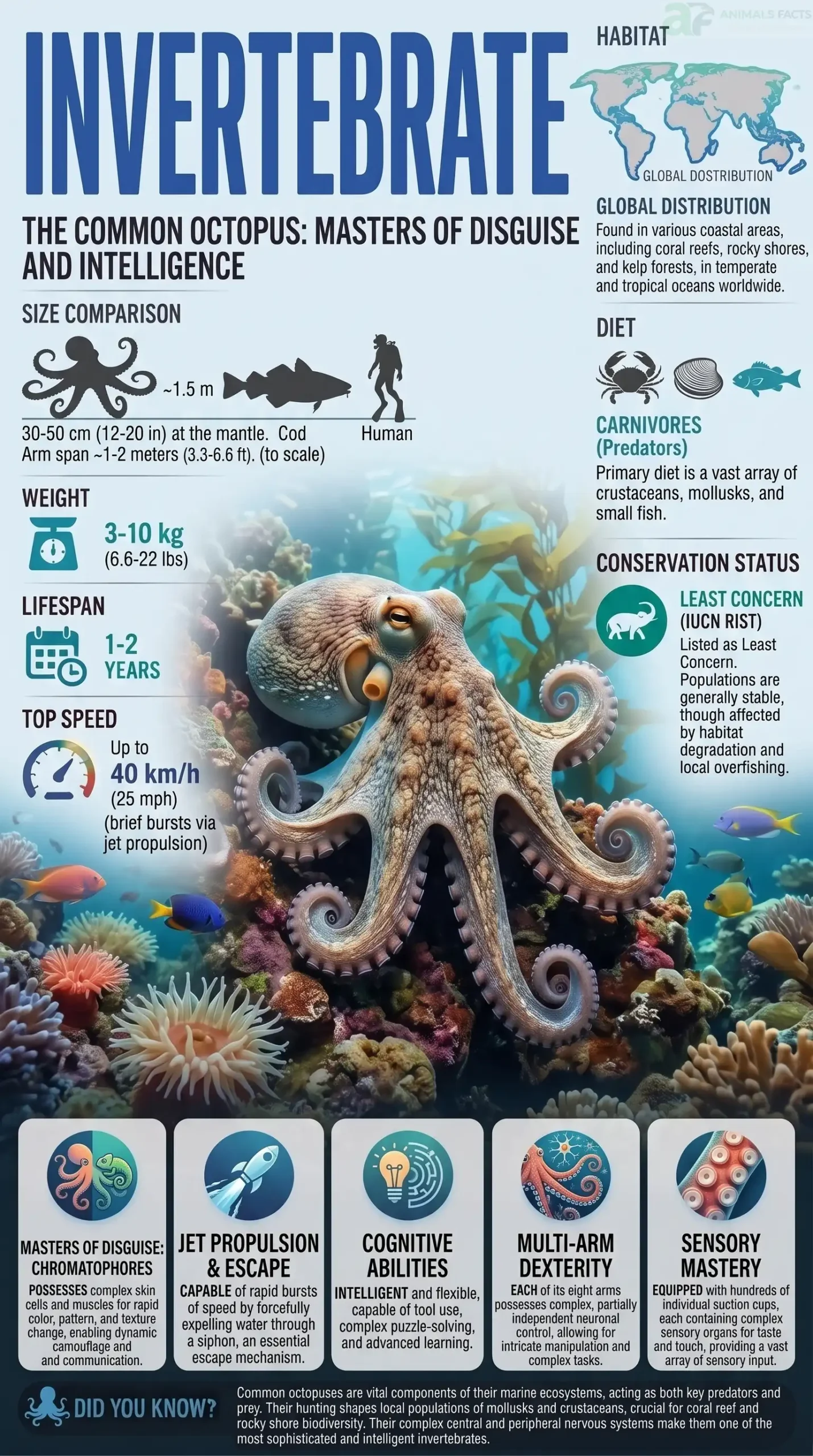
| Octopus (Cephalopoda) | Bilateral | None (entirely soft) | 9 brains; chromatophores; 3 hearts |
| Sea stars (Echinodermata) | Pentaradial (5-fold) | Calcium carbonate endoskeleton | Water vascular system; tube feet |
Size Records Across Invertebrates
| Record | Species | Measurement |
|---|---|---|
| Smallest animal | Myxozoa (microscopic parasitic cnidarian) | ~8 micrometers |
| Smallest free-living invertebrate | Stygotantulus stocki (crustacean) | 0.1 mm |
| Largest invertebrate | Colossal squid (Mesonychoteuthis hamiltoni) | Up to 14 m total length; 700 kg |
| Longest tentacle span | Lion’s mane jellyfish (Cyanea capillata) | Tentacles up to 37 m |
| Largest land invertebrate | Coconut crab (Birgus latro) | Up to 1 m leg span; 4.1 kg |
| Most legs | Illacme plenipes (millipede) | 750 legs |
| Longest worm | Bootlace worm (Lineus longissimus) | Recorded at 55 m — longer than a blue whale |
“Invertebrates are the little things that run the world. They are the cornerstone of every ecosystem, the foundation of every food chain, and the mechanism by which the chemistry of life itself is recycled and renewed.” — Sir David Attenborough, BBC Natural World
4. Top 25 Amazing Invertebrate Facts
Here are the most extraordinary, share-worthy interesting facts about invertebrates — each one a window into how astonishing life without a backbone truly is:
- Invertebrates make up over 97% of all known animal species on Earth
- The immortal jellyfish (Turritopsis dohrnii) can reverse its own life cycle — reverting from adult back to juvenile stage — and is considered biologically immortal
- An octopus has three hearts, nine brains, and blue blood — and can solve puzzles, recognize faces, and appear to dream
- The mantis shrimp can punch with the acceleration of a 22-caliber bullet and perceives 16 types of color — compared to humans’ 3
- A pistol shrimp snaps its claw so fast it creates a cavitation bubble that reaches 8,000°C — briefly hotter than the surface of the Sun
- Coral reefs — built entirely by invertebrate coral polyps — cover less than 1% of the ocean floor but support approximately 25% of all marine species
- The tardigrade (water bear) — a microscopic invertebrate — survives outer space, near-absolute-zero temperatures, extreme radiation, and pressures 6 times deeper than the Mariana Trench
- Earthworms process an estimated 1 billion tons of soil annually worldwide, making them the most important soil engineers on land
- A single ant colony can contain up to 700 million individuals — functioning as a coordinated superorganism with no central leadership
- The giant squid (Architeuthis dux) has eyes up to 30 cm in diameter — the largest eyes of any living animal
- Honeybees communicate the exact direction, distance, and quality of food sources through a mathematical waggle dance — one of the most sophisticated non-human communication systems known
- The peacock mantis shrimp smashes prey with a club-like appendage that delivers 1,500 Newtons of force — enough to shatter aquarium glass
- Sea cucumbers expel their internal organs when threatened — then regenerate them completely within weeks
- Some flatworms (Macrostomum lignano) can regenerate their entire body from a fragment just 1/279th of their original size
- Dragonflies (invertebrate arthropods) have a hunting success rate of 95% — the highest of any predator on Earth
- The bootlace worm (Lineus longissimus) is the longest animal ever recorded — a specimen found in Scotland measured an estimated 55 meters
- Horseshoe crabs have remained virtually unchanged for 450 million years and their blue blood is used to test every injectable drug and vaccine for contamination
- The mimic octopus can impersonate over 15 different species — including lionfish, flatfish, and sea snakes — a feat of behavioral flexibility unmatched in the animal kingdom
- Invertebrates were the first animals to fly — winged insects evolved approximately 350 million years ago, around 150 million years before the first pterosaurs
- Copepods (tiny crustaceans) are the most abundant multicellular animals on Earth and form the base of virtually every marine food chain
- The vampire squid (Vampyroteuthis infernalis) lives in oxygen-minimum zones where almost nothing else can survive — at depths of 600–900 meters
- Some sea sponges are more than 2,300 years old — among the longest-lived animals ever documented
- Nematode roundworms are so numerous that if all matter on Earth were removed except nematodes, the outlines of mountains, rivers, oceans, and even individual plants could still be traced in nematode form
- The glass sponge (Euplectella aspergillum) builds a skeletal lattice of silica so structurally sophisticated that engineers have adopted its design principles for modern skyscrapers and fiber optic cables
- Bombardier beetles spray a boiling chemical jet from their abdomen at 100°C with an audible pop — one of the most extraordinary chemical defense systems in nature
Did You Know? The immortal jellyfish (Turritopsis dohrnii) does not technically die of old age. When stressed, injured, or aging, it reverts its cells back to their earliest juvenile state — a process called transdifferentiation — essentially starting its life over. Scientists studying this process are investigating its potential implications for human aging biology and regenerative medicine.
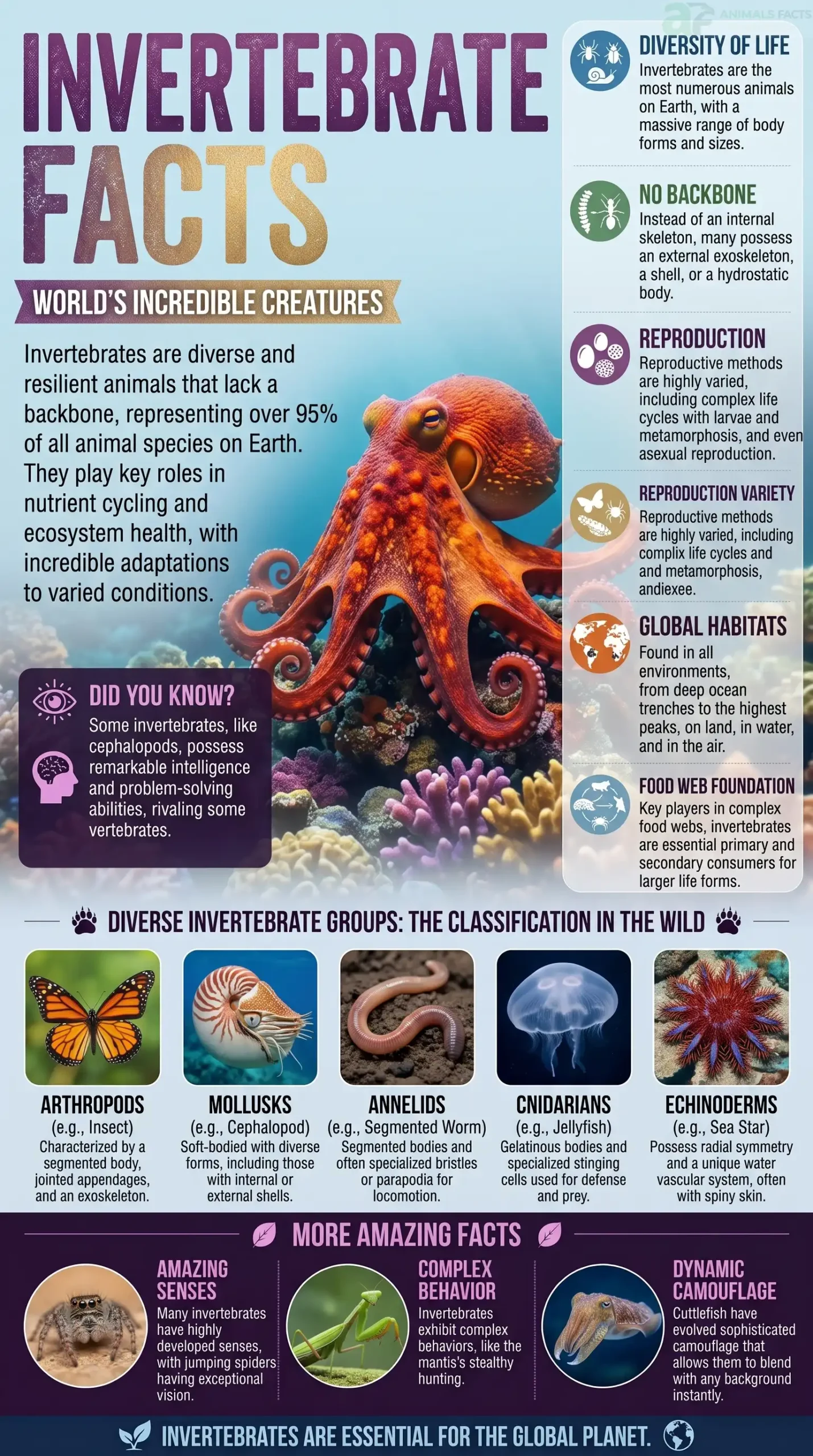
5. Invertebrate Fun Facts for Kids
- Invertebrates make up over 97% of all animal species on Earth
- Jellyfish have no brain, no heart, no bones — and have existed for 500+ million years
- Octopuses have 9 brains and 3 hearts and can recognize human faces
- Copepods are the most abundant multicellular animals alive on Earth
- Coral reefs support 25% of all marine species despite covering 1% of the ocean floor
- Tardigrades survive outer space, radiation, and temperatures from −272°C to 150°C
- Earthworms process 1 billion tons of soil every year
- The giant squid has eyes 30 cm wide — the largest of any living animal
- A snail can sleep for 3 years continuously during drought conditions
- Butterflies taste with their feet — chemoreceptors on their legs detect plant chemistry
- Sea stars can regenerate an entire body from a single severed arm
- Horseshoe crabs are 450 million years old — unchanged since before the dinosaurs
- The immortal jellyfish is considered biologically immortal
- Some deep-sea invertebrates produce their own light through bioluminescence
- Ants have colonized every continent on Earth except Antarctica
6. Natural Habitats of Invertebrate
No other animal grouping occupies as complete a range of habitats as invertebrates. Because they are defined by absence rather than positive traits, the invertebrates have explored every conceivable ecological niche that animal life can occupy.
Invertebrates Habitat Range by Environment
| Habitat Type | Dominant Invertebrate Groups | Notable Species |
|---|---|---|
| Deep ocean (>1,000 m) | Sea cucumbers, polychaetes, giant squid, amphipods, sea spiders | Giant squid, giant isopod, Dumbo octopus |
| Coral reef | Coral polyps, nudibranchs, mantis shrimp, cephalopods | Peacock mantis shrimp, blue-ringed octopus, clownfish-hosting anemones |
| Open ocean (pelagic) | Jellyfish, copepods, krill, pteropods, salps | Lion’s mane jellyfish, Antarctic krill, Portuguese man o’ war |
| Intertidal zone | Barnacles, mussels, sea stars, crabs, whelks | Common starfish, hermit crab, purple sea urchin |
| Freshwater | Crayfish, dragonfly larvae, leeches, freshwater mussels, water fleas | Giant water bug, caddisfly, freshwater pearl mussel |
| Tropical rainforest | Beetles, ants, butterflies, centipedes, spiders | Goliath birdeater, leafcutter ant, atlas moth |
| Desert / arid | Scorpions, darkling beetles, camel spiders, snails | Deathstalker scorpion, Namib fog beetle |
| Temperate forest | Earthworms, beetles, moths, woodlice, slugs | Stag beetle, common earthworm, garden snail |
| Soil (globally) | Nematodes, earthworms, springtails, mites | Lumbricus terrestris, tardigrades in soil moisture |
| Polar regions | Krill, sea spiders, ice mites, snow fleas | Antarctic krill (Euphausia superba), Arctic copepods |
| Caves | Cave beetles, cave crayfish, cave spiders, cave snails | Leptodirus hochenwart, Orconectes pellucidus |
| Parasitic (inside hosts) | Tapeworms, flukes, roundworms, lice, mites | Taenia solium, Plasmodium host mosquitoes |
Continent-by-Continent Breakdown
| Region | Invertebrate Highlights | Notable Fact |
|---|---|---|
| South America | Amazon insect diversity, giant river otters’ prey, Galápagos invertebrates | Amazon basin hosts ~10% of all known species |
| Africa | Termite megacolonies, scarab beetles, giant millipedes | African termite mounds reach 9 meters tall |
| Asia | Giant hornets, silkworm moths, Japanese spider crabs | Japanese spider crab has 3.7 m leg span |
| North America | Monarch butterflies, horseshoe crabs, crayfish diversity | Eastern U.S. has greatest freshwater mussel diversity globally |
| Europe | Garden snails, stag beetles, freshwater pearl mussels | Freshwater pearl mussel among most endangered invertebrates |
| Australia | Box jellyfish, cone snails, giant cuttlefish | Box jellyfish (Chironex fleckeri): world’s most venomous animal |
| Antarctica | Antarctic krill, sea spiders, ice mites | Krill swarms can weigh over 2 million tons |
| Ocean (global) | Copepods, jellyfish blooms, deep-sea fauna | Deep sea remains most unexplored invertebrate habitat |
Did You Know? If you collected all the nematode roundworms from just one square meter of rich garden soil, you would hold somewhere between 1 and 10 million individual worms in your hands — invisible to the naked eye but collectively performing essential nutrient cycling, bacterial regulation, and soil aeration functions that make plant life above them possible.
7. Invertebrate Diet & Feeding Behavior
Invertebrates collectively practice every feeding strategy that exists in the animal kingdom — and several that are unique to them.
Diet Breakdown Across Major Groups
| Group | Diet Type | Primary Food Source | Feeding Method |
|---|---|---|---|
| Sponges | Filter feeder | Bacteria, plankton, organic particles | Pump water through body; absorb nutrients |
| Jellyfish | Carnivore | Plankton, small fish, other invertebrates | Sting with nematocysts; passive drift |
| Corals | Mixotroph | Zooxanthellae algae (photosynthesis) + zooplankton | Photosynthesis + nematocyst feeding |
| Earthworms | Detritivore | Dead organic matter, soil bacteria, fungi | Ingest soil; digest organic component |
| Insects (varied) | All types | Nectar, leaves, blood, wood, other insects | Mouthparts vary: piercing, chewing, proboscis |
| Spiders | Strict carnivore | Insects, small vertebrates | Venom injection; external digestion |
| Octopuses | Carnivore | Crabs, shrimp, clams, fish | Venom; beak; external digestion via radula |
| Snails/Slugs | Herbivore/Detritivore | Leaves, fungi, algae, decaying matter | Radula (rasping tongue) |
| Squid | Carnivore | Fish, crustaceans, other cephalopods | Tentacles + beak; active pursuit |
| Sea stars | Carnivore | Mussels, clams, oysters, barnacles | Evert stomach outside body onto prey |
| Tapeworms | Parasite (absorptive) | Host’s digested nutrients | Absorb nutrients directly through body wall |
| Copepods | Filter feeder | Phytoplankton, bacteria | Suspension feeding |
| Krill | Filter feeder | Phytoplankton, ice algae | Filtering appendages |
One of the most remarkable feeding behaviors in the invertebrate world belongs to the sea star. When it encounters a mussel or clam — a prey item with a shell it cannot simply bite through — it wraps its arms around the shell, applies sustained suction via hundreds of tube feet, and pulls the two halves apart by just 0.1 mm. Into this tiny gap, it inserts its stomach outside its own body, secretes digestive enzymes directly onto the prey’s flesh, and absorbs the resulting liquid meal — all without the prey ever leaving its shell.
8. Invertebrate Reproduction & Life Cycle
Invertebrates display the broadest range of reproductive strategies of any animal grouping — encompassing virtually every method of reproduction known to biology.
Reproductive Strategies Across Groups
Sexual reproduction — The most widespread strategy; used by the majority of invertebrate species. Fertilization may be internal (spiders, scorpions, some insects) or external (most marine invertebrates, releasing eggs and sperm into open water).
Parthenogenesis — Reproduction without fertilization; females produce offspring from unfertilized eggs. Common in aphids, some bees (producing drones), water fleas (Daphnia), and certain species of stick insects.
Hermaphroditism — Individuals possess both male and female reproductive organs. Common in earthworms, land snails, flatworms, and many marine invertebrates. Some species (like certain fish-parasitic flatworms) can self-fertilize.
Budding — New individuals grow directly from the parent body. Common in sponges, hydras, and corals. The entire coral reef is built this way — one polyp budding from the next.
Biological Immortality — The immortal jellyfish (Turritopsis dohrnii) reverses its life cycle through transdifferentiation, escaping senescence entirely under the right conditions.
Lifespan Comparison
| Species | Lifespan | Notes |
|---|---|---|
| Mayfly (adult) | A few hours to 1 day | Shortest adult lifespan of any animal |
| Common housefly | ~28 days | |
| Honeybee worker | 6 weeks (summer) | Queen lives up to 5 years |
| Garden snail | 2–7 years | |
| Giant Pacific octopus | 3–5 years | |
| American lobster | Up to 140 years | May not senesce biologically |
| Japanese spider crab | Up to 100 years | |
| Deep-sea sponge (Monorhaphis chuni) | Estimated 11,000 years | Oldest known animal |
| Immortal jellyfish | Potentially indefinite | Biologically immortal under ideal conditions |
Did You Know? A deep-sea glass sponge (Monorhaphis chuni) collected from the East China Sea was estimated, by analysis of its growth layers, to be approximately 11,000 years old — making it the oldest known living animal ever recorded. It was already ancient when the pyramids of Egypt were being built.
9. Social Behavior & Communication
Invertebrate social organization ranges from absolute solitude to the most complex societies in the animal kingdom.
Eusociality – The Invertebrate Achievement
The most sophisticated social systems on Earth belong not to mammals or birds but to invertebrates. Ants, bees, wasps, and termites have independently evolved eusociality — the highest level of social organization in biology — characterized by cooperative brood care, overlapping generations, and reproductive division of labor between queens and sterile workers.
A mature leafcutter ant colony of up to 8 million individuals operates without any centralized command. Each worker follows simple chemical rules; the emergent result is a civilization that farms fungus in underground gardens, maintains ventilation systems, runs waste-disposal operations, and defends territory against enemies many times its individual size — a superorganism of staggering collective intelligence.
Communication Methods
| Method | Invertebrate Groups | Example |
|---|---|---|
| Pheromone trails | Ants, moths, beetles | Foraging trails; alarm signals; mate attraction |
| Waggle dance | Honeybees | Communicates food source location with mathematical precision |
| Bioluminescence | Fireflies, deep-sea invertebrates, some squid | Mating signals; predator luring; counter-illumination |
| Chromatophore display | Octopus, cuttlefish, squid | Color, pattern, and texture changes for communication |
| Stridulation | Crickets, grasshoppers, lobsters | Sound through body-part friction |
| Vibration | Spiders, scorpions | Substrate-borne signals for prey detection and mating |
| Chemical (contact) | Butterflies, bees | Feet chemoreceptors; taste-by-touch |
| Web tension signals | Spiders | Vibration patterns through silk communicate mate presence |
“Look beneath your feet. In a single handful of healthy soil, the invertebrate community — the nematodes, the mites, the springtails, the earthworm fragments — represents a biological complexity that rivals anything you might find in a tropical rainforest canopy. We simply cannot see it.” — Dr. E.O. Wilson, Harvard University, two-time Pulitzer Prize winner
10. Predators & Defense Mechanisms
What Eats Invertebrates?
Virtually every vertebrate on Earth depends on invertebrates as a food source at some point in its life cycle. Fish, amphibians, reptiles, birds, and mammals all consume invertebrates — often as their primary food source. Paradoxically, the largest predator category of invertebrates is other invertebrates — spiders, centipedes, mantises, dragonflies, and predatory beetles collectively consume more invertebrate biomass than all vertebrates combined.
Defense Strategies Across the Phylum
| Strategy | Group | Example |
|---|---|---|
| Venom injection | Spiders, scorpions, centipedes, cone snails, jellyfish, blue-ringed octopus | Box jellyfish: world’s most venomous animal |
| Ink release | Octopuses, squid, cuttlefish | Cloud of ink obscures escape; contains tyrosinase that disrupts predator senses |
| Chemical sprays | Bombardier beetles, millipedes, ants | Bombardier beetle: boiling 100°C chemical spray |
| Camouflage | Stick insects, crab spiders, octopuses, nudibranchs | Mimic octopus; orchid mantis; leaf-tailed gecko prey |
| Warning coloration (aposematism) | Monarch butterfly, poison dart beetles, nudibranchs | Bright colors signal toxicity |
| Autotomy | Sea stars, crabs, some octopuses | Shed limbs to escape; fully regenerate |
| Shell armor | Snails, clams, hermit crabs, turtles (convergent) | Calcium carbonate shells resist crushing |
| Mass aggregation | Krill, bees, army ants | Dilution effect and colony-level defense |
| Mimicry | Hoverflies, clearwing moths, mimic octopus | Impersonate dangerous species |
| Bioluminescence | Deep-sea squid, firefly squid | Counter-illumination to match background light |
| Autohemorrhage | Some beetles | Bleed deliberately from leg joints; blood is toxic or distasteful |
11. Invertebrate Facts for Kids
Hey young explorers! The animal world is mostly made of invertebrates — creatures with no backbone — and they are absolutely incredible. Here are some amazing invertebrate facts just for you:
- More than 97 out of every 100 animal species on Earth have no backbone — that means invertebrates are in charge!
- There is a jellyfish that is basically immortal — it can turn itself back into a baby when it gets old, and start life all over again!
- An octopus has THREE hearts and NINE brains — one brain in its head and one in each arm!
- The pistol shrimp snaps its claw so fast it makes a tiny flash of light hotter than the Sun — for just a split second!
- A dragonfly catches almost every single insect it chases — it has a 95% hunting success rate, making it the best hunter on Earth!
- Earthworms are underground superheroes — they eat dead leaves and poop out nutrients that help plants grow!
- Some sea stars can grow an entire new body from just one arm — like the ultimate superpower!
- The longest animal ever found was not a blue whale — it was a worm, stretching over 55 meters long!
- Honeybees do a special dance to tell their friends exactly where flowers are — like sending a GPS message with their bodies!
- A snail can sleep for THREE WHOLE YEARS if the weather is too dry — imagine sleeping that long!
12. Relationship with Humans
No animal grouping has shaped human civilization, health, economy, and culture more profoundly than invertebrates — and the relationship runs in every direction, from life-saving to life-threatening.
Invertebrates That Sustain Human Life
Pollination — The vast majority of the world’s flowering crop species depend on invertebrate pollinators — primarily bees, butterflies, beetles, and flies. The global economic value of invertebrate pollination services is estimated at $577 billion per year. Remove invertebrate pollinators, and human agriculture as currently practiced collapses within years.
Soil health — Earthworms, nematodes, mites, springtails, and millipedes collectively process the dead organic matter that keeps soil fertile. Their burrowing, digesting, and excreting creates the tilth and nutrient availability that every terrestrial food system depends on.
Marine food chains — Copepods and krill sit between ocean phytoplankton and every large marine animal — from anchovies to blue whales — that humans eat or depend upon. Their collapse would restructure every ocean food system within years.
Medicine — Horseshoe crab blood (LAL test) protects every injectable drug and vaccine. Spider and cone snail venom compounds are active sources of novel pain medications and cancer therapies. Maggot therapy (blow fly larvae) is an FDA-approved treatment for non-healing wounds. Bee venom is studied for arthritis, Parkinson’s, and neurological conditions.
Invertebrates That Threaten Human Life
Disease vectors — Mosquitoes (Diptera: Culicidae) transmit malaria, dengue, Zika, yellow fever, and more — killing an estimated 700,000+ people annually — making them the deadliest animals to humans in history. Ticks, sandflies, tsetse flies, and fleas transmit additional deadly diseases across all inhabited continents.
Agricultural pests — Locusts, aphids, whiteflies, nematodes, and weevils destroy billions of dollars of crops annually. A single swarm of desert locusts can contain 150 million individuals per square kilometer and consume its own weight in food every day.
Venomous species — Box jellyfish, cone snails, blue-ringed octopuses, and various spiders and scorpions claim human lives annually — though numbers are modest compared to disease-vector invertebrates.
13. Invertebrate Conservation Status & Threats
The Invertebrate Crisis
The conservation crisis facing invertebrates is simultaneously one of the most severe and most underreported environmental emergencies of our time. Key findings include:
- A 2019 global review in Biological Conservation found that 40% of invertebrate species are in decline, with one-third potentially facing extinction within decades
- Flying insect biomass in Germany declined by 75% over 27 years in protected reserves (2017 study)
- Freshwater invertebrates — mayflies, stoneflies, caddisflies, freshwater mussels — have experienced some of the steepest declines of any animal group
- Coral bleaching events, driven by ocean warming, have killed over 50% of the Great Barrier Reef’s coral cover since the 1990s — coral polyps are invertebrates, and their loss cascades to every species depending on reef structure
IUCN Status of Selected Invertebrates
| Species | IUCN Status |
|---|---|
| Migratory monarch butterfly | Endangered (2022) |
| Rusty patched bumblebee | Critically Endangered |
| Freshwater pearl mussel | Endangered |
| Horseshoe crab (Limulus polyphemus) | Vulnerable |
| Giant clam (Tridacna gigas) | Vulnerable |
| Staghorn coral (Acropora cervicornis) | Critically Endangered |
| Franklin’s bumblebee | Critically Endangered (possibly extinct) |
| European eel (larvae: invertebrate stage) | Critically Endangered |
Major Threats
| Threat | Impact Level | Invertebrates Most Affected |
|---|---|---|
| Habitat loss | Critical | All terrestrial, freshwater, and reef invertebrates |
| Pesticides (especially neonicotinoids) | Critical | Bees, butterflies, aquatic invertebrates |
| Climate change / ocean warming | Critical | Corals, polar krill, range-restricted species |
| Ocean acidification | High | Corals, mollusks, echinoderms (carbonate shells dissolve) |
| Light pollution | High | Moths, fireflies, nocturnal insects, marine turtle-following crabs |
| Plastic pollution | High | Marine invertebrates; microplastics found in deep-sea amphipods |
| Invasive species | High | Island species, freshwater invertebrates |
| Overharvesting | Medium | Horseshoe crabs, lobsters, shrimp, corals, sea cucumbers |
14. Famous Invertebrates
The Immortal Jellyfish (Turritopsis dohrnii)
Discovered off the coast of the Mediterranean in 1883 but not recognized as biologically immortal until 1996, Turritopsis dohrnii has since become one of the most discussed organisms in aging research worldwide. Its ability to revert mature cells back to their earliest stem-cell state — a process called transdifferentiation — has implications for regenerative medicine, cancer biology, and gerontology that scientists are only beginning to explore.
Paul the Octopus (2010)
This common octopus (Octopus vulgaris), housed at the Sea Life Centre in Oberhausen, Germany, became a global media phenomenon during the 2010 FIFA World Cup by correctly predicting the outcomes of 8 consecutive matches — including Spain’s final victory — by choosing between food boxes labeled with competing nations’ flags. The probability of this outcome by chance: 1 in 256.
Inky the Octopus (2016)
Inky, a common octopus at New Zealand’s National Aquarium, escaped from his tank overnight, crossed the aquarium floor, squeezed through a drainage pipe, and returned to the ocean — a story that captivated global media and became one of the most-shared wildlife stories of the year.
The Horseshoe Crab — Medicine’s Unsung Hero
No named individual, but the species Limulus polyphemus collectively deserves legendary status. Since 1970, horseshoe crab blood LAL testing has been mandatory for pharmaceutical safety testing globally. Every person who has ever received an injection — vaccine, saline drip, surgical implant — owes a debt to these ancient invertebrates.
The Mimic Octopus (Thaumoctopus mimicus)
Discovered in 1998 off the coast of Sulawesi, Indonesia, this species became instantly famous when footage emerged of it impersonating lionfish, flatfish, and sea snakes in real time. It remains the only known animal that can actively mimic multiple different species sequentially, selecting its impersonation based on which local predator is most threatening.
15. Role in Ecosystem & Food Chain
Invertebrates do not merely participate in ecosystems. They are ecosystems — the structural and functional foundation upon which all other life depends.
Core Ecological Roles
Decomposition and nutrient cycling — Without invertebrate decomposers — earthworms, beetles, flies, millipedes, nematodes, isopods — dead organic matter would accumulate indefinitely. Invertebrates break down leaves, wood, carcasses, and waste into nutrients that re-enter the soil and water, fueling plant growth and sustaining every food chain above them.
Pollination — Bees, butterflies, moths, beetles, and flies pollinate the majority of Earth’s flowering plants — wild and cultivated alike. Without this service, most fruit, vegetable, nut, and seed production would fail, triggering ecosystem collapse in every terrestrial biome.
Reef building — Coral polyps (cnidarian invertebrates) construct the physical architecture of coral reefs — the most biodiverse marine ecosystems on Earth. Without coral polyp activity, reef structures that took thousands of years to build would erode within decades.
Marine food chain base — Copepods, krill, and other zooplankton (almost entirely invertebrates) are the critical link between ocean phytoplankton and every large marine animal. Whales, tuna, seabirds, seals — all ultimately depend on invertebrate zooplankton to convert plant matter into animal protein.
Soil architecture — Burrowing invertebrates — earthworms, beetles, ants, moles crickets — aerate soil, improve drainage, and create the physical conditions that allow plant roots to penetrate and water to infiltrate. A single hectare of healthy agricultural soil may contain 400–700 km of earthworm tunnels.
16. Invertebrate Myths, Folklore & Cultural Significance
Ancient Egypt — The Sacred Scarab
The scarab beetle (Scarabaeus sacer) was among the most sacred symbols in ancient Egyptian theology — representing Khepri, the god of the rising sun, and the cycle of death and rebirth. Scarab amulets were placed over mummies’ hearts to protect the deceased during the afterlife journey. The image of a beetle rolling a dung ball across the sand — mirroring the sun’s movement across the sky — inspired one of the world’s oldest sustained religious metaphors.
Ancient Greece — Bees and Divine Wisdom
In ancient Greece, bees were considered messengers between the human and divine worlds. The Delphic Oracle at Delphi was called the Bee (Melissa), and priestesses of certain mystery cults took the same name. Bee imagery appears throughout Greek temple architecture, coinage, and poetry as symbols of eloquence, divine inspiration, and immortality.
Japanese Culture — Insects and Impermanence
Japanese aesthetic philosophy has for centuries celebrated insects as embodiments of mono no aware — the poignant beauty of transient things. The firefly (hotaru) appears throughout classical Japanese poetry as a symbol of longing, lost love, and fleeting summer beauty. Cricket song (matsumushi) has been kept as ambient music in Japanese homes for over a thousand years. The dragonfly (tombo) was a symbol of courage, strength, and victory — Japanese warriors wore dragonfly motifs on their armor.
Aztec Civilization — The Butterfly as Soul
The Aztec people believed that the souls of fallen warriors were reincarnated as hummingbirds and butterflies — particularly brilliantly colored species. The butterfly goddess Itzpapalotl (Obsidian Butterfly) was a fearsome deity associated with sacrifice, the night sky, and stars. Butterfly imagery pervades Aztec temple art, manuscript illustration, and ritual calendars.
Norse Mythology — The World Worm
The great Midgard Serpent (Jörmungandr) of Norse mythology — the world-encircling sea creature so large it could swallow its own tail — may draw from ancient sailors’ observations of giant sea worms or enormous marine invertebrates. The concept of a massive, world-defining worm or serpent appears in the mythologies of dozens of cultures globally, always associated with the boundary between the known and unknown world.
17. Invertebrates in Pop Culture
Film and Television
- Finding Nemo (2003) and Finding Dory (2016) — Invertebrates are central characters: Pearl the flapjack octopus, Peach the sea star, the tank-cleaning shrimp, and Hank the septopus
- A Bug’s Life (1998, Pixar) — Anthropomorphized arthropod colony; introduced millions of children to invertebrate social behavior
- My Octopus Teacher (2020, Netflix) — Academy Award-winning documentary exploring the relationship between a filmmaker and a wild octopus in South Africa; credited with dramatically increasing public awareness of invertebrate intelligence
- Blue Planet and Blue Planet II (BBC) — Invertebrates — from mantis shrimp to deep-sea cephalopods — are among the most spectacular sequences in both series
- Microcosmos (1996) — French documentary filmed at macro scale; transforms invertebrate behavior into cinematic spectacle
Books
- The Soul of an Octopus — Sy Montgomery (2015) — New York Times bestseller on octopus consciousness and personality
- Other Minds — Peter Godfrey-Smith (2016) — Philosophical exploration of intelligence in cephalopod invertebrates
- The Ants — E.O. Wilson & Bert Hölldobler (1990) — Pulitzer Prize-winning scientific masterwork on ant biology
- The Insect Crisis — Oliver Milman (2022) — Journalistic investigation of the global invertebrate decline crisis
Video Games
- Hollow Knight (2017) — An entire civilization of anthropomorphized invertebrate characters; one of the most acclaimed independent games ever made
- Invertebrate enemies and companions appear in virtually every major RPG and adventure franchise from The Legend of Zelda to Dark Souls
18. Invertebrate Facts vs. Common Myths
| Myth | Fact |
|---|---|
| “Invertebrates are simple, primitive animals” | Many invertebrates — octopuses, mantis shrimp, honeybees — possess sensory systems, intelligence, and behavioral complexity that rival or exceed many vertebrates |
| “Jellyfish are plants or not real animals” | Jellyfish are fully multicellular animals in the phylum Cnidaria — they hunt, digest, and reproduce sexually |
| “Spiders are insects” | Spiders are arachnids — they have 8 legs and 2 body parts; insects have 6 legs and 3 body parts. Both are invertebrates but from entirely different classes |
| “Earthworms come up when it rains because they drown underground” | Earthworms surface during rain to migrate — rain provides safe surface travel conditions without desiccation risk; healthy soil has enough air for breathing |
| “Invertebrates don’t feel pain” | Current neuroscientific evidence strongly suggests many invertebrates — particularly cephalopods and crustaceans — do experience nociception and likely some form of pain; the EU recognized cephalopod sentience in 2021 |
| “All invertebrates are small” | The colossal squid reaches 14 m and 700 kg; the bootlace worm reaches 55 m; the Japanese spider crab has a 3.7 m leg span |
| “Coral is a plant or rock” | Coral is built by living invertebrate animals — coral polyps — that are closely related to jellyfish |
| “Insects are dying out everywhere equally” | Decline is uneven — some agricultural pest species are increasing while specialized, range-restricted species collapse; the crisis is one of diversity loss, not universal decline |
19. Best Places to See Invertebrates in the Wild
- Great Barrier Reef, Australia — The world’s largest coral reef system offers unparalleled access to coral polyp ecosystems, giant clams, nudibranchs, mantis shrimp, and hundreds of crab and shrimp species. Snorkeling and diving accessible from Cairns and the Whitsundays.
- Amazon Rainforest, Brazil/Peru — The single greatest terrestrial invertebrate diversity hotspot on Earth. A single tree may harbor more beetle species than the entire UK. Night walks reveal tarantulas, giant centipedes, bullet ants, and hundreds of moth and beetle species attracted to lights.
- Monarch Butterfly Biosphere Reserve, Michoacán, Mexico — Witness tens of millions of monarch butterflies blanketing oyamel fir forests from November to March. A UNESCO World Heritage Site and one of the most spectacular wildlife events on the planet.
- Intertidal Zone, Pacific Coast, USA (Big Sur/Olympic Peninsula) — Rocky tide pools are among the most accessible invertebrate habitats in the world, revealing sea stars, anemones, hermit crabs, chitons, and nudibranch species at low tide.
- Komodo Island, Indonesia / Lembeh Strait, North Sulawesi — World-class diving destination for rare cephalopods (mimic octopus, flamboyant cuttlefish, blue-ringed octopus), mantis shrimp, and extraordinary nudibranch diversity.
- Namib Desert, Namibia — Extraordinary desert invertebrate adaptations; Namib fog beetles harvest water from morning fog; scorpions, solifugids (camel spiders), and darkling beetles thrive in one of Earth’s driest environments.
- Monterey Bay, California, USA — The Monterey Bay Aquarium (for education and inspiration) plus the surrounding kelp forest and deep submarine canyon offer access to extraordinary invertebrate diversity including giant Pacific octopuses, sea otters feeding on urchins, and dense krill aggregations.
20. How You Can Help
Invertebrate conservation is invertebrate survival — and given that invertebrates run every ecosystem that sustains human life, it is ultimately human survival too. Here is what you can do right now:
- Plant native wildflowers — Native flowering plants support native bee, butterfly, and beetle communities with far greater effectiveness than exotic ornamentals. Contact your local native plant society or the Xerces Society (xerces.org) for regional guidance
- Eliminate pesticides from your garden — Neonicotinoid insecticides are systemic, persisting in soil and plant tissue and killing non-target invertebrates including pollinators; organic alternatives exist for virtually every pest situation
- Turn outdoor lights off or switch to red-spectrum bulbs — Light pollution kills moths, disrupts firefly mating, and disorients migratory insects on a massive scale
- Leave leaf litter and bare soil — Overwintering butterflies, beetles, and solitary bees depend on undisturbed leaf litter and bare soil patches; a tidy garden is often an ecologically dead one
- Support dedicated organizations — The Xerces Society (xerces.org), Buglife (buglife.org.uk), Butterfly Conservation (butterfly-conservation.org), Coral Restoration Foundation (coralrestoration.org), and Save Our Seas Foundation (saveourseas.com) all fund critical invertebrate research and habitat protection
- Participate in citizen science — iNaturalist (inaturalist.org), BugGuide (bugguide.net), Bumble Bee Watch, CoralWatch (coralwatch.org), and Firefly Watch all collect invertebrate observation data that directly informs conservation decisions
- Reduce single-use plastic consumption — Microplastics are now found in the bodies of deep-sea invertebrates at 11,000 m depth; every piece of plastic prevented from entering waterways helps
- Choose sustainable seafood — Look for MSC certification; avoid shrimp and lobster from unsustainable fisheries; do not purchase coral products or wild-caught ornamental invertebrates without verified sustainable sourcing
21. Top Documentaries & Books
Must-Watch Documentaries
- Microcosmos (1996) — The definitive invertebrate documentary; ground-level macro cinematography that transforms ants, beetles, snails, and spiders into giants; a masterpiece of nature filmmaking
- My Octopus Teacher (2020, Netflix) — Academy Award winner; the most emotionally resonant invertebrate documentary ever made
- Blue Planet II (2017, BBC) — Episodes 2, 3, and 5 feature extraordinary invertebrate sequences including mantis shrimp, deep-sea cephalopods, and coral reef communities
- Planet Earth II (2016, BBC) — Desert and jungle episodes feature scorpions, insects, and spiders with unprecedented cinematography
- The Secret Life of Chaos (2010, BBC) — Explores the emergence of complex behavior from simple biological rules — using invertebrates as central examples
- Fantastic Voyage into a Drop of Water (BBC) — Microscopic invertebrate world revealed in extraordinary detail
Must-Read Books
- The Soul of an Octopus — Sy Montgomery (2015)
- Other Minds — Peter Godfrey-Smith (2016)
- The Ants — E.O. Wilson & Bert Hölldobler (1990) — Pulitzer Prize winner
- The Insect Crisis — Oliver Milman (2022)
- Spineless: The Science of Jellyfish and the Art of Growing a Backbone — Juli Berwald (2017)
- The Sound of the Sea: Seashells and the Fate of the Oceans — Cynthia Barnett (2021)
- An Inconvenient Truth About Earthworms — various invertebrate soil ecology research compilations
22. Comparison of Major Invertebrate Groups
| Feature | Mollusca (Octopus, Snails, Squid) | Echinodermata (Sea Stars, Urchins) | Cnidaria (Jellyfish, Corals) |
|---|---|---|---|
| Body symmetry | Bilateral | Pentaradial (5-fold) | Radial |
| Nervous system | Complex (octopus: 9 brains) | Nerve ring; no brain | Nerve net only; no brain |
| Skeleton | Shell (most); none (octopus) | Internal calcium carbonate | None (jellyfish); calcium carbonate (coral) |
| Habitat | Marine, freshwater, terrestrial | Exclusively marine | Predominantly marine |
| Feeding | Radula, tentacles, beak | Tube feet, everted stomach | Nematocysts (stinging cells) |
| Reproduction | Sexual; some hermaphroditic | Mostly sexual; high regenerative capacity | Sexual + asexual (budding) |
| Lifespan | Hours (some) to 140+ years (nautilus) | 5–35 years (most) | Hours to potentially immortal |
| Species count | ~85,000 | ~7,500 | ~11,000 |
| Conservation concern | High — cephalopods, giant clams | High — sea stars, coral bleaching | Critical — coral reefs |
| Notable record | Largest eyes of any animal (giant squid) | Can regenerate entire body from one arm | World’s most venomous animal (box jellyfish) |
23. Frequently Asked Questions About Invertebrate Facts
Q1: What is an invertebrate?
An invertebrate is any animal that lacks a vertebral column (backbone). The term is not a formal taxonomic classification but a descriptive grouping encompassing all animals outside the subphylum Vertebrata. Invertebrates include insects, spiders, crustaceans, worms, mollusks, jellyfish, corals, sponges, sea stars, and many more — collectively representing over 97% of all known animal species.
Q2: What is the scientific classification of invertebrates?
Invertebrates do not share a single scientific classification — the term is descriptive, not taxonomic. They span over 30 animal phyla, the largest being Arthropoda (insects, spiders, crustaceans), Mollusca (snails, octopuses, clams), Nematoda (roundworms), Annelida (earthworms, leeches), Echinodermata (sea stars, sea urchins), and Cnidaria (jellyfish, corals). The term was introduced by the French naturalist Jean-Baptiste Lamarck in 1801.
Q3: How many invertebrate species are there?
Over 1.3 million invertebrate species have been formally described — representing more than 97% of all known animal species. The true total, including undescribed species (particularly in tropical soils, deep oceans, and parasitic organisms), is estimated at between 8 and 30 million species. New species are formally described at a rate of thousands per year.
Q4: What is the largest invertebrate?
By total body length, the colossal squid (Mesonychoteuthis hamiltoni) is the largest — reaching up to 14 meters and 700 kg. By tentacle span, the lion’s mane jellyfish (Cyanea capillata) has recorded tentacle lengths up to 37 meters. By pure length, the bootlace worm (Lineus longissimus) holds the record at a documented 55 meters — making it the longest animal ever recorded.
Q5: Are invertebrates endangered?
Many are — and the crisis is severe and underreported. An estimated 40% of invertebrate species are in decline globally, with one-third potentially facing extinction within decades. Critically endangered invertebrates include the rusty patched bumblebee, freshwater pearl mussel, staghorn coral, and the migratory monarch butterfly (listed Endangered by IUCN in 2022). Thousands more have never been formally assessed.
Q6: Do invertebrates feel pain?
This is an area of active scientific research and increasing legal recognition. Current evidence strongly suggests that cephalopod mollusks (octopuses, squid, cuttlefish) and decapod crustaceans (crabs, lobsters, shrimp) experience nociception — the neurological processing of damaging stimuli — and likely some functional analog of pain. The European Union recognized cephalopod and decapod sentience in 2021, extending legal protections accordingly. The question remains more open for simpler invertebrates such as insects and worms.
Q7: What do invertebrates eat?
Collectively, invertebrates practice every feeding strategy in biology — herbivory (caterpillars, slugs), carnivory (spiders, scorpions, dragonflies), filter feeding (barnacles, copepods, clams, sponges), detritivory (earthworms, millipedes, woodlice), parasitism (tapeworms, lice, ticks), omnivory (crabs, ants, cockroaches), and even agriculture (leafcutter ants farming fungus). No other animal grouping approaches this dietary diversity.
Q8: How do invertebrates reproduce?
Invertebrates reproduce through virtually every method known to biology: sexual reproduction (most species), parthenogenesis (females only; aphids, water fleas, some bees), hermaphroditism (earthworms, snails, flatworms), budding (sponges, corals, hydras), fragmentation (some flatworms and sea stars), and even biological immortality with life-cycle reversal (the immortal jellyfish Turritopsis dohrnii).
Q9: What is the most important invertebrate for humans?
This is legitimately difficult to answer because multiple invertebrate groups are critically essential to human survival: bees and pollinators sustain food production worth $577 billion annually; copepods and krill sustain marine food chains that feed billions; horseshoe crabs protect every injectable medical product; earthworms maintain soil fertility worldwide; and silkworms have underpinned entire civilizations. Remove any one of these groups, and the cascading consequences for human civilization would be immense.
Q10: What is the most venomous invertebrate?
The box jellyfish (Chironex fleckeri), found in the waters of northern Australia and the Indo-Pacific, is widely considered the world’s most venomous animal — vertebrate or invertebrate. Contact with its tentacles can cause cardiovascular collapse and death in a healthy adult human within 2–5 minutes. Other highly venomous invertebrates include the blue-ringed octopus (tetrodotoxin; no antivenom), cone snails (conotoxin; potentially lethal), the deathstalker scorpion, and the Brazilian wandering spider.
24. Sources & References
Research Sources
- Wikipedia — Invertebrate, Arthropoda, Mollusca, Cnidaria, Echinodermata, Annelida, Porifera, Nematoda
- IUCN Red List — iucnredlist.org (species threat assessments; population trend data)
- National Geographic — nationalgeographic.com (invertebrate biology, coral reefs, cephalopod intelligence)
- Smithsonian Institution — si.edu (invertebrate evolutionary history, fossil record)
- Animal Diversity Web — animaldiversity.org (University of Michigan; species-level accounts)
- BBC Wildlife — bbc.co.uk/nature
- Britannica — britannica.com/animal/invertebrate
- Live Science — livescience.com (invertebrate discoveries, conservation data)
- Biological Conservation — 2019 global invertebrate decline review
- PNAS — pnas.org (insect biomass studies; nematode abundance estimates)
- Xerces Society — xerces.org (invertebrate conservation programs)
- WWF — worldwildlife.org (coral reef and marine invertebrate data)
- WHO — who.int (invertebrate-borne disease mortality)
- E.O. Wilson & Bert Hölldobler — The Ants, Harvard University Press (1990)
- Sy Montgomery — The Soul of an Octopus, Atria Books (2015)
- Peter Godfrey-Smith — Other Minds, Farrar, Straus & Giroux (2016)
- Oliver Milman — The Insect Crisis, W.W. Norton (2022)
- European Union — eu.int (2021 animal sentience recognition; cephalopod and decapod protections)