

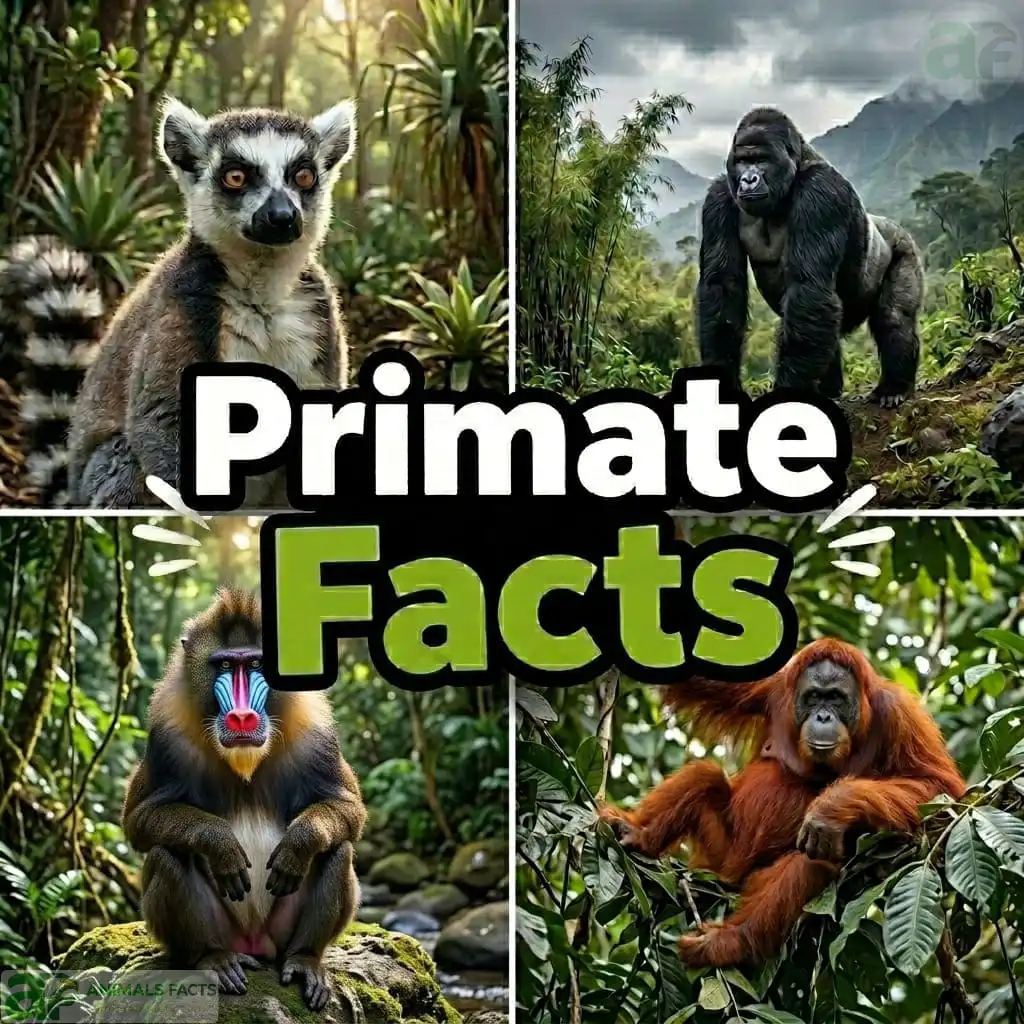
Primate Facts
| Feature | Details |
|---|---|
| Scientific Name | Primates (order) |
| Kingdom | Animalia |
| Phylum | Chordata |
| Class | Mammalia |
| Number of Species | Approximately 520 known species |
| Habitat | Tropical and subtropical forests, savannas, mountains, mangroves |
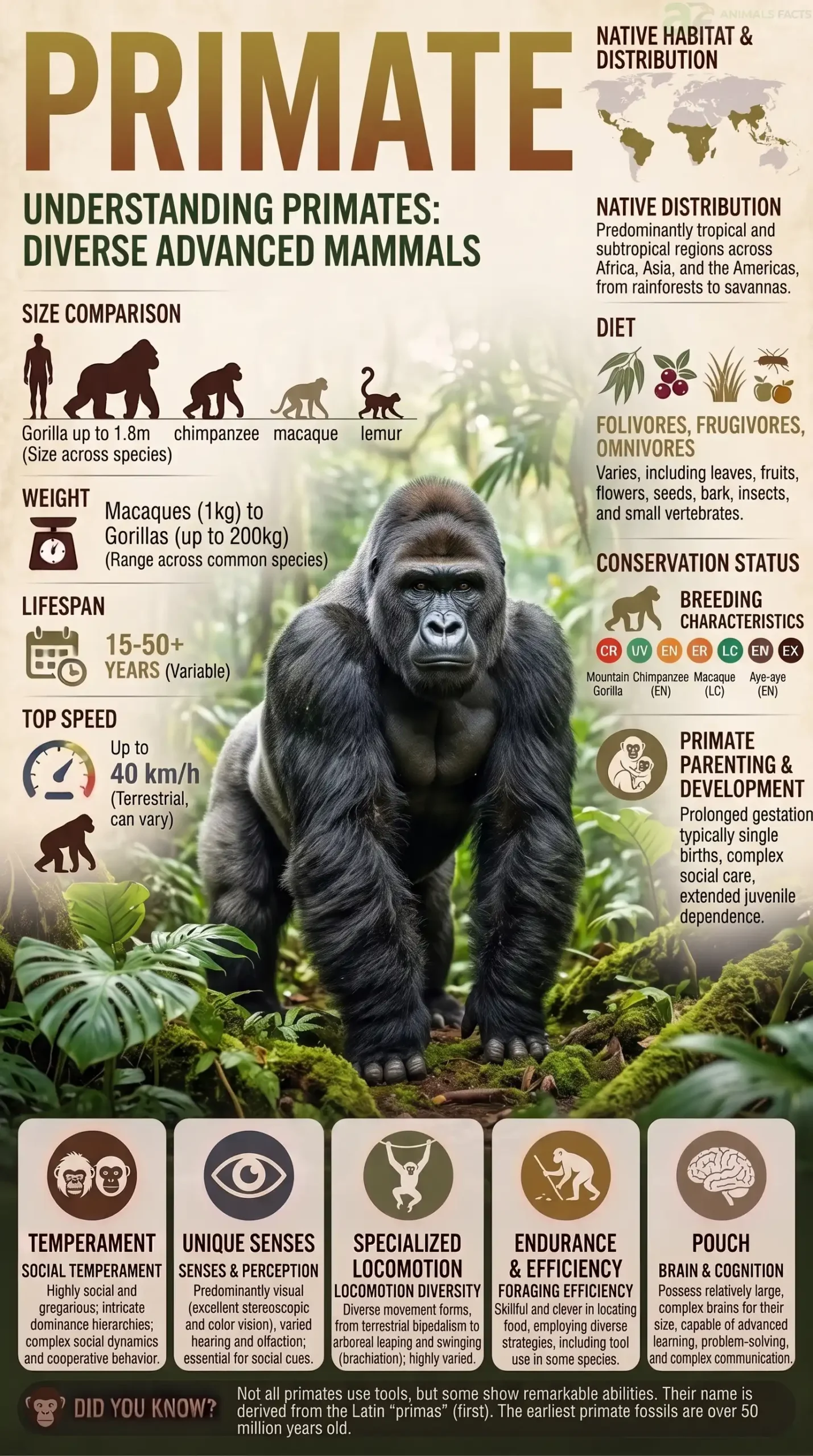
| Lifespan | 10–15 years (small prosimians) to 60+ years (great apes and humans) |
| Diet | Fruits, leaves, insects, seeds, small vertebrates, flowers |
| Size Range | 30 grams (Madame Berthe’s mouse lemur) to 270 kg (eastern lowland gorilla) |
| Weight Range | 30 grams to 270 kg |
| Top Speed | Up to 55 km/h (patas monkey — fastest primate) |
| Conservation Status | 60% of primate species threatened with extinction |
| Population Estimate | Varies by species; some critically endangered at fewer than 50 individuals |
| Closest Human Relatives | Chimpanzees — 98.7% shared DNA with humans |
 1. Introduction: What is Primate?
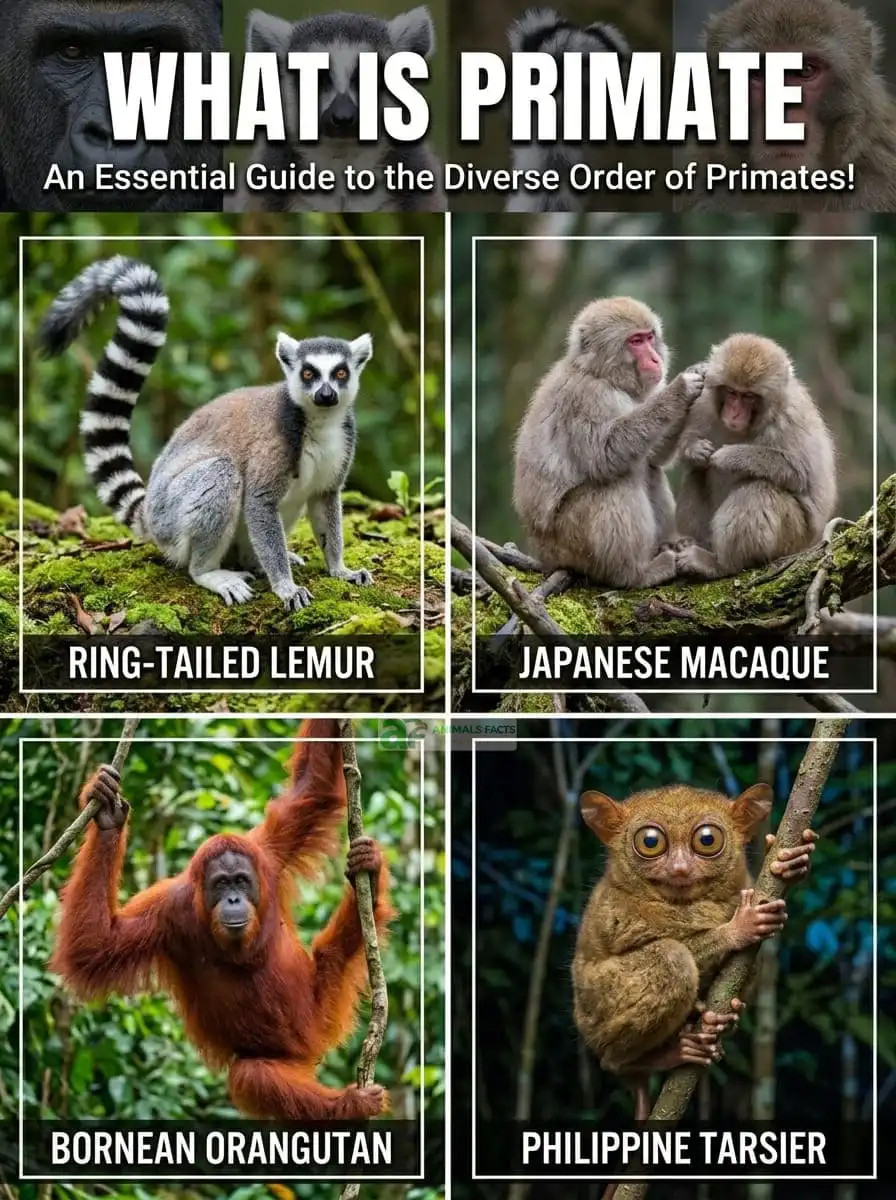
There is something profoundly unsettling — and profoundly wonderful — about looking into the eyes of a great ape. In that gaze, across what feels like an enormous evolutionary distance, you recognize something unmistakably familiar. That recognition is not imagination or sentimentality. It is biology. Primate facts are, in the most literal sense, facts about ourselves — because humans are primates, as fully and authentically as any chimpanzee in a Congo rainforest or any ring-tailed lemur in a Madagascar dry forest.
The order Primates is one of the most intensively studied, most charismatic, and most urgently threatened groups of animals on Earth. With approximately 520 known species, primates span an extraordinary range from the 30-gram Madame Berthe’s mouse lemur — the world’s smallest primate, small enough to sit in a teaspoon — to the eastern lowland gorilla, a mountain of muscle and intelligence weighing up to 270 kilograms. They include animals that live solitary nocturnal lives, animals that form complex democratic societies, and animals that wage organized warfare against neighboring groups. They use tools, teach skills to their young, mourn their dead, and in some cases have learned to communicate with humans through sign language and symbol boards with remarkable sophistication.
Yet interesting facts about primates come shadowed by urgent concern. As of 2026, 60% of all primate species are threatened with extinction — one of the highest proportions of any major animal group on Earth. Habitat destruction, hunting, and the illegal pet trade are pushing species that took millions of years to evolve toward the edge of oblivion with terrifying speed. This guide is both a celebration of what primates are and a call to understand what we stand to lose. Whether you’re searching for primate facts for kids, primate habitat details, primate diet information, or the deepest scientific understanding of primate behavior and intelligence, you’ll find it here. Let’s begin at the beginning — with our oldest relatives.
2. Primate Species Overview & Classification
Primates belong to the order Primates within the class Mammalia. They are defined by a suite of features that, taken together, distinguish them from all other mammal groups — though no single feature is exclusive to primates.
Defining Characteristics of Primates
- Forward-facing eyes with overlapping visual fields providing depth perception
- Grasping hands and feet with opposable thumbs or big toes (in most species)
- Fingernails and toenails rather than claws (in most species)
- Large brain-to-body ratio relative to other mammals
- Prolonged developmental periods — long gestation, extended infancy, slow maturation
- Reduced litter sizes — typically one or two offspring at a time
- Complex social structures and extended parental care
- Highly developed vision over smell (reversal of the typical mammalian pattern)
Primates Species Classification Table
| Taxonomic Rank | Classification |
|---|---|
| Kingdom | Animalia |
| Phylum | Chordata |
| Class | Mammalia |
| Order | Primates |
| Suborders | Strepsirrhini (lemurs, lorises, galagos), Haplorhini (tarsiers, monkeys, apes, humans) |
| Infraorders | Tarsiiformes, Simiiformes |
| Number of Families | ~17 families |
| Number of Genera | ~80 genera |
| Number of Species | ~520 described species |
Major Primate Groups
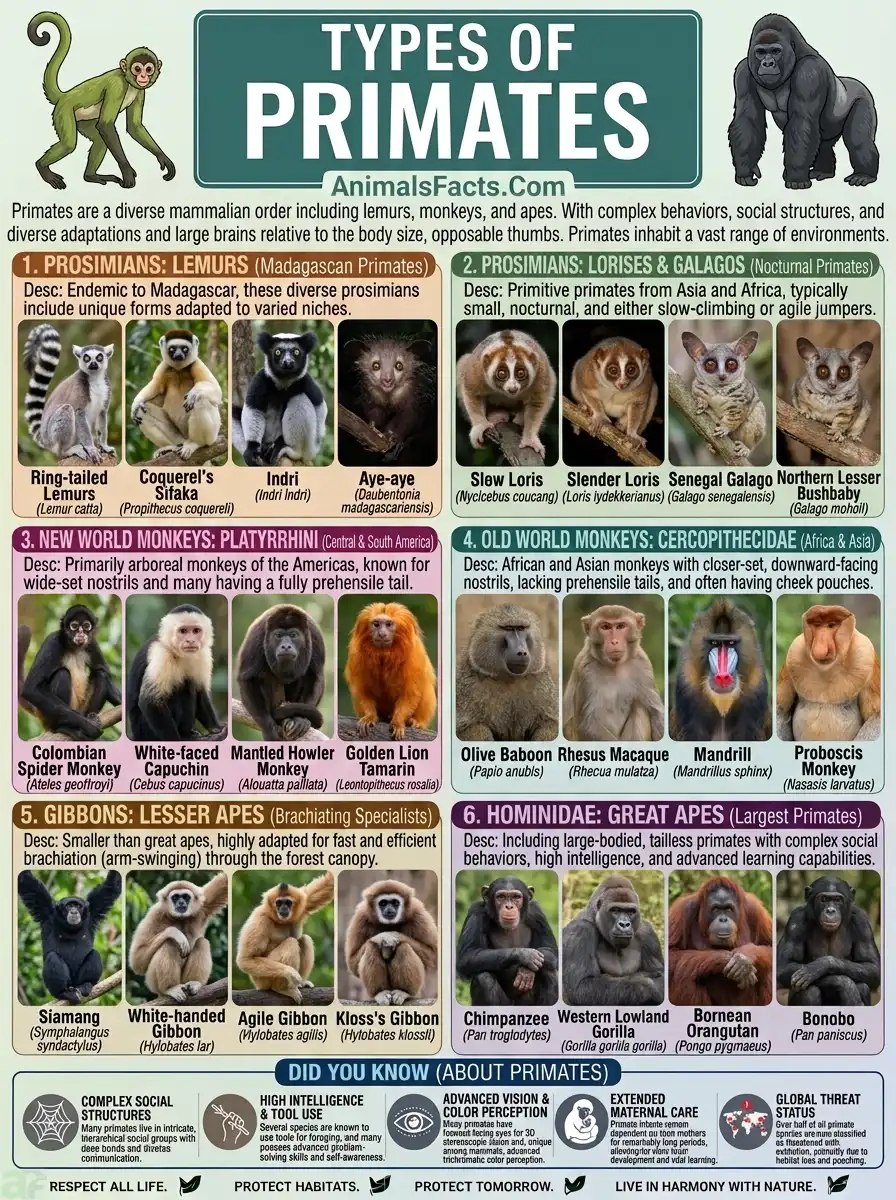
Strepsirrhines (“wet-nosed” primates) — The most ancient primate lineage, including lemurs (Madagascar only), lorises (Asia and Africa), and galagos/bush babies (Africa). Characterized by a moist nose tip, mobile ears, and greater reliance on smell than other primates.
Tarsiers — A small group (~13 species) found in Southeast Asia. Occupy a unique evolutionary position between strepsirrhines and the higher primates. Have the largest eyes relative to body size of any mammal — each eye is larger than the animal’s brain.
New World monkeys (~160 species) — Found exclusively in Central and South America. Include spider monkeys, howler monkeys, capuchins, marmosets, and tamarins. Many have prehensile tails that function as a fifth limb.
Old World monkeys (~140 species) — Found in Africa and Asia. Include baboons, macaques, colobus monkeys, and mandrills. No prehensile tails; most have sitting pads (ischial callosities).
Apes (~30 species including humans) — The most cognitively advanced primates. Divided into lesser apes (gibbons, ~20 species) and great apes (orangutans, gorillas, chimpanzees, bonobos, and humans).
Evolution & Discovery Timeline
~85 million years ago — The earliest primate ancestors (archaic mammals called plesiadapiforms) appear in the fossil record during the Late Cretaceous period.
~65–55 million years ago — True primates emerge following the mass extinction that eliminated non-avian dinosaurs. The first clear primate fossils, including Purgatorius, date to this period.
~40 million years ago — The split between New World monkeys and Old World monkeys/apes occurs, corresponding to the separation of South America from Africa.
~25 million years ago — The earliest apes (Proconsul) appear in East Africa.
~14 million years ago — The lineage leading to orangutans diverges from other great apes.
~10 million years ago — Gorilla lineage diverges. Around this time, hominins (human ancestors) begin separating from the chimpanzee lineage.
~7 million years ago — The human lineage (Homo and its ancestors) definitively diverges from the chimpanzee lineage.
1758 — Carl Linnaeus formally places humans (Homo sapiens) within the order Primates in Systema Naturae — a decision that was highly controversial at the time.
1960 — Jane Goodall begins her landmark study of wild chimpanzees at Gombe Stream, Tanzania — a study that would run for over 60 years and fundamentally transform our understanding of primate behavior and cognition.
1972 — Dian Fossey establishes the Karisoke Research Center in Rwanda, beginning the world’s most important study of mountain gorilla behavior and conservation.
1996 — The bonobo (Pan paniscus) is confirmed through genetic analysis to be equally closely related to humans as the common chimpanzee — a finding that reshapes understanding of human evolution.
2017 — A comprehensive genomic study confirms that 60% of all primate species are now threatened with extinction — the highest proportion ever recorded for this order.
2021 — New research documents chimpanzees in Guinea using tools to play — rolling, carrying, and repeatedly placing rocks in trees with no apparent purpose — behavior interpreted as possible proto-ritual activity.
“It’s not enough to love animals. We have to work hard, really hard, to save them — before it’s too late.” — Dr. Jane Goodall, primatologist and UN Messenger of Peace
3. Primate Physical Description & Unique Features
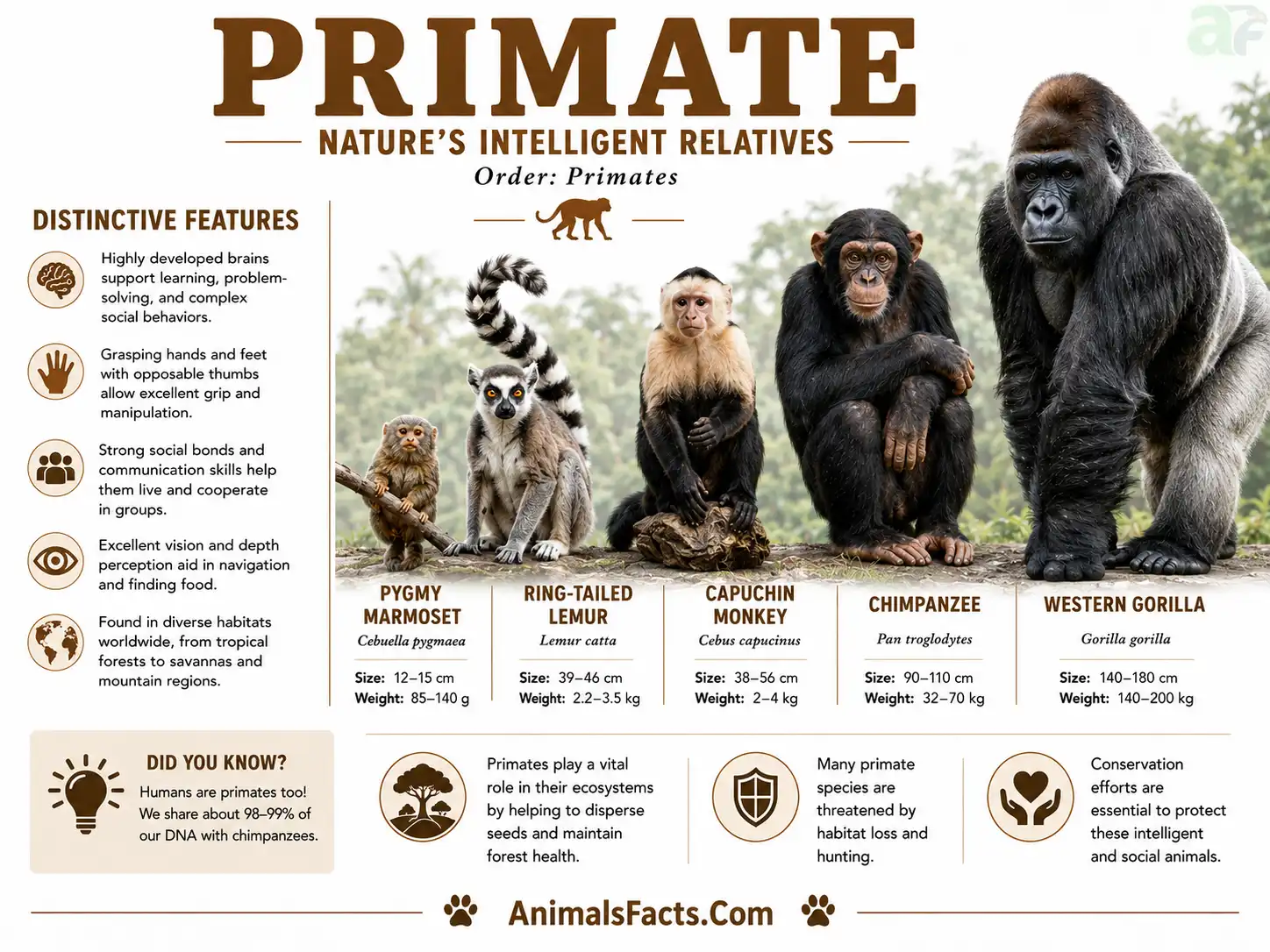
Primate size and weight spans a wider range than almost any other mammalian order, and the physical diversity of the group reflects millions of years of adaptation to radically different ecological niches.
Size & Weight Extremes
The Madame Berthe’s mouse lemur (Microcebus berthae) of Madagascar weighs just 30 grams and has a body length of approximately 9 cm — the world’s smallest known primate. At the other extreme, the eastern lowland gorilla (Gorilla beringei graueri) of the Democratic Republic of Congo can weigh up to 270 kg (595 lbs) with a standing height of 1.8 meters (6 feet) — making it the world’s largest living primate (excluding humans, though some humans exceed this weight).
Hands & Feet
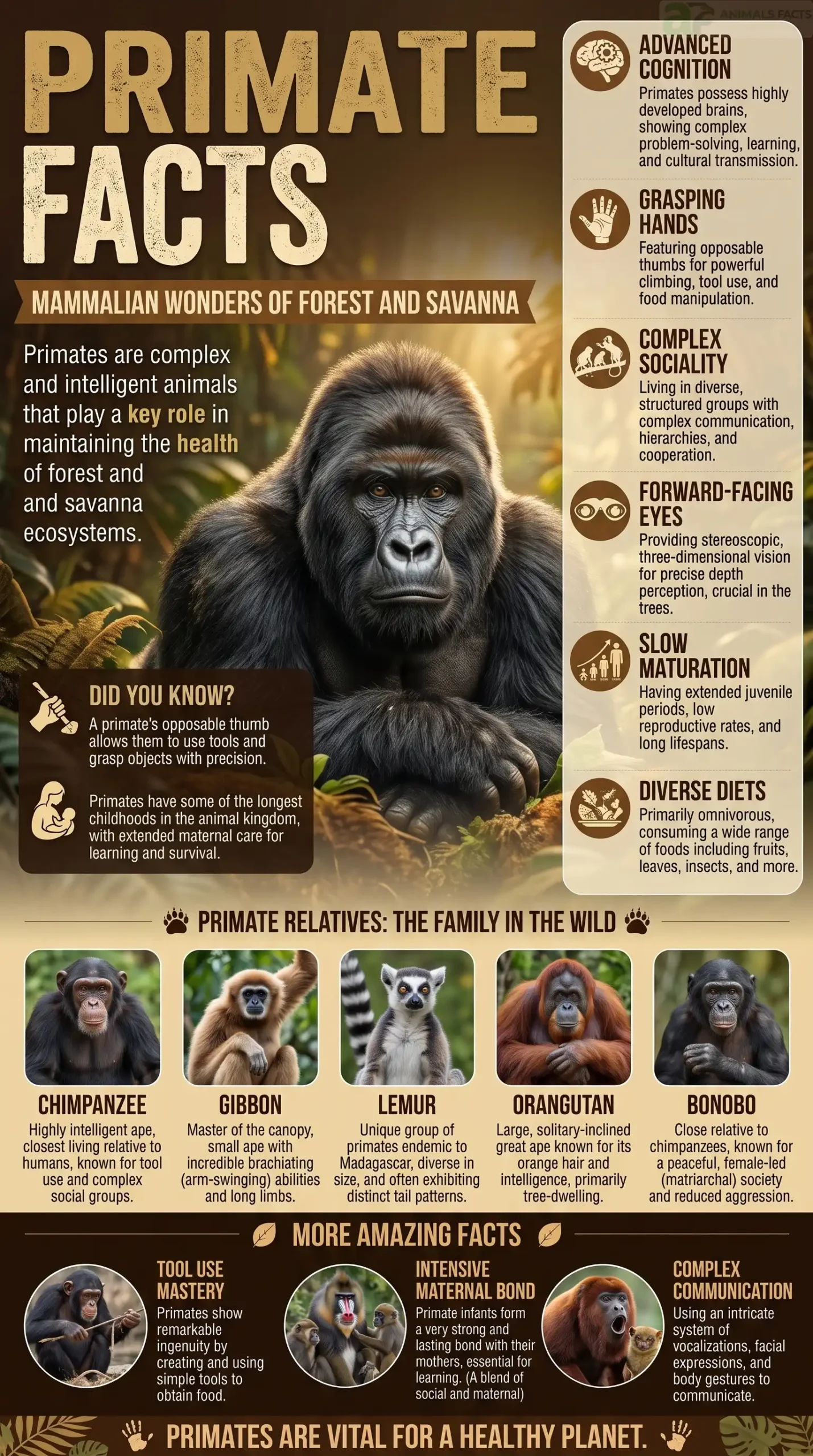
The primate hand is one of evolution’s most versatile innovations. The opposable thumb — present in all apes and most monkeys — allows a precision grip that enables tool use, food manipulation, and social grooming with extraordinary finesse. In spider monkeys and some colobus monkeys, the thumb is vestigial or absent — traded away in evolutionary favor of a long, hook-like hand optimized for brachiation (swinging through branches). New World monkeys like spider monkeys and woolly monkeys have evolved prehensile tails that function as a fully operational fifth limb, capable of supporting the animal’s entire body weight.
Eyes & Vision
Primate vision is among the most sophisticated in the mammal world. The forward-facing eyes of most primates create overlapping visual fields that provide stereoscopic depth perception — critical for judging distances when leaping between branches. Most diurnal (daytime-active) primates, including humans, great apes, and Old World monkeys, have trichromatic color vision — seeing in red, green, and blue, enabling them to distinguish ripe from unripe fruit with remarkable precision. The tarsier has taken primate eye evolution to an extreme — its eyes are so large relative to its skull that they cannot rotate in their sockets at all, and the tarsier must rotate its entire head to look sideways.
Gender & Age Differences
Sexual dimorphism in primates ranges from negligible to dramatic. Gorillas show extreme dimorphism — silverback males are roughly twice the weight of females. Mandrills (Mandrillus sphinx) display the most vivid sexual dimorphism of any primate — dominant males develop spectacular electric-blue and scarlet facial coloration that intensifies with testosterone levels. In gibbons, many species are monomorphic — males and females are virtually identical in size and coloration. In humans, sexual dimorphism is modest — males average approximately 15% larger than females by body mass.
Did You Know? The mandrill holds the distinction of being the world’s largest monkey (as opposed to ape). The face of a dominant male mandrill — with its vivid blue ridges and red central stripe — is so striking that early European explorers who first encountered them questioned whether they were real animals or mythological creatures.
4. Top 25 Amazing Primate Facts
Here is your definitive collection of the most extraordinary, scientifically verified, and genuinely mind-expanding primate facts as of 2026:
- Humans and chimpanzees share approximately 98.7% of their DNA — a closer genetic relationship than either species has with gorillas.
- The bonobo (Pan paniscus) is equally closely related to humans as the common chimpanzee and is sometimes called “the forgotten ape” — despite being arguably the most peaceful of all great apes.
- Chimpanzees use over 65 distinct tools in the wild — including stone hammers for cracking nuts, leaf sponges for drinking water, and stick probes for extracting honey and termites.
- The howler monkey (Alouatta species) produces the loudest call of any land animal — audible up to 4.8 km (3 miles) away in dense forest.
- Gorillas build a fresh sleeping nest every single evening — constructing a new bed from bent branches and leaves in as little as 5 minutes.
- The patas monkey (Erythrocebus patas) of the African savanna is the fastest primate, capable of reaching speeds of 55 km/h (34 mph).
- Orangutans are the only great apes found outside of Africa and are the most solitary of the great apes — adults spend up to 90% of their time alone.
- Capuchin monkeys have been documented rub millipedes onto their fur — the millipedes release toxins that may act as a natural insect repellent.
- Chimpanzees wage organized warfare — groups of males conduct coordinated territorial raids against neighboring communities, killing individuals they encounter, in behavior with disturbing structural similarities to human warfare.
- The aye-aye (Daubentonia madagascariensis) of Madagascar uses a method of foraging called percussive foraging — tapping on tree bark with its elongated middle finger to echolocate hollow chambers where grubs are hiding, then gnawing through the wood and extracting them.
- Japanese macaques (Macaca fuscata) have invented multiple cultural practices that spread through their populations — most famously washing sweet potatoes in seawater before eating them, a behavior invented by a single female named Imo in 1953 and gradually adopted by her entire social group.
- Gorilla groups are led by a silverback male — the “silver” comes from a saddle of gray hair that develops across the back when males reach full maturity, typically around 12 years of age.
- Tarsiers are the only fully carnivorous primates — their diet consists entirely of live prey including insects, lizards, small snakes, and birds.
- Some chimpanzee populations in West Africa have been observed leaving rocks in hollow trees with no apparent utilitarian purpose — behavior that researchers have cautiously described as possible proto-ritual or symbolic behavior.
- The siamang (Symphalangus syndactylus) of Malaysia and Sumatra is the largest gibbon and produces its spectacular calls using an inflatable throat sac that amplifies sound across the forest — pairs coordinate their calls into elaborate synchronized duets.
- Bonobos resolve virtually all social tensions through sexual behavior and affiliative contact — in contrast to chimpanzees, who resolve tensions through aggression. Bonobo society is female-dominated.
- Orangutans in Borneo and Sumatra are recognized as two distinct species — Pongo pygmaeus (Bornean) and Pongo abelii (Sumatran) — with a third species, the Tapanuli orangutan (Pongo tapanuliensis), formally described in 2017 and already considered the most endangered great ape on Earth with fewer than 800 individuals remaining.
- Ring-tailed lemurs (Lemur catta) conduct “stink fights” — rubbing their wrists across scent glands on their tails and then wafting the scent toward rivals by waving their tails — a form of olfactory competition unique among primates.
- The proboscis monkey (Nasalis larvatus) of Borneo has the most distinctive nose of any primate — adult males develop a pendulous, fleshy nose that can exceed 17 cm in length and functions as a resonating chamber for amplifying calls.
- Chimpanzees have been documented medicinally self-medicating — selecting specific plants not in their normal diet and consuming them when ill, a practice confirmed by pharmacological analysis of the plants chosen.
- Gorillas can develop heart disease — the leading cause of non-traumatic death in captive male gorillas is cardiovascular disease, mirroring patterns in human populations and making them valuable subjects for cardiac research.
- Spider monkeys (Ateles species) practice a form of delayed reciprocity — remembering past favors and returning them in future interactions, a cognitive ability previously thought restricted to humans and great apes.
- The indri (Indri indri) of Madagascar is the largest living lemur and produces song in a structured, rhythmic pattern that shares mathematical properties with human music — including regular beat intervals and descending pitch patterns.
- Marmosets practice a remarkable form of cooperative communication — when one marmoset is speaking, others in the group wait silently for their turn, taking turns in a conversational pattern structurally similar to human dialogue.
- Chimpanzees experience menopause — females stop reproducing in their 40s and 50s but continue living for decades more, spending those years supporting the reproductive success of their sons — a finding published in 2023 that added chimpanzees to the extremely small list of non-human animals known to experience this phenomenon.
5. Primates Fun Facts for Kids
- Primates have existed for over 85 million years
- The mandrill has the most colorful face of any mammal
- Orangutans share 96.9% of their DNA with humans
- A group of lemurs is called a conspiracy
- Aye-ayes use echolocation to find food — the only primate to do so
- Chimpanzees laugh when tickled — their laughter sounds like rapid panting
- The golden lion tamarin was nearly extinct in the 1970s but conservation efforts have brought it back from under 200 wild individuals to over 3,700
- Gorillas can catch human colds and flu — our diseases are among their greatest threats
- Gibbons are the fastest arboreal primates, swinging at speeds of 55 km/h through forest canopies
- Baboons have a social hierarchy so structured that rank is inherited — the offspring of high-ranking females automatically gain high social status
- A chimpanzee’s arm span can reach 2.7 meters — wider than any human
- Lemurs are found only on the island of Madagascar — nowhere else on Earth
6. Natural Habitat & Geographic Range of Primates
Primate habitat is concentrated in the tropical and subtropical regions of the world, with the overwhelming majority of species found within the tropics. However, some species have expanded into more temperate zones — the Japanese macaque survives in the snowy mountains of Honshu in temperatures well below freezing, while Barbary macaques inhabit the cool cedar forests of Morocco and Algeria.
Primate Habitat Types
Primates occupy tropical rainforests, cloud forests, dry deciduous forests, mangroves, savannas, rocky semi-arid scrublands, and montane forests up to 4,000 meters altitude. The gelada (Theropithecus gelada) of the Ethiopian Highlands lives exclusively at altitudes between 1,800 and 4,400 meters — the highest altitude of any non-human primate. Proboscis monkeys are semi-aquatic, swimming across rivers regularly and sometimes diving to escape predators. Hamadryas baboons live in the rocky semi-desert landscapes of the Horn of Africa and the Arabian Peninsula — among the driest habitats occupied by any primate.
Habitat Range by Continent
| Continent/Region | Notable Species | Primary Habitat Type |
|---|---|---|
| Africa | Chimpanzee, gorilla, baboon, mandrill, colobus monkey | Rainforest, savanna, montane forest, woodland |
| Asia | Orangutan, gibbon, macaque, proboscis monkey, langur | Tropical forest, cloud forest, mangrove, montane |
| South America | Spider monkey, howler monkey, marmoset, tamarin, capuchin | Tropical rainforest, cloud forest, wetland |
| Central America | Howler monkey, spider monkey, capuchin, squirrel monkey | Tropical forest, dry forest, mangrove |
| Madagascar | Lemurs (100+ species), aye-aye, indri, sifaka | Rainforest, dry deciduous forest, spiny desert |
| Southeast Asian Islands | Tarsier, orangutan (Borneo/Sumatra only), slow loris | Tropical forest, peat swamp forest |
| Europe | Barbary macaque (Morocco/Algeria — technically Africa; also introduced to Gibraltar) | Cedar forest, rocky scrubland |
| North America/Australia | None native | N/A |
Did You Know? The Japanese macaque (Macaca fuscata), also known as the “snow monkey,” is the northernmost-living non-human primate on Earth. Populations in the Jigokudani Valley of Nagano, Japan, famously warm themselves by bathing in natural hot springs — a behavior invented by a young female in 1963 and subsequently adopted by her social group, now observed by tourists from around the world.
7. Primate Diet & Feeding Behavior
Primate diet is predominantly plant-based, with fruits being the most important food source for the majority of species. However, the range of dietary strategies found across primates is impressive — from the pure insectivory of tarsiers to the near-exclusive grass-grazing of geladas.
Diet Breakdown Table
| Food Type | Approximate % of Primate Species That Include It | Example Species |
|---|---|---|
| Fruit (frugivory) | ~90% | Chimpanzees, orangutans, spider monkeys, gibbons |
| Leaves (folivory) | ~60% | Gorillas, colobus monkeys, howler monkeys, langurs |
| Insects (insectivory) | ~70% | Marmosets, tamarins, tarsiers, pottos, aye-ayes |
| Seeds & nuts | ~50% | Capuchins, macaques, baboons, bearded sakis |
| Gum & sap | ~25% | Marmosets, galagos, pygmy slow lorises |
| Flowers & nectar | ~30% | Gibbons, many lemurs, spider monkeys |
| Vertebrates (hunting) | ~10% | Chimpanzees, baboons, capuchins |
| Grass & roots | ~5% | Geladas, hamadryas baboons, patas monkeys |
Remarkable Feeding Strategies
Chimpanzee hunting is the most complex cooperative predation documented in any non-human primate. Groups of male chimpanzees coordinate to drive, surround, and capture red colobus monkeys in multi-individual hunts with distinct roles — drivers, blockers, and captors. In the Tai Forest of Ivory Coast, chimpanzees have been observed coordinating hunts in groups of up to 30 individuals with a success rate exceeding 85% — higher than most African predators.
Aye-aye foraging — The aye-aye has evolved a suite of specializations for a unique foraging strategy found in no other primate. Its continuously growing incisor teeth (unique among primates) gnaw through wood. Its elongated, skeletal third finger — thin enough to fit inside the holes it makes — extracts grubs, a technique functionally convergent with the woodpecker, but accomplished with a primate hand rather than a beak.
Colobus monkey digestion — Colobus monkeys feed heavily on leaves — including many that are toxic to other animals — because their multi-chambered stomach contains specialized bacteria that ferment and detoxify plant compounds. This adaptation, convergent with that of cows and other ruminants, allows colobus monkeys to exploit a food resource (mature leaves) that other primates cannot safely consume.
8. Primate Reproduction & Life Cycle
Primates are defined by their prolonged life history — longer gestation periods, longer infancies, extended juvenile periods, and longer lifespans than other mammals of comparable size. This extended developmental window is directly linked to the demands of the large, complex primate brain — which requires enormous time and experience to fully develop and program through social learning.
Mating Systems
Primate mating systems span the full spectrum. Gibbons are famously monogamous — bonded pairs maintain exclusive territories and coordinate spectacular duet songs that reinforce their pair bond. Gorillas live in harems — a single dominant silverback controls access to a group of several females. Chimpanzees and bonobos are promiscuous — females mate with multiple males, and males compete intensely through sperm competition (reflected in their relatively large testicles). Orangutans are largely solitary; females raise offspring entirely alone over a 7–9 year nursing period — the longest of any mammal except humans.
Growth Stages
- Gestation — Ranges from 4.5 months (marmosets) to 9 months (great apes and humans)
- Infancy — Characterized by complete dependence on the mother; carried constantly in most species
- Weaning — Extended in higher primates; chimpanzee and orangutan young may nurse for 4–7 years
- Juvenile period — Social play, skill acquisition, formation of peer relationships
- Sub-adult — Approaching sexual maturity; in apes this period lasts several years
- Adulthood — Sexual maturity reached; gorilla males continue growing physically until approximately 15 years
- Senescence — Documented in great apes; chimpanzee females experience menopause
Lifespan Comparison Table
| Species | Average Lifespan (Wild) | Maximum Recorded Lifespan |
|---|---|---|
| Chimpanzee | 30–40 years | 72 years (captivity) |
| Gorilla | 35–40 years | 60 years (captivity) |
| Orangutan | 35–45 years | 59 years (captivity) |
| Baboon | 20–30 years | 45 years (captivity) |
| Ring-tailed lemur | 16–19 years | 27 years (captivity) |
| Common marmoset | 5–7 years | 16 years (captivity) |
Did You Know? Female orangutans have the longest inter-birth interval of any mammal other than humans — typically waiting 7 to 9 years between offspring. This extraordinarily slow reproductive rate means orangutan populations recover from hunting and habitat loss extremely slowly — making every single individual critically important for population survival.
9. Social Behavior & Communication
Primate social behavior and communication are, by any measure, the most complex found in any non-human animal group. The combination of long life spans, large brains, prolonged social development, and complex group living has produced social intelligence of extraordinary sophistication.
Group Structures
Primate societies range from solitary (orangutans, aye-ayes) to pair-bonded (gibbons, titi monkeys) to small family groups (marmosets, tamarins — typically a breeding pair plus older offspring as “helpers”) to one-male harems (gorillas, hamadryas baboons, patas monkeys) to multi-male, multi-female communities (chimpanzees, bonobos, most macaques and baboons) to enormous super-groups called mandrillus herds of up to 800 individuals — the largest non-human primate aggregations ever recorded.
Vocalizations
Primate vocalizations span an enormous range of complexity. The indri produces songs with isochronous beat structure — meaning intervals between notes follow a precise mathematical regularity found in human music but previously unrecorded in non-human animals. Vervet monkeys (Chlorocebus pygerythrus) have semantic alarm calls — distinct vocalizations for aerial predators (hawks), ground predators (leopards), and snakes, with receivers responding appropriately to each (looking up, running to trees, or looking at the ground, respectively). This represents the closest thing to symbolic referential communication — language-like word use — documented in wild non-human animals.
Chimpanzees produce a complex repertoire of calls, gestures, and facial expressions. Jane Goodall’s research documented over 30 distinct vocalizations used in context-specific ways. More remarkably, chimpanzees use a gestural vocabulary of over 60 distinct intentional gestures with consistent meanings across populations — a form of communication that shares structural properties with human language in ways that vocalizations alone do not.
Intelligence & Cognition
Theory of mind — The ability to understand that others have different knowledge, beliefs, and intentions than oneself — has been demonstrated in chimpanzees, bonobos, orangutans, and arguably in gorillas and some monkey species. This cognitive ability underlies tactical deception, teaching, and empathy.
Self-recognition — Great apes (chimpanzees, bonobos, orangutans, gorillas) and some monkey species pass the mirror self-recognition test, demonstrating awareness of themselves as individuals. Chimpanzees use mirrors to examine parts of their bodies they cannot otherwise see, and have been observed using a mirror to remove food from between their teeth.
Mathematical ability — Chimpanzees trained in number recognition outperform humans on tasks requiring rapid memorization of number sequences — a finding from Kyoto University’s Primate Research Institute that has been repeatedly verified and remains one of the most startling demonstrations of non-human cognitive capacity.
10. Predators & Defense Mechanisms
Despite their intelligence and social complexity, primates face a range of dangerous natural predators and have evolved correspondingly sophisticated defense strategies.
Natural Predators
- Large felids — Leopards are the most significant primate predators across Africa and Asia; lions occasionally prey on baboons; clouded leopards specialize in arboreal primates in Asia
- Eagles — Crowned eagles of Africa and harpy eagles of South America specialize in hunting monkeys and can take prey up to 20 kg
- Snakes — Pythons and large constrictors, and venomous species, prey on smaller primates
- Crocodilians — Take primates crossing or drinking at water’s edge
- Chimpanzees — Prey on colobus monkeys and other smaller primates in coordinated group hunts
- Humans — The most significant predator of primates globally, through hunting, habitat destruction, and capture for the pet trade
Defense Strategies
Alarm calls — Vervet monkey semantic alarm calls represent one of the most sophisticated anti-predator communication systems in the animal world, allowing groups to mount predator-specific responses in seconds.
Group vigilance — Many primate species maintain sentinel individuals that watch for predators while others feed. Baboon troops post lookouts on elevated positions. Colobus monkey groups have been shown to have substantially lower predation rates than solitary individuals — safety truly in numbers.
Mobbing — Many primate species aggressively mob predators — surrounding snakes, eagles, or other threats in groups and making loud calls, driving the predator away. Capuchin monkeys have been observed confronting and driving off venomous snakes using this strategy.
Arboreal escape — Most primates are significantly safer in the tree canopy than on the ground, where the majority of their predators operate. Alarm calls in many species trigger immediate arboreal retreat.
Counter-attack — Male baboons possess enlarged canine teeth that can exceed 5 cm and represent formidable weapons. Male baboons have been documented driving off leopards — and in some cases have been observed killing or seriously injuring them.
Did You Know? Chimpanzees in Senegal’s Fongoli savanna have been observed crafting and using spears — selecting branches, stripping leaves, sharpening the tip with their teeth, and using the resulting tool to stab at bushbabies sheltering in tree hollows. This is the only documented case of a non-human primate making and using a weapon to hunt vertebrate prey.
11. Primate Facts for Kids
Hey young explorers and future primatologists! Here are some wild and wonderful primate facts for kids that will amaze everyone you tell:
You ARE a primate! That’s right — humans are primates, just like chimpanzees and lemurs. We share the same order as all the monkeys and apes in the world!
Chimps laugh when tickled! It sounds different from human laughter — more like rapid panting — but studies show it’s the real thing. Primatologists tickle chimps and they giggle!
Some monkeys can talk — kind of! Vervet monkeys have different alarm calls for different predators — one call for eagles and a completely different one for leopards. The other monkeys understand exactly what each call means!
Gorillas are gentle giants! Despite being enormous and powerful, silverback gorillas are gentle with their family groups and have been observed caring tenderly for injured and orphaned young.
Orangutans are the best tool users! They use sticks to fish insects out of holes, leaves as cups to drink from and as umbrellas in rain, and even use plant matter as bandages for wounds.
Aye-ayes have a magic finger! This strange Madagascar primate has one super-long, thin middle finger it uses to tap on trees and listen for the hollow spots where grubs are hiding — like having a built-in bug detector!
Lemurs are only found in one place! Madagascar is the only island on Earth where lemurs live wild. There are over 100 different kinds of lemur, from tiny mouse lemurs to the large, singing indri.
Siamangs sing together! These black gibbons from Malaysia and Indonesia sing beautiful duets with their partners every morning — using a huge throat balloon to make their voices super loud!
12. Primates Relationship with Humans
The relationship between humans and other primates is among the most ethically complex in all of human-animal relations — combining scientific debt, conservation responsibility, cultural exploitation, and philosophical questions about the boundaries of personhood.
Historical Use in Research
Non-human primates — particularly chimpanzees, rhesus macaques, and baboons — have contributed to some of the most important medical advances in history. The Salk polio vaccine (1955) was tested in rhesus macaques before human trials. Research in macaques led to the discovery of the Rh blood factor (named after rhesus monkeys), revolutionizing obstetrics. Space research used primates extensively — including the famous Ham the chimp, the first hominid in space (January 1961), and Enos, the first chimpanzee to orbit Earth (November 1961).
The use of great apes in biomedical research has been phased out in most countries due to their high cognitive capacity and the ethical concerns this raises. The United States, the last country to use chimpanzees in invasive research, officially retired all federally owned research chimpanzees to sanctuary in 2015.
Primates as Pets & Entertainment
The illegal pet primate trade remains one of the most damaging threats to primate conservation. Infant primates — particularly slow lorises, capuchins, and chimpanzees — are captured from the wild after their mothers are killed, and sold internationally. Slow lorises became viral video subjects due to footage of them being “tickled” — footage that animal welfare scientists have shown depicts animals in distress performing a defensive reflex, not pleasure.
Human-Primate Disease Transmission
Because of our close genetic relationship, we share many diseases with other primates — and can readily infect them with our illnesses. Mountain gorillas have died from measles, respiratory viruses, and likely COVID-19. Conversely, zoonotic diseases — including HIV (which originated in chimpanzees) and Ebola (associated with gorilla and chimpanzee die-offs in Central Africa) — have transferred from primates to humans with devastating consequences.
13. Primate Conservation Status & Threats
Primate conservation represents one of the most urgent challenges in modern biology. The scale of threat to this order is almost without parallel among vertebrate groups.
IUCN Status Overview
| Status Category | Approximate Number of Primate Species |
|---|---|
| Least Concern | ~95 species |
| Near Threatened | ~60 species |
| Vulnerable | ~112 species |
| Endangered | ~145 species |
| Critically Endangered | ~107 species |
| Extinct (since 1500) | ~5+ species |
| Data Deficient | ~15 species |
The headline figure is stark: approximately 60% of all primate species face some degree of extinction risk — one of the highest proportions of any major vertebrate group.
Most Critically Endangered Primates (2026)
- Tapanuli orangutan (Pongo tapanuliensis) — Fewer than 800 individuals; confined to a single forest in North Sumatra
- Hainan gibbon (Nomascus hainanus) — Fewer than 35 individuals; the world’s rarest primate
- Cross River gorilla (Gorilla gorilla diehli) — Approximately 250–300 individuals; straddling Nigeria-Cameroon border
- Miss Waldron’s red colobus (Piliocolobus waldronae) — May be functionally extinct; last confirmed sighting 2000
- Roloway monkey (Cercopithecus roloway) — Critically endangered; West African forest
Major Threats
Deforestation is the defining threat. The destruction of tropical forests — for agriculture (particularly oil palm in Southeast Asia, cattle ranching in the Amazon, and subsistence farming in Central Africa) — eliminates the habitat that virtually all primate species depend on. Palm oil cultivation alone has been responsible for the destruction of an estimated 25 million hectares of orangutan habitat in Borneo and Sumatra over the past four decades.
Hunting for bushmeat — The hunting of primates for human consumption remains widespread across Central and West Africa and parts of Southeast Asia. In the Congo Basin alone, an estimated 1 million tons of bushmeat are consumed annually, a significant portion of which consists of primates.
Illegal wildlife trade — Infant primates command high prices on the international pet market, with infant chimpanzees selling for thousands of dollars. For each infant that reaches a buyer, an estimated 10 other individuals — mothers, family members killed during capture — may die.
Did You Know? A single dam project proposed for the Batang Toru ecosystem in North Sumatra — where the Tapanuli orangutan was discovered in 2017 — threatens to fragment the already tiny population of this newly described species, which some scientists believe could push it to extinction before it is even fully studied.
14. Famous Primates in History & Pop Culture
Real-World Famous Primates
Koko (Gorilla gorilla gorilla, 1971–2018) — A female western lowland gorilla taught American Sign Language by Dr. Francine Patterson at Stanford University. Koko demonstrated a working vocabulary of over 1,000 signs and comprehension of approximately 2,000 spoken English words. She made global news when she requested a kitten as a pet for her birthday — naming it All Ball — and expressed grief when it was killed by a car.
Ham (Pan troglodytes, 1956–1983) — The first chimpanzee in space, launched aboard Mercury-Redstone 2 on January 31, 1961. Ham’s successful mission, during which he correctly performed lever-pulling tasks in response to lights during the flight, paved the way for Alan Shepard’s historic human spaceflight just months later. Ham lived out his retirement at the National Zoo in Washington, D.C.
David Greybeard (Pan troglodytes, c. 1948–1968) — The first chimpanzee observed and named by Jane Goodall at Gombe. David Greybeard was the first chimpanzee she observed using a tool — stripping leaves from a stick to probe a termite mound — a discovery that prompted Louis Leakey’s famous comment: “Now we must redefine tool, redefine man, or accept chimpanzees as humans.”
Imo (Macaca fuscata, c. 1952–1972) — A Japanese macaque female of Koshima Island who, at approximately 18 months of age, invented the practice of washing sweet potatoes in sea water — and later wheat-washing — behaviors that spread through her social group and have been described as the first scientifically documented case of non-human cultural invention and transmission.
Washoe (Pan troglodytes, 1965–2007) — The first non-human animal to learn American Sign Language, studied by Allen and Beatrix Gardner at the University of Nevada. Washoe spontaneously taught signs to her adopted son Loulis — the only documented case of a non-human teaching a human communication system to another non-human without human intervention.
15. Role in Ecosystem & Food Chain
Primates are keystone species in the tropical forest ecosystems they inhabit, serving as seed dispersers, prey, predators, and ecosystem engineers of the first importance.
Seed Dispersal
Frugivorous primates are among the most important seed dispersers in tropical forests. Large-bodied primates like chimpanzees, orangutans, and spider monkeys consume enormous quantities of fruit, transporting seeds in their digestive systems across distances of several kilometers before depositing them in their dung. Many tropical tree species have evolved fruits specifically adapted to attract primate consumers — large, colorful, nutritious fruits that reward the disperser while ensuring seed transport. Remove primates from a forest and the regeneration of many tree species is severely impaired — a process documented in African forests where heavy hunting has produced “empty forest syndrome”: structurally intact forest that is effectively silent and ecologically hollow due to the loss of its primate communities.
Insect Regulation
Insectivorous primates — marmosets, tamarins, tarsiers, and many others — consume enormous quantities of insects, regulating arthropod populations in complex ways that affect plant health and forest structure.
Prey for Predators
Primates form a critical food resource for multiple specialist predators — including crowned eagles, harpy eagles, and leopards — whose population health and reproductive success is directly linked to primate abundance. The decline of primate populations in hunted forests therefore has cascading effects on the apex predators that depend on them.
16. Primate Myths, Folklore & Cultural Significance
Across human cultures and throughout recorded history, non-human primates have occupied positions of extraordinary symbolic importance — revered as sacred, feared as demons, interpreted as ancestors, and celebrated as tricksters.
In Hindu tradition, the monkey deity Hanuman is one of the most widely worshipped figures in the religion — a symbol of devotion, strength, and selfless service who appears in the epic Ramayana as the devoted servant of the god Rama. Hanuman temples across India house sacred rhesus macaques and bonnet macaques that are fed by devotees daily. The monkeys are considered holy and are legally protected under Hindu cultural tradition throughout much of India.
In ancient Egyptian religion, the hamadryas baboon was associated with the god Thoth — deity of wisdom, writing, and the moon — and was mummified in enormous numbers and offered as temple sacrifices. Thousands of mummified baboons have been found in tombs at Saqqara, brought to Egypt from the Horn of Africa through long-distance trade networks.
In West African oral traditions, the chimpanzee figures in folktales as a creature of human-like cunning and mischief — sometimes presented as an ancestor figure or as a being that “almost became human” but made a wrong choice at a critical moment. In some communities, killing a chimpanzee is considered equivalent to killing a person.
In Chinese folklore, the Monkey King Sun Wukong — protagonist of the 16th-century novel Journey to the West by Wu Cheng’en — is one of the most beloved and enduring characters in Asian literature, combining enormous supernatural power with irrepressible playfulness and a fundamental nobility of spirit.
17. Primates in Pop Culture
Planet of the Apes (1968/2011–2017) — Pierre Boulle’s 1963 novel and its many film adaptations represent the most culturally significant exploration of primate intelligence in fiction. The Caesar trilogy (2011–2017) in particular was praised by primatologists for its relatively realistic portrayal of chimpanzee social dynamics and cognition.
Gorillas in the Mist (1988) — The biographical film about Dian Fossey and her landmark work with mountain gorillas in Rwanda, starring Sigourney Weaver, brought gorilla conservation to a mainstream global audience and is credited with significantly boosting international funding for gorilla protection.
Tarzan — Edgar Rice Burroughs’ creation (first novel 1912) remains one of the most culturally pervasive primate-related fiction franchises in history, inspiring dozens of films, television series, and adaptations. The character’s relationship with great apes reflects — and arguably shaped — public fascination with the boundary between human and non-human.
King Kong (1933/2005/2017) — The giant ape has become one of cinema’s most enduring monsters and one of its most complex — a figure simultaneously terrifying and sympathetic, reflecting deep cultural ambivalence about the relationship between humans and our primate relatives.
Curious George — H.A. Rey’s beloved children’s book character (first published 1941) has introduced generations of children to primates, though the character’s species (brown capuchin?) and captivity status have generated ongoing debate among primatologists.
18. Primate Facts vs. Common Myths
| Common Myth | The Real Fact |
|---|---|
| “Monkeys and apes are the same thing” | Apes have no tails and are more closely related to humans; monkeys (mostly) have tails and are a separate group |
| “Chimpanzees are monkeys” | Chimpanzees are great apes — far more closely related to humans than to any monkey |
| “Gorillas are aggressive and dangerous” | Gorillas are naturally gentle and shy; silverbacks only charge as a bluff display and actual attacks on humans are extremely rare |
| “Primates make good pets” | Primates are wild animals with complex social, psychological, and dietary needs that cannot be met in captivity; keeping them as pets causes severe suffering |
| “Humans evolved FROM chimpanzees” | False — humans and chimpanzees share a common ancestor from which both species descended through separate evolutionary paths |
| “Bigger brain always means smarter animal” | Sperm whales have larger brains than humans but lower cognitive complexity; brain-to-body ratio and neural organization matter more than absolute size |
| “Slow lorises enjoy being tickled” | Videos of “ticklish” lorises show them performing a defensive reflex, raising their arms to access venom glands on their elbows — they are terrified, not entertained |
| “Baboons are monkeys, not primates” | Baboons are absolutely primates — Old World monkeys within the family Cercopithecidae |
19. Best Places to See Primates in the Wild
1. Bwindi Impenetrable Forest, Uganda — One of only two places on Earth where you can track wild mountain gorillas on foot, coming within meters of gorilla family groups in their natural rainforest habitat. Permits are strictly limited and expensive, but the experience is widely described as life-changing.
2. Gombe Stream National Park, Tanzania — Jane Goodall’s original research site, where habituated chimpanzee communities can be observed at close range. One of the best places on Earth to watch complex chimpanzee social behavior.
3. Kinabatangan River, Sabah, Malaysia (Borneo) — The best accessible location to observe wild Bornean orangutans, proboscis monkeys, pig-tailed macaques, and multiple other primate species along river banks from boats.
4. Ranomafana National Park, Madagascar — The world capital of lemur diversity, with multiple species including the golden bamboo lemur and Milne-Edwards’ sifaka observable in their natural habitat.
5. Jigokudani Monkey Park, Nagano, Japan — The only place on Earth where you can observe wild Japanese macaques bathing in natural hot springs — a unique and utterly captivating behavior that has made this one of the world’s most photographed wildlife spectacles.
6. Danum Valley Conservation Area, Sabah, Malaysia — One of the best places to observe Bornean gibbons, red leaf monkeys, tarsiers, and slow lorises in their primary rainforest habitat.
7. Manú National Park, Peru — The Amazon’s most biodiverse protected area, home to 14 species of primates including giant spider monkeys, howler monkeys, squirrel monkeys, and capuchins — all observable from riverboats and forest trails.
20. How You Can Help
Primate conservation requires urgent, multifaceted action. Here is how you can contribute meaningfully, regardless of where you live.
Support these organizations:
- Jane Goodall Institute — janegoodall.org
- Dian Fossey Gorilla Fund — gorillafund.org
- Orangutan Foundation International — orangutan.org
- Primate Conservation Inc. — pcigrants.org
- WWF Great Apes Program — worldwildlife.org
- Ape Action Africa — apeactionafrica.org
- Pan African Sanctuary Alliance (PASA) — pasaprimates.org
What you can do:
- Check your palm oil — Palm oil appears in approximately 50% of supermarket products; choose products certified by the Roundtable on Sustainable Palm Oil (RSPO)
- Never buy primate “pets” — or watch, share, or like social media content featuring primates as pets or entertainment; this directly drives demand
- Choose sustainable wood and paper products — FSC-certified products reduce pressure on tropical forests
- Support ecotourism in primate range countries — gorilla trekking permit fees directly fund conservation in Rwanda and Uganda
- Report illegal wildlife trade — Use TRAFFIC’s reporting channels or contact your national wildlife crime unit
- Donate to sanctuary support — Primate sanctuaries across Africa and Asia care for hundreds of orphaned and rescued individuals
21. Top Documentaries & Books
Must-Watch Documentaries
- Chimpanzee (Disney Nature, 2012) — Beautifully filmed account of a young chimpanzee’s survival in the Tai Forest of Ivory Coast
- Dynasties: Chimpanzee (BBC, 2018) — David Attenborough narrates the political struggles of a chimpanzee community leader — among the finest wildlife documentary episodes ever produced
- Jane (National Geographic, 2017) — A deeply personal documentary built around previously unseen footage of Jane Goodall’s early work at Gombe; extraordinary
- Gorillas in the Mist (1988) — The essential film on Dian Fossey and mountain gorilla conservation
- The Amber Mounds — NHK/BBC documentary on Japanese macaque cultural behaviors
- Island of Lemurs: Madagascar (IMAX, 2014) — Narrated by Morgan Freeman; the definitive visual introduction to Madagascar’s extraordinary primate diversity
Must-Read Books
- In the Shadow of Man by Jane Goodall (1971) — The foundational text of modern primatology and still one of the greatest wildlife books ever written
- Gorillas in the Mist by Dian Fossey (1983) — Her personal account of 18 years with mountain gorillas; heartbreaking and magnificent
- The Age of Empathy by Frans de Waal — Explores the evolutionary roots of compassion using primate research
- Among African Apes edited by Martha Robbins & Christophe Boesch — Academic but accessible overview of great ape research
- Are We Smart Enough to Know How Smart Animals Are? by Frans de Waal — The definitive popular science book on animal cognition with extensive primate content
- Mama’s Last Hug by Frans de Waal — A profound exploration of animal emotions centered on chimpanzee behavior
22. Comparison with Similar Species
| Feature | Chimpanzee | Bonobo | Gorilla | Orangutan |
|---|---|---|---|---|
| Scientific name | Pan troglodytes | Pan paniscus | Gorilla gorilla/beringei | Pongo pygmaeus/abelii |
| Weight (male) | 40–70 kg | 37–61 kg | 140–270 kg | 50–90 kg |
| Habitat | West/Central Africa | DRC only | Central/East Africa | Borneo, Sumatra |
| Diet | Omnivore | Omnivore/frugivore | Herbivore | Frugivore |
| Social structure | Multi-male/female community | Female-dominated community | Silverback harem | Solitary |
| Conservation status | Endangered | Endangered | Critically Endangered | Critically Endangered |
| DNA similarity to humans | 98.7% | 98.7% | 98.3% | 96.9% |
| Estimated population | 170,000–300,000 | 15,000–20,000 | ~100,000 | ~55,000–65,000 |
23. Frequently Asked Questions About Primate Facts
What is the scientific name for primates?
Primates belong to the order Primates, within the class Mammalia. This is both the common and scientific name for the group. Individual species each have unique binomial names — the common chimpanzee is Pan troglodytes, the western lowland gorilla is Gorilla gorilla gorilla, the Bornean orangutan is Pongo pygmaeus, and the ring-tailed lemur is Lemur catta. Humans are Homo sapiens — formally classified within the family Hominidae (great apes) alongside chimpanzees, bonobos, gorillas, and orangutans.
How many primate species are there?
As of 2026, approximately 520 species of primates have been formally described. This number continues to grow — several new primate species are described each decade, typically discovered through genetic analysis of populations previously considered to be single species. Madagascar alone has seen substantial increases in recognized lemur species as genetic studies reveal hidden diversity within morphologically similar populations.
Are primates endangered?
Severely so. As of 2026, approximately 60% of all primate species face some degree of extinction risk according to the IUCN Red List. Of these, over 100 species are classified as Critically Endangered. The Hainan gibbon (Nomascus hainanus) of China, with fewer than 35 individuals remaining, is widely recognized as the world’s rarest primate and one of the rarest animals of any kind on Earth.
What do primates eat?
Primate diet is predominantly frugivorous — most species rely heavily on fruit. However, virtually all primates consume some animal matter (insects, eggs, or small vertebrates), and many species have dietary specializations. Gorillas are predominantly herbivorous, eating leaves, stems, and roots. Tarsiers are exclusively carnivorous. Geladas eat primarily grass. Many primate species are highly opportunistic omnivores that adjust their diet dramatically based on seasonal availability.
How closely related are humans to other primates?
Humans are most closely related to chimpanzees and bonobos, sharing approximately 98.7% of our DNA with both species. This genetic similarity is greater than the similarity between chimpanzees and gorillas. Humans share approximately 98.3% of their DNA with gorillas and approximately 96.9% with orangutans. Even with our most distant primate relatives — lemurs and tarsiers — humans share well over 90% of their genetic code.
What is the largest primate?
The eastern lowland gorilla (Gorilla beringei graueri) is the largest non-human primate, with male silverbacks reaching weights of up to 270 kg (595 lbs) and standing heights of 1.8 meters (6 feet). If humans are included (as they should be, being primates themselves), the largest primates are exceptional human individuals, some of whom exceed 300 kg in recorded cases.
What is the smallest primate?
The Madame Berthe’s mouse lemur (Microcebus berthae) of Madagascar is the world’s smallest known primate, with an average body weight of just 30 grams and a body length of approximately 9 cm — roughly the size of a large grape. It was formally described as a distinct species in 2000 and is found only in the Kirindy Forest of western Madagascar.
Can primates use tools?
Absolutely — and with far greater sophistication than once believed. Chimpanzees use over 65 distinct tools across populations in the wild, including stone hammers for nut-cracking, stick probes for termite and honey extraction, leaf sponges for drinking water, and — in Senegal — sharpened sticks used as weapons for hunting. Orangutans use sticks for extracting insects, leaves as gloves to handle thorny plants, and branches as bridges. Capuchin monkeys use stone hammers to crack open nuts — and their stone-tool-use culture has been traced back over 3,000 years using archaeological analysis.
Do primates have language?
This is one of the most debated questions in cognitive science. Primates have not been shown to develop spontaneous spoken language comparable to human language. However, captive great apes taught human communication systems — including American Sign Language (Washoe, Koko), lexigram boards (Kanzi the bonobo), and computer symbol systems — have demonstrated vocabulary sizes of several hundred to over 1,000 items, can combine symbols in structured ways, use symbols to refer to absent objects, and can respond appropriately to novel sentences they have never encountered before. In the wild, vervet monkeys have semantic alarm calls that function like words, and chimpanzees use over 60 intentional gestures with consistent meanings. Whether any of this constitutes “language” depends heavily on how one defines the term — a debate that is ultimately as much philosophical as biological.
Why are primates important to ecosystems?
Primates play multiple critical ecological roles. As seed dispersers, they transport the seeds of hundreds of tree species across forest landscapes, many of which cannot regenerate effectively without primate gut-passage. As prey, they support specialist predators including crowned eagles and leopards. As insect predators, they regulate arthropod populations. And as forest engineers, their feeding behavior — breaking branches, dropping fruit, creating clearings — shapes the physical structure of the forests they inhabit. The loss of primate communities from forests — through hunting even where habitat remains intact — produces measurable and significant changes in forest composition and structure that ecologists call “empty forest syndrome.”
24. Sources & References
Research Sources
- Wikipedia — Primates, Pan troglodytes, Gorilla, Pongo, Lemur, Tarsier
- IUCN Red List — iucnredlist.org (2025–2026 species assessments)
- IUCN SSC Primate Specialist Group — primate-sg.org
- National Geographic — nationalgeographic.com
- Smithsonian’s National Zoo — nationalzoo.si.edu
- WWF Global Primate Program — worldwildlife.org
- Jane Goodall Institute — janegoodall.org
- Dian Fossey Gorilla Fund — gorillafund.org
- BBC Wildlife / BBC Earth — bbcearth.com
- Britannica — britannica.com/animal/primate
- Live Science — livescience.com
- Animal Diversity Web (University of Michigan) — animaldiversity.org
- de Waal, Frans (2016). Are We Smart Enough to Know How Smart Animals Are? W.W. Norton
- Goodall, Jane (1971). In the Shadow of Man. Houghton Mifflin
- Fossey, Dian (1983). Gorillas in the Mist. Houghton Mifflin
- Primate Conservation Inc. Research Database — pcigrants.org