

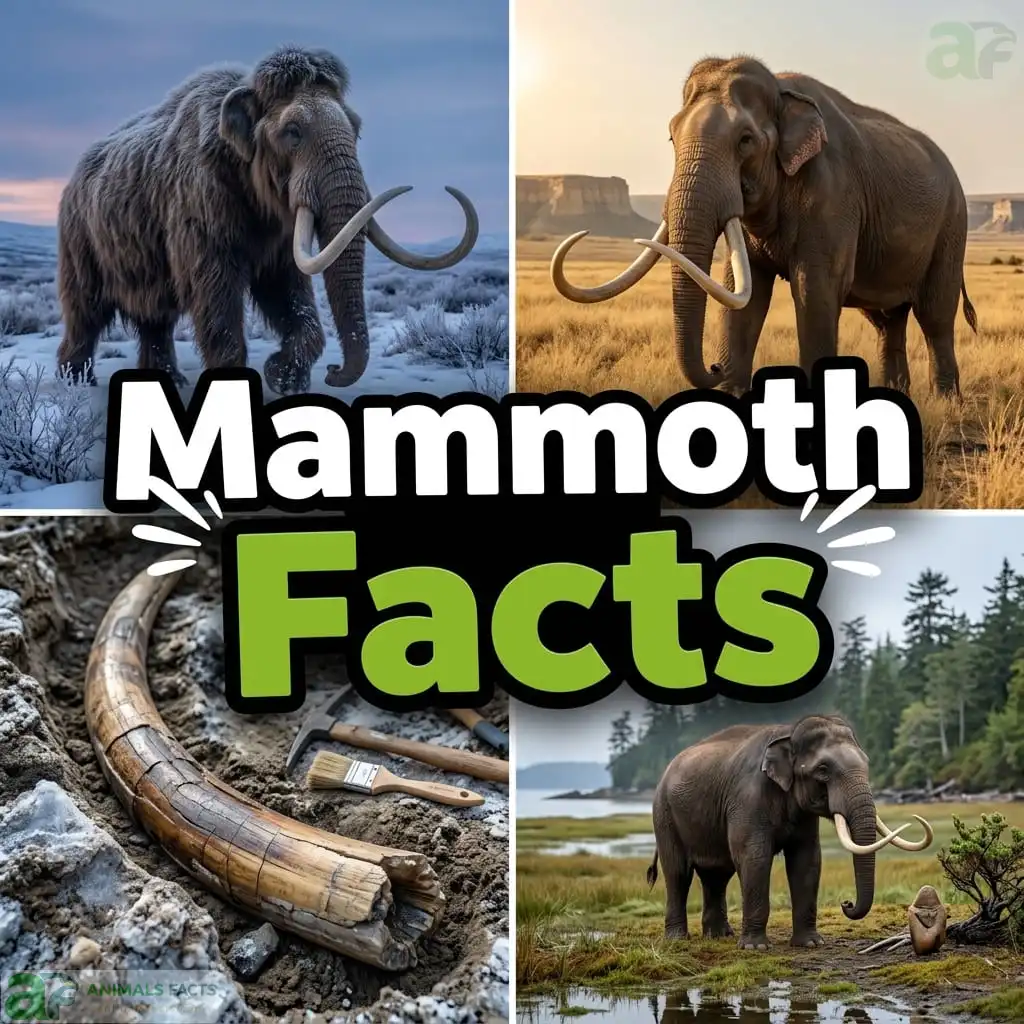
Mammoth Facts
| Feature | Details |
|---|---|
| Scientific Name | Mammuthus primigenius (woolly mammoth — most famous species) |
| Kingdom | Animalia |
| Phylum | Chordata |
| Class | Mammalia |
| Order | Proboscidea |
| Family | Elephantidae |
| Genus | Mammuthus |
| Number of Species | 9 recognized species within genus Mammuthus |
| Existed | ~5 million years ago to approximately 4,000 years ago (last island populations) |
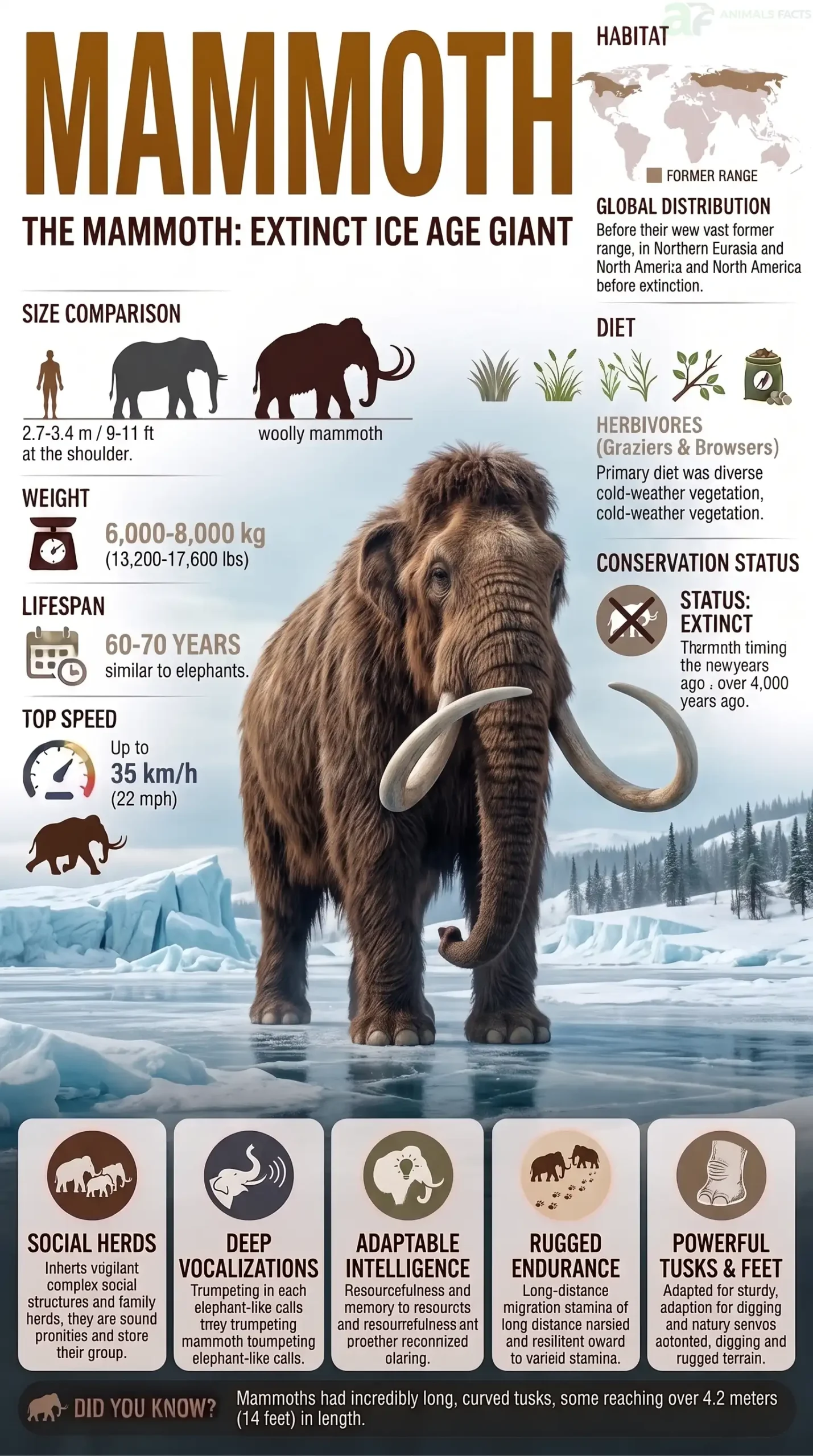
| Habitat | Arctic tundra, mammoth steppe, boreal grasslands, temperate forests |
| Lifespan | Estimated 60–80 years (similar to modern elephants) |
| Diet | Grasses, sedges, herbs, shrubs, flowering plants |
| Size | Up to 3.4 meters (11 ft) tall at shoulder (woolly); up to 4 meters (imperial mammoth) |
| Weight | 4,700–8,000 kg depending on species; males significantly larger than females |
| Top Speed | Estimated 20–25 km/h (based on modern elephant comparison) |
| Conservation Status | Extinct (last population ~4,000 years ago on Wrangel Island, Arctic Ocean) |
| Closest Living Relative | Asian elephant (Elephas maximus) — sharing ~99.6% of DNA |
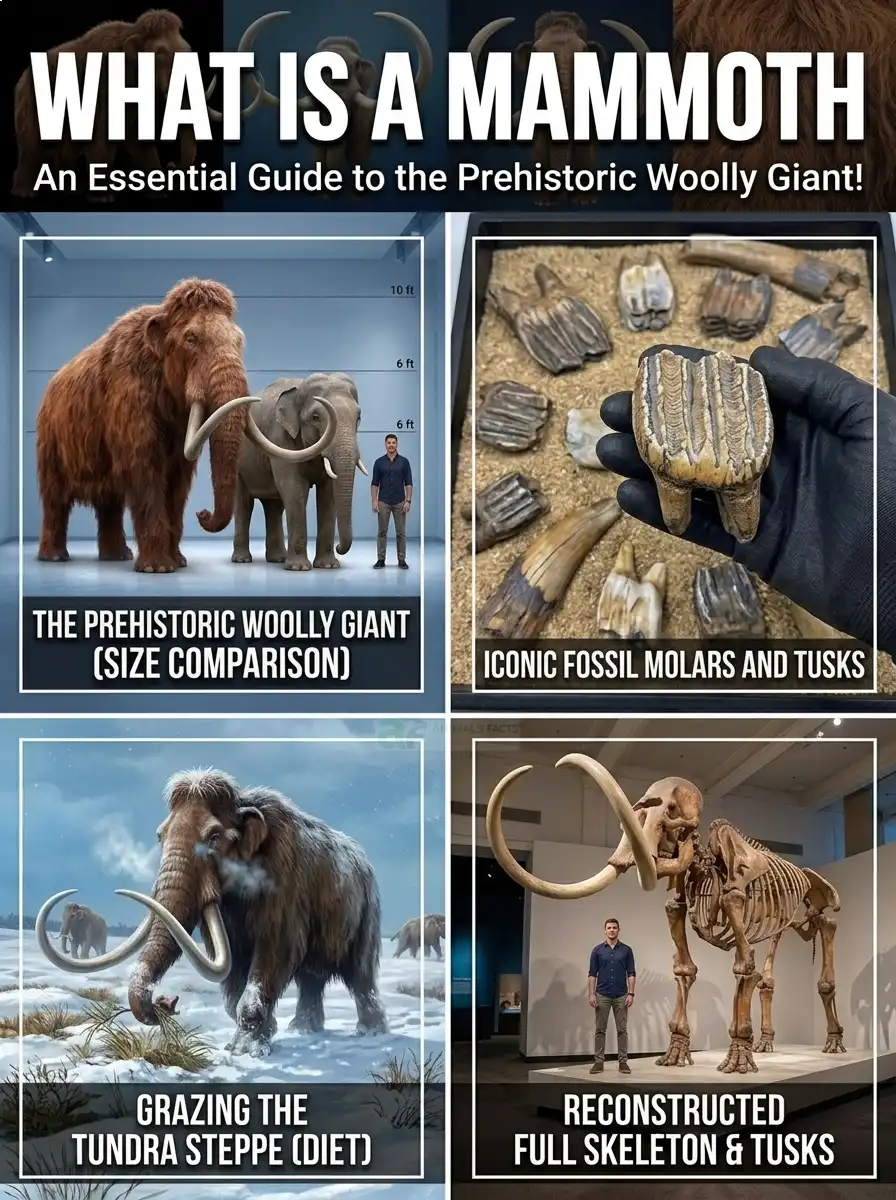
 1. Introduction: What is a Mammoth?
Imagine standing on a frozen Arctic plain 15,000 years ago, and through the swirling snow, a shape emerges — massive, shaggy, tusked, moving with a ponderous majesty that seems to belong to another world entirely. That shape was the woolly mammoth, and today, mammoth facts remind us that this was not a creature of myth or fantasy — it was a real, breathing, socially complex animal that walked the same Earth our ancient ancestors did, hunted alongside them, inspired their cave paintings, and whose frozen remains are still being pulled from Siberian permafrost in remarkable states of preservation to this day.
Interesting facts about mammoths reveal animals of extraordinary sophistication. They were not the lumbering brutes of popular imagination — they were highly intelligent, deeply social, ecologically transformative megafauna that shaped the landscapes of the Ice Age world the way elephants shape African savanna landscapes today. Their extinction — one of the most studied and debated events in Quaternary science — occurred so recently that woolly mammoth DNA is not only recoverable but is currently being studied in laboratories working toward the most audacious biological project in human history: bringing them back.
Whether you’re a student looking for mammoth facts for kids, a science enthusiast tracking the latest de-extinction research, a teacher building a prehistory lesson, or simply someone captivated by the idea of an animal so vast and magnificent that it still captures our collective imagination thousands of years after its disappearance, this is your definitive guide. We will cover mammoth habitat, mammoth diet, mammoth scientific names and classification, mammoth behavior and social life, the debates around their extinction, and the extraordinary science that may one day return something like them to Arctic tundra. The ice age has never been this fascinating.
2. Mammoth Species Overview & Classification
Mammoths belong to the family Elephantidae — the same family as living African and Asian elephants. This makes them not ancient relatives of elephants but genuine members of the same family, more closely related to modern elephants than modern elephants are to each other in some genetic analyses.
Species Classification Table
| Taxonomic Rank | Classification |
|---|---|
| Kingdom | Animalia |
| Phylum | Chordata |
| Class | Mammalia |
| Order | Proboscidea |
| Family | Elephantidae |
| Subfamily | Elephantinae |
| Genus | Mammuthus (Brookes, 1828) |
| Type Species | Mammuthus primigenius (woolly mammoth) |
| Number of Species | 9 formally recognized species |
| Temporal Range | ~5 million years ago to ~4,000 years ago |
The Nine Species of Mammoth
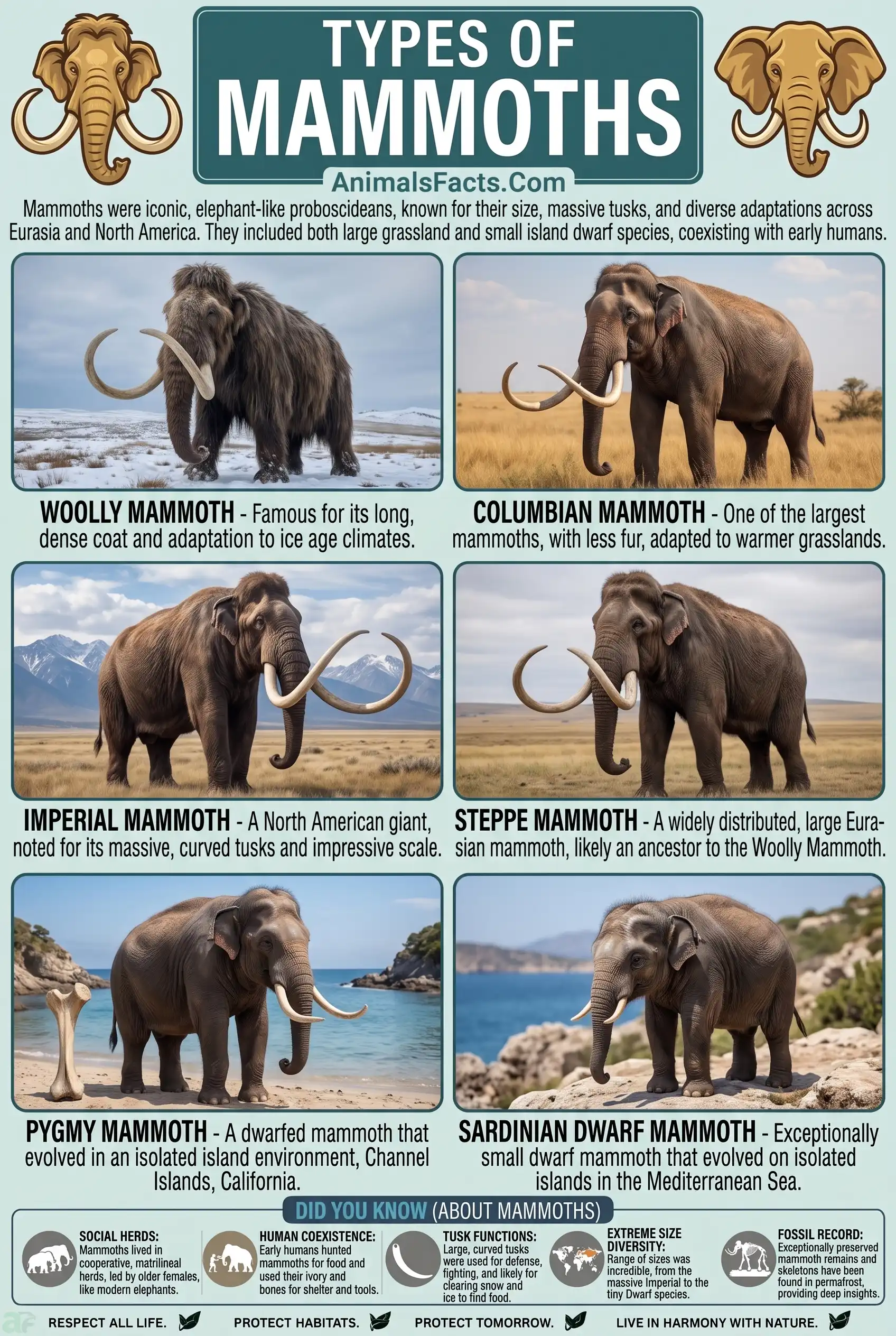
The genus Mammuthus encompassed remarkable diversity across millions of years and multiple continents. Nine species are formally recognized:
1. Mammuthus subplanifrons — The South African mammoth, considered the most primitive member of the genus; lived ~5 million years ago in Africa. Ancestral to all other mammoth species.
2. Mammuthus africanavus — The North African mammoth; lived ~3.5 million years ago across North Africa.
3. Mammuthus meridionalis — The southern mammoth; an early large mammoth that spread from Africa into Europe and Asia ~3 million years ago; reaching heights of ~4 meters.
4. Mammuthus rumanus — A lesser-known early European species.
5. Mammuthus trogontherii — The steppe mammoth; a massive species living ~700,000 years ago; considered the direct ancestor of both the woolly and Columbian mammoths. Largest tusks of any mammoth species, reaching up to 5 meters.
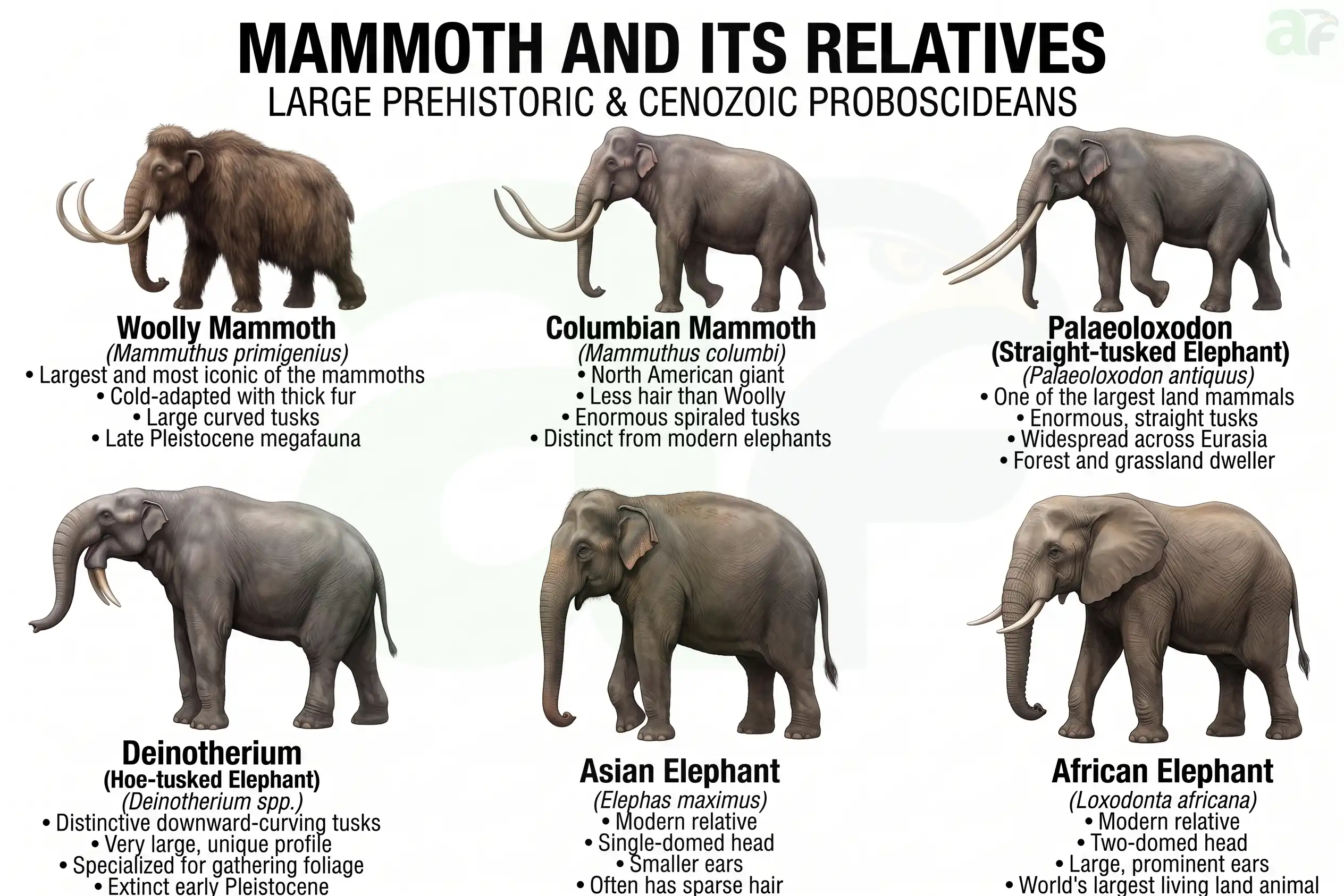
6. Mammuthus columbi — The Columbian mammoth; the dominant mammoth of North America; taller and less hairy than the woolly mammoth; lived in grasslands from modern Canada to Central America.
7. Mammuthus primigenius — The iconic woolly mammoth; the best-known and most extensively studied species; the dominant mammoth of Eurasia and northern North America during the Last Ice Age.
8. Mammuthus exilis — The Channel Islands pygmy mammoth of California; a dwarf species that evolved on the Channel Islands through insular dwarfism, reaching only ~1.4 meters tall.
9. Mammuthus lamarmorai — The Sardinian pygmy mammoth; another dwarf island species from the Mediterranean.
Subspecies Comparison Table
| Species | Region | Height | Weight | Extinction Date | Notable Feature |
|---|---|---|---|---|---|
| M. primigenius (woolly) | Eurasia, N. America | 3.4 m | 4,700–6,000 kg | ~4,000 BP (Wrangel Island) | Thick wool, curved tusks |
| M. columbi (Columbian) | N. America | 3.7–4.0 m | 8,000–10,000 kg | ~13,000 BP | Largest N. American species |
| M. trogontherii (steppe) | Eurasia | 4.0–4.5 m | ~10,000 kg | ~150,000 BP | Longest tusks of any proboscidean |
| M. exilis (pygmy) | Channel Islands, CA | 1.2–1.8 m | ~760 kg | ~13,000 BP | Insular dwarfism; smallest mammoth |
Evolution & Discovery Timeline
~5 million years ago — Mammuthus subplanifrons appears in southern Africa — the earliest member of the mammoth lineage, already showing the distinctive thick enamel ridged molar pattern that would characterize all future mammoths.
~3 million years ago — The first mammoths spread out of Africa into Europe and Asia as the genus Mammuthus meridionalis, coinciding with global cooling and the expansion of grasslands.
~700,000 years ago — The massive Mammuthus trogontherii (steppe mammoth) emerges, producing the lineage that ultimately gives rise to both the woolly and Columbian mammoths.
~400,000 years ago — The woolly mammoth (M. primigenius) emerges in eastern Asia, developing the cold-adaptation features — long fur, fat reserves, smaller ears, modified hemoglobin — that define the species.
~1.5 million years ago — Mammoths colonize North America via the Bering land bridge, eventually giving rise to the Columbian mammoth lineage.
~40,000 years ago — Woolly mammoths reach peak abundance across a vast territory from western Europe to eastern Siberia and into North America. Cave paintings in France and Spain depict them in remarkable detail.
~12,000–10,000 years ago — Major extinction pulse occurs across most of the mammoth’s range, coinciding with the end of the last Ice Age and the arrival of human hunters across previously uninhabited landscapes.
~8,000 years ago — A relict population survives on St. Paul Island in the Bering Sea — smaller, isolated, but surviving thousands of years after continental populations vanished.
~4,000 years ago (~2,000 BCE) — The last known mammoths — a dwarf population on Wrangel Island in the Arctic Ocean — go extinct. This is the same era as the construction of the Egyptian pyramids and the rise of early Chinese civilization.
1799 — The first scientifically significant woolly mammoth specimen — a frozen carcass with preserved skin and hair — is discovered in Siberia by Ossip Shumakhov and brought to scientific attention. It takes nearly a decade to reach researchers.
1796 — Georges Cuvier formally establishes that mammoths were a distinct species from living elephants — one of the first scientific proofs that extinction was a real phenomenon, not a heresy against divine creation.
1994 — The first successful extraction of ancient DNA from a woolly mammoth specimen, opening the field of paleogenomics.
2013 — Russian and Korean scientists announce the discovery of liquid blood in a frozen mammoth carcass recovered from Siberia — the first time liquid mammoth blood had ever been observed, raising the theoretical possibility of recovering viable cells.
2017 — Researchers at Harvard’s Wyss Institute, led by Dr. George Church, announce successful editing of woolly mammoth genes into Asian elephant cell lines — the first concrete step toward functional de-extinction.
2021 — Biotech company Colossal Biosciences is founded with the explicit goal of de-extincting the woolly mammoth by creating a cold-adapted elephant-mammoth hybrid through CRISPR gene editing, targeting a first living hybrid within the 2030s.
2025 — Colossal announces successful creation of cold-adapted Asian elephant embryonic stem cells carrying key mammoth genetic traits — a significant milestone toward their de-extinction goal.
“The mammoth is a ghost of an ecology that we have destroyed. Bringing it back — or something like it — might be the most important rewilding project in human history.” — Dr. George Church, Harvard University geneticist and co-founder of Colossal Biosciences
3. Mammoth Physical Description & Unique Features
Mammoth size and weight varied considerably across species and even between individuals of the same species — but all mammoths shared a suite of recognizable features that made them instantly distinctive.
The Woolly Mammoth’s Cold Adaptations
The woolly mammoth is the best-studied species, and its physical adaptations to Arctic cold are extraordinary in their precision and redundancy:
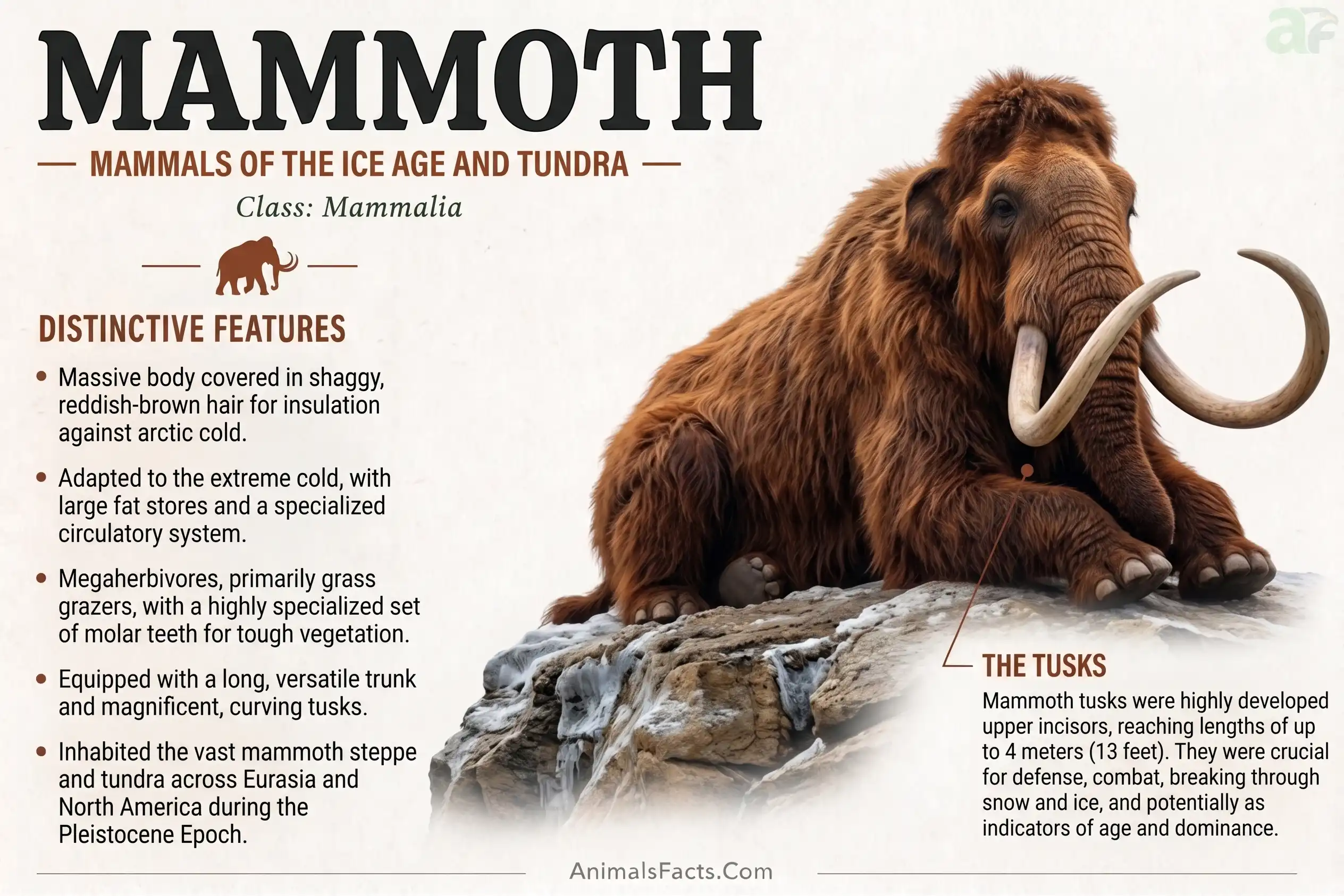
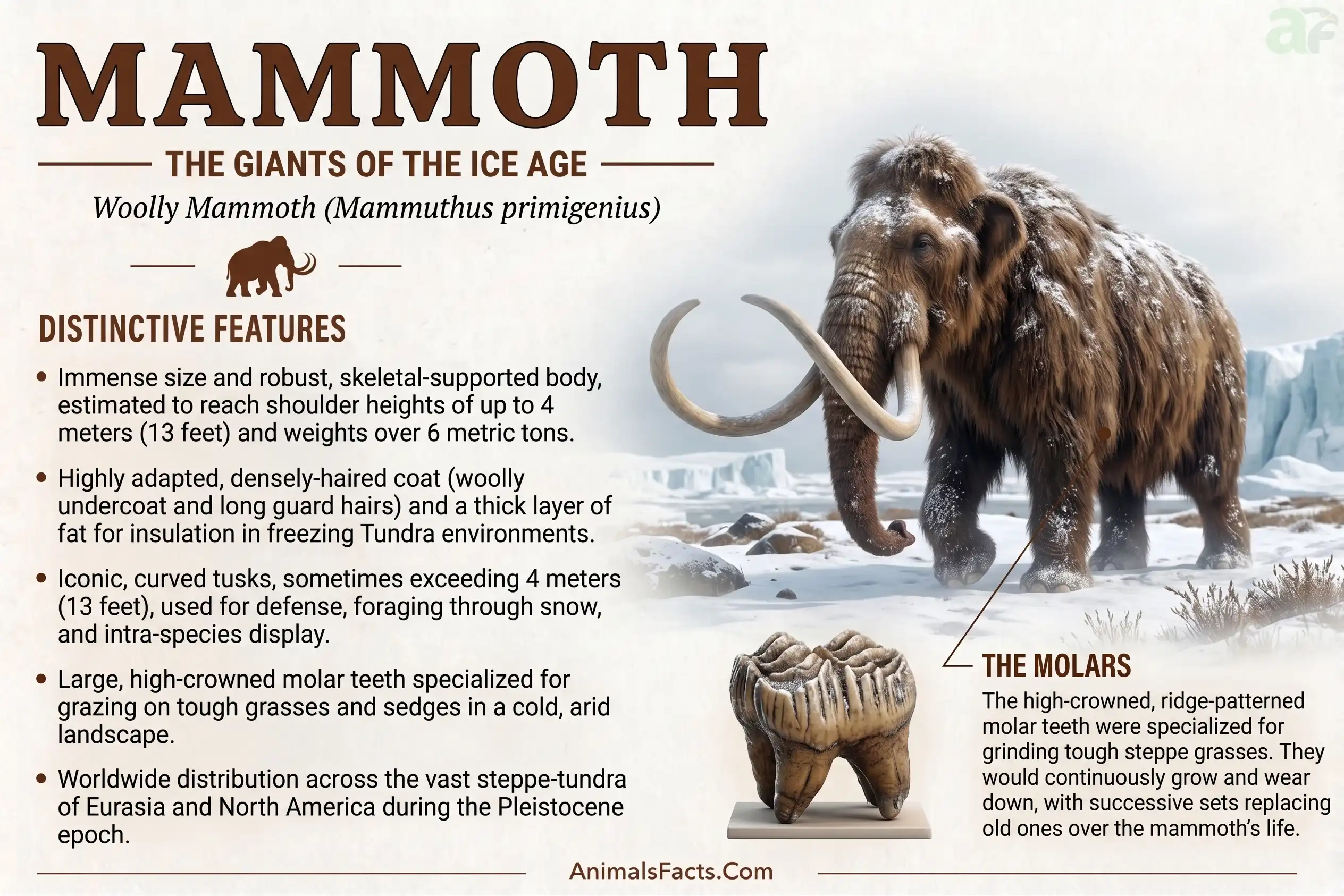
Coat system — The woolly mammoth’s coat consisted of three layers: an outer layer of guard hairs up to 90 cm long (some specimens show hair approaching 1 meter in length), a middle layer of coarse woolly hair, and an inner layer of dense underwool — together creating one of the most effective biological insulation systems ever evolved. The outer coat could be brown, black, or reddish — confirmed by both frozen specimens and melanin analysis of preserved hair.
Fat reserves — Beneath the skin, woolly mammoths maintained a layer of fat up to 10 cm thick — providing both thermal insulation and an energy reserve for winter months when food was scarce. This fat layer is regularly found preserved in frozen specimens.
Modified blood — Analysis of ancient mammoth DNA has revealed that their hemoglobin had a modified oxygen-release curve that remained functional at low temperatures — a critical adaptation preventing blood from “seizing up” in extreme cold, similar to adaptations found in some cold-water fish.
Ears and tail — Woolly mammoths had much smaller ears than living elephants (reducing surface area and thus heat loss) and a short, heavily haired tail — contrasting sharply with the large-eared, long-tailed African elephant optimized for heat dissipation in tropical conditions.
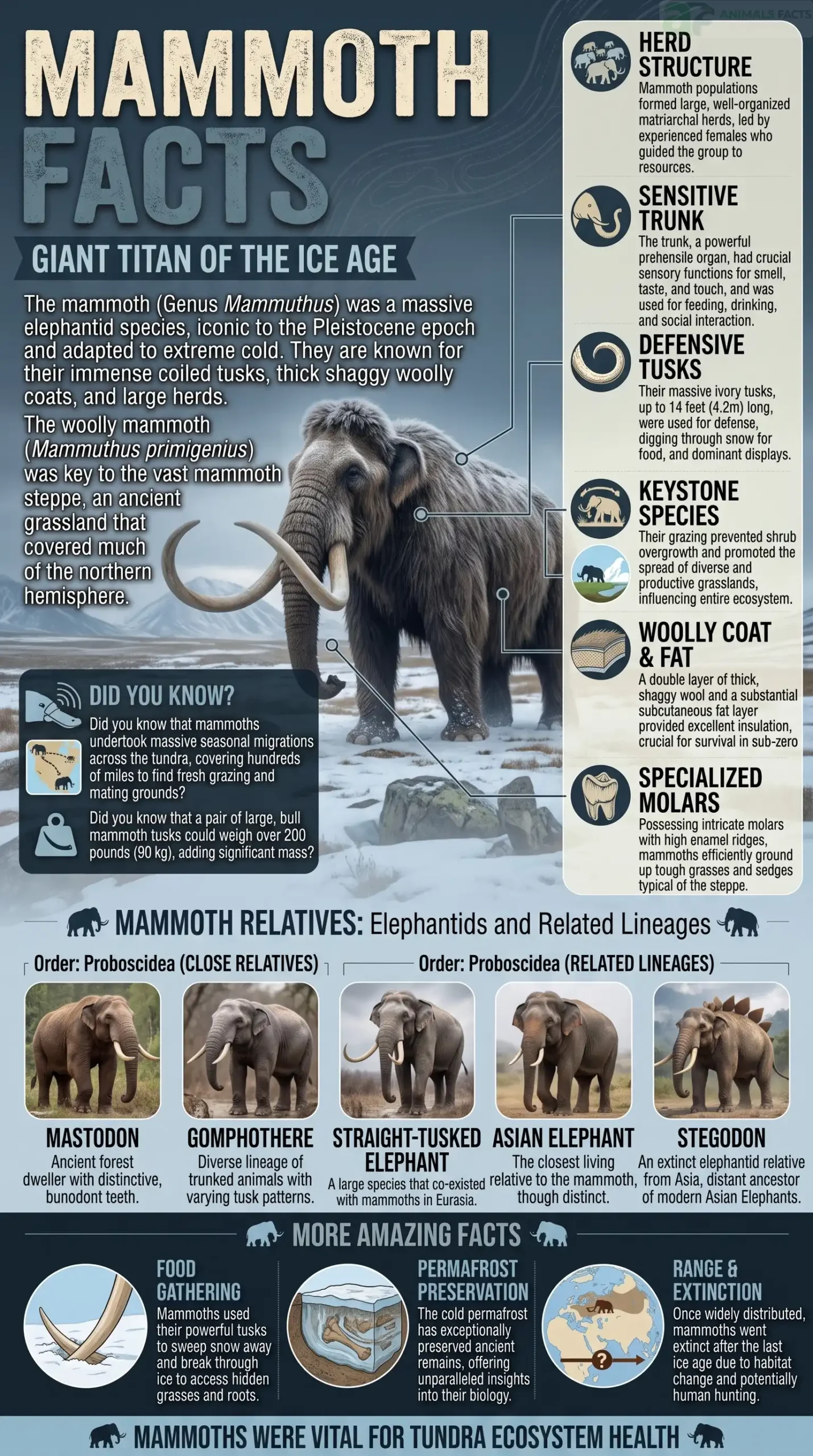
Tusks — Woolly mammoth tusks could reach 3.3–3.7 meters in large males. Their characteristic spiral curve is unique to the woolly mammoth — a result of a specific growth pattern that produced a corkscrew shape unlike the more gently curving tusks of the Columbian mammoth or living elephants. Tusk growth rings, like tree rings, record annual growth and health information — providing detailed biographical records of individual animals.
Size & Weight
Adult male woolly mammoths stood approximately 2.7–3.4 meters at the shoulder and weighed between 4,700 and 6,000 kg. Females were considerably smaller — approximately 2.0–2.6 meters tall and weighing 3,000–4,000 kg. The Columbian mammoth (M. columbi) was significantly larger, with males potentially reaching 4 meters at the shoulder and weighing up to 10,000 kg — making it one of the largest land mammals ever to exist in North America.
Hump
Many frozen woolly mammoth specimens and contemporary cave paintings show a distinct fatty hump above the shoulder — similar to the hump of a bison. This structure, found in both juveniles and adults, likely served as an additional fat reserve and may have altered the animal’s silhouette enough to be significant for species recognition.
Did You Know? A woolly mammoth’s molar teeth were among the most sophisticated dental structures ever evolved in a herbivore. Each molar — roughly the size of a large loaf of bread — had parallel ridges of hard enamel separated by softer dentine, creating a highly effective grinding surface for tough grass. Mammoths produced six sets of molars throughout their lifetime, moving forward in the jaw one at a time as earlier teeth wore down — a system identical to that of modern elephants.
4. Top 25 Amazing Mammoth Facts
Here is your comprehensive collection of the most extraordinary, scientifically verified, and genuinely jaw-dropping mammoth facts as of 2026:
- The last woolly mammoths on Earth survived until approximately 4,000 years ago — the same era as the Egyptian pyramids, Stonehenge’s completion, and the earliest Chinese writing.
- Woolly mammoths share 99.6% of their DNA with Asian elephants — a closer relationship than African and Asian elephants share with each other.
- A company called Colossal Biosciences is currently working to create a cold-adapted mammoth-elephant hybrid using CRISPR gene editing, targeting a first viable animal by the early 2030s.
- The largest mammoth tusks ever recorded belonged to the steppe mammoth (M. trogontherii) — reaching estimated lengths of 5 meters and weighing over 150 kg each.
- Woolly mammoth blood that was still liquid was recovered from a Siberian carcass in 2013 — the first time liquid mammoth blood had ever been observed, made possible by natural antifreeze properties.
- Mammoth hair color is now known from frozen specimens and pigment analysis — most were various shades of brown and reddish-brown, though dark brown and near-black individuals also existed.
- Over 80% of all mammoth ivory currently sold in the legal antique and art market comes from legally excavated Siberian permafrost — tens of thousands of mammoth tusks have been commercially recovered from Russia since the 1990s.
- The dwarf Channel Islands mammoth (M. exilis) evolved from full-sized Columbian mammoths in just ~6,000–12,000 years — one of the fastest documented cases of insular dwarfism in any mammal.
- A baby woolly mammoth named “Lyuba” — discovered in Siberia in 2007 — is the best-preserved mammoth ever found, with intact organs, eyelashes, and trunk contents revealing she died at approximately one month old from suffocation in mud.
- Woolly mammoths had a dung output estimated at over 180 kg per day — their waste fertilized the mammoth steppe ecosystem in ways that directly maintained its grassland character.
- Chemical analysis of mammoth tusks can track individual life histories — recording periods of food abundance, stress, drought, and disease as chemical signatures in the growth rings.
- Some Siberian permafrost localities contain mammoth bone concentrations so dense they are called “mammoth graveyards” — accumulations of hundreds of individuals representing thousands of years of natural deaths along migration routes and water sources.
- The word “mammoth” entered the English language from Russian (mammot or mamont), which itself derives from a Siberian indigenous language — probably from a word meaning “earth-burrower,” reflecting local beliefs that mammoths lived underground.
- Cave paintings of woolly mammoths in Font-de-Gaume (France) and Rouffignac Cave (France) are so anatomically accurate — correctly depicting the shoulder hump, sloping back, and curved tusks — that they constitute valid scientific documentation of mammoth appearance.
- The Columbian mammoth had tusks that could reach 5 meters in length — its tusks were used as shovels to uncover vegetation beneath snow and ice, leaving characteristic parallel scrape marks preserved at some fossil sites.
- Mammoths were ecosystem engineers on a continental scale — their grazing, trampling, and dung deposition maintained the mammoth steppe, a productive grassland ecosystem that covered enormous areas of Eurasia and North America during the Ice Age.
- The “mammoth steppe” — the ecosystem dominated by mammoths and other megafauna — was more productive than the modern tundra that replaced it; its loss following mammoth extinction contributed to the expansion of permafrost and potentially released significant stored carbon.
- Early humans used mammoth bones to construct shelters — structures built from mammoth skulls, leg bones, and tusks have been found at multiple sites in Ukraine and Russia, representing some of the earliest permanent human dwellings.
- Mammoth ivory was carved into figurines, tools, musical instruments, and jewelry by Upper Paleolithic humans — objects including the Venus of Hohle Fels (~40,000 years old, Germany) are carved from mammoth ivory.
- A preserved mammoth stomach content analysis reveals their diet included over 100 different plant species — grasses, sedges, herbs, flowers, mosses, and even tree bark in winter — making them highly flexible omnivorous herbivores.
- The pygmy mammoth of the Channel Islands (M. exilis) weighed less than a modern horse (~760 kg) — yet descended from Columbian mammoths that weighed up to 10,000 kg — representing a 92% reduction in body mass through evolution.
- Frozen mammoth specimens have been found with intact stomach contents still identifiable as specific plant species — providing a direct window into what individual animals ate in their last hours of life.
- Ancient humans in North America used mammoth bones as raw material for tools including knives, scrapers, and projectile points — tool kits associated with mammoth kills are found at multiple Clovis culture sites.
- The Beresovka mammoth — excavated in Siberia in 1901 — was found in a sitting position with unswallowed food still in its mouth, suggesting it died extremely rapidly — possibly from falling into a crevasse or collapsing riverbank.
- Analysis of ancient mammoth genomes has identified specific genes responsible for their cold adaptations — including modified TRPV3 (a temperature-sensing gene), modified hemoglobin, genes for fat metabolism, circadian rhythm adaptation to polar light conditions, and hair follicle development — forming a precise genetic blueprint for their cold-climate lifestyle.
5. Mammoth Fun Facts for Kids
- Mammoths and humans coexisted for at least 100,000 years across Eurasia
- A mammoth’s trunk had over 40,000 muscles — more than the entire human body
- Mammoths could use their tusks to shovel snow and break ice to reach water
- The word “mammoth” is now used as an English adjective meaning “enormous” — derived from the animal itself
- Woolly mammoth DNA has been successfully sequenced from specimens up to 700,000 years old (the oldest DNA ever recovered from any organism)
- Mammoths likely communicated using infrasound — low-frequency calls inaudible to humans — like modern elephants
- A group of mammoths would have been called a herd, just like modern elephants
- Mammoth permafrost specimens continue to emerge from Siberia regularly — new finds are reported virtually every year
- The last mammoths on Wrangel Island were pygmy mammoths — reduced in size through island dwarfism just as the Channel Islands population was
- Mammoths may have had a lifespan of 60–80 years — approximately the same as a modern elephant
- Mammoth babies were likely covered in dense reddish-brown wool from birth
- Ancient humans carved mammoth likenesses in bone, ivory, and stone across three continents
6. Natural Habitat & Geographic Range
Mammoth habitat varied considerably between species and through time, but the most iconic species — the woolly mammoth — was an animal of the mammoth steppe, an ancient ecosystem that no longer exists anywhere on Earth in its original form.
The Mammoth Steppe
The mammoth steppe was arguably the largest terrestrial biome on Earth during the height of the Last Ice Age (~20,000 years ago), stretching continuously from the British Isles in the west across Siberia and into Alaska and the Yukon in the east — a grassland ecosystem of extraordinary productivity maintained by the trampling, grazing, and dung fertilization of mammoths, woolly rhinoceroses, cave lions, woolly horses, and bison.
This was not the frozen wasteland of popular imagination — it was a productive, seasonally dynamic grassland producing enough food to support dense populations of megafauna. The key to its productivity was the megafauna themselves: by trampling vegetation, recycling nutrients through dung, and compacting snow (allowing cold to penetrate deeper, maintaining permafrost), these animals created a positive feedback loop that maintained the grassland ecosystem.
Habitat Range by Continent/Region
| Region | Species Present | Time Period | Habitat Type |
|---|---|---|---|
| Northern Europe (UK, France, Germany) | M. primigenius (woolly) | ~400,000–10,000 BP | Mammoth steppe, tundra grassland |
| Eastern Europe (Ukraine, Poland, Russia) | M. primigenius | ~400,000–10,000 BP | Mammoth steppe, open grassland |
| Siberia (Russia) | M. primigenius | ~400,000–4,000 BP | Subarctic steppe, tundra |
| China & East Asia | M. primigenius, M. trogontherii | ~1 million–10,000 BP | Mixed grassland, boreal forest edge |
| North America (mainland) | M. columbi, M. primigenius (north) | ~1.5 million–13,000 BP | Temperate grassland, boreal forest |
| Channel Islands, California | M. exilis (pygmy) | ~80,000–13,000 BP | Island scrubland |
| Central America | M. columbi | ~1 million–13,000 BP | Tropical savanna margins |
| Wrangel Island, Arctic | M. primigenius (dwarf) | ~8,000–4,000 BP | Arctic tundra grassland |
| Africa | M. subplanifrons, M. africanavus | ~5–2 million BP | Open savanna |
Did You Know? During the height of the last Ice Age (~20,000 years ago), sea levels were approximately 120 meters lower than today. This exposed a massive land bridge called Beringia connecting what is now Siberia to Alaska — a landmass larger than modern France — across which mammoths, horses, bison, cave lions, and eventually humans migrated between Asia and the Americas.
7. Diet & Feeding Behavior
Mammoth diet was dominated by plant material — mammoths were strict herbivores, but highly flexible and opportunistic ones. Analysis of preserved stomach contents, frozen dung, dental wear patterns, and isotope analysis of bones has provided a remarkably detailed picture of what individual mammoths actually ate.
Diet Breakdown Table
| Food Type | Approximate % of Diet (Woolly Mammoth) | Source of Evidence |
|---|---|---|
| Grasses and sedges | ~60–70% | Stomach contents, dental wear, isotope analysis |
| Herbs and flowering plants | ~15–20% | Stomach contents, pollen analysis |
| Shrubs and woody plants | ~5–10% | Isotope analysis, dental wear |
| Mosses and lichens | ~3–5% | Stomach contents (particularly winter diets) |
| Tree bark and twigs | ~2–5% | Dental marks, winter survival analysis |
| Aquatic plants | ~1–3% | Found in stomach contents near lake sites |
Daily Intake
Based on comparisons with modern elephants — scaled for body mass — adult woolly mammoths likely consumed approximately 180–270 kg of plant material per day. Given the relatively lower productivity of mammoth steppe vegetation compared to tropical elephant habitat, mammoths likely spent the majority of their daylight hours feeding — as modern elephants do — covering large distances to meet their nutritional requirements.
Seasonal Dietary Shifts
Isotope analysis of individual mammoth tusk growth rings reveals clear seasonal dietary cycling — summer and autumn rings show enriched signatures consistent with abundant, high-quality grass consumption, while winter rings show shifts consistent with reliance on lower-quality bark, twigs, and stored fat reserves. This pattern mirrors that of modern large herbivores in seasonal environments.
Tool-Assisted Feeding
Both woolly and Columbian mammoths used their tusks as feeding tools — excavating under snow and ice to expose cached vegetation, scraping bark from trees, and potentially digging for roots and mineral-rich soil (a behavior called geophagy, observed in modern elephants and likely in mammoths based on certain fossil site characteristics).
8. Reproduction & Life Cycle
Mammoth reproduction is inferred primarily from comparison with modern Asian elephants — their closest living relatives — supplemented by evidence from frozen specimens, bone age analysis, and tusk growth ring records.
Mating Behavior
Male mammoths almost certainly experienced musth — the periodic state of elevated testosterone and aggressive behavior observed in male Asian and African elephants, during which males compete intensely for access to females. Evidence includes the finding of adult male mammoth skulls with signs of combat damage consistent with tusk-fighting. During musth, modern elephant bulls lose significant body condition as they prioritize competition over feeding — a similar physiological state in mammoths would be legible as stress bands in tusk growth rings, and some researchers have tentatively identified such patterns in analyzed specimens.
Females likely reached sexual maturity at approximately 10–14 years of age, similar to Asian elephants. Gestation would have lasted approximately 22 months — the longest gestation period of any land mammal, a trait shared by all proboscideans.
Birth & Early Development
Mammoth calves were almost certainly precocial — born with open eyes, coordinated movement, and the ability to stand within hours. Given the Arctic environment and the predator pressure from wolves, cave lions, and hyenas, rapid mobility would have been essential for survival. Baby mammoths were likely covered in dense, reddish-brown wool from birth — preserved juvenile specimens show this clearly.
Calves would have been nursed by their mothers for approximately 3–5 years, during which time they learned the extensive spatial knowledge — migration routes, seasonal food sources, water locations, predator territories — that is central to elephant survival and that is transmitted exclusively through social learning from older herd members.
Growth Stages
- Birth — Calf weighs approximately 90–120 kg; born fully mobile; immediately enters herd social structure
- Early calf (0–2 years) — Complete dependence on mother’s milk; tusk eruption begins
- Late calf (2–5 years) — Nursing continues; solid food increasingly important; extensive social play
- Juvenile (5–12 years) — Weaned; increasingly independent feeding; tusks grow rapidly
- Sub-adult (12–20 years) — Males begin separating from family herds; females remain with natal group
- Adult (20–50 years) — Full size reached by approximately 25 years; peak reproductive years
- Old adult (50–70+ years) — Final molar set in use; declining dental function eventually limits feeding efficiency
Lifespan Comparison Table
| Species | Estimated Lifespan (Wild) | Key Life History Note |
|---|---|---|
| Woolly mammoth | 60–80 years (estimated) | Molar replacement limits maximum age |
| Asian elephant | 60–70 years | Closest living relative; best comparison model |
| African elephant | 60–70 years | Slightly longer-lived than Asian species |
| Columbian mammoth | 65–80 years (estimated) | Larger body; possibly slightly longer-lived |
| Mastodon (Mammut americanum) | 60–80 years (estimated) | Distinct family but similar life history |
9. Social Behavior & Communication
Like their closest living relatives, mammoths almost certainly had complex, matriarchal social structures built around multi-generational family groups led by experienced older females whose knowledge of landscape, resources, and danger was the key to group survival.
Social Structure
Evidence for matriarchal social organization in mammoths comes from several sources. Fossil bone bed analysis at several North American sites shows accumulations dominated by juveniles and adult females, consistent with the pattern of related females dying together — as occurs in drought-driven die-offs of modern elephant herds today. Adult males are often found isolated or in smaller single-sex groups, reflecting the pattern of male dispersal seen in modern elephant bulls.
Tusk morphology supports gender-separated social groups — male mammoth tusks show different wear patterns from female tusks, consistent with different uses (fighting and display in males; foraging-dominant use in females). The largest, most elaborately curved tusks — which served as status displays in addition to tools — are characteristic of dominant adult males.
Communication
Mammoths almost certainly communicated using infrasound — low-frequency sound below the threshold of human hearing — as modern elephants do. Infrasound travels enormous distances across open steppe landscapes (modern elephants communicate over 10 km using infrasound) and would have been essential for maintaining contact between individuals and family groups across the vast, treeless mammoth steppe.
Trunk communication — touching, stroking, and trunk-to-mouth greeting — was almost certainly a central element of mammoth social interaction, as it is in modern elephants. The trunk of a mammoth, with its estimated 40,000+ muscles, was capable of extraordinary sensitivity and expressiveness.
Intelligence
Given their extreme genetic and physiological similarity to Asian elephants — the third most cognitively complex land mammal after great apes and humans — mammoths almost certainly possessed comparable spatial memory, social cognition, learning capacity, and possibly grief behavior around deceased family members. The transmission of complex knowledge across generations through social learning — including knowledge of migration routes, seasonal resource locations, and predator territories — was likely the single most important factor in mammoth survival and would have made the matriarch’s knowledge the irreplaceable core of family group success.
Did You Know? A 2021 study published in Science analyzing the genome of a ~1.2 million-year-old mammoth from Siberia — the oldest DNA ever successfully sequenced from any organism — revealed that the ancestors of woolly mammoths interbred with a previously unknown mammoth population, adding a third lineage to our understanding of mammoth evolutionary history and demonstrating that hybridization was common in proboscidean evolution.
10. Predators & Defense Mechanisms
Adult woolly mammoths had virtually no natural predators capable of threatening them — their enormous size, thick hide, powerful tusks, and the protection of the herd made them effectively invulnerable to most Ice Age carnivores. However, juvenile mammoths and weakened adults faced real predatory threats, and the defensive strategies of the herd reflected these vulnerabilities.
Natural Predators
Cave lions (Panthera leo spelaea) — The largest big cat ever to exist, approximately 10–25% larger than modern African lions. Cave paintings show cave lions in proximity to mammoths, and some fossils show lion-consistent bite and claw marks on juvenile mammoth bones. However, a healthy adult mammoth was almost certainly beyond a cave lion’s ability to kill alone or even in a pride.
Cave hyenas (Crocuta crocuta spelaea) — Among the most common megafauna of Ice Age Europe, with extremely powerful jaws capable of crushing mammoth bone. Hyena den sites (called hyena lairs) frequently contain mammoth bones in great quantities — though most represent scavenging of already-dead individuals rather than active predation.
Dire wolves (Aenocyon dirus) — In North America, these large wolves may have posed a threat to juvenile Columbian mammoths, particularly in coordinated pack attacks.
Humans (Homo sapiens and late Homo neanderthalensis) — The most significant predator of mammoths during their final millennia. Archaeological evidence documents mammoth kill sites across Europe, Asia, and North America where organized human hunting took place. The extent to which human hunting drove mammoth extinction remains one of the most debated questions in Quaternary science.
Defense Strategies
Herd protection — As in modern elephants, the primary defense of young mammoths was the herd. When threatened, mammoths almost certainly formed defensive circles with young animals in the center — a behavior documented in multiple modern elephant populations and so effective that even cave lions were unlikely to penetrate it successfully.
Tusk defense — Adult mammoth tusks were formidable weapons. Evidence of tusk impact damage on the skulls of cave lions and other predators confirms they were actively used in defense. A full-power tusk thrust from an adult male mammoth — an animal weighing 5,000–6,000 kg moving at speed — would have delivered devastating force.
Charge display — Like modern elephants, mammoths almost certainly used mock-charge displays — running toward a threat with ears out and trunk raised — as a deterrent before committing to physical contact. The sheer scale of this display from an animal as large as a mammoth would have deterred all but the most desperate predators.
11. Mammoth Facts for Kids
Hey young explorers! Here are some totally incredible mammoth facts for kids that will make you the mammoth expert in your class:
- 🦣 Mammoths had the longest hair of any elephant ever! Their shaggy outer coat could grow nearly a meter long — imagine wearing a fur coat with hairs as long as your arm!
- 🦣 The last mammoths lived at the SAME TIME as the ancient Egyptians! While pharaohs were building pyramids about 4,000 years ago, a small group of mammoths was still alive on a remote Arctic island.
- 🦣 Mammoths had SIX sets of teeth! As their massive molar teeth wore down from all that tough grass-chewing, new teeth moved forward from the back of the jaw to replace them — like a built-in tooth conveyor belt!
- 🦣 A baby mammoth named Lyuba is the best-preserved mammoth ever found! She was only one month old when she died, and scientists have been able to study her organs, her eyelashes, and even what she last ate!
- 🦣 Scientists might actually BRING MAMMOTHS BACK! A company called Colossal Biosciences is working to use DNA technology to create a cold-loving elephant that looks and lives like a mammoth. We might see one in our lifetime!
- 🦣 Ancient humans painted mammoths in caves! Some of the most beautiful cave paintings in France, made up to 40,000 years ago, show woolly mammoths — drawn so accurately that scientists use them as evidence of what mammoths really looked like!
- 🦣 Mammoths built houses — sort of! Early humans used mammoth bones to build shelters. In Ukraine, archaeologists found huts made from hundreds of mammoth bones — walls, roofs, and all!
- 🦣 A mammoth’s trunk had more muscles than your whole body! The trunk contained an estimated 40,000 individual muscles, making it stronger than any human arm and sensitive enough to pick up a single blade of grass.
12. Relationship with Humans
The relationship between Homo sapiens and woolly mammoths was one of the most consequential — and most debated — human-animal relationships in all of prehistory. For tens of thousands of years, humans and mammoths shared the landscapes of Eurasia and the Americas, and their interaction shaped the development of both human culture and, ultimately, mammoth fate.
Coexistence & Hunting
Modern humans (and earlier, Neanderthals) shared the mammoth steppe with woolly mammoths for at least 100,000 years. Archaeological evidence documents mammoth hunting at multiple sites across Europe, Russia, and North America. Kill sites — locations where mammoth carcasses are associated with stone tools and butchering marks — have been found from Spain to Siberia to Arizona. In some cases, entire herds appear to have been driven off cliffs or into bogs.
However, the intensity and organization of mammoth hunting varied enormously across cultures and time periods. Some hunter-gatherer groups appear to have depended heavily on mammoths as a primary protein source, while others used mammoths opportunistically as scavenged resources when natural deaths occurred.
Mammoth Material Culture
Beyond food, mammoths provided an extraordinary range of raw materials to Ice Age human cultures:
Ivory — Mammoth ivory was carved into figurines, spear points, needles, jewelry, and musical instruments. The oldest confirmed musical instruments in the world — bone and ivory flutes found at Hohle Fels Cave in Germany, dated to ~40,000 years ago — include specimens made from mammoth ivory.
Bone — Mammoth long bones provided structural material for shelters (documented in Ukraine, Russia, and Czech Republic), tent frames, and large tools. Some mammoth bone structures in Ukraine represent the most substantial human constructions of their era.
Hide and fur — Mammoth hide and fur (inferred from ethnographic analogy with more recent societies using large mammal hides) provided clothing, shelter coverings, and carrying containers that were critical to human survival in sub-zero temperatures.
Fat — Mammoth fat rendered from carcasses provided fuel for fires and lamps — essential for warmth, cooking, and light during the Arctic winter’s near-total darkness.
The Extinction Debate
Whether humans were the primary cause of mammoth extinction — or whether climate change, or a combination of both, was responsible — is one of the longest-running debates in Quaternary science. As of 2026, most researchers favor a synergistic model: climate warming at the end of the last Ice Age contracted and fragmented mammoth habitat, while simultaneously human hunting pressure — particularly on small, isolated populations — pushed vulnerable groups over the extinction threshold. Neither factor alone fully explains the extinction pattern; together they provide a more complete picture.
The survival of the Wrangel Island population — an island that humans did not reach until approximately 2,000 BCE (very close to the mammoth’s final extinction date there) — provides suggestive, though not conclusive, evidence that human arrival correlated with final extinction even in this last refuge.
13. Conservation Status & Extinction
Mammoths are, of course, completely extinct as a living species. The last known population — a dwarf form of the woolly mammoth on Wrangel Island in the Arctic Ocean — went extinct approximately 4,000 years ago (~2,000 BCE), making mammoths one of the most recently extinct megafauna species and the last surviving proboscidean outside of the African and Asian elephant lineages.
Extinction Timeline
| Population | Extinction Date | Primary Cause(s) |
|---|---|---|
| European woolly mammoths | ~10,000–8,000 BP | Climate change + hunting pressure |
| Continental Siberian mammoths | ~10,000 BP | Climate change + hunting |
| North American Columbian mammoth | ~13,000–10,000 BP | Human hunting (Clovis culture) + climate |
| Channel Islands pygmy mammoth | ~13,000 BP | Sea level rise + possible human contact |
| St. Paul Island mammoths | ~5,600 BP | Freshwater source disappearance (no humans) |
| Wrangel Island woolly mammoths | ~4,000 BP | Human arrival + population bottleneck |
The De-extinction Effort
The fact that complete mammoth genomes have been recovered from frozen specimens — including genomes over 1 million years old — has placed mammoths at the center of the most ambitious de-extinction project in history.
Colossal Biosciences, founded in 2021 with initial funding of $15 million (subsequently raised to over $225 million as of 2024), is pursuing de-extinction through CRISPR gene editing of Asian elephant genomes — inserting key mammoth genes responsible for cold-tolerance, fat metabolism, hair growth, and other Arctic adaptations into Asian elephant cell lines. The goal is not a perfect genetic clone of the woolly mammoth (which may be biologically impossible given the complexity of gene expression and development) but a functional ecological equivalent — an animal capable of living on the Arctic tundra and performing the ecosystem engineering roles that the original mammoth did.
| Mammoth De-extinction Milestone | Year | Status |
|---|---|---|
| First mammoth DNA extraction | 1994 | Completed |
| Complete mammoth genome sequencing | 2015 | Completed |
| First mammoth genes edited into elephant cells | 2017 | Completed |
| Cold-adapted elephant stem cells created | 2025 | Completed (Colossal announcement) |
| First mammoth-elephant hybrid embryo | Target: 2027–2028 | In progress |
| First living mammoth-elephant hybrid | Target: early 2030s | In progress |
| Rewilding to Arctic tundra | Target: 2030s–2040s | Future goal |
14. Famous Mammoths in History & Pop Culture
Real-World Famous Mammoth Specimens
“Lyuba” — The best-preserved woolly mammoth ever found. Discovered in 2007 by a Nenets reindeer herder, Yuri Khudi, in northwestern Siberia (Yamal Peninsula). A one-month-old female calf, preserved with intact organs, eyelashes, trunk, and stomach contents (mother’s milk identified), who died approximately 42,000 years ago from suffocation in a muddy bank. She has been studied exhaustively and toured internationally, including display at the Field Museum in Chicago and the Natural History Museum in London. Her preservation is so extraordinary that her nipples and umbilical area are visibly intact.
“Wrangel Island mammoths” — The last surviving woolly mammoth population, confirmed by ancient DNA studies to have survived on Wrangel Island until approximately 4,000 years ago. DNA analysis of Wrangel Island individuals revealed evidence of significant genetic drift and accumulated deleterious mutations consistent with a small, isolated population experiencing inbreeding — a genetic “meltdown” that may have contributed to their final extinction independently of human arrival.
“Buttercup” — A female woolly mammoth specimen discovered on Maly Lyakhovsky Island in Siberia in 2013, with preserved liquid blood found in ice pockets beneath her body — the first time liquid mammoth blood had ever been observed. Korean researchers who participated in her excavation brought preserved cells back to their laboratory in the hope of extracting viable genetic material.
“Yuka” — A juvenile female woolly mammoth discovered in Siberia in 2010, remarkable for the preservation of her striped reddish-brown coat and for evidence that she was actually killed by ancient humans before scavengers disturbed the carcass — providing direct evidence of mammoth hunting.
The Beresovka Mammoth — Found in Siberia in 1900 and excavated in 1901 by a Russian Academy of Sciences expedition, the Beresovka mammoth was remarkable for being found in a seated position with unswallowed food preserved in its mouth, suggesting sudden death. Its skin, hair, and stomach contents (including intact grasses and herbs) were preserved in extraordinary detail. The original specimen is displayed at the Museum of the Academy of Sciences in St. Petersburg.
15. Role in Ecosystem & Food Chain
Mammoths were among the most ecologically influential animals ever to exist — true keystone species whose presence structured entire continental ecosystems through their feeding, movement, and waste.
The Mammoth Steppe Ecosystem
The mammoth steppe — the dominant Eurasian and North American biome during the Last Ice Age — was maintained largely by the activity of mammoths and associated megafauna. This was a highly productive ecosystem by Arctic standards, supporting dense populations of woolly mammoths, woolly rhinoceroses, horses, bison, reindeer, cave lions, hyenas, and wolves across an unbroken grassland extending from Britain to Canada.
The mechanism by which mammoths maintained this ecosystem is now well-understood through the lens of ecological succession theory and has been experimentally tested through the extraordinary Pleistocene Park project in Siberia (see Section 18). Mammoths:
Grazed the taller woody vegetation (shrubs, small trees) that would otherwise replace grassland in the subarctic, maintaining open grassland structure favorable for productive grass and herb growth.
Trampled snow in winter, allowing cold to penetrate deeper into the ground and maintain permafrost — which in turn stored enormous quantities of carbon that would otherwise have been released as greenhouse gases.
Fertilized the steppe with enormous quantities of dung — estimated at ~180 kg per adult per day — recycling nutrients at a rate that maintained grass productivity across the entire biome.
Broke open frozen ground and ice, creating access to water and mineral-rich soil that benefited hundreds of other species.
The Ecosystem Collapse
When mammoths went extinct, the mammoth steppe collapsed. The productive grassland was replaced by the much less productive moss-dominated tundra and boreal forest that covers Arctic Eurasia and North America today. This transition released significant quantities of stored permafrost carbon and fundamentally altered the energy budget of the Arctic ecosystem — changes whose cascading effects on global climate and biodiversity continue to the present day.
The Pleistocene Park project in northeastern Siberia, run by Russian ecologist Sergei Zimov and his son Nikita Zimov since the 1990s, is attempting to recreate the mammoth steppe ecosystem by reintroducing horses, bison, reindeer, musk oxen, and eventually (with Colossal’s collaboration) mammoth-elephant hybrids. Early results show that large herbivores do indeed compact snow, expose grass, and begin recreating steppe conditions — providing proof of concept for the ecosystem engineering that mammoths once performed.
16. Myths, Folklore & Cultural Significance
The discovery of mammoth bones and tusks by indigenous peoples and early civilizations — long before Western science understood what they were — generated a rich tradition of mythology and folklore that persisted for thousands of years.
In Siberian indigenous traditions — particularly among the Yakut, Evenki, and Yukagir peoples — the mammoth was known as the “earth-burrower” or “great earth-shaker”. The discovery of enormous tusks and bones emerging from the permafrost led to the belief that mammoths were giant subterranean creatures that lived underground like enormous moles, dying when they accidentally surfaced and were exposed to air and light. This belief was so compelling that when live mammoths reportedly emerged from the ground (almost certainly misidentified collapsing permafrost banks exposing carcasses), it was treated as a terrible omen.
In Chinese tradition, mammoth ivory and bones found in Siberian deposits traded south along ancient caravan routes were incorporated into the dragon bone tradition — large fossil bones being attributed to dragons and used in traditional medicine, a practice that continues to consume fossil material (including mammoth ivory chips) in some traditional medicine markets today.
In Norse mythology, scholars have speculated that large fossil bones — including mammoth skulls and bones emerging from Scandinavian and Arctic deposits — may have contributed to the conception of the frost giants (Jotunns) of Norse cosmology — enormous beings of the ice and cold from the primordial past.
Among Plains Native American peoples, the discovery of Columbian mammoth bones in the American West was incorporated into oral traditions of giant beings — in some traditions, heroes or creators who shaped the landscape and whose bones remained as powerful sacred objects.
17. Mammoths in Pop Culture
Ice Age (20th Century Fox/Blue Sky Studios, 2002) — The animated film franchise featuring Manny the woolly mammoth (voiced by Ray Romano) is the highest-grossing mammoth-related media property in history, generating over $3.2 billion across five films and multiple television specials. The franchise, while scientifically creative rather than accurate, introduced mammoths to an entire generation of children worldwide.
10,000 BC (Warner Bros., 2008) — Roland Emmerich’s prehistoric epic features Columbian mammoth-like creatures as central plot elements, capturing their enormous scale if not their behavioral accuracy.
Prehistoric Planet (Apple TV+, 2022–2023) — David Attenborough narrated this remarkable series, which includes segments featuring reconstructed Ice Age megafauna including mammoth-age environments. Its scientific accuracy and visual quality set a new benchmark for prehistoric animal documentaries.
Walking With Beasts (BBC, 2001) — The sequel to Walking With Dinosaurs features woolly mammoths extensively in its later episodes, depicting Ice Age Eurasia and the mammoth-human relationship in dramatized documentary format.
Alpha (Sony Pictures, 2018) — Set 20,000 years ago during the last Ice Age, this film features Columbian mammoth-like megafauna in its opening sequence — the only major Hollywood film to depict prehistoric human-megafauna interaction with genuine archaeological context.
The Mammoth Cometh (New Yorker long-form journalism, 2014) — Elizabeth Kolbert’s landmark article on de-extinction science, centering on the mammoth de-extinction project, is one of the most widely read pieces of science journalism of the past decade.
18. Mammoth Facts vs. Common Myths
| Common Myth | The Real Fact |
|---|---|
| “Mammoths were just giant hairy elephants” | Mammoths are distinct species with specific cold adaptations; though closely related to elephants, they represent millions of years of separate evolution |
| “All mammoths were huge” | Several mammoth species were pygmies — the Channel Islands mammoth weighed less than a horse, reduced by insular dwarfism |
| “Mammoths went extinct millions of years ago” | The last mammoths died approximately 4,000 years ago — recent enough to overlap with the Egyptian pyramid era |
| “Humans definitely caused mammoth extinction” | The evidence supports a combination of climate change and human hunting; neither alone fully explains the extinction pattern |
| “Mammoth DNA is fully recoverable for cloning” | Ancient DNA is fragmentary and damaged — de-extinction requires genetic reconstruction, not simple cloning; a perfect clone is not currently possible |
| “Frozen mammoths are found perfectly preserved everywhere” | Most mammoth remains are bones only; soft-tissue preservation is rare and requires specific permafrost conditions that have rarely been disturbed since death |
| “Mammoths and dinosaurs lived at the same time” | They did not — dinosaurs went extinct 66 million years ago; mammoths appeared ~5 million years ago |
| “The mammoth steppe was a frozen wasteland” | It was actually a highly productive grassland ecosystem — more like a cold Serengeti than modern tundra |
19. Best Places to Explore Mammoth History
1. Siberia, Russia — Active Permafrost Sites — The Siberian permafrost continues to yield new mammoth specimens every year as climate change accelerates thawing. The Yakutia (Sakha Republic) region is the world’s richest source of frozen mammoth remains. The Mammoth Museum in Yakutsk, Russia, houses some of the finest frozen mammoth specimens in the world and is the international center of mammoth research.
2. La Brea Tar Pits, Los Angeles, California, USA — One of the world’s most productive Ice Age fossil sites, where tens of thousands of Pleistocene animal bones — including Columbian mammoth specimens — have been recovered from natural asphalt seeps. The on-site Page Museum offers world-class exhibits including multiple mammoth skeletons and ongoing active excavation visible to visitors.
3. Hot Springs Mammoth Site, South Dakota, USA — A remarkable fossil site where approximately 61 Columbian mammoths (and counting) have been excavated from a prehistoric spring that served as a natural trap. It is the world’s largest in-situ mammoth excavation site, with fossils still being exposed in an active ongoing dig that visitors can watch through a specially designed building constructed around the original excavation.
4. Natural History Museum, London, UK — Houses one of the world’s finest collections of mammoth specimens, including a complete woolly mammoth skeleton and extensive frozen specimen material. The museum’s Ice Age gallery provides outstanding context for mammoth biology and extinction.
5. American Museum of Natural History, New York, USA — The Hall of Advanced Mammals features exceptional mammoth and mastodon specimens in the context of North American Ice Age ecology. The museum holds significant Columbian mammoth material from multiple western US sites.
6. Pleistocene Park, Chersky, Siberia, Russia — The extraordinary real-world experiment in mammoth steppe recreation run by Sergei and Nikita Zimov, where visitors can observe what the reconstructed mammoth steppe ecosystem looks like as large herbivores are reintroduced. Visiting requires significant planning but offers an unparalleled view of the practical ecology behind mammoth de-extinction.
7. Rouffignac Cave, Dordogne, France — The “Cave of a Hundred Mammoths” — a Paleolithic cave system containing over 150 individual mammoth drawings, including the largest single concentration of prehistoric mammoth art anywhere in the world. Visitors take a miniature railway through the cave, viewing drawings made by our Ice Age ancestors approximately 13,000 years ago.
20. How You Can Help — De-extinction & Paleontology
While you cannot conserve a species that is already extinct, there is meaningful action you can take to support the science that keeps their memory alive and the conservation of their living relatives.
Support these organizations:
- Colossal Biosciences — colossal.com — the primary mammoth de-extinction project; public engagement and donation options available
- Revive & Restore — reviverestore.org — the leading nonprofit in de-extinction science, working on multiple species
- Pleistocene Park Foundation — pleistocenepark.ru — supports the Siberian rewilding project
- Society of Vertebrate Paleontology — vertpaleo.org — advocates for ethical fossil science and public education
- WWF Arctic Program — worldwildlife.org/habitats/arctic — protects the landscapes where mammoths once lived and where their ecological successors could potentially be rewilded
What you can do:
- Support permafrost protection policies — climate change is destroying the permafrost that preserves mammoth specimens before they can be scientifically studied
- Advocate for elephant conservation — Asian elephants, the closest living relatives of mammoths, are Endangered; their survival is relevant to de-extinction research
- Report significant fossil finds responsibly — if you find what appears to be a significant fossil, contact your national geological survey or a university paleontology department rather than collecting it
- Support natural history museum memberships — these institutions house the mammoth specimens that underpin all research
- Follow and share mammoth science — public awareness and enthusiasm directly influences funding for paleontological research and de-extinction science
21. Top Documentaries & Books
Must-Watch Documentaries
- Raising the Mammoth (Discovery Channel, 2000) — One of the earliest comprehensive documentaries on mammoth biology and the Jarkov mammoth excavation; still valuable for its extensive fossil site footage
- Woolly Mammoth: Back From the Dead (National Geographic, 2014) — Focused on the science of de-extinction and early genetic work; features interviews with key researchers
- Genesis 2.0 (2018 documentary film) — A remarkable documentary following both Siberian tusk hunters and Harvard genetics researchers simultaneously, exploring the cultural and scientific dimensions of mammoth de-extinction
- Walking With Beasts (BBC, 2001) — Episode 6 features woolly mammoths in their Ice Age environment with exceptional dramatized documentary footage
- Prehistoric Planet (Apple TV+, 2022–2023) — While primarily about dinosaurs, the series’ technical approach to animal reconstruction has been applied to Ice Age content in associated productions
Must-Read Books
- Bring Back the King: The New Science of De-extinction by Helen Pilcher — Accessible and up-to-date overview of de-extinction science with substantial mammoth content
- Woolly: The True Story of the Quest to Revive One of History’s Most Iconic Extinct Creatures by Ben Mezrich (2017) — A narrative account of the Harvard de-extinction project centered on George Church’s research
- Mammoths: Ice Age Giants by Adrian Lister & Paul Bahn — The definitive popular science book on mammoth biology; beautifully illustrated with exceptional scientific detail
- End of the Megafauna: The Fate of the World’s Hugest, Fiercest, and Strangest Animals by Ross D.E. MacPhee — Places mammoth extinction in the broader context of the global megafauna extinction crisis
- The Sixth Extinction by Elizabeth Kolbert — Pulitzer Prize-winning overview of current extinction crises that places Ice Age megafauna extinction in vital context
22. Comparison with Similar Proboscideans
| Feature | Woolly Mammoth | Columbian Mammoth | American Mastodon | Asian Elephant |
|---|---|---|---|---|
| Scientific name | Mammuthus primigenius | Mammuthus columbi | Mammut americanum | Elephas maximus |
| Family | Elephantidae | Elephantidae | Mammutidae (distinct family) | Elephantidae |
| Height | 2.7–3.4 m | 3.7–4.0 m | 2.3–3.0 m | 2.4–3.5 m |
| Weight | 4,700–6,000 kg | 8,000–10,000 kg | 3,600–5,400 kg | 2,700–5,000 kg |
| Habitat | Arctic steppe, tundra | Temperate grassland, forest | Temperate forest, wetland | Tropical forest, grassland |
| Diet | Grass, sedge, herbs | Grass, browse, mixed | Browse, shrubs, conifers | Mixed browse and grass |
| Extinction | ~4,000 BP | ~13,000 BP | ~11,000 BP | Living (Endangered) |
| DNA similarity to human | N/A | N/A | N/A | Closest living mammoth relative |
| Tusks | Curved, spiral, up to 3.7 m | Curved, up to 5 m | Straighter, shorter | Males only; up to 3 m |
23. Frequently Asked Questions About Mammoths
Q1: What is the scientific name of the woolly mammoth?
The scientific name of the most famous and well-known mammoth species is Mammuthus primigenius. Mammuthus is the genus name (shared by all mammoth species), and primigenius means “first-born” or “original” in Latin — reflecting its status as the most recently evolved and most recognizable mammoth species. The full taxonomic placement is: Kingdom Animalia, Phylum Chordata, Class Mammalia, Order Proboscidea, Family Elephantidae, Genus Mammuthus, Species primigenius.
Q2: When did mammoths go extinct?
This depends on which species and population you’re referring to. Most continental populations of woolly mammoth went extinct approximately 10,000–8,000 years ago, at the end of the last Ice Age. Columbian mammoths in North America disappeared approximately 13,000 years ago. However, isolated island populations survived considerably longer — a dwarf population on St. Paul Island (Alaska) survived until approximately 5,600 years ago, and the last known mammoths — a dwarf population on Wrangel Island in the Arctic Ocean — went extinct approximately 4,000 years ago, meaning some mammoths survived long enough to coexist with ancient Egypt, early Chinese civilization, and Bronze Age Europe.
Q3: Are mammoths related to modern elephants?
Yes — very closely. Mammoths belong to the same family (Elephantidae) as modern Asian and African elephants. The woolly mammoth shares approximately 99.6% of its DNA with the Asian elephant (Elephas maximus) — making them more closely related than some populations of humans are to each other. The African elephant (Loxodonta africana) and Asian elephant diverged approximately 6 million years ago; the Asian elephant and woolly mammoth lineages diverged approximately 5–6 million years ago. In some analyses, woolly mammoths and Asian elephants are sister taxa — meaning they are each other’s closest relatives.
Q4: What did woolly mammoths eat?
Woolly mammoths were strict herbivores. Analysis of preserved stomach contents, frozen dung, dental wear patterns, and isotope analysis of bones collectively reveals a diet dominated by grasses and sedges (~60–70%), supplemented by herbs, flowering plants, shrubs, mosses, and woody plant material. A complete analysis of one preserved mammoth stomach revealed over 100 different plant species. Adult mammoths consumed an estimated 180–270 kg of plant material per day, spending the majority of daylight hours grazing across the mammoth steppe.
Q5: How big was a woolly mammoth?
Adult male woolly mammoths stood approximately 2.7–3.4 meters at the shoulder and weighed approximately 4,700–6,000 kg — comparable in size to a modern Asian elephant bull. Females were considerably smaller, standing approximately 2.0–2.6 meters and weighing 3,000–4,000 kg. Their characteristic spiral-curved tusks reached lengths of 3.3–3.7 meters in large males. The Columbian mammoth of North America was significantly larger, with males potentially reaching 4 meters at the shoulder and 10,000 kg — the largest North American land mammal of its era.
Q6: Can mammoths be brought back to life?
Not in the strict sense of cloning a perfect genetic replica — the DNA required for true cloning is too fragmented and damaged to reconstruct completely. However, de-extinction through genetic reconstruction is actively being pursued. Colossal Biosciences is using CRISPR gene editing to insert key mammoth genes — governing cold tolerance, fat storage, hair growth, and other Arctic adaptations — into Asian elephant genomes, with the goal of creating a functional ecological equivalent capable of living on the Arctic tundra. As of 2025, Colossal has successfully created cold-adapted elephant stem cells carrying key mammoth traits. The first living mammoth-elephant hybrid animal is targeted for the late 2020s to early 2030s.
Q7: Why did mammoths go extinct?
The extinction of the woolly mammoth remains one of the most studied and debated questions in Quaternary science. Current scientific consensus supports a synergistic model: climate warming at the end of the last Ice Age (10,000–8,000 years ago) transformed the mammoth steppe into tundra and boreal forest — habitats less suitable for mammoths — while simultaneously fragmenting populations into isolated groups. Human hunting pressure — particularly from newly arrived Homo sapiens wielding sophisticated projectile weapon technology — added significant additional mortality to populations already stressed by habitat loss. Neither factor alone fully explains the extinction pattern, but together they created a perfect storm that drove a species that had survived multiple previous ice age cycles to extinction.
Q8: Where have frozen mammoth specimens been found?
The vast majority of frozen mammoth specimens have been found in the permafrost of Siberia, Russia — particularly in Yakutia (Sakha Republic), the Yamal Peninsula, the Chukotka region, and various Arctic islands including Wrangel Island and Maly Lyakhovsky Island. Frozen specimens have also been found in Alaska and the Yukon, though in smaller numbers. The ongoing thawing of permafrost due to climate change is exposing new specimens at an accelerating rate — including Lyuba (2007), Yuka (2010), and Buttercup (2013), all of which were discovered within a decade due to permafrost exposure.
Q9: What is the oldest mammoth DNA ever recovered?
As of 2026, the oldest successfully sequenced mammoth DNA was recovered from three mammoth specimens found in permafrost deposits in northeastern Siberia, dating to approximately 700,000–1.2 million years ago — the oldest DNA ever successfully recovered from any organism. Published in 2021 in the journal Nature by a team led by Love Dalén of the Swedish Museum of Natural History, this extraordinary achievement revealed a previously unknown mammoth lineage (the Krestovka mammoth) that contributed genes to the Columbian mammoth lineage, adding unexpected complexity to our understanding of mammoth evolutionary history.
24. Sources & Research Credits
- Wikipedia — Mammuthus primigenius, Mammuthus columbi, Woolly mammoth, Mammoth de-extinction
- National Geographic — nationalgeographic.com
- Smithsonian National Museum of Natural History — naturalhistory.si.edu
- Britannica — britannica.com/animal/mammoth
- Live Science — livescience.com
- BBC Science & Nature — bbc.co.uk/nature
- Colossal Biosciences — colossal.com (2024–2025 press releases and research updates)
- Revive & Restore — reviverestore.org
- Lister, Adrian & Bahn, Paul (2007). Mammoths: Giants of the Ice Age. University of California Press
- Van der Valk, Tom et al. (2021). “Million-year-old DNA sheds light on the genomic history of mammoths.” Nature
- Dalén, Love et al. — multiple published papers on mammoth paleogenomics
- MacPhee, Ross D.E. (2019). End of the Megafauna. W.W. Norton
- Zimov, Sergei A. (2005). “Pleistocene Park: Return of the Mammoth’s Ecosystem.” Science