
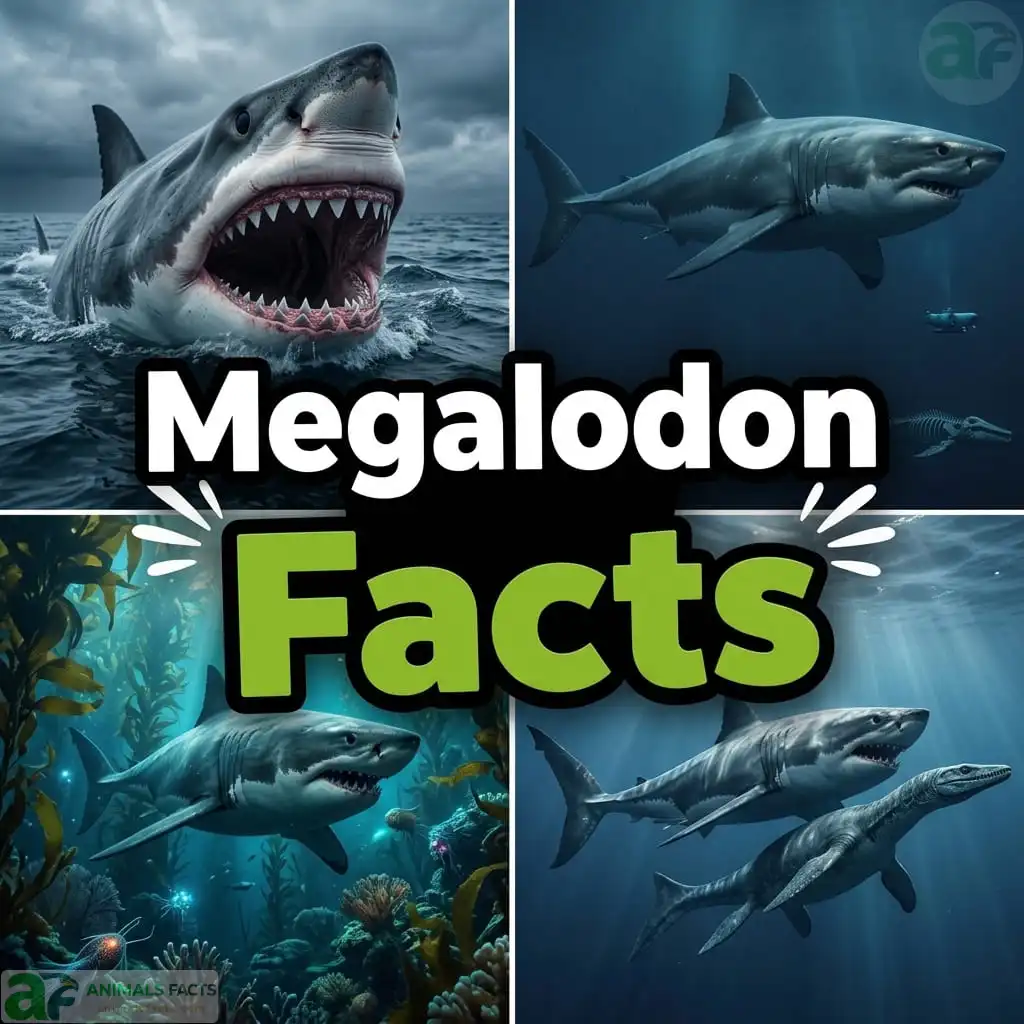
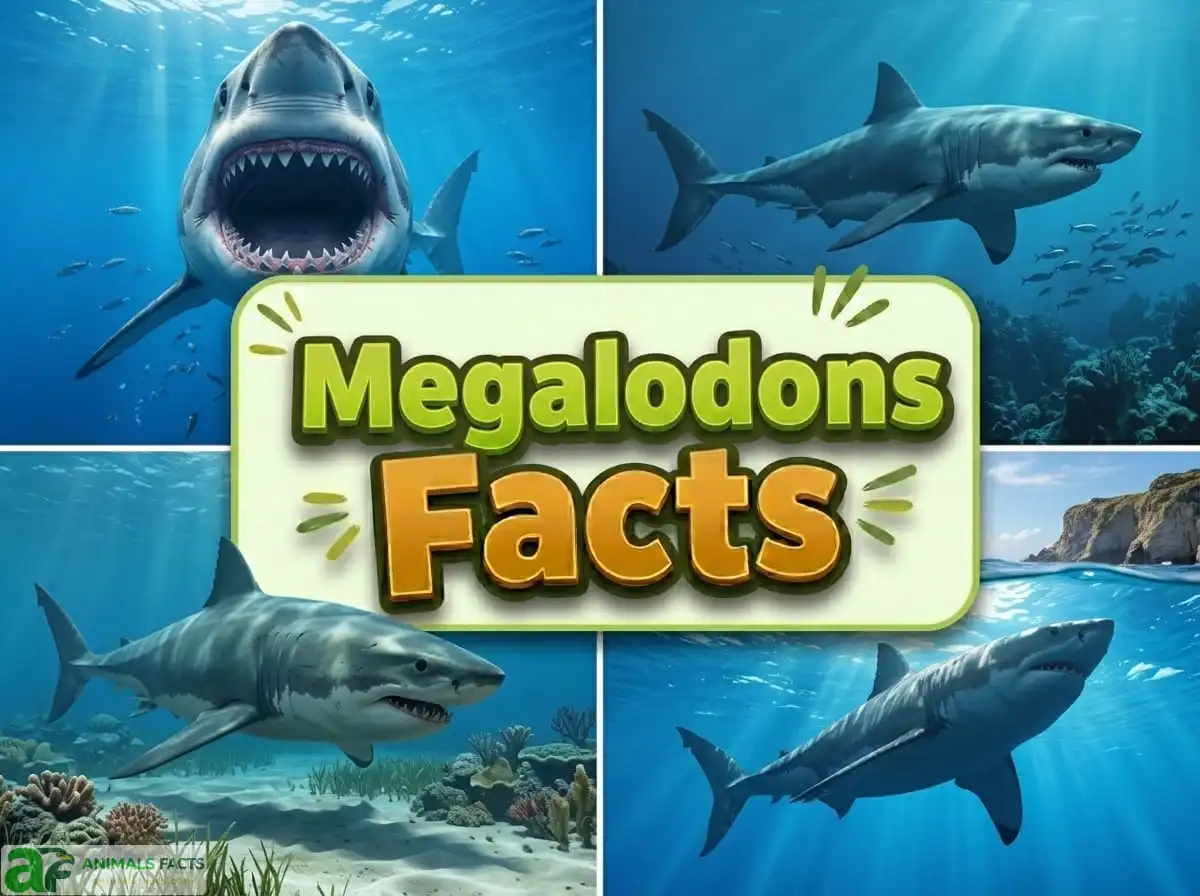
Megalodon Facts
| Feature | Details |
|---|---|
| Scientific Name | Otodus megalodon (formerly Carcharodon megalodon) |
| Kingdom | Animalia |
| Phylum | Chordata |
| Class | Chondrichthyes (cartilaginous fish) |
| Order | Lamniformes (mackerel sharks) |
| Family | Otodontidae (extinct) |
| Existed | Approximately 23 million to 3.6 million years ago (Miocene to Pliocene) |
| Habitat | Warm, shallow coastal and open ocean waters worldwide |
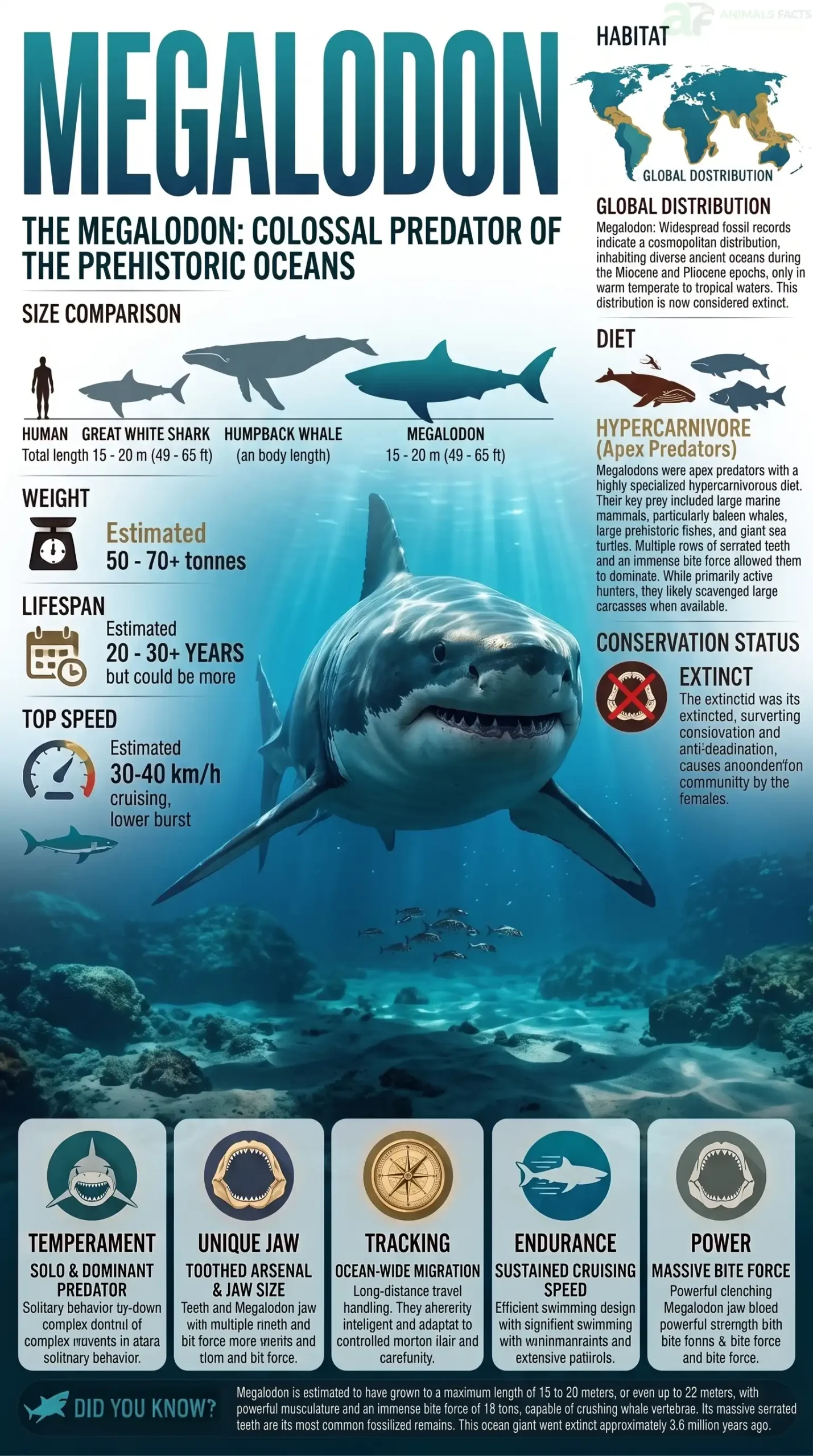
| Estimated Length | 14–20 meters (46–66 feet); maximum estimates up to 20 m |
| Estimated Weight | 50,000–100,000 kg (50–100 metric tons) |
| Top Speed | Estimated 18 km/h (11 mph) cruising; bursts possibly up to 30–40 km/h |
| Diet | Large marine mammals — whales, dolphins, seals, sea turtles, large fish |
| Bite Force | Estimated 108,000–180,000 Newtons — the most powerful bite in Earth’s history |
| Conservation Status | Extinct (~3.6 million years ago) |
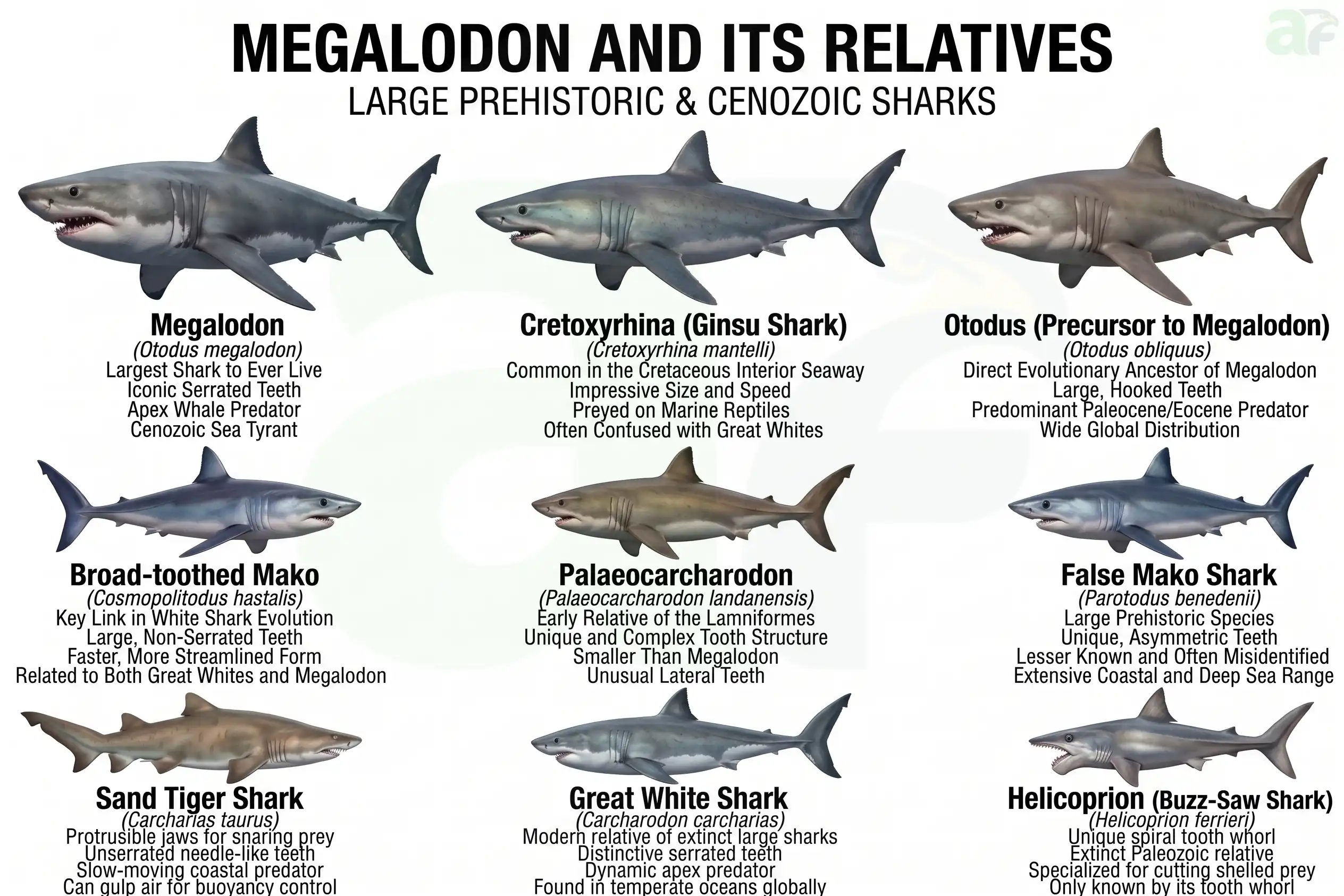
| Closest Living Relative | Mako shark (Isurus species), not the great white shark |
| Tooth Size | Up to 18.4 cm (7.25 inches) — largest shark teeth ever recorded |
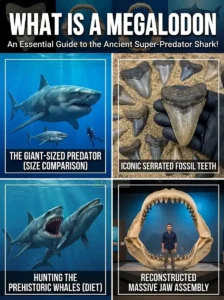 1. Introduction: What is a Megalodon?
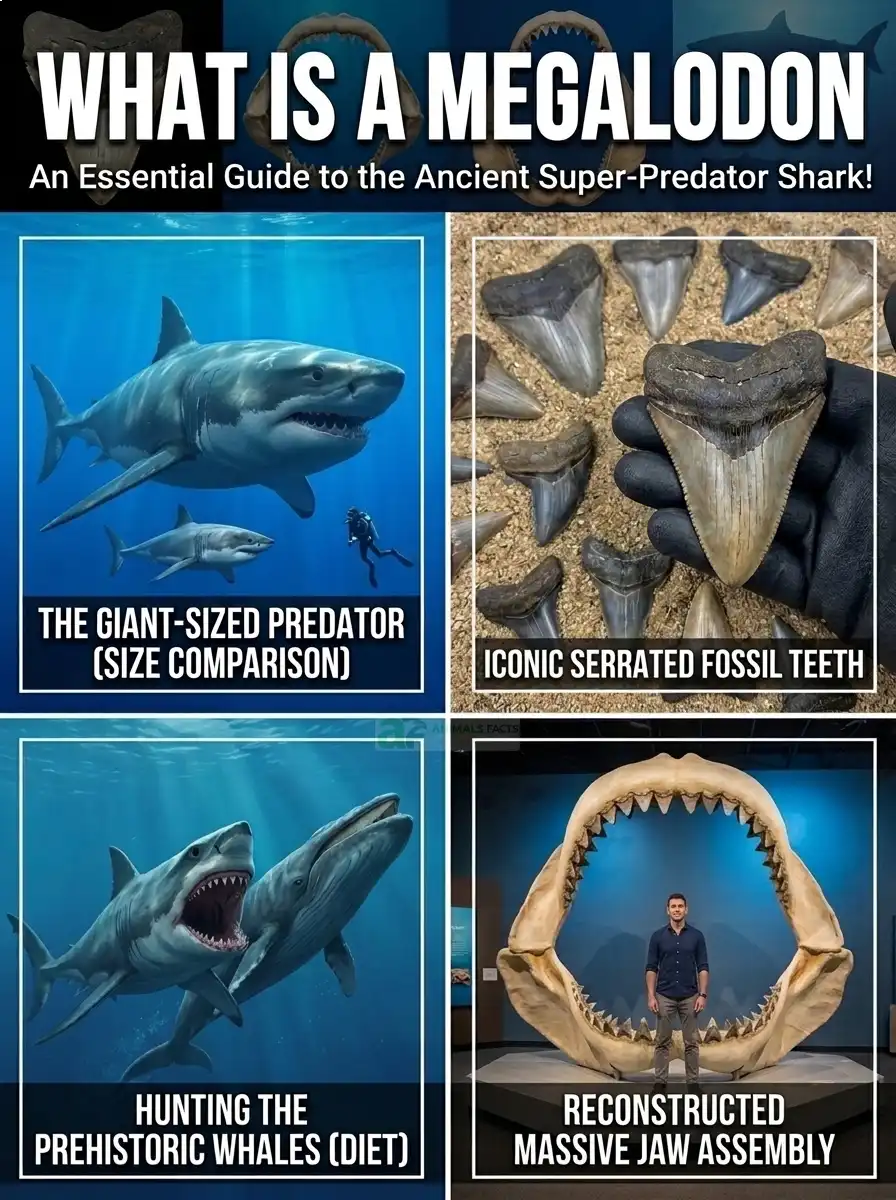
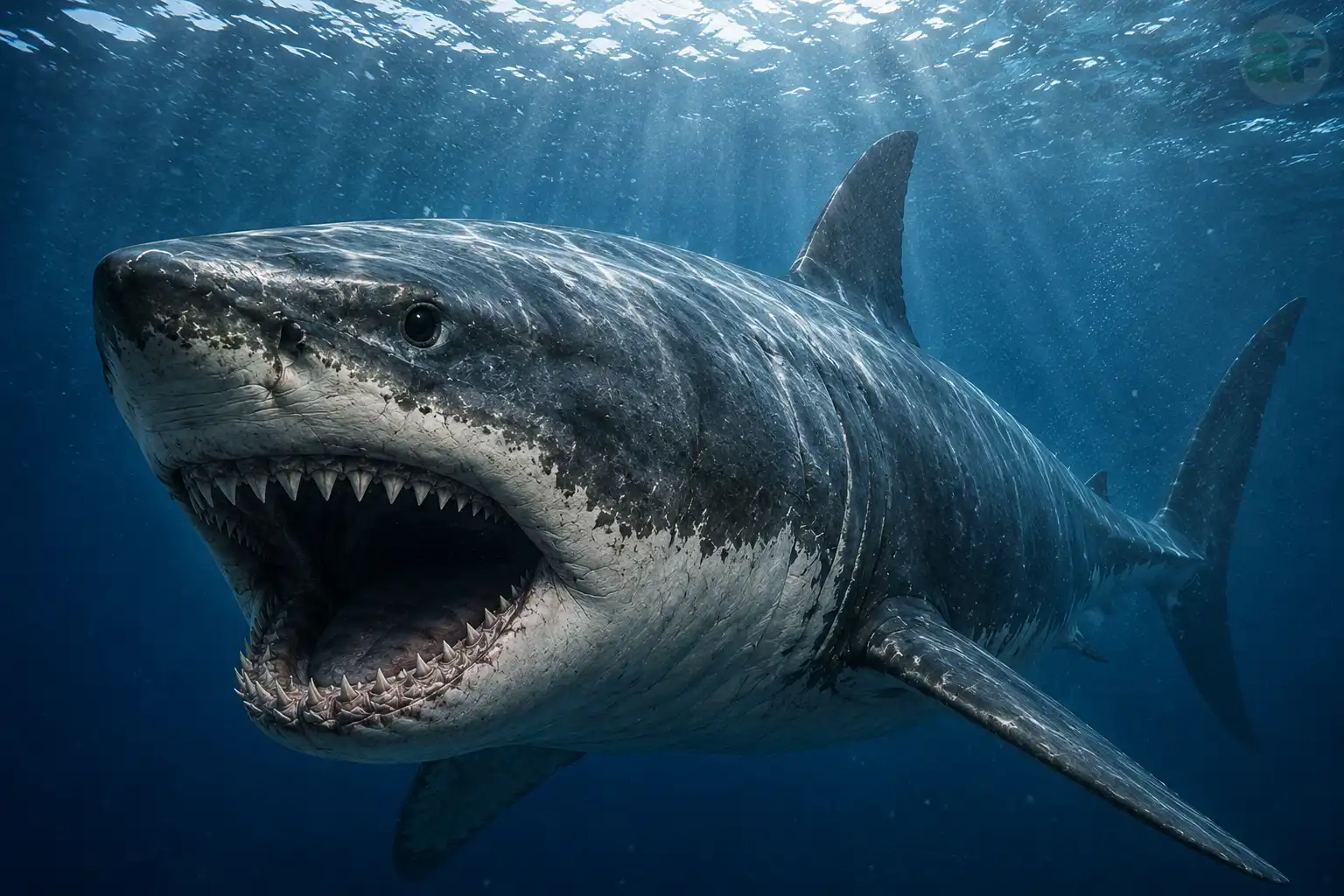
Imagine a shark the length of a city bus, with teeth the size of a human hand and a jaw wide enough to swallow two adults standing side by side. Imagine an animal so powerful that its bite force exceeded that of a Tyrannosaurus rex — and so dominant that it ruled the world’s oceans for nearly 20 million years. Now imagine that this animal was real. Because it was. Megalodon facts consistently deliver one of the most electrifying combinations of science and awe available anywhere in natural history — and the more we discover, the more extraordinary this animal becomes.
Interesting facts about megalodon reveal a creature that was not merely a giant version of the great white shark — as popular culture has persistently suggested — but a fundamentally distinct predator that occupied a unique ecological position as the apex predator of the ancient ocean. Otodus megalodon was the dominant marine predator of its time, hunting whales, dolphins, and sea turtles across every warm ocean on Earth for nearly two dozen million years. Its extinction approximately 3.6 million years ago represents one of the most significant ecological disruptions in ocean history — and its absence from the modern ocean is part of why the marine world looks the way it does today.
Whether you’re searching for megalodon facts for kids to fuel a young ocean enthusiast’s curiosity, a student researching prehistoric marine life, a shark enthusiast wanting to separate science from the blockbuster mythology of Hollywood’s Meg franchise, or simply someone who has always been equal parts terrified and fascinated by the idea of a 20-meter shark, you’ve found the right guide. We will explore megalodon habitat, megalodon diet, megalodon scientific name and classification, megalodon size and weight records, its biology, behavior, extinction, and its enduring grip on human imagination. Dive in — carefully.
2. Megalodon Species Overview & Classification
The scientific classification of megalodon has undergone significant revision in recent decades, making this one of the most actively debated megalodon facts in modern paleontology.
Species Classification Table
| Taxonomic Rank | Classification |
|---|---|
| Kingdom | Animalia |
| Phylum | Chordata |
| Class | Chondrichthyes |
| Subclass | Elasmobranchii |
| Order | Lamniformes |
| Family | Otodontidae (Glikman, 1964) |
| Genus | Otodus (Agassiz, 1843) |
| Species | O. megalodon (Agassiz, 1843) |
| Former Placement | Carcharodon megalodon (now rejected by most paleontologists) |
| Temporal Range | ~23 million – ~3.6 million years ago |
The Great Reclassification
For most of the 20th century, megalodon was classified as Carcharodon megalodon — suggesting it was a close relative of the modern great white shark (Carcharodon carcharias). This classification was supported by the superficial similarity between megalodon teeth and great white teeth, and by early assumptions about their evolutionary relationship.
However, DNA analysis of the great white shark and detailed study of shark tooth morphology have since demonstrated that the great white evolved independently — not from megalodon but from a different ancestral lineage. Megalodon is now placed in the extinct family Otodontidae and genus Otodus, with its closest living relatives being the mako sharks (Isurus species) rather than the great white. This reclassification — now widely accepted among paleontologists, though not universally — has significant implications for reconstructing megalodon’s appearance and biology.
Evolution & Discovery Timeline
~60 million years ago — The earliest otodontid sharks appear in the fossil record during the Paleocene epoch — distant ancestors of what would eventually become megalodon.
~23 million years ago — Otodus megalodon appears in the fossil record during the Early Miocene epoch. Its earliest specimens are found in waters that were warming globally as the Miocene Climatic Optimum brought elevated sea temperatures.
~16–10 million years ago — The peak abundance of megalodon during the Mid-Miocene, when global ocean temperatures were warm and whale populations — megalodon’s primary prey — were diverse and abundant.
~5 million years ago — Megalodon populations begin declining as global ocean temperatures drop toward the Pliocene cooling. Evidence suggests range contraction toward remaining warm-water zones.
~3.6 million years ago — Megalodon goes definitively extinct based on the most recent (2019) analysis of the youngest confirmed megalodon teeth. This date is significantly earlier than the previously accepted extinction date of 2.6 million years ago.
1666 — Danish scientist Niels Stensen (Nicolaus Steno) examines a large fossil shark tooth and correctly identifies it as a shark tooth — disproving the prevailing belief that these objects (called “tongue stones” or glossopetrae) were either magic objects or petrified snake tongues.
1835 — Swiss naturalist Louis Agassiz formally describes and names Carcharodon megalodon based on fossil teeth, establishing megalodon as a scientific species.
1909 — American Museum of Natural History paleontologist Bashford Dean attempts to reconstruct a megalodon jaw using collected teeth — his reconstruction was later found to be significantly oversized, but it generated enormous public interest.
2002 — Otodus megalodon reclassification to the genus Otodus gains increasing scientific acceptance, separating megalodon definitively from the great white shark lineage.
2019 — A comprehensive analysis by Catalina Pimiento and colleagues revises the megalodon extinction date to approximately 3.6 million years ago — 1 million years earlier than previously accepted — based on new statistical analysis of the youngest reliably dated megalodon teeth.
2023 — A landmark study using 3D modeling and biomechanical analysis of megalodon vertebrae and teeth provides the most detailed reconstruction of megalodon body proportions and swimming mechanics ever produced, confirming it was a broader, more robust animal than previously depicted.
“Megalodon reminds us that the ocean has hosted predators of unimaginable power — and that the deep past of our seas is filled with creatures that make even our most fearsome living sharks look modest by comparison.” — Dr. Catalina Pimiento, paleontologist, Swansea University, leading megalodon researcher
3. Megalodon Physical Description & Unique Features
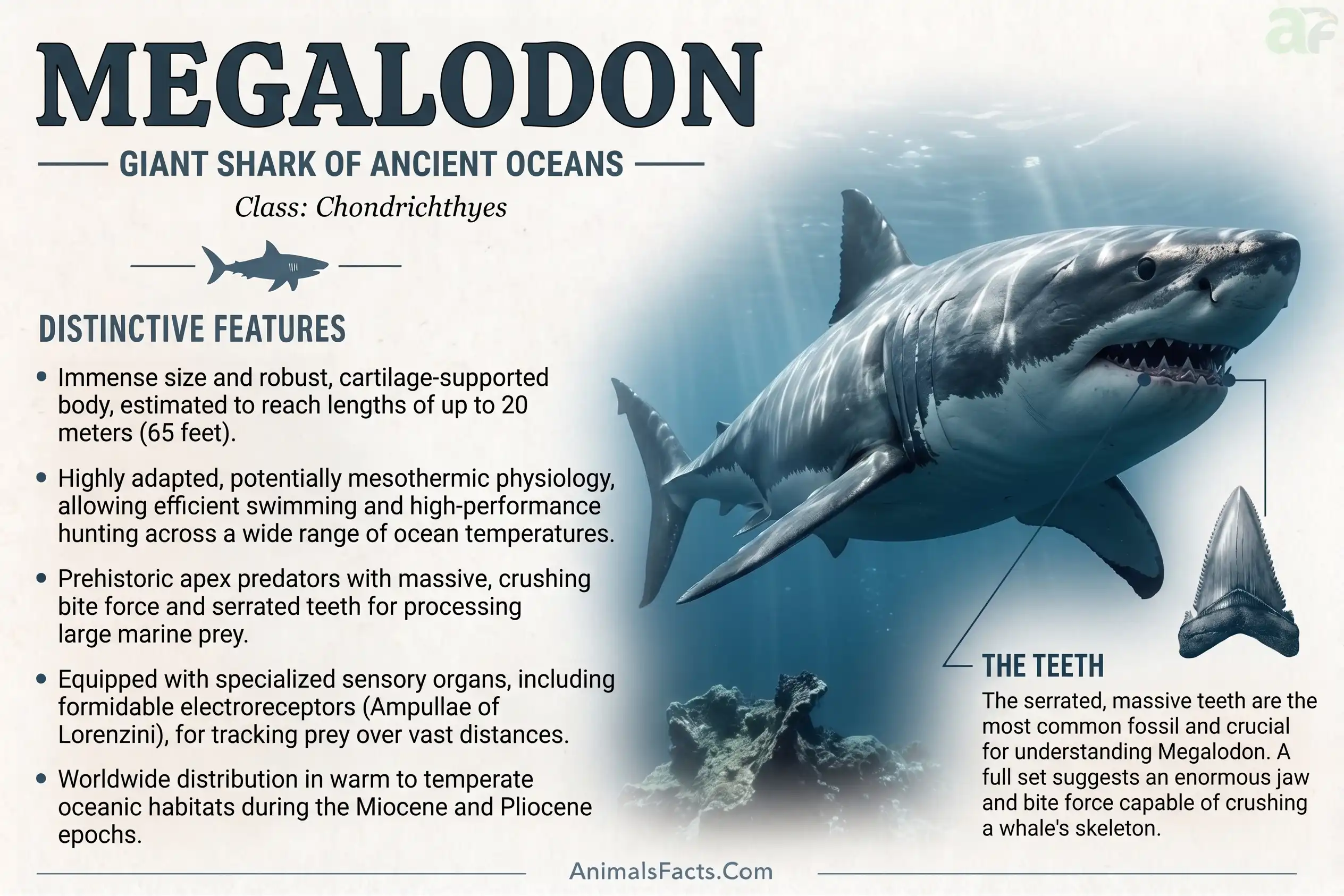
Megalodon size and weight are the subject of ongoing scientific debate — because, as a cartilaginous fish, megalodon’s skeleton was made of cartilage, not bone. Cartilage rarely fossilizes. As a result, virtually everything we know about megalodon’s body comes from its teeth (which are mineralized and fossilize readily), rare vertebral centra, and comparisons with living large lamniform sharks.
Reconstructing the Body
The most authoritative recent reconstruction, published in 2022 by a team from the University of California (Griffiths et al.) and widely reported in 2023, used photogrammetry and 3D modeling of megalodon vertebrae compared against the living lamniform sharks to produce the most scientifically grounded body reconstruction yet attempted. Their model suggests:
- Total length: approximately 14–16 meters for typical adults, with the largest individuals potentially reaching 18–20 meters
- Body form: more robust and wider-bodied than a great white, with a blunter, broader snout (consistent with Otodus rather than Carcharodon morphology)
- Mass: approximately 50,000–100,000 kg — making megalodon between 10 and 20 times heavier than a large great white shark
- Head size: approximately 4.65 meters long in large individuals — wide enough to swallow two adults side by side
The Teeth
Megalodon teeth are the most commonly found megalodon fossils and represent the primary source of data about the species. Key features:
Size — The largest confirmed megalodon tooth ever found measures 18.4 cm (7.25 inches) in height — found off the coast of South Carolina. Most adult megalodon teeth range from 10–18 cm. For comparison, the largest great white shark teeth rarely exceed 5 cm.
Structure — Megalodon teeth are broad, triangular, and serrated — with fine serrations along both edges that facilitated cutting through whale flesh and bone. The serrations are coarser and less fine than great white teeth, reflecting a prey-capture strategy optimized for large, thick-bodied marine mammals rather than the fast-swimming fish that dominate great white diets.
Quantity — Like all sharks, megalodon replaced its teeth continuously throughout its life. Estimates suggest megalodon had approximately 276 teeth across 5 rows at any given time, with a replacement rate that could produce thousands of teeth over a lifetime — explaining why megalodon teeth are relatively abundant in the fossil record despite the animal’s extinction 3.6 million years ago.
Gender Differences
In modern lamniform sharks, females are significantly larger than males — a pattern of sexual dimorphism likely shared by megalodon. Studies of megalodon tooth size distributions suggest two size classes that may represent males and females — with the largest individuals (potentially reaching 18–20 m) likely being females.
Did You Know? Megalodon teeth have been found literally everywhere on Earth — in every ocean and on every continent except Antarctica. They wash ashore on beaches from North Carolina to Australia, erode out of cliff faces in Europe, and are recovered by commercial dredging from the bottom of the Atlantic and Pacific. Beaches in Lee Creek, North Carolina and the Calvert Cliffs of Maryland are famous megalodon tooth hunting locations accessible to the public.
4. Top 25 Amazing Megalodon Facts
Here is your definitive collection of the most extraordinary, scientifically grounded, and genuinely awe-inspiring megalodon facts as of 2026:
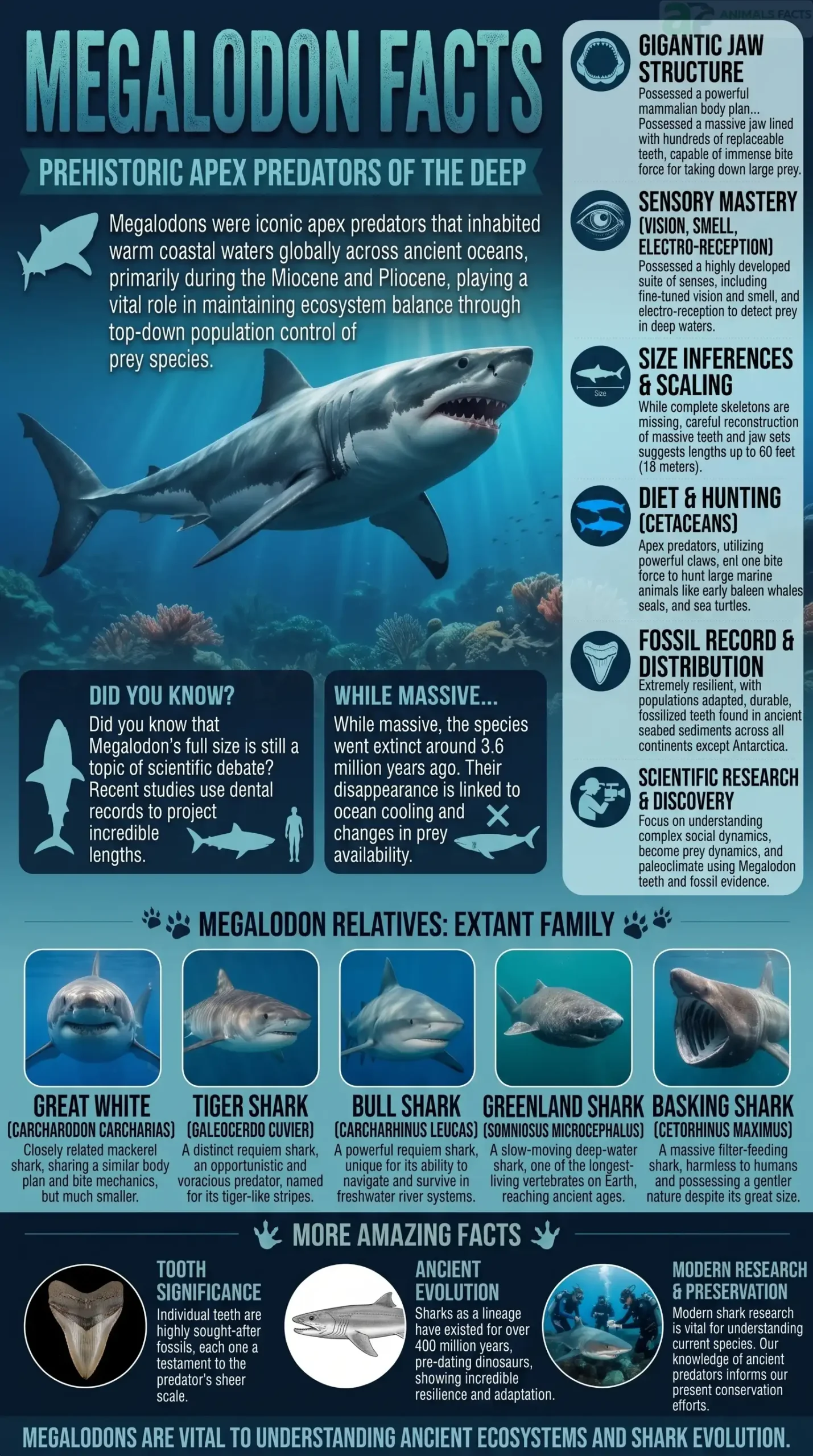
- Megalodon’s scientific name, Otodus megalodon, derives from Greek: mega (large) and odon (tooth) — literally “big tooth.”
- A megalodon’s bite force is estimated at between 108,000 and 180,000 Newtons — compared to approximately 57,000 Newtons for T. rex and 18,000 Newtons for a great white shark. Megalodon had the most powerful bite of any animal ever confirmed.
- Megalodon teeth have been found on every continent except Antarctica — including on the ocean floor thousands of meters below sea level.
- The largest confirmed megalodon tooth measures 18.4 cm (7.25 inches) — larger than an adult human hand.
- Megalodon is now classified in the family Otodontidae, making the mako shark its closest living relative — not the great white shark, despite popular belief.
- A 2022–2023 study reconstructed megalodon’s full body in unprecedented detail and found it was broader and more robust than earlier reconstructions suggested — more like a very large, stocky lamniform than simply a scaled-up great white.
- Megalodon’s jaw circumference is estimated at approximately 3.4 meters — wide enough to easily swallow a large adult human whole or engulf the skull of a sperm whale.
- Megalodon existed for approximately 20 million years — compared to modern humans, who have existed for about 300,000 years.
- Whale bones with megalodon bite marks have been found at dozens of sites worldwide — including bones showing evidence of multiple bites, suggesting megalodon disabled large prey before consuming it, similar to modern orca hunting strategies.
- Megalodon’s nursery grounds — areas where juveniles were born and developed — have been identified at sites in Panama, Maryland (USA), and the Canary Islands, suggesting megalodon used specific shallow coastal areas for reproduction.
- Megalodon disappeared approximately 3.6 million years ago — well before any modern human existed, definitively ruling out the science fiction claim that it might still be alive.
- A single megalodon likely needed to consume approximately 1,000–2,000 kg of food to sustain itself over several days after a large meal — the equivalent of eating a small car’s weight in whale meat.
- Some megalodon teeth are found with scratch marks from other megalodon teeth — evidence of intraspecific competition or mating behavior.
- The cooling of Earth’s oceans during the Pliocene epoch — which sharply reduced populations of the warm-water whale species that megalodon preferred to hunt — is considered the primary cause of its extinction.
- Megalodon is known to have given birth to live young — like all lamniform sharks — with juvenile megalodon nursery sites confirming that young megalodons were born at lengths of approximately 2–4 meters, already large enough to hunt mid-sized prey.
- Isotope analysis of megalodon teeth reveals it was at the highest trophic level of any marine organism ever recorded — even above other large marine predators of its era.
- The deep ocean “megalodon is still alive” conspiracy theory is definitively false. Megalodon was an apex predator of warm, productive surface and coastal waters — not a deep-sea animal. Its food supply (large whales) is well-monitored; undetected survival is scientifically impossible.
- A 2021 study measured swimming speed in megalodon using biomechanical modeling and concluded a typical adult cruised at approximately 18 km/h (11 mph) — faster than any modern human swimmer and comparable to great white shark cruising speed.
- Megalodon teeth show signs of having been used to ram and stun prey before biting — a two-phase attack strategy inferred from megalodon tooth marks on whale fossils showing initial blunt trauma followed by bite marks.
- The Otodontidae family to which megalodon belongs traces its evolutionary ancestry back approximately 60 million years, making it one of the longest-lived shark lineages in the fossil record.
- The first scientific description of megalodon teeth was published by Louis Agassiz in 1835 — a full 21 years before Charles Darwin published On the Origin of Species.
- Some whale fossils associated with megalodon bite marks show healed bone around the bite wounds — evidence that the whale survived the initial attack, providing a rare snapshot of a failed megalodon predation event.
- A 2020 study calculated that a megalodon could have its entire liver extracted by an orca within minutes during an attack — a vulnerability analogous to how modern orcas kill great white sharks by flipping them and extracting their livers. This may have contributed to megalodon’s extinction as orca intelligence and social hunting evolved.
- Megalodon teeth are legal to collect in most countries where they are found — making megalodon tooth hunting one of the most accessible forms of fossil collecting available to the public.
- The word “megalodon” entered popular English usage largely through the 1975 film Jaws — which, while featuring a great white shark, prompted public fascination with large prehistoric sharks and directly inspired the commercial fossil collecting that has since yielded thousands of megalodon specimens.
5. Megalodon Fun Facts for Kids
- Megalodon’s teeth have been found on every continent except Antarctica
- A megalodon could swallow a human whole without opening its jaw fully
- Megalodon’s dorsal fin was estimated to be approximately 1.62 meters tall
- The species survived for approximately 20 million years — 67 times longer than modern humans have existed
- Megalodon teeth are still being found by amateur fossil hunters on beaches today
- Megalodon’s closest living relative is the shortfin mako shark, not the great white
- Megalodon went extinct roughly 3.6 million years ago — long before any human existed
- A single megalodon tooth weighs approximately 1 kg — heavier than most full sets of adult human teeth
- The ocean floor still contains millions of undiscovered megalodon teeth
- Megalodon likely used shallow coastal nurseries to birth and raise young — just like modern sharks
- Megalodon’s pectoral fins were estimated at approximately 3.08 meters long
- Megalodon bone fossils are extremely rare because its skeleton was made of cartilage, not bone
6. Natural Habitat & Geographic Range
Megalodon habitat was global in scope but concentrated in specific environmental conditions — making it one of the most geographically widespread apex predators in the history of life on Earth.
Habitat Preferences
Megalodon was fundamentally a warm-water animal. Isotope analysis of its teeth — particularly oxygen and zinc isotope ratios — confirms it preferred water temperatures between approximately 12°C and 27°C (54°F–81°F), with the highest concentrations of megalodon fossils found in deposits corresponding to the warm, productive coastal and shelf seas of the Miocene and Pliocene epochs.
Megalodon occupied multiple depth zones:
Coastal and shelf waters (0–200 meters) — Where the majority of its prey (whales, dolphins, and sea turtles) concentrated. Most megalodon nursery sites are found in shallow, warm-water coastal deposits, suggesting juveniles used these environments extensively.
Open ocean (pelagic) — Adult megalodons almost certainly ranged widely across the open ocean following whale migration routes — as modern great white sharks follow seal and tuna migrations. Megalodon teeth found in deep-sea deposits (some recovered from the ocean floor at depths of 3,000–4,000 meters by dredging vessels) confirm open ocean habitat use, though these teeth likely sank from surface waters rather than indicating deep-sea habitation.
Habitat Range by Region
| Region | Evidence Type | Notable Sites |
|---|---|---|
| Eastern North America | Abundant teeth, vertebrae | Lee Creek (NC), Calvert Cliffs (MD), Venice Beach (FL) |
| Western North America | Teeth, rare vertebrae | California coast, Baja California shelf deposits |
| Western Europe | Teeth, occasional vertebrae | Belgium (North Sea), UK coast, Atlantic deposits |
| Mediterranean Basin | Teeth | Morocco, Spain, Italy — extensive Miocene deposits |
| South America | Teeth | Peru, Chile, Brazil Atlantic coast |
| Africa | Teeth | South Africa, Morocco, Egypt |
| South Asia | Teeth | India, Sri Lanka, Japan |
| Australia/Pacific | Teeth | Western Australia, New Zealand, Pacific island beaches |
| Deep ocean floor | Teeth (dredged) | Mid-Atlantic, Pacific — teeth sunk from surface waters |
Did You Know? Some of the most abundant megalodon tooth-collecting sites in the world are the beaches of Lee Creek, North Carolina and Venice Beach, Florida — where teeth wash ashore continuously from Miocene deposits eroding offshore. Amateur fossil hunters routinely find multiple teeth per visit, making megalodon one of the most accessible prehistoric creatures for the general public.
7. Diet & Feeding Behavior
Megalodon diet was almost exclusively composed of large marine vertebrates — making it the uncontested apex predator of its oceanic world and the dominant regulator of marine mammal populations for nearly 20 million years.
Diet Breakdown Table
| Prey Type | Estimated % of Diet | Evidence |
|---|---|---|
| Large whales (mysticetes/baleen whales) | ~50–60% | Bite-marked whale bones widespread in fossil record |
| Toothed whales (odontocetes — dolphins, sperm whales) | ~20–25% | Bite marks on fossil cetacean bones |
| Dugongs and sirenians (sea cows) | ~5–10% | Bite-marked sirenian fossils at multiple sites |
| Sea turtles | ~3–5% | Crushed turtle shell fragments with megalodon bite patterns |
| Large fish (tuna, swordfish, sharks) | ~5–10% | Inferred from comparison with modern lamniform diets |
| Seals and pinnipeds | ~3–5% | Bite marks on fossil pinniped remains |
Hunting Strategy
The reconstruction of megalodon’s hunting behavior relies on bite mark analysis of fossil whale bones — one of the most productive methods in paleobiology. Multiple studies analyzing these marks have identified two distinct phases of megalodon predation:
Phase 1 — Disabling strike — Analysis of whale fossils shows initial impact trauma consistent with megalodon using its broad, blunt snout as a battering ram to stun or immobilize prey. This is supported by the finding of whale fossils with blunt-force fractures in flippers, tail stock, and rib regions — areas a direct bite would not typically target but a ramming strike would.
Phase 2 — Consumptive biting — Following disabling, megalodon delivered massive biting attacks to the prey’s vital areas. Bite marks are concentrated on whale ribs, vertebrae, and flipper bones — exactly the areas that would be targeted to access the high-calorie blubber and internal organs.
This two-phase strategy suggests megalodon was a sophisticated, tactically intelligent hunter — not merely an indiscriminate biter but an animal that had evolved specific techniques optimized for the prey it pursued.
Caloric Requirements
Based on metabolic scaling from modern warm-bodied lamniform sharks (great whites and makos), a 15-meter megalodon likely required approximately 100,000 calories per day to sustain basic metabolic function, or could consume an enormous meal and fast for days to weeks afterward — exactly as modern great white sharks do. A single large whale could provide millions of calories, potentially sustaining megalodon for weeks.
8. Reproduction & Life Cycle
Megalodon reproduction is inferred from the identification of nursery sites, from comparison with living lamniform sharks, and from analysis of juvenile megalodon tooth and vertebra sizes.
Nursery Sites
One of the most significant recent advances in megalodon research has been the identification of ancient nursery areas — specific geographic locations where concentrations of juvenile megalodon teeth indicate that young animals were born and raised. Confirmed nursery sites include:
- Gatun Formation, Panama — Earliest and most extensively documented nursery; juvenile teeth alongside cetacean remains indicating abundant prey
- Calvert Formation, Maryland, USA — Numerous juvenile teeth spanning multiple size classes
- Bone Valley Formation, Florida, USA — Extensive juvenile material
- Canary Islands deposits — European nursery site confirming Atlantic-wide reproductive strategy
The use of shallow coastal nurseries is consistent with the reproductive biology of modern large lamniform sharks — using warm, sheltered, productive coastal areas where juveniles can develop with reduced competition from adults and access to abundant smaller prey.
Birth & Development
Birth size — Based on the smallest megalodon teeth found at nursery sites, juvenile megalodons were born at approximately 2–4 meters in length — already larger than many adult sharks of other species and capable of hunting substantial prey from birth.
Growth — Using shark vertebral growth ring analysis, megalodon is estimated to have grown at approximately 1 meter per year during early development, slowing as it approached adult size. Full adult size was likely reached at approximately 25–30 years of age.
Reproductive mode — Like all lamniform sharks, megalodon was almost certainly ovoviviparous — eggs hatching inside the mother, with pups born live after a gestation period likely similar to the great white shark’s ~11 months.
Litter size — Estimated at 1–6 pups based on lamniform shark comparison and the metabolic demands of carrying large, advanced pups.
Lifespan Comparison Table
| Species | Estimated Lifespan | Max Size | Living/Extinct |
|---|---|---|---|
| Otodus megalodon | ~40–88 years (estimated) | ~20 m | Extinct ~3.6 Ma |
| Great white shark (C. carcharias) | 40–70 years | ~6 m | Living (Vulnerable) |
| Whale shark (R. typus) | 80–130 years | ~18 m | Living (Endangered) |
| Greenland shark (S. microcephalus) | 272–500+ years | ~7 m | Living (Near Threatened) |
| Mako shark (I. oxyrinchus) | 28–32 years | ~4.5 m | Living (Endangered) |
9. Social Behavior & Communication
The social behavior of megalodon must be inferred almost entirely from comparison with modern large lamniform sharks and from the limited behavioral evidence available in the fossil record.
Was Megalodon Social?
Modern great white sharks are largely solitary hunters, aggregating at prey-rich locations but not exhibiting coordinated hunting or long-term social bonds. Given megalodon’s likely relationship with modern makos (its closest living relatives) and the biomechanics of hunting very large whales, most paleontologists consider megalodon to have been predominantly solitary, with occasional aggregation at whale feeding opportunities.
However, the extraordinary scale of some whale bone accumulation sites — where dozens of whale carcasses with megalodon bite marks are found together — raises the question of whether megalodon occasionally aggregated in numbers around particularly productive feeding areas, as modern sharks aggregate around whale carcasses today.
Sensory Capabilities
Megalodon almost certainly possessed the same electroreception system found in all sharks — the ampullae of Lorenzini, gel-filled pores concentrated around the snout that detect the weak electrical fields produced by the muscle movements of all living animals. In a 15–20 meter animal, this system would have an effective detection range potentially extending to tens of meters — allowing megalodon to detect the heartbeat of a nearby whale even in total darkness or murky water.
Lateral line system — The pressure-sensitive lateral line, running along the body of all fish, would have allowed megalodon to detect the low-frequency pressure waves created by the movement of large whales at considerable distances.
Olfaction — Like modern sharks, megalodon almost certainly had extraordinary chemoreception — the ability to detect chemical signals (including blood) in water at extremely low concentrations. Modern great white sharks can detect a single drop of blood diluted in 10 billion drops of water — megalodon’s larger olfactory organs likely provided at least comparable sensitivity.
10. Predators & Defense Mechanisms
For most of its 20-million-year reign, megalodon had essentially no natural predators. As the apex predator of the ancient ocean, nothing that lived during the Miocene and early Pliocene was capable of threatening a healthy adult megalodon. However, several factors may have contributed to its eventual extinction.
Potential Threats & Competition
Ancient sperm whales (Livyatan melvillei) — A giant predatory sperm whale that coexisted with megalodon during the Miocene, estimated at 13–17 meters in length with enormous teeth (over 30 cm — the largest teeth of any animal). Livyatan and megalodon almost certainly competed for the same large whale prey and may have occasionally contested the same carcass. Whether they actively fought is unknown, but competition for resources was almost certainly significant.
Primitive orca ancestors — As the Pliocene progressed, early relatives of modern orcas (Orcinus orca) were evolving their characteristic cooperative hunting intelligence. A 2020 study proposed that ancestral orcas may have targeted megalodon using the same technique modern orcas use against great white sharks — flipping them to induce tonic immobility and extracting nutrient-rich organs. If true, this represents a remarkable example of predatory innovation potentially contributing to the extinction of the largest predator in ocean history.
Juvenile vulnerability — While adults were essentially invulnerable, juvenile megalodons (at 2–5 meters) would have faced predation risk from large sharks and predatory marine mammals of the era.
Extinction Factors
The primary cause of megalodon’s extinction is now understood to be the global cooling of the Pliocene epoch (~5–2.5 million years ago), which dramatically reduced the populations of warm-water whale species that formed megalodon’s primary prey. As its prey base collapsed, megalodon — an apex predator at the very top of the food chain with enormous energy requirements — could not adapt quickly enough to alternative prey and went extinct. Competition from the newly evolving orca lineage (which was more adaptable, highly intelligent, and capable of exploiting cooler waters) may have accelerated the process.
Did You Know? The 2019 revised extinction date for megalodon — 3.6 million years ago — places its disappearance 1 million years earlier than the previously accepted date of 2.6 million years ago. This revision was based on rigorous statistical analysis of the youngest reliably dated megalodon teeth by Catalina Pimiento and colleagues, and has important implications for understanding what environmental changes drove the extinction.
11. Megalodon Facts for Kids
Hey young ocean explorers! Here are some absolutely incredible megalodon facts for kids that will make you the most interesting person at your school:
- 🦈 Megalodon had teeth as big as your hand! The largest megalodon teeth ever found are bigger than an adult human hand — up to 18 centimeters long. Great white shark teeth are only about 5 cm — tiny by comparison!
- 🦈 Megalodon was REAL — but it’s GONE! Some movies and YouTube videos claim megalodon might still be hiding in the deep ocean. It is definitely not. It went extinct 3.6 million years ago — long, long before any human was alive.
- 🦈 Its jaw was big enough to park a car inside! Scientists estimate megalodon’s jaws were about 3.4 meters wide — wide enough to swallow two adults side by side or engulf a small car.
- 🦈 Megalodon teeth wash up on beaches TODAY! You can actually find megalodon teeth on beaches in Florida, North Carolina, and other places around the world. Thousands of people find them every year — and they’re legal to keep!
- 🦈 It wasn’t related to great white sharks! Everyone thinks megalodon was like a giant great white, but scientists now know it was actually more closely related to the mako shark — a faster, more slender species.
- 🦈 Megalodon ate WHALES for breakfast! Its favorite food was large whales — we know this because scientists have found whale fossils with megalodon bite marks all over them, including bones where the whale healed after surviving an attack!
- 🦈 Megalodon had the most powerful bite of ANY animal ever! Stronger than T. rex, stronger than any living animal — megalodon’s bite force was estimated at over 100,000 Newtons. For reference, a human bites at about 1,300 Newtons.
- 🦈 Baby megalodons were already huge at birth! When megalodon pups were born, they were already about 2–4 meters long — bigger than many adult sharks today. They were born ready to hunt!
12. Relationship with Humans
Megalodon went extinct approximately 3.6 million years ago — roughly 3.3 million years before the first members of the genus Homo appeared on Earth. Modern Homo sapiens appeared only about 300,000 years ago. There was therefore no direct relationship between humans and living megalodon of any kind.
However, the relationship between humans and megalodon’s fossilized remains is rich, ancient, and culturally significant.
Fossil Tooth History
As noted above, megalodon teeth were known to ancient and medieval peoples across the world. The “tongue stones” (glossopetrae) described in medieval European natural history — large triangular stone objects with serrated edges found in rocky outcroppings and beaches — were almost universally believed to be the petrified tongues of serpents or dragons, with powerful magical and medicinal properties.
Powdered tongue stone was prescribed in medieval European medicine as an antidote to poison, a cure for snakebite, and a general tonic. Sets of tongue stones mounted in elaborate gold and silver settings were given as royal gifts — Pope Clement VII received an elaborate tongue stone setting in 1533, and multiple European noble families maintained collections. Only in the late 17th century, with Niels Stensen’s correct identification of their true nature as fossil shark teeth (1666), did the magical interpretation begin to fade.
Scientific & Commercial Significance
Today, megalodon teeth are among the most commercially significant fossils in the world. The legal megalodon tooth market generates tens of millions of dollars annually, with exceptional specimens — complete, large, well-colored teeth — selling for $1,000–$100,000+ at auction. This has both democratized access to prehistoric natural history (making fossils affordable to ordinary people) and created conservation challenges around significant scientific specimens being sold before they can be properly studied.
13. Conservation Status & Extinction
Megalodon is completely extinct, with its most recently confirmed specimens dating to approximately 3.6 million years ago (revised from the previously accepted 2.6 million years ago by Pimiento et al., 2019).
Why Did Megalodon Go Extinct?
The extinction of megalodon is one of the most studied questions in marine paleontology, and current scientific consensus points to a multi-factor extinction driven primarily by prey collapse and oceanographic change:
| Extinction Factor | Evidence | Significance |
|---|---|---|
| Global ocean cooling (Pliocene) | Isotope records of ocean temperature; megalodon range contraction toward warm refugia | Primary driver — reduced warm-water habitat |
| Whale prey decline | Reduction in diversity of warm-water mysticete whales during Pliocene cooling | Eliminated primary food source |
| Competition from early orcas | Timing of orca family (Delphinidae) diversification coincides with megalodon decline | Competed for remaining whale prey |
| Prey behavioral adaptation | Some whale species migrating to polar waters megalodon could not follow | Reduced prey accessibility |
| Possible supernova radiation | 2019 hypothesis — marine megafaunal extinction correlated with cosmic radiation from nearby supernova; remains controversial and unconfirmed | Highly speculative |
Is Megalodon Still Alive?
No. This is definitively, scientifically, and thoroughly established. Multiple lines of evidence make megalodon survival impossible:
Prey monitoring — Megalodon’s primary prey (large whales) is extensively monitored globally. No megalodon attacks on whales have been documented despite centuries of commercial whaling observation.
Habitat requirements — Megalodon required warm, productive, shallow coastal waters. The deep ocean is cold, dark, and food-poor — incompatible with megalodon’s known biology.
Fossil record — The most recent confirmed megalodon remains date to 3.6 million years ago. No younger specimens have been confirmed despite enormous commercial fossil hunting activity.
Environmental DNA — Modern eDNA ocean surveys, capable of detecting trace DNA from living organisms, have found no megalodon genetic material in any ocean sample.
14. Famous Megalodons in History & Pop Culture
Famous Fossil Specimens & Individual Teeth
The “Carolina Tooth” — The largest confirmed megalodon tooth ever found, measuring 18.4 cm (7.25 inches), discovered off the coast of South Carolina. Currently housed in a private collection, it is frequently cited in scientific literature as the definitive maximum size record for megalodon dentition.
The Bashford Dean Jaw Reconstruction (1909) — American Museum of Natural History paleontologist Bashford Dean attempted the first full megalodon jaw reconstruction using collected teeth from multiple individuals. His reconstruction — displayed at the AMNH — was later found to be significantly oversized (Dean underestimated tooth root depth, leading him to oversize the jaw). Nevertheless, this reconstruction generated enormous public interest and established the cultural image of megalodon as a jaw-dominated monster that persists to this day.
The Belgium “Monster” — A collection of megalodon vertebral centra and teeth found in Antwerp, Belgium in 1926 represents one of the most complete non-dental megalodon skeletal material ever recovered. The vertebrae provided crucial data for body size estimation.
The Ica Valley Collection (Peru) — Extraordinary concentrations of megalodon teeth alongside whale and sirenian remains in the Miocene deposits of Peru’s Ica Valley represent one of the best-documented megalodon feeding sites in the world, with dozens of whale bones bearing characteristic megalodon bite marks preserved in fine-grained marine sediment.
15. Role in Ecosystem & Food Chain
Megalodon’s ecological role was that of the ultimate apex predator — sitting at the very top of the Miocene and Pliocene ocean food web and exerting top-down regulatory pressure on marine mammal populations of extraordinary significance.
Trophic Ecology
Isotope analysis of megalodon teeth — particularly zinc isotope ratios (a relatively new method that traces trophic position through food web chemistry) — has confirmed that megalodon occupied the highest trophic position ever recorded for any marine animal in the fossil record. It was not merely at the top of the food web — it was above every other marine predator of its era, including Livyatan melvillei and large predatory dolphins.
As the dominant predator of large baleen whales — the largest animals in the ocean — megalodon directly regulated whale population sizes and community composition. By selectively preying on the easiest targets (sick, young, and old individuals), megalodon would have maintained the genetic health of whale populations just as large terrestrial predators maintain the health of their prey populations.
The Ecological Void
When megalodon went extinct ~3.6 million years ago, it left an ecological void at the apex of the ocean food web that was never fully filled by any single species. The vacuum it left was gradually occupied by a guild of cooperative hunters — primarily orcas — and large solitary predators including great white sharks. But neither orcas nor great whites approach megalodon’s prey size range or individual predatory impact. The extinction of megalodon therefore represents a fundamental structural change in ocean food web dynamics that echoes through to the present day.
Some marine ecologists have argued that the recovery of great whale populations in the modern ocean — following the devastation of industrial whaling — would benefit significantly from megalodon-equivalent pressure to restore full food web function. This argument feeds directly into the theoretical justification for de-extinction of large apex predators in both marine and terrestrial ecosystems.
16. Myths, Folklore & Cultural Significance
The cultural history of megalodon teeth spans thousands of years and multiple civilizations — making megalodon one of the few prehistoric animals with a documented folkloric tradition predating modern science by millennia.
“Tongue Stones” — Glossopetrae
The most widespread and long-lived folk tradition associated with megalodon teeth is the tongue stone mythology of medieval Europe and ancient Mediterranean cultures. Large shark teeth — particularly megalodon teeth for their impressive size — were found throughout Mediterranean coastal deposits and interpreted in pre-scientific frameworks as magical objects. The Roman naturalist Pliny the Elder mentioned them in Naturalis Historia (77 CE), claiming they fell from the moon during lunar eclipses.
Through the Middle Ages, tongue stones were believed to neutralize poison — a property so widely accepted that elaborate tongue stone stands (Natterzungen-Kredenzen) were used at European royal and noble tables to test food and wine for poison before the host consumed it. Sets of tongue stones embedded in silver or gold were diplomatic gifts, religious offerings, and treasured family heirlooms. The papal tongue stone collection mentioned above reflects how deeply this belief penetrated the highest levels of European society.
Pacific Island Traditions
In Hawaii and other Polynesian cultures, large shark teeth — including occasional megalodon teeth found in beach deposits or shallow ocean sediments — were incorporated into weapons (leiomano, shark-tooth clubs) and ornamental objects of high cultural significance. The spiritual power of the shark was believed to reside in its teeth, and large teeth commanded significant ceremonial value.
Native American Traditions
Various Native American coastal peoples of the eastern United States — living in areas rich with megalodon fossil material — incorporated large fossil shark teeth into their material cultures. Archaeological sites in Maryland and Virginia have yielded megalodon teeth in contexts suggesting they were collected, traded, and possibly used ritually — sometimes perforated for suspension as pendants.
17. Megalodon in Pop Culture
The Meg (2018, Warner Bros.) — The highest-grossing shark film since Jaws (1975), grossing approximately $530 million worldwide. Starring Jason Statham, the film depicts a living megalodon emerging from an unexplored deep-sea trench. While entertaining, its scientific inaccuracies are extensive — megalodon was not a deep-sea animal, not related to great whites as depicted, and definitively extinct. A sequel, Meg 2: The Trench (2023), grossed approximately $395 million globally.
Steve Alten’s Meg novel series (1997–present) — The source novels for the film franchise have sold millions of copies worldwide and created the template for the “megalodon survival” subgenre of thriller fiction that has generated dozens of imitators.
Discovery Channel’s “Megalodon: The Monster Shark Lives” (2013) — A notorious mockumentary that presented fictional footage and actors as real scientists claiming megalodon was still alive. It aired as part of Shark Week and was widely condemned by scientists for deliberately misleading viewers. Despite its scientific dishonesty, it generated Discovery Channel’s highest Shark Week ratings ever — demonstrating the public’s enormous appetite for megalodon content.
Megalodon tooth collecting community — The online megalodon tooth collecting community is one of the largest and most active fossil collecting communities in the world, with dedicated forums, YouTube channels, Instagram accounts, and beach-diving clubs generating millions of views and actively democratizing access to prehistoric natural history.
18. Megalodon Facts vs. Common Myths
| Common Myth | The Real Fact |
|---|---|
| “Megalodon might still be alive in the deep ocean” | Definitively false — megalodon was a shallow-water predator; the deep ocean is cold and food-poor; no evidence from eDNA surveys, prey observation, or the fossil record supports survival |
| “Megalodon was basically a giant great white shark” | False — megalodon belongs to a completely different family (Otodontidae) and is more closely related to the mako shark; its body proportions were also significantly different |
| “We’ve only explored 5% of the ocean, so megalodon could be hiding there” | Misleading — megalodon’s prey (large whales) is well-monitored in all ocean zones; unexplored areas are cold, deep, and inhospitable to megalodon’s biology |
| “Megalodon was the largest animal ever” | False — megalodon was the largest known predatory fish, but the blue whale (living today) is significantly larger at up to 190 metric tons vs. megalodon’s estimated 50–100 metric tons |
| “We have found complete megalodon skeletons” | False — megalodon’s skeleton was cartilage, which rarely fossilizes. We have only teeth, rare vertebrae, and fragments. No complete skeleton exists |
| “Megalodon teeth found in deep water prove it’s still alive” | False — deep-sea teeth are simply teeth that sank from shallow water after the animal died; some are indeed quite recent due to slow deep-sea sedimentation rates, but none are from living animals |
| “Megalodon was the top predator at all times during its existence” | Mostly true but nuanced — Livyatan melvillei and early orca relatives may have rivaled or competed with megalodon during some periods |
| “Megalodon ate dinosaurs” | Impossible — megalodon lived 23–3.6 million years ago; non-avian dinosaurs went extinct 66 million years ago — a gap of over 40 million years |
19. Best Places to Explore Megalodon History
1. Venice Beach, Florida, USA — “The Shark Tooth Capital of the World” — The shallow offshore waters and beach deposits of Venice Beach, Florida are the world’s most productive and accessible megalodon tooth collecting location. Tens of thousands of teeth — including many megalodon specimens — wash ashore each year from eroding offshore Miocene deposits. The annual Shark’s Tooth Festival in Venice draws thousands of fossil enthusiasts.
2. Calvert Cliffs, Maryland, USA — The Miocene deposits of the Calvert Cliffs along Chesapeake Bay are one of the richest fossil sites in North America, yielding megalodon teeth, whale bones, and thousands of other Miocene marine fossils. Calvert Cliffs State Park allows fossil collecting on the beach below the cliffs.
3. Lee Creek Mine / Aurora Fossil Museum, North Carolina, USA — The Aurora Fossil Museum in Aurora, NC, displays fossils from the adjacent Lee Creek phosphate mine — one of the world’s richest sources of Miocene and Pliocene marine fossils, including exceptional megalodon teeth and whale specimens.
4. Smithsonian National Museum of Natural History, Washington D.C., USA — Houses one of the world’s finest collections of megalodon specimens, with outstanding displays in the Sant Ocean Hall including a large jaw reconstruction and multiple specimen teeth representing the full size range of the species.
5. Natural History Museum, London, UK — Holds significant megalodon collections including specimens from European Miocene deposits. The shark gallery provides exceptional context for megalodon within shark evolutionary history.
6. Ica Regional Museum, Peru — Houses material from the extraordinary Ica Valley megalodon feeding sites, where whale fossils with megalodon bite marks are displayed in context — one of the best places in the world to understand megalodon as an active predator.
7. Diving — Beaufort County, South Carolina, USA — Licensed fossil diving in the rivers and coastal waters of South Carolina, where megalodon teeth erode continuously from submerged Miocene deposits, offers one of the most exciting fossil experiences available anywhere. Commercial diving operators offer guided megalodon tooth diving trips.
20. How You Can Help — Shark Conservation & Paleontology
While megalodon itself cannot be conserved (it is extinct), the living marine ecosystems it once dominated — and the living sharks that occupy its ecological descendants’ roles — urgently need support.
Support these organizations:
- Shark Trust — sharktrust.org — UK-based shark conservation with global programs
- Oceana — oceana.org — the world’s largest ocean conservation organization
- Wildlife Conservation Society (WCS) Marine Program — wcs.org
- Society of Vertebrate Paleontology (SVP) — vertpaleo.org — advocates for ethical fossil science
- OCEARCH — ocearch.org — real-time shark tracking and marine research; citizen science opportunities available
What you can do:
- Support shark finning bans — sharks are being killed at unsustainable rates globally; advocacy for legal protection matters
- Make sustainable seafood choices — overfishing eliminates the prey base that sustains large shark populations
- Collect megalodon teeth responsibly — only collect from legal public sites; report significant scientific finds to institutions rather than selling them
- Follow and share shark science — public awareness about shark conservation directly influences policy funding
- Dive responsibly around living sharks — responsible shark ecotourism provides economic alternatives to fishing and directly funds conservation in shark habitat countries
21. Top Documentaries & Books
Must-Watch Documentaries
- Prehistoric Predators: Mega Shark (National Geographic, 2007) — One of the first serious scientific documentaries on megalodon; features paleontologist research and early body reconstruction work
- Shark Week: Megalodon: The Monster Shark (Discovery, 2013) — Infamous mockumentary; scientifically dishonest but culturally significant for understanding public megalodon fascination; watch critically
- Hunt for the Super Predator (Discovery, 2014) — More scientifically grounded Shark Week special on megalodon ecology and extinction
- Blue Planet II (BBC, 2017) — While not specifically about megalodon, Attenborough’s landmark series provides essential context for understanding the marine ecosystems megalodon once dominated
- Prehistoric Planet (Apple TV+, 2022–2023) — The closest thing to a scientifically accurate treatment of prehistoric marine life; its approach to reconstruction methodology is directly applicable to megalodon
Must-Read Books
- Megalodon: Hunting the Hunter by Mark Renz — The most accessible popular science book specifically dedicated to megalodon biology, fossil record, and tooth collecting
- The Origin of Sharks by Edward O. Wiley & David Johnson — Essential context for understanding where megalodon fits in shark evolutionary history
- Meg by Steve Alten (1997) — The foundational megalodon fiction novel; entertaining and responsible for much of modern megalodon pop culture
- Fossil Sharks of the Chesapeake Bay Region by Bretton Kent — The definitive field guide for fossil shark collectors in one of the world’s richest megalodon deposit regions
- Ancient Oceans of North America by David Ward — Excellent context for understanding the Miocene marine world that megalodon dominated
22. Comparison with Similar Species
| Feature | Otodus megalodon | Great White Shark | Whale Shark | Sperm Whale |
|---|---|---|---|---|
| Scientific name | Otodus megalodon | Carcharodon carcharias | Rhincodon typus | Physeter macrocephalus |
| Status | Extinct (~3.6 Ma) | Living (Vulnerable) | Living (Endangered) | Living (Vulnerable) |
| Length | 14–20 m | 4–6 m (max ~7m) | 12–18 m | 11–20 m |
| Weight | 50,000–100,000 kg | 1,100–2,268 kg | 12,500–18,000 kg | 13,000–57,000 kg |
| Diet | Large marine mammals | Marine mammals, fish | Plankton filter feeder | Giant squid, fish |
| Habitat | Warm coastal/open ocean | Temperate coastal/pelagic | Tropical open ocean | Deep ocean, global |
| Closest relative | Mako shark (Isurus) | Mako shark (different family) | Unrelated to above | Toothed whale |
| Bite force | ~108,000–180,000 N | ~18,000 N | Near zero (filter) | ~30,000 N (estimate) |
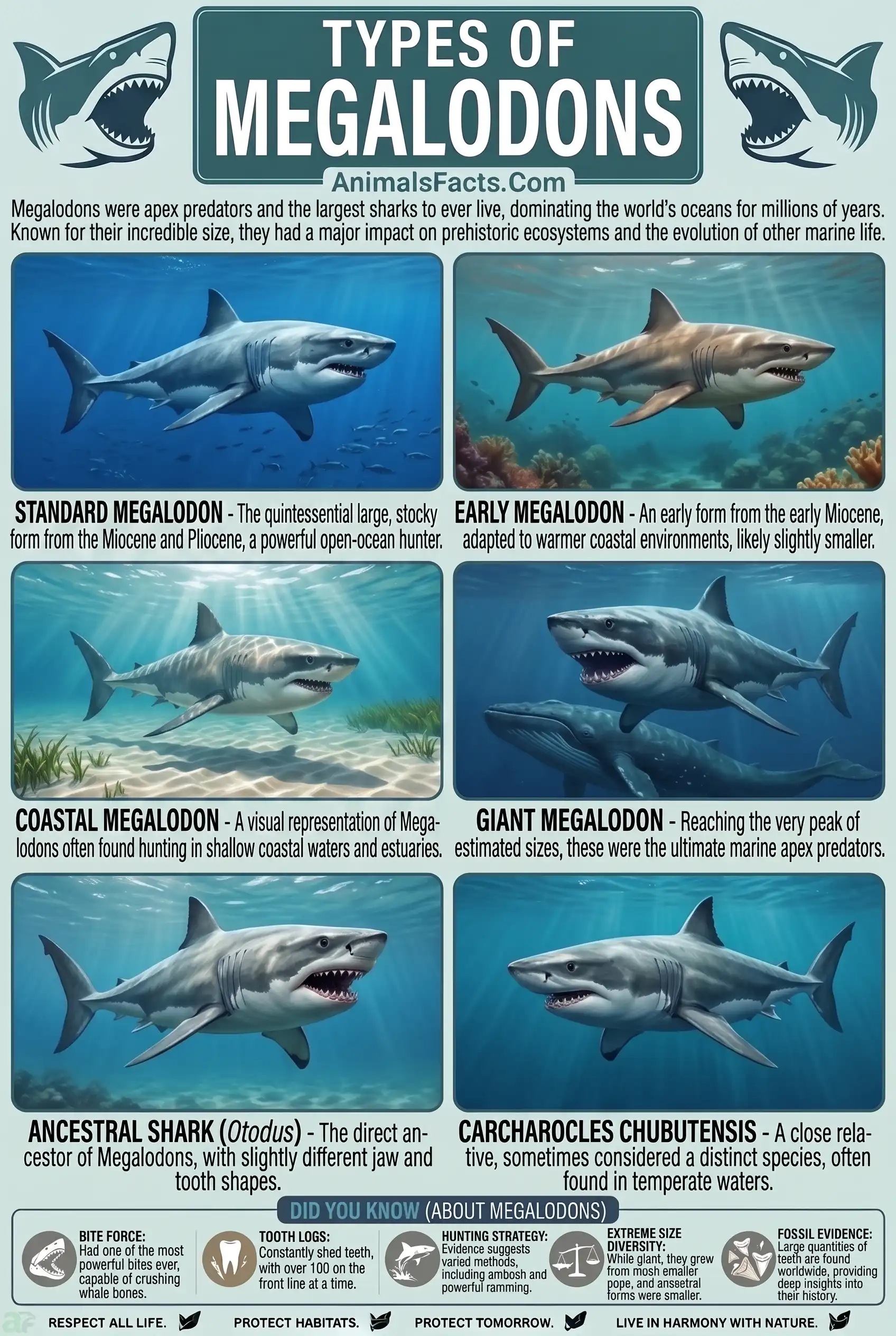
23. Frequently Asked Questions About Megalodons
What is the scientific name for megalodon?
The currently accepted scientific name is Otodus megalodon (Agassiz, 1843). For most of the 20th century it was classified as Carcharodon megalodon, but genetic and morphological analysis since the 1990s has firmly established that megalodon belongs to the extinct family Otodontidae and genus Otodus, not to the family Lamnidae (which contains the great white shark). The species name megalodon derives from Greek meaning “big tooth.”
How big was megalodon really?
Current best estimates based on vertebral analysis and tooth size scaling place typical adult megalodon at 14–16 meters (46–52 feet) in length, with the largest individuals possibly reaching 18–20 meters (59–66 feet). Weight estimates range from approximately 50,000 to 100,000 kilograms depending on body proportions assumed. A 2022–2023 3D modeling study confirmed that megalodon was broader and more robust-bodied than previously depicted — making it heavier than older estimates suggested for a given length.
When did megalodon go extinct?
The most recently revised and scientifically accepted extinction date for megalodon is approximately 3.6 million years ago, based on statistical analysis of the youngest reliably dated megalodon teeth published by Catalina Pimiento and colleagues in 2019. This revised date is significantly earlier than the previously accepted date of 2.6 million years ago. The extinction correlates strongly with global ocean cooling during the Pliocene epoch and the associated collapse of warm-water whale prey populations.
Is megalodon still alive in the deep ocean?
No — definitively and completely. This claim, popularized by a 2013 Discovery Channel mockumentary and multiple fictional films, has no scientific basis. Multiple lines of evidence rule it out: megalodon was a warm, shallow-water predator whose prey (large whales) is extensively monitored globally; no attacks consistent with megalodon have ever been documented; environmental DNA surveys of all ocean zones have found no megalodon genetic material; and no specimen younger than 3.6 million years has been confirmed despite enormous commercial and scientific fossil hunting activity. The “only 5% of the ocean has been explored” argument does not apply because megalodon could not survive in the cold, food-poor deep ocean.
What did megalodon eat?
Megalodon was an apex carnivore that fed primarily on large marine mammals — particularly baleen whales and toothed whales, supplemented by dugongs, sea turtles, large fish, and seals. Evidence comes from fossil whale bones bearing characteristic megalodon bite marks found at dozens of sites worldwide. Bite mark analysis suggests megalodon used a two-phase attack strategy: first disabling prey with blunt ramming strikes, then delivering consumptive bites to vital areas.
How powerful was megalodon’s bite?
Megalodon’s bite force is estimated at between 108,000 and 180,000 Newtons — making it the most powerful bite force of any animal ever confirmed in the fossil record. By comparison, T. rex bite force is estimated at approximately 57,000 N, and the great white shark at approximately 18,000 N. The megalodon’s enormous jaws, powerful jaw muscles (inferred from skull attachment sites in reconstructed models), and serrated teeth capable of cutting through whale bone made it the most formidable biological cutting tool in Earth’s history.
Why did megalodon go extinct?
The primary driver of megalodon’s extinction was the global cooling of the Pliocene epoch (~5–2.5 million years ago), which dramatically reduced ocean temperatures and caused the collapse of the warm-water whale populations that formed megalodon’s primary prey base. With its prey depleted, megalodon — an animal with enormous energy requirements and a specialized diet centered on large marine mammals — could not adapt quickly enough. Secondary factors may have included competition from the evolving orca lineage and behavioral adaptation of surviving whale species (migrating to polar waters megalodon could not follow).
Is megalodon related to the great white shark?
No — despite decades of popular assumption, megalodon is not closely related to the great white shark. Genetic and morphological analysis has established that megalodon belongs to the extinct family Otodontidae, while the great white belongs to the family Lamnidae. The two lineages diverged tens of millions of years ago and evolved large size and similar tooth forms convergently — independently developing similar features in response to similar ecological pressures (hunting large prey), not due to shared ancestry. Megalodon’s closest living relatives are mako sharks (Isurus species).
Where can I find megalodon teeth?
Megalodon teeth can be found at numerous public locations worldwide. The most productive and accessible sites include the beaches of Venice Beach, Florida (famous for washing ashore continuously), Calvert Cliffs, Maryland (where cliff erosion exposes Miocene deposits), Aurora, North Carolina (near the Lee Creek phosphate mine), and rivers of South Carolina (where commercial diving operations offer guided fossil diving). Megalodon teeth are also found in Belgium, Morocco, Peru, Japan, and Australia. They are legal to collect at most public sites and represent one of the most accessible prehistoric fossils in the world.
How many teeth did megalodon have?
Based on the tooth anatomy and jaw reconstruction of megalodon, scientists estimate it had approximately 276 functional teeth arranged in 5 rows at any given time. Like all sharks, megalodon replaced its teeth continuously throughout its life — teeth at the front of each row were functional, while replacement teeth developed behind them in a conveyor-belt pattern. Over a lifetime, a single megalodon may have produced thousands of individual teeth — explaining why megalodon teeth are relatively abundant in the fossil record despite the animal’s extinction 3.6 million years ago.
24. Sources & Refernces
Research Sources
- Wikipedia — Otodus megalodon, Otodontidae, Lamniformes, Miocene
- National Geographic — nationalgeographic.com
- Smithsonian National Museum of Natural History — naturalhistory.si.edu
- Britannica — britannica.com/animal/megalodon
- Live Science — livescience.com
- BBC Science & Nature — bbc.co.uk/nature
- Pimiento, Catalina et al. (2019). “The Neogene extinction of Otodus megalodon.” PEERJ
- Griffiths, M.L. et al. (2023). “Great white shark (Carcharodon carcharias) teeth and reconstruction of the megalodon.” Widely reported 2023 body reconstruction study
- Cooper, J.A. et al. (2022). “Body dimensions of the extinct giant shark Otodus megalodon.” Scientific Reports
- Renz, Mark (2002). Megalodon: Hunting the Hunter. PaleoPress
- OCEARCH Shark Tracker — ocearch.org
- Society of Vertebrate Paleontology — vertpaleo.org