
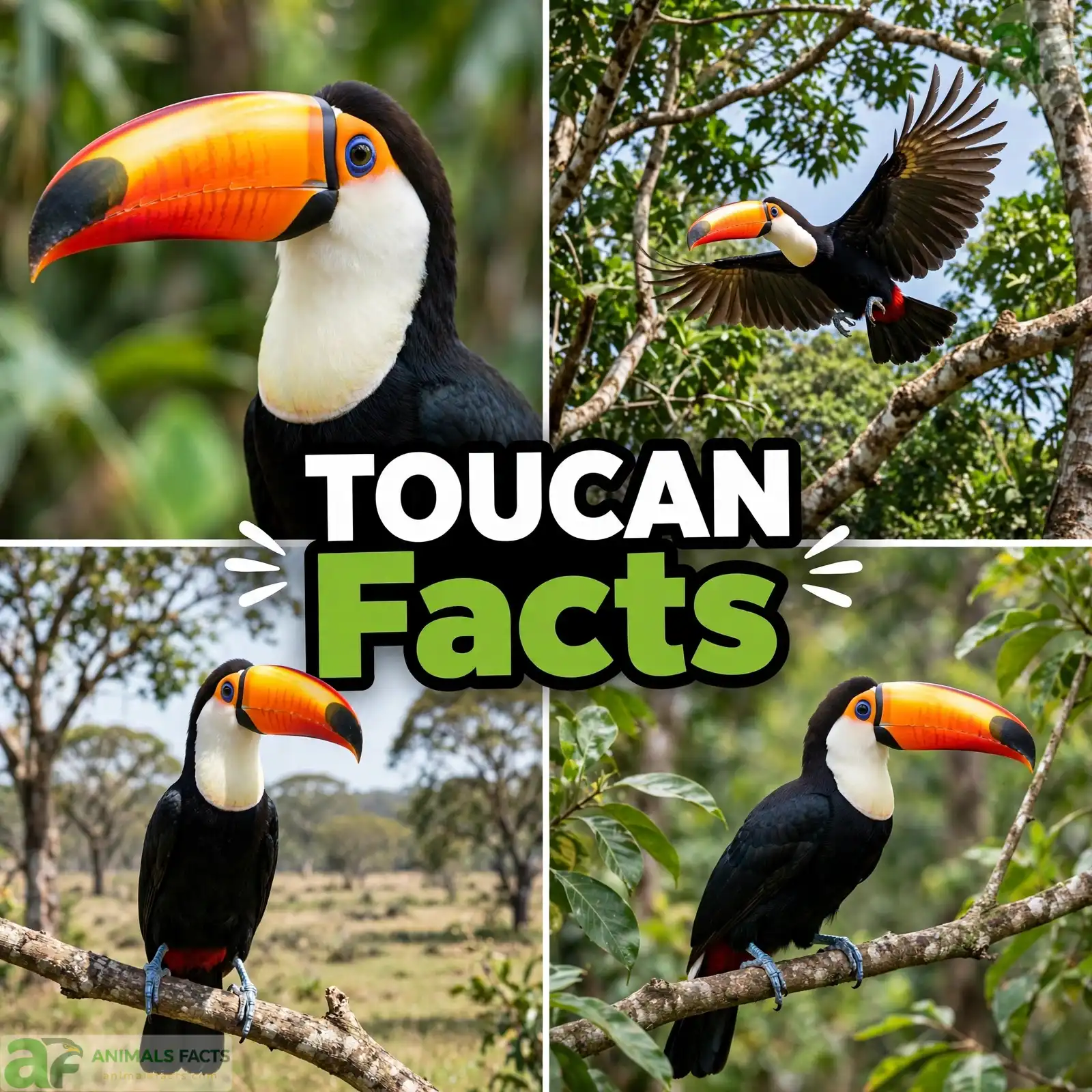
Toucan Facts
| Feature | Details |
|---|---|
| Primary Scientific Group | Family Ramphastidae; approximately 45 species across 5 genera |
| Kingdom | Animalia |
| Phylum | Chordata |
| Class | Aves |
| Order | Piciformes |
| Family | Ramphastidae (Vigors, 1825) |
| Common Names | Toucan; toucanet; aracari; mountain toucan; tucán (Spanish); tucano (Portuguese) |
| Native Range | Neotropical region — southern Mexico through Central America and South America to northern Argentina; also Trinidad |
| Habitat | Tropical and subtropical forest — primarily lowland rainforest; also cloud forest, forest edge, and increasingly urban parks with large trees |
| Lifespan | 12–20 years (wild); up to 26 years (captivity) |
| Diet | Primarily fruit (~85–90%); also insects, eggs, small vertebrates, and nectar |
| Body Length | 29–63 cm — from tiny toucanets to the massive toco toucan |
| Bill Length | Up to 23 cm (toco toucan) — up to 1/3 of total body length |
| Weight | 115–860 grams — from small toucanets to the toco toucan |
| Conservation Status | Most species Least Concern; several Near Threatened or Vulnerable; one species Critically Endangered |
| Defining Feature | The enormous, vividly colored bill that can be up to one-third of the bird’s total body length — the most disproportionately large bill of any bird relative to body size, yet weighing only approximately 1/20th of the bird’s body weight due to its hollow internal structure |
| Most Famous Species | Toco toucan (Ramphastos toco) — the iconic orange-billed black-and-white bird; the most widely recognized toucan and the basis for most toucan cultural imagery |
| Bill Function Discovery | The bill was long assumed to be a feeding tool; research in 2009 established that the primary function is thermoregulation — the most significant function revision for any iconic bird feature in modern ornithology |
 1. Introduction: What is a Toucan?
In the forest canopy of the Brazilian Atlantic Forest, at the junction of a strangler fig’s crown where the fruiting tree has attracted a community of birds from across the forest, a toco toucan lands on a branch with the deliberate competence of a bird that knows exactly what it is doing. The bill — orange-yellow, massive, nearly a quarter of a meter long — is the first thing the eye registers and the last thing it releases. The bill is so large relative to the bird’s body that every new observer experiences the same involuntary cognitive recalibration: surely this cannot be functional; surely this enormous colorful structure must be some kind of evolutionary exaggeration made possible by the absence of the selection pressure that would otherwise eliminate it. The bird begins working through the fig tree’s fruit, using the bill with the precision of a surgeon’s forceps — picking individual figs, tossing them backward with a practiced flip of the head and catching them in the throat. Within three minutes, the fig tree has been efficiently harvested of its most accessible fruit and the toucan has departed — carrying the seeds of multiple fig fruits in a digestive system that will deposit them, whole and viable, up to several kilometers from the parent tree before the day is done. Toucan facts begin with this scene — the combination of extraordinary visual impact and ecological precision that makes the toucan simultaneously the most recognizable bird in any tropical image and one of the most functionally important birds in the forest where it lives.
The toucans — family Ramphastidae, approximately 45 species — are the defining birds of the Neotropical region as much as any other single family. Their extraordinary bills — ranging from the modest 5 cm bills of small toucanets to the 23 cm bill of the toco toucan — are the most immediately iconic bird feature in any tropical ecosystem, recognized globally through their use in decades of advertising, children’s media, and cultural imagery. But toucan facts are far more surprising than the bill’s appearance suggests. The bill’s primary function is not what most people assume — the 2009 research discovery that the toco toucan’s bill functions primarily as a thermoregulator (controlling body temperature by regulating blood flow through the bill’s surface) rather than as a feeding tool represented one of the most significant revisions of an iconic biological assumption in modern ornithology. The bill is not heavy despite its size — its hollow honeycomb internal structure (made of a protein foam matrix reinforced with bony struts) makes it approximately 1/20th of the bird’s total body weight, one of the most weight-efficient biological structures in the animal kingdom. Toucans sleep in extraordinary postures — tucking the bill over the back and folding the tail forward over the back, compressing the entire bird into a compact package that fits into the small tree cavities where they roost. And the toucan’s role as a seed disperser — carrying large seeds over distances that no other forest animal in the same size class can match — makes it one of the most ecologically essential birds in the forests it inhabits.
Interesting facts about toucans reveal an animal of breathtaking biological and ecological complexity — the serated bill edges that have given the Ramphastidae their family name (from Greek rhamphos = “curved beak” + astos = “billed”) and that function as tiny saw-teeth for processing fruit; the social bonding ritual in which toucans engage in mutual bill-fencing and food-tossing between pair members — one of the most visually dramatic social bonding behaviors of any bird; the unexpected cavity nesting in tree holes that the short wings and long bill make an engineering challenge; the bill color signals that function in species recognition, mate quality assessment, and territorial signaling; the extraordinary plumage diversity across 45 species that makes the toucan family one of the most visually diverse in the bird world; and the role as a keystone disperser — the toucans’ seed-carrying capacity and dietary flexibility making them irreplaceable components of the forest seed dispersal system that cannot be fully replaced by any combination of other bird species. Whether you are searching for toucan facts for kids to explore the biology of the most colorful bill in the bird world, a Neotropical birder planning a tour of the Amazon or Atlantic Forest, a conservation biologist researching the ecological consequences of toucan population declines, or simply someone who has always wondered why that bill is actually that big — this is your comprehensive guide.
2. Toucan Species Overview & Classification
The toucans form a well-defined family within the order Piciformes — the woodpeckers and their relatives — and represent one of the most species-rich and most ecologically diverse bird families in the Neotropical region.
Species Classification Table
| Taxonomic Rank | Classification |
|---|---|
| Kingdom | Animalia |
| Phylum | Chordata |
| Class | Aves |
| Order | Piciformes |
| Family | Ramphastidae (Vigors, 1825) |
| Genera | Ramphastos (large toucans); Pteroglossus (aracaris); Selenidera (spot-billed toucanets); Andigena (mountain toucans); Aulacorhynchus (emerald toucanets) |
| Species count | Approximately 45 species |
| Etymology | Ramphastos from Greek rhamphos (curved beak) + hastos (billed); “toucan” from Portuguese tucano derived from the Tupi word tucan — the indigenous Brazilian name for the bird. The Tupi tucan likely derives from the word for “bone” or from the sound of the bird’s call |
The Surprising Evolutionary Position
Toucans belong to the order Piciformes — making them relatives of woodpeckers, puffbirds, jacamars, and barbets rather than relatives of parrots (which they superficially resemble in some habits) or other fruit-eating birds:
The woodpecker connection — Toucans and woodpeckers share:
- Zygodactyl feet — two toes pointing forward and two pointing backward (the same arrangement as woodpeckers, parrots, and cuckoos), providing excellent gripping capability on branches
- Cavity nesting — both families use tree cavities for nesting
- Geographic ranges that often overlap extensively
The African barbet relationship — The toucans’ closest Old World relatives are the African barbets (Lybiidae) — colorful, medium-sized fruit-eating birds that occupy similar ecological roles in African forests. The toucan-barbet comparison is one of the clearest examples of ecological and behavioral parallel evolution across different continents.
The Five Toucan Genera
| Genus | Common Name Group | Species Count | Bill Character | Size |
|---|---|---|---|---|
| Ramphastos | Large toucans | ~9 species | Largest bills; most colorful | 48–63 cm |
| Pteroglossus | Aracaris | ~15 species | Serrated; patterned | 30–46 cm |
| Selenidera | Spot-billed toucanets | ~6 species | Shorter; spotted | 30–38 cm |
| Andigena | Mountain toucans | ~4 species | Distinctive mountain-forest species | 40–50 cm |
| Aulacorhynchus | Emerald toucanets | ~12 species | Green; medium length | 29–42 cm |
Major Species — The Most Important Toucans
| Species | Scientific Name | Bill | Range | Notable Feature |
|---|---|---|---|---|
| Toco toucan | Ramphastos toco | 23 cm — orange | E. South America | Most famous; largest bill |
| Keel-billed toucan | Ramphastos sulfuratus | 12 cm — multi-color | Mexico to Venezuela | “Rainbow-billed”; national bird of Belize |
| Chestnut-mandibled toucan | Ramphastos ambiguus | 15 cm — yellow-red | Colombia to Ecuador | Large; dimorphic bill |
| Fiery-billed aracari | Pteroglossus frantzii | 9 cm — red-yellow | Costa Rica, Panama | Vivid red-yellow bill |
| Collared aracari | Pteroglossus torquatus | 9 cm — patterned | Mexico to Colombia | Common; accessible viewing |
| Emerald toucanet | Aulacorhynchus prasinus | 8 cm — green | Mexico to Bolivia | Green plumage; cloud forest |
| Plate-billed mountain toucan | Andigena laminirostris | 14 cm — patterned | Colombia, Ecuador | Cloud forest specialist |
| Saffron toucanet | Pteroglossus bailloni | 7 cm — green-red | SE Brazil, NE Argentina | Near Threatened |
Evolution & Discovery Timeline
~30–40 million years ago (Oligocene-Miocene) — The Ramphastidae lineage diverges within the Piciformes radiation — establishing the toucan family in South America.
~10–15 million years ago (Miocene) — The major toucan genera diversify — the Ramphastos large toucans, Pteroglossus aracaris, and other groups establishing their characteristic body plans and ecological roles.
~16,000 BCE onward — Indigenous peoples of tropical South America develop deep cultural and spiritual relationships with toucans — feathers used in ceremony, toucans appearing in cosmological narratives, toucan bills used as ornamental objects.
1519–1522 — Magellan’s circumnavigation; first European encounters with toucans documented in crew accounts.
1555 — French explorer Jean de Léry publishes one of the first detailed European descriptions of toucans encountered in Brazil — describing the extraordinary bill with astonishment.
1758 — Carl Linnaeus formally describes the toco toucan (Ramphastos toco) in Systema Naturae.
1963 — Guinness Stout launches its global “Toucan” advertising campaign based on the design created in 1935 — establishing the toucan as a globally recognized advertising icon associated with Irish stout.
2009 — Research by Glenn Tattersall and colleagues published in Science establishes that the toco toucan’s bill functions primarily as a thermoregulator — the most significant revision of an iconic bird anatomical function in modern ornithology.
2024 — The toucan family maintains its conservation status mix — most species Least Concern but several facing meaningful threats from deforestation, and the yellow-browed toucanet (Aulacorhynchus huallagae) remaining Critically Endangered in Peru.
“The toucan’s bill is perhaps the most misleading anatomical structure in all of ornithology — it looks like a feeding tool but it’s primarily a thermal radiator; it looks impossibly heavy but weighs almost nothing; it looks like an evolutionary exaggeration but it’s a masterpiece of biological engineering. Every assumption you bring to the toucan’s bill turns out to be wrong.”
— Dr. Glenn Tattersall, Brock University — the researcher who established the thermoregulatory function of the toucan’s bill
3. Toucan Physical Description & Unique Features
The toucan’s physical features collectively produce the most visually striking appearance of any Neotropical bird — and contain some of the most surprising biological engineering in the bird world.
The Bill — The Most Studied and Most Misunderstood Bird Feature
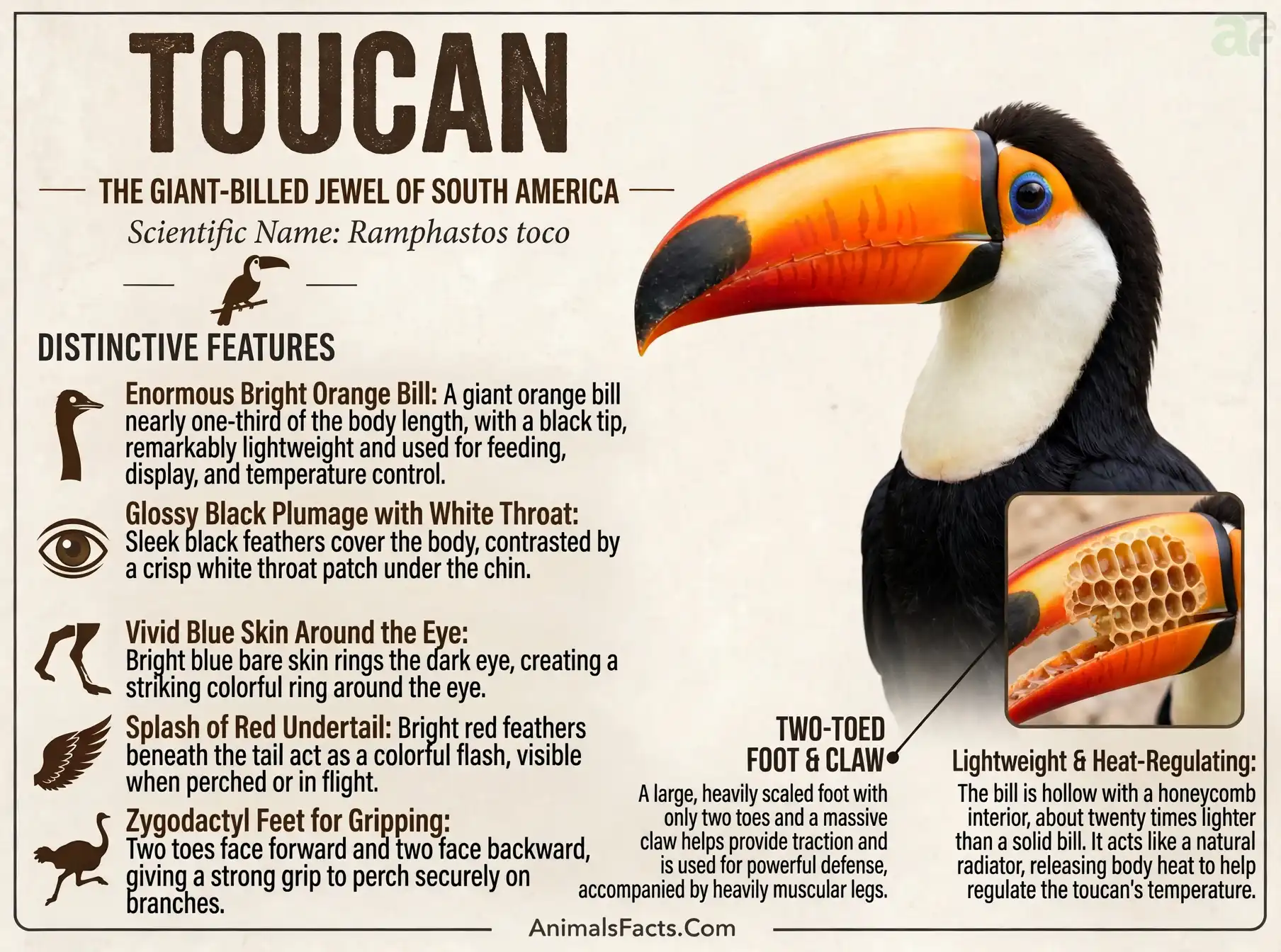
The size — The toco toucan’s bill reaches 23 cm in length — equivalent to approximately 1/3 of the bird’s total body length (which reaches 63 cm). The bill-to-body length ratio of the toco toucan is the largest of any bird:
- Toco toucan body length: ~63 cm; bill length: ~23 cm
- Bill represents approximately 36% of total body length
- No other bird has a bill approaching this proportion of total body length
The weight paradox — Despite its enormous size and vivid orange color, the toco toucan’s bill is extraordinarily lightweight:
- Total bill weight: approximately 17–18 grams (for a bird weighing ~680 grams)
- Bill weight as proportion of body weight: approximately 1/40th to 1/20th
- For comparison: if a human nose had the same proportion as the toucan’s bill, it would extend approximately 50 cm from the face
The internal structure — biological honeycomb:
The bill’s extraordinary lightness is achieved through a remarkable internal architecture:
- The bill’s outer shell is composed of keratin (the same protein as fingernails and bird beaks generally)
- The interior is not solid but contains a protein foam matrix — a network of hollow, air-filled cells separated by very thin walls
- The foam matrix is reinforced by bony struts — thin rods of bone extending from the shell inward
- This combination of keratin shell, foam interior, and bony reinforcement creates a structure with the highest strength-to-weight ratio of any bird bill structure
- The architecture parallels engineered lightweight composite materials used in aerospace — foam-core sandwich panels with fiber reinforcement
The serrated edges:
The bill’s cutting edges bear fine, tooth-like serrations:
- The serrations function as saw-teeth for processing fruit — particularly for gripping and tearing larger fruit
- The serrations give the family its name (Ramphastos from Greek for “curved beak”)
- Serration pattern varies between species and genera — a useful identification feature
The Primary Function — Thermoregulation
The 2009 discovery — Research published in Science by Glenn Tattersall, Denis Andrade, and Augusto Abe established that the toco toucan’s bill functions primarily as a thermoregulator — a biological radiator that controls the bird’s body temperature:
The mechanism:
- The bill contains a dense network of blood vessels close to the surface
- When the bird is too warm, blood flow to the bill increases — the bill surface radiates heat to the surrounding air, cooling the blood before it returns to the body
- When the bird is too cold or conserving heat, blood flow to the bill decreases — reducing heat loss through the bill surface
The experimental evidence:
- Infrared thermography of toucans showed bill surface temperatures varying by up to 10°C depending on the bird’s thermoregulatory state
- During sleep (when the bird tucks the bill under the back feathers), bill surface temperature drops dramatically — the bill being used as a thermostat in both directions
- The bill can radiate 25–400% of the bird’s total metabolic heat production depending on conditions — an extraordinary range of thermoregulatory capacity for a single body structure
The ecological context:
- Toucans are active in the tropical forest canopy where temperatures can vary dramatically between the exposed, sunlit upper canopy and the cool, shaded interior
- The bill’s thermoregulatory function allows the toucan to maintain body temperature across this variable thermal environment without the energy expenditure of increased metabolic heat production or evaporative cooling
The revised understanding:
- The bill does function in feeding — its length and precision allowing fruit plucking from thin branches
- But feeding is not the primary selective pressure that drove the bill’s extreme size — thermoregulation is the more likely primary driver
- This revision means that the “obvious” explanation for the bill’s extreme size was wrong — one of the most instructive examples in recent ornithology of how intuitive explanations for striking biological features can be misleading
The Sleeping Position — The Most Unusual Bird Sleep Posture
The roosting posture:
To fit into the small tree cavities where toucans roost, the bird adopts an extraordinary sleeping position:
- The bill is tucked over the back — rotated backward so the tip points toward the tail
- The tail is folded forward over the back — the long tail feathers projecting forward over the body
- The entire bird compresses into a roughly spherical package — the bill and tail meeting above the back
- This posture reduces the bird’s volume by approximately 30–40% — allowing the large bird to fit into cavities considerably smaller than would be expected from its overall body size
The thermoregulation connection:
The bill-over-back sleeping posture is not merely a space-saving adaptation — research shows that covering the bill with back feathers during sleep significantly reduces heat loss through the bill surface, conserving body heat during the cooler forest nights. The sleeping posture therefore integrates the thermoregulatory function with the spatial requirements of cavity roosting.
The Plumage — Extraordinary Diversity
Across the 45 toucan species, plumage diversity ranges from the toco toucan’s stark black-and-white to the emerald toucanet’s solid green to the many-colored complexity of the keel-billed toucan:
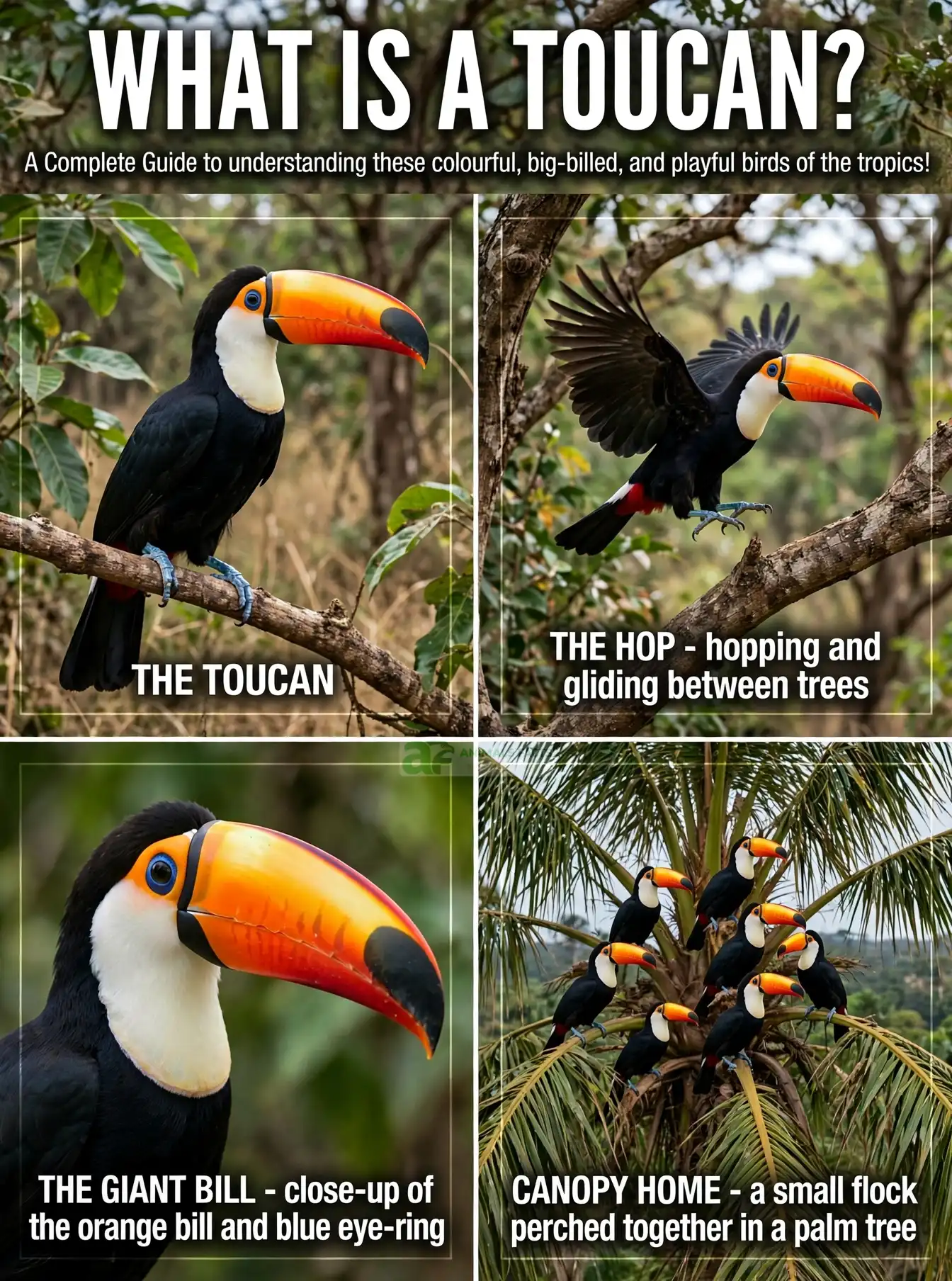
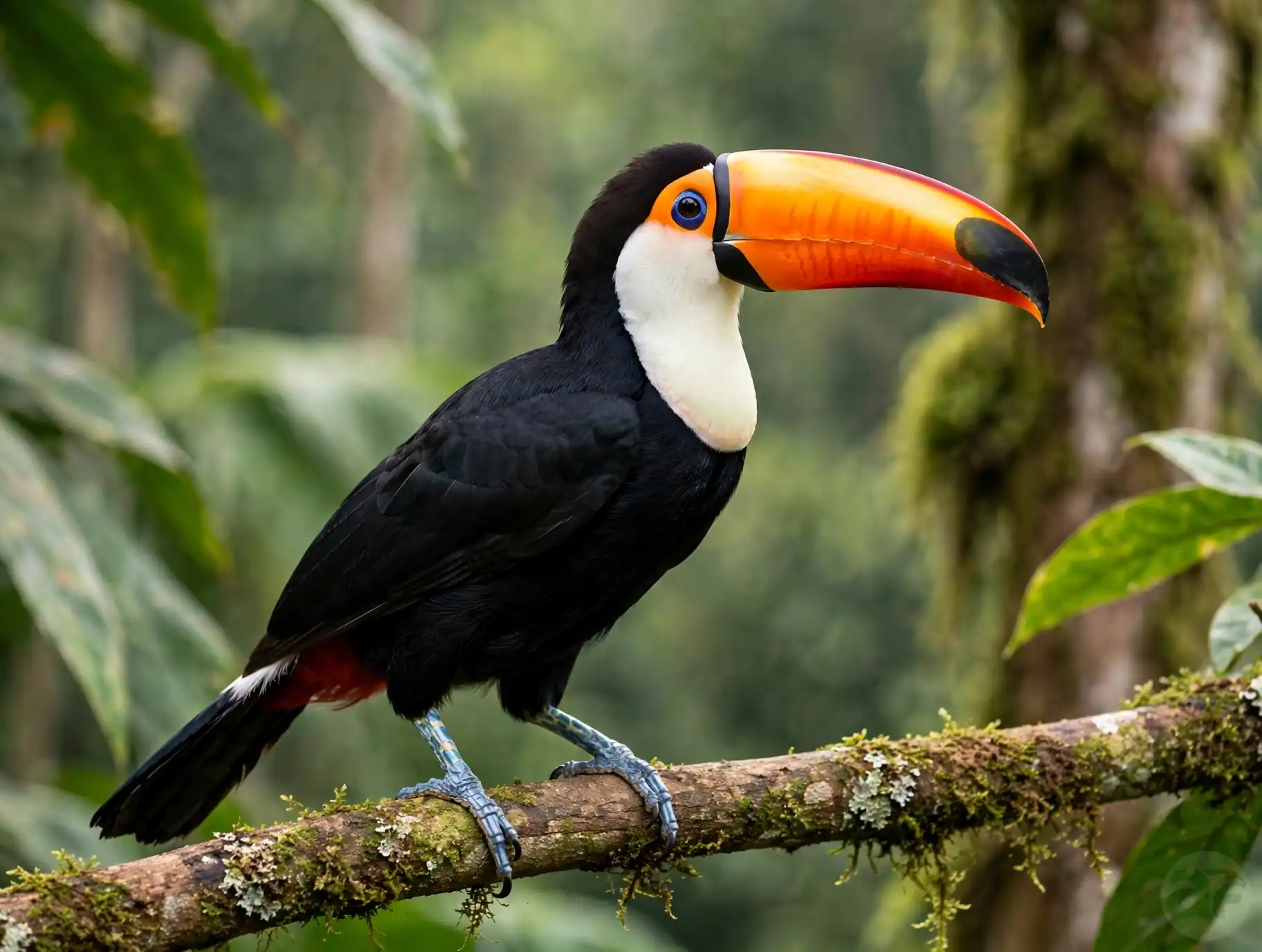
Toco toucan — The most recognizable: jet black body and wings with a white throat and chest bib; the orange-yellow bill with a black spot near the tip; red under-tail coverts. The stark black-and-white pattern with the vivid orange bill creates the most immediately distinctive bird silhouette in the Americas.
Keel-billed toucan — The most colorful bill of any toucan: the bill is lime green at the base, transitioning through blue, red, and orange — a multi-colored structure that has earned the bird the name “rainbow-billed toucan.” The body is black with a yellow face and chest.
Emerald toucanets — The most uniform: solid bright green body and wings with variable bill coloration. The green plumage provides canopy camouflage that the more dramatically patterned lowland toucans lack.
Mountain toucans — The most complex body plumage patterns: brown, blue, yellow, and red body combinations that make the mountain toucans among the most colorful large birds in the Andes cloud forest.
Aracaris — The most variably patterned: typically black backs with yellow-red banded underparts, the banding pattern varying between species and providing reliable field identification.
The Feet — The Woodpecker Inheritance
Zygodactyl arrangement — Two toes pointing forward (toes 2 and 3) and two pointing backward (toes 1 and 4) — the same arrangement as woodpeckers, parrots, and cuckoos:
- Provides exceptional branch-gripping stability in the forest canopy
- Allows the bird to reach in multiple directions from a single perch
- Facilitates the sideways turning that brings the bill to bear on food items in various positions
💡 Did You Know? The keel-billed toucan (Ramphastos sulfuratus) — the national bird of Belize — has one of the most colorful bills of any bird in the world, but this multi-color spectacle is not produced by pigment in the way that most bird colors are. The bill’s lime green, blue, red, and orange colors are produced by a combination of two mechanisms: melanin pigments producing some of the darker colors, and structural coloration — where the microscopic surface texture of the bill’s keratin creates color through light interference rather than through chemical pigments. This structural coloration mechanism is the same that produces the iridescent colors of hummingbirds and the blue of many butterfly wings — the color changing with viewing angle as different wavelengths of light constructively and destructively interfere. The keel-billed toucan’s bill is therefore one of the few bird structures where multiple color-production mechanisms operate simultaneously on a single structure — a biological color-mixing system that produces a bill more varied in hue than any single pigment mechanism could achieve. Research published in 2021 established the specific structural coloration mechanisms in toucan bills — adding another layer of biological sophistication to a structure that already contained the thermoregulation discovery of 2009 and the honeycomb architecture described in the 1990s. The toucan bill continues to produce scientific surprises despite being one of the most studied bird anatomical features in the world.
4. Top 25 Amazing Toucan Facts
Here is your definitive collection of the most extraordinary, scientifically verified, and genuinely astonishing toucan facts as of 2026:
- The toco toucan’s bill reaches 23 cm in length — approximately 1/3 of the bird’s total body length — making the bill-to-body ratio the largest of any bird on Earth. Yet despite its enormous size, the bill weighs only approximately 17–18 grams — roughly 1/40th of the bird’s body weight — due to its extraordinary hollow honeycomb internal structure.
- Research published in Science in 2009 established that the toucan’s primary bill function is thermoregulation — not feeding. The bill surface radiates heat through a dense network of blood vessels, functioning as a biological radiator that can dump up to 400% of the bird’s total metabolic heat during peak thermal regulation. This discovery overturned one of the most confidently held assumptions about the bill’s function.
- The toucan sleeps in one of the most unusual sleeping postures of any bird — tucking the enormous bill over its back and folding the tail forward so the tip also rests on the back. This transforms the large bird into a roughly spherical package, allowing it to fit into tree cavities 30–40% smaller than the bird’s resting body volume would otherwise require.
- The keel-billed toucan (Ramphastos sulfuratus) has a bill colored lime green, blue, red, and orange simultaneously — the multiple colors produced by a combination of pigments and structural coloration (light interference) that makes it one of the most complex color-production systems of any bird bill. It is the national bird of Belize.
- Toucans are the primary dispersers of large-seeded fruits in Neotropical forests — swallowing whole fruits up to approximately 4 cm in diameter, transporting them for up to 2 km from the parent tree, and depositing seeds in viable condition. No other bird of comparable size in the same habitat can match the toucan’s seed-carrying capacity for large-seeded fruits.
- The toucan’s bill interior is composed of a protein foam matrix reinforced with bony struts — a lightweight composite structure that engineers have studied as a model for lightweight, high-strength structural materials. The foam-core composite architecture mirrors engineering principles used in aerospace and sports equipment design.
- Toucans engage in a remarkable social bonding behavior — pairs and group members toss fruit to each other during social interactions, with one bird throwing a piece of fruit and the other catching it in mid-air. This fruit-tossing game reinforces social bonds within pairs and small groups and has been documented in multiple toucan species.
- The yellow-browed toucanet (Aulacorhynchus huallagae) of Peru is Critically Endangered — one of the rarest birds in South America, known from very few locations in a small area of montane forest in the departments of Huánuco and San Martín in Peru. Population estimates suggest fewer than 1,000 individuals remaining.
- Toucans have extremely short tongues relative to their bill length — the tongue reaches only about 1/3 of the bill’s internal length. The tongue’s tip is fringed with barb-like extensions that assist in manipulating fruit inside the bill — one of several anatomical surprises inside the famous bill.
- The toco toucan’s bill surface temperature varies by up to 10°C between active thermoregulation (when blood flow is high and heat loss maximized) and sleep (when blood flow is reduced and heat conserved). This 10°C variation on a single body surface represents one of the most dynamic thermoregulatory ranges documented on any bird body structure.
- Aracaris (genus Pteroglossus) roost communally — multiple individuals (up to 6 birds) roosting together in a single tree cavity. This communal roosting requires all birds to adopt the bill-over-back sleeping posture simultaneously, fitting far more birds into the cavity than would seem physically possible.
- Toucans are related to woodpeckers — both families belong to the order Piciformes and share the zygodactyl foot (two toes forward, two backward), the cavity-nesting habit, and various skeletal characteristics. A toucan is more closely related to a woodpecker than to any parrot despite some behavioral similarities with parrots.
- The toucan’s tongue is uniquely shaped — flat, narrow, and approximately 14 cm long in the toco toucan, with a fringe of comb-like extensions at the tip that help manipulate fruit. The tongue is adapted for working with fruit items inside the long bill rather than for insect probing as in woodpeckers.
- Multiple toucan species are documented predating the nests of other birds — raiding the nests of smaller cavity-nesting birds, consuming eggs and chicks. This predatory behavior is controversial from a conservation perspective — toucan population increases in some areas may suppress populations of cavity-nesting smaller birds whose nests are vulnerable to toucan raiding.
- The Andean toucans (mountain toucans) undergo altitudinal migration — moving between higher-elevation breeding sites and lower-elevation wintering areas in annual movements that reflect seasonal changes in fruit availability across the Andean elevation gradient.
- Toucan eggs are white and glossy — the absence of camouflaging pigmentation reflecting the security provided by the enclosed cavity nest environment where egg color concealment is unnecessary. White eggs are characteristic of most cavity-nesting birds.
- The toco toucan is documented bathing in rainwater collected in tree hollows and in water-filled epiphyte bromeliads — one of the few large birds that regularly uses collected rainwater rather than flowing water sources for bathing. This tree-hollow bathing behavior reflects the toco toucan’s arboreal lifestyle.
- Research using radio tracking of toco toucans has documented individual home ranges of 14–50 km² — indicating that individual birds range over enormous areas of forest in their daily and seasonal movements. This large range means that the seed dispersal function of toucans operates across a much larger landscape than smaller frugivores.
- The social hierarchy within toucan groups is established partly through bill displays — the bill being raised, lowered, and pointed in specific ways that communicate dominance and submission. The bill’s color intensity and size may also function as an honest signal of individual quality in these social interactions.
- Toucans were kept as pets by indigenous Amazonian peoples for centuries — and continue to be kept as pets in some areas despite legal protection. The pet trade has been a significant driver of population declines in accessible toucan populations, particularly around human settlements in Brazil.
- The Ramphastos toucans produce complex calls described as “yelping, croaking, and rattling” — the calls serving as territorial advertisements audible across large distances in the forest. The toco toucan’s call has been described as resembling the croaking of frogs, and the sound of large toco toucan groups calling simultaneously is one of the most distinctive soundscapes of the South American savanna-forest transition zone.
- The bill’s coloration in many toucan species is sexually dimorphic — males and females having subtly or substantially different bill colors. Research has documented that bill color intensity and pattern are assessed by potential mates during courtship — suggesting that the bill’s secondary function in sexual selection parallels its primary thermoregulatory function.
- Several toucan species are significant urban adapters — toco toucans and various aracaris have been documented expanding into urban and suburban areas with parks and large fruiting trees across Brazilian cities including São Paulo, Rio de Janeiro, and Curitiba. This urban colonization brings toucans into contact with new predators (domestic cats, raptors) and new food sources.
- Toucans use a forward-toss feeding technique for most fruit consumption — picking the fruit with the bill tip, then tilting the head backward and tossing the fruit into the throat rather than swallowing it directly. This technique allows the bird to process fruit that is larger than the bill’s gape — a biomechanical workaround for the bill’s extreme length preventing direct throat-swallowing.
- As of 2026, the global toucan family remains predominantly Least Concern in conservation status — but multiple species face meaningful threats from deforestation, and the Critically Endangered yellow-browed toucanet (Aulacorhynchus huallagae) represents one of the most urgent bird conservation priorities in Peru. The broader Atlantic Forest and Amazon basin toucan populations are declining as deforestation eliminates forest habitat.
5. Fun Facts About Toucans
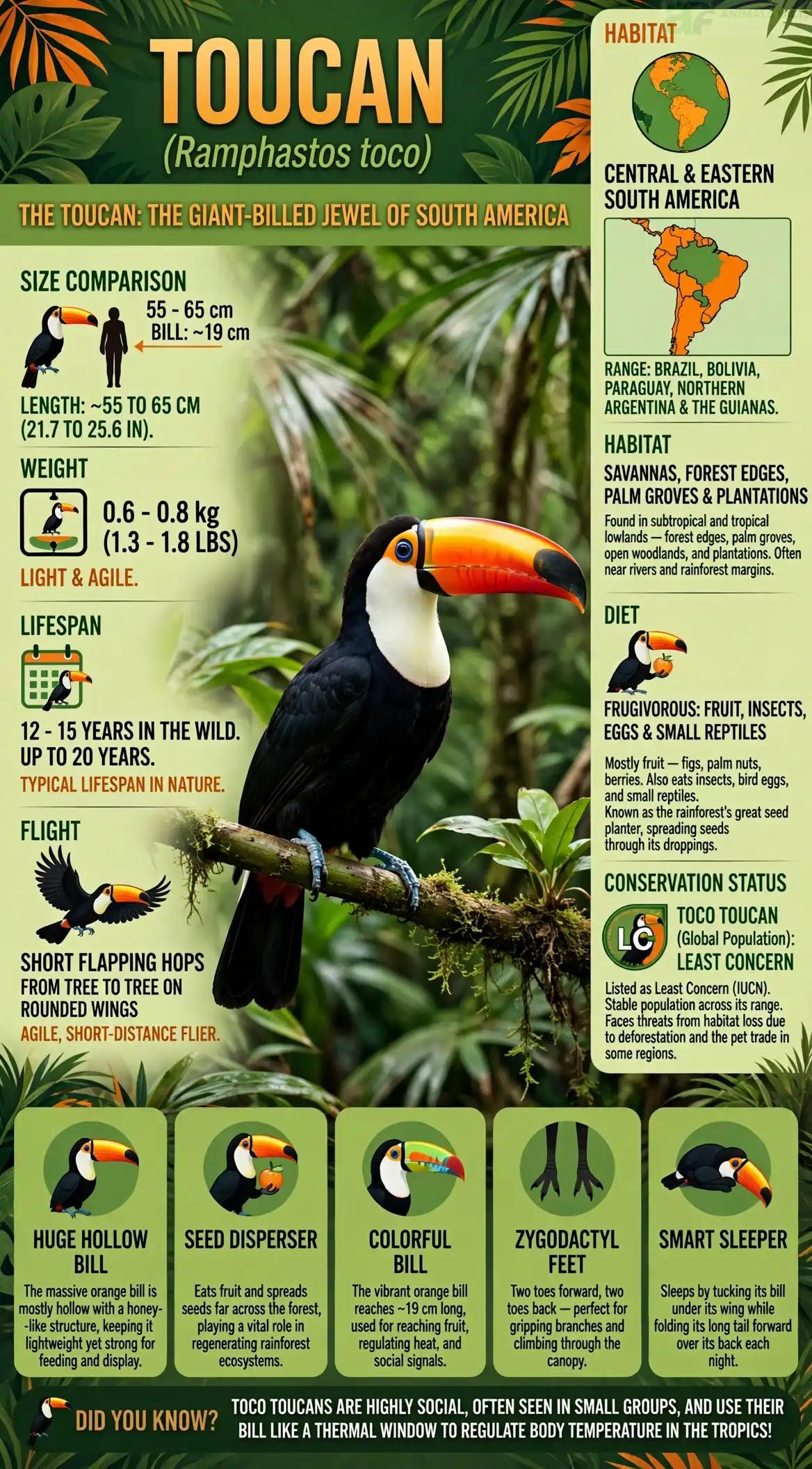
- Bill is 1/3 of body length — yet only 1/40th of body weight
- Primary bill function is thermoregulation — not feeding (2009 discovery)
- Sleeps with bill tucked over back — fits into cavities 30–40% smaller than body
- Keel-billed toucan — national bird of Belize; rainbow-colored bill
- Primary large-seed disperser in Neotropical forests
- Bill interior is protein foam matrix — studied by aerospace engineers
- Social fruit-tossing game reinforces pair bonds
- Yellow-browed toucanet — Critically Endangered — fewer than 1,000 left
- Tongue reaches only 1/3 of bill length — short relative to bill
- Aracaris roost communally — up to 6 birds in one tree cavity
- Related to woodpeckers — not parrots
- Bill temperature varies 10°C between thermoregulation states
6. Toucan Natural Habitat & Geographic Range
Toucan habitat spans the diversity of the Neotropical forest zone — from the sea-level Amazon lowlands to the high Andean cloud forests — with different species groups occupying specific elevation ranges and forest types.
Primary Habitat Types
Lowland tropical rainforest (Amazon basin and adjacent areas):
The most species-rich toucan habitat — the vast Amazon Basin and associated lowland forests support the highest diversity of large toucans:
- Large Ramphastos toucans — the toco toucan, chestnut-mandibled toucan, and relatives dominate the lowland canopy
- Aracaris (Pteroglossus) — multiple species occupy the mid-canopy and forest edge
- Spot-billed toucanets (Selenidera) — shade-adapted species in the forest interior
Atlantic Forest (southeastern Brazil):
The Brazilian Atlantic Forest — one of the world’s most biodiverse and most threatened forest systems — supports several toucan species including the saffron toucanet (Pteroglossus bailloni) as a near-endemic:
- The Atlantic Forest’s extraordinary endemic bird fauna includes toucan species found nowhere else
- The Atlantic Forest is also one of the world’s most deforested biomes — critical toucan habitat is at the center of the deforestation crisis
Andean cloud forest:
The mountain toucans and emerald toucanets occupy the Andean cloud forest zone — one of the most species-rich and most threatened habitats in South America:
- Andigena mountain toucans — primary cloud forest specialists; breeding at 1,500–3,000 m elevation
- Aulacorhynchus emerald toucanets — extensive diversity in cloud forest; multiple species occupying different elevation bands
Forest edge and fragmented forest:
Several toucan species — particularly the toco toucan and some aracaris — have adapted to forest edge, fragmented forest, and woodland-savanna transitions:
- The toco toucan’s exceptional adaptability to fragmented and edge habitats has allowed it to persist (and even expand) in areas where forest specialists have declined
- This adaptability has made the toco toucan the most commonly seen toucan in the areas of Brazil where forest is most heavily modified
Urban parks and gardens:
Toucans are increasingly documented in urban and suburban settings:
- Toco toucans breed in urban parks in major Brazilian cities
- Collared aracaris have been documented in urban areas of Costa Rica and Panama
- Urban toucan populations depend on large fruiting trees — the planting of native fruit trees in urban parks creates viable urban toucan habitat
Geographic Distribution
| Species Group | Primary Range | Elevation | Trend |
|---|---|---|---|
| Toco toucan | E. Brazil, Bolivia, N. Argentina, Paraguay | 0–1,750 m | Stable; expanding into modified habitats |
| Large Ramphastos (Amazonian) | Amazon Basin broadly | 0–1,500 m | Declining with deforestation |
| Aracaris | Central America to Bolivia/Brazil | 0–2,000 m | Variable; some stable, some declining |
| Mountain toucans | Andes broadly | 1,500–3,500 m | Several threatened by cloud forest loss |
| Emerald toucanets | Mexico to Bolivia | 1,000–3,500 m | Several threatened |
| Spot-billed toucanets | Amazon Basin | 0–1,000 m | Declining with deforestation |
7. Toucan Diet & Feeding Behavior
Toucan diet is dominated by fruit — the family representing one of the most thoroughly frugivorous large bird groups in the Neotropics — but supplemented by a surprising breadth of additional food types.
Diet Breakdown Table
| Food Type | Proportion | Notes |
|---|---|---|
| Fruit (primary) | ~85–90% | The overwhelming dietary staple; hundreds of fruit species consumed across the range |
| Insects | ~5–8% | Particularly important during breeding; chicks receive more insects than adults |
| Eggs and nestlings | ~2–5% | Toucan nest raiding documented in multiple species — an underappreciated dietary component |
| Small vertebrates | ~1–3% | Lizards, small snakes, frogs — consumed opportunistically |
| Nectar | Rare | Some species documented visiting flowers; occasional pollination role |
| Flowers and buds | Rare | Consumed opportunistically during fruit scarcity |
The Fruit-Processing System
Bill tip manipulation — Toucans use the bill tip as forceps — picking individual fruits with precision and then processing them through the forward-toss technique:
Step 1 — The bill tip grips the fruit item from the branch or fruit cluster
Step 2 — The fruit is worked toward the bill tip (using the serrated edges as grips)
Step 3 — The head is tilted backward (sometimes nearly vertical)
Step 4 — The fruit is tossed upward into the air and falls backward into the throat
Step 5 — The fruit is swallowed whole (for small fruits) or partially processed in the throat (for larger fruits)
The size limit — Toucans can swallow fruits up to approximately 4 cm in diameter whole — matching or exceeding the seed size of many large-seeded rainforest trees. This capacity for large-fruit swallowing is the key ecological service — fruits too large for other birds can be consumed and transported.
The Seed Dispersal Service
The dispersal quality — Toucans provide exceptionally high-quality seed dispersal for the plants they consume:
- Seeds are swallowed intact and deposited in viable condition
- The toucan’s large home range (14–50 km² in tracking studies) means seeds are deposited far from parent trees
- Seeds deposited in toucan feces have access to the nutrient-rich substrate that promotes seedling establishment
The plant dependencies — Research in the Brazilian Atlantic Forest and Amazon has identified plant species whose seed dispersal is dominated by toucans — in some cases, over 80% of the seeds of specific large-seeded tree species are dispersed by toucans. For these plants, toucan population declines translate directly into reduced seed dispersal and declining plant population viability.
The defaunation consequence — As toucans decline in areas of hunting pressure and habitat fragmentation, defaunation (the loss of large animals from forest fragments) produces measurable plant community changes:
- Large-seeded trees become increasingly rare as seed dispersal fails
- The plant community gradually shifts toward smaller-seeded species that can be dispersed by smaller birds
- This shift cascades through the ecosystem as the trees that large-seeded species produce — often the largest and most structurally important trees in the forest — are replaced by smaller, less structurally complex species
The Nest Raiding Behavior
The toucan as nest predator — Less celebrated than the seed dispersal function but ecologically significant:
- Toucans use their long bills to probe tree cavities and nest holes of smaller birds
- Documented prey includes eggs and chicks of various cavity-nesting small birds
- The toucan’s long bill gives it access to nesting cavities that smaller predators cannot reach without entering
Conservation implications — The nest-raiding behavior creates complex conservation trade-offs:
- In forest fragments where toucan populations persist but smaller forest birds have declined, increased toucan-nest raiding pressure on remaining small birds may represent an additional stressor
- The conservation value of protecting toucans as seed dispersers must be balanced against the nest-predation pressure they impose on co-occurring small birds
8. Toucans Reproduction & Life Cycle
Toucan reproduction reflects the fundamental pattern of monogamous pair bonds, cavity nesting, and biparental care typical of the Piciformes — but with the specific engineering challenges and solutions imposed by the enormous bill.
Pair Bond and Courtship
Monogamous pair bonds — Most toucan species are seasonally or long-term monogamous — pairs returning to the same territory and nest site across multiple breeding seasons. The pair bond is maintained through year-round territory defense and social bonding behaviors.
Courtship rituals:
- Fruit tossing — the most characteristic toucan courtship display; pair members toss pieces of fruit back and forth — one bird catching what the other throws. This behavior, while playful in appearance, is a significant behavioral assessment — the male demonstrating his coordination and bill precision to the female
- Bill touching and fencing — pairs engage in extended bill-touching interactions that may function as both social bonding and mutual assessment
- Mutual preening — particularly of the head and neck where the bill cannot reach — maintaining pair bonds through reciprocal care
Nest Site Selection and Preparation
Cavity nesting — All toucans nest in tree cavities — the enclosed space providing protection from predators and weather:
- Natural cavities — rotted wood in large trees; previously used cavities from various sources
- Woodpecker holes — toucans frequently use and enlarge old woodpecker excavations
- Artificial nest boxes — toucans readily accept appropriately sized nest boxes in areas where natural cavities are scarce
The bill-in-cavity engineering challenge — The toucan’s enormous bill creates a genuine engineering problem for cavity nesting:
- The bird cannot fully extend the bill inside the cavity
- The sleeping bill-over-back posture allows the bird to occupy the cavity
- Cavity dimensions must accommodate not just the bird’s body but the bill in its folded-back position
Egg Laying and Incubation
Clutch size — Typically 2–4 eggs per clutch (most species 2–3):
- Eggs are white and glossy — the cavity’s security making camouflage unnecessary
- Eggs are laid at 1–2 day intervals
- Incubation begins with the first or second egg — producing asynchronous hatching
Incubation — 15–18 days (varying by species) — shared between both parents:
- The short incubation period relative to the bird’s size reflects the cavity nest’s thermal stability (requiring less continuous brooding) and the developmental pace of this group
- Both parents share incubation in relatively equal shifts — one of the more equal parental sharing arrangements in large tropical birds
Chick Development
At hatching — Toucan chicks are altricial — hatching naked, blind, and helpless:
- The newly hatched chick’s bill is already disproportionately large relative to the body — though the full adult bill proportions take weeks to develop
- Chicks have distinctive heel pads — thickened pads on the ankles that protect against the rough wooden floor of the tree cavity
Nestling period — 40–60 days (varying considerably by species):
- Week 1–2: eyes closed; completely dependent; both parents provision with fruit and insects
- Week 3–4: eyes open; feather quills emerging; increasing responsiveness
- Week 5–6: feathers developing; bill approaching adult proportions; increasing activity within cavity
- Week 6–8: fledging — first flight from the cavity; remains dependent on parents for food
The chick diet — Chicks receive a higher proportion of insects and small vertebrates than adults:
- The protein from insects and small animals supports rapid skeletal and feather development
- Adults are documented catching insects in the air and hunting lizards more intensively during the chick-rearing period
Post-fledging dependency — Approximately 3–6 weeks after fledging before chicks achieve food independence:
- Family groups remain together for several weeks after fledging
- Young birds practice fruit-tossing and bill-precision behaviors during this period
9. Social Behavior & Communication
Toucan social behavior is more complex than the solitary lifestyle of most woodpeckers — the family being predominantly social outside the breeding season.
Group Living and Communal Roosting
Small group living — Most toucan species form small groups of 3–12 individuals outside the breeding season:
- Groups are typically family-based — breeding pairs with offspring from previous seasons
- Some species (particularly aracaris) form loose associations of multiple family groups
- Group living provides collective predator detection and social learning opportunities
The communal roost — One of the most endearing toucan behaviors:
- Aracaris (Pteroglossus species) regularly roost communally — 2–6 birds in a single tree cavity
- All roosting birds adopt the bill-over-back posture simultaneously
- The combined body heat of multiple birds in the cavity provides thermal advantages during cool forest nights
- Finding a communal aracari roost is one of the most rewarding close-range toucan encounters available to naturalists
Communication
Vocalizations — Toucans produce a variety of calls surprisingly large relative to their frugivorous lifestyle:
The territorial call:
- Large Ramphastos toucans produce yelping, croaking calls audible from considerable distances in the forest
- The toco toucan’s call has been described as resembling croaking frogs — “krrrick, krrrick” repeated in series
- Calls carry 300–500 meters in typical forest conditions
The alarm call:
- A sharp rattling or croaking produced when predators are detected
- Triggers flushing behavior in the group
- Other species in the area respond to toucan alarm calls — the toucan’s large size and good visibility making its alarm calls reliable predator-detection signals for other birds
The contact call:
- Soft clucking or croaking maintaining group cohesion during foraging
Bill displays — Visual communication through bill position and movement:
- Bill raised — aggressive display toward rivals
- Bill lowered — submissive signal
- Bill fencing — both birds engaging in lateral bill-touching movements during social bonding
The Fruit-Tossing Social Behavior
The fruit-tossing behavior — one bird throwing a piece of fruit to another, which catches it mid-air — is the most visually spectacular toucan social behavior:
Frequency — Most commonly documented during pair bonding and courtship — but also observed between group members in non-breeding contexts
The function — Multiple non-exclusive functions are proposed:
- Pair bond reinforcement — demonstrating coordination and cooperation between pair members
- Mate quality assessment — the male demonstrating bill precision to the female
- Food sharing — actual food transfer between individuals (particularly from experienced adults to juveniles)
- Social play — maintaining group cohesion through pleasurable shared activity
10. Predators & Defense Mechanisms
Toucans face a diverse array of predators in the Neotropical forest — their large, colorful bills and vocal nature making them relatively conspicuous targets.
Natural Predators
Arboreal predators:
- Tayra (Eira barbara) — a large, arboreal mustelid; the most significant mammalian predator of adult toucans and toucan nests; tayras are documented entering tree cavities to access roosting toucans and nest contents
- Boa constrictor and various tree snakes — documented nest predators; snakes entering cavities consume eggs and chicks
- Various arboreal weasels and coatis — opportunistic nest predators
Aerial predators:
- Ornate hawk-eagle (Spizaetus ornatus) — the primary aerial predator of large toucans in lowland forest; documented aerial strikes on perched toucans
- Black hawk-eagle (Spizaetus tyrannus) — similar to ornate hawk-eagle; documented toucan predation
- Various Accipiter hawks — take smaller toucans and aracaris in pursuit flight
- Harpy eagle — occasional toucan predation
Defense Mechanisms
The group alarm system — Toucans in groups provide collective early-warning:
- The sentinel behavior — individuals scanning for predators while others feed — provides early detection
- Alarm calls trigger immediate group response — all birds flushing or retreating to dense cover
- Multiple species in the area respond to toucan alarm calls
The mobbing response — Toucans are aggressive mobbers of potential predators:
- Groups of toucans will approach and mob perched predators (owls, snakes) — calling persistently and approaching closely
- The collective visual and acoustic pressure of a mobbing toucan group is effective at driving predators from the area
Cavity protection:
- The tree cavity provides significant protection for eggs and chicks — predators that cannot enter the cavity cannot access the nest
- Nest cavity selection emphasizes entrance dimensions that exclude the most significant predators (tayras and snakes)
Bill defense:
- The large bill can deliver significant blows — toucans defending themselves at close range use the bill to strike at and bite predators
- The bill’s strength (despite its lightness) makes it a capable defensive weapon
11. Toucan Facts for Kids
Hey amazing young wildlife scientists, colorful bird enthusiasts, and rainforest explorers! Here are some truly extraordinary toucan facts for kids that will make you the most fascinating wildlife expert in any conversation:
- 🦜 The toucan’s enormous beak is a TEMPERATURE CONTROL SYSTEM — not just for eating! Scientists discovered in 2009 that the toucan’s huge, colorful bill is primarily used to cool down and warm up! The bill is full of tiny blood vessels close to the surface. When the toucan is too hot, it sends lots of blood to the bill and the heat radiates away — like a car radiator! When it’s cold, it cuts blood flow to the bill to keep heat inside its body. It’s one of the most sophisticated natural temperature control systems ever discovered!
- 🦜 The enormous bill weighs almost NOTHING! Despite being nearly one-third of the bird’s total length, the toco toucan’s bill weighs only about 17 to 18 grams — about the same weight as a small handful of paperclips! The inside of the bill is not solid. It is filled with a spongy foam structure, like the foam inside a bicycle helmet, held together with tiny bony struts. This gives the bill incredible strength without adding much weight!
- 🦜 Toucans sleep curled up in a BALL with their bill tucked over their back! To fit inside small tree holes where they sleep, toucans perform an amazing trick: they tuck their huge bill backward over their body, then fold their tail forward until both the bill tip and tail tip are resting on their back. This squishes them into a ball shape that is 30 to 40 percent smaller than their resting size! The sleeping posture also helps them stay warm by covering the bill, which would otherwise lose heat.
- 🦜 Toucans PLAY CATCH with each other using pieces of fruit! Toucan pairs and family groups will pick up pieces of fruit and toss them to each other to catch. One bird throws the fruit, another catches it! Scientists think this is how they bond as couples and families — like playing catch together. It’s one of the most adorable bird behaviors in the rainforest, and it shows how intelligent these birds are!
- 🦜 The toucan is MORE CLOSELY RELATED to a woodpecker than to a parrot! Even though toucans and parrots both eat fruit and look somewhat similar, toucans are actually in the same bird group as woodpeckers! Both toucans and woodpeckers have two toes pointing forward and two pointing backward (called zygodactyl feet), both nest in tree holes, and both belong to the same bird order. If you are looking at a toucan, you are essentially looking at an extremely colorful relative of a woodpecker!
- 🦜 Without toucans, the RAINFOREST WOULD SLOWLY CHANGE FOREVER! Toucans eat large fruits and carry the seeds inside them for kilometers before pooping them out. Many rainforest trees produce seeds SO LARGE that toucans are the ONLY birds big enough to swallow them and carry them away from the parent tree. If toucans disappeared, these large trees could not spread their seeds properly. Over decades and centuries, the forest would change — losing some of the biggest, most important trees!
- 🦜 The keel-billed toucan has a bill that is FOUR COLORS AT ONCE! The keel-billed toucan’s bill is lime green, blue, red, and orange — all at the same time! The colors come from a combination of pigments AND a special microscopic surface structure that bends light (like a prism), similar to how a soap bubble shows rainbow colors. It is the national bird of Belize and one of the most colorful single objects in the entire bird world!
- 🦜 A group of aracari toucans can fit SIX BIRDS into a tree hole that barely seems big enough for one! Aracaris (a type of smaller toucan) roost together in groups of up to six birds in a single small tree cavity. Every bird must adopt the tucked-bill-and-tail sleeping posture to fit. Scientists who discover these roosts are always amazed — like finding a clown car full of birds!
12. Relationship with Humans
The toucan’s relationship with humans spans thousands of years of indigenous cultural significance across South and Central America, the colonial and post-colonial period of hunting, the global advertising icon status that has made the toucan the most internationally recognized tropical bird, the significant pet trade pressure that continues to affect wild populations, and the growing conservation urgency as deforestation eliminates forest habitat.
The Indigenous Relationship — Feathers, Spirit, and Food
Pre-Columbian cultural significance — Toucans are among the most significant bird groups in indigenous Amazonian and Mesoamerican cultural traditions:
Feathers in ceremony — Toucan feathers — particularly the bright red, yellow, and orange breast feathers of large Ramphastos species — were among the most valued decorative materials in indigenous Amazonian cultural traditions:
- Feathers used in headdresses, necklaces, and body decoration for ceremonies
- The toucan’s bill used as ornamental pendants and ritual objects
- Toucan bill and feather elements appear in the most important ceremonial contexts across multiple indigenous groups
Amazonian spiritual significance — In various Amazonian cosmological traditions, toucans occupy significant positions:
- The toucan’s bill associated with shamanic ritual — the bill representing a connection to the spirit world in some traditions
- Toucans appear in creation narratives across multiple Amazonian language groups
- The bird’s vivid coloration associated with celestial or supernatural realms in various indigenous cosmologies
The Desana people of the Colombian Amazon — One of the most extensively documented indigenous-toucan relationships: the Desana associate specific toucan species with specific cosmic roles, and the toucan’s call and behavior are interpreted as messages from the supernatural realm. The ritual use of toucan feathers in Desana ceremony has been documented across multiple anthropological studies.
As food — Toucans provided food for indigenous peoples across the range — the birds being hunted with blowpipes and arrows. The hunting was typically embedded in ceremonial protocols that limited offtake and acknowledged the bird’s spiritual significance.
The Guinness Toucan — The Most Successful Advertising Bird in History
The Guinness Stout toucan — one of the most successful and most enduring advertising campaigns in history — has done more than any other cultural product to embed the toucan in global popular consciousness:
The origin — In 1935, the Guinness advertising agency S.H. Benson introduced a toucan character into the Guinness advertising campaign designed by artists John Gilroy and writer Dorothy L. Sayers (the crime novelist also wrote advertising copy). The original tagline — “Toucan play at that game” — a pun on “two can” — launched one of the most durable advertising characters in history.
The cultural impact — The Guinness toucan:
- Made the toucan recognizable to millions of people who had never seen a real tropical bird
- Associated the toucan with Ireland and Irish culture — an association with no geographical logic but enormous cultural staying power
- Established the toucan as an advertising icon — spawning hundreds of toucan-themed brand characters across the 20th century
- Made “toucan” a near-universal word recognition in English-speaking countries where the bird does not naturally occur
The ornithological accuracy — The Guinness toucan is based loosely on the toco toucan’s characteristic orange-and-black appearance but is significantly stylized. The advertising character helped establish the toco toucan as the default “toucan” in popular culture — potentially to the disadvantage of the 44 other toucan species whose existence is far less widely known.
The Pet Trade — A Significant Conservation Pressure
The toucan as a pet — Toucans are among the most sought-after exotic pet birds in tropical Latin America and internationally:
- The toco toucan and various aracaris are kept as pets in significant numbers, particularly in Brazil
- Wild-caught toucans experience high mortality during capture and transport
- Captive toucans require specialized diets (fresh fruit, limited iron — toucans are prone to iron storage disease in captivity) that most pet owners cannot provide
The legal framework — Most toucan species are protected under CITES Appendix II — international trade regulated but permitted with documentation. Brazil and other range countries also maintain domestic wildlife protection legislation covering toucans.
The enforcement gap — Despite legal protection, illegal wildlife trade in toucans continues:
- Wild-caught toucans sold in urban markets across Brazil
- Internet-based wildlife trade platforms have expanded the illegal toucan trade market
- Enforcement of wildlife protection legislation in the vast Brazilian Amazon and Atlantic Forest is chronically under-resourced
The Ecotourism Value
Toucans are among the most economically valuable birds for Neotropical ecotourism — their combination of large size, vivid coloration, and relative accessibility in forest canopy and edge habitat making them reliable “crowd-pleaser” species:
Birdwatching tourism — Toucans are among the most-requested species by international birdwatching tourists visiting Costa Rica, Brazil, Ecuador, and other Neotropical countries. The economic value generated by toucan-centered ecotourism provides conservation arguments for forest protection in areas where toucans occur.
Wildlife photography — The toucan’s photogenic qualities make it one of the most commercially photographed birds in the Neotropics — toucan images appearing in travel magazines, natural history publications, and commercial contexts globally.
13. Toucan Conservation Status & Threats
Conservation Status Overview
| Species | IUCN Status | Population Trend | Primary Threat |
|---|---|---|---|
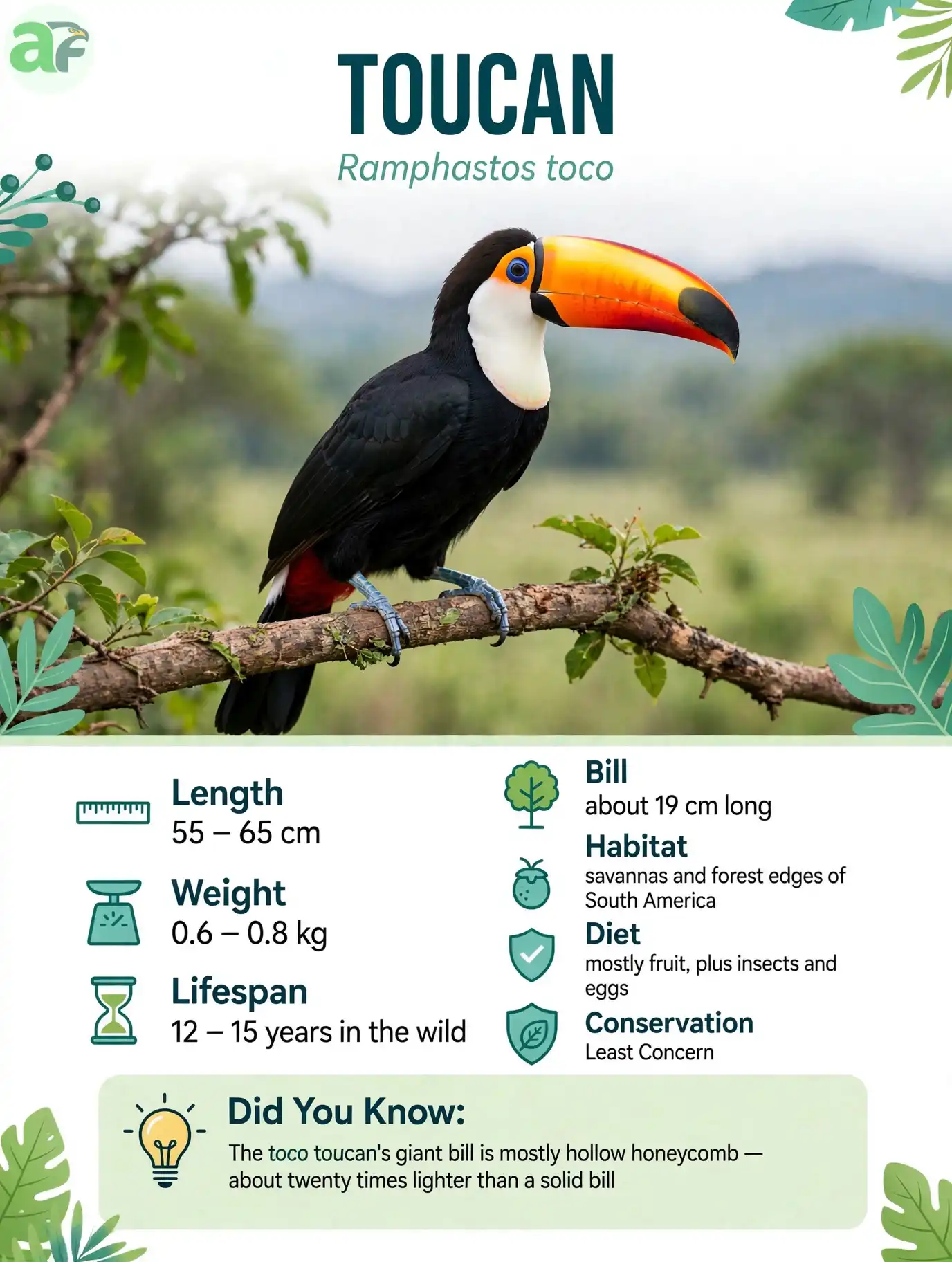
| Toco toucan | Least Concern | Stable/expanding | Largely stable; some hunting |
| Keel-billed toucan | Least Concern | Stable | Deforestation; some pet trade |
| Collared aracari | Least Concern | Stable | Deforestation |
| Emerald toucanet | Least Concern | Stable | Deforestation in some areas |
| Saffron toucanet | Near Threatened | Declining | Atlantic Forest loss |
| Plate-billed mountain toucan | Least Concern | Declining | Cloud forest loss |
| Yellow-browed toucanet | Critically Endangered | Decreasing | Montane forest loss; restricted range |
| Chestnut-tipped toucanet | Vulnerable | Decreasing | Cloud forest fragmentation |
| Spot-billed toucanet | Least Concern | Declining in some areas | Amazon deforestation |
The Yellow-Browed Toucanet — The Most Urgent Toucan Conservation Priority
The yellow-browed toucanet (Aulacorhynchus huallagae) of Peru is one of the rarest and most poorly known birds in South America:
The situation — Known from fewer than 10 locations in a restricted area of cloud forest in the departments of Huánuco and San Martín in central Peru. Population estimates suggest fewer than 1,000 individuals — and possibly far fewer. The species occupies a very narrow elevation band in a region experiencing significant deforestation.
The threat — Cloud forest in the yellow-browed toucanet’s range is being cleared for:
- Coffee and coca cultivation — small-scale agricultural clearing
- Cattle ranching — forest clearance for pasture
- Infrastructure development — road building opening previously remote forest to colonization
Conservation response — The Critically Endangered listing has generated some conservation attention — several NGOs and the Peruvian government’s SERNANP (protected areas authority) have initiated survey and protection programs. However, the species’ remote range and limited public profile have constrained conservation funding.
The Atlantic Forest Toucan Crisis
The Brazilian Atlantic Forest — where several toucan species occur as near-endemics — has lost approximately 85–88% of its original forest cover. The consequences for Atlantic Forest toucans:
The saffron toucanet (Pteroglossus bailloni) — Near Threatened; restricted to the southern Atlantic Forest; declining as forest fragments become smaller and more isolated.
The defaunation cascade — In Atlantic Forest fragments, toucans have declined significantly — and the ecological consequences are measurable:
- Large-seeded trees that toucans disperse are failing to regenerate in toucan-depleted forest fragments
- The plant community in toucan-absent fragments is shifting toward small-seeded species
- The loss of large trees cascades through the ecosystem — affecting the many species that depend on large tree structure
Major Threats Across the Family
| Threat | Description | Impact Level |
|---|---|---|
| Deforestation | Primary forest loss across the range; Atlantic Forest most severe | Critical |
| Hunting | Subsistence and commercial hunting for food and feathers | High in accessible areas |
| Pet trade | Wild capture for the domestic and international pet trade | High — particularly for larger species |
| Forest fragmentation | Isolation of forest patches below minimum viable habitat area | High for forest-interior specialists |
| Agricultural pesticides | Reducing insect prey availability; potential direct toxicity | Medium |
| Climate change | Shifts in fruit availability timing; cloud forest compression | Increasing concern |
| Nest predation increase | Elevated predation pressure in fragmented landscapes | Medium |
14. Famous Toucans in History & Pop Culture
Famous Individual Toucans
The Guinness Toucan (1935–present) — The most famous fictional toucan — and one of the most famous fictional birds — in commercial history. Created in 1935 by advertising artists John Gilroy and Dorothy L. Sayers for the Guinness Stout campaign, the toucan character — based on the toco toucan’s orange-and-black appearance — has been one of the most enduring advertising characters of the 20th century. The campaign’s pun-based humor (“Toucan play at that game,” “If he can say as you can, Guinness is good for you”) established both the advertising character and the association of “toucan” with sophisticated wordplay.
Toucan Sam (1963–present) — The Kellogg’s Froot Loops advertising character — a cartoon toucan with a multi-colored bill that changes color with each fruit flavor — is one of the longest-running cereal advertising characters in US history. Toucan Sam’s most famous tagline — “Follow your nose — it always knows” — has been one of the most recognized advertising phrases in American breakfast cereal marketing for over 60 years. Toucan Sam’s design is loosely based on the keel-billed toucan’s multi-colored bill.
“Zazu” in The Lion King (Disney, 1994) — While Zazu is a hornbill (an African bird, not a toucan), the character’s combination of a large, colorful bill, a dignified manner, and comedic displacement from his bill’s requirements draws on the general cultural archetype of the “large-billed bird” that the toucan has largely defined. The character demonstrates how the toucan’s bill has influenced the visual language of large-billed bird characters in animation globally.
Historical and Cultural Significance
The Tupi tucan — The word “toucan” itself is one of the few bird common names in English derived directly from an indigenous Amazonian language — the Tupi word tucan (or tucano) for the bird. The Tupi people of coastal Brazil were among the first indigenous Americans encountered by Portuguese explorers, and their word for the spectacular large-billed birds they shared their forest with passed directly into Portuguese and then into all major European languages.
The Aztec feather art — Aztec featherwork (amantecayotl) — one of the most sophisticated craft traditions in pre-Columbian Mesoamerica — used toucan feathers extensively in mosaic headdresses, shields, and ceremonial garments. The Aztec feather headdress (the quetzalapanecayotl) attributed to Moctezuma II and held in the Museum of Ethnology in Vienna incorporates feathers from multiple bird species including toucans alongside the more famous quetzal feathers. Toucan feathers appear in multiple surviving Aztec featherwork pieces held in European museums.
Jean de Léry’s 1558 description — The French Protestant minister and explorer Jean de Léry’s account of Brazil — Histoire d’un voyage faict en la terre du Brésil (1578, based on 1555–1556 observations) — contains one of the earliest and most vivid European descriptions of toucans. Léry described the bill with characteristic 16th-century amazement — comparing it favorably to the most remarkable natural wonders he had encountered. His account helped establish the toucan as one of the defining exotic novelties of the New World in European consciousness.
15. Role in Ecosystem & Food Chain
The Keystone Seed Dispersal Function
The large-seed niche — In Neotropical forests, the toucan occupies the large-seed dispersal niche that no other bird in the same size class can fill:
Why toucan dispersal is irreplaceable:
- Toucans swallow fruits with seeds up to 4 cm in diameter — beyond the capacity of most other forest birds
- Large-seeded fruits tend to come from large trees — the most structurally important trees in the forest
- Large seeds have high germination success rates when buried or protected by feces at the deposition site
- The toucan’s large home range ensures dispersal distances of 1–5 km — maintaining genetic connectivity between tree populations
The quantified dependency — Multiple research studies in the Atlantic Forest and Amazon have documented that specific plant species receive 50–90% of their seed dispersal from toucans. For these species, the toucan is effectively an obligate dispersal partner — the plant’s long-term survival at the landscape level depending on the toucan’s continued presence.
The defaunation cascade evidence — Research comparing plant communities in toucan-present versus toucan-absent forest fragments has documented measurable shifts:
- Toucan-absent fragments show reduced regeneration of large-seeded tree species
- Over decades, the plant community shifts toward smaller-seeded, toucan-independent species
- The structural complexity of the forest changes as large trees fail to replace themselves
The Pest Control Function
The insect consumption dimension — While fruit is the primary diet, toucan consumption of insects — particularly during breeding season — provides a regulatory function on forest insect populations.
The nest predation complexity — The toucan’s nest-raiding behavior creates an unusual ecological position — simultaneously a keystone positive function (seed dispersal) and a negative pressure on cavity-nesting bird populations. This dual role makes toucan ecology more complex than a simple “forest helper” narrative suggests.
The Food Web Position
As prey:
- Eggs and chicks consumed by tayras, snakes, and various raptors
- Adults taken by hawk-eagles and tayras
- Support of predator populations is an ecological service less frequently discussed than seed dispersal
As consumer:
- The toucan’s consumption of insects contributes to invertebrate regulation
- Nest-raiding affects cavity-nesting small bird populations
- Fruit consumption creates competitive interactions with other frugivores
16. Myths, Folklore & Cultural Significance
Indigenous Amazonian Traditions
The Desana cosmic toucan — Among the Desana people of the Colombian and Brazilian Amazon, the toucan occupies a specific cosmological position:
- The toco toucan’s call is interpreted as a message from the supernatural realm
- Toucan feathers used in specific ceremonial contexts associated with healing and shamanic practice
- The toucan’s bill associated with the shaman’s powers — the extraordinary bill representing supernatural capability
The Tupi creation traditions — Various Tupi-speaking groups of coastal and inland Brazil maintain creation narratives in which toucans played roles in establishing the current order of the natural world:
- The toucan’s colorful bill associated with the rainbow and with celestial phenomena in some traditions
- The bird’s association with forest fruit production embedding it in narratives about the forest’s abundance and sustaining capacity
The Kayapó toucan traditions — The Kayapó people of the Brazilian Amazon use toucan feathers extensively in the most important ceremonial contexts — the feathers representing specific spiritual associations that vary by species and color. The elaborate Kayapó ceremonies documented by anthropologists including Darrell Posey and various Brazilian researchers involve toucan feathers in headdresses and body decoration that connect the human and supernatural realms.
The Maya toucan symbolism — In Maya culture, the toucan (keel-billed toucan being the species of the Yucatán region) appears in ceramic art, carved stone, and various archaeological contexts:
- The toucan’s bill associated with solar deity imagery in some Maya artistic traditions
- Toucan images appear in Maya codices in contexts that suggest ritual or calendrical significance
The Bill as Symbol
The toucan’s bill has served as a universal symbol of abundance, exuberance, and tropical richness across cultures that have encountered the bird:
- European explorers and naturalists invariably described the bill as an example of nature’s extravagance — exceeding ordinary expectations of functional design
- The bill has been interpreted as evidence of divine creativity, of evolutionary excess, and of the tropics’ departure from European norms of biological modesty
- The symbolic weight of the bill — as a marker of tropical biological abundance — has made the toucan the default image for tropical rainforest in global popular culture
17. Toucans in Pop Culture
Toucan Sam (Kellogg’s, 1963–present) — One of the most enduring cereal mascot characters in American advertising history — Toucan Sam (the Froot Loops mascot) has appeared on cereal boxes for over 60 years. Sam’s multi-colored bill (changing color with each fruit flavor) draws on the keel-billed toucan’s natural bill coloration. The character’s signature line — “Follow your nose — it always knows” — is one of the most recognized advertising phrases in American breakfast culture.
Guinness Toucan (1935–present) — As described above — the most historically significant and most culturally embedded advertising toucan, whose 90-year longevity in Guinness advertising makes it one of the oldest surviving commercial advertising characters in Western marketing history.
The toucan in environmental branding — The toucan’s recognizability as a tropical rainforest symbol has made it one of the most frequently used images in environmental and conservation messaging — appearing on ecotourism materials, environmental organization logos, and conservation campaign graphics across the world.
Costa Rica tourism — The keel-billed toucan’s designation as the national bird of Belize and the prominence of various toucan species in Costa Rica’s extraordinary bird-watching tourism have made toucans the single most associated bird with Central American ecotourism — more recognizable in Costa Rica tourism marketing than any other single species.
“Up” (Pixar, 2009) — The colorful bird Kevin in Pixar’s animated film Up is based on a combination of bird features with significant toucan influence — the long, colorful bill and the tropical setting drawing on toucan visual characteristics. The character’s combination of large bill, vivid coloration, and surprising personality mirrors the toucan’s own combination of striking appearance and unexpected behavioral sophistication.
National Geographic and BBC documentary subjects — Toucans appear in virtually every comprehensive documentary treatment of Neotropical rainforest wildlife — their combination of visual appeal, behavioral interest (fruit-tossing, communal roosting), and ecological importance making them ideal documentary subjects. The BBC’s Planet Earth and Blue Planet series have featured toucan footage in the jungle and rainforest episodes.
18. Toucan Facts vs. Common Myths
| Common Myth | The Real Fact |
|---|---|
| “The toucan’s bill is primarily for eating” | Partially false — the 2009 discovery established that the bill’s primary function is thermoregulation — controlling body temperature by regulating blood flow through the bill surface. Feeding is a secondary function |
| “The toucan’s bill is very heavy” | False — the bill weighs approximately 1/40th of the bird’s body weight — extraordinarily light for its size due to the hollow protein foam matrix internal structure |
| “Toucans are related to parrots” | False — toucans belong to the order Piciformes and are most closely related to woodpeckers. Parrots are in the order Psittaciformes, which is actually more closely related to falcons |
| “Toucans can fly well over long distances” | Partially false — toucans are capable fliers over short distances but are not long-distance migrants or strong endurance fliers. Their short, rounded wings are adapted for canopy maneuvering rather than sustained flight |
| “The toucan’s bill is used for defense against predators” | Partially true — while the bill can be used defensively, it is not primarily a defensive weapon. The bill’s primary functions are thermoregulation, fruit manipulation, and social signaling |
| “All toucans look like the Froot Loops or Guinness toucan” | False — the iconic orange-billed black-and-white toco toucan is one of 45 toucan species. Many toucans are primarily green (emerald toucanets), or have complex banded patterns (aracaris), or are entirely different in appearance from the iconic image |
| “Toucans only eat fruit” | False — while fruit comprises approximately 85–90% of the diet, toucans also eat insects, eggs, nestlings, small vertebrates, and occasionally nectar. The nest-raiding behavior in particular is an underappreciated dietary component |
19. Best Places to See Toucans in the Wild
Central America — The Most Accessible Toucan Experiences
1. Arenal Volcano area, Costa Rica
The cloud forest and rainforest edges around Arenal Volcano support keel-billed toucans, collared aracaris, and emerald toucanets in highly accessible settings. The combination of excellent lodge infrastructure, professional naturalist guides, and high wildlife density makes the Arenal area one of the finest toucan-watching destinations globally. La Selva Biological Station (4 hours from San José) provides access to toco toucans alongside extraordinary general tropical bird diversity in a research station setting with excellent interpretation.
2. Manuel Antonio National Park, Costa Rica
The accessible Pacific-facing park supports multiple toucan species in a setting that combines beach and rainforest. Fiery-billed aracaris and yellow-throated toucans are regularly seen from park trails. The park’s small size and high visitor infrastructure make it one of the most accessible tropical wildlife parks in the Americas.
3. Boca Tapada, Costa Rica
The Caribbean lowlands around Boca Tapada support chestnut-mandibled toucans and keel-billed toucans alongside extraordinary general bird diversity — more than 400 bird species recorded in the area. Various lodges in the area offer specialist birding programs with exceptional toucan encounter rates.
South America — The Full Toucan Diversity
4. Manu National Park, Peru
The most biodiverse protected area in the world — Manu supports extraordinary toucan diversity including multiple Ramphastos species, various aracaris, and Andean mountain toucans at the park’s high-elevation sectors. The combination of lowland Amazon rainforest, cloud forest transition, and Andean puna in a single protected area supports more toucan species than any comparable area in South America.
5. Tambopata National Reserve, Peru
The Tambopata region near Puerto Maldonado in southeastern Peru — accessible via domestic flight from Lima — provides some of the most spectacular Amazon wildlife viewing available. Tambopata Research Center and adjacent lodges record multiple toucan species daily, with the giant river otters, macaw clay licks, and extraordinary mammal diversity providing a comprehensive Amazon wildlife experience alongside the toucans.
6. Iguazu Falls area, Brazil/Argentina
The extraordinary Iguazu Falls and surrounding Atlantic Forest supports toco toucans and saffron toucanets in one of the most dramatic settings in South America. Iguazu National Park (Brazil) and Iguazú National Park (Argentina) both support accessible toucan viewing along well-maintained walking trails. The combination of the falls’ drama and the Atlantic Forest wildlife makes this one of the most spectacular tourist destinations in South America.
7. The Pantanal, Brazil/Bolivia
The world’s largest tropical wetland — the Pantanal supports toco toucans at extraordinary densities in the riverside forest and gallery woodland. Toco toucans are arguably more easily and more repeatedly observed in the open Pantanal landscape than anywhere else in their range — the birds perching prominently in open trees along river banks and appearing at lodge feeders in many Pantanal accommodations.
The Lodge Feeder Recommendation
Many lodges throughout Costa Rica, Panama, Ecuador, and Brazil maintain fresh fruit feeding stations that reliably attract multiple toucan species to close range:
- Toco toucans at papaya feeders in the Pantanal and cerrado areas of Brazil
- Keel-billed toucans and aracaris at feeders in Costa Rica’s Arenal and Caribbean lowland lodges
- Mountain toucans at fruit feeders in Ecuadorian cloud forest lodges
Fruit-feeder toucan encounters allow the closest observation and the best photography opportunities available for these birds — and the behavioral observations (fruit-tossing, bill-fencing, dominance interactions at the feeder) provide extraordinary insights into toucan social behavior.
20. How You Can Help
Supporting toucan conservation requires action focused on forest protection, hunting reduction, pet trade elimination, and support for conservation organizations working in the critical habitats where toucans occur.
Support these organizations:
- American Bird Conservancy — abcbirds.org — comprehensive Neotropical bird conservation including Atlantic Forest programs directly benefiting toucans
- SAVE Brazil — savebrasil.org.br — Brazil’s premier bird conservation organization; Atlantic Forest conservation programs protecting saffron toucanets and other threatened toucans
- Rainforest Trust — rainforesttrust.org — funds purchase and protection of primary forest in the Amazon and Atlantic Forest
- World Land Trust — worldlandtrust.org — land purchase for conservation; protects forest habitat critical for toucans across the Neotropics
- Fundación ProAves (Colombia) — proaves.org — Colombia bird conservation including cloud forest protection for mountain toucans
- ACTP (Association for the Conservation of Threatened Parrots) — while focused on parrots, operates in areas of critical importance for toucans; cloud forest conservation programs
- Tompkins Conservation — tompkinsconservation.org — land protection in Atlantic Forest and Andes
Critical individual actions:
Never purchase wild-caught toucans — The illegal wildlife trade in toucans is sustained by consumer demand for exotic pets. Wild-caught toucans suffer high mortality during capture, transport, and captivity. Refusing to purchase wild-caught birds — and reporting suspected illegal wildlife trade to IBAMA (Brazil) or equivalent national wildlife authorities — directly reduces demand driving the trade.
Choose deforestation-free products — Products sourced from Atlantic Forest or Amazon deforestation drive the primary threat to toucan habitat. Choosing beef, soy, and coffee certified as deforestation-free reduces the commercial demand driving forest clearance.
Support Neotropical ecotourism — Visiting lodges and reserves that protect toucan habitat generates economic value for conservation. Choosing wildlife-focused lodges in Costa Rica, Brazil, Peru, and Ecuador, and tipping local naturalist guides generously, supports the communities whose livelihoods make forest protection economically viable.
Plant native fruit trees — In areas of Brazil, Costa Rica, Panama, and other range countries, planting native fruit trees in gardens, farms, and restored areas creates habitat and food sources for urban and rural toucan populations. Organizations including SAVE Brazil provide native plant species guidance for bird-friendly landscaping.
Participate in citizen science — Submitting toucan sightings to eBird during travel in tropical Americas contributes to the population distribution monitoring that identifies conservation priorities and measures the impact of forest loss on toucan populations.
21. Top Documentaries & Books
Must-Watch Documentaries
“Planet Earth II — Jungles” (BBC, David Attenborough, 2016) — The jungle episode features exceptional toucan content including fruit-tossing behavior and canopy foraging footage of extraordinary quality. The technical achievement of filming toucan canopy behavior in the controlled conditions needed for the BBC’s 4K production standard makes this one of the finest toucan documentary sequences available.
“Wild Brazil” (BBC, 2014) — Various episodes of this BBC Brazil natural history series feature toco toucan content in the cerrado and Pantanal settings — the open landscape facilitating filming quality unavailable in the dense Amazon canopy.
“Colombia: Wild Magic” (Netflix, 2015) — The Colombian cloud forest segments feature mountain toucans in the extraordinary Andean setting — some of the finest cloud forest toucan documentary footage available.
“Costa Rica: Paradise Recovered” (various productions) — Multiple Costa Rican wildlife documentary productions feature keel-billed toucans and aracaris in accessible Caribbean and Pacific slope settings.
Must-Read Books
Toucans, Barbets and Honeyguides by Lester Short and Jennifer Horne (Bird Families of the World series, 2002) — The definitive scientific monograph on the Ramphastidae and related families; comprehensive coverage of all toucan species with detailed ecological and behavioral information.
A Field Guide to the Birds of Costa Rica by F. Gary Stiles and Alexander Skutch — The standard field guide for Costa Rican birds including comprehensive toucan coverage; essential for visitors to Costa Rica’s exceptional toucan populations.
Birds of Peru by Thomas Schulenberg and colleagues — Comprehensive Peruvian field guide including coverage of the critically endangered yellow-browed toucanet.
The Birds of South America: Volume I by Robert Ridgely and Guy Tudor — The comprehensive scientific reference for South American bird identification including all toucan species.
Neotropical Birding (journal) — The primary academic journal for Neotropical bird conservation science; regularly publishes toucan ecology and conservation research.
22. Comparison of Major Toucan Species
| Feature | Toco Toucan | Keel-billed Toucan | Collared Aracari | Emerald Toucanet | Plate-billed Mountain Toucan |
|---|---|---|---|---|---|
| Scientific name | Ramphastos toco | Ramphastos sulfuratus | Pteroglossus torquatus | Aulacorhynchus prasinus | Andigena laminirostris |
| Body length | 63 cm | 55 cm | 40 cm | 34 cm | 48 cm |
| Bill length | 23 cm — orange | 12 cm — multi-color | 9 cm — patterned | 8 cm — green-yellow | 14 cm — complex pattern |
| Body plumage | Black/white | Black/yellow | Black/red-yellow banded | Bright green | Brown/blue/yellow/red |
| Weight | 680 g | 380 g | 230 g | 165 g | 400 g |
| Habitat | Open forest; edge; urban | Lowland forest | Lowland forest; edge | Cloud forest | Andean cloud forest |
| Altitude | 0–1,750 m | 0–1,500 m | 0–2,000 m | 1,000–3,000 m | 1,500–3,000 m |
| Conservation | Least Concern | Least Concern | Least Concern | Least Concern | Least Concern (declining) |
| Range | E. South America | Mexico to Venezuela | Mexico to Ecuador | Mexico to Bolivia | Colombia, Ecuador |
| Famous for | Iconic orange bill; thermoregulation discovery; most recognized toucan | Rainbow bill; national bird Belize | Common; accessible | Green camouflage; cloud forest | Complex plumage; Andean |
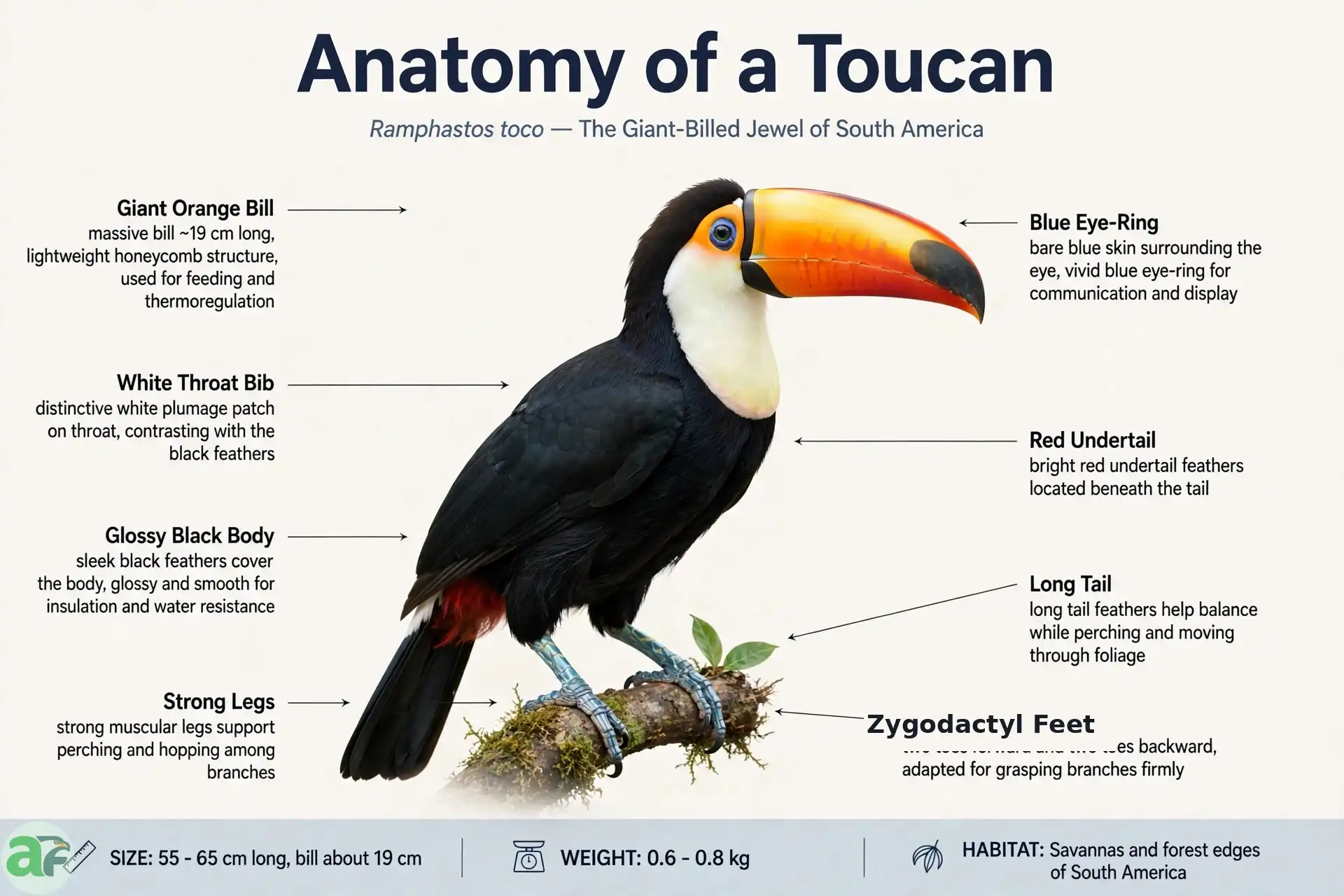
23. Frequently Asked Questions About Toucans
Q1. What is the scientific name of the toucan and what does it mean?
The family Ramphastidae takes its name from the type genus Ramphastos — established by Linnaeus in 1758. The genus name derives from the Greek rhamphos (curved beak or bill) — a reference to the toucan’s most immediately striking feature. The species name of the most famous member, the toco toucan, is Ramphastos toco — toco being an anglicization of the Tupi/Guaraní word tucano or toco for the bird. The common name “toucan” follows the same derivation — from the Portuguese tucano, which adopted the indigenous Tupi name tucan for the bird. The Tupi word may derive from the sound of the call, from a word meaning “bone” in reference to the bill, or from a Tupi term for the bird that has no direct translation to European languages. This makes “toucan” one of the few English common bird names that is directly and unambiguously derived from an indigenous Amazonian language — the Tupi contribution to global bird nomenclature being one of the most significant indigenous language impacts on world ornithological vocabulary. The keel-billed toucan (Ramphastos sulfuratus) — the national bird of Belize — has a species name meaning “sulfurous” (from Latin sulphur) — referring to the yellow coloring of parts of its plumage and bill.
Q2. What is the actual function of the toucan’s enormous bill?
This question has a surprising answer that most people don’t expect: the primary function of the toucan’s enormous bill is thermoregulation — controlling the bird’s body temperature — rather than feeding. This was established in a landmark 2009 study published in Science by Glenn Tattersall, Denis Andrade, and Augusto Abe, who used infrared thermography to measure the temperature of the toco toucan’s bill surface under different conditions. The bill’s surface temperature varied dramatically — up to 10°C — as the bird regulated blood flow through the dense network of blood vessels just below the bill’s surface. When the bird needed to cool down, blood flow to the bill increased, radiating heat through the bill surface (like a car radiator). When the bird needed to retain heat (during sleep), blood flow decreased, reducing heat loss. The bill can radiate between 25% and 400% of the bird’s total metabolic heat production — an extraordinary range of thermoregulatory capacity for a single body structure. The bill does function in feeding — the length and precision allowing fruit plucking from thin branches, and the serrated edges facilitating fruit manipulation. But feeding was not the primary selective pressure that drove the bill’s extreme size — thermoregulation is considered the more likely primary evolutionary driver. This discovery overturned one of ornithology’s most confidently held assumptions about the bill’s function — a reminder that even the most studied and most “obvious” biological features can have primary functions that aren’t immediately apparent.
Q3. Are toucans related to parrots?
Toucans are not closely related to parrots — despite superficial similarities including fruit-eating habits, vivid coloration, and the zygodactyl foot arrangement (two toes forward, two backward). Toucans belong to the order Piciformes — which includes woodpeckers, puffbirds, jacamars, and barbets. Parrots belong to the order Psittaciformes — which is actually more closely related to falcons (Falconiformes) than to Piciformes. The two groups last shared a common ancestor approximately 60–70 million years ago — far earlier than the common ancestor of toucans and woodpeckers. The similarity between toucans and parrots reflects convergent evolution — two unrelated lineages independently evolving similar characteristics (fruit-eating, vivid coloration, zygodactyl feet, cavity nesting) in response to similar ecological pressures. The toucan’s closest relatives within Piciformes are the barbets — colorful, medium-sized fruit-eating birds of Africa, Asia, and the Neotropics that occupy ecological roles similar to toucans in their respective regions.
Q4. How do toucans eat with such a large bill?
The toucan’s eating technique is specifically adapted to the bill’s extraordinary length — the bird cannot simply place food into its mouth the way a short-billed bird does. Instead, the toucan uses a forward-toss technique: the bird picks up a food item (usually a fruit) with the very tip of the bill, then tilts its head sharply backward (sometimes nearly vertical), and tosses the item backward into the throat. Gravity and inertia carry the food item from the bill tip to the throat without requiring the item to traverse the entire bill length. This technique allows the bird to process food items that are considerably larger than the bill’s gape would otherwise permit. Inside the bill, the serrated edges (tooth-like projections on the bill’s cutting surface) function as grips — holding the fruit item while the bird works it into position for the backward toss. The tongue — which is quite short relative to the bill length (reaching only about one-third of the bill’s internal length) — manipulates the food item with help from the barb-like fringes at the tongue’s tip. This combination of serrated gripping edges, head-tilt-and-toss technique, and short but agile tongue allows the toucan to efficiently process a wide range of fruit sizes despite the biomechanical challenge of the bill’s extreme length.
Q5. Where is the best place to see toucans in the wild?
The best places to see toucans depend on which species you want to observe and where you are traveling. For the most accessible toucan experience — multiple species at close range — fruit-feeder stations at lodges throughout Costa Rica (Arenal area), Panama, and Brazil provide extraordinary close-range encounters. The Pantanal of Brazil offers toco toucans at extraordinary density in the open riverside woodland — the most reliably productive single-species toucan viewing anywhere in South America. For maximum species diversity, the Manu National Park in Peru provides access to more toucan species in a single area than anywhere else in the world — lowland Amazonian species alongside cloud forest toucanets and mountain toucans in the park’s elevation gradient. For the specific combination of toucan viewing and general tropical wildlife experience that most international ecotourists seek, Costa Rica remains the most accessible destination — the keel-billed toucan, collared aracari, and emerald toucanet are reliably observed at virtually every quality wildlife lodge, the lodge infrastructure is exceptional, and the country’s strong environmental protection framework ensures the habitat quality that makes wildlife viewing productive. The key practical advice across all destinations: bring a good pair of binoculars (8×42 or 10×42), be active at dawn and dusk when toucans are most active, and ask local guide recommendations for the most productive current spots — local knowledge of fruiting trees and recent sightings dramatically improves encounter rates.
24. Sources & References
- Wikipedia — Ramphastidae, Ramphastos toco, Ramphastos sulfuratus, Pteroglossus, Aulacorhynchus huallagae
- IUCN Red List — iucnredlist.org (current assessments for all major toucan species)
- BirdLife International — birdlife.org (species factsheets; population assessments)
- Tattersall, G.J., Andrade, D.V., and Abe, A.S. (2009) — “Heat Exchange from the Toucan Bill Reveals a Controllable Vascular Thermal Radiator.” Science — the landmark thermoregulation discovery paper
- Seki, Y., Schneider, M.S., and Meyers, M.A. (2005) — published research on toucan bill mechanical properties and foam-matrix composite structure
- National Geographic — nationalgeographic.com
- BBC Wildlife / BBC Earth — bbcearth.com
- Britannica — britannica.com/animal/toucan
- Cornell Lab of Ornithology — allaboutbirds.org (species accounts; Macaulay Library; eBird data)
- SAVE Brasil — savebrasil.org.br (Atlantic Forest toucan conservation documentation)
- Stiles, F.G. and Skutch, A.F. — A Guide to the Birds of Costa Rica (field reference)
- Short, L.L. and Horne, J.F.M. — Toucans, Barbets and Honeyguides (Oxford University Press) — scientific monograph