
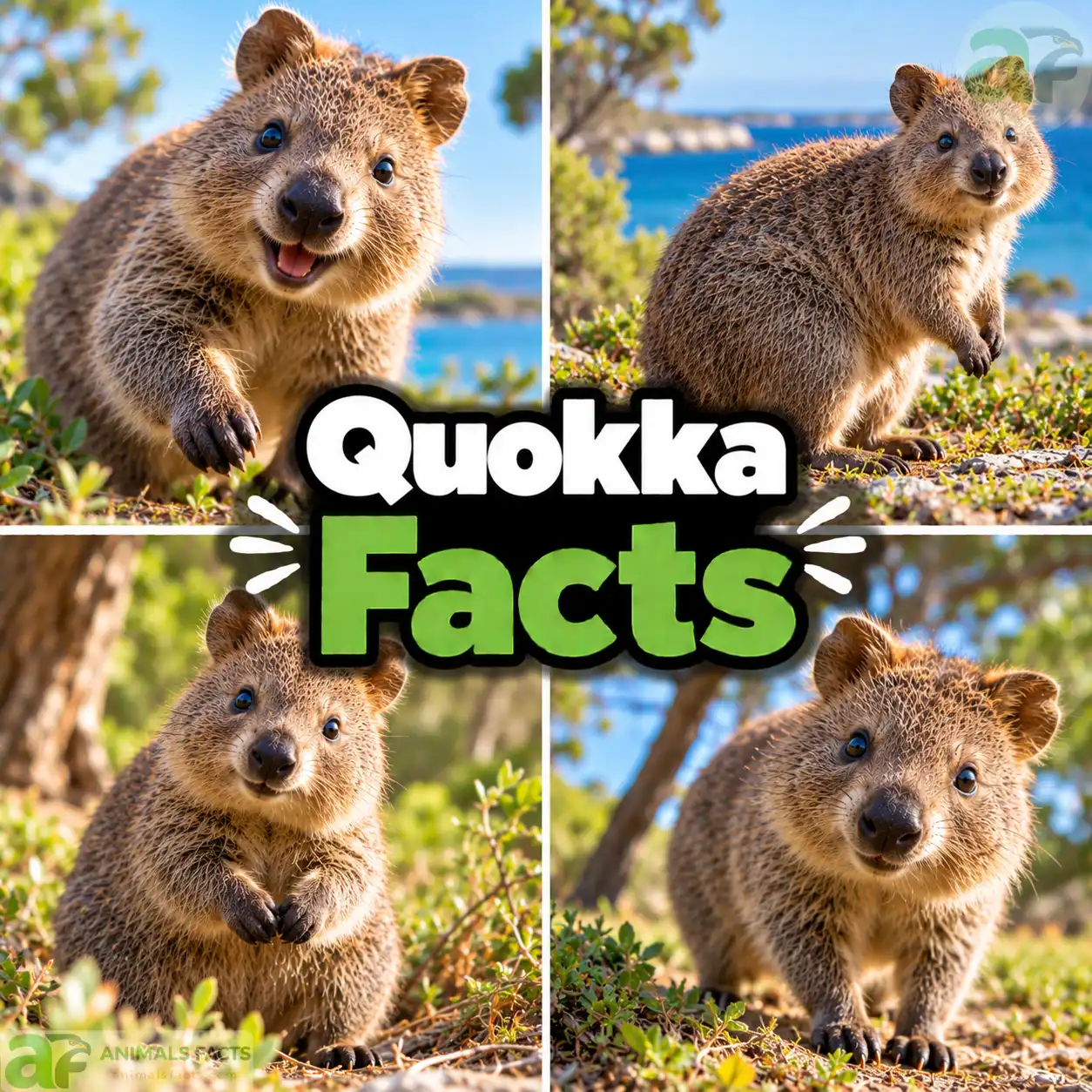
Quokka Facts
| Feature | Details |
|---|---|
| Scientific Name | Setonix brachyurus (Quoy & Gaimard, 1830) |
| Kingdom | Animalia |
| Phylum | Chordata |
| Class | Mammalia |
| Infraclass | Marsupialia |
| Order | Diprotodontia |
| Family | Macropodidae |
| Common Names | Quokka, short-tailed scrub wallaby |
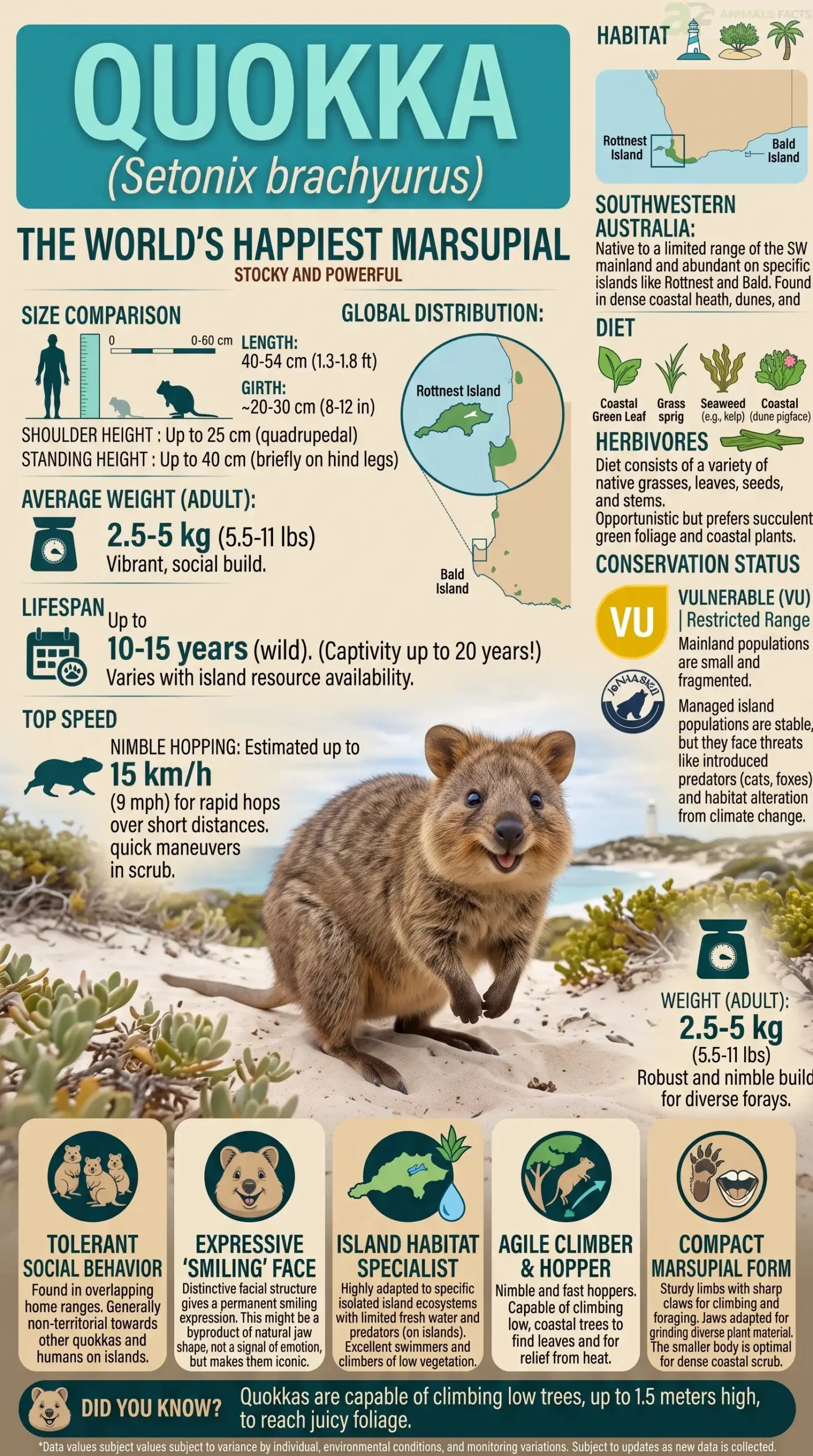
| Native Range | Southwestern Australia — primarily Rottnest Island and Bald Island; small mainland populations |
| Habitat | Dense coastal scrub, heath, swamps, forest edges |
| Lifespan | 10 years (wild average); up to 15 years (captivity) |
| Diet | Grasses, leaves, stems, bark, succulents — exclusively herbivorous |
| Body Length | 40–54 cm body plus 25–30 cm tail |
| Height | 20–30 cm at shoulder |
| Weight | 2.5–5 kg — roughly the size of a domestic cat |
| Top Speed | Up to 45 km/h in short bursts |
| Conservation Status | Vulnerable (IUCN) — declining mainland population |
| Defining Feature | Facial expression — the distinctive upturned mouth that produces the appearance of a perpetual smile |
| Social Media Fame | The “quokka selfie” phenomenon — one of the most photographed animals in Australian wildlife tourism |
 1. Introduction: What is a Quokka?
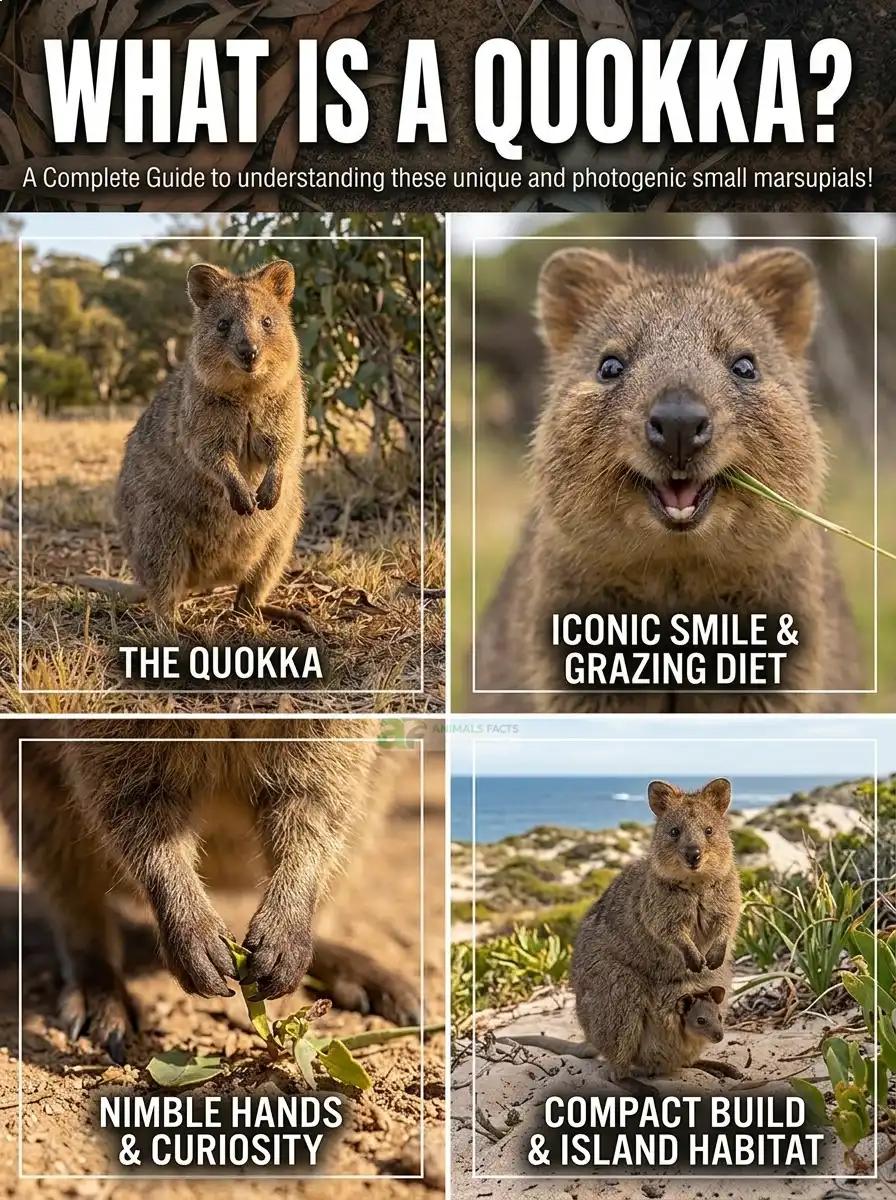
On a sun-drenched island off the coast of Western Australia, a small, round-faced marsupial waddles with unhurried confidence toward a group of tourists — pausing to regard them with what appears to be an expression of such uncomplicated, radiant happiness that the tourists immediately reach for their phone cameras. The animal presents its face to the lens with the apparent ease of a creature utterly at peace with itself and the world, its dark eyes bright, its rounded ears tilted forward, its mouth curved in what is unmistakably — if anatomically rather than emotionally — a smile. Quokka facts begin with this single, globally iconic image — the animal the internet has repeatedly voted “the world’s happiest animal”, whose selfie with a tourist became one of the most shared wildlife photographs in social media history, and whose genuine biological story is even more extraordinary than the viral fame that brought it to global attention.
The quokka is a small macropod — related to kangaroos and wallabies — that has achieved the remarkable feat of becoming one of the world’s most recognized and most beloved wild animals through a combination of facial anatomy, behavioral confidence, and an accidental collision with the smartphone era on a small Australian island where predators are absent and tourists are plentiful. But interesting facts about quokkas reveal an animal whose story extends far beyond photogenic charm — a species with a genuinely extraordinary reproductive biology that allows females to maintain two joeys at different developmental stages simultaneously, remarkable metabolic efficiency that allows survival in environments with limited fresh water through extraction of moisture from food, a social structure more complex than their reputation as “happy wanderers” suggests, and a mainland conservation crisis that stands in stark contrast to the thriving island population that has made the species globally famous.
Whether you are searching for quokka facts for kids to explore the science of marsupial biology and island ecology, a wildlife traveler planning a visit to Rottnest Island to experience the quokka selfie phenomenon for yourself, a conservation enthusiast wanting to understand the genuine threats facing this Vulnerable species on the Australian mainland, or simply someone who saw a quokka smile in a photograph and needed to understand everything about this extraordinary animal — this is your comprehensive guide. We cover quokka scientific name, quokka diet, quokka size and weight, quokka behavior, the remarkable reproductive biology of diapause, conservation status, cultural significance, and everything else that makes the world’s happiest-looking animal one of Australia’s most fascinating wildlife stories. The smiling marsupial awaits.
2. Quokka Species Overview & Classification
The quokka belongs to the family Macropodidae — the kangaroos and wallabies — and occupies a taxonomically distinctive position as the sole member of the genus Setonix, a lineage with no close living relatives within the macropod family.
Species Classification Table
| Taxonomic Rank | Classification |
|---|---|
| Kingdom | Animalia |
| Phylum | Chordata |
| Class | Mammalia |
| Infraclass | Marsupialia |
| Order | Diprotodontia |
| Family | Macropodidae |
| Genus | Setonix (Gray, 1837) |
| Species | S. brachyurus (Quoy & Gaimard, 1830) |
| Common Names | Quokka, short-tailed scrub wallaby |
| Etymology | Setonix = “bristle-claw” (Greek); brachyurus = “short-tailed” (Greek) |
| Sister Genus | Thylogale (pademelons) — most closely related macropod genus |
| Taxonomic Status | Monotypic genus — the only species in Setonix |
Position Within Macropodidae
The quokka belongs to the family that contains all kangaroos, wallabies, tree kangaroos, and related species:
| Subfamily | Representative Species | Relationship to Quokka |
|---|---|---|
| Macropodinae | Red kangaroo, Eastern grey kangaroo | Distant relatives |
| Sthenurinae | Extinct giant short-faced kangaroos | Extinct relatives |
| Lagostrophinae | Banded hare-wallaby | Moderately related |
| Potoroinae | Bettongs, potoroos, rat-kangaroos | Distant relatives |
Naming History
The name “quokka” derives from the Noongar Aboriginal language of southwestern Australia — the Indigenous people who inhabited the Rottnest Island and Perth coastal region. The Noongar word gwaga (sometimes transliterated as quoka or kwoka) was adopted into English by early European settlers — one of the relatively few cases where an Australian animal’s English common name derives directly from an Aboriginal language without modification.
Evolution & Discovery Timeline
~15–20 million years ago — The macropod family (Macropodidae) begins its radiation in Australia — the lineage that will eventually produce kangaroos, wallabies, and quokkas diverging from the broader marsupial fauna during the Miocene.
~3–5 million years ago — The quokka lineage is estimated to have diverged from its closest macropod relatives — the pademelons (Thylogale species) — based on molecular clock estimates from genetic studies.
~40,000–65,000 years ago — Indigenous Noongar peoples begin inhabiting the southwestern Australian coastline — establishing the first human relationship with quokkas across the species’ ancestral range.
1696 — Dutch explorer Willem de Vlamingh becomes the first European to formally document quokkas during his voyage to the southwestern Australian coast. De Vlamingh’s crew, encountering quokkas on what is now Rottnest Island, initially believed them to be giant rats — naming the island Rotte Nest (Dutch for “Rat’s Nest”) — the origin of Rottnest Island’s name still used today. This misidentification was one of history’s most consequential taxonomic errors — giving an island its permanent name based on a marsupial that the Dutch didn’t recognize as anything other than a very large rodent.
1830 — French naturalists Jean René Constant Quoy and Joseph Paul Gaimard formally describe the quokka scientifically as Didelphis brachyura — the binomial subsequently revised to Setonix brachyurus as the genus was established.
1831 — The genus Setonix is established by John Edward Gray — recognizing the quokka as sufficiently distinct from other macropods to warrant its own genus.
1980s — Systematic ecological research on Rottnest Island quokka populations begins providing the first comprehensive data on quokka biology, behavior, and reproductive ecology.
2010s — The “quokka selfie” phenomenon emerges on social media — accelerating dramatically through Instagram and Facebook from approximately 2012 onward — making quokkas one of the most photographed animals in Australian wildlife tourism and generating global public awareness of the species.
2015 — The quokka achieves global viral fame through celebrity quokka selfies — including widely shared photographs by athletes at the Tour de France and various celebrities visiting Rottnest Island — bringing the species to the attention of audiences on every continent.
2024 — Updated population assessments confirm continued mainland quokka population declines while Rottnest Island population remains stable — maintaining the species’ Vulnerable IUCN conservation status.
“The quokka is one of those extraordinary Australian animals that manages to be simultaneously ecologically fascinating, reproductively remarkable, and apparently incapable of looking anything other than delighted about everything. It is a genuinely wonderful animal — and the fact that its mainland populations are declining while its island populations attract global celebrity is one of conservation’s most poignant current stories.”
— Dr. Chris Johnson, Professor of Wildlife Conservation, University of Tasmania, and leading authority on Australian marsupial conservation
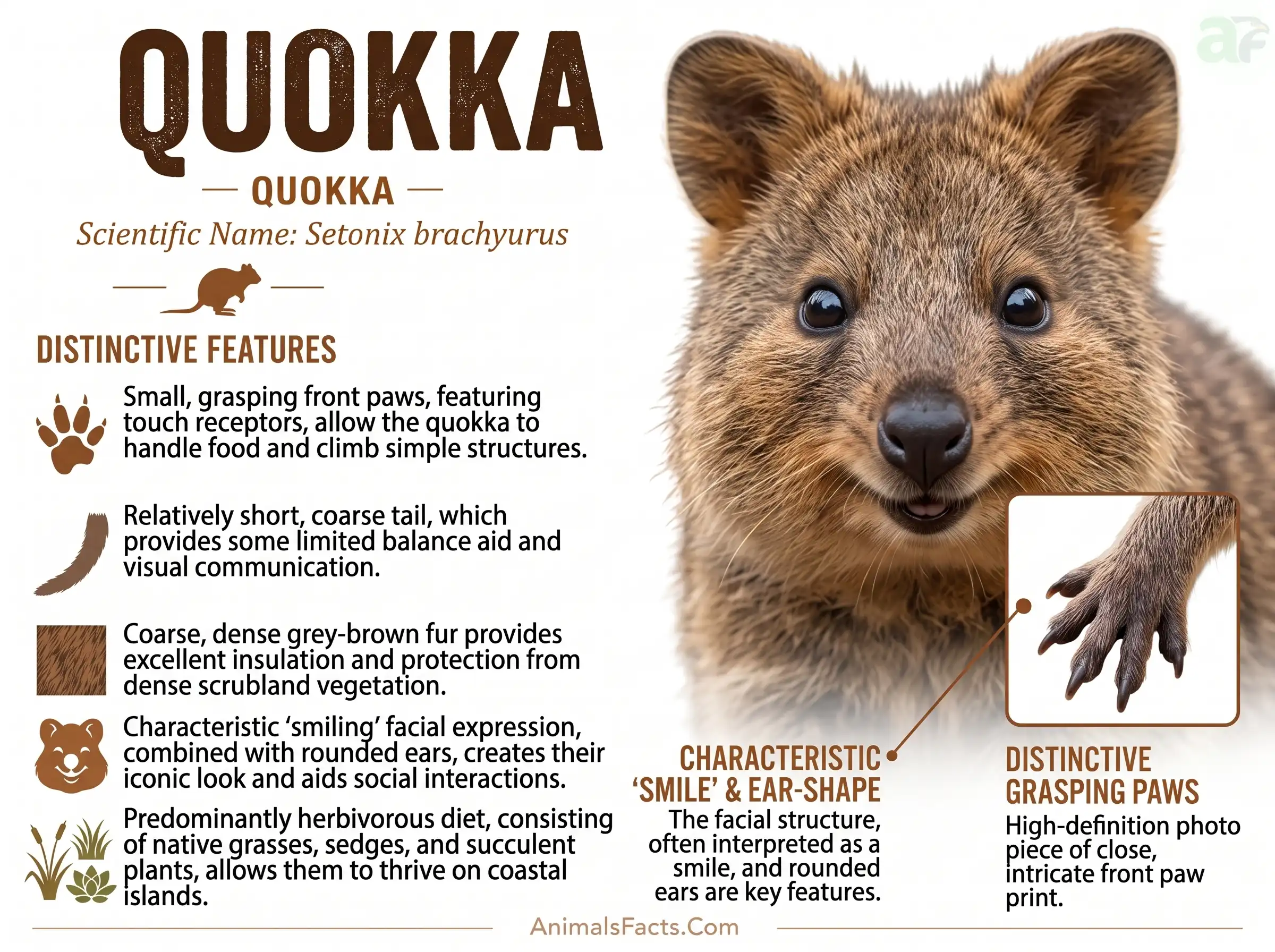
3. Quokka Physical Description & Unique Features
Quokka size and weight place it in the small-to-medium range of macropods — roughly cat-sized at 2.5–5 kg — with a distinctive physical appearance that combines the general macropod body plan with specific features that give quokkas their immediately recognizable, globally famous look.
The Face — The Source of the Smile
The quokka’s most immediately distinctive feature — and the source of its global fame — is its facial expression. The combination of several anatomical features creates the appearance of a perpetual, cheerful smile:
Upturned mouth corners — The quokka’s jaw muscles and the arrangement of the skin around the mouth produce a natural upward curve at the corners of the mouth — a structural feature that creates the smile appearance regardless of the animal’s actual emotional state. This is analogous to the way certain dog breeds appear to “smile” due to jaw anatomy rather than genuine emotional expression.
Short, broad muzzle — Unlike the elongated, narrow faces of many macropods (kangaroos, wallabies), the quokka has a relatively broad, rounded face with a shorter muzzle — giving it a more compact, “cute” facial profile that humans instinctively find appealing.
Relaxed facial muscles at rest — The quokka’s resting facial expression involves relaxed jaw and cheek muscles that, combined with the upturned mouth anatomy, produces the characteristic expression. In contrast, stressed or frightened quokkas show distinctly different expressions — but these are far less commonly photographed.
Large, dark, forward-facing eyes — Relatively large dark eyes positioned with reasonable binocular overlap give the quokka an alert, bright-eyed expression that reinforces the positive facial impression.
Round, forward-tilted ears — The ears are moderate-sized and tend to tilt slightly forward when the animal is relaxed and curious — reinforcing the attentive, friendly expression.
Body Form
Beyond the face, the quokka has a body form that reflects its macropod heritage with some distinctive modifications:
Compact, rounded body — The quokka is substantially rounder and more compact than most macropods of comparable body weight — with a stockier build that gives it a somewhat different silhouette from the lean, long-limbed kangaroo body plan.
Short tail — The name “short-tailed scrub wallaby” is directly descriptive — the quokka’s tail is proportionally shorter than most macropod tails, and is also thicker and less tapered than a wallaby’s. The tail is a fat storage organ — thickening when food is abundant and thinning when resources are scarce.
Small forelimbs — Like all macropods, the quokka’s forelimbs are much smaller than the hindlimbs — used primarily for grooming, feeding manipulation, and postural balance rather than locomotion.
Powerful hindlimbs — The hindlimbs are proportionally large and muscular — providing the hopping locomotion that allows quokkas to move at speeds up to 45 km/h when necessary, though they typically move at a much slower, more relaxed pace in the predator-free Rottnest Island environment.
Fur
The quokka’s fur is coarse-textured, greyish-brown to sandy brown on the back and sides, with paler brown to buff on the underparts and face. The fur texture is less dense than many Australian marsupials — reflecting adaptation to the warm coastal climate of the quokka’s primary range.
Pouch
Female quokkas have a forward-opening pouch — typical of the macropod family — with four nipples. The pouch is well-developed and extends significantly during joey development.
💡 Did You Know? The quokka’s facial anatomy that creates the famous “smile” has been analyzed by multiple animal behavior scientists and anatomists who have confirmed that the expression is entirely structural rather than emotional. The quokka does not experience happiness in the way humans project onto its expression — it simply has a jaw and muscle arrangement that produces an upturned mouth curve regardless of mood. However, the behavioral reality is arguably more interesting than the emotional projection — quokkas on Rottnest Island show genuinely reduced fear responses to humans compared to mainland populations, approaching tourists with what appears to be curiosity and confidence rather than the wariness typical of wild animals encountering humans. This behavioral confidence — combined with the structural smile — creates the overall impression of a spectacularly sociable and contented animal.
4. Top 25 Amazing Quokka Facts
Here is your definitive collection of the most extraordinary, scientifically verified, and genuinely astonishing quokka facts as of 2026:
- The quokka is frequently described as the “world’s happiest animal” — a title that reflects the species’ famous upturned mouth expression rather than any scientific measurement of animal happiness, but that has made it one of the most recognized animals on earth through social media.
- Rottnest Island — the quokka’s most famous habitat — was named after quokkas by Dutch explorer Willem de Vlamingh in 1696 — who mistook the animals for giant rats and called the island Rotte Nest (Dutch for “Rat’s Nest”), a name that has persisted for over 325 years.
- Female quokkas possess a remarkable reproductive superpower called embryonic diapause — maintaining a dormant embryo in suspended development simultaneously with a joey developing in the pouch — allowing them to produce offspring in rapid succession when environmental conditions are favorable.
- Quokkas can extract water from the leaves and plant matter they consume — allowing them to survive for extended periods without access to fresh drinking water in some parts of their range. This metabolic efficiency was critical for survival on Rottnest Island where fresh water has historically been extremely limited.
- The quokka is the sole member of its genus Setonix — a monotypic genus with no close living relatives, reflecting the quokka’s significant evolutionary distinctiveness within the macropod family.
- Quokkas are primarily nocturnal — spending the hot daylight hours resting in the shade of dense vegetation and foraging primarily during the cooler night and early morning hours. The sociable, visible quokkas that tourists photograph at Rottnest Island are largely showing daytime behavior induced by the availability of human-provided food — behavior that diverges from the species’ natural activity pattern.
- The Rottnest Island quokka population of approximately 12,000–13,000 individuals represents a conservation paradox — while thriving in the island’s predator-free environment, this population’s success has somewhat masked the catastrophic decline of mainland quokka populations, which have been reduced by the introduction of foxes and cats.
- A quokka joey is born after a gestation of approximately 27 days — weighing approximately 0.3 grams at birth — and completes development in the mother’s pouch over approximately 190 days before first emerging.
- Quokkas demonstrate genuinely extraordinary maternal behavior during extreme stress — females have been documented dropping joeys from the pouch when pursued by predators — not (as commonly portrayed) to distract predators with the joey, but because the joey’s distress calls and movements while falling cause the predator to pursue the joey rather than the mother. This brutal but effective survival mechanism has been widely misrepresented in popular media.
- The quokka’s metabolic water efficiency has been studied by researchers interested in extreme water conservation biology — the species can reduce water loss during hot periods by entering a state of reduced activity, reducing respiratory water loss while remaining capable of rapid response to threats.
- Quokkas have been observed climbing trees — an unusual behavior for a ground-dwelling macropod — to access leaves and shoots up to 1.5 meters above the ground. This arboreal foraging behavior, while not their primary feeding mode, demonstrates dietary flexibility.
- The “quokka selfie” phenomenon has become one of the most commercially significant wildlife tourism developments in Western Australia’s recent history — with Rottnest Island visitor numbers substantially increasing since quokka selfies began trending on social media, generating millions of dollars in tourism revenue for Western Australia annually.
- Quokkas are legally protected in Australia under the Wildlife Conservation Act 1950 — it is illegal to touch, handle, or feed quokkas without appropriate permits. Fines of up to $50,000 can be issued for deliberately harming a quokka on Rottnest Island.
- Despite their friendly appearance, quokkas can and do bite — particularly when approached too quickly, cornered, or when human food is involved. Quokka bites are not venomous or dangerous, but can be sharp and surprising to tourists who assume the animals are tame.
- The mainland quokka population — once distributed across a much larger area of southwestern Australia — has been reduced to small, isolated patches in the Stirling Range, the Jarrah Forest, and a few other locations following the introduction of European red foxes and domestic cats, which proved catastrophically effective predators of this ground-dwelling marsupial.
- Quokkas demonstrate complex home range behavior on the mainland — maintaining overlapping territories with a complex social hierarchy that is substantially different from the more relaxed, high-density coexistence observed in the predator-free Rottnest Island environment.
- The quokka’s teeth grow continuously throughout its life — an adaptation to the coarse, abrasive vegetation that forms the primary diet, and typical of herbivorous marsupials consuming high-silica plant material.
- Multiple celebrity quokka selfies have gone viral — athletes, actors, politicians, and public figures photographed with smiling quokkas on Rottnest Island have collectively generated media coverage reaching audiences of billions, making the quokka one of the most effectively ambassadorial animals in global wildlife awareness history.
- Quokkas on Bald Island — the second significant quokka island population near Albany in Western Australia — represent a completely separate population from the Rottnest Island animals, providing important genetic diversity insurance for the species’ long-term survival.
- The quokka’s digestive system is adapted for extracting maximum nutrition from low-quality, fibrous vegetation — it can re-ingest fecal pellets (coprophagy) — a behavior shared with many herbivorous mammals that allows a second pass of food through the digestive system to extract nutrients missed on the first pass.
- Quokkas are capable of surviving up to a month without food in emergency situations — relying on fat stores in the tail and reduced metabolic rate to bridge periods of food scarcity that would be fatal to many small mammals of equivalent size.
- On Rottnest Island, quokkas have been documented learning to use human structures — the tunnels, culverts, and buildings of the island’s tourist infrastructure — as shade shelters and movement corridors that replicate the dense vegetation cover they would use in natural habitat.
- The quokka’s social tolerance on Rottnest Island — where individuals share feeding areas and shelter sites with minimal aggression — is believed to be at least partly a behavioral adaptation to the island’s high population density, which requires more social flexibility than the territorial behavior typical of mainland populations.
- Scientific research on quokka reproductive physiology — particularly the embryonic diapause mechanism — has contributed significantly to understanding of marsupial reproductive biology with broader implications for conservation management of other marsupial species.
- As of 2026, the quokka remains classified as Vulnerable by the IUCN — the Rottnest Island population is stable and thriving, but mainland populations continue to face predation pressure from introduced foxes and cats, habitat degradation, and the long-term genetic risk of isolated small populations without adequate connectivity.
5. Fun Facts About Quokka Animal
- Rottnest Island was named after quokkas — Dutch explorers thought they were giant rats
- Quokkas are the only member of their genus — Setonix
- Their famous smile is anatomical, not emotional — jaw structure creates the expression
- Quokkas can survive without drinking water by extracting moisture from plants
- A quokka joey weighs just 0.3 grams at birth
- Females can maintain two joeys at different developmental stages simultaneously
- Quokkas are nocturnal — daytime friendliness on Rottnest is human-food-influenced
- Mainland quokka populations have been devastated by foxes and cats
- Touching a quokka can cost you $50,000 in fines on Rottnest Island
- The quokka selfie has generated millions in tourism revenue for Western Australia
- Quokkas can climb trees to reach leaves
- They can survive one month without food using tail fat reserves
6. Quokka Habitat & Geographic Range
Quokka habitat is one of the most restricted of any Australian macropod — the species occupies a narrow range in southwestern Australia defined by specific vegetation communities, climate conditions, and — critically — the presence or absence of introduced predators.
Habitat Requirements
Quokkas require specific habitat characteristics that vary between island and mainland populations:
Dense vegetation for shelter — All quokka populations require dense, low vegetation — particularly dense thickets of Melaleuca, Acanthocarpus, Guichenotia, and various heath species — that provide shelter from both sun and predators. On Rottnest Island, the characteristic dense scrub communities of heath and mallee provide this shelter; on the mainland, swamp edges and dense heath thickets serve the same function.
Adequate food plants — The scrub and heath communities providing shelter must also support sufficient palatable vegetation — grasses, sedges, leaves, succulents, and bark — to meet the quokka’s caloric needs through the year.
Water availability or metabolic water substitution — On the mainland, proximity to swamps, streams, or other fresh water sources is important. On Rottnest Island, where surface fresh water is historically very limited, quokkas have adapted to extract metabolic water from vegetation — reducing dependence on free water.
Absence of introduced predators — The single most critical habitat parameter for mainland quokka survival. The species’ ground-dwelling behavior, moderate size, and limited anti-predator responses make it extremely vulnerable to foxes and cats — their absence on the offshore islands explains the striking contrast between island and mainland population viability.
Habitat Types
Coastal heath and scrubland — The primary quokka habitat on Rottnest Island; dense low heath dominated by various shrub species provides shelter, food, and movement corridors.
Swamp margins and sedgeland — Important mainland quokka habitat; the dense vegetation of swamp edges and seasonally wet sedgelands provides shelter and a diverse food base.
Jarrah forest understory — Some mainland quokka populations persist in the understory of jarrah (Eucalyptus marginata) forest where the understory vegetation is sufficiently dense.
Coastal scrub — Rocky coastal areas with dense low scrub; important on Bald Island.
Geographic Range
| Location | Population Size | Status | Notes |
|---|---|---|---|
| Rottnest Island | ~12,000–13,000 | Thriving | Core population; tourist destination |
| Bald Island | ~500–700 | Stable | Important genetic reserve population |
| Stirling Range National Park (mainland) | Small — hundreds | Declining | Predation pressure |
| Jarrah Forest (mainland) | Small — scattered | Declining | Highly fragmented |
| Two Peoples Bay (mainland) | Very small | Declining | Isolated population |
| Other SW Australia mainland | Very small; scattered | Declining | Multiple tiny isolated populations |
💡 Did You Know? The contrast between the Rottnest Island quokka population (thriving at ~13,000 animals) and the mainland quokka population (fragmented, declining, and numbering only in the thousands) represents one of the most striking examples in Australian conservation biology of the “island refuge” phenomenon — where offshore islands free from introduced predators maintain viable populations of species that have been decimated on the mainland by foxes and cats. The same pattern holds for multiple Australian marsupial species — the bilby, the bridled nailtail wallaby, and various other species survive primarily or exclusively on islands or in fenced predator-free sanctuaries while their mainland counterparts continue to decline. The quokka’s global fame has ironically been generated almost entirely by the island population that masks this mainland conservation crisis from casual observers.
7. Quokka Diet & Feeding Behavior
Quokka diet is exclusively herbivorous — the species consuming a remarkable diversity of plant material that reflects both the variety of vegetation communities it inhabits and the nutritional challenges of extracting adequate water and energy from the coarse, often low-quality plants of southwestern Australian heath communities.
Diet Breakdown Table
| Food Type | Estimated % of Diet | Notes |
|---|---|---|
| Grasses and sedges | ~30–40% | Primary food; varies by seasonal availability |
| Leaves (various shrub species) | ~20–30% | Including Melaleuca, Acanthocarpus, various heath shrubs |
| Stems and new shoots | ~15–20% | Young growth preferred; higher water and nutrient content |
| Succulents (on Rottnest Island) | ~10–15% | Important water source on water-limited island |
| Bark | ~5–10% | Particularly during dry periods when other food scarce |
| Roots and bulbs | ~3–5% | Seasonally important; excavated with forepaws |
| Fallen fruit (where available) | ~2–5% | Opportunistic; higher energy density than leaves |
| Human food (Rottnest Island) | Highly variable | Illegal to feed; significant welfare concern |
The Water Extraction Superpower
One of the most biologically remarkable aspects of quokka feeding ecology is the species’ ability to meet most or all of its water requirements from dietary plant matter in some environments:
The mechanism — The quokka’s highly efficient kidneys produce concentrated urine — extracting maximum water from waste products. Combined with reduced respiratory water loss during hot periods (through behavioral inactivity and shallow breathing) and the extraction of metabolic water from the chemical breakdown of carbohydrates and fats in food, quokkas can maintain water balance on food alone in some conditions.
Rottnest Island significance — This water extraction capability was critical for the evolutionary success of quokkas on Rottnest Island — a limestone island with historically very limited fresh water. The island’s quokka population would not have been viable without this physiological water conservation capability.
Research significance — The quokka’s water metabolism has attracted attention from researchers studying extreme water conservation in small mammals — with implications for understanding how desert and semi-arid adapted animals maintain water balance, and for conservation management of water-stressed wildlife populations under increasing drought conditions associated with climate change.
Feeding Behavior
Nocturnal primary foraging — Quokkas on the mainland and in less disturbed parts of Rottnest Island are primarily nocturnal foragers — the combination of heat avoidance (reducing water loss from panting and activity) and predator avoidance drives foraging activity into the cooler, darker hours.
Daytime shelter seeking — During hot summer days, quokkas retreat into the densest available vegetation or shade structures — reducing activity to minimal levels to conserve both water and energy.
Coprophagy — Like many herbivores, quokkas re-ingest their own fecal pellets — a process called coprophagy that allows a second digestive pass of food material, extracting nutrients that were not fully absorbed on the first pass through the digestive system. This behavior, while aesthetically unappealing, is a highly effective nutritional strategy for extracting maximum value from low-quality fibrous vegetation.
The Human Food Problem on Rottnest Island
One of the most significant welfare and behavioral concerns associated with quokka tourism on Rottnest Island is the feeding of quokkas by tourists:
- Human food — including bread, chips, fruit, and other tourist snacks — is nutritionally inappropriate for quokkas and can cause digestive illness, nutritional imbalance, and behavioral dependency
- Animals conditioned to receiving human food show changed behavior — approaching humans more aggressively and spending less time in natural foraging
- Fines of up to $50,000 can be issued for deliberately feeding quokkas on Rottnest Island — reflecting the seriousness with which the Western Australian government regards this welfare issue
- Despite the prohibition, informal feeding continues to occur — particularly involving children who share food with animals that approach them
8. Quokka Reproduction & Life Cycle
Quokka reproduction is one of the most biologically sophisticated of any small marsupial — featuring the remarkable embryonic diapause mechanism that allows females to maintain offspring at two different developmental stages simultaneously, dramatically increasing reproductive efficiency.
The Embryonic Diapause System
Embryonic diapause is the reproductive superpower that distinguishes quokka (and several other macropod) reproduction from most other mammals. The system works as follows:
Stage 1 — Joey in pouch — A joey is developing in the pouch, attached to a nipple, receiving milk tailored to its developmental stage.
Stage 2 — Dormant embryo — Simultaneously, a second fertilized egg has been implanted in the uterus but has undergone only early cell division before entering a state of suspended development (diapause) — waiting, essentially paused, for the trigger to resume development.
Stage 3 — The trigger — When the pouch joey dies, is weaned, or permanently leaves the pouch, the dormant embryo immediately resumes development — the 27-day gestation completing rapidly and a new joey being born within approximately one month of the previous joey’s departure.
The outcome — A female quokka is therefore effectively always pregnant once she has begun breeding — maintaining a dormant embryo in reserve that can quickly replace any joey that is lost. This system maximizes reproductive output and dramatically reduces the time between litters compared to species that require a new mating event for each pregnancy.
Mating Behavior
Quokkas are seasonally polygynous — males compete for mating access to multiple females during the breeding season. The quokka mating season peaks in January to March on Rottnest Island, with mainland timing varying by population.
Male competition — Males compete through direct confrontation — chasing, boxing (using forelimbs), and biting — with larger males typically dominating access to receptive females. These competitive encounters are rarely observed by tourists but are a significant aspect of quokka social life during breeding season.
Female receptivity — Female quokkas undergo brief periods of estrus (sexual receptivity) — the combination of estrus signaling through scent and behavior attracting nearby males. The brevity of estrus in macropods means that mating windows are short and male competition can be intense.
Birth and Pouch Development
- Gestation: approximately 27 days
- Joey birth weight: approximately 0.3 grams
- Pouch development period: approximately 190 days — the longest phase of early development
- First pouch emergence: approximately Day 190–200
- Weaning: approximately Day 250–280 after birth
- Complete independence: approximately 1 year after birth
The Controversial Joey-Dropping Behavior
The quokka’s documented behavior of dropping joeys from the pouch when fleeing predators has been extensively misreported in popular media — frequently described as the mother “throwing” or “sacrificing” the joey to distract the predator. The biological reality is more nuanced:
When a female quokka flees from a predator, the joey — which is attached to a nipple inside the pouch — may become distressed and begin vocalizing and moving. This movement can cause the joey to detach from the nipple and fall from the pouch. The predator, detecting the vocalization and movement of the fallen joey, may pursue it rather than the mother — allowing the mother to escape.
The mother does not deliberately aim the joey at the predator or appear to make a calculated decision to release it — the behavior appears to be a stress-induced release response rather than deliberate sacrifice. And from a reproductive biology perspective, the female retains her dormant embryo — ready to produce a replacement joey — while the fallen joey is almost certainly lost to predation.
Quokka Lifespan Comparison Table
| Species | Average Lifespan (Wild) | Max Documented | Reproductive Rate |
|---|---|---|---|
| Quokka (S. brachyurus) | ~10 years | 15 years (captivity) | Multiple litters/year with diapause |
| Pademelon (Thylogale species) | 5–8 years | ~12 years | Similar diapause system |
| Tammar wallaby (N. eugenii) | 10–14 years | ~15 years | Strong diapause system |
| Rufous bettong (A. rufescens) | 4–6 years | 10 years | Diapause present |
| Eastern grey kangaroo | 12–18 years | 27 years | Diapause present |
9. Social Behavior & Communication
Quokka social behavior is considerably more complex than the universally friendly, undifferentiated sociability that the quokka selfie phenomenon suggests — with a sophisticated social structure that varies significantly between the island and mainland populations.
Island vs. Mainland Social Differences
The behavioral ecology of Rottnest Island quokkas is fundamentally different from that of mainland quokkas — reflecting the dramatically different ecological contexts of predator-free island life versus predator-threatened mainland existence:
Rottnest Island quokkas — With no significant predation pressure, Rottnest quokkas can afford to be relatively relaxed about vigilance, territory defense, and inter-individual distances. The island’s high quokka density (some of the highest densities of any macropod species anywhere) requires high social tolerance — individuals sharing shade sites, feeding areas, and movement corridors with minimal aggressive interaction. This enforced social tolerance has produced the relaxed, seemingly friendly behavior that tourists experience.
Mainland quokkas — Mainland populations maintain more conventional macropod social structures — with more pronounced individual territories (particularly among males), higher vigilance levels, stronger flight responses to perceived threats, and much less tolerance of human presence.
Home Range and Territory
Rottnest Island — Home ranges are small and heavily overlapping — reflecting the high population density and the enforced social tolerance of island life. Individual ranges of 2–6 hectares are typical.
Mainland — Home ranges are larger and less overlapping — reflecting lower density and more conventional macropod territorial behavior. Males maintain larger ranges than females with some overlap between male and female ranges.
Communication
Olfactory communication — The primary long-distance communication channel — scent marking from specialized glands and urine deposits communicates reproductive status, individual identity, and territorial information.
Vocalizations — Quokkas are relatively quiet compared to some macropods — producing:
- Soft clicking sounds during close-range social interactions
- Hissing when threatened or aggressive
- Loud alarm calls when detecting serious threats
- Joey clicking vocalizations to maintain contact with the mother
Body posture — Postural signals including ear position, tail angle, and body orientation communicate mood and social intention during close-range interactions.
Intelligence
Quokkas demonstrate spatial learning and foraging route memory — navigating complex vegetation mazes to access preferred food and shelter sites with consistent accuracy. On Rottnest Island, quokkas have demonstrated rapid learning of the spatial layouts of tourist facilities — quickly mapping which buildings, shelters, and gathering points reliably produce human food opportunities, and adjusting their daily movement patterns accordingly. This behavioral flexibility — while creating the welfare concerns discussed above — is itself evidence of genuine cognitive capability.
10. Predators & Defense Mechanisms
The quokka’s defense system reflects the dramatic difference between the predator-free island environment where most quokkas live today and the highly predator-threatened mainland environment where the species has historically faced natural predators.
Historical Natural Predators
Before European settlement introduced foxes and cats to mainland Australia, quokkas faced a natural predator community that included:
Dingo (Canis lupus dingo) — The primary large predator in southwestern Australia before European settlement; likely the most significant quokka predator on the mainland
Wedge-tailed eagle (Aquila audax) — Australia’s largest raptor; takes quokka-sized prey both as adults and juveniles
Tiger quoll (Dasyurus maculatus) — The largest marsupial carnivore in southwestern Australia; effective predator of ground-dwelling marsupials
Pythons and large monitors — Occasional predators, particularly of young animals
Indigenous hunting — Noongar peoples hunted quokkas as a food resource — a predation pressure that was part of the natural ecology for tens of thousands of years and that quokka populations evolved alongside
Introduced Predators — The Existential Threat
The introduction of European red foxes (Vulpes vulpes) and domestic cats (Felis catus) to mainland Australia has proven catastrophically effective at reducing quokka populations:
Red fox — Introduced to mainland Australia in the 1860s for hunting; reached southwestern Australia by the 1920s; the fox proved an extraordinarily effective predator of ground-dwelling marsupials including quokkas — combining speed, intelligence, and a size advantage over the quokka that made the marsupial’s limited defensive repertoire inadequate
Feral and domestic cats — Effective nocturnal hunters that prey heavily on small and medium-sized marsupials; feral cat predation on quokkas is significant particularly in agricultural margins
The quokka’s near-elimination from the mainland reflects a fundamental incompatibility between the quokka’s evolved defense strategies (optimized for pre-European predator community) and the hunting capabilities of introduced placental predators that Australian marsupials have had no evolutionary experience with.
Defense Mechanisms
Flight response — The quokka’s primary defense is flight — using its hopping locomotion at speeds up to 45 km/h to reach dense vegetation cover. The dense heath and scrub thickets that quokkas prefer provide cover that is difficult for larger predators to follow into.
Crypsis in vegetation — Resting in dense vegetation during daylight hours reduces detection probability by aerial predators.
The joey-dropping response — As described in the reproduction section — a stress-induced behavior during predator pursuit that may increase maternal survival.
Island defense — The most effective “defense” of the quokka’s surviving populations is simply the sea — the ocean barriers surrounding Rottnest Island and Bald Island that prevent fox and cat access to the populations that have made the species famous.
💡 Did You Know? The quokka’s astonishing friendliness toward humans on Rottnest Island is not evidence of an innately bold or trusting disposition — it is a behavioral adaptation to the predator-free environment of the island. With no foxes, cats, dingoes, or other significant predators to fear, generations of Rottnest Island quokkas have had no evolutionary pressure to maintain the wariness and flight responses that their mainland relatives must maintain for survival. The same behavioral selection pressure that has made mainland quokkas appropriately fearful of large moving animals has simply not operated on Rottnest Island — where approaching a large mammal (whether human or otherwise) has not historically been a dangerous thing to do. The quokka’s “friendliness” is therefore less a personality trait than an ecological product — a reminder that animal behavior is always shaped by the specific environment in which it evolves.

11. Quokka Facts for Kids
Hey amazing young wildlife explorers! Here are some genuinely incredible quokka facts for kids that will make you the most interesting animal expert in your class:
- The quokka is called the “world’s happiest animal!” Its mouth naturally curves upward at the corners — just like when you smile — because of the way its jaw muscles are arranged. So the quokka always looks happy even if it is not really smiling. It is like a built-in permanent smile emoji!
- An island was named after quokkas — by ACCIDENT! When Dutch explorer Willem de Vlamingh sailed to Rottnest Island in 1696, he saw quokkas and thought they were enormous rats. He named the island “Rotte Nest” — Dutch for “Rat’s Nest.” Three hundred years later, the island is still called that — even though quokkas are definitely NOT rats!
- Quokka mums can have TWO babies at different stages at the SAME TIME! A quokka mother can have one baby growing in her pouch while keeping another baby (as a tiny dormant egg) on hold inside her body — ready to start growing as soon as the first baby leaves. It is like having a biological backup plan!
- Quokka babies weigh less than a sugar cube at birth! A baby quokka (called a joey) weighs only about 0.3 grams when it is born. That is barely visible! But this tiny creature crawls all by itself into its mother’s pouch and spends 190 days growing there before coming out to explore the world.
- Quokkas can survive without drinking water! In some parts of their island home, there is almost no fresh water. But quokkas have super-efficient bodies that can extract all the water they need from the leaves and plants they eat — like a living water recycling machine!
- You can get a $50,000 FINE for touching a quokka! On Rottnest Island, touching, feeding, or harming quokkas is illegal. The Australian government takes quokka protection so seriously that the fines are enormous. So the best quokka selfie is one where you just smile naturally alongside the quokka — no touching!
- Quokkas can climb trees! Even though they are wallabies that normally hop around on the ground, quokkas have been spotted climbing trees up to one and a half meters high to reach leaves. A climbing, smiling wallaby — what more could you want?
- Famous athletes and celebrities have made quokkas WORLD FAMOUS! Photos of athletes, actors, and celebrities taking selfies with smiling quokkas on Rottnest Island have been shared billions of times around the world — making quokkas one of the most recognized animals on the internet!
12. Relationship with Humans
The relationship between quokkas and humans encompasses one of the most dramatic contrasts in contemporary wildlife history — the ancient, sustainable Indigenous coexistence that characterized thousands of years of shared landscape; the accidental naming of an island based on taxonomic confusion; and the extraordinary 21st century social media phenomenon that has made the quokka one of the most globally recognized wild animals while its mainland populations continue to quietly decline.
The Indigenous Relationship — Thousands of Years of Coexistence
Noongar peoples — the Aboriginal people of southwestern Australia — have lived alongside quokkas for at least 40,000–65,000 years, developing the detailed traditional ecological knowledge of quokka behavior, habitat, and seasonal patterns that characterizes Indigenous relationships with all local wildlife species.
The word “quokka” itself derives from the Noongar language — a linguistic legacy of this ancient coexistence that is permanently embedded in the species’ English name. Noongar hunting of quokkas as a food resource was part of the traditional economy of southwestern Australian Aboriginal communities — a sustainable use that continued alongside the healthy quokka populations that characterized the pre-European landscape.
The contrast between this millennia-long sustainable coexistence and the dramatic population declines that followed European settlement and the introduction of foxes and cats is one of the starkest examples in Australian wildlife history of the ecological consequences of replacing traditional land management with European practices.
The Colonial Misidentification
Willem de Vlamingh’s 1696 misidentification of quokkas as giant rats — and the consequent naming of Rottnest Island — represents one of history’s most consequential wildlife misidentifications. The Dutch colonial naming of Rotte Nest has persisted for over 325 years, surviving the scientific correct identification of quokkas as marsupials, surviving Australian independence, and surviving the development of the island into one of Australia’s premier tourist destinations — all without the name being changed to reflect the animal’s actual identity.
There is a certain irony in the fact that an island famous globally for its quokkas was named by people who thought quokkas were rats — and that this misidentification is now permanently commemorated in the island’s name even as the “rats” have become one of Australia’s most beloved and most photographed wildlife icons.
The Quokka Selfie Phenomenon
The quokka selfie — a tourist photographing themselves alongside a quokka whose upturned mouth creates a joint “smiling” portrait — emerged as a social media phenomenon approximately from 2010–2012 and accelerated dramatically through the mid-2010s:
The viral acceleration — Several key moments drove the phenomenon to global awareness:
- 2015 — Australian professional cyclist Richie Porte posted a quokka selfie that went globally viral during the Tour de France
- 2015–2016 — Multiple celebrity quokka selfies — including athletes, actors, and public figures — generated media coverage reaching hundreds of millions of people simultaneously
- Instagram and TikTok growth — The visual format of quokka selfies made them perfect social media content — generating extraordinary engagement across multiple platforms
- The “happiest animal” meme — Media coverage consistently describing quokkas as the “world’s happiest animal” created a cultural narrative that drove further photography interest
Tourism economic impact — The quokka selfie phenomenon has generated substantial measurable economic impact for Western Australia:
- Rottnest Island visitor numbers have increased significantly since quokka selfies began trending
- Western Australian tourism marketing has explicitly leveraged quokka imagery
- The Rottnest Island Authority estimates the “quokka effect” contributes tens of millions of dollars annually to Western Australian tourism
Welfare implications — The tourism phenomenon has created significant wildlife welfare challenges:
- Illegal feeding by tourists is widespread despite heavy fines
- Animals habituated to human food show changed behavior and reduced foraging of natural foods
- The 27 million selfies (estimated) taken with Rottnest quokkas annually create constant human pressure on the island’s animal population
- Some evidence of stress behaviors in heavily photographed individuals
Scientific Research Relationship
Quokkas have been important scientific research animals since the 1960s — when their metabolic physiology, reproductive biology, and thermoregulation attracted systematic study. Key research contributions include:
Diapause biology — Quokka reproductive research was foundational in establishing the understanding of embryonic diapause in macropods — the suspended embryo mechanism that has since been documented in multiple marsupial species.
Water metabolism research — Studies of quokka water metabolism contributed to broader understanding of water conservation mechanisms in small mammals — with implications for conservation biology under climate change.
Island biogeography — Rottnest Island’s quokka population has been used as a model system for understanding island population dynamics — the contrast between island and mainland populations providing natural experiments in predator-free vs. predator-present ecology.
13. Quokka Conservation Status & Threats
Conservation Status Overview
| Feature | Details |
|---|---|
| IUCN Status | Vulnerable (VU) |
| Australian Status | Vulnerable (Environmental Protection and Biodiversity Conservation Act) |
| Population Trend | Decreasing (mainland); Stable (islands) |
| Total Estimated Population | ~13,000–17,000 total; ~12,000 on Rottnest Island |
| Mainland Population | Very small and declining — estimated 1,000–4,000 individuals |
| Primary Threat | Introduced predators (fox, cat) on mainland |
Major Threats
| Threat | Description | Impact Level |
|---|---|---|
| Red fox predation | Primary cause of mainland population decline | Critical |
| Feral cat predation | Significant predation pressure, particularly nocturnal | High |
| Habitat loss and clearing | Agricultural and urban expansion in SW Australia | High |
| Habitat fragmentation | Isolation of small mainland populations | High |
| Drought and climate change | Increasing drought frequency in SW Australia | High and increasing |
| Fire management changes | Changed fire regimes affecting vegetation structure | Medium |
| Human disturbance (Rottnest) | Illegal feeding; handling; stress from tourism | Medium |
| Inbreeding depression | Small isolated populations losing genetic diversity | Increasing concern |
| Disease | Various pathogens in stressed populations | Medium |
The Mainland Population Crisis
While global media attention focuses on the thriving Rottnest Island population, the mainland quokka population tells a fundamentally different story:
The quokka was once distributed across a much larger area of southwestern Australia — occupying coastal heath, swamp edges, and forest understory from the Perth region south to Albany and east into areas of appropriate vegetation. Following European settlement and the spread of foxes and cats across this range, the mainland population has been compressed into a small number of isolated refuges:
- Stirling Range National Park — The largest remaining mainland population; subject to ongoing fox predation despite management efforts
- Jarrah Forest fragments — Scattered small populations; highly fragmented
- Two Peoples Bay — Very small population
The total mainland quokka population is poorly quantified but widely estimated at fewer than 4,000 individuals — down from a pre-European abundance that would have numbered in the hundreds of thousands across the species’ historical range.
Conservation Responses
Fox and cat control programs — Western Australian wildlife management agencies conduct baiting programs (primarily using 1080 sodium fluoroacetate bait) to reduce fox and cat density in areas where mainland quokka populations are present. These programs provide some protection but are logistically challenging across the fragmented landscape quokkas inhabit.
Predator-proof fenced sanctuaries — The Australian Wildlife Conservancy and related organizations operate fenced sanctuaries in southwestern Australia where quokkas and other vulnerable marsupials can be maintained in predator-free conditions — providing secure refuge populations and potential reintroduction stock.
Bald Island protection — The offshore Bald Island population near Albany represents a critical genetic reserve population that is naturally predator-free — providing insurance against catastrophic loss of the Rottnest Island population.
Community cat management — Advocacy for responsible cat ownership and feral cat management in areas adjacent to quokka habitat.
14. Famous Quokkas in History & Pop Culture
Famous Quokka Selfie Moments
Richie Porte’s Rottnest Selfie (2015) — Australian professional cyclist Richie Porte posted a quokka selfie that circulated globally during coverage of his Tour de France preparation — one of the defining moments in the establishment of the quokka selfie as a recognized global cultural phenomenon.
Roger Federer’s Quokka Encounter — Tennis legend Roger Federer photographed with a quokka during the Australian Open in Perth generated extraordinary media coverage — the combination of a globally recognized sporting superstar and the world’s most photogenic marsupial creating content that reached audiences of hundreds of millions globally.
Shaquille O’Neal’s Quokka Selfie — Basketball legend Shaquille O’Neal’s photograph with a quokka — the size contrast between the enormous NBA player and the tiny marsupial generating both humor and warmth — was among the most widely shared celebrity quokka selfie moments.
Chris Hemsworth’s Quokka Content — Australian actor Chris Hemsworth (Thor in the Marvel universe) has shared multiple quokka encounters that have generated massive engagement from his global social media following — connecting superhero celebrity with Australian wildlife awareness in extraordinary reach.
The Scientific Legacy
Early zoological specimens — The first quokka specimens sent to European natural history institutions in the early 19th century were among the foundational specimens in Australian marsupial taxonomy — contributing to the development of understanding of marsupial biology in Western science during the period when Australian fauna was being systematically described for the first time.
Metabolic research contributions — Quokka thermoregulation and water metabolism research conducted at the University of Western Australia in the 1960s–1980s produced foundational papers in Australian mammalian physiology — establishing the quokka as an important scientific model organism for understanding marsupial metabolic physiology.
15. Role in Ecosystem & Food Chain
Herbivore Ecosystem Engineering
As a mid-sized herbivore in coastal heath and scrubland ecosystems, the quokka plays important roles in vegetation structure management and nutrient cycling:
Grazing and browsing effects — Quokka foraging activity creates and maintains grazing lawns — areas of short, intensively grazed vegetation that increase habitat heterogeneity and provide feeding habitat for smaller herbivores and ground-foraging birds.
Seed dispersal — Quokkas consume fruits and plant material containing viable seeds — with some seeds surviving gut passage and being deposited in fecal pellets at distances from parent plants that contribute to plant dispersal across the landscape.
Nutrient cycling — Quokka fecal material deposits return nutrients to the soil at specific locations — creating localized nutrient enrichment patches that influence plant community composition over time.
The Prey Role
In historical mainland ecosystems — before the extinction pressure from foxes and cats — quokkas were an important prey resource for multiple native predator species:
- Dingoes — An important prey item for southwestern Australian dingo populations
- Tiger quolls — A significant prey species for marsupial carnivores
- Wedge-tailed eagles — A prey item for Australia’s apex aerial predator
- Large pythons and monitors — Occasional predators
The removal of quokkas from large areas of the mainland has reduced prey availability for these predator species — contributing to the broader trophic cascade effects of marsupial decline across southwestern Australia.
The Vegetation Management Role
In historical quokka habitat, the species’ intensive grazing of dense heath vegetation — creating and maintaining open patches within otherwise impenetrable vegetation — may have provided habitat for small ground-dwelling vertebrates and invertebrates that depend on this vegetation heterogeneity. The loss of quokka populations from large mainland areas may have contributed to structural changes in vegetation communities that have secondary effects on the broader ecological community.
16. Myths, Folklore & Cultural Significance
Noongar Cultural Significance
The quokka holds a place in Noongar cultural traditions that reflects the animal’s long presence in the southwestern Australian landscape and its significance as both a food resource and an ecological component of the country that Noongar people have stewarded for tens of thousands of years.
In Noongar tradition, the quokka’s name (gwaga) reflects the detailed observational engagement with local wildlife that characterizes Indigenous ecological knowledge — the term encapsulating not just the animal’s identity but a broader understanding of its place in the ecological community.
Contemporary Noongar rangers and conservation practitioners have been significant contributors to quokka conservation management — particularly in mainland refugia where traditional land management knowledge informs modern conservation approaches.
The “Happiest Animal” Cultural Mythology
The “world’s happiest animal” designation for the quokka is one of the most effective — and most biologically misleading — wildlife cultural narratives of the social media era:
The appeal — The narrative works because it provides a simple, emotionally resonant frame for sharing quokka images — the idea that there exists an animal that is genuinely, existentially happy provides a form of emotional relief and joy that audiences find irresistible.
The biological reality — Animal happiness in the sense humans project is not a well-defined scientific concept — certainly not measurable in a way that could identify any species as “the happiest.” The quokka’s smile is structural — produced by jaw muscle anatomy — not emotional. And quokkas face genuine threats, stresses, and challenges like any wild animal. They are not experiencing constant happiness.
The conservation value — Despite its biological inaccuracy, the “happiest animal” narrative has generated genuine conservation value — the global fame it has produced for the quokka has substantially increased public awareness of the species and its conservation status, generating both tourism revenue that funds island management and public engagement with Australian wildlife conservation more broadly.
The cultural paradox — The quokka’s global fame as the “happiest animal” coexists with its Vulnerable conservation status and the continuing decline of mainland populations — creating a situation where one of the world’s most famous wild animals is genuinely threatened. This paradox is one of the most pointed current examples of the disconnect between wildlife celebrity and wildlife conservation reality.
18. Quokkas in Pop Culture
“The Happiest Animal on Earth” (2012–present) — The quokka’s viral internet fame — emerging from the intersection of the quokka selfie phenomenon, social media visual culture, and the “happiest animal” cultural narrative — has made the quokka one of the most recognizable Australian animals globally. Unlike many wildlife viral moments that fade quickly, the quokka’s cultural prominence has been remarkably sustained — with new celebrity selfies, seasonal tourism peaks, and conservation stories continuously refreshing public engagement with the species.
Quokka merchandise industry — The quokka’s global fame has generated a substantial merchandise industry — quokka-themed stuffed animals, clothing, homeware, accessories, and novelty items are sold globally, with the Western Australian tourism industry and various commercial producers capitalizing on the species’ visual appeal. The Rottnest Island Authority maintains quokka-themed merchandise as a significant revenue stream.
Western Australian tourism branding — Tourism Western Australia has explicitly incorporated quokka imagery into its global marketing campaigns — using the quokka as a flagship ambassador animal for the state’s wildlife tourism offering. The campaign has been extraordinarily effective — generating international awareness of Western Australia as a wildlife destination far beyond what might otherwise have been achievable for a destination competing with the better-known wildlife offerings of Queensland and Northern Territory.
Conservation campaigns — Multiple Australian conservation organizations have leveraged quokka fame for conservation fundraising — using the species’ visual appeal and global recognition to generate donations and public engagement for both quokka-specific conservation and broader Australian wildlife conservation programs.

18. Quokka Facts vs. Common Myths
| Common Myth | The Real Fact |
|---|---|
| “Quokkas are always happy” | False — the smile is an anatomical feature (jaw muscle arrangement); quokkas experience stress, fear, and other states like any animal |
| “You can touch and pet quokkas on Rottnest Island” | False and illegal — touching quokkas is illegal with fines up to $50,000; approaching too close also causes stress |
| “Quokkas throw their babies at predators” | Oversimplified — joeys can fall from the pouch during panicked flight; this is a stress-induced response, not deliberate sacrifice |
| “Quokkas are tame domesticated animals” | False — quokkas are wild animals; the Rottnest Island population simply has reduced fear responses due to predator absence |
| “Quokkas are rats” | False — this was the specific misidentification made by Dutch explorers in 1696; quokkas are marsupials related to wallabies, not rodents |
| “Quokkas are only found on Rottnest Island” | False — there are populations on Bald Island and in several mainland locations in southwestern Australia |
| “Quokkas are abundant and not threatened” | Misleading — while the Rottnest Island population is healthy, the species is classified as Vulnerable globally with declining mainland populations |
| “Feeding quokkas is harmless fun” | False — human food is nutritionally inappropriate for quokkas and causes digestive illness; feeding is illegal and can result in fines of up to $50,000 |
19. Best Places to See Quokkas in the Wild
1. Rottnest Island, Western Australia — The defining quokka experience — accessible by 30-minute ferry from Fremantle or Perth, Rottnest Island is home to approximately 12,000–13,000 quokkas in a car-free island environment where the animals wander freely among the tourist facilities. The settlement area around Thomson Bay has the highest density of human-habituated quokkas — with animals commonly visible around cafes, accommodation areas, and the main shopping area. For more natural behavior observation, quokkas in the island’s interior vegetation are less human-habituated. Key reminder: do not touch, handle, or feed quokkas regardless of how friendly they appear — fines of up to $50,000 apply.
2. Bald Island, Western Australia — Adjacent to Albany on the south coast of Western Australia, Bald Island is accessible by charter boat and supports a smaller but important quokka population. Visits require coordination with the Department of Biodiversity, Conservation and Attractions and are less commonly undertaken than Rottnest visits — but provide a more genuinely wild quokka encounter in a less tourist-managed environment.
3. Stirling Range National Park, Western Australia — The largest remaining mainland quokka population is found in and around the Stirling Range — though encounters are significantly less reliable than on Rottnest Island. Wildlife spotlighting walks in appropriate habitat at night offer the best chance of mainland quokka encounters.
4. Two Peoples Bay Nature Reserve, Western Australia — A small quokka population persists in this coastal nature reserve near Albany — sharing the reserve with the equally remarkable noisy scrub-bird. Nocturnal spotlight walks offer occasional quokka sightings in the reserve’s dense coastal heath.
5. Perth Hills Jarrah Forest fragments — Several nature reserves in the hills east of Perth maintain small quokka populations in jarrah forest understory. Wildlife surveys conducted by the Department of Biodiversity, Conservation and Attractions occasionally coincide with quokka sightings in these locations.
6. Wildlife parks and sanctuaries near Perth — Perth Zoo, Caversham Wildlife Park, and Cohunu Koala Park maintain quokkas in naturalistic enclosures with educational interpretation. These managed encounters allow close observation without the restrictions that apply to wild animals — and provide important conservation education about the species’ biology and threats.
20. How You Can Help
Supporting quokkas requires action focused primarily on mainland predator management, habitat protection, and responsible behavior on Rottnest Island.
Support these organizations:
- Australian Wildlife Conservancy — australianwildlife.org — operates predator-free sanctuaries and mainland quokka conservation programs
- Rottnest Island Foundation — rottnestislandfoundation.org.au — conservation and environmental management on Rottnest Island
- Department of Biodiversity, Conservation and Attractions (WA) — dbca.wa.gov.au — government agency responsible for quokka management and conservation
- WWF Australia — wwf.org.au — broader Australian wildlife conservation advocacy including marsupial protection
- Wildlife Preservation Society of Queensland and WA equivalents — state-level wildlife conservation advocacy
On Rottnest Island:
- Never touch, handle, or feed quokkas — regardless of how friendly they appear; fines of up to $50,000 apply
- Maintain appropriate distance — at least 1 meter between yourself and any quokka
- Do not chase or follow quokkas — even without touching, persistent following causes stress
- Report illegal feeding by other tourists to Rottnest Island Authority staff
- Choose responsible photography — a natural quokka selfie (animal voluntarily present; no baiting, touching, or cornering) is both legal and ethical
Broader quokka conservation:
- Support predator control programs — politically and financially; fox and cat control programs are the single most important conservation intervention for mainland quokkas
- Advocate for responsible cat management — supporting local government cat containment policies reduces quokka predation in mainland areas
- Spread accurate information — correcting the myths about quokka happiness, touching permission, and conservation status helps build genuine understanding
21. Top Documentaries & Books
Must-Watch Documentaries
- “Wild Australia” (ABC/BBC) — Multiple episodes of this flagship Australian wildlife series feature quokka content — including Rottnest Island population ecology and mainland conservation challenges
- “Australia” (BBC Earth, 2020) — David Attenborough’s landmark Australian wildlife documentary includes Western Australian marsupial content with quokka coverage
- “Rottnest: The Quokka Island” (various Australian broadcasters) — Multiple documentary treatments of Rottnest Island ecology and the quokka tourism phenomenon; available through streaming services
- “Australia’s First 4 Billion Years” (PBS Nova) — Places the quokka in the context of Australian marsupial evolutionary history
- Wildlife Western Australia YouTube content — The Department of Biodiversity, Conservation and Attractions maintains educational content on quokka biology and conservation
Must-Read Books
- “Mammals of Australia” by Sue Churchill — Comprehensive reference including detailed quokka species accounts; essential for anyone interested in Australian mammal biology
- “Australia’s Mammals” by Andrew Burbidge and N.L. McKenzie — Scientific reference covering all Australian marsupials including detailed quokka ecology
- “The Quokka Question” — Various popular natural history accounts available through Australian publishers; check current availability through state library systems
- “Marsupials” by Patricia Armati et al. — Academic treatment of marsupial biology including quokka reproductive physiology
- “Australia’s Wildlife” by various authors — Multiple popular natural history guides covering quokkas in the context of Australian wildlife generally
22. Quokka Comparison with Similar Macropod Species
| Feature | Quokka | Pademelon | Tammar Wallaby | Bennett’s Wallaby | Potoroo |
|---|---|---|---|---|---|
| Scientific name | Setonix brachyurus | Thylogale species | Notamacropus eugenii | Notamacropus rufogriseus | Potorous tridactylus |
| Weight | 2.5–5 kg | 2–10 kg | 3–6 kg | 12–20 kg | 0.9–1.6 kg |
| Genus | Monotypic | Thylogale | Notamacropus | Notamacropus | Potorous |
| Tail | Short and thick | Medium; prehensile tip | Long | Long | Short |
| Diapause | Yes | Yes | Strong diapause | Yes | Limited |
| Habitat | Dense scrub/heath | Dense forest | Coastal scrub/heath | Forest/woodland | Dense forest |
| Conservation | Vulnerable | Variable by species | Least Concern | Least Concern | Near Threatened |
| Island populations | Yes (Rottnest) | Some islands | Yes (Kangaroo Island) | Yes (islands) | No |
| Famous for | “Happiest animal” | Forest skulking | Lunar research model | Most familiar wallaby | Fungal diet |
| Predator vulnerable | Very | Moderately | Moderately | Less so | Very |
23. Frequently Asked Questions About Quokkas
What is the scientific name of the quokka?
The quokka’s scientific name is Setonix brachyurus (Quoy & Gaimard, 1830). The genus name Setonix derives from Greek words meaning “bristle-claw” — referring to the texture of the animal’s claws. The species name brachyurus combines the Greek brachy (short) and oura (tail) — meaning “short-tailed” — accurately describing the quokka’s characteristically abbreviated tail compared to most macropods. The species was formally described by French naturalists Jean René Constant Quoy and Joseph Paul Gaimard in 1830 based on specimens from the southwestern Australian coast. The quokka is the sole member of the genus Setonix — a monotypic genus reflecting its evolutionary distinctiveness within the macropod family.
Why is the quokka called the “world’s happiest animal”?
The “world’s happiest animal” designation is a cultural label rather than a scientific measurement. The quokka’s facial anatomy — specifically the arrangement of jaw muscles and skin around the mouth — produces a natural upward curve at the corners of the mouth that creates the appearance of a smile regardless of the animal’s actual emotional state. When this structural smile coincides with the quokka’s relative confidence around humans on predator-free Rottnest Island — producing animals that approach tourists curiously rather than fleeing — the combination creates an impression of uncomplicated happiness that humans find irresistible. The label emerged from social media viral content and has been repeatedly amplified by media coverage — creating a self-reinforcing cultural narrative that is effective but biologically imprecise.
Is it legal to touch quokkas on Rottnest Island?
No — touching, handling, or deliberately disturbing quokkas is illegal under Western Australian law and can result in fines of up to $50,000. The legislation protecting quokkas reflects both wildlife welfare considerations (the animals are stressed by being handled, particularly as their population density on the island means constant disturbance is a cumulative welfare concern) and conservation management goals. Rottnest Island rangers actively monitor tourist-quokka interactions and will issue warnings and potentially citations for illegal contact. The legal framework is unambiguous — no touching, no feeding, maintain appropriate distance. Quokka selfies that go viral showing any human-animal physical contact are typically taken in violation of these regulations.
Where do quokkas live besides Rottnest Island?
Quokkas are found in three main locations: Rottnest Island (the largest population, approximately 12,000–13,000 individuals), Bald Island near Albany (a smaller but genetically important population of approximately 500–700 individuals), and scattered mainland locations in southwestern Australia including the Stirling Range National Park, Jarrah forest fragments near Perth, Two Peoples Bay Nature Reserve, and other small isolated patches. The mainland population is significantly smaller, more fragmented, and more difficult to observe than the island populations — with total mainland numbers estimated at fewer than 4,000 individuals and continuing to decline due to fox and cat predation.
What do quokkas eat?
Quokkas are exclusively herbivorous — consuming grasses, sedges, leaves, stems, bark, roots, succulents, and fallen fruit. Their diet is highly variable by season and location — on Rottnest Island, where vegetation communities are different from mainland habitats, succulents are more important diet components. The quokka’s digestive system is adapted for processing coarse, fibrous, low-quality vegetation — including the practice of coprophagy (re-ingestion of fecal pellets) to extract maximum nutrition from food. One of the most remarkable dietary adaptations is the quokka’s ability to extract sufficient metabolic water from food to meet water requirements without access to free drinking water in some conditions — critical for survival on the water-limited Rottnest Island.
Do quokkas really throw their babies at predators?
This is a significant oversimplification of a real but more nuanced behavior. Female quokkas fleeing from predators can experience a situation where the joey in the pouch — distressed by the panicked movement — detaches from the nipple and falls from the pouch. The fallen joey, vocalizing in distress, may attract the predator’s attention away from the fleeing mother. The mother does not appear to deliberately aim the joey at the predator or make a calculated decision to release it — the joey’s release appears to be a stress-induced pouch exit during panicked flight rather than a deliberate act of sacrifice. The biological framing is important: the female retains her dormant embryo (via embryonic diapause) and can rapidly produce a replacement joey — making the evolutionary cost of the behavior lower than it would be in a species without this reproductive backup system.
Why are mainland quokkas declining?
The mainland quokka population has been declining since European settlement introduced red foxes (arriving in southwestern Australia in the 1920s) and feral domestic cats — both of which are highly effective predators of ground-dwelling marsupials like quokkas. The quokka evolved without exposure to these placental predators and has inadequate behavioral defenses against them. Additional factors include: habitat clearing for agriculture and urban development; habitat fragmentation isolating small populations; changed fire regimes affecting vegetation structure; and increasingly severe and frequent droughts associated with climate change in southwestern Australia. The combination of these factors has compressed the mainland population into a small number of isolated refugia, each susceptible to local extinction events.
24. Sources & References
- Wikipedia — Setonix brachyurus, Macropodidae, Embryonic diapause, Rottnest Island
- IUCN Red List — iucnredlist.org (2016 assessment for Setonix brachyurus)
- Department of Biodiversity, Conservation and Attractions (Western Australia) — dbca.wa.gov.au
- Rottnest Island Authority — rottnestisland.com
- Australian Wildlife Conservancy — australianwildlife.org
- National Geographic — nationalgeographic.com
- Smithsonian National Museum of Natural History — naturalhistory.si.edu
- BBC Wildlife / BBC Earth — bbcearth.com
- Britannica — britannica.com/animal/quokka
- Live Science — livescience.com
- Johnson, Chris N. — multiple published papers on Australian marsupial conservation; University of Tasmania
- Hayward, M.W. et al. — published research on quokka predation and mainland population decline
- Shield, J.W. (1968). “Reproduction of the quokka, Setonix brachyurus, in the seasonal environment of Rottnest Island.” Journal of Zoology
- Atlas of Living Australia — ala.org.au (quokka distribution data)