

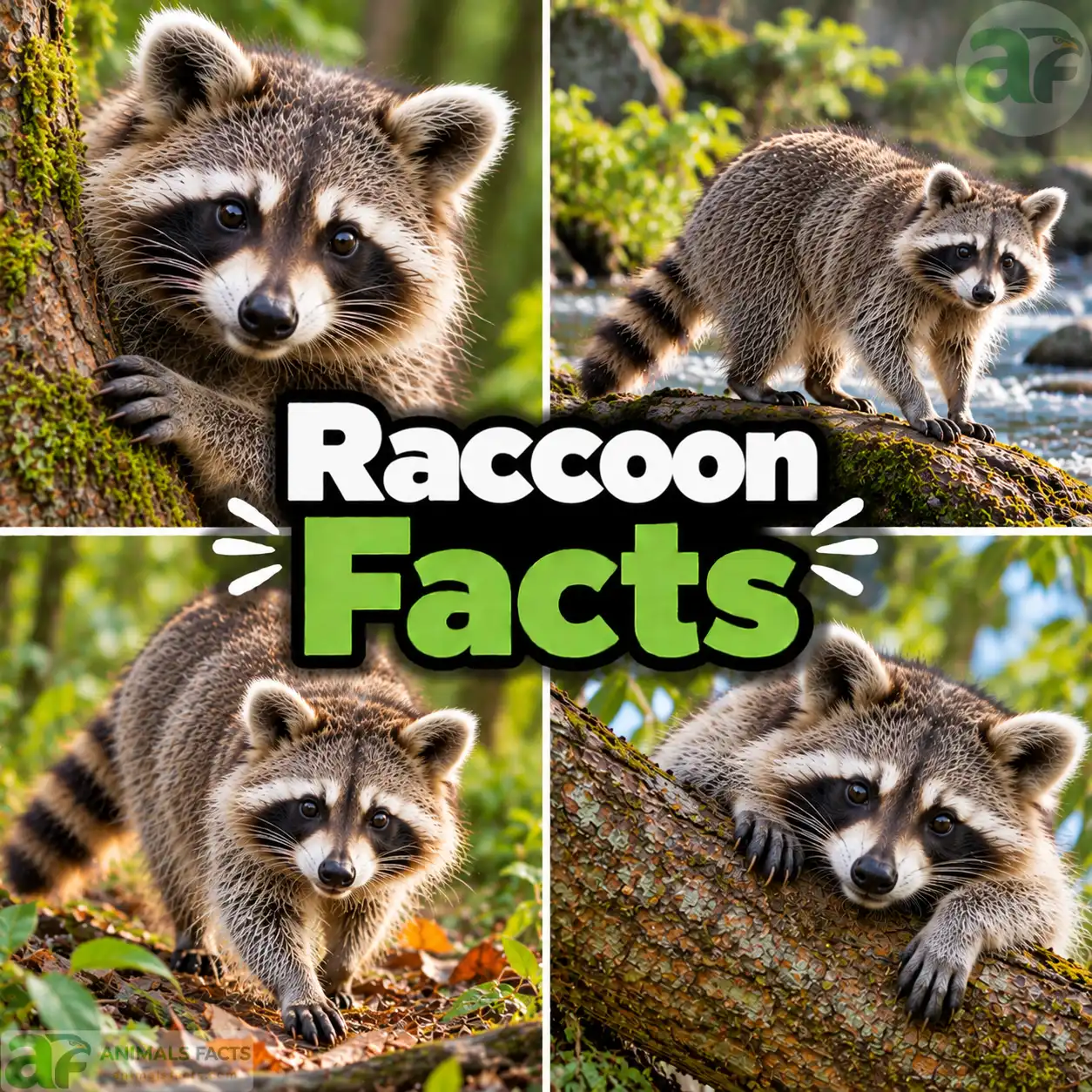
Raccoon Facts
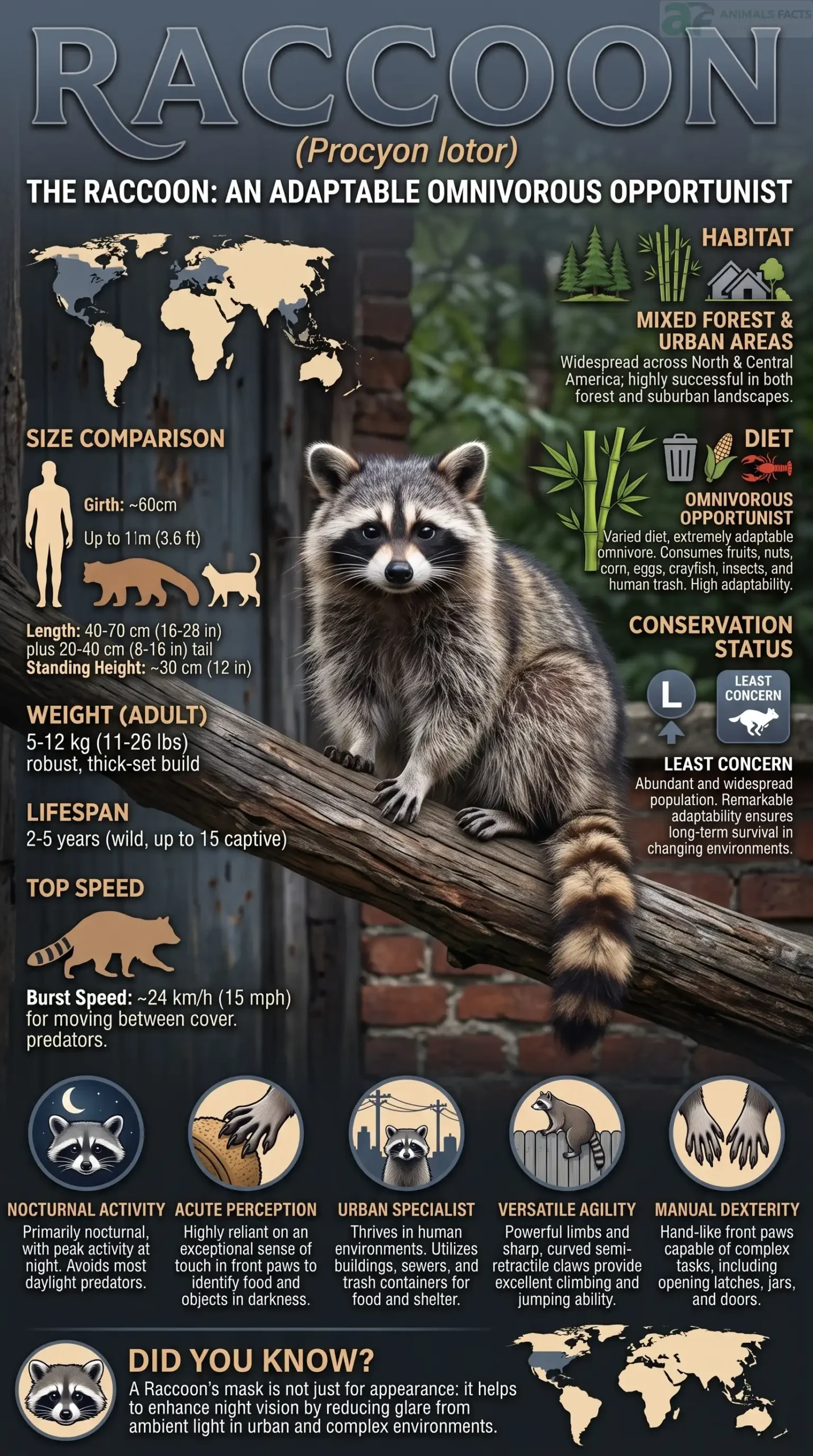
| Feature | Details |
|---|---|
| Scientific Name | Procyon lotor |
| Common Names | Raccoon, Common Raccoon, North American Raccoon |
| Kingdom | Animalia |
| Phylum | Chordata |
| Class | Mammalia |
| Order | Carnivora |
| Family | Procyonidae |
| Genus | Procyon |
| Recognized Subspecies | Up to 22 historically described — currently most taxonomists recognize 6 broad subspecies |
| Habitat | Forest, wetland, urban, suburban — virtually every environment in North America; introduced to parts of Europe and Asia |
| Lifespan | 2–3 years (wild average); up to 5 years (wild maximum); up to 21 years in captivity |
| Diet | True omnivore — invertebrates, fruit, nuts, eggs, small vertebrates, carrion, human food waste |
| Weight | 2–14 kg (average 4–8 kg); varies enormously by latitude (Bergmann’s Rule) |
| Body Length | 40–70 cm (body); tail adds 20–40 cm |
| Shoulder Height | 23–30 cm |
| Top Speed | Up to 24 km/h (15 mph) |
| Conservation Status | Least Concern (IUCN Red List) |
| North American Population | Estimated ~15–20 million individuals — one of the most abundant medium-sized carnivores in North America |
| Unique Feature | Among the most intelligent of all non-primate mammals; extraordinary tactile sensitivity in front paws; famous “food washing” behavior; masked facial pattern; one of world’s most successful urban wildlife species |
 1. Introduction: What is a Raccoon?
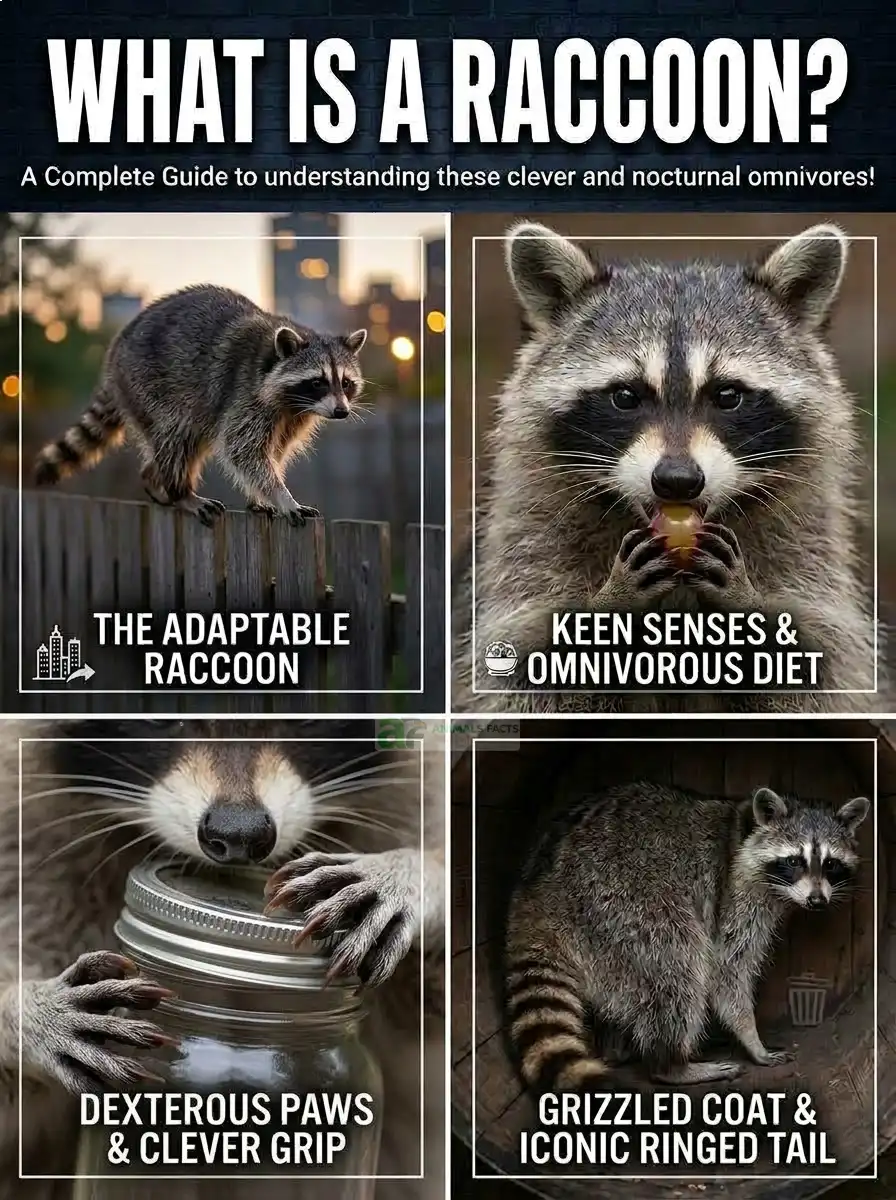
It opens locks. It solves puzzles. It remembers solutions to problems it encountered three years ago — a memory capacity that exceeds most other comparable mammals and rivals that of some primates. It has turned the human city into its personal buffet, exploiting garbage cans, compost bins, restaurant dumpsters, and pet food bowls with an improvisational intelligence that has driven wildlife managers and urban homeowners to genuine despair across North America and increasingly across Europe and Japan as well. And it accomplishes all of this while wearing what looks like a burglar’s mask across its face — a coincidence of natural coloration that has made it one of the most immediately recognizable and most culturally embedded wild animals in North American history. Raccoon facts reveal an animal of genuinely extraordinary intelligence, remarkable ecological flexibility, and a relationship with human civilization so deeply entangled that it is genuinely difficult to imagine the North American urban landscape without it.
The raccoon — Procyon lotor — is a medium-sized North American mammal of the family Procyonidae, related to the coatis, ringtails, and other uniquely American omnivores. It is, by virtually every metric, the most successful medium-sized carnivore in North America — with an estimated population of 15–20 million individuals across the continent, a range that has expanded significantly from its historical woodland habitat to encompass virtually every human settlement environment from rural farmland to dense urban core, and a behavioral flexibility that has allowed it not just to survive alongside human civilization but to genuinely thrive within it. Research has documented raccoon populations in major American cities running at densities of up to 100 individuals per square kilometer — among the highest documented population densities of any comparable wild carnivore anywhere in the world.
Whether you are a suburban homeowner frustrated by a raccoon raiding your garbage can and searching for raccoon facts to understand what you’re dealing with, a student researching raccoon facts for a school project, a wildlife enthusiast fascinated by urban wildlife ecology, a parent looking for raccoon facts for kids, or simply someone who has always wondered what’s going on behind those masked eyes and nimble black paws — this is the most complete guide to raccoon facts you will find anywhere. We cover raccoon habitat, raccoon diet, raccoon behavior, the famous food-washing mystery, intelligence, communication, reproduction, conservation, mythology, and the extraordinary story of an animal that has somehow managed to become simultaneously one of North America’s most studied and most misunderstood wild mammals.
2. Raccoon Species Overview & Classification
The raccoon belongs to the family Procyonidae — a family of medium-sized omnivores found exclusively in the Americas, including coatis, ringtails, cacomistles, olingos, and the kinkajou. The raccoon is the largest and most geographically widespread member of its family, and the one that has most successfully colonized human-modified environments.
Procyonidae — America’s Unique Omnivore Family
The family Procyonidae is a uniquely American carnivore family — with all living members found in North and Central America (with some South American members as well), representing a distinctive evolutionary lineage of omnivorous carnivores that shares the superfamily Musteloidea with mustelids, skunks, and the red panda. The Procyonidae are distinguished from other carnivore families by their generally omnivorous diets, semi-arboreal lifestyles, and distinctive facial and tail markings.
Species Classification Table
| Level | Classification |
|---|---|
| Kingdom | Animalia |
| Phylum | Chordata |
| Class | Mammalia |
| Order | Carnivora |
| Superfamily | Musteloidea |
| Family | Procyonidae |
| Genus | Procyon |
| Species | P. lotor |
| Closest Relatives | Crab-eating Raccoon (Procyon cancrivorus — South America); Coati (Nasua nasua and N. narica); Ringtail (Bassariscus astutus) |
Key Raccoon Subspecies
| Subspecies | Scientific Name | Range | Distinguishing Features |
|---|---|---|---|
| Eastern Raccoon | P. l. lotor | Eastern North America | Most studied; typical medium size |
| Florida Raccoon | P. l. elucus | Florida and southeastern coastal | Smaller; paler |
| Texas Raccoon | P. l. fuscipes | Texas and adjacent areas | Medium size |
| Pacific Coast Raccoon | P. l. pacificus | Pacific Coast states | Darker fur |
| Upper Mississippi Raccoon | P. l. hirtus | Northern US/Canada | Larger; denser winter coat |
| Mexican Raccoon | P. l. hernandezii | Mexico | Smaller; tropical adaptations |
Related Species
| Species | Scientific Name | Range | Notable Feature |
|---|---|---|---|
| Crab-eating Raccoon | Procyon cancrivorus | Central/South America | Shorter fur; aquatic specialist |
| White-nosed Coati | Nasua narica | Central/North America | Long snout; social; ground-feeding |
| South American Coati | Nasua nasua | South America | Similar to white-nosed |
| Ringtail | Bassariscus astutus | SW USA, Mexico | Smaller; large eyes; nocturnal |
| Kinkajou | Potos flavus | Central/South America | Prehensile tail; arboreal |
Species Evolution & Discovery Timeline
~35–40 million years ago: The Procyonidae family diverged from the common Musteloidea ancestor during the Eocene — establishing the independent evolutionary trajectory that would produce the uniquely American procyonid family.
~5–7 million years ago: The genus Procyon diverged from other procyonids during the late Miocene — establishing the lineage that would produce both the modern raccoon and its South American relative, the crab-eating raccoon.
~2–3 million years ago: The modern raccoon (Procyon lotor) achieved its contemporary form — with the distinctive masked facial pattern, ringed tail, and generalist omnivore ecology already established in the species.
~10,000–15,000 years ago: Early human inhabitants of North America encountered raccoons throughout the eastern and central portions of the continent — with the raccoon quickly becoming a significant element of Indigenous cultures, providing both food resources and cultural symbolism across dozens of nations.
1612: Captain John Smith provided one of the earliest written English descriptions of the raccoon in his writings about the Virginia colonies — recording the Powhatan word for the animal and describing its appearance and behavior to European audiences.
1758: Carl Linnaeus formally classified the raccoon as Ursus lotor — “washing bear” — in Systema Naturae, based on the species’ famous behavior of manipulating food near water, though it was later reclassified to its current genus.
19th–20th century: Raccoon fur was a major commercial fur resource across North America — with millions of raccoons harvested annually for fur and meat, generating significant economic activity and cultural traditions centered on raccoon hunting.
Late 20th century: Raccoon populations exploded following reduced hunting pressure, urban expansion providing food resources, and the species’ demonstrated capacity for rapid behavioral adaptation to urban environments — with the species colonizing cities across North America and subsequently being introduced (or escaping captivity) to establish invasive populations in Germany, Japan, and other countries.
3. Raccoon Physical Description & Unique Features
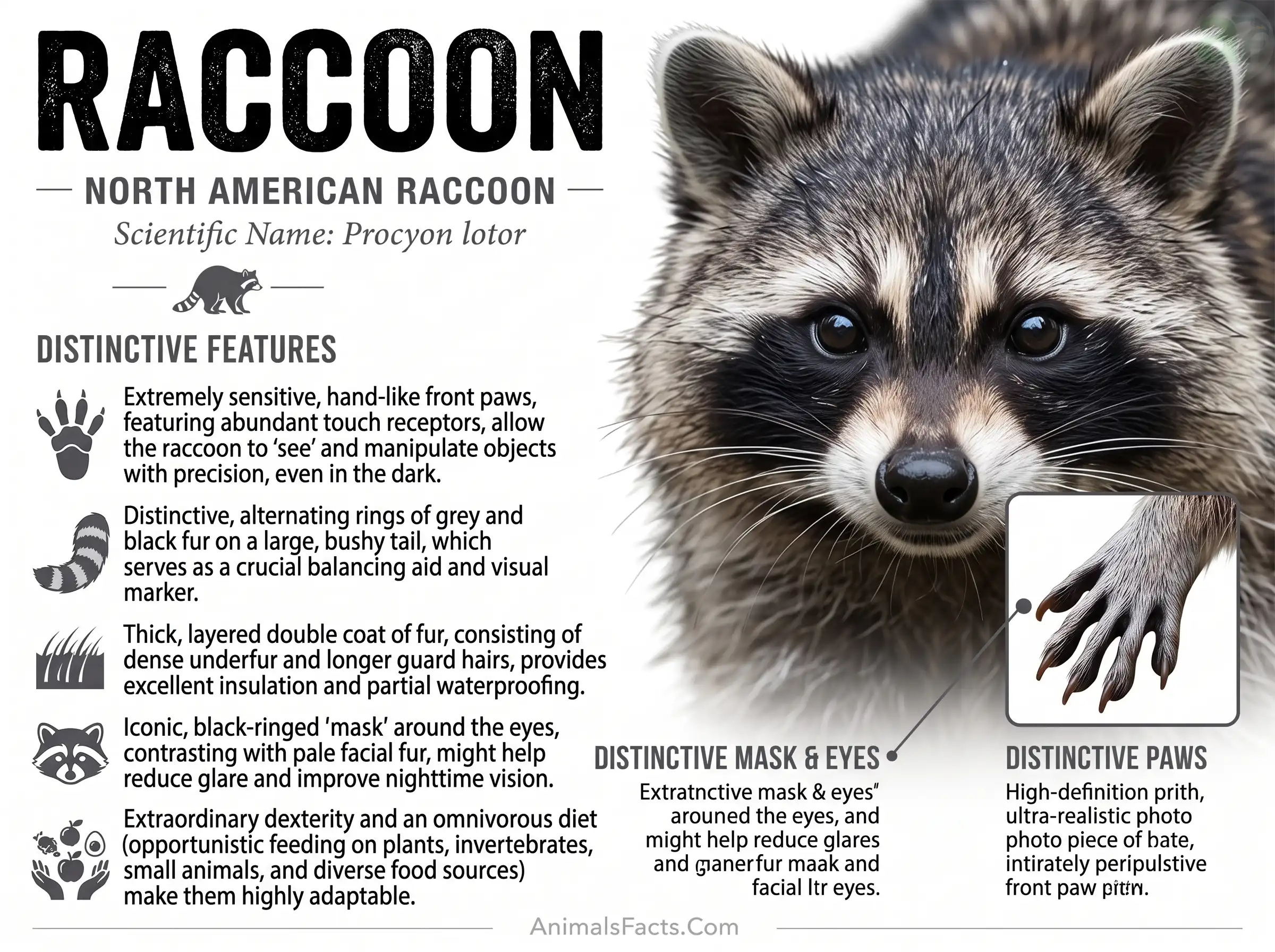
The raccoon’s physical design is simultaneously distinctive, recognizable, and functionally extraordinary — with an immediately recognizable facial pattern, a striking striped tail, and front paws of tactile sensitivity unmatched in the mammalian world outside of primates.
The Iconic Masked Face
The raccoon’s most immediately recognizable feature — the bold black mask of facial fur across the eyes and cheeks against a lighter facial background — is one of the most distinctive facial patterns of any North American mammal. Research has proposed multiple functional explanations for this masking:
Anti-glare function: The dark mask absorbs light rather than reflecting it into the eyes — potentially reducing glare from bright or reflective surfaces during foraging near water, analogous to the eye black used by athletes in bright conditions.
Social communication enhancement: The bold eye mask may make the raccoon’s eyes more visible and its facial expressions more readable during the relatively frequent social interactions that characterize raccoon life near shared food resources.
Camouflage disruptive coloration: The bold contrasting pattern may break up the facial outline in dappled light or vegetation, providing camouflage in specific foraging contexts.
The Extraordinary Front Paws
The raccoon’s front paws are among the most tactilely sensitive of any non-primate mammal — with an exceptional concentration of mechanoreceptors (touch-sensitive nerve endings) in the skin of the forepaws that allows the raccoon to identify objects almost entirely by touch. This hypersensitive tactile system enables:
Underwater foraging without vision: Raccoons can feel under rocks, in crevices, and through mud or murky water with their forepaws — detecting prey by touch rather than sight, in conditions where visual foraging would be impossible.
Remarkable dexterity: The raccoon’s forepaws can rotate, open, and manipulate objects with a dexterity unusual among non-primate mammals — allowing the animal to open containers, turn knobs, lift latches, and manipulate food items with precision.
Wetted paw hypersensitivity: The famous “food washing” behavior — rubbing food items near water or submerging them — appears to activate additional sensory capability in the moistened paw, further enhancing tactile assessment.
Size Variation — Bergmann’s Rule in Action
The raccoon demonstrates one of the most dramatic examples of Bergmann’s Rule (larger body size in colder climates) documented for any North American mammal — with individuals from northern populations sometimes weighing three to four times as much as individuals from southern populations:
- Southern raccoons (Florida, Mexico): Typically 2–4 kg
- Average North American raccoon: Typically 4–8 kg
- Northern raccoons (Canada, northern US): Up to 12–14 kg and occasionally approaching 20 kg in the largest documented individuals
The ringed tail — 20–40 cm long with 4–7 alternating dark and pale rings — is proportionally one of the longest tails of any North American carnivore and serves as a visual signal and balance organ.
Did You Know? The raccoon’s front paw tactile sensitivity is so extraordinary that researchers have documented raccoons identifying the species, size, and condition of a food item entirely by touch — with paws submerged in completely dark, opaque water — with accuracy comparable to or exceeding visual identification in normal lighting conditions. The density of mechanoreceptors in raccoon forepaws has been measured at levels comparable to the fingertips of humans — the most touch-sensitive part of the human body — making the raccoon’s paws one of the most remarkable natural tactile instruments in the mammalian world, and the basis for the foraging capability that allows raccoons to exploit aquatic and concealed food resources inaccessible to competitors with less sensitive forepaws.
4. Top 25 Surprising & Interesting Raccoon Facts
- Raccoons can remember solutions to problems for up to 3 years — a long-term memory capability that exceeds that of most comparable mammals and approaches that of some primates, documented through laboratory puzzle-box experiments.
- Raccoon populations in some North American cities reach densities of 100 individuals per square kilometer — among the highest population densities documented for any comparable wild carnivore anywhere in the world.
- The scientific name Procyon lotor means “washing bear” in Latin — a reference to the famous food-washing behavior, though the raccoon is not a bear and the “washing” behavior is not actually about cleaning food.
- Raccoons can open complex locks, jars, and latches — with research demonstrating that individual raccoons can learn to open containers requiring sequential multi-step manipulation, including combinations of turns, pushes, pulls, and tilts.
- The raccoon’s famous “food washing” behavior — rubbing food items in or near water — is now understood by researchers to be primarily about enhancing tactile sensory information rather than cleaning food, activating the paw’s hypersensitive mechanoreceptors through moisture.
- Raccoons in Germany — where they were introduced from North America in the early 20th century — have established a population of over 1 million individuals across Germany, representing one of the most successful mammalian invasive species introductions in European history.
- A raccoon can gain up to 50% of its total body weight in the autumn months before winter — with individuals in northern climates sometimes nearly doubling their spring body weight through intensive autumn foraging to build the fat reserves needed for winter semi-dormancy.
- Raccoons are not true hibernators — they enter a state of winter torpor rather than true hibernation, reducing activity and living off fat reserves during cold periods but waking and occasionally foraging during mild spells throughout winter.
- Laboratory research has documented that raccoons can solve puzzles more quickly on their second attempt than their first — not only remembering the solution but recalling it with sufficient precision to reduce time-to-solution, demonstrating genuine problem-solving learning.
- The raccoon is one of very few non-primate mammals to have been documented using tools — with individuals observed using sticks to scrape food from narrow containers and rocks to open shellfish, though these observations remain less systematically documented than tool use in primates.
- Raccoons communicate through a vocabulary of over 200 distinct sounds — including purring, whistling, growling, hissing, screaming, and chattering, giving them one of the most extensive vocal repertoires of any North American carnivore.
- Female raccoons and their offspring maintain social bonds that can last for several years — with females sometimes sharing overlapping territories with their adult daughters and granddaughters in networks of related females that represent the most complex social organization documented for the species.
- Urban raccoons have been documented memorizing the schedules of human garbage collection — adjusting their foraging activity to maximize access to freshly deposited garbage before collection, demonstrating both memory and behavioral scheduling capability.
- The raccoon’s geographic range has expanded northward significantly during the 20th century — with the species colonizing habitat in Canada that was historically beyond its range, partly due to climate warming and partly due to the availability of agricultural and urban food resources that allow overwinter survival in colder climates than the natural diet would support.
- Raccoons infected with the canine distemper virus — the most significant disease affecting raccoon populations — can display behavior that appears similar to rabies symptoms, including disorientation and aggression, contributing to public misidentification of distemper raccoons as rabid individuals.
- Raccoon roundworm (Baylisascaris procyonis) — a parasitic roundworm that lives in raccoon intestines — can infect humans who accidentally ingest raccoon feces, with potentially severe neurological consequences if larvae migrate to the brain, making raccoon feces a genuine public health concern in areas of dense raccoon population.
- The International Raccoon Appreciation Day — observed on October 1st annually — reflects the growing cultural interest in raccoons that has emerged from their high social media profile and their status as North America’s most visible urban wildlife.
- Raccoons are surprisingly good swimmers — documented voluntarily swimming across rivers over 1 kilometer wide during normal territorial movement, and deliberately entering water to forage for aquatic invertebrates, fish, and amphibians.
- Research in Toronto, Canada — one of the world’s most extensively studied urban raccoon populations — has documented raccoons learning to open the city’s specialized “raccoon-proof” garbage cans within weeks of their installation, demonstrating the speed of behavioral adaptation to novel challenges.
- Raccoon paws increase in tactile sensitivity when wet — researchers have documented measurably enhanced discrimination between objects of different textures and shapes when raccoon paws are moistened, providing the sensory explanation for the famous food-washing behavior.
- Individual raccoons have been documented maintaining consistent foraging route patterns across multiple seasons — returning to the same productive foraging locations at similar times each year, demonstrating long-term spatial memory of food resource locations.
- Raccoon population densities are typically 10–100 times higher in urban and suburban areas than in comparable rural areas — reflecting the extraordinary concentration of food resources (garbage, pet food, gardens, composting) in human settlements.
- The raccoon has been introduced to Japan — where it was imported as a pet following the popularity of an anime series featuring raccoons in the 1970s — and has since established a wild population of over 1 million individuals across multiple Japanese prefectures, causing significant damage to agricultural crops and historic buildings.
- Raccoons are one of the primary reservoir hosts of rabies in North America — with raccoon-transmitted rabies representing the most common form of wildlife rabies in the eastern United States and a significant public health management challenge.
- Despite their reputation as nuisance animals, raccoons provide genuine ecosystem services — including insect and rodent population regulation, seed dispersal, and, in areas with crab-eating or aquatic foraging behavior, regulation of invertebrate populations in wetland ecosystems.
5. Fun Facts About Raccoon
- Raccoons remember puzzle solutions for up to 3 years — extraordinary long-term memory.
- Urban raccoons reach densities of 100 per km² — one of the highest for any wild carnivore.
- The scientific name means “washing bear” — but they’re not bears, and it’s not washing!
- Raccoons can gain 50% of their body weight before winter.
- Germany has over 1 million invasive raccoons — introduced in the 1930s.
- Japan also has over 1 million raccoons — escaped from the pet trade.
- Raccoons communicate with over 200 distinct sounds.
- Their front paws are as touch-sensitive as human fingertips.
- They can open locks, jars, and latches — genuine problem solvers.
- Raccoons are not true hibernators — they take winter naps but wake up.
- Female raccoons maintain multi-generational social bonds with daughters and granddaughters.
- Toronto raccoons learned to open “raccoon-proof” cans within weeks of installation.
6. Raccoons Habitat & Geographic Range
The raccoon is North America’s most ecologically flexible medium-sized carnivore — successfully inhabiting virtually every terrestrial and urban environment on the continent, from the Arctic margins of southern Canada to the tropical forests of Central America.
Primary Habitat Types
Deciduous and mixed forest: The raccoon’s original and most characteristic natural habitat — the mixed deciduous forest of eastern North America, where the combination of forest mast (acorns, beechnuts), aquatic invertebrates in streams and wetlands, and diverse fruiting plants provides the varied food base that suits the species’ omnivore ecology.
Wetland and riparian habitat: Raccoons show a particularly strong association with water-adjacent environments — with streams, rivers, marshes, and lake margins providing the aquatic foraging opportunities (crayfish, frogs, fish) and the water-adjacent vegetation (fruiting shrubs, nut-bearing trees) that represent some of the most productive raccoon foraging conditions anywhere in their range.
Urban and suburban habitat: The most dramatically expanding habitat category — with raccoons now representing one of the most consistently and abundantly documented wildlife species in urban cores, suburban neighborhoods, and exurban residential areas across North America, Europe, and parts of Asia.
Agricultural land: Rural farmland — particularly areas combining corn, grain crops, vegetable gardens, orchards, and poultry operations — provides food resources that have allowed raccoon range expansion into agricultural landscapes historically beyond their woodland range.
Desert margins and coastal habitats: Raccoons inhabit coastal areas (exploiting tidal flat invertebrates), desert riparian zones (following water corridors), and various scrubland and grassland habitats — demonstrating the habitat generalism that has made geographic range expansion a consistent feature of raccoon population dynamics across North America.
Geographic Range Table
| Region | Status | Population | Notes |
|---|---|---|---|
| Eastern North America | Native; abundant | Core of global range | Highest densities in eastern US |
| Western North America | Native; expanding | Historically lower density | Range expansion through 20th century |
| Central America | Native; present | Lower density | Northern Central America |
| Germany | Invasive | ~1.2 million+ | Introduced 1930s; major ecological concern |
| France and surrounding areas | Invasive; expanding | ~100,000+ | Spreading from German core population |
| Japan | Invasive | ~1 million+ | Pet trade escapes from 1970s; agricultural pest |
| Russia (Far East) | Invasive | Unknown; present | Deliberate Soviet-era introduction |
| Spain, Benelux, other European countries | Invasive; establishing | Increasing | Spreading from core European populations |
Did You Know? The German raccoon population — which has grown from a tiny group released at a fur farm near Kassel in 1934 and a second deliberate release for hunting purposes in 1945 to over 1.2 million individuals by 2026 — represents one of the most consequential wildlife introductions in European ecological history. These raccoons, now distributed across most of Germany and spreading into France, Belgium, the Netherlands, and beyond, have generated significant concern among European wildlife managers and conservation scientists regarding their impacts on native bird populations (particularly cavity-nesting birds, whose eggs and chicks are vulnerable to raccoon predation), native reptile communities, and the historic buildings and archaeological sites that raccoons damage through denning and burrowing activities.
7. Raccoon Diet & Feeding Behavior
The raccoon is one of North America’s most comprehensively omnivorous mammals — with a diet documented to encompass hundreds of species of plants and animals across the full diversity of its geographic range, making it one of the broadest dietary generalists of any comparable-sized carnivore in the world.
What Raccoons Eat
Diet Breakdown Table
| Food Type | Approximate Percentage | Season/Notes |
|---|---|---|
| Invertebrates (crayfish, worms, insects, snails) | 25–40% | Primary animal protein; especially in warm months |
| Plant material (fruit, berries, nuts, seeds) | 25–40% | Seasonal peaks; critical autumn hyperphagia |
| Small vertebrates (frogs, fish, mice, voles) | 10–20% | Opportunistic; variable by habitat |
| Eggs and nestlings | 5–10% | Seasonal; important in spring |
| Agricultural crops (corn, grain) | 5–15% (varies) | Major conflict source in agricultural areas |
| Human food waste | Variable | Dominant in urban populations |
| Carrion | 2–5% | Opportunistic scavenging |
The Opportunistic Foraging Strategy
The raccoon’s dietary success is built on radical opportunism — the willingness to consume virtually any edible material encountered during foraging, combined with the intelligence and dexterity to access food resources that would be unavailable to less cognitively flexible or manually less capable species. This opportunism is reflected in:
Seasonal diet shifting: Raccoons dramatically shift their dietary composition across seasons — from spring invertebrate and egg foraging, through summer insect and early fruit consumption, to intensive autumn nut and grain foraging that represents the most critical calorie-building period for winter survival.
Urban diet modification: Urban raccoons in North American cities have been documented subsisting primarily on human food waste — garbage, restaurant dumpster contents, pet food, and deliberately offered human food — often consuming a diet dramatically higher in processed carbohydrates and saturated fats than wild raccoons, generating documented differences in body condition, parasite loads, and reproductive rates between urban and rural populations.
Aquatic foraging: The raccoon’s famous association with water reflects its genuinely productive aquatic foraging capability — with individuals regularly wading into streams and shallow water to feel for crayfish, clams, frogs, and fish with their hypersensitive front paws, exploiting food resources inaccessible to most competing carnivores.
The Food “Washing” Mystery — Solved
The raccoon’s most famous and most discussed feeding behavior — dousing or rubbing food items in or near water before eating — has generated scientific investigation and popular fascination for decades. The current scientific consensus is that this behavior is primarily about tactile sensory enhancement rather than food cleaning:
Sensory hypothesis: Moistening the paw activates and enhances the mechanoreceptors (touch-sensitive nerve endings) in the raccoon’s forepaws — allowing more precise tactile assessment of food items before consumption. The German word “Waschbär” (washing bear) and the Latin species name “lotor” (washer) both reference this behavior, reflecting how striking it appeared to European observers.
Origin hypothesis: The behavior may have originated as foraging behavior in the raccoon’s ancestral habitat — dunking prey in water to simulate the aquatic foraging context in which the species historically found food, with the enhanced tactile sensation providing functional benefit even when the dunked food is already in hand.
Did You Know? Raccoons in captivity will “wash” foods even in the complete absence of water — performing the characteristic rubbing and rolling manipulation of food items with their forepaws when no water is available, suggesting that the behavior is deeply programmed and motivated by tactile sensory enrichment rather than by water access per se. When both dry and wet conditions are available to captive raccoons, they consistently prefer to manipulate food items with moistened paws — providing strong behavioral evidence that paw moistening genuinely enhances the tactile sensory experience associated with food assessment, supporting the sensory enrichment hypothesis for food-washing behavior.
8. Raccoons Reproduction & Life Cycle
Raccoon reproduction is characterized by high reproductive rates that enable rapid population recovery following mortality events — a biological strategy well-matched to the species’ position as a prey item for multiple large predators and a target of significant human harvest.
Mating Behavior
Raccoons mate during January–March across most of their range — with the precise timing varying by latitude and local climate conditions. Males are promiscuous — mating with multiple females across their relatively large territories — and provide no paternal care for offspring.
Male competition: During the mating season, male raccoons significantly expand their territorial ranging — traveling extensively to locate receptive females and engaging in competitive encounters with rival males that can include vocalizations, chasing, and occasionally physical confrontation.
Gestation and Birth
Gestation period: Approximately 63–65 days — one of the shorter gestations among comparable-sized carnivores.
Litter size: Typically 3–7 kits (most commonly 3–4) — relatively large litters reflecting the species’ r-selected reproductive strategy of producing many young with high early mortality.
Birth weight: Approximately 60–75 grams per kit — small and altricial.
Denning: Females give birth in tree hollows, rock crevices, building attics, crawl spaces, and various other enclosed sites — with urban raccoons demonstrating remarkable creativity in selecting urban denning structures including roof spaces, chimneys, and abandoned buildings.
Key Developmental Stages
| Stage | Age | Key Development |
|---|---|---|
| Birth | January–April (varies latitude) | ~70 grams; blind, barely furred |
| Eyes open | ~3 weeks | Beginning visual awareness |
| First outings | ~8–10 weeks | Following mother outside den |
| Learning foraging | 10–20 weeks | Critical skill acquisition period with mother |
| Independence | ~12–14 months | Separation from mother, usually in autumn/winter |
| Sexual maturity | Female: 12 months; Male: 24 months | First breeding possible |
Raccoons Lifespan Comparison Table
| Species | Average Wild Lifespan | Maximum Confirmed |
|---|---|---|
| Raccoon | 2–3 years | ~21 years (captivity) |
| Red Panda | 8–10 years | ~23 years (captivity) |
| Ringtail | 6–9 years | ~16 years (captivity) |
| Coati | 7–8 years | ~14 years (captivity) |
9. Social Behavior & Communication
The raccoon’s social organization is considerably more complex than its general reputation as a solitary, nocturnal raider of garbage cans would suggest — with documented female social networks, learned behavioral traditions, and one of the most extensive vocal repertoires of any North American small-to-medium mammal.
Social Organization
Females: More socially complex than previously recognized — with adult females and their female offspring sometimes maintaining overlapping territories and sharing denning sites, forming loose but persistent social networks of related individuals. Research in Toronto and other urban areas has documented multi-generational female associations that represent genuine social relationships rather than simply territorial tolerance.
Males: More solitary and wide-ranging — maintaining large territories that overlap with those of multiple females but engaging in limited direct social interaction outside of mating season.
Winter aggregations: In cold climates, multiple raccoons sometimes share winter den sites — with groups of up to 23 individuals documented sharing large tree hollows during particularly cold periods, a form of temporary social aggregation likely motivated by thermoregulatory benefit from body heat sharing.
Intelligence and Problem-Solving
The raccoon’s intelligence has been a subject of scientific research since the early 20th century — with classic experiments by H.B. Davis in 1908 and numerous subsequent studies documenting cognitive capabilities including:
Lock and latch opening: Raccoons consistently solve novel locking mechanisms when food rewards are provided, with success rates increasing with repeated exposure and memory of solutions persisting for years.
Shape and texture discrimination: Raccoons can discriminate between objects of different shapes and textures using only their forepaws in complete darkness — demonstrating tactile discrimination capabilities comparable to or exceeding visual discrimination in many mammals.
Causal reasoning: Some research has suggested raccoons demonstrate rudimentary causal reasoning — understanding cause-and-effect relationships between their actions and outcomes — rather than simply trial-and-error learning, a cognitive capability previously thought to be restricted to primates and a few other cognitively sophisticated species.
Vocalizations
The raccoon’s vocal repertoire is one of the most extensive documented for any North American carnivore — with researchers having identified over 200 distinct vocalizations across different behavioral contexts:
Purring: Content vocalization during grooming, nursing, and relaxed social interaction. Chittering: High-frequency contact call — used between mothers and kits. Whistling: Contact calls between adults. Growling and hissing: Threat vocalizations during aggressive encounters. Screaming: Extreme distress or pain vocalization. Churring and chattering: Alarm calls warning of predators.
Did You Know? Research on urban raccoon populations has documented what scientists call “cultural transmission of foraging behavior” — learned problem-solving solutions passed from experienced individuals to younger raccoons through observation and social learning. Specific garbage can opening techniques, specific foraging routes, and specific shelter locations have been documented spreading through local raccoon populations over time in ways consistent with observational learning rather than independent discovery — making urban raccoon populations genuine examples of non-genetic behavioral inheritance, a form of proto-culture previously thought to be largely restricted to primates and some bird species.
10. Predators & Defense Mechanisms
The raccoon is both a significant predator across its range and a prey species for numerous larger carnivores — occupying a middle position in the North American carnivore hierarchy that has shaped both its defensive capabilities and its population dynamics.
Natural Predators
Great Horned Owls: The most significant predator of juvenile raccoons across virtually the entire range — great horned owls are among the few North American predators capable of taking young raccoons, and their nocturnal activity patterns bring them into direct competition with the raccoon in the same nighttime foraging window.
American Alligators: A significant predator in southeastern US wetland habitats — with raccoons frequently foraging at water margins where alligators ambush prey, creating one of the most significant natural predation risks for raccoons in Florida and the Gulf Coast states.
Coyotes: Increasing as a predator of raccoons as coyote populations have expanded into suburban and urban areas — with documented coyote predation on raccoons in areas where the two species share habitat.
Bobcats and Mountain Lions: Documented raccoon predators across their areas of range overlap — with bobcats in particular representing a significant nocturnal predation threat in rural and suburban areas.
Domestic Dogs: A significant mortality source in urban and suburban areas — with domestic dogs responsible for substantial raccoon mortality in areas of human settlement, both through direct pursuit and as a stress and injury source.
Humans: The dominant cause of raccoon mortality across most of the range — through regulated sport and fur hunting, vehicle collisions (one of the largest documented mortality sources), trapping for nuisance removal, and management killing in urban conflict situations.
Defense Mechanisms
Climbing: The raccoon’s most reliable escape strategy — all ages of raccoons can ascend trees rapidly, using their strong, curved claws to escape ground-based predators with speed that often surprises observers expecting slow movement from this apparently plodding animal.
Ferocity when cornered: Raccoons are genuinely dangerous defensive fighters when cornered — with sharp claws, strong teeth, and a combative willingness that makes raccoon-dog encounters potentially injurious to both parties and raccoon handling by humans genuinely hazardous without appropriate protective equipment.
Vocalization: The raccoon’s extensive alarm call vocabulary enables rapid communication of threat information — with specific vocalizations that appear to convey information about the type, direction, and urgency of detected threats.
11. Raccoon Facts for Kids
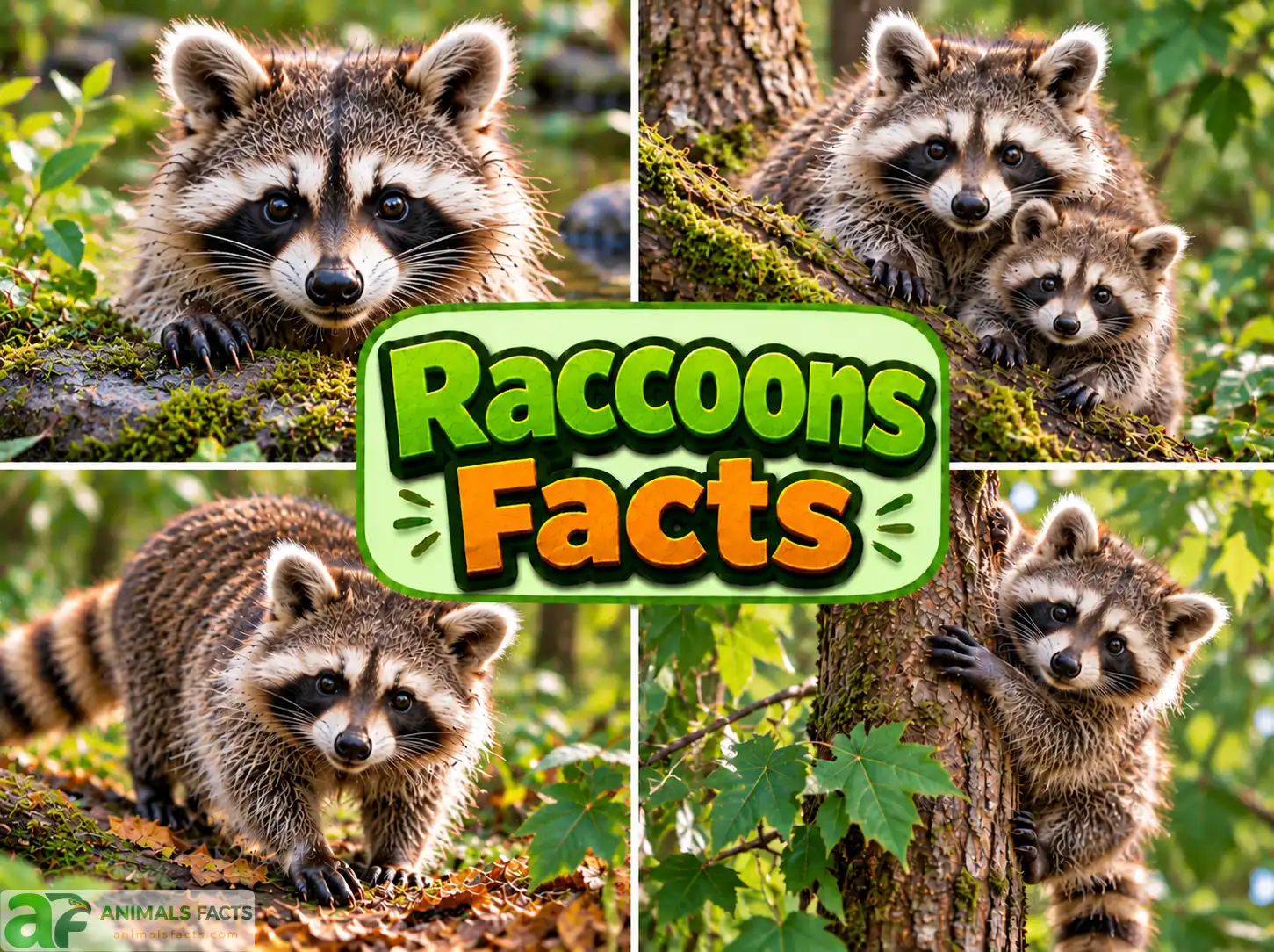
Hey kids — get ready to discover why raccoons are some of the cleverest and most interesting animals in all of North America!
- Raccoons are basically the genius criminals of the animal world — they can open locks, jars, and complicated containers to get at food! Scientists have tested raccoons with puzzles that require turning, pushing, pulling, and lifting in the right order, and raccoons figure them out! One scientist found that raccoons could remember how to solve puzzles they’d learned three years earlier!
- The raccoon has the most sensitive paws of almost any animal its size — the bottom of a raccoon’s paw is as touch-sensitive as the tip of your finger! This is how raccoons can feel for food in muddy water or under rocks completely by touch, even when they can’t see what they’re doing.
- That famous face mask isn’t face paint — raccoons are born with it! The black mask across their eyes might help them see better by reducing glare from bright surfaces, kind of like the black smudges that football players put under their eyes!
- When raccoons “wash” their food near water, they’re not really cleaning it — they’re actually feeling it more carefully! Wetting their paws makes them even more sensitive, so they can learn more about what they’re about to eat just by touching it!
- Raccoons can make over 200 different sounds — purring like a cat, chirping like a bird, growling, whistling, screaming, and chattering! They have one of the biggest sound vocabularies of any animal their size in North America!
- In Germany, there are over 1 million raccoons — they were brought there from North America in the 1930s and have been multiplying ever since! Japan also has over a million raccoons after some escaped from being pets!
- Before winter, raccoons eat as much as possible and can gain almost half their body weight in fat — so a 6 kg raccoon might become a 9 kg raccoon by winter! This fat keeps them warm and fed during cold months when they nap in their dens.
- Baby raccoons are called kits, and they’re born blind, almost hairless, and incredibly tiny — but they grow up quickly and by the time they’re about a year old, they’re completely independent!
Did You Know? Raccoons in the city of Toronto, Canada, became famous around the world when the city spent millions of dollars installing special “raccoon-proof” garbage cans that required a complicated two-handed operation to open. The raccoons figured out how to open them within weeks — and this story became international news! Toronto raccoons became so famous for their intelligence that they’re sometimes called “Toronto Trash Pandas” with great affection, and the city has developed special programs to try to peacefully coexist with its extremely clever wildlife neighbors.
12. Relationship with Humans
The raccoon’s relationship with North American human civilization is one of the most extensively documented, most complex, and most rapidly evolving human-wildlife relationships on the continent — spanning thousands of years from Indigenous cultural coexistence through the fur trade to the contemporary urban wildlife management challenge of a medium-sized carnivore that has learned to exploit every aspect of human settlement for its own benefit.
Indigenous North American Relationships
The raccoon has been a significant component of the cultural, subsistence, and spiritual traditions of numerous Indigenous nations across North America for thousands of years. Raccoon fur — thick, warm, and attractively patterned — has been used in traditional regalia, ceremonial garments, and practical clothing across dozens of nations. Raccoon meat has been an important subsistence food source for many eastern and midwestern nations, and the raccoon appears in the oral traditions and cultural symbolism of multiple Indigenous groups as a figure associated with trickery, intelligence, adaptability, and cunning.
The Fur Trade Era
The raccoon was a significant commercial fur resource across North America from the colonial era through the 20th century — with raccoon fur highly valued for its warmth and durability, generating commercial trapping industries across most of the species’ range. The coonskin cap — a hat made from a raccoon pelt with the tail attached — became one of the most iconic symbols of the American frontier in popular culture, associated with frontiersmen including Davy Crockett and Daniel Boone.
The Urban Conflict Era
The most significant contemporary human-raccoon relationship is the rapidly escalating urban wildlife conflict generated by raccoon populations that have colonized human settlements across North America and expanded populations in Europe and Japan. Urban raccoons cause an extraordinary range of documented damages:
Garbage contamination and dispersal: The most widespread and most extensively complained-about urban raccoon behavior — with raccoon garbage raiding generating public health concerns, economic costs, and significant public frustration across hundreds of North American cities.
Property damage: Raccoons denning in attics, chimneys, and crawl spaces generate significant property damage through the structural damage of denning, the contamination of insulation with feces and urine, and the fire and health risks associated with these intrusions.
Agricultural damage: Corn and grain crop raiding — particularly around harvest time — generates economically meaningful losses for rural farmers across the agricultural areas of the raccoon’s range.
Disease transmission: As discussed in the disease section — raccoon roundworm and rabies represent genuine public health concerns in areas of dense raccoon-human cohabitation.
13. Raccoon Conservation Status & Threats
The raccoon’s Least Concern IUCN conservation status reflects the species’ extraordinary population success — with a genuinely abundant and expanding global population that represents one of the more positive large-scale wildlife trends in North America.
Conservation Data (2026)
| Parameter | Data |
|---|---|
| IUCN Status | Least Concern |
| North American Population | ~15–20 million individuals |
| Population Trend | Stable to increasing across most of range |
| Invasive Populations | Germany ~1.2M, Japan ~1M, expanding in France and other European countries |
| Primary Mortality Sources | Vehicle collisions, regulated hunting, disease (distemper), urban management removal |
Major Considerations for Raccoon Management
While the raccoon is not a conservation concern globally, several specific considerations require attention:
Invasive population management: The established raccoon populations in Germany, Japan, Russia, and expanding across Europe represent genuine ecological concerns for native wildlife — with European wildlife managers actively debating appropriate control measures. Raccoon management in these invaded countries involves the complex trade-offs between animal welfare concerns, ecological impact mitigation, and the practical challenges of managing a highly intelligent, rapidly reproducing invasive species.
Disease management: Raccoon populations serve as primary reservoir hosts for both rabies and raccoon roundworm — with public health management programs in the eastern US and Canada including large-scale oral rabies vaccination distribution programs that have successfully reduced raccoon rabies incidence across large areas.
Island populations: Several small island raccoon populations — including populations on some Pacific Coast islands and various other isolated island habitats — face local threats from habitat loss and human predator control programs, representing the specific geographic contexts where raccoon populations face genuine conservation concern.
Did You Know? The US and Canadian governments have deployed one of the most ambitious wildlife disease management programs in history to combat raccoon rabies in the eastern US — distributing hundreds of millions of oral rabies vaccine baits (fishmeal-flavored vaccine packets dropped from aircraft or scattered by vehicles across suitable raccoon habitat) across targeted areas since the 1990s. This program — which has successfully eliminated raccoon rabies from portions of the eastern US where the virus was previously endemic — represents one of the most successful applications of wildlife disease management at landscape scale in North American wildlife management history, and has been used as a model for oral rabies vaccination programs in Europe targeting other rabies reservoir species.
14. Famous Raccoons
Rascal — Sterling North’s Beloved Companion
Rascal — the raccoon at the center of Sterling North’s 1963 memoir “Rascal: A Memoir of a Better Era” — is arguably the most famous individual raccoon in American literary history. North’s account of raising a wild raccoon kit as a childhood companion in Wisconsin, before ultimately releasing it to the wild, became a beloved American memoir that was adapted into a Disney film in 1969 and subsequently into a Japanese anime series “Rascal the Raccoon” (1977) — the anime that inadvertently triggered Japan’s raccoon invasion by inspiring a generation of Japanese children to want raccoons as pets.
Meeko — Disney’s Pocahontas
Meeko — the raccoon companion of the title character in Disney’s “Pocahontas” (1995) — introduced raccoons to a global audience of children through one of Disney’s most commercially successful animated films of the decade, cementing the raccoon’s role as a beloved American wildlife icon in global popular consciousness.
Guardians of the Galaxy’s Rocket
Rocket Raccoon — the Marvel Comics and Marvel Cinematic Universe character voiced by Bradley Cooper in the Guardians of the Galaxy films — has become one of the most culturally prominent raccoon characters in contemporary popular culture, exposing raccoon biology and behavior (loosely) to global audiences through one of Hollywood’s most successful superhero franchises.
Toronto’s Famous Urban Raccoons
Multiple Toronto raccoons have achieved genuine celebrity status through media coverage of their interactions with the city’s wildlife management programs — including the widely publicized raccoon that appeared to be waiting for a streetcar on a downtown Toronto street in footage that went globally viral, generating enormous online engagement and contributing significantly to Toronto’s international reputation as a city with a uniquely prominent urban raccoon culture.
15. Role in Ecosystem & Food Chain
The raccoon functions as both a significant predator and a significant prey species in North American ecosystems — occupying a genuine middle-trophic position that gives it meaningful ecological impact through both top-down (predation effects on prey) and bottom-up (serving as prey for larger carnivores) influences on ecological community structure.
Predation Effects
Bird nest predation: The raccoon is one of the most significant predators of ground-nesting bird eggs and nestlings across North America — with research documenting that raccoon predation accounts for a substantial proportion of nest failure in many ground-nesting bird populations including waterfowl, shorebirds, and various songbirds. This predation pressure can significantly influence the breeding success of affected bird species and shapes nesting habitat selection by bird populations in areas of high raccoon density.
Aquatic invertebrate regulation: Raccoon foraging on crayfish, frogs, and aquatic invertebrates in wetland and riparian habitats represents a genuine population regulation function — with raccoon predation potentially influencing the population dynamics of crayfish and amphibian species in heavily-used wetland foraging areas.
Rodent predation: Raccoon consumption of mice, voles, and other small rodents contributes to the multi-predator system of rodent population regulation across agricultural and woodland habitats — supplementing the regulation provided by raptors, snakes, and specialist rodent predators.
Seed Dispersal
As a significant consumer of berries, wild fruit, and other fleshy plant material, raccoons contribute to seed dispersal across their foraging ranges — distributing seeds of blackberries, wild grapes, persimmons, and various other fruit-bearing plants through their digestive tracts. This seed dispersal contribution is modest compared to dedicated frugivores like bears but is non-trivial given the raccoon’s abundance and wide foraging range.
16. Myths, Folklore & Cultural Significance
The raccoon occupies a rich and diverse position in North American cultural tradition — from the trickster figures of Indigenous oral tradition through the frontier symbolism of the coonskin cap to the contemporary urban wildlife celebrity that has made “trash panda” a term of genuine affection in North American popular culture.
Indigenous North American Traditions
Across numerous Indigenous nations of eastern and midwestern North America, the raccoon appears as a trickster figure — associated with cleverness, cunning, deception, and the ability to exploit situations to unexpected advantage. The raccoon’s masked appearance — making it look like it is perpetually wearing a disguise — reinforces its trickster associations in multiple cultural traditions, while its intelligence and food-stealing behavior make it a natural model for the archetypal trickster character that appears across so many Indigenous oral traditions.
The Algonquian word for raccoon — from which the English word “raccoon” derives — was recorded by John Smith in 1612 as something like “aroughcun” or “arocoun,” meaning approximately “one who rubs, scrubs, and scratches with its hands” — a direct reference to the food-handling behavior that Western observers found so distinctive. This etymology directly connects the English name to Indigenous observation of the species’ most characteristically unusual feeding behavior.
Frontier Symbolism — The Coonskin Cap
The coonskin cap — made from a raccoon pelt with the tail attached — became one of the most iconic symbols of the American frontier in 19th and early 20th century popular culture, associated with explorers, hunters, and frontiersmen as emblematic of the wilderness skills and resourcefulness that defined the American frontier narrative. The association of coonskin caps with figures like Davy Crockett and Daniel Boone made them a standard element of American frontier mythology, and the coonskin cap’s adoption as a children’s toy and costume accessory during the mid-20th century Davy Crockett media craze generated one of the most sustained and geographically widespread cultural associations between a specific animal and a national identity in American history.
17. Raccoons in Pop Culture
The raccoon has generated an extraordinary and extraordinarily diverse popular culture presence in North America — from beloved childhood fictional characters through internet celebrity to scientific research subjects that have generated mainstream media attention.
Film and Television
“Rascal” (Disney, 1969) — Adapted from Sterling North’s memoir, this Disney film about a boy and his raccoon companion introduced the species to a generation of American children as a beloved wildlife companion figure.
“Pocahontas” (Disney, 1995) — The raccoon Meeko provided one of Disney’s most beloved animal sidekick characters, introducing raccoons to a global audience alongside the film’s enormous commercial success.
“Guardians of the Galaxy” (Marvel, 2014–present) — Rocket Raccoon’s central role in one of Hollywood’s most successful superhero franchise films has made the raccoon a globally recognized pop culture figure, with Rocket’s combination of intelligence, mechanical aptitude, and combative competence drawing — whether intentionally or not — on genuinely raccoon-characteristic behavioral traits.
Various animated series — Including “Over the Hedge” (2006), “The Great Raccoon Mystery” and numerous other productions featuring raccoon characters that have collectively established raccoons as one of the most frequently represented North American wildlife species in children’s entertainment.
Social Media and Internet Culture
The raccoon is arguably the most consistently viral medium-sized mammal on North American social media — with “trash panda” having emerged as a widely used and genuinely affectionate alternative common name for the species, capturing both the raccoon’s garbage-raiding urban lifestyle and the paradoxical public affection it generates despite (or because of) this behavior. Individual raccoon videos — particularly featuring urban raccoons apparently frozen in guilt when discovered raiding food, raccoons solving puzzles, and raccoons engaging in endearing manual dexterity demonstrations — regularly generate tens of millions of views and represent some of the most consistently high-performing wildlife content across all social media platforms.
18. Raccoon Facts vs. Common Myths
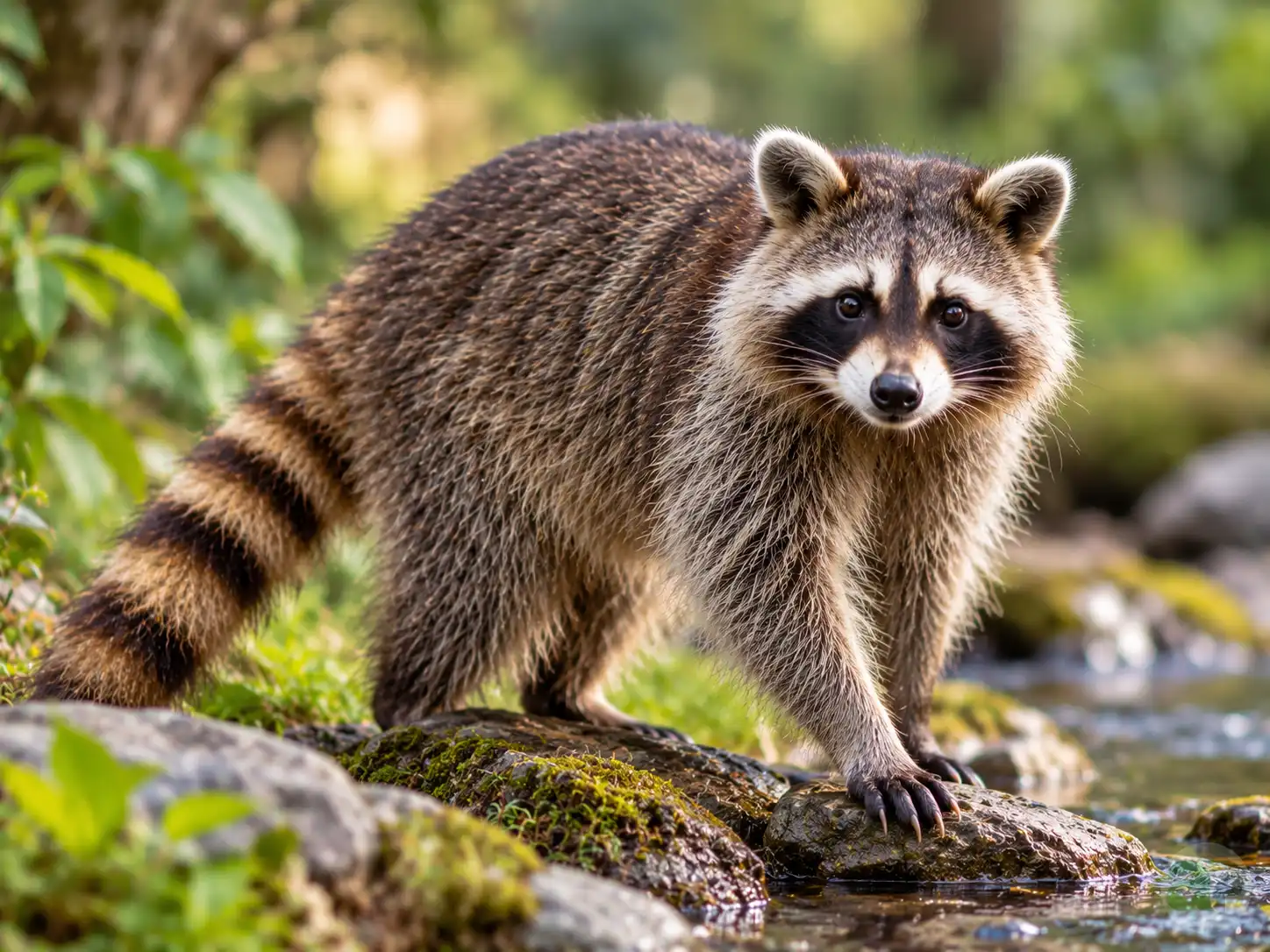
Myth: Raccoons wash their food to clean it before eating. Fact: Raccoons do not wash food for cleanliness — the behavior is primarily about tactile sensory enhancement. Moistening the paws activates and amplifies the mechanoreceptors in the raccoon’s hypersensitive forepaws, allowing more precise tactile assessment of food items. Captive raccoons perform this behavior even with clean food in clean water, confirming it is sensory rather than hygienic in motivation.
Myth: A raccoon seen during the day is necessarily sick with rabies. Fact: While raccoons are primarily nocturnal, daytime activity is not inherently abnormal — nursing females with young kits require additional food and may forage during daylight hours; individuals in urban areas with reduced predation fear may be active at any time; and young raccoons learning to forage may be active during the day. Signs of genuine rabies infection include confusion, disorientation, aggression without provocation, and difficulty walking — not simply daytime activity.
Myth: Raccoons are dirty, disease-ridden nuisances with no ecological value. Fact: Raccoons provide genuine ecosystem services — regulating populations of insects, crayfish, and rodents; dispersing seeds of berry-producing plants; serving as prey for larger carnivores including coyotes, bobcats, and owls; and contributing to wetland and riparian ecosystem function through their aquatic foraging. Their reputation as nuisances primarily reflects their success in exploiting human food resources rather than any intrinsic ecological uselessness.
Myth: Raccoons are related to bears. Fact: Raccoons belong to the family Procyonidae — their closest relatives are coatis, ringtails, olingos, and the kinkajou, not bears. The scientific name “lotor” (washing bear) and the German name “Waschbär” (washing bear) both reference the food-washing behavior but reflect historical nomenclature rather than actual taxonomic relationship to bears.
Myth: Raccoons are solitary animals with no social structure. Fact: While raccoons are primarily solitary in their daily foraging, they demonstrate meaningful social relationships — particularly between females and their female offspring, who sometimes maintain overlapping territories and shared den sites across multiple seasons. Winter denning aggregations of multiple adults, learned behavioral traditions passed between individuals, and the extended mother-kit association all reflect a more complex social structure than the “solitary raider” stereotype suggests.
19. Best Places to See Raccoons in the Wild
Everglades National Park, Florida
The Everglades supports exceptionally dense raccoon populations in its freshwater and coastal wetland habitats — with raccoons visible throughout the park at dawn and dusk, particularly along the water margins of the Anhinga Trail, Royal Palm area, and coastal mangrove zones where the combination of aquatic foraging opportunities and protected status produces some of the most approachable wild raccoon concentrations in North America.
Great Smoky Mountains National Park, Tennessee/North Carolina
The Smokies host thriving raccoon populations in their rich deciduous forest habitat — with raccoons regularly visible at established campgrounds, picnic areas, and woodland trailheads, particularly in the evening and early morning hours.
Assateague Island, Maryland/Virginia
Assateague Island — famous for its wild horses — also supports a significant raccoon population that has become well-habituated to visitor presence, with raccoons regularly encountered along beach margins, campground perimeters, and marsh edges in behavior that provides excellent close-range observation opportunities.
Stanley Park, Vancouver, British Columbia
Stanley Park — one of the world’s most celebrated urban parks, located within the City of Vancouver — hosts raccoon populations that are among the most habituated to human presence of any wild raccoons anywhere, regularly visible along park trails and at park water features, providing exceptional urban wildlife observation opportunities.
Cape Hatteras National Seashore, North Carolina
The coastal habitats of Cape Hatteras support raccoon populations that exploit both terrestrial foraging opportunities and the rich intertidal zone of the Outer Banks — providing observation opportunities in a spectacular natural setting with the combination of beach, marsh, and forest habitats that represents some of the finest raccoon habitat on the Atlantic Coast.
20. Top Documentaries & Books
Must-Watch Documentaries
“Urban Jungle” (BBC and various) — Multiple BBC and National Geographic productions covering urban wildlife across North American cities have featured raccoons prominently — with raccoon intelligence, problem-solving behavior, and urban adaptation documented with high production quality.
“Wild Things: North America” and related National Geographic productions — Multiple episodes focused on North American urban wildlife have dedicated significant time to raccoon ecology, behavior, and their remarkable adaptation to human-dominated environments.
Various CBC (Canadian Broadcasting Corporation) wildlife productions — CBC has produced several wildlife documentaries specifically focused on Toronto and other Canadian urban raccoon populations, providing some of the finest available footage of urban raccoon problem-solving and social behavior.
Essential Books
“Rascal” by Sterling North (1963) — The classic American memoir of raising a wild raccoon, beautifully written and scientifically informed for its era — one of the finest accounts of raccoon behavior and personality ever produced in popular form.
“Raccoon Nation” (CBC documentary companion material) — Material associated with the CBC documentary specifically focused on Toronto’s urban raccoon population and their remarkable cognitive adaptation to urban life provides excellent accessible popular science context for understanding urban raccoon ecology.
“Wildlife in the City” by various urban ecology authors — Multiple popular science books covering urban wildlife ecology in North America include extensive raccoon content providing accessible scientific context for understanding the species’ urban success.
21. Raccoon Comparison of Raccoons with Similar Animals
| Feature | Raccoon | Coati | Ringtail | Red Fox | Opossum |
|---|---|---|---|---|---|
| Scientific Name | Procyon lotor | Nasua narica | Bassariscus astutus | Vulpes vulpes | Didelphis virginiana |
| Weight | 2–14 kg | 3–8 kg | 0.8–1.4 kg | 3–14 kg | 0.5–6 kg |
| Family | Procyonidae | Procyonidae | Procyonidae | Canidae | Didelphidae (marsupial) |
| Distribution | North/Central America (native); Europe, Japan (invasive) | SW USA through South America | SW USA, Mexico | Nearly worldwide | North and South America |
| Facial Mask | Bold black mask | Elongated snout; no mask | Moderate facial markings | No mask | White face |
| Tail | Ringed; bushy | Long; faintly ringed | Strongly ringed | Bushy; white tip | Prehensile; naked |
| Diet | Broad omnivore | Omnivore; more insectivore | Insectivore; small vertebrates | Omnivore | Broad omnivore |
| Social Structure | Primarily solitary; some female bonds | Social (bands of females) | Primarily solitary | Primarily solitary | Solitary |
| Intelligence | Very high; 200+ vocalizations | Moderate | Moderate | High | Lower than raccoon |
| Conservation Status | Least Concern | Least Concern | Least Concern | Least Concern | Least Concern |
| Unique Feature | Hypersensitive paws; 3-year memory; urban success | Social foraging bands; elongated snout | Large eyes; semi-retractable claws | Widest-ranging wild canid | Only North American marsupial |
22. How You Can Help
Raccoon conservation differs from most wildlife advocacy contexts in that the species itself does not require population protection — but meaningful contributions to raccoon welfare, urban wildlife coexistence, and the management of invasive raccoon populations in non-native range countries are all areas where individual actions are impactful.
Support These Organizations
Urban Wildlife Information Network (UWIN) (urbanwildlifeinfo.org) — The primary research coordination body for urban wildlife science across North American cities, including extensive raccoon monitoring, behavioral ecology research, and coexistence education programs.
Humane Society of the United States — Wildlife Department (humanesociety.org) — Provides resources for humane urban wildlife conflict resolution and advocates for non-lethal management of urban raccoon conflicts.
TRAFFIC (traffic.org) — For international contexts, TRAFFIC monitors wildlife trade including the raccoon fur and live animal trades relevant to invasive population management.
Local wildlife rehabilitation centers — Most urban and suburban raccoon conflicts are most effectively addressed through licensed local wildlife professionals and rehabilitation centers.
Practical Actions
Secure all food sources. The most impactful action for reducing urban raccoon conflict — using raccoon-resistant garbage containers, removing outdoor pet food, securing compost bins, and bird feeder management eliminates the food rewards that attract and habituate raccoons to human spaces.
Never feed raccoons. Intentional feeding — while motivated by genuine affection for these intelligent animals — creates food-conditioned individuals that inevitably generate conflict and are typically killed as a management result. The kindest thing for urban raccoons is to maintain appropriate wildness by not providing direct food rewards.
Seal home entry points. Prevention of attic and crawl space denning — through professional exclusion of potential entry points — prevents the property damage and public health concerns associated with raccoon denning in structures.
Support urban wildlife research. Citizen science platforms including iNaturalist and urban wildlife monitoring programs in specific cities welcome raccoon sighting reports that contribute to population monitoring and urban ecology research across North America.
Advocate for humane invasive management. In European and Japanese contexts where invasive raccoon populations require management, supporting organizations that advocate for humane, evidence-based management approaches contributes to more effective and more ethically appropriate invasive species control.
Did You Know? The City of Toronto has one of the world’s most extensive and most publicly documented urban raccoon management programs — including specialized garbage container design, public education programs, nuisance wildlife response protocols, and active research partnerships with universities studying urban raccoon ecology and behavior. Toronto’s experience — both its challenges and its successes — has generated an extensive body of practical knowledge about urban wildlife coexistence that has been applied in cities across North America and studied by European wildlife managers grappling with their own raccoon populations. In many ways, Toronto’s raccoons have made the city an inadvertent global center of urban wildlife management expertise.
23. Frequently Asked Questions About Raccoons
Q1: What is the scientific name of the raccoon?
The raccoon’s scientific name is Procyon lotor — with “Procyon” meaning “before the dog” (from Greek astronomical terminology referring to the Procyon star) and “lotor” meaning “washer” in Latin, referencing the famous food-washing behavior. The family is Procyonidae, order Carnivora, class Mammalia.
Q2: How intelligent are raccoons?
Raccoons are among the most intelligent non-primate mammals — with documented cognitive capabilities including 3-year long-term memory for problem solutions, the ability to open complex multi-step locks and containers, potential rudimentary causal reasoning, and cultural transmission of learned behaviors between individuals. Laboratory research consistently ranks raccoon intelligence at the high end of comparable-sized mammals.
Q3: Do raccoons really wash their food?
Raccoons do rub and manipulate food items near water — but the behavior is not about cleanliness. Current scientific understanding is that it primarily functions to enhance tactile sensory information by moistening the forepaws, activating the hypersensitive mechanoreceptors in the paw skin and allowing more precise assessment of food items. Captive raccoons perform this behavior even with clean food in clean water.
Q4: Are raccoons dangerous?
Healthy raccoons are not typically aggressive toward humans — but they can be dangerous when cornered or defending young, with sharp claws and teeth capable of inflicting serious injuries. More significant health concerns include rabies (raccoons are a primary reservoir host in eastern North America) and raccoon roundworm (Baylisascaris procyonis), a parasite that can infect humans through contact with raccoon feces. Raccoon encounters should be treated with appropriate caution.
Q5: How many raccoons are in North America?
The current North American raccoon population is estimated at approximately 15–20 million individuals — making the raccoon one of the most abundant medium-sized carnivores on the continent, with populations at their highest historical levels in many areas due to reduced hunting pressure and the food resources provided by human settlements.
Q6: Do raccoons hibernate?
Raccoons do not true hibernate — they enter a state of winter torpor rather than full hibernation, reducing activity and living off fat reserves during cold periods but waking and occasionally foraging during mild spells. In the coldest parts of their range, raccoons may spend several weeks at a time in dormancy during the coldest winter periods.
Q7: Why do raccoons have a mask?
The raccoon’s distinctive black facial mask likely serves multiple functions — potentially including anti-glare (reducing light reflection into the eyes during water-surface foraging), social communication enhancement (making facial expressions more readable during social encounters), and camouflage disruption (breaking up the facial outline in dappled light conditions). The exact primary function remains an active area of scientific inquiry.
Q8: How long do raccoons live?
Wild raccoons have an average lifespan of only 2–3 years — primarily due to the combination of predation, disease, vehicle collisions, and hunting that represents the dominant mortality sources. The maximum documented wild lifespan is approximately 5 years, while captive raccoons with veterinary care and consistent nutrition have lived up to 21 years.
Q9: Are raccoons invasive species?
Raccoons are native species in North and Central America — but have established invasive populations in Germany (~1.2 million individuals), Japan (~1 million individuals), and other European countries where they are expanding. These invasive populations generate genuine ecological concerns for native wildlife — particularly ground-nesting birds and reptiles — and present management challenges for wildlife authorities in affected countries.
Q10: How can I keep raccoons out of my garbage?
Key practical actions include: using raccoon-resistant garbage containers with locking lids; keeping garbage inside until collection morning rather than overnight; securing composting bins with raccoon-proof construction; removing outdoor pet food and bird feeders or using raccoon-resistant designs; and applying natural repellents (cayenne pepper, predator urine) around container areas. The most effective long-term approach is eliminating food rewards rather than attempting to deter animals that are already conditioned to a food source.
26. Sources & References
Research Sources
- Wikipedia — Procyon lotor and related articles
- IUCN Red List — iucnredlist.org
- National Geographic — nationalgeographic.com
- Smithsonian’s National Zoo — nationalzoo.si.edu
- Urban Wildlife Information Network — urbanwildlifeinfo.org
- Encyclopaedia Britannica — britannica.com
- BBC Wildlife — bbc.co.uk
- Live Science — livescience.com
- Humane Society of the United States — humanesociety.org
- CDC (Centers for Disease Control) — raccoon disease information
- North, Sterling — “Rascal” (1963)
- Davis, H.B. — “The Raccoon: A Study in Animal Intelligence” (1908, foundational research)
- Prange, Suzanne et al. — Urban raccoon ecology research publications (multiple)