
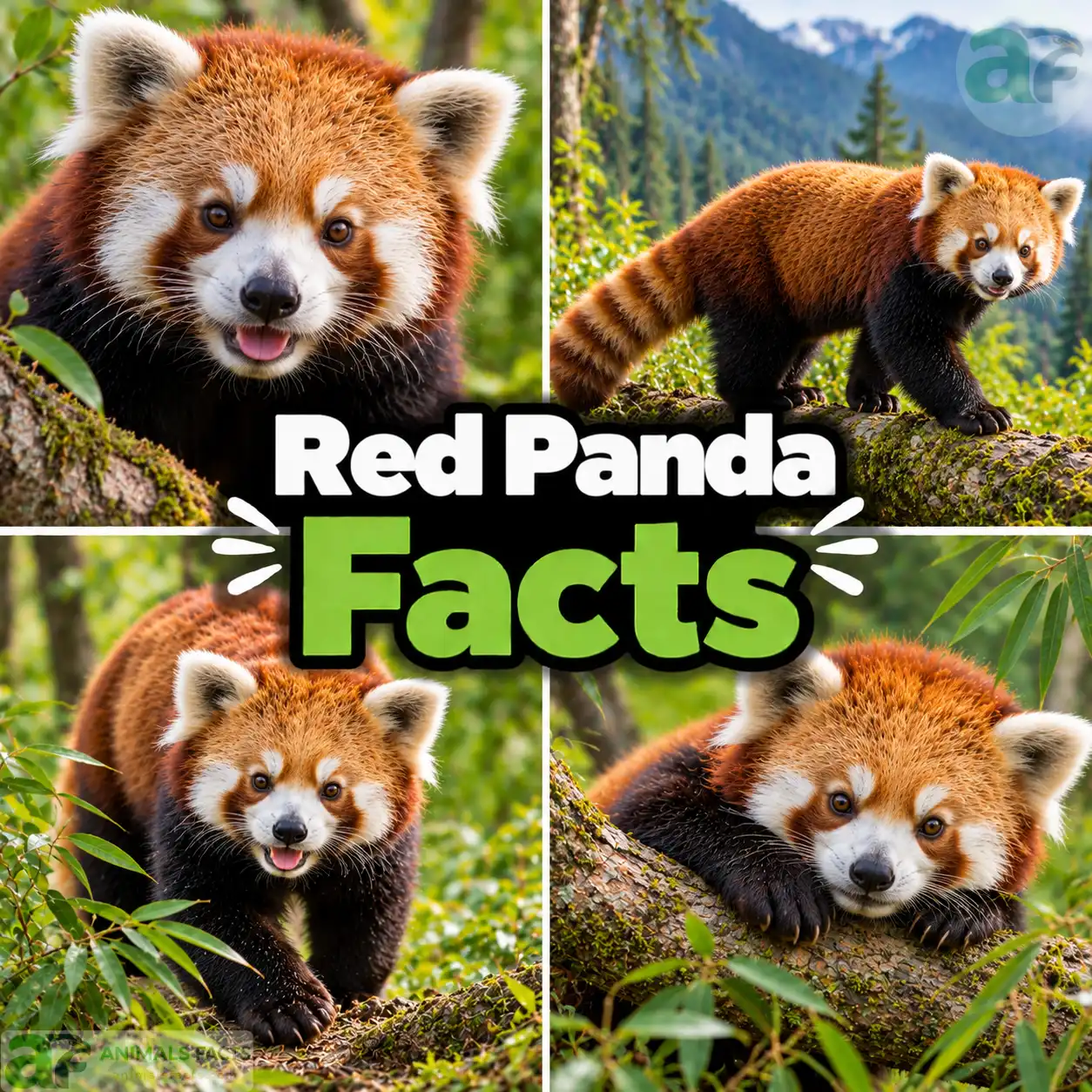
Red Panda Facts
| Feature | Details |
|---|---|
| Scientific Name | Ailurus fulgens |
| Common Names | Red Panda, Firefox, Lesser Panda, Red Cat-Bear, Shining Cat |
| Kingdom | Animalia |
| Phylum | Chordata |
| Class | Mammalia |
| Order | Carnivora |
| Family | Ailuridae — its OWN family, sole member of genus Ailurus |
| Genus | Ailurus |
| Recognized Subspecies | 2 subspecies — Ailurus fulgens fulgens (Himalayan Red Panda) and Ailurus fulgens styani (Chinese Red Panda) — split recognized in 2020 |
| Habitat | Temperate montane forest with bamboo understory — Himalayas, southwest China, northern Myanmar, northern India |
| Lifespan | 8–10 years in the wild; up to 23 years in captivity |
| Diet | Primarily bamboo (leaves and shoots) — supplemented by fruit, insects, eggs, small vertebrates |
| Weight | 3.7–6.2 kg — approximately the size of a large domestic cat |
| Body Length | 50–65 cm (body); tail adds 30–50 cm — roughly equal body and tail length |
| Shoulder Height | 20–30 cm |
| Conservation Status | Endangered (IUCN Red List, since 2008) |
| Global Wild Population | Estimated fewer than 10,000 mature individuals — possibly as few as 2,500 in some assessments |
| Unique Feature | Sole member of its own family (Ailuridae); modified wrist bone “false thumb” convergent with giant panda’s; the original “panda” (described before the giant panda got the name); Firefox browser logo inspiration |
 1. Introduction: What is a Red Panda?
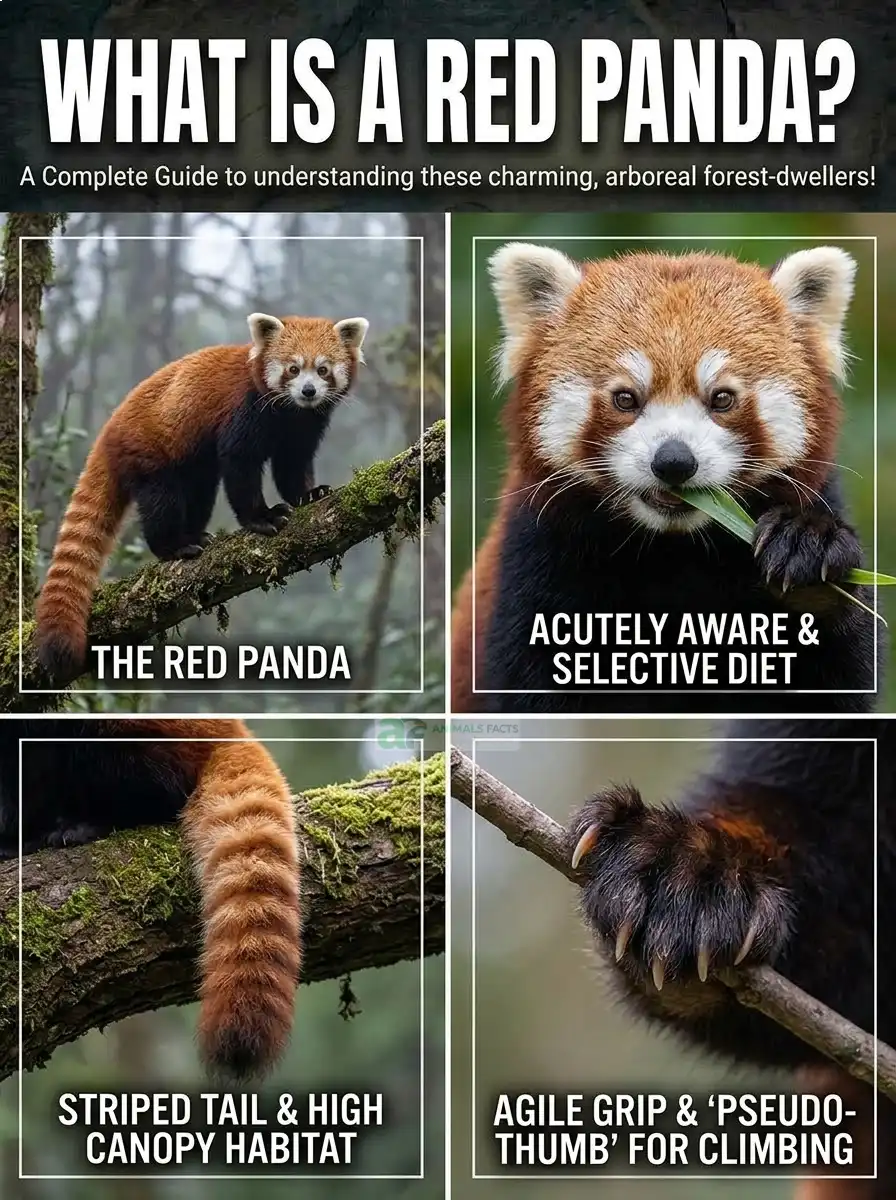
It was called “panda” before the giant panda ever received that name — the word itself derives from the Nepali “ponya” or the French “panda,” first applied to this small, russet-colored animal of the Himalayan forests when it was described to Western science in 1825, approximately 44 years before the giant panda was formally introduced to Western naturalists. It has a modified wrist bone that functions as a false thumb for gripping bamboo — convergently evolving the same solution as the giant panda to the same bamboo-gripping problem, independently and in a completely different mammalian lineage, one of evolution’s most extraordinary examples of parallel adaptation. And it has been designated the most endangered mammal in several of the countries it inhabits — with a global wild population estimated at fewer than 10,000 mature individuals across the fragmented Himalayan and southwestern Chinese forests it calls home. Red panda facts are, from the very beginning, full of genuinely extraordinary biological and conservation surprises.
The red panda — Ailurus fulgens — is a small, arboreal mammal of the temperate mountain forests of the Himalayas and southwestern China, inhabiting an ecological niche that it has occupied for millions of years in the high-altitude bamboo forests of Asia’s greatest mountain range. Despite its charming appearance — the reddish-brown fur, the masked face, the striped bushy tail that can exceed the length of its own body — the red panda is not a raccoon, not a bear, not a fox, and is not closely related to the giant panda despite sharing both its bamboo diet and its common name. It is the sole living member of its own unique family — Ailuridae — a taxonomic isolation that reflects its genuinely ancient evolutionary divergence from all other living mammals, making it not merely cute but genuinely scientifically extraordinary.
Whether you are a student researching red panda facts for a school project, a wildlife traveler planning a visit to the Himalayas, a conservation advocate concerned about the species’ Endangered status, a Firefox browser user curious about why a red panda is the mascot, a parent looking for red panda facts for kids, or simply someone who has been charmed by photographs of this remarkable animal — this is the most complete guide to red panda facts you will find anywhere. We cover red panda habitat, red panda diet, red panda behavior, the original panda name, the remarkable false thumb, reproduction, conservation, mythology, and the extraordinary story of an animal that has occupied its Himalayan bamboo forest niche for millions of years while remaining one of the least understood and most overlooked of Asia’s endangered mammals.
2. Red Panda Species Overview & Classification
The red panda’s taxonomic history is one of the most confusing and most scientifically debated in all of mammalogy — with the species having been classified at different times as related to raccoons, bears, mustelids (weasels and relatives), and giant pandas, before modern genetic analysis finally established it as the sole member of its own unique family.
The Taxonomic Debate — Resolved (Mostly)
Since its formal scientific description in 1825, the red panda has been a taxonomic puzzle — placed by different authorities in Procyonidae (raccoon family), Ursidae (bear family), and various mustelid-related groupings, before molecular phylogenetic analysis in the 1990s and 2000s confirmed that it represents a genuinely unique evolutionary lineage deserving its own family-level classification.
The family Ailuridae — containing only the single genus Ailurus with a single living species — is currently placed within the superfamily Musteloidea, grouping it most broadly with the mustelids (weasels, otters), procyonids (raccoons, coatis), and skunks — but with sufficient evolutionary distinctiveness to warrant its own family designation rather than placement within any of these related groups.
Species Classification Table
| Level | Classification |
|---|---|
| Kingdom | Animalia |
| Phylum | Chordata |
| Class | Mammalia |
| Order | Carnivora |
| Superfamily | Musteloidea |
| Family | Ailuridae (sole living genus and species) |
| Genus | Ailurus |
| Species | A. fulgens |
| Common Names | Red Panda, Firefox, Lesser Panda, Red Cat-Bear, Shining Cat, Ponya (Nepal) |
The Two Red Panda Subspecies — A 2020 Resolution
For most of scientific history, the red panda was treated as a single species — but genetic analysis published in 2020 formally recognized the existence of two genetically distinct subspecies with meaningful biological differences:
| Subspecies | Scientific Name | Range | Distinguishing Features |
|---|---|---|---|
| Himalayan Red Panda | Ailurus fulgens fulgens | Nepal, Bhutan, northeastern India, northern Myanmar | Slightly lighter coloration; paler facial markings; historically the “classic” subspecies |
| Chinese Red Panda | Ailurus fulgens styani | Sichuan, Yunnan (southern China), parts of northern Myanmar | Larger; darker coat; more pronounced facial markings; slightly different facial stripe pattern |
The recognition of two distinct subspecies has significant conservation implications — it means that each subspecies represents an independently evolving population requiring its own dedicated conservation strategy, and that the effective conservation unit for red pandas is smaller than a single global species assessment would suggest.
Species Evolution & Discovery Timeline
~22–25 million years ago: Red panda ancestors — early Ailuridae — appear in fossil deposits in both Europe and North America, demonstrating that the red panda lineage was once a globally distributed group rather than an Asian endemic.
~10–15 million years ago: The European and North American Ailuridae become extinct — leaving the Asian lineage that would eventually produce the modern red panda as the sole surviving Ailuridae population.
~2–4 million years ago: The modern red panda (Ailurus fulgens) achieved something close to its current form, establishing itself in the Himalayan and southwestern Chinese forest habitats it continues to occupy today.
1821: Major General Thomas Hardwicke presented the first Western scientific description of the red panda to the Linnean Society of London — though his description was not immediately published, leading to subsequent confusion about priority.
1825: French naturalist Frédéric Cuvier published the first formal scientific description of the red panda, naming it Ailurus fulgens — the species name translates as “shining cat,” referring to the lustrous quality of its reddish-brown fur. Cuvier also coined the term “panda” — from the French adaptation of the Nepali word “ponya” — which was first applied to this species, 44 years before Thomas Hardwicke’s “white bear” (later called giant panda) received the panda name.
1869: The giant panda was formally described to Western science by Père Armand David — and subsequently also acquired the “panda” name, eventually becoming so much better known globally that it appropriated the “panda” term while the original red panda became the “lesser” panda or “red” panda.
2001: Mozilla Firefox adopted the red panda as its mascot — with the browser’s name “Firefox” being a common English translation of the Mandarin Chinese name for red panda (火狐 — “fire fox”) — inadvertently making the red panda one of the most widely displayed animal images in the world of technology.
2020: Genetic analysis formally confirmed two distinct red panda subspecies — the Himalayan Red Panda and Chinese Red Panda — with significant conservation implications for species management across their range.
3. Red Panda Physical Description & Unique Features
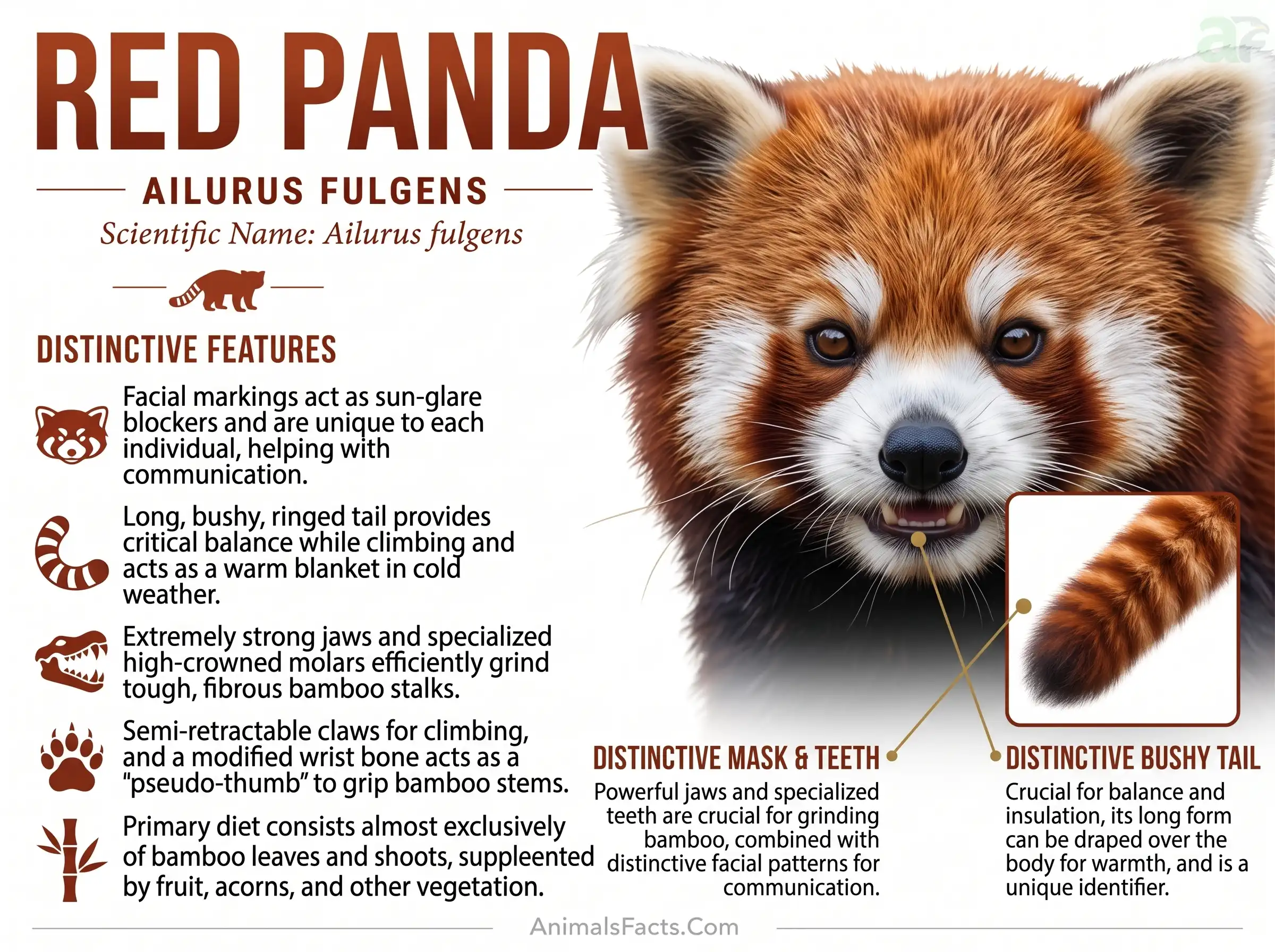
The red panda’s physical design is one of nature’s most visually captivating achievements — combining the russet-and-cream coloration of a fox with the masked facial pattern of a raccoon, the bushy striped tail of a ringtail, and the bamboo-gripping false thumb of a convergently evolved bamboo specialist, in an animal approximately the size of a large domestic cat.
Size and Build
The red panda is notably smaller than most people imagine from photographs — significantly smaller than the giant panda with which it is often mentally associated:
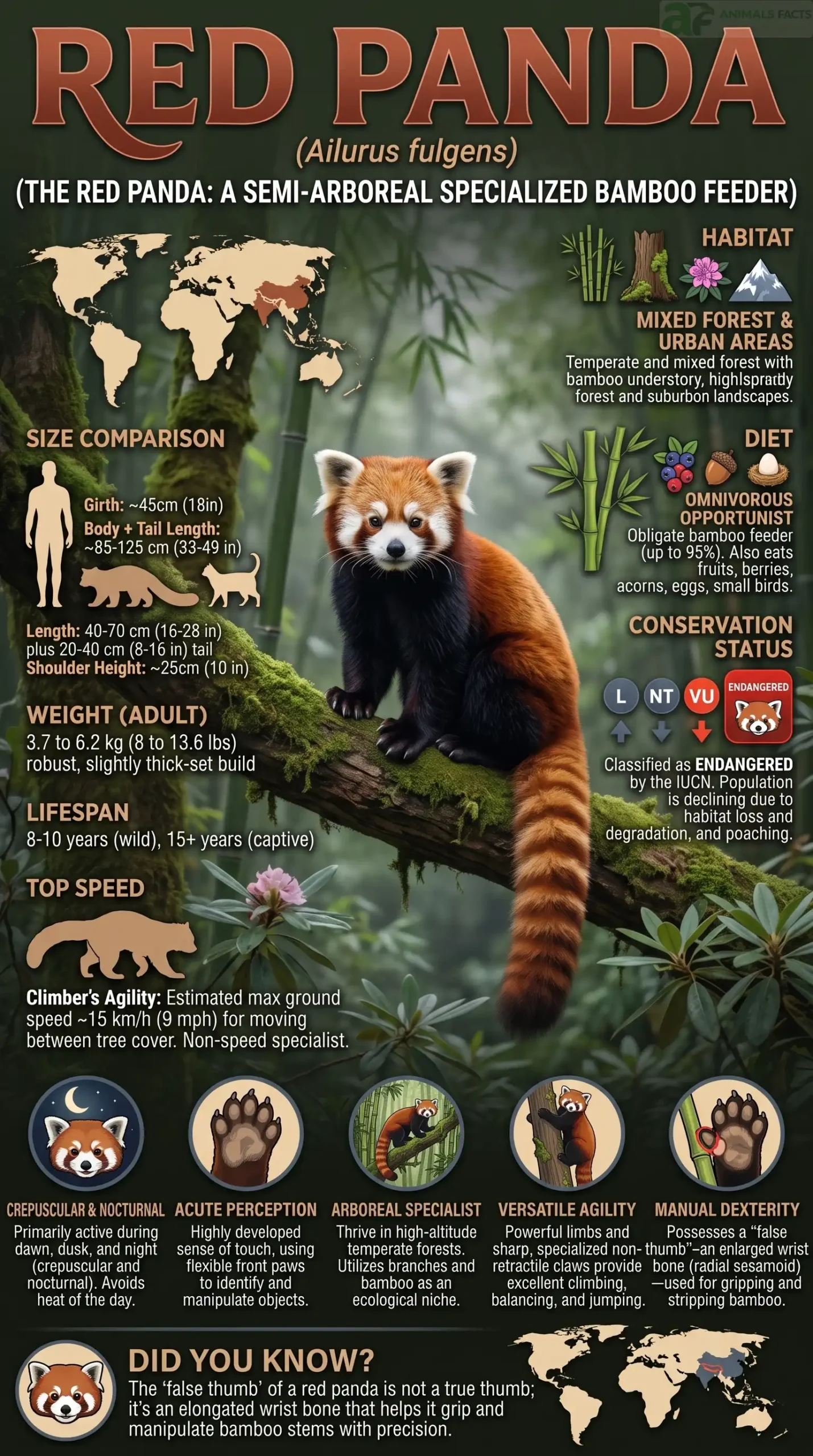
- Body length: 50–65 cm — comparable to a large domestic cat
- Tail length: 30–50 cm — approximately equal to body length, making the tail proportionally one of the longest of any Carnivora member relative to body size
- Weight: 3.7–6.2 kg — within the weight range of typical domestic cats
- Males: Marginally larger than females in most measured parameters
The Extraordinary Coat
The red panda’s coat is one of the most complex and most beautiful of any small carnivore:
Dorsal surface: Rich reddish-brown, sometimes approaching deep chestnut, with a distinctive texture and sheen that inspired Cuvier’s species name “fulgens” (shining).
Facial markings: Distinctive white or cream ears, eye rings, and muzzle with reddish-brown stripes running from the inner corner of each eye downward toward the jaw — creating a masked appearance distinct from but reminiscent of the raccoon facial pattern.
Underside and limbs: Dark brown to black — a coloration contrast that provides warmth absorption in the cold Himalayan forest environment while the reddish dorsal coat provides camouflage against the reddish-brown mosses and lichens of the temperate forest.
Tail: Striped with alternating reddish and pale rings — 5–6 rings along the length — providing a visually distinctive pattern that may serve communication functions during tail-raising displays.
The False Thumb — Convergent Evolution’s Greatest Parallel
The red panda possesses an enlarged radial sesamoid bone — a modified wrist bone — that functions as a sixth digit for gripping bamboo, identical in concept and function to the giant panda’s famous “false thumb.” This convergent evolution of the same anatomical solution to the same bamboo-gripping problem in two completely unrelated mammalian lineages — the red panda’s Ailuridae and the giant panda’s Ursidae — separated by tens of millions of years of independent evolution, is one of the most celebrated examples of convergent evolution in mammalian biology.
Thermal Adaptations
The red panda possesses several physical adaptations for surviving the cold montane environment it inhabits:
Dense underfur: An extremely dense undercoat provides insulation in temperatures that regularly fall below freezing in its mountain forest habitat.
Fur-covered paws: The soles of the red panda’s feet are covered with dense white fur — providing insulation against cold ground surfaces and potentially improving traction on snow-covered branches.
Tail as blanket: When resting in cold conditions, red pandas wrap their long, bushy tails around their bodies — using the tail as a natural blanket to reduce heat loss during rest.
Did You Know? The red panda’s facial coloration — with its distinctive reddish-brown stripes running from the inner corners of the eyes downward — may function as anti-glare coloration similar to the black “eye black” that athletes apply beneath their eyes to reduce sun glare. Research has suggested that the dark facial markings of several animals that are active in bright, open, or high-altitude environments may help reduce light reflection from the cheeks into the eyes, improving visual acuity in bright conditions. This functional interpretation of the red panda’s facial markings — if supported by further research — would make them not merely decorative but a genuinely adaptive feature for an animal that must make precise movements in the bright, reflective conditions of snow-covered Himalayan forest.
4. Top 25 Surprising & Interesting Red Panda Facts
- The red panda was called “panda” approximately 44 years before the giant panda received that name — making it the original panda, with “giant panda” being named later by analogy with the already-famous smaller animal.
- The red panda is the sole living member of its own family, Ailuridae — a taxonomic isolation reflecting evolutionary distinctiveness greater than that between lions and tigers, or between wolves and domestic dogs.
- The red panda independently evolved the same “false thumb” (enlarged radial sesamoid wrist bone for gripping bamboo) as the giant panda — in completely different evolutionary lineages, representing one of biology’s most celebrated examples of convergent evolution.
- The Firefox web browser was named after the red panda — with “Firefox” being a common English translation of the Mandarin Chinese name for red panda (火狐, “fire fox”), making the red panda the inadvertent mascot of one of the world’s most used internet browsers.
- Red panda ancestors lived in Europe and North America approximately 22–25 million years ago — making the red panda’s current restriction to the Himalayas and southwestern China a dramatic range contraction from an originally global distribution.
- Red pandas are crepuscular — most active around dawn and dusk — sleeping in tree branches for much of the day with their tail wrapped around their body as insulation.
- The red panda has fur on the soles of its feet — providing insulation against cold ground surfaces and improved grip on snow and ice-covered branches in its mountain forest habitat.
- Female red pandas build elaborate nests of leaves, moss, grass, and branches in tree hollows and rocky crevices for giving birth — constructing these nests several days before their cubs are born.
- Red pandas can descend trees headfirst — one of very few mammals capable of this, achieved through the same ankle-rotation capability documented in sun bears and some squirrels.
- A red panda’s territory is marked through scent glands on the soles of its feet — meaning the animal literally leaves chemical messages with every step, creating an invisible scent map of its territory detectable by other red pandas.
- Red pandas use their front paws like hands — sitting upright and using their forepaws to hold bamboo shoots while eating them, in a posture that has been described as appearing remarkably human-like.
- The red panda has been documented consuming bamboo at temperatures below freezing — continuing to forage for food even in winter weather conditions that would render most small mammals dormant or desperate for alternative food sources.
- The global captive red panda population — approximately 800 individuals across 200+ accredited institutions worldwide — is managed through a coordinated international studbook program that tracks the genetic relatedness of every captive individual to maximize breeding diversity.
- Red pandas are surprisingly vocal — producing a wide range of sounds including twittering, squealing, huffing, and a distinctive “huff-quack” warning call that has surprised many first-time observers with its unexpectedness from such a small, apparently quiet animal.
- The 2020 recognition of two subspecies — the Himalayan Red Panda and the Chinese Red Panda — means that conservation efforts must now explicitly address the needs of two independently evolving populations rather than treating all red pandas as a single conservation unit.
- Red pandas spend up to 13 hours per day resting — an energy conservation strategy reflecting the low nutritional value of bamboo, which requires energy conservation between feeding bouts to maintain adequate caloric balance.
- Female red pandas show strong site fidelity — returning to the same den sites used in previous years, creating a learned knowledge of safe denning locations within their home range that may be passed to offspring through observation.
- Red pandas are considered a flagship species for the Eastern Himalayan biodiversity hotspot — with their conservation providing protective benefits to the entire montane forest ecosystem they inhabit, including hundreds of other species of plants, animals, and fungi.
- The red panda’s reddish-brown coat provides camouflage against the reddish-brown mosses and lichens that cover the trees of its Himalayan forest habitat — a coloration that appears conspicuous to human observers in photographs but is genuinely cryptic in its natural environment.
- Red pandas have been documented at elevations of up to 4,800 meters above sea level in some parts of their range — among the highest elevations regularly occupied by any carnivore-order mammal of comparable body size.
- The Red Panda Network — the leading organization specifically focused on red panda conservation — has established a program of community-based conservation in Nepal that employs local community members as “Forest Guardians,” creating economic incentives for red panda protection within the communities that share the species’ habitat.
- Red pandas wash their faces and paws like cats — using tongue-dampened forepaws to clean facial markings and ears in a grooming behavior that has likely contributed to their cultural associations with cat-like qualities across multiple Asian traditions.
- The Ailurus fulgens name literally translates as “shining cat” — with “Ailurus” from the Greek for cat and “fulgens” from the Latin for shining or gleaming, referencing the lustrous quality of the red panda’s fur that impressed Frédéric Cuvier when he formally described the species in 1825.
- Red pandas are documented as highly capable swimmers — crossing streams and rivers as part of normal territorial movement, with the waterproof quality of their dense underfur maintaining insulation even when the outer coat is wet.
- The wild red panda population has declined by approximately 50% over the past 20 years — with habitat loss, poaching, and the increasingly fragmented nature of suitable bamboo forest driving a decline trajectory that makes the species one of Asia’s most urgently threatened mammals despite its relatively low global profile.
5. Fun Facts About Red Panda
- The red panda is the original “panda” — named 44 years before the giant panda.
- It has its own unique family — Ailuridae — containing only one species.
- Red pandas independently evolved the same “false thumb” as the giant panda.
- Firefox browser was named after the red panda (“火狐” = fire fox in Mandarin).
- Red pandas’ ancestors once lived in Europe and North America.
- They descend trees headfirst — one of very few mammals able to do this.
- Red pandas have fur on the soles of their feet for insulation and grip.
- They wrap their tail around themselves like a blanket when resting.
- Red pandas spend up to 13 hours per day resting — conserving bamboo energy.
- The species name Ailurus fulgens means “shining cat” in Latin.
- Wild populations have declined by ~50% in the past 20 years.
- A wild population estimate as low as 2,500 mature individuals in some assessments.
6. Red Panda Habitat & Geographic Range
The red panda’s geographic range is a crescent-shaped belt following the arc of the Himalayas and extending into the mountain ranges of southwestern China — a geographic distribution that reflects both the species’ ecological requirements and the historical range contraction from its formerly global distribution.
Primary Habitat Requirements
The red panda is an ecological specialist with specific and relatively narrow habitat requirements — the combination of which defines its current restricted range:
Temperate montane bamboo forest: The red panda’s defining habitat — mixed temperate forest (typically combining broadleaf deciduous and evergreen tree species) with a dense bamboo understory, at elevations typically between 2,200–4,800 meters, in areas of high moisture and moderate temperatures that sustain the bamboo and epiphytic moss communities the species depends upon.
Bamboo understory: The presence of sufficient bamboo — particularly Yushania and Fargesia species at higher elevations and Phyllostachys and related species at lower elevations — is the single most critical habitat requirement, as bamboo comprises the primary dietary component across virtually all seasons.
Large trees: Old-growth or mature second-growth trees with large horizontal branches and hollow trunks provide critical denning habitat for females with cubs, and serve as primary sleeping and resting locations for all individuals.
Cool, moist climate: Red pandas require relatively cool, moist conditions — being highly susceptible to heat stress, they are limited in the lower elevational extent of their range by temperature thresholds above which they cannot thermoregulate adequately.
Geographic Range Table
| Country | Status | Estimated Population | Notes |
|---|---|---|---|
| China (Sichuan, Yunnan) | Endangered (national) | ~3,000–4,000 (uncertain) | Largest national range; Chinese Red Panda subspecies present |
| Nepal | Endangered (national) | ~1,000–2,000 | Best-monitored population; Red Panda Network active |
| India (Sikkim, Arunachal Pradesh, West Bengal) | Endangered (national) | ~1,000–2,000 | Scattered population; significant research gaps |
| Bhutan | Endangered (national) | ~500–1,000 | Relatively intact habitat; better-protected populations |
| Myanmar (northern states) | Endangered (national) | Poorly quantified | Significant research gap; ongoing deforestation |
Did You Know? The red panda’s distribution follows the arc of the Eastern Himalayan Biodiversity Hotspot — one of the world’s 36 recognized biodiversity hotspots, areas that combine extraordinary species richness with extraordinary habitat threat. The Eastern Himalayas hotspot contains an estimated 10,000 plant species (of which approximately 3,160 are found nowhere else on Earth), alongside exceptional concentrations of endemic vertebrate species including the red panda, snow leopard, clouded leopard, and Himalayan black bear. Conservation of red panda habitat therefore simultaneously protects one of the world’s richest temperate biodiversity concentrations.
7. Red Panda Diet & Feeding Behavior
The red panda’s dietary commitment to bamboo parallels that of the giant panda — with the same paradox of a Carnivora member committed primarily to a grass diet — but with some important differences in dietary flexibility and feeding behavior that reflect the red panda’s smaller body size and different evolutionary history.
What Red Pandas Eat
Diet Breakdown Table
| Food Type | Approximate Percentage | Notes |
|---|---|---|
| Bamboo leaves | 50–60% | Primary year-round food source |
| Bamboo shoots | 15–25% (seasonal) | Highest nutritional value bamboo component; peak spring consumption |
| Bamboo stems | 5–10% | Lower nutritional value; consumed when other components less available |
| Fruit (various forest species) | 5–10% | Important supplementary food in fruiting seasons |
| Insects and invertebrates | 2–5% | Supplementary protein; more important in summer |
| Eggs and small vertebrates | 1–3% | Occasionally documented; reflecting Carnivora ancestry |
| Mushrooms and lichen | 1–3% | Supplementary nutrition; more important in winter |
| Roots and grasses | 1–3% | Minor supplement |
The Bamboo Feeding Strategy
Like the giant panda, the red panda faces the fundamental challenge that bamboo provides insufficient caloric density to fuel normal mammalian metabolic rates — with the low-nutrient bamboo requiring either very large daily intake, very long daily feeding time, or metabolic rate reduction to maintain energy balance.
The red panda’s solution to this challenge differs from the giant panda’s in important ways:
Reduced metabolic rate: Research has documented that the red panda maintains an unusually low metabolic rate compared to most placental mammals of its body size — reducing the caloric demand that bamboo must supply through physiological energy conservation rather than simply eating more.
Selective feeding: Red pandas are highly selective feeders — preferring the most nutritious bamboo components (young shoots and young leaves) over the less nutritious stems, and actively foraging for the highest-quality bamboo available in their territory at any given time.
Dietary supplementation: Unlike the giant panda, red pandas more actively supplement their bamboo diet with fruit, insects, and small vertebrates — reflecting both their smaller body size (which makes the energy cost of catching small prey proportionally lower than for a giant panda) and their greater foraging flexibility.
The False Thumb in Feeding
The red panda uses its modified wrist bone “false thumb” to grip bamboo in exactly the way the giant panda does — holding bamboo shoots between the false thumb and the first true digit to strip leaves, and stabilizing stems during feeding with the same basic grasping motion. Watching a red panda feed on bamboo — sitting upright, holding a shoot with both forepaws, and methodically stripping and consuming leaves — is one of wildlife’s most charming behavioral sequences, made all the more remarkable by the knowledge that this feeding technique represents an independent evolutionary invention of the same solution to the same problem by two entirely different mammalian lineages.
Did You Know? Research on red panda feeding efficiency has documented that the species selects bamboo leaves and shoots with consistently higher protein content than the average nutritional quality of available bamboo in their territory — demonstrating active nutritional assessment of food quality during foraging. This selective nutritional foraging — seeking out the most nutrient-rich bamboo available rather than simply consuming the most abundant — requires both sensory capability (detecting nutritional quality through taste, smell, or texture) and decision-making based on that assessment, representing a level of foraging sophistication that adds to the evidence of red panda cognitive complexity.
8. Red Panda Reproduction & Life Cycle
Red panda reproduction involves several of the most unusual and most fascinating reproductive behaviors documented for any small carnivore — including elaborate nest construction, tiny and highly altricial cubs, and a maternal investment period that is extended relative to the species’ body size.
Mating Behavior
Red pandas mate during January and February — with a breeding season clearly defined by photoperiod (day length) even in the species’ tropical and subtropical range, reflecting an ancient seasonal adaptation to the temperate mountain environments the species has historically occupied.
Seasonal fertility: Female red pandas are in estrus for only approximately 18 hours per mating season — an extraordinarily narrow fertility window that makes timing of mating critical and that has been a significant challenge in captive breeding programs.
Delayed implantation: Red pandas practice embryonic diapause — with the fertilized egg entering dormancy before implanting in the uterine wall, allowing adjustment of birth timing to optimal spring and early summer conditions for cub survival.
Birth and Maternal Care
Nest construction: The female begins building elaborate maternity nests several days before giving birth — selecting tree hollows, rock crevices, or dense bamboo thickets and lining the nest with moss, leaves, grass, and branches to create an insulated birthing chamber.
Gestation: Approximately 112–158 days — a range reflecting the variable duration of delayed implantation.
Litter size: Typically 1–4 cubs (most commonly 1–2).
Birth weight: Approximately 110–130 grams per cub — small and highly altricial, similar to the birth condition of other Carnivora of comparable body size.
Maternal behavior: The mother moves cubs between multiple nest sites — a behavior documented in many small carnivore species, believed to reduce parasite load and predator discovery risk by preventing extended use of any single nest location.
Key Developmental Stages
| Stage | Age | Key Development |
|---|---|---|
| Birth | January/February (breeding) → spring birth | ~120 grams; blind, nearly helpless |
| Eyes open | ~18 days | Beginning visual awareness |
| First mobility | ~3 months | Beginning to explore outside den |
| Bamboo introduction | ~4–5 months | Beginning to sample bamboo alongside nursing |
| Weaning | ~6–8 months | Gradual transition to solid food |
| Independence | ~12–14 months | Separation from mother before next breeding season |
| Sexual maturity | ~18 months (females); ~20 months (males) | First breeding possible |
Lifespan Comparison Table
| Species | Average Wild Lifespan | Maximum Confirmed |
|---|---|---|
| Red Panda | 8–10 years | ~23 years (captivity) |
| Giant Panda | 15–20 years | ~38 years (captivity) |
| Raccoon (for comparison) | 2–3 years | ~16 years (captivity) |
| Sun Bear | ~25 years | ~30 years (captivity) |
9. Social Behavior & Communication
The red panda is a predominantly solitary species — maintaining individual territories with relatively limited direct social interaction outside of the mating season and the mother-cub family relationship.
Territorial Organization and Scent Marking
Red pandas maintain territories through an extensive and sophisticated scent marking system — depositing chemical information at hundreds of locations throughout their range through:
Plantar scent glands: Glands on the soles of the feet deposit scent with every footstep — creating a chemical trail that other red pandas can follow to assess territorial occupancy, individual identity, and reproductive status without direct encounter.
Anal scent glands: Typical of many small carnivores, used for more deliberate marking at prominent landmarks.
Urine marking: Deposited at specific territorial marker locations throughout the home range.
Anogenital marking: Direct deposit of glandular secretions by rubbing the anogenital region on prominent substrates.
Female territories are typically 1–9 km², while male territories are somewhat larger and may overlap with multiple female ranges — following the general territorial pattern of many solitary carnivores.
Vocalizations
Despite their apparently quiet demeanor, red pandas produce a diverse and sometimes surprising range of vocalizations:
Twitter/chirp: The most common contact call — a soft, bird-like twittering used between individuals in relaxed social contexts and between mothers and cubs.
Squealing: An alarm or distress call produced when threatened or stressed.
Huffing: A more serious alarm signal — a sharp, explosive exhalation produced when confronted with a threat.
Huff-quack: A distinctive warning vocalization unique to red pandas — combining elements of a huff and a sound that has been compared to a duck’s quack, produced during threat display situations and described by first-time observers as surprisingly unusual from such a small, cute animal.
Grunt and squeak: Social contact calls used during mating encounters.
Did You Know? Red pandas have been documented engaging in extended play behavior well into adulthood — particularly in captive settings where the behavioral complexity of the captive environment allows expression of a full behavioral repertoire. Wild red pandas have also been observed in what researchers describe as playful behavior during social encounters, including batting at objects, chasing leaves, and engaging in apparent play-wrestling during the mating season. This extended play behavior in adult animals is generally associated with high cognitive capability in mammalian species — and the red panda’s play behavior, combined with its problem-solving capability and sensory foraging sophistication, contributes to a growing scientific appreciation of this species’ genuine cognitive complexity that contrasts with its low profile in intelligence research compared to more studied species.
10. Predators & Defense Mechanisms
The red panda — as a small carnivore in a mountain forest ecosystem shared with numerous larger predators — faces genuine and significant predation pressure, and has evolved a suite of behavioral and physical defensive strategies that reflect millions of years of coexistence with formidable natural enemies.
Natural Predators
Snow Leopards: The most significant natural predator of red pandas in the high-altitude portions of their shared range — with snow leopard predation documented through direct observation and camera trap evidence across multiple parts of the red panda’s Himalayan range.
Clouded Leopards: A significant predation threat in the lower-elevation, forested portions of the red panda’s range — with clouded leopards combining powerful tree-climbing capability and ambush hunting strategy that makes them particularly effective predators of arboreal species like the red panda.
Leopards: In the lower-elevation and more open portions of the red panda’s range, leopards represent a predation threat — with their combination of ground and tree hunting capability creating danger across multiple habitat strata.
Yellow-throated Martens: Documented predators of red panda cubs — martens’ combination of tree-climbing capability and small-carnivore hunting skill makes them particularly dangerous to the vulnerable young of denning females.
Large Raptors: Eagles and other large mountain raptors represent an aerial predation threat, particularly to young or smaller individuals in open habitat.
Humans: The dominant cause of red panda mortality globally — through habitat destruction, hunting and poaching (for fur, for the live pet trade, and occasionally for traditional medicine), accidental snaring in traps set for other animals, and the road collisions that accompany expanding road networks in panda habitat.
Defense Mechanisms
Tree climbing and arboreal escape: The red panda’s primary defensive strategy — its excellent climbing capability, including the unusual ability to descend trees headfirst, allows rapid escape from ground-based predators into the forest canopy.
Threat display: When cornered, red pandas adopt a characteristic threat display — standing upright on their hind legs with forepaws raised, appearing larger while simultaneously making access to their vulnerable underside more difficult. This standing threat display, combined with the “huff-quack” alarm call, can be surprisingly intimidating from an animal of the red panda’s small size.
Cryptic coloration: The red panda’s reddish-brown coat — which appears conspicuous to human observers in photographs — is genuinely cryptic in the species’ natural habitat, where reddish-brown mosses, lichens, and forest foliage create a background against which the resting red panda is remarkably difficult to spot.
Scent marking avoidance: The scent marking network maintained across a red panda’s territory provides information about potential predator presence — with foreign or unusual scents potentially signaling predator activity and triggering altered movement patterns.
11. Red Panda Facts for Kids
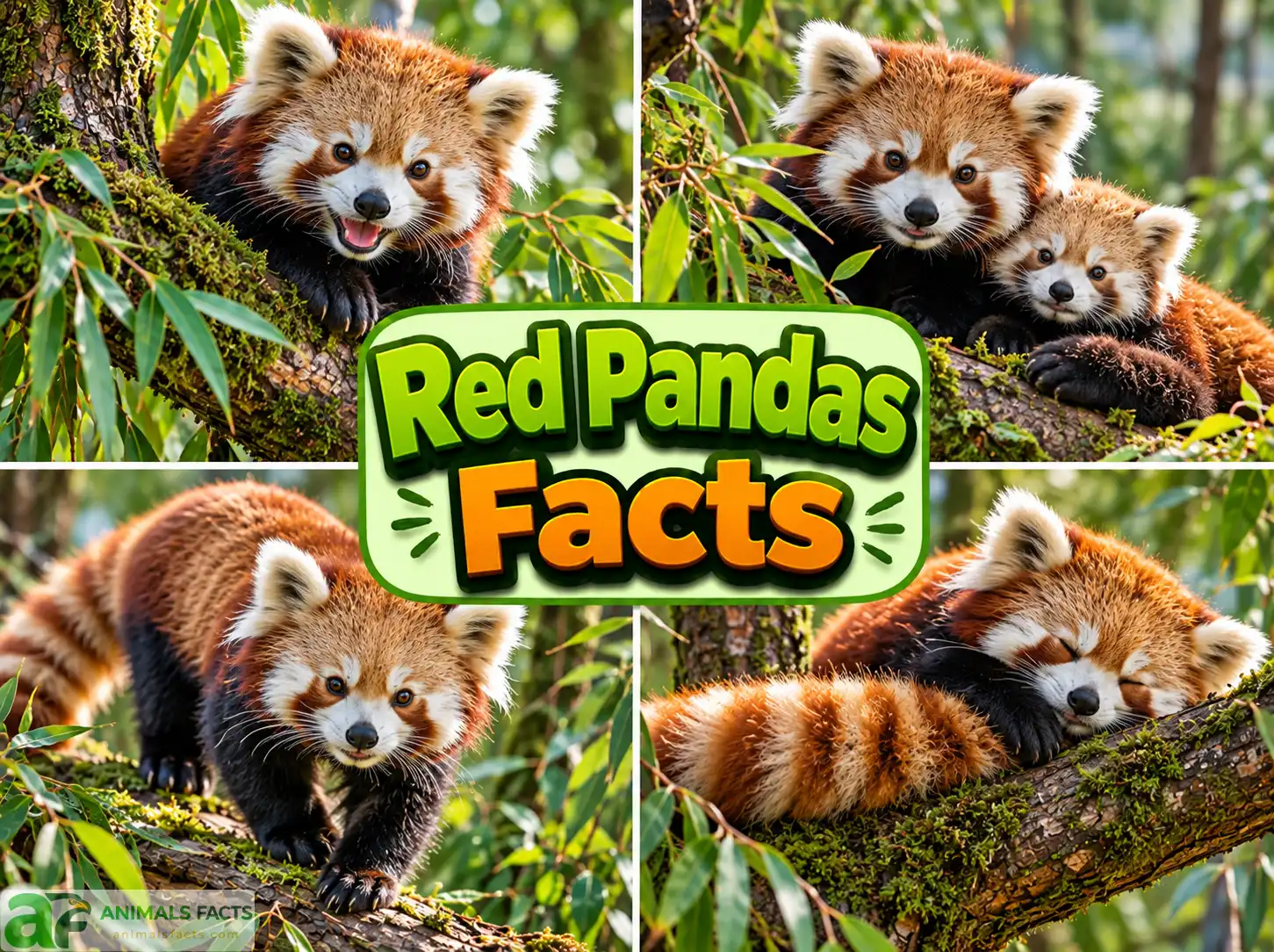
Hey kids — get ready to discover why the red panda might be the most amazing little animal you’ve ever heard about!
- Did you know that the red panda is the original “panda”? The word “panda” was first used to describe this small, red animal — almost 44 years before anyone in the West even knew that the giant black-and-white panda existed! So the giant panda got its name from the red panda, not the other way around!
- The red panda has its own family in the animal kingdom — all by itself! While lions, tigers, and domestic cats all share the cat family, and bears of many kinds share the bear family, the red panda has a whole scientific family group — called Ailuridae — with just one animal in it: the red panda itself!
- Like the giant panda, the red panda has a special “false thumb” — a special bone in its wrist that works like a thumb so it can grab bamboo shoots! The amazing thing is that these two animals evolved this special thumb completely independently — it’s like two different inventors, working completely separately, both came up with the exact same invention!
- The Firefox internet browser was named after the red panda! In Chinese, the red panda is called “火狐” which means “fire fox” — and that’s where the Mozilla Firefox browser got its name! So every time you see that orange and purple swirling icon, you’re looking at a stylized red panda wrapped around a globe!
- When red pandas are cold, they wrap their big fluffy tail around themselves like a cozy scarf or blanket! Their tail is almost as long as their whole body, so it makes a really good warmer!
- Red pandas can climb down trees headfirst — which very few animals in the world can do! Most animals have to back down trees because their claws only grip going up, but red pandas can rotate their ankles to go headfirst!
- The red panda is about the same size as a large house cat — but it lives in one of the world’s most dramatic environments, high up in the misty bamboo forests of the Himalayas!
- Red pandas have fur on the bottom of their feet — like built-in slippers! This keeps their feet warm in the cold mountain snow and helps them grip icy branches without slipping.
Did You Know? Red pandas are so good at camouflage that they’re very hard to spot in their natural habitat! Even though their red-orange coat might look bright and easy to see in photos, in the real Himalayan forest where they live, the trees and branches are covered with reddish-brown mosses and lichens that are almost exactly the same color as the red panda’s fur. Scientists studying wild red pandas sometimes have trouble seeing them even when they know almost exactly where they are — the camouflage is that good!
12. Relationship with Humans
The red panda’s relationship with human communities across its Himalayan range spans centuries of coexistence — from its deep roots in the material culture and spiritual traditions of Himalayan and southwestern Chinese peoples through to the contemporary crisis of habitat loss and poaching that has driven the species to Endangered status.
Indigenous Cultural Relationships
The red panda has been known to the Indigenous and traditional communities of the Himalayas for thousands of years — with the animal known by various regional names including “Ponya” in Nepali, “Wah” in some Himalayan languages (a reference to its vocalization), and “Nigalya Ponya” in certain regional traditions. Red panda fur — particularly the distinctive reddish-brown coat with its bushy tail — has historically been used in traditional ceremonial contexts across some Himalayan communities, with hats and ceremonial garments incorporating red panda skin documented across Himalayan cultural traditions from Nepal to Yunnan province in China.
The Poaching Crisis
The most significant contemporary threat at the individual animal level is poaching — with red pandas killed both for their distinctive fur and captured alive for the illegal exotic pet trade. Camera trap and law enforcement documentation across Nepal, India, and China has revealed ongoing poaching pressure that, given the species’ small wild population and low reproductive rate, represents a meaningful contribution to the overall population decline trajectory.
The illegal live trade in red pandas as exotic pets represents a particularly insidious form of poaching — with animals captured as cubs and transported through complex smuggling networks to buyers in Southeast Asian, Chinese, and occasionally Western markets. These animals almost invariably suffer significant welfare harm during transport and captivity, rarely survive for long in inappropriate domestic conditions, and each represents a direct removal from an already critically small wild population.
Research and Conservation Relationships
The red panda has attracted significant scientific and conservation attention in recent decades — with research programs across Nepal, China, India, and Bhutan generating increasingly detailed understanding of red panda ecology, behavior, and population dynamics. The Red Panda Network, founded in 2007 and based in Nepal, has developed one of the most innovative community-based conservation models for any small endangered mammal — employing local community members as “Forest Guardians” who monitor red panda populations, report poaching, and receive economic support that makes red panda conservation financially beneficial for the communities that share the species’ habitat.
13. Red Panda Conservation Status & Threats
The red panda’s Endangered IUCN classification reflects a genuine and severe conservation crisis — with the global wild population estimated at fewer than 10,000 mature individuals and a documented population decline of approximately 50% over the past 20 years across the species’ range.
Conservation Data (2026)
| Parameter | Data |
|---|---|
| IUCN Status | Endangered (since 2008) |
| Wild Population | Fewer than 10,000 mature individuals (some estimates as low as 2,500) |
| Captive Population | ~800 individuals in 200+ accredited institutions worldwide |
| Population Trend | Declining across virtually all range countries |
| Rate of Decline | Approximately 50% reduction over the past 20 years |
| Primary Range Countries | China, Nepal, India, Bhutan, Myanmar |
Major Threats
Habitat loss and deforestation: The most fundamental and most geographically extensive threat — with montane forest conversion to agricultural land (particularly in Nepal and northern India), selective logging, and infrastructure development (roads, hydroelectric projects) progressively reducing and fragmenting red panda habitat across all range countries. The highly specific habitat requirements of the red panda — requiring the combination of dense bamboo understory, large trees, and cool moist conditions — makes the species particularly sensitive to habitat degradation that might leave the forest structurally standing but ecologically unsuitable.
Habitat fragmentation: The fragmentation of remaining forest into isolated patches prevents genetic exchange between red panda subpopulations and creates local extinction risk for the small groups isolated in individual forest fragments. Research has documented that red pandas require relatively large, continuous forest areas to maintain viable populations — with fragments too small to support a viable population’s home ranges representing ecological traps that drain individuals from the population without providing viable breeding outcomes.
Poaching: As discussed above — both for fur and for the live pet trade — representing a direct, individual-level mortality threat that is particularly damaging in a species with such a small global population and low reproductive rate.
Bamboo flowering and die-off: Like giant pandas, red pandas face periodic mass bamboo die-off events — when bamboo species undergo synchronous mass flowering and die across large areas, local red panda food availability collapses, potentially causing starvation in isolated populations unable to move to areas with alternative bamboo species.
Climate change: Warming temperatures are projected to shift the altitudinal distribution of suitable red panda habitat progressively upward — potentially causing significant range contraction as lower-elevation habitat becomes too warm, while the finite upper-elevation extent of mountain habitat limits the area available at higher altitudes.
Did You Know? The International Red Panda Day — celebrated annually on the third Saturday of September — was established by the Red Panda Network specifically to raise global public awareness of the species’ Endangered status. Unlike many wildlife awareness days that achieve limited reach, International Red Panda Day has become one of the more successful species-specific awareness campaigns in small mammal conservation — generating significant social media engagement, zoo participation events, and educational outreach activity that has measurably increased public familiarity with the species’ conservation situation across multiple countries.
14. Famous Red Pandas
Firefox — The Global Tech Ambassador
While not an individual animal, the Firefox web browser logo has made the red panda arguably the most widely displayed animal image in the technology world — with the stylized red panda wrapped around a globe appearing on hundreds of millions of browser icons, website buttons, and technology communications worldwide since Mozilla Firefox’s launch in 2004. The connection between Firefox and the red panda has been explicitly acknowledged by Mozilla — with the organization providing support to red panda conservation and featuring the real animal prominently in Firefox anniversary communications.
Various Zoo-Born Celebrity Red Pandas
Multiple individual captive red pandas at major zoos worldwide have achieved significant regional celebrity status — including animals at the Smithsonian’s National Zoo (Washington DC), Edinburgh Zoo, San Diego Zoo, and various Chinese facilities — whose births, behaviors, and personalities have been featured in social media content reaching millions of viewers. The red panda’s combination of small size, attractive appearance, and engaging behavior makes it one of the most socially media-compelling zoo animals worldwide.
Research-Named Wild Individuals
Camera trap research programs in Nepal, China, and India have named and individually tracked specific wild red pandas over multiple research seasons — building individual life history records that have contributed substantially to scientific understanding of wild red panda ecology and behavior.
15. Role in Ecosystem & Food Chain
The red panda functions as an important ecological indicator species, seed disperser, and bamboo community modifier in the Himalayan and southwestern Chinese montane forest ecosystems it inhabits.
Seed Dispersal
Despite bamboo being the dietary foundation, red pandas consume significant quantities of forest fruit as a seasonal supplement — distributing seeds across their home ranges through their digestive tracts. In the species-rich montane forest ecosystems of the Eastern Himalayas, this seed dispersal contribution adds to the broader community of seed dispersers maintaining plant community diversity and forest regeneration capacity across the landscape.
Bamboo Community Effects
Red pandas’ selective consumption of bamboo — preferring the most nutritious young leaves and shoots — likely influences bamboo community structure and the competitive dynamics between bamboo plants in heavily used portions of their territories. While less dramatic than the bamboo community modifications created by a giant panda’s much larger daily intake, red panda bamboo grazing nevertheless represents a genuine ecological interaction with the bamboo community that has been little studied but is likely non-trivial given the density of red pandas in productive habitat.
Flagship and Umbrella Species Function
The red panda’s most significant ecological contribution may be its function as a flagship and umbrella species for the Eastern Himalayan Biodiversity Hotspot — with conservation efforts targeting red panda habitat simultaneously protecting the extraordinary biodiversity of one of the world’s most species-rich temperate forest ecosystems. Research has documented that protecting red panda habitat in Nepal and northeastern India simultaneously protects habitat for snow leopards, clouded leopards, Himalayan black bears, numerous endemic bird species, and thousands of plant species that depend on the same montane forest conditions.
16. Myths, Folklore & Cultural Significance
The red panda’s cultural significance across the Himalayan and southwestern Chinese communities that share its range is generally less extensively documented than that of more prominent Himalayan animals like the snow leopard or tiger — but includes meaningful cultural traditions and symbolic associations that reflect thousands of years of human coexistence with the species.
Himalayan Cultural Traditions
In Nepali and northeastern Indian cultural traditions, the red panda is associated with forest spirit beliefs and the broader animistic cultural framework in which specific animals are recognized as guardians or spiritual representatives of particular forest zones and ecological communities. The red panda’s distinctive appearance and arboreal, elusive lifestyle have contributed to its cultural associations with mystery, forest magic, and the hidden life of the high mountain forest that lies beyond the boundaries of human settlement.
In Sikkim — the small northeastern Indian state with one of the most significant state-level red panda conservation programs — the red panda holds particular cultural significance as a symbol of the state’s distinctive Himalayan ecological identity, appearing in state tourism promotion, conservation communication, and official cultural imagery.
Chinese Cultural References
In Yunnan and Sichuan provinces of China — where the Chinese Red Panda subspecies occurs — the red panda is referenced in local cultural and natural history traditions under various regional names including “火狐” (fire fox) and local terms that reflect its distinctive appearance and habitat associations. The species appears in Chinese natural history documentation dating back centuries, though without the mythological significance attributed to some other Chinese wildlife species.
Contemporary Conservation Symbolism
In contemporary conservation communication across all range countries, the red panda has become an increasingly powerful symbol of Himalayan biodiversity under threat — with its combination of extraordinary visual appeal and genuinely severe Endangered status making it an effective flagship species for communicating conservation urgency to both national and international audiences.
17. Red Pandas in Pop Culture
The red panda has generated a growing and increasingly significant popular culture presence in recent years — driven primarily by the Firefox browser connection, an animated feature film, and the explosion of red panda social media content from zoo and wildlife photography accounts.
Firefox — Technology’s Red Panda
The Mozilla Firefox web browser — one of the world’s most used internet browsers — has made the red panda’s image visible across hundreds of millions of computers, smartphones, and other devices worldwide through its distinctive orange panda-inspired logo. Mozilla has explicitly acknowledged the red panda connection and supported conservation efforts, making this corporate-wildlife connection one of the more tangible examples of commercial brand association benefiting an endangered species.
“Turning Red” (Pixar/Disney, 2022)
“Turning Red” — the 2022 Pixar animated feature film directed by Domee Shi — features a 13-year-old Chinese-Canadian girl who transforms into a giant red panda when overwhelmed by strong emotions. The film generated extraordinary global audience engagement — with its sensitive treatment of coming-of-age themes combined with the visually striking red panda transformation sequences introducing the red panda to an enormous new audience of children and families worldwide. Conservation organizations across the red panda’s range reported significant increases in public interest and inquiry following the film’s release.
Social Media Phenomenon
Multiple zoo-based red pandas — including individuals at the Smithsonian’s National Zoo, Padmaja Naidu Himalayan Zoological Park in Darjeeling, and various European and East Asian facilities — have achieved millions of social media followers through video and photographic content. Red panda content consistently ranks among the highest-engagement wildlife content across Instagram, TikTok, and YouTube — with behaviors including bamboo eating, tail-wrapping, and tree climbing generating viral engagement that has contributed measurably to public awareness of the species.
18. Red Panda Facts vs. Common Myths
Myth: The red panda and the giant panda are related animals. Fact: The red panda and giant panda are not closely related despite sharing bamboo diets, a false thumb, and the “panda” name. The giant panda is a bear (family Ursidae), while the red panda belongs to its own unique family (Ailuridae) more closely related to raccoons, weasels, and skunks than to bears. The similar false thumb in both species is a classic example of convergent evolution — independently arising in unrelated lineages — not evidence of shared ancestry.
Myth: The giant panda was named first and the red panda was named after it. Fact: The reverse is true — the red panda was named “panda” approximately 44 years before the giant panda received that name. The term “panda” (from the Nepali “ponya”) was first applied to the red panda when it was described to Western science in 1825, and was subsequently extended to the giant panda by analogy when Western naturalists described that species in 1869.
Myth: Red pandas are related to raccoons. Fact: While red pandas were historically classified with raccoons (Procyonidae) based on physical similarities, modern genetic analysis has confirmed that they belong to their own unique family (Ailuridae). They are placed within the broader superfamily Musteloidea alongside mustelids, procyonids, and skunks — but represent an independently evolving lineage sufficiently distinct for their own family designation.
Myth: Red pandas are “mini giant pandas.” Fact: Red pandas are not smaller versions of giant pandas — they are completely different animals from different families with completely different evolutionary histories. Their shared bamboo diet, similar altitudinal habitat preferences, and the historical application of the “panda” name to both species have created a false impression of relationship that genetics firmly contradicts.
Myth: Red pandas are common animals with stable populations. Fact: Red pandas are classified as Endangered by the IUCN — with a global wild population estimated at fewer than 10,000 mature individuals and a documented population decline of approximately 50% over the past 20 years. They are among the more severely threatened small mammals in Asia, with an urgency that is often underappreciated compared to their high public profile and social media popularity.
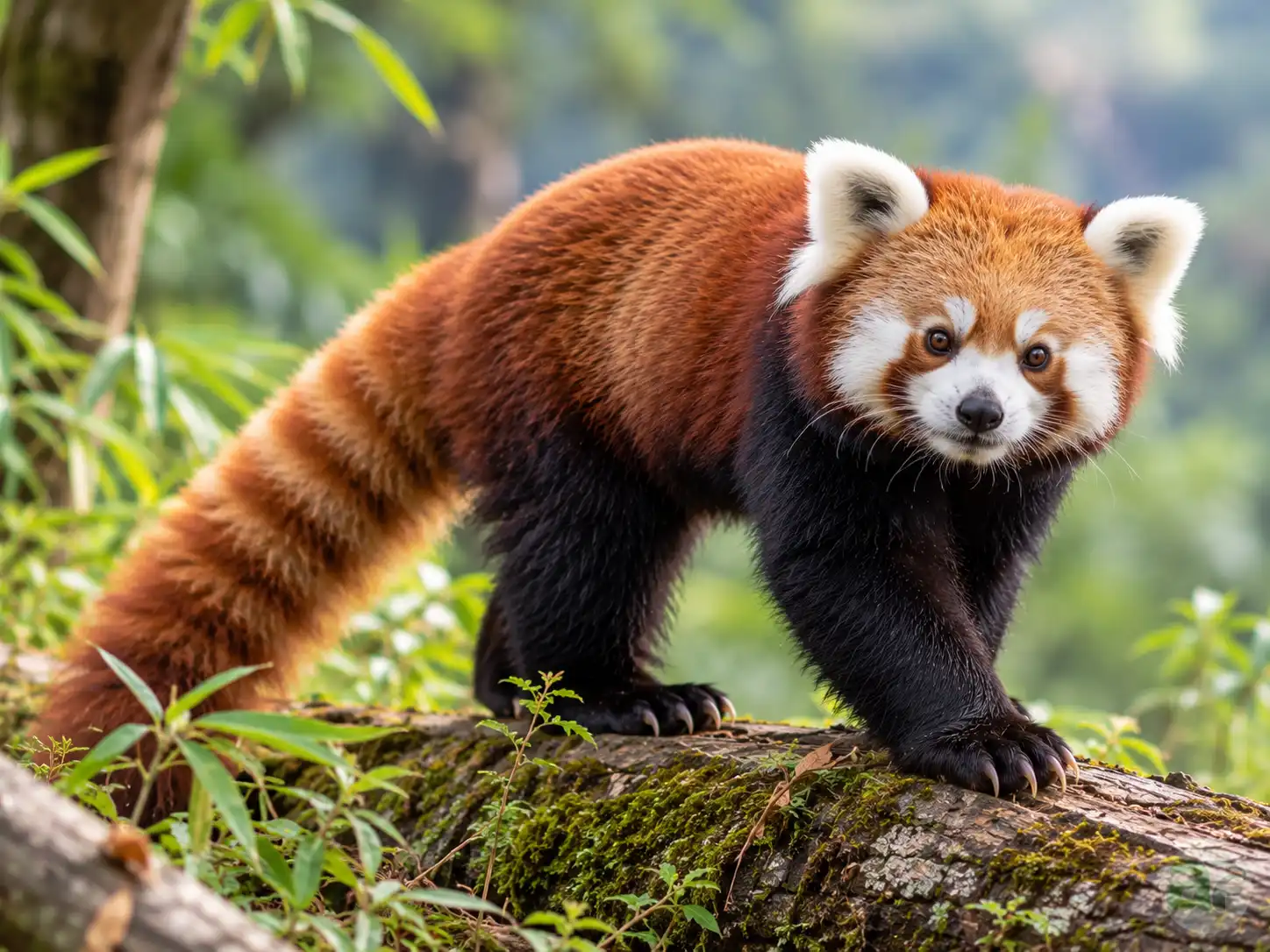
19. Best Places to See Red Pandas in the Wild
Singalila National Park, West Bengal and Sikkim, India
Singalila — on the ridge marking the border between India and Nepal in the Eastern Himalayas — is considered by many wildlife researchers as the best accessible location for wild red panda observation anywhere in the species’ range. The park’s excellent habitat quality, established nature guide infrastructure, and red panda research program history make it one of the most reliably productive red panda viewing destinations for serious wildlife observers.
Langtang National Park, Nepal
Langtang — accessible from Kathmandu and featuring some of Nepal’s finest Himalayan landscape — supports a significant red panda population in its temperate and subalpine forest zones. Guided wildlife walks with experienced local naturalists provide some of Nepal’s best wild red panda observation opportunities.
Chitwan and Surrounding Protected Areas Network, Nepal
While Chitwan itself is primarily lowland subtropical habitat, the network of protected areas extending northward into the Himalayan foothills from the Chitwan area includes red panda habitat in the higher-elevation portions accessible through extended guided treks.
Gangtok Area, Sikkim, India
Sikkim state — which has made red panda conservation a component of its official conservation identity — supports significant red panda populations in its montane forests, with guides based in the state capital Gangtok offering specialized red panda wildlife walks in accessible areas of suitable habitat.
Zhouzhi National Nature Reserve, Shaanxi, China
Within the Qinling Mountains — range of the rare Qinling subspecies — the Zhouzhi reserve provides one of the very few locations where the brown-and-white Qinling Giant Panda and the red panda can potentially be observed in the same landscape, making it one of the most remarkable wildlife destinations in China for panda species enthusiasts.
20. Top Documentaries & Books
Must-Watch Documentaries
“Red Panda” (various BBC Wildlife and National Geographic productions) — Multiple productions have dedicated specific segments or short documentary formats to red panda natural history, with sequences documenting feeding behavior, cub rearing, and territorial behavior in the Himalayan habitat providing some of the finest wild red panda footage available.
“Turning Red” (Pixar/Disney, 2022) — While an animated feature film rather than a natural history documentary, this production has generated exceptional public engagement with red pandas and is explicitly credited by conservation organizations with increasing awareness of the species’ existence and conservation situation among younger global audiences.
Red Panda Network documentary productions — Available through the Red Panda Network’s website and social media channels, short documentary content covering community-based conservation work in Nepal provides essential context for understanding the innovative conservation approaches being applied to red panda conservation.
Essential Books
“The Red Panda: Biology and Conservation of the First Panda” edited by Angela Glatston (2011) — The most comprehensive available scientific reference on red panda biology, ecology, and conservation, covering both subspecies and all aspects of the species’ natural history in a format accessible to motivated general readers alongside specialist researchers.
Various field guides to Himalayan mammals — Multiple comprehensive Himalayan wildlife field guides include detailed red panda sections that provide essential context for understanding the species within the broader Himalayan biodiversity it shares.
21. Red Panda Comparison of Red Pandas with Similar Animals
| Feature | Red Panda | Giant Panda | Raccoon | Ringtail | Himalayan Black Bear |
|---|---|---|---|---|---|
| Scientific Name | Ailurus fulgens | Ailuropoda melanoleuca | Procyon lotor | Bassariscus astutus | Ursus thibetanus |
| Weight | 3.7–6.2 kg | 70–125 kg | 2–10 kg | 0.8–1.4 kg | 40–200 kg |
| Family | Ailuridae (own family) | Ursidae (bears) | Procyonidae | Procyonidae | Ursidae (bears) |
| Distribution | Himalayas, SW China | Central China (3 provinces) | North America | SW USA, Mexico | Asia (widespread) |
| Primary Diet | Bamboo + fruit + insects | Bamboo (99%) | Omnivore (very broad) | Insects, fruit, small vertebrates | Bamboo, fruit, insects |
| “False Thumb” | Yes (convergent evolution) | Yes (convergent evolution) | No | No | No |
| Tail Type | Long, bushy, striped (30–50 cm) | Short | Bushy, ringed | Long, ringed | Short |
| Tree Climbing | Excellent; headfirst descent | Moderate | Excellent | Excellent | Moderate |
| Conservation Status | Endangered | Vulnerable | Least Concern | Least Concern | Vulnerable |
| Unique Feature | Original “panda”; own family; Firefox logo | False thumb; bamboo specialist; black-and-white | Highly adapted urban wildlife | Ringed tail; semi-retractable claws | Crescent moon chest mark |
22. How You Can Help
Red panda conservation requires both direct financial support for research and protection programs and broader advocacy for the Himalayan forest habitats on which the species depends.
Support These Organizations
Red Panda Network (redpandanetwork.org) — The leading organization specifically focused on red panda conservation, operating the innovative Forest Guardian community monitoring program in Nepal and conducting research across the species’ Himalayan range. Direct financial contributions support both field conservation and community livelihoods programs.
WWF Eastern Himalayas Program (worldwildlife.org) — WWF’s Eastern Himalayas program addresses habitat conservation at the landscape scale across red panda range countries, including habitat corridor restoration and sustainable forest management programs directly relevant to red panda population connectivity.
Wildlife Conservation Society Red Panda Research (wcs.org) — WCS conducts red panda population research in China, India, and Bhutan, providing the scientific foundation for evidence-based conservation management.
International Union for Conservation of Nature Red Panda Specialist Group — The IUCN’s specialist group coordinates research and conservation planning across all range countries, with particular focus on the 2020 subspecies recognition and its implications for subspecies-specific conservation strategies.
Practical Actions
Support the Red Panda Network’s Forest Guardian program. This specific program — employing community members in Nepal as paid wildlife monitors — has been demonstrated to generate measurable reductions in poaching and habitat destruction in areas where it operates. Direct financial support enables the expansion of this program to additional communities and additional red panda habitat areas.
Never support the exotic pet trade. Declining to purchase, support, or share content celebrating private red panda ownership — and reporting suspected illegal wildlife trade through TRAFFIC or relevant national authorities — helps reduce the demand that drives red panda poaching for the live pet trade.
Choose sustainable Himalayan products. Consumer choices favoring sustainably produced timber, paper, and agricultural products from Himalayan region suppliers help reduce the economic incentives for deforestation in red panda habitat.
Raise awareness through the Firefox and “Turning Red” connections. The red panda’s connection to Firefox and to Pixar’s “Turning Red” provides unusually accessible entry points for conservation communication — sharing accurate red panda conservation information alongside these cultural connections can reach audiences who might otherwise never engage with Himalayan wildlife conservation.
Support International Red Panda Day (third Saturday of September). Participating in International Red Panda Day activities — through social media engagement, zoo event participation, or donations to Red Panda Network — contributes to the public attention that generates conservation funding and advocacy support.
Did You Know? The Red Panda Network’s Forest Guardian program in Nepal has generated measurable conservation outcomes that have been documented and published in peer-reviewed conservation science journals — making it one of the best-evidenced community-based conservation programs for any small mammal species in Asia. By 2026, the program has employed over 600 Forest Guardians across multiple districts of Nepal, with research documenting that red panda poaching rates and habitat destruction are measurably lower in areas covered by the Forest Guardian network compared to comparable unprotected areas — providing rigorous scientific evidence that this community-engagement conservation approach genuinely works at the scale needed to make a difference for red panda population viability.
23. Frequently Asked Questions About Red Pandas
Q1: What is the scientific name of the red panda?
The red panda’s scientific name is Ailurus fulgens — with “Ailurus” from the Greek for “cat” and “fulgens” from the Latin for “shining” or “gleaming,” translating as “shining cat.” The family is Ailuridae — its own unique family containing only the single genus Ailurus with the single living species. The order is Carnivora, class Mammalia.
Q2: Is the red panda related to the giant panda?
No — the red panda and giant panda are not closely related despite sharing bamboo diets, a false thumb, and the “panda” name. The giant panda is a bear (family Ursidae), while the red panda belongs to its own unique family (Ailuridae). Their similar false thumbs are a famous example of convergent evolution — independently evolving the same solution in unrelated lineages.
Q3: Why is it called a “panda”?
The red panda is the original “panda” — the term was first applied to this species when it was formally described to Western science in 1825, approximately 44 years before the giant panda received the name. The word derives from the Nepali “ponya” and was used specifically for the red panda before being extended by analogy to the larger black-and-white bear.
Q4: Are red pandas endangered?
Yes — red pandas are classified as Endangered by the IUCN, with a global wild population estimated at fewer than 10,000 mature individuals and a documented population decline of approximately 50% over the past 20 years. They represent one of Asia’s more urgently threatened small mammals.
Q5: What do red pandas eat?
Red pandas eat primarily bamboo — particularly bamboo leaves and shoots, which comprise approximately 60–80% of their diet. They supplement this with fruit, insects, eggs, and small vertebrates. Despite their bamboo diet, they belong to the order Carnivora and retain a carnivore’s digestive system.
Q6: Why is Firefox named after the red panda?
The Mozilla Firefox web browser was named after the red panda because the Chinese name for the red panda is “火狐” (huǒhú), meaning “fire fox.” The browser developers chose this name and associated their logo’s visual styling with the red panda — making the Firefox icon a stylized depiction of the species.
Q7: How big are red pandas?
Red pandas are approximately the size of a large domestic cat — weighing 3.7–6.2 kg and measuring 50–65 cm in body length, with a tail of 30–50 cm roughly equal to the body length. Despite their modest size, their bushy tail and dense fur can make them appear somewhat larger in photographs.
Q8: How long do red pandas live?
Wild red pandas typically live 8–10 years, with the maximum documented captive lifespan reaching approximately 23 years in high-quality zoo facilities with veterinary care and consistent nutrition.
Q9: What are the two red panda subspecies?
The two subspecies recognized since 2020 are the Himalayan Red Panda (Ailurus fulgens fulgens) — found in Nepal, Bhutan, northeastern India, and northern Myanmar — and the Chinese Red Panda (Ailurus fulgens styani) — found in Sichuan and Yunnan provinces of China and parts of northern Myanmar. The Chinese subspecies is slightly larger and darker than the Himalayan subspecies.
Q10: How can I help red panda conservation?
Key actions include: supporting the Red Panda Network (redpandanetwork.org) and their Forest Guardian program; WWF Eastern Himalayas program; never supporting the exotic pet trade; choosing sustainable Himalayan products; and raising awareness through the Firefox, “Turning Red,” and International Red Panda Day connections that provide accessible entry points for conservation communication.
26. Sources & References
Research Sources
- Wikipedia — Ailurus fulgens and related articles
- IUCN Red List — iucnredlist.org
- Red Panda Network — redpandanetwork.org
- WWF — worldwildlife.org
- Wildlife Conservation Society — wcs.org
- National Geographic — nationalgeographic.com
- Smithsonian’s National Zoo — nationalzoo.si.edu
- Encyclopaedia Britannica — britannica.com
- BBC Wildlife — bbc.co.uk
- Live Science — livescience.com
- Glatston, Angela (editor) — “The Red Panda: Biology and Conservation of the First Panda” (2011)
- Hu, Yibo et al. — 2020 subspecies recognition research (Science Advances)