
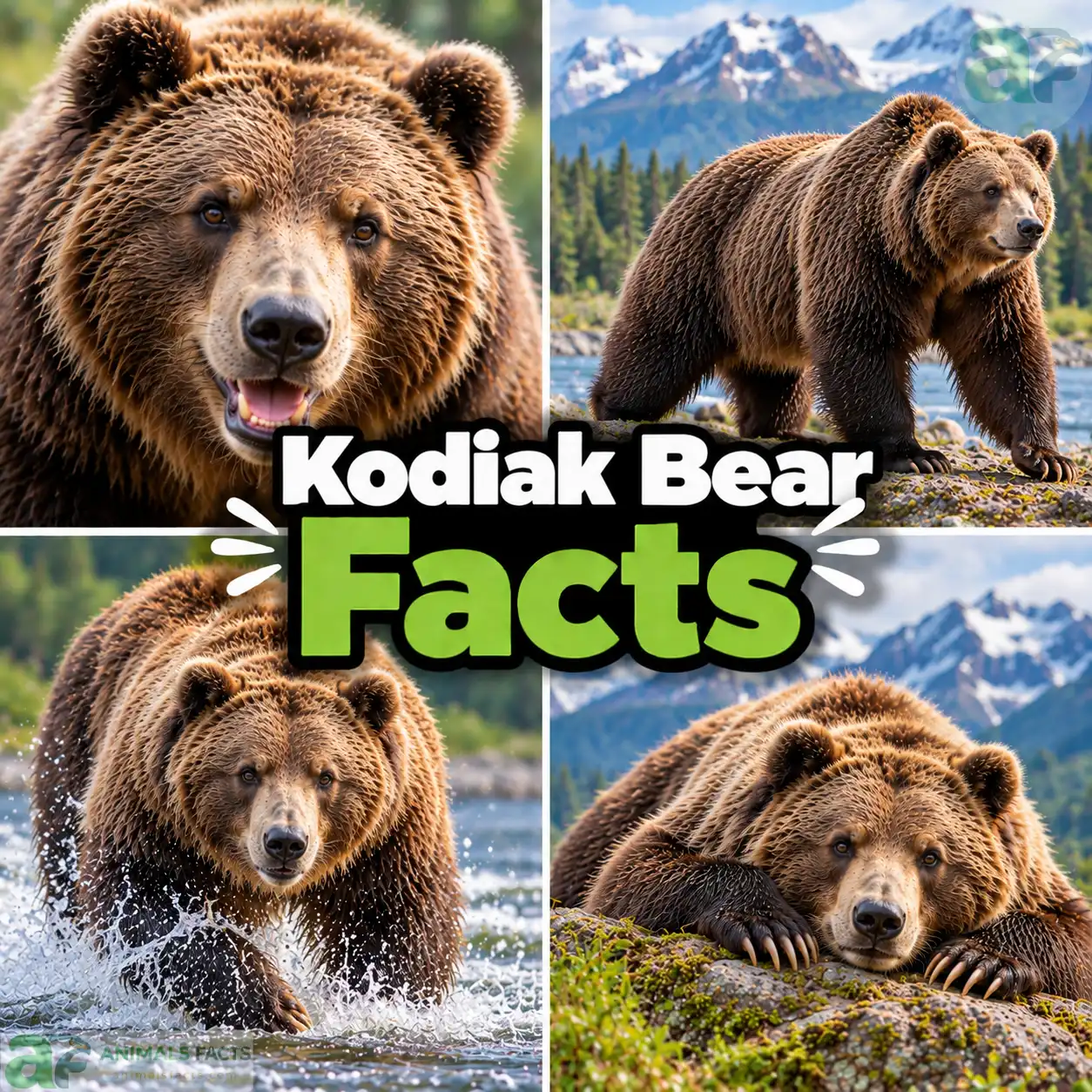
Kodiak Bear Facts
| Feature | Details |
|---|---|
| Scientific Name | Ursus arctos middendorffi |
| Common Names | Kodiak Bear, Kodiak Brown Bear, Alaskan Brown Bear |
| Kingdom | Animalia |
| Phylum | Chordata |
| Class | Mammalia |
| Order | Carnivora |
| Family | Ursidae |
| Genus | Ursus |
| Species / Subspecies | Subspecies of Brown Bear (Ursus arctos) |
| Habitat | Kodiak Archipelago, Alaska — all major islands in the archipelago including Kodiak Island, Afognak Island, Shuyak Island |
| Lifespan | 20–25 years in the wild; up to 30 years in captivity |
| Diet | Omnivore — Pacific salmon (primary seasonal), sedges, berries, deer, sea mammals, carrion |
| Weight | Males: 270–635 kg (average ~450 kg); Females: 135–275 kg |
| Body Length | 2.0–3.0 meters (males); 1.5–2.0 meters (females) |
| Shoulder Height | 1.2–1.5 meters (males) — 4+ feet at the shoulder |
| Top Speed | Up to 55 km/h (34 mph) in short bursts |
| Standing Height | Up to 3.0 meters (10 feet) when rearing on hind legs |
| Conservation Status | Least Concern (IUCN); stable; managed by Kodiak National Wildlife Refuge and Alaska Department of Fish and Game |
| Kodiak Archipelago Population | Estimated ~3,500 bears across the entire archipelago |
| Unique Feature | World’s largest bear subspecies (co-holder with polar bear of “world’s largest land carnivore” title); isolated on Kodiak Archipelago for ~12,000 years; extraordinary genetic distinctiveness from mainland brown bears |
 1. Introduction: What is a Kodiak Bear?
On the remote Kodiak Archipelago — a cluster of rugged, salmon-rich islands off Alaska’s southern coast — lives an animal that has achieved what most would consider impossible: becoming the largest land carnivore on Earth through thousands of years of island isolation, fueled almost entirely by one of nature’s most extraordinary annual spectacles. The Kodiak bear, a subspecies of the brown bear uniquely adapted to the island environment of the Kodiak Archipelago, has reached body weights exceeding 635 kilograms and standing heights of 3 meters on a diet dominated by Pacific salmon, Alaskan sedges, and the rich berry fields of one of the most productive island ecosystems on Earth. Kodiak bear facts begin with a superlative that no other land animal on Earth can match: the largest.
The Kodiak bear — Ursus arctos middendorffi — has been isolated on the Kodiak Archipelago for approximately 12,000 years, since rising sea levels at the end of the last Ice Age separated the island group from the Alaskan mainland. In those 12,000 years of island isolation, the Kodiak bear evolved into a genetically distinct population — separated from mainland grizzly bears by the ocean channels surrounding the archipelago, fueled by the extraordinary productivity of Kodiak’s Pacific salmon streams, and developing the body size, social flexibility, and behavioral characteristics that make it one of the most remarkable and most sought-after wildlife viewing subjects on Earth. The Kodiak Archipelago’s population of approximately 3,500 bears — concentrated on islands totaling roughly 13,000 square kilometers — represents one of the highest densities of large carnivores anywhere in North America.
Whether you are a wildlife traveler planning a trip to Kodiak Island, a student researching Kodiak bear facts for a school project, a conservation advocate interested in the Kodiak National Wildlife Refuge that protects this extraordinary population, a parent looking for Kodiak bear facts for kids, or simply someone who has been staggered by photographs of these enormous bears dwarfing the salmon streams they stand in — this is the most complete guide to Kodiak bear facts you will find anywhere. We cover Kodiak bear habitat, Kodiak bear diet, Kodiak bear behavior, communication, reproduction, the salmon-fueled physiology that produces the world’s largest bear, conservation, mythology, and the extraordinary story of a bear that has turned 12,000 years of island isolation into the most impressive body size achievement in the history of the order Carnivora.
2. Kodiak Bear Species Overview & Classification
The Kodiak bear is a subspecies of the brown bear (Ursus arctos) — the world’s most widely distributed bear species — but one that has developed such pronounced genetic, morphological, and ecological distinctiveness through thousands of years of island isolation that it is recognized as one of the most taxonomically significant brown bear populations in the world.
What Makes the Kodiak Bear a Distinct Subspecies?
- Genetic isolation: The Kodiak Archipelago’s separation from the mainland by ocean channels has prevented genetic exchange between Kodiak bears and mainland brown/grizzly bears for approximately 12,000 years — a period sufficient to generate measurable and scientifically significant genetic differentiation
- Body size: The Kodiak bear is the largest recognized subspecies of brown bear — significantly exceeding the body size of most mainland grizzly populations through the combination of genetic predisposition and the extraordinary food productivity of the Kodiak Archipelago ecosystem
- Behavioral characteristics: Kodiak bears demonstrate a degree of social tolerance that significantly exceeds that of most mainland grizzly populations — a behavioral adaptation to the concentrated, predictable seasonal salmon resources that bring large numbers of bears together in close proximity
Species Classification Table
| Level | Classification |
|---|---|
| Kingdom | Animalia |
| Phylum | Chordata |
| Class | Mammalia |
| Order | Carnivora |
| Family | Ursidae |
| Genus | Ursus |
| Species | Ursus arctos (Brown Bear) |
| Subspecies | Ursus arctos middendorffi (Kodiak Bear) |
| Named After | Alexander Theodor von Middendorff — Russian naturalist and Arctic explorer |
| Closest Relatives | Other Ursus arctos subspecies — particularly the Alaska Peninsula Brown Bear and the interior grizzly bear |
Brown Bear Subspecies Comparison
| Subspecies / Population | Scientific Name | Weight Range (Male) | Range | Key Feature |
|---|---|---|---|---|
| Kodiak Bear | U. a. middendorffi | 270–635 kg | Kodiak Archipelago, Alaska | Largest brown bear subspecies |
| Grizzly Bear | U. a. horribilis | 180–360 kg | North American interior | Shoulder hump; long digging claws |
| Alaska Peninsula Brown Bear | U. a. gyas (sometimes) | 250–400 kg | Alaska Peninsula | Large; intermediate between grizzly and Kodiak |
| Eurasian Brown Bear | U. a. arctos | 100–340 kg | Europe and Russia | Most widely distributed; multiple regional variants |
| Kamchatka Brown Bear | U. a. beringianus | 150–480 kg | Kamchatka Peninsula, Russia | Large; similar to Kodiak in salmon-fueled diet |
Species Evolution & Discovery Timeline
~1.2–1.6 million years ago: Brown bears arrived in North America from Asia via the Bering Land Bridge — eventually establishing populations across North America that would give rise to the distinct regional subspecies including the Kodiak bear.
~12,000 years ago: As the last Ice Age ended and sea levels rose, the Kodiak Archipelago was separated from the Alaskan mainland by the ocean channels that remain today — isolating the bear population of the archipelago from mainland populations and beginning the independent evolutionary trajectory of what would become the Kodiak bear subspecies.
~10,000 years ago: Indigenous Alutiiq (Sugpiaq) people settled the Kodiak Archipelago — establishing a human culture that would coexist with Kodiak bears for thousands of years, developing rich cultural traditions centered on the bears and the salmon runs that sustained both species.
1763–1784: Russian exploration and colonization of the Kodiak Archipelago began, introducing European contact to the region and eventually generating the commercial activities — primarily sea otter hunting and later commercial fishing — that would shape the archipelago’s economy and ecology for the following two centuries.
1896: Alexander Theodor von Middendorff, the Russian naturalist after whom the subspecies is named, described and classified the Kodiak bear as a distinct brown bear subspecies — Ursus arctos middendorffi — based on specimens collected from the archipelago.
1941: The Kodiak National Wildlife Refuge was established — covering approximately 2.5 million acres (1 million hectares) of Kodiak, Uganik, Afognak, and Ban Islands — providing the protected area foundation that has sustained the Kodiak bear population through the 20th and 21st centuries.
1963: A formal management program for Kodiak bears was established in cooperation between the Kodiak National Wildlife Refuge and the Alaska Department of Fish and Game — creating the science-based management framework that continues to govern Kodiak bear management today.
3. Kodiak Bear Physical Description & Unique Features
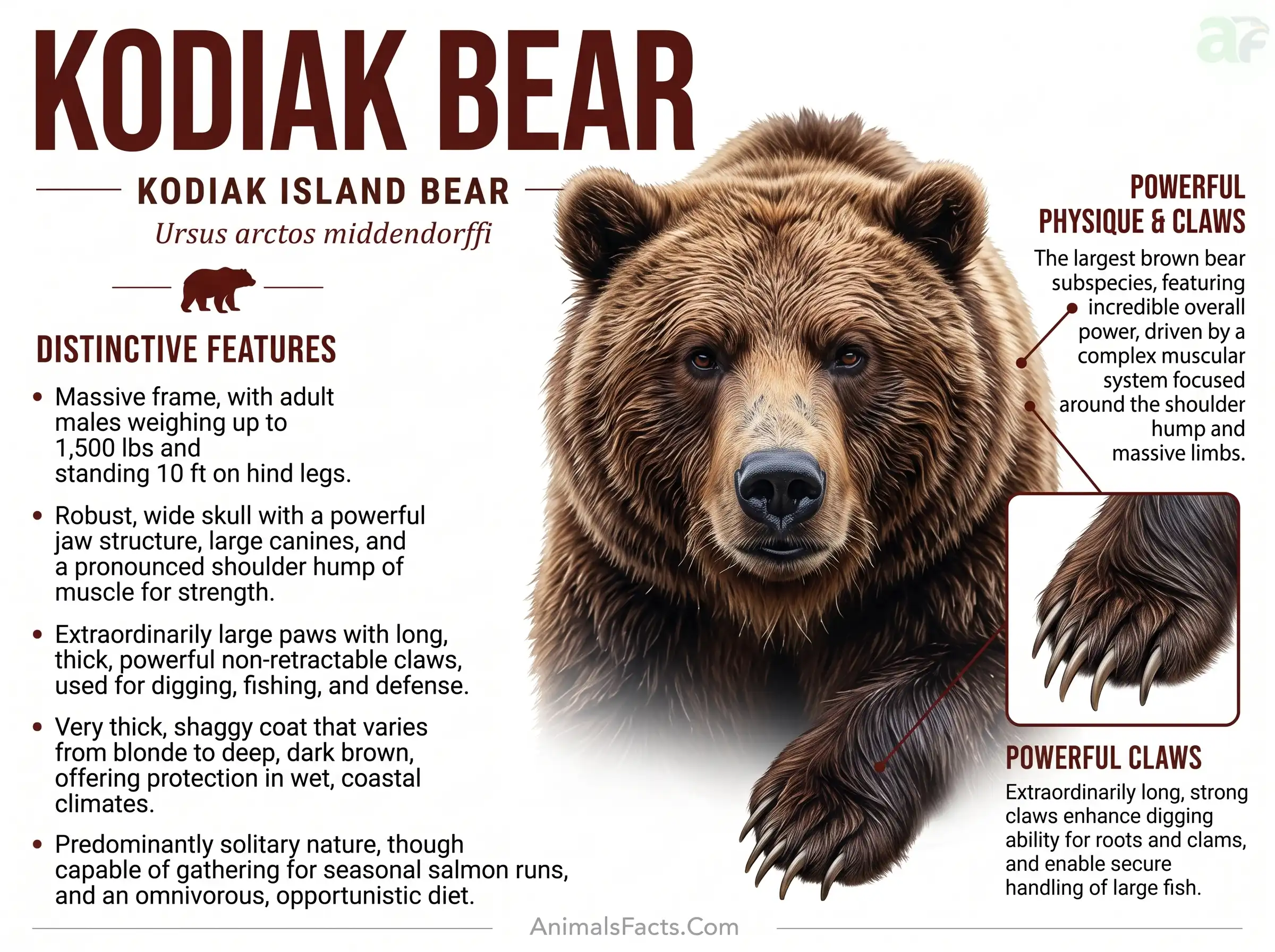
The Kodiak bear’s physical attributes begin and end with superlatives — not just the world’s largest bear, but the world’s largest land carnivore, an animal whose body dimensions represent the absolute maximum size achieved by any carnivorous mammal living on land anywhere on Earth today.
Size — The World Record
Adult males (boars): Average adult Kodiak males weigh approximately 272–454 kg in spring after winter dormancy, growing to 360–635 kg in autumn after seasonal hyperphagia. The largest verified Kodiak bears have approached or exceeded 680 kg — comparable to the heaviest recorded polar bears. Standing on hind legs, a large Kodiak male reaches approximately 3.0 meters (9.8 feet) — the height of a standard single-story ceiling plus the distance from floor to the top of a tall person.
Adult females (sows): Typically 135–275 kg, and approximately 2.0 meters in body length — still massive by any comparable standard, but dramatically smaller than the largest males, reflecting one of the more pronounced sexual dimorphisms in the bear family.
The salmon connection: The Kodiak bear’s exceptional body size is directly fueled by the extraordinary productivity of the Kodiak Archipelago’s Pacific salmon runs — providing a seasonal caloric input so concentrated and so nutritious that Kodiak bears can increase their body weight by 30–40% during the 2–3 month peak salmon season, building the fat reserves that sustain them through 5–7 months of winter dormancy and that, over generations, have enabled the evolution of the largest body size documented in any land carnivore.
The Shoulder Hump
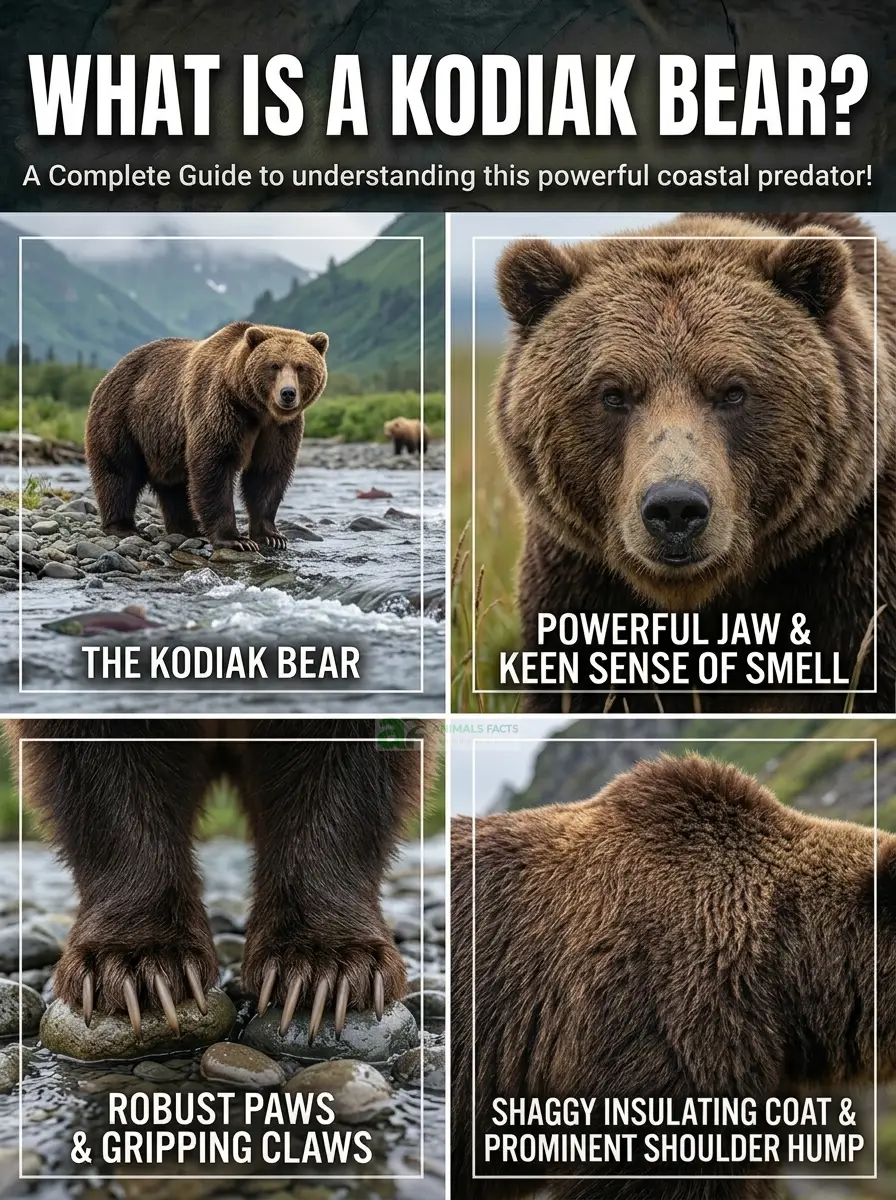
Like all brown bears, Kodiak bears possess the distinctive muscular shoulder hump that differentiates them immediately from American black bears — composed primarily of muscle mass rather than fat, directly powering the powerful digging and salmon-catching forelimb movements that characterize the species’ primary foraging behaviors. On an exceptionally large Kodiak male, this hump is a visually striking and imposing feature, contributing to the bear’s overall appearance of raw, concentrated physical power.
Coat and Coloration
Kodiak bears display the same range of coat coloration seen in other brown bear populations — from light tawny or blond through various shades of brown to dark chocolate — with considerable individual variation and seasonal changes in coat condition following winter dormancy. The distinctive pale tips on guard hairs that give grizzly bears their characteristic “grizzled” appearance are also present in many Kodiak individuals, though with the same individual variation that characterizes brown bear coat patterns generally.
Paws and Claws
The Kodiak bear’s paws are proportional to its enormous body size — large front paws reaching 30+ cm in width in the largest males, armed with long, relatively straight claws used for excavating roots and ground squirrels, turning rocks in search of invertebrates, and intercepting salmon in streams. The powerful musculature of the forelimbs — directly connected to the shoulder hump — gives the Kodiak bear forepaw strike forces that rank among the highest documented for any land predator.
Did You Know? The Kodiak bear’s extraordinary body size compared to mainland grizzly bears is believed to reflect a combination of genetic predisposition (certain genotypes that favor large body size becoming established in the founding island population) and exceptional food productivity (the Kodiak Archipelago’s Pacific salmon runs providing a caloric subsidy that mainland interior grizzly populations simply cannot access in comparable quantities). Research comparing Kodiak bears with geographically adjacent mainland brown bears has documented that the size difference is too large to be explained by diet alone — suggesting genuine genetic contribution to the Kodiak bear’s exceptional size — while simultaneously documenting that the salmon-rich diet of the archipelago provides the caloric foundation that allows genetically-predisposed large body size to actually be expressed. The combination of exceptional genes and exceptional salmon has produced, over 12,000 years of island isolation, the largest land carnivore on Earth.
4. Top 25 Surprising & Interesting Kodiak Bear Facts
- The Kodiak bear is the world’s largest bear subspecies — sharing with the polar bear the title of world’s largest land carnivore, with adult males regularly exceeding 450 kg and the largest documented individuals approaching 680 kg.
- Kodiak bears have been isolated on the Kodiak Archipelago for approximately 12,000 years — since rising sea levels at the end of the last Ice Age separated the islands from the Alaskan mainland, generating the genetic distinctiveness that characterizes the modern subspecies.
- The entire wild Kodiak bear population of approximately 3,500 individuals lives on an archipelago totaling only about 13,000 km² — representing one of the highest densities of large bears on Earth at approximately 1 bear per 3.7 km² of available habitat.
- A large male Kodiak bear standing on his hind legs reaches approximately 3.0 meters (10 feet) — taller than most standard residential room ceilings.
- During the peak salmon season, an adult Kodiak bear can consume up to 20,000 calories per day — equivalent to approximately 30–40 large salmon — as part of the hyperphagia that can increase body weight by 30–40% in preparation for winter dormancy.
- Kodiak bears demonstrate a remarkable degree of social tolerance at concentrated salmon streams — with dozens of bears fishing simultaneously at highly productive stream sections, developing complex social hierarchies and behavioral protocols that allow resource sharing with minimal fighting.
- The Kodiak National Wildlife Refuge — established in 1941 and covering approximately 2.5 million acres — protects over two-thirds of Kodiak Island and represents one of the most intact large carnivore habitats in North America.
- Kodiak bears are genetically distinct from mainland grizzly bears — with studies documenting measurable genetic differentiation between Kodiak bears and even their geographically nearest mainland brown bear relatives on the Alaska Peninsula.
- Female Kodiak bears produce cubs in some of the highest average litter sizes documented among brown bear populations — with triplets relatively common compared to most continental grizzly populations, likely reflecting the exceptional nutritional status of females fueled by abundant salmon resources.
- The oldest reliably documented Kodiak bear reached at least 27 years of age in the wild — at the upper range of brown bear longevity, reflecting the relatively low mortality pressure facing a bear population that lacks significant natural predators as adults.
- Kodiak bears have been documented swimming between the various islands of the Kodiak Archipelago — including crossings of channels several kilometers wide — as part of normal movement between seasonal foraging areas.
- The salmon species composition available to Kodiak bears shifts across the summer season — with sockeye, pink, coho, and chum salmon each peaking at different times, providing a sequential salmon feast that experienced bears exploit through learned knowledge of stream-specific timing patterns.
- Despite their enormous size, Kodiak bears are capable of surprising speed — documented at up to 55 km/h (34 mph) over short distances, a speed that exceeds most human physical expectations of an animal of this weight.
- Kodiak Island supports a regulated sport hunting program — managed by the Alaska Department of Fish and Game — that generates significant economic value for the local community while the Refuge’s two-thirds protects a large no-hunting zone maintaining population stability.
- Kodiak bear cubs are born in January or February weighing only approximately 350–500 grams — less than one-thousandth of an adult male’s weight, demonstrating the extreme altriciality characteristic of all bear young.
- Research has documented that Kodiak bears show strong individual fishing style preferences — with specific individuals consistently employing particular salmon-catching techniques (diving, snorkeling, standing, or pirating) across multiple seasons, suggesting that fishing behavior is learned and maintained as individual specializations rather than dictated by social rank alone.
- The Kodiak Archipelago receives over 1,600 mm of rain annually on average — one of the wettest inhabited archipelagos in North America — creating the lush, productive vegetation and salmon-supporting stream habitat that fuel the bear population’s exceptional productivity.
- Kodiak bear population counts have remained remarkably stable at approximately 3,500 individuals across multiple decades of systematic monitoring — a testament to the effectiveness of the management program and the resilience of the population given the Refuge’s protection of core habitat.
- The average home range of a Kodiak bear male is approximately 800–2,500 km² — reflecting the seasonal movement between coastal salmon streams, interior berry fields, and denning areas that characterizes Kodiak bear annual ecology.
- Kodiak bears exhibit one of the most pronounced seasonal weight fluctuation patterns of any bear subspecies — with large males losing up to 33% of their body weight over winter dormancy and regaining it through the following summer’s foraging cycle.
- Bears of the Karluk Lake system within the Kodiak National Wildlife Refuge are among the most extensively studied and most consistently photographed Kodiak bear populations — with decades of photographic records enabling individual identification and long-term behavioral monitoring.
- The development of a regulated bear viewing industry on Kodiak Island — complementing the existing hunting program — has generated growing economic value from non-consumptive wildlife tourism, creating additional stakeholder interest in maintaining the Kodiak bear population’s health.
- Genetic research comparing the Kodiak Archipelago bear population with mainland Alaska Peninsula brown bears has documented measurably different allele frequencies and genetic diversity patterns that confirm the subspecies’ genuine evolutionary distinctiveness from mainland populations.
- Kodiak bears consume a surprisingly diverse range of plant foods beyond berries — including sedges, cow parsnip, horsetail, kelp, and various other vegetation throughout the season, reflecting the general omnivory of brown bears supplemented by the extraordinary caloric density of the archipelago’s salmon runs.
- The Alutiiq people — the Indigenous inhabitants of the Kodiak Archipelago — maintained complex spiritual and cultural relationships with Kodiak bears for thousands of years before European contact, with the bear occupying a central position in Alutiiq cosmology, ceremony, and traditional ecological knowledge systems.
5. Fun Facts About Kodiak Bear
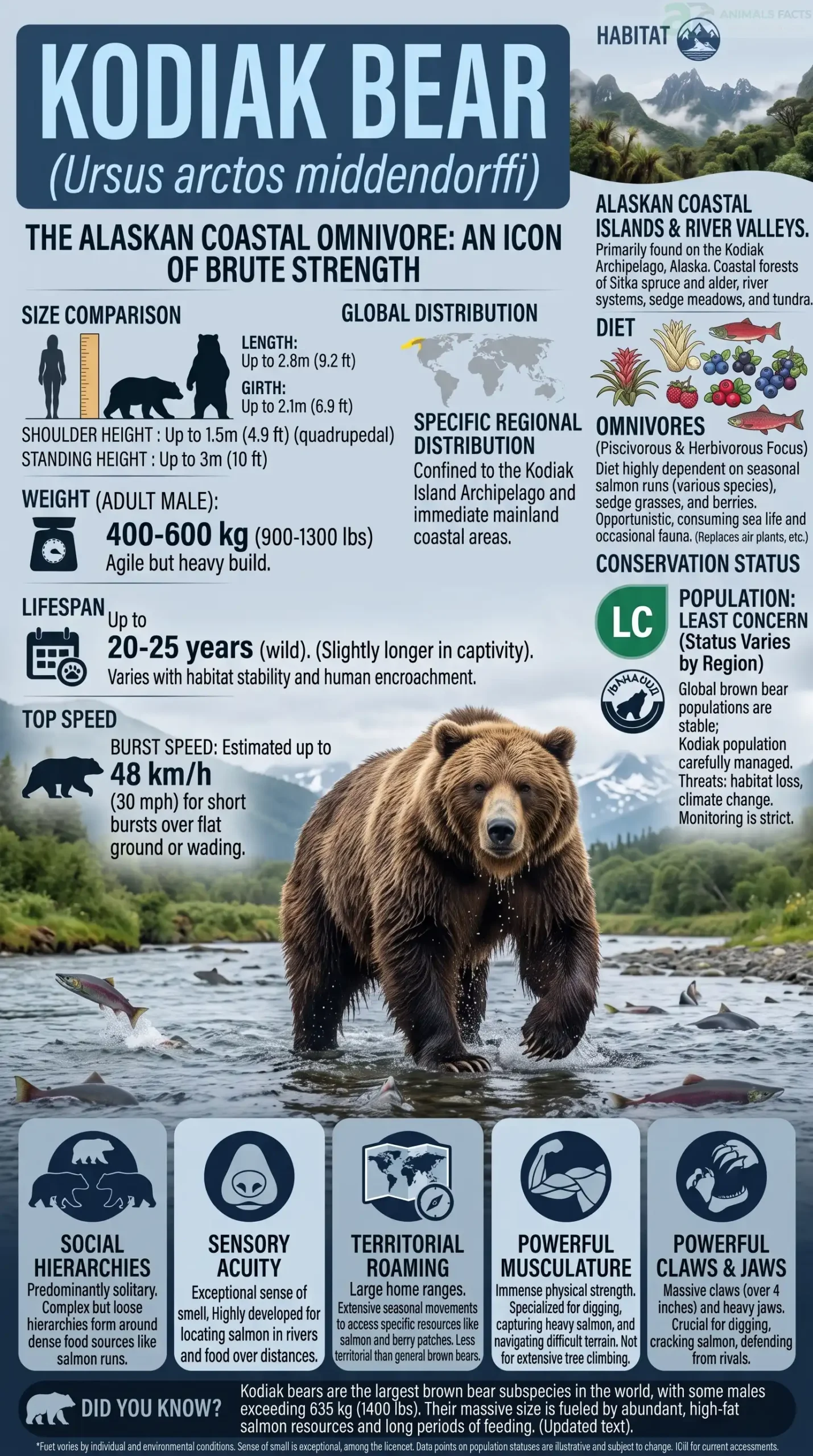
- The Kodiak bear is the world’s largest land carnivore.
- Adult males can weigh up to 635 kg — heavier than many motorcycles!
- All 3,500 wild Kodiak bears live on one small island group.
- Kodiak bears have been isolated on their islands for 12,000 years.
- They can eat up to 20,000 calories per day during salmon season.
- Kodiak bears can run at 55 km/h despite their enormous size.
- A standing Kodiak bear reaches 3 meters tall — room ceiling height.
- Kodiak cubs are born weighing just 350–500 grams — less than a bottle of water!
- The Kodiak National Wildlife Refuge protects two-thirds of Kodiak Island.
- Kodiak bears swim between islands of the archipelago regularly.
- Individual bears have distinct personal fishing styles they use every season.
- The population has remained stable at ~3,500 for decades of monitoring.
6. Kodiak Bear Habitat & Geographic Range
The Kodiak bear’s geographic range is, by definition, one of the most restricted of any recognized bear subspecies — confined entirely to the Kodiak Archipelago, a cluster of islands in the Gulf of Alaska off the Alaska Peninsula, within an area totaling approximately 13,000 km² of land surface distributed across several major and dozens of minor islands.
The Kodiak Archipelago
The Kodiak Archipelago consists of several major islands — including Kodiak Island (the largest, at approximately 9,300 km²), Afognak Island, Uganik Island, Raspberry Island, Shuyak Island, and numerous smaller islands — surrounded by the Gulf of Alaska and Shelikof Strait. The archipelago lies approximately 250 kilometers south of Anchorage and approximately 30 kilometers from the Alaska Peninsula mainland.
The archipelago’s geographic and biological characteristics are directly responsible for the Kodiak bear’s exceptional productivity:
Exceptional salmon streams: The archipelago’s rivers and streams support runs of five species of Pacific salmon — sockeye, pink, coho, chum, and king — providing the most calorie-dense and most seasonal food resource available to any brown bear population in North America.
Rich vegetation: The combination of the archipelago’s high rainfall (1,600+ mm annually), mild maritime climate (moderated by the Pacific Ocean), and rich volcanic soils produces exceptionally lush and productive vegetation — including dense sedge meadows, extensive berry fields (blueberry, salmonberry, crowberry), and diverse forb communities that supplement the salmon diet throughout the spring and summer season.
Rocky coastal habitat: The archipelago’s coastline provides beach foraging opportunities — with Kodiak bears documented feeding on marine invertebrates, sea mammals, and kelp along rocky shores — supplementing their inland food resources.
Habitat Types Used by Kodiak Bears
Salmon streams and riparian zones: The most critically important and most intensively used habitat — particularly during the July–October salmon run period, when stream corridors concentrate both bears and salmon in the most dramatic wildlife spectacle in the region.
Coastal meadows and sedge flats: Used intensively in spring following den emergence, when bears consume large quantities of emerging sedges, horsetail, and other early-growing vegetation to begin rebuilding body condition after winter dormancy.
Berry fields (inland and coastal): Used intensively in late summer and autumn as berry crops ripen — providing high-sugar foods that complement salmon protein and fat in the pre-denning hyperphagia season.
Mountain and subalpine terrain: Denning habitat for pregnant females and overwinter dormancy sites for all adults — typically excavated in stable snow fields or earthen sites on mountainsides above the zone of winter flooding.
Coastal intertidal and beach habitats: Used opportunistically for marine invertebrates, dead marine mammals, and kelp foraging — demonstrating the dietary flexibility that supplements the primary salmon-and-berry diet.
Geographic Isolation Table
| Island | Area | Bear Population | Key Features |
|---|---|---|---|
| Kodiak Island | ~9,300 km² | ~2,500–2,800 | Largest; most diverse habitat; main human settlement |
| Afognak Island | ~1,800 km² | ~300–400 | Northern; excellent salmon streams |
| Uganik Island | ~500 km² | ~100–200 | Within Refuge; excellent habitat |
| Shuyak Island | ~230 km² | ~50–100 | Northernmost; state park |
| Other islands | Various | ~200–300 | Smaller populations across archipelago |
Did You Know? The Karluk River system on Kodiak Island — flowing approximately 65 kilometers from Karluk Lake to the Pacific Ocean — supports one of the most productive sockeye salmon runs anywhere in Alaska, with annual sockeye returns sometimes exceeding 1.5 million fish. This extraordinary salmon abundance has made the Karluk system the focal point of both Kodiak bear research and sport fishing activity for generations, and has provided generations of researchers with the concentrated bear-salmon interaction study opportunities that have generated much of what is known about Kodiak bear fishing behavior and social dynamics. The relationship between the Karluk’s salmon productivity and the density and body condition of bears using the system provides one of the clearest documented examples of Pacific salmon fueling large carnivore success anywhere in the world.
7. Kodiak Bear Diet & Feeding Behavior
The Kodiak bear’s diet — and particularly its relationship with Pacific salmon — is the foundation of everything that makes this subspecies extraordinary. The annual salmon run transforms the Kodiak bear from a spring-season grass and sedge grazer into an intensive fish consumer whose hyperphagia capabilities fuel the largest body size achieved by any land carnivore on Earth.
The Annual Dietary Cycle
The Kodiak bear’s diet follows a precise annual calendar tied to the seasonal availability of different food resources across the archipelago’s ecosystem:
Diet Breakdown Table by Season
| Season | Primary Foods | Notes |
|---|---|---|
| Spring (May–June) | Sedges, horsetail, cow parsnip, early forbs | Post-dormancy recovery; vegetation-heavy; rebuilding body condition |
| Early summer (June–July) | Sedges, invertebrates, sea mammals, kelp, early berries | Transition period; salmon runs beginning |
| Peak salmon (July–October) | Pacific salmon (all 5 species) | Maximum caloric intake; 20,000 calories/day possible |
| Berry hyperphagia (August–October) | Blueberries, salmonberries, crowberries, elderberries | Parallel to late salmon; maximum sugar intake |
| Late autumn (October–November) | Remaining berries, ground squirrels, vegetation | Final pre-denning foraging |
| Winter dormancy (November–May) | Nothing — subsisting on fat reserves | 5–7 months without eating or drinking |
The Pacific Salmon Connection
The relationship between Kodiak bears and Pacific salmon is one of the most consequential predator-prey relationships in North American ecology — with the salmon’s annual mass mortality (all Pacific salmon die after spawning, leaving enormous quantities of carcasses in streams) providing a concentrated protein and fat resource that enables the Kodiak bear population to achieve body sizes, reproductive rates, and population densities impossible in salmon-free inland environments.
Species exploited: All five Pacific salmon species present in Kodiak streams — sockeye, pink, chum, coho, and king — are exploited by Kodiak bears, with the timing of each species’ run creating a sequential salmon feast that experienced bears navigate through learned knowledge of stream-specific run timing.
Selective consumption: Early in the salmon season when fish are abundant, Kodiak bears demonstrate highly selective feeding — consuming primarily the brain, eggs, and skin of freshly caught fish while discarding the muscle meat, maximizing caloric density per fish consumed. Later in the season, when abundance decreases and competition increases, bears consume more complete carcasses.
Fishing techniques: Individual bears develop and maintain personal fishing strategies:
- Standing fishing at falls — stationary position at cascade or waterfall locations where salmon congregate
- Diving — underwater pursuit of resting salmon in deep pools
- Snorkeling — partial submersion with face in water to locate and grab prey
- Sprint and splash — rapid pursuit of visible salmon in shallow water
- Pirating — stealing freshly caught fish from smaller or subordinate bears
Did You Know? Research tracking the nutritional contribution of salmon to Kodiak bear body condition has documented that the salmon season is so critical to Kodiak bear success that the weight gained during a single good salmon season can equal or exceed the total weight that an inland grizzly bear gains across an entire foraging year of diverse omnivorism. This comparison dramatically illustrates the extraordinary energetic subsidy that Pacific salmon provide to coastal bear populations — and explains why the Kodiak Archipelago’s exceptional salmon runs have enabled body size evolution at the absolute maximum of what is physiologically possible for a land-based carnivore.
8. Kodiak Bear Reproduction & Life Cycle
Kodiak bear reproduction reflects the general brown bear pattern with some important and measurable differences from mainland grizzly populations — particularly in average litter size, cub survival rates, and reproductive success metrics that reflect the exceptional nutritional environment of the Kodiak Archipelago.
Mating Behavior
Kodiak bears mate during May and June — with adult males actively seeking out and competing for receptive females across the archipelago. The competitive context of Kodiak bear mating is shaped by the extraordinarily high population density — with approximately 1 bear per 3–4 km² of available habitat, the probability of encountering competing males during the mating season is considerably higher for Kodiak males than for mainland grizzly males in most comparable habitats.
Delayed implantation: As with all brown bears, fertilized eggs undergo embryonic diapause — remaining dormant until autumn, when implantation is triggered by sufficient maternal fat reserves to support pregnancy through winter dormancy.
Denning and Birth
Den emergence variation: Females with cubs emerge from dens later than males and non-reproductive females — typically late April to early May, when snow conditions are more favorable for the young cubs’ first experiences outside the den.
Gestation: Approximately 180–266 days from implantation to birth (excluding the diapause period).
Birth: Typically January or February — the same winter denning period as other brown bear populations, while the mother remains in semi-dormant torpor.
Litter size: Typically 1–3 cubs (most commonly 2), with triplets documented more frequently in Kodiak than in most mainland grizzly populations — likely reflecting the superior nutritional condition of Kodiak females entering the denning period after a productive salmon and berry season.
Birth weight: Approximately 350–500 grams per cub — tiny relative to the enormous adult body size, consistent with all bear species.
Key Developmental Stages
| Stage | Age | Key Development |
|---|---|---|
| Birth in den | January/February | ~400 grams; blind, helpless |
| Eyes open | ~6 weeks | Beginning visual awareness in den |
| Den emergence | April/May (~4 months) | 5–10 kg; first outside experiences |
| First salmon experience | Summer of birth year | Critical learning period |
| Second winter with mother | Year 1–2 | Continue family group |
| Independence | 2–3 years | Separation from mother — dangerous period |
| Subadult | 3–6 years | Growing rapidly; peripheral to dominant adults |
| Sexual maturity | Female: 4–6 years; Male: 5–7 years | First breeding |
| Physical prime | 8–15 years | Maximum body size and reproductive success |
Lifespan Comparison Table
| Species | Average Wild Lifespan | Maximum Confirmed |
|---|---|---|
| Kodiak Bear | 20–25 years | ~30 years (wild); estimated |
| Grizzly Bear | 20–25 years | ~44 years (captivity) |
| Polar Bear | 20–25 years | ~43 years (captivity) |
| American Black Bear | 18–23 years | ~39 years (captivity) |
9. Social Behavior & Communication
The Kodiak bear’s social behavior is one of the most extensively studied and most genuinely remarkable aspects of the subspecies — with the high population density of the Kodiak Archipelago forcing bears into degrees of social proximity that have generated sophisticated behavioral adaptations to reduce conflict and enable resource sharing beyond what most mainland grizzly populations experience.
Social Tolerance at Salmon Streams
The most publicly visible and most scientifically significant aspect of Kodiak bear social behavior is the extraordinary tolerance for conspecific proximity at salmon streams — with dozens of individual bears sometimes fishing simultaneously within a relatively small stream section, developing a complex social hierarchy and behavioral protocol that allows resource sharing with minimized fighting.
At highly productive fishing locations within the Kodiak National Wildlife Refuge — particularly along the Frazer River and the Karluk River system — the social dynamics of large mixed-age, mixed-sex bear aggregations have been documented by researchers across multiple decades, revealing:
Dominance hierarchy: Large adult males dominate access to the most productive fishing positions — particularly the most productive waterfall positions where jumping salmon are most accessible. Smaller males, females with cubs, and subadults adopt alternative positions or use the falls during periods of reduced competition (early morning, late evening).
Individual relationship memory: Research has documented that specific bears appear to maintain memory of individual social relationships across seasons — with certain pairs of bears demonstrating consistent patterns of mutual tolerance or avoidance that persist across multiple salmon seasons.
Conflict minimization: Despite the concentration of dozens of large, powerful bears in a small area, serious injuries from conflicts are relatively rare — with the bears having developed a communication system of postural and behavioral signals that conveys dominance, submissiveness, and tolerance states with sufficient efficiency to prevent most potential conflicts from escalating to damaging physical contact.
Communication
Vocalizations: Kodiak bears produce the full range of brown bear vocalizations — huffing, jaw-popping, growls, roars, and the quieter contact calls used in mother-cub communication — with the social context of concentrated salmon stream aggregations generating a richer and more frequent display of these communication signals than is typical for more spatially dispersed mainland grizzly populations.
Scent marking: The same rub tree and trail marking system documented for mainland grizzlies — with bears rubbing against specific trees, depositing scent from body glands, and leaving claw and bite marks that communicate individual identity and social status to other bears monitoring the same sites.
Body language: The postural and movement communication that governs salmon stream social dynamics — including avoidance of direct eye contact by subordinate bears, specific approach and withdrawal sequences that signal social intent, and the physical distancing behaviors that maintain minimum acceptable proximity between bears of different social ranks.
Did You Know? Long-term behavioral research on Kodiak bears at stream fishing sites has documented that specific fishing position preferences within a stream section function as de facto territorial claims that are respected by the bear social hierarchy across multiple seasons — with dominant adults maintaining consistent access to the most productive stream positions year after year, while subordinate bears develop their own secondary positions within the social geography of the fishing site. This spatial consistency — maintained through behavioral signaling rather than physical confrontation — represents a level of social memory and relationship stability considerably more complex than the simple dominance hierarchy that early researchers assumed characterized bear aggregations.
10. Predators & Defense Mechanisms
Adult Kodiak bears are the unchallenged apex predator of the Kodiak Archipelago — with no natural predators capable of threatening a healthy adult, and facing only the potential competition and infanticide risk from other Kodiak bears that characterizes intraspecific interactions.
Natural Threats
Other Kodiak bears: The most significant natural mortality source for Kodiak bears after the juvenile stage is intraspecific competition — with adult males documented killing cubs (infanticide, which brings females back into estrus and eliminates non-related offspring) and occasionally killing smaller bears in serious territorial or competitive encounters. Female Kodiak bears are among the most aggressively protective mothers in the bear family — documented confronting and driving away adult males significantly larger than themselves in defense of cubs.
The absence of apex predators: One of the most ecologically significant features of the Kodiak Archipelago is the absence of wolves — which were never established on the islands — removing the apex competitor and predator that significantly influences bear behavior and population dynamics on the mainland. This absence has likely contributed both to the Kodiak bear’s population density (reduced competition for prey and carrion resources) and to the comparatively relaxed behavioral profile that characterizes Kodiak bears in many wildlife viewing contexts.
Humans: The primary documented source of Kodiak bear mortality outside of intraspecific interactions — through regulated sport hunting (managed by the Alaska Department of Fish and Game), defense of life and property killings, and occasional vehicle or vessel collisions in the most accessible coastal areas.
Defensive Capabilities
As the world’s largest land carnivore, the adult Kodiak bear’s primary defensive capability is simply its extraordinary physical power — forepaw strike forces estimated at potentially thousands of newtons, bite forces exceeding 1,200 psi, and a combination of mass, speed, and physical capability that makes confrontation with a healthy adult Kodiak bear a genuinely life-threatening situation for any other organism in its environment.
Maternal defense: As noted above, female Kodiak bears defending cubs demonstrate one of the most dangerous defensive situations encountered in North American wildlife — willing to confront adult males 2–3 times their own body weight in defense of offspring.
11. Kodiak Bear Facts for Kids
Hey kids — let’s dive into the world of the Kodiak bear, the biggest and most powerful bear — and therefore the biggest meat-eating land animal — in the whole world!
- Kodiak bears are the biggest bears in the world — and the biggest land carnivores on the whole planet! A big adult male Kodiak bear standing up on his hind legs is almost as tall as a basketball hoop and weighs as much as a small car!
- All the Kodiak bears in the world — about 3,500 of them — live on just one group of islands called the Kodiak Archipelago off the coast of Alaska. They’ve been living there for about 12,000 years, ever since the ocean rose and cut them off from the mainland at the end of the last Ice Age!
- Kodiak bears LOVE salmon — during the summer salmon season, they can eat 30–40 salmon in a single day! That’s thousands of calories of fish every day, which is why they get so big!
- Despite weighing as much as 635 kilograms, Kodiak bears can run as fast as 55 kilometers per hour — faster than a car drives in a school zone, and way faster than the fastest human sprinter who has ever lived!
- Baby Kodiak bears are born in January or February while their mom is sleeping in her winter den — and they’re incredibly tiny when they’re born, about the same weight as a bottle of juice, even though their mom might weigh 200 kilograms!
- When lots of Kodiak bears gather at salmon streams, they somehow all manage to get along and share the fish without fighting too much — they have a whole system of body language and behaviors that tell each other “I’m not a threat” or “I was here first” that usually keeps the peace!
- Kodiak Island gets more rain than almost anywhere in North America — all that rain makes the grass and berries grow incredibly well, giving bears plenty of food between salmon seasons!
- Unlike mainland Alaska where wolves also live, Kodiak Island has no wolves — which means Kodiak bears are the absolute top predator on the islands, with nothing at all to compete with them!
Did You Know? Kodiak bears that live near the ocean sometimes eat things that most people don’t think of as “bear food” — like seaweed (kelp), crabs, sea urchins, and even dead whales that wash up on the beach! Because the islands of the Kodiak Archipelago have so much coastline, bears that live near the shore have discovered that the ocean provides its own delicious buffet of foods alongside the salmon runs and berry fields in the forest. Bears who learn to eat these coastal foods from their mothers and continue using them throughout their lives are another example of how Kodiak bears are much smarter and more adaptable than many people realize!
12. Relationship with Humans
The Kodiak bear’s relationship with the human communities of the Kodiak Archipelago spans at least 10,000 years of Alutiiq coexistence, through the disruptions of Russian colonial contact and American territorial governance, to the contemporary management framework that makes the Kodiak Archipelago one of the world’s most carefully managed large carnivore habitats.
Alutiiq Cultural Coexistence
The Alutiiq (Sugpiaq) people — the Indigenous inhabitants of the Kodiak Archipelago who have occupied the islands for at least 7,500–10,000 years — developed a rich and complex cultural relationship with Kodiak bears across their millennia of shared occupation. The bear occupied a central position in Alutiiq spiritual life, ceremonial tradition, and traditional ecological knowledge — regarded as a powerful spirit being whose proper treatment and respect were essential to successful hunting, community well-being, and the maintenance of the human-bear relationship across generations.
Traditional Alutiiq bear hunting — conducted within a framework of ceremony, respect, and ecological knowledge accumulated across generations — provided both subsistence resources and the cultural context that shaped human-bear relations on the archipelago long before European contact.
Russian Colonial Period (1763–1867)
Russian exploration and colonization of the Kodiak Archipelago — centered on Kodiak’s role as the headquarters of the Russian-American Company’s sea otter hunting operations — introduced European perspectives on Kodiak bears as potential threats to be managed or exploited, alongside the commercial activities that would transform the archipelago’s ecology and economy. Russian records document observations of the extraordinary size of Kodiak bears from the earliest contact period, establishing the scientific foundation for eventual subspecies recognition.
American Management Era (1867–present)
Following the United States’ purchase of Alaska from Russia in 1867, the management of Kodiak bears evolved through several phases — from largely unregulated hunting during the settlement era, through the establishment of the Kodiak National Wildlife Refuge in 1941 and the formal management program developed in collaboration between the Refuge and the Alaska Department of Fish and Game from the 1960s onward.
The current management framework — combining the Refuge’s protection of approximately two-thirds of Kodiak Island as a no-hunting area, the state’s management of regulated sport hunting on remaining accessible areas, and active monitoring and population management through bear counts, hunter surveys, and ongoing research — has maintained the Kodiak bear population at approximately 3,500 individuals across multiple decades of systematic monitoring.
Human-Bear Conflict
Human-bear conflict on Kodiak Island reflects the extraordinary density of bears in a landscape that includes significant human settlements, commercial fishing operations, and outdoor recreation. The City of Kodiak (population approximately 6,000) and various smaller communities exist within the range of dense bear populations, creating management challenges for waste management, livestock protection, and public safety that wildlife managers address through public education, bear-resistant infrastructure, and conflict bear management.
13. Kodiak Bear Conservation Status & Threats
The Kodiak bear’s Least Concern conservation status reflects the genuine stability and carefully managed health of the archipelago’s bear population — one of the more positive large carnivore conservation situations in North America.
Conservation Data (2026)
| Parameter | Data |
|---|---|
| IUCN Status | Least Concern (as part of Ursus arctos) |
| Total Archipelago Population | ~3,500 bears |
| Kodiak Island Population | ~2,500–2,800 |
| Population Trend | Stable across multiple decades of monitoring |
| Annual Legal Harvest | ~160–190 bears (managed by ADFG) |
| Refuge Protection | ~2.5 million acres (two-thirds of Kodiak Island) |
| Management Authority | Kodiak National Wildlife Refuge (USFWS) and Alaska Dept. of Fish and Game |
Major Threats and Management Considerations
Salmon run variability: The Kodiak bear population’s dependence on Pacific salmon runs creates vulnerability to salmon population fluctuations — driven by ocean conditions, climate patterns, and commercial fishing pressure on Kodiak’s salmon stocks. Years of poor salmon returns generate measurably lower bear body condition, reduced reproductive success, and increased human-bear conflict as bears seek alternative food sources.
Climate change: Warming ocean temperatures affecting Pacific salmon productivity, changing precipitation patterns affecting vegetation production and den snow conditions, and shifting seasonal timing of food availability represent emerging climate-linked threats to the precise annual ecological calendar that the Kodiak bear population has evolved to exploit.
Human-bear conflict: Increasing recreational use of the Kodiak National Wildlife Refuge and surrounding areas — alongside the growth of Kodiak’s human population and infrastructure — creates ongoing management pressure around waste management, food storage, and the behavioral modifications that result from food conditioning of individual bears.
Regulated sport hunting management: The ongoing balance between the economic value of regulated bear hunting for Alaska and local communities, the sustainability requirements for maintaining the population at target levels, and the growing value of non-consumptive wildlife tourism creates management complexity requiring continuous monitoring and adaptive management response.
Did You Know? The Kodiak National Wildlife Refuge was established specifically to protect Kodiak bears and has successfully maintained the population at approximately 3,500 individuals for multiple decades — making it one of the most successful large carnivore protected area programs in American conservation history. The Refuge’s management approach — combining strict habitat protection across two-thirds of Kodiak Island with carefully managed sport hunting in remaining accessible areas, population monitoring through systematic counts and hunter harvest data, and ongoing research — is widely cited as a model for science-based large carnivore management that balances conservation, subsistence, sport hunting, and non-consumptive wildlife values within a single integrated management framework.
14. Famous Kodiak Bears
The Karluk River Bears — Long-Term Research Subjects
The individually photographed and identified bears of the Karluk River system within the Kodiak National Wildlife Refuge have been the subjects of some of the most sustained and most scientifically productive Kodiak bear behavioral research ever conducted — with specific animals documented across multiple decades, providing rare long-term data on individual life histories, social relationship persistence, and fishing behavior development that would be impossible to generate with shorter study periods.
Cubby and Other Named Research Individuals
Multiple individually named Kodiak bears have been tracked by wildlife researchers and refuge staff across their lifetimes — generating both scientific data and the kind of public familiarity with specific wild animals that has contributed to growing interest in Kodiak bear wildlife viewing as an alternative or complement to hunting.
Maximus — Record-Breaking Captive Kodiak
Maximus — a captive male Kodiak bear that lived at the Minnesota Zoo and later at the Point Defiance Zoo in Tacoma, Washington — became one of the most photographed and most widely discussed captive Kodiak bears in American zoo history through his documented exceptional size, reaching approximately 450 kg in captivity and frequently cited in discussions of bear world records. Captive Kodiak bears at multiple accredited American zoos have served as important ambassadors for the subspecies, introducing millions of zoo visitors to these remarkable animals in controlled conditions that allow closer and more sustained observation than wild encounters typically permit.
15. Role in Ecosystem & Food Chain
The Kodiak bear functions as the apex predator and primary keystone species of the Kodiak Archipelago ecosystem — with ecological contributions that extend from direct predation on salmon and deer to marine nutrient transfer, vegetation modification, and the broader suite of trophic cascade effects associated with top-predator presence.
Marine Nutrient Transfer — The Salmon Forest Connection
The Kodiak bear’s role in transferring marine-derived nutrients from salmon to terrestrial forest ecosystems is one of the most extensively studied and most ecologically significant processes in the archipelago’s ecosystem. Bears catching salmon and carrying carcasses away from streams into the surrounding forest deposit marine-derived nitrogen, phosphorus, and organic material throughout the riparian and upland forest — research has documented measurably accelerated tree growth and altered plant community composition in areas actively used by bears for salmon caching and consumption compared to comparable areas without bear activity.
In a landscape where salmon provide an extraordinary annual pulse of marine productivity into a terrestrial ecosystem, the Kodiak bear functions as the primary biological pump moving this marine subsidy into the forest — with consequences for forest productivity that cascade through the entire terrestrial ecosystem.
Deer Population Regulation
Introduced Sitka black-tailed deer — established on the Kodiak Archipelago in the early 20th century — are an important secondary prey species for Kodiak bears, particularly for calves in spring and for adults in situations of vulnerability. Bear predation on deer represents a top-down regulatory influence on the deer population that shapes vegetation dynamics across the archipelago.
Vegetation Engineering Through Foraging
Kodiak bears’ extensive digging behavior — for roots, ground squirrels, and invertebrates — modifies soil structure, nutrient distribution, and plant community composition across the areas they forage, contributing to the habitat heterogeneity that supports biodiversity across the archipelago’s vegetation communities.
16. Myths, Folklore & Cultural Significance
The Kodiak bear occupies a position of profound spiritual, cultural, and practical significance within the traditions of the Alutiiq (Sugpiaq) people — whose approximately 10,000 years of continuous occupation of the Kodiak Archipelago has generated one of the most geographically specific and most sustained human-bear cultural relationships in North American history.
Alutiiq Spiritual Traditions
In Alutiiq cosmology, the bear — particularly the enormous Kodiak bear of the archipelago — occupies a position of supreme spiritual power — regarded as one of the most powerful spirit beings in the Alutiiq universe, capable of communication with humans in dream and ceremony, deserving of profound respect in both hunting and daily forest encounter, and serving as a spiritual guardian and teacher of the proper relationship between humans and the natural world.
The Alutiiq tradition of bear shamanism — in which specific spiritual practitioners maintained particular relationships with bear spirits, could communicate with bears in ceremony, and were responsible for maintaining the proper spiritual protocols around bear hunting and human-bear encounter — reflects the depth of the cultural-spiritual engagement between Alutiiq people and Kodiak bears across thousands of years of shared archipelago occupation.
The bear hunt ceremony: Traditional Alutiiq bear hunting involved elaborate ceremonial protocols — including the proper treatment of bear remains after a kill, acknowledgment of the bear’s spirit, sharing of specific bear-derived materials with the community, and the conduct of ceremonies ensuring that the hunting relationship was maintained in proper spiritual balance. These protocols, developed and refined across generations of intimate coexistence with bears, reflect a sophisticated traditional ecological knowledge system in which the spiritual and practical dimensions of human-bear relations are inseparably integrated.
Contemporary Alutiiq Cultural Expression
Contemporary Alutiiq cultural artists and community members continue to maintain and express the tradition of Kodiak bear significance through traditional art forms — including Alutiiq masks, bentwood hats, and other decorative and ceremonial objects that incorporate bear imagery — alongside community education programs that transmit traditional ecological knowledge about bears to younger generations within a framework that honors both the traditional cultural significance of the bear and the contemporary scientific understanding of the subspecies.
17. Kodiak Bears in Pop Culture
The Kodiak bear has generated a significant and growing presence in American popular culture — driven by its extraordinary size, the spectacular salmon-fishing visual spectacle that makes Kodiak the world’s most accessible large bear viewing destination alongside Katmai, and the growing media coverage of the archipelago’s wildlife values.
Wildlife Documentary Coverage
Various National Geographic, BBC, and Discovery Channel productions have featured Kodiak bears in productions ranging from dedicated Kodiak-focused documentaries to segments within broader Alaskan wilderness programming. The combination of the bears’ exceptional size, the dramatic salmon-fishing sequences, and the social dynamics of large bear aggregations provides consistently compelling material for wildlife filmmakers.
“Bears” (Disneynature, 2014) — While primarily focused on Katmai National Park brown bears rather than Kodiak specifically, this widely-seen Disneynature production increased general public awareness of Alaskan coastal brown bear ecology and behavior, generating broader interest in Kodiak as a complementary viewing destination.
BBC and NatGeo Alaskan brown bear productions — Multiple programs covering Alaskan brown bear ecology and behavior have included Kodiak-specific content, with the exceptional bear density and salmon-fishing behavior providing visually dramatic material.
Wildlife Viewing Tourism Media
The growing bear viewing industry on Kodiak Island — involving guided wilderness lodge-based expeditions to stream-side bear viewing sites — has generated substantial photographic and video documentation of Kodiak bears by wildlife photographers and videographers worldwide, with images and footage distributed through social media, wildlife photography publications, and online platforms reaching increasingly large audiences.
Hunting Culture
The Kodiak bear occupies a specific and significant place in North American hunting culture — with Kodiak Island bear hunting recognized as one of the most physically demanding, most expensive, and most prestigious big game hunting experiences available in North America. The hunting culture surrounding Kodiak bears has generated extensive literary and photographic documentation across generations of hunting writers and photographers.
18. Kodiak Bear Facts vs. Common Myths
Myth: The Kodiak bear is the same as the grizzly bear. Fact: The Kodiak bear (Ursus arctos middendorffi) and the grizzly bear (Ursus arctos horribilis) are distinct recognized subspecies of the brown bear — related but genetically differentiated through approximately 12,000 years of island isolation. Kodiak bears are significantly larger on average than most grizzly populations, show higher social tolerance, live in a more productive marine ecosystem, and have measurably different genetic characteristics from even their geographically closest mainland brown bear relatives.
Myth: The Kodiak bear is the world’s largest bear — period. Fact: The Kodiak bear shares the world’s largest land carnivore title with the polar bear — with the heaviest verified individuals of both species falling in comparable weight ranges (600–700+ kg). Whether a specific exceptionally large polar bear or a specific exceptionally large Kodiak bear holds the individual size record depends on which documented specimens are compared. Both species are accurately described as the world’s largest land carnivores, sharing this status rather than one holding it exclusively.
Myth: Kodiak bears are always aggressive. Fact: Kodiak bears are wild animals deserving of appropriate respect and appropriate distance, but they are not characteristically aggressive toward humans in normal circumstances. Wildlife viewing operations on Kodiak Island regularly provide visitors with close observation of wild bears with appropriate professional guidance, and bear-caused human fatalities on the archipelago are genuinely rare given the number of human-bear encounters that occur annually. Like all large bears, Kodiak bears are dangerous in specific circumstances — particularly surprise encounters at close range and mothers with cubs — but are not predisposed to human aggression in the manner that their size and power alone might suggest.
Myth: Kodiak bears fish because they can’t find other food. Fact: Pacific salmon is not a fallback resource for Kodiak bears but a primary, preferred, and actively exploited food source that bears pursue with sophisticated individual techniques developed and refined across their lifetimes. The salmon resource is so important that experienced bears begin positioning themselves at productive stream sites before the salmon runs begin — demonstrating anticipatory behavior that reflects explicit knowledge of salmon run timing, not reactive response to a discovered food source.
Myth: All Kodiak bears are approximately the same enormous size. Fact: The 635 kg+ maximum body weights associated with the subspecies represent the largest documented individuals — adult males in prime condition following outstanding salmon and berry seasons. Most adult female Kodiak bears weigh 135–275 kg — still very large for a bear, but considerably more modest than the maximum male size. Young adults and bears in poor nutritional years are significantly smaller than the record-setting individuals that dominate discussions of Kodiak bear size.
19. Best Places to See Kodiak Bears in the Wild
Frazer Lake, Kodiak National Wildlife Refuge
Frazer Lake — accessible by floatplane or boat within the Kodiak National Wildlife Refuge — is one of the most productive and most accessible salmon-based bear viewing sites on Kodiak Island, with bears congregating along the Frazer River during the sockeye run in numbers that allow excellent close-range observation from established viewing platforms.
Karluk Lake and River System, Kodiak National Wildlife Refuge
The Karluk system — with its extraordinary salmon productivity — attracts some of the highest concentrations of Kodiak bears anywhere on the archipelago during peak run periods. Wilderness lodge-based access through floatplane allows multi-day immersion in this outstanding wildlife landscape with experienced guide support.
Kodiak National Wildlife Refuge (Multiple Sites)
The Refuge’s combination of protected habitat, Refuge biologist-guided viewing programs, and the extraordinary bear density of the core Refuge area provides the institutional framework for most organized Kodiak bear viewing — with specific stream sites varying in productivity and accessibility across the season.
Terror Lake Area, Kodiak Island
The Terror Lake watershed on central Kodiak Island supports significant bear populations in a spectacular landscape accessible by guided wilderness expeditions — providing viewing opportunities combined with the dramatic scenery of Kodiak’s rugged interior mountains and coastal fjords.
Uganik Island
Uganik Island — part of the Kodiak National Wildlife Refuge, accessible by floatplane from Kodiak — provides bear viewing opportunities in a less-visited section of the archipelago, with excellent salmon streams and the added value of remoteness from the main island’s infrastructure and human activity.
Shuyak Island State Park
Shuyak Island — the northernmost island in the archipelago — supports bear populations within a state park context, accessible by floatplane with kayak-based exploration of the island’s kayak-friendly coastline providing an unusual combination of sea kayaking and bear viewing opportunity.
20. Top Documentaries & Books
Must-Watch Documentaries
Various Alaska/Kodiak-focused National Geographic and BBC productions — Multiple wildlife documentary productions have dedicated episodes or significant segments to Kodiak bear ecology, fishing behavior, and the archipelago’s broader wildlife values, with the extraordinary visual quality of large bears in salmon streams providing consistently compelling footage.
“Alaska: Earth’s Frozen Kingdom” (BBC, 2015) — A BBC production covering Alaska’s full range of ecosystems and wildlife including coverage of the coastal brown bear salmon fishing behavior that characterizes both Kodiak and Katmai bear populations.
“Bears” (Disneynature, 2014) — An accessible family-format documentary following a brown bear mother and cubs through their first year in a landscape very similar to Kodiak’s ecology, useful for understanding Kodiak bear annual ecology in accessible narrative format.
Essential Books
“Kodiak Bear Country” by various wildlife writers — Multiple books covering Kodiak Island wildlife, bear ecology, and the Refuge management program provide accessible natural history context for understanding the world’s largest bear subspecies.
“Alaska’s Kodiak Island: Brown Bears and Wilderness” — Various author accounts of Kodiak wildlife, hunting tradition, and natural history provide both ecological documentation and the cultural context of Kodiak Island’s human-bear relationship across different historical periods.
21. Comparison of Kodiak Bears with Similar Bear Species
| Feature | Kodiak Bear | Grizzly Bear | Polar Bear | American Black Bear | Kamchatka Brown Bear |
|---|---|---|---|---|---|
| Scientific Name | Ursus arctos middendorffi | Ursus arctos horribilis | Ursus maritimus | Ursus americanus | Ursus arctos beringianus |
| Weight (Male) | 270–635 kg | 180–360 kg | 300–700 kg | 57–300 kg | 150–480 kg |
| Distribution | Kodiak Archipelago only | W. North America | Arctic circumpolar | North America (widespread) | Kamchatka Peninsula, Russia |
| Habitat | Island ecosystem; coastal | Mountain, tundra, forest | Arctic sea ice | All N. American biomes | Coastal; similar to Kodiak |
| Primary Seasonal Food | Pacific salmon | Berries, roots, deer, some salmon | Ringed seals (primary) | Berries, nuts, insects | Pacific salmon (similar to Kodiak) |
| Population | ~3,500 (entirely island-confined) | ~55,000 (N. America) | ~22,000–31,000 | ~800,000–950,000 | ~19,000 (estimated) |
| Social Tolerance at Food Resources | Very high (salmon streams) | Moderate to high | Low (solitary except Churchill) | Moderate | Very high (salmon streams) |
| Conservation Status | Least Concern | Least Concern (global)/Threatened (lower 48) | Vulnerable | Least Concern | Least Concern |
| Unique Feature | World’s largest bear; island-isolated; co-holder world’s largest land carnivore | Shoulder hump; interior specialist | Marine mammal; translucent fur | Most numerous N. American bear | Pacific salmon specialist; similar ecology to Kodiak |
22. How You Can Help
Kodiak bear conservation operates within a well-funded, well-staffed, and scientifically rigorous management framework — making individual conservation contributions primarily channeled through supporting the organizations and programs that sustain this management system and through responsible engagement with Kodiak’s wildlife values.
Support These Organizations
Kodiak National Wildlife Refuge — Friends of the Kodiak National Wildlife Refuge (friendsofkodiakrefuge.org) — The primary partner organization for the Kodiak NWR, supporting Refuge educational programs, research initiatives, and the broader public engagement activities that maintain public awareness of and advocacy for Kodiak bear conservation.
National Wildlife Refuge Association (refugeassociation.org) — The national advocacy organization supporting the US National Wildlife Refuge System, including the Kodiak NWR, through legislative advocacy, public education, and conservation funding support.
Alaska Coastal Brown Bear Foundation and similar organizations — Alaska-based wildlife conservation organizations supporting broader coastal brown bear research and conservation across the state, with relevance to the management frameworks governing Kodiak bear populations.
Practical Actions
Visit Kodiak responsibly through established bear viewing programs. Revenue from responsibly operated bear viewing tourism on Kodiak Island generates direct economic value from living, wild bears and creates stakeholder interest in maintaining the population’s health, safety, and habitat integrity. Choosing guided viewing operations that prioritize bear welfare, maintain appropriate distances, and employ experienced naturalist guides supports the highest-quality wildlife experience while contributing to the local conservation economy.
Follow all Refuge regulations. Adhering to food storage requirements, established approach distances, and designated trail and camp sites in the Kodiak National Wildlife Refuge directly reduces food conditioning risk for individual bears and maintains the wildlife-focused character of the Refuge that is essential to the bear population’s long-term management success.
Support sustainable Alaskan salmon fisheries. The sustainability of Kodiak’s Pacific salmon runs — the foundation of the Kodiak bear’s extraordinary productivity — depends on the sustainable management of commercial salmon fisheries in Kodiak and surrounding waters. Supporting sustainably certified Alaskan salmon products generates market incentives for fisheries management that maintains the salmon runs essential to bear population health.
Advocate for climate policy. The long-term viability of Pacific salmon runs — and therefore of the Kodiak bear’s caloric foundation — depends significantly on ocean temperature conditions affected by climate change. Supporting climate policy consistent with maintaining productive Pacific salmon ecosystems has direct relevance to Kodiak bear conservation.
Did You Know? The Kodiak National Wildlife Refuge manages a unique bear monitoring program that combines systematic aerial population counts, hunter harvest data, radio and GPS collar tracking of individual bears, and long-term behavioral observation at key stream sites to provide one of the most complete population monitoring datasets for any large bear population in the world. This monitoring system — refined across more than 60 years of consistent application — has generated the population stability data that confirms the Kodiak bear population’s sustained health, provided the scientific foundation for the regulated harvest management decisions that have maintained population numbers, and generated fundamental behavioral ecology insights that have advanced scientific understanding of large bear social systems, dietary ecology, and conservation management approaches applicable to bear conservation worldwide.
23. Frequently Asked Questions About Kodiak Bears
Q1: What is the scientific name of the Kodiak bear?
The Kodiak bear’s scientific name is Ursus arctos middendorffi — classifying it as a subspecies of the brown bear (Ursus arctos). The subspecies name honors Alexander Theodor von Middendorff, the Russian naturalist and Arctic explorer after whom it was named. The family is Ursidae (bears), order Carnivora, class Mammalia.
Q2: How big does a Kodiak bear get?
Adult male Kodiak bears typically weigh 272–454 kg in spring and can reach 360–635 kg in autumn after the salmon and berry season. The largest documented individuals approach 680 kg. On hind legs, large males stand up to 3.0 meters (10 feet) tall. Adult females are considerably smaller — typically 135–275 kg.
Q3: Is the Kodiak bear the same as the grizzly bear?
The Kodiak bear and grizzly bear are distinct recognized subspecies of the brown bear — related but separated by approximately 12,000 years of island isolation that has generated measurable genetic differentiation. Kodiak bears are significantly larger on average than most grizzly populations and are confined entirely to the Kodiak Archipelago, while grizzlies range across mainland western North America.
Q4: How many Kodiak bears exist?
The total Kodiak bear population is estimated at approximately 3,500 individuals — all confined to the Kodiak Archipelago. This population has remained stable at approximately this level across multiple decades of systematic monitoring, reflecting the effectiveness of the management program centered on the Kodiak National Wildlife Refuge.
Q5: Where do Kodiak bears live?
Kodiak bears live exclusively on the Kodiak Archipelago — a cluster of islands in the Gulf of Alaska off the Alaska Peninsula, approximately 250 kilometers south of Anchorage. The major islands supporting bear populations include Kodiak Island, Afognak Island, Uganik Island, and Shuyak Island.
Q6: What do Kodiak bears eat?
Kodiak bears are omnivores with a diet that shifts dramatically across the season — from sedges, forbs, and spring vegetation after den emergence, through intensive Pacific salmon fishing during the July–October salmon runs (when bears can consume up to 20,000 calories daily), to intensive berry foraging in late summer and autumn, and finally winter dormancy sustained entirely by accumulated fat reserves.
Q7: Are Kodiak bears endangered?
Kodiak bears are classified as Least Concern — with a stable population of approximately 3,500 individuals maintained under the management framework of the Kodiak National Wildlife Refuge and Alaska Department of Fish and Game. The population has remained stable across multiple decades of systematic monitoring and is not considered at conservation risk under current management conditions.
Q8: How long do Kodiak bears live?
Wild Kodiak bears typically live 20–25 years, with the oldest documented wild individuals reaching approximately 27 years of age. Captive Kodiak bears have been documented living to approximately 30 years in appropriate zoo facilities.
Q9: What is the Kodiak National Wildlife Refuge?
Kodiak National Wildlife Refuge is a federally protected area covering approximately 2.5 million acres (approximately 1 million hectares) — encompassing roughly two-thirds of Kodiak Island plus portions of Afognak, Uganik, and Ban Islands. Established in 1941 specifically to protect Kodiak bears and their habitat, the Refuge provides no-hunting protection for the core of the Kodiak bear’s range and is managed by the US Fish and Wildlife Service in cooperation with the Alaska Department of Fish and Game.
Q10: How can I see Kodiak bears in the wild?
The best Kodiak bear viewing opportunities are available through guided wilderness lodge-based expeditions to salmon stream sites within the Kodiak National Wildlife Refuge, typically accessed by floatplane from the city of Kodiak. The best viewing season is July through October during the salmon runs, when bears congregate at productive stream sites. The Karluk River system, Frazer Lake, and Terror Lake area are among the most productive viewing sites. Visitors should work with licensed guides who are experienced with bear behavior and Refuge regulations.
26. Sources & Closing Elements
Research Sources
- Wikipedia — Ursus arctos middendorffi and related articles
- IUCN Red List — iucnredlist.org
- Kodiak National Wildlife Refuge (US Fish and Wildlife Service) — fws.gov/refuge/kodiak
- Alaska Department of Fish and Game — adfg.alaska.gov
- National Geographic — nationalgeographic.com
- Smithsonian’s National Zoo — nationalzoo.si.edu
- Encyclopaedia Britannica — britannica.com
- BBC Wildlife — bbc.co.uk
- Live Science — livescience.com
- Titus, Kimberlee et al. — Kodiak bear population ecology research publications (multiple, ADFG)
- Wielgus, Robert and Frederick Bunnell — Brown bear ecology research relevant to Kodiak subspecies management