

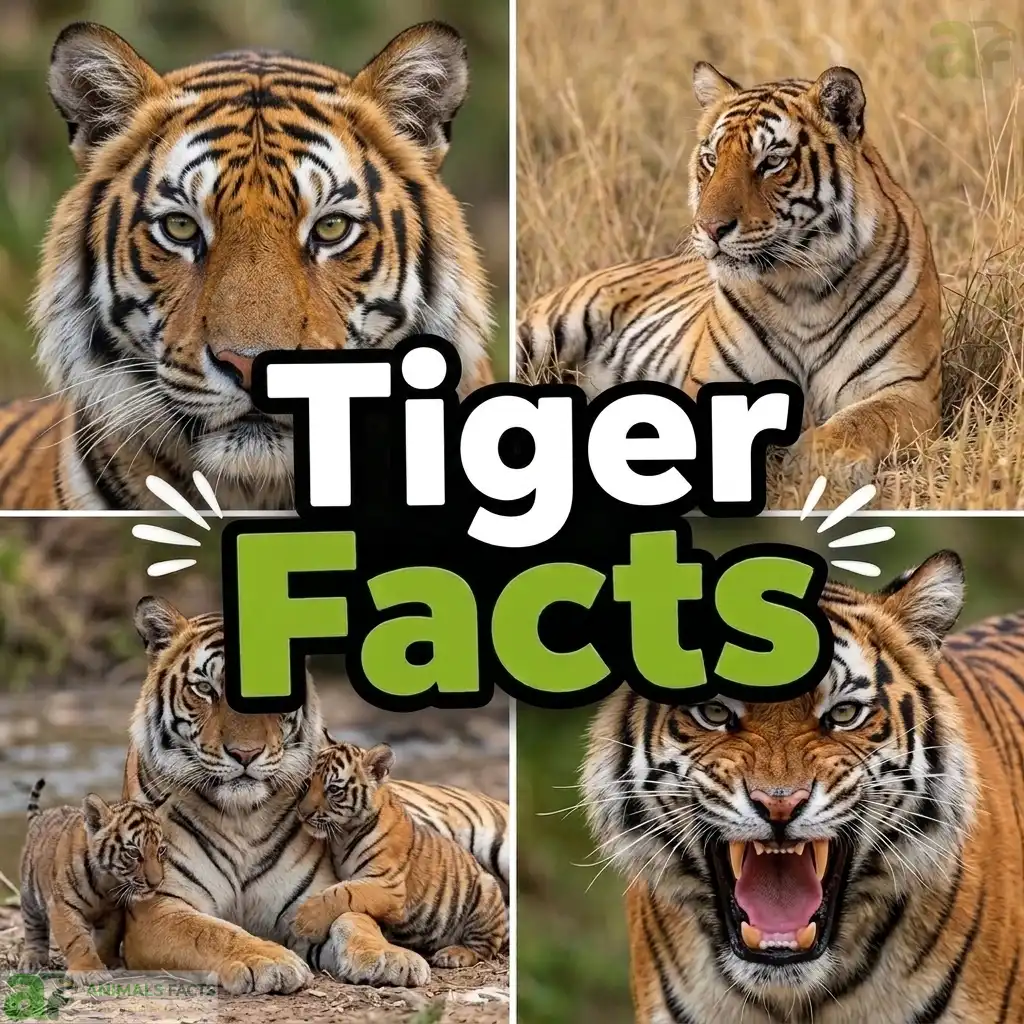
Tiger Facts
| Feature | Details |
|---|---|
| Scientific Name | Panthera tigris |
| Kingdom | Animalia |
| Phylum | Chordata |
| Class | Mammalia |
| Order | Carnivora |
| Family | Felidae |
| Genus | Panthera |
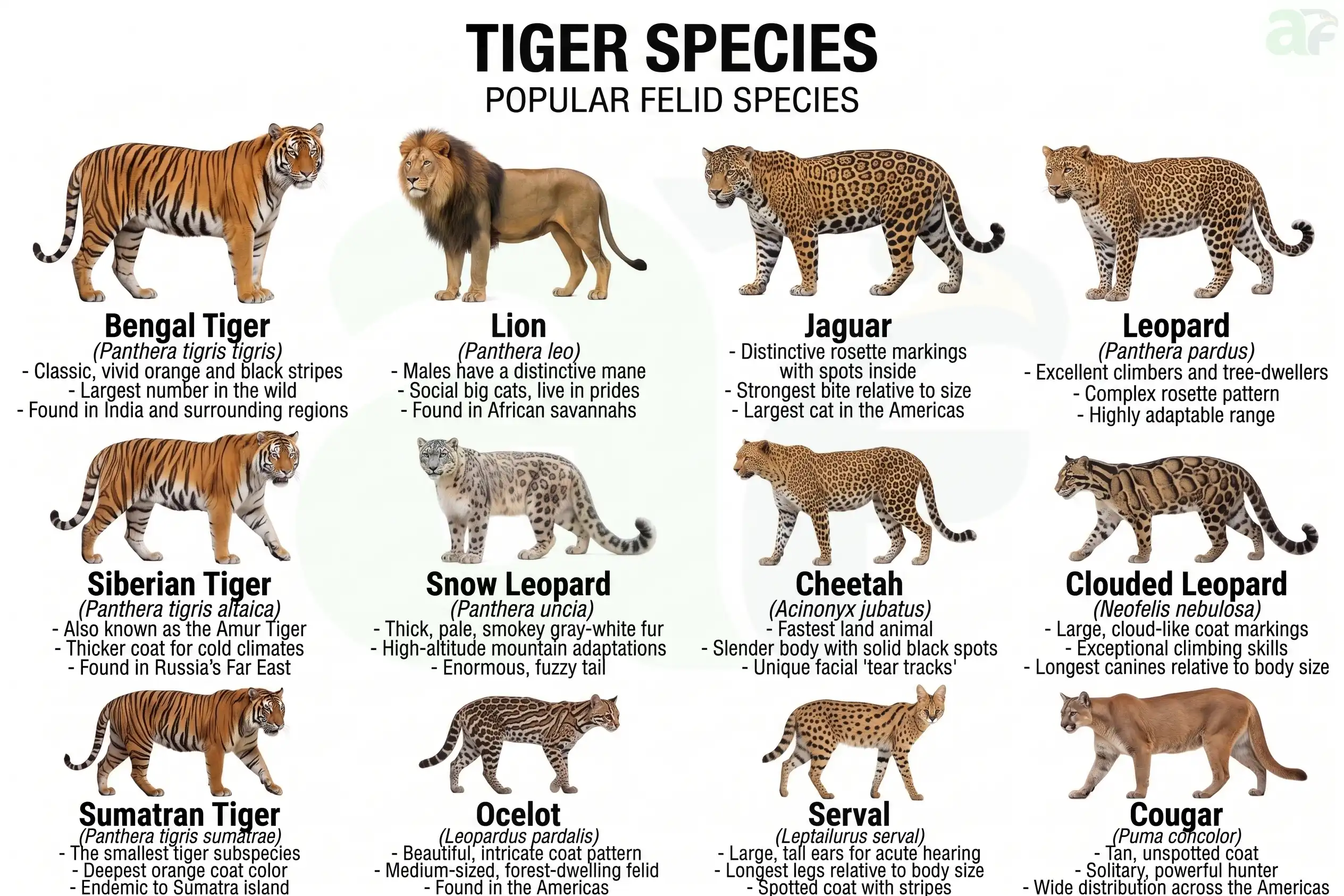
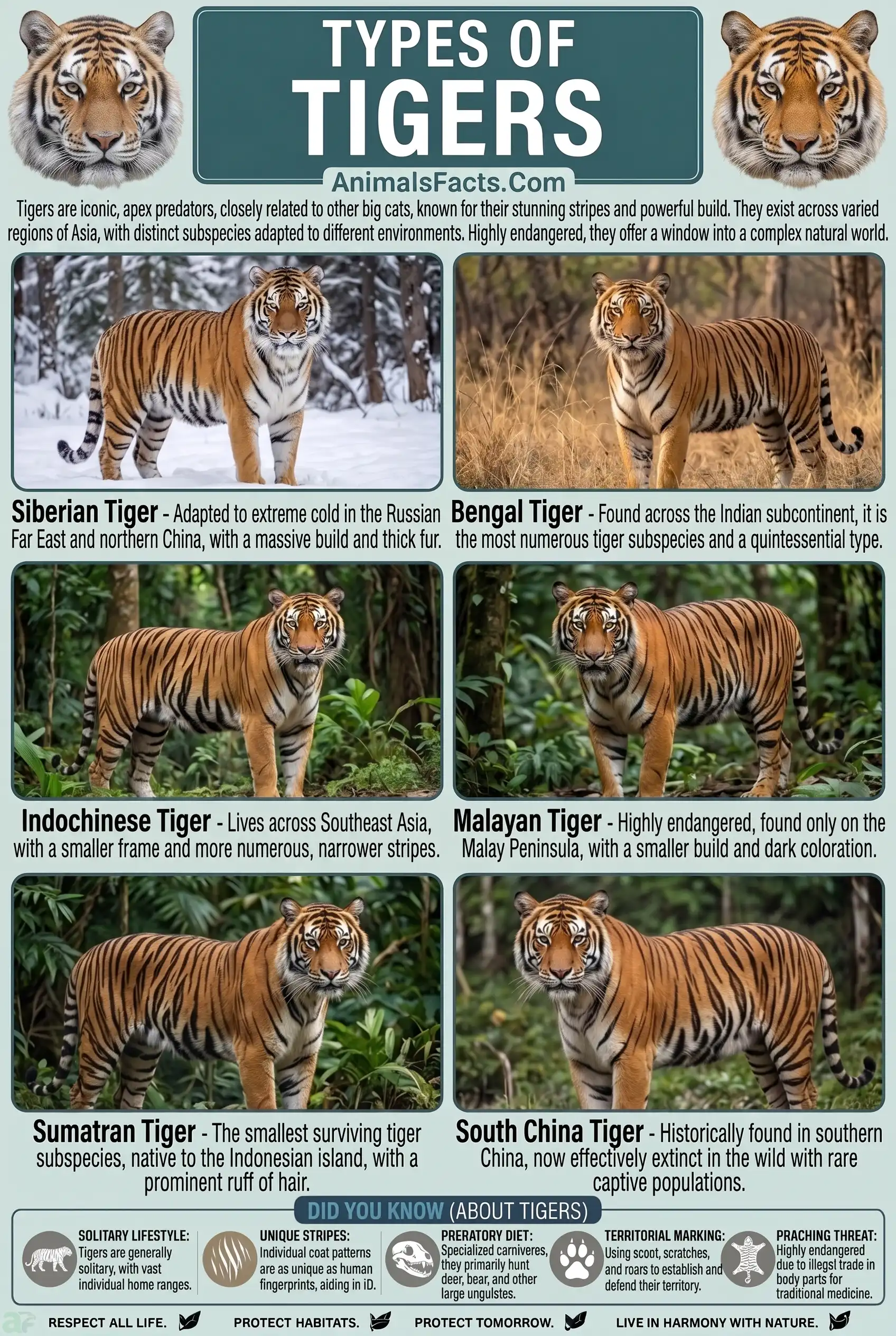
| Living Subspecies | 6 recognized subspecies (Bengal, Siberian/Amur, Sumatran, Malayan, Indochinese, South China) |
| Extinct Subspecies | 3 (Bali, Javan, Caspian — all extinct in the 20th century) |
| Habitat | Tropical rainforest, temperate forest, mangrove swamps, grassland, tundra margins — 13 range countries across Asia |
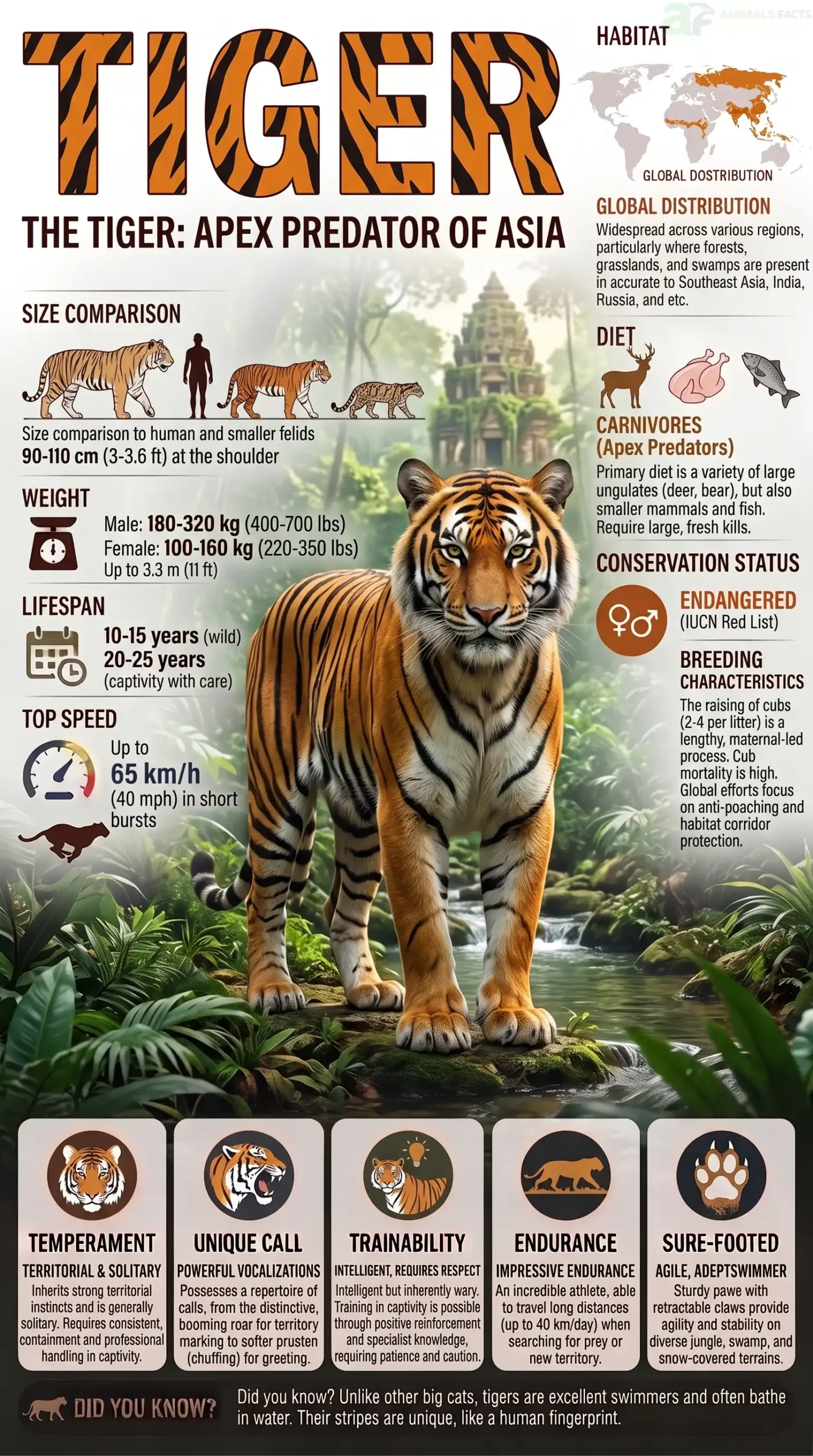
| Lifespan | 10–15 years in the wild; up to 26 years in captivity |
| Diet | Apex carnivore — deer, wild boar, buffalo, gaur, and other large ungulates |
| Weight | Males: 90–300 kg (varies by subspecies); Females: 65–167 kg |
| Body Length | 1.4–3.3 meters (excluding tail); tail adds 60–110 cm |
| Shoulder Height | 90–110 cm |
| Top Speed | Up to 65 km/h (40 mph) in short sprints |
| Conservation Status | Endangered (IUCN Red List) |
| Global Wild Population | Estimated 5,574 individuals (2022 census — most comprehensive ever conducted) |
| Unique Feature | Largest wild cat on Earth; only truly striped big cat; each tiger’s stripe pattern is unique as a fingerprint |
 1. Introduction: What is a Tiger?
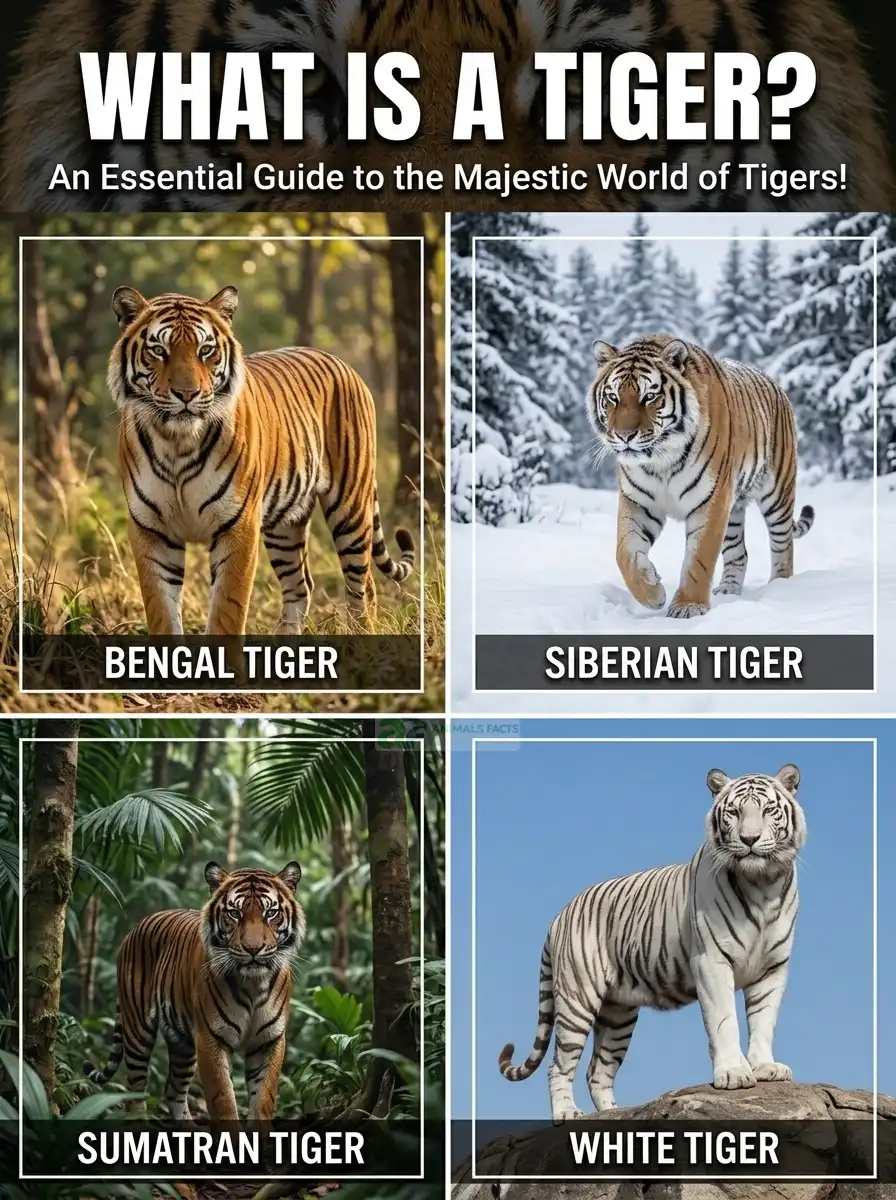
It moves through the forest like a flame — orange and black, rippling with power, its enormous paws falling in absolute silence on the forest floor. It is the largest wild cat on Earth, a solitary apex predator of astonishing physical power and surprising behavioral complexity, and one of the most universally recognized animals in human cultural history. Tiger facts are simultaneously among the most awe-inspiring in the natural world and among the most urgently important in contemporary conservation — because the animal that has served as the symbol of wild power and untamed nature across Asian civilizations for thousands of years is fighting for survival across a fraction of its former territory.
The tiger — Panthera tigris — represents the pinnacle of felid evolution: the largest, most powerful, and most ecologically dominant member of the cat family, evolved through millions of years of natural selection into a hunting machine of extraordinary efficiency. Tigers have survived multiple Ice Ages, the collapse and rise of entire ecosystems, and thousands of years of human civilization expanding around them. What they have not survived — at least not yet — is the combination of industrial-scale habitat destruction and relentless poaching that characterized the 20th century. From an estimated 100,000 wild tigers at the beginning of the 20th century, the global wild population had collapsed to fewer than 2,000 individuals at its lowest point around 2010, before a historic conservation effort produced the first documented global tiger population increase in over a century.
Whether you are a student researching tiger facts for a school project, a conservation enthusiast following the remarkable recovery story of one of Asia’s most iconic animals, a parent searching for tiger facts for kids, a wildlife photographer planning a tiger-tracking expedition to India, or simply someone who has always been mesmerized by the beauty and power of the world’s largest cat — this is the most complete guide to tiger facts you will find anywhere. We cover tiger habitat, tiger diet, tiger behavior, communication, reproduction, all six living subspecies, conservation, mythology, and the extraordinary but still incomplete recovery story of an animal that deserves every conservation effort being made on its behalf. Let us begin.
2. Species Overview & Classification
Tigers belong to the genus Panthera — the roaring cats — alongside lions, leopards, jaguars, and snow leopards. Within Panthera, tigers are unique in their combination of extreme body size, solitary behavior, and strong association with forest and water habitats. Unlike lions, which evolved for open-country cooperative hunting, tigers are the consummate solitary ambush predators of dense forest and tall grass environments.
Living Tiger Subspecies Comparison
| Subspecies | Scientific Name | Estimated Wild Population (2026) | Range | Unique Feature |
|---|---|---|---|---|
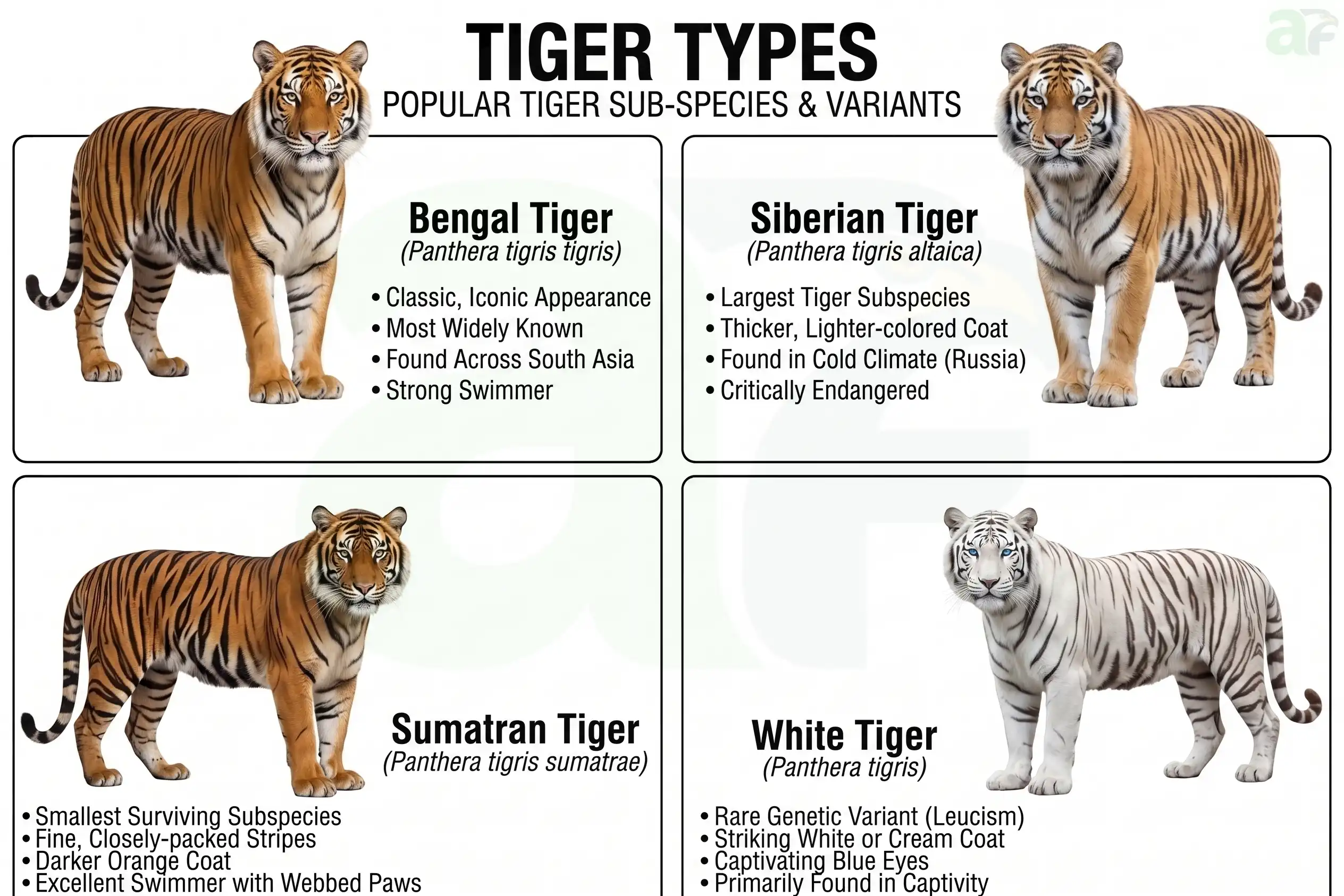
| Bengal Tiger | Panthera tigris tigris | ~3,167 | India, Nepal, Bhutan, Bangladesh | Most numerous; includes white tiger gene |
| Siberian / Amur Tiger | Panthera tigris altaica | ~500–600 | Russian Far East; small China border population | Largest subspecies; coldest habitat |
| Sumatran Tiger | Panthera tigris sumatrae | ~400–600 | Sumatra, Indonesia only | Smallest subspecies; narrowest stripes; Critically Endangered |
| Malayan Tiger | Panthera tigris jacksoni | ~80–120 | Peninsular Malaysia | Critically Endangered; smallest mainland subspecies |
| Indochinese Tiger | Panthera tigris corbetti | ~150–200 | Thailand, Myanmar, Laos, Cambodia, Vietnam | Severely reduced; primarily in Thailand |
| South China Tiger | Panthera tigris amoyensis | Functionally extinct in the wild; ~100 in captivity | Southern China (no confirmed wild sightings since 1990s) | Most endangered; possibly extinct in wild |
Extinct Tiger Subspecies
| Subspecies | Scientific Name | Range | Year of Extinction |
|---|---|---|---|
| Bali Tiger | Panthera tigris balica | Bali, Indonesia | ~1950s |
| Javan Tiger | Panthera tigris sondaica | Java, Indonesia | ~1970s–1980s |
| Caspian Tiger | Panthera tigris virgata | Central Asia, Iran, Turkey | ~1970s |
The extinction of three tiger subspecies in a single century — driven entirely by human activity through habitat destruction and hunting — represents one of the most severe accelerations of large carnivore extinction in recorded history, and serves as a sobering reminder of the realistic trajectory for remaining subspecies without sustained conservation action.
Species Evolution & Discovery Timeline
~2–3 million years ago: The earliest members of the tiger lineage appeared during the Pliocene Epoch in Asia, diverging from the common Panthera ancestor — making tigers among the oldest-evolved of the five Panthera species.
~1 million years ago: Tigers spread from their Central Asian origin across the continent — colonizing the Indian subcontinent, Southeast Asia, and the Russian Far East through a combination of active range expansion and changing climate, establishing populations across an enormous geographic range.
~100,000–12,000 years ago: During the Pleistocene Epoch, tigers inhabited a range extending from Beringia (the land connection between Asia and North America) through the current tiger range, with fossil evidence suggesting they briefly penetrated into Alaska or northwestern North America.
~10,000 years ago: As the Pleistocene megafauna collapsed and human populations expanded across Asia following the last Ice Age, the tiger’s range began contracting from its maximum extent.
~2,000–1,000 years ago: Historical records — including Chinese imperial documents, Indian Sanskrit texts, and Persian writings — document tigers across a range extending from eastern Turkey through Iran and Central Asia across South and Southeast Asia to the Russian Far East.
1758: Carl Linnaeus formally classified the tiger as Felis tigris in Systema Naturae, later reclassified as Panthera tigris as the big cat genus was established.
1900–1970: The catastrophic decline — from an estimated 100,000 wild tigers at the century’s beginning to approximately 1,800 by the early 1970s — driven by unrestricted hunting and habitat destruction, representing one of the most rapid large-predator population collapses in history.
1973: Project Tiger launched in India — the most ambitious single-nation tiger conservation program ever attempted, creating a network of dedicated tiger reserves that would form the backbone of Bengal Tiger recovery over subsequent decades.
2010: The St. Petersburg Tiger Summit — attended by representatives of 13 tiger range countries — established the global TX2 goal to double wild tiger numbers by 2022. The 2022 tiger census documented approximately 5,574 wild tigers, representing the first globally documented wild tiger population increase in over a century.
3. Physical Description & Unique Features
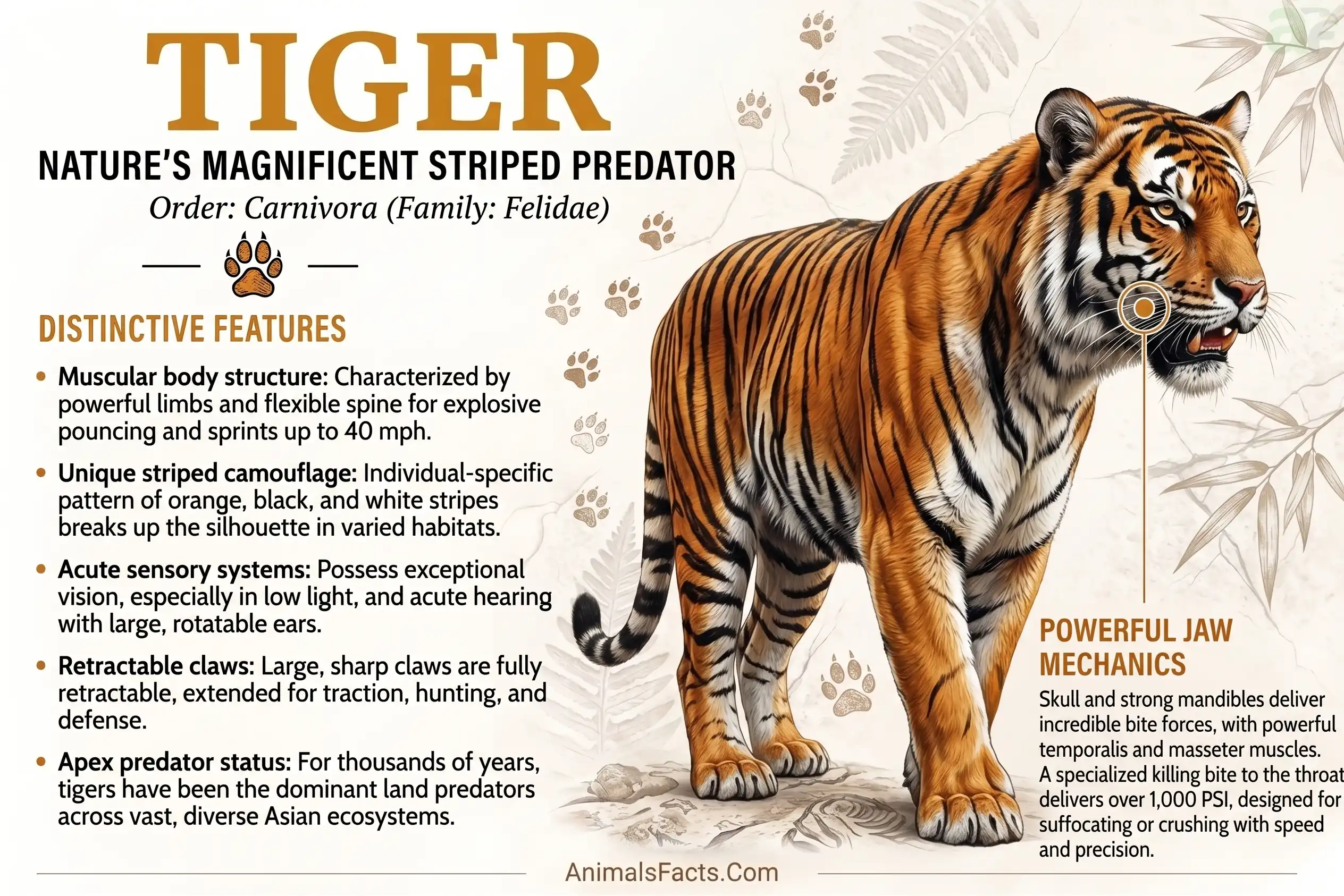
The tiger’s physical design represents the apex of solitary felid evolution — every anatomical feature reflecting millions of years of refinement as a forest ambush predator capable of taking prey several times its own weight.
Size and Sexual Dimorphism
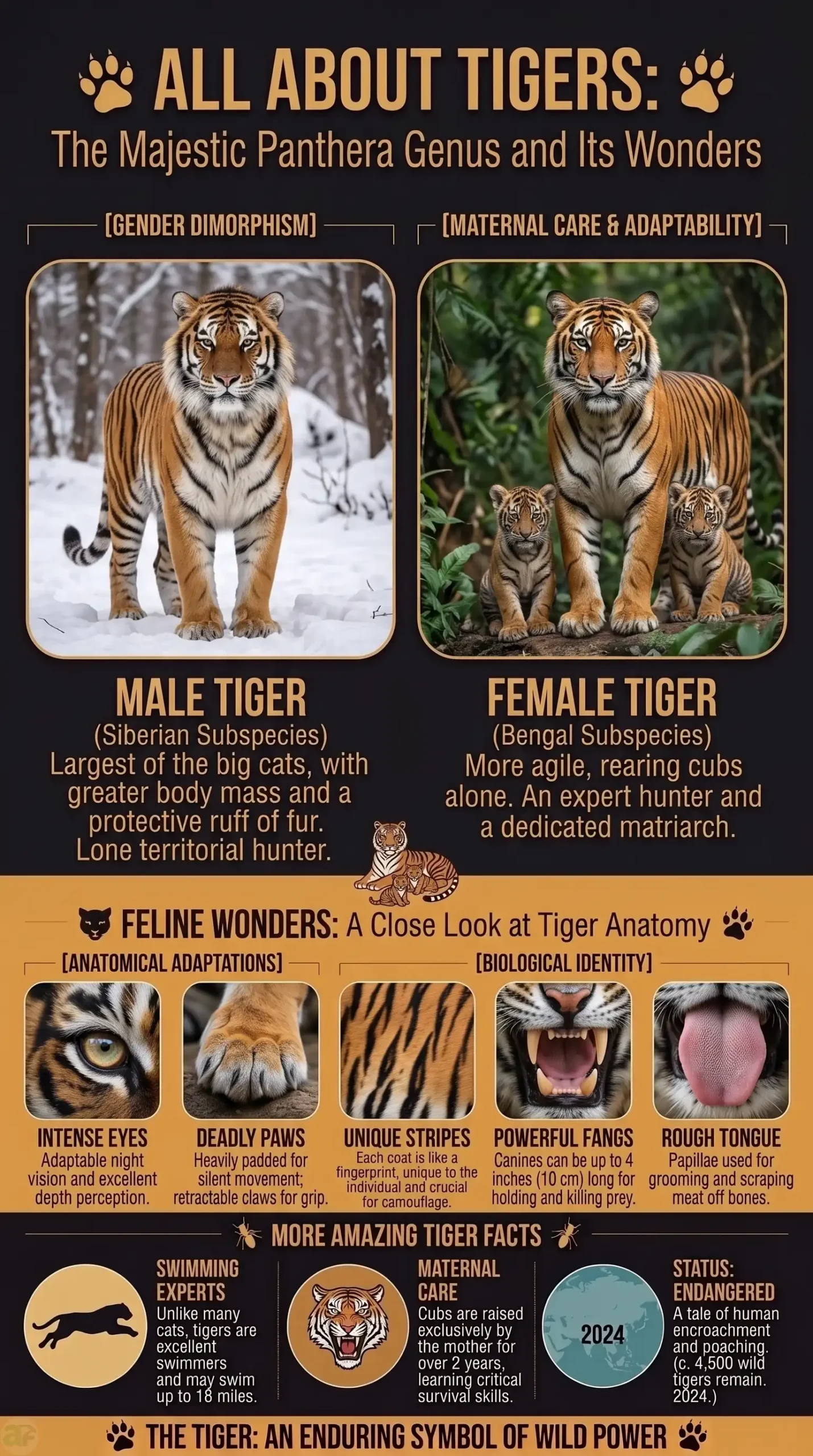
Siberian/Amur Tiger males — the largest subspecies — can weigh up to 300 kg and measure 3.3 meters in total length (body plus tail), making them the heaviest wild cat on Earth and among the largest land predators in the world. The largest reliably documented wild Siberian Tiger weighed approximately 300 kg.
Bengal Tiger males typically weigh 170–260 kg, while females weigh 100–160 kg — a sexual dimorphism of approximately 40–50% by weight that is consistent across subspecies.
Sumatran Tiger — the smallest subspecies — with males averaging only 90–130 kg and females 65–91 kg, reflecting the evolutionary tendency toward smaller body size on island environments with limited large prey.
The Tiger’s Unique Stripe Pattern
Every tiger on Earth possesses a completely unique stripe pattern — as individual as a human fingerprint, and as distinctive as a zebra’s or giraffe’s individual pattern. These stripes are not merely surface coloration — they extend into the skin, so that a shaved tiger would still show its stripe pattern in the skin pigmentation beneath. This makes each tiger recognizable to researchers who photograph the same individuals repeatedly, enabling population monitoring without capturing or tagging individual animals.
The functional purpose of tiger stripes has been debated by researchers — the current consensus suggests they primarily serve as disruptive camouflage, breaking up the tiger’s body outline in dappled forest light and tall grass environments where the alternating light and dark patterns mimic vertical shadows remarkably effectively.
Retractable Claws and Forepaw Power
Tiger forepaws are arguably the most powerful appendages of any felid — the forelimbs of adult male tigers are so muscled that a single swipe from a forepaw has been documented killing large domestic cattle and breaking the necks of prey animals through sheer impact force. Research suggests a Siberian Tiger’s forepaw strike can generate forces exceeding 10,000 Newtons — comparable to the impact of a moderate vehicle collision.
The Tiger’s Eyes
Tiger eyes are forward-facing — providing binocular vision and exceptional depth perception critical for judging distances during final approach to prey. The pupils are circular (unlike the slit pupils of smaller cats) — a characteristic shared with all Panthera big cats, associated with daytime hunting activity supplemented by the reflective tapetum lucidum behind the retina that enhances low-light vision for the tiger’s partially nocturnal hunting patterns.
Did You Know? Tigers are the only striped big cat on Earth — leopards have spots (rosettes), jaguars have spots (with spots within rosettes), lions and cougars have solid coats, and cheetahs have solid spots. The tiger’s bold striped pattern is unique among the world’s large wild cats and has contributed to making it one of the most universally recognized animals on Earth. In India alone, tigers appear in more traditional art, religious iconography, and cultural symbolism than virtually any other wild animal.
4. Top 25 Surprising & Interesting Tiger Facts
- The tiger is the largest wild cat on Earth — large Siberian Tiger males can weigh up to 300 kilograms and measure 3.3 meters in total length.
- Every tiger has a completely unique stripe pattern — no two tigers have identical stripes, making each individual as identifiable as a human fingerprint.
- Tigers are powerful, willing swimmers — unlike most cats, tigers actively seek water and regularly swim across rivers several kilometers wide, with documented open-water swims exceeding 29 kilometers.
- Tigers have been documented killing prey through a skull-crushing bite directly through the cranium of large deer and wild boar — the most powerful bite of any regularly studied cat species relative to skull size.
- The South China Tiger is functionally extinct in the wild — no confirmed wild sightings have been made since the 1990s, with the remaining ~100 individuals confined to captivity in Chinese zoos.
- A tiger can consume up to 40 kilograms of meat in a single feeding — then may not eat again for several days while digesting.
- Tigers roar for territorial communication, but also produce a unique sound called “prusten” or chuffing — a soft, non-threatening huffing sound used as a friendly greeting between familiar tigers, equivalent in social function to a purr.
- The Siberian Tiger inhabits the coldest natural habitat of any wild cat species — tolerating temperatures as low as -40°C in the Russian Far East, sustained by a thick subcutaneous fat layer and the densest fur coat of any tiger subspecies.
- Tiger stripes extend through the fur into the skin itself — a shaved tiger would still display its stripe pattern in the skin pigmentation beneath the fur.
- In 2022, the first comprehensive global tiger census confirmed approximately 5,574 wild tigers — representing the first documented global tiger population increase in over a century, attributed to intensified conservation efforts across multiple range countries.
- Tigers are primarily nocturnal or crepuscular hunters — most active during dawn, dusk, and nighttime hours when darkness provides cover for approach and the tiger’s superior low-light vision provides a hunting advantage.
- The Sundarbans mangrove delta of India and Bangladesh supports a significant tiger population that regularly swims between islands, consumes fish and marine crabs as dietary supplements, and represents the world’s only mangrove-adapted tiger population.
- Tiger urine has a distinctive smell often described as resembling buttered popcorn — a consequence of specific chemical compounds in the urine used for scent marking, allowing trained conservation dogs to detect tiger presence from territorial marking.
- The Malayan Tiger — with only approximately 80–120 individuals in the wild — represents one of the most urgent large carnivore conservation emergencies anywhere in the world, facing potential extinction within decades without dramatically accelerated protection.
- Tigers can mimic the calls of their prey — documented instances of Sumatran and Bengal Tigers producing sounds similar to the distress calls of sambar deer and other prey animals, potentially as a luring technique during hunts.
- White tigers — which appear periodically in Bengal Tiger populations in the wild — are not albinos or a separate subspecies, but carry a rare recessive gene causing leucism (reduced pigmentation). All white tigers in captivity worldwide descend from a single wild-caught white tiger cub named Mohan, captured in 1951 in India.
- The Caspian Tiger — extinct since the 1970s — was genomically so closely related to the Siberian/Amur Tiger that scientists have proposed a rewilding program using Amur Tigers to restore a tiger presence in Central Asian habitats within the Caspian’s former range.
- Tigers have been documented traveling up to 1,000 kilometers in dispersal journeys from their birth territories — a remarkable distance for a species that maintains strict territorial boundaries once established.
- A tiger’s pug marks (footprints) are large enough that a grown man can comfortably fit his outstretched hand inside a single front paw print of an adult Siberian Tiger male.
- The Sundarbans tiger population has developed a notable and genuinely dangerous tendency to attack humans more frequently than other tiger populations — likely a consequence of the particular environmental conditions of the mangrove habitat, where tigers and humans regularly encounter each other in narrow waterway systems with limited visibility.
- Bengal Tiger cubs grow at one of the fastest rates of any big cat — a newborn weighing 785–1,600 grams can reach close to full adult weight within 24 months of birth.
- Tigers have a specialized organ in the roof of their mouth — the vomeronasal or Jacobson’s organ — that detects chemical signals undetectable to the nose alone, used in scent-reading territorial marks and assessing reproductive status of other tigers.
- The extinct Bali Tiger was the smallest tiger subspecies ever documented — smaller than a typical large domestic dog at its smallest adult size.
- India is home to approximately 70% of the world’s total wild tiger population — a consequence of both genuine conservation success through Project Tiger and the relative degradation of tiger populations in other range countries.
- Tiger conservation has generated one of the most rigorous and scientifically sophisticated monitoring systems in wildlife science — camera trapping networks spanning millions of hectares across India, Nepal, Bhutan, and other range countries, capable of identifying individual tigers by stripe pattern and generating precise population census data at continental scale.
5. Tiger Fun Facts for Kids
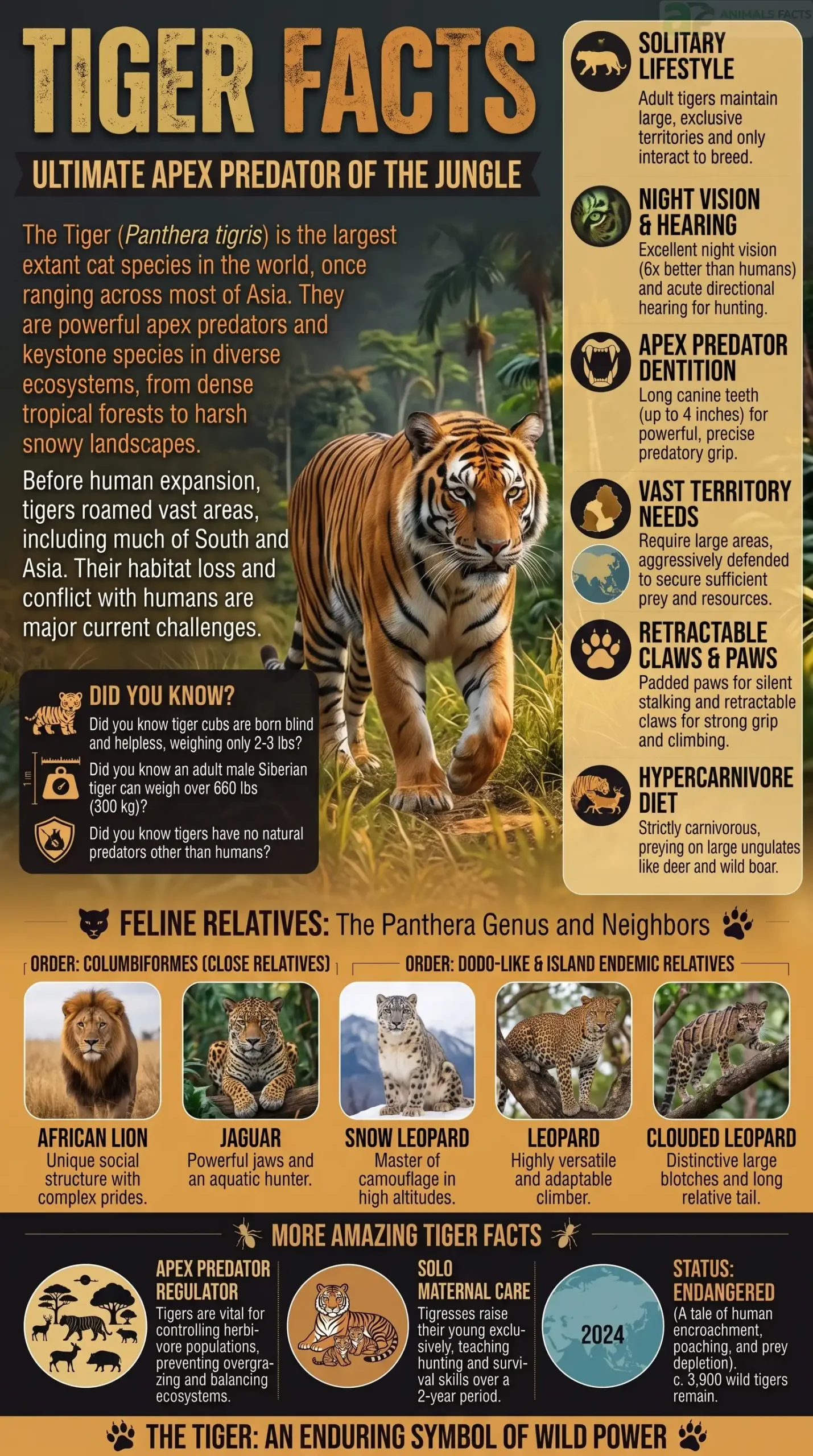
- The tiger is the largest wild cat on Earth — heavier than lions, leopards, and all other felids.
- Every tiger’s stripe pattern is unique — like a human fingerprint.
- Tigers are enthusiastic swimmers — regularly crossing rivers several kilometers wide.
- A tiger’s roar can travel 3 kilometers through dense forest.
- The Sumatran Tiger is found only on a single Indonesian island and is Critically Endangered.
- A tiger can eat 40 kg of meat in one sitting — roughly 15% of its body weight.
- India hosts approximately 70% of all wild tigers on Earth.
- White tigers are not a separate subspecies — they carry a rare recessive gene.
- The South China Tiger has not been confirmed in the wild since the 1990s.
- Tiger stripes extend through the fur into the skin itself.
- Tigers can mimic the calls of their prey to lure them closer.
- The Siberian Tiger tolerates temperatures as low as -40°C — the cold-hardiest of all big cats.
6. Natural Habitat & Geographic Range
Tigers once inhabited a vast swathe of Asia stretching from eastern Turkey through the Caucasus, across Central Asia, through the Indian subcontinent, Southeast Asia, and north to the Russian Far East. Today, they occupy scattered, often-isolated patches of habitat across 13 range countries — a fraction of their historical distribution.
Primary Habitat Types
Tropical and subtropical rainforest: The primary habitat of Sumatran, Malayan, Indochinese, and parts of Bengal Tiger populations — dense, multilayered forest with high prey density but increasingly fragmented and degraded by deforestation and plantation agriculture (particularly oil palm in Sumatra and Malaysia).
Deciduous forest and dry forest: Bengal Tigers in central and western India inhabit dry deciduous forests — characteristic habitats of iconic reserves including Panna, Satpura, Pench, and Tadoba — seasonally dramatic landscapes where tigers hunt sambar, chital, and gaur through open woodland.
Mangrove forest: The Sundarbans delta ecosystem — spanning India’s West Bengal state and Bangladesh — supports a significant tiger population uniquely adapted to tidal mangrove habitat, swimming between islands and hunting through dense, salt-water-flooded forest.
Temperate and boreal forest: The Siberian Tiger inhabits mixed temperate and boreal forest in Russia’s Primorsky and Khabarovsk territories — an environment of birch, Korean pine, and Mongolian oak dramatically different from the tropical forests of southern tiger subspecies.
Grassland and floodplain: Bengal Tigers in Nepal’s Chitwan and Bardia national parks inhabit the tall elephant grass floodplains of the Terai — one of the most productive tiger habitats remaining, with exceptionally high prey density.
Habitat Range by Region
| Region / Country | Tiger Subspecies | Estimated Population | Status |
|---|---|---|---|
| India | Bengal Tiger | ~3,167 (2022 census) | Largest single national population; recovering |
| Russia (Far East) | Siberian/Amur Tiger | ~500–600 | Relatively stable; recovering |
| Nepal | Bengal Tiger | ~355 | Strong recovery; TX2 goal exceeded |
| Bhutan | Bengal Tiger | ~130 | Recovering in protected areas |
| Bangladesh (Sundarbans) | Bengal Tiger | ~100–114 | Stable but threatened by sea level rise |
| Sumatra, Indonesia | Sumatran Tiger | ~400–600 | Critically Endangered; deforestation threat |
| Peninsular Malaysia | Malayan Tiger | ~80–120 | Critically Endangered; urgent |
| Thailand | Indochinese Tiger | ~130–150 | Small recovery in Western Forest Complex |
| China | Siberian Tiger (border) | <50 | Fragile; border corridor dependent on Russia |
Did You Know? The Indian state of Madhya Pradesh hosts more wild tigers than any other political unit on Earth — with over 780 tigers documented in the 2022 census, more than any other Indian state and more than most entire countries. This concentration reflects both the quality of Madhya Pradesh’s forest reserves (including Kanha, Bandhavgarh, Satpura, Pench, and several others) and the effectiveness of the forest protection and anti-poaching programs implemented there over five decades of Project Tiger management.
7. Diet & Feeding Behavior
Tigers are obligate hypercarnivores — their diet consists almost entirely of meat, and they represent the apex predator across every ecosystem they inhabit. Unlike lions, which benefit from cooperative hunting within a pride, tigers achieve the extraordinary feat of routinely taking prey several times their own weight entirely alone.
What Tigers Eat
Tiger prey varies considerably by subspecies and habitat — Bengal Tigers primarily hunt sambar deer, chital (spotted deer), wild boar, gaur (Indian bison), and nilgai, with gaur in particular representing extraordinarily dangerous prey capable of killing tigers during failed hunts. Siberian Tigers prey heavily on sika deer, roe deer, wild boar, and importantly, brown bears in the Russian Far East — documented interactions in which Siberian Tigers successfully hunt and kill brown bears, one of the few examples of a cat species regularly preying on bear species.
Diet Breakdown Table
| Prey Type | Approximate Percentage | Notes |
|---|---|---|
| Sambar Deer | 20–30% (South Asian populations) | Primary prey across much of India |
| Chital (Spotted Deer) | 15–25% (India) | Abundant and widely hunted |
| Wild Boar | 15–25% (range-wide) | Important across all subspecies and habitats |
| Gaur / Indian Bison | 5–15% (India) | Largest prey; extremely dangerous to hunt |
| Sika and Roe Deer | 20–35% (Siberia) | Primary prey for Amur Tiger |
| Water Buffalo | 5–10% (where present) | Targeted in Sundarbans and some Indian reserves |
| Brown Bear / Black Bear | 5–10% (Siberia) | Documented Amur Tiger prey — remarkable inter-predator predation |
| Smaller mammals, birds, fish | 5–10% | Supplementary prey; significant for Sundarbans population |
| Domestic livestock | Variable | Significant where tigers overlap with human settlements |
The Tiger’s Hunting Strategy
Tigers are the consummate ambush predators — relying on the combination of extraordinary camouflage, absolute silence during approach, explosive final-rush speed, and the killing power of their forepaws and jaws to take prey before the prey can react effectively.
Approach phase: A tiger typically detects prey by scent or sight from considerable distance, then enters a slow, careful approach using every available piece of cover — sometimes requiring 30–60 minutes of patient stalking to close to within 10–30 meters of the target animal.
Rush and contact: From close range, the tiger launches an explosive rush covering the final distance in 3–5 bounds, using its enormous forepaws to grip and pull down or destabilize the prey while simultaneously delivering a killing bite to the throat, back of the skull, or nape of the neck.
Kill method: Tigers most commonly kill by a sustained throat bite that asphyxiates the prey, or a nape bite that severs the spinal cord — with the method chosen reflecting the prey species, its size relative to the tiger, and the specific circumstances of the encounter.
Did You Know? Tiger hunting is far less consistently successful than their fearsome reputation suggests — research in multiple study sites has documented an average hunting success rate of only 5–10% for attempted hunts. A tiger may attempt dozens of hunts in a week with only a single successful kill — which makes each successful kill enormously ecologically and energetically significant, and explains the tiger’s behavior of consuming kills as thoroughly as possible before abandoning the carcass.
8. Reproduction & Life Cycle
Tiger reproduction reflects the species’ solitary nature and vast territorial requirements — with breeding encounters between typically non-overlapping territory-holders, extended cub-dependency periods during which cubs must learn the complete range of hunting skills before independence, and significant cub mortality that makes each successful breeding event precious in conservation terms.
Mating Behavior
Tigers are non-seasonal breeders — mating can occur year-round in tropical habitats, though there may be regional peaks. When a female comes into estrus (typically lasting 3–7 days), she advertises her reproductive state through urine spraying, vocalizations, and scent marking, which male tigers in the area detect and respond to over considerable distances.
Mating pairs engage in frequent copulation over the estrus period — as many as 20–35 matings per day — a frequency believed to stimulate ovulation and establish paternity. During this period, the normally solitary tigers maintain close proximity, with the male remaining with the female for the duration of estrus before departing to their own territory.
Gestation and Birth
Gestation period: Approximately 93–112 days (roughly 3–3.5 months) — one of the shortest gestation periods among big cats, producing small, helpless young.
Litter size: Typically 2–4 cubs (range: 1–7), born weighing approximately 785–1,600 grams — remarkably small given adult tiger size.
Birth location: Cubs are born in a secluded den — dense vegetation, rocky caves, hollow trees, or steep embankments — chosen for concealment, shelter from weather, and proximity to water.
Key Developmental Stages
| Stage | Age | Key Development |
|---|---|---|
| Neonatal | 0–6 weeks | Eyes closed; helpless; hidden in den |
| Eyes open | 2–3 weeks | Beginning visual awareness; confined to den |
| First outings | 6–8 weeks | Cubs begin emerging from den |
| Weaning begins | 3–6 months | Introduction to meat; still nursing |
| Weaning complete | 5–6 months | Transition to solid food |
| Accompanying hunts | 6–18 months | Learning hunting through observation |
| Independent hunting attempts | 11–18 months | Beginning to hunt small prey independently |
| Dispersal | 18–30 months | Sub-adults leave mother’s territory |
| Territory establishment | 2–3 years | Finding and defending own range |
| Sexual maturity | 3–4 years (female); 4–5 years (male) | First breeding possible |
Lifespan Comparison Table
| Species | Average Wild Lifespan | Maximum Confirmed |
|---|---|---|
| Bengal Tiger | 10–15 years | ~26 years (captivity) |
| Siberian Tiger | 10–15 years | ~25 years (captivity) |
| Sumatran Tiger | 8–12 years | ~24 years (captivity) |
| Lion | 10–14 years | ~29 years (captivity) |
| Leopard | 12–15 years | ~23 years (captivity) |
9. Social Behavior & Communication
The tiger is one of the most studied solitary carnivores in the world — and research over the past five decades has revealed that “solitary” does not mean “non-social,” but rather that tigers maintain complex social information networks, recognize individual neighbors by scent, engage in occasional and often tolerant encounters, and maintain intricate territorial relationships that are anything but random.
Territorial System
Each adult tiger maintains a home range — the territory within which it hunts, rests, and, for females, raises cubs. Territory sizes vary enormously by subspecies, prey density, and habitat:
- Bengal Tiger females: 15–60 km² (prey-rich Indian reserves)
- Bengal Tiger males: 50–200 km² (overlapping with several female territories)
- Siberian Tiger males: 400–1,000 km² (reflecting far lower prey density in Siberian habitat)
Males actively maintain and defend territories that typically overlap with the ranges of several females — providing access to mating opportunities when females come into estrus. Territorial boundaries are maintained through scent marking (urine spraying, feces deposition, and glandular secretions on vegetation), scratch marks on trees, and roaring, with direct physical confrontation between territorial males occurring but representing a genuine last resort.
Communication Methods
Roaring: Tigers produce a deep, resonant roar audible up to 3 kilometers through dense forest — used for territorial advertisement and contact communication with known neighbors. The roar is less commonly heard than lion roars, reflecting the tiger’s more solitary and secretive behavioral profile.
Prusten (Chuffing): A uniquely social tiger vocalization — a soft, rhythmic exhalation through the nostrils produced during non-threatening close-range interactions, used as a friendly greeting between tigers in familiar relationships (mothers and cubs, mating pairs, tolerant neighbors). The prusten is considered analogous to the purring of smaller cats.
Scent communication: The primary long-distance communication channel for solitary tigers — scent marks deposited throughout the territory serve as a complex chemical bulletin board, conveying individual identity, reproductive status, territorial claims, and the approximate time since the mark was deposited.
Body language: Tiger facial expression, ear position, tail movement, and body posture communicate social information in close-range encounters — from the fully flattened ears and narrowed eyes of genuine aggression to the relaxed ear position and half-closed eyes of contentment.
Did You Know? Research using camera trap networks across Indian tiger reserves has demonstrated that neighboring tigers whose ranges overlap frequently visit the same marking trees and prominent scent-marking sites days apart — essentially exchanging messages without ever meeting. In some reserves, individual tigers have been shown to deliberately modify their activity timing in areas of range overlap with dominant neighbors — avoiding areas recently visited by a dominant individual, suggesting that tigers maintain sophisticated awareness of their neighbors’ movements based on chemical information.
10. Predators & Defense Mechanisms
Adult tigers in good health face virtually no natural predation — their combination of size, strength, and lethal capability places them functionally at the top of every food web they inhabit. However, tiger cubs face significant predation risk, and in specific circumstances, even adult tigers face genuine threats.
Natural Competitors and Threats
Leopards: In habitats where tigers and leopards coexist, leopards have developed a relationship of careful avoidance — staying out of areas of high tiger activity, shifting to nocturnal activity patterns where tigers are more diurnal, and generally structuring their behavior to minimize encounters with tigers, which regularly kill leopards when encounters occur.
Dholes (Asian Wild Dogs): Packs of dholes — India’s highly endangered wild dog species — have been documented in the remarkable behavior of mobbing and harassing tigers, occasionally killing tigers through coordinated pack attacks. This behavior, observed by researchers and documented in camera trap footage, represents one of the extraordinary examples of smaller pack-hunting predators successfully challenging and overcoming a much larger solitary felid.
Crocodiles: In river and swamp habitats, large saltwater crocodiles and mugger crocodiles represent genuine danger to tigers — both species are documented predators of tigers in the Sundarbans and in some other wetland environments where their paths regularly cross.
Brown and Asian Black Bears: In Siberian Tiger habitat, brown bears are not merely prey for tigers — they are genuine competitors that regularly steal tiger kills and occasionally kill tiger cubs at dens. The interspecific competition between Siberian Tigers and brown bears in the Russian Far East represents one of the most intense large-carnivore competitive interactions documented anywhere in the world.
Humans: As in all large carnivore conservation contexts, humans represent the overwhelmingly dominant cause of tiger mortality — through poaching, snaring, retaliatory killing over livestock predation, and road collisions. The transformation of this human-caused mortality from the primary driver of tiger decline to the primary challenge of tiger recovery is the central narrative of contemporary tiger conservation.
Defense and Threat Response
Threat display: When a tiger feels threatened or cornered, it produces a dramatic threat display — full-body fluffing of the fur to appear larger, lowered head, direct eye contact, ears flattened against the skull, and a deep, resonant series of growls or full roars. This display is typically sufficient to deter most potential threats.
Strategic retreat: Despite their formidable capability, tigers avoid direct confrontation whenever possible, preferring to withdraw from encounters with humans, large bear groups, and dhole packs rather than engaging in potentially costly physical conflict.
11. Tiger Facts for Kids
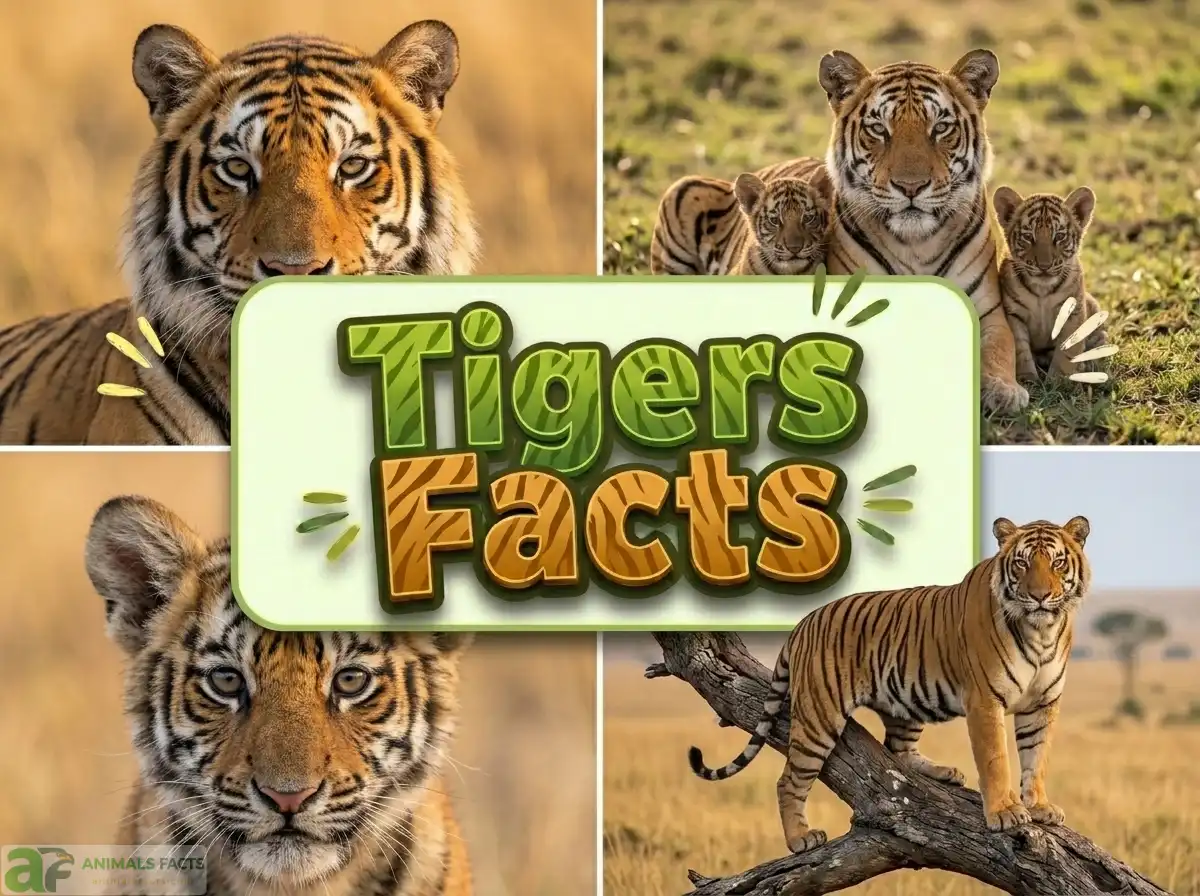
Hey kids — get ready to discover why tigers are some of the most magnificent animals that have ever walked the Earth!
- Tigers are the biggest cats in the world — bigger than lions, bigger than leopards, bigger than any other wild cat! A large male tiger can weigh as much as two fully grown adult humans combined!
- Every tiger in the world has a completely different stripe pattern — just like every human has different fingerprints. Scientists actually use photographs of tiger stripes to tell individual tigers apart!
- Tigers love swimming — unlike most cats that hate water, tigers regularly swim across rivers and cool off in pools during hot weather. Some tigers have been seen swimming for over 29 kilometers without a break!
- Tiger cubs are born with beautiful spotted patterns that gradually fade into stripes as they grow up. The spots help camouflage them when they’re tiny and vulnerable.
- Tigers communicate with a special friendly sound called “prusten” — a soft puffing sound through their nose that means “hello, I’m friendly.” Tiger moms use this sound with their cubs!
- The tiniest tiger in the world — the Sumatran Tiger — lives only on one Indonesian island and is smaller than you might imagine. The biggest tigers, the Siberian Tigers, live in freezing cold Russia and can survive temperatures colder than -40°C!
- A tiger can’t eat every day — sometimes it hunts for days without catching anything, and then eats an enormous meal of up to 40 kilograms of meat all at once!
- There are only about 5,574 tigers left in the wild — that means all the wild tigers in the world would fit inside a large sports stadium. But the good news is that number is actually going up now thanks to conservation!
Did You Know? Tigers can make a sound that scientists believe sounds exactly like buttered popcorn — that’s the smell of their urine, which they spray on trees and bushes to tell other tigers this is their territory! The smell from tiger urine contains special chemicals that carry information about who the tiger is, whether it’s a male or female, and whether it’s looking for a mate. It’s like leaving a detailed message on a tree!
12. Relationship with Humans
The relationship between tigers and humans is among the most ancient, most complex, and most consequential of any human-large predator interaction — encompassing hundreds of thousands of years of evolutionary co-existence in Asian ecosystems, deep entrenchment in Asian cultural and religious traditions, and in the modern era, the central narrative of one of the most intensive large carnivore conservation programs ever attempted.
Ancient Co-existence and Cultural Integration
Humans and tigers have shared landscapes in Asia for hundreds of thousands of years — a period long enough for both species to have developed sophisticated behavioral adaptations to each other’s presence. Archaeological evidence of tiger imagery in the oldest known South Asian civilization — the Indus Valley Civilization (approximately 2600–1900 BCE) — demonstrates that tigers were culturally significant to humans across the subcontinent long before the historical era.
Human-Tiger Conflict
Livestock predation is the most widespread and economically significant human-tiger conflict across all tiger range countries — driving retaliatory killing that represents one of the most significant contemporary causes of tiger mortality. When a tiger kills livestock — particularly in communities where a single cow or buffalo may represent significant economic value — the incentive for retaliatory killing can be overwhelming, particularly where compensation programs are inadequate or inaccessible.
Human fatalities from tigers — while dramatically reduced compared to historical levels, remain a genuine and tragic reality in certain parts of the tiger’s range, most significantly in the Sundarbans, where an estimated 50–100 people per year historically died in tiger attacks in the Indian portion of the delta (though intensive management including tiger-proof embankment huts and trained forest guard patrols has reduced this figure substantially in recent decades). The unusual frequency of Sundarbans tiger attacks is believed to reflect the specific environmental conditions of the mangrove habitat — narrow waterways, poor visibility, and the necessity for humans to collect honey, fish, and firewood in tiger territory.
Project Tiger and Conservation Partnership
Launched in April 1973 by Indian Prime Minister Indira Gandhi, Project Tiger established India’s network of dedicated tiger reserves — now numbering 54 reserves covering over 75,000 km² — and created the institutional and legal framework within which India’s tiger population has recovered from approximately 1,800 individuals in 1973 to over 3,167 in the 2022 census. Project Tiger remains the most successful single-nation large carnivore conservation program in history and has served as a model for tiger conservation programs across the species’ range.
13. Conservation Status & Threats
The tiger’s conservation situation is one of the most extensively documented and most intensively managed of any endangered species — the subject of decades of scientific research, hundreds of peer-reviewed papers, billions of dollars in conservation investment, and the political commitment of 13 range-country governments.
Global Tiger Conservation Data (2026)
| Subspecies | IUCN Status | Population | Trend |
|---|---|---|---|
| Bengal Tiger | Endangered | ~3,167 | Increasing in India; mixed elsewhere |
| Siberian/Amur Tiger | Endangered | ~500–600 | Relatively stable; recovering |
| Sumatran Tiger | Critically Endangered | ~400–600 | Declining (deforestation) |
| Malayan Tiger | Critically Endangered | ~80–120 | Sharply declining |
| Indochinese Tiger | Endangered | ~150–200 | Declining; isolated populations |
| South China Tiger | Critically Endangered | ~100 (captive only) | Functionally extinct in wild |
Major Threats to Tigers
Poaching for traditional medicine and wildlife trade: The most direct and most devastating immediate threat to wild tigers across all range countries. Tiger bones, skin, and organs command enormous prices in traditional Asian medicine markets — particularly in China, Vietnam, and parts of Southeast Asia — creating financial incentives for poaching that dwarf the alternative economic value of wild tigers to local communities. Sophisticated international trafficking networks move tiger products across borders with considerable difficulty for law enforcement agencies.
Habitat loss and fragmentation: The progressive conversion of tiger habitat to agricultural land, plantation forestry (particularly oil palm in Southeast Asia), infrastructure development, and human settlement is the most fundamental long-term threat to tiger survival — reducing the available hunting territory, fragmenting populations, and cutting off the connectivity between populations essential for genetic health. Sumatra has lost over 50% of its forest cover in the past 25 years — the primary driver of the Sumatran Tiger’s Critically Endangered status.
Prey depletion: The “empty forest syndrome” — in which human hunting for bushmeat has removed most of the deer, wild boar, and other ungulates from otherwise intact forest — renders large tracts of apparently suitable habitat unable to support tiger populations. Research in Southeast Asia has consistently demonstrated that tiger density correlates more strongly with prey abundance than with any other habitat variable, making prey recovery as important as habitat protection for tiger conservation.
Human-tiger conflict: As discussed above, retaliatory and preventive killing of tigers by communities experiencing livestock predation represents a significant and widespread mortality source that is difficult to address without effective compensation programs, non-lethal deterrent support, and meaningful economic alternatives.
Did You Know? The 2022 Global Tiger Census — coordinated by the IUCN and implemented across all 13 tiger range countries using standardized camera trapping and occupancy modeling methodology — was the most comprehensive and scientifically rigorous wildlife census ever conducted for any large carnivore species. The confirmed population of 5,574 individuals represented the first globally documented tiger population increase since systematic monitoring began — a milestone that conservation organizations worldwide described as one of the most significant positive developments in international wildlife conservation of the past decade.
14. Famous Tigers
Machali — The Queen of Ranthambore
Machali (also known as T-16) was a Bengal Tiger female in India’s Ranthambore Tiger Reserve who became one of the most photographed and most celebrated individual wild tigers in history. Known for her unusual boldness around tourist safari vehicles and her dramatic documented interactions — including a remarkable 11-minute battle with a large crocodile, photographed and subsequently published worldwide — Machali was estimated to have generated over 10 million US dollars in tourism revenue during her lifetime. She died of natural causes in 2016 at the exceptional wild age of approximately 19 years, and was honored with a state funeral by Rajasthan government officials who recognized her extraordinary contribution to Indian tiger conservation and tourism.
Mohan — The Grandfather of All White Tigers
Mohan was a white Bengal Tiger cub captured in 1951 in the forests of Rewa, Madhya Pradesh, by the Maharaja Martand Singh Ju Deo. Bred extensively in captivity — including with his own daughter to perpetuate the recessive white gene — Mohan is the direct ancestor of virtually every white tiger in captivity worldwide today. The extensive inbreeding required to maintain the white tiger trait has resulted in significant genetic health problems in white tiger populations, making them subjects of both public fascination and conservation concern.
Tigger — The Sundarbans’ Most Documented Male
Multiple individual Sundarbans tigers have been named and tracked over the decades by the West Bengal Forest Department and partner research organizations — providing some of the most comprehensive behavioral data on the unique mangrove-adapted population and demonstrating the extraordinary behavioral flexibility of tigers in one of the world’s most challenging habitats.
Corbett’s Man-Eaters — Historical Tigers
Jim Corbett, the celebrated British hunter-turned-conservationist, documented his experiences killing man-eating tigers across the Kumaon and Garhwal hills of India in his celebrated books — most famously “Man-Eaters of Kumaon” (1944). The individual tigers in his accounts — the Champawat Tigress (reportedly responsible for 436 human deaths), the Panar Leopard, the Rudraprayag Leopard — became among the most famous individual large carnivores in literary history, while Corbett’s accounts simultaneously demonstrated his deep respect and affection for tigers and contributed significantly to the early conservation movement in India.
15. Role in Ecosystem & Food Chain
Tigers, as apex predators in every ecosystem they inhabit, regulate prey populations, influence prey behavior, and create cascading ecological effects that extend throughout the food web — functioning in Asian forest ecosystems in a role broadly comparable to wolves in North American ecosystems.
Prey Regulation
Tiger predation directly reduces and regulates ungulate populations — deer, wild boar, and other herbivores — preventing the population explosions that would occur in apex predator absence. Research in Indian tiger reserves has demonstrated that areas with healthy tiger populations sustain significantly different deer and boar population structures — with greater age and sex balance, higher average individual body condition, and lower incidence of disease — compared to areas where tigers have been removed, reflecting the selective predation on weak, old, or diseased individuals.
The “Ecology of Fear” in Tiger Landscapes
Beyond direct predation, tigers alter prey behavior through what ecologists term the “ecology of fear” — prey animals modify their grazing patterns, movement routes, water-hole use timing, and habitat selection in response to tiger predation risk. This behavioral modification distributes grazing pressure more evenly across the landscape, reducing overgrazing of specific vegetation patches and contributing to plant community diversity.
Tiger Reserves as Conservation Umbrellas
Indian research has consistently demonstrated that tiger conservation areas function as biodiversity conservation umbrellas — the habitat and management conditions required to sustain viable tiger populations also provide sanctuary for hundreds of other species across the entire plant and animal community. Species as diverse as elephants, gaur, dholes, leopards, sloth bears, crocodiles, and thousands of plant, bird, and invertebrate species all benefit from the protected area networks established primarily for tiger conservation.
16. Myths, Folklore & Cultural Significance
The tiger occupies a position of profound spiritual, symbolic, and cultural significance across virtually every Asian civilization within its historical range — a reflection of the tiger’s extraordinary physical presence, behavioral power, and the deep ecological relationship between tiger populations and human communities across millennia of shared landscapes.
Hindu and Indian Traditions
In Hindu tradition, the tiger is inextricably associated with the goddess Durga — the supreme manifestation of divine feminine power, depicted invariably riding a tiger into battle against demonic forces. The tiger-mounted Durga represents the principle that divine power in its most active, protective form is expressed through the tiger’s combination of grace, strength, and ferocity. The National Animal of India — designated in 1973 at the launch of Project Tiger — is the Bengal Tiger, reflecting the animal’s centrality to Indian national and cultural identity.
Chinese Zodiac and Traditional Medicine
The Tiger is the third animal in the Chinese Zodiac — associated with courage, intensity, independence, and leadership, with individuals born in tiger years traditionally believed to share these qualities. More problematically, Traditional Chinese Medicine has historically ascribed medicinal properties to tiger bones, organs, and other body parts — creating demand that has driven significant tiger poaching across Asia. Intensive campaigns to develop and promote herbal and manufactured alternatives, alongside legal prohibition of tiger product trade under CITES, have had mixed but gradually improving results in reducing this demand.
Korean and Siberian Indigenous Traditions
In Korean tradition, the tiger is the most important animal in the national symbolic vocabulary — serving as the guardian spirit of the Korean people, the protector of mountains, and the subject of an enormous body of folk art and literature. The Amur Tiger holds similarly important symbolic status for the Udege and Nanai peoples of the Russian Far East — indigenous communities for whom the tiger was a spiritual protector, respected neighbor, and central figure in religious practice extending back thousands of years.
Southeast Asian Royal Traditions
In the royal traditions of Malaysia, Thailand, Vietnam, and other Southeast Asian kingdoms, tigers served as symbols of royal authority and divine power — depicted in palace art, royal seals, and military insignia. The Malayan Tiger appears on the Malaysian coat of arms (as supporters flanking the shield), on the Maybank logo, and serves as the national symbol of Malaysia — a cultural significance that has become increasingly poignant as the actual Malayan Tiger population has declined toward functional extinction.
17. Tigers in Pop Culture
Tigers have generated one of the most sustained and globally diverse presences in human entertainment and cultural production of any wild animal — a reflection of their extraordinary visual impact, their deep symbolic resonance across Asian traditions, and their status as one of the most universally recognized and emotionally compelling animals on Earth.
Film and Television
“Life of Pi” (Ang Lee, 2012) — The Oscar-winning adaptation of Yann Martel’s celebrated novel, featuring the Bengal Tiger “Richard Parker” as the central animal character, generated extraordinary global public engagement with tigers and their conservation situation, earning Best Director and Best Visual Effects Academy Awards while introducing the tiger’s complex duality — terrifying predator and involuntary companion — to an enormous worldwide audience.
“The Jungle Book” (multiple adaptations of Rudyard Kipling’s 1894 work) — Shere Khan, the Bengal Tiger antagonist of Kipling’s Jungle Book stories, is one of the most famous fictional tigers in literary and cinema history — simultaneously the most dangerous predator in the jungle and a figure of genuine majesty, appearing in Disney’s 1967 animated adaptation, the 2016 Jon Favreau live-action adaptation, and numerous other versions.
“Tiger King” (Netflix, 2020) — The documentary series following the eccentric American big cat keeper Joe Exotic became one of the most-watched Netflix documentaries in history, generating extraordinary global engagement with tigers while simultaneously documenting the troubling realities of captive big cat ownership in the United States — leading directly to the passage of the Big Cat Public Safety Act (signed into US law in December 2022), which significantly tightened restrictions on private ownership of tigers and other big cats.
Literature
“Man-Eaters of Kumaon” by Jim Corbett (1944) — The most celebrated account of human-tiger conflict in literary history, combining extraordinary narrative skill with genuine ecological observation and conservation advocacy.
“Life of Pi” by Yann Martel (2001, Booker Prize winner) — The novel that placed a Bengal Tiger at the center of one of the most celebrated works of literary fiction of the 21st century — its meditation on survival, faith, and the nature of truth through the lens of an extraordinary human-tiger relationship.
Sports Mascots and Brand Icons
Tony the Tiger — the mascot of Kellogg’s Frosted Flakes / Frosties cereal, created in 1952 — is perhaps the most globally recognized corporate animal mascot in history, with the tagline “They’re Grrreat!” penetrating popular culture across more than 70 years of continuous advertising. The Detroit Tigers (MLB), Auburn Tigers (NCAA), Clemson Tigers (NCAA), LSU Tigers (NCAA), Princeton Tigers (NCAA), Esso/ETiger mascot, and numerous other sports teams worldwide use tiger imagery — reflecting the animal’s universal associations with power, speed, and aggressive competitiveness.
18. Tiger Facts vs. Common Myths
Myth: Tigers and lions are about the same size, with males of both being roughly comparable. Fact: Tigers are consistently significantly larger than lions — male Bengal Tigers average heavier than male African Lions, and male Siberian Tigers are dramatically larger. A 300 kg male Siberian Tiger is approximately 50% heavier than a typical male African Lion.
Myth: White tigers are a separate subspecies or an albino variety. Fact: White tigers are neither a subspecies nor albinos — they carry a recessive genetic mutation (leucism) that reduces orange pigmentation while retaining stripe pattern. All white tigers in captivity worldwide descend from a single wild-caught Bengal Tiger named Mohan, captured in India in 1951. They have normal eye color (blue) rather than the pink eyes of true albinos.
Myth: Tigers hate water and avoid it when possible. Fact: Tigers are enthusiastic and skilled swimmers who actively seek water for cooling, crossing territorial boundaries, and accessing prey near water sources. Documented swims exceeding 29 kilometers in open water have been recorded, and the Sundarbans population is entirely adapted to a mangrove habitat traversed by swimming between islands.
Myth: The South China Tiger population can be recovered through conservation. Fact: The South China Tiger is considered functionally extinct in the wild — with no confirmed wild sightings since the 1990s and a captive population of approximately 100 individuals maintained in Chinese zoos. While recovery programs exist, the practical prospects for wild restoration are considered extremely challenging given the degree of habitat conversion across the subspecies’ historical range.
Myth: Tiger attacks on humans are primarily predatory — tigers hunt and eat people. Fact: Most tiger attacks on humans are defensive or conflict-related rather than predatory — occurring when a tiger is cornered, surprised, injured, or when a human inadvertently approaches a female with cubs. True predatory attacks — in which a tiger deliberately hunts and consumes humans — are primarily documented in the Sundarbans and historically in parts of India and Southeast Asia, typically involving tigers that are injured (unable to hunt normal prey), very old, or in extreme habitat conditions with severely depleted normal prey bases.
Myth: All tiger subspecies are equally threatened. Fact: There is dramatic variation in conservation status across tiger subspecies — from the relatively numerous and recovering Bengal Tiger (~3,167 individuals) to the functionally extinct South China Tiger (~100 captive only) and the critically endangered Malayan Tiger (~80–120 individuals). Any discussion of “tiger conservation” must acknowledge these enormous differences in urgency across subspecies.
19. Best Places to See Tigers in the Wild
Ranthambore National Park, India
One of India’s most famous and most accessible tiger reserves, Ranthambore offers reliable tiger sightings in a dramatic landscape of Rajasthani dry deciduous forest, ruined Mughal-era fortresses, and picturesque lakes. The home of the legendary Machali, Ranthambore’s relatively open habitat and habituated tiger population make it one of the most photography-friendly tiger destinations in the world, accessible by both government-run and private safari vehicles.
Kanha National Park, India
Kanha — which partially inspired Rudyard Kipling’s Jungle Book — is considered by many wildlife experts as the finest tiger reserve in India, combining exceptional tiger density with a beautifully maintained sal forest landscape, superb infrastructure, and one of India’s most successful wildlife management traditions. The nearby Pench Tiger Reserve offers a complementary experience.
Bandhavgarh National Park, India
Famous for having the highest tiger density of any protected area in India, Bandhavgarh in Madhya Pradesh offers exceptional tiger sighting frequencies for visitors, alongside a dramatic hilltop fort and outstanding general wildlife viewing across its diverse habitats.
Chitwan National Park, Nepal
Nepal’s flagship wildlife reserve, Chitwan offers excellent Bengal Tiger viewing in the dramatic Terai Arc landscape of tall elephant grass and subtropical forest, alongside superb rhinoceros, elephant, and gharial viewing. Nepal has achieved extraordinary tiger conservation success — exceeding its TX2 doubling goal for tigers ahead of schedule.
Sundarbans National Park, India
The world’s only mangrove-adapted tiger population makes the Sundarbans one of the most extraordinary and distinctive tiger viewing destinations on Earth — though tiger sightings are substantially more difficult here than in open landscape reserves. Boat-based tours through the tidal channels of the Sundarbans offer extraordinary atmospheric encounters and the genuine possibility of a tiger sighting on riverbanks or swimming between islands.
Khao Yai National Park and Western Forest Complex, Thailand
Thailand’s Western Forest Complex — centered on Huai Kha Khaeng Wildlife Sanctuary and the broader Western Forest Complex — supports one of the few viable Indochinese Tiger populations remaining outside India, with recent research demonstrating slow but genuine population recovery following intensive anti-poaching programs.
Sikhote-Alin Biosphere Reserve, Russia
The wild and remote forests of Russia’s Sikhote-Alin Biosphere Reserve in the Primorsky Territory offer the extraordinary experience of searching for Siberian/Amur Tigers in their spectacular temperate forest habitat — though actual tiger sightings require patience, appropriate timing, and experienced local guides. The Russian winter, with tigers visible as tracks in snow against a silent birch-and-pine landscape, is considered by wildlife photographers as one of the most dramatic and memorable wildlife photography environments in the world.
20. Top Documentaries & Books
Must-Watch Documentaries
“Tiger: Spy in the Jungle” (BBC/Disneynature, 2008) — A landmark wildlife documentary filmed using cameras hidden in elaborate animal-shaped disguises (including decoy elephants and robotic tiger cubs) to document Bengal Tiger family life in Panna National Park with unprecedented intimacy, earning awards and critical acclaim for its extraordinary footage.
“Dynasties — Tiger” (BBC, 2018) — Part of David Attenborough’s acclaimed Dynasties series, following a tigress in India’s Bandhavgarh reserve through the extraordinary challenge of raising four cubs against formidable odds — offering the most behaviorally sophisticated portrayal of tiger family dynamics ever filmed for a general audience.
“Land of the Tiger” (BBC Natural World / various) — Multiple BBC productions have followed tigers across different Indian reserves and Russian Far East landscapes, collectively building one of the most comprehensive natural history documentary records of any single large carnivore species.
“Tiger King” (Netflix, 2020) — While primarily a human documentary rather than a wildlife film, its examination of America’s captive tiger industry and the passage of the subsequent Big Cat Public Safety Act makes it one of the most practically impactful tiger-related documentaries ever produced in terms of legislative consequence.
“Project Tiger” (various Indian productions) — Several Indian documentary productions have chronicled the history and impact of India’s landmark Project Tiger program — essential viewing for understanding the policy framework that produced the world’s most successful large cat conservation recovery.
Essential Books
“Man-Eaters of Kumaon” by Jim Corbett (1944) — The foundational work of tiger natural history and conflict literature — Corbett’s accounts of hunting man-eating tigers in the Kumaon hills combine extraordinary narrative skill with deep ecological observation and, ultimately, genuine conservation advocacy.
“The Tiger: A True Story of Vengeance and Survival” by John Vaillant (2010) — The extraordinary true account of a Siberian Tiger that systematically hunted and killed the poachers who had shot and wounded it in Russia’s Primorsky Territory — a masterwork of narrative nonfiction that illuminates tiger cognition, behavior, and the complex human-tiger relationship in Russia’s Far East.
“Tigers in the Snow” by Peter Matthiessen (2000) — A beautifully written account of the Siberian Tiger’s conservation situation and the human communities that share its range, by one of the 20th century’s finest nature writers.
“The Tiger’s Eye: Tracking and Field Guide to Tigers” by various authors — Multiple field guides and scientific texts provide detailed reference material on tiger natural history for those seeking deeper technical engagement with tiger biology.
21. Comparison of Tigers with Similar Big Cats
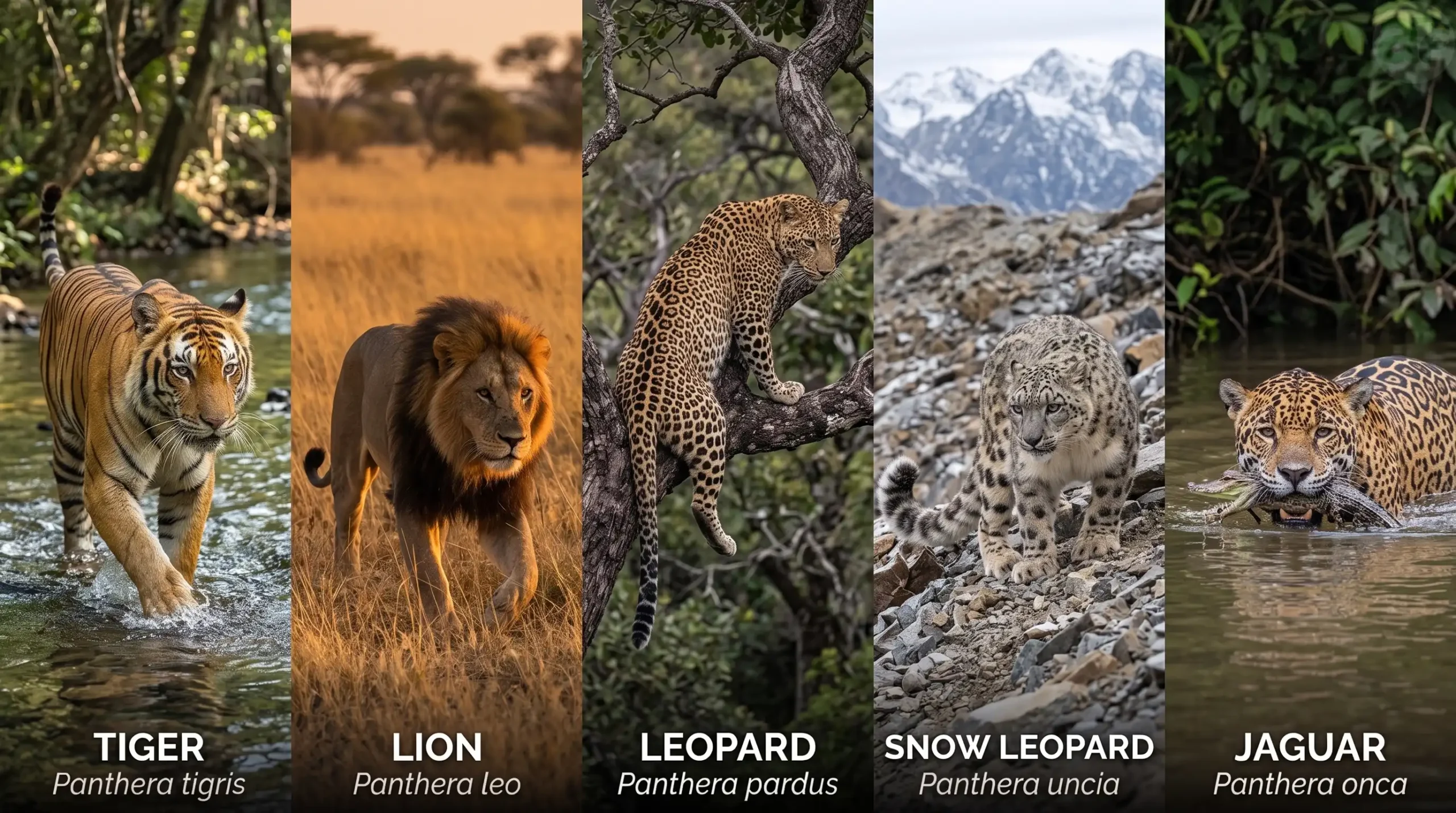
| Feature | Tiger | Lion | Leopard | Snow Leopard | Jaguar |
|---|---|---|---|---|---|
| Scientific Name | Panthera tigris | Panthera leo | Panthera pardus | Panthera uncia | Panthera onca |
| Weight | 90–300 kg | 120–250 kg | 28–90 kg | 22–55 kg | 56–96 kg |
| Distribution | Asia (13 countries) | Sub-Saharan Africa; India | Africa; Asia | Central/South Asian mountains | South/Central America |
| Habitat | Forest; grassland; mangrove | Savanna; grassland | Forest; rocky terrain | High-altitude mountains | Rainforest; wetland |
| Social Structure | Solitary | Prides (unique) | Solitary | Solitary | Solitary |
| Primary Diet | Large ungulates | Large ungulates | Medium mammals | Blue sheep; ibex | Caiman; peccary; deer |
| Hunting Method | Ambush; throat/nape bite | Cooperative pride hunts | Stalk and ambush | Mountain ambush | Skull bite (unique) |
| Conservation Status | Endangered | Vulnerable | Vulnerable | Vulnerable | Near Threatened |
| Population | ~5,574 | ~20,000–25,000 | ~250,000 | ~4,000–6,500 | ~64,000 |
| Unique Feature | Largest cat; swimmer; stripes | Only social cat; mane | Strongest climber; most widespread | Cannot roar; densest fur | Most powerful bite relative to size |
22. How You Can Help
Tiger conservation has the benefit of being one of the best-funded and most strategically sophisticated conservation programs in the world — meaning that individual contributions, both financial and behavioral, can connect to well-established programs with demonstrated effectiveness.
Support These Organizations
Panthera (panthera.org) — The world’s leading wild cat conservation organization, running major tiger conservation programs including the Tigers Forever initiative across multiple range countries, focused on long-term monitoring and anti-poaching support in the most critical tiger landscapes.
WWF (worldwildlife.org/species/tiger) — One of the largest funders of tiger conservation globally, supporting anti-poaching patrols, habitat protection, community development programs, and policy advocacy across tiger range countries.
Wildlife Conservation Society (wcs.org) — Operates comprehensive tiger conservation programs in India, Russia, Thailand, Myanmar, and other range countries, including the long-running programs fundamental to understanding tiger ecology and implementing effective management.
Wildlife Protection Society of India (wpsi-india.org) — India-based organization focused specifically on anti-poaching intelligence, documenting tiger trade cases, and supporting law enforcement in India’s tiger reserves.
Save the Tiger Fund / National Geographic Society — Various National Geographic-affiliated programs support tiger field research and conservation communication globally.
Practical Actions
Choose responsible tourism. Selecting tiger safari operators in India, Nepal, and Russia who demonstrate commitment to conservation, anti-poaching support, and local community benefit ensures your tourism expenditure contributes directly to the economic case for maintaining wild tiger landscapes.
Avoid traditional medicine products of uncertain origin. Consumer demand reduction for tiger bone and tiger-derived traditional medicine products is one of the most direct actions consumers can take to reduce poaching incentives. Supporting organizations working on demand reduction advocacy in China, Vietnam, and other consumer markets amplifies individual impact.
Support legislation. The Big Cat Public Safety Act in the United States (passed 2022) significantly reduced private captive tiger ownership — which is associated with multiple conservation concerns including laundering of wild tiger products and creating demand for the exotic cat industry. Advocacy for strong wildlife trade legislation in your own country contributes to the broader regulatory environment.
Participate in citizen science. Various tiger range country programs welcome wildlife observation reports — including specific monitoring apps in India — that contribute to occupancy modeling and population assessment data.
Did You Know? Nepal became the first tiger range country to double its wild tiger population ahead of the international TX2 target — growing from approximately 121 tigers in 2009 to over 355 by 2022. This extraordinary achievement was accomplished through a combination of intensive anti-poaching programs, community conservation areas that extend protection beyond formal reserve boundaries, dedicated ranger training and equipment investment, and community development programs that created genuine economic alternatives to wildlife crime. Nepal’s success demonstrates that ambitious tiger recovery goals are achievable with sustained political will, adequate resourcing, and genuine community partnership.
23. Frequently Asked Questions About Tigers
Q1: What is the scientific name of the tiger?
The tiger’s scientific name is Panthera tigris. It belongs to the genus Panthera — the roaring big cats — alongside the lion (P. leo), leopard (P. pardus), jaguar (P. onca), and snow leopard (P. uncia). The family is Felidae (cats), order Carnivora, and class Mammalia.
Q2: How many tigers are left in the world?
The most recent comprehensive global tiger census (2022) confirmed approximately 5,574 wild tigers across all subspecies — the first documented global tiger population increase in over a century. India alone hosts approximately 3,167 tigers, representing approximately 70% of the global total. The remaining population is distributed across 12 other range countries.
Q3: Are tigers endangered?
Yes — tigers are classified as Endangered on the IUCN Red List at the species level. Several subspecies face far more severe situations: the Sumatran Tiger and Malayan Tiger are both Critically Endangered, the South China Tiger is functionally extinct in the wild, and the Indochinese Tiger faces very small and fragmented remaining populations.
Q4: What is the largest tiger subspecies?
The Siberian or Amur Tiger (Panthera tigris altaica) is the largest living tiger subspecies — males regularly reach 180–300 kg in weight and 2.7–3.3 meters in total body length, making them the largest wild cat species on Earth.
Q5: Can tigers and lions breed together?
Yes — tigers and lions can produce hybrid offspring in captivity. A Liger (lion father × tiger mother) grows significantly larger than either parent species due to the interaction of growth-regulating genes from both species, with some ligers exceeding 400 kg — the largest cats ever recorded. The reverse hybrid (Tigon — tiger father × lion mother) is typically smaller than either parent. Neither hybrid occurs in the wild due to geographic separation.
Q6: Why are tigers striped?
Tiger stripes function primarily as disruptive camouflage — breaking up the body outline in the dappled light and vertical shadow patterns of forest and tall grass habitats, making stationary or slowly moving tigers remarkably difficult to detect against the background. Each tiger’s stripe pattern is unique — functioning as an individual identification marker used by researchers in camera trap studies.
Q7: Do tigers live alone or in groups?
Tigers are primarily solitary animals — maintaining individual territories that they defend from other tigers of the same sex. However, “solitary” does not mean isolated — tigers maintain complex social information networks through scent marking, communicate with territorial neighbors, and engage in occasional tolerant encounters. Mothers and cubs live together as family units, and mated pairs remain together during estrus periods.
Q8: How long do tigers live?
Wild tigers typically live 10–15 years — with mortality from territorial combat, hunting injuries, and human-caused deaths limiting most individuals to this range. Maximum documented wild lifespan approaches 20 years; captive tigers regularly live 20–26 years with proper care.
Q9: Do tigers swim?
Yes — tigers are enthusiastic and skilled swimmers who actively seek water for cooling, territorial crossing, and prey access. Documented swims in excess of 29 kilometers have been recorded, and the Sundarbans Tiger population of India and Bangladesh is entirely adapted to a mangrove habitat navigated primarily by swimming between islands.
Q10: How can I help tiger conservation?
Key actions include: supporting reputable conservation organizations focused on tigers (Panthera, WWF, Wildlife Conservation Society, Wildlife Protection Society of India); choosing responsible tiger safari tourism in India, Nepal, or Russia that benefits local communities and conservation programs; avoiding traditional medicine products of uncertain origin; advocating for strong wildlife trade legislation in your country; and spreading accurate information about tigers to counter the misinformation that contributes to both demand for tiger products and public misunderstanding of the tiger’s genuine conservation status.
24. Sources & References
Research Sources
- Wikipedia — Panthera tigris and individual subspecies articles
- IUCN Red List — iucnredlist.org
- Panthera — panthera.org
- WWF — worldwildlife.org/species/tiger
- Wildlife Conservation Society — wcs.org
- Wildlife Protection Society of India — wpsi-india.org
- National Geographic — nationalgeographic.com
- Smithsonian’s National Zoo — nationalzoo.si.edu
- Encyclopaedia Britannica — britannica.com
- BBC Wildlife — bbc.co.uk
- Live Science — livescience.com
- India Tiger Census 2022 — Project Tiger/NTCA (National Tiger Conservation Authority)
- Corbett, Jim — “Man-Eaters of Kumaon” (1944)
- Vaillant, John — “The Tiger: A True Story of Vengeance and Survival” (2010)
- Matthiessen, Peter — “Tigers in the Snow” (2000)