

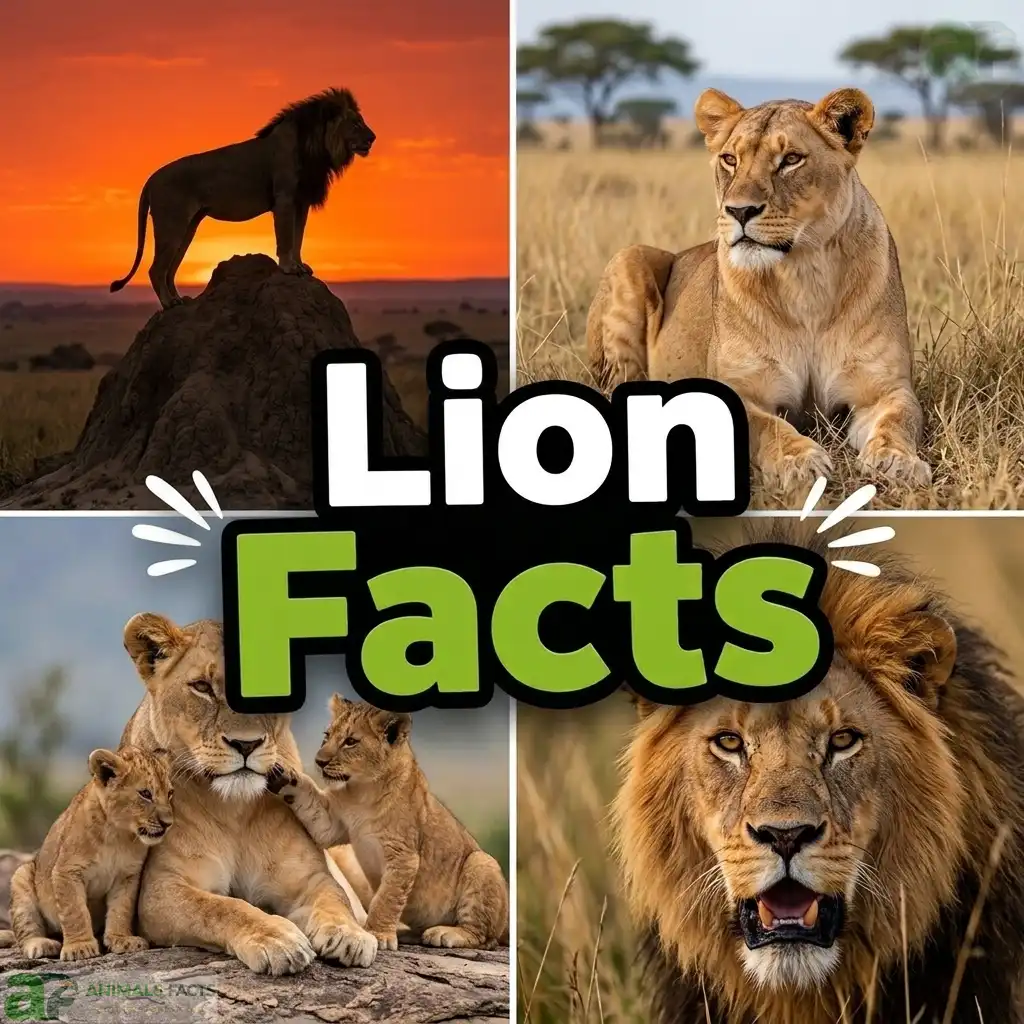
Lion Facts
| Feature | Details |
|---|---|
| Scientific Name | Panthera leo |
| Kingdom | Animalia |
| Phylum | Chordata |
| Class | Mammalia |
| Order | Carnivora |
| Family | Felidae |
| Genus | Panthera |
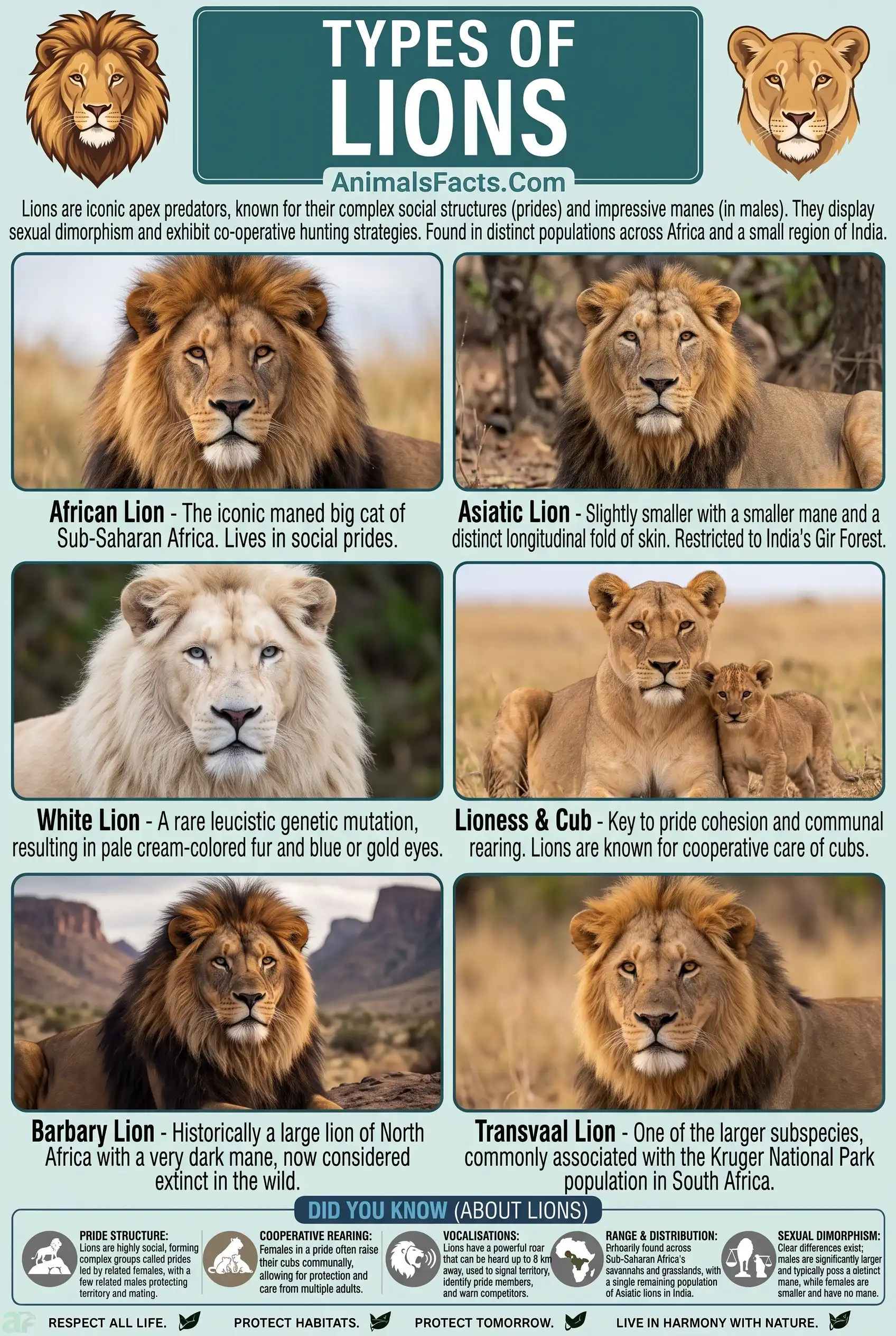
| Total Recognized Subspecies | 2 recognized subspecies (P. l. leo — African/Asiatic; P. l. melanochaita — Southern/Eastern African) under current IUCN classification |
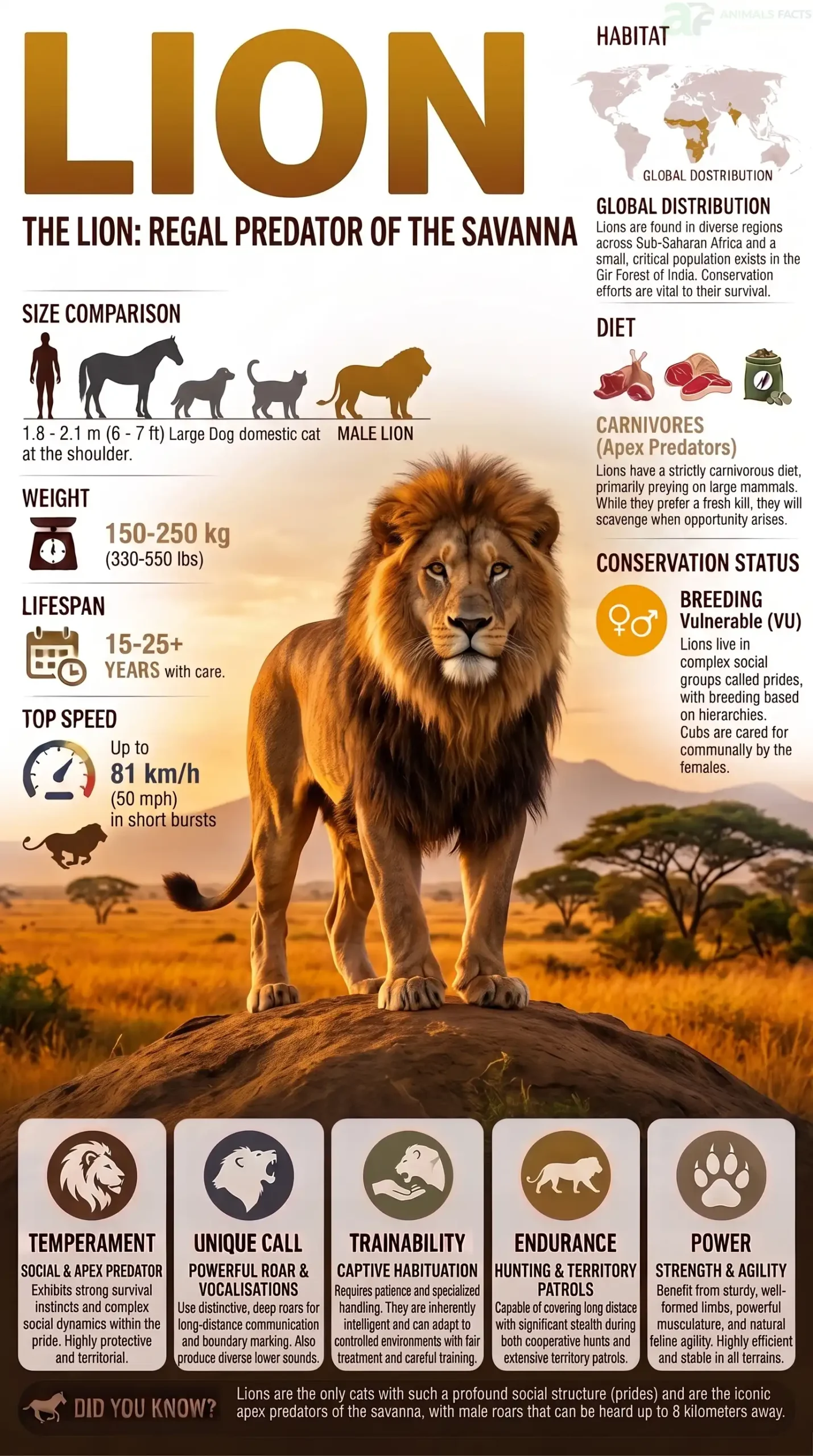
| Habitat | Savanna, grassland, open woodland, scrubland — Sub-Saharan Africa; small Asiatic population in Gir Forest, India |
| Lifespan | 10–14 years in the wild; up to 25–29 years in captivity |
| Diet | Apex carnivore — wildebeest, zebra, buffalo, antelope, and other large ungulates |
| Weight | Males: 150–250 kg; Females: 120–180 kg |
| Body Length | 1.7–2.5 meters (excluding tail); tail adds 60–100 cm |
| Shoulder Height | 100–130 cm |
| Top Speed | Up to 81 km/h (50 mph) in short sprints |
| Conservation Status | Vulnerable (IUCN Red List) |
| Global Wild Population | Estimated 20,000–25,000 individuals (2026) |
| Unique Feature | Only truly social wild cat; males possess distinctive mane; deepest roar of any big cat |
 1. Introduction: What is a Lion?
It is called the King of the Savanna — and few titles in the natural world have been earned as completely. The lion’s roar, audible from 8 kilometers away in the still night air of the African plains, has signaled power, danger, and the deep, ancient authority of nature to every creature within earshot for millions of years. Lion facts are some of the most dramatic, surprising, and ultimately most sobering in the entire animal kingdom — revealing an animal of extraordinary social complexity, breathtaking physical power, and profoundly threatened future status that could hardly be more different from its celebrated image as the symbol of invincible strength.
The lion — Panthera leo — is the second-largest wild cat on Earth after the tiger, and the only truly social member of the entire cat family (Felidae). Where every other wild cat species on Earth lives and hunts alone, lions live in structured family groups called prides — cooperating in hunts, raising cubs communally, and defending territories through coordinated group action that gives them a unique ecological capability among the world’s great felids. This social structure, combined with their extraordinary size and power, allowed lions to occupy the apex predator position across virtually all of Africa and large parts of Asia, Europe, and North America during the Pleistocene Epoch. Today, they cling to survival across a fraction of that former territory.
Whether you are a student searching for lion facts for a school project, a safari enthusiast preparing for an East African wildlife trip, a parent looking for lion facts for kids, a conservation advocate engaged with the urgent realities of big cat decline, or simply someone captivated by one of nature’s most magnificent animals — this is the most complete guide to lion facts you will find anywhere. We cover lion habitat, lion diet, lion behavior, communication, reproduction, conservation, mythology, and the extraordinary but increasingly urgent story of the animal that has represented human ideals of power, courage, and nobility for thousands of years. Let us begin.
2. Lion Species Overview & Classification
Lions belong to the genus Panthera — the group of big cats capable of true roaring, which includes tigers, leopards, jaguars, and snow leopards. Within Panthera, the lion is uniquely specialized for open-country social hunting, occupying an ecological niche unlike that of any other felid.
What Makes a Lion Distinct Among Big Cats?
- Unique sociality: The only wild cat species that consistently lives and hunts in social groups (prides)
- Sexual dimorphism: Among the most pronounced of any cat species — males are significantly larger than females and uniquely possess a mane
- Roaring capability: Like all Panthera members, lions possess a modified laryngeal anatomy allowing true roaring — the loudest roar of any cat species
- Open-country specialization: Unlike most big cats that are associated with forest or dense vegetation, lions are most strongly associated with open grassland and savanna habitats
Lion Subspecies Comparison
| Subspecies | Scientific Name | Range | Key Feature |
|---|---|---|---|
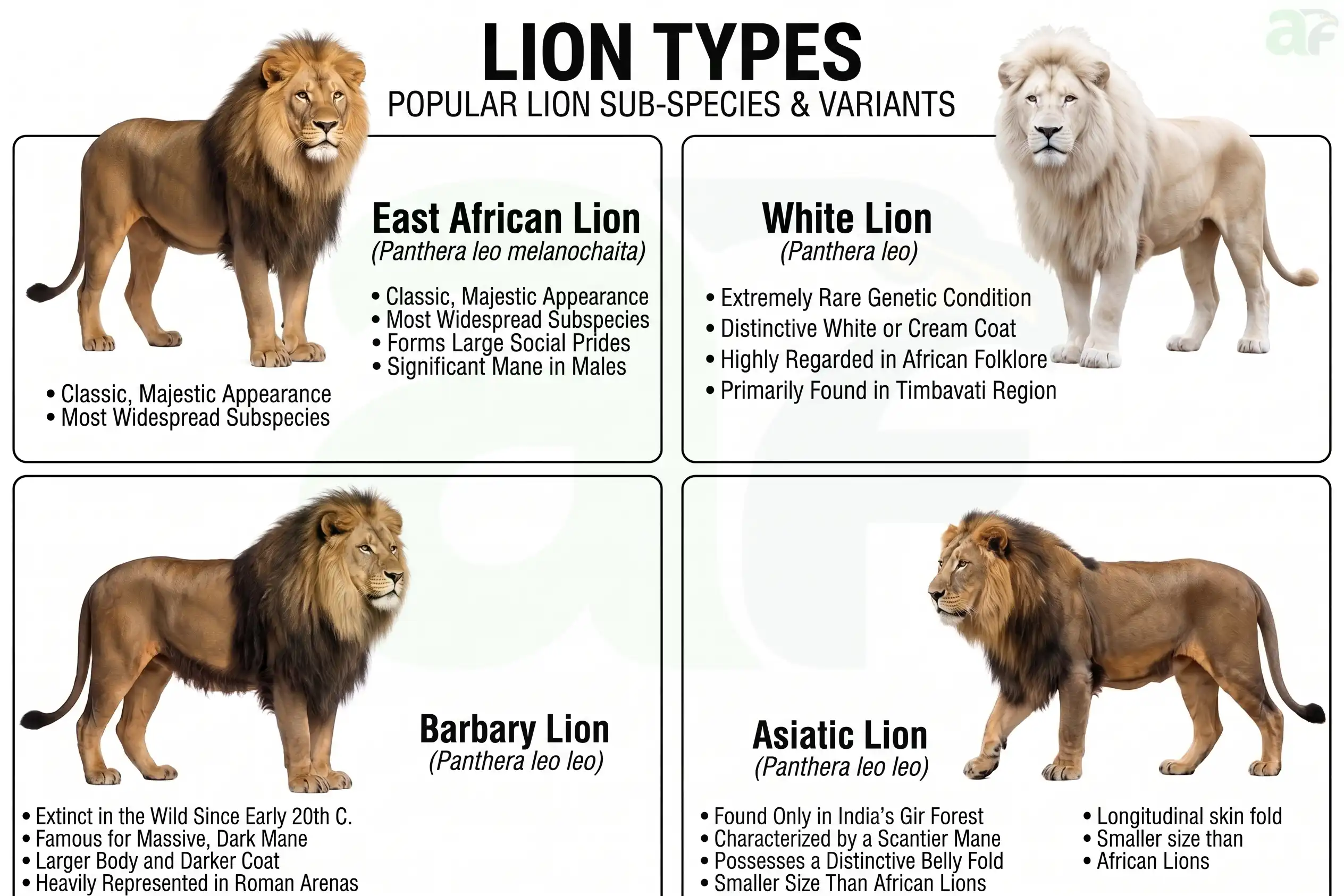
| Northern Lion / Asiatic Lion | Panthera leo leo | West/Central Africa; India (Gir Forest) | Includes Asiatic population; males have smaller, less full manes on average |
| Southern/Eastern African Lion | Panthera leo melanochaita | Eastern and Southern Africa | Most numerous; includes the iconic Serengeti and Kruger populations |
Historical and Extinct Subspecies / Populations
| Former Subspecies/Population | Range | Extinction |
|---|---|---|
| Cape Lion | South Africa (Cape region) | Extinct ~1858 |
| Barbary Lion | North Africa | Wild extinction ~1920s; captive descendants may exist |
| West African Lion | West Africa | Critically reduced; considered regionally functionally distinct |
| European Lion | Southern Europe | Extinct ~100 CE |
| American Lion (Panthera atrox) | North America | Extinct ~11,000 years ago |
Species Evolution & Discovery Timeline
~3.5 million years ago: The lineage leading to modern lions diverged from other Panthera species during the Pliocene Epoch, with early lion ancestors appearing first in Africa.
~1.5–2 million years ago: Early Panthera leo — recognizably lion-like in form — appeared in Africa, beginning the long evolutionary history of the species on the continent.
~350,000 years ago: Lions crossed into Europe and Asia, establishing widespread Eurasian cave lion (Panthera leo spelaea) populations that coexisted with early humans and are depicted in some of the oldest cave art ever discovered.
~100,000–50,000 years ago: The American Lion (Panthera atrox) — the largest cat ever to live in the Americas — reached North and South America via the Bering Land Bridge, coexisting with mammoths, saber-toothed cats, and early Indigenous peoples before going extinct at the end of the Pleistocene.
~11,000 years ago: The American Lion and European/Cave Lion populations went extinct at the end of the last Ice Age, leaving only the African and small Asiatic populations that survive today.
~2000 BCE: Ancient Egyptian and Mesopotamian records document lions in North Africa and the Middle East, where the species was still widespread in historical times.
~100 CE: The last reliably documented wild lions in Europe were killed by Roman-era hunters — the species had been eliminated from Europe through hunting and habitat loss by the early centuries of the common era.
1758: Carl Linnaeus formally described and classified the lion as Felis leo in Systema Naturae, later reclassified as Panthera leo as systematic understanding of big cat relationships improved.
2017: Genetic and morphological analysis led to the current two-subspecies classification — consolidating earlier multi-subspecies frameworks into the current P. l. leo (Northern) and P. l. melanochaita (Southern/Eastern) groupings.
3. Lion Physical Description & Unique Features
The lion is one of the most recognizable and visually distinctive animals on Earth — its combination of size, power, and the male’s unique mane creating an appearance that has defined human concepts of regal authority and natural power for thousands of years.
Size and Sexual Dimorphism
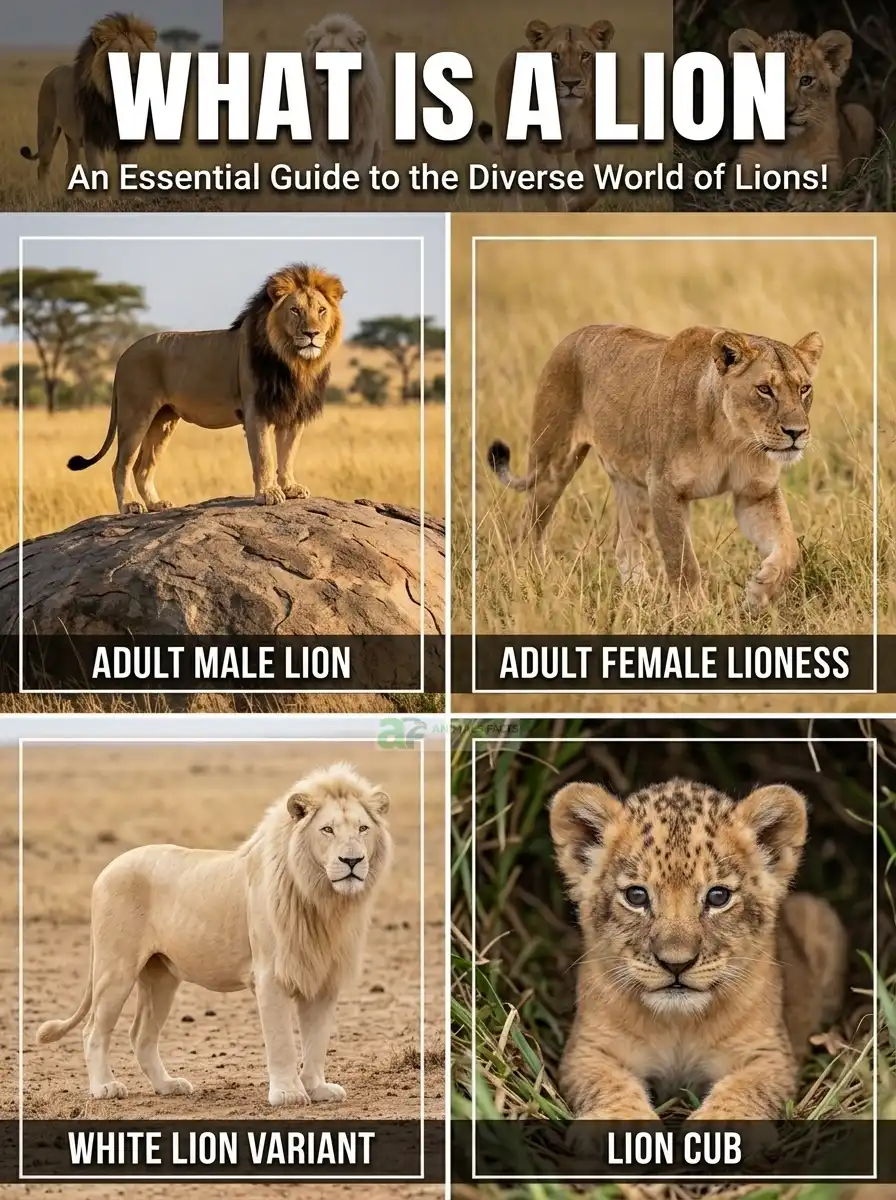
Lions display among the most dramatic sexual dimorphism of any cat species — adult males are significantly larger, heavier, and visually strikingly different from adult females due to the mane.
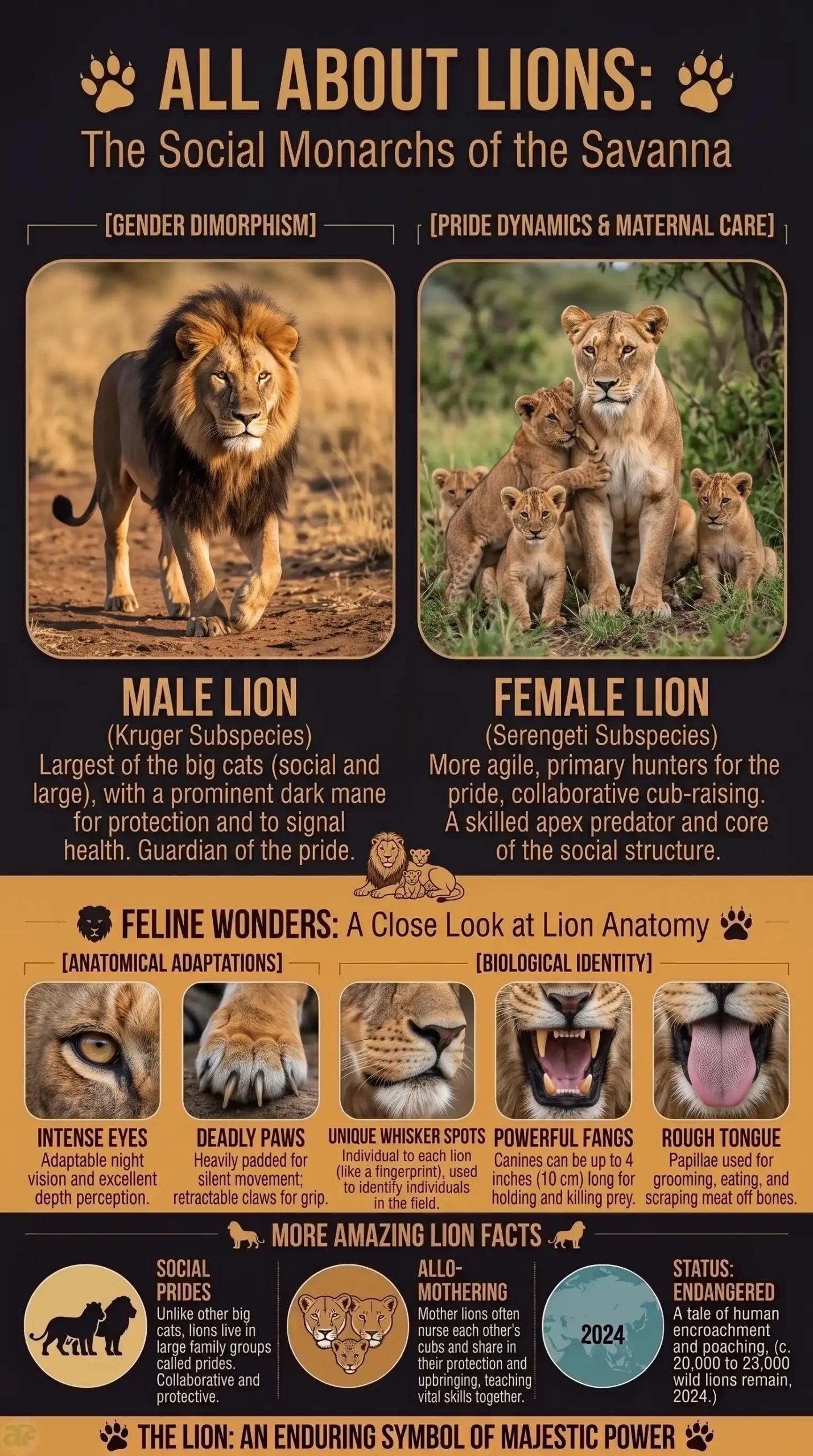
Male lions typically weigh 150–250 kg (with exceptional individuals in some populations reaching or exceeding 300 kg), stand approximately 100–130 cm at the shoulder, and measure 1.7–2.5 meters in body length excluding the tail. The additional 60–100 cm of tail brings total length to over 3 meters in the largest individuals.
Female lions (lionesses) are consistently smaller — typically 120–180 kg in weight, slightly shorter in height, and without a mane. This size difference reflects the different ecological roles of males and females within pride social structure — females are the primary hunters, and their more slender build provides speed and agility advantages that the more heavily built males lack.
The Male Lion’s Mane
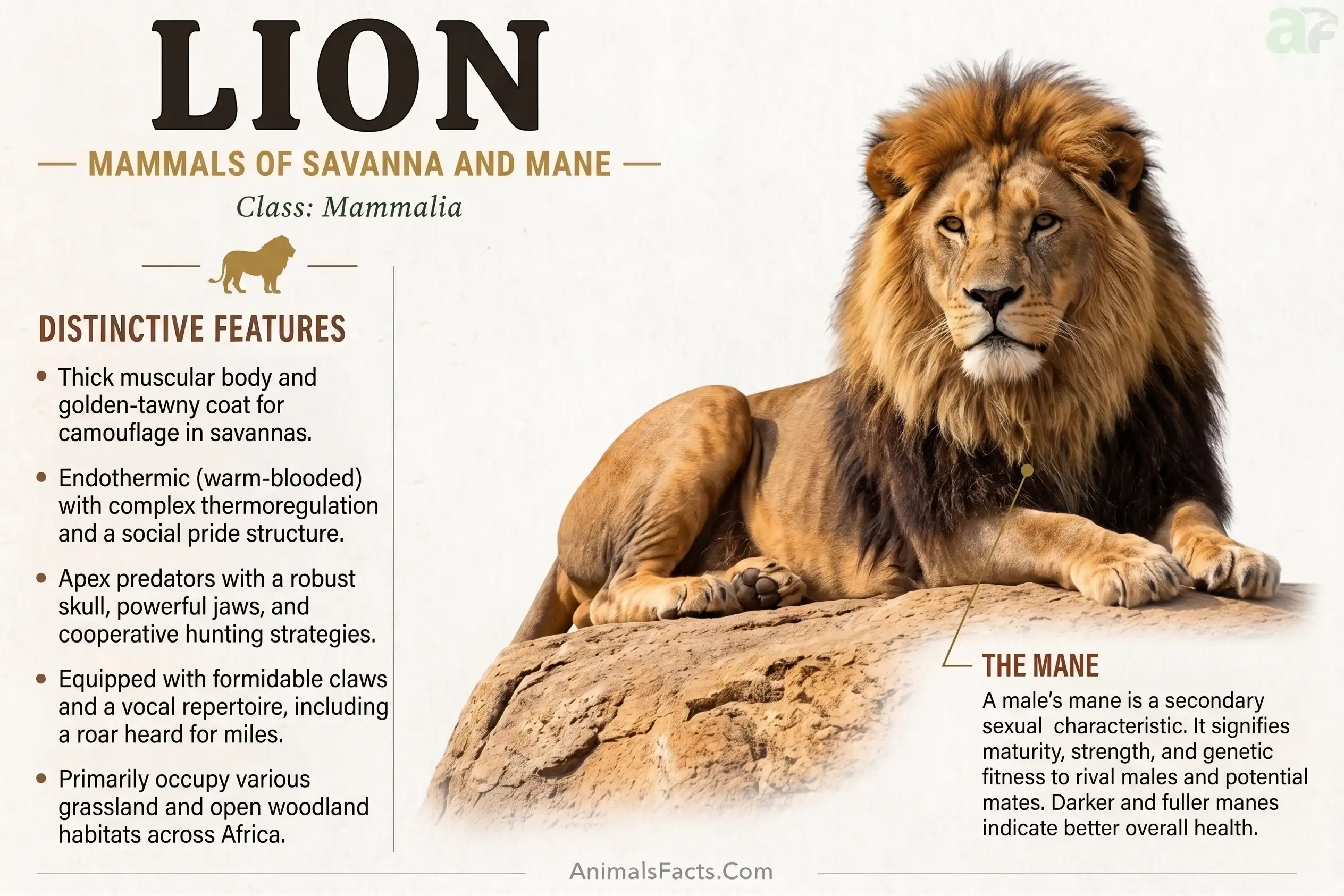
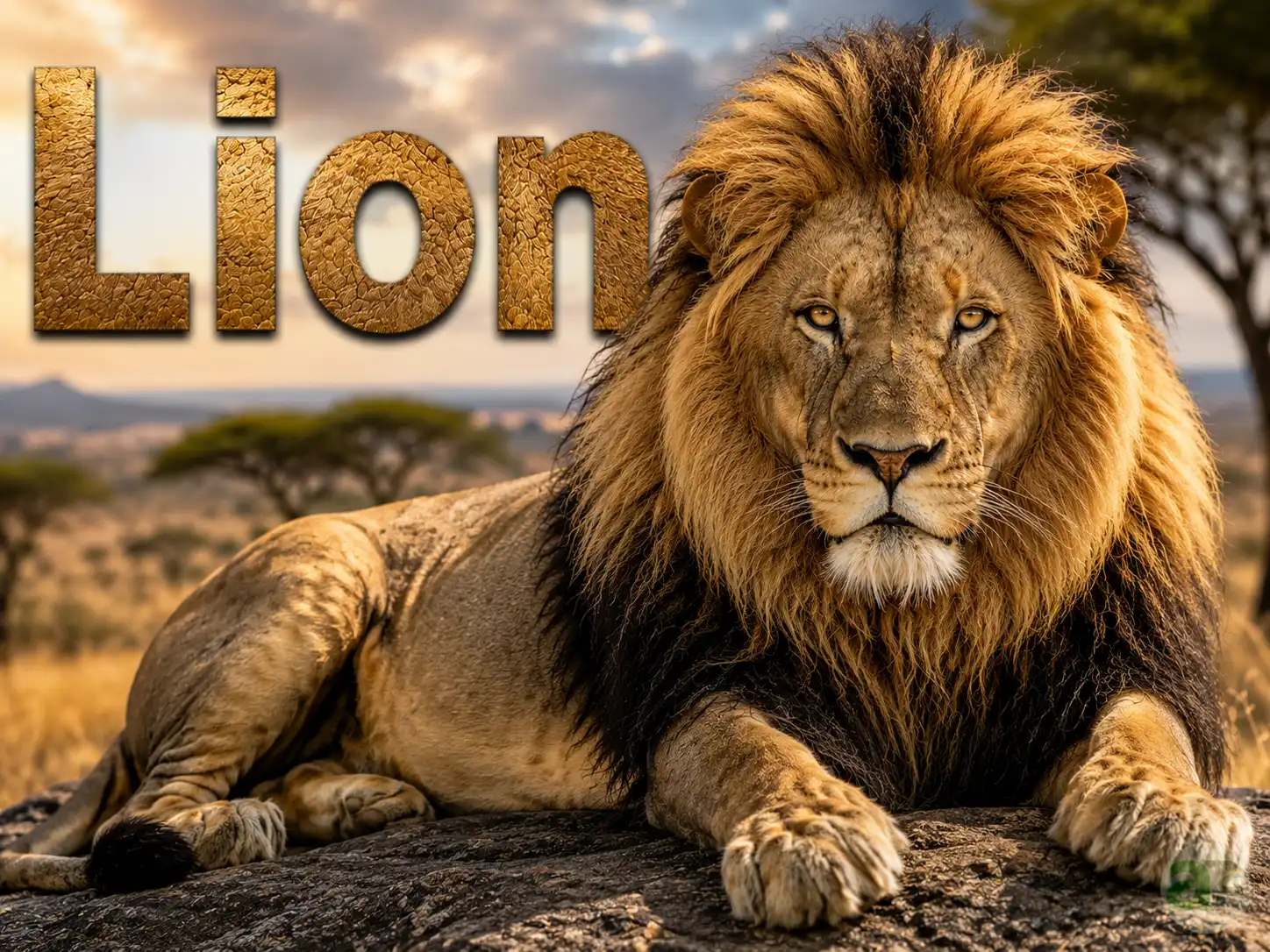
The lion’s mane is one of the most celebrated and most studied secondary sexual characteristics of any land mammal — a unique feature found in no other wild cat species. The mane encompasses the head, neck, and chest of adult males, ranging in color from blond through tawny, chestnut, dark brown, and near-black, with darker manes generally associated with higher testosterone levels and correlating strongly with male fitness indicators including territory quality, reproductive success, and overall health.
Research conducted in Serengeti National Park by lion biologist Peyton West and colleagues demonstrated that lionesses strongly prefer males with darker, fuller manes — a preference that drives selection for mane development and provides females with a reliable signal of male genetic quality and health. Manes also provide genuine physical protection during male-male combat — the dense hair around the neck and shoulder region absorbs biting and scratching attacks from rival males.
Paws and Claws
A lion’s paws are equipped with fully retractable claws — kept razor-sharp by remaining sheathed during walking — that can extend up to 3.8 cm during prey capture or combat. The forepaws are extremely powerful, capable of delivering striking blows with sufficient force to knock down prey animals significantly larger than the lion itself.
Did You Know? The male lion’s roar is the loudest vocalization produced by any wild cat — measurable at up to 114 decibels at close range, audible to human ears at distances of 8 kilometers, and likely perceivable by other lions considerably further away. The roar is produced by a uniquely modified larynx — containing a square-shaped vocal fold (rather than the triangular fold of other cats) — that allows the production of this extraordinary low-frequency vocalization.
4. Top 25 Surprising & Interesting Lion Facts
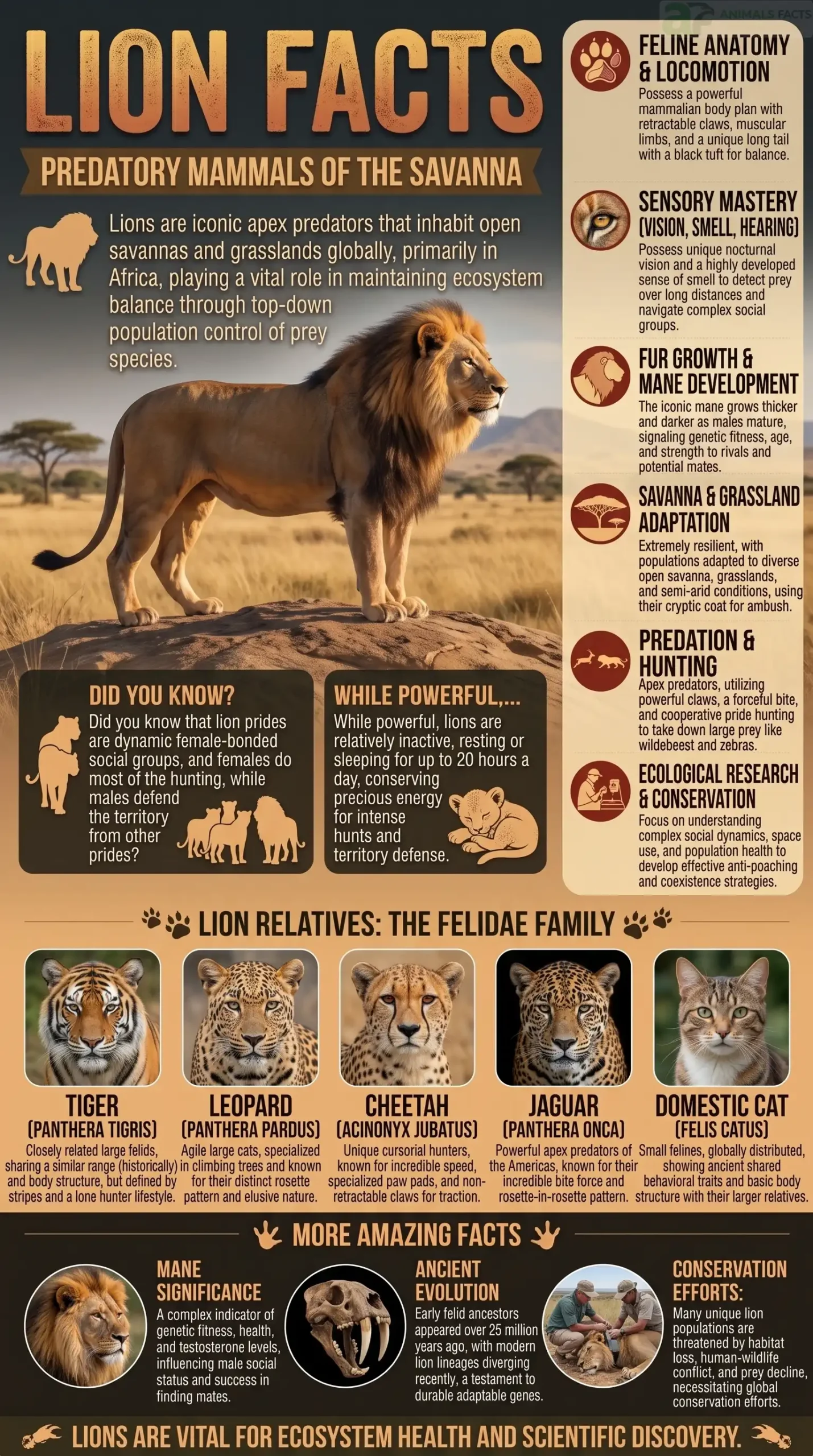
- Lions are the only wild cat species that lives and hunts in social groups — all other wild cat species hunt and live primarily alone.
- The lion’s roar is audible from 8 kilometers away and can reach 114 decibels — making it the loudest vocalization of any wild cat.
- Female lions (lionesses) do approximately 85–90% of the hunting for the pride — the commonly celebrated “male as hunter” image is almost entirely reversed from reality.
- A lion can sprint at up to 81 km/h, but only maintains this speed for very short distances — typically 50–100 meters before tiring, which is why cooperative hunting with pride members is essential.
- Lions sleep and rest for an extraordinary 16–20 hours per day — more than almost any other large land mammal — conserving energy between hunts.
- A male lion’s mane color is a reliable indicator of health, age, and testosterone levels — darker manes correlate with superior male fitness, and lionesses consistently prefer darker-maned males as mates.
- Lions are the only cats with tufted tails — the tuft at the tip of the lion’s tail conceals a small, hardened spine called the claw or nail whose function remains not fully understood by researchers.
- The Asiatic Lion (Panthera leo leo) was once distributed from Greece to India — today just approximately 800 individuals survive, all in the Gir Forest National Park and Wildlife Sanctuary in Gujarat, India, making it one of the most concentrated populations of any endangered big cat.
- Lions are the only big cats where males and females look dramatically different — the male’s mane creates such a pronounced visual distinction that early European naturalists initially classified African and Indian lions as potentially different species.
- A pride of lions defending or fighting over territory can produce a coordinated chorus roar in which multiple lions roar simultaneously — an acoustic demonstration of pride size and strength that functions as long-distance territorial advertisement.
- Lion cubs are born with spotted coats — the spots gradually fade as the cub matures, though faint shadow spots are sometimes visible on the limbs and belly of adult lions in good lighting.
- Despite their association with Africa, lions were recently present across three continents — with populations in Europe persisting until approximately 100 CE and across the Middle East into historical times.
- The West African lion population — found in countries including Burkina Faso, Benin, Niger, and Nigeria — has been reduced to approximately 400 individuals scattered in fragmented populations, making it one of the most critically threatened lion regional populations and potentially the most endangered lion population outside the Asiatic Lion.
- Lions drink water when available but can survive on the moisture in their prey alone for extended periods — a behavioral flexibility that allows them to persist in semi-arid environments with seasonal water availability.
- A coalition of nomadic male lions — typically brothers or cousins who have left their birth pride together — can cover territories of over 400 square kilometers, traveling enormous distances in search of prides whose resident males they can challenge and displace.
- When a new coalition of males takes over a pride, they almost invariably practice infanticide — killing the existing cubs — which brings females back into estrus more rapidly, allowing the new males to reproduce before they are challenged by younger rivals. This behavior, while disturbing, is a natural evolutionary strategy maximizing the genetic contribution of incoming males.
- Lions are documented tool-adjacent users — while not manufactured tool users, lions have been observed deliberately using their bodies, positioning, and environmental features in sophisticated ways during hunts that reflect considerable situational intelligence.
- The Kalahari Desert lion population of southern Africa has developed remarkable adaptations for life in an arid, woodland-dense environment — including distinctive black-maned males (associated with the specific environmental conditions of the Kalahari), larger territories, and behavioral flexibility in hunting different prey species.
- A pride of female lions synchronizes their reproductive cycles — multiple lionesses in the same pride often give birth at approximately the same time, facilitating communal cub-rearing and nursing where multiple females nurse each other’s cubs.
- Male lions that are killed and eaten by hyena clans are not unusual — while the popular “lions versus hyenas” narrative typically portrays lions as dominant, large hyena clans regularly and successfully challenge, harass, and in extreme cases kill isolated male lions.
- The Gir Forest Asiatic Lion population has recovered from approximately 20 individuals at the beginning of the 20th century to over 800 today — one of the most successful single-species big cat conservation recoveries in history, achieved primarily through stringent habitat protection.
- Lions can consume up to 40 kilograms of meat in a single feeding — roughly 30% of their body weight — before settling into an extended rest and digestive period that may last days.
- Female lions in a pride are typically all related — sisters, daughters, and mothers — creating a stable matriarchal extended family unit at the core of pride social structure.
- White lions are not albinos — they are a rare natural color mutation (leucism) carrying a recessive gene found primarily in the Timbavati Private Nature Reserve of South Africa, where they occur occasionally in natural wild populations.
- A lion’s tongue is covered with backward-pointing papillae — the same rough, rasp-like structures found in domestic cats — that are used to scrape meat from bones with extraordinary efficiency and double as a grooming tool for removing dirt and parasites from fur.
5. Lion Fun Facts for Kids
- Lions are the only truly social wild cats — every other cat species hunts alone.
- Lionesses do 85–90% of the hunting — but adult males eat first at kills.
- A lion’s roar reaches 8 kilometers across open savanna.
- Lions can sleep and rest for 16–20 hours daily.
- Lion cubs are born spotted — the spots fade gradually with age.
- The Asiatic Lion survives in just one location — India’s Gir Forest.
- A lion can eat up to 40 kg of meat in one sitting.
- Pride females are typically all related — a core extended family of mothers, daughters, and sisters.
- Male mane color directly signals health, age, and genetic quality to females.
- Lions are the second-largest cat species on Earth after the tiger.
- White lions are not albinos — they carry a rare leucistic gene found naturally in one South African reserve.
- A group of lions is called a pride — one of the few collective nouns for animals that is both accurate and consistently used.
6. Natural Habitat & Geographic Range
The lion’s current geographic range represents a dramatically reduced shadow of its historical distribution — the species that once roamed from Canada to South America (as Panthera atrox), across all of Europe and the Middle East, and throughout Africa now persists in scattered and fragmented populations across sub-Saharan Africa and a single tiny Indian reserve.
Primary Habitat Types
Savanna: The quintessential lion habitat — open grassland with scattered trees and bushes providing cover for stalking prey. The vast savannas of East and Southern Africa support the largest remaining lion populations.
Open woodland: Lions readily occupy woodland habitats where sufficient open country allows prey detection and cooperative hunting, including miombo woodland across Central Africa and bushveld across Southern Africa.
Grassland and floodplain: Open grasslands and seasonally flooded plains — particularly in the Okavango Delta and across the Masai Mara/Serengeti ecosystem — support some of the highest lion densities recorded anywhere.
Semi-arid scrubland: Lions in the Kalahari and parts of Namibia and Angola demonstrate remarkable adaptation to arid and semi-arid environments, tolerating environmental conditions considerably more challenging than the ideal savanna habitat.
Dry tropical forest: The Gir Forest population of Asiatic Lions demonstrates that lions can persist in dry tropical deciduous forest — a habitat type significantly different from typical African savanna — provided prey and space are sufficient.
Historical Range Loss
Lions have suffered one of the most dramatic geographic range contractions of any large mammal — losing an estimated 90–94% of their historical range since 1500 CE. This contraction has been most severe in:
- North Africa and Middle East: Complete elimination, with the last North African wild lions killed in the 1920s
- Southern Asia: Eliminated from throughout the subcontinent except the protected Gir Forest
- West and Central Africa: Reduced to very small, fragmented populations
- Most of East Africa outside protected areas: Eliminated from unprotected landscapes through habitat conversion and persecution
Habitat Range by Region
| Region | Population Estimate | Status |
|---|---|---|
| Eastern Africa (Tanzania, Kenya, Uganda, etc.) | ~11,000–14,000 | Most numerous; Serengeti ecosystem core |
| Southern Africa (Botswana, Zimbabwe, Zambia, South Africa) | ~6,000–9,000 | Relatively stable in protected areas |
| West Africa | ~400 | Critically depleted; fragmented |
| Central Africa | ~2,000–4,000 | Poorly monitored; significant range |
| India (Gir Forest only) | ~800 | Recovering; isolated |
| North Africa / Middle East | 0 wild | Extinct in the wild |
Did You Know? The Serengeti-Mara ecosystem, spanning Tanzania and Kenya, supports the single largest contiguous lion population on Earth — approximately 3,000–4,000 individuals — within an ecosystem sustained by the greatest remaining large mammal migration on the planet, the Great Migration of over 1.5 million wildebeest, providing lions with an extraordinary prey base that sustains this exceptional population density.
7. Diet & Feeding Behavior
Lions are obligate apex carnivores — at the absolute top of the food chain in every ecosystem they inhabit, capable of taking prey from the smallest Thomson’s gazelle to the largest Cape Buffalo and even young elephants.
What Lions Eat
Lion diet reflects the prey community of their habitat — in East Africa, wildebeest and zebra dominate the diet; in southern Africa, buffalo, impala, and warthog are particularly important; in the Gir Forest, chital deer and sambar are primary prey. Lions are opportunistic and will take virtually any prey available — from mice and hares to adult hippos and elephant calves.
Diet Breakdown Table
| Prey Type | Approximate Percentage | Notes |
|---|---|---|
| Wildebeest | 20–30% (East Africa) | Primary prey in Serengeti ecosystem |
| Zebra | 15–25% (East Africa) | High-value prey; dangerous to catch |
| Buffalo | 10–25% (varies by region) | Most dangerous prey; requires full pride cooperation |
| Various antelope (impala, gazelle, topi, etc.) | 20–35% | Common across range; varied by availability |
| Warthog, warthog and bush pig | 5–15% | Important in some areas; often taken at burrows |
| Giraffe | 1–5% | Typically calves or aged adults; extremely dangerous |
| Elephant and hippo calves | <2% | Opportunistic; requires large coordinated group |
| Carrion and scavenged kills | 5–25% | Significantly underestimated; lion willingness to scavenge is well documented |
The Reality of Lion Hunting
Lion hunting is far less consistently successful than popular culture implies — research across multiple study sites has documented an average hunting success rate of 17–27% for individual hunts, reflecting the genuine difficulty of catching large, alert, powerful prey animals in open country. Cooperative group hunting increases success rates for large prey, but even coordinated pride hunts frequently fail.
Female-led hunting strategy: Lionesses typically hunt in coordinated groups, using a fan or surround formation to encircle prey before a designated “chaser” initiates the final pursuit. Individual females within a pride tend to specialize in specific hunting roles — wing positions, center positions, or the direct attack role — that are maintained consistently across multiple hunts.
Male lion hunting: Contrary to popular belief, male lions are capable hunters and do hunt independently — particularly in areas where males form coalitions without a resident pride. However, within pride social structure, males tend to benefit from the hunting efforts of females while contributing primarily through territorial defense.
Did You Know? Lions are significant and habitual scavengers — a fact that historical wildlife observation significantly underestimated. Research using GPS collar tracking has demonstrated that in some ecosystems, lions obtain between 25 and 50% of their food through scavenging carcasses killed by other predators, particularly hyenas. The popular narrative of the “proud lion” versus “scavenging hyena” is essentially reversed — hyenas are highly efficient hunters who lose kills to lions at least as often as the reverse.
8. Reproduction & Life Cycle
Lion reproduction is intricately connected to the complex dynamics of pride social structure — with mating patterns, birth timing, and cub survival all deeply influenced by the political realities of male coalition tenure and pride female relationships.
Mating Behavior
Unlike many large mammals with specific breeding seasons, lions are non-seasonal breeders — mating can occur at any time of year, though there may be regional peaks correlated with prey availability. When a female comes into estrus, a mating pair — typically the dominant male and an estrous female — will mate repeatedly over 2–4 days, engaging in mating bouts that can occur up to 20–40 times per day, with each mating lasting only a few seconds. This extraordinarily frequent mating pattern appears to stimulate ovulation and may reduce the potential for other males to displace the paired male and father cubs.
Gestation and Birth
Gestation period: Approximately 100–119 days — one of the shorter gestation periods among large wild cats, producing relatively small and dependent young.
Litter size: Typically 2–4 cubs (range: 1–6), born weighing approximately 1.2–1.5 kg each — small relative to the mother’s body weight.
Birth: Cubs are born in a secluded den — typically a cave, dense thicket, or rocky shelter — well away from the main pride, where the mother hides them for the first 4–6 weeks before introducing them to other pride members.
Key Developmental Stages
| Stage | Age | Key Development |
|---|---|---|
| Neonatal | 0–3 weeks | Eyes closed; helpless; hidden in den |
| Early juvenile | 3–8 weeks | Eyes open; first mobility; spotted coat visible |
| Introduction to pride | 4–8 weeks | Mother introduces cubs to other pride members |
| Weaning | 6–9 months | Gradual transition from milk to meat |
| Learning phase | 6–18 months | Accompanying pride on hunts; learning through observation |
| Sub-adult | 18 months–3 years | Males begin mane development; approaching adult size |
| Adult | 3–4 years | Full sexual maturity; males may disperse from birth pride |
Lifespan Comparison Table
| Species | Average Wild Lifespan | Maximum Confirmed |
|---|---|---|
| Lion | 10–14 years | ~20 years (wild); 29 years (captivity) |
| Tiger | 8–10 years | ~22 years (captivity) |
| Leopard | 12–15 years | ~23 years (captivity) |
| Cheetah | 10–12 years | ~20 years (captivity) |
| Jaguar | 12–15 years | ~23 years (captivity) |
9. Social Behavior & Communication
The lion’s social system is the defining characteristic that separates it from every other wild cat on Earth — and the pride structure it creates represents one of the most studied and most ecologically significant social organizations in the entire mammalian order Carnivora.
Pride Structure
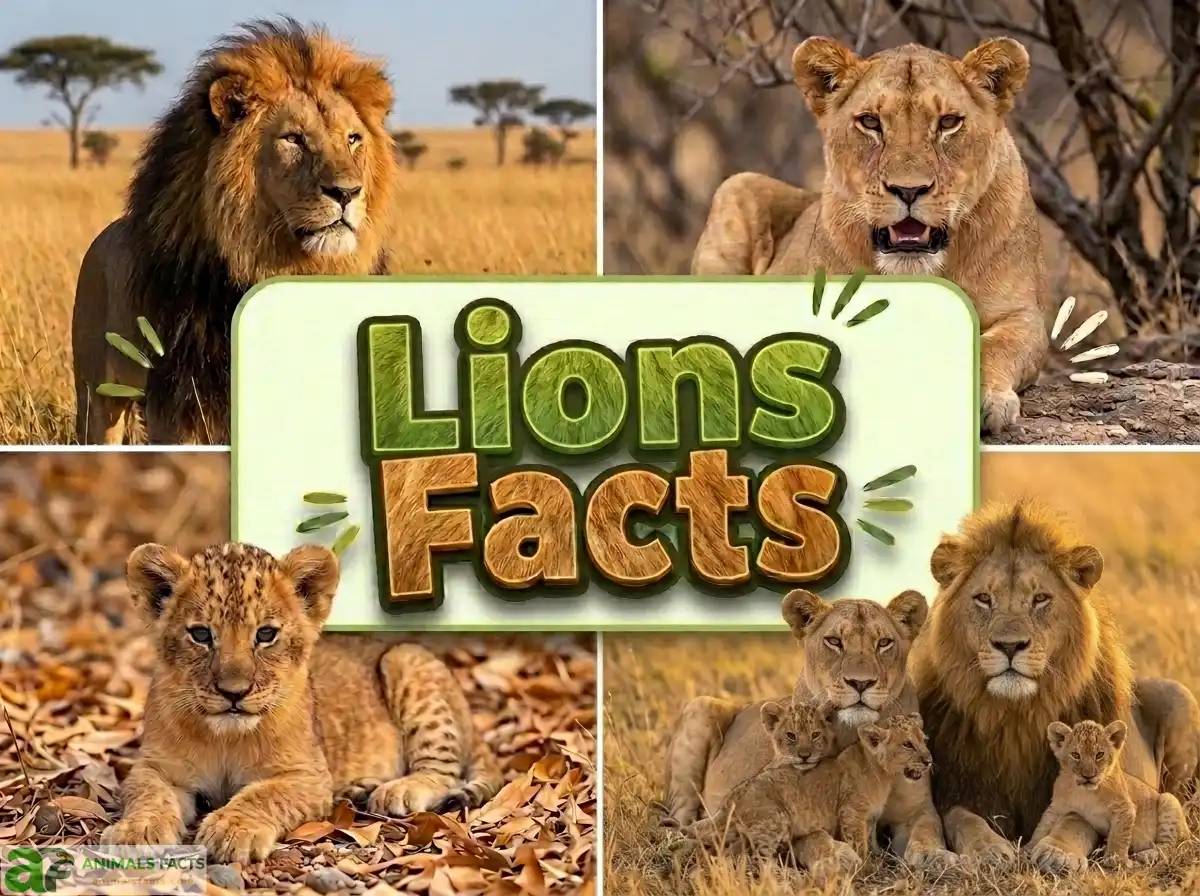
A typical lion pride consists of 4–15 related adult females (mothers, daughters, and sisters forming an extended matrilineal family), their dependent cubs and sub-adults of both sexes, and 1–4 adult males (typically brothers or cousins forming a coalition) who hold tenure over the pride and its territory.
This structure creates a complex and dynamic social ecosystem — the resident female coalition provides territorial continuity and hunting coordination across generations, while male coalitions cycle through tenure periods that typically last 2–4 years before being displaced by new male coalitions.
Female relationships: Lionesses within a pride maintain long-term, stable relationships characterized by cooperative hunting, communal cub-rearing (with multiple mothers nursing each other’s cubs), and coordinated territorial defense against rival female groups.
Male coalition dynamics: Males who leave their birth pride typically form coalitions with other expelled males — often brothers or cousins — who work together to challenge and displace resident male coalitions from established prides. Larger coalitions (3–4 males) hold tenure significantly longer than pairs or single males, because their combined size represents a more powerful defensive force.
Communication
Roaring: The most distinctive and ecologically important lion vocalization — used for territorial advertisement, contact calls between pride members, and demonstrating coalition or pride size. Roaring typically occurs at night or in the early morning, and pride roaring sessions in which multiple animals contribute simultaneously can communicate information about group size and composition to distant prides.
Other vocalizations: Lions produce a remarkable range of additional sounds including huffs, moans, grunts, growls, snarls, hisses, and uniquely among big cats, an affiliative “prusten” (chuffing) sound used in close friendly interactions — the same contact call used by tigers and other Panthera species to signal non-threatening intent.
Body language: Lion communication through posture and body language is as nuanced as that of any social carnivore — ear position, tail carriage, body orientation, and facial expression all convey specific social information in the continuous negotiations of pride social life.
Rubbing and scent marking: Lions rub heads and faces together during social greetings — depositing scent from facial glands and reinforcing social bonds. Territory is also marked through urine spraying on prominent vegetation and through scratching tree trunks, which deposits both visual scratch marks and glandular secretions from between-toe glands.
Did You Know? Research by lion biologist Karen McComb and colleagues at the University of Sussex demonstrated that lion prides can distinguish between the roars of familiar and unfamiliar lions by acoustic analysis alone — and can make accurate judgments about the number of individuals in a rival group based solely on roaring, adjusting their behavioral response (approaching or avoiding) based on whether they judged their own group to be larger or smaller. This demonstrates a form of numerical assessment through acoustic analysis that represents sophisticated social cognition.
10. Predators & Defense Mechanisms
Adult lions in good health and within a functioning pride face remarkably few natural predators — their size, speed, and cooperative defense capabilities make them effectively untouchable by most large carnivores. Cubs and sub-adults, however, face significant predation risk, and isolated adult males face genuine danger from rival male coalitions and, in some circumstances, from large hyena clans.
Natural Predators and Competitors
Spotted Hyenas (Crocuta crocuta): The primary competitor and, in numerical circumstances, a genuine predator of isolated male lions and cubs. Where hyena clans outnumber lions significantly, hyenas can and do mob and kill lions through coordinated harassment — a documented reality in the Ngorongoro Crater of Tanzania, where dense hyena populations frequently challenge and occasionally kill isolated lions.
African Wild Dogs: Not physical predators of lions — African Wild Dogs are significantly smaller — but represent active competitors for prey in overlapping habitats, with wild dogs losing kills to lions regularly through kleptoparasitism (theft).
Crocodiles: Nile Crocodiles present genuine danger to lions crossing rivers or drinking at water sources, particularly in areas like the Mara River crossings of the Masai Mara, where crocodiles are both large and numerous.
Other lions: Inter-pride and inter-coalition conflict represents the primary mortality risk for adult males. Male-male combat over pride tenure or territorial boundaries can be extremely violent and frequently lethal — the most common cause of death for adult male lions.
Humans: By a vast margin, the most significant mortality factor for lions globally — through illegal poaching, retaliatory killing over livestock predation, legal trophy hunting (in some range countries), and the indirect effects of habitat loss and prey depletion.
Defense and Survival Strategies
Group living: The pride’s primary defensive function — multiple adults provide coordinated cub protection, collective deterrence of approaching predators, and numerical advantage in conflicts with other carnivores.
Territorial roaring: By advertising pride size and health through roaring, prides frequently deter challenges from rival groups without requiring physical confrontation, conserving energy and avoiding injury.
Cub concealment: The hiding of very young cubs in dense vegetation or caves for the first weeks of life represents the primary defense against infanticide and predation during the most vulnerable life stage.
11. Lion Facts for Kids
Hey kids — get ready to discover why lions are some of the most incredible animals on the entire planet!
- Lions are the only wild cats in the whole world that live together in family groups! Every other kind of wild cat — tigers, leopards, cheetahs — lives alone, but lions live in big families called prides.
- It’s actually the girl lions, called lionesses, who do most of the hunting — not the boy lions with the big manes! The mane males mostly guard the territory and the cubs while the lionesses catch the food.
- A lion’s roar is so loud that you can hear it from 8 kilometers away — that’s further than most people can walk in an hour! They roar to talk to their family and to tell other lions to stay out of their territory.
- Lions sleep for an amazing 16 to 20 hours every day — that’s almost as long as you spend sleeping and being awake combined!
- Baby lions are called cubs, and they’re born with spots on their fur, just like a leopard! The spots slowly disappear as they grow up.
- The male lion’s mane isn’t just for looking impressive — it actually protects his neck and throat during fights with other male lions, like a built-in armor!
- Lions can run as fast as 81 kilometers per hour over a short distance — that’s faster than most cars are allowed to go in a city!
- There are only about 800 lions left in India — all living in one special forest called the Gir Forest. The rest of the world’s lions all live in Africa.
Did You Know? A lion’s tongue is super rough, covered in tiny backward-pointing bumps called papillae — just like your pet cat’s tongue! These rough bumps act like a built-in brush for grooming fur AND like a built-in knife for scraping every last bit of meat off a bone. That rough texture is why if a lion licked your hand it would feel like sandpaper, just much, much bigger and stronger!
12. Relationship with Humans
The relationship between lions and humans stretches back to the very origins of Homo sapiens in Africa — making it one of the longest, most complex, and most consequential interspecies relationships in human evolutionary history.
Ancient Coexistence and Competition
Early humans in Africa coexisted with, competed against, and were occasionally preyed upon by lions for hundreds of thousands of years. Archaeological evidence of lion remains at early human sites, alongside cave paintings and petroglyphs depicting lions across Africa, Europe, and Asia, attests to the profound impact lions had on the human imagination during the formative periods of our species. The Chauvet Cave paintings of southern France — dated to approximately 36,000 years ago and representing some of the oldest known detailed wildlife art — include extraordinarily accomplished depictions of cave lions, suggesting that lions held significant cultural and possibly spiritual importance for early European humans.
Lions in Ancient Civilizations
Lions featured centrally in the cultures, religions, and political symbolism of virtually every ancient civilization in regions where they occurred. Ancient Egyptian pharaohs depicted themselves as lions or as lion-human hybrids (sphinxes); the Assyrian Empire mounted spectacular lion hunts as royal spectacle; Babylonian and Mesopotamian palace decorations featured lions prominently; Greek and Roman arenas used African lions in gladiatorial spectacles; and Indian royal courts maintained lions as symbols of sovereignty.
Human-Lion Conflict Today
Livestock predation is the most widespread and practically significant source of human-lion conflict in contemporary Africa and India. As lion populations recover in some regions while human populations and pastoral activities expand around protected areas, the frequency of lion attacks on cattle, goats, and sheep creates economic losses that incentivize retaliatory killing — driving some of the highest lion mortality rates documented outside of direct hunting.
Human fatalities from lion attacks remain a genuine public safety concern in certain areas, particularly where lions have learned to associate human settlements with easy prey or where human activities bring people into close contact with lions in poor visibility. Tanzania records the highest number of lion attacks on humans globally — with research suggesting that areas with historically high lion densities and specific environmental conditions (high grass, poor lighting, proximity to sleeping areas) generate most incidents.
Trophy Hunting
Legal trophy hunting of lions — permitted in several African countries including Tanzania, Zambia, Zimbabwe, and Mozambique — remains one of the most politically controversial aspects of lion conservation management. Advocates argue that well-managed trophy hunting generates revenue for conservation and creates economic incentives for communities to tolerate lions; critics argue that trophy hunting removes specific high-quality breeding males (particularly mane males in their prime) that are ecologically most valuable to pride social stability.
13. Conservation Status & Threats
The lion’s conservation situation represents one of the most severe and least publicly recognized wildlife crises in the world — an animal so strongly associated in human culture with power and abundance that its genuinely precarious status frequently surprises non-specialist audiences.
Global Lion Conservation Data (2026)
| Population | IUCN Status | Estimated Number | Population Trend |
|---|---|---|---|
| African Lion (overall) | Vulnerable | ~20,000–25,000 | Declining |
| West African Lion | Critically Endangered | ~400 | Sharply declining |
| Central African Lion | Vulnerable | ~2,000–4,000 | Declining |
| East African Lion | Vulnerable | ~11,000–14,000 | Mixed; stable in core protected areas |
| Southern African Lion | Vulnerable | ~6,000–9,000 | Relatively stable in protected areas |
| Asiatic Lion (India) | Endangered | ~800 | Increasing (successful recovery) |
Major Threats to Lions
Habitat loss and fragmentation: Agricultural expansion, human settlement growth, and infrastructure development are steadily reducing and fragmenting lion habitat across the continent. Lions require very large territories — a pride needs between 50 and 400 square kilometers depending on prey density — and increasingly fragmented protected areas are insufficient to support viable populations.
Prey depletion: The systematic hunting of lion prey species — through bushmeat hunting, wildlife trade, and livestock incursion into protected areas — reduces the prey base available to lions, forcing them to prey on livestock, generating conflict with humans, and reducing reproductive success and population density.
Retaliatory killing: Retaliatory killing of lions by herders protecting livestock represents perhaps the most widespread and difficult-to-address cause of ongoing lion mortality across Africa. In communities with limited access to compensation programs or non-lethal deterrent support, the economic impact of livestock losses creates powerful incentives for killing lions.
Disease: Canine distemper virus (CDV), bovine tuberculosis (BTB), and numerous other diseases transmitted from domestic animals threaten lion populations adjacent to livestock-keeping communities — demonstrated dramatically by CDV outbreaks that killed significant proportions of several Serengeti and Ngorongoro lion populations in 1994 and subsequently.
Illegal Wildlife Trade: While lion body parts are less prominently traded than tiger parts in Asian traditional medicine markets, demand for lion bones as a substitute for tiger bone has grown significantly in South and Southeast Asian markets — a demand partially met by captive-bred lions in South Africa, but also driving some wild lion killing.
Did You Know? The lion’s population has declined by approximately 43% over the past 21 years (three lion generations) according to the most recent comprehensive IUCN assessment — a decline equivalent to the loss of nearly half the world’s lion population within living memory — making the lion’s Vulnerable classification a significant understatement of the species’ practical conservation urgency in the assessment of many lion biologists.
14. Famous Lions
Elsa — The Lion Who Changed Conservation History
Elsa was a lioness raised from a cub by game warden George Adamson and his wife Joy Adamson in Kenya during the late 1950s, and subsequently successfully rehabilitated and released into the wild — the first documented successful return of a hand-raised carnivore to wild life. Joy Adamson’s account of Elsa’s rehabilitation — published as “Born Free” in 1960 — became one of the best-selling wildlife books in history and the basis for a celebrated 1966 film, fundamentally shifting global public attitudes toward wildlife conservation and captive animal welfare.
Cecil — The Most Famous Lion of the 21st Century
Cecil was a male African Lion resident in Zimbabwe’s Hwange National Park, known for his distinctive dark mane and his unusual tolerance of tourist vehicles, making him one of the most photographed and observed lions in Africa. Cecil’s killing by an American trophy hunter in July 2015 — lured outside the park boundary with bait — generated an unprecedented wave of global public outrage, resulting in significant changes to airline trophy shipping policies, intensified international scrutiny of trophy hunting regulation, and arguably representing the single event that most dramatically raised global public awareness of lion conservation since “Born Free.”
Christian — The Lion Who Remembered
Christian was a lion purchased as a cub from Harrods department store in London in 1969 by two young Australians, John Rendall and Ace Berg, who raised him in their Chelsea home before releasing him in Kenya with the help of George Adamson. When Rendall and Berg returned to visit Christian in the wild approximately a year after his release — by which time he had become the leader of a pride — they were filmed running to embrace them affectionately. The footage, rediscovered on YouTube decades later, became one of the most widely viewed animal videos ever posted online and introduced millions of people to the concept of lion-human bond.
Scarface — Yellowstone’s Lion? No — Africa’s Most Recognizable Male
Scarface (also known as Scar) was a male Maasai Mara lion famous for the distinctive scar across his nose and face from a fight — named and tracked by Olare Motorogi Conservancy researchers and safari guides for over a decade, becoming one of the most recognized and photographed individual wild lions of the 2010s, regularly featured in wildlife photography awards and documentaries.
15. Role in Ecosystem & Food Chain
Lions occupy the pinnacle of the food web in every ecosystem they inhabit — functioning as apex predators whose presence, behavior, and population dynamics influence virtually every aspect of the surrounding ecological community through cascading effects that extend far beyond the simple predator-prey interaction.
Prey Population Regulation
Lions directly regulate the populations of their primary prey species — wildebeest, zebra, buffalo, and various antelope — through predation. This regulation helps prevent the prey population explosions that would occur in the absence of predators, which would drive overgrazing, vegetation collapse, and subsequent prey population crashes. Research in the Serengeti has demonstrated that the combined effect of lion and other large predator predation is essential to maintaining the dynamic equilibrium of the wildebeest migration — one of the most spectacular ecological phenomena on Earth.
The “Ecology of Fear”
Beyond direct predation, lions influence prey populations through behavioral modification — the “ecology of fear” in which prey animals alter their movement, grazing, and habitat use patterns in response to predation risk. Research has documented that wildebeest, zebra, and antelope alter their grazing distribution, water-hole use timing, and habitat selection in ways that reduce overexploitation of specific vegetation patches — an effect that contributes to vegetation diversity and habitat heterogeneity across savanna ecosystems.
Scavenger Support
Lions, as the dominant carnivore in most African savanna systems, regularly yield carcasses to vultures, hyenas, jackals, marabou storks, and dozens of other scavenger species following feeding. Lion kills thus represent a crucial and reliable energy subsidy for an entire community of scavenger species — with the removal of lions from an ecosystem potentially having cascading negative effects on scavenger populations dependent on lion-killed carcasses.
16. Myths, Folklore & Cultural Significance
No wild animal has generated a more globally consistent, more symbolically powerful, or more culturally pervasive mythology than the lion — the “King of Animals” title is one of the most cross-culturally recognized animal metaphors in human history, appearing in virtually every civilization that has had contact with lions and in dozens of cultures that knew lions only through trade, travelers’ accounts, or artistic tradition.
Ancient Egypt — The Lion as Divine Power
In ancient Egypt, the lion was associated with the most powerful divine forces in the cosmos. The goddess Sekhmet — depicted as a woman with a lion’s head — embodied divine wrath, war, and healing; the god Maahes was a lion-headed deity of war and protection; and the Sphinx — part human, part lion — was one of the most powerful symbols in Egyptian sacred architecture. Lions were kept in royal menageries, depicted in palace art, and associated directly with pharaonic power and divine protection.
Mesopotamian and Biblical Traditions
The lion features in the earliest written texts of human civilization — including Gilgamesh (approximately 2100 BCE), in which the hero’s lion-hunting exploits demonstrate his extraordinary power. Biblical references to lions are numerous and consistent — Daniel in the lions’ den, the lion of Judah, and the widespread use of lion metaphor across both the Hebrew Bible and New Testament establish the lion as the defining symbol of divine power, royal authority, and the dangerous forces of the natural world simultaneously.
Heraldic and National Symbolism
The lion became the dominant symbol of European royal heraldry — adopted by the English crown as early as the 12th century under Richard I (“Richard the Lionheart”) and remaining central to the British royal coat of arms to the present day. The lion appears on the national flags or coats of arms of over 15 nations — including England, Scotland, the Netherlands, Belgium, Bulgaria, Sri Lanka, and Ethiopia — making it the most commonly used animal symbol in national heraldry worldwide.
East African and South Asian Traditions
In Maasai tradition, the killing of a lion (olamayiani) was historically a rite of passage for young warriors — a practice that has been increasingly replaced by non-lethal lion-based ceremonies in recognition of lion conservation concerns, while maintaining the cultural significance of the lion-warrior relationship. In Indian tradition, the lion (simha) is associated with royalty, courage, and the authority of both kings and deities — the four-lion capital of Emperor Ashoka’s pillar, depicting four lions facing outward in each cardinal direction, remains the National Emblem of India to this day.
17. Lions in Pop Culture
Few animals have generated a more sustained, more globally widespread, or more culturally diverse presence in human entertainment than the lion — a reflection of its deep cultural resonance as the ultimate symbol of power, nobility, and the wild natural world.
Film and Animation
“The Lion King” (Disney, 1994 & 2019) — One of the highest-grossing animated films of all time and the most successful single piece of media ever created specifically around the lion, following young Simba’s journey from prince to king across an African savanna setting loosely inspired by Shakespeare’s Hamlet. The film’s extraordinary commercial success and cultural resonance — including stage musical adaptations running continuously since 1997 — has made its vision of lion social dynamics one of the most widely recognized animal behavioral portrayals in human culture, for better or worse oversimplifying the genuine complexity of lion social life.
“Born Free” (1966) — The celebrated film adaptation of Joy Adamson’s book about Elsa the lioness, starring Virginia McKenna and Bill Travers, which won Academy Awards and fundamentally shifted mainstream public attitudes toward captive wildlife.
“The Lion, the Witch and the Wardrobe” (various adaptations of C.S. Lewis’s 1950 novel) — The great lion Aslan — a Christ-like figure in Lewis’s allegorical Narnia series — is one of the most theologically significant animal characters in English literature, representing divine sacrifice and resurrection through the form of the lion.
Literature and Symbol
“The Old Man and the Sea” — Hemingway’s 1952 Nobel Prize-winning novella features recurring dreams of lions on African beaches that function as the aging fisherman’s symbol of youth, vitality, and remembered strength — one of the most celebrated uses of lion symbolism in modern American literature.
Aslan from C.S. Lewis’s Chronicles of Narnia remains one of the most culturally significant lion characters in all literature — a complex embodiment of divine power, sacrificial love, and natural authority that has shaped the imaginative lives of generations of English-speaking readers.
Sports Mascots
The lion is the most commonly used animal mascot in professional sports worldwide — appearing as the symbol of England’s national football team, dozens of Premier League clubs, numerous international rugby teams, and countless other sporting organizations globally. The Chelsea FC, Aston Villa, Millwall, and Birmingham City football clubs all use lion imagery, as do national teams from Germany (the Nationalelf mascot) to Sri Lanka, Belgium, and Senegal.
18. Lion Facts vs. Common Myths
Myth: The male lion is the primary hunter of the pride. Fact: Lionesses do approximately 85–90% of the hunting — their more slender, agile builds make them significantly more effective pursuit predators than the heavier, mane-encumbered males. Male lions do hunt independently (particularly coalition males without a pride) but within pride social structure, hunting is primarily a female activity.
Myth: Lions live primarily in jungles. Fact: Lions are quintessential open-country animals — savanna, grassland, and open woodland are their primary habitats. The phrase “king of the jungle” is a cultural inheritance from historical lion distribution in forested parts of their former Asian range (where “jungle” in the original Hindi sense referred to wild land generally, not specifically forest) rather than an accurate description of current lion habitat preferences.
Myth: Lions always roar at the moon. Fact: Lion roaring is a communication behavior unrelated to lunar phase — used for territorial advertisement, contact-calling between pride members, and demonstrating group size. Lions roar most frequently at night simply because this is when they are most active — the association with moonlight is a cultural rather than biological observation.
Myth: A pride is always led by the dominant male. Fact: Lion pride social decision-making is primarily led by the senior females — older, experienced lionesses guide pride movements, hunting strategies, and territorial decisions. Males provide territorial defense but do not typically initiate or direct day-to-day pride activities.
Myth: Lions and tigers cannot interbreed. Fact: Lions and tigers can produce hybrid offspring — the Liger (lion father, tiger mother) and Tigon (tiger father, lion mother) — in captivity, demonstrating their close genetic relationship. Ligers are the largest known cats, reaching up to 400 kg, due to the interaction of lion and tiger growth-regulatory genetics. These hybrids are not found in the wild due to the geographic separation of the two species.
Myth: White lions are albinos. Fact: White lions are not albinos — they carry a leucistic gene that reduces pigmentation without eliminating it entirely, producing white or near-white coats while retaining blue or golden eyes (albinos have pink eyes) and some pigmentation in other tissues. White lions occur naturally in the Timbavati region of South Africa and are not a separate subspecies but a color variant within the normal lion population.
19. Best Places to See Lions in the Wild
Serengeti National Park, Tanzania
The Serengeti supports the world’s largest contiguous lion population — approximately 3,000 individuals in an ecosystem sustained by the Great Migration. Lion sightings are among the most reliable in Africa, with multiple prides occupying accessible areas near the main tourism routes. The Seronera area in central Serengeti is particularly famous for its lion density and ease of observation year-round.
Masai Mara National Reserve, Kenya
The northern extension of the Serengeti ecosystem, the Masai Mara offers extraordinary lion viewing — particularly during the July–October Migration period when enormous concentrations of wildebeest attract large prides to the river crossing areas. The Masai Mara’s open grassland landscape and habituated lion populations make it one of the premier lion photography destinations in the world.
Okavango Delta and Chobe National Park, Botswana
Botswana’s Okavango ecosystem supports exceptional lion populations adapted to both semi-arid savanna and seasonally flooded floodplain habitats — lions regularly wade through shallow flood water and have been observed swimming between islands. The adjacent Chobe National Park supports high densities of both lions and elephant, creating dramatic predator-prey interaction opportunities.
Kruger National Park, South Africa
Africa’s most-visited large wildlife reserve, Kruger supports approximately 1,600 lions and offers the most infrastructure-rich lion viewing in Africa — with extensive road networks accessible by self-drive visitors, supplemented by guided walks and drives. Several well-known individual lion prides have been tracked and documented by researchers and safari guides for decades, offering exceptional behavioral observation opportunities.
Gir Forest National Park, India
The only place on Earth where Asiatic Lions can be observed in the wild, Gir Forest in Gujarat, India, offers guided jeep safari experiences with reliably high lion sighting rates given the relatively concentrated Asiatic Lion population (~800 individuals) in a manageable forest landscape. The experience of observing a genetically and morphologically distinct lion population in an Indian dry forest setting is entirely different from African safari viewing and represents an irreplaceable wildlife experience.
Hwange National Park, Zimbabwe
Home to the famous Cecil (see Famous Lions section) and numerous large, habituated lion prides, Hwange supports one of Zimbabwe’s most significant lion populations against the backdrop of the country’s largest national park — offering both luxury lodge and budget camping options.
20. Top Documentaries & Books
Must-Watch Documentaries
“The Last Lions” (National Geographic, 2011) — A strikingly beautiful and emotionally powerful documentary following a lone lioness attempting to raise her cubs in the Okavango Delta against extraordinary odds, narrated by Jeremy Irons and filmed over three years with exceptional access and intimacy.
“Dynasties — Lion” (BBC, 2018) — Part of David Attenborough’s landmark Dynasties series, this episode follows the specific political dynamics of a Kenyan lion pride over an extended period, offering perhaps the most behaviorally sophisticated portrayal of lion social complexity ever filmed for a general audience.
“Born Free” (1966) — The original and still-resonant film adaptation of Joy Adamson’s account of Elsa the lioness — essential viewing for understanding the foundations of modern big cat conservation ethics.
“David Attenborough’s Africa — Savannah” (BBC, 2013) — Contains exceptional lion sequences, including the extraordinary filming of lions hunting in complete darkness using thermal imaging — revealing behaviors previously invisible to researchers and filmmakers.
“Big Cat Diary” (BBC, multiple series since 1996) — The long-running BBC series following lion, leopard, and cheetah families in the Masai Mara over successive years, creating continuity of observation unprecedented in wildlife television.
Essential Books
“Born Free” by Joy Adamson (1960) — The foundational text of modern big cat conservation — the account of Elsa the lioness that launched the global conservation movement for large carnivores.
“The Serengeti Lion” by George Schaller (1972) — The foundational scientific study of lion behavior and ecology, conducted by one of the 20th century’s most distinguished field biologists — still regarded as the essential scientific reference on lion natural history.
“Among the Lions” and related titles by Jonathan Scott — Accounts of years spent observing and filming lion families in the Masai Mara by one of Africa’s most celebrated wildlife photographers and filmmakers.
“Roaring Back: The Restoration of the American Lion” and related lion conservation texts — Various popular science accounts of contemporary lion conservation challenges provide essential reading for understanding the species’ current situation.
21. Comparison of Lions with Similar Big Cats
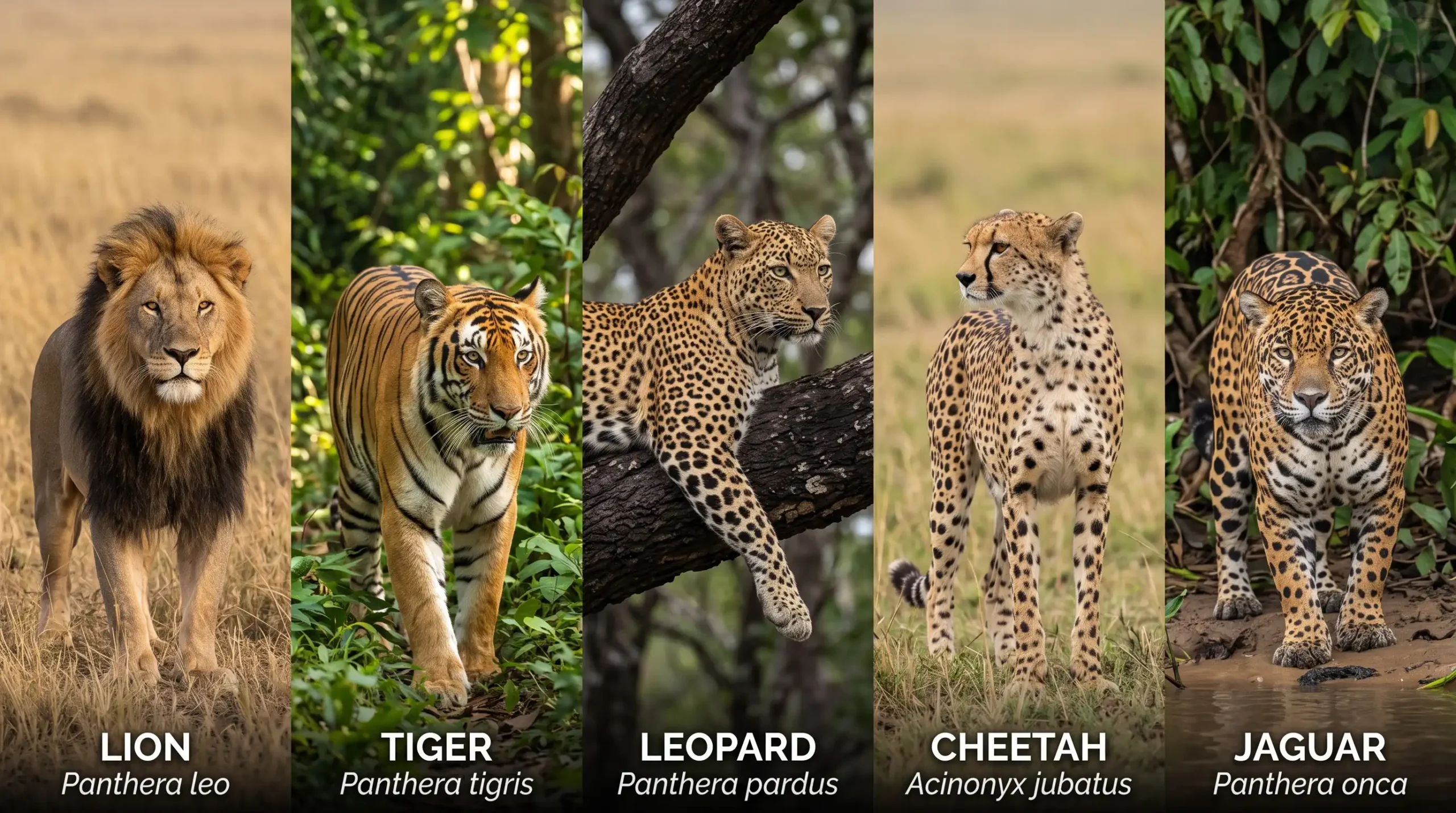
| Feature | Lion | Tiger | Leopard | Cheetah | Jaguar |
|---|---|---|---|---|---|
| Scientific Name | Panthera leo | Panthera tigris | Panthera pardus | Acinonyx jubatus | Panthera onca |
| Weight | 120–250 kg | 90–300 kg | 28–90 kg | 21–72 kg | 56–96 kg |
| Distribution | Africa; India (tiny) | Asia | Africa, Asia | Africa; tiny Iran pop. | South/Central America |
| Habitat | Savanna, grassland | Forest | Forest, savanna | Open grassland | Rainforest, wetland |
| Social Structure | Prides (unique) | Solitary | Solitary | Solitary / male coalitions | Solitary |
| Primary Diet | Large ungulates | Large ungulates | Medium mammals | Gazelle, impala | Caiman, peccary, deer |
| Conservation Status | Vulnerable | Endangered | Vulnerable | Vulnerable | Near Threatened |
| Population | ~20,000–25,000 | ~5,574 | ~250,000 | ~7,100 | ~64,000 |
| Unique Feature | Only social cat; mane | Largest cat; swimmer | Strongest climber relative to size | Fastest land animal | Strongest bite relative to size |
22. How You Can Help
Lion conservation requires action across multiple fronts — from protecting remaining habitat to reducing human-lion conflict to addressing the political and economic challenges of maintaining large wild predators alongside growing human populations.
Support These Organizations
Panthera (panthera.org) — The world’s leading wild cat conservation organization, running the PrideLion program specifically focused on African Lion and Asiatic Lion conservation across multiple range countries.
African Wildlife Foundation (awf.org) — Runs community-based lion conservation programs, livestock protection initiatives, and human-wildlife coexistence projects across East and Central Africa.
Lion Recovery Fund (lionrecoveryfund.org) — A collaborative fund specifically designed to channel conservation resources to the most impactful lion conservation programs across Africa.
Wildlife Conservation Society (wcs.org) — Operates lion conservation programs in Tanzania, Kenya, Democratic Republic of Congo, and other range states, including long-running research programs fundamental to understanding lion ecology.
Asiatic Lion Conservation Project (gujaratforestdepartment.in and partner organizations) — Supporting the ongoing management and conservation of the Gir Forest Asiatic Lion population through government and NGO partnership programs in Gujarat, India.
Practical Actions
Choose responsible tourism. Selecting safari operators with demonstrated commitment to conservation, anti-poaching support, and community benefit ensures your tourism revenue contributes to the economic case for lion conservation in range states.
Support livestock protection programs. Organizations like Lion Guardians (Kenya and Tanzania) and Living with Lions run community-based programs equipping pastoral communities with livestock enclosure improvements and non-lethal deterrent tools — directly reducing the retaliatory killing that represents lions’ most widespread mortality source.
Never purchase lion bone products. Consumer choices that avoid traditional medicine products containing lion or other big cat bones reduce the demand driving illegal lion trade and captive lion farming.
Advocate for policy change. Public engagement with trophy hunting policy debates, with national-level protected area funding decisions, and with international wildlife trade legislation — through petitions, advocacy organizations, and direct political engagement — helps ensure that policy environments support rather than undermine lion conservation.
Did You Know? The Lion Guardians program in Kenya — employing young Maasai men who were traditionally expected to prove their courage by killing lions, redirecting their tracking and wildlife knowledge skills into lion monitoring and community protection work — has demonstrated extraordinary success in reducing lion killing in its operational areas, while providing meaningful employment and cultural validation for participants, and recovering local lion populations in areas where they had been effectively eliminated. It stands as one of the most innovative and effective human-lion coexistence models in contemporary conservation.
23. Frequently Asked Question About Lions
Q1: What is the scientific name of the lion?
The lion’s scientific name is Panthera leo. It belongs to the genus Panthera — the group of big cats capable of true roaring — alongside the tiger (P. tigris), leopard (P. pardus), jaguar (P. onca), and snow leopard (P. uncia). The family is Felidae (cats), the order Carnivora, and the class Mammalia.
Q2: How many lions are left in the world?
The global wild lion population is estimated at approximately 20,000–25,000 individuals as of 2026, making them one of the rarer large carnivore species globally. An additional approximately 800 Asiatic Lions survive in India’s Gir Forest. The African population represents approximately 43% fewer lions than existed just 21 years ago, reflecting ongoing population declines across most of the species’ range.
Q3: Are lions endangered?
Lions are classified as Vulnerable on the IUCN Red List — a status that many lion biologists consider inadequate given the severity of ongoing population declines. Several regional populations face far more serious situations — the West African lion is effectively Critically Endangered with approximately 400 individuals, and the Asiatic Lion remains Endangered despite its recent recovery.
Q4: Why are lions called the King of the Jungle?
The title “King of the Jungle” is a cultural artifact partly derived from historical lion distribution in forested parts of their former Asian range (where “jungle” referred broadly to wild land), partly from the lion’s use as a symbol of royal power in European and Asian traditions, and partly from the lion’s position as top predator. In reality, lions are primarily savanna and grassland animals — not jungle dwellers — making “King of the Savanna” a considerably more accurate description.
Q5: Why do male lions have manes?
The male lion’s mane serves multiple functions: it provides genuine protection during male-male combat (the dense hair cushions biting and scratching attacks to the neck and throat); it signals male quality to females (darker, fuller manes correlate with higher testosterone levels, better health, and superior reproductive fitness); and it functions as a visual signal of dominance to rival males. Lionesses strongly prefer darker-maned males as mates, driving evolutionary selection for mane development.
Q6: Are lions dangerous to humans?
Yes — lions are genuinely dangerous predators that do occasionally attack and kill humans, particularly in areas where they have learned to associate human settlements with prey or where environmental conditions (dense vegetation, poor visibility, night proximity) bring humans into contact with hunting lions. Tanzania experiences the highest rate of lion attacks on humans globally. However, with appropriate behavior in lion country and proper safari guidance, the statistical risk to visitors is very low.
Q7: What do lions eat?
Lions are apex carnivores feeding primarily on large ungulates — wildebeest, zebra, buffalo, and various antelope species depending on regional prey availability. An adult lion requires approximately 5–8 kg of meat per day (though feast-and-famine cycles mean single feeds may provide 40 kg followed by days without eating). Lions also scavenge considerably more than previously recognized — obtaining up to 25–50% of food from carcasses killed by other predators in some ecosystems.
Q8: How long do lions live?
Wild lions typically live 10–14 years — with males typically having shorter lifespans than females due to the high mortality risks associated with territorial combat and competition with rival coalitions. Maximum documented wild lifespan approaches 20 years. In captivity, lions regularly reach 25–29 years with appropriate care.
Q9: What is the difference between African and Asiatic Lions?
The Asiatic Lion (Panthera leo leo) and African Lion (P. l. melanochaita and related populations) diverged from a common ancestor approximately 100,000 years ago through geographic isolation. Key physical differences include the Asiatic Lion’s somewhat smaller body size, a distinct longitudinal fold of skin along the belly (absent in African lions), a less full and typically shorter mane in males, and slightly different ear shape. The Asiatic Lion population is also genetically less diverse than African populations due to its severe historical bottleneck.
Q10: How can I help lion conservation?
Key actions include: supporting reputable conservation organizations focused on lion conservation (Panthera, Lion Recovery Fund, African Wildlife Foundation); choosing responsible safari tourism that benefits local communities and conservation programs; avoiding products that may contain lion bone or other big cat derivatives; advocating for strong legal protections for lions in range states and for robust international wildlife trade regulation; and supporting human-lion coexistence programs that provide communities with livestock protection tools, reducing the retaliatory killing that drives much of the lions’ ongoing population decline.
24. Sources & References
Research Sources
- Wikipedia — Panthera leo and related articles
- IUCN Red List — iucnredlist.org
- Panthera — panthera.org
- African Wildlife Foundation — awf.org
- Lion Recovery Fund — lionrecoveryfund.org
- National Geographic — nationalgeographic.com
- Smithsonian’s National Zoo — nationalzoo.si.edu
- Encyclopaedia Britannica — britannica.com
- BBC Wildlife — bbc.co.uk
- Live Science — livescience.com
- WWF — worldwildlife.org
- Wildlife Conservation Society — wcs.org
- Schaller, George — “The Serengeti Lion” (1972)
- Adamson, Joy — “Born Free” (1960)
- McComb, Karen et al. — “Roaring and numerical assessment in contests between groups of female lions” (2011)