
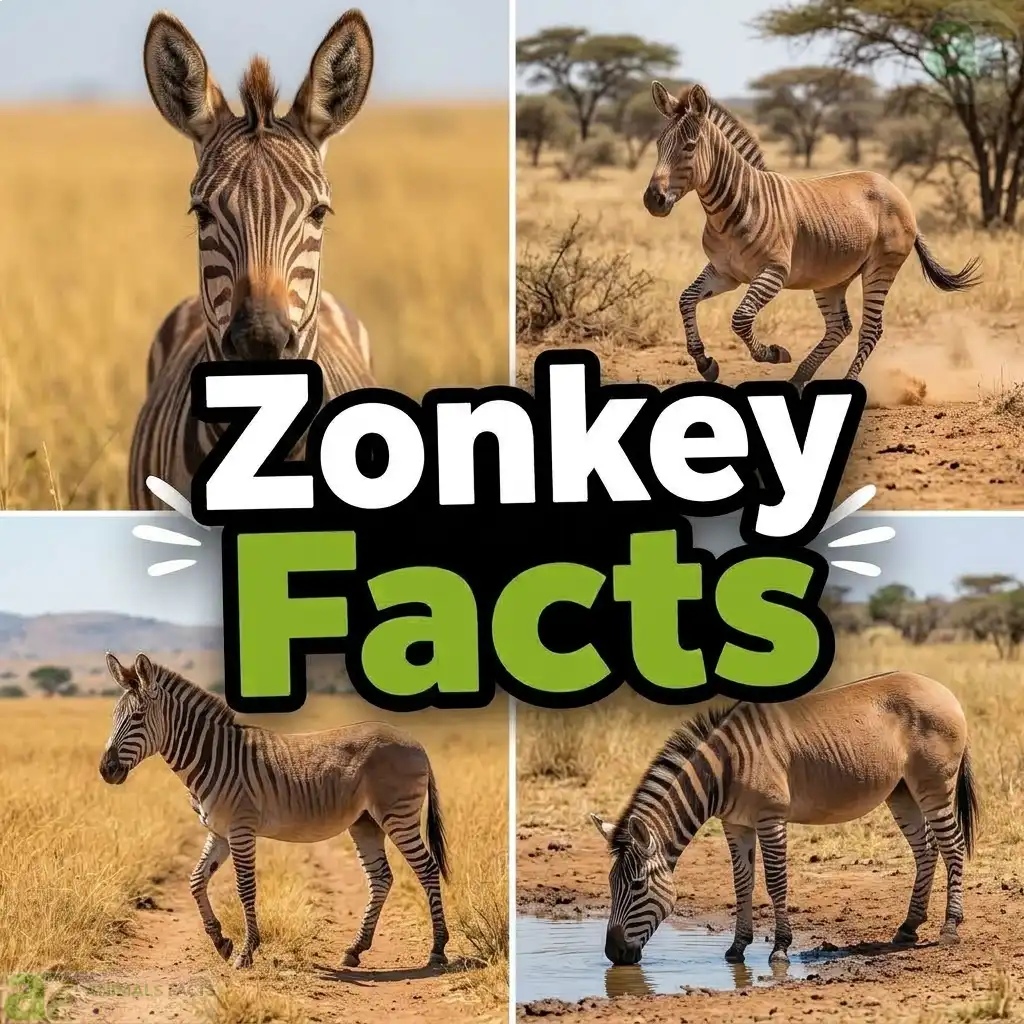
Zonkey Facts
| Feature | Details |
|---|---|
| Scientific Name | Equus zebra × Equus asinus (hybrid) |
| Kingdom | Animalia |
| Phylum | Chordata |
| Class | Mammalia |
| Order | Perissodactyla |
| Family | Equidae |
| Common Names | Zonkey, zedonk, zebonkey, zebrinny, donkra, zebrass |
| Parent Species | Zebra (Equus species) × Domestic donkey (Equus asinus) |
| Native Range | Not native — produced in captivity; some accidental occurrences in Africa |
| Habitat | Captive environments; occasionally open African plains (accidental hybrids) |
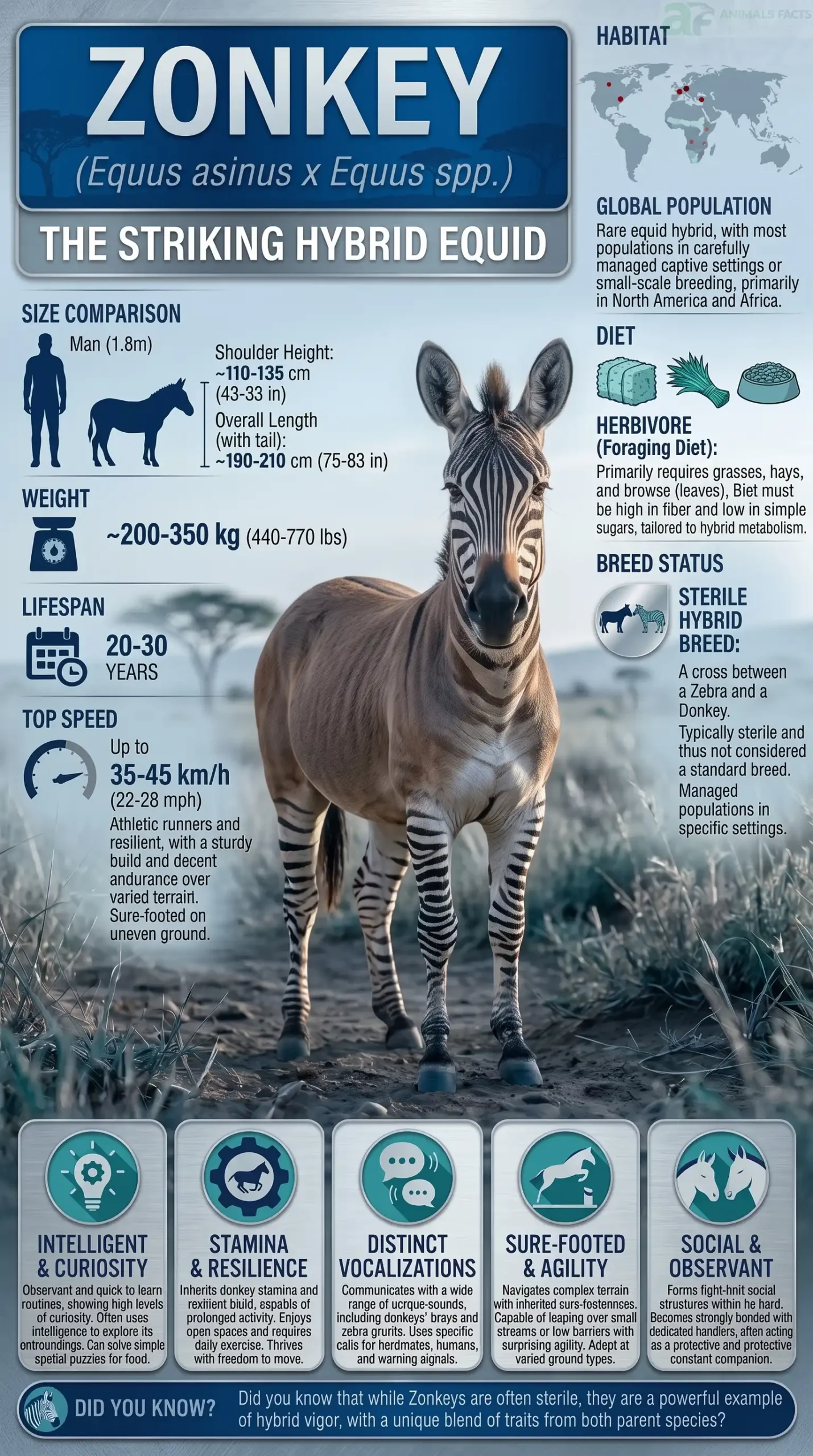
| Lifespan | Estimated 15–25 years (based on parent species lifespans) |
| Diet | Grasses, hay, leaves, shrubs, fruits, vegetables — herbivorous |
| Height | 90–125 cm at shoulder (varies by parentage) |
| Weight | 200–450 kg (varies significantly by parentage) |
| Top Speed | Estimated 40–50 km/h in short bursts |
| Conservation Status | Not applicable as a species — sterile hybrid |
| Chromosome Count | 2n = 53 or 54 (between zebra’s 44–46 and donkey’s 62) |
| Fertility | Almost always sterile — cannot reproduce |
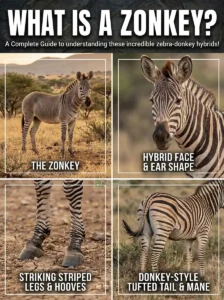 1. Introduction: What is a Zonkey?
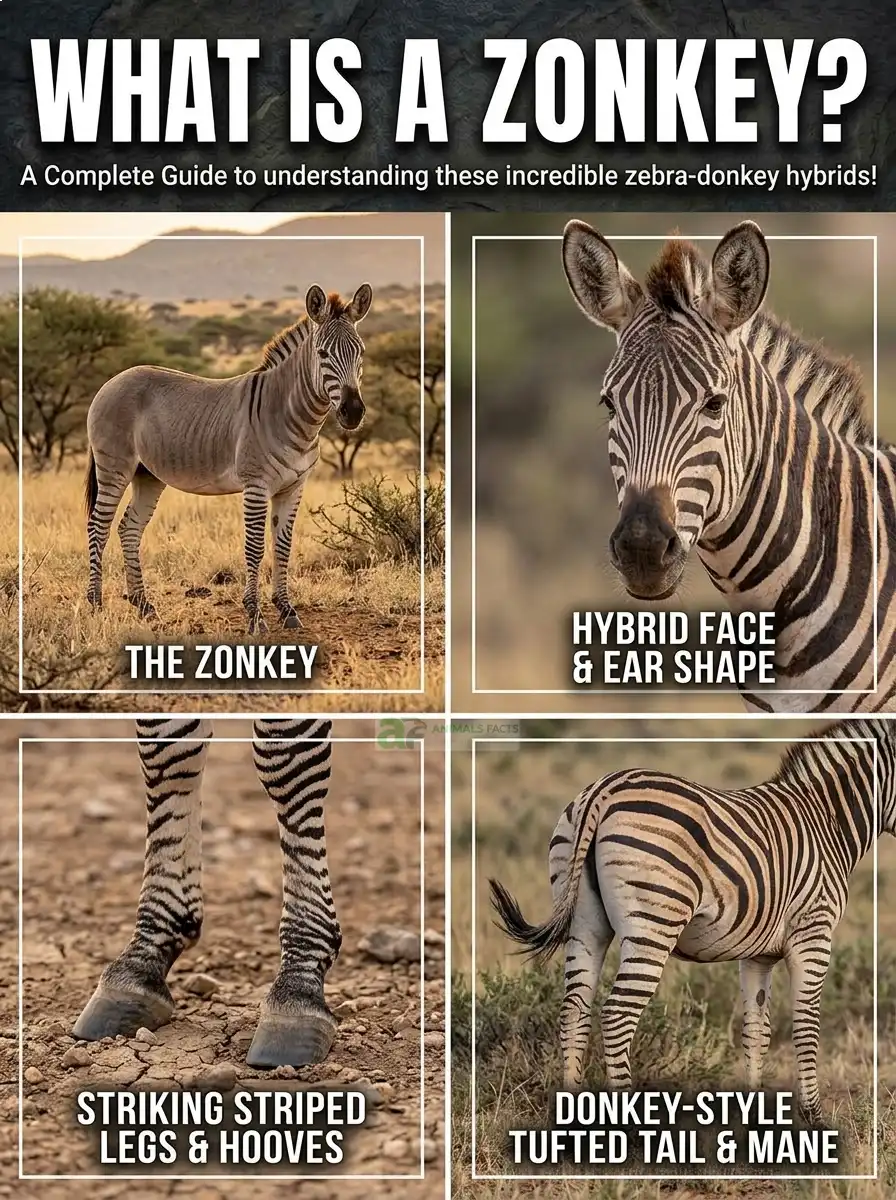
Imagine an animal with the sturdy, compact body of a donkey, the dramatic black-and-white striped legs of a zebra, and the gentle, curious temperament of an animal that seems genuinely uncertain which world it belongs to. Zonkey facts introduce one of nature’s most visually striking and biologically intriguing outcomes — the rare but real offspring of a zebra and a donkey, an animal that sits at the extraordinary intersection of two ancient, distinct evolutionary lineages and embodies in its very existence some of the deepest questions in genetics, hybridization science, and the biology of species boundaries.
The zonkey is not a myth, not a digital manipulation, and not a novelty invented by a zoo marketing department. Interesting facts about zonkeys reveal an animal that occurs both in captivity — where breeders deliberately cross zebras with donkeys — and occasionally in the wild across sub-Saharan Africa, where zebras and donkeys sharing the same range sometimes produce hybrid offspring without human intervention. The zonkey’s body is a living genetic negotiation — its chromosome count splitting the difference between the zebra’s 44–46 chromosomes and the donkey’s 62, producing an animal with approximately 53 chromosomes that is almost always sterile, unable to pass its unique genetic combination forward to another generation. Each zonkey, in a very real sense, is a biological one-off — a genetic experiment that begins and ends with a single individual.
Whether you are a student searching for zonkey facts for kids to fuel curiosity about hybrid animals and genetics, a biology enthusiast fascinated by the science of hybridization and species boundaries, a wildlife lover captivated by the visual spectacle of an animal that carries its zebra heritage in bold stripes on donkey-shaped legs, or simply someone who encountered a photo of this remarkable animal and needed to know more — this is your comprehensive guide. We cover zonkey scientific name, zonkey diet, zonkey size and weight, zonkey behavior, the genetics of hybrid animals, the cultural significance of human fascination with hybrids, and everything else these extraordinary animals have to offer. Nature’s most unexpected collaboration deserves your full attention.
2. Zonkey Species Overview & Classification
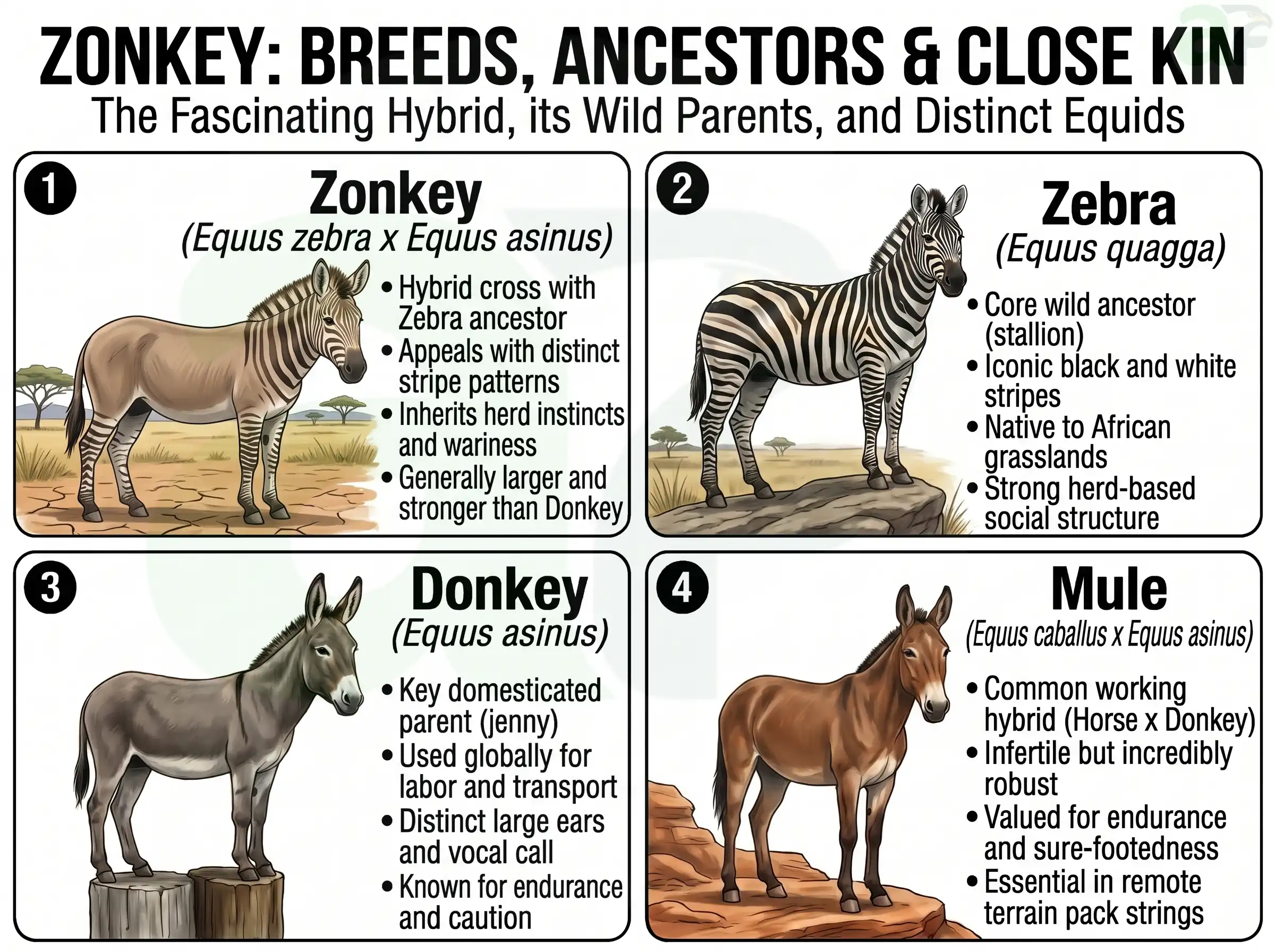
The zonkey occupies a genuinely unique taxonomic position — it is not a species, not a subspecies, and not a variety, but rather an interspecific hybrid — the offspring of two distinct species belonging to the same genus (Equus) that are related closely enough to produce viable offspring but different enough that those offspring are almost invariably sterile.
Species Classification Table
| Taxonomic Rank | Classification |
|---|---|
| Kingdom | Animalia |
| Phylum | Chordata |
| Class | Mammalia |
| Order | Perissodactyla |
| Family | Equidae |
| Genus | Equus (both parent species) |
| Father (Sire) | Zebra — typically Equus zebra, E. quagga, or E. grevyi |
| Mother (Dam) | Domestic donkey — Equus asinus |
| Hybrid Designation | Equus zebra × Equus asinus (or other zebra species) |
| Taxonomic Status | Hybrid — not a recognized species |
| Chromosome Count | ~53–54 (intermediate between parents) |
Understanding the Hybrid Terminology
The zonkey goes by a remarkable number of common names — each reflecting different combinations of parent species names or different regional traditions:
- Zonkey — the most widely used popular name; combination of “zebra” and “donkey”
- Zedonk — common alternative, particularly in American English
- Zebonkey — less common but used in some regions
- Donkra — when a female donkey (jenny) × male zebra (stallion)
- Zebrinny — when a female zebra (mare) × male donkey (jack) — more rare
- Zebrass — occasionally used, combining “zebra” and “ass” (the technical term for donkey)
- Zedonk — used specifically for the cross of a zebra stallion with a donkey jenny
The naming variation reflects the fact that the cross can be made in different directions — the sire (father) and dam (mother) can be either species — though in practice the most common cross is a zebra stallion × donkey jenny, producing the standard zonkey.
The Parent Species
Zebras belong to the genus Equus and comprise three living species:
- Plains zebra (Equus quagga) — the most common; 2n = 44 chromosomes
- Mountain zebra (Equus zebra) — 2n = 32 chromosomes
- Grévy’s zebra (Equus grevyi) — the largest; 2n = 46 chromosomes
Domestic donkeys (Equus asinus) have 2n = 62 chromosomes — a chromosome count significantly higher than any zebra species, which is the primary reason zonkey offspring are sterile (their odd chromosome numbers cannot pair properly during meiosis to produce viable eggs or sperm).
Subspecies Comparison Table
As a hybrid rather than a species, zonkeys have no formal subspecies. However, the characteristics of individual zonkeys vary significantly depending on which zebra species was the parent:
| Zonkey Type | Zebra Parent | Donkey Parent | Chromosome Count | Appearance |
|---|---|---|---|---|
| Plains zebra × donkey | E. quagga (44 chr.) | E. asinus (62 chr.) | ~53 | Bold stripes mainly on legs; donkey body |
| Mountain zebra × donkey | E. zebra (32 chr.) | E. asinus (62 chr.) | ~47 | Less prominent stripes; more donkey-like |
| Grévy’s zebra × donkey | E. grevyi (46 chr.) | E. asinus (62 chr.) | ~54 | Narrow stripes; larger body |
Evolution & Discovery Timeline
~4 million years ago — The Equus genus emerges in North America and begins spreading across Eurasia and Africa. The ancestors of modern zebras and donkeys diverge from a common equid ancestor during this period.
~2–3 million years ago — The distinct zebra species lineages and the ancestral donkey/wild ass lineages separate — developing the different chromosome counts that make their modern hybrids sterile.
~6,000 years ago — The African wild ass (Equus africanus) — the ancestor of the modern donkey — is domesticated in northeastern Africa, beginning the long history of domestic donkeys sharing landscapes with wild zebras in Africa.
1815 — One of the earliest formal documented records of a zebra-donkey hybrid appears in European natural history literature — described as a curiosity by naturalists observing colonial African fauna.
1900s — Multiple European zoos begin experimenting with zebra-donkey crosses as exotic curiosities. The hybrids attract enormous public interest.
1971 — A zedonk named “Ippo” born at a zoo in Florence, Italy becomes one of the most documented early modern zonkeys — generating significant scientific interest in equid hybridization.
2010 — A wild-born zedonk named “Ippo” is born at the Chestatee Wildlife Preserve in Dahlonega, Georgia, USA — born to a zebra mother and donkey father who shared an enclosure. She becomes one of the most photographed zonkeys in American media history.
2014 — A spontaneous wild zonkey is documented by researchers in Tsavo East National Park, Kenya — a plains zebra that had apparently bred with a local donkey, producing a visually striking striped hybrid that integrated into the local zebra herd.
2019 — Further documented wild zonkey sightings in Kenya and Ethiopia demonstrate that accidental hybridization between wild or feral zebras and domestic donkeys in Africa is more common than previously assumed.
2023 — Genetic analysis of wild-born African zonkeys published in the Journal of Zoology provides the most comprehensive DNA characterization of natural zebra-donkey hybrids to date — confirming the chromosome counts and sterility of wild zonkeys while documenting their remarkable behavioral integration into host species groups.
“Hybrid animals like the zonkey are nature’s living experiments — they reveal where species boundaries are real and where they are permeable, and they force us to confront the fact that evolution does not always draw clean lines between kinds of animals.” — Dr. Oliver Ryder, Director of Conservation Genetics, San Diego Zoo Wildlife Alliance, and leading expert in equid genetics and conservation
3. Zonkey Physical Description & Unique Features
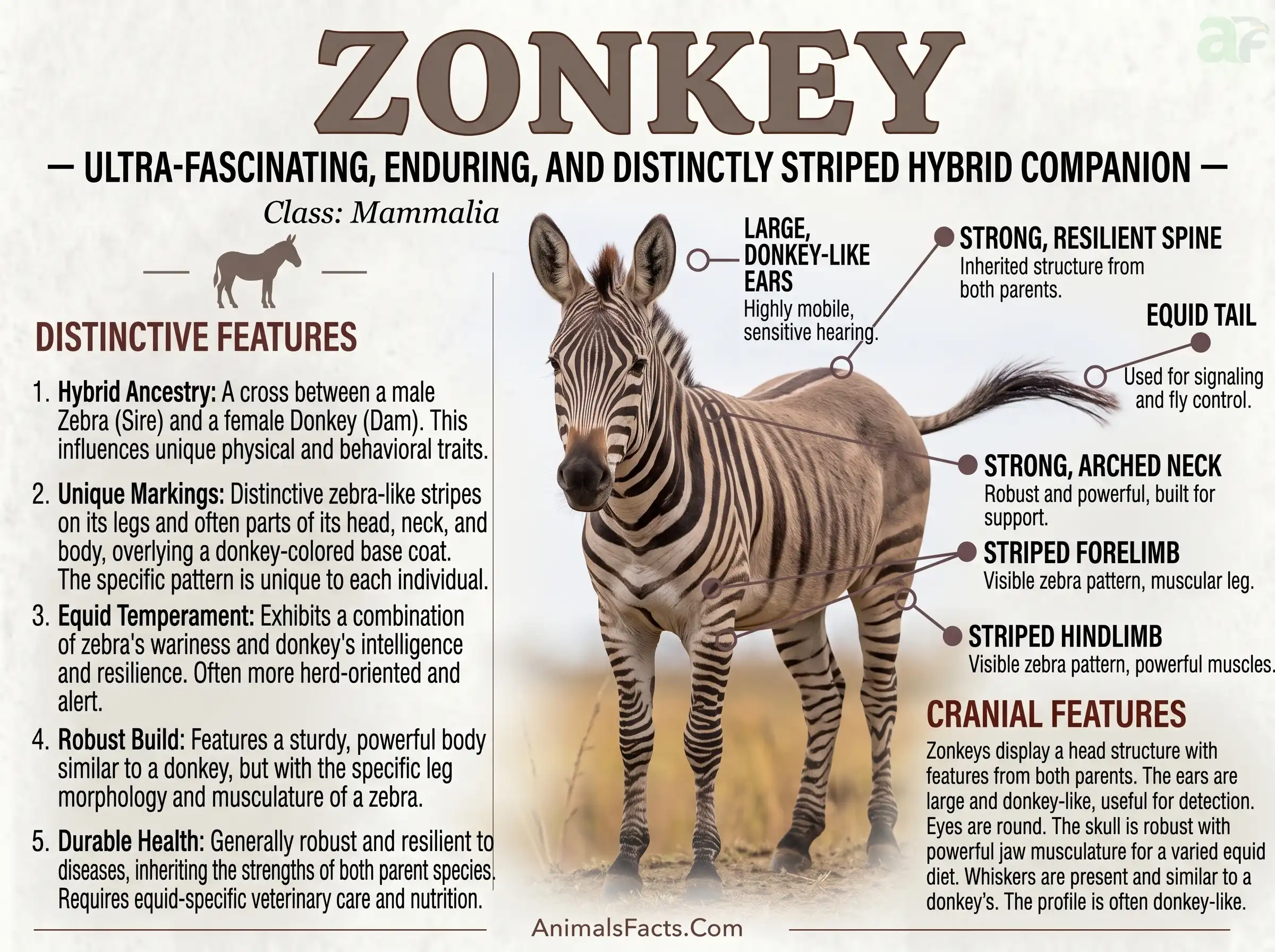
Zonkey size and weight vary considerably depending on the specific parent species involved — but all zonkeys share a distinctive and immediately recognizable physical signature that combines features of both parent species in ways that are simultaneously predictable and endlessly variable between individuals.
Body Form
The zonkey’s body typically reflects a blend of both parent species’ morphology — with the overall body shape, head size, and ear length being variable mixes of zebra and donkey characteristics. In most zonkeys:
- The overall body conformation resembles a donkey more than a zebra — compact, sturdy, with a relatively large head and upright mane
- The ear length is typically intermediate — longer than a zebra’s but shorter than a full-sized donkey’s
- The legs are proportionally longer than a typical donkey’s, reflecting zebra influence
- The overall height and weight fall between the parent species
The Defining Feature — Striped Legs
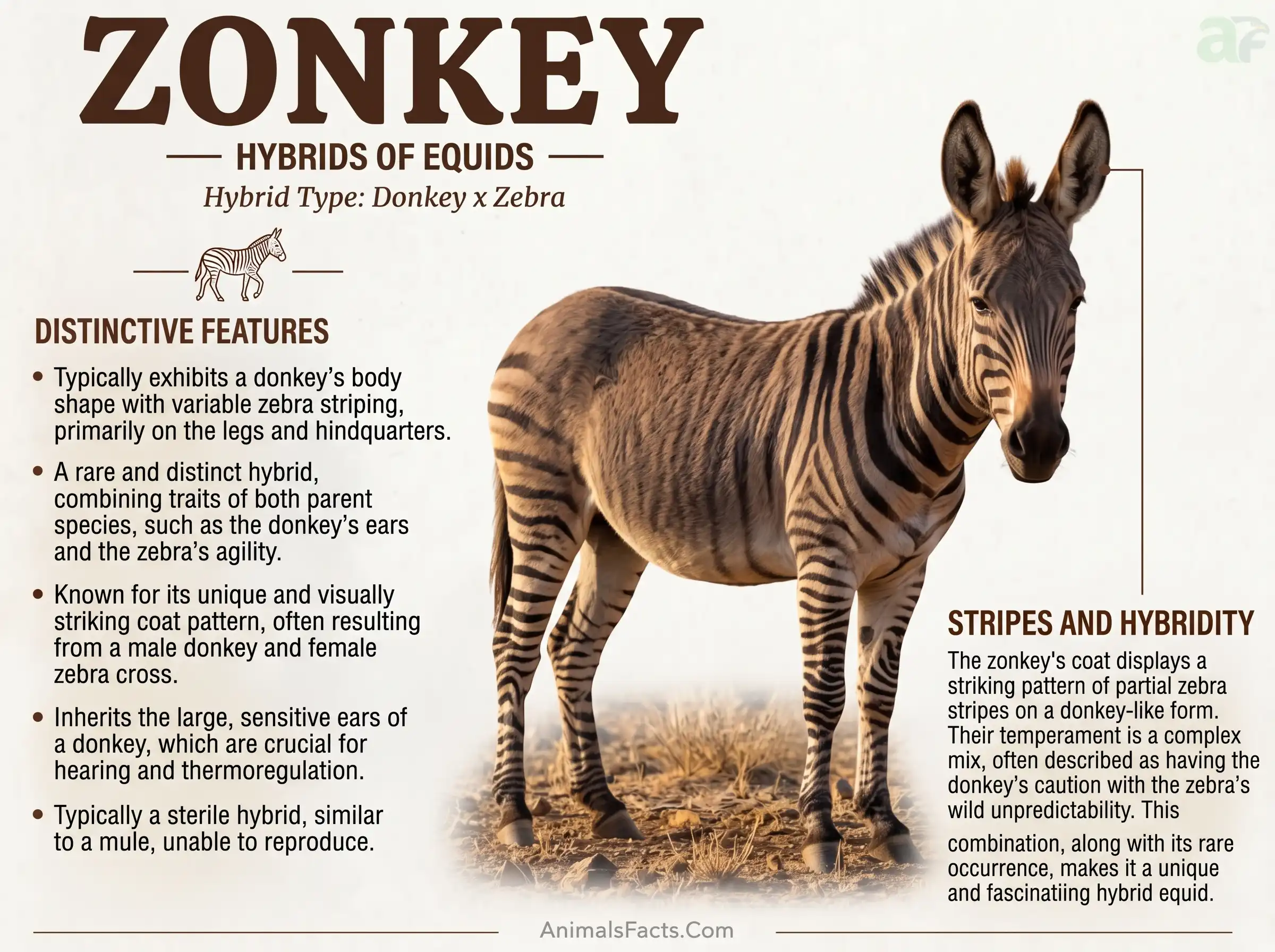
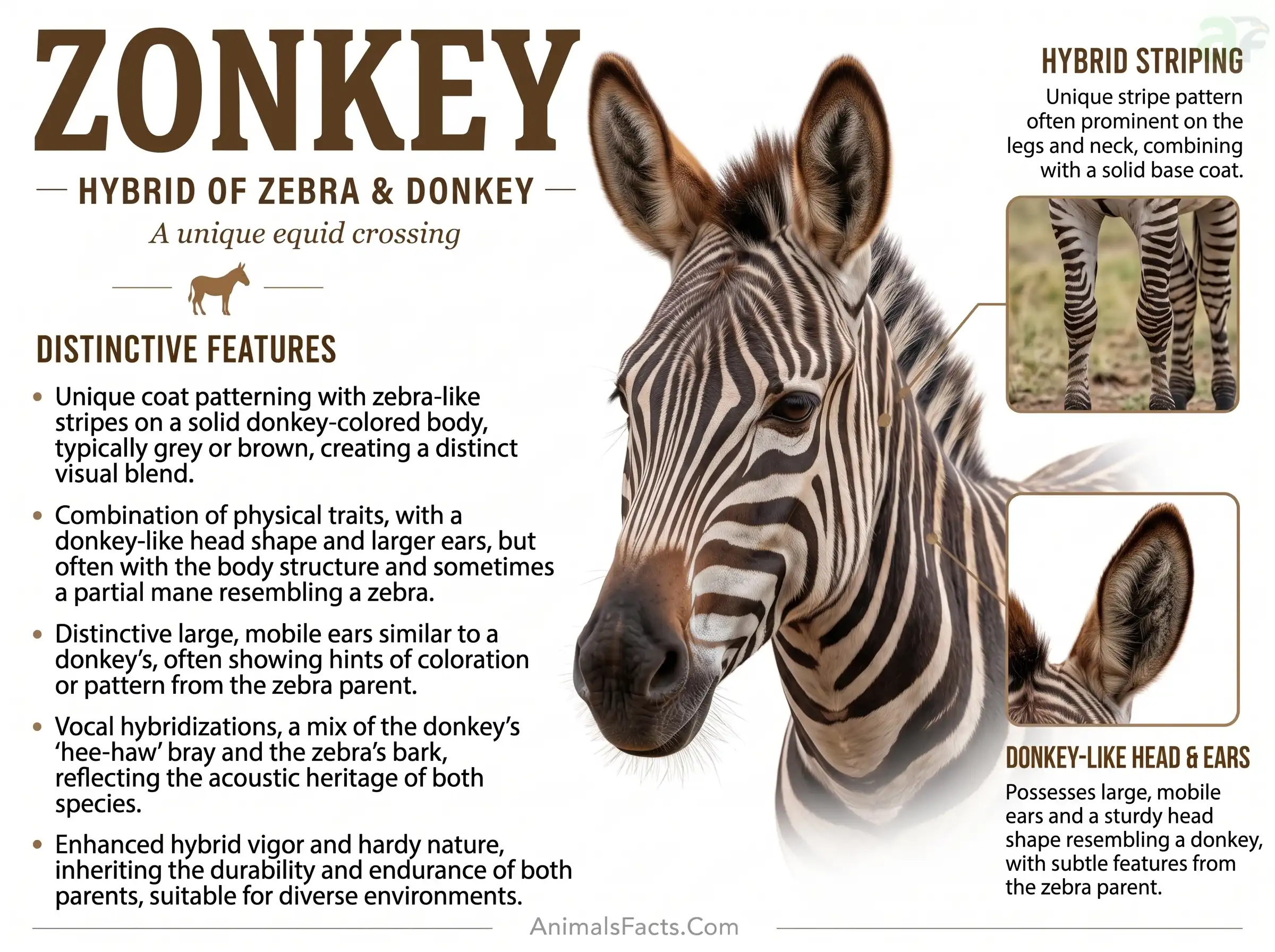
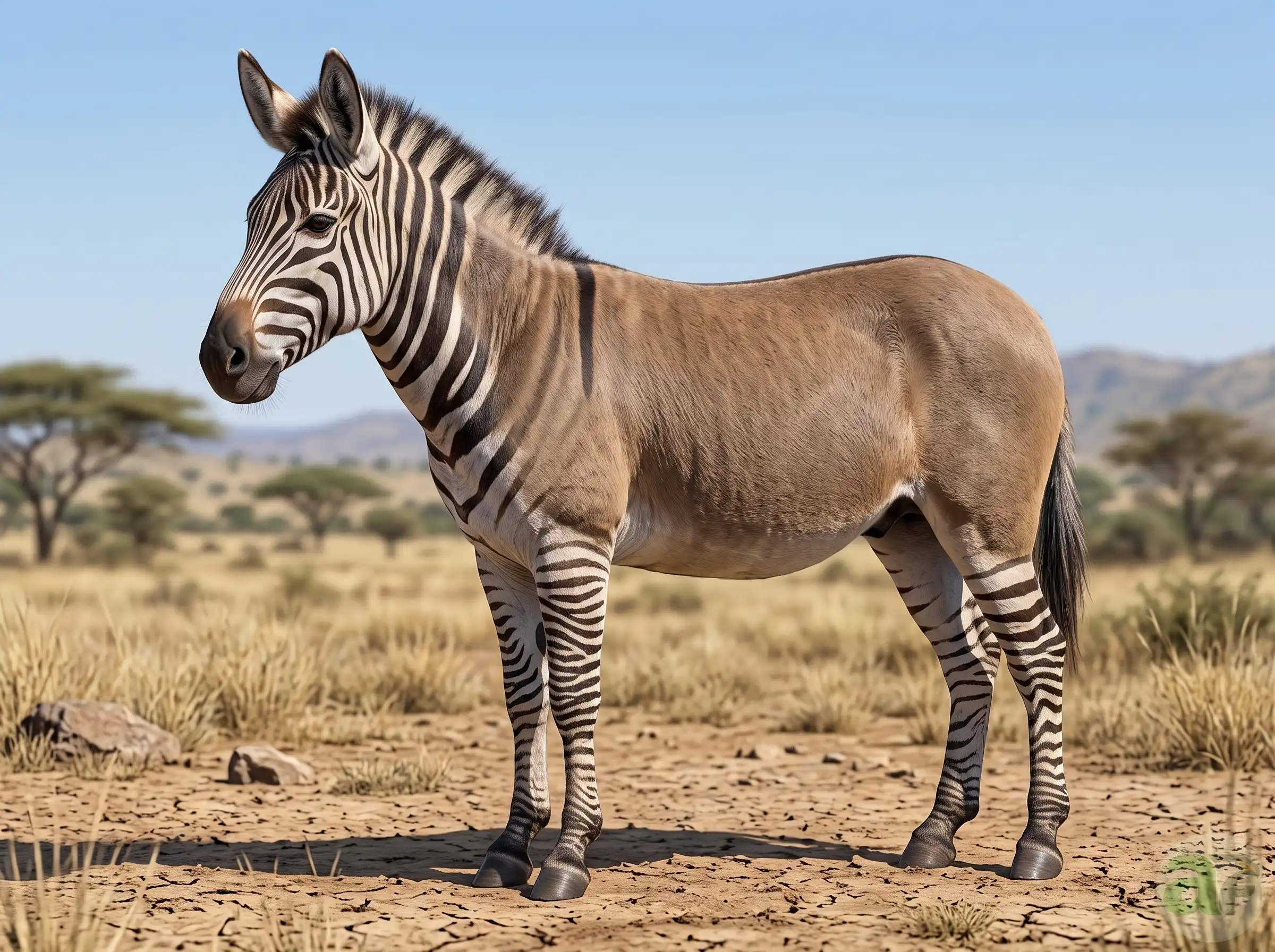
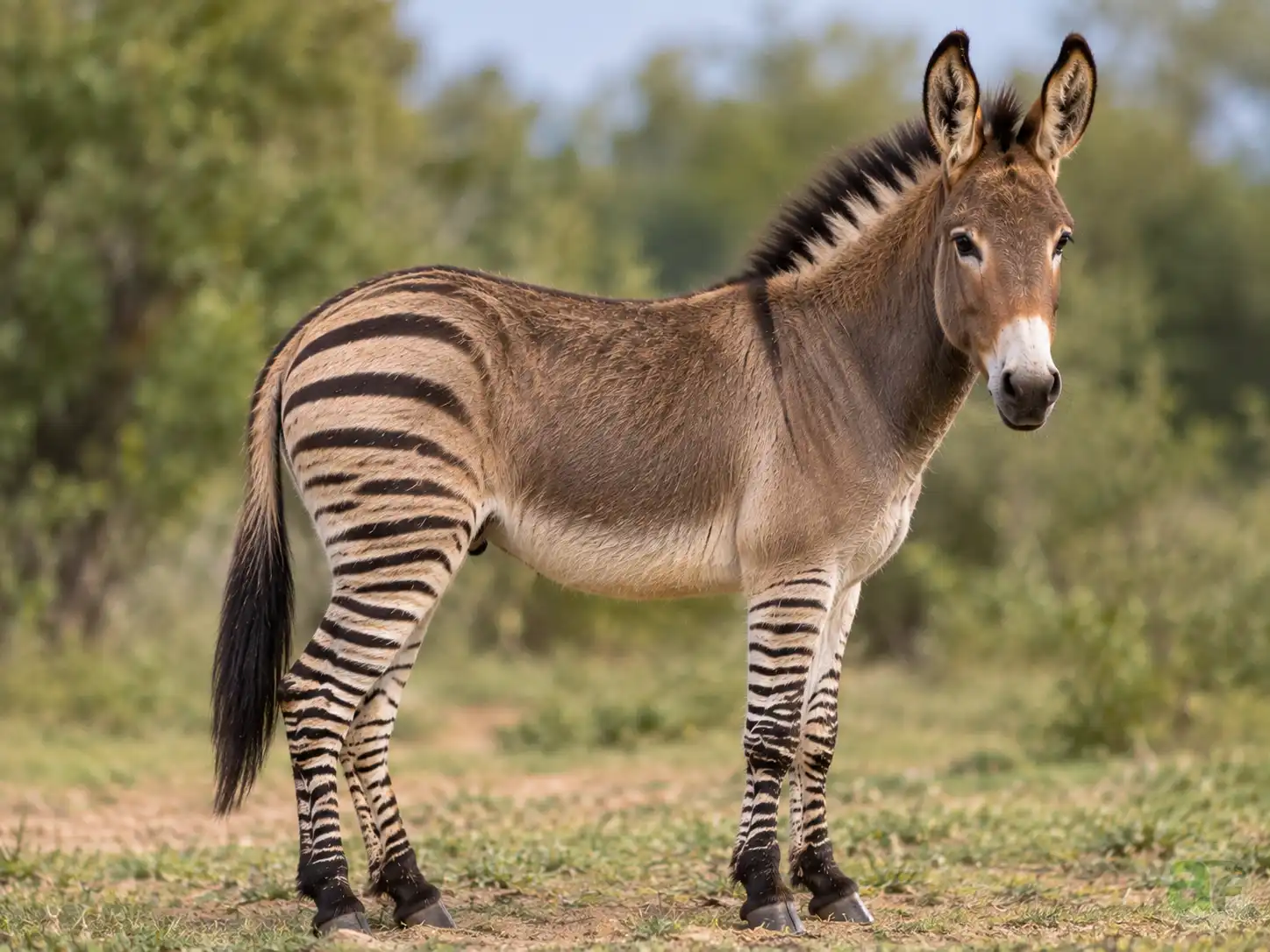
The most immediately striking and visually defining feature of virtually every zonkey is the presence of bold black-and-white or brown-and-cream stripes — typically concentrated on the legs and lower body, fading to a more uniform donkey-like coloration on the upper body, neck, and head. This pattern reflects the genetics of coat color and pattern inheritance — the zebra’s striping genes are partially expressed in the hybrid, producing the characteristic “zebra socks” appearance that makes zonkeys instantly identifiable.
The extent and boldness of the striping varies considerably between individuals depending on:
- Which zebra species was the parent (Grévy’s zebra hybrids tend to have narrower, more numerous stripes; plains zebra hybrids show broader, bolder stripes)
- The specific genetic combination inherited from each parent — striping pattern genes show variable dominance in hybrids
- Body region — stripes are almost always more prominent on the legs and hindquarters, fading on the barrel and neck
Coat Color
The base coat color of most zonkeys is tan, brown, or grey-brown — reflecting the donkey parent’s typical coloration — overlaid with the zebra-derived stripes in darker brown to black. Some zonkeys show a dorsal stripe (a single dark line running along the spine from neck to tail) — a feature common in donkeys that may be enhanced or modified by zebra genetics. The overall visual impression is of a donkey that has been partially dipped in zebra paint — with the lower body vividly striped and the upper body in the muted tones of the donkey parent.
Mane & Tail
Most zonkeys have an upright, stiff mane resembling a zebra’s rather than the longer, flowing mane of a horse or the coarser mane of a donkey — reflecting stronger expression of the zebra’s mane genetics. The tail typically resembles the donkey parent’s — with a tufted tip of longer hair — though some zonkeys show intermediate tail characteristics.
Gender & Size Differences
Zonkey males are generally slightly larger and heavier than females — reflecting the size dimorphism of both parent species. Zonkey size varies significantly depending on whether the zebra parent was the large Grévy’s zebra (producing larger zonkeys) or the smaller mountain zebra (producing smaller ones). A zonkey with a Grévy’s zebra father and a large-breed donkey mother might weigh up to 450 kg — while a mountain zebra × standard donkey hybrid might weigh as little as 200 kg.
Did You Know? The striping pattern of a zonkey is not simply a blend of the two parent coats — it reflects the complex genetics of pattern formation during embryonic development. Zebra stripes develop from the activation and inhibition of pigment-producing cells (melanocytes) during embryonic skin development — a process that follows a precise spatial pattern determined by multiple genes. In a zonkey embryo, these same genes are present but interact with the donkey’s different pigmentation genetics, producing patterns that are neither fully zebra nor fully donkey but a unique genetic negotiation between the two systems.
4. Top 25 Amazing Zonkey Facts
Here is your definitive collection of the most extraordinary, scientifically verified, and genuinely mind-bending zonkey facts as of 2026:
- Zonkeys are not purely fictional or zoo inventions — wild zonkeys occur naturally in parts of sub-Saharan Africa where domestic donkeys share landscapes with zebra populations, including documented cases in Kenya, Ethiopia, and Tanzania.
- A zonkey’s chromosome count — approximately 53–54 — sits precisely between the zebra’s 44–46 and the donkey’s 62, reflecting the mathematical averaging of the two parent genomes.
- Zonkeys are almost always sterile — their odd chromosome number prevents normal meiosis (the cell division that produces eggs and sperm), making reproduction biologically impossible in virtually all cases.
- The “zedonk” Ippo born in Georgia, USA in 2010 became one of the most photographed hybrid animals in internet history — her image generating millions of social media shares and introducing the concept of equid hybridization to a global audience.
- A wild zonkey documented in Kenya’s Tsavo East National Park in 2014 was observed living fully integrated into a plains zebra herd — behaviorally functioning as a zebra despite its distinctive donkey-influenced appearance.
- Zonkeys inherit the hardiness of both parent species — combining the donkey’s legendary disease resistance and endurance with the zebra’s adaptability to harsh African conditions, making them remarkably robust animals.
- The striped legs of a zonkey are not simply superficial coloring — the stripe pattern is genetically determined by the same molecular signaling pathways that produce full zebra stripes, partially activated in the hybrid genome.
- Zonkeys typically have better disease resistance than purebred donkeys in some disease environments — reflecting a phenomenon called hybrid vigor (heterosis), where hybrids sometimes outperform either parent species in specific physiological measures.
- A zonkey’s vocalization is one of its most amusing characteristics — many zonkeys produce calls that are intermediate between the zebra’s bark-like whinny and the donkey’s iconic bray, sometimes described as a “bray-whinny” combination that sounds like neither parent species cleanly.
- The mule (horse × donkey) is the world’s most familiar and historically important equid hybrid — and the zonkey’s existence is often explained by comparison: just as horses and donkeys produce mules, zebras and donkeys produce zonkeys.
- Unlike mules — which have been bred and used as working animals for 5,000+ years — zonkeys have never been systematically bred for practical use due to their rarity, their variable size, and the difficulty of managing zebra-derived animals that retain wild behavioral tendencies.
- The ears of a zonkey are typically longer than a zebra’s but shorter than a standard donkey’s — an intermediate expression of ear length genetics that is one of the most reliable physical indicators of hybrid parentage.
- Zonkeys are not domesticated animals in the traditional sense — even captive-born zonkeys that are handled from birth retain behavioral characteristics inherited from their zebra parent, including wariness, flight responses, and occasional unpredictability.
- The Kenyan wild zonkey documented in 2014 appeared to be accepted by the local zebra herd without significant aggression — suggesting that zebra social recognition based on stripe pattern and behavior may be flexible enough to accommodate an individual with intermediate characteristics.
- Zonkeys have stronger hooves than most horses and comparable strength to donkey hooves — a structural characteristic inherited from both parent species that makes them theoretically capable of traversing rocky terrain with minimal hoof care.
- The first recorded deliberate breeding of a zonkey in a documented scientific context occurred in the early 20th century when European zoos began systematically crossing zebra stallions with donkey mares to study equid hybridization.
- Female zonkeys — while sterile — still cycle hormonally, show estrus behavior, and can sometimes be used as teaser animals in breeding programs to gauge the reproductive readiness of stallions.
- The behavioral temperament of individual zonkeys varies enormously — some individuals are remarkably calm and handleable, reflecting donkey-influenced temperament, while others retain strong zebra-derived flight responses and can be difficult to approach even after years of human contact.
- Zonkeys have been documented living for over 20 years in captive settings — a lifespan consistent with both parent species and suggesting that the hybrid genome does not impose significant longevity costs.
- The Tsavo wild zonkey’s DNA, analyzed from hair samples collected by researchers, confirmed it was the offspring of a plains zebra (Equus quagga) mother and a domestic donkey (Equus asinus) father — a reversed cross (zebra mother rather than father) that is less commonly documented than the standard zebra stallion × donkey jenny cross.
- Zonkeys often display heterosis (hybrid vigor) in terms of disease resistance — showing resistance to certain tick-borne diseases and intestinal parasites that affect both parent species, making them paradoxically healthier than purebred animals in high-disease environments.
- The social behavior of captive zonkeys shows fascinating blending — they typically bond more readily with donkeys than with zebras in mixed-species settings, possibly because their overall appearance and smell are more donkey-like despite the striped legs.
- Some zonkeys show a distinctive shadow stripe or ghost striping on the upper body — faint stripes visible in certain lighting conditions on what appears to be a uniformly colored upper coat, reflecting the partial expression of striping genes that are more fully expressed on the legs.
- Genetic research on equid hybrids including zonkeys has contributed significantly to understanding speciation mechanisms — the process by which one species becomes two — by documenting exactly which genetic differences cause sterility in hybrids.
- The zonkey represents one of the most visually striking examples of Mendel’s laws of inheritance in action — the partial expression of zebra stripe genes in a donkey-bodied animal demonstrates dominant and recessive gene expression in a pattern that biology students worldwide now use as a teaching example.
5. Fun Facts About Zonkeys
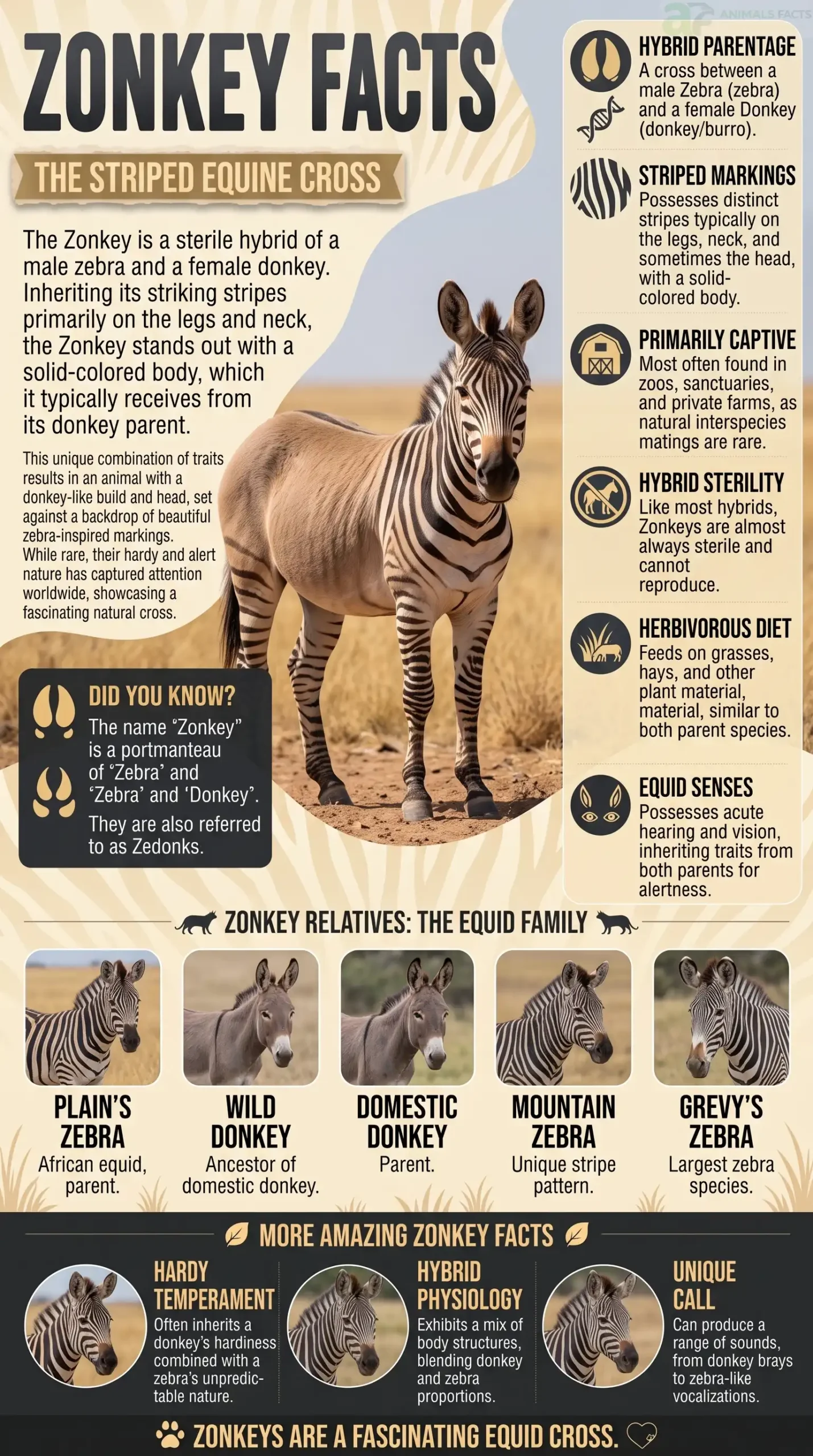
- Zonkeys have approximately 53 chromosomes — between zebra’s 44–46 and donkey’s 62
- Wild zonkeys have been documented living in Kenyan zebra herds
- A zonkey’s call is a bizarre blend of a zebra’s whinny and a donkey’s bray
- Zonkeys are almost always completely sterile — they cannot reproduce
- The zonkey named “Ippo” became an internet sensation in 2010
- Zonkeys often have better disease resistance than either parent species
- Each zonkey is essentially a genetic one-off that cannot pass its genes forward
- Zonkey stripe patterns vary depending on which zebra species was the parent
- Zonkeys can live for over 20 years in captivity
- Their hooves are exceptionally strong — inherited from both hardy parent species
- Zonkeys retain wild zebra behavioral tendencies even when hand-raised
- The zonkey is sometimes called a zedonk, zebonkey, or donkra
6. Natural Habitat & Geographic Range
Zonkey habitat is almost exclusively the human-managed environments of zoos, wildlife parks, and private animal facilities — because the zonkey is not a naturally occurring species but a hybrid that requires the unlikely proximity of two species that evolved in overlapping but distinct ecological niches. However, naturally occurring zonkeys do exist in limited areas of Africa where zebra populations and domestic donkey populations share unmanaged landscapes.
Captive Habitat
The vast majority of the world’s zonkeys live in:
- Zoological parks and wildlife sanctuaries — where they are kept as educational exhibits demonstrating equid hybridization
- Private wildlife facilities — in Africa, the Americas, and Europe where exotic animal enthusiasts maintain small herds
- Research facilities — studying equid genetics, hybridization biology, and reproductive physiology
- Petting zoos and farm parks — where the zonkey’s distinctive appearance and relatively calm temperament (in some individuals) makes them popular visitor attractions
Wild Zonkey Range
Naturally occurring wild zonkeys are documented primarily in areas of sub-Saharan Africa where:
- Plains zebra populations (Equus quagga) come into contact with domestic donkeys in or near pastoral communities
- Fencing is minimal or absent, allowing genuine interbreeding opportunities
- The zebra population is large enough that occasional reproductive contact with donkeys occurs
Confirmed and credibly reported wild zonkey locations include:
| Region | Country | Notes |
|---|---|---|
| Tsavo region | Kenya | Most documented wild zonkey case (2014) |
| Laikipia Plateau | Kenya | Multiple reported sightings |
| Afar Triangle | Ethiopia | Several reported cases near pastoral communities |
| Serengeti border areas | Tanzania | Occasional reports |
| Limpopo region | South Africa | Rare reports near game farm boundaries |
| Masai Mara region | Kenya | Occasional contact zone |
Why Wild Zonkeys Are Rare
Despite the extensive overlap between zebra and donkey ranges across sub-Saharan Africa, wild zonkeys are genuinely rare for several important reasons:
- Species recognition — zebras preferentially associate and breed with other zebras; cross-species mating requires unusual social circumstances
- Physical barriers — even in the same landscape, zebras and donkeys typically occupy slightly different microhabitats
- Behavioral differences — the social structures of zebra herds and domestic donkey groups differ enough to reduce regular interaction
- Human management — domestic donkeys are typically kept within some level of human management that limits their free interaction with wild zebra populations
Did You Know? The Tsavo wild zonkey documented in Kenya in 2014 was first noticed by researchers from the Sheldrick Wildlife Trust who saw a small zebra-like animal with unusually long ears and an atypical striping pattern moving with a zebra herd near the Tsavo East National Park boundary. When approached and photographed, the animal’s donkey parentage was unmistakable — striped legs on a clearly donkey-proportioned body. DNA analysis later confirmed the animal as a genuine wild-born zonkey — not a captive escape — demonstrating that natural hybridization events do occur in the wild without human involvement.
7. Diet & Feeding Behavior
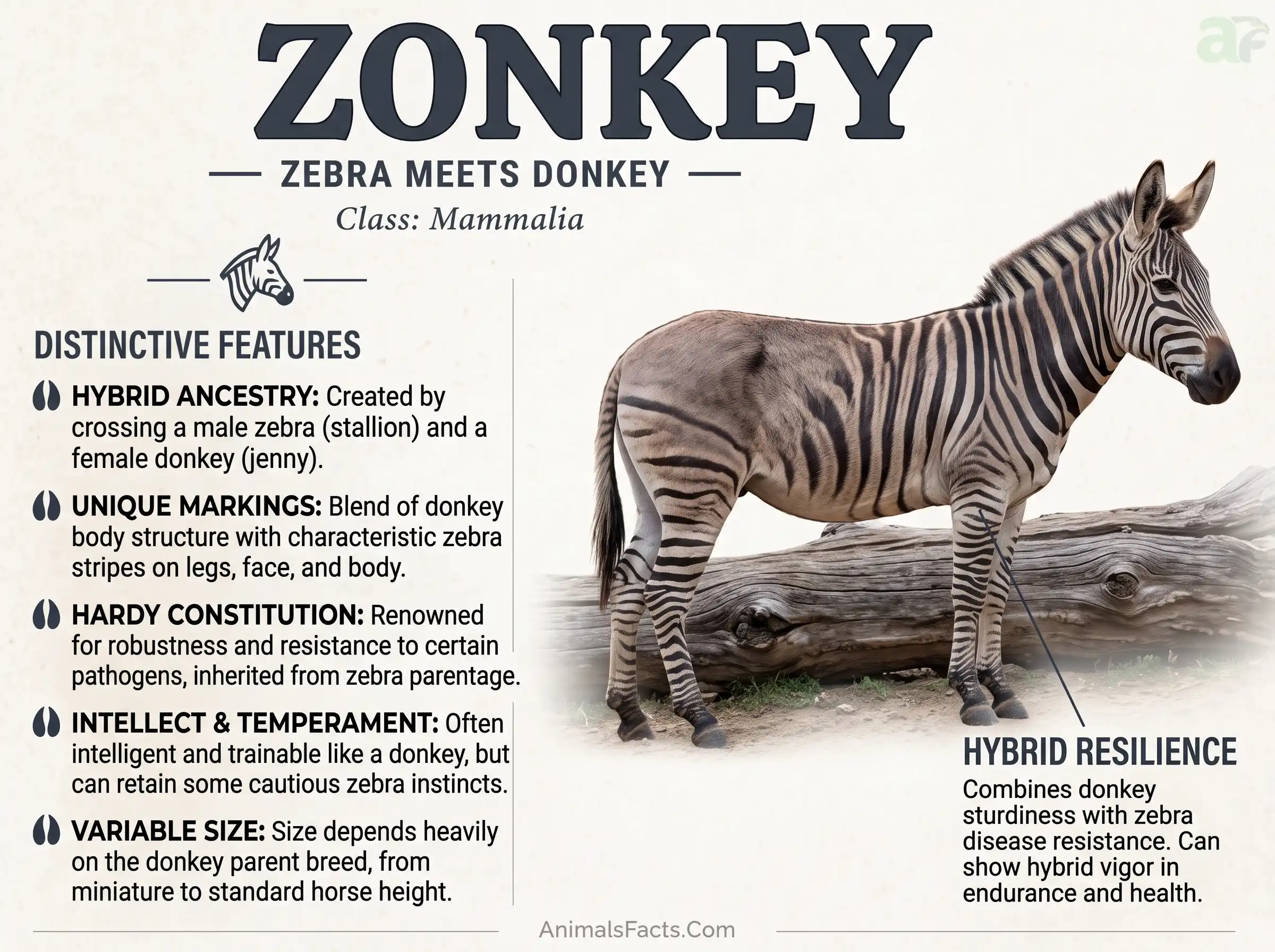
Zonkey diet is straightforwardly herbivorous — reflecting the dietary patterns of both parent species, which are themselves obligate herbivores occupying broadly similar dietary niches despite their different natural environments.
Diet Breakdown Table
| Food Type | Estimated % of Diet | Notes |
|---|---|---|
| Grasses and hay | ~60–70% | Primary dietary component; reflects zebra and donkey dietary base |
| Leaves and browse | ~10–15% | Shrubs, tree leaves; more prominent in donkey-influenced feeding |
| Herbs and forbs | ~5–10% | Broad-leaved plants; nutritional supplement |
| Fruits and vegetables | ~5–10% | Apples, carrots, other produce in captivity |
| Bark and woody material | ~2–5% | Occasional; more common in donkey-influenced individuals |
| Mineral supplements | Non-nutritive | Salt licks and mineral blocks essential in captivity |
Feeding Behavior
Zonkeys are continuous grazers — like all equids, they are designed to consume small quantities of fibrous vegetation throughout most of their waking hours, relying on a large, simple hindgut fermentation system (cecum) to break down plant cellulose.
Donkey dietary heritage — Donkeys evolved in arid environments (northeastern Africa and the Middle East) and are extraordinarily efficient at extracting nutrition from poor-quality vegetation. They can survive on sparse, dry, thorny vegetation that would be nutritionally insufficient for horses. This dietary efficiency is partially inherited by zonkeys — they are generally able to thrive on lower-quality forage than a horse of equivalent size would require.
Zebra dietary heritage — Zebras are primarily grass specialists, following seasonal grass growth across savanna landscapes in the great migrations of East Africa. Their digestive systems are optimized for processing large quantities of coarse grass. This heritage manifests in the zonkey’s preference for grass-based forage and its ability to process lower-quality fibrous hay efficiently.
Water requirements — Zonkeys require regular water access but can tolerate somewhat longer intervals between drinking than horses, reflecting the donkey parent’s greater desert adaptation. In captive settings, fresh water should be available at all times.
Foraging Behavior
Captive zonkeys display mixed foraging strategies — some individuals show strong grazing behavior (head down, moving slowly across a grass area), while others show more browsing behavior (selectively picking leaves and shoots from vegetation at head height). This behavioral variation between individuals reflects the variable expression of parental behavioral tendencies in the hybrid genome.
8. Reproduction & Life Cycle
Zonkey reproduction — or more accurately, the fundamental inability to reproduce that defines the species — is one of the most biologically fascinating aspects of this hybrid animal, and understanding it requires a basic understanding of the chromosome biology that makes hybrids between different species generally sterile.
Why Zonkeys Cannot Reproduce — The Chromosome Biology
The root cause of zonkey sterility lies in the chromosome count mismatch between parent species:
- Zebra (Equus quagga): 2n = 44 chromosomes (22 pairs)
- Donkey (Equus asinus): 2n = 62 chromosomes (31 pairs)
- Zonkey: 2n ≈ 53 — receiving 22 chromosomes from the zebra parent and 31 from the donkey parent
Normal reproduction requires meiosis — a specialized cell division that produces eggs and sperm, each containing half the normal chromosome number. For meiosis to work properly, chromosomes must pair up with their matching partners (homologous chromosomes) and then separate cleanly.
In a zonkey, the 22 zebra chromosomes cannot properly pair with the 31 donkey chromosomes because they are not homologous — they represent different evolutionary reorganizations of the original equid genome. The result is that meiosis fails or produces chromosomally abnormal eggs and sperm that cannot successfully fertilize or develop. The zonkey is therefore reproductively dead-end — each individual is a unique genetic combination that will never be reproduced.
Zonkey Longevity
Despite their sterility, zonkeys are physiologically healthy animals with lifespans estimated at 15–25 years — consistent with the lifespans of both parent species (domestic donkeys commonly live 25–40 years; zebras live 20–30 years in the wild and longer in captivity). The sterility itself does not affect the zonkey’s general health or longevity — it is a reproductive limitation, not a metabolic one.
Growth & Development
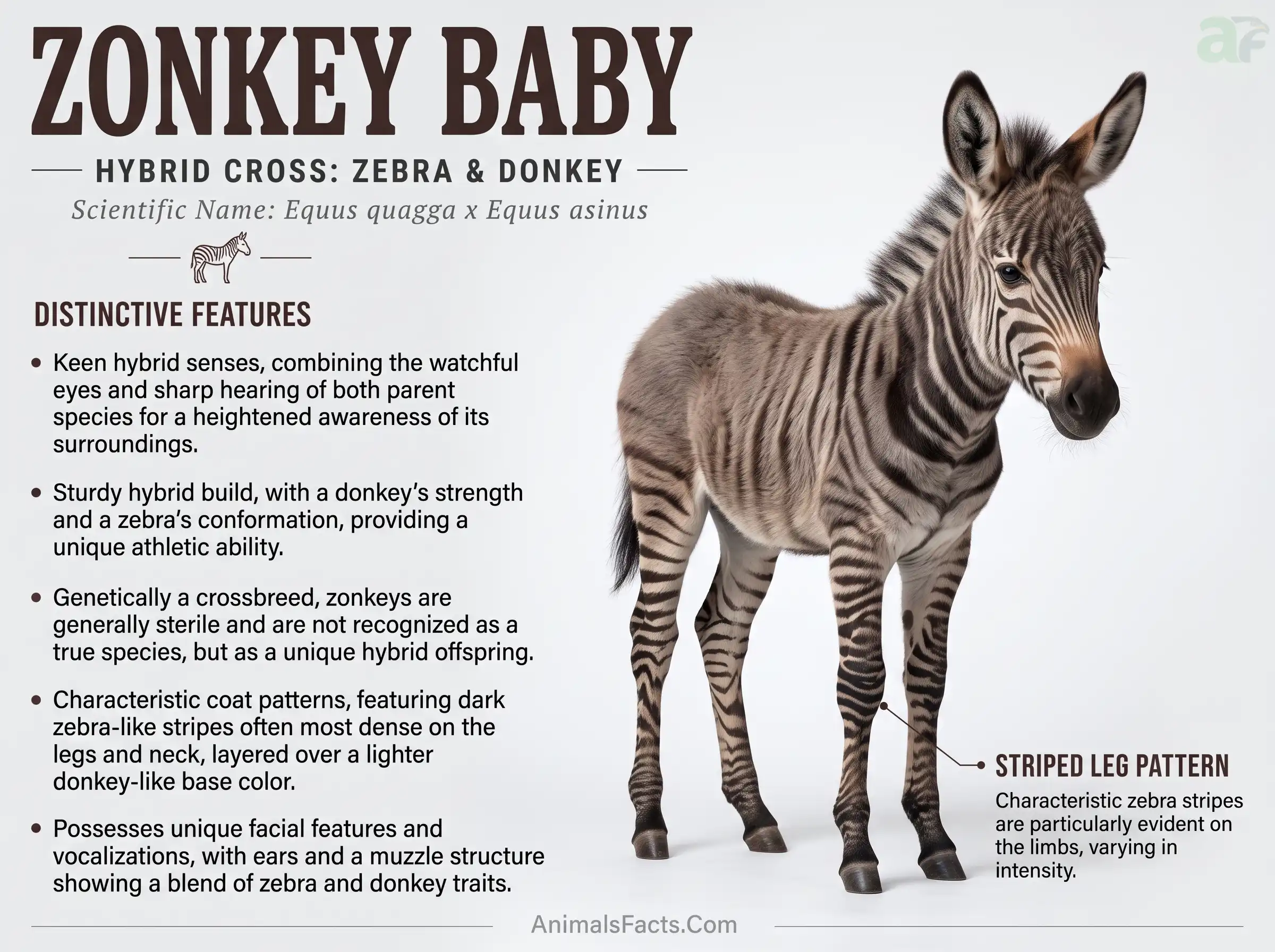
Zonkey foals develop at rates broadly similar to donkey foals — reaching significant size within the first year and approaching adult proportions by 2–3 years of age. The striping pattern that makes zonkeys visually distinctive is present from birth — foals are born with the same leg stripes they will carry throughout their life, though the contrast may intensify slightly as the adult coat develops.
Lifespan Comparison Table
| Animal | Average Lifespan (Wild/Working) | Average Lifespan (Captivity) | Reproductive? |
|---|---|---|---|
| Zonkey (hybrid) | ~15–20 years (estimated) | Up to 25 years | No — sterile |
| Mule (horse × donkey) | 15–20 years (working) | Up to 40 years | No — sterile |
| Plains zebra (E. quagga) | 20–25 years | Up to 40 years | Yes |
| Domestic donkey (E. asinus) | 25–30 years | Up to 40+ years | Yes |
| Domestic horse (E. caballus) | 20–25 years | Up to 35 years | Yes |
9. Social Behavior & Communication
Zonkey social behavior is one of the most intriguing aspects of these hybrid animals — reflecting a genuine behavioral negotiation between the social tendencies inherited from two quite different parent species, producing individuals whose social preferences and communication patterns are sometimes predictable and sometimes genuinely surprising.
Social Preferences
In captivity, zonkeys show highly variable social preferences. Some individuals bond strongly with donkeys — their overall body odor, behavioral signals, and social approach apparently triggering donkey social recognition despite the striped legs. Others show stronger affinity for zebra companions when available. Many captive zonkeys form bonds with whatever equid companion is available — reflecting the strong equid need for social companionship that is common to all members of the horse family.
In the wild, the Tsavo zonkey was observed fully integrated into a plains zebra herd — moving with the herd, grazing alongside zebra individuals, and apparently accepted as a herd member. This remarkable behavioral integration suggests that zebra social recognition is based on a broader set of signals than just visual stripe pattern — including smell, vocalizations, and behavioral cues that the zonkey may have inherited sufficiently from its zebra parent to pass the social recognition threshold.
Vocalizations
The zonkey’s vocal communication is among its most entertaining characteristics. Equid vocalizations are species-specific — donkeys bray (the iconic “hee-haw”), zebras whinny (a high-pitched, bark-like sound quite different from a horse’s whinny), and horses whinny and neigh. Zonkeys typically produce intermediate vocalizations that blend elements of both parent species’ calls — sometimes described as a bray that transitions into a whinny, or a whinny with an unusual rough quality. Individual zonkeys vary in which parental vocalization pattern is more dominant.
Intelligence
Zonkeys appear to inherit the intelligence characteristics of both parent species — the donkey’s legendary stubbornness and problem-solving persistence combined with the zebra’s environmental awareness and cautious intelligence producing animals that are simultaneously clever and challenging. Donkey intelligence is frequently underrated — donkeys are capable of complex learning, recognize familiar humans after long absences, and are remarkably good at evaluating risks before acting. Zebra intelligence is calibrated to predator-rich savanna environments — strong spatial memory, excellent predator recognition, and rapid threat assessment. Zonkeys appear to exhibit both sets of characteristics, making them potentially more cognitively capable than either parent species in some test situations.
10. Predators & Defense Mechanisms
The predator profile and defense capabilities of zonkeys depend heavily on whether the individual is wild or captive — captive zonkeys face essentially no predation threat, while wild zonkeys in African landscapes potentially face the same predator community as wild zebras.
Potential Wild Predators
For wild-born zonkeys in sub-Saharan Africa, the relevant predator community includes:
- Lions (Panthera leo) — Primary predators of wild zebras and therefore potential predators of wild zonkeys of comparable size
- Spotted hyenas (Crocuta crocuta) — Major predators of zebras across the African savanna; would pose a genuine threat to wild zonkeys
- Wild dogs (Lycaon pictus) — Cooperative hunters capable of taking prey significantly larger than themselves
- Leopards (Panthera pardus) — Would threaten young or smaller zonkeys
- Nile crocodiles (Crocodylus niloticus) — A threat at water crossings, as they are for zebras
Defense Strategies
Speed — Like both parent species, zonkeys can run at estimated speeds of 40–50 km/h — sufficient to outrun most large predators over any significant distance. Sustained running endurance, combining the donkey’s legendary stamina with the zebra’s speed, may make zonkeys particularly effective at escape over longer distances.
Kicking — All equids are formidable defensive kickers — a full-force kick from an adult equid can seriously injure or kill a large predator. Zonkeys inherit this defensive capability from both parent species, making them genuinely dangerous to any predator that approaches from behind.
Herd integration — The Tsavo wild zonkey’s integration into a zebra herd provided it with the collective vigilance and predator confusion benefits of group living — a fundamental anti-predator strategy of savanna herbivores that the zonkey was able to access through its behavioral acceptance by the herd.
Camouflage limitations — Ironically, the zonkey’s distinctive striped legs may actually compromise the camouflage that full zebra stripes provide in a herd context. Zebra stripe patterns are thought to contribute to motion dazzle — a visual confusion effect that makes it difficult for predators to accurately target an individual animal in a moving herd. A zonkey with partial stripes may not fully benefit from this effect.
Did You Know? The donkey’s legendary stubbornness — which has made donkeys the subject of countless jokes and expressions — is actually a sophisticated self-preservation mechanism. Unlike horses, which can be panicked into running themselves to death by a perceived threat, donkeys assess dangerous situations carefully before deciding on action. A donkey that “refuses to move” is typically evaluating whether the proposed action is safe — and will only proceed when its own assessment confirms the risk is acceptable. Zonkeys appear to inherit this careful risk assessment behavior from their donkey parent, making them less prone to panic but potentially more challenging to handle in unfamiliar situations.
11. Zonkey Facts for Kids
Hey incredible young animal explorers! Here are some totally mind-blowing zonkey facts for kids that will absolutely astonish everyone you share them with:
- 🦓 A zonkey is a real animal — not a cartoon! It’s the actual offspring of a real zebra and a real donkey. When these two animals have a baby together, the result is a zonkey — with a donkey’s body and zebra-striped legs. Nature is more creative than any cartoonist!
- 🦓 Zonkeys have striped socks! Most zonkeys have a donkey-colored body but zebra stripes on their legs — like they’re wearing black-and-white striped stockings. It’s one of the most visually amazing things in the whole animal kingdom!
- 🦓 Zonkeys can’t have babies of their own! Because their zebra parent and donkey parent have different numbers of chromosomes — the tiny instruction packages inside every cell — the zonkey’s body can’t make the cells needed to reproduce. Each zonkey is a unique one-of-a-kind animal that can never be recreated!
- 🦓 They make the funniest sound! When a zonkey calls out, it produces a sound that’s half donkey bray and half zebra whinny — like nature couldn’t decide which sound to give it and ended up mixing both together!
- 🦓 Wild zonkeys actually exist in Africa! In Kenya and Ethiopia, where wild zebras and domestic donkeys sometimes live near each other, real wild zonkeys have been born without any human help. They then join zebra herds and live wild lives!
- 🦓 Zonkeys are super tough! They combine the donkey’s legendary toughness and ability to survive on poor food with the zebra’s hardiness — making them amazingly robust animals that can handle harsh conditions better than most other equids.
- 🦓 Their name can be said MANY ways! People call them zonkeys, zedonks, zebonkeys, zebrasses, and donkras — depending on which country you’re in or which parent was the mother and which was the father!
- 🦓 A zonkey can live for over 20 years! Despite being a hybrid with no ability to have babies, zonkeys live just as long as their parents — up to 25 years in captivity — enjoying a full, healthy life.
12. Relationship with Humans
The relationship between humans and zonkeys is relatively recent, culturally specific, and driven primarily by human fascination with novelty and the biology of hybrid animals — making it quite different from the deep, utilitarian, thousands-of-years-old relationships that humans have developed with the zonkey’s parent species.
Historical Human Interest in Equid Hybrids
Human interest in equid hybridization is ancient — the mule (horse × donkey) has been intentionally bred for human use for at least 5,000 years, and ancient civilizations including Mesopotamia, Egypt, and Rome used mules extensively as working animals. The mule’s combination of horse size and donkey toughness made it extraordinarily valuable for agricultural and military transport.
The zebra-donkey cross — the zonkey — attracted human curiosity from the earliest periods of European contact with African wildlife. Colonial-era naturalists documented zebra-donkey hybrids in early zoological literature, and European zoos began attempting deliberate crosses in the early 20th century. However, unlike mules, zonkeys proved to have limited practical utility — they retain the zebra’s wild behavioral tendencies, making them significantly more difficult to train and handle than mules, and their variable size makes them unreliable working animals.
Zonkeys in Zoos and Wildlife Parks
Today, the primary human relationship with zonkeys occurs in zoological and wildlife park contexts — where zonkeys serve as:
- Educational exhibits demonstrating animal hybridization and genetics to the public
- Ambassadors for conservation awareness about their parent species — particularly zebras, which face conservation pressure
- Research subjects for studies of equid genetics, hybridization, and reproductive biology
- Visitor attractions whose distinctive appearance generates significant public interest and social media engagement
The ethical dimensions of deliberately breeding zonkeys in captivity are actively discussed within the zoo community. Some conservationists argue that breeding hybrids diverts resources and attention from conservation of the pure parent species. Others argue that zonkeys serve valuable educational roles and that the individual animals live healthy, long lives without welfare concerns.
Attempted Working Use
There are limited historical accounts of zonkeys being used as pack animals — particularly in parts of Africa where their combination of zebra disease resistance and donkey working temperament was theoretically attractive. In practice, the zebra-derived behavioral traits — including strong flight responses, resistance to handling, and unpredictable reactions to unfamiliar situations — made most zonkeys significantly more difficult to work with than mules or standard donkeys. The few documented attempts to train zonkeys for consistent working use in the modern era have had mixed results — some individuals become reliable under skilled handling, while others remain permanently resistant to systematic training.
13. Conservation Status & Threats
As a hybrid rather than a species, the zonkey has no IUCN conservation status — it cannot be endangered, vulnerable, or threatened because it is not a population that can be managed for conservation in the traditional sense. However, the conservation status of its parent species is directly relevant to the likelihood of wild zonkey occurrences.
Parent Species Conservation Context
| Parent Species | IUCN Status | Wild Population | Trend |
|---|---|---|---|
| Plains zebra (Equus quagga) | Near Threatened | ~500,000 | Decreasing |
| Mountain zebra (Equus zebra) | Vulnerable | ~35,000 | Increasing |
| Grévy’s zebra (Equus grevyi) | Endangered | ~3,000 | Decreasing |
| Domestic donkey (Equus asinus) | Not applicable (domestic) | ~40+ million | Stable |
Implications for Wild Zonkey Occurrence
The declining populations of wild zebra species — particularly the Grévy’s zebra — mean that as zebra populations contract, the probability of contact between wild zebras and domestic donkeys decreases in absolute terms. Paradoxically, as zebra habitat is reduced and zebra populations are pushed into smaller areas that increasingly overlap with human habitation and domestic livestock (including donkeys), the relative probability of inter-species contact may increase locally even as the total zebra population declines.
Ethical Considerations in Captive Breeding
The deliberate breeding of zonkeys in captivity raises several conservation ethics questions that the zoo and wildlife management communities continue to debate:
- Resource allocation — Do captive zonkeys consume resources (space, veterinary care, feeding) that could be more productively applied to conservation breeding of threatened pure species?
- Genetic pollution — While zonkeys themselves are sterile, deliberately maintaining hybrid populations might inadvertently normalize attitudes toward hybridization that could complicate conservation genetics programs
- Educational value vs. sensationalism — Do captive zonkeys genuinely educate the public about genetics and hybridization, or do they primarily serve as novelty attractions?
These debates are healthy and ongoing — reflecting the maturing of zoo conservation ethics that has transformed zoological institutions from collections of curiosities into serious conservation organizations.
14. Famous Zonkeys in History & Pop Culture
Famous Named Zonkey Individuals
“Ippo” — The most famous zonkey in modern popular culture — born in 2010 at the Chestatee Wildlife Preserve in Dahlonega, Georgia, USA, to a zebra mother and donkey father who shared an enclosure. Ippo’s birth generated global media coverage and her photographs — showing the classic zonkey appearance of donkey body with boldly striped legs — went viral across social media platforms at a time when viral animal content was just beginning to dominate internet culture. Her story was covered by CNN, BBC, National Geographic, and hundreds of other outlets. As of 2026, Ippo continues to live at the preserve and remains one of the most photographed hybrid animals in American history.
“Eclyse” — A zonkey born in Germany at the Stukenbrock Safari Park in 2007, whose particular coloration — bold white with distinct black stripes only on part of her body — made her visual appearance especially striking and generated significant European media attention. Unlike most zonkeys whose stripes are concentrated on the legs, Eclyse had a partial striping pattern that covered portions of her flank and face as well — making her appearance particularly dramatic and unusual even within the already unusual zonkey category.
The Tsavo Zonkey — The wild-born zonkey documented by Sheldrick Wildlife Trust researchers in Kenya’s Tsavo region in 2014 — the most thoroughly documented natural hybridization event between wild zebra and domestic donkey populations. This individual’s story was covered extensively in scientific and popular media and contributed significantly to the understanding that wild zonkey occurrence is more than a theoretical possibility.
“Zebby” — A zonkey at the Jerusalem Biblical Zoo in Israel whose distinctive appearance made him one of the most photographed animals at one of the Middle East’s most visited zoological parks — introducing zonkeys to a significant Middle Eastern and international audience and generating considerable local media interest.
15. Role in Ecosystem & Food Chain
As a hybrid animal that does not form natural populations, the zonkey plays no consistent or defined role in any ecosystem — it is essentially an ecological bystander rather than an ecological actor in any systematic sense. However, in the specific context of wild-born zonkeys living in African ecosystems, some ecological observations are possible and interesting.
Wild Zonkey Ecological Integration
The documented case of the Tsavo wild zonkey living within a plains zebra herd offers a rare window into the ecological role that a wild zonkey might play. By virtue of its zebra herd membership, the Tsavo zonkey:
- Contributed to herd vigilance — additional eyes and ears monitoring the environment for predators
- Participated in grazing patterns — moving with the herd and consuming grass in the same pattern as zebra herd members
- Occupied the same ecological niche as a plains zebra — in terms of grass consumption, water use, and spatial distribution
The individual’s ecological footprint would have been essentially identical to that of a plains zebra of similar size — there is no evidence that the hybrid status of a wild zonkey produces meaningfully different ecological impacts from those of either parent species in the same environment.
Educational Ecological Role
The most meaningful ecological role of zonkeys in human contexts is as living demonstrations of hybrid biology — educating visitors to zoological parks about the genetics of species, the concept of reproductive barriers between species, and the biology of hybridization. This educational function contributes indirectly to conservation awareness for both parent species — particularly zebras, whose conservation status is increasingly precarious.
16. Myths, Folklore & Cultural Significance
Hybrid animals have occupied a special position in human cultural imagination across virtually every civilization that has known of their existence — combining features of two known animals into something that seems to transcend ordinary categorical boundaries. The zonkey’s cultural significance is relatively recent compared to mythological hybrids of antiquity, but it draws on a deep human tradition of fascination with boundary-crossing creatures.
The Cultural Fascination with Animal Hybrids
Human mythology is extraordinarily rich in hybrid animal figures — creatures that combine features of two or more known animals in ways that violate ordinary categorical boundaries. The sphinx (human head, lion body), the centaur (human upper body, horse lower body), the griffin (eagle head and wings, lion body), the mermaid (human upper body, fish lower body) — all reflect a persistent human fascination with the idea of animals that exist at the boundary between categories.
Real animal hybrids — including zonkeys, mules, ligers, and others — tap into this same cultural fascination, offering the remarkable spectacle of boundary-crossing that mythology has always celebrated but now manifesting in biological reality. The zonkey’s distinctive appearance — body of one animal, legs of another — is almost exactly the kind of hybrid that mythological imagination produces, making it culturally resonant in ways that purely ordinary animals are not.
African Traditional Attitudes
In some East African pastoral communities — particularly those of the Maasai and related pastoralist peoples — hybrid animals are viewed with a mixture of curiosity and cautious concern. An unusual animal born to domestic livestock or appearing near a herd can carry cultural significance as an omen or unusual event requiring interpretation by community elders. A wild zonkey appearing near a Maasai boma (homestead) would likely be regarded as a remarkable occurrence worthy of discussion and interpretation within local cosmological frameworks, though specific documented traditions regarding zonkeys specifically are limited given the rarity of the phenomenon.
Modern Internet Cultural Significance
The most significant cultural context for the zonkey in the contemporary world is the internet viral phenomenon — the zonkey’s distinctive visual appearance makes it ideally suited to the visual culture of social media sharing. Images and videos of zonkeys — particularly the dramatic leg-striped young zonkeys with their visually striking appearance — generate enormous engagement on platforms including Instagram, TikTok, Twitter/X, and YouTube. This viral visibility has made the zonkey one of the best-known hybrid animals in popular culture and has introduced millions of people to concepts of animal hybridization, genetics, and species biology who would never have encountered these topics through formal education.
17. Zonkeys in Pop Culture
“Ippo” the Georgia Zedonk (2010–present) — The Chestatee Wildlife Preserve zedonk became one of the defining viral animal stories of the early social media era — her photographs and video footage circulated globally across news platforms and social media simultaneously in late 2010, reaching tens of millions of viewers in a pattern that was then relatively novel but has since become the standard mode of wildlife story distribution. Her image continues to circulate on social media as a perennial favorite in lists of “amazing hybrid animals.”
“Eclyse” the German Zonkey (2007–present) — The Stukenbrock Safari Park zonkey’s particularly dramatic partial striping generated significant European media coverage and contributed to zonkey awareness in European audiences for whom the animal was entirely unfamiliar.
Animal hybridization YouTube content — Zonkeys feature prominently in a thriving YouTube genre of “amazing hybrid animal” videos that collectively have accumulated hundreds of millions of views — introducing genetics concepts and hybrid biology to audiences who consume science content through entertainment channels rather than formal education.
“Zonkey” in children’s literature — Several children’s books and educational materials have incorporated the zonkey as a teaching tool for genetics lessons — using the animal’s visually obvious combination of parent features to explain concepts of inheritance, dominant and recessive genes, and species boundaries to young readers.
18. Zonkey Facts vs. Common Myths
| Common Myth | The Real Fact |
|---|---|
| “Zonkeys are not real animals” | False — zonkeys are genuine biological hybrids born from real zebra-donkey crosses; they occur both in captivity and in the wild in Africa |
| “Zonkeys look like half-zebra, half-donkey throughout their body” | Partially false — most zonkeys have donkey-colored upper bodies with zebra stripes primarily on the legs and lower body; full-body striping is rare |
| “Zonkeys can reproduce with each other” | False — zonkeys are almost universally sterile; their mismatched chromosome numbers prevent normal meiosis and therefore reproduction |
| “A zonkey is the same as a zorse” | False — a zorse is a zebra × horse hybrid; a zonkey is a zebra × donkey hybrid. Different parent species, different hybrid animals |
| “Zonkeys only exist in zoos” | False — wild zonkeys have been documented in Kenya, Ethiopia, and other parts of sub-Saharan Africa where zebras and donkeys share unmanaged landscapes |
| “Zonkeys are unhealthy because they are hybrids” | False — zonkeys often exhibit hybrid vigor (heterosis) and are generally healthy animals with normal lifespans; sterility is a reproductive limitation, not a health problem |
| “Zebras and donkeys are closely related because they can hybridize” | Partially misleading — while both are in the genus Equus, they are different species with significantly different chromosome counts; their ability to produce hybrids does not mean they are closely related, only that they share enough genetic compatibility for fertilization |
| “A zonkey’s stripes are the same as a zebra’s” | False — zonkey stripes are partial expressions of the zebra stripe gene system, typically less complete and less uniform than full zebra stripes, concentrated on the legs rather than covering the entire body |
19. Best Places to See Zonkeys
1. Chestatee Wildlife Preserve, Dahlonega, Georgia, USA — Home of the famous Ippo the zedonk — one of the most celebrated zonkeys in modern popular culture. The preserve allows public visits and has been a pilgrimage site for zonkey enthusiasts since Ippo’s birth in 2010. The preserve’s commitment to education about hybrid animals makes it one of the best places to learn about zonkey biology alongside seeing the animals in person.
2. Stukenbrock Safari Park (Safari-Park Stukenbrock), Germany — Home of Eclyse, the dramatic partially-striped zonkey whose unusual coloration generated significant European media attention. The park’s zonkey exhibit has become one of its signature attractions and provides excellent educational context about equid hybridization.
3. Jerusalem Biblical Zoo, Israel — Home to Zebby the zonkey, one of the most famous zonkeys in Middle Eastern and international popular awareness. The zoo’s educational programming around the zonkey exhibit provides excellent context for understanding hybrid animal biology.
4. Various African Wildlife Sanctuaries — Several wildlife sanctuaries and rescue organizations in Kenya, South Africa, and Tanzania that work with orphaned or rescued wild animals occasionally have zonkeys either born on premises or brought in from the wild — providing the opportunity to see animals with wild rather than fully captive backgrounds.
5. Tsavo East National Park, Kenya — While you cannot guarantee seeing the wild zonkey documented here in 2014 (or any successor), the Tsavo region represents the most credible documented location of wild zonkey occurrence. Wildlife safaris in the Tsavo area offer the genuine possibility — however remote — of encountering a wild-born zonkey integrated into a zebra herd.
6. Online — YouTube and Wildlife Photography Archives — For the vast majority of zonkey enthusiasts, the most accessible “encounter” with a zonkey is through the extraordinary quality of wildlife photography and video content available online. Channels dedicated to unusual and hybrid animals have accumulated thousands of hours of zonkey footage from locations worldwide.
7. Check Local Exotic Animal Parks and Sanctuaries — Zonkeys exist in small numbers at exotic animal parks, petting zoos, and wildlife sanctuaries across the United States, Europe, and other regions. A simple internet search for “zonkey near me” or “zedonk sanctuary” will identify facilities within driving distance of many population centers.
20. How You Can Help
While the zonkey itself requires no conservation intervention — it is neither endangered nor a conservation priority — you can meaningfully support the conservation of its parent species, both of which face genuine threats.
Support these organizations:
- African Wildlife Foundation — awf.org — supports zebra habitat protection and anti-poaching programs across Africa
- Grevy’s Zebra Trust — grevyszebratrust.org — focused specifically on the endangered Grévy’s zebra, the rarest wild zebra species
- WWF Africa Program — worldwildlife.org — comprehensive wildlife conservation including zebra habitat protection
- The Donkey Sanctuary — thedonkeysanctuary.org.uk — advocates for the welfare of domestic donkeys globally, including feral and working populations in Africa that may produce wild zonkeys
- Brooke (Animal welfare in development contexts) — brooke.org — works to improve welfare of working donkeys, mules, and horses in developing countries
What you can do:
- Support zebra conservation — declining zebra populations reduce the probability of wild zonkeys occurring naturally and represent a genuine conservation concern
- Engage responsibly with zonkey content — share educational content about zonkey biology alongside the entertaining images; help your audience understand the genetics rather than just the novelty
- Visit ethical facilities — if you visit a zoo or wildlife park that has a zonkey, choose facilities with strong conservation credentials and educational programming
- Advocate for working donkey welfare — the millions of working donkeys in sub-Saharan Africa represent both a welfare concern and the population most likely to produce wild zonkeys through natural contact with zebras
21. Top Documentaries & Books
Must-Watch Documentaries
- Equus: Story of the Horse (CBC/PBS, 2018) — A comprehensive two-part documentary on the evolution, biology, and human relationship with all members of the horse family — including discussion of hybridization and the biology of equid interbreeding
- Zebra: Africa’s Wild Horse (National Geographic) — Covers zebra biology and ecology with content relevant to understanding the wild parent of zonkeys
- The Hybrid (various wildlife documentary channels) — Multiple short-form documentary pieces on hybrid animals including zonkeys are available on wildlife-focused YouTube channels and streaming platforms
- Wild Africa: Grasslands (BBC) — Features plains zebra ecology and behavior in the East African landscapes where wild zonkeys occasionally occur
- Life: Mammals (BBC, 2009) — David Attenborough’s comprehensive mammal series includes equid biology content relevant to understanding zonkey parent species
Must-Read Books
- The Horse: The Epic History of Our Noble Companion by Wendy Williams — Comprehensive history of the horse family including discussion of equid hybridization and the biology of mules and other hybrids
- Genetics: From Genes to Genomes by Hartwell et al. — The standard genetics textbook that uses equid hybridization including zonkey biology as a teaching example for chromosome biology
- Zebra: The Equid That Refused to Be Tamed by multiple natural history authors — Available in various editions covering zebra biology and ecology
- The Mule by Robert Miller & Rick Lamb — The definitive book on the world’s most important equid hybrid with extensive discussion of hybridization biology relevant to understanding zonkeys
- Hybrid: The History and Science of Plant Breeding by Noel Kingsbury — While focused on plants, this accessible book provides the best popular science explanation of hybridization biology applicable across the animal kingdom
22. Comparison with Similar Hybrid and Equid Species
| Feature | Zonkey | Zorse | Mule | Hinny | Liger |
|---|---|---|---|---|---|
| Parents | Zebra × Donkey | Zebra × Horse | Horse (♀) × Donkey (♂) | Donkey (♀) × Horse (♂) | Lion × Tiger |
| Family | Equidae | Equidae | Equidae | Equidae | Felidae |
| Chromosome count | ~53–54 | ~64 | 63 | 63 | ~38 |
| Sterile? | Yes — almost always | Yes | Yes — almost always | Yes — almost always | Yes |
| Size vs. parents | Intermediate | Intermediate | Larger than donkey | Smaller than mule | Larger than either parent |
| Temperament | Variable; partly wild | Variable; partly wild | Calm; highly trainable | Stubborn; less trainable | Extremely dangerous |
| Visual appearance | Donkey body, striped legs | Horse body, striped legs | Horse-donkey blend | Horse-donkey blend | Lion-tiger blend |
| Working use | Limited | Limited | Extensively used — 5,000 years | Rare | None |
| Conservation relevance | None (hybrid) | None (hybrid) | None (hybrid) | None (hybrid) | None (hybrid) |
| Wild occurrence | Yes — documented | Possible | Rare | Very rare | No |
23. Frequently Asked Questions About Zonkey Facts
Q1. What is the scientific name of a zonkey?
The zonkey does not have its own formal scientific name as a species — because it is a hybrid, not a species, it cannot be assigned a binomial name under the International Code of Zoological Nomenclature. It is scientifically described by the cross of its parent species: typically Equus quagga × Equus asinus (when the plains zebra is the zebra parent) or Equus zebra × Equus asinus (when the mountain zebra is the parent). The notation uses × to indicate a hybrid cross, and the mother’s species is conventionally listed second, making a standard plains zebra × donkey zonkey: Equus asinus × Equus quagga with the donkey as dam.
Q2. Are zonkeys real animals?
Yes — absolutely and completely real. Zonkeys are genuine biological hybrid animals produced by crossing a zebra (of any of the three living zebra species) with a domestic donkey. They exist in captivity at numerous zoological parks and wildlife facilities worldwide, and have been documented occurring naturally in the wild in sub-Saharan Africa. They are not digitally manipulated, not mythological creatures, and not zoo marketing inventions. Their distinctive striped-leg appearance is genuine and reproducible across multiple independent hybrid crosses worldwide.
Q3. Can zonkeys reproduce?
No — zonkeys are almost universally sterile. This sterility results from the chromosome number mismatch between their parent species: zebras have 44–46 chromosomes while donkeys have 62 chromosomes. Zonkeys receive approximately 22–23 chromosomes from the zebra parent and 31 from the donkey parent, producing a total of approximately 53–54 chromosomes. Because these chromosomes are not properly homologous pairs, the meiosis process required to produce eggs or sperm fails to proceed correctly, making reproduction biologically impossible in virtually all cases. Each zonkey is therefore a genetic one-off that cannot pass its unique genetic combination to offspring.
Q4. What is the difference between a zonkey and a zorse?
Both are zebra hybrids — but the parent species differ. A zonkey (or zedonk) is the offspring of a zebra and a donkey (Equus asinus). A zorse is the offspring of a zebra and a horse (Equus caballus). Both are sterile hybrids with intermediate chromosome counts, but they differ in body size (zorses are typically larger, reflecting the horse parent’s larger body), temperament (horse behavior is different from donkey behavior, producing different hybrid temperament profiles), and visual appearance (zorses typically have a more horse-like body with zebra stripes, while zonkeys have a more donkey-like body). Both are sometimes collectively called “zebroids” — the general term for any zebra hybrid.
Q5. Where do zonkeys come from?
Zonkeys are produced in two ways. Captive zonkeys are born in zoological parks, wildlife sanctuaries, and private animal facilities where zebras and donkeys are kept together and allowed to breed, or where deliberate cross-breeding is arranged. Wild zonkeys occur in parts of sub-Saharan Africa — particularly in Kenya, Ethiopia, and potentially other East African countries — where wild or feral zebra populations come into contact with domestic donkeys kept by pastoral communities. The most thoroughly documented wild zonkey case was recorded in Kenya’s Tsavo East National Park in 2014, where DNA analysis confirmed a wild-born zonkey living within a plains zebra herd.
Q6. How long do zonkeys live?
Zonkeys are estimated to live approximately 15–25 years — consistent with the lifespans of both parent species in comparable conditions. Domestic donkeys commonly live 25–40 years with good care; plains zebras live 20–30 years in the wild and longer in captivity. The hybrid’s sterility does not affect longevity — it is a reproductive limitation rather than a metabolic or health issue. Several captive zonkeys have been documented living beyond 20 years in good health, suggesting that the hybrid genome does not impose significant longevity costs.
Q7. What do zonkeys eat?
Zonkeys are herbivores — like all members of the horse family. Their diet consists primarily of grasses and hay (forming approximately 60–70% of food intake), supplemented by leaves, browse, herbs, fruits, and vegetables. They inherit the donkey parent’s ability to thrive on relatively poor-quality, dry, fibrous vegetation — making them adaptable and economical feeders compared to horses of similar size. In captivity, zonkeys are typically fed the same diet as donkeys — hay, grass, and occasional fruit and vegetable treats — with fresh water available at all times and mineral supplements to compensate for any nutritional gaps in the hay-based diet.
Q8. Are zonkeys dangerous?
Zonkeys can be unpredictable and potentially dangerous — particularly individuals that retain strong behavioral inheritance from the zebra parent. Zebras are wild animals that have never been domesticated and retain flight responses, bite reflexes, and kicking behaviors calibrated for a predator-rich African savanna environment. Even captive-born zonkeys that are handled from birth may retain zebra-derived wariness and unpredictability that makes them less reliably safe to handle than domestic donkeys or horses. Anyone working with zonkeys — particularly around the hindquarters — should treat them with the same caution appropriate to working with semi-wild equids. However, well-socialized captive zonkeys with extensive human contact from birth can be managed safely by experienced handlers.
24. Sources & References
- Wikipedia — Zebroid, Zonkey, Equus quagga, Equus asinus, Equid hybridization
- National Geographic — nationalgeographic.com
- Smithsonian National Museum of Natural History — naturalhistory.si.edu
- BBC Wildlife / BBC Earth — bbcearth.com
- Britannica — britannica.com/animal/zebroid
- Live Science — livescience.com
- Sheldrick Wildlife Trust — sheldrickwildlifetrust.org (Tsavo wild zonkey documentation)
- Journal of Zoology — published papers on equid hybridization and wild zonkey genetics
- San Diego Zoo Wildlife Alliance — sandiegozoowildlifealliance.org
- Grevy’s Zebra Trust — grevyszebratrust.org
- IUCN Red List — iucnredlist.org (parent species conservation assessments)
- The Donkey Sanctuary — thedonkeysanctuary.org.uk
- Chestatee Wildlife Preserve — chestateewildlifepreserve.com (Ippo documentation)