
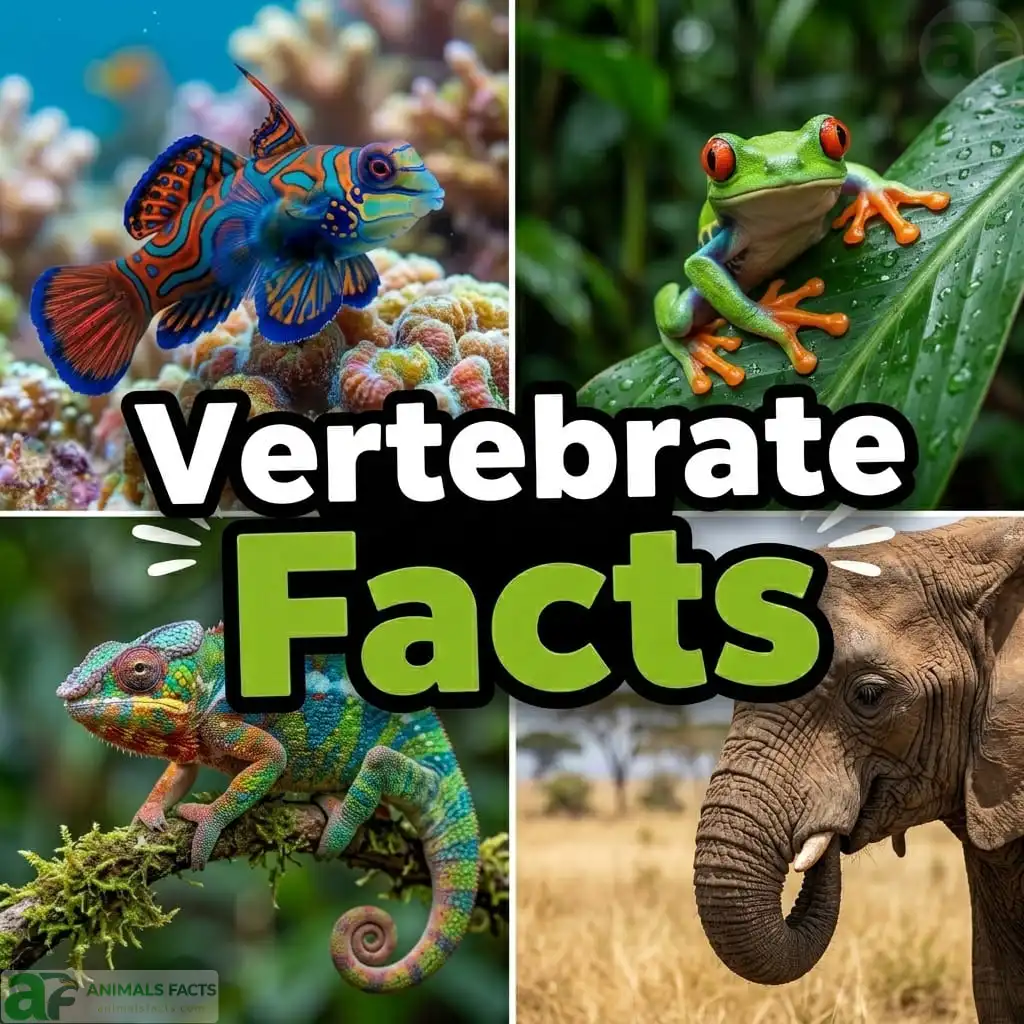
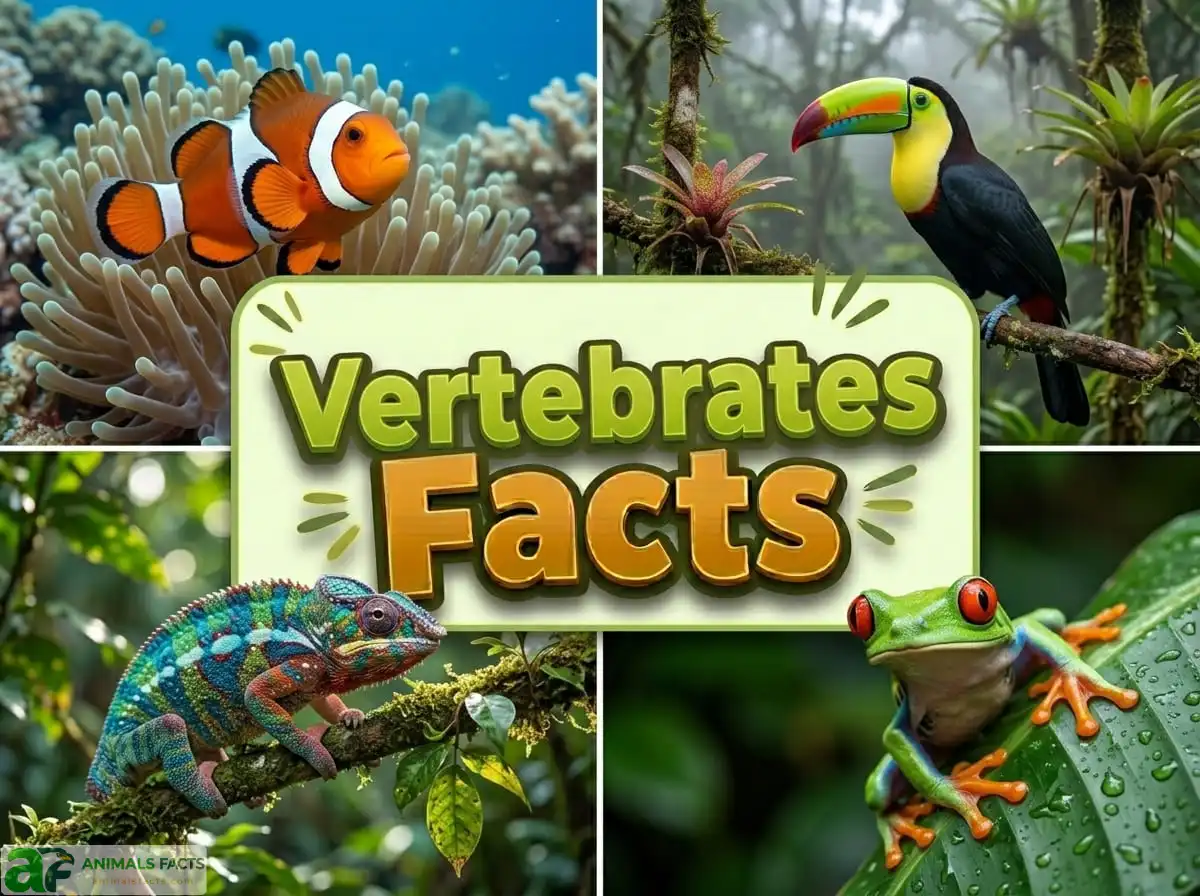
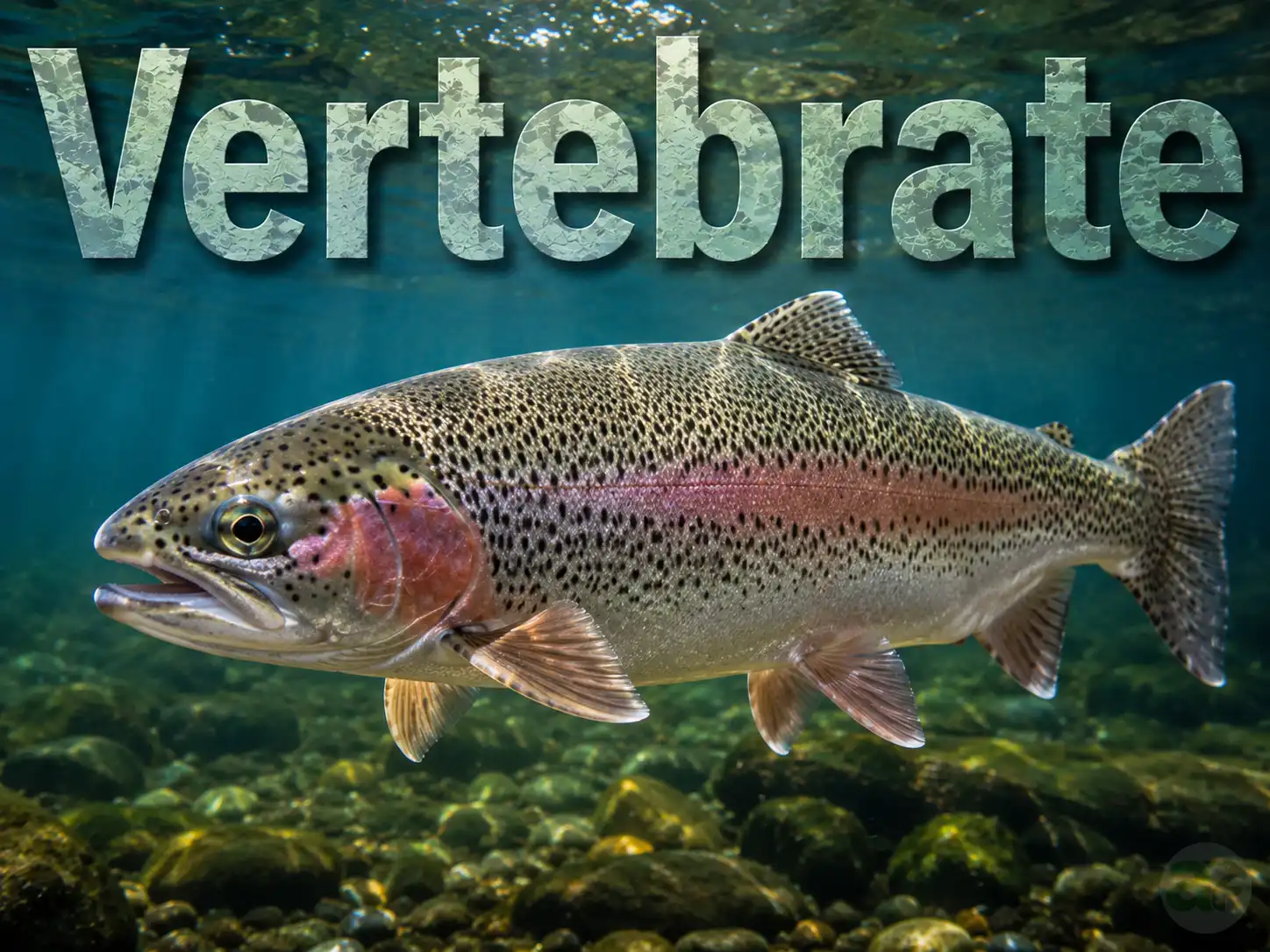
Vertebrate Facts
| Feature | Details |
|---|---|
| Scientific Name | Vertebrata (subphylum) |
| Kingdom | Animalia |
| Phylum | Chordata |
| Subphylum | Vertebrata (Cuvier, 1812) |
| Number of Classes | 5 major classes (fish groups, amphibians, reptiles, birds, mammals) |
| Number of Described Species | Approximately 66,000+ described species |
| Estimated Total Species | ~70,000–75,000 (including undescribed) |
| Habitat | Every environment on Earth — oceans, freshwater, land, air, polar ice, deep sea |
| Lifespan | Days (some fish) to 507 years (ocean quahog — a mollusk; longest vertebrate: ~272 years, Greenland shark) |
| Diet | Everything from sunlight energy (indirectly via photosynthesis consumed) to blood, bone, and toxic prey |
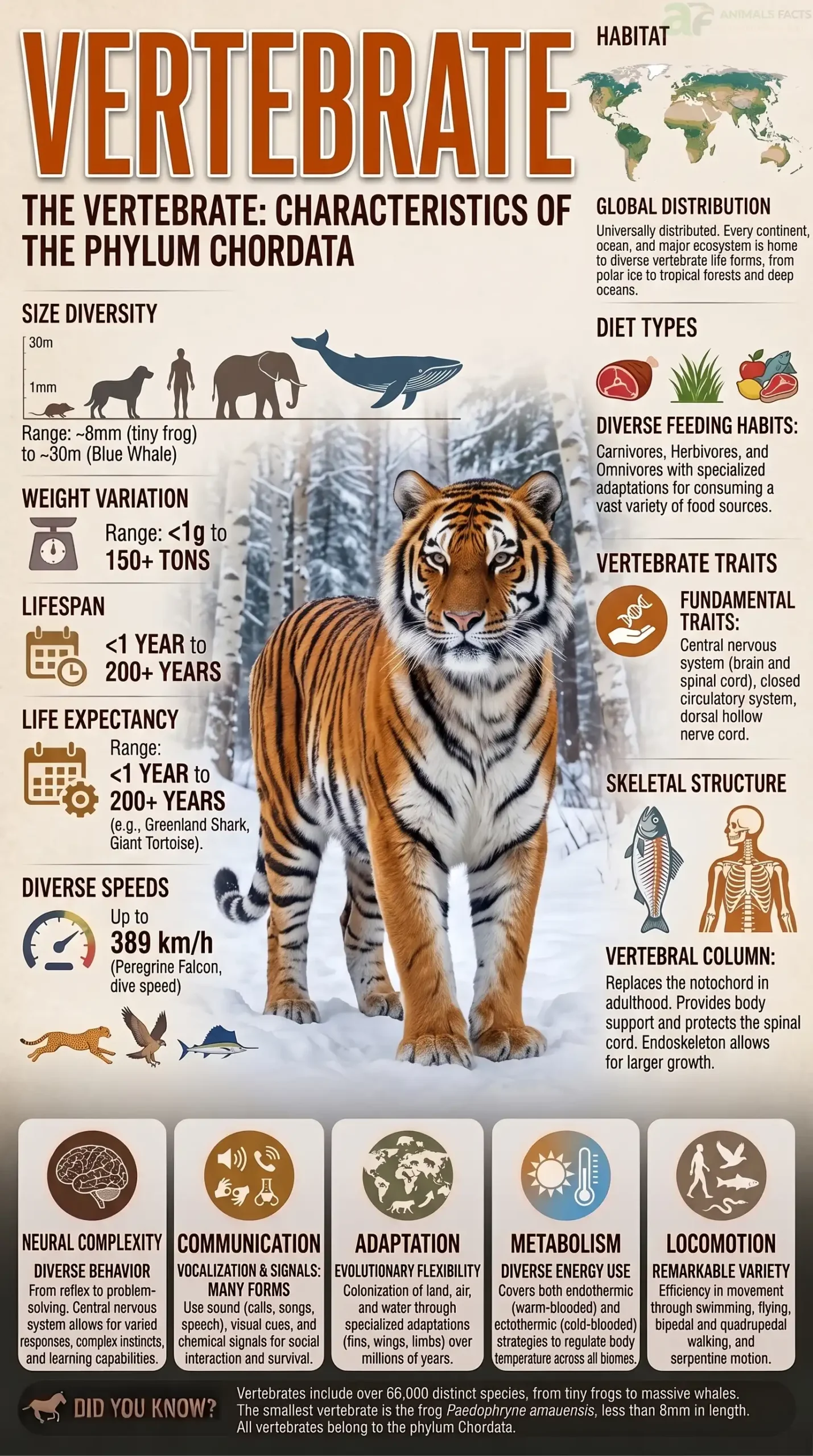
| Size Range | 7.9 mm (Paedophryne amauensis frog) to 33 meters (blue whale) |
| Weight Range | Under 1 gram to 190,000 kg (blue whale) |
| Top Speed | 389 km/h (peregrine falcon in dive) — fastest animal on Earth |
| Conservation Status | Varies; approximately 28% of assessed vertebrate species threatened with extinction |
| % of All Animal Species | Vertebrates represent approximately 3–5% of all described animal species |
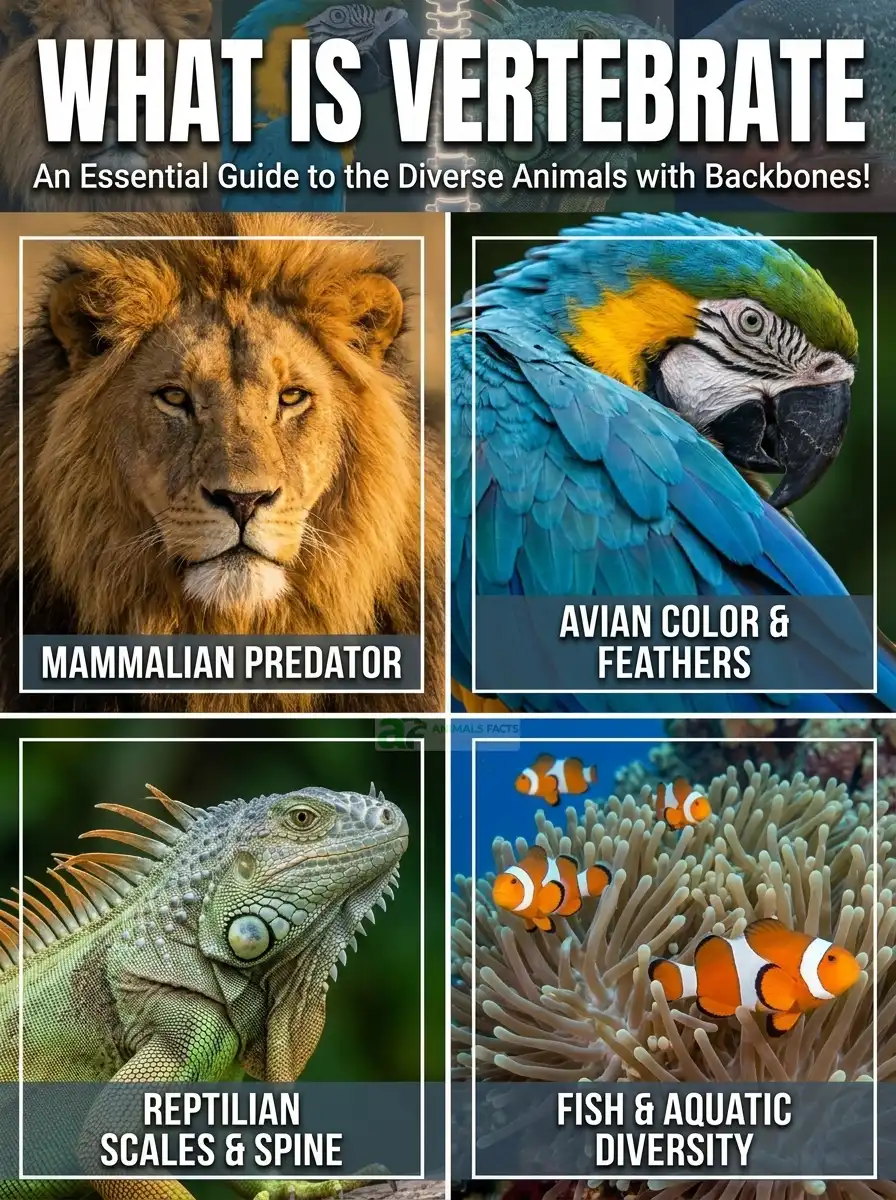
1. Introduction: What is Vertebrate?
We are vertebrates. When you look in the mirror, pick up your dog, watch a bird land on your windowsill, or peer into a fish tank — you are watching members of one of the most remarkable experiments in the history of life on Earth. Vertebrate facts tell the story of animals defined by a single shared innovation — the vertebral column, the backbone — that proved so spectacularly successful over the past 530 million years that this one structural idea eventually generated every fish, every amphibian, every reptile, every bird, and every mammal alive today. Including you.
The subphylum Vertebrata contains approximately 66,000 described species — a number that sounds modest against the millions of known insect species, but which encompasses a diversity of form, function, and behavior that is genuinely incomprehensible in its scope. Interesting facts about vertebrates reveal the smallest frog so tiny it fits on a fingernail, the largest animal that has ever existed (the blue whale, still alive today), the fastest animal ever measured in any environment (the peregrine falcon at nearly 390 km/h in a dive), the slowest metabolism of any mammal (the Greenland shark, which grows at a centimeter a year and lives for 272+ years), the deepest-diving air-breathing animal (the Cuvier’s beaked whale at over 2,990 meters), and the animal with the most complex brain relative to body size yet documented in any living organism (the human, which is reading these words right now).
Whether you’re searching for vertebrate facts for kids to make a biology class unforgettable, exploring vertebrate habitat and ecology for academic research, preparing for a natural history exam, or simply overwhelmed by curiosity about the group of animals that produced you and every other creature with a spine — this is your comprehensive guide. We cover vertebrate scientific names, vertebrate diet, vertebrate size and weight extremes, vertebrate behavior, vertebrate evolutionary history, conservation status, cultural significance, and the profound ecological roles these animals play in maintaining the living systems of the planet. Backbone present. Let’s begin.
2. Vertebrate Species Overview & Classification
Vertebrates belong to the subphylum Vertebrata within the phylum Chordata — the phylum defined by possession of a notochord (a flexible rod-like structure providing axial support) at some stage of development, a dorsal hollow nerve cord, and pharyngeal slits at some stage of the life cycle.
Species Classification Table
| Taxonomic Rank | Classification |
|---|---|
| Kingdom | Animalia |
| Phylum | Chordata |
| Subphylum | Vertebrata (Cuvier, 1812) |
| Major Superclasses | Agnatha (jawless fish), Gnathostomata (jawed vertebrates) |
| Number of Major Classes | 5 (often 6–8 depending on fish classification) |
| Number of Described Species | ~66,000+ |
| Temporal Range | ~530 million years ago to present |
| % of Animal Species | ~3–5% of all described animal species |
The Five Major Vertebrate Classes
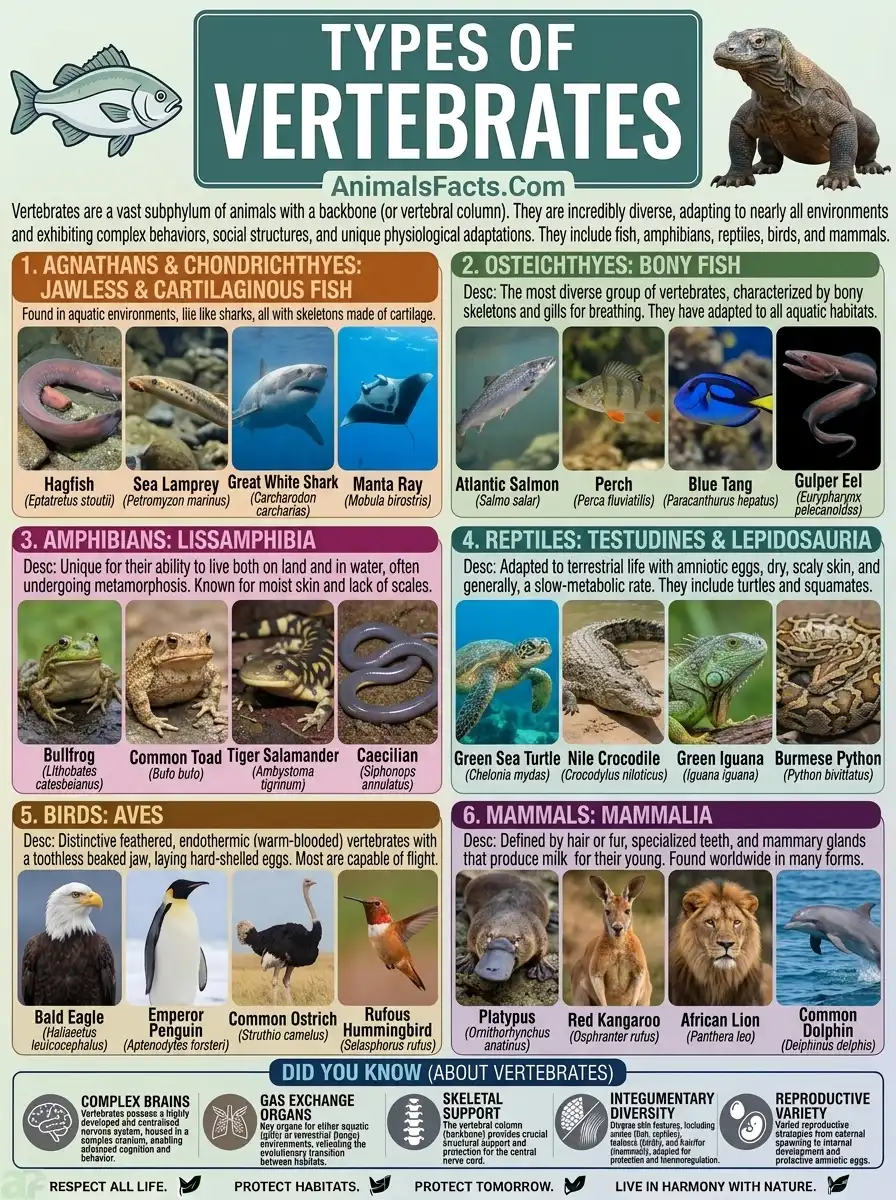
Class Actinopterygii + Chondrichthyes + Sarcopterygii (Fish — typically divided into several classes)
Covering all fish groups:
- Jawless fish (Agnatha) — lampreys and hagfish; ~120 species; the most primitive living vertebrates
- Cartilaginous fish (Chondrichthyes) — sharks, rays, chimaeras; ~1,100 species
- Ray-finned fish (Actinopterygii) — the largest vertebrate class; ~30,000 species; includes virtually all familiar fish
- Lobe-finned fish (Sarcopterygii, excluding tetrapods) — coelacanths and lungfish; ~8 species; the living relatives of all land vertebrates
Class Amphibia (Amphibians) ~8,400 species; frogs, salamanders, caecilians; the first vertebrates to colonize land partially
Class Reptilia (Reptiles) ~10,000 species; lizards, snakes, turtles, crocodilians, tuatara
Class Aves (Birds) ~10,700 species; the most species-rich class of land vertebrates; technically a subgroup of reptiles in modern classification
Class Mammalia (Mammals) ~6,500 species; defined by hair, mammary glands, and warm-bloodedness
Evolution & Discovery Timeline
~530 million years ago — The earliest vertebrate-like animals appear in the Cambrian period. Myllokunmingia and Haikouichthys from the Chengjiang deposits of China are among the earliest confirmed chordate animals with vertebrate-like features.
~480 million years ago — The first true vertebrates with defined vertebral columns appear during the Ordovician period — jawless, armored fish called ostracoderms dominate early vertebrate history.
~420 million years ago — The jaw evolves in the vertebrate lineage — one of the most transformative innovations in animal history. Jawed fish (Gnathostomata) begin their rapid diversification during the Silurian period.
~375 million years ago — Tiktaalik roseae — the famous “fishapod” from Arctic Canada — represents the transition between fish and tetrapods. It has fish-like gills and scales but arm-like fins and can do push-ups — one of the greatest transitional fossils ever discovered.
~365 million years ago — The first tetrapods (four-limbed vertebrates) emerge from water to colonize land during the Late Devonian period.
~310 million years ago — The amniote egg evolves — allowing vertebrate reproduction fully on land for the first time. The amniote lineage eventually produces all reptiles, birds, and mammals.
~225 million years ago — The first dinosaurs and first mammals appear during the Triassic period.
~150 million years ago — Archaeopteryx — the famous feathered transition fossil — documents the evolution of birds from theropod dinosaurs.
~66 million years ago — The Chicxulub asteroid eliminates non-avian dinosaurs; mammals and birds diversify explosively into the vacated ecological roles.
1758 — Carl Linnaeus systematically classifies vertebrates in Systema Naturae — the formal foundation of vertebrate taxonomy.
1812 — Georges Cuvier formally establishes the concept of Vertebrata as a distinct animal subphylum.
1859 — Darwin’s On the Origin of Species establishes the framework for understanding vertebrate evolutionary relationships.
2003 — The complete human genome is published — revolutionizing understanding of vertebrate genetics and evolutionary relationships.
2023 — Comprehensive DNA analysis confirms the total number of living vertebrate species as approximately 66,000, with hundreds of new species described annually, particularly fish and amphibians.
“The vertebrates are the great success story of animal evolution — 530 million years of continuous innovation, diversification, and adaptation that has produced every creature we think of as ‘an animal’ in our daily lives.” — Dr. Neil Shubin, University of Chicago paleontologist and author of Your Inner Fish
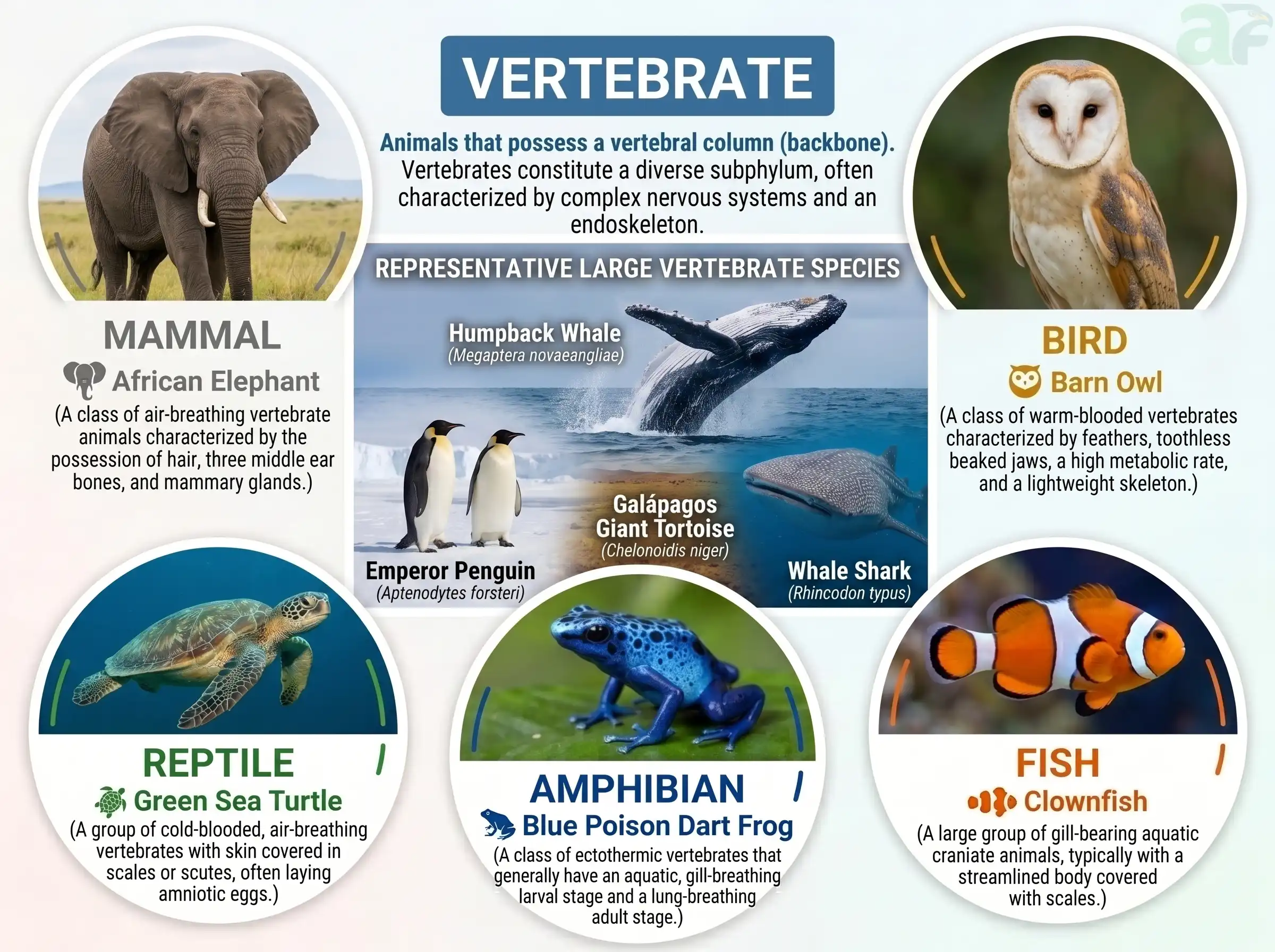
3. Physical Description of Vertebrates
Vertebrate size and weight span the most extreme range of any major animal group — from organisms invisible to the naked eye to the largest animals that have ever lived — unified by the defining structural feature of the vertebral column.
The Vertebral Column — Evolution’s Greatest Hit
The vertebral column (backbone or spine) is the defining feature of all vertebrates. It is a flexible, segmented rod of individual vertebrae (bones or cartilage) surrounding and protecting the spinal cord — the information superhighway connecting the brain to the body. The evolution of this structure approximately 500 million years ago was transformative: it provided:
- Structural support for active, coordinated locomotion at scales impossible for soft-bodied animals
- Protection for the delicate spinal cord
- A scaffold for the attachment of muscles in ways that allow the power and precision of movement from fish swimming to human surgery
- A foundation for the eventual evolution of limbs in tetrapods
Other Defining Vertebrate Features
- Skull — A bony or cartilaginous case enclosing and protecting the brain; found in all vertebrates
- Endoskeleton — An internal skeleton of bone (most vertebrates) or cartilage (sharks, rays)
- Bilateral symmetry — Left-right body symmetry; combined with the vertebral axis, this defines the basic vertebrate body plan
- Closed circulatory system — A heart pumping blood through a closed network of vessels; present in all vertebrates (though highly variable in structure)
- Paired appendages — Fins (fish) or limbs (tetrapods); used for locomotion, manipulation, and display
- Two eyes — Universally present across the subphylum (though secondarily lost in some cave species)
Size Extremes
The smallest vertebrate alive today is the nano-chameleon Brookesia nana of Madagascar — adult males have a body length of just 13.5 mm (less than the width of two fingernails). The smallest vertebrate by most metrics is the frog Paedophryne amauensis of Papua New Guinea, discovered in 2009, with adults measuring 7.7 mm — smaller than a US dime.
The largest vertebrate is the blue whale (Balaenoptera musculus) — reaching lengths of 33 meters and weights of 190 metric tons — the largest animal that has ever existed in the entire 4-billion-year history of life on Earth.
Did You Know? The coelacanth (Latimeria chalumnae) — a lobe-finned fish discovered alive in 1938 after being known only from fossils — belongs to a lineage more closely related to you than to most fish. Lungfish and coelacanths are the closest living fish relatives of all land vertebrates, including humans. When you look at a coelacanth, you are looking at approximately what the ancestor of all tetrapods looked like ~380 million years ago.
4. Top 25 Amazing Vertebrate Facts
Here is your comprehensive, scientifically verified collection of the most extraordinary vertebrate facts as of 2026:
- Vertebrates account for approximately 3–5% of all described animal species — yet they include every fish, amphibian, reptile, bird, and mammal on Earth.
- The blue whale is the largest animal that has ever lived — larger than any known dinosaur — and is still alive today.
- The Greenland shark (Somniosus microcephalus) is the longest-lived vertebrate known to science — with individuals confirmed to be over 272 years old, and some estimated at 392–512 years, making some living Greenland sharks older than the United States.
- The peregrine falcon (Falco peregrinus) reaches speeds of up to 389 km/h (242 mph) in a hunting dive — making it the fastest animal movement ever recorded on Earth.
- The mimic octopus is not a vertebrate — but the mimic octopus impersonates multiple vertebrate species including flatfish, lionfish, and sea snakes, demonstrating how fundamentally important vertebrate body shapes are as templates even for invertebrate mimicry.
- The electric eel (Electrophorus voltai) — actually a knifefish — can generate electrical discharges of up to 860 volts — powerful enough to stun a horse.
- All vertebrates share the same basic developmental toolkit — a common set of developmental genes called Hox genes that specify body plan from head to tail. The same genes that pattern your arm patterned a fish’s fin, a bird’s wing, and a bat’s flight membrane.
- The axolotl (Ambystoma mexicanum) — a Mexican salamander — retains its juvenile form throughout its entire life (neoteny) and can regenerate its limbs, heart, spinal cord, parts of its brain, and even its eyes — the most complete regeneration capability of any vertebrate.
- Birds are dinosaurs — scientifically and unambiguously. Modern birds are the direct descendants of feathered theropod dinosaurs, making the ~10,700 living bird species the only surviving dinosaur lineage.
- The naked mole rat is the only mammal that is truly poikilothermic (cold-blooded) — unable to regulate its own body temperature, despite being a mammal. It relies on the stable underground temperature of its African burrow system.
- The Arctic tern (Sterna paradisaea) migrates from its Arctic breeding grounds to the Antarctic and back each year — a round trip of approximately 70,900 km (44,100 miles) — the longest migration of any animal on Earth.
- Vertebrate blood contains a remarkably conserved protein — hemoglobin — for transporting oxygen. The same protein (with variations) carries oxygen in fish, frogs, reptiles, birds, and mammals. Its conservation across 500 million years of evolution reflects its near-perfect optimization.
- The Cuvier’s beaked whale (Ziphius cavirostris) holds the record for the deepest dive by any air-breathing vertebrate — reaching depths of 2,992 meters (1.86 miles) and holding its breath for up to 222 minutes (3.7 hours).
- The tuatara (Sphenodon punctatus) of New Zealand is the sole living representative of the order Rhynchocephalia — a reptile lineage that diverged from lizard ancestors approximately 240 million years ago. It is a living fossil.
- The coelacanth was known only from fossils dated up to 66 million years ago until a living individual was caught off the coast of South Africa in 1938 — one of the most extraordinary zoological discoveries in history.
- Vertebrates are the only animals with a true brain — though defining “true brain” is complex, the vertebrate brain with its distinct forebrain, midbrain, and hindbrain represents a structural complexity found in no other animal phylum.
- The whale shark (Rhincodon typus) is the world’s largest fish — reaching 18 meters (59 feet) in length — and is a filter feeder, subsisting on tiny plankton despite being larger than most sharks.
- Hibernating vertebrates — including bears, bats, and various rodents — suppress their body temperature, heart rate, and metabolic rate so dramatically that they appear indistinguishable from death during deep torpor.
- The platypus and echidnas are the world’s only surviving monotremes — egg-laying mammals — representing a lineage that diverged from the therian mammal ancestor approximately 166 million years ago.
- Flying fish (Exocoetidae) can leap from the water and glide through the air for distances of up to 400 meters (1,300 feet) using their enlarged pectoral fins — a remarkable vertebrate adaptation blurring the boundary between aquatic and aerial locomotion.
- The migratory patterns of vertebrates are among the most complex navigational behaviors in all of animal biology — humpback whales navigate by magnetic field sensing, Arctic terns navigate by stars and solar cues, and salmon navigate home from the open ocean by smell.
- All vertebrates, from lampreys to humans, share a basic nervous system architecture — the vertebrate neural plan was established approximately 500 million years ago and has been modified but never replaced in any lineage since.
- The thorny dragon (Moloch horridus) of Australia drinks through its skin — channeling moisture along micro-grooves in its scales to its mouth — one of the most remarkable physiological innovations in vertebrate history.
- Lungfish — one of the only fish capable of breathing air through primitive lungs — can aestivate (enter a drought-resistant torpor) for up to 5 years encased in a mucous cocoon in dried mud, resuming activity when rains return.
- The lateral line system of fish — a sensory organ that detects pressure waves and water movement — is evolutionarily homologous to the inner ear of all tetrapods including humans. The same developmental tissue that becomes fish lateral line cells becomes the hair cells of your auditory and vestibular systems.
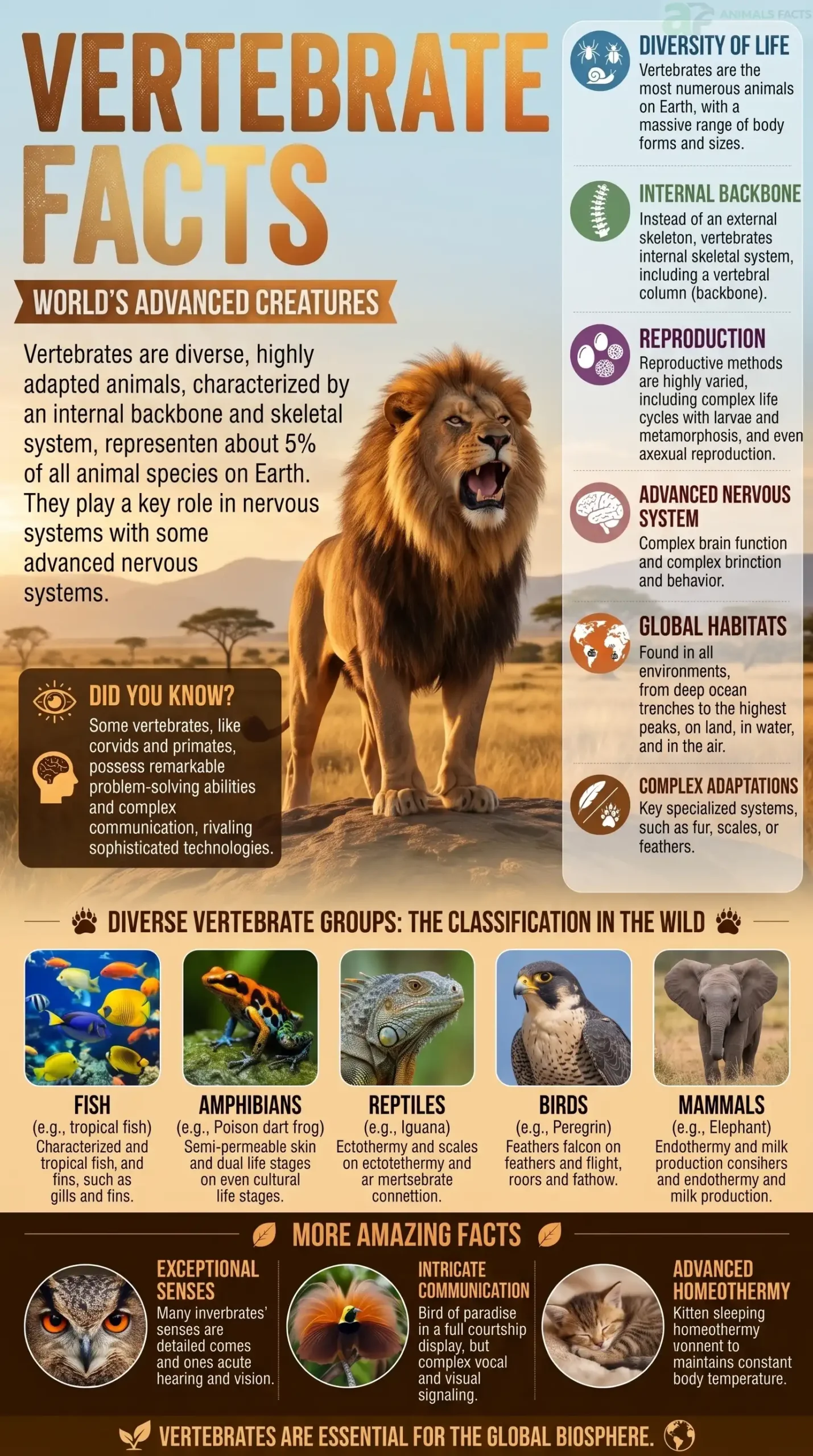
5. Vertebrate Fun Facts for Kids
- Vertebrates have been on Earth for over 530 million years
- The blue whale is the largest animal ever to have lived
- The Greenland shark can live for over 272 years — older than the United States
- Birds are technically dinosaurs — the only surviving dinosaur lineage
- The axolotl can regenerate its heart, spinal cord, and brain tissue
- The peregrine falcon is the fastest animal on Earth at 389 km/h
- All vertebrate limbs — from fish fins to human hands — are built using the same genetic toolkit
- The coelacanth was considered extinct for 66 million years until found alive in 1938
- Arctic terns migrate ~70,900 km every year — the longest animal migration on Earth
- Vertebrates represent only ~3–5% of animal species but all familiar large animals
- The platypus is a mammal that lays eggs and has a duck bill — and senses electricity through its bill
- Lungfish can survive up to 5 years without water, encased in a mucous cocoon
6. Natural Habitat & Geographic Range
Vertebrate habitat diversity is unmatched in the animal world — the subphylum has colonized every conceivable environment on Earth, from the deepest ocean trenches to the highest mountain peaks, from boiling hydrothermal vent environments to Antarctic ice.
Habitat Types
Vertebrates inhabit tropical rainforests, temperate deciduous forests, boreal taiga, arctic tundra, deserts, grasslands, wetlands, freshwater rivers and lakes, coastal shallows, coral reefs, open ocean pelagic zones, deep sea abyssal plains, alpine meadows, caves, hot springs, and urban environments. They are found at depths of over 8,000 meters in marine trenches (snailfish have been recorded at 8,336 meters in the Mariana Trench) and at altitudes above 6,000 meters in the Himalayas.
Habitat Range by Continent
| Continent/Region | Notable Vertebrate Groups | Vertebrate Diversity Level |
|---|---|---|
| South America | Amazon fish (largest freshwater fish diversity), birds, amphibians, mammals | Highest terrestrial vertebrate diversity |
| Africa | Large mammal diversity, cichlid fish, reptiles | Highest large mammal diversity |
| Asia | Tiger, panda, sea turtle, river dolphins, gibbon | Very high; many endemic species |
| Australia/Oceania | Marsupials, monotremes, endemic birds, sharks | Highest reptile diversity per area |
| North America | Bears, wolves, salmonids, raptors, rattlesnakes | High; extensive temperate diversity |
| Europe | Marine fish, migratory birds, wolves, brown bears | Moderate; highly modified by humans |
| Arctic/Antarctic | Polar bear, penguins, seals, Arctic cod | Low diversity, extreme specialization |
| Deep Ocean | Anglerfish, snailfish, gulper eels, coelacanth | Low species count, extreme adaptations |
Did You Know? The Mariana snailfish (Pseudoliparis swirei) holds the record for the deepest-living vertebrate ever confirmed — specimens have been recorded at 8,336 meters below sea level in the Mariana Trench. At these depths, water pressure is over 800 atmospheres — equivalent to the weight of approximately 1,600 cars pressing on every square meter of the fish’s body. The fish’s tissues contain a compound called TMAO (trimethylamine oxide) that stabilizes proteins under crushing pressure.
7. Vertebrate Diet & Feeding Behavior
Vertebrate diet spans the entire range of possible biological food sources — from dissolved organic matter (some fish) to sunlight-produced algae (herbivorous fish), from plant matter to apex predation, from blood to bone, from carrion to living prey of astonishing size.
Diet Breakdown Table
| Dietary Strategy | Major Vertebrate Groups | Key Examples |
|---|---|---|
| Herbivory (plants, algae, grass) | Mammals, fish, reptiles, birds | Horses, manatees, iguanas, geese |
| Carnivory (vertebrate prey) | Apex predators across all classes | Lions, sharks, eagles, crocodiles |
| Insectivory (insects/arthropods) | Most birds, many mammals, reptiles, amphibians | Bats, anteaters, insectivorous birds, frogs |
| Piscivory (fish) | Many fish, birds, mammals | Herons, ospreys, dolphins, pike |
| Filter feeding (plankton) | Whale sharks, baleen whales, manta rays | Blue whale, whale shark, basking shark |
| Omnivory (mixed) | Bears, pigs, humans, most corvids | Brown bear, wild boar, crow, chimpanzee |
| Scavenging (carrion) | Hyenas, vultures, some sharks | Griffon vulture, Greenland shark |
| Parasitism (blood/tissue) | Lamprey, vampire bat, some parasitic catfish | Sea lamprey, common vampire bat |
| Frugivory (fruit) | Fruit bats, hornbills, bears (seasonal) | Flying foxes, toucans, black bear |
| Granivory (seeds) | Many birds, some mammals | Finches, parrots, harvest mouse |
Extraordinary Feeding Adaptations
Baleen whale filter feeding — Blue and humpback whales engulf thousands of gallons of water and force it through baleen plates — comb-like structures of keratin in the upper jaw — retaining hundreds of kilograms of krill per mouthful. A single blue whale consumes approximately 3.6 metric tons of krill daily during feeding season.
Archerfish target shooting — The archerfish (Toxotes species) shoots precise jets of water at insects on overhanging vegetation, knocking them into the water. Remarkably, the fish compensates for the refraction of light at the water surface, calculating the correction needed to aim accurately — a feat requiring sophisticated spatial reasoning.
Vampire bat blood feeding — The common vampire bat (Desmodus rotundus) uses heat-sensitive organs near its nose to locate blood vessels, makes a painless incision with razor-sharp teeth, and laps blood (not sucks it) while anticoagulants in its saliva keep the wound bleeding. It can drink 40% of its body weight in blood in a single meal.
Whale shark filter feeding — Despite being the world’s largest fish, the whale shark feeds exclusively on tiny organisms — opening its enormous mouth and filtering 600 cubic meters of water per hour to extract plankton, fish eggs, and small fish.
8. Vertebrates Reproduction & Life Cycle
Vertebrate reproduction encompasses virtually every strategy available in the animal kingdom — from broadcast spawning of millions of eggs with no parental care, to the 22-month gestation of elephants, to the live birth of sharks, to the egg-laying mammals (monotremes), to the marsupial pouch system.
Reproductive Strategies
External fertilization, no parental care — Most marine fish broadcast sperm and eggs into the water simultaneously; fertilization and development are entirely external. A single female Atlantic cod can produce up to 9 million eggs per year.
Internal fertilization, egg-laying — Sharks, reptiles, birds, and monotremes; internal fertilization followed by external development in an egg (shelled in reptiles, birds, and monotremes).
Internal fertilization, live birth — Most mammals and some fish (sharks, guppies); young develop internally to various stages before birth.
Parental care extremes — Emperor penguins balance a single egg on their feet for 65 days in Antarctic winter, fasting and huddling against temperatures of -40°C. At the other extreme, many fish species scatter millions of eggs with no subsequent parental involvement whatsoever.
Lifespan Comparison Table
| Species/Group | Average Lifespan (Wild) | Maximum Documented |
|---|---|---|
| Greenland shark (Somniosus microcephalus) | ~200 years | 392+ years (estimated) |
| Ocean quahog clam — not a vertebrate | N/A | 507 years |
| Bowhead whale (Balaena mysticetus) | ~100+ years | 211 years (confirmed) |
| Aldabra giant tortoise (Aldabrachelys gigantea) | ~100+ years | 182 years (confirmed) |
| Koi carp (Cyprinus rubrofuscus) | ~30–40 years | 226 years (unverified claim) |
| Human (Homo sapiens) | ~72–80 years (global average) | 122 years (Jeanne Calment, verified) |
| Common mayfly (Ephemera danica) — not a vertebrate | — | — |
| Mouse (Mus musculus) | ~1 year | ~4 years |
9. Social Behavior & Communication
Vertebrate social behavior and communication systems span the full spectrum from complete solitude to the most complex societies in the animal kingdom — and the communication systems found within the subphylum include every form of signal transmission ever used by animals.
Social Systems Across the Classes
Fish — Most fish are semi-social at best — schooling behavior in many species provides predator confusion benefits without true social organization. Exceptions include cleaner wrasse fish that maintain service “stations” that hundreds of other fish visit in organized sequence, and cichlids that show complex biparental care and family group living.
Amphibians — Most are solitary except during breeding aggregations; some poison dart frogs (Dendrobatidae) show biparental care and social family units.
Reptiles — Predominantly solitary; crocodilians are the most socially complex reptiles — mothers guard eggs, assist hatching, and protect young for up to two years.
Birds — The most diverse social systems of any vertebrate class — from completely solitary raptors to the eusocial-like colonial seabird colonies with millions of individuals, to the extraordinarily complex cooperative breeding systems of superb fairy-wrens and meerkats.
Mammals — The apex of vertebrate social complexity — from solitary tigers to the matriarchal societies of elephants, the democratic decision-making of chimpanzees, and the language-using, civilization-building societies of humans.
Communication Systems
Vertebrates use every conceivable communication channel:
- Acoustic — bird song, frog calls, whale song, mammal vocalizations; the most information-dense channel in most vertebrate groups
- Visual — color displays, posture, facial expression; reaching its peak in primates and cephalopods
- Chemical (pheromonal) — critical in mammals, fish, and amphibians for mate attraction and territorial marking
- Electrical — electroreception in sharks, rays, and the platypus; electric communication in electric fish
- Vibrational — substrate-borne communication in frogs, mice (ultrasonic), and elephants (infrasound)
- Magnetic — navigation by earth’s magnetic field in migratory birds, sea turtles, and salmon
10. Predators & Defense Mechanisms
Vertebrate predator-prey relationships have shaped the evolution of body form, behavior, and ecology across hundreds of millions of years — producing an arms race of attack and defense strategies of extraordinary sophistication.
The Apex Predator Concept
Apex predators — vertebrates with no natural predators as adults — occur in all vertebrate classes:
- Fish — Great white shark, orca (technically a toothed whale but also a top predator)
- Amphibians — No true apex predators (all are vulnerable to some predators)
- Reptiles — Saltwater crocodile, Komodo dragon, large constrictors
- Birds — Peregrine falcon, harpy eagle, Steller’s sea eagle
- Mammals — Lion, tiger, orca, human
Defense Strategies Across the Classes
Fish — Counter-shading (dark above, light below), schooling behavior (predator confusion), cryptic coloration, venomous spines (stonefish, lionfish), electrical discharge (electric eels), inflation (pufferfish), toxicity (tetrodotoxin in puffers)
Amphibians — Cryptic coloration, aposematism (bright warning colors in poison dart frogs), skin toxins (some of the most potent biological toxins known — batrachotoxin from Phyllobates dart frogs can kill an adult human), mucus secretions
Reptiles — Speed (lizards), armor (tortoise shells, armadillo lizard scales), venom (snakes, Gila monster), camouflage (chameleons, leaf-tailed geckos), tail autotomy (many lizards), playing dead (hognose snakes)
Birds — Flight speed, alarm calls, mobbing of predators, cryptic nesting, distraction displays (broken-wing display of killdeer), chemical defense (pitohui of New Guinea — the only known poisonous bird)
Mammals — Chemical defense (skunks), physical armor (armadillo, pangolin), speed (cheetah), group defense (musk oxen, meerkats), venom (platypus, slow loris, shrews), camouflage
Did You Know? The golden poison dart frog (Phyllobates terribilis) of Colombia contains enough batrachotoxin in its skin to kill approximately 10 adult humans. A single gram of batrachotoxin is estimated to be ~15 times more toxic than VX nerve agent by body weight. These tiny frogs — barely larger than a fingernail — are among the most toxic vertebrates on Earth, despite being entirely passive in their defense. They acquire their toxins from the specialized beetles and arthropods they eat in the wild.
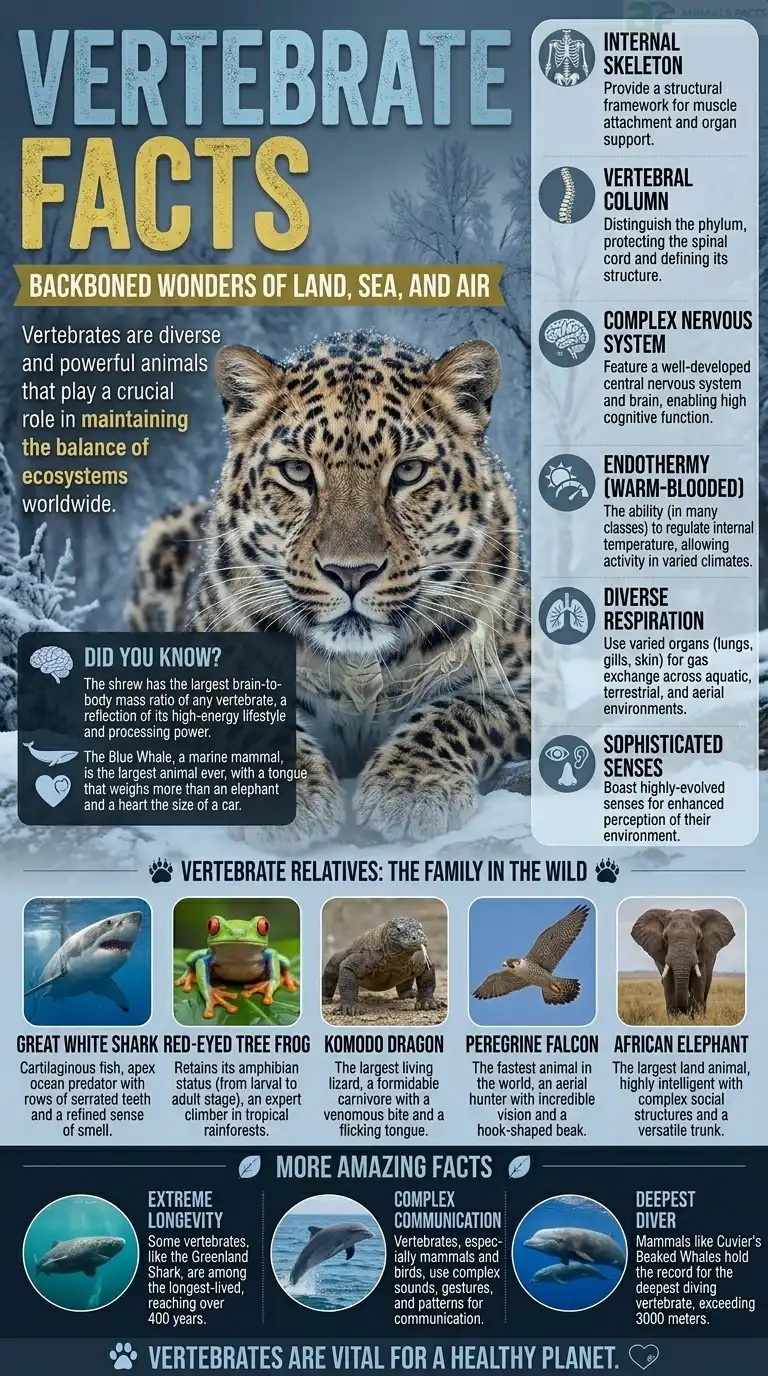
11. Vertebrate Facts for Kids
Hey amazing young scientists! Here are the most incredible vertebrate facts for kids that will totally blow your mind:
You are a vertebrate! That’s right — you have a backbone (spine), which makes you part of the same group as sharks, frogs, birds, and elephants. We’re all related!
The blue whale is the biggest animal EVER! Bigger than the biggest dinosaur, bigger than any creature that has ever lived in the entire 4-billion-year history of Earth. And it still exists today!
Birds are actually dinosaurs! Scientists now know for certain that birds evolved from feathered dinosaurs. Every time you see a pigeon or a crow, you’re looking at a living dinosaur!
The axolotl can regrow its HEART! This amazing Mexican salamander can regenerate not just its legs and tail, but also its heart, spinal cord, and parts of its brain. Scientists are studying it to understand how to help humans heal better.
Some sharks are older than the United States! Greenland sharks can live for over 272 years — meaning some sharks swimming today were born before America declared independence in 1776!
Arctic terns fly around the WORLD every year! These small birds migrate from the Arctic to the Antarctic and back every single year — a round trip of about 70,900 km. That’s like flying to the moon almost halfway!
A frog the size of a pea exists! The world’s smallest vertebrate is a frog from Papua New Guinea that measures just 7.7 mm — smaller than a pea, and so tiny it could sit on your thumbnail!
All vertebrate limbs are basically the SAME! Whether it’s a human arm, a bird wing, a whale flipper, or a bat wing — they’re all built from the same basic bones arranged in the same basic pattern. We’re all connected!
12. Relationship with Humans
Humans are vertebrates — and our relationship with other vertebrates encompasses hunting, domestication, medical research, cultural mythology, ecological impact, and increasingly urgent conservation responsibility.
Domestication
Humans have domesticated a remarkable range of vertebrate species. The dog (Canis lupus familiaris) was domesticated approximately 15,000–40,000 years ago — the first animal domesticated by humans. Cattle, horses, sheep, goats, pigs, and chickens followed approximately 10,000 years ago during the agricultural revolution. Fish farming (aquaculture) now produces over 90 million metric tons of aquatic organisms annually — more than wild-capture fisheries in some years.
Medical Research
Vertebrate animal models — particularly mice, rats, zebrafish, frogs, and non-human primates — underpin virtually every medical treatment available to humans today. The zebrafish (Danio rerio) has become a critical vertebrate model organism for genetics research because its transparent embryos allow real-time observation of vertebrate development using light microscopy.
Human Ecological Impact
Humans have arguably had a greater impact on vertebrate biodiversity than any other single species in the history of life:
- Overhunting — Driven dozens of large vertebrates to extinction; the passenger pigeon, Steller’s sea cow, and thylacine are iconic examples
- Habitat destruction — The primary driver of current vertebrate extinctions
- Introduction of invasive species — Introduced vertebrates (cats, rats, foxes, cane toads) have devastated native vertebrate communities on islands worldwide
- Climate change — Altering the distribution, phenology, and ecology of vertebrates globally; contributing to coral reef bleaching that destroys fish habitat
13. Vertebrate Conservation Status & Threats
Vertebrate conservation is one of the most urgent challenges in global biology. The current rate of vertebrate extinction is estimated at 100–1,000 times the background extinction rate — a level that qualifies the current period as a mass extinction event by geological standards.
Conservation Status Overview
| Status Category | Approximate % of Assessed Vertebrate Species |
|---|---|
| Least Concern | ~54% |
| Near Threatened | ~6% |
| Vulnerable | ~9% |
| Endangered | ~9% |
| Critically Endangered | ~8% |
| Extinct in the Wild | ~1% |
| Extinct | ~3% |
| Data Deficient | ~10% |
Major Threats by Vertebrate Class
| Class | Primary Threats | Examples |
|---|---|---|
| Fish | Overfishing, habitat loss, pollution, climate change | Atlantic bluefin tuna, many freshwater species |
| Amphibians | Chytrid fungus, habitat loss, climate change | Over 200 species affected by Batrachochytrium dendrobatidis |
| Reptiles | Habitat loss, hunting, climate change (sea turtles) | All sea turtle species threatened |
| Birds | Habitat loss, invasive species, windows/cats | 1,400+ species threatened |
| Mammals | Habitat loss, hunting, climate change | Tigers, elephants, rhinos, whales |
The Amphibian Crisis
The global amphibian crisis represents the most severe vertebrate biodiversity emergency currently underway. The chytrid fungus (Batrachochytrium dendrobatidis and B. salamandrivorans) has caused the decline of over 500 amphibian species and the extinction of at least 90 species — making it the most lethal vertebrate disease ever documented. Over 40% of all amphibian species are now considered threatened with extinction.
14. Famous Vertebrates in History & Pop Culture
Famous Individual Vertebrates
“Jaws” — The great white shark that starred in Steven Spielberg’s 1975 film permanently altered public perception of sharks and ocean swimming — and is widely credited with creating the modern summer blockbuster film format. The shark’s cultural impact on vertebrate conservation is ambivalent: it generated both fear (leading to increased shark killing) and fascination (driving shark conservation awareness).
“Lonesome George” — The last Pinta Island Galápagos tortoise (Chelonoidis niger abingdonii), died in 2012. He became the world’s most famous individual reptile and the face of the IUCN’s extinction awareness campaigns.
“Knut” — A polar bear born in Berlin Zoo in 2006 who became a global media sensation after being hand-raised by keepers following rejection by his mother. His death in 2011 was mourned internationally.
“Alex” — The African grey parrot studied by Dr. Irene Pepperberg at Harvard and Brandeis Universities; demonstrated cognitive abilities previously considered exclusive to great apes — including the ability to ask questions, understand zero as a concept, and use over 100 English words meaningfully before his death in 2007.
“Barry” — The most famous individual Saint Bernard dog in history, who legend credits with saving over 40 lives in the Swiss Alps. Barry (c. 1800–1814) is commemorated by a monument at the Cimetière des Chiens in Paris and a permanent memorial at the Natural History Museum in Bern.
15. Role in Ecosystem & Food Chain
Vertebrates are foundational elements of virtually every ecosystem on Earth — functioning as apex predators, herbivores, decomposers, seed dispersers, pollinators, soil engineers, and the primary prey and predator species that structure food webs at every trophic level.
Trophic Cascades
The trophic cascade — where changes in apex predator populations cascade through food webs to affect plant communities — is perhaps best documented through vertebrate examples. The reintroduction of gray wolves to Yellowstone National Park in 1995 triggered a cascade that changed river courses, recovered vegetation, increased beaver populations, and fundamentally altered the park’s hydrology. Removal of sharks from coral reef systems triggers similar trophic cascades that can effectively kill the reef.
Seed Dispersal & Pollination
Vertebrates are responsible for some of the most important seed dispersal and pollination relationships in plant ecology. Fruit bats (flying foxes) are the primary pollinators and seed dispersers for many tropical fruit trees and other plants. Hummingbirds pollinate thousands of plant species across the Americas. Fish disperse seeds of riparian plants through consuming and transporting fruits that fall into rivers.
Decomposition
Vertebrate scavengers — condors, vultures, Tasmanian devils, hyenas, and various fish — perform critical ecosystem sanitation services by rapidly processing vertebrate carcasses that would otherwise create disease reservoirs and nutrient blocks.
16. Myths, Folklore & Cultural Significance
Vertebrates — and particularly large, visible, behaviorally complex vertebrates — have occupied the center of human mythological and cultural imagination across every civilization in recorded history.
Global Vertebrate Mythology
The Dragon — The most universally distributed mythological vertebrate, appearing independently in European, Chinese, Japanese, Indian, Mesoamerican, and African traditions as a giant, powerful, often serpentine vertebrate with supernatural abilities. Some scholars argue that dragon myths represent folk memories of large fossil reptiles discovered by early human cultures — dinosaur and crocodilian fossils in particular.
The Phoenix — The mythological bird of death and rebirth appears in ancient Egyptian (Bennu), Greek, Arabic, Chinese (Fenghuang), Persian (Simurgh), and many other traditions — representing the vertebrate bird as a symbol of cyclical renewal and transformation.
The Whale — From the biblical Jonah and the Whale to the Polynesian tradition of Māui fishing up land from a great fish, to Herman Melville’s Moby Dick — the whale is one of the most mythologically and literarily significant vertebrates across human cultures, representing the awe-inspiring scale of the natural world at its most extreme.
Indigenous Animal Knowledge
Many indigenous cultures have developed extraordinarily detailed ecological knowledge of vertebrates over thousands of years. Inuit traditional knowledge of Arctic marine vertebrates — bowhead whales, narwhals, walruses, and Arctic cod — represents the world’s most comprehensive long-term dataset on Arctic vertebrate ecology, accumulated over 4,000+ years of intensive observation. This knowledge is now actively integrated with Western scientific methods in Arctic marine conservation planning.
17. Vertebrates in Pop Culture
Jurassic Park (1993/2015–2022) — The franchise has generated over $6 billion at the global box office and made dinosaurs (vertebrates) the most commercially successful animals in entertainment history. Its influence on vertebrate paleontology — inspiring generations of scientists — is immeasurable.
Free Willy (1993) — The orca (Orcinus orca) who starred in this film became the subject of the most expensive wildlife rehabilitation project ever attempted and directly inspired the Marine Mammal Protection Act amendments that followed.
Planet Earth (BBC, 2006) and Planet Earth II (BBC, 2016) — The most watched natural history documentary series ever made; each episode features vertebrates as primary subjects and has generated measurable increases in conservation awareness and funding for featured species.
The Lion King (Disney, 1994/2019) — One of the highest-grossing animated films in history; its vertebrate characters — lions, meerkats, warthogs, hyenas — introduced millions of children to African vertebrate ecology.
18. Vertebrate Facts vs. Common Myths
| Common Myth | The Real Fact |
|---|---|
| “Fish have no feelings or pain awareness” | False — fish have nociceptors and demonstrate behavioral responses to painful stimuli consistent with pain experience; the scientific consensus has shifted toward recognizing fish sentience |
| “Sharks are mindless killing machines” | False — sharks have complex behaviors, social structures, and cognitive abilities; great whites have been documented learning and demonstrating curiosity |
| “Reptiles are slow and cold” | Partially false — while reptiles are ectothermic, many are fast, intelligent, and thermally dynamic; crocodilians show complex social behavior and parental care |
| “Birds are not dinosaurs” | False — birds ARE dinosaurs; this is not a metaphor but a scientific classification fact |
| “The biggest animals are the most dangerous” | False — the largest animals (blue whale, whale shark, African elephant, giraffes) are typically herbivores or filter feeders; danger does not correlate with size |
| “Humans are the only tool-using vertebrates” | False — tool use has been documented in chimpanzees, capuchin monkeys, crows, cockatoos, dolphins, sea otters, and multiple other vertebrate species |
| “Sharks must keep swimming or they die” | Partially false — some shark species (great white, mako) must swim continuously to ventilate their gills; others (nurse sharks, whitetip reef sharks) can pump water over their gills and rest on the bottom |
| “Frogs and toads are basically the same” | Mostly false — while all are anuran amphibians, frogs and toads represent distinct lineages with different skin texture, locomotion, and habitat preferences |
19. Best Places to Experience Vertebrate Diversity in the Wild
1. Amazon Basin, Brazil/Peru — The most vertebrate-diverse region on Earth, home to over 3,000 freshwater fish species (more than the entire Atlantic Ocean), the greatest bird diversity of any comparable area, and an extraordinary array of reptiles, amphibians, and mammals. Research stations at Manu National Park and Tambopata provide access to this incomparable vertebrate richness.
2. Galápagos Islands, Ecuador — The living laboratory of vertebrate evolution — marine iguanas, giant tortoises, blue-footed boobies, Darwin’s finches, hammerhead sharks, and Galápagos penguins in a single location. The combination of terrestrial and marine vertebrate diversity and the tameness of animals unused to predation makes this the finest vertebrate encounter destination on Earth.
3. Great Barrier Reef, Australia — The world’s most extensive coral reef system harbors over 1,500 fish species, six of the world’s seven sea turtle species, multiple shark and ray species, dolphins, dugongs, and some of the most diverse vertebrate communities on Earth in an accessible marine environment.
4. Serengeti/Masai Mara, Tanzania/Kenya — The highest density and diversity of large terrestrial vertebrates anywhere on Earth — lions, elephants, cheetahs, leopards, wildebeest, zebras, hippos, crocodiles, and extraordinary bird life in a landscape essentially unchanged from the Pleistocene.
5. Borneo, Malaysia/Indonesia — The rainforests of Borneo harbor extraordinary vertebrate diversity including orangutans, pygmy elephants, Bornean gibbons, clouded leopards, proboscis monkeys, and one of the world’s highest snake and lizard diversities per unit area.
6. Yellowstone National Park, Wyoming, USA — The premier temperate terrestrial vertebrate ecosystem in North America — wolf packs, grizzly bears, bison herds, pronghorn, elk, moose, sandhill cranes, and the world’s most visible demonstration of trophic cascade ecology.
7. The Maldives/Red Sea — For marine vertebrate encounters in extraordinary clarity, the coral reefs of the Maldives and the Red Sea offer daily encounters with whale sharks, manta rays, reef sharks, turtles, dugongs, and an extraordinary diversity of reef fish in water visibility exceeding 30 meters.
20. How You Can Help
Vertebrate conservation requires action at every scale — from individual lifestyle choices to international policy.
Support these organizations:
- WWF Global — worldwildlife.org — comprehensive vertebrate conservation across all classes
- IUCN — iucn.org — the authoritative body for species conservation status assessment
- Ocean Conservancy — oceanconservancy.org — marine vertebrate conservation
- Wildlife Conservation Society — wcs.org — field conservation across all vertebrate groups
- Amphibian Survival Alliance — amphibians.org — focused on the amphibian extinction crisis
- Save Our Seas Foundation — saveourseas.com — shark and ray conservation
What you can do:
- Reduce your carbon footprint — climate change is driving vertebrate range shifts and extinctions across all classes
- Make sustainable seafood choices — overfishing is the primary threat to marine vertebrates; use seafood guides like those from Monterey Bay Aquarium’s Seafood Watch
- Support wildlife corridor programs — habitat fragmentation is a primary driver of vertebrate decline
- Keep cats indoors — domestic cats kill billions of birds and small mammals annually in the US alone
- Reduce plastic use — marine vertebrates including sea turtles, seabirds, and whales die from plastic ingestion and entanglement
- Contribute to citizen science — iNaturalist, eBird, and marine mammal sighting databases all depend on public observation
21. Top Documentaries & Books
Must-Watch Documentaries
- Planet Earth and Planet Earth II (BBC, 2006/2016) — The definitive vertebrate natural history documentary series; every episode is a masterclass in vertebrate biology and ecology
- Our Planet (Netflix, 2019) — David Attenborough’s landmark conservation series; the most comprehensive overview of vertebrate biodiversity and its threats ever produced for a general audience
- Blue Planet II (BBC, 2017) — The definitive marine vertebrate documentary; the octopus-hunting fish sequence generated more scientific interest than any documentary sequence in years
- Dynasties (BBC, 2018) — Intimate portraits of individual vertebrate family groups including chimpanzees, lions, tigers, and painted wolves
- Your Inner Fish (PBS, 2014) — Based on Neil Shubin’s landmark book; the finest documentary ever made on vertebrate evolutionary biology and the shared ancestry of all vertebrates
Must-Read Books
- Your Inner Fish by Neil Shubin — The definitive popular account of vertebrate evolution and the discovery of Tiktaalik
- The Story of the Human Body by Daniel Lieberman — How vertebrate evolutionary history shaped the human body
- Vertebrate Life by F. Harvey Pough et al. — The standard academic textbook on vertebrate biology and diversity
- The Sixth Extinction by Elizabeth Kolbert (Pulitzer Prize) — The most important book on current vertebrate extinction rates
- Life of Vertebrates by J.Z. Young — A classic comprehensive account of vertebrate biology
22. Comparison of the Five Vertebrate Classes
| Feature | Fish (multiple classes) | Amphibians (Amphibia) | Reptiles (Reptilia) | Birds (Aves) | Mammals (Mammalia) |
|---|---|---|---|---|---|
| Species count | ~34,000 | ~8,400 | ~10,000 | ~10,700 | ~6,500 |
| Body temperature | Mostly ectothermic | Ectothermic | Ectothermic | Endothermic | Endothermic |
| Skin covering | Scales | Moist, glandular skin | Scales/scutes | Feathers | Hair/fur |
| Reproduction | Mostly external/aquatic | External/aquatic (most) | Internal, eggs (most) | Internal, eggs | Internal, live birth (most) |
| Parental care | Rare | Rare | Limited | Common | Universal |
| Largest member | Whale shark (18 m) | Chinese giant salamander (1.8 m) | Saltwater croc (6 m) | Ostrich (2.7 m) | Blue whale (33 m) |
| Oldest lineage | ~530 Ma | ~365 Ma | ~310 Ma | ~150 Ma | ~225 Ma |
| Defining feature | Gills, fins | Dual life cycle | Amniote egg | Feathers | Mammary glands, hair |
23. Frequently Asked Questions About Vertebrate Facts
What is the scientific name for vertebrates?
Vertebrates belong to the subphylum Vertebrata (Cuvier, 1812), within the phylum Chordata of the kingdom Animalia. The name derives from the Latin vertebra (joint, from vertere, to turn), referring to the defining vertebral column (backbone). The subphylum is further divided into the superclasses Agnatha (jawless fish) and Gnathostomata (jawed vertebrates), with the jawed vertebrates including all fish classes, amphibians, reptiles, birds, and mammals.
How many vertebrate species are there?
As of 2026, approximately 66,000 vertebrate species have been formally described. This breaks down approximately as: ~34,000 fish species, ~8,400 amphibians, ~10,000 reptiles, ~10,700 birds, and ~6,500 mammals. New vertebrate species continue to be discovered and described — particularly fish and amphibians in poorly surveyed tropical regions — at a rate of several hundred per year.
What makes something a vertebrate?
An animal is classified as a vertebrate if it possesses a vertebral column (backbone) — a segmented structure of individual vertebrae surrounding and protecting the spinal cord. All vertebrates also possess a skull encasing the brain, a closed circulatory system, and a distinct head with concentrated sensory organs. Vertebrates belong to the phylum Chordata, and all at some stage of development possess a notochord, dorsal hollow nerve cord, and pharyngeal slits.
What is the largest vertebrate?
The blue whale (Balaenoptera musculus) is the largest vertebrate and the largest animal ever known to have existed — reaching lengths of 33 meters (108 feet) and weights of up to 190 metric tons (209 short tons). Its heart alone is the size of a small car. In terms of length alone, the whale shark (Rhincodon typus) can reach 18 meters among fish, and some reports suggest individual blue whales may reach 33.5 meters.
What is the smallest vertebrate?
The frog Paedophryne amauensis of Papua New Guinea, described in 2009, is widely recognized as the world’s smallest vertebrate by body length — with adults measuring just 7.7 mm in snout-to-vent length. The dwarf pygmy goby (Eviota sigillata) and related goby species are among the smallest vertebrates by body mass at under 0.1 grams. The nano-chameleon Brookesia nana of Madagascar holds the record for the smallest reptile — adult males just 13.5 mm in body length.
What is the longest-lived vertebrate?
The Greenland shark (Somniosus microcephalus) holds the confirmed record — radiocarbon dating of eye lens proteins has confirmed individuals over 272 years old, with some estimates suggesting maximum lifespans of 392–512 years. The bowhead whale has a confirmed maximum age of 211 years. Among reptiles, the Aldabra giant tortoise (Aldabrachelys gigantea) has confirmed records approaching 200 years.
Are birds really vertebrates?
Yes — absolutely. Birds are vertebrates belonging to the class Aves within the subphylum Vertebrata. They possess all defining vertebrate features: a vertebral column, skull, closed circulatory system, and an internal bony skeleton. Additionally, in modern scientific classification, birds are actually a specialized lineage of theropod dinosaurs within the class Reptilia — making them not just vertebrates but a specialized subgroup of reptiles.
How are vertebrates different from invertebrates?
The fundamental distinction is the presence or absence of a vertebral column (backbone). Vertebrates have a backbone enclosing the spinal cord, a skull protecting the brain, and an internal endoskeleton. Invertebrates — which represent over 95% of all animal species — lack these structures. Invertebrates include insects, spiders, crustaceans, worms, mollusks, echinoderms, and all other animal phyla outside of Chordata. All vertebrates are chordates, but not all chordates are vertebrates — the closely related lancelets and tunicates (sea squirts) are chordates without true vertebrae.
Are vertebrates endangered?
Many are, severely so. Approximately 28% of assessed vertebrate species are currently threatened with extinction according to the IUCN Red List (2025 update). The amphibian class is in particular crisis — over 40% of all amphibian species are threatened, driven primarily by the chytrid fungus. All species of rhinoceros, many shark species, numerous primate species, and most large migratory fish are currently threatened. The current rate of vertebrate extinction is estimated at 100–1,000 times the natural background rate — qualifying the current period as a sixth mass extinction event by geological standards.
24. Sources & References
- Wikipedia — Vertebrata, Actinopterygii, Amphibia, Reptilia, Aves, Mammalia
- IUCN Red List — iucnredlist.org (2025 assessments)
- National Geographic — nationalgeographic.com
- Smithsonian National Museum of Natural History — naturalhistory.si.edu
- WWF Global — worldwildlife.org
- BBC Wildlife / BBC Earth — bbcearth.com
- Britannica — britannica.com/animal/vertebrate
- Live Science — livescience.com
- Shubin, Neil (2008). Your Inner Fish. Pantheon Books
- Nielsen, J. et al. (2016). “Eye lens radiocarbon reveals centuries of longevity in the Greenland shark.” Science
- Kolbert, Elizabeth (2014). The Sixth Extinction. Henry Holt
- Pough, F.H. et al. (2018). Vertebrate Life (10th ed.). Pearson