
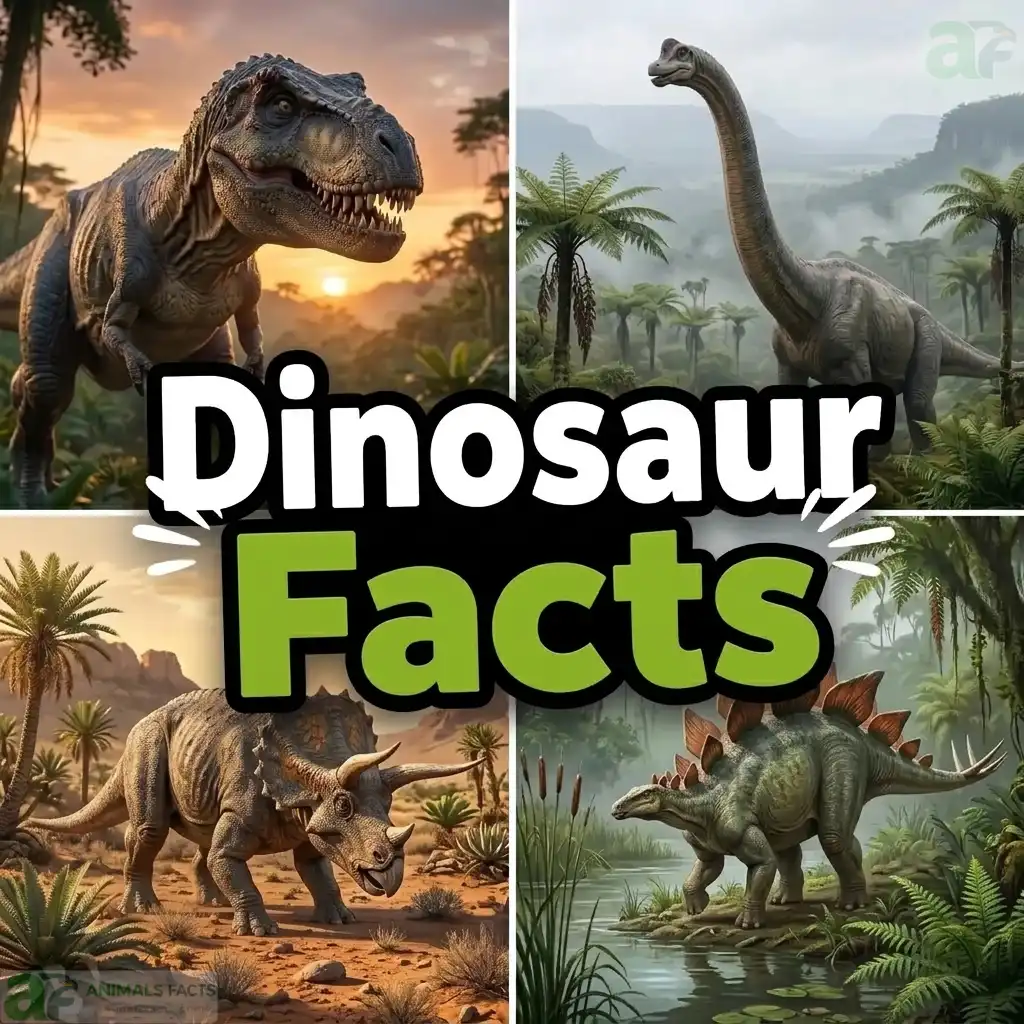
Dinosaur Facts
| Feature | Details |
|---|---|
| Scientific Classification | Clade Dinosauria (within Archosauria) |
| Kingdom | Animalia |
| Phylum | Chordata |
| Class | Reptilia (traditionally); now recognized as distinct clade |
| Existed | ~243 million to 66 million years ago (non-avian dinosaurs) |
| Living Descendants | Birds (Aves) — approximately 10,700 species alive today |
| Number of Named Species | Over 1,000 non-avian dinosaur species described |
| Estimated Total Species | Scientists estimate 700–2,500+ additional species remain undiscovered |
| Size Range | ~50 cm (Microraptor) to ~40 meters (Patagotitan mayorum) |
| Weight Range | Under 1 kg to approximately 70,000 kg (Patagotitan) |
| Diet Types | Herbivores (~65%), carnivores (~35%), omnivores (few) |
| Habitat | Every continent including Antarctica |
| Extinction Event | Chicxulub asteroid impact, ~66 million years ago |
| Survived As | Modern birds — the only living dinosaur lineage |
 1. Introduction: What is a Dinosaur?
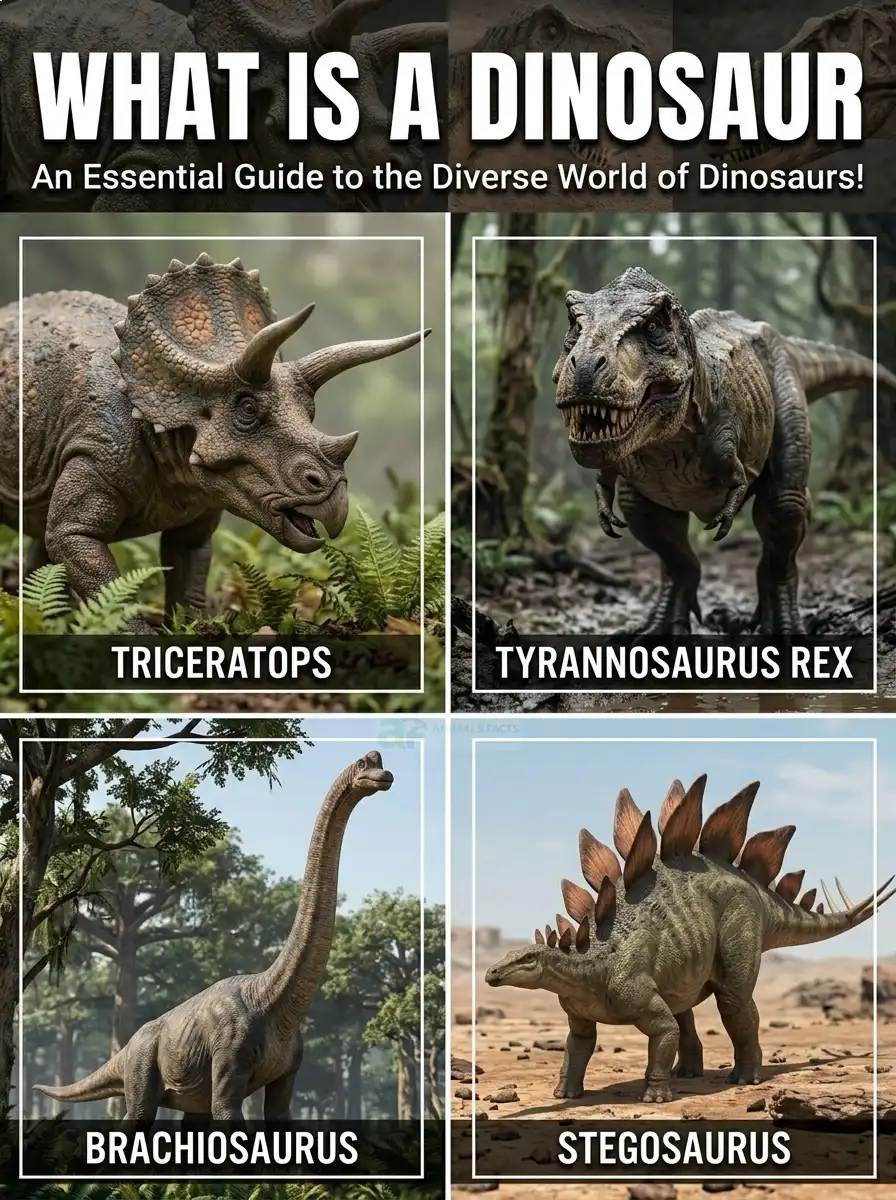
There is almost no other subject in all of natural history that ignites human curiosity quite like dinosaur facts. These extraordinary animals — which ruled the Earth for over 175 million years — have captured our collective imagination unlike anything else from the deep past. We have named them, argued about them, built museums around them, and made them the stars of some of the most successful films in cinema history. And yet, for all the cultural familiarity we have with dinosaurs, the scientific reality of what these creatures actually were continues to surprise even the most seasoned researchers.
The word “dinosaur” comes from the Greek deinos (terrible, powerful) and sauros (lizard) — coined by British anatomist Sir Richard Owen in 1842. But the creatures Owen named were far more than terrible lizards. Interesting facts about dinosaurs reveal animals that were warm-blooded (at least some of them), feathered (many of them), highly social (several species), and so successful that they dominated life on land for nearly 180 million years — a reign so long it makes the entire existence of Homo sapiens look like a geological eyeblink. And crucially, they never truly went extinct: birds are dinosaurs, scientifically speaking, and over 10,700 bird species carry the dinosaur legacy forward into the living world of 2026.
Whether you are a young student encountering dinosaur facts for kids for the first time, a parent trying to answer the relentless questions of a dinosaur-obsessed child, a teacher preparing lessons on prehistoric life, a paleontology enthusiast, or simply someone who has always felt the pull of these magnificent creatures, this is your most comprehensive guide. We will explore dinosaur habitat, dinosaur diet, the science of how dinosaurs lived, moved, communicated, and reproduced — and we will confront and correct some of the most persistent myths about these animals that popular culture has embedded in public consciousness. Let’s go back — about 240 million years.
2. Dinosaur Species Overview & Classification
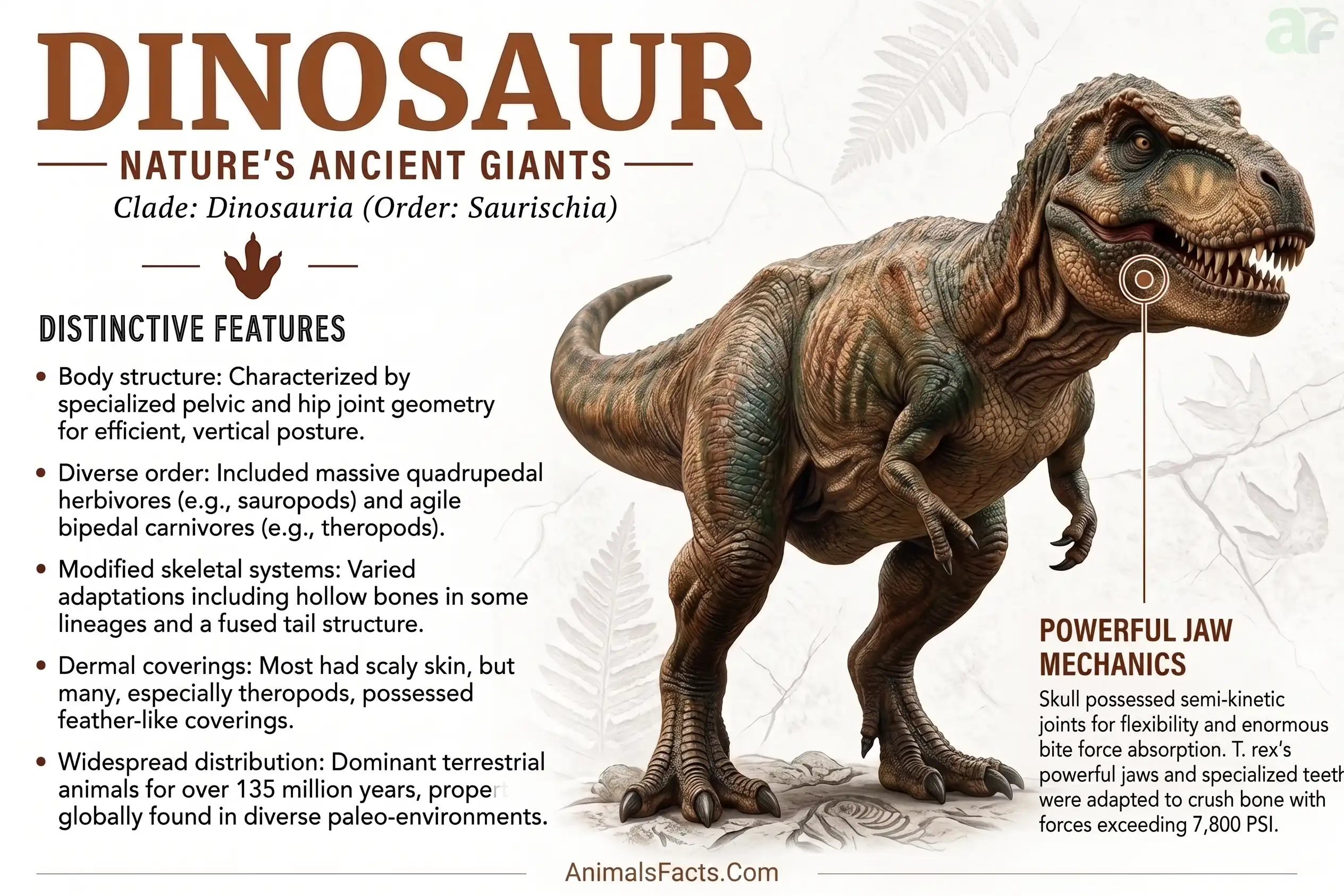
Dinosaurs belong to the clade Dinosauria, a grouping defined by a suite of skeletal features — most importantly, an upright posture in which the limbs extend directly beneath the body rather than splaying out to the sides (as in lizards and crocodilians). This upright stance, which they share with birds and mammals, is one of the key reasons dinosaurs became so ecologically dominant.
Dinosaur Classification Table
| Taxonomic Level | Classification |
|---|---|
| Domain | Eukaryota |
| Kingdom | Animalia |
| Phylum | Chordata |
| Class | Reptilia (traditional) / Sauropsida (modern) |
| Order | Dinosauria (Owen, 1842) |
| Major Clades | Saurischia (“lizard-hipped”), Ornithischia (“bird-hipped”) |
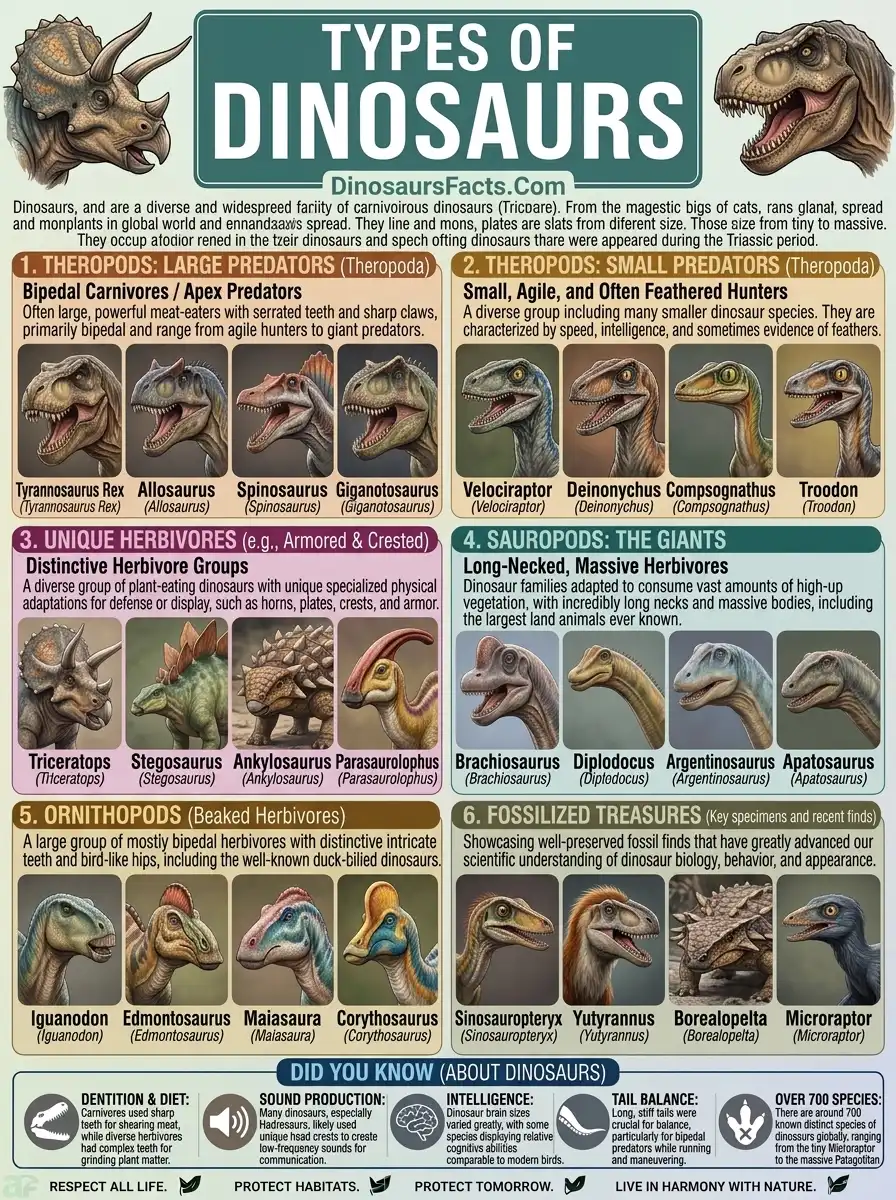
| Infraclades | Theropoda, Sauropodomorpha, Ornithopoda, Ceratopsia, Thyreophora, Pachycephalosauria |
| Temporal Range | Middle Triassic (~243 Ma) to present (via birds) |
| Named Non-Avian Species | ~1,000+ formally described |
The Two Great Dinosaur Lineages
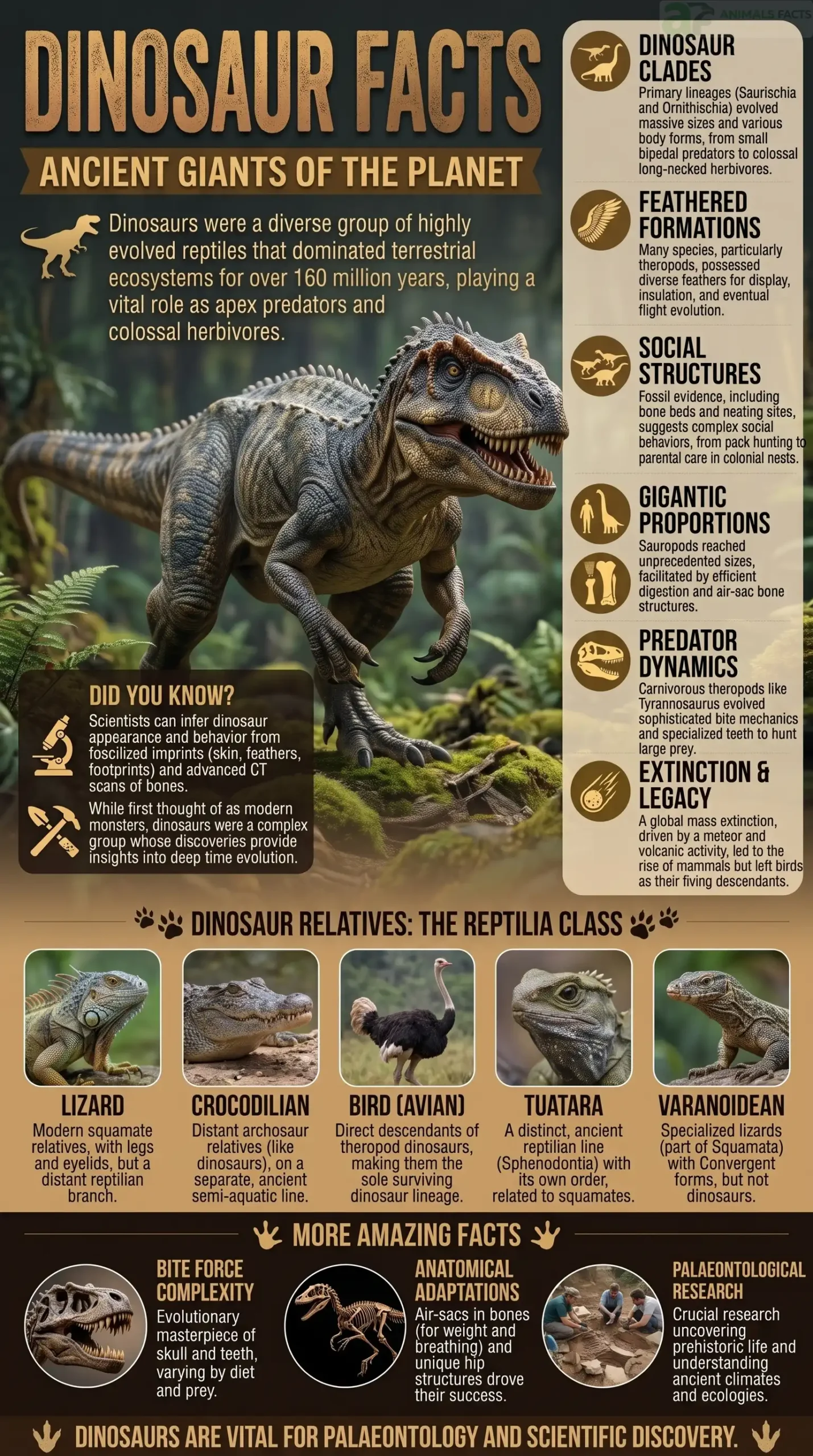
Dinosaurs are divided into two major groups based on hip structure:
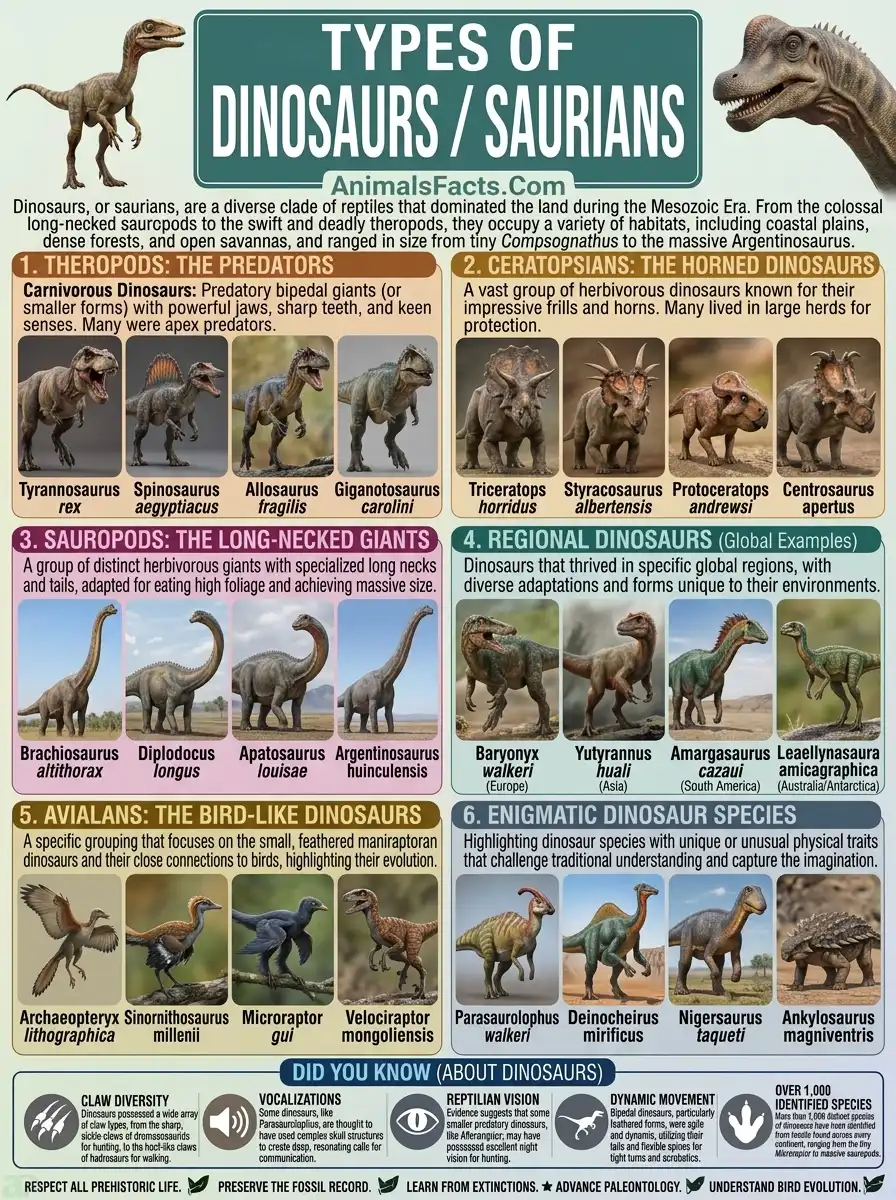
Saurischia (“lizard-hipped”) — Despite the name, this group includes birds’ direct ancestors. It is divided into:
- Theropoda — Bipedal, mostly carnivorous dinosaurs including Tyrannosaurus rex, Velociraptor, Spinosaurus, Allosaurus, and ultimately all modern birds
- Sauropodomorpha — The long-necked giants including Brachiosaurus, Diplodocus, Patagotitan, and Argentinosaurus
Ornithischia (“bird-hipped”) — Despite the hip structure superficially resembling birds, this group is not the ancestor of birds. It includes:
- Ornithopoda — Including Iguanodon, Hadrosaurus, and the hadrosaur “duck-bills”
- Ceratopsia — Horned dinosaurs including Triceratops, Styracosaurus, and Protoceratops
- Thyreophora — Armored dinosaurs including Stegosaurus, Ankylosaurus, and their relatives
- Pachycephalosauria — Dome-headed dinosaurs including Pachycephalosaurus
The Third Major Group: Marginocephalia
Ceratopsia and Pachycephalosauria are now grouped together in the clade Marginocephalia based on shared skull features — a reclassification that reflects the ongoing refinement of dinosaur taxonomy through modern analysis.
Evolution & Discovery Timeline
~243 million years ago — The earliest definitive dinosaurs appear in what is now South America during the Middle Triassic period. Eoraptor lunensis and Herrerasaurus ischigualastensis from Argentina represent some of the earliest members of the group.
~230 million years ago — Dinosaurs begin diversifying and spreading across the supercontinent Pangaea. They remain relatively small and uncommon compared to other Triassic reptiles.
~201 million years ago — The Triassic-Jurassic extinction event eliminates most competing large reptile groups, clearing ecological space that allows dinosaurs to explode in diversity and abundance.
~160 million years ago — The Late Jurassic sees the rise of the giant sauropods (Brachiosaurus, Diplodocus) and large theropods (Allosaurus). The iconic Archaeopteryx — the first feathered, bird-like dinosaur — appears in what is now Germany.
~125 million years ago — Early Cretaceous China produces extraordinary feathered dinosaur fossils (Sinosauropteryx, Microraptor, Yi qi) that transform our understanding of the dinosaur-bird relationship.
~68 million years ago — The Late Cretaceous represents the final flourishing of the dinosaur age, with Tyrannosaurus rex, Triceratops, Ankylosaurus, and hundreds of other iconic species living alongside the first modern flowering plants and early small mammals.
~66 million years ago — A 10-km-wide asteroid strikes the Yucatán Peninsula of Mexico, creating the Chicxulub crater. The immediate and cascading effects — wildfires, “nuclear winter” from ejected dust blocking sunlight, acid rain, and global temperature collapse — kill all non-avian dinosaurs and approximately 75% of all species on Earth.
1824 — William Buckland formally describes Megalosaurus — the first dinosaur to be scientifically named.
1842 — Sir Richard Owen coins the term “Dinosauria” in a landmark paper to the British Association for the Advancement of Science.
1858 — The first reasonably complete dinosaur skeleton discovered in North America — Hadrosaurus foulkii — found in New Jersey by William Parker Foulke, sparking America’s dinosaur craze.
1877 — The “Bone Wars” between American paleontologists Othniel Charles Marsh and Edward Drinker Cope begin — a bitter competitive fossil-hunting rivalry that produced an extraordinary number of new dinosaur species but also significant scientific fraud.
1905 — The American Museum of Natural History in New York mounts the world’s first Tyrannosaurus rex skeleton — creating global sensation and permanently cementing T. rex as the public face of dinosaurs.
1969 — John Ostrom describes Deinonychus antirrhopus and argues that dinosaurs were warm-blooded, active animals — triggering the “Dinosaur Renaissance” that transformed scientific understanding of these animals.
1996 — Chinese paleontologists describe Sinosauropteryx prima — the first non-avian dinosaur confirmed to have had feathers — a discovery that changes everything about how we visualize these animals.
2017 — Patagotitan mayorum is formally described from Argentina — the largest dinosaur and largest land animal ever confirmed, weighing an estimated 69,000 kg.
2020 — An extraordinary preserved dinosaur skin and soft tissue specimen of Edmontosaurus reveals that some hadrosaurs had fleshy head crests previously unknown from skeleton evidence alone.
2023 — New analysis of Tyrannosaurus rex specimens suggests the species may actually represent three separate species — a proposal that remains actively debated in the paleontological community as of 2026.
“Dinosaurs are not just the stuff of Hollywood fantasy. Every time we dig up a new species, the picture becomes richer, stranger, and more magnificent than any film has yet captured.” — Dr. Paul Sereno, University of Chicago paleontologist and National Geographic Explorer-in-Residence
3. Dinosaur Physical Description & Unique Features
Dinosaur size and weight encompass the most extreme range of any land animal group that has ever lived, and their physical diversity reflects an evolutionary experiment conducted across almost 180 million years on a constantly changing planet.
Size Extremes
The largest dinosaur ever confirmed is Patagotitan mayorum of Late Cretaceous Argentina — a titanosaur sauropod estimated to weigh approximately 69,000 kg (152,000 lbs) and measure 37 meters (121 feet) in length. Its thigh bone alone stands 2.4 meters tall — larger than most adult humans. Competing candidates for the largest dinosaur title include Argentinosaurus, Dreadnoughtus, and Supersaurus — all South American sauropods of comparable staggering proportions.
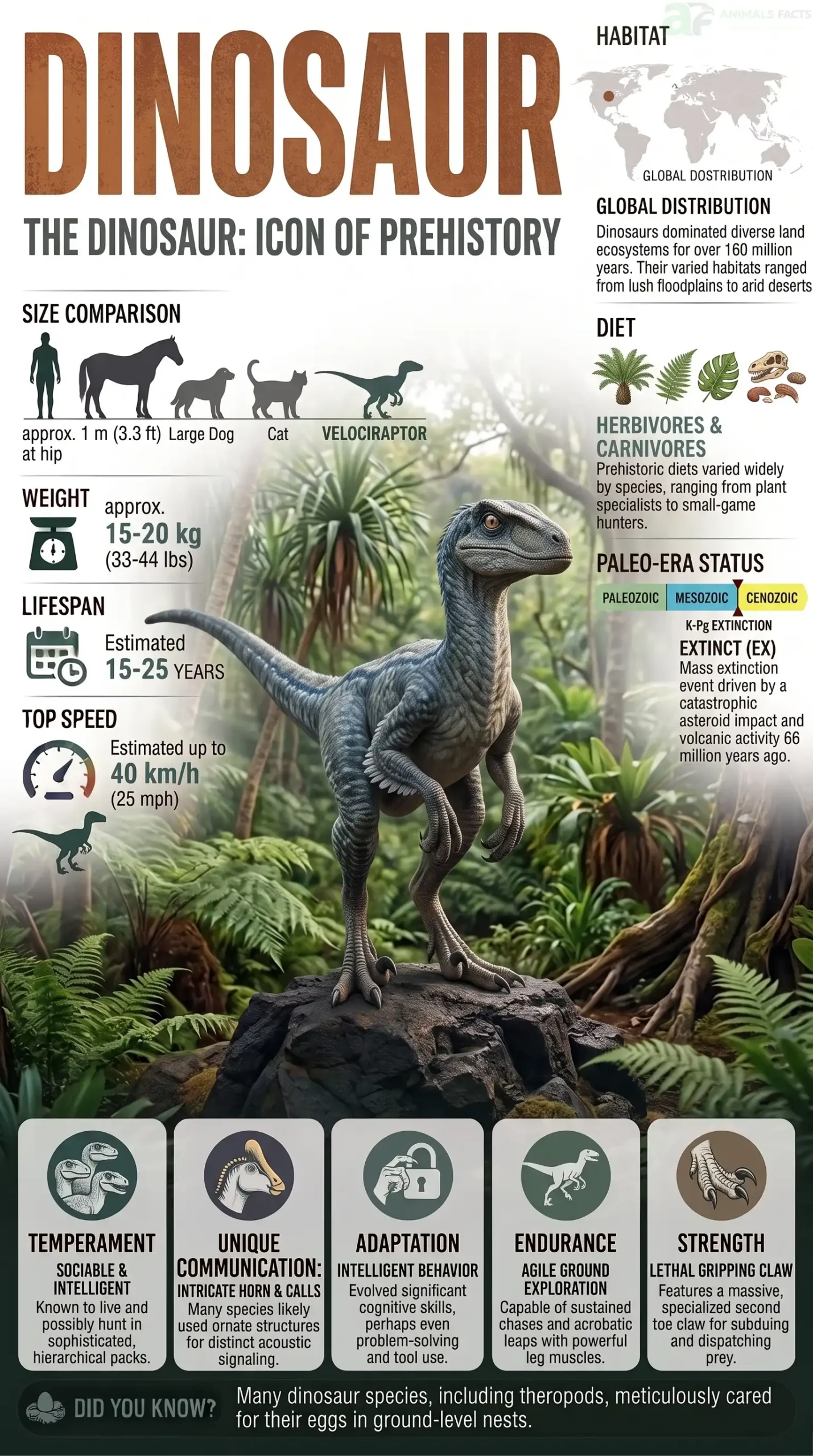
The smallest non-avian dinosaur known is Microraptor zhaoianus of Early Cretaceous China, with an estimated weight of just 1 kg (2.2 lbs) and a length of approximately 50 cm. It was four-winged — bearing feathers on both arms and legs — and almost certainly capable of gliding if not powered flight.
Feathers
One of the most transformative dinosaur facts of the past thirty years is the discovery that feathers were not an invention of birds — they were a widespread dinosaur feature. Non-avian dinosaurs with confirmed or probable feathers include members of virtually every major theropod group. The famous Velociraptor of Jurassic Park fame was not a scaly reptile but almost certainly a feathered animal resembling a large, aggressive turkey with killer claws. Even the largest theropods may have had at least partial feather coverage — juvenile T. rex specimens show evidence of filamentous feathers, though adults may have been largely bare-skinned.
Posture & Locomotion
All dinosaurs shared the defining upright posture — legs directly under the body — that distinguishes them from sprawling reptiles. This posture enabled greater speed, endurance, and body size than is possible in a sprawling animal. Dinosaurs were either bipedal (walking on two legs — all theropods, most early ornithischians), quadrupedal (four-legged — all sauropods, ceratopsians, most ankylosaurs and stegosaurs), or capable of switching between the two postures (facultatively quadrupedal, as in iguanodonts).
Gender & Age Differences
Determining sex from dinosaur fossils is notoriously difficult. However, a landmark 2016 study identified medullary bone — a calcium-rich tissue produced by female birds during egg production — inside the femur of a Tyrannosaurus rex specimen, confirming it was female. Growth rings in dinosaur bones (similar to tree rings) reveal that most dinosaurs grew extremely rapidly during juvenile stages before slowing dramatically — a pattern more similar to modern birds and mammals than to reptiles.
Did You Know? Spinosaurus aegyptiacus is now recognized as the largest carnivorous dinosaur ever discovered, exceeding Tyrannosaurus rex in length by potentially several meters. A 2020 study of its paddle-like tail suggested it was an active swimmer — the first evidence of a semi-aquatic lifestyle in any large theropod dinosaur.
4. Top 25 Amazing Dinosaur Facts
Here is your essential collection of the most extraordinary, scientifically verified, and genuinely mind-expanding dinosaur facts as of 2026:
- Dinosaurs ruled the Earth for approximately 175 million years — a span 87 times longer than the entire existence of modern humans.
- Birds are dinosaurs — not descended from dinosaurs, but actual living members of the clade Dinosauria. Every sparrow, eagle, and penguin is a dinosaur.
- There are more bird species alive today (~10,700) than there were known non-avian dinosaur species throughout the entire Mesozoic Era.
- Patagotitan mayorum was so large that its heart had to pump blood through a neck over 10 meters long to reach its brain.
- Tyrannosaurus rex had the most powerful bite force ever measured for a land animal — estimated at 57,000 Newtons (6 tons) — enough to crush bone with a single bite.
- Many dinosaurs had hollow bones — a feature they share with modern birds — which reduced weight without sacrificing structural strength.
- The Chicxulub asteroid that ended the dinosaur age released energy equivalent to approximately 10 billion Hiroshima atomic bombs.
- Velociraptor was not the human-sized terror of the Jurassic Park films — it was approximately the size of a turkey (about 2 meters long, 15 kg) and almost certainly fully feathered.
- Ankylosaurus‘s tail club was capable of delivering blows powerful enough to shatter bone — including potentially the leg bones of T. rex.
- The sauropod Diplodocus could crack its tail like a bullwhip, creating a sonic boom that may have been used for communication or defense — the first supersonic sound produced by any animal.
- Some dinosaurs are confirmed to have sat on their nests like modern birds, brooding their eggs with body heat — documented in Oviraptor, Troodon, and Maiasaura species.
- Triceratops and T. rex lived closer in time to us than they did to Stegosaurus — Stegosaurus predates T. rex by approximately 83 million years, while T. rex lived just 66 million years ago.
- The fastest dinosaurs were likely small theropods — Struthiomimus and Gallimimus are estimated to have reached speeds of 50–70 km/h, comparable to a racehorse.
- Stegosaurus had a brain approximately the size of a walnut — roughly 80 grams — in a body weighing up to 7,000 kg.
- Sauropod dinosaurs grew faster than any other land animal in history — juvenile Apatosaurus individuals grew from hatchling to adult size (~23,000 kg) in approximately 10 years.
- The discovery of DNA-like material in dinosaur bones (T. rex femur, 2005, by Mary Schweitzer) suggests biological molecules can survive far longer than previously believed — though claims of actual recoverable DNA remain scientifically controversial.
- Pachycephalosaurus had a dome of solid bone up to 25 cm thick on top of its skull — used in head-butting contests over mates or territory, analogous to modern musk oxen or bighorn sheep.
- Argentinosaurus eggs — confirmed for titanosaur sauropods — were roughly the size of a rugby ball despite the mothers weighing over 60,000 kg. This means hatchlings were approximately 1/10,000th the size of their mothers.
- The feathers of Microraptor have been shown through microscopic melanin analysis to have been iridescent black — similar to a modern starling — making it one of the first non-avian dinosaurs whose color is known with reasonable confidence.
- Spinosaurus had nostrils set high on its skull (like a crocodile) and dense bones reducing buoyancy — both adaptations for an aquatic lifestyle utterly unlike any other large theropod.
- Several dinosaur species — including Triceratops, Edmontosaurus, and ankylosaurs — have been found in bone beds containing dozens or hundreds of individuals, providing strong evidence of herding behavior.
- The longest dinosaur name belongs to Micropachycephalosaurus hongtuyanensis — a tiny pachycephalosaur from China with 23 letters in its genus name.
- T. rex had binocular vision comparable to a modern hawk — its eyes faced more forward than most dinosaurs, giving it exceptional depth perception ideal for precisely targeting prey.
- Some sauropod dinosaurs had neck vertebrae with air cavities (pneumatized bones) that reduced the weight of the neck so dramatically that the neck itself could weigh less than the skeleton of a large dog despite being 10+ meters long.
- The most complete T. rex skeleton ever found — nicknamed “Sue” — was discovered in South Dakota in 1990 and sold at auction in 1997 for $8.36 million to the Field Museum of Natural History in Chicago.
5. Dinosaurs Fun Facts for Kids
- Dinosaurs first appeared approximately 243 million years ago
- The word “dinosaur” literally means “terrible powerful lizard” in Greek
- T. rex arms were actually quite powerful — each arm could curl approximately 180 kg
- Some dinosaurs were warm-blooded like modern birds and mammals
- The largest eggs ever laid were dinosaur eggs — titanosaur eggs the size of rugby balls
- Velociraptor means “swift seizer” in Latin
- Dinosaur fossils have been found on every continent, including Antarctica
- More dinosaur species have been discovered in the past 20 years than in all previous paleontological history combined
- Chickens are more closely related to T. rex than T. rex is to Stegosaurus
- Brachiosaurus had nostrils on top of its skull — scientists once thought this meant it lived in water (it didn’t)
- Ankylosaur armor (osteoderms) was so tough it has been compared to modern ceramic composite armor
- The first dinosaur ever formally named (Megalosaurus, 1824) was described from a jawbone initially misidentified as a giant human bone
6. Natural Habitat & Geographic Range
Dinosaur habitat spanned the entire planet across their ~175-million-year reign. Because they lived during the time of the supercontinent Pangaea and its gradual breakup, early dinosaurs effectively inhabited a single landmass, while later species became increasingly distributed across isolated continental fragments with distinct faunas.
Habitat Types
Dinosaurs lived in environments that spanned a remarkable range — from tropical coastal plains to arid desert basins, from polar forests with seasonal darkness to mangrove swamps. Contrary to the popular image of dinosaurs in a perpetually steamy jungle, the Mesozoic world included a wide variety of climates, and polar dinosaurs are among the most fascinating recent discoveries in paleontology.
Habitat Range by Continent
| Continent | Notable Dinosaur Species Found | Notable Formation/Site |
|---|---|---|
| North America | T. rex, Triceratops, Allosaurus, Diplodocus | Hell Creek Formation, Morrison Formation |
| South America | Patagotitan, Argentinosaurus, Carnotaurus, Eoraptor | Ischigualasto Formation, Patagonian beds |
| Africa | Spinosaurus, Carcharodontosaurus, Afrovenator | Saharan deposits, Tendaguru Formation (Tanzania) |
| Europe | Megalosaurus, Iguanodon, Europasaurus, Archaeopteryx | Isle of Wight, Solnhofen (Germany) |
| Asia | Velociraptor, Protoceratops, Yi qi, Sinosauropteryx | Gobi Desert, Yixian Formation (China) |
| Australia | Australovenator, Diamantinasaurus, Muttaburrasaurus | Winton Formation, Queensland |
| Antarctica | Cryolophosaurus, Glacialisaurus | Beardmore Glacier region |
| India | Rajasaurus, Kotasaurus, Barapasaurus | Deccan Trap region, Godavari Basin |
Polar Dinosaurs
One of the most remarkable and underappreciated dinosaur facts is the confirmation that dinosaurs lived in polar regions — including areas within the Arctic Circle — where they experienced months of continuous darkness each year. Fossils discovered in Alaska (Prince Creek Formation) include Pachyrhinosaurus perotorum and a species of Edmontosaurus, suggesting these animals either migrated or remained year-round in high latitudes. Their endothermic (warm-blooded) metabolism would have been essential for surviving such conditions — providing important evidence against the old image of dinosaurs as cold-blooded reptiles.
Did You Know? Dinosaur fossils from Antarctica — discovered near the Beardmore Glacier — prove that these animals lived within the Antarctic Circle during the Early Jurassic period, when Antarctica was part of the supercontinent Gondwana and enjoyed a warmer climate than today, though still experiencing polar darkness for portions of the year.
7. Diet & Feeding Behavior
Dinosaur diet divided the group broadly into herbivores, carnivores, and a small number of omnivores — and each dietary category produced extraordinary feeding adaptations.
Diet Breakdown Table
| Dietary Category | Approximate % of Known Species | Representative Species |
|---|---|---|
| Herbivory (plants — leaves, ferns, conifers) | ~65% | Sauropods, hadrosaurs, ceratopsians, stegosaurs |
| Carnivory (vertebrate prey) | ~30% | T. rex, Allosaurus, Velociraptor, Spinosaurus |
| Omnivory (mixed plant and animal) | ~4% | Oviraptor, Gallimimus, Troodon |
| Insectivory (insects and small invertebrates) | ~1% | Small theropods, early ornithischians |
| Piscivory (fish) | ~3% | Spinosaurus, Baryonyx, Suchomimus |
Remarkable Feeding Strategies
Sauropod browsing — The long necks of sauropods like Brachiosaurus and Diplodocus allowed them to access food at heights (and potentially depths) unavailable to other herbivores. Computer modeling suggests Brachiosaurus could reach vegetation at heights of up to 13 meters — higher than any other land animal before or since. Some sauropods swallowed gastroliths (stones) that sat in their digestive system, physically grinding tough plant material, as some modern birds still do.
T. rex feeding — Analysis of T. rex bite marks on Triceratops and Edmontosaurus bones reveals a feeding pattern of puncture and pull — biting through bone and ripping off chunks of flesh. The extraordinary bite force (~57,000 N) allowed T. rex to consume bones entirely, extracting marrow with a precision and force unmatched by any other land predator. Evidence of bite marks consistent with scavenging suggests T. rex was likely both an active predator and opportunistic scavenger — analogous to modern lions and hyenas.
Hadrosaur dentition — The duck-billed hadrosaurs had perhaps the most extraordinary teeth of any dinosaur — dental batteries of up to 1,400 tightly packed teeth that functioned as a continuously self-replacing grinding surface. As teeth wore down from grinding tough vegetation, new teeth grew up from below to replace them — a system of dental replacement more efficient than anything found in modern mammals.
8. Reproduction & Life Cycle
Dinosaur reproduction fundamentally resembled that of modern birds — all dinosaurs laid eggs (even the largest sauropods), many showed evidence of nest-guarding and parental care, and growth rates in many species were rapid and bird-like rather than slow and reptile-like.
Egg Diversity
Dinosaur eggs ranged from the spherical sauropod eggs (roughly 25 cm diameter) to the elongated, asymmetrical eggs of theropods that more closely resemble modern bird eggs. The shape and structure of dinosaur eggshells are so diagnostic that paleontologists can often identify the dinosaur group that laid them even when no skeleton is found nearby.
Parental Care
Evidence of parental care in dinosaurs is now well-established for several species:
- Maiasaura (“good mother lizard”) — Named for the discovery by Jack Horner and Bob Makela in 1978 of nests with juveniles too young to have left independently, with food remains suggesting adults returned to feed their young
- Oviraptor — For decades assumed to be stealing eggs (hence its name, “egg thief”), it is now known from spectacular brooding fossils to have been sitting on its own eggs like a modern bird
- Psittacosaurus — Fossils from China show an adult associated with 34 juvenile individuals, interpreted as a parent guarding a creche
Growth Rates
Bone ring analysis has revealed that many dinosaurs — particularly theropods and sauropods — grew at extraordinarily rapid rates during juvenile phases. A T. rex grew at approximately 2 kg per day during its peak growth phase (roughly age 14–18 years). A Apatosaurus went from hatchling weight (~5 kg) to adult (~23,000 kg) in approximately 10 years — among the fastest growth rates ever documented for any animal.
Lifespan Comparison Table
| Species | Estimated Lifespan | Growth to Adult | Notes |
|---|---|---|---|
| T. rex | 28–32 years | ~20 years | Died relatively young; few lived past 30 |
| Diplodocus | 70–80 years (estimated) | ~10–15 years | Long-lived like modern large animals |
| Triceratops | 30–40 years (estimated) | ~15 years | Inferred from growth ring data |
| Velociraptor | 15–20 years (estimated) | ~5 years | Small size, faster life history |
| Archaeopteryx | ~5–10 years (estimated) | ~1–2 years | Bird-like rapid development |
9. Social Behavior & Communication
The social lives of dinosaurs are among the most actively debated and rapidly evolving areas of dinosaur behavior research. Evidence gathered over the past several decades has fundamentally overturned the old image of solitary, slow, and dim-witted prehistoric monsters.
Evidence for Herding
Bone beds — accumulations of multiple individuals of the same species — provide compelling evidence that many dinosaur species were social. A single bone bed in Alberta, Canada contains the remains of over 3,000 Centrosaurus individuals — almost certainly a catastrophic death of a migrating herd. Maiasaura nesting colonies in Montana cover areas of over 1 square kilometer, with individual nests spaced approximately 7 meters apart — close enough for social interaction, far enough to avoid constant conflict.
Communication
Without preserved vocal anatomy, dinosaur vocalizations are inferred from structure and comparisons with modern relatives. The hollow crests of hadrosaurs like Parasaurolophus are among the most fascinating acoustic structures in paleontology — computer modeling of Parasaurolophus walkeri crests suggests they functioned as resonating chambers capable of producing deep, resonating calls similar to a trombone or French horn. Different crest shapes in different species (or possibly in males versus females of the same species) would have produced distinctly different sounds — potentially enabling species recognition and individual identification across the dense forest environments they inhabited.
Intelligence
Brain size relative to body mass (encephalization quotient, or EQ) varies considerably across dinosaurs. Troodon formosus had an EQ comparable to modern emus or ostriches — suggesting cognitive abilities broadly similar to those of living large flightless birds. The small, bird-like Troodon is often cited as potentially the “smartest” non-avian dinosaur, with large eyes suggesting acute vision, possibly including night vision capability.
10. Predators & Defense Mechanisms
The relationship between dinosaurian predators and their prey drove some of the most spectacular evolutionary arms races in the history of life — producing weapons and defenses of extraordinary sophistication.
Major Predator-Prey Dynamics
The Late Jurassic Morrison Formation of North America presents a vivid snapshot of predator-prey dynamics: Allosaurus (the apex predator) hunting Diplodocus, Brachiosaurus, and Stegosaurus; Ceratosaurus competing with Allosaurus for the same prey; and Ornitholestes hunting small prey items below the attention of larger predators.
The Late Cretaceous Hell Creek ecosystem is even better known: T. rex as the unchallenged apex predator, hunting and scavenging Triceratops, Edmontosaurus, and Ankylosaurus — each of which had evolved extraordinary defensive adaptations against exactly such a predator.
Defensive Adaptations
Stegosaurus thagomizer — The spiked tail of Stegosaurus — now officially called the thagomizer (a term coined in a Gary Larson Far Side cartoon that was subsequently adopted by paleontologists) — left damage marks on Allosaurus bones that confirm it was used as an active weapon. Analysis suggests tail swings could deliver bone-crushing blows.
Ankylosaurus tail club — The fused mass of bone at the end of Ankylosaurus‘s tail could weigh up to 60 kg and deliver blows with a force sufficient to shatter the leg bones of even the largest predators. Computer modeling suggests the swing was rapid enough to generate forces exceeding 100,000 Newtons at the moment of impact.
Triceratops horns and frill — The three horns of Triceratops were genuine weapons — evidence of horn-on-horn contact and healed horn wounds confirms they were used in both intraspecific combat and defense against T. rex. A remarkable fossil published in 2020 shows Triceratops bone with embedded T. rex tooth — and healed bone growth around the wound — proving the animal survived a predator attack.
Sauropod size — For the largest sauropods, sheer body mass was the primary defense. An adult Patagotitan at 69,000 kg faced no serious predation risk — even the largest theropods would have been unable to subdue it. Young sauropods, however, were highly vulnerable and may have been protected by herding behavior, with adults forming protective barriers around juveniles.
Did You Know? The ankylosaur Zuul crurivastator (named after the Ghostbusters monster due to its terrifying appearance) was described in 2017 from one of the most complete and best-preserved ankylosaur specimens ever found. Its tail club was so complete that skin impressions are preserved around it — giving us a precise picture of the weapon’s real-world appearance in life.
11. Dinosaur Facts for Kids
Hey young dinosaur explorers! Here are some totally awesome dinosaur facts for kids that will make you the most interesting person at school:
- 🦕 Dinosaurs came in ALL sizes! Some were smaller than chickens. Others were longer than three school buses parked end to end. And guess what — those tiny ones were covered in feathers just like birds!
- 🦕 T. rex had a superpower nose! Scientists think T. rex had an incredible sense of smell — it could probably sniff out food from kilometers away, like the world’s most terrifying bloodhound.
- 🦕 Some dinosaurs took care of their babies! Maiasaura moms brought food to their babies in the nest — just like birds and many mammals do today. That’s actually where its name comes from: it means “good mother lizard”!
- 🦕 Dinosaurs never stopped making new teeth! Hadrosaurs (the duck-billed dinosaurs) had up to 1,400 teeth in their mouths at once, constantly replacing worn ones with fresh ones from below — like a shark but even more intense!
- 🦕 Birds ARE dinosaurs! Your pet bird, the pigeons in the park, eagles, penguins — they’re all real living dinosaurs. The dinosaurs didn’t all die out — the bird ones survived and there are now 10,700 species of them!
- 🦕 Velociraptor was much smaller than in the movies! In Jurassic Park, Velociraptors are as big as humans. In real life they were about the size of a large turkey — and they had feathers!
- 🦕 The biggest dinosaur had a heart-pumping problem! Patagotitan was so incredibly long that its heart had to pump blood up a neck over 10 meters long just to keep its brain working. Imagine having a neck longer than a bus!
- 🦕 You can see dinosaur footprints today! Real dinosaur footprints are preserved in rocks all over the world — in places like Dinosaur Valley State Park in Texas, you can actually walk up to real T. rex footprints in a riverbed!
12. Relationship with Humans
Humans and non-avian dinosaurs never coexisted — separated by 66 million years of geological time. But the relationship between humans and dinosaurs — through fossil discovery, scientific study, cultural fascination, and the living descendants we share our world with — is one of the most profound in natural history.
Discovery History
Dinosaur fossils were known to humans long before their true nature was understood. Ancient Chinese scholars interpreted large fossil bones as dragon bones, and ground them into medicinal powders — a practice documented for at least 2,000 years. Ancient Greek communities living near fossil beds in the Aegean region may have developed legends of griffins based on fossil Protoceratops skulls found in the Gobi Desert — complete with their distinctive curved beaks and four-limbed body profile.
In Native American traditions, large fossil bones were incorporated into spiritual frameworks and treated with respect as the remains of powerful ancestral beings. The Sioux people’s term for large fossil bones translates roughly as “the bones of the great serpent” — reflecting a sense of ancient, powerful origin.
The first scientific description of what we now recognize as a dinosaur bone was made by English physician Robert Plot in 1677 — he described a large bone from Oxfordshire that he correctly identified as belonging to a creature larger than any living animal, though he mistakenly suggested it might be from a giant human.
Economic & Cultural Impact
Dinosaurs generate an enormous and diverse economic impact in the modern world. The global paleotourism industry — museum visits, fossil site tourism, educational programming — is estimated to be worth several billion dollars annually. The Jurassic Park / Jurassic World franchise has grossed over $6 billion at the global box office as of 2026, making it one of the highest-grossing film franchises in history and one of the most powerful vehicles for public science communication (and public scientific misinformation) ever created.
The commercial fossil market generates significant revenue but also creates serious conservation challenges — important scientific specimens are occasionally sold to private collectors before they can be properly studied, a practice that paleontologists have campaigned against for decades.
13. Conservation Status — What Happened & The Living Legacy
Non-avian dinosaurs are, of course, entirely extinct — having been eliminated by the Chicxulub impact event approximately 66 million years ago. But the story of dinosaur “conservation” has two profoundly important dimensions: the preservation of the fossil record that allows us to know dinosaurs at all, and the conservation of birds — the living dinosaurs that carry this ancient lineage forward.
The Mass Extinction Event
The Cretaceous-Paleogene (K-Pg) extinction event was caused by the impact of a ~10 km diameter asteroid at what is now Chicxulub, Mexico. The immediate effects — tremendous heat pulse, mega-tsunamis, and global wildfires — were followed by the more prolonged catastrophe of “impact winter”: dust, soot, and sulfate aerosols blocking sunlight for months to years, collapsing photosynthesis, food chains, and global temperatures. An estimated 75% of all species on Earth were eliminated, including all non-avian dinosaurs.
What Survived
The dinosaur lineage did not end on that day 66 million years ago. A group of small, feathered theropods — the direct ancestors of modern birds — survived, possibly because their small size, dietary flexibility, and ability to cache food helped them weather the catastrophic disruption to global ecosystems. From these survivors, all 10,700+ living bird species ultimately descended, making birds the most species-rich group of land vertebrates on Earth today.
Fossil Conservation
Protecting the fossil record — the physical evidence of dinosaur existence — is an active conservation challenge. Illegal fossil collection, habitat destruction in fossil-bearing formations, and the commercial fossil trade all threaten the scientific record. Organizations including the Society of Vertebrate Paleontology (SVP) and individual national governments work to protect significant fossil sites through legislation and international cooperation.
| Threat to Fossil Record | Impact | Status |
|---|---|---|
| Illegal collection | Loss of scientific context | Ongoing; major problem in China, Argentina, Mongolia |
| Commercial fossil trade | Key specimens in private hands | Legally complex; SVP actively campaigns against this |
| Habitat development | Fossil site destruction | Managed through heritage legislation in most countries |
| Natural erosion | Gradual loss of exposed fossils | Ongoing; highlights importance of rapid documentation |
14. Famous Dinosaurs in History
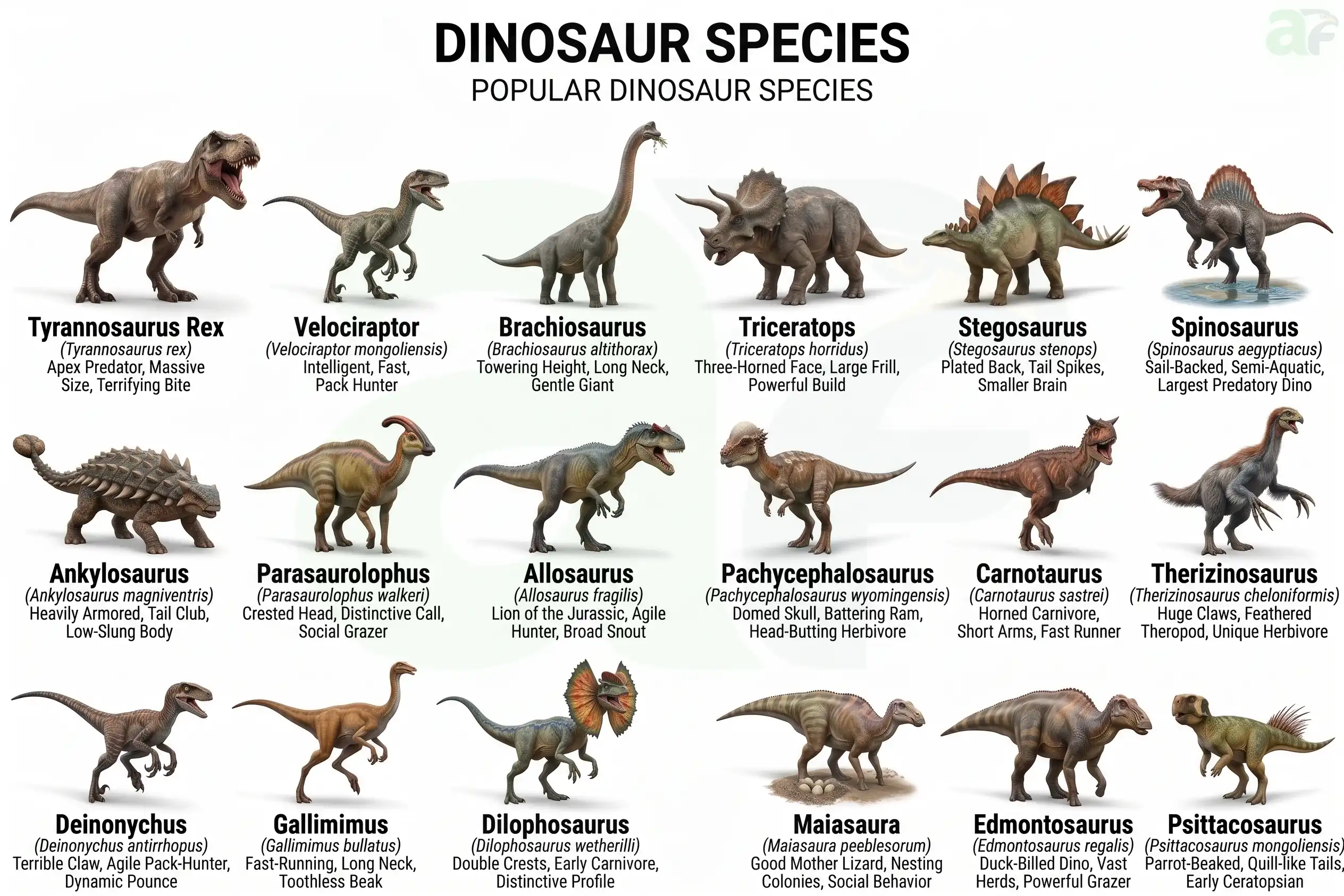
Famous Named Dinosaur Specimens
“Sue” (Tyrannosaurus rex, specimen FMNH PR 2081) — Discovered in 1990 by fossil hunter Sue Hendrickson in the Hell Creek Formation of South Dakota. The most complete T. rex skeleton ever found (approximately 90% complete), sold at auction for a then-record $8.36 million to the Field Museum of Natural History in Chicago in 1997. A new, even more complete T. rex skeleton nicknamed “Máximo” now holds the record for completeness at the Field Museum following its mounting in 2018.
“Stan” (T. rex, specimen BHI 3033) — The second most complete T. rex ever discovered, named after amateur fossil hunter Stan Sacrison. Sold at Christie’s auction house in October 2020 for a staggering $31.8 million — the highest price ever paid for a dinosaur fossil. Its purchase by an anonymous buyer and subsequent revelation that it was destined for Abu Dhabi’s new natural history museum caused significant controversy in the paleontological community.
“Scotty” (T. rex, specimen RSM P2523.8) — Currently believed to be the largest T. rex individual ever found, described from Saskatchewan, Canada in 2019. Estimated to have weighed approximately 8,800 kg in life.
“Leonardo” (Brachylophosaurus canadensis) — A juvenile hadrosaur mummy discovered in 2000 in Montana, with approximately 90% of its original soft tissue preserved as mummified skin, scales, and muscle — providing an extraordinary window into dinosaur soft tissue anatomy.
“Big John” (Triceratops horridus) — The largest Triceratops skull ever found, sold at auction in Paris in 2021 for $7.7 million.
15. Role in Ecosystem & Food Chain
Dinosaurs were the dominant vertebrates of terrestrial ecosystems for ~175 million years, occupying every ecological role from apex predator to primary herbivore to seed disperser to decomposer. Their ecological influence was so profound that the Mesozoic world — its landscapes, its plant communities, its evolutionary pressures on every other group of living things — cannot be understood without understanding the role of dinosaurs.
Ecological Roles
Large sauropods as megaherbivores — Sauropods exerted a profound engineering effect on their environments. Their enormous feeding pressure on vegetation maintained open forest structures similar to how elephants shape African savanna landscapes today. Their footprints created depressions that filled with water and became microhabitats. Their dung was a nutrient-rich resource exploited by insects, fungi, and microorganisms.
Theropods as population regulators — Apex predator theropods regulated prey populations and maintained ecosystem health, preventing any single herbivore species from becoming so dominant as to collapse vegetation. The role of T. rex in Hell Creek ecosystems closely parallels that of modern lions in African savanna — an apex predator whose presence structures the entire food web below it.
Flowering plant co-evolution — The diversification of flowering plants (angiosperms) during the Cretaceous period is now understood to have co-evolved significantly with ornithopod and ceratopsian dinosaurs — large-bodied herbivores whose feeding behavior created disturbed ground conditions ideal for fast-growing flowering plants, while the plants evolved nutritious fruits and seeds that provided high-quality food for the dinosaurs that spread them.
16. Myths, Folklore & Cultural Significance
The human fascination with large fossil bones — long before anyone understood what they were — produced some of the richest folklore traditions associated with any natural phenomenon.
In ancient China, dinosaur bones were called “dragon bones” (lóng gǔ) and attributed to actual dragons that had died and partially petrified. Ground dragon bone powder was prescribed in Chinese traditional medicine for treating conditions including dizziness, fever, and malaria — a practice documented continuously for over 2,000 years and continuing today in some traditional medicine markets, where fossil material continues to be sold as medicine despite being scientifically priceless.
In ancient Greece, the paleontologist Adrienne Mayor has argued compellingly in her book The First Fossil Hunters (2000) that many ancient Greek mythological creatures — including giants, griffins, and the Cyclops — were inspired by fossil discoveries. The Cyclops myth, in particular, may have been generated by ancient Mediterranean peoples encountering skulls of the dwarf elephant Elephas falconeri, whose large central nasal cavity could easily be misinterpreted as a giant single eye socket.
In Native American traditions of the American West — where some of the world’s richest dinosaur fossil beds are located — large bones were treated as the remains of powerful beings and incorporated into oral traditions about a time when the world was different and far more dangerous. The Sioux regarded fossil bones with reverence; the Blackfoot people of Montana call large fossil bones imitaa-isskimm (“buffalo stones”) and incorporated them into ceremonial bundles.
17. Dinosaurs in Pop Culture
Jurassic Park (1993) — Steven Spielberg’s adaptation of Michael Crichton’s 1990 novel is perhaps the single most influential work of science communication — and science misinformation — about dinosaurs ever produced. Its legacy includes inspiring multiple generations of professional paleontologists while simultaneously embedding several factually inaccurate images (featherless Velociraptors, venom-spitting Dilophosaurus) so deeply in public consciousness that correcting them remains an ongoing challenge for scientists.
The Lost World by Arthur Conan Doyle (1912) — Long before Jurassic Park, Doyle’s novel established the template of dinosaurs as living monsters in a hidden world — an idea that has been revisited dozens of times in fiction.
Fantasia (Disney, 1940) — The iconic “Rite of Spring” sequence features dinosaurs in an image that dominated popular imagination for decades — and was already scientifically outdated at the time of release (depicting dinosaurs as sluggish, swamp-dwelling cold-bloods).
Walking With Dinosaurs (BBC, 1999) — Narrated by Kenneth Branagh, this landmark six-part documentary series used then-revolutionary CGI to present dinosaurs as living animals in their ecosystems. Its influence on how the public and scientists communicate about dinosaurs is incalculable.
The Land Before Time (1988) — The animated film and its long-running sequel series introduced generations of children to dinosaur diversity and scientific names with a warmth and emotional accessibility that built deep early affection for paleontology.
18. Dinosaur Facts vs. Common Myths
| Common Myth | The Real Fact |
|---|---|
| “Dinosaurs were all enormous” | Many dinosaurs were small — Microraptor was the size of a crow; Compsognathus the size of a chicken |
| “Velociraptors were human-sized” | Real Velociraptors were turkey-sized (~2 m long, 15 kg). The film’s “raptors” were based on Deinonychus |
| “Dinosaurs were slow and sluggish” | Many dinosaurs were fast, active animals — evidence supports warm-blooded physiology in many species |
| “Dinosaurs had scales like lizards” | Many dinosaurs — particularly theropods — were feathered; even large species like T. rex may have had feathers as juveniles |
| “Dinosaurs are extinct” | Birds are dinosaurs — the avian lineage of dinosaurs is alive and thriving with 10,700+ species |
| “Humans and dinosaurs coexisted” | False — non-avian dinosaurs went extinct 66 million years ago; modern humans appeared ~300,000 years ago |
| “T. rex was the largest predator ever” | Spinosaurus was longer than T. rex, though T. rex was more robustly built; Carcharodontosaurus and Giganotosaurus also rival or exceed T. rex in size |
| “Dinosaurs had tiny brains and were stupid” | Brain size varied enormously; Troodon and bird-like theropods had relatively large brains with cognitive abilities comparable to modern large birds |
19. Best Places to Explore Dinosaur History
1. Dinosaur Provincial Park, Alberta, Canada — A UNESCO World Heritage Site containing one of the richest dinosaur fossil beds ever discovered. Over 40 species of dinosaur have been found here, including spectacular ceratopsian bone beds. The park offers guided fossil walking tours and the spectacular landscape of the Badlands.
2. Hell Creek Formation, Montana & South Dakota, USA — The source of many of the world’s most famous T. rex, Triceratops, and Ankylosaurus specimens. Museums in the region including the Museum of the Rockies (Bozeman, MT) hold some of the finest dinosaur collections in the world.
3. Gobi Desert, Mongolia & China — The world’s most productive region for Cretaceous Asian dinosaurs, yielding Velociraptor, Protoceratops, Oviraptor, Tarbosaurus, and extraordinary feathered theropods from Chinese deposits. The IVPP (Institute of Vertebrate Paleontology and Paleoanthropology) in Beijing houses a world-class collection.
4. Patagonia, Argentina — The epicenter of titanosaur sauropod discovery, where Patagotitan, Argentinosaurus, and Dreadnoughtus were all found. The Museo Paleontológico Egidio Feruglio in Trelew houses extraordinary specimens and offers access to active dig sites.
5. Solnhofen, Bavaria, Germany — The limestone quarries that produced Archaeopteryx and exquisitely preserved Jurassic marine and terrestrial life. The Jura-Museum Eichstätt holds one of the finest Archaeopteryx specimens in existence.
6. Isle of Wight, United Kingdom — Europe’s richest dinosaur fossil island, dubbed “Dinosaur Island,” with accessible cliff exposures yielding new specimens regularly. The Dinosaur Isle Museum in Sandown is the UK’s only purpose-built dinosaur museum.
7. Dinosaur Valley State Park, Glen Rose, Texas, USA — The most accessible site in the world for viewing in-situ dinosaur trackways — actual footprints left by sauropods and theropods in riverbed rock 113 million years ago. Visitors can wade into the Paluxy River and step next to the genuine tracks.
20. How You Can Help Paleontology
While dinosaurs themselves cannot be conserved (they are extinct), the fossil record that allows us to know them can be — and this requires active, ongoing effort.
Support these organizations:
- Society of Vertebrate Paleontology (SVP) — vertpaleo.org — advocates for ethical fossil collection and scientific access
- Natural History Museum, London — nhm.ac.uk — public engagement and research
- Smithsonian National Museum of Natural History — naturalhistory.si.edu
- Palaeontological Association — palass.org
- Dinosaur Research Institute — dinosaurresearchinstitute.com
What you can do:
- Never purchase commercially collected fossils that cannot be verified as legally and ethically sourced — commercially collected vertebrate fossils often lack crucial scientific context
- Report significant fossil finds to your national geological survey, a university paleontology department, or a natural history museum rather than collecting them yourself
- Support museum memberships — natural history museums are the primary repositories of the fossil record and depend on public support
- Participate in citizen science — projects like iDigBio and Fossil Finder allow non-specialists to contribute meaningfully to paleontological research by digitizing museum collections or identifying fossils in satellite imagery
- Advocate for heritage protection — support legislation that protects significant fossil sites from development and illegal collection
21. Top Documentaries & Books
Must-Watch Documentaries
- Walking With Dinosaurs (BBC, 1999) — The definitive dinosaur documentary series; still magnificent despite some outdated science
- Prehistoric Planet (Apple TV+, 2022–2023) — Narrated by David Attenborough; the most scientifically accurate and visually spectacular dinosaur documentary ever produced, incorporating feathers, behavior, and ecology based on cutting-edge research
- Planet Dinosaur (BBC, 2011) — A six-part series focusing on new discoveries including Spinosaurus and various feathered theropods
- Dinosaur 13 (documentary film, 2014) — The remarkable true story of the discovery of “Sue” the T. rex and the legal battle that followed
- The Real T. rex with Chris Packham (BBC, 2019) — A focused examination of the latest T. rex research including color, intelligence, and behavior
Must-Read Books
- The Rise and Fall of the Dinosaurs by Steve Brusatte (2018) — Widely considered the best modern popular science book on dinosaur paleontology; authoritative, accessible, and thrilling
- Dinosaurs: The Most Complete, Up-to-Date Encyclopedia for Dinosaur Lovers of All Ages by Dr. Thomas R. Holtz Jr. — Comprehensive reference for all age groups
- The Dinosaur Artist by Paige Williams (2018) — The gripping true story of the commercial fossil trade and the theft of Mongolian dinosaur specimens
- How to Build a Dinosaur by Jack Horner & James Gorman — Explores the science of reverse-engineering dinosaur features from modern birds
- The First Fossil Hunters by Adrienne Mayor — Groundbreaking exploration of how ancient civilizations incorporated fossil discoveries into mythology
22. Comparison of Major Dinosaur Groups
| Feature | T. rex | Triceratops | Brachiosaurus | Velociraptor |
|---|---|---|---|---|
| Group | Theropoda | Ceratopsia | Sauropodomorpha | Theropoda (Dromaeosauridae) |
| Length | ~12 m | ~9 m | ~26 m | ~2 m |
| Weight | ~8,000–9,000 kg | ~6,000–12,000 kg | ~28,000–58,000 kg | ~15 kg |
| Diet | Carnivore | Herbivore | Herbivore | Carnivore |
| Period | Late Cretaceous | Late Cretaceous | Late Jurassic | Late Cretaceous |
| Location | North America | North America | North America, Africa | Mongolia, China |
| Feathers | Possible (juvenile) | None confirmed | None | Almost certainly yes |
| Defense/Weapon | Bite force, size | Horns, frill | Size, tail whip | Sickle claw |
23. Frequently Asked Questions About Dinosaurs
Q1: What is the scientific name for dinosaurs?
Dinosaurs belong to the clade Dinosauria, a term coined by British anatomist Sir Richard Owen in 1842. The name derives from the Greek deinos (terrible, powerful) and sauros (lizard). Individual dinosaur species each have their own binomial or polynomial scientific names — Tyrannosaurus rex (“tyrant lizard king”), Triceratops horridus (“terrible three-horned face”), Velociraptor mongoliensis (“swift seizer from Mongolia”), and so on. Modern taxonomy places Dinosauria within the larger clade Archosauria, which also includes crocodilians and pterosaurs (the latter not being dinosaurs).
Q2: When did dinosaurs live?
Non-avian dinosaurs lived from approximately 243 million years ago (Middle Triassic period) to approximately 66 million years ago (end of the Cretaceous period) — a span of approximately 177 million years. The Mesozoic Era, during which they lived, is divided into the Triassic (~252–201 Ma), Jurassic (~201–145 Ma), and Cretaceous (~145–66 Ma) periods. If birds are included (as they scientifically should be), the dinosaur lineage continues to the present day.
Q3: What killed the dinosaurs?
The primary cause of non-avian dinosaur extinction was the Chicxulub asteroid impact, which struck what is now the Yucatán Peninsula of Mexico approximately 66 million years ago. The ~10 km diameter asteroid released energy equivalent to approximately 10 billion nuclear weapons, triggering immediate devastation (heat pulse, mega-tsunamis, wildfires) followed by months to years of “impact winter” as dust and soot blocked sunlight globally. This collapsed food chains from the bottom up, eliminating approximately 75% of all species on Earth. Significant volcanic activity from the Deccan Traps of India may have contributed to environmental stress preceding and following the impact, though most paleontologists regard the asteroid as the decisive cause.
Q4: Were dinosaurs warm-blooded or cold-blooded?
The scientific consensus has shifted dramatically since the 1960s. The evidence now indicates that many — and probably most — dinosaurs were endothermic (warm-blooded), maintaining elevated, stable internal body temperatures independently of their environment. Evidence includes: rapid growth rates (documented from bone ring analysis); bone structure similar to modern warm-blooded animals; polar distribution in some species; and direct descent from birds, which are warm-blooded. The exact thermal physiology likely varied across the group — some large sauropods may have maintained stable temperatures through gigantothermy (bulk thermal inertia) rather than active endothermy — but the old image of sluggish, cold-blooded reptiles is scientifically outdated.
Q5: Did dinosaurs have feathers?
Yes — many did, and this is now one of the most firmly established facts in paleontology. Feathers have been confirmed in numerous theropod dinosaur species through both direct fossil preservation (particularly from the exquisite Early Cretaceous deposits of Liaoning Province, China) and indirect evidence (quill knobs on bones). Feathered non-avian dinosaurs include Sinosauropteryx, Yutyrannus, Microraptor, Anchiornis, Sinornithosaurus, Caudipteryx, Oviraptor, and many others. Even juvenile T. rex specimens show evidence of filamentous feathers. The feather is a dinosaur invention that predates birds by tens of millions of years.
Q6: How fast could T. rex run?
The running speed of T. rex has been debated for decades. Biomechanical modeling of its leg structure and muscle mass suggests a maximum sustainable speed of approximately 17–25 km/h (10–16 mph) — broadly comparable to a human jogging pace. A 2021 study suggested that T. rex may have used a distinctive walking gait with a resonant frequency that was highly efficient over long distances, potentially making it an effective persistence hunter rather than a sprinter. Whatever its top speed, its enormous stride length (~4 m) and efficient gait likely made it an effective predator of the relatively slow-moving hadrosaurs and ceratopsians that formed its primary prey.
Q7: What was the largest dinosaur ever?
The largest dinosaur ever confirmed is Patagotitan mayorum, a titanosaur sauropod from the Late Cretaceous of Patagonia, Argentina. Formally described in 2017 by Carballido et al., it is estimated to have weighed approximately 69,000 kg (152,000 lbs) and measured approximately 37 meters (121 feet) in length. It is represented by bones from six individuals — making it better-documented than many gigantic dinosaur species. Other contenders for the title include Argentinosaurus huinculensis, Dreadnoughtus schrani, and Supersaurus vivianae, all of which may have approached or even exceeded Patagotitan in total mass based on incomplete remains.
Q8: Are birds really dinosaurs?
Yes — scientifically and unambiguously. Birds (Aves) are a group of feathered theropod dinosaurs that evolved from small, feathered ancestors during the Jurassic period. The transition from non-avian dinosaurs to birds is now documented by dozens of transitional fossil species — including Archaeopteryx, Anchiornis, Xiaotingia, Aurornis, and many others — that show every conceivable intermediate between “typical” dinosaur and “typical” bird anatomy. Modern taxonomy formally places Aves within Dinosauria — making “are birds dinosaurs?” not a philosophical question but a matter of scientific definition. A chicken is as much a dinosaur as T. rex — just 66 million years of evolution removed from their last common ancestor.
Q9: How do we know what dinosaurs looked like?
Paleontologists reconstruct dinosaur appearance from multiple lines of evidence. Skeletal anatomy provides the primary framework — bone structure reveals muscle attachment points, body proportions, and locomotion. Skin and soft tissue impressions preserved in fine-grained sediments reveal external texture for dozens of species. Melanosomes — microscopic pigment-containing structures preserved inside fossil feathers — allow color reconstruction for feathered species, with Microraptor (iridescent black), Sinosauropteryx (rusty red and white banded tail), and Caihong juji (iridescent rainbow-like plumage) among the species whose colors are known with reasonable confidence. Comparisons with living relatives (birds and crocodilians) inform soft anatomy. And CT scanning of skulls reveals brain structure, sinus anatomy, and inner ear morphology that tells us about their sensory capabilities.
Q10: Were any dinosaurs venomous?
Evidence for venom in non-avian dinosaurs is limited but exists. Sinornithosaurus, a feathered dromaeosaurid from Early Cretaceous China, was proposed in a 2009 paper to have had a venom delivery system based on grooved teeth and a possible venom gland cavity in the skull. This claim remains controversial and is not universally accepted by paleontologists. Interestingly, the living descendants of dinosaurs — birds — include one confirmed venomous species: the pitohui of New Guinea, which incorporates toxic batrachotoxins from its beetle diet into its feathers and skin. The broader question of whether venom was more widespread in Mesozoic theropods than currently recognized remains an active area of research.
24. Sources & References
Research Sources
- Wikipedia — Dinosauria, Tyrannosaurus, Sauropoda, Feathered dinosaurs, Chicxulub crater
- Smithsonian National Museum of Natural History — naturalhistory.si.edu
- National Geographic — nationalgeographic.com/dinosaurs
- BBC Science & Nature — bbc.co.uk/nature
- Britannica — britannica.com/animal/dinosaur
- American Museum of Natural History — amnh.org
- Society of Vertebrate Paleontology — vertpaleo.org
- Live Science — livescience.com
- Brusatte, Steve (2018). The Rise and Fall of the Dinosaurs. William Morrow
- Holtz, Thomas R. (2007). Dinosaurs: The Most Complete, Up-to-Date Encyclopedia. Random House
- Carballido et al. (2017). “A new giant titanosaur sheds light on body mass evolution among sauropod dinosaurs.” Proceedings of the Royal Society B
- Hutchinson, John R. & Garcia, Mariano (2002). “Tyrannosaurus was not a fast runner.” Nature
- Sereno, Paul C. — multiple published research papers on dinosaur systematics and evolution
- Erickson et al. — multiple published papers on dinosaur growth and physiology