

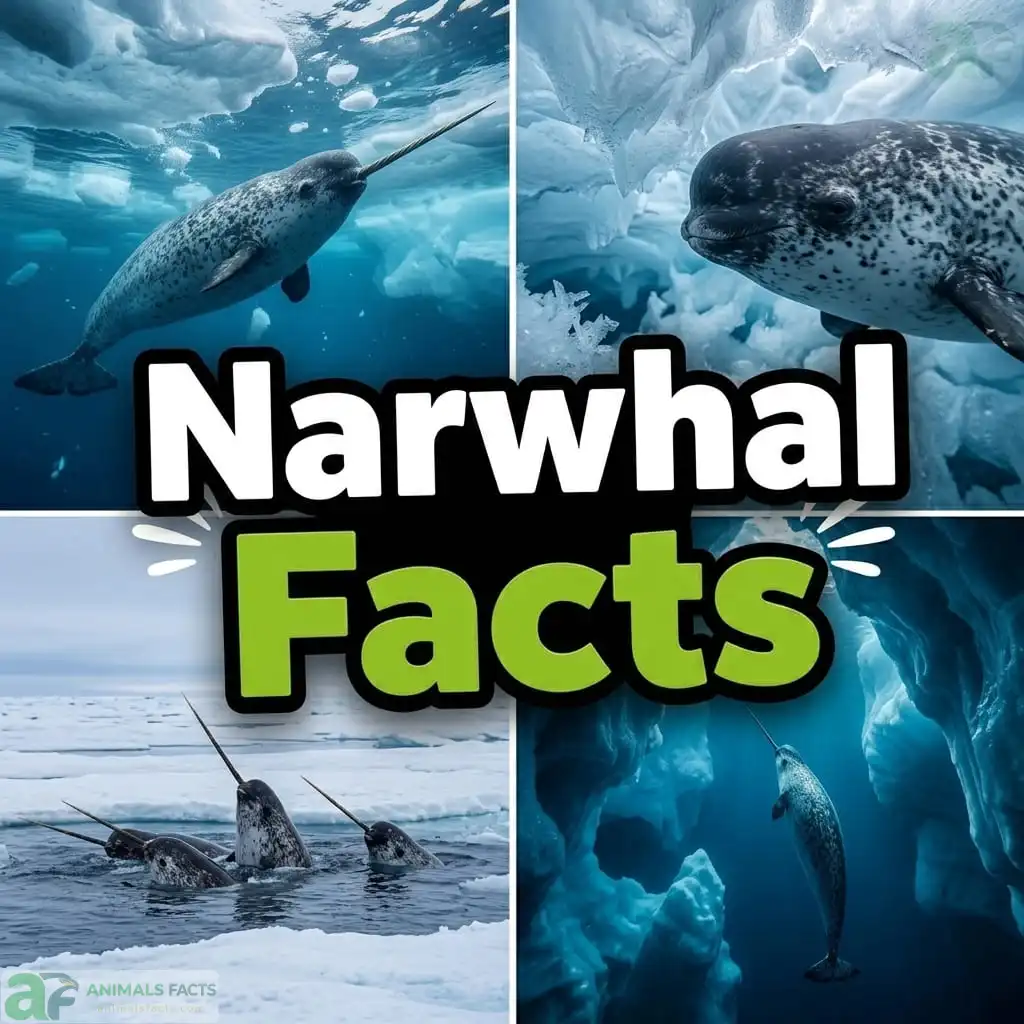
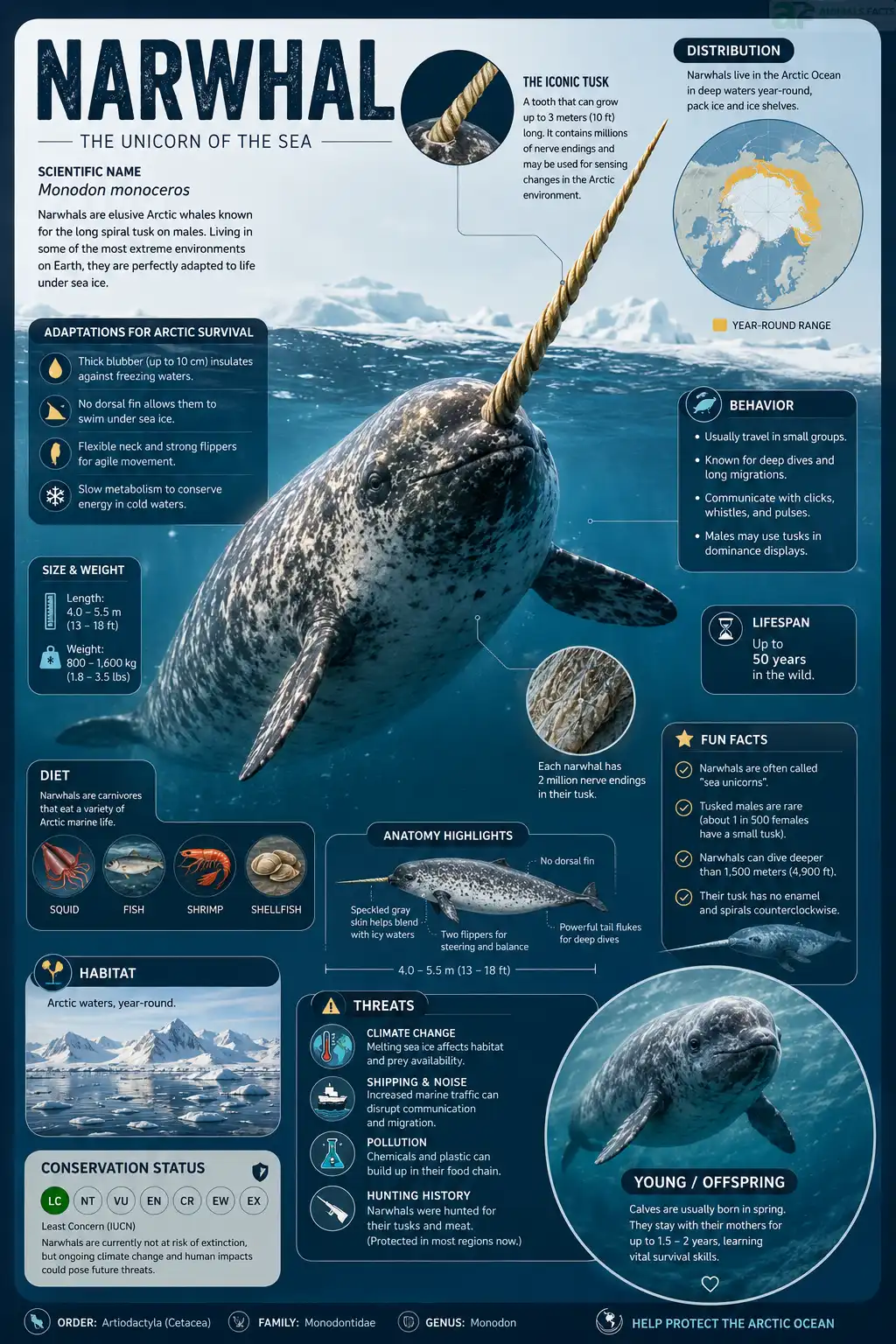
Narwhal Facts
| Feature | Details |
|---|---|
| Scientific Name | Monodon monoceros |
| Kingdom | Animalia |
| Class | Mammalia |
| Order | Artiodactyla |
| Family | Monodontidae |
| Habitat | Arctic Ocean, subarctic seas; fjords, bays, pack ice |
| Lifespan | 25–50 years |
| Diet | Carnivore — Arctic cod, Greenland halibut, squid, shrimp |
| Conservation Status | Least Concern (IUCN); Near Threatened in some regional assessments |
| Body Length | 3.9–5.5 m (including tusk) |
| Weight | 800–1,600 kg |
| Tusk Length | Up to 3 m (males); rarely present in females |
| Speed | Up to 25 km/h |
| Population Estimate | ~123,000–170,000 individuals globally |
| Dive Depth | Up to 1,800 m |
 1. Introduction: What is a Narwhal?
Imagine a creature so strange, so impossibly beautiful, that medieval Europeans refused to believe it was real — convinced instead that its spiraling horn came from the legendary unicorn. Yet the narwhal is entirely real, and narwhal facts are stranger and more extraordinary than any myth could manufacture. This ghostly Arctic whale glides beneath frozen seas, diving deeper than almost any other toothed whale, navigating worlds of permanent darkness by sound alone — and wearing on its face one of the most mysterious structures in the entire animal kingdom.
The narwhal has captivated humans for centuries. Vikings sold its tusk as “unicorn horn” for many times its weight in gold. Inuit hunters knew it as qilalugaq tugaalik — “the one that is good at curving itself to the sky” — and revered it as a symbol of the Arctic’s wild and unpredictable abundance. Modern scientists have spent decades trying to understand what that extraordinary spiraling tusk actually does — and the answers, still unfolding as of 2026, are more astonishing than anyone expected.
This is your complete guide to narwhal facts — covering everything from the narwhal’s scientific name and size and weight, to its deepest dives, its mysterious tusk, its cultural significance, and the growing conservation threats it faces in a warming Arctic. Whether you are a student searching for narwhal facts for kids, a researcher cross-checking data, or simply someone who watched a documentary and fell immediately and helplessly in love with this animal — you have come to the right place.
2. Narwhal Species Overview & Classification
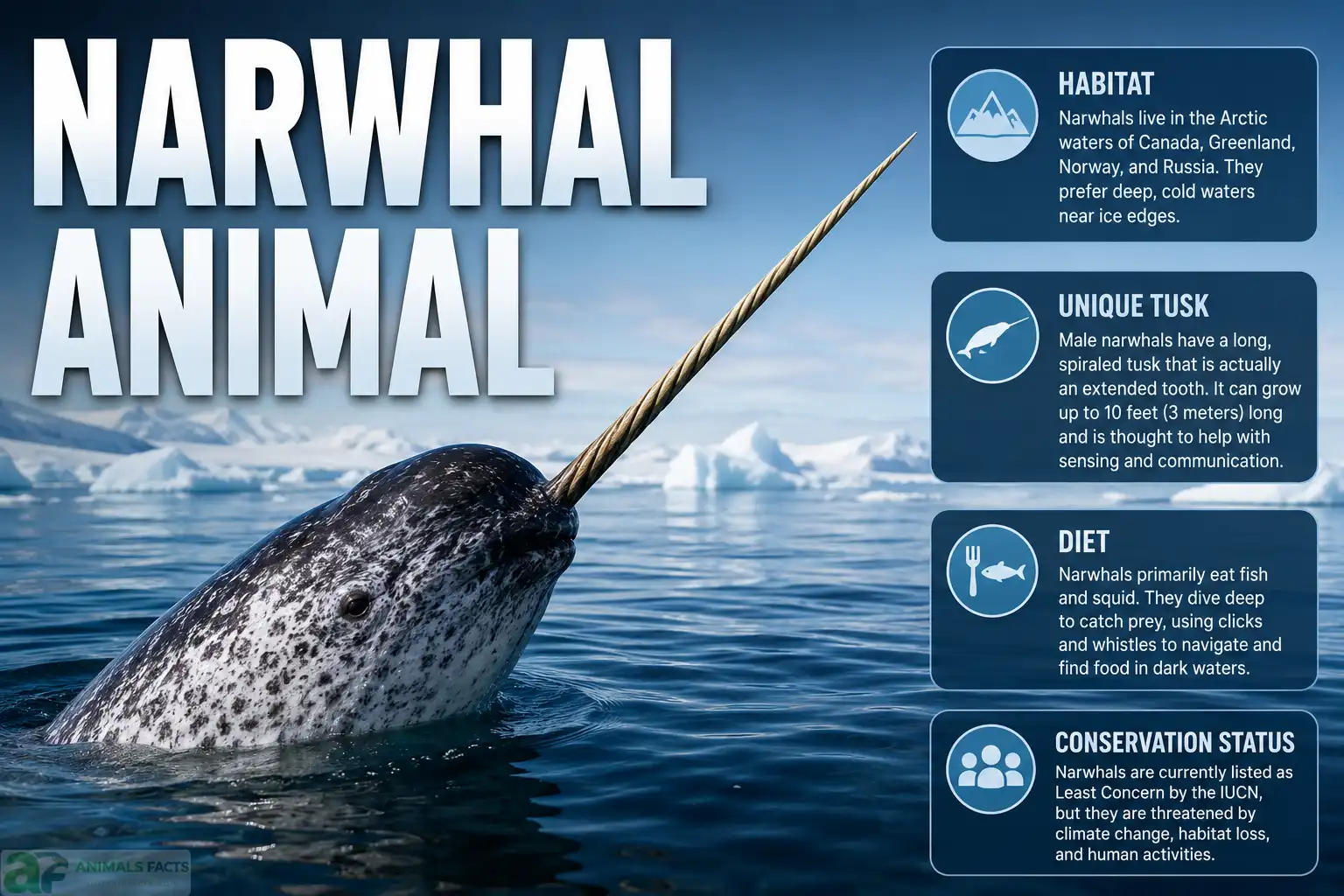
The narwhal belongs to the family Monodontidae — a small, ancient family of toothed whales containing only two living species: the narwhal and the beluga whale. Both are Arctic specialists, highly adapted to life in cold, often ice-covered waters, and both lack a dorsal fin — an adaptation that allows them to swim easily beneath sea ice without obstruction.
Taxonomy Table
| Level | Classification |
|---|---|
| Kingdom | Animalia |
| Phylum | Chordata |
| Class | Mammalia |
| Order | Artiodactyla |
| Infraorder | Cetacea |
| Family | Monodontidae |
| Genus | Monodon |
| Species | Monodon monoceros |
| Common Name | Narwhal, narwhale, “unicorn of the sea” |
| Etymology | Old Norse: nár (corpse) + hvalr (whale) — “corpse whale,” referencing their mottled coloration |
Narwhal Subspecies and Population Structure
The narwhal has no recognized subspecies — it is a single species (Monodon monoceros). However, scientists recognize several distinct population stocks based on geographic range, genetics, and migratory patterns:
- West Greenland population — the largest, summering in Baffin Bay and Lancaster Sound
- East Greenland population — smaller; less studied
- Russian Arctic population — poorly documented; possibly distinct
- Hudson Bay population — isolated; genetically somewhat distinct
Species Evolution & Discovery Timeline
- ~30 million years ago — Monodontidae diverges from other toothed whale families during the Oligocene; early ancestors adapt to cold North Atlantic environments
- ~5 million years ago — Ancestral narwhal lineage separates from beluga lineage; Arctic specialization intensifies
- ~1 million years ago — Modern Monodon monoceros body plan established; tusk evolution complete
- 900–1000 CE — Norse explorers encounter narwhals in Arctic waters; tusks traded as “unicorn horn” (alicorn)
- 1100–1400 CE — Peak European trade in narwhal tusks; sold to royalty and churches as magical objects
- 1758 — Carl Linnaeus formally describes Monodon monoceros in Systema Naturae
- 1800s — Systematic whaling of narwhals by European and American whalers for oil and ivory
- 1970s — Canadian government begins formal narwhal population surveys and harvest management
- 1986 — First satellite tagging of narwhals; migration and dive patterns begin to be documented
- 2014 — Landmark study reveals narwhal tusk contains up to 10 million nerve endings — a sensory organ, not a weapon
- 2017 — Drone footage captures narwhals using tusks to stun Arctic cod — first direct evidence of tusk used in hunting
- 2020–2026 — Climate change effects on narwhal habitat intensify; new population assessments suggest regional declines in some stocks
3. Narwhal Physical Description & Features
The narwhal’s body is immediately recognizable — but its features reveal extraordinary biological engineering beneath the surface.
Body and Coloration
Adult narwhals have a mottled, blotchy pattern of dark gray, brown, black, and white — a coloration that changes dramatically with age. Calves are born almost uniformly blue-gray or dark gray. As juveniles, they become blue-black. Adults develop the characteristic mottled pattern, and very old individuals can become almost entirely white — earning them the Inuit name qilalugaq (white whale) sometimes applied to very old animals.
The narwhal body is torpedo-shaped and powerfully built — adapted for deep diving and sustained Arctic swimming. Unlike most cetaceans, narwhals have no dorsal fin — replaced by a dorsal ridge of tough connective tissue running along the back. This adaptation allows narwhals to swim directly beneath sea ice without risk of injury.
The Tusk – Nature’s Most Mysterious Structure
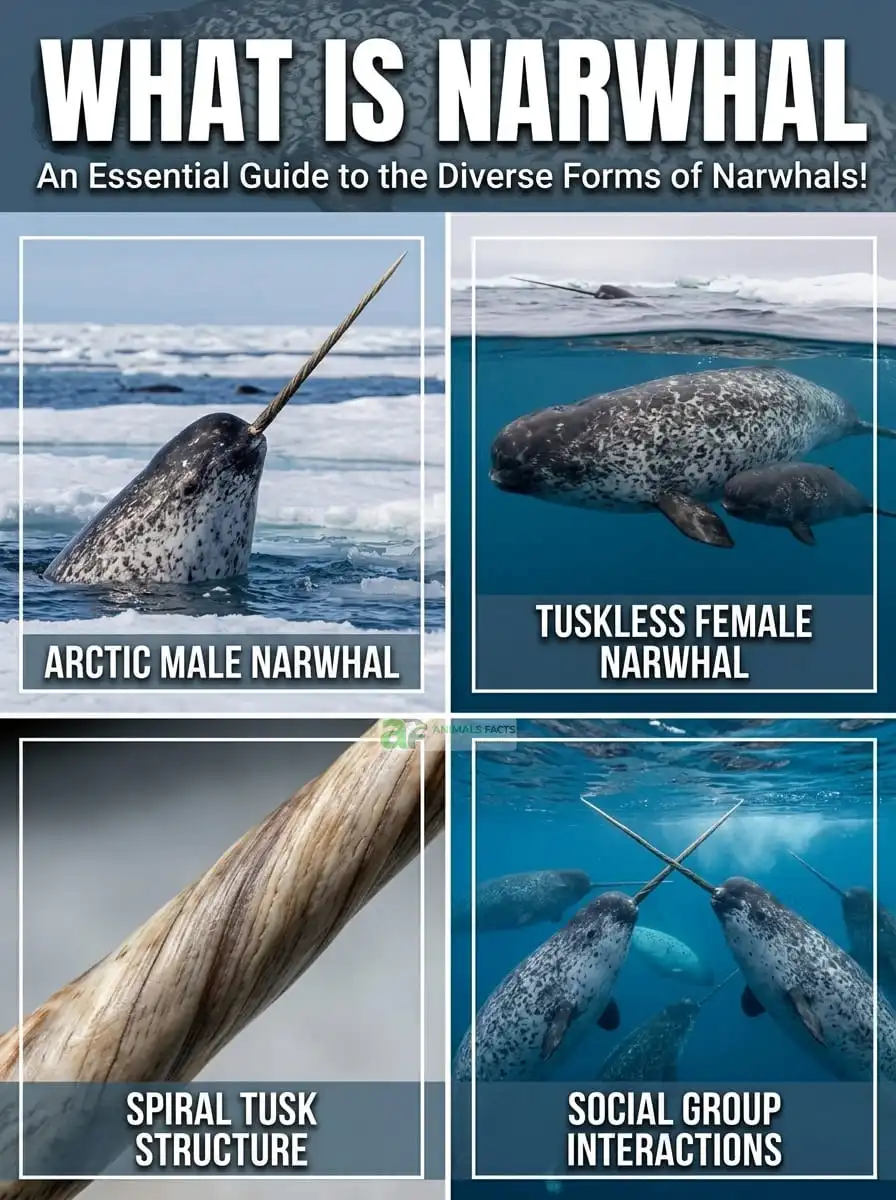
The narwhal’s most iconic feature is its extraordinary spiraling tusk — a modified tooth that grows through the upper left lip. It is present in virtually all adult males and in approximately 15% of females. Occasionally, both males and females develop two tusks (double-tusked narwhals are extremely rare — fewer than 1 in 500).
The tusk is not a horn — it is a tooth, specifically the left upper canine, which grows forward and through the lip in a counter-clockwise spiral. It can reach up to 3 meters in length in large males, representing roughly half the animal’s total body length. The other canine tooth (right upper) typically remains embedded in the skull and never erupts.
In 2014, a landmark study by researchers at Harvard University revealed that the narwhal tusk contains up to 10 million nerve endings connected directly to the brain through the pulp — making it one of the most sensitive sensory structures ever discovered in any animal. It can detect changes in temperature, salinity, pressure, and particle gradients in the surrounding water.
Size Comparison by Sex and Age
| Feature | Adult Male | Adult Female | Calf |
|---|---|---|---|
| Body length | 3.9–5.5 m (incl. tusk) | 3.5–4.5 m | 1.5–1.7 m at birth |
| Weight | 800–1,600 kg | 700–1,000 kg | ~80 kg at birth |
| Tusk | Present; up to 3 m | Usually absent; occasionally short | Absent |
| Coloration | Mottled gray-black-white | Similar; often slightly darker | Dark blue-gray |
| Dorsal fin | Absent (dorsal ridge) | Absent (dorsal ridge) | Absent |
| Flippers | Short; curled upward at tips | Similar | Proportionally large |
“The narwhal tusk is the most extraordinary sensory structure I have encountered in 30 years of cetacean research. It is essentially a tooth turned inside out — with millions of nerve endings exposed directly to the ocean. The narwhal experiences the Arctic ocean through its face.” — Dr. Martin Nweeia, Harvard School of Dental Medicine, narwhal tusk researcher
4. Top 25 Amazing Narwhal Facts
Here are the most astonishing, share-worthy interesting facts about narwhals — each one more remarkable than the last:
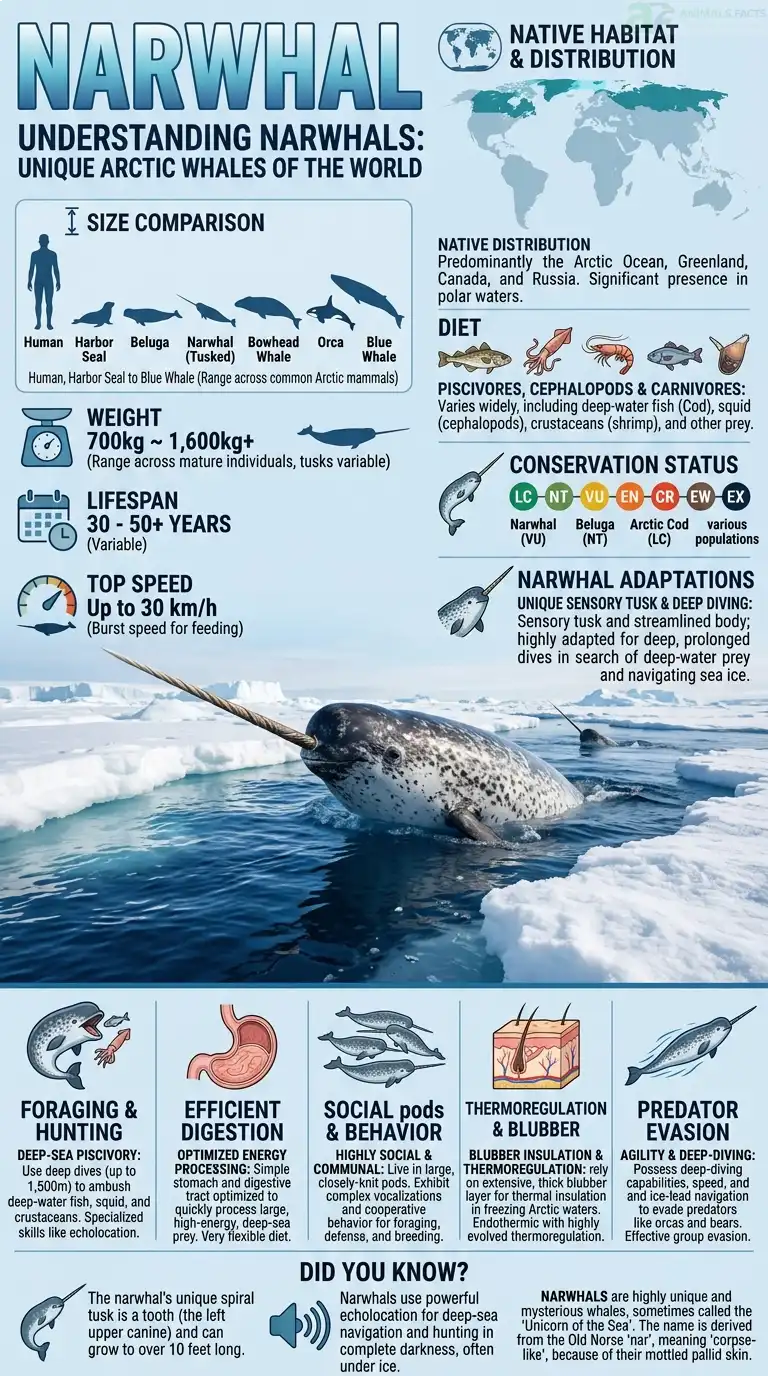
- The narwhal’s scientific name Monodon monoceros means “one tooth, one horn” in Greek
- The name “narwhal” comes from Old Norse meaning “corpse whale” — referencing the animal’s pale, mottled coloration
- Narwhals can dive to depths of 1,800 meters — deeper than most submarines operate
- At maximum depth, narwhals experience pressure of over 175 atmospheres — enough to crush most human-made vessels
- The narwhal tusk contains up to 10 million nerve endings — making it one of the most sensitive structures in the animal kingdom
- In 2017, drone footage first captured narwhals using their tusks to stun Arctic cod before eating them
- Narwhals spend approximately 3 months per year trapped under sea ice, breathing through small cracks and holes
- They are one of the deepest-diving mammals in the world — diving up to 25 times per day during winter feeding
- Narwhal tusks were sold in medieval Europe as “unicorn horns” (alicorn) worth up to 10 times their weight in gold
- A single narwhal tusk owned by Queen Elizabeth I was reportedly valued at the equivalent of a castle
- Narwhals have no dorsal fin — an adaptation allowing them to swim under sea ice
- They are one of only five animal species known to undergo menopause (alongside humans, orcas, belugas, and pilot whales)
- Narwhals produce a complex repertoire of clicks, whistles, and pulsed calls to navigate and communicate
- They are uniquely susceptible to climate change — described by scientists as the marine mammal most vulnerable to Arctic warming
- Narwhals change color dramatically with age — from dark blue-gray as calves to nearly pure white in very old individuals
- Double-tusked narwhals are extraordinarily rare — fewer than 1 in 500 individuals develop two full tusks
- A narwhal’s tusk always spirals in the same counter-clockwise direction — no known exceptions exist
- Narwhals produce some of the loudest sounds of any marine mammal — their clicks reach 218 decibels
- They have been recorded swimming at speeds of 25 km/h in short bursts — but typically travel at 4–6 km/h
- Narwhals migrate up to 3,000 km seasonally between summer feeding grounds and winter pack-ice habitat
- The narwhal genome was fully sequenced in 2019, revealing genetic adaptations to extreme cold and pressure
- Narwhals have an unusually flexible neck compared to most cetaceans — they can turn their heads slightly, unlike many whale species
- They are thought to use echolocation clicking so precise it can distinguish objects at distances of hundreds of meters in total darkness
- Narwhal blubber is up to 10 cm thick — providing thermal insulation against water temperatures of −1.5°C to 0°C
- The Inuit have relied on narwhals for muktuk (raw skin and blubber) for over 4,000 years — one of the highest natural sources of Vitamin C in the Arctic
Did You Know? During particularly harsh winters when sea ice closes too rapidly, narwhals can become trapped in a phenomenon called sassats — when they are caught in a small breathing hole surrounded by ice with no escape. These events, documented by Inuit hunters for centuries, can kill dozens to hundreds of narwhals at once — and are becoming more unpredictable as climate change disrupts Arctic ice formation patterns.
5. Fun Facts at a Glance
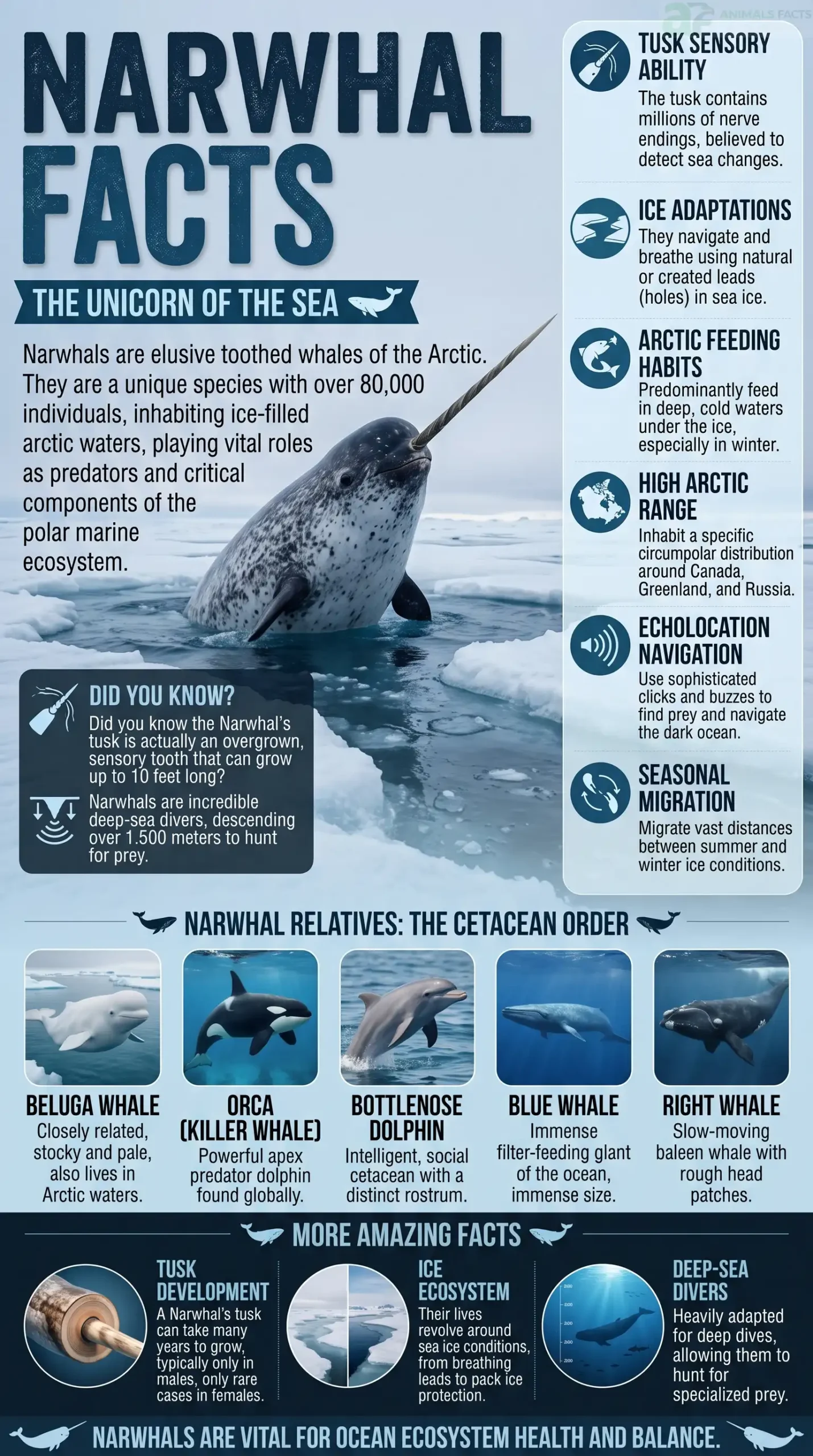
- Narwhals are known as the “unicorns of the sea” — their tusk inspired the unicorn legend
- They dive to 1,800 m depth — deeper than most submarines
- Their tusk has 10 million nerve endings — one of the most sensitive structures in nature
- They spend 3 months per year under sea ice
- They use echolocation clicks reaching 218 decibels — among the loudest sounds of any mammal
- ~123,000–170,000 narwhals exist in the wild today
- They are the marine mammal most vulnerable to climate change
- In 2017, narwhals were filmed using their tusks to stun fish for the first time
- Medieval European royalty paid 10x the tusk’s gold weight for a single narwhal horn
- The tusk is a tooth — not a horn — that grows through the upper lip
- Very old narwhals turn nearly pure white
- The tusk always spirals counter-clockwise — no exceptions known
- Calves are born at around 80 kg and 1.6 m in length
- Narwhals are closely related to beluga whales — both in family Monodontidae
- Narwhals undergo menopause — one of only five animal species known to do so
6. Natural Habitat of Narwhals
Narwhals are among the most Arctic-specialized marine mammals on Earth — their entire range is confined to the high Arctic and subarctic, where they have evolved over millions of years to exploit environments that remain inaccessible to most other species.
Habitat Characteristics
Narwhals inhabit some of the most extreme marine environments on the planet:
- Summer habitat — shallow coastal waters, fjords, and bays of the high Arctic (particularly around Baffin Island, Hudson Bay, and Greenland), where they feed intensively in relatively ice-free conditions
- Winter habitat — dense, moving pack ice of the deep Arctic Ocean, where they maintain access to breathing through cracks and leads in the ice
- Preferred water temperature — −1.5°C to 5°C — among the coldest preferred temperatures of any cetacean
- Dive depth — routinely to 500–800 m during winter feeding; recorded maximum of 1,800 m
Habitat Range by Region
| Region | Season | Key Areas | Notes |
|---|---|---|---|
| Canadian Arctic | Year-round (migration) | Baffin Bay, Lancaster Sound, Hudson Bay, Eclipse Sound | Largest concentration globally |
| West Greenland | Summer | Melville Bay, Disco Bay, Baffin Bay | Major summering population |
| East Greenland | Year-round | East Greenland Sea, Scoresby Sound | Smaller, less studied population |
| Svalbard (Norway) | Occasional | Franz Josef Land waters | Rare; vagrant sightings |
| Russian Arctic | Year-round | Laptev Sea, Kara Sea | Poorly documented; possibly distinct population |
| Northern Hudson Bay | Summer | Repulse Bay, Igloolik | Distinct population; climate-threatened |
Did You Know? Narwhals undertake some of the most extreme vertical migrations of any marine mammal. In winter, when they inhabit deep pack-ice areas, they have been recorded diving to 1,800 meters up to 25 times per day — spending the equivalent of 6 hours at extreme depth in every 24-hour period, breathing only at small cracks in the ice between dives.
7. Narwhal Diet & Feeding Behavior
Narwhals are specialized, seasonal hunters — their diet shifts dramatically between summer and winter, and their feeding behavior is among the most extraordinary of any cetacean.
Diet Breakdown
| Prey Species | Estimated % of Diet | Season | Notes |
|---|---|---|---|
| Arctic cod (Boreogadus saida) | ~30–40% | Winter | Primary winter prey; hunted at depth |
| Greenland halibut (Reinhardtius hippoglossoides) | ~25–35% | Winter | Deep-water; most calorie-dense prey |
| Arctic squid (Gonatus fabricii) | ~15–20% | Winter | Major component during pack-ice season |
| Northern shrimp (Pandalus borealis) | ~10–15% | Year-round | Opportunistic prey |
| Capelin (Mallotus villosus) | ~5–10% | Summer | Coastal summer feeding |
| Polar cod and other fish | ~5% | Variable | Supplemental prey |
Feeding Strategy
Narwhals are intermittent fasters in an extraordinary sense — during Arctic summer, they feed relatively little compared to their winter-feeding intensity. In winter, when they inhabit deep pack-ice areas over the Continental Shelf, they engage in intensive, deep-water feeding that fuels their entire energy budget.
The 2017 drone footage from the WWF and researchers in Tremblay Sound, Nunavut, captured narwhals approaching schools of Arctic cod from below, using short, rapid tusk strikes to stun individual fish before consuming them. This was the first direct visual evidence of tusk use in active hunting — though scientists believe suction feeding (drawing prey in through the mouth) remains the primary feeding method for most prey types.
Narwhals have only two teeth total — the tusk (left upper canine) and the embedded right upper canine. They have no functional teeth for chewing — all prey is swallowed whole. Their feeding suction is generated by specialized muscles that create a powerful vacuum, drawing fish and squid directly into the throat.
8. Narwhal Reproduction & Life Cycle
Narwhal reproduction follows the slow, high-investment pattern typical of large-bodied Arctic cetaceans — with long gestation, extended maternal care, and late sexual maturity.
Mating Behavior
Mating occurs in April, during or just after the northward spring migration. Males compete for females through a combination of:
- Tusk jousting — males cross and rub tusks in apparent displays of dominance (scarring patterns on male heads confirm regular physical contact between tusks)
- Acoustic displays — complex sequences of clicks and calls
- Physical proximity displays — males maneuver their bodies relative to other males and females
Female narwhals are believed to select mates partly based on tusk length and condition — longer, undamaged tusks may signal health and genetic quality.
Life Stages
Gestation — Approximately 14 months — one of the longer cetacean gestation periods, appropriate for such a large-bodied, cold-adapted species.
Birth — Calves are born tail-first (as with all cetaceans) in July or August — peak summer, when ice is minimal and prey is accessible. A single calf is the rule; twins are essentially unrecorded.
Nursing — Calves nurse for approximately 20 months — receiving energy-rich milk with up to 45% fat content that supports rapid growth in cold waters.
Sexual maturity — Females reach sexual maturity at approximately 5–7 years; males at 8–9 years. Males may not reproduce successfully until 13–16 years, when they are large enough to compete effectively.
Narwhal Lifespan Comparison
| Species | Wild Lifespan | Notes |
|---|---|---|
| Narwhal (Monodon monoceros) | 25–50 years | Age determined by counting growth layers in canine teeth |
| Beluga whale (Delphinapterus leucas) | 35–50 years | Closest living relative |
| Bottlenose dolphin (Tursiops truncatus) | 20–40 years | More studied; females live longer |
| Orca (Orcinus orca) | 50–90 years | Female orcas longest-lived cetaceans after humans |
| Bowhead whale (Balaena mysticetus) | 200+ years | Longest-lived mammal; shares Arctic range |
Did You Know? Scientists determine a narwhal’s age by counting growth layer groups (GLGs) in cross-sections of the narwhal’s embedded canine tooth — the same method used to age trees by counting rings. The oldest narwhals ever documented using this method were estimated to be approximately 50 years old — though some researchers believe individuals may live slightly longer in undisturbed populations.
9. Social Behavior & Communication
Narwhals are among the more socially complex cetaceans in Arctic waters — their social lives are structured, their communication sophisticated, and their collective behavior sometimes breathtaking in scale.
Group Structure
Narwhals typically travel in pods of 2–25 individuals, organized by:
- Nursery groups — females with calves; most cohesive social unit
- Bachelor groups — adult males; less stable; individuals join and leave
- Mixed groups — occur during migration and at feeding aggregations
- Aggregations — during spring migration, thousands of narwhals converge in major staging areas (Lancaster Sound is the most important globally) — with aerial surveys documenting single aggregations of 500–5,000+ individuals
Communication
Narwhals are highly vocal animals that produce an extraordinary range of sounds:
- Clicks — used for echolocation (biosonar); among the highest-intensity biological sounds ever measured at 218 decibels
- Whistles — used for social communication; each individual has distinct whistle patterns
- Pulsed calls — complex, variable calls used in social contexts; convey information about individual identity and emotional state
- Coda clicks — distinctive click patterns that may function like “signatures” among individual animals
Their echolocation is precise enough to navigate under ice in complete darkness, locate prey at depth, and detect ice structure — functions essential for survival in their Arctic environment.
Intelligence of Narwhal
Narwhals show several indicators of advanced cognition:
- Complex social bonds — long-term associations between individuals; juveniles maintain relationships with their mothers for years after weaning
- Cultural learning — migration routes and habitat use appear to be culturally transmitted from experienced animals to younger generations — a critically important feature given how specific and knowledge-dependent Arctic navigation is
- Tool use (probable) — tusk use in hunting, as documented in 2017, represents one of the few confirmed examples of cetacean tool-assisted predation
- Play behavior — juveniles and adults observed engaging in apparent play at the surface — tusk crossing, chasing, and bubble-blowing documented by researchers
10. Predators & Defense Mechanisms
Despite their size and Arctic isolation, narwhals face significant natural predation — and their behavioral responses to predators reveal sophisticated threat-assessment and group-coordination abilities.
Natural Predators
| Predator | Threat Level | Hunting Method | Notes |
|---|---|---|---|
| Orca (Orcinus orca) | High | Pack hunting; herding | Primary predator; coordinated attacks on narwhal pods |
| Polar bear (Ursus maritimus) | Medium | Ambush at breathing holes | Takes narwhals trapped at sassats or breathing at ice edges |
| Greenland shark (Somniosus microcephalus) | Low–Medium | Ambush; slow pursuit | Opportunistic; documented in narwhal stomach contents as species sharing deep-water habitat |
| Walrus (Odobenus rosmarus) | Very Low | Opportunistic | Documented occasionally attacking narwhal calves |
Defense Strategies
- Tight group formation — narwhals respond to orca presence by forming tight, coordinated groups — individuals cluster together, making individual targeting more difficult
- Ice refuge — narwhals retreat into pack ice where orcas (with large dorsal fins) cannot follow — one of the primary ecological reasons narwhals remain in ice-covered areas
- Acoustic alarm signals — specific vocalizations alert group members to predator presence; pods coordinate escape responses
- Speed — in open water, narwhals can reach 25 km/h in short escape bursts
- Tusk — while primarily a sensory and social structure, tusks may serve a secondary role in defense when other options are exhausted
Did You Know? Orcas — the primary natural predator of narwhals — are increasingly entering previously inaccessible Arctic waters as sea ice retreats due to climate change. This means narwhals are losing their primary refuge from predation at the same time that their habitat is warming and their prey distributions are shifting. The convergence of these pressures makes climate change a compounding rather than simply additive threat to narwhal populations.
11. Narwhal Facts for Kids
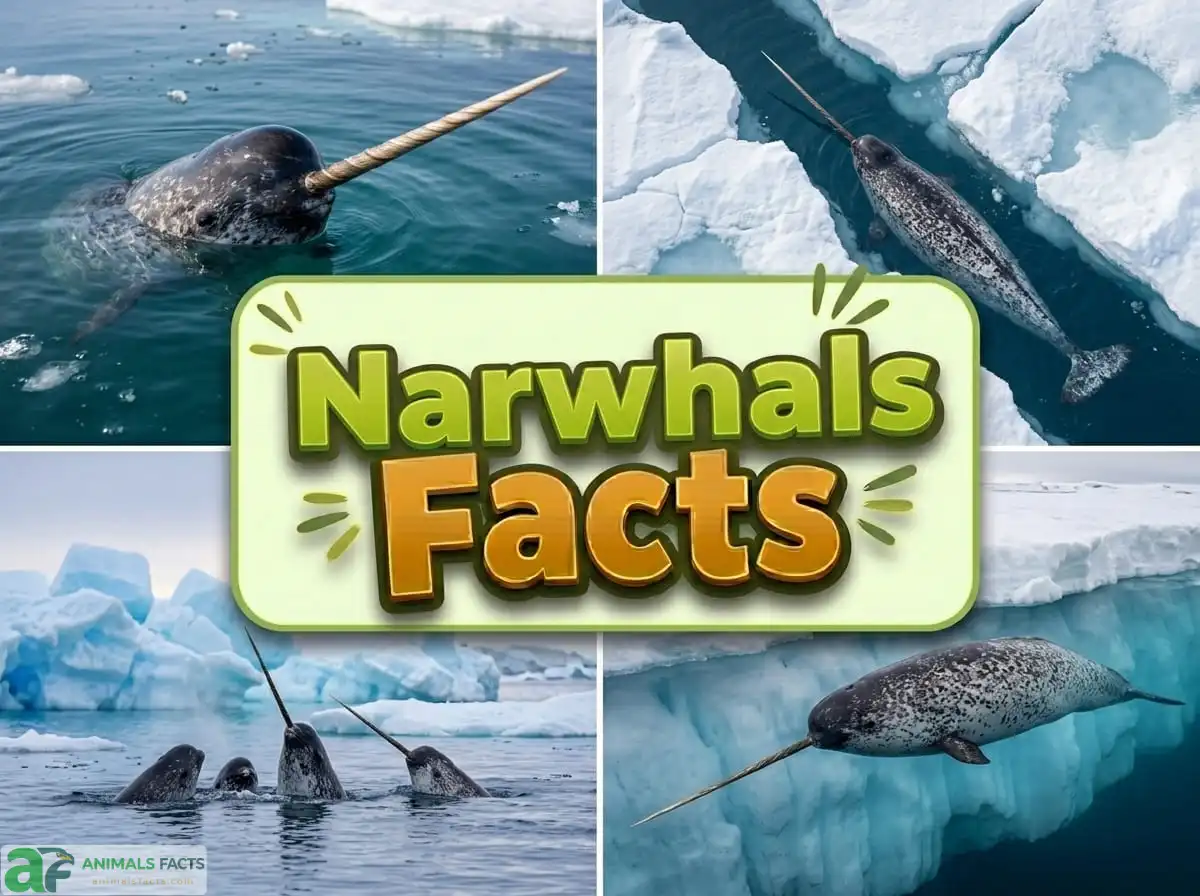
Hey young explorers! Narwhals are real animals — and they are way more magical than the mythical unicorns they inspired! Here are some awesome narwhal facts just for you:
- The narwhal is sometimes called the “unicorn of the sea” because of its amazing spiraling horn — but it’s actually a tooth, not a horn!
- Narwhals live in the Arctic — one of the coldest, iciest places on Earth — and they LOVE it!
- They can swim deep underwater — up to 1,800 meters down — that’s deeper than most submarines go!
- Baby narwhals are called calves — they are born gray-blue and slowly turn more colorful as they grow up!
- Very OLD narwhals turn almost completely white — like a white whale!
- Narwhals talk to each other using clicks, whistles, and squeaks — and scientists think each narwhal has its own special sound, like a name!
- Their tusk is incredibly sensitive — it can feel tiny changes in the temperature and saltiness of the water around them!
- In 2017, scientists filmed narwhals using their tusks to bonk fish on the head to stun them before eating them!
- Narwhals have no dorsal fin on their back — this lets them swim right under sea ice without getting stuck!
- The word “narwhal” comes from an old Norse word meaning “corpse whale” because of their unusual pale, blotchy color — but we think they look pretty amazing!
12. Relationship with Humans
The relationship between narwhals and humans spans thousands of years — from the Inuit communities whose cultures and survival have been intertwined with narwhals for millennia, to the medieval European monarchs who paid fortunes for their tusks, to the modern scientists trying to understand and protect them in a rapidly changing Arctic.
Inuit and Narwhals – 4,000 Years of Coexistence
For Arctic Indigenous peoples — particularly the Inuit of Canada and Greenland — the narwhal is not merely a fascinating animal but a cultural cornerstone and critical food source. Narwhal provides:
- Muktuk — the skin and thin layer of blubber eaten raw or fermented; one of the highest natural sources of Vitamin C available in the Arctic, where plant foods are absent
- Meat — consumed fresh, dried, and frozen
- Tusk — historically used for tools, harpoon handles, and sledge runners; now sold as art and carving material
- Sinew — used as thread and cordage
- Oil — used for heating and lighting
The Inuit hold legal subsistence harvest quotas for narwhals — negotiated between Indigenous communities and government wildlife management bodies in both Canada and Greenland. These quotas represent a carefully managed balance between cultural rights, nutritional needs, and conservation.
The “Unicorn Horn” Trade – Medieval Europe
From approximately 900–1700 CE, narwhal tusks were the most valuable trade commodity in Northern Europe — sold as the genuine horns of unicorns (alicorn) believed to have magical, medicinal, and protective properties. The tusk of a single narwhal could be worth:
- 10 times its weight in gold
- Enough to purchase a large castle (recorded in accounts of purchases by European royalty)
- More than 100 times the annual wage of a skilled craftsman
Narwhal tusks were crafted into royal scepters, papal staffs, goblets (believed to neutralize poison), and medicine. The Danish royal throne was constructed from narwhal tusks in 1671 — the Throne Chair of Denmark — and remains intact in the Rosenborg Castle in Copenhagen today.
Modern Human-Narwhal Interactions
- Narwhals do not attack humans — they are shy animals that typically flee at the approach of vessels
- Boat traffic is a growing threat — narwhals are highly sensitive to the sound of ships and engines, altering their behavior significantly at distances of several kilometers
- Scientific research involves satellite tagging, acoustic monitoring, and non-invasive aerial surveys — narwhals cannot survive captivity and have never been successfully kept in aquariums long-term
13. Narwhal Conservation Status & Threats
IUCN Status
The narwhal is currently classified as Least Concern by the IUCN Red List — based on a global population estimated at 123,000–170,000 individuals. However, this headline status conceals important regional variations:
- Some local populations (particularly Hudson Bay) show significant declining trends
- The narwhal is considered by multiple researchers to be the marine mammal most vulnerable to climate change of any species on Earth
- Several nations classify it as Near Threatened in their national assessments
- CITES Appendix II listing regulates international trade in narwhal products
Population Trend Data
| Population | Estimated Size | Trend | Notes |
|---|---|---|---|
| West Greenland / Baffin Bay | ~90,000+ | Stable to declining | Largest stock; climate pressure increasing |
| East Greenland | ~10,000–15,000 | Uncertain | Poorly monitored; possibly declining |
| Hudson Bay | ~12,000 | Declining | Most climate-threatened stock |
| Russian Arctic | Unknown | Data Deficient | Almost no recent data |
| Global Total | ~123,000–170,000 | Stable overall; regional declines | IUCN 2026 assessment |
Major Threats
| Threat | Impact Level | Details |
|---|---|---|
| Climate change / Sea ice loss | Critical | Narwhals are the most climate-vulnerable marine mammal; loss of sea ice removes predator refuge and disrupts prey distribution |
| Ocean noise pollution | High | Shipping, seismic surveys, and military sonar severely disrupt narwhal echolocation and behavior |
| Expanding orca range | High | As sea ice retreats, orcas access previously protected narwhal habitat |
| Hunting (unregulated) | Medium | Legal Inuit subsistence harvest is managed; illegal hunting occurs in some areas |
| Oil and gas development | Medium | Expanding Arctic extraction disrupts key habitat |
| Bycatch | Low–Medium | Entanglement in fishing gear documented but not a primary threat |
| Pollution | Low–Medium | Arctic bioaccumulation of industrial chemicals; narwhal blubber shows elevated PCB and mercury levels |

14. Famous Narwhals
The Rosenborg Tusk – Denmark’s Royal Legacy
The Throne Chair of Denmark in Rosenborg Castle, Copenhagen — crafted in 1671 from narwhal tusks — represents the most historically significant use of narwhal material in human culture. The throne was used by Danish kings for coronation ceremonies for centuries and remains one of the most valuable pieces of royal furniture in Europe.
“Noodle” – The Media Darling
In 2016, footage of a narwhal nicknamed “Noodle” circulated widely after drone footage captured the whale swimming with its unusually long, straight tusk in the waters off Nunavut. The footage, published by the WWF, helped introduce narwhals to a new generation of viewers and contributed to public support for Arctic conservation funding.
The BBC Narwhal Pod – Frozen Planet
The narwhal pod filmed by the BBC’s Frozen Planet (2011) for David Attenborough’s iconic series represented the first time many viewers had seen narwhals behaving naturally in the wild. The sequence — showing thousands of narwhals gathering in Lancaster Sound during spring migration — remains one of the most-watched nature filming sequences ever produced on these animals.
Queen Elizabeth I’s Tusk – Worth a Castle
The narwhal tusk purchased for Queen Elizabeth I of England in the late 16th century was reportedly valued at £10,000 — the equivalent of a large castle or country estate at the time. It was kept in the royal collection and considered one of the most precious objects in the English court.
15. Role in Ecosystem & Food Chain
Position in the Arctic Food Web
Narwhals occupy a critical mid-trophic position in the Arctic marine food web — as significant predators of deep-water fish and squid, and as important prey for orcas and polar bears.
As predators: Narwhals are among the most significant consumers of Greenland halibut at depth in their range — their intensive winter feeding at depth regulates fish populations and maintains the balance of deep-water Arctic communities.
As prey: For orcas — themselves apex predators regulating a wide range of Arctic and subarctic species — narwhals represent a significant and energy-rich prey source. The presence of narwhal pods influences where orcas hunt, which cascades into effects on seals, fish, and other species that orcas also consume.
As ecosystem indicators: Narwhals are considered an exceptional indicator species for Arctic ecosystem health — their population trends, migration timing, and body condition reflect broader changes in Arctic climate, sea ice, and prey availability that affect the entire system.
Ecological Services
- Nutrient cycling — narwhal feeding at depth and defecating at the surface pumps deep-water nutrients to the sunlit surface layer — a process called the “whale pump” — contributing to surface phytoplankton productivity
- Prey regulation — intensive winter feeding on Arctic cod and Greenland halibut regulates these populations
- Supporting apex predators — narwhals sustain polar bear and orca populations across the Arctic
16. Narwhal Myths, Folklore & Cultural Significance
The Unicorn Connection — Medieval Europe’s Greatest Deception
The narwhal tusk is almost certainly the primary source of the European unicorn legend. From approximately the 9th century CE, Norse traders brought narwhal tusks from Arctic waters south to European markets — where they were sold as the genuine horns of unicorns, creatures mentioned in ancient texts (including some Biblical translations of Hebrew re’em, a wild ox, mistranslated as “unicorn” in some traditions).
These tusks were believed to have extraordinary magical properties:
- They could detect poison in food or drink (cups made from tusk material were believed to bubble or change color in the presence of poison)
- They could cure disease — including plague
- They could neutralize snake venom
- They granted protection to whoever possessed them
The trade in narwhal tusks sustained by this belief was one of the most profitable in medieval Europe — making Arctic hunters and Norse traders extremely wealthy while keeping European royalty and clergy blissfully unaware that their magical unicorn horns came from a whale.
Inuit Culture – The Arctic’s Sacred Whale
In Inuit cosmology, the narwhal holds a place of deep cultural and spiritual significance. One Inuit legend tells of a woman pulled into the sea and transformed into a narwhal — her long hair becoming the spiraling tusk. This story connects narwhals to themes of transformation, the deep ocean, and the boundary between the human and animal worlds — a common motif in circumpolar Indigenous traditions.
The tusk is used in Inuit art — carved from the tusk itself or represented in soapstone sculpture — as a symbol of the Arctic’s abundance, mystery, and the reciprocal relationship between humans and the animals they depend upon.
Viking Culture – Symbols of the Arctic North
For Norse peoples, the narwhal (known as narhvalr) was associated with the extremity of the known world — the waters beyond the edge of mapped reality. Their tusks were brought south as proof that extraordinary things existed in the frozen north — functioning as a kind of physical souvenir of the world’s edges, and contributing to Norse reputation as the people who navigated where others dared not go.
17. Narwhals in Pop Culture
Film and Television
- Frozen Planet (2011, BBC) — David Attenborough narrates extraordinary narwhal migration and aggregation sequences; the series introduced narwhals to mainstream global audiences on a massive scale
- Blue Planet II (2017, BBC) — narwhal sequences in Episode 1 show their diving behavior and Arctic habitat in unprecedented detail
- Arctic Dogs (2019) — animated film featuring a narwhal character; introduced the animal to young audiences
- Elf (2003, New Line Cinema) — the famous scene in which Buddy the Elf enthusiastically high-fives a narwhal (“Bye, Buddy! Hope you find your dad!”) became one of the most iconic movie moments of the 2000s and dramatically raised narwhal cultural profile
- The Narwhal Song (YouTube viral, 2010) — the animated YouTube video “Narwhals (Narwhals, Swimming in the Ocean)” accumulated tens of millions of views and became a defining piece of early internet absurdist humor
Books
- Narwhal: Unicorn of the Sea — Ben Clanton (2016) — beloved children’s picture book series; Narwhal and Jelly have spawned multiple sequels and a Netflix animated adaptation
- The Narwhal’s Tusk — various natural history authors; multiple popular science books examining tusk function
- The Brilliant Abyss — Helen Scales (2021) — explores deep-sea ecosystems including narwhal diving behavior
Internet Culture
- Narwhals experienced a massive surge in internet popularity in the 2010s — appearing in countless memes, merchandise, and viral content
- The narwhal emoji 🦄(often applied to narwhals despite technically depicting a unicorn) became a symbol of rare, magical things in internet culture
- “Narwhal bacons at midnight” became a famous Reddit community recognition phrase — narwhals serving as a symbol of Reddit’s unique subculture
18. Narwhal Facts vs. Common Myths
| Myth | Fact |
|---|---|
| “The narwhal tusk is a horn” | The tusk is a tooth — specifically the left upper canine — that grows through the lip |
| “Only male narwhals have tusks” | Approximately 15% of females also develop tusks, though usually shorter |
| “The tusk is used as a weapon” | Primary functions are sensory detection and social display; hunting use documented in 2017 |
| “Narwhals are endangered” | Global status is Least Concern — but some regional populations are declining significantly |
| “Narwhal horns cure disease” | Medieval belief with no scientific basis; the tusk has no medicinal properties |
| “Narwhals can survive in captivity” | False — narwhals cannot survive long-term in aquariums; all captive attempts have failed within months |
| “The tusk spirals in different directions in different narwhals” | The tusk always spirals counter-clockwise — no exceptions have ever been documented |
| “Narwhals are related to dolphins” | Narwhals are more closely related to beluga whales than to dolphins — both are in family Monodontidae |
| “Narwhals live under ice all year” | They inhabit open coastal waters in summer and move to pack ice areas only in winter |
| “Narwhals use their tusks for breaking ice” | No evidence supports this popular belief; echolocation, breath efficiency, and behavioral avoidance manage ice-related challenges |
19. Best Places to See Narwhals in the Wild
- Lancaster Sound, Nunavut, Canada — The single most important narwhal aggregation site in the world. Each spring, tens of thousands of narwhals converge in Lancaster Sound before dispersing to summer feeding grounds. Accessible by Arctic expedition cruise from Resolute Bay; sightings almost guaranteed in July–August.
- Eclipse Sound and Pond Inlet, Nunavut, Canada — One of the most accessible narwhal-viewing locations in the Arctic. The hamlet of Pond Inlet on Baffin Island sits directly on major narwhal migration routes; local Inuit guides lead boat tours for extraordinary close-range viewing in July–August.
- Tremblay Sound, Nunavut, Canada — The site of the landmark 2017 drone footage of narwhals using their tusks to hunt. Remote; accessible only by charter aircraft and boat, but offers some of the finest narwhal viewing on Earth in peak summer.
- Disco Bay (Disko Bay), West Greenland — A major overwintering and spring staging area for West Greenland narwhals. The town of Ilulissat offers boat tours from April onward; the combination of iceberg-filled waters and narwhal pods is visually spectacular.
- Scoresby Sound, East Greenland — The world’s largest fjord system; an important area for East Greenland narwhals. Accessible via expedition cruise from Iceland; narwhals visible August–September alongside musk ox, Arctic foxes, and polar bears.
- Admiralty Inlet, Nunavut, Canada — A critical narwhal summering area with some of the highest densities of the species on Earth. Remote; accessible by chartered floatplane from Arctic Bay. Early August offers peak viewing.
- Resolute Bay area, Nunavut, Canada — Gateway to Lancaster Sound; the starting point of most high Arctic cruise itineraries that include narwhal viewing. Local guides and wildlife researchers based here offer context-rich viewing experiences.
20. How You Can Help
Narwhals face a future shaped by decisions being made right now — about climate change, Arctic development, and ocean noise pollution. Here is what you can do:
- Support climate action — Narwhals are the marine mammal most vulnerable to climate change; every reduction in carbon emissions directly benefits their survival prospects. Support organizations like the Climate Reality Project and advocate for ambitious national and international climate policy
- Support narwhal-specific conservation — WWF Arctic (wwf.panda.org/arctic) funds narwhal research, Inuit co-management programs, and Arctic habitat protection; Oceans North (oceansnorth.org) advocates for science-based narwhal management in Canada
- Advocate for Arctic shipping restrictions — Ocean noise from expanding Arctic shipping is a serious narwhal threat; support shipping regulations through International Maritime Organization advocacy campaigns
- Choose Arctic tourism responsibly — If visiting the Arctic, choose operators that follow Arctic wildlife watching guidelines — maintaining minimum distances from narwhals and reducing engine noise in their presence
- Support Inuit-led conservation — Indigenous communities have managed narwhals sustainably for thousands of years; supporting Inuit co-management of Arctic resources and Indigenous land rights is essential to narwhal conservation. Organizations like Inuit Tapiriit Kanatami (itk.ca) represent Inuit interests in Arctic policy
- Participate in citizen science — Log narwhal sightings on iNaturalist (inaturalist.org) and follow Narwhal Nation citizen science initiatives tracking population trends in accessible Arctic areas
21. Top Documentaries & Books
Must-Watch Documentaries
- Frozen Planet (2011, BBC) — David Attenborough’s masterpiece of Arctic natural history; narwhal sequences in episodes 1 and 3 are among the finest ever filmed; available on BBC iPlayer and streaming platforms
- Blue Planet II (2017, BBC) — Episode 1 (“One Ocean”) features extraordinary narwhal diving sequences in unprecedented depth; won multiple BAFTA awards
- Secrets of the Whales (2021, Disney+/National Geographic) — Narwhal featured in Episode 4 alongside beluga whales; produced by James Cameron; extraordinary underwater footage
- Arctic Secrets (2010, IMAX) — IMAX-format documentary featuring narwhal migration sequences in Lancaster Sound
- Narwhal: The Real Unicorn (2015, National Geographic) — Dedicated documentary covering narwhal biology, tusk research, and Inuit cultural connections; excellent for classroom use
Must-Read Books
- Narwhal: Unicorn of the Sea — Ben Clanton (2016) — the most beloved children’s narwhal book; perfect for ages 4–8; multiple sequels published
- The Brilliant Abyss: Exploring the Majestic Hidden Life of the Deep Ocean — Helen Scales (2021) — explores narwhal deep-diving and Arctic ecosystems with beautiful prose
- The Narwhal: Natural History and Cultural Heritage — Kristin Laidre & Martin Nweeia (eds.) — the definitive scientific reference on narwhal biology, ecology, and conservation
- Moby-Duck: The True Story of 28,800 Bath Toys Lost at Sea — Donovan Hohn (2011) — while focused on ocean currents, covers Arctic wildlife including narwhals in an engaging narrative
- The Ice at the End of the World — Jon Gertner (2019) — explores Greenland’s changing Arctic ecosystem, where narwhals are a central indicator of ecological change
22. Comparison with Similar Species
| Feature | Narwhal | Beluga Whale | Orca (Killer Whale) |
|---|---|---|---|
| Scientific Name | Monodon monoceros | Delphinapterus leucas | Orcinus orca |
| Family | Monodontidae | Monodontidae | Delphinidae |
| Length | 3.9–5.5 m | 3.0–5.5 m | 6–8 m |
| Weight | 800–1,600 kg | 700–1,500 kg | 3,600–5,400 kg |
| Color | Mottled gray-black-white | Pure white (adults) | Black and white |
| Dorsal fin | Absent (ridge only) | Absent (ridge only) | Very large (males up to 1.8 m) |
| Tusk | Present in males; sometimes females | Absent | Absent |
| Habitat | High Arctic; pack ice | Arctic and subarctic; more flexible | All oceans; Arctic presence growing |
| Diet | Arctic cod, halibut, squid | Fish, squid, crustaceans | Seals, fish, whales, narwhals |
| Social structure | Pods of 2–25; large migrations | Pods of 2–25; flexible | Stable matrilineal pods |
| Conservation | Least Concern | Least Concern | Data Deficient |
| Echolocation | Yes; 218 dB clicks | Yes | Yes |
| Relationship to narwhal | — | Closest relative | Major predator |
23. Frequently Asked Questions About Narwhals
Q1: What is the narwhal’s scientific name?
The narwhal’s scientific name is Monodon monoceros — from the Greek mono (one), odon (tooth), monos (one), and keras (horn), meaning “one tooth, one horn.” It was formally described by Carl Linnaeus in his landmark Systema Naturae in 1758. The narwhal belongs to the family Monodontidae — a small family containing only the narwhal and the beluga whale.
Q2: What is the narwhal’s tusk for?
The narwhal tusk is a modified tooth — the left upper canine — that grows through the upper lip and can reach 3 meters in length. Research published in 2014 revealed that the tusk contains up to 10 million nerve endings making it an extraordinarily sensitive sensory organ — detecting changes in temperature, salinity, and pressure. In 2017, drone footage first documented narwhals using their tusks to stun Arctic cod before eating them. The tusk also plays a role in male social competition — males spar with tusks in dominance displays. No single function fully explains the tusk; it likely serves multiple purposes simultaneously.
Q3: Are narwhals endangered?
Narwhals are currently classified as Least Concern by the IUCN, with a global population of approximately 123,000–170,000 individuals. However, several regional populations — particularly the Hudson Bay stock — show significant declining trends. Narwhals are considered the marine mammal most vulnerable to climate change by multiple researchers, and their status may worsen significantly as Arctic warming accelerates. International trade in narwhal products is regulated by CITES Appendix II.
Q4: How deep can narwhals dive?
Narwhals are extraordinary divers — recorded to depths of 1,800 meters (nearly 2 km) below the surface. During winter feeding season, they may dive to these extreme depths up to 25 times per day, spending the equivalent of 6 hours at depth per 24-hour period. At 1,800 meters, they experience pressure over 175 atmospheres — far beyond the crush depth of most human submarines. Their bodies have evolved multiple adaptations for withstanding this pressure, including collapsible lungs and redistributable blood flow.
Q5: What do narwhals eat?
Narwhals are carnivores that feed primarily on Arctic cod, Greenland halibut, Arctic squid, and northern shrimp. Their diet shifts seasonally — in summer they feed relatively little in coastal waters, while in winter they engage in intensive deep-water feeding under pack ice. They have no functional chewing teeth — all prey is swallowed whole, using powerful suction generated by specialized muscles. In 2017, narwhals were filmed using their tusks to stun fish before consuming them — the first documented evidence of active tusk use in hunting.
Q6: How long do narwhals live?
Narwhals typically live for 25–50 years in the wild. Age is determined by counting growth layer groups (GLGs) in cross-sections of the embedded canine tooth — the same principle as counting tree rings. The oldest reliably aged narwhals have been estimated at approximately 50 years. Females likely live longer than males on average — as is common in cetaceans — and narwhals are one of only five animal species known to undergo menopause.
Q7: Can narwhals be kept in captivity?
No — narwhals cannot survive in captivity. Every attempt to keep narwhals in aquariums or marine parks has resulted in the animal’s death within weeks to months. Narwhals are extremely sensitive to confinement, altered pressure, artificial environments, and human disturbance. Their deep-diving physiology, complex social needs, and sensitivity to noise make them entirely unsuitable for captive settings. This is in stark contrast to their closest relative, the beluga whale, which survives and even breeds in captivity.
Q8: Why are narwhals called “unicorns of the sea”?
The nickname comes from the narwhal’s extraordinary spiraling tusk, which inspired the European unicorn legend during the medieval period. Norse traders sold narwhal tusks to Europeans as genuine “unicorn horns” (alicorn) — believed to have magical properties including the ability to detect poison and cure disease. These tusks were worth up to 10 times their weight in gold and were purchased by royalty and clergy across Europe. The connection between narwhal tusks and unicorn mythology was so strong that the unicorn became the national animal of Scotland — a tradition that persists today.
Q9: How do narwhals communicate?
Narwhals communicate through a sophisticated repertoire of clicks, whistles, and pulsed calls. Their echolocation clicks — used for navigation and prey detection under ice — are among the most powerful biological sounds ever measured, reaching 218 decibels. They produce distinct individual signature calls that allow group members to identify each other — similar to the signature whistles of dolphins. During aggregations of thousands of individuals, the acoustic environment beneath the ice is extraordinarily complex, with overlapping calls from hundreds of animals simultaneously.
Q10: What is the biggest threat to narwhals?
The single greatest threat to narwhals is climate change and Arctic sea ice loss. Narwhals depend on sea ice for refuge from orca predation — as ice retreats, orcas access previously protected narwhal habitat. Sea ice loss also disrupts narwhal prey distributions, alters migration routes, and creates unpredictable ice conditions that can trap narwhals in sassats (ice entrapments). Additional significant threats include ocean noise pollution from expanding Arctic shipping and industrial development, expanding orca range, and pollution (industrial chemicals that bioaccumulate in narwhal blubber).
24. Sources & References
Research Sources
- Wikipedia — Narwhal, Monodon monoceros, Monodontidae, Narwhal tusk
- IUCN Red List — iucnredlist.org (narwhal species assessment, 2022; population data)
- National Geographic — nationalgeographic.com (narwhal biology, tusk research, Arctic conservation)
- Smithsonian Institution — si.edu (narwhal natural history; taxonomy)
- WWF Arctic — wwf.panda.org/arctic (narwhal conservation programs; 2017 drone footage project)
- BBC Wildlife — bbc.co.uk/nature (Frozen Planet narwhal sequences; Blue Planet II)
- Britannica — britannica.com/animal/narwhal
- Live Science — livescience.com (narwhal tusk sensitivity research; dive records)
- Animal Diversity Web — animaldiversity.org (University of Michigan)
- PNAS / Journal of Experimental Marine Biology — peer-reviewed narwhal research including Nweeia et al. (2014) tusk sensory study
- Oceans North — oceansnorth.org (Canadian narwhal management and Inuit co-management)
- NOAA Fisheries — fisheries.noaa.gov (narwhal status and biology)
- Inuit Tapiriit Kanatami — itk.ca (Inuit cultural relationships with narwhals)
- Kristin Laidre, University of Washington — leading narwhal researcher; satellite tagging and population assessment studies
- Martin Nweeia, Harvard School of Dental Medicine — narwhal tusk sensory research