
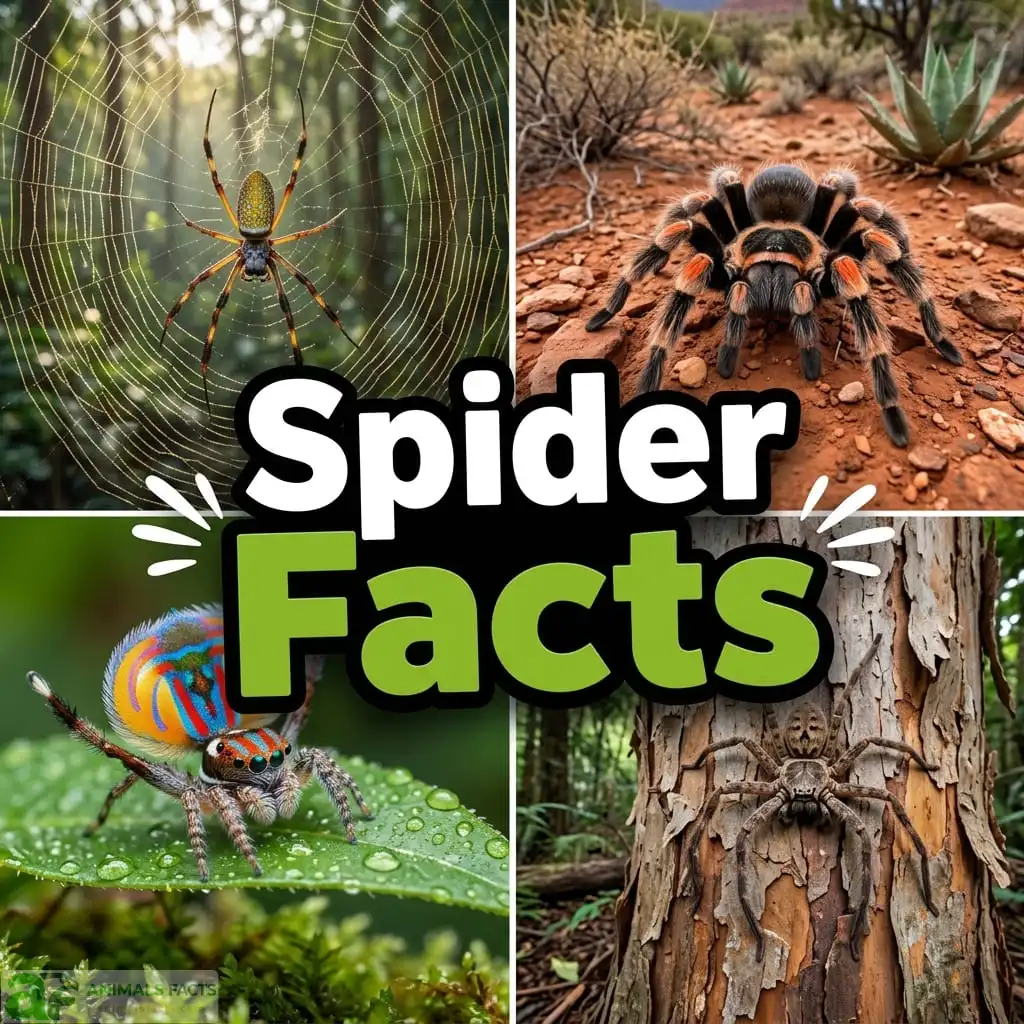
Spider Facts
| Feature | Details |
|---|---|
| Scientific Name | Araneae (order) |
| Kingdom | Animalia |
| Phylum | Arthropoda |
| Class | Arachnida |
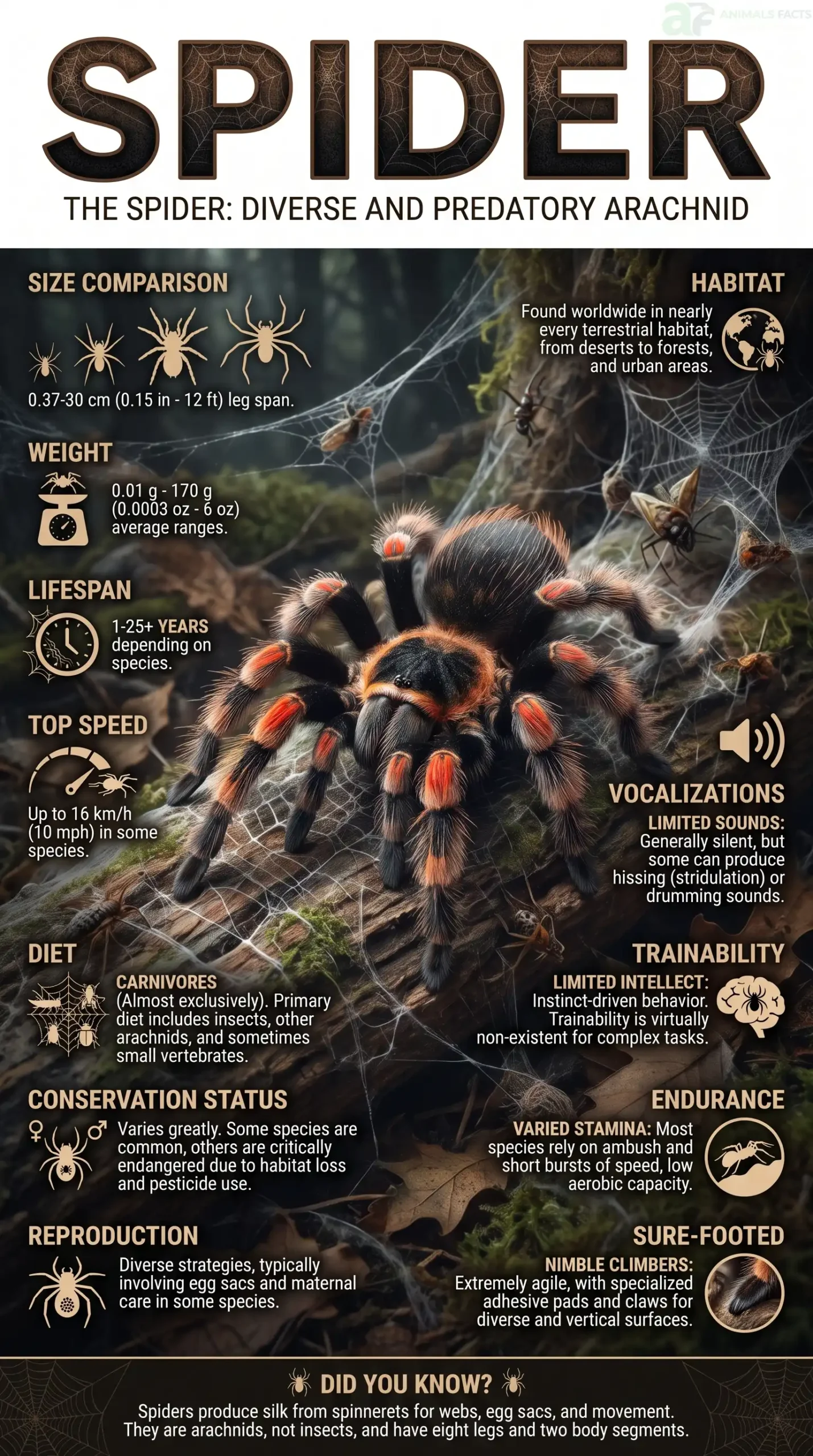
| Number of Species | Over 50,000 known species |
| Habitat | Every terrestrial habitat on Earth except Antarctica and open ocean |
| Lifespan | 1–3 years (most species); up to 30 years (some tarantulas) |
| Diet | Insects, other arthropods, small vertebrates |
| Size Range | 0.37 mm (Patu digua) to 30 cm leg span (Goliath birdeater) |
| Weight Range | Fraction of a milligram to 170 grams (Goliath birdeater) |
| Top Speed | Up to 53 km/h (giant house spider, short bursts) |
| Conservation Status | Varies — most Least Concern, dozens Critically Endangered |
| Population Estimate | Estimated 10 quadrillion spiders globally |
| Silk Strength | Weight for weight, 5x stronger than steel |
1. Introduction: What is a Spider?
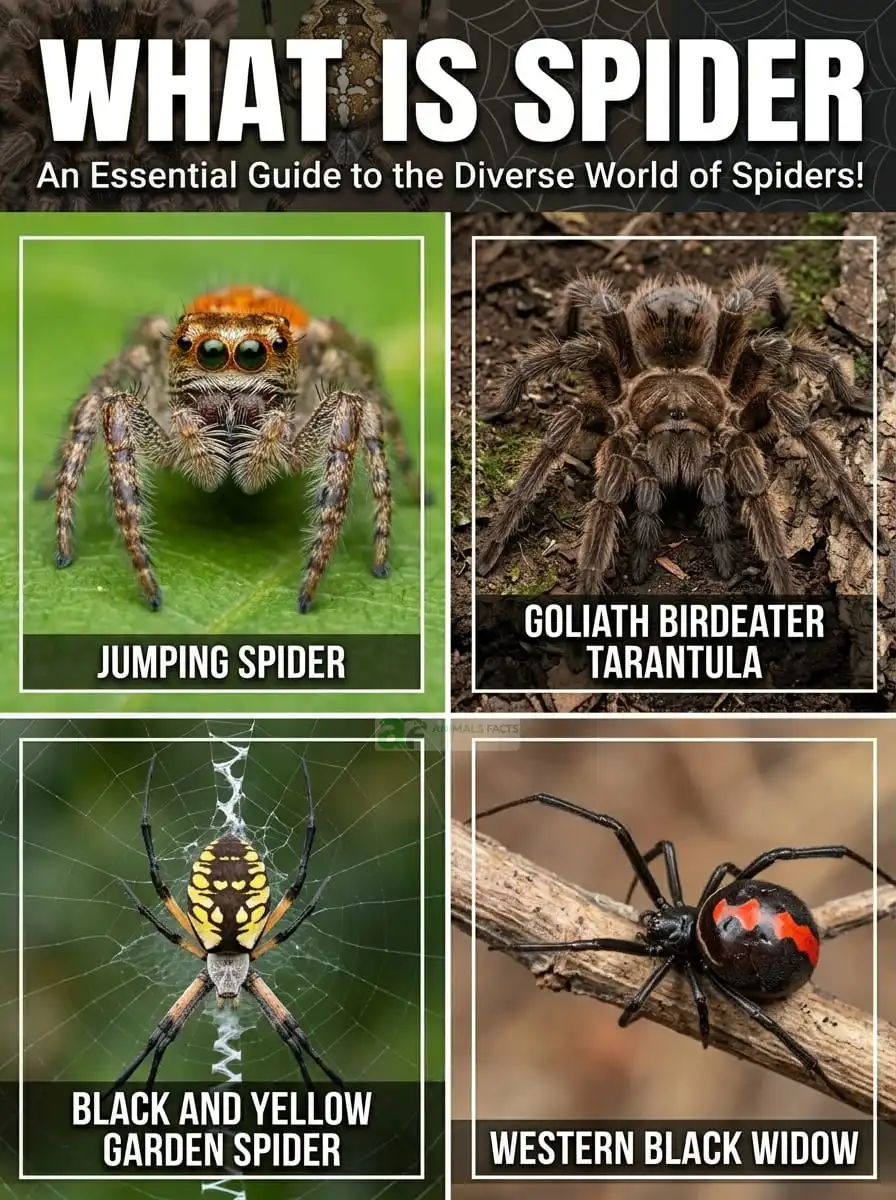
There is perhaps no creature on Earth more universally feared — and more profoundly misunderstood — than the spider. Mention spider facts in a room full of people and you will immediately see reactions ranging from fascinated curiosity to full-body shudders. Yet the truth about spiders is so much richer, stranger, and more wonderful than the fear-soaked myths that surround them. These eight-legged architects, chemists, and hunters have been perfecting the art of survival for over 380 million years, predating the dinosaurs by more than 150 million years.
Spider facts reveal animals of extraordinary complexity and capability. They produce silk stronger than steel. They navigate by sensing vibrations in air and ground with incredible precision. Some are social, some are capable of recognizing individual human faces, and others have evolved such perfect camouflage that they are literally invisible against flower petals. There are spiders that sail the ocean on silk threads, spiders that live underwater in air bubbles, spiders that mimic ants, and spiders that deceive their prey using fake insects as lures. And yet the vast majority of the world’s 50,000+ spider species are completely harmless to humans — and every single one of them is an irreplaceable part of the ecosystems we depend on.
Whether you’re searching for interesting facts about spiders for a school project, looking for spider facts for kids, or simply trying to overcome a case of arachnophobia with some solid science, you’ve come to the right place. This comprehensive guide covers spider habitat, spider diet, spider scientific names, spider behavior, spider size and weight records, conservation status, and everything in between. By the end, we promise you’ll look at the spider in the corner of your ceiling a little differently.
2. Spider Species Overview & Classification
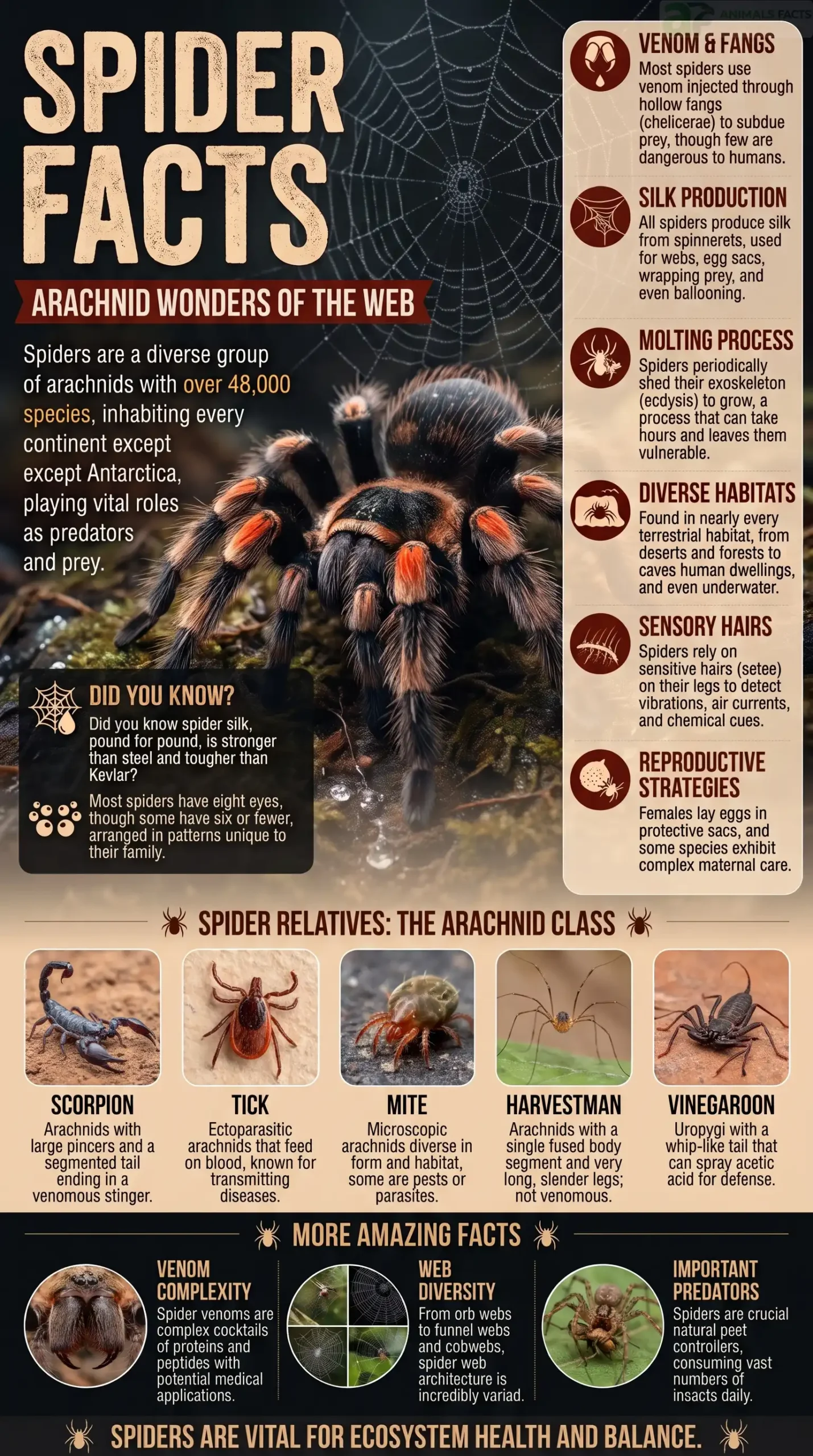
Spiders belong to the order Araneae, within the class Arachnida. They are distinguished from other arachnids — such as scorpions, mites, and ticks — by a unique combination of features: two main body segments (the cephalothorax and abdomen), eight legs, fangs that inject venom (chelicerae), and the universal ability to produce silk.
Species Classification Table
| Taxonomic Rank | Classification |
|---|---|
| Kingdom | Animalia |
| Phylum | Arthropoda |
| Subphylum | Chelicerata |
| Class | Arachnida |
| Order | Araneae |
| Suborders | Mesothelae, Opisthothelae |
| Infraorders | Mygalomorphae (tarantulas, trapdoor), Araneomorphae (most modern spiders) |
| Number of Families | ~120 families |
| Number of Genera | ~4,100+ genera |
| Number of Species | 50,000+ described species |
Major Spider Families
The spider world is organized into major families with fascinating distinctions:
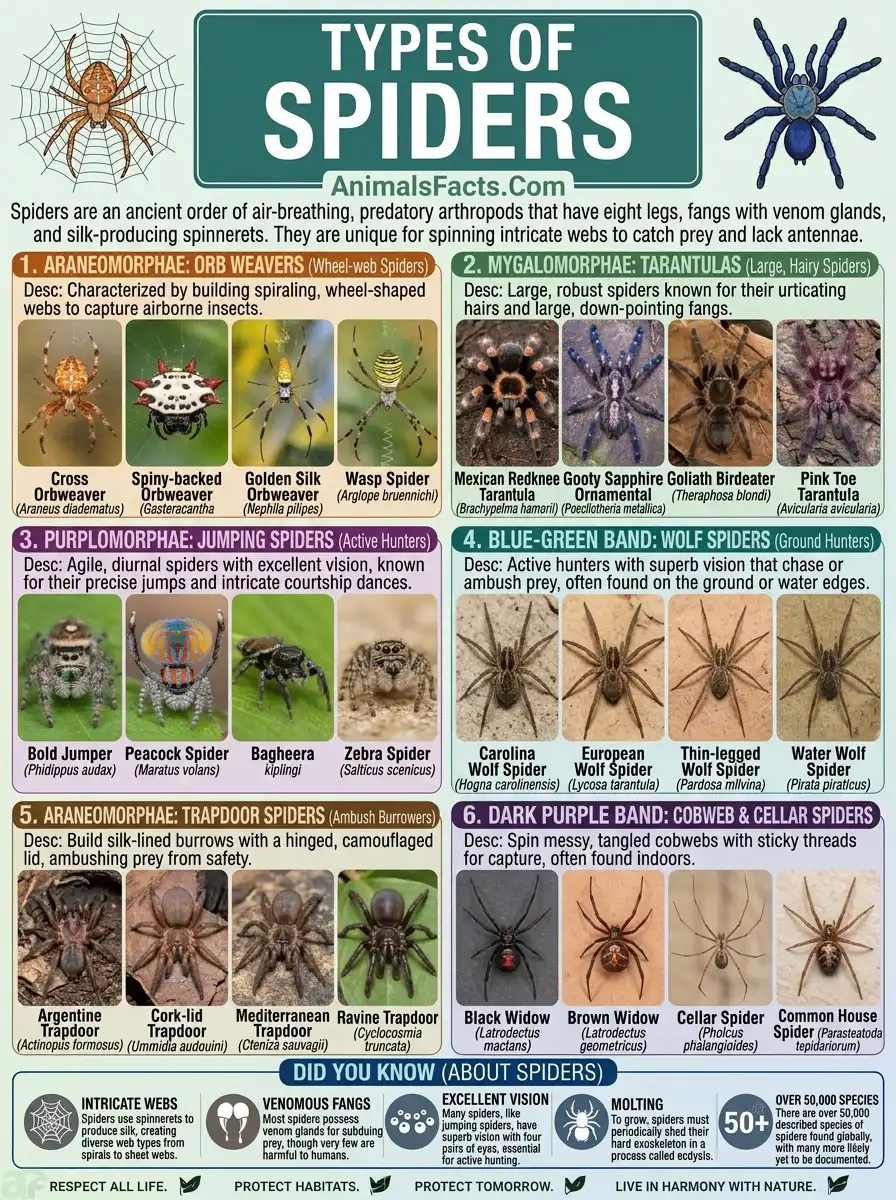
- Araneidae (Orb-weavers) — Classic wheel-shaped web builders; includes garden spiders
- Salticidae (Jumping spiders) — The largest spider family with ~6,400 species; exceptional vision and leaping ability
- Theridiidae (Cobweb spiders) — Includes the infamous black widow
- Theraphosidae (Tarantulas) — Large, hairy, long-lived; ~1,000 species
- Lycosidae (Wolf spiders) — Active ground hunters; carry young on their backs
- Thomisidae (Crab spiders) — Ambush predators disguised as flowers
- Linyphiidae (Sheet web spiders) — Tiny spiders that build sheet-like horizontal webs
- Nephilidae (Golden silk orb-weavers) — Produce the strongest natural spider silk known
Evolution & Discovery Timeline
~380 million years ago — The earliest spider ancestors appear during the Devonian period, before land plants had diversified significantly.
~300 million years ago — True spiders with silk-spinning ability appear in the Carboniferous period.
~250 million years ago — The split between the two major spider infraorders, Mygalomorphae and Araneomorphae, is believed to have occurred.
1758 — Carl Linnaeus formally begins classifying spiders in Systema Naturae, founding the scientific study of arachnology.
1890s — Henry C. McCook and Eugène Simon produce landmark monographs laying the foundation of modern spider taxonomy.
1940 — The American spider biologist Willis J. Gertsch publishes American Spiders, bringing public attention to spider biology.
1973 — Peter Witt’s landmark research on spider web geometry and drug effects on web-building inspires a new field of behavioral neuroscience.
2001 — Researchers successfully splice spider silk genes into goats, producing silk proteins in goat milk — a breakthrough in biomaterial science.
2017 — Scientists calculate that the world’s spider population consumes between 400 and 800 million tons of prey per year — more than the entire human race eats annually.
2021 — Jumping spiders are demonstrated to experience REM-like sleep, suggesting spiders may dream — a finding that shook the scientific world.
2023 — A new spider species, Phrynus pseudoparvulus, is discovered hidden in museum collections — highlighting how many species remain undescribed.
“Spiders are master engineers. The architecture of an orb-weaver’s web represents one of the most mathematically precise structures produced by any animal — including humans.” — Dr. Fritz Vollrath, Professor of Zoology, University of Oxford, and leading expert on spider silk
3. Spider Physical Description & Features
One of the most compelling spider facts is the sheer range of physical forms found within this single order. Spiders range from near-invisible specks to animals with leg spans wider than a dinner plate, and their bodies are packed with biological innovations that continue to astonish scientists.
Body Structure
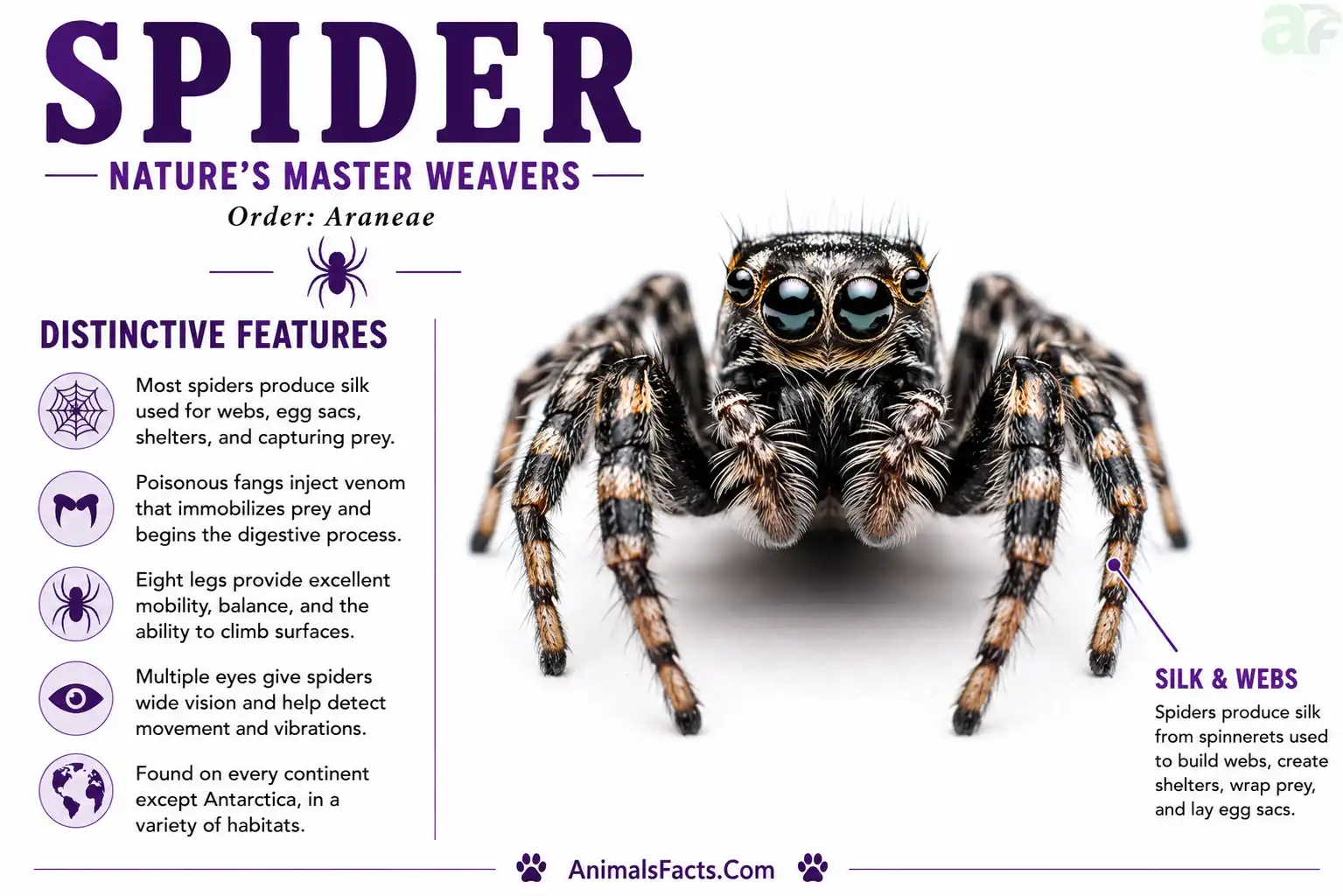
Every spider has two main body sections: the cephalothorax (fused head and thorax) and the abdomen, connected by a narrow waist called the pedicel. Eight legs attach to the cephalothorax, along with two pedipalps (sensory appendages that resemble small legs) and the chelicerae — jaw-like structures that contain the venom glands and end in hollow fangs.
Eyes
Most spiders have eight eyes, though some cave-dwelling species have lost them entirely through evolution. Jumping spiders have evolved the most remarkable spider eyes of all — their large forward-facing principal eyes are structured like telephoto lenses, providing sharp, color vision including UV wavelengths invisible to humans. These eyes sit on moveable retinas that can swivel and track targets with eerie precision.
Spider Size & Weight
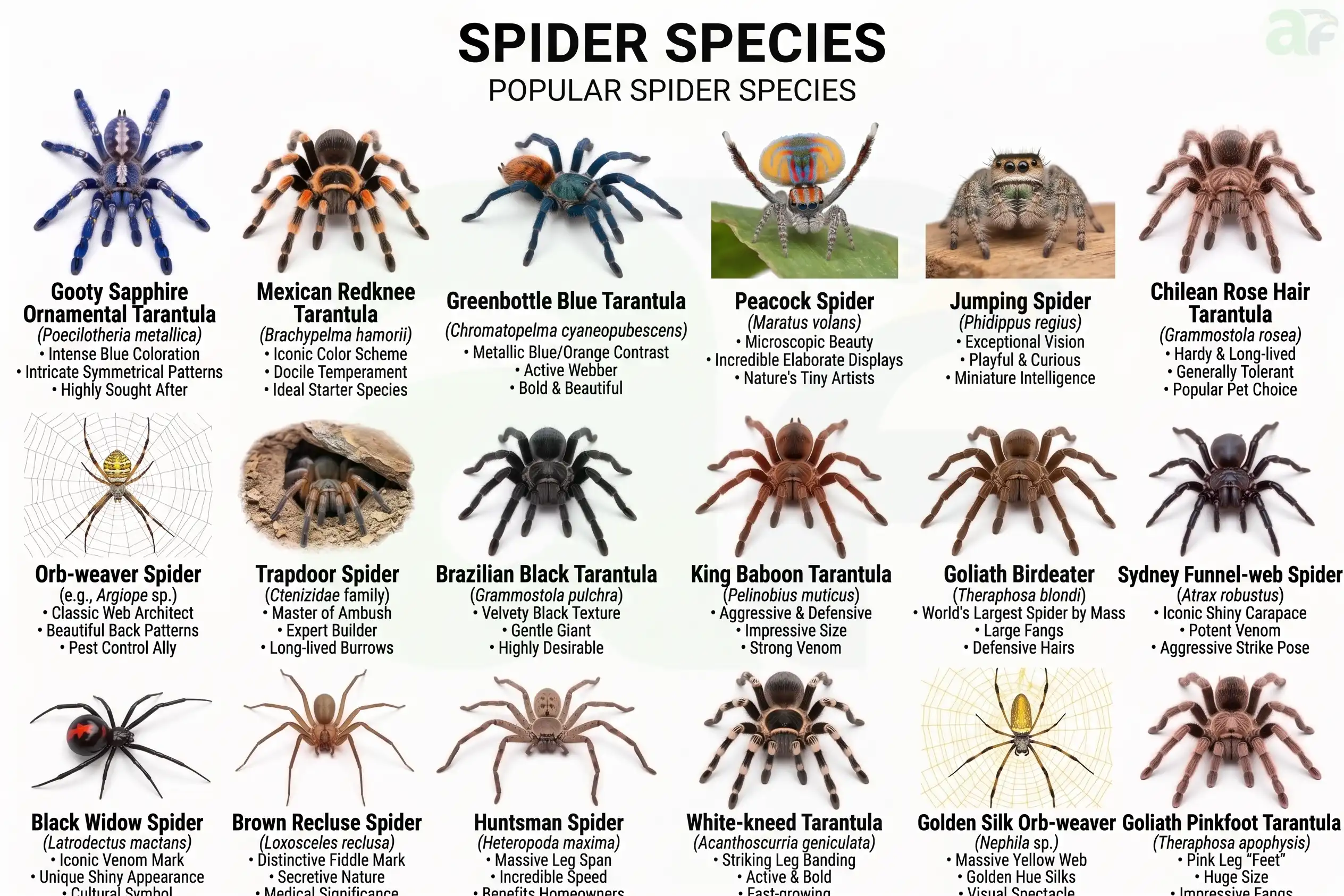
The Goliath birdeater tarantula (Theraphosa blondi) of South America holds the record for the world’s largest spider by mass, weighing up to 170 grams (6 oz) with a leg span of up to 30 cm (12 inches). The giant huntsman spider (Heteropoda maxima) of Laos holds the record for the largest leg span at 30 cm. At the other extreme, the Patu digua of Colombia has a body length of just 0.37 mm — smaller than the period at the end of this sentence.
Gender Differences
In most spider species, females are significantly larger than males — sometimes dramatically so. In the golden silk orb-weaver, females can be 10 times larger than males by body mass. Males are typically shorter-lived, often dying shortly after mating. Female tarantulas, by contrast, can live for 20–30 years in captivity.
Did You Know? Male peacock spiders (Maratus species) of Australia perform elaborate dance displays to attract females — raising a colorful, iridescent flap on their abdomen and performing multi-step choreographed routines that have gone viral on YouTube with tens of millions of views.
4. Top 25 Amazing Spider Facts
Here is your essential collection of the most extraordinary, surprising, and scientifically verified spider facts as of 2026:
- Spiders have been on Earth for over 380 million years — predating dinosaurs by more than 150 million years.
- There are over 50,000 known species of spiders, and scientists estimate hundreds of thousands more remain undescribed.
- The global spider population is estimated at 10 quadrillion individuals — roughly 1.4 million spiders for every human being on Earth.
- All spiders produce silk, but not all spiders build webs — many use silk only for egg sacs, draglines, or retreat tubes.
- Spider silk is weight-for-weight 5 times stronger than steel and 3 times tougher than Kevlar (the material used in bulletproof vests).
- The Darwin’s bark spider (Caerostris darwini) of Madagascar produces the toughest biological material ever recorded — silk 10 times stronger than Kevlar.
- Spiders are found on every continent on Earth except Antarctica.
- Jumping spiders can leap up to 50 times their own body length.
- Virtually all spiders are venomous, but only about 200 species have venom capable of causing medical harm to humans — and fatalities are extremely rare.
- Spiders don’t have muscles in their legs for extension — they extend their legs hydraulically, using blood pressure. A dead spider’s legs curl inward because the hydraulic pressure disappears.
- A 2021 study found that jumping spiders appear to experience REM-like sleep states, suggesting they may dream.
- The ogre-faced spider (Deinopis) holds its web between its front legs and throws it like a net at passing prey.
- The bolas spider (Mastophora) doesn’t build a web at all — it produces a chemical that mimics moth pheromones and swings a sticky silk thread to catch male moths drawn in by the smell.
- The diving bell spider (Argyroneta aquatica) lives almost entirely underwater, maintaining an air bubble that functions as an external gill.
- Social spiders exist — species like Anelosimus eximius live in colonies of thousands and cooperatively hunt prey far larger than any individual could tackle alone.
- The portia spider (Portia genus) is considered one of the most cognitively advanced invertebrates — it can plan detour routes to prey it cannot currently see and modifies its hunting strategy based on what works.
- Spiders collectively consume between 400 and 800 million tons of prey annually — more than all humans and whales eat combined.
- The Sydney funnel-web spider (Atrax robustus) is widely considered the world’s most dangerous spider — its venom can kill an adult human in as little as 15 minutes without antivenom.
- Tarantula hairs (called urticating setae in New World species) are a defense weapon — they flick microscopic barbed hairs into the eyes and skin of attackers, causing intense irritation.
- The spitting spider (Scytodes) spits a venomous, sticky silk at prey from a distance of up to 2 cm, pinning it in place before biting.
- Orb-weaver spiders often eat their own web each morning and rebuild it nightly — recycling the protein to reduce energy costs.
- Black widows are not aggressive — bites typically occur only when the spider is accidentally pressed against skin. Most confirmed bites in the US resolve without antivenom.
- The trap-door spider (Ctenizidae family) builds a camouflaged hinged door over its burrow entrance and lies in wait, feeling vibrations in trip-wires of silk radiating from the door.
- Some jumping spiders can recognize and remember individual human faces — distinguishing one person from another in laboratory experiments.
- Female wolf spiders carry their entire egg sac attached to their spinnerets, then allow newly hatched spiderlings to ride on their back for their first week of life.
5. Spiders Fun Facts for Kids
- Spiders have blue blood — their blood contains copper-based hemocyanin instead of iron-based hemoglobin
- A spider’s silk glands can produce up to 7 different types of silk for different purposes
- The black widow’s venom is 15 times more potent than a rattlesnake’s by volume
- Spiders can survive for months without eating during cold or lean periods
- Tarantulas can regenerate lost limbs through molting
- The largest spider webs ever recorded span 25 meters across a river (Darwin’s bark spider)
- Some jumping spiders navigate by using polarized light from the sky as a compass
- Spiders have existed through five mass extinction events
- The word “arachnid“ comes from the Greek myth of Arachne, a weaver turned into a spider by Athena
- A single spider can consume up to 2,000 insects per year
- Spiders have book lungs — leaf-like breathing organs unique to arachnids
- Male spiders often vibrate, tap, or “drum” to communicate with females
6. Natural Habitat of Spiders
Spider habitat diversity is staggering. These animals have colonized virtually every terrestrial environment on Earth, from tropical rainforest canopies to arctic tundra, from deep caves to high-altitude mountaintops above 5,000 meters. A few species have even mastered aquatic environments.
Habitat Types
Spiders inhabit tropical rainforests, temperate woodlands, deserts, grasslands, mountains, caves, freshwater margins, coastal dunes, agricultural fields, and suburban homes. Some species, like the raft spider (Dolomedes), live at the edge of ponds and streams, sensing prey through water surface vibrations. The diving bell spider (Argyroneta aquatica) spends virtually its entire life submerged in freshwater ponds across Europe and Asia.
Habitat Range by Continent
| Continent/Region | Notable Species | Habitat Type |
|---|---|---|
| Africa | Baboon tarantulas, social spiders, golden orb-weavers | Savanna, rainforest, desert |
| Asia | Huntsman spiders, jumping spiders, water spiders | Tropical forest, caves, freshwater |
| Australia | Funnel-web, redback, huntsman, peacock spiders | Desert, forest, urban areas |
| North America | Black widow, brown recluse, wolf spider, tarantula | Desert, grassland, forest, homes |
| South America | Goliath birdeater, Brazilian wandering spider, golden silk | Rainforest, savanna |
| Europe | Garden spider, house spider, water spider, zebra jumper | Woodland, grassland, freshwater |
| Arctic/High altitude | Arctic wolf spider, various small species | Tundra, mountain meadows |
| Antarctica | None | N/A |
Did You Know? The arctic wolf spider (Pardosa glacialis) survives in the High Arctic, living on the shores of Greenland and surviving temperatures that would kill most arthropods. It is one of the northernmost land animals on Earth.
7. Spider Diet & Feeding Behavior
Spider diet is almost universally carnivorous. The vast majority of species feed primarily on insects and other arthropods, making them the most important biological pest control system on the planet.
Diet Breakdown Table
| Food Type | Approximate % of Spider Species That Include It | Example Predators |
|---|---|---|
| Insects (flies, moths, beetles, ants) | ~95% | Garden spiders, jumping spiders, wolf spiders |
| Other spiders | ~30% | Jumping spiders, black widows, portia spiders |
| Other arachnids (mites, scorpions) | ~15% | Large tarantulas, huntsman spiders |
| Small vertebrates (frogs, lizards, birds) | ~5% | Goliath birdeater, large tarantulas |
| Small fish | ~3% | Fishing spiders, raft spiders |
| Pollen & plant nectar | ~1% | Bagheera kiplingi (jumping spider — rare herbivore) |
| Other spiders’ eggs | ~8% | Various cobweb and orb-weaver species |
Hunting Strategies
Spiders have evolved an extraordinarily diverse range of hunting strategies:
Web-based trapping — Orb-weavers, cobweb spiders, and funnel-web spiders construct silk structures that passively capture prey. Web designs vary from the iconic geometric orb to tangled cobwebs, funnel-shaped sheets, and tripwire systems.
Active hunting — Wolf spiders, jumping spiders, and huntsman spiders don’t use webs to catch prey. They track, stalk, and ambush prey using exceptional senses — particularly the forward-facing telephoto eyes of jumping spiders, which can track a fly from 30 cm away with the precision of a sniper.
Ambush predation — Crab spiders sit motionless on flowers, often matching the flower’s color precisely, waiting for pollinators to land within striking range.
Tool use — The bolas spider and ogre-faced spider represent some of the most cognitively impressive predation strategies in the invertebrate world, involving active tool construction and use.
8. Spider Reproduction & Life Cycle
Spider reproduction involves some of the most dramatic and sometimes dangerous courtship behaviors in the animal kingdom. The widely held belief that female spiders always eat males after mating is actually a myth for most species — though it does occur in some, notably the black widow and redback spider.
Mating Behavior
Male spiders must approach females with extreme caution in species where size dimorphism is extreme. They use a range of signals to announce their identity and intentions: vibrational drumming, visual displays (jumping spiders), pheromone trails, web-plucking, and elaborate dance sequences. Male peacock spiders perform multi-part dances involving leg raises, abdominal fan displays, and rhythmic side-to-side movements with a precision that has mesmerized millions of online viewers.
Before mating, male spiders must first charge their pedipalps with sperm — they spin a small sperm web, deposit sperm onto it, then draw the sperm up into specialized structures in their pedipalps, which function as the mating organ.
Egg & Development Stages
- Sperm transfer — Male deposits sperm into female’s reproductive opening via pedipalps
- Egg laying — Female deposits fertilized eggs (dozens to thousands, depending on species) into a silk egg sac
- Incubation — Eggs develop within the protective egg sac for 2–8 weeks
- Hatchlings (spiderlings) — Emerge from egg sac; go through 1–2 molts within the sac before dispersal
- Ballooning — Many spiderlings disperse by releasing silk threads and floating on air currents — some have been found at altitudes above 4 km
- Juvenile stage — Series of molts (typically 4–12 depending on species) before reaching adulthood
- Adult — Full reproductive maturity reached; males typically die within weeks; females may survive for years
Spider Lifespan Comparison Table
| Species | Average Lifespan (Female) | Average Lifespan (Male) |
|---|---|---|
| Goliath birdeater tarantula | 15–25 years | 3–6 years |
| Black widow | 1–3 years | Weeks to months |
| Garden orb-weaver | ~1 year | ~1 year (dies after mating) |
| Wolf spider | 1–3 years | ~1 year |
| Jumping spider | 1–3 years | ~1 year |
| Trap-door spider | Up to 35 years | 5–7 years |
Did You Know? A trapdoor spider (Gaius villosus) in Western Australia, known as “Number 16,” lived to an estimated 43 years of age before being killed by a parasitic wasp — making her the oldest spider ever recorded by a significant margin.
9. Social Behavior & Communication
Most spiders are solitary and highly territorial — but the deeper you look, the more complex their social and communicative lives appear.
Communication Methods
Vibrational signaling is perhaps the most important communication channel for most spiders. The entire spider body is covered in sensory hairs called trichobothria that detect air movements, and slit sensilla along the legs that detect substrate vibrations. Male spiders produce species-specific vibrational signals by drumming, stridulating (rubbing body parts together), or plucking the web — each signal pattern is unique enough that females can identify a male’s species and condition before he approaches.
Chemical communication via pheromones is critically important for mate location. Male spiders can detect the silk draglines left by females and extract detailed information about her species, reproductive status, and even her recent diet from the chemical signature alone.
Visual communication reaches its peak in jumping spiders, which have evolved spectacular color patterns, iridescent structures visible only under UV light, and remarkably choreographed courtship dances. Female jumping spiders are exacting judges — males that perform poorly or make errors in their dance routines are often rejected or attacked.
Social Spiders
A small number of spider species (~25 known) are genuinely eusocial or cooperative, living in colonies that share webs, cooperate in prey capture, and jointly care for young. The African social spider (Stegodyphus dumicola) lives in colonies of up to 300 individuals, building massive communal webs in shrubs and trees. These colonies operate with a degree of task specialization — certain individuals preferentially take on prey capture roles while others tend eggs and young.
Intelligence
Portia spiders (Portia genus) are consistently cited as the most cognitively capable spiders ever studied. They are capable of detour solving — planning routes to prey that require temporarily moving away from the target. They modify their hunting strategy based on feedback, learning from failed attempts in real time. They can distinguish between different prey types and deploy species-specific strategies for each. By any measurable standard, portia spiders demonstrate planning, learning, and flexible decision-making at a level previously thought impossible for animals with such small nervous systems.
10. Predators & Defense Mechanisms
Despite being fearsome predators themselves, spiders face danger from a surprising array of natural enemies.
Natural Predators
- Birds — Among the most significant predators; many birds specialize in spiders
- Wasps — Particularly spider wasps (Pompilidae), which paralyze spiders and use them as living food for their larvae
- Parasitic wasps (Ichneumonidae) — Lay eggs inside spiders or on egg sacs
- Lizards & frogs — Major predators of ground-dwelling spiders
- Centipedes — Prey on spiders sharing the same microhabitats
- Other spiders — Many species, particularly jumping spiders, actively hunt and eat other spiders
- Mantids — Praying mantises are effective ambush predators of spiders
- Humans — Habitat destruction and pesticide use reduce spider populations
Defense Strategies
Venom — The most direct defense; while primarily a hunting tool, spider venom also deters some predators.
Camouflage — From the near-perfect bark mimicry of some huntsman spiders to the petal-matching white or yellow coloration of crab spiders, camouflage is widespread.
Urticating hairs — New World tarantulas can flick microscopic barbed hairs from their abdomen toward a threat using their back legs. These hairs embed in skin and mucous membranes, causing intense irritation.
Thanatosis (death feigning) — Many spider species “play dead” when touched, going completely limp and allowing themselves to drop to the ground.
Speed — The giant house spider (Eratigena atrica) can achieve speeds of up to 1.7 km/h – equivalent to 53 km/h if scaled to human size — making rapid escape a viable primary strategy.
Web as early warning system — Many spiders retreat into a tubular silk hideaway and maintain physical contact with their web via a signal thread. Any vibration in the web is immediately communicated to the spider.
Did You Know? Some orb-weaver spiders build stabilimenta — conspicuous zigzag bands of silk in the center of their webs. Scientists have debated for decades whether these are camouflage, structural stabilizers, or signals to warn birds away from flying through and destroying the web. Current evidence supports the bird-warning hypothesis.
11. Spider Facts for Kids
Hey curious explorers! Here are some wild and wonderful spider facts for kids that will totally amaze you:
Spiders have eight eyes! Most spiders have eight eyes arranged in different patterns — but some cave spiders have no eyes at all because they live in complete darkness!
Spider silk is stronger than steel! Imagine a thread thinner than your hair that is tougher than a bulletproof vest. That’s what spiders spin every single day!
Spiders use hydraulics for their legs! Instead of muscles that push their legs out, spiders pump fluid into their legs to extend them — like tiny hydraulic robots.
Some spiders can fly — kind of! Baby spiders called spiderlings shoot out a thin strand of silk and let the wind carry them through the air — sometimes for hundreds of kilometers!
Jumping spiders can see more colors than you can! They see ultraviolet light that is completely invisible to human eyes, and they can judge distances almost like a human can.
Spiders may dream! Scientists discovered in 2021 that jumping spiders appear to have a sleeping state similar to REM sleep in humans — the stage where we dream!
The biggest spider is as wide as a dinner plate! The Goliath birdeater tarantula has legs that can span 30 cm — wider than most dinner plates. Despite its name, it rarely eats birds!
Some spiders live underwater! The diving bell spider builds a bubble of air trapped in silk underwater and lives in it like a tiny submarine home!
12. Relationship with Humans
The relationship between spiders and humans is one of the most emotionally complicated in the animal kingdom — characterized by irrational fear on one side and, increasingly, growing scientific admiration on the other.
Arachnophobia
Arachnophobia — the fear of spiders — is one of the most common specific phobias in the world, estimated to affect 3.5–6.1% of the global population in clinically significant form. Evolutionary psychologists suggest a mild inherited wariness toward spiders was once adaptive for our ancestors in environments where venomous spiders posed genuine risks. In modern environments, where the overwhelming majority of spiders pose no danger, this ancestral wariness has persisted and, in some people, amplified into a full phobia.
Medical Significance
Genuinely dangerous spiders do exist. The Sydney funnel-web (Atrax robustus), Brazilian wandering spiders (Phoneutria species), black widow (Latrodectus species), and brown recluse (Loxosceles reclusa) are responsible for the majority of serious spider bite incidents globally. However, deaths from spider bites are extremely rare — modern antivenom has reduced funnel-web fatalities in Australia essentially to zero since its introduction in 1981. Globally, spider bites cause fewer than 7 confirmed deaths per year in the modern medical era.
Spider Silk in Technology
Spider silk has inspired some of the most exciting research in biomaterial science. Potential applications include surgical sutures, bulletproof materials, aerospace components, and biodegradable fishing lines. Companies including Bolt Threads and Spiber Inc. have developed commercially produced synthetic spider silk proteins as of 2025, with applications in sportswear and medical devices.
Spiders as Pest Control
Perhaps the most practically important spider fact for humans: spiders are the world’s most valuable biological pest control system. By consuming hundreds of millions of tons of insects annually, they suppress populations of mosquitoes, agricultural pests, disease vectors, and food storage insects in ways that would otherwise cost farmers and public health systems enormous resources to replicate artificially.
13. Spiders Conservation Status & Threats
Spider conservation is a growing field, though spiders remain among the most under-studied animals from a conservation standpoint, largely due to their small size, cryptic habits, and the public’s lack of enthusiasm for funding their protection.
IUCN Status Overview
| Status Category | Approximate Number of Spider Species |
|---|---|
| Least Concern | ~2,500 assessed (vast majority unassessed) |
| Near Threatened | ~150 species |
| Vulnerable | ~200 species |
| Endangered | ~150 species |
| Critically Endangered | ~80 species |
| Extinct | ~9 confirmed species |
| Data Deficient | Tens of thousands (most species never assessed) |
Major Threats
Habitat destruction is the primary driver of spider population declines worldwide, particularly deforestation of tropical rainforests where the highest spider diversity is concentrated. In agricultural landscapes, the conversion of natural habitat to monoculture farmland, combined with heavy pesticide use, has been shown to reduce spider diversity by up to 70% in affected areas.
Light pollution is an emerging threat — many spider species that are adapted to hunting at night have their behavior disrupted by artificial lighting, affecting both their ability to hunt and their mating behavior.
Climate change is altering spider species ranges, shifting the timing of life cycle events, and creating mismatches between spider emergence and the availability of prey insects.
Did You Know? The Kauaʻi cave wolf spider (Adelocosa anops) of Hawaii is one of the world’s most endangered spiders — found only in a handful of lava tube caves on the island of Kauaʻi, with a total wild population estimated at just a few hundred individuals.
14. Famous Spiders in History & Pop Culture
Real-World Famous Spiders
Number 16 — A trapdoor spider (Gaius villosus) in Western Australia monitored by researchers from 1974 until her death in 2016, living to an estimated 43 years — the longest verified lifespan of any spider ever recorded.
Charlotte — While fictional, E.B. White’s Charlotte from the 1952 novel Charlotte’s Web is arguably the most culturally influential spider in history, having introduced generations of children to an empathetic perspective on arachnids.
Rosie the Tarantula — The trained tarantula used on the sets of multiple Hollywood productions, including The Amazing Spider-Man film series, whose trainers became among the world’s leading experts on tarantula behavior.
15. Role in Ecosystem & Food Chain
Spiders are keystone predators in virtually every terrestrial food web. Their combined predatory impact — consuming hundreds of millions of tons of prey annually — makes them the dominant regulators of arthropod populations on land.
In forest ecosystems, spiders suppress populations of leaf-eating caterpillars and beetles, protecting tree growth and forest structure. In agricultural fields, research has repeatedly shown that higher spider diversity and abundance directly correlates with lower pest insect damage — making spiders worth billions of dollars in natural pest control services annually.
Spiders also serve as critical prey items for hundreds of bird species, many of which time their nesting and breeding cycles specifically around spider abundance. Remove spiders from an ecosystem and bird populations decline significantly.
Some spiders also contribute to nutrient cycling — their prey capture and consumption, combined with the decomposition of their silk and bodies, returns significant quantities of nitrogen and other nutrients to the soil.
16. Spider Myths, Folklore & Cultural Significance
Spider mythology spans virtually every human culture, from the rainforests of West Africa to the deserts of the American Southwest.
In West African and Caribbean traditions, the spider deity Anansi is one of the most beloved and important figures in oral literature — a trickster god of stories, knowledge, and wisdom who regularly outwits much larger and more powerful beings. Anansi stories traveled to the Americas with enslaved West Africans and became foundational to several African-American and Caribbean oral traditions.
In Native American cultures, particularly among the Hopi and Navajo peoples, Spider Grandmother (Na’ashjé’ii Asdzáá) is a revered creator deity — a wise elder who taught humans to weave and helped guide heroes through the spirit world.
In ancient Greek mythology, the story of Arachne — a mortal weaver of superhuman skill who challenged the goddess Athena to a weaving contest — gave spiders their scientific class name, Arachnida. Depending on the version, Arachne is either transformed into a spider by a vengeful Athena or voluntarily transforms herself.
In Japanese folklore, the jorō-gumo is a shape-shifting spider demon capable of taking human female form to lure and devour men — a legend that persists in popular culture to this day.
17. Spiders in Pop Culture
Spider-Man — First appearing in Amazing Fantasy #15 in August 1962, created by Stan Lee and Steve Ditko, Spider-Man is arguably the most commercially successful animal-inspired superhero in history. The character has generated over $1 billion in annual merchandise sales and inspired multiple billion-dollar film franchises.
Charlotte’s Web (1952 / 1973 / 2006) — E.B. White’s novel and its adaptations have done more to humanize spiders in the public mind than perhaps any scientific document ever written. Charlotte the barn spider remains one of literature’s most beloved animal characters.
Shelob — J.R.R. Tolkien’s monstrous giant spider from The Lord of the Rings draws directly on the deep cultural archetype of the spider as a creature of darkness and danger.
The Spiders (Die Spinnen, 1919–1920) — Fritz Lang’s early German adventure film serial used spider imagery extensively in its pulp adventure storytelling.
Tarantula (1955) — One of many 1950s B-movies featuring giant mutated spiders, cementing the spider’s place in the iconography of atomic-age horror.
18. Spider Facts vs. Common Myths
| Common Myth | The Real Fact |
|---|---|
| “We swallow 8 spiders in our sleep per year” | This is completely false — vibrations from sleeping humans repel spiders |
| “Daddy longlegs are the most venomous spiders” | False — daddy longlegs are not spiders (they’re harvestmen); their “venom” claim is unverified and almost certainly untrue |
| “All spiders are dangerous to humans” | Only about 200 of 50,000+ species have venom capable of harming humans |
| “Female spiders always eat males after mating” | This occurs in some species but is not typical for the vast majority |
| “Spiders are insects” | Spiders are arachnids, not insects — they have 8 legs, 2 body parts, no wings or antennae |
| “Spiders come indoors to escape cold weather” | Most house spiders are born indoors and live their entire lives in buildings |
| “Spiders can be killed by vinegar” | While acidic, household vinegar concentrations are not reliable spider killers |
| “Brown recluse spiders are everywhere” | Their actual range is limited to specific regions of the central/southern US — misidentification is extremely common |
19. Best Places to See Spiders in the Wild
1. Amazon Rainforest, Brazil & Peru — The most spider-diverse region on Earth, home to the Goliath birdeater, Brazilian wandering spider, and hundreds of species found nowhere else.
2. Daintree Rainforest, Queensland, Australia — The world’s oldest tropical rainforest harbors extraordinary spider diversity, including golden orb-weavers with webs visible from meters away and remarkable huntsman species.
3. Madagascar — The island’s extraordinary endemism extends to spiders — home to Darwin’s bark spider, producers of the world’s strongest silk, whose webs have been recorded spanning 25 meters across rivers.
4. Namib Desert, Namibia — Watch for the spectacular golden wheel spider (Carparachne aureoflava), which escapes predators by curling into a ball and cartwheeling down sand dunes at up to 1 meter per second.
5. Costa Rica — Exceptional spider diversity in a relatively accessible ecotourism infrastructure makes this one of the best places in the world for spider-watching, with tarantulas, orb-weavers, and jumping spiders in abundance.
6. Ayers Rock Region, Australian Outback — Trapdoor spiders, wolf spiders, and redbacks all thrive in this iconic landscape, where patient observers can find trapdoor burrows with remarkable camouflaged lids.
7. Borneo, Malaysia/Indonesia — Among the world’s highest spider species density per unit area, with multiple species new to science discovered on virtually every major expedition.
20. How You Can Help
Spider conservation and appreciation is something everyone can contribute to.
Support these organizations:
- British Arachnological Society — britishspiders.org.uk
- American Arachnological Society — americanarachnology.org
- IUCN Spider Specialist Group — iucn.org
- Invertebrate Conservation Trust (Buglife) — buglife.org.uk
- iNaturalist — inaturalist.org (citizen science platform)
What you can do:
- Stop killing house spiders — they eat mosquitoes, flies, and cockroaches in your home
- Reduce pesticide use in your garden — pesticides devastate spider populations
- Plant diverse native vegetation to support the insect prey that sustains spider communities
- Report sightings via iNaturalist — citizen science data on spider distribution is enormously valuable to researchers
- Educate others — sharing accurate spider facts reduces fear and improves public attitudes toward these vital animals
- Support habitat conservation — particularly tropical forest protection, which safeguards the majority of global spider diversity
21. Top Documentaries & Books
Must-Watch Documentaries
- Planet Earth II (BBC, 2016) — Features the breathtaking sequence of marine iguana hatchlings and Galápagos racer snakes, plus extraordinary spider footage
- Life in the Undergrowth (BBC, 2005) — David Attenborough narrates a landmark five-part series on invertebrate life, with substantial spider content
- First Life (BBC, 2010) — Places spider evolution in the context of life’s deep history
- The Dark: Nature’s Nighttime World (BBC, 2012) — Extensive nocturnal spider footage
- Miniature Wonders (NHK/BBC, 2022) — Macro-photography documentary featuring extraordinary jumping spider and orb-weaver sequences
Must-Read Books
- The Spider’s Web by Theodore Evans — Classic introduction to spider biology and behavior
- Spiders of the World by Robert Foelix — The definitive scientific reference on spider biology
- Charlotte’s Web by E.B. White — The greatest work of spider literature ever written
- Arachnids by Jan Beccaloni (Natural History Museum) — Beautifully illustrated comprehensive guide
- The Lives of Spiders by Oxford Scientific Films — Stunning photographic natural history
22. Comparison with Similar Arachnid Species
| Feature | Spider (Araneae) | Scorpion (Scorpiones) | Harvestman (Opiliones) |
|---|---|---|---|
| Body segments visible | 2 (cephalothorax + abdomen) | 2 + segmented tail | 1 (fused into one oval) |
| Legs | 8 | 8 | 8 |
| Silk production | Yes — all species | No | No |
| Venom | Yes — almost all species | Yes | No |
| Eyes | 2–8 | 2–12 | 2 |
| Pincers (pedipalps) | Small, leg-like | Large claws | Small |
| Number of species | 50,000+ | ~2,500 | ~6,600 |
| Oldest fossil | ~380 million years | ~430 million years | ~400 million years |
| Distribution | Global except Antarctica | Global except Antarctica | Global except Antarctica |
23. Frequently Asked Questions About Spider Facts
What is the scientific name for spiders?
Spiders belong to the order Araneae, within the class Arachnida. The full taxonomic classification places them in phylum Arthropoda. Individual species each have unique binomial names — for example, the black widow is Latrodectus mactans, the garden spider is Araneus diadematus, and the Goliath birdeater is Theraphosa blondi.
How many species of spiders are there in the world?
As of 2026, over 50,000 species of spiders have been formally described and catalogued in the World Spider Catalog. Scientists estimate the true total, including undescribed species in tropical regions, may exceed 150,000 species. New species are described at a rate of approximately 500–800 per year.
Are all spiders venomous?
Virtually all spiders possess venom glands, making them technically venomous. However, only approximately 200 species have venom potent enough to cause significant medical harm to humans. The vast majority of spider species are either too small to pierce human skin or possess venom that causes only mild, localized reactions at most.
What do spiders eat?
The overwhelming majority of spiders are carnivorous, feeding primarily on insects and other arthropods. Larger species like tarantulas and huntsman spiders also consume small vertebrates including frogs, lizards, small rodents, and occasionally small birds. One remarkable exception is Bagheera kiplingi, a Central American jumping spider whose diet consists largely of plant material — the only known predominantly herbivorous spider.
How do spiders make webs?
Spiders produce silk in specialized glands in their abdomen, extruding it through organs called spinnerets. Most orb-weaver spiders construct their webs by first laying down a framework of non-sticky “dragline” silk, then adding spirals of sticky capture silk. The entire process typically takes 30–60 minutes. Crucially, a spider produces different types of silk from different glands for different purposes — structural silk, sticky capture silk, egg sac silk, and wrapping silk are all chemically and structurally different.
What is the most dangerous spider in the world?
The Sydney funnel-web spider (Atrax robustus) of southeastern Australia is generally considered the world’s most dangerous spider to humans. Its venom contains a compound called atracotoxin that specifically attacks primate (including human) nervous systems with extreme potency. Without antivenom, a bite can kill an adult human in under 15 minutes. Since the introduction of antivenom in 1981, there have been zero recorded deaths from funnel-web spider bites in Australia.
How long do spiders live?
Lifespan varies enormously by species. Most small spiders — house spiders, orb-weavers, jumping spiders — live for approximately 1–3 years. Female tarantulas are exceptional, with some living 20–30 years in captivity. The record holder is “Number 16,” a trapdoor spider in Western Australia estimated to have lived 43 years before her death in 2016.
Can spiders be kept as pets?
Many spider species make excellent pets for those comfortable with them. Tarantulas are the most popular pet spiders, with the Mexican red-knee tarantula (Brachypelma hamorii), Chilean rose (Grammostola rosea), and curly hair tarantula (Tliltocatl albopilosus) being particularly favored for their docility. Jumping spiders are increasingly popular due to their extraordinary intelligence, curiosity, and large eyes that make them appear almost anthropomorphically expressive.
Are spiders important to the environment?
Extremely so. Spiders are among the most ecologically important animals on Earth. Their collective consumption of 400–800 million tons of prey annually makes them the dominant regulator of terrestrial arthropod populations — controlling insect pests of agriculture, disease vectors like mosquitoes, and countless other species that would otherwise reproduce unchecked. Remove spiders from ecosystems and the cascading effects on plant life, bird populations, and human health would be severe and immediate.
Why do spiders come into houses?
Contrary to popular belief, most house spiders are not seasonal invaders seeking warmth. The majority of common house spider species (Tegenaria and Eratigena species in the Northern Hemisphere) are permanent indoor residents that spend their entire lives inside buildings, having evolved alongside human habitation. The increase in spider sightings during late summer and autumn is due to males becoming sexually active and wandering more widely in search of females — not due to outdoor spiders seeking warmth.
24. Sources & References
Research Sources
- Wikipedia — Araneae, Theraphosidae, Latrodectus, Portia (spider), Atrax robustus
- IUCN Red List — iucnredlist.org (2025 species assessments)
- National Geographic — nationalgeographic.com
- Smithsonian Institution — si.edu
- WWF Global — worldwildlife.org
- BBC Wildlife / BBC Earth — bbcearth.com
- Britannica — britannica.com/animal/spider
- Live Science — livescience.com
- World Spider Catalog (2026 edition) — wsc.nmbe.ch
- Foelix, Rainer (2011). Biology of Spiders (3rd ed.). Oxford University Press
- Vollrath, Fritz & Knight, David P. (2001). “Liquid crystalline spinning of spider silk” — Nature
- Nyffeler, M. & Birkhofer, K. (2017). “An estimated 400–800 million tons of prey are annually killed by the global spider community” — The Science of Nature
- Rößler, D.C. et al. (2022). “Dreaming in jumping spiders” — PNAS