

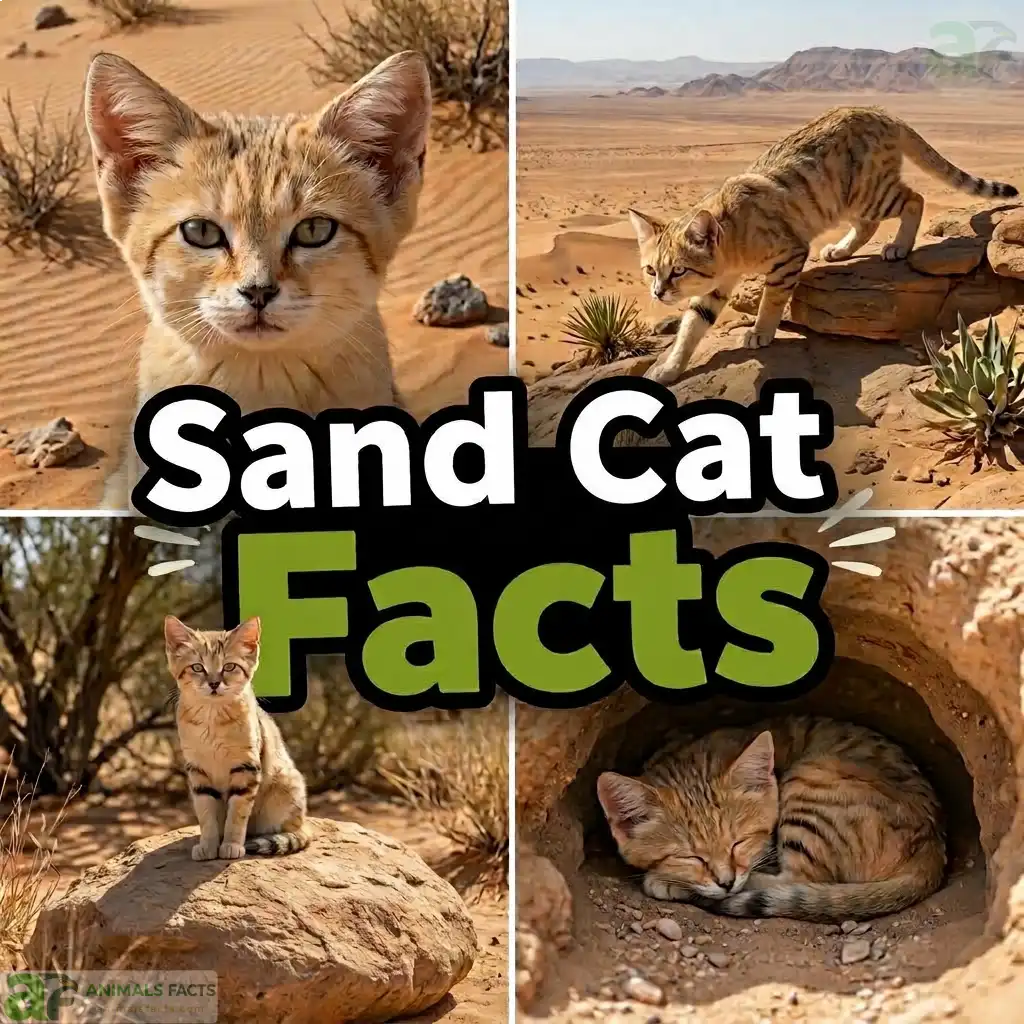
Sand Cat Facts
| Feature | Details |
|---|---|
| Scientific Name | Felis margarita (Loche, 1858) |
| Kingdom | Animalia |
| Phylum | Chordata |
| Class | Mammalia |
| Order | Carnivora |
| Family | Felidae |
| Genus | Felis (Linnaeus, 1758) |
| Common Names | Sand cat, sand dune cat |
| Native Range | North Africa, Middle East, Central Asia |
| Habitat | True desert — sandy and stony desert, dry plains, arid scrubland |
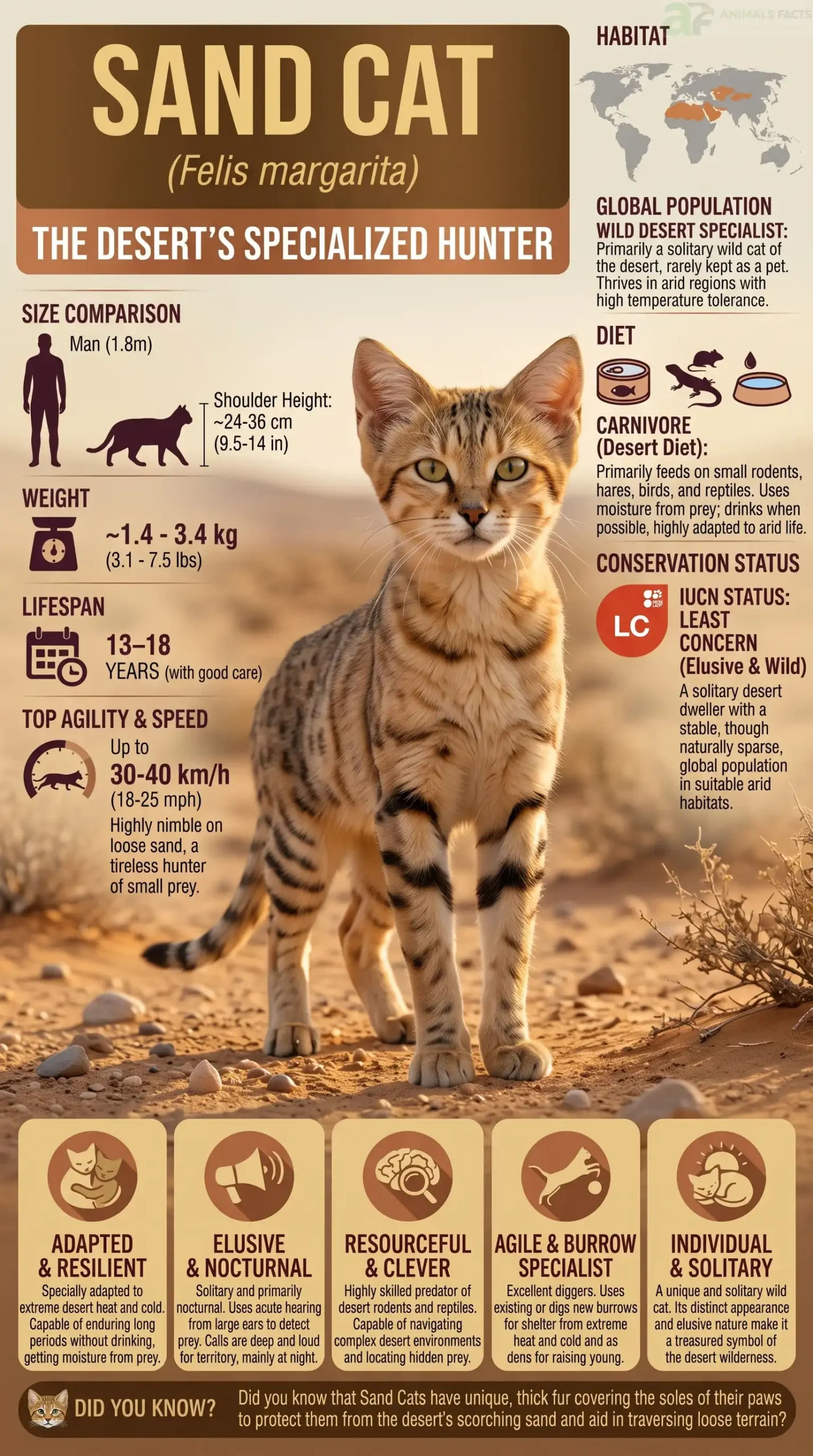
| Lifespan | 8–13 years (wild); up to 17 years (captivity) |
| Diet | Rodents, birds, reptiles, invertebrates, hares |
| Body Length | 39–52 cm plus 23–31 cm tail |
| Height | 24–30 cm at shoulder |
| Weight | 1.4–3.4 kg |
| Top Speed | Up to 40 km/h in short bursts |
| Conservation Status | Least Concern (IUCN) — but declining |
| Number of Subspecies | 4 recognized subspecies |
| Closest Living Relative | Domestic cat (Felis catus) and wildcat (Felis silvestris) — same genus |
| Special Adaptation | Fur-covered paws that insulate against scorching sand and enable silent movement |
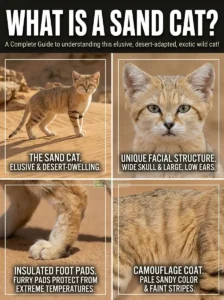 1. Introduction: What is a Sand Cat?
In the vast, shimmering emptiness of the Sahara Desert — where summer surface temperatures exceed 70°C, where rain may not fall for years at a time, and where the landscape offers almost no shade, water, or visible life — one of the world’s most perfectly adapted predators moves through the night in near-perfect silence. Sand cat facts begin with this single, extraordinary image: a small, deceptively ordinary-looking cat — barely larger than a domestic tabby — that has evolved over millions of years into the most desert-specialized wild felid on Earth. An animal that not only survives in conditions that would kill most other mammals within hours, but that thrives in them — hunting, raising kittens, and living its entire life in environments where the sand surface reaches temperatures hot enough to cook food.
The sand cat is among the least studied and most mysterious of all wild cat species — a creature so perfectly adapted to its extreme environment that it was unknown to Western science until 1858 and so secretive and nocturnal that even today, in an era of GPS tracking and sophisticated camera traps, fundamental aspects of its ecology remain undocumented. Interesting facts about sand cats reveal an animal of breathtaking evolutionary ingenuity — paws so densely furred on their undersides that they function as natural snowshoes on scorching sand, ears so large and sensitively positioned that they can detect prey moving underground, a physiology so precisely calibrated for water conservation that the cat can survive indefinitely without ever drinking — obtaining all necessary moisture from the bodies of its prey. A cat that can lower its body close to the ground and flatten its ears so effectively that it becomes essentially invisible against the sand surface even in full daylight.
Whether you are searching for sand cat facts for kids to fuel curiosity about desert wildlife and animal adaptations, planning a desert safari to witness one of nature’s most extreme survival specialists in its natural environment, researching sand cat habitat and ecology for academic purposes, or simply captivated by photographs of this wide-eyed, round-faced, impossibly adorable wild cat — this is your comprehensive guide. We cover sand cat scientific name, sand cat diet, sand cat size and weight, sand cat behavior, the extraordinary physiological adaptations that make desert survival possible, conservation status, cultural significance, and the profound ecological role these animals play in some of Earth’s harshest environments. The desert’s most secretive hunter awaits.
2. Species Overview & Classification
The sand cat belongs to the genus Felis — the same genus as the domestic cat (Felis catus) and the wildcat (Felis silvestris), making it more closely related to the familiar domestic cat than to most other wild felid species. This taxonomic proximity to the domestic cat has made the sand cat of particular interest in feline evolutionary biology and has complicated aspects of its conservation genetics.
Species Classification Table
| Taxonomic Rank | Classification |
|---|---|
| Kingdom | Animalia |
| Phylum | Chordata |
| Class | Mammalia |
| Order | Carnivora |
| Family | Felidae |
| Subfamily | Felinae |
| Genus | Felis (Linnaeus, 1758) |
| Species | F. margarita (Loche, 1858) |
| Common ancestor with domestic cat | ~6–8 million years ago |
| Sister species | Wildcat (Felis silvestris) and domestic cat (Felis catus) |
Discovery and Naming
The sand cat was first formally described by Víctor Loche — a French naturalist — in 1858, based on specimens collected in the Saharan Algerian desert during a French military expedition. Loche named the species Felis margarita — the species name honoring General Jean Auguste Margueritte, the French military officer who led the expedition during which the first specimens were collected.
The fact that the sand cat remained unknown to Western science until the mid-19th century — despite occurring across enormous areas of North Africa and the Middle East that had been in contact with European civilization for millennia — reflects the extraordinary effectiveness of the species’ camouflage, its nocturnal habits, and its preference for the most inhospitable desert terrain where human presence was minimal.
Subspecies Comparison Table
| Subspecies | Range | Notes |
|---|---|---|
| F. m. margarita | Sahara (Algeria, Niger, Libya) | Nominate subspecies; paler coloration |
| F. m. airensis | Air Mountains (Niger) | Slightly different coloration; isolated population |
| F. m. scheffeli | Pakistan (Nushki Desert) | Darker coloration; considered by some to be most distinct |
| F. m. thinobia | Central Asia (Turkmenistan, Uzbekistan, Kazakhstan) | Most northerly subspecies; slightly larger body |
Evolution & Discovery Timeline
~6–8 million years ago — The sand cat lineage diverges from the common ancestor shared with the wildcat (Felis silvestris) and the domestic cat (Felis catus) — beginning the evolutionary trajectory toward extreme desert specialization during the Miocene epoch.
~3–5 million years ago — As the Sahara and Arabian deserts expand during Pliocene aridification events, the sand cat lineage adapts progressively to increasingly extreme desert conditions — developing the physiological and morphological specializations for which the species is now famous.
1858 — Víctor Loche formally describes the species as Felis margarita — the first Western scientific documentation of the sand cat, based on specimens from the Algerian Sahara.
1926 — First sand cat documented from the Arabian Peninsula — establishing the species’ presence in the Middle Eastern desert systems.
1968 — First comprehensive field study of sand cat behavior in Pakistan — conducted by wildlife biologist Paul Joslin — providing the earliest systematic behavioral data on the species.
2005 — The first GPS tracking study of sand cats in Israel’s Arava desert reveals daily movement distances and home range sizes that dramatically exceed previous estimates — showing that sand cats routinely travel 5–10 km per night while hunting.
2013 — A landmark camera trap study in the Moroccan Sahara — led by Grégory Breton and the Panthera organization — produces the most comprehensive photographic documentation of wild sand cats ever achieved, including the first footage of sand cat kittens in the wild.
2017 — A study in Abu Dhabi (UAE) provides the most detailed GPS tracking data ever recorded for sand cats — documenting daily movements, hunting behavior, and habitat selection across a full annual cycle.
2019 — The first systematic sand cat breeding behavior study using camera traps in the wild documents details of mating, birth, and kitten development that were previously known only from captive studies.
2023–2024 — Expanded camera trap networks across the Sahara, Arabian Peninsula, and Central Asian range countries provide the most comprehensive distribution data yet for the species — while simultaneously revealing the extent of monitoring gaps that prevent reliable population assessment.
“The sand cat is the purest expression of desert specialization in the cat family — every aspect of its biology, from its fur-covered paws to its moisture-conserving physiology, reflects millions of years of evolutionary refinement for life in the most extreme dry environments on Earth. It is a masterpiece of natural selection.” — Dr. Alexander Sliwa, Cologne Zoo and leading sand cat researcher
3. Physical Description & Unique Features
Sand cat size and weight place it among the smallest of wild cat species — but its physical features are so precisely and elegantly adapted for desert survival that virtually every aspect of its morphology tells a story of extraordinary evolutionary engineering.
Body Form
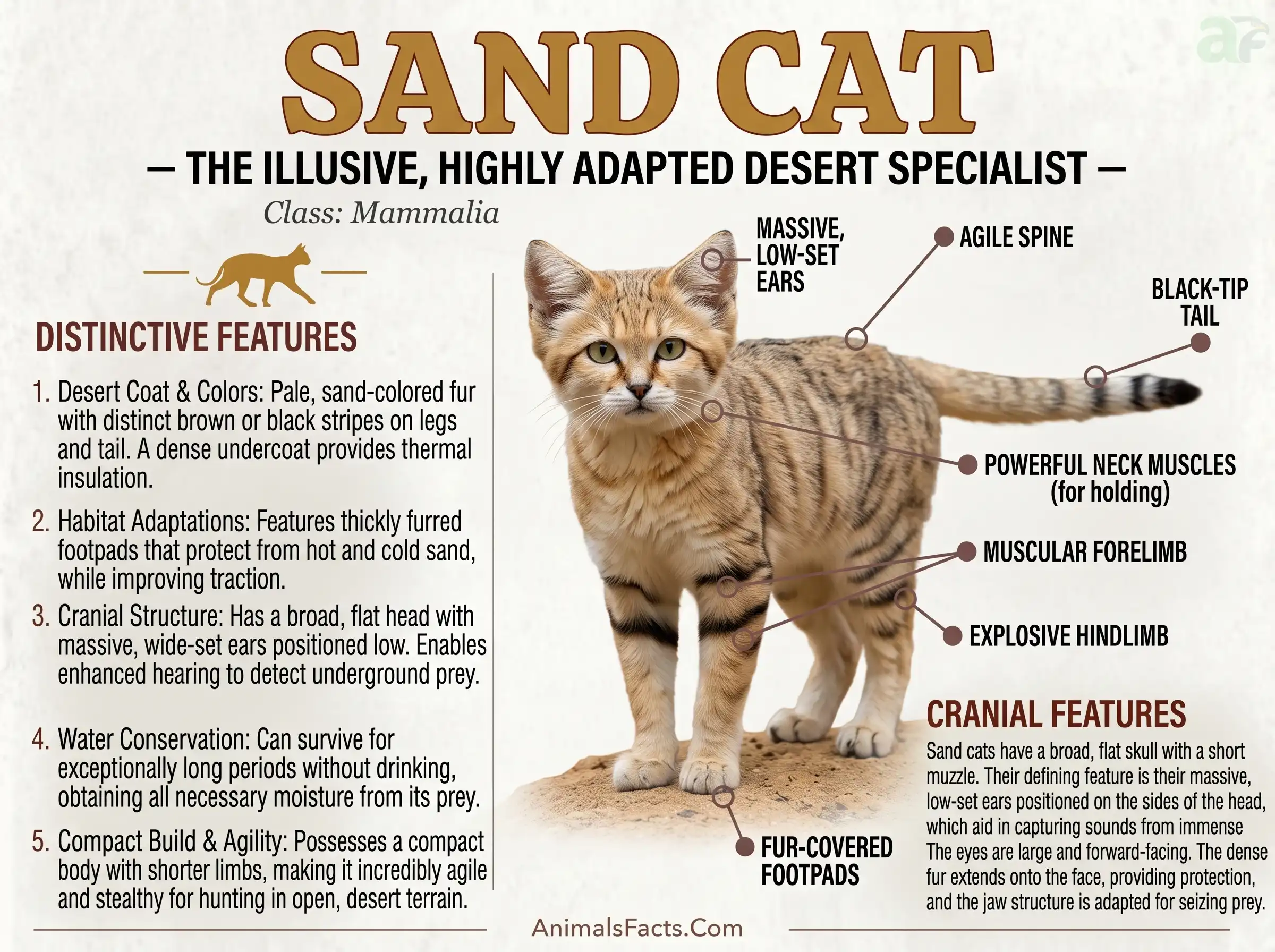
The sand cat has a compact, robust body — slightly stockier than might be expected for its modest weight — mounted on short, strong legs that keep its body close to the ground. This low-slung profile serves multiple adaptive functions:
- Reduces wind resistance during movement across open desert terrain
- Keeps the cat’s center of gravity low — improving stability on loose sand
- Allows the cat to flatten itself completely against the sand surface when threatened — making it nearly invisible from any angle
- Minimizes heat exchange with hot air at heights above the super-heated sand surface while the cat is active
The overall body impression is of a cat that is deceptively normal-looking — wide-faced, round-headed, and golden-sandy in color — until one notices the extraordinary features that distinguish it from any domestic cat.
The Head — Designed for Desert Hearing
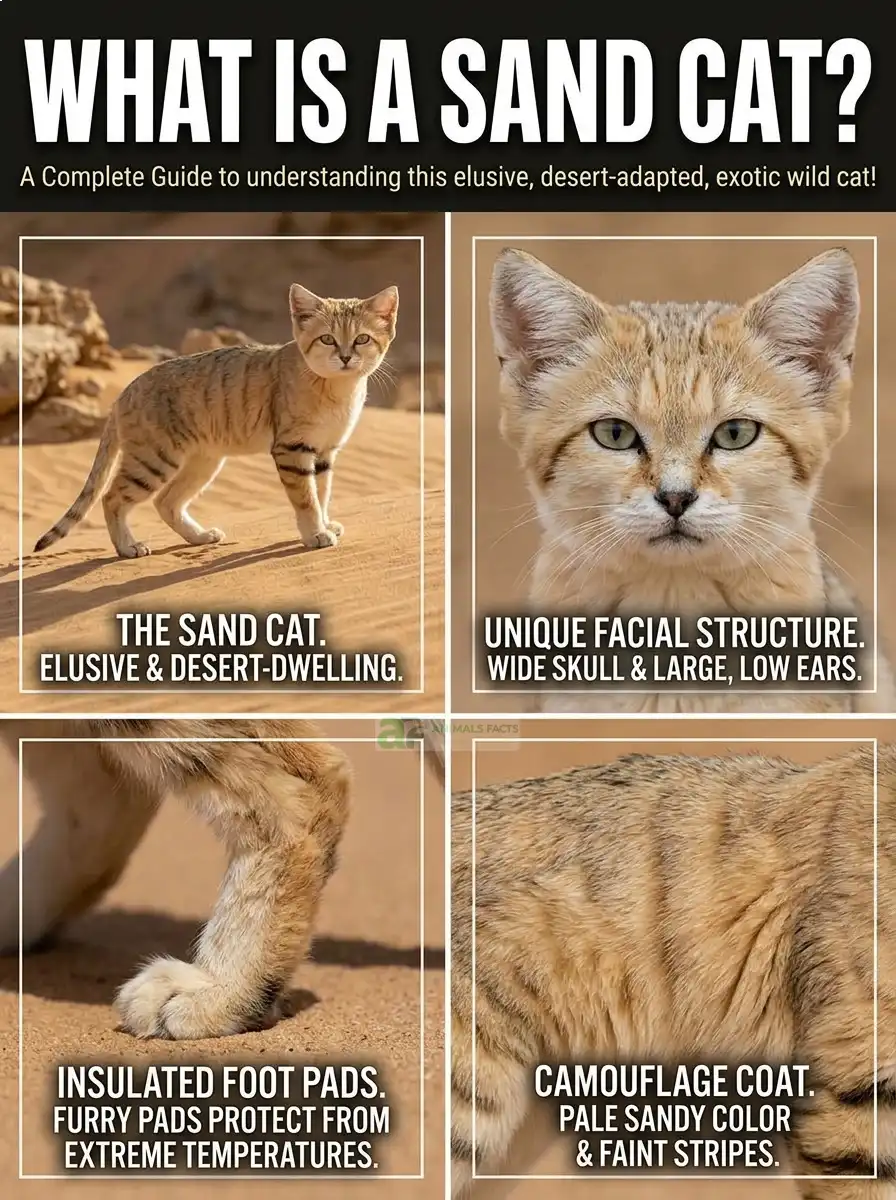
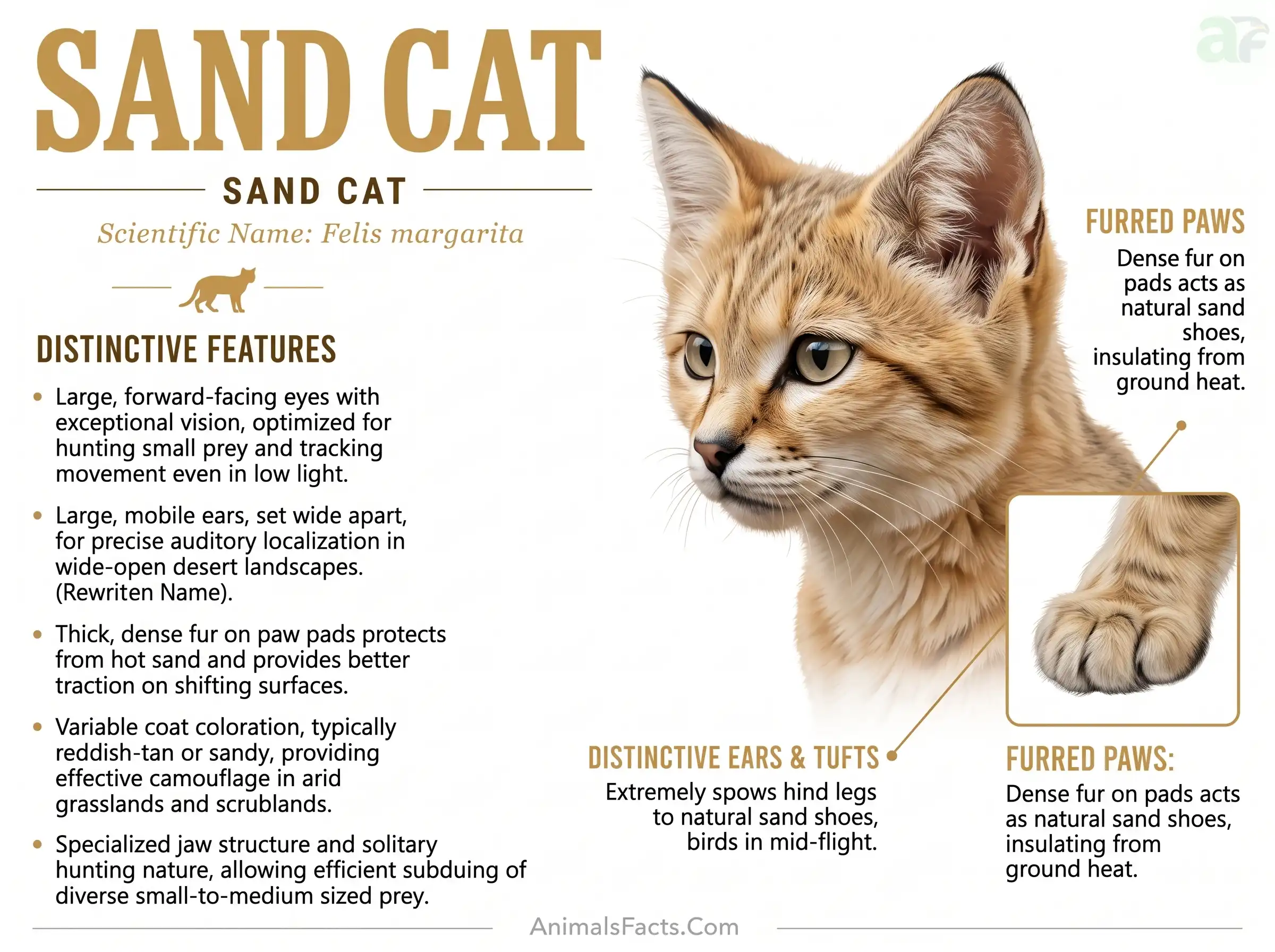
The sand cat’s head is its most visually distinctive feature — exceptionally wide and flat, with ears that are remarkably large and positioned at the sides of the head rather than on top. This distinctive head morphology serves a critical function: the widened skull provides a larger base for the ear muscles and ear canal structures, creating an auditory system of extraordinary sensitivity.
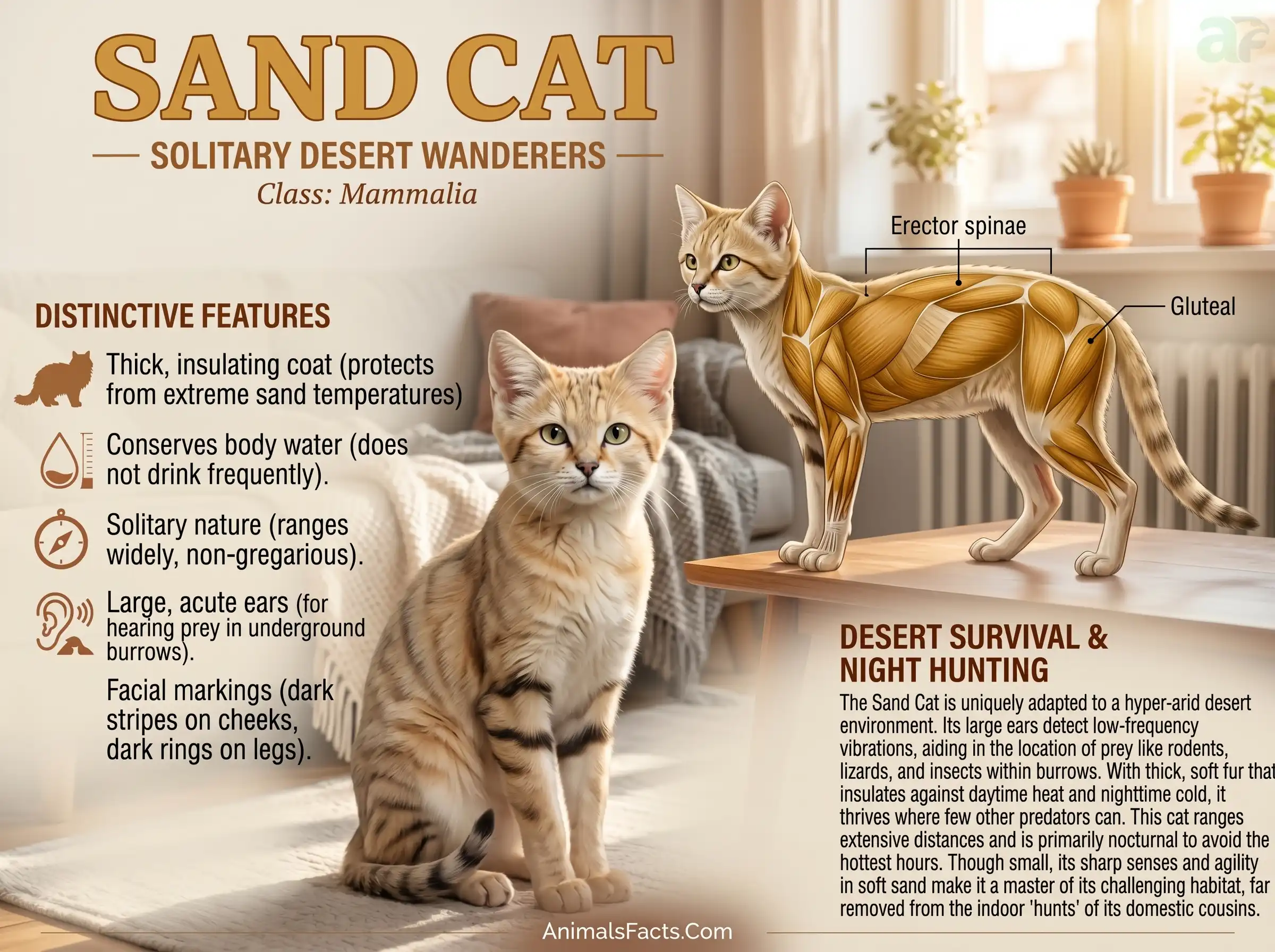
The ear canals themselves are enlarged compared to other small felids — a structural adaptation that amplifies low-frequency sounds traveling through the ground. Sand cats use this exceptional hearing to detect the movements of prey animals underground — locating burrowing rodents, insects, and reptiles beneath the sand surface before digging to extract them.
The wide, flat head with its large lateral ears gives the sand cat a distinctly rounded, almost owl-like facial appearance that is responsible for much of the species’ extraordinary visual appeal and photogenic quality.
The Paws — Nature’s Desert Boots
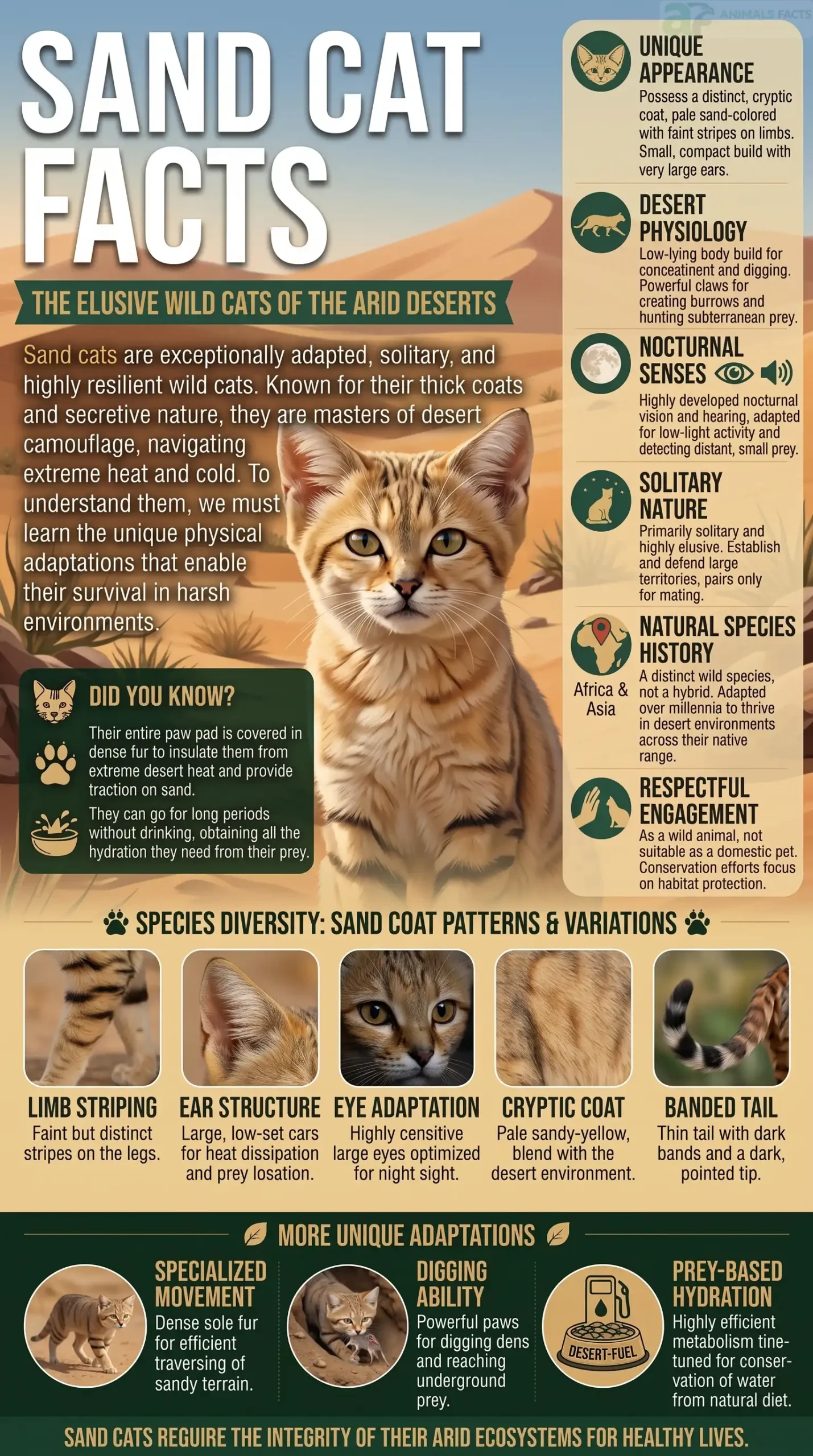
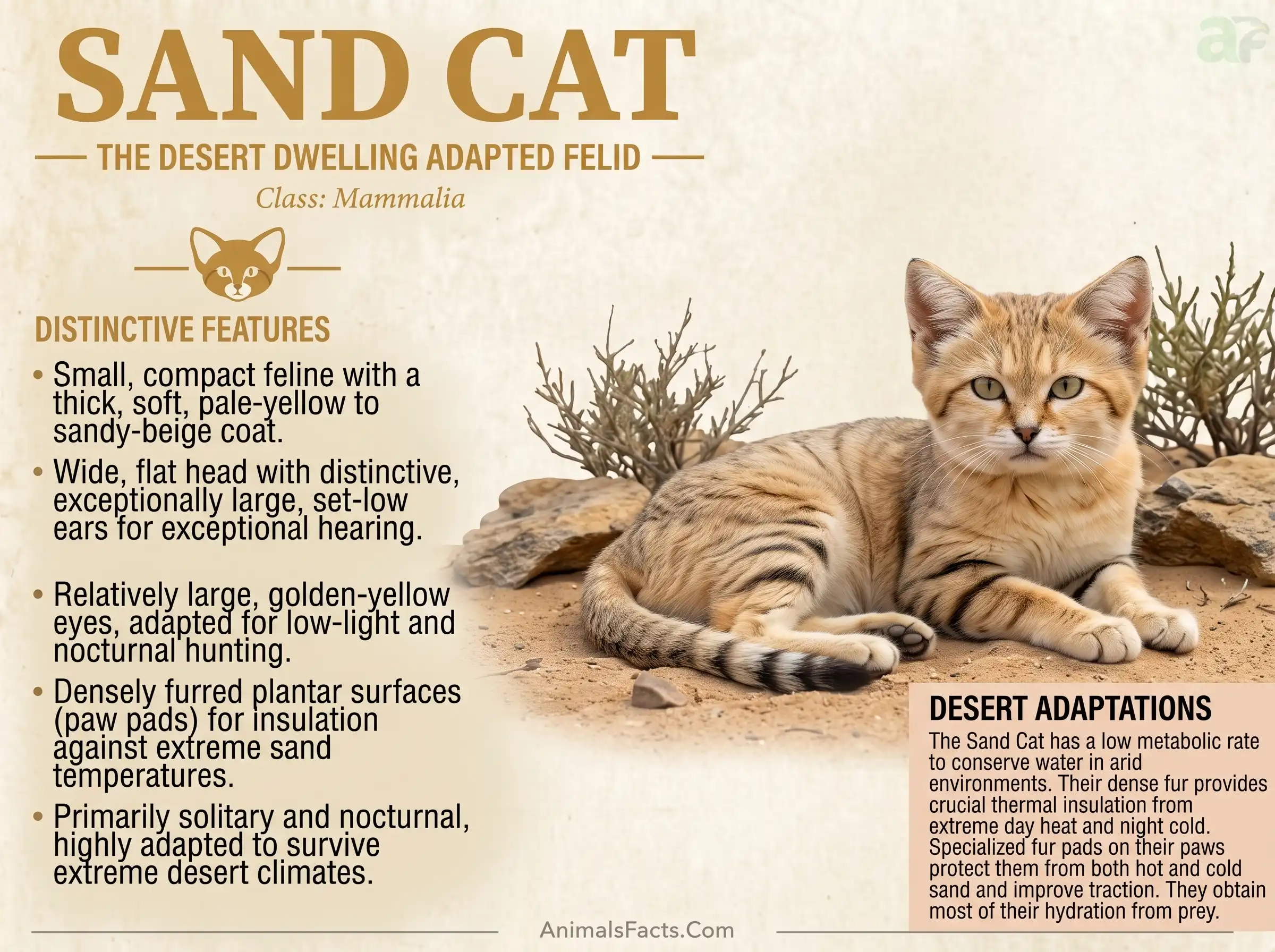
The sand cat’s most functionally extraordinary physical feature is its paws — densely covered with thick tufts of stiff, black-tipped fur on both the upper surface and the sole. This fur coverage of the paw sole is unique among wild cats and serves two critical functions:
Thermal insulation — Desert sand surface temperatures can exceed 70–80°C in summer — temperatures that would cause severe burns on unprotected skin. The dense fur on the paw soles provides thermal insulation that allows the sand cat to walk on sand surfaces that would be immediately injurious to any barefoot animal.
Silent locomotion — The thick fur on the paw soles acts as a natural sound dampener — muffling the sounds of the cat’s footfalls on loose sand or gravel. This silent movement is critical for approaching prey without detection and for moving through desert terrain without alerting both prey and potential predators.
Sand shoe effect — The furred paws distribute the cat’s weight over a larger surface area — preventing the cat from sinking deeply into loose desert sand in the same way that snowshoes distribute human weight over snow.
Coat & Coloration
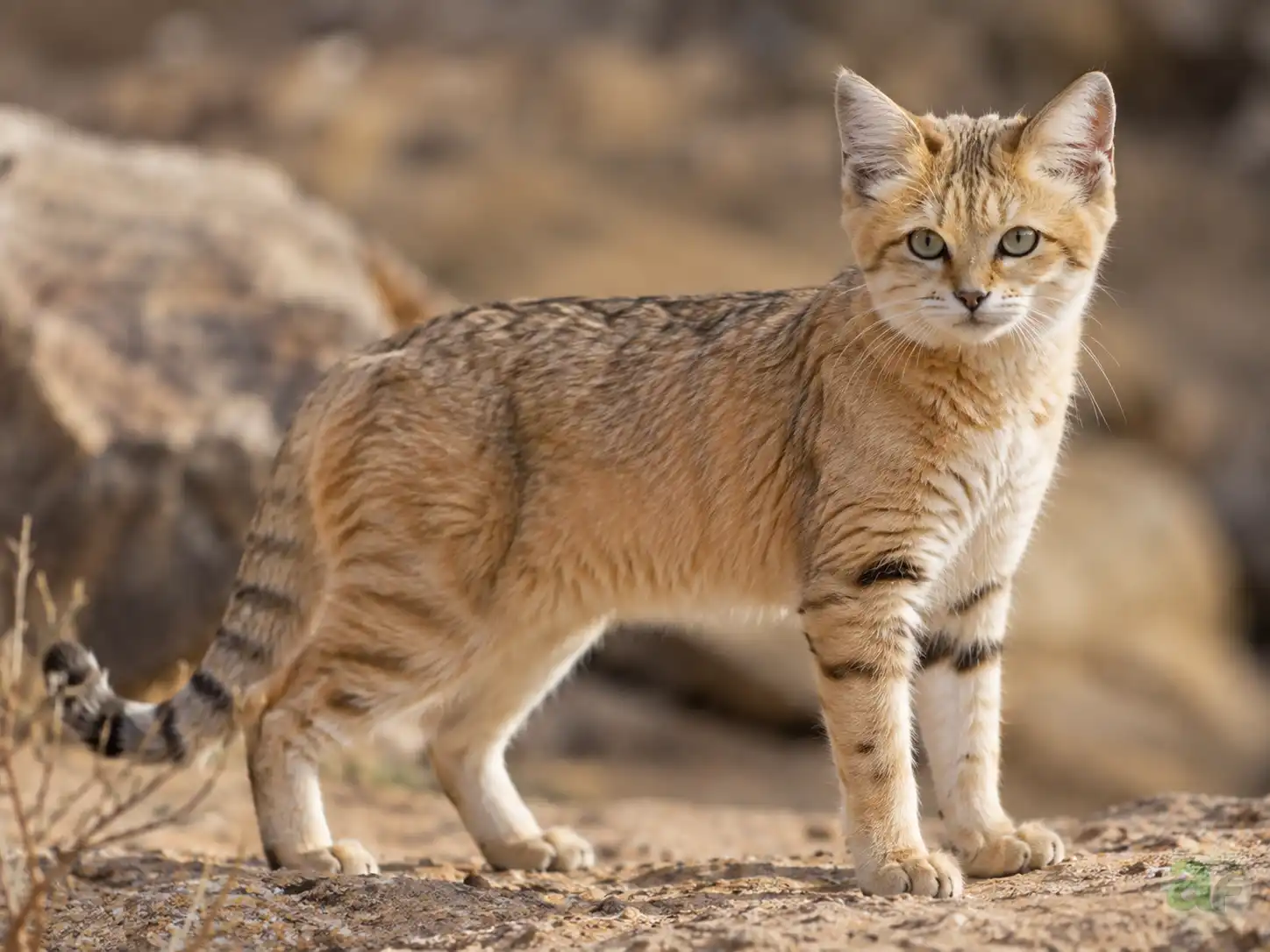
The sand cat’s coat is pale sandy-brown to golden-buff on the upper surfaces — precisely matching the color of the desert sand and rock surfaces of its habitat. The underparts are paler to white. The face typically shows faint reddish streaks running from the outer corner of each eye across the cheeks, and the tail has several dark rings and a dark tip — the only strong patterning on an otherwise cryptically colored animal.
The coat is dense and relatively long compared to most small cats — providing insulation against the extreme temperature fluctuations of the desert environment, where surface temperatures may range from -5°C at night to +52°C in the shade during the day in some parts of the range.
Eyes
The sand cat has large, forward-facing eyes — typical of nocturnal predators — that are particularly striking given the wide, flat facial structure. Eye color is typically yellow-green to amber. The large eye size provides maximum light-gathering capability for hunting in the extremely low light of desert nights, and the tapetum lucidum (reflective layer behind the retina) produces the characteristic eye-shine when illuminated by a flashlight — one of the most reliable methods for detecting sand cats in field surveys.
Did You Know? The sand cat’s paw fur creates a tracking paradox that has frustrated researchers for decades — the dense fur on the paw soles leaves almost no tracks in sand, making the species effectively invisible to traditional tracking methods. While large predators like lions and leopards leave unmistakable footprints that allow researchers to estimate population sizes from track surveys, sand cat populations cannot be assessed this way. The combination of nocturnal habits, cryptic coloration, nearly trackless movement, and extreme habitat remoteness makes the sand cat one of the most genuinely difficult wild animals to study on Earth.
4. Top 25 Amazing Sand Cat Facts
Here is your definitive collection of the most extraordinary, scientifically verified, and genuinely astonishing sand cat facts as of 2026:
- The sand cat is the only wild cat species that lives primarily in true desert — it does not merely tolerate desert conditions but is physiologically and behaviorally optimized for the most extreme arid environments on Earth.
- Sand cats can survive without ever drinking water — obtaining all necessary moisture from the bodies of their prey. This extreme water independence allows them to inhabit desert areas with no surface water whatsoever.
- The paw soles of sand cats are densely furred — a feature unique among wild cats that insulates against sand surface temperatures exceeding 70°C and enables nearly silent movement across loose desert terrain.
- Sand cats can detect prey moving underground using their oversized ears and enlarged ear canals — allowing them to locate and dig out burrowing rodents, insects, and reptiles that are completely invisible on the sand surface.
- Sand cats routinely travel 5–10 km per night while hunting — distances that were dramatically larger than researchers expected when the first GPS tracking studies were conducted, revealing that these small cats range across enormous desert territories.
- The sand cat was unknown to Western science until 1858 — making it one of the last wild cat species to be formally described, despite occurring across vast areas of North Africa and the Middle East that had been explored by Europeans for centuries.
- Sand cats have been documented burying their prey in sand for later consumption — a food-caching behavior that allows them to exploit large prey items over multiple feeding sessions and to maintain food reserves in environments where prey availability is unpredictable.
- The sand cat’s eye-shine is exceptionally bright — reflecting green-gold in artificial light — and this intense eye-shine is the primary method used by researchers conducting night surveys to detect these otherwise nearly invisible animals.
- Sand cats can lower their body temperature during the hottest part of the desert day — entering a state of heat torpor in underground burrows that allows them to dramatically reduce metabolic heat production and water loss during peak temperature hours.
- The sand cat’s barometric pressure sensitivity is thought to exceed that of most other small felids — allowing it to detect approaching desert storms and adjust its behavior accordingly, retreating to shelter before severe weather events arrive.
- A 2019 camera trap study in the Moroccan Sahara documented sand cat kittens in the wild for the first time — providing footage of natural kitten behavior that had previously been known only from captive studies, representing one of the most significant recent advances in sand cat field biology.
- Sand cats produce a high-pitched barking call during the breeding season — described as resembling a small dog’s bark — that carries long distances across open desert terrain and is used to locate potential mates in the vast, sparsely populated desert landscape.
- The sand cat’s gestation period of approximately 59–67 days is slightly shorter than that of the domestic cat — producing litters of 2–4 kittens that must develop rapidly to survive the extreme desert environment.
- Sand cats have been documented sprinting across open sand at speeds up to 40 km/h — using a distinctive loping gait that minimizes contact time between the furred paws and the hot sand surface.
- The sand cat’s skull is proportionally wider than that of any other small wild cat — a structural adaptation that creates the wide, flat head profile housing the enlarged ear canals essential for subsurface prey detection.
- Sand cats are among the few wild felids that live at both extremely high temperatures (summer desert) and sub-zero temperatures (winter desert nights) — with the same individual potentially experiencing temperature ranges of 60°C or more across a single year.
- The species has been recorded at elevations up to 2,000 meters in the more mountainous parts of its range — including rocky desert mountain systems in the Sahara and Arabian Peninsula — demonstrating habitat flexibility beyond the sandy desert plains most commonly associated with the species.
- Sand cats show minimal fear response to humans — researchers in areas where the species has had little human contact report that sand cats often stare directly at approaching humans rather than fleeing, apparently because the species has evolved in landscapes with essentially no human presence.
- The sand cat’s fur insulation is so effective that it can maintain core body temperature within a few degrees of normal even when ambient temperatures exceed 50°C — a thermoregulatory capability that involves both behavioral (burrowing) and physiological (reduced metabolic rate) components.
- Camera trap studies have documented sand cats traveling together — pairs of individuals moving and hunting in close proximity — behavior that challenges the assumption of complete solitude in this species and suggests a more complex social system than previously assumed.
- Sand cats have been documented consuming venomous snakes — including small vipers — apparently without ill effects. The mechanism by which sand cats neutralize or avoid viper venom is not fully understood and represents an active area of research.
- The sand cat’s urine is highly concentrated — with water conservation so efficient that its kidneys produce urine with a dramatically higher solute concentration than domestic cats or other small felids — a physiological adaptation critical for survival without access to free water.
- Sand cats are the only small wild cat known to regularly inhabit both the Sahara-Arabian desert system of Africa and the Middle East AND the completely separate central Asian desert systems of Turkmenistan, Uzbekistan, and Kazakhstan — spanning two distinct desert biogeographic regions.
- Research from Abu Dhabi has documented sand cats using the same burrows — typically dug by other animals such as foxes and porcupines, or sometimes self-dug — for extended periods as daytime resting and birthing sites, with some burrows used repeatedly over multiple years.
- The sand cat’s population size is completely unknown — no reliable global population estimate exists as of 2026, reflecting the combination of remote habitat, cryptic behavior, and inadequate survey coverage that makes the species one of the least-known wild cats in terms of basic demographic parameters.
5. Fun Facts About Sand Cats
- Sand cats are the only wild cat living in true desert — the most extreme dry environments on Earth
- They never need to drink water — getting all moisture from prey bodies
- Their fur-covered paw soles protect against 70°C sand temperatures
- Sand cats can detect prey moving underground with their enormous ears
- They travel 5–10 km every night while hunting
- Sand cats were unknown to science until 1858
- They bark like small dogs when looking for mates
- Sand cats were first filmed with kittens in the wild only in 2019
- Their eye-shine is the brightest of any small wild cat — the main way researchers find them
- They bury surplus prey in sand for later eating
- Sand cats eat venomous vipers apparently without harm
- Their global population is completely unknown — one of the most mysterious cats on Earth
6. Natural Habitat & Geographic Range
Sand cat habitat is among the most extreme of any felid species — defined not merely by aridity but by the combination of extreme heat, near-zero rainfall, minimal vegetation, and the absence of surface water that characterizes true desert environments.
Habitat Requirements
The sand cat is specifically adapted to several distinct desert terrain types:
Sandy desert (erg) — Open sand seas with minimal vegetation; the habitat most strongly associated with the species in popular imagination and genuinely a core habitat in the Saharan range
Stony desert (reg and hamada) — Flat gravel plains and rocky desert surfaces; frequently used across all parts of the range and in some areas more heavily used than sandy terrain
Sandy and stony depressions with sparse vegetation — Desert areas with periodic low shrubs (Stipagrostis, Calligonum, Salsola) that support small rodent populations essential for sand cat prey
Desert wadis — Dry watercourses that occasionally carry flash flood water and support slightly denser vegetation; important hunting corridors
Rocky desert mountains — Elevated rocky terrain within the desert zone; used more extensively than early literature suggested
Geographic Range by Region
| Region | Country | Population Status | Key Habitats |
|---|---|---|---|
| North Africa | Morocco (Sahara) | Present; well-documented | Sandy and rocky desert |
| North Africa | Algeria | Present; nominate subspecies | Saharan sandy desert |
| North Africa | Tunisia, Libya | Present; poorly documented | Saharan terrain |
| North Africa | Egypt (Sinai, Western Desert) | Present | Rocky and sandy desert |
| North Africa | Niger, Mali | Present; very poorly documented | Saharan sandy terrain |
| Middle East | Israel (Arava, Negev) | Small resident population; well-studied | Rocky desert, wadi systems |
| Middle East | Saudi Arabia | Present; poorly documented | Arabian desert systems |
| Middle East | UAE, Oman | Present; some camera trap data | Arabian sandy desert |
| Middle East | Jordan, Syria, Iraq | Historical presence; current status unclear | Desert terrain |
| Central Asia | Turkmenistan | F. m. thinobia present | Karakum desert |
| Central Asia | Uzbekistan, Kazakhstan | Present; very poorly documented | Central Asian desert systems |
| South Asia | Pakistan (Nushki) | F. m. scheffeli; very poorly documented | Baluchistan desert |
Elevation Range
While most commonly associated with low-elevation desert plains, sand cats have been recorded at elevations from sea level to approximately 2,000 meters in the more mountainous desert systems of the Sahara and Arabian Peninsula.
Did You Know? The sand cat’s range spans two completely separate desert biogeographic regions — the Saharo-Arabian desert system stretching from Morocco across North Africa and the Middle East, and the Central Asian desert system of Turkmenistan, Uzbekistan, and Kazakhstan. These two regional populations have been separated by non-desert habitat for millions of years — long enough to develop into recognizable subspecies — making the sand cat one of the few terrestrial mammals with genuinely disjunct populations across separate continental desert systems. The evolutionary and genetic relationship between these populations is an active area of research.
7. Diet & Feeding Behavior
Sand cat diet reflects the extreme scarcity of prey in desert environments — the species is a highly opportunistic, versatile predator that exploits whatever animal resources are available in its resource-poor habitat.
Diet Breakdown Table
| Prey Type | Estimated % of Diet | Notes |
|---|---|---|
| Small rodents (gerbils, jerboas, mice) | ~40–60% | Primary prey; gerbils most important across most of range |
| Reptiles (lizards, small snakes) | ~15–25% | Including venomous vipers; important in all habitat types |
| Birds (ground birds, nestlings) | ~10–15% | Larks, sandgrouse, and other desert-adapted birds |
| Hares and rabbits | ~5–10% | Cape hare and other desert lagomorphs where available |
| Invertebrates (insects, scorpions) | ~3–5% | Particularly important for juveniles |
| Venomous snakes | ~2–5% | Including small vipers; behavior for neutralizing venom unclear |
Hunting Strategy
Sand cat hunting strategy is among the most sophisticated of any small felid — calibrated precisely for prey detection and capture in environments where both prey density and light levels are low:
Subsurface detection — The sand cat’s primary and most distinctive hunting technique involves using its oversized ears to detect underground movement — the low-frequency vibrations produced by burrowing rodents moving through sand beneath the surface. Once a subsurface prey animal is detected, the sand cat digs rapidly and precisely to intercept it — a technique that is extraordinarily efficient in sand where digging is easy and the prey’s direction of travel can be tracked by the sound it produces.
Ambush at burrow entrances — Sand cats frequently station themselves near rodent burrow entrances — waiting motionlessly for prey to emerge in a patient ambush that can last several hours.
Active pursuit — For surface-active prey (lizards, birds), sand cats use short, explosive rushes — closing distances of 10–20 meters in the open desert terrain in a matter of seconds.
Viper predation — The documented consumption of small vipers (Cerastes and Echis species) by sand cats is one of the most remarkable aspects of their feeding ecology. Field observations and analysis of stomach contents confirm this behavior — though the mechanism by which sand cats avoid or neutralize viper venom has not been fully explained. Some researchers suggest that the sand cat’s rapid, precise strike — aimed at the viper’s head — may consistently prevent successful envenomation.
Prey Caching
Sand cats have been documented burying surplus prey in sand — covering uneaten prey items with sand and returning to them over subsequent days. This caching behavior is particularly important in the desert context where prey availability is highly variable and storing food against lean periods represents a significant survival advantage.
Water Balance
The sand cat’s most extraordinary dietary adaptation is its ability to extract sufficient water from prey alone to meet all physiological needs without access to free water. The bodies of prey animals (primarily rodents) contain approximately 65–70% water by mass — and the sand cat’s highly efficient kidney function extracts maximum water from this dietary moisture while producing highly concentrated urine that minimizes water loss. This water independence is the fundamental physiological adaptation that enables the sand cat to inhabit true desert environments with no surface water.
8. Reproduction & Life Cycle
Sand cat reproduction is adapted to the extreme seasonality of desert environments — with breeding timed to maximize kitten survival in one of the world’s most challenging landscapes for raising young.
Breeding Season
Sand cats show seasonal breeding across most of their range — with the specific timing varying by latitude and local climate:
- Saharan and Middle Eastern populations — Primary breeding season January–April with a possible second breeding season September–October in areas with bimodal climate patterns
- Central Asian populations — Breeding season April–June — timed to the more compressed warm season of the higher-latitude Central Asian desert systems
- Captive populations — Have demonstrated the capability for year-round breeding when removed from natural photoperiod cues — confirming that seasonality in wild populations is environmentally driven rather than physiologically fixed
The Barking Courtship Call
One of the most distinctive aspects of sand cat reproduction is the barking courtship vocalization — a loud, repetitive call resembling a small dog’s bark that individuals of both sexes produce during the breeding season to locate potential mates across the vast, empty desert landscape. This call carries remarkable distances in the still desert night air — and represents the primary method by which sand cats — whose population densities are extremely low — locate each other for mating in territories that may span dozens of square kilometers.
Gestation & Birth
- Gestation period: 59–67 days — slightly shorter than domestic cats
- Litter size: typically 2–4 kittens (occasionally 1–5)
- Birth weight: approximately 40–65 grams per kitten
- Birth site: natural cavities — typically abandoned burrows of foxes, porcupines, and other desert animals; occasionally self-dug burrows
Kitten Development
Sand cat kittens develop remarkably quickly — an adaptation to the desert environment where the window of favorable conditions for learning and development is limited:
- Newborn (0–14 days) — Born with spotted coat (spots fade by ~5 months); eyes and ears closed; entirely dependent on mother
- Early kitten (14–21 days) — Eyes open; beginning to respond to sounds; still den-bound
- Active kitten (3–6 weeks) — Leaving den with increasing frequency; beginning to play actively
- Juvenile (6–12 weeks) — Accompanying mother on short foraging excursions; learning prey detection techniques
- Sub-adult (3–6 months) — Increasingly independent; spots fading to adult plain coat
- Independence (approximately 6 months) — Dispersing from mother’s range; establishing own territory
- Sexual maturity — approximately 14–18 months in females; 18–24 months in males
Lifespan Comparison Table
| Species | Average Lifespan (Wild) | Average Lifespan (Captivity) | Notes |
|---|---|---|---|
| Sand cat (F. margarita) | 8–13 years | Up to 17 years | Harsh environment limits wild lifespan |
| Wildcat (F. silvestris) | 10–14 years | Up to 20 years | Closest wild relative |
| Domestic cat (F. catus) | 13–17 years (indoor) | Up to 30 years | Same genus; longer-lived with care |
| Caracal (Caracal caracal) | 10–16 years | Up to 19 years | Sympatric in parts of range |
| Serval (Leptailurus serval) | 10–12 years | Up to 23 years | Comparably sized |
9. Social Behavior & Communication
Sand cat social behavior is among the least documented of any wild cat species — the combination of remote habitat, nocturnal habits, and extremely low population densities has made long-term behavioral studies extraordinarily difficult. What is known reveals a species whose social system is more nuanced than the simple solitary model initially assumed.
Solitary but Overlapping
Sand cats are predominantly solitary — maintaining individual home ranges and hunting alone for most of the year. However, GPS tracking studies have documented patterns that suggest greater social complexity than strict solitude:
- Male and female ranges overlap substantially — more so than in many solitary felids
- Range sharing — Multiple individuals have been tracked sharing significant portions of the same home range without apparent conflict
- Paired movement — Camera traps have documented two sand cats traveling and resting in close proximity outside of the breeding season — raising questions about whether some degree of pair bonding may occur
Home Range Size
The GPS tracking data from Abu Dhabi (2017) and Israel’s Arava desert (2005) produced home range estimates that dramatically exceeded prior expectations:
- Male home range: approximately 16–177 km²
- Female home range: approximately 10–60 km²
These extremely large home ranges — for a cat weighing less than 3 kg — reflect the low prey density of desert environments requiring cats to range widely to meet their energy needs.
Communication
Scent marking — Like most felids, sand cats use urine spraying and cheek rubbing to mark territorial boundaries and communicate reproductive status. These scent marks are deposited on rocks, shrubs, and other prominent landscape features along the cat’s regular travel routes.
Vocalizations — Beyond the breeding-season barking call, sand cats produce:
- Purrs — during relaxed social and mother-kitten interactions
- Hisses and growls — defensive vocalizations
- Mews and chirps — contact calls between mothers and kittens
- High-pitched screams — during extreme agitation or defensive encounters
Visual signals — Flattening of the ears, tail position, and body posture serve as visual communication signals during rare close-range encounters between individuals.
Intelligence
Sand cats demonstrate spatial memory of remarkable precision — navigating vast, featureless desert landscapes with consistent accuracy, relocating specific burrow sites, prey-rich areas, and territorial boundaries across home ranges of dozens of square kilometers. Captive sand cats have demonstrated learning and problem-solving capabilities broadly comparable to domestic cats — though the extreme specialization of their sensory systems for subsurface prey detection suggests cognitive capabilities in that domain that may exceed those of domestic cats.
10. Predators & Defense Mechanisms
Despite being a capable predator in its own right, the sand cat faces genuine predation pressure from a range of desert carnivores and raptors — and has evolved defensive strategies precisely calibrated for the open, relatively exposed desert environment.
Natural Predators
- Eagle owls (Bubo species) — The pharaoh eagle owl and desert eagle owl are the most significant aerial predators of sand cats across the Saharan and Arabian range
- Raptors — Lanner falcons (Falco biarmicus) and other desert raptors pose threats, particularly to juveniles
- Honey badgers (Mellivora capensis) — Documented killing sand cats in some areas of the range
- Caracals (Caracal caracal) — Significantly larger felids that may prey on sand cats where ranges overlap
- Desert foxes — Rüppell’s foxes (Vulpes rueppellii) and fennec foxes (Vulpes zerda) compete for food and may occasionally take sand cat kittens
- Cobras and large vipers — Venomous snakes represent a risk to both kittens in dens and occasionally adults
- Domestic dogs — An increasing threat in areas of expanding human settlement
Defense Strategies
The freeze-and-flatten response — The sand cat’s most remarkable defensive behavior is its freeze-and-flatten response — when threatened, it immediately drops to the ground, flattens its body completely against the sand surface, and presses its ears flat against its skull. This response — combined with the sand-colored coat — renders the cat essentially invisible in its natural environment. Researchers approaching sand cats in the open desert have documented the animal vanishing entirely in front of them simply by executing this response on the open sand.
Burrowing — The sand cat’s ability to use burrows for refuge — both self-dug and adopted from other animals — provides critical protection from both aerial predators and ground-level threats.
Nocturnal timing — By being active primarily at night, sand cats avoid peak activity periods for many diurnal raptors.
Speed — When the freeze response fails and direct predator encounter occurs, sand cats can achieve 40 km/h in short bursts — sufficient to reach burrow refuge in most open desert encounters.
Cryptic eye-shine management — Interestingly, when approached by light-carrying humans at night, sand cats that initially appear from their eye-shine will sometimes deliberately look away — breaking the eye-shine reflection — as a response to being detected, potentially reducing their visibility to the approaching threat.
Did You Know? The sand cat’s eye-shine color is distinctively different from that of other small wild cats found in the same regions. While domestic cats and wildcats typically produce orange to yellow eye-shine, sand cats produce a particularly intense green-gold shine that has been described by researchers as the most vivid and far-visible eye-shine of any small felid. Night surveys in sand cat range areas using powerful flashlights or spotlights can detect sand cat eye-shine at distances of up to 60 meters — making nocturnal spotlight surveys the most practical method for detecting this otherwise invisible species in its desert habitat.
11. Sand Cat Facts for Kids
Hey amazing young wildlife explorers! Here are some genuinely astonishing sand cat facts for kids that will make everyone around you say “I did not know that!”
- 🐱 Sand cats never need to drink water! They get all the water they need from the bodies of the animals they eat. They are like living water recyclers — nothing goes to waste, including the moisture in their food!
- 🐱 Their paws have built-in boots! The undersides of sand cat paws are covered with thick fur — like wearing warm, cushioned boots. This fur protects their feet from desert sand that can get as hot as 70°C — that is hotter than boiling water!
- 🐱 They can hear animals moving UNDERGROUND! Sand cats have enormous ears that can pick up the tiny vibrations of rodents and lizards moving beneath the sand surface. They can locate dinner without even seeing it!
- 🐱 They were a complete mystery to scientists until 1858! Even though sand cats live in places that humans have explored for thousands of years, nobody formally described them to science until 1858 — making them one of the last wild cats ever officially discovered!
- 🐱 Sand cats make a sound like a tiny barking dog! When looking for a mate in the vast desert, sand cats produce a loud barking call that sounds like a small dog. Imagine hearing mysterious barking in the middle of the Sahara Desert at night!
- 🐱 They can completely DISAPPEAR in front of you! When a sand cat senses danger, it flattens itself completely against the sand, spreads its fur, and presses its ears flat. Its sandy coloring makes it vanish so completely that researchers have lost sight of sand cats standing just a few meters away in open desert!
- 🐱 Sand cat kittens are born with SPOTS! Even though adult sand cats are plain sandy-colored with no spots, babies are born spotted — like miniature leopards. The spots fade away as they grow up!
- 🐱 They eat venomous snakes! Sand cats have been found with venomous vipers in their stomachs — apparently eating them without being harmed. Scientists are still trying to figure out exactly how they do this without getting hurt!
12. Relationship with Humans
The relationship between sand cats and humans is one of the most minimal and most recently developed of any wild cat species — for most of human history, the species inhabited terrain so inhospitable that sustained human presence was limited, and the two species rarely encountered each other. This is changing rapidly as human pressures increasingly penetrate even the most remote desert environments.
Historical Minimal Contact
For most of the past several thousand years, the primary human communities sharing territory with sand cats were Bedouin nomadic pastoralists of North Africa and the Arabian Peninsula — peoples whose deep knowledge of desert ecology included awareness of the sand cat’s existence. Bedouin oral traditions include references to small desert cats that match the sand cat’s description and behavior, demonstrating that traditional desert peoples were aware of the species long before Western naturalists formally described it.
The Bedouin relationship with sand cats was generally one of neutral coexistence — the cats posed no threat to livestock (being too small to take any domestic animal of significance), provided no major benefit (desert rodents are rarely in conflict with traditional pastoralism), and occupied terrain remote enough from permanent settlements that direct encounters were infrequent.
The Zoo and Captive Breeding Relationship
The sand cat’s extraordinary appearance — the wide face, large eyes, and compact body create an aesthetic that many people find irresistibly appealing — has made it a sought-after species for zoological collections worldwide. This demand has been both a threat (driving collection from wild populations in some historical periods) and a conservation opportunity (captive breeding programs have maintained insurance populations and funded field research).
Captive breeding of sand cats began in European zoos in the 1960s and has expanded to include facilities in North America, the Middle East, and Asia. As of 2026, several hundred sand cats are maintained in captive institutions worldwide — though early captive breeding had mixed success due to inadequate understanding of the species’ specific dietary, environmental, and social needs.
The Pet Trade Threat
The sand cat’s appealing appearance has made it a target of the illegal exotic pet trade — particularly in some Middle Eastern countries where wealthy individuals seek exotic desert animals as status symbols. Kittens are sometimes taken from wild populations for sale as pets — a practice that is both legally prohibited under international wildlife trade regulations and ecologically harmful to the already poorly monitored wild populations.
Sand cats make extremely poor pets — their wild behavioral needs, specific dietary requirements, high-intensity hunting drive, and nocturnal activity patterns make them deeply incompatible with domestic environments, and animals that have been maintained as pets are rarely successfully rehabilitated for release back to wild populations.
Research Relationship
The scientific study of sand cats has progressed from essentially zero systematic field research before 2000 to a growing body of GPS tracking, camera trap, and behavioral studies that are now providing fundamental insights into the species’ ecology. The Saharan Sand Cat Project — led by Grégory Breton and Panthera — and the Abu Dhabi sand cat research program represent the most productive current field research initiatives, with findings from both programs dramatically expanding knowledge of sand cat movement ecology, habitat use, and reproductive behavior.
13. Conservation Status & Threats
The sand cat’s Least Concern IUCN classification conceals a conservation situation that is genuinely uncertain and potentially more concerning than the designation suggests — with declining populations in many areas, inadequate monitoring across most of the range, and multiple significant threats operating simultaneously.
Conservation Status Overview
| Feature | Details |
|---|---|
| IUCN Status | Least Concern (LC) — last assessed 2016 |
| Population Trend | Decreasing |
| Global Population Estimate | Unknown — no reliable estimate exists |
| CITES Listing | Appendix II |
| Protected Status | Protected by law in most range countries |
Major Threats
| Threat | Description | Impact Level |
|---|---|---|
| Habitat degradation | Livestock overgrazing destroying desert vegetation and prey populations | High — widespread |
| Human settlement expansion | Roads, infrastructure, and settlement penetrating formerly remote desert | High |
| Illegal pet trade | Collection of kittens for exotic pet market | Medium-High |
| Hunting and persecution | Some direct killing; road kills increasing | Medium |
| Prey depletion | Overhunting of desert rodents and hares by humans | Medium-High |
| Domestic dog predation | Increasingly common as settlements expand into desert | Medium |
| Hybridization with domestic cats | Where domestic cats penetrate desert edge habitats | Low-Medium; genetic concern |
| Climate change | Expanding desertification changes ecosystem structure | Increasing concern |
The Monitoring Gap
The most fundamental conservation challenge for the sand cat is the near-complete absence of reliable population data. As of 2026:
- No global population estimate exists with any statistical confidence
- Population trends cannot be quantified — the “decreasing” classification is based on inference from habitat loss rates rather than actual population measurements
- Distribution data for large portions of the range (Libya, Mali, Niger, Pakistan, Central Asia) is based on historical records or isolated reports rather than systematic surveys
- The combination of remote habitat, cryptic behavior, and minimal research investment has produced a data situation that makes evidence-based conservation planning essentially impossible
Addressing this monitoring deficit — through expanded camera trap networks, GPS tracking programs, and standardized survey protocols — is the most urgent conservation need for the species.
14. Famous Sand Cats in History & Pop Culture
Famous Named Sand Cat Individuals
“Rolex” — A male sand cat tracked by GPS in the Abu Dhabi research program beginning in 2015 who became one of the most data-rich individually documented sand cats in history. Rolex’s tracking data — covering multiple years of continuous movement monitoring — provided fundamental insights into sand cat home range size, daily movement patterns, burrow use, and seasonal behavioral variation that transformed the scientific understanding of the species’ ecology.
“Kalahari” — A female sand cat at the Cincinnati Zoo who became the most photographed captive sand cat in American zoo history during the 2010s — her extraordinarily photogenic appearance generating social media engagement that introduced millions of people to the species and contributed to public awareness of sand cat conservation.
The “Saharan Sand Cat Project” Stars — The camera trap images and video footage produced by Grégory Breton and Panthera’s Saharan Sand Cat Project between 2013 and 2019 — including the first-ever photographs of sand cat kittens in the wild — generated global media coverage across National Geographic, BBC, and hundreds of other outlets, making the Moroccan Sahara sand cat population among the most publicly recognized wild cat populations in the world.
“Sable” — A sand cat at the Al Ain Zoo in the UAE who participated in one of the most successful captive breeding programs for the species, producing multiple litters that contributed to understanding sand cat reproductive biology and improving captive management protocols across the Middle Eastern zoo community.
Scientific Significance
The sand cat’s discovery and formal description in 1858 is significant in the history of zoology for demonstrating how a large, widespread mammal species could remain unknown to formal Western science for so long — inhabiting a region with extensive European contact while its extreme desert habitat effectively concealed it from naturalists who did not venture into the deep desert.
15. Role in Ecosystem & Food Chain
The sand cat plays critical ecological roles in the desert ecosystems it inhabits — functioning simultaneously as a mesopredator regulating desert rodent populations, as prey for larger desert carnivores, and as a component of the desert food web that connects plant, invertebrate, rodent, and predator communities.
Rodent Population Regulation
The sand cat’s primary ecological function is the regulation of desert rodent populations — particularly gerbils and jerboas that are the most abundant small mammals in most desert systems. In the absence of effective rodent predators, desert rodent populations can explode dramatically following rainfall events that temporarily increase seed and plant food availability — with population crashes following when food resources are depleted.
Sand cat predation provides top-down regulation of rodent populations that moderates the amplitude of these boom-bust cycles — maintaining rodent populations at levels more consistent with long-term desert carrying capacity. This regulation has cascade effects on desert plant communities (through rodent seed predation and granivory) and on the broader food web.
Desert Food Web Position
The sand cat occupies the secondary consumer position in most desert food webs:
Producers — Desert plants, algae, biological soil crusts Primary consumers — Desert rodents, hares, insects, reptiles Secondary consumers (sand cat position) — Sand cat, desert foxes, small raptors Tertiary consumers — Eagle owls, caracals, desert monitor lizards Apex — Caracal, occasionally leopard at desert margins
Indirect Ecosystem Effects
Beyond direct predation effects, sand cats contribute to desert ecosystem functioning through:
Burrow creation and maintenance — Sand cats that dig their own burrows create microhabitat used by a variety of desert invertebrates, reptiles, and small mammals — extending their ecological impact beyond direct predation
Nutrient cycling — Through the burial of prey caches, sand cats locally concentrate nutrients in specific desert locations — potentially influencing the distribution of desert plants and invertebrates around cache sites
16. Myths, Folklore & Cultural Significance
The sand cat’s cultural significance reflects its long coexistence with desert-dwelling human communities — particularly the nomadic Bedouin peoples of North Africa and the Arabian Peninsula who have accumulated deep traditional ecological knowledge of the species.
Bedouin Traditional Knowledge
Among Bedouin communities of the Arabian Peninsula and North Africa, the sand cat is known by various names — including “Al-qatt al-rimal” (sand cat in Arabic) — and features in traditional ecological knowledge as a desert resident associated with deep desert terrain far from permanent water. Bedouin oral traditions describe the sand cat’s remarkable ability to survive without water — a quality that commanded respect from desert peoples for whom water was the most precious and limiting resource.
In some Bedouin traditions, the sand cat’s appearance near a camp was interpreted as an indicator of the presence of desert rodents — and therefore as a potential indicator of underground water or food resources in the vicinity. This practical ecological interpretation of sand cat behavior reflects the sophisticated environmental reading skills developed by desert peoples over centuries of close environmental observation.
Symbol of Desert Resilience
In the broader cultural landscape of desert nations — particularly in Morocco, Algeria, Saudi Arabia, UAE, and Israel — the sand cat has become an increasingly prominent symbol of desert biodiversity and the remarkable life that persists in extreme environments. Conservation organizations in these countries have adopted the sand cat as a flagship species for desert conservation campaigns — using its extraordinary adaptations as a communication tool for broader messages about desert ecosystem conservation.
Religious and Cultural Context
In Islamic cultural traditions prevalent across the sand cat’s range, the natural world is regarded as God’s creation deserving of care and respect — a cultural foundation that conservation organizations in Muslim-majority countries have effectively leveraged in creating local support for sand cat protection. The sand cat’s extraordinary survival adaptations are frequently cited in this context as evidence of the perfection of divine creation — a framing that aligns conservation values with deeply held cultural and religious beliefs.
The “Cute” Cultural Phenomenon
In the modern global cultural context, the sand cat occupies a distinctive position as one of the most aesthetically appealing wild animals in popular awareness — its wide face, enormous eyes, and compact body generate an almost universal positive aesthetic response that cuts across cultural boundaries. This “cute factor” has been extensively leveraged in conservation communications — with sand cat images consistently outperforming other small wild cat species in social media engagement metrics across multiple platforms and languages.
17. Sand Cats in Pop Culture
Social Media Phenomenon — The sand cat is arguably the most viral wild cat on social media — images and videos of sand cats, particularly photographs showing the wide face and enormous eyes at close range, consistently generate extraordinary engagement across Instagram, TikTok, Facebook, and Twitter/X. Individual sand cat photographs have accumulated millions of shares — introducing the species to audiences who had never previously heard of a sand cat and generating substantial conservation awareness as a side effect of the aesthetic appeal.
The “World’s Cutest Wild Cat” Title — The sand cat is frequently described in popular media as the “world’s cutest wild cat” — a designation that, while subjective, reflects the consistent pattern of public aesthetic response to the species’ unusually appealing appearance. This popular designation has been used by Panthera, WWF, and other conservation organizations as a communication hook — leveraging the species’ popularity to deliver conservation messages to audiences that might not otherwise engage with wild cat conservation content.
National Geographic Coverage — Sand cat content — particularly the images and video from the Saharan Sand Cat Project showing kittens in the wild for the first time — has appeared on National Geographic’s digital platforms, generating some of the organization’s most-shared wildlife content of the 2010s decade.
Zoo and Aquarium Promotion — Zoos maintaining sand cats have consistently found them among their most popular social media subjects — with sand cat content regularly exceeding engagement generated by much larger and more conventionally impressive species. The Cincinnati Zoo, San Diego Zoo, and Al Ain Zoo have each used sand cat content to significantly expand their social media reach.
18. Sand Cat Facts vs. Common Myths
| Common Myth | The Real Fact |
|---|---|
| “Sand cats are baby domestic cats” | False — sand cats are a completely separate wild species (Felis margarita); their compact size and rounded faces make them superficially resemble domestic kittens but they are fully wild animals |
| “Sand cats can be kept as pets” | False — sand cats are wild animals with specific needs incompatible with domestic settings; ownership is illegal without permits in most countries and is harmful to both individual animals and wild populations |
| “Sand cats are found only in sandy desert” | Partially false — while associated with sandy desert, sand cats also regularly inhabit stony desert, rocky terrain, and desert wadis; substrate type is less important than aridity |
| “Sand cats drink water like other cats” | False — sand cats are physiologically adapted to obtain all necessary water from prey; they can survive indefinitely without access to free water |
| “Sand cats are harmless and gentle” | Misleading — sand cats are efficient wild predators with sharp claws and teeth; they are not dangerous to humans but they are genuinely wild animals, not tame |
| “Sand cats are endangered” | Technically false — they are IUCN Least Concern; but this status is based on inadequate data, and populations are declining in many areas |
| “Sand cats leave no footprints” | Largely true — the dense fur on their paw soles leaves minimal tracks in sand; this is a genuine characteristic that creates significant challenges for population surveys |
| “Sand cats live in groups like lions” | False — sand cats are predominantly solitary; the apparent social tolerance documented in some studies does not extend to group living in the manner of pride-forming felids |
19. Best Places to See Sand Cats in the Wild
1. Moroccan Sahara (Draa Valley and Erg Chegaga region) — The site of the Panthera Saharan Sand Cat Project’s most productive field research — this region of southwestern Morocco has produced more documented sand cat sightings and camera trap records than any other single location in the species’ range. Guided desert expeditions with wildlife-focused operators from Zagora and M’hamid offer the best available opportunities for nighttime sand cat spotlight surveys in the region.
2. Arava Desert and Negev, Israel — The Israeli sand cat population — while small — is the most intensively studied in the world, with multiple GPS tracking studies conducted in the Arava Valley between the Dead Sea and the Red Sea. The Israel Nature and Parks Authority conducts periodic sand cat surveys and occasionally shares guided opportunities with researchers. The Negev desert’s accessibility from Israeli population centers makes it the most practically accessible sand cat habitat for international visitors.
3. Dubai Desert Conservation Reserve, UAE — The Dubai Desert Conservation Reserve — established in 1999 around the Al Maha resort — has an active sand cat monitoring program and maintains one of the best-documented Arabian Peninsula sand cat populations. Conservation-focused guests at the reserve may have opportunities to participate in night surveys under ranger supervision.
4. Arabian Oryx Sanctuary, Oman — Oman’s central desert harbors sand cat populations in some of the most pristine remaining Arabian desert habitat. The Arabian Oryx Sanctuary — a UNESCO World Heritage Site — protects habitat across an enormous area that supports multiple desert carnivore species including sand cats.
5. Saharan National Parks (Algeria and Tunisia) — Algeria’s Tassili n’Ajjer National Park and Ahaggar National Park in the central Sahara both have documented sand cat populations in some of the most spectacular desert landscape on Earth. Access requires significant logistical planning but rewards visitors with genuinely remote wildlife encounters.
6. Major Zoo Collections — For the majority of people globally, the most accessible sand cat encounter is in a well-managed zoo — facilities including the Cologne Zoo (Germany), Cincinnati Zoo (USA), Parc des Félins (France), Al Ain Zoo (UAE), and several other institutions maintain sand cats with excellent welfare standards and educational programming. These institutions directly fund the field research that is advancing sand cat conservation.
7. Night Safari Singapore — The Night Safari at Singapore Zoo maintains sand cats as part of its nocturnal animal collection — providing excellent close-range observation opportunities under the controlled low-light conditions that simulate the species’ natural activity period.
20. How You Can Help
Sand cat conservation requires action across multiple fronts — from supporting field research to reducing habitat degradation and the illegal pet trade.
Support these organizations:
- Panthera — panthera.org — operates the Saharan Sand Cat Project and supports sand cat research across the range
- Small Wild Cat Conservation Foundation — smallcats.org — dedicated to small wild cat species including sand cats
- IUCN Cat Specialist Group — iucncsg.org — coordinates global wild cat conservation including sand cat monitoring
- Sahara Conservation Fund — saharaconservation.org — protecting the Saharan ecosystem that is the sand cat’s primary habitat
- WWF Middle East — worldwildlife.org — conservation programs in Arabian Peninsula sand cat range countries
What you can do:
- Never purchase sand cats or support the exotic pet trade — demand reduction is essential for protecting wild populations from collection pressure
- Support sustainable pastoralism — overgrazing by domestic livestock is a primary driver of sand cat habitat degradation; sustainable land management programs in desert communities directly benefit sand cats
- Contribute to citizen science — sighting records submitted to iNaturalist from the Sahara, Middle East, and Central Asia have genuine scientific value for filling distribution data gaps
- Support desert-based ecotourism — responsible wildlife tourism in sand cat range countries generates economic incentives for habitat protection
- Advocate for desert conservation — deserts are frequently undervalued in conservation prioritization despite their extraordinary specialized biodiversity; helping raise their profile matters
- Share accurate information — the sand cat’s extraordinary biology — water independence, fur-covered paws, subsurface hearing — is genuinely compelling and shares well; accurate awareness is the foundation of conservation support
21. Top Documentaries & Books
Must-Watch Documentaries
- “Sand Cat: Secrets of Survival” (various wildlife networks) — Multiple documentary treatments of sand cat biology are available through National Geographic, Animal Planet, and BBC wildlife content archives; check streaming platforms for current availability
- “Africa’s Deadly Dozen” (National Geographic) — Features desert ecosystem content relevant to sand cat ecology
- “Wild Arabia” (BBC, 2013) — A three-part series on Arabian Peninsula wildlife that includes desert ecosystem sequences relevant to sand cat habitat
- “Sahara” (BBC Natural World) — Various episodes covering Saharan wildlife ecology provide excellent habitat context
- Panthera’s YouTube channel — The most current documentary-quality footage of wild sand cats from field research programs; freely accessible and continuously updated
Must-Read Books
- “Wild Cats of the World” by Luke Hunter — The definitive popular reference; the sand cat chapter is the best single-source account of the species’ biology and conservation
- “Sand Cat: Desert Survivor” — Various popular natural history accounts of the species available in multiple languages from Middle Eastern and European publishers
- “The Wild Cat Book” by Fiona and Mel Sunquist — Comprehensive species accounts including the sand cat
- “Deserts of the World” by Michael Allaby — Essential ecological context for understanding the extreme environments the sand cat inhabits
- “Felidae of the World” by various academic authors — Scientific treatment of all wild cat species including detailed sand cat systematics and ecology
22. Comparison with Similar Small Wild Cat Species
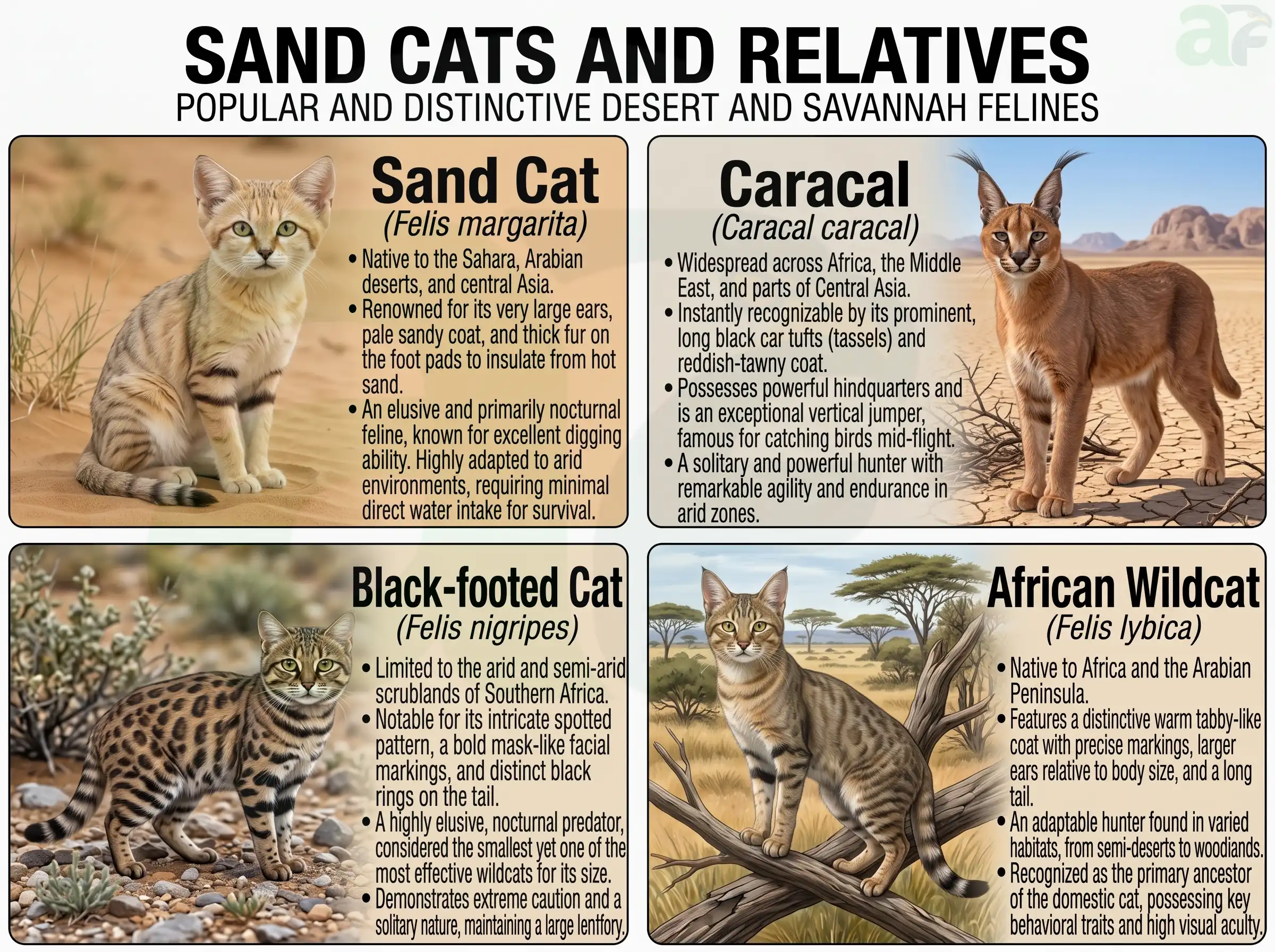
| Feature | Sand Cat | Wildcat | Black-footed Cat | Pallas’s Cat | Caracal |
|---|---|---|---|---|---|
| Scientific name | Felis margarita | Felis silvestris | Felis nigripes | Otocolobus manul | Caracal caracal |
| Weight | 1.4–3.4 kg | 3–8 kg | 1–2.5 kg | 2–5 kg | 8–20 kg |
| Paw soles | Densely furred | Standard | Standard | Lightly furred | Standard |
| Primary habitat | True desert | Forest/scrubland | Southern African grassland | Central Asian steppe | Savanna/scrub |
| Water independence | Yes — drinks rarely | No | Partially | No | No |
| Activity | Nocturnal | Primarily nocturnal | Nocturnal | Crepuscular/nocturnal | Primarily nocturnal |
| Diet | Rodents, reptiles, birds | Rodents, birds, rabbits | Rodents, insects | Small mammals, birds | Small to medium mammals |
| IUCN status | Least Concern | Least Concern | Vulnerable | Near Threatened | Least Concern |
| Ear size | Very large and wide-set | Medium | Large | Large with facial ruff | Large with tufts |
| Vocalizations | Barking call; 13+ types | Variety including caterwauling | Limited | Distinctive yowls | Variety |
23. Frequently Asked Questions About Sand Cat Facts
Q1: What is the scientific name of the sand cat?
The sand cat’s scientific name is Felis margarita (Loche, 1858). It was formally described by French naturalist Víctor Loche in 1858 based on specimens collected during a French military expedition to Algeria. The species name margarita honors General Jean Auguste Margueritte — the French military officer who led the expedition. The genus name Felis places the sand cat in the same genus as the wildcat (Felis silvestris) and the domestic cat (Felis catus) — confirming its close evolutionary relationship to the most familiar of all felids.
Q2:Do sand cats really never drink water?
Yes — sand cats can survive without ever drinking water and are physiologically adapted to do so. They obtain all necessary moisture from the bodies of prey animals (primarily rodents), whose body tissues contain approximately 65–70% water by mass. The sand cat’s highly efficient kidneys extract maximum water from dietary sources and produce extremely concentrated urine — minimizing water loss. This physiological water independence is the fundamental adaptation that enables the species to inhabit true desert environments with no surface water sources. In captivity, sand cats will drink water if it is provided — but wild individuals in areas without surface water demonstrate that drinking is not physiologically necessary.
Q3:How are sand cats adapted to desert life?
Sand cats possess a remarkable suite of desert adaptations that make them the most specialized desert felid on Earth. Key adaptations include: densely furred paw soles providing thermal insulation against scorching sand surfaces and enabling silent movement; enlarged ear canals and wide skull providing exceptional hearing for detecting underground prey; highly efficient kidneys enabling survival without drinking water; dense, insulating coat providing protection against extreme temperature fluctuations (from below zero at night to over 50°C by day); cryptic sandy-buff coloration providing camouflage against desert terrain; low-profile body form enabling rapid flattening and disappearance against the sand surface; and behavioral adaptations including daytime burrowing during peak heat and primarily nocturnal activity to avoid the hottest periods.
Q4:Where do sand cats live?
Sand cats are found across a broad but discontinuous range spanning North Africa, the Middle East, and Central Asia. In North Africa, they occur across the Sahara from Morocco and Algeria through Libya, Egypt, Niger, Mali, and Chad. In the Middle East, they are present in the Sinai, Arabian Peninsula, and historically in Jordan, Syria, and Iraq. In Central Asia, a separate subspecies (F. m. thinobia) inhabits the desert systems of Turkmenistan, Uzbekistan, and Kazakhstan, and a distinct subspecies (F. m. scheffeli) occurs in Pakistan’s Baluchistan province. They inhabit sandy desert, stony desert, and dry gravel plains — virtually any extremely arid terrain where prey populations are sufficient.
Q5:Are sand cats endangered?
The sand cat is currently classified as Least Concern by the IUCN — but this classification is based on limited data and should not be interpreted as meaning the species is secure. The population trend is declining, no reliable global population estimate exists, and significant threats including habitat degradation, prey depletion, and the exotic pet trade are operating across the range. The species is listed on CITES Appendix II — recognizing that international trade requires monitoring and control. In the United States, the sand cat is listed under the Endangered Species Act as a threatened species — reflecting a stricter assessment of conservation risk. The sand cat’s “Least Concern” global status reflects the inadequacy of current monitoring data more than genuine confidence in population stability.
Q6:How big is a sand cat?
Sand cats are small wild cats — typically weighing between 1.4 and 3.4 kg, with body lengths of 39–52 cm plus a 23–31 cm tail. They stand approximately 24–30 cm at the shoulder. Males are slightly larger than females on average. These dimensions make them comparable to a small to medium domestic cat in body size — though their wide, flat skull and disproportionately large ears give them a distinctive appearance that makes them look different from standard cats despite similar body proportions. The largest sand cats occur in the Central Asian subspecies (F. m. thinobia); the smallest in the Pakistani subspecies (F. m. scheffeli).
Q7:Can you keep a sand cat as a pet?
Absolutely not — and this cannot be overstated. Sand cats are wild animals whose behavioral, dietary, and environmental needs are completely incompatible with domestic settings. They are protected by international law under CITES Appendix II, and ownership without specific permits is illegal in most countries. Sand cats require access to live prey, specific temperature conditions, appropriate burrowing substrate, extremely low humidity, and environmental complexity that no domestic setting can provide. Animals maintained as pets suffer severe psychological stress and physical health consequences. The illegal pet trade in sand cats directly harms wild populations — and animals that have been kept as pets are rarely successfully rehabilitated for return to the wild. The correct response to finding a sand cat in need is to contact local wildlife authorities, not to attempt to keep it.
Q8:What do sand cats eat?
Sand cats are obligate carnivores with a diet dominated by small desert rodents — particularly gerbils, jerboas, and mice that constitute approximately 40–60% of their diet. They also regularly consume reptiles (lizards and small snakes, including venomous vipers) contributing approximately 15–25%, desert-adapted birds (larks, sandgrouse) at 10–15%, desert hares at 5–10%, invertebrates (insects, scorpions) at 3–5%, and occasionally venomous snakes. The documented consumption of venomous vipers is one of the most remarkable aspects of sand cat feeding ecology — the mechanism by which they avoid or neutralize venom is not fully understood. Sand cats also cache surplus prey by burying it in sand — returning over multiple days to consume large prey items in stages.
24. Sources & References
- Wikipedia — Felis margarita, Felidae, Desert ecology, Sand cat
- IUCN Red List — iucnredlist.org (2016 assessment for Felis margarita)
- CITES — cites.org (Appendix II listing documentation)
- Panthera — panthera.org (Saharan Sand Cat Project)
- National Geographic — nationalgeographic.com
- Smithsonian National Museum of Natural History — naturalhistory.si.edu
- BBC Wildlife / BBC Earth — bbcearth.com
- Britannica — britannica.com/animal/sand-cat
- Live Science — livescience.com
- Sliwa, Alexander — multiple published papers on sand cat biology; Cologne Zoo
- Breton, Grégory et al. — Saharan Sand Cat Project field reports; Panthera
- Abbadi, Mike (2017). Abu Dhabi sand cat GPS tracking study results
- Hunter, Luke (2015). Wild Cats of the World. Bloomsbury Publishing
- Sunquist, Mel and Fiona (2002). Wild Cats of the World. University of Chicago Press
- IUCN Cat Specialist Group — iucncsg.org