

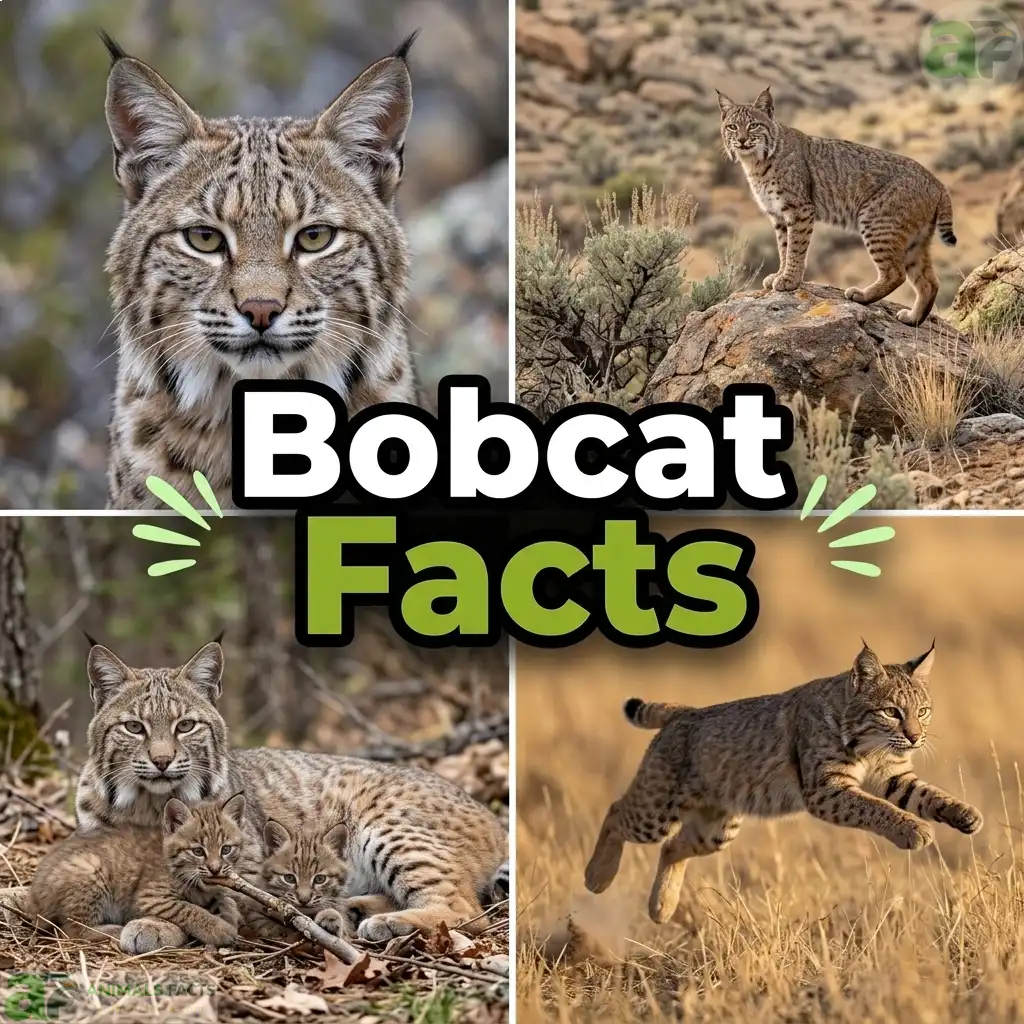
Bobcat Facts
| Feature | Details |
|---|---|
| Scientific Name | Lynx rufus |
| Common Names | Bobcat, Red Lynx, Bay Lynx (historical) |
| Kingdom | Animalia |
| Phylum | Chordata |
| Class | Mammalia |
| Order | Carnivora |
| Family | Felidae |
| Genus | Lynx |
| Recognized Subspecies | 2 under current IUCN taxonomy (formerly up to 13) — L. r. rufus (western) and L. r. floridanus (eastern/southern) widely used by some sources |
| Habitat | Every major North American biome — forests, deserts, swamps, grasslands, mountains, suburban areas |
| Lifespan | 7–10 years in the wild; up to 32 years in captivity |
| Diet | Rabbits, hares, rodents, deer (particularly fawns), birds, reptiles — highly flexible omnivore tendencies |
| Weight | Males: 8–14 kg; Females: 6–9 kg |
| Body Length | 47–125 cm (excluding tail); tail: 9–20 cm (the distinctive “bobbed” tail) |
| Shoulder Height | 30–60 cm |
| Top Speed | Up to 48 km/h (30 mph) sustained; short bursts approaching 56 km/h |
| Vertical Jump | Up to 3.7 meters |
| Conservation Status | Least Concern (IUCN Red List) |
| North American Population | Estimated 2.3–3.5 million individuals — the most numerous wild cat in North America |
| Unique Feature | Most successful wild cat in North America; found in every US contiguous state except Delaware; documented thriving in suburban neighborhoods of major US cities |
 1. Introduction: What is a Bobcat?
It is the most numerous wild cat in North America — with an estimated 2.3 to 3.5 million individuals across a range spanning from southern Canada to central Mexico — yet most people who live their entire lives within its territory never knowingly see one. It has survived the extermination campaigns that eliminated wolves and cougars from most of the eastern United States, thrived in the face of habitat changes that devastated other medium-sized predators, and in recent decades began successfully colonizing suburban neighborhoods in major American cities — hunting in backyards, resting on roof terraces, and navigating residential streets with the same quiet confidence it applies to wilderness forest. Bobcat facts reveal the ultimate story of American wild cat resilience — an animal whose success is built on flexibility, intelligence, and an extraordinary capacity for adapting to whatever environment humans throw at it.
The bobcat — Lynx rufus — is a medium-sized wild cat in the genus Lynx, sharing its lineage with the Canada Lynx, Eurasian Lynx, and Iberian Lynx while demonstrating a habitat generalism and dietary flexibility that sets it apart from its more specialized relatives. Named for its characteristic short, “bobbed” tail, the bobcat is the only wild cat found in every contiguous US state except Delaware, with a range encompassing environments as different as the boreal forest fringe of southern Canada, the subtropical swamps of the Florida Everglades, the Mojave and Chihuahuan Deserts, the Great Plains grassland, the Pacific coastal scrubland, and increasingly, the suburban and peri-urban landscapes surrounding major American metropolitan areas.
Whether you are a homeowner who spotted a bobcat in your yard for the first time and wants to understand what you saw, a student researching bobcat facts for a school project, a wildlife photographer hoping to capture this elusive predator on camera, a parent looking for bobcat facts for kids, or a conservation enthusiast interested in the story of North America’s most successful wild cat — this is the most complete guide to bobcat facts you will find anywhere. We cover bobcat habitat, bobcat diet, bobcat behavior, communication, reproduction, all subspecies, conservation, mythology, and the extraordinary story of a wild cat that has quietly and completely outcompeted every rival predator at the art of living alongside human civilization. Let us begin.
2. Species Overview & Classification
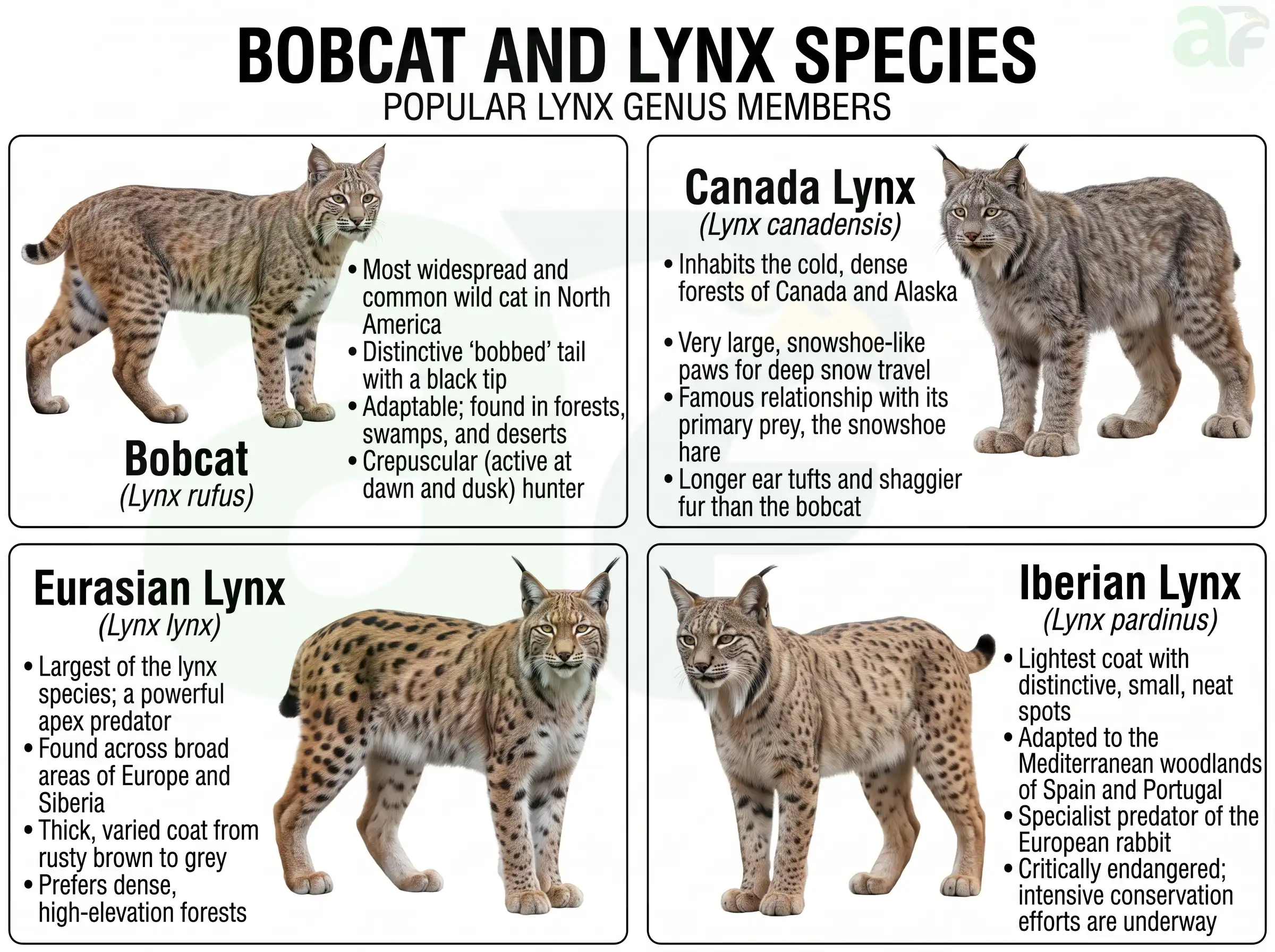
The bobcat belongs to the genus Lynx within the family Felidae — sharing evolutionary history with the Canada Lynx, Eurasian Lynx, and Iberian Lynx through a common ancestor that colonized North America from Asia during the Pleistocene epoch. Despite its smaller stature and absence of the dramatic snowshoe paws that characterize the Canada Lynx, the bobcat is recognized as the most ecologically and demographically successful of all North American wild cats.
What Defines the Bobcat Within the Lynx Genus?
Within the genus Lynx, the bobcat is distinguished by:
- Habitat generalism: Far more flexible habitat requirements than the Canada Lynx (boreal specialist) or Iberian Lynx (Mediterranean scrubland specialist)
- Dietary flexibility: The broadest prey range of any North American Lynx species — from insects to adult white-tailed deer
- Smaller ear tufts: Less pronounced than other lynx species
- Shorter legs relative to body: Compared to the long-limbed Canada Lynx — reflecting adaptation to terrestrial hunting across diverse terrain rather than snow travel
- More spotted coat: Bold spots and pattern often more pronounced than Eurasian Lynx adults
- Urban adaptability: The most successful lynx species in terms of tolerating human-modified landscapes
Species Classification Table
| Level | Classification |
|---|---|
| Kingdom | Animalia |
| Phylum | Chordata |
| Class | Mammalia |
| Order | Carnivora |
| Family | Felidae |
| Subfamily | Felinae |
| Genus | Lynx |
| Species | L. rufus |
| Common Names | Bobcat, Red Lynx, Bay Lynx (historical) |
Bobcat Subspecies
Historical taxonomy recognized up to 13 bobcat subspecies across North America. The current 2017 IUCN Cat Specialist Group revision simplified this to 2 subspecies:
| Subspecies | Scientific Name | Range | Notable Features |
|---|---|---|---|
| Western/Northern Bobcat | Lynx rufus rufus | Western North America and Canada | Larger on average; grayer in some populations |
| Eastern/Southern Bobcat | Lynx rufus floridanus | Eastern and southeastern North America | Includes Florida population; darker in some areas |
Several historically recognized subspecies retain common use in regional management:
| Historical Subspecies | Range | Status |
|---|---|---|
| Florida Bobcat | Florida | Abundant; genetically distinct |
| Desert Bobcat | Baja California, southwestern USA | Adapted to arid conditions |
| Nova Scotia Bobcat | Maritime Canada | Northernmost population |
Species Evolution & Discovery Timeline
~2.6 million years ago: Lynx ancestors — similar to the modern Eurasian Lynx — crossed the Bering Land Bridge from Asia into North America during the Pleistocene, establishing the ancestral population that would eventually give rise to both the Canada Lynx and the Bobcat through divergent adaptation to different North American environments.
~1.8 million years ago: The Bobcat lineage diverged from the Canada Lynx lineage — with the ancestral population differentiating into the snow-adapted Canada Lynx of the boreal north and the more terrestrially flexible Bobcat of more temperate and diverse southern environments.
~20,000 years ago: Bobcats were distributed across virtually their entire modern range — coexisting with larger Pleistocene predators including American lions, saber-toothed cats, and dire wolves, surviving their mass extinctions at the end of the last Ice Age through dietary flexibility and habitat adaptability.
~10,000 years ago: The Pleistocene megafauna extinction removed the most formidable competing and threatening predators — with the bobcat emerging from this period as one of the most ecologically intact and demographically stable medium-sized predators in North America.
~1500s–1800s CE: Indigenous Americans had maintained cultural relationships with bobcats for thousands of years; European colonists subsequently perceived bobcats primarily as threats to livestock and game, initiating systematic hunting and trapping that reduced populations across much of the eastern range.
1758: Carl Linnaeus described the species and the bobcat was later formally described as Lynx rufus — its species name deriving from the Latin word for “red” or “reddish,” referring to the reddish-brown coat coloration.
1900s–1950s: Systematic bobcat hunting, trapping, and habitat destruction — combined with bounty programs in several states — drove bobcat populations significantly downward across parts of the eastern and midwestern United States.
1977: The bobcat was listed in CITES Appendix II — restricting international trade in bobcat skins and products and reducing the commercial hunting pressure that had previously been the most significant threat to the species.
1980s–2026: Remarkable population recovery and range expansion — with bobcats recolonizing multiple midwestern states from which they had been extirpated, expanding northward in New England and the Great Lakes region, and increasingly establishing in suburban areas of major cities including Los Angeles, Atlanta, Chicago suburbs, and many others.
3. Physical Description & Unique Features
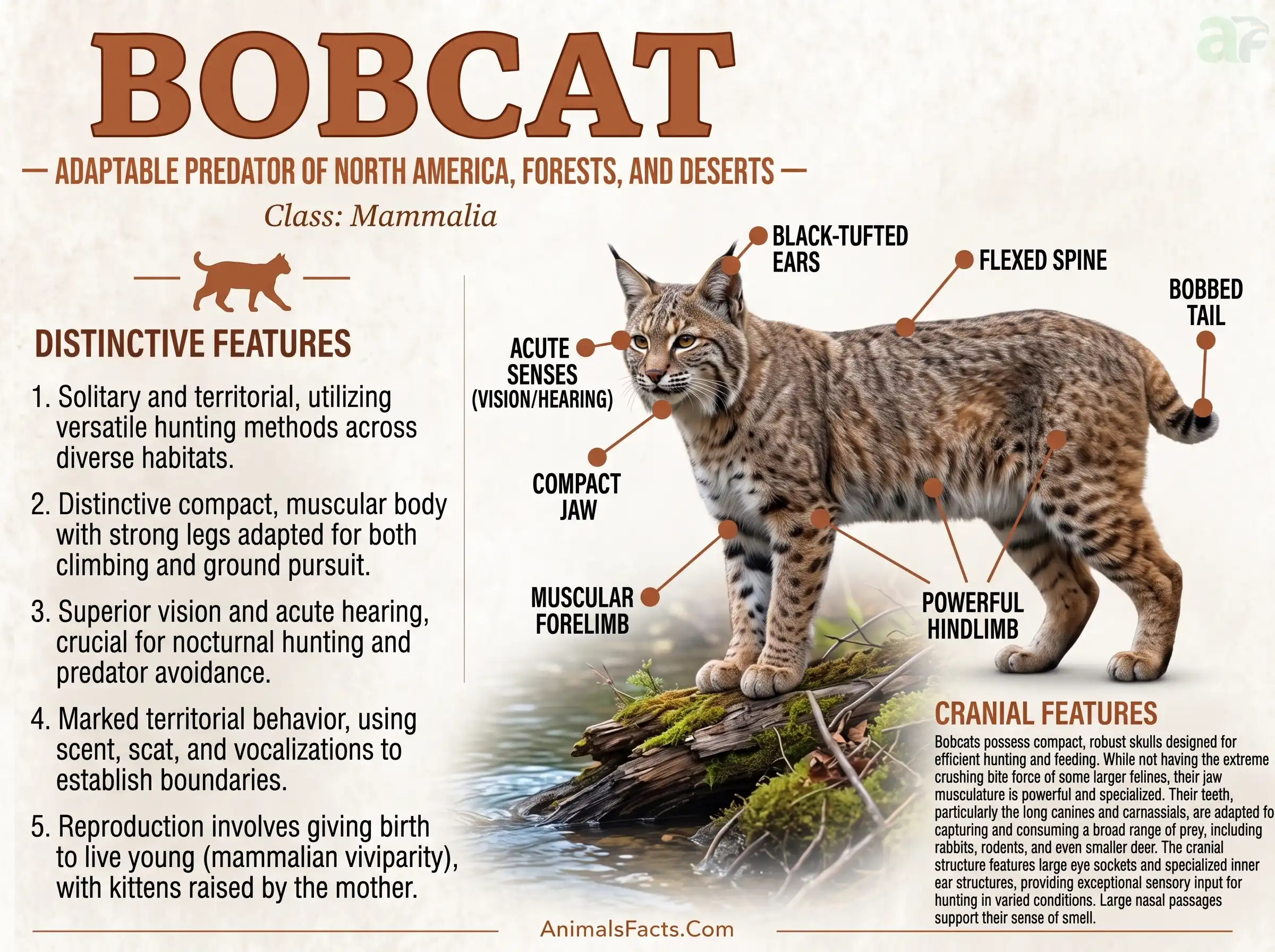
The bobcat’s physical design achieves an ideal compromise between the specialized adaptations of its lynx relatives and the generalist capability required to thrive across the enormous range of environments the species inhabits.
Size and Sexual Dimorphism
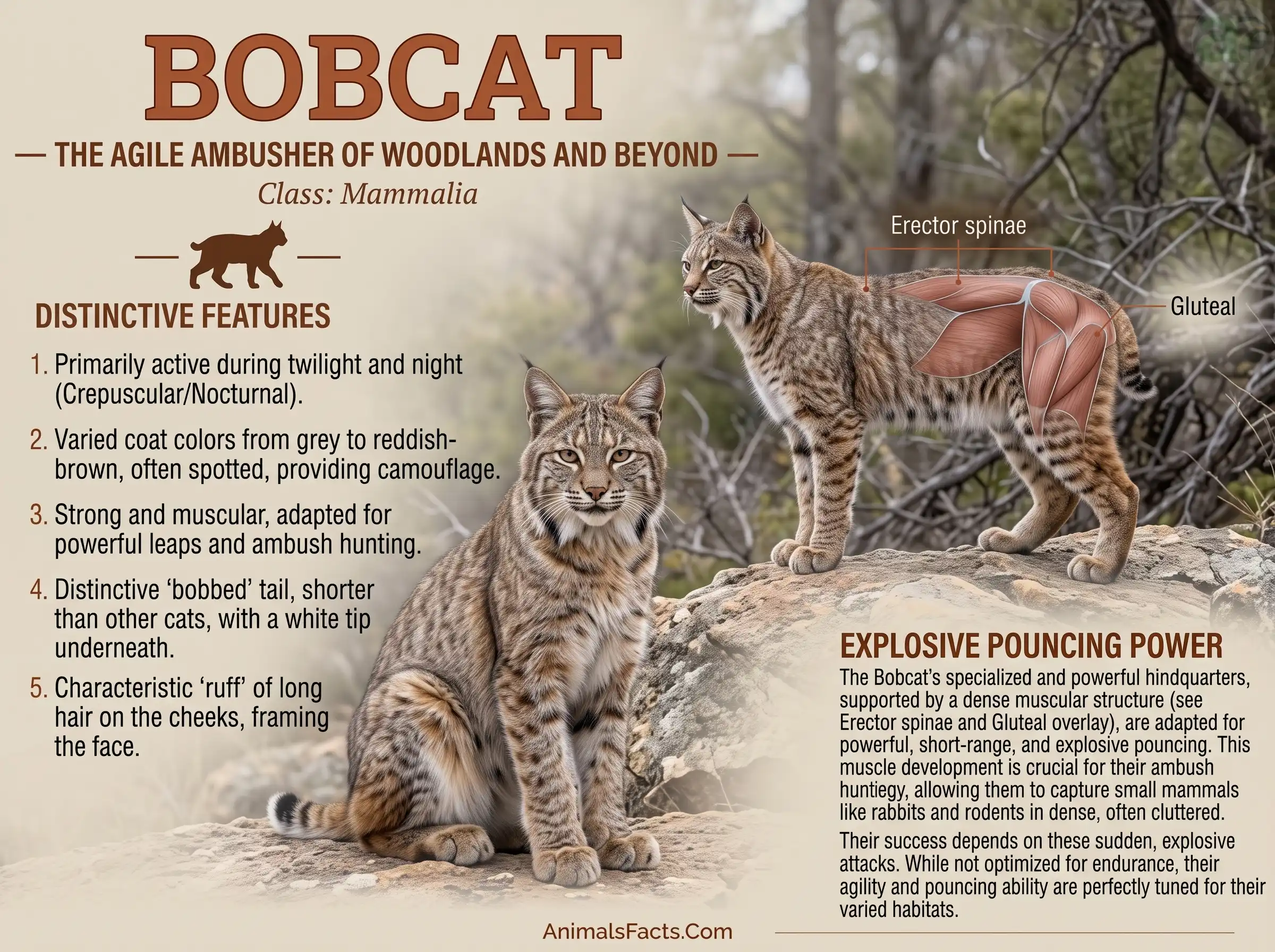
The bobcat is a medium-sized felid — larger than a domestic cat but significantly smaller than a cougar or jaguar. Males are consistently 25–75% heavier than females from the same population, a pronounced sexual dimorphism that likely reflects male-male competition for territories and breeding access:
- Large males: Up to 14 kg and 125 cm in body length in the largest northern and western populations
- Average males: Typically 8–11 kg and 65–90 cm body length
- Females: Typically 6–9 kg and 47–70 cm body length
- Smallest populations: Desert-adapted bobcats in Baja California and the Sonoran Desert tend toward smaller average size than northern or mountain populations
Geographic variation in bobcat size follows Bergmann’s Rule broadly — with the largest individuals occurring in the northernmost and highest-altitude portions of the range (New England, British Columbia, northern Rocky Mountains) and the smallest in the warmest, most southern portions.
The Famous “Bob” Tail
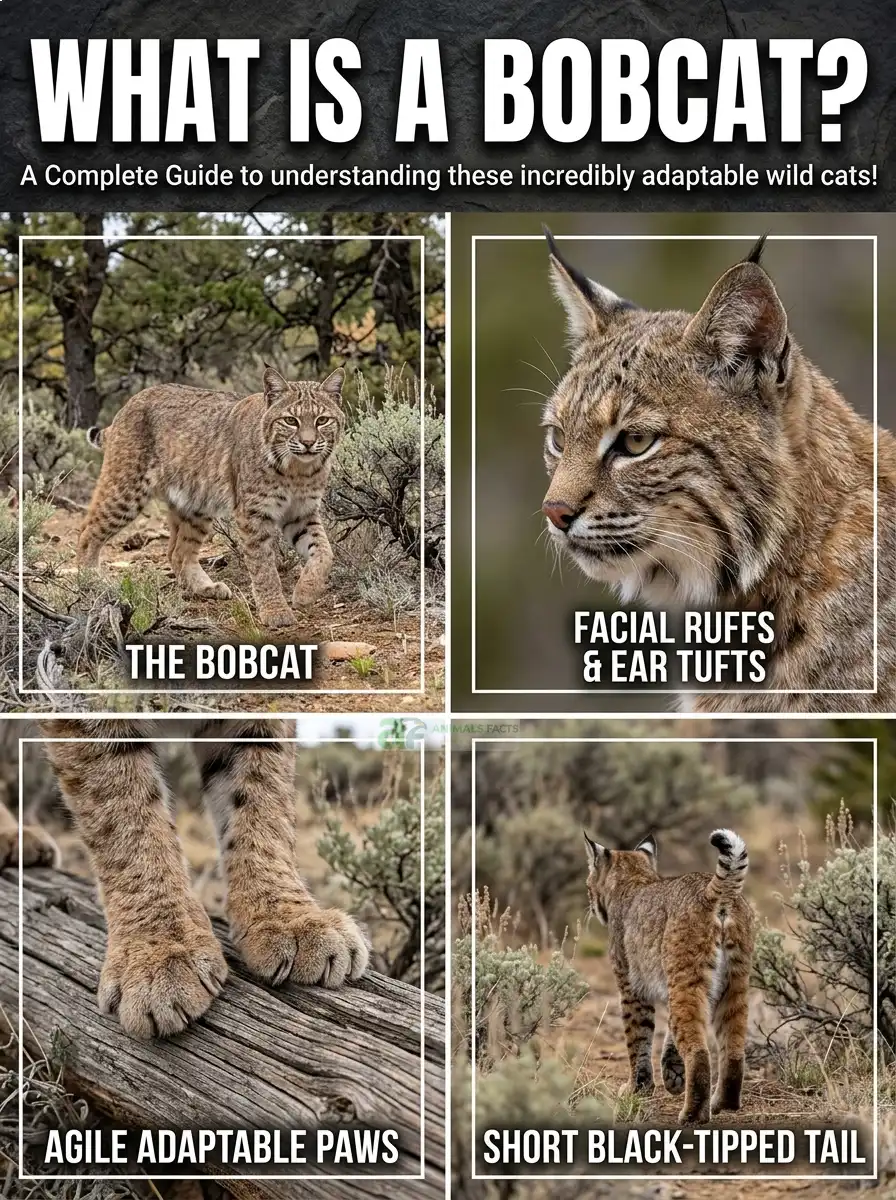
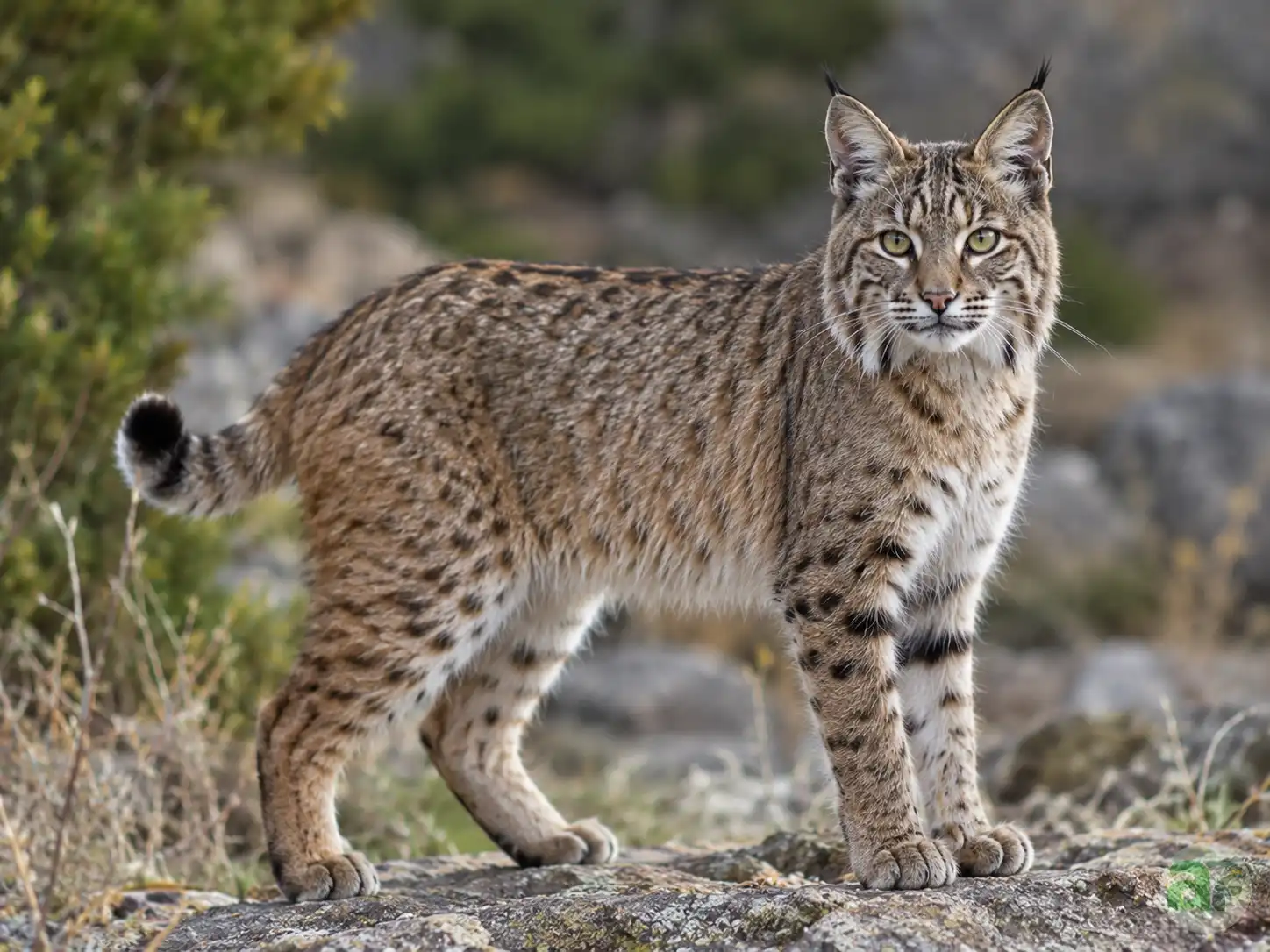
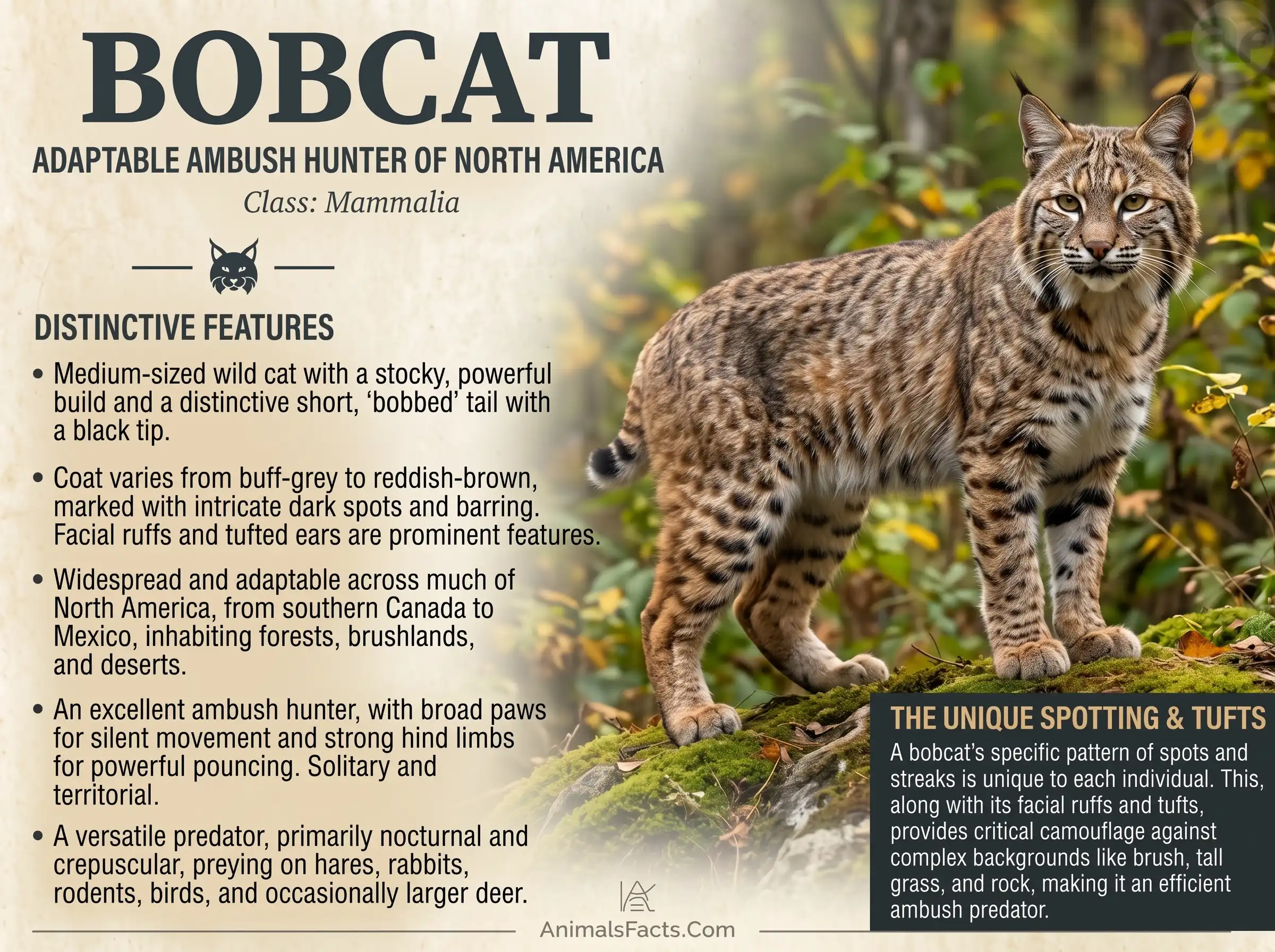
The bobcat’s most immediately recognizable feature — the short, “bobbed” tail measuring only 9–20 cm — has given the species its common name and immediately distinguishes it from all other North American wild cats except the Canada Lynx (which also has a short tail). The bobcat’s tail is slightly longer than the Canada Lynx’s and typically shows distinct black banding on the upper surface with a white underside — a coloration contrast that may function as a visual signal during social interactions between individuals.
The functional reasons for the bobcat’s (and all lynx species’) short tail have generated scientific debate — with proposed explanations including reduced drag during movement through dense vegetation, thermoregulatory advantages in cold environments (shorter tail = less surface area for heat loss), and simply the ancestral retention of a derived feature from a common lynx ancestor.
Coat and Coloration
The bobcat’s coat ranges from tawny, reddish-brown, or gray-brown on the back and sides to pale cream or white on the belly, with dark brown or black spots and streaks across the body in a pattern that provides remarkably effective camouflage in the dappled light of the diverse environments it inhabits. Individuals from different parts of the range show significant variation — with desert populations tending toward paler, grayer coats and forest populations typically displaying richer, redder-brown backgrounds.
Unlike the Canada Lynx, which has a highly uniform, dense winter coat adapted for Arctic cold, the bobcat’s coat is lighter and less voluminous — reflecting the more temperate environments across most of its range.
The Exceptional Ear and Sensory System
The bobcat’s proportionally large, tufted ears — smaller tufts than the Canada Lynx but still pronounced — are capable of rotating independently, allowing the animal to monitor sounds from multiple directions simultaneously. Combined with large forward-facing eyes providing good binocular vision and depth perception, and a sensitive whisker system providing tactile environmental information, the bobcat possesses one of the most comprehensive sensory systems of any medium-sized North American mammal.
Did You Know? The bobcat’s ability to navigate suburban and urban environments successfully has made it the subject of one of the most extensive urban wildlife camera trap studies in North America — the Urban Wildlife Information Network’s multi-city bobcat monitoring program. Camera trap data from cities including Chicago, Washington DC, Atlanta, and multiple California metro areas has documented bobcats successfully hunting in city parks, crossing multi-lane roads, nesting in suburban backyards, and raising kittens within the boundaries of major metropolitan areas — demonstrating behavioral flexibility that has fundamentally changed researchers’ understanding of large wild cat capacity for urban coexistence.
4. Top 25 Surprising & Interesting Bobcat Facts
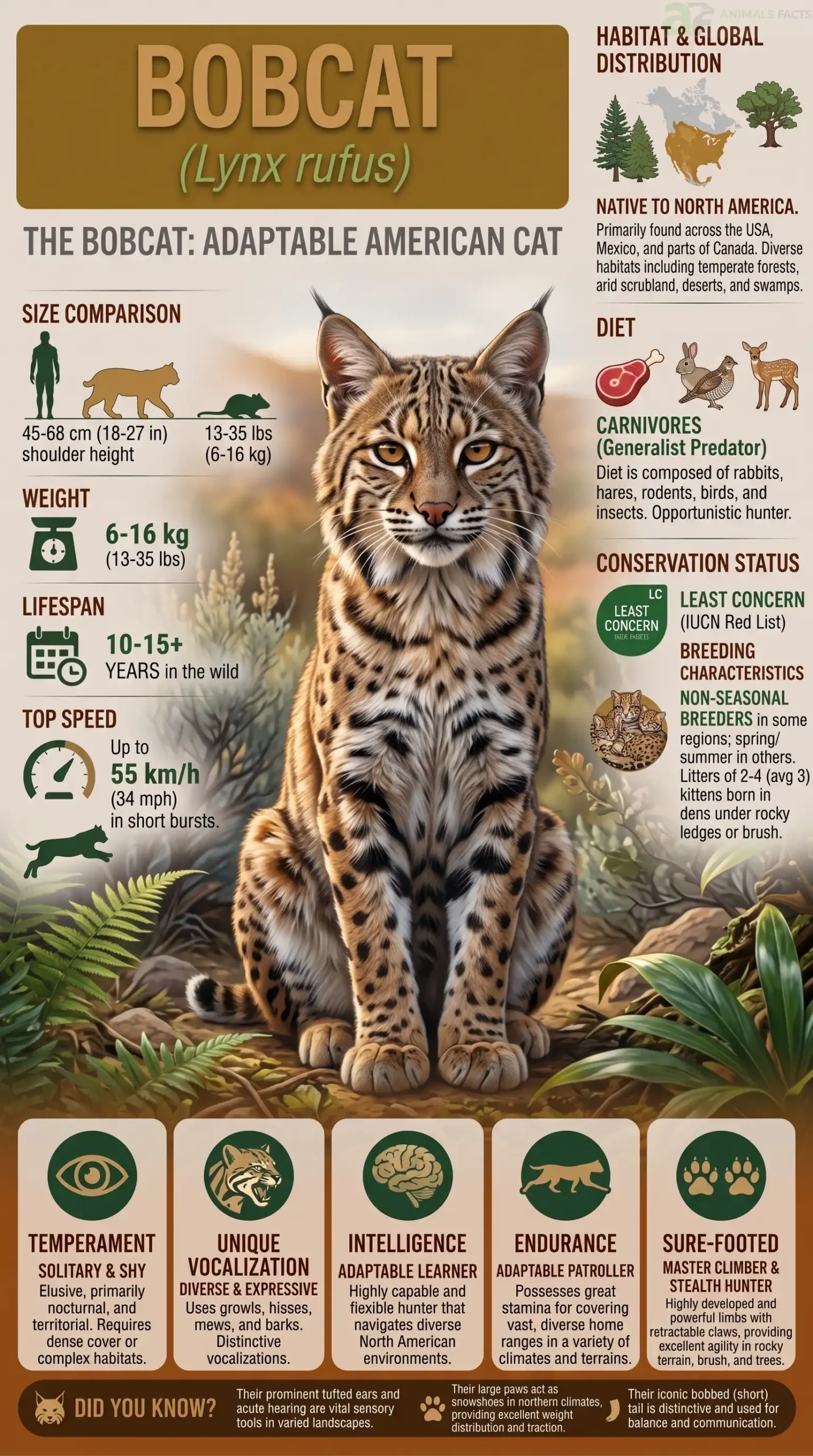
- The bobcat is the most numerous wild cat in North America — with an estimated 2.3–3.5 million individuals across a range spanning from southern Canada to central Mexico.
- Bobcats are found in every US contiguous state except Delaware — the widest geographic distribution of any wild cat in North America, covering virtually every biome on the continent.
- A bobcat can kill white-tailed deer weighing up to 5–8 times its own body weight — ambushing deer at rest or driving them into deep snow where the deer’s greater weight becomes a disadvantage.
- The oldest confirmed wild bobcat reached approximately 16 years of age — remarkable for a wild felid of its size. The oldest captive bobcat reached a documented 32 years — the longest confirmed lifespan of any lynx species.
- Bobcats have been photographed and documented successfully reproducing in suburban neighborhoods within the city limits of Los Angeles, Atlanta, Nashville, and dozens of other major metropolitan areas — making them one of the most urban-adapted wild cats in the world.
- A bobcat’s walk creates a track pattern in which the hind paw lands precisely in the track left by the front paw (called “direct register”) — a gait so precise that the animal’s actual track count appears to be half what it actually is, a cryptic behavior that also minimizes noise during stalking.
- The bobcat vocalization repertoire is extraordinarily diverse — including meows, purrs, growls, hisses, screams, and a distinctive winter caterwauling that sounds alarmingly like a screaming woman and has been mistaken for supernatural phenomena by wilderness travelers for centuries.
- Bobcats can survive in environments where their primary prey (rabbits and hares) are absent — shifting dietary composition to deer, rodents, birds, or virtually any other available prey with remarkable behavioral flexibility unmatched by their lynx relatives.
- The bobcat swims voluntarily and competently — having been documented crossing rivers over 200 meters wide as routine territory behavior, and hunting waterfowl and aquatic prey in wetland habitats.
- Despite having roughly the same body weight as a Canada Lynx, the bobcat’s paws are approximately half the size — an adaptation to the absence of deep snow across most of its range that conversely makes it less effective than the Canada Lynx in deep-snow environments.
- Bobcats are documented scent-marking extensively throughout their territories — spraying urine on prominent rocks, trees, and trail junctions with such regularity that a single territorial male’s range may contain hundreds of active scent posts monitored and refreshed on a regular schedule.
- A bobcat can leap approximately 3 meters vertically from a standing position — enabling it to ambush prey from elevated perches and escape pursuit by larger predators by rapidly ascending trees.
- The bobcat’s facial markings — including the distinctive pattern of dark bars on the cheeks that create a characteristic “decorated face” appearance — are individually unique, allowing researchers to identify specific individuals from photographs using pattern matching algorithms similar to those used for tigers and leopards.
- Bobcat territories vary enormously by habitat and prey density — from as small as 3 km² in exceptionally prey-rich habitats to over 200 km² for males in arid, prey-sparse desert environments.
- Bobcats are documented using culvert underpasses and wildlife bridges beneath roads more readily than most other medium-sized carnivores — a behavioral flexibility that makes bobcats particularly amenable to road mitigation strategies.
- The bobcat’s claws are fully retractable — kept razor-sharp by protective sheathing during walking — and used both for prey capture and for tree climbing that provides access to elevated hunting perches and predator escape routes.
- Bobcats have been observed “playing dead” momentarily when seized by predators in some reported encounters — a behavioral response (thanatosis) documented in several prey species but rarely in active predators of the bobcat’s capability.
- In desert populations, bobcats have been documented surviving without drinking free water for extended periods — obtaining sufficient moisture from their prey, a physiological flexibility that enables persistence in arid environments far from reliable water sources.
- The bobcat’s scream — produced primarily by females in estrus and during highly agitated social interactions — is one of the most unsettling sounds in North American wilderness, described variously as resembling a screaming woman, a screaming baby, or an alarmed peacock, and frequently investigated by concerned locals who hear it at night without seeing its source.
- Bobcat kittens play with extreme intensity that appears to develop specific hunting skills — researchers have documented specific play behaviors that directly correspond to prey-catching techniques used in adult hunting, suggesting that kitten play serves a genuine skill-development function rather than being simply pleasurable activity.
- The bobcat’s primary competitor across much of its range is the coyote — with the two species showing complex competitive dynamics including dietary overlap, competitive exclusion in some habitats, and documented direct aggression between individuals.
- Bobcat territory boundaries are not enforced through constant physical patrolling but through the scent information network maintained by urine and feces deposits — with neighboring individuals essentially exchanging chemical messages that allow territorial boundaries to be understood and respected with minimal direct contact.
- Bobcats in Florida co-occur with the Florida Panther (cougar) and American Alligator — demonstrating the ability to survive in a multi-predator community that includes significantly larger carnivores, through the same behavioral flexibility and crypticity that characterizes the species across its entire range.
- The first photographic documentation of a bobcat hunting and killing an adult white-tailed deer was not achieved until relatively recently — reflecting both the nocturnal secretiveness of the hunting behavior and the technical challenges of documenting a predation event that can be completed in less than 30 seconds from initial contact.
- Bobcats in suburban and urban areas show measurably reduced flight distance from humans compared to rural bobcats — habituation to human presence that has occurred rapidly within individual lifetimes rather than requiring generational behavioral change, demonstrating remarkable individual behavioral plasticity.
5. Fun Facts at a Glance
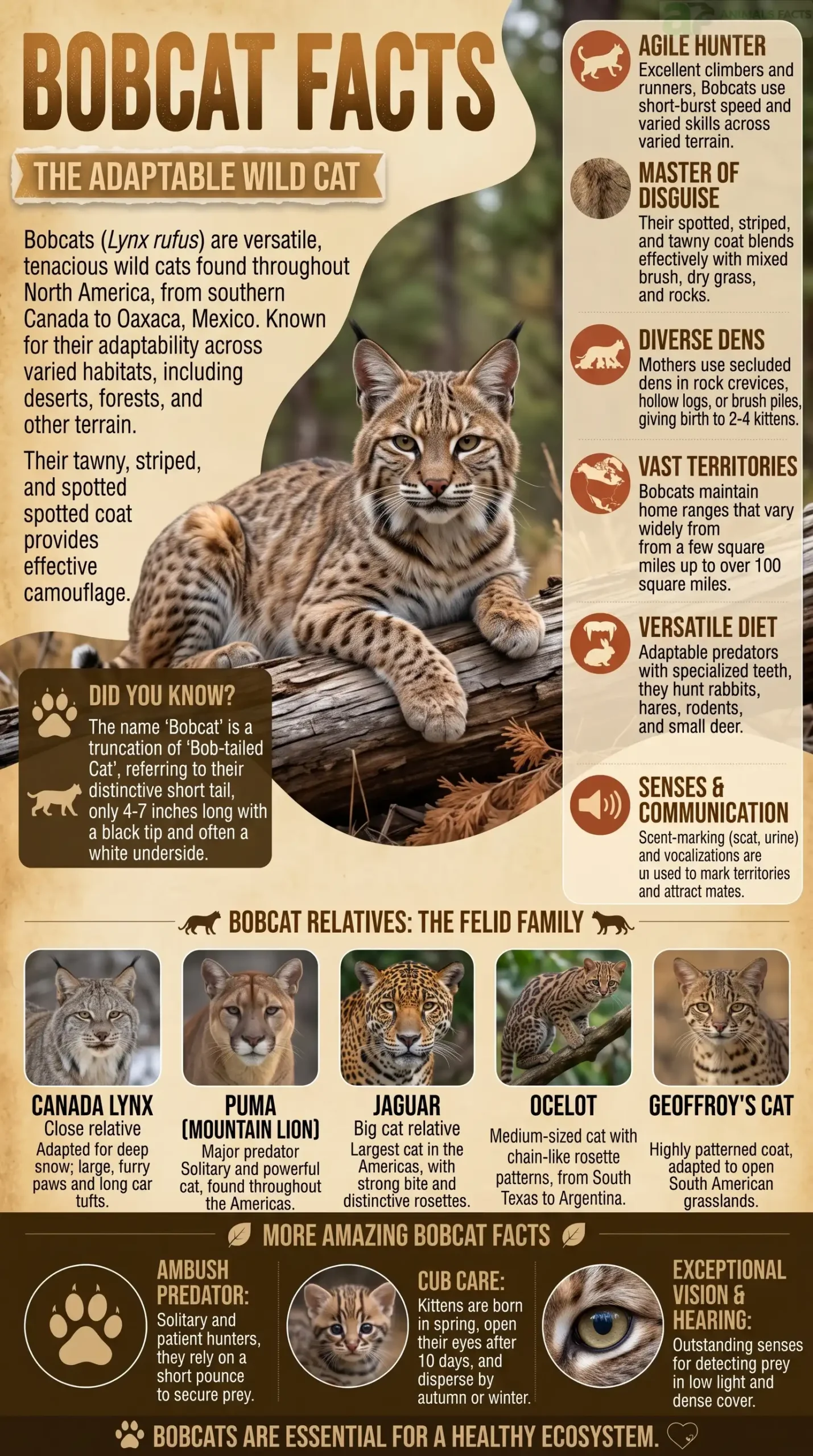
- The bobcat is found in every US contiguous state except Delaware — the widest North American wild cat distribution.
- An estimated 2.3–3.5 million bobcats make it the most numerous North American wild cat.
- Bobcats can kill deer 5–8 times their own weight.
- The bobcat’s tail is so short it gave the animal its “bob” tail name.
- Bobcats walk with perfect “direct register” — hind paw landing exactly where front paw was, minimizing tracks.
- The oldest captive bobcat lived to 32 years — longest of any lynx species.
- Bobcats are thriving in suburban neighborhoods of major US cities.
- Bobcats can leap 3.7 meters vertically from standing.
- Desert bobcats can survive without drinking free water by extracting moisture from prey.
- The bobcat’s winter scream can sound alarming like a woman in distress.
- Bobcat facial markings are individually unique — like a fingerprint.
- Bobcats are the most adaptable North American wild cat — thriving where wolves and cougars have been eliminated.
6. Natural Habitat & Geographic Range
The bobcat’s habitat range is the single most comprehensive testament to its extraordinary ecological adaptability — a species that genuinely inhabits every major North American terrestrial biome, from subtropical swamp to semi-arid desert, from temperate coastal forest to Great Plains grassland, and from wilderness to city suburb.
Major Habitat Types
Temperate deciduous and mixed forest: The eastern North American forest zone — from New England through the Appalachians and across the Midwest — represents one of the bobcat’s core habitats, supporting some of the highest population densities outside the species’ most productive western range areas. Dense forest with adequate prey and denning sites supports thriving bobcat populations even in heavily fragmented, human-modified landscapes.
Coniferous mountain forest: Across the western United States — the Sierra Nevada, Cascades, Rocky Mountains, and associated ranges — bobcats inhabit coniferous forest alongside ponderosa pine, Douglas fir, and associated mixed woodland, typically following prey into different elevation zones seasonally.
Desert and semi-arid scrubland: The Mojave, Sonoran, Chihuahuan, and Great Basin Deserts all support bobcat populations — with desert-dwelling bobcats demonstrating remarkable physiological adaptation to heat and water scarcity, and dietary adjustment to desert-specific prey including kangaroo rats, jackrabbits, rattlesnakes, and quail.
Subtropical swamp and coastal habitat: The Florida Everglades, Big Cypress Swamp, coastal Georgia and Carolina marsh systems — environments of extreme heat, humidity, and seasonal flooding — all support stable bobcat populations, making Florida and the southeastern coastal plain one of the most densely bobcat-occupied regions in the country.
Chaparral and coastal scrubland: The Pacific coastal zone — California’s chaparral communities, Oregon coastal forest, and associated habitat — supports the bobcat populations that have most visibly adapted to suburban and peri-urban environments, generating the most-studied examples of urban bobcat coexistence.
Suburban and urban habitat: The most recent and most conservation-relevant habitat expansion — with bobcats documented establishing stable, breeding territories in suburban neighborhoods across California, Illinois, Virginia, Georgia, Texas, and many other states. Urban bobcats typically hunt domestic rabbits, squirrels, rats, and occasionally domestic cats and small dogs, and use suburban parks, golf courses, greenways, and yard landscapes as territorial ranges.
Geographic Range Table
| Region | Presence | Population Density | Status |
|---|---|---|---|
| Eastern USA (all states) | Present everywhere except DE | Moderate to high | Recovering and stable |
| Western USA (all states) | Present across full range | High in productive habitats | Stable to increasing |
| Southern Canada (southern fringes) | Present across multiple provinces | Lower than US | Stable; expanding slightly |
| Mexico (northern and central) | Present across significant range | Moderate; declining in some areas | Declining in Mexico |
| Florida | Present statewide | High | Stable and abundant |
| Major US cities (suburban fringes) | Documented in 25+ metro areas | Low but stable | Increasing |
| Delaware | No confirmed breeding population | None | Extirpated or never established |
Did You Know? The bobcat’s range has actually expanded across parts of its eastern distribution over the past 50 years — with the species recolonizing Ohio, Indiana, Illinois, Iowa, and other midwestern states from which it had been largely extirpated by the mid-20th century through hunting and habitat loss. This natural recolonization — driven by recovering prey populations, reduced hunting pressure, and perhaps increased dietary flexibility enabling exploitation of agricultural landscapes — represents one of North American wildlife’s most successful examples of predator population recovery without formal reintroduction programs.
7. Diet & Feeding Behavior
The bobcat’s diet is the central explanation for its extraordinary ecological success — a prey base so diverse and a hunting strategy so flexible that almost no environment within its range cannot provide adequate sustenance for a resident bobcat population.
What Bobcats Eat
The bobcat is classified as a facultative dietary generalist — showing strong preference for rabbits and hares across most of its range while demonstrating willingness and ability to shift to virtually any available prey when primary prey is scarce or unavailable. This dietary flexibility stands in sharp contrast to the Canada Lynx (~75–97% snowshoe hare) and Iberian Lynx (~75–90% European rabbit), whose dietary specialization creates significant population vulnerability when preferred prey crashes.
Diet Breakdown Table
| Prey Type | Approximate Percentage | Notes |
|---|---|---|
| Cottontail rabbits | 25–50% (most habitats) | Most important prey across most of range |
| Jackrabbits | 15–30% (western/desert range) | Critical prey in arid environments |
| Snowshoe hares | 15–25% (northern range) | Important where overlap with Canada Lynx range |
| White-tailed deer (fawns and adults) | 10–25% (eastern/deciduous forest) | Significantly more important than often recognized |
| Mule deer | 5–15% (western range) | Taken through ambush; particularly in winter |
| Squirrels and rodents | 10–20% | Important year-round supplement |
| Birds (various) | 5–15% | Ground-nesting species, quail, turkeys |
| Reptiles (snakes, lizards) | 2–10% | Particularly important in desert and southern habitats |
| Insects and invertebrates | 1–5% | Minor; more important for juveniles |
| Domestic livestock (poultry, small animals) | Variable | Source of human-bobcat conflict |
Hunting Strategies
The bobcat is a stalk-and-ambush predator — the same basic hunting strategy shared with most felid species, refined and adapted to the bobcat’s specific prey community and habitat diversity:
The freeze-and-wait: For bird and squirrel prey, bobcats frequently employ extended motionless waiting near predictable prey locations — bird feeders, squirrel caching sites, rabbit burrows — before launching a precise final pounce when prey moves within range.
The belly-crawl stalk: For larger, more vigilant prey including deer, bobcats are documented performing extended, extremely slow belly-crawl approaches — sometimes lasting 30 minutes or more over distances of 50+ meters — before a brief explosive rush to the target.
The leap-and-seize: The bobcat’s climbing ability and jumping power allow hunting from elevated perches — with individual bobcats documented sitting in trees or on rocky outcrops and dropping onto prey passing below.
Deer hunting strategy: The bobcat’s ability to kill white-tailed deer and mule deer several times its own weight is accomplished through two primary methods — ambushing deer from above or behind, targeting the throat or back of the neck, and (particularly in winter) driving deer into deep snow where the deer’s weight becomes a disadvantage and the bobcat can pursue across the surface. Research has documented bobcats regularly making deer kills that are too large to consume in a single feeding — caching the carcass under snow, leaves, or debris and returning over multiple days.
Did You Know? A study tracking bobcat dietary composition in suburban New Jersey documented that suburban bobcats had diets that differed significantly from their rural counterparts — with domestic rabbits (kept in outdoor hutches), eastern grey squirrels, Norway rats, and European starlings forming a larger-than-expected proportion of the diet, and white-tailed deer fawns representing a significant caloric contribution in the fawning season. This dietary opportunism — immediately exploiting the prey resources concentrated in human-modified suburban landscapes — reflects the same dietary flexibility that has allowed bobcats to colonize diverse wild habitats, and suggests that human modifications to landscape have created rather than eliminated bobcat prey availability in many suburban contexts.
8. Reproduction & Life Cycle
Bobcat reproduction reflects the species’ position as a moderately sized temperate-zone felid — with seasonal but flexible breeding timing, moderate litter sizes, significant maternal investment, and a prolonged juvenile learning period appropriate to the dietary complexity the species masters.
Mating Behavior
Bobcats are primarily seasonally monestrous in northern populations — with a distinct mating season in late winter (January–March) timed to produce kittens during spring prey availability peaks. Southern populations may show less pronounced seasonality, with breeding documented across a broader seasonal window in Florida and other warm-climate areas.
Male bobcats expand their territorial patrolling during the mating season — covering significantly more ground to locate receptive females and compete with rival males. Vocalizations increase dramatically during this period — with the famous caterwauling of receptive females attracting males from across considerable distances and occasionally triggering aggressive male-male encounters near female territories.
Gestation and Birth
Gestation period: Approximately 60–70 days — among the shorter felid gestations, similar to domestic cats.
Litter size: Typically 1–6 kittens (most commonly 2–4), with larger litters common in years of abundant prey.
Birth: Kittens are born in a well-concealed den — typically a rocky crevice, dense brush pile, hollow log, or (increasingly in suburban habitats) under porches, in storm drain systems, or in landscape features of human-modified environments.
Key Developmental Stages
| Stage | Age | Key Development |
|---|---|---|
| Neonatal | 0–10 days | Eyes closed; entirely helpless; spotted coat present |
| Eyes open | 9–11 days | Beginning visual awareness |
| First outings | 3–5 weeks | Beginning to leave den with mother |
| Weaning | 2–4 months | Transition to solid food |
| Hunting accompaniment | 3–8 months | Learning prey detection and hunting through observation |
| Kill participation | 5–9 months | Beginning to participate in hunts |
| Independence | 8–12 months | Separation from mother; establishing own range |
| Sexual maturity | Female: ~12 months; Male: ~24 months | First breeding possible |
Lifespan Comparison Table
| Species | Average Wild Lifespan | Maximum Confirmed |
|---|---|---|
| Bobcat | 7–10 years | 32 years (captivity) — longest of any lynx |
| Canada Lynx | 10–14 years | ~21 years (captivity) |
| Eurasian Lynx | 12–17 years | ~26 years (captivity) |
| Ocelot | 7–10 years | ~20 years (captivity) |
| Cougar / Mountain Lion | 8–13 years | ~20 years (captivity) |
9. Social Behavior & Communication
The bobcat is a primarily solitary animal with a well-documented territorial organization built around overlapping male ranges that encompass the exclusive territories of multiple females — a spatial organization typical of most solitary felids and consistent with the reproductive strategy of a polygamous, territorial male seeking to maximize access to multiple breeding females.
Territorial Organization
Female territories: Typically exclusive — females actively defend their core range from other adult females through scent marking and occasional direct aggression. Female territory sizes typically 8–20 km² in productive habitat.
Male territories: Larger — typically 30–80 km² in woodland habitats, up to 200+ km² in desert environments — overlapping with the ranges of 2–4 adult females and neighboring males, with males maintaining tolerance of some overlap at territory boundaries.
Seasonal variation: Bobcat territory sizes show seasonal contraction and expansion — with territories typically smaller in summer (when prey is most abundant and movement most efficient) and larger in winter (when prey is scarcer and more movement is required to meet caloric needs).
Communication Methods
Scent marking: The primary and most extensively used communication method — bobcats maintain complex scent marking networks throughout their territories, with urine spray deposits on prominent rocks, trees, and trail junctions, feces deposited at visible locations (sometimes in elevated, highly visible positions specifically selected for maximum scent dispersal), and scratch marks on bark that deposit both visual signals and glandular scent simultaneously.
Vocalizations: A remarkably diverse repertoire including:
- Meow: Short-range contact calls, similar to domestic cat
- Purr: During relaxed, affiliative interactions (mothers with kittens)
- Hiss and spit: Close-range threat displays
- Growl: Sustained threat vocalization
- Caterwaul/scream: The famous winter mating vocalization — a haunting, sustained wail produced primarily by females in estrus but also by males in territorial or mating context, capable of carrying over a kilometer through winter forest
Body language: Tail position (limited given the short tail), ear orientation, body posture, and facial expression communicate social information in close-range encounters — with the distinctive facial markings of the bobcat potentially enhancing the readability of subtle facial expressions in low-light conditions.
Did You Know? GPS collar research on urban bobcats in Los Angeles’s Santa Monica Mountains documented that individual urban bobcats maintained home range boundaries remarkably similar to those of rural bobcats in comparable prey density habitats — despite navigating residential streets, commercial areas, and suburban parks as parts of their regular territorial routes. The urban bobcats mapped overlapping territories and maintained scent marking patterns indistinguishable from those of wilderness individuals — with freeway underpasses and wildlife bridges serving the same territorial boundary and crossing function as natural topographic features in wilderness habitats. This behavioral consistency between urban and wild individuals demonstrates how completely the bobcat’s fundamental behavioral toolkit transfers across dramatically different habitat contexts.
10. Predators & Defense Mechanisms
Despite being a capable predator of surprisingly large prey, the bobcat faces significant mortality risk from several larger predators and from the suite of human-caused threats that represent the dominant mortality source across most of its range.
Natural Predators
Coyotes: The bobcat’s most significant and most widespread natural competitor and occasional predator — with coyotes documented killing adult bobcats and bobcat kittens in multiple range countries. The coyote-bobcat competitive relationship is complex and context-dependent, with coyotes typically dominant in open habitats where their pack hunting advantage and superior running speed provide advantages, while bobcats typically maintain advantages in dense, rocky, or mountainous terrain where their agility and climbing capability provide effective escape routes.
Mountain Lions (Cougars): Where mountain lion and bobcat ranges overlap across the western United States, mountain lions are dominant competitors — significantly larger and capable of killing bobcats directly, with bobcats showing measurable behavioral avoidance of areas with high mountain lion activity.
Wolves: In the northern portions of the bobcat’s range where wolves have recovered — particularly in the northern Rocky Mountains and Great Lakes region — wolves represent a significant mortality risk and competitive pressure, with wolf pack territory establishment associated with reduced bobcat population density in some documented cases.
American Alligators: In the southeastern United States, particularly Florida, American Alligators represent a genuine predation risk to bobcats at water crossings and along water margins — with documented alligator predation on bobcats at river crossings and watering sites.
Great Horned Owls and Large Raptors: Significant predators of bobcat kittens — large raptors are capable of taking young kittens during the period before they are large enough to be safe from avian predation.
Humans: The dominant cause of bobcat mortality across virtually the entire range — through legal hunting and trapping (in many US states and Canadian provinces), vehicle collisions, and habitat loss. In the 1970s, at the peak of the fur trade, bobcat pelts commanded significant prices and hunting pressure was intense enough to drive regional population declines in several states.
Defense Mechanisms
Tree climbing: The bobcat’s excellent climbing ability — facilitated by fully retractable, sharp claws — provides rapid access to elevated refuge inaccessible to most ground-based pursuing predators including dogs, coyotes, and wolves.
Dense cover use: The bobcat’s strong preference for dense vegetation cover and rocky terrain provides simultaneous camouflage from both predators and prey — and gives the bobcat significant escape advantages over pursing predators in broken, complex terrain.
Defensive aggression: Unlike some medium-sized carnivores that invariably flee threats of any size, the bobcat is documented defending itself aggressively against domestic dogs of comparable or larger size — with reliable accounts of bobcats successfully fighting off pursuing dogs and occasionally injuring or killing dogs that cornered them.
Speed and maneuverability: While not the fastest cat species, the bobcat’s top speed of approximately 48 km/h and extraordinary maneuverability in broken terrain provide effective short-distance escape capability in the dense habitats it typically occupies.
11. Bobcat Facts for Kids
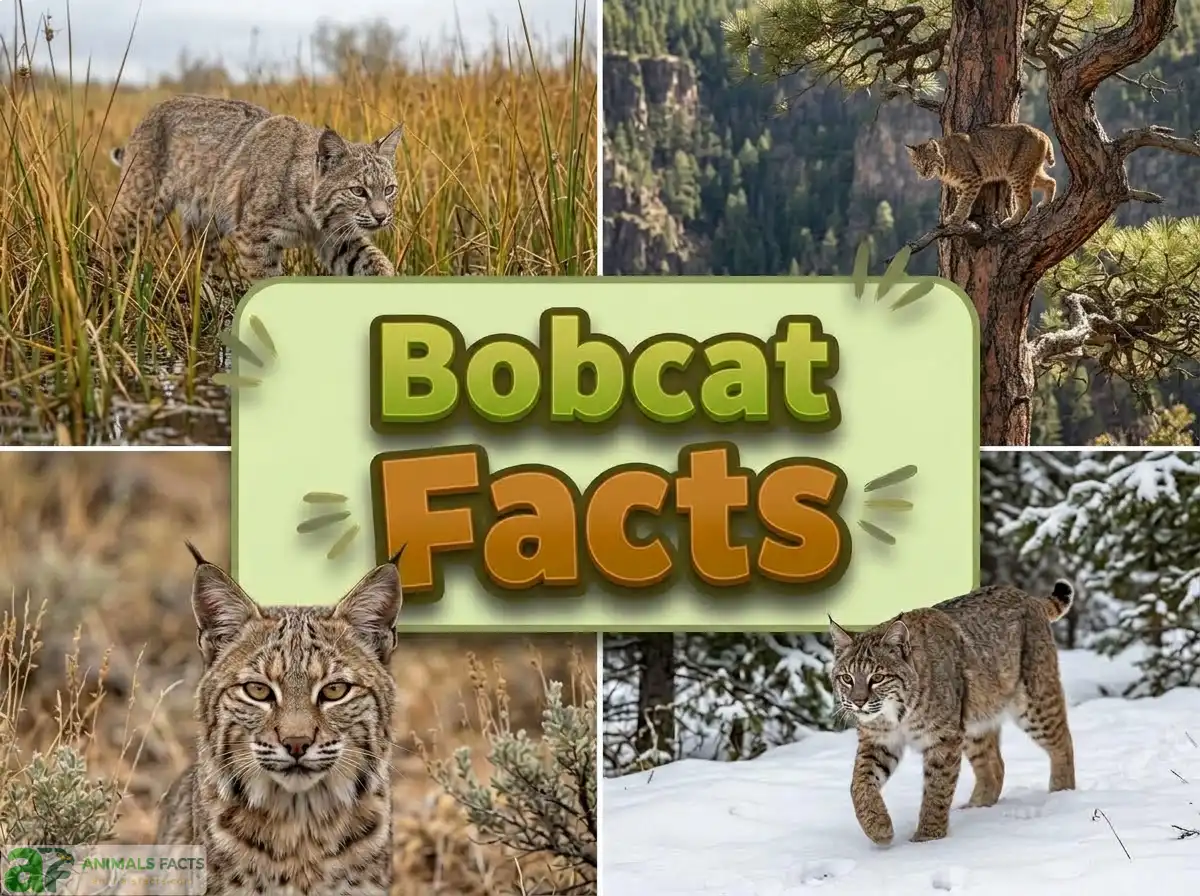
Hey kids — get ready to learn about the bobcat, the most successful wild cat in all of North America!
- The bobcat gets its name from its super-short “bobbed” tail — it’s so short it looks like someone snipped the end off! It’s only about as long as a hand!
- Bobcats live in almost every part of North America — from the cold forests of Canada all the way to the hot deserts of Mexico! They can survive in basically every habitat from snowfields to swamps to city parks!
- There are more bobcats than 2.3 million of them across North America — that makes the bobcat the most common wild cat on the whole continent!
- Bobcats are amazing jumpers — they can leap about 3.7 meters straight up in the air from a standing position! That’s about as tall as a two-story building!
- Even though bobcats are roughly the same size as a large domestic cat, they’re strong enough to catch and kill deer that are five to eight times heavier than they are!
- Some bobcats actually live in city neighborhoods — researchers have found bobcats living in the suburbs of Los Angeles, Atlanta, and other big American cities, hunting squirrels and rabbits in people’s backyards!
- The bobcat makes a really spooky sound in winter — it sounds like a woman screaming and has scared many people who heard it without seeing what was making the noise. It’s just a bobcat calling for a mate!
- Bobcat kittens are born with beautiful spotted coats — their patterns help camouflage them when their mother has to leave the den to go hunting.
Did You Know? A bobcat walks in a super-sneaky way called “direct register” — when it walks, each back foot lands in exactly the same spot where the front foot just was! This means that instead of making four tracks in the mud or snow, a bobcat only seems to leave two! It also means the bobcat makes much less noise walking through leaves or branches — because its feet already know the safe, quiet spots from where the front feet already tested. It’s like the bobcat has built-in silent footsteps!
12. Relationship with Humans
The bobcat’s relationship with humans is one of the most nuanced and rapidly evolving stories in American wildlife management — encompassing a history of systematic persecution, the recovery that followed reduced hunting pressure, and an increasingly intimate urban coexistence that is challenging and reshaping how Americans understand and relate to wild predators living among them.
Historical Persecution and Bounty Programs
Throughout the 18th and 19th centuries and into the early 20th century, bobcats were systematically persecuted across much of their North American range — through government bounty programs (paying hunters per bobcat killed, justified by claims of excessive poultry and small game predation), professional trapping for the fur trade, and generalized hostility toward wild predators that characterized wildlife management policy across the era of European-derived American land management.
The fur trade represented the most acute historic threat — with bobcat pelt prices during peak decades generating sufficient economic incentive to drive significant regional population reductions. By the mid-20th century, bobcats had been extirpated from several midwestern and central US states including Ohio, Indiana, and Illinois.
Fur Trade Decline and Population Recovery
The 1977 CITES Appendix II listing — restricting international commercial trade in bobcat skins — combined with changing public attitudes toward wildlife and the decline of natural fur fashion markets produced a dramatic reduction in commercial hunting pressure on bobcat populations from the late 1970s onward. This reduced pressure, combined with natural recovery enabled by the species’ high reproductive rate and dietary flexibility, produced the remarkable population recovery and range expansion that has continued through 2026.
Contemporary Bobcat-Human Conflict
Contemporary human-bobcat conflict typically involves:
Poultry predation: Bobcats entering unsecured chicken coops and duck pens — the most common livestock conflict, typically involving small-scale backyard operations rather than commercial agriculture.
Small pet predation: Occasional bobcat predation on small domestic cats and toy breed dogs left unattended outdoors in suburban and rural areas adjacent to bobcat habitat — generating significant media attention and public concern disproportionate to the statistical frequency.
Urban encounters: As bobcat populations expand into suburban and urban areas, encounters between bobcats and humans increase — the vast majority ending without incident, but the minority involving unusual bobcat behavior (daytime activity, apparent lack of fear) generating public concern and wildlife agency responses.
Urban Coexistence — The New Frontier
The most significant contemporary development in the human-bobcat relationship is the establishment of stable, breeding bobcat populations within major US metropolitan areas. Research programs in Los Angeles, Chicago, Washington DC, Charlotte, Atlanta, and multiple other cities have documented bobcats not merely passing through urban areas during dispersal but establishing permanent home ranges, successfully raising kittens, and persisting across multiple generations in suburban and peri-urban habitats.
This urban colonization has generated both public fascination and management challenges — requiring wildlife agencies and municipalities to develop communication strategies, conflict mitigation protocols, and policy frameworks for a genuinely novel form of human-large predator coexistence in densely populated environments.
13. Conservation Status & Threats
The bobcat’s overall conservation status — Least Concern across its entire range — reflects the extraordinary population recovery and current abundance that make it one of North America’s conservation success stories. This positive overall status, however, masks some regional concerns.
Conservation Data (2026)
| Population / Region | Status | Estimated Population | Trend |
|---|---|---|---|
| North America (overall) | Least Concern | ~2.3–3.5 million | Stable to increasing |
| Eastern USA | Abundant | >1 million | Stable; recovering in Midwest |
| Western USA | Abundant | >1 million | Stable |
| Southern Canada | Least Concern | ~50,000–100,000 | Stable |
| Mexico | Declining (nationally) | Unknown; reduced | Declining in many areas |
| Delaware | Absent | 0 confirmed breeding | Extirpated |
Major Threats to Bobcats
Legal hunting and trapping: Bobcats are legally hunted and/or trapped in most western US states and several Canadian provinces — with annual harvest estimates in the range of 40,000–50,000 individuals across North America. While overall population abundance supports sustainable harvest at these levels, regional variations in population density and local habitat quality require area-specific monitoring to prevent localized over-harvest.
Road mortality: Increasingly significant as US road networks expand into previously roadless areas — with vehicle collisions representing a documented and significant mortality source, particularly in fragmented habitats where bobcats must cross roads to complete their territorial ranges.
Habitat fragmentation: While the bobcat tolerates fragmented habitat far better than most medium-sized carnivores, extreme habitat fragmentation can create genetic isolation between populations — with some genetic studies documenting reduced gene flow between urban and rural bobcat populations separated by major highways.
Urbanization effects: While bobcats have demonstrated remarkable urban adaptability, the increasing density of development creates complex trade-offs — more fragmented habitat, higher road density, and novel anthropogenic hazards (including rodenticide-poisoned prey) that represent an emerging threat to urban bobcat populations specifically.
Rodenticide poisoning: A growing and increasingly documented threat — particularly to urban and suburban bobcat populations that prey on rats and other rodents regularly exposed to anticoagulant rodenticides (second-generation anticoagulant rodenticides, or SGARs). Studies in Los Angeles-area bobcats have documented that a significant proportion of tested individuals carry measurable tissue levels of SGARs accumulated through prey, with documented deaths attributable to rodenticide exposure in multiple urban populations.
Did You Know? Research on urban bobcats in the Los Angeles area documented an alarming pattern of rodenticide (rat poison) accumulation in bobcat liver tissue — with nearly 90% of tested urban bobcats showing detectable levels of second-generation anticoagulant rodenticides (SGARs) accumulated through their prey. Bobcats that consumed SGAR-poisoned rats or other rodents accumulated these compounds in their own tissues, with several documented deaths directly attributable to SGAR poisoning. This finding has catalyzed significant advocacy around reducing SGAR use in residential and urban areas, and contributed to California’s 2023 statewide ban on second-generation rodenticides — one of the most significant regulatory actions taken specifically to protect urban wildlife populations in US history.
14. Famous Bobcats
Bob — The Santa Monica Mountains Celebrity
“Bob” (formally tracked as B-359) was a male bobcat monitored by the National Park Service’s Santa Monica Mountains wildlife study in the Los Angeles area, who achieved significant public recognition through a viral series of camera trap images in which he appeared perched on a trail cam — looking directly into the camera with the characteristic imperious expression of a bobcat apparently unimpressed by human technology. His images generated millions of social media shares and introduced enormous numbers of urban Southern Californians to the existence of wild bobcats in their metropolitan backyard.
The Yellowstone Bobcat
Several individual bobcats have been documented within Yellowstone National Park — particularly around the Lamar Valley and other areas of the park where wildlife observation is intensive. These individuals, photographed and observed by park researchers and visitors, represent the northeastern-most documented regular bobcat presence in the Greater Yellowstone Ecosystem and provide research insight into bobcat behavior in the presence of wolves, cougars, and coyotes simultaneously.
Research-Named Urban Bobcats
Multiple urban wildlife research programs maintain named or numbered individual bobcat study subjects that have generated significant public interest — including GPS-collared bobcats in the Chicago Metropolitan Area (studied by the Urban Wildlife Institute at Lincoln Park Zoo), Washington DC metro area, and multiple California cities. These named research individuals have become local celebrities through media coverage of their radio collar data — with their tracked movements across city streets, parks, and suburban landscapes generating regular coverage in local news outlets.
15. Role in Ecosystem & Food Chain
The bobcat functions as a mesopredator across most of its range — positioned below cougars, wolves, and bears in the predator hierarchy while simultaneously serving as the dominant predator of small-to-medium prey in many ecosystems, with cascading ecological effects that extend far beyond the simple predator-prey relationship.
Rabbit and Rodent Population Regulation
The most ecologically significant bobcat function — the regulation of cottontail rabbit, jackrabbit, and rodent populations — prevents the population explosions that would result from the removal of this primary bobcat prey base. Research documenting ecosystem changes following local bobcat population reduction (through hunting, trapping, or habitat loss) consistently identifies significant increases in rabbit and rodent populations, with cascading effects on vegetation (through increased grazing pressure), disease transmission risk (through increased rodent density), and agricultural impact.
White-tailed Deer Fawn Predation
Bobcat predation on white-tailed deer fawns represents an ecologically significant but historically underestimated contribution to deer population regulation — with research documenting that bobcat predation can account for 10–25% of fawn mortality in some populations. This level of fawn predation contributes meaningfully to keeping deer populations within the carrying capacity of their habitat — reducing the overgrazing pressure that results when deer populations exceed sustainable levels.
“Mesopredator Release” Effects
Where larger predators — particularly wolves and cougars — have been eliminated from ecosystems, bobcats typically become the dominant medium-sized carnivore. This elevated status can create mesopredator release effects — with bobcat populations increasing beyond their normal density in the absence of predator competition and regulation, exerting elevated predation pressure on specific prey species that may produce cascading ecological effects on prey community composition.
16. Myths, Folklore & Cultural Significance
The bobcat has generated a rich but less systematically documented cultural tradition than larger predators — reflecting its historical invisibility to most observers and its association with the wild, unseen spaces at the margins of human settlement rather than the dramatic open-country presence that made lions, tigers, and wolves more prominent in mythological traditions worldwide.
Indigenous North American Traditions
Across dozens of distinct Indigenous nations of North America, the bobcat holds significant but varied cultural positions — typically associated with stealth, observation without being seen, patience in hunting, and the ability to know things that remain hidden from others. These qualities directly reflect genuine observation of bobcat behavior — an animal that was present throughout the landscapes of virtually every North American Indigenous nation yet could live in close proximity to human settlements while remaining essentially invisible.
The Cherokee, Ojibwe, Seminole, and multiple other nations have oral traditions incorporating bobcat imagery — with the animal’s characteristic patience, explosive hunting precision, and behavioral crypticity making it a natural symbol for the skilled hunter, the quiet observer, and the keeper of forest secrets. Several Plains nations used bobcat skins in ceremonial contexts, associating the spotted pelt with supernatural visual capabilities and tracking skill.
Southwestern and Mexican Traditions
In the Pueblo traditions of the American Southwest, the bobcat holds a specific position in the directional animal system — associated with specific cardinal directions, seasons, or realms of existence in traditional cosmological frameworks. Bobcat fetishes carved from stone or turquoise appear in Pueblo artistic and ceremonial traditions, alongside the better-known mountain lion and bear fetishes.
Contemporary Wildlife Symbolism
The bobcat has become an increasingly prominent symbol in contemporary American environmental and conservation communication — representing the possibility of wild nature coexisting with human civilization, the resilience of wildlife in the face of habitat loss, and the surprising biodiversity present in suburban and urban environments that many people assume to be wildlife-free. Its emergence as a camera trap celebrity through suburban bobcat photography programs has made it one of the most effective gateway species for urban environmental education.
17. Bobcats in Pop Culture
The bobcat has generated a significant and growing cultural presence in American popular media — driven by the combination of its striking appearance, its surprising urban presence, and its role as the most accessible and commonly encountered North American wild cat for the majority of the US population.
Film and Television
Various wildlife documentary productions — Multiple National Geographic, PBS, and BBC productions have featured bobcats in segments covering North American wildlife, with particularly excellent footage of hunting behavior in desert and mountain habitats generating significant audience engagement.
Urban wildlife documentary coverage — ABC, NBC, CBS, and numerous local television news programs have covered urban bobcat stories extensively since the 2010s — with footage of bobcats crossing suburban streets, resting in residential yards, and being tracked by GPS collar studies generating viral social media shares and regular news segments across major American media markets.
“Nature” (PBS) — The long-running PBS natural history series has featured bobcats in multiple episodes, including dedicated coverage of the species’ remarkable urban adaptability.
Sports Mascots
The bobcat is one of the most widely used wild cat mascots across American educational and sports institutions — appearing as the mascot for:
Ohio University Bobcats — One of the most prominent university athletic programs using bobcat imagery.
Montana State University Bobcats — A major NCAA Division I program with the bobcat as primary mascot.
Charlotte Bobcats (now Charlotte Hornets) — Former NBA franchise (2004–2014) that used bobcat imagery as its primary brand identity, exposing millions of basketball fans to the species name.
Multiple high schools and community colleges across the United States — reflecting the bobcat’s status as one of the most common wild animals across the country.
Online and Social Media
The urban bobcat phenomenon has generated extraordinary social media engagement — with camera trap images and videos of bobcats in suburban backyards, on urban trails, and navigating city environments routinely generating millions of views across YouTube, Instagram, and TikTok. Several specific individuals have become social media celebrities — with dedicated follower communities tracking named or numbered GPS-collared bobcats through their mapped daily movements across urban and suburban landscapes.
18. Bobcat Facts vs. Common Myths
Myth: Bobcats are dangerous to humans and frequently attack people. Fact: Unprovoked bobcat attacks on adult humans are extremely rare — the species’ natural behavior is strong avoidance of humans, and healthy wild bobcats almost invariably retreat from human presence. Attacks are primarily documented involving rabies-infected individuals (whose neurological impairment removes normal avoidance behavior) or bobcats that have been deliberately food-conditioned or otherwise habitually fed by humans. Treating a wild bobcat seen in a suburban yard as a serious threat requiring emergency intervention is a significant overreaction to what is typically simply a wild animal passing through its normal territory.
Myth: Bobcats are the same as baby mountain lions. Fact: Bobcats (Lynx rufus) and mountain lions/cougars (Puma concolor) are completely different species — adult mountain lions are dramatically larger (up to 100 kg vs. 14 kg maximum for bobcats), have uniformly tawny coats without adult spots, have long tails (vs. the bobcat’s short tail), and are members of a different genus (Puma vs. Lynx). Young mountain lion kittens do show spotted coats, but are significantly larger than even large adult bobcats by the time they are old enough to be encountered without their mother.
Myth: Bobcats will attack small children. Fact: While no risk can be categorically dismissed, documented bobcat attacks on children are extraordinarily rare — and virtually all documented aggressive interactions have involved unusual circumstances (food-conditioned individual, rabies infection, or child cornering the animal). Maintaining normal caution and not approaching wild bobcats provides effective risk reduction.
Myth: Seeing a bobcat during the day means it is sick. Fact: While bobcats are most active at dawn and dusk, daytime activity is entirely normal — particularly in areas where prey is abundant and human disturbance is low. Female bobcats with kittens to feed, individuals in areas of high prey density, and bobcats in habitats where their cover is adequate may be regularly active during daylight hours. The criterion for concern is not daytime activity but abnormal behavior — including staggering, disorientation, or unprovoked approach toward humans.
Myth: Bobcats cannot be dangerous to adult deer. Fact: Bobcats have been documentedly and repeatedly observed, photographed, and tracked killing adult white-tailed deer — not only fawns. Deer can weigh up to 8 times the weight of a large bobcat, yet bobcats regularly and successfully prey on adults through precise ambush technique, leverage, and a targeted bite to the throat or nape.
Myth: Bobcats and domestic cats can interbreed. Fact: Bobcats (Lynx rufus) and domestic cats (Felis catus) are sufficiently genetically distinct that hybridization under natural conditions has not been confirmed by scientific evidence. While there is popular culture mythology around “Bobcats” (hypothetical bobcat-domestic cat hybrids), no verified case of natural bobcat-domestic cat hybridization has been documented through genetic analysis. Reported spotted domestic cats in areas where bobcats occur are typically simply naturally spotted domestic cat breeds (Bengals, Ocicats, Egyptian Maus) or cats with natural genetic variation in spot patterning.
19. Best Places to See Bobcats in the Wild
Big Bend National Park, Texas
Big Bend consistently ranks among the best locations in North America for reliable bobcat observation — with habituated individuals along the Rio Grande corridor and in the Chisos Basin offering relatively close-range sightings during dawn and dusk periods. The park’s desert mountain landscape provides exceptional photography opportunities.
Bosque del Apache National Wildlife Refuge, New Mexico
This remarkable wildlife refuge — famous for its winter sandhill crane and waterfowl concentrations — also hosts excellent bobcat viewing opportunities, with bobcats regularly photographed hunting waterfowl along the refuge’s water management channels during winter months.
Great Smoky Mountains National Park, Tennessee/North Carolina
The extensive protected forest of the Smokies supports healthy bobcat populations, with dawn and dusk drives along park roads producing regular sightings — particularly in more remote sections of the park away from peak tourist traffic.
Point Reyes National Seashore, California
Point Reyes supports a significant and relatively habituated bobcat population in a dramatic coastal landscape — with the combination of excellent grassland, coastal scrub, and riparian bobcat habitat concentrated within a relatively compact and accessible national seashore providing excellent sighting opportunities.
Cuyahoga Valley National Park, Ohio
One of the most urban-adjacent national parks in the United States — Cuyahoga Valley near Cleveland has documented recovering bobcat populations following natural recolonization of the area after historical extirpation. Bobcat sightings here represent the broader Midwest recolonization story and occur within a genuinely suburban national park environment accessible to large urban populations.
Laguna Atascosa National Wildlife Refuge, Texas
Already discussed in the Ocelot article as the primary US ocelot location — Laguna Atascosa also supports excellent bobcat populations, with the combination of brushland and wetland habitats producing diverse wildlife viewing alongside the extremely rare ocelot.
Santa Monica Mountains National Recreation Area, California
The urban national park surrounding Los Angeles — the most studied urban wildlife landscape in North America — offers the most accessible documentation of urban bobcat coexistence anywhere, with the National Park Service’s wildlife camera trap program generating extensive imagery and multiple individual GPS-collared bobcats whose tracked movements through suburban Los Angeles can be followed through NPS public communications.
20. Top Documentaries & Books
Must-Watch Documentaries
“Urban Jungle” (BBC and various) — Multiple productions documenting urban wildlife across North American cities include significant bobcat content — particularly footage from Los Angeles, where the Santa Monica Mountains study has generated extraordinary access to urban bobcat behavioral documentation.
“Wild America” (PBS, Marty Stouffer, multiple series) — The long-running PBS series produced multiple segments on bobcat natural history across different North American habitats, representing some of the most extensively distributed bobcat documentary content in American television history.
“America’s Wild Spaces” and related NPS productions — National Park Service documentary productions covering individual national park wildlife communities have featured bobcat content in multiple episodes across Yellowstone, Big Bend, and other bobcat-inhabited park systems.
“Suburban Jungle” and related urban wildlife documentary series — Recent productions specifically documenting wildlife in suburban and urban environments have featured bobcat content prominently — reflecting the animal’s emergence as one of the most compelling and publicly surprising examples of wildlife-urban coexistence.
Urban Wildlife Information Network research videos — Available through the UWIN and partner organization websites, extensive camera trap footage of urban bobcats across multiple US cities provides some of the most detailed and scientifically documented urban bobcat behavioral content available.
Essential Books
“Bobcat: Master of Survival” by Kevin Hansen (2007) — The most comprehensive popular natural history account of bobcat ecology, behavior, and conservation — drawing on decades of field research to provide an authoritative and readable overview of the species across its full range.
“America’s Other Wild Cats” by various authors — Several popular natural history books covering North America’s smaller wild cat species include comprehensive bobcat chapters providing accessible scientific context.
“Urban Carnivores: Ecology, Conflict, and Conservation” edited by Stanley Gehrt, Seth Riley, and Brian Cypher — An academic volume with significant bobcat urban ecology content, providing the scientific foundation for understanding suburban bobcat coexistence — accessible to motivated general readers seeking deeper scientific engagement.
21. Comparison of Bobcats with Similar Wild Cats
| Feature | Bobcat | Canada Lynx | Ocelot | Cougar | Coyote (comparison) |
|---|---|---|---|---|---|
| Scientific Name | Lynx rufus | Lynx canadensis | Leopardus pardalis | Puma concolor | Canis latrans |
| Weight | 6–14 kg | 8–14 kg | 7–16 kg | 29–100 kg | 7–21 kg |
| Distribution | All of North America (except DE) | Canada and northern USA | S. Texas through South America | Most of Americas | Most of North America |
| Habitat | All North American biomes | Boreal forest (specialist) | Tropical forest, scrubland | All Americas biomes | Grassland, forest, urban |
| Primary Prey | Rabbits, rodents, deer | Snowshoe hare (~75–97%) | Rodents, reptiles, birds | Deer, elk, peccaries | Rabbits, rodents, deer |
| Paw Size | Moderate | Large (snowshoe adaptation) | Moderate | Large | N/A (canid) |
| Conservation Status | Least Concern | Least Concern | Least Concern | Least Concern | Least Concern |
| Population | ~2.3–3.5 million | ~150,000–200,000 | ~hundreds of thousands | ~50,000 | ~500,000+ |
| Urban Adaptation | Excellent; documented in 25+ cities | Poor | Moderate in agroforestry | Poor | Excellent |
| Unique Feature | Most numerous and widespread N. American cat; urban success | Snowshoe paws; hare cycle | Most elaborately patterned small cat | Widest Americas range | Most adaptable North American canid |
22. How You Can Help
Bobcat conservation — while not the emergency that faces many wild cat species — benefits from active public engagement to address the specific regional and emerging threats facing this otherwise successful species.
Support These Organizations
National Wildlife Federation (nwf.org) — Advocates for bobcat habitat connectivity, wildlife crossing infrastructure, and responsible hunting regulations across North America.
Defenders of Wildlife (defenders.org) — Supports bobcat coexistence programs and advocates against lethal conflict resolution approaches in human-bobcat conflict situations.
Urban Wildlife Information Network (urbanwildlifeinfo.org) — The primary research coordination body for urban wildlife science across North American cities — supporting urban bobcat monitoring, rodenticide impact research, and public education programs.
Mountain Lion Foundation (mountainlion.org) — While primarily focused on cougars, this organization’s work on wildlife crossing infrastructure and habitat connectivity directly benefits bobcat populations sharing the same landscapes.
Local wildlife rehabilitation centers — Most urban and suburban wildlife conflicts involving bobcats are most effectively addressed through licensed wildlife professionals associated with local rehabilitation networks.
Practical Actions
Avoid second-generation anticoagulant rodenticides. The most direct and immediately impactful action for urban and suburban residents wanting to protect local bobcat populations — switching from SGAR-based rat poisons to alternative pest control methods (snap traps, first-generation anticoagulants, integrated pest management) eliminates the primary documented toxicological threat to urban bobcat populations.
Secure small pets and poultry. Using covered, secure outdoor enclosures for chickens, ducks, and small dogs — particularly at dawn, dusk, and nighttime when bobcats are most active — eliminates the primary source of human-bobcat conflict and reduces both bobcat kills of pets and retaliatory killing of bobcats by owners.
Support wildlife crossing infrastructure. Advocacy for wildlife underpasses and overpasses on roads crossing bobcat habitat reduces road mortality and maintains genetic connectivity between increasingly fragmented bobcat populations.
Participate in citizen science. iNaturalist, state wildlife agency reporting systems, and urban wildlife camera trap programs welcome public wildlife sightings and camera trap submissions that contribute significantly to understanding bobcat distribution and population trends.
Don’t feed bobcats. Deliberate or inadvertent feeding of bobcats — through pet food left outside, deliberately offered food, or habituation to humans in ways that reduce flight distance — creates food-conditioned individuals that inevitably generate conflict and typically result in the animal’s removal or killing by wildlife authorities.
Did You Know? The Urban Wildlife Information Network (UWIN) — a research consortium coordinating standardized wildlife monitoring protocols across 30+ North American cities simultaneously — has generated the most comprehensive scientific dataset on urban bobcat ecology ever assembled. UWIN camera trap data, deployed across multiple cities using identical protocols, has enabled the first truly comparative analysis of urban bobcat population ecology across diverse urban environments — revealing that bobcat presence in cities correlates most strongly with the availability of natural cover (wooded parks, ravines, riparian corridors) rather than simply with the absence of dense human development, providing specific landscape planning recommendations for cities seeking to maintain bobcat populations as components of urban biodiversity.
23. Frequently Asked Questions About Bobcats
Q1: What is the scientific name of the bobcat?
The bobcat’s scientific name is Lynx rufus — placing it in the genus Lynx alongside the Canada Lynx (L. canadensis), Eurasian Lynx (L. lynx), and Iberian Lynx (L. pardinus). The species name “rufus” derives from the Latin for “red” or “reddish,” referencing the animal’s characteristic reddish-brown coat coloration. The family is Felidae (cats), subfamily Felinae, order Carnivora, class Mammalia.
Q2: How many bobcats are there in the world?
Current estimates place the total North American bobcat population at approximately 2.3 to 3.5 million individuals — making the bobcat the most numerous wild cat in North America by a very wide margin, and among the most numerous wild cats in the world. The bobcat is found only in North America (from southern Canada through the United States to central Mexico).
Q3: Are bobcats dangerous to humans?
Healthy wild bobcats are extremely rarely dangerous to humans — their natural behavior is strong avoidance of people, and documented attacks on adult humans are extraordinarily uncommon. Most rare aggressive encounters involve rabies-infected individuals or animals that have been food-conditioned through human feeding. Normal precautions (not approaching or attempting to touch a wild bobcat, not feeding them) essentially eliminate risk.
Q4: What is the difference between a bobcat and a mountain lion?
The bobcat (Lynx rufus) and mountain lion/cougar (Puma concolor) are completely different species in different genera. Bobcats are typically 8–14 kg and have a short “bobbed” tail, spotted coat, and tufted ears. Mountain lions are dramatically larger at 29–100 kg, have a long tail (60–90 cm), uniform tawny adult coat (kittens are spotted), and significantly larger overall body size. Adult mountain lions are approximately 5–7 times heavier than adult bobcats.
Q5: Do bobcats live near cities?
Yes — bobcats have been documented establishing stable breeding populations in suburban and peri-urban environments surrounding dozens of major US cities, including Los Angeles, Atlanta, Nashville, Chicago suburbs, Washington DC suburbs, and many others. They use urban parks, golf courses, greenways, and residential yards as foraging and territorial habitat, typically hunting squirrels, rabbits, and rats in these environments.
Q6: What do bobcats eat?
Bobcats are flexible carnivores with the broadest prey range of any North American wild cat species. Primary prey includes cottontail rabbits, jackrabbits, and snowshoe hares (across most of the range), supplemented by white-tailed deer (particularly fawns but also adults), rodents, birds, reptiles, and virtually any other available prey. Their dietary flexibility is a primary factor in their extraordinary ecological success across diverse habitats.
Q7: How long do bobcats live?
Wild bobcats typically live 7–10 years — with the highest natural mortality occurring during the dispersal period (8–12 months of age) when young animals attempt to establish new territories. The maximum confirmed wild lifespan is approximately 16 years; the maximum captive lifespan is a remarkable 32 years — the longest documented lifespan of any lynx species.
Q8: What is the “bobcat” name from?
The bobcat takes its common name from its most distinctive visual feature — the characteristically short, “bobbed” tail measuring only 9–20 cm, dramatically shorter than the long tails of most other wild cats. This tail length — shared with other lynx species — gives the animal an immediately recognizable silhouette.
Q9: Are bobcats endangered?
No — the bobcat is classified as Least Concern by the IUCN, with a global population of approximately 2.3–3.5 million individuals across North America. It has recovered from historical hunting pressure and is currently expanding its range into parts of the eastern United States from which it had been extirpated. Some regional populations and the Mexican range face more concerning local trends.
Q10: How can I help bobcat conservation?
Key actions include: avoiding second-generation anticoagulant rodenticides (which accumulate in bobcat tissue through prey and represent a documented urban bobcat mortality source); securing poultry and small pets in covered outdoor enclosures to reduce human-bobcat conflict; supporting wildlife crossing infrastructure on roads through bobcat habitat; participating in citizen science wildlife sighting platforms; and supporting organizations focused on wildlife connectivity, responsible hunting regulations, and urban wildlife coexistence.
24. Sources & References
Research Sources
- Wikipedia — Lynx rufus and related articles
- IUCN Red List — iucnredlist.org
- National Wildlife Federation — nwf.org
- Defenders of Wildlife — defenders.org
- Urban Wildlife Information Network — urbanwildlifeinfo.org
- National Geographic — nationalgeographic.com
- Smithsonian’s National Zoo — nationalzoo.si.edu
- Encyclopaedia Britannica — britannica.com
- BBC Wildlife — bbc.co.uk
- Live Science — livescience.com
- National Park Service (Santa Monica Mountains) — nps.gov
- Hansen, Kevin — “Bobcat: Master of Survival” (2007)
- Gehrt, Stanley et al. — “Urban Carnivores” (2010)
- Riley, Seth P.D. et al. — Urban mountain lion and bobcat ecology publications (NPS/UC Davis, multiple)
- California Department of Fish and Wildlife bobcat population research (multiple publications)