
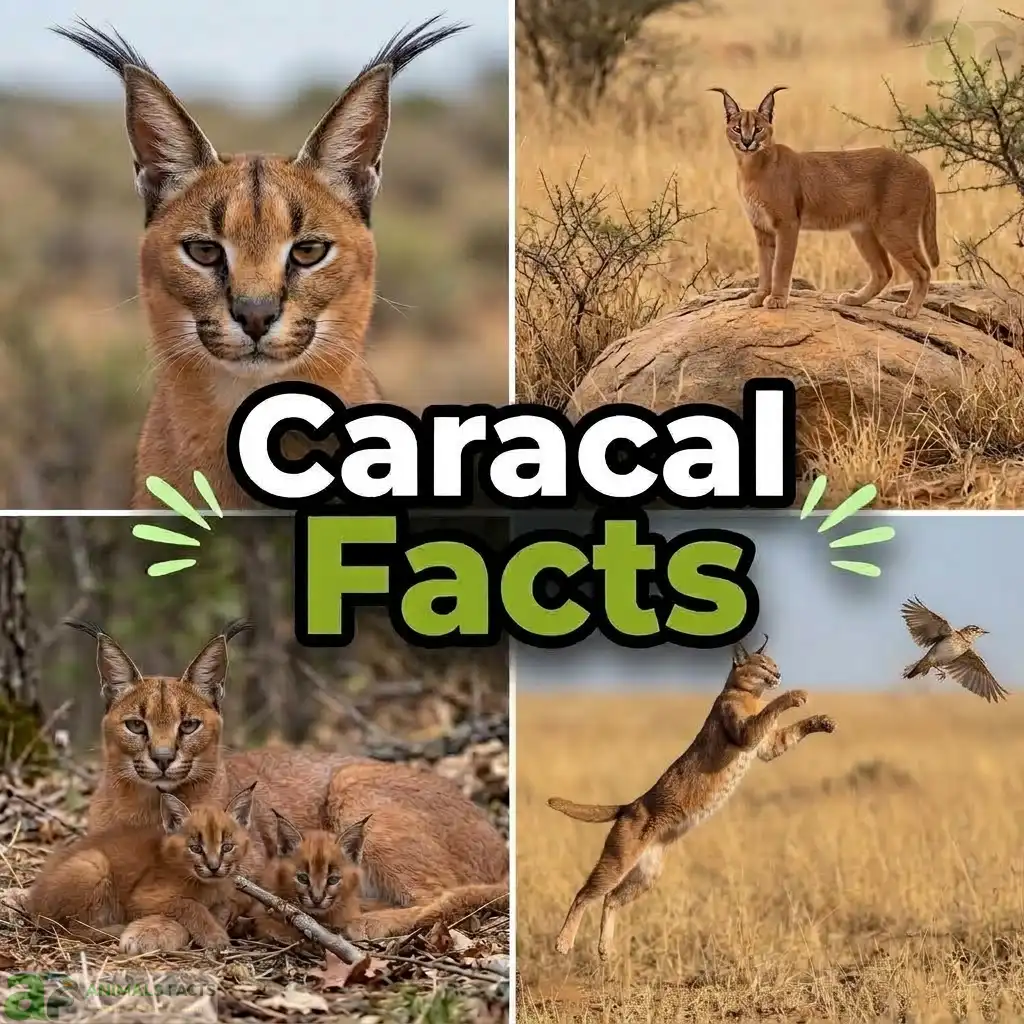
Caracal Facts
| Feature | Details |
|---|---|
| Scientific Name | Caracal caracal |
| Common Names | Caracal, Desert Lynx, Persian Lynx (historical, inaccurate) |
| Kingdom | Animalia |
| Phylum | Chordata |
| Class | Mammalia |
| Order | Carnivora |
| Family | Felidae |
| Genus | Caracal (sole living species) |
| Recognized Subspecies | 8–9 subspecies traditionally described; genetic research supports broad regional groupings rather than sharply distinct subspecies |
| Habitat | Savanna, scrubland, semi-desert, dry woodland, montane grassland — across Africa, the Middle East, Central Asia, and parts of South Asia |
| Lifespan | 10–12 years in the wild; up to 19 years in captivity |
| Diet | Carnivore — rodents, hares, hyraxes, birds, small antelope |
| Weight | 8–19 kg; males average heavier than females |
| Body Length | 65–90 cm (excluding tail); tail adds 25–34 cm |
| Shoulder Height | 40–50 cm |
| Top Speed | Approximately 80 km/h (50 mph) in short bursts |
| Vertical Jump / Bird Strike Height | Up to 3–3.5 meters vertically — among the highest of any cat relative to body size |
| Conservation Status | Least Concern (IUCN Red List, global); regionally threatened in North Africa, Central Asia, and parts of the Middle East |
| Global Wild Population | Estimated 50,000+ individuals (significant uncertainty; poorly monitored across much of range) |
| Unique Feature | Famous for knocking multiple birds out of the air in a single leap; long black ear tufts; closest living relative is the African Golden Cat and serval |
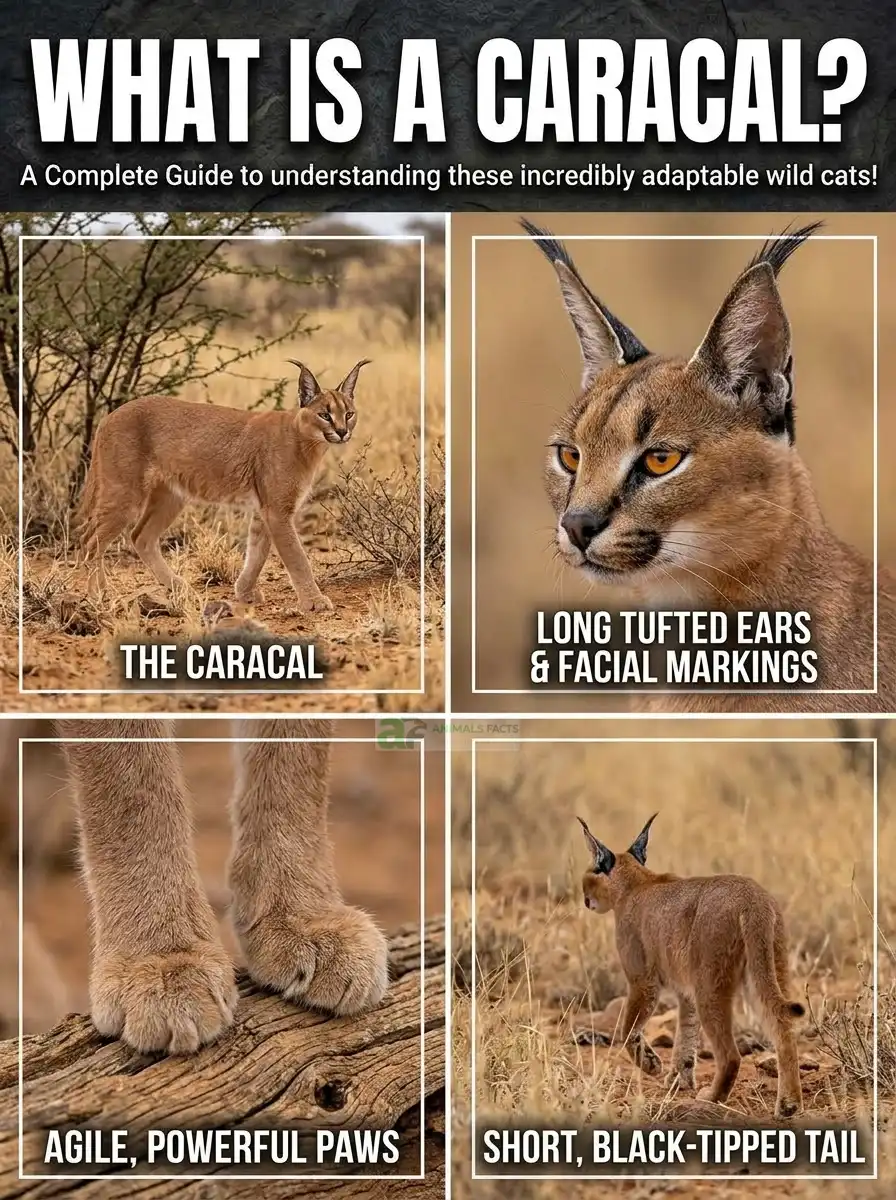
 1. Introduction: What is a Caracal?
It can leap more than three meters straight up into the air — higher than a basketball hoop — and in that single explosive jump, strike down not just one bird but several at once, swatting startled flocks out of the sky with paws moving faster than the human eye can follow. It is one of the most powerful jumpers relative to body size of any cat on Earth, a predator capable of taking down prey several times its own weight, and yet it remains one of the least recognized and most overlooked wild cats in the world — overshadowed in public awareness by its more famous African neighbors despite being, pound for pound, one of the most formidable felines on the planet. Caracal facts are full of genuine surprises.
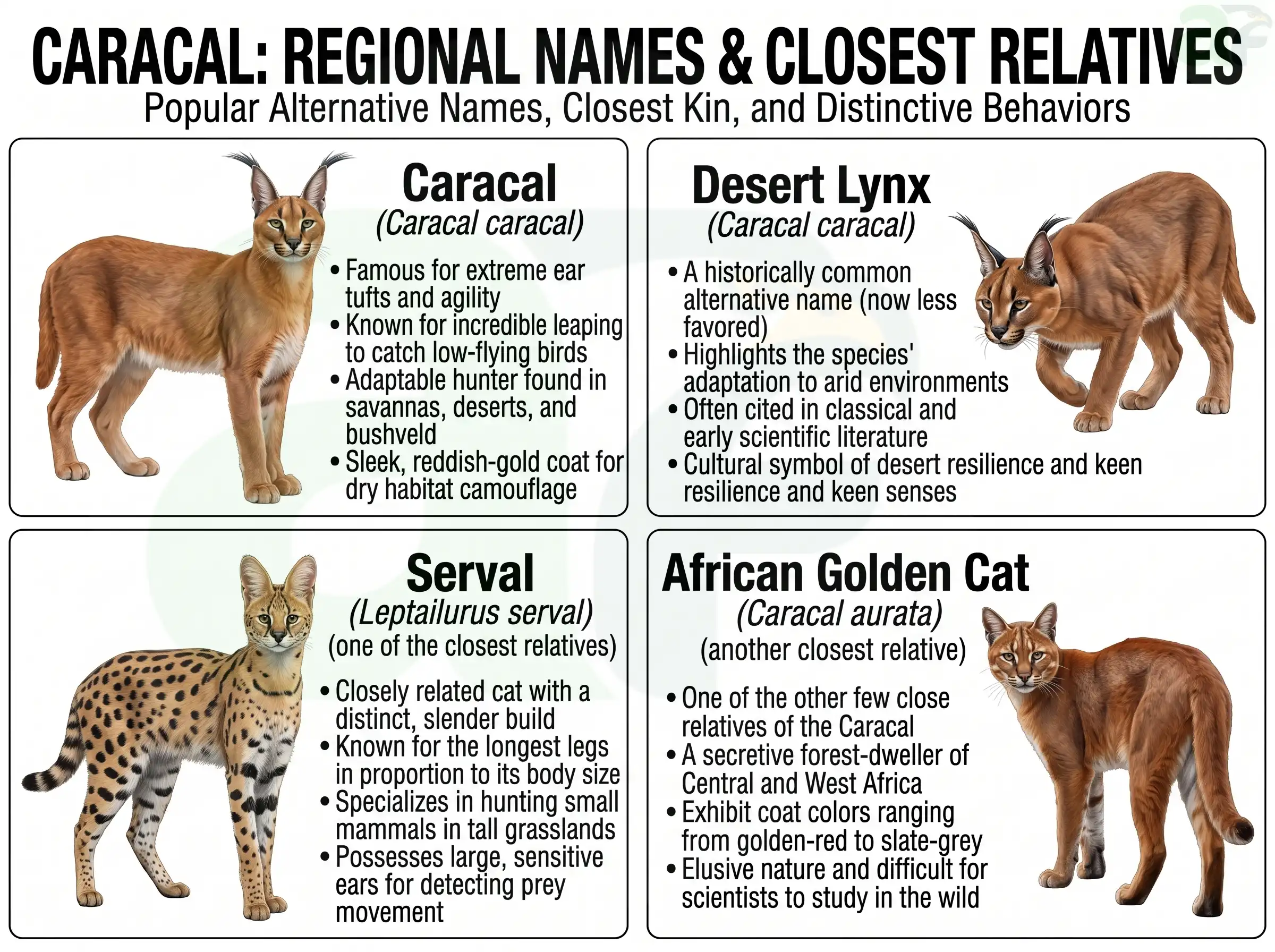
The caracal — Caracal caracal — is a medium-sized wild cat distinguished immediately by its long, dramatic black ear tufts (which give it its common alternate name, sometimes confusingly applied, of “desert lynx,” despite the caracal not being a true lynx at all) and its extraordinary combination of speed, power, and explosive jumping ability. Genetic research has revealed that the caracal’s closest living relatives are not the lynxes it superficially resembles, but rather the African Golden Cat and the serval — together forming a distinct evolutionary lineage within the cat family that diverged from other felids millions of years ago. Found across an enormous range spanning most of Africa, the Middle East, Central Asia, and parts of the Indian subcontinent, the caracal has proven remarkably adaptable to a wide range of arid and semi-arid environments, while remaining one of the most elusive and least-studied medium-sized cats on Earth.
Whether you are a student researching caracal facts for a school project, a wildlife photographer hoping to capture this elusive cat’s astonishing jumping ability on camera, a parent looking for caracal facts for kids, a conservation enthusiast interested in this often-overlooked African and Asian predator, or simply someone who has been captivated by viral videos of caracals demonstrating their extraordinary acrobatic hunting skills — this is the most complete guide to caracal facts you will find anywhere. We cover caracal habitat, caracal diet, caracal behavior, communication, reproduction, conservation, mythology, and the extraordinary story of one of the world’s most underappreciated wild cats. Let us begin.
2. Species Overview & Classification
The caracal belongs to the family Felidae within the subfamily Felinae — the non-roaring cats — and is the sole living species within its own genus, Caracal. This genus represents a distinct evolutionary lineage within the cat family, genetically separate from both the true lynxes (genus Lynx) and the larger Panthera cats, despite superficial resemblance to lynxes through its tufted ears.
The Caracal Lineage — Closer to the Serval Than the Lynx
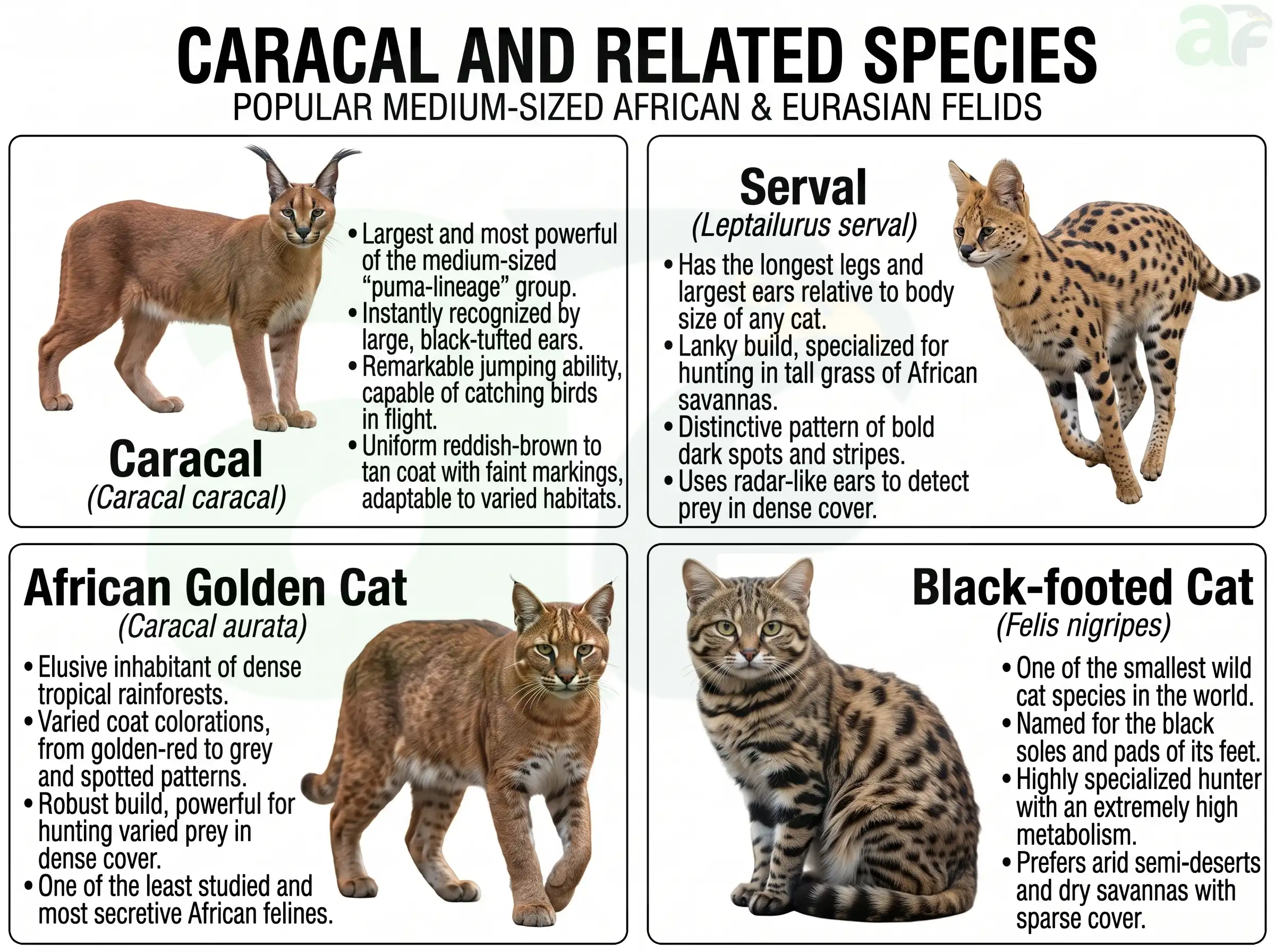
One of the most significant findings in modern felid genetics is that the caracal’s name and superficial appearance — particularly its prominent ear tufts — have historically led to widespread confusion with true lynx species, generating the misleading historical common name “desert lynx” or “Persian lynx.” Genetic research has definitively established that the caracal is not closely related to any lynx species. Instead, its closest living relatives are the African Golden Cat (Caracal aurata) and the serval (Leptailurus serval) — together forming the Caracal lineage, one of eight major lineages recognized within the modern cat family Felidae.
Species Classification Table
| Level | Classification |
|---|---|
| Kingdom | Animalia |
| Phylum | Chordata |
| Class | Mammalia |
| Order | Carnivora |
| Family | Felidae |
| Subfamily | Felinae |
| Genus | Caracal |
| Species | C. caracal |
| Closest Relatives | African Golden Cat (Caracal aurata), Serval (Leptailurus serval) |
Caracal Subspecies (Traditional Classification)
Historical taxonomy described 8–9 subspecies of caracal based primarily on geographic distribution and minor morphological variation, though modern genetic analysis suggests these regional populations may represent a continuum of variation rather than sharply distinct evolutionary units:
| Subspecies (Traditional) | Range |
|---|---|
| C. c. caracal | Southern Africa |
| C. c. nubica | East Africa, Sudan |
| C. c. algira | North Africa |
| C. c. michaelis | Turkmenistan, Central Asia |
| C. c. schmitzi | Middle East, Arabian Peninsula |
| C. c. poecilotis | West Africa |
| C. c. limpopoensis | Southern Africa (regional variant) |
Species Evolution & Discovery Timeline
~8.5 million years ago: The Caracal lineage — comprising the ancestors of the modern caracal, African Golden Cat, and serval — diverged from other cat lineages during the late Miocene Epoch, establishing one of the eight major evolutionary branches of the modern Felidae family.
~3.4 million years ago: Genetic divergence between the caracal and serval lineages occurred, with the two species subsequently developing dramatically different hunting adaptations — the caracal toward explosive jumping power and the serval toward elongated limbs for grassland hunting — despite their shared evolutionary origin.
~1 million years ago: Caracals achieved their broad modern distribution across Africa, the Middle East, and parts of Asia — a range expansion that reflects the species’ exceptional adaptability to arid and semi-arid environments across three continents.
Ancient Egypt (~3000–300 BCE): The earliest documented evidence of human-caracal interaction — with caracal imagery appearing in Egyptian art and mummified caracal remains discovered in connection with the sacred animal burial traditions associated with the cat-headed goddess Bastet, suggesting the caracal held religious or symbolic significance distinct from the domestic cat.
Persian and Indian historical period (~1500s–1900s CE): Caracals were trained as hunting companions across Persia and the Indian subcontinent — used in a hunting practice analogous to falconry, in which trained caracals were released to catch game birds, demonstrating the species’ extraordinary natural hunting prowess being harnessed for human use.
1776: The caracal was formally described scientifically by Johann Christian Daniel von Schreber, establishing its place in formal Western zoological taxonomy.
20th century: Caracals were extirpated from significant portions of their historical range — including most of North Africa outside Morocco and parts of their former Central Asian distribution — through habitat loss, hunting, and persecution as livestock predators.
2002–2026: Modern genetic research definitively established the caracal’s evolutionary relationship to the serval and African Golden Cat, fundamentally revising scientific understanding of the species’ taxonomic position and prompting renewed conservation and research interest in this previously understudied cat.
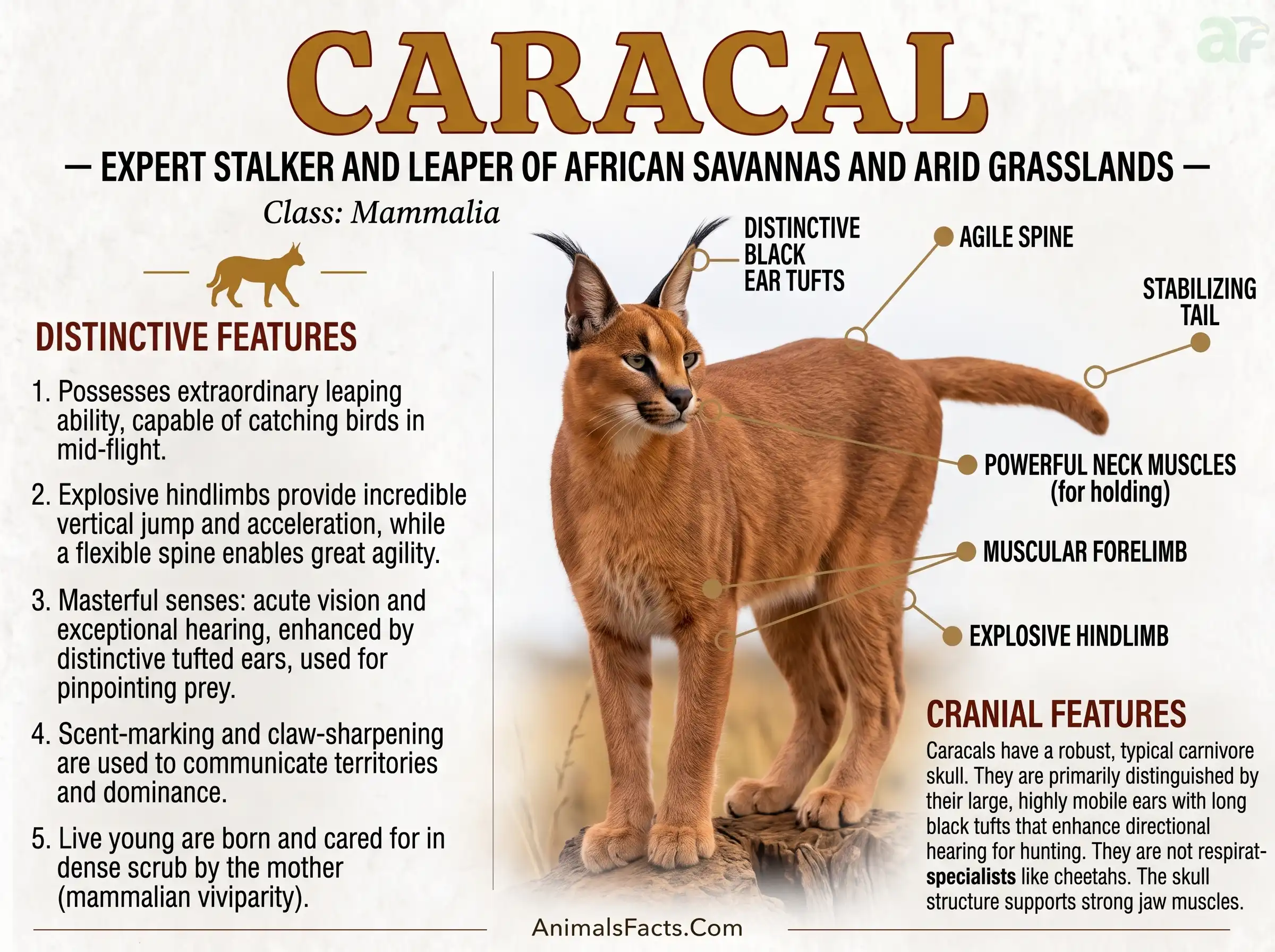
3. Physical Description & Unique Features
The caracal’s physical design represents one of the most specialized combinations of power, speed, and explosive jumping capability found in any medium-sized cat — every anatomical feature contributing to its extraordinary reputation as the supreme aerial hunter among the world’s wild cats.
Size and Sexual Dimorphism
Caracals are medium-sized cats — significantly larger than a domestic cat but smaller than a leopard or cougar. Males are typically 15–20% heavier than females:
- Males: Typically 8–19 kg, with the largest individuals from southern African populations
- Females: Typically 7–13 kg
- Body length: 65–90 cm excluding tail, with the tail adding a further 25–34 cm
The Iconic Ear Tufts
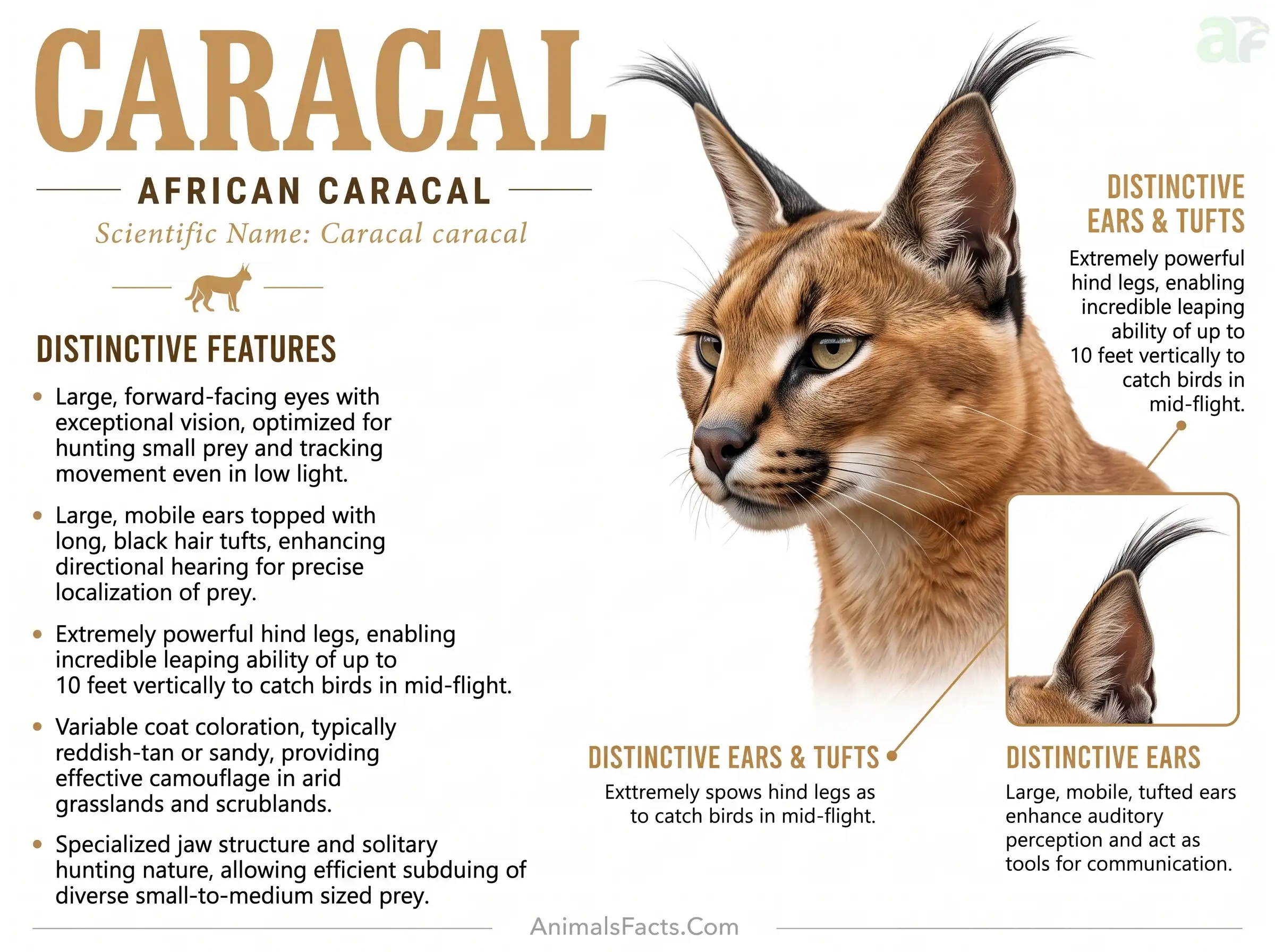
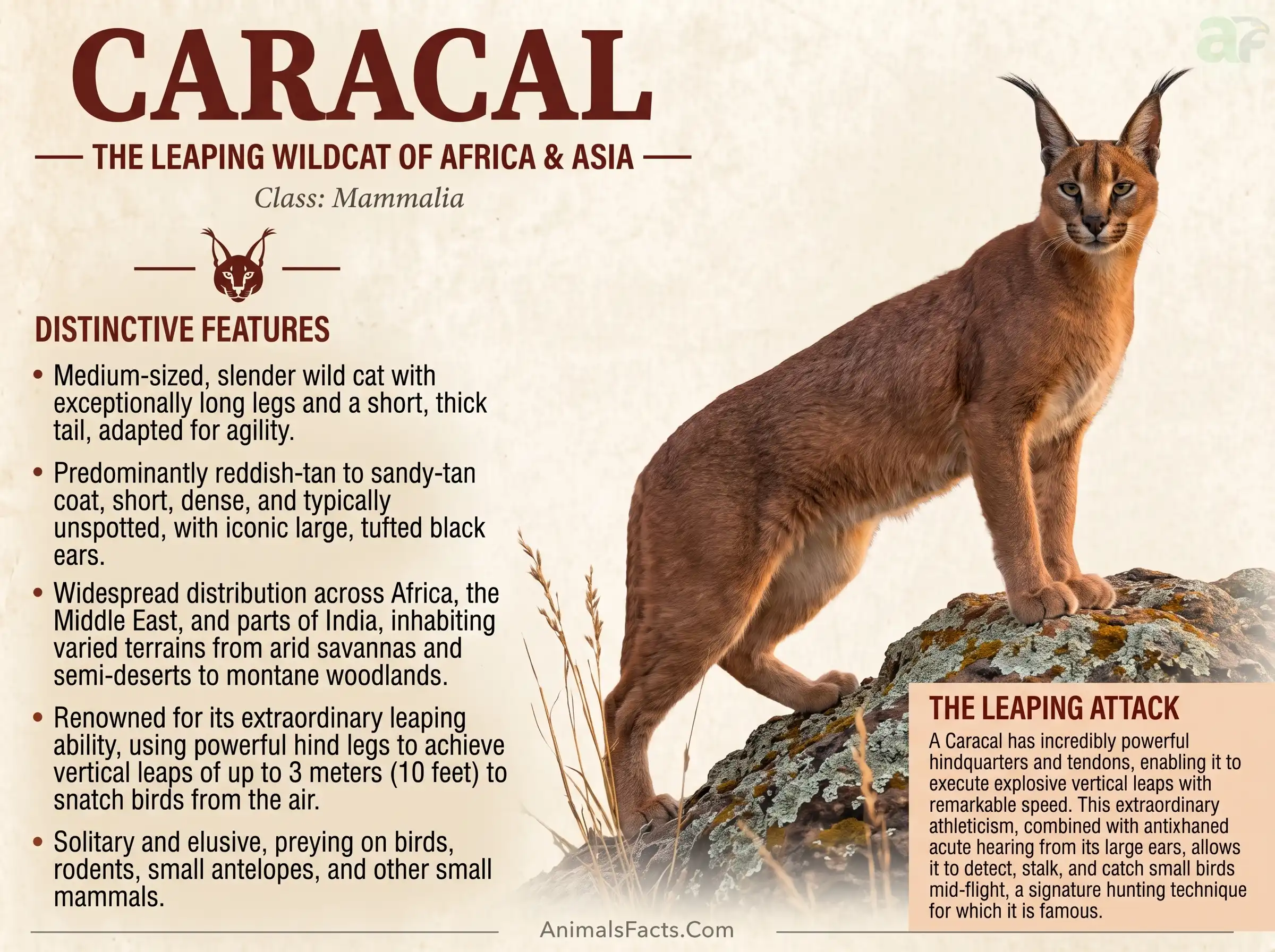
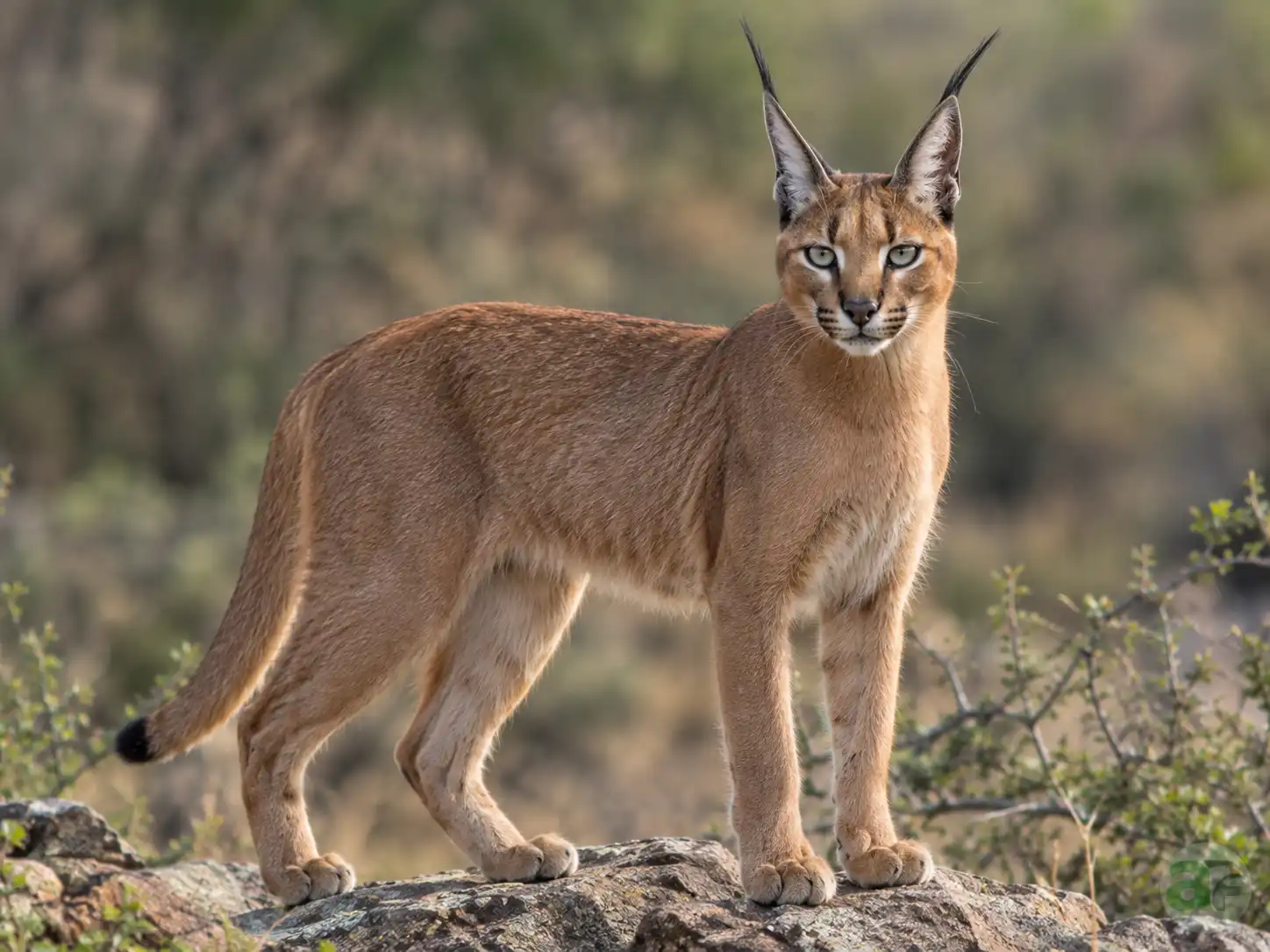
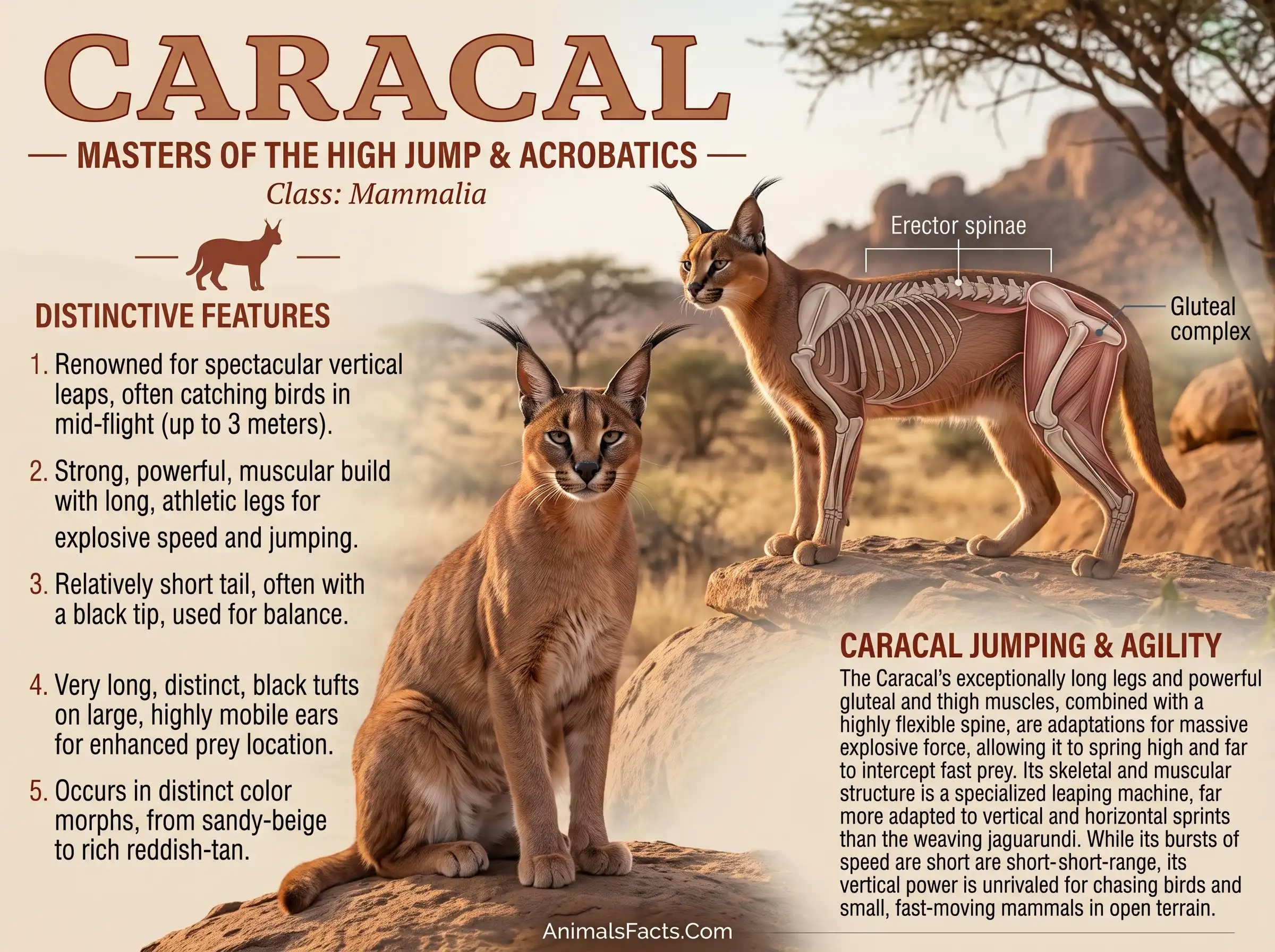
The caracal’s most distinctive and immediately recognizable feature is its long, prominent black ear tufts — extending up to 5 cm from the tips of the ears, the longest and most dramatic ear tufts of any wild cat species. These tufts give the caracal its name — derived from the Turkish word “karakulak,” meaning “black ear.”
The functional purpose of the caracal’s exceptional ear tufts has generated significant scientific interest, with proposed explanations including enhanced directional hearing (extending the effective surface area available for sound collection), visual communication between individuals (the tufts are highly visible and may convey emotional state through movement), and species and individual recognition during social encounters.
Explosive Hindquarter Power
The caracal’s most celebrated physical capability — its extraordinary jumping power — is generated by exceptionally well-developed hindquarter musculature relative to its body size. The caracal’s powerful hind legs, combined with a flexible spine, allow it to generate the explosive vertical leaps of up to 3–3.5 meters that have made it internet-famous for knocking birds out of mid-flight — a capability unmatched by any other cat species relative to body size, and rivaling some of the most powerful jumping mammals on Earth pound-for-pound.
Coat and Coloration
The caracal’s coat is a uniform tawny, reddish-brown, or sandy color — without the spots or stripes that characterize most other medium-sized wild cats — providing excellent camouflage against the arid, scrubland, and savanna backgrounds that characterize most of its range. The underside is typically paler, often white, with subtle dark markings around the eyes and a distinctive white patch above each eye and around the mouth. Unlike many spotted cats, the caracal’s solid coat coloration is sometimes compared to that of the cougar or the lion, reflecting a convergent evolutionary adaptation to similar open, arid habitat types.
Facial Markings
The caracal possesses a distinctive facial pattern featuring black markings on the face — particularly around the eyes and on the bridge of the nose — combined with the long black ear tufts, giving the species a striking and somewhat dramatic facial appearance that has made it a popular subject for wildlife photography despite the species’ overall behavioral secretiveness.
Did You Know? The caracal’s extraordinary jumping ability has made it the subject of viral wildlife videos showing the cat leaping into the air and striking multiple birds simultaneously from a flushed flock — a hunting technique that requires not only the raw jumping power for which the species is famous but also extraordinary spatial awareness and paw-eye coordination to track and intercept multiple fast-moving targets during a single airborne leap. Research has documented caracals successfully knocking down two birds in a single jump on multiple occasions — a feat that has been compared to the precision required for a human athlete to simultaneously catch two thrown objects while in mid-air during a jump.
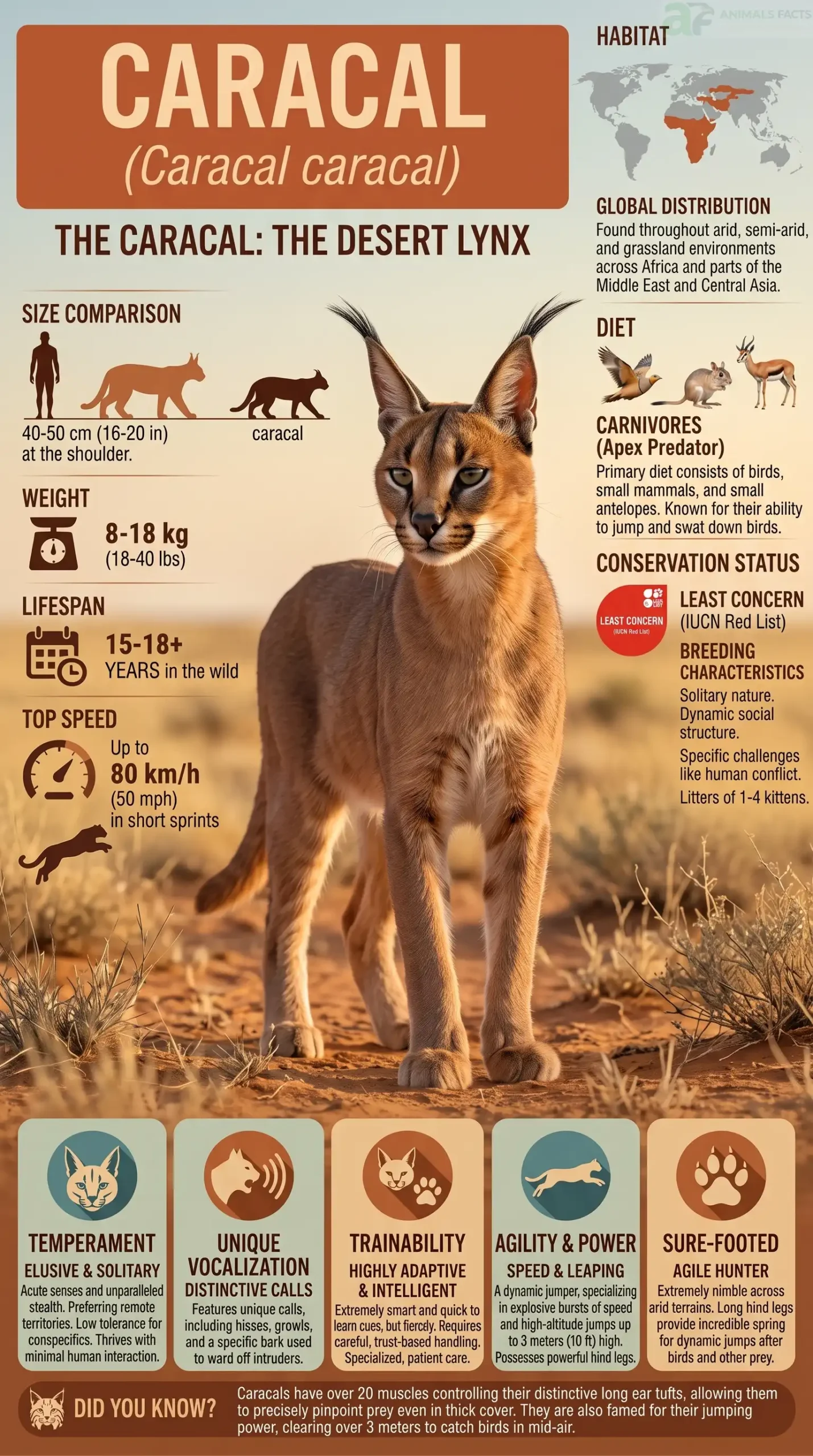
4. Top 25 Surprising & Interesting Caracal Facts
- The caracal can leap over 3 meters vertically — high enough to knock birds out of the air in mid-flight, one of the most impressive jumping feats of any cat species relative to body size.
- Caracals have been documented striking down multiple birds in a single leap — using their powerful paws to swat several startled birds from a flushed flock during one explosive jump.
- The name “caracal” derives from the Turkish word “karakulak,” meaning “black ear” — a direct reference to the species’ most distinctive physical feature.
- The caracal’s closest living relatives are not lynxes despite superficial resemblance, but rather the African Golden Cat and the serval — together forming a distinct evolutionary lineage that diverged from other cats approximately 8.5 million years ago.
- Caracals were historically trained for hunting across Persia and India — used in a practice similar to falconry, in which trained caracals were released to catch game birds, demonstrating the extraordinary natural hunting capability that humans sought to harness.
- The caracal can take down prey up to three times its own body weight — including young antelope, adult impala lambs, and small adult ungulates considerably larger than the cat itself.
- Despite weighing only 8–19 kg, caracals have been documented successfully hunting and killing adult mountain reedbuck and young kudu — antelope species significantly larger than the cat.
- The caracal’s range spans three continents — Africa, the Middle East, and Asia — making it one of the most geographically widespread medium-sized wild cats in the world, second only to the bobcat and leopard in overall range extent among non-domestic cats.
- Caracals can survive for extended periods without drinking free water — obtaining sufficient moisture from their prey, an adaptation that allows them to persist in extremely arid desert environments across their range.
- The caracal is sometimes called the “African lynx” or “desert lynx” despite not being a true lynx species at all — one of the most persistent and widespread cases of common-name taxonomic confusion in the wild cat world.
- Caracals possess independently mobile ears — each ear capable of rotating separately to triangulate sound location with exceptional precision, controlled by over 20 distinct muscles per ear, more than almost any other mammal.
- A caracal’s hunting success rate against birds in flight has been documented as remarkably high compared to other aerial-hunting predators — reflecting the precision and power of their jumping technique.
- The caracal is the largest of Africa’s small wild cats — significantly outsizing the African Wildcat, Black-footed Cat, and Sand Cat, while remaining considerably smaller than the leopard, lion, and cheetah that share much of its range.
- Caracals have been documented in ancient Egyptian art and mummification practices — with preserved caracal remains discovered in connection with sacred cat burial sites, suggesting the species held religious significance in ancient Egyptian culture distinct from the domestic cat.
- In parts of their range, caracals are known to climb trees to escape larger predators or to access bird nests — demonstrating climbing capability beyond what their primarily terrestrial hunting style might suggest.
- The caracal’s whiskers are exceptionally long and sensitive, providing critical tactile information that supplements vision during low-light hunting and helps the cat navigate through dense scrub vegetation without visual confirmation of every obstacle.
- Caracals have been recorded preying on domestic livestock including young goats and sheep, generating significant human-wildlife conflict across pastoral regions of their range — a conflict pattern documented from South Africa to Iran.
- The caracal possesses a remarkably broad ecological niche — successfully hunting prey ranging from small rodents and birds to antelope many times its own weight, demonstrating dietary flexibility unusual among similarly-sized cat species.
- Research using camera traps and GPS collar data has documented individual caracals maintaining territories of up to 300 km² in the most arid and prey-sparse portions of their range, among the largest territories of any cat of comparable body size.
- The caracal’s coat color varies geographically — with desert populations typically displaying paler, sandier coloration than populations from more vegetated habitats, an adaptation that provides optimal camouflage for the specific environment each population inhabits.
- Caracals are primarily solitary and nocturnal across most of their range — though daytime activity has been documented in regions with minimal human disturbance and cooler temperatures.
- A caracal kept as a pet by musician and TV personality “Caracal Cat” videos (multiple individuals across social media) has generated enormous public interest in the species — though wildlife experts consistently caution against keeping caracals as pets due to their wild behavioral needs and the legal and ethical complexities involved.
- The caracal is one of the few wild cat species with documented evidence of surplus killing of domestic poultry — entering enclosures and killing significantly more birds than it can consume in a single feeding, a behavior pattern that intensifies human-caracal conflict in agricultural areas.
- Caracals have a bite force proportionally among the strongest of medium-sized cats — reflecting their capability to dispatch prey considerably larger than themselves through a precise and powerful killing bite.
- The South African caracal population has been the subject of one of the most extensive long-term urban-edge predator research programs in Africa — the Urban Caracal Project based in Cape Town, documenting how caracals navigate the wildland-urban interface of one of Africa’s largest metropolitan areas.
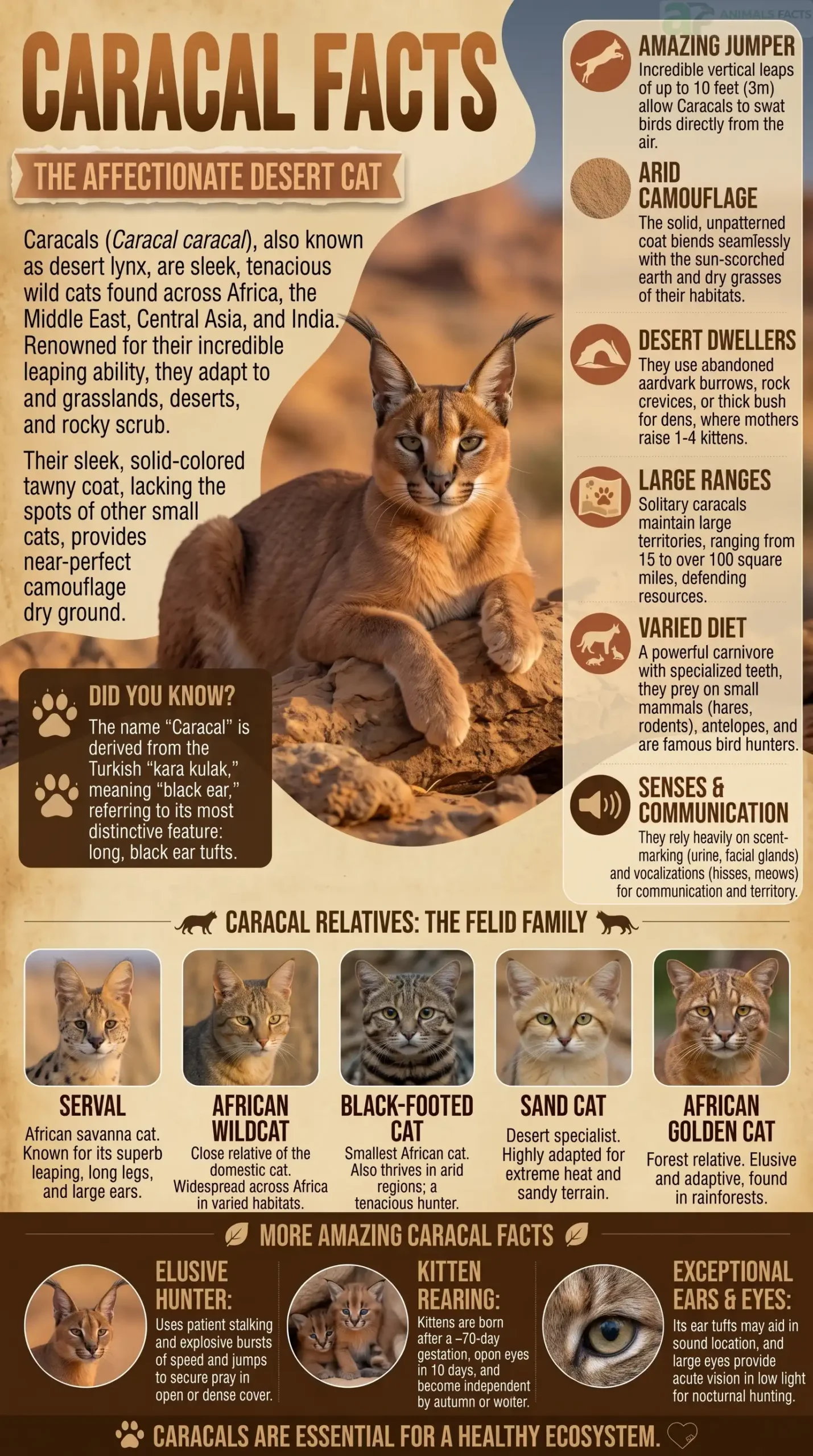
5. Fun Facts About Caracals
- Caracals can leap over 3 meters straight up — high enough to knock birds from the sky.
- The name “caracal” comes from the Turkish word for “black ear.”
- The caracal’s closest relatives are the serval and African Golden Cat — not the lynx.
- Caracals were historically trained for hunting birds, similar to falconry.
- Caracals can kill prey up to three times their own body weight.
- The caracal’s range spans three continents — Africa, the Middle East, and Asia.
- Caracals can survive without drinking free water for extended periods.
- Each caracal ear has over 20 muscles for independent rotation.
- Caracal remains have been found in ancient Egyptian sacred animal burials.
- Caracals occasionally climb trees to escape predators or reach prey.
- The caracal is the largest small wild cat in Africa.
- A research program in Cape Town studies caracals living at the edge of the city.
6. Natural Habitat & Geographic Range
The caracal’s habitat range is genuinely extraordinary in its geographic scope — spanning three continents and an enormous diversity of arid, semi-arid, and savanna environments, reflecting the species’ exceptional ecological flexibility and tolerance for water-limited conditions that few other medium-sized cats can match.
Primary Habitat Types
Savanna and grassland: Across much of sub-Saharan Africa, caracals inhabit open savanna and grassland habitat — sharing this environment with lions, leopards, and cheetahs while occupying a different ecological niche through their smaller size and different prey preferences.
Semi-desert and arid scrubland: Some of the most significant caracal populations occupy genuinely arid environments — including the Kalahari Desert, the Karoo region of South Africa, and the arid zones of North Africa and the Middle East — demonstrating the species’ remarkable adaptation to water-scarce conditions.
Montane and rocky terrain: Caracals are documented at significant elevation across their range — including mountainous regions of South Africa, the Atlas Mountains of North Africa, and highland areas of the Middle East and Central Asia, where rocky terrain provides denning sites and hunting cover.
Dry woodland: Across portions of East and Southern Africa, caracals inhabit dry woodland and bushveld habitats — utilizing dense vegetation for concealment while hunting in adjacent more open areas.
Desert margins (Central Asia and Middle East): The Central Asian and Middle Eastern populations of the caracal occupy some of the most extreme desert-margin environments inhabited by any cat species — including portions of Turkmenistan, Iran, and the Arabian Peninsula, where the species persists at very low densities in genuinely harsh conditions.
Urban-wildland interface: A growing area of research interest — caracal populations at the edge of expanding cities, particularly Cape Town, South Africa, have demonstrated remarkable adaptability to peri-urban environments, navigating fragmented natural habitat patches within and around a major metropolitan area.
Habitat Range by Continent/Region
| Region | Countries | Population Status | Notes |
|---|---|---|---|
| Southern Africa | South Africa, Namibia, Botswana, Zimbabwe | Most abundant and best-studied population | Stable; significant human-wildlife conflict |
| East Africa | Kenya, Tanzania, Ethiopia | Present but less studied | Poorly monitored |
| West Africa | Senegal, Nigeria, and surrounding countries | Reduced; fragmented | Declining; habitat loss |
| North Africa | Morocco, Algeria, Tunisia, Egypt | Significantly reduced | Locally threatened; historical range contraction |
| Middle East | Saudi Arabia, UAE, Israel, Jordan, Iran | Fragmented; low density | Vulnerable in several countries |
| Central Asia | Turkmenistan, Uzbekistan | Critically low; poorly monitored | Among the most threatened regional populations |
| South Asia | India (Rajasthan, Gujarat) | Very small, isolated population | Critically Endangered nationally in India |
Did You Know? The caracal population in India — restricted primarily to the arid regions of Rajasthan and Gujarat — is so critically small and fragmented that the species is listed as Critically Endangered at the national level by Indian wildlife authorities, despite the species’ overall global classification of Least Concern. India’s caracal population may number fewer than 50 confirmed individuals, representing one of the most severe regional conservation crises facing any caracal population worldwide and highlighting how dramatically conservation status can vary across a species’ geographic range.
7. Diet & Feeding Behavior
The caracal is an exceptionally capable and versatile predator — combining the explosive power needed to take down prey several times its own weight with the precision required to catch small, fast-moving prey including birds in flight, making it one of the most ecologically flexible medium-sized cats in the world.
What Caracals Eat
Caracal diet varies considerably by region and prey availability, but consistently demonstrates the species’ capacity to exploit a remarkably broad range of prey sizes and types — from insects and small rodents to antelope species considerably larger than the cat itself.
Diet Breakdown Table
| Prey Type | Approximate Percentage | Notes |
|---|---|---|
| Rodents (rats, mice, gerbils) | 25–40% | Primary prey across most habitats |
| Hares and rabbits | 15–25% | Important supplementary prey |
| Hyraxes (rock hyrax/dassie) | 10–20% (rocky habitats) | Particularly important in mountainous terrain |
| Birds (various, including game birds) | 10–20% | Notable for aerial capture technique |
| Small antelope (duiker, steenbok, young impala) | 10–20% | Demonstrates exceptional power relative to body size |
| Reptiles | 2–8% | Supplementary; varies by habitat |
| Domestic livestock (goats, sheep, poultry) | Variable | Significant conflict source in pastoral regions |
| Insects and invertebrates | 1–5% | Minor dietary component |
Hunting Strategy
The caracal employs a combination of stalk-and-ambush and explosive pursuit hunting techniques, adapted to the specific prey type being targeted:
Ground-based stalking: For mammalian prey including rodents, hares, and small antelope, the caracal uses a careful, patient stalking approach through available cover, closing to within striking distance before launching a rapid pursuit covering the final gap in seconds.
Aerial bird hunting: The caracal’s most famous and visually spectacular hunting technique — when approaching a flock of resting or feeding birds, the caracal launches an explosive vertical leap timed to intercept the birds as they flush into flight, using its powerful paws to strike down one or occasionally multiple birds during a single airborne maneuver. This technique requires precise timing and spatial calculation, as the cat must anticipate the birds’ flight trajectory and intercept them mid-air rather than pursuing prey that has already escaped to a safe altitude.
Antelope predation: For prey significantly larger than itself — including young kudu, impala lambs, and adult mountain reedbuck — the caracal relies on a precise throat or nape bite delivered after a rapid, powerful ambush rush, using its disproportionate strength relative to body size to subdue and dispatch prey that would seem, by simple weight comparison, to be beyond the cat’s capability.
Caching behavior: Like several other medium-sized cats, caracals have been documented caching larger kills — covering partially consumed carcasses with vegetation or debris and returning to feed over multiple days, particularly important when larger prey provides more food than can be consumed or safely defended in a single feeding.
Did You Know? Research analyzing caracal predation on livestock in South Africa’s Karoo region — one of the country’s most significant sheep and goat farming areas — has documented that caracals are responsible for a substantial proportion of small livestock losses, generating one of Africa’s most significant ongoing human-carnivore conflict situations. This conflict has driven extensive lethal control programs targeting caracals across South African farmland for decades, even as the species’ overall population remains stable — highlighting the complex tension between a genuinely successful, adaptable predator and the agricultural communities whose livelihoods can be directly affected by its predatory success.
8. Reproduction & Life Cycle
Caracal reproduction follows the general pattern of solitary medium-sized felids — with non-seasonal breeding capability in many parts of the range, moderate litter sizes, and a maternal dependency period appropriate to the complex hunting skills kittens must master before independence.
Mating Behavior
Caracals are capable of breeding year-round across much of their range, particularly in tropical and subtropical regions, though some populations — particularly those at higher latitudes or in more seasonal climates — show breeding peaks linked to optimal prey availability and environmental conditions.
Female caracals advertise estrus through scent marking and vocalizations, with males in overlapping territories responding and competing for mating access. Mating consortships between otherwise solitary adults are typically brief, lasting only a few days.
Gestation and Birth
Gestation period: Approximately 68–81 days.
Litter size: Typically 1–4 kittens (most commonly 2–3).
Birth weight: Approximately 250–300 grams per kitten.
Den location: Caracal kittens are born in a well-concealed den — typically a rock crevice, dense thicket, or abandoned burrow of another species — chosen for protection from predators and harsh weather conditions.
Key Developmental Stages
| Stage | Age | Key Development |
|---|---|---|
| Neonatal | 0–10 days | Eyes closed; entirely dependent on mother |
| Eyes open | 6–10 days | Beginning visual awareness |
| First outings | 4–6 weeks | First exploration outside den |
| Weaning | 10–12 weeks | Transition to solid food |
| Hunting learning | 4–10 months | Accompanies mother; learning prey detection and hunting |
| Independence | 9–12 months | Separation from mother; establishing own range |
| Sexual maturity | Female: ~7–12 months; Male: ~12–15 months | First breeding possible |
Lifespan Comparison Table
| Species | Average Wild Lifespan | Maximum Confirmed |
|---|---|---|
| Caracal | 10–12 years | ~19 years (captivity) |
| Serval | 10–12 years | ~22 years (captivity) |
| African Golden Cat | 10–12 years (estimated) | ~12 years (captivity) |
| Bobcat | 7–10 years | ~32 years (captivity) |
| Ocelot | 7–10 years | ~20 years (captivity) |
9. Social Behavior & Communication
The caracal is a predominantly solitary species — maintaining individual territories through scent marking and indirect communication, with social interaction largely confined to mating encounters and mother-kitten family groups.
Territorial Organization
Caracal territories vary dramatically depending on habitat quality and prey density — among the widest territorial size ranges documented for any cat of comparable body size:
- Productive habitat (South Africa farmland with abundant prey): Female territories as small as 4–7 km²; male territories 20–30 km²
- Arid/desert habitat (Central Asia, Sahara margins): Territories up to 300 km² for males in the most prey-sparse environments
Male caracal territories typically overlap with the ranges of 2–4 females, following the standard solitary felid territorial organization in which males maximize reproductive access by maintaining ranges that encompass multiple female territories.
Communication Methods
Scent marking: The primary communication medium — caracals spray urine on prominent vegetation and rocks, deposit feces at visible territorial locations, and use scratch marks on trees and termite mounds to maintain territorial information networks.
Vocalizations: Caracals produce a range of vocalizations including purring, hissing, growling, and a distinctive short bark or “wah” call used in close-range communication, particularly between mothers and kittens. Unlike some cats, caracals are not known for dramatic long-distance calls comparable to the lynx scream or cougar caterwaul, reflecting their generally quieter behavioral profile.
Body language: Ear position is particularly significant in caracal communication — given the prominent and highly visible ear tufts, subtle changes in ear orientation likely provide unusually clear visual signals to other caracals during the relatively infrequent close-range social encounters between territorial adults.
Did You Know? The Urban Caracal Project, based around Cape Town, South Africa, has used GPS collar data to document that caracals living at the edge of this major metropolitan area maintain surprisingly large territories — sometimes exceeding 20 km² — that incorporate both protected natural areas (including Table Mountain National Park) and fragmented urban green spaces, golf courses, and vineyard landscapes. This research has revealed that Cape Town’s caracals navigate one of the most human-dominated landscapes occupied by any wild cat population studied to date, crossing major roads regularly and showing measurable behavioral adaptations to minimize human encounter risk while still accessing the full extent of their required territory.
10. Predators & Defense Mechanisms
As a medium-sized predator, the caracal faces predation risk from several larger carnivores across its range, while itself representing a significant predatory threat to a remarkably broad range of prey species, creating a complex position within the predator hierarchies of the diverse ecosystems it inhabits.
Natural Predators and Competitors
Leopards: The most significant natural predator and competitor of caracals across most of sub-Saharan Africa — leopards regularly kill caracals in direct encounters and represent the dominant competitive pressure shaping caracal habitat use and activity timing in areas where both species coexist.
Lions and Hyenas: Both species represent significant threats to caracals, particularly kittens, in the African savanna ecosystems they share — with caracals generally avoiding areas of high lion or hyena activity through behavioral and spatial adjustment.
African Wild Dogs: In areas of overlap, packs of African Wild Dogs represent a coordinated predation threat that caracals, as solitary animals, cannot effectively counter through direct confrontation.
Jackals: Black-backed and side-striped jackals represent both competitors and occasional threats to caracal kittens, particularly in regions where jackal populations are dense.
Large eagles: Martial Eagles and other large African raptors are documented predators of caracal kittens, taking young animals during the vulnerable period before they reach sufficient size for protection from avian predation.
Humans: Across much of the caracal’s range — but particularly in South Africa’s agricultural regions — humans represent the most significant source of caracal mortality through lethal predator control programs targeting livestock predation, alongside habitat loss, vehicle collisions, and, in some regions, hunting for fur or traditional uses.
Defense Mechanisms
Speed and agility: The caracal’s combination of running speed (up to 80 km/h in short bursts) and extraordinary jumping power provide effective escape capability from most ground-based predators.
Tree climbing: Caracals readily climb trees when threatened by ground-based predators including leopards, hyenas, and dogs — accessing elevated refuge unavailable to non-climbing pursuers.
Cryptic behavior: Like most medium-sized cats, the caracal’s primary defensive strategy is behavioral secretiveness — avoiding direct encounters with larger predators through careful habitat selection, scent-based threat detection, and nocturnal or crepuscular activity timing in areas of higher predator density.

11. Caracal Facts for Kids
Hey kids — get ready to discover why the caracal is one of the most amazing jumping cats in the whole world!
- The caracal can jump over 3 meters straight up into the air — that’s taller than a basketball hoop! It uses this incredible jump to knock birds right out of the sky while they’re flying!
- Some caracals have even been seen knocking down two birds at once in a single jump — like a furry superhero with incredible reflexes!
- The name “caracal” comes from a Turkish word that means “black ear” — because of the cool, long black tufts of fur sticking up from the tips of its ears!
- Even though the caracal looks a bit like a lynx with those pointy ear tufts, scientists discovered that its closest relatives are actually different cats called the serval and the African Golden Cat — not lynxes at all!
- A long time ago, people in Persia and India actually trained caracals to hunt birds for them — kind of like how people train falcons today, except with a cat!
- The caracal can hunt animals three times bigger than itself — imagine if you could fight and win against someone three times your size!
- Caracals live on three different continents — Africa, parts of the Middle East, and parts of Asia! That’s a huge area for a cat that most people have never even heard of!
- Each of the caracal’s ears has over 20 different muscles that let it move each ear separately — like having two tiny radar dishes that can point in completely different directions at the same time!
Did You Know? Scientists studying caracals near Cape Town, South Africa, discovered something amazing — these wild cats have learned to live right at the edge of a huge city! They cross busy roads, sneak through vineyards, and even hunt in golf courses, all while staying mostly invisible to the millions of people living nearby. Some of these city-edge caracals have territories bigger than 20 football fields combined, showing just how cleverly they’ve adapted to share their home with one of Africa’s biggest cities!
12. Relationship with Humans
The caracal’s relationship with humans spans thousands of years of documented interaction — from apparent religious significance in ancient Egypt, through historical use as a trained hunting companion across Persia and India, to contemporary conflict with livestock farmers and emerging research on urban coexistence.
Ancient Egyptian Connections
Caracal remains discovered in connection with ancient Egyptian sacred animal burial sites — associated with the cult of the cat-headed goddess Bastet — suggest that the caracal held religious or symbolic significance in ancient Egyptian culture that was distinct from, though related to, the reverence shown toward the domestic cat. The presence of caracal mummies alongside the more numerous domestic cat mummies indicates that ancient Egyptians recognized and specifically valued this larger, more powerful wild relative of the domestic cat.
The Hunting Companion Tradition
One of the most distinctive historical human-caracal relationships developed across Persia (modern Iran) and India, where caracals were captured, trained, and used as hunting companions in a practice with notable similarities to falconry. Trained caracals were released to catch game birds and small mammals for their human handlers — a practice that required harnessing the caracal’s extraordinary natural hunting ability, including its famous bird-striking jump, for practical human benefit. This tradition persisted in various forms across the region for centuries, representing one of the most sustained human partnerships with any wild felid species outside of full domestication.
Contemporary Livestock Conflict
The most significant contemporary human-caracal interaction is livestock predation conflict, particularly acute in South Africa’s agricultural regions — where caracals regularly prey on sheep, goats, and poultry, generating substantial economic losses for farming communities. This conflict has driven extensive lethal predator control programs, including hunting, trapping, and poisoning campaigns targeting caracals across South African farmland, despite the species’ overall population remaining stable at the national level. The tension between caracal predation losses and farmer livelihoods represents one of Africa’s most significant and longest-running human-carnivore conflicts involving a medium-sized cat species.
The Exotic Pet Phenomenon
In recent years, caracals have gained significant attention as exotic pets in some countries — driven partly by viral social media content showing tame caracals in domestic settings. Wildlife experts and conservation organizations consistently caution against this practice, noting that caracals retain strong wild behavioral instincts, require specialized care and enormous space inappropriate for typical domestic settings, and that private ownership in many jurisdictions exists in a complex and often inadequately regulated legal gray area that can facilitate illegal wildlife trade.
13. Conservation Status & Threats
The caracal’s overall Least Concern IUCN classification reflects its genuinely stable and widespread population across much of southern and eastern Africa — but this broad classification obscures significant regional conservation crises facing specific populations across the species’ enormous range.
Global Caracal Conservation Data (2026)
| Region / Population | Status | Population Estimate | Trend |
|---|---|---|---|
| Southern Africa | Least Concern | Largest and most stable population | Stable |
| East Africa | Least Concern (regional) | Significant but poorly quantified | Stable to declining |
| West Africa | Near Threatened (regional) | Reduced; fragmented | Declining |
| North Africa | Vulnerable (regional) | Significantly reduced | Declining; locally extirpated in places |
| Middle East | Vulnerable to Endangered (regional, country-dependent) | Fragmented; low density | Declining |
| Central Asia | Endangered (regional) | Critically low | Sharply declining |
| India | Critically Endangered (national) | Possibly fewer than 50 individuals | Critical; near-extinction risk |
Major Threats to Caracals
Retaliatory killing over livestock predation: The most significant and widespread threat across much of the caracal’s range — particularly acute in South Africa’s commercial farming regions, where extensive predator control programs targeting caracals (alongside black-backed jackals) have continued for decades, representing one of the most significant ongoing sources of caracal mortality continent-wide.
Habitat loss and fragmentation: Agricultural expansion, urban development, and infrastructure construction progressively reduce and fragment caracal habitat across all range regions — with particularly severe impacts in North Africa, the Middle East, and Central Asia, where caracal populations were already naturally sparse due to the arid environments these regions occupy.
Road mortality: An increasingly documented threat, particularly relevant for populations at the urban-wildland interface such as Cape Town’s caracal population, where road networks bisecting fragmented natural habitat create significant vehicle collision risk.
Illegal hunting and trapping: Despite legal protections in many countries, caracals continue to be illegally hunted and trapped across portions of their range — for fur, for the exotic pet trade, and in some regions for traditional medicine or cultural practices.
Prey depletion: In regions where hunting pressure has significantly reduced wild prey populations, caracals face reduced food availability that can drive increased reliance on livestock predation — creating a feedback loop that intensifies human-wildlife conflict.
Did You Know? South Africa’s caracal population has been subject to extensive, long-running predator control programs specifically targeting caracal and black-backed jackal predation on livestock — with estimates suggesting that thousands of caracals are killed annually across South African farmland through various lethal control methods including hunting, trapping, and historically, poison. Despite this sustained and significant mortality pressure, South African caracal populations have remained remarkably stable — a demonstration of the species’ exceptional reproductive resilience and ecological adaptability that distinguishes it from many other medium-sized carnivores facing comparable human-caused mortality pressure.
14. Famous Caracals
The Urban Caracal Project’s Tracked Individuals
The Urban Caracal Project in Cape Town, South Africa, has individually monitored and named numerous caracals through GPS collar research since its establishment — with these tracked individuals generating significant public interest and media coverage as researchers document their movements through one of Africa’s largest urban areas. These named research subjects have become important ambassadors for caracal conservation awareness across South Africa, with their mapped territorial movements published and discussed extensively in regional media.
Social Media Caracal Celebrities
Several individual pet and rescue caracals have achieved significant social media fame in recent years — with videos showing their characteristic ear movements, jumping ability, and behavior generating millions of views across platforms including Instagram, TikTok, and YouTube. While these individuals have significantly raised public awareness and fascination with the species, wildlife conservation organizations have consistently used this attention as an opportunity to educate the public about the ethical and practical concerns surrounding private caracal ownership.
Historical Hunting Caracals
While individual named caracals from the historical Persian and Indian hunting tradition are not well-documented in surviving records to the same degree as famous individual cheetahs from similar hunting traditions, historical accounts and artwork from the Mughal period in India depict trained caracals as valued and individually recognized hunting companions of royalty and nobility, reflecting a sustained cultural tradition of human-caracal partnership across several centuries.
15. Role in Ecosystem & Food Chain
The caracal functions as an important mesopredator across the diverse ecosystems it inhabits — regulating populations of rodents, hares, hyraxes, and birds while itself serving as prey for larger carnivores, occupying a critical mid-level position in food webs spanning three continents.
Rodent and Small Mammal Population Control
The caracal’s predation on rodents and hares provides significant pest control services across agricultural and natural landscapes throughout its range — research has documented that areas with healthy caracal populations typically sustain measurably lower rodent densities than comparable areas without caracal presence, contributing to natural pest regulation that benefits both ecosystem health and, ironically, the same agricultural communities that sometimes experience conflict with caracals over livestock predation.
Hyrax Population Regulation
In rocky and mountainous habitats across Africa, caracal predation represents one of the primary regulatory pressures on rock hyrax (dassie) populations — small mammals that, in the absence of adequate predation pressure, can reach densities that significantly impact vegetation in their rocky habitat through intensive grazing.
Bird Population Effects
The caracal’s distinctive aerial hunting technique means it represents a genuine and ecologically meaningful predation pressure on ground-roosting and ground-feeding bird species across its range — including game birds such as francolins and guineafowl, contributing to the natural population regulation of these species within broader avian community dynamics.
Position in the Predator Hierarchy
As a mesopredator subordinate to lions, leopards, hyenas, and African Wild Dogs across much of its African range, the caracal’s population dynamics and habitat use are significantly shaped by the presence and density of these larger competing predators — creating complex multi-level predator community dynamics that influence the broader structure of African savanna and woodland ecosystems.
16. Myths, Folklore & Cultural Significance
The caracal occupies a position of significant but somewhat understated cultural significance across the diverse civilizations within its enormous geographic range — reflecting both its genuine historical importance to human communities and its relative obscurity compared to more famous African and Asian cats.
Ancient Egyptian Religious Significance
As discussed in the Relationship with Humans section, caracal remains discovered in connection with sacred animal burial sites associated with the goddess Bastet indicate that ancient Egyptian culture recognized the caracal as a religiously and symbolically significant animal distinct from the domestic cat — likely associated with the broader Egyptian reverence for feline power, protection, and the connection between cats and divine forces in Egyptian cosmology.
Persian and South Asian Royal Traditions
Across Persia and Mughal India, the caracal’s role as a trained hunting companion for royalty and nobility embedded the species within elite cultural traditions associated with sport, status, and the demonstration of mastery over nature. Persian and Mughal artistic traditions, including miniature paintings, occasionally depict trained caracals in hunting scenes, providing visual documentation of this historical practice and its cultural significance within South and Central Asian royal courts.
African Traditional Associations
Across various sub-Saharan African cultural traditions, the caracal — while less prominently featured in mythology than the lion or leopard — holds associations with stealth, agility, and the supernatural capability to leap and strike with precision. The species’ extraordinary jumping ability has made it a natural symbol for athletic prowess and precise, decisive action in various regional oral traditions, though documented and widely recorded mythological traditions specifically centered on the caracal are less extensive than those associated with Africa’s larger and more visually dominant cat species.
Modern Scientific and Conservation Symbolism
In contemporary conservation communication, the caracal has increasingly become a symbol of underappreciated and understudied wildlife — representing the broader category of medium-sized carnivores that receive significantly less conservation funding, research attention, and public awareness than the more charismatic large cats, despite facing genuine and in some regions severe conservation challenges.
17. Caracals in Pop Culture
The caracal has experienced a significant and rapidly growing presence in contemporary popular culture — driven almost entirely by the combination of its visually striking appearance and the viral popularity of videos demonstrating its extraordinary jumping ability.
Social Media and Viral Content
The caracal’s distinctive jumping technique has made it one of the most consistently popular wild cat subjects across wildlife social media — with videos showing caracals leaping to catch birds or simply demonstrating their athletic ability regularly generating millions of views across platforms including YouTube, Instagram, TikTok, and Facebook. This social media visibility has done more to raise public awareness of the caracal than any single documentary or traditional media production, introducing the species to global audiences who might otherwise never have encountered it.
Film and Television
Wildlife documentary coverage — While the caracal has not been the central subject of a major dedicated documentary comparable to those produced for lions, tigers, or cheetahs, it has featured prominently in multiple BBC, National Geographic, and Discovery Channel productions focused on African and Middle Eastern wildlife, with its jumping hunting technique frequently highlighted as a signature behavioral sequence in broader wildlife compilation programming.
“Big Cat Week” and related programming — Various Nat Geo Wild and Animal Planet productions have featured caracal segments specifically highlighting the species’ jumping ability and broader natural history, contributing to growing mainstream recognition.
Exotic Pet Culture and Controversy
The caracal’s presence in exotic pet social media culture — with several individual pet caracals achieving substantial online followings — has generated both increased species awareness and significant controversy within the conservation community, with wildlife welfare organizations regularly highlighting concerns about the ethics and practicality of private caracal ownership even as this content has undeniably increased general public familiarity with the species.
18. Caracal Facts vs. Common Myths
Myth: The caracal is a type of lynx. Fact: Despite the historical and still-common alternate name “desert lynx” or “African lynx,” the caracal is not a true lynx and is not closely related to any of the four genuine lynx species (Eurasian, Canada, Iberian, or Bobcat). Genetic research has established that the caracal’s closest living relatives are the serval and African Golden Cat — entirely different cats that, together with the caracal, form a distinct evolutionary lineage separate from the genus Lynx.
Myth: Caracals can be easily tamed and make good pets. Fact: While caracals can be raised in captivity and individual hand-raised animals can become tame to their specific human caretakers, they remain fundamentally wild animals with complex behavioral, dietary, and spatial needs that are extremely difficult to meet in typical domestic settings. They retain strong wild hunting instincts, can be unpredictable, and require space, enrichment, and specialized care inappropriate for the vast majority of potential owners — most wildlife welfare organizations actively discourage private caracal ownership.
Myth: The caracal only hunts birds. Fact: While the caracal’s bird-catching jumping technique has made it famous on social media, rodents, hares, and hyraxes typically constitute a larger proportion of the actual diet than birds across most populations. The caracal is a genuinely versatile predator capable of hunting prey ranging from insects to antelope several times its own weight — birds represent just one component of a much broader dietary range.
Myth: Caracals are extremely rare and endangered everywhere. Fact: The caracal is classified as Least Concern globally, with substantial and stable populations across much of southern and eastern Africa. However, this overall classification masks genuinely severe regional conservation crises — particularly in India (Critically Endangered nationally, possibly fewer than 50 individuals), Central Asia, and parts of North Africa and the Middle East, where the species faces serious threats and significantly reduced populations.
Myth: The caracal’s ear tufts help it hear better, full stop. Fact: While enhanced hearing is one proposed function of the caracal’s prominent ear tufts, the scientific consensus has not definitively confirmed this as the primary or sole function — alternative or complementary explanations including visual communication, species recognition, and individual signaling during social encounters remain genuinely plausible and are actively researched. The exact function (or combination of functions) of the dramatic ear tufts remains a subject of ongoing scientific investigation rather than settled fact.
Myth: Caracals are solely nocturnal. Fact: While caracals are predominantly nocturnal and crepuscular across most of their range, particularly in areas of significant human activity or hunting pressure, daytime activity has been documented in regions with minimal human disturbance, cooler climates, or specific seasonal conditions — making the species more accurately described as showing flexible activity patterns rather than being strictly nocturnal.
19. Best Places to See Caracals in the Wild
Kgalagadi Transfrontier Park, South Africa/Botswana
The arid red-sand dunes and open terrain of the Kgalagadi provide some of the best opportunities anywhere to observe caracals in genuinely wild conditions — with the relatively open habitat and well-developed self-drive infrastructure offering visitors a reasonable chance of sighting this elusive cat, particularly during early morning and evening drives.
Karoo National Park, South Africa
The semi-arid Karoo region of South Africa supports one of the country’s most significant caracal populations, with the national park’s relatively open terrain and established research presence (including studies associated with broader Karoo predator research programs) providing improved sighting opportunities compared to more densely vegetated habitats.
Cape Point and Table Mountain National Park, South Africa
Home to the famous Urban Caracal Project research population — this dramatic coastal and mountain landscape at the southwestern tip of Africa offers visitors the unique opportunity to potentially observe caracals navigating one of the most studied urban-wildland interface populations in the world, with occasional sightings reported along hiking trails and roads within the park.
Negev Desert, Israel
The Negev Desert supports a documented Middle Eastern caracal population, with wildlife tours and research-affiliated expeditions in this dramatic desert landscape providing opportunities to learn about and potentially observe the species in one of its more arid Middle Eastern range areas.
Sossusvlei and Namib-Naukluft, Namibia
The dramatic desert landscapes of Namibia support caracal populations adapted to extremely arid conditions, with specialized desert wildlife tours offering opportunities to learn about the species’ remarkable adaptations to water-scarce environments, though direct sightings require considerable patience given the cat’s nocturnal habits in this hot environment.
Etosha National Park, Namibia
Etosha’s waterhole-based wildlife viewing infrastructure provides excellent general wildlife observation opportunities, including occasional caracal sightings particularly during nighttime drives and at well-positioned waterhole hides during low-light periods when the species is most active.
20. Top Documentaries & Books
Must-Watch Documentaries
“Big Cats” (BBC Earth, 2018) — This broader big cat documentary series includes notable caracal footage, with the species’ extraordinary jumping technique featured as a signature behavioral sequence demonstrating the diversity of hunting adaptations across the cat family.
Various National Geographic and Nat Geo Wild productions — Multiple programs covering African and Middle Eastern wildlife have featured caracal segments, typically highlighting the species’ jumping ability and broader natural history within compilation-format wildlife programming.
“Karoo Wildlife” and South African nature documentary productions — Several South African wildlife documentary productions have covered caracal ecology specifically in the context of South Africa’s significant human-carnivore conflict situation, providing valuable context for understanding the species’ contemporary conservation challenges.
Urban Caracal Project research videos and media coverage — Available through the project’s website and associated media coverage, extensive footage and research documentation of Cape Town’s urban-edge caracal population provides some of the most scientifically grounded caracal content currently available.
Essential Books
“Wild Cats of the World” by Mel and Fiona Sunquist (2002) — The essential comprehensive reference for all wild cat species, including a detailed caracal chapter covering the species’ biology, ecology, and conservation status as part of the definitive scientific overview of the world’s felids.
“Small Wild Cats: The Animal Answer Guide” by Jim Sanderson and Patrick Watson — An accessible popular science account covering the world’s smaller and medium-sized wild cat species, including substantial caracal coverage within the broader context of often-overlooked felid species.
Various academic publications on South African human-carnivore conflict — Multiple peer-reviewed scientific papers covering caracal-livestock conflict in South Africa provide essential reading for those interested in deeper understanding of the species’ most significant contemporary conservation and management challenge.
21. Comparison of Caracals with Similar Wild Cats
| Feature | Caracal | Serval | Bobcat | African Golden Cat | Eurasian Lynx |
|---|---|---|---|---|---|
| Scientific Name | Caracal caracal | Leptailurus serval | Lynx rufus | Caracal aurata | Lynx lynx |
| Weight | 8–19 kg | 8–18 kg | 6–14 kg | 5.5–16 kg | 18–36 kg |
| Distribution | Africa, Middle East, Central/South Asia | Sub-Saharan Africa | North America | Central and West Africa | Europe, Russia, Central Asia |
| Habitat | Savanna, scrubland, semi-desert | Grassland, wetland margins | All North American biomes | Tropical rainforest | Boreal/montane forest |
| Closest Relative | Serval and African Golden Cat | Caracal and African Golden Cat | Other Lynx species | Caracal and serval | Other Lynx species |
| Signature Trait | Explosive vertical jumping; bird-strike hunting | Long legs; high jumping for rodent capture | Most numerous N. American cat | Most poorly studied African cat | Largest lynx; deer hunter |
| Ear Tufts | Long, dramatic black tufts | Minimal | Moderate | Minimal | Pronounced |
| Conservation Status | Least Concern (regionally variable) | Least Concern | Least Concern | Vulnerable | Least Concern |
| Population | ~50,000+ | Unknown; widespread | ~2.3–3.5 million | Unknown; poorly studied | ~50,000–70,000 |
22. How You Can Help
Caracal conservation requires attention to both the species’ genuine conservation strongholds, where human-wildlife conflict drives ongoing mortality, and its critically threatened peripheral populations facing more acute extinction risk.
Support These Organizations
Urban Caracal Project (urbancaracal.org) — The leading research and conservation program studying caracals at the wildland-urban interface around Cape Town, South Africa, providing critical data on human-caracal coexistence in rapidly developing landscapes.
Panthera (panthera.org) — While primarily focused on larger cats, Panthera’s broader wild cat conservation research and policy work includes attention to medium-sized cat species including the caracal across multiple range countries.
Endangered Wildlife Trust (ewt.org.za) — A South African organization running predator conflict mitigation and research programs directly relevant to caracal-livestock conflict resolution.
Wildlife Conservation Society (wcs.org) — Supports broader carnivore conservation research across Africa and Asia that includes caracal population monitoring and habitat protection components.
Small Wild Cat Conservation organizations — Various regional and international organizations focused specifically on lesser-known and understudied small-to-medium wild cat species provide important support for caracal research across its most threatened regional populations.
Practical Actions
Support non-lethal livestock protection methods. Organizations promoting alternatives to lethal predator control — including livestock guardian dogs, improved enclosure design, and protective collars for vulnerable livestock — directly address the primary driver of caracal mortality in South Africa’s commercial farming regions, offering farmers effective conflict reduction without requiring caracal killing.
Avoid supporting the exotic pet trade. Refraining from purchasing or supporting businesses that sell or promote caracals as pets helps reduce demand that can drive illegal capture from wild populations, particularly in regions where legal protections are weakly enforced.
Support research on understudied regional populations. Caracal populations in Central Asia, the Middle East, North Africa, and India remain significantly understudied compared to the well-researched South African population — supporting organizations conducting baseline research in these regions helps establish the scientific foundation necessary for effective conservation planning.
Participate in citizen science. Wildlife observation platforms including iNaturalist welcome caracal sighting reports from across the species’ enormous range, contributing valuable distribution data, particularly for poorly monitored regional populations.
Raise awareness about regional conservation disparities. Sharing accurate information about the dramatic difference between the caracal’s stable overall global status and the genuinely critical situation facing populations in India, Central Asia, and parts of North Africa helps ensure these less visible conservation emergencies receive appropriate attention.
Did You Know? The Endangered Wildlife Trust’s Carnivore Conservation Programme in South Africa has worked directly with commercial farmers to test and promote non-lethal predator deterrent methods as alternatives to traditional lethal caracal control — including research into protective livestock collars, improved kraaling (enclosure) practices, and guardian animal programs. Early results from farms implementing these non-lethal approaches have demonstrated meaningful reductions in livestock losses while reducing caracal mortality — offering a potential model for addressing one of Africa’s most significant and longest-running human-medium carnivore conflicts at genuine commercial agricultural scale.
23. Frequently Asked Questions About Caracals
Q1: What is the scientific name of the caracal?
The caracal’s scientific name is Caracal caracal — making it the sole living species in its own genus, Caracal. The family is Felidae (cats), subfamily Felinae, order Carnivora, and class Mammalia. The genus also includes the caracal’s closest living relative, the African Golden Cat (Caracal aurata).
Q2: Is the caracal a type of lynx?
No — despite the common but misleading alternate names “desert lynx” and “Persian lynx,” the caracal is not a true lynx and is not closely related to any of the four lynx species (Eurasian, Canada, Iberian, or Bobcat). Genetic research has established that the caracal’s closest relatives are the serval and the African Golden Cat.
Q3: How high can a caracal jump?
Caracals can leap over 3 meters (approximately 10 feet) vertically — among the highest jumps relative to body size of any cat species. This extraordinary jumping ability allows the caracal to knock birds out of mid-flight, a hunting technique that has made the species famous through viral wildlife videos.
Q4: Are caracals endangered?
The caracal is classified as Least Concern globally by the IUCN, with substantial and stable populations across much of southern and eastern Africa. However, this overall classification obscures significant regional crises — the species is Critically Endangered in India (possibly fewer than 50 individuals), and faces serious population declines across Central Asia, North Africa, and parts of the Middle East.
Q5: What do caracals eat?
Caracals are versatile carnivores with a diet that includes rodents, hares, hyraxes, birds, and small antelope — including prey up to three times their own body weight. Their famous bird-catching jumping technique demonstrates exceptional precision, but rodents and hares typically form a larger overall proportion of the diet than birds across most populations.
Q6: Where do caracals live?
Caracals have one of the widest geographic ranges of any medium-sized wild cat — found across most of Africa (excluding dense rainforest regions), the Middle East, Central Asia, and parts of the Indian subcontinent. They primarily inhabit savanna, scrubland, semi-desert, and dry woodland habitats.
Q7: Can caracals be kept as pets?
While technically possible in some jurisdictions and increasingly visible through social media, wildlife experts and conservation organizations strongly discourage caracal ownership as pets. Caracals retain strong wild behavioral instincts, require specialized care, large territories, and enrichment that are extremely difficult to provide in domestic settings, and private ownership exists in a complex and often poorly regulated legal environment in many countries.
Q8: How long do caracals live?
Wild caracals typically live 10–12 years, with the maximum confirmed captive lifespan reaching approximately 19 years. This lifespan is comparable to other medium-sized wild cats including the serval, though shorter than the remarkable longevity records documented for some captive bobcats.
Q9: Why are caracals in conflict with farmers?
Caracals regularly prey on small livestock including sheep, goats, and poultry, generating significant economic losses for farming communities, particularly in South Africa’s commercial agricultural regions. This conflict has driven extensive lethal predator control programs, making human-caracal conflict one of Africa’s most significant and longest-running carnivore management challenges, despite the species’ overall stable population status.
Q10: How can I help caracal conservation?
Key actions include: supporting the Urban Caracal Project and similar regional research organizations; supporting non-lethal livestock protection programs that reduce the retaliatory killing driving caracal mortality in South Africa; avoiding the exotic pet trade; supporting research on understudied regional populations in Central Asia, India, and the Middle East; and participating in citizen science platforms that contribute to caracal distribution and population monitoring data.
24. Sources & References
Research Sources
- Wikipedia — Caracal caracal and related articles
- IUCN Red List — iucnredlist.org
- Urban Caracal Project — urbancaracal.org
- Endangered Wildlife Trust — ewt.org.za
- Panthera — panthera.org
- Wildlife Conservation Society — wcs.org
- National Geographic — nationalgeographic.com
- Smithsonian’s National Zoo — nationalzoo.si.edu
- Encyclopaedia Britannica — britannica.com
- BBC Wildlife — bbc.co.uk
- Live Science — livescience.com
- Sunquist, Mel and Fiona — “Wild Cats of the World” (2002)
- Sanderson, Jim and Watson, Patrick — “Small Wild Cats: The Animal Answer Guide”
- Serieys, Laurel et al. — Urban Caracal Project research publications (multiple)