

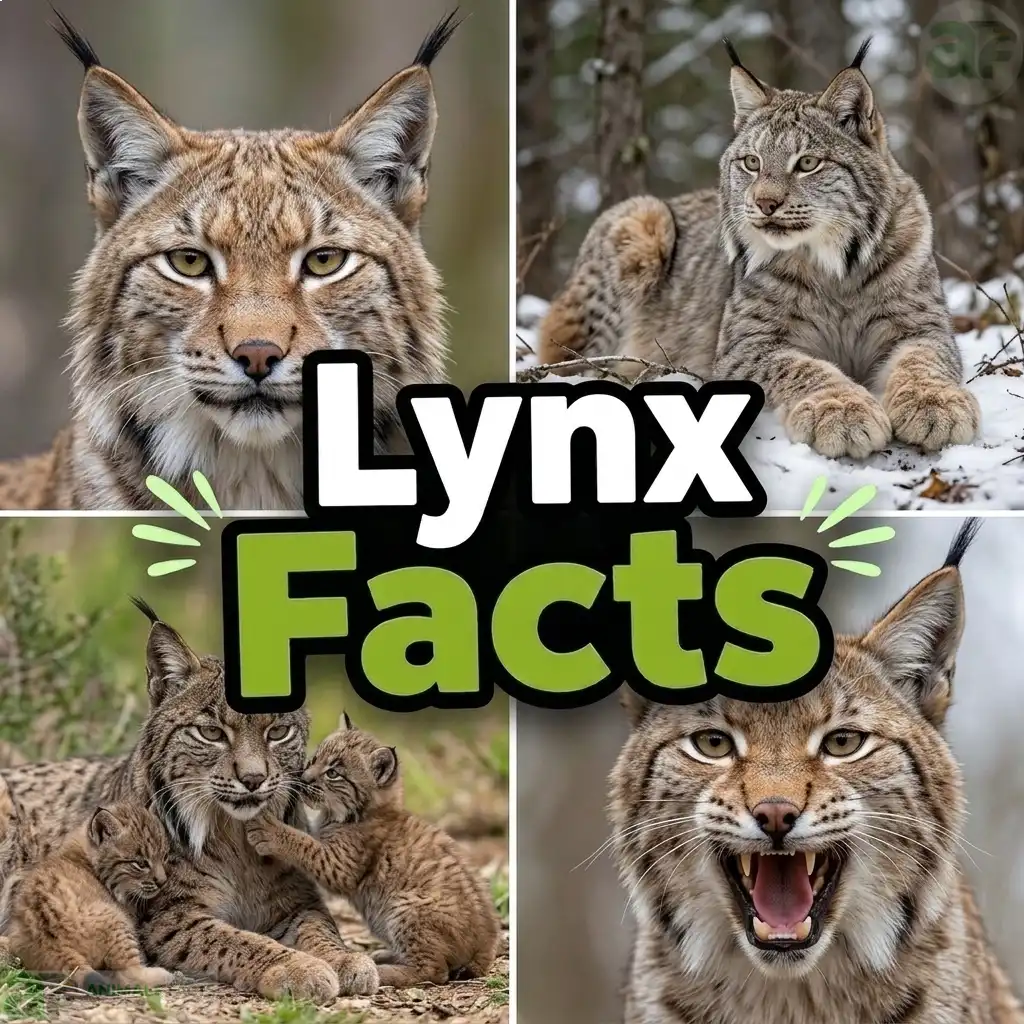
Lynx Facts
| Feature | Details |
|---|---|
| Genus | Lynx |
| Kingdom | Animalia |
| Phylum | Chordata |
| Class | Mammalia |
| Order | Carnivora |
| Family | Felidae |
| Total Living Species | 4 species — Eurasian Lynx, Canada Lynx, Iberian Lynx, Bobcat |
| Habitat | Boreal and montane forests, Mediterranean scrubland, North American coniferous and mixed forest, tundra, grassland margins |
| Lifespan | 10–17 years in the wild; up to 26 years in captivity (species dependent) |
| Diet | Specialized carnivores — snowshoe hares (Canada Lynx), lagomorphs, deer, roe deer, ungulates, birds, rodents (Eurasian Lynx) |
| Weight | 8–36 kg (Bobcat smallest at 8–14 kg; Eurasian Lynx largest at up to 36 kg) |
| Body Length | 67–130 cm excluding tail; tail very short (5–25 cm) in all species |
| Shoulder Height | 50–75 cm |
| Top Speed | Up to 80 km/h (50 mph) in short sprints — Eurasian Lynx documented |
| Most Endangered Species | Iberian Lynx — recovered to ~1,000+ individuals from a historic low of ~100 (2002) |
| Most Numerous Species | Bobcat — estimated 2.3–3.5 million individuals across North America |
| Conservation Status | Varies: Bobcat (Least Concern), Canada Lynx (Least Concern), Eurasian Lynx (Least Concern), Iberian Lynx (Endangered, recovering) |
| Unique Features | Tufted ears; proportionally huge snowshoe-like paws; short “bobbed” tail; ruff of longer fur around face |
 1. Introduction: What is a Lynx?
They move through deep winter snow without sinking, their enormous paws distributing weight across the surface like living snowshoes. They can detect prey from 75 meters in near-total darkness with some of the most acute night vision of any cat on Earth. They communicate through a haunting array of wails, hisses, and caterwauling that echoes through winter forests in ways that have frightened and fascinated wilderness travelers for centuries. And one of them — the Iberian Lynx — recovered from fewer than 100 individuals to over 1,000 in just two decades, becoming one of the most remarkable conservation success stories in the history of large carnivore recovery. Lynx facts are extraordinary from every angle.
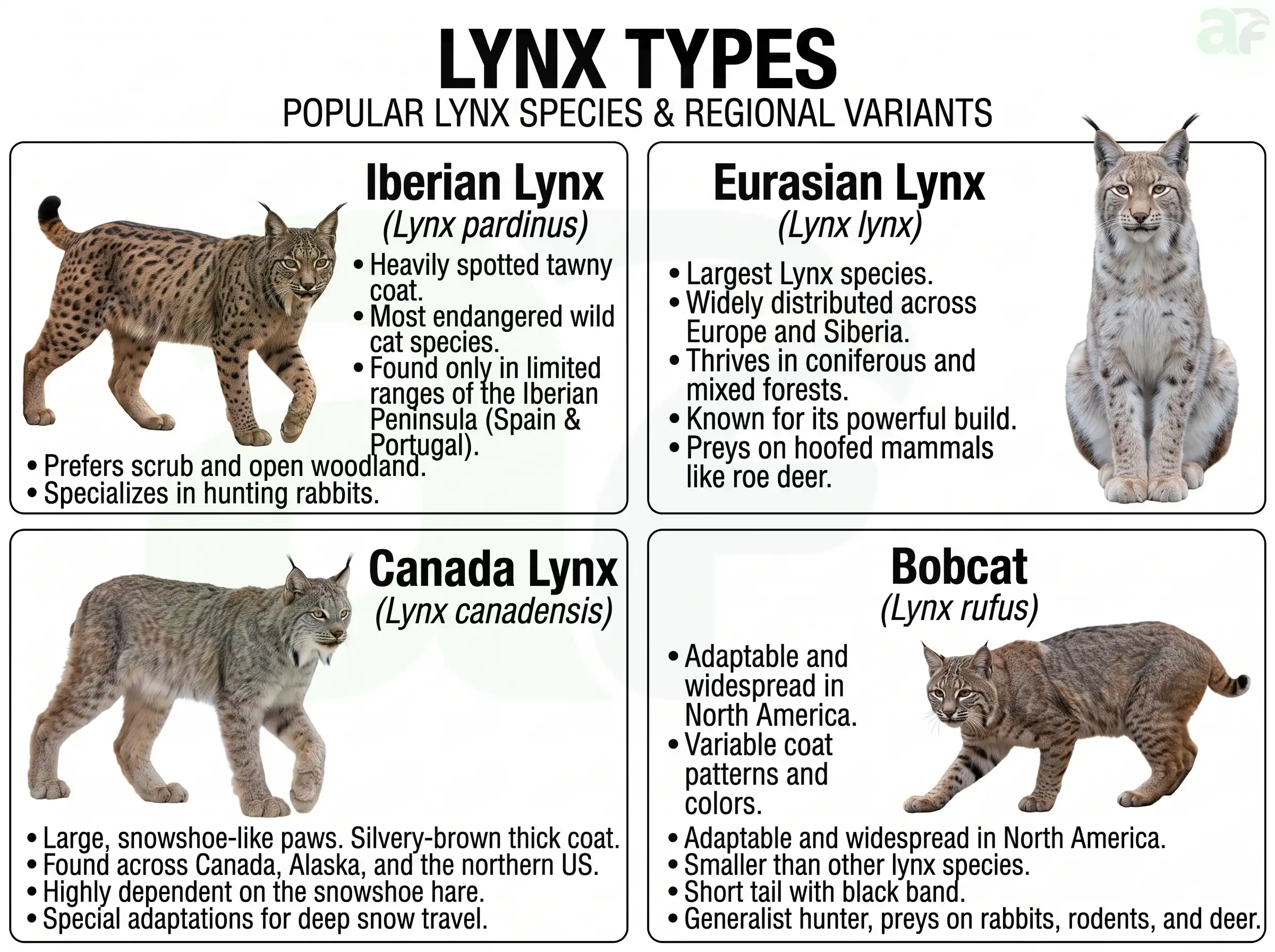
The genus Lynx contains just four species — the Eurasian Lynx (Lynx lynx), the largest and most geographically widespread; the Canada Lynx (Lynx canadensis), with its extraordinary dependency on a single prey species; the Iberian Lynx (Lynx pardinus), which came within a generation of extinction before a landmark conservation program pulled it back; and the Bobcat (Lynx rufus), the most numerous wild cat in North America with over 3 million individuals. Together, these four species occupy habitats from the Siberian taiga to the Spanish scrubland, from the Canadian tundra margin to the Florida Everglades — demonstrating ecological flexibility that has allowed the lynx lineage to survive and thrive across an extraordinary range of environments.
Whether you are a student searching for lynx facts for a school project, a birdwatcher who spotted a lynx on a winter wildlife walk, a parent seeking lynx facts for kids, a conservation advocate following the Iberian Lynx’s remarkable recovery, or simply someone captivated by the mysterious, tufted-eared cats of the world’s great forests — this is the most complete guide to lynx facts you will find anywhere. We cover lynx habitat, lynx diet, lynx behavior, communication, reproduction, all four species, conservation, mythology, and the extraordinary story of a genus that has navigated the most challenging periods in wild cat history through a combination of specialized adaptation and behavioral flexibility. Let us begin.
2. Species Overview & Classification
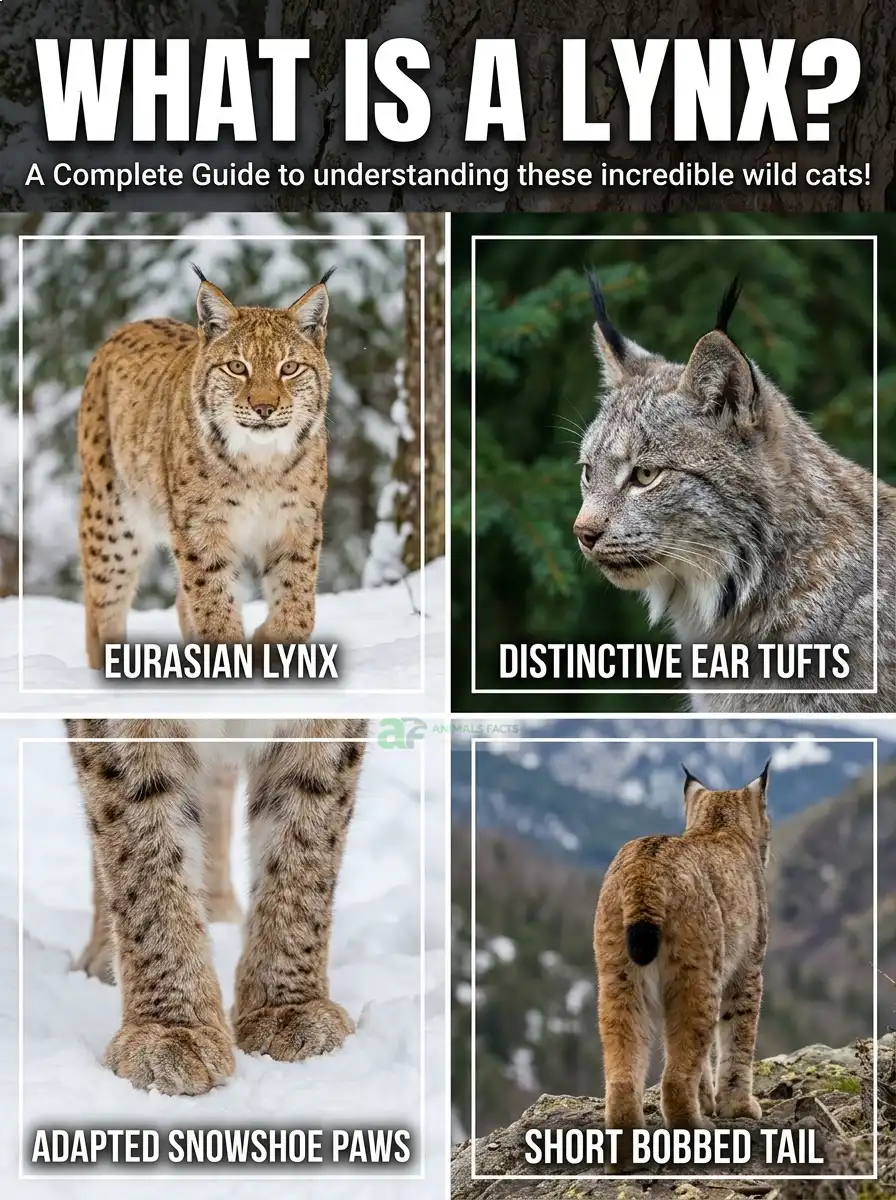
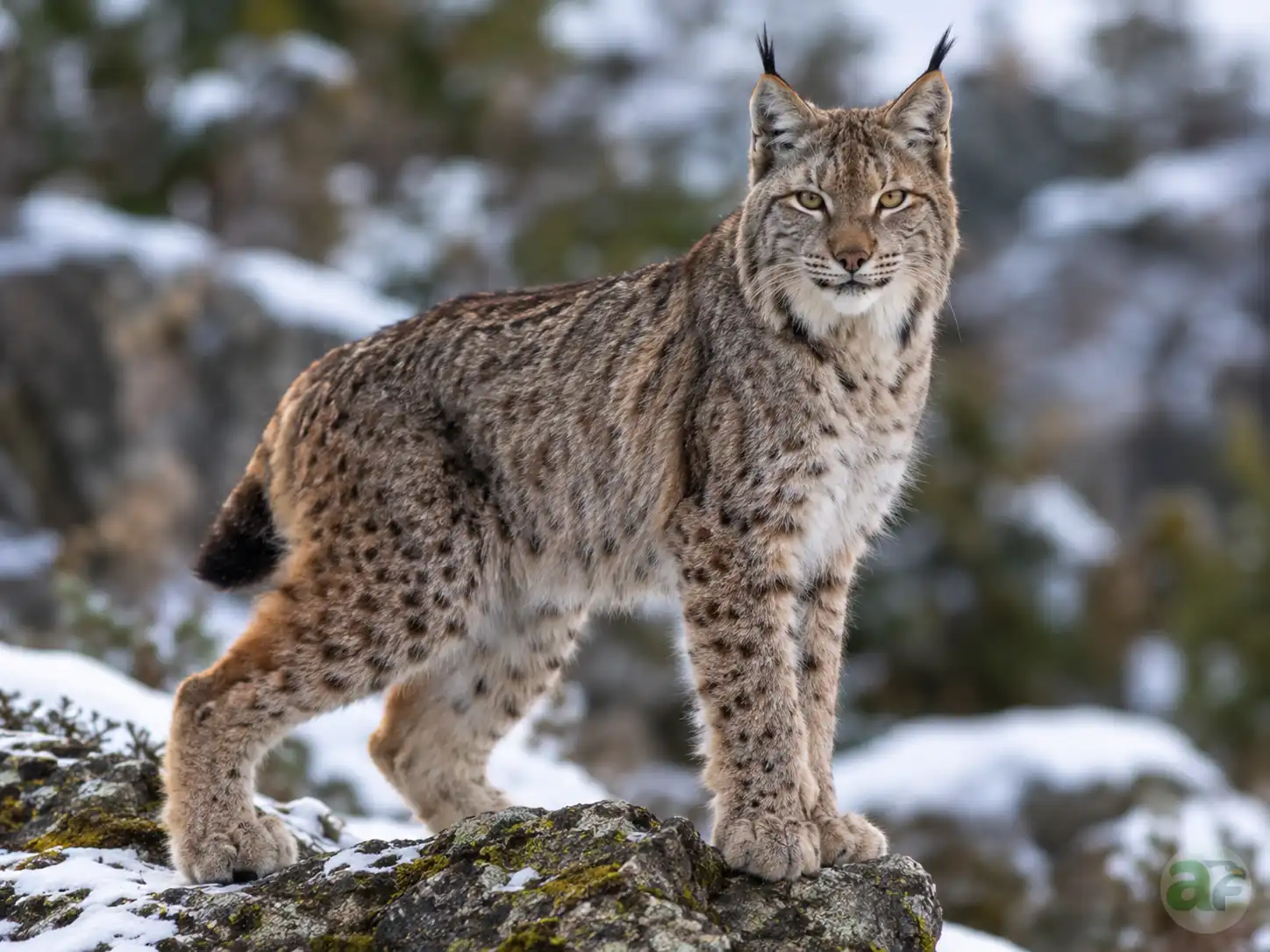
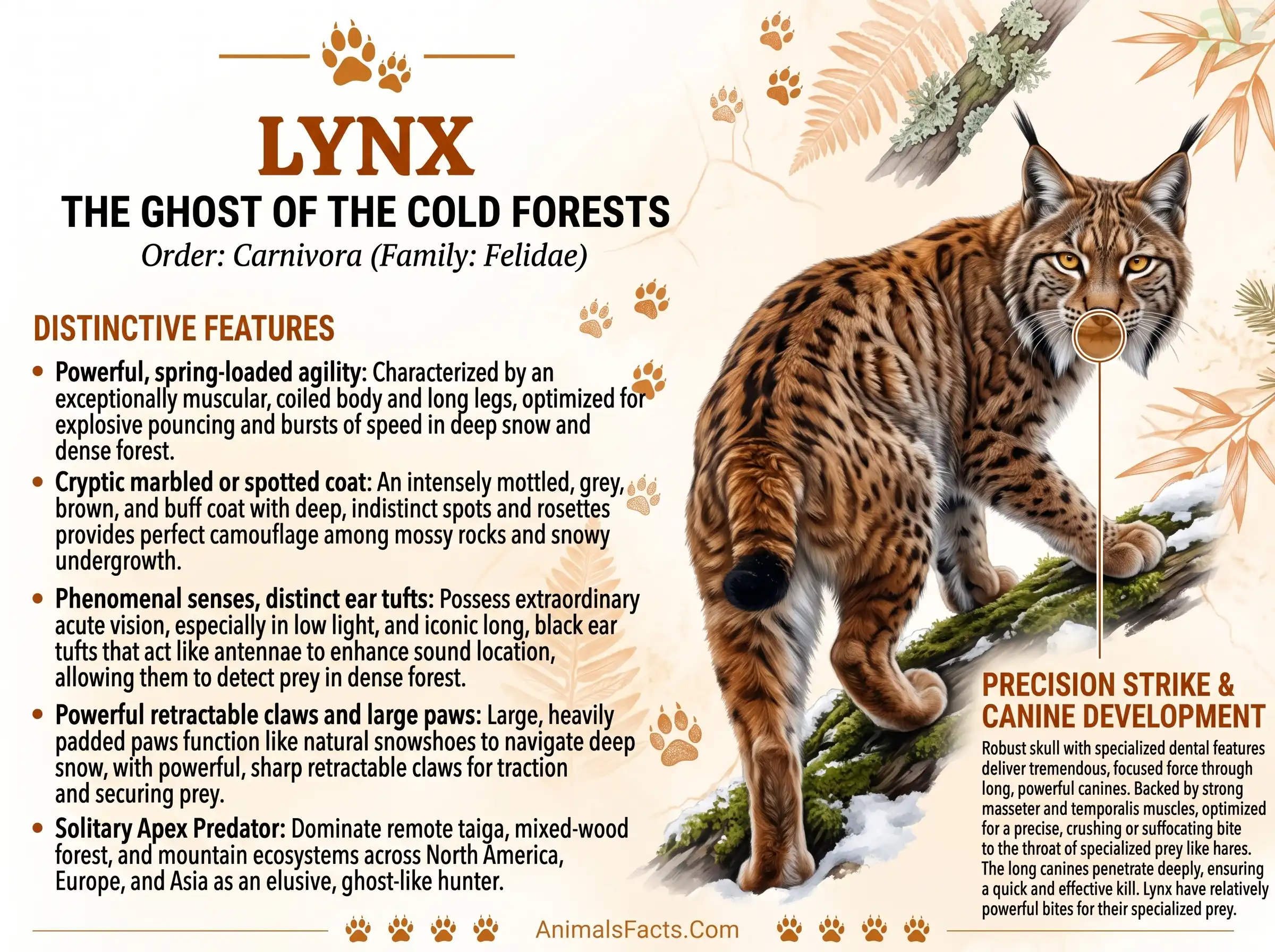
The genus Lynx belongs to the family Felidae within the subfamily Felinae — the purring, non-roaring cats. Lynxes are characterized by their distinctive short tails, tufted ears, facial ruffs, and (in northern species) dramatically enlarged paws adapted for snow travel — a combination of features instantly recognizable and shared by all four species.
What Defines a Lynx?
All four lynx species share these defining characteristics:
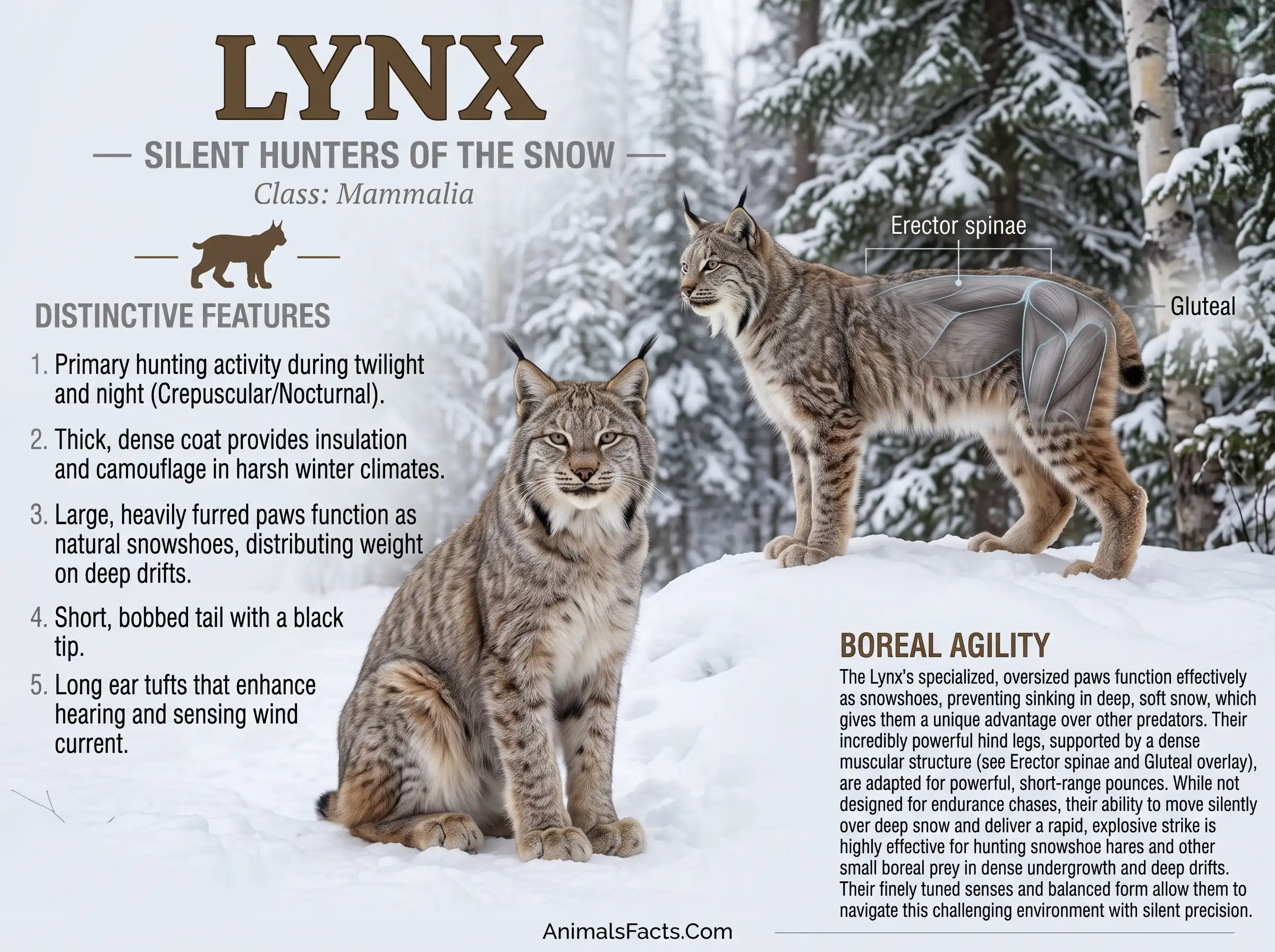
- Short “bobbed” tail: The most immediately distinctive feature — all lynx species have a dramatically shortened tail (5–25 cm), truncated compared to most other felid species
- Ear tufts: Prominent tufts of black hair extending from the tips of the ears — absent in very few other felid species, and most dramatically developed in the Eurasian and Canada Lynx
- Facial ruff: A distinctive framing of longer fur around the face, forming a ruff or collar that gives lynxes their characteristic broad-headed, “bearded” appearance
- Proportionally large paws: Particularly pronounced in the Canada Lynx, whose enormously broad paws function as natural snowshoes — the most specialized snow-travel adaptation of any felid
- Long hind legs: Lynxes have proportionally longer hind legs than forelimbs — giving them a characteristic high-rumped posture and contributing to their jumping power
Four Lynx Species Comparison Table
| Species | Scientific Name | Weight | Range | Population | IUCN Status |
|---|---|---|---|---|---|
| Eurasian Lynx | Lynx lynx | 18–36 kg | Europe, Russia, Central Asia, China | ~50,000–70,000 | Least Concern |
| Canada Lynx | Lynx canadensis | 8–14 kg | Canada, northern USA | ~150,000–200,000 | Least Concern |
| Iberian Lynx | Lynx pardinus | 6–13 kg | Spain and Portugal | ~1,000+ (recovering) | Endangered |
| Bobcat | Lynx rufus | 8–14 kg | North America (most widespread) | ~2.3–3.5 million | Least Concern |
Species Evolution & Discovery Timeline
~6–8 million years ago: The Lynx lineage began diverging from related felid ancestors during the Miocene Epoch — establishing the evolutionary foundation for the genus that would eventually produce all four modern lynx species.
~3.5 million years ago: Early lynx-like cats (Lynx issiodorensis) appeared in Europe during the Pliocene — representing the ancestral lineage that would subsequently give rise to both the Iberian Lynx and Eurasian Lynx through separate evolutionary pathways.
~2 million years ago: The Iberian Lynx diverged from the common Eurasian Lynx ancestor — establishing itself as a genetically and morphologically distinct species adapted specifically to the Mediterranean scrubland ecosystem of the Iberian Peninsula.
~2.6 million years ago: Early lynx ancestors crossed from Asia into North America via the Bering Land Bridge during the Pleistocene — eventually giving rise to both the Canada Lynx and the Bobcat through divergent adaptation to different North American habitats and prey communities.
~2,000 BCE: The Eurasian Lynx appears in early human artistic and cultural records across Europe and Asia — including early Bronze Age artwork and subsequent classical period references documenting the species across its former extensive European range.
~1700–1900 CE: Eurasian Lynx populations were systematically exterminated across Western and Central Europe through hunting, persecution as livestock predators, and habitat destruction — eliminated from Germany, France, Switzerland, Austria, and most of the Scandinavian lowlands by the early 20th century.
1758: Carl Linnaeus formally described the Eurasian Lynx as Felis lynx in Systema Naturae — the foundational scientific description of the genus.
1971–1972: The first successful Eurasian Lynx reintroductions in Switzerland (1971) and former Yugoslavia (1973) initiated decades of reintroduction programs that have partially restored lynx populations across portions of Western and Central Europe.
2002: The Iberian Lynx population reached its historic documented low of approximately 100 individuals — the lowest population ever recorded for a wild cat species not already extinct, making it the most endangered felid in the world at that time.
2012–2026: The Iberian Lynx Recovery Program — combining captive breeding, habitat restoration, rabbit population management, and reintroduction — produced extraordinary results, recovering the wild population from ~100 to over 1,000 individuals by 2024 — prompting the IUCN to reclassify the species from Critically Endangered to Endangered in 2015, one of the most celebrated wildlife recovery successes in history.
3. Physical Description & Unique Features
The four lynx species display significant variation in size and habitat adaptation while sharing the distinctive physical features that immediately identify them as members of the same genus.
Size Extremes
Largest species: The Eurasian Lynx — the largest lynx species and the third-largest wild cat in Europe after the brown bear and wolf (if bears are excluded) — with adult males reaching 36 kg and 130 cm in body length, comparable to a large German Shepherd dog.
Smallest species: The Iberian Lynx — the smallest lynx species, with adult males typically weighing only 7–10 kg and females 5–7 kg — making it the smallest lynx and among the smallest of the medium-sized wild cats found in temperate environments.
Most common size: The Canada Lynx and Bobcat are broadly comparable in overall body weight — both typically between 8–14 kg — though the Canada Lynx appears larger due to its proportionally enormous paws and longer limbs.
The Canada Lynx’s Extraordinary Paws
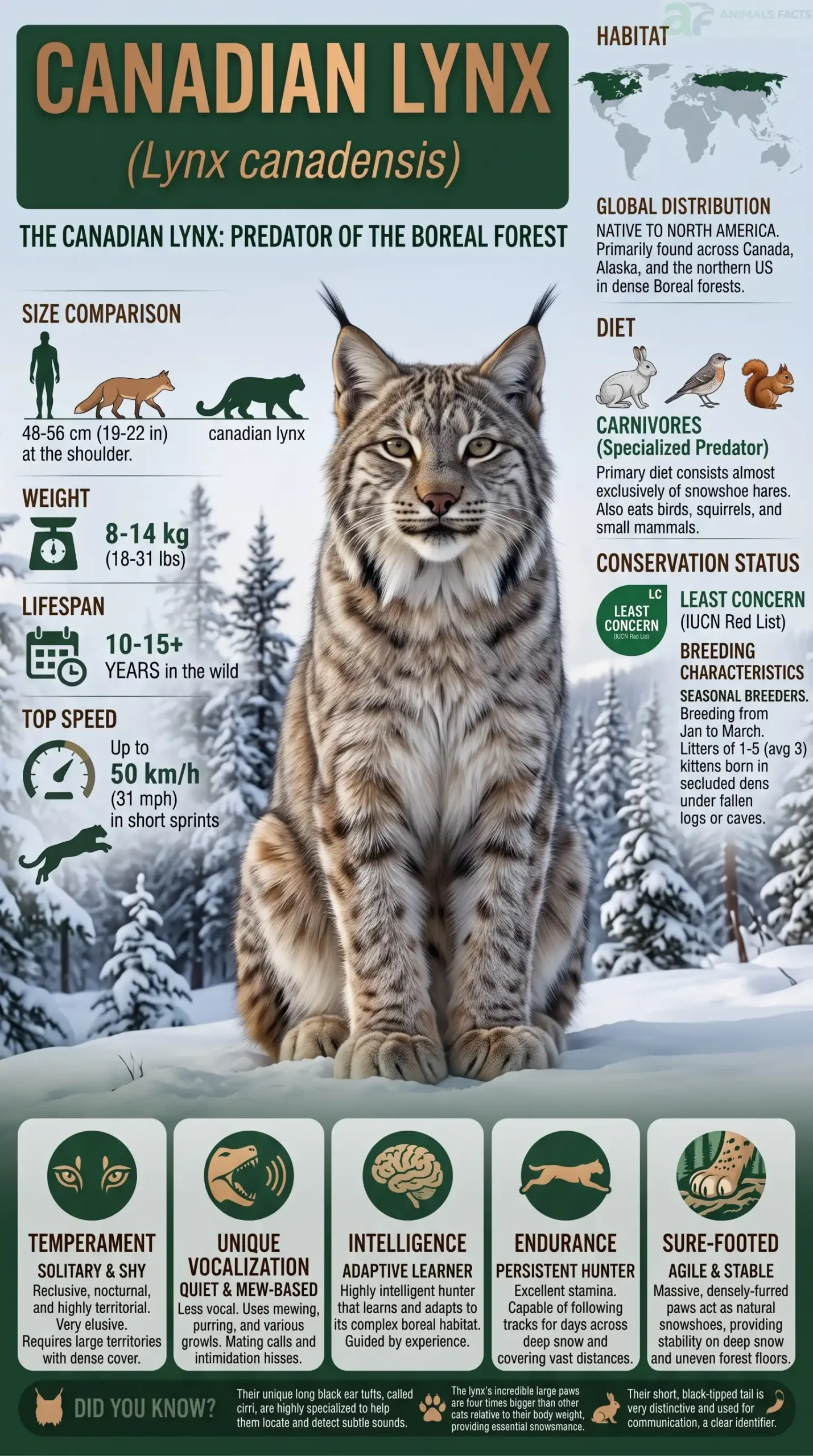
The most remarkable anatomical feature of any lynx species — the Canada Lynx’s oversized paws — represent one of the most extreme snow-travel adaptations in the entire order Carnivora. A Canada Lynx’s front paw can measure up to 10 cm in diameter — comparable in width to the front paw of a puma weighing four times as much. This enormous relative paw size distributes the lynx’s body weight across a much larger surface area than a smaller paw would, allowing it to run across the surface of deep, unconsolidated snow where its primary prey (the snowshoe hare) would sink — providing a critical predatory advantage in the boreal winter environment that defines the Canada Lynx’s ecological niche.
Ear Tufts — Function and Significance
The tufted ears that characterize all lynx species have generated significant scientific interest and debate — with proposed functions including enhanced directional hearing (the tufts potentially acting as additional antenna-like structures extending the effective sound-gathering width of the ear), species recognition between individuals, visual communication during close-range interactions, and simply camouflage-breaking disruption of the ear outline in dappled forest light. The current research consensus suggests the tufts likely serve multiple functions simultaneously — none of which requires their large size to be fully explained by a single adaptation.
The Facial Ruff
The broad facial ruff of fur that frames the lynx’s face — most pronounced in the Eurasian Lynx — may serve thermoregulatory functions (insulating the face in extreme cold), visual communication functions (enhancing the apparent size and expression of facial features during social encounters), and potentially sensory functions (with vibrissae embedded in the ruff contributing to tactile environmental information). The ruff gives lynxes their characteristic broad-faced, almost owl-like frontal appearance that contributes significantly to their distinctive visual identity.
Did You Know? The Iberian Lynx is the world’s most endangered felid — not the snow leopard, not the Amur leopard — and holds the distinction of having been pulled back from the closest documented brush with extinction of any wild cat species. The 2002 low of approximately 94–108 individuals across just two isolated populations in southern Spain represented a genuinely terminal trajectory, with genetic modelers projecting extinction within decades without dramatic intervention. The subsequent recovery to over 1,000 individuals by 2024 represents arguably the most complete and rapid large carnivore recovery ever achieved by a conservation program.
4. Top 25 Surprising & Interesting Lynx Facts
- The Iberian Lynx was the world’s most endangered felid as recently as 2002 — with fewer than 100 wild individuals — before recovering to over 1,000 individuals by 2024 through one of history’s most successful wild cat conservation programs.
- The Canada Lynx’s relationship with the snowshoe hare is one of the most famous predator-prey cycles in ecology — when hare populations crash in their famous 9–11 year cycle, Canada Lynx populations crash 1–2 years later, with documented population swings of 10-fold or more.
- The Bobcat is the most numerous wild cat in North America — with an estimated 2.3–3.5 million individuals — making it far more abundant than any other wild cat in the Western Hemisphere.
- The Eurasian Lynx is the largest lynx species and third-largest terrestrial predator in Europe — capable of taking prey as large as adult female red deer weighing over 100 kg, despite the lynx itself weighing only 20–30 kg.
- All lynx species are exceptional swimmers — regularly crossing rivers and lakes as part of territory patrols and dispersal movements, with documented water crossings exceeding 500 meters for Canada Lynx.
- The short tail that characterizes all lynx species has led to long-standing scientific debate — with recent genetic evidence suggesting the short tail may be a genuinely derived (evolved) feature of the lynx lineage rather than simply the absence of a longer ancestral tail.
- The Canada Lynx has been documented traveling up to 1,000 kilometers during extraordinary dispersal events — with individuals crossing multiple national parks and wilderness areas in multi-month journeys between natal territories and new range areas.
- The Iberian Lynx feeds almost exclusively on European rabbits — with rabbits comprising approximately 75–90% of diet and the species’ entire ecological niche essentially built around rabbit prey availability. When rabbit populations collapsed from disease (first myxomatosis, then viral hemorrhagic disease), Iberian Lynx populations followed.
- Eurasian Lynx ear tufts can be independently controlled — observed to move and orient independently of each other during social and environmental scanning, potentially providing more precise directional acoustic information than fixed tufts would allow.
- The Bobcat’s range includes every US contiguous state except Delaware, and it successfully inhabits environments as diverse as the Mojave Desert, Florida Everglades, Appalachian forest, and Pacific coastal scrubland — demonstrating habitat generalism unusual among wild cats of its size.
- Lynxes produce a haunting repertoire of winter vocalizations — including wailing, caterwauling, yowling, and what researchers have described as a “screaming barking” sound during the mating season — capable of carrying for several kilometers through winter forest.
- The Eurasian Lynx was successfully reintroduced to Switzerland in 1971, Slovenia in 1973, and subsequently to multiple other European countries — representing one of Europe’s longest-running large carnivore reintroduction programs and a model for subsequent wolf and bear reintroductions.
- Bobcats have been documented successfully coexisting with humans in suburban and even urban environments — with stable populations documented in suburban New Jersey, suburban California, and multiple other US metropolitan area fringes, approaching the urban adaptability demonstrated by coyotes.
- The Canada Lynx’s feet function so effectively as snowshoes that in deep powder snow, the lynx applies only approximately 40 grams per cm² of pressure on the snow surface — compared to approximately 100+ grams per cm² for a coyote — allowing it to run across snow surfaces where its competitors sink and struggle.
- Lynx kittens are born with blue eyes — which change to the characteristic golden-yellow of adults within the first few months of life, a color change similar to that seen in other wild cat species.
- The Iberian Lynx is considered a “keystone species” in the Mediterranean scrubland ecosystem — its predation on rabbits, rodents, and waterfowl having cascading effects on vegetation structure and small prey community composition that extend far beyond the simple predator-prey relationship.
- All four lynx species display significant individual variation in coat pattern — with some individuals showing pronounced spotting or rosette patterns (most pronounced in the Iberian Lynx and Eurasian Lynx), while others display more uniform coats.
- The Eurasian Lynx holds the record for the longest confirmed territorial range of any lynx species — with male territories documented exceeding 400 km² in areas of low prey density in the Scandinavian and Siberian portions of its range.
- Canada Lynx have been documented caching prey under snow — covering partially consumed snowshoe hare carcasses with snow and returning over several days to continue feeding, a behavior that helps maximize the caloric value of each successful hunt during the energetically demanding boreal winter.
- The Iberian Lynx recovery program achieved its first documented reintroduction into Portugal in 2014 — beginning the recovery of the species in a country from which it had been functionally extinct for decades, with the Portuguese population now approaching 200 individuals.
- Lynxes have been documented engaging in play behavior well into adulthood — particularly between semi-tolerant neighboring individuals during winter, when the energy cost of territorial defense may be partially offset by the benefits of brief social interaction.
- The Bobcat’s silent locomotion — walking with exceptional foot placement precision that avoids branch-snapping and leaf-rustling during hunts — has been measured as producing significantly less noise than a human walking on the same substrate, demonstrating extraordinary sound-suppression capabilities.
- Eurasian Lynx reintroduced in Switzerland have been tracked crossing the Swiss Alps on multiple occasions — demonstrating dispersal capability across some of Europe’s most challenging mountainous terrain and populating areas that had been lynx-free for over a century.
- The Canada Lynx is the only wild cat species in which the effects of climate change on prey-predator cycling have been most extensively and rigorously documented — with research demonstrating measurable impacts of warming temperatures on snowshoe hare population dynamics, hare-lynx cycle regularity, and lynx population viability across the boreal zone.
- All four lynx species possess the tapetum lucidum — the reflective layer behind the retina that causes the characteristic “eyeshine” visible when light hits a cat’s eyes in the dark — but lynx eyes are proportionally among the largest relative to skull size of any comparable cat species, contributing to exceptional low-light vision critical for their predominantly crepuscular and nocturnal hunting.
5. Fun Facts About Lynx
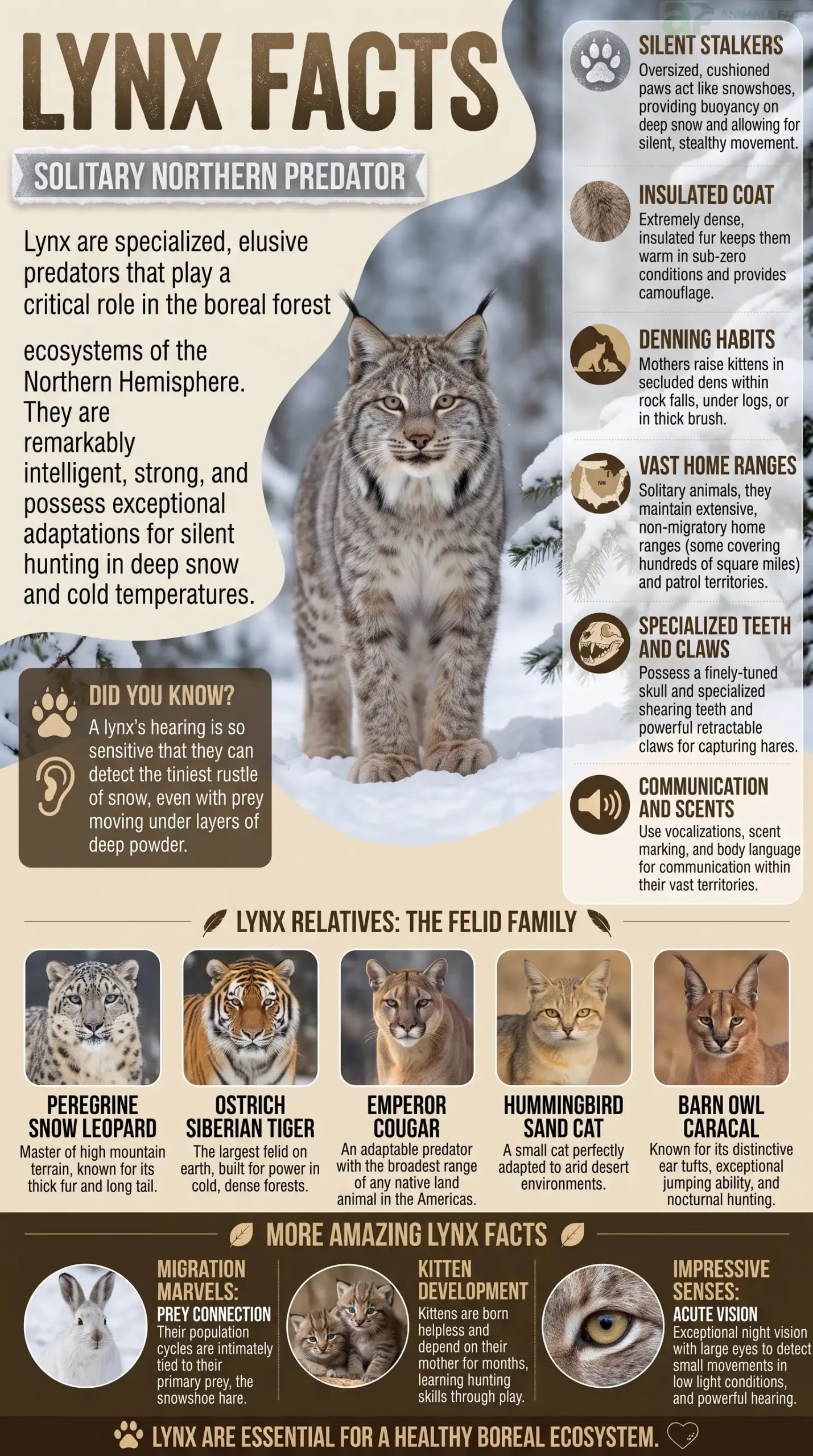
- There are 4 lynx species worldwide — Eurasian, Canada, Iberian, and Bobcat.
- The Iberian Lynx recovered from ~100 to 1,000+ individuals — one of conservation’s greatest victories.
- The Bobcat is the most numerous wild cat in North America with 3+ million individuals.
- The Canada Lynx’s paws are so large they work like natural snowshoes.
- All lynx species have distinctive tufted ears and short “bobbed” tails.
- Canada Lynx populations crash when snowshoe hare populations crash — one of ecology’s most famous cycles.
- The Eurasian Lynx can take down adult female red deer despite weighing three times less.
- Lynxes can travel up to 1,000 kilometers during dispersal journeys.
- Bobcats survive in suburban environments across the US — including near major cities.
- Lynx kittens are born with blue eyes that change to golden-yellow as they grow.
- Lynx winter vocalizations can travel several kilometers through forest.
- The Eurasian Lynx was reintroduced to Switzerland in 1971 — Europe’s oldest lynx recovery program.
6. Natural Habitat & Geographic Range
The four lynx species collectively inhabit an extraordinary range of environments — from the frozen boreal forests of northern Canada to the dry Mediterranean scrubland of southern Spain, from the Siberian taiga to the Florida swampland — demonstrating the ecological flexibility of the lynx lineage while also highlighting the dramatically different conservation situations facing individual species.
Eurasian Lynx Habitat
The Eurasian Lynx inhabits boreal and mixed coniferous-deciduous forest across an enormous range stretching from Scandinavia through Russia and Central Asia to eastern China — the largest geographic range of any lynx species. It is also the most altitudinally flexible lynx — documented from sea level in Scandinavian coastal forests to over 5,500 meters in the Himalayan and Tibetan highlands.
In Western and Central Europe, reintroduced Eurasian Lynx populations are establishing in temperate mixed forest — the Alps, Carpathians, Dinaric Alps, Jura Mountains, and Vosges — representing a fundamentally different forest type from the boreal spruce and pine that characterizes its Siberian stronghold, and demonstrating significant habitat plasticity.
Canada Lynx Habitat
The Canada Lynx is one of the most habitat-specific of the lynx species — almost exclusively associated with mature boreal coniferous forest (spruce-fir and spruce-pine) with adequate snow cover and healthy snowshoe hare populations. This extremely specific habitat and prey dependency means the Canada Lynx is essentially a specialist within a specialist — restricted to a particular forest type within a particular climate zone within a particular prey density threshold.
The US range of the Canada Lynx is restricted primarily to northern Maine, Minnesota, Michigan, Idaho, Montana, Washington, and the Rocky Mountains of Colorado — representing fragmented, southerly extensions of the boreal forest zone that support smaller, more vulnerable populations than the vast Canadian boreal.
Iberian Lynx Habitat
The Iberian Lynx is the most habitat-restricted lynx species — historically confined to the Mediterranean scrubland (maquis) of the Iberian Peninsula, characterized by dense stands of cistus, lavender, rosemary, rockrose, and scattered cork oak — a habitat uniquely associated with abundant European rabbit populations. Currently recovering populations are primarily concentrated in Andalusia and Castilla-La Mancha in Spain, with reintroduced populations establishing in Portugal.
Bobcat Habitat
The Bobcat demonstrates the greatest habitat generalism of any lynx species — successfully occupying environments as diverse as the coniferous and deciduous forests of New England, the subtropical swamps of Florida, the Sonoran Desert of Arizona, the Pacific coastal scrubland of California, the Great Plains grassland margins, and increasingly, suburban and peri-urban landscapes across the continental United States.
Habitat Range by Region
| Region | Species Present | Population | Status |
|---|---|---|---|
| Boreal Eurasia (Russia, Scandinavia, Siberia) | Eurasian Lynx | ~50,000+ | Stable; core population |
| Central/Western Europe (Alps, Carpathians, etc.) | Eurasian Lynx (reintroduced) | ~1,500–2,000 | Recovering; fragmented |
| China/Central Asia | Eurasian Lynx | ~10,000–15,000 | Poorly monitored |
| Canada and northern USA | Canada Lynx | ~150,000–200,000 | Stable in core range; declining at margins |
| Southern Spain and Portugal | Iberian Lynx | ~1,000+ (recovering) | Endangered; recovering |
| Continental USA (most areas) | Bobcat | ~2.3–3.5 million | Abundant; least concern |
| Southern USA and Mexico | Bobcat (southern range) | Part of above | Stable to declining locally |
Did You Know? The Canada Lynx and the Bobcat share a range border across much of the northern United States — with Canada Lynx dominating in the snowier, boreal zone to the north and Bobcats dominating in the more temperate zone to the south. Research has demonstrated that this boundary is not primarily determined by geography or vegetation type but by snowpack depth and duration — Canada Lynx outcompete Bobcats in deep, persistent snow (where their larger paws provide a decisive advantage), while Bobcats outcompete Canada Lynx in shallow or ephemeral snow (where the Canada Lynx’s snow adaptation provides no benefit but Bobcats’ smaller, more agile paws provide superior terrestrial mobility). Climate change is expected to shift this boundary northward as snow conditions change — potentially contracting Canada Lynx range while expanding Bobcat range.
7. Diet & Feeding Behavior
The four lynx species range from extreme dietary specialists to remarkably flexible generalists — reflecting the different ecological contexts and prey communities of their respective environments.
Dietary Specialization vs. Generalism
The Iberian Lynx and Canada Lynx represent the dietary specialist end of the lynx spectrum — both showing extreme dependency on single prey species that constitutes the overwhelming majority of their diet. The Eurasian Lynx and Bobcat are considerably more flexible, regularly taking a wider range of prey species and sizes.
Diet Breakdown Table
| Species | Primary Prey | Secondary Prey | Dietary Specialization Level |
|---|---|---|---|
| Iberian Lynx | European rabbit (~75–90%) | Rodents, birds, waterfowl (10–25%) | Extreme specialist |
| Canada Lynx | Snowshoe hare (~75–97%) | Rodents, birds, deer (3–25%) | Extreme specialist |
| Eurasian Lynx | Roe deer, chamois, red deer calves (~70%) | Rodents, hares, birds, foxes (30%) | Moderate specialist |
| Bobcat | Rabbits and hares (~50–60%) | Rodents, deer, birds, reptiles (40–50%) | Flexible generalist |
The Canada Lynx-Snowshoe Hare Cycle
The most ecologically celebrated dietary relationship in the lynx genus — and arguably one of the most famous predator-prey cycles in all of ecology — is the Canada Lynx-Snowshoe Hare cycle. Snowshoe hare populations across the boreal zone undergo a dramatic population cycle of approximately 9–11 years — driven by a combination of food availability, predation pressure, and stress-related physiological effects on hare reproduction. Canada Lynx populations track this cycle closely but with a 1–2 year lag — peaking in abundance approximately 1–2 years after hare population peaks, and crashing 1–2 years after hare populations collapse.
At hare population peaks, Canada Lynx densities can approach 1 individual per km² in productive habitat. At hare population lows, surviving lynx disperse widely, starve, or fail to reproduce — with documented population crashes of 10-fold or more within 2–3 years.
Eurasian Lynx as a Deer Predator
The most impressive feeding achievement among lynx species is the Eurasian Lynx’s capacity to regularly take roe deer and occasionally chamois and young red deer — prey animals often significantly larger than the lynx itself. Research in Switzerland documents that roe deer comprise approximately 60–70% of the Eurasian Lynx diet, with individual cats regularly taking deer weighing 20–30 kg — comparable to the lynx’s own body weight — through a precise throat or nape suffocation bite similar to the techniques used by much larger cats.
Did You Know? In years of snowshoe hare population collapse, Canada Lynx have been observed making kills of prey they would normally avoid — including ruffed grouse, red squirrels, mice, and voles — prey items providing a tiny fraction of the caloric value of a hare. Research has documented individual lynx during hare crash years spending significantly more time hunting per successful kill, consuming prey items previously ignored, and losing body condition at rates that — if sustained — would be lethal. The extraordinary physiological and behavioral stress of hare crash years represents one of the most dramatic documented examples of predator vulnerability to prey cycle dependency in the ecological literature.
8. Reproduction & Life Cycle
Lynx reproduction follows the general small felid pattern — seasonal breeding timed to produce young when prey is most available, with maternal dependency periods appropriate to the prey learning requirements of each species’ specific ecological context.
Mating Behavior
All four lynx species are seasonally monoestrous — females typically enter a single annual estrus period during winter or early spring (varying by species and latitude), with mating occurring during this brief window. The winter timing ensures that kittens are born in spring when prey is most abundant and territorial competition is reduced.
Eurasian Lynx mating occurs in February–March, with females entering estrus for approximately 7–10 days — producing the famous winter caterwauling vocalizations associated with lynx mating season.
Canada Lynx mating peaks in February–March, with the timing showing some population-level variation linked to snowshoe hare population density — with females in low-hare-density populations sometimes failing to come into estrus at all, a remarkable physiological response to food stress.
Gestation and Birth
Gestation period: Approximately 63–74 days across all four species — relatively uniform.
Litter size: Typically 1–4 kittens (most commonly 2–3), with significant variation by species and prey availability — Canada Lynx litter sizes average larger in hare-peak years and smaller in hare-crash years.
Birth condition: Kittens are born blind, helpless, with spotted coats and closed eyes — the spots fading toward adult pattern as the kitten matures.
Key Developmental Stages
| Stage | Age | Key Development |
|---|---|---|
| Neonatal | 0–2 weeks | Eyes closed; helpless; entirely den-dependent |
| Eyes open | 10–17 days | Beginning visual awareness |
| First outings | 5–7 weeks | Beginning to leave den |
| Weaning | 3–5 months | Transition to meat |
| Accompanying hunts | 4–10 months | Learning prey detection and hunting |
| Winter together | First winter (5–10 months) | Kittens and mother overwinter together |
| Independence | 9–11 months (Canada Lynx typically spring dispersal) | Separation from mother |
| Sexual maturity | 10–24 months (varies by species) | First breeding possible |
Lifespan Comparison Table
| Species | Average Wild Lifespan | Maximum Confirmed |
|---|---|---|
| Eurasian Lynx | 12–17 years | ~26 years (captivity) |
| Canada Lynx | 10–14 years | ~21 years (captivity) |
| Iberian Lynx | 10–13 years | ~19 years (captivity) |
| Bobcat | 7–10 years | ~16 years (wild) |
| Ocelot (comparison) | 7–10 years | ~20 years (captivity) |
9. Social Behavior & Communication
Lynxes are primarily solitary animals outside of mating associations and mother-kitten family units — maintaining individual territories through scent marking and vocal advertisement with relatively little direct contact between adults except during the mating season.
Territorial Organization
All four lynx species maintain exclusive female territories with larger, overlapping male territories that encompass the ranges of 1–3 females — a territorial organization common to most solitary felids:
- Eurasian Lynx male territories: Typically 200–450 km² (larger in prey-sparse areas)
- Canada Lynx territories: Highly variable, 15–250 km² depending on prey density
- Iberian Lynx territories: Relatively small, 5–20 km² reflecting the dense prey habitat
- Bobcat territories: 15–75 km² for males; 7–25 km² for females
Communication Methods
Vocalizations: All lynx species produce a characteristic winter caterwauling during the mating season — a haunting, sustained wailing produced by both males and females advertising reproductive status across large territories. During other seasons, lynxes are typically very quiet, relying primarily on scent rather than vocal communication.
Scent marking: The primary communication medium — all lynx species spray urine on prominent rocks, trees, and trail junctions, deposit feces at visible locations, and create scratch posts on trees — maintaining territorial information networks that allow overlapping individuals to avoid direct encounters.
Visual communication: Ear position, tail position (limited given the short tail), body posture, and facial expression communicate social information during the relatively infrequent direct encounters between territorial adults — with the prominent ear tufts and facial ruff potentially enhancing the readability of subtle expression changes during close-range encounters.
Did You Know? Research on Eurasian Lynx in Switzerland using GPS collars discovered that neighboring lynx — whose territories overlapped significantly — maintained complex “social schedules” of mutual avoidance, visiting the same key locations (particularly deer kill sites and prominent scent-marking trees) on alternating days rather than simultaneously. This temporal separation of overlapping territory use — maintained through the scent information left at shared locations — allows neighboring lynx to effectively “communicate” their recent presence and avoid costly direct confrontations without ever actually meeting in person — a sophisticated information-based coexistence strategy.
10. Predators & Defense Mechanisms
Adult lynxes are efficient medium-sized predators with relatively few natural enemies — their main threats coming from larger competing carnivores in some habitats and from human-caused mortality across all four species.
Natural Predators and Competitors
Wolves: The most significant natural competitor and occasional predator of lynxes in areas of range overlap — particularly relevant for the Eurasian Lynx across Russia, Scandinavia, and the Balkans, and for the Canada Lynx in areas of wolf recovery across North America. Wolves regularly steal lynx kills and kill lynx kittens, and can displace lynx from preferred habitats through competitive dominance, creating complex three-way predator dynamics where wolves → suppress lynxes → increasing indirect prey (deer) availability for lynx in some contexts.
Coyotes: For both the Canada Lynx and Bobcat, the coyote is a significant competitor — with coyotes dominating lynx and bobcats in direct encounters but being outperformed by them in specific snow-depth conditions (Canada Lynx advantage) or hunting skill (Bobcat advantage in certain prey contexts).
Eagles and large owls: Significant predators of lynx kittens — with Golden Eagles, Great Horned Owls, and Eagle Owls documented preying on young lynx across all species’ ranges during the vulnerable early months before kittens are large enough to be protected from avian predation.
Brown bears and mountain lions: Occasional direct predators of lynxes in areas of overlap — large brown bears can and do kill lynxes during territorial encounters, and mountain lions (cougars) dominate lynxes in direct confrontations, creating competitive pressure that influences lynx habitat and temporal activity choices.
Humans: Overwhelmingly the most significant cause of lynx mortality across all four species — through legal and illegal hunting, vehicle collisions, fur trapping, habitat destruction, and retaliatory killing over livestock predation.
Defense Strategies
Avoidance and crypticity: The lynx’s primary survival strategy — behavioral secretiveness that makes all four species among the most difficult medium-sized cats to observe in the wild despite reasonably high population densities in some areas.
Tree climbing: All four lynx species readily climb trees when threatened — using their retractable claws and strong forelimbs to access elevated refuge inaccessible to dogs, wolves, and coyotes that represent common pursuit threats.
Extraordinary speed over snow: In the winter environment where most large carnivores pursue them, Canada Lynx in particular can outrun competing predators across deep snow through their snowshoe-paw advantage, creating a genuine physical escape capability unavailable in summer conditions.
11. Lynx Facts for Kids
Hey kids — get ready to discover why lynxes are some of the most mysterious and fascinating wild cats in the entire world!
- There are 4 different kinds of lynx — the Eurasian Lynx, Canada Lynx, Iberian Lynx, and Bobcat! They all have short stubby tails and cool tufts of black hair on the tips of their ears!
- The Canada Lynx has feet so big for its body size that it can run across the top of deep snow without sinking — like wearing natural snowshoes! This is how it chases snowshoe hares through blizzards!
- The Iberian Lynx almost went completely extinct — there were only about 100 left in the whole world in 2002! But thanks to amazing conservation work, there are now over 1,000 wild Iberian Lynxes living in Spain and Portugal!
- Lynxes have those amazing ear tufts — the little black brushes that stick up from the top of their ears! Scientists think these might help them hear even better, like little antennae for sounds!
- Baby lynxes are called kittens, just like pet cats, and they’re born with beautiful blue eyes that change to golden-yellow as they grow up!
- The Bobcat is the most common wild cat in all of North America — with over 3 million of them living everywhere from deserts to forests to even some city suburbs!
- Lynxes can make some really spooky sounds in winter — wailing and caterwauling so loudly that the sound can travel several kilometers through the forest!
- When the Canada Lynx can’t find snowshoe hares to eat (because hares have a population crash every 10 years or so), the lynx population crashes too — one of the most dramatic examples in nature of how predators and prey need each other!
Did You Know? The Bobcat is so good at sneaking quietly that it can walk through crunchy dry leaves or snapping twigs and make almost no sound at all! Scientists who have studied how bobcats move discovered that they place their paws extremely precisely — stepping in exactly the right spots to avoid anything that would make noise. This makes them one of the quietest animals in North American forests, allowing them to sneak up on rabbits and squirrels without making a single sound until the final pounce!
12. Relationship with Humans
The four lynx species have experienced dramatically different historical relationships with humans — ranging from the Eurasian Lynx’s systematic extermination across Western Europe to the Bobcat’s resilience alongside human development, and from the Iberian Lynx’s near-extinction to its remarkable partnership-based recovery.
Historical Persecution
Eurasian Lynx: The most dramatically historically persecuted lynx species in Europe — systematically eliminated across Western and Central Europe through a combination of deliberate hunting (for fur, for sport, and as perceived livestock predators), poisoning, trapping, and habitat destruction between approximately 1700 and 1900 CE. By the early 20th century, the Eurasian Lynx had been extirpated from Switzerland, Germany, France, Austria, most of Scandinavia (except northern Norway and Sweden), and most of Central Europe — surviving only in small pockets of Eastern Europe, Scandinavia’s northernmost regions, and the vast wilderness of Russia and Central Asia.
Iberian Lynx: The combination of direct persecution (hunting and trapping), habitat destruction (conversion of Mediterranean scrubland to agricultural land and pine plantation), rabbit population collapse from disease, and road mortality between approximately 1950 and 2000 drove the Iberian Lynx population from several thousand individuals to the documented 2002 low of approximately 94–108 individuals.
Canada Lynx: Historical fur trapping — with lynx fur prized for its soft, insulating quality — significantly reduced Canada Lynx populations across much of their range during the 18th and 19th centuries, and the fur trade continues to be a managed activity in several Canadian provinces.
Bobcat: More successfully resisted human persecution than other lynx species through behavioral adaptability and habitat generalism — though it was still significantly reduced across parts of its range during peak fur trade periods and was extirpated from some Midwestern states by the mid-20th century.
Lynx-Livestock Conflict
Eurasian Lynx predation on sheep and goats in agricultural regions of their recovering European range represents a genuine and ongoing conflict — with livestock-killing incidents generating significant political resistance to lynx reintroduction programs in farming communities across Switzerland, France, Germany, and Scandinavia. Compensation programs for verified lynx kills have become a standard part of European lynx management, though the adequacy of compensation rates and the administrative burden of claim processes remain ongoing contentious issues.
13. Conservation Status & Threats
The conservation situations facing the four lynx species represent the full spectrum of wild cat conservation challenges — from comfortably abundant to recently saved from extinction.
Global Lynx Conservation Data (2026)
| Species | IUCN Status | Population | Primary Threat | Trend |
|---|---|---|---|---|
| Eurasian Lynx | Least Concern | ~50,000–70,000 | Poaching; habitat fragmentation; road mortality | Stable in core; declining locally |
| Canada Lynx | Least Concern | ~150,000–200,000 | Climate change (snowpack); habitat loss; trapping | Stable; southern range declining |
| Iberian Lynx | Endangered | ~1,000+ (recovering) | Habitat loss; road mortality; rabbit disease | Recovering strongly |
| Bobcat | Least Concern | ~2.3–3.5 million | Urbanization; road mortality; hunting pressure | Stable to increasing |
Major Threats to Lynxes
Habitat fragmentation and road mortality: The most widespread and practically significant threat across all four species — with roads bisecting lynx territories creating both direct mortality (vehicle collisions) and indirect genetic isolation (preventing dispersal between habitat patches). For the Iberian Lynx, road mortality remains one of the highest documented causes of non-natural death despite intensive traffic management around key habitat areas.
Climate change: Particularly significant for the Canada Lynx, whose range is essentially defined by the snowpack depth and duration that gives it a competitive advantage over Bobcats. Projected decreasing snowpack across the boreal zone boundary is expected to contract Canada Lynx range and expand Bobcat range — potentially threatening the species’ viability in the southernmost portions of its US range.
Rabbit disease (Iberian Lynx specific): The ongoing threat of myxomatosis and viral hemorrhagic disease to European rabbit populations across the Iberian Peninsula represents a continuing vulnerability for the recovered Iberian Lynx population — with any large-scale rabbit population collapse capable of reversing the recovery gains achieved over the past two decades.
Illegal poaching and snaring: Documented across all four species — most severe for Eurasian Lynx in parts of Eastern Europe and Central Asia where poaching remains inadequately enforced and lynx fur retains commercial value.
Did You Know? The Iberian Lynx recovery program achieved something that had never been accomplished before in wild cat conservation — successfully captive-breeding a critically endangered wild cat and reintroducing the offspring into multiple new wild locations across two countries. The program’s captive breeding centers produced their first successfully reintroduced generations in the 2010s, establishing populations in areas of suitable habitat where lynxes had been absent for decades. By 2024, the wild population had crossed 1,000 individuals — prompting the IUCN to consider a further reclassification from Endangered to Vulnerable — a trajectory that would represent one of the most complete conservation status improvements ever achieved for a Critically Endangered large mammal.
14. Famous Lynxes
Denali — The Eurasian Lynx of Swiss Reintroduction
The 1971 Swiss Eurasian Lynx reintroduction — the first successful lynx reintroduction in Western Europe — used three pairs of Eurasian Lynx sourced from Czechoslovakia, released into the Bernese Oberland region of Switzerland. The descendants of these founding animals established what became a functioning Swiss population that eventually spread into neighboring France, Italy, and Germany — establishing the foundation for the broader European lynx recovery that continues today. The original reintroduction individuals, while not individually named in contemporary records, are recognized as foundational to the entire Western European Eurasian Lynx recovery story.
Nena — The Iberian Lynx Symbol
Multiple named Iberian Lynx females from the captive breeding program — including individuals at the Centro Nacional de Reproducción del Lince Ibérico (El Acebuche) in Andalusia — have become symbols of the species’ recovery, with their births and subsequent reintroductions tracked by the program’s public communication efforts. The first reintroduced female to successfully raise kittens in the wild from the captive breeding program — whose offspring represented the program’s first demonstrated second-generation recovery — is particularly celebrated in Iberian Lynx conservation history.
“M1” and “F1” — Canada Lynx Research Icons
Research programs tracking Canada Lynx across the boreal zone have monitored numerous individually identified and collared animals across decades — with specific GPS-collared individuals in Algonquin Provincial Park, Ontario, in Montana’s Northern Continental Divide Ecosystem, and in Maine generating some of the most detailed behavioral ecology data ever collected for the species, including the extraordinary documented dispersal events that have revealed the Canada Lynx’s capacity for trans-continental movement.
15. Role in Ecosystem & Food Chain
The four lynx species play distinctly different but consistently important ecological roles in their respective ecosystems — ranging from the Canada Lynx’s central position in one of ecology’s most celebrated predator-prey cycles to the Iberian Lynx’s keystone function in Mediterranean scrubland biodiversity.
The Canada Lynx-Snowshoe Hare System
The Canada Lynx functions as a critical regulator of the snowshoe hare population cycle — a system that cascades through the entire boreal ecosystem. Hare populations at peak support a diverse predator community including lynx, coyotes, great horned owls, and hawks. Hare population crashes following peak years affect every predator dependent on them — with cascading effects on rodent populations (which expand as predator pressure decreases following the hare crash), on vegetation (which responds to reduced hare grazing pressure), and on the broader boreal food web structure.
Eurasian Lynx as Deer Regulator
Eurasian Lynx predation significantly regulates roe deer populations across their European range — with research documenting measurable differences in roe deer population structure and density between areas with functioning lynx populations and areas from which lynx have been eliminated. In addition to direct numerical regulation, lynx predation generates significant “landscape of fear” effects — altering deer behavior, habitat use, and group size in ways that reduce overgrazing pressure in specific vegetation patches.
Iberian Lynx as Keystone Predator
The Iberian Lynx is recognized as a keystone species in the Mediterranean scrubland ecosystem — with its predation on rabbits, rodents, ducks, and small birds generating cascading effects on plant community composition, small prey population dynamics, and the overall biodiversity of the maquis ecosystem. Research has documented measurable changes in vegetation structure, bird community composition, and small mammal abundance in areas with versus without Iberian Lynx — confirming the keystone status that makes its recovery ecologically important beyond simply maintaining the species itself.
16. Myths, Folklore & Cultural Significance
The lynx has generated a distinctive mythological and cultural tradition across the civilizations of Europe and North America — typically associated with keen sight, secret knowledge, and the ability to perceive hidden truths — a symbolic tradition that directly reflects the lynx’s extraordinary visual capability and behavioral secretiveness.
European Mythology — The Keeper of Secrets
In European folklore and mythology, the lynx is most consistently associated with supernatural visual acuity — the ability to see through walls, perceive hidden objects, and reveal concealed truths. This tradition reflects genuine observation of the lynx’s extraordinary eyes and its reputation as one of the most difficult woodland animals to observe — an animal that seems to see everything without being seen itself.
The ancient Greek mythological figure Lynceus, one of the Argonauts famous for his extraordinarily keen eyesight (reportedly able to see underground and through solid objects), took his name from the lynx — with “lynx” derived from the Greek word for “seeing” or “light.” This linguistic connection established the lynx as the supreme symbol of visual perception in Western cultural tradition.
Medieval European heraldry incorporated lynx imagery with associations of keen judgment, uncovering of secrets, and seeing through deception — with lynxes appearing on the coats of arms of several noble families across Central Europe with explicit reference to these qualities.
Indigenous North American Traditions
Across numerous Indigenous North American nations, the lynx occupies a significant position in oral tradition and spiritual practice — typically associated with mystery, stealth, secret knowledge, and the boundary between the visible and hidden worlds. The lynx’s extraordinary behavioral invisibility — its ability to move through the forest entirely unseen and unheard — made it a natural symbol for the hidden, unseen aspects of reality in traditions that paid close attention to the natural world.
The Ojibwe (Anishinaabe) tradition includes rich oral traditions involving the lynx — with the spirit of the lynx associated with the power of deep winter, the secrets of the boreal forest, and the ability to see through superficialities to essential truths.
Academic Tradition — The Accademia dei Lincei
One of the most celebrated cultural uses of lynx symbolism in the history of human intellectual life — the Accademia dei Lincei (Academy of the Lynxes), founded in Rome in 1603, was one of the world’s earliest scientific academies and the institutional home of Galileo Galilei during his most productive astronomical years. The academy’s founders chose the lynx as their symbol precisely for its folkloric association with keen sight and the penetration of hidden truths — making the lynx the symbol of the scientific method itself in one of the founding institutions of modern scientific culture.
17. Lynxes in Pop Culture
The lynx has generated a significant presence in modern popular culture — driven by its distinctive appearance, its extreme behavioral secretiveness, and the remarkable conservation success story of the Iberian Lynx that has attracted significant media attention.
Film and Television
BBC Natural World and David Attenborough productions — Multiple BBC Natural History Unit productions have featured lynxes in winter boreal forest footage, with the Canada Lynx snowshoe-hare system and the Eurasian Lynx reintroduction story both receiving significant documentary attention in major series including “Planet Earth,” “Frozen Planet,” and dedicated Wildlife on One and Natural World episodes.
“Iberian Lynx: Back from the Brink” and related conservation documentary productions — The extraordinary Iberian Lynx recovery story has attracted multiple documentary productions from Spanish, Portuguese, and international broadcasters, generating significant public awareness of both the near-extinction and the remarkable subsequent recovery.
“Wild Cats of the World” — National Geographic and BBC small cat documentary productions have featured lynx species prominently, providing detailed natural history coverage of all four species.
Brand and Technology Associations
Apple Mac OS X Lynx — Apple’s pattern of naming Mac OS X operating system versions after wild cats included “Lynx” as one of the internal development codenames in the early OS X series, continuing the tradition established with the public Jaguar, Panther, Leopard, Tiger, Lion, and Mountain Lion releases.
Linux operating system — The text-based web browser “Lynx” (created 1992) became one of the earliest and most widely used web browsers in the Unix/Linux community — its name a direct reference to the lynx’s reputation for keen perception and the ability to navigate complex environments efficiently.
Sports mascots — The lynx appears as mascots across multiple sports organizations — the Minnesota Lynx (WNBA), one of the most successful professional women’s basketball franchises in American sports history, uses lynx imagery as its primary brand identity, significantly raising public awareness of the animal across North American sports audiences.
Literature
Finnish national mythology — The lynx (Finnish: “ilves”) appears in Finnish folk tradition and the Kalevala — the Finnish national epic — with lynx imagery used to convey stealth, winter power, and the ability to perceive hidden things. Finland’s designation of the Eurasian Lynx as a nationally significant wildlife species reflects its deep roots in Finnish cultural tradition.
18. Lynx Facts vs. Common Myths
Myth: All four lynx species are essentially the same animal with minor variations. Fact: The four lynx species are genuinely distinct species with significant differences in size (Bobcat 8–14 kg vs. Eurasian Lynx up to 36 kg), habitat (subtropical desert to boreal forest), diet (extreme snowshoe hare specialist vs. flexible generalist), social organization, and conservation status (Bobcat Least Concern with 3 million individuals vs. Iberian Lynx Endangered recovering from near-extinction). They share physical features (tufted ears, short tail, facial ruff) but represent significantly different ecological entities.
Myth: Lynxes can actually see through solid objects. Fact: The folklore associating lynxes with supernatural visual acuity — specifically the ability to see through solid objects — is pure mythology derived from the animal’s reputation for keen eyesight and its ability to remain hidden while apparently observing everything around it. Lynx vision is genuinely exceptional for low-light conditions, with proportionally large eyes and a highly developed tapetum lucidum — but this reflects superior night vision and motion detection, not any supernatural transparency.
Myth: The Bobcat is a miniature version of the Canada Lynx. Fact: The Bobcat and Canada Lynx are distinct species that happen to be similar in size — their similarity reflects common ancestry rather than one being a scaled version of the other. Key differences: Bobcats have much smaller paws (reflecting their terrestrial, snow-free habitat adaptation), are more spotted in coat pattern, have shorter ear tufts, are significantly more dietary generalists, show much greater habitat flexibility, and are far more abundant than Canada Lynx.
Myth: The Canada Lynx only eats snowshoe hares. Fact: While snowshoe hares comprise approximately 75–97% of the Canada Lynx diet under normal conditions, this is not absolute — lynxes supplement their diet with grouse, ptarmigan, red squirrels, voles, and other prey, and during hare crash years may rely on these alternative prey sources almost entirely. The extreme hare dependency is real but is more accurately described as facultative dietary specialization rather than absolute dietary restriction.
Myth: Lynxes are dangerous to humans. Fact: All four lynx species are extremely rarely aggressive toward humans under natural conditions — the animals’ behavioral preference is strong avoidance of humans, and recorded attacks on humans are extraordinarily uncommon and typically involve cornered or provoked individuals. Lynxes pose far less risk to humans than domestic dogs of comparable size.
Myth: The Iberian Lynx is just a Spanish subspecies of the Eurasian Lynx. Fact: The Iberian Lynx is a fully distinct species — Lynx pardinus — that diverged from the Eurasian Lynx ancestor approximately 2 million years ago and has been genetically isolated on the Iberian Peninsula for long enough to develop distinct morphological, behavioral, and ecological characteristics that clearly separate it from the Eurasian Lynx. It is recognized as a separate species by all major taxonomic authorities.
19. Best Places to See Lynxes in the Wild
Białowieża Forest, Poland and Belarus (Eurasian Lynx)
The ancient Białowieża Primeval Forest — the largest remaining primary lowland forest in Europe — supports a naturally occurring Eurasian Lynx population alongside the famous European Bison recovery program. Winter wildlife tours offer opportunities to find lynx tracks and, occasionally, glimpse these secretive animals in the most intact temperate forest ecosystem remaining in the region.
Doñana National Park and Andalusia, Spain (Iberian Lynx)
Doñana National Park and the surrounding Andalusian countryside represent the heartland of the Iberian Lynx recovery — with populations now present across multiple areas of suitable habitat in southern Spain. Guided wildlife tours focusing specifically on Iberian Lynx have become a significant ecotourism attraction, with sighting frequencies improving as the population grows.
Algonquin Provincial Park, Ontario, Canada (Canada Lynx)
Algonquin Provincial Park offers the best accessible Canada Lynx viewing in southern Canada — with a resident population that occasionally ventures near park roads and trails, particularly in late winter. Snow tracking and dawn/dusk spotlighting tours offer the best opportunities.
Grand Teton and Yellowstone National Parks, USA (Canada Lynx)
The northern Rocky Mountain ecosystem — including Grand Teton, Yellowstone, and adjacent wilderness areas — supports one of the more accessible Canada Lynx populations in the contiguous United States, with winter wildlife tours occasionally producing sightings in the region’s extensive boreal and subalpine forest.
Big Bend and Surrounding Texas Trans-Pecos (Bobcat)
Big Bend National Park offers excellent Bobcat viewing — with a relatively habituated population and the park’s rocky desert terrain providing excellent visibility. Bobcats are more reliably viewable here than in many other parts of their range, with dawn and dusk drives along park roads producing regular sightings.
Scandinavia — Norwegian and Swedish Winter Tours (Eurasian Lynx)
Specialist winter wildlife tours in Norway and Sweden — particularly in the Norwegian mountains and in Dalarna and Jämtland in northern Sweden — offer dedicated Eurasian Lynx tracking experiences, with trained guides using snow tracking to locate and observe lynx during their most active winter period.
20. Top Documentaries & Books
Must-Watch Documentaries
“Lynx” (BBC Natural World, multiple productions) — BBC Natural History Unit lynx productions, particularly the episodes documenting Eurasian Lynx in winter forest environments and the Canada Lynx-snowshoe hare cycle, represent the finest available natural history coverage of the genus.
“Iberian Lynx: Back from the Brink” (various Spanish and international productions) — Multiple documentary productions specifically covering the extraordinary Iberian Lynx recovery story, including footage from the captive breeding program and early reintroduction events.
“Frozen Planet” (BBC, 2011) — Includes exceptional Canada Lynx sequences in its boreal winter episode — some of the most dramatic and technically accomplished Canada Lynx footage ever produced.
“Europe’s Last Lions” and “Wild Europe” productions (BBC/European co-productions) — Coverage of Eurasian Lynx reintroduction programs across multiple European countries provides essential context for understanding the broader European large carnivore recovery story.
“Bobcat” (various National Geographic and PBS productions) — Multiple productions have documented Bobcat ecology across diverse North American habitats, including exceptional urban and suburban Bobcat footage from California and the southeastern United States.
Essential Books
“The Eurasian Lynx” by DesertedCity Translations / various authors — Scientific and popular natural history accounts of Eurasian Lynx ecology, behavior, and the European reintroduction programs.
“Lynx” (Lynx Edicions wildlife guides) — Comprehensive natural history reference material for all four lynx species published by the specialist wildlife publisher.
“Saving the Iberian Lynx” — Multiple popular and scientific accounts of the Iberian Lynx recovery program, providing accessible insight into one of conservation’s most celebrated large carnivore recoveries.
“The Snowshoe Hare and Canada Lynx” — Multiple ecological publications and accessible scientific accounts cover the famous predator-prey cycle in detail accessible to general readers.
21. Comparison of Lynx Species with Similar Wild Cats
| Feature | Eurasian Lynx | Canada Lynx | Iberian Lynx | Bobcat | Ocelot |
|---|---|---|---|---|---|
| Scientific Name | Lynx lynx | Lynx canadensis | Lynx pardinus | Lynx rufus | Leopardus pardalis |
| Weight | 18–36 kg | 8–14 kg | 6–13 kg | 8–14 kg | 7–16 kg |
| Distribution | Europe, Russia, Central Asia, China | Canada, northern USA | Spain and Portugal | Most of North America | S. Texas to Argentina |
| Habitat | Boreal/montane forest | Boreal coniferous forest | Mediterranean scrubland | All North American biomes | Tropical forest, scrubland |
| Primary Prey | Roe deer, chamois | Snowshoe hare (>75%) | European rabbit (>75%) | Rabbits, rodents, deer | Rodents, reptiles, birds |
| Paw Size | Large | Extremely large (snowshoe paws) | Smaller | Smaller | Moderate |
| Conservation Status | Least Concern | Least Concern | Endangered (recovering) | Least Concern | Least Concern (globally) |
| Population | ~50,000–70,000 | ~150,000–200,000 | ~1,000+ recovering | ~2.3–3.5 million | ~hundreds of thousands |
| Unique Feature | Largest lynx; kills deer | Snowshoe paws; hare cycle | Most endangered cat recovery success | Most numerous North American cat | Most elaborately patterned small cat |
22. How You Can Help
Lynx conservation spans from the genuinely urgent challenges facing recovering Eurasian and Iberian populations to the need for maintaining viable populations of the more numerous Canada Lynx and Bobcat against climate and land-use pressures.
Support These Organizations
WWF European Lynx Conservation Program (wwf.eu) — Supports Eurasian Lynx reintroduction, monitoring, and coexistence programs across multiple European range countries.
SOS Lince / Iberian Lynx ex situ Conservation Program (iberianlynx.eu) — The primary coordinating body for the Iberian Lynx recovery program across Spain and Portugal.
Panthera (panthera.org) — Runs lynx conservation programs including research on all four species and active conservation support for Iberian and Eurasian Lynx populations.
National Wildlife Federation (nwf.org) — Advocates for Canada Lynx habitat protection and climate resilience in northern boreal forest regions of North America.
Defenders of Wildlife (defenders.org) — Supports Canada Lynx habitat protection through ESA listing maintenance and northern Rockies conservation advocacy.
Practical Actions
Support Iberian rabbit habitat management. The Iberian Lynx’s dependence on European rabbit populations makes rabbit habitat management — including maintaining adequate scrubland cover and advocating against anti-rabbit campaigns that damage lynx food supply — a direct conservation contribution.
Support Eurasian Lynx reintroduction programs. Several European countries including the UK and Germany have ongoing or planned Eurasian Lynx reintroduction discussions — engaging with public consultation processes, supporting advocacy organizations, and educating livestock farming communities about coexistence tools contributes to the political feasibility of these programs.
Advocate for Canada Lynx climate protections. Supporting organizations engaged in climate change policy advocacy and boreal forest protection directly addresses the primary long-term threats to Canada Lynx range viability.
Report bobcat sightings. Citizen science platforms including iNaturalist and state wildlife agency reporting systems welcome bobcat sightings that contribute to population monitoring across their vast North American range.
Support wildlife crossing infrastructure. Road mortality is a significant lynx threat across all four species — advocacy for wildlife crossing construction on roads through lynx habitat directly reduces one of the most significant documented mortality sources.
Did You Know? The Iberian Lynx recovery program has generated one of the most detailed records of conservation genetics management ever assembled for a wild cat species — with the captive breeding program maintaining explicit genetic management protocols ensuring that specific lineages are represented in breeding pairs, that founder individual genetic contributions are balanced, and that genetic diversity loss is minimized across successive captive and wild generations. The program’s Genetic Management Plan is considered a model for small-population wild cat conservation genetics worldwide, and its documented success in maintaining and even partially recovering genetic diversity from an extreme bottleneck has directly influenced conservation genetics approaches for other critically endangered species.
23. Frequently Asked Questions About Lynxes
Q1: How many species of lynx are there?
There are 4 living lynx species: the Eurasian Lynx (Lynx lynx), Canada Lynx (Lynx canadensis), Iberian Lynx (Lynx pardinus), and Bobcat (Lynx rufus). All four share the characteristic short tail, tufted ears, and facial ruff that define the genus, but differ significantly in size, habitat, diet, and conservation status.
Q2: Are lynxes dangerous to humans?
All four lynx species are extremely rarely aggressive toward humans under natural conditions — strong behavioral preference for human avoidance means that attacks on humans are extraordinarily uncommon. Lynxes pose far less risk to humans than domestic dogs of comparable size. The primary safety concern is avoiding direct confrontations with cornered or injured individuals.
Q3: What is the rarest lynx species?
The Iberian Lynx (Lynx pardinus) is classified as Endangered and was at its lowest documented point of approximately 94–108 wild individuals in 2002 — making it historically the rarest wild cat species on Earth. Following intensive conservation intervention, the population has recovered to over 1,000 individuals by 2024 — one of conservation’s most celebrated recoveries.
Q4: What do lynxes eat?
Diet varies significantly by species. The Canada Lynx is an extreme snowshoe hare specialist (~75–97% of diet). The Iberian Lynx is similarly specialized on European rabbit (~75–90%). The Eurasian Lynx is a more flexible predator taking primarily roe deer alongside smaller prey. The Bobcat is the most flexible — consuming rabbits and hares, rodents, deer, birds, and reptiles across its diverse habitats.
Q5: What is special about Canada Lynx paws?
The Canada Lynx possesses dramatically oversized paws relative to its body size — front paws reaching up to 10 cm in diameter — that function as natural snowshoes by distributing body weight across a larger surface area. This adaptation allows Canada Lynx to run across the surface of deep powder snow where their prey (snowshoe hares) and competitors (coyotes, bobcats) sink — a crucial predatory advantage in the boreal winter environment.
Q6: Is the Bobcat the same as a Canada Lynx?
No — Bobcats (Lynx rufus) and Canada Lynx (Lynx canadensis) are distinct species that are similar in body size but differ significantly in paw size (Canada Lynx much larger), dietary specialization (Canada Lynx almost exclusively snowshoe hares vs. Bobcat broad generalist), habitat (Canada Lynx restricted to deep-snow boreal zone vs. Bobcat across all North American biomes), and abundance (Canada Lynx ~200,000 vs. Bobcat ~3 million individuals).
Q7: Where does the Iberian Lynx live?
The Iberian Lynx is confined to Spain and Portugal — currently primarily in Andalusia and Castilla-La Mancha in southern Spain, with recovering populations in Portugal following reintroductions beginning in 2014. The species requires Mediterranean scrubland (maquis) habitat with adequate European rabbit populations — a specific habitat type that has been significantly reduced by agriculture and urban development.
Q8: How long do lynxes live?
Lifespan varies by species — Eurasian Lynx live approximately 12–17 years in the wild (up to 26 in captivity); Canada Lynx approximately 10–14 years; Iberian Lynx approximately 10–13 years; and Bobcat approximately 7–10 years in the wild, up to 16.
Q9: Are lynxes affected by climate change?
Yes — particularly the Canada Lynx, whose range is essentially defined by snowpack depth and duration. Projected decreasing snowpack across the boreal zone boundary due to climate change is expected to allow Bobcat range expansion northward while contracting Canada Lynx range — potentially threatening the species’ viability in the southernmost US portions of its range. The Eurasian Lynx in Central Asia and the Iberian Lynx (through rabbit population effects of increased drought) also face climate-related conservation challenges.
Q10: How can I help lynx conservation?
Key actions include: supporting WWF, Panthera, and the Iberian Lynx Recovery Program with financial contributions; advocating for Eurasian Lynx reintroduction programs in countries where they are planned or ongoing; supporting Canada Lynx habitat protection and climate policy advocacy; reporting lynx and bobcat sightings to citizen science platforms; and supporting wildlife crossing infrastructure that addresses road mortality threats across all four species’ ranges.
24. Sources & References
Research Sources
- Wikipedia — Genus Lynx and individual species articles
- IUCN Red List — iucnredlist.org
- Iberian Lynx Recovery Program — iberianlynx.eu
- WWF — worldwildlife.org
- Panthera — panthera.org
- National Geographic — nationalgeographic.com
- Smithsonian’s National Zoo — nationalzoo.si.edu
- Encyclopaedia Britannica — britannica.com
- BBC Wildlife — bbc.co.uk
- Live Science — livescience.com
- Defenders of Wildlife — defenders.org
- National Wildlife Federation — nwf.org
- Krebs, Charles J. — Snowshoe hare and Canada Lynx cycle research (multiple publications)
- Ferreras, Pablo et al. — Iberian Lynx ecology and conservation publications (multiple)
- Breitenmoser, Urs et al. — Eurasian Lynx reintroduction research (multiple publications)