
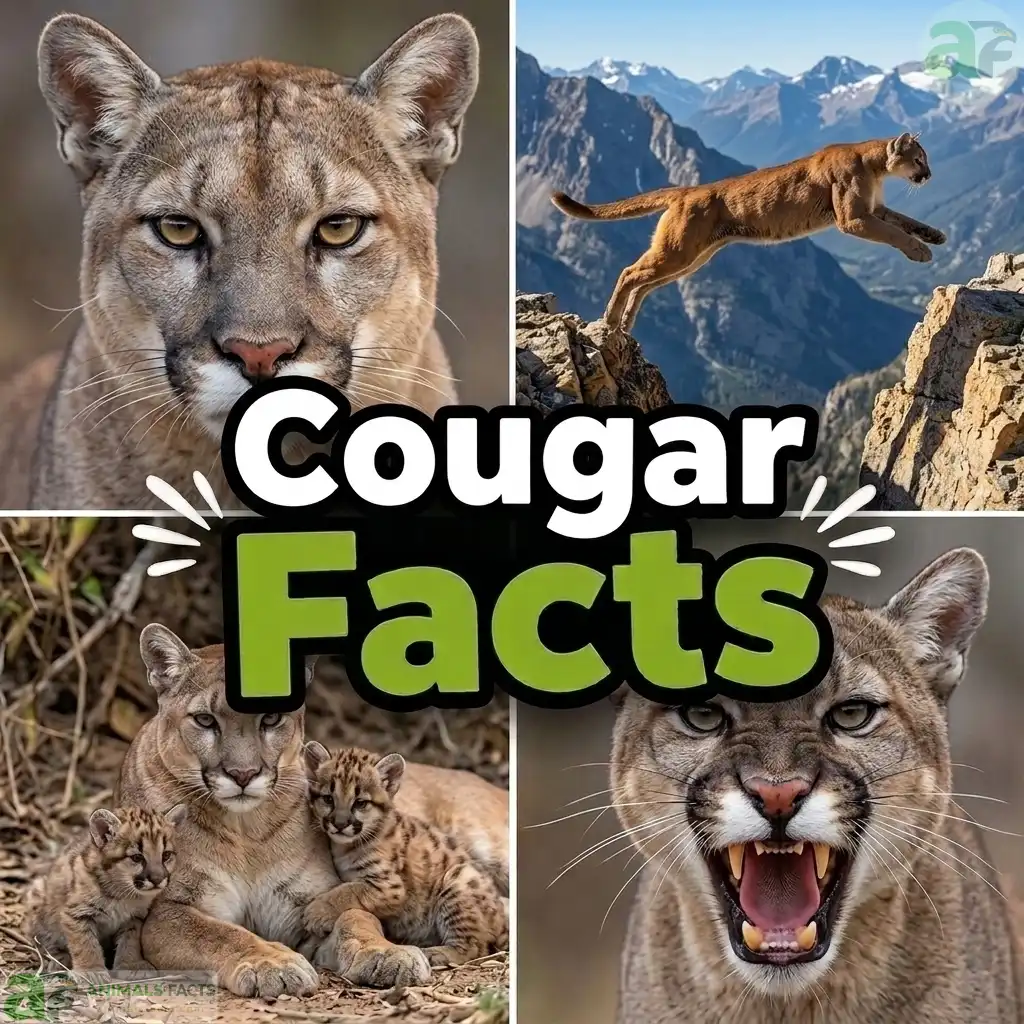
Cougar Facts
| Feature | Details |
|---|---|
| Scientific Name | Puma concolor |
| Common Names | Cougar, Mountain Lion, Puma, Panther (regional), Catamount (historical) |
| Kingdom | Animalia |
| Phylum | Chordata |
| Class | Mammalia |
| Order | Carnivora |
| Family | Felidae |
| Genus | Puma |
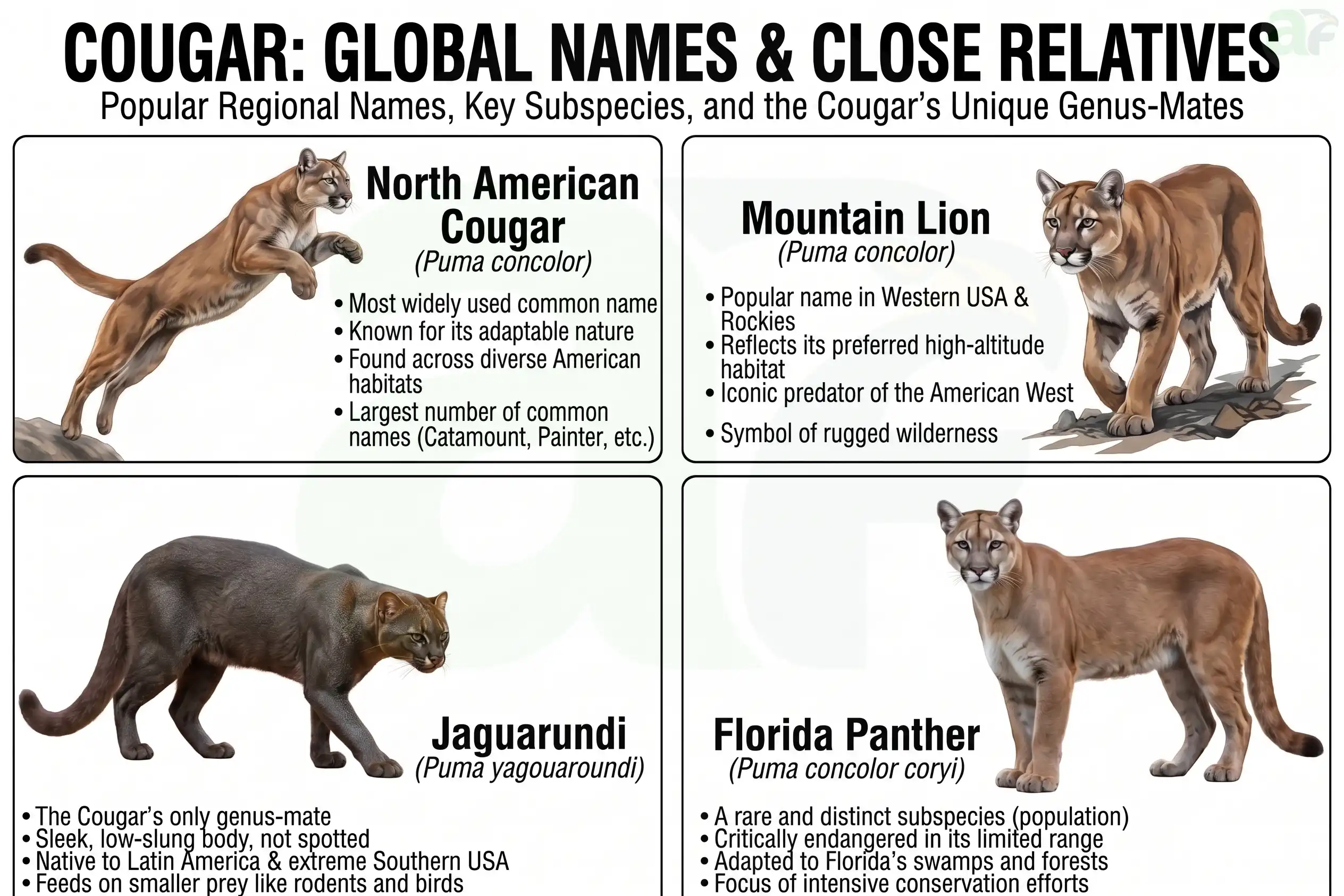
| Recognized Subspecies | Currently 2 recognized subspecies (North American: P. c. couguar; South American: P. c. concolor) under the revised 2017 IUCN taxonomy |
| Habitat | The widest natural range of any wild terrestrial mammal in the Western Hemisphere — rainforest, mountain, desert, grassland, swamp, tundra margin, forest |
| Lifespan | 8–13 years in the wild; up to 20 years in captivity |
| Diet | Apex carnivore — white-tailed deer, mule deer, elk, moose calves, peccaries, livestock |
| Weight | Males: 53–100 kg; Females: 29–64 kg |
| Body Length | 1.5–2.4 meters (total including tail); tail alone: 60–90 cm |
| Shoulder Height | 60–90 cm |
| Top Speed | Up to 80 km/h (50 mph) in short bursts |
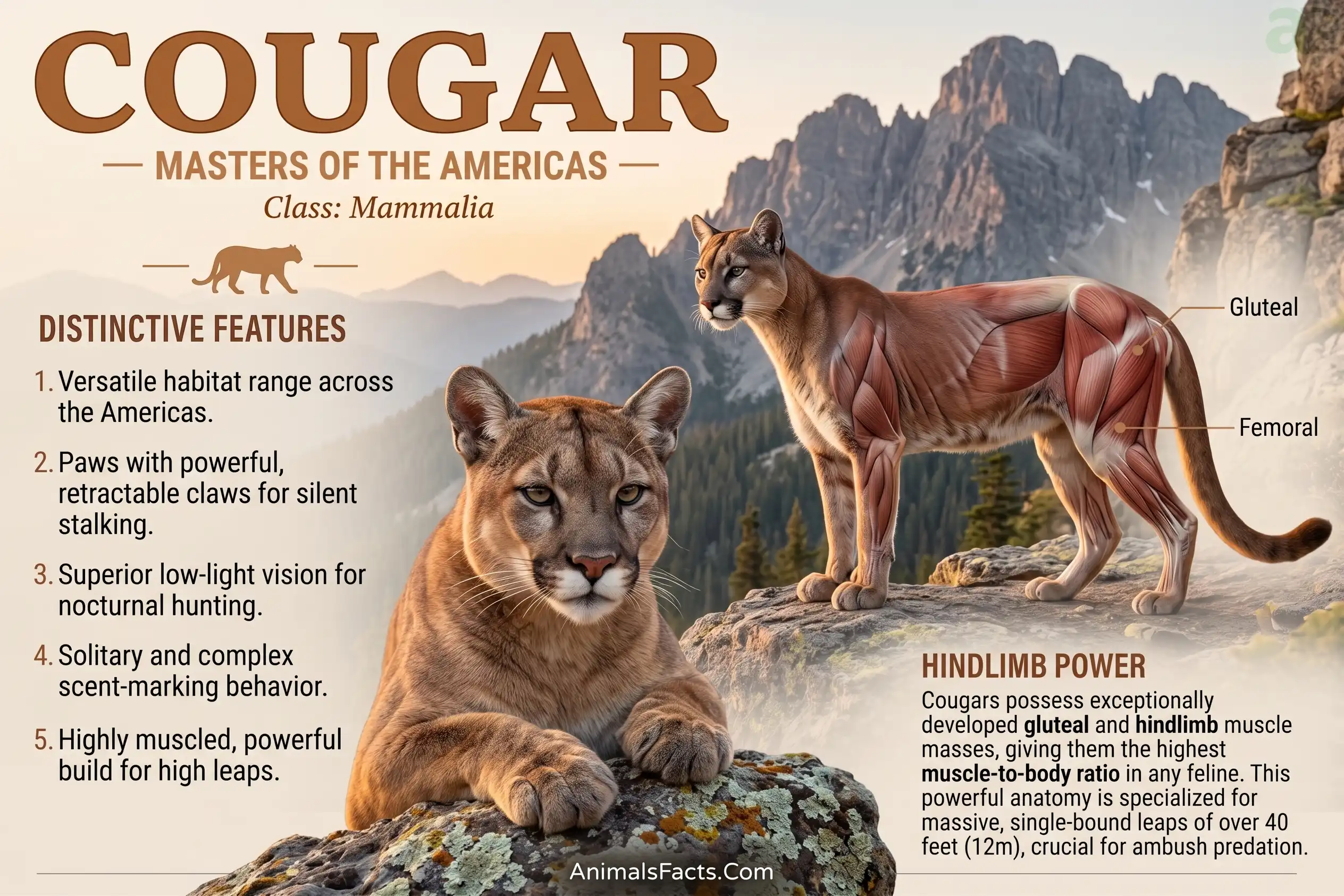
| Vertical Jump | Up to 5.5 meters high from standing; horizontal leaps of 12+ meters |
| Conservation Status | Least Concern (overall species) — Florida Panther Critically Endangered; Eastern Cougar declared extinct 2018 |
| Global Wild Population | Estimated ~50,000 individuals across full range |
| Unique Feature | Widest natural range of any wild terrestrial mammal in the Americas; most common names of any wild cat (40+ names); cannot roar — purrs like a domestic cat |
 1. Introduction: What is a Cougar?
It has more names than any other wild animal on Earth — over 40 documented common names across its vast range — called cougar, puma, mountain lion, panther, catamount, painter, and dozens of regional variations across North, Central, and South America. It holds the title of the widest natural range of any wild terrestrial mammal in the Western Hemisphere — a geographic achievement stretching from the Yukon Territory of northwestern Canada to the southern tip of South America in Patagonia, encompassing virtually every major terrestrial biome on two continents. And yet it is so secretive, so cryptic, and so deliberately invisible that most people who live their entire lives within its range never see one. Cougar facts reveal an animal of extraordinary ecological success built on a foundation of absolute behavioral invisibility.
The cougar — Puma concolor — is not technically a “big cat” in the strict scientific sense. Despite its impressive size — large males can weigh over 100 kg and exceed 2.4 meters in total length — the cougar belongs to the genus Puma rather than the roaring genus Panthera, and is more closely related to the cheetah than to lions or tigers. It cannot roar. Instead, it produces a remarkable range of sounds including chirps, whistles, and a haunting “scream” that has terrified and fascinated wilderness travelers for centuries. And like a domestic cat, it can purr on both inhalation and exhalation — a behavioral connection to its smaller relatives that no lion or tiger can match.
Whether you are a hiker learning cougar safety for a western mountain trail, a student researching cougar facts for a school project, a parent looking for cougar facts for kids, a conservation advocate following the remarkable story of the Florida Panther’s recovery from near-extinction, or simply someone captivated by the most geographically successful wild cat in the Americas — this is the most complete guide to cougar facts you will find anywhere. We cover cougar habitat, cougar diet, cougar behavior, communication, reproduction, all subspecies, conservation, mythology, and the extraordinary story of an animal that has survived the decimation of North America’s large carnivore community while remaining almost entirely invisible to the humans it lives alongside. Let us begin.
2. Species Overview & Classification
The cougar belongs to the family Felidae within the subfamily Felinae — the purring cats — rather than the roaring Pantherinae that contains lions, tigers, leopards, and jaguars. This classification reflects its evolutionary position as a large representative of the small-to-medium cat lineage that separately evolved large body size, rather than as a member of the ancient lineage of true roaring big cats.
Evolutionary Position — Closer to Cheetahs Than Lions
Genetic research has confirmed that the cougar’s closest living relative is the cheetah (Acinonyx jubatus) — both representing the surviving members of an ancient lineage that originated in North America, migrated to Eurasia (giving rise to cheetah ancestors), and subsequently returned to or persisted in the Americas as the modern puma lineage. This evolutionary relationship explains several behavioral and anatomical similarities between cougars and cheetahs — including the inability to roar, the capacity to purr continuously, and semi-retractable claw structures — that distinguish both species from the true roaring Panthera cats.
Subspecies Revision
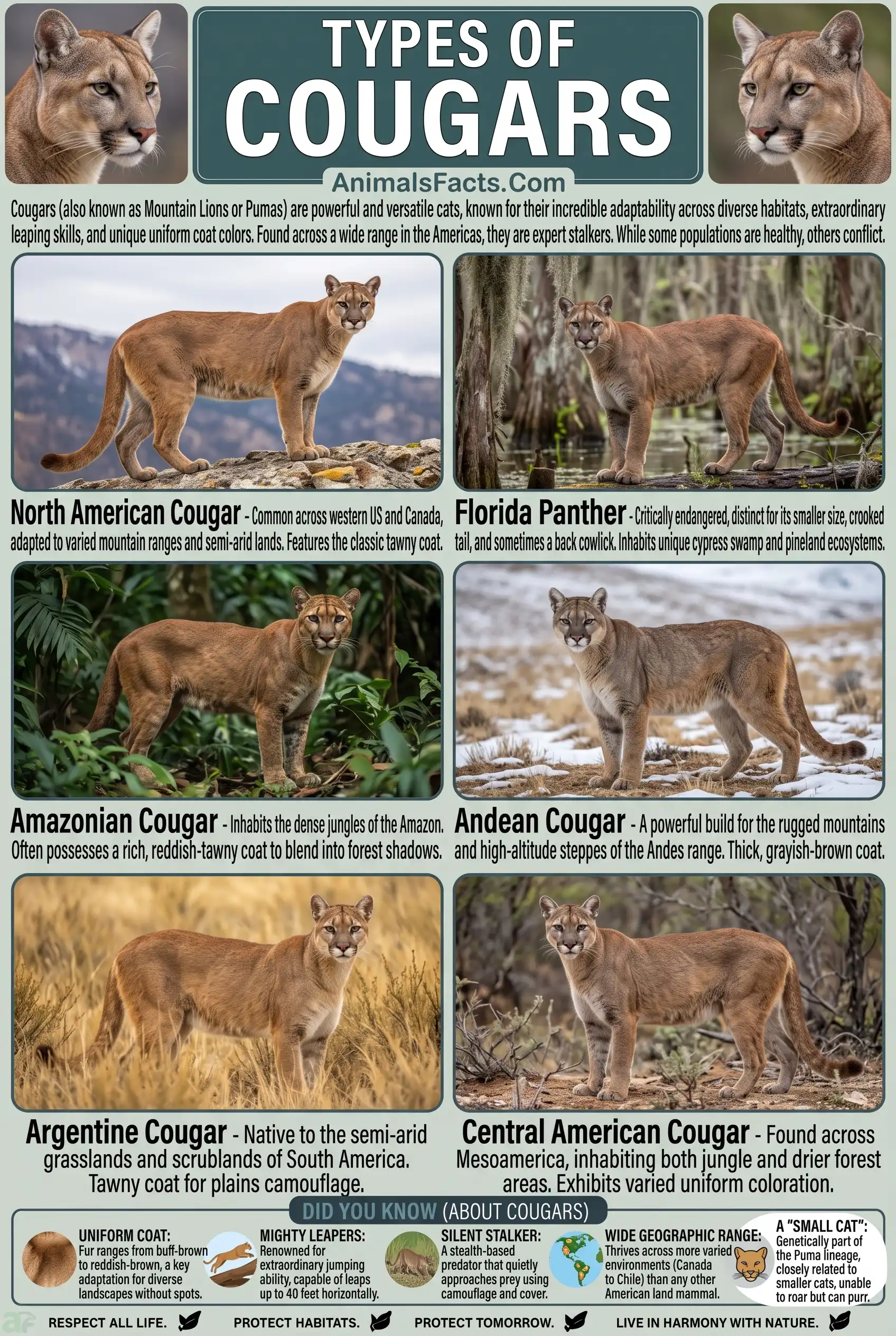
Historical taxonomy recognized up to 32 cougar subspecies across the species’ vast range — a proliferation subsequently revised to 6 subspecies by Wilson & Reeder (2005) and most recently further consolidated to just 2 subspecies by the 2017 IUCN Cat Specialist Group revision:
| Subspecies | Scientific Name | Range | Notes |
|---|---|---|---|
| North American Cougar | Puma concolor couguar | North and Central America | Includes the Florida Panther (critically endangered) and the Eastern Cougar (declared extinct 2018) |
| South American Cougar | Puma concolor concolor | South America | Multiple former subspecies consolidated; includes Andean Puma, Patagonian Puma, etc. |
Historical Subspecies of Conservation Note
| Former Subspecies | Range | Status |
|---|---|---|
| Florida Panther | South Florida only | Critically Endangered; ~200 individuals |
| Eastern Cougar | Eastern North America | Declared extinct by USFWS in 2018 |
| Costa Rican Cougar | Central America | Incorporated into P. c. couguar |
| Andean Mountain Lion | Andes Mountains | Incorporated into P. c. concolor |
Species Evolution & Discovery Timeline
~8–10 million years ago: The evolutionary lineage leading to modern pumas and cheetahs diverged from the common felid ancestor — establishing the Puma lineage as a separate evolutionary branch within the cat family.
~3–4 million years ago: Early puma-like ancestors appeared in North America — the continent where the Puma lineage actually originated, not South America as many assume.
~2–3 million years ago: As the Isthmus of Panama completed the land connection between North and South America, puma ancestors began colonizing South America — eventually establishing the most latitudinally extensive range achieved by any terrestrial mammal in the Western Hemisphere.
~10,000–12,000 years ago: The puma survived the Pleistocene megafauna extinction that eliminated dozens of other large North American mammals — including saber-toothed cats, dire wolves, and American lions — likely through behavioral flexibility and dietary adaptability that allowed transition to the surviving deer-dominated prey community.
~10,000 years ago: Genetic research suggests that modern North American cougar populations experienced a significant population bottleneck following the Pleistocene extinctions — with current North American cougars largely descended from a South American recolonization event after the original North American population was severely reduced.
1758: Carl Linnaeus formally classified the cougar as Felis concolor in Systema Naturae, later reclassified as Puma concolor as the genus structure was revised.
1900s: Systematic government extermination campaigns across North America — including bounty programs, professional hunting, and poisoning — drove cougars to extinction or near-extinction across most of the eastern United States and much of the southeastern range.
1967: The Florida Panther was listed as Endangered under precursor legislation to the US Endangered Species Act — among the first large carnivores to receive formal federal protection.
1995: A program introducing 8 female Texas cougars into the Florida Panther population — to address the severe inbreeding depression caused by the subspecies’ extreme genetic bottleneck — succeeded dramatically, producing a genetic rescue that reversed declining population trends and remains one of the most celebrated genetic intervention conservation programs in history.
2018: The US Fish and Wildlife Service officially declared the Eastern Cougar (Puma concolor couguar, eastern population) extinct — the first recognized extinction of a North American wild cat in modern times, attributed to historical hunting and habitat loss.
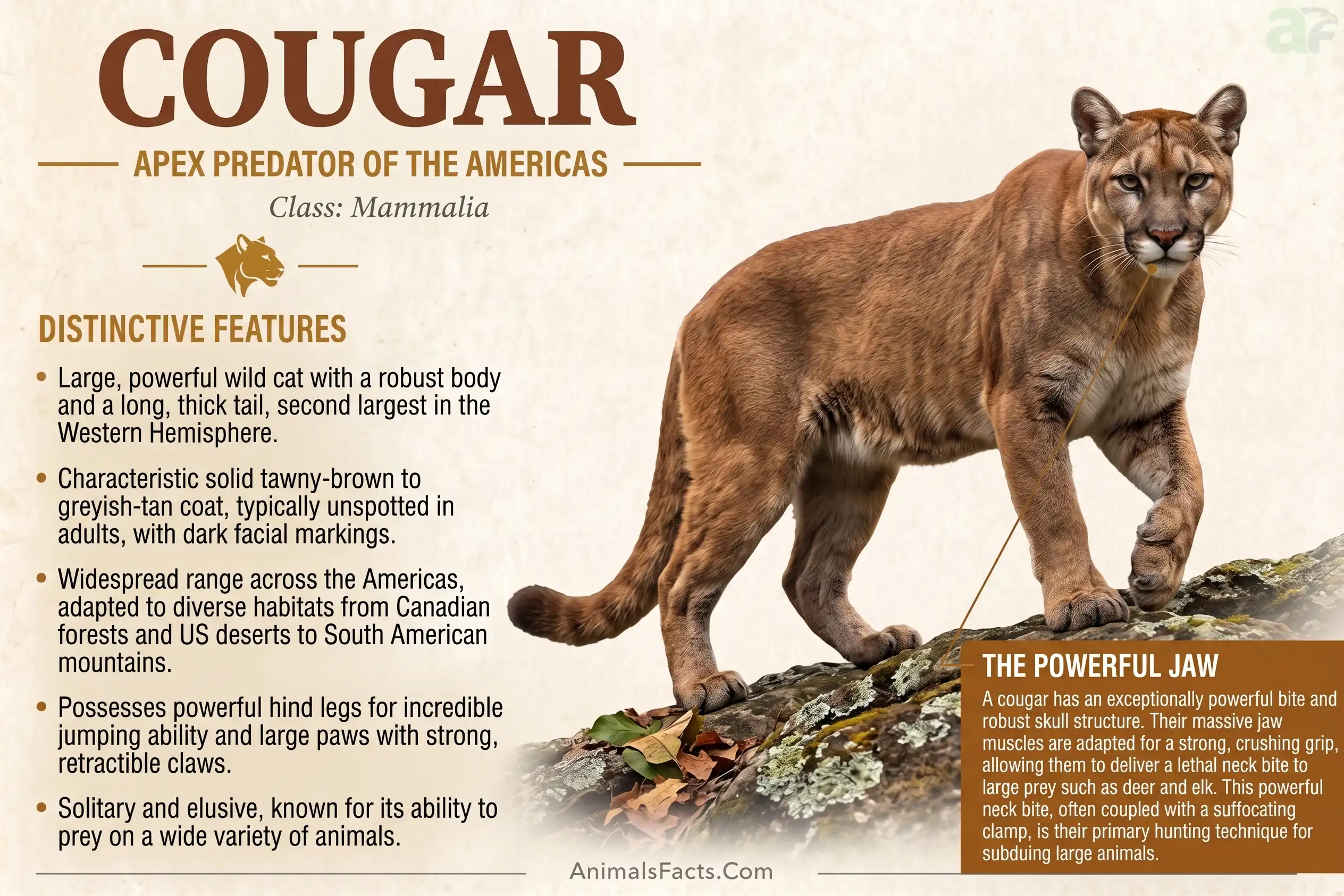
3. Physical Description & Unique Features
The cougar’s physical design is a study in understated versatility — a body plan that sacrifices the extreme specializations of cheetah speed, leopard climbing power, or jaguar bite force in favor of a balanced, capable predator toolkit that functions effectively across virtually every environment the species inhabits.
Size and Sexual Dimorphism
Largest populations: Cougars in the northern portions of their range — British Columbia, Alberta, Wyoming, Montana — tend toward the largest body sizes, with large males occasionally exceeding 100 kg and measuring over 2.4 meters in total length. The largest confirmed wild cougar weighed approximately 120 kg — though this represents an exceptional outlier rather than a typical size.
Smallest populations: High-altitude Andean populations and some tropical South American populations tend toward significantly smaller body size — with some populations averaging only 35–50 kg for males, reflecting both prey size calibration and the general latitude-related body size variation (Bergmann’s Rule) observed across the species’ range.
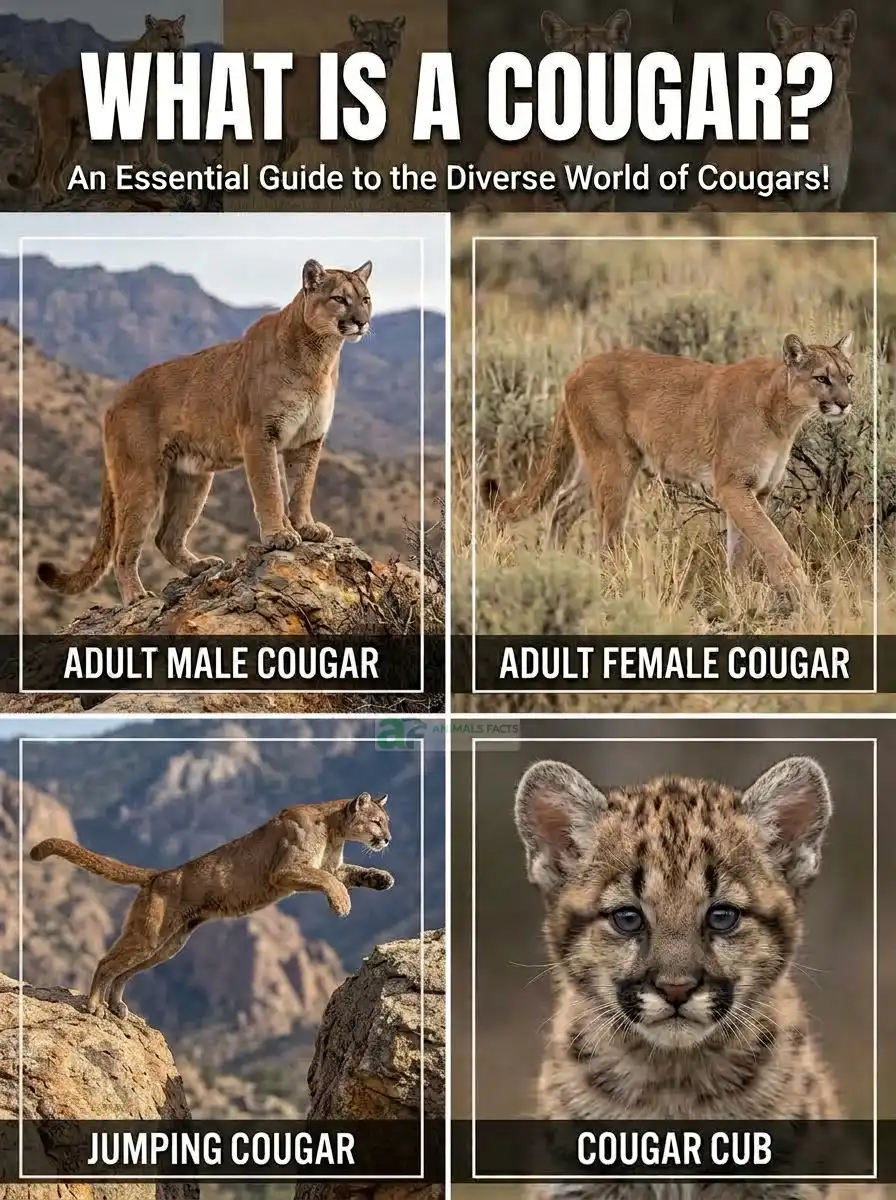
Sexual dimorphism: Male cougars are typically 40–60% heavier than females from the same population — a pronounced difference that likely reflects male-male competition for territories and breeding access.
The Solid Coat — No Spots or Stripes
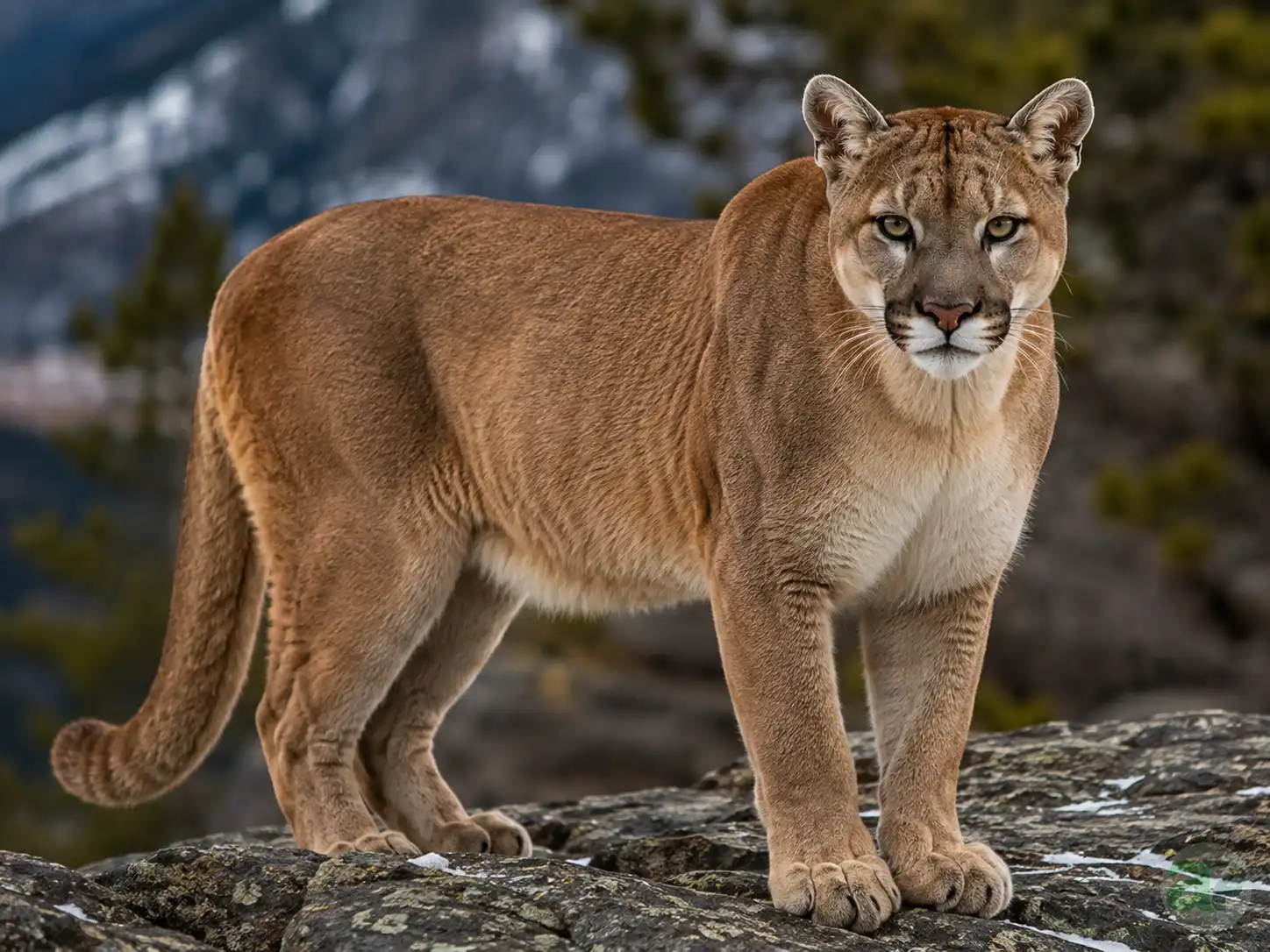
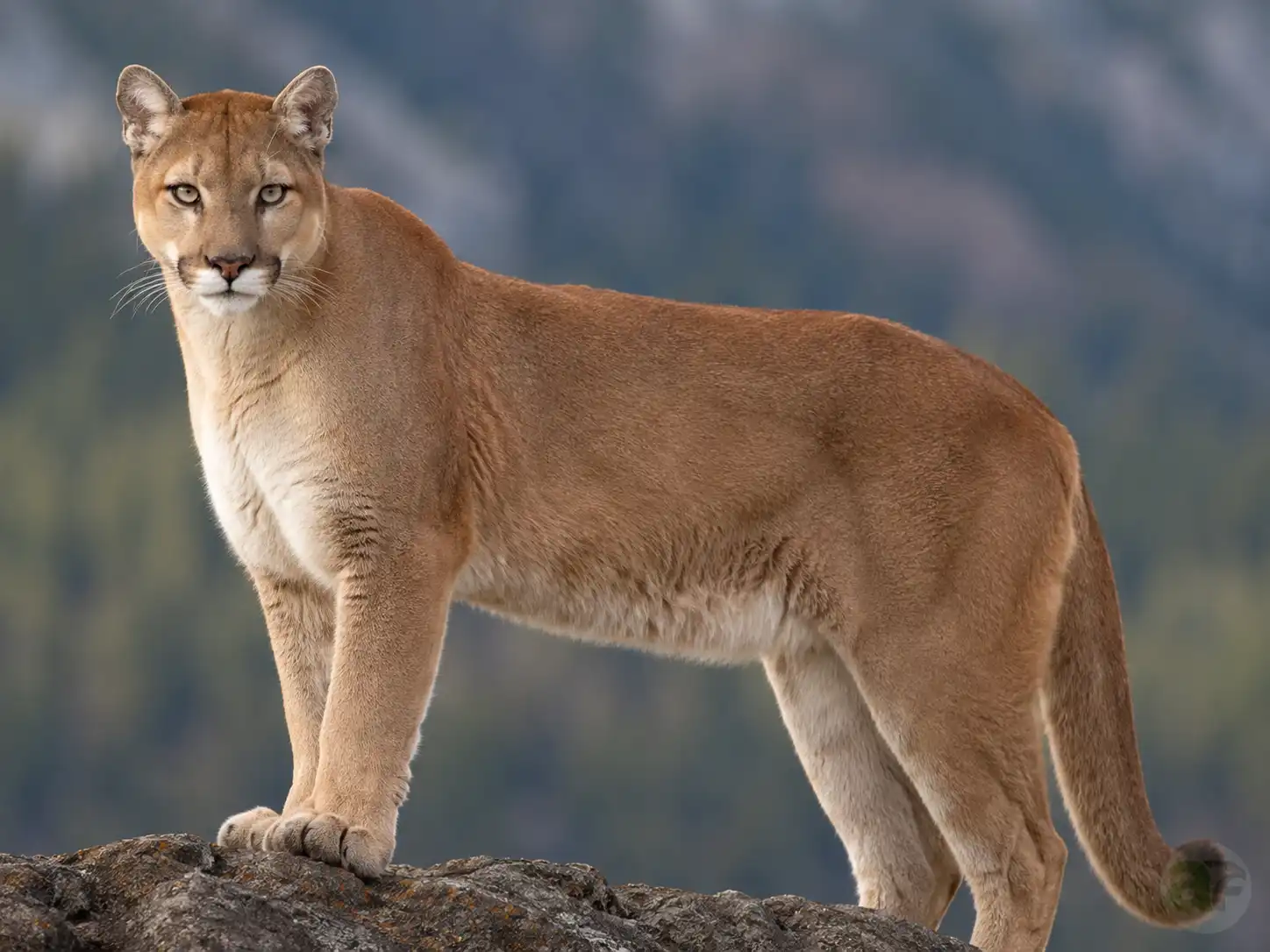
One of the most immediately distinctive features of the cougar is its uniformly tawny-brown coat — unmarked by the spots, rosettes, or stripes that characterize most other large cats. The coat color typically ranges from tawny or reddish-brown across the back and sides to pale cream or white on the belly, throat, and inner limbs, with dark markings on the muzzle, ears, and tail tip. Cubs, however, are born with distinctive spotted coats and blue eyes — spots that fade within the first year of life as the cub approaches adult coloration.
The Proportionally Long Tail
The cougar’s tail is remarkably long relative to its body — typically 60–90 cm in length — the longest tail proportionally of any North American carnivore. This tail serves as a critical balance organ during high-speed pursuit and jumping, and its characteristic curled or upswept position when the animal is walking or running represents one of the most reliable field identification features for distinguishing cougars from other large cats in regions of potential range overlap.
Exceptional Jumping Capability
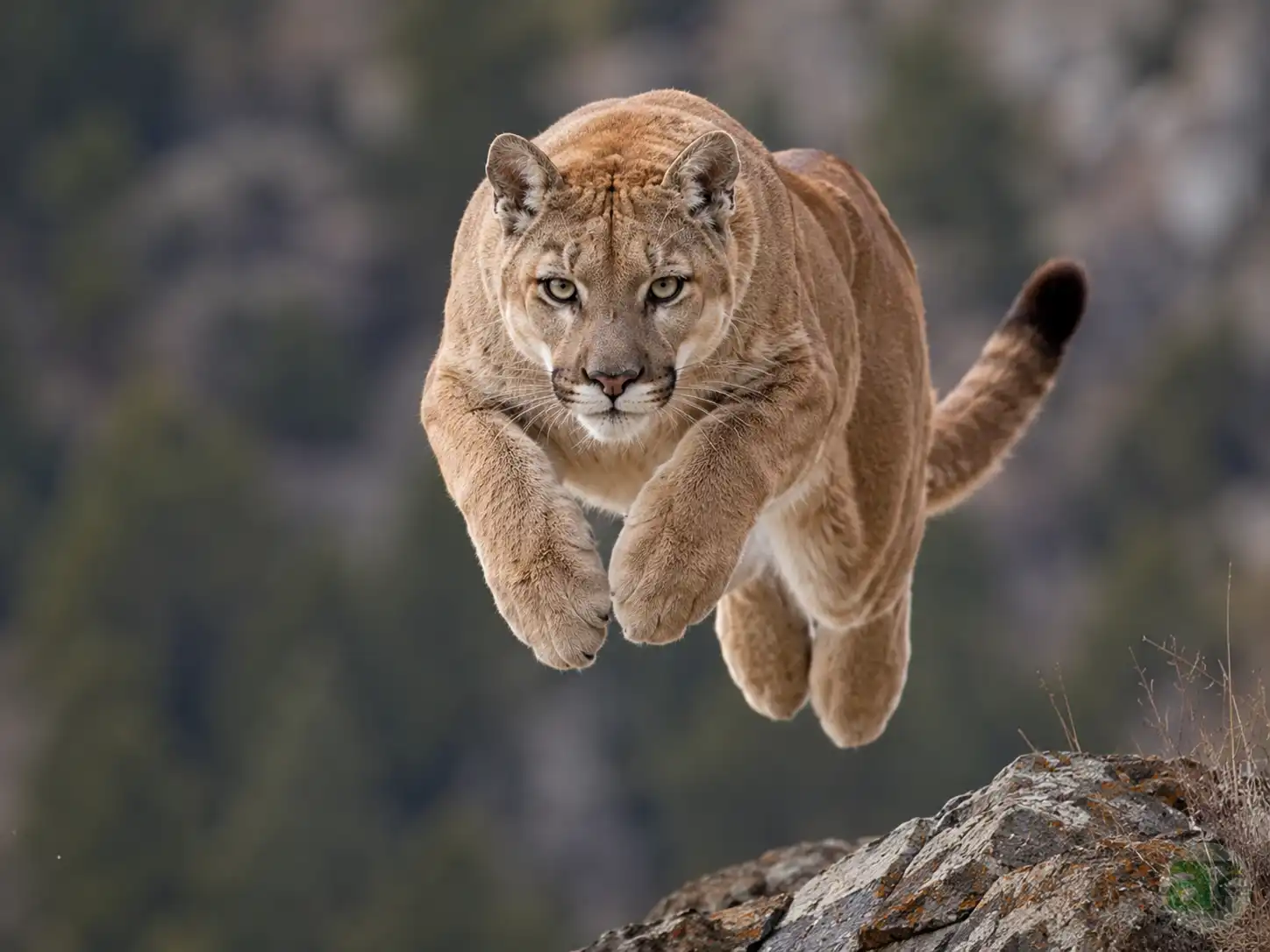
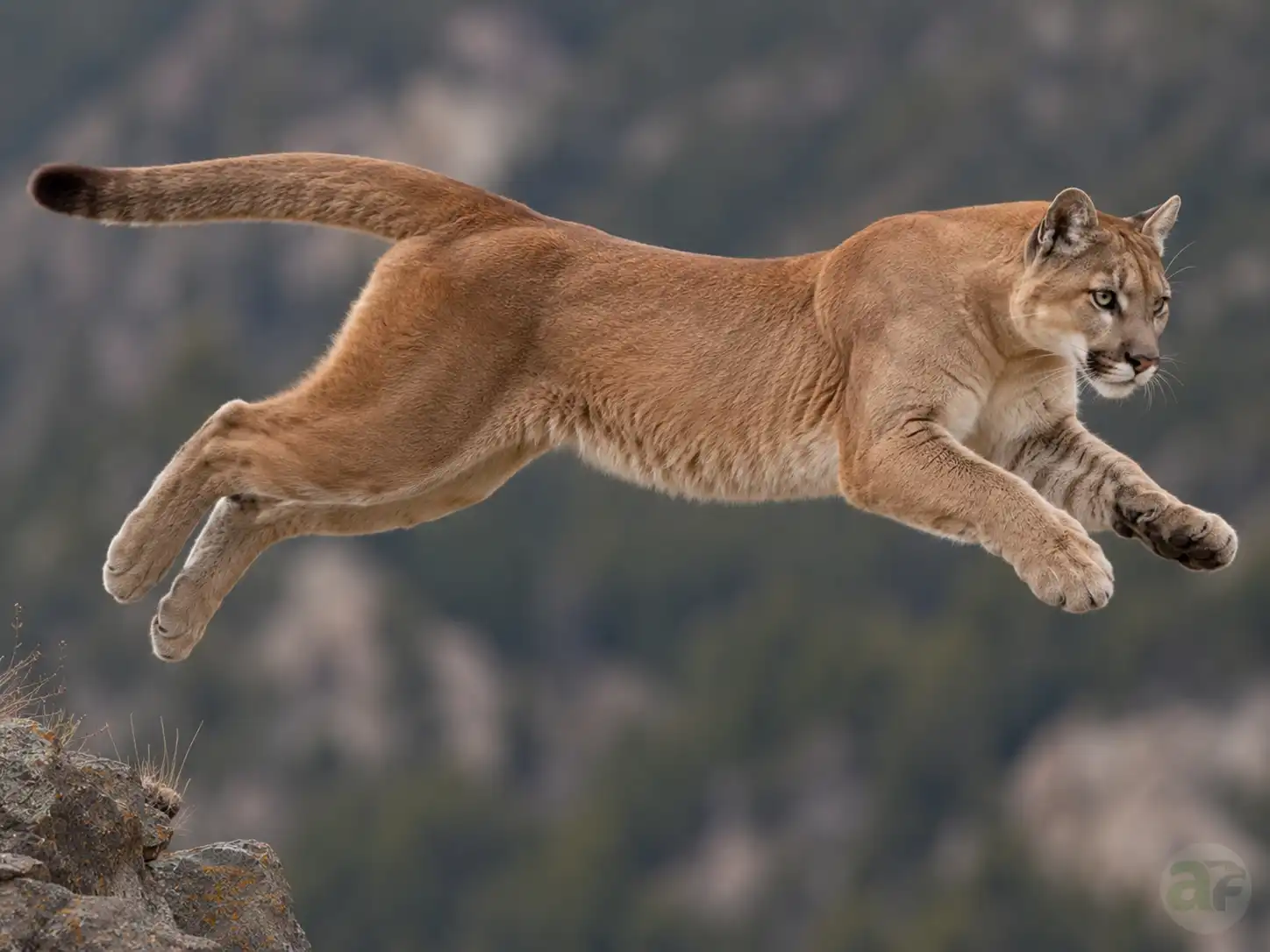
The cougar possesses perhaps the most impressive jumping ability of any wild cat relative to body size — capable of vertical leaps of up to 5.5 meters from a standing position and horizontal leaps of over 12 meters during prey pursuit. These capabilities reflect the combination of powerful hindquarter musculature, a flexible spine, and the proportionally long hindlimbs that give the cougar its characteristic rangy appearance when observed at close range.
Did You Know? The cougar holds a remarkable and previously little-known distinction — it is classified by geneticists as the closest living relative of the cheetah rather than as a close relative of lions or tigers. Genetic research has confirmed that the Puma and Acinonyx (cheetah) lineages share a common ancestor that diverged from other cat lineages approximately 8–10 million years ago, before separately giving rise to the cheetah in Eurasia and the puma in the Americas. This relationship explains why both species share the inability to roar, the capacity for continuous purring, and certain semi-retractable claw structures — features that distinguish both from the true roaring Panthera cats.
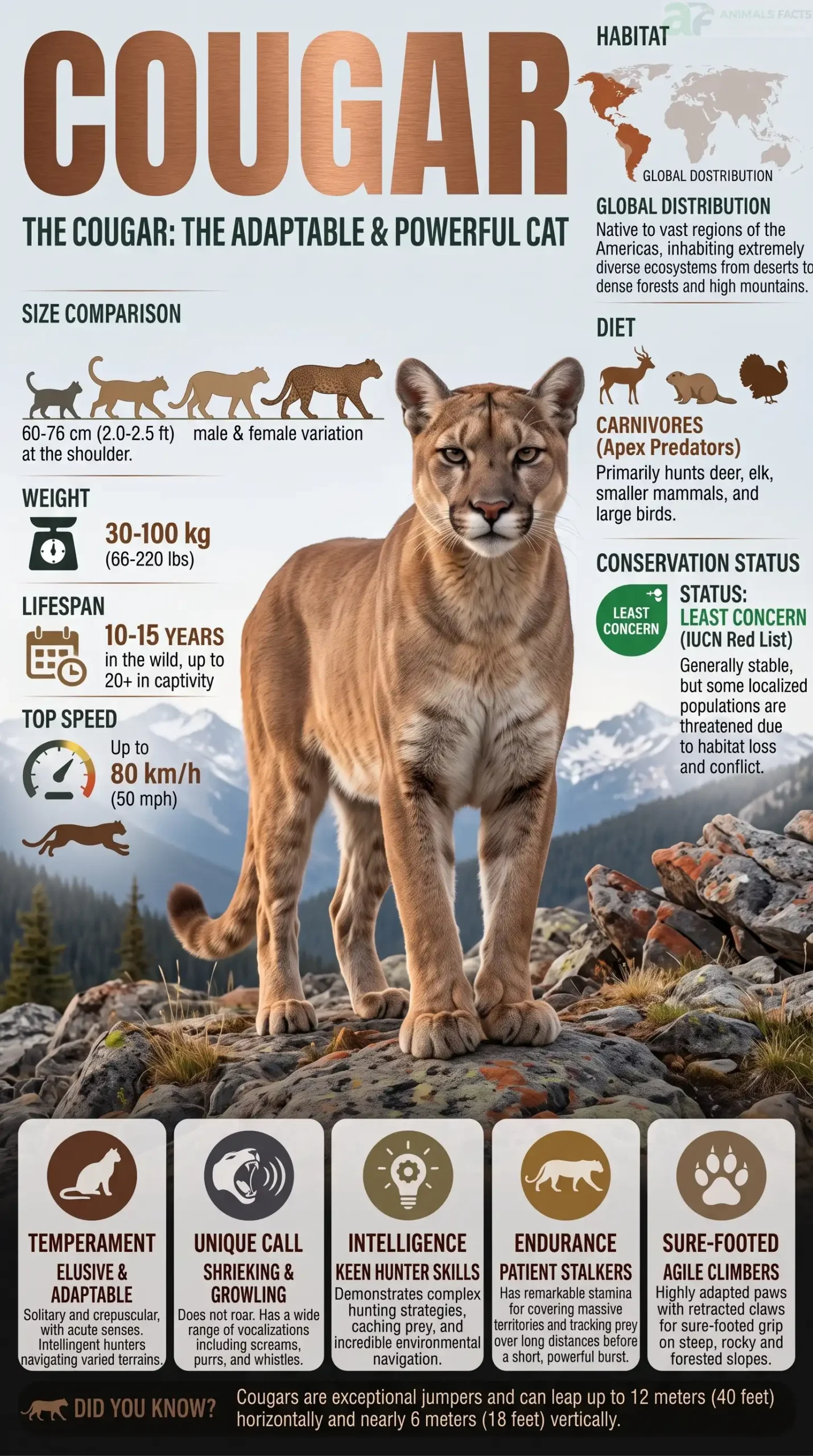
4. Top 25 Surprising & Interesting Cougar Facts
- The cougar holds the world record for the most common names of any wild animal — with over 40 documented common names across its range, including cougar, puma, mountain lion, panther, catamount, painter, ghost cat, catamount, red tiger, and dozens of regional variants.
- The cougar has the widest natural range of any wild terrestrial mammal in the Western Hemisphere — from the Yukon Territory of northwestern Canada to the tip of Patagonia in southern Chile and Argentina.
- Despite its size, the cougar cannot roar — it is not a member of the roaring Panthera genus but belongs to Puma, and produces sounds more reminiscent of a domestic cat, including purring, chirping, whistling, and the famous haunting scream.
- The cougar can purr continuously on both inhalation and exhalation — unlike lions, tigers, leopards, and jaguars, which can only vocalize on exhalation — a capability shared with domestic cats but absent in all true roaring big cats.
- The cougar is capable of vertical jumps of 5.5 meters from a standing position and horizontal leaps exceeding 12 meters during prey pursuit — proportionally among the most impressive jumping abilities of any land mammal.
- The Florida Panther — a critically endangered population of cougars in southern Florida — had declined to as few as 20–30 individuals in the early 1990s, making it one of the most severely bottlenecked large mammal populations in North American history, before a genetic rescue program increased the population to approximately 200 individuals by 2026.
- Genetic research has determined that the cougar’s closest living relative is not the lion or the jaguar — as proximity of range might suggest — but the cheetah (Acinonyx jubatus) of Africa and Iran.
- The Eastern Cougar — a subspecies that historically ranged across eastern North America — was officially declared extinct by the US Fish and Wildlife Service in 2018, making it the first North American wild cat recognized as extinct in modern times.
- A cougar can consume an entire adult white-tailed deer over the course of a 3–7 day period — returning repeatedly to a cached carcass after hunting success, similar to the caching behavior of leopards.
- Cougars have been documented traveling through the heart of New York City suburbs, downtown Los Angeles, and other major metropolitan areas — demonstrating a behavioral flexibility that has brought them into increasing contact with human populations as Western US cities expand into historical cougar habitat.
- The term “panther” used in the southeastern United States — particularly “Florida Panther” — refers to the cougar, not to a separate species. “Black panther” sometimes mistakenly applied to dark-coated animals in the Southeast refers to melanistic leopards or jaguars in other regions; melanism has never been reliably documented in wild cougar populations.
- A male cougar’s territory can be extraordinarily large — with documented ranges up to 1,300 km² in areas of low prey density — making individual cougars among the most wide-ranging large carnivores in the Western Hemisphere.
- Cougars have been documented crossing the Rocky Mountains on multiple occasions and have been tracked using GPS collars traveling over 1,000 kilometers during dispersal journeys — demonstrating the extraordinary movement capability of young males establishing new territories.
- Unlike most large cats that avoid water, cougars swim readily and have been observed crossing rivers over 300 meters wide as part of normal territory patrols.
- The famous “cougar scream” — a haunting, high-pitched wail produced primarily by females in estrus and occasionally in social interactions — has been mistaken for a child screaming, a woman in distress, and various supernatural entities by wilderness travelers who heard it without seeing its source.
- Cougars are documented caching (covering) their kills with leaves, grass, pine needles, and other debris — returning to feed over multiple days, a behavior that reduces scent and conceals kills from competing scavengers.
- The cougar’s primary prey across most of its North American range is white-tailed deer or mule deer — but the species has been documented successfully hunting prey ranging in size from insects and small rodents to adult moose in exceptional cases.
- Despite their size, cougars are preyed upon by wolves in areas of range overlap — with wolf packs documented killing individual cougars during territorial encounters in Yellowstone and the northern Rocky Mountains, creating a competitive dynamic that significantly influences cougar behavior and habitat use.
- The reintroduction of wolves to Yellowstone in 1995 altered cougar behavior measurably within years — with cougars shifting their activity patterns, habitat use, and kill site selection to reduce encounters with wolves, demonstrating rapid behavioral adaptation to a new competitive pressure.
- Cougars produce a distinctive “chirp” vocalization — a short, high-pitched sound used in close-range communication between mothers and cubs — that sounds strikingly like a bird call and frequently surprises wilderness hikers who attribute the sound to avian sources.
- Female cougars invest an extraordinarily long period in cub-rearing — cubs may remain with their mother for 12–24 months, one of the longest maternal dependency periods among comparable-sized felids.
- Cougars have been documented making kills within city limits of several major western US cities — including deer kills documented in backyards, parks, and urban open spaces in cities including Los Angeles, San Jose, Boulder, and Tucson.
- The Puma genus once contained multiple species across the Americas — including the now-extinct American Cheetah (Miracinonyx), which occupied a similar cursorial predator niche in Pleistocene North America — demonstrating that the puma lineage was once considerably more species-diverse than its single surviving modern representative.
- Cougars can go 8–9 days without food between successful hunts during periods of low prey availability — a physiological flexibility that reflects adaptation to the variable prey availability characteristic of their diverse habitats.
- The cougar’s retractable claws are kept razor-sharp through a combination of protective sheathing that prevents ground contact during walking and deliberate tree-scratching behavior — functional claw honing that has been documented at “scratch posts” used repeatedly by the same individual across months and years.
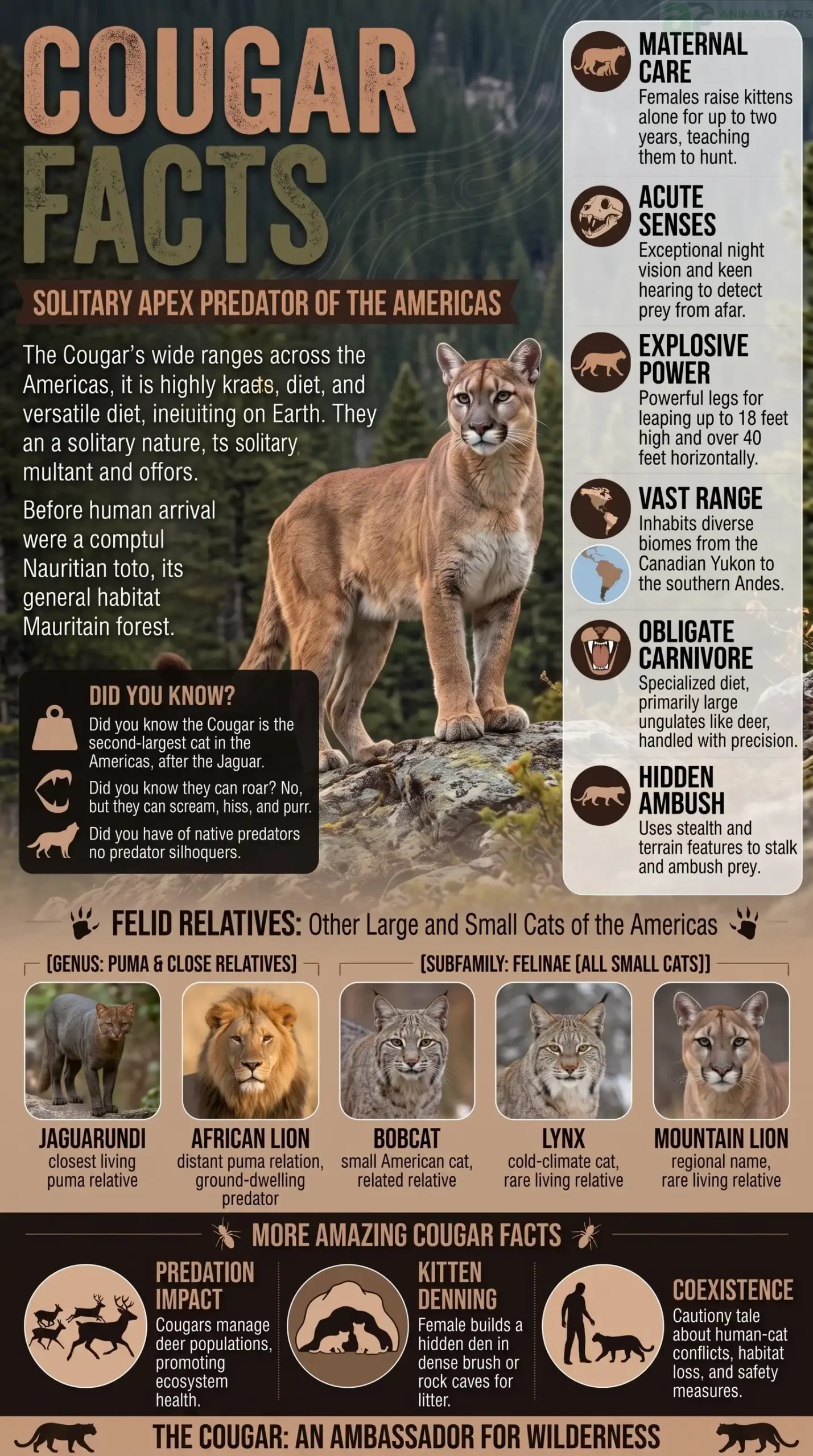
5. Cougar Fun Facts for Kids
- The cougar has over 40 documented common names — more than any other animal.
- The cougar has the widest range of any wild terrestrial mammal in the Americas.
- Cougars cannot roar — they purr, chirp, whistle, and scream instead.
- Cougars can leap 5.5 meters vertically and 12+ meters horizontally in a single bound.
- The cougar’s closest relative is the cheetah, not the lion or jaguar.
- The Florida Panther recovered from just ~20 individuals to ~200 thanks to a genetic rescue.
- The Eastern Cougar was declared officially extinct in 2018.
- Cougars cover their kills with debris and return to feed over multiple days.
- Cougars have been documented making kills in suburban backyards of major US cities.
- Wolves reintroduced to Yellowstone measurably changed cougar behavior within years.
- Cougar cubs are born spotted but lose their spots within their first year.
- Cougars purr on both inhale and exhale — like domestic cats, unlike all roaring big cats.
6. Natural Habitat & Geographic Range
The cougar’s habitat range is one of the most extraordinary of any wild animal — a testament to the species’ ecological adaptability that stands as arguably the greatest geographic achievement of any wild terrestrial mammal in the Western Hemisphere.
Primary Habitat Types
Temperate and boreal mountain forest: The cougar’s most iconic North American habitat — the coniferous forests and mountain meadows of the Rocky Mountains, Sierra Nevada, Cascade Range, and associated ranges — supporting some of the highest cougar densities in North America through abundant deer and elk prey. States including Idaho, Montana, Wyoming, Colorado, Utah, Washington, Oregon, and California support the core of the western North American cougar population.
Tropical and subtropical rainforest: Across Central and South America, cougars inhabit dense tropical rainforest — from the cloud forests of Central America through the Amazon Basin — coexisting with jaguars (with which they overlap significantly in this region) through behavioral partitioning of activity time, prey size, and microhabitat use.
Sonoran and Chihuahuan Desert: Cougars inhabit the desert landscapes of the southwestern United States and northern Mexico — adapting their hunting strategy to desert-dwelling prey including mule deer, javelinas (peccaries), bighorn sheep, and smaller mammals in the sparse water-limited environments of the American Southwest.
Subtropical swamp and coastal habitat: The Florida Panther demonstrates remarkable adaptation to the subtropical swamp habitats of southern Florida — including the Big Cypress Swamp, Everglades, and surrounding agricultural lands — representing the southeastern-most cougar population in North America and one of the most habitat-restricted large carnivore populations in the United States.
High-altitude Andean habitat: South American cougar populations extend into the Andes Mountains at elevations exceeding 5,800 meters — making the cougar the highest-altitude wild cat documented on Earth, with some Andean populations surviving in conditions of extreme altitude, cold, and prey scarcity that few other large carnivores could tolerate.
Patagonian steppe and grassland: The Patagonian populations of southern Argentina and Chile inhabit open steppe and grassland habitats at the southern extreme of the species’ range — among the most dramatically cold-adapted cougar populations, hunting guanacos (relatives of llamas and alpacas) across windswept grasslands that bear more resemblance to the Tibetan Plateau than to the tropical forests of the Amazon.
Habitat Range by Region
| Region | Country Examples | Approx. Population | Status |
|---|---|---|---|
| Western North America | USA (western states), Canada (BC, AB) | ~30,000–40,000 | Stable to recovering in core range |
| Central America | Mexico, Costa Rica, Guatemala, Honduras | ~5,000–8,000 | Fragmented; declining |
| Amazon Basin | Brazil, Peru, Colombia | Portion of ~40,000+ S. American | Overlaps with jaguar; poorly monitored |
| Andes Mountains | Peru, Bolivia, Ecuador, Chile, Argentina | Poorly quantified | Significant; locally threatened |
| Pantanal | Brazil, Bolivia | Moderate | Coexists with jaguars |
| Patagonia | Argentina, Chile | Moderate | Huntable in parts; persecuted |
| Florida (Panther) | USA (South Florida only) | ~200 individuals | Critically Endangered |
| Eastern North America | USA (east of Mississippi) | Functionally extirpated (occasional dispersers) | Eastern Cougar declared extinct 2018 |
Did You Know? In June 2011, a young male cougar was struck and killed by a vehicle on a Connecticut highway — over 2,700 kilometers from the nearest known stable Western cougar population. DNA analysis confirmed the animal originated from the Black Hills of South Dakota, where its journey began over 18 months earlier. This individual’s extraordinary transcontinental dispersal journey — documented through DNA matching, camera trap images, and track records along the way — remains one of the most remarkable documented animal dispersal events in North American wildlife history, and generated significant public debate about whether cougars might naturally recolonize eastern North America.
7. Diet & Feeding Behavior
The cougar is a highly efficient stalking ambush predator — relying on exceptional cover utilization, patient approach, and a single killing bite to take prey that often significantly outweighs it, across a broader range of prey types and sizes than virtually any other large cat species in the Western Hemisphere.
What Cougars Eat
Cougar diet is predominantly centered on deer across most of the North American range — with white-tailed deer, mule deer, elk calves, and related cervids comprising the majority of diet across most documented populations. However, the species’ extraordinary geographic range encompasses dramatically different prey communities, and cougar diet reflects this diversity with remarkable flexibility.
Diet Breakdown Table
| Prey Type | Approximate Percentage | Notes |
|---|---|---|
| White-tailed deer | 35–60% (eastern/southern North America) | Primary prey across most eastern range |
| Mule deer | 30–55% (western North America) | Primary prey across most western range |
| Elk (calves and sub-adults primarily) | 10–25% (Rocky Mountain region) | Significant seasonal prey in northern range |
| Peccaries/Javelinas | 10–20% (southwestern USA and Central America) | Major prey in desert and tropical environments |
| Bighorn sheep | 5–15% (mountain western range) | Significant concern for endangered sheep populations |
| Guanacos and vicuñas | 30–50% (Patagonian/Andean populations) | Primary prey across southern South American range |
| Moose calves | 1–5% (northern range) | Occasional; requires considerable risk |
| Smaller mammals, rodents, hares | 10–20% | Important supplement in lean periods |
| Domestic livestock | Variable | Major source of human-cougar conflict |
The Cougar’s Hunting Strategy
The cougar is a stalking ambush predator — relying on patient, careful approach to within very close range of prey before launching a short, explosive pursuit ending in a killing bite.
Approach and stalk: Cougars typically detect prey at considerable distance — either through direct visual observation from an elevated vantage point or through scent detection during territory patrol — and then begin a slow, careful stalk using all available cover to close to within 10–30 meters of the target animal.
Rush and contact: From close range, the cougar launches an explosive rush — covering the final gap in seconds — using its powerful hindquarters and jumping capability to close on prey rapidly before the animal can react fully.
Kill method: The cougar kills through a precision throat bite or a nape bite targeting the back of the skull and upper spine — with the specific technique reflecting the size and defensive capability of the prey. The cougar’s well-developed jaw musculature allows it to maintain a suffocating throat grip on prey animals substantially heavier than itself for the minutes required to complete the kill.
Caching behavior: After making a kill, cougars typically drag the carcass to cover and cache it under debris — covering it with leaves, pine needles, dirt, and whatever organic material is available. This caching behavior protects the kill from ravens and other scavengers and allows the cougar to return and feed over multiple days before the carcass spoils.
Did You Know? Research using GPS collars on mountain lions in the Sierra Nevada documented that individual cougars make a large prey kill approximately every 9–12 days on average — with significant variation based on prey size, season, and whether a female is feeding dependent cubs (which dramatically increases kill frequency). A female with two large cubs may kill a deer-sized animal every 3–4 days to sustain her family — generating substantial ecological impact through the carcasses she leaves behind, which support populations of ravens, eagles, coyotes, black bears, and dozens of other scavenger species.
8. Reproduction & Life Cycle
Cougar reproduction reflects a well-documented balance between long maternal investment and relatively high cub mortality — with the characteristic reproductive strategy of a large solitary felid in an environment of variable prey availability and significant large-predator competition.
Mating Behavior
Cougars are non-seasonal breeders across most of their range — mating can occur year-round in tropical and subtropical portions of the range, with potential seasonal peaks linked to prey availability in temperate regions. Female cougars advertise estrus through urine marking, vocalizations (including the famous “scream”), and body language — with male cougars becoming aware of reproductive females through scent monitoring during regular territorial patrols.
Mating consortships between otherwise solitary adults typically last 3–6 days, during which the pair travels, feeds, and mates repeatedly before separating and returning to individual territory maintenance. Infanticide by incoming males is a documented risk to cubs when a new male takes over a female’s range — as in many solitary felid species, incoming males benefit reproductively from eliminating dependent offspring and bringing the female back into estrus.
Gestation and Birth
Gestation period: Approximately 82–96 days — among the shorter gestations of large felids.
Litter size: Typically 1–4 cubs (most commonly 2–3), born weighing approximately 230–450 grams each.
Birth: Cubs are born in a secluded den — dense brush pile, rocky cave, or hollow log — with their characteristic spotted coats and closed eyes.
Key Developmental Stages
| Stage | Age | Key Development |
|---|---|---|
| Neonatal | 0–2 weeks | Eyes closed; spotted coat; helpless |
| Eyes open | 10–14 days | Beginning visual awareness |
| First outings | 6–8 weeks | Beginning to leave den with mother |
| Weaning | 3–6 months | Transition to meat alongside nursing |
| Accompanying hunts | 6–12 months | Learning prey detection and hunting |
| Kill participation | 8–18 months | Beginning to participate in family hunts |
| Independence | 12–24 months | Separation from mother |
| Dispersal | 12–24 months | Establishing independent territory; highest mortality period |
| Sexual maturity | Female: ~2 years; Male: ~2–3 years | First breeding |
Lifespan Comparison Table
| Species | Average Wild Lifespan | Maximum Confirmed |
|---|---|---|
| Cougar | 8–13 years | ~20 years (captivity) |
| Jaguar | 12–15 years | ~23 years (captivity) |
| Leopard | 12–17 years | ~23 years (captivity) |
| Bobcat | 7–10 years | ~16 years (wild) |
| Ocelot | 7–10 years | ~20 years (captivity) |
9. Social Behavior & Communication
The cougar is one of the most thoroughly solitary large carnivores on Earth — maintaining exclusive territories through intensive marking behavior, avoiding direct encounters through careful scent monitoring, and forming lasting social bonds only between mothers and dependent cubs.
Territorial Organization
The cougar’s territorial system is characterized by overlapping male territories — large male home ranges that encompass the exclusive territories of several adult females — with males competing intensely for access to the females within their range. Territory sizes vary enormously:
- Female cougars: Typically 40–250 km² depending on prey density and habitat
- Male cougars: Typically 100–1,300 km² in documented North American populations
- Florida Panthers: Smaller territories reflecting the restricted habitat available — female territories approximately 200–500 km², male territories 500–700 km²
Communication Methods
The Cougar Scream: The most famous and most evocative cougar vocalization — a long, haunting, high-pitched wail produced primarily by females during estrus, occasionally by both sexes in social contexts. The scream carries remarkable distances across mountain terrain and has been described by wilderness travelers as one of the most unsettling sounds in the North American wilderness, frequently triggering fear responses in humans who hear it without knowing its source.
Chirping and whistling: Short, high-pitched contact calls used between mothers and cubs and occasionally between consorting adults. These calls are strikingly bird-like in quality — frequently misidentified as avian calls by observers who hear them without seeing their source.
Purring: Produced during relaxed, affiliative interactions — between mothers and cubs and occasionally between familiar adults during consortship. The cougar purrs on both inhalation and exhalation — distinguishing it from all roaring Panthera cats, which can only produce continuous sound on exhalation.
Growling, hissing, and spitting: Threat vocalizations produced during close-range encounters with competitors, potential predators, or humans — rarely heard but well-documented in wildlife encounters.
Scent marking: The primary long-distance communication medium — cougars spray urine on prominent rocks, trees, and trail junctions, and create “scrapes” — small mounds of pine needles, leaves, or soil marked with urine and feces — that function as territorial bulletin boards conveying identity, sex, reproductive status, and time-since-deposition information to other cougars.
Did You Know? Research using GPS collars on cougars in Yellowstone National Park documented a remarkable social pattern — neighboring female cougars whose territories closely overlapped were sometimes close relatives (mothers and daughters, or sisters), and these closely related females showed significantly greater tolerance for territorial overlap and occasional co-feeding at kills than unrelated females. This kin-based spatial organization — previously undocumented in solitary felids at this resolution — suggests that cougar “solitary” social organization may be considerably more nuanced than previously appreciated, with family relationships influencing territorial dynamics in ways invisible to traditional field observation.
10. Predators & Defense Mechanisms
Adult cougars in good health face very few natural predators — their size, speed, and cryptic behavior make them effective competitors in every ecosystem they inhabit. However, cubs, juveniles, and adult cougars in specific competitive situations face genuine predation and mortality risk from several sources.
Natural Predators and Competitors
Gray Wolves: The most significant natural competitor and occasional predator of cougars in areas of range overlap across the northern Rocky Mountains, Pacific Northwest, and portions of Canada. Wolf packs regularly kill cougars when encounters occur — with the social advantage of pack hunting overcoming the size and agility advantage of the solitary cougar. The reintroduction of wolves to Yellowstone National Park in 1995 measurably altered cougar behavior and habitat use across the park within years.
Grizzly and Black Bears: Bears represent significant kleptoparasites (kill thieves) rather than typical predators — but large grizzly bears can and do kill cougars in direct confrontations, and both species regularly steal cougar kills. In areas of high bear density, cougars structure their kill-site behavior to minimize bear encounters, occasionally abandoning kills to avoid direct confrontation.
Jaguars: In areas of range overlap across Central and South America, jaguars are dominant competitors — larger, more powerfully built, and capable of subduing cougars directly in territorial confrontations. Research in areas of cougar-jaguar overlap consistently documents cougars deferring to jaguars in direct encounters, shifting to smaller prey, and utilizing different microhabitats and activity times to reduce competitive pressure from the larger felid.
American Alligators: In Florida, American Alligators represent a genuine predation risk to Florida Panthers — with documented cases of alligator predation on cougars crossing waterways in Big Cypress and Everglades habitats.
Humans: The primary cause of cougar mortality across virtually the entire species range — through hunting (legal in many western US states and Canadian provinces), vehicle collisions, and retaliatory or preventive killing related to livestock predation or human safety concerns.
Defense and Survival Strategies
Crypticity and avoidance: The cougar’s primary survival strategy — the behavioral invisibility that allows it to coexist alongside millions of people across the western United States while remaining essentially unseen by the vast majority of those people.
Vertical escape: While not as extreme a climber as leopards, cougars readily climb trees to escape pursuing wolves or bears — with cubs in particular spending significant time in trees during the period before they are large enough to defend themselves.
Protective maternal aggression: Female cougars defending cubs are one of the most genuinely dangerous wildlife encounters documented in North America — willing to physically confront threats including humans, wolves, bears, and male cougars to protect dependent offspring.
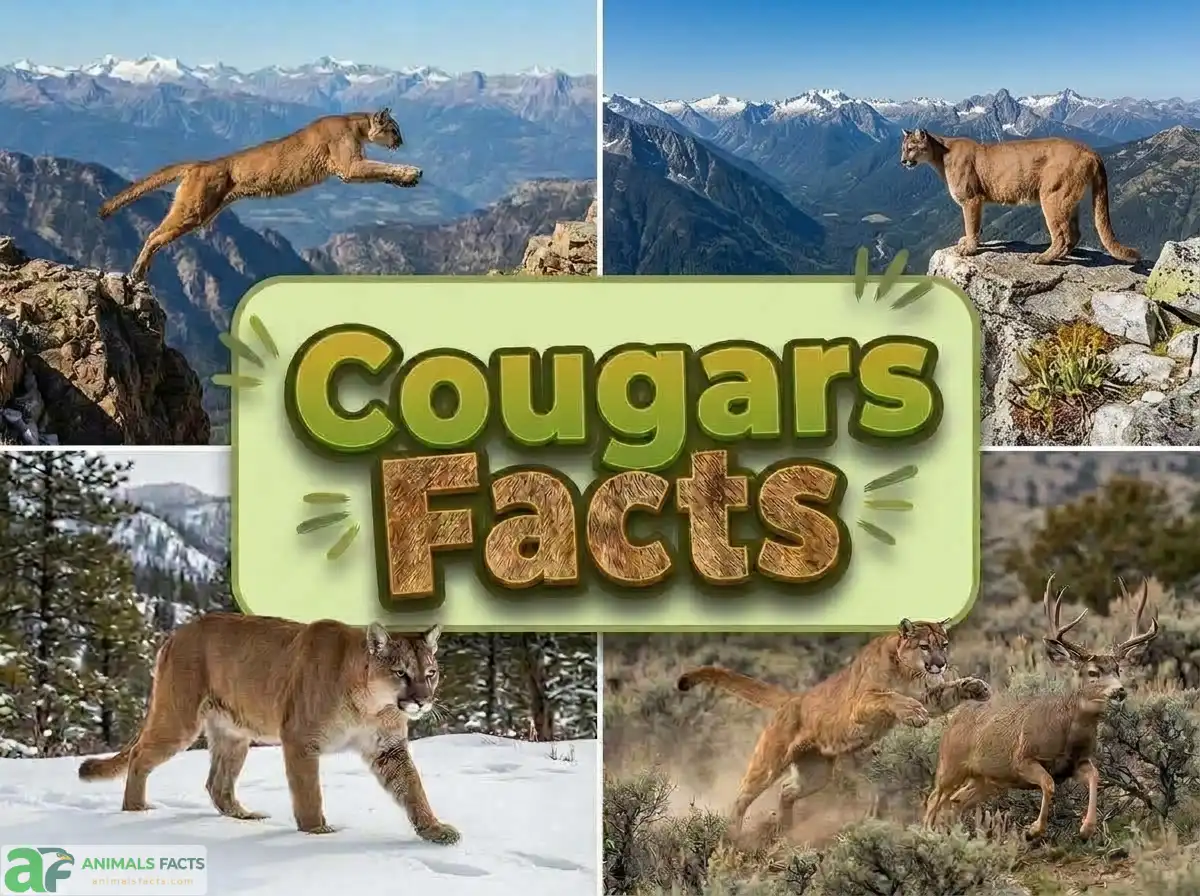
11. Cougar Facts for Kids
Hey kids — get ready to discover why the cougar (also called the mountain lion, puma, or panther!) is one of the most incredible and mysterious cats in the whole world!
- The cougar has more different names than any other animal on Earth — people call it mountain lion, puma, panther, painter, ghost cat, catamount, and over 40 other names depending on where they live!
- Even though cougars are big — as heavy as a grown adult human — they can’t roar like lions or tigers! Instead they make sounds like chirping, whistling, and a really spooky scream that can give hikers in the mountains quite a fright at night!
- Cougars can jump incredibly high — straight up as high as a one-story building from a standing start! And they can leap forward over 12 meters in a single bound — that’s longer than most swimming pools!
- Baby cougars are called cubs, and they’re born with beautiful spotted coats — just like a leopard! The spots slowly disappear as they grow up and become one plain tawny-brown color.
- The cougar lives in more different places than any other wild land animal in the Americas — from freezing cold Canada all the way down to the icy winds of Patagonia at the bottom of South America!
- Cougars are actually more closely related to cheetahs than to lions — even though they look more like lions! Both cougars and cheetahs can purr, while lions and tigers cannot!
- After catching a meal, cougars bury it under leaves and grass and come back to eat it over several days — like having a packed lunch in the woods!
- The Florida Panther — a special kind of cougar that lives in Florida — almost went extinct with only about 20 left in the world! Thanks to conservation efforts it has recovered to about 200 animals today!
Did You Know? The cougar’s famous “scream” — a long, eerie wail that sounds like someone crying in the dark forest — is actually used mainly by female cougars when they want to find a mate. The sound is so unusual and so scary-sounding that throughout history, people who heard it at night often thought there was a ghost or a strange supernatural creature in the forest. It remains one of the most spine-tingling sounds any hiker in the mountains of North or South America can hear in the wild!
12. Relationship with Humans
The cougar’s relationship with humans across the Americas is one of the most complex and rapidly evolving of any large carnivore — shaped by thousands of years of Indigenous reverence, centuries of systematic persecution, and increasingly challenging questions about coexistence as expanding human development encroaches on remaining cougar habitat.
Ancient Coexistence and Indigenous Traditions
Humans and cougars have shared the Americas for at least 13,000 years — with cougar imagery appearing across a diverse range of Indigenous artistic, ceremonial, and cultural traditions across both North and South America. From the Anasazi rock art of the American Southwest to the Nazca Lines of coastal Peru (which include feline imagery widely associated with cougar symbolism), to the ceremonial traditions of dozens of Indigenous nations across North and South America, the cougar has occupied a position of significant cultural and spiritual importance throughout the human history of the Americas.
Systematic Persecution — 18th to 20th Century
Following European colonization of the Americas, the cougar was subjected to one of the most intensive and sustained large carnivore persecution campaigns in North American history. Government bounty programs, professional hunting, livestock protection killing, and deliberate extermination campaigns drove cougars to complete extinction in the eastern United States (except for the isolated Florida Panther population) and significantly reduced populations across most of western North America by the mid-20th century.
The Pennsylvania Cougar (eastern subspecies) was killed at scale until the last confirmed eastern wild cougar in Pennsylvania was documented in 1871. By 1900, cougars had been eliminated from approximately 60–70% of their historical North American range.
Contemporary Human-Cougar Interaction
The contemporary human-cougar relationship is defined by two converging trends — cougar population recovery across portions of western North America where hunting is regulated and habitat remains, and expanding human development into historical cougar habitat across the suburban-wildland interface of the American West.
This convergence has produced a steady increase in cougar encounters with humans across California, Colorado, Arizona, and other western states — with the vast majority of encounters ending without incident, but a small number resulting in attacks that generate significant public concern and media coverage disproportionate to the actual statistical risk cougars represent to human safety.
Human fatalities from cougar attacks are exceptionally rare — approximately 25 fatalities have been documented in North America over the past 125 years, fewer than annual deaths from bee stings, lightning, or domestic dogs in any single year. However, non-fatal attacks are more common, and the increasing interface between suburban development and cougar habitat makes cougar encounter preparedness an increasingly relevant public safety topic across the western United States.
13. Mountain Lion Conservation Status & Threats
The cougar’s overall IUCN classification as Least Concern reflects the species’ remarkable overall population viability across its vast range — but this broad classification masks enormous variation in the situations facing specific regional populations, from the genuinely thriving western North American populations to the critically endangered Florida Panther and the already-extinct Eastern Cougar.
Global Cougar Conservation Data (2026)
| Population | IUCN / US Status | Estimated Population | Trend |
|---|---|---|---|
| Western North America | Least Concern | ~30,000–40,000 | Stable to recovering |
| Central America | Least Concern overall | ~5,000–8,000 | Declining; fragmented |
| South America (all populations) | Least Concern overall | ~40,000–50,000 | Variable; declining in some regions |
| Florida Panther | Critically Endangered | ~200 individuals | Recovering; road mortality concern |
| Eastern Cougar | Extinct (declared 2018) | 0 confirmed wild | Extinct |
Major Threats to Cougars
Habitat loss and fragmentation: The primary long-term threat to cougar viability across both Americas — with highway construction, urban development, and agricultural expansion progressively reducing connectivity between habitat patches and creating genetic isolation between populations. The I-10 and I-405 freeways in the Santa Monica Mountains of Los Angeles are among the most studied examples — creating near-total barriers between the isolated mountain cougar population and the wider California population, driving the Santa Monica Mountain population toward a genetic bottleneck comparable to the Florida Panther’s historical crisis.
Vehicle collisions: The single greatest identified cause of Florida Panther mortality — with the network of roads crossing south Florida representing lethal barriers that kill dozens of panthers annually. Road mortality is also a growing concern for California’s cougar populations and for other regional populations where highways bisect primary movement corridors.
Legal hunting: Cougars are legally hunted in numerous western US states and Canadian provinces — regulated hunting programs that generate significant revenue and, proponents argue, maintain human tolerance for the species, but that critics argue may be reducing populations below ecologically optimal levels in some regions.
Retaliatory killing: Cougar predation on livestock — particularly domestic sheep, goats, horses, and cattle — generates retaliatory killing that represents a significant mortality source across both the North American and South American range. In Patagonia particularly, conflict with sheep-ranching communities over livestock predation has historically driven significant cougar persecution.
Inbreeding depression: The Florida Panther population experienced severe inbreeding depression by the early 1990s — with documented health effects including kinked tails, heart defects, poor sperm quality, and elevated disease susceptibility caused by extreme genetic bottlenecking. The 1995 genetic rescue program — introducing 8 Texas females into the Florida population — dramatically reversed these health trends and remains one of the most celebrated applied genetics interventions in conservation history.
Did You Know? The Santa Monica Mountains National Recreation Area — a chain of mountains rising from the suburbs of Los Angeles — supports an isolated cougar population (P50 or “Mountain Lion” population) of approximately 12–20 individuals that is genetically isolated by surrounding freeways to a degree that researchers predict will produce the same inbreeding crisis that nearly destroyed the Florida Panther within 50 years if genetic connectivity is not restored. The planned Wallis Annenberg Wildlife Crossing across US-101 Highway — the world’s largest wildlife crossing when completed, spanning 200 meters across 10 lanes of traffic — is specifically designed to address this genetic isolation by allowing cougar movement between the Santa Monica Mountain population and cougars in more connected habitats to the north.
14. Famous Cougars
P-22 — The Celebrity Mountain Lion of Los Angeles
P-22 was a male mountain lion documented living in Griffith Park — a 1,700-hectare urban park surrounded by freeways in the heart of Los Angeles — from approximately 2012 until his euthanasia in December 2022 following injuries sustained in a vehicle collision. Identified by GPS collar and camera trap by the National Park Service’s Santa Monica Mountains wildlife study, P-22 became one of the most beloved and most publicly followed individual wild animals in American history — his image appearing on magazine covers, murals, and merchandise, and his story generating extraordinary public engagement with urban wildlife and wildlife crossing infrastructure advocacy. His legacy directly contributed to public and political support for the Wallis Annenberg Wildlife Crossing — a landmark wildlife infrastructure project specifically designed to address the genetic isolation crisis facing Los Angeles area mountain lions.
FL95 and Florida Panther Recovery Individuals
The Florida Panther Recovery Program maintains individual records for virtually every Florida Panther — with numbered individuals whose births, movements, health assessments, and deaths are tracked through an extensive radio-collar and camera trap monitoring network. These individually monitored panthers — with records spanning decades of the recovery program — represent some of the most extensively documented individual large carnivore histories in American conservation.
The Connecticut Disperser — P-42 or “Rocky”
The young male cougar killed on a Connecticut highway in June 2011 — subsequently nicknamed “Rocky” by some media outlets — whose remarkable 2,700-kilometer dispersal journey from South Dakota across the Great Lakes region and through New York to Connecticut was reconstructed from DNA, camera trap records, and tracking data, remains one of the most celebrated individual animal dispersal stories in North American wildlife history.
Elbroch’s Named Research Individuals
Mark Elbroch and colleagues at the Teton Cougar Project in Wyoming have studied named individual cougars — including “Lana,” “the White Female,” and various others — across multiple years of intensive GPS collar research, producing some of the most detailed behavioral ecology data ever collected for individual wild cougars and generating multiple books and documentaries accessible to general audiences.
15. Role in Ecosystem & Food Chain
The cougar functions as a keystone apex predator across every ecosystem it inhabits — with documented trophic cascade effects comparable to those generated by wolves in Yellowstone, directly demonstrating the ecological importance of apex predator presence for overall ecosystem health.
The Trophic Cascade — Cougars and Vegetation
Research published in Biological Conservation (2012) documented one of the most striking demonstrations of cougar-driven trophic cascades ever recorded — in areas of Zion National Park where human activity had driven cougars to local rarity, mule deer populations were dramatically elevated, grazing pressure on streamside cottonwood and willow was unsustainable, streambank vegetation had collapsed, songbird diversity had declined, and stream channels had destabilized. In adjacent areas where cougars remained abundant, deer populations were regulated, streambank vegetation was intact, and associated biodiversity was substantially greater.
This finding — demonstrating that cougar presence cascaded through deer behavioral modification to influence vegetation, bird communities, and stream morphology — provided a powerful American parallel to the more widely publicized Yellowstone wolf trophic cascade story, establishing the cougar as an equally significant ecological architect of North American ecosystems.
Deer and Ungulate Population Regulation
Across their North American range, cougars directly regulate populations of white-tailed deer, mule deer, and elk through predation — preventing the population explosions that generate overgrazing, vegetation collapse, and subsequent prey population crashes in the absence of top predators. Research in multiple western US states has demonstrated that areas with functioning cougar populations sustain deer and elk populations in better overall health — with higher average body condition scores, lower disease incidence, and more balanced age and sex ratios — reflecting the selective predation on weak, old, and sick individuals characteristic of efficient ambush predation.
Supporting Scavenger Communities
Cougar kills — deer and elk carcasses cached under debris and consumed over multiple days — represent critical food subsidies for a diverse community of scavengers including ravens, Steller’s jays, magpies, eagles, black bears, coyotes, foxes, and dozens of other species dependent on carrion access. Research in the Teton Range of Wyoming documented that a single cougar’s kill cache supported an average of 39 species of vertebrates and invertebrates — demonstrating the extraordinary ecological reach of cougar hunting activity.
16. Puma Myths, Folklore & Cultural Significance
The cougar occupies a profound position in the cultural and spiritual traditions of Indigenous peoples across North and South America — with a cultural significance that rivals or exceeds that of any other wild animal across the Western Hemisphere, reflecting thousands of years of shared landscape with this powerful, mysterious predator.
North American Indigenous Traditions
Across dozens of distinct Indigenous nations of North America, the cougar holds a position of deep spiritual significance — associated with hunting power, stealth, guardianship, and leadership. Many traditions regard the cougar as a supreme hunter whose skills and qualities are to be emulated — Apache, Zuni, Hopi, and numerous other Southwestern nations have rich traditions of cougar symbolism in art, ceremony, and healing practice. The Zuni Cougar fetish (a carved stone representation of the cougar, traditionally carried for hunting power and protection) remains one of the most recognized and produced forms of Southwestern Indigenous art.
In the Cherokee tradition, the cougar is one of the most significant clan animals — the Panther Clan carrying cultural authority associated with the animal’s combination of stealth, power, and leadership. Across the Pacific Northwest nations, the cougar appears as a powerful supernatural figure in multiple oral traditions, associated with mountain power and extraordinary hunting ability.
Andean and South American Traditions
In Andean cultures — including the Inca civilization — the cougar (called “puma” in Quechua) held profound political and spiritual significance, associated with royalty, the temporal world, and earthly power. In the Inca cosmological system, three animals represented the three realms of existence: the condor (upper world/sky), the serpent (lower world/underground), and the puma (the temporal middle world in which humans live) — making the puma a central symbol of the earthly realm itself.
The city of Cusco, the Inca capital, was reportedly designed in the shape of a puma from the air — with different city districts corresponding to different body parts of the animal, embedding the puma’s significance into the physical layout of the most important city in the pre-Columbian Americas.
European Contact and Changing Perceptions
With European colonization of the Americas, the cultural narrative surrounding cougars shifted dramatically — from the reverence of Indigenous tradition to the fear and hostility of a colonial agricultural society that viewed large predators primarily as threats to livestock and human safety. Colonial and subsequent American government policies explicitly promoted cougar elimination across most of the species’ North American range — with bounty programs, professional government hunters, and agricultural community pressure systematically reducing cougar populations across the eastern and southern United States by the early 20th century.
17. Cougars in Pop Culture
The cougar has generated a significant and historically deep presence in North American popular culture — from its role in university athletic mascots to its appearance in landmark wildlife documentaries, from its central place in outdoor recreation culture to its recent emergence as a symbol of urban wildlife advocacy.
Film and Television
“American Lion” and various wildlife documentary productions — Multiple documentary productions focused on mountain lions have significantly shaped North American public understanding of cougar ecology and behavior, with PBS Nature productions and National Geographic documentaries providing the most widely viewed cougar natural history coverage available.
“The Cougar” (Wild Chronicles, National Geographic) and related productions — Various NatGeo and PBS series have followed cougar families in the Yellowstone ecosystem, the Pacific Northwest, and the Santa Cruz Mountains of California, providing close-range behavioral documentation of a notoriously secretive species.
“Ghost of the Mountains” (BBC) — A segment of BBC’s celebrated “Planet Earth” series, featuring the snow leopard in similar secretive high-mountain habitat, drew significant comparison to cougar ecology in subsequent documentary discussions.
P-22 documentary productions — Multiple documentary productions specifically focused on P-22’s extraordinary urban life in Griffith Park, Los Angeles, have generated significant public engagement with urban wildlife coexistence.
Sports Mascots
The cougar is one of the most widely used college sports mascots in North America — appearing under names including Cougars, Mountain Lions, Pumas, and Panthers across dozens of NCAA institutions. Notable programs include the Washington State Cougars, BYU Cougars, Houston Cougars, University of Houston Cougars, and Penn State Nittany Lions (historically mountain-lion derived). The Carolina Panthers (NFL) and Florida Panthers (NHL) are among the most prominent professional sports teams using panther/cougar imagery.
Literature and Conservation Advocacy
“Beast in the Garden” by David Baron (2003) — A gripping narrative account of an increasing human-cougar conflict in Boulder, Colorado, that generated significant public discussion about coexistence strategies and wildlife management in the rapidly expanding suburban-wildland interface of the American West.
“Heart of a Lion” by William Stolzenburg (2016) — An extraordinary account of a mountain lion’s documented transcontinental dispersal journey from South Dakota to Connecticut (the “Rocky” story), generating both scientific attention and public wonder regarding cougar dispersal capability and the potential for eastern US recolonization.
18. Cougar Facts vs. Common Myths
Myth: Black cougars exist in North America. Fact: Melanism (black coat coloration) has never been reliably documented in wild cougar populations anywhere in the Americas. Reports of “black panthers” in North America are consistently attributed to misidentification of other dark animals (black bears, large domestic cats, dogs), photographic artifacts, or — in some cases — reports of actual melanistic jaguars or leopards. The cougar’s coat ranges from tawny to grey-brown but does not include confirmed black individuals.
Myth: Cougars are dangerous predators that regularly attack humans. Fact: Cougar attacks on humans are extraordinarily rare — approximately 25 fatal attacks have been documented in North America across 125 years, a frequency dramatically lower than deaths from domestic dogs, bee stings, or lightning annually. Most cougars avoid humans consistently, and the vast majority of encounters end without incident. Attacks most commonly involve children or individuals running — triggering pursuit-predation instincts — in wilderness areas.
Myth: The Florida Panther is a different species from the cougar. Fact: The Florida Panther is a subspecies (or regional population) of the cougar (Puma concolor) — not a separate species. It is classified as Puma concolor couguar (the North American cougar subspecies) representing the southeastern-most surviving cougar population in North America.
Myth: Cougars are strictly mountain animals. Fact: Despite one of their most common names, cougars are not restricted to mountainous terrain — they inhabit virtually every major terrestrial biome in the Americas, including tropical lowland rainforest, coastal swamp (Florida Panthers), desert scrubland, grassland steppe (Patagonian pumas), and even urban fringe habitat. “Mountain lion” reflects historical observations from the western United States rather than a strict habitat requirement.
Myth: Cougars are a type of big cat. Fact: Despite their large size, cougars are not technically “big cats” in the scientific sense — they belong to the genus Puma (within subfamily Felinae) rather than the genus Panthera (subfamily Pantherinae) that contains the true big cats. This is why cougars cannot roar, can purr continuously, and are more closely related to the cheetah than to lions, tigers, or leopards.
Myth: Cougars always screech or scream when moving through an area. Fact: Cougars are extraordinarily quiet in normal movement — the famous “scream” is produced only in specific social contexts (primarily female estrus advertisement) and is not a regular vocalization during normal activity. The vast majority of cougar movements through human-inhabited areas occur in complete silence — one of the primary reasons cougar presence often goes entirely undetected despite the animals living in close proximity to human populations.
19. Best Places to See Cougars in the Wild
Torres del Paine National Park, Patagonia, Chile
The best location in the world for reliable wild puma observation — the open steppe landscape and habituated guanaco populations of Torres del Paine, combined with a relatively relaxed Patagonian cougar (puma) population accustomed to vehicle presence from years of wildlife tourism, provide extraordinary opportunities to observe cougars in genuinely wild conditions. During peak winter months, puma sightings of multiple individuals per day are documented by tour operators — making Torres del Paine the Pantanal equivalent for cougar viewing, and one of the world’s premier wildlife tourism destinations.
Big Bend National Park, Texas, USA
Big Bend supports one of the most accessible wild cougar populations in the continental United States — with habituated individuals photographed at relatively close range in the park’s chihuahuan desert and mountain habitats. While sightings remain less predictable than in Torres del Paine, Big Bend offers the best cougar viewing opportunity in the southern United States in a dramatic desert mountain landscape.
Glacier National Park, Montana, USA
Glacier supports healthy mountain lion populations in spectacular Rocky Mountain habitat alongside wolves, grizzly bears, and exceptional general wildlife diversity. Cougar sightings here are rare but possible — the primary value of Glacier for cougar enthusiasts is the intact predator ecosystem in which cougars operate alongside a full complement of competing and prey species.
Yellowstone and Grand Teton National Parks, USA
Yellowstone’s cougar population provides the best-studied and most scientifically documented North American mountain lion community — with decades of GPS collar research generating extraordinary behavioral data. While direct sightings are uncommon, cougar sign (tracks, scrapes, cached kills) is regularly found by experienced naturalists, and the park’s wolf reintroduction provides unique opportunities to observe the competitive dynamics between wolves and cougars.
Santa Cruz Mountains, California, USA
Research by the Santa Cruz Puma Project — one of the world’s most intensive urban mountain lion studies — has generated extraordinary close-range footage of cougars navigating suburban-wildland interface habitats, with specific individuals extensively documented on camera traps across both wildland and developed areas. Guided wildlife tours in this region offer some of the most accessible mountain lion natural history interpretation available in the United States.
Corcovado National Park, Costa Rica
For observers interested in tropical cougar populations — the Osa Peninsula’s Corcovado supports both cougars and jaguars in primary rainforest habitat, with experienced local guides offering multi-day expeditions in one of Central America’s most biologically rich protected areas.
20. Top Documentaries & Books
Must-Watch Documentaries
“The Cat That Changed America” (PBS Nature) — Documents the extraordinary story of P-22 and the broader Santa Monica Mountains mountain lion population, weaving together urban wildlife ecology, infrastructure advocacy, and human connection to wild animals in one of the most compelling American wildlife documentary productions in recent years.
“America’s Lion” (various productions) — Multiple PBS and National Geographic documentary productions have followed mountain lion families in the western United States over successive years, generating close-range behavioral footage of a notoriously secretive species.
“Ghost Mountain Lions” — Various National Geographic and BBC productions have used camera trap footage and GPS tracking visualization to reveal the invisible world of mountain lion territorial behavior and social interaction.
“Pumas: Legends of the Ice Mountains” — Dedicated to Patagonian puma populations in Torres del Paine, this production offers some of the most intimate wild cougar footage available — made possible by the exceptional viewing opportunities of Chile’s southern steppe.
“The Cougars of the Santa Ana Mountains” (National Park Service/various) — The comprehensive NPS Santa Monica Mountains mountain lion research program has generated extensive documentary content documenting urban mountain lion ecology, genetic isolation, and wildlife crossing advocacy.
Essential Books
“Heart of a Lion” by William Stolzenburg (2016) — The extraordinary narrative account of a mountain lion’s documented 2,700-kilometer transcontinental dispersal journey — combining ecological science, conservation policy, and genuine wilderness adventure in one of the finest popular science books about any large carnivore.
“Beast in the Garden” by David Baron (2003) — An essential account of escalating human-cougar conflict in Boulder, Colorado, and the policy debates surrounding mountain lion management in the expanding suburban-wildland interface.
“Puma: Conqueror of the Americas” by various wildlife authors — Multiple technical and popular natural history accounts of puma ecology across the species’ full South American range provide context for the largest remaining cougar populations.
“Walking with the Great Apes” by Sy Montgomery includes significant puma comparative material, and “The Secret Lives of Mountain Lions” by various field researchers provide detailed accounts of GPS collar research documenting mountain lion territorial behavior.
21. Comparison of Cougars with Similar Big Cats
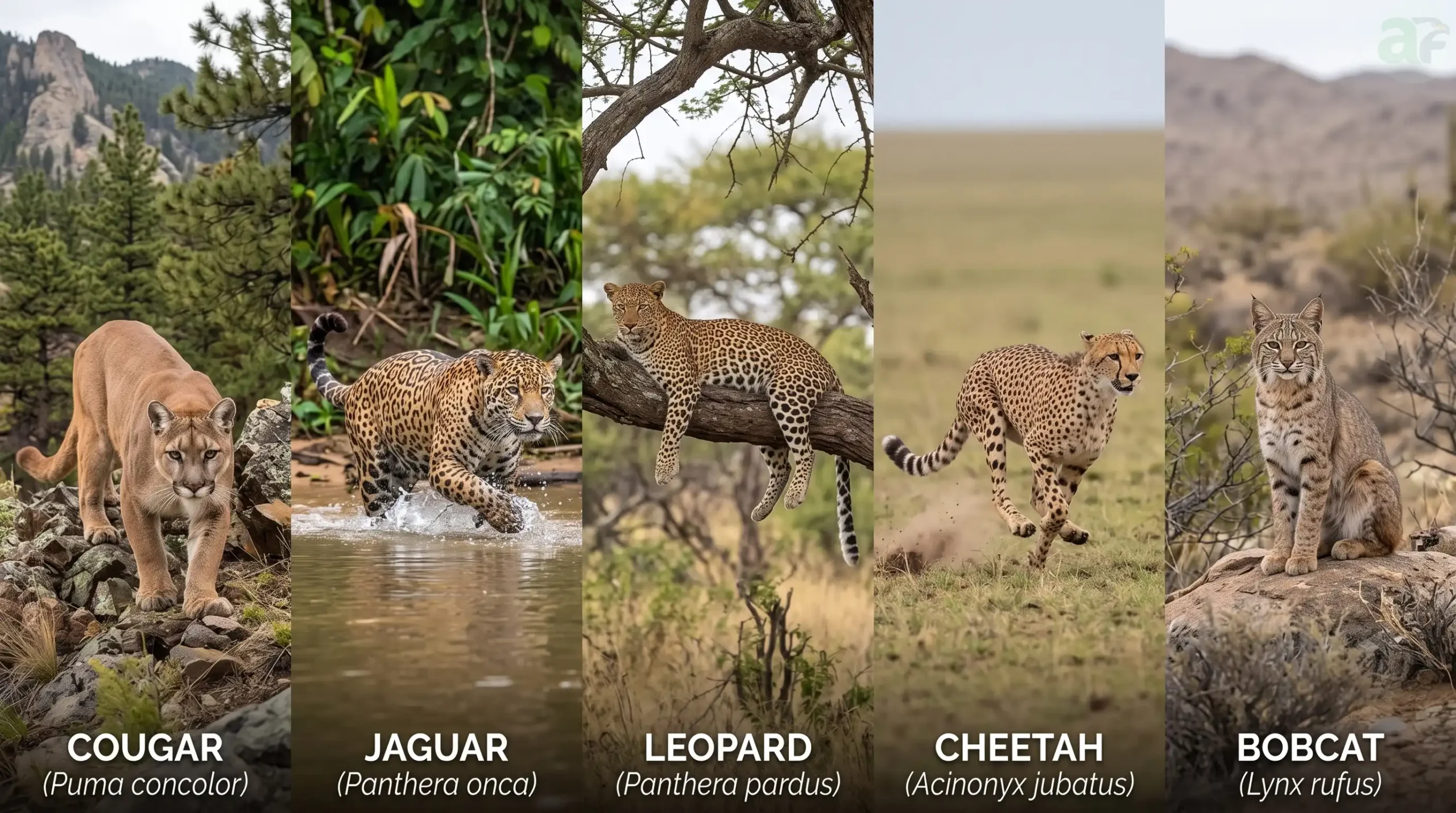
| Feature | Cougar / Puma | Jaguar | Leopard | Cheetah | Bobcat |
|---|---|---|---|---|---|
| Scientific Name | Puma concolor | Panthera onca | Panthera pardus | Acinonyx jubatus | Lynx rufus |
| Weight | 29–100 kg | 56–160 kg | 28–90 kg | 21–72 kg | 6–18 kg |
| Distribution | Entire Americas (widest range) | Central and South America | Africa; Asia | Africa; Iran | North America |
| Habitat | All — mountain, rainforest, desert, swamp | Rainforest; wetland; dry forest | Forest; savanna; mountain | Open savanna | Forest; scrubland |
| Can Roar? | No (purrs) | Yes | Yes | No (purrs) | No (purrs) |
| Coat Pattern | Solid tawny/brown (unspotted adults) | Large spotted rosettes (with central dots) | Hollow rosettes | Solid spots | Spots and bars |
| Kill Method | Throat or nape bite | Skull/spine crush bite | Throat suffocation | Throat bite after trip | Throat/nape bite |
| Evolutionary Relatives | Closely related to cheetah | Panthera (lion, tiger, leopard) | Panthera | Related to puma | True lynx lineage |
| Conservation Status | Least Concern (overall) | Near Threatened | Vulnerable | Vulnerable | Least Concern |
| Population | ~50,000+ | ~64,000–173,000 | ~250,000 | ~7,100 | ~1 million+ |
| Unique Feature | Widest range; 40+ common names; purrs | Strongest bite of any cat | Most adaptable cat; widest range Old World | Fastest land animal | Tufted ears; adapted to cold |
22. How You Can Help
Cougar conservation varies dramatically by region — from the abundant and stable western North American populations requiring primarily coexistence education, to the genuine extinction emergency of the Florida Panther requiring intensive active management.
Support These Organizations
Panthera (panthera.org/cat/puma) — The world’s leading wild cat conservation organization runs the Puma Program across multiple range countries, conducting research and supporting conservation in South American range countries where cougar populations face significant hunting pressure and livestock conflict.
Florida Panther Fund / Florida Wildlife Foundation — Supports the ongoing Florida Panther recovery effort including road mortality reduction, habitat connectivity improvement, and rancher coexistence programs across south Florida.
Mountain Lion Foundation (mountainlion.org) — The primary US advocacy organization specifically focused on mountain lion conservation policy, working to maintain and strengthen protections for cougars across their North American range.
National Park Service — Santa Monica Mountains Wildlife Study — The NPS research program studying the isolated Santa Monica Mountains cougar population and advocating for the Wallis Annenberg Wildlife Crossing can be supported through the National Parks Conservation Association and related partner organizations.
Wildlife Conservation Society (wcs.org) — Runs puma conservation programs across South America, including significant programs in the Patagonian region and Amazon Basin populations.
Practical Actions
Support wildlife crossing infrastructure. The most impactful single conservation action for isolated cougar populations — including the Santa Monica Mountains population and the Florida Panther — is the construction of wildlife underpasses and overpasses that allow safe road crossing. Supporting organizations advocating for wildlife crossing infrastructure funding at state and federal levels directly addresses the genetic isolation and road mortality threats.
Practice cougar awareness in cougar country. Understanding appropriate behavior in cougar country — including making noise while hiking, keeping children and pets close, never running from a cougar, and making yourself appear large during an encounter — reduces both the risk of negative human-cougar interactions and the retaliatory killing that follows dangerous encounters.
Support non-lethal livestock protection programs. Organizations funding livestock guardian dogs, night corrals, and other non-lethal deterrent tools for ranchers in cougar country directly reduce the retaliatory and preventive killing that represents one of the most significant cougar mortality sources.
Participate in citizen science. Programs including iNaturalist and specific regional mountain lion monitoring platforms welcome public camera trap submissions and wildlife sighting reports that contribute to population monitoring across the cougar’s vast range.
Advocate for strong wildlife crossing legislation. The Wildlife Crossings Pilot Program — funded through the Infrastructure Investment and Jobs Act in the United States — represents the most significant federal investment in wildlife connectivity infrastructure in American history. Supporting its full implementation and advocating for additional funding helps address the infrastructure barrier threats facing isolated cougar and other wildlife populations across North America.
Did You Know? The Florida Panther’s genetic rescue program — in which 8 Texas mountain lion females were introduced into the Florida population in 1995 to address extreme inbreeding depression — stands as one of the most cited and most celebrated interventions in applied conservation genetics history. Within just 5 years of the introduction, population health indicators including cub survival rates, sperm quality, and juvenile growth rates had measurably improved — and the population grew from approximately 20–30 individuals to over 80 within a decade, and over 200 by 2026. The program has since been used as a model for genetic rescue planning in other critically inbred populations including the isolated Santa Monica Mountain mountain lions.
23. Frequently Asked Questions About Cougar
Q1: What is the scientific name of the cougar?
The cougar’s scientific name is Puma concolor — placing it in the genus Puma within the subfamily Felinae. Unlike lions, tigers, and leopards (genus Panthera), the cougar belongs to a separate evolutionary lineage more closely related to the cheetah than to the roaring big cats. The family is Felidae (cats), order Carnivora, and class Mammalia.
Q2: Why does the cougar have so many names?
The cougar’s 40+ common names reflect both its extraordinary geographic range across two continents and the independent naming traditions of hundreds of Indigenous nations, European colonial languages, and regional English dialects across North and South America. The most widely used names include cougar (most common in North America), puma (most common in South America), mountain lion (widespread in western North America), and panther (southeastern United States). All refer to the same species, Puma concolor.
Q3: Can cougars roar?
No — cougars cannot roar. They belong to the genus Puma (subfamily Felinae) rather than the roaring genus Panthera (subfamily Pantherinae), and lack the modified laryngeal anatomy required for true roaring. Instead, cougars produce chirps, whistles, growls, hisses, and the distinctive haunting “scream” primarily produced by females in estrus, alongside the continuous purr (on both inhalation and exhalation) shared with domestic cats.
Q4: Are cougars and mountain lions the same animal?
Yes — cougar and mountain lion are two of over 40 common names for the same species, Puma concolor. Other widely used names include puma, panther (in the southeastern US), catamount (historical), and ghost cat. The animal is exactly the same species regardless of which name is used in a specific geographic region or cultural context.
Q5: What is the Florida Panther?
The Florida Panther is a critically endangered population of cougars — classified as a subspecies Puma concolor couguar — surviving in small numbers in southern Florida. It is not a separate species. By 2026, the population has recovered to approximately 200 individuals from a catastrophic low of approximately 20–30 individuals in the early 1990s, following an intensive genetic rescue program that introduced Texas mountain lion females into the inbred Florida population in 1995.
Q6: How large can cougars get?
Cougar size varies considerably by population and region — the largest individuals, from northern Rocky Mountain populations, have been documented at over 100 kg and 2.4 meters in total length. The largest confirmed wild cougar weighed approximately 120 kg — comparable to a large female lion. South American populations tend toward smaller average size. Males are typically 40–60% heavier than females from the same region.
Q7: Do cougars attack humans?
Cougar attacks on humans are extremely rare — approximately 25 fatal attacks have been documented in North America across 125 years, dramatically fewer than annual deaths from domestic dogs, bee stings, or lightning strikes. The vast majority of cougar encounters with humans end without incident. Most attacks occur in wilderness areas and involve children or individuals running — triggering pursuit instincts. Understanding and practicing appropriate cougar encounter behavior virtually eliminates risk.
Q8: What do cougars eat?
Cougars are apex carnivores whose diet centers on deer across most of North America — primarily white-tailed deer in the east and mule deer in the west. Elk, peccaries, bighorn sheep, and various smaller mammals supplement the diet depending on regional availability. In South America, guanacos, vicuñas, and various smaller mammals are primary prey. Domestic livestock — particularly sheep, goats, and calves — represent a significant conflict source in areas where cougar range overlaps with ranching.
Q9: Is the Eastern Cougar really extinct?
Yes — the Eastern Cougar (the former eastern population of Puma concolor couguar) was officially declared extinct by the US Fish and Wildlife Service in January 2018, following a comprehensive review finding no evidence of a surviving breeding population in eastern North America. Occasional confirmed records of cougars in the east — such as the 2011 Connecticut individual — represent long-distance dispersers from western populations rather than evidence of a surviving eastern population.
Q10: How can I help cougar conservation?
Key actions include: supporting wildlife crossing infrastructure that addresses genetic isolation in fragmented cougar populations; supporting the Mountain Lion Foundation, Panthera, and Florida Panther Fund; learning and practicing cougar safety awareness in cougar country to reduce dangerous encounters and retaliatory killing; supporting non-lethal livestock protection programs that reduce conflict-based mortality; and participating in citizen science platforms that contribute to cougar population monitoring across the species’ vast range.
26. Sources & References
Research Sources
- Wikipedia — Puma concolor and related articles
- IUCN Red List — iucnredlist.org
- Mountain Lion Foundation — mountainlion.org
- Panthera — panthera.org/cat/puma
- Florida Panther National Wildlife Refuge — fws.gov
- National Park Service (Santa Monica Mountains) — nps.gov
- National Geographic — nationalgeographic.com
- Smithsonian’s National Zoo — nationalzoo.si.edu
- Encyclopaedia Britannica — britannica.com
- BBC Wildlife — bbc.co.uk
- Live Science — livescience.com
- Wildlife Conservation Society — wcs.org
- Stolzenburg, William — “Heart of a Lion” (2016)
- Baron, David — “Beast in the Garden” (2003)
- Elbroch, Mark — Teton Cougar Project publications (multiple)
- Ripple, William J. et al. — “Cougar trophic cascade” research (Biological Conservation, 2012)