
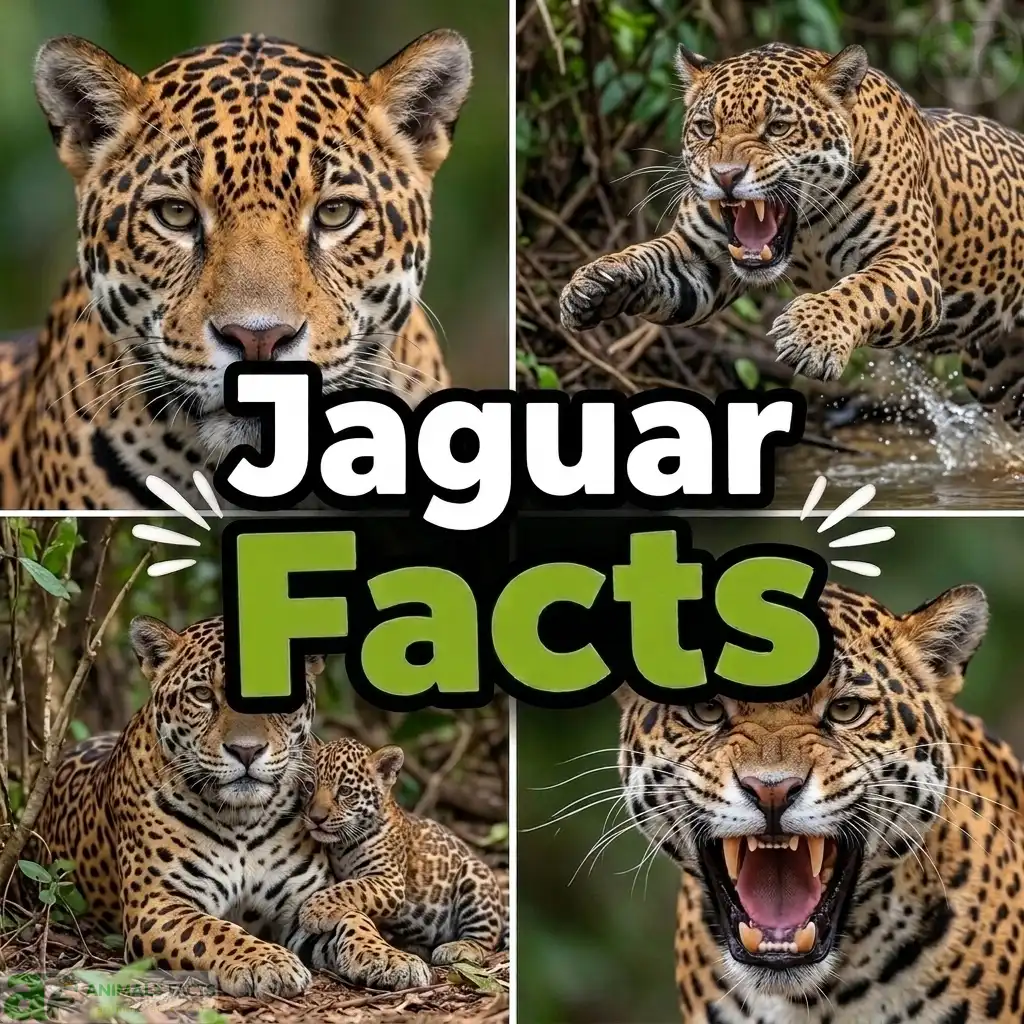
Jaguar Facts
| Feature | Details |
|---|---|
| Scientific Name | Panthera onca |
| Kingdom | Animalia |
| Phylum | Chordata |
| Class | Mammalia |
| Order | Carnivora |
| Family | Felidae |
| Genus | Panthera |
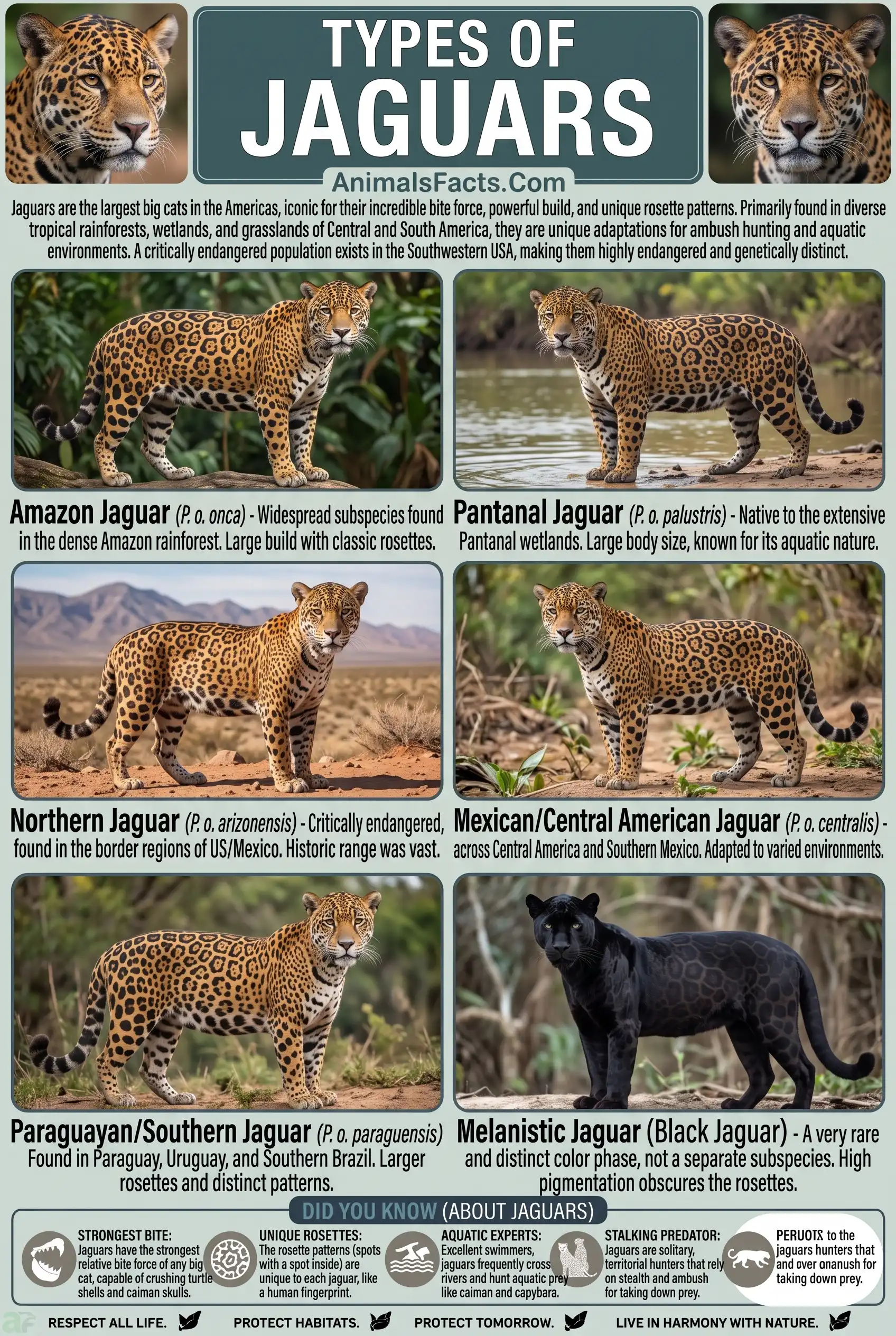
| Regional Populations | Historically recognized as up to 8–9 subspecies; current genetic consensus supports 1 species, no formally recognized subspecies, though regional management units are identified |
| Habitat | Tropical rainforest, seasonally flooded grassland, dry woodland, scrubland — from Mexico south through Central and South America |
| Lifespan | 12–15 years in the wild; up to 23 years in captivity |
| Diet | Apex carnivore — capybara, caimans, peccaries, deer, tapir, turtles, and over 87 documented prey species |
| Weight | Males: 56–96 kg (up to 160 kg in some populations); Females: 36–60 kg |
| Body Length | 1.12–1.85 meters (excluding tail); tail adds 45–75 cm |
| Shoulder Height | 63–76 cm |
| Top Speed | Up to 80 km/h (50 mph) in short bursts |
| Bite Force | 2,000 psi — the strongest bite force of any wild cat, and proportionally the strongest of any big cat relative to skull size |
| Conservation Status | Near Threatened (IUCN Red List) — several regional populations Endangered or Critically Endangered |
| Global Wild Population | Estimated 64,000–173,000 individuals (wide range reflects monitoring uncertainty) |
| Unique Feature | Strongest bite of any cat; kills by crushing skull rather than throat suffocation; swims expertly; only big cat native to the Americas |
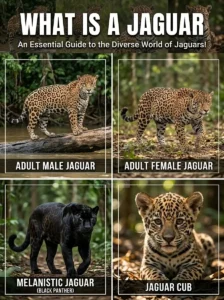 1. Introduction: What is a Jaguar?
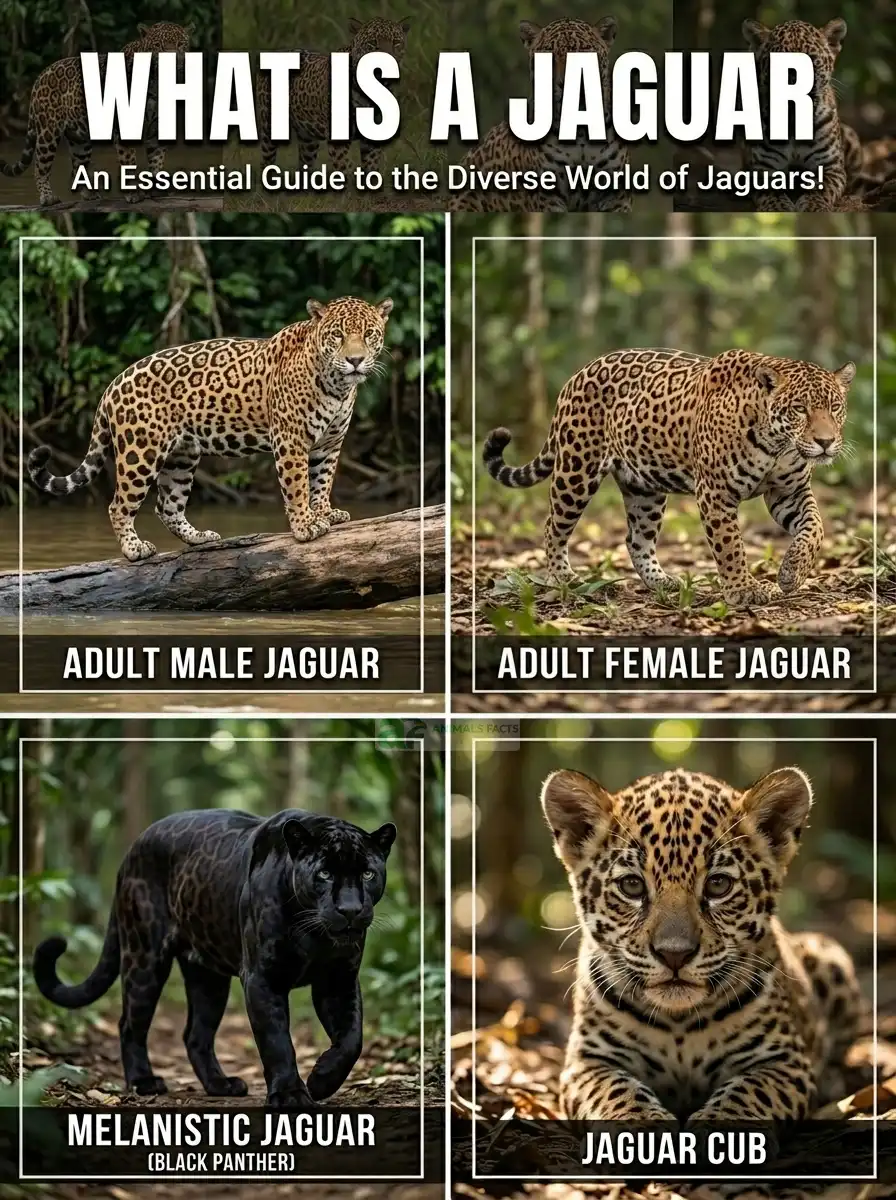
It kills differently from every other cat on Earth. Where lions, tigers, and leopards suffocate prey through a sustained throat bite, the jaguar does something altogether more dramatic — it drives its canine teeth directly through the skull or spine of its victim, crushing bone with the most powerful bite of any wild cat and killing instantly through neurological shock rather than suffocation. This lethal, distinctive hunting method requires a skull and jaw architecture so uniquely developed that the jaguar’s proportionally enormous head has become one of its most recognizable physical features. Jaguar facts are, from the very first, extraordinary — and they get more remarkable with every discovery.
The jaguar — Panthera onca — is the largest cat in the Western Hemisphere and the third-largest wild cat on Earth, behind only the tiger and lion. It is the only member of the genus Panthera native to the Americas — a continent it has dominated as apex predator across an enormous range stretching from the southwestern United States through Mexico, Central America, and across South America to the rainforests of the Brazilian Amazon and the flooded grasslands of Bolivia’s Pantanal. The jaguar is an accomplished swimmer who actively hunts in rivers and lakes, an ecological keystone whose presence or absence reshapes entire ecosystems, and the central spiritual and mythological figure of dozens of Indigenous civilizations across the Americas — a cultural significance rivaling that of the lion in Europe and Africa or the tiger in Asia.
Whether you are a student searching for jaguar facts for a school project, a wildlife traveler preparing for an Amazon expedition or a Pantanal safari, a conservation advocate concerned about the jaguar’s declining range, a parent looking for jaguar facts for kids, or simply someone fascinated by the most powerful cat in the Americas — this is the most complete guide to jaguar facts you will find anywhere. We cover jaguar habitat, jaguar diet, jaguar behavior, reproduction, the remarkable black jaguar, conservation, mythology, and the urgent story of a species whose range has contracted by nearly 50% from its historical maximum. Let us begin.
2. Species Overview & Classification
The jaguar belongs to the genus Panthera — the roaring cats — alongside lions, tigers, leopards, and snow leopards. Within this genus, jaguars represent the sole surviving member to have colonized the Western Hemisphere, arriving from Asia via the Bering Land Bridge during the Pleistocene and subsequently diverging into a uniquely American apex predator.
What Makes the Jaguar Distinct Among Panthera Cats?
- Skull-crushing bite: The jaguar kills through cranial or spinal bite rather than throat suffocation — the unique killing method among wild cats, enabled by the largest and most powerful jaw muscles relative to skull size of any cat
- Rosette pattern with central spots: Unlike the leopard’s hollow rosettes, jaguar rosettes contain one or more central dark spots — a key visual distinction between the two species
- Aquatic hunting: The jaguar actively hunts in water — catching fish, caimans, and turtles in rivers and lakes with a proficiency unmatched among large cats
- Extreme dietary breadth: Over 87 documented prey species — the broadest prey range of any large cat
- Only big cat of the Americas: The sole Panthera species native to the Western Hemisphere
Regional Population / Historical Subspecies
While modern genetic research does not support formal subspecies recognition, regional populations show significant size variation and are managed as distinct conservation units:
| Regional Population | Geographic Range | Body Size Notes |
|---|---|---|
| Northern (Mexico/Central America) | Mexico through Panama | Smaller; most threatened |
| Amazon Basin | Brazilian Amazon, Peru, Colombia, Venezuela | Medium size; largest remaining continuous habitat |
| Pantanal (Southern Brazil/Bolivia/Paraguay) | World’s largest tropical wetland | Largest body size recorded; best jaguar viewing |
| Cerrado | Brazilian savanna region | Increasingly isolated |
| Gran Chaco | Argentina, Paraguay, Bolivia | Reduced; fragmented |
| Atlantic Forest | SE Brazil | Critically reduced; near local extinction |
Species Evolution & Discovery Timeline
~3.6–4 million years ago: The Panthera lineage began to differentiate from related cat genera in Eurasia — the origin of the evolutionary line that would eventually produce jaguars.
~2–3 million years ago: Jaguar ancestors — closely related to the Eurasian Jaguar (Panthera gombaszoegica) — inhabited Europe and Asia before spreading to North America via the Bering Land Bridge.
~1.5–2 million years ago: Early jaguar-like cats became established in North America, eventually spreading southward into Central and South America as the Isthmus of Panama land bridge completed the connection between the continents approximately 3 million years ago.
~800,000–200,000 years ago: The jaguar achieved its maximum geographic range — extending from the southern United States through South America, and with relatives present in Europe and Asia.
~11,000 years ago: Multiple large predators and prey species went extinct in North America at the end of the Pleistocene, significantly reducing jaguar range and prey availability on the North American continent.
~10,000 BCE – 1500 CE: The jaguar served as the central spiritual and political symbol of the major civilizations of Mesoamerica and South America — including the Olmec, Maya, Aztec, and Inca — across thousands of years of cultural development.
1758: Carl Linnaeus formally classified the jaguar as Felis onca in Systema Naturae, later reclassified as Panthera onca as its membership in the roaring cat genus was established.
1963: The last documented breeding of wild jaguars in the United States (Arizona) was recorded — the species subsequently becoming extirpated from US territory, with only occasional dispersing males from Mexico documented crossing into the US southwestern states since then.
2026: The Jaguar Corridor Initiative — the most ambitious range-wide jaguar conservation program ever attempted — continues coordinating conservation efforts across 18 range countries to maintain connectivity between jaguar populations from Mexico to Argentina.
3. Physical Description & Unique Features
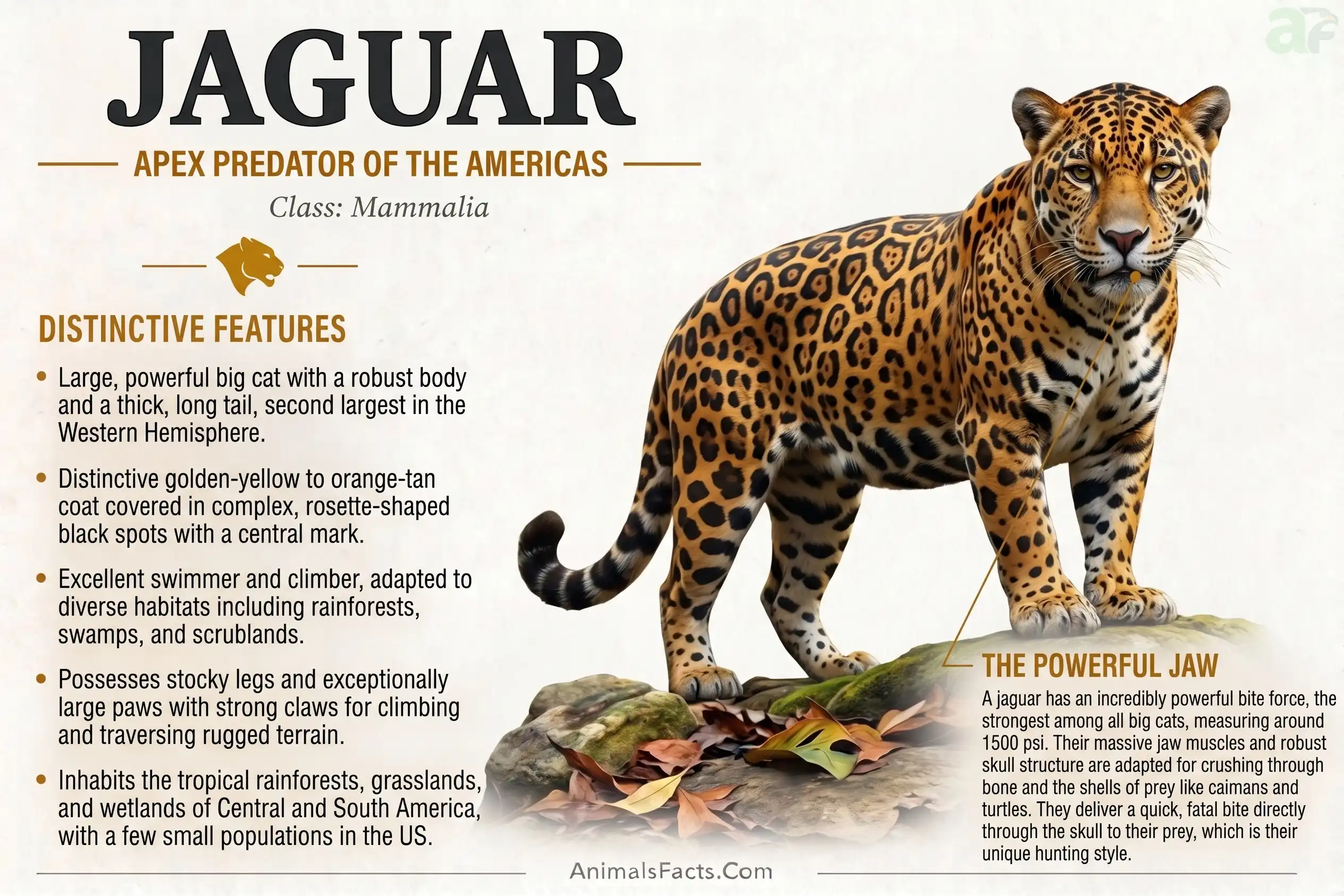
The jaguar’s physical design is a study in compact, concentrated power — less about elegance and speed than about raw structural strength, capable of generating forces that no other cat on Earth can match.
Size and Sexual Dimorphism
Largest jaguars: The Pantanal population of southern Brazil and Bolivia consistently produces the largest individual jaguars on record — with some exceptionally large Pantanal males documented exceeding 130 kg and occasionally approaching 160 kg. These individuals rival or exceed the size of small female lions or tigers.
Smallest jaguars: Central American populations — historically classified as “hernandesii” subspecies — are significantly smaller, with males sometimes barely exceeding 60 kg, reflecting the evolutionary tendency toward smaller body size in prey-limited and fragmented habitats.
Sexual dimorphism: Male jaguars are typically 10–20% heavier than females from the same region, with more massive heads and broader chests — though this difference is less pronounced than in lions or tigers.
The Jaw — Nature’s Most Powerful Cat Bite
The jaguar’s most distinctive anatomical feature is the disproportionate size and musculature of its skull and jaw. The jaguar possesses a broader skull relative to its body size than any other Panthera species — housing the largest temporal muscles and the most powerful jaw-closing mechanism of any cat. This anatomy generates a bite force of approximately 2,000 psi (pounds per square inch) — exceeding that of the lion, tiger, and leopard, and sufficient to pierce the shells of river turtles, crack the skulls of caimans and capybaras, and penetrate the armor-like skin of armadillos.
The Coat — Rosettes with a Difference
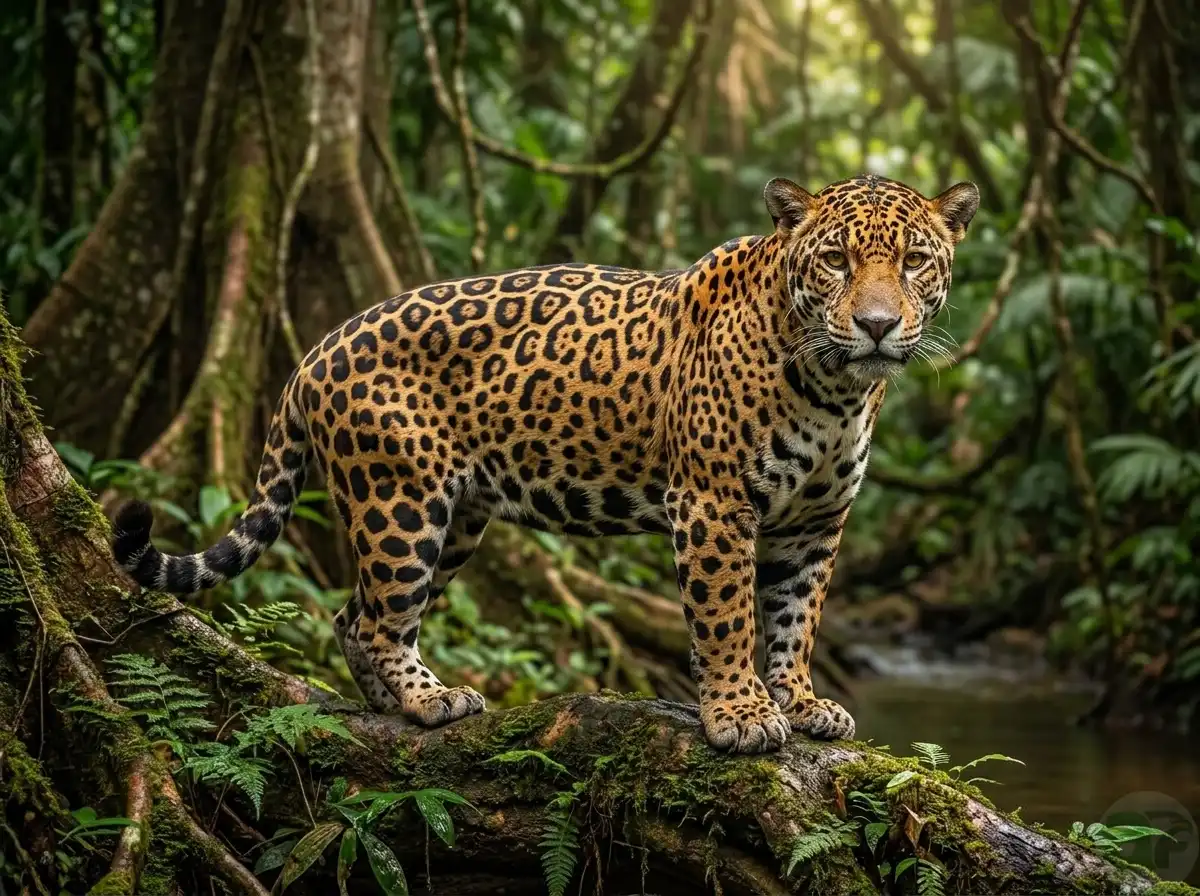
The jaguar’s coat pattern is immediately distinguishable from the leopard’s — jaguar rosettes are larger, more irregularly shaped, and critically, contain one or more dark spots within the rosette (hollow in leopards). The background coat color is typically tawny yellow-orange, though significant variation exists between individuals and regions.
The Black Jaguar
Approximately 10–15% of jaguars across their range display melanism — a genetic condition causing overproduction of the dark pigment melanin, resulting in an almost entirely black coat. These “black jaguars” (often called black panthers in popular culture, though this term is scientifically imprecise) are not a separate subspecies — they are ordinary jaguars carrying a dominant or partially dominant melanistic gene. In good lighting, the black jaguar’s rosette pattern remains visible as slightly darker black patterns against the background black coat. Melanistic coloration is more common in dense rainforest habitats where reduced light may provide additional camouflage advantage.
Did You Know? The jaguar’s bite is so powerful that it can penetrate the 6-inch thick shell of a river turtle — a feat requiring bite force that would be impossible for any other wild cat. The turtle’s shell is one of nature’s most effective defensive structures, yet the jaguar has evolved jaws specifically capable of overcoming it, reflecting the extraordinary evolutionary pressure exerted by abundant aquatic prey in the jaguar’s river-rich Amazonian and Pantanal habitats.
4. Top 25 Surprising & Interesting Jaguar Facts
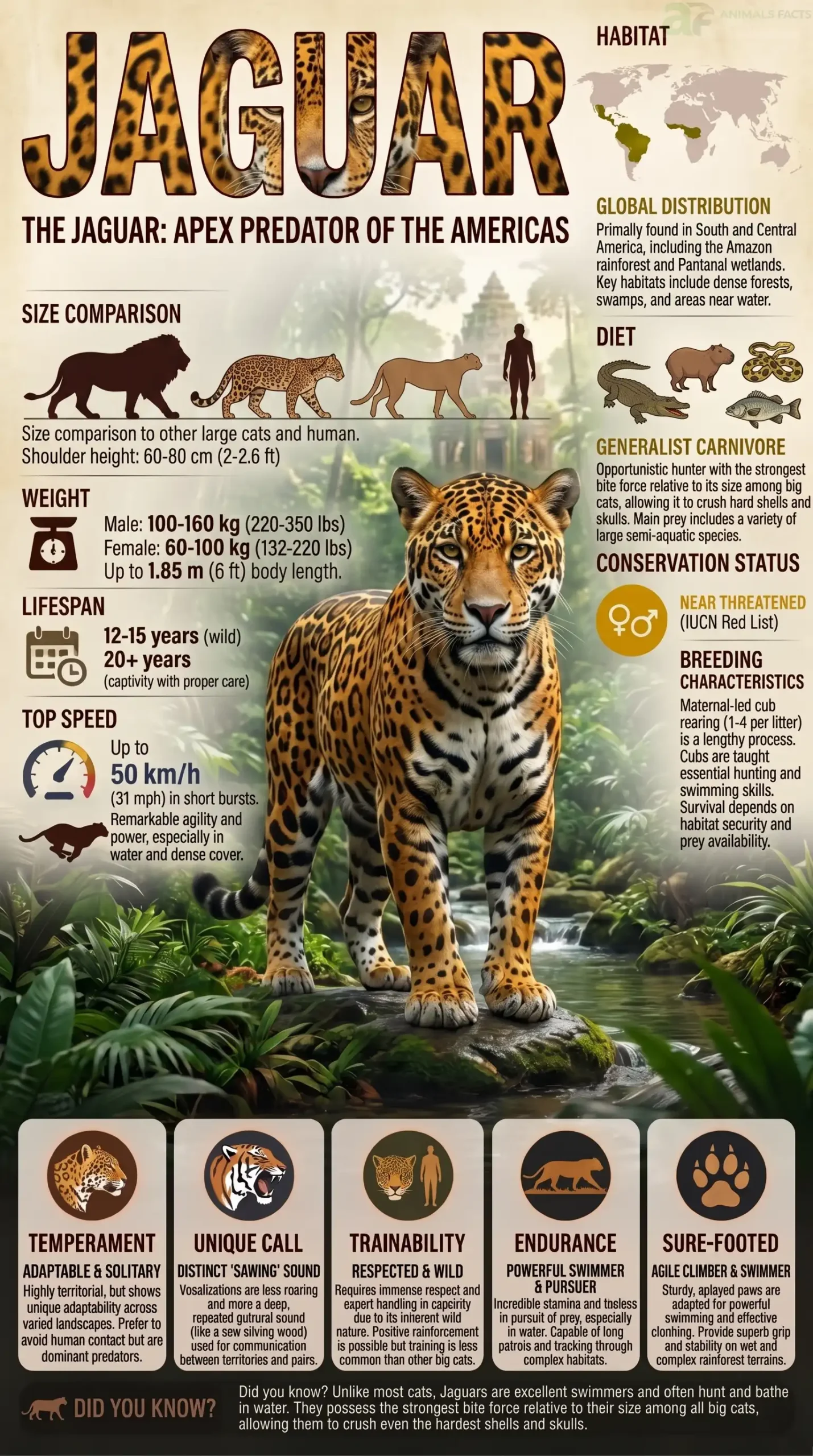
- The jaguar has the strongest bite of any wild cat — generating approximately 2,000 psi of bite force, more than twice that of a lion, and sufficient to crush a turtle’s shell or pierce a caiman’s skull.
- Jaguars kill prey by biting directly through the skull or spine — a unique killing method among all wild cats that causes instant neurological death rather than the throat-suffocation method used by lions, tigers, and leopards.
- The jaguar is the only Panthera big cat native to the Americas — making it the apex felid predator across an entire hemisphere.
- Jaguars are expert swimmers who actively hunt in rivers and lakes — pursuing fish, caimans, capybaras, and turtles in water with proficiency unmatched by any other large cat species.
- The jaguar’s diet includes over 87 documented prey species — the broadest recorded prey range of any wild cat, reflecting extraordinary dietary flexibility across the diverse environments of its range.
- Black jaguars — sometimes called “black panthers” — are not a separate species or subspecies but ordinary jaguars carrying a melanistic gene that causes nearly black coats. Approximately 10–15% of the jaguar population is melanistic.
- The jaguar’s name derives from the Tupí-Guaraní word “yaguareté” — meaning “true beast” or “beast that kills in one leap” — reflecting the profound impression this cat made on Indigenous South American cultures across millennia.
- A jaguar can successfully hunt and kill full-grown caimans (South American relatives of alligators) — including individuals approaching 2.5 meters in length — by biting through the caiman’s skull with a single strike to the back of the head.
- The Pantanal wetland of southwestern Brazil and eastern Bolivia supports the world’s highest density of jaguars anywhere — making it the best location in the world for observing jaguars in the wild, with sighting frequencies comparable to lion sightings in the Serengeti.
- Jaguars have been documented traveling over 500 kilometers in dispersal journeys from their birth territories — a range that has become critically important for conservation planners working to maintain connectivity between isolated jaguar populations across the Americas.
- The jaguar was once distributed across the United States as far north as California, New Mexico, Texas, Arizona, Louisiana, and Florida — representing one of the most dramatic range contractions of any large predator in North American history.
- The jaguar’s coat pattern — like that of tigers and cheetahs — is individually unique, allowing researchers to identify specific individuals through camera trap photographs without capturing or tagging animals.
- Jaguars regularly consume soil and clay — visiting riverside clay and mineral licks to supplement their diet with essential minerals, particularly sodium, that are difficult to obtain in sufficient quantities from meat alone.
- The jaguar has been documented caching prey — hoisting kills into trees to protect them from terrestrial scavengers — a behavior previously considered unique to leopards among large cats.
- Despite being substantially heavier than cheetahs and comparable in weight to leopards, jaguars are capable of surprisingly explosive movement — capable of short bursts up to 80 km/h.
- The Amazon Basin hosts the world’s largest continuous jaguar population — an estimated 40,000–60,000 individuals in a landscape that, while still extensive, is being reduced by deforestation at rates that threaten the long-term viability of this critical population.
- Jaguars produce a distinctive vocalization called a “saw” — a series of repeated, deep coughing grunts that sound remarkably like a handsaw cutting through wood, used for territorial advertisement and contact communication.
- Genetic research has demonstrated that all living jaguars are genetically more closely related to lions, leopards, tigers, and snow leopards than to any North American cat — reflecting the jaguar’s Eurasian origin and its relatively recent arrival in the Americas approximately 2 million years ago.
- The Black Caiman — the largest predator in the Amazon ecosystem — and the jaguar engage in one of the most dramatic predator-on-predator interactions documented in South American ecosystems, with jaguars regularly ambushing and killing caimans along Amazonian riverbanks.
- The jaguar is classified as a keystone species across all major ecosystems it inhabits — its removal triggering cascading ecological effects that alter vegetation, prey populations, and the overall structure of the food web.
- Jaguar home ranges vary enormously by habitat and prey density — from as small as 25–40 km² for females in prey-rich Pantanal habitats to over 500 km² for males in prey-sparse Amazonian or Chaco landscapes.
- Research using GPS collar data on Pantanal jaguars has documented individuals swimming regularly across the Paraguay River — distances of over 500 meters of open water crossed routinely as part of normal territory patrol.
- A female jaguar in the Pantanal named “Gata” was documented by Panthera researchers as having successfully raised more cubs to independence than any other individually monitored jaguar in the history of jaguar research — contributing significantly to understanding of reproductive strategy and cub survival factors.
- The jaguar’s spots are not merely decorative — they are present on the skin itself beneath the fur, meaning a shaved jaguar retains visible spot patterning in its underlying skin pigmentation.
- In 2026, the jaguar remains extirpated from approximately 45–55% of its historical range — with the largest range losses occurring in the drier, more heavily agricultural margins of its range including most of the United States, large parts of Mexico, Uruguay, and much of Argentina’s Pampas region.
5. Jaguar Fun Facts for Kids
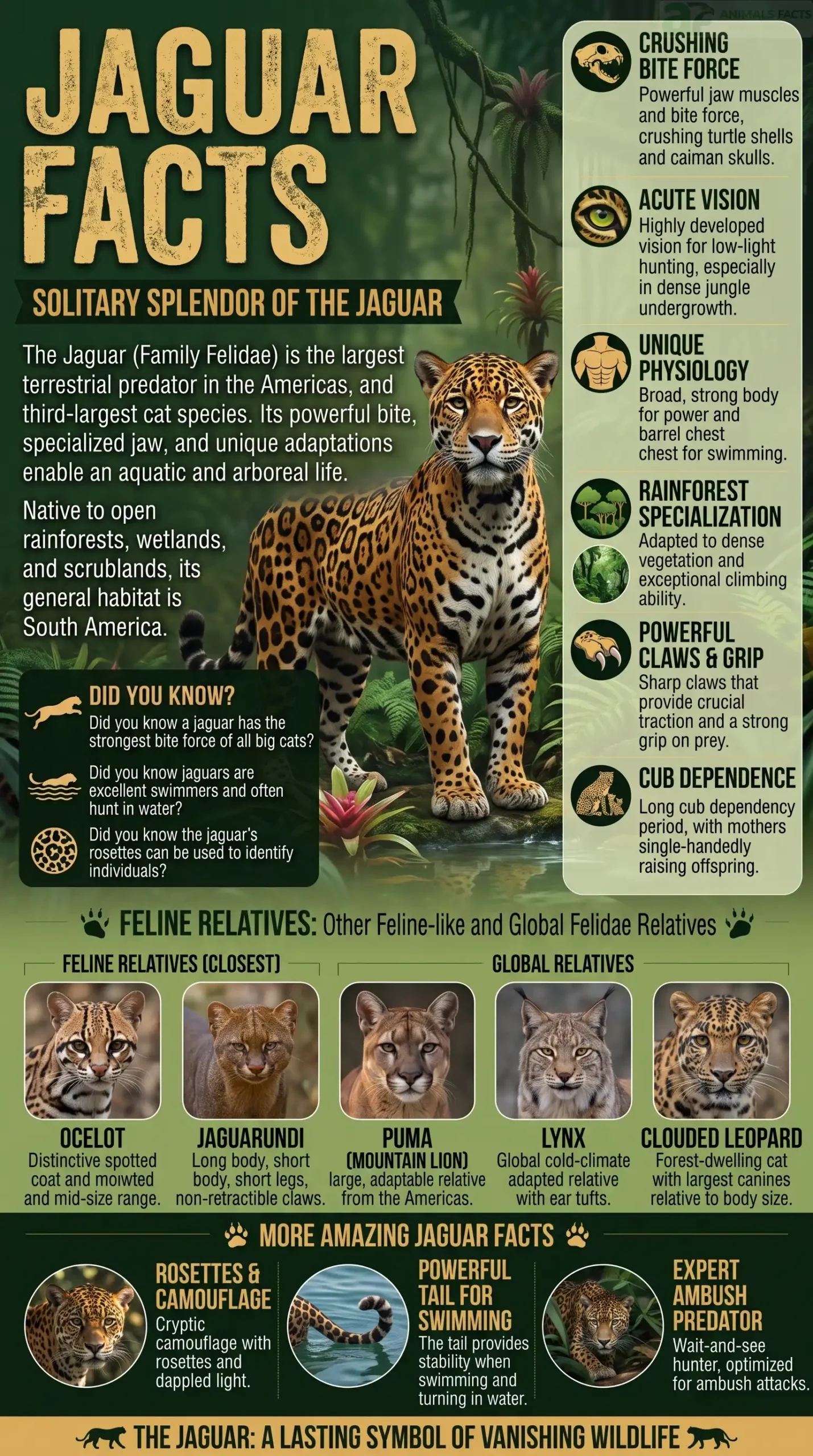
- The jaguar has the most powerful bite of any cat on Earth — stronger than a lion’s or tiger’s.
- Jaguars kill prey by biting through the skull rather than the throat — unique among all cats.
- Black jaguars are ordinary jaguars — just carrying a dark-coat gene.
- The jaguar is the only big cat in the Americas.
- Jaguars eat over 87 different prey species — the most diverse cat diet recorded.
- Jaguars are extraordinary swimmers who hunt in rivers and lakes.
- The jaguar’s name comes from the Tupí word meaning “beast that kills in one leap.”
- The Pantanal in Brazil/Bolivia is the best place in the world to see wild jaguars.
- Jaguars can bite through river turtle shells — one of nature’s strongest natural armors.
- Like tiger stripes, every jaguar’s rosette pattern is unique.
- The jaguar once ranged through the entire southern United States — now extirpated.
- Jaguars hoist kills into trees to protect them — similar to leopards.
- The saw vocalization of a jaguar sounds remarkably like a handsaw cutting wood.
6. Natural Habitat & Geographic Range
The jaguar is a habitat generalist of remarkable adaptability — the same species that thrives in the world’s largest tropical rainforest (the Amazon), the world’s largest tropical wetland (the Pantanal), dry deciduous forests, flooded grasslands, and highland cloud forests. This ecological flexibility is one of the jaguar’s most remarkable characteristics and has sustained its survival across a more diverse set of environments than almost any other large cat.
Primary Habitat Types
Tropical rainforest: The Amazon Basin — spanning Brazil, Peru, Colombia, Venezuela, Bolivia, and surrounding countries — represents the largest remaining continuous jaguar habitat on Earth. Dense, multi-canopy rainforest with high biodiversity provides both prey abundance and forest cover that supports the highest overall jaguar numbers of any ecosystem type.
Seasonally flooded grassland and wetland: The Pantanal of southwestern Brazil, eastern Bolivia, and northwestern Paraguay — the world’s largest tropical wetland system, flooded for several months annually — supports the highest known density of jaguars anywhere in the world. The extraordinary abundance of capybaras, caimans, giant river otters, tapirs, and fish in this uniquely productive ecosystem sustains jaguar densities of 6–12 individuals per 100 km² in some areas — densities comparable to lion populations in the richest African savannas.
Dry woodland and cerrado: The Brazilian Cerrado — the world’s most biodiverse savanna ecosystem — supports significant jaguar populations in a landscape increasingly fragmented by agricultural expansion, particularly soybean cultivation and cattle ranching.
Tropical dry forest: Dry forest habitats in Mexico, Central America, and parts of northern South America support jaguar populations at lower densities than wetter habitats, requiring correspondingly larger individual territories.
Cloud forest and montane habitat: Jaguars have been documented at elevations exceeding 3,000 meters in the Andes — demonstrating vertical range flexibility unusual for large cats and providing connectivity corridors between valley populations.
Habitat Range by Region
| Region | Country Examples | Population Estimate | Primary Habitat | Status |
|---|---|---|---|---|
| Amazon Basin | Brazil, Peru, Colombia, Bolivia | ~40,000–60,000 | Tropical rainforest | Largest population; deforestation threat |
| Pantanal | Brazil, Bolivia, Paraguay | ~4,000–7,000 | Tropical wetland | Highest density; best conservation status |
| Cerrado | Brazil | ~8,000–12,000 | Savanna / dry woodland | Fragmented; agricultural expansion |
| Gran Chaco | Argentina, Paraguay, Bolivia | ~5,000–8,000 | Dry forest / scrubland | Poorly monitored; declining |
| Central America | Belize, Guatemala, Honduras, Costa Rica | ~1,500–3,000 | Tropical forest | Fragmented; corridor-dependent |
| Mexico | Southern states | ~4,000–5,000 | Tropical forest | Reduced; recovering in some areas |
| Atlantic Forest | Southeastern Brazil | ~250–600 | Tropical forest | Near local extinction; Critically Endangered |
| United States | Arizona, New Mexico | Occasional dispersing males only | Scrubland, pine-oak forest | Extirpated as breeding population |
Did You Know? The Pantanal of southwestern Brazil hosts such extraordinary jaguar densities that wildlife tourism operators in the region — particularly along the Cuiabá River in the northern Pantanal — have documented average jaguar sighting rates exceeding 8–12 individual jaguars per day during peak viewing periods, making wild jaguar encounters in the northern Pantanal more predictable and frequent than lion encounters in most African national parks. This remarkable wildlife spectacle has made the Pantanal one of the world’s most important wildlife tourism destinations in the past decade.
7. Diet & Feeding Behavior
The jaguar is the most ecologically versatile large predator in the Western Hemisphere — an obligate carnivore whose diet spans an extraordinary range of prey species, sizes, and environmental contexts, from small fish and frogs to tapirs approaching 300 kg and full-grown caimans reaching over 2 meters.
What Jaguars Eat
The jaguar’s diet has been studied across multiple ecosystems and consistently demonstrates the broadest prey range of any wild cat — with over 87 documented prey species across the species’ range. This extraordinary dietary flexibility reflects both the jaguar’s ecological generalism and the diverse prey communities of its South American habitats.
Diet Breakdown Table
| Prey Type | Approximate Percentage | Notes |
|---|---|---|
| Capybara | 20–35% (wetland habitats) | World’s largest rodent; primary prey in Pantanal |
| Peccaries (collared and white-lipped) | 15–25% (forest habitats) | Primary prey in many forest and cerrado habitats |
| Caimans (spectacled and broad-snouted) | 10–20% (wetland habitats) | Remarkable prey; killed by skull bite through neck |
| Deer (brocket and marsh deer) | 10–20% | Important across all habitat types |
| Tapir (South American) | 5–15% | Largest prey; requires exceptional power to subdue |
| Fish | 5–15% (wetland/riverine) | Scooped from water with forepaw; regular prey in Pantanal |
| River turtles and giant river turtles | 5–10% (wetland) | Shell penetrated by jaw power unique to jaguar |
| Armadillos | 5–10% | Armored; pierced by jaguar jaw |
| Domestic livestock (cattle, horses) | Variable | Major human-conflict source |
| Rodents, birds, reptiles | 5–10% | Supplementary prey across all habitats |
The Jaguar’s Unique Hunting Method
The jaguar’s skull-penetrating bite is the defining feature of its hunting strategy — and distinguishes it sharply from every other large cat on Earth:
Approach: Like most large cats, jaguars are ambush predators, approaching prey slowly and silently through dense vegetation or shallow water, using cover to minimize detection.
Final rush: A short explosive rush from close range — typically less than 10–15 meters — relying on surprise and power rather than extended high-speed pursuit.
The kill: Rather than biting the throat, the jaguar delivers a single, precisely aimed bite to the back of the skull or through the temporal bones of the prey’s cranium, driving the lower canine teeth into the brain cavity or spinal cord. Death is essentially instantaneous — a dramatic contrast to the several-minute suffocation of a lion’s or leopard’s kill.
Aquatic hunting: In water, the jaguar employs a distinctive technique — slapping the water surface with a forepaw to stun fish and then scooping them out, leaping onto basking caimans from riverbanks, and ambushing capybaras and tapirs as they enter or exit the water.
Did You Know? The jaguar’s bite penetrates the shells of the giant South American river turtle (Podocnemis expansa) — one of the world’s largest freshwater turtles, with shells reaching 90 cm in length and several centimeters thick. The ability to breach this extraordinary natural armor, which deters virtually every other predator in the jaguar’s ecosystem, gives jaguars exclusive access to an important prey resource — representing a remarkable example of niche-opening through extreme physical capability that has no parallel among other felids.
8. Reproduction & Life Cycle
Jaguar reproduction reflects the solitary, territory-based social system of all Panthera cats — with brief mating encounters between otherwise independent adults, extended periods of maternal investment, and cub mortality rates shaped significantly by the predation pressures and habitat quality of specific regions.
Mating Behavior
Jaguars are non-seasonal breeders across most of their tropical range — mating can occur year-round, though there may be regional peaks linked to prey availability and environmental conditions. Female jaguars advertise estrus through vocalizations, urine marking, and body posture changes — with the characteristic territorial saw vocalization becoming more frequent during the reproductive period.
Male jaguars are aware of female reproductive state within their overlapping range areas through regular scent monitoring during territory patrol — converging on estrous females and engaging in brief but intensive mating consortships before separating and returning to their individual territories.
Gestation and Birth
Gestation period: Approximately 90–105 days — similar to the cheetah and slightly shorter than most other Panthera cats.
Litter size: Typically 1–4 cubs (most commonly 2), born weighing approximately 700–900 grams each — relatively small given the adult size of the species.
Den location: Cubs are born in dense vegetation, caves, rocky outcrops, or hollow trees — the mother selecting concealed sites that provide protection from potential infanticide by rival males and from predation.
Key Developmental Stages
| Stage | Age | Key Development |
|---|---|---|
| Neonatal | 0–2 weeks | Eyes closed; entirely dependent on mother |
| Eyes open | 13–14 days | Beginning visual awareness; spotting pattern visible |
| First outings | 5–7 weeks | Beginning to move outside den |
| Weaning begins | 3–4 months | Introduction to meat alongside nursing |
| Accompanying hunts | 6–18 months | Learning prey detection and hunting through observation |
| Independence | 18–24 months | Separating from mother; establishing own range |
| Territory establishment | 2–3 years | Young jaguars establishing independent territories |
| Sexual maturity | Female: ~2 years; Male: ~3–4 years | First breeding possible |
Lifespan Comparison Table
| Species | Average Wild Lifespan | Maximum Confirmed |
|---|---|---|
| Jaguar | 12–15 years | ~23 years (captivity) |
| Leopard | 12–15 years | ~23 years (captivity) |
| Lion | 10–14 years | ~29 years (captivity) |
| Puma / Mountain Lion | 8–13 years | ~20 years (captivity) |
| Ocelot | 7–10 years | ~20 years (captivity) |
9. Social Behavior & Communication
Like tigers and leopards, jaguars are primarily solitary animals outside of mating encounters and mother-cub family units — maintaining large individual territories with relatively well-understood spatial organization, and communicating extensively through scent, vocal, and visual marking systems.
Territorial Organization
Male jaguar territories are typically significantly larger than female territories, overlapping with the ranges of several females and patrolled regularly to maintain territorial claims against competing males. Territory size varies enormously:
- Pantanal males: As small as 25–40 km² in the richest habitat
- Amazon Basin males: Typically 50–200 km²
- Cerrado/Chaco males: Up to 500+ km² in prey-sparse dry habitat
Territorial boundaries between neighboring jaguars are maintained through mutual avoidance — facilitated by the chemical and acoustic information exchanged through marking — with direct physical confrontations between resident adults being comparatively rare and typically reserved for genuine territorial disputes or mating competition.
Communication Methods
The “saw” vocalization: The jaguar’s most characteristic and distinctive vocalization — a series of deep, repetitive grunting calls that closely resemble the sound of a handsaw cutting through wood, produced from the chest with a rhythm of approximately 4–8 repetitions per second. The saw carries across considerable distances through forest environments and serves as the primary long-distance territorial advertisement — equivalent in function to a lion’s roar, though dramatically different in acoustic character.
Roaring: Like all Panthera members, jaguars are capable of true roaring — a less commonly produced but acoustically distinctive sound used during intense arousal, territorial disputes, or mating encounters.
Scent marking: The primary communication medium for territorial organization — jaguars spray urine on prominent trees, rocks, and riverbank features throughout their territory, scratch tree bark (leaving both visual marks and scent from interdigital glands), and deposit feces at prominent locations.
Flehmen response: Like all cats, jaguars process scent information from marks using the vomeronasal organ — displaying the characteristic lip-curling “flehmen” expression while analyzing urine marks from other jaguars, receiving information about identity, sex, reproductive status, and territory ownership.
Did You Know? Jaguar territories in the Pantanal frequently extend into the Paraguay River system itself — with GPS collar data from Pantanal jaguars demonstrating that individual males regularly cross the main river channel and patrol islands in the river system as part of their normal territorial rounds. This extraordinary aquatic territorial behavior — unique among large cats — reflects the jaguar’s evolutionary adaptation to the Pantanal’s semi-aquatic landscape, in which waterways are as much a highway as a barrier.
10. Predators & Defense Mechanisms
Adult jaguars in good health are effectively the apex predator across every ecosystem they inhabit — no other predator in the Western Hemisphere regularly preys on healthy adult jaguars. Cubs and juvenile jaguars, however, face genuine predation risks, and adult jaguars face increasing mortality from human sources.
Natural Threats
Other jaguars: The most significant natural mortality risk for adult male jaguars is direct combat with other males during territorial disputes or competition for mating access — jaguar combat between equally matched males can result in severe injuries or death. Male jaguars frequently carry significant scarring from previous territorial encounters.
Caimans and anacondas: While jaguars regularly prey on caimans and large constricting snakes, large caiman bulls and giant anacondas (the world’s heaviest snake) represent genuine reciprocal predation risks to jaguars that miscalculate a hunting attempt — documented encounters between large caimans and jaguars show fatalities occurring on both sides in exceptional cases.
Pumas: The puma (mountain lion / cougar) — the second-largest cat in the Americas — is a competitor and occasional antagonist of the jaguar. In habitats where both species co-occur, pumas typically avoid areas of high jaguar activity, shifting their distribution to reduce encounter frequency with the heavier, more powerful jaguar. Direct aggressive interactions can be fatal to pumas.
Humans: By an overwhelming margin, the primary cause of adult jaguar mortality across the entire range — through direct poaching, retaliatory killing over livestock predation, vehicle collisions on roads bisecting jaguar habitats, and the indirect effects of habitat destruction and prey depletion.
Defense Strategies
Avoiding humans: Jaguars are not naturally aggressive toward humans and actively avoid contact — the relatively low rate of jaguar attacks on humans compared to lion or tiger attacks reflects this avoidance behavior, which appears to be both instinctive and learned.
Territorial marking saturation: Dense and consistent scent marking throughout a territory communicates presence and reduces the frequency of confrontational encounters with neighboring jaguars — allowing territorial boundaries to be maintained through chemical communication rather than constant physical confrontation.
Aquatic refuge: The jaguar’s exceptional swimming ability provides an unusual defensive option unavailable to most large cats — jaguars readily enter and cross rivers when threatened, including by humans, using waterways as both barriers and escape routes.
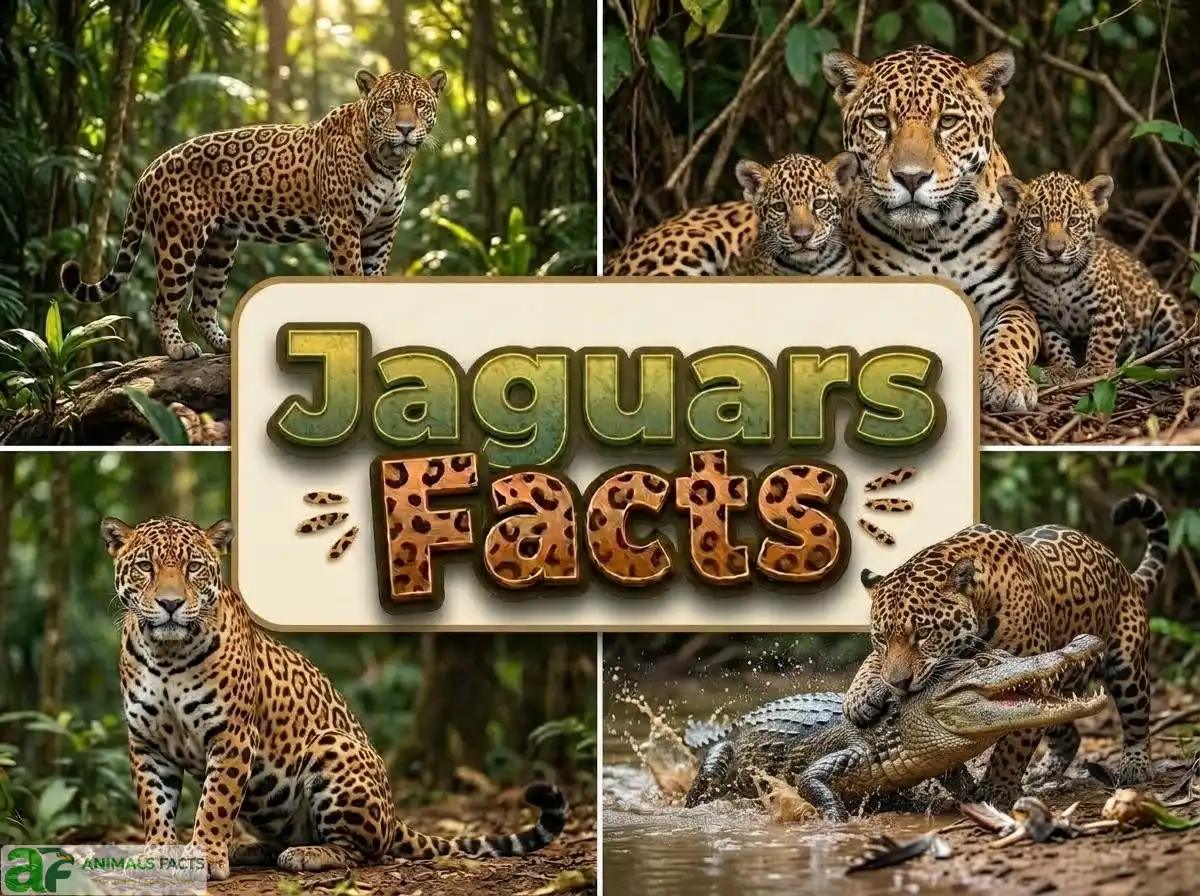
11. Jaguar Facts for Kids
Hey kids — let’s dive into some of the most amazing facts about the jaguar, the most powerful cat in the entire Americas!
- The jaguar is the biggest cat in North and South America — even bigger than a mountain lion or a cougar! It’s so strong that it can crush the shell of a river turtle with just one bite!
- Jaguars have a totally different way of catching their food from other big cats — instead of biting the throat like lions do, a jaguar bites through the skull of its prey, killing it instantly. That’s why it needs such an enormous, powerful head!
- Black jaguars — which look completely black — are the same animal as a spotted jaguar! They just have a special gene that gives them very dark fur. If you look closely in bright sunlight, you can actually still see their spots!
- Jaguars are some of the best swimmers of any cat — they love water and regularly swim across wide rivers, catch fish, and even hunt crocodile-like animals called caimans in the water!
- The jaguar gets its name from a South American Indigenous word that means “beast that kills in one leap” — which is pretty much exactly what it does!
- A jaguar makes a sound called a “saw” — it sounds exactly like someone sawing through wood, not like a regular cat roar at all!
- Jaguars eat over 87 different kinds of animals — including fish, turtles, caimans, deer, capybaras (the world’s biggest rodents), and even armadillos!
- The best place in the world to see a wild jaguar is in a place called the Pantanal in Brazil — a giant wetland where jaguars are so common that people in boats sometimes see 10 or more different jaguars in a single day!
Did You Know? Every single jaguar in the world has a completely different spot pattern — just like every person has different fingerprints! Scientists take photographs of jaguars’ spots to identify which individual jaguar is which, without ever needing to capture or tag the animal. There are thousands of photographs of individual jaguars stored in databases that help scientists count how many jaguars are living in different areas of the Amazon and Pantanal.
12. Relationship with Humans
The jaguar’s relationship with humans spans from being the supreme deity of some of the most advanced civilizations in pre-Columbian history to being hunted nearly to extinction for fur, feared and killed as a livestock predator, and now the subject of intensive conservation investment across 18 countries.
The Deepest Indigenous Partnership
The jaguar’s relationship with Indigenous peoples of the Americas is arguably the deepest and longest human-large-predator cultural entanglement in the world — spanning at least 4,000 years of documented artistic, religious, and political significance across dozens of distinct civilizations. From the Olmec civilization (the earliest known major Mesoamerican culture, ~1500–400 BCE) — whose art is so dominated by jaguar imagery that the Olmec are sometimes described as a “jaguar cult” — through the Maya, Aztec, and Inca at the height of their political and cultural power, to the hundreds of Amazonian Indigenous communities who continue to maintain jaguar-centered spiritual traditions today, no other large carnivore on Earth has been so consistently and universally placed at the center of human spiritual and political life.
Fur Trade and Historical Persecution
The international fur trade of the mid-20th century — at its peak in the 1960s, when roughly 18,000 jaguars were legally killed annually for the skin trade to supply European and North American fashion markets — represents the most acute single threat to jaguar populations in recorded history. By the time the Convention on International Trade in Endangered Species (CITES) listed the jaguar in 1973 and international trade in jaguar products was effectively banned, the species had been eliminated from several range countries and severely reduced across much of its remaining range.
Human-Jaguar Conflict Today
Livestock predation is the most widespread and practically significant human-jaguar conflict across the species’ range today — with jaguars killing cattle, horses, and other domestic animals across vast areas of pastoral land that overlap with or border jaguar habitat. This predation creates direct economic losses for ranching communities and powerful incentives for retaliatory jaguar killing — estimated to account for a substantial proportion of contemporary adult jaguar mortality, particularly at the margins of protected areas.
13. Conservation Status & Threats
The jaguar’s overall IUCN classification as Near Threatened masks significant variation across its range — with some populations in the core Amazon and Pantanal habitats relatively stable while others, particularly in Central America, the Atlantic Forest, and the Gran Chaco, face genuinely Endangered or Critically Endangered status.
Global Jaguar Conservation Data (2026)
| Region | Population | IUCN Status | Trend |
|---|---|---|---|
| Amazon Basin | ~40,000–60,000 | Near Threatened | Declining (deforestation) |
| Pantanal | ~4,000–7,000 | Relatively stable | Stable in core; declining at margins |
| Cerrado | ~8,000–12,000 | Vulnerable | Declining |
| Central America | ~1,500–3,000 | Endangered | Declining; corridor-dependent |
| Atlantic Forest | ~250–600 | Critically Endangered | Sharply declining |
| Gran Chaco | ~5,000–8,000 | Vulnerable | Declining |
| Mexico | ~4,000–5,000 | Endangered | Mixed; recovering in some reserves |
Major Threats to Jaguars
Deforestation and habitat loss: The most fundamental long-term threat — the Amazon Basin loses an estimated 1–2 million hectares of forest annually, primarily to cattle ranching and soy cultivation, with each hectare of forest converted representing a direct reduction of available jaguar habitat. The cumulative impact on jaguar population viability across the Amazon over the coming decades represents one of the most consequential conservation challenges in the Western Hemisphere.
Human-wildlife conflict: As documented above, retaliatory killing of jaguars by ranchers experiencing livestock predation represents one of the most widespread and immediate sources of jaguar mortality. In areas where jaguar range overlaps with cattle ranching — which describes most of the jaguar’s remaining range outside core protected areas — this conflict is the primary driver of mortality.
Illegal wildlife trade: Despite international trade bans since 1973, jaguar parts — particularly teeth, skins, and bones — are traded illegally, with demand increasingly driven by Chinese traditional medicine and luxury markets, particularly following the near-elimination of tigers from much of their range. Research by TRAFFIC has documented significant jaguar parts seizures in several South American countries and demand from Asian markets that creates a worrying new trafficking threat to the species.
Road mortality: Infrastructure development — particularly major highways crossing jaguar habitats in Brazil, Bolivia, and Central America — creates significant jaguar mortality through vehicle collisions and effectively fragments populations by creating barriers to movement and dispersal.
Did You Know? The Jaguar Corridor Initiative, led by Panthera across 18 jaguar range countries, aims to maintain connected jaguar habitat from Mexico to Argentina — a north-south corridor of over 8,400 kilometers. The initiative works with governments, landowners, and communities to maintain or restore landscape connectivity between fragmented jaguar populations, recognizing that genetic exchange between populations through dispersal is essential for long-term jaguar viability across the Americas. As of 2026, the corridor maintains functional connectivity across approximately 60% of the jaguar’s range.
14. Famous Jaguars
Xena and Other Named Pantanal Jaguars
The northern Pantanal’s Cuiabá River corridor has produced some of the most extensively documented and publicly recognized individual wild jaguars anywhere in the world — with named individuals including Xena, Ousado, Marley, and others tracked and photographed by researchers and tourism guides over multiple years. These individuals have become familiar figures to thousands of wildlife tourists and photographers who visit the Pantanal annually, and their documented life histories — including cub-rearing events, territorial changes, and individual hunting styles — have provided extraordinary insight into jaguar natural history unavailable anywhere else.
El Jefe — Arizona’s Celebrity Jaguar
El Jefe (“The Boss”) was a male jaguar documented by trail cameras in the Santa Rita Mountains of southern Arizona between 2011 and 2015 — the only known resident jaguar in the United States during this period and one of the most closely followed individual wild animals in North American conservation history. His presence generated enormous public interest, media coverage, and conservation advocacy regarding the potential corridor connectivity between Mexico’s jaguar populations and historical US jaguar range. El Jefe’s disappearance from US cameras in 2015 was widely mourned, though his fate remains unknown.
Gata and Notable Pantanal Research Individuals
“Gata” — a Pantanal female jaguar intensively studied by Panthera’s Pantanal research team — became one of the most productive and documented individual female jaguars in the scientific record, with her cub-rearing history providing foundational data for understanding jaguar reproductive success factors in wetland habitats.
15. Role in Ecosystem & Food Chain
The jaguar is classified as a keystone species and apex predator across all major ecosystems it inhabits — its presence or absence triggering cascading ecological effects that reshape predator-prey relationships, prey behavior, vegetation dynamics, and the overall structure of the food web throughout its range.
Top-Down Prey Regulation
Jaguar predation directly regulates the populations of capybara, peccaries, deer, and caimans — preventing the population explosions that occur in the absence of top predators and maintaining the prey population structures that support ecosystem health. Research in areas where jaguars have been removed — particularly the Atlantic Forest and parts of the cerrado — documents significant increases in herbivore damage to vegetation and declines in overall ecological stability following jaguar loss.
Caiman Population Regulation
The jaguar’s regulation of caiman populations in Pantanal and Amazonian ecosystems is particularly significant — caimans are themselves apex predators of aquatic and semi-aquatic systems, and their populations, when unchecked by jaguar predation, can significantly alter fish populations, bird nesting success (caimans regularly raid bird nesting colonies), and aquatic vegetation dynamics.
Seed Dispersal Through Movement
Jaguars carry seeds in their digestive tracts — consuming fruit alongside prey and depositing seeds at distance from parent plants through defecation during territory patrols. While not a primary ecological role, this seed dispersal contribution, spread across the enormous territories of individual jaguars, contributes to plant community diversity and regeneration across large landscape areas.
The Trophic Cascade
Research across South American ecosystems has increasingly documented trophic cascade effects associated with jaguar presence — comparable to the wolf-elk-vegetation cascades documented in Yellowstone. Where jaguars maintain viable populations, deer and peccary populations show altered behavior and distribution patterns that reduce localized overgrazing, supporting vegetation diversity and the habitat structure on which dozens of other species depend.
16. Myths, Folklore & Cultural Significance
No animal in the cultural history of the Western Hemisphere occupies a position of spiritual, political, and artistic significance comparable to the jaguar — the undisputed lord of pre-Columbian American mythology and religious tradition across an extraordinary diversity of civilizations spanning four millennia.
The Olmec — The Original Jaguar Civilization
The Olmec civilization of coastal Mexico — generally recognized as the “mother culture” of Mesoamerican civilization, flourishing approximately 1500–400 BCE — produced what may be the most jade-intensive and jaguar-dominated art corpus in the pre-Columbian record. Olmec art features a recurring mythological being called the “were-jaguar” — a composite human-jaguar figure representing the transformation between human and divine power — that appears on enormous basalt thrones, jade figurines, and ceremonial objects throughout the Olmec archaeological record. The pervasive Olmec jaguar motif established a template that subsequent Mesoamerican civilizations would adapt, extend, and elaborate for the following three thousand years.
The Maya — Jaguar as Divine Royalty
In Maya civilization, the jaguar occupied a central position in religious cosmology and political legitimacy. The jaguar was associated with Ixbalanque (one of the Hero Twins of Maya mythology), with the underworld (Xibalba), and with shamanic transformation — Maya rulers adopted jaguar titles (the word “balam” means jaguar in Yucatec Mayan), wore jaguar pelts as royal regalia, sat on jaguar throne carvings, and commissioned extraordinary jaguar iconography that pervades Maya art from the Classic Period (250–900 CE). The Jaguar Sun God (Kinich Ahau in jaguar form) represented the sun’s nightly passage through the underworld — the sun becoming a jaguar each night as it traversed the dark realm beneath the Earth before rising again at dawn.
The Aztec — Jaguar Warriors
Aztec military tradition incorporated jaguar symbolism into one of the most celebrated warrior traditions in pre-Columbian history. The Jaguar Warriors (Ocēlōtl in Nahuatl) — an elite fighting order distinguished by jaguar skin regalia and helmet — were among the most feared soldiers in the Aztec army, alongside the equally elite Eagle Warriors. Membership in the Jaguar Warrior order required capturing a specified number of enemy combatants alive in battle — a demanding criterion that reserved the distinction for the most accomplished military individuals. Aztec stone sculptures depicting Jaguar Warriors are among the finest pre-Columbian military art in existence.
The Inca — Otorongo
In Inca civilization, the jaguar (known as “otorongo” in Quechua) was associated with strength, power, and the ruling class — featured in Inca ceremonial art, textile design, and architectural decoration. The nearby Amazon cultures — including the dozens of Indigenous nations across the Amazon Basin — maintain the richest continuous living tradition of jaguar cultural and spiritual significance anywhere in the Americas, with jaguar shamanism, jaguar clan systems, and jaguar-centered cosmologies remaining central to the spiritual practice of many Amazonian peoples to the present day.
17. Jaguars in Pop Culture
The jaguar has generated a significant and culturally diverse presence in modern entertainment and commercial culture — drawing on both its extraordinary physical reputation and its deep historical roots in pre-Columbian American civilizations.
Film and Television
“The Jaguar” and various Amazon adventure films — multiple adventure and nature documentary films have featured the jaguar as a central subject, though relatively few have achieved the cultural penetration of big cat films centered on tigers and lions, reflecting the jaguar’s geographic distance from major documentary production traditions centered in East Africa.
National Geographic and BBC Amazon productions — including major documentary series such as “Amazon with Bruce Parry” (BBC, 2008) and various National Geographic Wild productions — have provided the most extensively watched popular natural history coverage of jaguars, with Pantanal jaguar footage increasingly prominent in wildlife documentary productions since the 2010s.
“Nat Geo Wild’s Big Cat Week” and related content — dedicated wildlife programming has significantly expanded English-language public awareness of the jaguar as a conservation subject, particularly through Pantanal-based footage that demonstrates the remarkable jaguar viewing opportunities available in this ecosystem.
Brand Associations
Jaguar Land Rover — the British luxury automotive brand — has used the jaguar as its primary brand symbol since 1945, associating the vehicle with the cat’s combination of power, speed, and elegant predatory capability. The leaping jaguar hood ornament — officially called the “Leaper” — became one of the most recognized automotive symbols in the world, and the brand’s association with its feline namesake has generated significant commercial value built on the jaguar’s extraordinary natural reputation.
Sports Mascots
The jaguar features as the mascot of the NFL’s Jacksonville Jaguars (established 1993) — the most prominent North American professional sports team to use jaguar imagery — alongside numerous Latin American football clubs and national teams, particularly from countries within the jaguar’s range, including Mexico and several Central American nations.
Literature and Visual Art
The jaguar’s extraordinary history as the central symbol of pre-Columbian American civilization has generated a rich body of literary and artistic engagement — from Ted Hughes’s celebrated poem “The Jaguar” (1957) and “Second Glance at a Jaguar” (1960) to extensive engagement in the work of Latin American literary figures for whom the jaguar represents indigenous American identity, power, and the confrontation between pre-Columbian and European civilizations.
18. Jaguar Facts vs. Common Myths
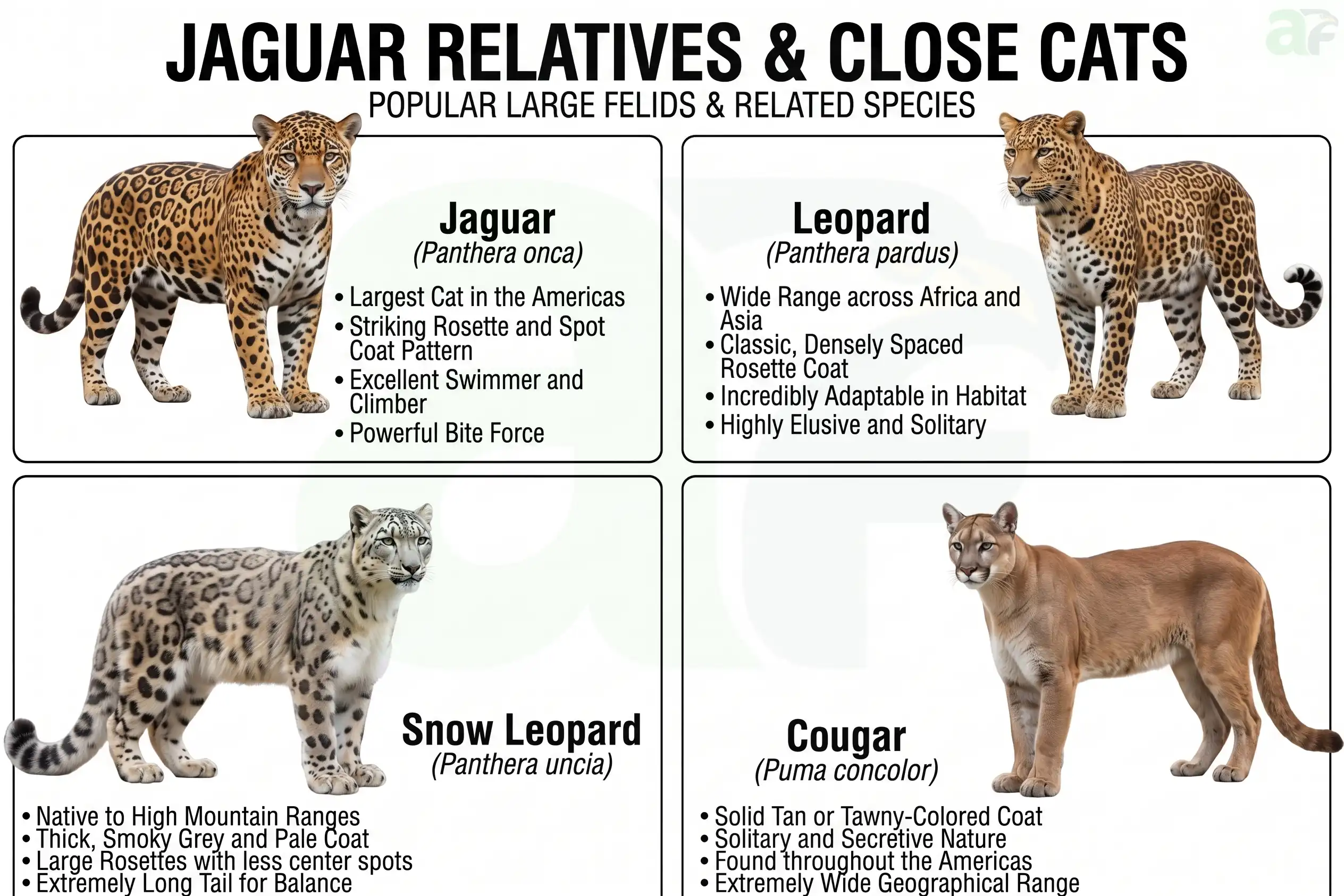
Myth: Jaguars and leopards are the same animal, or extremely similar. Fact: While both are spotted big cats, jaguars and leopards are significantly different animals — jaguars are larger and more powerfully built, their rosettes contain central spots (leopard rosettes are hollow), they inhabit entirely different continents (Americas vs. Africa/Asia), they hunt differently (skull bite vs. throat suffocation), they are accomplished swimmers (leopards avoid deep water), and their ecological roles are distinct. The similarity in spotted coat pattern is an example of convergent evolution rather than close relationship.
Myth: Black jaguars are a separate, more aggressive subspecies. Fact: Black jaguars are ordinary jaguars carrying a melanistic gene that causes overproduction of dark pigment. They are not more aggressive, not a different subspecies, and not fundamentally different from spotted jaguars in behavior or ecology — they simply have a different coat color. Their rosette pattern remains visible in good lighting.
Myth: Jaguars frequently attack humans. Fact: Unprovoked jaguar attacks on humans are extremely rare — the jaguar’s natural behavioral tendency is strong avoidance of humans, and historically documented attacks are overwhelmingly associated with jaguars that have been cornered, injured, or food-conditioned. The jaguar’s safety record with humans is considerably better than that of lions or tigers, despite being the largest cat in the Americas.
Myth: The jaguar is the same species as the puma/mountain lion. Fact: The jaguar (Panthera onca) and puma (Puma concolor) are completely different species from different genera — the jaguar is a member of the roaring Panthera genus (with lions, tigers, and leopards), while the puma is more closely related to the cheetah and smaller cats. They differ dramatically in size (jaguars are roughly twice the weight of pumas in most range areas), coat pattern (spots vs. solid coat), ecology (jaguar is aquatic; puma is terrestrial), and evolutionary relationship.
Myth: Jaguars are rare animals unlikely to be seen in the wild. Fact: In the northern Pantanal of Brazil — the world’s best jaguar viewing location — wildlife boats regularly encounter 5–15 different individual jaguars per day during peak season. The Pantanal provides wildlife viewing opportunities for jaguars that rival or exceed the reliability of lion sightings in the most famous African national parks, making this accessible region a world-class wildlife destination.
Myth: The black jaguar has eyes that glow red in darkness. Fact: Like all cats, the jaguar’s eyes contain a reflective layer (tapetum lucidum) that glows yellowish-green in direct light — not red. The red-eye effect associated with cats in folklore likely reflects a mixture of cultural imagination and the different reflective properties of human eyes (which do appear red in flash photography due to blood vessel reflection).
19. Best Places to See Jaguars in the Wild
Northern Pantanal, Brazil — Cuiabá River Corridor
The undisputed world capital of wild jaguar viewing — the boat-based wildlife tours along the Cuiabá River and its tributaries in the northern Pantanal offer the most reliable, frequent, and close-range jaguar encounters available anywhere on Earth. During the dry season (July–October), when receding floodwaters concentrate wildlife along riverbanks, sighting rates of 8–15 individual jaguars per day are routinely documented by multiple tour operators. Several permanently resident jaguar individuals and family groups are known and tracked by local naturalists, allowing targeted encounters.
Porto Jofre and Jaguar Flotel, Mato Grosso, Brazil
The small riverside settlement of Porto Jofre — at the end of the Transpantaneira road in Brazil’s Mato Grosso state — has become the epicenter of Pantanal jaguar tourism, with multiple floating hotels (flotels) providing base camps for intensive jaguar-focused river boat safaris that have made this one of the most sought-after wildlife experiences in the world.
Cockscomb Basin Wildlife Sanctuary, Belize
Cockscomb Basin in Belize — established as the world’s first dedicated jaguar sanctuary in 1986 — provides forest trail and camera trap experiences in some of Central America’s finest remaining jaguar habitat. While actual jaguar sightings are less frequent than in the Pantanal, Cockscomb offers exceptional opportunities to observe jaguar sign and experience intact Central American tropical forest in the company of experienced local guides.
Barra de Colorado Wildlife Refuge, Costa Rica
Costa Rica’s northeastern Caribbean lowlands support a recovering jaguar population, with the Barra de Colorado and nearby Tortuguero area providing habitat that connects to Nicaraguan jaguar populations through intact forest corridors. While sightings require patience, the exceptional overall biodiversity of the area makes jaguar-focused expeditions rewarding experiences.
Madidi National Park and Rurrenabaque, Bolivia
Bolivia’s Madidi National Park — one of the world’s most biodiverse protected areas — supports significant jaguar populations in pristine Amazon Basin rainforest, with the gateway town of Rurrenabaque offering access to both jungle lodge experiences in Madidi and Bolivian Pampa (grassland) ecosystems where wildlife visibility is significantly higher.
Corcovado National Park, Costa Rica
Corcovado — Costa Rica’s most biologically intense national park, covering the Osa Peninsula — supports one of Central America’s more accessible jaguar populations, with experienced local naturalist guides offering multi-day trail expeditions in primary rainforest where jaguar encounters, while uncommon, occur with greater frequency than in most Central American habitats.
Amazon Reserves (Mamirauá and Amanã), Brazil
The Mamirauá Sustainable Development Reserve in the Brazilian Amazon — the world’s largest protected flooded forest — and adjacent Amanã Reserve provide remote but extraordinary jaguar experiences in one of the most intact Amazonian ecosystems remaining, accessible through specialized eco-lodges offering boat and canoe-based wildlife exploration.
20. Top Documentaries & Books
Must-Watch Documentaries
“Jaguar: Stealth Predator” (BBC Natural World / National Geographic) — Multiple productions have documented jaguar hunting behavior in the Pantanal with extraordinary close-range footage, including the dramatic caiman-hunting sequences that have become iconic in wildlife filmmaking.
“Wild Brazil” (BBC, 2014) — Features extended Pantanal jaguar sequences among the finest ever filmed, including coordinated hunting footage and mother-cub behavioral documentation, narrated with characteristic BBC Natural History Unit quality.
“Amazon with Bruce Parry” (BBC, 2008) — While broadly focused on Amazonian ecosystems and Indigenous cultures, the series includes significant jaguar content and provides the cultural and ecological context that makes jaguar conservation comprehensible.
“Panthera’s Jaguar Corridor Initiative” (Panthera documentary series) — Conservation-focused documentary coverage of the range-wide jaguar corridor initiative provides essential context for understanding the scale and ambition of contemporary jaguar conservation.
“Jaguar Social Club” (Nat Geo Wild) and related Wildlife programming — Recent National Geographic Wild productions documenting named individual Pantanal jaguars over successive years have created the most publicly engaging and emotionally connected jaguar natural history content currently available.
Essential Books
“An Indomitable Beast: The Remarkable Journey of the Jaguar” by Alan Rabinowitz (2014) — Written by the world’s foremost jaguar conservation scientist, who established the Cockscomb Basin Jaguar Sanctuary and co-founded Panthera, this is the essential popular account of jaguar natural history, conservation, and cultural significance — arguably the single best book about jaguars ever published.
“The Jaguar’s Shadow” by Richard Mahler (2009) — A compelling narrative account of jaguar ecology and conservation challenges along the US-Mexico border, providing essential reading for understanding the North American jaguar situation and the potential for recovery in historical US range.
“Panthera Onca: The Jaguar” and various scientific monographs — Technical natural history references providing comprehensive coverage of jaguar biology, ecology, and population dynamics for readers seeking deeper scientific engagement.
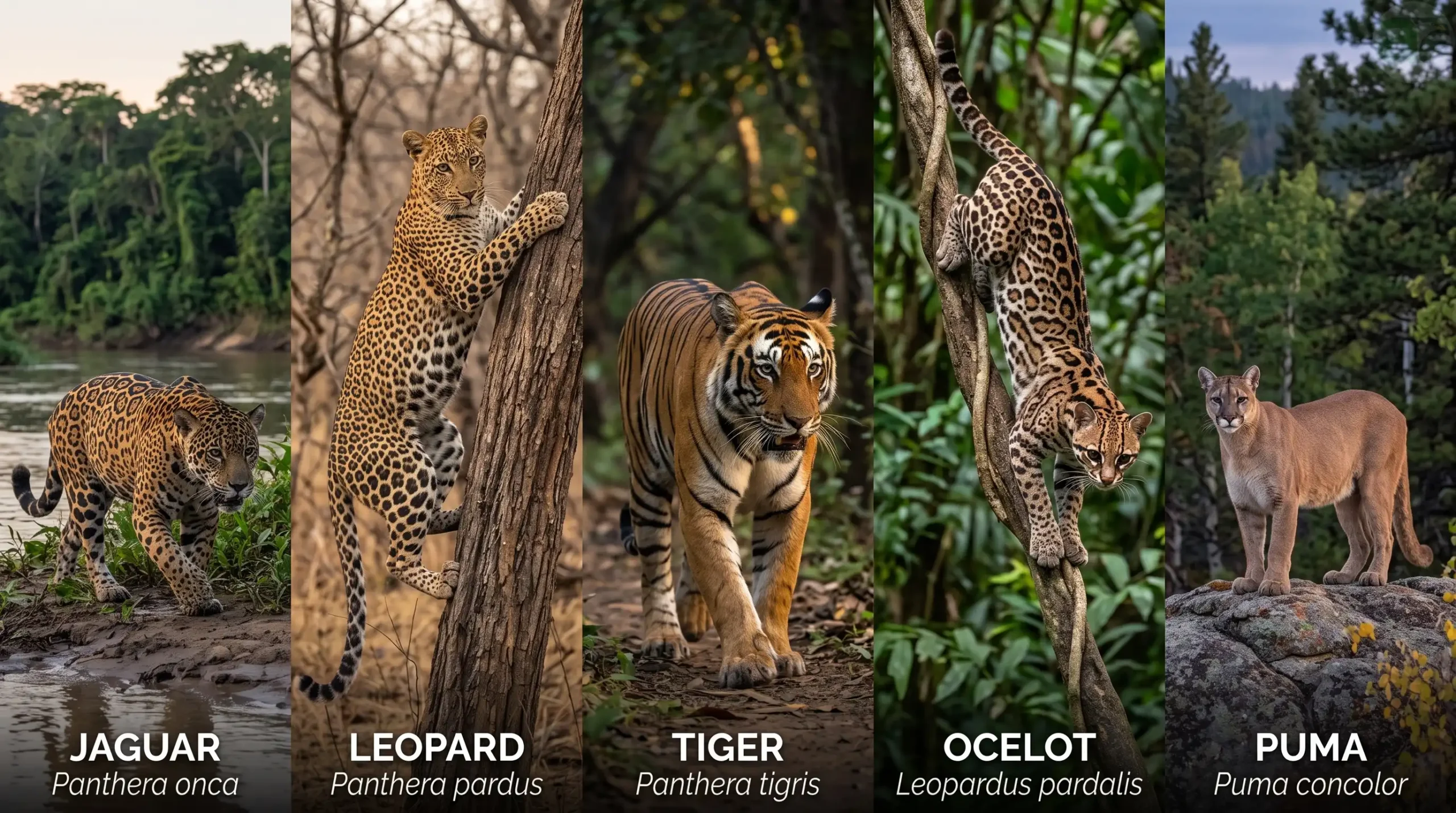
21. Comparison of Jaguars with Similar Big Cats
| Feature | Jaguar | Leopard | Puma / Mountain Lion | Ocelot | Tiger |
|---|---|---|---|---|---|
| Scientific Name | Panthera onca | Panthera pardus | Puma concolor | Leopardus pardalis | Panthera tigris |
| Weight | 56–160 kg | 28–90 kg | 29–120 kg | 7–16 kg | 90–300 kg |
| Distribution | Central and South America | Africa; Asia | North and South America | Southern USA to S. America | Asia |
| Habitat | Rainforest; wetland; dry forest | Forest; savanna; rocky terrain | Mountains; forest; desert | Tropical forest; woodland | Forest; grassland; wetland |
| Coat Pattern | Rosettes with central spots | Hollow rosettes | Solid (adults); spotted (young) | Complex spotted/rosette | Bold black stripes |
| Kill Method | Skull/spine crush bite | Throat suffocation | Throat suffocation | Throat suffocation | Skull/spine bite or throat |
| Swimming | Expert; hunts aquatically | Avoids water | Avoids water | Swims competently | Exceptional swimmer |
| Conservation Status | Near Threatened | Vulnerable | Least Concern | Least Concern | Endangered |
| Bite Force | ~2,000 psi (highest of any cat) | ~1,000 psi | ~700 psi | ~350 psi | ~1,050 psi |
22. How You Can Help
Jaguar conservation operates across an enormous geographic scale — 18 range countries, diverse habitats, and complex socioeconomic contexts — requiring a corresponding diversity of conservation approaches that individuals can support in meaningful ways.
Support These Organizations
Panthera (panthera.org/cat/jaguar) — The world’s leading wild cat conservation organization, running the Jaguar Corridor Initiative across 18 range countries, conducting fundamental population research in the Pantanal and Amazon, and pioneering human-jaguar coexistence programs with ranching communities.
Wildlife Conservation Society (wcs.org) — Operates major jaguar conservation programs in Bolivia, Brazil, Colombia, and Central America, including long-running population research and community engagement programs in the Pantanal and Amazon Basin.
Jaguar Conservation Fund (jaguar.org.br) — Brazil-based organization focused specifically on Brazilian jaguar conservation including cerrado and Atlantic Forest populations.
WWF Brazil (wwf.org.br) — Runs major jaguar conservation programs in the Pantanal and Amazon, alongside significant deforestation prevention advocacy that addresses the most fundamental long-term threat to jaguar habitat.
Rainforest Alliance (rainforest-alliance.org) — Certifying agricultural products from jaguar range countries under sustainability criteria that include wildlife-friendly land management standards, creating market incentives for ranching and farming operations compatible with jaguar presence.
Practical Actions
Choose certified sustainable beef and soy products. The most significant driver of jaguar habitat loss — Amazon deforestation — is overwhelmingly associated with cattle ranching and soy production. Consumer choices favoring certified sustainable or deforestation-free products from Brazilian suppliers create market signals that reduce the financial incentive for deforestation.
Support coexistence programs. Organizations like Panthera’s Jaguar and Livestock Coexistence Program work with ranching families to implement non-lethal depredation prevention tools — livestock guardian dogs, improved corrals, and GPS alert systems — that reduce livestock losses and corresponding retaliatory jaguar killing. Financial contributions to these programs directly reduce jaguar mortality.
Advocate for Amazon protection policy. The most impactful single conservation action for jaguar survival — maintaining the Amazon’s forest cover — requires policy decisions at the Brazilian federal and state government level. Supporting organizations engaged in Brazilian environmental policy advocacy, and engaging with your own country’s foreign policy positions regarding Amazon protection, contributes to the political will required for forest conservation at scale.
Choose responsible Pantanal tourism. The extraordinary wildlife tourism economy of the northern Pantanal — built almost entirely around jaguar viewing — provides one of the most direct and positive financial incentives for jaguar conservation anywhere in the world. Choosing tour operators certified for responsible wildlife viewing and demonstrating genuine commitment to conservation revenue sharing contributes to this powerful economic case for jaguar protection.
Did You Know? Panthera’s “Jaguar SMART” program — combining camera trap monitoring, GPS collar data, and community-based livestock protection in the Pantanal and Amazon — has produced the most rigorous and spatially comprehensive jaguar population assessment ever attempted for any individual large cat population. The program’s camera trap network across the Pantanal has documented over 800 individually identified jaguars in a single landscape — the most individuals ever simultaneously monitored for any wild jaguar population, providing the population dynamics data essential for scientifically informed conservation management of this extraordinary ecosystem.
23. Frequently Asked Questions About Jaguars
Q1: What is the scientific name of the jaguar?
The jaguar’s scientific name is Panthera onca — placing it firmly within the genus Panthera alongside the lion (P. leo), tiger (P. tigris), leopard (P. pardus), and snow leopard (P. uncia). The family is Felidae (cats), order Carnivora, and class Mammalia. The jaguar is the only Panthera species native to the Americas.
Q2: How big do jaguars get?
Jaguar size varies considerably by region — the largest individuals, from the Pantanal of southern Brazil and Bolivia, have been documented at up to 160 kg and 2.5 meters in total length. Most adults weigh between 56–96 kg for males and 36–60 kg for females, though Pantanal populations are significantly heavier than average. The jaguar is the largest cat in the Americas and the third-largest wild cat globally after the tiger and lion.
Q3: Are jaguars and leopards the same animal?
No — jaguars and leopards are different species from different continents, though both are spotted members of the Panthera genus. Key differences: jaguars are larger; their rosettes contain central spots (leopard rosettes are hollow); jaguars are native to the Americas while leopards inhabit Africa and Asia; jaguars kill by skull-crushing bite while leopards suffocate prey by the throat; and jaguars are accomplished swimmers while leopards typically avoid deep water.
Q4: What is a black jaguar?
A black jaguar (sometimes called a “black panther”) is simply an ordinary jaguar carrying a melanistic gene that causes overproduction of dark pigment, resulting in an almost entirely black coat. Approximately 10–15% of jaguars carry this coloration. They are not a separate subspecies, are not more aggressive, and their rosette pattern remains visible in good lighting. The same melanistic gene occurs in leopards and other Panthera species.
Q5: How many jaguars are left in the world?
Current estimates of the global wild jaguar population range from approximately 64,000 to 173,000 individuals — a wide range reflecting significant uncertainty in population monitoring across the jaguar’s large and diverse range. The largest populations occur in the Amazon Basin (~40,000–60,000) and Cerrado, with smaller but significant populations in the Pantanal, Gran Chaco, Central America, and Mexico.
Q6: Are jaguars endangered?
The jaguar is classified as Near Threatened globally by the IUCN — though this overall classification masks significant regional variation. Several populations face much more severe situations — the Atlantic Forest population (~250–600 individuals) is effectively Critically Endangered, the Central American populations face Endangered status, and the Mexican population requires intensive conservation attention.
Q7: Why does the jaguar kill differently from other cats?
The jaguar’s unique skull-penetrating bite reflects its evolutionary specialization for hunting heavily armored prey — including river turtles, caimans, and armadillos — in the prey-rich aquatic and semi-aquatic habitats of its South American range. This killing method requires the disproportionately large and powerfully muscled skull that is the jaguar’s most distinctive anatomical feature, and generates the ~2,000 psi bite force that exceeds that of any other cat species.
Q8: Where is the best place to see jaguars in the wild?
The northern Pantanal of Brazil — particularly the Cuiabá River corridor accessible from Porto Jofre and Cuiabá city — is overwhelmingly recognized as the best jaguar viewing location in the world, with documented sighting rates of 8–15 individual jaguars per day during peak season (July–October). This makes Pantanal jaguar viewing more predictable and frequent than lion viewing in most African national parks.
Q9: Do jaguars attack humans?
Unprovoked jaguar attacks on humans are extremely rare — the jaguar naturally avoids contact with humans and its documented attack history is far shorter than that of lions, tigers, or even leopards relative to the human population density across its range. Historically documented attacks have overwhelmingly involved cornered, injured, or food-conditioned individuals. Visitors to jaguar range on organized tours face negligible risk.
Q10: How can I help jaguar conservation?
Key actions include: supporting Panthera, WWF, and Wildlife Conservation Society jaguar programs; choosing certified sustainable beef and soy products that reduce deforestation incentives across the jaguar’s range; supporting human-jaguar coexistence programs that fund non-lethal livestock protection for ranching communities; choosing responsible Pantanal wildlife tourism that generates economic value for jaguar conservation; and advocating for Amazon protection policy in your country’s engagement with Brazilian environmental regulation.
24. Sources & References
Research Sources
- Wikipedia — Panthera onca and related articles
- IUCN Red List — iucnredlist.org
- Panthera — panthera.org/cat/jaguar
- Wildlife Conservation Society — wcs.org
- WWF — worldwildlife.org/species/jaguar
- Jaguar Conservation Fund — jaguar.org.br
- National Geographic — nationalgeographic.com
- Smithsonian’s National Zoo — nationalzoo.si.edu
- Encyclopaedia Britannica — britannica.com
- BBC Wildlife — bbc.co.uk
- Live Science — livescience.com
- TRAFFIC (Wildlife Trade Monitoring Network) — traffic.org
- Rabinowitz, Alan — “An Indomitable Beast: The Remarkable Journey of the Jaguar” (2014)
- Mahler, Richard — “The Jaguar’s Shadow” (2009)
- Eizirik, E. et al. — Jaguar genetics and population structure research (multiple publications)