

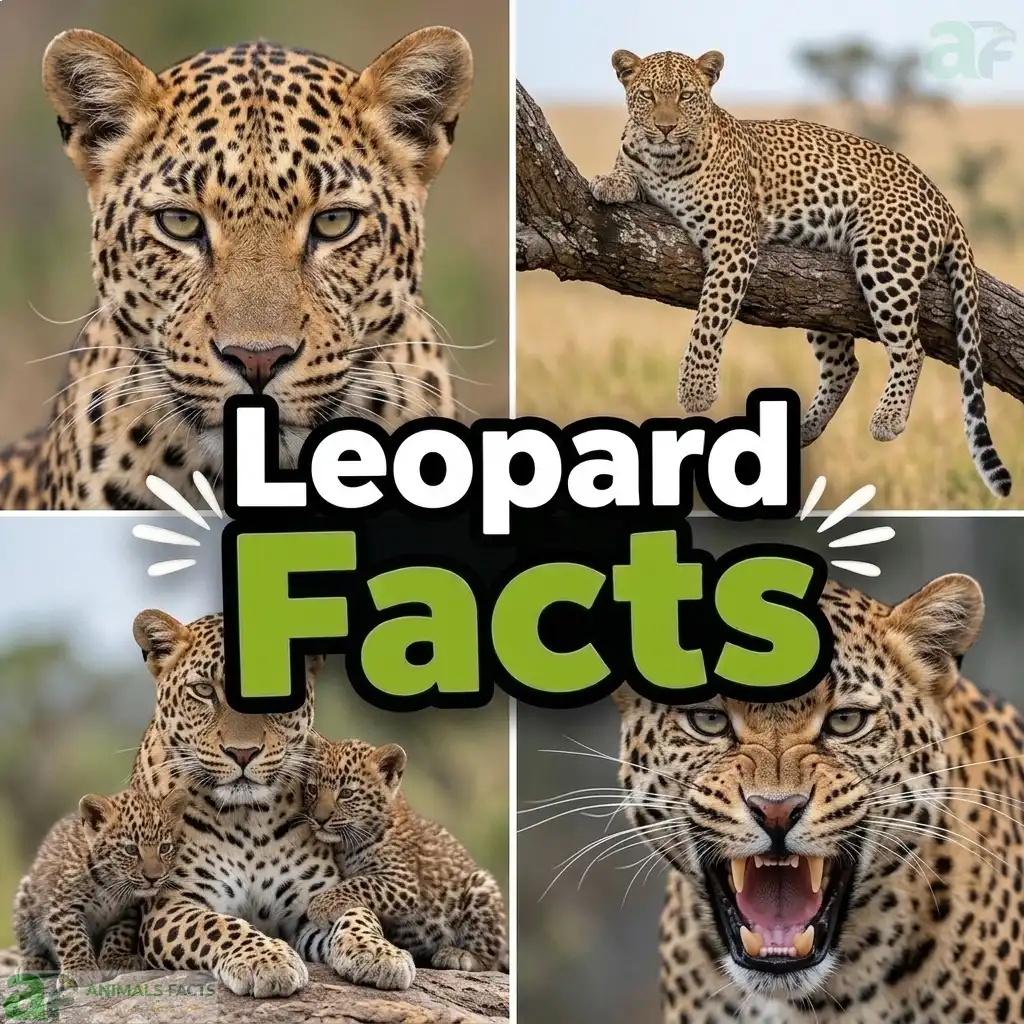
Leopard Facts
| Feature | Details |
|---|---|
| Scientific Name | Panthera pardus |
| Kingdom | Animalia |
| Phylum | Chordata |
| Class | Mammalia |
| Order | Carnivora |
| Family | Felidae |
| Genus | Panthera |
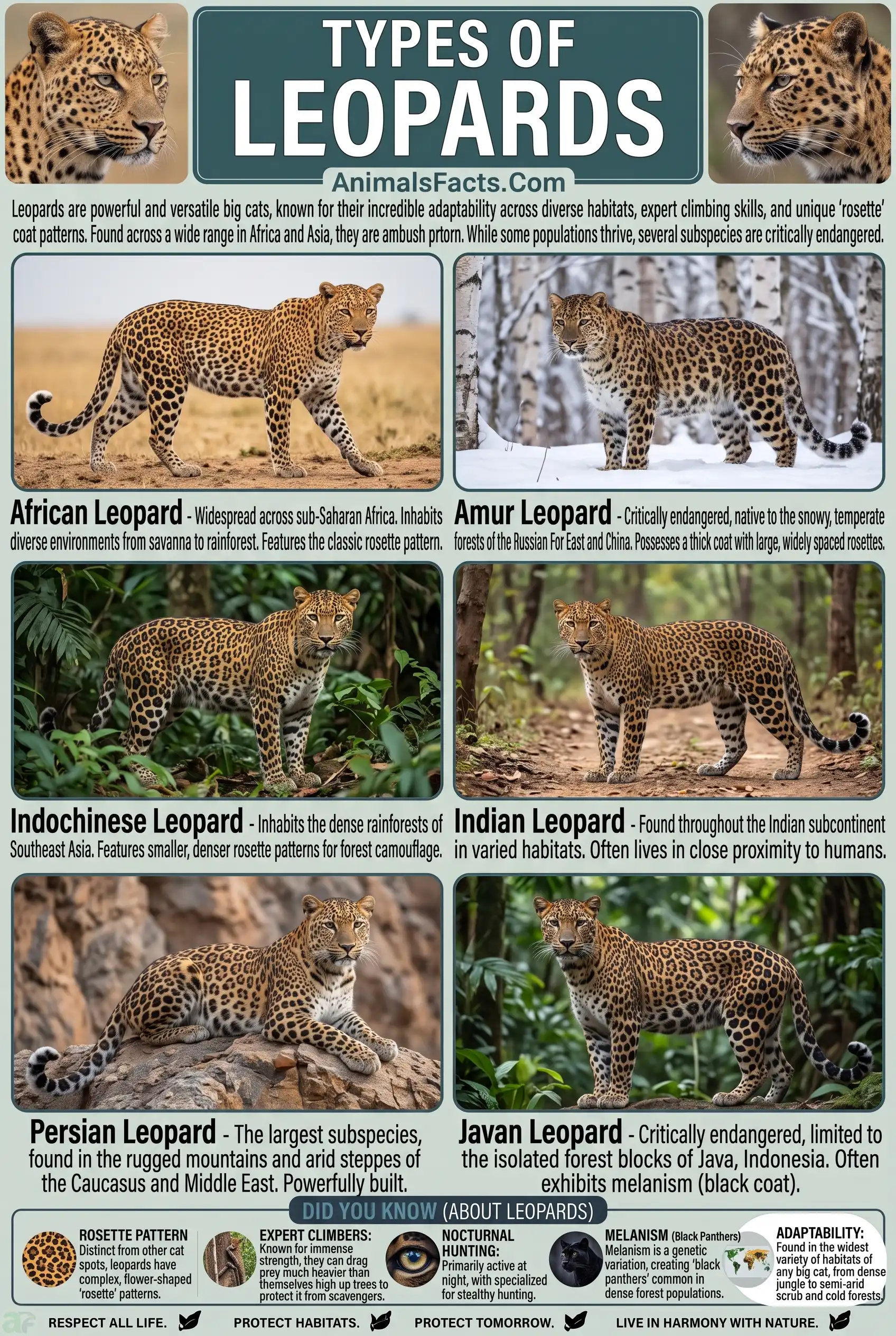
| Recognized Subspecies | 9 recognized subspecies (African, Indian, Javan, Sri Lankan, Persian, North Chinese, Amur, Indochinese, Arabian) |
| Habitat | The widest habitat range of any wild cat — rainforest, savanna, grassland, mountain, desert, scrubland, urban fringe — across sub-Saharan Africa and South/Southeast/East Asia |
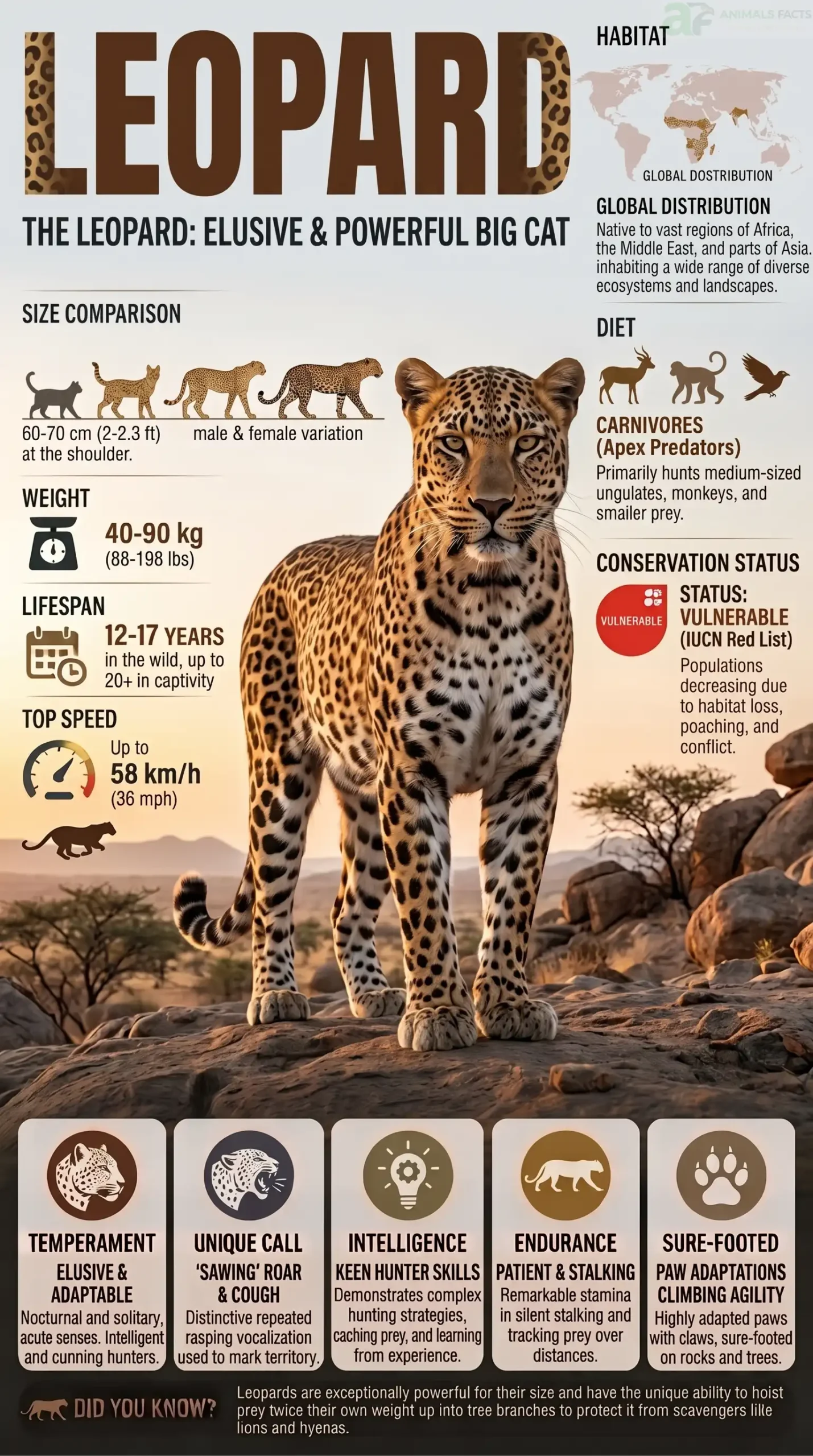
| Lifespan | 12–17 years in the wild; up to 23 years in captivity |
| Diet | Opportunistic apex carnivore — over 100 documented prey species across its global range |
| Weight | Males: 30–90 kg; Females: 20–60 kg — varies enormously by subspecies and habitat |
| Body Length | 90–190 cm (excluding tail); tail adds 66–102 cm |
| Shoulder Height | 57–78 cm |
| Top Speed | Up to 58 km/h (36 mph) in short bursts |
| Climbing Ability | Can carry prey three times its own body weight up vertical tree trunks |
| Conservation Status | Vulnerable (IUCN Red List) — several subspecies Critically Endangered |
| Global Wild Population | Estimated ~250,000 individuals (though significant uncertainty; some estimates lower) |
| Unique Feature | Most widespread wild cat on Earth; most adaptable large predator; strongest tree-climber of any large cat; black (melanistic) morph common |
 1. Introduction: What is a Leopard?
It hunts alone in the dead of night, using skills refined over millions of years into the most complete predatory toolkit of any large cat on Earth. It hides prey weighing more than itself in treetops inaccessible to every competing predator. It survives in environments ranging from sub-zero Siberian birch forests to the 50-degree heat of Arabian deserts, from the dense undergrowth of Sri Lankan tropical jungle to the snow-blown peaks of the Moroccan Atlas Mountains, from the urban fringes of Mumbai to the heart of the Congo Basin. Leopard facts reveal an animal of extraordinary and unmatched adaptability — the most geographically widespread, habitat-diverse, and ecologically flexible of all the world’s large cats, and arguably the most complete natural predator in the history of the family Felidae.
The leopard — Panthera pardus — is simultaneously the most common and the most secretive of the world’s big cats. While lions sleep openly in the Serengeti grass and tigers leave enormous pug marks along Indian forest trails, the leopard vanishes — melting into the dappled shadows of a tree canopy, emerging after dark to move like silence through landscapes it shares with human settlements, livestock herds, and every competing predator in its ecosystem. It is by far the most difficult of Africa’s large cats to observe in the wild despite being the most numerous — a consequence of a behavioral secrecy that has allowed it to survive the extinction of its competitors across vast portions of Asia where tigers, lions, and cheetahs have been eliminated, persisting as the last large predator in dozens of habitats.
Whether you are a student searching for leopard facts for a school project, a safari enthusiast trying to spot the most elusive member of the Big Five, a parent looking for leopard facts for kids, a researcher interested in the leopard’s extraordinary conservation challenges across nine recognized subspecies, or simply someone captivated by the most beautiful and most successful large cat on Earth — this is the most complete guide to leopard facts you will find anywhere. We cover leopard habitat, leopard diet, leopard behavior, communication, reproduction, all nine subspecies, conservation, mythology, and the extraordinary story of an animal that has survived everything humanity and history have thrown at it — so far. Let us begin.
2. Leopard Species Overview & Classification
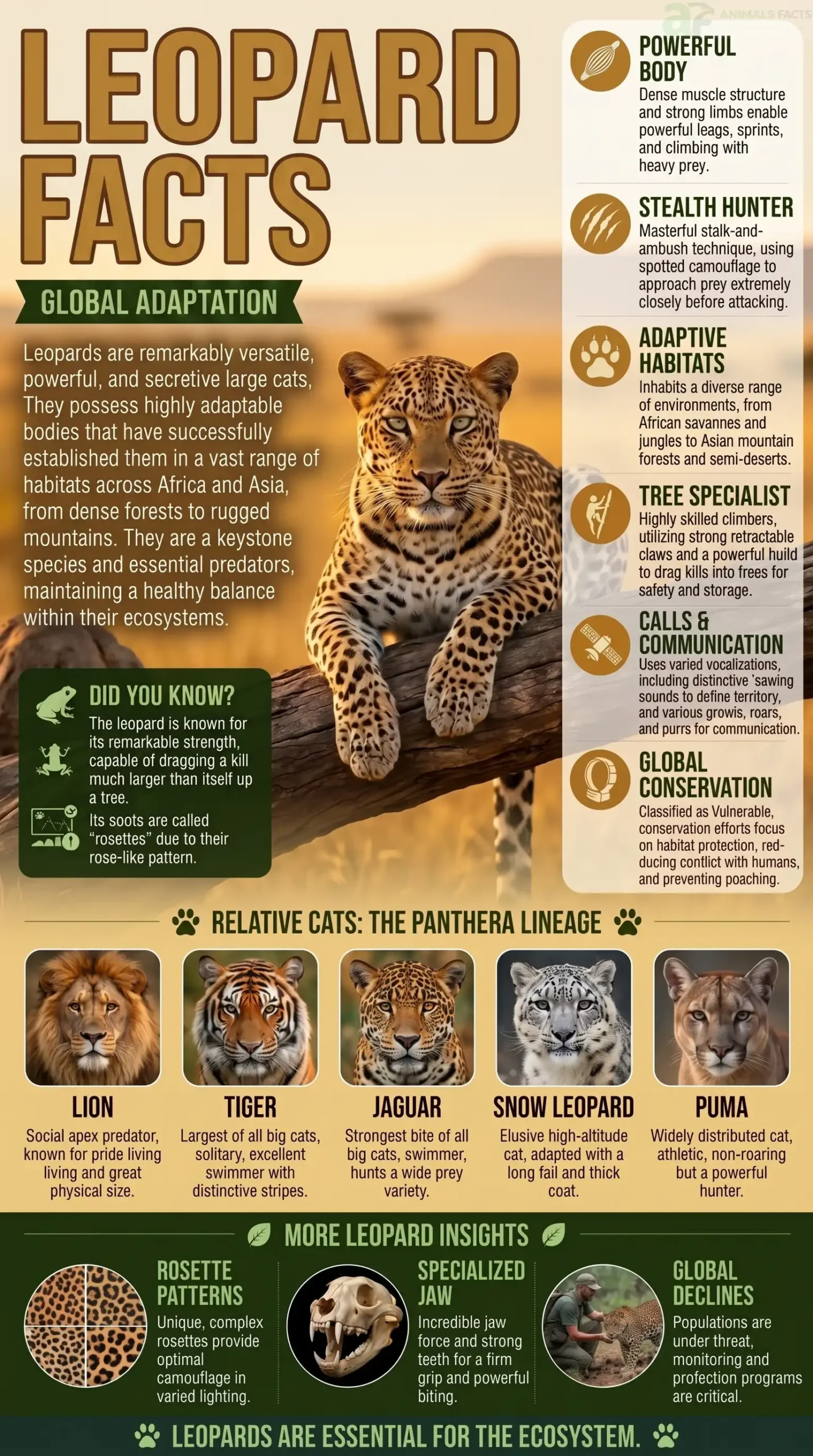
The leopard belongs to the genus Panthera — the roaring cats — alongside lions, tigers, jaguars, and snow leopards. Within this distinguished group, the leopard is the smallest and most geographically widespread member, with a distribution spanning two continents, more than 70 countries, and virtually every terrestrial biome except the polar extremes.
What Makes the Leopard Distinct Among Panthera Cats?
- Widest geographic range of any wild cat: More countries, more continents, and more habitat types than any other cat species
- Most adaptable large predator: Successfully inhabits environments from sea level to over 5,000 meters elevation, from equatorial rainforest to near-desert
- Strongest tree climber of any large cat: Capable of carrying prey three times its body weight up vertical tree trunks using extraordinary muscular power
- Most secretive large cat: Behavioral crypticity and nocturnal activity allow persistence alongside human settlements and competing predators that have driven other large cats to local extinction
- Broadest prey range: Over 100 documented prey species — more dietary diversity than any other Panthera cat
- Melanistic morph: The “black leopard” or “black panther” — one of the most celebrated and misunderstood wildlife phenomena globally
Leopard Subspecies Comparison Table
| Subspecies | Scientific Name | Range | Estimated Population | Conservation Status |
|---|---|---|---|---|
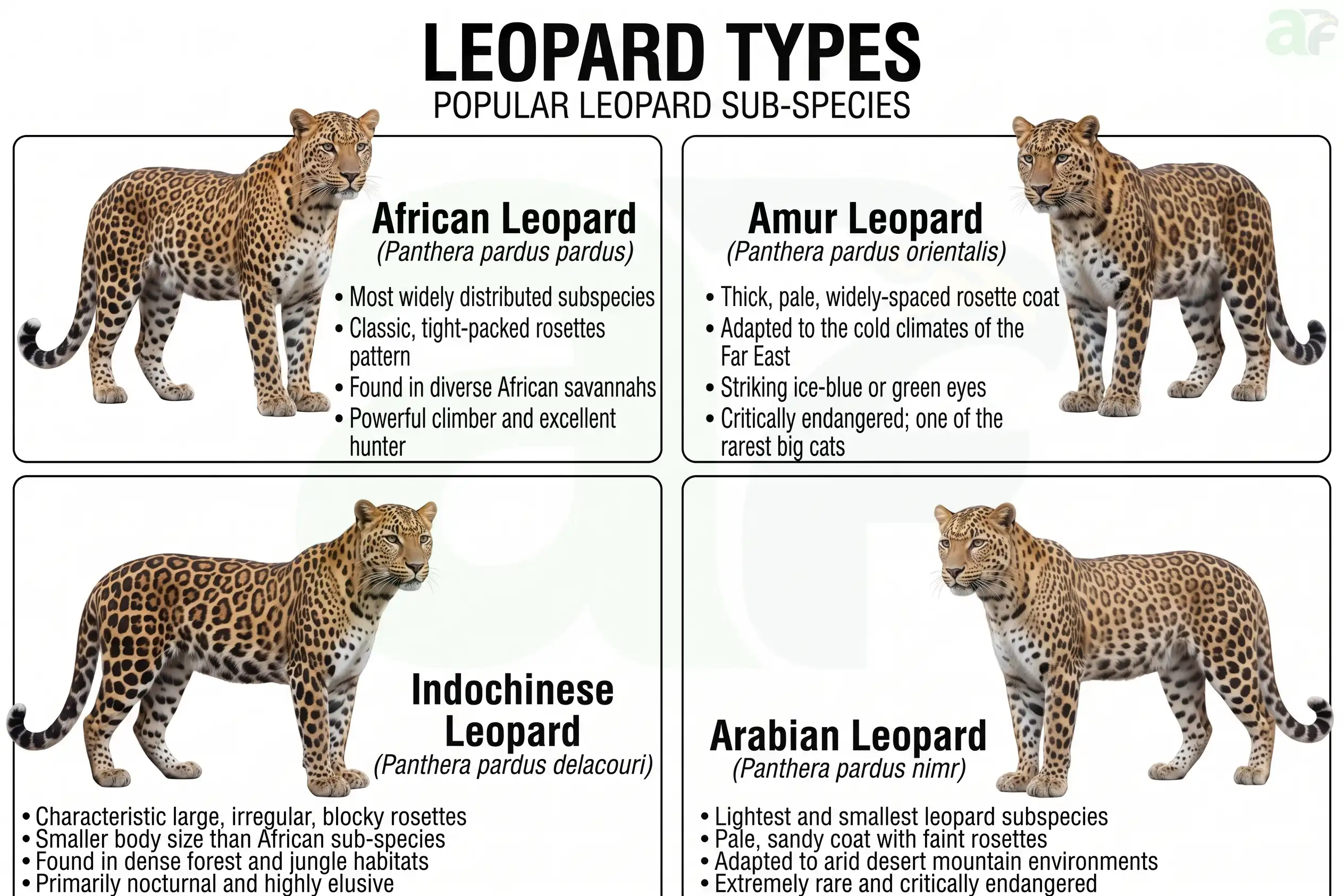
| African Leopard | Panthera pardus pardus | Sub-Saharan Africa | ~200,000 (broadly estimated) | Vulnerable |
| Indian Leopard | Panthera pardus fusca | Indian subcontinent | ~12,000–14,000 | Vulnerable |
| Javan Leopard | Panthera pardus melas | Java, Indonesia | ~250–500 | Critically Endangered |
| Sri Lankan Leopard | Panthera pardus kotiya | Sri Lanka | ~700–950 | Endangered |
| Persian Leopard | Panthera pardus saxicolor | Iran, Central Asia, Caucasus | ~800–1,100 | Endangered |
| North Chinese Leopard | Panthera pardus japonensis | Northern China | ~100–400 | Critically Endangered |
| Amur Leopard | Panthera pardus orientalis | Russian Far East, NE China | ~100–120 | Critically Endangered |
| Indochinese Leopard | Panthera pardus delacouri | SE Asia (Thailand, Cambodia, etc.) | <1,000 | Critically Endangered |
| Arabian Leopard | Panthera pardus nimr | Arabian Peninsula | ~100–200 | Critically Endangered |
Species Evolution & Discovery Timeline
~6–8 million years ago: The Panthera lineage began diverging from other felid groups during the Miocene Epoch — establishing the evolutionary foundation for modern big cats.
~3.8 million years ago: Genetic research suggests the leopard lineage diverged from other Panthera ancestors — making the leopard one of the older evolutionary branches among the living big cats.
~2 million years ago: Early leopards were distributed widely across Africa, Europe, and Asia — with fossil evidence from China, India, and multiple European sites demonstrating the species’ ancient and widespread distribution.
~100,000–500,000 years ago: Leopards colonized the broadest extent of their historical range — inhabiting environments from the British Isles (fossil evidence confirmed) across Europe, the entire Middle East, South and Southeast Asia, and throughout Africa.
~40,000 years ago: Paleolithic humans depicted leopards in early cave art — including the extraordinary Chauvet Cave paintings of southern France, alongside lions and rhinoceroses, demonstrating the leopard’s presence in Ice Age Europe and its significance to early human consciousness.
1758: Carl Linnaeus formally described the leopard as Felis pardus in Systema Naturae, later reclassified as Panthera pardus as the big cat genus was established.
1916: The first formal scientific description of the Amur Leopard as a distinct subspecies, drawing attention to the critically endangered population of the Russian Far East and northeastern China.
2008: The IUCN reclassified the leopard from Least Concern to Near Threatened — subsequently upgraded to Vulnerable in 2016 as mounting evidence confirmed global population declines of 25–30% over three generations.
2022–2026: Ongoing genetic research continues to refine understanding of leopard subspecies boundaries, population connectivity, and genetic diversity — providing critical information for conservation management of the species’ most threatened regional populations.
3. Leopard Physical Description & Unique Features
The leopard’s physical design achieves a remarkable balance between climbing power and terrestrial hunting efficiency — neither the largest nor the fastest of the big cats, but the most comprehensively capable across the widest range of tasks.
Size Extremes and Subspecies Variation
The leopard displays enormous size variation across its nine subspecies — reflecting the different ecological pressures of their diverse habitats:
Largest subspecies: The Persian Leopard (Panthera pardus saxicolor) is the largest living leopard subspecies — adult males can reach 90 kg and 190 cm in body length, approaching the size of a small male lion in exceptional individuals. The Amur Leopard of the Russian Far East is similarly large.
Smallest subspecies: The Arabian Leopard (Panthera pardus nimr) is the smallest — adult males typically weigh only 30–40 kg — roughly the size of a large domestic dog, reflecting the adaptation to life in the prey-sparse environments of the Arabian Peninsula.
Average African Leopard: Males typically weigh 40–90 kg depending on region, with the largest individuals documented in areas of abundant large prey such as the Kruger National Park of South Africa.
The Rosette Pattern
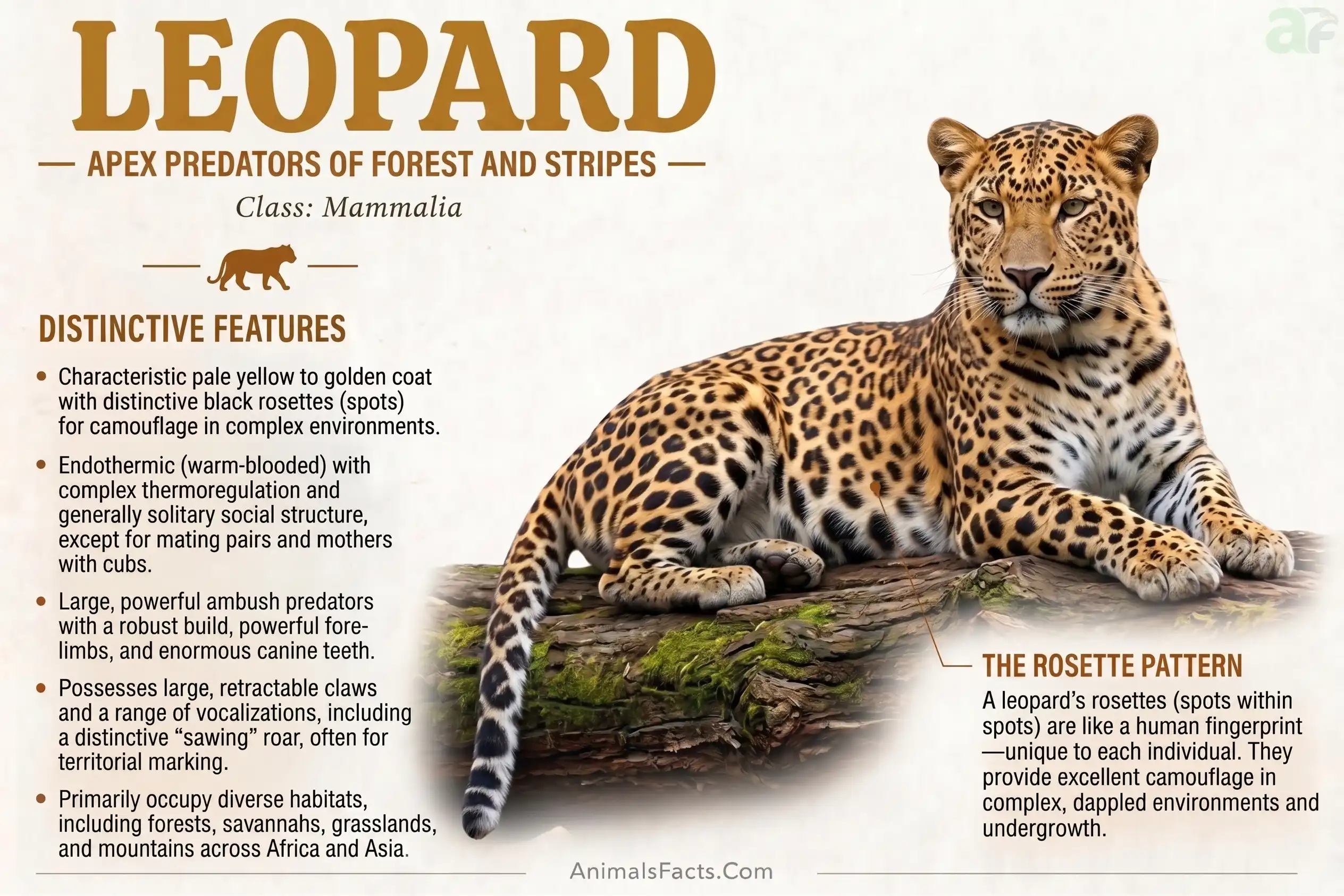
The leopard’s coat is covered in hollow rosettes — roughly circular or irregular ring-shaped clusters of black spots surrounding a lighter center — a pattern that provides extraordinary camouflage in the dappled light of forest, woodland, and savanna environments. Each rosette pattern is individually unique — allowing researchers to identify specific leopards from photographs without physical capture or tagging.
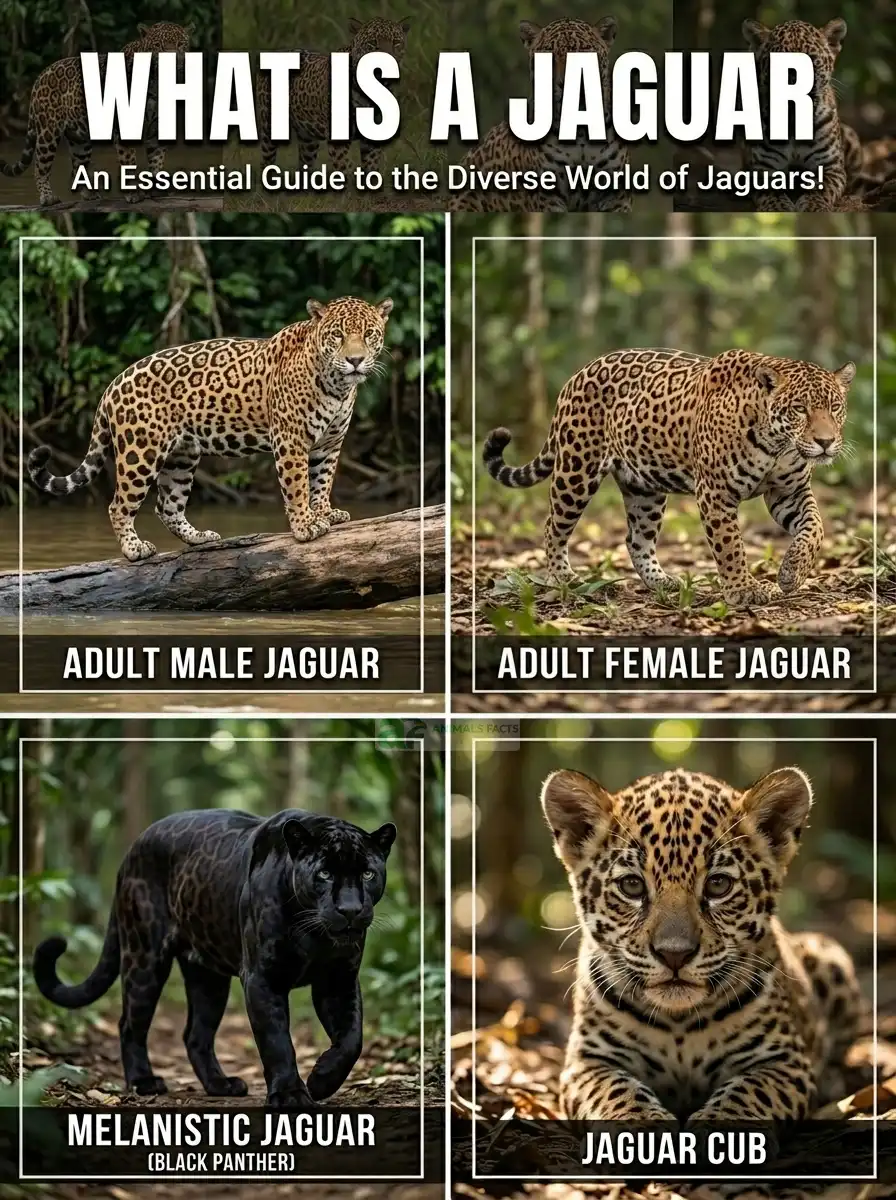
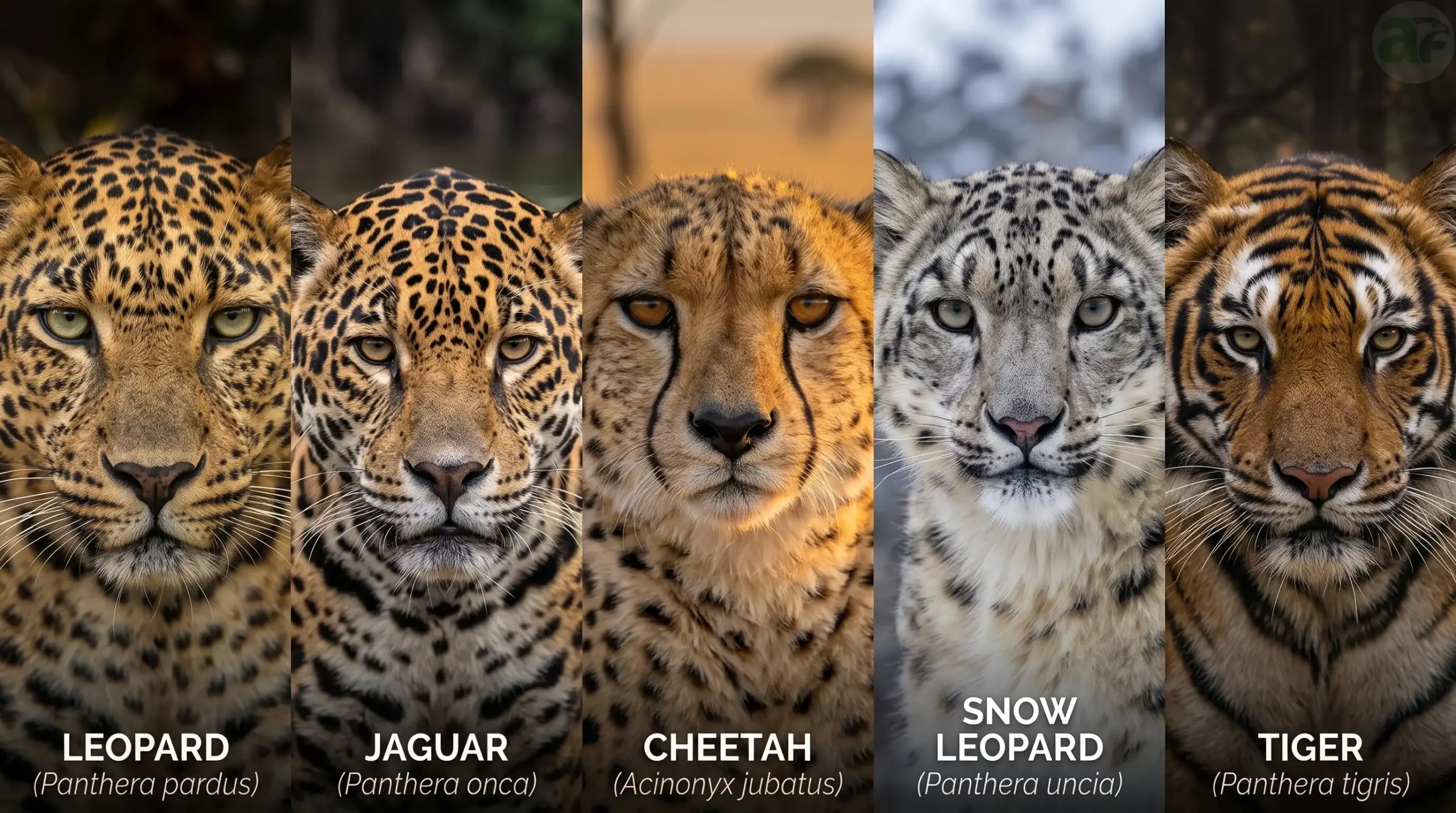
The critical visual distinction between leopard rosettes and jaguar rosettes is the presence of central spots within jaguar rosettes (leopard rosettes are hollow) — a difference that allows confident species identification in areas where both might be confused.
The Black Leopard
The most dramatic and most famous leopard color morph — the black leopard (commonly but imprecisely called a “black panther”) — results from a recessive melanistic gene causing overproduction of dark pigment. Black leopards are most common in dense, humid tropical forests — particularly in Southeast Asia and the wetter forests of East Africa — where reduced light levels may provide additional camouflage advantage. In good lighting, a black leopard’s rosette pattern is visible as slightly darker black against the background coat.
The Laikipia Wilderness of Kenya made international headlines in 2019 when a young male black leopard was photographically documented for the first time in nearly a century in Africa — a sighting that generated extraordinary global media coverage and demonstrated both the extreme rarity of melanistic leopards in the African savanna and the power of modern camera trap technology to reveal secretive wildlife.
Muscular Architecture for Tree Climbing
The leopard’s muscular architecture is uniquely optimized among large cats for vertical power — the shoulder girdle, forelimbs, and neck muscles are disproportionately developed relative to the animal’s body weight, providing the concentrated strength required to haul prey weighing up to three times the leopard’s own body weight up tree trunks. This tree-hoisting behavior — used to cache kills above the reach of lions, hyenas, and wild dogs — is the defining ecological behavior of the African leopard, and the muscular system that makes it possible is one of the most impressive power-to-weight engineering feats in the natural world.
Did You Know? Leopards have been documented hoisting prey as large as adult male giraffe calves weighing over 125 kg into treetops — a feat requiring the sustained exertion of forces far exceeding what the leopard’s body weight alone would suggest possible. Research biomechanics has shown that the leopard achieves this through a combination of short-burst muscle fiber activation (allowing brief but extreme force generation), claw-grip on bark, and a body posture that converts the animal’s body weight into a mechanical advantage. No other wild cat can perform anything approaching this feat.
4. Top 25 Surprising & Interesting Leopard Facts
- The leopard is the most widespread wild cat on Earth — found across more countries and habitat types than any other cat species, from sub-Saharan Africa through the Middle East to South, Southeast, and East Asia.
- Leopards can carry prey three times their own body weight up vertical tree trunks — a strength feat unmatched by any other large cat and one of the most extraordinary demonstrations of power in the entire animal kingdom.
- There are 9 recognized subspecies of leopard — ranging from the relatively abundant African Leopard to the Critically Endangered Amur Leopard with only approximately 100–120 wild individuals.
- The leopard’s diet includes over 100 documented prey species — the most diverse prey range of any Panthera cat, reflecting the extraordinary adaptability of this species across wildly different environments.
- Black leopards — often called “black panthers” — are not a separate species or subspecies, but ordinary leopards carrying a melanistic gene that causes near-black coat coloration. Their rosette pattern remains visible in good lighting.
- Leopards are documented living successfully in cities — including a significant population of leopards that regularly enters Mumbai, India (one of the world’s most densely populated megacities) to prey on domestic dogs and occasionally livestock.
- The Amur Leopard of the Russian Far East is arguably the most endangered big cat in the world — with approximately 100–120 wild individuals, it has fewer wild representatives than the South China Tiger or the Javan Rhino.
- Leopards are exceptional swimmers — though they rarely need to cross large bodies of water as part of their normal territories, they swim readily and have been observed crossing rivers several hundred meters wide without hesitation.
- A leopard’s spots are not flat markings — they are created by a three-dimensional arrangement of hair shafts of different lengths and melanin concentrations, producing a subtle textural difference between spotted and unspotted areas visible at close range.
- Leopards are the only large cat species that routinely persists in human-dominated landscapes across significant portions of its range — making them critical subjects for human-wildlife coexistence research.
- The Arabian Leopard — with fewer than 200 wild individuals — is so critically endangered that it may already be functionally extinct in several countries of its historical range, including parts of Saudi Arabia, Oman, and Yemen.
- Leopards produce a remarkably distinctive vocalization called a “rasp” or “saw” — identical in acoustic structure to the jaguar’s saw vocalization, reflecting the close evolutionary relationship between these two species.
- Leopard whiskers — the long sensory vibrissae on the muzzle — can be uniquely patterned on each individual, providing an additional individual identification method used by researchers alongside rosette pattern photography.
- A leopard can open its jaws wider than any other comparably sized carnivore — allowing it to handle prey animals nearly as large as itself with the throat suffocation bite used across all Panthera kills.
- The Javan Leopard inhabits one of the world’s most densely human-populated islands — Java, Indonesia, with over 140 million people — making it one of the most extreme examples of large predator persistence alongside human settlement anywhere in the world.
- Leopards are documented using roads and human infrastructure for territorial movement in Africa and Asia — adapting rapidly to human landscape modification in ways that other large cats have not.
- Female leopards in areas of high lion and hyena density are observed doing the majority of their hunting and feeding at night and within tree canopy, essentially removing themselves from ground-level competition with larger predators through behavioral flexibility rather than physical power.
- The Sri Lankan Leopard (Panthera pardus kotiya) is the apex predator of Sri Lanka — an island that historically lacked tigers and lions, allowing the leopard to evolve into a larger-than-average subspecies in the absence of the competitive pressure that limits leopard size on mainland Africa and Asia.
- Leopards have been documented maintaining cubs to independence in territories overlapping with major human settlements — an extraordinary demonstration of behavioral plasticity that no tiger or lion population has replicated in comparable urban contexts.
- The leopard’s tail is proportionally longer than that of most other large cats — typically nearly as long as the body, functioning as a balance organ during tree climbing and a social communication device during rare territorial encounters.
- A leopard can detect prey by scent from over 1.5 kilometers under favorable wind conditions — its olfactory system, while less developed than a wolf’s, significantly exceeds that of most other cats.
- Male leopards in some African savanna populations have been documented killing and consuming lion cubs when found unattended — a behavior that simultaneously reduces competition and provides an energy-dense meal.
- The Indian Leopard has been documented killing and consuming porcupines despite the obvious injury risk from quills — and injured leopards that cannot hunt more mobile prey have historically been associated with an increased risk of preying on humans, creating a documented link between porcupine abundance and man-eating leopard incidents in historical Indian records.
- Camera trap surveys in India’s Western Ghats have documented leopard population densities of up to 16 individuals per 100 km² in high-quality habitat — demonstrating that leopards can achieve densities comparable to African lion populations when habitat and prey are sufficient.
- The leopard is the only large cat in India that has maintained stable populations in areas where both tigers and lions are absent — functioning as the sole large carnivore across vast tracts of forest and scrubland that were historically too dry or degraded for tigers but too open and human-influenced for viable tiger recovery.
5. Leopard Fun Facts for Kids
- The leopard is the most widespread wild cat — found across 70+ countries and every major terrestrial biome except polar regions.
- Leopards can hoist prey three times their body weight into trees — an unmatched big cat feat.
- There are 9 recognized subspecies with enormous size and habitat variation.
- The Amur Leopard has only ~100–120 wild individuals — possibly the world’s rarest big cat.
- Leopards have over 100 documented prey species — the most diverse cat diet.
- Black leopards are not a separate animal — they carry a melanistic gene.
- Leopards regularly enter the city of Mumbai to hunt — living alongside 20+ million people.
- The Sri Lankan Leopard is the apex predator of an entire island — with no tigers or lions competing.
- Every leopard’s rosette pattern is unique — like a fingerprint.
- Leopards produce a distinctive rasp/saw vocalization almost identical to a jaguar’s.
- The leopard’s global range has declined by approximately 25–37% in the past three generations.
- Leopards are excellent swimmers who cross rivers readily as part of territory patrol.
6. Natural Habitat & Geographic Range
The leopard’s habitat range is the most extraordinary of any wild cat — and arguably of any large carnivore on Earth. The capacity to inhabit environments as diverse as the sub-zero forests of Russia’s Primorsky Territory, the humid equatorial rainforest of the Congo Basin, the rocky deserts of the Arabian Peninsula, the high-altitude cloud forests of Ethiopia’s Bale Mountains, and the urban-fringe forest patches of India’s Mumbai Metropolitan Region places the leopard in a category of ecological adaptability unmatched by any comparable predator.
Primary Habitat Types
Tropical and subtropical rainforest: The Congo Basin, the Western Ghats of India, Sri Lanka, Java, and much of Southeast Asia support leopard populations in dense, multi-canopy rainforest — where the leopard’s tree-climbing ability and solitary, secretive behavior provide significant advantages over other large predators.
Savanna and open woodland: The African savanna ecosystem — from the Serengeti to Kruger, the Masai Mara to Okavango — supports the largest number of leopards in the world, with populations in the woodland-savanna mosaic sustaining the highest densities. The tree-hoisting behavior is most critical here, protecting kills from the lions and hyenas that dominate open savanna.
Mountain and highland ecosystems: The Caucasus Mountains, Ethiopian Bale Mountains, the Zagros Mountains of Iran, and the highlands of Central Asia support leopard populations adapted to cold winters and mountainous terrain — demonstrating altitudinal flexibility that extends to over 5,200 meters elevation in some documented cases.
Semi-arid and desert-margin habitat: The Arabian Leopard demonstrates extreme adaptation to genuine desert conditions — surviving in rocky wadis, mountain escarpments, and desert-margin scrubland with sparse prey densities that would be unsustainable for any other large cat.
Temperate and boreal forest: The Amur Leopard of Russia and northeastern China inhabits mixed temperate-boreal forest — enduring winters of -40°C through physiological adaptations including a thick, pale-colored winter coat, long fur, and enlarged paws for snow travel.
Urban and peri-urban habitat: Mumbai’s leopard population — estimated at 35–50 individuals residing within the Sanjay Gandhi National Park and regularly entering surrounding urban neighborhoods — represents the most dramatic documented case of large cat persistence within a megacity, with leopards navigating streets, markets, and residential areas during nocturnal forays.
Habitat Range by Continent/Region
| Continent / Region | Notable Populations | Subspecies Present | Status |
|---|---|---|---|
| Sub-Saharan Africa | Kruger, Serengeti, Masai Mara, Congo Basin | African Leopard (P. p. pardus) | Largest overall population; declining |
| South Asia (India, Nepal, Bhutan) | Western Ghats, Central India, Terai Arc | Indian Leopard (P. p. fusca) | ~12,000–14,000; Vulnerable |
| Sri Lanka | Yala, Wilpattu, Horton Plains | Sri Lankan Leopard (P. p. kotiya) | ~700–950; Endangered |
| Southeast Asia | Thailand, Cambodia, Vietnam, Laos, Myanmar | Indochinese Leopard (P. p. delacouri) | <1,000; Critically Endangered |
| Indonesia (Java) | Gunung Halimun-Salak, Meru Betiri NP | Javan Leopard (P. p. melas) | ~250–500; Critically Endangered |
| Central & Southwest Asia | Iran, Caucasus, Central Asia | Persian Leopard (P. p. saxicolor) | ~800–1,100; Endangered |
| Russian Far East / NE China | Primorsky Territory, Jilin Province | Amur Leopard (P. p. orientalis) | ~100–120; Critically Endangered |
| Arabian Peninsula | Oman, Yemen, Saudi Arabia (marginally) | Arabian Leopard (P. p. nimr) | ~100–200; Critically Endangered |
| North China | Shanxi, Shaanxi, Hebei provinces | North Chinese Leopard (P. p. japonensis) | ~100–400; Critically Endangered |
Did You Know? The leopard’s historical range in Europe was far more extensive than most people realize — fossil evidence confirms leopards in Britain, France, Spain, and throughout the Mediterranean region until approximately 11,000 years ago. The Pleistocene leopard (Panthera pardus spelaea) was a large, cold-adapted subspecies whose remains have been found alongside those of cave bears, woolly rhinoceroses, and early modern humans in cave sites across Europe — demonstrating that our ancestors shared landscapes with leopards for tens of thousands of years, potentially influencing the leopard’s deep significance in early human rock art and symbolic culture.
7. Diet & Feeding Behavior
The leopard is the supreme dietary generalist among large cats — an opportunistic predator whose documented prey list of over 100 species spans everything from dung beetles and large frogs through to adult male elands weighing over 200 kg, representing a prey range that encompasses virtually every terrestrial and semi-aquatic animal in any ecosystem the leopard inhabits.
What Leopards Eat
Leopard diet varies enormously by geographic location, habitat type, and the availability of competing predators — reflecting the species’ extraordinary capacity to exploit whatever food resource is most abundant and accessible in each specific context.
Diet Breakdown Table
| Prey Type | Approximate Percentage | Notes |
|---|---|---|
| Impala, gazelle, small-medium antelope | 30–45% (Africa) | Primary prey across savanna habitats |
| Warthog | 10–20% (Africa) | Commonly taken; dug from burrows |
| Duiker, steenbok (small antelope) | 10–20% (forest and scrub) | Primary prey in dense forest habitats |
| Baboons and primates | 5–15% (varies) | Taken regularly; surprisingly important |
| Hares, rodents, and small mammals | 5–15% | Supplementary; important in lean periods |
| Sambar, chital deer | 20–35% (India) | Primary prey across Indian habitats |
| Wild boar | 5–15% (Asia) | Important across Asian range |
| Domestic livestock (dogs, goats, calves) | Variable | Major human-conflict source |
| Birds and reptiles | 2–8% | Supplementary; taken opportunistically |
| Fish and crabs (coastal/riparian) | 1–5% | Documented but uncommon |
Tree Hoisting — The Leopard’s Signature Behavior
The hoisting of kills into trees is one of the most celebrated and most ecologically significant feeding behaviors of any large predator — and the defining practical demonstration of the leopard’s extraordinary muscular power.
In African savanna ecosystems, where lions and spotted hyenas represent constant competition for food resources, leopards reduce kill loss through vertical separation — dragging prey up tree trunks to horizontal branches where ground-based competitors cannot follow. Research in the Sabi Sand Game Reserve of South Africa has documented leopards successfully defending cached kills against groups of up to 15 spotted hyenas simply through vertical inaccessibility — a strategy so effective that tree-accessible kills survive dramatically longer than ground-level kills in high competition environments.
Did You Know? Leopards in the Mumbai metropolitan area have been documented preying primarily on domestic dogs — with studies by the Wildlife Institute of India suggesting that Mumbai’s park-resident leopards consume an estimated 1,500 to 2,200 dogs annually from surrounding urban neighborhoods. This extraordinary urban hunting behavior, while occasionally resulting in human injury when leopards are disturbed or cornered in residential areas, has the surprising additional effect of significantly reducing dog populations in areas adjacent to Sanjay Gandhi National Park — and correspondingly reducing the incidence of rabies in these communities, creating an unexpected public health benefit from the leopard’s urban presence.
8. Reproduction & Life Cycle
Leopard reproduction follows the fundamental pattern of all Panthera cats — non-seasonal breeding, a relatively short gestation, highly dependent cubs, and an extended period of maternal investment — with some population-specific variations that reflect the diverse environmental contexts of the species’ global range.
Mating Behavior
Female leopards are non-seasonally polyestrous across most of their range — capable of mating year-round in tropical and subtropical habitats, with potential seasonal peaks in some temperate-zone subspecies linked to prey availability. Female estrus lasts approximately 6–7 days, during which the normally solitary female may associate briefly with a male before returning to individual territory maintenance.
Male leopards maintain awareness of female reproductive status through scent monitoring during regular territory patrols — locating and briefly consorting with estrous females whose ranges overlap their own. Mating consortships typically last 3–7 days, with repeated copulation during this period.
Gestation and Birth
Gestation period: Approximately 90–105 days — among the shortest in Panthera, producing highly altricial young.
Litter size: Typically 1–3 cubs (most commonly 2), born weighing approximately 430–600 grams each.
Birth: Cubs are born in a concealed den — dense thicket, rock cave, hollow log, or riverside vegetation — carefully chosen for camouflage and protection from infanticide by rival males and predation by lions, hyenas, and other threats.
Key Developmental Stages
| Stage | Age | Key Development |
|---|---|---|
| Neonatal | 0–10 days | Eyes closed; entirely helpless; hidden in den |
| Eyes open | 10–14 days | Beginning visual awareness; spotted coat fully developed |
| First outings | 6–8 weeks | First movements outside den area |
| Weaning begins | 3–4 months | Introduction to meat alongside nursing |
| Climbing training | 4–8 months | Learning tree access and kill hoisting |
| Accompanying hunts | 8–18 months | Learning prey detection and hunting |
| Independence | 18–24 months | Separation from mother |
| Territory establishment | 2–3 years | Establishing independent range |
| Sexual maturity | Female: ~2 years; Male: ~2.5–3 years | First breeding possible |
Lifespan Comparison Table
| Species | Average Wild Lifespan | Maximum Confirmed |
|---|---|---|
| Leopard | 12–17 years | ~23 years (captivity) |
| Jaguar | 12–15 years | ~23 years (captivity) |
| Lion | 10–14 years | ~29 years (captivity) |
| Tiger | 10–15 years | ~26 years (captivity) |
| Cheetah | 8–12 years | ~20 years (captivity) |
9. Social Behavior & Communication
The leopard is one of the most thoroughly solitary of all large cats — maintaining exclusive use of individual territories through intensive marking behavior, avoiding direct encounters with territorial rivals through careful scent monitoring, and forming lasting social bonds only between mothers and dependent cubs.
Territorial Organization
Leopard territory sizes vary enormously by habitat, prey density, and subspecies:
- Female African Leopard: Typically 15–30 km² in prey-rich savanna
- Male African Leopard: Typically 30–60 km² (overlapping with 2–3 female territories)
- Female Indian Leopard: 25–60 km² depending on habitat
- Male Amur Leopard: Up to 200–300 km² in prey-sparse temperate forest
Territories are maintained through intensive scent marking — including urine spray on prominent rocks, trees, and trail junctions, feces deposited at highly visible locations, and scratch marks on trees — alongside the vocal advertisement of the distinctive rasp vocalization during nocturnal territory patrols.
Communication Methods
The Rasp / Saw vocalization: The leopard’s most characteristic and ecologically important vocalization — a series of harsh, repetitive coughing grunts whose rhythm closely resembles a handsaw cutting through wood. This sound carries across considerable distances in forest and savanna, serving as territorial advertisement, contact call between known neighbors, and social signal during mating encounters. The acoustic similarity between leopard and jaguar rasp vocalizations reflects the close evolutionary relationship between these two Panthera species.
Roaring: Like all Panthera members, leopards are capable of true roaring — though less frequently produced than the roar or rasp, used primarily in intense arousal situations including territorial disputes and mating encounters.
Scent communication: The primary medium of leopard social information exchange — providing individual identity, reproductive status, territorial boundaries, and time-since-deposition information that allows complex territorial negotiation among neighboring individuals without requiring direct visual or physical contact.
Prusten (chuffing): The same non-threatening close-range greeting vocalization documented in tigers and leopards — produced as a soft rhythmic exhalation during affiliative interactions between mothers and cubs or briefly consorting adults.
Body language: While rarely visible due to the leopard’s secretive nature, body posture, tail position, ear orientation, and facial expression communicate complex social and emotional information during the relatively infrequent close-range encounters between territorial individuals.
Did You Know? Research using camera trap data from leopard populations in India’s Pench Tiger Reserve demonstrated that individual leopards in areas of tiger presence significantly shift their temporal activity patterns — becoming almost exclusively nocturnal in areas of high tiger density, while using dawn and crepuscular hours in areas with fewer tigers. This behavioral flexibility — adjusting activity timing to minimize encounters with a dominant competitor — represents a sophisticated behavioral adaptation that has likely been critical to the leopard’s persistence across landscapes where tiger and lion populations remain viable, and may explain why leopards are so much harder to observe than tigers even in areas where both species coexist.
10. Predators & Defense Mechanisms
Despite being powerful predators capable of taking a wide range of prey, leopards face significant predation and competition pressure — particularly from the larger social carnivores that share their range in Africa and parts of Asia. The leopard’s suite of defensive adaptations — behavioral crypticity, tree use, temporal flexibility, and willingness to abandon prey rather than risk injury — reflects millions of years of coexistence with formidable competitors.
Natural Predators and Competitors
Lions: The most significant natural threat to leopards in African savanna environments — lions kill leopards directly during territorial encounters, kill leopard cubs found in dens, and regularly steal kills from leopards at ground level. The lion’s numerical advantage (living in prides) makes direct confrontation with a solitary leopard almost always advantageous to the lions, driving leopards to structure their behavior — primarily through tree use and nocturnal activity — to minimize direct encounters.
Spotted Hyenas: Both kill thieves and occasional direct leopard killers — large hyena clans can mob and kill lone adult leopards, though healthy adults in trees are effectively safe. Hyenas demonstrate remarkable ability to locate and retrieve tree-cached leopard kills by shaking or climbing partially up tree trunks, forcing leopards to cache kills on progressively thinner branches inaccessible to hyenas’ weight.
Tigers: In habitats of overlap across India and Southeast Asia, tigers are the dominant competitor — leopards in tiger areas shift to smaller prey, more arboreal behavior, and strictly nocturnal activity patterns to minimize competitive encounters with the larger and more powerful tigers.
Dholes (Asian Wild Dogs): In some Asian habitats, packs of dholes represent genuine threats to leopards — documented mobbing and occasional killing of leopards through coordinated numerical attack, similar to their documented encounters with tigers.
Crocodiles: Leopards that hunt or drink at water sources in Africa and Asia face genuine predation risk from Nile Crocodiles and Saltwater Crocodiles — ambush predators capable of killing adult leopards that approach too close to water margins.
Humans: The overwhelmingly dominant source of leopard mortality across all subspecies and regions — through poaching, retaliatory killing over livestock predation, road collisions, habitat destruction, and (in some African countries) legal trophy hunting.
Defense Mechanisms
Crypticity: The leopard’s primary and most comprehensive defensive strategy — the behavioral secretiveness and exceptional camouflage that make leopards the most difficult large African cat to observe even in areas where they are relatively numerous.
Tree use: Vertical separation from ground-based threats — both for kill caching and for resting during daylight hours — provides effective protection against lions, hyenas, and humans during the majority of the daylight hours when leopards rest.
Temporal avoidance: Shifting activity to hours when competing and threatening species are less active — becoming strictly nocturnal in areas of high lion or tiger density — reduces encounter rates with dominant competitors.
Rapid abandonment: Leopards readily abandon kills in the presence of larger threats, accepting food loss to preserve physical safety — a pragmatic survival calculation that reflects the relative abundance of prey compared to the irreplaceable value of the leopard’s own physical integrity.
11. Leopard Facts for Kids
Hey kids — get ready to discover why leopards are some of the most incredible and mysterious big cats in the entire world!
- Leopards can carry prey animals that are three times heavier than themselves up a tree — imagine carrying three of your friends at the same time while climbing a ladder! That’s how strong a leopard is!
- The spots on a leopard are called rosettes because they look a bit like flowers. Every single leopard has a different rosette pattern — just like every person has different fingerprints!
- Black leopards — which look completely black and mysterious — are the same animal as a spotted leopard! They just have a special gene that makes their fur very dark. If you look carefully in bright sunlight, you can still see their spots through the dark fur!
- Leopards are the sneakiest of all the big cats — they’re so good at hiding that people walking right past them often can’t see them at all, even in the daytime!
- A leopard can hear sounds from up to 1.5 kilometers away and can see in the dark much better than any human can!
- Some leopards actually live in cities — in Mumbai, India (one of the world’s biggest cities), leopards regularly sneak into neighborhoods at night to find food, then disappear back into the forest before morning!
- The tiniest leopard subspecies — the Arabian Leopard — is so small it weighs about the same as a large dog. But the biggest — the Persian Leopard — can weigh as much as a small lion!
- Leopards are brilliant climbers and feel completely comfortable sleeping and eating in the tops of trees, where lions and hyenas can’t reach them!
Did You Know? Leopards hunt more kinds of animals than any other big cat — scientists have counted over 100 different species that leopards have been seen eating! That includes everything from tiny frogs and beetles to huge animals like adult male baboons and even young giraffe calves! This incredible ability to eat almost anything they can catch is one of the main reasons leopards are found in more places around the world than any other big cat.
12. Relationship with Humans
The leopard’s relationship with humans across its global range encompasses one of the longest and most geographically extensive records of human-large-carnivore interaction in history — ranging from the reverence of ancient Egyptian pharaohs to the systematic persecution of colonial-era hunters, from the contemporary human-wildlife conflict of Indian farming communities to the extraordinary case of urban coexistence in Mumbai.
Ancient and Historical Relationships
Leopards have coexisted with human civilizations across Africa and Asia for hundreds of thousands of years — appearing in some of the world’s oldest artistic traditions and maintaining roles in the material, symbolic, and spiritual culture of dozens of civilizations. In ancient Egypt, leopard skins were royal and priestly regalia — worn by pharaohs and high priests as symbols of divine authority. In sub-Saharan African kingdoms, leopard skin cloaks and leopard-tooth necklaces served as markers of royal status across dozens of political traditions. In India, the leopard features in ancient Sanskrit literature, Mughal miniature paintings, and the religious traditions of multiple cultural groups.
The Man-Eating Leopard Problem in India
Unlike lions and tigers, whose man-eating behavior has been extensively documented and publicized, the Indian Leopard’s man-eating history represents one of the most understated but genuinely significant episodes of human-large-carnivore conflict in history. Jim Corbett — the hunter-turned-conservationist — documented multiple legendary man-eating leopards in the Kumaon and Garhwal regions of northern India in the early 20th century, including the Panar Leopard (reportedly responsible for 400 human deaths) and the Rudraprayag Leopard (attributed to approximately 125 deaths over 8 years). These exceptional cases — typically involving injured or old leopards unable to catch normal prey — generated significant fear and hunting pressure on leopard populations across India, contributing to population declines that continue to be reflected in reduced Indian Leopard range today.
Contemporary Urban Coexistence
The most extraordinary contemporary example of human-leopard coexistence anywhere in the world occurs in and around Mumbai, India’s Sanjay Gandhi National Park — where an estimated 35–50 leopards reside within a forest patch surrounded by approximately 20 million people and regularly venture into urban neighborhoods at night. Research by the Wildlife Conservation Society and partner organizations in Mumbai has demonstrated that these urban leopards successfully prey almost entirely on domestic dogs, maintain functional territories despite the extraordinary density of human activity, and largely avoid direct conflict with humans despite living in what is arguably the most intensive human-wildlife interface involving large carnivores anywhere on Earth.
13. Conservation Status & Threats
The leopard’s overall Vulnerable status masks enormous variation across subspecies — from relatively abundant African populations to the barely-surviving Amur Leopard that represents the most critically endangered large cat in the world.
Global Leopard Conservation Data (2026)
| Subspecies | IUCN Status | Population | Primary Threats |
|---|---|---|---|
| African Leopard | Vulnerable | ~200,000 (uncertain) | Declining; habitat loss, conflict, hunting |
| Indian Leopard | Vulnerable | ~12,000–14,000 | Habitat loss, human conflict, road mortality |
| Sri Lankan Leopard | Endangered | ~700–950 | Habitat loss; snaring; conflict |
| Persian Leopard | Endangered | ~800–1,100 | Habitat loss; poaching; prey depletion |
| Indochinese Leopard | Critically Endangered | <1,000 | Snaring; habitat loss; prey depletion |
| Javan Leopard | Critically Endangered | ~250–500 | Deforestation; human settlement expansion |
| Arabian Leopard | Critically Endangered | ~100–200 | Prey depletion; persecution; habitat loss |
| North Chinese Leopard | Critically Endangered | ~100–400 | Habitat fragmentation; persecution |
| Amur Leopard | Critically Endangered | ~100–120 | Habitat fragmentation; poaching; prey depletion |
Major Threats to Leopards
Habitat loss and fragmentation: The fundamental long-term driver of leopard decline across all range countries — agricultural expansion, urban development, infrastructure construction, and extractive industries progressively reduce and fragment the habitat patches that support viable leopard populations.
Human-wildlife conflict and retaliatory killing: Across both African and Asian range, leopard predation on domestic livestock generates retaliatory killing that represents one of the most widespread immediate causes of leopard mortality. Unlike lion or tiger conflict, which typically involves larger livestock and more dramatic incidents, leopard-livestock conflict often involves smaller animals (dogs, goats, sheep) — creating lower-value economic losses but more frequent incidents and correspondingly higher rates of retaliatory killing.
Poaching and illegal wildlife trade: Leopard skins, bones, and teeth are traded illegally across both African and Asian markets — with demand driven by luxury fur markets (historically), traditional medicine (primarily in Asia), and status symbol demand. The IUCN and TRAFFIC have documented significant leopard part seizures across multiple range countries, with demand from Chinese traditional medicine markets increasing as tiger products become scarcer.
Prey depletion: The “empty forest” syndrome — in which human hunting removes most medium-sized prey from apparently intact leopard habitat — is increasingly recognized as one of the most significant threats to leopard populations across Southeast Asia in particular, where extensive forest may remain but contain insufficient prey to sustain viable leopard populations.
Road mortality: Roads bisecting leopard habitat create significant mortality — particularly for the smaller subspecies and for dispersing young leopards attempting to cross between habitat patches. India’s rapidly expanding road network represents a growing leopard mortality source across multiple states.
Did You Know? The Amur Leopard (Panthera pardus orientalis) of Russia’s Primorsky Territory and northeastern China is frequently cited as the rarest big cat in the world — with a wild population of approximately 100–120 individuals compared to approximately 5,574 wild tigers, 20,000+ lions, and 7,100 cheetahs. The Amur Leopard’s survival to this point — through a combination of Russian and Chinese conservation collaboration, anti-poaching programs, habitat protection, and deer population restoration — represents one of the most difficult large cat conservation achievements in history, and ongoing international attention to this subspecies remains critical to preventing its extinction.
14. Famous Leopards
Legadema — The Star of the Okavango
Legadema (“Light from the Sky” in Setswana) was a female leopard in Botswana’s Okavango Delta who became the subject of the extraordinary National Geographic documentary “Eye of the Leopard” (2006), filmed by renowned wildlife photographers Dereck and Beverly Joubert over several years beginning from Legadema’s cubhood. Her remarkable story — including the extraordinary filmed moment in which she gently carried a live, unharmed baby baboon that she had caught (and subsequently released) — captivated millions of viewers worldwide and provided unprecedented intimate footage of leopard behavioral development and individual personality. Legadema became one of the most recognized individual leopard in wildlife documentary history.
Tjellers and Other Sabi Sand Legends
The Sabi Sand Game Reserve of South Africa — where decades of individual leopard habituation to tourist vehicles has produced some of the most relaxed and reliably viewable wild leopard populations in Africa — has produced generations of famous named individuals whose life stories have been followed by researchers, guides, and visitors across decades. Individuals including Tjellers, Dewane, Ximungwe, and many others have become familiar figures to thousands of safari visitors and have provided extraordinary behavioral data through long-term observation.
The Rudraprayag and Panar Leopards — Historical Notoriety
The Rudraprayag Leopard and Panar Leopard — two man-eating Indian Leopards killed by Jim Corbett in the early 20th century and described in his celebrated books — became among the most famous individual large carnivores in literary history. The Rudraprayag Leopard’s 8-year reign of terror across the Garhwal Himalaya pilgrimage routes, attributed to approximately 125 human deaths, generated extraordinary fear across a large region and eventual public celebration of its killing in 1926.
Tendua — India’s Most Photographed Urban Leopard
Multiple named urban leopards in Mumbai’s Sanjay Gandhi National Park — documented by camera trap networks and urban wildlife researchers — have become familiar figures in Indian conservation media, with their documented territories, prey preferences, and interactions with the surrounding urban landscape providing extraordinary research insight into the emerging field of urban large carnivore ecology.
15. Role in Ecosystem & Food Chain
The leopard functions as a mesopredator and apex predator simultaneously — depending on the ecosystem, it may occupy the top trophic position (Sri Lanka, where no tigers or lions compete) or a secondary position (Africa and India, where lions and tigers dominate), with correspondingly different ecological roles and impacts.
Apex Predator Function (Island and Fragmented Habitats)
In ecosystems where larger social carnivores are absent — including Sri Lanka, Java, and many increasingly fragmented landscapes in Africa and Asia from which lions and tigers have been eliminated — the leopard functions as the sole apex predator, directly regulating prey populations, influencing prey behavior through the landscape of fear, and providing all the ecosystem services that apex predators collectively deliver including prey health maintenance through selective predation and vegetation regulation through herbivore behavior modification.
Mesopredator Function (African Savanna and Indian Tiger Reserves)
In ecosystems where lions and tigers are present, the leopard functions as a mesopredator — hunting primarily medium-sized prey that larger carnivores take less efficiently, and structuring its behavior to minimize encounters with dominant competitors. Research has documented that leopard presence in these contexts contributes to prey population regulation at the medium-prey level that lions and tigers under-exploit — providing complementary ecological services that make leopard presence additive rather than redundant to the apex predator ecosystem function.
Baboon and Primate Population Control
Leopard predation on baboons in African savanna ecosystems represents a particularly significant ecological service — baboons are highly opportunistic, ecologically disruptive primates whose populations, when unchecked by leopard predation, can significantly damage vegetation, raid crops, and displace other wildlife species. Research in the Laikipia Plateau of Kenya has documented measurable increases in baboon-caused crop raiding and wildlife displacement in areas where leopard populations have been reduced — demonstrating the indirect consequences of leopard removal for agricultural communities who might otherwise regard leopard as a threat.
16. Myths, Folklore & Cultural Significance
The leopard has generated one of the most globally extensive and culturally diverse bodies of mythology, symbolic significance, and artistic representation of any wild animal — reflecting both its widespread geographic distribution and its extraordinary behavioral impact on human communities across Africa, the Middle East, South Asia, and East Asia.
Ancient Egypt — The Spotted Royal
In ancient Egyptian culture, the leopard occupied a position of deep religious and royal significance — its skin worn by sem priests during funerary rituals as a symbol of the power to protect the deceased on their journey to the afterlife, and associated with the god Osiris and the transformative power of the underworld. Egyptian pharaohs collected and displayed leopards as symbols of royal power and divine authority, and leopard imagery appears extensively in tomb paintings, royal regalia, and ritual objects across multiple dynasties.
Sub-Saharan African Traditions
Across the diverse cultural traditions of sub-Saharan Africa, the leopard holds a remarkably consistent symbolic position as the embodiment of power, cunning, royalty, and spiritual authority — the most powerful symbol of human-animal connection in most African traditional political systems. Leopard skin cloaks were the defining regalia of chiefs and kings across hundreds of African political traditions — worn by the Zulu kings, the rulers of the Ashanti Confederacy, Yoruba royalty, and dozens of other political systems as the most prestigious marker of legitimate authority. The leopard’s combination of solitary self-sufficiency, lethal power, and nighttime invisibility made it the supreme symbol of individual royal power — contrasting with the lion’s association with collective, social power.
South Asian Traditions
In Hindu mythology, the leopard is associated with the goddess Durga (who is depicted riding a tiger in most traditions but a leopard-like big cat in some regional variants) and with the fierce warrior deity Bhairava. The leopard features in Sanskrit literature, Mughal miniature painting (some of the most detailed and accurate pre-photographic depictions of leopard behavior in existence), and in the oral traditions of numerous tribal communities across the Indian subcontinent who have lived in close proximity to leopards for millennia.
East Asian and Islamic Traditions
In Chinese traditional art and symbolism, the leopard is associated with military valor and ferocity in battle — appearing in imperial military regalia and in the traditional ranking systems of imperial officials, where the leopard represented specific ranks of military authority. In Islamic artistic tradition, the leopard appears extensively in manuscript illumination and decorative art, associated with royal hunting traditions and the prestige of the hunt.
17. Leopards in Pop Culture
The leopard has generated a significant and culturally diverse presence in modern entertainment and commercial culture — drawing on its beautiful spotted coat, its extreme behavioral mystery, and its deep roots in both African and Asian cultural traditions.
Film and Television
“Eye of the Leopard” (National Geographic, 2006) — Filmed by Dereck and Beverly Joubert over several years in the Okavango Delta, this documentary following the leopard Legadema from cubhood to adulthood is widely regarded as one of the finest wildlife documentary films ever made — winning multiple awards and introducing millions of viewers to the behavioral complexity and individual personality of wild leopards.
BBC’s “Big Cat Diary” — Leopard sequences (multiple series from 1996) — The Masai Mara-based leopard families followed across multiple BBC seasons, particularly the families centered on Half-Tail, Zawadi, and Bella, provided some of the most extended and emotionally engaging leopard documentary content ever produced.
“Leopard Son” (National Geographic, 1996) — A pioneering and beautifully photographed film following a young male leopard from cubhood through his first year of independence in the Serengeti, narrated by Jeremy Irons.
“Planet Earth II” — “Cities” episode (BBC, 2016) — The extraordinary sequence showing a leopard navigating the streets of Mumbai at night, filmed using thermal cameras, became one of the most watched individual wildlife documentary segments in television history — generating international conversation about urban wildlife and human-animal coexistence.
Literature and Art
Rudyard Kipling’s “The Leopard” references appear across multiple works, reflecting the animal’s deep integration into Anglo-Indian literary tradition. The Gujarati proverb “Baag ke vaar se bacho, lekin cheetah se dur rehna” — distinguishing between the visible danger of tigers and the invisible danger of leopards — captures the essence of the leopard’s cultural reputation for secretive, unseen menace.
Fashion and commercial design: The leopard print — the spotted pattern derived from the African Leopard’s coat — has become one of the most enduringly popular and commercially significant animal-derived patterns in fashion history, appearing across clothing, accessories, interior design, and commercial branding across decades and cultural contexts. The “leopard print” aesthetic — combining exoticism, glamour, and power — has proven remarkably culturally durable, appearing in fashion from the 1940s to the 2020s with consistent commercial appeal.
Technology and Sports
Apple’s Mac OS X Leopard (2007) — One of Apple’s most significant operating system releases, continuing the tradition of naming Mac OS X versions after large cats and associating the operating system with the leopard’s attributes of speed, elegance, and capability. Sri Lanka’s national cricket team uses a leopard as an alternative national symbol; the Leopard tank (Leopard 1 and Leopard 2) of the German Bundeswehr is one of the most widely deployed and celebrated main battle tank designs in NATO history, named for the cat’s combination of power, speed, and lethal capability.
18. Leopard Facts vs. Common Myths
Myth: Leopards and jaguars are the same animal, just in different regions. Fact: Leopards (Panthera pardus) and jaguars (Panthera onca) are distinct species from different continents — leopards are native to Africa and Asia while jaguars are native to the Americas. Key differences: jaguar rosettes contain central spots (leopard rosettes are hollow); jaguars are significantly larger and more powerfully built; jaguars kill by skull bite while leopards suffocate prey by the throat; jaguars are enthusiastic aquatic hunters while leopards prefer terrestrial hunting; and the two species have been geographically separated for millions of years with no range overlap.
Myth: A “black panther” is a separate species. Fact: The term “black panther” refers to any Panthera cat carrying a melanistic gene that causes near-black coat coloration — most commonly applied to black leopards in Africa and Asia, or to black jaguars in the Americas. Black panthers are not a separate species, subspecies, or distinct population — they are ordinary leopards or jaguars carrying a color-variant gene. Their spotted pattern remains visible in good lighting.
Myth: Leopards are less dangerous than lions or tigers because they are smaller. Fact: Leopards are exceptionally dangerous to humans — their combination of explosive speed, powerful bite, retractable claws, and secretive approach make them formidable threats in conflict situations. Historical records of leopard man-eating in India document higher human mortality rates per incident than tiger man-eating in some periods, and contemporary leopard-human conflict in India, Sri Lanka, and parts of Africa regularly results in serious injuries. The leopard’s smaller size does not translate to reduced dangerousness in direct encounters.
Myth: The leopard’s spots are purely decorative. Fact: The leopard’s rosette pattern provides highly effective camouflage in the dappled light of forest undergrowth, woodland edges, and savanna grass — breaking up the body outline in a way that makes a stationary or slowly moving leopard extraordinarily difficult to detect. The pattern is not decorative but has been subject to strong natural selection for maximum concealment effectiveness in the leopard’s primary hunting environment.
Myth: Leopards are rare and endangered everywhere. Fact: While several subspecies face genuine Critically Endangered status, the African Leopard (Panthera pardus pardus) maintains an estimated population that — while substantially reduced from historical levels — remains in the hundreds of thousands across sub-Saharan Africa. The leopard is classified as Vulnerable globally, not Endangered — though this overall classification can give a misleadingly optimistic impression of the true severity of the situation facing several Asian subspecies.
Myth: Tree-hoisted kills are primarily about keeping food cool. Fact: Leopards hoist kills into trees primarily to protect them from competition — from lions, spotted hyenas, and other ground-based scavengers and predators that cannot follow them into the canopy. The behavior is driven by competition pressure rather than temperature regulation, which is why tree hoisting behavior is most common and elaborate in areas with high hyena and lion density, and less prominent in environments where large ground-based competitors are absent.
19. Best Places to See Leopards in the Wild
Sabi Sand Game Reserve, South Africa
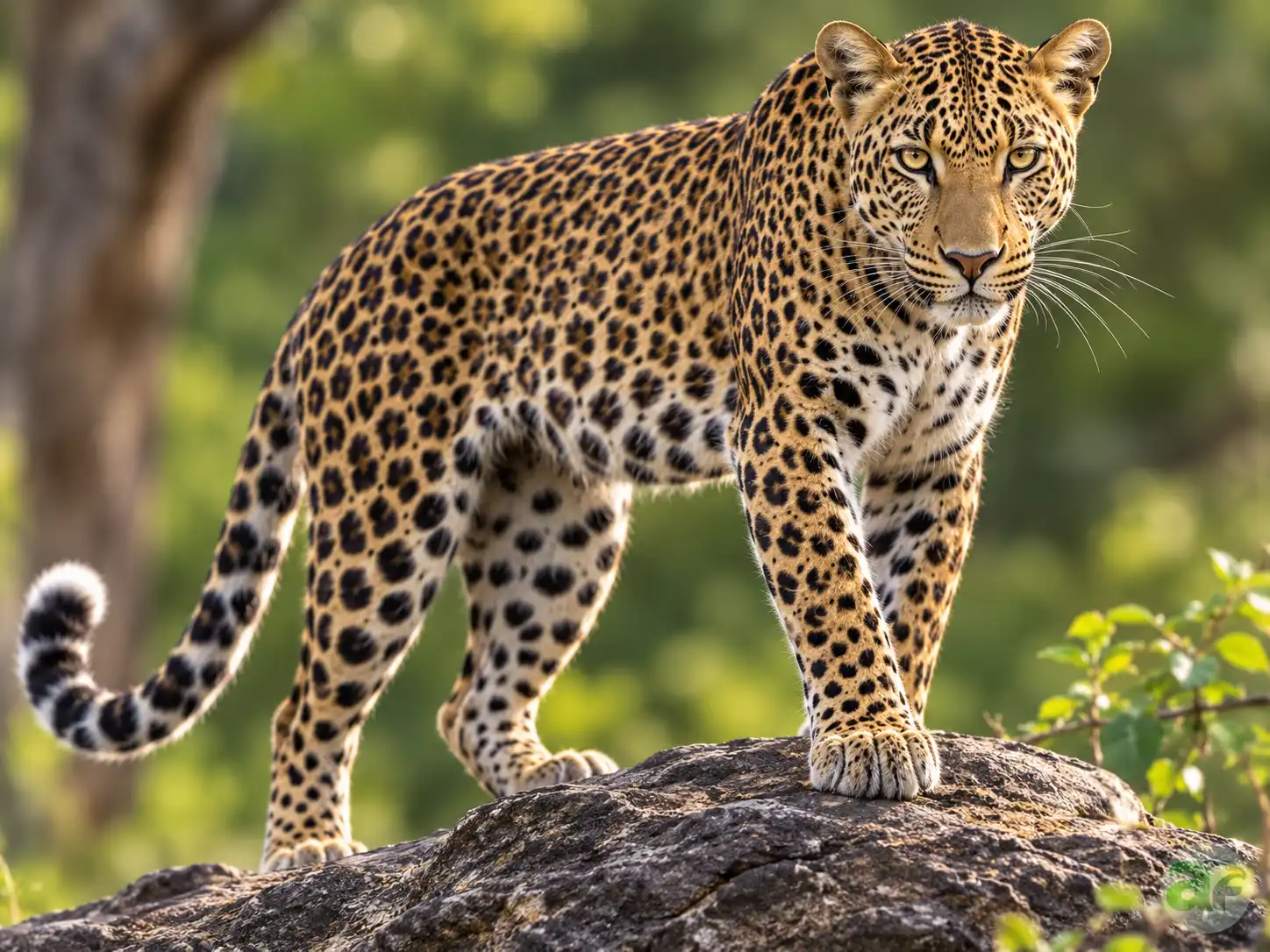
The Sabi Sand — a private game reserve sharing an unfenced boundary with Kruger National Park — is widely regarded as the finest leopard viewing destination in Africa, offering encounters with individually known, highly habituated leopard individuals whose life stories span multiple generations. Sabi Sand’s exceptional leopard sighting frequency — daily sightings of multiple individuals are routine during peak seasons — and the remarkable intimacy of encounters with relaxed, habituated leopards make this one of Africa’s premier wildlife experiences.
Yala National Park, Sri Lanka
Yala is considered by many wildlife photographers as the best location in the world for photographing wild leopards — with the highest leopard density of any protected area globally (approximately 1 leopard per 2.6 km² in the core area), relatively open habitat that maximizes visibility, and a population well-habituated to tourist vehicles. Sri Lanka’s leopards are also the island’s apex predators — displaying more bold, confident behavior than leopards in African habitats where larger competitors maintain dominance.
Jhalana Leopard Reserve, India
Jhalana, a compact reserve within the city limits of Jaipur, Rajasthan, is India’s first designated leopard reserve — and remarkable for its extraordinary accessibility and sighting frequency within a completely urban setting. Jhalana’s urban leopards are among the most relaxed and easily observable in India, providing extraordinary close-range viewing and photography opportunities.
Masai Mara, Kenya
The Masai Mara supports a significant leopard population alongside its celebrated lion and cheetah populations — with specific riparian forest areas along the Mara River and its tributaries providing prime leopard habitat. Mara leopards are typically more secretive than Sabi Sand individuals, making sightings less frequent but often more dramatic when they occur.
Kruger National Park, South Africa
South Africa’s flagship wildlife reserve supports a substantial leopard population across its diverse habitats — with leopards most reliably encountered in the southern Kruger riparian zones around the Sabie and Crocodile rivers. Self-drive accessibility makes Kruger one of the most democratically available leopard viewing destinations in Africa.
Land of the Leopard National Park, Russia
The primary protected area for the Critically Endangered Amur Leopard — established specifically to protect the last wild population of this subspecies in Russia’s Primorsky Territory. Camera trap programs managed by the reserve document virtually every individual Amur Leopard in the wild, and guided visits provide a unique opportunity to experience this extraordinary conservation story in its native landscape.
Wilpattu National Park, Sri Lanka
A more secluded alternative to Yala with excellent Sri Lankan Leopard populations in a landscape of naturally formed lake basins (villus) and dry tropical forest — offering a less crowded leopard viewing experience that some wildlife enthusiasts prefer to Yala’s higher visitor pressure.
20. Top Documentaries & Books
Must-Watch Documentaries
“Eye of the Leopard” (National Geographic, 2006) — Directed by Dereck and Beverly Joubert in the Okavango Delta — widely considered the finest leopard documentary ever made, following Legadema from cubhood through early adulthood with extraordinary intimacy and behavioral insight.
“BBC Big Cat Diary — Leopard” (BBC, multiple series 1996–2008) — The most extensively produced leopard natural history documentary series ever created, following successive generations of Masai Mara leopard families across over a decade of production.
“Planet Earth II — Cities” (BBC, 2016) — The Mumbai leopard sequence, filmed using thermal imaging, represents one of the most extraordinary urban wildlife sequences in documentary history — revealing the invisible world of the leopard navigating a megacity at night.
“Leopard: 21” and related Sabi Sand productions — Multiple productions documenting the remarkable individual leopards of Sabi Sand across successive years, providing the most intimate and sustained coverage of individual leopard life histories available.
“Land of the Leopard” — Various documentary productions covering the Amur Leopard conservation story in the Russian Far East — essential viewing for understanding one of conservation’s most urgent and dramatic challenges.
Essential Books
“The Leopard’s Tale: Revealing the Mysteries of Catalhoyuk” — While primarily about the archaeological site rather than the animal, this work illuminates the leopard’s extraordinary significance in early human culture, with Neolithic cave art featuring leopard imagery among the world’s earliest symbolic animal art.
“Man-Eaters of Kumaon” by Jim Corbett (1944) — While primarily focused on tigers and one legendary leopard (the Rudraprayag man-eater), Corbett’s accounts provide the most celebrated popular account of human-leopard conflict and the extraordinary behavioral capabilities of the Indian Leopard.
“Leopards: Biology, Behavior, and Conservation” by various authors — Technical scientific references covering leopard ecology, behavior, and conservation biology for readers seeking deeper engagement with the science of the species.
“The Spotted Sphinx” by Joy Adamson (1969) — Adamson’s account of raising and rehabilitating a captive-born cheetah contains significant comparative material on big cat behavior, including significant observations of leopard behavioral ecology in East African contexts.
21. Comparison of Leopards with Similar Big Cats
| Feature | Leopard | Jaguar | Cheetah | Snow Leopard | Tiger |
|---|---|---|---|---|---|
| Scientific Name | Panthera pardus | Panthera onca | Acinonyx jubatus | Panthera uncia | Panthera tigris |
| Weight | 28–90 kg | 56–160 kg | 21–72 kg | 22–55 kg | 90–300 kg |
| Distribution | Africa; Asia (widest range of any cat) | Americas | Africa; Iran | Central Asian mountains | Asia |
| Habitat | All — forest, savanna, mountain, desert, urban | Rainforest; wetland; dry forest | Open savanna | High mountain | Forest; grassland; mangrove |
| Social Structure | Solitary | Solitary | Female solitary; male coalitions | Solitary | Solitary |
| Kill Method | Throat suffocation | Skull/spine bite | Throat bite after trip | Throat suffocation | Skull/spine bite or throat |
| Tree Climbing | Exceptional; hoists prey 3x body weight | Moderate | Poor | Excellent; mountain terrain | Poor |
| Conservation Status | Vulnerable | Near Threatened | Vulnerable | Vulnerable | Endangered |
| Population | ~250,000 | ~64,000–173,000 | ~7,100 | ~4,000–6,500 | ~5,574 |
| Unique Feature | Most widespread cat; most adaptable; widest prey range | Strongest bite; aquatic hunting | Fastest land animal | Cannot roar; densest fur | Largest cat; only truly striped big cat |
22. How You Can Help
Leopard conservation spans the full spectrum from the relatively stable African populations to the emergency conservation of the Amur Leopard — requiring diverse approaches and allowing individual contributions to connect to specific, high-impact programs.
Support These Organizations
Panthera (panthera.org/cat/leopard) — The world’s leading wild cat organization runs major leopard conservation programs across Africa and Asia, including the landmark Leopard’s Crossing initiative identifying and protecting critical movement corridors.
Wildlife Conservation Society (wcs.org) — Operates leopard research and conservation programs across multiple African and Asian range countries, including the iconic Mumbai Leopard Project that has generated foundational insights into urban leopard ecology.
Amur Leopard and Tiger Alliance (ALTA) (amur-leopard.org) — The primary international collaborative program supporting Amur Leopard conservation in Russia and China, coordinating anti-poaching, habitat management, and prey restoration across the subspecies’ tiny remaining range.
WWF (worldwildlife.org) — Supports leopard conservation programs across multiple subspecies and range countries, including significant programs for Persian, Amur, and African Leopard populations.
Snow Leopard Conservancy — While primarily focused on snow leopards, this organization’s community-based approaches to human-predator coexistence provide directly applicable models for leopard coexistence programs across Asia.
Practical Actions
Avoid buying real leopard skin or fur products. Despite international trade bans, leopard parts continue to circulate in illegal markets — consumer demand reduction remains one of the most direct actions individuals can take to reduce poaching incentives.
Support human-wildlife conflict compensation programs. Organizations that fund compensation programs for farmers losing livestock to leopards reduce the retaliatory killing that represents the most widespread immediate cause of leopard mortality across both Africa and Asia. Financial contributions to these programs directly convert to reduced leopard mortality.
Choose responsible safari tourism. In areas like Sabi Sand, the Masai Mara, and Sri Lanka’s national parks, responsible safari tourism generates substantial revenue that creates economic incentives for leopard conservation at the landscape level. Selecting operators with demonstrated conservation commitments ensures your expenditure contributes to this economic case.
Raise awareness about Asian leopard subspecies. The African Leopard’s relatively stable overall numbers can obscure the genuine extinction emergencies facing several Asian subspecies — sharing accurate information about the Amur Leopard’s critical status, the Javan Leopard’s precarious survival, and the Arabian Leopard’s near-extinction helps ensure these less prominent conservation emergencies receive the attention they deserve.
Did You Know? The successful cooperation between Russia and China on Amur Leopard conservation — creating the jointly managed Leopard Land protected area on the Russian side and the Northeast Tiger and Leopard National Park on the Chinese side — has resulted in documented population growth in this critically endangered subspecies, from approximately 25–35 individuals in the early 2000s to approximately 100–120 individuals by 2026. This cross-border conservation success demonstrates that even the most critically endangered large cat subspecies can recover from the edge of extinction when sustained political will, adequate funding, and genuine anti-poaching enforcement are maintained across international boundaries.
25. Frequently Asked Question About Leopards
Q1: What is the scientific name of the leopard?
The leopard’s scientific name is Panthera pardus — placing it in the genus Panthera alongside the lion (P. leo), tiger (P. tigris), jaguar (P. onca), and snow leopard (P. uncia). The family is Felidae (cats), order Carnivora, and class Mammalia. There are 9 recognized subspecies ranging from the relatively abundant African Leopard to the Critically Endangered Amur Leopard.
Q2: How many subspecies of leopard are there?
There are 9 recognized subspecies of leopard: the African Leopard, Indian Leopard, Javan Leopard, Sri Lankan Leopard, Persian Leopard, North Chinese Leopard, Amur Leopard, Indochinese Leopard, and Arabian Leopard. Conservation status ranges from Vulnerable (African, Indian) to Critically Endangered (Javan, Arabian, Amur, North Chinese, Indochinese).
Q3: What is a black panther?
A “black panther” is not a separate species — it is any Panthera cat (most commonly a leopard or jaguar) carrying a melanistic gene that causes near-black coat coloration. Black leopards are most common in dense humid forests, particularly in Southeast Asia and wet East African forests. Their rosette pattern remains visible in good lighting. The term “black panther” has no formal scientific meaning.
Q4: How strong is a leopard?
Leopards are the strongest tree-climbing big cat — capable of hauling prey weighing up to three times their own body weight up vertical tree trunks. A large male leopard weighing 90 kg can therefore carry prey of up to 250–270 kg — including adult impala, warthogs, and even sub-adult baboons — into the tree canopy. This is considered one of the most impressive strength feats in the natural world relative to body size.
Q5: Are leopards endangered?
The overall IUCN classification for the leopard as a species is Vulnerable — with a global population decline of approximately 25–37% over three generations documented. However, several subspecies face far more critical situations — the Amur Leopard (~100–120 individuals), Arabian Leopard (~100–200), North Chinese Leopard (~100–400), Javan Leopard (~250–500), and Indochinese Leopard (<1,000) are all Critically Endangered.
Q6: Where do leopards live?
Leopards have the widest range of any wild cat — found across sub-Saharan Africa, parts of North Africa, the Middle East, Central Asia, South Asia, Southeast Asia, and the Russian Far East. They inhabit an extraordinary diversity of environments including tropical rainforest, savanna, grassland, mountain terrain, semi-desert, and urban fringe habitat — making them the most geographically versatile large carnivore on Earth.
Q7: What do leopards eat?
Leopards have the most diverse diet of any Panthera cat — over 100 documented prey species across their global range, including impala, gazelle, duiker, warthog, baboons, hares, rodents, birds, reptiles, fish, domestic dogs, and livestock. Their dietary flexibility is one of the primary reasons they persist across such diverse environments and in areas where other large cats have been eliminated.
Q8: How long do leopards live?
Wild leopards typically live 12–17 years — longer on average than lions, tigers, and cheetahs, perhaps reflecting the advantages of solitary life (fewer injuries from group competition) and effective predator avoidance through behavioral crypticity. The maximum confirmed lifespan in captivity reaches approximately 23 years.
Q9: Why do leopards climb trees with their prey?
Leopards hoist kills into trees primarily to protect them from larger predators and scavengers — particularly lions, spotted hyenas, African Wild Dogs, and other ground-based competitors that cannot effectively follow a leopard into the canopy. This vertical separation of food resources is the most important competitive behavioral adaptation the leopard possesses in areas where it must coexist with larger social carnivores.
Q10: How can I help leopard conservation?
Key actions include: supporting Panthera, WWF, and the Amur Leopard and Tiger Alliance with financial contributions to leopard research and protection programs; avoiding real leopard skin or fur products; supporting human-wildlife conflict compensation programs that reduce retaliatory killing; choosing responsible safari tourism in areas like Sabi Sand, Yala, and Jhalana that generates economic value for leopard conservation; and raising awareness about the genuine extinction emergencies facing several Asian leopard subspecies that are far less widely known than tigers or lions.
26. Sources & References
Research Sources
- Wikipedia — Panthera pardus and subspecies articles
- IUCN Red List — iucnredlist.org
- Panthera — panthera.org/cat/leopard
- Wildlife Conservation Society — wcs.org
- WWF — worldwildlife.org/species/leopard
- Amur Leopard and Tiger Alliance — amur-leopard.org
- National Geographic — nationalgeographic.com
- Smithsonian’s National Zoo — nationalzoo.si.edu
- Encyclopaedia Britannica — britannica.com
- BBC Wildlife — bbc.co.uk
- Live Science — livescience.com
- TRAFFIC — traffic.org
- Corbett, Jim — “Man-Eaters of Kumaon” (1944)
- Hayward, Matt W. et al. — “Prey preferences of the leopard” (Journal of Zoology, 2006)
- Athreya, Vidya et al. — “Leopard ecology in human-dominated landscapes” (multiple publications)