

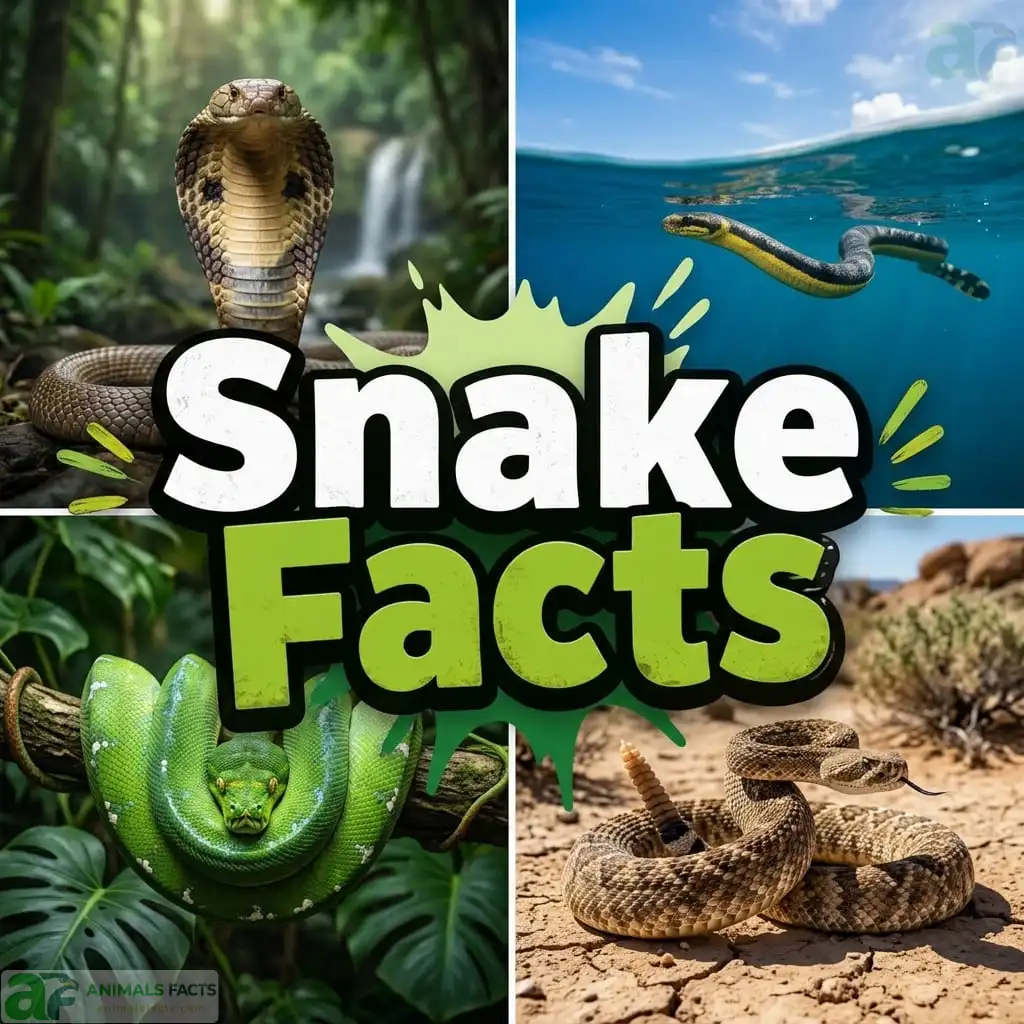
Snake Facts
| Feature | Details |
|---|---|
| Scientific Suborder | Serpentes |
| Kingdom | Animalia |
| Phylum | Chordata |
| Class | Reptilia |
| Order | Squamata |
| Total Known Species | Approximately 3,700+ species worldwide |
| Oldest Snake Group | Blind snakes (Typhlopidae) — among the most primitive living snakes |
| Habitat | Every continent except Antarctica; every environment from desert to ocean to rainforest |
| Smallest Snake | Barbados Threadsnake (Tetracheilostoma carlae) — 10 cm body length; thinner than a spaghetti strand |
| Largest Living Snake | Green Anaconda (Eunectes murinus) — up to 8+ meters and 250 kg by weight; Reticulated Python is longest at 7+ meters |
| Largest Snake Ever | Titanoboa cerrejonensis — approximately 13 meters and 1,135 kg; extinct 58–60 million years ago |
| Fastest Snake | Black Mamba (Dendroaspis polylepis) — up to 20 km/h on land |
| Most Venomous Snake | Inland Taipan (Oxyuranus microlepidotus) — most toxic venom of any land snake |
| Longest Lifespan | Ball Python — up to 47 years in captivity; Boa Constrictor — up to 40 years |
| Diet | Obligate carnivores — all snakes eat only animal prey |
| Conservation Status | Over 200 snake species threatened with extinction (IUCN, 2026) |
| Global Population | Estimated hundreds of billions of individual snakes worldwide |
 1. Introduction: What is Snake?
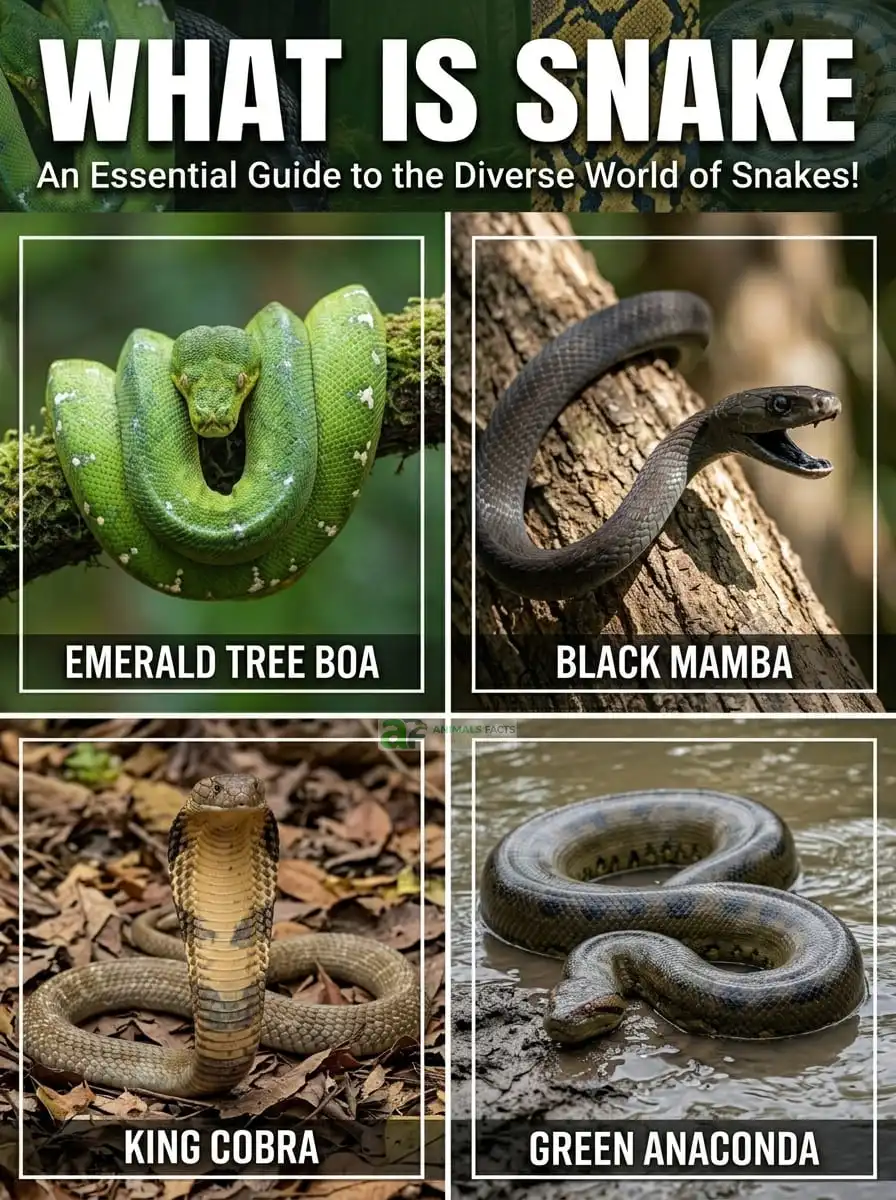
They have no limbs, no eyelids, no external ears, and no voice. Yet they have conquered every continent on Earth except Antarctica, colonized the deepest rainforests and driest deserts, ruled the oceans, and generated more human fear, fascination, and mythological significance than almost any other creature in the natural world. Snake facts — real, scientifically verified snake facts — have the extraordinary power to transform the most snake-phobic person into someone who can at least acknowledge the magnificence of these ancient, astonishing animals.
The suborder Serpentes contains approximately 3,700 known species — making snakes one of the most species-diverse reptile groups on Earth. They range in size from the Barbados Threadsnake — at just 10 centimeters long and thinner than a strand of spaghetti — to the Green Anaconda, which can exceed 8 meters in length and 250 kilograms in weight. They inhabit tropical rainforests, Arctic tundra margins, open oceans, deep deserts, freshwater rivers, and every terrestrial and aquatic environment in between. They are simultaneously among the most medically important animals on Earth — their venoms killing an estimated 80,000–138,000 people annually — and among the most valuable, with those same venoms yielding life-saving pharmaceutical compounds used by millions.
Whether you are a student searching for snake facts for a school report, a herpetology enthusiast, a parent looking for snake facts for kids, a medical researcher interested in venom pharmacology, or simply someone who encountered a snake in your garden and wanted to understand what you were looking at — this is the most complete guide to snake facts available anywhere. We cover snake habitat, snake diet, snake behavior, reproduction, venom, conservation, mythology, and the extraordinary ecological roles that make snakes irreplaceable components of healthy ecosystems worldwide. Let us begin.
2. Snake Species Overview & Classification
Snakes are limbless, elongated reptiles belonging to the suborder Serpentes within the order Squamata (which also includes lizards). They evolved from lizard ancestors approximately 150 million years ago — and the precise ecological driver of their limb loss (whether burrowing, aquatic adaptation, or another pressure) remains one of the most actively debated questions in vertebrate evolutionary biology.
What Defines a Snake?
All snakes share these defining characteristics:
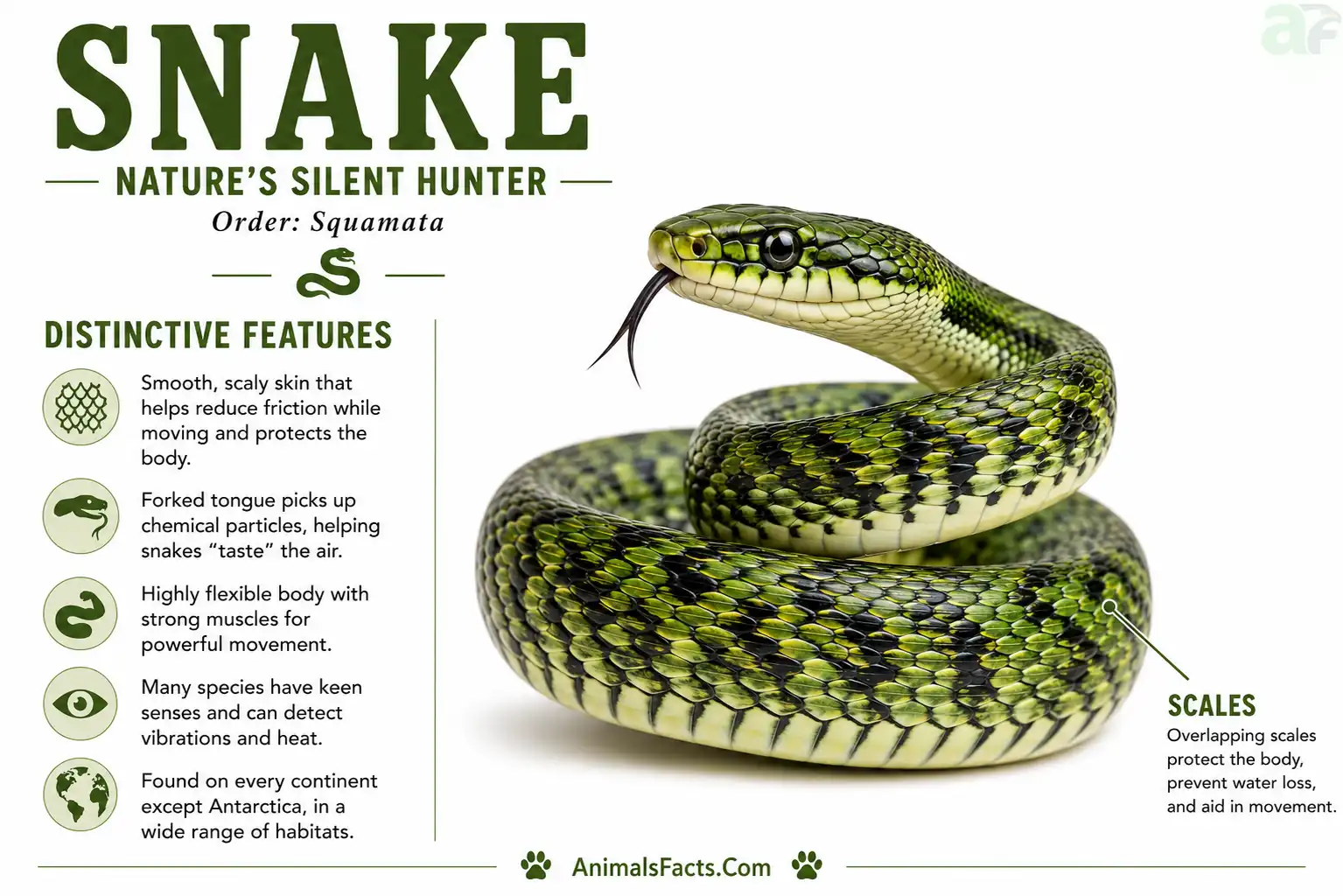
- No limbs: All snakes have lost their limbs through evolutionary reduction — though some primitive species (boas and pythons) retain tiny vestigial pelvic girdle remnants called pelvic spurs
- No eyelids: Snake eyes are covered by a permanent transparent scale called the brille or spectacle — which is shed along with the rest of the skin during moulting
- No external ear openings: Snakes detect ground vibrations through their jawbones and have no capacity for airborne sound — they are functionally deaf to most sounds
- Forked tongue: All snakes use a forked tongue to collect chemical particles from the air and transfer them to the Jacobson’s organ (vomeronasal organ) in the roof of the mouth — a chemical detection system of extraordinary sensitivity
- Highly flexible jaw: Snakes can open their mouths to extraordinary widths through a complex of loosely connected skull bones — allowing them to swallow prey significantly larger in diameter than their own head
- Continuous scale covering: The entire body is covered in overlapping scales of varying shapes and sizes — no snake has any hair, feathers, or bare skin
Major Snake Classification Table
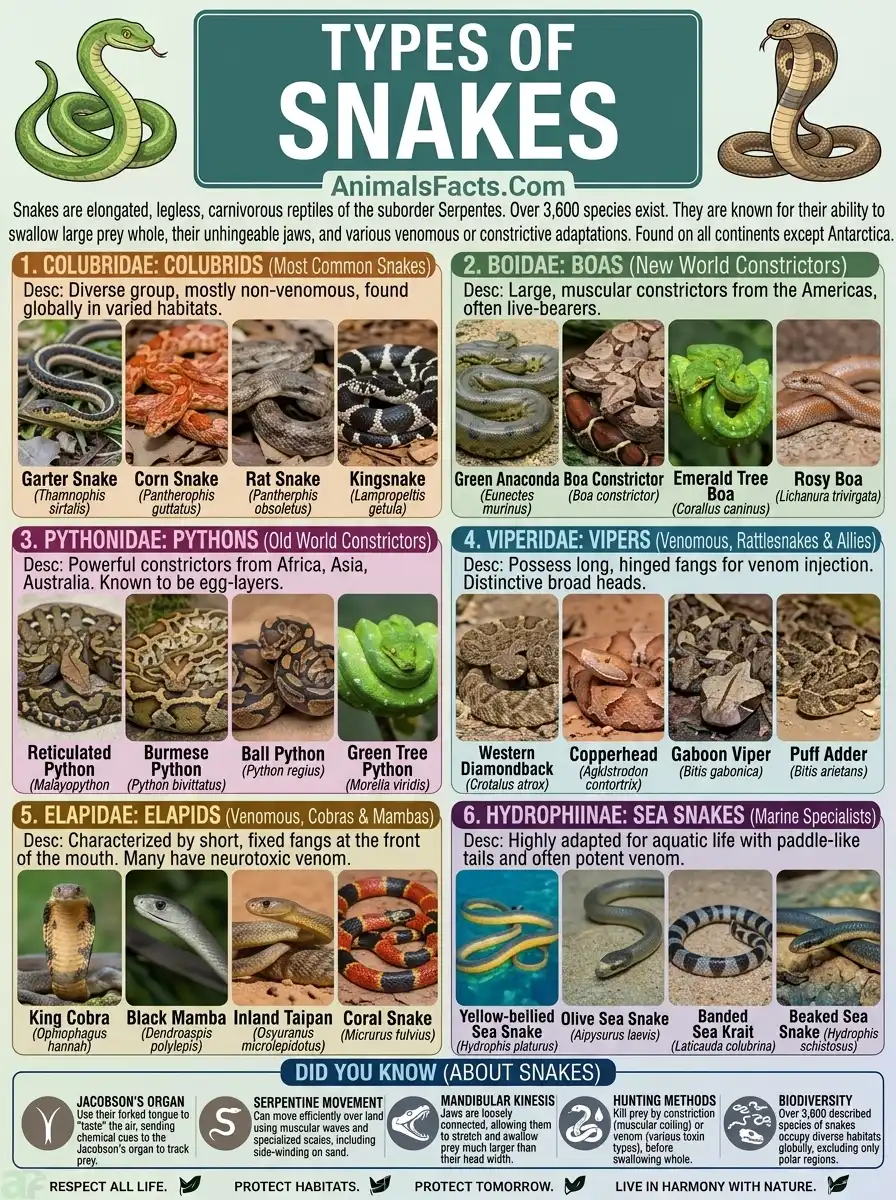
| Family | Common Name | Approx. Species | Key Examples |
|---|---|---|---|
| Colubridae | Colubrids (non-venomous / mildly venomous) | ~1,800 | King Snake, Rat Snake, Garter Snake, Grass Snake |
| Elapidae | Elapids (front-fanged venomous) | ~360 | Cobra, Mamba, Krait, Taipan, Sea Snake |
| Viperidae | Vipers (hinged front-fanged venomous) | ~330 | Rattlesnake, Puff Adder, Russell’s Viper, Gaboon Viper |
| Pythonidae | Pythons | ~40 | Reticulated Python, Burmese Python, Ball Python |
| Boidae | Boas | ~60 | Boa Constrictor, Green Anaconda, Rainbow Boa |
| Typhlopidae | Blind Snakes | ~270 | Brahminy Blind Snake |
| Hydrophiidae / Elapidae | Sea Snakes | ~70 | Yellow-bellied Sea Snake, Olive Sea Snake |
| Lamprophiidae | African Snakes & allies | ~300 | Boomslang, Twig Snake, File Snake |
Snakes Species Evolution & Discovery Timeline
~150 million years ago: The earliest confirmed snake ancestors appeared during the Late Jurassic Period — diverging from lizard ancestors likely through adaptation to either burrowing or aquatic environments. Eophis underwoodi from the UK is among the oldest known snake fossils.
~95–100 million years ago: Najash rionegrina — a terrestrial snake from Argentina with well-developed hind limbs — provides extraordinary evidence of the transition from limbed lizard ancestors to modern snakes.
~90 million years ago: Pachyrhachis problematicus of the ancient Tethys Sea demonstrates that some early snakes were fully aquatic, supporting the marine-origin hypothesis for snake evolution.
~58–60 million years ago: Titanoboa cerrejonensis — the largest snake ever known — inhabited the tropical forests of what is now Colombia, reaching 13 meters in length and over 1,000 kilograms in weight. Its enormous size is believed to reflect the much higher temperatures of Paleocene tropical environments.
~35 million years ago: The major modern snake families — Colubridae, Viperidae, Elapidae, Pythonidae, and Boidae — had established themselves across the major continents.
~15 million years ago: The Elapidae (cobras, mambas, taipans) diversified explosively — evolving highly sophisticated venom delivery systems.
~5 million years ago: Rattlesnakes appeared in North America — their unique rattle evolving as a warning device, possibly to alert large-hooved animals to their presence and prevent accidental trampling.
1758: Carl Linnaeus formally described numerous snake species in Systema Naturae, establishing the foundational taxonomy of snake classification.
2008: The Barbados Threadsnake (Tetracheilostoma carlae) was formally described — establishing the record for the world’s smallest snake.
2023: Several new snake species continued to be described from Southeast Asian rainforests, Papua New Guinea, and the Amazon Basin — reflecting the enormous undescribed diversity remaining in tropical snake communities.
3. Snakes Physical Description & Features
The snake body plan — limbless, elongated, and covered in scales — has proven one of the most evolutionarily successful designs in the history of vertebrates. In snakes, this apparently limiting body plan has been refined into an instrument of extraordinary biological versatility.
Size Extremes
Smallest snake: The Barbados Threadsnake (Tetracheilostoma carlae) — discovered in 2008 on the Caribbean island of Barbados — measures just 10 centimeters in length and is so thin it could coil comfortably on a US quarter coin. It feeds exclusively on termite and ant larvae.
Longest snake: The Reticulated Python (Malayopython reticulatus) of Southeast Asia holds the confirmed record for length — wild individuals exceeding 7 meters are documented, with the record confirmed individual measuring 7.67 meters. Unverified historical accounts claim individuals over 9 meters.
Heaviest snake: The Green Anaconda (Eunectes murinus) of South America — confirmed individuals weighing over 250 kg and exceeding 8 meters in length. The anaconda’s aquatic lifestyle supports its enormous bulk — water buoyancy allows body masses impossible for a purely terrestrial animal of similar length.
Most venomous snake: The Inland Taipan (Oxyuranus microlepidotus) of central Australia — its venom has the highest measured toxicity of any land snake, with a single bite containing enough venom to theoretically kill 100 adult humans. Despite this, it is a shy, reclusive species with no confirmed human fatality attributed to it in recorded history.
Snakes Unique Physical Adaptations
The Flexible Jaw: Snakes do not “dislocate” their jaws to swallow large prey — a common misconception. Rather, their lower jawbones are not fused at the chin (as in most vertebrates) but are connected by an elastic ligament — allowing the two halves to spread apart independently. Combined with highly mobile skull bones, this allows snakes to engulf prey up to three times their own head diameter.
Heat-Sensing Pit Organs: Pit vipers (family Viperidae, subfamily Crotalinae — including rattlesnakes, copperheads, and many Asian vipers) and pythons and boas possess specialized infrared-sensing organs — loreal pits (in pit vipers) and labial pits (in many pythons and boas). These organs detect infrared radiation — heat emitted by warm-blooded prey — with extraordinary precision, allowing these snakes to locate, track, and strike warm-blooded animals in complete darkness.
The Jacobson’s Organ: All snakes “smell” primarily through their forked tongue and vomeronasal organ (Jacobson’s organ) — a chemosensory structure in the roof of the mouth. The forked tongue samples chemical particles from the air and ground surface; the two tips of the fork deposit these particles into two separate apertures in the Jacobson’s organ, allowing the snake to determine the direction of a scent gradient — essentially smelling in stereo. This system is so sensitive that snakes can follow prey trails hours old and detect the scent of prey hidden under soil.
Scale Diversity: Different snake species have evolved specialized scale arrangements for specific ecological functions. Arboreal snakes (tree-dwelling species) often have keeled scales providing grip on smooth bark. Desert sidewinders have specialized lateral scales that prevent them from sinking in loose sand. Sea snakes have flattened, paddle-like tails for aquatic propulsion.
Did You Know? The Paradise Flying Snake (Chrysopelea paradisi) of Southeast Asia can truly fly — or more accurately, glide. It launches itself from tree branches, flattens its body into a concave C-shape to create an aerodynamic surface, and undulates laterally as it glides — traveling up to 10 meters horizontally through the air between trees with remarkable accuracy. High-speed video has revealed that its aerial undulation actually improves gliding stability rather than generating lift — it is a more sophisticated aerodynamic performance than any similar animal.
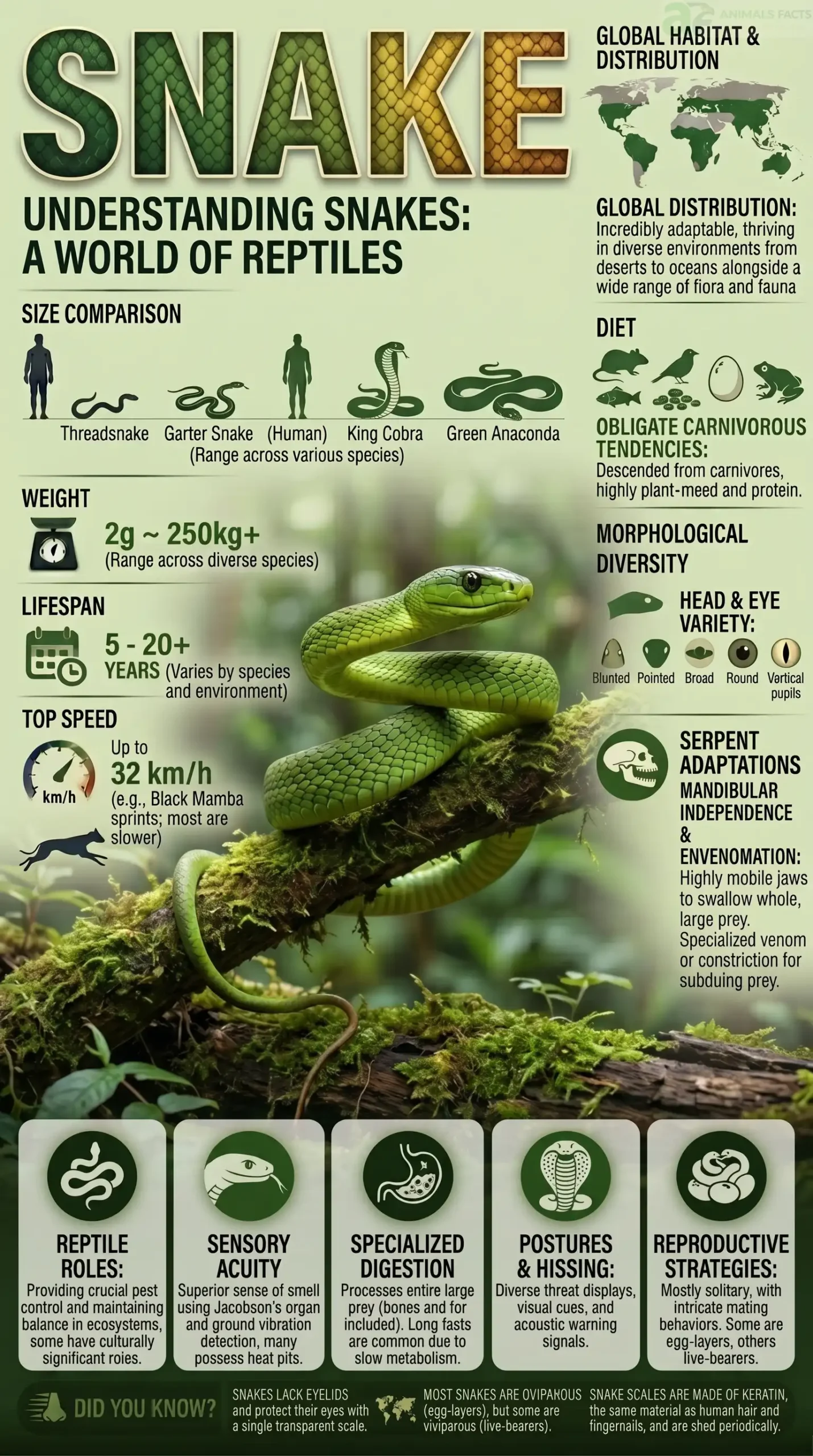
4. Top 25 Surprising & Interesting Snake Facts
- Snakes have no eyelids — they sleep with their eyes open, covered by a transparent scale called the brille that is shed with each skin moult.
- The King Cobra is the world’s longest venomous snake — reaching lengths of up to 5.5 meters — and is the only snake known to build a nest and actively guard its eggs.
- All snakes are obligate carnivores — no snake species consumes any plant material at any stage of its life.
- The Inland Taipan of Australia has the most toxic venom of any land snake — a single bite contains enough venom to kill approximately 100 adult humans theoretically, though it is extremely shy and rarely encountered.
- Snakes smell with their tongue — the forked tongue collects chemical particles and delivers them to the vomeronasal organ in the roof of the mouth.
- The Reticulated Python is the world’s longest snake — confirmed individuals exceeding 7.67 meters in length.
- Rattlesnake rattles grow by adding one segment each time the snake sheds its skin — typically 2–4 times per year. The rattle is made of keratin — the same material as human fingernails.
- The Black Mamba is the fastest land snake on Earth — capable of speeds up to 20 km/h in short bursts. Despite its fearsome reputation, it is also highly shy and will flee given any opportunity.
- Snakes can go for extraordinarily long periods without eating — large pythons can survive for over one year between meals after consuming a large prey item.
- The Spitting Cobra can project venom from its fangs with remarkable accuracy at distances of up to 2.5 meters — always targeting the eyes of a threat. The venom causes intense pain and potentially permanent blindness if not washed out immediately.
- Sea snakes are among the most venomous animals in the ocean — the Belcher’s Sea Snake is sometimes cited as the world’s most venomous snake overall, though it is extremely docile and rarely bites.
- The Egg-eating Snake (Dasypeltis) has no functional teeth — it swallows bird eggs whole, cracks the shell using modified vertebrae in its throat, absorbs the contents, and regurgitates the crushed shell as a compact parcel.
- Snakes regularly shed their entire outer skin layer (ecdysis) as they grow — a healthy adult snake may shed 3–6 times per year. Unlike lizards, which shed in patches, snakes shed their entire skin in one piece.
- The Gaboon Viper has the longest fangs of any venomous snake — up to 5 centimeters in length — and injects the largest volume of venom of any snake in a single bite.
- The Anaconda gives birth to live young — not eggs — with litters of up to 40 live neonates, each already over 60 cm at birth.
- Boa Constrictors kill their prey not through suffocation as was long believed — but by increasing constriction pressure incrementally with each heartbeat of the prey, causing cardiac arrest long before suffocation would occur.
- The Coral Snake of North America uses a neurotoxic venom that disrupts nerve-to-muscle communication — preventing muscles from relaxing. Victims remain fully conscious as progressive paralysis spreads. Coral snake antivenom production was discontinued in the US in 2010 due to low commercial demand.
- The African Rock Python — Africa’s largest snake — is known to prey on small crocodilians, large antelope, and warthogs — and has attacked adult humans in documented cases.
- Snakes have no vocal cords — all snake “sounds” (hissing, rattling) are produced by forcing air through the glottis (the opening to the trachea) or by mechanical structures like the rattlesnake’s rattle.
- The King Snake (Lampropeltis) of North America is immune to the venom of rattlesnakes and pit vipers it routinely preys on — one of the few animals known to hunt venomous snakes as a primary dietary strategy.
- Python embryos have tiny limb buds that are genetically suppressed early in development — demonstrating that snakes retain the genetic machinery for limb development from their lizard ancestors.
- The Rough-scaled Bush Viper (Atheris hispida) of Central Africa has such strongly keeled scales that it appears to be covered in spines — one of the most visually extraordinary snakes in the world.
- Green Anacondas are sexually dimorphic in the extreme — females are significantly larger than males, sometimes 4–5 times heavier than adult males of the same age.
- The Death Adder of Australia achieves the fastest strike of any snake — from resting position to full strike completion in approximately 0.13 seconds — faster than most other strikes ever recorded for any snake species.
- Snake venom has contributed to the development of multiple life-saving pharmaceutical drugs — including Captopril (hypertension), Eptifibatide (blood clots), Tirofiban (heart attacks), and Ziconotide (extreme pain) — making snakes among the most medically important animals on Earth.
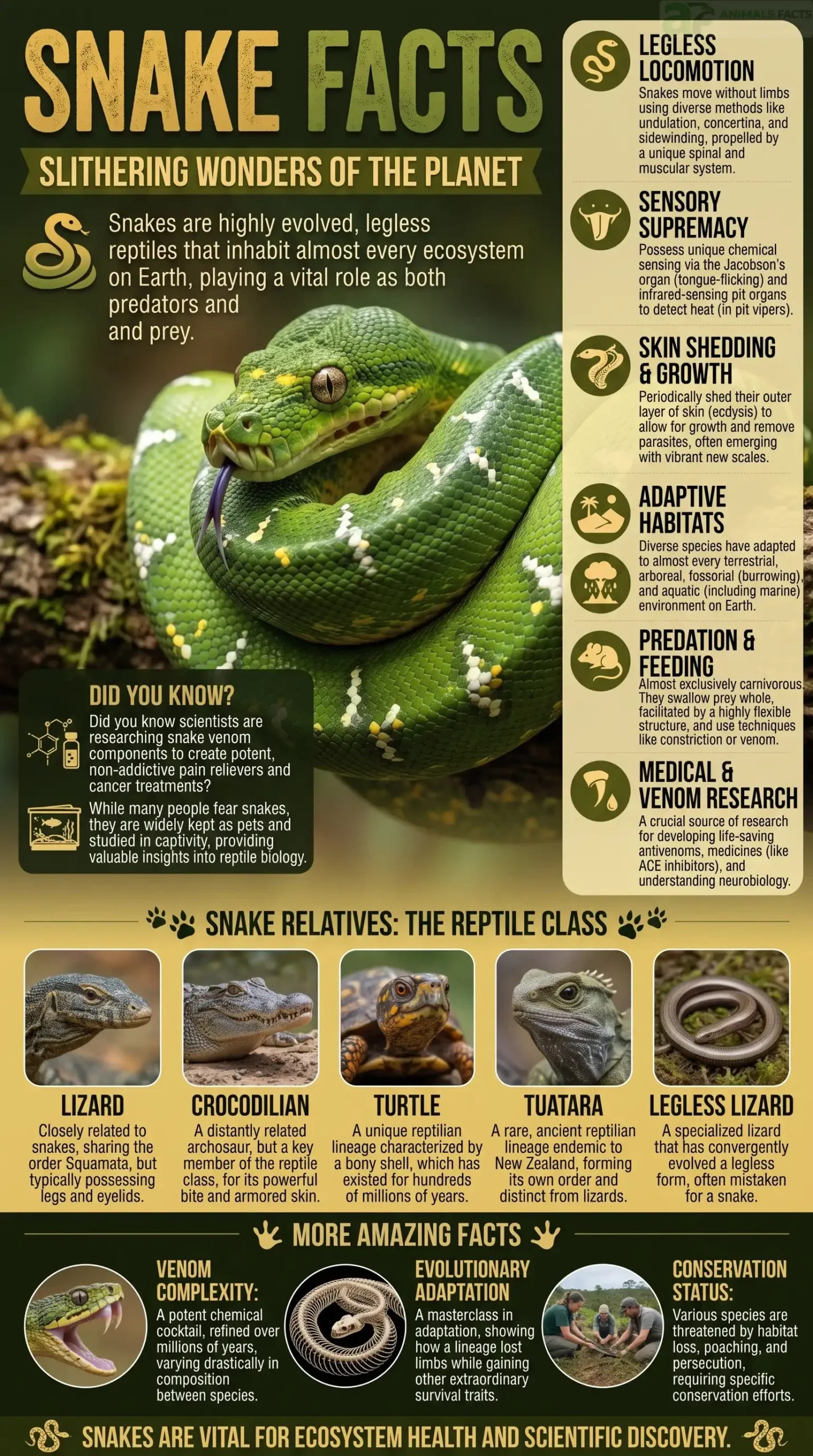
5. Snake Fun Facts for Kids
- There are approximately 3,700 species of snakes — found on every continent except Antarctica and every major ocean.
- Only about 600 snake species are venomous — and only approximately 200 can deliver a bite that is potentially lethal to humans. The vast majority of snakes are completely harmless.
- The Black Mamba — despite its fearsome reputation — is named for the black color of the inside of its mouth, not its skin. Its skin is actually olive to grey.
- Snakes can detect earthquakes minutes before humans can — their extreme sensitivity to ground vibrations through their jawbones registers the initial P-waves that precede a seismic event.
- A Rattlesnake can strike from a coiled position to full extension and back within 0.33 seconds — approximately 10 times faster than the human eye can follow.
- The Brahminy Blind Snake is the world’s most widely distributed snake — it has been accidentally transported in soil with plant shipments to every continent except Antarctica, where it reproduces by parthenogenesis (all individuals are female).
- Snake charming does not involve the snake responding to music — snakes cannot hear airborne sounds. The snake responds to the movement of the charmer’s instrument and body, not the music.
- The Sidewinder Rattlesnake moves by throwing loops of its body sideways across loose desert sand — the only contact points are two sections of body, leaving a distinctive J-shaped track pattern.
- Some snake species hibernate in communal dens of thousands — the Red-sided Garter Snake dens of Manitoba, Canada, contain the largest snake aggregations on Earth, with up to 8,000 individuals per limestone cave system.
- A large python’s digestion is so metabolically demanding that its heart, liver, and small intestine can double in size within 48 hours of eating a large meal — and then shrink back when digestion is complete.
- The Tentacled Snake of Southeast Asia — the only aquatic snake with tentacles on its face — uses a remarkable reflex: it triggers the startle reflex of nearby fish before striking, then strikes the fish in the direction it reflexively flinches.
- The Milos Viper (Macrovipera schweizeri) is found on just four small Greek islands — and may be the rarest viper on Earth.
6. Natural Habitat of Snakes
Snakes are one of the most geographically successful and ecologically versatile reptile groups — inhabiting virtually every terrestrial and many freshwater and marine environments worldwide.
Major Snake Habitat Types
Tropical Rainforests: The most species-rich snake habitat on Earth. The Amazon Basin contains over 200 snake species; Southeast Asian rainforests are similarly rich. Arboreal specialists like Green Tree Pythons, Emerald Tree Boas, Vine Snakes, and Tree Kraits have evolved extraordinary adaptations for canopy life. Terrestrial species including Bushmasters, Fer-de-Lance, and numerous boas and pythons share the forest floor.
Grasslands & Savannas: African savannas support iconic venomous species including the Black Mamba, Puff Adder, Boomslang, Bush Viper, and enormous non-venomous constrictors including the African Rock Python. North American grasslands support Rattlesnakes, Bullsnakes, Indigo Snakes, and numerous colubrid species.
Deserts: Snakes have excelled in desert adaptation. The Sidewinder Rattlesnake of the Sonoran Desert, the Horned Viper of the Sahara, the Saw-scaled Viper of arid India and the Middle East, and the Sand Boa species of African and Asian deserts all thrive in environments that challenge most vertebrates.
Freshwater Ecosystems: Many snake species are semi-aquatic or fully aquatic. Water Moccasins (Cottonmouths) hunt in North American swamps and rivers. Asian Keelback Snakes hunt fish in Southeast Asian waterways. The Anaconda is South America’s dominant freshwater aquatic predator.
Marine Environments: Approximately 70 species of true sea snakes (family Hydrophiidae) and one species of sea krait inhabit tropical and subtropical oceans from the Indian Ocean to the Pacific. The Yellow-bellied Sea Snake is the most widespread, occurring across the entire Indo-Pacific. Sea snakes are among the most venomous animals in the ocean.
Mountain Environments: Several viper species have adapted to high-altitude environments. The Common Viper (Vipera berus) reaches higher latitudes and altitudes than any other snake — found above 3,000 meters in some Alpine locations and ranging to the Arctic Circle in Norway and Russia.
Habitat Range by Continent
| Continent | Notable Snake Groups | Approximate Species |
|---|---|---|
| Asia | King Cobra, Reticulated Python, Russell’s Viper, Kraits, Sea Snakes, Rat Snakes | 1,000+ |
| South America | Anaconda, Boa Constrictor, Bushmaster, Fer-de-Lance, Coral Snakes, Vine Snakes | 800+ |
| Africa | Black Mamba, Puff Adder, African Rock Python, Boomslang, Gaboon Viper, Spitting Cobra | 600+ |
| North America | Rattlesnakes, Kingsnakes, Garter Snakes, Copperhead, Coral Snake, Indigo Snake | 300+ |
| Australia & Oceania | Inland Taipan, Eastern Brown Snake, Tiger Snake, Death Adder, Taipan, Sea Kraits | 200+ |
| Europe | Common Viper, Grass Snake, Smooth Snake, Montpellier Snake, Dice Snake | 60+ |
| Oceans (Global) | Yellow-bellied Sea Snake, Olive Sea Snake, Banded Sea Krait | ~70 |
| Antarctica | No snakes | 0 |
Did You Know? Ireland, Iceland, New Zealand, and a handful of other island nations have no native snake species — a fact famously associated with the legend of Saint Patrick driving snakes from Ireland (though the actual reason is geological: these islands were glaciated during periods when snakes could not recolonize from continental snake populations). The only native snake in Hawaii is a tiny blind snake accidentally introduced from the Philippines.
7. Snake’s Diet & Feeding Behavior
All snakes — without exception — are obligate carnivores. Every species of snake in the world eats only animal prey, at every stage of its life. No snake can obtain nutrition from plant material. This absolute carnivory — combined with their ability to swallow prey whole — has shaped every aspect of snake anatomy and behavior.
What Snakes Eat
Snake dietary preferences range across the full spectrum of animal prey available in their environments:
Small mammals: Rats, mice, voles, shrews, bats, rabbits, and various rodents — the primary prey of most large non-venomous constrictors and many venomous species.
Birds and bird eggs: Many tree-dwelling snakes specialize in birds and eggs. The Indian Rat Snake and Black Mamba regularly take roosting birds.
Reptiles (including other snakes): King Cobras eat almost exclusively other snakes. King Snakes are immune to pit viper venom and regularly prey on rattlesnakes. Monitor Lizards are prey for large pythons and boas.
Amphibians: Many smaller snake species — including most garter snakes and grass snakes — feed primarily on frogs, toads, and salamanders.
Fish: Water-associated snakes including the Grass Snake, Asian Keelback Snakes, Anacondas, and most sea snakes consume fish as a primary or significant prey item.
Invertebrates: Small, primitive snakes — blind snakes, threadsnakes, and several small colubrid species — feed almost exclusively on ant and termite larvae, earthworms, and small invertebrates.
Eggs: The African Egg-eating Snake (Dasypeltis) feeds exclusively on bird eggs — swallowing them whole and crushing them internally.
Diet Breakdown Table
| Snake Group | Primary Prey | Secondary Prey | Hunting Method |
|---|---|---|---|
| Pythons & Anacondas | Mammals (large; 70%) | Birds, reptiles (30%) | Ambush; constriction |
| Boa Constrictors | Mammals (60%) | Birds, lizards (40%) | Ambush; constriction |
| Vipers | Rodents, small mammals (70%) | Birds, lizards, frogs (30%) | Ambush; envenomation |
| Cobras | Rodents, frogs, other snakes (60%) | Birds, lizards (40%) | Active hunting; envenomation |
| Mambas | Rodents, birds (70%) | Bats, lizards (30%) | Active pursuit; envenomation |
| Rattlesnakes | Rodents (80%) | Birds, lizards (20%) | Ambush; heat detection; envenomation |
| King Cobra | Other snakes (90%) | Lizards (10%) | Active pursuit; envenomation |
| Garter Snakes | Frogs, earthworms (60%) | Fish, small rodents (40%) | Active foraging |
| Sea Snakes | Fish (80%) | Eels, crustaceans (20%) | Active pursuit underwater |
| Egg-eating Snake | Bird eggs (100%) | — | Swallowing whole; internal crushing |
How Snakes Hunt
Ambush predation: The most common strategy — particularly among vipers, pythons, and boas. The snake remains motionless — sometimes for days — in a strategic position. When prey approaches within striking distance, it delivers an explosive strike and either injects venom or initiates constriction.
Active foraging: Characteristic of mambas, cobras, racers, and king snakes — the snake actively searches for prey through systematic exploration of burrows, vegetation, and terrain.
Luring: The Death Adder and some Copperheads use caudal luring — slowly waving the tail tip (which may be bright yellow or other contrasting colors in juveniles) to attract curious frogs, lizards, or small mammals within striking range.
Aquatic ambush: Sea snakes and water-associated species wait near coral reef crevices, riverside overhangs, or submerged vegetation for fish to pass within striking range.
Did You Know? The Tentacled Snake (Erpeton tentaculatum) of Southeast Asia has evolved one of the most sophisticated predatory tricks of any snake. It detects fish nearby and subtly twitches its body — triggering the fish’s innate C-start escape reflex, which causes the fish to flinch away from the perceived threat. The Tentacled Snake then strikes in the direction the fish reflexively jumps. The snake essentially hacks the fish’s nervous system, turning the fish’s own escape response against it in a predatory ambush so refined it seems almost diabolical.
8. Snake Reproduction & Life Cycle
Snakes reproduce through one of three strategies — egg-laying, live birth, or egg-retention — and have evolved some of the most remarkable reproductive behaviors and adaptations of any vertebrate group.
Reproductive Strategies
Oviparity (egg-laying): The most common strategy among snakes — approximately 70% of snake species lay eggs. Eggs are deposited in soil, rotting vegetation, burrows, or under rocks — usually in locations that provide stable temperature and humidity. Most egg-laying snakes provide no parental care after deposition.
Notable exception — King Cobra: The King Cobra is the only snake known to build a deliberate nest — gathering leaves and debris into a mound structure, laying eggs inside, and then guarding both the nest and the eggs actively until hatching. This is a remarkable level of parental investment for any reptile.
Viviparity (live birth): Approximately 30% of snake species give birth to live young — including all boas, anacondas, sea snakes, most vipers, and many other species. Live birth is particularly common among snakes in cold climates, where external egg incubation would be impossible.
Ovoviviparity: Some species retain eggs internally until they are ready to hatch — then give birth to live-appearing young. The distinction between true viviparity and ovoviviparity in snakes is technically complex and the subject of ongoing research.
Mating Behavior
Snake mating is preceded by remarkable courtship rituals:
Combat dances: Male vipers, rattlesnakes, and mambas engage in ritualized combat — rearing up, intertwining their bodies, and attempting to pin each other’s head to the ground. This combat determines access to females without lethal injury to either participant.
Pheromone trailing: Male snakes follow pheromone trails left by females across landscapes — sometimes traveling several kilometers. In communal denning species, the emergence of females triggers spectacular mating balls — dozens of males competing to mate with a single female simultaneously.
Cloacal stimulation: Male snakes use their pelvic spurs (vestigial hind limb remnants present in boas and pythons) to stimulate females during courtship — one of the most visible traces of snake lizard ancestry.
Key Life History Facts
| Snake Species | Incubation / Gestation | Clutch / Litter Size | Age at Maturity |
|---|---|---|---|
| Ball Python | ~55 days incubation | 4–10 eggs | 2–3 years |
| Reticulated Python | ~85–90 days incubation | 15–100 eggs | 3–5 years |
| Boa Constrictor | ~5–8 months gestation | 10–65 live young | 2–3 years |
| Green Anaconda | ~6–7 months gestation | 20–40 live young | 3–4 years |
| King Cobra | ~60–80 days incubation | 20–40 eggs | 5–6 years |
| Inland Taipan | ~65 days incubation | 12–20 eggs | 2–3 years |
| Common Viper | ~3–4 months gestation | 3–20 live young | 3–4 years |
Snakes Lifespan Comparison Table
| Species | Average Lifespan (Wild) | Record (Captivity) |
|---|---|---|
| Garter Snake | 2–3 years | ~10 years |
| Corn Snake | 6–8 years | ~23 years |
| Ball Python | 20–30 years | 47 years |
| Boa Constrictor | 20–30 years | ~40 years |
| Reticulated Python | 15–25 years | ~32 years |
| King Cobra | 20–25 years | ~28 years |
| Common Viper | 10–15 years | ~25 years |
| Green Anaconda | 10–12 years | ~30 years |
9. Social Behavior & Communication
Snakes are generally regarded as solitary, asocial animals — and this characterization is broadly accurate compared to highly social mammals or birds. However, snake behavior is more complex and varied than popular understanding suggests.
Social Structures
Solitary lifestyle: The vast majority of snake species spend most of their lives entirely alone — encountering other snakes only during breeding season and occasionally at communal denning sites.
Communal denning: Many temperate-climate snakes — particularly rattlesnakes, garter snakes, and European vipers — aggregate in large numbers for winter dormancy (brumation) in communal dens. These aggregations are primarily driven by the scarcity of suitable overwintering sites and are not true social groups — individuals show no coordinated behavior or social recognition beyond proximity.
The Red-sided Garter Snake spectacle: The emergence of thousands of Red-sided Garter Snakes (Thamnophis sirtalis parietalis) from their communal winter dens in Manitoba, Canada, each spring is one of nature’s most extraordinary wildlife events — with up to 8,000 snakes emerging from a single limestone sinkhole complex and forming writhing mating balls of dozens of males competing for a single female.
King Cobra pairs: During breeding season, King Cobra pairs may remain together longer than most snake species — guarding the nest cooperatively in some documented cases.
Communication
Chemical communication: The primary communication channel for snakes. Every snake leaves a scent trail composed of pheromones secreted from skin glands — readable by other snakes through their vomeronasal system. Snake pheromones encode information about species, sex, reproductive status, and individual identity.
Visual signals: Limited in snakes due to their fixed facial expression (no eyelids or movable facial muscles for expression). Threat displays — hood spreading in cobras, rattle display in rattlesnakes, hissing in many species, and the dramatic “death feign” of hognose snakes — are the primary visual communications.
Vibration detection: All snakes detect ground vibrations through their jawbones — connected to the inner ear through a chain of bones. This allows snakes to detect the footsteps of approaching predators or prey with extraordinary sensitivity across distances of several meters.
Did You Know? The Burmese Python has a remarkable thermal sense — its lip scales contain approximately 70 heat-sensing pits that detect infrared radiation (heat) from warm-blooded animals. In complete darkness, a Burmese Python can locate a mouse in a completely dark room by the heat it emits — striking with lethal accuracy despite having no visual information whatsoever. This heat-sensing system is more sensitive than any artificial thermal imaging technology of comparable size.
10. Predators & Defense Mechanisms
Despite their reputation as dangerous predators, snakes are themselves preyed upon by a wide variety of animals — and have evolved an extraordinary diversity of defensive strategies in response.
Common Snake Predators
Birds of prey: The Secretary Bird of Africa kills venomous snakes by stamping them with powerful, heavily scaled legs — one of the most specialized snake-predation techniques of any bird. Eagles — particularly Short-toed Snake Eagles, Serpent Eagles, and Bateleur Eagles — specialize in snake predation across Africa and Asia.
Mammals: Mongooses are famously resistant to cobra and viper venom — their acetylcholine receptors have evolved structural modifications that prevent venom from binding effectively. Honey Badgers similarly predate on venomous snakes with apparent immunity to many venoms. Hedgehogs, pigs, raccoons, and numerous other mammals consume snakes opportunistically.
Other snakes: King Cobras eat almost exclusively other snakes. King Snakes are immune to pit viper venom and routinely prey on rattlesnakes. Indigo Snakes consume a wide variety of other snake species. Snake predation by snakes is one of the most significant predatory pressures on snake populations in many habitats.
Humans: The single greatest cause of snake mortality worldwide — through direct persecution (killing on sight), road traffic, habitat destruction, commercial collection for food and medicine, and the pet trade.
Defense Mechanisms
Cryptic coloration: The most widely used snake defense — the majority of snake species have evolved coloration that makes them extremely difficult to detect against their natural background. Gaboon Vipers have one of the most extraordinary camouflage patterns in the animal kingdom — their complex geometric skin patterns make them virtually invisible against dead leaf litter on a forest floor.
Warning coloration (Aposematism): Coral snakes, venomous sea snakes, and many other highly venomous species advertise their toxicity through vivid red-yellow-black, or blue-banded color patterns that experienced predators learn to avoid.
Mimicry: Harmless species mimicking venomous ones — the Milk Snake and Scarlet Kingsnake of North America mimic the red-yellow-black banding of Eastern Coral Snakes with remarkable accuracy, deterring predators without the metabolic cost of producing venom.
Playing dead (Thanatosis): The Eastern Hognose Snake puts on the most dramatic death performance of any snake — rolling onto its back, opening its mouth, lolling its tongue, releasing a foul smell, and remaining completely limp even when picked up and handled. It will persistently roll back onto its back if turned right-side-up — appearing determined to remain “dead.”
Hood spreading: Cobras spread their distinctive hoods by extending the ribs behind the head — creating a dramatically larger, more intimidating appearance while simultaneously displaying species-specific hood markings that may serve as warning signals.
Rattle: The Rattlesnake rattle is one of the most sophisticated acoustic warning devices evolved by any animal — producing an unmistakable sound that has been identified by predators as a threat signal for millions of years. The rattle frequency increases with temperature — a hotter rattlesnake produces faster, more intense rattling.
Bleeding from the eyes: The Horned Lizard can squirt blood from its eyes — but snakes have their own versions of dramatic defensive responses. Several Spitting Cobras can project venom from their fangs with remarkable accuracy up to 2.5 meters, always targeting the eyes — where it causes intense burning pain and potentially permanent blindness without immediate washing.
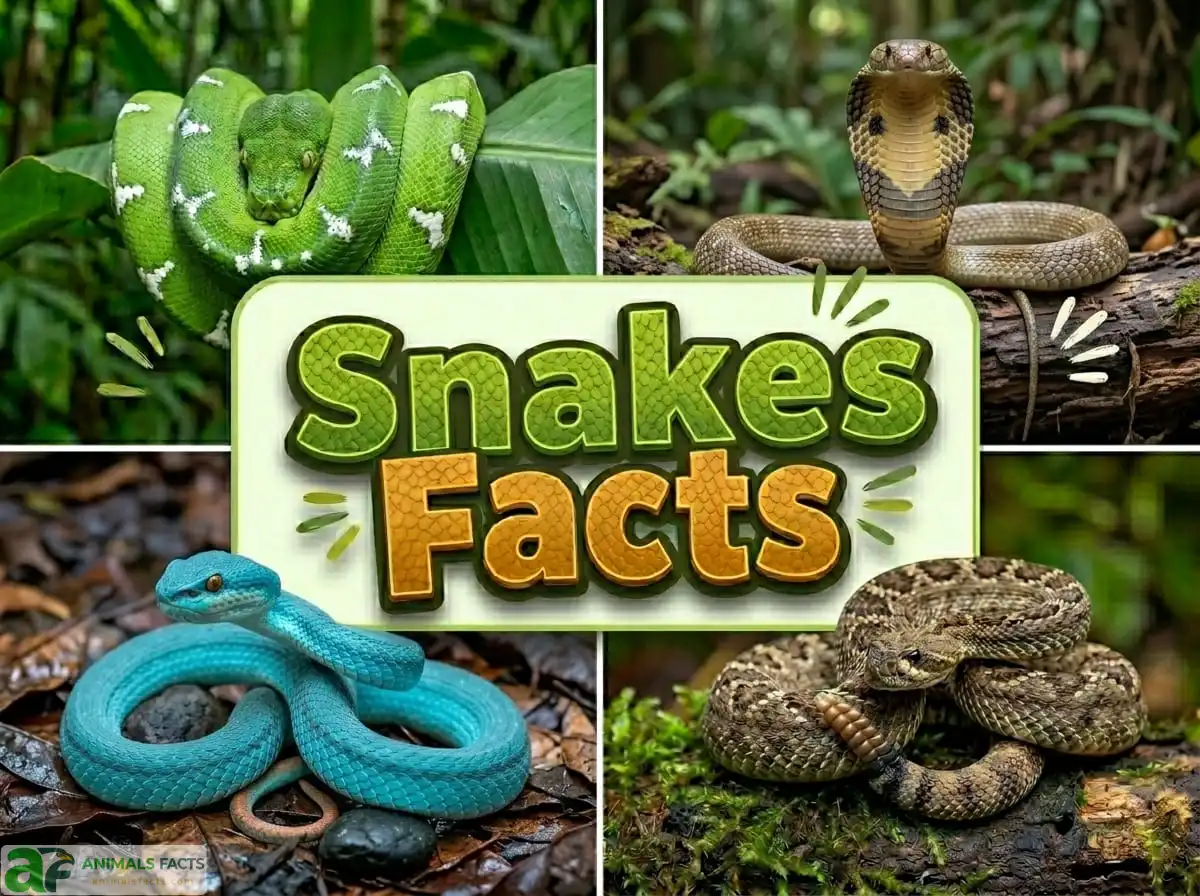
11. Snake Facts for Kids
Hey kids – are you ready to discover why snakes are actually some of the most amazing and important animals on Earth? Forget the scary stuff – the truth about snakes is way more interesting than any scary story!
- Snakes smell with their tongues! That flickering tongue is collecting tiny smell particles from the air and delivering them to a special smelling organ in the roof of their mouth!
- The longest snake in the world — the Reticulated Python — can be longer than a school bus!
- Rattlesnakes make their rattle sound by shaking a set of hollow keratin segments at the end of their tail — they are basically playing natural maracas to warn you away!
- Snakes never stop growing — they keep getting longer and longer throughout their entire lives, which is why they have to shed their skin regularly to make room!
- The Paradise Flying Snake can glide through the air between trees by flattening its body into a special shape — it can travel 10 meters through the air between tree branches!
- Some snakes in Canada hibernate together in huge groups — up to 8,000 snakes sleep through winter in the same underground cave!
- The smallest snake in the world — the Barbados Threadsnake — is thinner than a strand of spaghetti and only 10 centimeters long!
- Snake venom has saved millions of human lives — scientists have made incredibly important medicines from snake venom that help people with heart disease, high blood pressure, and pain!
Did You Know? Snakes are actually incredibly useful to farmers! A single snake living near a farm can eat hundreds of rats and mice every year — protecting crops that would otherwise be destroyed by rodents. In fact, scientists estimate that snakes save farmers in the United States billions of dollars in food protection every year. So the next time you see a snake in a garden, remember — that snake might be protecting your food supply!
12. Relationship with Humans
The relationship between humans and snakes is one of the most ancient, most contradictory, and most consequential in all of human history — simultaneously generating profound reverence and paralyzing terror, yielding life-saving medicines and causing tens of thousands of deaths annually.
Snakebite – A Global Health Crisis
Snakebite envenomation is classified by the World Health Organization as a Neglected Tropical Disease — the only animal interaction to receive this designation, reflecting the extraordinary public health burden it represents.
Global snakebite statistics:
- Approximately 5.4 million snakebites occur annually worldwide
- Approximately 1.8–2.7 million result in envenomation (venom injection)
- Approximately 80,000–138,000 deaths per year — with estimates varying widely due to underreporting in low-income countries
- Approximately 400,000 survivors suffer permanent disabilities — amputations, blindness, neurological damage — from snakebite annually
- The vast majority of deaths and serious injuries occur in South Asia, Sub-Saharan Africa, and Southeast Asia — regions where agricultural workers encounter venomous snakes in rice paddies, fields, and forests, often without access to antivenom
The Big Four venomous snakes responsible for the majority of snakebite deaths in South Asia are: Indian Cobra (Naja naja), Common Krait (Bungarus caeruleus), Russell’s Viper (Daboia russelii), and Saw-scaled Viper (Echis carinatus).
Snakes in Medicine
Snake venoms are one of the most actively researched sources of bioactive compounds in modern pharmacology:
Captopril — an ACE inhibitor treating high blood pressure and heart failure — derived from the venom of the Brazilian Lancehead Viper (Bothrops jararaca). It is one of the most widely prescribed cardiovascular drugs in the world.
Eptifibatide — a platelet aggregation inhibitor preventing blood clots and heart attacks — derived from the venom of the Pygmy Rattlesnake (Sistrurus miliarius).
Tirofiban — another antiplatelet agent for acute coronary syndrome — derived from the venom of the Saw-scaled Viper (Echis carinatus).
Batroxobin — a thrombin-like enzyme from Bothrops snake venom — used clinically to control bleeding during surgery in several countries.
Ziconotide — derived from cone snail venom (not a snake, but related research), used for severe chronic pain unresponsive to morphine.
Traditional Use of Snakes
Across many cultures, snakes have been used for food, traditional medicine, leather goods, and religious ritual:
Food: Snake meat is consumed in China, Vietnam, Indonesia, West Africa, Mexico, and other regions — with Cobra and Python particularly prized. The snake wine of Southeast Asia — liquor with a whole snake submerged inside — is sold as a traditional health tonic.
Traditional medicine: Snake bile, blood, and venom feature in traditional medical systems across Asia and Africa — with claimed but scientifically unverified benefits for numerous conditions.
Leather: Snake skin — particularly Python, Boa, and Cobra — has been used for luxury goods (shoes, handbags, belts) for centuries, driving significant commercial collection pressure.
13. Snake Conservation Status & Threats
Snakes are among the most persecuted and least-protected groups of vertebrates in the world — facing a global conservation crisis driven primarily by human fear and misunderstanding, habitat loss, and commercial exploitation.
Global Snake Conservation Data (2026)
| IUCN Category | Number of Snake Species |
|---|---|
| Critically Endangered | 50+ |
| Endangered | 80+ |
| Vulnerable | 100+ |
| Near Threatened | 70+ |
| Data Deficient | 1,000+ (most species never formally assessed) |
| Extinct since 1500 | ~15 confirmed |
Major Threats to Snakes
Direct Persecution: The single most widespread cause of snake death — humans kill snakes on sight out of fear with extraordinary frequency worldwide. Millions of harmless snake species are killed annually by people who mistake them for venomous species or simply kill every snake they encounter. This persecution falls disproportionately on large-bodied harmless species (which are most visible and most alarming) — including many pythons, boas, and large constrictors that are ecologically important.
Habitat Loss: Deforestation, agricultural expansion, wetland drainage, and urban development destroy the habitats that snakes depend on for prey, shelter, and overwintering sites. Many specialist snakes — particularly arboreal species and island endemics — are critically threatened by the loss of specific habitat types.
Road Mortality: Snakes thermoregulating on warm road surfaces are killed in enormous numbers by vehicles globally. Studies have documented that road networks through forested areas can effectively eliminate snake populations from large surrounding areas through sustained mortality.
Commercial Collection: Snakes are collected commercially for food, leather, traditional medicine, and the pet trade at enormous scale. The global Python skin trade involves hundreds of thousands of wild-caught Reticulated and Burmese Pythons annually — despite CITES listing and trade regulations.
Invasive Species: The Brown Tree Snake (Boiga irregularis) — accidentally introduced to Guam after World War II — eliminated 12 of 18 native forest bird species and devastated lizard populations on the island through predation. Conversely, invasive Burmese Pythons established in the Florida Everglades since the 1990s (released by pet owners) have caused catastrophic declines in native mammal populations, with up to 99% reduction in some species.
Climate Change: Changing temperatures affect snake thermoregulation, reproduction, and prey availability. High-altitude and high-latitude snake populations face habitat range contraction as climate shifts.
Did You Know? The King Cobra — the world’s longest venomous snake and a species of enormous cultural significance across Southeast Asia — has declined so dramatically from habitat loss and collection across its range that the IUCN reclassified it from Vulnerable to Endangered in 2022. This reclassification — driven by evidence of population declines exceeding 30% over three generations — made the King Cobra’s situation one of the most urgent large snake conservation priorities in Asia.
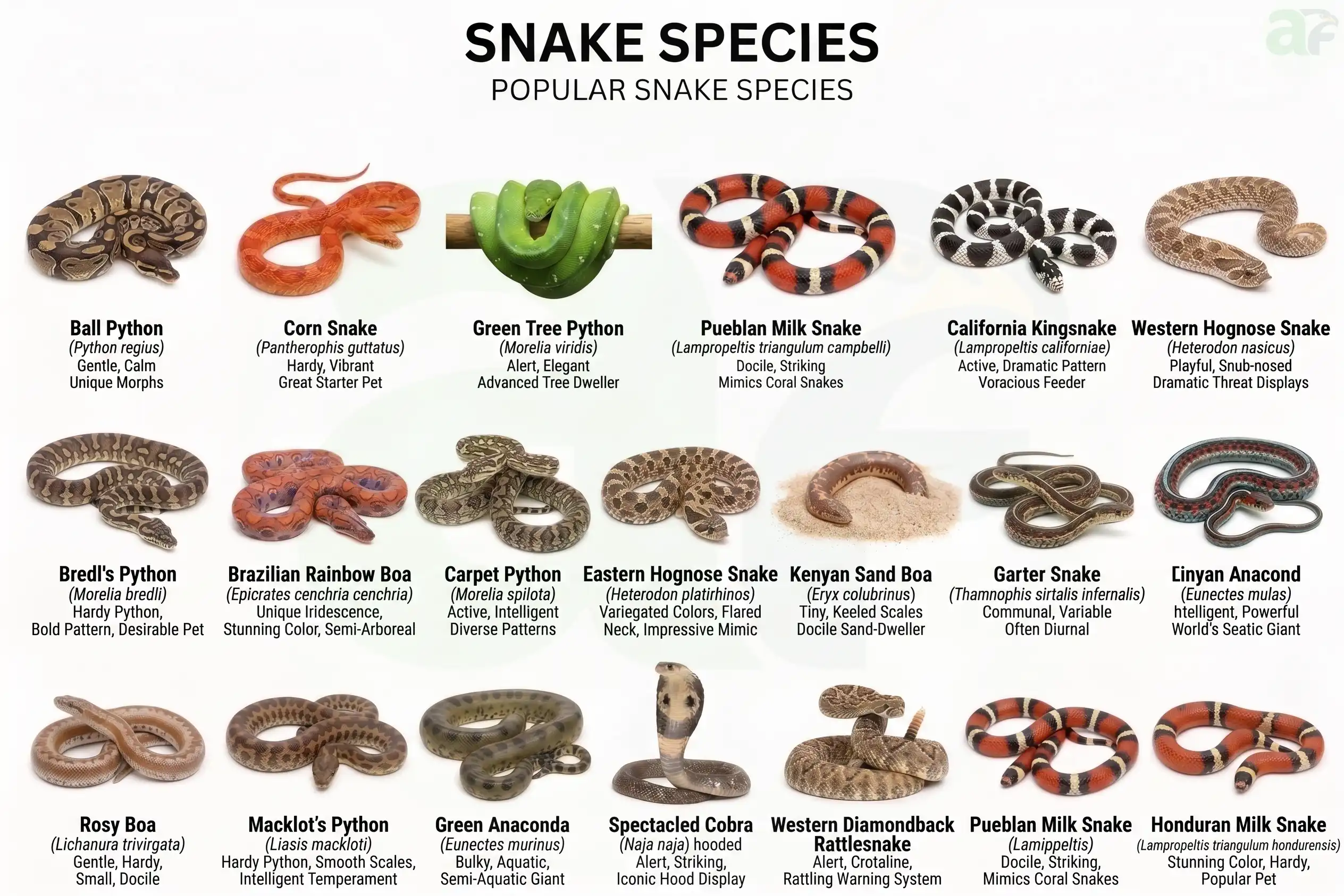
14. Famous Snakes
Titanoboa – The Snake That Ruled the Paleocene
Titanoboa cerrejonensis — known only from fossils discovered in the Cerrejón coal mine of northern Colombia in 2009 — was the largest snake ever to exist. Estimated at approximately 13 meters in length and over 1,135 kilograms in weight, Titanoboa lived approximately 58–60 million years ago in the tropical forests of Paleocene South America. Its enormous size required ambient temperatures significantly higher than modern tropical environments — making it one of the most valuable biological thermometers for understanding ancient climate. A full-scale Titanoboa model toured natural history museums worldwide — generating widespread public fascination with prehistoric snake life.
Julius Squeezer – The Burmese Python of the Florida Everglades
While no single python became individually famous, the Burmese Python invasion of the Florida Everglades became one of the most widely covered wildlife stories in North America. Beginning with escaped or released pet pythons in the 1990s and accelerating dramatically in the 2000s, the established Burmese Python population has caused documented declines of 85–99% in some native mammal species — including raccoons, opossums, bobcats, rabbits, and white-tailed deer. The Florida Python Challenge — an annual authorized python removal competition – has captured thousands of pythons and brought global media attention to the ecological consequences of irresponsible exotic pet releases.
Nagini – The Cultural Snake
Nagini — the serpent companion of the dark wizard Lord Voldemort in J.K. Rowling’s Harry Potter series — became one of the most famous fictional snakes in modern literary and cinema history. Portrayed as an enormous, intelligent, and deeply sinister snake capable of human transformation, Nagini’s character drew heavily on South and Southeast Asian Naga mythology — divine serpent beings of Hindu and Buddhist tradition. Her depiction reached global audiences through seven films and generated significant public discussion about the cultural representation of snakes.
Rikki-Tikki-Tavi’s Adversaries – Nag and Nagaina
In Rudyard Kipling’s 1894 story “Rikki-Tikki-Tavi” – part of The Jungle Book — the cobras Nag and Nagaina serve as the primary antagonists to the heroic mongoose. The story — one of the most widely read short stories in English literature — captured the mongoose-cobra dynamic with remarkable accuracy for its era and introduced generations of English-speaking readers to the real ecology of cobra predation and mongoose immunity.
The Anaconda of the 1997 Film
The enormous fictional Anaconda of Luis Llosa’s 1997 horror film “Anaconda” — while entirely fictional in its depicted size and behavior — introduced the Green Anaconda to global popular culture as the archetypal massive snake monster, generating decades of public fascination with the world’s heaviest snake. The film spawned multiple sequels and significantly increased public interest in real Anaconda biology.
15. Role in Ecosystem & Food Chain
Snakes play irreplaceable ecological roles that go largely unappreciated — and the consequences of their removal from ecosystems, wherever it has occurred, have been dramatic and costly.
Rodent Control – A Billion-Dollar Service
The single most economically significant ecological service provided by snakes is rodent population control. Snakes — particularly rat snakes, kingsnakes, bull snakes, and many viper species — consume enormous quantities of rodents annually. Studies estimating the economic value of snake-mediated rodent control to agriculture run into billions of dollars annually in the United States alone.
A single Eastern Diamondback Rattlesnake territory can encompass several farm fields — consuming dozens of rodents per year and preventing crop damage that would otherwise require expensive pesticide application. The systematic persecution of rattlesnakes across the American South — through rattlesnake roundups that kill tens of thousands of animals annually — has demonstrably increased rodent crop damage in affected areas.
The India Case Study
Studies in agricultural India — where snake persecution and habitat loss have dramatically reduced snake populations in farming areas — have documented corresponding increases in rodent crop damage and rodent-borne disease transmission (particularly leptospirosis and rat-bite fever). The correlation between declining snake populations and increasing rodent-related agricultural losses represents one of the most compelling demonstrations of snake ecological value in scientific literature.
Trophic Position
Snakes occupy multiple positions in food webs simultaneously — functioning as mid-level predators in most ecosystems. They consume prey species (rodents, frogs, birds) at one level while being consumed by eagles, mongooses, large cats, and other predators at another. This dual role makes them critical “middlemen” in energy flow through terrestrial ecosystems.
Sea snakes occupy a similar mid-level trophic position in coral reef and pelagic ocean food webs — consuming fish and eels while serving as prey for sharks, sea eagles, and large reef fish.
16. Snake Myths, Folklore & Cultural Significance
No animal in the history of human mythology has been more universally present, more symbolically diverse, or more emotionally charged than the snake. From the oldest religious texts ever written to the most recently published novels, the snake appears as a symbol of creation, destruction, wisdom, evil, healing, fertility, and immortality — often simultaneously, within the same cultural tradition.
The Garden of Eden
The snake in the Book of Genesis — whose temptation of Eve in the Garden of Eden is one of the most analyzed passages in all of world literature — established the serpent’s association with deception, forbidden knowledge, and the fall of humanity in the Western Christian, Jewish, and Islamic traditions. This single narrative has had an incalculable impact on Western cultural attitudes toward snakes — contributing significantly to the fear and persecution of snakes across centuries of European and European-influenced civilization.
Ancient Egypt
The Uraeus — a rearing cobra depicted on the headdress of every Egyptian Pharaoh — was the symbol of divine authority, protection, and the power of the sun god Ra. The cobra goddess Wadjet was one of the oldest deities in the Egyptian pantheon — patron of Lower Egypt and protector of the Pharaoh. The Egyptian Cobra (Naja haje) was believed to spit fire and was associated with the sun’s transformative power.
The Ouroboros — a serpent devouring its own tail — is one of the oldest symbols in recorded human culture, appearing first in ancient Egyptian iconography and later adopted into Greek, Norse, alchemical, and modern symbolic traditions as a representation of infinity, cyclical time, and the unity of all things.
Hindu and Buddhist Traditions
The Naga — divine serpent beings — are among the most important and most positively depicted supernatural entities in Hindu and Buddhist cosmological systems. In Hinduism, Shesha (Ananta) — the infinite cosmic serpent — forms the bed on which the god Vishnu reclines between universes. Vasuki — another cosmic serpent — was used as the rope in the Churning of the Cosmic Ocean that produced the nectar of immortality. Shiva wears cobras as ornaments — symbols of mastery over death and time.
In Buddhist tradition, the Naga King Mucalinda sheltered the meditating Siddhartha Gautama (Buddha) from a rainstorm with his hood — one of the most frequently depicted scenes in early Buddhist art. Naga beings are considered protectors of Buddhist teachings and are depicted throughout temple architecture across Thailand, Cambodia, Laos, and Sri Lanka.
The Rod of Asclepius
The Rod of Asclepius — a serpent entwined around a staff — is the global symbol of medicine and healthcare. In Greek mythology, Asclepius was the god of medicine and healing — always depicted with his serpent staff. The association between snakes and healing reflects the snake’s ancient symbolic connection to renewal (through skin shedding), wisdom, and access to the underworld (where healing plants were believed to originate). The Rod of Asclepius (one serpent on one staff) remains the most widely used medical symbol worldwide — distinct from the Caduceus (two serpents, associated with Hermes/Mercury) which is used mainly in US military medicine through a historical error.
17. Snakes in Pop Culture
From ancient mythology to billion-dollar film franchises, snakes have inspired human creative culture with a consistency and emotional power matched by very few other animals.
Film
“Anaconda” (1997) — One of the most commercially successful creature-feature films of the 1990s; established the Giant Anaconda as a popular culture monster archetype and generated enduring public fascination with the world’s heaviest snake. Its four sequels demonstrate the sustained commercial appeal of giant snake narratives.
“Snakes on a Plane” (2006) — Samuel L. Jackson’s internet-phenomenon action film became one of the most memed films of the 2000s and spawned an entire cultural moment. Despite its absurdist premise, the film drew genuine attention to snake diversity and to the fear responses snakes generate.
“Indiana Jones and the Raiders of the Lost Ark” (1981) — Harrison Ford’s famous ophidiophobia (fear of snakes) became one of the most celebrated character traits in action cinema. The snake pit scene — featuring thousands of Egyptian Cobras and Pythons — cemented the snake as the definitive cinema symbol of ancient danger and primal fear.
“The Jungle Book” (1967 & 2016 Disney adaptations) — Kaa the hypnotic python is one of the most recognizable snake characters in animation — though the character significantly differs from Kipling’s original, more ambiguously portrayed Kaa.
Literature
“Rikki-Tikki-Tavi” by Rudyard Kipling (1894) — One of the most widely read short stories featuring snakes in English literature; the cobras Nag and Nagaina remain among the most memorable snake characters in children’s literature.
“Harry Potter” series by J.K. Rowling (1997–2007) — Nagini, Voldemort’s serpent companion, and the entire mythology of Parseltongue (the magical ability to speak with snakes) drew heavily on global snake mythology and introduced snake symbolism to a new generation of readers worldwide.
“The White Tiger” by Aravind Adiga (2008, Booker Prize) — Uses snake symbolism extensively as a metaphor for social hierarchy and the coiled, suppressed violence of India’s caste system.
Video Games & Digital Culture
“Snake” — the pre-installed mobile phone game that introduced millions of people globally to their first digital gaming experience on Nokia mobile phones from 1997 onward — is arguably the most widely played simple video game in history and arguably the most culturally impactful snake-themed digital product ever created.
Solid Snake of the Metal Gear Solid franchise — one of the most celebrated video game protagonists in history — carries the snake name through the entire mythology of the series.
18. Snake Facts vs. Common Myths
Myth: Snakes are slimy. Fact: Snake skin is completely dry — covered in smooth or keeled scales with no external moisture or mucus secretion. The apparently shiny surface of many snakes reflects light from their smooth scales — it is not moisture. Many people who have touched snakes for the first time are surprised by how dry and warm their skin feels.
Myth: All snakes are venomous and dangerous. Fact: Of approximately 3,700 snake species, only about 600 are venomous to any meaningful degree, and approximately 200 are capable of delivering a potentially lethal bite to humans. The remaining 3,100+ species are completely harmless to humans.
Myth: A snake can chase a human and outrun them. Fact: The Black Mamba — the world’s fastest snake — reaches approximately 20 km/h on flat terrain in short bursts. An average adult human can jog at 12–15 km/h and sprint at 24–28 km/h. No snake on Earth is capable of chasing or outrunning a healthy adult human who is actually running. Virtually all snake “chases” are defensive behaviors — snakes fleeing humans who are following them.
Myth: Snakes hypnotize their prey before striking. Fact: Snakes do not hypnotize prey. The apparent “frozen” state of prey animals during a snake encounter is a fear paralysis response — a common involuntary behavioral response of many small animals when a predator is detected too close to escape. It is the prey’s own nervous system, not any snake ability, that causes this behavior.
Myth: Baby snakes are more dangerous than adults because they cannot control their venom. Fact: This is a widely repeated myth with no scientific basis. Snakes of all ages have complete muscular control over their venom injection. However, juvenile venomous snakes may inject venom in a higher proportion of defensive bites (compared to the dry bites that many adult venomous snakes deliver in defensive encounters) — but the absolute quantity of venom delivered by a juvenile is dramatically less than an adult of the same species.
Myth: Rattlesnake rattles indicate age — one rattle segment per year. Fact: Rattle segments are added each time a rattlesnake sheds its skin — typically 2–4 times per year depending on food availability, temperature, and growth rate. The number of rattle segments cannot reliably indicate age.
Myth: A dead snake cannot bite. Fact: This is dangerously false. The severed head of a venomous snake can deliver a reflexive bite and inject venom for up to one hour after death — the bite reflex is controlled by the spinal cord and continues functioning after the brain has stopped. Several documented envenomations have occurred from contact with the severed heads of recently killed venomous snakes.
19. Best Places to See Snakes in the Wild
Everglades National Park, Florida, USA
Home to both native venomous species — Eastern Diamondback Rattlesnakes, Cottonmouths (Water Moccasins), Dusky Pygmy Rattlesnakes, and Coral Snakes — and the now-established invasive Burmese Python population. Airboat tours and hiking through sawgrass prairies and cypress swamp provide opportunities to observe multiple snake species in a remarkable subtropical wilderness setting.
Chitwan National Park, Nepal
One of the finest locations in Asia for observing Indian Cobras, King Cobras, Common Kraits, Russell’s Vipers, and the enormous Indian Rock Python in their natural jungle and grassland habitat. Guided walks with experienced naturalists provide safe, educational snake viewing alongside incredible wildlife — including rhinoceros, tigers, and elephants.
Amazon Basin, Brazil & Peru
The most snake-diverse region on Earth — night walks through primary Amazon rainforest with professional herpetologist guides reveal extraordinary diversity including Boa Constrictors, Anacondas, Coral Snakes, Fer-de-Lance, Bush Masters, and dozens of non-venomous colubrid species. Yasuni National Park in Ecuador and Manu National Park in Peru are premier locations.
Manitoba Snake Dens, Canada
The Narcisse Snake Dens of Manitoba, Canada, host the world’s largest snake aggregation — up to 75,000 Red-sided Garter Snakes emerge from communal winter dens each spring (typically late April/early May) and form spectacular mating aggregations. The Manitoba Wildlife Branch runs public viewing programs making this one of the most accessible large snake wildlife spectacles on Earth.
Komodo Island, Indonesia
While famous primarily for Komodo Dragons, the island also supports significant populations of Reticulated Pythons, Cobras, and other snake species. The surrounding Lesser Sunda Islands have extraordinary snake diversity including numerous endemic species.
Raja Ampat & Banda Sea, Indonesia — Sea Snakes
For those fascinated by marine snakes, the Banda Sea and Raja Ampat archipelago of Indonesia are among the best locations to observe Banded Sea Kraits, Olive Sea Snakes, and Yellow-lipped Sea Kraits in their natural reef habitat during snorkeling and diving excursions.
20. Top Documentaries & Books
Must-Watch Documentaries
“Planet Earth II — Islands” (BBC, 2016) — The legendary sequence of Galápagos Racer Snakes pursuing Marine Iguana hatchlings across lava fields is widely described as the greatest wildlife sequence ever filmed on television — a masterpiece of natural history filmmaking featuring some of the most dramatic snake behavior ever captured on camera.
“David Attenborough’s Life in Cold Blood” (BBC, 2008) — The definitive television documentary on reptile biology includes extraordinary snake coverage — from hunting behavior to reproduction to venom delivery — filmed with unprecedented intimacy and technical quality.
“Venom: Nature’s Killer” (National Geographic) — A compelling exploration of venomous snake biology, venom pharmacology, and the medical importance of snake venoms — one of the finest popular documentaries on snake venom science available.
“The Rat Snakes” (BBC Natural World) — An intimate portrait of the ecological role of non-venomous rat snakes in Asian and North American ecosystems — demonstrating the extraordinary importance of these often-overlooked species as rodent controllers.
“Giant Anaconda: Queen of the Amazon” (National Geographic) — An exceptional documentary on the biology, behavior, and ecology of the world’s heaviest snake in its Pantanal and Amazon habitat.
Essential Books
“The Life of a Serpent” by various authors — Multiple acclaimed volumes have explored snake natural history, including Harry Greene’s “Snakes: The Evolution of Mystery in Nature” (1997) — arguably the most beautiful and scientifically comprehensive book on snakes ever published for a general audience.
“Venom: The Secrets of Nature’s Deadliest Weapon” by Ronald Jenner and Eivind Undheim (2017) — A beautifully illustrated, scientifically rigorous exploration of venom evolution, chemistry, and medical applications across snakes and other venomous animals.
“The King of Snakes: The Natural History of the King Cobra” by various authors — Several volumes explore the remarkable biology of the world’s longest venomous snake and the conservation challenges facing it.
“Snakebite: A Story of People, Venom, and a Race to Develop the World’s Most Needed Medicine” by Brendan Borrell (2022) — A compelling narrative exploration of the global snakebite crisis, antivenom development, and the extraordinary people working to address one of the world’s most neglected public health emergencies.
21. Comparison of Major Snake Groups
| Feature | Pythons | Vipers | Elapids (Cobras/Mambas) | Colubrids | Sea Snakes |
|---|---|---|---|---|---|
| Species Count | ~40 | ~330 | ~360 | ~1,800 | ~70 |
| Venom | None | Yes (hemotoxic/cytotoxic) | Yes (neurotoxic) | Most non-venomous; some rear-fanged | Yes (neurotoxic; highly potent) |
| Fang Type | No fangs | Hinged front fangs | Fixed front fangs | Rear fangs (some) or none | Fixed front fangs |
| Killing Method | Constriction | Envenomation | Envenomation | Constriction / swallowing alive | Envenomation |
| Distribution | Africa, Asia, Australia | Global (exc. Antarctica) | Africa, Asia, Australia, Americas | Global | Indian Ocean, Pacific Ocean |
| Largest Species | Reticulated Python (7.67m confirmed) | Bushmaster (3.6m) | King Cobra (5.5m) | Indigo Snake (2.6m) | Yellow-bellied Sea Snake (1.1m) |
| Lifespan | 20–47 years | 10–25 years | 10–28 years | 5–20 years | 5–10 years (estimated) |
| Conservation | Several threatened by skin trade | Many threatened; persecution | King Cobra Endangered | Mixed; many stable | Several Vulnerable |
| Unique Feature | Heat-sensing labial pits; primitive pelvic spurs | Hinged fangs; widest venom diversity | Hood spreading; active daytime hunters | Most diverse snake family; widest ecological range | Paddle tail; most venomous ocean snakes |
22. How You Can Help
Snake conservation is one of the most neglected areas in wildlife conservation — snakes receive a tiny fraction of the conservation funding and public sympathy directed to more charismatic species, despite facing comparable or greater threats. Here is what every person can do.
Support These Organizations
Save the Snakes (savethesnakes.org) — A US-based nonprofit dedicated exclusively to snake conservation through education, community engagement, and habitat protection programs worldwide.
Amphibian and Reptile Conservation Trust — ARC (arc-trust.org) — UK-based organization working to protect snakes and other reptiles through habitat management, citizen science, and public education.
The Center for Snake Conservation (snakeconservation.org) — Dedicated to snake research, education, and advocacy; runs community programs to reduce snake persecution through education about ecological roles and identification.
IUCN Boa and Python Specialist Group — Coordinates global conservation assessment and management recommendations for the world’s largest constrictors.
Wildlife SOS (wildlifesos.org) — Works in India to protect native snake species, rescue snakes from human conflict situations, and educate communities about the ecological importance of snakes.
Practical Actions
Never kill a snake on sight. The overwhelming majority of snakes encountered by humans are completely harmless. If you encounter a snake you cannot positively identify, leave it alone — all snakes will move away if given space and time. Call a professional snake relocator if a snake enters a building.
Learn to identify your local snake species. Knowing which snakes in your region are venomous (and which are not) eliminates both unnecessary fear and unnecessary killing. iNaturalist (inaturalist.org) has excellent snake identification tools and a global community of expert identifiers.
Never collect wild snakes for the pet trade. Always verify that captive snakes are captive-bred before purchase. Wild-caught snakes suffer significant mortality in transit and their collection depletes wild populations.
Support antivenom access advocacy. The global snakebite crisis is driven largely by lack of access to effective antivenom in low-income countries. Organizations including the Global Snakebite Initiative (globalsnakebiteinitiative.org) and Médecins Sans Frontières (MSF) campaign for improved antivenom access and affordability.
Participate in reptile citizen science. Submitting snake observations to iNaturalist, HerpMapper, and national reptile atlas projects contributes directly to snake distribution monitoring — helping scientists track population trends and identify areas needing conservation attention.
Oppose rattlesnake roundups. The rattlesnake roundup events held annually across several US states collect thousands of snakes using gasoline to flush burrows — killing snakes, contaminating habitats, and removing ecologically important animals. Support organizations working to replace these events with education-based wildlife festivals.
Did You Know? Scientists at the Liverpool School of Tropical Medicine and the Wellcome Sanger Institute are using genomics and synthetic biology to develop next-generation antivenoms that could replace current products — which are expensive, animal-derived, and often ineffective against geographically specific venom variants. If successful, these universal antivenoms could save tens of thousands of lives annually in the developing world. Supporting organizations funding snakebite research contributes directly to this life-saving work.
23. Frequently Asked Questions About Snakes
Q1: How many species of snakes exist?
As of 2026, approximately 3,700 snake species have been formally described worldwide. New species continue to be discovered at a rate of approximately 30–50 per year — primarily from tropical rainforests of Southeast Asia, the Amazon Basin, and the Congo Basin, where intensive herpetological survey work continues to reveal previously unknown species.
Q2: Are all snakes venomous?
No — the vast majority of snakes are not venomous. Of approximately 3,700 species, only about 600 are venomous to any meaningful degree, and only approximately 200 are capable of delivering a bite potentially lethal to humans. The remaining 3,100+ species are completely harmless and play important ecological roles as rodent and pest controllers.
Q3: What is the most dangerous snake in the world?
The answer depends on how “dangerous” is defined. The Inland Taipan has the most toxic venom of any land snake — but is shy, rarely encountered, and has no confirmed human fatalities. The Saw-scaled Viper and Russell’s Viper of Asia cause the most human deaths annually due to their abundance near human populations and their highly dangerous hemotoxic venom. The Black Mamba is widely considered the most dangerous in terms of combination of venom potency, speed, and defensive aggression. By total human deaths caused, Asian species — particularly Russell’s Viper — are responsible for the most fatalities.
Q4: Do snakes feel pain?
Yes — snakes have nociceptors (pain-detecting neurons) and spinal cord pain-processing pathways. Scientific evidence supports that snakes experience pain responses to tissue damage, though the subjective experience of pain in reptiles remains a subject of ongoing research and debate.
Q5: How long can snakes go without eating?
This varies enormously by species. Small snake species may need to feed every few days; medium-sized species typically feed every 1–3 weeks. Large pythons and boas can survive for 12–18 months without eating after consuming a large prey item — their extremely low metabolic rate and efficient nutrient utilization allows this extraordinary fasting capability.
Q6: Can snakes hear?
Snakes have no external ear openings and are functionally deaf to most airborne sounds. However, they detect ground vibrations with extraordinary sensitivity through their jawbones — which transmit vibrations to the inner ear. This ground-vibration detection is so sensitive that snakes can detect the footsteps of approaching humans or animals from several meters away. Snake charming does not involve the snake responding to music — it responds to the movement of the charmer’s instrument and body.
Q7: How do snakes swallow prey larger than their head?
Snakes do not “dislocate” their jaws — rather, the two halves of the lower jaw are connected by an elastic ligament (not fused as in most vertebrates), allowing them to spread apart independently. Combined with highly mobile skull bones and extremely elastic skin, this allows snakes to engulf prey up to three times their own head diameter by “walking” their two sides of the jaw alternately over the prey.
Q8: What should I do if bitten by a snake?
In case of snakebite: remain calm and still (movement speeds venom absorption); immobilize the bitten limb at or below heart level; remove constricting items (rings, watches, tight clothing near the bite); get to a hospital immediately — antivenom is the only effective treatment for serious envenomation. Do NOT cut and suck the bite (ineffective and harmful); do NOT apply a tourniquet; do NOT apply ice. Try to note the appearance of the snake for identification purposes, but do NOT attempt to capture or kill it.
Q9: Are snakes important for ecosystems?
Yes — enormously so. Snakes serve as critical rodent population controllers (saving billions in agricultural losses annually), as mid-level predators regulating prey populations throughout food webs, as prey species for eagles, mongooses, and other predators, and as indicators of ecosystem health. Their removal from ecosystems consistently produces negative cascading effects — particularly dramatic increases in rodent populations and associated crop damage and disease transmission.
Q10: How can I help snake conservation?
Key actions include: never killing snakes on sight; learning to identify local snake species using iNaturalist or field guides; opposing rattlesnake roundups and other snake persecution events; supporting organizations like Save the Snakes and the Center for Snake Conservation; contributing snake sightings to citizen science platforms; never purchasing wild-caught snakes as pets; and supporting antivenom access advocacy for the billions of people in developing countries at risk of snakebite.
24. Sources & References
Research Sources
- Wikipedia — Suborder Serpentes and individual species articles
- IUCN Red List — iucnredlist.org
- Save the Snakes — savethesnakes.org
- Center for Snake Conservation — snakeconservation.org
- Global Snakebite Initiative — globalsnakebiteinitiative.org
- World Health Organization — Snakebite envenomation — who.int
- National Geographic — nationalgeographic.com
- Smithsonian’s National Zoo — nationalzoo.si.edu
- Encyclopaedia Britannica — britannica.com/animal/snake
- BBC Wildlife — bbc.co.uk
- Live Science — livescience.com
- HerpMapper — herpmapper.org
- iNaturalist — inaturalist.org
- Greene, Harry — “Snakes: The Evolution of Mystery in Nature” (1997)
- Jenner, Ronald & Undheim, Eivind — “Venom: The Secrets of Nature’s Deadliest Weapon” (2017)
- Borrell, Brendan — “Snakebite” (2022)