
Axolotl Facts
| Feature | Details |
|---|---|
| Scientific Name | Ambystoma mexicanum |
| Common Name | Axolotl (also called Mexican Walking Fish) |
| Class | Amphibia |
| Order | Urodela |
| Family | Ambystomatidae |
| Native Habitat | Lake Xochimilco, Mexico City, Mexico |
| Lifespan | 10–15 years in captivity; 5–6 years in the wild |
| Diet | Carnivore — worms, insects, small fish, crustaceans |
| Conservation Status | Critically Endangered (IUCN Red List) |
| Body Length | 15–45 cm (6–18 inches) |
| Weight | 60–227 grams |
| Speed | Slow swimmer; moves in short bursts |
| Wild Population Estimate | Fewer than 1,000 individuals (possibly as low as 50–100 in the wild) |
| Unique Trait | Retains juvenile (larval) features throughout its entire life — a phenomenon called neoteny |
 1. Introduction: What is an Axolotl?
Imagine an animal that never truly grows up, can regrow a lost limb in a matter of weeks, and has been called one of the most scientifically important creatures on Earth. That animal is the axolotl — and axolotl facts are some of the most jaw-dropping in the entire animal kingdom.
Native to just one lake system in Mexico City, this extraordinary amphibian has fascinated scientists, artists, writers, and nature lovers for centuries. With its feathery external gills, permanent smile, and almost alien appearance, the axolotl looks like something straight out of a fantasy novel. Yet it is very real — and very much in danger of disappearing forever.
Whether you are a student searching for axolotl facts for a school project, a passionate nature enthusiast, or simply someone who stumbled across a photo of this remarkable creature and needed to know more — you are in exactly the right place. This article covers everything: axolotl habitat, axolotl diet, axolotl behavior, its role in science and culture, and what we can all do to help save it. Let us dive in.
2. Axolotl Species Overview & Classification
The axolotl belongs to the mole salamander family, making it a true amphibian — though it behaves unlike almost any other amphibian on the planet.
Species Classification Table
Kingdom: Animalia Phylum: Chordata Class: Amphibia Order: Urodela (Salamanders) Family: Ambystomatidae Genus: Ambystoma Species: A. mexicanum
The axolotl is the most well-known member of the genus Ambystoma, a group of salamanders native to North America. It is closely related to the tiger salamander (Ambystoma tigrinum), and the two species can even interbreed under certain conditions.
Unlike most amphibians, the axolotl does not undergo full metamorphosis. It remains in its larval aquatic form for life — a condition known as neoteny or paedomorphosis. This means adult axolotls still have gills, fins, and a fully aquatic lifestyle, much like a tadpole that never becomes a frog.
Species Evolution & Discovery Timeline
Ancient times: Axolotls lived throughout the lakes of the Valley of Mexico and were revered by the Aztec civilization.
1863: The first live axolotls were shipped from Mexico to Paris for scientific study.
1864: French naturalist Auguste Duméril became the first scientist to successfully breed axolotls in captivity in Paris.
1880s–1900s: Axolotls became widely used in European laboratories due to their extraordinary regenerative abilities.
1936: Scientists began detailed studies of axolotl limb regeneration.
1968: The axolotl genome project was initiated, eventually revealing one of the largest animal genomes ever sequenced.
2009: The IUCN officially listed the axolotl as Critically Endangered.
2013: A major field survey found fewer than 100 wild axolotls remaining in Lake Xochimilco.
2020s: Conservation breeding programs and lake restoration efforts were significantly intensified across Mexico.
3. Axolotl Physical Description & Unique Features
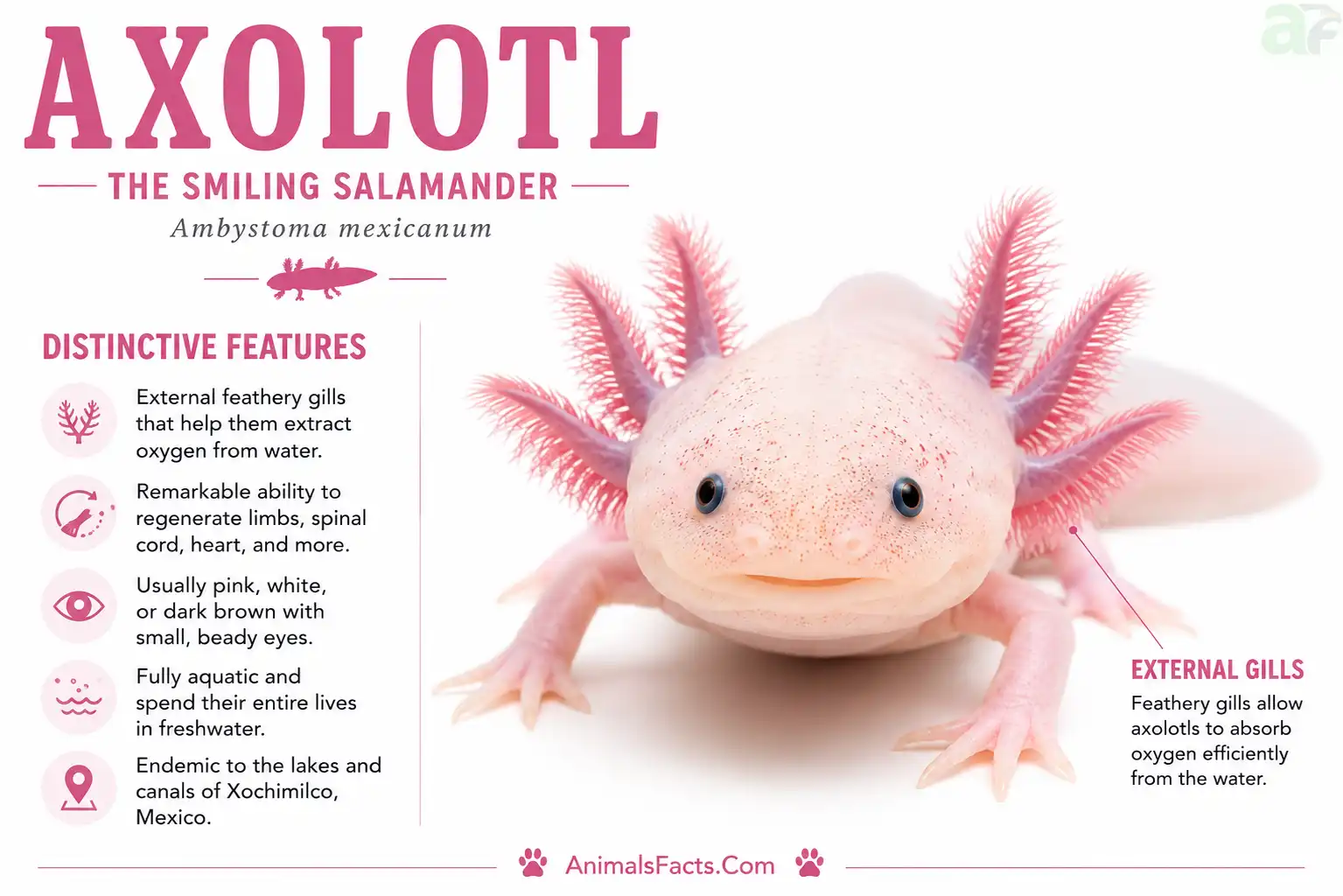
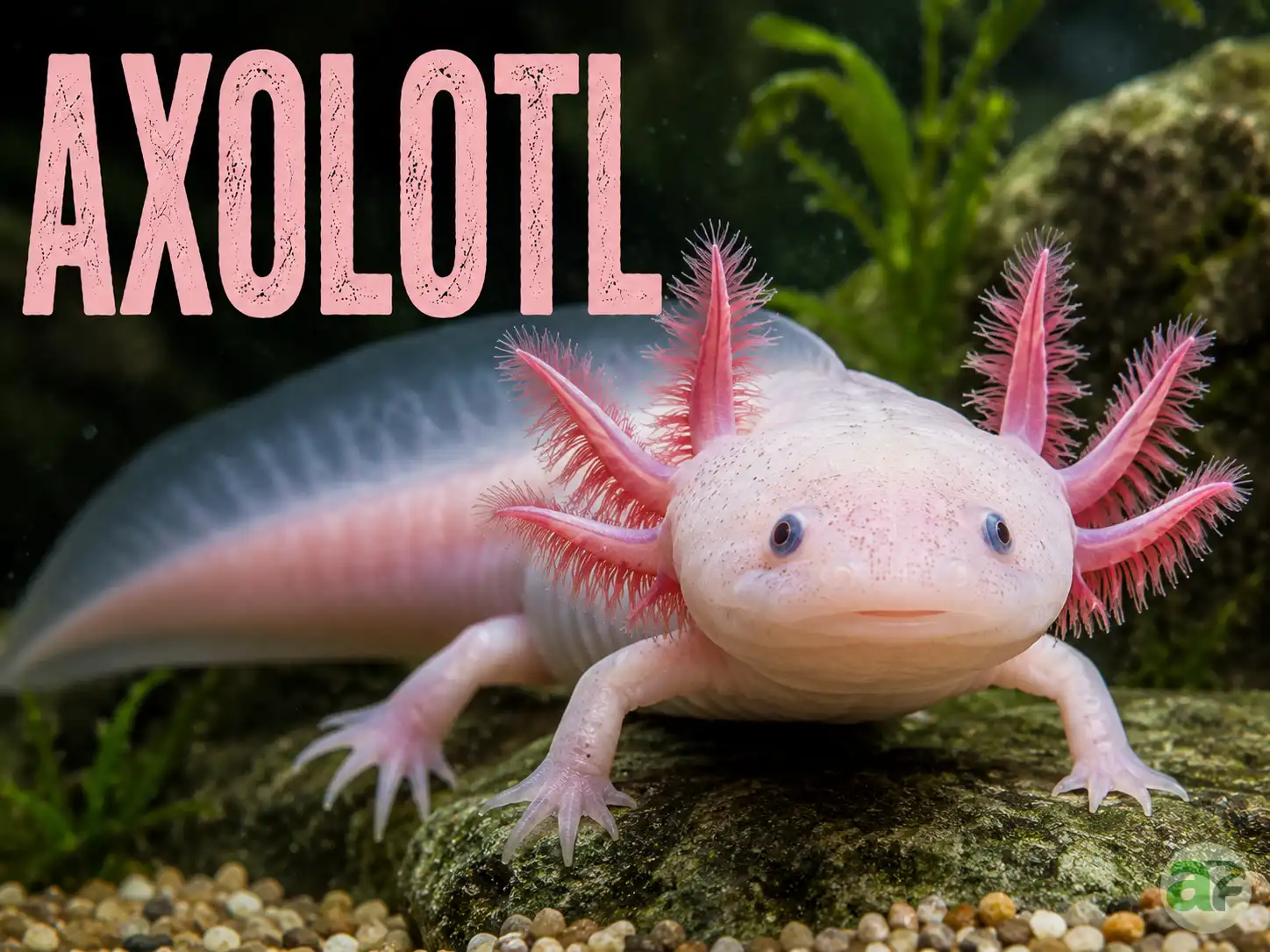
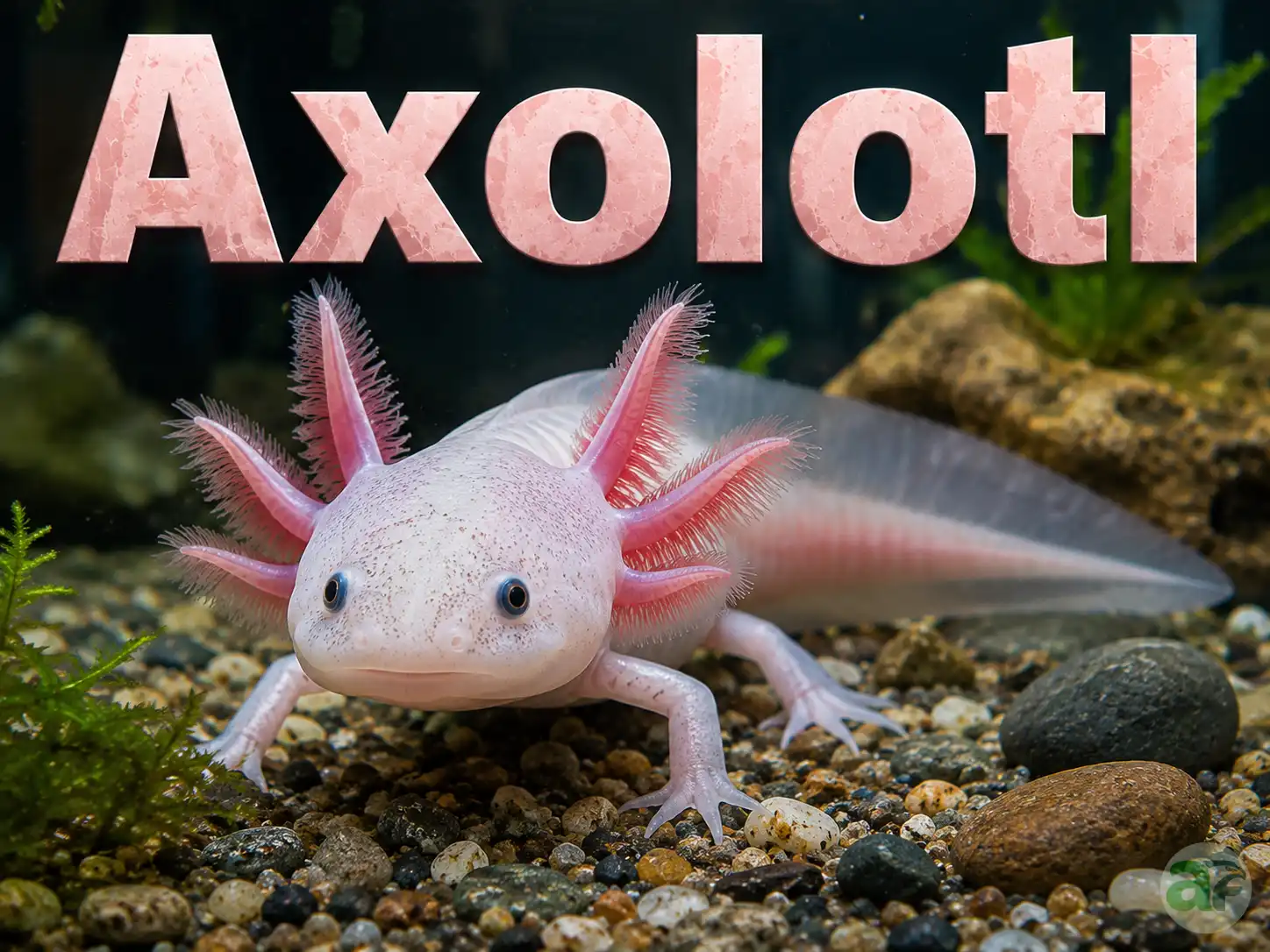
The axolotl is one of the most visually distinctive animals in the world. At first glance, it almost looks like it was designed by a cartoonist — with its wide flat head, permanent upturned mouth that gives it the appearance of always smiling, tiny lidless eyes, and most strikingly, its spectacular feathery external gills that fan out from the sides of its head like a natural crown.
Size & Appearance
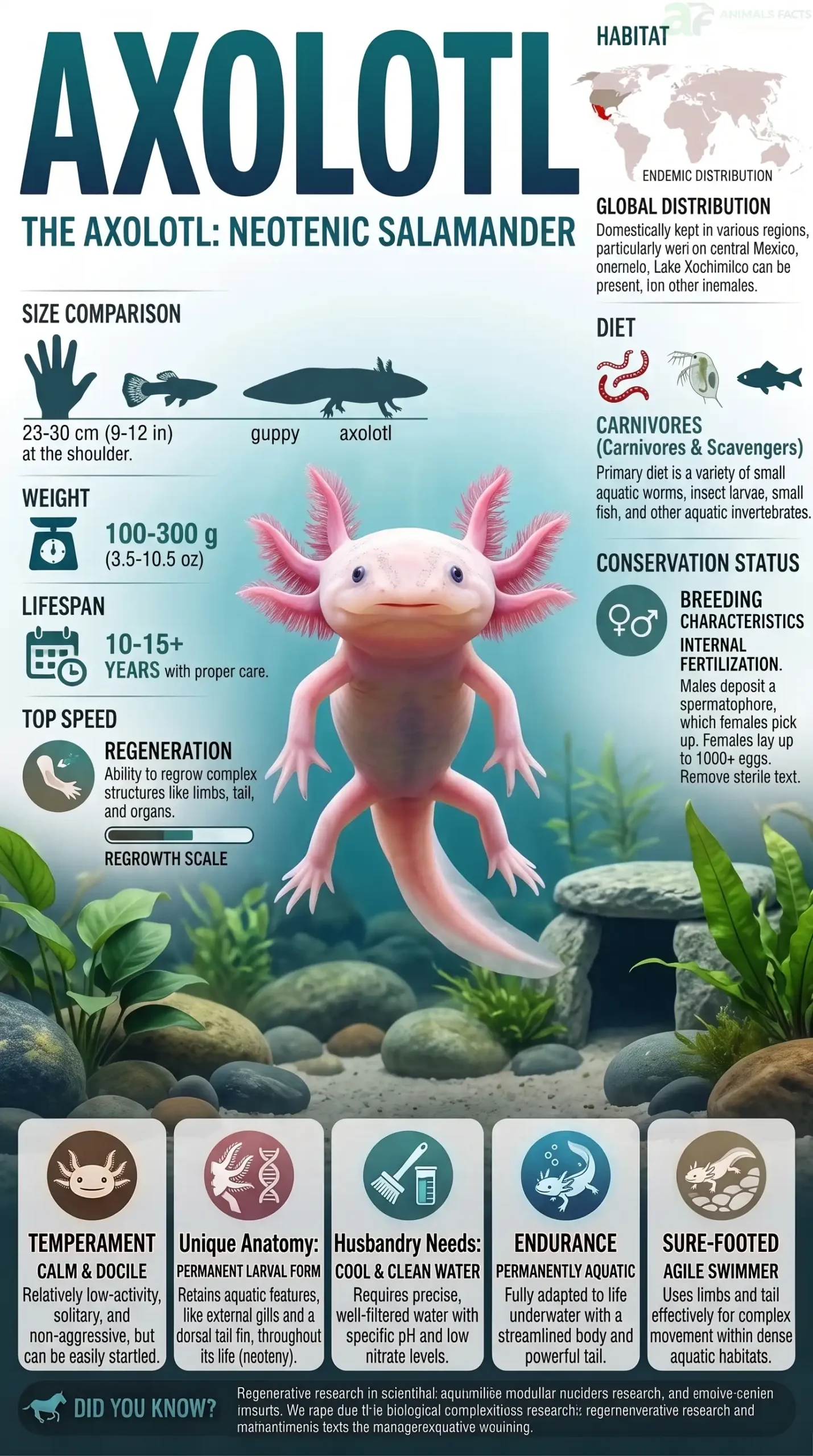
Adult axolotls typically grow between 15 and 45 centimeters in length, with the average sitting around 23–30 cm. They weigh between 60 and 227 grams. Males and females are similar in size, though females tend to be slightly plumper — especially when carrying eggs.
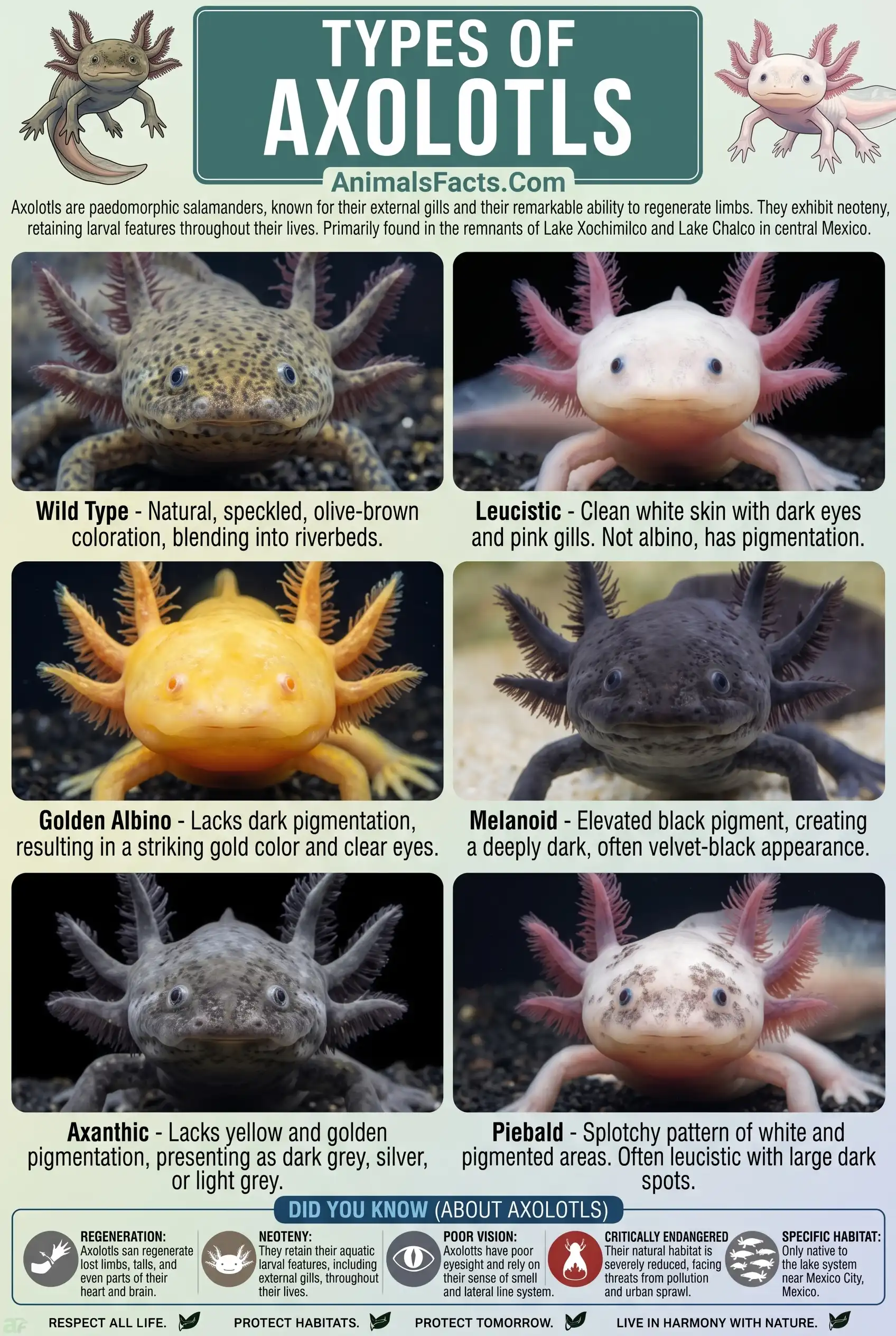
Axolotls come in a wide range of colors:
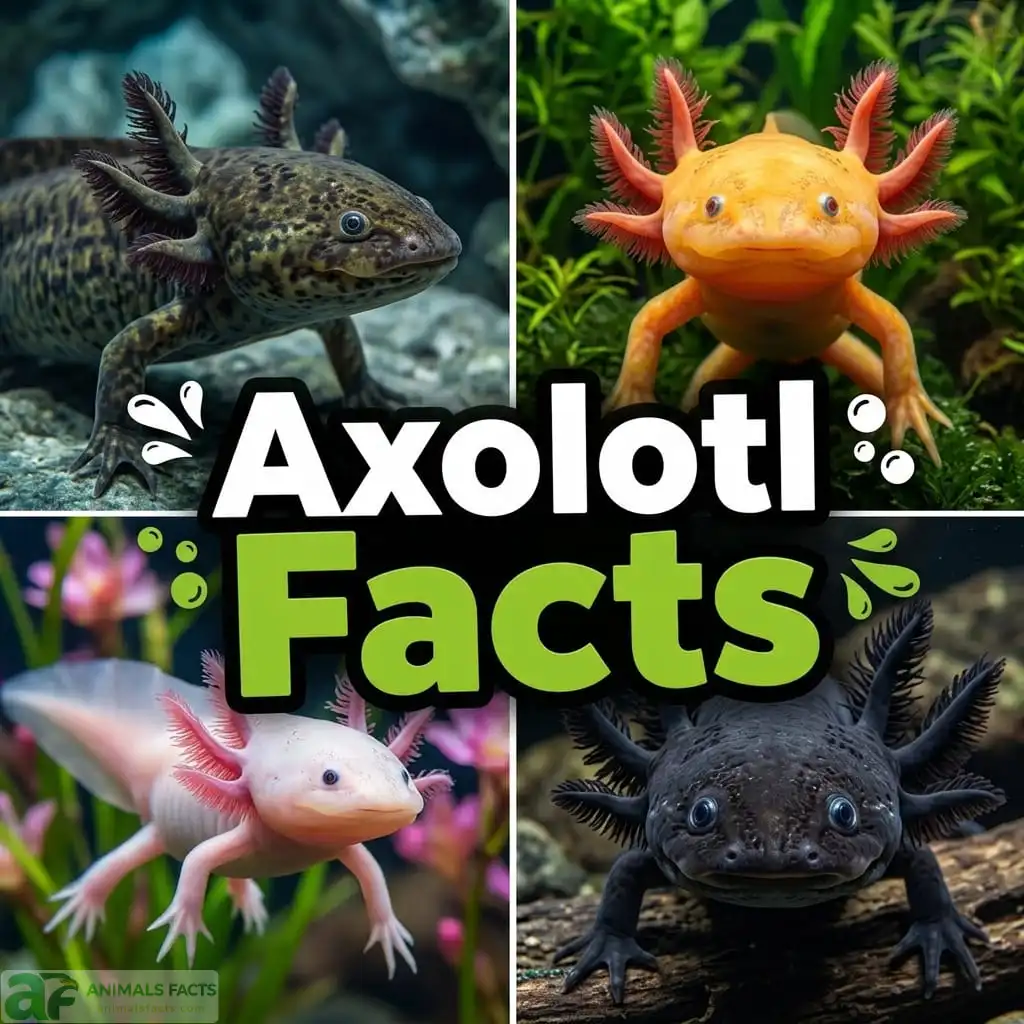
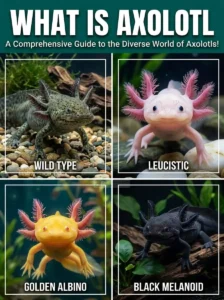
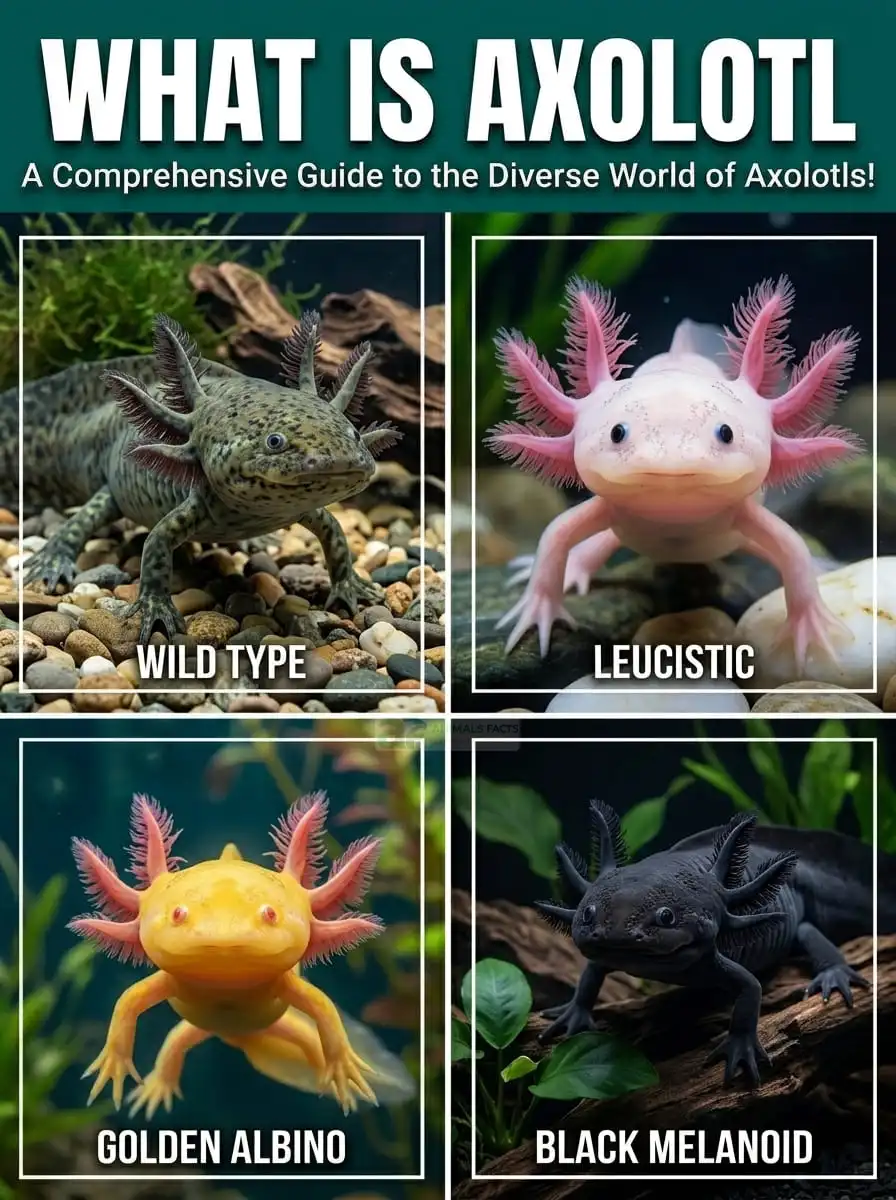
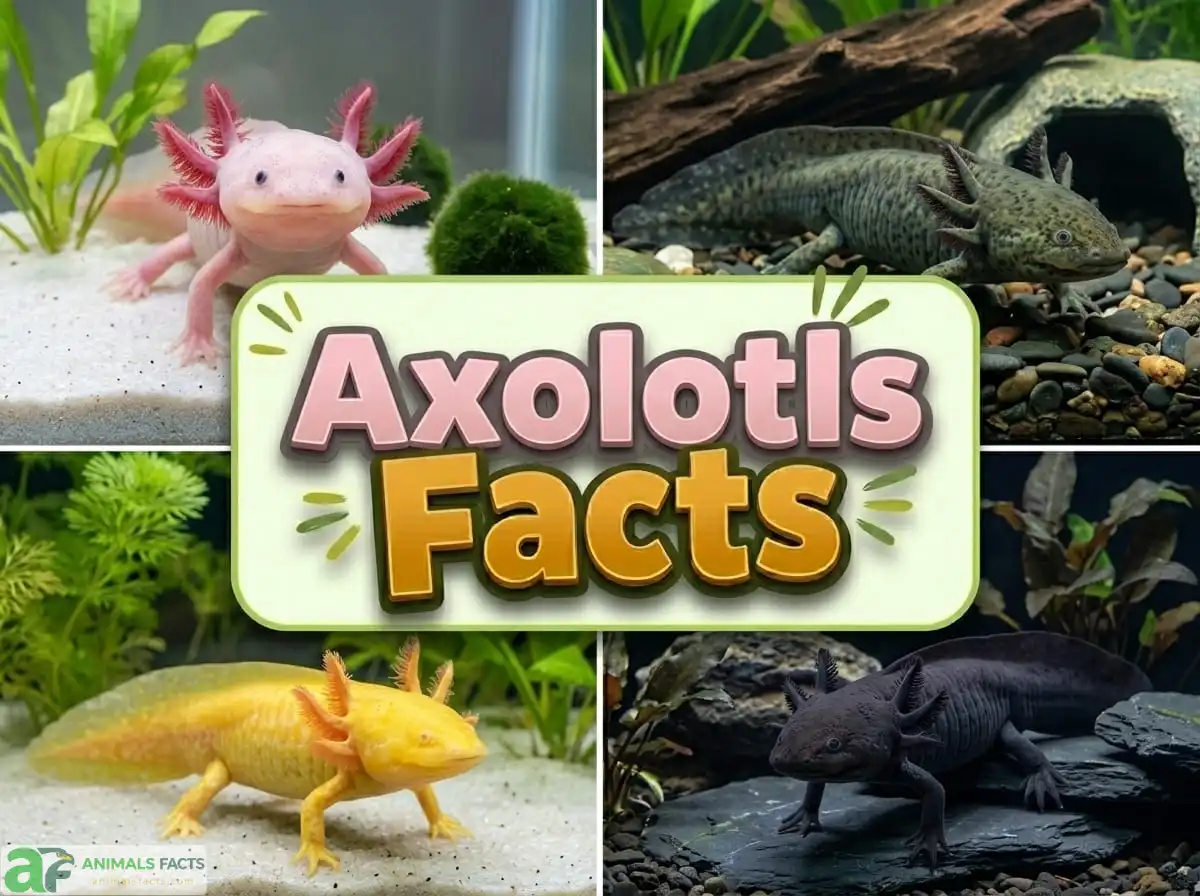
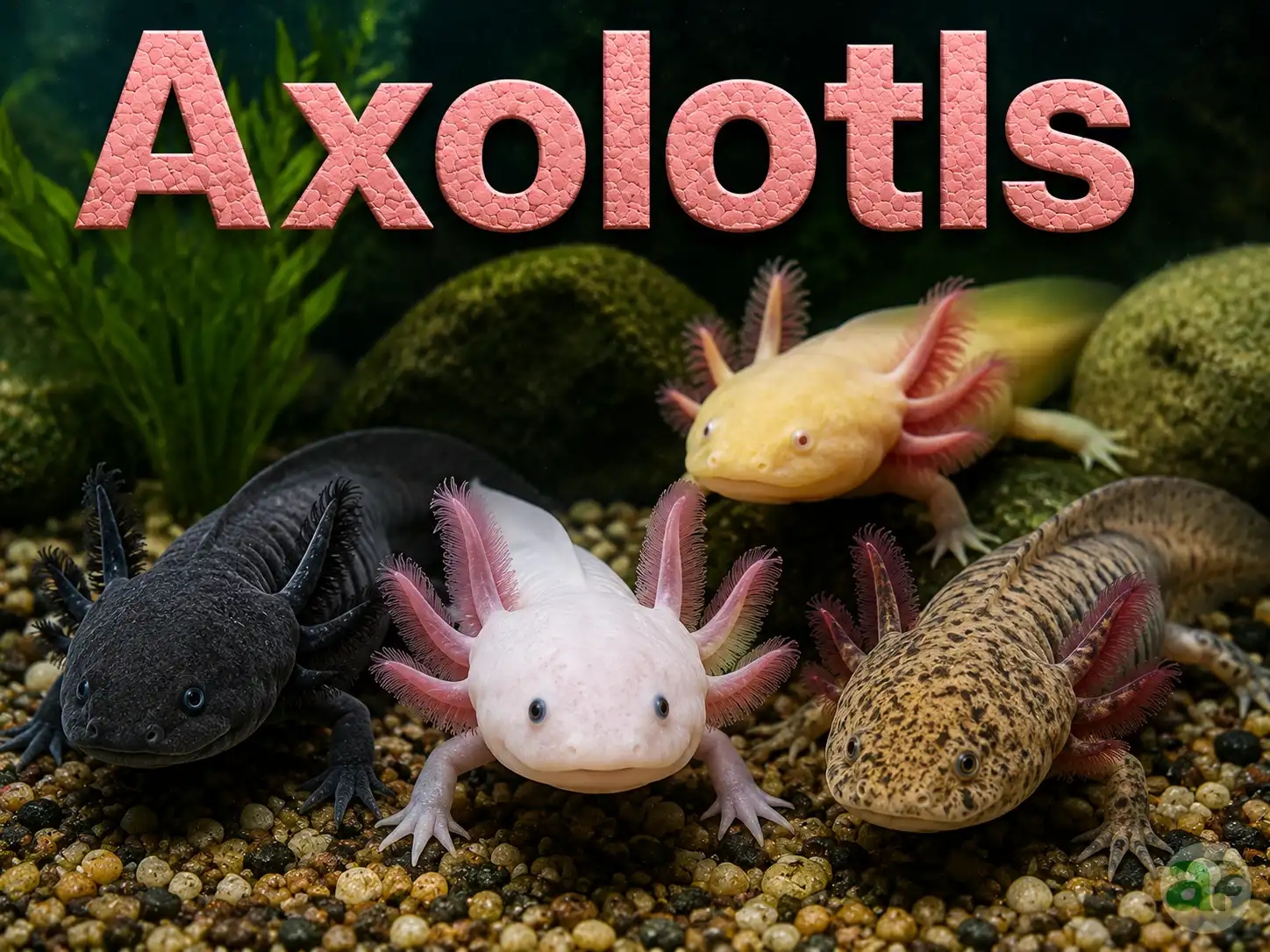
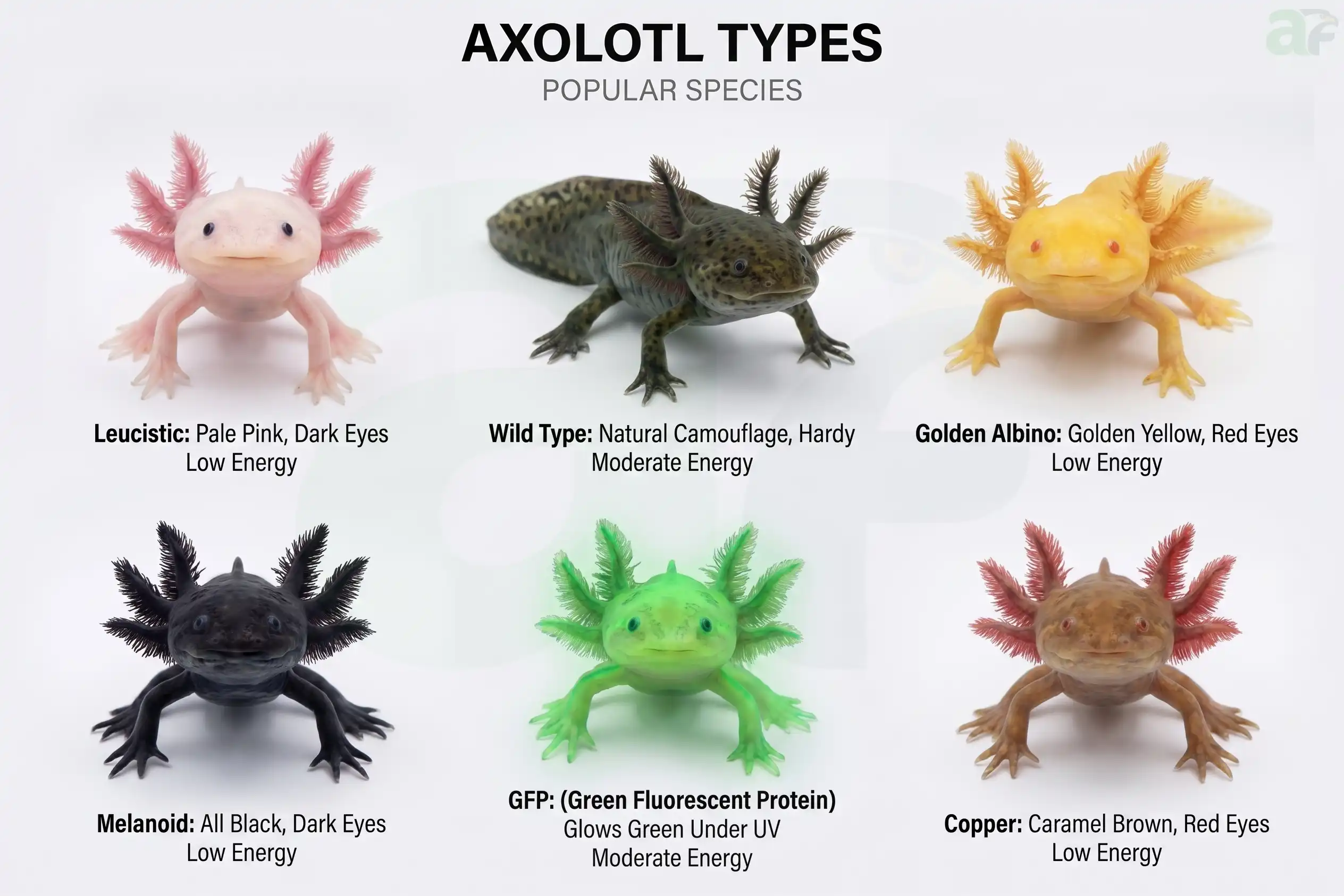
Wild type: Olive-brown or dark grey with gold speckles Leucistic: Pale pink or white with black eyes (most commonly seen in captivity) Albino: Golden or white with pink eyes Melanoid: Entirely dark grey or black Piebald: White with irregular dark patches
Their four small, stubby legs are equipped with long, delicate fingers — four on the front limbs and five on the rear. Despite having legs, axolotls rarely walk along the bottom. They prefer to use their powerful flat tail to glide gracefully through the water.
Did You Know? The axolotl’s feathery gills are not merely decorative. They are densely packed with blood vessels that extract oxygen directly from the water. In cleaner, more oxygenated water the gills shrink slightly; in murky or oxygen-poor water, they grow noticeably larger to compensate.
4. Top 25 Surprising & Interesting Axolotl Facts
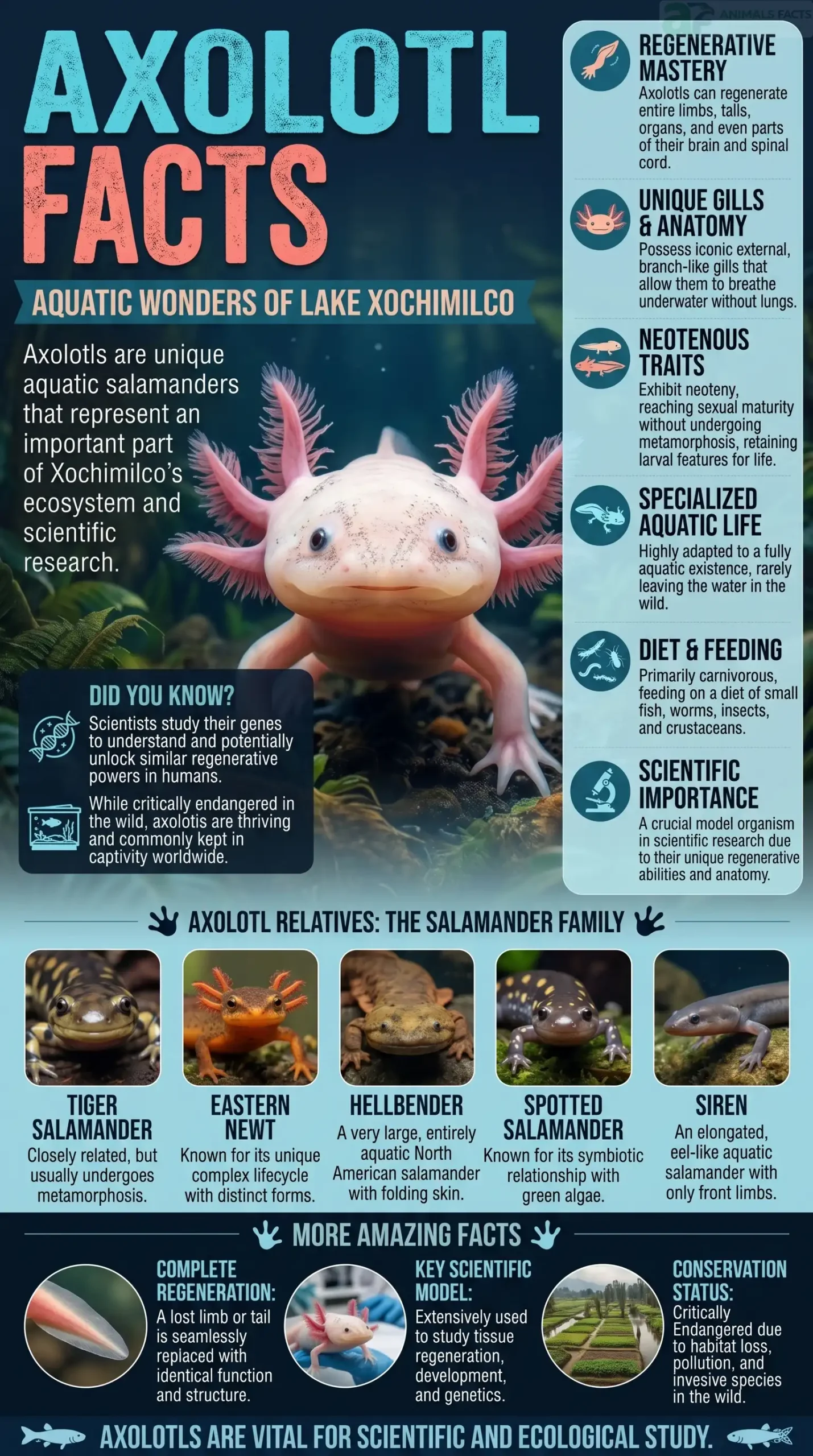
- The axolotl can regenerate not just limbs, but also parts of its heart, lungs, spine, and even brain tissue.
- Its name comes from the Nahuatl language of the Aztecs and roughly translates to “water monster” or “water dog.”
- Axolotls are sometimes called the “Mexican Walking Fish” — but they are not fish at all. They are amphibians.
- Unlike nearly every other amphibian, axolotls never undergo metamorphosis under normal conditions.
- A single axolotl can lay between 100 and 1,000 eggs in one breeding cycle.
- Axolotls can regrow a missing limb in as little as a few weeks.
- They have been used in cancer research, as scientists study their remarkable ability to prevent tumor formation during tissue regeneration.
- The axolotl’s genome is 10 times larger than the human genome — one of the largest animal genomes ever successfully sequenced.
- Axolotls breathe through their gills, through their skin, and occasionally through their rudimentary lungs.
- In the wild, axolotls are found in only one location on Earth — the Lake Xochimilco canal system in Mexico City.
- They are cannibalistic — axolotls will readily eat smaller axolotls if housed together, particularly when young.
- Axolotls have no eyelids — they cannot blink or close their eyes at any time.
- They were considered a sacred animal by the ancient Aztec people.
- Axolotls are almost entirely nocturnal in the wild.
- Scientists have successfully induced axolotls to metamorphose using iodine injections, but the resulting adults are typically sickly and short-lived.
- The axolotl’s smile is not a real smile — it is simply the natural resting shape of its jaw.
- They detect prey using a lateral line system — specialized sensory organs along their body that detect movement in the water.
- Axolotls have been sent to space — they were among the animals studied aboard French and Soviet space missions in the 20th century.
- A wild axolotl’s lifespan is estimated at just 5–6 years, while captive axolotls regularly live 10–15 years.
- There are more axolotls living in captivity worldwide than currently exist in the wild.
- The axolotl was once a key food source for the Aztec people and was also incorporated into traditional medicine.
- They can absorb water and some nutrients directly through their skin as well as through normal feeding.
- Axolotls have rudimentary teeth — tiny, underdeveloped teeth used to grip prey rather than chew it.
- The species has been continuously bred in captivity since 1864, making it one of the longest-running laboratory animal programs in scientific history.
- Scientists believe that studying axolotl regeneration could one day help humans regrow damaged organs and nerve tissue — a breakthrough that could redefine modern medicine.
5. Axolotl Fun Facts
- The axolotl is the only salamander that spends its entire adult life completely underwater.
- It has been called “the Peter Pan of the animal kingdom” because it biologically never grows up.
- Mexico City’s Lake Xochimilco is now essentially a network of canals — the axolotl’s last remaining wild home on Earth.
- Axolotls can suck prey into their mouths like a vacuum cleaner using a lightning-fast suction technique.
- The axolotl appeared on the old 50-centavo Mexican coin, a reflection of its deep cultural importance.
- Their gills visibly turn a brighter red when they are excited or under stress.
- Many captive axolotls learn to recognize their owners and swim to the front of the tank when approached.
- The axolotl genome project took over a decade to complete due to its enormous complexity and size.
- In 2023, wildlife cameras in Xochimilco confirmed a small surviving wild axolotl population in restored canal sections.
- Axolotls have been observed surviving being partially frozen at very low temperatures for short periods.
- A group of axolotls has no special collective noun — scientists simply refer to them as a “population.”
6. Axolotl Habitat & Geographic Range
The axolotl is one of the most geographically restricted animals on Earth. Its entire wild range consists of Lake Xochimilco and its connected canal system, located in the southern districts of Mexico City. This lake is all that remains of a far larger ancient lake system called Lake Texcoco, which once dominated the entire Valley of Mexico.
Habitat Details
Habitat Type: Freshwater lakes and slow-moving canals Preferred Water Temperature: 14–20°C (57–68°F) Typical Water Depth: 1–7 meters Vegetation: Dense aquatic plants including water lilies, reeds, and submerged grasses Water Type: Cool, slow-moving freshwater
Habitat Range by Continent
North America (Mexico): Yes — native; Lake Xochimilco only Central America: No wild population South America: No wild population Europe: Captivity only Asia: Captivity only Africa: Captivity only Oceania: Captivity only
The ancient Lake Texcoco system was dramatically reduced after Spanish colonizers began draining large portions of it in the 1600s to prevent flooding of their new city. What remained continued to shrink over the following centuries due to urban expansion, agricultural water diversion, and pollution. Today the axolotl clings to survival in a tiny fragment of its former territory.
Did You Know? Mexico City is one of the most densely populated cities on Earth, and the axolotl’s last wild habitat sits directly in the middle of it — surrounded by urban sprawl, agricultural runoff, and invasive species introduced by humans.
7. Axolotls Diet & Feeding Behavior
Axolotls are obligate carnivores, meaning they consume only animal-based food. In the wild they are opportunistic hunters — they will eat nearly anything smaller than themselves that they can successfully catch.
How They Hunt
Axolotls use a combination of sight, their lateral line system (which detects vibrations and water movement), and smell to locate prey. When prey comes within striking range, the axolotl opens its mouth with explosive speed, creating a powerful suction that pulls the prey in whole. This technique is called suction feeding and happens in a fraction of a second — far too fast for the human eye to follow in real time.
Diet Breakdown Table
Earthworms: Primary food source in both wild and captivity — approximately 40% Small fish and fish larvae: Commonly consumed wild prey — approximately 20% Aquatic insects and larvae: Regularly eaten — approximately 15% Small crustaceans: Shrimp and small crayfish — approximately 10% Mollusks: Snails and small shellfish — approximately 10% Smaller axolotls: Opportunistic cannibalism — approximately 5%
Common Captive Diet
In captivity, axolotls are typically fed earthworms (nightcrawlers), bloodworms, brine shrimp, specially formulated axolotl pellets, and occasional lean pieces of fish or beef heart.
Did You Know? Axolotls have such limited eyesight that they sometimes accidentally bite each other’s limbs, mistaking them for food. Fortunately, thanks to their extraordinary regenerative ability, the victim simply grows the limb back — usually within a few weeks.
8. Axolotl Reproduction & Life Cycle
Axolotls reach sexual maturity at around 12–18 months of age. In the wild, breeding is seasonal and typically triggered by changes in water temperature and day length, occurring most commonly between December and June.
Mating Behavior
The male initiates courtship by nudging the female and performing a “tail-fanning” display. He then deposits small jelly-coated packages of sperm called spermatophores on the substrate. The female collects these with her cloaca, and fertilization takes place internally.
Egg Laying
The female deposits between 100 and 1,000 eggs individually on aquatic plants and rocks over a period of 24–48 hours. Each egg is tiny — roughly 2mm in diameter — and coated in its own individual protective jelly layer.
Growth Stages
Eggs: Hatch after approximately 14–21 days depending on water temperature. Hatchlings: Only a few millimeters long at birth; fully independent from day one. Juveniles: Reach adult size in approximately 12 months. Adults: Remain permanently in aquatic larval form throughout their entire life.
Lifespan Comparison Table
Axolotl: 10–15 years (captivity), 5–6 years (wild) Tiger Salamander: 10–16 years Fire Salamander: 14–20 years Common Frog: 5–10 years Mudpuppy Salamander: 20+ years
9. Social Behavior & Communication
Axolotls are largely solitary animals in the wild. They do not form social groups, establish dominance hierarchies, or communicate in any manner recognizable to humans. They have no vocal cords and produce absolutely no sounds.
Their primary form of communication is chemical — they release pheromones into the surrounding water during breeding season to signal reproductive readiness to potential mates. They also detect and respond to water vibrations, changes in light intensity, and the movement of nearby creatures through their sensitive lateral line system.
Intelligence & Learned Behavior
Axolotls are not considered highly intelligent by amphibian standards. However, they are capable of basic learned associations — most notably linking the approach of their owner with the delivery of food. In laboratory settings, axolotls have demonstrated the ability to navigate simple mazes, suggesting a modest level of spatial awareness.
In captivity, axolotls display surprisingly individual personalities. Some are bold and inquisitive, actively approaching the glass of their tank when humans come near. Others are notably shy and spend most of their time hiding beneath plants or decorative objects. Over time, many captive axolotls appear to genuinely recognize the people who feed them.
10. Predators & Defense Mechanisms
In the wild, axolotls face predation from various animals. Their most dangerous threats today, however, are not natural predators — they are invasive species introduced to their habitat by human activity.
Natural Predators
- Large wading birds (herons and egrets)
- Large native fish
- Water snakes
Invasive Predators (Introduced by Humans)
Tilapia: An African fish introduced to Lake Xochimilco for food production. It aggressively competes with and directly preys upon axolotls, their eggs, and their food sources.
Common Carp: Introduced to Mexican water systems; destroys aquatic vegetation and consumes axolotl eggs and juveniles.
Perch: Another introduced species that directly preys on axolotls throughout their remaining habitat.
Defense Mechanisms
Axolotls have very limited active defenses. Their primary strategy is camouflage — their wild-type dark olive-brown coloration helps them blend naturally into the muddy lake bed. When threatened they typically remain perfectly still or retreat slowly into dense aquatic vegetation. They do not bite aggressively, produce toxins, or display any meaningful aggressive behavior toward predators.
Their greatest survival adaptation is ironically their regenerative ability — even if a predator successfully bites off a limb, the axolotl can survive the injury and completely regrow the missing part within weeks.
11. Axolotl Facts for Kids
Hey kids — are you ready to meet one of the coolest animals on the entire planet? Say hello to the axolotl!
The axolotl — say it like this: ACK-suh-LAH-tuhl — is a type of salamander that lives in Mexico. Here are some awesome things that make it totally amazing:
- It looks like it is wearing a feathery crown on its head! Those feathery things are actually its gills — they help it breathe underwater just like fish.
- It never grows up! While frogs start as tadpoles and grow into adult frogs, the axolotl stays looking like a baby its whole life. Scientists call this “neoteny.”
- It can grow back body parts! If an axolotl loses a leg, it simply grows a brand new one. Scientists are studying this amazing power to help people one day!
- It always looks like it is smiling! That is just the natural shape of its face — and it is incredibly cute.
- It lives in just one lake in Mexico City — a city with more people than most entire countries!
- There are fewer axolotls in the wild than there are students in most schools. That means they really need our help to survive!
Did You Know? Scientists study axolotls to figure out how their bodies heal so perfectly without leaving scars. One day, this research might help doctors help injured people grow new skin, bone, and even heart tissue!
12. Relationship with Humans
The relationship between axolotls and humans stretches back thousands of years — and it has not always worked in the axolotl’s favor.
Historical Significance
The axolotl was deeply important to the Aztec civilization, which flourished in central Mexico from the 13th to the 16th century. The Aztecs built their magnificent capital city on islands in Lake Texcoco — the very lake system where axolotls lived in abundance. They hunted axolotls regularly for food and incorporated them into traditional medicine, particularly to treat respiratory ailments. A syrup made from dried axolotl was sold in Mexican markets well into the 20th century as a folk treatment for bronchitis and coughs.
In Aztec mythology, the axolotl was believed to be a physical transformation of Xolotl, the dog-headed deity of lightning and the underworld, who transformed himself into a salamander to escape sacrifice. This belief elevated the axolotl to a near-sacred status within Aztec culture.
Modern Relationship
Today humans relate to axolotls in three primary ways.
As pets: Axolotls have become enormously popular exotic pets worldwide, particularly across the United States, Europe, and Japan. Captive-bred axolotls are legal to own in most countries and are prized for their remarkable appearance and relatively straightforward care requirements.
As laboratory animals: The axolotl is one of the most scientifically important research animals in modern biology. Thousands are maintained in university and research laboratory colonies worldwide, studied extensively for their regenerative abilities, developmental biology, and genetics.
As a conservation symbol: Growing awareness of the axolotl’s critically endangered status has transformed it into a conservation icon — particularly in Mexico, where campaigns to clean up Lake Xochimilco and restore its habitat have gained significant public and governmental attention.
13. Axolotl Conservation Status & Threats
The axolotl is officially listed as Critically Endangered on the IUCN Red List — the highest category of threat before Extinct in the Wild. Its situation is considered one of the most urgent amphibian conservation crises anywhere in the world.
Conservation Status Data
IUCN Status: Critically Endangered Population Trend: Decreasing Estimated Wild Population (2020s): Fewer than 1,000; possibly as low as 50–100 individuals Primary Threats: Habitat loss, water pollution, invasive species, urban development Legal Protection: Protected under Mexican federal law; listed on CITES Appendix II
Major Threats in Detail
Habitat Destruction: Lake Xochimilco has been reduced to a fraction of its original size by Mexico City’s relentless urban expansion. What remains is a system of canals heavily impacted by agriculture, residential waste, and industrial runoff.
Water Pollution: The Xochimilco canals receive agricultural chemicals, pesticides, fertilizers, and in places untreated sewage. Water quality has declined dramatically over decades, placing enormous stress on axolotl populations.
Invasive Species: The introduction of tilapia and carp to Xochimilco has been catastrophic for axolotls. These fish consume axolotl eggs, juveniles, and food sources while competing aggressively for habitat.
Over-collection: Historically axolotls were collected extensively for food, medicine, and the pet trade. While this has significantly decreased, illegal collection still occurs in some areas.
Climate Change: Rising temperatures and increasingly erratic rainfall patterns are affecting water levels and temperature ranges in Xochimilco, making the environment progressively less suitable for axolotl survival.
Did You Know? Even though axolotls are critically endangered in the wild, they are among the most commonly kept exotic amphibians in the world. The global captive population is estimated to number in the millions — a striking contrast to their near-extinction in nature.
14. Famous Axolotls
While axolotls do not attract the same “celebrity animal” recognition as lions or giant pandas, a handful of notable individuals and programs have brought them into the wider spotlight.
The Paris Colony (1864)
The original six axolotls shipped to Paris in 1863 and successfully bred by naturalist Auguste Duméril in 1864 are considered the founding ancestors of virtually every laboratory axolotl population in the world today. Without these six individuals, modern axolotl science would simply not exist.
The Indiana University Colony
The axolotl colony maintained at Indiana University has served as the world’s foremost supplier of axolotls to scientific research institutions for decades. It has provided animals to laboratories across the globe and remains central to the species’ ongoing survival as a research animal.
Kenji – Chapultepec Zoo, Mexico City
A famous leucistic axolotl named Kenji, housed at the Chapultepec Zoo in Mexico City, became one of the most photographed axolotls in the world and helped raise significant public awareness about the species’ conservation needs among Mexican audiences.
“Minecraft’s Axolotl”
When the axolotl was added to the enormously popular video game Minecraft in the 2021 Caves & Cliffs update, it became an overnight sensation among younger audiences globally — introducing millions of children to the species for the very first time and sparking widespread curiosity about its real-world conservation situation.
15. Role in Ecosystem & Food Chain
Despite being small and unassuming in appearance, the axolotl plays a meaningful ecological role in the Xochimilco canal system.
As a predator, the axolotl helps naturally regulate populations of aquatic insects, worms, small fish, and crustaceans. By keeping these populations in check, it contributes to the overall balance of the aquatic food web and prevents any single prey species from becoming dominant.
As prey, the axolotl provides a reliable food source for larger birds and fish. Its potential disappearance from the ecosystem — which is now a very real possibility — would create a gap that affects every species that currently depends on it.
The axolotl also functions as a critically important indicator species. Its health and population numbers directly reflect the overall condition of the Xochimilco ecosystem. When axolotl numbers decline, it signals clearly that water quality and ecological balance are deteriorating. Conservation scientists routinely use axolotl population surveys as a barometer for the health of the entire canal system.
16. Axolotl Myths, Folklore & Cultural Significance
The axolotl occupies a uniquely profound place in the mythology and cultural heritage of ancient Mexico that few animals anywhere in the world can match.
The Aztec God Xolotl
In Aztec cosmology, the current universe required the gods themselves to sacrifice their lives in order to be created. Xolotl — the dog-headed deity of lightning, deformity, and the underworld — refused to be sacrificed and desperately fled. According to myth, he transformed first into a corn plant, then into a maguey cactus, and finally into an axolotl to escape his fate in the waters of Lake Texcoco. He was eventually caught and sacrificed there.
This foundational myth gave the axolotl its very name — Xolotl + atl (meaning “water” in Nahuatl) — and elevated it to a position of near-divine significance in Aztec religious life. The axolotl was seen as a powerful symbol of transformation, duality, sacrifice, and the boundary between life and death.
Modern Cultural Significance
In contemporary Mexico, the axolotl has evolved into a symbol of national identity and natural heritage. It appears on the 50-centavo coin, in widespread public art, and prominently in environmental conservation campaigns. Nobel Prize-winning Mexican poet Octavio Paz wrote about the axolotl as a profound metaphor for the Mexican national identity — perpetually caught between transformation and stasis, between its ancient indigenous past and its modern present.
Argentine author Julio Cortázar wrote one of the most celebrated and widely studied short stories in all of Latin American literature, simply titled “Axolotl” (1956). In it, a man becomes obsessively fascinated with axolotls in a Paris aquarium and gradually comes to believe he has transformed into one himself — a haunting meditation on identity, longing, and transformation.
17. Axolotl in Pop Culture
The axolotl’s wholly otherworldly appearance has made it a beloved and increasingly visible figure in modern popular culture across multiple generations.
Minecraft (2021)
The axolotl was added as a tameable aquatic creature in Minecraft’s landmark Caves & Cliffs update. Players could collect them in buckets, breed different color variants, and deploy them in combat against underwater enemies. Their inclusion was widely celebrated by the global gaming community and introduced the species to an entirely new audience of millions of young players.
Social Media Stardom
The axolotl has become one of the most viral exotic animals on TikTok, Instagram, and YouTube, accumulating billions of collective views on videos showing captive axolotls eating, swimming, and interacting with their owners. This extraordinary viral popularity has simultaneously raised conservation awareness and unfortunately fueled increased demand for the pet trade.
Documentaries & Television
The axolotl has been featured in numerous prestigious wildlife and science documentaries, including segments on BBC Earth, National Geographic, and various Netflix nature series exploring Mexico’s unique biodiversity and conservation challenges.
Literature
Beyond Cortázar’s famous short story, the axolotl has appeared as a symbol and subject in essays, poetry, and environmental literature across multiple languages — a testament to its remarkable power to capture the human imagination.
18. Axolotl Facts vs. Common Myths
Myth: The axolotl is a fish. Fact: The axolotl is an amphibian — specifically a salamander. It is called the “Mexican Walking Fish” purely because of its aquatic lifestyle, not because it belongs to any fish species.
Myth: Axolotls are immortal. Fact: While axolotls possess extraordinary regenerative abilities, they are absolutely not immortal. They live 10–15 years in captivity and are fully subject to disease, predation, and environmental stress like any other animal.
Myth: All axolotls are pink or white. Fact: The pink and white leucistic form is very common in captivity but genuinely rare in nature. Wild axolotls are typically dark olive-brown or black — colors that help them camouflage in their natural environment.
Myth: Axolotls can live comfortably in any freshwater environment. Fact: Axolotls require cool water specifically between 14–20°C, precise water chemistry, and consistently clean conditions. They are highly sensitive to temperature changes, pollution, and poor water quality.
Myth: You can safely force an axolotl to metamorphose using iodine. Fact: While hormone or iodine treatments can trigger partial metamorphosis, the resulting animals are typically stunted, chronically stressed, and significantly short-lived. Forced metamorphosis is harmful and strongly discouraged by every reputable axolotl authority.
Myth: Axolotls make easy, low-maintenance pets suitable for beginners. Fact: Axolotls require carefully maintained water temperature and quality, a specialized diet, and an appropriately sized tank. They are moderately demanding pets that require genuine research, commitment, and consistent care.
19. Best Places to See Axolotls
Wild Sightings
Lake Xochimilco, Mexico City, Mexico — The only location on Earth where wild axolotls still survive. Conservation boat tours of the historic canals occasionally offer sightings, though they are genuinely rare given the critically low wild population. The Xochimilco Ecological Park and Plant Market operates guided ecological canal tours with conservation-focused guides.
Zoos & Aquariums with Captive Populations
Chapultepec Zoo, Mexico City, Mexico — Home to one of Mexico’s most important captive axolotl populations, with active conservation breeding programs supporting wild population recovery.
Shedd Aquarium, Chicago, USA — Features axolotls as part of its freshwater life exhibits and has been actively involved in axolotl conservation education programs for the public.
London Zoo, United Kingdom — Has maintained axolotl populations and uses them in wildlife conservation awareness programs for visitors.
Paris Natural History Museum, France — The historic site where the very first captive breeding of axolotls occurred in 1864; periodically features special axolotl displays connecting history and conservation.
National Autonomous University of Mexico (UNAM) Axolotl Laboratory, Mexico City — The world’s leading axolotl research and conservation facility, which occasionally hosts public education events and open days for interested visitors.
20. Top Documentaries & Books
Must-Watch Documentaries
“Racing Extinction” (2015, Discovery Channel) — An acclaimed documentary covering critically endangered species worldwide, including powerful segments on the global amphibian extinction crisis.
“Our Planet” (Netflix, 2019) — David Attenborough’s landmark nature series, which includes compelling coverage of freshwater ecosystems under immediate threat from human activity.
“Mexico’s Wild Coast” (National Geographic) — Features important segments on axolotls and the fragile Xochimilco canal ecosystem.
“The Freshwater Crisis” (BBC Earth) — Examines the global crisis facing freshwater species, including Mexico’s axolotl and its shrinking habitat.
Essential Books
“Axolotl” by Julio Cortázar (1956, short story) — The single most celebrated literary work ever written about the axolotl; essential reading for any admirer of the species.
“The Sixth Extinction” by Elizabeth Kolbert (2014, Pulitzer Prize winner) — A masterful and urgent exploration of the global amphibian extinction crisis, including species like the axolotl.
“Amphibians: The World of Frogs, Toads, Salamanders and Newts” by Robert Hofrichter — A comprehensive scientific overview of amphibian biology including detailed coverage of the axolotl.
“The Aztecs: A Very Short Introduction” by David Carrasco — Essential background reading for understanding the axolotl’s deep cultural and mythological roots in ancient Mexican civilization.
21. Comparison with Similar Species
Axolotl | Scientific name: Ambystoma mexicanum | Length: 15–45 cm | Habitat: Freshwater lakes, Mexico only | Diet: Carnivore (worms, fish, insects) | Conservation Status: Critically Endangered | Unique Trait: Permanent neoteny; extraordinary full-body regeneration
Tiger Salamander | Scientific name: Ambystoma tigrinum | Length: 18–40 cm | Habitat: Varied environments, North America | Diet: Carnivore | Conservation Status: Least Concern | Unique Trait: Largest land-dwelling salamander in North America; undergoes normal metamorphosis
Mudpuppy | Scientific name: Necturus maculosus | Length: 20–49 cm | Habitat: Freshwater lakes, North America | Diet: Carnivore | Conservation Status: Least Concern | Unique Trait: Also retains external gills as a permanent adult; more limited regenerative ability than axolotl
Fire Salamander | Scientific name: Salamandra salamandra | Length: 15–25 cm | Habitat: European forests | Diet: Carnivore | Conservation Status: Least Concern | Unique Trait: Highly toxic skin secretions; vivid black-and-yellow warning coloration
22. How You Can Help
The axolotl’s future depends entirely on sustained human action — both in Mexico and internationally. Here is what you can do right now.
Support These Conservation Organizations
Axolotl Foundation (Fundación Ajolote) — A dedicated Mexican nonprofit focused on protecting wild axolotls and actively restoring the Xochimilco canal ecosystem.
IUCN Amphibian Specialist Group — Coordinates and funds global amphibian conservation efforts including critical research on axolotl survival.
Amphibian Ark (AArk) — Works to establish and maintain captive breeding programs for endangered amphibians worldwide, providing a safety net against total extinction.
WWF Mexico — Funds important habitat restoration and conservation programs in Mexico, including direct work in the Xochimilco region.
If You Own an Axolotl
Always purchase exclusively from a reputable, licensed captive breeder — never from suspected wild-caught stock. Never release a captive axolotl into any wild environment. Captive-bred axolotls can carry diseases that devastate wild populations and lack the survival skills required for wild life.
General Actions Anyone Can Take
Reduce your use of pesticides and chemical fertilizers — they ultimately flow into waterways connected to axolotl habitats. Educate friends, family, and colleagues about the axolotl’s critically endangered status. Share conservation campaigns focused on Lake Xochimilco clean-up efforts across your social media platforms. Follow and support the work of UNAM’s world-renowned axolotl research laboratory.
Did You Know? In 2023, researchers from UNAM successfully reintroduced captive-bred axolotls into specially restored sections of the Xochimilco canals using innovative water filtration “refuge” systems. Early monitoring results were genuinely promising — axolotls were observed actively surviving and even thriving within the filtered protected zones.
23. Frequently Asked Question About Axolotls
Q1: What exactly is an axolotl?
An axolotl is a species of aquatic salamander native exclusively to Mexico. Unlike virtually all other amphibians, it permanently retains its juvenile larval features — including its distinctive external gills — throughout its entire life, never undergoing complete metamorphosis into a land-dwelling adult form.
Q2: Where do axolotls live in the wild?
Wild axolotls exist today in only one location in the entire world: the Lake Xochimilco canal system in Mexico City, Mexico. They were once found throughout the broader Valley of Mexico lake system, but centuries of habitat destruction have confined them to this single, shrinking area.
Q3: Are axolotls endangered?
Yes — severely so. The axolotl is classified as Critically Endangered by the IUCN Red List. Wild population estimates range from fewer than 1,000 individuals to as few as 50–100 in certain surveys, placing it among the most threatened amphibians anywhere in the world.
Q4: Can axolotls really regenerate body parts?
Yes — and to a genuinely remarkable degree. Axolotls can fully regenerate limbs, portions of their heart, lung tissue, sections of their spinal cord, and even certain areas of brain tissue with near-perfect biological accuracy. This extraordinary ability is the subject of intensive ongoing scientific research worldwide.
Q5: How long do axolotls live?
In captivity with proper care, axolotls typically live between 10 and 15 years. In the wild, their lifespan is estimated at only around 5–6 years due to environmental stresses, habitat degradation, and predation pressure.
Q6: Do axolotls make good pets?
Axolotls can be fascinating and rewarding pets for dedicated and well-prepared owners. However, they require carefully maintained water temperature between 14–20°C, consistently clean water conditions, an appropriately sized tank, and a specialized diet. They are moderately demanding and are not suitable for first-time pet owners without thorough prior research.
Q7: Why is the axolotl nicknamed the “Mexican Walking Fish”?
The nickname comes from the axolotl’s fully aquatic lifestyle combined with its four small walking legs. Despite the misleading name, the axolotl is absolutely not a fish — it is an amphibian and a true salamander.
Q8: What do axolotls eat?
Axolotls are carnivores. In the wild they consume earthworms, aquatic insects, small fish, and small crustaceans. In captivity they are most commonly fed earthworms, bloodworms, brine shrimp, and specially formulated axolotl pellets.
Q9: Is the axolotl connected to Aztec mythology?
Yes — profoundly so. The axolotl is directly linked to Xolotl, the Aztec god of lightning, deformity, and the underworld, who was said to have transformed himself into an axolotl in the waters of Lake Texcoco to escape sacrificial death. This myth gave the axolotl both its name and its near-sacred cultural status.
Q10: Can axolotls live safely alongside other fish or aquatic animals?
Axolotls are generally best kept alone or with other axolotls of closely similar size. They will readily eat smaller tank mates, and fast-moving fish species may aggressively nip at and permanently damage their fragile, sensitive external gills.
24. Sources & References
Research Sources
- Wikipedia — Axolotl species article
- IUCN Red List — Ambystoma mexicanum official assessment
- National Geographic — Axolotl Species Profile
- Smithsonian’s National Zoo — Axolotl Fact Sheet
- Encyclopaedia Britannica — britannica.com/animal/axolotl
- WWF — Global Amphibian Conservation pages
- Live Science — Axolotl Regeneration Research coverage
- Animal Diversity Web (University of Michigan) — Ambystoma mexicanum
- BBC Wildlife — Axolotl feature articles
- UNAM Axolotl Laboratory — axolotl.org.mx
- Amphibian Ark — aark.org
- Cortázar, Julio — “Axolotl” (short story, 1956)
- Kolbert, Elizabeth — “The Sixth Extinction” (2014)