
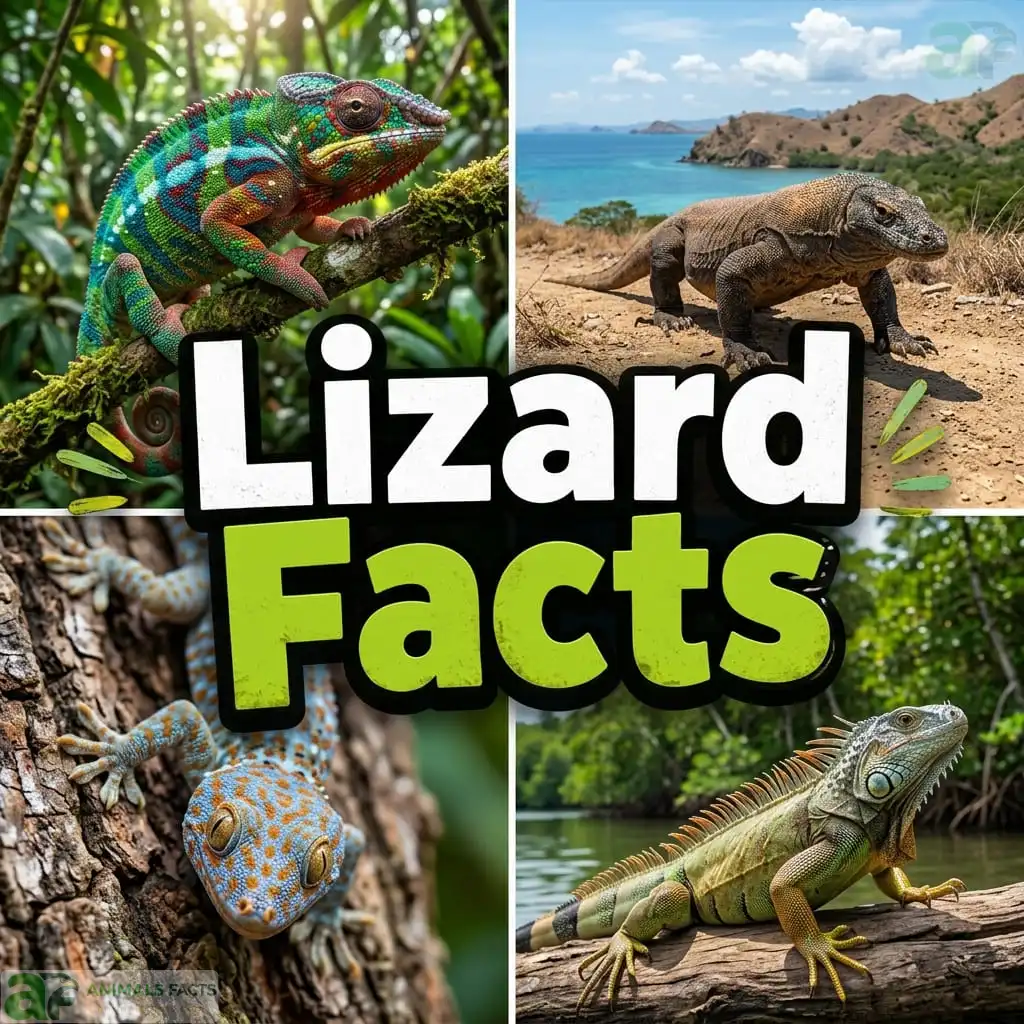
Lizard Facts
| Feature | Details |
|---|---|
| Scientific Name | Lacertilia (suborder) |
| Kingdom | Animalia |
| Class | Reptilia |
| Number of Species | Over 7,000 known species |
| Habitat | Deserts, rainforests, grasslands, mountains, wetlands |
| Lifespan | 3–50 years (varies by species) |
| Diet | Insects, plants, small mammals, fruits, eggs |
| Size Range | 1.6 cm (nano-chameleon) to 3 meters (Komodo dragon) |
| Weight Range | Under 1 gram to over 70 kg |
| Top Speed | Up to 35 km/h (perentie monitor) |
| Conservation Status | Varies — many species Least Concern, dozens Critically Endangered |
| Population Estimate | Hundreds of billions globally |
| Continents Found | All except Antarctica |
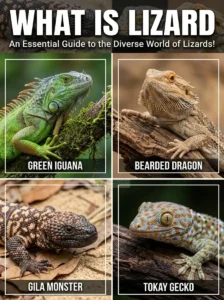 1. Introduction: What is Lizard?
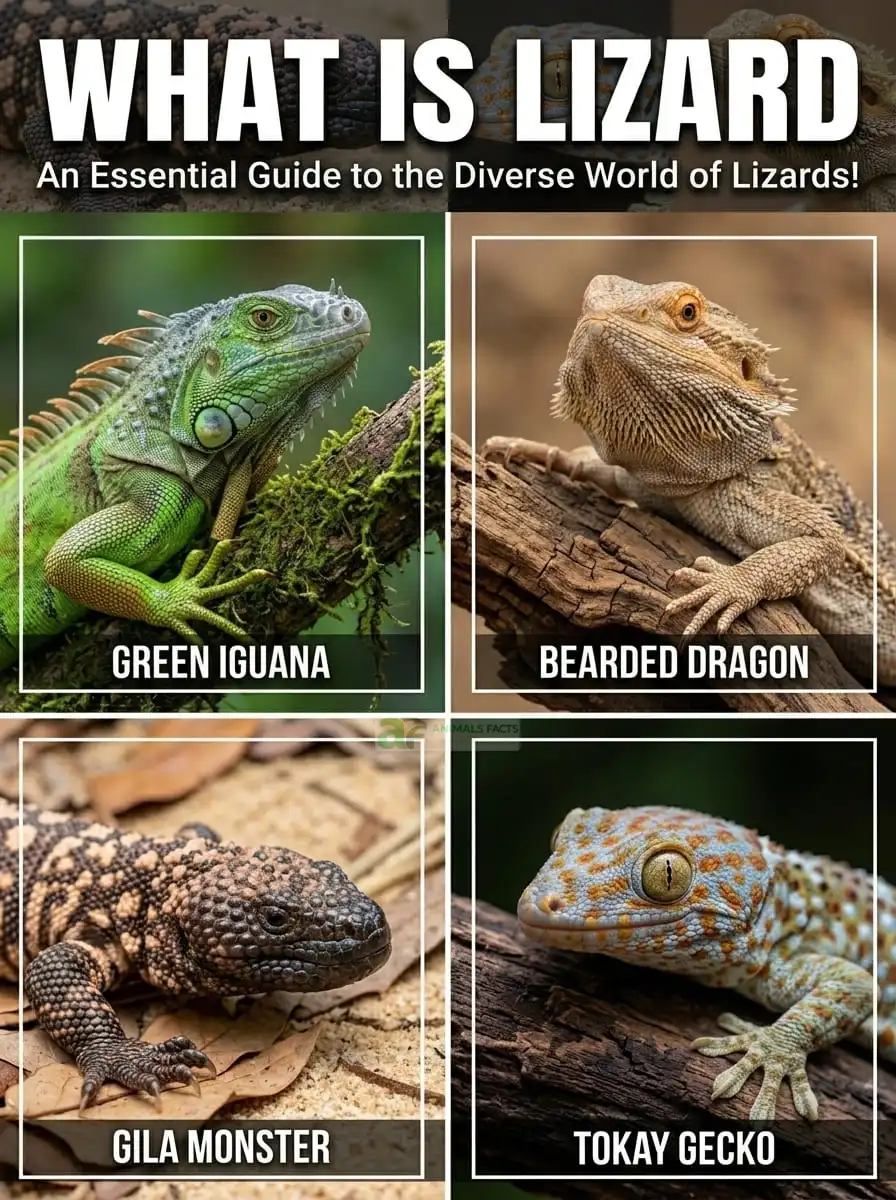
If you’ve ever watched a gecko walk upside-down across a ceiling, seen a frilled lizard fan out its dramatic neck ruff in warning, or marveled at a chameleon shifting colors before your eyes, you already know that lizard facts belong in a category all their own. These ancient, extraordinary reptiles have been crawling, climbing, and thriving on this planet for over 240 million years — long before the first dinosaurs roamed the earth.
Lizards are one of the most diverse, adaptable, and misunderstood groups of animals alive today. With more than 7,000 described species spread across every continent except Antarctica, interesting facts about lizards seem almost endless. From the Komodo dragon — a venomous giant that can take down a water buffalo — to the nano-chameleon of Madagascar, barely larger than a thumbnail, lizards occupy virtually every ecological niche on the planet. They live in scorching deserts, lush rainforests, rocky mountaintops, suburban backyards, and even the edges of the Arctic Circle.
Whether you’re a student doing research, a parent looking for lizard facts for kids, a wildlife enthusiast, or simply someone who stumbled onto this page out of curiosity, you’re in the right place. This comprehensive guide covers lizard habitat, lizard diet, lizard scientific name classifications, lizard behavior, lizard size and weight records, and everything in between. Let’s dive deep into the incredible world of lizards.
2. Lizard Species Overview & Classification
Lizards belong to the order Squamata, which they share with snakes. Within this order, lizards form the suborder Lacertilia (also called Sauria). They are not a single unified evolutionary group — technically, lizards are a paraphyletic grouping, meaning snakes actually evolved from within the lizard lineage. This makes the biology of lizards even more fascinating from a scientific perspective.
Species Classification Table
| Taxonomic Rank | Classification |
|---|---|
| Kingdom | Animalia |
| Phylum | Chordata |
| Class | Reptilia |
| Order | Squamata |
| Suborder | Lacertilia (Sauria) |
| Infraorders | Iguania, Gekkota, Scincomorpha, Anguimorpha, Amphisbaenia |
| Number of Families | ~40 families |
| Number of Genera | ~600+ genera |
| Number of Species | 7,000+ species |
Major Lizard Families
The lizard world is organized into several major families, each with unique characteristics:
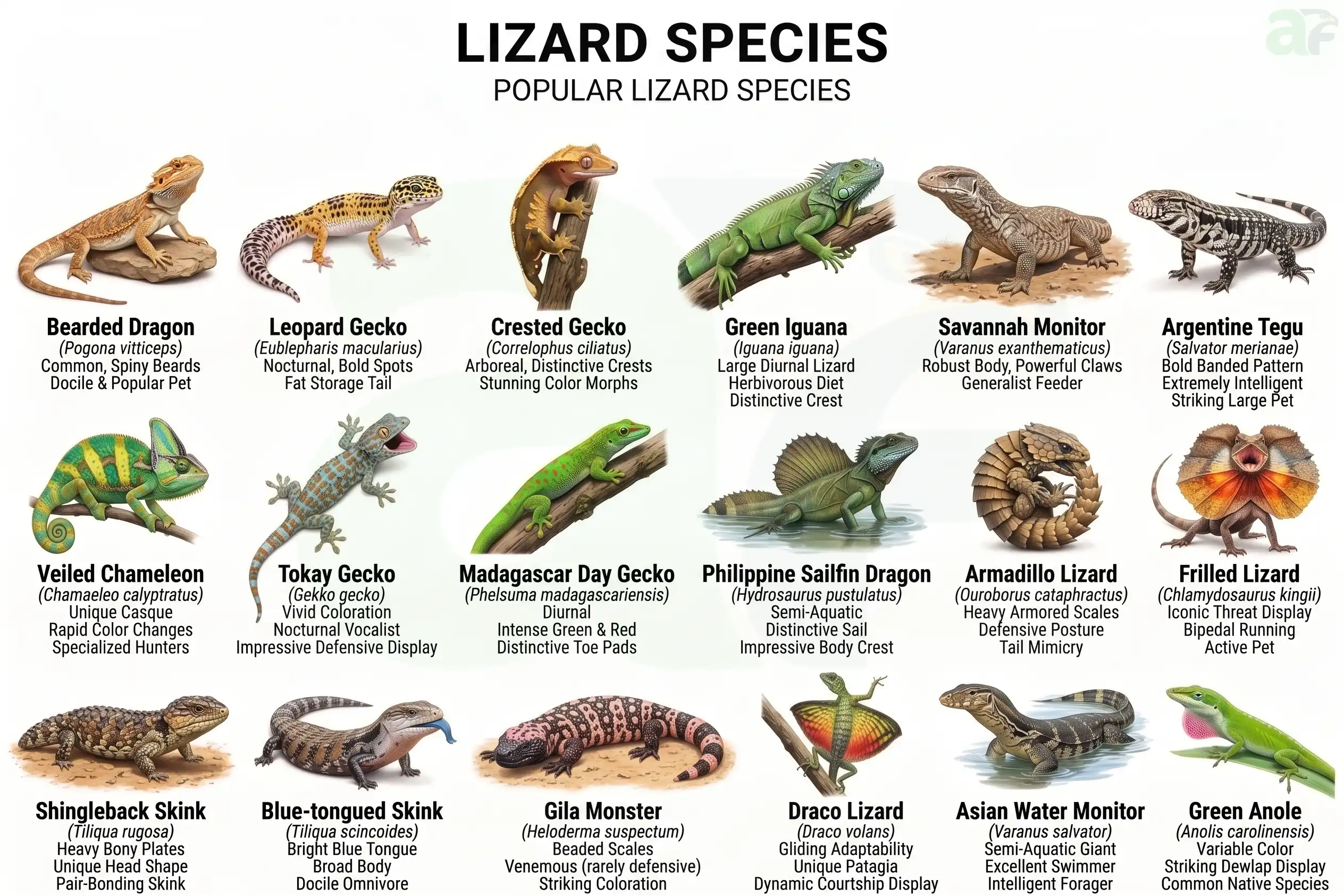
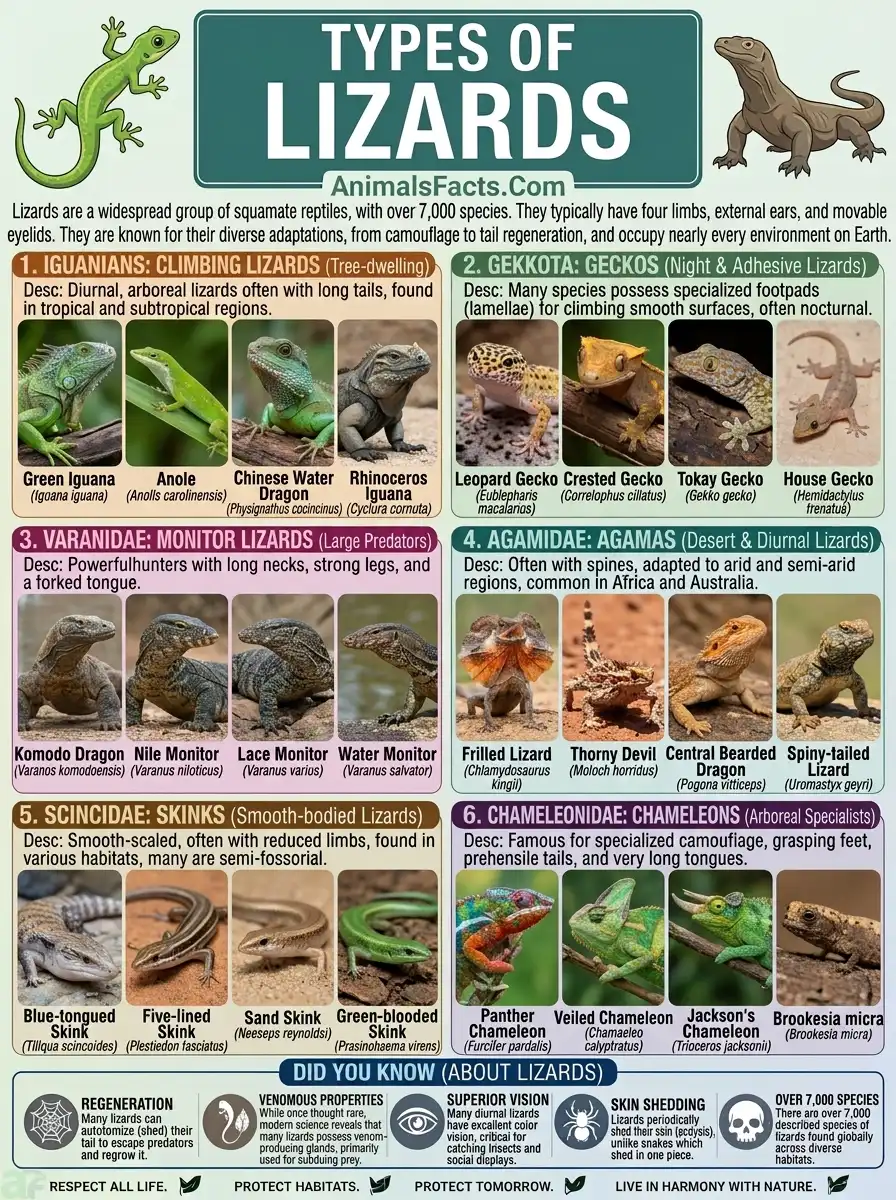
- Gekkonidae (Geckos) — ~2,000 species, known for adhesive toe pads and vocalizations
- Scincidae (Skinks) — ~1,800 species, the largest lizard family
- Lacertidae (Wall lizards/True lizards) — common in Europe and Asia
- Iguanidae (Iguanas) — large, herbivorous lizards of the Americas
- Chamaeleonidae (Chameleons) — ~220 species, famous for color-changing ability
- Varanidae (Monitor lizards) — includes the Komodo dragon, the world’s largest lizard
- Agamidae (Agamas/Dragon lizards) — includes the bearded dragon and flying lizard
Lizards Evolution & Discovery Timeline
~240 million years ago — The earliest lizard-like reptiles appear during the Triassic period.
~167 million years ago — True squamates (lizards and snakes) diverge from a common ancestor.
~100 million years ago — Mosasaurs, giant marine relatives of monitor lizards, dominate the seas.
1758 — Carl Linnaeus formally begins classifying reptiles in his landmark work Systema Naturae.
1912 — The Komodo dragon (Varanus komodoensis) is formally described by Western science after reports from Dutch colonial officers in Indonesia.
1954 — The first scientific study of lizard thermoregulation behavior is published, changing how scientists view reptile intelligence.
2007 — Researchers confirm that Komodo dragons possess venom glands, overturning decades of scientific consensus.
2012 — The nano-chameleon (Brookesia micra) of Madagascar is described — at the time, one of the smallest reptiles ever recorded.
2021 — Brookesia nana, an even tinier chameleon, is discovered in Madagascar, with males measuring just 13.5 mm in body length.
2024–2026 — DNA analysis continues to reveal dozens of new cryptic lizard species every year, particularly in tropical regions of Southeast Asia and South America.
“Reptiles in general, and lizards in particular, represent one of evolution’s greatest success stories. Their diversity of form and function is simply breathtaking.” — Dr. Jonathan Losos, Harvard University evolutionary biologist and author of Improbable Destinies
3. Lizard Physical Description & Features
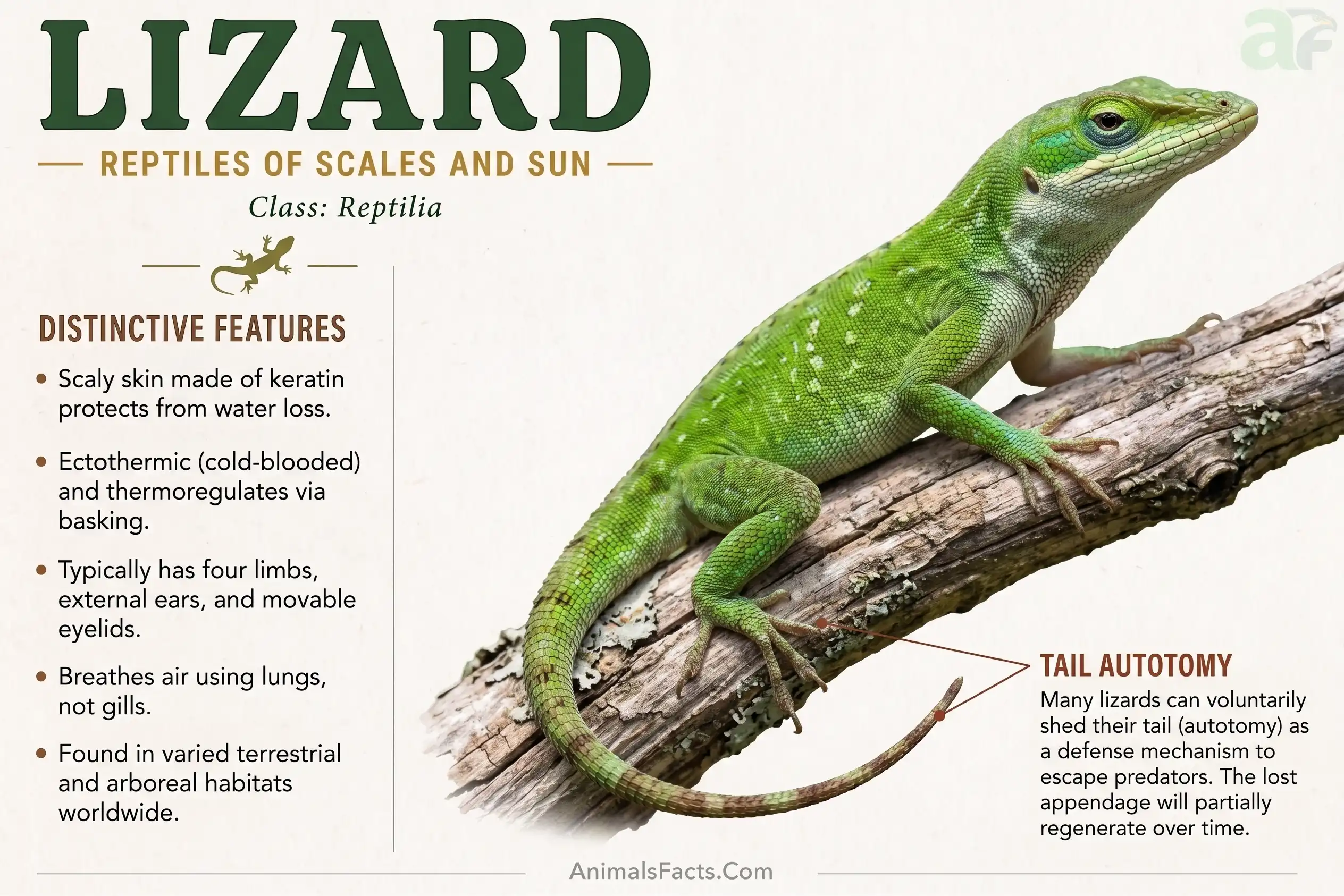
One of the most captivating lizard facts is the sheer variety of physical forms found within this group. There is truly no single “typical” lizard body plan — evolution has produced an astonishing range of shapes, sizes, colors, and structures.
Size & Weight
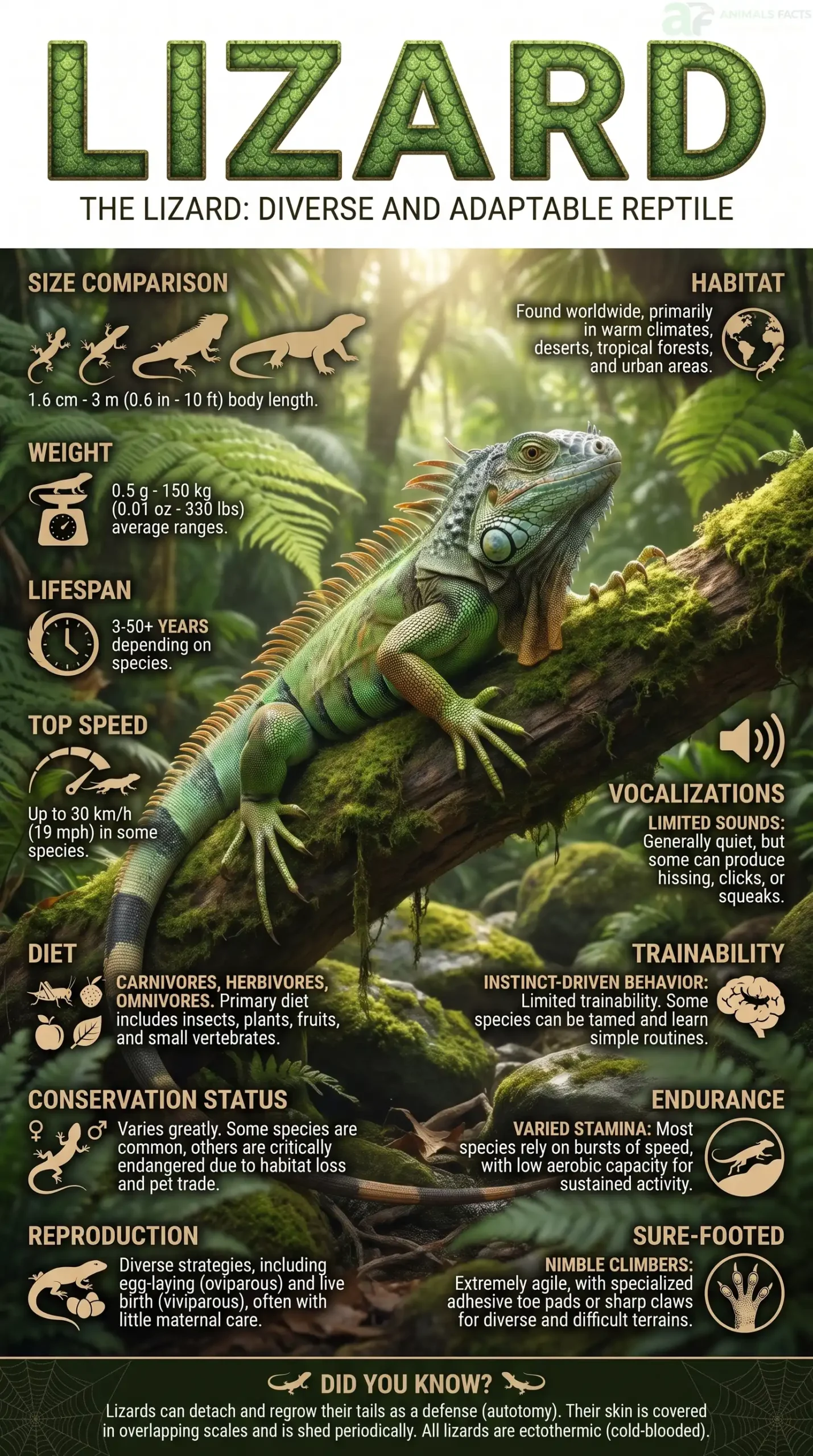
The Komodo dragon (Varanus komodoensis) holds the record as the world’s largest living lizard, reaching lengths of up to 3 meters (10 feet) and weighing as much as 70 kilograms (154 lbs). At the other extreme, the recently described Brookesia nana of Madagascar is so small it can comfortably sit on a human fingertip, with a total length of under 22 mm.
Gender & Age Differences
In most lizard species, males tend to be larger and more colorful than females. Male green iguanas develop large dorsal spines and pronounced dewlaps (throat fans) used in courtship displays. In some species like the green anole, males display a bright pink or red dewlap to attract mates and intimidate rivals. Juvenile lizards often hatch with different coloration than adults — a protective adaptation to avoid aggression from adults of their own species.
Unique Physical Features
- Forked tongue — Used in many lizards to “smell” the air by collecting chemical particles
- Autotomy — The ability to voluntarily detach and later regrow their tail as a defense mechanism
- Adhesive toe pads — Geckos have millions of microscopic hair-like structures called setae on their feet, allowing them to cling to almost any surface
- Moveable eyelids — Most lizards have eyelids, unlike snakes
- Third eye (parietal eye) — Many lizards have a light-sensitive organ on the top of their skull that detects changes in light and UV radiation
- Dewlap — A retractable flap of skin under the chin used for communication and thermoregulation
4. Top 25 Amazing Lizard Facts
Here is your dedicated collection of the most surprising, jaw-dropping, and wonderful lizard facts gathered from scientific research and wildlife studies as of 2026:
- There are over 7,000 species of lizards on Earth — more than any other reptile group.
- The Komodo dragon can detect the smell of blood from up to 10 kilometers (6 miles) away.
- Some lizard species, including certain whiptail lizards, reproduce entirely through parthenogenesis — females produce offspring without any males.
- The blue-tongued skink flashes its vivid blue tongue to startle and confuse predators.
- Chameleons don’t actually change color primarily for camouflage — color change is primarily a form of social communication.
- The Gila monster and the Mexican beaded lizard are the only two venomous lizards in the United States.
- Flying lizards (Draco species) glide between trees using elongated ribs covered in skin — they can glide up to 9 meters in a single leap.
- Gecko feet are so sophisticated that they work even in the vacuum of space, according to studies simulating zero-gravity environments.
- The marine iguana of the Galápagos Islands is the world’s only ocean-going lizard, diving up to 12 meters to graze on algae.
- Some monitor lizards have been shown to exhibit cooperative hunting behavior, a level of intelligence once thought exclusive to mammals.
- The thorny devil (Moloch horridus) of Australia drinks water through its skin, channeling moisture along tiny grooves to its mouth.
- Frilled lizards can run on their hind legs alone when escaping predators — a bipedal sprint that can reach up to 30 km/h.
- The Jackson’s chameleon has three horns on its face, giving it a striking resemblance to the prehistoric Triceratops.
- Lizards shed their skin in patches (unlike snakes, which shed in one piece).
- The Komodo dragon has 60 serrated teeth, each capable of being replaced up to four times in a lifetime.
- Some geckos can vocalize — the tokay gecko (Gekko gecko) produces a distinctive barking call that sounds remarkably like its own name.
- The armadillo girdled lizard (Ouroborus cataphractus) curls into a tight ball when threatened, biting its own tail to protect its soft belly — looking exactly like a tiny dragon.
- Lizards’ scales are made of keratin — the same protein that makes up human fingernails.
- The basilisk lizard (Basiliscus basiliscus) can run across the surface of water on its hind legs, earning it the nickname “Jesus lizard.”
- Some skink species are fully viviparous — they give birth to live young rather than laying eggs.
- The Galápagos land iguana and the marine iguana are known to hybridize in the wild, producing fertile offspring.
- Monitor lizards have forked tongues just like snakes, and use a Jacobson’s organ in the roof of their mouth to process scent information.
- The satanic leaf-tailed gecko (Uroplatus phantasticus) of Madagascar has evolved a tail and body pattern so convincing it is virtually indistinguishable from a dead leaf.
- Several lizard species can survive body temperatures below freezing for short periods using natural antifreeze compounds in their blood.
- The oldest known lizard fossil, Megachirella wachtleri, dates back 240 million years to the Middle Triassic period.
Lizard Fun Facts
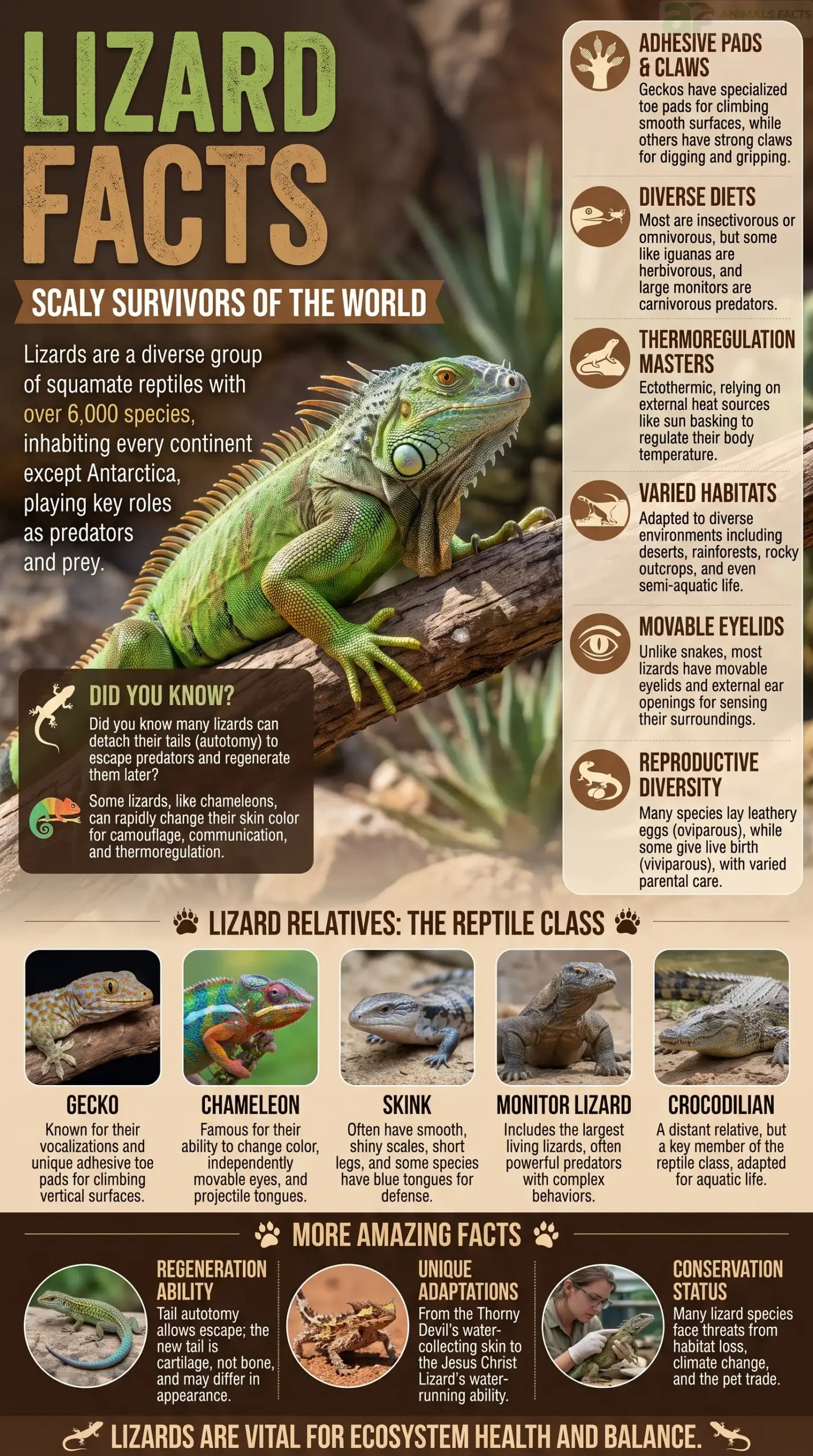
- Lizards have inhabited Earth for over 240 million years
- The fastest lizard can run at 35 km/h
- Some lizards can go without food for months in cold weather
- The smallest lizard fits on a fingertip
- Geckos clean their eyes with their tongue (they have no eyelids)
- Lizards taste the air using their forked tongue
- Some lizards can change color in less than 2 seconds
- The Komodo dragon can consume up to 80% of its own body weight in one meal
- Chameleons have a tongue longer than their entire body
- Lizards are found on every continent except Antarctica
- Many lizard species are nocturnal and hunt entirely at night
- Some geckos communicate using ultrasonic frequencies inaudible to humans
5. Natural Habitat of Lizards
Lizard habitat diversity is arguably the most impressive of any reptile group. These animals have colonized virtually every terrestrial environment on Earth, from sea level to altitudes exceeding 5,000 meters in the Himalayas and Andes.
Habitat Types
Lizards thrive in deserts, tropical rainforests, temperate woodlands, grasslands, rocky mountain slopes, coastal areas, wetland margins, and even urban environments. The cold climate skink of New Zealand survives near glacial environments, while the sandfish skink of the Sahara essentially “swims” through loose sand dunes.
Habitat Range by Continent
| Continent/Region | Notable Species | Habitat Type |
|---|---|---|
| Africa | Nile monitor, agamas, chameleons | Savanna, desert, rainforest |
| Asia | Komodo dragon, flying lizard, tokay gecko | Tropical forest, island ecosystems |
| Australia | Thorny devil, blue-tongue skink, frilled lizard | Desert, scrubland, forest |
| North America | Gila monster, horned lizard, green anole | Desert, forest, grassland |
| South America | Green iguana, tegu, basilisk lizard | Rainforest, grassland, wetland |
| Europe | Common wall lizard, sand lizard, European green lizard | Grassland, rocky slopes, woodland edges |
| Caribbean/Islands | Anoles, curly-tailed lizards, iguanas | Tropical dry forest, coastal scrub |
| Antarctica | None | N/A |
Did You Know? The common wall lizard (Podarcis muralis) has successfully colonized parts of southern England and Canada after being accidentally or deliberately introduced — demonstrating remarkable adaptability to new climates.
6. Lizard Diet & Feeding Behavior
Lizard diet varies enormously depending on species, size, and habitat. The group includes dedicated insectivores, strict herbivores, fearsome carnivores, and highly flexible omnivores.
Diet Breakdown Table
| Food Type | Percentage of Species That Eat It | Example Species |
|---|---|---|
| Insects & arthropods | ~60% | Geckos, anoles, agamas |
| Plant matter (leaves, fruit, flowers) | ~40% | Green iguana, marine iguana, uromastyx |
| Small vertebrates (rodents, birds) | ~15% | Monitor lizards, tegus, Gila monster |
| Other lizards | ~10% | Komodo dragon, large monitors |
| Carrion (dead animals) | ~5% | Komodo dragon, large varanids |
| Eggs | ~8% | Monitor lizards, tegus |
| Snails & mollusks | ~5% | Some skinks, plated lizards |
| Fish & aquatic prey | ~3% | Nile monitor, water monitors |
How Lizards Hunt
Most lizards are sit-and-wait predators — they remain perfectly still until prey comes within striking range, then launch a rapid ambush. Monitor lizards, by contrast, are active foragers, using their exceptional sense of smell to track prey across large distances. The chameleon uses perhaps the most spectacular hunting method of all: an extendable tongue that can reach 1.5 times the animal’s body length, launched at prey in under 0.07 seconds — one of the fastest movements in the entire animal kingdom.
7. Lizard Reproduction & Life Cycle
Lizard reproduction spans a remarkable range of strategies. The majority of lizards are oviparous (egg-laying), but a significant number are viviparous (live-bearing), and a handful reproduce through parthenogenesis — cloning themselves without fertilization.
Mating Behavior
Male lizards use an array of impressive displays to attract females and warn off rivals. These include dewlap extensions, push-up displays (used by iguanas and agamas), color intensification, and ritualized combat. In some monitor lizard species, males engage in dramatic wrestling bouts, rearing up on their hind legs and grappling with forelimbs.
Growth Stages
- Egg/Gestation — Incubation lasts 6–12 weeks for most egg-laying species; viviparous species carry young for 3–6 months
- Hatchling — Born fully independent; most receive no parental care
- Juvenile — Period of rapid growth; often vulnerable to predation
- Sub-adult — Sexual maturity approached; territorial behavior begins
- Adult — Full size reached; breeding begins; varies enormously by species
Lifespan Comparison Table
| Species | Average Lifespan (Wild) | Average Lifespan (Captivity) |
|---|---|---|
| Komodo Dragon | 30 years | Up to 50 years |
| Green Iguana | 8–10 years | Up to 20 years |
| Leopard Gecko | 6–10 years | Up to 20 years |
| Chameleon (Veiled) | 2–3 years | Up to 8 years |
| Blue-tongued Skink | 15–20 years | Up to 30 years |
| Bearded Dragon | 5–8 years | Up to 15 years |
Did You Know? Some female Komodo dragons have reproduced via parthenogenesis in captivity — giving birth to healthy male offspring without ever mating. This was first confirmed at Chester Zoo in England in 2006.
8. Social Behavior & Communication
Most lizards are considered solitary animals, but the reality of lizard social behavior is considerably more complex. Many species demonstrate sophisticated territorial, communicative, and even cooperative behaviors.
Communication Methods
Visual signals are the dominant form of communication in most lizard species. The dewlap of anoles and iguanas, the frill of frilled lizards, the beard of bearded dragons (which turns black when stressed or displaying), and full-body color changes in chameleons all serve complex communicative functions. These displays convey information about territorial ownership, readiness to mate, submission, or threat level.
Chemical communication is equally important. Most lizards possess femoral pores on their inner thighs that secrete waxy chemical compounds, leaving scent marks on surfaces to signal territory. Monitor lizards and tegus use their forked tongues to follow these chemical trails with remarkable precision.
Vocalizations are relatively rare among lizards compared to frogs or birds, but they do exist. Geckos are the most vocal lizards — the tokay gecko emits a loud, distinctive call, while many smaller geckos produce chirps, squeaks, and ultrasonic pulses. Some species of skink produce hissing sounds when threatened.
Intelligence
Recent research has challenged the old assumption that lizards are simply instinct-driven automata. Monitor lizards have demonstrated the ability to count (distinguishing between quantities of food items), solve novel puzzles, and recognize individual human caretakers. Komodo dragons in captivity have shown what appear to be play behaviors — interacting with objects without any food reward — a behavior associated with higher cognitive function.
9. Predators & Defense Mechanisms
Despite their impressive adaptations, lizards face a wide array of natural enemies. Understanding lizard behavior under threat reveals some of the most creative survival strategies in the animal kingdom.
Natural Predators
- Birds of prey (hawks, eagles, owls) — among the most significant predators of small lizards
- Snakes — particularly monitor lizards preying on smaller lizard species
- Mammals (foxes, mongooses, cats, rats) — especially on islands where introduced mammals have devastated lizard populations
- Larger lizards — Komodo dragons regularly eat smaller varanid lizards
- Spiders and large insects — prey on the smallest lizard species
Lizards Defense Strategies
Autotomy — The self-detachment of the tail is perhaps the most famous lizard defense. The detached tail continues to wriggle, distracting the predator while the lizard escapes. The tail regenerates over several weeks, though the new version is composed of cartilage rather than bone.
Camouflage — From the leaf-tailed gecko to the horned lizard, many species rely on extraordinary cryptic coloration to become effectively invisible.
Chemical defense — The Gila monster’s bright bead-like scales serve as a warning coloration (aposematism), advertising its venomous bite to potential predators.
Frill display — The frilled lizard faces its attacker head-on, suddenly snapping open its enormous neck frill and hissing loudly — a display designed purely to frighten.
Spiny armor — Species like the thorny devil and armadillo lizard use physical spines and bony scales to make themselves extremely unpleasant to swallow.
Blood squirting — The horned lizards (Phrynosoma species) of North America employ one of the most extraordinary defenses in the entire animal kingdom: they can squirt blood from their eyes — up to 1.5 meters (5 feet) — by increasing blood pressure in their ocular sinuses until tiny vessels burst. The blood contains chemicals that are specifically repellent to canid predators like coyotes and wolves.
Did You Know? The armadillo girdled lizard is the only lizard species known to live in stable family groups — adults have been observed actively protecting juveniles from predators, a behavior virtually unique among lizards.
10. Lizard Facts for Kids
Hey young explorers! Here are some awesome lizard facts for kids that will amaze your friends and family:
Lizards are super old! They’ve been around since before the dinosaurs — that’s over 240 million years ago!
Some lizards can walk on water! The basilisk lizard runs so fast on its back legs that it skims across rivers and ponds. Scientists call it the “Jesus lizard.”
Chameleons shoot their tongue like a rocket! Their sticky tongue is longer than their whole body and moves faster than a race car accelerating from 0 to 60.
Geckos can walk upside down! Their tiny toes are covered in millions of microscopic hairs that grip surfaces using a scientific force called Van der Waals attraction.
Lizards taste the air! That flickering tongue isn’t just for show — lizards use it to sniff out food, danger, and other lizards nearby.
Baby lizards are totally independent! Most lizard moms don’t stick around after laying eggs. Baby lizards hatch already knowing how to hunt and survive on their own.
Some lizards glow! A few species of chameleons have bones that fluoresce blue under ultraviolet light — a secret glow that only other chameleons can see!
The biggest lizard can eat a goat! The Komodo dragon is so powerful it can eat animals as big as deer and pigs in one sitting.
11. Relationship with Humans
The relationship with humans is one of the more complex lizard facts stories to tell. Throughout history, lizards have been feared, worshipped, hunted, eaten, kept as pets, and studied with growing fascination.
Historical Significance
In many ancient cultures, lizards held deep spiritual significance. In ancient Egypt, lizard hieroglyphs symbolized good luck and abundance. Ancient Romans kept lizards as good luck charms in their homes. In many Pacific Island cultures, the gecko is regarded as a protective household spirit — having a gecko in your home is considered a blessing.
Lizards as Pets
The modern pet reptile industry has made lizards one of the most popular exotic pets worldwide. Species like the bearded dragon (Pogona vitticeps), leopard gecko (Eublepharis macularius), blue-tongued skink, and crested gecko are kept in millions of homes globally. The global reptile pet trade is estimated to be worth over $1.4 billion USD annually as of 2025.
Human Conflicts
Large monitor lizards occasionally raid poultry farms and can deliver powerful bites and whipping tail strikes to humans who corner them. Komodo dragon attacks on humans, while rare, do occur — typically when tourists or park rangers approach too closely without proper precautions. Between 1974 and 2012, at least 24 verified Komodo dragon attacks on humans were recorded on the islands of the Indonesian archipelago.
12. Lizards Conservation Status & Threats
Lizard conservation is an increasingly urgent field. While the group as a whole remains diverse and abundant, a significant and growing number of species face serious threats.
IUCN Status Overview
| Status Category | Approximate Number of Lizard Species |
|---|---|
| Least Concern | ~4,200 species |
| Near Threatened | ~250 species |
| Vulnerable | ~300 species |
| Endangered | ~200 species |
| Critically Endangered | ~100 species |
| Extinct in the Wild / Extinct | ~30+ species |
Major Threats
Habitat loss is the single greatest threat to lizard populations globally, driven by agricultural expansion, urban development, and deforestation. Climate change poses an existential threat to many species — particularly those that depend on precise temperature windows for temperature-dependent sex determination (where the sex of hatchlings is determined by nest temperature). Warmer global temperatures are already skewing sex ratios in some populations toward all-female cohorts.
Invasive species — particularly rats, cats, and mongooses — have devastated island lizard populations. More than 50% of all lizard extinctions in recorded history have occurred on islands following the introduction of invasive predators.
The illegal pet trade continues to threaten rarer lizard species, with animals poached from wild populations to supply collectors around the world.
Did You Know? In New Zealand, all native lizard species (geckos and skinks) are legally protected, and it is illegal to keep them as pets without a special license. New Zealand has lost over 40% of its original lizard diversity since human settlement began.
13. Famous Lizards in History & Pop Culture
Real-World Famous Lizards
Nile (the Komodo dragon) — A female Komodo dragon at the London Zoo who famously reproduced via parthenogenesis in 2006, generating worldwide scientific interest.
El Viejo (“The Old Man”) — A Galápagos land iguana estimated to be over 60 years old and one of the oldest recorded lizards on the islands, documented by conservation teams.
Puff — A beloved bearded dragon who became a social media sensation with over 2 million followers across platforms due to his remarkably expressive face and apparent laid-back personality.
14. Role in Ecosystem & Food Chain
Lizards occupy multiple levels of the food chain simultaneously, functioning as predators, prey, seed dispersers, and insect population regulators. Their ecological role is profound and often underappreciated.
As predators of insects, lizards provide natural pest control services worth billions of dollars annually to agriculture and human health. A single common gecko can consume hundreds of mosquitoes, flies, and cockroaches per night. Remove lizards from an ecosystem and insect populations can explode, with cascading effects on plant life and disease transmission.
Large herbivorous lizards like iguanas and Galápagos tortoises’ closest relatives act as seed dispersers, eating fruits and depositing seeds at distances far from the parent plant — a service critical for forest regeneration.
As prey items, lizards feed an enormous range of predators, including birds, snakes, mammals, and larger lizards. They are a linchpin species in many food webs, and their disappearance can trigger trophic cascades that destabilize entire ecosystems.
15. Lizard Myths, Folklore & Cultural Significance
Across human history, lizard mythology has been richly diverse — ranging from protective household spirits to omens of evil.
In West African traditions, particularly among the Yoruba people, the monitor lizard is associated with royalty and power. In Hindu mythology, the garden lizard (Calotes versicolor) is considered a messenger of the god Rama. In many Aboriginal Australian cultures, the goanna (monitor lizard) features prominently in Dreamtime stories as a creature of cunning intelligence.
In medieval European folklore, the lizard was often associated with wisdom and good luck — Roman naturalist Pliny the Elder wrote that a blind man sleeping outdoors would be healed by a lizard placing its face near his eyes. In many South American indigenous traditions, large iguanas are revered as symbols of fertility and are associated with rain-bringing deities.
16. Lizards in Pop Culture
Godzilla — The world’s most famous fictional lizard, first appearing in the 1954 Japanese film Gojira. Godzilla is inspired directly by giant monitor lizards and the cultural memory of atomic bomb horror.
Rango (2011) — An Academy Award-winning animated film featuring a chameleon protagonist, celebrated for its remarkably accurate portrayal of lizard behavior and desert ecology.
The Geico Gecko — Perhaps the world’s most recognizable lizard character, this animated gecko has been the mascot of GEICO insurance since 1999.
The Basilisk in the Harry Potter series — While technically a mythological serpent, J.K. Rowling’s version draws heavily on giant monitor lizard imagery.
Komodo — A recurring villain in the Marvel Comics universe, directly named after and visually modeled on the Komodo dragon.
17. Lizard Facts vs. Common Myths
| Common Myth | The Real Fact |
|---|---|
| “Lizards are slimy” | Lizard scales are completely dry — they have no mucus glands |
| “Chameleons change color to match their background” | Color change is primarily for social communication and temperature regulation |
| “Komodo dragons kill with bacteria in their saliva” | This long-held belief was overturned in 2009 — they use venom glands |
| “All lizards can regrow their tail” | Only some species have this ability; many lizards cannot regenerate lost tails |
| “Geckos are silent” | Many gecko species are highly vocal and among the noisiest reptiles |
| “Lizards are low intelligence, mindless animals” | Many species show problem-solving, memory, and social learning |
| “House lizards (geckos) are dangerous to humans” | Completely false — they are harmless and beneficial pest controllers |
| “Horned lizards shoot acid from their eyes” | They shoot blood, not acid — and only to deter canid predators specifically |
18. Best Places to See Lizards in the Wild
1. Komodo National Park, Indonesia — The only place on Earth where you can observe wild Komodo dragons in their natural habitat. Rangers offer guided walking tours on Komodo and Rinca islands.
2. Galápagos Islands, Ecuador — Home to both the legendary marine iguana and the impressive Galápagos land iguana, found nowhere else on Earth.
3. Namib Desert, Namibia — One of the best places to observe the extraordinary web-footed gecko and various skinks that have evolved uniquely for extreme desert conditions.
4. Madagascar — The world capital of chameleon diversity, with approximately half of all chameleon species on Earth found here, alongside stunning leaf-tailed geckos.
5. Australian Outback — Encounter the thorny devil, blue-tongued skink, frilled lizard, and numerous monitor species (goannas) in their native environment.
6. Costa Rica & Panama — Tropical forests of Central America offer breathtaking encounters with basilisk lizards, green iguanas, and a stunning diversity of anoles.
7. Canary Islands, Spain — The Canary Islands giant lizard (Gallotia stehlini) is a must-see for European wildlife enthusiasts, and these islands host remarkable lizard endemism.
19. How You Can Help
Lizard conservation is something every person can contribute to, regardless of where you live.
Support these conservation organizations:
- IUCN Reptile Specialist Group — iucn.org
- Komodo Survival Program — works directly on Komodo dragon protection
- Amphibian and Reptile Conservation (ARC) — arc-trust.org (UK-based, global reach)
- Wildlife Conservation Society (WCS) — wcs.org
- WWF — worldwildlife.org
What you can do:
- Never buy wild-caught reptiles as pets — always verify captive-bred status
- Support invasive species removal programs on islands
- Plant native vegetation in your garden to attract and support local lizard species
- Join citizen science projects like iNaturalist to document lizard sightings in your area
- Reduce pesticide use — pesticides eliminate the insects that lizards depend on
- Spread awareness — sharing accurate lizard facts on social media helps combat fear and misunderstanding
20. Top Documentaries & Books
Must-Watch Documentaries
- Planet Earth II (BBC, 2016) — Contains one of the most dramatic lizard sequences ever filmed: marine iguana hatchlings fleeing racer snakes on the Galápagos
- Life (BBC, 2009) — Features incredible footage of Komodo dragons hunting and the basilisk lizard walking on water
- Spy in the Wild (BBC, 2017) — Uses animatronic spy cameras to capture intimate lizard behavior
- Wild Madagascar (BBC) — The definitive documentary on Madagascar’s extraordinary chameleon and gecko diversity
Must-Read Books
- Lizards: Windows to the Evolution of Diversity by Eric Pianka & Laurie Vitt — The definitive scientific overview
- Improbable Destinies by Jonathan Losos — Features extensive discussion of lizard evolution and the Anolis lizard research program
- The Komodo Dragon: A Natural History by Joan B. Proctor — Classic natural history text on the world’s largest lizard
- Geckos of the World by Aaron M. Bauer — Comprehensive photographic and scientific guide
21. Frequently Asked Questions About Lizard Facts
Q1. What is the scientific name for lizards?
Lizards belong to the suborder Lacertilia (also called Sauria) within the order Squamata. There is no single scientific name for all lizards because they represent thousands of individual species, each with their own binomial name. For example, the Komodo dragon is Varanus komodoensis, the green iguana is Iguana iguana, and the common leopard gecko is Eublepharis macularius.
Q2. How many species of lizards are there?
As of 2026, scientists have described over 7,000 species of lizards, making them the most species-rich group of reptiles. New species continue to be discovered every year, particularly in tropical regions of Madagascar, Southeast Asia, and South America.
Q3. What do lizards eat?
Lizard diet varies enormously by species. Most small lizards are insectivores, feeding on beetles, moths, crickets, and ants. Large lizards like monitors and tegus are carnivores, eating mammals, birds, and eggs. Iguanas and some other lizards are primarily herbivores, feeding on leaves, flowers, and fruit. Many species are omnivores, eating whatever is available.
Q4. Are lizards endangered?
While many lizard species remain abundant, over 100 species are currently classified as Critically Endangered by the IUCN Red List. Island species are particularly vulnerable. Habitat loss, climate change, and invasive predators are the primary threats.
Q5. How long do lizards live?
Lifespan varies greatly. Small geckos and anoles typically live 3–7 years in the wild. Medium-sized species like bearded dragons may live 8–15 years in captivity. The Komodo dragon can live up to 30 years in the wild and over 50 years in captivity.
Q6. Can lizards regrow their tails?
Many, but not all, lizard species can regenerate a lost tail through a process called autotomy. The regenerated tail is typically composed of cartilage rather than bone and may differ in color and texture from the original. Species that can regrow tails include most geckos, anoles, skinks, and iguanas. Monitor lizards cannot regenerate lost tails.
Q7. Are lizards good pets?
Many lizard species make excellent pets for experienced owners. Bearded dragons, leopard geckos, blue-tongued skinks, and crested geckos are among the most popular and are well-suited to captivity when properly housed and fed. However, all reptile pets require specialized care, proper UVB lighting, appropriate temperatures, and correct nutrition. Wild-caught lizards should never be purchased.
Q8. What is the largest lizard in the world?
The Komodo dragon (Varanus komodoensis) is the world’s largest living lizard, reaching up to 3 meters (10 feet) in length and weighing up to 70 kilograms (154 lbs). They are found only on a handful of Indonesian islands including Komodo, Rinca, Flores, and Gili Motang.
Q9. What is the smallest lizard in the world?
The nano-chameleon Brookesia nana of northern Madagascar, described in 2021, holds the record as the world’s smallest known lizard. Adult males measure only 13.5 mm in snout-to-vent length — small enough to perch comfortably on a matchstick head.
Q10. Do lizards have venom?
Contrary to popular belief, venom is not rare in lizards. The Gila monster and Mexican beaded lizard are the most well-known venomous lizards. However, research published from 2005 onward has shown that monitor lizards (including Komodo dragons) also possess functional venom glands. Additionally, many iguanians possess primitive venom glands, though most do not deliver venom in a medically significant way.
22. Sources & References
Research Sources
- Wikipedia — Squamata, Lacertilia, Komodo dragon, Chamaeleonidae
- IUCN Red List — iucnredlist.org (species assessments, 2025 update)
- National Geographic — nationalgeographic.com
- Smithsonian’s National Zoo — nationalzoo.si.edu
- WWF Global — worldwildlife.org
- BBC Wildlife Magazine — bbcwildlife.com
- Britannica — britannica.com/animal/lizard
- Live Science — livescience.com
- Animal Diversity Web (University of Michigan) — animaldiversity.org
- Losos, Jonathan B. (2017). Improbable Destinies. Riverhead Books
- Pianka, Eric R. & Vitt, Laurie J. (2003). Lizards: Windows to the Evolution of Diversity. UC Press
- Fry, Bryan G. et al. (2009). “A central role for venom in predation by Varanus komodoensis” — PNAS