
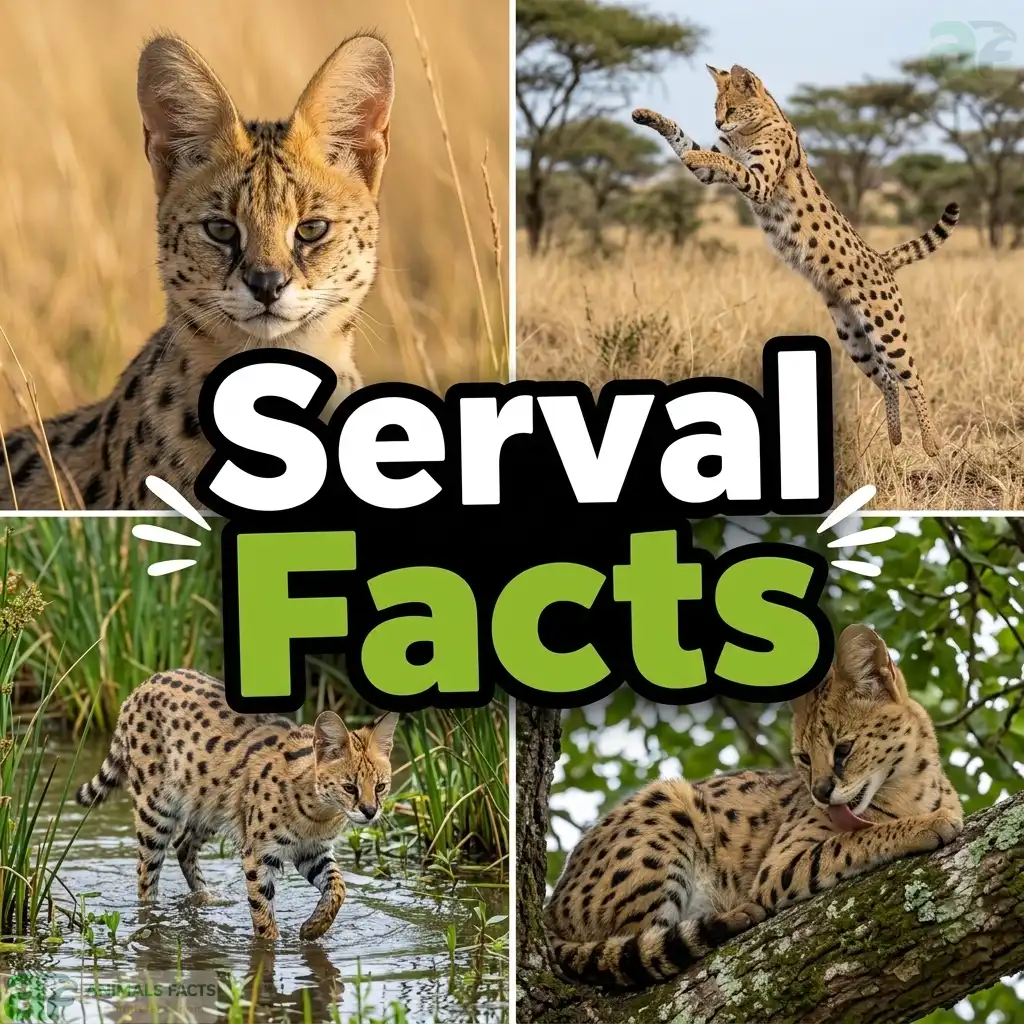
Serval Facts
| Feature | Details |
|---|---|
| Scientific Name | Leptailurus serval |
| Common Names | Serval, Bush Cat (regional) |
| Kingdom | Animalia |
| Phylum | Chordata |
| Class | Mammalia |
| Order | Carnivora |
| Family | Felidae |
| Genus | Leptailurus (sole living species) |
| Recognized Subspecies | Historically up to 17 described; modern taxonomy supports broad regional groupings rather than distinct subspecies |
| Habitat | Grassland, savanna, wetland margins, reed beds — across sub-Saharan Africa (one tiny North African outlier population) |
| Lifespan | 10–12 years in the wild; up to 22 years in captivity |
| Diet | Rodents (primary), birds, reptiles, amphibians, insects |
| Weight | 8–18 kg; males average heavier than females |
| Body Length | 59–100 cm (excluding tail); tail adds 24–45 cm |
| Shoulder Height | 54–66 cm — proportionally the tallest wild cat relative to body weight |
| Top Speed | Approximately 80 km/h (50 mph) in short bursts |
| Vertical/Pounce Jump | Up to 3 meters vertically and 4 meters horizontally to catch prey or flying birds |
| Hunting Success Rate | Estimated 50% — among the highest of any wild cat |
| Conservation Status | Least Concern (IUCN Red List, global); regionally threatened in North Africa and parts of South Africa |
| Global Wild Population | Estimated tens of thousands, widespread but poorly quantified |
| Unique Feature | Longest legs relative to body size of any cat; largest ears relative to head size of any cat; closest relatives are the caracal and African Golden Cat |
 1. Introduction: What is a Serval?
It stands taller, relative to its weight, than any other wild cat on Earth — a body built almost entirely of leg, with ears so large and so finely tuned that it can detect a mouse rustling beneath thick grass from 20 meters away without ever seeing it. When it strikes, it does not stalk low and slow like a leopard — it leaps, sometimes nearly 3 meters straight up, crashing down on its prey with both forepaws in a single decisive pounce that succeeds roughly half the time it’s attempted — one of the highest hunting success rates documented for any cat species in the world. Serval facts reveal an animal engineered by evolution into one of the most specialized and most successful small predators on the African continent, and yet one that remains startlingly unfamiliar to most people outside the wildlife research community.
The serval — Leptailurus serval — is a medium-sized African wild cat instantly recognizable by its extraordinarily long legs, oversized ears, and beautifully spotted golden coat. Despite its elegant, almost gazelle-like proportions, the serval is a formidable and highly specialized predator of grassland and wetland-margin rodents, equipped with one of the most acute auditory hunting systems of any felid and a leaping ability that allows it to snatch birds directly out of the air. Genetic research has revealed that the serval’s closest living relatives are the caracal and the African Golden Cat — together forming a distinct evolutionary lineage that diverged from the rest of the cat family millions of years ago, despite the serval’s superficial resemblance to a smaller cheetah.
Whether you are a student researching serval facts for a school project, a safari traveler hoping to spot this elusive grassland specialist, a parent looking for serval facts for kids, someone curious about the controversial Savannah cat hybrid breed derived from servals, or simply someone fascinated by one of Africa’s most visually striking and behaviorally specialized small cats — this is the most complete guide to serval facts you will find anywhere. We cover serval habitat, serval diet, serval behavior, communication, reproduction, conservation, mythology, and the extraordinary story of an animal whose body has been shaped by evolution into the perfect rodent-hunting machine. Let us begin.
2. Species Overview & Classification
The serval belongs to the family Felidae within the subfamily Felinae — the non-roaring cats — and is the sole living species within its own genus, Leptailurus. The genus name derives from the Greek “leptos” (slender) and “ailouros” (cat) — a fitting description of the serval’s remarkably slim, elongated body proportions.
The Caracal Lineage — Serval’s True Family
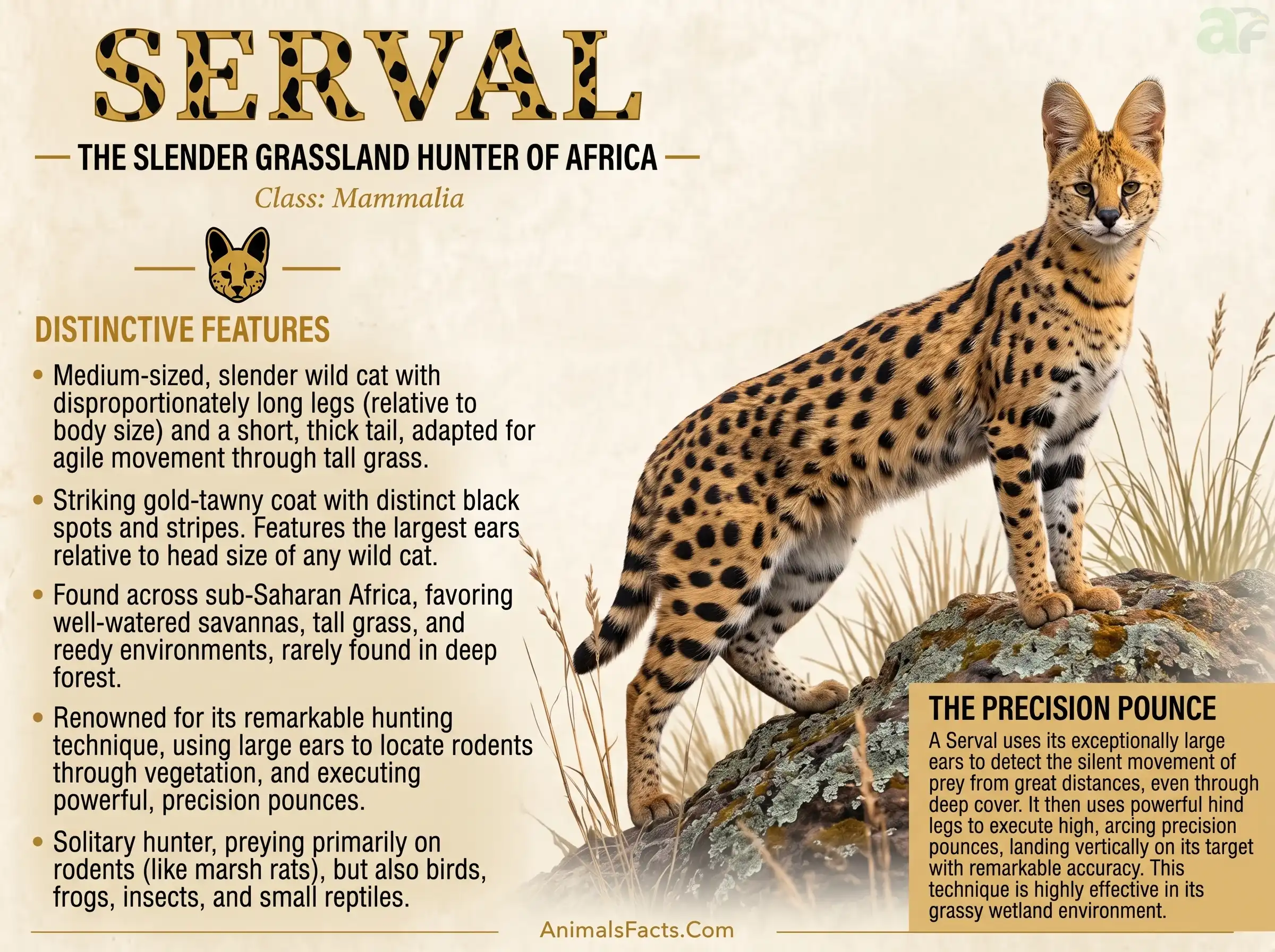
As established in modern felid genetics, the serval belongs to what researchers call the Caracal lineage — one of eight major evolutionary branches within the modern cat family — alongside the caracal (Caracal caracal) and the African Golden Cat (Caracal aurata). This lineage diverged from other cat lineages approximately 8.5 million years ago, with the serval’s own evolutionary split from the caracal/African Golden Cat ancestor occurring around 3.4–5.5 million years ago. Despite superficial resemblance to a miniature cheetah, the serval is not closely related to the cheetah at all — its long legs and spotted coat represent a striking case of convergent evolution, in which unrelated species independently evolve similar physical traits in response to similar ecological pressures (in this case, hunting in tall grass habitats).
Species Classification Table
| Level | Classification |
|---|---|
| Kingdom | Animalia |
| Phylum | Chordata |
| Class | Mammalia |
| Order | Carnivora |
| Family | Felidae |
| Subfamily | Felinae |
| Genus | Leptailurus |
| Species | L. serval |
| Closest Relatives | Caracal (Caracal caracal), African Golden Cat (Caracal aurata) |
Serval Subspecies (Historical Classification)
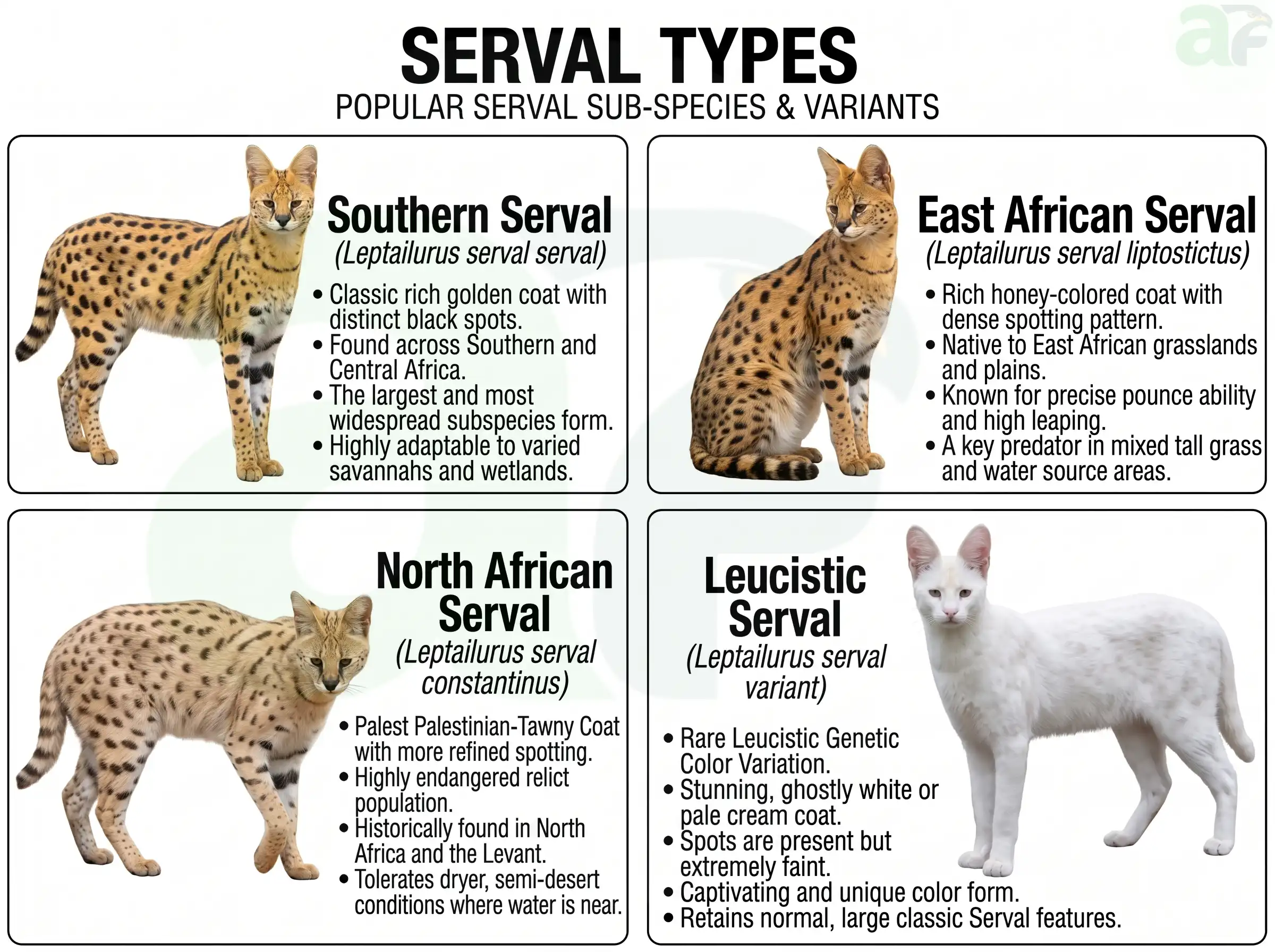
Up to 17 subspecies were historically described based on regional coat variation, though modern genetic analysis suggests far less distinct differentiation than once believed, with most authorities now recognizing broader regional population groupings:
| Regional Population | Range | Notes |
|---|---|---|
| East African Serval | Kenya, Tanzania, Uganda | Most heavily studied population |
| Southern African Serval | South Africa, Botswana, Zimbabwe, Zambia | Significant agricultural-margin population |
| West African Serval | Senegal, Nigeria, surrounding countries | More fragmented; less studied |
| Central African Serval | DRC, Central African Republic | Forest-margin and wetland populations |
| North African Serval (Serval constantina) | Historically Algeria/Tunisia | Functionally extinct in North Africa; tiny remnant possibly extirpated |
Species Evolution & Discovery Timeline
~8.5 million years ago: The Caracal lineage — encompassing the ancestors of the modern serval, caracal, and African Golden Cat — diverged from other cat lineages during the late Miocene Epoch.
~3.4–5.5 million years ago: The serval’s evolutionary line diverged from the shared ancestor of the caracal and African Golden Cat, beginning the species’ independent evolutionary trajectory toward its distinctive long-legged, grassland-specialized body plan.
~1–2 million years ago: The serval developed its modern morphology — including the extraordinarily elongated limbs and oversized ears that define the species today — as adaptations to hunting small, well-concealed prey in tall African grassland and wetland-margin habitats.
Ancient Egypt (~3000–300 BCE): Servals appear in Egyptian artwork and archaeological evidence, with some researchers suggesting the species may have held cultural or symbolic significance similar to that documented for the caracal, though direct evidence is less extensive than for the caracal or domestic cat.
1776: The serval was formally scientifically described by Johann Christian Daniel von Schreber, the same naturalist who described the caracal in the same period, establishing the species’ place in Western zoological taxonomy.
20th century: Serval populations were significantly reduced across North Africa (where the species is now considered functionally extinct or nearly so) and parts of southern Africa, primarily through habitat loss associated with wetland drainage and agricultural conversion.
1980s–2000s: Development of the Savannah cat — a domestic hybrid breed created by crossing servals with domestic cats — began in the United States, eventually becoming a recognized (though controversial) breed by some cat fancier organizations.
2010s–2026: Modern genetic research definitively confirmed the serval’s close evolutionary relationship to the caracal and African Golden Cat, while ongoing field research — including GPS collar studies in South Africa and East Africa — has significantly expanded scientific understanding of serval territory size, hunting success rates, and population dynamics.
3. Physical Description & Unique Features
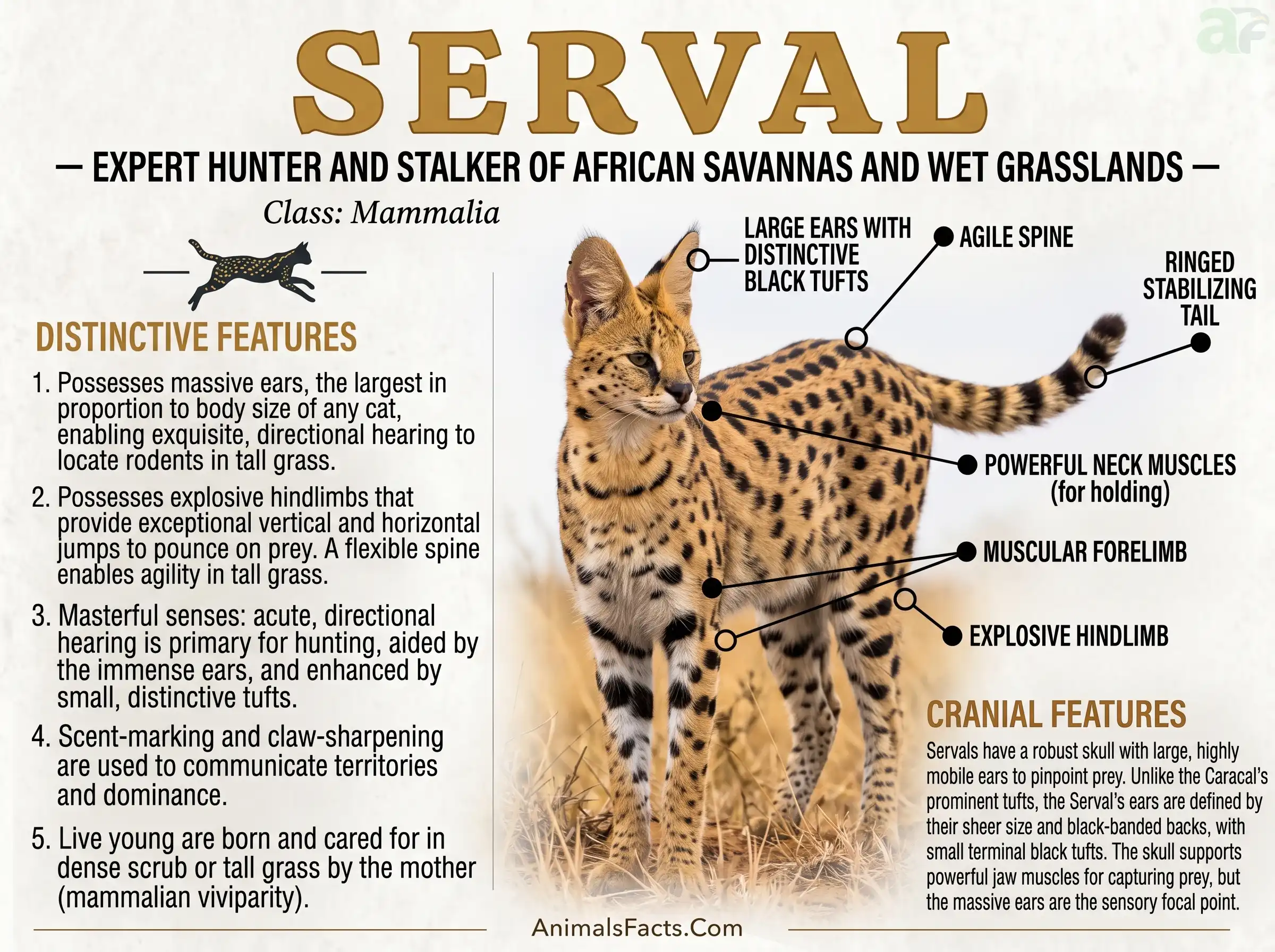
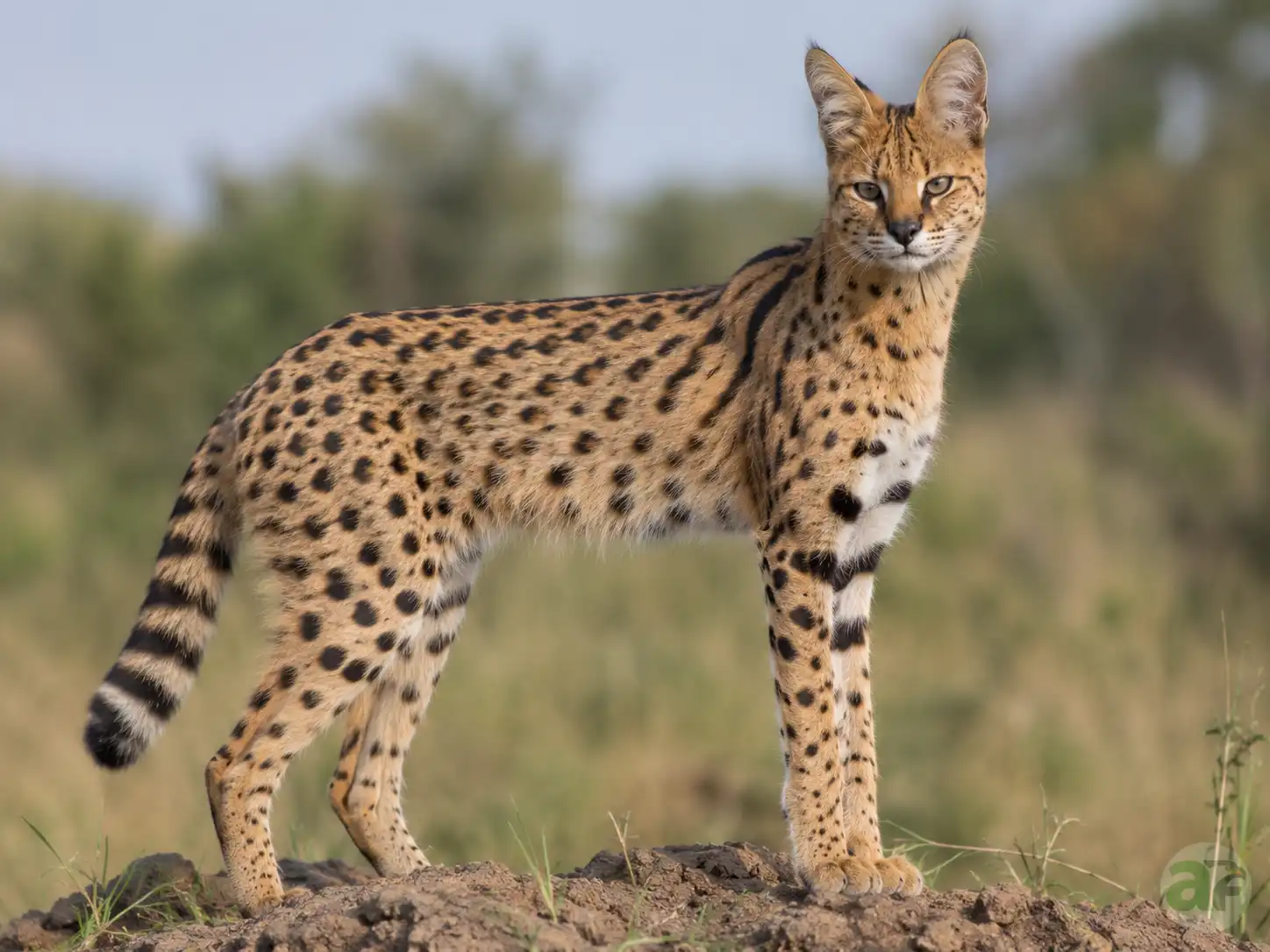
The serval possesses one of the most distinctive and immediately recognizable body plans of any wild cat — a combination of extreme proportional features that, taken together, create an animal that looks almost like an artistic exaggeration of a typical cat silhouette.
The Tallest Cat Relative to Body Weight
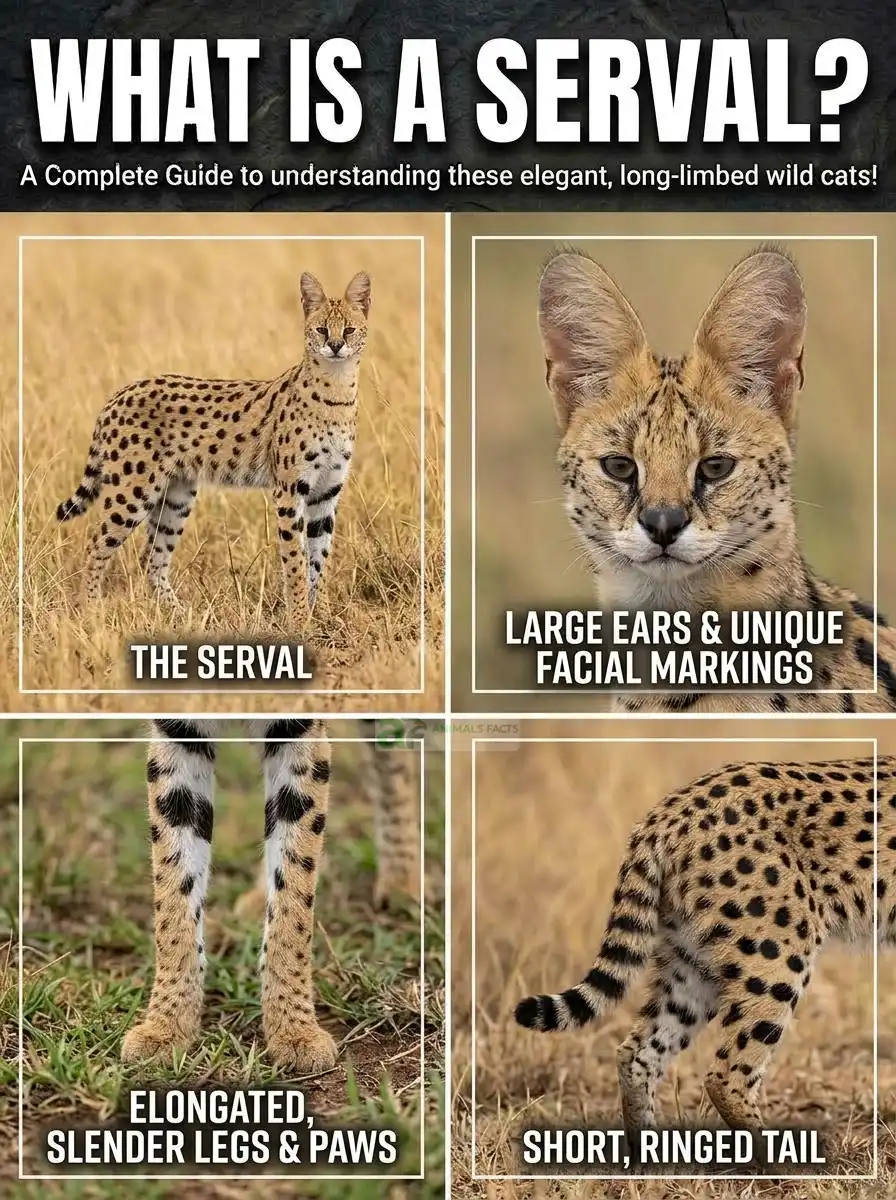
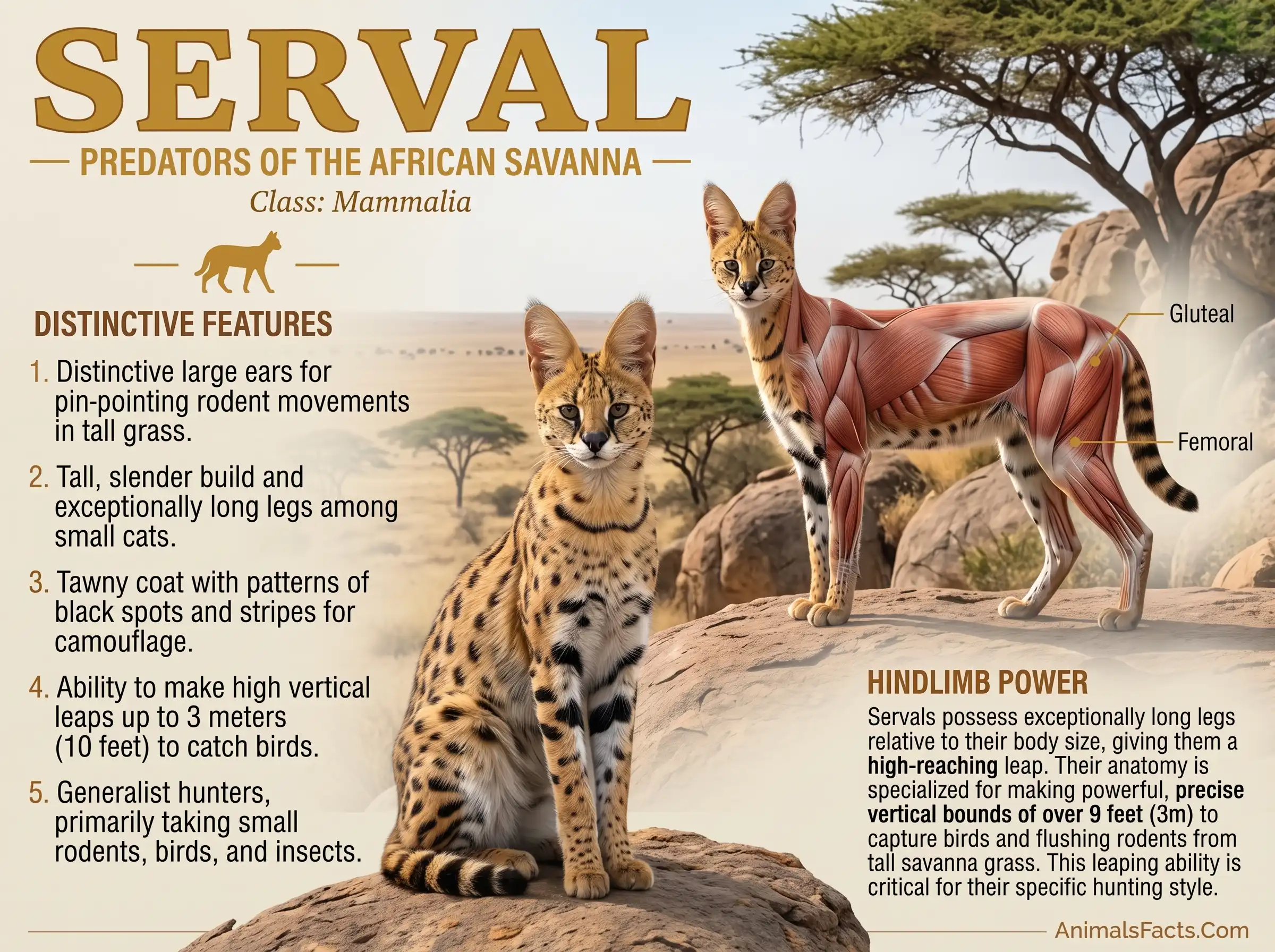
The serval’s most extraordinary physical claim to fame is that it possesses the longest legs relative to body size of any cat species on Earth — a proportional achievement that gives the serval a standing height comparable to much larger cats despite weighing only 8–18 kg. This leg length — particularly the hind legs — provides the serval with two critical hunting advantages: the ability to see over tall grass to spot prey and potential threats, and the explosive jumping power needed for its signature leaping hunting technique.
The Largest Ears Relative to Head Size
The serval also holds the distinction of possessing the largest ears relative to head size of any cat species — large, rounded, and highly mobile ears that function as exceptionally sensitive directional sound-collection devices. This auditory specialization allows the serval to detect the precise location of rodents moving beneath dense grass or soil even when the prey is completely invisible — a critical adaptation given that much of the serval’s hunting occurs in habitats where direct visual prey detection is severely limited by vegetation density.
Size and Sexual Dimorphism
Servals are medium-sized cats, with males typically 10–20% heavier than females:
- Males: Typically 9.5–18 kg
- Females: Typically 8–13 kg
- Body length: 59–100 cm excluding tail, with the tail adding a relatively short 24–45 cm — proportionally shorter than in many other cats, reflecting reduced reliance on tail-based balance compared to climbing specialists
Coat and Coloration
The serval’s coat is a striking golden-yellow to buff background marked with bold black spots that, in some individuals, merge into elongated streaks particularly along the back and shoulders — a pattern distinct from the leopard’s rosettes or the cheetah’s solid round spots. The undersides are typically white or pale cream. A small number of individuals display melanism (an entirely black coat) — relatively more commonly documented in serval populations from high-altitude regions of East Africa than in most other wild cat species, suggesting a potential adaptive advantage to dark coloration in specific high-altitude environmental conditions.
Skull and Dental Adaptations
The serval possesses a proportionally small, narrow skull relative to body size compared to most other cats — an adaptation associated with its specialized hunting technique, which relies more on auditory detection and explosive pouncing power than on the powerful jaw-crushing bite force needed by cats that more frequently subdue larger, actively struggling prey.
Did You Know? The serval’s combination of extraordinary leg length and acute hearing allows it to perform one of the most precise predatory behaviors documented in any cat — detecting a rodent’s exact location underground or beneath dense vegetation purely through sound, then leaping high into the air and crashing down with both front paws simultaneously onto the precise spot where the prey is concealed, pinning it before it can react. This technique, sometimes called the “high pounce” or “mousing leap,” has been measured reaching heights of nearly 3 meters and has been documented succeeding in catching prey on approximately half of all attempts — an extraordinarily high success rate compared to the typically much lower success rates documented for most other wild cat species.
4. Top 25 Surprising & Interesting Serval Facts
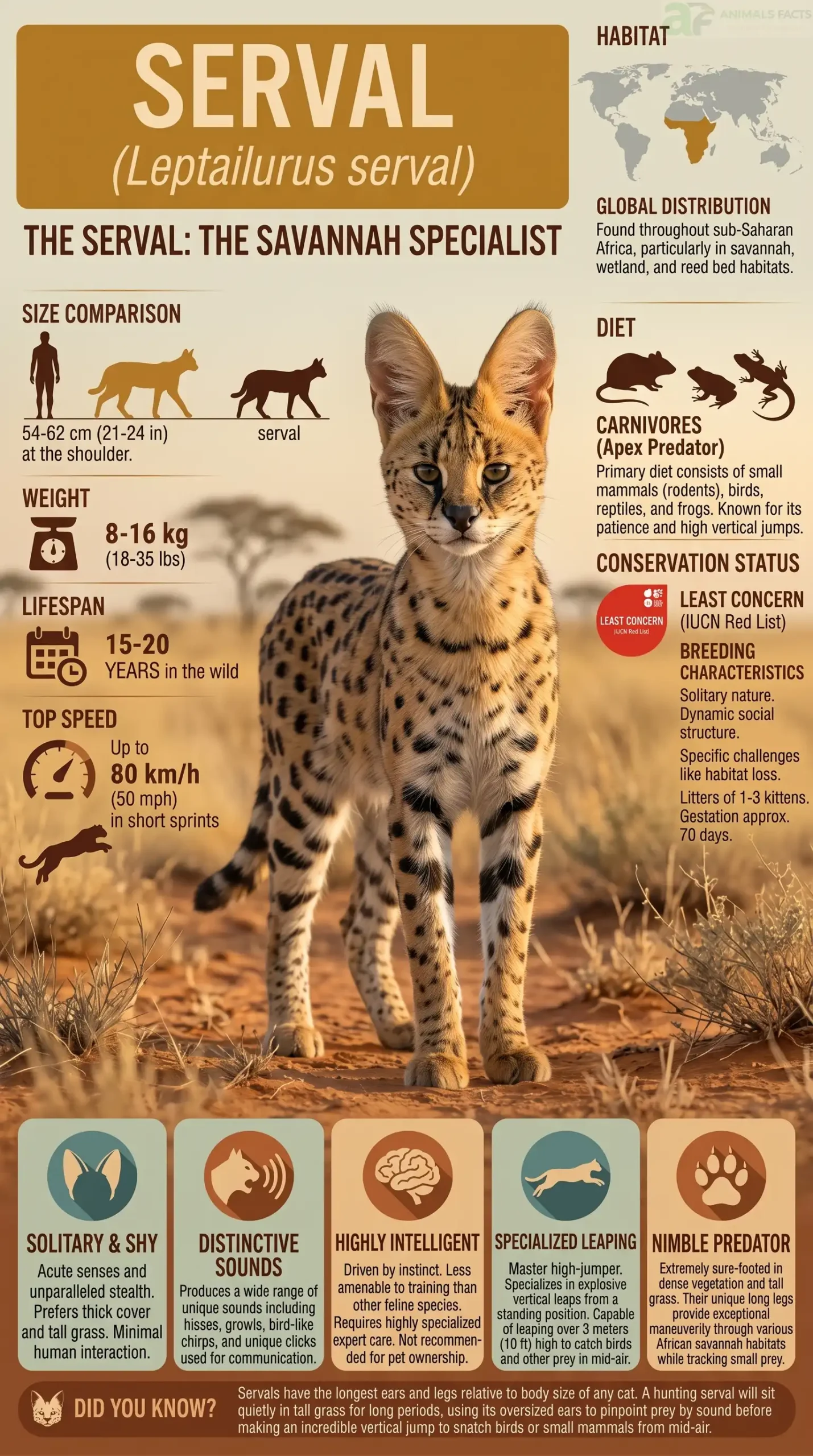
- The serval has the longest legs relative to body size of any cat species — giving it a standing height comparable to cats several times its weight.
- The serval also has the largest ears relative to head size of any cat species — an extraordinary auditory adaptation for detecting hidden prey.
- Servals can leap up to 3 meters vertically and 4 meters horizontally in a single bound to catch prey, including birds in mid-flight.
- The serval’s hunting success rate is estimated at approximately 50% — among the highest documented for any wild cat species, far exceeding the typical 10–25% success rates of lions and leopards.
- Despite its long-legged, spotted appearance resembling a miniature cheetah, the serval is not closely related to the cheetah at all — its closest relatives are the caracal and the African Golden Cat.
- Servals have been documented digging rodents directly out of their burrows using their forepaws — a hunting technique requiring both physical excavation skill and the precise auditory location of underground prey.
- The serval’s distinctive “mousing leap” — pouncing on prey from above with both front paws — is so effective that researchers have documented individual servals catching as many as 10 rodents in a single hour during productive hunting periods.
- A small number of servals display melanism (completely black coats) — documented more frequently in high-altitude East African populations (particularly the Aberdare Mountains and Mount Kenya regions) than in most other wild cat species.
- The serval is sometimes called the “giraffe cat” in some regional contexts due to its disproportionately long neck and legs relative to its body — though this nickname is not in widespread formal use.
- Servals have been documented catching birds directly out of the air — leaping upward to intercept birds flushed from grass or reed beds, a hunting technique requiring exceptional timing and spatial calculation.
- The serval’s name derives from a Portuguese word related to “lynx” or possibly from a term describing a wolf-like or deer-like creature — reflecting historical European confusion about the species’ precise taxonomic identity when first documented by colonial naturalists.
- Female servals raise their kittens entirely alone, with no paternal involvement in cub-rearing — typical of most solitary cat species but notable given the serval’s relatively high reproductive investment in kitten development.
- Servals are excellent swimmers, often hunting directly in shallow water and wetland margins for amphibians, fish, and aquatic birds — demonstrating habitat versatility beyond their typical grassland association.
- The Savannah cat, a popular and controversial domestic hybrid breed, is created by crossing servals with domestic cats — first-generation hybrids (F1) retain significant wild serval characteristics and behavior, generating ongoing debate about the ethics and practicality of such hybridization.
- A serval’s ears can rotate independently through nearly 180 degrees, allowing it to monitor sounds from completely different directions simultaneously while focusing visual attention elsewhere.
- Servals are believed to have one of the most specialized rodent-focused diets of any African cat — with some populations documented obtaining over 90% of their caloric intake from rodents alone.
- The serval’s tail is proportionally shorter than that of most other wild cats — reflecting its primarily terrestrial, non-climbing hunting lifestyle compared to more arboreal felid species.
- Servals have been documented “listening” with their entire body oriented toward a sound source for extended periods — sometimes remaining nearly motionless for several minutes while precisely triangulating prey location before committing to the explosive pounce.
- The serval population in North Africa (formerly classified as a distinct subspecies, Leptailurus serval constantina) is now considered functionally extinct or critically close to extinction — representing one of the most severe regional conservation losses for any African cat species.
- Servals demonstrate remarkable adaptability to agricultural landscapes in parts of southern Africa, with documented populations persisting in farmland areas where rodent prey remains abundant despite significant habitat modification.
- The serval’s distinctive black-and-white tail markings, featuring bold rings near the tip, may serve as a visual communication signal during social interactions, particularly between mothers and kittens in dense grass habitat where visual contact would otherwise be difficult to maintain.
- Research has documented individual servals maintaining remarkably precise and consistent hunting routes through their territories — returning to the same productive rodent-hunting areas on a predictable schedule that maximizes prey encounter rates.
- The serval possesses among the most acute vertical sound localization capabilities documented in any cat — critical for detecting prey moving directly beneath the cat’s position in dense grass, where horizontal sound localization alone would be insufficient.
- Servals in Tanzania’s Ngorongoro Crater have been studied extensively due to the area’s unusually high serval density and favorable observation conditions, making this location one of the most scientifically important sites for understanding wild serval ecology.
- The serval’s overall body design represents one of the most extreme morphological specializations within the entire cat family — with virtually every distinguishing physical feature (leg length, ear size, body slenderness) directly serving its specialized grassland rodent-hunting ecological niche.
5. Fun Facts about Servals
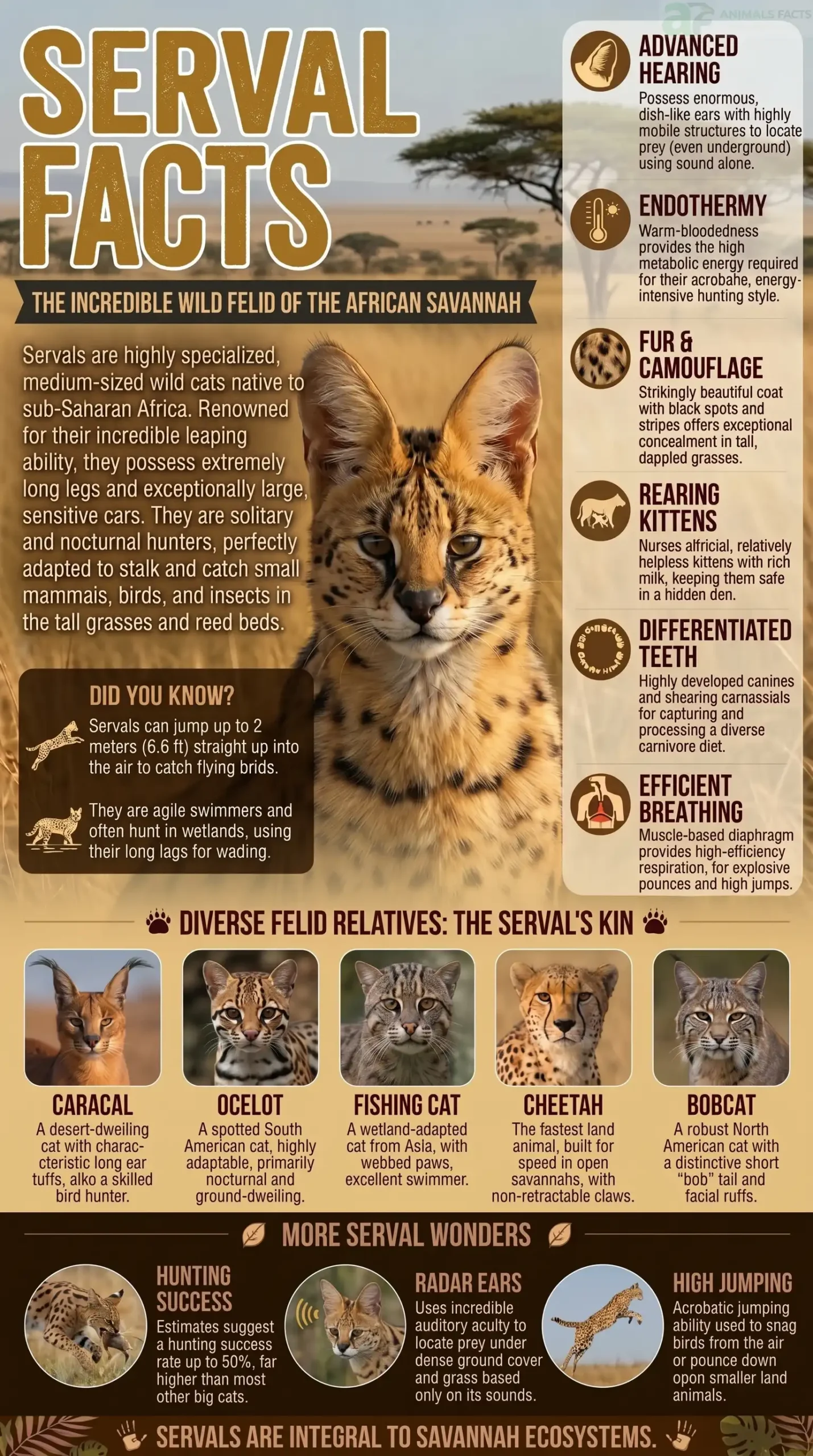
- The serval has the longest legs relative to body size of any cat in the world.
- The serval also has the largest ears relative to head size of any cat.
- Servals can leap 3 meters vertically to catch birds and rodents.
- The serval’s hunting success rate (~50%) is among the highest of any wild cat.
- Despite resembling a mini cheetah, the serval’s closest relatives are the caracal and African Golden Cat.
- Some servals are completely black — a trait more common in East African mountain populations.
- Servals can catch up to 10 rodents in a single hour during good hunting conditions.
- Servals are strong swimmers and hunt in wetlands and shallow water.
- The Savannah cat breed is a domestic hybrid created from serval-domestic cat crosses.
- A serval’s ears can rotate nearly 180 degrees independently.
- Up to 90% of a serval’s diet can consist of rodents alone.
- The serval is believed to be functionally extinct in North Africa.
6. Natural Habitat & Geographic Range
The serval’s habitat preferences are notably more specialized and water-dependent than those of many other African wild cats — reflecting its evolutionary specialization for hunting rodents in tall grass and wetland-margin environments where moisture sustains the dense vegetation and abundant small mammal populations the species depends upon.
Primary Habitat Types
Grassland and savanna with tall grass cover: The serval’s optimal and most characteristic habitat — open to semi-open grassland with grass tall and dense enough to provide cover and support abundant rodent populations, but not so dense as to prevent the serval’s leaping hunting technique from functioning effectively.
Wetland margins and reed beds: Servals show a particularly strong association with water-adjacent habitats — marshes, riverine grassland, and reed beds — reflecting both the higher rodent densities typically supported by these productive ecosystems and the serval’s documented willingness to hunt amphibians, fish, and waterfowl directly in shallow water.
Moorland and high-altitude grassland: In East Africa, particularly Kenya and Ethiopia, servals inhabit high-altitude moorland and montane grassland environments up to elevations exceeding 3,000 meters — among the higher-altitude habitats occupied by any African small cat species, and the environment most strongly associated with the species’ documented melanistic individuals.
Agricultural margins: Across parts of southern and eastern Africa, servals have demonstrated significant adaptability to farmland habitats — particularly areas combining crop agriculture with adjacent grassland or wetland patches that sustain rodent populations, allowing the species to persist in landscapes substantially modified by human agricultural activity.
Forest-margin and savanna mosaic: In Central and West Africa, servals inhabit the transitional zones between forest and savanna — utilizing the grassland and woodland-margin patches within these mosaic landscapes rather than penetrating deep into closed-canopy forest interior.
Habitat Range by Continent/Region
| Region | Countries | Population Status | Notes |
|---|---|---|---|
| East Africa | Kenya, Tanzania, Uganda, Ethiopia | Most studied and relatively secure | Stable in protected areas |
| Southern Africa | South Africa, Botswana, Zimbabwe, Zambia, Namibia | Significant; agricultural-margin presence | Generally stable; localized declines |
| West Africa | Senegal, Nigeria, Ghana, surrounding countries | Fragmented; reduced | Declining; habitat loss |
| Central Africa | DRC, Central African Republic, Cameroon | Present in forest-savanna mosaic | Poorly monitored |
| North Africa | Historically Algeria, Tunisia, Morocco | Functionally extinct or critically near-extinct | Severe historical decline |
Did You Know? The serval’s strong ecological association with wetland and water-adjacent habitats makes it one of the African cat species most vulnerable to wetland drainage and water resource development — a threat pattern distinct from the habitat pressures facing more drought-tolerant species like the caracal. Research in South Africa has documented measurable serval population declines correlating directly with wetland conversion for agriculture, highlighting how the species’ specialized habitat requirements create vulnerability even in regions where overall land conversion pressure might seem moderate compared to more intensively developed areas.
7. Diet & Feeding Behavior
The serval is one of the most dietarily specialized of Africa’s medium-sized cats — a rodent-hunting specialist whose entire physical design, from its elongated legs to its enormous ears, reflects millions of years of evolutionary refinement toward a single overarching ecological purpose: detecting and capturing small, well-hidden prey in tall grass and wetland habitats with maximum efficiency.
What Servals Eat
While the serval’s diet does include a range of supplementary prey types, rodents constitute the overwhelming majority of its caloric intake across most studied populations — a degree of dietary specialization toward small mammals that exceeds most other medium-sized cat species.
Diet Breakdown Table
| Prey Type | Approximate Percentage | Notes |
|---|---|---|
| Rodents (rats, mice, vlei rats, gerbils) | 70–90% | Primary prey across virtually all populations |
| Birds (ground-nesting and wetland species) | 5–15% | Significant secondary prey; includes aerial capture |
| Reptiles (lizards, snakes) | 2–8% | Supplementary; varies by habitat |
| Amphibians (frogs, toads) | 2–10% (wetland habitats) | More significant in marsh and water-margin habitat |
| Insects (grasshoppers, locusts) | 2–5% | Minor supplement; more important seasonally |
| Small mammals (hares, hyraxes) | 2–5% | Occasional; larger prey items |
| Fish | 1–3% (wetland habitats) | Documented in water-adjacent populations |
The Serval’s Signature Hunting Technique
The serval’s hunting strategy is among the most distinctive and specialized of any wild cat, built around its extraordinary combination of acute hearing and explosive jumping power:
Acoustic detection: The serval typically begins a hunting sequence by standing motionless in tall grass with its large ears oriented and rotating to detect the precise sound and location of rodent movement beneath the vegetation — a process that can take several minutes of patient, near-total stillness before the cat has sufficient acoustic information to proceed.
The vertical pounce (“mousing”): Once prey location is precisely triangulated, the serval launches its signature high vertical leap — sometimes reaching nearly 3 meters — bringing both front paws down forcefully on the precise location of the concealed prey, typically with sufficient force and precision to immediately stun or kill the target even before visual confirmation of the prey’s exact position.
Digging: When prey retreats into a burrow during the hunting sequence, servals are documented rapidly excavating the burrow entrance with their forepaws — a technique requiring both physical digging capability and continued acoustic tracking of the prey’s underground movement.
Aerial bird capture: Less frequently but notably, servals employ a similar leaping technique to intercept birds flushed from grass cover — timing an upward leap to catch birds as they take flight, a hunting behavior shared with (though independently evolved from) the caracal’s similar bird-catching technique.
Did You Know? Research conducted in South Africa’s grassland and wetland ecosystems has documented that individual servals can successfully capture and consume as many as a dozen rodents per night during periods of high prey availability — reflecting both the exceptional efficiency of the serval’s hunting technique and the substantial caloric demands of maintaining the species’ relatively high metabolic rate. This intensive rodent predation makes the serval one of the most significant natural pest control agents in the African grassland and agricultural-margin ecosystems it inhabits, with documented benefits for crop protection in areas where servals persist alongside farming activity.
8. Reproduction & Life Cycle
Serval reproduction follows the general pattern of solitary medium-sized African felids — with relatively flexible breeding timing across much of the range, moderate litter sizes, and a maternal investment period reflecting the complex acoustic hunting skills kittens must master before achieving independence.
Mating Behavior
Servals can breed year-round across much of their tropical and subtropical range, though populations in more seasonal environments — particularly higher-latitude southern African populations — may show breeding peaks correlated with optimal rainfall and prey abundance periods.
Female servals advertise reproductive availability through scent marking and vocalizations, with males in overlapping territories responding and competing for mating opportunities. As with most solitary cats, mating consortships are brief, typically lasting only a few days before the pair separates.
Gestation and Birth
Gestation period: Approximately 66–77 days.
Litter size: Typically 1–4 kittens (most commonly 2–3).
Birth weight: Approximately 230–260 grams per kitten.
Den location: Serval kittens are born in a well-concealed den, typically located within dense grass, reed beds, or abandoned burrows of other species — chosen specifically for concealment given the species’ strong grassland and wetland-margin habitat preference.
Key Developmental Stages
| Stage | Age | Key Development |
|---|---|---|
| Neonatal | 0–9 days | Eyes closed; entirely dependent on mother |
| Eyes open | 9–13 days | Beginning visual awareness |
| First outings | 3–4 weeks | First exploration beyond immediate den area |
| Weaning | 6–8 weeks (begins); complete by 4–5 months | Gradual transition to solid food |
| Hunting learning | 4–8 months | Accompanying mother; learning acoustic hunting technique |
| Independence | 6–12 months | Separation from mother; establishing own range |
| Sexual maturity | Female: ~12–18 months; Male: ~18–24 months | First breeding possible |
Lifespan Comparison Table
| Species | Average Wild Lifespan | Maximum Confirmed |
|---|---|---|
| Serval | 10–12 years | ~22 years (captivity) |
| Caracal | 10–12 years | ~19 years (captivity) |
| African Golden Cat | 10–12 years (estimated) | ~12 years (captivity) |
| African Wildcat | 13–16 years | ~17 years (captivity) |
| Bobcat (comparison) | 7–10 years | ~32 years (captivity) |
9. Social Behavior & Communication
The serval is a predominantly solitary species — maintaining individual territories through scent marking, with social interaction largely confined to mating encounters and the extended mother-kitten relationship during the dependency period.
Territorial Organization
Serval territory sizes vary considerably depending on habitat quality and prey density:
- High-quality wetland/grassland habitat: Female territories as small as 9–12 km²; male territories 11–32 km²
- More marginal or fragmented habitat: Larger territories required, occasionally exceeding 50 km² for males in lower-density prey environments
Male serval territories typically overlap with the ranges of multiple females, following the standard polygamous territorial organization typical of most solitary cat species, in which males maximize reproductive opportunity by maintaining ranges encompassing several female territories.
Communication Methods
Scent marking: The primary communication medium — servals spray urine on prominent grass tussocks, shrubs, and trail junctions throughout their territories, and use scratch marks and feces deposits to maintain territorial information networks that minimize the need for direct physical encounters between neighboring individuals.
Vocalizations: Servals produce a range of vocalizations including a distinctive high-pitched chirping call, hissing, growling, and a unique loud, repeated bark-like call used primarily for long-distance contact communication — among the more vocal of Africa’s small cat species, with the contact call documented carrying across considerable distances in open grassland habitat.
Body language: Given the serval’s strong reliance on acoustic information during hunting, visual body language signals — including ear position, tail movement, and posture — likely carry particular significance during the relatively infrequent close-range social encounters between adult servals, though this aspect of serval communication remains less thoroughly studied than the species’ hunting behavior.
Did You Know? Servals possess what researchers describe as among the most acute directional hearing capabilities documented in any cat species — with the proportionally enormous serval ear capable of detecting and precisely locating sounds at frequencies and volumes that would be entirely imperceptible to human observers. This auditory specialization is so refined that researchers studying serval hunting behavior have documented individuals successfully striking prey locations with first-attempt accuracy exceeding 50% even when the prey animal is completely concealed beneath dense vegetation or soil, demonstrating sound localization precision that ranks among the most sophisticated documented in the mammalian world.
10. Predators & Defense Mechanisms
As a medium-sized cat occupying African savanna and grassland ecosystems shared with some of the world’s most formidable large predators, the serval faces genuine and significant predation risk across its range, requiring effective defensive strategies to persist alongside Africa’s larger carnivore community.
Natural Predators
Leopards: The serval’s most significant natural predator across most of its African range — leopards regularly kill servals in direct encounters, and the smaller cat’s behavioral and habitat choices are significantly shaped by the need to minimize leopard encounter risk.
Lions: While not a primary prey target, lions opportunistically kill servals encountered during territorial movements or while resting, representing a genuine though less frequent predation risk compared to leopards.
Hyenas: Spotted hyenas represent both competitors and occasional predators of servals, particularly vulnerable kittens encountered away from maternal protection.
African Wild Dogs: Pack-hunting wild dogs represent a coordinated predation threat that solitary servals cannot effectively counter through direct confrontation, though direct documented predation events are less common than with leopards.
Large eagles and raptors: Martial Eagles and other large African birds of prey are documented predators of serval kittens, capable of taking young animals before they reach sufficient size for protection from avian predation threats.
Pythons: In some regions, large African rock pythons represent a genuine ambush predation threat to servals, particularly at water sources where the snake’s ambush strategy and the cat’s reduced vigilance during drinking create vulnerability.
Humans: Across portions of the serval’s range, humans represent a significant mortality source through habitat destruction, vehicle collisions, retaliatory killing related to poultry predation, and historically, hunting for the fur trade.
Defense Mechanisms
Speed and explosive jumping: The serval’s combination of running speed (up to 80 km/h in short bursts) and extraordinary vertical jumping power provide significant escape capability when threatened by ground-based predators.
Acute hearing for threat detection: The same exceptional auditory system that makes the serval such an effective hunter also provides early warning of approaching predators, allowing the cat to detect and respond to threats before visual confirmation would be possible in dense grass habitat.
Cryptic coloration and behavior: The serval’s spotted coat provides effective camouflage in dappled grass and reed habitat, and the species relies heavily on behavioral crypticity — remaining motionless and using available cover — as a primary defensive strategy against larger predators.
Water as refuge: Given the serval’s strong association with wetland habitat and documented swimming capability, water bodies may provide an escape option from some ground-based predators less comfortable entering deep or fast-moving water.
11. Serval Facts for Kids
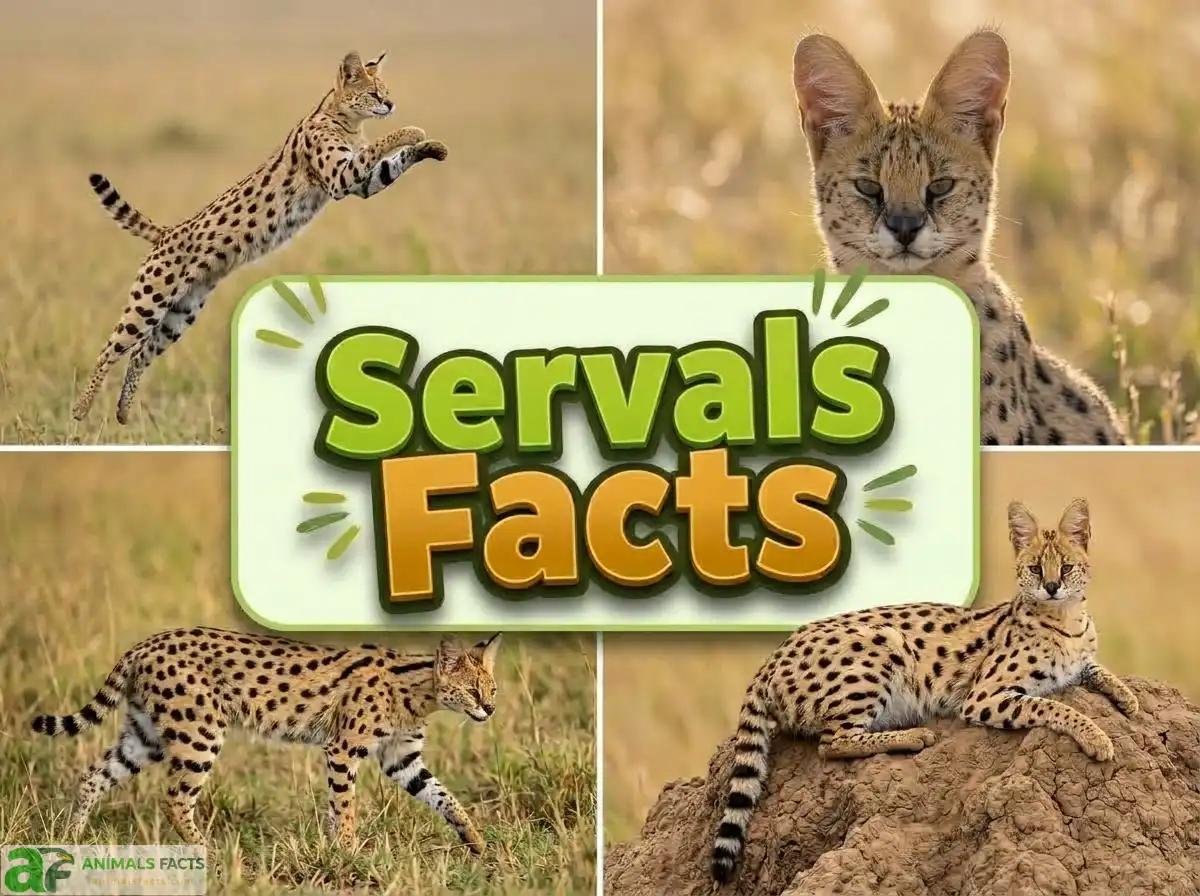
Hey kids — get ready to discover why the serval is one of the most amazing and unusual cats in the whole world!
- The serval has the longest legs compared to its body size of any cat on Earth! If you scaled a serval up to the size of a lion, it would tower over every other cat because of how long its legs are!
- The serval also has the biggest ears compared to its head of any cat in the world! Those huge ears help it hear a mouse moving through grass from really far away — even if the mouse is completely hidden!
- Servals can jump almost 3 meters straight up in the air — that’s as tall as a basketball hoop! They use this incredible jump to pounce on mice and rats hiding in tall grass, landing right on top of them with both front paws!
- Even though the serval looks like a mini cheetah with its long legs and spotted coat, scientists discovered they’re not related to cheetahs at all! Its real cousins are the caracal and a rare cat called the African Golden Cat!
- A serval catches its prey successfully about half the time it tries — that’s an amazing hunting success rate! Most other wild cats only succeed maybe 1 out of every 4 or 5 tries!
- Some servals are born completely black instead of spotted gold — these black servals live mostly high up in the mountains of East Africa!
- Servals love water and are actually really good swimmers! They sometimes hunt frogs and fish right in shallow water and marshes!
- People have created a special pet cat breed called the Savannah cat by breeding servals with regular house cats — these hybrid cats are much bigger than normal house cats and keep some wild serval features!
Did You Know? A serval’s ears are so sensitive that scientists believe it can hear a rodent’s heartbeat from several meters away in completely silent conditions! When a serval is hunting, it stands perfectly still with its huge ears rotating like little radar dishes, listening super carefully to figure out exactly where a hidden mouse or rat is moving — even if the little animal is completely invisible underground or beneath thick grass. Then, in one incredible leap, the serval jumps high into the air and comes crashing down with both front paws landing in exactly the right spot!
12. Relationship with Humans
The serval’s relationship with human communities across Africa spans ancient cultural recognition through to contemporary controversies surrounding the exotic pet trade and domestic hybridization — a relationship considerably less documented historically than that of the caracal but increasingly significant in modern conservation and animal welfare discussions.
Ancient and Historical Recognition
While less extensively documented than the caracal’s apparent religious significance in ancient Egypt, servals appear in Egyptian artwork and some archaeological contexts, suggesting at least some level of cultural recognition and significance among ancient African civilizations within the species’ range, though the depth and nature of this historical relationship remains less thoroughly studied by researchers compared to other African cat species.
Contemporary Human-Serval Conflict
The most significant contemporary human-serval interaction across Africa involves poultry predation — servals entering chicken coops and duck enclosures in rural and agricultural communities, generating localized conflict and occasional retaliatory killing. This conflict is generally considered less severe and less economically significant than the comparable conflict involving caracal predation on larger livestock (sheep and goats), given the serval’s smaller size and stronger preference for wild rodent prey over domestic animals when wild prey is available.
The Savannah Cat Controversy
One of the most significant and increasingly prominent contemporary human-serval relationships is the development and growing popularity of the Savannah cat — a domestic hybrid breed first developed in the 1980s through crossing servals with domestic cats (commonly Bengal or Oriental Shorthair breeds for initial crosses). First-generation (F1) Savannah cats retain substantial physical size and behavioral characteristics from their serval ancestry, while later-generation hybrids (F4, F5, and beyond) become progressively more similar to typical domestic cats in both appearance and temperament.
The Savannah cat breed has generated significant controversy within both the cat fancy and wildlife conservation communities — with critics raising concerns about the welfare implications of breeding wild-behavior-retaining hybrids for the pet trade, the regulatory complexity of owning hybrid cats (which face varying and often confusing legal restrictions across different US states and countries), and the broader ethical questions surrounding using wild serval genetics to create novel domestic pet breeds. Proponents argue that well-managed breeding programs, focused on later-generation hybrids with reduced wild behavioral traits, can produce cats that are both genuinely domestic-appropriate and visually striking, generating commercial demand that — properly regulated — does not require ongoing wild serval capture.
13. Conservation Status & Threats
The serval’s overall Least Concern IUCN classification reflects its relatively widespread distribution and generally stable population across most of sub-Saharan Africa, though this classification masks significant regional variation, with the species facing genuine extinction-level threats in specific portions of its historical range.
Global Serval Conservation Data (2026)
| Region / Population | Status | Population Estimate | Trend |
|---|---|---|---|
| East Africa | Least Concern | Significant; best-studied population | Stable in protected areas |
| Southern Africa | Least Concern (regional) | Substantial; some agricultural-margin presence | Stable to locally declining |
| West Africa | Near Threatened (regional) | Reduced; fragmented | Declining |
| Central Africa | Least Concern (regional, poorly monitored) | Significant but poorly quantified | Uncertain |
| North Africa | Critically Endangered / Possibly Extirpated (regional) | Possibly zero remaining individuals | Functionally extinct |
Major Threats to Servals
Wetland drainage and habitat conversion: Given the serval’s strong association with wetland-margin habitat, the drainage and agricultural conversion of marshes, vleis, and seasonal wetlands across Africa represents one of the most significant habitat threats specifically relevant to this species, distinct from the broader savanna habitat loss affecting many African carnivores.
Habitat fragmentation: Agricultural expansion and infrastructure development progressively fragment serval habitat across much of the species’ range, reducing connectivity between populations and limiting the dispersal necessary for genetic exchange.
Retaliatory killing: Poultry predation generates localized retaliatory killing, particularly in agricultural areas where servals persist alongside small-scale farming operations — a less severe but still meaningful mortality source compared to the larger-scale conflict affecting caracal populations.
Illegal wildlife trade: Servals face ongoing pressure from illegal capture for the exotic pet trade and for the Savannah cat breeding industry, with wild-caught individuals sometimes entering breeding programs despite regulatory efforts to require captive-bred breeding stock.
Climate change and water resource pressure: Given the species’ wetland-dependency, climate-driven changes to rainfall patterns and increasing human demand for water resources across Africa represent an emerging long-term threat to serval habitat quality and extent.
Did You Know? The North African serval population — formerly classified as a distinct subspecies (Leptailurus serval constantina) found in Algeria and Tunisia — has experienced one of the most severe and least publicized regional extinctions of any African cat species. Once present across portions of the Maghreb region, the North African serval is now considered by most conservation authorities to be functionally extinct or possibly entirely extirpated, with no confirmed sightings in recent decades despite targeted survey efforts. This represents a complete regional loss that occurred with remarkably little international conservation attention compared to the more publicized declines of other African cat species, highlighting the broader pattern of insufficient research and conservation investment directed toward Africa’s medium-sized and small cat species.
14. Famous Servals
Savannah Cat Breed Foundation Animals
The original serval-domestic cat crosses that established the Savannah cat breed in the 1980s — including the foundational hybrid often credited as the first documented Savannah cat, born from a serval father and domestic cat mother — represent historically significant individuals in the development of this controversial but increasingly popular hybrid breed, though detailed individual records from the breed’s earliest development are less thoroughly documented than for more established domestic cat breeds.
Ngorongoro Crater Research Servals
Tanzania’s Ngorongoro Crater has hosted some of the most extensively studied individual wild servals in scientific history, with the area’s exceptional serval density and favorable observation conditions allowing researchers to document individually identified servals across multiple years, generating significant behavioral ecology data that has substantially advanced scientific understanding of wild serval hunting behavior, territorial dynamics, and reproductive ecology.
Social Media Serval and Savannah Cat Celebrities
Multiple individual pet Savannah cats and, less commonly, captive servals housed in accredited wildlife facilities have achieved significant social media presence, with their distinctive long-legged appearance and dramatic ear size generating substantial public engagement and fascination, contributing significantly to general public awareness of both the wild serval species and the controversial Savannah cat hybrid breed.
15. Role in Ecosystem & Food Chain
The serval occupies an important and highly specialized mesopredator position within African grassland and wetland ecosystems — functioning as one of the continent’s most significant rodent population regulators while itself serving as prey for larger carnivores and large raptors.
Rodent Population Regulation
The serval’s intensive and highly specialized rodent predation represents one of the most significant natural pest control services provided by any African cat species — with research suggesting that serval populations can substantially influence local rodent population dynamics in grassland and agricultural-margin habitats. Given that rodents constitute up to 90% of the serval’s diet in many populations, the ecological significance of this predation pressure for maintaining balanced small mammal communities is considerable, with potential cascading benefits for vegetation, seed predation dynamics, and agricultural pest management in areas where servals persist.
Wetland Ecosystem Indicator Species
Due to the serval’s strong habitat association with wetland-margin environments, the species’ presence and population health serve as a meaningful indicator of wetland ecosystem condition across much of its range — declining serval populations in a given wetland area often signal broader ecological degradation affecting the entire wetland community, making serval conservation monitoring a useful proxy for broader wetland health assessment.
Bird Population Effects
Through its documented aerial bird-capture hunting technique, the serval represents a genuine predation pressure on ground-nesting and wetland-associated bird species, contributing to the natural population regulation of species including various weaver birds, francolins, and waterfowl within the grassland and marsh ecosystems it inhabits.
16. Myths, Folklore & Cultural Significance
The serval occupies a less extensively documented but still meaningful position within African cultural traditions compared to the continent’s larger and more visually dominant cat species — reflecting both genuine cultural recognition and the relative scholarly neglect that has characterized broader research attention toward this species.
African Traditional Associations
Across various African cultural traditions within the serval’s range, the species has been associated with stealth, patience, and precise, decisive action — qualities directly reflecting the genuine behavioral characteristics observed in the serval’s hunting technique, which combines extended patient waiting with sudden, explosive, and highly precise predatory action. Some regional traditions associate the serval’s distinctive appearance — particularly its long legs and large ears — with supernatural alertness and the ability to perceive things hidden from ordinary perception, paralleling similar associations documented for other cats with exceptional sensory capabilities across different cultural traditions worldwide.
Limited Documentation Compared to Other African Cats
It is worth noting that documented mythology and folklore specifically centered on the serval is considerably less extensive in the academic and ethnographic literature compared to traditions associated with lions, leopards, and even the caracal — likely reflecting both the serval’s more secretive, less frequently encountered behavioral profile and the historically limited ethnographic research attention directed toward smaller and medium-sized African cat species relative to the continent’s more visually dominant and economically or symbolically significant large predators.
Modern Conservation and Educational Symbolism
In contemporary African wildlife education and conservation communication, the serval has increasingly become recognized as a symbol of the specialized ecological adaptations that characterize many of Africa’s lesser-known carnivore species — used in educational contexts to illustrate evolutionary specialization and the broader diversity of African wildlife beyond the more commonly featured “Big Five” large mammal species.
17. Servals in Pop Culture
The serval has generated a growing but still relatively modest presence in contemporary popular culture — significantly amplified in recent years by the visibility of the Savannah cat hybrid breed and viral social media content showcasing the species’ distinctive physical characteristics.
Social Media and Viral Content
The serval’s extraordinary physical proportions — particularly its long legs and oversized ears — have made it an increasingly popular subject for wildlife social media content, with videos and images showcasing the species’ distinctive appearance and remarkable jumping ability generating substantial engagement across platforms including Instagram, TikTok, and YouTube, often shared alongside or in comparison to content featuring the closely related caracal.
Film and Television
Wildlife documentary coverage — The serval has featured in multiple BBC, National Geographic, and Discovery Channel productions focused on African grassland and savanna ecosystems, typically highlighted for its distinctive hunting technique and unusual physical proportions within broader programming about African wildlife diversity.
Savannah cat-related media coverage — Numerous television segments, news features, and online content have covered the controversial Savannah cat breed, generating significant public discussion and awareness of the underlying wild serval species that forms the foundation of this hybrid breed.
Sports and Brand Mascots
While less commonly used as a formal mascot compared to more famous big cats, the serval’s distinctive silhouette has appeared in various African wildlife conservation branding and tourism marketing contexts, leveraging the species’ visually striking and immediately recognizable appearance to represent the broader diversity of African grassland wildlife in promotional and educational materials.
18. Serval Facts vs. Common Myths
Myth: The serval is closely related to the cheetah. Fact: Despite the superficial resemblance created by its long legs and spotted coat, the serval is not closely related to the cheetah at all. This is a classic case of convergent evolution, in which two unrelated species independently develop similar physical features in response to similar environmental pressures. The serval’s actual closest relatives are the caracal and the African Golden Cat, with which it shares a common evolutionary lineage that diverged from the cheetah and other cats millions of years earlier.
Myth: Savannah cats are essentially wild servals kept as pets. Fact: Savannah cats are domestic hybrid cats resulting from crossing servals with domestic cat breeds — they are not wild servals, though early-generation hybrids (particularly F1 and F2) retain significant physical size and some behavioral characteristics from their serval ancestry. Later-generation Savannah cats (F4 and beyond) are predominantly domestic in both genetics and temperament, with progressively diminishing serval characteristics as the hybrid generations advance.
Myth: Servals primarily hunt large prey like antelope. Fact: Unlike the caracal, which can successfully hunt antelope several times its own body weight, the serval is an extreme rodent specialist — with rodents constituting 70–90% of its diet in most studied populations. The serval’s hunting adaptations are specifically optimized for small, well-concealed prey rather than larger mammals, distinguishing its ecological niche significantly from that of its close relative the caracal.
Myth: Servals are extremely rare and critically endangered everywhere. Fact: The serval is classified as Least Concern globally, with substantial and generally stable populations across much of East and southern Africa. However, the species faces genuinely severe regional crises — particularly the likely functional extinction in North Africa — demonstrating the same pattern seen in many widespread species, where overall global stability can mask serious localized population collapses.
Myth: The serval’s large ears are purely for show or have no specific hunting function. Fact: The serval’s exceptionally large ears serve a genuinely critical functional purpose — providing the acute directional sound localization capability that allows the species to precisely detect hidden rodent prey beneath dense grass and soil, a capability directly responsible for the serval’s unusually high hunting success rate of approximately 50%.
Myth: All servals have spotted coats. Fact: While the vast majority of servals display the species’ characteristic golden spotted coat, melanism (entirely black coloration) occurs naturally in some individuals, documented with particular frequency in high-altitude East African populations including those found in Kenya’s Aberdare Mountains region — demonstrating genuine natural color variation within the species rather than representing a separate subspecies or population.
19. Best Places to See Servals in the Wild
Ngorongoro Crater, Tanzania
Widely regarded as the best location in the world for observing wild servals, the Ngorongoro Crater’s exceptional rodent prey density and relatively open grassland habitat provide unusually favorable serval-viewing conditions, with the area hosting one of the highest documented serval densities anywhere on the African continent.
Maasai Mara National Reserve, Kenya
The Maasai Mara’s extensive grassland habitat and well-developed safari infrastructure provide good opportunities for serval sightings, particularly in areas combining open grassland with nearby water sources, though sightings remain less predictable than for the reserve’s larger and more famous predator species.
Aberdare National Park, Kenya
Home to one of the most significant populations of melanistic (black) servals anywhere in Africa, the high-altitude moorland and forest-margin habitat of Aberdare National Park offers a unique opportunity to potentially observe this striking color variant in its natural high-altitude habitat.
Kruger National Park, South Africa
Kruger’s diverse habitat mosaic, including significant grassland and wetland-margin areas, supports a substantial serval population, with sightings most commonly reported around dawn and dusk in areas combining open grassland with nearby water features.
Okavango Delta, Botswana
The extraordinarily productive wetland ecosystem of the Okavango Delta provides excellent serval habitat, with the area’s combination of seasonal flooding, reed beds, and grassland supporting healthy rodent populations and correspondingly favorable serval hunting conditions, making this one of the premier serval-viewing destinations in southern Africa.
Nairobi National Park, Kenya
Remarkably, the grassland habitat within Nairobi National Park — located at the edge of Kenya’s capital city — supports a documented serval population, offering visitors the unusual opportunity to potentially observe this specialized grassland hunter within a short drive of a major African metropolitan area.
20. Top Documentaries & Books
Must-Watch Documentaries
“Big Cats” (BBC Earth, 2018) — This comprehensive big cat documentary series includes notable serval footage, with the species’ extraordinary leaping hunting technique featured prominently as a demonstration of the diversity of predatory adaptations found across the cat family.
Various BBC and National Geographic East African wildlife productions — Multiple documentaries focused on the Serengeti-Mara ecosystem and other East African grassland environments have featured serval hunting sequences, typically highlighting the species’ distinctive “mousing leap” technique as a signature behavioral demonstration.
Savannah cat documentary and television coverage — Various television news segments and online documentary content covering the Savannah cat breed provide context for understanding both the hybrid breed and the wild serval species from which it derives, though dedicated standalone serval documentaries remain less common than for more famous African cats.
Essential Books
“Wild Cats of the World” by Mel and Fiona Sunquist (2002) — The essential comprehensive scientific reference for all wild cat species, including a detailed serval chapter covering the species’ specialized biology, hunting ecology, and conservation status within the definitive overview of the world’s felids.
“Small Wild Cats: The Animal Answer Guide” by Jim Sanderson and Patrick Watson — An accessible popular science account covering smaller and medium-sized wild cat species worldwide, including substantial serval coverage as part of the broader exploration of often-overlooked felid species.
Various academic publications on Savannah cat hybridization and welfare — Multiple peer-reviewed and popular publications examining the ethical, welfare, and regulatory dimensions of serval-domestic cat hybridization provide essential context for understanding this significant and ongoing controversy in the contemporary human-serval relationship.
21. Comparison of Servals with Similar Wild Cats
| Feature | Serval | Caracal | Cheetah | African Golden Cat | Bobcat |
|---|---|---|---|---|---|
| Scientific Name | Leptailurus serval | Caracal caracal | Acinonyx jubatus | Caracal aurata | Lynx rufus |
| Weight | 8–18 kg | 8–19 kg | 21–72 kg | 5.5–16 kg | 6–14 kg |
| Distribution | Sub-Saharan Africa | Africa, Middle East, Asia | Africa; Iran | Central/West Africa | North America |
| Habitat | Grassland, wetland margins | Savanna, scrubland, semi-desert | Open savanna | Tropical rainforest | All N. American biomes |
| Closest Relative | Caracal and African Golden Cat | Serval and African Golden Cat | Cougar (genetically) | Caracal and serval | Other Lynx species |
| Signature Trait | Longest legs and largest ears relative to size; vertical “mousing” pounce | Explosive vertical jumping; bird-strike hunting | Fastest land animal | Most poorly studied African cat | Most numerous N. American cat |
| Primary Diet | Rodents (70–90%) | Rodents, hares, small antelope | Gazelle, impala | Rodents, small antelope, birds | Rabbits, rodents, deer |
| Hunting Success Rate | ~50% (among highest of any cat) | High but less documented | ~25–40% | Poorly documented | Moderate |
| Conservation Status | Least Concern (regionally variable) | Least Concern (regionally variable) | Vulnerable | Vulnerable | Least Concern |
22. How You Can Help
Serval conservation requires attention to both the species’ relatively secure core East and southern African populations and the genuinely critical situation facing its most threatened regional populations, particularly in North and West Africa.
Support These Organizations
Panthera (panthera.org) — While primarily focused on larger cats, Panthera’s broader African wild cat conservation research and policy engagement includes attention to medium-sized cat species including the serval across multiple range countries.
Endangered Wildlife Trust (ewt.org.za) — A South African organization conducting carnivore research and conflict mitigation programs directly relevant to serval populations in southern Africa’s agricultural and wetland landscapes.
Wildlife Conservation Society (wcs.org) — Supports broader carnivore and wetland ecosystem conservation research across Africa, including habitat protection efforts directly relevant to serval population sustainability.
Born Free Foundation (bornfree.org.uk) — Engages in advocacy around exotic pet trade issues directly relevant to ongoing concerns about wild serval capture for the pet and hybrid breeding industry.
Local African wetland conservation organizations — Given the serval’s strong habitat dependency on wetland ecosystems, supporting regional and national wetland conservation initiatives across the species’ range provides indirect but meaningful conservation benefit.
Practical Actions
Support wetland conservation initiatives. Given the serval’s strong ecological dependency on wetland and water-margin habitats, supporting organizations and policies focused on wetland protection and sustainable water resource management directly addresses one of the species’ most significant habitat threats.
Make informed decisions about Savannah cat ownership. If considering a Savannah cat, research breed generation carefully (later-generation hybrids such as F4 and beyond are generally considered more appropriate for typical domestic settings), verify that breeding stock is captive-bred rather than wild-caught, and understand the complex and varying legal regulations governing hybrid cat ownership in your jurisdiction.
Support non-lethal poultry protection methods. Encouraging and supporting the use of secure, predator-proof poultry housing in regions where serval-poultry conflict occurs reduces both economic losses for farmers and retaliatory killing of servals.
Participate in citizen science. Wildlife observation platforms including iNaturalist welcome serval sighting reports, contributing valuable distribution data particularly important for understanding the status of poorly monitored regional populations in West and Central Africa.
Raise awareness about regional conservation disparities. Sharing accurate information about the serval’s likely functional extinction in North Africa and ongoing declines in West Africa helps draw attention to conservation needs that receive disproportionately little attention compared to the species’ more secure overall global status.
Did You Know? Research conducted at Ngorongoro Crater — one of the world’s premier sites for wild serval research — has contributed substantially to scientific understanding of the species’ remarkable hunting efficiency, with long-term behavioral observation documenting hunting success rates and prey capture techniques that have fundamentally shaped scientific understanding of acoustic predation strategies across the broader cat family. This research underscores the scientific value of continued investment in serval-focused field research, particularly given how much remains unknown about the species’ population dynamics across less-studied portions of its enormous African range.
23. Frequently Asked Questions About Servals
Q1: What is the scientific name of the serval?
The serval’s scientific name is Leptailurus serval — making it the sole living species in its own genus, Leptailurus. The family is Felidae (cats), subfamily Felinae, order Carnivora, and class Mammalia. The genus name derives from Greek words meaning “slender cat.”
Q2: Is the serval related to the cheetah?
No — despite superficial resemblance from its long legs and spotted coat, the serval is not closely related to the cheetah. This similarity represents convergent evolution, where unrelated species independently develop similar traits. The serval’s actual closest living relatives are the caracal and the African Golden Cat.
Q3: Why does the serval have such big ears?
The serval’s exceptionally large ears — proportionally the largest of any cat species relative to head size — provide highly acute directional sound localization capability, allowing the cat to precisely detect the location of rodents and other small prey hidden beneath dense grass or soil, even when the prey is completely invisible.
Q4: How high can a serval jump?
Servals can leap up to approximately 3 meters vertically and 4 meters horizontally in a single bound — used both for their signature “mousing leap” pounce technique on ground-dwelling rodents and for catching birds directly out of the air.
Q5: Are servals endangered?
The serval is classified as Least Concern globally by the IUCN, with substantial populations across much of East and southern Africa. However, the species is considered functionally extinct or critically near-extinct in North Africa, and faces significant declines in parts of West Africa, demonstrating substantial regional variation in conservation status despite the species’ overall stable global classification.
Q6: What do servals eat?
Servals are rodent specialists, with rodents constituting approximately 70–90% of their diet in most studied populations. Supplementary prey includes birds (sometimes caught in flight), reptiles, amphibians, insects, and occasionally fish, reflecting the species’ strong association with grassland and wetland-margin habitats.
Q7: What is a Savannah cat?
A Savannah cat is a domestic hybrid breed created by crossing servals with domestic cats, first developed in the 1980s. First-generation (F1) Savannah cats retain significant physical and behavioral characteristics from their serval ancestry, while later-generation hybrids (F4 and beyond) become progressively more similar to typical domestic cats. The breed remains controversial due to welfare and regulatory concerns.
Q8: How long do servals live?
Wild servals typically live 10–12 years, with the maximum confirmed captive lifespan reaching approximately 22 years — among the longer lifespans documented for medium-sized African wild cats, comparable to the caracal but shorter than the remarkable longevity records documented for some captive bobcats.
Q9: Where do servals live?
Servals inhabit sub-Saharan Africa, with a strong preference for grassland, savanna, and wetland-margin habitats. They are found across East Africa (particularly well-studied populations in Kenya and Tanzania), southern Africa, and parts of West and Central Africa, with the historical North African population now considered functionally extinct.
Q10: How can I help serval conservation?
Key actions include: supporting wetland conservation organizations given the serval’s strong habitat dependency on these threatened ecosystems; making informed decisions about Savannah cat ownership if considering this hybrid breed; supporting non-lethal poultry protection methods in regions experiencing serval-livestock conflict; participating in citizen science platforms that contribute to serval distribution data; and raising awareness about the species’ critical regional conservation crises, particularly in North and West Africa.
26. Sources & Refrences
Research Sources
- Wikipedia — Leptailurus serval and related articles
- IUCN Red List — iucnredlist.org
- Panthera — panthera.org
- Endangered Wildlife Trust — ewt.org.za
- Wildlife Conservation Society — wcs.org
- Born Free Foundation — bornfree.org.uk
- National Geographic — nationalgeographic.com
- Smithsonian’s National Zoo — nationalzoo.si.edu
- Encyclopaedia Britannica — britannica.com
- BBC Wildlife — bbc.co.uk
- Live Science — livescience.com
- Sunquist, Mel and Fiona — “Wild Cats of the World” (2002)
- Sanderson, Jim and Watson, Patrick — “Small Wild Cats: The Animal Answer Guide”
- Ngorongoro Crater serval research publications (multiple)