
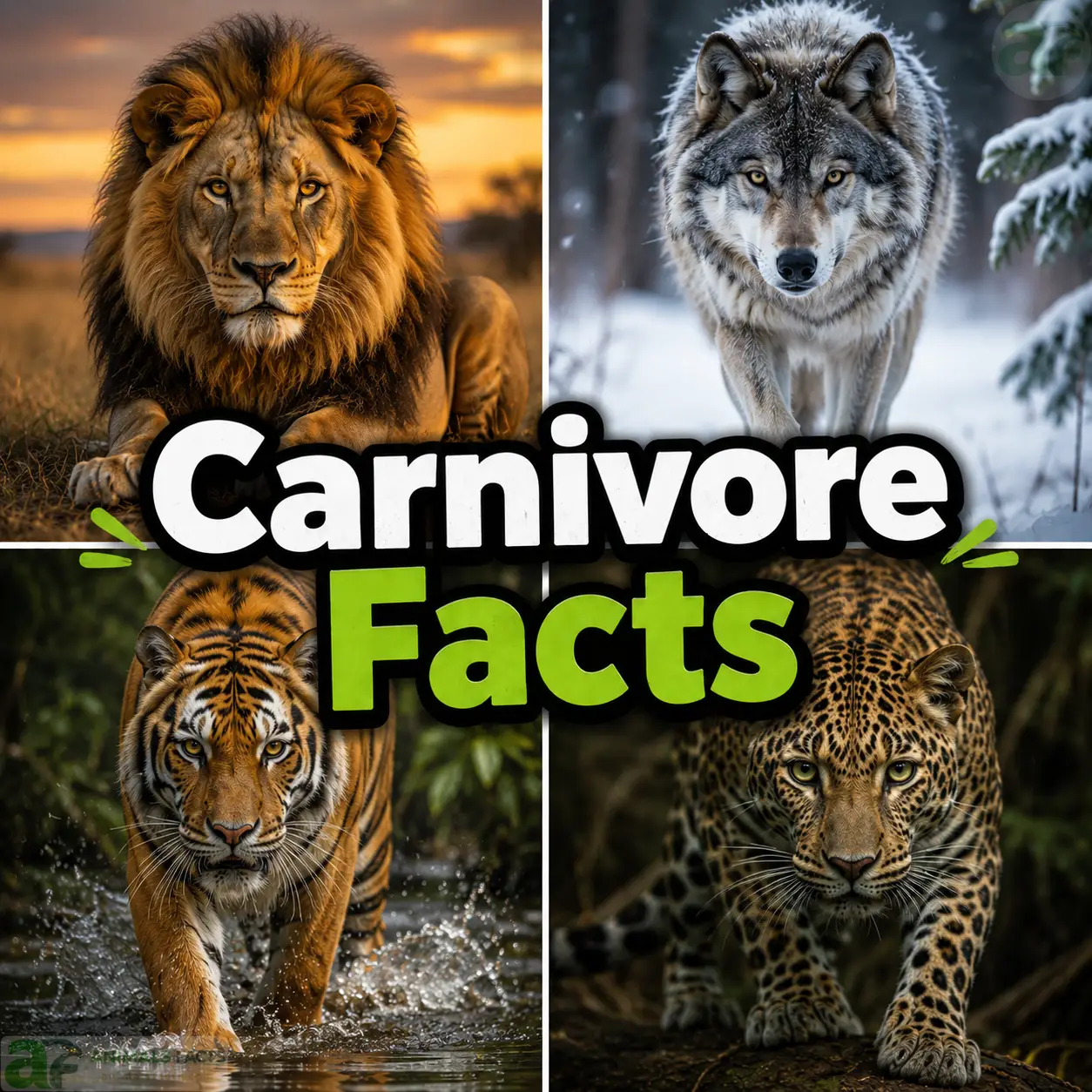
Carnivore Facts
| Feature | Details |
|---|---|
| Scientific Name (Order) | Carnivora (mammalian order); broader ecological carnivores span multiple taxa |
| Kingdom | Animalia |
| Meaning of Name | Latin: caro (flesh) + vorare (to devour) — “flesh eater” |
| Order Carnivora Species | Over 280 species within the mammalian order |
| Ecological Carnivores | Thousands of species across birds, reptiles, fish, amphibians, insects, and invertebrates |
| Habitat | Every habitat on Earth — from Arctic tundra to tropical rainforest, deep ocean to high desert |
| Lifespan Range | 1–2 years (small weasels) to 70+ years (killer whales) |
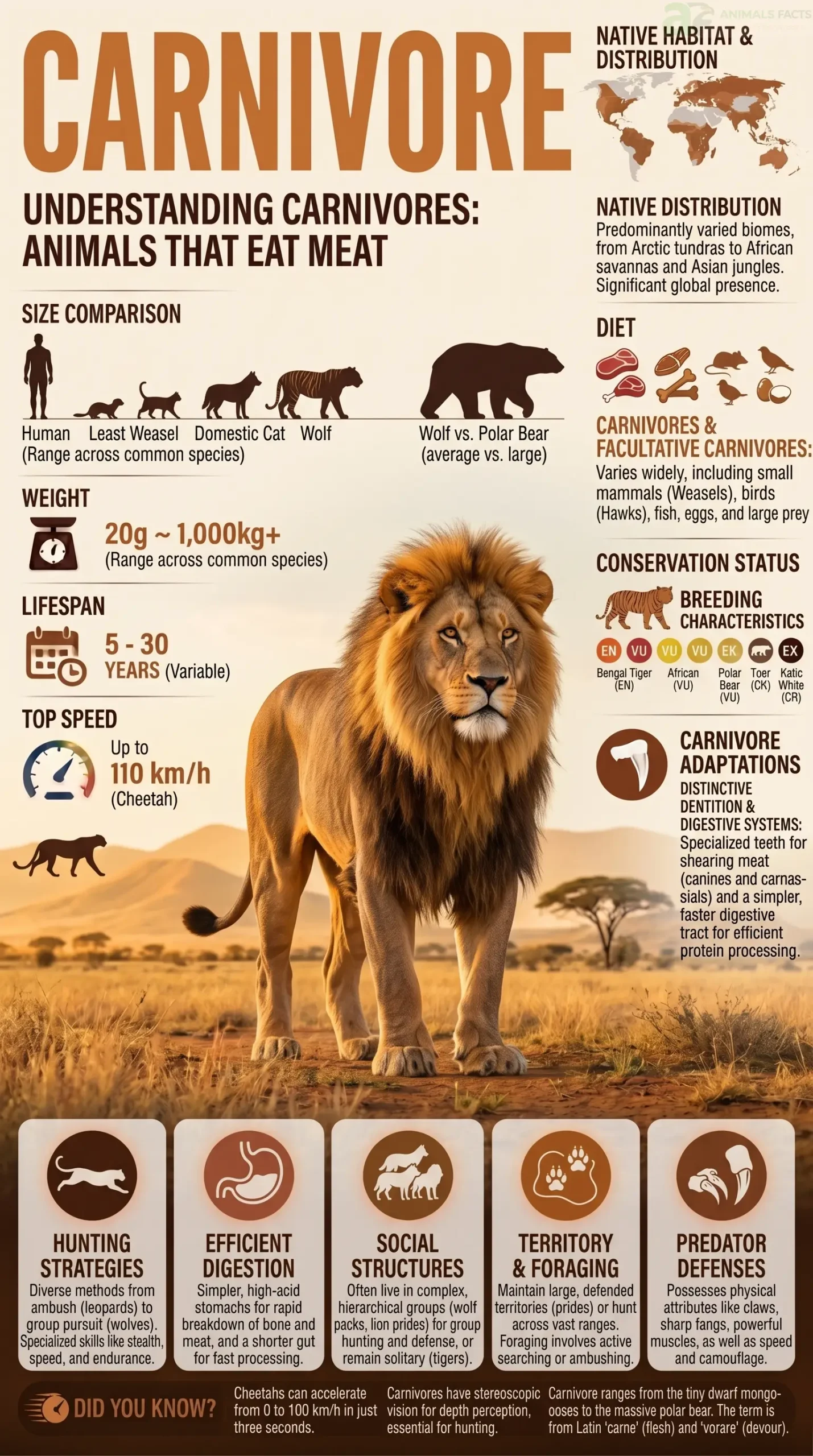
| Size Range | 25 g (least weasel) to 6,000 kg (male southern elephant seal) |
| Diet | Meat exclusively or predominantly — from insects to large ungulates to whales |
| Conservation Status | Many species Vulnerable, Endangered, or Critically Endangered |
| Speed Records | Cheetah: 120 km/h (fastest land carnivore); peregrine falcon: 389 km/h diving (fastest animal) |
| Top Predator Biomass | Lions, tigers, wolves, and orcas anchor the world’s major terrestrial and marine food chains |
 1. Introduction: What is Carnivore?
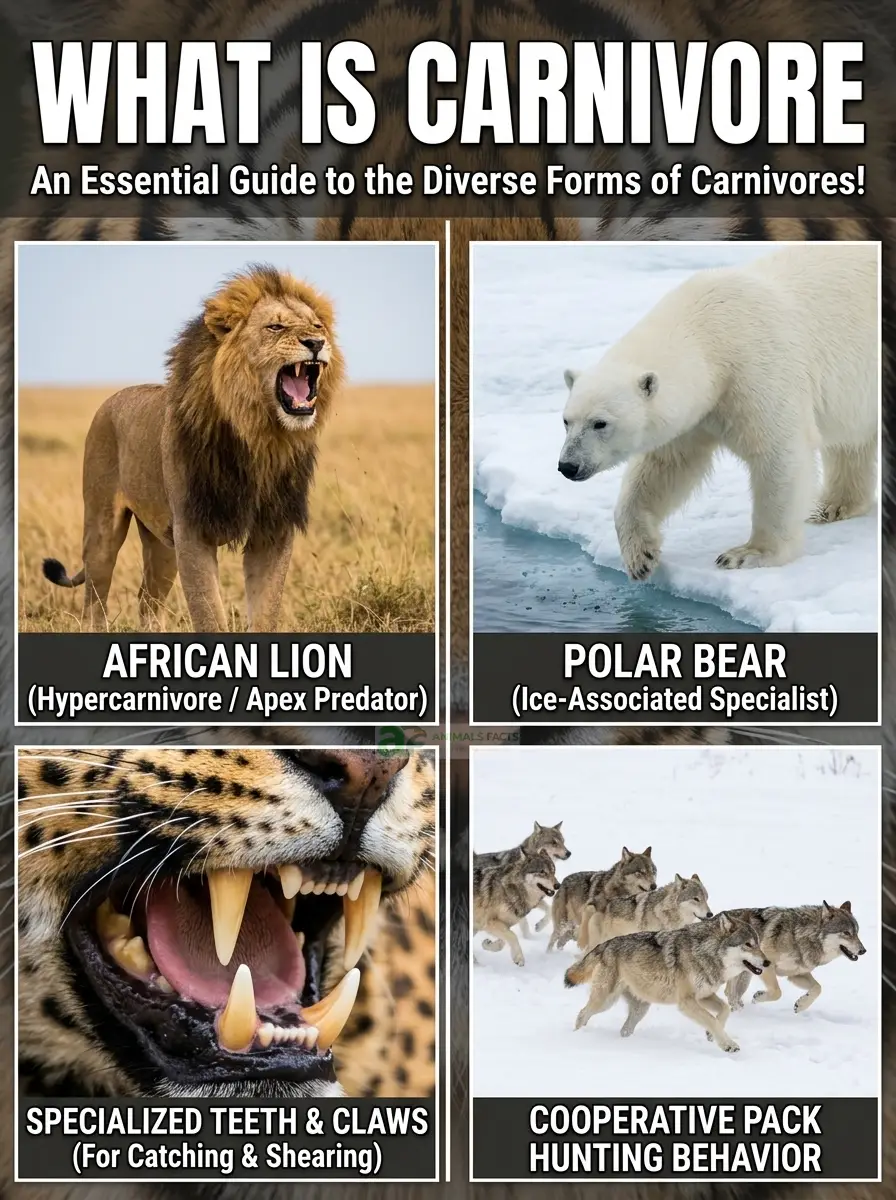
There is a moment, captured in countless wildlife documentaries, that stops the human heart mid-beat — the instant a lion locks eyes with a wildebeest across the golden Serengeti grass, or a great white shark breaches the surface in an explosive strike, or a wolf pack closes in silently through winter snow on a lone elk. These moments captivate us because they speak to something ancient in our own biology — the recognition that we share a planet with animals that are, by their very nature, perfectly engineered to kill. Carnivore facts are among the most electrifying in all of natural history — because they describe the cutting edge of evolution, the sharpest tools the natural world has ever produced.
The word “carnivore” carries two distinct meanings in biology. In the narrower, taxonomic sense, it refers to members of the mammalian order Carnivora — a group of over 280 species that includes lions, wolves, bears, seals, otters, mongooses, and their relatives. In the broader ecological sense, it describes any animal that obtains the majority of its energy from consuming other animals — a definition that extends from the peregrine falcon diving at 389 km/h to trap-door spiders ambushing insects in the dark, from the orca coordinating pack attacks on blue whales to the Venus flytrap snapping shut on a wandering beetle. Interesting facts about carnivores span both definitions — and in doing so, they cover the full breadth of predatory life on Earth.
This is your complete, authoritative guide to carnivore facts — covering taxonomy, anatomy, hunting behavior, ecology, conservation, and the profound role these animals play in keeping the natural world balanced and alive. Whether you are a student looking for carnivore facts for kids, a teacher building a food web curriculum, a wildlife enthusiast, or simply someone who watched a nature documentary and found themselves unable to look away from the predator — this article was written for you.
2. Species Overview & Classification
The term “carnivore” operates simultaneously at two biological levels — the taxonomic and the ecological — and understanding both is essential to appreciating the full breadth of carnivore facts.
The Mammalian Order Carnivora
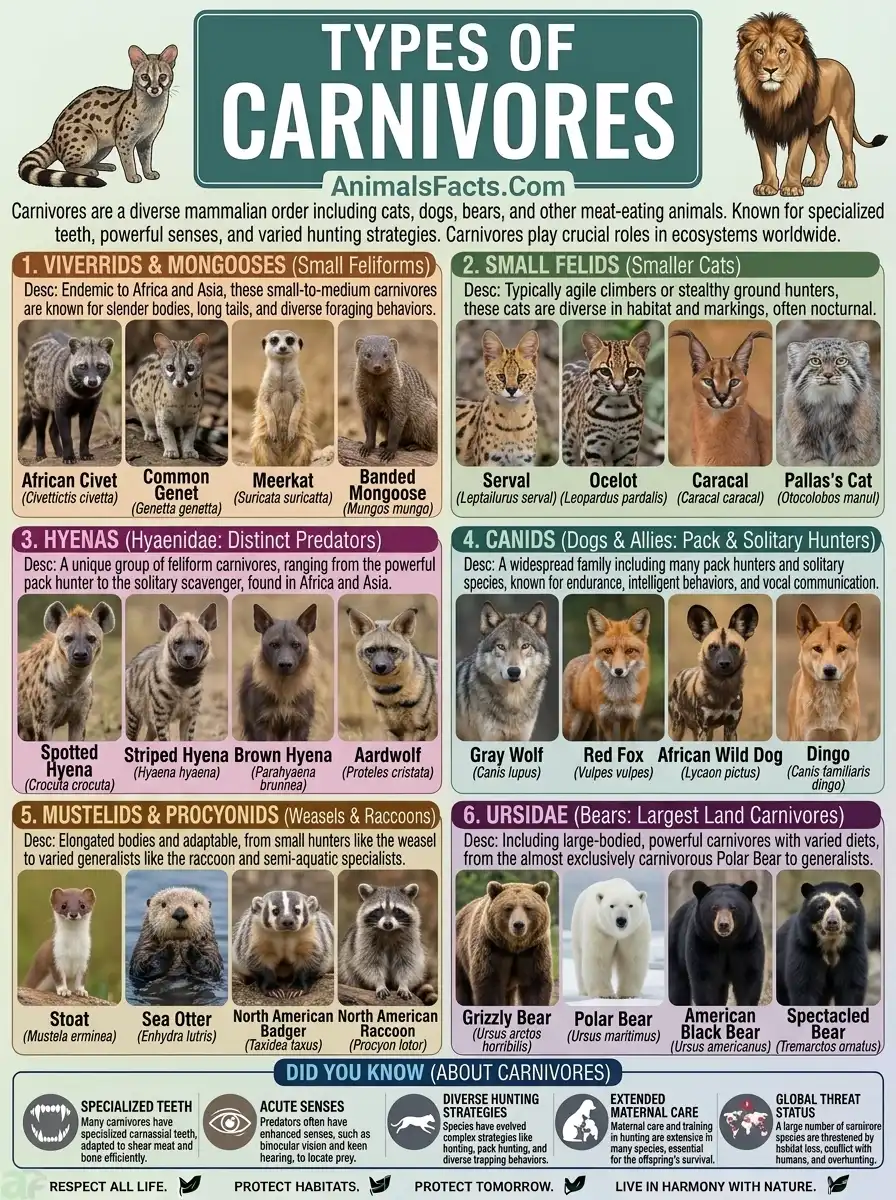
The order Carnivora is a formal taxonomic grouping within the class Mammalia, defined not purely by diet but by shared anatomical ancestry — particularly the possession of carnassial teeth (specialized shearing molars). Many members of Carnivora are not exclusively meat-eaters: bears eat significant quantities of plant matter; giant pandas are almost entirely herbivorous; raccoons are highly omnivorous.
Taxonomy Table — Order Carnivora
| Level | Classification |
|---|---|
| Kingdom | Animalia |
| Phylum | Chordata |
| Class | Mammalia |
| Order | Carnivora |
| Suborders | Feliformia (cat-like) and Caniformia (dog-like) |
| Families | 16 living families |
| Genera | ~129 genera |
| Species | ~286 described species |
| Defined by | Carnassial teeth; typically 4 limbs with claws; varied diet |
Major Families Within Order Carnivora
| Family | Common Name | # Species | Notable Members |
|---|---|---|---|
| Felidae | Cats | ~41 | Lion, tiger, leopard, cheetah, domestic cat |
| Canidae | Dogs, wolves, foxes | ~36 | Gray wolf, red fox, African wild dog, coyote |
| Ursidae | Bears | 8 | Polar bear, grizzly, giant panda, sun bear |
| Mustelidae | Weasels, otters, badgers | ~59 | Sea otter, wolverine, honey badger, stoat |
| Phocidae | True seals | ~19 | Leopard seal, harbor seal, elephant seal |
| Hyaenidae | Hyenas | 4 | Spotted hyena, aardwolf, brown hyena |
| Procyonidae | Raccoons, coatis | ~13 | Common raccoon, ringtail, kinkajou |
| Herpestidae | Mongooses | ~34 | Meerkat, banded mongoose, Indian mongoose |
| Viverridae | Civets, genets | ~34 | African civet, common genet |
| Mephitidae | Skunks | ~12 | Striped skunk, spotted skunk |
Ecological Carnivores Beyond Carnivora
The ecological definition of carnivore extends far beyond the mammalian order:
| Group | Examples | Hunting Method |
|---|---|---|
| Raptors (birds) | Eagles, hawks, owls, falcons | Aerial dive or stoop; talons and beak |
| Marine carnivores | Sharks, orcas, barracuda, giant squid | Speed, ambush, pack coordination |
| Reptile carnivores | Crocodilians, Komodo dragon, monitor lizards | Ambush; bite force; venom (some) |
| Amphibian carnivores | Giant salamanders, ceratophrys frogs | Ambush; enormous gape |
| Invertebrate carnivores | Mantis shrimp, dragonflies, jumping spiders | Speed, venom, trapping |
| Plant carnivores | Venus flytrap, sundews, pitcher plants | Chemical and mechanical trapping |
| Fish carnivores | Great white shark, pike, piranha | Speed, ambush, pack feeding |
Species Evolution & Discovery Timeline
- ~65 million years ago — Following the extinction of non-avian dinosaurs, Miacoidea — small, tree-dwelling, weasel-like mammals — emerge as early placental carnivore ancestors
- ~55 million years ago — Miacids diversify; the lineages that will become modern Carnivora begin to diverge
- ~42 million years ago — Feliformia (cat-like) and Caniformia (dog-like) suborders diverge from a common ancestor
- ~30 million years ago — Early felids, canids, and ursids recognizable in the fossil record
- ~10 million years ago — Large saber-toothed cats (Machairodus) and giant bear-dogs (Amphicyon) dominant apex predators
- ~2 million years ago — Smilodon (saber-toothed cat) and Panthera (true big cats) coexist in North and South America
- ~11,000 years ago — End of the Pleistocene megafaunal extinction; saber-toothed cats, dire wolves, and American lions go extinct
- ~15,000 years ago — Gray wolf (Canis lupus) begins domestication process toward modern dog (Canis lupus familiaris)
- 1758 — Carl Linnaeus classifies major carnivore species; foundational taxonomy established
- 1821 — The order Carnivora formally established as a taxonomic grouping
- 1973 — U.S. Endangered Species Act passed; wolves, cheetahs, and other carnivores gain federal protection
- 1995 — Gray wolves reintroduced to Yellowstone National Park; landmark conservation and ecological restoration event
- 2020–2026 — Ongoing genomic research continues revealing evolutionary relationships among carnivore families; new small carnivore species described annually from tropical forests
3. Physical Description & Unique Features
Carnivores — whether defined taxonomically or ecologically — have been shaped by the relentless evolutionary pressure of hunting and killing prey. The result is an astonishing diversity of body plans, each precisely tuned to a specific predatory lifestyle.
The Core Physical Adaptations of Carnivores
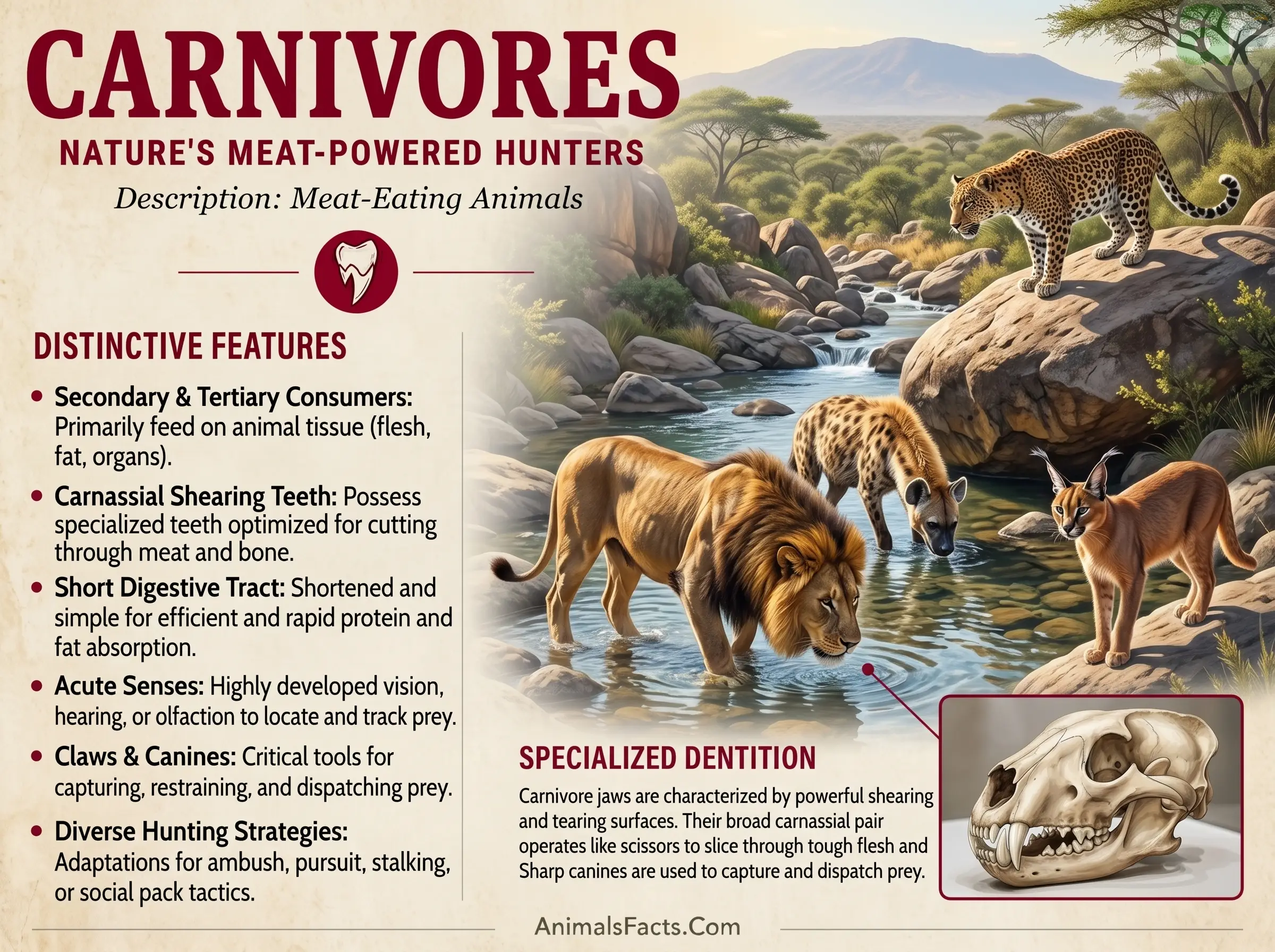
Dentition — The most universal diagnostic feature of carnivorous mammals is specialized teeth. All members of order Carnivora possess carnassial teeth — the fourth upper premolar and first lower molar modified into shearing blades that slice meat like scissors. Obligate carnivores have additionally reduced or eliminated molars used for grinding plant material.
Sensory systems — Carnivores consistently demonstrate enhanced versions of the senses most useful for hunting: forward-facing eyes providing binocular depth perception (critical for judging strike distance), acute hearing extending into ultrasonic ranges (owls can locate prey beneath snow by sound alone), and exceptional olfaction — wolves can detect prey scent at 1.6 km distance under favorable conditions.
Locomotor adaptations — Different carnivores have evolved radically different locomotor systems: the cheetah’s flexible spine and non-retractable claws for speed; the wolf’s digitigrade foot posture and long limbs for endurance; the crocodilian’s ambush stillness and explosive short-burst speed; the peregrine falcon’s swept-back wings and muscular chest for high-speed diving.
Weaponry — Carnivores deploy an extraordinary variety of killing tools: retractable claws (felids), non-retractable grip claws (canids), crushing bite force (hyenas: 1,100 PSI; saltwater crocodile: 3,700 PSI), venomous fangs (many snake species; Komodo dragon saliva), talons (raptors), and electrical sensing (sharks detecting prey bioelectric fields).
Size Comparison Across Major Carnivore Groups
| Species / Group | Body Length | Weight | Notable Size Record |
|---|---|---|---|
| Least weasel (Mustela nivalis) | 11–26 cm | 25–250 g | Smallest mammalian carnivore on Earth |
| Cheetah (Acinonyx jubatus) | 1.1–1.4 m | 21–72 kg | Fastest land animal: 120 km/h |
| African lion (Panthera leo) | 1.4–2 m | 120–250 kg | Largest wild cat in Africa |
| Polar bear (Ursus maritimus) | 2–3 m | 350–700 kg | Largest land carnivore |
| Orca (Orcinus orca) | 6–8 m | 3,600–5,400 kg | Apex predator of every ocean |
| Southern elephant seal | Up to 5 m | Up to 3,500 kg (male) | Largest member of order Carnivora |
| Saltwater crocodile | Up to 6 m | Up to 1,000 kg | Largest living reptilian carnivore |
| Great white shark | Up to 6.4 m | Up to 2,268 kg | Largest predatory fish |
| Peregrine falcon | 34–58 cm | 330–1,000 g | Fastest animal: 389 km/h diving |
“Predators are not the villains of the natural world. They are its editors — removing the weak and the sick, shaping prey behavior, and ultimately determining the health of every ecosystem they inhabit. A world without predators is a world out of balance.” — Sir David Attenborough, BBC Planet Earth series
4. Top 25 Amazing Carnivore Facts
Here are the most extraordinary, conversation-stopping interesting facts about carnivores — spanning the full ecological breadth of meat-eating life on Earth:
- The peregrine falcon (Falco peregrinus) dives at speeds exceeding 389 km/h — making it the fastest animal ever recorded on Earth, bar none
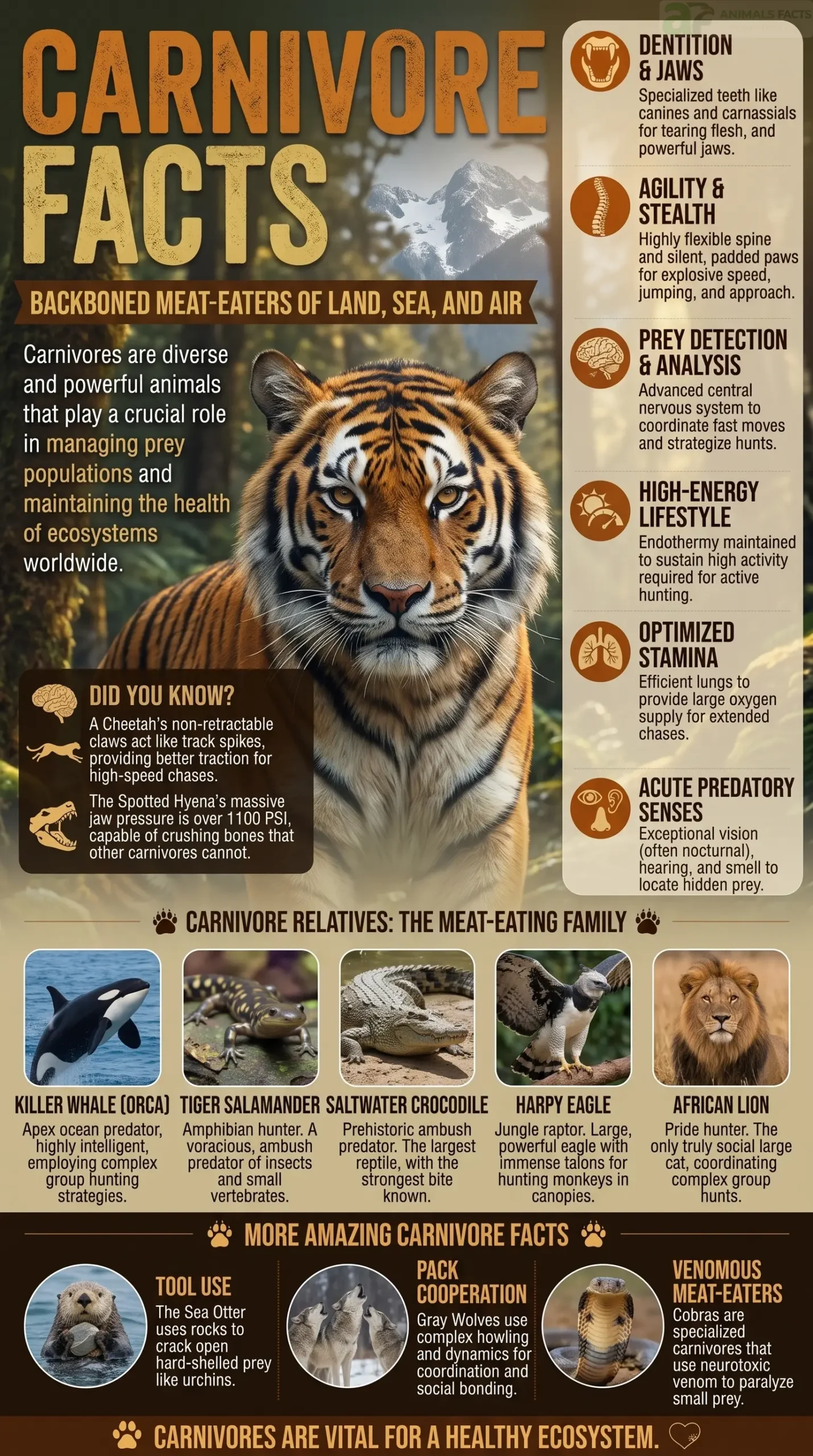
- The spotted hyena (Crocuta crocuta) has a bite force of approximately 1,100 PSI — powerful enough to crush bone and digest it entirely, leaving nothing behind
- Dragonflies have a hunting success rate of 95% — higher than any other predator on Earth, including lions (25%) and great white sharks (50%)
- The orca (Orcinus orca) is the apex predator of every ocean — it hunts great white sharks, blue whales, and has been documented coordinating pack hunts of extraordinary sophistication
- A chameleon’s tongue accelerates from 0 to 97 km/h in one hundredth of a second — the fastest muscle movement of any terrestrial vertebrate
- The Komodo dragon (Varanus komodoensis) delivers venom from glands between its teeth — anticoagulant compounds that cause prey to bleed out even after escaping
- Wolves (Canis lupus) can travel up to 80 km in a single day while tracking prey — one of the most impressive sustained pursuit distances in the animal kingdom
- The mantis shrimp punches with the force of 1,500 Newtons — enough to shatter glass — making it the most powerful carnivore relative to body size in the ocean
- A great white shark can detect one drop of blood diluted in 100 liters of water and can sense blood in the ocean from 5 km away
- Saltwater crocodiles have the most powerful bite ever measured in any living animal — approximately 3,700 PSI — yet the muscles that open their jaws are so weak a person could hold them shut with their hands
- The golden poison dart frog (Phyllobates terribilis) is a carnivore whose skin contains enough batrachotoxin to kill 10 adult humans — derived entirely from the toxic arthropods in its diet
- Some carnivorous plants — like the Venus flytrap — can count: they require two separate touches within 20 seconds to close, preventing energy waste on non-prey stimuli like raindrops
- Polar bears (Ursus maritimus) are the only members of order Carnivora that are hypercarnivores in a marine environment — obtaining virtually 100% of their calories from meat (primarily ringed seals)
- The African wild dog (Lycaon pictus) has the highest hunting success rate of any large mammalian carnivore — succeeding in over 80% of hunts, compared to lions at 25%
- Tiger sharks (Galeocerdo cuvier) have been found with license plates, car tires, and a suit of armor in their stomachs — they will attempt to consume almost anything
- The secretary bird (Sagittarius serpentarius) kills venomous snakes by stomping on them with enough force to deliver five times its own body weight per kick — one of the most unusual predatory techniques in the bird world
- Wolverines (Gulo gulo) have been documented driving bears and mountain lions away from their kills — pound for pound among the most ferocious carnivores alive
- The Venus flytrap closes so fast that it can trap a fly in 100 milliseconds — one of the fastest plant movements ever recorded
- Orcas have been observed teaching their young complex hunting techniques — beaching themselves deliberately to catch seals, a behavior passed down culturally through generations
- The Tasmanian devil (Sarcophilus harrisii) can consume up to 40% of its own body weight in a single feeding — one of the highest relative food intake rates of any mammalian carnivore
- Bats (order Chiroptera, many species carnivorous) consume the equivalent of their entire body weight in insects nightly during summer — providing pest control services worth billions of dollars to agriculture
- The inland taipan (Oxyuranus microlepidotus) — a carnivorous snake — has the most toxic venom of any terrestrial snake; a single bite contains enough toxin to kill 289 humans
- Great horned owls (Bubo virginianus) can rotate their heads 270 degrees — not 360 as is commonly believed — and can locate prey in almost complete darkness through sound alone
- The Nile crocodile (Crocodylus niloticus) has been estimated to be responsible for approximately 1,000 human deaths per year — making it the deadliest large carnivore to humans globally
- The blue whale — the largest animal ever to live on Earth — is a carnivore: it eats exclusively krill, consuming up to 4 metric tons of tiny crustaceans per day during feeding season
Did You Know? The spotted hyena is not merely a scavenger — it is one of the most successful active hunters in Africa, with studies showing that in many ecosystems hyenas hunt more than 70% of their own food. Lions, by contrast, frequently steal from hyenas rather than the reverse — a complete inversion of the popular cultural narrative.
5. Carnivore Fun Facts for Kids
- The peregrine falcon dives at 389 km/h — the fastest speed of any animal
- Cheetahs reach 120 km/h — fastest land animal
- Great white sharks detect blood from 5 km away
- Saltwater crocodiles have the strongest bite ever measured: 3,700 PSI
- Wolves can travel 80 km in a single day on the hunt
- African wild dogs succeed in 80%+ of hunts — highest of any large mammal
- Blue whales eat 4 metric tons of krill daily — the largest carnivore by food volume
- Komodo dragons deliver venom from glands between their teeth
- Venus flytraps can count to two before closing to avoid false triggers
- Wolverines drive away bears and mountain lions from their kills
- Insectivorous bats eat their entire body weight in insects every night
- The inland taipan’s single bite contains enough venom to kill 289 humans
- Great horned owls locate prey in near-total darkness by sound alone
- Mantis shrimp deliver 1,500 Newtons of force — shattering aquarium glass
- Nile crocodiles cause an estimated 1,000 human deaths per year
6. Natural Habitat & Geographic Range
Carnivores — both taxonomically and ecologically defined — inhabit every ecosystem on Earth. From the deepest ocean trenches to the highest mountain peaks, from equatorial rainforests to polar ice caps, meat-eating animals have colonized every environment where prey can be found.
Habitat Range by Continent and Region
| Region | Dominant Carnivore Groups | Notable Apex Predators |
|---|---|---|
| Sub-Saharan Africa | Big cats, hyenas, wild dogs, crocodilians, raptors | Lion, leopard, cheetah, Nile crocodile, martial eagle |
| South and Southeast Asia | Tigers, leopards, dholes, crocodilians, monitor lizards | Bengal tiger, clouded leopard, saltwater crocodile |
| North America | Wolves, bears, mountain lions, eagles, sharks | Gray wolf, grizzly bear, great white shark, bald eagle |
| South America | Jaguars, pumas, giant river otters, caimans | Jaguar, harpy eagle, anaconda, giant river otter |
| Europe | Wolves, brown bears, wolverines, lynx, golden eagles | Eurasian wolf, brown bear, Eurasian lynx |
| Arctic / Polar | Polar bears, orcas, leopard seals, Arctic foxes | Polar bear, orca, leopard seal |
| Australia / Oceania | Dingoes, Tasmanian devils, saltwater crocodiles, sharks | Saltwater crocodile, great white shark, dingo |
| Oceans (global) | Sharks, orcas, sperm whales, leopard seals, giant squid | Orca, great white shark, sperm whale |
| Freshwater | Crocodilians, giant river otters, large fish, otters | Nile crocodile, giant river otter, bull shark |
| Caves / Subterranean | Cave-adapted fish, blind salamanders, bat species | Giant cavefish; various bat species |
| High altitude | Snow leopards, golden eagles, Andean condors | Snow leopard, golden eagle |
Habitat Types by Carnivore Specialization
| Habitat | Specialist Carnivores | Adaptation |
|---|---|---|
| Open savanna | Lion, cheetah, African wild dog | Speed, pack coordination, stamina |
| Dense forest | Tiger, jaguar, clouded leopard | Ambush, camouflage, tree climbing |
| Arctic tundra/ice | Polar bear, Arctic fox, snowy owl | White camouflage, fat reserves, cold physiology |
| Desert | Caracal, fennec fox, sidewinder rattlesnake | Heat tolerance, water conservation, night hunting |
| Ocean/marine | Great white shark, orca, leopard seal | Speed, echolocation, electroreception |
| Sky/aerial | Peregrine falcon, harpy eagle, bald eagle | Vision, speed, talon grip strength |
| Subterranean | Star-nosed mole, cave-adapted spiders | Touch/chemical sensing; lack of eyes |
Did You Know? The snow leopard (Panthera uncia) inhabits some of the most extreme altitudes of any large carnivore — regularly hunting above 5,000 meters in the Himalayan and Central Asian mountain ranges, in temperatures that can drop to −40°C. Its extraordinarily long, thick tail — nearly as long as its body — is used both for balance on rocky slopes and wrapped around its face like a scarf while sleeping in the cold.
7. Diet & Feeding Behavior
The defining characteristic of all ecological carnivores is the consumption of other animals for the majority of their caloric needs. But within that broad definition, the diversity of prey, hunting methods, and feeding behaviors is staggering.
Diet Classification
Hypercarnivores — More than 70% of diet comes from other animals. Examples: polar bear, killer whale, cheetah, great white shark, inland taipan.
Mesocarnivores — 50–70% animal matter, supplemented by plant material. Examples: red fox, raccoon, striped skunk, some bear species.
Hypocarnivores — Less than 30% animal matter within the order Carnivora. Examples: giant panda (bamboo specialist), aardwolf (termite specialist), some bear species.
Diet Breakdown Across Major Carnivore Groups
| Group | Primary Prey | Secondary / Supplemental | Approx. % Animal Matter |
|---|---|---|---|
| Big cats (lion, tiger, leopard) | Large ungulates (wildebeest, deer, buffalo) | Smaller mammals, birds | >95% |
| Cheetah | Small to medium antelope (gazelle, impala) | Hares, birds | >98% |
| Gray wolf | Large ungulates (elk, moose, deer) | Beaver, hares, rodents, carrion | >80% |
| Grizzly bear | Salmon, ungulates, insects, small mammals | Berries, roots, fungi | ~60% |
| Polar bear | Ringed seals, bearded seals | Walrus, beluga whale, carrion | ~98% |
| Spotted hyena | Wildebeest, zebra, gazelle; carrion | Insects, fruits (minor) | >90% |
| Great white shark | Seals, sea lions, dolphins, large fish | Seabirds, sea turtles | ~100% |
| Orca | Seals, fish, squid, dolphins, great white sharks | Seabirds, sea turtles | ~100% |
| Peregrine falcon | Small to medium birds (pigeons, starlings) | Bats, large insects | ~100% |
| African wild dog | Medium antelope (impala, springbok) | Smaller mammals | >95% |
| Komodo dragon | Deer, goats, pigs, water buffalo, carrion | Smaller lizards, birds, eggs | >90% |
Hunting Strategies
Carnivores have evolved the full spectrum of predatory approaches:
Ambush hunting — Tigers, crocodiles, and jumping spiders rely on camouflage and explosive short-range speed; patience is the primary weapon. A tiger may stalk prey for hours before the final 10-second rush.
Coursing / pursuit hunting — Wolves and African wild dogs rely on endurance over speed — exhausting prey over distances of 3–8 km through coordinated relay hunting in which pack members take turns at the front.
Aerial stooping — Peregrine falcons climb to altitude, then fold wings and free-fall, steering with micro-adjustments in wing and tail position, striking prey with closed talons at terminal velocity.
Pack coordination — Orcas, lions, and wolves coordinate strategies in real time — flanking, driving prey toward other group members, and in orca pods, creating wave-wash attacks to knock seals off ice floes.
Trapping — Spiders, antlions, and carnivorous plants construct physical traps — silk webs, pit traps, and chemical adhesive surfaces — that do the hunting passively.
8. Reproduction & Life Cycle
Carnivores invest heavily in their offspring — with longer gestation periods, smaller litter sizes, and extended parental care compared to most herbivores — because raising a functional predator requires time, teaching, and resources.
Reproductive Strategies
Most large carnivores are K-strategists — producing few offspring but investing heavily in each. This reproductive strategy means carnivore populations are inherently slow to recover from decline — a critical conservation consideration.
Solitary carnivores (tigers, leopards, snow leopards) — Males and females associate only briefly for mating. Females raise cubs entirely alone.
Pack carnivores (wolves, African wild dogs, meerkats) — Cooperative breeding in which non-reproductive group members assist in pup-rearing, feeding, guarding, and teaching — a reproductive system that dramatically increases offspring survival rates.
Semelparous carnivores — Some species (notably certain salmon-eating spiders and mantis species) reproduce once and die; females sometimes consumed by their own offspring.
Lifespan Comparison Across Carnivores
| Species | Wild Lifespan | Captivity Lifespan | Notes |
|---|---|---|---|
| Least weasel | 1–3 years | Up to 10 years | Shortest-lived mammalian carnivore |
| African wild dog | 10–12 years | Up to 17 years | Pack living extends lifespan |
| African lion | 10–14 years (male) | Up to 20 years | Males die younger due to competition |
| Gray wolf | 6–13 years | Up to 17 years | Longer in protected populations |
| Polar bear | 15–18 years | Up to 30 years | Climate-threatened; body condition declining |
| Great white shark | ~70 years | Never survives captivity | One of longest-lived cartilaginous fish |
| Orca | Up to 60–90 years (female) | Dramatically reduced in captivity | Matriarchal pods; grandmothers lead family groups |
| Galapagos tortoise (ecological carnivore at times) | 175+ years | Similar | Longest-lived reptile |
Did You Know? Female orcas undergo menopause — one of only five animal species known to do so (humans, short-finned pilot whales, belugas, and narwhals being the others). Post-reproductive female orcas live for decades after their last calf, leading family pods and transmitting ecological knowledge — such as the locations of salmon runs — to younger generations. Research shows that pods with post-menopausal grandmothers have significantly higher survival rates during food shortages.
9. Social Behavior & Communication
Carnivore social organization spans the full spectrum — from the absolute solitude of the snow leopard to the extraordinarily complex democratic societies of African wild dogs.
Social Structures
Solitary hunters (tigers, leopards, jaguars, great white sharks) — Maintain large individual territories; associate only for mating; cubs raised by mothers alone.
Pair-bonded hunters (foxes, some mongoose species, many raptors) — Male and female form long-term bonds; share territorial defense and pup-rearing responsibilities.
Pride/pack hunters (lions, wolves, African wild dogs, orcas) — Extended family groups with sophisticated division of labor, social hierarchies, cooperative hunting, and shared pup-rearing.
Fission-fusion societies (spotted hyenas, cheetahs) — Social structure that flexibly shifts between solitary and group configurations depending on prey availability and reproductive status.
Communication Methods
| Method | Groups | Examples |
|---|---|---|
| Vocalizations | Cats, wolves, hyenas, birds | Lion’s roar audible 8 km away; wolf howl carries 10 km; spotted hyena’s “laugh” conveys social status |
| Scent marking | Most terrestrial carnivores | Urine, gland secretions, scat deposits define territory; contain information on sex, reproductive status, individual identity |
| Body language | Cats, canids, mustelids | Ear position, tail carriage, piloerection (hair-raising), posture communicate dominance, submission, aggression |
| Facial expression | Great apes (omnivore/carnivore), domestic cats, wolves | Detailed social signals; domestic cat’s slow blink indicates non-threatening intent |
| Echolocation | Dolphins, orcas, bats | Produce and interpret ultrasonic clicks; locate prey in complete darkness or murky water |
| Electroreception | Sharks, platypus | Detect bioelectric fields of prey animals; functions in complete darkness and murky water |
| Infrasound | Tigers, lions | Low-frequency vocalizations below human hearing threshold felt as vibration; used for long-range communication |
10. Predators & Defense Mechanisms
What Threatens Carnivores?
Apex predators — by definition — face few natural predators. But they are not invulnerable:
- Other apex predators — Lions kill leopards and cheetahs. Tigers occasionally kill leopards. Orcas hunt great white sharks. Nile crocodiles take lions. Intra-guild predation is a significant mortality source for carnivores.
- Prey defense — Cape buffalo kill lions. Moose kill wolves. Hippos kill crocodiles. Prey species are not passive — many large herbivores actively defend themselves with lethal effectiveness.
- Parasites and disease — Canine distemper devastates African wild dog and lion populations. Chronic wasting disease (deer and elk) can impact wolf pack prey bases. Mange devastates fox and wolf populations.
- Competition — Carnivores compete intensely for prey and territory; starvation is a common cause of death particularly among young dispersing individuals.
- Humans — By far the dominant mortality source for most large carnivore species globally — through direct killing (hunting, poaching, persecution), habitat destruction, prey depletion, and road collisions.
Defensive Adaptations of Carnivores
| Strategy | Species | Description |
|---|---|---|
| Size and strength | Polar bear, grizzly, jaguar | Physical dominance deters most threats |
| Chemical defense | Skunks, honey badger | Mephitidae spray sulfurous compounds up to 3 m with accuracy; honey badger skin highly resistant to bee stings and snake venom |
| Armor | Honey badger, pangolin (ecological carnivore) | Extremely thick, loose skin; keratin scales |
| Speed | Cheetah, African wild dog | Outrun threats; endurance escape |
| Pack defense | Wolves, meerkats, African wild dogs | Group mobbing of threats; sentinel systems |
| Venom resistance | Honey badger, mongoose | Partial resistance to snake venom; hunt and eat venomous snakes |
| Nocturnal lifestyle | Most small carnivores | Active at night reduces encounter rate with diurnal larger predators |
Did You Know? The honey badger (Mellivora capensis) has skin so loose and thick that it can turn around inside its own skin when gripped by a predator — biting its attacker from a direction they never expected. It has been documented surviving bites from venomous cobras, attacks from lions and leopards, and stings from bee colonies — all in pursuit of a meal. Guinness World Records has named it the world’s most fearless animal multiple times.
11. Carnivore Facts for Kids
Hey young wildlife explorers! Carnivores are the hunters of the animal world — and they are absolutely incredible! Here are some amazing carnivore facts just for you:
- A cheetah can go from 0 to 100 km/h in just 3 seconds — faster than most sports cars!
- Dragonflies catch 95 out of every 100 insects they chase — they’re the best hunters on Earth!
- A peregrine falcon dives faster than a race car — reaching 389 km/h!
- Wolves howl to talk to each other — their howl can be heard from 10 kilometers away!
- The honey badger is so tough that bee stings, snake bites, and even lion claws can barely hurt it!
- Orcas are so smart they teach their babies special tricks for hunting — like beaching themselves to catch seals!
- A great white shark can smell a single drop of blood from 5 kilometers away!
- The Komodo dragon is venomous — it bites animals and then follows them until they collapse!
- Polar bears are so well insulated that they can overheat running even in cold Arctic weather!
- Female orcas live to be 90 years old and become the wise grandmothers of their ocean families!
12. Relationship with Humans
No animal group has shaped the human imagination, culture, economy, and ecology more profoundly than carnivores. The relationship is ancient, complex, and runs in every direction simultaneously.
Carnivores as Competitors and Threats
Throughout human prehistory, large carnivores were direct competitors and regular threats. Lions, wolves, tigers, hyenas, and crocodiles all preyed on early humans — and the fear, respect, and fascination this generated permeates human culture to this day. Even now:
- Nile crocodiles kill an estimated 1,000 humans per year in sub-Saharan Africa
- Hippos (semi-carnivorous/omnivorous) kill approximately 500 people per year
- Wolves have killed humans historically; attacks remain rare but occur
- Tigers in the Sundarbans mangroves of India and Bangladesh are still responsible for occasional human fatalities
- Sharks cause approximately 70–80 unprovoked bites per year globally, with 5–10 fatalities — dramatically less dangerous than popular culture suggests
Domestication
The most consequential human-carnivore relationship in history is the domestication of the gray wolf (Canis lupus) into the domestic dog (Canis lupus familiaris) — a process that began approximately 15,000–40,000 years ago and produced the most diverse domesticated animal species on Earth, from Great Danes to Chihuahuas. Dogs have served as hunting partners, guards, herders, companions, working animals, and increasingly as service animals and emotional support companions.
Cats (Felis catus) were domesticated approximately 10,000 years ago in the Near East — initially as pest control agents for grain storage, later as companions. Today, with approximately 600 million domestic cats worldwide, the domestic cat is the most numerous carnivore on Earth.
Carnivores in Conservation and Agriculture
Carnivores are simultaneously the animals most feared by farmers (livestock predation) and most essential to the ecosystems farmers depend on. The loss of wolves from the American West dramatically increased elk populations, which overgrazing decimated riparian vegetation — destabilizing entire river systems. The reintroduction of wolves to Yellowstone in 1995 triggered a trophic cascade that changed river courses — demonstrating the ecological power of apex predators.
13. Conservation Status & Threats
The Carnivore Conservation Crisis
Large carnivores are among the most threatened animals on Earth. Their requirements for large territories, low reproductive rates, and frequent conflict with humans make them extraordinarily vulnerable:
- 75% of large carnivore species are declining in population
- 25% of terrestrial carnivore species have lost more than 50% of their historical range
- The order Carnivora contains more IUCN-listed threatened species than almost any other mammalian order
IUCN Status of Major Carnivores
| Species | IUCN Status | Estimated Population (2026) |
|---|---|---|
| Amur leopard (Panthera pardus orientalis) | Critically Endangered | ~120 individuals |
| Sumatran tiger (Panthera tigris sumatrae) | Critically Endangered | ~400 individuals |
| African wild dog (Lycaon pictus) | Endangered | ~6,600 individuals |
| Snow leopard (Panthera uncia) | Vulnerable | 4,000–6,500 individuals |
| Polar bear (Ursus maritimus) | Vulnerable | ~26,000 individuals |
| Cheetah (Acinonyx jubatus) | Vulnerable | ~7,100 individuals |
| Lion (Panthera leo) | Vulnerable | ~20,000–25,000 individuals |
| Gray wolf (Canis lupus) | Least Concern overall, but many subspecies threatened | Varies dramatically by region |
| Great white shark (Carcharodon carcharias) | Vulnerable | Unknown; declining |
| Orca (Orcinus orca) | Data Deficient | ~50,000 total; some populations Critically Endangered |
Major Threats
| Threat | Impact Level | Carnivores Most Affected |
|---|---|---|
| Habitat loss and fragmentation | Critical | All large territorial carnivores |
| Human-wildlife conflict | Critical | Lions, wolves, tigers, leopards, crocodiles |
| Poaching and illegal wildlife trade | Critical | Tigers, leopards, wolves (pelts/parts) |
| Climate change | High | Polar bears (sea ice loss); snow leopards (prey range shift) |
| Prey depletion | High | All large carnivores; tiger, snow leopard, wolf |
| Road mortality | High | Pumas, wolves, bears, wolverines |
| Disease | Medium | African wild dogs (distemper), lions (FIV, distemper) |
| Persecution / legal killing | High | Wolves, coyotes, bears, large sharks |
14. Famous Carnivores
Cecil the Lion (1999–2015)
Cecil was a black-maned male lion living in Zimbabwe’s Hwange National Park — the subject of a long-term research study by Oxford University’s Wildlife Conservation Research Unit. In July 2015, he was illegally shot with a crossbow by American dentist Walter Palmer — triggering a global media firestorm and reigniting the debate around trophy hunting regulation. Cecil’s death led to significant changes in airline policies restricting transport of hunting trophies and sparked legislative efforts in multiple countries.
Scarface — The Wolf (1995–2012)
Scarface (wolf 21M) was a legendary gray wolf of the Druid Peak Pack in Yellowstone National Park — described by researchers as possibly the greatest Yellowstone wolf who ever lived. Known for his extraordinary size, hunting skill, and unusual willingness to spare defeated rivals (never killing a wolf he had beaten), Scarface was studied for over a decade and his story told in multiple documentaries and books.
Deep Blue — The Great White Shark
Deep Blue is one of the largest great white sharks ever filmed — estimated at over 6 meters and likely 50+ years old. First photographed off Mexico’s Guadalupe Island in 2013, she has been filmed repeatedly and become the most famous individual shark in the world — appearing in multiple documentaries and generating millions of social media views.
Christian the Lion (1969–1973)
Christian was a lion cub purchased from Harrods department store in London in 1969 by two Australians, John Rendall and Ace Bourke, raised in their Chelsea apartment, and eventually released into the wild in Kenya by conservationist George Adamson. When the two men visited a year later, Christian — now the leader of a wild pride — recognized them and greeted them with what appeared to be affection. The footage, rediscovered on YouTube in 2008, received over 100 million views in its first year — one of the earliest viral wildlife videos.
Tilikum — The Orca (1981–2017)
Tilikum was a male orca held at SeaWorld Orlando whose story — including the deaths of three people and his psychological deterioration in captivity — was documented in the 2013 Netflix documentary Blackfish. The film sparked a global conversation about orca captivity, caused SeaWorld’s stock to drop dramatically, and ultimately contributed to the company’s announcement in 2016 that it would end its orca breeding program.
15. Role in Ecosystem & Food Chain
No ecological concept better illustrates the importance of carnivores than the trophic cascade — the chain of effects that flows downward through the food web when an apex predator is removed from or added to an ecosystem.
The Yellowstone Wolf Effect
The reintroduction of gray wolves to Yellowstone National Park in 1995 produced one of the most documented trophic cascades in history. With wolves absent for 70 years, elk had overgrazed riverbands, eliminating willows, aspens, and cottonwoods. Within years of wolf reintroduction:
- Elk changed their grazing behavior to avoid lingering in riverbeds (the “ecology of fear“)
- Riverbank vegetation recovered; willows and aspens regrew
- Beavers returned (attracted by willow); beaver dams created wetland habitats
- Songbird populations increased; bears benefited from berry-bearing shrubs
- River banks stabilized; rivers literally changed course as erosion decreased
The return of one carnivore species restructured an entire ecosystem — including altering the physical landscape. This phenomenon is called a trophic cascade and demonstrates why apex predator conservation is inseparable from broader ecosystem health.
Core Ecological Roles of Carnivores
Population regulation — Carnivores prevent prey populations from overgrazing or overbrowsing their habitats. Without predation pressure, herbivore populations boom, vegetation collapses, and the habitat supporting all species — including the herbivores themselves — is destroyed.
Selection pressure — By targeting weak, sick, old, and slow individuals, carnivores continuously improve the genetic health of prey populations — an effect sometimes called “the gift of the predator.”
Scavenging and nutrient recycling — Carrion left by large carnivores feeds dozens of scavenger species — from vultures and hyenas to beetles and bacteria. A single large kill supports an entire community of secondary consumers.
Mesopredator suppression — Apex carnivores suppress mid-level predators (mesopredators) that would otherwise overexploit smaller prey. The removal of wolves from American ecosystems triggered explosions in coyote populations — which devastated songbird and rodent communities over vast areas.
16. Myths, Folklore & Cultural Significance
The Lion — King of Beasts
The lion has held the title of “King of Beasts” in human culture for over 5,000 years — appearing in the art of ancient Egypt, Mesopotamia, Greece, Rome, India, and Sub-Saharan Africa as a symbol of royal power, courage, and divine authority. The Sphinx of Giza (c. 2500 BCE) combines a human head with a lion body — representing the union of human intelligence and leonine power. Lions appear on the royal arms of more nations than any other animal — including England (three lions), Scotland, Norway, Sweden, Denmark, and Ethiopia.
The Wolf — Villain and Guardian
The wolf occupies the most paradoxical position of any carnivore in world mythology — simultaneously the most feared villain of European folklore (the big bad wolf of fairy tales; werewolf legends) and the most revered guardian in other traditions. In Roman mythology, the she-wolf who suckled Romulus and Remus was the founding mother of Rome itself. For the Mongolian people, the wolf is a sacred ancestor — Genghis Khan was said to be descended from the Blue Wolf. Many Native American nations — including the Lakota, Cherokee, and Anishinaabe — revere the wolf as a teacher, a guide, and a symbol of family loyalty.
The Tiger — Power and Terror
The tiger is the supreme predator deity across much of South and Southeast Asian culture. In Hindu tradition, the goddess Durga rides a tiger — the vehicle of divine power and righteous fury. In Chinese culture, the tiger is one of the 12 zodiac animals and the King of all earthly animals (the lion, not native to China, was represented in the West’s equivalent role). The white tiger is a symbol of the West in Chinese directional mythology — associated with autumn, metal, and the protection of the dead.
The Bear — The Shapeshifter
Across Siberian, Scandinavian, and Native American shamanistic traditions, the bear holds a unique position as a shapeshifter — an animal so close to human in its behavior (walking upright, eating similar foods, maternal care of young) that it was thought to be a transformed human or an ancestor in animal form. The word “bear” itself, in Germanic languages, is a taboo replacement for the original word (lost to history) — hunters feared that speaking the animal’s true name would summon it.
The Shark — Ancient Terror
Great white sharks appear in the mythologies of Pacific Island cultures as manifestations of ancestral spirits — protectors of canoe voyagers and guardians of sacred fishing grounds. In Hawaiian tradition, certain sharks (niuhi) were believed to be family gods (aumakua) — and killing one could bring terrible misfortune. This reverence stands in stark contrast to modern Western shark mythology — dominated by fear following the publication of Peter Benchley’s Jaws in 1974.
17. Carnivores in Pop Culture
Film and Television
- The Lion King (1994, Disney; 2019 remake) — Lions as the central characters of one of the most successful animated films ever made; lionizes (literally) the carnivore as hero and villain simultaneously
- Jaws (1975, Universal) — Great white shark as ultimate monster; Peter Benchley later regretted the film’s impact on shark conservation attitudes and became an ocean conservation advocate
- Blackfish (2013, Netflix) — Orca captivity documentary; single-handedly transformed public opinion on SeaWorld and contributed to the end of orca breeding programs in captivity
- The Ghost and the Darkness (1996) — Two man-eating lions of Tsavo; based on true events
- Dances with Wolves (1990) — Wolf as symbol of wilderness and spiritual connection
- Our Planet (2019, Netflix) — David Attenborough narrates extraordinary sequences of orca hunting, polar bear decline, and wolf ecology
Books
- The Predator’s Ball — Numerous natural history titles covering specific carnivore species
- Of Wolves and Men — Barry Lopez (1978) — Seminal work on the human-wolf relationship
- Jaws — Peter Benchley (1974) — Novel that defined shark fear for a generation
- The Snow Leopard — Peter Matthiessen (1978) — Pulitzer Prize-winning account of searching for snow leopards in Nepal
- The Man-Eaters of Tsavo — Colonel J.H. Patterson (1907) — Account of lion attacks on railway workers in East Africa; still in print
18. Carnivore Facts vs. Common Myths
| Myth | Fact |
|---|---|
| “Lions are the most successful African hunters” | African wild dogs succeed in over 80% of hunts; lions succeed in only ~25%; spotted hyenas are also far more successful hunters than lions |
| “Sharks are mindless killing machines” | Sharks are highly selective feeders with sophisticated sensory systems; unprovoked attacks on humans are extremely rare and often involve mistaken identity |
| “Hyenas are just scavengers” | Spotted hyenas hunt more than 70% of their food in most ecosystems; they are primary predators, not primarily scavengers |
| “Wolves always attack humans” | Wolf attacks on healthy humans are extremely rare; there are fewer than 10 documented fatal wolf attacks in North America in the past 100 years |
| “The biggest carnivore is the lion” | The southern elephant seal is the largest member of order Carnivora; the polar bear is the largest land member; neither is closely related to lions |
| “Carnivores are aggressive all the time” | Predators spend most of their time resting to conserve energy; a lion sleeps up to 20 hours per day |
| “Snakes are naturally aggressive toward humans” | Virtually all snake bites occur during defensive encounters — snakes detect humans as threats, not prey; no snake actively hunts humans |
| “Sharks can smell blood from miles away” | Sharks detect blood at extreme dilution from approximately 5 km under ideal conditions — remarkable, but not the instantaneous miles-wide detection popular culture depicts |
19. Best Places to See Carnivores in the Wild
- Serengeti National Park, Tanzania — The greatest wildlife spectacle on Earth. Lions, cheetahs, leopards, spotted hyenas, and African wild dogs all inhabit the Serengeti ecosystem. The annual Great Migration draws over 1.5 million wildebeest — and every predator in the system benefits. Year-round access from Arusha; dry season (June–October) offers best predator sightings.
- Yellowstone National Park, Wyoming, USA — The greatest carnivore conservation success story in North American history. Gray wolves, grizzly bears, black bears, mountain lions, and coyotes all visible with patience. The Lamar Valley is the best location in the world for wolf observation from a road.
- Ranthambore National Park, Rajasthan, India — One of India’s best tiger reserves, where Bengal tigers regularly hunt in daylight and near water — offering extraordinary viewing opportunities. Safari access year-round except during monsoon.
- Svalbard, Norwegian Arctic — The best accessible location in the world for wild polar bear observation. Expedition cruise ships navigate Arctic fjords where polar bears hunt ringed seals on sea ice. Optimal from April to August.
- Guadalupe Island, Mexico — The premier great white shark diving destination in the world. Sharks of extraordinary size — including the legendary Deep Blue — visit regularly from August through November. Cage diving expeditions depart from Ensenada, Baja California.
- Okavango Delta, Botswana — The most biodiverse carnivore habitat in Southern Africa — lions, leopards, cheetahs, spotted hyenas, African wild dogs, and Nile crocodiles all present in an extraordinary floodplain ecosystem. Best accessed through private safari concessions from Maun.
- Churchill, Manitoba, Canada — The polar bear capital of the world during October–November when bears gather awaiting Hudson Bay ice formation. Tundra buggy tours provide extraordinary proximity to the world’s largest land carnivore.
20. How You Can Help
The conservation of carnivores is among the most urgent and most impactful areas in wildlife protection — because saving an apex predator means saving the entire ecosystem it regulates. Here is what you can do:
- Support established conservation organizations — Panthera (panthera.org) — the global wild cat conservation organization; African Wildlife Foundation (awf.org); Defenders of Wildlife (defenders.org); WWF (worldwildlife.org/species) — all fund carnivore protection programs across multiple continents
- Choose responsible ecotourism — Wildlife viewing tourism generates income for local communities, creating economic incentives for carnivore conservation that directly compete with poaching and livestock conflict retribution; book with responsible operators
- Oppose trophy hunting of endangered species — Contact government representatives; support legislative efforts to ban imports of trophies from Endangered and Vulnerable carnivore species
- Reduce your carbon footprint — Climate change is the primary threat to polar bears and a growing threat to Arctic fox, snow leopard, and other cold-adapted carnivores; individual and collective carbon reduction actions matter
- Never purchase wildlife products — Tiger bone wine, shark fin soup, leopard fur, and bear bile products directly fund the poaching and trafficking that is driving species to extinction
- Participate in citizen science — iNaturalist (inaturalist.org) and Snapshot Serengeti allow you to log carnivore sightings and classify camera trap images that directly support research
- Support coexistence programs — Organizations like Cheetah Conservation Fund (cheetah.org) and Snow Leopard Trust (snowleopardtrust.org) run programs that compensate herders for livestock losses and provide predator-proof corrals — reducing the economic incentive to kill carnivores
21. Top Documentaries & Books
Must-Watch Documentaries
- Planet Earth II (2016, BBC) — David Attenborough narrates extraordinary carnivore sequences including snow leopard hunting, cheetah family life, and orca pack hunting
- Our Planet (2019, Netflix) — David Attenborough; polar bear decline, wolf ecology, and orca hunting sequences of extraordinary quality
- Blackfish (2013, Netflix) — The definitive documentary on orca captivity; changed the industry
- The Last Lions (2011, National Geographic) — Immersive documentary following a lone lioness in the Okavango Delta
- Game of Wolves (2020, PBS Nature) — Wolf reintroduction in Yellowstone and the ongoing political battles around wolf recovery
- Dynasties (2018, BBC) — David Attenborough narrates the lives of individual carnivore families — lion, cheetah, painted wolf — over extended time periods
Must-Read Books
- Of Wolves and Men — Barry Lopez (1978) — Definitive exploration of the human-wolf relationship across cultures and history
- The Snow Leopard — Peter Matthiessen (1978) — Pulitzer Prize-winning Himalayan trek in search of the elusive cat
- Roar: A Lion’s Story — Various authors on lion conservation
- The Serengeti Rules — Sean Carroll (2016) — Explores how predator-driven regulation governs ecosystems
- Carnivore Minds — G.A. Bradshaw (2017) — Examines cognition and emotional life of large carnivores
22. Comparison of Major Carnivore Groups
| Feature | Felidae (Cats) | Canidae (Wolves, Dogs) | Ursidae (Bears) |
|---|---|---|---|
| Hunting strategy | Ambush; explosive short sprint | Cooperative pursuit; endurance | Opportunistic; foraging + ambush |
| Diet | Hypercarnivore (>95% meat) | Mesocarnivore (~60–80% meat) | Omnivore (~40–70% meat, varies) |
| Social structure | Mostly solitary (except lions) | Pack (wolves); some solitary | Solitary (except mothers with cubs) |
| Key weapon | Retractable claws; bite | Bite; endurance | Bite; forepaw strike |
| Speed | Cheetah: 120 km/h; lion: 80 km/h | Wolf: 65 km/h | Grizzly: 55 km/h |
| Lifespan (wild) | 10–16 years | 6–13 years | 15–25 years |
| # of species | ~41 | ~36 | 8 |
| Conservation | Many Endangered/Vulnerable | Gray wolf recovering; others threatened | Polar bear Vulnerable; others LC |
| Territorial marking | Scent; scratch marks; roaring | Scent; howling | Scent rubs; claw marks on trees |
| Intelligence | High; individual problem-solving | Very high; cooperative social intelligence | Very high; long memory; tool-adjacent use |
23. Frequently Asked Questions About Carnivores
Q1: What is a carnivore?
A carnivore is any animal that obtains the majority of its energy from consuming other animals. In the ecological sense, this includes organisms across the animal kingdom — from sharks and eagles to spiders and carnivorous plants. In the taxonomic sense, it refers specifically to members of the mammalian order Carnivora — a group of over 280 species defined by shared anatomical ancestry, including the possession of carnassial (shearing) teeth, and including cats, dogs, bears, seals, weasels, and their relatives.
Q2: What is the scientific name for carnivores?
The mammalian order is formally named Carnivora — from the Latin caro (flesh) and vorare (to devour). It was established as a formal taxonomic order in 1821. The broader ecological category of carnivore has no single scientific name — it describes a feeding guild that spans multiple animal phyla and hundreds of thousands of species.
Q3: What is the largest carnivore on Earth?
The answer depends on definition. Within the mammalian order Carnivora, the southern elephant seal (Mirounga leonina) is the largest — males can reach 6 meters and 3,500 kg. Among land-dwelling members of Carnivora, the polar bear (Ursus maritimus) is largest. Among all ecological carnivores, the sperm whale (a toothed whale eating giant squid) and blue whale (eating krill) are the heaviest animals, though their classification as “carnivores” in the traditional sense is ecological rather than taxonomic.
Q4: What is the fastest carnivore?
By air, the peregrine falcon (Falco peregrinus) is the fastest animal on Earth — diving at speeds exceeding 389 km/h. On land, the cheetah (Acinonyx jubatus) reaches 120 km/h in short sprints. In water, the sailfish (Istiophorus platypterus) reaches speeds of approximately 110 km/h — the fastest fish.
Q5: Are bears carnivores?
Bears belong to the mammalian order Carnivora and are therefore taxonomic carnivores — but ecologically, most bear species are omnivores. Grizzly and brown bears eat large quantities of berries, roots, insects, and fish. Giant pandas eat almost exclusively bamboo. Only the polar bear is a true ecological hypercarnivore — obtaining virtually all calories from seals and other marine mammals.
Q6: What is the most dangerous carnivore to humans?
The most deadly animal to humans is the mosquito (an ecological carnivore that feeds on blood) — responsible for over 700,000 human deaths per year through disease transmission. Among larger animals, the Nile crocodile (Crocodylus niloticus) is the deadliest large carnivore — killing approximately 1,000 people annually in direct predation. Among members of order Carnivora, lions and tigers account for the most direct human deaths from large cats globally.
Q7: Are sharks carnivores?
Yes — sharks are ecological carnivores that feed on other animals. Sharks are not members of the mammalian order Carnivora (they are fish in the class Chondrichthyes). Great white sharks are hypercarnivores — feeding on seals, sea lions, dolphins, large fish, and marine mammals. Whale sharks and basking sharks are filter feeders — technically still carnivores (they eat zooplankton and small fish) but not apex predators.
Q8: Are carnivores endangered?
Many are — and the situation is serious. 75% of large carnivore species are declining in population. The Amur leopard has approximately 120 individuals remaining. The Sumatran tiger has around 400. The African wild dog numbers only ~6,600. The cheetah has approximately 7,100 left. Large carnivores face threats from habitat loss, prey depletion, human-wildlife conflict, and direct persecution across most of their ranges.
Q9: How do carnivores hunt?
Carnivores have evolved an extraordinary diversity of hunting strategies. Ambush hunters (tigers, crocodiles, jumping spiders) rely on camouflage and explosive short-range acceleration. Pursuit hunters (wolves, African wild dogs) use endurance to exhaust prey over long distances. Aerial hunters (peregrine falcons) dive from altitude at extreme speed. Pack hunters (lions, orcas, wolves) coordinate sophisticated group strategies. Trappers (spiders, carnivorous plants) construct physical traps. Venom hunters (snakes, cone snails) deliver toxic compounds that immobilize prey.
Q10: What role do carnivores play in the ecosystem?
Carnivores are the regulators of ecosystems. They control prey populations, preventing overgrazing and habitat destruction. They select for healthier prey genetics by targeting the weak and sick. They suppress mesopredator populations that would otherwise overexploit smaller animals. Their kills feed scavenger communities of enormous diversity. And through the ecology of fear — changing where and how prey animals move and feed — they shape entire landscapes. The reintroduction of wolves to Yellowstone changed river courses. The collapse of sea otter populations triggered sea urchin explosions that devoured kelp forests. Remove a carnivore, and ecosystems unravel in ways that cascade far beyond what anyone predicted.
24. Sources & References
- Wikipedia — Carnivora, Felidae, Canidae, Ursidae, Apex predator, Trophic cascade, Yellowstone wolves
- IUCN Red List — iucnredlist.org (all species threat assessments; population estimates)
- National Geographic — nationalgeographic.com (carnivore biology, hunting behavior, conservation)
- Smithsonian Institution — si.edu (carnivore evolutionary history; taxonomy)
- Animal Diversity Web — animaldiversity.org (University of Michigan)
- BBC Wildlife — bbc.co.uk/nature
- Britannica — britannica.com/animal/carnivore
- Live Science — livescience.com (carnivore records, conservation news)
- WWF — worldwildlife.org (large carnivore conservation data)
- Panthera — panthera.org (wild cat conservation research)
- Defenders of Wildlife — defenders.org (wolf, bear, and large carnivore conservation)
- NOAA — noaa.gov (shark and marine carnivore data)
- Yellowstone National Park — nps.gov/yell (wolf reintroduction; trophic cascade documentation)
- Snow Leopard Trust — snowleopardtrust.org (population estimates and research)
- Cheetah Conservation Fund — cheetah.org (cheetah population data and conservation programs)