
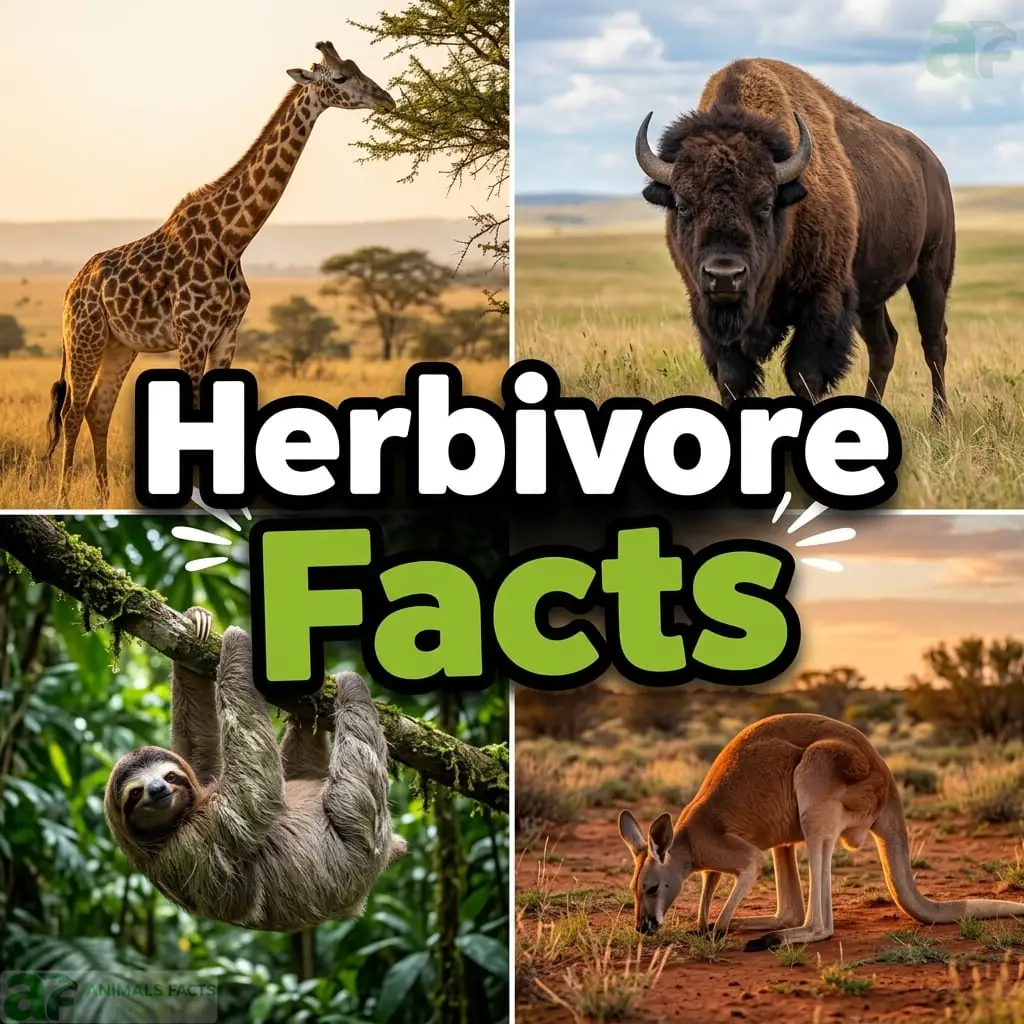
Herbivore Facts
| Feature | Details |
|---|---|
| Ecological Category | Herbivore — any animal obtaining the majority of its energy from plant matter |
| Formal Taxonomic Status | Not a single taxon — spans multiple phyla, classes, and orders |
| Kingdom | Animalia |
| Diet Definition | Plants, algae, fungi, and other photosynthetic organisms |
| Estimated Species | Hundreds of thousands — the majority of all animal species consume plant matter |
| Habitat | Every terrestrial, freshwater, and marine ecosystem on Earth |
| Lifespan Range | Days (some insects) to 175+ years (Aldabra giant tortoise) |
| Size Range | Microscopic (zooplankton) to 190,000 kg (blue whale — krill-based diet) |
| Speed Records | Pronghorn antelope: 88 km/h (fastest herbivorous land mammal); wildebeest: 80 km/h |
| Conservation Status | Many species Endangered or Critically Endangered — especially megaherbivores |
| Ecological Role | Primary consumers — the critical link between plant energy and all animal life |
| Biomass | Herbivores represent the largest share of animal biomass on Earth |
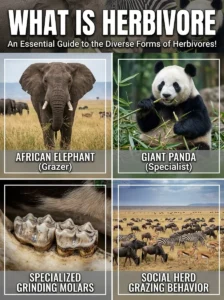 1. Introduction: What is Herbivore?
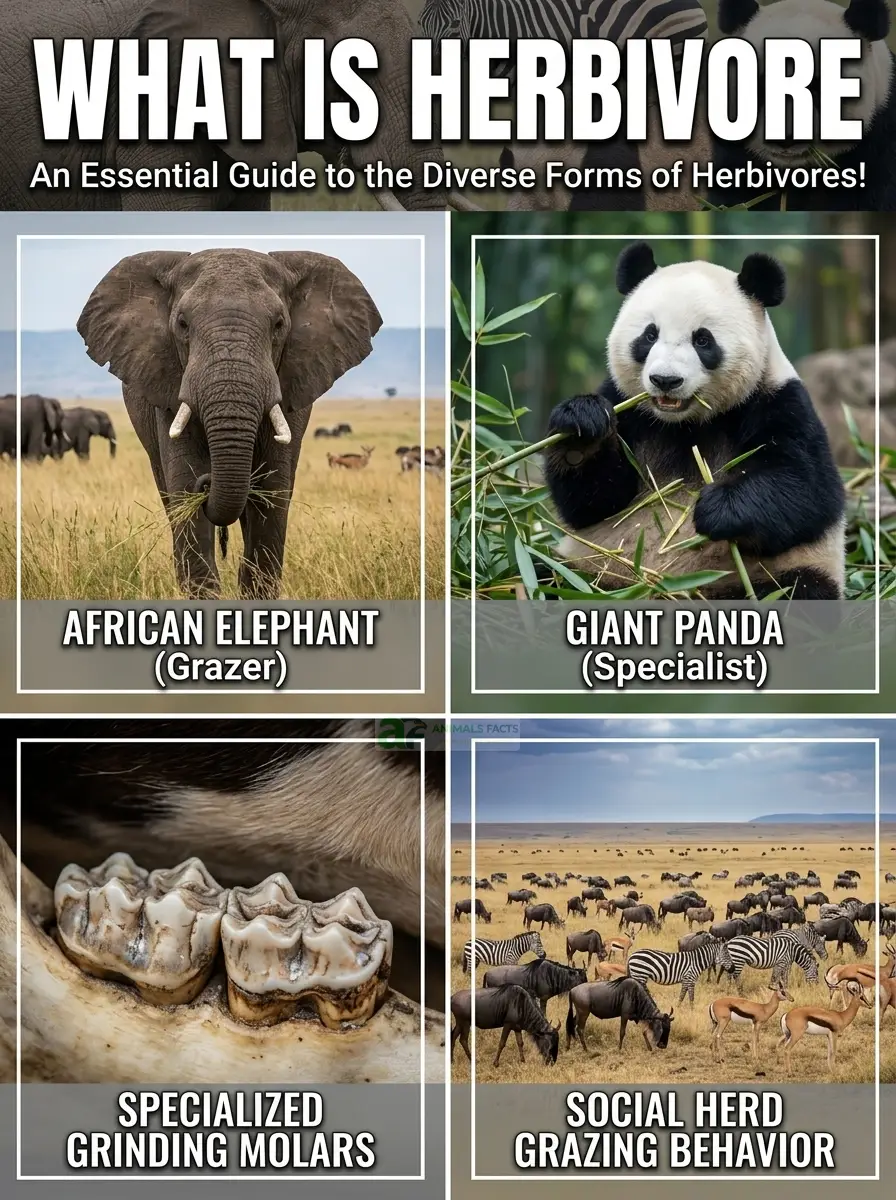
Stand on the Serengeti plains at dawn and watch the horizon fill with the movement of one and a half million wildebeest — a living river of hooves and horns stretching further than the eye can follow. Crouch in the Amazon rainforest canopy and observe a three-toed sloth hanging motionless for hours, so perfectly attuned to its leafy world that algae grows in its fur. Peer beneath the surface of any ocean and find krill — tiny crustaceans consuming phytoplankton by the trillion — quietly sustaining the largest animals that have ever lived on Earth. Herbivore facts are facts about the foundational layer of all animal life — the animals that convert sunlight, captured in leaves and roots and algae and grasses, into flesh and blood that every carnivore, omnivore, and scavenger on Earth ultimately depends upon.
Herbivores are not simply passive victims waiting to be eaten. Interesting facts about herbivores reveal animals of extraordinary sophistication — elephants that remember water sources across decades of drought; howler monkeys whose calls carry three miles through dense jungle; beavers that engineer entire landscapes, creating wetlands that support hundreds of species; sea urchins that can strip entire kelp forests bare or, with their grazing controlled, allow those same forests to flourish. Herbivores are ecosystem engineers, seed dispersers, soil architects, and forest managers — the animals whose mouths, hooves, and digestive systems shape the physical landscape of the planet.
This is your complete, authoritative guide to herbivore facts — covering every major group, every extraordinary adaptation, every ecological role, and every cultural significance connected to these remarkable plant-eating animals. Whether you are a student searching for herbivore facts for kids, a teacher building a food chain curriculum, a conservationist assessing threats, or simply someone who watched the Great Migration and was moved by the sheer scale of herbivorous life — this article was written for you.
2. Herbivore Species Overview & Classification
Unlike carnivores (which have a formal mammalian order, Carnivora) or omnivores, herbivore is a purely ecological category — a feeding guild that encompasses animals from across the entire animal kingdom, united only by their dietary dependence on plant matter. The diversity within this category is staggering.
What Makes an Animal a Herbivore?
An herbivore is any animal that obtains the majority of its nutritional energy from plant material — including leaves, stems, roots, seeds, fruits, bark, algae, phytoplankton, grasses, and aquatic vegetation. The category encompasses:
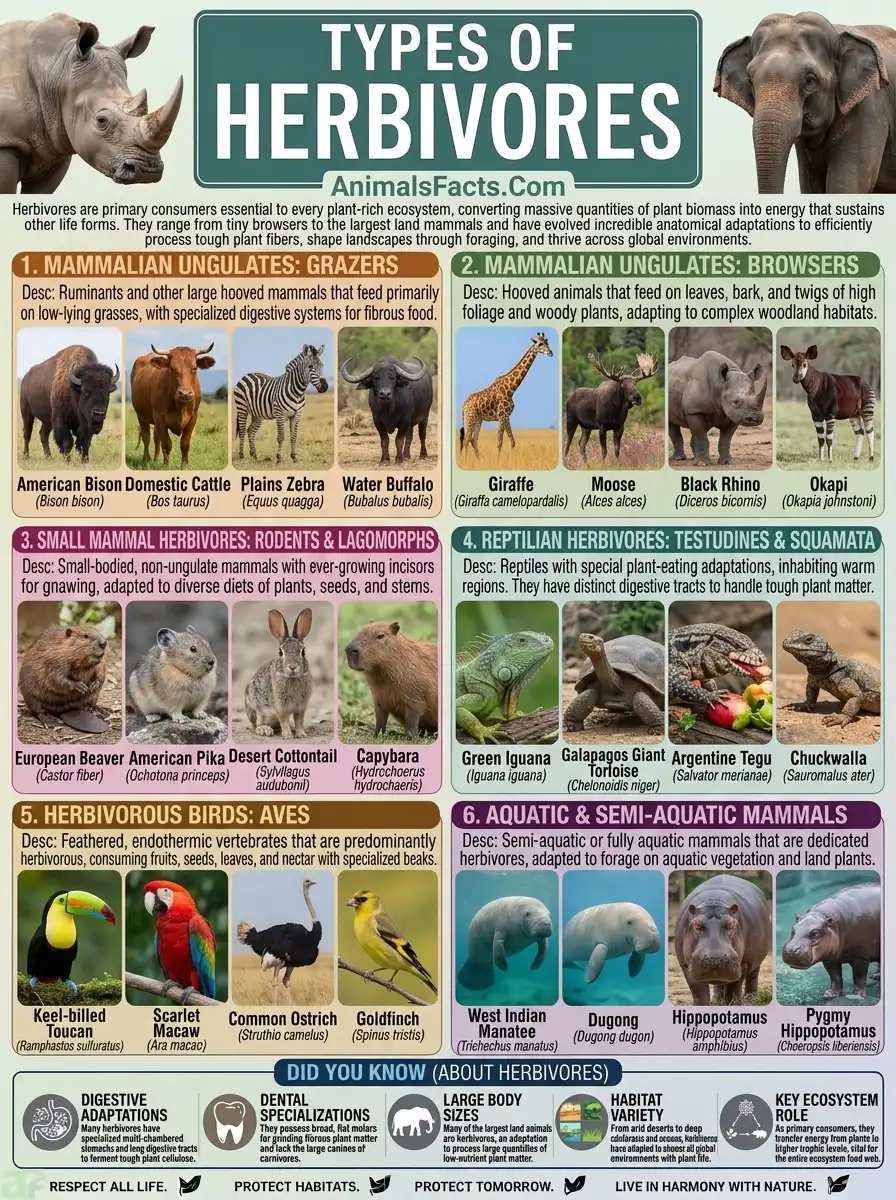
Grazers — Feed primarily on grasses and low vegetation (wildebeest, bison, rabbits, geese) Browsers — Feed primarily on leaves, shoots, and bark of shrubs and trees (giraffes, koalas, deer) Granivores — Feed primarily on seeds and grains (many birds, rodents, some insects) Frugivores — Feed primarily on fruit (fruit bats, many primates, toucans) Folivores — Feed primarily on leaves (sloths, koalas, howler monkeys, giant pandas) Nectarivores — Feed primarily on nectar (hummingbirds, most bees, some bats) Algivores — Feed primarily on algae (many marine invertebrates, some fish, manatees) Filter feeders on phytoplankton — (baleen whales, whale sharks, flamingos, copepods)
Major Herbivore Groups Across the Animal Kingdom
| Animal Group | Classification | Herbivore Examples | Approx. Herbivorous Species |
|---|---|---|---|
| Mammals | Class Mammalia | Elephants, horses, deer, rabbits, whales, manatees | ~1,000+ species |
| Birds | Class Aves | Geese, parrots, finches, emus, flamingos | ~2,000+ species |
| Reptiles | Class Reptilia | Green iguana, Galápagos tortoise, marine iguana | ~500+ species |
| Insects | Class Insecta | Grasshoppers, butterflies (larvae), aphids, stick insects | Hundreds of thousands |
| Fish | Class Actinopterygii | Parrotfish, surgeonfish, grass carp, rabbitfish | ~2,000+ species |
| Crustaceans | Subphylum Crustacea | Krill, copepods, land crabs (some), crayfish (some) | Thousands |
| Mollusks | Phylum Mollusca | Land snails, sea hares, chitons, limpets | Thousands |
| Echinoderms | Phylum Echinodermata | Sea urchins, some sea stars | Hundreds |
| Amphibians | Class Amphibia | Tadpoles (most), some adult frogs | Hundreds |
Taxonomy of Key Mammalian Herbivore Orders
| Order | Common Name | Key Examples | Approx. Species |
|---|---|---|---|
| Proboscidea | Elephants | African bush, African forest, Asian elephant | 3 |
| Perissodactyla | Odd-toed ungulates | Horses, rhinos, tapirs | ~17 |
| Artiodactyla / Cetartiodactyla | Even-toed ungulates + whales | Cattle, deer, giraffes, hippos, camels, whales | ~300+ |
| Rodentia | Rodents | Beavers, capybara, squirrels, voles | ~2,300+ (many herbivorous) |
| Lagomorpha | Rabbits and hares | European rabbit, snowshoe hare, pika | ~90 |
| Sirenia | Manatees and dugongs | West Indian manatee, dugong | 4 |
| Pilosa | Sloths and anteaters | Three-toed sloth, two-toed sloth | ~10 (sloths) |
Species Evolution & Discovery Timeline
- ~470 million years ago — First land plants appear; arthropod herbivores begin evolving to exploit terrestrial plant resources
- ~360 million years ago — First herbivorous tetrapods appear in the fossil record; Diadectes among the earliest terrestrial vertebrate herbivores
- ~250 million years ago — Herbivorous dinosaurs (including early sauropods) diversify rapidly following the Permian extinction
- ~200 million years ago — First mammals appear; early forms are insectivorous; plant-eating mammals diversify later
- ~65 million years ago — Non-avian dinosaur extinction opens ecological space; mammalian herbivores diversify explosively in the Paleocene and Eocene
- ~50 million years ago — Earliest horses (Eohippus), proboscideans, and perissodactyls appear
- ~35 million years ago — Grasses spread globally; grassland-adapted ungulates diversify dramatically
- ~7 million years ago — Earliest relatives of modern elephants, rhinos, and hippos established
- ~10,000 years ago — Pleistocene megafaunal herbivore extinction; woolly mammoths, mastodons, ground sloths, and giant horses go extinct — partly from climate change, partly from human hunting
- ~10,000 years ago — Domestication of cattle, sheep, goats, and horses begins in the Near East and Central Asia
- 1758 — Carl Linnaeus classifies major herbivore species in Systema Naturae
- 2000–2026 — Ongoing genomic research reveals evolutionary relationships among herbivore lineages; new herbivorous fish, insect, and reptile species described annually
3. Physical Description of Herbivores
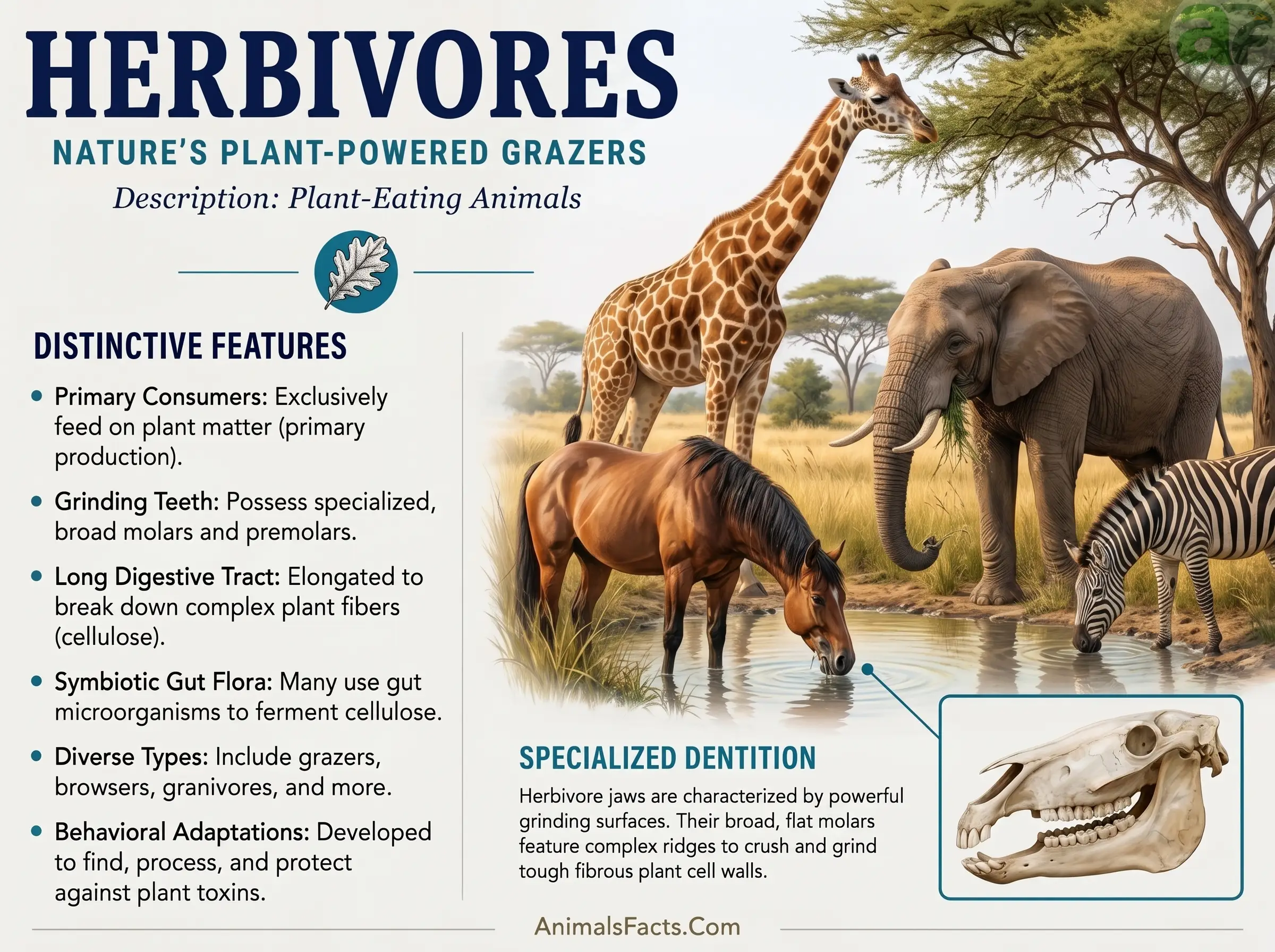
Herbivores have been shaped by hundreds of millions of years of evolutionary pressure to efficiently extract nutrition from plant matter — a food source that is abundant, immobile, and difficult to digest. The result is an extraordinary array of physical adaptations across different animal groups.
Core Physical Adaptations of Herbivores
Dentition — Plant matter is tough, abrasive, and low in nutrition per gram. Herbivorous mammals have evolved highly specialized teeth: hypsodont (high-crowned) molars for withstanding the abrasion of grass; lophodont (ridged) teeth for shredding leaves; diastema (gap between incisors and molars) for manipulating vegetation; and continuously growing teeth in rabbits and rodents that never wear down completely.
Digestive systems — Plant cell walls are made of cellulose — a complex carbohydrate that no vertebrate can digest without microbial help. Herbivores have evolved two primary solutions: ruminant digestion (cattle, deer, giraffe, sheep — four-chambered stomach; food regurgitated and rechewed as “cud”; bacterial fermentation in the rumen) and hindgut fermentation (horses, rhinos, rabbits — fermentation in an enlarged cecum or colon after the stomach).
Body size — Many of the world’s largest animals are herbivores — because a large gut is necessary to process enough plant matter to meet caloric needs, and large size reduces the thermoregulatory cost per unit of body mass.
Eyes positioned laterally — Prey animals typically have eyes on the sides of their heads — providing a near-360-degree field of vision for predator detection, sacrificing binocular depth perception (which predators need for judging strike distance).
Locomotor adaptations for speed and endurance — Ungulate hooves (modified toe bones) provide springy, energy-efficient locomotion across open grassland. Pronghorn antelope have evolved extraordinary cardiovascular capacity — their trachea, lungs, and heart are disproportionately large relative to body size, allowing them to sustain speeds of 88 km/h for extended distances — not just in short bursts.
Size Records Across Herbivore Groups
| Record | Species | Measurement |
|---|---|---|
| Largest land herbivore (living) | African bush elephant (Loxodonta africana) | Up to 6,000 kg and 3.3 m shoulder height |
| Largest herbivore ever | Patagotitan mayorum (sauropod dinosaur) | Estimated 69,000 kg |
| Largest marine herbivore | Dugong/manatee; blue whale (krill) | Blue whale: up to 190,000 kg |
| Fastest herbivore | Pronghorn antelope (Antilocapra americana) | 88 km/h sustained |
| Slowest herbivore | Three-toed sloth (Bradypus spp.) | 0.24 km/h maximum |
| Longest-lived herbivore | Aldabra giant tortoise (Aldabrachelys gigantea) | 175+ years verified |
| Tallest land herbivore | Giraffe (Giraffa camelopardalis) | Up to 5.8 m tall |
| Smallest mammalian herbivore | Pygmy rabbit (Brachylagus idahoensis) | ~400 g |
Physical Comparison Across Major Herbivore Groups
| Feature | Ungulates (Deer, Cattle) | Elephants | Sloths |
|---|---|---|---|
| Teeth | High-crowned molars; diastema | Continuously replaced molars (6 sets) | Reduced; no enamel |
| Digestion | Ruminant (4 chambers) or hindgut | Hindgut fermentation (less efficient) | Extremely slow; multi-week digestion |
| Eyes | Lateral (wide field of vision) | Forward-facing (unusual for herbivore) | Lateral |
| Speed | Up to 88 km/h (pronghorn) | Up to 25 km/h (elephant charge) | 0.24 km/h |
| Social structure | Variable — herds to solitary | Matriarchal herds | Solitary |
| Defense | Flight; horns; hooves | Size; tusks; herd protection | Camouflage; algae-covered fur |
“Herbivores are not the passive victims of the natural world. They are its architects. The elephants that push down trees are creating forest clearings. The wildebeest that graze the Serengeti are managing the grass. Without these animals, the landscapes we treasure would be unrecognizable.” — Sir David Attenborough, BBC Planet Earth series
4. Top 25 Amazing Herbivore Facts
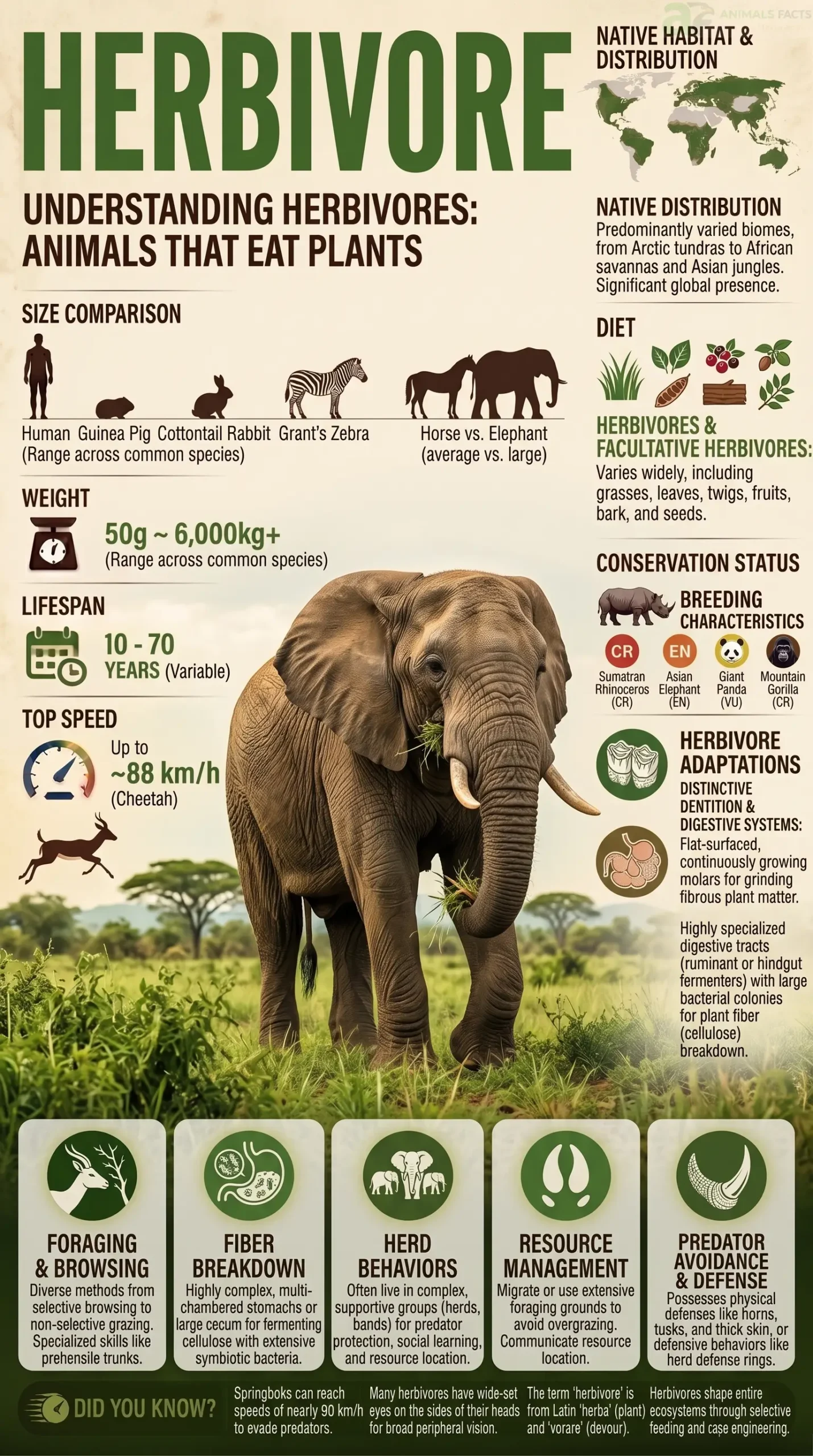
Here are the most astonishing, conversation-stopping interesting facts about herbivores — each one a revelation about what plant-eating life is truly capable of:
- The blue whale — the largest animal ever to have lived on Earth — is an ecological herbivore: it consumes up to 4 metric tons of krill (which eat phytoplankton) per day
- Elephants spend up to 18 hours per day eating — consuming up to 270 kg of vegetation daily and walking 50–70 km to find it
- A cow produces approximately 200 liters of methane gas per day through ruminant fermentation — making livestock one of the largest agricultural sources of greenhouse gas globally
- The three-toed sloth moves so slowly and has such a low metabolic rate that algae grows in its fur — providing camouflage and hosting a unique ecosystem of moths, beetles, and fungi
- Pronghorn antelope (Antilocapra americana) can sustain speeds of 88 km/h for extended distances — evolved to outrun the now-extinct American cheetah that once hunted them
- Elephants are a keystone species — a single elephant creates water holes, pushes down trees, and disperses seeds across vast distances, engineering habitat for hundreds of other species
- The giraffe has a 45 cm, prehensile tongue — dark blue-black in color — that can strip leaves from thorny acacia branches without injury
- Caterpillars (herbivorous insect larvae) consume their own weight in plant material every single day — making them among the most intensive plant consumers relative to body size in the animal kingdom
- Beavers are herbivores whose dam-building creates wetlands that increase local biodiversity, control flooding, improve water quality, and sequester carbon — making them one of the most ecologically impactful herbivores in North America
- The dugong (Dugong dugon) grazes seagrass meadows so precisely that it leaves feeding trails on the seafloor — and returns to the same patches as the seagrass regrows, actively managing its own food supply
- Wild horses (and their ancestor Equus ferus) played a critical role in shaping grassland ecosystems across North America, Eurasia, and Africa — their grazing patterns maintain plant diversity by preventing any single grass species from dominating
- Some leaf-cutter ants do not directly eat the leaves they collect — they use them to farm fungi underground, making them agricultural herbivores that feed their fungus gardens rather than consuming leaves themselves
- The koala’s gut microbiome is so specialized for digesting toxic eucalyptus leaves that a koala raised without the right bacteria simply cannot digest its primary food source — mothers pass the bacteria to joeys through a specialized fecal pap
- The giant panda (Ailuropoda melanoleuca) has the digestive system of a carnivore but eats 99% bamboo — its gut processes bamboo so inefficiently that it must eat for up to 16 hours per day to meet caloric needs
- Hippos (considered semi-herbivorous megafauna) deposit enormous quantities of dung in rivers and lakes — providing nutrients that support entire freshwater food chains from algae to fish
- The wildebeest migration in the Serengeti involves 1.5 million animals crossing the Mara River — and their collective grazing of the Serengeti-Mara ecosystem is the primary driver of the grassland’s extraordinary biodiversity
- Manatees (Trichechus spp.) are the only marine mammals that feed almost exclusively on aquatic plants — consuming 50–100 kg of seagrass per day and earning the nickname “sea cows”
- Rabbits practice cecotrophy — they produce two types of droppings, eating one type (soft cecotropes) directly from their own anus to reprocess nutrients their gut did not absorb the first time
- The Galápagos marine iguana is the world’s only truly marine lizard — it dives into cold Pacific waters to graze on underwater algae, and sneezes out excess salt absorbed during feeding
- Baleen whales filter-feed on zooplankton and krill through keratin plates in their mouths — the same material that makes human fingernails — straining thousands of tiny organisms from the water with each mouthful
- African elephants have the longest pregnancy of any land animal — 22 months — and calves are born needing years of instruction on which plants to eat, where water is found, and how to navigate the landscape
- Some parrotfish (Scaridae) eat coral to access the algae inside — excreting the calcium carbonate skeleton as white sand — producing significant quantities of the white sand beaches of tropical islands
- The capybara (Hydrochoerus hydrochaeris) — the world’s largest rodent at up to 65 kg — is a semi-aquatic herbivore that grazes riverside vegetation and has been documented allowing dozens of bird species and even monkeys, rabbits, and ducks to rest on its back
- Termites are herbivores that collectively consume more plant biomass in tropical ecosystems than any other animal group — including all the large mammalian herbivores combined
- The passenger pigeon — once the most numerous bird on Earth with flocks of over 3 billion individuals — was a seed and mast herbivore whose extinction fundamentally transformed North American forest ecology
Did You Know? The African elephant’s daily movement patterns are so influential that they have been called “ecosystem engineers” by ecologists. A single elephant in a single lifetime can dig over 100 water holes, push down enough trees to open hundreds of clearings, and disperse seeds across territories covering thousands of square kilometers — creating habitat for plants, birds, insects, and mammals that could not exist without these physical modifications to the landscape.
5. Herbivore Fun Facts for Kids
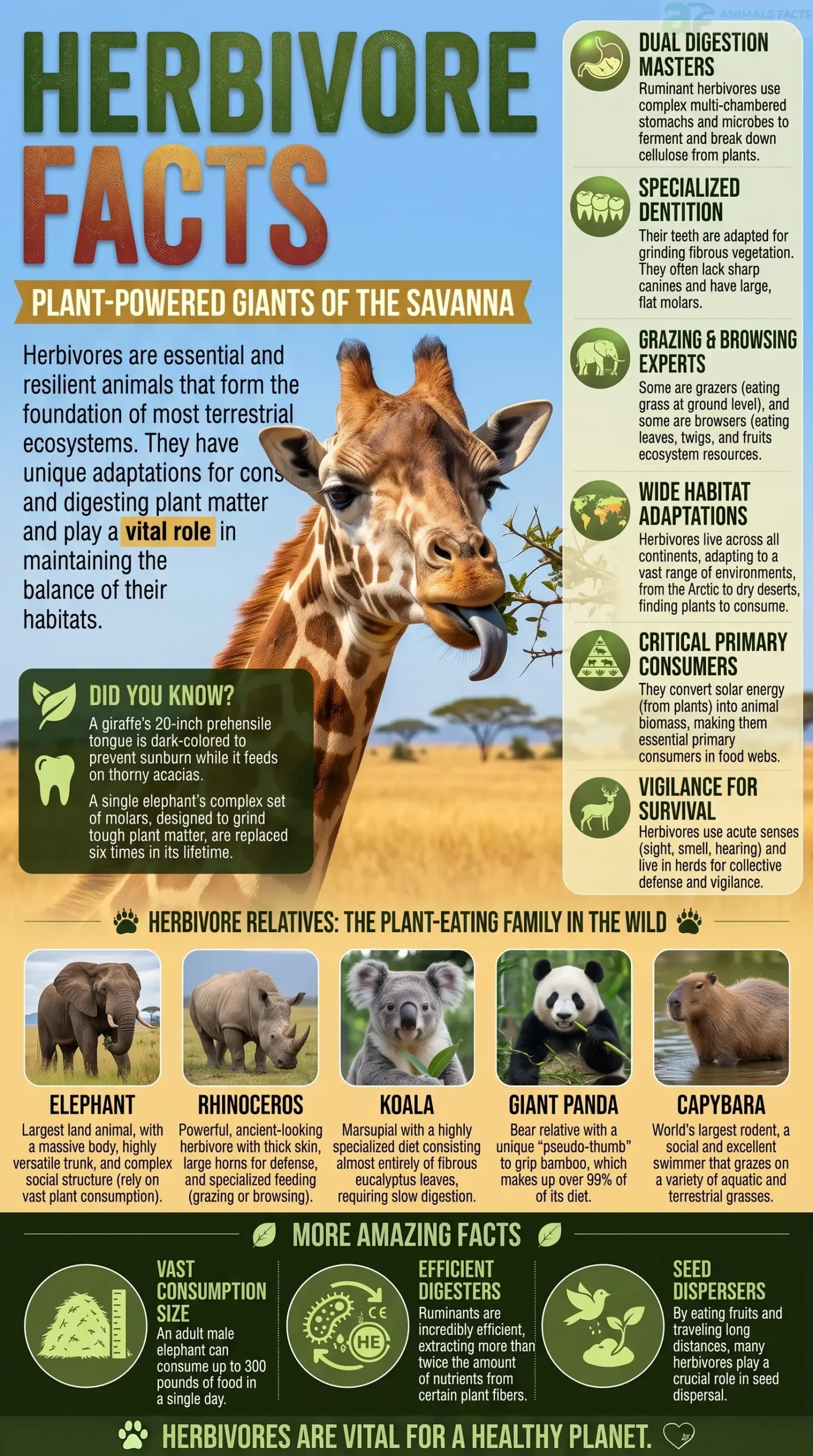
- 🐘 Elephants eat up to 270 kg of vegetation per day and spend 18 hours eating
- 🐳 Blue whales eat 4 metric tons of krill daily — the largest herbivore diet by volume
- 🦥 Sloths move at 0.24 km/h and grow algae in their fur for camouflage
- 🦌 Pronghorn antelope sustain 88 km/h — the fastest long-distance herbivore on land
- 🦒 Giraffes have 45 cm tongues to strip thorny acacia leaves
- 🐼 Giant pandas spend 16 hours per day eating bamboo
- 🦫 Beavers engineer entire wetland ecosystems — increasing local biodiversity dramatically
- 🐇 Rabbits eat their own droppings to extract more nutrients from food
- 🐟 Parrotfish produce tropical white sand beaches by digesting coral skeletons
- 🌿 Termites consume more plant matter in tropical ecosystems than all large mammals combined
- 🦛 Hippo dung fertilizes entire freshwater food chains in African rivers and lakes
- 🦎 Marine iguanas dive underwater to graze on algae and sneeze out the excess salt
- 🐝 Bees are nectar-herbivores whose pollination services are worth $577 billion annually to agriculture
- 🦣 Woolly mammoths — extinct herbivores — maintained grassland ecosystems that helped regulate Arctic climate
- 🦬 The Great Migration involves 1.5 million wildebeest managing the Serengeti grassland
6. Natural Habitat & Geographic Range
Herbivores inhabit every ecosystem on Earth where plant life exists — which is essentially every terrestrial, freshwater, and marine environment on the planet. Because plants are the primary producers of virtually every ecosystem, herbivores are everywhere plant matter is found.
Habitat Range by Environment
| Habitat Type | Dominant Herbivore Groups | Notable Species |
|---|---|---|
| African savanna/grassland | Elephants, zebras, wildebeest, giraffes, rhinos | African bush elephant, white rhino, reticulated giraffe |
| Temperate grassland | Bison, pronghorn, prairie dogs, grasshoppers | American bison, pronghorn antelope, black-tailed prairie dog |
| Tropical rainforest | Gorillas, tapirs, sloths, howler monkeys, leaf-cutter ants | Mountain gorilla, Brazilian tapir, three-toed sloth |
| Temperate forest | Deer, elk, rabbits, caterpillars, wood-boring beetles | White-tailed deer, North American elk, European rabbit |
| Arctic tundra | Caribou, musk ox, Arctic hares, lemmings, geese | Caribou (Rangifer tarandus), musk ox, snow goose |
| Desert | Camels, addax, desert tortoises, sand gazelles | Dromedary camel, Saharan addax, Mojave desert tortoise |
| Freshwater | Manatees, hippos, beavers, coypus, aquatic insects | West Indian manatee, common hippopotamus, North American beaver |
| Marine | Dugongs, sea turtles, manatees, parrotfish, krill | Dugong, green sea turtle, Antarctic krill |
| Coral reef | Parrotfish, surgeonfish, sea urchins, green turtles | Bumphead parrotfish, blue tang surgeonfish |
| Mountain | Mountain goats, yaks, ibex, pikas, marmots | Alpine ibex, Tibetan yak, American pika |
| Wetland / Mangrove | Hippos, manatees, coypus, aquatic birds | Hippopotamus, West Indian manatee, greater flamingo |
Continent-by-Continent Herbivore Highlights
| Region | Herbivore Highlights | Notable Record |
|---|---|---|
| Africa | Elephant, rhino, hippo, giraffe, wildebeest, zebra | Greatest megaherbivore diversity of any continent |
| Asia | Asian elephant, Indian rhino, giant panda, yak, Saiga antelope | Giant panda: world’s most specialized folivore |
| North America | Bison, pronghorn, elk, moose, beaver, manatee | Pronghorn: fastest herbivore in the Western Hemisphere |
| South America | Tapir, capybara, giant anteater, sloths, howler monkey | Capybara: world’s largest rodent |
| Europe | European bison, red deer, chamois, European rabbit | European bison (Wisent): largest land animal in Europe |
| Australia | Red kangaroo, koala, wombat, dugong, green turtle | Koala: world’s most specialized eucalyptus feeder |
| Antarctica | Antarctic krill, penguins (fish-eaters, but krill-dependent) | Krill: keystone herbivore of the Southern Ocean |
| Ocean (global) | Krill, copepods, baleen whales, green turtles, dugongs | Antarctic krill biomass: ~500 million tons |
Did You Know? The Tibetan Plateau — the world’s highest plateau, averaging over 4,500 meters above sea level — supports one of the most extreme large herbivore communities on Earth. Tibetan yaks (Bos grunniens) graze at altitudes where oxygen levels are 40% lower than at sea level, surviving on sparse tundra grasses through winter temperatures of −40°C. Their blood contains a unique hemoglobin variant that binds oxygen more efficiently than lowland cattle — a genetic adaptation shared, remarkably, with their domestic descendants.
7. Diet & Feeding Behavior of Herbivores
The defining characteristic of all herbivores is obtaining caloric energy from plant matter — but within that broad definition, the diversity of plant foods consumed, feeding strategies employed, and digestive systems used is as varied as the animal kingdom itself.
Diet Classification
Obligate herbivores — Feed exclusively or almost exclusively on plant matter. Cannot efficiently metabolize animal protein even when available. Examples: horses, rabbits, giant pandas, koalas, green iguanas.
Facultative herbivores — Primarily plant-eating but occasionally consume animal matter opportunistically. Examples: many deer species (known to eat bird eggs and small vertebrates); hippos (primarily grazers but documented scavenging meat).
Seasonal herbivores — Shift between primarily herbivorous and omnivorous diets based on season. Examples: black bears (spring/summer herbivory; autumn frugivory; occasional meat).
Diet Breakdown Across Major Herbivore Groups
| Group | Primary Plant Food | Secondary Food | Approx. % Plant Matter | Feeding Method |
|---|---|---|---|---|
| Elephants | Grasses, leaves, bark, roots, fruits | Mineral-rich soil and clay | ~99% | Prehensile trunk; strip bark with tusks |
| Giraffes | Acacia leaves, mimosa, wild apricot | Other browse species | ~100% | 45 cm prehensile tongue; highly selective |
| Wildebeest | Short grasses (especially Themeda) | Occasionally other plants | ~100% | Grazing; follow grass growth patterns |
| White rhino | Short grasses | Occasional browse | ~100% | Wide lips specialized for bulk grass grazing |
| Koala | Eucalyptus leaves (100–150 species but 30–50 preferred) | Minimal water (from leaves) | ~100% | Clamp and strip leaves; detoxify via gut microbiome |
| Giant panda | Bamboo (stems, shoots, leaves) | Occasional fruit, honey, eggs | ~99% | Both forepaws modified with pseudo-thumb for grip |
| Krill | Phytoplankton, ice algae | Small zooplankton occasionally | ~90% | Filter-feeding basket appendages |
| Parrotfish | Algae (from coral, rock, seagrass) | Coral polyps (incidental) | ~80% | Beak-like fused teeth scrape substrate |
| Pronghorn antelope | Forbs, shrubs, grasses | Cacti (in dry season) | ~100% | Selective grazing; mobile foraging |
| Manatee | Seagrass, freshwater hyacinth, algae | Occasional invertebrates | ~99% | Prehensile upper lip guides vegetation to mouth |
| Termites | Dead wood, leaf litter, grass, dung | Fungi (cultivated from plant matter) | ~100% | Mandibles cut; gut microbiome digests cellulose |
| Leaf-cutter ants | Leaves (fed to fungus gardens) | Fungal garden output | ~100% | Cut and carry leaves; do not directly eat them |
8. Herbivore Reproduction & Life Cycle
Herbivore reproductive strategies vary enormously with body size, predator pressure, and environmental stability — from the rapid breeding of rabbits and rodents to the slow, investment-heavy reproduction of elephants and whales.
The Spectrum of Herbivore Reproductive Strategies
High reproduction, low investment (r-strategists) — Small herbivores facing high predation pressure reproduce rapidly, produce many offspring, and provide minimal parental care. Rabbits can produce up to 12 litters per year with 4–8 kits per litter — an annual reproductive potential of nearly 100 offspring per female. Most offspring do not survive their first year.
Low reproduction, high investment (K-strategists) — Large herbivores with few natural predators (or effective anti-predator strategies) invest enormously in individual offspring. Elephants have a 22-month gestation — the longest of any land animal — produce a single calf, and invest 8–12 years of intensive maternal care before the calf is independent. A female elephant may produce only 4–6 calves in her lifetime.
Semelparous herbivores — Some plants and their associated herbivores reproduce once catastrophically and die. Many mast-seeding trees produce enormous seed crops unpredictably, and the herbivore species that specialize on their seeds (passenger pigeons, certain squirrel populations) undergo boom-and-bust population cycles in synchrony.
Lifespan Comparison
| Species | Wild Lifespan | Captivity Lifespan | Notes |
|---|---|---|---|
| Common rabbit (Oryctolagus cuniculus) | 1–2 years (wild) | Up to 12 years | High predation; rapid reproduction compensates |
| White-tailed deer (Odocoileus virginianus) | 2–6 years (males); up to 14 years (females) | Up to 20 years | Males die younger from rut injuries |
| African elephant (Loxodonta africana) | 60–70 years | Similar | Lifespan limited by 6th molar set wearing out |
| Giraffe (Giraffa camelopardalis) | 20–25 years | Up to 28 years | |
| White rhinoceros (Ceratotherium simum) | 40–50 years | Up to 55 years | |
| Green sea turtle (Chelonia mydas) | 80+ years | Similar | Late maturity (25–35 years) |
| Aldabra giant tortoise | 175+ years | Similar | Longest-lived herbivore |
| Bowhead whale (Balaena mysticetus) | Over 200 years | Never survives in captivity | Oldest mammal; krill-based herbivore |
Did You Know? The African elephant’s lifespan is ultimately determined by its teeth — not its heart, organs, or immune system. Elephants have six sets of molar teeth that cycle through sequentially across their lifetime. When the last set wears out (typically in the animal’s 60s), it can no longer chew food effectively and gradually dies of starvation. This is why elderly elephants in the wild often seek out soft riverine vegetation and swampy areas where food requires less chewing.
9. Social Behavior & Communication
Herbivores display some of the most sophisticated social structures in the animal kingdom — driven by the survival advantages of group living in the face of predation, and the informational benefits of collective knowledge about food and water resources.
Social Structures
Matriarchal herds (elephants) — African and Asian elephant family groups are led by the oldest female (matriarch) — the individual with the greatest accumulated knowledge of seasonal resources, predator patterns, water locations, and migratory routes. Studies have shown that herds with older, more experienced matriarchs have significantly higher survival rates during drought years.
Mixed mega-herds (wildebeest, caribou) — Some herbivores aggregate in enormous mixed herds of hundreds of thousands during migration — individual safety through sheer numbers, with the many eyes of the herd providing near-total detection of approaching predators.
Harem social systems (horses, deer, elephant seals) — A dominant male controls reproductive access to a group of females, defending them from rival males. Males outside the harem form bachelor groups until they can challenge and displace a dominant male.
Colonial herbivores (prairie dogs, meerkats, beavers) — Some herbivores live in structured underground or semi-subterranean colonies with sentinel systems, alarm calls, and complex social hierarchies.
Communication Methods
| Method | Herbivore Groups | Examples |
|---|---|---|
| Vocalizations | Elephants, monkeys, deer, rabbits, cattle | Elephant infrasound carries 10+ km; howler monkey call carries 5 km; white-tailed deer snort-wheeze warns herd |
| Chemical signals (pheromones) | Deer, rabbits, insects, cattle | Deer tarsal gland secretions signal individual identity and reproductive status |
| Visual signals | Deer (white tail), rabbits (tail flash), zebra (stripe patterns) | White-tailed deer flags tail as alarm; zebra stripes may confuse predators in stampede |
| Infrasound | Elephants, hippos, rhinos | Elephants produce sub-20 Hz calls inaudible to humans; travel through ground and air simultaneously |
| Seismic signaling | Elephants | Foot stomps and low-frequency vocalizations detected through the ground by feet up to 30 km away |
| Touch and grooming | Primates, horses, elephants | Social bonding; hierarchy reinforcement |
| Alarm systems | Prairie dogs, meerkats, rabbits, ungulates | Prairie dogs have one of the most sophisticated alarm call systems of any animal — encoding predator species, size, color, and speed in distinct calls |
10. Predators & Defense Mechanisms
Herbivores exist in a constant evolutionary arms race with carnivores — every defensive adaptation they develop puts selective pressure on predators to counter it, which in turn selects for better defenses.
Natural Predators of Herbivores
The predators of herbivores encompass virtually every large carnivore group — from lions hunting wildebeest, to wolves hunting elk, to orcas hunting whale calves, to eagles hunting rabbits, to sharks hunting sea turtles. The scale of predation pressure varies enormously:
- A wildebeest calf has approximately a 50% chance of dying in its first year — mostly to predation
- A rabbit born in the wild has an average life expectancy of under 1 year
- An adult elephant in a healthy ecosystem has virtually no natural predators — only lions targeting weakened or isolated individuals
Defense Strategies
| Strategy | Herbivore Groups | Description |
|---|---|---|
| Speed and flight | Pronghorn, gazelles, impala, hares | Primary defense of open-habitat prey animals; outrun predators |
| Herd aggregation | Wildebeest, bison, zebra, caribou | Individual risk diluted by herd size; predator confusion in stampede |
| Horns and antlers | Buffalo, rhinos, elk, moose, oryx | Active defense against predators; dramatic in male-male competition |
| Size | Elephants, hippos, rhinos, giraffes | Too large and dangerous for most predators to attack |
| Camouflage | Deer (fawns), tapirs, sloths, stick insects | Spotted or cryptically-colored young; adults match habitat |
| Armor | Pangolins, turtles, tortoises, armadillos | Keratin scales or bone-reinforced shell deters biting predators |
| Chemical defense | Monarch caterpillars, some beetles, poison dart frogs | Sequester plant toxins into own tissues; become inedible |
| Underground retreat | Rabbits, prairie dogs, mole rats, pikas | Burrow systems allow rapid escape |
| Kick and charge | Horses, zebras, cattle, elephants, hippos | Powerful kicks; charges can kill lions, crocodiles, humans |
| Alarm networks | Prairie dogs, meerkats, most herd animals | Sentinel individuals; complex alarm call systems |
| Spines and thorns | Porcupines, hedgehogs, sea urchins | Quills and spines cause severe pain; embed in predator mouth |
Did You Know? The pronghorn antelope is faster than any living predator in North America — and scientists long wondered why, since its current predators (coyotes, bobcats, mountain lions) are not fast enough to make such extreme speed necessary. The answer: the pronghorn evolved to escape the American cheetah (Miracinonyx trumani) — a North American big cat that went extinct approximately 10,000 years ago. The pronghorn is still running from a predator that no longer exists — a biological ghost of the Pleistocene.
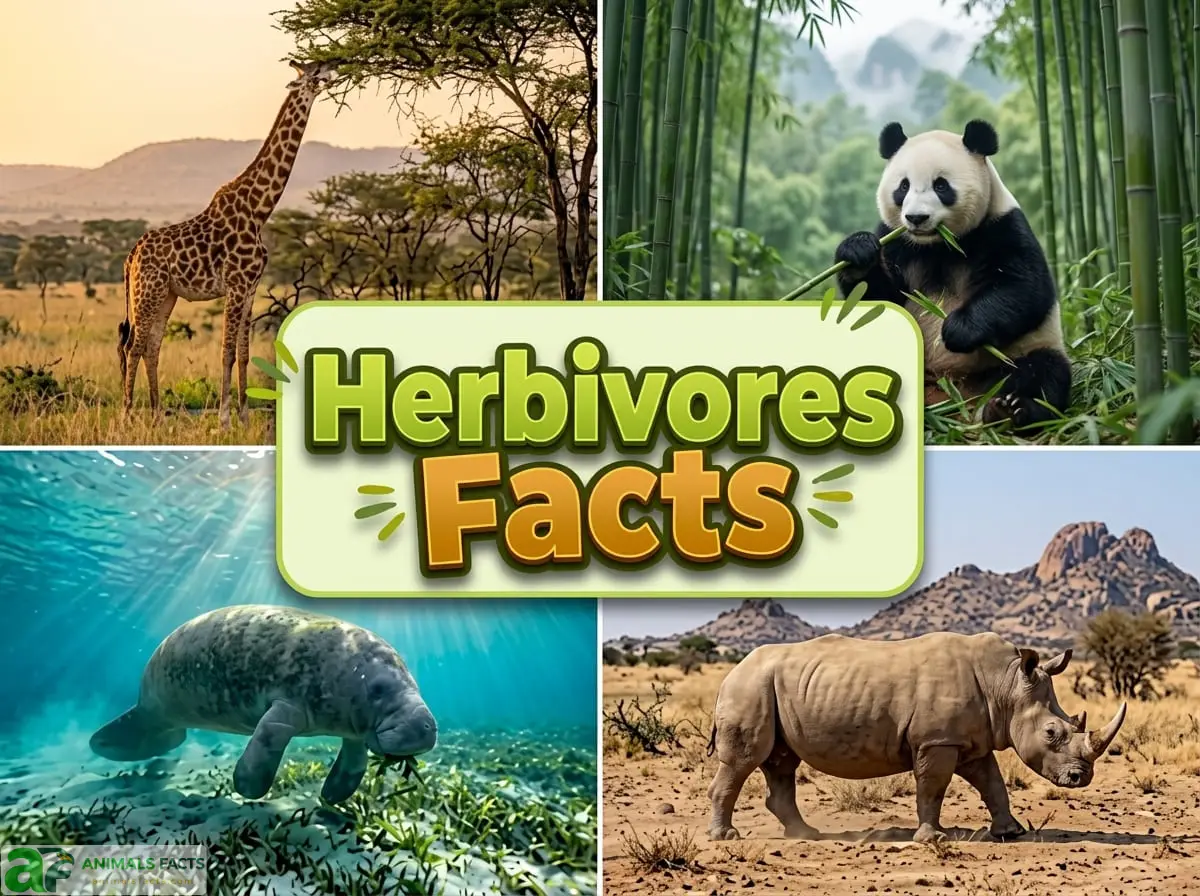
11. Herbivores Facts for Kids 🐘🦒🐰🦋
Hey young nature explorers! Herbivores are the plant-eaters of the animal world — and they are absolutely incredible! Here are some amazing herbivore facts just for you:
- Elephants eat up to 270 kg of food every day — that’s like eating over 500 bags of sugar worth of leaves and grass!
- The giraffe has a tongue so long — 45 cm — it can wrap around thorny branches to pull off leaves!
- A three-toed sloth moves so slowly that algae actually grows in its fur — giving it a greenish tint that helps it hide in the trees!
- Rabbits eat some of their own droppings every day — not because they’re gross, but because it gives them extra nutrition!
- The pronghorn antelope is the second-fastest land animal on Earth — it can run at 88 km/h for long distances!
- Caterpillars eat their own weight in leaves every single day — imagine eating YOUR weight in food!
- Parrotfish turn coral into white beach sand — so the beautiful white beaches of tropical islands are partly made of parrotfish poop!
- Giant pandas must eat for up to 16 hours a day because bamboo has so little nutrition!
- Beavers build dams that create entire ponds and wetlands — they’re like animal engineers!
- The blue whale — the biggest animal ever — eats nothing but tiny shrimp-like creatures called krill!
12. Relationship with Humans
No animal group has shaped human civilization more profoundly than herbivores. Domesticated herbivores are the foundation of agriculture, transportation, and culture across the entire span of human history.
Domesticated Herbivores — The Animals That Built Civilization
The domestication of herbivores beginning approximately 10,000–12,000 years ago in the Near East, Central Asia, and China was arguably the single most transformative event in human history after the control of fire:
| Domesticated Herbivore | Date of Domestication | Region | Primary Human Use |
|---|---|---|---|
| Sheep (Ovis aries) | ~11,000 years ago | Near East | Wool, meat, milk |
| Goat (Capra hircus) | ~10,000 years ago | Near East | Milk, meat, fiber |
| Cattle (Bos taurus) | ~10,000 years ago | Near East/Africa | Meat, milk, labor, leather |
| Pig (Sus scrofa) | ~9,000 years ago | Near East/China | Meat |
| Horse (Equus caballus) | ~5,500 years ago | Central Asian steppe | Transportation, warfare, labor |
| Donkey (Equus asinus) | ~5,000 years ago | North Africa | Labor, transportation |
| Camel (Camelus spp.) | ~3,000–4,000 years ago | Arabia/Central Asia | Transportation, milk, meat, fiber |
| Rabbit (Oryctolagus cuniculus) | ~600 years ago | Europe (monasteries) | Meat, fur |
Horses enabled the spread of cultures across continents, made warfare mobile at speeds previously impossible, and connected trading civilizations. Cattle provided the draft power that made large-scale agriculture possible — from ancient Mesopotamian irrigation to medieval European plowing. Sheep and goats sustained nomadic cultures across deserts and mountains where no other agriculture was possible.
Wild Herbivores and Human Conflict
Where domesticated and wild herbivores compete for the same land, conflict is inevitable:
- Elephants raid crops, destroying entire harvests in a single night — a critical source of human-elephant conflict across Africa and Asia
- Deer and elk in North America cause approximately 1.5 million vehicle collisions per year — resulting in ~200 human deaths and $1 billion in property damage annually
- Hippos are responsible for approximately 500 human deaths per year in Africa — among the deadliest large animals to humans
- Locust swarms — herbivorous insects — can devastate entire regional harvests; the 2019–2020 East African locust crisis affected 70 million people’s food security
Herbivore Products That Drive Global Economies
- Wool — ~2.1 million tons produced annually from domesticated sheep
- Leather — ~8 billion m² of leather produced annually from cattle hides
- Honey — 1.8 million tons produced annually by herbivorous bees
- Silk — ~168,000 tons produced annually from silkworm moth (herbivore) cocoons
- Dairy — ~906 million tons of milk produced annually from cattle, sheep, goats, and camels
13. Herbivore Conservation Status & Threats
The Megaherbivore Crisis
Large herbivores — animals over 1,000 kg — are among the most threatened animals on Earth. Their requirements for vast territories, slow reproduction, and frequent conflict with agriculture and human settlement make them extraordinarily vulnerable:
- 60% of the world’s largest herbivore species are threatened with extinction
- 9 of 17 megaherbivore species are globally threatened (IUCN)
- Wild herbivore populations globally have declined by approximately 60% since 1970
IUCN Status of Major Herbivores
| Species | IUCN Status | Estimated Population (2026) |
|---|---|---|
| Northern white rhino (Ceratotherium simum cottoni) | Critically Endangered | 2 individuals (both female; functionally extinct in wild) |
| Sumatran rhino (Dicerorhinus sumatrensis) | Critically Endangered | ~80 individuals |
| Javan rhino (Rhinoceros sondaicus) | Critically Endangered | ~76 individuals |
| Mountain gorilla (Gorilla beringei beringei) | Endangered | ~1,000+ individuals |
| African forest elephant (Loxodonta cyclotis) | Critically Endangered | ~100,000 individuals |
| Black rhino (Diceros bicornis) | Critically Endangered | ~6,195 individuals |
| Saiga antelope (Saiga tatarica) | Critically Endangered | Recovering; ~1.3 million after mass die-offs |
| Asian elephant (Elephas maximus) | Endangered | ~40,000–50,000 individuals |
| Dugong (Dugong dugon) | Vulnerable | Unknown; declining |
| African bush elephant (Loxodonta africana) | Vulnerable | ~415,000 individuals |
Major Threats
| Threat | Impact Level | Herbivores Most Affected |
|---|---|---|
| Habitat loss and fragmentation | Critical | All large herbivores; all specialist feeders |
| Poaching (ivory, horn, bushmeat) | Critical | Elephants, rhinos, hippos, gorillas |
| Agricultural expansion | Critical | All megaherbivores; crop-raiding conflict triggers retribution killing |
| Climate change | High | Arctic herbivores (caribou, musk ox, Arctic hare); drought-affected grazers |
| Overgrazing by livestock | High | Wild ungulates; grazing habitat degradation |
| Invasive species | High | Island herbivores; endemic plant species consumed by introduced goats/rabbits |
| Ocean warming and acidification | High | Marine herbivores; seagrass meadows (dugong, manatee); phytoplankton (krill, baleen whales) |
| Human-wildlife conflict | High | Elephants, hippos, large ungulates in farming areas |
14. Famous Herbivores
Jumbo the Elephant (1861–1885)
Jumbo was an African bush elephant born in Sudan, transported to the Paris Zoo, transferred to London Zoo, and eventually purchased by P.T. Barnum for his circus in 1882. He became the most famous animal in the world during his lifetime — an object of public fascination and affection on two continents — and his name entered the English language as a synonym for anything of exceptional size. His tragic death, struck by a freight train in Ontario in 1885, generated public mourning equivalent to that for a major public figure.
Sudan — The Last Male Northern White Rhino (1973–2018)
Sudan was the last male northern white rhinoceros on Earth — his death in March 2018 at the Ol Pejeta Conservancy in Kenya marked the functional extinction of a subspecies. His image — old, gentle, protected by armed guards 24 hours a day — became one of the most powerful symbols of the global wildlife conservation crisis. Two females (Najin and Fatu) remain; scientists are pursuing IVF with preserved sperm to attempt to save the subspecies.
Nils Olav — The Royal Penguin (Herbivore-Adjacent)
Not strictly herbivorous, but the king penguin Nils Olav III — a penguin at Edinburgh Zoo who serves as the mascot and Honorary Colonel-in-Chief of the Norwegian King’s Guard — represents the extraordinary cultural significance humans attach to charismatic animals, including the many herbivores adopted as national and institutional symbols.
Benjamin the Thylacine — A Carnivore, But Herbivore Ecosystems Lost Him
The thylacine (Tasmanian tiger), whose extinction in 1936 is commemorated by Benjamin — the last known individual who died in Hobart Zoo — serves as a powerful reminder of how the loss of predators reshapes herbivore ecology; an indirect but important herbivore conservation story.
The Woolly Mammoth — The Extinct Herbivore Shaping Modern Science
Woolly mammoths (Mammuthus primigenius) have become the flagship species of de-extinction science — with companies like Colossal Biosciences using CRISPR gene-editing technology to attempt to resurrect mammoth-like traits in Asian elephant cell lines. The ecological argument: restoring a mammoth-like megaherbivore to Siberian tundra could help restore grassland ecosystems that would sequester more carbon than modern tundra, potentially mitigating permafrost thaw.
15. Role in Ecosystem & Food Chain
Herbivores are the primary consumers in virtually every food chain on Earth — the essential link between the sun’s energy captured in plant matter and every animal that has ever existed. Without herbivores, the energy locked in plant biomass would be accessible only to decomposers — and the animal kingdom as we know it would simply not exist.
Core Ecological Roles
Primary energy transfer — Herbivores convert the chemical energy of photosynthesis into animal biomass available to carnivores, omnivores, and scavengers. Every predator, regardless of how apex its position, ultimately depends on this herbivore energy transfer.
Vegetation management — Grazing and browsing herbivores prevent any single plant species from dominating — maintaining plant diversity that supports greater animal diversity. African elephants maintain open woodland structure; wildebeest maintain grassland composition; sea urchins maintain algae diversity on reefs.
Seed dispersal — Frugivorous herbivores are the primary long-distance seed dispersers of most tropical tree species. A fruit eaten by a tapir or spider monkey and deposited 5 km away in feces is a forest management action — extending the range of tree species and maintaining genetic diversity across fragmented landscapes.
Nutrient cycling — Herbivore dung, urine, and carcasses return plant-sequestered nutrients to the soil — often far from where the plants grew. Hippo dung carried nutrients from terrestrial grazing into rivers, supporting aquatic food chains. Whale feces — produced at the surface after feeding in deep water — fertilize surface phytoplankton, stimulating the very plant growth that feeds the whale’s krill prey.
Ecosystem engineering — Beavers create wetlands. Elephants create waterholes and clearings. Prairie dogs create habitat for burrowing owls and black-footed ferrets. Muskrats maintain wetland plant diversity. These physical modifications to habitat create and sustain biodiversity for hundreds of other species.
16. Myths, Folklore & Cultural Significance
The Cow — Sacred Animal of Hinduism
No herbivore holds greater religious significance than the domestic cow in Hindu tradition. The cow (Gau Mata — “cow mother”) represents abundance, non-violence, and the nurturing earth in Hindu scripture. The Rigveda — one of the oldest religious texts in the world (c. 1500–1200 BCE) — contains extensive praise of cows as symbols of wealth and divine generosity. In Hindu mythology, the divine cow Kamadhenu grants all wishes — a cow of plenty that flows with nourishment for all creation. Today, approximately 280 million people in India do not eat beef in accordance with this religious reverence.
The Elephant — Ganesha and Royal Power
The elephant is the most symbolically significant large herbivore in Asian cultures. In Hinduism, Ganesha — the elephant-headed god of wisdom, beginnings, and obstacle removal — is one of the most widely worshipped deities in the world. In Buddhist tradition, the white elephant is among the most auspicious omens — Buddha’s birth was preceded by his mother’s dream of a white elephant entering her womb. In Southeast Asian royal culture, possession of white elephants (rare leucistic individuals) was a mark of divine favor and political legitimacy — wars were fought over them.
The Horse — Companion of Gods and Heroes
The horse transformed human civilization and sits at the center of cultures across the ancient world. In Greek mythology, the divine horse Pegasus — born from Medusa’s blood — carried thunder and lightning for Zeus. The Norse god Odin rode Sleipnir — an eight-legged horse — across the nine worlds of Norse cosmology. In Celtic traditions, the horse goddess Epona was worshipped from Britain to the Danube — the only Celtic deity to be officially worshipped in Rome. The Trojan Horse — a deceptive wooden herbivore — decided the outcome of the greatest war in Greek mythology.
The Rabbit — Fertility and the Moon
In Chinese and East Asian lunar mythology, a rabbit lives on the Moon — pounding the elixir of immortality in a mortar. This Moon Rabbit (Yutu in Chinese, Tsuki no Usagi in Japanese) appears in artwork, poetry, and folk festivals across East and Southeast Asia and was immortalized in 2013 when China named its Chang’e 3 lunar rover “Yutu” (Jade Rabbit). In Mesoamerican mythology, the Aztec believed rabbits (tochtli) were the animals of drunkenness and fertility — the 400 gods of pulque were rabbit-headed deities.
The Buffalo (Bison) — Sacred to the Plains
The American bison (Bison bison) is the most spiritually significant animal to Plains Indigenous nations — a central figure in the cosmologies, ceremonies, and survival strategies of the Lakota, Comanche, Blackfoot, Cheyenne, and dozens of other peoples. Bison provided food, clothing, shelter (hide tepees), tools (bone), and spiritual sustenance — their near-total extermination in the 19th century (from ~60 million to ~1,000 individuals) was deliberately used as a tool of cultural genocide against Plains nations. Bison herds are slowly recovering under Indigenous-led conservation programs.
17. Herbivores in Pop Culture
Film and Television
- The Lion King (1994 and 2019, Disney) — The Serengeti herbivore community — wildebeest, zebras, giraffes, elephants — forms the backdrop and plot mechanism; the wildebeest stampede is one of the most dramatic sequences in animation history
- Bambi (1942, Disney) — The deer as innocent, vulnerable herbivore; defined generations of children’s attitudes toward wildlife and hunting
- Fantasia (1940, Disney) — The Rite of Spring sequence depicts herbivorous dinosaurs as gentle giants before their extinction
- Dumbo (1941 and 2019, Disney) — The elephant as herbivore symbol of gentleness, family, and extraordinary hidden power
- Bambi, The Living Desert, The Vanishing Prairie (1950s, Disney True-Life Adventures) — Early nature documentaries featuring North American herbivores
- Our Planet (2019, Netflix) — David Attenborough narrates extraordinary herbivore sequences including elephant migrations, flamingo breeding, and whale feeding
Books
- Never Cry Wolf — Farley Mowat (1963) — While focused on wolves, fundamentally a study of caribou-wolf herbivore-predator dynamics
- Watership Down — Richard Adams (1972) — Novel following a community of rabbits; one of the great ecological allegories in English literature
- The Elephant Whisperer — Lawrence Anthony (2009) — Memoir of rehabilitating a troubled elephant herd in South Africa
- Ivory, Horn and Blood — Robin Sharp (2013) — Examines the poaching crisis decimating herbivore megafauna
Mascots and Symbols
- Ellie the Elephant — mascot of the British Liberal Democrats; elephants as party symbols across multiple democracies
- Thumper (rabbit, Bambi) and Dumbo (elephant) — two of Disney’s most beloved herbivore characters
- Bullwinkle J. Moose — animated moose character; one of early American television’s iconic herbivore personalities
18. Herbivore Facts vs. Common Myths
| Myth | Fact |
|---|---|
| “Herbivores are gentle and harmless” | Hippos, elephants, buffalo, and moose are among the most dangerous animals to humans on Earth — hippos kill ~500 people per year; elephants ~500 per year |
| “Cows are dumb animals” | Cattle demonstrate long-term memory, form close friendships, show excitement when solving problems, and display distress when separated from companions |
| “Herbivores are always the prey, never the predator” | Hippos scavenge meat opportunistically; deer eat bird eggs; some caterpillars are cannibalistic; the line between herbivore and omnivore is frequently blurred |
| “Rabbits are low-maintenance, simple animals” | Rabbits have complex social structures, practice cecotrophy, require specialized veterinary care, and are prone to severe health problems when improperly housed |
| “Elephants are afraid of mice” | False — elephants are not afraid of mice; the myth likely originates from observations of elephants cautiously investigating unfamiliar small objects. Elephants can be startled by sudden movements but show no specific fear of rodents |
| “Giant pandas are bears that chose to eat plants” | Giant pandas are classified as bears (Ursidae) but have distinct genomic adaptations to bamboo digestion — including a modified “pseudo-thumb” wrist bone, specialized gut microbiome, and reduced taste sensitivity for umami (meat flavor) |
| “Herbivores don’t need much water because they eat plants” | Many desert-adapted herbivores (camels, addax, oryx) are exceptional at water conservation — but most large herbivores require enormous daily water intake: elephants drink up to 200 liters per day |
| “Grazing animals destroy the land they live on” | Properly-managed rotational grazing actually improves grassland health, increases plant diversity, and can sequester significant quantities of carbon — mimicking the natural patterns of wild herbivore herds |
19. Best Places to See Herbivores in the Wild
- Serengeti National Park, Tanzania / Masai Mara, Kenya — The greatest herbivore spectacle on Earth. The annual Great Migration of 1.5 million wildebeest, 200,000 zebra, and 500,000 gazelle is the largest overland animal movement on the planet. Year-round herbivore abundance includes elephant herds, giraffe, cape buffalo, and black rhino. The Mara River crossing (July–October) is particularly spectacular.
- Amboseli National Park, Kenya — The finest destination in the world for close observation of free-ranging African elephants — large family groups move across open plains with Mount Kilimanjaro as a backdrop. Amboseli’s elephants are among the most studied wild populations in the world.
- Kaziranga National Park, Assam, India — Home to the world’s largest population of Indian one-horned rhinoceros — over 2,600 animals in a single park. Elephant-back safaris allow extraordinary proximity. Also home to Asian elephants, swamp deer, and wild water buffalo.
- Yellowstone National Park, Wyoming, USA — The American bison has been restored to Yellowstone in herds exceeding 4,000 animals. Elk, moose, pronghorn antelope, bighorn sheep, and bison are all reliably observed. The Lamar Valley in winter offers extraordinary herbivore watching.
- Galápagos Islands, Ecuador — Home to the Aldabra/Galápagos giant tortoise — one of the longest-lived animals on Earth; marine iguanas — the world’s only ocean-diving lizard, grazing on underwater algae; and land iguanas grazing on cactus pads. Accessible year-round by expedition cruise.
- Okavango Delta, Botswana — The world’s largest inland river delta hosts extraordinary herbivore diversity — elephants, hippos, cape buffalo, red lechwe, sable antelope, and sitatunga — in a flooded mosaic landscape that varies dramatically between wet and dry seasons. Best accessed through private safari concessions from Maun.
- Antarctica / South Georgia Island — Witness Antarctic krill — the herbivorous foundation of the entire Southern Ocean food web — and the extraordinary megafauna they support: humpback whales, leopard seals, crabeater seals, and penguin colonies numbering in the millions. Accessible via expedition cruise from Ushuaia, Argentina.
20. How You Can Help
The conservation of herbivores is the conservation of ecosystems — because herbivores are the primary consumers without whom no carnivore, scavenger, or decomposer community can function. Here is what you can do:
- Support megaherbivore conservation organizations — Save the Elephants (savetheelephants.org); International Rhino Foundation (rhinos.org); WWF’s Species Conservation programs (worldwildlife.org); African Wildlife Foundation (awf.org) — all fund direct protection of threatened large herbivores
- Choose sustainable products — Avoid ivory, rhino horn, and products made from threatened herbivore species; choose FSC-certified wood (reducing habitat loss); choose sustainable palm oil (reducing orangutan and elephant habitat destruction)
- Support sustainable livestock farming — Choose grass-fed, pasture-raised, and regeneratively farmed animal products that mimic natural herbivore grazing patterns rather than contributing to monoculture deforestation
- Participate in citizen science — Snapshot Serengeti (snapshotserengeti.org) allows you to classify camera trap images of African herbivores; iNaturalist accepts herbivore observations globally; eBird tracks herbivorous bird species
- Advocate for rewilding — Support organizations advocating for Rewilding Europe (rewildingeurope.com), American Prairie (americanprairie.org) bison restoration, and Pleistocene Park (pleistocenepark.ru) mammoth-steppe restoration in Siberia
- Reduce your carbon footprint — Climate change is a growing threat to Arctic herbivores (caribou, musk ox), marine herbivores (krill, dugong, seagrass-dependent species), and drought-affected grazers across Africa and Asia
- Oppose illegal wildlife trade — Report suspected wildlife trafficking; support TRAFFIC (traffic.org) and Wildlife Justice Commission in their anti-poaching work
21. Top Documentaries & Books
Must-Watch Documentaries
- Planet Earth II (2016, BBC) — David Attenborough narrates extraordinary herbivore sequences including grassland migrations, desert-adapted oryxes, and island iguanas
- Our Planet (2019, Netflix) — Polar bear and walrus climate crisis sequences; whale feeding and migration; elephant family dynamics
- The Elephant Queen (2019, Apple TV+) — Immersive, beautifully filmed documentary following a matriarch elephant and her family through drought in East Africa
- Racing Extinction (2015, Discovery) — Examines the sixth mass extinction including the crisis facing herbivore megafauna
- Jane (2017, National Geographic) — Jane Goodall’s chimpanzee research; chimpanzees are largely frugivorous herbivores
- The Last Animals (2017) — Documentary on the ivory and rhino horn poaching crisis and the people fighting to stop it
Must-Read Books
- The Elephant Whisperer — Lawrence Anthony (2009) — Memoir of rehabilitating a troubled elephant herd
- Watership Down — Richard Adams (1972) — Allegorical novel following a rabbit community
- Last Chance to See — Douglas Adams & Mark Carwardine (1990) — Includes baiji, kakapo, and other herbivores on the edge of extinction
- The Soul of an Octopus — Sy Montgomery (2015) — While not herbivore-focused, explores marine invertebrate cognition relevant to understanding ecological herbivores
- Feral: Rewilding the Land, Sea and Human Life — George Monbiot (2013) — Explores the ecological roles of large herbivores in rewilding European landscapes
- The Sixth Extinction — Elizabeth Kolbert (2014, Pulitzer Prize winner) — Examines mass extinction including megaherbivore losses
22. Comparison of Major Herbivore Groups
| Feature | Megaherbivores (Elephants, Rhinos, Hippos) | Ungulates (Deer, Antelope, Horses) | Lagomorphs (Rabbits, Hares, Pikas) |
|---|---|---|---|
| Body size | 1,000–6,000+ kg | 5–800 kg | 0.1–5 kg |
| Digestive system | Hindgut fermentation (less efficient) | Ruminant (most) or hindgut (horses) | Hindgut; cecotrophy for extra efficiency |
| Reproduction rate | Very low; 1 offspring; 22-month gestation (elephant) | Moderate; 1–2 offspring | Very high; up to 12 litters per year |
| Lifespan | 40–70+ years | 10–25 years | 1–12 years |
| Predator defense | Size; charge; tusk/horn | Speed; horns; herd | Speed; burrowing; camouflage |
| Social structure | Matriarchal herds (elephant); solitary (rhino) | Herds; harem; mixed | Colonial to solitary |
| Conservation | Critical — most species threatened | Varies; many stable; some critically endangered | Most Least Concern; some island species endangered |
| Ecological role | Ecosystem engineers | Grazers/browsers; seed dispersers | Grazers; soil aerators; prey base |
| Domestication | None successfully (elephant trained but not domesticated) | Major — horse, cattle, sheep, goat, camel | Rabbit (partial); guinea pig (Andes) |
23. Frequently Asked Questions About Herbivores
Q1: What is a herbivore?
A herbivore is any animal that obtains the majority of its nutritional energy from plant matter — including grasses, leaves, stems, roots, seeds, fruits, bark, algae, phytoplankton, and aquatic vegetation. The term is an ecological classification, not a formal taxonomic one — it encompasses animals from across the animal kingdom, from insects and snails to elephants and baleen whales. Herbivores are the primary consumers of every food chain, converting the energy of photosynthesis into animal biomass accessible to carnivores and omnivores.
Q2: What is the scientific name for herbivores?
Herbivore is an ecological term, not a formal taxonomic classification — there is no single scientific name for all herbivores. Different herbivore groups have their own formal taxonomic designations: elephants belong to the order Proboscidea; horses and rhinos to Perissodactyla; cattle, deer, and giraffes to Artiodactyla; rabbits to Lagomorpha; and so on. The word “herbivore” itself derives from the Latin herba (plant, grass) and vorare (to devour).
Q3: What is the largest herbivore on Earth?
The answer depends on definition. The African bush elephant (Loxodonta africana) is the largest living land herbivore — reaching up to 6,000 kg. The blue whale (Balaenoptera musculus) is the largest animal ever to have lived — reaching 190,000 kg — and feeds on krill (zooplankton that eat phytoplankton), making it an ecological herbivore at one remove. The largest true plant-eater by body mass that has ever existed was likely Patagotitan mayorum — a titanosaur sauropod dinosaur estimated at up to 69,000 kg.
Q4: What do herbivores eat?
Herbivores collectively eat virtually every form of plant life: grasses (wildebeest, horses, bison), leaves (giraffes, koalas, sloths, caterpillars), bark and wood (elephants, beavers, termites), seeds and grains (many birds, rodents), fruit (fruit bats, many primates, toucans), nectar (hummingbirds, bees), aquatic plants (manatees, dugongs, coypus), algae (parrotfish, sea urchins, marine iguanas), and phytoplankton (krill, copepods, baleen whales). Each dietary specialization is matched by specific anatomical and physiological adaptations.
Q5: Are herbivores endangered?
Many are — particularly megaherbivores (species over 1,000 kg). The northern white rhinoceros has only 2 individuals remaining. The Sumatran rhinoceros has approximately 80. The African forest elephant is Critically Endangered. The black rhinoceros, mountain gorilla, Asian elephant, and dugong are all Endangered or Vulnerable. Globally, wild herbivore populations have declined by approximately 60% since 1970 — a crisis driven by habitat loss, poaching, and human-wildlife conflict.
Q6: How do herbivores digest plant material?
Plant cell walls are made of cellulose — a complex carbohydrate no vertebrate can break down without microbial assistance. Herbivores have evolved two primary solutions: ruminant digestion (cattle, deer, giraffes, sheep — four-chambered stomach; bacteria in the rumen ferment cellulose; food is regurgitated and re-chewed as “cud”) and hindgut fermentation (horses, rhinos, elephants, rabbits — fermentation occurs in an enlarged cecum or colon after food passes through the stomach). Both systems rely on symbiotic gut bacteria to break down cellulose into usable nutrients.
Q7: What is the fastest herbivore?
The pronghorn antelope (Antilocapra americana) is the fastest herbivorous land mammal — sustaining speeds of 88 km/h over long distances. This makes it the second-fastest land animal overall (after the cheetah at 120 km/h), but uniquely, the pronghorn can maintain high speed for far longer than any big cat. It evolved this extreme speed capability to escape the American cheetah — which went extinct approximately 10,000 years ago — making the pronghorn still running from a ghost predator of the Pleistocene.
Q8: Are herbivores important to ecosystems?
Herbivores are perhaps the most important animal group for ecosystem function. They are the primary consumers that transfer solar energy from plants to all other animals. They manage vegetation — preventing any single plant species from dominating and maintaining the plant diversity that supports all animal diversity. They disperse seeds — extending tree ranges and maintaining forest genetic diversity. They engineer habitats — elephants create waterholes, beavers create wetlands, prairie dogs create burrow systems. And they cycle nutrients — returning plant-sequestered minerals to the soil and water through dung, urine, and decomposition. Remove herbivores, and ecosystems collapse from the bottom of the food chain upward.
Q9: What herbivore has the longest lifespan?
Among verified living herbivores, the bowhead whale (Balaena mysticetus) — a baleen whale that filter-feeds on zooplankton — has been documented living to over 200 years, making it the longest-lived mammal on Earth. Among terrestrial herbivores, the Aldabra giant tortoise (Aldabrachelys gigantea) reaches 175+ years. Among smaller herbivores, the African elephant lives up to 70 years, its lifespan ultimately determined by the wearing-out of its sixth and final set of molar teeth.
Q10: What herbivore is most important to humans?
This is genuinely difficult to answer, as multiple herbivore groups are irreplaceable for different reasons. Domesticated cattle, sheep, goats, and horses have been the literal foundation of human civilization for 10,000 years — providing food, clothing, labor, and transportation. Bees and other pollinating herbivores sustain $577 billion worth of global food production annually. Krill and copepods sustain marine food chains that feed billions of people. Elephants and other megaherbivores maintain the forest and grassland ecosystems that regulate climate, rainfall, and carbon storage across entire continents. Arguably, the herbivore most important to human survival is whichever one’s ecosystem services you are currently depending on — and the answer is different on every continent.
24. Sources & References
- Wikipedia — Herbivore, Proboscidea, Perissodactyla, Artiodactyla, Lagomorpha, Sirenia, Ruminant, Hindgut fermentation
- IUCN Red List — iucnredlist.org (all species threat assessments; population estimates 2026)
- National Geographic — nationalgeographic.com (herbivore biology, migration, megafauna conservation)
- Smithsonian Institution — si.edu (herbivore evolutionary history; taxonomy; fossil record)
- Animal Diversity Web — animaldiversity.org (University of Michigan; species accounts)
- BBC Wildlife — bbc.co.uk/nature
- Britannica — britannica.com/science/herbivore
- Live Science — livescience.com (herbivore records, conservation news)
- WWF — worldwildlife.org (megaherbivore conservation programs and population data)
- Save the Elephants — savetheelephants.org (elephant biology and conservation data)
- International Rhino Foundation — rhinos.org (rhinoceros population data)
- FAO — fao.org (livestock production statistics; agricultural herbivore data)
- NOAA — noaa.gov (marine herbivore data; krill and whale population monitoring)
- African Wildlife Foundation — awf.org (African megaherbivore conservation programs)
- Rewilding Europe — rewildingeurope.com (large herbivore rewilding programs)