
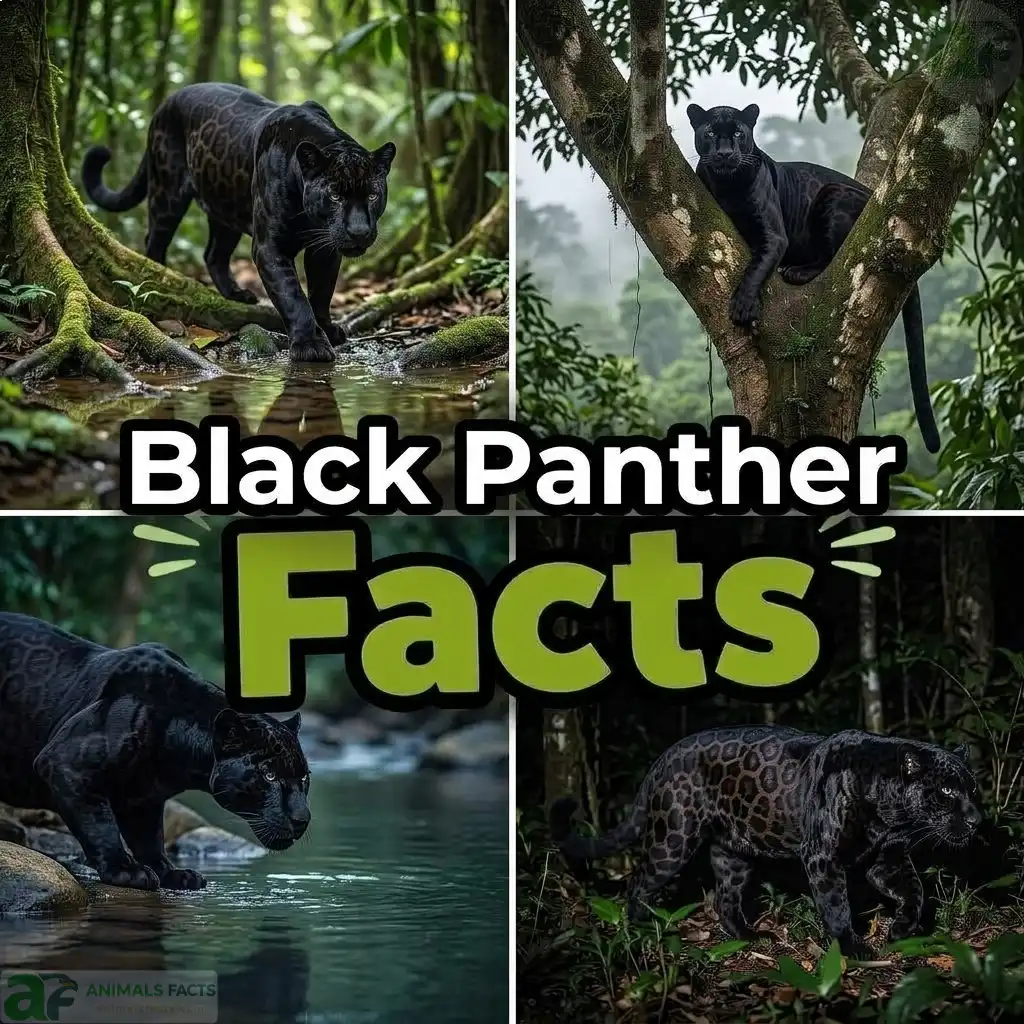
Black Panther Facts
| Feature | Details |
|---|---|
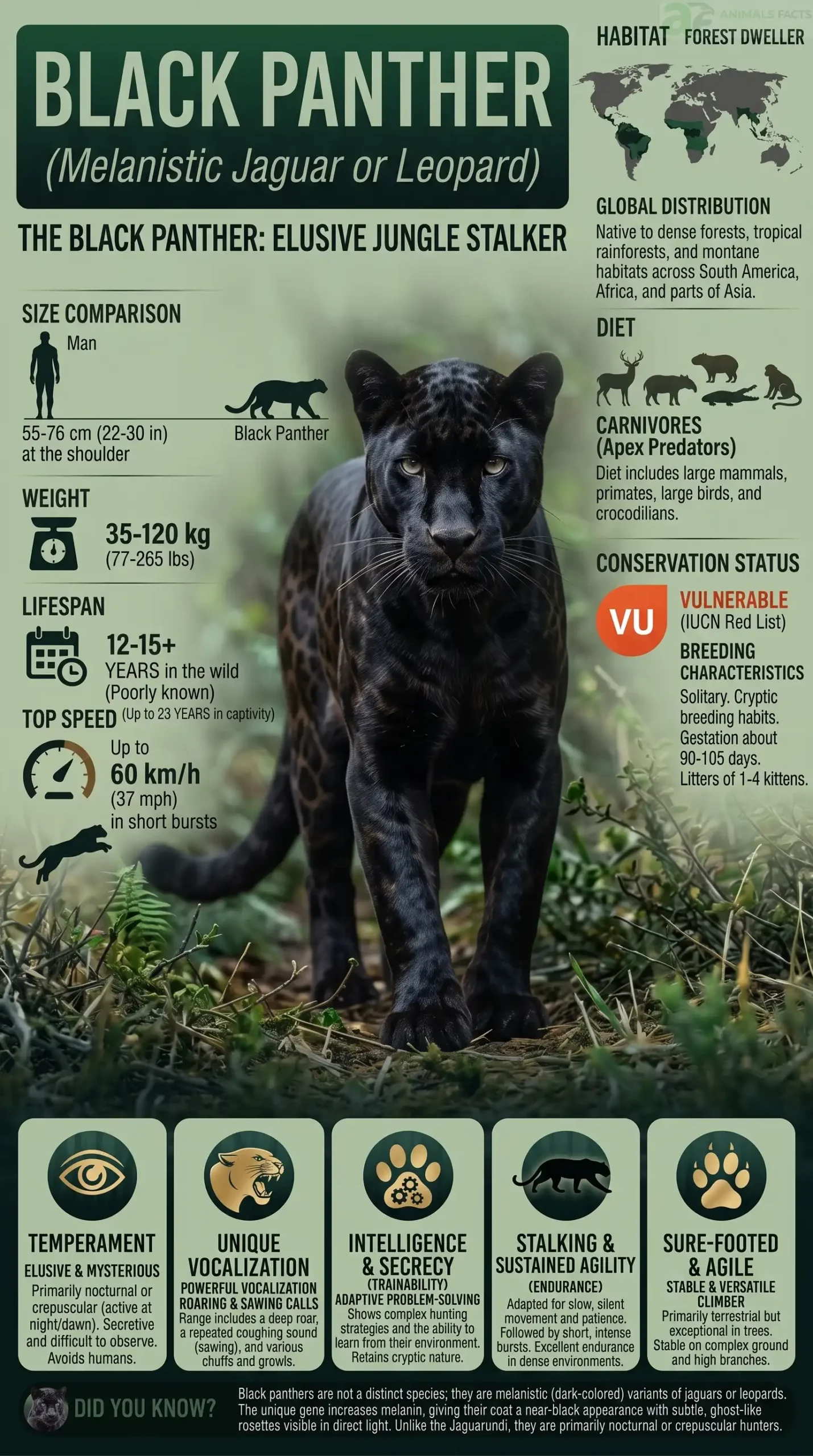
| Scientific Name | Panthera pardus (leopard) or Panthera onca (jaguar) — depending on location |
| Kingdom | Animalia |
| Phylum | Chordata |
| Class | Mammalia |
| Order | Carnivora |
| Family | Felidae |
| Common Names | Black panther, black leopard, black jaguar |
| Native Range | Sub-Saharan Africa, South and Southeast Asia (black leopard); Central and South America (black jaguar) |
| Habitat | Tropical and subtropical forest, dense woodland, scrubland, grassland |
| Lifespan | 12–17 years (wild); up to 23 years (captivity) |
| Diet | Deer, antelope, wild pigs, monkeys, birds, smaller mammals |
| Body Length | 90–190 cm plus 60–110 cm tail (leopard); 112–185 cm plus tail (jaguar) |
| Height | 45–78 cm at shoulder |
| Weight | 29–90 kg (leopard); 56–120 kg (jaguar) |
| Top Speed | Up to 58 km/h (leopard); up to 80 km/h (jaguar) |
| Conservation Status | Vulnerable (leopard — Panthera pardus); Near Threatened (jaguar — Panthera onca) |
| Cause of Black Coat | Melanism — overproduction of melanin pigment due to a recessive or dominant gene mutation |
| Are spots visible? | Yes — ghost spots visible in certain lighting conditions |
 1. Introduction: What is a Black Panther?
In the darkest hours before dawn, somewhere deep in the rainforests of Malaysia or the dense jungles of India, a shadow moves through the undergrowth with a silence and a fluidity that makes the darkness itself seem to breathe. No spotted coat catches the moonlight. No tawny flanks betray the outline of a large predator moving through the trees. Only the faint, occasional glimmer of two pale eyes — burning briefly in the dark before vanishing again — confirms that something alive and extraordinary has passed through. Black panther facts begin with this single, unforgettable image — the ghost cat, the shadow leopard, the embodiment of everything mysterious, powerful, and primordially awe-inspiring about the large felid world.
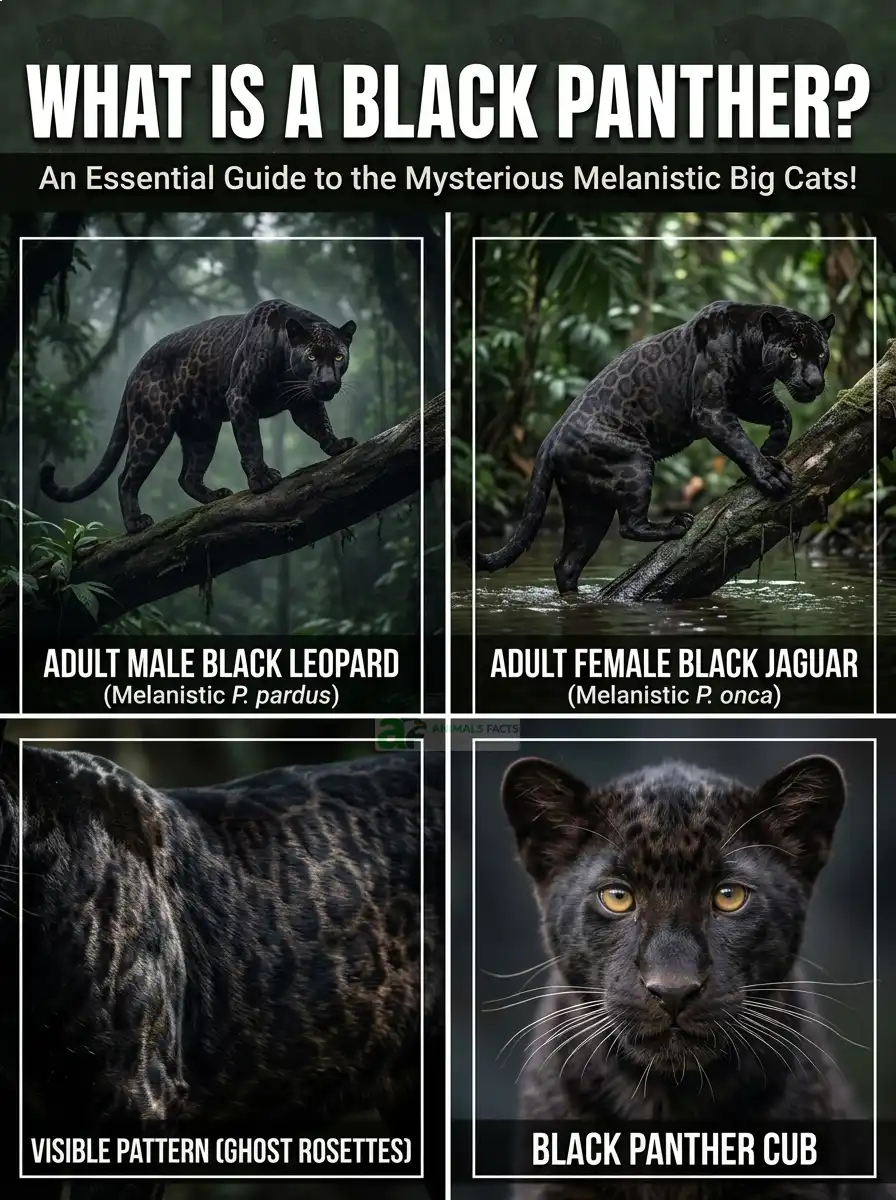
The black panther is one of the most misunderstood animals in the world — because it is not, technically, a species at all. Interesting facts about black panthers reveal that this animal is not a distinct species but rather a melanistic color variant — a black-coated individual of either the leopard (Panthera pardus) or the jaguar (Panthera onca) — produced when a genetic mutation causes an overproduction of the dark pigment melanin. In Africa and Asia, black panthers are melanistic leopards. In Central and South America, they are melanistic jaguars. The term “black panther” itself is a popular name rather than a scientific one — a cultural construction that captures something real and important about the psychological impact of these animals without reflecting a biological reality of distinct species membership.
And yet the black panther’s impact on human imagination — across cultures, across centuries, across every civilization that has shared territory with these shadow cats — is undeniable and extraordinary. Whether you are searching for black panther facts for kids to explore the science of genetic melanism and animal color variation, planning a wildlife journey to the few remaining places on Earth where wild black panthers can be encountered, researching black panther habitat and ecology for scientific or educational purposes, or simply someone who has always been mesmerized by the idea of a fully black leopard moving through an African forest at midnight — this is your comprehensive guide. We cover black panther scientific name, black panther diet, black panther size and weight, the extraordinary genetics of melanism, black panther behavior, conservation, cultural mythology, and the profound ecological roles these animals play in the world’s most remarkable wild landscapes. The shadow of the jungle has a story to tell.
2. Species Overview & Classification
The black panther’s classification is the single most important foundational fact in understanding the animal — because it fundamentally determines everything else, from the animal’s size and behavior to its conservation status and geographic range.
Species Classification Table
| Taxonomic Rank | Black Leopard | Black Jaguar |
|---|---|---|
| Kingdom | Animalia | Animalia |
| Phylum | Chordata | Chordata |
| Class | Mammalia | Mammalia |
| Order | Carnivora | Carnivora |
| Family | Felidae | Felidae |
| Subfamily | Pantherinae | Pantherinae |
| Genus | Panthera | Panthera |
| Species | P. pardus | P. onca |
| Common Name | Leopard / Black leopard | Jaguar / Black jaguar |
| Range | Africa, Middle East, Asia | Central and South America |
| IUCN Status | Vulnerable | Near Threatened |
Understanding Melanism — The Science of the Black Coat
Melanism is the biological mechanism that produces black panthers — and understanding it is fundamental to understanding these animals:
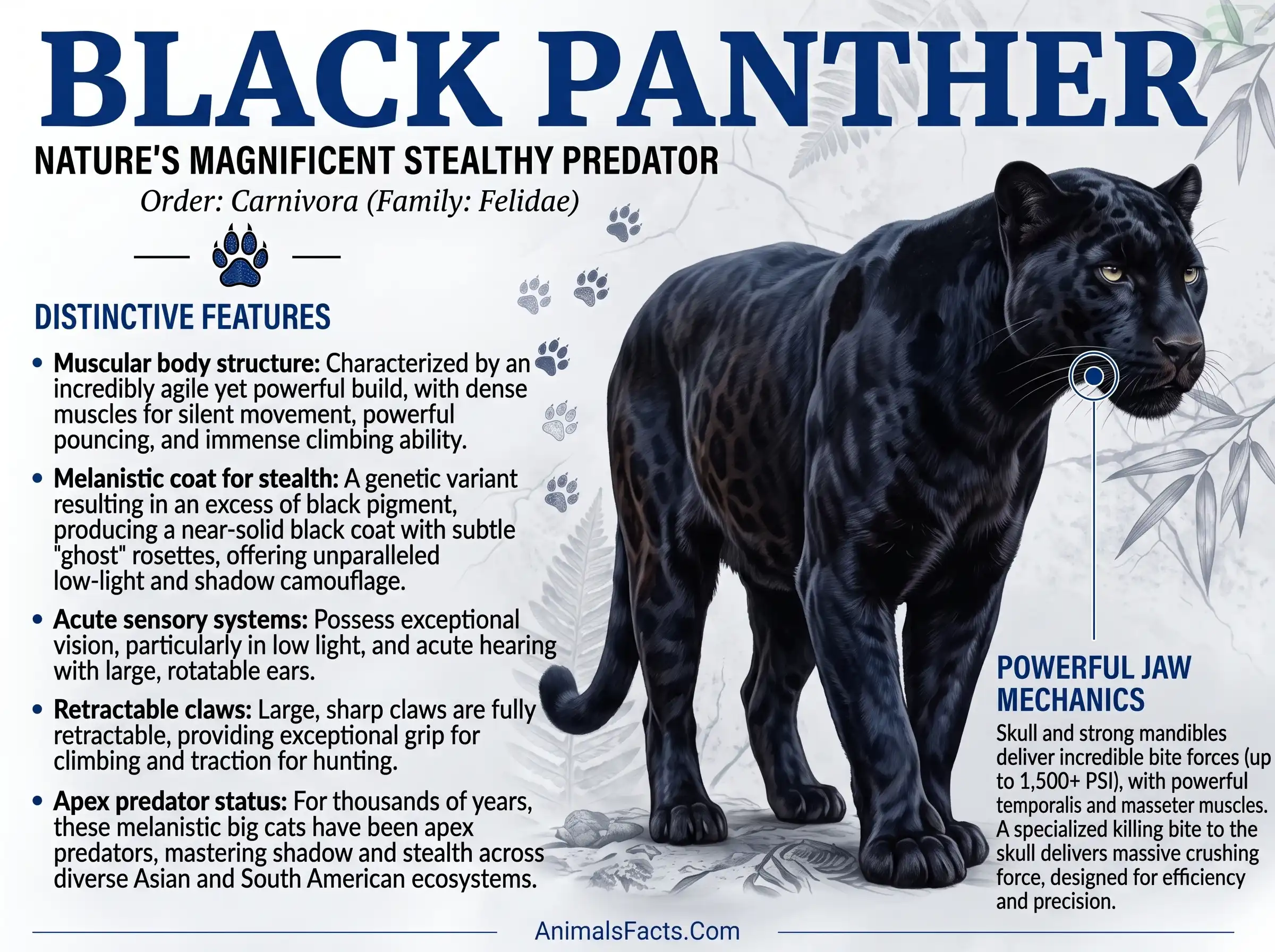
What is melanism? — Melanism is the increased production of melanin — the dark pigment responsible for black and brown coloration in skin, hair, scales, and feathers across the animal kingdom. When a genetic mutation causes an overproduction of melanin, the animal’s coat becomes dramatically darker — in extreme cases producing an entirely black coat that visually obliterates the underlying pattern.
The genetic mechanism differs between species:
In leopards (Panthera pardus) — Melanism is caused by a recessive allele of the ASIP (Agouti Signaling Protein) gene. A leopard must inherit two copies of this recessive allele (one from each parent) to express full melanism. This means that two normally colored leopards — each carrying one copy of the recessive allele as a hidden carrier — can produce melanistic offspring. Leopards with only one copy of the allele appear normally colored but are genetic carriers.
In jaguars (Panthera onca) — Melanism is caused by a dominant allele of the MC1R gene. A jaguar needs only one copy of this dominant allele to express melanism — meaning that every melanistic jaguar has at least one melanistic parent (or a parent that carries the dominant allele silently, which is rarer given the dominant inheritance pattern).
Why the Spots Are Still There
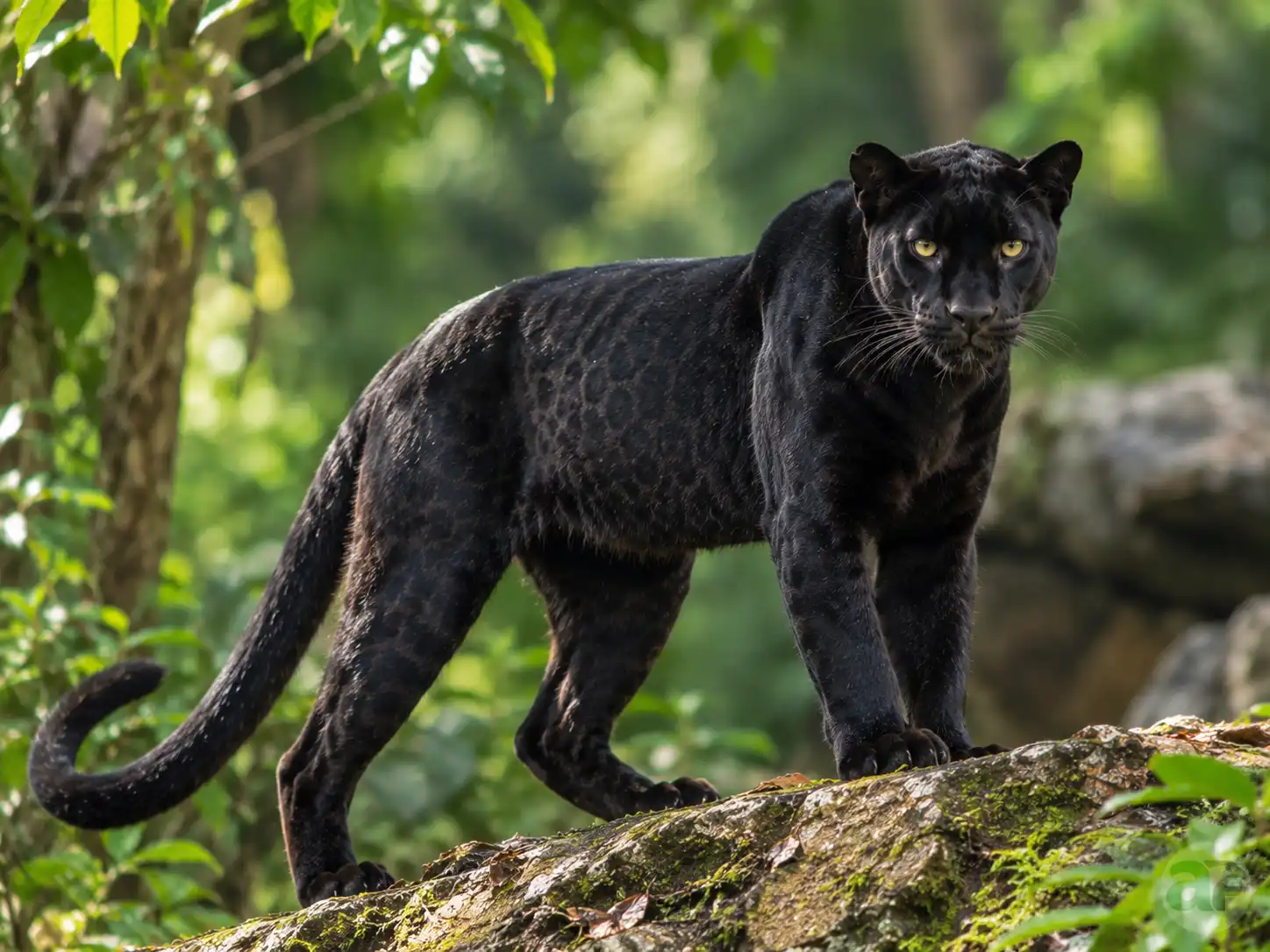
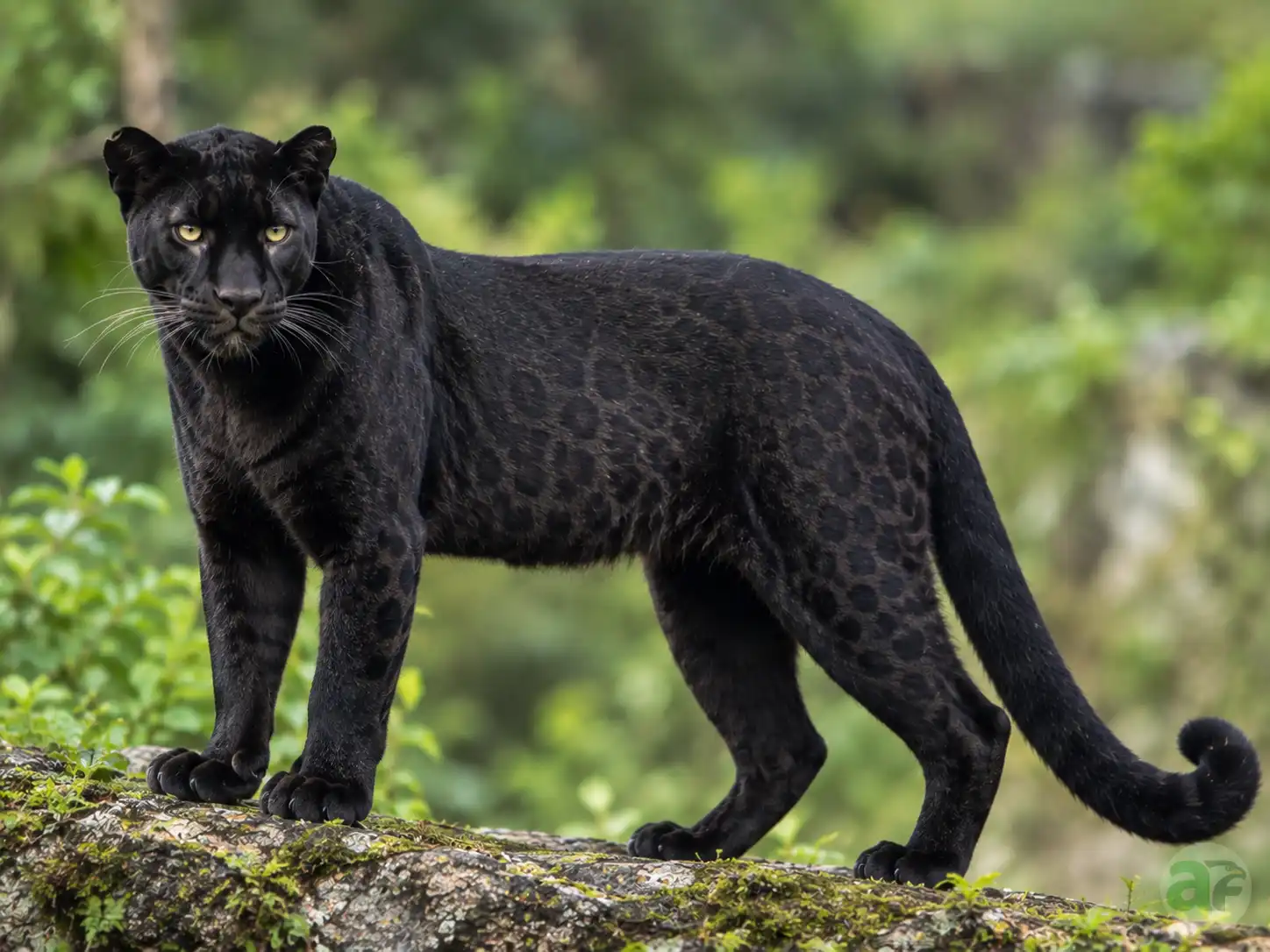
One of the most important and most fascinating black panther facts is that the underlying spot pattern is not actually eliminated by melanism — it is masked by the excess dark pigment. Both leopard spots (rosettes) and jaguar spots (larger, more complex rosettes) remain present in melanistic individuals — they are simply hidden under the black coat in normal lighting conditions. In strong directional sunlight or certain photographic conditions, the underlying spots and rosettes become visible as “ghost spots” — slightly darker shadows of the underlying pattern visible against the jet-black ground color. A black panther photographed in bright sunlight reveals itself clearly as a black leopard or black jaguar — the rosettes unmistakable beneath the black sheen.
The Frequency of Melanism
The frequency of melanistic individuals varies dramatically between species and between populations:
In leopards — Melanistic individuals are most common in the dense forests of Southeast Asia — particularly the Malay Peninsula and Sumatra — where melanism rates may reach 50% or more of the population. This elevated frequency in forest environments supports the hypothesis that melanism confers a camouflage advantage in dark, densevegetation habitats where reduced light penetration makes a black coat superior camouflage. In African savannas, melanistic leopards are extremely rare — the open habitat provides no camouflage advantage and the normal spotted coat is superior.
In jaguars — Melanistic individuals occur at approximately 6% frequency across the jaguar’s range — with slightly higher frequencies in dense tropical forest habitats, again suggesting a habitat-linked selective advantage.
Subspecies and Melanism
| Leopard Subspecies | Range | Melanism Frequency |
|---|---|---|
| P. p. pardus (African leopard) | Sub-Saharan Africa | Very rare — <1% |
| P. p. fusca (Indian leopard) | Indian subcontinent | Uncommon — 2–5% |
| P. p. delacouri (Indochinese leopard) | Southeast Asia mainland | More common — 5–15% |
| P. p. japonensis (North Chinese leopard) | China, Korea | Rare |
| P. p. kotiya (Sri Lankan leopard) | Sri Lanka | Uncommon |
| Malayan leopard (sometimes P. p. delacouri) | Malay Peninsula | Most frequent — up to 50%+ |
Evolution & Discovery Timeline
~6–10 million years ago — The Panthera genus diverges from other felid lineages — the leopard lineage separating first, followed by the jaguar lineage.
~3–4 million years ago — The jaguar lineage diverges from the leopard-lion-tiger ancestor and colonizes the Americas — establishing the separate evolutionary trajectory that produces the jaguar as the New World’s largest cat.
~Ancient times — Melanistic leopards and jaguars coexist with their normally colored counterparts across their range; indigenous peoples in Africa, Asia, and the Americas have recognized and culturally incorporated black cats for millennia.
1787 — European naturalists formally document the melanistic leopard — initially debating whether it represents a separate species (Felis melas) or a color variant of the known leopard.
1828 — The name “black panther” enters widespread use in European natural history literature as a general term for dark-coated big cats.
1904 — Early 20th century genetic research begins establishing that melanism is heritable — laying the groundwork for understanding the genetic mechanism.
2012 — Genomic sequencing studies confirm the specific genetic loci responsible for melanism in leopards and jaguars — establishing the molecular basis of the black coat for the first time.
2019 — Exceptional camera trap footage of a wild black leopard in Laikipia, Kenya — one of the clearest photographic documentations of a wild black leopard in Africa in almost 100 years — generates global media coverage and scientific interest.
2024 — Expanded camera trap networks across Southeast Asia — particularly in Malaysia and Thailand — produce the most comprehensive documentation yet of black panther populations and behavior in genuinely wild settings.
“The black panther is the most potent symbol in the big cat world — an animal that takes everything already extraordinary about a leopard or jaguar and adds the additional dimension of perfect, liquid darkness. To see one in the wild — which almost nobody ever does — must be among the most profound wildlife encounters available to a human being.”
— Dr. Luke Hunter, President Emeritus, Panthera, and author of Wild Cats of the World
3. Physical Description & Unique Features
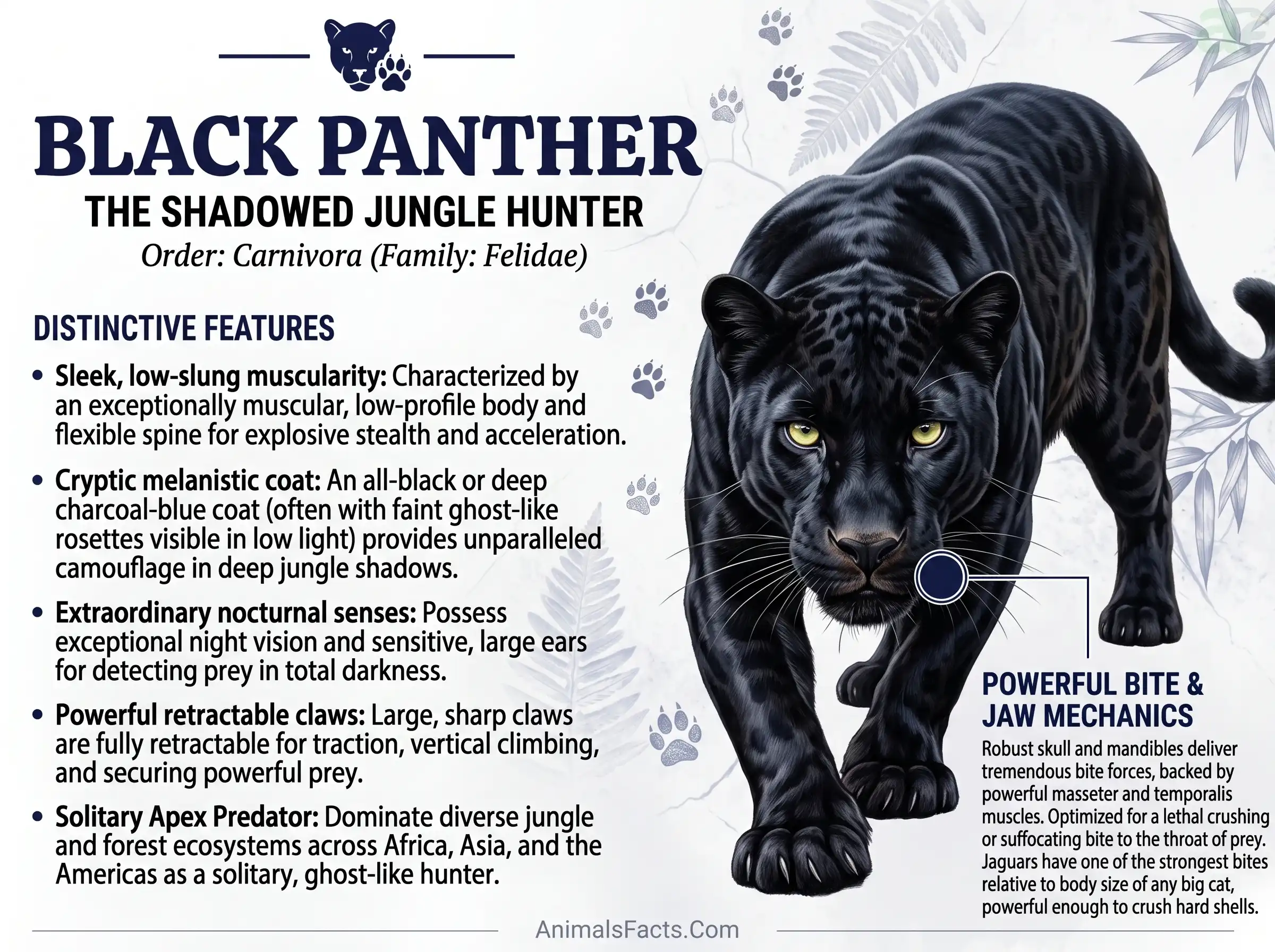
Black panther size and weight are identical to those of normally colored individuals of the same species — melanism is a coat color difference, not a size or body form difference. However, the visual impact of the black coat transforms the appearance of the animal so dramatically that the psychological effect of encountering a black panther versus a spotted leopard or jaguar is entirely different.
The Black Coat — A Study in Optical Perfection
The black panther’s coat is not simply “dark” — it is a genuine optical phenomenon that absorbs and reflects light in ways that create visual effects impossible in the normally patterned coats of the parent species:
Surface sheen — The black coat of a melanistic leopard or jaguar has a distinctive blue-black iridescent sheen in bright light — similar to the sheen of a raven’s feather or polished jet. This is caused by the specific arrangement of melanin granules within the hair shafts that produce structural coloration effects on top of the pigment-based color.
Light absorption — A black coat absorbs significantly more solar radiation than a tawny or spotted coat — a physical property with thermoregulatory implications. Black panthers in hot environments may need to spend more time in shade during peak temperature hours to avoid overheating — a possible evolutionary cost offset by the camouflage advantages in forest environments.
The ghost spots — In certain lighting conditions — particularly bright, direct sunlight — the underlying rosette pattern of the leopard or jaguar becomes visible through the black coat as slightly darker shadows. This phenomenon is caused by the differential density of melanin in the spots versus the ground color — even in a melanistic individual, the spots contain marginally more melanin pigment than the ground, creating a subtle but visible contrast in strong light. High-quality photographs of black panthers in sunlight reveal these ghost spots with beautiful clarity.
Body Form — Leopard vs. Jaguar
Because “black panther” refers to two different species, the body form varies significantly depending on which species is being discussed:
Black leopard body form:
- Longer, more slender body relative to weight
- Proportionally longer tail — typically exceeding 75% of body length
- Smaller, rounder head relative to body
- Longer legs relative to body depth
- Distinctive climbing adaptation — the leopard’s body is optimized for arboreal hunting and prey transport into trees
Black jaguar body form:
- Broader, more massively built body — the jaguar is the bulkiest of the Panthera species relative to body length
- Larger, broader head with the most powerful bite force of any Panthera species relative to body size
- Shorter, thicker limbs — adapted for power rather than speed
- Shorter tail relative to body length than leopard
- Aquatic adaptation — the jaguar’s body reflects its association with riverine environments
Eyes
Both black leopards and black jaguars have pale yellow to amber eyes — a striking contrast against the black coat that makes the eyes appear to glow in darkness or low light. This striking eye color against black fur is one of the most visually dramatic features of the black panther and one of the primary identification features when encountering these animals in the wild.
Sexual Dimorphism
In both leopards and jaguars, males are substantially larger than females — a size difference that is just as pronounced in melanistic individuals as in normally colored ones:
Leopard sexual dimorphism:
- Males: typically 37–90 kg
- Females: typically 29–60 kg
Jaguar sexual dimorphism:
- Males: typically 56–120 kg (larger individuals in the Pantanal)
- Females: typically 36–80 kg
Did You Know? The black panther’s coat creates a thermal disadvantage in hot environments — dark coloration absorbs more solar radiation than pale or spotted coloration, making black panthers more susceptible to overheating in direct sunlight. Research on black leopards in Southeast Asia has documented that melanistic individuals spend more time in shade during peak temperature hours compared to spotted individuals in the same population — a behavioral compensation for the thermal cost of dark coloration. This thermal disadvantage may partly explain why melanism remains relatively rare in the leopard’s African range, where open savannas expose animals to intense direct sunlight for extended periods.
4. Top 25 Amazing Black Panther Facts
Here is your definitive collection of the most extraordinary, scientifically verified, and genuinely astonishing black panther facts as of 2026:
- The “black panther” is not a separate species — it is a melanistic (black-coated) individual of either the leopard (Panthera pardus) in Africa and Asia, or the jaguar (Panthera onca) in Central and South America.
- Black panthers still have spots — the underlying rosette pattern is present but masked by excess melanin. In bright sunlight, “ghost spots” are visible through the black coat — a beautiful optical phenomenon that reveals the hidden leopard or jaguar beneath the darkness.
- The genetics of melanism differ between the two species — in leopards, it is caused by a recessive gene (requiring two copies to express); in jaguars, it is caused by a dominant gene (requiring only one copy to express).
- In the Malay Peninsula, melanistic leopards are so common that they may represent 50% or more of the local leopard population — one of the highest frequencies of melanism in any wild cat population globally.
- A melanistic leopard and a normally spotted leopard can mate and produce both melanistic and spotted cubs in the same litter — depending on the genetic makeup of each parent.
- The 2019 camera trap footage of a wild black leopard in Laikipia, Kenya — captured by San Diego Zoo photographer Will Burrard-Lucas and wildlife biologist Nicholas Pilfold — was described as the most significant African black leopard documentation in almost 100 years.
- Black panthers have blue-black iridescent sheens in sunlight — not simply “black” but a complex optical effect caused by the arrangement of melanin granules that creates structural coloration effects similar to raven feathers.
- A black jaguar’s bite force — already the strongest of any Panthera species relative to body size — is sufficient to pierce turtle shells and crack caiman skulls, making it one of the most powerful bites of any living terrestrial mammal.
- Black panthers in Africa and Asia are exceptional climbers — melanistic leopards regularly carry prey carcasses weighing more than themselves up vertical tree trunks to cache them beyond the reach of lions and hyenas.
- Black jaguars of the Amazon are remarkable swimmers — jaguars are one of the few big cats that actively swim and hunt in water, and melanistic jaguars have been photographed swimming across wide river channels in the Amazon basin.
- The word “panther” derives from the Latin panthera and the Greek panther — etymologically connected to words meaning “all beast” or “hunter of all” — reflecting the ancient cultural impression of the panther as a supreme, universal predator.
- Leucism — the opposite of melanism — also occurs in leopards and jaguars, producing very pale, washed-out coloration. A fully leucistic big cat in these species would be the opposite of a black panther in genetic terms — though true albinism (complete absence of melanin) is extremely rare.
- Black leopards in India occur most frequently in the forests of Karnataka, Tamil Nadu, and Kerala — where dense forest cover provides the camouflage advantage that makes melanism selectively beneficial.
- The term “black panther” has been applied historically to melanistic cougars (pumas) in North America — but no confirmed melanistic puma has ever been documented. All North American “black panther” sightings are likely misidentifications of other animals.
- Black jaguars and normally spotted jaguars interbreed freely in the wild — there is no reproductive isolation between melanistic and non-melanistic jaguars; they are simply genetic variants of the same species.
- In Southeast Asian folklore, black panthers are frequently associated with supernatural entities — forest spirits, shapeshifters, and guardians of the jungle — reflecting the extraordinary psychological impact of encountering a large black cat in dense tropical forest at night.
- The first scientific description of a melanistic leopard in the formal Western scientific literature was made in the late 18th century — initially debated as a potential separate species before being correctly identified as a color variant.
- Black leopards hunt using a strategy that may be enhanced by their dark coloration — approaching prey through shadow and low-light conditions where the spotted coat of a normal leopard would be more visible than the uniformly dark coat of a melanistic individual.
- Melanistic jaguars have been documented in every country within the jaguar’s range — from Mexico to Argentina — confirming that the dominant melanism gene is distributed throughout the species’ entire population.
- The IUCN Red List does not recognize black panthers as a separate conservation category — melanistic individuals are assessed as part of the population of their respective parent species and are subject to the same threats and protections.
- Black leopards and black jaguars produce the same vocalizations as their spotted counterparts — the leopard’s distinctive rasping, sawing cough and the jaguar’s deep “uh-uh-uh” roar — with no vocalizations specific to or modified by melanistic coloration.
- Some researchers have proposed that melanism in leopards may provide a disease resistance advantage — with darker individuals potentially showing greater resistance to certain pathogens — a hypothesis based on similar findings in other melanistic animal populations but not yet definitively confirmed in wild leopard populations.
- “Black panthers” in the context of North American folklore and reported sightings most commonly represent misidentified bobcats, cougars, or domestic black cats — no melanistic puma or any large melanistic cat native to North America has been confirmed in the modern era.
- The melanistic jaguar appears prominently in the mythology of multiple Mesoamerican civilizations — including the Maya and Aztec — where it is associated with night, the underworld, royalty, and supernatural power.
- Camera trap studies have confirmed that in populations where both melanistic and non-melanistic individuals occur, the social and territorial behaviors of black and spotted animals are identical — melanism affects coat color only, not behavior, ecology, or fitness in any documented way.
5. Fun Facts About Black Panther Animal
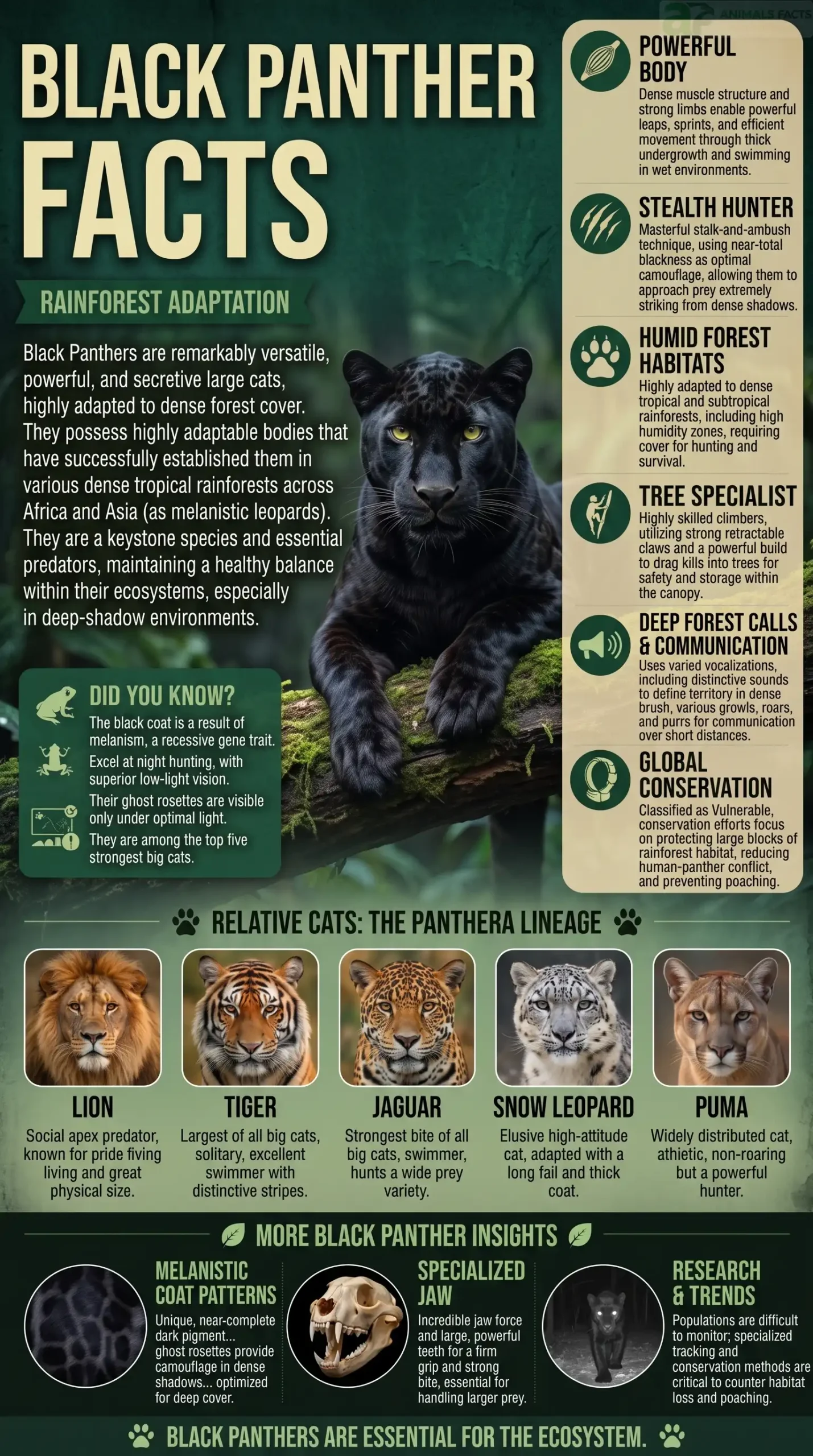
- Black panthers are not their own species — they are black leopards or black jaguars
- They still have spots — visible as ghost patterns in bright sunlight
- In Malaysia, 50% of leopards may be melanistic
- The 2019 Kenya black leopard footage was the first quality African documentation in 100 years
- Their coat has a blue-black iridescent sheen — like raven feathers
- Leopard melanism is recessive; jaguar melanism is dominant
- Black jaguars can pierce turtle shells with their bite
- Black panthers are exceptional climbers and swimmers
- The word “panther” means “all beast” or “hunter of all”
- No confirmed melanistic puma has ever been documented in North America
- Black leopards and spotted leopards freely interbreed
- Melanistic individuals are genetically healthier — not a defect
6. Natural Habitat & Geographic Range
Black panther habitat mirrors the habitat of its parent species — leopards or jaguars — but with a notable bias toward dense, dark, forested environments where the black coat provides the greatest camouflage advantage.
Habitat Preferences of Black Leopards
Black leopards show a markedly stronger association with dense forest habitat than the broader leopard species:
Tropical and subtropical moist broadleaf forest — The primary habitat of melanistic leopards; the dense canopy creates low-light conditions where black coloration provides superior camouflage
Montane forest — Melanistic leopards are documented in highland forest in India, Ethiopia (one of the last African populations), and Southeast Asia
Tropical dry forest — Present but less common in drier forest types where more open conditions reduce the camouflage advantage
Dense coastal and riverine forest — Important habitat in Malaysia, Sumatra, and parts of the Indian subcontinent
Habitat Preferences of Black Jaguars
Black jaguars are found across the full range of jaguar habitat but show elevated frequency in:
Amazon rainforest — The densest tropical forest in the jaguar’s range; provides maximum cover and lowest light penetration
Pantanal wetland forest — The world’s largest tropical wetland; dense riverine forest corridors
Mesoamerican tropical forest — Central American forest habitat with significant jaguar populations
Atlantic Forest of Brazil — Severely fragmented but historically important black jaguar habitat
Geographic Range by Region
| Region | Species | Melanism Status | Key Countries |
|---|---|---|---|
| Malay Peninsula | Leopard | Very common — potentially >50% | Malaysia (Peninsular), Thailand (south) |
| Sumatra | Leopard | Common — 30–50% estimated | Indonesia |
| Indian subcontinent | Leopard | Uncommon — 2–8% | India, Sri Lanka |
| Indochina | Leopard | Moderately common | Vietnam, Cambodia, Thailand (north) |
| Sub-Saharan Africa | Leopard | Very rare — <1% | Ethiopia, Kenya, scattered |
| Amazon Basin | Jaguar | ~6% of population | Brazil, Peru, Colombia, Ecuador |
| Pantanal | Jaguar | Approximately 6% | Brazil, Bolivia |
| Mesoamerica | Jaguar | Approximately 6% | Mexico, Belize, Guatemala, Costa Rica |
| Atlantic Forest | Jaguar | Historically present; now very rare | Brazil |
Did You Know? Africa’s Bale Mountains in Ethiopia — a montane forest ecosystem at over 3,000 meters above sea level — hosts one of the very few confirmed breeding populations of black leopards in Africa. This isolated highland population has a measurably higher melanism frequency than lowland African leopard populations — possibly reflecting the advantages of dark coloration in the dense, high-altitude Afromontane forest habitat where light penetration is reduced by both the tree canopy and the frequent mist and fog of the montane environment. The Bale Mountains black leopard population is among the most rarely photographed wild cat populations in the world.
7. Diet & Feeding Behavior
Black panther diet is identical to that of normally colored individuals of the parent species — melanism affects only coat color and has no documented effect on prey selection, hunting strategy, or feeding behavior. However, some researchers have hypothesized that the black coat may provide feeding advantages through enhanced camouflage during the nocturnal hunting periods when both leopards and jaguars are most active.
Diet Breakdown Table — Black Leopard
| Prey Type | Estimated % of Diet | Notes |
|---|---|---|
| Medium ungulates (deer, antelope, wild pigs) | ~40–60% | Primary prey category; prey selection varies by range |
| Small ungulates (duiker, chevrotain, muntjac) | ~15–25% | Important in forest environments with limited large prey |
| Primates (monkeys, langurs, baboons) | ~10–20% | Particularly important in forest habitats |
| Small mammals (rodents, hares, mongooses) | ~5–10% | Supplementary prey |
| Birds | ~3–5% | Opportunistic; ground birds most commonly taken |
| Reptiles | ~2–5% | Occasional; monitor lizards, smaller snakes |
| Carrion | ~1–3% | Opportunistic scavenging |
Diet Breakdown Table — Black Jaguar
| Prey Type | Estimated % of Diet | Notes |
|---|---|---|
| Large ungulates (tapirs, peccaries, deer, capybara) | ~45–60% | Primary prey across most of range |
| Aquatic prey (caimans, river turtles, fish) | ~15–25% | Particularly important in riparian habitats |
| Large rodents (capybara, paca, agouti) | ~10–15% | Important supplementary prey |
| Livestock (cattle, horses) | ~5–15% (where available) | Primary source of human-jaguar conflict |
| Small mammals (armadillo, anteater) | ~3–5% | Supplementary |
| Reptiles (boa constrictor, anaconda, monitor) | ~2–5% | Documented; unusual predators among felids |
| Birds | ~1–3% | Opportunistic |
The Hunting Advantage of the Black Coat
The question of whether melanism provides a hunting advantage is one of the most actively researched aspects of black panther biology:
Evidence supporting a hunting advantage:
- Both leopards and jaguars hunt primarily at night and in twilight — conditions where dark coloration provides superior camouflage against the dark backgrounds of forest undergrowth
- Camera trap comparisons have suggested that melanistic individuals are less often detected by prey animals in low-light conditions — consistent with a camouflage advantage
- The elevated frequency of melanism in dense forest populations — where dark conditions are most common — suggests habitat-linked selective advantage
The ambush strategy — Both black leopards and black jaguars are ambush predators — their hunting success depends on approaching prey undetected before a sudden, explosive final rush. The black coat’s superior camouflage in low-light conditions may allow approaches to closer distances before prey detection — increasing success rates.
The Jaguar’s Unique Aquatic Hunting
Black jaguars demonstrate the same remarkable aquatic hunting behavior as spotted jaguars — one of the most distinctive feeding behaviors of any big cat:
- Fishing — Jaguars scoop fish from water with a sweeping paw motion — dipping the paw and flicking fish onto the bank with a single movement
- Caiman hunting — Documented attacking caimans (South American crocodilians) in the water — killing with a bite to the skull that pierces the armored head
- River turtle predation — The jaguar’s extraordinary bite force allows it to crack river turtle shells — a feeding capability unique among living felids
- Capybara aquatic pursuit — Following capybara into water to complete a kill that began on land
8. Reproduction & Life Cycle
Black panther reproduction is identical to that of the parent species — melanism imposes no reproductive isolation and no documented reproductive cost or benefit. Melanistic and normally colored individuals of both species interbreed freely in the wild.
Black Leopard Reproduction
Mating behavior — Leopards are solitary and territorial — males and females come together only for mating, with the encounter typically lasting 5–7 days before the pair separates. The male plays no role in cub rearing.
Estrus cycle — Female leopards cycle approximately every 46 days if not mated; estrus lasts approximately 6–7 days.
Gestation period — 90–105 days — producing litters of 1–3 cubs (occasionally 4).
Cub development — Cubs are born blind and helpless; their eyes open at approximately 10 days; they begin following the mother at 2–3 months; they begin participating in hunts at 9–12 months; full independence typically achieved at 18–24 months.
Melanism in cubs — A black leopard cub born to a melanistic mother and spotted father will be melanistic only if the father carries a hidden copy of the recessive melanism allele. If the father is a genetic carrier (heterozygous), approximately 50% of cubs will be melanistic. If neither parent is melanistic, a melanistic cub can appear only if both parents are hidden carriers of the recessive allele.
Black Jaguar Reproduction
Mating behavior — Jaguars are similarly solitary; mating encounters are brief; males do not participate in cub rearing.
Gestation period — 93–105 days — producing litters of 1–4 cubs.
Cub development — Cubs remain with the mother for 18–24 months — one of the longest maternal dependency periods in the big cat world.
Melanism inheritance — Because jaguar melanism is dominant, a black jaguar mated with a spotted jaguar will produce approximately 50% black offspring if the black parent carries one copy of the dominant allele (the most common situation). If the black parent carries two copies (homozygous), all offspring will be black regardless of the spotted parent’s genotype.
Lifespan Comparison Table
| Species/Variant | Average Lifespan (Wild) | Max Documented | Notes |
|---|---|---|---|
| Black leopard | 12–17 years | ~23 years (captivity) | Same as spotted leopard |
| Black jaguar | 12–15 years | ~25 years (captivity) | Same as spotted jaguar |
| Spotted leopard (P. pardus) | 12–17 years | 23 years (captivity) | No lifespan difference documented |
| Spotted jaguar (P. onca) | 12–15 years | 25 years (captivity) | No lifespan difference documented |
| Tiger (P. tigris) | 10–15 years | 26 years (captivity) | Comparable Panthera species |
9. Social Behavior & Communication
Black panther social behavior is identical in every documented respect to the social behavior of normally colored individuals of the parent species. Melanism does not affect social organization, territorial behavior, communication, or intelligence — it affects only coat color.
Leopard Social Structure
Leopards are among the most solitary of the large felids — maintaining individual territories and avoiding sustained social interaction except during mating and mother-cub associations:
Home range — Male territories typically cover 40–400 km² in different habitat types; female territories are smaller at 20–100 km². Male ranges typically overlap with multiple female ranges.
Territorial marking — Urine spraying, feces deposits at prominent locations, scratch marks on trees and rocks, and cheek rubbing on territorial boundaries maintain a chemical communication network that enables territory management without constant direct confrontation.
Arboreal behavior — Leopards are the most arboreal of the large felids — regularly climbing trees to rest, survey territory, cache prey, and escape from larger predators (lions and hyenas). Black leopards show the same climbing capability as spotted individuals.
Jaguar Social Structure
Jaguars maintain large, individual territories with minimal social interaction outside breeding:
Home range — Male jaguars maintain territories of 60–500 km² depending on habitat quality and prey density; female territories are smaller.
The “uh-uh-uh” vocalization — The jaguar’s characteristic roar — sometimes described as resembling a sawing cough repeated at regular intervals — carries long distances through dense forest and is the primary long-range communication tool for territory advertisement and mate location. Black jaguars produce this same distinctive vocalization.
Intelligence
Both black leopards and black jaguars demonstrate the problem-solving intelligence and spatial memory characteristic of their parent species — widely regarded as among the most cognitively sophisticated of all wild felids. Documented behaviors include:
- Complex prey selection strategies — adjusting prey species targeting based on seasonal availability and individual prey fitness assessment
- Memory of hunting routes — returning to productive hunting areas and ambush sites with consistent accuracy across months
- Tool-like behavior — some jaguars have been documented using their tails as lures, dangling the tip in water to attract fish in a manner resembling fishing behavior in other species
- Learning from experience — individual adaptability in response to novel prey, novel threats, and changed environmental conditions
10. Predators & Defense Mechanisms
Adult black leopards and black jaguars are apex or near-apex predators in their respective ecosystems — facing limited natural predation pressure as adults. However, cubs and sub-adults face genuine threats, and even adults must navigate complex predator communities in some environments.
Threats to Black Leopards
Lions (Panthera leo) — In African savannas, lions are the primary threat to leopards — killing leopards in territorial encounters and stealing kills. Melanistic leopards in African environments (extremely rare given the rarity of melanism in Africa) would face the same lion threat as spotted leopards.
Tigers (Panthera tigris) — In Asian range areas where tigers co-occur with leopards, tigers dominate encounters — killing leopards and displacing them from kills. In dense forest habitats where melanistic leopards are most common, tiger pressure may be reduced but not eliminated.
Dholes (Cuon alpinus) — Wild dogs of Asia that hunt cooperatively; documented killing leopards in some areas of shared range.
Spotted hyenas (Crocuta crocuta) — In African range areas; steal kills and occasionally kill cubs.
Threats to Black Jaguars
No natural apex predators — The jaguar is the apex predator across its entire range; no wild animal regularly preys on healthy adult jaguars.
Anacondas and large caimans — Large water anacondas (Eunectes murinus) and black caimans (Melanosuchus niger) represent very occasional threats to jaguars in aquatic environments — documented encounters between jaguars and large anacondas go both ways, with both species recorded killing the other.
Humans — By far the most significant source of mortality for both black leopards and black jaguars — see Conservation section.
Defense Strategies
Tree-refuge — Black leopards use their extraordinary climbing ability as a primary defense against larger terrestrial predators — carrying prey carcasses up vertical trunks and using tree canopies as safe resting areas inaccessible to lions, tigers, and hyenas.
Camouflage and concealment — The black coat provides potentially superior camouflage in low-light and forested conditions — allowing black panthers to avoid detection and remain concealed from both predators and rivals.
Territorial advertisement — Strong scent marking and vocalization programs maintain territorial boundaries that reduce the frequency of costly direct confrontations with competing individuals.
Speed and agility — Both black leopards and black jaguars combine impressive speed with exceptional agility — capable of rapid directional changes and vertical escape movements that make them genuinely difficult to pursue in their preferred forest habitats.
Did You Know? The black leopard’s arboreal prey caching behavior — dragging entire ungulate carcasses weighing more than the leopard itself up vertical tree trunks — is one of the most impressive demonstrations of muscular power relative to body weight in the entire cat family. A leopard weighing 50 kg has been documented dragging a giraffe calf weighing 90 kg up a 5-meter vertical tree trunk — a feat of strength that has no parallel among the large felids. Black leopards perform this same behavior with the same efficiency — demonstrating that melanism imposes no cost on the extraordinary musculature of the species.
11. Black Panther Facts for Kids
Hey amazing young wildlife explorers and future big cat scientists! Here are some truly incredible black panther facts for kids that will make you the most fascinating person in your class:
- 🐆 Black panthers are NOT their own species! The secret is that a “black panther” is just a regular leopard or jaguar that has black fur instead of spotted fur — like how some dogs can be black and some dogs can be brown, but they are all still the same type of dog!
- 🐆 They STILL have spots — you just cannot see them normally! If you look at a black panther in bright sunlight, you can actually see the spots hiding underneath the black fur — they show up as darker shadows called “ghost spots.” The spots are there — they are just covered by all the dark color!
- 🐆 Their fur has a SECRET rainbow in it! In strong sunlight, the black fur of a panther shines with a beautiful blue-black iridescent glow — like the feathers of a raven or a starling. It is not just black — it is shimmering, glowing black!
- 🐆 Black jaguars can BITE THROUGH turtle shells! The jaguar has the strongest bite of any of the big cats compared to its size — strong enough to crack open the hard shell of a river turtle. No other wild cat on Earth can do this!
- 🐆 In Malaysia, HALF of all leopards might be black! In the jungles of Malaysia, so many leopards are born with black fur that black panthers might be more common than spotted ones! The dark jungle gives black cats such good camouflage that more of them survive.
- 🐆 Black jaguars can SWIM better than most cats! Jaguars love water and are excellent swimmers — they have even been photographed swimming across wide rivers in the Amazon jungle. They will dive into rivers to catch fish and caimans!
- 🐆 The word “panther” means “hunter of ALL things!” The ancient name for panther comes from Greek words meaning roughly “all beast” or “hunter of everything” — because ancient people were so impressed by how these cats could hunt anything they wanted!
- 🐆 A black panther baby might be born with SPOTS! Sometimes when a black leopard has cubs with a spotted leopard, some babies come out black and some come out spotted. Brothers and sisters in the same litter can look completely different from each other!
12. Relationship with Humans
The relationship between black panthers — as melanistic leopards and jaguars — and human communities is simultaneously one of ancient reverence and modern crisis — encompassing thousands of years of mythological significance, the colonial era of systematic persecution, and the contemporary conservation emergency that threatens both parent species globally.
Historical Coexistence and Cultural Reverence
Across virtually every culture that has shared territory with black panthers — from the indigenous peoples of Mesoamerica to the farming communities of India’s Western Ghats, from the Malay rainforest peoples to the Ohlone of California — the black cat has occupied a position of extraordinary symbolic power.
The darkness and invisibility of the black coat — combined with the already formidable power and hunting ability of leopards and jaguars — created animals that seemed to embody supernatural qualities. Cultures that regarded ordinary spotted leopards and jaguars with respect and fear reserved a special, often spiritual category for their black-coated counterparts — animals that seemed to emerge from and merge back into the darkness itself.
The Colonial Persecution Era
The arrival of European colonial powers in Africa, Asia, and the Americas initiated a period of systematic big cat persecution that dramatically reduced populations of both leopards and jaguars — and therefore of the melanistic individuals within those populations:
Trophy hunting — Black panthers were specifically sought as hunting trophies because of their extraordinary rarity and visual impact — a mounted black leopard or black jaguar being among the most prestigious trophies available to colonial and early 20th century sport hunters.
Livestock predation retaliation — As human settlement expanded into big cat range, conflicts over livestock led to systematic leopard and jaguar killing — eliminating individuals and populations without regard to coat color.
Habitat destruction — The conversion of forest to agriculture eliminated the dense forest habitats where melanistic individuals are most frequent — disproportionately impacting black panther populations.
Contemporary Human-Leopard Conflict
The most significant contemporary human-black panther relationship is human-leopard conflict — occurring where expanding human settlements push into leopard territory or where leopard territory has been compressed into fragments surrounded by human habitation:
Livestock depredation — Leopards that begin taking livestock in response to prey depletion or habitat fragmentation create immediate, economically significant human-wildlife conflict that often results in retaliatory killing.
Human safety incidents — Unlike tigers and lions, leopards show greater tolerance of human presence and are more likely to continue inhabiting areas of high human density — creating occasional human safety incidents that generate intense local fear and pressure for leopard removal.
Community tolerance programs — The most successful contemporary human-leopard conflict responses involve livestock insurance programs, community guardian programs, and livestock protection improvements — economic interventions that reduce the financial impact of predation and build community tolerance for leopard presence.
13. Conservation Status & Threats
The conservation status of black panthers is assessed as part of their parent species populations — there are no separate conservation categories for melanistic individuals, and the threats they face are the same threats facing leopards and jaguars broadly.
Conservation Status Overview
| Species | IUCN Status | Wild Population | Population Trend |
|---|---|---|---|
| Leopard (P. pardus) | Vulnerable | ~250,000 (rough estimate) | Decreasing |
| Jaguar (P. onca) | Near Threatened | ~64,000–173,000 | Decreasing |
Leopard Population Context
The leopard has experienced one of the most dramatic range contractions of any large felid — losing approximately 75% of its historical range over the past two centuries:
- Eliminated from most of North Africa and the Middle East
- Severely reduced across South Asia — Indian leopard populations are highly fragmented
- Dramatically declining across West and Central Africa
- Southeast Asian populations — including the dense forest populations with highest melanism rates — face severe habitat loss from palm oil plantation expansion
Critically, melanistic leopard populations in Southeast Asia — particularly in Malaysia and Sumatra — are threatened by the same forces decimating the broader leopard population in the region, with the added dimension that the dense forest habitat they preferentially occupy is among the most rapidly cleared habitat type in the region.
Jaguar Population Context
The jaguar has lost approximately 50% of its historical range and continues to face significant threats:
- Amazon deforestation — the primary threat; the Amazon holds the largest remaining jaguar population
- Human-jaguar conflict over livestock in ranch areas
- Poaching for body parts for the Chinese traditional medicine market — an increasing 21st century threat
- Road infrastructure — new roads through previously intact jaguar habitat fragment populations and increase mortality
Major Threats
| Threat | Impact on Leopard | Impact on Jaguar |
|---|---|---|
| Habitat loss (agriculture, deforestation) | Critical — 75% range reduction | High — 50% range reduction |
| Human-wildlife conflict (livestock predation, retaliation) | High — primary direct mortality | High — primary direct mortality |
| Poaching (traditional medicine, body parts) | High — organized trade in Asia | Increasing — Chinese market demand |
| Trophy hunting | Medium — legal in some African countries | Low — prohibited across most range |
| Road kills | Medium | High — particularly in Brazil |
| Climate change | Increasing concern | Increasing concern |
| Prey depletion | High — bushmeat hunting reduces prey base | Medium |
14. Famous Black Panthers in History & Pop Culture
Famous Black Panther Individuals and Events
The Laikipia Black Leopard (2019) — The black leopard documented by Will Burrard-Lucas using camera traps in Laikipia Wilderness Camp, Kenya became one of the most significant wildlife photography events of the decade. The images — showing a clearly melanistic adult African leopard in extraordinarily high quality — were described by scientists as the most significant African black leopard documentation in approximately 100 years and generated global media coverage. Dr. Nicholas Pilfold of San Diego Zoo Institute for Conservation Research confirmed the animal’s presence and identity through multiple camera trap records. The photographs were published in National Geographic in February 2019.
The “Black Panther of Sivanipalli” — Documented in Jim Corbett’s famous wildlife accounts of colonial India; a melanistic leopard in the forests of Sivanipalli became the subject of one of the most celebrated accounts in Indian wildlife literature — inspiring generations of wildlife writers and hunters with its remarkable elusiveness.
Jim Corbett’s Melanistic Leopard Accounts — The legendary British-Indian hunter-turned-conservationist Jim Corbett described encounters with melanistic leopards in the forests of northern India in multiple books — his vivid descriptions of the “shadow cat” creating some of the most evocative wildlife prose ever written and contributing significantly to Western awareness of and fascination with black panthers.
The Kabini Black Leopard (2015–2022) — A male melanistic leopard documented in the Nagarhole Tiger Reserve (Kabini region) of Karnataka, India became one of the most photographed wild black leopards in history — attracting wildlife photographers from around the world to the Kabini area over a period of years and generating an extraordinary body of photographic documentation. His regular appearance near the Kabini river crossing made him a celebrated wildlife photography subject.
15. Role in Ecosystem & Food Chain
Black panthers — as melanistic leopards and jaguars — play the same critical apex and mesopredator ecological roles as their spotted counterparts. The ecological function of these animals is among the most important of any terrestrial predator in their respective ecosystems.
The Leopard’s Ecological Role
The leopard is one of the most ecologically flexible of all apex predators — occupying a unique ecological position in many African and Asian ecosystems:
Multi-prey regulation — The leopard’s extraordinarily broad prey range — from small rodents to animals several times its own weight — means it functions simultaneously as a regulator of multiple prey species across multiple trophic levels. No other large felid regulates prey across such a diverse taxonomic and size range.
Mesopredator suppression — Where leopards are healthy, they suppress populations of medium-sized carnivores (golden jackals, olive baboons, various mongoose species) that would otherwise overexploit small prey populations. Leopard removal triggers mesopredator release — often with cascading effects through the food web.
Primate regulation — In forest ecosystems, leopards are among the most important regulators of primate populations — particularly baboons in African savannas and various monkey species in Asian forests. Leopard predation on baboons regulates baboon raiding of human crops — a service with direct economic value to farming communities.
The Jaguar’s Ecological Role
The jaguar is the apex predator of the Western Hemisphere — occupying the top of the food chain across an enormous geographic range:
Prey regulation across trophic levels — Jaguars regulate populations of tapirs, peccaries, capybara, caimans, deer, and large rodents — each representing an important node in the food web of Neotropical ecosystems. Removal of jaguars from an ecosystem triggers predictable cascading changes in prey species behavior and abundance.
Seed dispersal facilitation — Jaguar predation on tapirs and peccaries — both major seed dispersers in Neotropical forests — indirectly affects plant community composition through top-down regulation of seed disperser behavior and population size.
Aquatic ecosystem linkage — The jaguar’s frequent aquatic hunting — removing caimans, river turtles, and large fish — creates a unique linkage between terrestrial and aquatic food webs that no other large terrestrial predator in the Americas provides.
16. Myths, Folklore & Cultural Significance
Black panthers occupy one of the most culturally significant positions of any animal in human mythological tradition — their darkness, power, and near-supernatural elusiveness making them resonant symbols across virtually every civilization that has encountered them.
Mesoamerican Traditions — The Night Jaguar
In Aztec cosmology, the jaguar — and particularly the black jaguar — was associated with Tezcatlipoca — one of the most powerful deities in the Aztec pantheon, the god of the night sky, darkness, sorcery, and the earth. Tezcatlipoca was often depicted as a black jaguar or wearing jaguar skin — the black coat connecting the god to the primordial darkness of the night sky and to the underworld.
The Aztec jaguar warriors — one of the two elite military orders of the Aztec military system — wore jaguar skins and helmets depicting jaguar heads as battle dress, drawing on the jaguar’s strength, courage, and ferocity as protective and inspirational symbols.
In Maya cosmology, the jaguar was associated with Ix Balam — the night sun, who traveled through the underworld in jaguar form during the night hours before being reborn as the daytime sun each morning. The black jaguar’s association with night and the underworld made it a symbol of death, transformation, and rebirth. The Maya god Kisin — associated with death and the underworld — was sometimes depicted as a black jaguar.
South and Southeast Asian Traditions
In South Asian traditions — particularly in the Hindu and Buddhist communities of India and Sri Lanka — the leopard occupies a complex mythological space. The black leopard, where it occurs, is typically regarded with heightened spiritual significance — either as a manifestation of Kali (the black goddess associated with time, death, and liberation) or as a forest spirit of exceptional power.
In the indigenous traditions of Peninsular Malaysia and Sumatra — where black leopards are most common — the melanistic cat holds particular spiritual significance. Various Orang Asli (aboriginal) traditions of Malaysia regard the black panther as a forest guardian spirit whose sighting is either an omen or a spiritual communication depending on the specific cultural context.
African Traditions
In sub-Saharan African traditions — where black leopards are extremely rare — sightings of black leopards are typically regarded as extraordinarily significant events. Various traditions interpret such sightings as appearances of ancestor spirits, powerful omens, or manifestations of supernatural force that require ritual response.
The Hausa people of West Africa have historical accounts of black leopards that attribute to them the qualities of invisibility, shapeshifting, and connection to the spirit world — reflective of the animal’s near-complete disappearance into darkness when it retreats into forest.
17. Black Panthers in Pop Culture
Marvel’s Black Panther (2018) — The Marvel Cinematic Universe film featuring the Wakandan hero T’Challa as the Black Panther — a warrior king who derives superhuman abilities from the heart-shaped herb and wears a vibranium suit styled as a black panther — became one of the highest-grossing superhero films in history, grossing over $1.3 billion at the worldwide box office. The film’s extraordinary cultural impact — celebrating African heritage, African excellence, and an African superhero — made “Black Panther” a global cultural phenomenon of unprecedented significance. The film renewed global interest in actual black panthers — leopards and jaguars — and generated measurable increases in conservation awareness and funding for big cat protection.
Bagheera from “The Jungle Book” — Rudyard Kipling’s 1894 novel (and subsequent Disney adaptations) features Bagheera — a sleek, black panther (specifically a black leopard) who serves as mentor, protector, and friend to the human child Mowgli in the jungles of India. Bagheera is among the most beloved animal characters in children’s literature — combining grace, intelligence, dignity, and genuine affection with formidable physical capability. Disney’s 1967 animated film made Bagheera one of the most recognized fictional black panthers in popular culture globally.
Zira from “The Lion King” sequel — Various black panther and shadow cat characters have appeared across the Disney animation universe reflecting the cultural power of the black big cat imagery.
Black Panther in Athletic Branding — Multiple professional sports teams across American football, basketball, and soccer use black panther imagery — the Carolina Panthers (NFL) being the most prominent, with their black panther logo one of the most recognized in American professional sports. The Jacksonville Jaguars (NFL) also use jaguar imagery that frequently incorporates the black jaguar aesthetic.
Black Panther Party (1966) — The Black Panther Party — the American political organization founded in Oakland, California in 1966 — adopted the black panther as its symbol — choosing an animal that was powerful, noble, and would “never attack first but would strike back with ferocious force” when threatened. While outside the scope of wildlife biology, the organization’s use of the black panther symbol represents one of the most culturally significant adoptions of wildlife imagery in 20th century American political history.
18. Black Panther Facts vs. Common Myths
| Common Myth | The Real Fact |
|---|---|
| “The black panther is its own species” | False — black panthers are melanistic (black-coated) individuals of either the leopard (Panthera pardus) or jaguar (Panthera onca) — not a separate species |
| “Black panthers have no spots” | False — the underlying spot pattern is present but masked by melanin; ghost spots are clearly visible in bright sunlight or in certain photographic conditions |
| “Black panthers are more aggressive than spotted ones” | No evidence — coat color has no documented relationship to temperament or aggression level; melanistic individuals show identical behavior to spotted counterparts |
| “There are black panthers in North America” | No confirmed cases — despite numerous reported sightings, no melanistic puma or any other large melanistic native cat has been confirmed in North America; sightings are misidentifications |
| “Melanism is a disease or defect” | False — melanism is a heritable genetic variation; melanistic individuals are not less healthy than their spotted counterparts; the trait may confer camouflage advantages in specific habitats |
| “Black panthers only live in Africa” | False — while the most famous black panther is the African black leopard, melanistic leopards are actually more common in Asia (particularly Malaysia and Sumatra), and black jaguars occur in South and Central America |
| “Black panthers are going extinct separately from leopards and jaguars” | Misleading — black panthers are not assessed as a separate conservation category; their fate is tied to that of the parent species populations |
| “A black panther and a spotted big cat cannot mate” | False — melanistic and spotted individuals of both leopard and jaguar freely interbreed; they produce litters with both melanistic and spotted cubs |
19. Best Places to See Black Panthers in the Wild
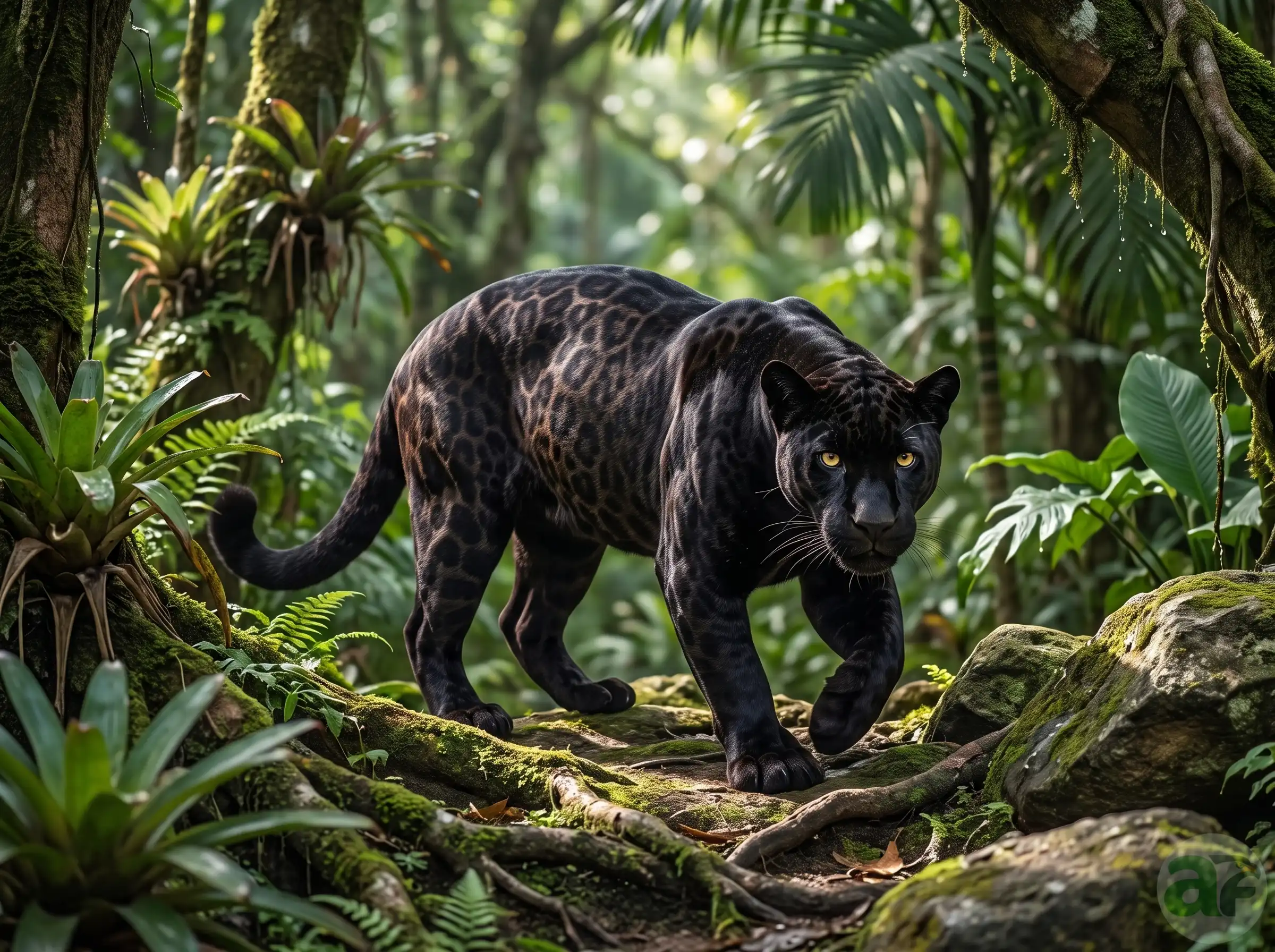
1. Taman Negara and Endau-Rompin National Parks, Peninsular Malaysia — With potentially the highest melanistic leopard frequency of any location on Earth, the forests of Peninsular Malaysia offer the best theoretical probability of wild black panther observation. However, even here, encounters are extraordinarily rare — the combination of dense forest, nocturnal habits, and the leopard’s natural elusiveness makes sightings exceptional events even for experienced researchers. Camera trap programs in these parks provide the most systematic documentation of black leopards available.
2. Nagarhole Tiger Reserve (Kabini Region), Karnataka, India — The site of extended documentation of the famous Kabini black leopard — this reserve in southwestern India offers guided wildlife safaris with a realistic (if still low) probability of black leopard encounters. The Kabini river areas have produced numerous high-quality black leopard sightings over recent years, making this the most accessible black leopard observation destination currently available.
3. Bale Mountains National Park, Ethiopia — One of the only confirmed breeding populations of black leopards in Africa — located in the high-altitude Afromontane forests of Ethiopia’s Bale Mountains. Remote, logistically challenging, and with very low population density, this location offers a genuinely wild Ethiopian wilderness experience with an extremely low but real probability of black leopard encounter.
4. Laikipia Wilderness, Kenya — The site of the famous 2019 Will Burrard-Lucas black leopard photographs — this private conservancy in central Kenya has documented black leopard presence and offers luxury wildlife safari experiences in a well-managed conservation landscape.
5. Pantanal, Brazil (Black Jaguar) — The world’s largest tropical wetland — straddling Brazil, Bolivia, and Paraguay — offers the world’s finest jaguar observation opportunities, and with approximately 6% of the jaguar population being melanistic, the Pantanal offers realistic possibilities of black jaguar encounters during dedicated jaguar-focused safari experiences from Porto Jofre.
6. Amazon Basin, Brazil and Peru (Black Jaguar) — The Amazon hosts the world’s largest jaguar population, and black jaguars occur throughout. Camera trap programs operated by conservation organizations including Panthera provide systematic black jaguar documentation, and river-based wildlife lodges in Madre de Dios (Peru) and the Brazilian Amazon offer wildlife observation opportunities.
7. Cockscomb Basin Wildlife Sanctuary, Belize (Black Jaguar) — The world’s first jaguar preserve; black jaguars are documented in this Belizean sanctuary, and the country’s small size and accessible road network make it one of the most tourism-friendly jaguar observation destinations in Central America.
20. How You Can Help
Supporting black panthers means supporting the conservation of their parent species — leopards and jaguars — both of which face significant and increasing threats across their ranges.
Support these organizations:
- Panthera — panthera.org — the world’s leading wild cat conservation organization; operates major leopard (Project Leopard) and jaguar (Jaguar Corridor Initiative) field programs globally
- Wildlife Conservation Society — wcs.org — field-based leopard and jaguar conservation across Africa, Asia, and the Americas
- WWF Leopard Program — worldwildlife.org — leopard conservation across African and Asian range countries
- Jaguar Conservation Fund — jaguar.org.br — dedicated jaguar conservation in Brazil
- Snow Leopard Trust / Leopard Program — broader big cat conservation including leopard
- African Wildlife Foundation — awf.org — African leopard conservation and human-wildlife conflict programs
What you can do:
- Support anti-poaching programs — both leopards and jaguars are subject to poaching for skins and body parts; anti-poaching patrol funding is directly impactful
- Choose sustainable products — sustainable palm oil certification (RSPO) and sustainable beef choices reduce habitat destruction in leopard and jaguar range
- Support community conflict resolution programs — organizations working with farming communities on livestock protection and compensation programs reduce retaliatory killing
- Adopt a leopard or jaguar through WWF or Panthera
- Advocate for legal trade restrictions — support stronger enforcement of CITES trade prohibitions on big cat parts
- Spread accurate information — helping people understand that black panthers are leopards and jaguars — animals with real conservation needs — rather than mysterious mythological creatures is itself a conservation action
21. Top Documentaries & Books
Must-Watch Documentaries
- “Black Leopard: Into the Night” (National Geographic) — The most comprehensive documentary ever produced specifically on black leopards; covers the 2019 Kenya discovery and broader black leopard biology
- “Big Cats” (BBC, 2018) — Three-part series with dedicated black leopard content from the Laikipia region of Kenya; exceptional cinematography
- “Wild India: Leopard” (BBC Natural World) — Covers Indian leopard ecology including melanistic individuals in the Karnataka forests
- “Jaguar: Born Free” (National Geographic) — Jaguar conservation documentary with coverage of black jaguar populations in the Pantanal
- “Planet Earth II — Jungles” (BBC, 2016) — Features leopard jungle ecology relevant to understanding black leopard habitat; exceptional cinematography
- “The Natural World: Black Panther” (BBC) — Dedicated black panther natural history documentary covering both leopard and jaguar populations
Must-Read Books
- “Wild Cats of the World” by Luke Hunter — The definitive popular reference for all wild cat species; excellent chapters on both leopard and jaguar with detailed melanism coverage
- “The Leopard” by Giuseppe Tomasi di Lampedusa — Technically a novel about Sicilian nobility; the title and themes resonate with the profound cultural symbolism of the black panther in literature
- “Jungle Lore” by Jim Corbett — The legendary hunter-conservationist’s accounts of melanistic leopards in Indian forests; among the finest wildlife writing ever produced
- “Jaguars and Electric Eels” by Alexander von Humboldt — The great naturalist’s account of South American wildlife including early documentation of black jaguars
- “The Jaguar’s Shadow” by Richard Mahler — The story of jaguar conservation and the remarkable recovery of the species in parts of North America; includes black jaguar coverage
22. Comparison with Normal-Colored Leopard and Jaguar
| Feature | Black Leopard | Spotted Leopard | Black Jaguar | Spotted Jaguar |
|---|---|---|---|---|
| Species | Panthera pardus | Panthera pardus | Panthera onca | Panthera onca |
| Coat | Black (melanistic) | Tawny + black rosettes | Black (melanistic) | Tawny + complex rosettes |
| Ghost spots visible? | Yes — in bright light | Full rosettes always visible | Yes — in bright light | Full rosettes always visible |
| Weight | Same as spotted | 29–90 kg | Same as spotted | 56–120 kg |
| Genetics | Recessive allele (needs 2 copies) | Standard | Dominant allele (needs 1 copy) | Standard |
| Frequency | Up to 50% (Malaysia); <1% (Africa) | Most common | ~6% globally | ~94% globally |
| Habitat preference | Dense forest (higher frequency) | All leopard habitats | Dense forest (slightly higher) | All jaguar habitats |
| Behavior | Identical to spotted | Standard leopard | Identical to spotted | Standard jaguar |
| Conservation status | Same as parent species | Vulnerable | Same as parent species | Near Threatened |
| Lifespan | Identical | 12–17 years | Identical | 12–15 years |
| Reproductive capability | Full | Full | Full | Full |
23. Frequently Asked Questions About Black Panthers
Q1: What is the scientific name of the black panther?
The black panther does not have its own scientific name — because it is not a separate species. In Africa and Asia, a black panther is a melanistic leopard — Panthera pardus (Linnaeus, 1758). In Central and South America, a black panther is a melanistic jaguar — Panthera onca (Linnaeus, 1758). The term “black panther” is a popular descriptive name rather than a biological classification. Some historical literature used the name Felis melas for the melanistic leopard, but this designation was never formally accepted in modern taxonomy. Both animals are full members of their respective species in every biological sense — differing from their spotted counterparts only in coat color.
Q2: Are black panthers and leopards the same animal?
In Africa and Asia — yes, completely. A black panther in Africa or Asia is a melanistic leopard — genetically, behaviorally, and ecologically identical to a spotted leopard in every way except coat color. The black coat results from a recessive mutation in the Agouti Signaling Protein gene — a cat must inherit two copies of this mutant allele to express the black phenotype. Black leopards and spotted leopards can mate and produce both black and spotted cubs in the same litter. In Central and South America, a black panther is a melanistic jaguar — similarly identical to a spotted jaguar in every biological sense except coat color.
Q3: Why are black panthers black?
Black panthers are black due to melanism — an inherited genetic condition causing overproduction of melanin, the dark pigment responsible for black and brown coloration in hair, skin, and other tissues. In leopards, melanism is caused by a recessive allele of the ASIP gene — requiring two copies (one from each parent) for expression. In jaguars, melanism is caused by a dominant allele of the MC1R gene — requiring only one copy for expression. The excess melanin produced by these mutations floods the hair shafts with dark pigment — obscuring the underlying spot pattern and producing a uniformly black coat. The underlying spots remain present and are visible as ghost spots in bright light.
Q4: Do black panthers exist in North America?
No confirmed melanistic big cats native to North America have ever been documented. Despite widespread popular belief in “black panthers” in North America — with thousands of reported sightings in the United States, Canada, and Mexico — none of these sightings has ever been confirmed by physical evidence. The most likely explanations for reported North American black panther sightings include: misidentification of black domestic cats (which appear much larger than they are in outdoor settings), misidentification of melanistic bobcats (very rare but documented), escaped exotic pets, and simple errors of observation in low-light conditions. No melanistic puma (cougar/mountain lion) has ever been confirmed — despite the puma’s enormous range and extensive human contact, not a single verified melanistic individual has been documented in the entire scientific record.
Q5: Are black panthers more aggressive than spotted leopards or jaguars?
No — there is no documented difference in aggression, temperament, behavior, or personality between melanistic and spotted individuals of either leopard or jaguars. The black coat affects only pigmentation — it has no documented effect on hormones, neurological function, or behavioral tendencies. Studies of black leopard populations in Malaysia and camera trap behavioral studies comparing black and spotted jaguars in the Pantanal have found no significant behavioral differences attributable to coat color. The cultural association of black panthers with greater danger or aggression is a mythological and pop-culture construction with no scientific basis.
Q6: How rare are black panthers?
The rarity of black panthers varies enormously depending on species and geographic location. Black leopards in Africa are extremely rare — sightings of wild African black leopards are so infrequent that the 2019 Laikipia documentation was described as the first quality evidence in approximately 100 years. Black leopards in Southeast Asia — particularly in the Malaysian Peninsula — may constitute 50% or more of local populations, making them approximately as common as spotted leopards in those areas. Black jaguars occur at approximately 6% frequency across the jaguar’s range — rare but present in every jaguar range country.
Q7: Can a black panther and a spotted leopard have cubs together?
Yes — melanistic and spotted leopards (or jaguars) interbreed freely in the wild with no reproductive isolation. The genetics determine what colors offspring will be:
For leopards (recessive melanism): If both parents carry a copy of the recessive melanism allele — one expressing it (black) and one being a silent carrier — approximately 50% of offspring will be melanistic and 50% will be spotted. If the spotted parent does not carry the recessive allele, no offspring will be melanistic regardless of the black parent.
For jaguars (dominant melanism): A black jaguar with one copy of the dominant allele mated with a spotted jaguar will produce approximately 50% black offspring. A black jaguar with two copies of the dominant allele will produce 100% black offspring.
Q8: Are black panthers endangered?
Black panthers are not assessed separately from their parent species — they are evaluated as part of the leopard (Vulnerable — Panthera pardus) and jaguar (Near Threatened — Panthera onca) populations. Both species face significant and increasing threats from habitat loss, human-wildlife conflict, and poaching. The melanistic individuals within both populations face the same threats as their spotted counterparts — with the additional consideration that the dense forest habitats preferentially occupied by melanistic individuals in Southeast Asia are among the most rapidly deforested in the world. Supporting leopard and jaguar conservation is identical to supporting black panther conservation.
24. Sources & References
Research Sources
- Wikipedia — Melanistic leopard, Jaguar, Panthera pardus, Panthera onca, Melanism
- IUCN Red List — iucnredlist.org (2016–2024 assessments for leopard and jaguar)
- Panthera — panthera.org (Project Leopard and Jaguar Corridor Initiative)
- National Geographic — nationalgeographic.com (black leopard 2019 documentation)
- Wildlife Conservation Society — wcs.org
- WWF Species Programme — worldwildlife.org
- BBC Wildlife / BBC Earth — bbcearth.com
- Britannica — britannica.com/animal/black-panther
- Live Science — livescience.com
- Hunter, Luke (2015). Wild Cats of the World. Bloomsbury Publishing
- Burrard-Lucas, Will and Pilfold, Nicholas — National Geographic, February 2019 (black leopard documentation)
- Eizirik, E. et al. (2003). “Molecular genetics and evolution of melanism in the cat family.” Current Biology
- Schneider, M.F. et al. (2012) — published research on jaguar melanism genetics
- Sunquist, Mel and Fiona (2002). Wild Cats of the World. University of Chicago Press